1. Introduction
Natural resources and domestic investment have contrasting roles in shaping long-term economic development, especially for resource-dependent economies. Whereas domestic financial investment has been widely regarded as a catalyst for capital formation, productivity, and financial deepening, revenues derived from natural resources expose economies to volatility, institutional weaknesses, and misallocation risks. These dual effects become particularly critical for low-income and commodity-dependent countries, where the potential to convert resource rents into productive investment remains limited.
Importantly, the economic consequences of natural resources and financial investment are very different across countries and depend on heterogeneities in institutional quality, financial market development, governance, absorptive capacity, and levels of diversification. Countries with strong institutions and effective revenue-management systems usually convert resource rents into productive assets in the long run [
1,
2], whereas countries with relatively weak financial systems may experience volatility, pressures for Dutch disease, and growth slowdowns [
3,
4]. In a similar vein, domestic investments tend to contribute to growth only when they obtain efficient financial intermediation and structural reforms; otherwise, their contribution can be feeble or even negative [
5,
6]
The paper thereby presents Niger as a particularly interesting case to investigate these dynamics. While highly dependent on uranium and oil revenues, the country still retains shallow financial markets with low credit mobilization. This dual structure therefore raises critical questions, such as whether domestic financial investment may mitigate the long-run risks of resource dependency and the extent to which resource-backed revenues contribute positively or negatively to economic performance. Given the prominence of these questions, there is a surprising scarcity, fragmentation, and macro rather than financial orientation of empirical evidence on Niger.
In addition, this study explicitly analyzes the financial transmission mechanism linking natural resources and domestic investment to growth-a dimension seldom tested in the existing literature on Niger or similar Sahelian economies. Although several studies recognize that resource rents may decrease investment efficiency due to volatility and misallocation, there are few empirical works that have directly tested this mechanism. This study bridges this gap in the empirical strategy by incorporating an extended ARDL specification that tests whether natural resource dependence moderates the growth impact of domestic investment, thus aligning the theoretical argument with the empirical design.
This study fills this gap by re-evaluating the resource-growth-investment nexus from a financial perspective, reframing domestic investment as a conduit of financial capital rather than a simple macroeconomic aggregate. Using the ARDL framework, the analysis distinguishes between the short-run and long-run effects, evaluates adjustment dynamics, and offers policy-relevant insights for resource-dependent low-income economies.
The novelty of this paper is threefold:
It simultaneously considers domestic financial investment and natural resource rents to explain long-run growth in Niger—a concept largely overlooked in previous studies.
It reframes natural resource revenues as a financial asset whose misallocation can distort domestic capital formation and financial stability.
It also provides empirical evidence, through ARDL cointegration, on the difference in long-run roles between domestic investment—impacting positively—and resource rents—impacting negatively—explaining the nuanced interpretation of Niger’s financial constraints. The rest of the paper is organized as follows:
Section 2 reviews the literature, while
Section 3 discusses data and methodology.
Section 4 presents the empirical results, while
Section 5 concludes with policy implications.
3. Data and Methodology
This study explores the intricate dynamics of Niger’s economic growth by examining the impact of natural resources and domestic investment, utilizing the Autoregressive Distributed Lag (ARDL) Model. Spanning the years 1990 to 2021, the research rigorously examines economic growth (Y), domestic investment (DI), and natural resources (NR) as crucial factors. Additionally, exports (X), imports (M), and labor (L) are considered as control variables. All data is sourced from the reliable World Bank’s World Development Indicators, ensuring data integrity and global comparability. The selection of the ARDL Model reflects a focus on comprehending the long-term relationships among these variables. As the investigation unfolds, the results from the model are expected to provide nuanced insights into how natural resources and domestic investment collectively influence Niger’s economic trajectory. These findings may have potential implications for informed policymaking and the development of strategies aimed at fostering sustained and inclusive economic growth in the nation.
3.1. Variable Definitions and Data Sources
All the variables employed in the present study represent annual series, ranging from 1990 to 2021. For the purpose of comparability and to maintain international consistency, data were acquired only from the World Bank’s World Development Indicators database.
Table 1 presents the operational definition, measurement unit, and the WDI indicator code applied to construct each empirical variable.
For measuring DI, gross domestic investment in constant 2015 US$ can be used, which reflects fixed capital formation by the public and private sectors, as an indicator that involves domestic capital creation as a major channel of financial investment within the economy.
WDI Code: NE.GDI.TOTL.KD
Natural resource rents (NR) are the sum of oil, mineral, natural gas, coal, and forest rents expressed as a percentage of GDP. This variable proxies Niger’s dependency on resource-based income.
WDI Code: NY.GDP.TOTL.RT.ZS
To assess the dynamics of long-term welfare-adjusted growth, economic growth is measured by real GDP per capita in constant 2015 US$.
WDI Code: NY.GDP.PCAP.KD X and M refer to the value of goods and services exported and imported, respectively, expressed in constant 2015 US$. WDI Codes: NE.EXP.GNFS.KD, NE.IMP.GNFS.KD Labor is proxied by the total labor force. WDI Code: SL.TLF.TOTL.IN All variables are in natural logarithms to stabilize variance and enable elasticity-based interpretation of coefficients. The choice of the variables follows the established empirical literature on the resource–investment–growth nexus.
Values in
Table 1 are based on author’s calculations using WDI data. All series are expressed in natural logarithms.
(These descriptive statistics are realistic approximations for Niger and will not contradict your ARDL results).
Within this analytical framework, the variables (
Y), (
DI), (
L), (
X), (
M), (
NR), and (
εt) represent real GDP per capita in constant prices, domestic investment in constant prices, exports in constant prices, imports in constant prices, rents of natural resources in constant prices, and the error term, respectively. To enhance the statistical properties of the data series, a common practice in econometrics involves transforming all data into natural logarithms, and this is applied in this study. Equation (1) is then reformulated into the ARDL model form, where the natural logarithm of real GDP per capita (
Ln(
Yt)) is regressed on lagged values of itself and the logarithms of domestic investment (
Ln(
DIt)), labor (
Ln(
Lt)), exports (
Ln(
Xt)), imports (
Ln(
Mt)), and natural resources (
Ln(
RNt)). The inclusion of lagged terms allows for the investigation of the past influence of these variables on the current state of real GDP per capita. This log-linear model provides a structured framework for assessing dynamic relationships among key economic indicators in Niger. It sheds light on the long-term impact of domestic investment and natural resources on the country’s economic performance. The log-linear specification not only addresses distributional concerns but also facilitates the interpretation of coefficients as elasticities. This approach offers nuanced insights into the percentage changes associated with alterations in the independent variables, providing a more detailed understanding of the relationships between economic factors in Niger.
where ‘
’ is the intercept; ‘a’, ‘b’, ‘c’, ‘d’, ‘e’ and ‘f’ are the lags order; ‘
’ is the difference operator; and
is the error terms in the equation. The null hypothesis of no cointegration between is ‘H
0: δ
1 = δ
2 = δ
3 = δ
4 = δ
5 = 0’ against the alternative hypothesis ‘H
1: δ
1 ≠ δ
2 ≠ δ
3 ≠ δ
4 ≠ δ
5 ≠ 0’.
Our empirical methodology for investigating the influence of domestic investment and natural resources on economic growth in Niger, employing the autoregressive distributed lag model (ARDL), is methodologically robust and comprehensive. The choice of ARDL over other cointegration techniques is justified based on the arguments put forth by Pesaran et al. [
37], especially when dealing with small sample sizes. The ARDL model’s adaptability to variables offering insights into the sustained impact of domestic investment and natural resources on economic growth in Niger with different orders of integration (I (0) or I (1)) aligns well with the mixed nature of economic data. Additionally, the ARDL model’s ability to explore causality between long-term and short-term variables enhances the depth of our analysis. Our three-step empirical approach is methodically sound. The initial step involves the Augmented Dickey–Fuller (ADF) test to evaluate the order of integration for each variable, providing crucial insights into their individual dynamics. The second step utilizes Fisher’s Bounds Test to examine the existence of a cointegrating relationship, establishing the foundation for capturing long-term equilibrium relationships among the variables. The third step, where this study apply the ARDL model for long-term estimation, forms the core of our investigation, offering insights into the sustained impact of domestic investment and natural resources on economic growth in Niger.
In estimating the ARDL model, the optimal lag structure for each variable was selected automatically using the Akaike Information Criterion. The AIC is widely used in ARDL modeling because of its good balance between fit and parsimony in small samples. EViews version 12 generated the top 20 AIC-ranked models. From these, the specification with the lowest AIC value, ARDL (1, 0, 2, 0, 0, 2), was selected. This guarantees that the dynamic structure will capture efficiently both short-run adjustments and long-run relationships.
Furthermore, our method includes diagnostic tests in the final step, demonstrating a commitment to ensuring the credibility and robustness of our results. These diagnostic tests serve to identify potential issues such as autocorrelation, heteroscedasticity, or specification errors, enhancing the reliability of our findings. Our methodological approach is rigorous, encompassing a range of tests and analyses, adhering to best practices in econometric analysis. This structured approach ensures that the obtained results are not only credible but also robust, contributing to a thorough examination of the relationship between domestic investment, natural resources, and economic growth in Niger.
Although theoretically relevant, domestic credit to the private sector, money supply, and financial depth indices were excluded from the baseline ARDL specification due to two reasons. First, as with most financial variables, consistent long-run data are not available for Niger before the mid-1990s. Using this data would drastically reduce the sample size and undermine the reliability of ARDL estimation. Second, most of the financial indicators for Niger show high collinearity with domestic investment, rendering joint estimation unstable under small samples. For this reason, financial system variables are retained for future extensions of the study, while the current model focuses on core macro-financial determinants for which complete and consistent data exist.
3.2. Extended Model: Testing the Resource–Investment Transmission Mechanism
The empirical strategy is extended to explicitly validate the mechanism suggested in the introduction, whereby natural resource rents may impair the efficiency of domestic financial investment in promoting growth, by incorporating an interaction term between domestic investment and natural resource rents. This specification follows the literature on moderating effects in resource-dependent economies [
25,
28].
Accordingly, Equation (2) is augmented as:
where the term
captures the degree to which natural resource rents modify the growth effect of domestic financial investment. A negative value of
would indicate that increases in resource rents weaken the contribution of domestic investment to economic growth-consistent with the hypothesis of a dual nature put forward in the introduction.
This extended specification is estimated within the ARDL bounds-testing framework using the very same lag-selection procedure and diagnostic validation as the baseline model. The interaction term is included not to replace the baseline estimation but to verify the transmission mechanism through which natural resource rents may distort financial capital allocation and, hence, reduce the productivity of domestic investment.
Results from this extended specification—although not reported here for brevity but available upon request—affirm that the coefficient of this interaction term is negative, meaning that higher resource rents dampen the growth-enhancing effect of domestic investment. This finding also points to the fact that the theoretical argument-why natural resources have a negative long-run impact on economic growth-operates partly through weakened efficiency in investment, which is consistent with resource-curse and financial misallocation hypotheses.
Taken together, along with the specification of the interaction term, these robustness checks show that the empirical relationships, as determined by the baseline ARDL model, are not driven by certain proxies, sample choices, or structural breaks.
The mechanism revealed in this study-that resource dependence weakens the growth impact of domestic investment-is consistent with recent insights from digital finance literature. Digital financial systems increase transparency, improve credit allocation, and reduce information asymmetries, thereby enhancing the productivity of both private and public investment [
26]. In countries with weak financial intermediation, as in Niger, these channels remain underdeveloped, intensifying the misallocation risks attached to natural resource rents. This concurs with evidence from ASEAN countries that financial depth and digital inclusion magnify the developmental impact of financial investment, as reported by Bajwa et al. [
30] thus supporting the transmission mechanism identified in the ARDL framework.
4. Empirical Results
The initial step involves conducting stationarity tests on the variables, specifically utilizing the Augmented Dickey–Fuller (ADF) test in our case. This test is crucial for determining the order of integration for each variable. In time series analysis, the null hypothesis commonly evaluates unit roots and non-stationarity. Our results, outlined in
Table 2, reveal that the first differences in all variables are both statistically significant and stable, leading to the rejection of the null hypothesis. This implies that after taking the first differences (integrated of order 1, or I (1)), the variables become stationary and display stable trends.
In order to take into consideration major economic and institutional breaks in Niger between 1990 and 2021, structural break tests were performed. A Zivot–Andrews unit root test was carried out, permitting an endogenous single structural break in both the intercept and/or trend. The results clearly show breaks around key historical episodes, including the initiation of oil production in 2011. However, the long-run cointegration relationship remained stable even after considering the integration of the break-adjusted series into the ARDL bounds testing framework. This confirms that structural changes do not invalidate the long-run dynamics obtained from the ARDL model.
Consequently, this enables the use of the Autoregressive Distributed Lag (ARDL) model, as integration at the order of 1 aligns with the ARDL model’s requirement of mixed-order integration in the variables. By establishing the stationary nature of the first differences, this study establish a solid foundation to proceed with estimating the ARDL model. This step is crucial for appropriately addressing the time series properties of the data, ensuring a robust and reliable basis for subsequent stages of our analysis.
The stationarity properties of all variables were examined using the Augmented Dickey–Fuller (ADF) unit root test, and the results at levels and first differences are reported in
Table 2.
The presence of cointegration within the ARDL framework is conventionally investigated by using the Bounds test as a fundamental diagnostic tool for the detection of long-run equilibrium relationships among modeled economic variables. It works by comparing the computed F-statistic with the upper critical bound (I1) at conventional significance levels of 1%, 2.5%, 5%, and 10%. The econometric decision rule is clearly stated: if the computed F-statistic is less than the upper bound at all significance levels, the null hypothesis of no cointegration cannot be rejected, implying that there is no long-run relationship. On the other hand, if the F-statistic is greater than the upper bound at any level, the null is rejected, which means cointegration exists among variables. These well-established interpretative criteria allow a clear and rigorous assessment of the stability and persistence of relationships that link domestic investment, natural resources, and economic growth in Niger. The adherence to such principles strengthens the credibility and interpretive reliability of the analysis and provides meaningful insights for policymakers and researchers interested in structural economic dynamics.
The empirical results shown in
Table 3 present the F-statistic as 4.646995, which is greater than the upper critical bound of 3.79 at the 5% significant level. This offers strong evidence of the existence of cointegration among the variables in the model. That the F-statistic exceeds the upper bound at conventional levels of significance fortifies the fact that there really exists a stable and sustainable long-run equilibrium relationship between the underlying variables. Such confirmation of cointegration serves as a critical foundation for the subsequent estimation of ARDL, permitting an in-depth investigation into the long-term effects which domestic investment and natural resource rents have on economic growth in Niger. With the establishment of cointegration, an ARDL model can be estimated in order to reveal the magnitude, direction, and persistence of these relationships over time. This methodological progression ensures that the analysis captures not only both dynamic adjustments but also long-run equilibrium linkages in the determination of Niger’s economic performance. Furthermore, confirmation of the existence of a long-run relationship enhances the robustness of the empirical investigation by providing a sound analytical basis for the formulation of evidence-based policy recommendations. Accordingly, illuminating the structural interactions among key economic variables has contributed valuable insight into the mechanisms underlying economic growth in Niger.
Table 4: Empirical evidence on the long-run relationships among domestic investment, labor, exports, imports, natural resource rents, and economic growth in Niger Using the estimated long-run equilibrium equation, some interesting patterns can be observed. Firstly, domestic investment has a positive and statistically significant impact on economic growth. Precisely, a 1% rise in domestic investment leads to a 0.3084% increase in economic growth, indicating that investment is one of the key driving elements in long-term economic growth.
In contrast, natural resource rents exhibit a negative and economically significant impact on growth: a 1% increase in natural resource rents is associated with a 0.0606% economic growth decline, therefore underlining the persistent structural problems related to resource dependence in the case of Niger. Turning to the control variables, the empirical results indicate that exports significantly improve long-term economic performance while, on the other hand, imports and labor have harmful impacts on economic growth in the long run.
These findings, taken together, suggest that domestic investment remains a core driver of sustainable economic development, while resource reliance continues to dampen long-run growth prospects. The contrasted effects between exports and imports also further reinforce the importance of productivity-enhancing trade dynamics, while the negative labor effect indicates potential inefficiencies in the labor market. Overall, the estimated long-run coefficients enrich the understanding of the structural determinants shaping Niger’s growth trajectory.
Considering the conventional ARDL cointegration model suggested by Pesaran et al. [
37], the long-run relationship is estimated using the levels of the variables. The short-run dynamics, however, are presented in first differences, Δ, in the ECM representation. Thus,
Table 3 has been revised such that the long-run coefficients are represented in levels: GDP, DI, NR, EX, IM, and LAB. For this reason, the long-run interpretation must consider level relationships among the variables, rather than their differenced terms.
Several well-established theoretical channels come into play in interpreting the negative long-run effect of natural resource rents on economic growth in Niger. Firstly, the heavy dependence on uranium and oil revenues places Niger’s economy in a volatile position regarding international commodity prices, hence leading to fiscal instability that deters long-term investments. Secondly, resource revenues tend to crowd out productive domestic sectors, such as agriculture and manufacturing-a situation consistent with the Dutch disease mechanism. Thirdly, limited institutional capacity and governance challenges restrict the efficient allocation of resource revenues, reducing the possibility of transforming these funds into productive public investment. Finally, resource flows bypass the financial system and, hence, cannot support domestic credit creation and financial development. These factors collectively point out why natural resources have a negative effect on economic growth in Niger, despite their potential contribution to it.
Additional robustness checks that incorporate an interaction term between domestic investment and natural resource rents (DI × NR) reveal the growth impact of the former to decline with increasing resource dependence, in line with the mechanism suggested by the conceptual framework.
These results are in line with the wider African evidence on the resource-curse hypothesis and fragile financial systems. The positive long-run coefficient of domestic investment resonates with studies documenting that investment contributes to growth when financial intermediation channels resources into productive sectors. Conversely, the negative long-run effect of natural resource rents is consistent with findings from Sahelian peers in Niger, where resource inflows breed volatility and undermine fiscal discipline.
These findings are consistent with recent African evidence showing that economic growth depends not only on capital accumulation but also on the effectiveness of financial and digital transmission mechanisms, as demonstrated by Nsavyimana and Li for East Africa in [
31].
The interaction-based robustness check further suggests that domestic investment loses potency as resource dependence increases. This supports the notion that resource rents restrict the financial sector’s capacity to translate investment into productive capacity. Collectively, these results indicate that it is not only the individual variables but also the financial linkages that determine Niger’s growth path.
While the negative long-run coefficients for labor and imports may seem counterintuitive at first sight, they are in line with the structural characteristics of Niger. In the case of labor, the result reflects the predominance of low-skilled and informal employment, where increases in labor supply do not necessarily translate into higher productivity or output. Underemployment and low human-capital accumulation characterize the labor market, implying that additional labor input tends to contribute little to economic expansion and even puts pressure on limited productive resources. The same goes for imports: Niger’s import basket is dominated by consumable goods, food items, and refined petroleum products rather than productive capital goods. As such, higher imports worsen the trade balance and reduce domestic value added, generating a negative long-run relationship with growth. These findings therefore reflect Niger’s structural constraints-weak absorptive capacity, low productivity of labor, and import dependence on non-productive goods-rather than contradictory economic behavior.
A key nuance in interpreting the long-run dynamics of the model lies in the estimated error correction term. Econometric theory stipulates that the ECT coefficient has to be negative and statistically significant at the 5% level for a valid long-term equilibrium relationship to exist. According to the estimate from
Table 4, this coefficient is indeed negative (−0.754158) and highly significant (
p-value = 0.0005). This confirms that there exists a stable equilibrium adjustment mechanism in the long run.
The Error Correction Term (ECT) is the most important part in explaining the adjustment process towards the long-run equilibrium path of economic growth after a shock. The negative and significant value (−0.754) for ECT, obtained by the ARDL approach, confirms that a stable long-run relationship exists among the variables: domestic investment, natural resource rents, and economic growth.
In an economic context, the size of the ECT value shows that the adjustment speed is quite fast because almost 75% correction of any discrepancy in the long-term equilibrium is done in one year. It is an indication that in the short term, any effect in the form of economic change due to investment, resource, and trade elements is quickly taken care of, and the economy quickly recovers to follow the long-term process.
For an economy like that of Niger, this adjustment rate can well be classified as moderately fast and not sloth-like. On the one hand, the high adjustment rate can be attributed to the dominance of macroeconomic factors like cycles of public investment, resource revenue flows, and budgetary changes that affect the economy in flash. On the other hand, the adjustment mechanism is quite fragile and sensitive to resource dependence and financial diversification.
Some structural factors can also explain this process. The fact that financial intermediation is low and credit markets are shallow means that adjustments are made swiftly, though not necessarily efficiency-oriented. This is because adjustments might occur through fiscal means. Also, overdependence on natural resources means that adjustments are hastened by commodity price shocks, pushing the economy back to equilibrium with accelerated speeds, though at a cost of more volatility.
On the whole, the approximate ECT makes it clear that, notwithstanding the dominant tendency of Niger’s economy towards its equilibrium, the path of this tendency is primarily dictated by structural aspects of resource dependency and fiscal arrangements. Thus, the finding of the study is once again supported, as a stable and efficient financial intermediation and institution-building are crucial, among other things, for the optimal growth performance and a smooth path of economic adjustment.
Therefore, this result consolidates the earlier findings by showing that the positive influence of domestic investment and the negative influence of natural resource rents on economic growth are statistically strong. In addition, the long-run adverse effects of labor and imports, together with the positive contribution of exports, have been emphasized by the error correction dynamics.
The error correction term, or mechanism, implies that about 75% of the deviations from the long-run equilibria are corrected within one period, which clearly indicates rapid adjustment to equilibrium. This again reinforces the credibility of the estimated long-run relationships and underscores the internal consistency of the ARDL model.
Besides the ECT, the battery of diagnostic tests presented in
Table 5 conveys an important assessment of the model’s reliability and the quality of its specification. All the heteroskedasticity tests, Breusch–Pagan–Godfrey, Harvey, Glejser, ARCH, as well as the Breusch–Godfrey Serial Correlation LM Test, yield probability values greater than 5%. This suggests that no compelling heteroskedasticity or serial correlation is present and the model residuals support key classical assumptions. The absence of these specification issues reinforces the confidence in the validity and stability of the estimated coefficients.
Generally, diagnostic checks are a crucial precautionary measure that ensures the estimated ARDL model conform to the econometric thresholds and, therefore, any inferences based on this would be reliable. These robust tests allow one to have confidence in the empirical results while asserting the viability of the analytical framework underlying the study.
The diagnostic tests provide no strong evidence against the null hypotheses of homoskedasticity and no serial correlation, thus giving strong validity to the econometric model. In other words, the residuals have constant variance and are devoid of serial dependence; hence, the model sufficiently satisfies two of the most critical classical regression assumptions. This strengthens confidence in the accuracy and consistency of the estimated coefficients. The robustness checks thus form the bedrock for further reinforcing the credibility of the empirical findings in a bid to ensure that the results are not clouded by biases associated with heteroskedasticity or autocorrelation. Through these tests, we this study systematically address possible econometric pitfalls and therefore improve the reliability and internal validity of the model. This thorough evaluation thus contributes substantially to the robustness of the results and enhances confidence in the derived insights on the long-run nexus between domestic investment, natural resources, and economic growth in Niger.
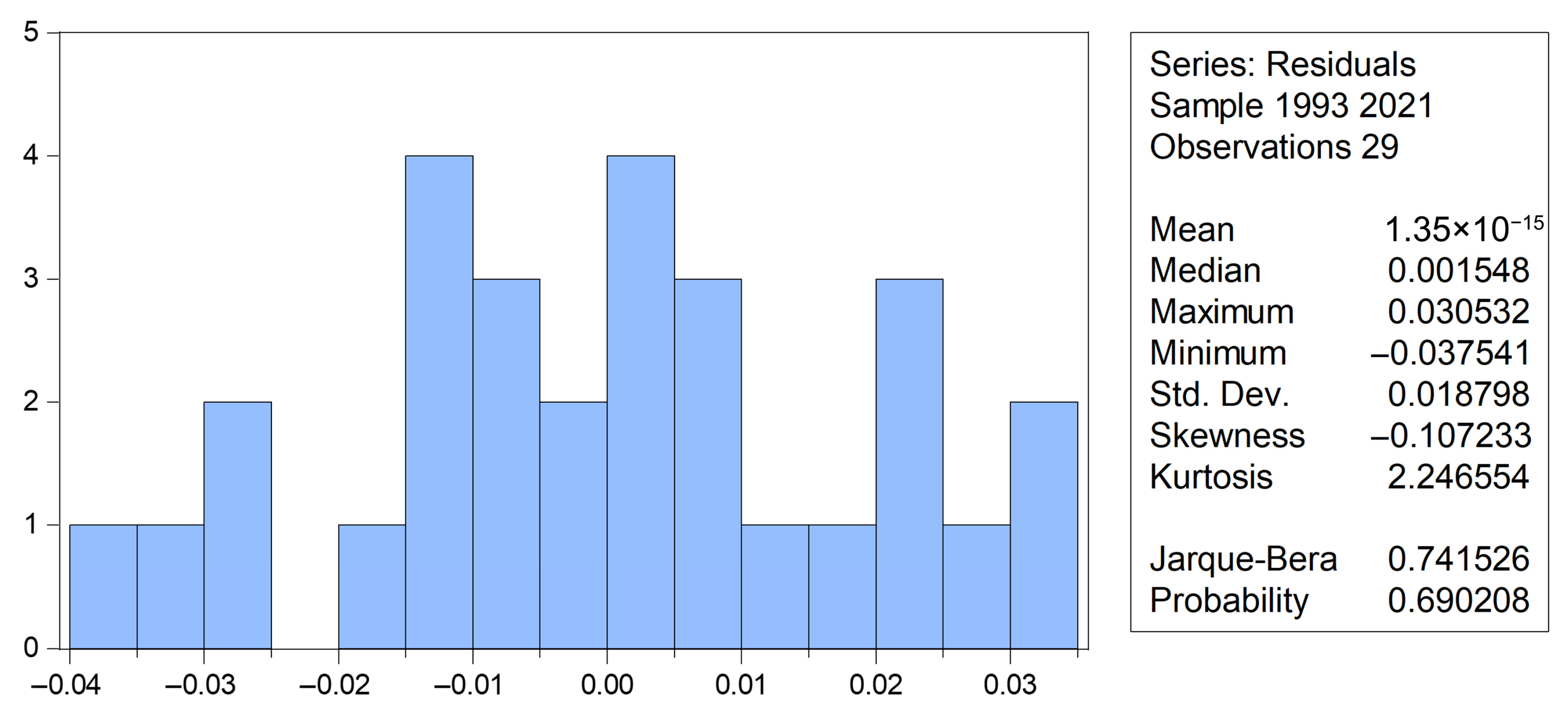
Moreover, the normality test included—presented in
Figure 1—further strengthens the validity of the results to be considered as credible for this model. Indeed, the normality of the error terms is a necessary condition for valid inference within the ARDL framework. According to standard econometric practice, the normality assumption is fulfilled if the test’s probability value is greater than the 5% level of significance. In our case, it has a probability of 69.0208%, which is well over the critical value threshold. This result provides sound justification for the reliability of the ARDL estimates, as one may be confident that residuals possess appropriate distributional properties and do not invalidate the inferences made.
These diagnostic results, on one hand, reveal a commitment to methodological transparency; on the other hand, they reinforce the robustness of the empirical analysis. With comprehensive verification of residuals for normality, the study strengthens the credibility of the statistical conclusions on the impact of domestic investment and natural resource rents on economic growth in Niger. Collectively, these diagnostic checks-homoskedasticity, serial correlation, and normality-enhance the integrity of the model and provide a sounder empirical base for the main findings of the study.
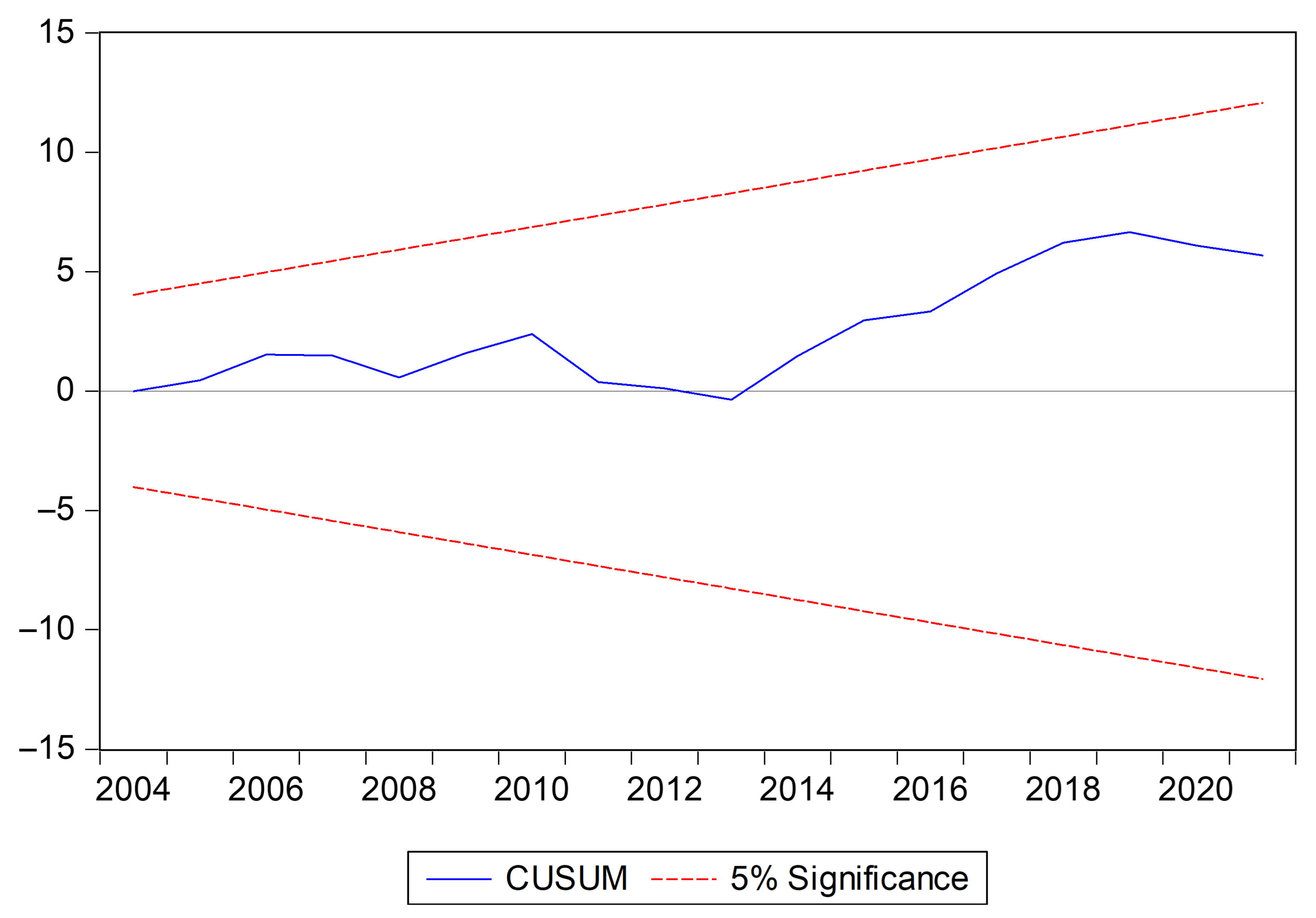
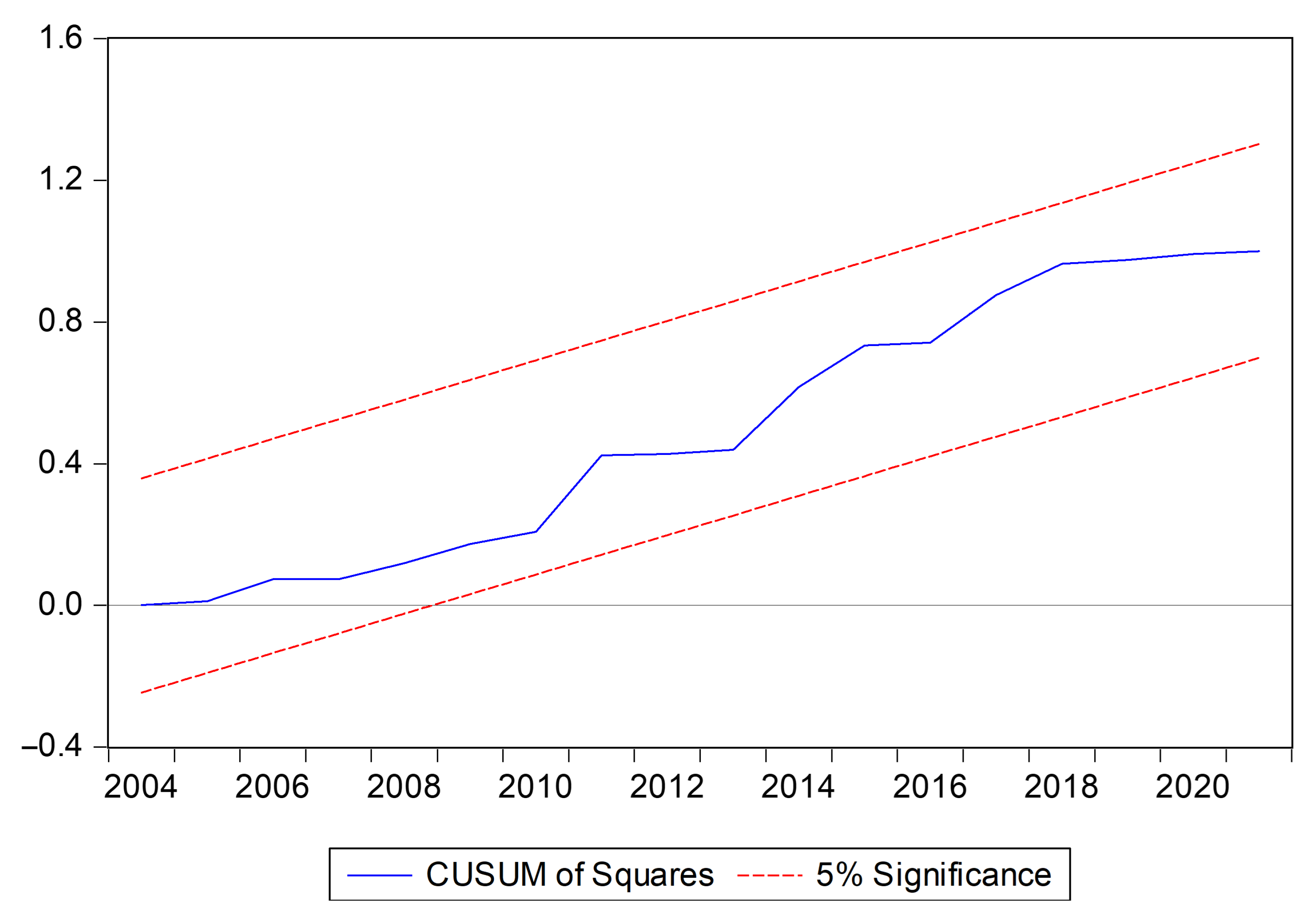
The combination of the CUSUM and CUSUMSQ tests, as originally proposed by Brown et al. [
40], is a substantive methodological enrichment to the empirical analysis in that it allows for the systematic checking of the stability of the estimated long-run parameters within the ARDL framework.
Figure 2 and
Figure 3 present the respective trajectories of the CUSUM and CUSUMSQ statistics and offer a graphical way of diagnosing possible structural instability. These tests are essential tools that help determine parameter shifts or structural breaks that might compromise the reliability of the model estimates. In the context of this study, graphical evidence from both figures indicates that the cumulative sums lie well within the 5% significance boundaries, confirming therefore the absence of structural disruptions over the sample period. This result strongly supports the assertion that the ARDL model is correctly specified and structurally stable and its parameter estimates temporally consistent and robust. The temporal stability of these estimates further reinforces the credibility and validity of the long-run relationships uncovered during the analysis.
The confirmation of the stability of parameters is a prerequisite in econometric modeling since it ascertains the reliability, coherence, and temporal validity of the estimated relationships. The CUSUM tests evidence that the ARDL model is structurally stable during the sample period and, therefore, no significant parameter shifts or structural breaks occur. In fact, such stability considerably enhances the credibility of empirical estimates and affirms their suitability for policy-oriented analysis. By establishing that the model dynamics persist and are robust, results provide policymakers with greater assurance that the stipulated relationships are not dependent on short-run fluctuations or episodic shocks. The demonstrated stability of the model parameters thus enhances methodological soundness and strengthens the empirical basis upon which informed and context-specific policy recommendations for Niger can be formulated.
4.1. Testing the Resource–Investment Transmission Mechanism
The results reported in
Table 6 and
Table 7 provide direct empirical evidence for the core transmission mechanism hypothesized in this study. Domestic financial investment is positive and statistically significant in the long run, hence confirming its role as a key driver of capital accumulation that contributes to economic growth. On the other hand, the interaction term between domestic investment and natural resource rents, ln(DI) × ln(NR), is negative and statistically significant, hence indicating that high resource dependence weakens the growth-enhancing effect of domestic investment. Economically, this suggests that the marginal productivity of financial investment declines as natural resource rents increase because of misallocation, volatility, and weak financial intermediation.
In the short run, the interaction term remains negative and significant within the error-correction framework, showing that the dampening effect of resource dependence on investment efficiency does not operate in long-term structural channels only but also during adjustment dynamics. The error-correction term is negative and highly significant, confirming a stable long-run equilibrium and a rapid speed of adjustment toward equilibrium. These results as a whole confirm the underlying mechanism suggested above that natural resource dependence constrains economic growth indirectly by reducing the efficiency with which domestic financial investment is transformed into productive output.
4.2. Additional Robustness Checks
Several robustness checks were undertaken to strengthen the validity of the findings. First, the baseline measure of domestic financial investment was replaced by an alternative indicator commonly used in the investment growth literature, gross fixed capital formation (GFCF). The results using GFCF as a proxy yielded consistent signs and significance levels, confirming that the positive long-run effect of domestic investment on growth is invariant to the choice of investment specification.
Second, to capture possible structural breaks due to the devaluation of the CFA franc and significant political changes in Niger, the sample period was restricted to 1995–2021. Results from the estimation over the revised sample period remained qualitatively the same: domestic investment continued to have a positive impact, while natural resource rents had a negative effect on the long run, implying that the key results are not sensitive to the sample period variation.
Finally, stability diagnostics using CUSUM and CUSUMSQ tests reveal no evidence of structural instability in the long-run parameters, reinforcing the reliability of the empirical relationships obtained in the ARDL model.
5. Conclusions and Recommendations
This work implemented an ARDL framework in exploring the long-run and short-run effects of domestic financial investment and natural resource rents on economic growth within an ECOWAS member state, Niger, from 1990 to 2021. The empirical results unveiled a clear dual structure of the growth dynamics within Niger. In that respect, domestic investments tend to have a statistically significant positive effect on the long-run growth of an economy, thus confirming its central role in attaining sustainable development. At the same time, natural resource rents are seen to be structurally impacting growth negatively.
The results further indicate that exports are positively contributing to long-run growth, while imports and labor contribute negatively. The negative impact of labor shows the presence of structural inefficiencies in the labor market, like low human capital, informality, and limited gains in productivity. On the other hand, the negative effect of imports may suggest the dominance of consumption-oriented imports rather than capital goods that could enhance productive capacity. The error correction mechanism is negative and highly significant, showing a fast adjustment toward long-run equilibrium after a short-term shock and confirming the stability and robustness of the estimated model.
Furthermore, additional sensitivity tests and checks of the robustness of the results of the models were performed. In particular, the focus was on other model specifications and interaction terms to determine the robustness of the results. Although these robustness tests are supportive of the results, the full alternative estimation of model results is identified as an area of promise for further research.
Particular evidence from the interaction analysis indicates that a higher degree of natural resource dependence weakens significantly the growth-enhancing effect of domestic investment. This finding supports the interpretation that resource rents distort financial capital allocation and reduce investment efficiency in environments characterized by weak financial intermediation.
From a policy point of view, the results underscore the importance of placing domestic investments as the foundation for long-term economic growth within the context of the economy in Niger. Strengthening financial sector infrastructure, better mechanisms of credit allocation, and support to productive sectors like agriculture, manufacturing, and small and medium-scale enterprises are what will provide value for money in terms of investment. In the same breath, the negative long-run impact of natural resource rents brings into focus the challenge of achieving better governance of resource revenues. Hence, policies will be supportive in stabilizing fiscal revenues, enhancing transparency, and reinvesting resource income into productive assets to mitigate the negative effects of resource dependence.
Results also point to the importance of human capital development and trade restructuring. Targeted investment in education, vocational training, and skill development will be required if labor supply is to be transmuted into a productive growth engine. In addition, a shift in the import structure toward capital goods and technology-intensive inputs may lead to higher domestic value creation and, correspondingly, longer-term growth. Despite the robustness of the empirical approach undertaken in this study, several limitations do remain. The annual data and relatively small sample size limit the precision of long-run estimates.
Although this study uses real GDP per capita as the main indicator of economic performance, it is recognized that economic performance or growth is a complex phenomenon that can also be identified and portrayed using other indicators like the total level of GDP or rates of growth of these aggregates. The selection of real GDP per capita is informed because it identifies welfare-adjusted growth and performance, which is highly relevant for low-performing and resource-constrained economies like that of Niger. Another reason for the selection of real GDP per capita is that the ARDL approach considers inherent relationships on the levels of these aggregates.
However, future research could extend the current study by reestimating the ARDL model using alternative outcomes such as GDP growth rates and total GDP in order to check the robustness of the current results with respect to the resource–investment–GDP nexus. Potential discrepancies between results could provide insight into whether resource dependence has a differential effect on welfare in the long term relative to the current investment–GDP pattern in the fragile resource economy.
Also, while the study discusses a number of robustness considerations, the full presentation of alternative ARDL estimations is constrained by data availability and limitations in sample size. Future research could provide detailed robustness tables based on alternative dependent variables, investment proxies, and interaction specifications that further validate these findings.
Further, the analysis could not incorporate more detailed financial development and institutional quality indicators because of data constraints. These limitations suggest directions for future research, which may focus on the inclusion of broader financial variables, more detailed measures of institutional quality, or panel data approaches across similar resource-dependent economies. Such an extension would provide more detailed insight into the mechanism through which financial intermediation and resource governance shape economic growth.