


Inside Out: Organizations as Service Systems Equipped with Relational Boundaries


Abstract
1. Introduction
2. Theoretical Background
2.1. Boundaries of Organizations
Identification Criteria of Organizational Boundaries
2.2. Systemic Conception of Organizational Boundaries
Viable System Approach as a Lens for Interpreting Boundaries
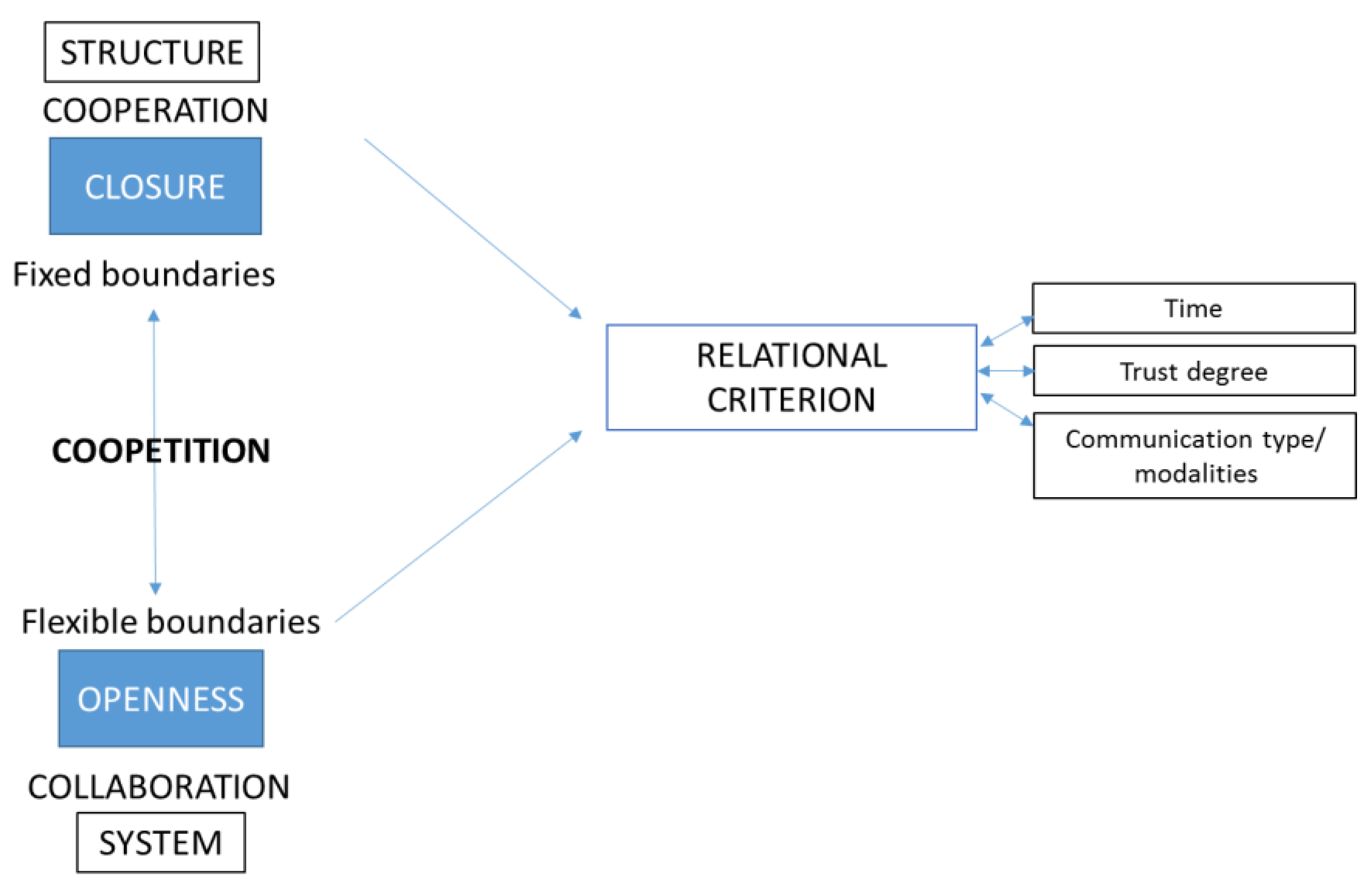
3. Redesigning Boundaries in a Systemic-Relational Service Perspective
3.1. Systemic Conception of Organizational Boundaries
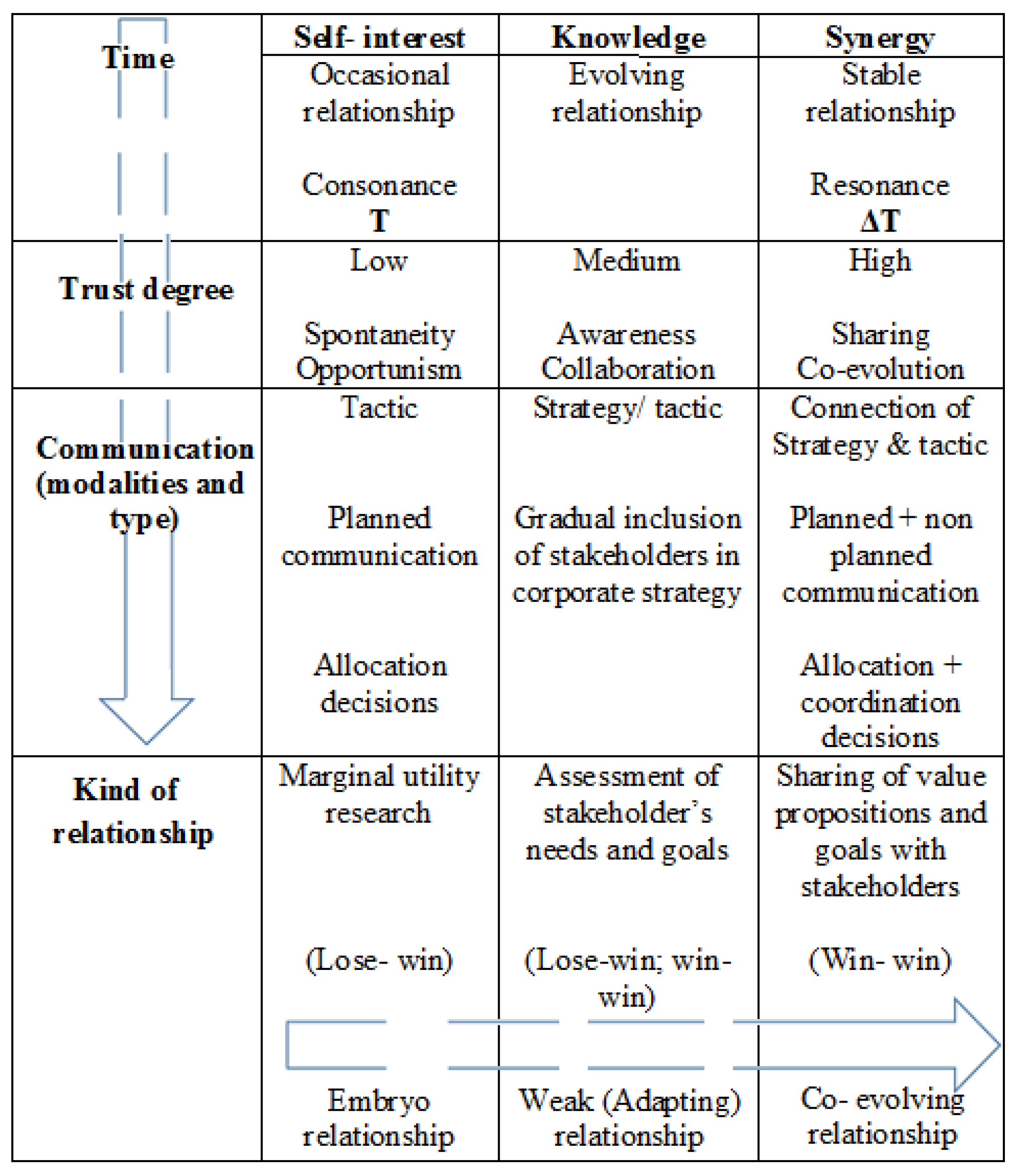
3.2. The Relational Criterion: From Self-Interest to Synergic Relationships
4. Implications and Conclusions
Author Contributions
Conflicts of Interest
References
- Shipilov, A.; Godart, F.; Clement, J. What boundaries? How mobility networks across countries and status groups affect the creative performance of organizations. Strateg. Manag. J. 2016, 38, 1232–1252. [Google Scholar] [CrossRef] [Scilit]
- Huang, X.; Yang, J. Production of boundaries by social service organizations: Based on the study of family integrated service centers in Guangzhou. J. Chin. Sociol. 2016, 3, 11. [Google Scholar] [CrossRef] [Scilit]
- Wilden, A. System and Structure: Essays in Communication and Exchange Second Edition; Routledge: London, UK, 2013. [Google Scholar]
- Paulsen, N.; Hernes, T. Managing Boundaries in Organizations; Palgrave Macmillan: Basingstoke, UK, 2003. [Google Scholar]
- Lamont, M.; Molnár, V. The study of boundaries in the social sciences. Annu. Rev. Sociol. 2002, 28, 167–195. [Google Scholar] [CrossRef] [Scilit]
- Hyatt, D.G.; Johnson, J.L. Expanding boundaries: Nongovernmental organizations as supply chain members. Elementa 2016, 4, 93. [Google Scholar] [CrossRef] [Scilit]
- Scott, W.R.; Davis, G.F. Organizations and Organizing: Rational, Natural and Open Systems Perspectives; Routledge: London, UK, 2015. [Google Scholar]
- Coase, R.H. The nature of the firm. Econ. New Ser. 1937, 4, 386–405. [Google Scholar] [CrossRef]
- Holmqvist, M. Learning in imaginary organizations: Creating interorganizational knowledge. J. Organ. Chang. Manag. 1999, 12, 419–438. [Google Scholar] [CrossRef] [Scilit]
- Schotter, A.; Abdelzaher, D. The boundary spanning effects of the Muslim diaspora on the internationalization processes of firms from organization of Islamic conference countries. J. Int. Manag. 2013, 19, 82–98. [Google Scholar] [CrossRef] [Scilit]
- Fenza, G.; Loia, V.; Orciuoli, F. Providing Smart Objects with Intelligent Tutoring Capabilities by Semantic Technologies. In Proceedings of the Intelligent Networking and Collaborative Systems (INCoS) Conference, Ostrava, CZ, USA, 7–9 September 2016; pp. 103–109. [Google Scholar]
- Loia, V.; Maione, G.; Tommasetti, A.; Torre, C.; Troisi, O.; Botti, A. Toward smart value co-education. In Smart Education and E-Learning 2016; Springer: Berlin, Germany, 2016; pp. 61–71. [Google Scholar]
- Ciasullo, M.V.; Polese, F.; Troisi, O.; Carrubbo, L. How Service Innovation Contributes to Co-Create Value in Service Networks. In Proceedings of the International Conference on Exploring Services Science, Bucharest, Romania, 19 May 2016; pp. 170–183. [Google Scholar]
- Troisi, O.; Tuccillo, C. A re-conceptualization of port supply chain management according to the service dominant logic perspective: A case study approach. Esper. D’impresa 2014, 2, 33–50. [Google Scholar] [CrossRef] [Scilit]
- Ciasullo, M.; Troisi, O. Sustainable value creation in SMEs: A case study. TQM J. 2013, 25, 44–61. [Google Scholar] [CrossRef] [Scilit]
- Barile, S.; Polese, F. Smart service systems and viable service systems: Applying systems theory to service science. Serv. Sci. 2010, 2, 21–40. [Google Scholar] [CrossRef] [Scilit]
- Troisi, O.; Carrubbo, L.; Maione, G.; Torre, C. What’s ahead in service research: New perspectives for business and Society. In Proceedings of the XXVI RESER Conference, Naples, Italy, 8–10 September 2016. [Google Scholar]
- Hirschhorn, L.; Gilmore, T. The new boundaries of the “boundaryless” company. Harv. Bus. Rev. 1992, 70, 104–115. [Google Scholar] [PubMed]
- Teece, D. Profiting from technological innovation: Implications for integration, collaboration and public policy. Res. Policy 1986, 15, 285–305. [Google Scholar] [CrossRef] [Scilit]
- Galeotti, M.; Garzella, S. Governo Strategico Dell’azienda; Giappichelli: Torino, Italy, 2013. [Google Scholar]
- Ashkenas, R. The Boundaryless Organization: Breaking the Chains of Organizational Structure. In The Jossey-Bass Management Series; Jossey-Bass Inc. Publishers: San Francisco, CA, USA, 1995. [Google Scholar]
- Abbott, A. Things of Boundaries. Soc. Res. 1995, 857–882. [Google Scholar]
- Gadde, L.E. Moving corporate boundaries: Consequences for innovative redesign. J. Supply Chain Manag. 2013, 49, 12–26. [Google Scholar] [CrossRef] [Scilit]
- Heracleous, L. Boundaries in the study of organization. Hum. Relat. 2004, 57, 95–103. [Google Scholar] [CrossRef] [Scilit]
- Butera, F. Il Campo di Fragole: Reti di Imprese e Reti di Persone Nelle Imprese Sociali Italiane; Angeli: Milano, Italy, 1999. [Google Scholar]
- Lorenzoni, G.; Lomi, A. Impresa Guida e Organizzazione a Rete. Accordi Fra Imprese, Reti e Vantaggio Competitivo; Etas: Milano, Italy, 1992. [Google Scholar]
- Von Bertalanffy, L.V. General System Theory: Foundations, Development, Applications; George Braziller: New York, NY, USA, 1968. [Google Scholar]
- Grandori, A. Impigliati nella rete. Svilupp. Organ. 1998, 170, 97–106. [Google Scholar]
- Castells, M. The Network Society; Blackwell: Oxford, UK, 1996. [Google Scholar]
- Penrose, E.T. The Theory of the Growth of the Firm; Sharpe: New York, NY, USA, 1959. [Google Scholar]
- Browne, J.; Zhang, J. Extended and Virtual Enterprises—Similarities and Differences’. Int. J. Agile Manag. Syst. 1999, 1, 30–36. [Google Scholar] [CrossRef] [Scilit]
- Cantwell, J.A. Blurred boundaries between firms, and new boundaries within (large multinational) firms: The impact of decentralized networks for innovation. Seoul J. Econ. 2013, 26, 1–32. [Google Scholar]
- Schilling, M.A.; Steensma, H.K. Disentangling the theories of firm boundaries: A path model and empirical test. Organ. Sci. 2002, 13, 387–401. [Google Scholar] [CrossRef] [Scilit]
- Billinger, S.; Jacobides, M.G. Changing the firm’s digital backbone: How information technology shapes the boundaries of the firm. In Proceedings of the BLED 2006, Bled, Slovenia, 5–7 June 2006; pp. 1–20. [Google Scholar]
- Haak, R. Theory and Management of Collective Strategies in International Business: The Impact of Globalization on Japanese German Business Cooperations in Asia; Springer: Berlin, Germany, 2003. [Google Scholar]
- Ashkenas, R. Management: How to loosen organizational boundaries. J. Bus. Strateg. 2000, 21, 11–12. [Google Scholar] [CrossRef] [Scilit]
- Vang-Lauridsen, J. Boundaries of the firm and intellectual production-wrestling with Transaction Costs Economics. In Proceedings of the DRUID Academy Conference, Frederiksberg, Denmark, 6–8 January 2000. [Google Scholar]
- Abelow, D.H. Continuous dynamic boundaries. U.S. Patent Application No. 14/808,100, 24 July 2015. [Google Scholar]
- Dubois, A. Organizing Industrial Activities across Firm Boundaries; Routledge: London, UK, 2006. [Google Scholar]
- Jacobides, M.G.; Winter, S.G. Entrepreneurship and firm boundaries: The theory of a firm. J. Manag. Stud. 2007, 44, 1213–1241. [Google Scholar] [CrossRef] [Scilit]
- Santos, F.M.; Eisenhardt, K.M. Organizational boundaries and theories of organization. Organ. Sci. 2005, 16, 491–508. [Google Scholar] [CrossRef] [Scilit]
- Leiblein, M.J.; Miller, D.J. An empirical examination of transaction-and firm-level influences on the vertical boundaries of the firm. Strateg. Manag. J. 2003, 24, 839–859. [Google Scholar] [CrossRef] [Scilit]
- Chanin, M.N.; Shapiro, H.J. Dialectical inquiry in strategic planning: Extending the boundaries. Acad. Manag. Rev. 1985, 10, 663–675. [Google Scholar] [CrossRef] [Scilit]
- Stacey, R.D. Managing the Unknowable: Strategic Boundaries between order and Chaos in Organizations; John Wiley & Sons: New York, NY, USA, 1992. [Google Scholar]
- Sherman, H.J.; Schultz, R. Open boundaries: Creating Business Innovation through Complexity; Da Capo Press: Cambridge, MA, USA, 1998. [Google Scholar]
- Williamson, O.E. Transaction-cost economics: The governance of contractual relations. J. Law Econ. 1979, 22, 233–261. [Google Scholar] [CrossRef] [Scilit]
- Nelson, R.; Winter, S. An Evolutionary Theory of Economic Change; Harvard University Press: Cambridge, MA, USA, 1982. [Google Scholar]
- Hamel, G. Leading the Revolution; Harvard Business School Press: Boston, MA, USA, 2000. [Google Scholar]
- Foss, N.J. Knowledge-based approaches to the theory of the firm: Some critical comments. Organ. Sci. 1996, 7, 470–476. [Google Scholar] [CrossRef] [Scilit]
- Araujo, L.; Dubois, A.; Gadde, L.-E. The Multiple Boundaries of Firms. J. Manag. Stud. 2003, 40, 1255–1277. [Google Scholar] [CrossRef] [Scilit]
- Grossman, S.J.; Hart, O.D. The costs and benefits of ownership: A theory of vertical and lateral integration. J. Political Econ. 1986, 94, 691–719. [Google Scholar] [CrossRef] [Scilit]
- Scott, W.R. Le Organizzazioni; Il Mulino: Bologna, Italy, 1985. [Google Scholar]
- Rocchi, F. Conoscenza E Impresa: Un modello Interpretativo; Cedam: Padova, Italy, 1994. [Google Scholar]
- Helper, S.; MacDuffie, J.P.; Sabel, C. Pragmatic collaborations: Advancing knowledge while controlling opportunism. Ind. Corp. Chang. 2000, 9, 443–488. [Google Scholar] [CrossRef] [Scilit]
- Ferrero, G. Impresa E Management; Giuffrè: Milano, Italy, 1987. [Google Scholar]
- Richardson, G.B. The organisation of industry. Econ. J. 1972, 82, 883–896. [Google Scholar] [CrossRef] [Scilit]
- Normann, R.; Ramirez, R. Designing Interactive Strategy: From Value Chain to Value Constellation; Wiley: London, UK, 1994. [Google Scholar]
- Granstrand, O.; Patel, P.; Pavitt, K. Multi-technology corporations: Why they have “distributed” rather than “distinctive core” competencies. Calif. Manag. Rev. 1997, 39, 8–25. [Google Scholar] [CrossRef] [Scilit]
- Patel, P.; Pavitt, K. How technological competencies help define the core (not the boundaries) of the firm. In The Nature and Dynamics of Organizational Capabilities; Dosi, G., Nelson, R., Winter, S., Eds.; Oxford University Press: New York, NY, USA, 2000; pp. 313–333. [Google Scholar]
- Loasby, B.J. The organisation of capabilities. J. Econ. Behav. Organ. 1998, 35, 139–160. [Google Scholar] [CrossRef] [Scilit]
- Rullani, E. Economia delle reti: I linguaggi come mezzi di produzione. Econ. Politica Ind. 1989, 64, 125–164. [Google Scholar]
- Coda, V. L’orientamento Strategico Dell’impresa; Utet: Torino, Italy, 1988. [Google Scholar]
- Garzella, S. I Confini Dell’azienda. Un Approccio Strategico; Giuffrè: Milano, Italy, 2000. [Google Scholar]
- Capra, F. The Web of Life; Flamingo: London, UK, 1997. [Google Scholar]
- Laszlo, E. The Systems View of the World a Holistic Vision for Our Time; Hampton Press: New York, NY, USA, 1996. [Google Scholar]
- Mele, C.; Pels, J.; Polese, F. A brief review of systems theories and their managerial applications. Serv. Sci. 2010, 2, 126–135. [Google Scholar] [CrossRef] [Scilit]
- Maglio, P.P.; Spohrer, J. Fundamentals of service science. J. Acad. Market. Sci. 2008, 36, 18–20. [Google Scholar] [CrossRef] [Scilit]
- Katz, D.; Kahn, R. The Social Psychology of Organizations; John Wiley & Sons: New York, NY, USA, 1966. [Google Scholar]
- Golinelli, G.M. Viable Systems Approach (VSA). In Governing Business Dynamics; Cedam: Padova, Italy, 2010. [Google Scholar]
- Barile, S. Management Sistemico Vitale; Giappichelli: Torino, Italy, 2009. [Google Scholar]
- Golinelli, G.M. L’approccio Sistemico Al Governo Dell’impresa. L’impresa Sistema Vitale, 1st ed.; Cedam: Padova, Italy, 2000. [Google Scholar]
- Barile, S. Contributi Sul Pensiero Sistemico In Economia D’impresa; Arnia: Salerno, Italy, 2000. [Google Scholar]
- Barile, S.; Pels, J.; Polese, F.; Saviano, M. An introduction to the viable systems approach and its contribution to marketing. J. Bus. Mark. Manag. 2012, 5, 54–78. [Google Scholar]
- Barile, S.; Polese, F. Linking the viable system and many-to-many network approaches to service-dominant logic and service science. Int. J. Qual. Serv. Sci. 2010, 2, 23–42. [Google Scholar]
- Barile, S.; Saviano, M. Foundations of systems thinking: The structure-system paradigm. In Contributions to Theoretical and Practical Advances in Management. A Viable Systems Approach (VSA); ASVSA, Associazione per la Ricerca Sui Sistemi Vitali; International Printing: Avellino, Italy, 2011; pp. 1–24. [Google Scholar]
- Barlett, C.A.; Ghoshal, S. Matrix management: Not a structure, a frame of mind. Harv. Bus. Rev. 1989, 68, 138–145. [Google Scholar]
- Ng, I.C.L.; Parry, G.; Maull, R.; McFarlane, D. Complex engineering service systems: A grand challenge. In Complex Engineering Service Systems; Ng, I.C.L., Parry, G., Wild, P., McFarlane, D., Tasker, P., Eds.; Springer: New York, NY, USA, 2010. [Google Scholar]
- Sunder, S. Regulatory competition among accounting standards within and across international boundaries. J. Account. Public Policy 2002, 21, 219–234. [Google Scholar] [CrossRef] [Scilit]
- Jordan, J.V. Boundaries: A relational perspective. Psychother. Forum 1995, 1, 1–4. [Google Scholar]
- Wieland, H.; Polese, F.; Vargo, S.; Lusch, R. Toward a service (eco) systems perspective on value creation. Int. J. Serv. Sci. Manag. Eng. Tech. 2012, 3, 12–24. [Google Scholar] [CrossRef] [Scilit]
- Vargo, S.L.; Lusch, R.F. Reducing the fear of crime in a community: A logic of systems & system of logics perspective. In Proceedings of the Grand Challenge in Service Week: Understanding Complex Service Systems Through Different Lens, Cambridge, UK, 20–23 September 2011. [Google Scholar]
- Maglio, P.; Vargo, S.L.; Caswell, N.; Spohrer, J. The service system is the basic abstraction of service science. Inf. Syst. E-Bus. Manag. 2009, 7, 395–406. [Google Scholar] [CrossRef] [Scilit]
- Pellicano, M.; Ciasullo, M.V. La Visione Strategica Dell’impresa.; Giappichelli: Torino, Italy, 2010. [Google Scholar]
- Spigel, B. The relational organization of entrepreneurial ecosystems. Entrep. Theory Pract. 2015, 41. [Google Scholar] [CrossRef] [Scilit]
- Barile, S.; Saviano, M.; Polese, F.; Di Nauta, P. Il rapporto impresa-territorio tra efficienza locale, efficacia di contesto e sostenibilità ambientale. Sinergie Rivista di Studi E Ricerche. 2013, 90, 25–49. [Google Scholar]
- Håkansson, H. International Marketing and Purchasing of Industrial Goods; Wiley: London, UK, 1982. [Google Scholar]
- Dyer, J.H.; Singh, H. The relational view: Cooperative strategy and sources of interorganizational competitive advantage. Acad. Manag. Rev. 1998, 23, 660–679. [Google Scholar]
- Nahapiet, J.; Ghoshal, S. Social capital, intellectual capital, and the organizational advantage. Acad. Manag. Rev. 1998, 23, 242–266. [Google Scholar]
- Pellicano, M.; Ciasullo, M.V.; Monetta, G.; Galvin, M. An In-Depth Study of Public Administrations: The Shift from Citizen Relationship Management to Stakeholder Relationship Governance. In Proceedings of the Toulon-Verona Conference “Excellence in Services”, Palermo, PA, Italy, 31 August–1 September 2015. [Google Scholar]
- Fenza, G.; De Maio, C.; Loia, V.; Tommasetti, A.; Troisi, O.; Vesci, M. Contextual fuzzy- based decision support system through opinion analysis: A case study at University of Salerno. Int. J. Inf. Technol. Decis. Mak. 2016, 15, 923–948. [Google Scholar]
- Velotti, L.; Botti, A.; Vesci, M. Public-Private Partnerships and Network Governance: What Are the Challenges? Public Perform. Manag. Rev. 2012, 36, 340–365. [Google Scholar] [CrossRef] [Scilit]
- Hartley, B.; Pickton, D. Integrated marketing communications requires a new way of thinking. J. Mark. Commun. 1999, 5, 97–106. [Google Scholar] [CrossRef] [Scilit]
- De Santo, M.; Pietrosanto, A.; Napoletano, P.; Carrubbo, L. Knowledge based service systems. In System Theory and Service Science: Integrating Three Perspectives in a New Service Agenda; Gummesson, E., Mele, C., Polese, F., Eds.; IGI Global: Naples, Italy, 9–12 June 2011. [Google Scholar]
- Flint, D.J.; Lusch, R.F.; Vargo, S.L. The supply chain management of shopper marketing as viewed through a service ecosystem lens. Int. J. Phys. Distrib. Logist. Manag. 2014, 44, 23–38. [Google Scholar] [CrossRef] [Scilit]
- Breidbach, C.; Brodie, R.; Hollebeek, L. Beyond virtuality: from engagement platforms to engagement ecosystems. Manag. Serv. Qual. 2014, 24, 592–611. [Google Scholar] [CrossRef] [Scilit]
- Brander, L.M.; Wagtendonk, A.J.; Hussain, S.S.; McVittie, A.; Verburg, P.H.; de Groot, R.S.; van der Ploeg, S. Ecosystem service values for mangroves in Southeast Asia: A meta-analysis and value transfer application. Ecosyst. Serv. 2012, 1, 62–69. [Google Scholar] [CrossRef] [Scilit]
- Bengtsson, M.; Hinttu, S.; Kock, S. Relationships of cooperation and competition between competitors. In Proceedings of the 19th Annual IMP Conference, Lugano, Switzerland, 4–6 September 2003; pp. 1–11. [Google Scholar]
- Agranoff, R.; McGuire, M. Collaborative Public Management: New Strategies for Local Governments; Georgetown University Press: Georgetown, WA, USA, 2004. [Google Scholar]
- Hallahan, K.; Holtzhausen, D.; van Ruler, B.; Verčič, D.; Sriramesh, K. Defining strategic communication. Int. J. Strateg. Commun. 2007, 1, 3–35. [Google Scholar] [CrossRef] [Scilit]
- Sriramesh, K.; Verčič, D. The mass media and public relations. In Global Public Relations Handbook, Revised and Expanded Edition: Theory, Research, and Practice; Routledge: London, UK, 2009. [Google Scholar]
- Golinelli, G.M.; Gatti, M. L’impresa sistema vitale. II governo dei rapporti intersistemici. Emerg. Issues Manag. 2001, 2, 53–81. [Google Scholar]
- Ballantyne, D.; Varey, R.J. Creating value-in-use through marketing interaction: The exchange logic of relating, communicating and knowing. Mark. Theory 2006, 6, 335–348. [Google Scholar] [CrossRef] [Scilit]
- Vargo, S.L.; Lusch, R.F. Evolving to a new dominant logic for marketing. J. Mark. 2004, 68, 1–17. [Google Scholar] [CrossRef] [Scilit]

| Concept | Assumption |
|---|---|
| Society | Society can be understood as a network of more or less extensive and structured relations |
| Social structure is taken as a persistent pattern of relationships among all social positions | |
| Social structure is configured through networks, that is, sets of nodes and links that indicate their interconnections | |
| Social structure can be conceptualized in terms of durable patterns of relationship among multiple social actors | |
| Actors | Each actor interacts with others influencing their behaviour |
| Actors move among the social spaces generated by the intersection of different relational fields, in which every person plays a different social role and assumes a different position | |
| Actors and their actions are autonomous and interdependent (but not independent) units | |
| Network | Network models are structural environments that provide opportunities or constraints to individual actions |
| The pattern of social ties in which actors are inserted produces consequences determinant for them | |
| Relational links among actors allow for the transfer or the flow of material and immaterial resources |
| Criterion | Description | Limits |
|---|---|---|
| Transaction costs | Organizational boundaries depend on the level of transactions and the responsiveness of performed transactions | Static orientation due to the idea according to which transactions depend on lots of complex dynamics, often difficult to predict |
| Contractual-legal | Organizational boundaries are influenced by the type and entity of formal agreements reached with other parties | No consideration of the circumstances in which an organization engages relationships based on informal characteristics |
| Ownership | A resource is understood as internal only whether it is owned by organization or is linked to it by a legal relationship comparable to the property right | Interpretive distortions in evaluating human resources |
| Space-time barriers | A resource is internal whether it is within the spatial (e.g., in stock) or time (e.g., at a certain hour) scope of organization | Not adequate with intangible resources (services) |
| Interest sharing | Resources having interests in common or pursuing shared objectives are considerable as internal | Organization is a syncretic system in which there are many different interests and goals |
| Job sharing | Organizational boundaries depend on the type of the undertaken activities and on how these ones fit together | The progressive trend towards the dematerialization of activities complicates to establish whether they are essential or marginal for organization’s existence and development |
| Specific competences | The specific competences (direct knowledge) of an organization allow defining its size | Although the organization’s know-how spins mainly around distinctive skills, it includes not only them, but also indirect competences |
| Communication | Only the resources capable of communicating with each other should be understood as internal | Distinct entities could be able to communicate with each other through the use of the same language without necessarily belonging to the same system |
| Governance action and autonomy | Boundaries are understood as a transition zone between inside and outside, which circumscribes resources and activities on which organization is able to exercise its discretionary power and extend its influence and control | Excessive discretion in the identification of boundaries |
© 2017 by the authors. Licensee MDPI, Basel, Switzerland. This article is an open access article distributed under the terms and conditions of the Creative Commons Attribution (CC BY) license (http://creativecommons.org/licenses/by/4.0/).
Share and Cite
Crespo Garrido, M.J.; Grimaldi, M.; Maione, G.; Vesci, M. Inside Out: Organizations as Service Systems Equipped with Relational Boundaries. Systems 2017, 5, 36. https://doi.org/10.3390/systems5020036
Crespo Garrido MJ, Grimaldi M, Maione G, Vesci M. Inside Out: Organizations as Service Systems Equipped with Relational Boundaries. Systems. 2017; 5(2):36. https://doi.org/10.3390/systems5020036
Chicago/Turabian StyleCrespo Garrido, María Jimena, Mara Grimaldi, Gennaro Maione, and Massimiliano Vesci. 2017. "Inside Out: Organizations as Service Systems Equipped with Relational Boundaries" Systems 5, no. 2: 36. https://doi.org/10.3390/systems5020036
APA StyleCrespo Garrido, M. J., Grimaldi, M., Maione, G., & Vesci, M. (2017). Inside Out: Organizations as Service Systems Equipped with Relational Boundaries. Systems, 5(2), 36. https://doi.org/10.3390/systems5020036

