Article

TriageRAG: Confidence-Based Triage for Idea-Stage §103-Propensity Screening

College of Economics and Business, Hankuk University of Foreign Studies, 81, Oedae-ro, Mohyeon-eup, Cheoin-gu, Yongin-si 17035, Gyeonggi-do, Republic of Korea
*
Author to whom correspondence should be addressed.
Systems 2026, 14(9), 1160; https://doi.org/10.3390/systems14091160
Submission received: 26 March 2026 / Revised: 4 July 2026 / Accepted: 15 July 2026 / Published: 16 September 2026

Highlights

Please indicate how your work links to systems science via your contributions to systems practice, theory, and/or methodology.
  • Methodology: Integrates a commodity classifier, routing by classifier confidence, and LLM verification grounded in retrieved evidence into a single triage system in which the classifier decides the cases it handles well and escalation acts only where the classifier is weak.
  • Practice: Uncertainty becomes a routing signal, a tunable threshold trades accuracy against escalation cost, escalated cases carry an auditable evidence trail, and results show where reliability varies by technology domain, giving practitioners a controllable decision support workflow for screening §103 propensity at the idea stage.
What are the main findings and/or the implications of the main findings?
  • Classifier confidence supports triage: it beats classic text and metadata baselines at every coverage level, most of all at the low coverage that triage exploits, and LLM escalation, which verifies the classifier against retrieved evidence, lifts accuracy on the uncertain cases that are hard for every method.
  • Both findings hold once leakage is excluded by a corpus from one period, a temporal holdout, and disjoint outcome classes. Under those conditions, title and abstract still carry a modest but real signal of §103 propensity beyond technology field metadata, and confidence routing beats random routing at matched coverage.

Abstract

Screening for §103 propensity at the idea stage is inherently difficult: obviousness is a context-sensitive legal determination over prior art combinations that surface-level text cannot fully capture. Yet because §103 concerns the inventive step of the underlying idea rather than only the wording of the claims, an application as filed may already carry a weak signal of §103 propensity—motivating a screening tool at the idea stage. We present TriageRAG (T-RAG), a confidence-based decision-support framework. A fine-tuned ModernBERT-large classifier produces a prediction together with a confidence score; high-confidence cases are delivered directly, while only low-confidence cases are escalated to a large language model (LLM), which is supplied with the classifier’s own prediction as the primary signal together with retrieved similar prior applications, and is instructed to verify the classifier rather than replace it. We evaluate under deliberately leakage-free conditions—a same-era corpus, a temporal hold-out, and a contamination-free label set in which the §103 label follows the USPTO Office Action Research Dataset and the two classes are disjoint by construction. Under these strict conditions the system remains useful: the classifier confidence rank-orders correctness well enough to support high-precision automatic decisions at low coverage, and classifier-primary escalation improves accuracy precisely on the uncertain cases where the classifier is weakest, without degrading it overall. We position the contribution as a triage architecture—turning a deliberately commodity classifier into an auditable decision-support tool—rather than as a new classifier. Ablation studies isolate the roles of confidence routing, retrieval design, and the escalation prompt, and characterize the accuracy–cost trade-off across the escalation threshold.

1. Introduction

Patent examination is the legal process by which a government patent office determines whether an invention satisfies the requirements for patent protection. Among the various grounds for rejection, obviousness under 35 U.S.C. §103 is particularly difficult to adjudicate [1,2]: it requires comparing the claimed invention against combinations of prior art references and determining whether their differences would have been apparent to a hypothetical person having ordinary skill in the art (PHOSITA). This comparison is inherently subjective, context-sensitive, and highly contested, making §103 the most common basis for both initial rejection and subsequent appeals.
Automated patentability-risk screening has compelling practical applications: inventors can assess patentability risk before incurring filing costs, patent attorneys can refine prosecution strategy and claim scope, and patent offices can allocate examiner resources more efficiently. T-RAG is specifically designed for the idea-stage patentability assessment scenario, where an inventor has articulated a technical concept but has not yet drafted formal patent claims. At this stage, title and abstract are the natural representation of the invention, and the goal is to provide a reliable signal about §103 obviousness risk before investing in claim drafting and formal prosecution. Using abstract-level input is therefore a deliberate design choice aligned with this service context, not a proxy for full legal analysis: the system targets inventors and early-stage practitioners who need actionable guidance at the ideation phase, where claim text does not yet exist.
There is also a conceptual reason to expect a usable signal at this stage. Although a §103 rejection is, in prosecution practice, often resolved through claim amendment—which can make obviousness appear to be a claim-level, post hoc matter—obviousness is at root a question of the inventive step: whether the underlying idea is non-obvious over the prior art, rather than of how its claims happen to be worded. From this view, the application as disclosed at filing may already carry information about a §103 propensity, prior to any amendment. We make this point cautiously: it motivates idea-stage screening rather than asserting that §103 can be decided from an abstract, and our results report a signal that is modest but measurably above field-frequency baselines (Section 6), i.e., a screening signal, not a substitute for the full claim-level determination. Yet a prediction alone is often insufficient because practitioners need to understand how confident the system is and on what basis a conclusion was reached before they can act on it responsibly. Early approaches relied on handcrafted features, such as citation counts, claim breadth, and prosecution history [3]. Recent neural approaches have applied BERT-based models to the binary grant/reject classification task [4,5], improving aggregate accuracy but leaving fundamental practitioner needs unmet.
A first gap concerns the absence of actionable uncertainty signals. When a classifier is uncertain, as it often is near the GRANTED/REJECTED decision boundary, its output should not be treated the same as a high-confidence prediction. Existing systems provide no principled criterion for when to trust automated outputs and when to escalate to human review, leaving practitioners without a reliable basis for this judgment. A second gap is the lack of evidence-grounded explanations. The §103 obviousness determination requires reasoning over prior art combinations, secondary considerations, and examiner-specific arguments [1]. A prediction that lacks traceable supporting evidence cannot be audited, contested, or used to guide prosecution strategy, limiting its practical value regardless of raw accuracy. A third gap is domain heterogeneity without adaptive guidance. Examination patterns and classifier reliability differ substantially across technology domains such as biotechnology, software, and mechanical engineering. A system that treats all domains identically provides no indication of where its outputs should be weighted most heavily and where additional scrutiny is warranted.
To address these gaps, we propose TriageRAG (T-RAG), a decision-support framework that makes classifier uncertainty an integral part of the prediction workflow. The design is inspired by medical triage: just as a triage nurse establishes evidence-based criteria for when a patient can be managed by standard protocol versus when specialist review is necessary, T-RAG establishes calibrated criteria for when a classifier prediction is sufficiently reliable to act upon and when it should be escalated to LLM verification backed by retrievable, auditable prior art evidence.
Importantly, T-RAG does not aim to simply maximize aggregate accuracy. Because the system targets idea-stage practitioners who must decide whether to invest in formal prosecution, making reliability legible is as important as prediction quality. The confidence threshold provides a transparent escalation criterion; the RAG-grounded LLM provides auditable, citation-backed reasoning for escalated cases; and domain-level analysis reveals where the system’s guidance is most and least trustworthy, allowing practitioners to calibrate their reliance on system outputs to their own risk tolerance and technology domain.
We position this work explicitly as a systems integration contribution: the contribution is not the classifier, but the T-RAG architecture that lifts overall performance. The base classifier is deliberately a commodity component—a standard fine-tuned encoder, reported without embellishment—and the value lies in what is built around it: confidence-based routing that keeps the classifier in charge of the cases it handles well, and classifier-primary, retrieval-augmented escalation that improves accuracy precisely on the cases it handles poorly. So the contribution is the integration that turns a modest classifier into a better-performing triage system, stated plainly rather than dressed up as a new classifier; interpretive claims about LLM behavior are hedged accordingly throughout.
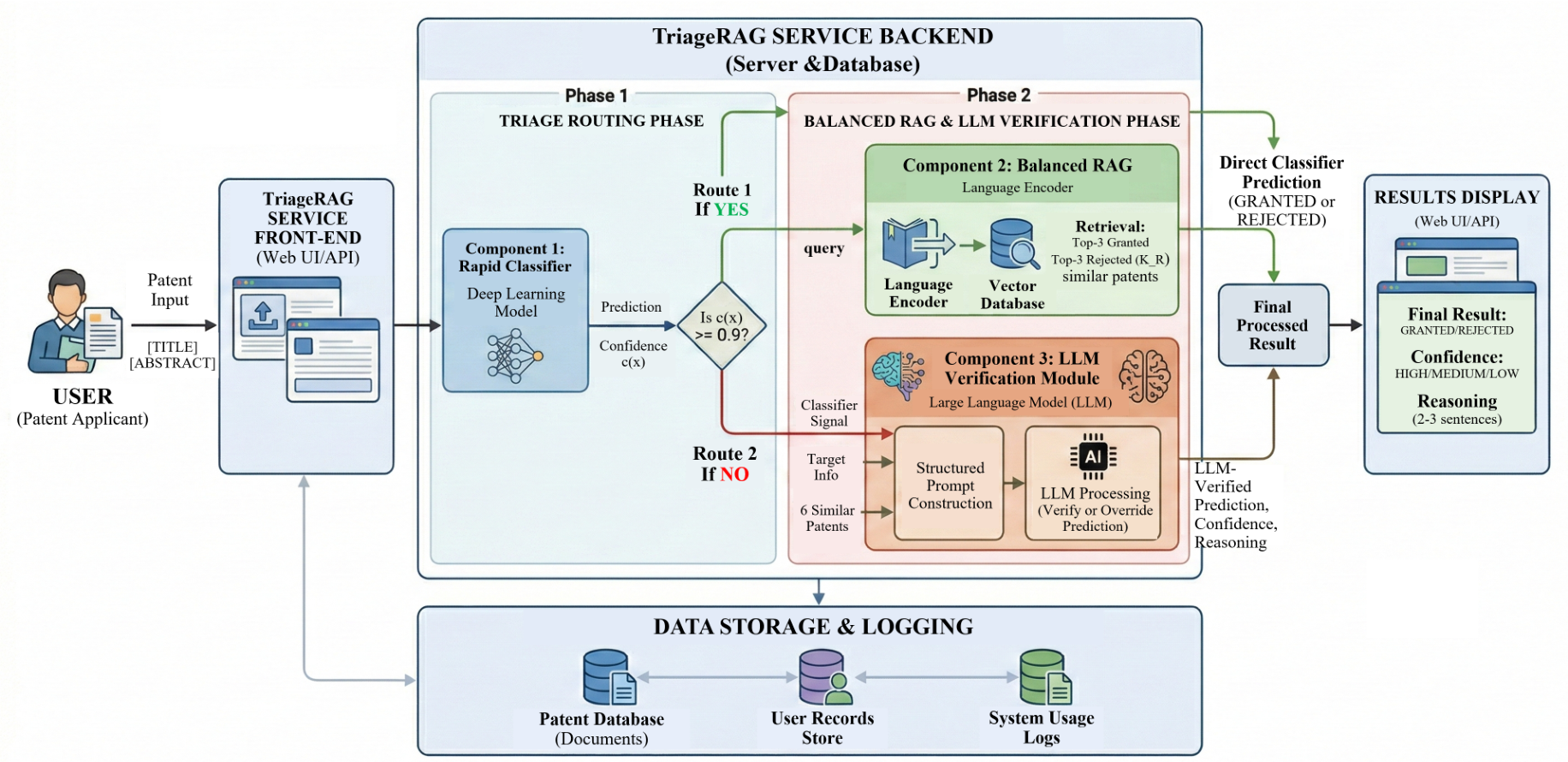
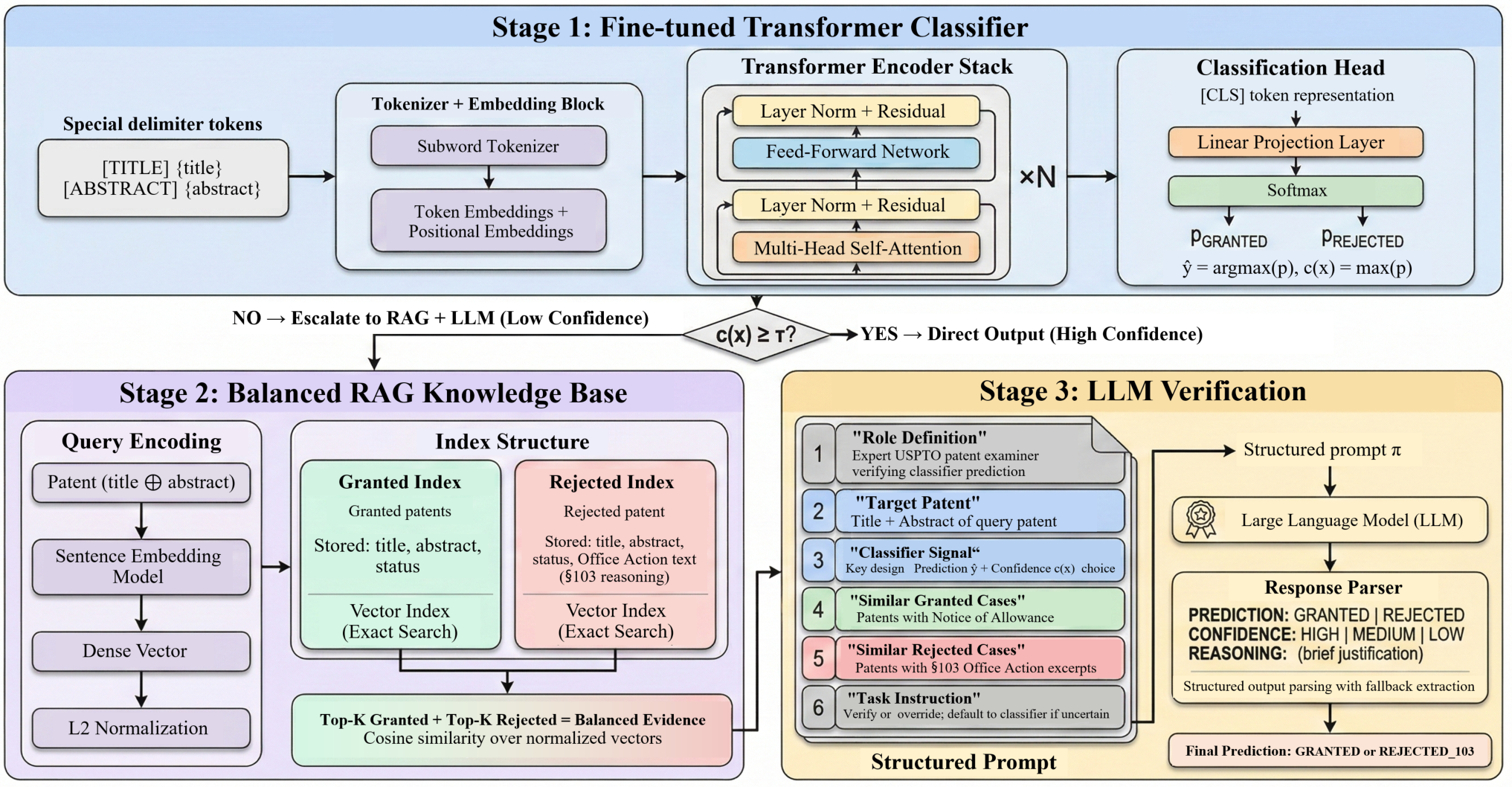
Figure 1 illustrates the high-level T-RAG pipeline, and Figure 2 details the system architecture.
This work makes the following contributions.
  • We fine-tune a ModernBERT-large [6] classifier for idea-stage §103-propensity screening and report its calibration in full on the leakage-free Dataset B: the raw model is over-confident (ECE = 0.068, with an 8.9 pp gap in the 0.8–0.9 band), temperature scaling reduces this to ECE = 0.0086 (random split)/0.0048 (temporal hold-out), and—most relevant for routing—its confidence rank-orders correctness (selective AUROC 0.65/0.63) better than classic baselines.
  • We introduce a classifier-primary escalation design: low-confidence cases are sent to an LLM that is given the classifier’s own prediction and confidence as the primary signal together with retrieved similar prior applications, and is instructed to verify the classifier rather than replace it. We show this distinction is decisive—a naive replace design degrades accuracy, whereas classifier-primary support improves it precisely on the uncertain cases where the classifier is weakest.
  • We provide a confidence-based routing criterion with a single tunable threshold τ and report the full accuracy–cost (escalation budget) trade-off rather than a single operating point.
  • We evaluate under deliberately leakage-free conditions—a same-era corpus, a temporal hold-out, and a contamination-free, disjoint label set whose §103 labels follow the USPTO Office Action Research Dataset—with ablations isolating the roles of confidence routing, retrieval design (showing balanced retrieval is not necessary), and the escalation prompt.

2. Related Work

2.1. Patent Classification and Outcome Prediction

Patent document retrieval has traditionally relied on the Cooperative Patent Classification (CPC) system, a five-level hierarchical taxonomy (section, class, subclass, group, subgroup) assigned during examination [7]. Early automated methods treated patent classification as a text categorization problem, using handcrafted features such as citation networks, claim counts, and prosecution histories [3]. Deep learning methods subsequently dominated this task: DeepPatent [7] combined word2vec embeddings with CNN-based sentence-level feature extraction, while domain-specific embeddings have improved feature representation [8]; hierarchical models such as HFEM [9] and MEXN [10] addressed long-document structure through progressive feature aggregation; and PatentBERT [4] applied BERT fine-tuning to the binary grant/reject prediction task. Full-text similarity search has also been applied to prior art retrieval [11], and patent similarity measurement combining text mining with image recognition [12] has broadened the scope of computational patent analysis. Recent studies on patent grant prediction with interpretable machine learning [13] and comprehensive surveys on AI-based patent methods [14] further document the growing maturity of this field.
Despite this progress, a critical gap remains: prior models treat the classifier as a black box and do not leverage prediction confidence for selective review. When confidence is low, as it often is near the GRANTED/REJECTED decision boundary, classifier predictions are unreliable and should not be directly trusted. Our work addresses this gap by combining confidence-aware routing with LLM verification backed by structured evidential retrieval.

2.2. Retrieval-Augmented Generation

Retrieval-augmented generation (RAG) [15] augments LLM generation with dynamically retrieved documents, mitigating hallucination while grounding responses in verified source material. Recent surveys [16] categorize RAG architectures into naïve, advanced, and modular paradigms, with adaptive retrieval emerging as a key design choice. Dense passage retrieval [17] has enabled end-to-end trainable retrievers that substantially outperform sparse BM25 [18] methods on open-domain question answering. Self-RAG [19] introduces self-reflective retrieval, allowing models to adaptively decide when to retrieve and to critique their own outputs. In legal domains, RAG has been applied to case law retrieval [20] and contract clause identification [21], demonstrating that domain-specific document structure benefits from specialized retrieval strategies. PAI-NET [22] proposes prior-art-aware contrastive learning for patent similarity ranking, showing that incorporating citation relationships into the embedding space improves retrieval quality beyond textual similarity.
A key design choice in RAG for classification tasks is whether retrieved evidence covers both outcome classes. To our knowledge, T-RAG is the first to apply two-sided RAG evidence—retrieval from both granted and §103-rejected cases—to binary §103-propensity screening. Restricting retrieval to rejection-only documents, as in our earlier v1 pipeline, induces systematic REJECTED bias; Section 8.3 provides a detailed analysis.

2.3. Confidence Calibration and Selective Prediction

Selective prediction [23] formalizes the risk–coverage trade-off: a model may abstain on low-confidence inputs to achieve higher accuracy on the remaining predictions. Modern neural networks are often over-confident because their softmax probabilities do not reliably reflect empirical accuracy [24], requiring post hoc calibration, such as temperature scaling [25], to restore reliability. Complementary work on detecting misclassified and out-of-distribution examples [26] has shown that softmax confidence provides a useful signal for identifying uncertain predictions. In human–AI collaboration systems, uncertain predictions can be deferred to human experts [27] or more capable models [28], with the coverage–accuracy frontier determined by threshold tuning.
In the LLM domain, cost-aware routing has emerged as a parallel line of research. FrugalGPT [29] cascades queries through progressively larger LLMs, and Hybrid LLM [30] routes queries between small and large models based on predicted query difficulty. T-RAG differs from these approaches in two respects: the first-stage router is a domain-specific fine-tuned classifier rather than a general-purpose small LLM, and the escalation decision is grounded in the classifier’s confidence score rather than a learned routing policy trained on LLM output agreement.
Our work extends the selective-prediction paradigm to LLM-as-expert escalation. A key prerequisite is that classifier confidence correlates with accuracy; our calibration analysis (Section 4.3) empirically confirms this property for ModernBERT on our patent dataset, enabling threshold-based routing from rank-ordered confidence; we nonetheless apply post hoc temperature scaling (Section 6) rather than claiming that calibration tuning is unnecessary.

2.4. Large Language Models in Legal and Patent Domains

General-purpose LLMs, such as GPT-4 [31], Claude [32], and open-weight models like LLaMA [33], demonstrate strong reasoning through in-context learning [34] and chain-of-thought prompting [35], but lack exposure to the specific distribution of USPTO examination decisions, limiting their direct applicability. A recent survey of LLMs in law [36] highlights both the promise and limitations of applying general-purpose models to specialized legal tasks. Legal-BERT [37] demonstrated that pre-training on legal corpora substantially improves downstream legal NLP task performance, highlighting the importance of domain alignment. Prior work on domain-adapted RAG [38] showed that supplying structured analogous cases rather than generic retrieved text is essential for reliable LLM performance in expert domains. Stage-aware governance frameworks for LLM-assisted decision making [39] further underscore the importance of structuring human oversight at different processing stages, a principle our triage architecture embodies.
T-RAG operationalizes this insight through a structured verification prompt that supplies the LLM with analogous granted and rejected cases, the classifier’s prediction and confidence level, and explicit instructions to argue why the classifier should or should not be overridden. As our qualitative analysis (Section 8.4) shows, this structured framing produces substantially more targeted reasoning than unconstrained LLM generation.

3. Problem Formulation

Given a patent application represented as a (title, abstract) pair, x = ( t , a ) X , the goal is to predict the binary §103-propensity label:
y { GRANTED , REJECTED _ 103 } ,
where REJECTED_103 denotes rejection under 35 U.S.C. §103 (obviousness).
Let f θ : X [ 0 , 1 ] 2 denote a probabilistic classifier with parameters θ , producing class probabilities. Define the predicted label and confidence score as
y ^ ( x ) = arg max i f θ ( x ) i , c ( x ) = max i f θ ( x ) i .
Let R ( x ) = R G ( x ) R R ( x ) denote the RAG retrieval function returning the k most similar patents, partitioned into granted ( R G ) and rejected ( R R ) subsets, with | R G | = | R R | = k / 2 . (This balanced partition is the Dataset A design; on Dataset B, R ( x ) is instead the natural top-k set—the k nearest neighbors regardless of outcome class—following the retrieval ablation of Section 6.2.)
Our hybrid inference system H : X { 0 , 1 } is
H ( x ) = y ^ ( x ) if c ( x ) τ LLM x , y ^ ( x ) , c ( x ) , R ( x ) if c ( x ) < τ ,
where τ ( 0.5 , 1.0 ) is the confidence threshold and LLM ( · ) denotes the LLM-based verification function. The design goal is to choose τ such that the overall accuracy of H exceeds both the classifier alone and full-LLM processing, while minimizing the fraction of LLM calls.
Algorithm 1 formalizes the complete inference procedure.
Algorithm 1 T-RAG Inference
Input: 
Patent application x, confidence threshold τ , retrieval budget k
Output: 
Predicted outcome y ^ final
  1:
// Stage 1: Classifier Inference
  2:
p f θ ( x )                         ▹ class probability vector
  3:
y ^ arg max i p i ;     c ( x ) max i p i
  4:
if  c ( x ) τ  then
  5:
     y ^ final y ^
  6:
    return  y ^ final                    ▹ high-confidence: LLM skipped
  7:
end if
  8:
// Stage 2: Two-Sided RAG Retrieval
  9:
e x SBERT ( t a )
10:
R G ( x ) TopK ( e x , K G , k / 2 )                    ▹ K G : granted index
11:
R R ( x ) TopK ( e x , K R , k / 2 )                    ▹ K R : rejected index
12:
R ( x ) R G ( x ) R R ( x )
13:
// Stage 3: LLM Verification
14:
π BuildPrompt ( x , y ^ , c ( x ) , R ( x ) )
15:
y ^ final ParseResponse ( LLM ( π ) )
16:
return  y ^ final

4. Methodology

4.1. Classifier: ModernBERT-Large

We employ ModernBERT-large [6] as the backbone classifier, building on the transformer architecture [40]. ModernBERT incorporates three key architectural improvements over standard BERT: FlashAttention [41] for memory-efficient long-sequence processing; rotary positional embedding (RoPE) [42] that generalize to sequences beyond training length; and efficient pre-training on a diverse 2 trillion-token corpus. Compared to earlier encoder variants, such as RoBERTa [43], ModernBERT supports longer sequences and achieves competitive downstream performance with improved training efficiency. These properties make ModernBERT well suited for patent abstracts, which are on average substantially longer than general-domain texts. A linear classification head W R 1024 × 2 is appended to the [CLS] token representation.

4.1.1. Input Representation

Each patent application is formatted as a single string:
[ TITLE ] t [ ABSTRACT ] a ,
where t and a are the title and abstract strings. The special delimiter tokens [TITLE] and [ABSTRACT] are added to the vocabulary, enabling the model to learn field-specific representations within the unified sequence.

4.1.2. Training Configuration

The model is fine-tuned with AdamW [44] using a learning rate of 2 × 10 5 with linear warmup (ratio  = 0.1 ) and linear decay. Mixed-precision FP16 training [45] on a single NVIDIA RTX 4090 GPU (NVIDIA Corporation, Santa Clara, CA, USA) requires approximately 87 min over 3 epochs, with Epoch 2 selected via early stopping on validation loss. Table 1 summarizes all the hyperparameters.

4.2. Two-Sided RAG Knowledge Base

The RAG knowledge base indexes 100,000 patents: 50,000 granted patents and 50,000 §103-rejected applications. Crucially, we maintain an equal ratio of granted and rejected documents. Including both outcome classes is important: our analysis in Section 8.3 shows that a rejection-only knowledge base induces a strong REJECTED prediction bias, because the LLM sees only evidence supporting rejection and has no counterevidence with which to reason.

4.2.1. Embedding and Indexing

Following the embedding-based retrieval strategy demonstrated in prior patent network research [22], patent texts are encoded into dense vectors by Sentence-BERT (all-MiniLM-L6-v2) [46]:
e = SBERT ( t a ) R 384 .
Vectors are l 2 -normalized and indexed with FAISS [47] IndexFlatIP, which implements exact inner-product search equivalent to cosine similarity over normalized vectors.

4.2.2. Metadata Storage

Each indexed document stores the following metadata:
  • title: patent title;
  • abstract: patent abstract;
  • status: GRANTED or REJECTED_103;
  • oa_text: Office Action text including examiner §103 reasoning (rejected cases only).

4.3. Confidence-Based Routing

The routing mechanism exploits a key empirical property of ModernBERT: its confidence scores exhibit strictly monotonic accuracy ordering across all deciles, as shown in Table 2. On Dataset A, the 5-bin expected calibration error (ECE) is 0.042 and the Brier score is 0.122, indicating that the model is moderately over-confident—the largest calibration gap appears in the 0.8–0.9 band (11.2 pp)—but the monotonic ordering ensures that confidence thresholding reliably separates accurate from uncertain predictions. Because our routing mechanism requires only rank-order reliability (high confidence ⇒ high accuracy) rather than exact probability calibration, this monotonic ordering is the property that threshold-based routing relies on.
We do not, however, claim that calibration tuning is unnecessary: on the leakage-free dataset we additionally fit post hoc temperature scaling [25], which lowers the ECE substantially (Section 6), and we report per-band reliability and a threshold sweep across both splits, so that the calibration claim is demonstrated rather than asserted.
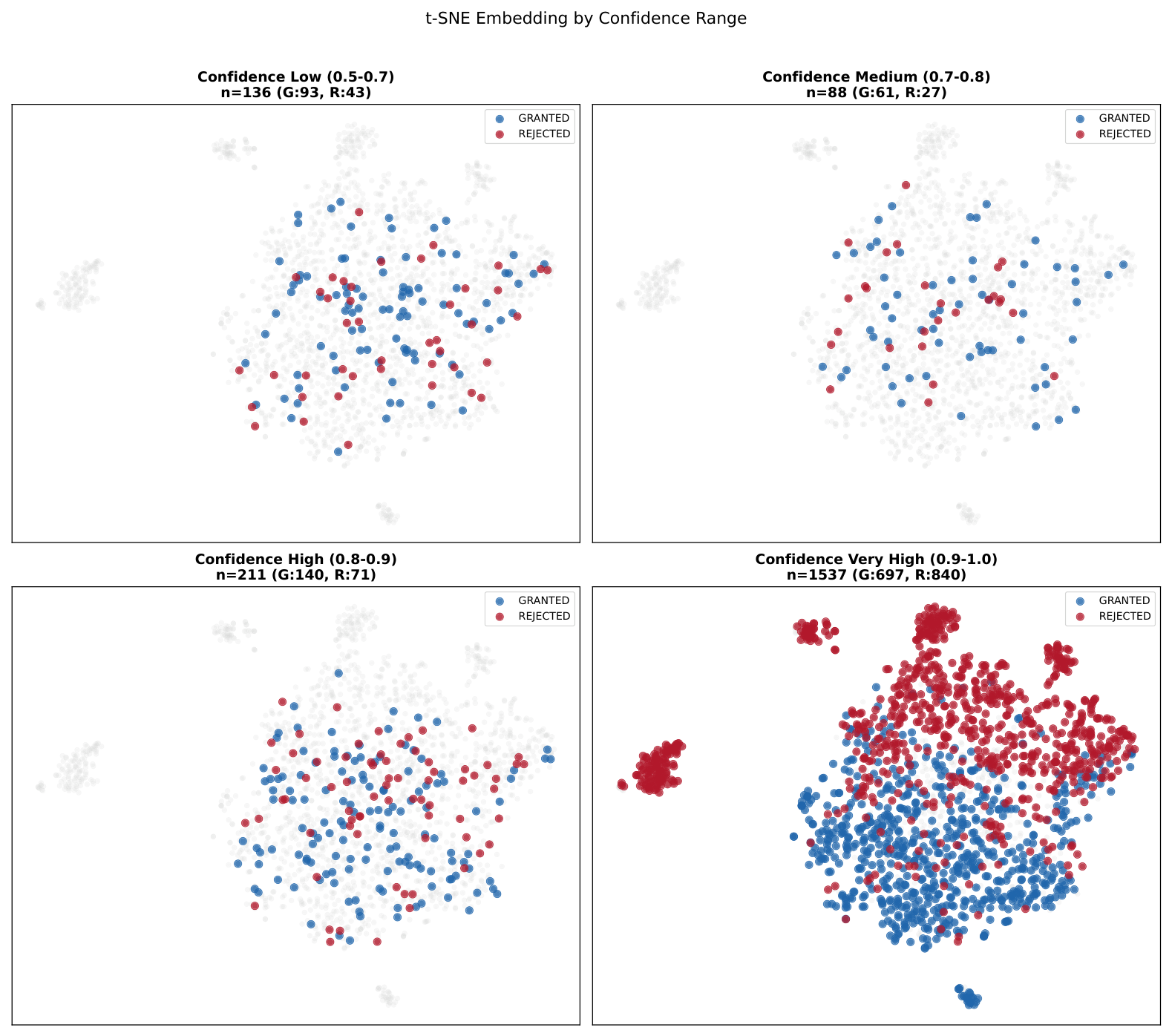
There is a pronounced inflection point at 0.9: accuracy drops 19 pp from the high-confidence band (≥ 0.9 : 92.8%) to the adjacent band (0.8–0.9: 73.8%). The 33.1% of samples with confidence below 0.9 achieve only 67.5% average accuracy, barely above chance for a balanced binary task, making them ideal candidates for LLM escalation. Figure 3 provides a t-SNE visualization of the embedding space, confirming that low-confidence samples cluster in the decision boundary region, where GRANTED and REJECTED classes genuinely overlap.
Based on this calibration analysis, we set the routing threshold to τ = 0.9 for the Dataset A experiments (the operating point is dataset-specific: the Dataset B results below report the confident/uncertain split at c = 0.6 ; the escalation-budget threshold τ esc swept in the ablations is a separate parameter controlling how many deferred cases reach the LLM). For high-confidence samples ( c ( x ) 0.9 , comprising 71% of the evaluation set), the classifier prediction is used directly at an expected accuracy of 92.8%. For low-confidence samples ( c ( x ) < 0.9 , the remaining 29%), the prediction is escalated to LLM verification. This routing strategy concentrates the LLM budget on the cases where the expected accuracy improvement is highest. The ablation studies in Section 7 validate this choice and reveal that τ = 0.80 achieves identical accuracy at 36% lower cost.

4.4. LLM Verification with Two-Sided RAG

For low-confidence cases, the top-k ( k = 6 ) most similar patents are retrieved from the balanced knowledge base:
R ( x ) = R G ( x ) R R ( x ) , | R G ( x ) | = | R R ( x ) | = 3 .
This balanced retrieval is the design used on Dataset A. In our leakage-free study (Dataset B), we additionally evaluate natural top-k retrieval—the k nearest neighbors irrespective of outcome class, with  k = 3 —in place of the balanced R G R R mix. Our retrieval ablation (Section 6.2) shows that natural top-3 performs at least as well as balanced retrieval, so the class balance is not essential (directly addressing the concern that balanced retrieval might compensate for weak retrieval); we therefore use natural top-3 as the default on Dataset B while retaining the balanced variant for Dataset A. The prompt design below is identical for both: in particular, supplying the classifier’s own prediction and confidence as the primary signal is what makes the escalation a verification rather than a blank-slate re-prediction—an ablation in Section 6.2 confirms that removing this signal turns the escalation from a net gain into a net loss.

4.4.1. Prompt Design

The verification prompt is structured to serve distinct communicative functions. The prompt opens with a role definition that positions the LLM as an expert USPTO patent examiner verifying a classifier’s prediction, establishing the adversarial verification stance. It then presents the title and abstract of the target patent x, followed by the classifier’s predicted label y ^ and confidence score c ( x ) . Providing this signal, rather than requesting a blank-slate judgment, prompts the LLM to argue why the prediction should be upheld or overridden, yielding more targeted reasoning (see Section 8.4). The retrieved evidence is as follows: up to three analogous granted patents from R G , providing support for patentability, and up to three §103-rejected applications from R R including Office Action excerpts with examiner reasoning on obviousness. This balanced 3 + 3 evidence block describes the Dataset A design; under the natural top-k retrieval used on Dataset B, the block instead holds the k nearest neighbors regardless of class. The prompt closes with the task specification, instructing the LLM to verify or override the classifier’s prediction and to default to the classifier prediction when uncertain, which biases the LLM toward conservative overrides and reduces false positives.

4.4.2. Response Parsing

The LLM is instructed to respond in a structured format:
  • PREDICTION: GRANTED or REJECTED
    CONFIDENCE: HIGH, MEDIUM, or LOW
    REASONING: (2-3 sentences)
The final prediction is extracted using regex-based pattern matching with fallback to keyword frequency counting when the format is not followed exactly.

5. Experimental Setup

5.1. Dataset

We construct our dataset from USPTO patent data obtained via PatentsView and the USPTO Office Action Research Dataset. The dataset is designed to be balanced between classes to eliminate label-frequency bias from evaluation metrics. Table 3 summarizes the resulting Dataset A statistics.
The RAG knowledge base is constructed from a disjoint set of 50,000 granted patents and 50,000 rejected applications with Office Action text, none of which appear in the test set. All splits use fixed random seed 42 for reproducibility. For pipeline experiments involving LLM API calls, we evaluate on a stratified random sample of 2000 cases (1000 GRANTED, 1000 REJECTED_103; seed 123) drawn from the 20,000-sample test set. Stratification is applied along two dimensions: (i) class balance is enforced exactly, and (ii) the low-confidence region ( c ( x ) < 0.9 ) is slightly undersampled relative to the full test population (29% vs. 33.1% in the 20,000-sample set; Table 2) to ensure at least 580 samples for routing-level analysis (≥30 per technology center in the domain study). The resulting confidence distribution is approximately proportional to the population within each decile, with the high-confidence band comprising 71% of the subset.
The corpus described above (Dataset A) uses a random split. To directly address the temporal-leakage and label-contamination concerns raised in review, we additionally construct Dataset B, a same-era, leakage-free corpus drawn from the Harvard USPTO Patent Dataset (HUPD) [48]: applications filed in 2014–2015, with §103 labels taken from the USPTO Office Action Research Dataset, GRANTED and REJECTED_103 disjoint at the application level, and evaluated under both a random split and a temporal hold-out (train on 2014 filings, test on 2015 filings). We read Dataset B (temporal hold-out) as the operative, leakage-controlled result; its construction, rationale, and full results are detailed in Section 6.1. To quantify LLM response variability, every LLM call is executed three times independently (temperature = 0 , separate API invocations); we report the mean and standard deviation across the three runs. Full-scale classifier evaluation is conducted on all 20,000 test samples.

5.2. Evaluation Metrics

We report overall accuracy (Acc.), macro precision (M-Prec.), macro recall (M-Rec.), macro F1, and per-class F1 scores (F1-G for GRANTED, F1-R for REJECTED_103). The per-class F1 scores are essential for detecting systematic prediction bias: a model that predicts only REJECTED would achieve 50% accuracy on balanced data but 0% F1-G, rendering accuracy alone misleading. For the primary comparison between T-RAG and RAG + Claude, we additionally report 95% Clopper–Pearson confidence intervals and McNemar’s test for paired proportions to assess statistical significance.

5.3. Baselines

We compare against four baselines spanning the zero-shot-to-fine-tuned spectrum. The two zero-shot LLM baselines were deliberately chosen to represent the lower and upper bounds of LLM capability at the time of evaluation, enabling systematic assessment of how model capacity interacts with the proposed architecture. Zero-shot Qwen3-4B [49] is a 4B-parameter local LLM representing the lower bound of general-purpose language model performance, prompted to predict the §103-propensity label without fine-tuning or retrieval. Zero-shot Claude Opus 4.6 is a state-of-the-art commercial LLM representing the upper bound, evaluated with zero-shot prompting using the same prompt template. By bracketing model capability in this way, we can determine whether the performance gains of T-RAG arise from the architectural design rather than from relying on a particular model’s strength. ModernBERT Classifier Only is our fine-tuned classifier without any LLM verification stage, providing an upper bound on the classifier’s standalone contribution. RAG + Claude (no classifier) applies Claude Opus 4.6 with balanced RAG but without confidence-based routing, processing all 2000 evaluation samples through the LLM to isolate the effect of selective versus full LLM engagement.

5.4. Implementation Details

ModernBERT-large is fine-tuned using the HuggingFace Transformers [50] Trainer API. Experiments use Python 3.12.3, PyTorch 2.11.0, Transformers 5.12.1, sentence-transformers 5.6.0, faiss 1.14.3, and the Anthropic Python SDK 0.96.0. SBERT embeddings use the sentence-transformers/all-MiniLM-L6-v2 checkpoint. Nearest-neighbor retrieval uses FAISS IndexFlatIP over l 2 -normalized vectors. Qwen3-4B runs locally using bfloat16 precision on the RTX 4090. Claude Opus 4.6 is accessed via the Anthropic Python SDK (claude-opus-4-6). Although temperature is set to zero, minor response variation across API calls can arise from non-deterministic GPU kernel scheduling and floating-point accumulation order on the provider side; our three-run protocol captures this residual variance.

6. Results

We report results on two datasets. Dataset A is the corpus used in our original study; Dataset B is a new corpus constructed for this revision. In Dataset A, the GRANTED and REJECTED_103 classes are drawn from different filing-year ranges. This year separation was a deliberate design choice: it keeps the two classes disjoint at the application level and structurally prevents the amend-to-grant trajectory—a §103-rejected application later granted after amendment—from placing the same application on both sides. We recognize, however, that separating classes by era can introduce its own era-correlated text signal. To control for this we construct Dataset B, a same-era corpus drawn from the Harvard USPTO Patent Dataset (HUPD) [48], restricted to the 2014–2015 filing cohort, whose §103 labels follow the USPTO Office Action Research Dataset and whose GRANTED and REJECTED_103 classes are disjoint by construction (verified: zero shared application IDs; 43,813 applications per class), evaluated under both a random split and a temporal hold-out (train on earlier filings, test on later). Concretely, GRANTED contains applications whose final HUPD disposition is granted and that never received a §103 rejection during prosecution, while REJECTED_103 contains applications whose final disposition is not granted and whose office actions carry the §103 rejection flag (applications with co-occurring §102 rejections are excluded to keep the label §103-specific); §103-rejected applications that were later granted after amendment therefore fall into neither class. After text-level deduplication, the two classes are balanced at 43,813 applications each. The random split is 85/15 (74,482 train/13,144 test); the temporal hold-out trains on 2014 filings (57,796) and tests on 2015 filings (29,830), with both class-balanced. The retrieval index for escalation is built from the corresponding training split only, so no test application can appear as retrieved evidence; escalation uses Claude Opus 4.8 (claude-opus-4-8) via the Anthropic API, and deferred-set escalation experiments are evaluated on a random sample of up to 1500 low-confidence cases per split. We present both tracks rather than discarding either. Their absolute numbers are not directly comparable: Dataset B’s lower accuracy reflects both the change of corpus and the intrinsically harder task of discriminating between same-era applications within the same fine-grained technology domain, rather than contamination in Dataset A. We therefore read Dataset B (temporal hold-out) as the rigorous, leakage-controlled figure for temporal generalization, while Dataset A remains the full end-to-end system benchmark.

6.1. Results on Dataset B (Leakage-Free)

Table 4 reports the full picture. We compare the ModernBERT classifier and the T-RAG system against two classic non-deep baselines—CPC-LR, a CPC-code-only logistic regression (metadata only, no text), and a TF-IDF + CPC logistic regression—and decompose accuracy by the classifier’s confidence: a confident region ( c 0.6 , the cases T-RAG auto-decides) and an uncertain region ( c < 0.6 , the cases T-RAG escalates); the 0.6 boundary is the optimal escalation budget identified by the τ esc sweep of Section 6.2, whose benefit is positive across the full swept range [ 0.55 , 0.85 ] on both splits. All methods are scored on the same cases in each region. Acc@5% is each method’s own top-5%-confidence (standalone triage) accuracy; overall is proportion-weighted over all cases.
Three findings stand out. First, the abstract carries a real but modest signal beyond field frequency. The ModernBERT classifier (AUROC: 0.719 temporal) exceeds the text-free CPC-LR metadata baseline (0.646) by + 0.073 and the classic TF-IDF + CPC baseline (0.683) by + 0.036 , so the result is not reducible to a topic-frequency lookup—consistent with the idea-stage signal motivated in Section 1—though the overall accuracy ( 66.0 % , near a 66 % field ceiling) reflects the task’s intrinsic difficulty. Second, the classifier’s confidence supports high-precision triage: at 5% coverage it reaches 86.5 % accuracy (temporal), dominating both baselines, so confident cases can be auto-decided reliably (the routing contribution). Third, classifier-primary escalation helps exactly where the classifier is weak. On the uncertain cases ( c < 0.6 , ≈22% of the data), the classifier is near chance ( 53.2 % , temporal—in fact below the TF-IDF + CPC baseline of 54.0 % , i.e., these cases are intrinsically hard for every method), and the LLM lifts them to 55.8 % ( + 2.6  pp), raising overall accuracy from 66.0 % to 66.6 % . The random split shows the same pattern with larger gains ( 51.7 % 57.2 % on uncertain cases; overall 66.6 % 67.8 % ). The overall gain is modest by construction—only ≈22% of cases are escalated and those cases are genuinely difficult—so the system’s value is best read in the uncertain column (where it acts) and the triage operating point, not the proportion-weighted overall.

6.2. Ablations and Diagnostics (Dataset B)

Escalation design: verify vs. replace. Supplying the classifier’s prediction and confidence as the primary signal is decisive. With this signal (the verification design of Section 4.4.1), classifier-primary escalation is net-positive on the deferred set—the low-confidence pool c < 0.85 considered for escalation—at + 2.14  pp random/ + 0.58  pp temporal at the optimal budget τ esc = 0.60 , and positive across the swept range τ esc [ 0.55 , 0.85 ] . These deferred-set averages are diluted by the 0.6 c < 0.85 cases on which the classifier’s prediction is kept; on the escalated cases themselves ( c < 0.6 ) the lift is larger, 51.7 % 57.2 % (random)/ 53.2 % 55.8 % (temporal), as reported in Table 4. A stripped variant that hides the classifier signal and requests a blank-slate prediction is net-negative ( 2.1  pp). The gain therefore comes from verification, not replacement.
Retrieval design: balance is unnecessary. At matched neighbor count, natural top-3 retrieval (best deferred-set Δ = + 2.14  pp) is at least as good as natural top-6 ( + 1.21 ) and balanced 3 + 3 ( + 1.34 ); balancing the granted/rejected mix gives no advantage. The retrieval ceiling is itself task-limited—a §103-rate k-NN AUROC of 0.65 0.68 that does not rise when the embedder is upgraded from MiniLM-L6 to e5-large or to a 2025 state-of-the-art model (Qwen3-Embedding-8B)—so the balanced design was not masking a weak embedder.
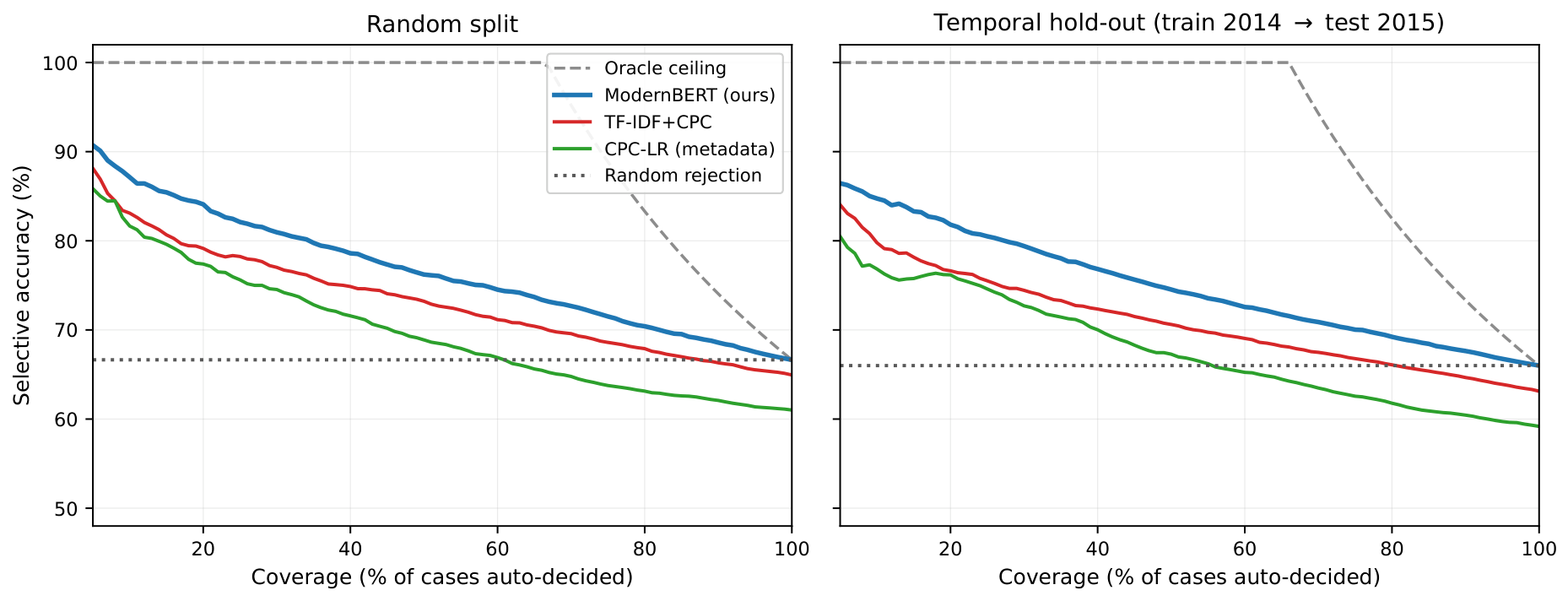
Calibration. The raw classifier is over-confident (ECE: 0.068 ; an 8.9  pp gap in the 0.8–0.9 band); post hoc temperature scaling, fitted per split ( T * = 1.53 on the random split), reduces the ECE to 0.0086 (random)/ 0.0048 (temporal). Table 5 reports the per-band reliability before and after scaling on the random split: the raw per-band gaps of + 3.3 to + 8.9  pp collapse to at most 2.1  pp; the temporal split shows the same collapse. The threshold sweep is likewise stable across splits: at the Dataset A default τ = 0.9 , the retained set covers 12.8 % of cases at 86.0 % accuracy (random) vs. 12.2 % at 84.1 % (temporal), so the operating point is not overfit to a single split. Confidence rank-orders correctness (selective AUROC: 0.65 / 0.63 , vs. 0.62 / 0.61 for TF-IDF + CPC’s own confidence), and the risk–coverage curve (Figure 4) dominates both classic baselines and random rejection at every coverage level, on both splits (AUROC: 0.204 vs. 0.237 for TF-IDF + CPC vs. 0.334 for random rejection on the random split; 0.224 vs. 0.264 vs. 0.340 on the temporal hold-out).
Routing statistics. We quantify the routing benefit at a matched 50 % coverage: the confidence-retained half of the test set (the highest-confidence 50 % of cases) reaches 76.2 % accuracy (random split)/ 74.5 % (temporal) against overall accuracies of 66.6 % / 66.0 % . A randomization test (20,000 random routings of the same size) places confidence-routing above all permutations (empirical p < 1 / 20,000 ), and a bootstrap CI on this retained − overall accuracy gap is + 9.6  pp, 95% CI [ + 8.8 , + 10.4 ]  pp (random)/ [ + 8.0 , + 9.1 ]  pp (temporal). We report these as the correct statistics for the routing benefit.

6.3. Results on Dataset A (Original)

We retain the original Dataset A analyses below as the end-to-end system benchmark. As noted above, their higher absolute numbers partly reflect Dataset A’s cross-era construction—a deliberate design that also keeps its two classes disjoint—so we read Dataset B (temporal hold-out) as the rigorous, leakage-controlled figure for temporal generalization, while Dataset A is the full end-to-end system benchmark. The original model comparison, per-class metrics, and domain-reliability analyses follow (all subsections through Section 6.6 pertain to Dataset A).

6.4. Comprehensive Model Comparison

Table 6 establishes the performance landscape from zero-shot baselines to the full T-RAG pipeline.
The results reveal several notable findings. Note that the classifier accuracy on the 2000-sample pipeline subset (85.5%) is slightly higher than on the full 20,000-sample test set (83.69%, Table 7), because the stratified pipeline sample contains 71% high-confidence predictions versus 65.4% in the full population, raising the subset-level accuracy.
Zero-shot LLMs fail on this task: Qwen3-4B (48.8%) performs at chance level with a severe REJECTED bias (F1-G: 17.4%), while Claude Opus 4.6 (58.2%) is more balanced but still substantially below the fine-tuned classifier (85.5%). This performance gap between the lower-bound and upper-bound LLMs confirms that domain-specific supervision is indispensable for specialized legal classification [37], regardless of model scale. Notably, ModernBERT (395M parameters) outperforms zero-shot Claude Opus 4.6, a model orders of magnitude larger, by 27.3 pp, demonstrating that parameter count and general capability cannot substitute for domain-specific supervised learning on this task.
Two-sided RAG evidence also helps: RAG + Claude without a classifier (87.3%) outperforms the classifier alone by 1.8 pp, confirming that structured evidential context improves LLM reasoning. However, the F1-G/F1-R ratio (88.0/86.5) reveals a residual GRANTED bias, which T-RAG’s routing mechanism mitigates by applying LLM verification only where the classifier is uncertain, independently of which class is predicted.
Perhaps most notably, selective routing outperforms full LLM engagement. Processing only 29% of samples through the LLM yields higher accuracy than processing all samples (92.0% vs. 87.3%). This occurs because the fine-tuned classifier handles high-confidence cases with 92.8% accuracy, and routing these same cases through the LLM introduces noise from unnecessary overrides. The accuracy gap between T-RAG (92.0%) and RAG + Claude (87.3%) is 4.7 pp; the 95% Clopper–Pearson confidence interval for T-RAG accuracy is [ 90.8 % , 93.1 % ] , which does not overlap with that of RAG + Claude [ 85.8 % , 88.7 % ] , and McNemar’s test confirms the difference is statistically significant ( χ 2 = 35.2 , p < 0.001 ). Low standard deviations across three independent LLM runs ( ± 0.3  pp for T-RAG) further confirm the reproducibility of these results.

6.5. Classifier Performance

Table 7 reports the per-epoch training progression of ModernBERT-large on 20,000 held-out test samples.
The Epoch 2 checkpoint achieves 83.69% accuracy and 83.93% F1. The sharp increase in validation loss at Epoch 3 (0.389 → 1.318), with simultaneously declining F1, indicates overfitting, confirming Epoch 2 as the optimal checkpoint via early stopping.
Table 8 compares ModernBERT-base (149M) and ModernBERT-large (395M). The larger model achieves +1.2 pp F1, primarily through improved recall (+4.6 pp), which we attribute to the extended context window (1024 vs. 512 tokens) capturing discriminative signals in longer abstracts.

6.6. Routing Statistics and Low-Confidence Analysis

With τ = 0.9 , 1420 of 2000 evaluation samples (71.0%) are handled by the classifier directly, while 580 (29.0%) are escalated to LLM verification.
Table 9 isolates the 580 evaluation samples routed to the LLM. The classifier’s accuracy on this subset is 65.0%, only modestly above chance for a balanced binary task, confirming that these cases are genuinely difficult.
Claude Opus 4.6 improves accuracy by 25.0 pp (183 wins, 38 losses across 580 routed samples), demonstrating that LLM reasoning capacity, not just retrieval, is essential for correcting uncertain predictions. Qwen3-4B achieves only +1.0 pp on the same samples, confirming that the performance disparity between the lower-bound and upper-bound LLMs observed in zero-shot evaluation persists in the pipeline setting. The low standard deviation ( ± 0.5  pp) across three independent LLM runs confirms that the improvement is robust to LLM response variability. This result validates the architectural choice of pairing confidence-based routing with a capable verification model, as smaller models cannot reliably integrate evidence from multiple analogous cases to override classifier predictions.

6.7. Detailed Per-Class Metrics

Table 10 breaks down precision, recall, and F1 per class for all methods. T-RAG achieves the highest F1 for both GRANTED (92.3%) and REJECTED (91.7%), the only method to rank first on this balanced metric for both classes, with an inter-class F1 gap of just 0.6 pp. This consistent performance across classes is the primary practical advantage of confidence-based routing: rather than excelling on one subset of cases at the expense of another, T-RAG provides reliable guidance across the full range of examination outcomes.

7. Ablation Studies

We conduct three ablation studies using the 2000-sample evaluation set without additional LLM API calls, by re-analyzing the per-sample confidence scores and stored LLM predictions from the main pipeline experiment.

7.1. Confidence Threshold Sweep

We sweep τ { 0.70 , 0.75 , 0.80 , 0.85 , 0.90 , 0.95 } by re-routing stored samples without re-running the LLM, and compute the resulting accuracy and LLM call rate; Table 11 reports the results.
A peak accuracy of 92.0% is achieved at τ { 0.80 , 0.90 , 0.95 } . Most importantly, τ = 0.80 matches τ = 0.90 while requiring only 370 LLM calls vs. 580, representing a 36% reduction in API cost. We retain τ = 0.90 as the default for its robustness to classifier recalibration across different splits, but recommend τ = 0.80 for cost-sensitive deployments.

7.2. Routing Strategy: Confidence-Based vs. Random

A central claim of T-RAG is that the identity of routed samples matters, not merely their count. We test this by simulating 1000 random routing trials: each trial selects 29% of evaluation samples uniformly at random for LLM verification. Table 12 compares the routing strategies at a matched LLM budget.
Confidence-based routing outperforms the random routing mean by +4.6 pp. Across 1000 random-routing trials at matched LLM budget, none reached the observed 92.0% accuracy (best 89.2%). We report this randomization check rather than a parametric σ -based statement, because the spread of random reshuffling is not the sampling error of the accuracy point estimate. Confidence-based routing approaches the oracle routing upper bound (93.5%).

7.3. Tech Center Domain Analysis

To examine whether T-RAG’s benefits are uniform across technology domains, we link the 1000 REJECTED_103 evaluation samples to their USPTO Technology Center (TC) codes via exact title matching against the Office Action metadata (100% match rate). Table 13 reports the per-domain results.
Domains with lower classifier accuracy gain most: Biotechnology (TC 1600, +29.2 pp) and Computer Architecture (TC 2100, +21.1 pp) involve nuanced obviousness reasoning, where the LLM’s structured analogical reasoning provides the most value. Conversely, TC 2600 (100.0% classifier accuracy) experiences a 7.0  pp degradation from incorrect LLM overrides. With at least 57 samples per technology center, these domain-level differences are statistically interpretable: a two-proportion z-test confirms the TC 1600 gain as significant ( p < 0.001 ) and the TC 2100 gain at p < 0.05 , while the TC 2600 degradation is also significant ( p < 0.01 ). These results motivate future work on domain-adaptive thresholding.

8. Analysis and Discussion

8.1. Why Zero-Shot LLMs Fail

Zero-shot LLMs perform near or below random (49–59%) for three interconnected reasons. First, LLMs trained on general web corpora have no calibration to USPTO-specific distributions and therefore lack exposure to the particular patterns of USPTO examination decisions. Second, both models exhibit systematic prediction bias: Qwen3-4B strongly favors REJECTED (F1-G: 17.4%), while Claude Opus 4.6 is more balanced but still suboptimal. Third, obviousness determination requires a comparative framework involving specific prior art combinations [1], which zero-shot models cannot construct without access to relevant case evidence.

8.2. The Value of Domain-Specific Fine-Tuning

ModernBERT (395M parameters) outperforms zero-shot Claude Opus 4.6 by 27.3 pp on the 2000-sample pipeline evaluation. This result is consistent with findings in legal [37] and medical [38] NLP, where domain-specific fine-tuning on labeled data substantially outperforms general-purpose models regardless of the latter’s scale, and aligns with broader trends in AI-driven decision-support systems [51].

8.3. Why Two-Sided Evidence Retrieval Matters

Our v1 pipeline restricted the RAG knowledge base to rejection-only documents. Because the LLM received only evidence supporting rejection, it systematically over-predicted REJECTED, a form of retrieval-induced anchoring bias. In a pilot evaluation on 200 samples, the rejection-only RAG pipeline achieved 74.0% accuracy with an extreme F1-G/F1-R imbalance of 58.3/82.1, confirming that unbalanced retrieval induces severe class bias. The v2 pipeline with two-sided retrieval (a knowledge base of 50K granted + 50K rejected) eliminates this imbalance by providing counterevidence from both outcomes, enabling the LLM to perform genuine comparative reasoning.
An instructive control is RAG + Claude without a classifier, which achieves 87.3%, higher than the classifier alone (85.5%) but lower than T-RAG (92.0%). This 4.7 pp gap is statistically significant (McNemar’s χ 2 = 35.2 , p < 0.001 ) and demonstrates that while two-sided RAG evidence contributes to high LLM accuracy, it is not sufficient; confidence-based routing is equally important.

8.4. Qualitative Analysis: LLM Reasoning vs. Examiner Reasoning

Three patterns emerge from the qualitative comparison (Table 14). First, RAG retrieval consistently surfaces relevant prior art. Second, T-RAG reasoning is qualitatively richer: receiving the classifier’s prediction and confidence as a structured hypothesis causes the LLM to argue why the prediction should be upheld or overridden. Third, both approaches demonstrate substantive technical reasoning rather than surface-level keyword matching, suggesting—on these illustrative cases—that RAG-enhanced LLMs can recover elements of the examiner’s comparative analysis, though we do not claim they reproduce examiner-level legal reasoning. These findings support T-RAG’s core design choice: providing the classifier prediction as context focuses LLM reasoning on the specific question of whether the classifier should be overridden.

8.5. Limitations and Scope

We are explicit about the scope of our claims. (i) Leakage-controlled, but a deliberately clean task. Our rigorous results (Dataset B) remove era and label leakage—same-era construction, a temporal hold-out, and disjoint classes whose §103 labels follow the USPTO Office Action Research Dataset—so the reported numbers are a leakage-controlled floor rather than a best-case ceiling. At the same time, a contamination-free separation is also an easier setting than full prosecution: applications that received a §103 rejection but were later granted after amendment are, by construction, not placed in the granted class. We therefore do not claim to resolve this ambiguous middle; characterizing performance on the full amend-to-grant population is a harder, separate task and explicit future work. (ii) Modest signal. The title-and-abstract signal is real but weak (AUROC 0.72 , ≈ 66 % balanced accuracy); it supports idea-stage screening and triage, but is not a substitute for the claim-level legal determination, and the overall accuracy gain from escalation is small because most cases are confident and the escalated cases are intrinsically difficult. (iii) Narrow temporal window. Our temporal hold-out trains on 2014 filings and tests on 2015 filings—a one-year-forward window; a true forward-deployment evaluation, with a longer calendar gap matching examination latency and spanning shifts in examination standards, would further strengthen the generalization claim. (iv) Two datasets. Dataset A and Dataset B differ in construction and are not directly comparable; we present both: Dataset A as the end-to-end system benchmark and Dataset B (temporal hold-out) for temporal generalization.

9. Conclusions

We presented T-RAG, a confidence-based triage framework for idea-stage patent obviousness assessment that integrates fine-tuned ModernBERT-large classification with retrieval-augmented LLM verification. Designed for inventors and early-stage practitioners who need actionable §103 risk guidance before formal claim drafting, the system uses title and abstract as input, the natural representation of an invention at the ideation phase, and delivers predictions together with confidence signals and auditable prior art evidence.
The experimental findings converge on four conclusions. Domain-specific fine-tuning on labeled patent data is substantially more effective than zero-shot deployment of large foundation models. Retrieving evidence from both outcome classes—rather than from rejected cases only—matters for unbiased LLM reasoning; however, our retrieval ablation shows that forcing an equal granted/rejected count is not itself necessary, as natural top-k retrieval performs at least as well. Confidence-based routing outperforms random routing at equivalent LLM budget—on Dataset A, none of 1000 random-routing trials at matched budget reached the observed accuracy, and on Dataset B a randomization test over 20,000 random routings at matched coverage yields empirical p < 1 / 20,000 —confirming that classifier confidence reliably identifies the cases where LLM verification is most beneficial. Finally, LLM verification benefits are strongly domain-dependent, with biotechnology and computer architecture gaining most, motivating domain-adaptive thresholding as a direction for future work.
Several design boundaries merit discussion. First, the balanced k = 6 (3 granted + 3 rejected) retrieval budget is the design used in the Dataset A end-to-end pipeline; on the leakage-controlled Dataset B we ablate retrieval design (natural top-3/top-6 vs. forced balanced 3 + 3 ) and find that forced balance is not necessary. A fuller sweep over k on the end-to-end pipeline—beyond the k { 2 , 4 , 6 , 8 } pilot that showed diminishing returns past k = 6 —remains future work due to the combinatorial cost of re-running the full LLM evaluation. Second, although the test set and RAG knowledge base are disjoint at the document level, we do not explicitly filter patent-family relatives. Patents within the same family share substantial textual overlap, and their presence in both sets could inflate retrieval similarity scores. We consider this a conservative bias—it advantages all RAG-based methods equally and does not differentially favor T-RAG over the RAG + Claude baseline—but future work should evaluate with family-level deduplication to quantify the effect. Third, our LLM results are tied to a specific model snapshot (claude-opus-4-6); provider-side model updates may alter reproduction fidelity, and users should pin model versions for operational deployments.
Building on prior work in patent retrieval networks [22], several directions suggest natural extensions. Expanding to multi-class formulations covering §101, §102, and §112 grounds would more fully reflect real examination outcomes. Domain-adaptive routing could further improve the accuracy–cost trade-off. The deliberate restriction to title and abstract reflects T-RAG’s target use case: idea-stage patentability assessment, where formal claims do not yet exist. A complementary system could accept claim text for applications that have progressed to the drafting stage, testing whether richer input improves accuracy on the cases the abstract-level classifier finds most difficult; however, this would address a distinct user need rather than a limitation of the current design. As patent examination standards evolve with case law, periodic retraining will be necessary to maintain temporal currency.


Author Contributions

Conceptualization, K.-Y.L. and J.B.; methodology, K.-Y.L. and J.B.; software, J.B.; validation, K.-Y.L.; formal analysis, K.-Y.L. and J.B.; investigation, K.-Y.L. and J.B.; resources, K.-Y.L. and J.B.; data curation, K.-Y.L. and J.B.; writing—original draft preparation, K.-Y.L. and J.B.; writing—review and editing, K.-Y.L. and J.B.; visualization, J.B.; supervision, J.B.; project administration, J.B.; funding acquisition, J.B. All authors have read and agreed to the published version of the manuscript.

Funding

This work was supported by Hankuk University of Foreign Studies Research Fund of 2025.

Data Availability Statement

The data supporting the reported results can be accessed through the USPTO PatentsView (https://patentsview.org, accessed on 22 July 2026), the Office Action Research Dataset (https://www.uspto.gov/ip-policy/economic-research/research-datasets, accessed on 22 July 2026), and the Harvard USPTO Patent Dataset (HUPD, https://patentdataset.org, accessed on 22 July 2026) [48].

Conflicts of Interest

The authors declare no conflicts of interest.

References

  1. Graham v. John Deere Co. Graham v. John Deere Co., 383 U.S. 1; U.S. Supreme Court: Washington, DC, USA, 1966.
  2. KSR. KSR International Co. v. Teleflex Inc., 550 U.S. 398; U.S. Supreme Court: Washington, DC, USA, 2007.
  3. Hido, S.; Suzuki, S.; Nishiyama, R.; Imamichi, T.; Takahashi, R.; Nasukawa, T.; Idé, T.; Kanehira, Y.; Yohda, R.; Ueno, T.; et al. Modeling patent quality: A system for large-scale patentability analysis using text mining. J. Inf. Process. 2012, 20, 655–666. [Google Scholar] [CrossRef] [Scilit]
  4. Lee, J.S.; Hsiang, J. Patent classification by fine-tuning BERT language model. World Pat. Inf. 2020, 61, 101965. [Google Scholar] [CrossRef] [Scilit]
  5. Devlin, J.; Chang, M.W.; Lee, K.; Toutanova, K. BERT: Pre-training of deep bidirectional transformers for language understanding. In Proceedings of the 2019 Conference of the North American Chapter of the Association for Computational Linguistics: Human Language Technologies; Association for Computational Linguistics: Stroudsburg, PA, USA, 2019; pp. 4171–4186. [Google Scholar]
  6. Warner, B.; Chaffin, A.; Clavié, B.; Weller, O.; Hallström, O.; Taghadouini, S.; Gallagher, A.; Biswas, R.; Ladhak, F.; Aarsen, T.; et al. Smarter, better, faster, longer: A modern bidirectional encoder for fast, memory efficient, and long context finetuning and inference. arXiv 2024, arXiv:2412.13663. [Google Scholar]
  7. Li, S.; Hu, J.; Cui, Y.; Hu, J. DeepPatent: Patent classification with convolutional neural networks and word embedding. Scientometrics 2018, 117, 721–744. [Google Scholar] [CrossRef] [Scilit]
  8. Risch, J.; Krestel, R. Domain-specific word embeddings for patent classification. Data Technol. Appl. 2019, 53, 108–122. [Google Scholar] [CrossRef] [Scilit]
  9. Hu, J.; Li, S.; Hu, J.; Yang, G. A hierarchical feature extraction model for multi-label mechanical patent classification. Sustainability 2018, 10, 219. [Google Scholar] [CrossRef] [Scilit]
  10. Bai, J.; Shim, I.; Park, S. MEXN: Multi-stage extraction network for patent document classification. Appl. Sci. 2020, 10, 6229. [Google Scholar] [CrossRef] [Scilit]
  11. Helmers, L.; Horn, F.; Biegler, F.; Oppermann, T.; Müller, K.R. Automating the search for a patent’s prior art with a full text similarity search. PLoS ONE 2019, 14, e0212103. [Google Scholar] [CrossRef] [Scilit] [PubMed]
  12. Lin, W.; Yu, W.; Xiao, R. Measuring patent similarity based on text mining and image recognition. Systems 2023, 11, 294. [Google Scholar] [CrossRef] [Scilit]
  13. Yao, L.; Ni, H. Prediction of patent grant and interpreting the key determinants: An application of interpretable machine learning approach. Scientometrics 2023, 128, 4933–4969. [Google Scholar] [CrossRef] [Scilit]
  14. Shomee, H.H.; Wang, Z.; Ravi, S.N.; Medya, S. A comprehensive survey on AI-based methods for patents. arXiv 2024, arXiv:2404.08668. [Google Scholar]
  15. Lewis, P.; Perez, E.; Piktus, A.; Petroni, F.; Karpukhin, V.; Goyal, N.; Küttler, H.; Lewis, M.; Yih, W.-T.; Rocktäschel, T.; et al. Retrieval-augmented generation for knowledge-intensive NLP tasks. In Proceedings of the 34th International Conference on Neural Information Processing Systems; Curran Associates Inc.: Red Hook, NY, USA, 2020. [Google Scholar]
  16. Gao, Y.; Xiong, Y.; Gao, X.; Jia, K.; Pan, J.; Bi, Y.; Dai, Y.; Sun, J.; Guo, Q.; Wang, M.; et al. Retrieval-augmented generation for large language models: A survey. arXiv 2024, arXiv:2312.10997. [Google Scholar]
  17. Karpukhin, V.; Oguz, B.; Min, S.; Lewis, P.; Wu, L.; Edunov, S.; Chen, D.; Yih, W.-T. Dense passage retrieval for open-domain question answering. In Proceedings of the 2020 Conference on Empirical Methods in Natural Language Processing (EMNLP); Association for Computational Linguistics: Stroudsburg, PA, USA, 2020; pp. 6769–6781. [Google Scholar]
  18. Robertson, S.; Zaragoza, H. The probabilistic relevance framework: BM25 and beyond. Found. Trends Inf. Retr. 2009, 3, 333–389. [Google Scholar]
  19. Asai, A.; Wu, Z.; Wang, Y.; Sil, A.; Hajishirzi, H. Self-RAG: Learning to retrieve, generate, and critique through self-reflection. In Proceedings of the International Conference on Learning Representations 2024 (ICLR 2024), Vienna, Austria, 7–11 May 2024. [Google Scholar]
  20. Zhong, H.; Xiao, C.; Tu, C.; Zhang, T.; Liu, Z.; Sun, M. How does NLP benefit legal system: A summary of legal artificial intelligence. In Proceedings of the 58th Annual Meeting of the Association for Computational Linguistics; Association for Computational Linguistics: Stroudsburg, PA, USA, 2020; pp. 5218–5230. [Google Scholar]
  21. Hendrycks, D.; Burns, C.; Chen, A.; Ball, S. CUAD: An expert-annotated NLP dataset for legal contract review. In Proceedings of the 35th Conference on Neural Information Processing Systems (NeurIPS 2021) Track on Datasets and Benchmark, Virtual, 6–14 December 2021. [Google Scholar]
  22. Lee, K.Y.; Bai, J. PAI-NET: Retrieval-augmented generation patent network using prior art information. Systems 2025, 13, 259. [Google Scholar] [CrossRef] [Scilit]
  23. Geifman, Y.; El-Yaniv, R. Selective classification for deep neural networks. In Proceedings of the 31st International Conference on Neural Information Processing Systems; Curran Associates Inc.: Red Hook, NY, USA, 2017; pp. 4878–4887. [Google Scholar]
  24. Niculescu-Mizil, A.; Caruana, R. Predicting good probabilities with supervised learning. In Proceedings of the 22nd International Conference on Machine Learning; Association for Computing Machinery: New York, NY, USA, 2005; pp. 625–632. [Google Scholar]
  25. Guo, C.; Pleiss, G.; Sun, Y.; Weinberger, K.Q. On calibration of modern neural networks. In Proceedings of the 34th International Conference on Machine Learning; JMLR: Cambridge, MA, USA, 2017; pp. 1321–1330. [Google Scholar]
  26. Hendrycks, D.; Gimpel, K. A baseline for detecting misclassified and out-of-distribution examples in neural networks. In Proceedings of the 5th International Conference on Learning Representations (ICLR 2017), Toulon, France, 24–26 April 2017. [Google Scholar]
  27. Mozannar, H.; Sontag, D. Consistent estimators for learning to defer to an expert. In Proceedings of the 37th International Conference on Machine Learning; JMLR: Cambridge, MA, USA, 2020; pp. 7076–7087. [Google Scholar]
  28. Madras, D.; Pitassi, T.; Zemel, R. Predict responsibly: Improving fairness and accuracy by learning to defer. In Proceedings of the 32nd International Conference on Neural Information Processing Systems; Curran Associates Inc.: Red Hook, NY, USA, 2018; pp. 6150–6160. [Google Scholar]
  29. Chen, L.; Zaharia, M.; Zou, J. FrugalGPT: How to use large language models while reducing cost and improving performance. arXiv 2023, arXiv:2305.05176. [Google Scholar]
  30. Ding, D.; Mallick, A.; Wang, C.; Sim, R.; Mukherjee, S.; Rühle, V.; Lakshmanan, L.V.S.; Awadallah, A.H. Hybrid LLM: Cost-efficient and quality-aware query routing. In Proceedings of the Twelfth International Conference on Learning Representations (ICLR 2024), Vienna, Austria, 7–11 May 2024. [Google Scholar]
  31. OpenAI; Achiam, J.; Adler, S.; Agarwal, S.; Ahmad, L.; Akkaya, I.; Aleman, F.L.; Almeida, D.; Altenschmidt, J.; Altman, S.; et al. GPT-4 technical report. arXiv 2023, arXiv:2303.08774. [Google Scholar]
  32. Anthropic. Claude 3.5 Sonnet Model Card Addendum; Technical Report; Anthropic: San Francisco, CA, USA, 2024. [Google Scholar]
  33. Touvron, H.; Lavril, T.; Izacard, G.; Martinet, X.; Lachaux, M.-A.; Lacroix, T.; Rozière, B.; Goyal, N.; Hambro, E.; Azhar, F.; et al. LLaMA: Open and efficient foundation language models. arXiv 2023, arXiv:2302.13971. [Google Scholar]
  34. Brown, T.B.; Mann, B.; Ryder, N.; Subbiah, M.; Kaplan, J.; Dhariwal, P.; Neelakantan, A.; Shyam, P.; Sastry, G.; Askell, A.; et al. Language models are few-shot learners. In Proceedings of the 34th International Conference on Neural Information Processing Systems; Curran Associates Inc.: Red Hook, NY, USA, 2020; pp. 1877–1901. [Google Scholar]
  35. Wei, J.; Wang, X.; Schuurmans, D.; Bosma, M.; Ichter, B.; Xia, F.; Chi, E.H.; Le, Q.V.; Zhou, D. Chain-of-thought prompting elicits reasoning in large language models. In Proceedings of the 36th International Conference on Neural Information Processing Systems; Curran Associates Inc.: Red Hook, NY, USA, 2022. [Google Scholar]
  36. Lai, J.; Gan, W.; Wu, J.; Qi, Z.; Yu, P.S. Large language models in law: A survey. AI Open 2024, 5, 181–196. [Google Scholar] [CrossRef] [Scilit]
  37. Chalkidis, I.; Fergadiotis, M.; Malakasiotis, P.; Aletras, N.; Androutsopoulos, I. LEGAL-BERT: The muppets straight out of law school. In Findings of the Association for Computational Linguistics: EMNLP 2020; Association for Computational Linguistics: Stroudsburg, PA, USA, 2020; pp. 2898–2904. [Google Scholar]
  38. Siriwardhana, S.; Weerasekera, R.; Wen, E.; Kaluarachchi, T.; Rana, R.; Nanayakkara, S. Improving the domain adaptation of retrieval augmented generation (RAG) models for open domain question answering. Trans. Assoc. Comput. Linguist. 2023, 11, 1–17. [Google Scholar] [CrossRef] [Scilit]
  39. Kim, J.; Shin, H. Stage-aware governance of large language models: Managing uncertainty and human oversight in AI-assisted literature review systems. Systems 2026, 14, 153. [Google Scholar] [CrossRef] [Scilit]
  40. Vaswani, A.; Shazeer, N.; Parmar, N.; Uszkoreit, J.; Jones, L.; Gomez, A.N.; Kaiser, L.; Polosukhin, I. Attention is all you need. In Proceedings of the 31st International Conference on Neural Information Processing Systems; Curran Associates Inc.: Red Hook, NY, USA, 2017; pp. 5998–6008. [Google Scholar]
  41. Dao, T.; Fu, D.Y.; Ermon, S.; Rudra, A.; Ré, C. FlashAttention: Fast and memory-efficient exact attention with IO-awareness. In Proceedings of the 36th International Conference on Neural Information Processing Systems; Curran Associates Inc.: Red Hook, NY, USA, 2022. [Google Scholar]
  42. Su, J.; Ahmed, M.; Lu, Y.; Pan, S.; Bo, W.; Liu, Y. RoFormer: Enhanced transformer with rotary position embedding. Neurocomputing 2024, 568, 127063. [Google Scholar] [CrossRef] [Scilit]
  43. Liu, Y.; Ott, M.; Goyal, N.; Du, J.; Joshi, M.; Chen, D.; Levy, O.; Lewis, M.; Zettlemoyer, L.; Stoyanov, V. RoBERTa: A robustly optimized BERT pretraining approach. arXiv 2019, arXiv:1907.11692. [Google Scholar]
  44. Loshchilov, I.; Hutter, F. Decoupled weight decay regularization. In Proceedings of the 7th International Conference on Learning Representations (ICLR 2019), New Orleans, LA, USA, 6–9 May 2019. [Google Scholar]
  45. Micikevicius, P.; Narang, S.; Alben, J.; Diamos, G.; Elsen, E.; Garcia, D.; Ginsburg, B.; Houston, M.; Kuchaiev, O.; Venkatesh, G.; et al. Mixed precision training. In Proceedings of the 6th International Conference on Learning Representations (ICLR 2018), Vancouver, BC, Canada, 30 April–3 May 2018. [Google Scholar]
  46. Reimers, N.; Gurevych, I. Sentence-BERT: Sentence embeddings using Siamese BERT-networks. In Proceedings of the 2019 Conference on Empirical Methods in Natural Language Processing (EMNLP 2019); Association for Computational Linguistics: Stroudsburg, PA, USA, 2019; pp. 3982–3992. [Google Scholar]
  47. Johnson, J.; Douze, M.; Jégou, H. Billion-scale similarity search with GPUs. IEEE Trans. Big Data 2021, 7, 535–547. [Google Scholar] [CrossRef] [Scilit]
  48. Suzgun, M.; Melas-Kyriazi, L.; Sarkar, S.K.; Kominers, S.D.; Shieber, S.M. The Harvard USPTO Patent Dataset: A large-scale, well-structured, and multi-purpose corpus of patent applications. In Proceedings of the Advances in Neural Information Processing Systems 36 (NeurIPS 2023), Datasets and Benchmarks Track; Neural Information Processing Systems: Red Hook, NY, USA, 2023. [Google Scholar]
  49. Qwen Team. Qwen3 technical report. arXiv 2025, arXiv:2505.09388. [Google Scholar]
  50. Wolf, T.; Debut, L.; Sanh, V.; Chaumond, J.; Delangue, C.; Moi, A.; Cistac, P.; Rault, T.; Louf, R.; Funtowicz, M.; et al. Transformers: State-of-the-art natural language processing. In Proceedings of the 2020 Conference on Empirical Methods in Natural Language Processing: System Demonstrations; Association for Computational Linguistics: Stroudsburg, PA, USA, 2020; pp. 38–45. [Google Scholar]
  51. Almalki, S.S. AI-driven decision support systems in agile software project management: Enhancing risk mitigation and resource allocation. Systems 2025, 13, 208. [Google Scholar] [CrossRef] [Scilit]
Figure 1. Overview of the T-RAG pipeline. A patent application is first processed by the ModernBERT-large classifier, which produces a prediction with a confidence score. High-confidence predictions ( c ( x ) τ ) are accepted directly, while low-confidence cases are escalated to classifier-primary LLM verification with retrieved evidence from granted and §103-rejected patents (balanced retrieval on Dataset A; natural top-k on the leakage-free Dataset B).
Systems 14 01160 g001
Figure 2. Detailed architecture of the T-RAG system. The pipeline consists of three stages: (1) ModernBERT-large classifier inference with confidence scoring; (2) RAG retrieval over granted and §103-rejected knowledge bases using SBERT embeddings and FAISS indexing (balanced retrieval on Dataset A; natural top-k on Dataset B); and (3) classifier-primary LLM verification with a structured prompt containing the classifier signal and retrieved evidence.
Systems 14 01160 g002
Figure 3. t-SNE visualization of fine-tuned ModernBERT [CLS] embeddings by confidence range. Low-confidence samples (0.5–0.7) cluster in the boundary region, where classes overlap, while high-confidence samples (0.9–1.0) occupy well-separated class-specific regions. This confirms that prediction uncertainty reflects genuine geometric ambiguity in the embedding space, not merely miscalibration. The 0.9–1.0 panel ( n = 1537 ) includes only samples with confidence in [ 0.9 , 1.0 ) ; 28 samples with float32 softmax confidence of exactly 1.0 are omitted from visualization.
Systems 14 01160 g003
Figure 4. Risk–coverage curves on the leakage-free Dataset B ((left): random split; (right): temporal hold-out, train on 2014 filings and test on 2015 filings). Selective accuracy is computed by auto-deciding cases in decreasing order of each method’s confidence up to the given coverage. The ModernBERT classifier dominates the TF-IDF + CPC and CPC-LR baselines at every coverage level on both splits, and the advantage widens as coverage tightens—the operating regime that triage exploits. The random-rejection floor is flat at the overall accuracy; the oracle ceiling rejects all errors first.
Systems 14 01160 g004
Table 1. ModernBERT-large model and training configuration.
ParameterValue
Base modelanswerdotai/ModernBERT-large
Parameters∼395M
Hidden size1024
Attention heads16
Layers24
Max sequence length1024 tokens
Classification headLinear (1024, 2)
OptimizerAdamW
Learning rate 2 × 10 5
Batch size4 (eff. 16 w/gradient accum.)
Gradient accum.4 steps
Epochs3 (best: Epoch 2)
Warmup ratio0.1
Weight decay0.01
Mixed precisionFP16
Table 2. Classifier confidence vs. actual accuracy on Dataset A (20,000 test samples). ECE = 0.042; Brier = 0.122. A total of 301 samples with float32 softmax confidence of exactly 1.0 are omitted from the binned rows but belong to the ≥ 0.9 band for all analyses (total below 0.9: 33.1%). Bold highlights the high-confidence band (≥0.9) that is retained for direct classifier decisions.
ConfidenceAccuracy | Δ | CountPercentage
0.5–0.652.7%2.3 pp12256.1%
0.6–0.758.2%6.8 pp13056.5%
0.7–0.866.1%8.9 pp16148.1%
0.8–0.973.8%11.2 pp247612.4%
0.9–1.092.8%2.2 pp13,07965.4%
Table 3. Dataset A statistics.
SplitGRANTEDREJECTED_103Total
Training50,00050,000100,000
Test10,00010,00020,000
Total60,00060,000120,000
Table 4. §103-propensity screening performance on the leakage-free HUPD corpus. Conf. (≥0.6)/Uncert. (<0.6): accuracy on cases where the classifier’s confidence is high/low (the regions T-RAG routes on), with all methods scored on the same cases. Acc@5%: each method’s own top-5%-confidence triage accuracy. Overall: proportion-weighted. T-RAG keeps the classifier on confident cases and escalates only uncertain cases to a classifier-primary LLM, so its gain concentrates in Uncert. T-RAG routes on classifier scores, so its triage AUROC equals the classifier’s; escalation improves uncertain-case accuracy, not ranking. Split: R = random split, T = temporal hold-out. Bold indicates the best value in each column (within each split).
MethodSplitAUROCAcc@5%Conf. (≥0.6)Uncert. (<0.6)Overall
CPC-LR (metadata)R0.66285.863.053.461.0
T0.64680.561.252.059.2
TF-IDF + CPC (classic)R0.70488.167.455.464.9
T0.68384.065.754.063.1
ModernBERT classifierR0.73490.770.551.766.6
T0.71986.569.653.266.0
T-RAG (ours)R0.734 90.770.557.267.8
T0.719 86.569.655.866.6
Table 5. Per-band reliability of the Dataset B classifier (random split, n = 13,144 ), raw vs. temperature-scaled ( T * = 1.53 ). Gap = mean confidence − accuracy within the band (positive = over-confident). Counts differ between the raw and scaled columns because scaling moves samples across band boundaries.
ConfidenceRaw Acc.Raw GapScaled Acc.Scaled Gap
0.5–0.651.7% + 3.3  pp52.8% + 2.1  pp
0.6–0.758.1% + 6.9  pp65.0% 0.1  pp
0.7–0.867.9% + 7.1  pp75.1% 0.5  pp
0.8–0.975.9% + 8.9  pp83.9% + 0.1  pp
0.9–1.086.0% + 7.8  pp93.6% + 0.3  pp
Table 6. Comprehensive model comparison (2000 samples, balanced). LLM-based methods report mean ± std over three independent runs with majority-vote aggregation. Bold indicates the best value in each column.
MethodAcc.M-Prec.M-Rec.F1F1-G/F1-R
Zero-shot Qwen3-4B 48.8 ± 0.5 %47.2%48.8%40.2%17.4/62.9
Zero-shot Claude Opus 4.6 58.2 ± 0.6 %59.6%58.2%56.7%48.6/64.8
ModernBERT Classifier Only85.5%85.5%85.5%85.5%85.7/85.3
Classifier + RAG + Qwen3-4B 85.0 ± 0.4 %85.1%85.0%85.0%84.6/85.4
RAG + Claude (no classifier) 87.3 ± 0.4 %87.9%87.3%87.3%88.0/86.5
T-RAG (ours)92.0 ± 0.3%92.3%92.0%92.0%92.3/91.7
Table 7. ModernBERT-large training results (20,000 test samples). Bold indicates the best value in each column.
EpochAcc.F1Prec.Rec.
10.82080.82220.81570.8289
2 (best)0.83690.83930.82720.8518
30.83830.83520.85140.8196
Table 8. ModernBERT base vs. large. Bold indicates the better value in each column.
ModelAcc.F1Prec.Rec.
Base (512 tokens)0.83230.82770.85110.8055
Large (1024 tokens)0.83690.83930.82720.8518
Table 9. Performance on low-confidence samples ( c ( x ) < 0.9 , n = 580 ; mean ± std of 3 independent runs). Bold indicates the best value in each column; — indicates not applicable (the classifier-only row is the reference against which improvements are measured).
MethodAcc.ImprovementWin/Loss
Classifier only65.0%
+RAG + Qwen3-4B 66.0 ± 0.9 %+1.0 pp72 W/66 L
+RAG + Claude 4.690.0 ± 0.5%+25.0 pp183 W/38 L
Table 10. Detailed per-class metrics for all methods. Bold indicates the best value in each column.
MethodClassPrec.Rec.F1
Zero-shot Qwen3-4BGRANTED45.0%10.8%17.4%
REJECTED49.3%86.8%62.9%
Zero-shot Claude 4.6GRANTED63.1%39.6%48.6%
REJECTED56.0%76.8%64.8%
ModernBERT ClassifierGRANTED84.5%87.0%85.7%
REJECTED86.6%84.0%85.3%
Classifier + RAG + Qwen3GRANTED86.9%82.4%84.6%
REJECTED83.3%87.6%85.4%
RAG + Claude (no cls.)GRANTED83.2%93.4%88.0%
REJECTED92.5%81.2%86.5%
T-RAG (ours)GRANTED88.9%96.0%92.3%
REJECTED95.7%88.0%91.7%
Table 11. Confidence threshold τ sweep. Bold indicates the peak accuracy across the swept thresholds.
τ AccuracyLLM RateLLM Calls
0.7091.0%9.5%190
0.7591.5%13.0%260
0.8092.0%18.5%370
0.8591.5%25.0%500
0.9092.0%29.0%580
0.9592.0%44.5%890
Table 12. Routing strategy comparison (all at 29% LLM budget). Oracle routing assumes perfect foreknowledge of which samples the LLM can correct, serving as a theoretical upper bound.
StrategyAccuracyLLM Rate
Classifier only (no routing)85.5%0%
Random routing (mean ± std, n = 1000 ) 87.4 % ± 0.3 % 29%
Random routing (best of 1000)89.2%29%
Confidence-based routing (ours)92.0%29%
Oracle routing (upper bound) 93.5%29%
Table 13. Per-domain performance on REJECTED_103 samples ( n 30 ). Bold indicates the domains with statistically significant pipeline gains.
TCDomainNCls.PipelineGain
1600Biotech/organic chem.7256.9%86.1% + 29.2  pp
2100Computer architecture5759.6%80.7% + 21.1  pp
2800Semiconductors (EE)16872.0%78.0% + 6.0  pp
3600Transport/electronics20685.9%90.3% + 4.4  pp
3700Mechanical engineering13784.7%84.7% + 0.0  pp
1700Chemical/materials9389.2%89.2% + 0.0  pp
2400Networking/comm.124100.0%100.0% + 0.0  pp
2600Semiconductors (elec.)143100.0%93.0% 7.0  pp
ALLREJECTED_103100083.9%88.1% + 4.2  pp
Table 14. Qualitative comparison of rejection reasoning. Neither LLM approach has access to the target patent’s Office Action; both rely on RAG-retrieved similar cases as context.
PatentRAG-OnlyT-RAGActual OA §103
Anti-viral agent (17921457)“Combination of known antimicrobial metal compounds (silver, copper) with inorganic carriers (titanium phosphate, silicic acid) would be considered obvious since each component’s properties were well-established.”Identifies “titanium phosphate, silicic acid, silver, and copper compounds” and explicitly notes that granted cases (surface-attached compounds) are “not sufficiently similar to override the direct evidence of rejection.”Rejected over Sugiura (US 2019/0045793) + Tatsuhiko (JP 3829640 B). Sugiura discloses “titanium phosphate” that “can contain silver, copper, or both.”
Turbogenerator control (18437641)“Direct match with rejected case strongly indicates this combination of control elements is obvious.”Recognizes §103 via identical RAG case; adds that “similar granted patents (G1–G3) involve different control systems and are not sufficiently similar to overcome the direct evidence.”Claims 1–12, 14–19 rejected over Kanegae, Shoemaker, Ganev, and Skertic (element-by-element claim mapping).
Crane safety (17835341)“Rejected over Schoonmaker, Tamazato, Morisset, Kimura—common safety monitoring features are obvious combinations.”Cites same four references; reasons that event detection, severity assessment, and mode switching are “a straightforward combination of known techniques.”New rejection citing Schneider and Benton plus Schoonmaker, Tamazato, Morisset, Kimura, and 11 additional references. Both LLM approaches identified 4 of 15+ references by name.
Disclaimer/Publisher’s Note: The statements, opinions and data contained in all publications are solely those of the individual author(s) and contributor(s) and not of MDPI and/or the editor(s). MDPI and/or the editor(s) disclaim responsibility for any injury to people or property resulting from any ideas, methods, instructions or products referred to in the content.