
Article

TriageRAG: Confidence-Based Triage for Idea-Stage §103-Propensity Screening
College of Economics and Business, Hankuk University of Foreign Studies, 81, Oedae-ro, Mohyeon-eup, Cheoin-gu, Yongin-si 17035, Gyeonggi-do, Republic of Korea
*
Author to whom correspondence should be addressed.
Systems 2026, 14(9), 1160; https://doi.org/10.3390/systems14091160

Submission received: 26 March 2026 / Revised: 4 July 2026 / Accepted: 15 July 2026 / Published: 16 September 2026

Abstract

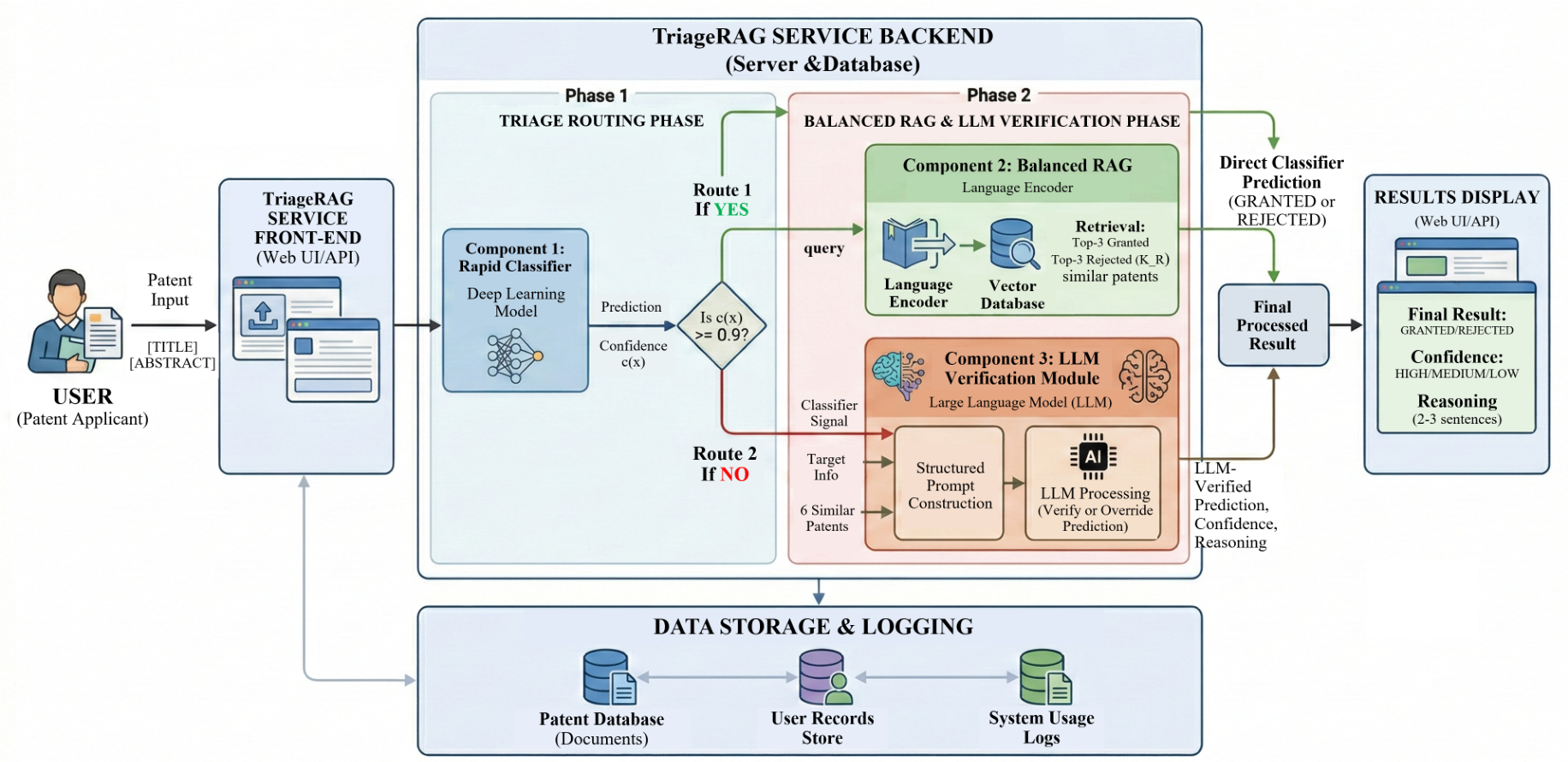
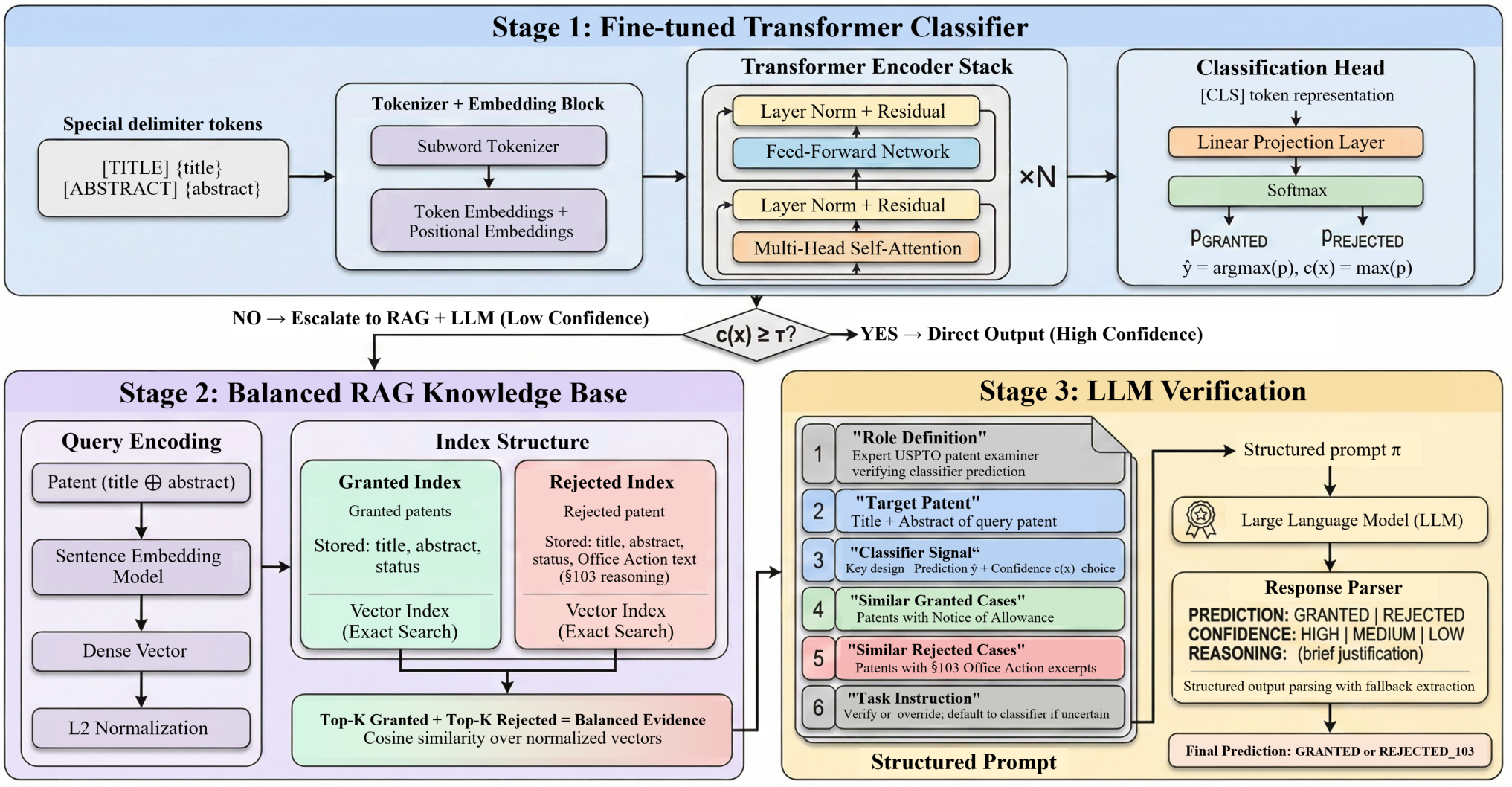
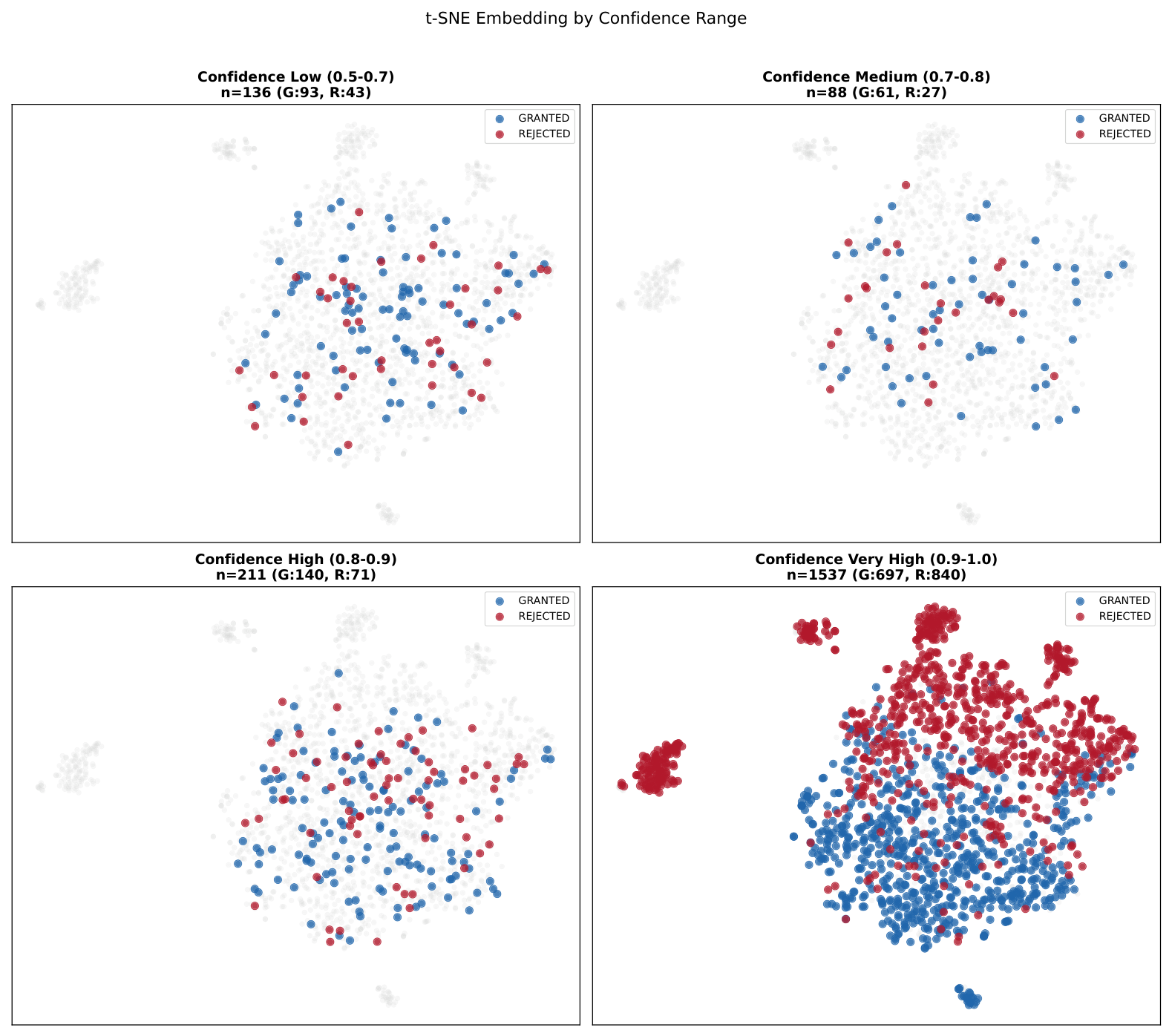
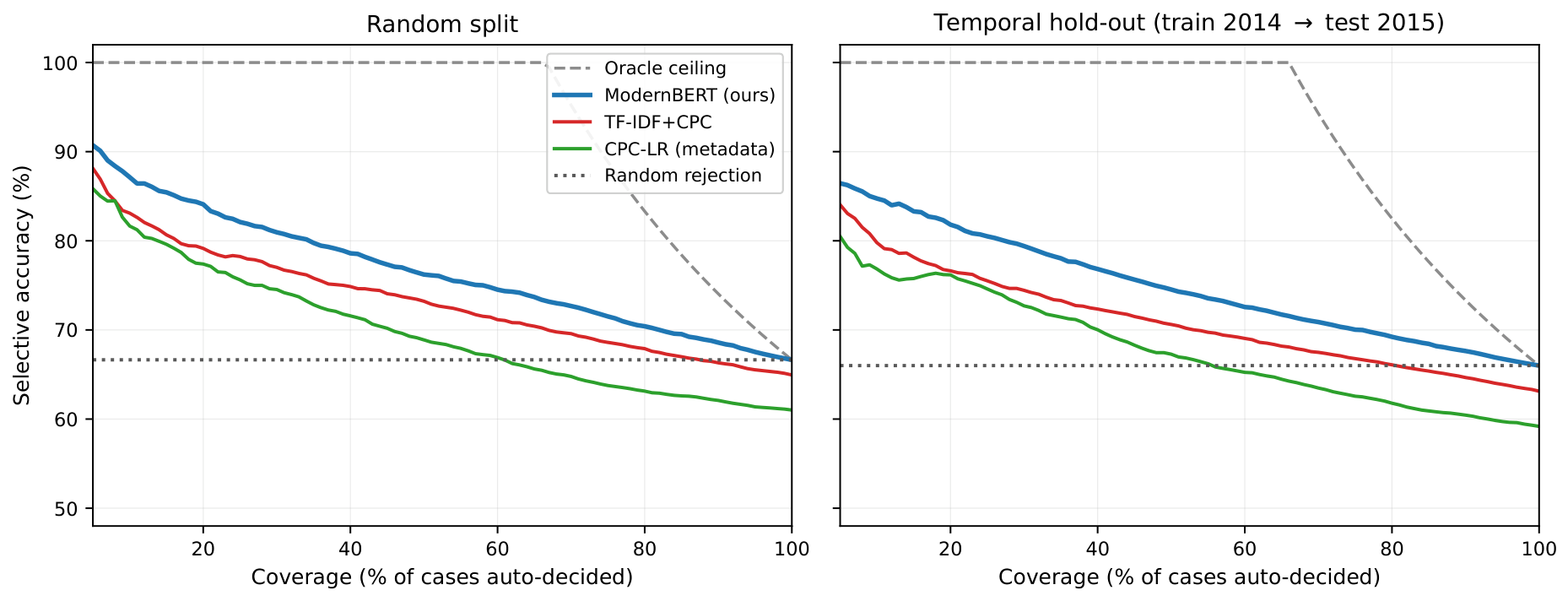
Screening for §103 propensity at the idea stage is inherently difficult: obviousness is a context-sensitive legal determination over prior art combinations that surface-level text cannot fully capture. Yet because §103 concerns the inventive step of the underlying idea rather than only the wording of the claims, an application as filed may already carry a weak signal of §103 propensity—motivating a screening tool at the idea stage. We present TriageRAG (T-RAG), a confidence-based decision-support framework. A fine-tuned ModernBERT-large classifier produces a prediction together with a confidence score; high-confidence cases are delivered directly, while only low-confidence cases are escalated to a large language model (LLM), which is supplied with the classifier’s own prediction as the primary signal together with retrieved similar prior applications, and is instructed to verify the classifier rather than replace it. We evaluate under deliberately leakage-free conditions—a same-era corpus, a temporal hold-out, and a contamination-free label set in which the §103 label follows the USPTO Office Action Research Dataset and the two classes are disjoint by construction. Under these strict conditions the system remains useful: the classifier confidence rank-orders correctness well enough to support high-precision automatic decisions at low coverage, and classifier-primary escalation improves accuracy precisely on the uncertain cases where the classifier is weakest, without degrading it overall. We position the contribution as a triage architecture—turning a deliberately commodity classifier into an auditable decision-support tool—rather than as a new classifier. Ablation studies isolate the roles of confidence routing, retrieval design, and the escalation prompt, and characterize the accuracy–cost trade-off across the escalation threshold.
Keywords: idea-stage §103-propensity screening; patent decision support; retrieval-augmented generation; confidence-based routing; ModernBERT; large language models; selective prediction; obviousness rejection idea-stage §103-propensity screening; patent decision support; retrieval-augmented generation; confidence-based routing; ModernBERT; large language models; selective prediction; obviousness rejection