Article

Modular Legal Personhood for AI Use Cases: An Enterprise Systems Engineering Framework for Digital Transformation †
by
Mayumi J. Okuno
1,‡ and
Hiroshi G. Okuno
2,3,*,‡
1
Faculty of Law, Toyo University, Hakusan, Bunkyo-ku, Tokyo 112-8606, Japan
2
Future Robotics Organization, Waseda University, Okubo, Shinjuku-ku, Tokyo 169-0072, Japan
3
Graduate School of Informatics, Kyoto University, Sakyo-ku, Kyoto 606-8501, Japan
*
Author to whom correspondence should be addressed.
This paper is an extended version of our paper published in Proceedings of the 2025 IEEE International Symposium on Technology and Society (ISTAS), Santa Clara, CA, USA, 10–12 September 2025.
These authors contributed equally to this work.
Systems 2026, 14(9), 1157; https://doi.org/10.3390/systems14091157
Submission received: 15 July 2026 / Revised: 3 September 2026 / Accepted: 10 September 2026 / Published: 15 September 2026
(This article belongs to the Special Issue Enterprise Systems Engineering and Digital Transformation)

Highlights

Please indicate how your work links to systems science via your contributions to systems practice, theory, and/or methodology.
  • Defines the AI use case as an intermediate enterprise system of interest.
  • Links legal-organizational design to ESE governance functions and assessment.
What are the main findings and/or the implications of the main findings?
  • Legal differentiation adds value only when governance matches operational reality.
  • Alternative forms may suffice if they preserve the required governance functions.

Abstract
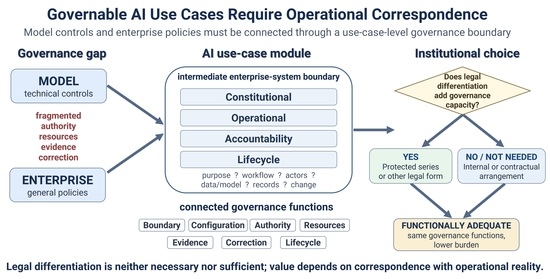
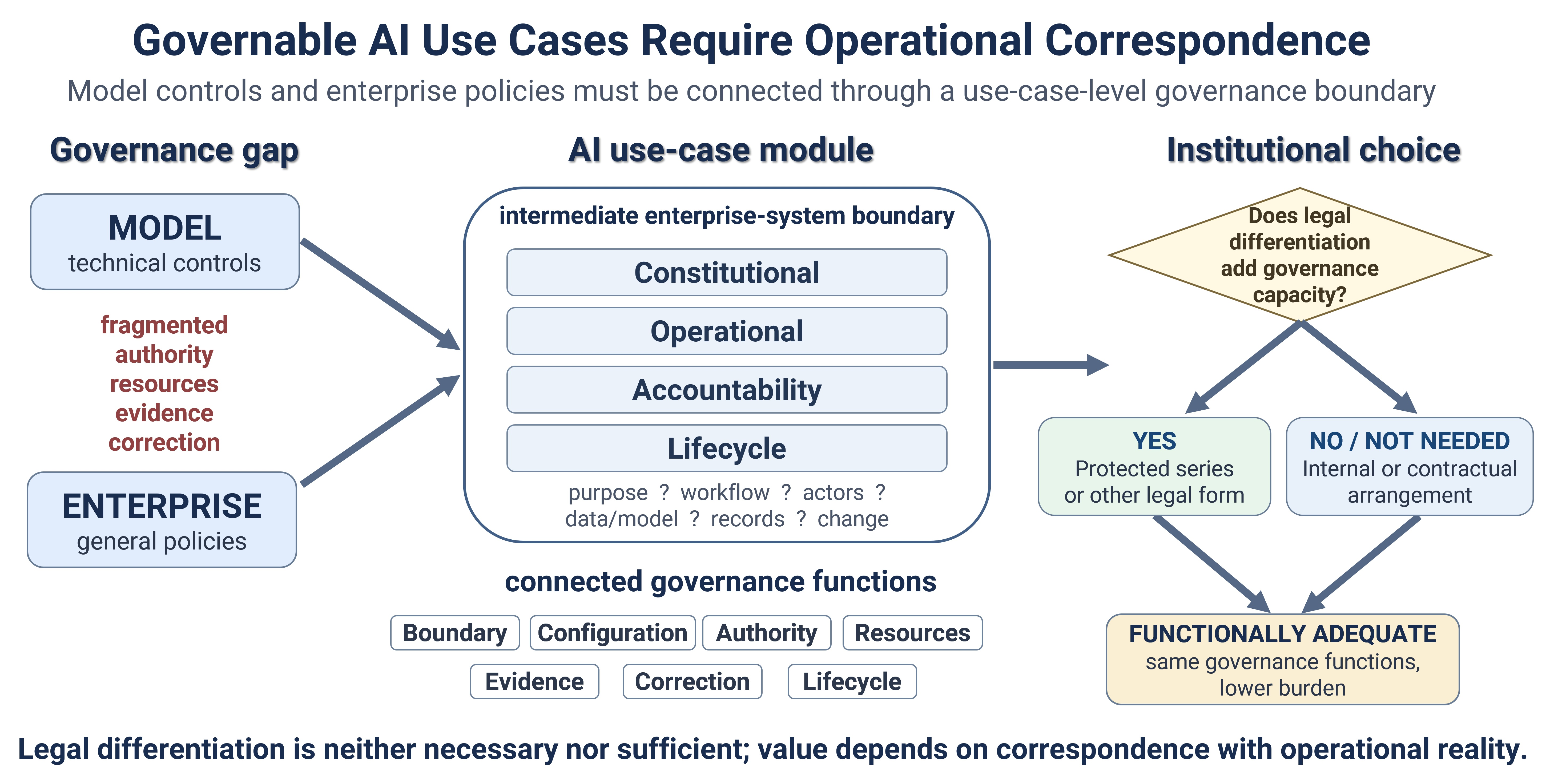
AI-enabled digital transformation can create governance gaps when model-level controls do not capture deployment-specific organizational relationships and enterprise-wide policies remain too general for materially different use cases. This article addresses that problem through a design-theoretic synthesis of Enterprise Systems Engineering, socio-technical governance, modularity theory, accountability scholarship, and organizational law, treating the AI use case as an intermediate enterprise-system boundary. It develops modular legal personhood as one possible legal-organizational architecture for structuring human and enterprise responsibility around that boundary; the concept does not attribute legal personality or autonomous responsibility to AI. The framework specifies connected governance functions, staged implementation, and assessment mechanisms linking boundary, configuration, authority, resources, evidence, corrective action, lifecycle adaptation, and enterprise-level coordination. The analysis indicates that legal differentiation is neither necessary nor sufficient for effective governance: its potential value arises when existing mechanisms leave these functions fragmented, while alternative legal, contractual, or internal arrangements may be preferable when they provide equivalent capabilities with lower burden. The framework remains a design-theoretic and empirically testable proposition; the hypothetical application is illustrative rather than validating, and practical feasibility, reliability, and comparative effectiveness require future organizational pilots and comparative research.

Graphical Abstract

1. Introduction

1.1. Governance Problem and Research Gap

Digital transformation increasingly makes artificial intelligence (AI) a constitutive element of organizational action because AI capabilities are embedded not only in technical systems but also in workflows, data infrastructures, decision processes, vendor relationships, and oversight arrangements [1,2]. Enterprise Systems Engineering (ESE) provides an appropriate perspective on this transformation because it treats the enterprise as a purposeful system in which people, technologies, processes, information, resources, governance arrangements, and external environments must be designed in relation to organizational objectives [3,4]. Accordingly, enterprise AI governance concerns the architecture through which AI-enabled activities are authorized, integrated, monitored, revised, and held to account, rather than the technical performance of models considered in isolation.
Existing governance approaches address important parts of this architecture, although they frequently operate at boundaries that are either too narrow or too broad. Ethical principles articulate general commitments such as transparency, fairness, privacy, responsibility, and human oversight, whereas technical documentation describes models, datasets, intended uses, performance conditions, and limitations. Risk-management frameworks, impact assessments, audits, and regulatory requirements add organizational processes for documentation, monitoring, review, incident response, and lifecycle control. Because these mechanisms do not necessarily identify the concrete organizational activity to which authority, resources, records, risks, and corrective powers belong, their coexistence does not by itself produce an integrated governance unit.
Sociotechnical scholarship cautions that AI governance becomes incomplete when technical abstractions are separated from the institutional settings in which systems acquire organizational meaning and effect [5,6]. Internal auditing research further shows that accountability depends on organizational processes capable of connecting design decisions, deployment conditions, evidence, and corrective action across the lifecycle [7]. These limitations support the need for a use-case-level boundary through which technical, organizational, and institutional requirements can be governed together.
Model-centered governance is too narrow when the effects of AI depend on the purpose pursued, the workflow in which outputs are used, the persons exercising authority, the data and infrastructure supporting the deployment, and the decisions that follow. Enterprise-wide governance is correspondingly too broad when common policies cannot distinguish among deployments with different purposes, affected populations, risk levels, technical dependencies, operating environments, and lifecycle conditions. The resulting boundary deficit makes it difficult to determine what is being governed, which enterprise participants are responsible for particular decisions, what evidence must be preserved, and when a material change requires reassessment or intervention.
The problem is therefore legal-organizational as well as technical because an AI-enabled activity becomes governable only when its operational boundary is associated with decision authority, adequate resources, reviewable records, risk allocation, lifecycle control, and accountability relationships. A governance architecture must preserve enterprise-wide coordination while differentiating individual deployments sufficiently to support context-specific control. This article responds to that problem by treating the AI use case as an intermediate enterprise-system boundary between the technical AI system and the enterprise as a whole.

1.2. Research Question and Principal Claim

The article addresses the following research question: How can an enterprise establish a use-case-level governance boundary that remains legally identifiable, operationally aligned, reviewable, adaptable, and accountable throughout an AI deployment’s lifecycle? This question concerns the institutional design of the deployment rather than the attribution of autonomous legal status to the AI system itself.
The article develops modular legal personhood as a design-theoretic response. The term does not imply that legal personhood itself is divisible into modules. Rather, “modular” refers to the deployment-specific application and configuration of legal-organizational forms and associated governance capacities around distinct AI use cases, while preserving their connection to enterprise-level responsibility. Under this framework, a defined AI use case is associated with a differentiated legal-organizational unit whose governance can be configured according to the deployment’s purpose, operating conditions, risks, interfaces, and lifecycle requirements. Protected series within a Series Limited Liability Company (Series LLC) provide the primary legal prototype. A protected series is a legally differentiated unit established within a broader LLC structure, with governance, assets, obligations, and records that may be associated with that series under applicable law. Its contractual flexibility, differentiated asset structure, liability segregation, and record separateness make the use-case boundary institutionally concrete.
The principal claim is that modular legal personhood can translate an AI use case into a bounded enterprise subsystem when legal differentiation, contractual configuration, and operational practice remain aligned. Legal separation alone is insufficient because a nominal module that lacks corresponding personnel, resources, records, technical control, or corrective authority cannot perform the governance functions assigned to it. Consequently, the framework conditions modularization on operational correspondence, parent-organization responsibility, resource adequacy, accessible evidence, meaningful corrective powers, proportionality, and substance-over-form review.

1.3. Core Concepts and Scope

In this article, an enterprise is a mission-oriented organizational system rather than only a for-profit business firm, so the framework extends to public, private, nonprofit, scientific, infrastructural, and commercial organizations. The framework is particularly relevant where an AI product or service is deployed across organizational boundaries, because external clients, vendors, infrastructure providers, sectoral requirements, and contractual obligations increase the number of interfaces through which authority, evidence, risk, and corrective responsibility must be coordinated. Its scope is not limited to commercial deployment, however, because comparable governance problems arise when public, nonprofit, scientific, or infrastructural organizations rely on externally supplied AI capabilities or operate AI across differentiated internal units. An AI use case is the bounded socio-technical configuration through which AI capability is applied to a declared organizational purpose, including the relevant data and model dependencies, workflows, human roles, infrastructure, external relationships, decisions, resources, risks, records, oversight arrangements, and lifecycle controls. This boundary is broader than the technical model because it includes the organizational conditions that give the model practical effect, whereas it is narrower than the enterprise because it remains associated with a particular purpose and deployment.
Enterprise participants are the persons and entities that authorize, design, supply, finance, insure, operate, audit, oversee, or regulate an AI use case. Affected stakeholders are the persons or groups whose rights, interests, opportunities, or welfare may be materially affected by the deployment. The distinction matters because a person may be affected by a use case without participating in its design or operation, while governance must account both for the allocation of responsibility among enterprise participants and for consequences experienced by affected stakeholders.
The contractual architecture combines a common contractual core with one or more deployment-specific riders. The common contractual core is the stable body of terms that preserves the module’s institutional identity, baseline governance, relationship with the associated organization, recordkeeping obligations, amendment procedures, escalation structure, and conditions for suspension or termination. A deployment-specific rider is a functionally delimited contractual component that supplements or modifies the common core in response to a defined deployment condition, such as an applicable jurisdiction, sectoral requirement, risk classification, data or model dependency, vendor relationship, human-oversight arrangement, incident-response duty, or lifecycle change. A modular operating agreement is the configurational method through which the complete body of terms governing a protected series is composed from that stable core and the riders required by the particular deployment.
The resulting AI use-case module is a bounded legal-organizational and enterprise-system unit through which a specific AI use case can be authorized, resourced, monitored, reviewed, modified, suspended, or retired. The framework combines structural modularity, which differentiates the module as an institutional unit, with configurational modularity, which permits its governance requirements to be assembled and revised through identifiable contractual components. Because the broader proposition is functional rather than form-dependent, organizations may reproduce these functions through subsidiaries, special-purpose entities, protected cell companies, internal charters, dedicated accounting arrangements, regulated operating units, procurement structures, or board-approved governance plans when protected-series law is unavailable or disproportionate.

1.4. Research Approach

This study adopts a design-theoretic approach to construct an enterprise systems engineering framework for governing AI use cases. It synthesizes insights from enterprise systems engineering, socio-technical governance, organizational design, AI governance, and organizational law to identify recurring boundary and governance problems and translate them into design requirements. These requirements are then mapped to legal-organizational, contractual, architectural, and assessment mechanisms. The detailed literature-selection criteria, analytical synthesis procedure, framework-construction process, and evaluation status are described in Section 3.
The study does not empirically validate the proposed framework or claim that modular legal personhood is universally necessary or superior to existing governance arrangements. Rather, it develops an analytically traceable and empirically testable design proposition whose practical viability and comparative value require future real-world evaluation.

1.5. Contributions and Article Structure

The article makes five related contributions. First, it identifies the AI use case as an intermediate systems boundary through which technical capability, organizational purpose, operational authority, affected stakeholders, resources, risks, evidence, and lifecycle change can be governed together. Second, it develops modular legal personhood as a legal-organizational substrate for institutionalizing that boundary without attributing independent moral or legal agency to the AI system. Third, it defines the modular operating agreement as a contractual configuration architecture that combines a stable common core with deployment-specific riders. Fourth, it translates this architecture into cumulative ESE governance functions and a layered AI use-case module. Fifth, it develops an assessment logic through which formal existence, operational correspondence, and governance performance can be distinguished and examined.
These contributions extend, while remaining distinct from, the authors’ prior and related work. The authors’ AI & Society article examined how business-entity structures can support liability protection, risk allocation, and AI service governance across jurisdictions [8], whereas the ISTAS-25 paper introduced modular legal personhood through protected-series design and deployment-specific contractual riders [9]. The present article instead constructs an ESE framework that connects the AI use-case boundary, legal-organizational differentiation, contractual configuration, layered governance functions, implementation indicators, and an empirical research agenda.

2. Literature Review and Conceptual Foundations

This section develops the conceptual foundations for treating the AI use case as an intermediate enterprise-system boundary. The literature identifies three connected problems: AI-enabled transformation distributes decision making across technical and organizational components, existing governance mechanisms do not necessarily converge on a common operational object, and a socio-technical boundary remains ineffective unless it acquires institutional capacity. The review therefore proceeds from ESE and digital transformation, through socio-technical AI governance and the boundary deficit in existing approaches, to modularity, organizational design, and legal personhood. It concludes by deriving the design requirements used to construct the framework in Section 3.

2.1. Enterprise Systems Engineering and Digital Transformation

AI-enabled digital transformation presents an enterprise-design problem because the introduction of AI can alter organizational processes, decision rights, information flows, capabilities, value creation, and relationships with external actors [1,2]. Digital technologies are also recombinable across organizational settings, which means that models, data services, platforms, and automated functions may migrate beyond the workflow or unit for which they were initially introduced [10]. Consequently, governance cannot be limited to the technical acquisition of an AI system because the deployment may reconfigure the enterprise through the activities, dependencies, and decisions that develop around it.
ESE responds to this problem by treating the enterprise as a purposeful and evolving system whose people, technologies, processes, information, resources, governance arrangements, and external relationships must remain aligned with mission-level objectives [3,11]. From this perspective, AI governance concerns the architecture through which an AI-enabled activity is authorized, integrated, supported, monitored, modified, and held to account. Because lifecycle integration, stakeholder concerns, configuration control, risk management, and organizational adaptation are already central ESE concerns, the field provides a basis for examining AI governance as an enterprise capability rather than as a model-level control [4].
The distributed structure of contemporary AI deployments nevertheless complicates enterprise-wide control because models, datasets, infrastructure providers, vendors, workflows, and oversight functions may remain operationally or managerially independent while contributing to the same organizational outcome. Such arrangements exhibit systems-of-systems characteristics when components develop under different authorities, incentives, contracts, locations, and timescales [12]. Although centralized policies may establish common expectations, they cannot by themselves ensure that authority, evidence, resources, and corrective capacity remain coordinated across distributed dependencies [13].
The literature therefore points to a need for governance that is simultaneously differentiated and coordinated. A viable architecture must isolate a sufficiently specific activity for control while preserving its interfaces with enterprise-level strategy, shared infrastructure, portfolio oversight, and external obligations. The resulting design problem is not whether the enterprise should govern AI centrally or locally, but how it can establish bounded governance units whose variation remains compatible with enterprise-wide direction.

2.2. Socio-Technical AI Governance

The technical model cannot serve as the sole object of governance because the meaning and consequences of AI arise from interactions among technical artifacts, organizational purposes, human practices, institutional conditions, and affected stakeholders. Socio-technical systems research has long shown that technical and social arrangements must be designed jointly, while studies of situated action and technology in practice demonstrate that organizational effects cannot be inferred from technical properties alone [14,15,16]. An AI deployment must therefore be understood through the activity in which the model is embedded rather than through the model as an isolated artifact [17,18].
This problem becomes particularly significant during problem formulation because the organizational purpose assigned to a deployment shapes its target variables, proxies, evaluation criteria, data requirements, and operational decisions [19]. When those choices are abstracted from their institutional setting, technical specifications may conceal the relationships, assumptions, and downstream consequences through which the system acquires practical effect. Sociotechnical scholarship accordingly cautions that AI governance becomes incomplete when technical abstractions are separated from the settings in which systems are designed, interpreted, and used [5].
Human involvement does not remove this difficulty because the effectiveness of oversight depends on how authority, information, workload, intervention points, and escalation duties are organized. A nominal statement that a human remains in the loop provides limited assurance when the responsible person lacks timely information, practical override authority, organizational support, or the ability to alter the workflow [20,21]. Governance must therefore specify not only whether human review exists, but also when it occurs, what evidence supports it, who may intervene, and what consequences follow from that intervention.
Organizational research on responsible AI reaches a related conclusion because ethical and assurance functions depend on reporting relationships, access to decision makers, cross-functional coordination, incentives, and the capacity to modify development or deployment practices [22,23]. Internal auditing research further demonstrates that accountability requires organizational processes capable of connecting design choices, deployment conditions, evidence, incidents, and corrective action across the lifecycle [7]. The appropriate object of governance is therefore the socio-technical activity through which enterprise participants combine AI capability with organizational action, rather than any technical component considered separately.

2.3. The Boundary Deficit in Existing AI Governance

Contemporary AI governance provides principles, documentation practices, audits, impact assessments, risk-management processes, and regulatory duties, although these mechanisms do not necessarily converge on a shared operational boundary. Ethics frameworks articulate commitments such as fairness, transparency, privacy, responsibility, and human oversight, while organizational methods seek to translate those commitments into procedures and tools [24,25,26,27]. The persistent problem is that general principles do not determine the particular activity, actors, resources, evidence, or corrective powers through which they must be implemented.
Technical documentation improves the visibility of models and datasets by recording intended uses, evaluation conditions, performance characteristics, composition, provenance, processing, and limitations [28,29,30]. These materials are indispensable for technical review, yet they do not independently establish who authorized the deployment, which workflow it affects, what resources sustain it, how external dependencies are governed, or which organizational unit must respond when conditions change. Model-centered governance may therefore be insufficient when organizational effects depend on relationships among technical components, workflow, human authority, external dependencies, and downstream decisions that extend beyond the model itself.
Enterprise-wide governance can present a complementary limitation because policies formulated for an organization as a whole may be insufficiently specific for deployments with materially different purposes, affected stakeholders, risk levels, technical dependencies, jurisdictions, and lifecycle conditions. Although a common policy can define baseline expectations, implementation still requires an identifiable activity to which decision rights, records, review duties, and escalation mechanisms can be attached. Enterprise-level commitments become operational only when they are translated into governance arrangements for a concrete use case.
Accountability, auditing, and impact-assessment scholarship make this requirement especially clear because each approach presupposes an object whose decisions and consequences can be reconstructed and evaluated. Accountability requires an actor to explain and justify conduct before a forum capable of assessment and response, while auditing requires evidence connecting organizational commitments to design, deployment, monitoring, incidents, and remediation [7,31,32,33]. Impact assessment likewise becomes consequential only when it is integrated into decision-making processes whose participants have access to relevant information and authority to modify, suspend, or reject the proposed activity [6].
Risk-management and regulatory frameworks reinforce the same institutional requirement. The NIST AI Risk Management Framework and ISO/IEC 23894 organize governance around lifecycle activities for identifying, assessing, monitoring, communicating, and treating AI risks [34,35]. The EU AI Act similarly connects obligations to intended purpose, risk classification, documentation, record keeping, human oversight, incident reporting, and post-market monitoring [36]. These requirements cannot be implemented coherently unless the organization can identify the deployment to which the relevant duties, responsible actors, resources, records, and corrective powers belong.
The resulting deficit is therefore a boundary deficit rather than an absence of governance mechanisms. It arises conditionally where the applicable governance level fails to provide a persistent organizational object to which the complete deployment-specific governance configuration can be attached. Model-level controls may be insufficient when relevant organizational effects extend beyond the model, whereas enterprise-wide controls may be insufficiently specific when materially different deployments require distinct actors, resources, records, controls, contractual relationships, and lifecycle responses. Table 1 summarizes the relative strengths, conditional limitations, and appropriate roles of model-level, enterprise-level, and AI use-case-level governance boundaries.
Against this comparison, the AI use-case boundary is not selected merely because it lies between the model and the enterprise. It is proposed as the smallest persistent organizational unit capable of including the deployment’s declared purpose, workflow, responsible actors, technical dependencies, affected stakeholders, resources, records, external relationships, and lifecycle controls while excluding unrelated enterprise activities. Its adequacy therefore depends on four conditions: sufficient completeness to capture the relationships that generate organizational effects; sufficient specificity to distinguish the deployment from other activities; sufficient persistence to support lifecycle governance; and sufficient connectivity to enterprise-level resources, shared dependencies, and escalation mechanisms.
These conditions also limit the claim made in this article. As Table 1 indicates, the proposed use-case boundary is complementary to, rather than a replacement for, model-level and enterprise-level governance. Where model-level governance already captures the relevant organizational relationships, or where enterprise-level governance provides sufficiently specific and persistent control over the deployment, an additional use-case-level boundary may provide little incremental value. The proposed boundary is therefore justified only when it improves the correspondence between the governed activity and the organizational object through which authority, resources, evidence, correction, and lifecycle responsibilities are coordinated.

2.4. Modularity, Organizational Design, and Legal Personhood

Identifying the AI use case as a socio-technical system of interest does not itself provide the institutional capacity needed to govern it. ESE can specify the boundary, functions, and interfaces of a system of interest, but those specifications do not by themselves create a persistent organizational unit capable of holding resources, allocating authority, maintaining records, or structuring external relationships. The resulting institutional gap is addressed through legal-organizational modularity, which makes the identified boundary institutionally recognizable and operable over time. This requirement connects the socio-technical and ESE literature to modular systems theory, organizational design, and organizational law.
Near-decomposability explains how complex systems can remain intelligible when relationships within modules are more stable and intensive than relationships across their boundaries [37]. Modular architecture further requires the disciplined allocation of functions and the specification of interfaces through which components can be combined, varied, or replaced without redesigning the system as a whole [38,39]. Because standardized interfaces and shared design rules can coordinate adaptation across technical and organizational structures, modularity provides a conceptual basis for differentiating AI use cases while preserving enterprise-level coordination [40,41].
The same logic applies to governance because AI deployments may share baseline requirements while differing in purpose, operating environment, risk, technical dependencies, external relationships, and lifecycle conditions. A monolithic governance instrument makes such variation difficult to isolate and revise, whereas entirely bespoke arrangements can fragment common standards and increase coordination costs. A modular governance architecture must therefore preserve a stable institutional identity while allowing defined components to change in response to deployment-specific conditions.
Organizational law contributes a complementary mechanism because legal personality and entity boundaries can associate assets, claims, obligations, decision rights, records, and external relationships with a differentiated organizational unit [42]. Asset-partitioning scholarship explains how legally recognized boundaries can structure relationships among an organization, its participants, creditors, contracting parties, and other stakeholders [43,44,45]. Legal personhood consequently has systems significance when it makes an operational boundary institutionally recognizable and connects responsibility with the resources and authority needed to exercise it.
This functional use of legal personhood differs from proposals to grant autonomous, moral, or electronic personality to AI systems. The relevant subject is not the model or machine considered as an independent rights-bearing actor, but the human and organizational arrangement through which a defined AI use case is authorized and operated. Although the literature on electronic and synthetic personhood reveals risks of control gaps and responsibility displacement, it also underscores the need for institutional forms that keep responsibility attached to the enterprise participants who design, deploy, oversee, and benefit from AI-enabled activity [46,47,48,49,50,51].
Protected series provide a useful prototype because they combine differentiation within a broader organizational structure with the possibility of separate governance, assets, obligations, and records. Their value at this stage of the argument is conceptual rather than doctrinal: they illustrate how structural modularity can give an AI use case an institutional boundary, while contractual modularity can configure governance within that boundary. The statutory requirements, legal limitations, and contractual construction of that prototype are examined in Section 3 rather than in the literature review.

2.5. Design Requirements Derived from the Literature

The literature first establishes that the governance architecture requires a determinate use-case boundary. That boundary must connect a declared purpose with the relevant workflow, technical dependencies, enterprise participants, affected stakeholders, decisions, and operating context because a boundary defined only by the model cannot capture the activity through which organizational effects arise. At the same time, the boundary must remain connected to enterprise strategy and portfolio oversight so that modularization does not become institutional isolation.
Second, governance must be configurable because deployments share some requirements while differing in material conditions. A stable baseline should preserve institutional identity, common authority rules, recordkeeping expectations, escalation relationships, and enterprise responsibility, whereas controlled variation should permit governance to respond to differences in risk, jurisdiction, technical dependency, external participation, and lifecycle status. Configurability must remain reviewable, which means that the applicable governance configuration and the reasons for changing it must be identifiable over time.
Third, the architecture must align authority and interfaces because responsibility becomes nominal when decision rights do not correspond to the technical and organizational dependencies that shape the deployment. It must also align resources with risk because a governance unit cannot monitor, investigate, correct, or suspend an AI use case without adequate personnel, information, technical access, financial support, and escalation capacity. Where risks or dependencies exceed the module’s authority or resources, the architecture must connect the issue to enterprise-level intervention rather than treating the boundary as a shield against broader responsibility.
Fourth, the architecture must make the use case observable and adaptable throughout its lifecycle. Reviewable evidence should connect authorization, design assumptions, technical changes, human interventions, incidents, stakeholder effects, audit findings, and corrective action, while configuration controls should identify when a change requires reassessment, amendment, suspension, or retirement. Because no formal boundary can guarantee substantive performance, implementation must also be assessed for correspondence between documented governance, operational practice, and actual governance capacity.
Taken together, the literature yields seven design requirements: determinate boundary identity, configurable governance, authority-interface alignment, resource-risk capacity, reviewable evidence and corrective capacity, lifecycle adaptation, and organizational anchoring. These requirements provide the criteria against which the framework is constructed rather than conclusions inferred from the legal prototype. Section 3 therefore begins by explaining the design-theoretic method through which these requirements are translated into a legal-organizational substrate, a modular contractual architecture, and a layered AI use-case module.

3. Design-Theoretic Framework Construction

Section 2 derived seven architecture-level requirements for a use-case-level governance framework: determinate boundary identity, configurable governance, authority-interface alignment, resource-risk capacity, reviewable evidence and corrective capacity, lifecycle adaptation, and organizational anchoring. This section explains the design-theoretic method through which those requirements are translated into a legal-organizational substrate, a modular contractual architecture, a layered AI use-case module, and connected governance functions. It also identifies the analytical outputs of the construction and distinguishes them from empirical findings concerning implementation effectiveness.

3.1. Design-Theoretic Method and Analytical Synthesis

The research problem concerns the design of an institutional arrangement that connects legal form, contractual governance, organizational practice, technical deployment, and enterprise architecture. It therefore cannot be addressed through doctrinal legal analysis, technical risk analysis, or organizational analysis considered separately. The study adopts a design-theoretic orientation in which the principal research output is a framework specifying the components, relationships, functions, and implementation conditions required to govern an AI use case as an enterprise subsystem. The unit of analysis is not the AI model, legal entity, or enterprise considered independently, but the governance architecture through which a defined AI use case is authorized, configured, operated, reviewed, modified, suspended, and retired.
The literature synthesis is purposive and function-oriented rather than systematic, bibliometric, or exhaustive. Sources were included in the principal construction when they contributed directly to at least one component of the design problem: enterprise boundaries and interfaces; socio-technical integration; modularity and configuration; organizational authority and capacity; evidence, accountability, and corrective action; lifecycle control; or the legal institutionalization of differentiated organizational units. Priority was given to foundational systems and organizational scholarship, peer-reviewed research identifying recurrent governance or implementation problems, authoritative standards and regulatory materials, and organizational-law sources capable of clarifying the institutional functions of legal differentiation. This selection strategy reflects the interdisciplinary and design-oriented purpose of the study rather than an attempt to reproduce the search and screening procedures of a systematic literature review.
Materials were not used as principal construction sources when they addressed model performance without an identifiable organizational-governance implication, described sector-specific controls without a transferable architectural relationship, or concerned doctrinal details unrelated to the functions assigned to the proposed use-case boundary. Such materials may remain relevant to the substantive governance of a particular deployment, but they do not independently determine the architecture-level relationships examined in this article. The inclusion and exclusion criteria therefore concern the role of sources in framework construction rather than a claim that excluded topics are unimportant to AI governance.
The analytical synthesis proceeded by extracting design-relevant propositions from the selected source domains in three forms: governance conditions that an architecture should satisfy, failure modes that an architecture should prevent or reveal, and institutional capabilities required to connect governance requirements with organizational action. Conceptually overlapping propositions were consolidated when they addressed the same architecture-level relationship. A proposition was retained separately when combining it with another would remove a distinct relationship among the governance boundary, authority, interfaces, resources, evidence, corrective action, lifecycle change, or enterprise responsibility. This procedure constitutes an interpretive analytical synthesis rather than a formal qualitative coding study. Accordingly, the study does not claim inter-coder reliability, exhaustive coverage, or the reproducibility associated with a systematic review.
The number seven was not predetermined and is not presented as a universal or exhaustive taxonomy of AI-governance concerns. Seven requirements were retained because each represents a distinct architecture-level failure mode that could not be absorbed into another requirement without losing an important design relationship. These failure modes are an indeterminate object of governance; uncontrolled deployment-specific variation; responsibility without corresponding interface authority; responsibility without adequate capacity; review without continuous evidence or effective corrective action; governance that does not adapt to material change; and modularization that becomes disconnected from enterprise responsibility. The resulting requirements are determinate boundary identity, configurable governance, authority-interface alignment, resource-risk capacity, reviewable evidence and corrective capacity, lifecycle adaptation, and organizational anchoring.
Substantive concerns such as fairness, privacy, security, safety, transparency, and sector-specific compliance are not excluded from the framework. They enter as deployment-specific governance and control contents configured within the architecture rather than as additional architecture-level requirements. This distinction separates the structure through which governance is organized from the substantive obligations and values that the structure must implement in a particular use case.
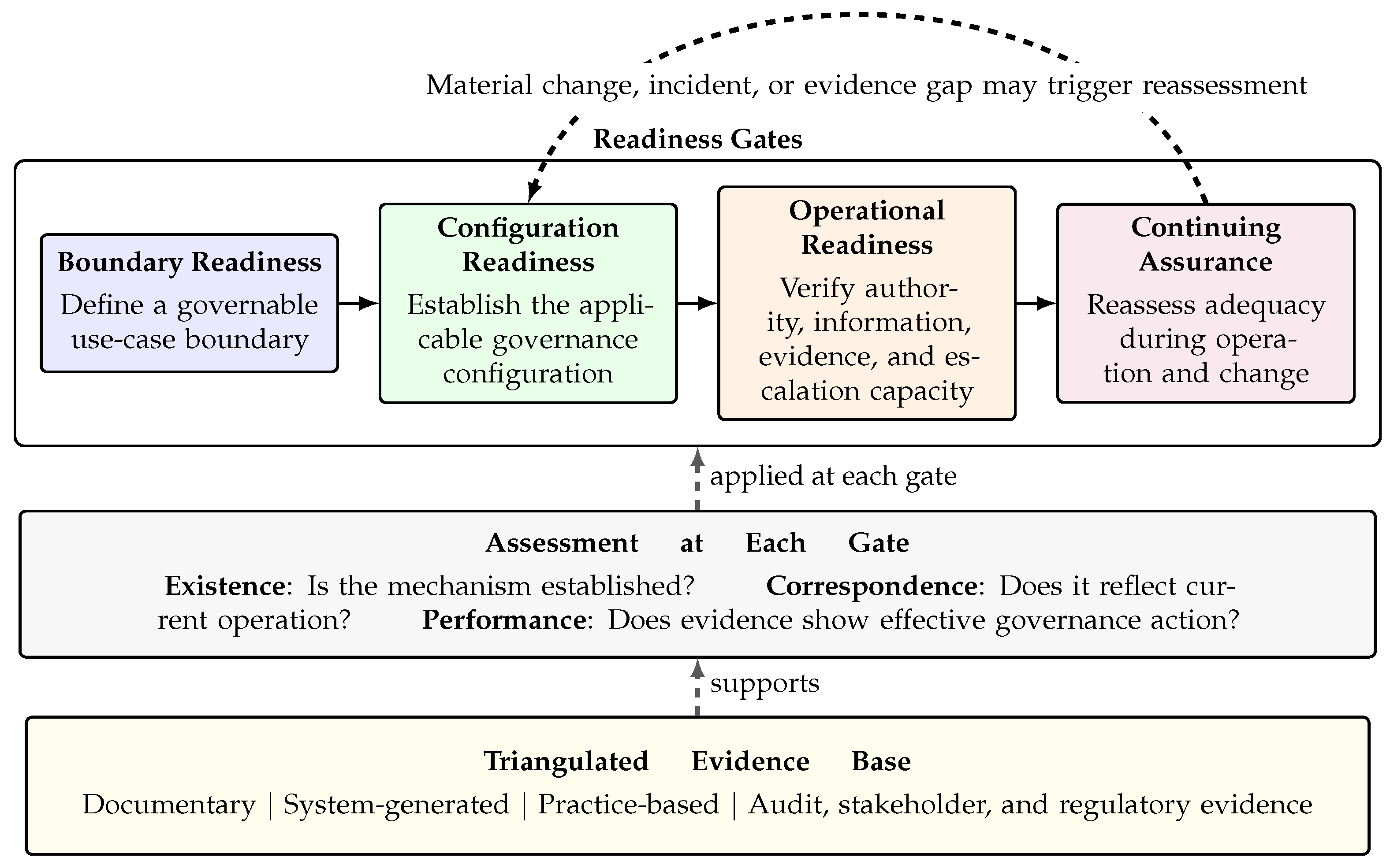
Framework construction follows a sequence of analytical translations. First, the boundary deficit identified in Section 2.3 is translated into the seven design requirements summarized in Section 2.5. Second, protected-series and organizational-law features are examined to determine which requirements they may support and which require additional contractual, operational, or enterprise-level mechanisms. Third, the resulting legal and contractual mechanisms are translated into constitutional, operational, accountability, and lifecycle layers within an AI use-case module. Fourth, the architectural components are analyzed in terms of the governance functions they are intended to support. Fifth, readiness gates, assessment dimensions, and candidate indicators are specified so that formal design can subsequently be compared with operational correspondence and observed governance performance.
Protected series are used as the primary legal prototype because they make differentiated governance within a continuing organizational structure especially visible. They are not selected on the assumption that they are universally available, necessary, or superior to every alternative legal or organizational arrangement. The prototype is examined through functional correspondence with the design requirements and through analytical traceability among legal features, contractual mechanisms, architectural layers, governance functions, and assessment dimensions. Its feasibility and legal limitations are addressed separately in Section 3.3.
At this stage, the framework is evaluated through analytical traceability, internal coherence, selective comparison with external governance reference points, and illustrative application. Analytical traceability examines whether each literature-derived requirement is connected to an identifiable legal, contractual, organizational, or architectural response. Internal coherence examines whether the proposed layers, functions, implementation gates, assessment dimensions, and indicators remain mutually consistent. Selective comparison examines how the framework relates functionally to established risk-management, regulatory, auditing, documentation, procurement, and compliance mechanisms. Illustrative application examines whether the proposed concepts can be applied consistently to stipulated deployment conditions.
These forms of evaluation do not establish comparative effectiveness, causal validity, practical feasibility, cost efficiency, or improved organizational performance. The study does not report observed numerical changes in incident rates, compliance outcomes, evidence completeness, escalation latency, corrective-action performance, or governance cost. The resulting framework is therefore an analytically constructed and empirically testable design proposition rather than an empirically validated maturity, causal, or performance model. Real-world pilot implementation, independent application, longitudinal observation, and comparison with existing organizational arrangements remain necessary to evaluate its practical viability and relative advantages.

3.2. Modular Legal Personhood as the Legal-Organizational Substrate

A socio-technical boundary does not become governable merely because analysts can describe it. Unless authority, resources, obligations, records, and external relationships are associated with an institutionally recognizable unit, the identified use case may remain dependent on dispersed arrangements that cannot be reviewed or corrected as a coherent whole. The first construction problem is therefore to provide the use-case boundary with sufficient legal and organizational substance without treating the AI system itself as an autonomous legal actor.
Modular legal personhood responds to this problem by using an organizational boundary to structure responsibility around the deployment. Legal personality and entity differentiation can associate assets, claims, decision rights, contractual relationships, and records with a specified organizational unit, while asset partitioning can distinguish that unit’s resources and obligations from those associated with other activities [42,43,44,45]. The framework uses these features instrumentally because the purpose of the legal boundary is to make human and organizational responsibility more specific, rather than to transfer responsibility to the AI system.
Protected series within a Series LLC provide the primary prototype because they permit differentiated organizational arrangements to operate within a continuing relationship with an associated LLC. LLC law generally allows substantial contractual specification of management authority, economic arrangements, information rights, internal procedures, and relationships among organizational participants, subject to mandatory legal limits [52,53]. Protected-series statutes add mechanisms for associating assets, obligations, records, management arrangements, and liability consequences with individual series, although the precise requirements and legal effects vary among jurisdictions [54,55]. These features make the protected series a useful institutional substrate for representing an AI use case as a bounded organizational module.
The legal boundary nevertheless supports governance only when it corresponds to the actual deployment. A protected series that exists formally but lacks control over relevant resources, access to operational records, authority over dependent systems, or the capacity to initiate corrective action does not satisfy the design requirements established in Section 2.5. Operational correspondence therefore requires the declared purpose, participating actors, assets, contracts, workflows, technical dependencies, records, and decision rights of the series to remain aligned with the AI-enabled activity attributed to it.
The associated LLC also remains part of the governance architecture because modularization cannot be allowed to fragment enterprise responsibility. Shared infrastructure, common vendors, enterprise policies, portfolio dependencies, financial support, and escalation authority may remain outside the individual series even when use-case governance is differentiated. Accordingly, modular legal personhood combines local differentiation with organizational anchoring: the protected series provides a specific governance boundary, while the associated LLC retains responsibilities for portfolio coordination, shared capabilities, resource support, escalation, and correction when a risk exceeds the authority or capacity of the module.

3.3. Feasibility Conditions and Limits of the Protected-Series Prototype

The protected-series prototype is subject to threshold legal feasibility conditions. Organizational law can use entity differentiation and asset partitioning to associate assets, obligations, decision rights, contractual relationships, and records with a defined organizational unit, but the legal consequences of that differentiation depend on the applicable organizational form and governing law [42,43,44,45]. Protected-series regimes accordingly vary in their formation requirements, notice mechanisms, recordkeeping and asset-association conditions, management arrangements, and liability effects [54,55]. The prototype should therefore be treated as legally implementable only where the governing jurisdiction authorizes the relevant form and the legal conditions necessary for the intended differentiation can be satisfied in practice.
As of August 2026, 21 U.S. states statutorily authorize some form of domestic series or protected-series structure, while the other states do not provide a comparable domestic formation mechanism [56]. The District of Columbia and Puerto Rico also provide statutory series regimes [56]. These regimes are not uniform in terminology, formation procedure, recordkeeping requirements, asset-association rules, or liability effects. The absence of a domestic formation statute, however, does not necessarily preclude a protected series formed elsewhere from registering or obtaining authority to transact business in that jurisdiction. For purposes of this discussion, a “foreign protected series” means a protected series formed under the law of a jurisdiction other than the forum jurisdiction, including another U.S. state. Domestic formation authority and the treatment of a foreign protected series must therefore be analyzed as distinct legal questions.
Formation under one jurisdiction does not resolve every legal question arising from deployment or external relationships in another jurisdiction. A number of jurisdictions permit a foreign protected series to register or obtain authority to transact business even though their own law does not provide an equivalent domestic formation mechanism [56]. The applicable procedures vary and may require registration by the series LLC, registration by an individual series, certificates of authority, disclosure of the existence of the series, or disclosure of the liability-segregation characteristics created by the formation law [56]. Some jurisdictions also address the law governing the organization, internal affairs, or liability of a foreign protected series. Registration or authorization to transact business should not, however, be treated as a categorical guarantee that every inter-series liability limitation, asset-partitioning effect, or other legal consequence recognized by the formation jurisdiction will receive identical effect in the forum jurisdiction. Where an AI use case, its assets, contracting parties, creditors, or regulated activities span jurisdictions, implementation therefore requires separate analysis of domestic formation authority, foreign-series registration, governing law, liability-segregation effects, insolvency and creditor consequences, and other mandatory local requirements.
Commercial law provides a related, although function-specific, development toward more explicit treatment of protected series. The 2022 Amendments to the Uniform Commercial Code (UCC) expressly include a protected series of a series organization within the definition of a “person,” thereby allowing a qualifying protected series, where otherwise applicable, to be treated as an organization and as a debtor under Article 9 [57,58]. For UCC purposes, this treatment is not limited to a protected series formed under the law of the enacting state. In jurisdictions that enact the 2022 Amendments, the rule therefore makes the commercial-law treatment of protected series more explicit and potentially more uniform for transactions governed by the UCC. That UCC classification does not, however, itself determine whether the forum jurisdiction will give effect to every liability-segregation rule or other entity-law consequence created by the protected-series law of another jurisdiction. Commercial-law treatment should consequently be distinguished from recognition of the full entity-law consequences of a foreign protected series.
Sectoral feasibility must be assessed separately from entity-law availability. In highly regulated settings, including health care, financial services, critical infrastructure, and other licensed or regulated activities, sector-specific law may assign duties, licenses, reporting obligations, professional responsibilities, privacy or data-governance requirements, or reserved decision authority to an enterprise, regulated operator, licensed provider, or other designated actor. Those obligations cannot be displaced merely by placing an AI use case within a protected series. A protected-series implementation is therefore feasible only to the extent that use-case-level differentiation remains compatible with the nondelegable and organization-level responsibilities imposed by the applicable sectoral regime.
Legal availability is necessary but not sufficient for governance feasibility. LLC law generally permits substantial contractual specification of management authority, economic arrangements, information rights, internal procedures, and relationships among organizational participants, subject to applicable legal limits [52,53]. A protected series that exists formally but lacks access to relevant records, authority over material interfaces, control or assured access to necessary resources, or the capacity to initiate escalation and corrective action does not satisfy the design requirements established in Section 2.5. Operational correspondence therefore requires the declared purpose, participating actors, assets, contracts, workflows, technical dependencies, records, and decision rights of the series to remain aligned with the AI-enabled activity attributed to it.
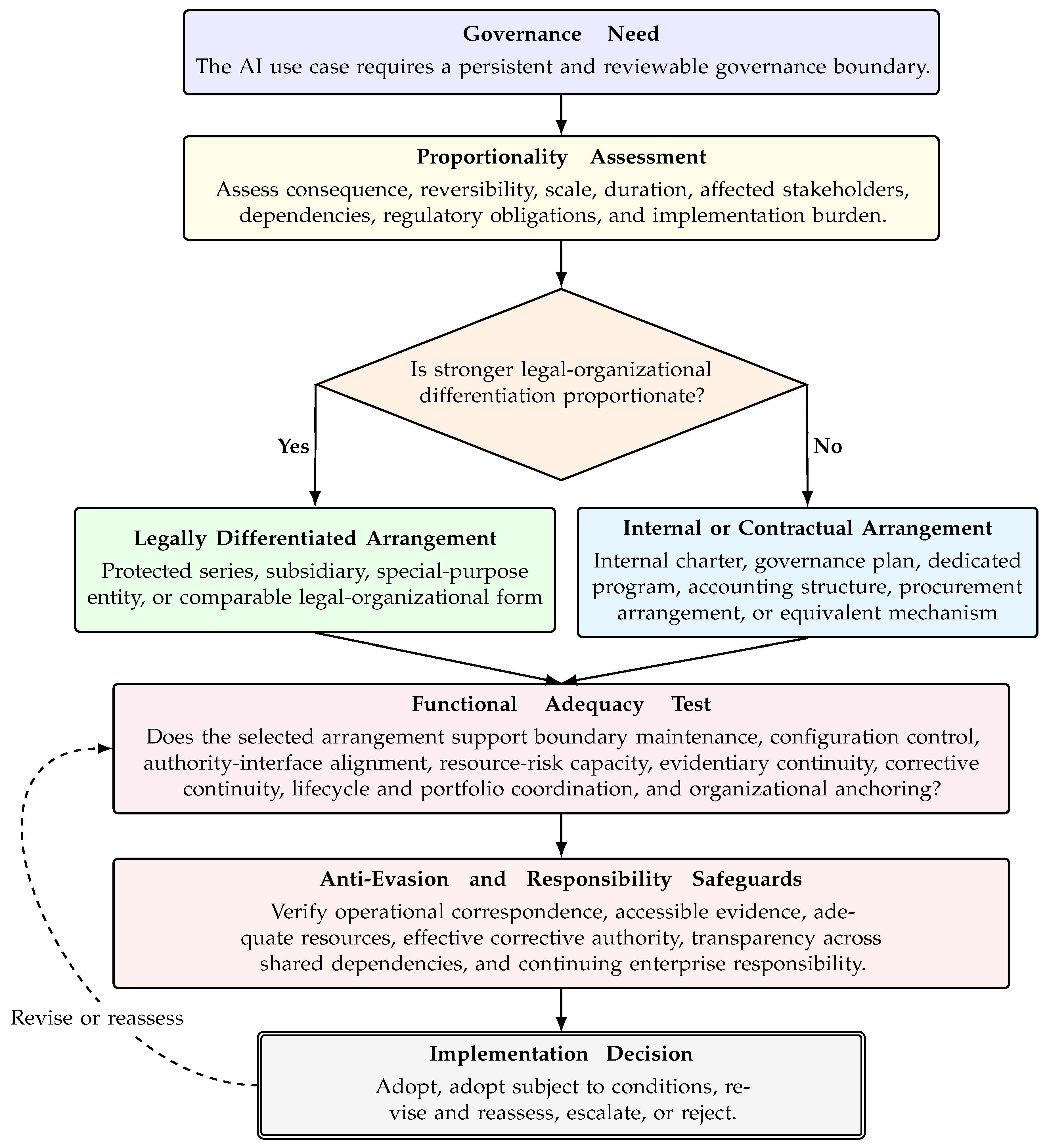
Organizational suitability is also a question of proportionality. A protected-series structure is most plausible as a directly implementable governance form where an AI use case is sufficiently persistent and consequential to justify differentiated governance and has identifiable contracts, resources, dependencies, records, authority relationships, and lifecycle responsibilities that can be associated with the module. It may be disproportionate where the deployment is temporary or low consequence, where the legal and administrative burden of maintaining differentiation exceeds the expected governance benefit, or where existing arrangements already provide functionally equivalent boundary, authority, resource, evidence, corrective, and lifecycle capabilities. The use of a protected series also does not remove enterprise-level responsibility for shared infrastructure, common vendors, portfolio dependencies, resource support, reserved powers, or escalation that remains outside the module. Legal differentiation is therefore treated as a conditional design choice rather than as the default organizational response to AI deployment.
Where a protected-series form is unavailable, legally uncertain, incompatible with applicable sectoral requirements, or organizationally disproportionate, the prototype should be treated as a functional reference architecture rather than as a directly implementable legal form. Possible alternatives include a subsidiary, special-purpose entity, internal governance charter, dedicated accounting and recordkeeping arrangement, procurement structure, or board-approved governance plan, provided that the chosen arrangement can reproduce the required boundary, configuration, authority, resource, evidence, corrective, lifecycle, and enterprise-anchoring functions. Comparable legal and organizational forms differ in the extent to which they provide entity differentiation, asset partitioning, contractual flexibility, governance autonomy, and continuity, so the choice of form should be evaluated functionally rather than by assuming that a protected series is categorically superior [58]. Organizational forms can therefore provide different combinations of entity differentiation, asset partitioning, and contractual governance, and portability of the framework depends on functional correspondence rather than replication of a particular legal form [42,45,52].
Functional portability does not require another jurisdiction to reproduce the protected-series form itself. The U.S. Series LLC is distinctive because it permits multiple legally differentiated series to operate within a continuing umbrella entity, whereas many civil-law, common-law, and mixed legal systems provide limited-liability entities without an equivalent internal series structure. Accordingly, the relevant comparison should distinguish structural equivalence from functional equivalence.
Where no protected-series analogue exists, one use-case module can instead be associated with a separately constituted limited-liability entity. Examples include a German GmbH [59], French SARL [60,61], Japanese Godo-Kaisha [62,63], or UK limited liability partnership [64,65], each of which can provide a legally identifiable organizational boundary and support differentiated governance arrangements under the applicable law. The Japanese Godo-Kaisha is particularly instructive because it was developed with substantial structural similarity to the U.S. LLC while remaining subject to Japanese corporate-law and tax treatment rather than ordinary U.S.-style pass-through taxation. The UK LLP likewise provides an incorporated body corporate with legal personality separate from that of its members, notwithstanding its partnership terminology.
The principal difference is therefore not necessarily whether the core governance functions can be reproduced, but how much legal and administrative duplication is required to reproduce them. If formation and operating costs are set aside, a portfolio of separately constituted entities can perform many of the boundary, authority, asset-association, recordkeeping, corrective, and lifecycle functions that the proposed framework assigns to multiple protected series within a Series LLC. The Series LLC prototype may nevertheless reduce the cost and complexity of maintaining multiple differentiated use-case modules under a common organizational structure. Prior work by the authors has discussed this substitution logic in relation to AI governance and modular legal-personhood architectures [8,9,66].
Other legal systems may also provide mechanisms that reproduce selected functions without establishing a separate entity. For example, the Italian regime for patrimoni destinati ad uno specifico affare illustrates a different civil-law mechanism through which function-specific asset segregation may be achieved without reproducing a U.S.-style protected series [67]. Such mechanisms should not be treated as doctrinal equivalents of a protected series. Rather, the framework asks whether separate entities, dedicated assets, contractual arrangements, internal governance instruments, accounting, and recordkeeping mechanisms can, individually or in combination, reproduce the governance functions required for the particular AI use case. Mixed legal systems should be evaluated through the same jurisdiction-specific and function-by-function analysis, recognizing that the available combination of civil-law, common-law, and locally specific organizational mechanisms may differ across mixed jurisdictions [68].
The article does not provide an exhaustive jurisdiction-by-jurisdiction doctrinal survey, and implementation therefore requires case-specific legal analysis of formation law, the law governing the deployment and its external relationships, applicable sectoral regulation, and recognition in relevant jurisdictions.

3.4. Modular Operating-Agreement Architecture

Legal differentiation alone cannot accommodate the variety of AI deployments because use cases operating within the same enterprise may differ in purpose, jurisdiction, sector, risk classification, technical dependency, vendor involvement, human oversight, and lifecycle status. A single undifferentiated agreement may preserve common governance at the cost of contextual fit, whereas separately drafted agreements for every deployment may produce inconsistency, duplication, and high amendment costs. The contractual design problem is therefore to preserve a stable organizational baseline while permitting controlled and reviewable variation.
The contractual architecture operates at two connected levels. The Series LLC-level operating agreement establishes the relationship between the associated LLC and its protected series, including portfolio oversight, shared infrastructure, common reporting expectations, resource relationships, and reserved enterprise powers. Within that structure, the series-specific operating agreement constitutes the complete body of terms governing an individual protected series, whether those terms appear in one document or in several documents that have been validly adopted and incorporated. This article uses “operating agreement” as a functional term because statutory terminology differs among jurisdictions [56,69].
Using the concepts defined in Section 1.3, the modular operating agreement composes the series-specific agreement from a common contractual core and the deployment-specific riders required by the use case. The common core preserves continuity in institutional identity, baseline authority, organizational relationships, recordkeeping, amendment, escalation, suspension, and termination, while riders introduce controlled variation for conditions that do not apply uniformly across deployments. Because each rider performs a defined governance function, it can be adopted, combined, amended, replaced, suspended, or retired without reconstructing the agreement as an undifferentiated whole. The resulting configuration therefore converts contractual supplementation into a form of governance configuration management.
The distinction between the common core and deployment-specific riders does not correspond strictly to a division between internal and external norms. Enterprise policies, ethical commitments, legal duties, sectoral standards, and contractual obligations may appear in either component depending on whether they apply generally or vary by deployment. The modular operating agreement instead provides a configuration architecture through which heterogeneous normative requirements are translated into a single reviewable governance arrangement for the use case. In this sense, contractual modularity performs a governance-configuration function: it preserves stable enterprise requirements while permitting controlled adaptation to jurisdiction, sector, client, vendor, technical, and lifecycle conditions.
The architecture requires explicit rules for rider selection, hierarchy, adoption, and change. The applicable configuration should be traceable to identified characteristics of the deployment, and the agreement should specify who may determine that a rider is required, which evidence supports the decision, how conflicts between the common core and a rider are resolved, and when a change triggers reassessment. Without these controls, apparent modularity could create uncertainty concerning which provisions govern the use case at a particular time.
Contractual configuration acquires institutional effect only when the documents, governing law, and operational practices correspond. The common core and applicable riders must be adopted through legally sufficient procedures, remain consistent with mandatory law, and be reflected in actual allocations of authority, resources, records, and responsibilities [52,53,54,55]. The consequence is a configurable governance architecture in which common enterprise requirements remain stable while deployment-specific variation becomes identifiable, reviewable, and capable of controlled revision.

3.5. AI Use-Case Module Architecture

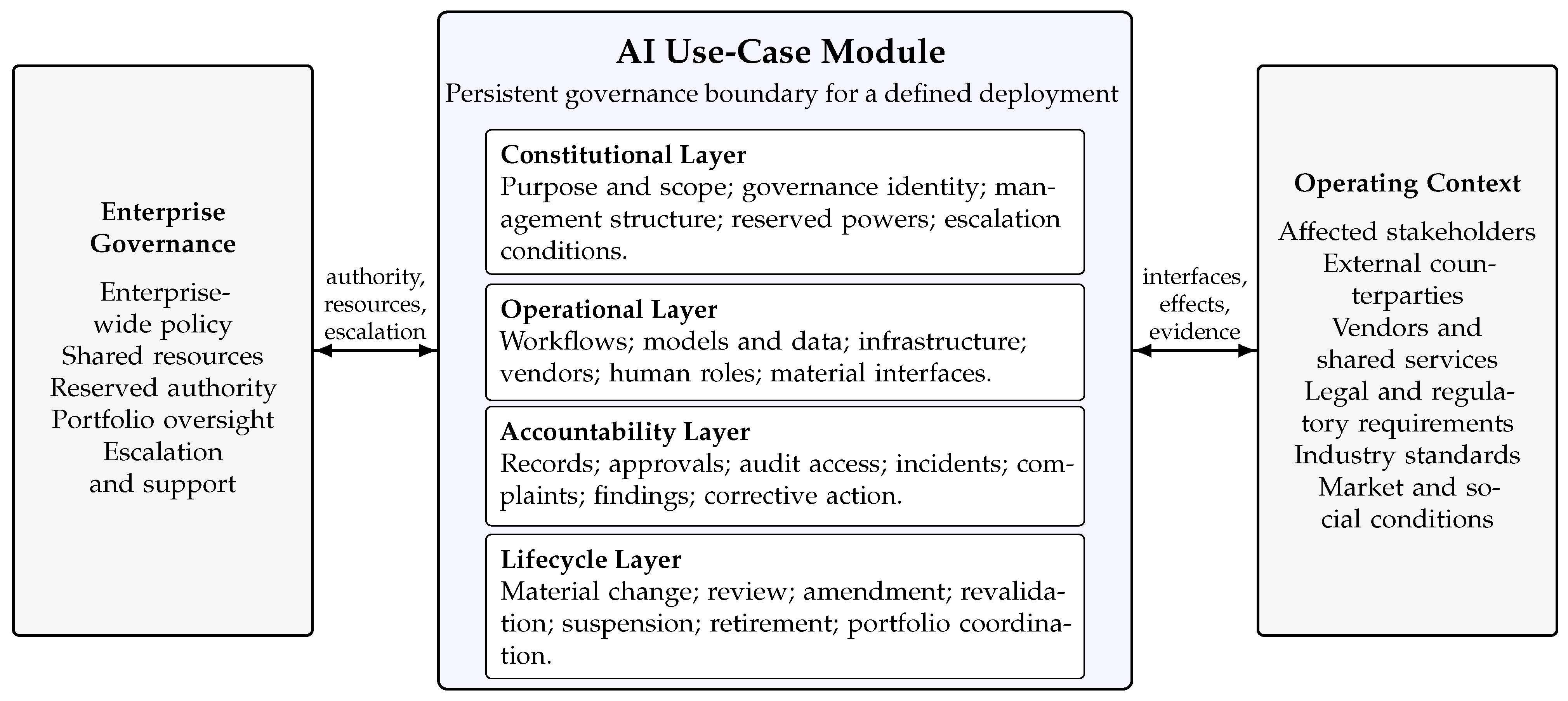
The contractual configuration must be translated into an enterprise architecture because legal terms alone do not show how governance operates across organizational roles, technical dependencies, evidence, and lifecycle change. Figure 1 summarizes the resulting AI use-case module as an intermediate enterprise subsystem situated between the associated LLC, affected stakeholders, the external environment, and critical external dependencies. Within that subsystem, the architecture distinguishes four connected layers: constitutional, operational, accountability, and lifecycle. These layers do not represent separate organizations or sequential stages because they describe complementary aspects of the same governed activity.
The constitutional layer defines the module’s foundational identity and relationship with the enterprise. ESE requires system boundaries, stakeholder concerns, decision authority, lifecycle responsibilities, and mission-level relationships to be specified before operational components can be coordinated [3,4,11]. Accordingly, this layer specifies the authorized purpose, boundary, management structure, reserved enterprise powers, principal decision rights, resource commitments, escalation relationships, and conditions for suspension or termination. The common core is the principal contractual mechanism for this layer because these provisions must remain sufficiently stable to preserve the module’s identity when particular technical or regulatory conditions change. The consequence is a determinate institutional boundary against which unauthorized expansion, repurposing, and governance drift can be identified.
The operational layer connects that institutional boundary to the components and practices through which the use case functions. Socio-technical research shows that system effects depend on the interaction of technical artifacts, workflows, organizational roles, and situated practices, while systems architecture emphasizes the interfaces through which dependencies and changes propagate [15,16,17,35]. Human-automation research further demonstrates that oversight is meaningful only when reviewers possess adequate information, intervention opportunities, practical authority, and organizational support [20,21]. This layer therefore addresses data and model dependencies, workflows, infrastructure, vendors, access controls, human roles, review points, intervention authority, and material technical interfaces. Deployment-specific riders are particularly important at this layer because operational requirements may differ substantially among use cases even when the modules share the same constitutional baseline. The resulting configuration aligns decision authority with the interfaces through which performance, dependency, and risk can propagate.
The accountability layer makes the module reviewable by connecting governance obligations with evidence and corrective capacity. Model cards, datasheets, and related documentation practices provide evidence about models, datasets, intended uses, and lifecycle conditions, although accountability also requires records of organizational decisions, reviews, incidents, and responses [28,29,30]. Auditing and accountability scholarship accordingly emphasizes the preservation of evidence through which authorizations, design choices, deployment conditions, interventions, findings, and remediation can be reconstructed and evaluated [7,31,32,33]. This layer therefore includes recordkeeping, documentation, audit access, impact-assessment results, approvals, interventions, incidents, complaints, affected-stakeholder information, review findings, escalation records, and remediation decisions. Although record separateness can improve observability, it must not prevent the associated LLC, regulators, auditors, or other authorized reviewers from reconstructing the relationship between module-level decisions and enterprise-level responsibility. The consequence is an evidentiary structure through which formal governance claims can be compared with operational conduct.
The lifecycle layer governs change because a use case that was adequately configured at authorization may cease to correspond to its operating environment. Systems engineering and modular-design research treat configuration control, interface stability, lifecycle integration, and controlled component replacement as necessary conditions for maintaining coherence in evolving systems [4,37,39,40,41]. AI risk-management and regulatory frameworks similarly require continuing monitoring, reassessment, incident response, and post-deployment control when models, data, intended purposes, risks, or operating conditions change [34,35,36]. This layer therefore specifies material-change triggers, periodic review, revalidation, amendment, rider replacement, resource reassessment, suspension, retirement, record retention, and portfolio coordination. The common core preserves continuity in change authority and escalation, while riders permit the applicable configuration to evolve when models, data sources, vendors, workflows, legal classifications, or stakeholder effects change. The consequence is a lifecycle mechanism that permits adaptation without allowing change to become informal or unreviewable drift.
The four layers are interdependent because weakness in one layer can undermine the others. A clear constitutional boundary has limited effect when the operational deployment exceeds it, while detailed operational controls cannot establish accountability when evidence is fragmented or corrective authority is absent. Similarly, an adequate initial configuration may deteriorate unless lifecycle mechanisms detect and govern material change. This interdependence reflects the broader ESE requirement that system boundaries, interfaces, resources, evidence, and lifecycle controls be coordinated rather than optimized independently [3,4,11]. The module becomes governable only when the four layers remain mutually consistent and connected to enterprise-level support and intervention.

3.6. Analytical Traceability of the Framework

A framework that combines legal, contractual, organizational, and technical elements risks becoming a descriptive collection of mechanisms unless the relationships among those elements are explicit. Analytical traceability addresses this problem by connecting each design requirement derived in Section 2.5 to a legal-organizational response, a contractual or architectural realization, and an expected governance consequence. The mapping synthesizes the ESE and systems-architecture requirements concerning boundaries, interfaces, resources, configuration, and lifecycle control [3,4,11,35]; the modularity literature concerning decomposition, functional allocation, interfaces, and coordinated adaptation [37,38,39,40,41]; the accountability and documentation literature concerning reviewable evidence and corrective processes [7,28,29,30,31,32,33]; and organizational-law scholarship concerning legal personality and asset partitioning [42,43,44,45]. Table 2 presents the resulting construction.
The table represents a construction logic rather than an empirical finding. Its rows should therefore be read as traceable design propositions: the cited literature supports the underlying requirements, while this study proposes the particular correspondence among protected-series features, contractual mechanisms, architectural layers, and governance consequences. Protected-series features do not automatically produce the stated consequences because the legal form must be implemented through valid contractual arrangements, operational correspondence, adequate resources, accessible evidence, and effective enterprise oversight. The framework therefore distinguishes the existence of a formal mechanism from its correspondence with the deployment and from its performance in practice.
This distinction also explains the allocation of later sections. Section 4 examines the mechanisms through which the constructed architecture is expected to perform boundary, configuration, authority, resource-risk, accountability, and lifecycle functions. Section 5 then examines whether those mechanisms exist formally, correspond to operational reality, and demonstrate adequate governance performance. The construction developed here consequently provides an analytically traceable proposition that can be implemented, assessed, compared, and revised without being presented as an already validated universal model.

3.7. Design-Theoretic Outputs and Evaluation Status

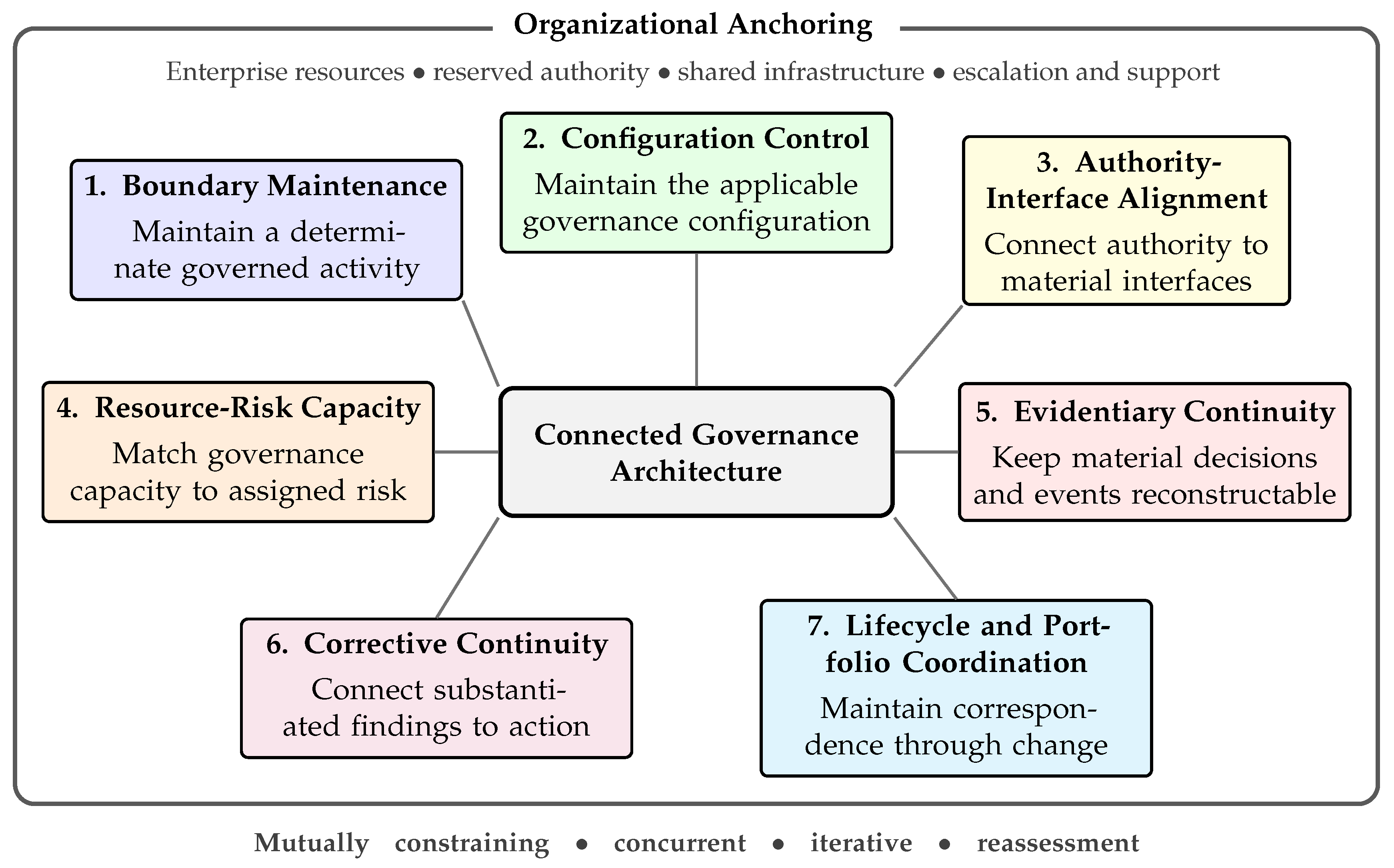
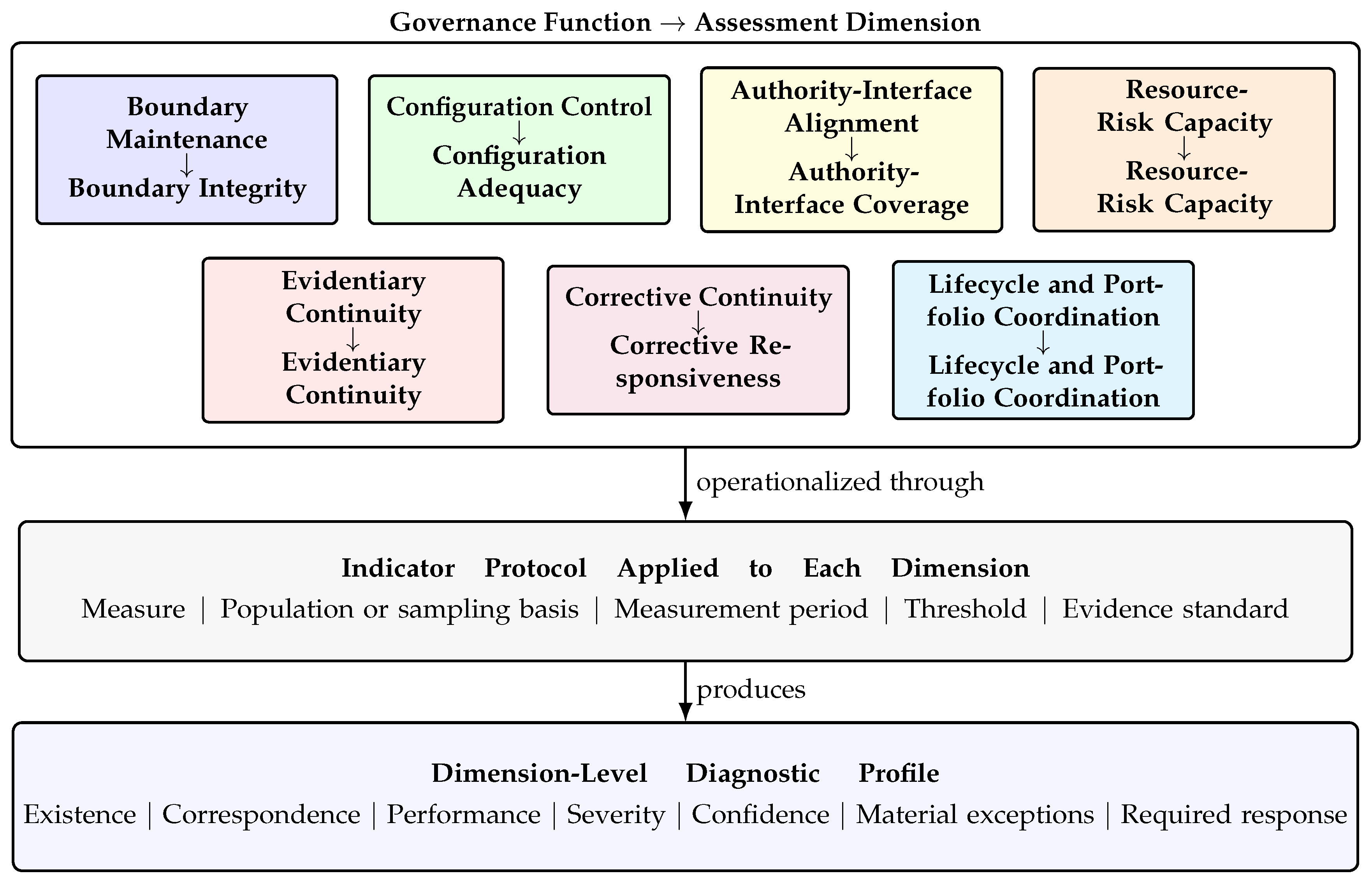
The design-theoretic construction yields five connected outputs. First, it specifies the AI use case as an intermediate enterprise system of interest that connects organizational purpose, workflow, technical dependencies, human authority, external relationships, resources, evidence, and lifecycle controls. Second, it develops modular legal personhood as a legal-organizational substrate through which that boundary may acquire institutional continuity without attributing legal personality or autonomous agency to the AI system. Third, it defines the modular operating agreement as a configuration architecture combining a stable common contractual core with controlled deployment-specific riders. Fourth, it organizes the governed use case through four connected architectural layers and seven governance functions that relate boundary maintenance, configuration control, authority, resources, evidence, corrective action, and lifecycle coordination, as summarized in Figure 2. Fifth, it provides readiness gates, assessment dimensions, and candidate indicators through which implementation may subsequently be examined.
These outputs provide a positive analytical contribution by making the governance architecture traceable across the AI use-case boundary, legal-organizational mechanisms, contractual configuration, architectural layers, governance functions, and assessment dimensions. The framework converts otherwise distributed governance concerns into identifiable functional relationships that can be examined for boundary mismatch, configuration drift, authority gaps, inadequate capacity, evidentiary discontinuity, ineffective correction, and lifecycle or portfolio-coordination failures. It thereby provides a common analytical structure for diagnosing governance fragmentation, comparing legally differentiated and functionally equivalent organizational arrangements, and translating governance propositions into observable assessment questions and candidate measures.
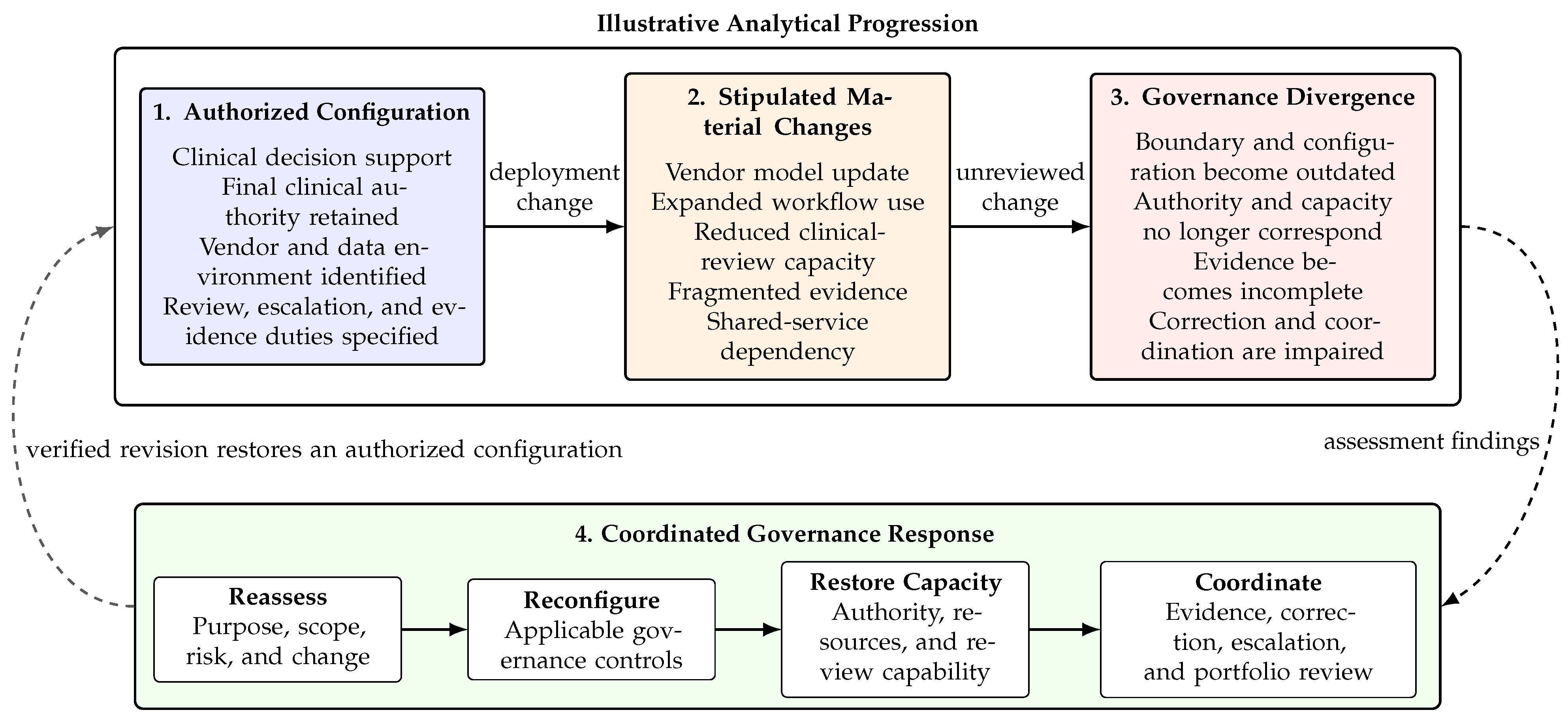
Table 2 evaluates whether the literature-derived requirements are connected to identifiable legal, contractual, organizational, and architectural responses, while Section 4 analyzes how those components are intended to perform connected governance functions. Section 5 then distinguishes formal existence, operational correspondence, and governance performance and specifies how those relationships may be examined in implementation. The hypothetical scenario illustrates how that analytical structure can be applied consistently under stipulated deployment conditions.
These outputs remain design artifacts and analytical relationships rather than observed organizational outcomes. The study does not establish numerical improvement or comparative superiority; such claims require real-world implementation, independent application, longitudinal observation, and comparison with existing organizational arrangements.

4. Functional Analysis of the Governance Architecture

Section 3 constructs the AI use-case module as a legal-organizational and enterprise-system architecture, while the present section analyzes the governance functions that this architecture is intended to support. The four architectural layers describe complementary structural aspects of the same governed activity, whereas the seven governance functions describe how those structures are intended to maintain boundary correspondence, configuration control, effective authority and capacity, evidentiary continuity, corrective action, and lifecycle coordination. The functions therefore do not introduce additional governance objects, organizational layers, or control structures. Rather, they provide a functional interpretation of the architecture constructed in Section 3.
The seven governance functions do not reproduce the seven design requirements on a one-to-one basis. The design requirements specify conditions that the architecture must satisfy, whereas the governance functions specify the activities through which those conditions are intended to be maintained. The composite requirement of reviewable evidence and corrective capacity is separated into evidentiary continuity and corrective continuity; organizational anchoring operates as a cross-cutting condition across the functions; and lifecycle adaptation extends to portfolio coordination when material changes affect shared enterprise dependencies. The analysis therefore distinguishes seven connected functions: boundary maintenance, configuration control, authority-interface alignment, resource-risk capacity, evidentiary continuity, corrective continuity, and lifecycle and portfolio coordination. Table 2 establishes the structural traceability between the design requirements and the framework components, while the present section examines their functional relationships.

4.1. Boundary Maintenance and Configuration Control

The first governance problem is a potential mismatch between the boundary used by a governance mechanism and the organizational activity that produces the relevant effects. As Table 1 summarizes, model-level, enterprise-level, and use-case-level boundaries have different strengths and appropriate roles and should therefore be treated as complementary rather than mutually exclusive. Model-level governance may be insufficient when organizational effects depend on purpose, workflow, data, infrastructure, human authority, external dependencies, and downstream decisions that extend beyond the model itself, whereas enterprise-level governance may be insufficiently specific when materially different deployments require distinct actors, resources, records, controls, dependencies, and lifecycle responses. Where such a mismatch occurs, model reuse, workflow expansion, vendor change, or repurposing can alter the governed activity without formal recognition that the use case itself has changed [5,6,19].
The architecture constructed in Section 3 responds by making the authorized use-case boundary an explicit and reviewable object of governance. Rather than treating the model inventory or enterprise policy as the operative boundary, the framework requires the deployment’s declared purpose and operational configuration to remain identifiable over time. The relevant governance function is therefore boundary maintenance: the organization must be able to determine whether the activity being operated still corresponds to the activity that was authorized.
Boundary maintenance also requires configuration control because the conditions governing a use case may change without eliminating the identity of the use case itself. The framework addresses this distinction by separating the stable elements that preserve institutional continuity from the variable elements that respond to deployment-specific conditions, as developed in Section 3.4. The governance question is consequently not whether variation exists, but whether the applicable configuration, the reasons for its selection, and the authority for its amendment remain traceable.
The consequence is that use drift and configuration mismatch become reviewable rather than remaining informal organizational developments. Reviewers can compare the authorized boundary with the current deployment, determine whether changes are material, and require reassessment, amendment, escalation, or suspension when correspondence has been lost. Enterprise consistency and deployment-specific adaptation can therefore coexist, provided that boundary changes and configuration changes remain subject to explicit governance control.

4.2. Authority-Interface Alignment and Resource-Risk Capacity

The second governance problem is a mismatch between assigned responsibility and the authority and capacity required to exercise it. An AI use case may depend on developers, data providers, infrastructure operators, vendors, professional users, compliance functions, and downstream decision makers that remain subject to different managerial and contractual controls. Responsibility becomes nominal when the actor expected to govern the use case cannot obtain necessary information, influence or control a relevant interface, alter a dependent component, or require action from another participant. The same problem arises when formal authority exists but is unsupported by sufficient personnel, expertise, technical access, financial resources, or remediation capacity.
Distributed authority makes this mismatch especially difficult to detect because no single participant may control the complete chain through which an AI-enabled decision is produced. Systems-of-systems research shows that operationally and managerially independent components can contribute to a common outcome while continuing to evolve under different authorities and timescales [12,13]. Systems architecture and socio-technical systems engineering similarly emphasize that control depends on the relationships and interfaces among technical components, organizational roles, and external actors rather than on the formal assignment of responsibility alone [17,18,35]. The relevant governance question is therefore whether assigned authority covers, or can effectively reach through escalation and contractual mechanisms, the interfaces through which the use case operates and through which risk may propagate.
The architecture constructed in Section 3 responds by making authority-interface alignment a reviewable governance condition. Rather than repeating the allocation mechanisms developed in Section 3.5 and Section 3.6, the present analysis asks whether each material dependency is matched by an actor who can obtain information, make or require a decision, and initiate intervention. Where an interface remains controlled by a vendor, shared enterprise function, infrastructure provider, or another module, governance must identify the contractual or organizational path through which the responsible actor can obtain cooperation or escalate the matter. An ungoverned interface exists when responsibility has been assigned but no actor possesses an effective means of controlling, influencing, or escalating the relevant dependency. As Section 3.3 clarifies, this functional requirement does not depend on adoption of the protected-series form; a functionally equivalent arrangement must provide the same effective authority, access, and escalation capability.
Human oversight provides a particularly important test of authority-interface alignment. A person designated to review an AI output cannot exercise meaningful oversight when relevant information is unavailable, intervention occurs too late, workloads make review impracticable, or the reviewer lacks authority to override, suspend, or escalate the resulting decision [20,21]. The functional inquiry therefore concerns whether oversight can materially affect the course of the use case rather than whether a human role appears in the formal governance arrangement. This distinction makes it possible to identify oversight that is formally present but operationally ineffective.
Authority must also correspond to resource-risk capacity because control cannot be exercised without the means required to investigate, monitor, intervene, and remediate. Organizational research on responsible AI shows that governance functions depend on expertise, cross-functional access, institutional support, reporting relationships, and the ability to influence development and deployment decisions [22,23]. Risk-management frameworks similarly presuppose sufficient information, personnel, technical access, monitoring capability, and response resources throughout the lifecycle [34,35]. The relevant question is therefore not whether resources have been allocated in the abstract, but whether available capacity is proportionate to the risks, dependencies, and governance responsibilities associated with the particular use case.
The framework responds to a capacity deficit by requiring escalation when the module cannot govern a risk through its own authority and resources. Escalation is not an exception to modular governance because the use-case boundary is intended to identify the level at which a problem becomes visible, not to require every problem to be resolved locally. When a risk depends on shared infrastructure, enterprise-wide policy, portfolio-level resources, or powers reserved outside the module, the issue must be escalated through the organizational relationships established in Section 3.2. Within the framework, enterprise-level governance therefore retains responsibility for supplying support or exercising intervention where the module’s authority or capacity is insufficient.
The principal consequence is that responsibility can be evaluated as an operational capability rather than inferred from titles, contractual language, or organizational charts. Reviewers can identify whether each material interface is covered by effective authority, whether assigned actors possess resources proportionate to their responsibilities, and whether unresolved gaps are connected to a credible escalation path. Authority-interface alignment and resource-risk capacity therefore convert formal responsibility into actionable governance while also revealing where the use-case module depends on enterprise-level support.

4.3. Evidentiary Continuity and Corrective Continuity

The third governance problem is that evidence concerning an AI use case is often fragmented across technical systems, organizational units, contractual relationships, and external providers. Model documentation may describe intended uses and performance conditions, operational records may show how outputs entered a workflow, contractual files may identify vendor obligations, and audit or incident records may document later review. When these materials cannot be connected, however, reviewers cannot reconstruct who made a decision, which information was available, whether the authorized configuration was followed, or how the organization responded after a problem became visible [7,28,29,30]. The existence of documentation therefore does not by itself establish evidentiary continuity or effective accountability.
The functional problem is one of evidentiary continuity rather than record volume. Accountability requires a reviewable sequence connecting authorization, design assumptions, deployment conditions, human interventions, material changes, incidents, findings, and responses. Accountability scholarship accordingly treats explanation and justification as institutional relationships in which an actor must provide an account to a forum capable of evaluating it, while auditing research emphasizes evidence that links organizational commitments to decisions and conduct across the lifecycle [31,32,33,70]. The relevant question is therefore whether the available evidence permits an authorized reviewer to reconstruct the governance history of the use case and connect material events to applicable requirements, responsible actors, and subsequent action.
The architecture developed in Section 3 responds by making evidentiary continuity a governance condition rather than merely a recordkeeping obligation. Without repeating the contents of the accountability layer specified in Section 3.5, the present analysis asks whether records generated by different participants can be associated with the same use case, ordered over time, and connected to the decisions they support. Observability exists when a reviewer can move from a formal requirement to evidence of its implementation, identify deviations, and trace the organizational response. An evidentiary gap exists when a material decision or event cannot be connected to an identifiable actor, applicable governance requirement, supporting information, or subsequent action.
Organizing evidence around the use case must not create informational isolation. Although use-case-level organization can reduce fragmentation, accountability is weakened when the relevant record set excludes enterprise decisions, shared infrastructure changes, vendor actions, or dependencies involving other modules. The functional requirement is therefore accessible traceability across organizational boundaries, including the ability of enterprise-level governance, authorized auditors, regulators, and other competent forums to examine how module-level conduct was shaped by broader organizational arrangements. As Section 3.3 clarifies, this requirement is functional rather than form-specific and must be preserved whether the use-case boundary is implemented through a protected series or through another legally and organizationally suitable arrangement.
Evidentiary continuity also addresses a second governance failure: review that produces findings without an effective path to action. Once evidence connects requirements, decisions, deviations, and consequences, governance must determine whether an identified actor possesses, or can reach through escalation, sufficient authority to respond. Impact assessments, audits, complaints procedures, and incident reviews have limited effect when the reviewing body can describe a failure but cannot obtain additional evidence, impose conditions, require remediation, suspend operation, or escalate the matter to an actor with sufficient authority [6,7,32]. The framework therefore extends evidentiary continuity into corrective continuity by requiring substantiated findings to connect to an identifiable decision path through which proportionate action can be initiated, implemented, and subsequently reviewed.
The principal consequence is that accountability can operate as a closed governance loop rather than as a retrospective collection of documents. Evidentiary continuity makes the governance history reconstructable, institutional review converts that reconstructed account into an evaluative judgment, and corrective continuity connects the judgment to amendment, remediation, escalation, suspension, or retirement. Reviewers can therefore assess not only whether records exist, but whether the organization can reconstruct events, attribute decisions, evaluate correspondence with the applicable configuration, initiate proportionate action, and verify the resulting response. Evidentiary continuity and corrective continuity thus connect documentation, review, and organizational action without treating any one of them as sufficient evidence of effective governance.

4.4. Lifecycle Adaptation and Portfolio Coordination

The fourth governance problem is that an authorized configuration can lose correspondence with the deployment over time, while the same change may also affect activities beyond the individual use-case boundary through shared enterprise dependencies. Model updates, data shifts, vendor modifications, workflow expansion, changes in affected stakeholders, and revised legal or risk classifications may materially alter the use case even when its formal authorization remains unchanged. Where models, datasets, infrastructure, vendors, personnel, or decision processes are shared, a change or failure identified in one module may also affect other use cases or the enterprise as a whole. Lifecycle governance must therefore address both temporal change within the module and cross-boundary consequences arising from interconnected dependencies [12,13,34,35,36].
The architecture constructed in Section 3 responds by treating continuing correspondence as a governance condition rather than presuming that an initially adequate configuration will remain adequate. Without repeating the lifecycle mechanisms specified in Section 3.5, the functional inquiry asks whether material changes are detected, whether their implications are assessed against the authorized use case, and whether governance and operational arrangements are revised before substantial divergence develops between formal authorization and actual practice. A lifecycle failure exists when the deployment changes materially but the organization continues to rely on an authorization, risk assessment, authority allocation, resource arrangement, or oversight mechanism that no longer corresponds to current conditions.
Effective lifecycle adaptation requires change control to connect reassessment with operational implementation because amendment of a document does not by itself restore correspondence. Systems engineering and modular-design research emphasize configuration control, interface management, controlled replacement, and verification when evolving components may affect system coherence [4,39,40,41]. The relevant governance process must therefore connect an identified change with the evidence considered, the decision reached, the operational measures adopted, and verification that authority, resources, technical controls, vendor obligations, monitoring arrangements, and records correspond to the revised configuration. Lifecycle adaptation is achieved only when formal governance and operational practice are brought back into correspondence; formal amendment alone is insufficient.
The same change-identification process may also trigger portfolio coordination when the effects of a change extend beyond the individual use-case boundary. Systems-of-systems research shows that locally managed components may produce broader consequences when they remain operationally interconnected and evolve under different authorities [12,13]. The functional question is therefore whether a material finding is communicated to an enterprise-level actor capable of identifying affected modules, evaluating shared dependencies, coordinating common responses, allocating additional support, or exercising authority that lies outside the individual module. Portfolio coordination is required where the relevant dependency, risk, or corrective response cannot be understood or governed adequately within the module in which the change was first detected.
Portfolio coordination does not eliminate the use-case boundary or transfer routine governance to the enterprise level. The module remains the primary object for identifying and assessing deployment-specific change, while enterprise-level governance addresses effects that depend on shared infrastructure, common vendors, portfolio resources, reserved powers, or dependencies spanning multiple modules. As Section 3.3 clarifies, this allocation of functions is not dependent on the protected-series form itself; functionally equivalent organizational arrangements must preserve both local lifecycle responsibility and access to enterprise-level coordination where required.
The principal consequence is that lifecycle adaptation and portfolio coordination provide a structured means of examining whether change remains governed at both the use-case and enterprise levels. At the module level, reviewers can assess whether the current deployment still corresponds to its authorized configuration and whether material changes have been processed through a traceable decision and implementation path. At the enterprise level, they can assess whether shared dependencies and cross-module effects have triggered appropriate communication, coordination, support, or escalation. These functions are intended to prevent silent drift and displaced risk, but their practical effectiveness requires empirical evaluation of how reliably organizations detect, communicate, and respond to material change.

4.5. Governance Synthesis

The final governance problem is that the functions examined in this section may be treated as independent checklist items rather than as connected conditions of an operating governance architecture. Under such an interpretation, an organization might regard extensive records as sufficient despite an indeterminate use-case boundary, rely on formally assigned responsibility where relevant interfaces remain outside effective authority, or complete a formal amendment without restoring correspondence between governance and operational practice. The synthesis problem is therefore to determine how the separate functions constrain and reinforce one another across the same governed use case.
The framework responds by treating the functions developed in Section 4.1, Section 4.2, Section 4.3 and Section 4.4 as connected and mutually constraining rather than independently sufficient. Boundary maintenance establishes what activity is being governed; configuration control identifies the authorized governance arrangement; authority-interface alignment and resource-risk capacity determine whether responsible actors can act across material dependencies; evidentiary continuity makes the resulting decisions and events reconstructable; corrective continuity connects substantiated findings to action; and lifecycle and portfolio coordination maintain correspondence as the deployment and its shared dependencies change. Organizational anchoring remains cross-cutting because each function may depend on enterprise-level resources, reserved authority, shared infrastructure, or escalation beyond the individual module.
Figure 2, introduced in Section 3.7, summarizes the seven governance functions and emphasizes that they form a connected and mutually constraining governance architecture. The relationships among the functions are analytical rather than strictly temporal or causal. Several functions may operate concurrently, recur iteratively, or trigger reassessment of other conditions, although governance activities may remain constrained when foundational conditions such as boundary identity, applicable configuration, effective authority, or accessible evidence are unresolved.
This integrated view also prevents any single legal, contractual, documentary, or organizational mechanism from being treated as sufficient evidence of effective governance. A formally differentiated module may exist without operational correspondence; extensive documentation may exist without evidentiary continuity; assigned responsibility may exist without effective authority or capacity; and review may occur without corrective action. The framework therefore evaluates governance as the correspondence among boundary, configuration, authority, resources, evidence, correction, lifecycle adaptation, and enterprise-level coordination rather than as the presence of any individual mechanism.
The principal consequence is that modular legal personhood is treated as one possible institutional substrate for a connected governance architecture rather than as a self-sufficient legal solution. Where the protected-series form is used, its governance value depends on whether the functions described above are realized in operational practice. Where another legal or organizational arrangement is used, the same functional relationships remain relevant if that arrangement is intended to provide equivalent governance capabilities. Whether such integration improves governance performance or provides advantages over existing arrangements remains an empirical question addressed by the assessment framework and future comparative evaluation developed in the following sections.

5. Implementation and Assessment

A conceptually complete governance architecture may remain ineffective when formal adoption does not correspond to operational practice or when assessment cannot reveal how governance functions in use. This section therefore examines staged implementation, operational correspondence, measurable assessment, illustrative application, and validation limits for the governance functions developed in Section 4.

5.1. Proportional Implementation Through Staged Institutionalization

Implementation should be proportionate to the maturity, risk, and operational significance of the use case. Immediate adoption of the complete legal-organizational architecture may impose unnecessary burden on an exploratory or low-consequence deployment, whereas delayed institutionalization may allow a consequential use case to expand without a stable boundary, effective authority, or reviewable evidence. The relevant question is therefore when deployment conditions justify increasing levels of governance formalization.
The framework organizes implementation through four readiness gates: boundary readiness, configuration readiness, operational readiness, and continuing assurance. Each gate requires specified evidence and an authorized decision to proceed, proceed subject to conditions, revise, pause, escalate, or terminate. The first three gates ordinarily structure progression toward activation, while continuing assurance recurs during operation and may return the use case to an earlier gate when material change, incident, or evidentiary deficiency undermines the existing arrangement.
The boundary-readiness gate asks whether purpose, scope, participants, affected stakeholders, principal dependencies, intended decisions, and initial risk conditions are sufficiently determinate to define a governable system of interest. The configuration-readiness gate asks whether material deployment conditions are covered by applicable governance provisions and connected to authority, resources, evidence, and escalation paths. The operational-readiness gate asks whether responsible actors can obtain necessary information, exercise intervention powers, preserve required records, and escalate unresolved risks before activation [4,34,35]. Passing these gates does not require adoption of a protected series or any other particular legal form.
The continuing-assurance gate reassesses whether the authorized boundary, governance configuration, authority, resources, and evidentiary arrangements remain adequate after material change, incident, emerging stakeholder effect, or evidence gap. Figure 3 summarizes the four gates and the assessment lenses applied at each review. The staged approach allows governance intensity and form to be adjusted as the deployment’s maturity, consequences, dependencies, and reversibility change.

5.2. Operational Correspondence and Assessment Evidence

Passage through a readiness gate does not establish that approved mechanisms continue to correspond to the deployment or influence organizational conduct. Assessment must therefore examine the functional relationships developed in Section 4 rather than treat the existence of individual mechanisms as evidence of effective governance.
The framework applies three assessment lenses. Existence asks whether the relevant legal, contractual, organizational, or technical mechanism has been formally established. Correspondence asks whether that mechanism reflects the use case as currently operated. Performance asks whether evidence from a specified period shows that the mechanism has supported detection, review, intervention, escalation, or correction when required. These lenses distinguish formal adoption from operational alignment and observed governance performance.
Assessment should draw on triangulated evidence because no single source necessarily provides a complete account of implementation. Relevant evidence may include agreements, authorizations, policies, risk assessments, logs, access and change records, interviews, observations, audit findings, complaints, and affected-stakeholder reports [7,31,32,33]. Evidence quality should be considered in terms of provenance, completeness, temporal relevance, accessibility, and independence.
External governance frameworks provide reference points for coverage rather than proof of legal sufficiency or empirical effectiveness. The NIST AI Risk Management Framework, ISO/IEC 23894, and the EU AI Act provide lifecycle, risk-management, documentation, oversight, monitoring, and response reference points relevant to the proposed assessment [34,35,36]. Table 3 summarizes how these sources are used for selective coverage comparison rather than conformity assessment or certification.
The resulting assessment logic is diagnostic rather than certifying. External reference points identify potential coverage gaps, while the three assessment lenses distinguish existence, correspondence, and performance; together, they provide the basis for the dimensions and indicators developed below.

5.3. Operationalization Through Assessment Dimensions and Indicators

Broad governance concepts require observable measures if they are to support implementation and empirical evaluation. The seven governance functions developed in Section 4 are therefore translated into seven assessment dimensions, each evaluated through a predefined measure, population or sampling basis, measurement period, threshold, and evidentiary standard. Figure 4 summarizes this translation from governance functions to diagnostic assessment.
Organizational anchoring is treated as a cross-cutting condition within authority-interface coverage, resource-risk capacity, and lifecycle and portfolio coordination rather than as a separate eighth dimension. Table 4 specifies the diagnostic question, candidate indicator, and principal evidence for each dimension. The indicators are proposed operationalizations rather than validated scales and require sector- and deployment-specific calibration before comparative or decision-making use.
Indicator protocols should be specified before results are interpreted. Denominators, sampling periods, and thresholds should reflect the relevant population, lifecycle, risk, reversibility, and consequences of delayed intervention, while evidence quality should be assessed for provenance, completeness, temporal relevance, accessibility, and corroboration [7,34,35].
Indicator values should also be reported with severity, confidence, material exceptions, and unresolved evidence gaps because favorable aggregate values may conceal a critical failure. The resulting output is therefore a multidimensional diagnostic profile suitable for longitudinal and comparative testing rather than a universal governance score.

5.4. Illustrative Application to a Hypothetical Scenario

The following hypothetical hospital-triage scenario illustrates how the assessment framework can be applied to stipulated deployment conditions. It is used to examine analytical consistency and the distinction among formal existence, operational correspondence, and governance performance, not to establish empirical validity or comparative superiority. The scenario is therefore illustrative rather than evidentiary.
A hospital authorizes an AI-enabled triage service for clinical decision support, retains final clinical authority, identifies the vendor and hospital data environment, and specifies review, escalation, evidence-access, and incident-cooperation responsibilities. Recommendations, overrides, incidents, and material changes are recorded, while the external vendor controls a material technical dependency and information relevant to monitoring and correction.
The scenario then introduces a vendor model update, expansion of the output into patient-flow and resource-allocation decisions, reduced time for meaningful clinical review, fragmented hospital and vendor evidence, and use of the same model service by another hospital function. These stipulated changes test whether the authorized boundary, governance configuration, authority, resources, evidence, and lifecycle arrangements continue to correspond to operation. Figure 5 summarizes the resulting analytical progression from material change to governance divergence and coordinated response.
Figure 5 presents the scenario-level progression, while Table 5 applies the seven assessment dimensions to the stipulated conditions. The table links each condition to a diagnostic implication and an indicated governance response without treating the scenario as empirical evidence.
The scenario does not imply that existing governance mechanisms would fail to identify these conditions. Model documentation, enterprise policy, risk-management, audit, procurement, or compliance processes could identify individual issues; the proposed framework instead examines whether purpose, vendor interfaces, authority, resources, evidence, corrective action, and shared dependencies remain connected within the same governed use case.
The application therefore demonstrates analytical usability rather than diagnostic superiority. Whether the framework improves detection, coordination, corrective performance, or organizational outcomes relative to alternative governance arrangements remains an empirical question requiring independent and real-world evaluation.

5.5. Interpretation and Validation Limits

Quantified indicators and a coherent illustrative application should not be interpreted as evidence that the framework is a validated maturity model, certification standard, universal scoring instrument, or proof of superior outcomes. Indicator results depend on denominators, thresholds, sampling periods, severity rules, and evidence quality, while an author-constructed scenario may favor the concepts used to construct it. Assessment should therefore be reported as a dimension-level diagnostic profile with confidence, material exceptions, and evidentiary limitations rather than as a single aggregate score.
Validation requires progressively stronger forms of external examination. Structured expert review can assess coverage and redundancy, independent application can examine consistency among assessors, and organizational pilots can test feasibility, data availability, and implementation burden. Longitudinal and comparative studies can then examine whether the indicators detect governance deterioration and whether the proposed architecture produces different outcomes from existing legal and organizational arrangements. The external-reference comparison in Section 5.2 examines coverage, and the hypothetical scenario in Section 5.4 examines analytical usability; neither constitutes empirical validation.
The resulting assessment claim is deliberately bounded. The framework makes the governance propositions developed in Section 3 and Section 4 observable and empirically testable, while leaving reliability, validity, calibration, practical feasibility, and comparative effectiveness open to future evaluation. Section 6 considers the implications of this limited claim for proportionality, functional portability, responsibility fragmentation, and the broader contribution to ESE.

6. Discussion

This section considers the framework’s functional portability, proportionality, responsibility safeguards, contribution to ESE, and empirical limits. The discussion focuses on the conditions and limits of the proposed architecture rather than restating its components or assessment dimensions.

6.1. Functional Portability and Legal-Form Dependence

The framework should not be treated as dependent on the availability of the protected-series form. Protected-series regimes vary in formation, governance, recordkeeping, liability effects, and external recognition, and the form may be unavailable or disproportionate in some jurisdictions or deployments [52,53,54,55]. Protected series therefore serve as a prototype that makes differentiated governance particularly visible rather than as a universally preferred implementation.
Functional portability depends on whether another legal or organizational arrangement can reproduce the relevant governance relationships with sufficient specificity and continuity. Possible alternatives include subsidiaries, internal charters, procurement arrangements, dedicated accounting structures, regulated operating units, and board-approved governance plans. Their adequacy should be evaluated function by function according to boundary identity, configuration control, authority, capacity, evidence, corrective action, lifecycle adaptation, and organizational anchoring rather than by formal resemblance to a protected series [42,43,45].
Modular legal personhood is therefore best understood as a design pattern with form-dependent implementations. Legal differentiation may provide an explicit institutional boundary, but its absence does not prevent use-case-level governance where another arrangement provides functionally equivalent capabilities. Portability thus broadens the framework beyond a particular legal form while preserving a substantive test of the relationships actually established.

6.2. Proportionality and the Risk of Over-Formalization

Institutional differentiation can impose cost, delay, rigidity, and administrative burden that exceed the governance needs of a particular use case. Low-consequence, reversible, or exploratory deployments may not justify the same legal and organizational commitments as deployments affecting safety, rights, essential services, or large populations, while under-formalization may allow consequential uses to expand without adequate authority, resources, evidence, or corrective capacity.
Proportionality therefore requires governance intensity to reflect factors such as consequence severity, reversibility, scale, duration, affected stakeholders, automation, external dependencies, detectability of failure, and applicable legal obligations [34,35,36]. The staged approach in Section 5.1 allows governance to become more formal as consequence or dependency increases and to be simplified when the use case is reduced, terminated, or otherwise no longer justifies the same institutional burden.
The framework consequently does not require every AI use case to become a protected series or equivalent legal entity. Stronger legal-organizational differentiation is justified only when its expected governance value exceeds its legal and administrative burden and when existing arrangements do not already provide functionally adequate governance. Proportionality therefore constrains modular legal personhood rather than treating institutional differentiation as an end in itself.

6.3. Responsibility Fragmentation and Anti-Evasion Safeguards

Legal and organizational differentiation can clarify responsibility but can also divide, obscure, or externalize it. A module may be assigned formal responsibility without the authority or resources needed to discharge it, while shared infrastructure, portfolio decisions, or enterprise incentives may remain under the control of other organizational actors. Entity-based approaches to AI governance therefore require safeguards against arrangements that use formal separation to conceal the human and organizational actors that design, control, or benefit from the system [46,47,48,49,50,51,71].
The framework addresses this risk by treating the use-case boundary as a means of locating rather than limiting responsibility. Operational correspondence, authority-interface alignment, resource adequacy, accessible evidence, corrective capacity, and enterprise-level escalation require assessment to follow the actual allocation of authority, information, resources, and control. A formally differentiated module that lacks these conditions does not provide effective accountability merely because responsibility has been assigned to it.
The resulting anti-evasion principle is that modularization should not reduce the ability of affected stakeholders, auditors, regulators, or other competent forums to identify responsible actors, obtain relevant evidence, or secure an effective response [23,31,32,33]. Modularity can strengthen accountability only when it localizes responsibility without displacing responsibility for shared dependencies, reserved powers, inadequate resources, or portfolio-level decisions. Where formal boundaries conceal those relationships, governance assessment should follow operational authority and control rather than organizational form.
Figure 6 integrates the portability, proportionality, and anti-evasion considerations into a function-based implementation decision. The process evaluates organizational form only after identifying governance need and applies the same functional and responsibility safeguards regardless of the selected arrangement.
The selection process separates proportionality from functional adequacy. A less formal arrangement may be sufficient when it performs the required functions, whereas a legally differentiated arrangement should be revised or rejected when it lacks operational correspondence, authority, resources, accessible evidence, corrective capacity, or continuing enterprise-level coordination.

6.4. Contribution to Enterprise Systems Engineering and Relation to Existing Governance Mechanisms

The ESE problem addressed by this study is that legal and contractual arrangements are often treated as external constraints on enterprise architecture rather than as configurable components of the enterprise system itself. ESE provides methods for analyzing purpose, boundaries, stakeholders, interfaces, resources, lifecycle change, and organizational transformation, although the institutional mechanisms through which those relationships acquire authority and continuity may remain under-specified [3,4,11,35]. AI governance presents this limitation sharply because technical controls and enterprise-wide policies may require an intermediate organizational object through which they can be connected to a particular activity.
The first contribution to ESE is the identification of the AI use case as an intermediate enterprise-system boundary. This boundary is not simply a technical decomposition because it incorporates organizational purpose, human authority, affected stakeholders, resources, evidence, external dependencies, and lifecycle responsibility. Socio-technical systems research supports the inclusion of these relationships within the system of interest, while the present framework adds an institutional mechanism through which the resulting boundary can remain identifiable and governable [5,6,17,18]. The use-case boundary therefore provides a means of connecting technical specificity with enterprise-level accountability where existing governance does not already provide an equivalent persistent organizational object.
The second contribution is the treatment of legal-organizational configuration as an ESE design object. Modular-systems theory explains how bounded components, stable interfaces, and controlled variation can reduce complexity and support adaptation [37,38,39,40,41]. The framework extends this reasoning by distinguishing structural modularity, which differentiates the institutional unit, from configurational modularity, which varies the governance applicable within that unit. Legal form and contract consequently become elements through which enterprise boundaries, interfaces, authority, and lifecycle controls can be designed rather than merely background conditions with which the architecture must comply. As Section 3.3 emphasizes, this contribution is functional rather than form-specific and does not require adoption of a protected-series structure where another arrangement can provide equivalent governance capabilities.
The third contribution is a correspondence-based account of governance performance. The framework does not infer governability from the existence of a legal unit, contractual provision, technical control, or documentary record because governance depends on continuing correspondence among formal arrangements, operational activity, authority, resources, evidence, and corrective capacity. This account enables ESE analysis to examine where a governance function ceases to support the next and how that breakdown affects the enterprise system. The broader implication is that digital transformation involves the configuration of normative and organizational architectures alongside technical architectures.
The proposed architecture is complementary to existing AI governance mechanisms rather than a substitute for them. Risk-management frameworks such as the NIST AI Risk Management Framework and ISO/IEC 23894 provide lifecycle processes for identifying, assessing, monitoring, communicating, and treating risk, while the EU AI Act establishes legal obligations concerning intended purpose, documentation, human oversight, incident reporting, and post-market monitoring [34,35,36]. Impact assessments and auditing provide structured review and evidence, technical documentation records model- and data-level characteristics, procurement and contracting can allocate duties and information rights across external relationships, and enterprise compliance mechanisms provide common policies, shared capabilities, and escalation [6,7,28,29,32]. The use-case architecture does not replace these mechanisms; its proposed role is to provide a persistent organizational object around which their deployment-specific requirements, responsible actors, resources, evidence, interfaces, and lifecycle obligations can be connected when those elements would otherwise remain distributed across separate processes and organizational units.
Modular legal personhood is therefore neither universally necessary nor sufficient for effective AI governance. Where existing risk-management, audit, procurement, compliance, and organizational arrangements already establish a persistent use-case boundary, align authority with material interfaces, provide resources proportionate to risk, preserve accessible evidence, support corrective action, and maintain lifecycle and enterprise-level coordination, additional legal differentiation may provide little incremental value and may impose unnecessary administrative burden. Its potential contribution arises instead where these functions remain fragmented across policies, contracts, technical records, review processes, and organizational units that do not converge on a continuing object of governance. Even in that circumstance, legal differentiation cannot itself create organizational commitment, incentives, expertise, resources, information access, or corrective capacity; its proposed value is limited to providing an institutional structure through which those capabilities can be assigned, connected, maintained, and reviewed.
The principal consequence is an expanded but conditional conception of enterprise-system design. AI-enabled transformation can be analyzed not only through technology, process, data, and organizational structure, but also through the legal and contractual arrangements that may stabilize boundaries, allocate authority, associate resources and evidence, and govern change. The contribution remains design-theoretic and does not establish that modular legal personhood or any particular legal form outperforms existing governance arrangements. Rather, it provides a functionally specified institutional design proposition whose incremental value depends on whether it improves governance correspondence without creating disproportionate legal or organizational burden. The framework thereby connects institutional design with ESE without reducing either field to the concepts of the other.

6.5. Empirical Research Agenda

The framework remains a set of testable design propositions rather than a validated maturity model or universal assessment instrument. Its internal coherence, external reference points, and hypothetical application do not establish reliability, practical feasibility, or comparative effectiveness. Empirical research should therefore examine whether the proposed concepts can be applied consistently, implemented in organizations, and shown to provide incremental value over existing governance arrangements.
An initial stage should examine content validity and usability through structured expert review and independent application. Participants with expertise in ESE, organizational law, AI governance, risk management, technical assurance, and affected-stakeholder representation can assess whether the requirements and dimensions omit material relationships or contain unnecessary overlap. Independent assessors can then apply the framework to common deployment materials to examine consistency of interpretation, evidence requirements, and decision rules, while documenting the expertise, access, time, and organizational burden required.
A subsequent stage should use bounded organizational pilots to compare the enterprise’s existing governance arrangement with a proposed use-case-level configuration over a defined operating period. Candidate outcomes include boundary deviations, coverage of material interfaces, evidence-chain completeness, escalation and containment latency, corrective-action completion, shared-dependency communication, and implementation burden.
To evaluate comparative advantage, future studies should establish the enterprise’s existing governance arrangement as a baseline and apply a predefined indicator protocol to both the baseline and the proposed use-case-level configuration over comparable operating periods or matched use cases. The comparison should examine governance outcomes jointly with the additional burden required to implement and maintain the proposed arrangement, including relevant legal and administrative effort, staff time, coordination workload, review latency, and resource requirements. Evidence of incremental advantage would therefore require improvement in specified governance outcomes while avoiding disproportionate deterioration in other dimensions. Any observed governance benefit should also be evaluated against the additional implementation burden required to achieve it. Greater legal or organizational formalization should not itself be treated as evidence of improvement. Conversely, if the proposed configuration produces little governance improvement or imposes implementation burdens that outweigh the observed benefit, the comparison would not support its adoption in that setting.
The indicators in Section 5.3 provide candidate measures, but their denominators, thresholds, sampling rules, and evidentiary standards require context-specific calibration. Longitudinal observation can further examine whether governance correspondence deteriorates or improves as the deployment changes.
Comparative studies can then examine protected-series, subsidiary, internal-governance, contractual, or other functionally equivalent arrangements under comparable conditions. Such studies may show that legal differentiation adds little beyond strong existing governance, that particular indicators are unreliable, or that administrative burden outweighs governance benefits. They may also identify conditions under which a persistent use-case boundary improves evidentiary continuity, corrective responsiveness, lifecycle coordination, or other outcomes. The framework is therefore intended to remain falsifiable and revisable in light of empirical evidence.

7. Conclusions

This article examined a boundary problem in enterprise AI governance: model-level controls may be insufficient when organizational effects extend beyond the model, while enterprise-wide governance may be insufficiently specific for materially different deployments. It identified the AI use case as an intermediate enterprise-system boundary and developed modular legal personhood as one possible institutional means of stabilizing that boundary. Protected series served as the primary legal prototype, while modular operating agreements illustrated how stable governance requirements could be combined with deployment-specific configuration. The resulting framework proposes that a consequential AI use case can be governed as an enterprise subsystem when its purpose, authority, resources, evidence, interfaces, corrective capacity, and lifecycle arrangements remain aligned with operational reality.
The framework contributes to ESE by treating legal and contractual arrangements as potential components of enterprise-system design rather than only as external constraints. It distinguishes structural modularity, which differentiates the governed unit, from configurational modularity, which permits governance to vary as deployment conditions change. The associated governance functions are mutually constraining rather than independently sufficient: formal differentiation, documentation, assigned responsibility, or technical control does not establish effective governance unless boundary, authority, resources, evidence, corrective action, lifecycle adaptation, and enterprise-level coordination remain connected. Modular legal personhood is therefore neither necessary nor sufficient in every case, and alternative legal, contractual, or internal arrangements may be preferable when they provide functionally equivalent capabilities with lower legal or organizational burden.
The framework remains a design-theoretic and empirically testable proposition rather than a validated maturity model or demonstrated improvement over existing governance arrangements. Its assessment dimensions and hypothetical application specify what could be examined, but reliability, practical feasibility, sector-specific suitability, and comparative effectiveness require independent application, organizational pilots, longitudinal observation, and comparative research. Empirical evidence may support revision, simplification, or rejection of particular components. The broader implication is therefore conditional: where existing governance mechanisms leave deployment-specific authority, resources, evidence, corrective capacity, and lifecycle responsibility fragmented, a persistent use-case-level institutional architecture may provide a means of connecting them while preserving responsibility within the enterprise as a whole.

Author Contributions

Conceptualization, M.J.O. and H.G.O.; methodology, M.J.O. and H.G.O.; software, H.G.O.; formal analysis, M.J.O.; investigation, M.J.O. and H.G.O.; resources, H.G.O.; writing—original draft preparation, H.G.O.; writing—review and editing, M.J.O. and H.G.O.; visualization, H.G.O.; supervision, M.J.O.; project administration, H.G.O.; funding acquisition, M.J.O. and H.G.O. All authors have read and agreed to the published version of the manuscript.

Funding

This research was supported by the Japan Society for the Promotion of Science under Grant No. 25K15291 for H.G.O. and M.J.O. and the INOUE ENRYO Memorial Grant and the 2025 Mitsubishi Foundation under the Research Grants in the Humanities for M.J.O.

Institutional Review Board Statement

Not applicable.

Informed Consent Statement

Not applicable.

Data Availability Statement

No new data were created or analyzed in this study. Data sharing is not applicable to this article.

Acknowledgments

During the preparation of this manuscript/study, the authors used ChatGPT-5.5 Thinking with ScholarAI, Gemini-3 Pro, Copilot Free, Lexis+AI and DeepL Pro for the purposes of bibliographic search and editing. The authors have reviewed and edited the output and take full responsibility for the content of this publication.

Conflicts of Interest

The authors declare no conflicts of interest.

Abbreviations

The following abbreviations are used in this manuscript:
AIArtificial intelligence
AI RMFArtificial Intelligence Risk Management Framework
DLLCADelaware Limited Liability Company Act
ESEEnterprise Systems Engineering
EUEuropean Union
ISOInternational Organization for Standardization
IECInternational Electrotechnical Commission
LLCLimited liability company
NISTNational Institute of Standards and Technology
UPSAUniform Protected Series Act

References

  1. Vial, G. Understanding Digital Transformation: A Review and a Research Agenda. J. Strateg. Inf. Syst. 2019, 28, 118–144. [Google Scholar] [CrossRef] [Scilit]
  2. Bharadwaj, A.; El Sawy, O.A.; Pavlou, P.A.; Venkatraman, N. Digital Business Strategy: Toward a Next Generation of Insights. MIS Q. 2013, 37, 471–482. [Google Scholar] [CrossRef] [Scilit]
  3. SEBoK Editorial Board. Enterprise Systems Engineering. Guide to the Systems Engineering Body of Knowledge. 2024. Available online: https://sebokwiki.org/wiki/Enterprise_Systems_Engineering (accessed on 7 June 2026).
  4. Walden, D.D.; Shortell, T.M.; Roedler, G.J.; Delicado, B.; Mornas, O.; Yip, Y.S.; Endler, D. (Eds.) INCOSE Systems Engineering Handbook: A Guide for System Life Cycle Processes and Activities, 5th ed.; John Wiley & Sons: Hoboken, NJ, USA, 2023. [Google Scholar]
  5. Selbst, A.D.; Boyd, D.; Friedler, S.A.; Venkatasubramanian, S.; Vertesi, J. Fairness and Abstraction in Sociotechnical Systems. In Proceedings of the 2019 Conference on Fairness, Accountability, and Transparency (FAT* ’19), Atlanta, GA, USA, 29–31 January 2019; pp. 59–68. [Google Scholar] [CrossRef] [Scilit]
  6. Selbst, A.D. An Institutional View of Algorithmic Impact Assessments. Harv. J. Law Technol. 2021, 35, 117–191. [Google Scholar]
  7. Raji, I.D.; Smart, A.; White, R.N.; Mitchell, M.; Gebru, T.; Hutchinson, B.; Smith-Loud, J.; Theron, D.; Barnes, P. Closing the AI Accountability Gap: Defining an End-to-End Framework for Internal Algorithmic Auditing. In Proceedings of the 2020 Conference on Fairness, Accountability, and Transparency (FAT* ’20), Barcelona, Spain, 27–30 January 2020; pp. 33–44. [Google Scholar] [CrossRef] [Scilit]
  8. Okuno, M.J.; Okuno, H.G. Legal frameworks for AI service business participants: A comparative analysis of liability protection across jurisdictions. AI Soc. 2025, 40, 5667–5683, Correction in AI Soc. 2026. https://doi.org/10.1007/s00146-026-03260-x. [Google Scholar] [CrossRef] [Scilit]
  9. Okuno, M.J.; Okuno, H.G. Modular Legal Personhood for AI Use Cases. In Proceedings of the IEEE International Symposium on Technology and Society (ISTAS-25), Santa Clara, CA, USA, 10–12 September 2025; IEEE: New York, NY, USA, 2025; 8p. [Google Scholar] [CrossRef] [Scilit]
  10. Yoo, Y.; Boland, R.J., Jr.; Lyytinen, K.; Majchrzak, A. Organizing for Innovation in the Digitized World. Organ. Sci. 2012, 23, 1398–1408. [Google Scholar] [CrossRef] [Scilit]
  11. Rouse, W.B. Enterprises as Systems: Essential Challenges and Approaches to Transformation. Syst. Eng. 2005, 8, 138–150. [Google Scholar] [CrossRef] [Scilit]
  12. Maier, M.W. Architecting Principles for Systems-of-Systems. Syst. Eng. 1998, 1, 267–284. [Google Scholar] [CrossRef] [Scilit]
  13. Jamshidi, M. (Ed.) System of Systems Engineering: Innovations for the 21st Century; John Wiley & Sons: Hoboken, NJ, USA, 2009. [Google Scholar] [CrossRef] [Scilit]
  14. Trist, E.L. The Evolution of Socio-Technical Systems: A Conceptual Framework and an Action Research Program; Occasional Paper 2; Ontario Quality of Working Life Centre: Toronto, ON, Canada, 1981; Available online: https://www.lmmiller.com/blog/wp-content/uploads/2013/06/The-Evolution-of-Socio-Technical-Systems-Trist.pdf (accessed on 7 June 2026).
  15. Suchman, L.A. Plans and Situated Actions: The Problem of Human-Machine Communication; Cambridge University Press: Cambridge, UK, 1987; Available online: https://bitsavers.trailing-edge.com/pdf/xerox/parc/techReports/ISL-6_Plans_and_Situated_Actions.pdf (accessed on 7 June 2026).
  16. Orlikowski, W.J. The Duality of Technology: Rethinking the Concept of Technology in Organizations. Organ. Sci. 1992, 3, 398–427. [Google Scholar] [CrossRef] [Scilit]
  17. Baxter, G.; Sommerville, I. Socio-Technical Systems: From Design Methods to Systems Engineering. Interact. Comput. 2011, 23, 4–17. [Google Scholar] [CrossRef] [Scilit]
  18. Carayon, P. Human Factors of Complex Sociotechnical Systems. Appl. Ergon. 2006, 37, 525–535. [Google Scholar] [CrossRef] [Scilit]
  19. Passi, S.; Barocas, S. Problem Formulation and Fairness. In Proceedings of the Conference on Fairness, Accountability, and Transparency (FAT* ’19), Atlanta, GA, USA, 29–31 January 2019; pp. 39–48. [Google Scholar] [CrossRef] [Scilit]
  20. Parasuraman, R.; Sheridan, T.B.; Wickens, C.D. A Model for Types and Levels of Human Interaction with Automation. IEEE Trans. Syst. Man Cybern.-Part A Syst. Hum. 2000, 30, 286–297. [Google Scholar] [CrossRef] [Scilit]
  21. Sarter, N.B.; Woods, D.D.; Billings, C.E. Automation Surprises. In Handbook of Human Factors and Ergonomics, 2nd ed.; Salvendy, G., Ed.; John Wiley & Sons: New York, NY, USA, 1997; pp. 1926–1943. [Google Scholar]
  22. Metcalf, J.; Moss, E.; Boyd, D. Owning Ethics: Corporate Logics, Silicon Valley, and the Institutionalization of Ethics. Soc. Res. Int. Q. 2019, 86, 449–476. [Google Scholar] [CrossRef] [Scilit]
  23. Rakova, B.; Yang, J.; Cramer, H.; Chowdhury, R. Where Responsible AI Meets Reality: Practitioner Perspectives on Enablers for Shifting Organizational Practices. Proc. ACM Hum.-Comput. Interact. 2021, 5, 1–23. [Google Scholar] [CrossRef] [Scilit]
  24. Jobin, A.; Ienca, M.; Vayena, E. The global landscape of AI ethics guidelines. Nat. Mach. Intell. 2019, 1, 389–399. [Google Scholar] [CrossRef] [Scilit]
  25. Mittelstadt, B. Principles Alone Cannot Guarantee Ethical AI. Nat. Mach. Intell. 2019, 1, 501–507. [Google Scholar] [CrossRef] [Scilit]
  26. Schiff, D.; Biddle, J.; Borenstein, J.; Laas, K. What’s Next for AI Ethics, Policy, and Governance? A Global Overview. In Proceedings of the AAAI/ACM Conference on AI, Ethics, and Society (AIES’20), New York, NY, USA, 7–9 February 2020; pp. 153–158. [Google Scholar] [CrossRef] [Scilit]
  27. Morley, J.; Floridi, L.; Kinsey, L.; Elhalal, A. From What to How: An Initial Review of Publicly Available AI Ethics Tools, Methods and Research to Translate Principles into Practices. Sci. Eng. Ethics 2020, 26, 2141–2168. [Google Scholar] [CrossRef] [Scilit]
  28. Mitchell, M.; Wu, S.; Zaldivar, A.; Barnes, P.; Vasserman, L.; Hutchinson, B.; Spitzer, E.; Raji, I.D.; Gebru, T. Model Cards for Model Reporting. In Proceedings of the Conference on Fairness, Accountability, and Transparency (FAT* ’19), Atlanta, GA, USA, 29–31 January 2019; pp. 220–229. [Google Scholar] [CrossRef] [Scilit]
  29. Gebru, T.; Morgenstern, J.; Vecchione, B.; Vaughan, J.W.; Wallach, H.; Daumé, H., III; Crawford, K. Datasheets for Datasets. Commun. ACM 2021, 64, 86–92. [Google Scholar] [CrossRef] [Scilit]
  30. Arnold, M.; Bellamy, R.K.E.; Hind, M.; Houde, S.; Mehta, S.; Mojsilović, A.; Nair, R.; Ramamurthy, K.N.; Olteanu, A.; Piorkowski, D.; et al. FactSheets: Increasing Trust in AI Services through Supplier’s Declarations of Conformity. IBM J. Res. Dev. 2019, 63, 6:1–6:13. [Google Scholar] [CrossRef] [Scilit]
  31. Bovens, M.A.P. Analysing and Assessing Accountability: A Conceptual Framework. Eur. Law J. 2007, 13, 447–468. [Google Scholar] [CrossRef] [Scilit]
  32. Kroll, J.A.; Huey, J.; Barocas, S.; Felten, E.W.; Reidenberg, J.R.; Robinson, D.G.; Yu, H. Accountable Algorithms. Univ. Pa. Law Rev. 2017, 165, 633–705. [Google Scholar]
  33. Wieringa, M. What to Account for When Accounting for Algorithms: A Systematic Literature Review on Algorithmic Accountability. In Proceedings of the 2020 Conference on Fairness, Accountability, and Transparency (FAT* ’20), Barcelona, Spain, 27–30 January 2020; pp. 1–18. [Google Scholar] [CrossRef] [Scilit]
  34. National Institute of Standards and Technology (NIST). Artificial Intelligence Risk Management Framework (AI RMF 1.0). 2023. Available online: https://nvlpubs.nist.gov/nistpubs/ai/NIST.AI.100-1.pdf (accessed on 7 June 2026).
  35. ISO/IEC 23894:2023; Information Technology—Artificial Intelligence—Guidance on Risk Management. International Standard: Geneva, Switzerland, 2023. Available online: https://www.iso.org/standard/77304.html (accessed on 7 June 2026).
  36. European Union. Regulation (EU) 2024/1689 of the European Parliament and of the Council of 13 June 2024 Laying Down Harmonised Rules on Artificial Intelligence (Artificial Intelligence Act). Off. J. Eur. Union 2024, L, 1689. [Google Scholar]
  37. Simon, H.A. The Architecture of Complexity. In Facets of Systems Science; Springer: Boston, MA, USA, 1962; Volume 106, pp. 465–476. [Google Scholar] [CrossRef] [Scilit]
  38. Parnas, D.L. On the Criteria To Be Used in Decomposing Systems into Modules. Commun. ACM 1972, 15, 1053–1058. [Google Scholar] [CrossRef] [Scilit]
  39. Ulrich, K. The Role of Product Architecture in the Manufacturing Firm. Res. Policy 1995, 24, 419–440. [Google Scholar] [CrossRef] [Scilit]
  40. Sanchez, R.; Mahoney, J.T. Modularity, Flexibility, and Knowledge Management in Product and Organization Design. Strateg. Manag. J. 1996, 17, 63–76. [Google Scholar] [CrossRef] [Scilit]
  41. Baldwin, C.Y.; Clark, K.B. Design Rules, Volume 1: The Power of Modularity; The MIT Press: Cambridge, MA, USA, 2000. [Google Scholar] [CrossRef] [Scilit]
  42. Kraakman, R.; Armour, J.; Davies, P.; Enriques, L.; Hansmann, H.; Hertig, G.; Hopt, K.; Kanda, H.; Pargendler, M.; Ringe, W.G.; et al. The Anatomy of Corporate Law: A Comparative and Functional Approach, 3rd ed.; Oxford University Press: London, UK, 2017. [Google Scholar]
  43. Hansmann, H.; Kraakman, R. The essential role of organizational law. Yale Law J. 2000, 110, 387–440. [Google Scholar] [CrossRef] [Scilit]
  44. Hansmann, H.; Kraakman, R. Organizational Law as Asset Partitioning. Eur. Econ. Rev. 2000, 44, 807–817. [Google Scholar] [CrossRef] [Scilit]
  45. Hansmann, H.; Kraakman, R.; Squire, R. Law and the Rise of the Firm. Harv. Law Rev. 2006, 119, 1335–1403. [Google Scholar]
  46. Solum, L.B. Legal Personhood for Artificial Intelligences. NCL Rev. 1992, 70, 1231–1287. [Google Scholar]
  47. Bryson, J.J.; Diamantis, M.E.; Grant, T.D. Of, for, and by the People: The Legal Lacuna of Synthetic Persons. Artif. Intell. Law 2017, 25, 273–291. [Google Scholar] [CrossRef] [Scilit]
  48. Chesterman, S. Artificial Intelligence and the Limits of Legal Personality. Int. Comp. Law Q. 2020, 69, 819–844. [Google Scholar] [CrossRef] [Scilit]
  49. Zech, H. Liability for AI: Public policy considerations. ERA Forum 2021, 22, 147–158. [Google Scholar] [CrossRef] [Scilit]
  50. Bayern, S. The Implications of Modern Business-Entity Law for the Regulation of Autonomous Systems. Stanf. Technol. Law Rev. 2015, 19, 93–112. [Google Scholar]
  51. LoPucki, L.M. Algorithmic Entities. Wash. Univ. Law Rev. 2018, 95, 887. [Google Scholar]
  52. Ribstein, L.E. The Rise of the Uncorporation; Oxford University Press: New York, NY, USA, 2009. [Google Scholar] [CrossRef] [Scilit]
  53. Molk, P. How Do LLC Owners Contract Around Default Statutory Protections? J. Corp. Law 2017, 42, 503–557. [Google Scholar]
  54. Uniform Law Commission. Uniform Protected Series Act (UPSA) with Prefatory Key and Comments. 2017. Available online: https://www.uniformlaws.org/HigherLogic/System/DownloadDocumentFile.ashx?DocumentFileKey=30c1060c-0ea7-4ed4-9d48-df97c991f4b9 (accessed on 7 June 2026).
  55. DLLCA. Del. Code Ann Tit. 6, §18–215 (Protected Series). 1996. Available online: https://delcode.delaware.gov/title6/c018/sc02/#18-215 (accessed on 7 June 2026).
  56. Ribstein, L.E.; Keatinge, R.R.; Rutledge, T.E. Ribstein and Keatinge on Limited Liability Company, 1st ed.; Thomson Reuters: Eagan, MN, USA, 2026. [Google Scholar]
  57. Uniform Law Commission and Am Institute. Uniform Commercial Code (UCC) Amendments (2022): Final Act with Comments, 2022. Available online: https://www.uniformlaws.org/committees/community-home?CommunityKey=1457c422-ddb7-40b0-8c76-39a1991651ac (accessed on 7 June 2026).
  58. Okuno, H.G.; Okuno, M.J. Governance-by-Design for AI Compliance: Compiling EU AI Act Duties into Computable Operating-Agreement Clauses. In 21st International Conference on Artificial Intelligence and Law (ICAIL 2026), Singapore, June 2026; ACM: New York, NY, USA, 2026; 11p. [Google Scholar]
  59. Act on Limited Liability Companies (Gesetz Betreffend die Gesellschaften mit Beschränkter Haftung—GmbHG); Section 13; Federal Ministry of Justice: Berlin, Germany, 2026. Available online: https://www.gesetze-im-internet.de/englisch_gmbhg/englisch_gmbhg.html (accessed on 7 June 2026).
  60. Code Civil; Article 1842; Légifrance: Paris, France, 2026; Available online: https://www.legifrance.gouv.fr/codes/article_lc/LEGIARTI000049876831 (accessed on 7 June 2026).
  61. Code de Commerce; Article L223-1; Légifrance: Paris, France, 2026; Available online: https://www.legifrance.gouv.fr/codes/article_lc/LEGIARTI000019291708 (accessed on 7 June 2026).
  62. Shishido, Z. Legislative policy of alternative forms of business organization: The case of Japanese LLCs. In Research Handbook on Partnerships, LLCs and Alternative Forms of Business Organizations; Hillman, R.W., Lowenstein, M.J., Eds.; Edward Elgar: Cheltenham, UK, 2015; pp. 374–389. [Google Scholar]
  63. Companies Act; Act No. 86, Arts. 575–675; Japanese Law Translation, Ministry of Justice: Tokyo, Japan, 2005. Available online: https://www.japaneselawtranslation.go.jp/en/laws/view/4481 (accessed on 7 June 2026).
  64. Morse, G.; Davies, P.L.; Fletcher, I.F.; Milman, D.; Morris, R. (Eds.) Palmer’s Limited Liability Partnership Law, 3rd ed.; Sweet & Maxwell: London, UK, 2017. [Google Scholar]
  65. United Kingdom. Limited Liability Partnerships Act 2000, Section 1. Available online: https://www.legislation.gov.uk/ukpga/2000/12/section/1 (accessed on 7 June 2026).
  66. Okuno, M.J.; Okuno, H.G. Risk Management for Artificial General Intelligence by Limited Liability Companies. In International Symposium on Business & Management (ISBM 2023); Lecture Notes in Networks and Systems; Springer: Singapore, 2024; Volume 833, pp. 13–26. [Google Scholar] [CrossRef] [Scilit]
  67. Patrimoni destinati ad uno specifico affare. In Codice Civile; Article 2447-bis; Normattiva, Istituto Poligrafico e Zecca dello Stato: Rome, Italy, 1942; Available online: https://www.normattiva.it/eli/id/1942/04/04/042U0262/CONSOLIDATED/20251128 (accessed on 7 June 2026).
  68. Palmer, V.V. (Ed.) Mixed Jurisdictions Worldwide: The Third Legal Family, 2nd ed.; Cambridge University Press: Cambridge, UK, 2012. [Google Scholar] [CrossRef] [Scilit]
  69. Sargent, M.A.; Schwudetzky, W.D. Limited Liability Company Handbook, 2024–2025 ed.; Thomson Reuters: Eagan, MN, USA, 2024. [Google Scholar]
  70. AlSayyad, A.; Huang, K.Y.; Pal, R. AgentTrace: A Structured Logging Framework for Agent System Observability. arXiv 2026, arXiv:2602.10133. [Google Scholar]
  71. European Parliament. European Parliament Resolution of 16 February 2017 with Recommendations to the Commission on Civil Law Rules on Robotics. 2017. Available online: https://www.europarl.europa.eu/doceo/document/TA-8-2017-0051_EN.html (accessed on 7 June 2026).
Figure 1. Simplified architecture of the AI use-case module. The module forms an intermediate enterprise subsystem connecting enterprise governance with the deployment’s operating context. Its constitutional, operational, accountability, and lifecycle layers represent complementary aspects of the same governed use case rather than separate organizations or sequential stages. The institutional form may be a protected series or another arrangement providing functionally equivalent governance capabilities.
Systems 14 01157 g001
Figure 2. Seven connected governance functions of the AI use-case architecture. Each function addresses a distinct governance relationship, while effective governance depends on their continuing correspondence rather than on any function operating independently. The functions may operate concurrently, iteratively, or through reassessment; the figure does not represent a temporal or causal sequence.
Systems 14 01157 g002
Figure 3. Staged implementation and assessment logic. Four readiness gates structure progression from boundary definition to continuing assurance, with reassessment possible after material change, incident, or evidence gap. At each gate, existence, correspondence, and performance are evaluated using triangulated evidence. Before activation, performance may be examined through testing, simulation, pilot evidence, or comparable operations; after activation, it is examined through observed organizational performance.
Systems 14 01157 g003
Figure 4. Operationalization of governance functions through assessment dimensions and indicator protocols. Each governance function is translated into a corresponding assessment dimension, which is evaluated through a predefined indicator protocol. The arrows represent the proposed assessment logic rather than empirically validated causal relationships.
Systems 14 01157 g004
Figure 5. Illustrative analytical progression in the hypothetical hospital-triage scenario. Stipulated material changes create divergence between the authorized configuration and current operation, prompting reassessment and coordinated governance response. The arrows represent the proposed analytical sequence rather than an empirically validated causal pathway.
Systems 14 01157 g005
Figure 6. Proportional implementation logic for the proposed governance architecture. A proportionality assessment determines whether stronger legal-organizational differentiation is justified. Legally differentiated and internal or contractual arrangements are then evaluated through the same functional adequacy and anti-evasion tests. The implementation decision may result in adoption, conditional adoption, revision and reassessment, escalation, or rejection; the dashed feedback path represents revision or reassessment rather than a mandatory cycle.
Systems 14 01157 g006
Table 1. Conditional comparison of governance boundaries.
BoundaryPrimary StrengthPotential LimitationAppropriate Role
Model or datasetTechnical specificity and direct connection to model-level controlsMay not capture workflow, organizational authority, external dependencies, downstream decisions, and lifecycle responsibilitiesAppropriate where the relevant governance problem is primarily model-specific
EnterpriseEnterprise-wide policy, shared resources, portfolio oversight, and escalationMay be insufficiently specific for materially different deployment configurationsAppropriate for common policy, shared capabilities, portfolio coordination, and reserved authority
AI use caseCan integrate purpose, workflow, actors, dependencies, resources, evidence, and lifecycle controls around a defined deploymentAdds value only if the resulting boundary corresponds to operational reality and does not duplicate existing governanceAppropriate where deployment-specific relationships require a persistent intermediate governance object
Table 2. Analytical traceability of the proposed framework.
Design RequirementPrototype or Equivalent Legal-Organizational ResponseContractual or Architectural RealizationProposed Governance Role
Determinate boundary identityDifferentiated protected series or equivalent bounded organizational unitAuthorized purpose, scope, management structure, and enterprise relationship in the common core and constitutional layerDefines an identifiable system of interest against which operational correspondence, use drift, and unauthorized expansion can be assessed
Configurable governanceContractual autonomy within a continuing organizational structureCommon contractual core combined with deployment-specific ridersMaintains baseline governance while permitting controlled and reviewable variation
Authority-interface alignmentAllocation of management rights, reserved powers, and external relationshipsProvisions governing actors, vendors, infrastructure, workflows, intervention rights, and escalation pathsConnects decision rights to the material interfaces through which the deployment operates
Resource-risk capacityAssociation of resources and obligations with the module, supported by enterprise-level capacityResource commitments, staffing, expertise, technical access, financial arrangements, and escalation provisionsConnects assigned responsibility with the capacity required to discharge it
Reviewable evidence and corrective capacityAccessible use-case records together with identifiable review and corrective authorityAccountability provisions covering approvals, records, incidents, audits, intervention, escalation, remediation, and suspensionSupports evidentiary continuity and connects substantiated findings to corrective action
Lifecycle adaptationContinuing institutional identity combined with controlled amendmentMaterial-change triggers, periodic review, amendment, revalidation, suspension, and retirement proceduresSupports adaptation while preserving governance traceability across change
Organizational anchoringContinuing relationship between the module and enterprisePortfolio oversight, shared-capability rules, reserved enterprise powers, and enterprise-level escalationPreserves enterprise responsibility for shared dependencies, resources, and reserved authority
Note: The table presents the authors’ analytical mapping of literature-derived design requirements to proposed legal-organizational, contractual, and architectural mechanisms. The proposed governance roles are design propositions rather than observed outcomes or validated causal effects.
Table 3. Selected external reference points for framework assessment.
External Reference PointSelected Governance FocusUse in the Present Assessment
NIST AI Risk Management Framework [34]Govern, Map, Measure, and Manage functions across the AI lifecycleProvides a reference point for assessing coverage of organizational governance, deployment context, risk measurement, prioritization, treatment, and response
ISO/IEC 23894 [35]Integration of AI risk identification, analysis, evaluation, treatment, monitoring, and communication into organizational processesProvides a reference point for assessing whether risk responsibilities, resources, monitoring, communication, treatment, and lifecycle processes are connected to the governed use case
EU AI Act [36]Selected applicable obligations concerning intended purpose, risk management, documentation, logging, human oversight, incident reporting, corrective action, and post-market monitoringProvides a reference point for assessing whether applicable obligations can be associated with a defined deployment, responsible actors, accessible records, effective oversight, and corrective authority
Note: The table provides a selective coverage comparison rather than a conformity assessment or comprehensive legal crosswalk. It does not establish conformity with the referenced instruments or evidence of operational effectiveness.
Table 4. Proposed assessment dimensions and candidate indicators for empirical evaluation.
DimensionDiagnostic QuestionCandidate IndicatorPrincipal Evidence
Boundary integrityDoes current operation remain within the authorized purpose and scope?Proportion of sampled operations conforming to authorized purpose and scope; number and severity of material boundary deviationsAuthorization records, workflow samples, system logs, change records, complaints, and stakeholder reports
Configuration adequacyDoes the current governance configuration address material deployment conditions?Proportion of material conditions covered by current and verified governance controlsApplicable agreements, rider register, risk classification, dependency inventory, configuration history, and implementation tests
Authority-interface coverageDoes each material interface have effective control, influence, or escalation authority?Proportion of material interfaces with a verified control, influence, or escalation pathResponsibility matrices, access rights, contracts, service agreements, escalation tests, interviews, and exercises
Resource-risk capacityDo responsible actors possess capacity proportionate to assigned risks and duties?Proportion of critical responsibilities meeting predefined staffing, expertise, access, time, and response-capacity thresholdsStaffing, expertise, budget, technical access, workload data, and response resources
Evidentiary continuityCan material decisions and events be reconstructed across participants and systems?Proportion of sampled material events with a complete and accessible evidence chainLogs, approvals, model and data records, intervention records, audit files, incident documentation, and review records
Corrective responsivenessDo substantiated findings produce timely and proportionate action?Proportion of corrective actions completed within applicable thresholds; median time from substantiated finding to containmentFinding registers, remediation plans, escalation decisions, suspension records, effectiveness reviews, and closure evidence
Lifecycle and portfolio coordinationAre material changes and shared-dependency effects identified and reviewed in time?Proportion of material changes reviewed within threshold; proportion of shared-dependency findings communicated and assessed within thresholdChange records, periodic reviews, dependency registers, portfolio reports, shared-service notifications, and incident analysis
Note: No observed values are reported in this study. The indicators are candidate measures rather than validated measurement scales and should be interpreted through the lenses of existence, correspondence, and performance. Thresholds, sampling rules, measurement periods, severity classifications, and evidence-quality criteria require context-specific calibration.
Table 5. Illustrative application of the assessment dimensions to a hypothetical scenario.
DimensionScenario ConditionDiagnostic ImplicationIndicated Governance Response
Boundary integrityOutputs are used for patient-flow and resource-allocation decisions beyond the original authorizationOperation exceeds the authorized purpose and scopeRestrict the expanded use or formally reassess and amend the authorization before continuation
Configuration adequacyThe model update, workflow expansion, and reduced review conditions are not reflected in the current configurationGovernance corresponds to an earlier deployment stateReassess material changes and update the applicable governance controls
Authority-interface coverageHospital oversight depends on vendor-controlled information without a verified path for timely access or interventionResponsibility is not matched by effective authority over a material interfaceEstablish information rights, change-notification duties, intervention rights, and a tested escalation path
Resource-risk capacityExpanded use increases monitoring demands while clinical workload reduces review capacityAvailable capacity is not proportionate to the revised scope and riskIncrease review time, staffing, expertise, and response resources or reduce deployment scope
Evidentiary continuityHospital and vendor records cannot be reliably connected to case-level decision historiesMaterial events cannot be reconstructed through a complete evidence chainEstablish shared identifiers, access rights, retention rules, and evidence-exchange procedures
Corrective responsivenessReview identifies concerns, but restriction, remediation, or suspension authority is unclearFindings do not connect to a complete corrective decision pathAssign corrective and escalation authority and establish severity-based response thresholds
Lifecycle and portfolio coordinationThe model update and incident pattern are not assessed for another function using the same serviceA shared dependency may propagate risk without portfolio-level reviewNotify affected use cases, assess the shared dependency, and coordinate reassessment and correction
Note: The conditions are stipulated elements of a hypothetical scenario rather than empirical findings. The indicated responses illustrate the proposed assessment logic and are not universal legal, technical, or clinical prescriptions.
Disclaimer/Publisher’s Note: The statements, opinions and data contained in all publications are solely those of the individual author(s) and contributor(s) and not of MDPI and/or the editor(s). MDPI and/or the editor(s) disclaim responsibility for any injury to people or property resulting from any ideas, methods, instructions or products referred to in the content.