
Modular Legal Personhood for AI Use Cases: An Enterprise Systems Engineering Framework for Digital Transformation †


Highlights
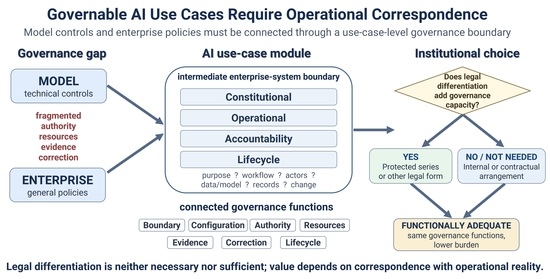
- Defines the AI use case as an intermediate enterprise system of interest.
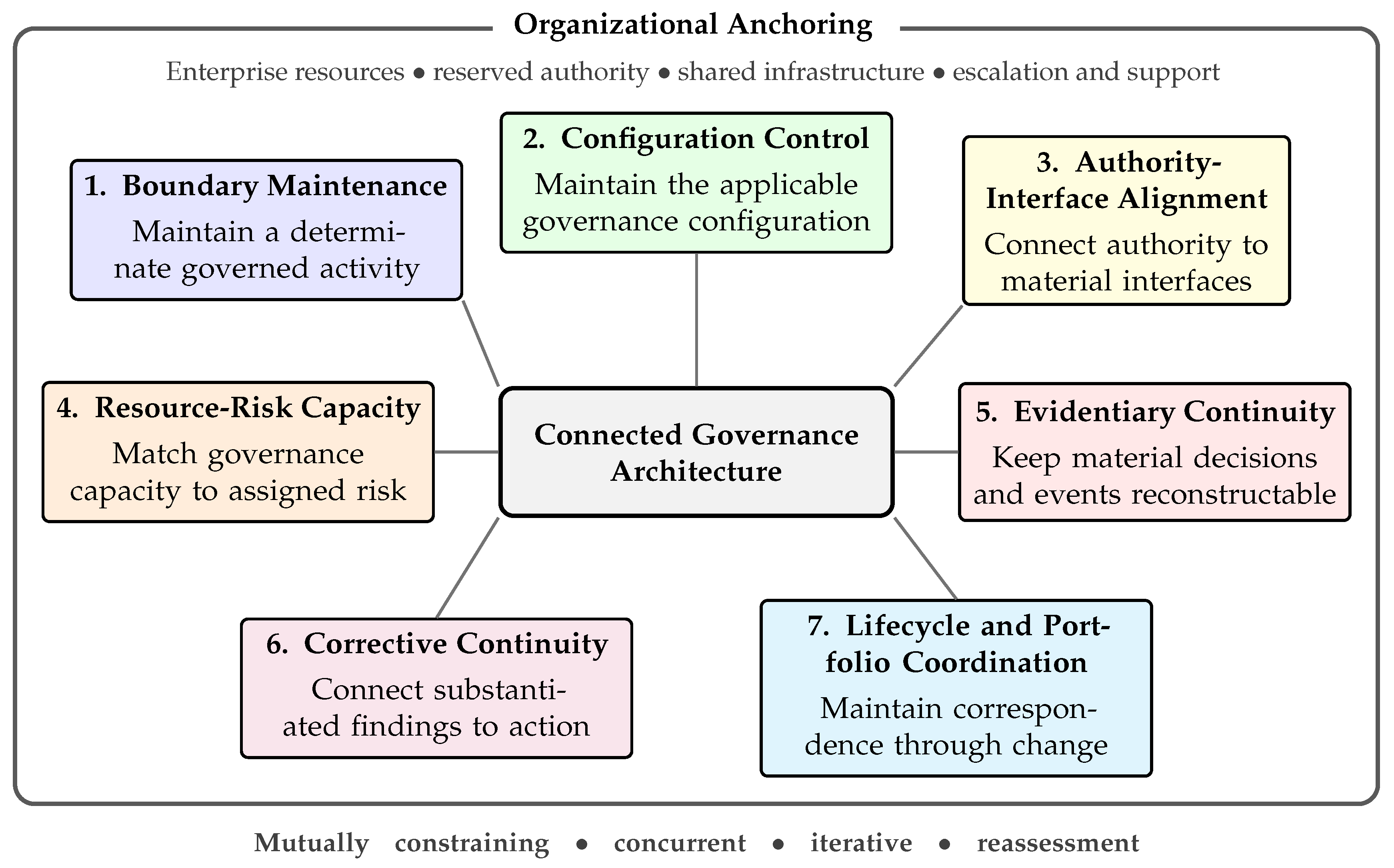
- Links legal-organizational design to ESE governance functions and assessment.
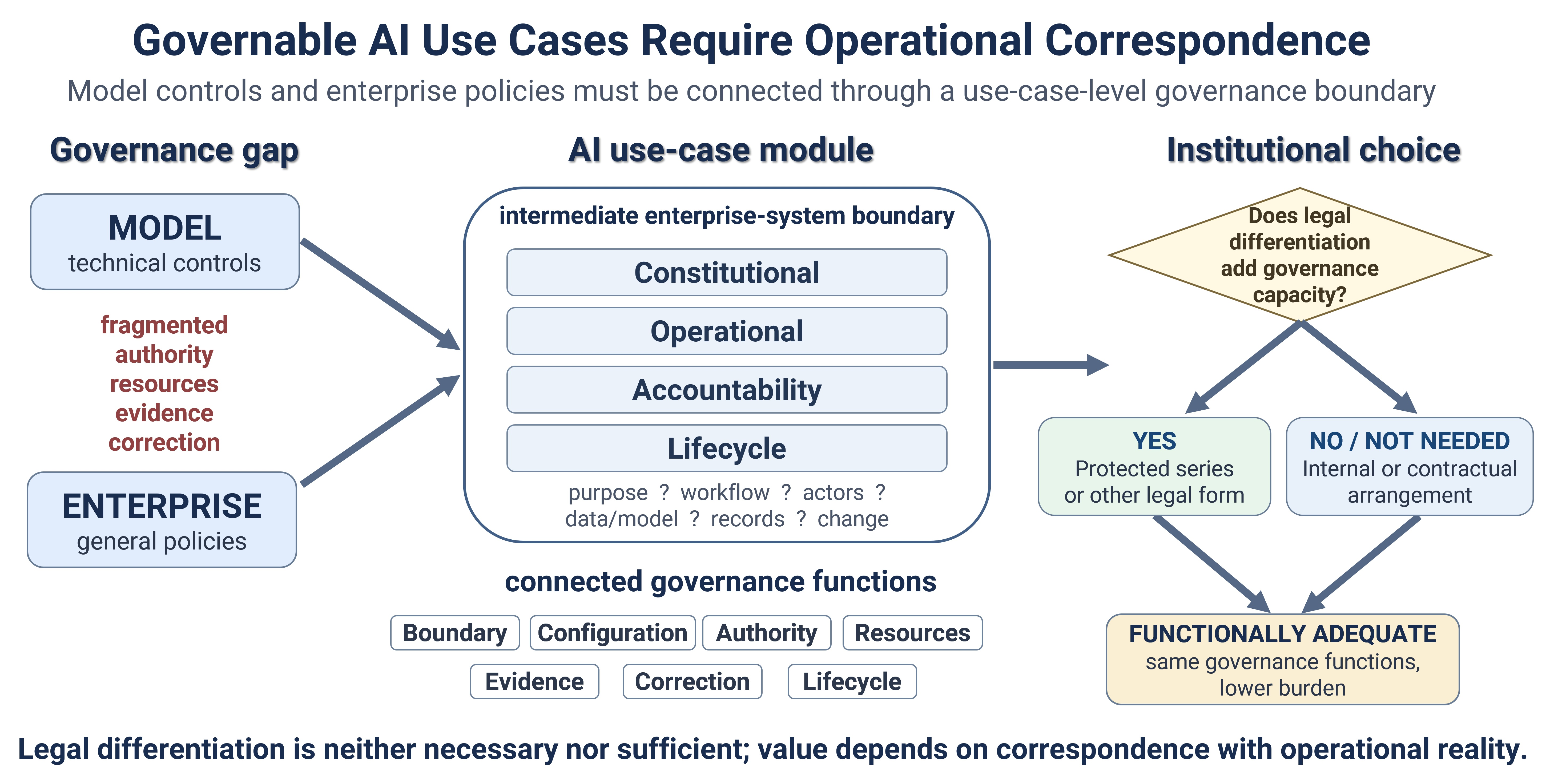
- Legal differentiation adds value only when governance matches operational reality.
- Alternative forms may suffice if they preserve the required governance functions.
Abstract
1. Introduction
1.1. Governance Problem and Research Gap
1.2. Research Question and Principal Claim
1.3. Core Concepts and Scope
1.4. Research Approach
1.5. Contributions and Article Structure
2. Literature Review and Conceptual Foundations
2.1. Enterprise Systems Engineering and Digital Transformation
2.2. Socio-Technical AI Governance
2.3. The Boundary Deficit in Existing AI Governance
2.4. Modularity, Organizational Design, and Legal Personhood
2.5. Design Requirements Derived from the Literature
3. Design-Theoretic Framework Construction
3.1. Design-Theoretic Method and Analytical Synthesis
3.2. Modular Legal Personhood as the Legal-Organizational Substrate
3.3. Feasibility Conditions and Limits of the Protected-Series Prototype
3.4. Modular Operating-Agreement Architecture
3.5. AI Use-Case Module Architecture
3.6. Analytical Traceability of the Framework
3.7. Design-Theoretic Outputs and Evaluation Status
4. Functional Analysis of the Governance Architecture
4.1. Boundary Maintenance and Configuration Control
4.2. Authority-Interface Alignment and Resource-Risk Capacity
4.3. Evidentiary Continuity and Corrective Continuity
4.4. Lifecycle Adaptation and Portfolio Coordination
4.5. Governance Synthesis
5. Implementation and Assessment
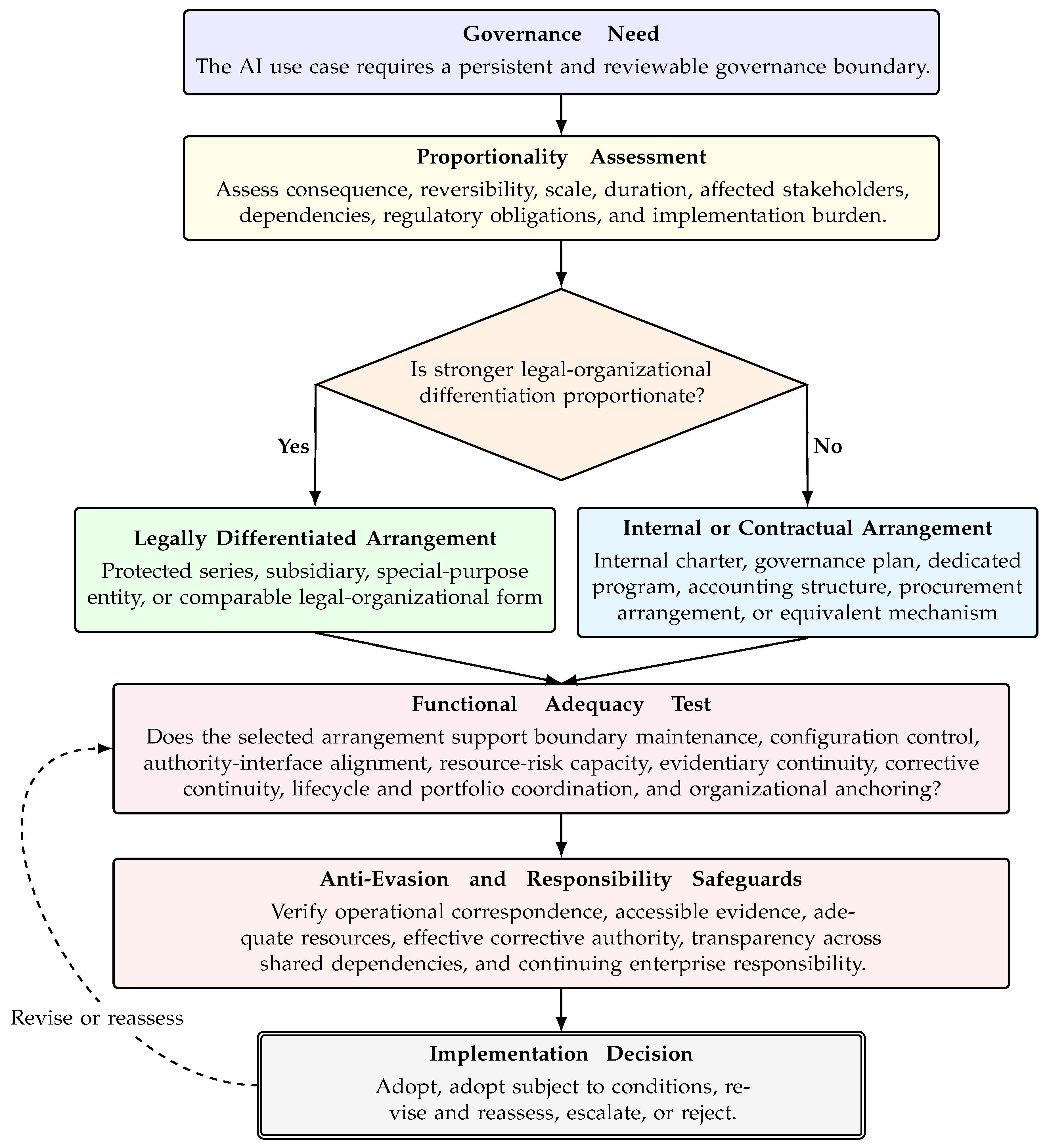
5.1. Proportional Implementation Through Staged Institutionalization
5.2. Operational Correspondence and Assessment Evidence
5.3. Operationalization Through Assessment Dimensions and Indicators
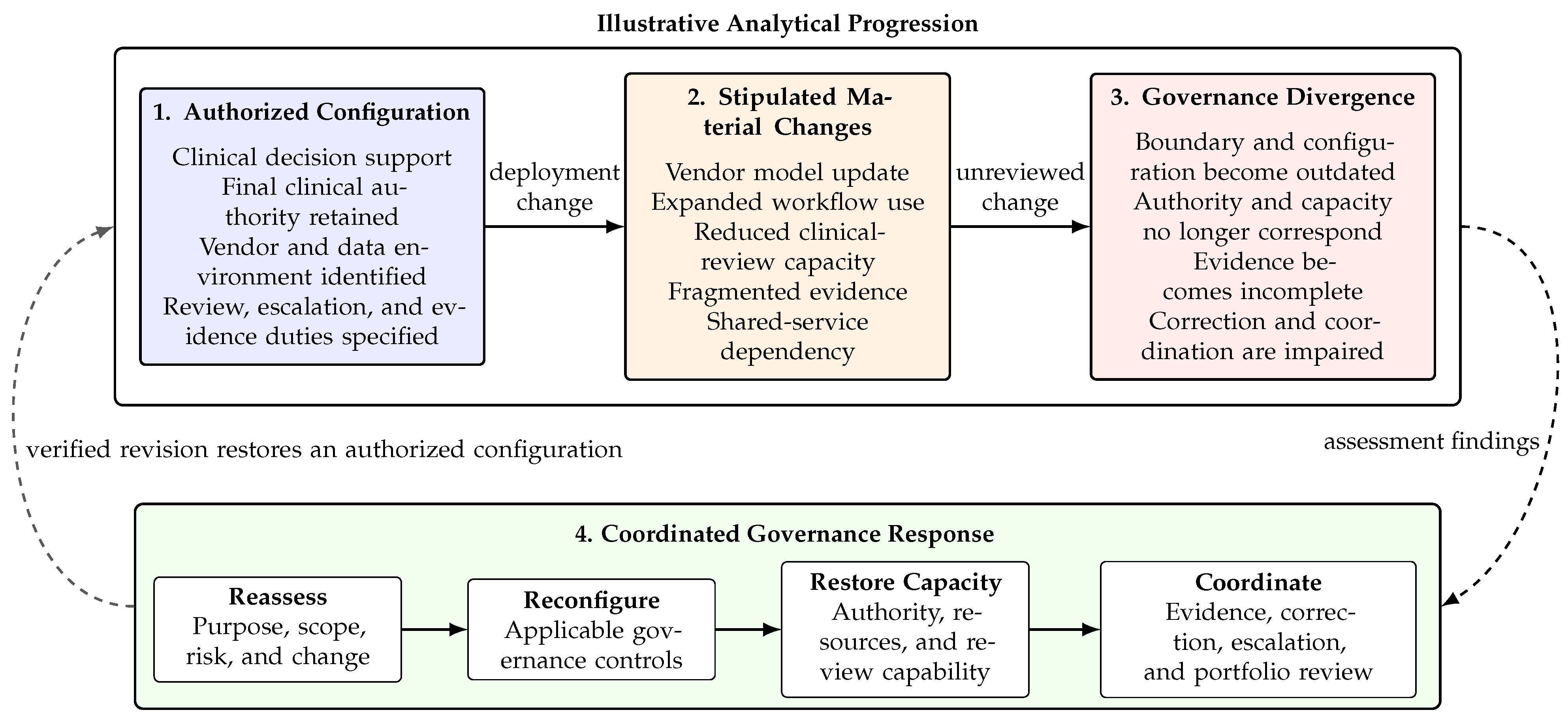
5.4. Illustrative Application to a Hypothetical Scenario
5.5. Interpretation and Validation Limits
6. Discussion
6.1. Functional Portability and Legal-Form Dependence
6.2. Proportionality and the Risk of Over-Formalization
6.3. Responsibility Fragmentation and Anti-Evasion Safeguards
6.4. Contribution to Enterprise Systems Engineering and Relation to Existing Governance Mechanisms
6.5. Empirical Research Agenda
7. Conclusions
Author Contributions
Funding
Institutional Review Board Statement
Informed Consent Statement
Data Availability Statement
Acknowledgments
Conflicts of Interest
Abbreviations
| AI | Artificial intelligence |
| AI RMF | Artificial Intelligence Risk Management Framework |
| DLLCA | Delaware Limited Liability Company Act |
| ESE | Enterprise Systems Engineering |
| EU | European Union |
| ISO | International Organization for Standardization |
| IEC | International Electrotechnical Commission |
| LLC | Limited liability company |
| NIST | National Institute of Standards and Technology |
| UPSA | Uniform Protected Series Act |
References
- Vial, G. Understanding Digital Transformation: A Review and a Research Agenda. J. Strateg. Inf. Syst. 2019, 28, 118–144. [Google Scholar] [CrossRef] [Scilit]
- Bharadwaj, A.; El Sawy, O.A.; Pavlou, P.A.; Venkatraman, N. Digital Business Strategy: Toward a Next Generation of Insights. MIS Q. 2013, 37, 471–482. [Google Scholar] [CrossRef] [Scilit]
- SEBoK Editorial Board. Enterprise Systems Engineering. Guide to the Systems Engineering Body of Knowledge. 2024. Available online: https://sebokwiki.org/wiki/Enterprise_Systems_Engineering (accessed on 7 June 2026).
- Walden, D.D.; Shortell, T.M.; Roedler, G.J.; Delicado, B.; Mornas, O.; Yip, Y.S.; Endler, D. (Eds.) INCOSE Systems Engineering Handbook: A Guide for System Life Cycle Processes and Activities, 5th ed.; John Wiley & Sons: Hoboken, NJ, USA, 2023. [Google Scholar]
- Selbst, A.D.; Boyd, D.; Friedler, S.A.; Venkatasubramanian, S.; Vertesi, J. Fairness and Abstraction in Sociotechnical Systems. In Proceedings of the 2019 Conference on Fairness, Accountability, and Transparency (FAT* ’19), Atlanta, GA, USA, 29–31 January 2019; pp. 59–68. [Google Scholar] [CrossRef] [Scilit]
- Selbst, A.D. An Institutional View of Algorithmic Impact Assessments. Harv. J. Law Technol. 2021, 35, 117–191. [Google Scholar]
- Raji, I.D.; Smart, A.; White, R.N.; Mitchell, M.; Gebru, T.; Hutchinson, B.; Smith-Loud, J.; Theron, D.; Barnes, P. Closing the AI Accountability Gap: Defining an End-to-End Framework for Internal Algorithmic Auditing. In Proceedings of the 2020 Conference on Fairness, Accountability, and Transparency (FAT* ’20), Barcelona, Spain, 27–30 January 2020; pp. 33–44. [Google Scholar] [CrossRef] [Scilit]
- Okuno, M.J.; Okuno, H.G. Legal frameworks for AI service business participants: A comparative analysis of liability protection across jurisdictions. AI Soc. 2025, 40, 5667–5683, Correction in AI Soc. 2026. https://doi.org/10.1007/s00146-026-03260-x. [Google Scholar] [CrossRef] [Scilit]
- Okuno, M.J.; Okuno, H.G. Modular Legal Personhood for AI Use Cases. In Proceedings of the IEEE International Symposium on Technology and Society (ISTAS-25), Santa Clara, CA, USA, 10–12 September 2025; IEEE: New York, NY, USA, 2025; 8p. [Google Scholar] [CrossRef] [Scilit]
- Yoo, Y.; Boland, R.J., Jr.; Lyytinen, K.; Majchrzak, A. Organizing for Innovation in the Digitized World. Organ. Sci. 2012, 23, 1398–1408. [Google Scholar] [CrossRef] [Scilit]
- Rouse, W.B. Enterprises as Systems: Essential Challenges and Approaches to Transformation. Syst. Eng. 2005, 8, 138–150. [Google Scholar] [CrossRef] [Scilit]
- Maier, M.W. Architecting Principles for Systems-of-Systems. Syst. Eng. 1998, 1, 267–284. [Google Scholar] [CrossRef] [Scilit]
- Jamshidi, M. (Ed.) System of Systems Engineering: Innovations for the 21st Century; John Wiley & Sons: Hoboken, NJ, USA, 2009. [Google Scholar] [CrossRef] [Scilit]
- Trist, E.L. The Evolution of Socio-Technical Systems: A Conceptual Framework and an Action Research Program; Occasional Paper 2; Ontario Quality of Working Life Centre: Toronto, ON, Canada, 1981; Available online: https://www.lmmiller.com/blog/wp-content/uploads/2013/06/The-Evolution-of-Socio-Technical-Systems-Trist.pdf (accessed on 7 June 2026).
- Suchman, L.A. Plans and Situated Actions: The Problem of Human-Machine Communication; Cambridge University Press: Cambridge, UK, 1987; Available online: https://bitsavers.trailing-edge.com/pdf/xerox/parc/techReports/ISL-6_Plans_and_Situated_Actions.pdf (accessed on 7 June 2026).
- Orlikowski, W.J. The Duality of Technology: Rethinking the Concept of Technology in Organizations. Organ. Sci. 1992, 3, 398–427. [Google Scholar] [CrossRef] [Scilit]
- Baxter, G.; Sommerville, I. Socio-Technical Systems: From Design Methods to Systems Engineering. Interact. Comput. 2011, 23, 4–17. [Google Scholar] [CrossRef] [Scilit]
- Carayon, P. Human Factors of Complex Sociotechnical Systems. Appl. Ergon. 2006, 37, 525–535. [Google Scholar] [CrossRef] [Scilit]
- Passi, S.; Barocas, S. Problem Formulation and Fairness. In Proceedings of the Conference on Fairness, Accountability, and Transparency (FAT* ’19), Atlanta, GA, USA, 29–31 January 2019; pp. 39–48. [Google Scholar] [CrossRef] [Scilit]
- Parasuraman, R.; Sheridan, T.B.; Wickens, C.D. A Model for Types and Levels of Human Interaction with Automation. IEEE Trans. Syst. Man Cybern.-Part A Syst. Hum. 2000, 30, 286–297. [Google Scholar] [CrossRef] [Scilit]
- Sarter, N.B.; Woods, D.D.; Billings, C.E. Automation Surprises. In Handbook of Human Factors and Ergonomics, 2nd ed.; Salvendy, G., Ed.; John Wiley & Sons: New York, NY, USA, 1997; pp. 1926–1943. [Google Scholar]
- Metcalf, J.; Moss, E.; Boyd, D. Owning Ethics: Corporate Logics, Silicon Valley, and the Institutionalization of Ethics. Soc. Res. Int. Q. 2019, 86, 449–476. [Google Scholar] [CrossRef] [Scilit]
- Rakova, B.; Yang, J.; Cramer, H.; Chowdhury, R. Where Responsible AI Meets Reality: Practitioner Perspectives on Enablers for Shifting Organizational Practices. Proc. ACM Hum.-Comput. Interact. 2021, 5, 1–23. [Google Scholar] [CrossRef] [Scilit]
- Jobin, A.; Ienca, M.; Vayena, E. The global landscape of AI ethics guidelines. Nat. Mach. Intell. 2019, 1, 389–399. [Google Scholar] [CrossRef] [Scilit]
- Mittelstadt, B. Principles Alone Cannot Guarantee Ethical AI. Nat. Mach. Intell. 2019, 1, 501–507. [Google Scholar] [CrossRef] [Scilit]
- Schiff, D.; Biddle, J.; Borenstein, J.; Laas, K. What’s Next for AI Ethics, Policy, and Governance? A Global Overview. In Proceedings of the AAAI/ACM Conference on AI, Ethics, and Society (AIES’20), New York, NY, USA, 7–9 February 2020; pp. 153–158. [Google Scholar] [CrossRef] [Scilit]
- Morley, J.; Floridi, L.; Kinsey, L.; Elhalal, A. From What to How: An Initial Review of Publicly Available AI Ethics Tools, Methods and Research to Translate Principles into Practices. Sci. Eng. Ethics 2020, 26, 2141–2168. [Google Scholar] [CrossRef] [Scilit]
- Mitchell, M.; Wu, S.; Zaldivar, A.; Barnes, P.; Vasserman, L.; Hutchinson, B.; Spitzer, E.; Raji, I.D.; Gebru, T. Model Cards for Model Reporting. In Proceedings of the Conference on Fairness, Accountability, and Transparency (FAT* ’19), Atlanta, GA, USA, 29–31 January 2019; pp. 220–229. [Google Scholar] [CrossRef] [Scilit]
- Gebru, T.; Morgenstern, J.; Vecchione, B.; Vaughan, J.W.; Wallach, H.; Daumé, H., III; Crawford, K. Datasheets for Datasets. Commun. ACM 2021, 64, 86–92. [Google Scholar] [CrossRef] [Scilit]
- Arnold, M.; Bellamy, R.K.E.; Hind, M.; Houde, S.; Mehta, S.; Mojsilović, A.; Nair, R.; Ramamurthy, K.N.; Olteanu, A.; Piorkowski, D.; et al. FactSheets: Increasing Trust in AI Services through Supplier’s Declarations of Conformity. IBM J. Res. Dev. 2019, 63, 6:1–6:13. [Google Scholar] [CrossRef] [Scilit]
- Bovens, M.A.P. Analysing and Assessing Accountability: A Conceptual Framework. Eur. Law J. 2007, 13, 447–468. [Google Scholar] [CrossRef] [Scilit]
- Kroll, J.A.; Huey, J.; Barocas, S.; Felten, E.W.; Reidenberg, J.R.; Robinson, D.G.; Yu, H. Accountable Algorithms. Univ. Pa. Law Rev. 2017, 165, 633–705. [Google Scholar]
- Wieringa, M. What to Account for When Accounting for Algorithms: A Systematic Literature Review on Algorithmic Accountability. In Proceedings of the 2020 Conference on Fairness, Accountability, and Transparency (FAT* ’20), Barcelona, Spain, 27–30 January 2020; pp. 1–18. [Google Scholar] [CrossRef] [Scilit]
- National Institute of Standards and Technology (NIST). Artificial Intelligence Risk Management Framework (AI RMF 1.0). 2023. Available online: https://nvlpubs.nist.gov/nistpubs/ai/NIST.AI.100-1.pdf (accessed on 7 June 2026).
- ISO/IEC 23894:2023; Information Technology—Artificial Intelligence—Guidance on Risk Management. International Standard: Geneva, Switzerland, 2023. Available online: https://www.iso.org/standard/77304.html (accessed on 7 June 2026).
- European Union. Regulation (EU) 2024/1689 of the European Parliament and of the Council of 13 June 2024 Laying Down Harmonised Rules on Artificial Intelligence (Artificial Intelligence Act). Off. J. Eur. Union 2024, L, 1689. [Google Scholar]
- Simon, H.A. The Architecture of Complexity. In Facets of Systems Science; Springer: Boston, MA, USA, 1962; Volume 106, pp. 465–476. [Google Scholar] [CrossRef] [Scilit]
- Parnas, D.L. On the Criteria To Be Used in Decomposing Systems into Modules. Commun. ACM 1972, 15, 1053–1058. [Google Scholar] [CrossRef] [Scilit]
- Ulrich, K. The Role of Product Architecture in the Manufacturing Firm. Res. Policy 1995, 24, 419–440. [Google Scholar] [CrossRef] [Scilit]
- Sanchez, R.; Mahoney, J.T. Modularity, Flexibility, and Knowledge Management in Product and Organization Design. Strateg. Manag. J. 1996, 17, 63–76. [Google Scholar] [CrossRef] [Scilit]
- Baldwin, C.Y.; Clark, K.B. Design Rules, Volume 1: The Power of Modularity; The MIT Press: Cambridge, MA, USA, 2000. [Google Scholar] [CrossRef] [Scilit]
- Kraakman, R.; Armour, J.; Davies, P.; Enriques, L.; Hansmann, H.; Hertig, G.; Hopt, K.; Kanda, H.; Pargendler, M.; Ringe, W.G.; et al. The Anatomy of Corporate Law: A Comparative and Functional Approach, 3rd ed.; Oxford University Press: London, UK, 2017. [Google Scholar]
- Hansmann, H.; Kraakman, R. The essential role of organizational law. Yale Law J. 2000, 110, 387–440. [Google Scholar] [CrossRef] [Scilit]
- Hansmann, H.; Kraakman, R. Organizational Law as Asset Partitioning. Eur. Econ. Rev. 2000, 44, 807–817. [Google Scholar] [CrossRef] [Scilit]
- Hansmann, H.; Kraakman, R.; Squire, R. Law and the Rise of the Firm. Harv. Law Rev. 2006, 119, 1335–1403. [Google Scholar]
- Solum, L.B. Legal Personhood for Artificial Intelligences. NCL Rev. 1992, 70, 1231–1287. [Google Scholar]
- Bryson, J.J.; Diamantis, M.E.; Grant, T.D. Of, for, and by the People: The Legal Lacuna of Synthetic Persons. Artif. Intell. Law 2017, 25, 273–291. [Google Scholar] [CrossRef] [Scilit]
- Chesterman, S. Artificial Intelligence and the Limits of Legal Personality. Int. Comp. Law Q. 2020, 69, 819–844. [Google Scholar] [CrossRef] [Scilit]
- Zech, H. Liability for AI: Public policy considerations. ERA Forum 2021, 22, 147–158. [Google Scholar] [CrossRef] [Scilit]
- Bayern, S. The Implications of Modern Business-Entity Law for the Regulation of Autonomous Systems. Stanf. Technol. Law Rev. 2015, 19, 93–112. [Google Scholar]
- LoPucki, L.M. Algorithmic Entities. Wash. Univ. Law Rev. 2018, 95, 887. [Google Scholar]
- Ribstein, L.E. The Rise of the Uncorporation; Oxford University Press: New York, NY, USA, 2009. [Google Scholar] [CrossRef] [Scilit]
- Molk, P. How Do LLC Owners Contract Around Default Statutory Protections? J. Corp. Law 2017, 42, 503–557. [Google Scholar]
- Uniform Law Commission. Uniform Protected Series Act (UPSA) with Prefatory Key and Comments. 2017. Available online: https://www.uniformlaws.org/HigherLogic/System/DownloadDocumentFile.ashx?DocumentFileKey=30c1060c-0ea7-4ed4-9d48-df97c991f4b9 (accessed on 7 June 2026).
- DLLCA. Del. Code Ann Tit. 6, §18–215 (Protected Series). 1996. Available online: https://delcode.delaware.gov/title6/c018/sc02/#18-215 (accessed on 7 June 2026).
- Ribstein, L.E.; Keatinge, R.R.; Rutledge, T.E. Ribstein and Keatinge on Limited Liability Company, 1st ed.; Thomson Reuters: Eagan, MN, USA, 2026. [Google Scholar]
- Uniform Law Commission and Am Institute. Uniform Commercial Code (UCC) Amendments (2022): Final Act with Comments, 2022. Available online: https://www.uniformlaws.org/committees/community-home?CommunityKey=1457c422-ddb7-40b0-8c76-39a1991651ac (accessed on 7 June 2026).
- Okuno, H.G.; Okuno, M.J. Governance-by-Design for AI Compliance: Compiling EU AI Act Duties into Computable Operating-Agreement Clauses. In 21st International Conference on Artificial Intelligence and Law (ICAIL 2026), Singapore, June 2026; ACM: New York, NY, USA, 2026; 11p. [Google Scholar]
- Act on Limited Liability Companies (Gesetz Betreffend die Gesellschaften mit Beschränkter Haftung—GmbHG); Section 13; Federal Ministry of Justice: Berlin, Germany, 2026. Available online: https://www.gesetze-im-internet.de/englisch_gmbhg/englisch_gmbhg.html (accessed on 7 June 2026).
- Code Civil; Article 1842; Légifrance: Paris, France, 2026; Available online: https://www.legifrance.gouv.fr/codes/article_lc/LEGIARTI000049876831 (accessed on 7 June 2026).
- Code de Commerce; Article L223-1; Légifrance: Paris, France, 2026; Available online: https://www.legifrance.gouv.fr/codes/article_lc/LEGIARTI000019291708 (accessed on 7 June 2026).
- Shishido, Z. Legislative policy of alternative forms of business organization: The case of Japanese LLCs. In Research Handbook on Partnerships, LLCs and Alternative Forms of Business Organizations; Hillman, R.W., Lowenstein, M.J., Eds.; Edward Elgar: Cheltenham, UK, 2015; pp. 374–389. [Google Scholar]
- Companies Act; Act No. 86, Arts. 575–675; Japanese Law Translation, Ministry of Justice: Tokyo, Japan, 2005. Available online: https://www.japaneselawtranslation.go.jp/en/laws/view/4481 (accessed on 7 June 2026).
- Morse, G.; Davies, P.L.; Fletcher, I.F.; Milman, D.; Morris, R. (Eds.) Palmer’s Limited Liability Partnership Law, 3rd ed.; Sweet & Maxwell: London, UK, 2017. [Google Scholar]
- United Kingdom. Limited Liability Partnerships Act 2000, Section 1. Available online: https://www.legislation.gov.uk/ukpga/2000/12/section/1 (accessed on 7 June 2026).
- Okuno, M.J.; Okuno, H.G. Risk Management for Artificial General Intelligence by Limited Liability Companies. In International Symposium on Business & Management (ISBM 2023); Lecture Notes in Networks and Systems; Springer: Singapore, 2024; Volume 833, pp. 13–26. [Google Scholar] [CrossRef] [Scilit]
- Patrimoni destinati ad uno specifico affare. In Codice Civile; Article 2447-bis; Normattiva, Istituto Poligrafico e Zecca dello Stato: Rome, Italy, 1942; Available online: https://www.normattiva.it/eli/id/1942/04/04/042U0262/CONSOLIDATED/20251128 (accessed on 7 June 2026).
- Palmer, V.V. (Ed.) Mixed Jurisdictions Worldwide: The Third Legal Family, 2nd ed.; Cambridge University Press: Cambridge, UK, 2012. [Google Scholar] [CrossRef] [Scilit]
- Sargent, M.A.; Schwudetzky, W.D. Limited Liability Company Handbook, 2024–2025 ed.; Thomson Reuters: Eagan, MN, USA, 2024. [Google Scholar]
- AlSayyad, A.; Huang, K.Y.; Pal, R. AgentTrace: A Structured Logging Framework for Agent System Observability. arXiv 2026, arXiv:2602.10133. [Google Scholar]
- European Parliament. European Parliament Resolution of 16 February 2017 with Recommendations to the Commission on Civil Law Rules on Robotics. 2017. Available online: https://www.europarl.europa.eu/doceo/document/TA-8-2017-0051_EN.html (accessed on 7 June 2026).




| Boundary | Primary Strength | Potential Limitation | Appropriate Role |
|---|---|---|---|
| Model or dataset | Technical specificity and direct connection to model-level controls | May not capture workflow, organizational authority, external dependencies, downstream decisions, and lifecycle responsibilities | Appropriate where the relevant governance problem is primarily model-specific |
| Enterprise | Enterprise-wide policy, shared resources, portfolio oversight, and escalation | May be insufficiently specific for materially different deployment configurations | Appropriate for common policy, shared capabilities, portfolio coordination, and reserved authority |
| AI use case | Can integrate purpose, workflow, actors, dependencies, resources, evidence, and lifecycle controls around a defined deployment | Adds value only if the resulting boundary corresponds to operational reality and does not duplicate existing governance | Appropriate where deployment-specific relationships require a persistent intermediate governance object |
| Design Requirement | Prototype or Equivalent Legal-Organizational Response | Contractual or Architectural Realization | Proposed Governance Role |
|---|---|---|---|
| Determinate boundary identity | Differentiated protected series or equivalent bounded organizational unit | Authorized purpose, scope, management structure, and enterprise relationship in the common core and constitutional layer | Defines an identifiable system of interest against which operational correspondence, use drift, and unauthorized expansion can be assessed |
| Configurable governance | Contractual autonomy within a continuing organizational structure | Common contractual core combined with deployment-specific riders | Maintains baseline governance while permitting controlled and reviewable variation |
| Authority-interface alignment | Allocation of management rights, reserved powers, and external relationships | Provisions governing actors, vendors, infrastructure, workflows, intervention rights, and escalation paths | Connects decision rights to the material interfaces through which the deployment operates |
| Resource-risk capacity | Association of resources and obligations with the module, supported by enterprise-level capacity | Resource commitments, staffing, expertise, technical access, financial arrangements, and escalation provisions | Connects assigned responsibility with the capacity required to discharge it |
| Reviewable evidence and corrective capacity | Accessible use-case records together with identifiable review and corrective authority | Accountability provisions covering approvals, records, incidents, audits, intervention, escalation, remediation, and suspension | Supports evidentiary continuity and connects substantiated findings to corrective action |
| Lifecycle adaptation | Continuing institutional identity combined with controlled amendment | Material-change triggers, periodic review, amendment, revalidation, suspension, and retirement procedures | Supports adaptation while preserving governance traceability across change |
| Organizational anchoring | Continuing relationship between the module and enterprise | Portfolio oversight, shared-capability rules, reserved enterprise powers, and enterprise-level escalation | Preserves enterprise responsibility for shared dependencies, resources, and reserved authority |
| External Reference Point | Selected Governance Focus | Use in the Present Assessment |
|---|---|---|
| NIST AI Risk Management Framework [34] | Govern, Map, Measure, and Manage functions across the AI lifecycle | Provides a reference point for assessing coverage of organizational governance, deployment context, risk measurement, prioritization, treatment, and response |
| ISO/IEC 23894 [35] | Integration of AI risk identification, analysis, evaluation, treatment, monitoring, and communication into organizational processes | Provides a reference point for assessing whether risk responsibilities, resources, monitoring, communication, treatment, and lifecycle processes are connected to the governed use case |
| EU AI Act [36] | Selected applicable obligations concerning intended purpose, risk management, documentation, logging, human oversight, incident reporting, corrective action, and post-market monitoring | Provides a reference point for assessing whether applicable obligations can be associated with a defined deployment, responsible actors, accessible records, effective oversight, and corrective authority |
| Dimension | Diagnostic Question | Candidate Indicator | Principal Evidence |
|---|---|---|---|
| Boundary integrity | Does current operation remain within the authorized purpose and scope? | Proportion of sampled operations conforming to authorized purpose and scope; number and severity of material boundary deviations | Authorization records, workflow samples, system logs, change records, complaints, and stakeholder reports |
| Configuration adequacy | Does the current governance configuration address material deployment conditions? | Proportion of material conditions covered by current and verified governance controls | Applicable agreements, rider register, risk classification, dependency inventory, configuration history, and implementation tests |
| Authority-interface coverage | Does each material interface have effective control, influence, or escalation authority? | Proportion of material interfaces with a verified control, influence, or escalation path | Responsibility matrices, access rights, contracts, service agreements, escalation tests, interviews, and exercises |
| Resource-risk capacity | Do responsible actors possess capacity proportionate to assigned risks and duties? | Proportion of critical responsibilities meeting predefined staffing, expertise, access, time, and response-capacity thresholds | Staffing, expertise, budget, technical access, workload data, and response resources |
| Evidentiary continuity | Can material decisions and events be reconstructed across participants and systems? | Proportion of sampled material events with a complete and accessible evidence chain | Logs, approvals, model and data records, intervention records, audit files, incident documentation, and review records |
| Corrective responsiveness | Do substantiated findings produce timely and proportionate action? | Proportion of corrective actions completed within applicable thresholds; median time from substantiated finding to containment | Finding registers, remediation plans, escalation decisions, suspension records, effectiveness reviews, and closure evidence |
| Lifecycle and portfolio coordination | Are material changes and shared-dependency effects identified and reviewed in time? | Proportion of material changes reviewed within threshold; proportion of shared-dependency findings communicated and assessed within threshold | Change records, periodic reviews, dependency registers, portfolio reports, shared-service notifications, and incident analysis |
| Dimension | Scenario Condition | Diagnostic Implication | Indicated Governance Response |
|---|---|---|---|
| Boundary integrity | Outputs are used for patient-flow and resource-allocation decisions beyond the original authorization | Operation exceeds the authorized purpose and scope | Restrict the expanded use or formally reassess and amend the authorization before continuation |
| Configuration adequacy | The model update, workflow expansion, and reduced review conditions are not reflected in the current configuration | Governance corresponds to an earlier deployment state | Reassess material changes and update the applicable governance controls |
| Authority-interface coverage | Hospital oversight depends on vendor-controlled information without a verified path for timely access or intervention | Responsibility is not matched by effective authority over a material interface | Establish information rights, change-notification duties, intervention rights, and a tested escalation path |
| Resource-risk capacity | Expanded use increases monitoring demands while clinical workload reduces review capacity | Available capacity is not proportionate to the revised scope and risk | Increase review time, staffing, expertise, and response resources or reduce deployment scope |
| Evidentiary continuity | Hospital and vendor records cannot be reliably connected to case-level decision histories | Material events cannot be reconstructed through a complete evidence chain | Establish shared identifiers, access rights, retention rules, and evidence-exchange procedures |
| Corrective responsiveness | Review identifies concerns, but restriction, remediation, or suspension authority is unclear | Findings do not connect to a complete corrective decision path | Assign corrective and escalation authority and establish severity-based response thresholds |
| Lifecycle and portfolio coordination | The model update and incident pattern are not assessed for another function using the same service | A shared dependency may propagate risk without portfolio-level review | Notify affected use cases, assess the shared dependency, and coordinate reassessment and correction |
Disclaimer/Publisher’s Note: The statements, opinions and data contained in all publications are solely those of the individual author(s) and contributor(s) and not of MDPI and/or the editor(s). MDPI and/or the editor(s) disclaim responsibility for any injury to people or property resulting from any ideas, methods, instructions or products referred to in the content. |
© 2026 by the authors. Licensee MDPI, Basel, Switzerland. This article is an open access article distributed under the terms and conditions of the Creative Commons Attribution (CC BY) license.
Share and Cite
Okuno, M.J.; Okuno, H.G. Modular Legal Personhood for AI Use Cases: An Enterprise Systems Engineering Framework for Digital Transformation. Systems 2026, 14, 1157. https://doi.org/10.3390/systems14091157
Okuno MJ, Okuno HG. Modular Legal Personhood for AI Use Cases: An Enterprise Systems Engineering Framework for Digital Transformation. Systems. 2026; 14(9):1157. https://doi.org/10.3390/systems14091157
Chicago/Turabian StyleOkuno, Mayumi J., and Hiroshi G. Okuno. 2026. "Modular Legal Personhood for AI Use Cases: An Enterprise Systems Engineering Framework for Digital Transformation" Systems 14, no. 9: 1157. https://doi.org/10.3390/systems14091157
APA StyleOkuno, M. J., & Okuno, H. G. (2026). Modular Legal Personhood for AI Use Cases: An Enterprise Systems Engineering Framework for Digital Transformation. Systems, 14(9), 1157. https://doi.org/10.3390/systems14091157