Article

What Choices Do Employees Have When Facing Destructive Leaders, and What Are the Odds of a Good Outcome for the Employees? A Systemic Perspective


by
Jan Emblemsvåg
1,* and
Marianne Synnes Emblemsvåg
2
1
Department of Ocean Operations and Civil Engineering, Norwegian University of Science and Technology, Larsgårdsvegen 2, 6009 Ålesund, Norway
2
Department of Health Sciences Ålesund, Norwegian University of Science and Technology, Larsgårdsvegen 2, 6009 Ålesund, Norway
*
Author to whom correspondence should be addressed.
Systems 2026, 14(8), 937; https://doi.org/10.3390/systems14080937
Submission received: 8 May 2026 / Revised: 12 July 2026 / Accepted: 31 July 2026 / Published: 3 August 2026

Highlights

Contributions to systems science, systems practice, systems theory and/or methodology:
  • This study treats organizations as complex adaptive systems and applies Gresham’s Law in a novel way to describe the choices employees encounter when facing destructive leadership.
  • This study is, to the knowledge of the authors, the first exploratory study employed in the context of destructive leadership research.
Main findings and/or implications of the main findings:
  • The probability of managers curbing destructive leaders is not better than that predicated by a simple random choice model.
  • The low probability of a positive outcome for the employee suggests that leaving the organization is a rational choice for employees unless there are other compelling reasons to stay.

Abstract

The destructive leadership evolution model derives from the centuries-old Gresham’s Law, and it states that “bad” leaders drive out “good” leaders, but “good” leaders cannot drive out “bad” leaders when “bad” leaders are allowed to operate with impunity. Employees will therefore face a choice between becoming a colluder, a conformer, or a leaver unless top management successfully resolves the situation. This paper analyzes the situation from the employees’ perspective using Gresham’s Law as the starting point. The principal advantage of using Gresham’s Law lies in its systemic perspective: it treats corporations as complex adaptive systems and therefore makes explicit the conditions under which particular outcomes are likely to arise. The analysis itself consists of using a random choice model and Monte Carlo simulations. The study is therefore exploratory in nature, and it demonstrates that the probability of averting destructive leadership tendencies remains low unless top management intervenes deliberately. These results align with empirical results of other researchers, indicating that managers are not any more effective at curbing destructive leaders than can be predicted by a simple random choice model. Consequently, the model suggests that for most employees a rational course of action is to exit the organization except where other compelling considerations outweigh the costs of staying.

1. Introduction

The Pupil asked, “What are the four evils?” Confucius replied, “To execute without having admonished; this is called cruelty. To examine accomplishments without having instructed; this is called brutality. To be lax in direction yet make deadlines; this is called viciousness. To be stingy in giving what is due to others; this is called being bureaucratic.”
Confucius
Analects 20:4
Leadership is the most important problem in human affairs—it is the source of national greatness and national despair [1]. As Drucker famously observed [2]: “Only three things happen naturally in organizations: friction, confusion, and underperformance. Everything else requires leadership”. Indeed, Herzberg [3] showed that interventions to improve employee motivation through personal growth had little effect, but removing bad supervision had a sizable effect.
Unfortunately, mainstream leadership research has suffered from a positivity bias by focusing on the desirable attributes of leaders to the neglect of the unpleasant reality that many leaders behave badly and cause great harm [4]. This positivity bias is evident from the fact that although the literature on destructive leadership, toxic leadership, etc., has grown substantially over the last decades, its publication volume is far smaller than that of the literature on the desirable aspects of leadership, which by the end of the last century included more than 9000 different systems, languages, principles and paradigms [5]. Since then, this body of research has grown even more.
Yet, a 2019 study by the Society for Human Resource Management (SHRM) found that 1 in 4 workers in the USA dread going to work, and 58% of employees who quit a job due to workplace culture say that their managers are the main reason they ultimately left [6]. Also, a Gallup survey involving more than a million American workers reveals that half of all employees say they have left a company because of a bad boss [7]. Indeed, “the great resignation” can be spoken of in the US, and it relates to what the researchers [8] call a “toxic culture”. In a subsequent article, the same authors [9] probe further into the matter and identify five factors of toxic cultures—disrespectful, non-inclusive, unethical, cutthroat, and abusive. The cost for US businesses is large— USD 223 bn in the period covering 2015 through 2019, according to one estimate [10].
Note that survey data have well-known bias risks and should not be overinterpreted. For example, safety science research often relies on employee surveys, but after reviewing three survey cases, Keiser et al. [11] found that up to a third of the variation can be explained by impression management, i.e., providing socially desirable responses because of the salient social consequences associated with responding and additional costs of providing unfavorable responses. The existence of impression management should come as no surprise because the human resource (HR) department is likely to take the side of the leader without compelling information [12].
Unfortunately, bad leadership is not a new phenomenon. Indeed, Aristophanes (446–386) of ancient Greece wrote in the “Frogs” [13]:
Oftentimes have we reflected on a similar abuse
In the choice of men for office, and of coins for common use;
For your old and standard pieces, valued and approved and tried
Here among the Grecian nations, and in all the world beside,
Recognized in every realm for trusty stamp and pure assay,
Are rejected and abandoned for the trash of yesterday;
For vile, adulterate issue, drossy, counterfeit and base,
Which the traffic of the city passes current in their place.
More than 2000 years later, Gresham’s Law was formulated to describe similar phenomena. British economist Henry Dunning Macleod (1858) decided to name the tendency of “bad” money driving “good” money out of circulation after Sir Thomas Gresham (1519–1579), the financial agent of Queen Elizabeth I [14]. The same mechanism, of bad driving out the good, has also been suggested concerning leadership [15].
Indeed, much research has been performed over the years to understand “bad” leadership (e.g., [4,15,16] amongst others), and a variety of different terms have been used to describe it, such as “tyrannical” [17], “bullying” [18], “unethical” and “bad” [19], “dark” [20], “dysfunctional” [21], “psychopathic” [22], “self-serving” [23], “despotic” [24], “Machiavellian” [25], “toxic” [26] and “destructive leader” [16]. Since the term “destructive leadership” is most commonly used in the scholarly literature [27], it is also used in this paper.
Most of this research follows a traditional management research approach where a research question leads to the design of a research method followed by observations and/or surveys, using useful measurements and sufficient reliability levels to provide the insights required to build a model and theory; see, for example, Tharenou et.al. [28].
Interestingly, Emblemsvåg and Emblemsvåg [15] chose a different approach, starting from a generic version of Gresham’s Law, which can be formulated as follows [29]:
‘Bad’ money drives out ‘good’ money, but ‘good’ money cannot drive out ‘bad’ money when fixed exchange rate is enforced and there is sufficient supply to invoke choice. In lieu of choice, ‘bad’ money stabilizes ‘good’ money and the entire coinage.
The authors argued that Gresham’s Law can best be described using complex systems theory since (1) most real-life systems seem to interact and produce new, emergent behaviors in alignment with complexity theory, and (2) corporations are complex adaptive systems (CASs) [30].
A CAS consists of self-similar agents that interact with one another and with the environment, such that relatively simple agents with simple rules of behavior can collectively produce complex, emergent dynamics. Consequently, the properties that characterize the system as a whole usually cannot be inferred—or sometimes even defined—from the description of any single agent [31]. Indeed, “Complexity science studies systems where large numbers of components or subsystems, at times of a different nature, combine to produce surprising emergent phenomena apparent at multiple scales. It is these phenomena, hidden behind the often deceptively simple rules that govern individual components, that best define complex systems” [32]. Moreover, the complexity grows as the system grows in size [33]. Therefore, these systems must be studied holistically, as the sum of the agents and their interactions, and not element by element through reductionism [34].
Thus, complexity theory views organizations as a CAS. Within this perspective, destructive leadership is not simply an isolated behavioral deficiency; rather, it is a system-level emergent phenomenon through Gresham-like dynamics, where destructive leaders, through political skills, opportunism, or dysfunctional incentives, may outcompete and ultimately “drive out” good leaders [15]. Destructive behavior can become reinforced when the organization rewards, tolerates or fails to correct such leaders, leading to gradual leadership shift toward dysfunction [35]. The model developed for the evolution of destructive leaders, built on Gresham’s Law as an analogy, is stated as follows [15]:
‘Bad’ leaders drive out ‘good’ leaders, but ‘good’ leaders cannot drive out ‘bad’ leaders when ‘bad’ leaders are allowed to operate with impunity. In times of crisis, ‘bad’ leaders can stabilize the situation because people accept some destructive behavior as a cost to overcome the crisis.
The translation of Gresham’s Law from its generic version hinges on a couple of observations. A fixed exchange rate implies that coins of different metallic content have the same exchange rate at any given time—not that it stays the same over time. Europe during the medieval period and later was no stranger to debasement of coins (inflation). In a leadership context, the “exchange rate” refers to the fact that people of different qualities inhabit the same occupations, as frequently observed in real life. Second, there is a functional equivalence between different currencies adjusted for exchange rates, just as different leaders exhibit leadership styles that are not functionally identical, yet, they often have similar jobs.
Unfortunately, the destructive leadership evolution model comes with a caveat: it requires the correct identification of a destructive leader. This caveat is important, and Velde et al. [36] claim that without some private information, the phenomenon of circulation by tale or Gresham’s Law would not exist, since both revolve around what happens when one meets an uninformed seller.
This situation represents a third observation, and it relates directly to the fact that the complexity of a CAS is a combination of the attributes of the system (ontological complexity) and simultaneously also a “function of our present understanding of the system” (epistemological complexity) [37]. In other words, the existence of private information is highly likely, perhaps even inescapable. Indeed, forced circulation was observed throughout history, but in organizational leadership such forcing is only observed in special cases arising from a lack of people and in crises. Such forcing, however, stabilizes the situation, as it did with early coinage, reinforcing the usefulness of using Gresham’s Law as an analogy.
An obvious challenge in that situation is whether or not the private information can be trusted. Thus, trust and the level of informed decision-making are closely related to the core of Gresham’s Law. It is not difficult to understand in the context of coins. Suppose you are buying something in the market with coins. Once the change is handed to you, in addition to the goods you bought, you easily notice if one coin is different than the others. Then, the element of choice arises: is this slightly different coin of the same intrinsic value as the others or has it been debased (which happened frequently in Medieval Europe)?
The challenge when it comes to leadership is that such choices are much more difficult, which induces the obvious question concerning the destructive leadership evolution model [15]: how can choices be made for various levels of trust? While the superior of the destructive leader has a choice to make concerning the employment of the destructive leader, the subordinate also has a choice to make. Although the literature on the broad topic of decision-making is vast [38], the authors find among senior managers that most of them asked family and relatives and friends and colleagues to help them when facing difficult decisions—only a minority of people report that they use the internet or expert sources. Thus, arguably, decisions are made by talking to people they trust.
Hence, employees’ choice when encountering a destructive leader is shaped by a complex interplay of personal resources, organizational climate, power dynamics, and the severity of the leader’s destructive behavior, amongst other factors [39]. This can be the choice between speaking up or staying silent, confronting the leader, avoiding him/her, reporting the behavior or tolerating it, or whether to stay in the job or exit. As Sue [40,41] eloquently puts it; “take it, leave it, or change it”. Complexity theory helps explain why these choices are relatively path dependent, but difficult due to an unpredictable result.
The choice an employee makes when confronted with a destructive leader depends on numerous factors, including the characteristics of the leader, the employee, their relationship, and the broader organizational environment. One way of overcoming this situation is to observe and seek advice from colleagues who work successfully with the leader. However, if there is a real destructive leader, this approach will not suffice and exit is the recommended choice [12].
Padilla et al. [35] introduced the “toxic triangle”, a framework describing how bad leaders gain and maintain power, emphasizing the combined influence of leaders, followers and contextual conditions in producing and tolerating destructive leadership. Accordingly, these dimensions are also central for understanding the options employees perceive and the decision they make when encountering destructive leadership. Since an organization is defined by its participants, everyday employee choices shape broader systemic patterns, thereby enabling the normalization and proliferation of destructive leadership. Over time, this may result in the emergence of a so-called “toxic culture”.
Toxic cultures might drive even prominent leaders out of coveted leadership positions, and a single bad leader, even in a middle-ranking leadership position, can bring down an entire organization [42]. Once a toxic culture takes root, it shapes individual perceptions and restricts the viable options for confronting destructive leadership. Organizational silence becomes a rational coping mechanism in such morally unsafe environments [43]. Thus, individual decisions and systemic tendencies co-create each other—a hallmark of a CAS.
This study will explicate and analyze the choice of the employee from a mathematical point of view without any preferences towards any theory other than what can be deducted from the destructive leadership evolution model [15]. The following research question will be addressed; “what choices do employees have when facing destructive leaders and what are the odds of a good outcome for the employee?” A “good outcome” refers to a favorable resolution for the employee, which ideally manifests itself either through the removal of the destructive leader, internal transfer of the employee, or promotion to a position outside the destructive leader’s influence.
The hypothesis used to address this research question is that “the probability of a good outcome can be described by a random choice model”, implying that leadership in many organizations is unable to effectively address destructive leaders. This may seem a severe hypothesis, but the empirical evidence on the prevalence and impact of destructive leadership is discouraging. If this hypothesis is shown to hold, the practical advice based on the modeling results to an employee facing a destructive leader is clear (absent other compelling reasons to stay)—leave the organization or move internally to a position outside the leader’s sphere of influence. For simplicity, both options are referred to as “leave” in this paper. Obviously, a real-life choice must be based on more factors that the modeling cannot capture, as discussed later.
The method deployed in this paper relies on the destructive leadership evolution model of Emblemsvåg and Emblemsvåg [15] and the barrier model of Breevaart et.al. [39] to explicate the choices, and to calculate the probabilities of a good outcome. These two papers therefore provide the main theoretical underpinnings of the presented work.
It is important to note that various human preferences such as risk aversion, conservatism, etc., could alter the choice in ways that contradicts the probabilities. Such preferences are not included due to the complexity of handling them realistically. Their effects are, as discussed in Section 2, included numerically by adding substantial degrees of uncertainties to the choice process.
Next, the choice is discussed in greater depth, and then the odds for making a good choice are calculated under the assumption of a random choice model in Section 3. The purpose of this simple random choice model is to provide an independent benchmark that can be used to compare to actual empirical data provided by others, as discussed in more detail next. The results are then subsequently discussed, and in Section 4 the limitations and the future work are discussed.

2. The Method

This study is partly based on literature and partly based on simulations and a deduction of conclusions thereof. The literature part is presented in the first section of Section 3 and this section is dedicated to the more analytical part of the paper.
This study presents a decision model outlining the choices faced by employees when they encounter destructive leadership, within the constraints discussed above. Our argument concerning the choice is structured in three ways. First, the theoretical foundations are explored as a point of departure by using a six-point model which is developed here in combination with the barrier model of Breevaart et.al. [39]; see Section 3.1. This model was chosen due to its structuredness and clarity. Moreover, the destructive leadership evolution model is revisited in Section 3.2, including how it relates to CAS. Then, the decision tree model is presented in Section 3.3 and the mathematical results in Section 3.4.
This study should preferably have been supported by a longitudinal approach. However, when the negative experiences of people are the topic, such a study would be difficult to execute. Therefore, a novel approach is used instead where the theoretical model of Gresham’s Law in a leadership context is analyzed using a simulation of a baseline model that represents an extreme decision-making process constituting only random choices.
Essentially, instead of trying to assess the true probabilities for a large set of people, probabilities are simply randomly assigned according to the number of possible outcomes (frequency interpretation of probability). So, if there are two possible outcomes for a decision, the probability becomes 50%, which is the random outcome of a choice with two possible outcomes for n people when n → ∞. This enables the calculation of the cumulative random choice probabilities for the two final outcomes—“stay” or “leave”. As such, the modeling provided in this paper provides an extreme baseline of random choice outcomes. Then, by comparing these results to findings from the literature, the best choice for the employee can be deducted all else being equal (paribus ceteris). This study is therefore an exploratory study using numerical simulations to cap the solution space and subsequently using the literature to interpret the solution space via deductive arguments. Then, the research question can be addressed without venturing into the extremely rich literature on risk aversion, conservatism, trust, fear, and more.
Indeed, one of the great advantages of exploratory modeling is to simplify complex processes and interactions to the appropriate level of detail [44]. For more than 30 years it has been applied and refined in the geomorphological sciences, where it was first introduced by [45], and for more than 25 years in epidemiology [46]. A challenge for the application of exploratory modeling shown in this study is that we do not possess more detailed models than Gresham’s Law, which could conceivably had been used to include a number of factors that have been excluded here such as job market situation, dependencies, and culture. Our usage of exploratory modeling is therefore in the early stages, and to the knowledge of the authors, this type of modeling has never before been used in the context of destructive leadership.
A simple decision tree is used to calculate the cumulative probabilities for certain outcomes, and the results are used to address the hypothesis. The acceptance of the hypothesis is subsequently used to deduct an answer to the research question using insights from the literature. This indirect approach is chosen because directly addressing the research question through surveys and the like is unreliable, as discussed above.
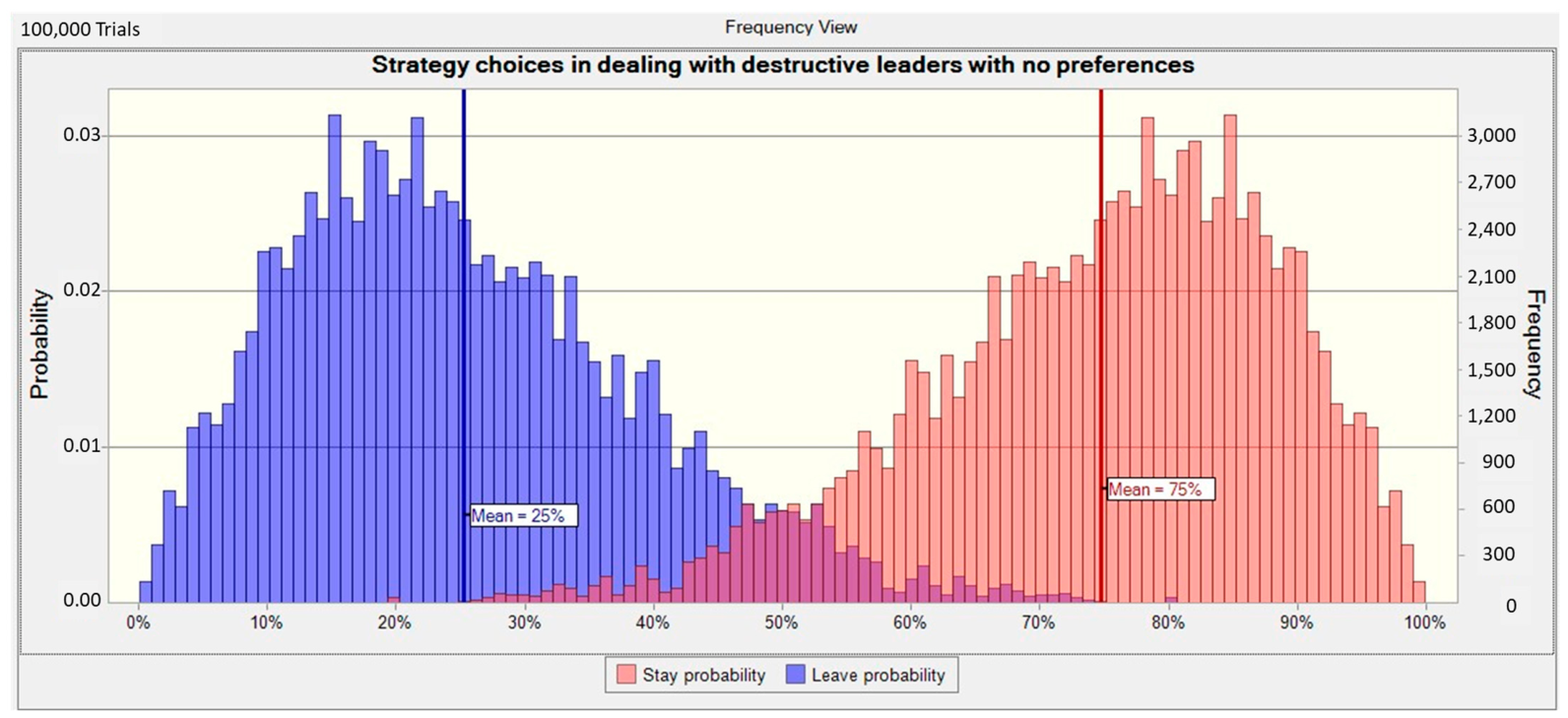
The final element of the method is to assess how the various factors would influence real-life decisions of “exit, voice and loyalty”, which is done by adding uncertainties to the model as a numerical proxy for including the real-life factors. A Monte Carlo simulation is subsequently performed with 100,000 trials where each decision is modeled with an expected value as indicated but with triangular uncertainty distributions from 0% to 100%. For example, a 33% deterministic probability is modeled as ranging from 0% to 100% with an expected value of 33%. Similarly, a 50% deterministic probability is modeled as ranging also from 0% to 100% but with 50% as the expected value.
This approach of numerically including the uncertainties in the choices that employees make, irrespective of whether the decisions are based on a correctly understood situation, is conservative. By using a Monte Carlo simulation, the entire solution space can be sampled and provide a numerical solution to a CAS. The resulting probability distributions are much more reliable than the deterministic decision tree results. If the resulting probability distributions do not overlap, the choice of “staying” or “leaving” will never produce the same outcome probability. Hence, the choice should be clear from a purely probabilistic perspective. Then, additional insights from the literature are useful for interpreting the results.
Note that the decision tree ignores practical issues related to a choice in real life such as labor market conditions, economic issues, accumulated pension rights, and cultural issues. However, these practical issues are included in the six-step decision process and numerically handled by using the uncertainty distributions discussed previously.

3. Results

It is almost impossible to be untouched by incivility between people at work [47], and the choice an employee must make is not straightforward because of the different characteristics of the different types of destructive leadership [15]. Also, employees should avoid making a choice based merely on disliking people. In fact, people who struggle to work well with their leaders are nearly always part of the problem themselves—their behavior is in some way preventing them from being recognized and valued [12].
One way of overcoming this situation is to observe and seek advice from colleagues who work successfully with the leader, but this approach will not suffice if there is a real destructive leader, and exit becomes the recommended choice [12]. Thus, employees must have realistic expectations concerning what is possible to achieve in organizations, to avoid wandering from one job to another looking for an ideal that may not exist.
The decision process of an employee encountering a destructive leader can be structured as a six-point model, as discussed next. Then, it is shown in Section 3.2 that the destructive leadership evolution in an organization is a CAS. In Section 3.3 and Section 3.4, the decision process and the odds are discussed. The contributions made in this paper are briefly summarized in Section 3.5.

3.1. Exit, Voice or Loyalty?

The decision process starts when the organization contains, or begins to reward, destructive leadership, irrespective of whether it is subtle or fully developed, because it sets the conditions for potential Gresham dynamics [15]. Destructive leadership persists not only because of the leader’s behavior, but because multiple environmental barriers trap the employee in place [39]. This affects the employee’s decision process, triggering a chain of dynamic considerations that can be structured as a six-point model:
  • A triggering event activates the decision process. The employee experiences destructive leadership, such as shouting, swearing, ridiculing, and invading privacy [48], the leader takes credit for team successes while blaming subordinates for failures [49,50], etc. It may be a single event, but it is equally likely that the situation is emerging and gradually grows worse, before it finally reaches a tipping point (“had enough”).
  • How the employee experiences the event (i.e., the nature, severity, frequency, intent, ambiguity) significantly influences the employee’s response. When the destructive leadership behavior is subtle, passive–aggressive, or ambiguous, employees often hesitate because they doubt whether the behavior is sufficiently severe to warrant action [39]. Different types of destructive leader behaviors impact followers differently, but all types increase turnover intentions, although with different urgencies, and constrain employees’ choices in distinct ways [50]. However, as behavior worsens, or becomes more overt, employees are more likely to shift from denial to active coping efforts [49].
  • How the employee responds via active coping efforts depends on personal resources, power dynamics between the employee and the destructive leader, the social and organizational context, and the opportunities and constraints as described in the barrier model of abusive supervision [39]:
    (a)
    Personal resources: Employees exposed to destructive leadership are likely to employ a range of conflict-coping strategies: some retaliate, some resign and some adapt to the situation [51]. Research shows that coping behaviors may be directed toward or away from the source of stress—that is, the destructive leader—distinguishing between approach and avoidance coping strategies [52,53]. Moreover, behavioral and cognitive efforts to manage destructive leadership can be categorized as problem focused (attempts to change or eliminate the problem) or emotion focused (managing emotional reactions to the problem) [52,53,54].
    How employees cope depends partly on their personal resources and characteristics. Employees who believe they can manage conflict or navigate difficult conversations are more likely to confront or report the behavior, whereas those with low self-efficacy often resort to avoidance or silence [55]. Prior experiences with bullying or conflict may lead some employees to avoid similar situations, while others may develop resilience that buffer the negative effects [56]. Moreover, when individuals perceive the situation as uncontrollable, they are more likely to use avoidance-focused coping strategies, such as withdrawing, ruminating, taking leave, or leaving the organization entirely [52,57].
    (b)
    Power dynamics: The power relationship between the employee and the destructive leader shapes the perceived feasibility of various responses. When the destructive leader controls evaluations, workload, opportunities, and references, employees have fewer safe choices due to higher risk of retaliation. High dependence on the destructive leader for career advancement or job security reduces the likelihood of confrontation. Employees who rely on their position as a stepping stone may choose silence or emotional masking, whereas those with alternative opportunities may be more inclined to confront, report or exit [58].
    (c)
    Social and organizational context: The organizational climate and culture may function as an enabler of the destructive leadership behavior [35,52]. Organizational cultures that emphasize power, control and competitiveness, and where psychological safety is low, can create conditions where destructive leadership behaviors are tolerated or even rewarded [35].
    (d)
    Opportunities and constraints: Employees exposed to destructive leadership often cannot simply confront, report or leave the situation, even when such actions appear rational from an outside perspective [39]. This is not only because of the leader’s actions, but also because environmental barriers surround the employee, making leaving the organization or resisting the destructive leader difficult.
  • The emotional reaction of the employee influences the choice made. At first, abusive supervision provokes anger and fear, but over time when followers keep getting confronted with abusive supervision, followers’ emotions flatten out and eventually they end up feeling sad and helpless [59], which can explain why followers do not end the abusive relationship [39].
  • The employee makes his or her choice. Followers and middle management face distorted incentives, and some may comply because destructive leaders hold power and destructive behavior is rewarded. Resisting the system is punished. A selection pressure emerges.
  • A systemic feedback loop occurs:
    (a)
    If employees choose “Endure” or “Avoid”, destructive leaders face no resistance, and bad leaders remain in place. Worse, when leaders perceive follower coping strategies as submissive, they are likely to maintain or increase their destructive behavior [53].
    (b)
    If employees “report”, but barriers block success, destructive leaders gain even more power, and the organization drifts further toward toxicity [60].
    (c)
    If employees choose “Exit”, potentially good employees and good leaders leave, leading to destructive leadership proportion increases [15].
    (d)
    If confrontation fails, the relational and organizational barriers [39] may strengthen, leading to fear and silence.

3.2. The Destructive Leadership Evolution as CAS

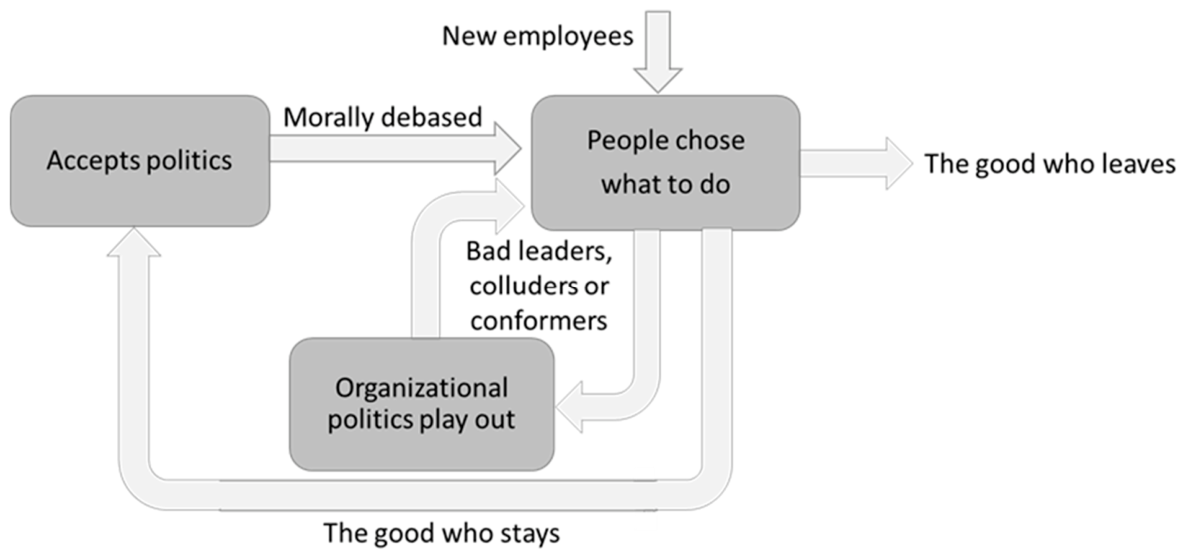
The barrier model of abusive supervision [39] frames destructive leadership as a system-wide problem with the employees positioned at the center. This framing is in alignment with Gresham’s Law and the existence of a CAS. Furthermore, the model has four expanding layers of barriers: individual, relational, organizational and societal. These barriers represent four levels of a CAS, that under certain circumstances create the conditions that allow the Gresham’s Law CAS dynamic to unfold; see Figure 1. These circumstances arise when the organization is large enough to let organizational politics play out covertly.
That situation occurs when some legitimate metric can be used outwardly to explain recruitment, succession and retention, but illegitimate reasons are actually the ones that are being used. This is typical defensive reasoning, which operates according to the following rules—“Keep premises tacit, make inferences with covert logic, and subject conclusions to private tests; the tests should be consistent with the logic used by the person reaching the conclusion”. Defensive reasoning is therefore self-referential because there is no external and independent reality check, and it will consequently become self-serving, self-sealing, self-fulfilling and ultimately self-deceiving [61].
As demonstrated above, the choices employees make are shaped by several influencing factors, and they can be classified according to the coping strategies they choose. Padilla et al. [35] propose that in the “toxic triangle” of destructive leadership, there are two types of “susceptible followers”, conformers and colluders. While both support or enable destructive leadership, they differ in their motivations and actions: Conformers are passive followers who comply out of fear, unmet needs, or low self-esteem, whereas colluders are active accomplices who align with the leader for personal gain and ambition. Emblemsvåg and Emblemsvåg [15] added “leavers” to the classification of followers—those who cannot accept either of the two coping strategies.
Interestingly, the choices presented above [39] can also be deducted through observing economic transactions. From economics, two principal determinants of the readiness to resort to voice are known when exit is possible in a market, which Hirschman [62] also believes hold in politics: (1) the extent to which the certainty of exit can be traded against the uncertainties of an improvement in a deteriorating product, and (2) the estimate of the customer’s ability to influence the organization. As a rule, loyalty holds exit at bay and activates voice and can therefore be very useful. However, blind loyalty is bad [63]. The same mechanisms are assumed to exist concerning destructive leadership coping strategies.
It should be noted that loyalty has always been a hot topic in the field of organizational behavior, and is of great significance to the operation and management of organizations [64]. There is also a great difference in culture; “In the western pattern, all members in an organization are equivalent, just as all straws in a bundle are alike. This is quite different from the Chinese pattern. Social relationships in China possess a self-centered quality. Like the ripples formed from a stone thrown into a lake, each circle spreading out from the center becomes more distant and at the same time more insignificant” [65].
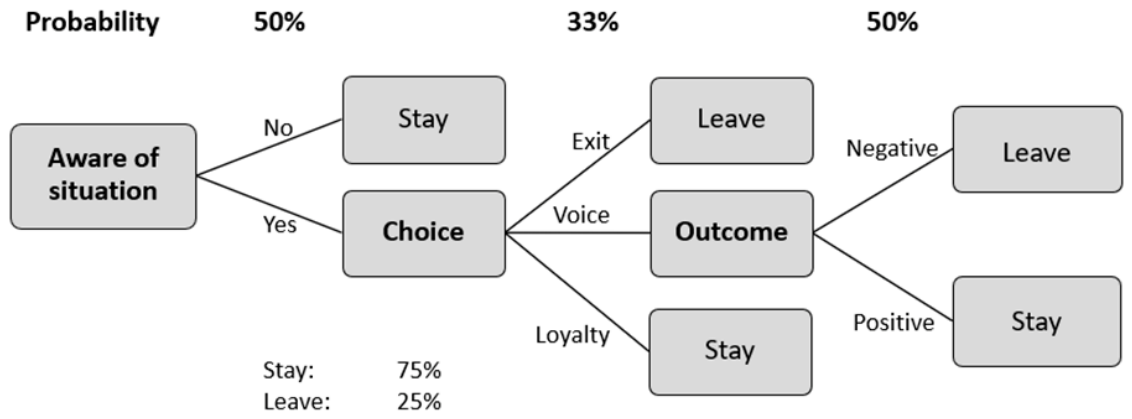
Since distinguishing between “Endure” or “Avoid” (discussed earlier) is difficult without personal insights, the term “loyal” is more useful—without venturing into its causes. The choice structure can now be developed using the terms of Hirschman [62]—“exit”, “voice” or “loyalty”. By merging the destructive leadership evolution model in Figure 1 with the discussion above, the choice of whether or not an employee should stay can be expressed as a decision tree; see Figure 2.

3.3. The Decision Tree for Exit, Voice or Loyalty

The decision tree starts by acknowledging that there is a situation. Those that are unaware of the situation will stay or leave for conditions that are irrelevant to this analysis. Those that are aware of the situation will face a choice with two possible outcomes. In a simple random choice model, each of these are assigned a probability of 50%.
Then, each of the next three possible outcomes (“exit”, “voice” or “loyalty”) will be assigned a probability of 33%. “Exit” implies leaving, while “loyalty” implies either compliance with destructive leaders out of fear, as conformers do, or active participation in a destructive leader’s agenda, as colluders do [35]. A simple random choice model cannot make such distinctions, which is why they are grouped together. This is not unreasonable since conformers also can contribute to destructive leadership [66] though inaction.
The latter choice, “voice”, is based on a risk assessment with an ultimate outcome of either “staying” or “leaving” depending on the outcome of voicing the concerns, both with a probability of 50%. The employee will stay under three conditions, of which none are identifiable in this simple model: first, the employee gives up and becomes a conformer; second, the employee becomes a colluder; and third, there is actually real change taking place and the destructive leadership situation is resolved. However, the odds of coming out on top after a confrontation or actual institutional changes take place are low [47].

3.4. The Odds of the Choices

To analyze these choices, the concept of utility can be used. The Random Utility Maximization (RUM) model [67] has had a major impact on how choice behavior has been modeled and studied over the past 50 years [68]. Indeed, “we find that many, though not all, of the behavioral traits discussed in the literature can be approximated sufficiently closely by a random utility framework” [69]. However, establishing a credible utility function for the discussed CAS is beyond the scope of this paper. Rather, the random choice is merely calculated as cumulative probabilities and then compared to what real-life data suggest, and from there the hypothesis and answers to the research question are inferred. The deterministic result is shown in Figure 2.
In lieu of a more refined choice model that represents a CAS in its richness, Figure 3 shows essentially the total solution space without any preferences that could have narrowed the choice solution space down. The expected probability for an employee to escape the model in Figure 2 is 25%, deterministically. Most people will choose to stay. The percentiles in Table 1 are interesting, and more useful than the deterministic result, since the deterministic result is driven purely by mathematics, while the uncertainty can account for a number of effects.
If focus is placed on the 10–90% percentiles, the results are not far from Edgard Schein’s famous statement, repeated in an interview [70] that “… 80% of the people survived the ordeal [being prisoner of war in Korea] by being passive. That’s generally the way it is in organizations”. In fact, this very simple model suggests 76% will stay either as conformers or colluders on average (50% percentile). Furthermore, the results are not materially different than those reported by Nutt [71].
This finding is in itself interesting because it suggests that top management’s abilities to deal with destructive leaders are on par with the results from the random choice model. When destructive leaders occur in the workplace, there is, in other words, a dearth of effective leadership, one way or the other. That statement is the logical conclusion of the insights offered by Drucker [2] at the beginning of this paper.
Thus, concerning the initial research question, the answer is clear: unless there is a compelling reason to stay, including effective measures that are taken to resolve the situation, the employee should consider leaving. The chances of a good outcome for the employee are basically too slim, unless you are willing to lower your standards to become a conformer or a colluder.
These statements are, of course, derived from the model and must be interpreted with care. For example, the modeling does not include real-life factors that people should consider in this context, such as bad labor market conditions, high economic dependency, pension rights, psychological safety, and specific cultural contexts.

3.5. Contributions to the Body of Knowledge

This paper extends the knowledge base concerning destructive leadership in three ways. First, the approach of using Gresham’s Law, random choice modeling and Monte Carlo simulations (exploratory modeling) is novel in this field of research to our knowledge. The great benefit is that the need for longitudinal studies for our specific purpose is greatly reduced. That said, longitudinal studies would, of course, have been advantageous if the methodological challenges discussed in Section 2 could have been resolved.
The second contribution is the results of the modeling itself. The fact that a random choice model gives the same probability estimate of a good outcome for an employee as some empirical studies indicates that the abilities of top management in dealing with destructive leaders is not materially better than what can be achieved by chance. This may seem a surprising finding, but recall the statements of Drucker in Section 1. Furthermore, as shown in the discussion next, lack of good performance is common in a number of fields. That said, we should be careful overstretching this finding since causation has not been established. We have only proven that it is probable at some level.
A third contribution relates to the fact that this paper builds on the previous work in the destructive leadership evolution model and the barrier model. Moreover, this paper adds credibility to the destructive leadership evolution model by showing that the caveats of that model [15] can be successfully addressed. Empirical work remains to be coupled with the model to refine it further.

4. Discussion, Limitations and Future Work

The model used here is a simple, random choice model without any preferences in the decision-making. This simplicity is, on the surface, a shortcoming since all the non-mathematical factors that people include when making choices, either consciously or unconsciously, are ignored in the modeling. Yet, interestingly, the results are not materially different from those reported by a number of authors that have studied related issues, such as Nutt [71] and Schein [70]. Those two studies have limited statistical significance, which shows that empirical studies are necessary in the future to verify the results of this paper.
There are, of course, limits to the accuracy of the results when making indirect comparisons between empirical studies and exploratory simulation results. This introduces methodological uncertainties since empirical results are derived from real-life data, whereas the exploratory results are obtained from idealized data sets. This uncertainty is resolved in this paper only by numerically adding sufficient uncertainties to the exploratory modeling to stay on the conservative side. Eliminating this methodological uncertainty can only be achieved by large-scale empirical studies, but that is future work, as noted earlier.
Large-scale empirical studies would have enabled the establishment of more detailed models under the overarching model structure to exploit the benefits of capturing causality using exploratory modeling; see [44]. However, without such detailed models, the initial exploratory modeling in the context of destructive leadership shown here cannot claim causality, only probability.
However, there are other interesting studies, as well, that offer some evidence. First, a survey of 672 leaders in the Chinese construction industry shows that an employee’s leadership potential significantly increases both leader jealousy and leader ostracism, with leader jealousy serving as a mediator [72]. That study does not address exactly the same problem statement as addressed here, but it is likely that some of the fundamental aspects are similar due to human nature. Assuming that a jealous leader is experienced as a destructive leader, the odds of good outcomes for an employee in such a situation is low, as indicated in this paper as well.
Second, a large survey of 2185 human resource professionals and 10,796 leaders from 2014 organizations around the world may also provide support for the results provided here [73]: 71% of the leaders report significant stress levels; 54% of these are concerned about burnout and 40% consider leaving leadership roles entirely (28% of the total sample), compared to just 20% of the less stressed leaders (6% of the total sample). Again, the results are materially quite similar, or even slightly worse, as the random choice model presented here, implying that leadership efforts to deal with the situation are ineffective.
While the employees must try to pass the correct judgment concerning whether or not a leader is destructive, they must be aware of their own defensive reasoning, which can cloud their own judgments from a scientific point of view. As Argyris [61] puts it: “…we become unaware of the programs in our heads that keep us unaware” resulting in “skilled unawareness” and “skilled incompetence”. Thus, is the employee the problem, or is the leader truly destructive? The latter question is difficult to address.
Regardless, it is the employees who must ultimately live with the consequences of their own decisions, whether or not it is based on a correct understanding of the situation. In this paper, this challenge is handled by modeling the uncertainties associated with the decision-making process; see Figure 2. The tension between the assumptions of the model and the practical difficulty of applying it in real life (i.e., the fact that real-life decisions do not rest upon mere mathematical calculations as shown in the decision tree) constitutes an inherent problem which cannot be fully resolved in practice, since the employee would typically need professional support to understand the situation in details. Nevertheless, the impact of this issue has been numerically captured by incorporating uncertainty distributions into the decision process to account for it numerically. Figure 3 therefore provides a realistic estimate for the solution space.
It is therefore useful to revert back to the beginning—complexity theory. Experience seems to indicate that the larger the organizational system, the more complex and basically the more difficult it is to change. For example, at the inter-governmental level there are over 250,000 international treaties that aim to foster global cooperation, but they mostly fail to produce their intended effects, and some are even counter-effective [74]. At the corporate level, 70% of change initiatives fail [75]. The average organization has undergone five major changes, yet only 34% of those initiatives are successful [76]. The list is long of failures, including the largely negative responses from the global survey [73] just mentioned, to implement change in larger organizations of various sorts. Failure is more often the norm than success. Gresham’s Law seems to abound everywhere.
The fact is that changing the direction for large organizations, whether they are governments, multinational corporations, large projects and the like, is predicted by complexity theory. The reason is that a CAS is governed by its attractor, and changing the attractor requires that the system is brought to its current bifurcation/tipping point to undergo a fundamental change of the system.
Unfortunately, there are no universally accepted definitions for attractors, but an attractor can be defined as a subset of an abstract mathematical space called “phase space” that describes a “dissipative dynamical system” by representing all possible states of the system, with each possible state of the system corresponding to one unique point in the phase space [77]. Furthermore, a dissipative dynamical system is characterized by the presence of some sort of internal “friction” that tends to contract phase-space volume elements and hence induce attractors. Therefore, an attractor can be thought of as the long-term behavior of a CAS, and the attractor in this case has a name—Gresham’s Law.
In human societal systems, this finding is tantamount to suggesting that crises drive human development. While that statement is too categorical, it is clear that “…crises, despite their hardships, should be viewed as opportunities for personal and collective development” [78]. Bringing large bodies of people to such a state in a planned fashion is very difficult. Indeed, the myth of modernity, the idea of progress, is common but ultimately related to materialism [79], but employee wellbeing is not necessarily related to materialistic measures. The organizational system is also unlikely to prove useful due to the conservatism driven by its attractor. Therefore, unless there are leaders able to deal with the destructive leader, employees probably have to look for the solution themselves more than in some external, positive intervention.
Ultimately, an employee’s understanding of the situation matters less than the fact that they will have to live with the situation. What an employee must understand is that change will be difficult. Next, the employee must ask himself whether or not providing knowledge about the case to the superior of the destructive leader would help the employee in dealing with the destructive leader.
If the answer to that question is positive, the employee should seek to thoroughly document the situation and then provide the documentation to the superior of the destructive leader. In the simplest case, the situation could be a misunderstanding, and the employee should therefore approach the matter with care. If the employee is unsure about the outcome of such an approach, or fear the answer is negative, the employee should consider leaving the organization or seek another position within the organization unless there are other compelling reasons for staying. Such compelling reasons include bad labor market conditions, high economic dependency, pension rights, psychological safety, and specific cultural contexts.
By leaving the organization, the employee sends a strong signal. Unfortunately, exit is perhaps the only trustworthy resolution of the risk of an employee incorrectly labeling a leader as a destructive leader. By leaving, the employee sends the signal that the situation is unbearable, which must be true for the employee whether the situation is interpreted in one way or the other. The employee must, of course, weigh the strength of the messaging against the cost of messaging. Leaving can be a drastic choice and must be weighed up against other compelling reasons for staying. The simple exploratory modeling performed here cannot resolve such issues. The positive aspect with such exploratory modeling, however, is that the employee can infer their own conclusions given the baseline provided by the modeling. The baseline modeling indicates that the odds of a good outcome are low (25% deterministically) and that leaving is a rational choice—but the employee must always keep in mind that it is not the only choice.
For the organization, a good exit interview will therefore be critical to learn and understand whether or not they do have a destructive leader at hand. Therefore, a competent and independent HR department is needed for the organization to deal with destructive leaders, since others that are directly involved in the situation could arguably suffer from biases, agendas and more.
The superior of the destructive leader must ultimately trust other people’s experience since the destructive leader in question is only experienced firsthand from the perspective of an employee. The perspective of the superior is more difficult to address if HR cannot perform a very good exit interview. This perspective of choice remains a future topic to address. This paper addresses the employee perspective.

5. Conclusions

This paper has demonstrated that, despite the good intensions that organizations abound with, handling destructive leaders boils down to whether or not their superior leader and independent and competent HR professionals can/will take active measures to resolve the situation. Otherwise, there is a significant risk that Gresham’s Law will rule. If employees believe that the superior leader has been made aware of the situation and will handle the situation well, they should provide the documentation necessary. Unfortunately, prior survey results in the literature indicate that the capabilities of organizations as systems in dealing with destructive leadership are close to the same efficacy as suggested by the random choice model presented here, i.e., on average, 25% probability for a positive outcome for the employee. Therefore, in lieu of active leadership, modeling in this paper suggests that the chance of a good outcome is low, which makes considering leaving the organization a rational choice for an employee encountering a destructive leader.

Author Contributions

Conceptualization, J.E. and M.S.E., Writing—original draft, J.E.; Writing—review & editing, M.S.E. All authors have read and agreed to the published version of the manuscript.

Funding

This research received no external funding.

Institutional Review Board Statement

Not applicable.

Informed Consent Statement

Not applicable.

Data Availability Statement

The paper contains all data that are used.

Acknowledgments

The authors thank the editorial team and the anonymous reviewers for their efforts and suggestions. The detailed reading of the reviewers helped us substantially improve this paper.

Conflicts of Interest

The authors declare no conflicts of interest.

Abbreviations

The following abbreviations are used in this manuscript:
CASComplex adaptive system
RUMRandom Utility Model

References

  1. Acemoglu, D.; Robinson, J.A. Why Nations Fail: The Origins of Power, Prosperity, and Poverty; Crown Publishing: New York, NY, USA, 2013; p. 546. [Google Scholar]
  2. Kouzes, J.M.; Posner, B.Z. Great Leadership Creates Great Workplaces; Jossey-Bass: Hoboken, NJ, USA, 2013; p. 64. [Google Scholar]
  3. Herzberg, F. One more time: How do you motivate employees? Harv. Bus. Rev. 1968, 46, 53–62. [Google Scholar] [CrossRef][Green Version]
  4. Hogan, R.; Kaiser, R.B.; Sherman, R.A.; Harms, P.D. Twenty Years on the Dark Side: Six Lessons about Bad Leadership. Consult. Psychol. J. Pract. Res. 2021, 73, 199–213. [Google Scholar] [CrossRef]
  5. Buckingham, M.; Coffman, C. First, Break All the Rules: What the World’s Greatest Managers Do Differently; Simon & Schuster UK: London, UK, 1999; p. 271. [Google Scholar]
  6. Mirza, B. Toxic Workplace Cultures Hurt Workers and Company Profits; Society for Human Resource Management (SHRM): Alexandria, VA, USA, 2019; Available online: https://www.shrm.org/resourcesandtools/hr-topics/employee-relations/pages/toxic-workplace-culture-report.aspx (accessed on 10 December 2025).
  7. Gallup. State of the American Manager: Analytics and Advice for Leaders; Gallup: Washington, DC, USA, 2015; p. 56. [Google Scholar]
  8. Sull, D.; Sull, C.; Zweig, B. Toxic Culture Is Driving the Great Resignation. Sloan Management Review 2022. Available online: https://sloanreview.mit.edu/article/toxic-culture-is-driving-the-great-resignation/ (accessed on 24 June 2024).
  9. Sull, D.; Sull, C.; Cipolli, W.; Brighenti, C. Why Every Leader Needs to Worry About Toxic Culture. Sloan Management Review 2022. Available online: https://sloanreview.mit.edu/article/why-every-leader-needs-to-worry-about-toxic-culture/ (accessed on 24 June 2024).
  10. Bolden-Barrett, V. Toxic Cultures Have Cost US Businesses $223B in the Past Five Years. HR Dive 2019. Available online: https://www.hrdive.com/news/toxic-cultures-have-cost-us-businesses-223b-in-the-past-five-years/563905/ (accessed on 24 June 2024).
  11. Keiser, N.L.; Payne, S.C. Are employee surveys biased? Impression management as a response bias in workplace safety constructs. Saf. Sci. 2019, 118, 453–465. [Google Scholar] [CrossRef]
  12. Kets de Vries, M.F.R. When You Hate Your Boss. Harv. Bus. Rev. 2016, 94, 98–101. [Google Scholar]
  13. Balch, T.W. The Law of Oresme, Copernicus, and Gresham. In Proceedings of the American Philosophical Society; APS Press: Philadelphia, PA, USA, 1908. [Google Scholar]
  14. Fetter, F.W. Some Neglected Aspects of Gresham’s Law. Q. J. Econ. 1932, 46, 480–495. [Google Scholar] [CrossRef]
  15. Emblemsvåg, J.; Emblemsvåg, M.S. How bad leaders can drive out good leaders. J. Leadersh. Stud. 2023, 17, 5–26. [Google Scholar] [CrossRef]
  16. Einarsen, S.; Aasland, M.S.; Skogstad, A. Destructive leadership behaviour: A definition and conceptual model. Leadersh. Q. 2007, 18, 207–216. [Google Scholar] [CrossRef]
  17. Ashforth, B. Petty tyranny in organizations. Hum. Relat. 1994, 47, 755–778. [Google Scholar] [CrossRef]
  18. Namie, G.; Namie, R. The Bully at Work: What You Can Do to Stop the Hurt and Reclaim the Dignity on the Job; Sourcebooks: Naperville, IL, USA, 2000; p. 373. [Google Scholar]
  19. Kellerman, B. Leadership Warts and All. Harv. Bus. Rev. 2004, 82, 40–45. [Google Scholar] [PubMed]
  20. Paulhus, D.L.; Williams, K.M. The dark triad of personality: Narcissism, Machiavellianism, and psychopathy. J. Res. Personal. 2002, 36, 556–563. [Google Scholar] [CrossRef]
  21. Walton, M. Leadership behavior-in-context: An antidote to leadership hype. Ind. Commer. Train. 2011, 43, 415–421. [Google Scholar] [CrossRef]
  22. Boddy, C.R. Corporate psychopaths, bullying and unfair supervision in the workplace. J. Bus. Ethics 2011, 100, 367–379. [Google Scholar]
  23. Rus, D.; van Knippenberg, D.; Wisse, B. Leader self-definition and leader self-serving behavior. Leadersh. Q. 2010, 21, 509–529. [Google Scholar] [CrossRef]
  24. De Hoogh, A.H.B.; Den Hartog, D.N. Ethical and despotic leadership, relationships with leader’s social responsibility, top management team effectiveness and subordinates’ optimism: A multi-method study. Leadersh. Q. 2008, 19, 297–311. [Google Scholar] [CrossRef]
  25. Judge, T.A.; Piccolo, R.F.; Kosalka, T. The bright and dark sides of leader traits: A review and theoretical extension of the leader trait paradigm. Leadersh. Q. 2009, 20, 855–875. [Google Scholar] [CrossRef]
  26. Whicker, M.L. Toxic Leaders: When Organizations Go Bad; Bloomsbury Academic: London, UK, 1996; p. 200. [Google Scholar]
  27. Krasikova, D.V.; Green, S.G.; LeBreton, J.M. Destructive Leadership: A Theoretical Review, Integration, and Future Research Agenda. J. Manag. 2013, 39, 1308–1338. [Google Scholar] [CrossRef]
  28. Tharenou, P.; Dononhue, R.; Cooper, B. Management Research Methods; Cambridge University Press: Cambridge, UK, 2007; p. 350. [Google Scholar]
  29. Emblemsvåg, M.S.; Emblemsvåg, J. Developing a generic model of Gresham’s Law for qualitative analyses. Int. J. Gen. Syst. 2022, 51. [Google Scholar] [CrossRef]
  30. Coleman, H.J., Jr. What Enables Self-Organizing Behavior in Business. Emergence 1999, 1, 33–48. [Google Scholar] [CrossRef] [PubMed]
  31. Carmichael, T.; Hadžikadi’c, M. The Fundamentals of Complex Adaptive Systems. In Complex Adaptive Systems: Views from the Physical, Natural, and Social Sciences; Carmichael, T., Collins, A.J., Hadžikadi’c, M., Eds.; Springer: Cham, Switzerland, 2019; pp. 1–16. [Google Scholar]
  32. Hébert-Dufresne, L.; Allard, A.; Garland, J.; Hobson, E.A.; Zaman, L. The path of complexity. npj Complex. 2024, 1, 4. [Google Scholar] [CrossRef]
  33. INCOSE. Systems Engineering Handbook: A Guide for System Life Cycle Processes and Activities, Version 3; International Council on Systems Engineering (INCOSE): Seattle, WA, USA, 2006; p. 185. [Google Scholar]
  34. Emblemsvåg, M.S.; Emblemsvåg, J. A strategic- and tactical model for managing complex risks in social systems. Int. J. Disaster Risk Reduct. 2025, 128, 105716. [Google Scholar] [CrossRef]
  35. Padilla, A.; Hogan, R.; Kaiser, R.B. The toxic triangle: Destructive leaders, susceptible followers, and conducive environments. Leadersh. Q. 2007, 18, 176–194. [Google Scholar] [CrossRef]
  36. Velde, F.R.; Weber, W.E.; Wright, R. A Model of Commodity Money, with Applications to Gresham’s Law and the Debasement Puzzle. Rev. Econ. Dyn. 1999, 2, 291–323. [Google Scholar] [CrossRef]
  37. Cilliers, P. Complexity theory as general framework for sustainability science. In Exploring Sustainability Science: A Southern African Perspective; Burns, M., Weaver, A., Clark, W., Kates, R., Eds.; African Sun Media: Stellenbosch, South Africa, 2008; pp. 39–57. [Google Scholar]
  38. Hallo, L.; Nguyen, T.; Gorod, A.; Tran, P. Effectiveness of Leadership Decision-Making in Complex Systems. Systems 2020, 8, 5. [Google Scholar] [CrossRef]
  39. Breevaart, K.; Wisse, B.M.; Schyns, B. Trapped at Work: The Barriers Model of Abusive Supervision. Acad. Manag. Exec. 2022, 36, 936–954. [Google Scholar] [CrossRef]
  40. Sue, M.P. Toxic People: Decontaminate Difficult People at Work without Using Weapons or Duct Tape; John Wiley & Sons: Hoboken, NJ, USA, 2007; p. 243. [Google Scholar]
  41. Sue, M.P. The Reactor Factor: How to Handle Difficult Work Situations Without Going Nuclear; John Wiley & Sons: Hoboken, NJ, USA, 2010; p. 240. [Google Scholar]
  42. Drummond, H. Living in a fool’s paradise: The collapse of Barings’ Bank. Manag. Decis. 2002, 40, 232–238. [Google Scholar] [CrossRef]
  43. Morrison, E.W.; Milliken, F.J. Organizational silence: A barrier to change and development in a pluralistic world. Acad. Manag. Rev. 2000, 25, 706–725. [Google Scholar] [CrossRef]
  44. Larsen, L.; Thomas, C.; Eppinga, M.; Coulthard, T. Exploratory Modeling: Extracting Causality from Complexity. Eos 2014, 95, 285–292. [Google Scholar] [CrossRef]
  45. Murray, A.B.; Paola, C. A cellular model of braided rivers. Nature 1994, 371, 54–57. [Google Scholar] [CrossRef]
  46. Weitkunat, R.; Wildner, M. Exploratory causal modeling in epidemiology: Are all factors created equal? J. Clin. Epidemiol. 2002, 55, 436–444. [Google Scholar] [CrossRef] [PubMed]
  47. Porath, C. An Antidote to Incivility. Harv. Bus. Rev. 2016, 94, 108–111. [Google Scholar]
  48. Tepper, B.J. Consequences of abusive supervision. Acad. Manag. J. 2000, 43, 178–190. [Google Scholar] [CrossRef] [PubMed]
  49. Schmid, E.A.; Verdorfer, A.P.; Peus, C. Shedding light on leaders’ self-interest: Theory and measurement of exploitative leadership. J. Manag. 2017, 45, 1401–1433. [Google Scholar] [CrossRef]
  50. Schmid, E.A.; Verdorfer, A.P.; Peus, C.V. Different Shades—Different Effects? Consequences of Different Types of Destructive Leadership. Front. Psychol. 2018, 9, 1289. [Google Scholar] [CrossRef] [PubMed]
  51. Mackey, J.D.; Parker Ellen, B., III; McAllister, C.P.; Alexander, K.C. The dark side of leadership: A systematic literature review and meta-analysis of destructive leadership research. J. Bus. Res. 2021, 132, 705–718. [Google Scholar] [CrossRef]
  52. Brandebo, M.F.; van Baalen, M. The Destructive Loop: Dealing and Coping with Destructive Leadership. Scand. J. Psychol. 2026, 67, 852–866. [Google Scholar] [CrossRef] [PubMed]
  53. May, D.; Wesche, J.S.; Heinitz, K.; Kerschreiter, R. Coping with destructive leadership: Putting forward an integrated theoretical framework for the interaction process between leaders and followers. Z. Für Psychol. 2014, 222, 203–213. [Google Scholar] [CrossRef]
  54. Lazarus, R.S.; Folkman, S. Stress, Appraisal, and Coping; Springer Publishing: New York, NY, USA, 1984; p. 460. [Google Scholar]
  55. Ayub, N.; AlQurashi, S.M.; Al-Yafi, W.A.; Jehn, K. Personality traits and conflict management styles in predicting job performance and conflict. Int. J. Confl. Manag. 2017, 28, 671–694. [Google Scholar] [CrossRef]
  56. Anandhan, H.; Sathyamoorthi, V.; Deikus, M.; Vveinhardt, J. Resilience as a Moderator of the Effects of Workplace Bullying on Psychological Distress and Sleep Quality Among Information Technology Professionals. Int. J. Environ. Res. Public Health 2026, 23, 29. [Google Scholar] [CrossRef] [PubMed]
  57. Webster, V.; Brough, P.; Daly, K. Fight, Flight or Freeze: Common Responses for Follower Coping with Toxic Leadership. Stress Health 2016, 32, 346–354. [Google Scholar] [CrossRef] [PubMed]
  58. Stouten, J.; Tripp, T.M.; Bies, R.J.; De Cremer, D. When something is not right: The value of silence. Acad. Manag. Perspect. 2019, 33, 323–333. [Google Scholar] [CrossRef]
  59. Oh, J.K.; Farh, C.I.C. An emotional process theory of how subordinates appraise, experience, and respond to abusive supervision over time. Acad. Manag. Rev. 2015, 42, 207–232. [Google Scholar] [CrossRef]
  60. Zhang, Y.; Bednall, T.C. Antecedents of Abusive Supervision: A Meta-analytic Review. J. Bus. Ethics 2016, 139, 455–471. [Google Scholar] [CrossRef]
  61. Argyris, C. On Organizational Learning, 2nd ed.; Blackwell Publishing: Oxford, UK, 1999; p. 464. [Google Scholar]
  62. Hirschman, A.O. Exit, Voice, and Loyalty: Responses to Decline in Firms, Organizations, and States; Harvard University Press: Cambridge, MA, USA, 1970; p. 162. [Google Scholar]
  63. Berry, Z.; Lewis, N., Jr.; Sowden, W. Are You Too Loyal to Your Organization? Harvard Business Review 2021. Available online: https://hbr.org/2021/09/are-you-too-loyal-to-your-organization (accessed on 20 September 2023).
  64. Zhang, H.; Du, L.; Jia, Z. “Loyalty to organizations” or “loyalty to supervisors”? Research on differential leadership and employee loyalty behavior: A perspective of insiders and outsiders. Front. Psychol. 2022, 13, 971624. [Google Scholar] [CrossRef] [PubMed]
  65. Fei, X.; Hamilton, G.G.; Zheng, W. From the Soil: The Foundations of Chinese Society; University of California Press: Berkely, CA, USA, 1992; p. 160. [Google Scholar]
  66. Dorasamy, N. The nexus between Narcissist Followers and Leaders-Antecedent for Toxic Leadership. J. Econ. Behav. Stud. 2018, 10, 251–260. [Google Scholar] [CrossRef]
  67. McFadden, D.L. Conditional logic analysis of qualitative choice behavior. In Frontiers in Econometrics; Zarembka, P., Ed.; Academic Press: New York, NY, USA, 1974; pp. 105–142. [Google Scholar]
  68. Hess, S.; Daly, A. (Eds.) Handbook of Choice Modelling; Edward Elgar Publishing Ltd.: Cheltenham, UK, 2014; p. 720. [Google Scholar]
  69. Hess, S.; Daly, A.; Batley, R. Revisiting consistency with random utility maximisation: Theory and implications for practical work. Theory Decis. 2018, 84, 181–204. [Google Scholar] [CrossRef] [PubMed]
  70. Coutu, D.L. Edgar H. Schein: The Anxiety of Learning. Harv. Bus. Rev. 2002, 80, 100–106. [Google Scholar]
  71. Nutt, P. Leverage, Resistance and the Success of Implementation Approaches. J. Manag. Stud. 1998, 35, 213–240. [Google Scholar] [CrossRef]
  72. Yu, Z.; Wang, F.; Ye, L.; Liao, G.; Zhang, Q. The Dark Side of Employee’s Leadership Potential: Its Impact on Leader Jealousy and Ostracism. Behav. Sci. 2025, 15, 1001. [Google Scholar] [CrossRef] [PubMed]
  73. DDI. Global Leadership Forecast 2025; Development Dimensions International (DDI): Bridgeville, PA, USA, 2026; Available online: https://www.ddi.com/research/global-leadership-forecast-2025 (accessed on 5 April 2026).
  74. Hoffman, S.J.; Baral, P.; van Katwyka, S.R.; Sritharan, L.; Hughsam, M.; Randhawa, H.; Lin, G.; Campbell, S.; Campus, B.; Dantas, M.; et al. International treaties have mostly failed to produce their intended effects. Proc. Natl. Acad. Sci. USA 2022, 119, e2122854119. [Google Scholar] [CrossRef] [PubMed]
  75. Nohria, N.; Beer, M. Cracking the Code of Change. Harv. Bus. Rev. 2000, 78, 133–141. Available online: https://hbr.org/2000/05/cracking-the-code-of-change (accessed on 24 June 2024).
  76. CEB. Open Source Change: Making Change Management Work; Corporate Executive Board (CEB) Corporate Leadership Council: Arlington, VA, USA, 2016; p. 155. [Google Scholar]
  77. Ilachinski, A. Land Warfare and Complexity, Part I: Mathematical Background and Source Book (U); CIM 461; Center for Naval Analyses: Alexandria, VA, USA, 1996; p. 231. [Google Scholar]
  78. Krokosz, E. The Role of Crises in Human Development. J. Secur. Sustain. Issues 2023, 13, 203–207. [Google Scholar] [CrossRef]
  79. Pető, Z. Progress and Its Critics: A Conservative Critique of the Myth of Progress. Histories 2026, 6, 3. [Google Scholar] [CrossRef]
Figure 1. The destructive leadership evolution model derived from Gresham’s Law. Source: Emblemsvåg and Emblemsvåg [15].
Systems 14 00937 g001
Figure 2. The decision tree of the choice point in the destructive leadership evolution model given no preferences, as in a random choice model.
Systems 14 00937 g002
Figure 3. The subordinate strategy choice probabilities in dealing with destructive leaders with no preferences.
Systems 14 00937 g003
Table 1. Subordinate strategy percentiles in dealing with destructive leaders.
PercentilesStayLeave
0%22%0%
10%56%9%
20%64%13%
30%69%17%
40%73%20%
50%76%24%
60%80%27%
70%83%31%
80%87%36%
90%91%44%
100%100%78%
Disclaimer/Publisher’s Note: The statements, opinions and data contained in all publications are solely those of the individual author(s) and contributor(s) and not of MDPI and/or the editor(s). MDPI and/or the editor(s) disclaim responsibility for any injury to people or property resulting from any ideas, methods, instructions or products referred to in the content.