Article

The Emergence of a Digital Organisational Culture During a Digital Transformation: A Comparative Case Study


by
Ibrahim Almatrodi
1,* and
Dimitra Skoumpopoulou
2
1
Management Information Systems Department, College of Business Administration, King Saud University, Riyadh 11451, Saudi Arabia
2
Newcastle Business School, Northumbria University, Newcastle upon Tyne NE1 8ST, UK
*
Author to whom correspondence should be addressed.
Systems 2026, 14(8), 935; https://doi.org/10.3390/systems14080935
Submission received: 25 June 2026 / Revised: 23 July 2026 / Accepted: 30 July 2026 / Published: 3 August 2026

Highlights

Please indicate how your work links to systems science via your contributions to systems practice, theory, or methodology.
  • This paper demonstrates that digital transformation is an interconnected system of cultural change work, where leadership, strategy, communication, resistance, and learning interact to shape digital organisational culture.
  • This paper provides a practical framework that helps university leaders manage digital transformation by integrating leadership, strategy, employee support, and continuous learning to foster digital organisational culture.
What are the main findings and/or the implications of the main findings?
  • The study found that digital organisational culture emerges through the interaction of leadership, strategy, communication, and continuous learning rather than through technology alone. The findings highlight the importance of adopting an integrated approach to digital transformation.
  • The study shows that institutional context shapes how digital organisational culture emerges, indicating that there is no universal pathway to digital transformation.

Abstract

This comparative case study investigates the impact of digital transformation (DT) on the development of a digital organisational culture (OC) within two distinct university settings: one in Saudi Arabia and the other in the United Kingdom. Adopting a qualitative interpretive methodology, the research examines the intricate dynamics of cultural shifts triggered by digital transformation. Drawing on Alvesson and Sveningsson’s framework, the study explores how changes in the nature of work and the emergence of new collective meanings influence organisational culture within the context of digital change. Through in-depth qualitative analysis, the research offers valuable insights into the complexities of transformation within two culturally diverse higher education institutions (HEIs). The study identifies digital strategy as the primary catalyst for this shift, emphasising that robust leadership and management support are essential to aligning strategic initiatives with cultural objectives. The research further establishes that a digital strategy capable of fostering a digital organisational culture is built upon three key pillars: a culture of compliance, performance reshaping, and a culture of continuous learning. However, existing studies identify leadership, resistance, strategy and training as important DT factors. This study extends the literature by demonstrating that these are not independent variables but interconnected forms of cultural change work through which digital organisational culture emerges. These findings contribute to a deeper understanding of the complexities of digital transformation and organisational culture change, providing practical implications and recommendations for successful digital integration within university environments.

1. Introduction

Previous research documented that the business landscape has witnessed a profound transformation [1]. Specifically, the higher education (HE) sector has experienced a change in its current business model, and it is mainly attributed to the influence of digital transformation (DT) on universities [2]. Thus, the integration of digital technologies within the operational framework of universities has not only improved academic delivery methods but has also brought significant changes in the organisational culture (OC) of these institutions, such as fostering a culture of adaptability, resilience, continuous improvement through leadership, employee engagement, and communication [3]. At the same time, understanding the culture of an organisation can be critical for the success of a business, with Hamdani et al. [4] arguing that the organisational culture within an institution impacts the strategy required for digital transformation. More critically, Rodríguez-Abitia et al. [5] state that a university’s implementation of digital transformation may fail due to a lack of changes in the OC together with other factors, such as lack of leadership support [6].
Previous studies mentioned previously identified factors, such as leadership [7], strategy [8], resistance [9], communication [10], and training [11], as important determinants of digital transformation success. These factors are typically examined as distinct organisational capabilities or managerial practices. However, existing studies provide only a fragmented understanding of how these factors collectively reshape organisational culture during digital transformation, particularly within higher education institutions. This study aimed to deal with this gap, as the factors mentioned previously should not be understood as independent drivers of digital transformation but rather as interconnected forms of cultural change work through which digital organisational culture emerges. Drawing on Alvesson and Sveningsson’s [12] framework, this paper shifts attention from identifying isolated success factors towards explaining the dynamic processes through which meanings, work practices, values, and organisational relationships are reconstructed during digital transformation.
This research investigates how digital transformation reshapes organisational culture within higher education by examining how digital organisational culture emerges through ongoing processes of cultural change work. Using a comparative interpretive case study of two universities, one in Saudi Arabia and one in the United Kingdom, the study responds to calls for richer theoretical explanations of organisational change during digital transformation [13,14]. Rather than treating leadership, strategy, resistance, and training as separate determinants of digital transformation, the study examines how these dimensions interact to reshape organisational values, work practices, and collective meanings, thereby contributing to the emergence of a digital organisational culture.
Through this exploration, the study contributes to the digital transformation and organisational culture literature in three ways. First, it extends Alvesson and Sveningsson’s [12] concept of cultural change work to explain how digital organisational culture emerges during digital transformation within higher education institutions. Second, it demonstrates that leadership, strategy, resistance, and learning are not independent antecedents of digital transformation success but interconnected processes through which organisational culture is actively reconstructed. Third, by comparing universities operating in distinct institutional contexts, the study illustrates how different governance environments shape the processes through which digital organisational culture develops.
Therefore, the paper seeks to address these objectives:
  • To examine how digital transformation reshapes organisational culture through interconnected processes of cultural change work within two distinct universities in two countries.
  • To explain how leadership, strategy, resistance, and changes in work practices interact to produce the emergence of a digital organisational culture.
The structure of the paper is as follows: the next section will present a comprehensive literature review on aspects of digital transformation and organisational culture, while Section 3 provides a discussion of the theoretical framework followed in this study. Section 4 provides a detailed analysis of the research methodology, while Section 5 presents the findings and discussion part. Finally, Section 6 provides the concluding remarks for this research.

2. Literature Review

2.1. Digital Transformation and Organisational Culture in Higher Education

DT is defined as “the process of enhancing an organization by instigating substantial modifications to its characteristics using a blend of information, computing, communication, and connectivity technologies” [15], p. 118. Digital transformation represents a form of business transformation driven by emerging technologies [16], and while digital transformation is crucial for business value and competitiveness, its impact on organisational culture remains unclear [17]. The adoption of new technologies has affected the way people within organisations communicate, collaborate, and make decisions [18], and thus organisations need to have a clear understanding on how digital transformation influences the reshaping of organisational culture [19].
Key components of organisational culture identified across studies include values, norms, cultural forms, traditions, procedures, attitudes, and subcultures [20,21]. More specifically, the formation of organisational culture is influenced by various factors, such as founders, managers, work groups, organisational characteristics, and the external environment [22]. Specific elements that contribute to an innovative digital culture include mission and vision statements, democratic communication, safe spaces, flexibility, collaboration, boundary spanning, incentives, and leadership [23]. Organisational culture in universities tends to be based on the culture of clan, adhocracy, hierarchy and market orientation [24], with hierarchical, patriarchal, servile, and interdependent values being the underlying characteristics of organisational culture, shaping the choice of leadership styles in the management of universities [25,26].
Deep [3] emphasised the importance of leadership, employee engagement, and communication in fostering a digital-centric mindset. The risk of failure increases, as people typically exhibit resistance to change [3]. While certain individuals may find satisfaction, happiness, and benefits in change, others may experience distress, pressure, and drawbacks [27]. As de Sousa Jabbour et al. [28] show, organisational culture should support technology adoption and make resistance to change less of a risk. Digital strategy provides the strategic direction through which organisations leverage existing and emerging digital capabilities to achieve long-term objectives. Rather than focusing solely on technological adoption, digital strategy aligns digital technologies with broader organisational goals to support value creation and competitiveness within the digital economy [29].
Thus, the impact of COVID-19 on universities resulted in innovation in the area of resources (material–economic dimension) and in the area of relationships (socio-political dimension), while the discursive dimension (cultural-discursive dimension) was negatively impacted [30]. The emergency shift to remote delivery in universities during the COVID-19 pandemic resulted in high satisfaction levels and clearly reflected the relevance of enhancing the digital components within future learning experiences in HE.
Although existing studies consistently identify leadership, employee engagement, communication, resistance to change, and digital strategy as important factors influencing digital transformation, they largely examine these as independent organisational determinants. Consequently, current research provides only a fragmented understanding of how these factors interact to reshape organisational values, work practices, and collective meanings during digital transformation. As a result, there remains limited theoretical understanding of how these organisational factors become interconnected forms of cultural change through which digital organisational culture emerges. Addressing this limitation requires a richer theoretical perspective capable of explaining digital transformation as an ongoing process of cultural change rather than merely a collection of isolated success factors.

2.2. Explaining Cultural Change During Digital Transformation: Current Theoretical Limitations

Digital transformation has been examined through several theoretical perspectives, including strategic (digital strategy), organisational (dynamic capabilities and organisational change), technological (technology adoption), innovation, and leadership perspectives. Collectively, these perspectives explain how organisations develop digital capabilities, implement new technologies, and align digital initiatives with strategic objectives. Digital strategy research highlights the importance of establishing a clear strategic direction for digital transformation, either through context-specific approaches or by adapting established strategic management principles to digital environments [31]. Organisational change research views digital transformation as a process that reshapes organisational structures and practices to enable continuous adaptation within digital business ecosystems [32]. Technology adoption research has primarily focused on identifying the factors that facilitate successful digital transformation adoption, including perceived ease of use, time-saving, security, and financial considerations [33]. Innovation management research provides only a fragmented understanding of how innovation management interacts with digital transformation to influence organisational change [34]. Digital leadership research focuses on how leadership capabilities facilitate digital transformation by supporting organisational change and digital initiatives [35]. Collectively, these perspectives have significantly advanced understanding of the strategic, organisational, technological, and managerial dimensions of digital transformation. However, they primarily explain individual aspects of digital transformation rather than how these organisational processes collectively reshape organisational culture.
Despite these contributions, existing perspectives predominantly conceptualise digital transformation as a strategic, technological, or capability-building process. The literature in digital transformation does not provide an overall and clear clarification for what makes digital transformation succeeds. What we see is that the information systems (IS) literature handles these issues separately and that there is a lack of a holistic understanding. Organisational culture focuses on the impact digital transformation can have on us and helps us understand how its adoption can be successful in the face of cultural and organisational struggle, which current IS literature lacks. Therefore, this study provides a limited explanation of how organisational values, meanings, work practices, and employee interpretations evolve throughout digital transformation. As a result, digital transformation is frequently represented as a collection of managerial success factors rather than an ongoing process of organisational and cultural reconstruction.
This limitation is reflected in the existing literature on digital transformation and higher education [36], where leadership, communication, digital strategy, employee engagement, resistance, and training are commonly identified as determinants of digital transformation. Although these factors are undoubtedly important, they are generally examined independently, offering only a fragmented explanation of how they collectively contribute to the emergence of a digital organisational culture.
Alvesson and Sveningsson’s [12] concept of cultural change work offers a useful perspective for addressing this limitation. Rather than treating organisational culture as a static organisational attribute, the framework conceptualises culture as something continuously constructed and reconstructed through leadership, organisational discourse, work practices, employee interactions, and everyday organisational activities. This perspective shifts attention from identifying isolated determinants of digital transformation towards explaining the processes through which organisational culture evolves during digital transformation. The authors shift the focus from “organisational culture change” as a static outcome to “cultural change work” as a dynamic process. This concept refers to the ongoing, active effort and struggle to influence meanings, understandings, and identity within the organisation. Essentially, their theory posits that culture is not static; rather, it is constantly being “worked on” by managers and employees through daily interactions. Prior research has leveraged Alvesson and Sveningsson’s [12] framework, as demonstrated in Table 1.
The studies in Table 1 argue that digital transformation transcends mere technical upgrades and is fundamentally a form of “cultural change work” Comprehending digital transformation requires an analysis of values, resistance, work practices, and employee discourse—all core components of Alvesson and Sveningsson’s theory. For instance, Chatman and O’Reilly [37] demonstrate that culture is not simply behaviour but is rooted in deep-seated values and perceptions of reality. While digital transformation impacts culture from the “top down,” its success is contingent upon these underlying values. Similarly, Kouhizadeh et al. [38] frame resistance to digitisation not as mere stubbornness, but as a complex interplay of internal and external factors. Consequently, this study utilises the framework to interpret resistance as a natural response to shifting “work methods and practice” By reframing digital transformation from a “project management” task to “cultural change work” this research investigates the struggle over meaning and work that occurs during a university’s digital transition. Collectively, these studies demonstrate that understanding digital transformation requires moving beyond technological implementation towards explaining how organisational meanings, work practices, and values are continually negotiated. This provides the theoretical foundation for the present study. Therefore, a second gap exists in the literature. While digital transformation research has identified numerous organisational determinants of successful transformation, relatively little attention has been paid to understanding digital transformation as an ongoing process of cultural change. Accordingly, this study adopts Alvesson and Sveningsson’s [12] concept of cultural change work to explain how leadership, digital strategy, communication, resistance, and changing work practices become interconnected organisational processes through which digital organisational culture emerges.

2.3. Comparative Understanding of the Emergence of Digital Organisational Culture

Comparative research is a systematic approach that examines similarities and differences across multiple cases or contexts to develop a deeper understanding of organisational and social phenomena [41]. Within digital transformation research, comparative studies have been used to investigate variations in digital transformation adoption, implementation challenges, and organisational outcomes across different settings [42]. Such an approach provides valuable insights into how organisational and institutional contexts shape digital transformation and organisational culture [43]. Unlike single-case studies, comparative research enables researchers to distinguish context-specific practices from broader organisational patterns, thereby strengthening theoretical explanations of organisational and cultural change [44].
Institutional context plays a critical role in shaping the success of digital transformation, and comparative research has been particularly valuable in demonstrating how differences in organisational and national contexts influence digital transformation outcomes [45]. Comparative studies show that institutional factors, including leadership, governance, organisational culture, and policy environments, significantly influence the implementation of digital transformation in higher education. For example, a comparison of universities in Ukraine and the Czech Republic demonstrates that successful digital transformation depends on policy consistency, institutional leadership, and inclusive access, while also revealing important differences in how these factors operate across national contexts [46]. Similarly, studies have shown that institutional context shapes organisational values and operational practices [47], influences leadership and organisational culture in Indonesian universities [48], determines levels of digital maturity in Spanish universities [49], and affects employee participation through knowledge sharing and employee mobility [50]. Furthermore, institutional context also influences organisational resistance to change, with developed and developing countries experiencing different context-specific challenges during digital transformation [51].
Nevertheless, most comparative studies focus on comparing organisational outcomes, digital maturity, or implementation success rather than explaining how digital organisational culture emerges during digital transformation. As a result, they provide limited theoretical understanding of why similar digital initiatives produce different cultural outcomes across institutional settings.
This study addresses these limitations through a comparative interpretive case study of two universities operating within distinct institutional contexts. By drawing on Alvesson and Sveningsson’s [12] concept of cultural change work, the study explains how organisational values, leadership, work practices, strategy, and employee interpretations interact to shape the emergence of a digital organisational culture.

3. Theoretical Framework

Conducting a study on organisational culture change, specifically comparing two universities operating in distinct environments, requires insights from a framework that can effectively explicate and comprehend such organisational changes. This study incorporates insights from Alvesson and Sveningsson [12] for comprehending organisational cultural change because they provide a means of understanding the impact of digital transformation on organisational culture and effectively show the emergence of the digital OC. The data collection and analysis processes are guided by the following principles from Alvesson and Sveningsson [12]:
  • Effects on the nature of work: Understanding how the nature of work evolves during the process of DT is the key to understanding the change in organisational culture. Changes in work methods and practices caused by digital transformation can signify the emergence of a digital organisational culture. Analysing how automation affects the performance and delivery of work, and exploring the repercussions of these changes in work methods and practices, will elucidate the role played by digital transformation in reshaping the traditional ways into a digital organisational culture.
  • Interpretation of new collective meaning: Examining how digital transformation has engendered new digital meanings for work within the two universities is also critical. The study focuses on elucidating the collective meanings, such as the newfound emphasis on transparency, that have emerged as a result of digital transformation and how these have influenced the perception and experience of digital work in university settings.
Guided by these principles, the framework informs both data collection and thematic analysis by focusing on changes in work practices and the construction of new collective meanings during digital transformation.

4. Methods

4.1. Research Methodology

This research adopted a qualitative methodology [52], which was used to examine how a digital organisational culture emerges during the process of digital transformation. Adopting a qualitative approach is suitable for this study because it allows for a deeper understanding of complex cultural shifts, changes in individual behaviours, and how different actors interpret new collective meanings within university environments.

4.2. Research Strategy

This research adopted an interpretive case study research strategy [53,54] of DT and changing organisational culture in a Saudi university and a United Kingdom university. Thus, the focus of the study was on how changing an institution’s culture into a digital culture is possible through achieving digital transformation within two universities [55]. Central aspects of culture change work theory adopted from Alvesson and Sveningsson [12] were used as the main tool for enabling and guiding data collection and analysis.

4.3. Data Collection

Data collection was conducted through semi-structured interviews. The main sample targeted for this research was IT managers and employees at a Saudi and a United Kingdom university that had an active role in the digital transformation process. The snowball sampling method was applied to identify participants. Snowball sampling was considered appropriate because many of the key actors involved in the digital transformation programme occupied specialised organisational roles that could not easily be identified through publicly available organisational information. Data was analysed by first transcribing the interviews, then identifying themes in the data and explaining and interpreting the themes using theory insights from Alvesson and Sveningsson [12] and the literature to support the findings.
To identify and select participants for this research, a purposive approach was combined with the snowball sampling method. This selection process began by targeting key “seed” participants at both universities, focusing on senior IT managers and other managers who had an active role in planning the digital strategy. Following the semi-structured interviews with these main actors, they were asked to recommend other colleagues, such as system managers and operational employees, who were directly involved in or affected by the digital transformation process. This referral method allowed the researchers to access a sample population of 23 participants who possessed deep insights into the institutional transformation. The sampling process was continued until data saturation was reached, meaning that no new themes or cultural dimensions emerged from the subsequent interviews.
Although the sample population of 23 participants provided a comprehensive understanding of the digital transformation process, relying on the snowball sampling method introduces certain limitations regarding perspective bias. Specifically, the sample is mainly composed of IT managers, deans, and senior administrators who had an active role in driving the digital strategy. This means that management and technical viewpoints are heavily represented in the findings. At the same time, the experiences of frontline academic staff, particularly those who may have shown resistance to automated workflows or experienced digital isolation, are less represented in this study. However, because the main objective of this research is to interpret and understand how strategic leadership actions and management support align to make culture change work, focusing on these key actors was necessary to understand the governance of the transformation.

4.4. The Two Case Studies

This is a comparative case study of two universities, one located in the Kingdom of Saudi Arabia and the other in the United Kingdom, and the selection of these two higher education institutions (HEIs) was not arbitrary. Instead, it represents a purposeful approach designed to investigate how digital transformation (DT) plays a role in changing organisational culture across distinct environments, so they were purposefully selected to maximise theoretical variation.
First, the national policy environments present different drivers for each institution. The Saudi university operates within a highly centralised framework, driven by government policies such as Vision 2030 [56] that aim to optimise administrative and digital systems. Conversely, the UK university functions like a business within a marketised corporate model. In this setting, digital transformation is mainly used as a strategic tool to maintain competitiveness within a highly commercialised higher education sector.
Second, the technological maturity timelines and governance models offer clear points of comparison. The Saudi institution represents a historic public university that began a real process of transformation as early as 2007, moving from mainframe systems to advanced enterprise resource planning (ERP/SAP) and business intelligence (BI) tools. On the other hand, the UK university, which was established in the 1880s, underwent a sudden structural restructuring in 2016. This led to the centralisation of its systems to facilitate digitisation under a significantly reduced workforce footprint.
Adopting an interpretive lens to compare a university culture driven by top-down compliance and government support (Saudi Arabia) against an institutional culture shaped by market survival and process efficiency (United Kingdom) enables a deeper understanding of how a new digital organisational culture emerges.
These contrasting institutional settings were deliberately selected because they represent theoretically different governance environments while sharing the common characteristic of institution-wide digital transformation. Two universities were chosen as case studies: a major public university in Saudi Arabia founded in the 1960s, and a university in the United Kingdom founded in the 1880s, both of which had undergone digital transformation. The universities had started a process of digital transformation before this study was conducted, and the digital methods had been introduced prior to the start of this research. It is a retrospective study that offers an opportunity for staff from both universities to consider notable events and identify the obstacles faced during the journey of DT, as well as examine how this transformation influenced the organisational culture of their university. To grasp the full impact of digital transformation on the university culture, a comprehensive study of the institutions and their personnel was conducted, generating a significant amount of data that contributed to the research’s main focus. The research process started in May 2023, when semi-structured interviews were carried out to gather the data for this research. The interviews offered a method to gain a comprehensive understanding of how digital transformation led to a change in the organisational culture of the two universities [57]). The interviews were carried out with a sample population of 23 participants (11 participants at the university in the UK and 12 participants at the university in Saudi Arabia). Different actors involved in the digital transformation process were interviewed. Each interview lasted between 1 and 1.5 h. A description of the participants is found in Table 2.

4.5. The Interview Questions

The interviews were carried out from July 2023 to September 2023. The questions were based on Alvesson and Sveningsson’s [12] theoretical framework. The first question aimed to shed alight on the history of digital transformation at the universities and the impact it had on the organisational culture and the creation of a new digital organisational culture. The rest of the questions were designed to identify factors related to digital transformation that had an impact on the organisational culture at the universities, including how values, norms and management can aid a shift towards a digital culture.
Regarding how the interviews were conducted, an informal approach was followed, and the interviewer ensured that open-ended questions were asked in order to encourage the participants to open up and share their views, opinions, and experiences. To accommodate the preferences and locations of the participants, the semi-structured interviews were carried out either face-to-face or virtually via digital platforms such as Microsoft Teams, depending on participant availability. Each interview lasted between 1 and 1.5 h. To ensure accurate data collection, the sessions were audio-recorded with the permission of the participants, and detailed notes were taken during the discussions. For the case study in Saudi Arabia, the interviews were carried out in Arabic to allow the participants to express their views freely, and the data was subsequently translated into English. For the United Kingdom university case study, all interviews were conducted in English. This setup allowed different actors involved in the digital transformation process to consider notable events and identify the obstacles faced during the journey of digital transformation.
The specific questions asked during the semi-structured interviews were designed based on Alvesson and Sveningsson’s [12] theoretical framework. The first question aimed to elicit information on the history of digital transformation at the universities and the impact it had on the organisational culture and the creation of a new digital organisational culture. The rest of the questions were designed to identify factors related to digital transformation that had an impact on the organisational culture at the universities. To investigate the theoretical dimension related to the “effects on the nature of work,” participants were asked open-ended questions to understand how the nature of work evolves during the process of digital transformation. This included questions such as “How has the introduction of digital platforms changed your day-to-day administrative or teaching methods?” and “What obstacles did you face when moving from paper-based to electronic functions?” Furthermore, to interpret and understand the “emergence of new collective meaning” at work, questions focused on elucidating collective meanings, including “How do you perceive the impact of increased transparency and data accessibility on employee relationships?” and “In what ways has the digital strategy influenced the values and work norms within your department?” This setup ensured that the questions could identify how values, norms, and management can aid a shift towards a digital culture.

4.6. Data Analysis

Creswell [52] outlined a methodical approach to analysing data in six steps. The initial stage involves organising and preparing the data for analysis, which includes tasks such as transcribing interviews. The data is then carefully reviewed to highlight key points relevant to the research questions. The subsequent phase involves coding the interview data, which involves segmenting the data into meaningful sections and explaining the significance of each part [52]. These segments are then grouped into categories based on the type of participant. The coding process is then used to identify themes for further analysis. Lastly, the researchers interpret the data by linking the key findings with the findings in existing literature. The data analysis process for this study followed the qualitative analysis techniques proposed by Creswell [52], combined with the theoretical insights on organisational culture change presented by Alvesson and Sveningsson [12]. This involved clarifying the results based on specific themes, and the utilisation of theory in this research followed an iterative process of data collection and analysis [53].
Following the transcription of the interviews, data analysis was conducted using the qualitative analysis techniques proposed by Creswell [52], combined with the theoretical insights on organisational culture change presented by Alvesson and Sveningsson [12]. This involved an iterative process of data collection and analysis to ensure a rigorous approach. Initial open coding was performed independently by the researchers, which resulted in identifying raw codes such as transitioning from paper applications, loss of community, and fear of losing professional roles. To manage subjectivity and ensure the trustworthiness of the qualitative analysis, any disagreements regarding the interpretation of codes or classification boundaries were thoroughly discussed between the authors until a mutual consensus was reached.
The progression from initial codes to the final themes was directly guided and shaped by our theoretical framework. For instance, open codes reflecting guidance-driven habits and incentives/KPIs were grouped under the sub-theme of leadership and management culture, which was ultimately mapped into the primary pillar of culture of compliance. Similarly, codes capturing ready-made reporting and workflow speed were categorised under business process improvement within the theoretical dimension of effects on the nature of work. Utilising the theory in this manner ensured that the empirical data was systematically connected to our theoretical dimensions, rather than remaining purely descriptive.
The data analysis process followed a systematic approach for coding and identifying the final themes. First, the open coding process was conducted by segmenting the transcribed interview data into meaningful sections to identify initial meanings. This initial stage resulted in generating descriptive, raw codes based on the direct experiences of the participants, such as using automated smart forms, relying on digital fingerprinting, and working from home. Second, these initial codes were axially grouped into categories based on their similarities to form sub-themes. For instance, raw codes tracking the usage of automated workflows were grouped under the sub-theme of business process improvement, while codes capturing the reduction in community work were grouped under changes in individuals. Finally, the theoretical concepts of Alvesson and Sveningsson [12] were applied to map these sub-themes into the final main themes of the study. Sub-themes reflecting leadership support and structural changes were aligned with the main theme of strategy, whereas sub-themes highlighting workplace adaptations and process engineering were mapped into emergence of a digital culture. This structured approach ensured that the empirical data was systematically connected to our theoretical dimensions, rather than remaining purely descriptive.
Following Lincoln and Guba [58], and in order to assure the credibility and trustworthiness of the qualitative analysis, several steps were followed to ensure a rigorous approach. First, researcher triangulation was applied during the data analysis process. Initial open coding was performed independently by the authors, and any interpretive differences or coding boundaries were thoroughly discussed until a mutual consensus was reached. This collaborative process helped manage subjectivity and enhanced the consistency of the findings. Second, the study relied on providing a detailed description of the empirical data. This was achieved by integrating extensive, direct quotations from different actors across both universities, which allows readers to clearly see the direct connection between the raw interview transcripts and the final theoretical themes. Finally, member checking was conducted by sharing select interpreted findings and the developed theoretical framework with academic collaborators and key informants. This step was important to ensure that our interpretations accurately reflected the institutional realities of the digital transformation journey within the studied environments.

5. Findings and Discussion

The results and discussion are structured based on the three main themes of strategy, the emergence of digital culture, and meaning at work and digital transformation. These themes derived from our interviews and are based on Alvesson and Sveningsson’s [12] insights. These themes enabled us to better understand the implementation of digital transformation and identify the impact of digital transformation on organisational culture change (Table 3).
The strategy theme illustrates how digital transformation (DT) initiatives impact cultural values and norms, specifically by fostering a culture of compliance through clear management actions and strategic leadership. As digital transformation evolves, changes in work methods and practices—such as the transition from paper-based to electronic processes and the implementation of automation—serve as tangible manifestations of organisational culture (OC) change. Interview data provided evidence that as technology reshapes how tasks are communicated and completed, it fundamentally alters the traditional nature of work. Finally, the study highlights how digital transformation facilitates the production of new collective meanings within the organisation. In accordance with Alvesson and Sveningsson’s [12] framework, the emergence of transparency as a new reality in both universities serves as a definitive sign of a shifting organisational culture toward a digitalised version (Table 4).

5.1. Strategy

To understand organisational culture change, there is a need to look at the digital transformation strategy, because through strategy implementation one can determine changes in the way management deals with cultural norms and values. This theme discusses organisational culture change from the perspective of three main issues, namely leadership and management culture, cultural norms and values. These themes derived from the data analysis.

5.1.1. Leadership and Management Culture

Universities have developed plans and strategies to improve their services through digital transformation [5]. In the UK, the university management adopted a policy that integrates digital transformation as a key component of its overall strategy, while the Saudi university prioritised the enhancement of its digital systems, driven by government policies aimed at improving administrative and financial functions. Both universities established a well-defined strategy for digital transformation, which plays a pivotal role in its successful implementation and utilisation. This is supported by the existing literature, as demonstrated by Kane et al. [59], Becker & Schmid [60], and Touijer & Elabjani [61], which highlights how a well-executed digital strategy contributes to the maturity of the implementation of digital systems. Thus, strategy can play a role in preparing the scene for the digital transformation, and leadership plays an important role in making the strategy happen. This was clear at both universities.
As one respondent from the UK university described:
The university’s strategy is something that really helped us understand what we were doing. I think you get a lot of ideas and innovation, but without that strategy to underpin the whole thing, it is really quite difficult to actually get anything done. Also, leadership style and support makes a huge difference.
(UK-6)
A respondent from the Saudi university explained that:
Leadership must reward and punish as a result of using technology. Once the goals are clear and the KPIs are clear, technology is a tool that helps you achieve your goals and transform your business.
(SA1)
In the two case studies, leadership and management culture influenced the development of a strategy for digital transformation. Thus, leadership and management involvement and participation in the implementation of the strategy created a culture of compliance by the users that helped achieve the goals set by management. The clarity of the strategy objectives in the UK case and the incentives given in the Saudi case proved that strategy could create a culture of compliance that is a result of leadership and management culture. The literature discusses compliance and digital transformation from different perspectives, but the closest recent study to this study showed that digital transformation strengthens the governance of information systems [62], and compliance with the strategy can help with digital transformation governance and lead to organisational culture change.
These findings suggest that leadership shapes digital organisational culture through different institutional mechanisms rather than through a universal approach. In the Saudi university, leadership created compliance by aligning digital transformation with government policies and formal performance controls. In contrast, leadership in the UK university generated compliance by framing digital transformation as essential for organisational competitiveness and long-term sustainability. These differences demonstrate that digital culture is not produced by leadership alone but emerges through the interaction between leadership practices and the wider institutional environment.

5.1.2. Cultural Values

Kazim [63] pointed out that, during digital transformation leadership, organisations may change their style and characteristics to adapt to the new digital era. Employees can change their ways of working once executives have given them a clear vision and their commitment and support. This study tallies with previous findings that digital transformation not only affects the leaders but also exerts an opposing influence on them. In the case of universities, digital transformation instigates significant changes that enhance, improve, and reshape their performance. This implies that cultural values are driven by digital transformation and help reshape organisational performance in a way that leads to improvement in such performance, as found in other studies, such as Chouaibi et al. [64]. A respondent from a UK university provided insight into this phenomenon, stating:
… DT can also have an impact on leadership because they always listen to the market. They listen to the effectiveness of digital transformation.
(UK-1)
At the Saudi university, the vice president’s leadership played a pivotal role in facilitating the shift toward digital transformation. He offered both financial and moral support to ensure the success of the project. As one respondent from the Saudi University stated:
If it were not for the university’s support for the project and its supervision and president, the (vice president), who supervised the project, his role would have been crucial in the project.
(SA-2)
The impacts of digital transformation can be many, such as improving productivity and efficiency, leading to an improvement in performance. This leads to the first important factor on the impact of digital transformation on organisational culture change and the emergence of new digital culture that relates to cultural values that arise in universities: performance improvement.
The literature (e.g., Leão and da Silva [65]) shows that digital transformation impacts company competitiveness (e.g., Sui et al. [66]), primarily in terms of innovation (e.g., Chen & Kim [67]), efficiency (e.g., Al-Saudi & Flayyih [68]), cost reduction (e.g., Leão & Silva [65]) and the impact on the global value chain in terms of specialisation (e.g., Leão & Silva [64]) and geographical scope (e.g., Leão & Silva [65]). For example, one respondent argued the following:
Also, if you look at leadership decision-making, they really want to be competitive. So, they really want to remain competitive in the market because we all know that in the UK HE works like a business. So if they don’t go through digital transformation, they will not be competitive.
(UK-1)
This study showed that the ability to compete and thrive within the UK business environment leads to the use of competitiveness as a tool that enables a cultural value to be used that is related to applying competitiveness in a business culture that impacted universities. This underscores the significance and vision of how digital transformation can aid universities not only to survive but also to flourish in a competitive landscape.
The comparison also demonstrates that organisational values evolve in response to different strategic priorities. While the Saudi university associated digital transformation with organisational development and alignment with national reform, the UK university viewed it primarily as a mechanism for maintaining competitiveness within a market-oriented higher education sector. Consequently, digital organisational culture reflects the strategic priorities embedded within each institutional context rather than a common set of digital values.

5.1.3. Cultural Norms

Leadership during challenging times can significantly influence how digital transformation can facilitate navigation through crises, such as the COVID-19 pandemic (e.g., Hai et al. [69]). The integration of technology and digital systems has played a crucial role in the delivery of education at both universities. A participant in the UK university explained how leadership played a role in this integration:
I think it was driven by the university leadership, I think the leadership saw what was happening during COVID, and they said this is what we need to do. What leadership has done at the senior level has looked at the way education is moving.
(UK-8)
Other participants discussed how productivity changed across the institution:
The level of productivity also increased. COVID-19 speeded this up!
(UK-1)
DT gave more meaning, reducing and eliminating paper was obvious before COVID-19.
(SA-3)
During the COVID-19 pandemic, students and lecturers had to adapt to a whole process of teaching and learning online that led one participant to say that students started to self-learn [70], self-reflect and self-own. These can be considered to be new cultural work norms instigated by the COVID-19 days within universities.
The UK university devised a comprehensive strategy that involved acknowledging the necessity of digital transformation through direct engagement with users, thus comprehending their input. This approach significantly contributed to the successful implementation of digital transformation and increased user satisfaction. Thus, employee participation [71] and communication improvement became clearer following the DT project in the university. The literature (e.g., Zhang, Xu, Y. & Ma [8]; Cui [72]) points to the importance of strategic actions for digital transformation. A respondent from a UK university further elaborated:
They have done a lot of talking to the staff to find out what was good and what was bad. There is an A-Team who have specialists and they will work with the library and look at it in depth and they have the technical expertise. The system that you end up with is a better system because it has been looked at by somebody who knows what they are talking about in a more technical way.
(UK-5)
The older systems did not meet the requirements adequately, prompting the adoption of new systems and the necessity for digital transformation that specifically addressed the administrative and financial needs of the Saudi university. A new digital cultural norm emerged in the university, which is involvement in discussion and sharing employee views freely on digital transformation. A respondent at the Saudi University expanded on this point:
The number of employees is high, if the procedures are completely automated, this number will decrease and the procedures will speed up. Most employees are used to working under guidance. It is an old culture. It is forbidden to discuss. It is forbidden to bring ideas. Now with the new system, it was necessary to have a third party, and we had a company, and we were beneficiaries and we had the employee and the project manager and they were asking the company to follow up on it. So that we do not repeat the same mistake at ERP, now the new system can be developed by any company.
(SA-4)
Some participants at the UK university mentioned the lack of training culture, which indicates that this is absent from the UK university strategy to implement digital systems. The literature calls for innovative training related to digital transformation [73]. One of the participants said:
It’s very difficult when there is no support and no team that can help you and support you. There is no culture to provide training, I don’t think people recognise actually the value of sharing culturally or sharing ideas on how to drive things forward.
(UK-5)
However, in the Saudi university, the situation was different:
Training had to be provided for use, and our previous experience is different, such as knowing how to connect, and there are new sections for the first-time technology is used. In general, we have not had much change, and the main principles are the same.
(SA-6)
These findings indicate that cultural norms surrounding digital transformation are shaped by how organisations support employees during change. Structured training and employee involvement encouraged the normalisation of new digital practices in the Saudi university, whereas limited institutional support in the UK increased reliance on individual adaptation. This suggests that continuous learning is not simply a technical requirement but an important cultural mechanism through which digital organisational culture develops.

5.2. The Emergence of a Digital Culture

Organisational culture is transformed as a result of digital transformation in organisations (e.g., Rodriguez-Lluesma et al. [5]). The nature of academic work and administrative work in both universities changed with digital technologies, with the activities now benefitting greatly from technology (Mohamed Hashim et al. [74]). Additionally, both universities share a common history of relying on paper-based processes, which have gradually transitioned toward electronic processes for numerous functions in both academic and administrative realms. For example, a respondent from the UK said that:
All that we had for the students was based on paper. So yeah very much from a paper-based application right through to an app-based application.
(UK-4)
Similarly, a Saudi participant stated that:
We achieve this level this year and our electronic transactions have moved from paper-based to electronic, and now the university has passed this
(SA-2)

5.2.1. Business Process Improvement

In the UK university, the need for process improvement (e.g., Kerpedzhiev et al. [75]) was also indicated by one of the participants:
We need to make sure that the process is ready for that. You cannot do the DT for a problematic process. You cannot do the digital transformation when the staff is not ready. We also need to do the DT with a good purpose, so we need to have a very good purpose for that. And there should also be good consultation behind that.
(UK-1)
In a similar manner, a participant from the Saudi university emphasised that:
In any DT, processes are supposed to be modified to suit the capabilities of technology. For example, a faculty member offers me a teaching load allowance. A committee meets, and the transaction is transferred from person to person. You must complete this procedure. It is necessary to apply business intelligence and activate smart forms, introduce artificial intelligence, and improve the procedure accordingly, and engineering the procedure with the transformation process is important.
(SA-1)
While at the UK university, it was observed that:
… something that is more visible now, just thinking back an all of the paper-based forms that you had to fill in if you wanted to do any kind of report and it was very much a counting exercise of sheets of paper potentially, or entries in a spreadsheet. Whereas now we have a lot of ready-made reports that we can just run so it makes things more accessible, we can give more meaningful data, more accurate data.
(UK-11)
These findings imply that business process improvement represents more than operational efficiency. Redesigning organisational processes changed how employees interacted with digital systems and with one another, reinforcing new patterns of work that gradually contributed to the emergence of a digital organisational culture.

5.2.2. Changes in Individuals

Digital transformation changed the way academics and administrators perform administrative and financial work (e.g., Zhai et al. [76]), and especially teaching, at both universities. It also improved employee engagement (e.g., Chanias et al. [77]) with other stakeholders. As one respondent at the UK university said:
For me, it has been a continuous journey, but if I were to think of the day-to-day job of an academic now relative to back then, yeah, technology has made it fundamentally different not just in teaching and learning activity, but also in how we engage with many other university-level activities, as well.
(UK-4)
At the Saudi university, automation (e.g., Tschang & Almirall [78]) played a role in such transformation of work:
Throughout the financial and administrative system, digital transformation is a necessity. What helps meet needs, transformation, self-service provision, and complete automation have become a necessity. The beginning of the transaction comes from the employee himself to whom the employee comes and deals with it. The change is due to automation.
(SA-4)
At the UK university, digital transformation reduced the sense of a tight-knit community and distanced people from working together; however, at the Saudi university, it increased employee engagement. A participant from the UK university stated:
It has had some impact. especially at the operational level. Maybe increase the level of confidence in the staff. But negatively it reduces the sense of community working together, distancing the people from each other. So, I will say that digital transformation culturally has had positive and negative impact. But I think the negative part will be overweight.
(UK-1)
At the same time, a participant from the Saudi university explained how digital transformation actually increased engagement and communication:
There is a third party to which I need to return, and we have a company to deal with and we benefit. The problem is with the employee, the project manager (Deanship of IT) and they are asking the company for (development) and I need to hear from him with a clear understanding of the same issue. SAP is not limited to a specific company; any company can work on it. We transferred the data. The company said it was the best practice, and we took the company’s account. You have to communicate with the company, we don’t have the tools. Project management is provided by the university. For example, if you have problems, you do not have to have the best employees and contract with a company.
(SA-4)
However, digital transformation can affect staff performance and achievement of universities’ targets [79], as indicated by one of the participants in the UK:
It is about saving money ultimately and doing things more efficiently, and I guess they would say it is smartly innovatively and joined up and seamless and looking at performance against targets looking at how we do things looking at processes.
(UK-9)
Rather than reflecting objective, organisation-wide metrics, the findings highlight how individual participants experienced and interpreted changes in workplace dynamics. For example, a senior academic at the UK university perceived that digital transformation had an operational impact that negatively reduced the sense of community working together and created distance among staff (UK-1). Conversely, respondents from the Saudi university described experiences where technological implementation, particularly surrounding SAP systems and vendor coordination, actually served as a catalyst for increased communication and employee engagement across departments (SA-4). Framing these findings as subjective actor perceptions is crucial, as individual experiences of engagement or isolation vary depending on role and operational involvement.
The contrasting perceptions also illustrate that digital transformation simultaneously produces organisational benefits and social consequences. While automation increased communication and collaboration in the Saudi university, participants in the UK perceived reduced social interaction and weaker workplace communities. These findings suggest that digital culture emerges through employees’ lived experiences of technological change rather than through technology itself.

5.2.3. Changes in University Departments

At the UK university, a restructuring (e.g., Tran et al. [80]) took place in 2016, resulting in the centralisation of the systems. This, coupled with a reduced workforce, required the development of multiple systems to facilitate university digitisation. A respondent from the UK university further elaborated on this development:
A lot of things were still paper-based, the restructure happened in 2016 and because the teams were stripped back to very little and obviously a lot of the systems were centralised, it meant that there wasn’t enough staff, and in this case a lot of systems were developed to help. Digital now then, than there ever has been. So it has progressed quite significantly in what I would say is a short period of time.
(UK-4)
The Saudi university has expertise (e.g., Svistunov et al. [81]) in the implementation of digital systems, which has been instrumental in its recent transformation. By meticulously identifying its needs and selecting appropriate systems and partners, the university has been able to effectively achieve its objectives through this digital transformation. With ambitious goals and government support, the university has endeavoured to digitise its operations, bringing about significant changes in its primary administrative and financial systems to align with contemporary standards. A reduction in the duplication of work processes was noticed in the UK university as a result of digitisation in the university. This is also true for the Saudi university, where administrative function processes were reduced if they met the relevant rules and laws.

5.2.4. Transparency

Transparency emerged as a key theme based on the shared perceptions of participants across both institutions. The consensus among the interviewed actors from both universities was that digital tools led to a perceived increase in transparency and operational visibility. At the UK university, participants interpreted transparency in terms of data accessibility and automated reporting (UK-1). In contrast, at the Saudi university, participants associated transparency with heightened accountability resulting from digital tracking tools, such as fingerprint attendance systems (SA-5). While these findings reflect the qualitative insights of key actors rather than formal institutional performance indicators, they offer valuable understanding into how digital systems shape perceptions of organisational accountability.
This proved that transparency can be a result of digital transformation in developing countries, as indicated by Shenkoya [82]. This emerged as a common theme during interviews at both universities, with participants acknowledging it as an outcome of digital transformation. The consensus among the participants from both universities was that digital transformation had led to an increase in transparency.
A participant from the UK university stated:
When we go to any digitalisation and digital transformation, you see obviously that the level of transparency will increase because the university will rely on the data and the data will be accessible through the digital tools to people.
(UK-1)
A participant from the Saudi university similarly reported:
To some extent, the best example of who we have added a fingerprint, employee attendance has increased, accountability has increased, the level of delays has decreased, employee is asking questions, and accountability and transparency have increased.
(SA-5)
Although transparency emerged in both universities, it acquired different organisational meanings. In the Saudi university, it reinforced accountability through monitoring mechanisms, whereas in the UK, it supported evidence-based decision-making through improved access to organisational data. These differences demonstrate that identical digital capabilities can generate different cultural outcomes depending on institutional priorities.

5.2.5. The Pain Behind DT

One respondent at the UK university pointed out that “pain” can be a result of digital transformation [83] because its process is continuous and adapting to it requires training and development. As one of the users pointed out:
So change is always good, including digital transformation. But it always brings pain. And so, if you look at this, we talk about the transformation. I would say that if digital transformation happens before processing improvement before enough training before enough development, then the pain is gonna be even more, and perhaps the level of the effectiveness of digital transformation will be reduced. So, we have to be very careful.
(UK-1)
The Saudi university has gone through different processes of digital transformation, as explained by one of the respondents:
The DT in the university began in 2007, so the transformation started in a real way, as the university was transformed into financial and academic systems and removed the mainframe and converted the data into a structured and relational form. Now, we have entered a second stage, the stage of transformation of business intelligence.
(SA-1)
Fear of losing jobs (e.g., Dengler & Gundert [84]) as a result of digital transformation was mentioned as one of the problems of DT by a respondent from the UK university. However, this was not the case in the Saudi university:
If you look at the humanistic approach, many staff lose their jobs as I said, especially the professional staff, not the academic ones. so that would obviously have a negative impact.
(UK-1)
When it comes to values, a UK university participant acknowledged that digital transformation has changed the way people think about their work:
I think it’s quite hard to separate the change in values around digitisation from the wider change in values. And I think that has happened at the same time as digitisation, I think they have collectively changed how people think. People work alone to a significant extent. The university did become more centralised and its support functions. Now it is a portal request or it is an e-mail to an unnamed inbox. I think people feel quite differently about the dynamics of relationships now.
(UK-3)
A respondent from the Saudi university, however, said that there was:
[A] positive impact on standards and values. In recruitment, our communication used to be via email, and now we have requests such as identification statements that the employee can print from his place.
(SA-4)
This sentiment was repeated by another respondent:
Employee habits and values change indirectly through DT.
(SA-1)
One of the values that emerged was that universities started to support remote working [85] as a result of digital transformation. At the UK university, one respondent said:
I can work digitally and I can work from home, it is less stressful. It has been improved that balance for me. It’s been a driving force behind that.
(UK-8)
At the Saudi university, one respondent said:
To shorten time, the university decided two months ago to give the employee the right to work remotely for four days. This is the result of the availability of technical tools, the shortening of time, and the ability to work anytime and anywhere.
(SA-4)
As the way of work changed, the amount of work assigned to academics and administrators increased as a result of digital transformation. In the UK, this led to a happy workplace, according to one respondent:
With academic support, things became easier. But then on the other hand, I feel like that increased their workload. And these processes and systems had come into place and things were much more digital. I think it would make for a very happy workforce.
(UK-11)
At the Saudi university, digital transformation has affected satisfaction and happiness, as it has provided tools to increase productivity. However, some of the challenges of DT are not related to technical matters but rather to resources (e.g., Manny et al. [86]), as stated by a UK university employee:
We are still struggling with various things, but the majority of that is down to resources, not necessarily digital [issues].
(UK-11)
Similarly, according to one participant in Saudi:
The challenge is not technological. Technology implements what is required, and the other challenge is in culture, mindset. Feedback from the different departments would have noticed a change in culture, especially in employee habits. The way employees worked changed, such as the purchasing department, who were working on excel sheets, and now they are doing all their work in SAP.
(SA-7)
These findings indicate that resistance should not be interpreted solely as opposition to technology but as a response to organisational change. Where digital transformation was supported by structured learning and clear governance, employees adapted more positively. Where organisational restructuring and limited support accompanied digital transformation, participants associated it with uncertainty and social disruption. This highlights the importance of balancing technological implementation with human-centred change management.

5.3. Meaning at Work and Digital Transformation

DT’s impact on teaching can be negative. The negative consequences were identified by Piccoli et al. ([87], p. 6) as “role reversal, minimization of human interaction, and strategic learning.” However, digital transformation can also make the work easier to perform, as one respondent explained:
So unfortunately, digitalisation for teaching, for example, teaching online, it doesn’t matter how advanced is going to be, it is not the most effective. In the classroom, you talk to people, you see the body language there is a sense of community. When it comes to research, the DT is more helpful for us. For example, look at all these things that we are doing for the ref assessments. Yes, there is a pain, but perhaps the jobs are getting easier for us. Look again at the new technology coming towards every single year in terms of access to the papers, and for the leadership and administration, it can be overall a grey area.
(UK-1)
Also, digital transformation changes the way employees do their work [88], as one UK university participant explained:
All sorts of things to do with the digital technologies that we have to use within the university to help teaching and learning. And we were at the forefront when we moved into that digital round from the pandemic. You know, we had to be the ones that were up and running as quickly, faster because we had to support staff moving all of their teaching into the learning spaces and have an understanding of that. So, that changed our way of working. Doing things electronically and quickly.
(UK-8)
A participant from the Saudi university had a different opinion:
I do not imagine that digital transformation will change the meaning of work and will not change the nature of employee work, his interest, and his affiliation, but the employee who has many problems will continue to have problems, and the employee who is late will continue to be late, but if the organisation does not reward and punish, nothing will change. It is the punishment that changes, not the technology. Technology is a tool of the tools that are used in this part and the technical system increase the efficiency of the employee.
(SA-1)

5.4. Cross-Case Comparative Analysis

This section analyses the key similarities, differences, and underlying institutional mechanisms between the Saudi and UK university settings across six core dimensions:

5.4.1. Leadership and Strategy Alignment

Both universities shared the similarity of relying on clear digital strategies driven by executive leadership to guide cultural change work. However, the institutional motivation behind strategy development differed significantly due to external national policy 2009 environments. In the Saudi university, leadership acted as a centralised authority enforcing state-level digital mandates, where strategy was linked to clear financial and administrative policies. Conversely, leadership decision-making in the UK university was driven by market pressures, where digital transformation was framed as a strategic necessity for business survival and institutional competitiveness within a commercialised sector.

5.4.2. Compliance and Employee Participation

The role of compliance and user participation presented distinct cultural dynamics. In the Saudi case, cultural change work relied on formal compliance, where management utilised explicit performance measures, KPIs, and reward-and-punishment mechanisms to incentivise digital adoption. While this enforced compliance initially encountered an old culture accustomed to strict top-down guidance, it gradually fostered new digital norms allowing staff to share views more freely through project management teams. In contrast, the UK university emphasised user consultation and participatory engagement during early system design. However, because this participation occurred alongside workforce reduction and centralisation, participants perceived compliance as an operational burden rather than an empowering shift.

5.4.3. Training Culture and Technological Support

A major divergence emerged regarding the institutional support mechanisms accompanying DT. The Saudi university integrated formal training programmes as a core pillar of its transition, which helped reduce employee friction when adopting complex enterprise resource planning (ERP/SAP) platforms. In comparison, participants from the UK university highlighted a distinct lack of training culture, reporting that digital tools were often implemented without sufficient institutional support or structured learning teams. This lack of training forced staff to rely on self-learning, thereby increasing the perception of “pain” and stress associated with increased digital workloads.

5.4.4. Transparency and Accountability

Both case studies demonstrated that increased data accessibility and automated processes fostered a shared perception of enhanced organisational transparency. In both institutions, transitioning from paper-based transactions to digital workflows made operational data accessible to management and staff. However, the cultural expression of transparency differed. In the Saudi university, transparency was operationalised through strict accountability tools, such as digital attendance and automated transaction tracking. In the UK university, transparency was primarily experienced as analytical reporting efficiency, enabling departments to generate accurate data performance reports quickly.

5.4.5. Resistance to Change and the Dynamics of Relationships

While resistance is a natural response to changing work methods and practices, the nature of resistance and social friction varied across the two institutional contexts. In the UK university, resistance manifested as digital isolation and anxiety over job insecurity. The centralisation of support functions into portal requests and unnamed inboxes reduced face-to-face interaction, leading participants to express concern over a diminished sense of community and changing relationship dynamics. In contrast, resistance in the Saudi university was primarily centered on habits and mindset rather than job loss fears. Furthermore, because system implementation in the Saudi case required active coordination with third-party vendors and internal IT deanships, it unexpectedly increased communication and interaction among involved departments.

5.4.6. Theoretical Synthesis

Interpreting these contrasts through the lens of Alvesson and Sveningsson [12], the findings indicate that digital organisational culture does not emerge through a single universal pathway. Instead, “cultural change work” is heavily mediated by institutional governance. Where digital transformation is underpinned by state-supported resources, centralised governance, and structured training (as in the Saudi case), cultural change work fosters a culture of compliance alongside increased operational engagement. Where digital transformation is driven by market competition, workforce restructuring, and rapid centralisation (as in the UK case), cultural change work creates tensions between performance efficiency and employee isolation. Identifying these contrasting mechanisms underscores that successful digital culture emergence requires balancing strategic leadership with continuous learning and human-centred support systems.

5.5. The Developed Theoretical Framework

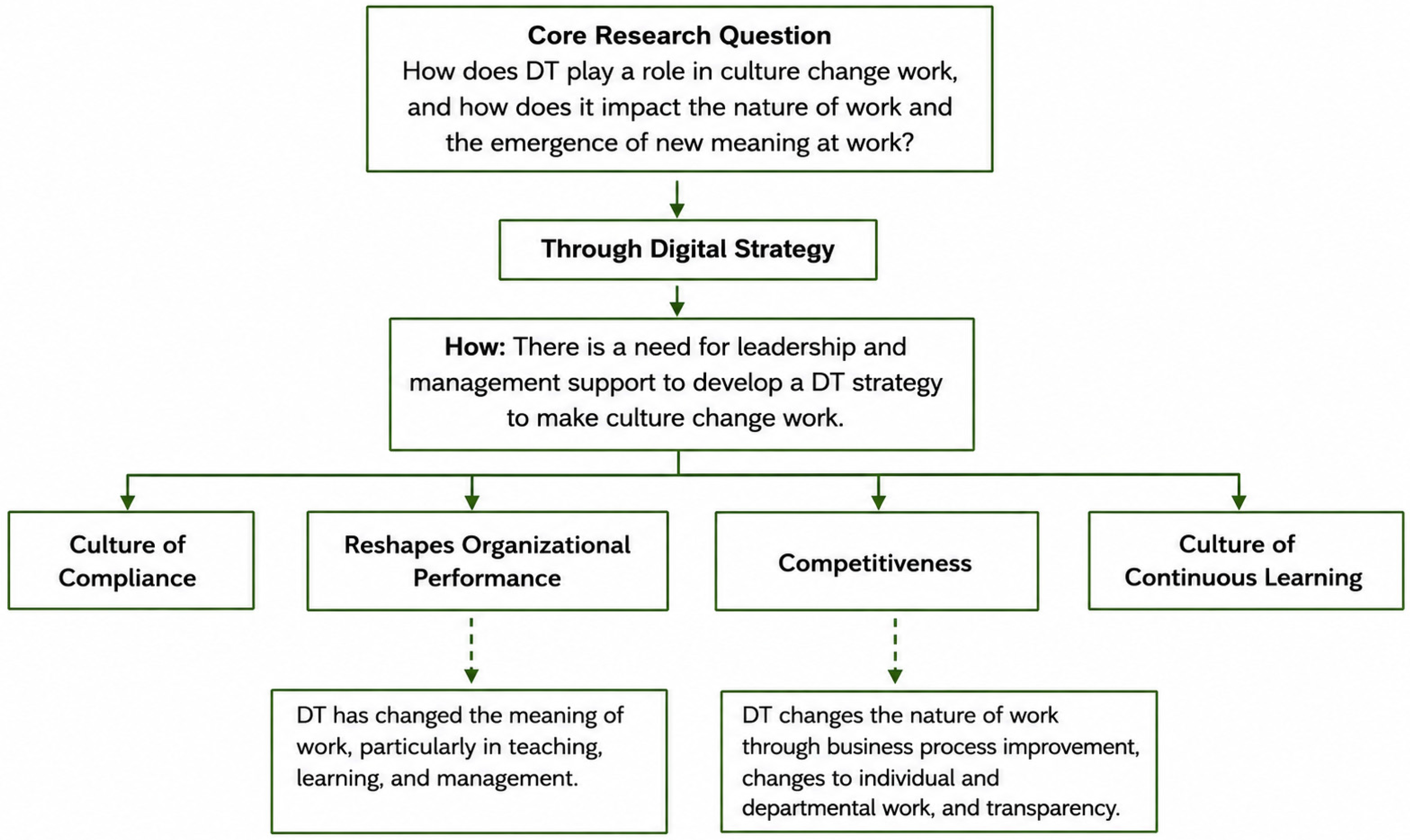
This theoretical framework focuses on three core questions: how digital transformation (DT) enables cultural change, how it impacts the nature of work, and how it leads to the emergence of new meaning within the workplace. The study identifies digital strategy as the primary enabling tool for this cultural shift, emphasising that it requires robust leadership and management support to align strategic initiatives with cultural objectives.
The foundations of a digital strategy that fosters a digital organisational culture are built upon three key pillars:
  • A culture of compliance: This ensures that digital initiatives align with the organisational goals established by leadership.
  • Performance reshaping: The strategy enhances organisational performance by improving productivity and effectiveness, thereby securing a competitive market position.
  • A culture of continuous learning: Digital strategy facilitates an environment where employees are empowered to acquire and master new skills.
Within the context of university digital transformation, these changes manifest in two primary ways. First, they redefine the meaning of work by altering how and why staff perceive their roles. Second, they transform the nature of work by introducing structural shifts in professional practices—specifically through business process improvements, increased transparency, and redesigned workflows.

6. Conclusions

This study advances current knowledge by demonstrating that digital transformation does not directly create a digital organisational culture. Instead, culture emerges through a process of cultural change work in which leadership, digital strategy, communication, and continuous learning collectively shape how employees reinterpret both the meaning and the nature of work. Furthermore, the comparative findings show that this process is mediated by institutional context, indicating that there is no single universal pathway through which digital organisational culture emerges.
The focus of this study was to gain a deeper understanding on how digital transformation contributes to the emergence of a digital organisational culture within universities, using a comparative case study of one UK and one Saudi Arabia institution. The findings show that digital transformation does not reshape university culture directly; rather, it works through a digital strategy that leadership translates into everyday practice. When communication is clear and employees are well supported through the process, three cultural pillars are formed: a culture of compliance that aligns digital initiatives with organisational goals, performance reshaping that improves productivity and effectiveness, and a culture of continuous learning that equips staff to acquire new skills. Together these pillars redefine both the meaning of work—how staff understand their roles—and the nature of work itself, through redesigned processes and revised professional practices.
More specifically, rapid and significant changes in the workforce are driven by various digital innovations such as artificial intelligence, robotics, data analytics, digital platforms, and automation. Although these advancements pose genuine risks, such as unemployment, job instability, uncertainty, and increased surveillance, they may also encourage the emergence of a work culture that prioritises relationships over transactions [5]. Digital transformation is leading organisations towards flexible organisational structures that facilitate ongoing adjustments, and this shift is integrated within, and impelled by, digital business ecosystems [32]. The digital transformation process has challenged preconceived notions about the nature of work, requiring employees to acquire new responsibilities and skills. The automation procedure involves the replacement of labour with machines, resulting in the displacement of the workforce, yet there are countervailing influences. Digital transformation and its procedures provide prospects for the emergence of new tasks and professional roles. The literature (e.g., [89,90]) shows that there is a need to investigate organisational culture change in environments where culture is a very strong element. Such investigation will enable researchers and practitioners to gain a clearer understanding of how digital transformation can change organisational culture.
The findings also show that while both institutions experienced broadly similar structural pressures towards digitalisation, participants’ interpretations of these changes were shaped by institutional context, management style, and national setting. The UK case illustrates how the rapid shift to remote teaching accelerated cultural adaptation, whereas the Saudi case highlights the role of accountability and reward structures in determining whether new technologies translate into genuinely new ways of working, or are absorbed into existing routines without altering underlying attitudes. This divergence reinforces the notion that digital transformation alone does not produce a digital culture, but digital transformation has to be seen as a catalyst whose cultural effects are dependent on leadership commitment, institutional readiness, and the meanings employees themselves attach to their changing work.

6.1. Contribution to Theory and Practice

This paper contributes to the literature on digital transformation and organisational culture change in higher education by moving beyond a mere synthesis of existing frameworks. While prior research often treats cultural change as a uniform outcome or focuses primarily on corporate environments, this study extends Alvesson and Sveningsson’s [12] concept of “cultural change work” into the higher education sector across two distinct geopolitical landscapes.
Specifically, this study makes three key theoretical contributions:
  • The research reveals that digital organisational culture does not emerge through a single universal process. Instead, it demonstrates how macro-level governance models dictate the nature of cultural change work. In centralised, state-guided environments (Saudi Arabia), cultural shift is mediated through state mandates and formal support, fostering compliance alongside enhanced operational communication. In contrast, in marketised environments (United Kingdom), cultural shift is driven by commercial survival and workforce restructuring, which risks creating digital isolation despite improvements in reporting efficiency.
  • The study contributes a novel framework (Figure 1) identifying three essential pillars— a culture of compliance, performance reshaping, and a culture of continuous learning—that act as the core operational mechanisms linking digital strategy with cultural evolution.
  • By examining actor experiences, the paper extends theoretical understanding regarding how automation redefines both the nature of work (workflow automation, reporting, and transparency) and the meanin at work (shifts in professional identities and relationship dynamics) within public institutions.
This paper contributes to the field by identifying comparative analyses on the impact of digital transformation on organisational culture change, especially on work and how it plays a role in the emergence of a new digital organisational culture in two universities—one in Saudi Arabia and the other in the UK—on which there is a lack of literature (e.g., [91]). While research often highlights the intersection of digital transformation and organisational culture, specific explorations of university culture remain scarce [92]. This study addresses that gap by offering a theoretical framework validated by two distinct case studies. Ultimately, the findings refine the analysis of similar institutional contexts and deepen our understanding of how digital transformation drives cultural evolution. By applying organisational culture change theory, this research provides a robust lens for examining the mechanisms behind culture shifts in the digital age. The proposed framework also provides a foundation for future research. Researchers can use the three cultural pillars identified in this study—culture of compliance, performance reshaping, and culture of continuous learning—as an analytical framework for examining digital transformation across different organisational and national contexts. The framework may also be applied, refined, or extended to investigate how emerging technologies, including generative AI, reshape organisational culture in sectors beyond higher education.

6.2. Implications for Practice

The findings provide several actionable recommendations for leaders and managers responsible for digital transformation within higher education institutions. Universities can use the results to gain a clear idea of how digital transformation can introduce a new digital culture. This study also aids in gaining a clear understanding of how managers can understand the effect of digital transformation on their institutions and thus ensure that organisations can fully utilise new technologies as well as gain a return on their investments from the implementation of digital transformation. More specifically, we would suggest that since leadership and management support is the mechanism that converts a digital strategy into cultural change, it is essential for HE institutions to lead the digital transformation strategy visibly, not just administratively. Universities need to consider that in order to build a culture of compliance where employees support digital transformation, they also need to remove any triggers of resentment and ensure that training and support are available. This further means that since digital transformation changes the nature of work, a generic training programme is insufficient. Management has to be prepared to take appropriate action to reduce job insecurity and nurture a culture of continuous learning through structured ongoing training. Finally, if universities want to implement digital transformation successfully, they have to communicate any changes through culturally appropriate channels. This, in turn, can reduce resistance by treating it as a diagnostic tool through which they can receive feedback from employees and relevant stakeholders, rather than treating resistance just as a barrier.

6.3. Limitations and Future Research

This study is qualitative, and its findings are limited to the case studies. It would be useful to carry out a study with a similar focus using quantitative methods to achieve a better understanding of how digital technologies can impact organisations and organisational culture. A further limitation of this study relates to the timing of the data collection. The empirical data was collected in 2023, prior to the rapid diffusion of generative artificial intelligence (AI) and subsequent advances in automation, digital platforms, and institutional digital practices. While the study provides valuable insights into how digital organisational culture emerges during digital transformation, the pace of technological change means that organisational contexts may have evolved since the data was collected. Future research could extend this work by examining how recent developments in generative AI and emerging digital technologies continue to reshape organisational culture and digital transformation processes. One area of potential future research would be to consider how organisational culture changed in relation to digital transformation so as to develop a theoretical framework to describe the impact of emerging technologies and digital transformation in different sectors, for example, within financial institutions. Finally, another limitation of this study relates to data source scope. The findings regarding cultural dynamics—such as changes in sense of community, employee engagement, and transparency—are based on the qualitative perceptions and lived experiences of the interviewed actors. While these accounts provide deep contextual insights, they were not triangulated with quantitative performance indicators or internal policy documents. Future research could integrate document analysis and quantitative metrics to validate whether these individual perceptions align with institution-wide outcomes.

Author Contributions

Conceptualization, I.A. and D.S.; Methodology, I.A. and D.S.; Validation, I.A.; Formal analysis, I.A.; Investigation, I.A. and D.S.; Data curation, I.A. and D.S.; Writing—original draft, I.A. and D.S.; Writing—review & editing, I.A. and D.S.; Supervision, I.A. All authors have read and agreed to the published version of the manuscript.

Funding

Ongoing Research Funding Program (ORF-2026-1782), King Saud University, Riyadh, Saudi Arabia.

Institutional Review Board Statement

The study was conducted in accordance with the Declaration of the Helsinki, and approved by the Standing Committee for Research Ethics, King Saud University (Approval Code: KSU-HE-23-715) on 21 June.

Informed Consent Statement

Informed consent was obtained from all subjects in the study.

Data Availability Statement

The data presented in this study are available on request from the corresponding author due to privacy.

Conflicts of Interest

The authors declare no conflict of interest.

References

  1. Sestino, A.; Kahlawi, A.; De Mauro, A. Decoding the data economy: A literature review of its impact on business, society and digital transformation. Eur. J. Innov. Manag. 2023, 28, 298–323. [Google Scholar] [CrossRef] [Scilit]
  2. Rof, A.; Bikfalvi, A.; Marques, P. Pandemic-accelerated digital transformation of a born digital higher education institution. Educ. Technol. Soc. 2022, 25, 124–141. [Google Scholar]
  3. Deep, G. Digital transformation’s impact on organizational culture. Int. J. Sci. Res. Arch. 2023, 10, 396–401. [Google Scholar] [CrossRef] [Scilit]
  4. Hamdani, N.A.; Maulani, G.A.F.; Nugraha, S.; Mubarok, T.M.S.; Herlianti, A.O. Corporate culture and digital transformation strategy in universities in Indonesia. Stud. Appl. Econ. 2021, 39, 1–8. [Google Scholar] [CrossRef] [Scilit]
  5. Rodríguez-Abitia, G.; Bribiesca-Correa, G. Assessing digital transformation in universities. Future Internet 2021, 13, 52. [Google Scholar] [CrossRef] [Scilit]
  6. Branch, J.W.; Burgos, D.; Serna, M.D.A.; Ortega, G.P. Digital transformation in higher education institutions: Between myth and reality. In Radical Solutions and eLearning: Practical Innovations and Online Educational Technology; Springer: Singapore, 2020; pp. 41–50. [Google Scholar]
  7. Senadjki, A.; Au Yong, H.N.; Ganapathy, T.; Ogbeibu, S. Unlocking the potential: The impact of digital leadership on firms’ performance through digital transformation. J. Bus. Socio-Econ. Dev. 2024, 4, 161–177. [Google Scholar]
  8. Zhang, X.; Xu, Y.Y.; Ma, L. Information technology investment and digital transformation: The roles of digital transformation strategy and top management. Bus. Process Manag. J. 2023, 29, 528–549. [Google Scholar] [CrossRef] [Scilit]
  9. Cieslak, V.; Valor, C. Moving beyond conventional resistance and resistors: An integrative review of employee resistance to digital transformation. Cogent Bus. Manag. 2025, 12, 2442550. [Google Scholar]
  10. Zerfass, A.; Brockhaus, J. Digital corporate communication and digital transformation of communication functions and organizations. In Handbook on Digital Corporate Communication; Edward Elgar Publishing: Cheltenham, UK, 2023; pp. 238–252. [Google Scholar]
  11. Kruppe, T.; Lang, J. Further training in the context of the digital transformation. In Research Handbook on Digital Sociology; Edward Elgar Publishing: Cheltenham, UK, 2023; pp. 433–445. [Google Scholar]
  12. Alvesson, M.; Sveningsson, S. Changing Organizational Culture: Cultural Change Work in Progress; Routledge: London, UK, 2015. [Google Scholar]
  13. Kutnjak, A.; Pihiri, I.; Furjan, M.T. Digital transformation case studies across industries–literature review. In Proceedings of the 2019 42nd International Convention on Information and Communication Technology, Electronics and Microelectronics (MIPRO); IEEE: Piscataway, NJ, USA, 2019; pp. 1293–1298. [Google Scholar]
  14. Kapotas, S. Digital Transformation of Organizations and Their Organizational Cultures: A Case Study in a National Defense Industry. J. Strateg. Innov. Sustain. 2024, 19, 45–68. [Google Scholar] [CrossRef] [Scilit]
  15. Vial, G. Understanding Digital Transformation: A review and a research agenda. J. Strateg. Inf. Syst. 2019, 28, 118–144. [Google Scholar] [CrossRef] [Scilit]
  16. Tang, D. What is digital transformation? EDPACS 2021, 64, 9–13. [Google Scholar] [CrossRef] [Scilit]
  17. Pfaff, Y.M.; Wohlleber, A.J.; Münch, C.; Küffner, C.; Hartmann, E. How digital transformation impacts organizational culture—A multi-hierarchical perspective on the manufacturing sector. Comput. Ind. Eng. 2023, 183, 109432. [Google Scholar] [CrossRef] [Scilit]
  18. Bozkus, K. Organizational Culture Change and Technology: Navigating the Digital Transformation; IntechOpen: London, UK, 2023. [Google Scholar] [CrossRef] [Scilit]
  19. Miller, C.E. Leading Digital Transformation in Higher Education: A toolkit for technology leaders. In Technology Leadership for Innovation in Higher Education; IGI Global: Hershey, PA, USA, 2019; pp. 1–25. [Google Scholar]
  20. Gutterman, A.S. Organizational Culture—An Overview of Research; SSRN: Rochester, NY, USA, 2023. [Google Scholar]
  21. Sułkowski, Ł. Elements of Organizational Culture–theoretical and methodological problems. Management 2012, 16, 63–71. [Google Scholar] [CrossRef] [Scilit]
  22. Popa, B.M. Organizational culture dimensions and variables. J. Def. Resour. Manag. 2017, 8, 114–120. [Google Scholar]
  23. Dombrowski, C.; Kim, J.Y.; Desouza, K.C.; Braganza, A.; Papagari, S.; Baloh, P.; Jha, S. Elements of innovative cultures. Knowl. Process Manag. 2007, 14, 190–202. [Google Scholar] [CrossRef] [Scilit]
  24. Ferreira, A.I.; Hill, M.M. Organisational cultures in public and private Portuguese universities: A case study. High. Educ. 2008, 55, 637–650. [Google Scholar]
  25. Akanji, B.; Mordi, C.; Ituma, A.; Adisa, T.A.; Ajonbadi, H. The influence of organisational culture on leadership style in higher education institutions. Pers. Rev. 2020, 49, 709–732. [Google Scholar]
  26. Singun, A.J. Unveiling the barriers to digital transformation in higher education institutions: A systematic literature review. Discov. Educ. 2025, 4, 37. [Google Scholar] [CrossRef] [Scilit]
  27. Rashid, Z.A.; Sambasivan, M.; Rahman, A.A. The influence of organizational culture on attitudes toward organizational change. Leadersh. Organ. Dev. J. 2004, 25, 161–179. [Google Scholar] [CrossRef] [Scilit]
  28. de Sousa Jabbour, A.B.L.; Jabbour, C.J.C.; Foropon, C.; Godinho Filho, M. When titans meet–Can industry 4.0 revolutionise the environmentally-sustainable manufacturing wave? The role of critical success factors. Technol. Forecast. Soc. Change 2018, 132, 18–25. [Google Scholar] [CrossRef] [Scilit]
  29. Li, F. What is digital strategy and does it really matter? In Research Handbook on Digital Strategy; Edward Elgar Publishing: Cheltenham, UK, 2023; pp. 393–410. [Google Scholar]
  30. González-Nieto, N.A.; García-Hernández, C.; Espinosa-Meneses, M. School culture and digital technologies: Educational practices at universities within the context of the COVID-19 pandemic. Future Internet 2021, 13, 246. [Google Scholar] [CrossRef] [Scilit]
  31. Korachi, Z.; Bounabat, B. General approach for formulating a digital transformation strategy. J. Comput. Sci. 2020, 16, 493–507. [Google Scholar] [CrossRef] [Scilit]
  32. Hanelt, A.; Bohnsack, R.; Marz, D.; Antunes Marante, C. A systematic review of the literature on digital transformation: Insights and implications for strategy and organizational change. J. Manag. Stud. 2021, 58, 1159–1197. [Google Scholar]
  33. Xicang, Z.; Bilal, M.; Jiying, W.; Sohu, J.M.; Akhtar, S.; Itzaz Ul Hassan, M. Unraveling the factors influencing digital transformation and technology adoption in high-tech firms: The moderating role of digital literacy. Sage Open 2024, 14, 21582440241300189. [Google Scholar] [CrossRef] [Scilit]
  34. Appio, F.P.; Frattini, F.; Petruzzelli, A.M.; Neirotti, P. Digital transformation and innovation management: A synthesis of existing research and an agenda for future studies. J. Prod. Innov. Manag. 2021, 38, 4–20. [Google Scholar] [CrossRef] [Scilit]
  35. Yao, Q.; Tang, H.; Liu, Y.; Boadu, F. The penetration effect of digital leadership on digital transformation: The role of digital strategy consensus and diversity types. J. Enterp. Inf. Manag. 2024, 37, 903–927. [Google Scholar]
  36. Benavides, L.M.C.; Tamayo Arias, J.A.; Arango Serna, M.D.; Branch Bedoya, J.W.; Burgos, D. Digital transformation in higher education institutions: A systematic literature review. Sensors 2020, 20, 3291. [Google Scholar] [CrossRef] [Scilit] [PubMed]
  37. Chatman, J.A.; O’Reilly, C.A. Paradigm lost: Reinvigorating the study of organizational culture. Res. Organ. Behav. 2016, 36, 199–224. [Google Scholar] [CrossRef] [Scilit]
  38. Kouhizadeh, M.; Saberi, S.; Sarkis, J. Blockchain technology and the sustainable supply chain: Theoretically exploring adoption barriers. Int. J. Prod. Econ. 2021, 231, 107831. [Google Scholar] [CrossRef] [Scilit]
  39. Van Rooij, B.; Fine, A. Toxic corporate culture: Assessing organizational processes of deviancy. Adm. Sci. 2018, 8, 23. [Google Scholar] [CrossRef] [Scilit]
  40. Johansson, C.; Heide, M. Speaking of change: Three communication approaches in studies of organizational change. Corp. Commun. Int. J. 2008, 13, 288–305. [Google Scholar] [CrossRef] [Scilit]
  41. Ragin, C.C.; Rubinson, C. The distinctiveness of comparative research. In The SAGE Handbook of Comparative Politics; Sage Publications: Thousand Oaks, CA, USA, 2009; pp. 13–34. [Google Scholar]
  42. Joseph, O. Digital Transformation in SMEs: A Comparative Study of Developing and Developed Economies. Int. J. Financ. Econ. Manag. Stud. 2026, 2, 30–37. [Google Scholar] [CrossRef] [Scilit]
  43. Darsana, I.M. A convergent theoretical framework for understanding digital transformation across cultural contexts globally. Satukata J. Sains Tek. Dan Studi Kemasyarakata 2025, 4, 39–52. [Google Scholar] [CrossRef] [Scilit]
  44. Eisenhardt, K.M. Better stories and better constructs: The case for rigor and comparative logic. Acad. Manag. Rev. 1991, 16, 620–627. [Google Scholar] [CrossRef] [Scilit] [PubMed]
  45. Ajani, O.A.; Dlomo, S. Comparative analysis of digital transformation’s impact on higher education institutions: A systematic literature analysis of public versus private sector. J. Res. High. Educ. 2024, 8, 72–96. [Google Scholar] [CrossRef] [Scilit]
  46. Danylyuk, S. Digital Transformation in Higher Education: A Comparative Analysis of Ukraine and the Czech Republic. Eur. Sci. E-J. 2025, 37, 97–102. [Google Scholar]
  47. Valdés, K.N.; y Alpera, S.Q.; Cerdá Suárez, L.M. An institutional perspective for evaluating digital transformation in higher education: Insights from the Chilean case. Sustainability 2021, 13, 9850. [Google Scholar] [CrossRef] [Scilit]
  48. Anggoro, S.; Nurdin, D.; Sururi, S. Leading managing transformation to digital University in Indonesian Context. J. Kependidikan J. Has. Penelit. Dan Kaji. Kepustakaan DI Bid. Pendidik. Pengajaran Dan Pembelajaran 2023, 9, 729–739. [Google Scholar] [CrossRef] [Scilit]
  49. Llopis-Albert, C.; Juárez-Varón, D.; Pocek, J.; Costa-Climent, R. Institutional entrepreneurship and digital transformation in higher education: A configurational and structural analysis of digital maturity. Int. Entrep. Manag. J. 2026, 22, 87. [Google Scholar] [CrossRef] [Scilit]
  50. Hizam, S.M.; Akter, H.; Sentosa, I.; Ahmed, W.; Masrek, M.N.; Ali, J. Predicting workforce engagement towards digital transformation through a multi-analytical approach. Sustainability 2023, 15, 6835. [Google Scholar] [CrossRef] [Scilit]
  51. Wang, T.; Dai, T.; Yang, L.; Osmanova, L.; Hwarari, D. Digital innovation in higher education: Comparing approaches in developed and developing countries. Front. Educ. 2025, 10, 1723087. [Google Scholar] [CrossRef] [Scilit]
  52. Creswell, J.W. Research Design: Qualitative, Quantitative, and Mixed Methods Approaches; Sage Publications: Thousand Oaks, CA, USA, 2013. [Google Scholar]
  53. Walsham, G. Interpretive case studies in IS research: Nature and method. Eur. J. Inf. Syst. 1995, 4, 74–81. [Google Scholar] [CrossRef] [Scilit]
  54. Walsham, G. Doing interpretive research. Eur. J. Inf. Syst. 2006, 15, 320–330. [Google Scholar] [CrossRef] [Scilit]
  55. Orlikowski, W.J.; Baroudi, J.J. Studying information technology in organizations: Research approaches and assumptions. Inf. Syst. Res. 1991, 2, 1–28. [Google Scholar] [CrossRef] [Scilit]
  56. Kingdom of Saudi Arabia. Saudi Vision 2030. Available online: https://www.vision2030.gov.sa/en (accessed on 21 July 2026).
  57. Harrell, M.C.; Bradley, M.A. Data Collection Methods. Semi-Structured Interviews and Focus Groups; RAND National Defense Research Institute: Santa Monica, CA, USA, 2009. [Google Scholar]
  58. Lincoln, Y.S.; Guba, E.G. Naturalistic Inquiry; Sage Publication: Newbury Park, CA, USA, 1985. [Google Scholar]
  59. Kane, G.C.; Palmer, D.; Phillips, A.N.; Kiron, D.; Buckley, N. Strategy, Not Technology, Drives Digital Transformation. MIT Sloan Management Review. 2015. Available online: https://sloanreview.mit.edu/projects/scholars/strategy-drives-digital-transformation/ (accessed on 25 July 2025).
  60. Becker, W.; Schmid, O. The right digital strategy for your business: An empirical analysis of the design and implementation of digital strategies in SMEs and LSEs. Bus. Res. 2020, 13, 985–1005. [Google Scholar] [CrossRef] [Scilit]
  61. Touijer, M.N.; Elabjani, A. A Delphi study on digital maturity and digital competitiveness in the context of digital transformation. J. Enterprising Communities People Places Glob. Econ. 2025, 19, 386–409. [Google Scholar] [CrossRef] [Scilit]
  62. Yan, S.; Xi, Y.; Wu, Z. Enterprise Digital Transformation and Compliance in Cross-Regional Development: A Dynamic Capabilities Perspective. Sustainability 2024, 16, 844. [Google Scholar] [CrossRef] [Scilit]
  63. Kazim, F.A. Digital transformation and leadership style: A multiple case study. ISM J. Int. Bus. 2019, 3, 24–33. [Google Scholar]
  64. Chouaibi, S.; Festa, G.; Quaglia, R.; Rossi, M. The risky impact of digital transformation on organizational performance–evidence from Tunisia. Technol. Forecast. Soc. Change 2022, 178, 121571. [Google Scholar] [CrossRef] [Scilit]
  65. Leão, P.; da Silva, M.M. Impacts of digital transformation on firms’ competitive advantages: A systematic literature review. Strateg. Change 2021, 30, 421–441. [Google Scholar] [CrossRef] [Scilit]
  66. Sui, X.; Jiao, S.; Wang, Y.; Wang, H. Digital transformation and manufacturing company competitiveness. Financ. Res. Lett. 2024, 59, 104683. [Google Scholar] [CrossRef] [Scilit]
  67. Chen, P.; Kim, S. The impact of digital transformation on innovation performance-The mediating role of innovation factors. Heliyon 2023, 9, e13916. [Google Scholar] [CrossRef] [Scilit] [PubMed]
  68. Al-Saudi, N.H.; Flayyih, H.H. The impact of digital transformation on office management efficiency. J. Econ. Adm. Sci. 2024, 30, 645–661. [Google Scholar] [CrossRef] [Scilit]
  69. Hai, T.N.; Van, Q.N.; Thi Tuyet, M.N. Digital transformation: Opportunities and challenges for leaders in the emerging countries in response to COVID-19 pandemic. Emerg. Sci. J. 2021, 5, 21–36. [Google Scholar] [CrossRef] [Scilit]
  70. Miethlich, B.; Belotserkovich, D.; Abasova, S.; Zatsarinnaya, E.; Veselitsky, O. Transformation of digital management in enterprises amidst the COVID-19 pandemic. Inst. Econ. 2022, 14, 1–26. [Google Scholar] [CrossRef] [Scilit]
  71. Ullrich, A.; Reißig, M.; Niehoff, S.; Beier, G. Employee involvement and participation in digital transformation: A combined analysis of literature and practitioners’ expertise. J. Organ. Change Manag. 2023, 36, 29–48. [Google Scholar] [CrossRef] [Scilit]
  72. Cui, J. Does digital strategy, organizational agility, digital leadership promote DT? A study of digital strategy, organizational agility, digital leadership affects corporate DT in Chinese technological firms. J. Integr. Soc. Sci. Humanit. 2024, 1, 1–13. [Google Scholar] [CrossRef] [Scilit]
  73. Morozov, M.; Morozova, N.; Moldazhanov, M. Innovative training in digital transformation. In International Conference on Economics, Management and Technologies 2020 (ICEMT 2020); Atlantis Press: Dordrecht, The Netherlands, 2020; pp. 499–504. [Google Scholar]
  74. Mohamed Hashim, M.A.; Tlemsani, I.; Duncan Matthews, R. A sustainable university: Digital transformation and beyond. Educ. Inf. Technol. 2022, 27, 8961–8996. [Google Scholar] [CrossRef] [Scilit] [PubMed]
  75. Kerpedzhiev, G.D.; König, U.M.; Röglinger, M.; Rosemann, M. An exploration into future business process management capabilities in view of digitalization: Results from a Delphi study. Bus. Inf. Syst. Eng. 2021, 63, 83–96. [Google Scholar]
  76. Zhai, H.; Yang, M.; Chan, K.C. Does digital transformation enhance a firm’s performance? Evidence from China. Technol. Soc. 2022, 68, 101841. [Google Scholar] [CrossRef] [Scilit]
  77. Chanias, S.; Myers, M.D.; Hess, T. Digital transformation strategy making in pre-digital organizations: The case of a financial services provider. J. Strateg. Inf. Syst. 2019, 28, 17–33. [Google Scholar] [CrossRef] [Scilit]
  78. Tschang, F.T.; Almirall, E. Artificial intelligence as augmenting automation: Implications for employment. Acad. Manag. Perspect. 2021, 35, 642–659. [Google Scholar] [CrossRef] [Scilit]
  79. Selimović, J.; Pilav-Velić, A.; Krndžija, L. Digital workplace transformation in the financial service sector: Investigating the relationship between employees’ expectations and intentions. Technol. Soc. 2021, 66, 101640. [Google Scholar] [CrossRef] [Scilit]
  80. Tran, N.P.; Le, Q.T.T.; Vo, A.T.; Vo, D.H. Digital transformation and corporate restructuring: Does corporate governance matter? J. Strategy Manag. 2024, 19, 464–479. [Google Scholar] [CrossRef] [Scilit]
  81. Svistunov, V.M.; Lobachev, V.V.; Manukyan, S. New expertise and skills of manager in the context of digital business transformation. In Socio-Economic Systems: Paradigms for the Future; Springer International Publishing: Cham, Switzerland, 2021; pp. 911–921. [Google Scholar]
  82. Shenkoya, T. Can digital transformation improve transparency and accountability of public governance in Nigeria? Transform. Gov. People Process Policy 2023, 17, 54–71. [Google Scholar] [CrossRef] [Scilit]
  83. Libert, B.; Beck, M.; Wind, Y. Questions to ask before your next digital transformation. Harv. Bus. Rev. 2016, 60, 11–13. [Google Scholar]
  84. Dengler, K.; Gundert, S. Digital transformation and subjective job insecurity in Germany. Eur. Sociol. Rev. 2021, 37, 799–817. [Google Scholar] [CrossRef] [Scilit]
  85. Battisti, E.; Alfiero, S.; Leonidou, E. Remote working and digital transformation during the COVID-19 pandemic: Economic–financial impacts and psychological drivers for employees. J. Bus. Res. 2022, 150, 38–50. [Google Scholar] [CrossRef] [Scilit] [PubMed]
  86. Manny, L.; Duygan, M.; Fischer, M.; Rieckermann, J. Barriers to the digital transformation of infrastructure sectors. Policy Sci. 2021, 54, 943–983. [Google Scholar] [CrossRef] [Scilit] [PubMed]
  87. Piccoli, G.; Rodriguez, J.A.; Palese, B.; Bartosiak, M. The Dark Side of Digital Transformation: The Case of Information Systems Education. In Proceedings of the ICIS, Seoul, Republic of Korea, 10–13 December 2017. [Google Scholar]
  88. Schwarzmüller, T.; Brosi, P.; Duman, D.; Welpe, I.M. How does the digital transformation affect organizations? Key themes of change in work design and leadership. Manag. Rev. 2018, 29, 114–138. [Google Scholar] [CrossRef] [Scilit]
  89. Latta, G.F. A process model of organizational change in cultural context (OC3 Model) The impact of organizational culture on leading change. J. Leadersh. Organ. Stud. 2009, 16, 19–37. [Google Scholar] [CrossRef] [Scilit]
  90. Cicea, C.; Țurlea, C.; Marinescu, C.; Pintilie, N. Organizational culture: A concept captive between determinants and its own power of influence. Sustainability 2022, 14, 2021. [Google Scholar] [CrossRef] [Scilit]
  91. Hameli, K. Foundations of organizational culture: A comprehensive review. J. Balk. Econ. Manag. 2024, 1, 53–66. [Google Scholar] [CrossRef] [Scilit]
  92. Reisberger, T.; Reisberger, P.; Copuš, L.; Madzík, P.; Falát, L. The linkage between digital transformation and organizational culture: Novel machine learning literature review based on latent dirichlet allocation. J. Knowl. Econ. 2025, 16, 2082–2118. [Google Scholar] [CrossRef] [Scilit]
Figure 1. The developed theoretical framework.
Systems 14 00935 g001
Table 1. Studies that have applied Alvesson and Sveningsson’s framework [12] and how it will be applied in this research.
StudyResultThe Application of Alvesson and Sveningsson’s (2015) [12] Framework
Chatman and O’Reilly [37]Explored the significance of culture in relation to performance and discerned that culture pertains not to behaviour but to the perception of value and reality.This study used Alvesson and Sveningsson’s [12] framework to show how culture can be better understood if the investigation focuses on values. This implies that digital transformation impacts organisational culture from the top down and that cultural values play a role in the success or failure of bringing about culture change through digital transformation.
Kouhizadeh et al. [38]Inferred from Alvesson and Sveningsson’s [12] work that resistance to digitisation can arise from a combination of internal and external factors, spanning individual and organisational levels.This study used Alvesson and Sveningsson [12] to explain resistance as a response to digitalisation change, which supports the use of the framework in this study to understand how digital transformation is impacted by the nature of work methods and practices and how resistance can be an impact.
Van Rooij and Fine [39]The need to transform the values and work methodologies within the organisation.This study acknowledges the primary organisational challenge identified in Alvesson and Sveningsson’s [12] research. This supports the use of Alvesson and Sveningsson’s [12] framework in this study, as it seeks to find out whether cultural values, work practices and methods play a role in the impact of DT on organisational culture change in universities.
Johansson and Heide [40]Demonstrate how Alvesson and Sveningsson [2] and other scholars endeavour to comprehend how individuals interpret change initiatives and how their perceptions and understanding influence the outcomes.This is important for the analysis of the case studies included in this study, which focus on how participants understand the changes that digital transformation promises to bring about in universities.
Table 2. The participant sample.
RoleGenderInstitutionParticipant Code Name
ManagerMSaudi universitySA-1
Vice deanMSaudi universitySA-2
LibrarianMSaudi universitySA-3
ManagerMSaudi universitySA-4
DeanMSaudi universitySA-5
ManagerMSaudi universitySA-6
Vice deanMSaudi universitySA-7
ManagerMSaudi universitySA-8
Deputy managerMSaudi universitySA-9
Deputy managerMSaudi universitySA-10
EmployeeMSaudi universitySA-11
ManagerMSaudi universitySA-12
Senior academicMUK universityUK-1
Senior managerFUK universityUK-2
Senior academicMUK universityUK-3
ITFUK universityUK-4
LibrarianFUK universityUK-5
IT managerFUK universityUK-6
IT managerMUK universityUK-7
ITMUK universityUK-8
ManagerFUK universityUK-9
University executiveMUK universityUK-10
Senior managerFUK universityUK-11
Table 3. Themes from the results.
Main ThemeSub-Themes
Strategy
  • Leadership and management culture
  • Cultural values
  • Cultural norms
The emergence of a digital culture
  • Business process improvement
  • Changes in individuals
  • Changes in universities departments
  • Transparency
  • The pain behind DT
Meaning at work and DT
Table 4. Synthesis mapping of research objectives, theoretical dimensions, empirical themes, and sample evidence.
Research ObjectiveTheoretical Dimension (Alvesson & Sveningsson [12])Empirical Main Theme & Sub-ThemesCase-Specific Patterns & Empirical Examples
Objective 1: To explore organisational culture and digital transformation status in UK and Saudi universities.Cultural change work & strategy implementationStrategy:
  • Leadership & management
  • Cultural values
  • Cultural norms
Saudi: Top-down, state-guided (Vision 2030), policy compliance, incentive/KPI-driven governance. “Leadership must reward and punish as a result of using technology” (SA-1).
UK: Marketised, business-driven model focusing on competitive survival and cost efficiency. “In the UK HE works like a business. So if they don’t go through DT, they will not be competitive” (UK-1).
Objective 2: To interpret actors’ experiences of digital transformation’s impact on organisational culture change.Effects on the nature of workEmergence of a digital culture:
  • Process improvement
  • Individual changes
  • Departmental changes
Saudi: Formalised training programs, transition from Excel to SAP, increased structural engagement via project teams. “Training had to be provided for use …” (SA-6).
UK: Lack of structured training culture, reliance on self-learning, centralisation causing staff reduction and reliance on digital portals. “Now it is a portal request or an e-mail to an unnamed inbox” (UK-3).
Objective 2: To interpret actors’ experiences of digital transformation’s impact on organisational culture change.Interpretation of new collective meaningsMeaning at work & emergent realities:
  • Transparency
  • The pain behind DT
Saudi: Emergence of technological compliance and attendance tracking (fingerprint systems) as new collective accountability. “Accountability and transparency have increased” (SA-5).
UK: Emergence of digital isolation, reduced sense of community working, and fear of professional staff job displacement. “It reduces the sense of community working together …” (UK-1).
Disclaimer/Publisher’s Note: The statements, opinions and data contained in all publications are solely those of the individual author(s) and contributor(s) and not of MDPI and/or the editor(s). MDPI and/or the editor(s) disclaim responsibility for any injury to people or property resulting from any ideas, methods, instructions or products referred to in the content.