1. Introduction
Business model innovation (BMI) is recognized as a critical source of competitive advantage, enabling organizations to redefine how they create, deliver, and capture value in changing markets [
1,
2,
3]. AI reshapes products, services, and the nature of innovation processes, making it a critical influencing factor of BMI [
4,
5,
6]. While firms acknowledge AI’s strategic potential and deploy AI models to enable value-creation mechanisms, such efforts often fail to deliver substantial progress. In response, a growing body of research has shifted attention from the mere adoption of AI technologies toward understanding how AI capability (AIC) influences BMI. AIC refers to the digital organizational capacity to integrate AI infrastructure, data, and expertise for operational transformation [
7,
8].
Recent research has empirically established the positive direct association between AIC and BMI [
9]. This capability enables firms to reconfigure the core architectures of their business models, which lies at the core of BMI [
2]. Along this line, a few studies have begun to elucidate this connection through internally focused mechanisms such as strategic agility [
6], organizational adaptability [
10] and dynamic capabilities for circular BMI [
11]. These studies have offered valuable insights. Nevertheless, two critical research gaps remain under-explored in the current literature. These two gaps are inherently interconnected: even if AI capability can theoretically improve customer responsiveness to transform business models, this transformation process is highly dependent on firms’ internal cultural norms. Without a supportive digital organizational culture, firms cannot effectively interpret ambiguous AI predictions and translate them into customer-centric market actions, which further weakens the indirect path from AIC to BMI via CR. This dual omission jointly limits the completeness of the AIC-BMI nomological network in the existing literature.
First, while existing studies on AIC and BMI have predominantly focused on internal efficiency-oriented mechanisms such as resource orchestration and operational optimization [
9], this narrow focus overlooks the market-facing nature of BMI, which fundamentally involves reshaping firm–customer value exchange systems. Although a few studies have touched on response speed [
6], there is a lack of empirical research that unpacks how AIC is translated into interactive firm–customer actions that drive systemic business model reconfiguration. Second, prior research on the boundary conditions of AIC has focused almost exclusively on external environmental factors such as environmental dynamism [
12]. However, unlike traditional deterministic technologies, AIC generates probabilistic, data-driven insights that require organizational interpretation and collective action. This means that even firms with identical AIC may achieve vastly different strategic outcomes, depending on their internal shared norms and cultural context. Yet to date, the role of internal cultural factors in shaping the translation of AIC into strategic change remains largely unexamined in the AI literature, representing a critical missing piece in the nomological network of AIC-enabled value creation.
This study adopts service-dominant logic (SDL) as its theoretical framework, primarily because it posits that value is co-created through operant resources [
13]. Based on this, AIC can be regarded as a higher-order operant resource, providing a theoretical foundation for analyzing the relationship. Moreover, it also emphasizes that this process relies on resource integration and institutional transformation [
14], thereby offering a process-based explanation. The strategic challenge lies not simply in sensing, but in converting these insights into coordinated, cross-functional actions. Specifically, operant resources create value when integrated with other resources through organizational routines [
13]. In AIC-driven value creation, customer responsiveness (CR) represents a routine that operationalizes the sense–interpret–act cycle by converting AIC into coordinated market-oriented actions. Defined as a firm’s ability to sense, interpret, and act on evolving customer needs [
15], it aligns with SDL’s tenet.
A further premise of SDL is that value creation is enabled and constrained by institutional arrangements, or shared norms that coordinate resource integration. In the digital context, we identify digital organizational culture (DOC) as a manifestation of such arrangements, defined as shared assumptions about organizational functioning in digital contexts [
16,
17]. Existing research has focused on external conditions such as environmental dynamism [
18], or competitive intensity [
19] as triggers for transformation, elucidating when and why firms need to respond. This study shifts the analytical focus to institutional arrangements, proposing that DOC influences the execution of strategic intent, shaping how AIC is interpreted, shared, and translated into action.
Therefore, this study investigates two research questions: (1) from an SDL value co-creation perspective, whether and how AI capability is linked to business model innovation through the market-oriented mechanism of customer responsiveness; (2) drawing on SDL’s institutional axiom, whether digital organizational culture strengthens the AIC → CR pathway and, in turn, the indirect association between AIC and BMI. By empirically testing these questions, this study offers several theoretical contributions. First, it identifies CR as a mechanism that helps explain the association between AIC and BMI by connecting firm–customer interactions to business model reconfiguration, complementing existing research focused on operational efficiency and resource optimization. Second, it extends SDL to the digital context by specifying how shared norms and values influence the conversion of probabilistic AI outputs into strategic responses. Third, it enriches the nomological network of AIC by introducing DOC as a boundary condition specific to AI contexts, responding to calls for attention to the internal interpretive mechanisms that shape AIC-enabled value creation.
2. Theoretical Background and Literature Review
2.1. Service-Dominant Logic
SDL is a theoretical framework that emphasizes value co-creation via resource integration in dynamic systems [
14,
20]. It categorizes resources into operand and operant types. Unlike traditional goods-dominant logic which focuses on tangible product exchanges, SDL posits that value stems from operant rather than operand resource applications.
SDL’s core principles are consolidated into five axioms. A key premise holds that operant resources are the primary source of value creation [
13], while the fifth axiom emphasizes that value co-creation is enabled and constrained by institutional arrangements [
14], defined as the shared norms, rules, and practices that coordinate resource integration. Prior research has applied these ideas to digital contexts in several ways. For instance, Vargo et al. (2024) [
21] draw on this premise to examine how digital technologies, through resource liquification, function as operant resources that enable novel forms of value co-creation in service ecosystems. Linde et al. [
4] invoked the fifth axiom to investigate how organizational culture shapes digital transformation outcomes. These studies have advanced our understanding of both operant resources and institutional arrangements in digital contexts.
SDL argues that value co-creation follows a repeated sense–interpret–act cycle based on resource integration. As a higher-order operant resource, AIC supplies massive probabilistic market data (sensing foundation); customer responsiveness (CR) acts as an organizational routine to interpret AI data and coordinate cross-functional market actions; digital organizational culture (DOC), as an institutional norm, determines whether firms dare to act on uncertain AI insights. This three-stage cycle perfectly matches our research framework and provides a holistic SDL theoretical lens for AI-driven business model transformation.
Accordingly, we ground our framework in two SDL axioms. Based on this, AIC acts as a higher-order operator resource [
21]. Following the logic that value emerges from resource integration, AIC’s potential is actualized through the sense–interpret–act cycle [
22]. These provide a theoretical lens to explore how resources facilitate strategic value reconfiguration through organizational translation, and relevant institutional conditions. Traditional digital technologies (e.g., ERP, big data platforms) generate deterministic, clear operational data with definite interpretation standards. In contrast, AI outputs are probabilistic, predictive, and ambiguous, requiring organizational consensus, cross-departmental data sharing and experimental tolerance to realize value. This unique feature makes internal institutional culture (DOC) an indispensable boundary condition ignored in prior transformation research based on SDL.
It is important to clarify the theoretical role that SDL plays in this study. SDL provides a macro-theoretical lens that sensitizes us to two key premises: (a) value emerges from the integration of operant resources, and (b) such integration is shaped by institutional arrangements. However, testing the full scope of SDL, particularly its recursive, feedback-driven dynamics, would require longitudinal or simulation-based designs that track resource integration over extended time horizons. The present study does not attempt to empirically model the entire sense–interpret–act cycle as a dynamic process. Rather, we translate SDL’s core premises into a testable, cross-sectional mediation–moderation framework that isolates one dominant pathway: from AIC (operant resource) through CR (market-oriented integration routine) to BMI (value system reconfiguration). This approach allows us to empirically examine the existence and strength of this pathway, while acknowledging that the broader service-ecosystem dynamics remain a rich avenue for future research. In doing so, we treat SDL as a theoretical foundation for construct selection and hypothesis derivation, rather than as a blueprint for dynamic process modeling.
2.2. AI Capability
Organizational capabilities are routines that combine skills, knowledge, and coordinated actions to generate competitive advantages [
23,
24]. Applied to AI, AIC represents the capacity to strategically integrate AI infrastructure, data assets, human expertise, and adaptive processes for operational transformation and sustainable advantage. Prior studies have identified various strategic and technical facets of AIC, providing a baseline for understanding its role in modern organizations [
25].
Drawing on established frameworks, AIC is conceptualized as a multidimensional construct comprising three integrated facets. Infrastructure capabilities encompass technical resources, such as cloud platforms and algorithms that relates to real-time data processing, critical for high-volume transactions [
26]. Business-spanning capabilities represent intangible resources such as AI-driven processes that translate data insights into new value propositions [
27]. A proactive stance reflects human capital’s adaptability and data literacy, which are necessary for fostering AI experimentation and cross-functional collaboration [
28]. These dimensions collectively capture the infrastructural, processual, and behavioral facets of AIC. Specifically, infrastructure capabilities (ICs) provide basic data operand resources to support market sensing. Business-spanning capabilities (BSs) integrate AI technical resources with business value logic, realizing primary resource integration. Proactive stance (PS) reflects organizational operant resource willingness to continuously experiment and integrate AI resources with customer market resources.
2.3. The Impact of AI Capability on Business Model Innovation
BMI refers to the fundamental reconfiguration of how firms create, deliver, and capture value [
29]. Amid intensifying digital competition, established business models can no longer align with the external environment, failing to sustain value creation and instead giving rise to internal inertia and risk. Consequently, BMI has emerged as a critical pathway for overcoming stagnation and addressing industry disruptions [
1].
Theoretically, scholars have developed multiple frameworks to explain BMI. Research based on dynamic capability theory suggests that BMI serves as a strategic response to environmental change [
30]. The resource-based view emphasizes that unique resource combinations are key drivers of BMI [
31]. Meanwhile, the SDL perspective posits that BMI represents a reconfiguration of value co-creation systems [
14]. These theoretical lenses provide a multidimensional framework for understanding BMI. In empirical research, existing findings have mainly explored three categories of antecedents: environmental [
3], organizational [
32], and technological [
33] factors.
Consistent with the SDL premise, AIC enables firms to reconfigure their value creation, delivery, and capture systems. From a resource-based view, AIC provides the material foundation for BMI by combining infrastructure, data assets, and human expertise into unique organizational resources. From a dynamic capabilities perspective, AIC allows firms to rapidly adapt to shifting market demands through mechanisms such as algorithm iteration and real-time data analysis [
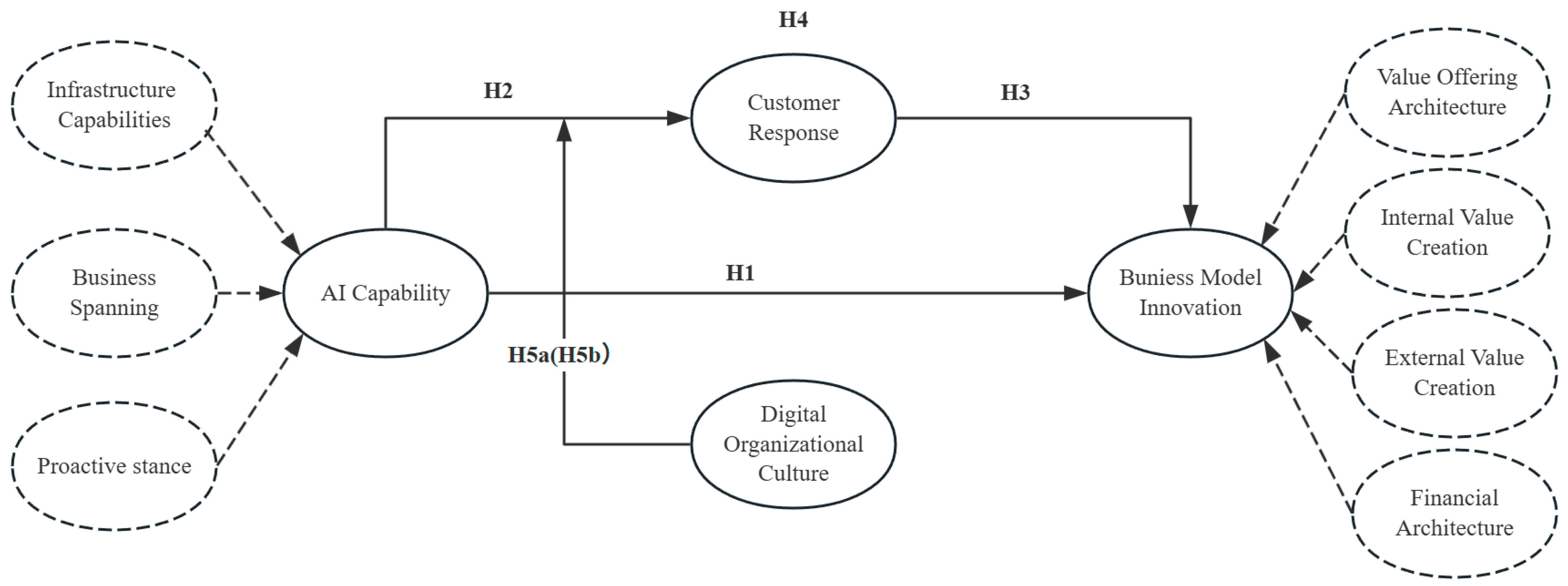
34]. Together, these perspectives suggest that AIC is positively associated with BMI by enabling firms to transform how value is created, delivered, and captured. Accordingly, we propose:
H1. AIC has a positive association with BMI.
2.4. The Mediating Role of Customer Responsiveness
CR originates from the Day [
35] framework of market sensing and customer-linking capabilities, defined as the ability to sense, interpret, and act on evolving customer needs. It enables organizations to convert market intelligence into coordinated action. Distinct from organizational agility (emphasizing response speed) and absorptive capacity (focusing on knowledge assimilation), CR captures the market-driven process from insight to action, serving as a dynamic routine reflecting the firm’s external market orientation.
It is important to distinguish CR from the outcomes it enables. While CR captures the organizational process of sensing and acting on customer needs (e.g., CR4: “expand into new regional or international markets”), BMI captures the structural reconfiguration of the business model (e.g., VOA4: “a new sales market is established”). In other words, CR4 captures the firm’s responsiveness capability to pursue geographic expansion, whereas VOA4 captures whether such expansion has actually resulted in a structural change to the business model’s value-offering architecture.
From a capability transformation perspective, AIC enhances CR by reinforcing its mechanisms. The three dimensions of AIC contribute to this process. Infrastructure capabilities enable real-time data collection and pattern recognition, providing the technological foundation for market sensing [
26]. Business-spanning capabilities transform data into business insights, with machine learning identifying consumption pattern shifts to deepen demand interpretation [
27]. A proactive stance ensures agility in executing responses, as AI-literate employees adjust strategies and cross-functional collaboration facilitates insight dissemination [
36,
37]. These dimensions form a dynamically reinforcing loop: infrastructure enables sensing, business spanning supports deep interpretation, and proactive stance ensures swift action, with new data generated from actions further enhancing sensing capabilities [
38]. Based on this analysis, we propose:
H2. AIC has a positive association with CR.
From the value reconstruction perspective, CR serves as the mechanism through which AIC manifests in BMI. As a dynamic capability, CR transforms value-creation architecture across three core dimensions that collectively define BMI. First, CR drives value proposition innovation by translating customer insights into new offerings. Firms leverage real-time feedback to develop solutions for evolving needs [
39]. Second, CR facilitates value delivery reconfiguration by converting customer data into optimized touchpoints and seamless omnichannel experiences [
40]. In addition, CR evolves value capture mechanisms by identifying willingness-to-pay patterns for innovative pricing models [
41]. These architectural changes, spanning value propositions, delivery, and capture, collectively constitute BMI. From SDL’s value co-creation system reconfiguration logic, BMI essentially represents the reconstruction of firm–customer resource exchange relationships. AIC alone cannot directly reconstruct value exchange; it must rely on CR to realize bidirectional resource integration between enterprises and customers: firms use AI data resources to identify customer demand resources, then deliver customized value propositions, distribution channels and pricing mechanisms, ultimately forming new business model architecture. Therefore, CR acts as a mandatory intermediate routine linking AIC operant resources to systemic BMI reconfiguration, forming partial mediation. Thus, CR is the key mechanism linking AIC to strategic value reconfiguration. Based on this analysis, we propose:
H3. CR has a positive association with BMI.
H4. CR mediates the positive relationship between AIC and BMI.
Taken together, the above hypotheses articulate a theoretically grounded nomological network in which CR serves as a key conduit through which AIC is linked to BMI. It is worth emphasizing that these hypotheses, as formulated, are statements about statistical associations and indirect effects in a theoretically specified direction. While the underlying theory (SDL) implies causal processes, the empirical design of this study—based on temporally separated but still perceptual survey data—tests for patterned covariation consistent with these theoretical expectations, rather than establishing definitive causal effects. We therefore interpret our findings as evidence of theory-consistent associations, with causal inferences requiring further validation through alternative research designs.
2.5. The Moderating Role of Digital Organizational Culture
SDL’s fifth axiom emphasizes that value creation is enabled and constrained by institutional arrangements. We argue that DOC serves precisely this institutional role in the AI context, shaping how the probabilistic, ambiguous insights generated by AIC are interpreted, shared, and translated into customer-responsive actions. DOC, as the cultural infrastructure comprising shared norms of data-driven collaboration and experimentation [
16,
17], determines whether AI insights will remain latent or become active operant resources. Consistent with SDL’s fifth axiom, institutional norms (DOC) constrain the full chain of resource integration: low DOC leads to internal data silos, resistance to AI experimental results and delayed customer response actions, weakening both the AIC → CR path and the subsequent CR → BMI value reconstruction. High DOC forms shared data-driven decision norms, accelerating the transformation of AI probabilistic insights into customer responsiveness, which further amplifies the indirect impact of AIC on BMI. Thus, DOC positively moderates the conditional indirect effect (moderated mediation), supporting H5b. Based on this, we propose:
H5a. DOC positively moderates the relationship between AIC and CR, such that the effect is stronger when DOC is high.
H5b. DOC positively moderates the indirect effect of AIC on BMI via CR, such that the mediation effect is stronger when DOC is high.
4. Data Analysis and Results
4.1. Common Method Bias and Non-Response Bias
Common method bias (CMB) and non-response bias were tested to ensure data quality. First, for CMB, we conducted Harman’s single-factor test, and the results showed that the unrotated first factor explained 37.29% of the total variance, which is well below the 50% threshold. To further confirm this, we also conducted the common latent factor (CLF) test, and the difference between the standardized regression weights with and without the CLF was less than 0.2 for all indicators, confirming that common method bias is not a serious concern in this study. For non-response bias, we compared the demographic and firm characteristics, as well as the key construct scores, between early and late respondents, as well as between respondents who completed all three waves and those who only completed the first wave. No significant differences were found, ruling out non-response bias. Procedural remedies were also adopted to reduce CMB, three-wave staggered data collection, anonymous filling, random ordering of questionnaire items, and clear statement that there were no right or wrong answers to reduce response bias. Statistical tests including Harman’s single-factor test and the common latent factor (CLF) method jointly confirm no severe common method variance.
4.2. Evaluation of the Measurement Model
Due to different criteria for formative and reflective constructs, we employed distinct standards for reliability and validity. With two second-order variables, a two-stage approach was adopted. The repeated indicator method operationalized the higher-order constructs. As both are endogenous, latent variable scores were indicators in the second stage.
To further address potential concerns about conceptual overlap between CR and BMI dimensions, we examined the HTMT values between CR and the four BMI dimensions. The HTMT values ranged from 0.612 to 0.734, all below the conservative threshold of 0.85 [
44]. Notably, the HTMT between CR4 and VOA4 was 0.697, indicating that despite surface-level content similarity, the two constructs are empirically distinct. This is consistent with our theoretical positioning of CR as a responsiveness capability and BMI as a business model reconfiguration outcome.
For reflective constructs, we tested reliability, convergent validity, and discriminant validity. As shown in
Appendix A, all constructs demonstrated factor loadings over 0.75.
Table 1 presents reliability and validity indicators, with Cronbach’s alpha and composite reliability above 0.8, and AVE values exceeding 0.64, indicating good internal consistency and convergent validity. To assess discriminant validity, we compared AVE values with inter-construct correlations.
Table 1 illustrates the square root of the AVE for each construct exceeded its correlations with others, confirming adequate discriminant validity. This study further adopts the HTMT criterion to test discriminant validity. All HTMT values between reflective constructs are below the strict threshold of 0.85, which further verifies adequate discriminant validity beyond the Fornell–Larcker criterion.
For formative constructs, we evaluated their validity using weights (significance and relevance), VIF (to assess multicollinearity), and outer loadings (to assess absolute contribution), as shown in
Table 2. Following established guidelines for formative measurement [
45], we do not report R
2 values for the individual dimensions of BMI, because R
2 is not a meaningful validity criterion for formative constructs—unlike reflective constructs, where R
2 indicates convergent validity. Instead, the adequacy of formative measurement is determined by the significance and magnitude of indicator weights, VIF values below the conservative threshold of 3.0, and outer loadings above 0.50 for indicators with non-significant weights.
Table 3 shows the evaluation of second-order constructs. First, the multicollinearity test revealed that VIF for all first-order dimensions was below 3.0, indicating no serious multicollinearity issues. Second, the weights of the three first-order dimensions of AIC (IC, BS, PS) were 0.373, 0.290, and 0.501, respectively, and all were significant (t > 2.893). The weights of the four dimensions of BMI (VOA, IVC, EVC, FA) were 0.425, 0.211, 0.218, and 0.304, respectively. It is worth noting that two of the BMI dimensions (IVC and EVC) have t-values slightly below 1.96. Similar to the indicator level, this does not invalidate the higher-order construct. Their theoretical relevance as distinct components of BMI, combined with their strong absolute contributions (outer loadings: IVC = 0.731, EVC = 0.746), and low multicollinearity (VIF < 3.0) justify their retention. Two formative indicators (VOA1, FA4) also show non-significant outer weights, which is acceptable for formative constructs for two interrelated reasons. First, these indicators capture distinct and irreplaceable theoretical dimensions of BMI—VOA1 addresses new customer group expansion, while FA4 addresses revenue logic restructuring—and deleting them would fundamentally alter the construct’s content domain. Second, their absolute contributions (outer loadings: VOA1 = 0.573, FA4 = 0.542) exceed the recommended 0.50 threshold, confirming their substantive relevance to the BMI construct. Additionally, all VIF values are below 3.0, eliminating multicollinearity as an alternative explanation for the non-significant weights. Thus, all items are retained.
Blindfolding calculation shows Q2 values of all higher-order constructs exceed 0, confirming sufficient predictive relevance of the measurement model.
4.3. Evaluation of the Structural Model
The structural model evaluation relies on path coefficients, significance levels, R-squared values, and the examination of mediating and moderating effects. We used partial least squares structural equation modeling (PLS-SEM) to test the structural model. We initially included firm size, firm age, and industry sector as control variables; however, none of these variables showed significant associations with the dependent variables, and their inclusion did not alter the significance or magnitude of the hypothesized paths. Following standard practice, we report the more parsimonious model without control variables.
The R
2 values were 0.538 for CR and 0.501 for BMI, indicating model coherence. Regarding direct effects,
Table 4 shows that AIC is significantly associated with BMI (β = 0.373,
p < 0.001), supporting H1, and AIC is significantly related to CR (β = 0.541,
p < 0.001), supporting H2. CR is significantly associated with BMI (β = 0.415,
p < 0.001), supporting H3. For the mediation effect, we used the bootstrap method with 5000 resamples to examine it. Results show that the indirect effect of AIC on BMI through CR was 0.224 (
p < 0.001), supporting H4. The VAF value was 37.5%, calculated as 0.224/(0.224 + 0.373), indicating that CR plays a partial mediating role. For moderation, the interaction between DOC and AIC is significantly associated with CR. For moderation, the interaction between DOC and AIC significant affects CR (β = 0.299,
p < 0.001), supporting H5a, indicating DOC strengthens the AIC-to-CR link.
To further test DOC’s moderating effect on CR’s mediation between AIC and BMI, we calculated the conditional indirect effects at different levels of DOC using PLS-SEM bootstrapping with 5000 resamples. Following Hayes’ recommended approach, we computed the index of moderated mediation. We also conducted a supplementary analysis using PROCESS Model 7 to cross-validate the PLS-SEM results [
46]; the two methods yielded consistent patterns (see
Appendix A for PROCESS output). The results in
Table 5 show an index of 0.237 (Boot SE = 0.053, 95% Boot CI [0.141, 0.345]). This indicates a statistically significant moderating effect of DOC on the indirect AIC-BMI path through CR. Conditional indirect effects by DOC level were 0.113 at low DOC (mean − 1 SD, 95% Boot CI [0.050, 0.185]), 0.254 at mean DOC (95% Boot CI [0.176, 0.340]), and 0.396 at high DOC (mean + 1 SD, 95% Boot CI [0.273, 0.526]). This confirms that a stronger DOC amplifies the indirect AIC–BMI effect through CR, supporting H5b.
The conditional indirect effect rises from 0.113 (low DOC) to 0.396 (high DOC), representing a 249% increase in the indirect influence of AIC on BMI via CR. This substantial gap confirms that digital organizational culture acts as a critical institutional enabler of SDL-based cross-party value co-creation, unlocking the full strategic potential of AI capability.
5. Discussion
5.1. Main Findings
This study proposes and tests a research model consisting of several hypotheses: AIC is positively associated with BMI (H1), AIC is positively associated with CR (H2), CR is positively associated with BMI (H3), CR mediates the relationship between AIC and BMI (H4), DOC moderates AIC’s effect on CR (H5a), and the indirect effect of AIC on BMI through CR is moderated by DOC (H5b). Prior AIC-BMI research adopts internal efficiency mechanisms (strategic agility, organizational adaptability) rooted in dynamic capability theory, focusing on intra-firm resource optimization. Vargo et al. (2024) [
21] preliminarily discussed digital technologies as operant resources in service ecosystems but treated digital tools as deterministic. This study advances their research by distinguishing ambiguous probabilistic AI outputs from traditional digital technologies and embedding DOC as institutional moderators, forming a targeted AI extension of SDL’s fifth institutional axiom. The main findings are presented below.
Our findings confirm a positive association between AIC and BMI (supporting H1), and further suggest that this association operates, at least in part, through the market-oriented mechanism of customer responsiveness. Specifically, the positive AIC-CR and CR-BMI links (supporting H2 and H3) are consistent with the SDL premise that value emerges not from resources in isolation, but from their integration through organizational routines. The partial mediation documented in H4 (indirect effect = 0.224, VAF = 37.5%) indicates that CR represents one, though not the only, plausible pathway through which AI capability relates to business model reconfiguration.
Additionally, this conversion process is related to a firm’s internal institutional arrangements. The positive interaction between DOC and AIC on CR indicates that “the positive interaction between DOC and AIC on CR suggests that the AIC–CR association is more pronounced under higher levels of digital organizational culture. Moreover, the conditional indirect effect (H5b), which increases substantially from low to high DOC, indicates that the mediating pathway via CR is contextually contingent: its strength depends on whether firms have cultivated shared norms of data sharing, collaboration, and experimentation. These findings are consistent with the interpretation that DOC functions as an institutional enabler that amplifies the realized association between AI capability and customer-directed action, although causal attribution remains subject to the research design’s limitations.
5.2. Theoretical Contributions
This study makes theoretical contributions in several aspects. First, this study integrates AI capability (AIC), service-dominant logic (SDL), and business model innovation (BMI) into a unified, empirically validated framework specifically tailored to the digital context. Prior research on AIC and BMI has predominantly focused on internal efficiency-oriented mechanisms such as resource orchestration and operational optimization. In contrast, this study identifies customer responsiveness (CR) as a critical market-oriented mediating mechanism, providing empirical evidence for how AIC is linked to BMI through dynamic firm–customer interactions, thereby shifting the focus from internal operational improvements to market-facing value co-creation processes and customer-centric value reconfiguration. While CR is a well-established concept in marketing, our contribution lies in configuring it as the missing link within the specific AIC-BMI nomological network, shifting the focus from internal operational improvements to market-facing value co-creation processes.
Second, this study extends service-dominant logic to the unique context of AI-enabled value co-creation, by specifying how shared institutional norms shape the translation of probabilistic AI outputs into actionable organizational action. Prior applications of SDL have predominantly focused on traditional service contexts. The probabilistic and ambiguous nature of AI outputs requires distinct organizational interpretation processes, unlike the deterministic inputs of traditional digital tools. By introducing digital organizational culture (DOC) as a critical institutional moderator, this study demonstrates how shared norms and practices shape the strategic efficacy of AIC as an operant resource.
Third, this study offers a novel internal perspective on the boundary conditions of AIC-enabled value reconfiguration, shifting the focus from prior external environmental factors to internal institutional arrangements. Existing research on the boundary conditions of AIC has predominantly focused on external factors such as environmental dynamism and competitive intensity, which explain when firms need to transform. In contrast, this study provides evidence that digital organizational culture moderates the strength of the association between AI capabilities and strategic action, complementing prior work on external moderators by highlighting the role of internal institutional arrangements.
5.3. Practical Implications
This study makes two practical contributions. For managers and organizations seeking to translate their AI investments into strategic business model transformation, this research provides actionable, systemic insights. It moves beyond the conventional, narrow focus on technology adoption alone, by conceptualizing the translation of AIC into BMI as a holistic, multi-stage organizational process. By constructing and validating this integrated model, we provide managers with a clear roadmap to guide their AI transformation journey.
In addition to technological capabilities, this study reveals that AIC-driven business model transformation requires not only technological capabilities but also a supportive digital organizational culture. When firms establish a data-driven, collaborative culture, AIC is more likely to be interpreted and translated into action. This finding offers managers a pathway for enhancing strategic execution through cultural change, including cultivating cross-functional data literacy, building tolerance for iterative AI experimentation, and embedding evidence-based decision-making into organizational routines, to help firms unlock the full strategic potential of their AI investments.
Besides these, there are the following suggestions: For the AI capability technical layer: Build three-dimensional AIC system including data infrastructure, business AI planning and employee data literacy mechanisms. For the customer value co-creation layer: Establish AI-driven customer sensing-response closed-loop workflows to realize real-time demand interpretation and omnichannel value delivery optimization. For the digital culture institutional layer: Cultivate cross-functional data sharing, AI experimental tolerance and evidence-based decision-making norms to eliminate internal inertia restricting AI value transformation.
5.4. Limitations and Future Research Directions
Our study has several limitations that can be addressed in future research.
First, while our three-wave survey design allows us to examine the proposed relationships with temporal ordering, the short time intervals (two weeks between waves) do not provide sufficient evidence to establish strict causal relationships. Future research could employ longer intervals or experimental designs to better capture causality. Our three-wave design establishes temporal precedence but cannot capture the recursive, feedback-driven dynamics inherent in SDL’s service ecosystem, representing a key avenue for future longitudinal or simulation-based studies.
Second, this study focuses on Chinese firms in digitally intensive sectors. While this allows us to conduct a controlled examination of the proposed relationships in a context with high AI penetration, it limits the generalizability of our findings to other industries or cultural contexts. Future studies could replicate and extend our model in other contexts, such as traditional manufacturing sectors undergoing transformation, or cross-cultural settings.
Third, the measurement of BMI as a formative construct relies on a comprehensive set of dimensions. As noted in our validation analysis, some dimensions (e.g., IVC, EVC) exhibited lower statistical significance, likely due to the complexity of the construct. Future research might refine the measurement scale or use alternative operationalizations of BMI to further validate our findings.
Fourth, all data were collected from single informants (managers/technical staff) via a self-reported survey platform. Although we employed procedural and statistical remedies for common method bias, common method variance remains a potential concern. Future studies could obtain data from multiple informants within each firm or use objective performance indicators to corroborate our perceptual measures.
Fifth, this study does not distinguish general AI and generative AI capabilities. Large generative AI produces stronger ambiguous predictive insights, which may strengthen the moderating role of DOC. Subsequent research can subdivide AI capability types for comparative analysis.
Sixth, and more fundamentally, while this study draws on SDL—a framework that emphasizes recursive, feedback-driven value co-creation processes—the empirical model (PLS-SEM) tests a static, unidirectional mediation–moderation structure. This creates a theoretical–empirical gap: the sense–interpret–act logic underpinning our hypotheses implies dynamic, iterative cycles (e.g., customer-responsive actions generating new data that refine AI models, which in turn enhance future responsiveness), yet our three-wave design captures only a single temporal sequence rather than tracking such recursive dynamics. Consequently, our findings should be interpreted as cross-sectional evidence of theory-consistent associations at a given point in time, rather than as a complete empirical operationalization of SDL’s full service-ecosystem dynamics. Future research could employ experience sampling, daily diary, or computational simulation methods to more faithfully model the iterative feedback loops inherent in AI-enabled value co-creation.