1. Introduction
Online knowledge communities have become essential infrastructures for innovation. They allow for asynchronous participation, integrate diverse expertise, and enable dynamic knowledge exchange. Yet the quality of knowledge diffusion within these communities remains underexplored, especially as generative AI technologies such as DeepSeek and ChatGPT lower the barriers to information access while making it harder to discern trustworthy sources [
1]. The speed of technological advancement has outstripped the capabilities of traditional knowledge dissemination models, which are often slow, fragmented, and driven by conflicting motivations [
2]. Online knowledge communities function as socio-technical systems, where knowledge diffusion quality emerges from the interplay of knowledge content, technological infrastructure, and social interactions [
3]. Enhancing this quality is therefore vital for national innovation capacity and industrial resilience.
Prior studies have examined various factors influencing knowledge diffusion in online communities. These include information content quality [
4], knowledge characteristics [
5], information credibility [
6], knowledge service strategies [
7], platform attributes [
8], emotional support [
9], and credit risk [
10]. Most of these studies adopted a net-effect logic, treating each factor as an independent predictor. A few studies have begun to recognize the importance of interactions among the information, system, and service dimensions. However, they still rely on traditional regression-based methods that cannot capture how multiple conditions combine to produce an outcome. The concept of equifinality, which means that different conditions can lead to similar outcomes, suggests that there may be multiple pathways to high knowledge diffusion quality. A systematic exploration of these configurational effects is needed.
From a systems thinking perspective, causality in socio-technical systems is rarely linear or additive. Instead, it exhibits three features that are central to systems theory. Conjunctural causality means that outcomes depend on combinations of conditions. Equifinality means that multiple configurations can produce the same outcome. Causal asymmetry means that the conditions leading to the presence of an outcome differ from those leading to its absence. Online knowledge communities operate as information systems focused on knowledge dissemination. The DeLone and McLean (D&M) information systems success model provides a framework for understanding information quality, system quality, and service quality as interconnected components within a broader socio-technical system [
11]. Yet existing research has treated these three dimensions as separate predictors, using methods that emphasize isolated net effects. This approach overlooks the configurational logic that may explain knowledge diffusion quality. Fuzzy-set qualitative comparative analysis (fsQCA) offers a methodologically appropriate alternative because it is designed to capture how conditions combine and how different pathways can lead to the same outcome [
12].
To address this gap, the present study adopts a socio-technical systems perspective and uses the D&M model as a way to dimensionalize the knowledge, technical, and social subsystems. We constructed a theoretical framework in which seven conditions derived from information quality, system quality, and service quality collectively influence knowledge diffusion quality. Methodologically, we combined fsQCA with necessary condition analysis (NCA) to identify both equifinal pathways and critical thresholds. Empirical data were collected from 307 users of online knowledge communities using validated measures. By operationalizing systems concepts such as equifinality, conjunctural causality, and subsystem interdependence, this study advances socio-technical systems theory in the context of knowledge diffusion. It also provides practical implications for platform governance.
2. Theory
2.1. Online Knowledge Communities as Socio-Technical Systems
Socio-technical systems (STS) theory, originating from the seminal work of Trist and Bamforth on organizational coal mining, conceptualizes organizations and platforms as interdependent systems comprising technical subsystems and social subsystems [
13]. The technical subsystem encompasses tools, infrastructure, processes, algorithms, and technological artifacts. The social subsystem encompasses people, roles, relationships, norms, trust, culture, and interactions. A foundational principle of STS theory is that system performance depends not on optimizing either subsystem in isolation, but on their joint optimization and alignment [
14]. This principle has been widely applied to understand how technology and human factors co-evolve in complex organizational and digital contexts.
Online knowledge communities exemplify this socio-technical interdependence. On the one hand, the technical subsystem includes platform architecture, user interface design, search algorithms, system responsiveness, and ease of use, features that determine whether users can efficiently access and navigate knowledge content [
15]. On the other hand, the social subsystem encompasses user roles, including knowledge contributors, consumers, and moderators, trust relationships between users and the platform, norms of knowledge sharing, and the emotional connections users develop with the community. Importantly, while elements of the social subsystem, such as service assurance, namely trust, and service empathy, namely personalized care, are delivered through technical interfaces, their essential nature remains social, meaning that they involve psychological safety, trust perceptions, and affective engagement [
16]. This distinction is central to STS theory, which maintains that the technological carrier does not define whether a system element is social or technical in nature.
Thus, understanding knowledge diffusion quality, namely the extent to which knowledge creation, dissemination, sharing, and innovation meet the user requirements, requires a systems lens that captures how these two subsystems interact. The quality of knowledge diffusion emerges not from the performance of either subsystem alone, but from their joint configuration. This perspective guides the theoretical development that follows, framing the D&M information systems success model as a dimensionalization of the socio-technical system components.
While classical STS theory distinguishes only technical and social subsystems, the present study further separates the knowledge-related aspects, that is, information content, presentation, and utility, as a distinct knowledge subsystem. This tripartite division aligns with the D&M model’s three quality dimensions and allows for a finer-grained configurational analysis of knowledge diffusion.
2.2. The D&M Model as a Dimensionalization of Socio-Technical Systems
The D&M information systems success model is among the most established frameworks for evaluating information system success, encompassing six dimensions: information quality, system quality, service quality, intention to use, user satisfaction, and net benefits [
17]. Originally developed to assess the determinants of IS success, the model has been extended in recent years to examine users‘ continuance intention and behavior across diverse contexts through the integration of contextual factors [
18]. Within a socio-technical systems framework, the three core dimensions of the D&M model, information quality, system quality, and service quality, can be understood as a dimensionalization of the STS components.
Table 1 summarizes this mapping.
This mapping requires theoretical justification. The knowledge subsystem corresponds to information quality because knowledge content, specifically its accuracy, clarity, and usability, represents the “substance” that flows through the system. The technical subsystem corresponds to system quality because responsiveness and ease of use are pure technical performance attributes that determine how efficiently users interact with the platform.
The mapping of service quality to the social subsystem warrants particular explanation. Service quality in the D&M model encompasses assurance, the ability to instill trust and confidence, and empathy, personalized care, and attention [
19]. While these service elements are delivered through technical interfaces, such as customer support chatbots, privacy policies, or personalized recommendation algorithms, their essential nature is social. Assurance reflects users’ trust in the platform’s reliability and integrity, which is fundamentally a social judgment about an institutional actor. Empathy reflects the users’ perception of being cared for as individuals, which involves affective engagement and personalized attention, qualities rooted in social interaction rather than technical performance [
20]. This distinction is consistent with STS theory, which differentiates between the technical means of delivery and the social nature of the relationship being formed.
Importantly, the D&M model’s original formulation emphasizes that these three dimensions are interdependent rather than orthogonal. Assessments of system quality often incorporate considerations of information and service quality, while information quality, as a prerequisite for knowledge services, not only shapes users’ evaluations of system quality, but also influences their perceptions of service quality [
21]. This inherent interdependence aligns with the STS principle that the whole is more than the sum of its parts, that is, the performance of a socio-technical system emerges from the configuration of its subsystems, not from any single component.
Yet most studies have treated information quality, system quality, and service quality primarily as independent antecedents of intention and continued use, offering limited insight into the configurational mechanisms through which these three dimensions jointly shape user behavior. Addressing this gap, Sarkheyli and Song (2019), in their study of organizational knowledge management systems, found that information quality, system quality, and service quality influence knowledge sharing quality, which in turn sustains user participation and ultimately contributes to system success [
22]. Unlike their work, which focused on knowledge sharing quality in organizational settings, our study explicitly dimensionalizes the D&M model into knowledge, technical, and social subsystems to enable a configurational analysis of knowledge diffusion quality in online communities.
In the context of online knowledge communities, users engage in knowledge diffusion activities to acquire, share, and create knowledge. The quality of knowledge diffusion serves as a critical determinant of perceived value and continued participation, with the knowledge, technical, and social subsystems constituting its key drivers. Therefore, a configurational analysis of how these three subsystems jointly affect knowledge diffusion quality provides an essential foundation for understanding the behavioral mechanisms that follow. This study returns to the original systems logic inherent in the D&M model, that is, that these dimensions are interconnected elements forming a unified whole, and extends it through a configurational methodology.
2.3. Conceptual Model
Building on Sarkheyli and Song’s (2019) application of the D&M model to knowledge sharing quality [
22], this study proposes a conceptual model of knowledge diffusion quality within online knowledge communities. Drawing on the socio-technical systems framework established in
Section 2.1 and
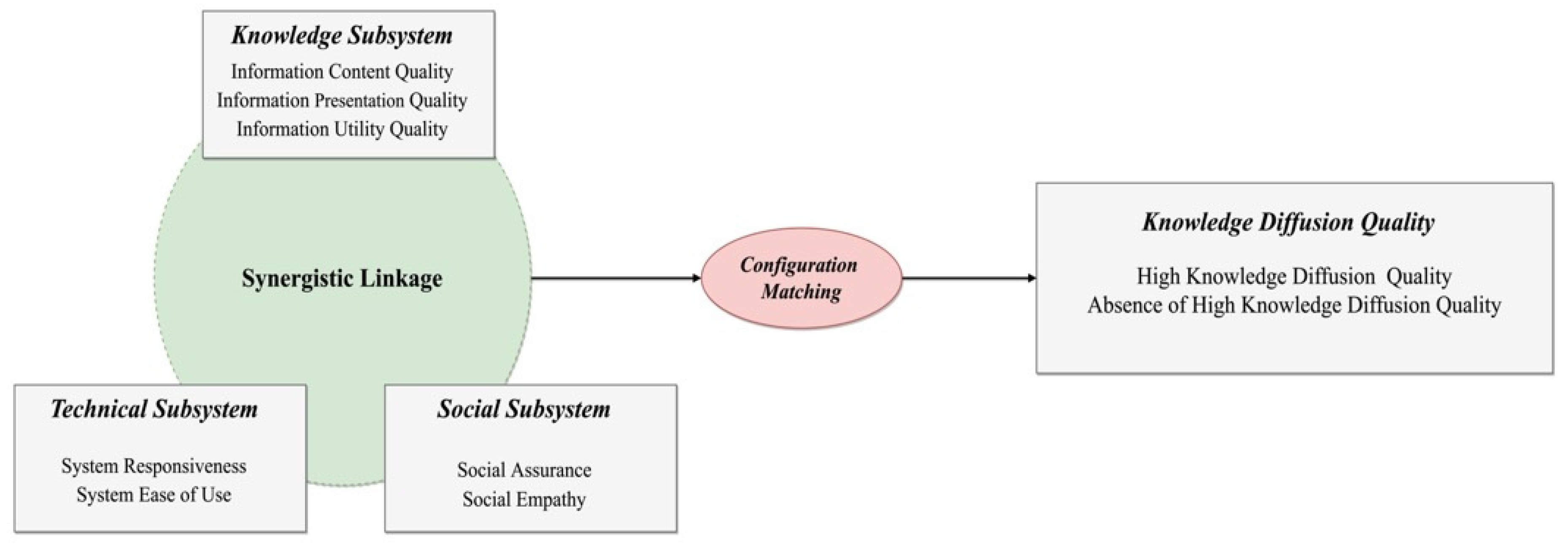
Section 2.2, the model consists of seven condition variables derived from three fundamental subsystems: the knowledge subsystem, comprising information content quality, information presentation quality, and information utility quality; the technical subsystem, comprising system responsiveness and system ease of use; and the social subsystem, comprising service assurance and service empathy. These seven conditions collectively influence the knowledge diffusion outcomes. The objective is to elucidate the configurational effects of these factors on knowledge diffusion quality, specifically how different combinations of subsystem elements can achieve the same systemic outcome through equifinality. As illustrated in
Figure 1, these elements interact and align through configurational pathways to enhance knowledge diffusion quality. The subsequent section provides a brief overview of each condition, along with their interrelationships, while recognizing that from a systems perspective, their effects are interdependent, a point that will be empirically addressed through configurational analysis in later sections.
2.3.1. Knowledge Diffusion Quality
The concept of knowledge diffusion quality (KDQ) comprises two fundamental components: knowledge diffusion and quality. Knowledge diffusion involves the processes of knowledge creation, dissemination, sharing, and innovation. The International Organization for Standardization (ISO) defines quality as “the degree to which a set of inherent characteristics fulfills requirements”. Inherent characteristics pertain to attributes intrinsic to the entity that differentiate it from others, while requirements refer to the needs and expectations of stakeholders, including explicit or implicit needs, involving organizations, users, and other relevant parties [
23]. Building on this definition, the present study conceptualizes knowledge diffusion quality as the extent to which the processes, systems, and outcomes of knowledge creation, dissemination, sharing, and innovation meet the requirements of individuals and relevant stakeholders.
2.3.2. Information Conditions
Information possesses a tripartite structure comprising the content itself, the symbols representing it, and the receiver’s interpretation and application. Within this framework, information quality can be understood as consisting of three interrelated dimensions: content quality, presentation quality, and utility quality [
24].
Information content quality (ICQ) refers to the extent to which information accurately reflects the actual state of affairs, primarily focusing on the objectivity and accuracy of its content [
25]. Objectivity necessitates that information providers depict phenomena or system attributes without distortion from personal bias or self-interest. Accuracy signifies adherence to widely accepted facts or standards. Lou et al. (2013) contend that high-quality information content is more crucial for effective knowledge diffusion than the mere quantity of available information [
26]. Online knowledge communities realize their value and function by addressing users’ knowledge needs, thereby fostering sustained engagement in knowledge diffusion activities. In contrast, low-quality or misleading content undermines system credibility and perceived value, which can erode user trust and lead to withdrawal from the community, ultimately hindering knowledge diffusion [
27]. Consequently, this study asserts that information content quality serves as a determinant of knowledge diffusion quality in online knowledge communities. The contribution of information content quality to knowledge diffusion, however, is not isolated. Its impact may depend on whether the technical subsystem, system responsiveness, can deliver this content efficiently and whether the social subsystem, service assurance, can foster user trust in that content.
Information presentation quality (IPQ) pertains to the clarity with which information conveys its intended meaning, encompassing dimensions such as comprehensibility, clarity, precision, consistency, and conciseness [
28]. Information is communicated through symbolic representations, and users depend on these symbols to acquire, articulate, share, and exchange knowledge. Advances in digital technologies have diversified the formats through which information is presented, thereby enhancing user experience and addressing knowledge needs [
24]. By shaping both the perceived value and functional utility of knowledge exchange, information presentation quality significantly influences the effectiveness of knowledge diffusion within online communities. Consequently, this study posits that information presentation quality plays a vital role in enhancing knowledge diffusion quality in online knowledge communities.
Information utility quality (IUQ) pertains to the degree to which users perceive information as effectively usable, which includes their perceived efficacy in acquiring, sharing, and creating information [
29]. By offering sufficient contextual explanations and minimizing redundancy, information content lessens the cognitive effort required for access and exchange, thereby addressing users’ fundamental knowledge needs. Wu et al. (2017) demonstrated in their examination of knowledge transmission within educational virtual communities that users’ perceived efficacy in acquiring, sharing, and creating content positively affects their willingness to share and their subsequent sharing behaviors [
30]. Consequently, this study posits that information utility quality enhances knowledge diffusion quality in online knowledge communities. Information utility quality’s role in enhancing knowledge diffusion quality is likely amplified when the technical subsystem ensures rapid access and the social subsystem provides empathetic support, which is a configurational logic this study empirically examined.
2.3.3. System Conditions
System quality pertains to the nature of user interactions with a system’s IT functionalities [
31]. Within the D&M model, system quality serves as a crucial determinant of information system success. Since online knowledge communities rely fundamentally on information systems, this study, informed by prior research [
32], conceptualizes system quality through two dimensions: system responsiveness and system ease of use. System responsiveness is defined as the speed at which the platform reacts to user actions, encompassing page loading time, content retrieval speed, and download speed. In contrast, system ease of use refers to the degree to which the user interface is intuitive, learnable, and operable.
System responsiveness (SR) and knowledge diffusion quality. In the age of big data, the expansion of information technologies and platforms has heightened user expectations concerning system performance. System responsiveness is essential for maintaining user engagement with information systems. Prolonged response times extend user waiting periods, which in turn reduces the perceived ease of access to knowledge [
33]. From the standpoint of knowledge diffusion, reducing system response latency improves system quality and promotes more effective knowledge transmission and dissemination within the platform [
34]. Consequently, this study posits that system responsiveness plays a significant role in enhancing the quality of knowledge diffusion in online knowledge communities.
System ease of use (SEU) and knowledge diffusion quality. The technology acceptance model (TAM) posits that users’ cognitive evaluations of a technology, particularly perceived ease of use, shape their attitudes toward that technology and subsequently influence their behavioral intentions [
35]. Cho et al. (2020) empirically demonstrated that system ease of use significantly impacts users’ willingness to pay for knowledge in their study of online knowledge platforms [
36]. In the context of online knowledge communities, a system design that facilitates participation enhances users’ perceived ease of engaging in knowledge diffusion activities. Therefore, this study posits that system ease of use contributes positively to the quality of knowledge diffusion within online knowledge communities.
2.3.4. Service Conditions
Service quality denotes the extent of divergence between users’ perceptions of service and their expectations [
37]. Pang et al. (2020) demonstrated that user behavior is affected by service quality, with positive evaluations enhancing users’ intentions to continue using the service and their willingness to engage in knowledge diffusion activities [
38]. While the dimensions of reliability, responsiveness, and tangibility have been incorporated within the constructs of information quality and system quality, this study, in accordance with Jin and Xu (2020) [
37], concentrates on the remaining two dimensions: service assurance and service empathy.
Service assurance (SA) and knowledge diffusion quality are closely intertwined. Service assurance encompasses the knowledge, courtesy, and ability of service providers to instill trust and confidence [
39]. Studies show that distrust and concerns regarding information privacy pose significant obstacles to user engagement in online knowledge communities, potentially leading to their failure [
38]. Trust, characterized as the level of confidence in the dependability of other parties established through repeated interactions, is widely recognized as a fundamental requirement for knowledge dissemination [
39]. By nurturing trust, service assurance cultivates users’ sense of psychological security, thereby boosting their involvement in knowledge sharing activities. This, in turn, enhances both the perceived value and effectiveness of knowledge exchange within online knowledge communities. Consequently, this investigation posits that service assurance plays a pivotal role in enhancing the quality of knowledge diffusion in online knowledge communities.
Service empathy (SE) and knowledge diffusion quality are intricately linked. Service empathy denotes the personalized care and attention that a system offers its users [
40]. In the realm of online health communities, Chen and Xu (2021) discovered that providing personalized health information or services based on user data, such as registration particulars and browsing history, boosts users’ perceptions of a platform’s competence, integrity, and benevolence, thereby impacting their knowledge sharing behavior [
41]. Personalization emerges as a fundamental strategy for enhancing user satisfaction in the Web 3.0 era. By creating user interest profiles from registration data, platforms can furnish customized knowledge services, thereby enhancing the accuracy of knowledge dissemination within the system [
42]. Service empathy not only boosts the precision and efficiency of knowledge diffusion through tailored services but also molds the perceived value and efficacy of knowledge exchange. Consequently, this research posits that service empathy plays a pivotal role in enhancing the quality of knowledge diffusion in online knowledge communities. Service empathy’s effectiveness in enhancing knowledge diffusion quality is intertwined with the knowledge subsystem, particularly utility quality, and the technical subsystem, particularly responsiveness, which highlights the need for a configurational approach.
3. Materials and Methods
3.1. Integrated Approach Combining fsQCA and NCA
From a systems thinking perspective, causality in socio-technical systems is rarely linear or additive. Instead, it exhibits three features central to systems theory: conjunctural causality, meaning that outcomes depend on combinations of conditions; equifinality, meaning that multiple configurations can lead to the same outcome; and causal asymmetry, meaning that the causes of presence and absence differ [
43]. FsQCA is a set-theoretic method designed to elucidate this causal complexity by treating cases as configurations of conditions and analyzing the intricate causal relationships between these configurations and outcomes. This method is based on the premise that factors influencing a specific outcome are interdependently related rather than independent [
44]. Two primary characteristics differentiate fsQCA from conventional quantitative methods. First, its multidimensional and holistic approach provides an alternative to traditional regression analysis, which typically emphasizes the isolated net effects of individual factors. This allows for a more appropriate framework for examining interdependent conditions and their configurational effects on outcomes. Second, fsQCA incorporates causal asymmetry, recognizing that the presence and absence of an outcome may necessitate distinct explanatory configurations. With a sample of 307 cases, this study fulfills the criteria for large-
n fsQCA, facilitating a thorough examination of individual cases while ensuring adequate external validity.
NCA complements fsQCA by identifying and testing necessary but not sufficient conditions among a set of antecedents [
45]. While fsQCA can qualitatively assess whether a condition is necessary for an outcome, it does not quantify the requisite level of that condition. NCA addresses this limitation by identifying the threshold effects, that is, the levels at which system elements must be present for an outcome to materialize. Dul et al. (2021) observed that NCA captures the necessary conditions, the absence of which would inhibit the occurrence of the outcome, whereas fsQCA identifies conditions that contribute to the outcome [
46]. Together, these methods enable a rigorous investigation of the configurational logic underlying knowledge diffusion quality in socio-technical systems.
3.2. Sample and Data Collection
Unlike academic papers and technological patents, which illustrate knowledge diffusion through citation networks, knowledge diffusion activities in online knowledge communities occur within informal communication contexts and are fundamentally cognitive. Consequently, the measurement of relevant variables should primarily depend on users’ perceived quality as the key evaluative criterion [
47]. This study employed a questionnaire survey to collect data.
Sampling strategy and participant recruitment. This study employed a multi-channel convenience sampling strategy to recruit participants from online knowledge communities. The target population for this study was active users of online knowledge communities in China. Questionnaires were distributed and collected through both online and offline channels, with a specific emphasis on maximizing coverage and mitigating self-selection bias. Specifically, online distribution targeted multiple platforms, including the GitHub knowledge community, academic discussion forums, and discipline-specific knowledge-sharing groups, through posted invitations and shared survey links via social media platforms (e.g., WeChat, QQ) frequented by knowledge community users. Additionally, a snowball sampling component was incorporated, whereby initial respondents were encouraged to forward the survey to other eligible users within their networks. Offline distribution supplemented the online efforts through in-person outreach in academic and professional settings. This multi-channel approach is consistent with the recommended practices for improving the representativeness of non-probability samples in online community research. The data collection process extended over approximately nine months, from September 2024 to June 2025, with slight variations in release timing across platforms.
This study refers to the research ideas of prior studies [
48,
49,
50,
51,
52,
53,
54,
55] and develops measurement items based on existing validated scales. A total of eight latent variables and twenty-eight measurement items were included in this research, all of which adopted a five-point Likert scale. Detailed information is presented in
Supplementary Materials Table S1.
3.3. Descriptive Statistics
After receiving 392 responses, we applied a two-stage screening. First, 41 responses completed in under one minute were excluded. Second, manual inspection of the remaining 351 questionnaires removed 44 additional cases due to patterned or logically inconsistent answers (e.g., uniformly low ratings across information, system, and service dimensions paired with implausibly high ratings of knowledge diffusion quality). This yielded 307 valid responses (78.3% effective rate).
The demographic profile of the sample is as follows. Age distribution approximates a normal curve, with respondents aged 18 to 40 constituting the majority (93.8% of the sample). In terms of education, respondents with a master’s degree or higher formed the largest group (190 individuals, 61.9%), followed by those with a bachelor’s degree (95 individuals, 30.9%). Collectively, respondents holding at least a bachelor’s degree accounted for over 90% of the sample, indicating that the survey reached a highly educated segment of online knowledge community users. Occupationally, the sample consisted primarily of university students (127 respondents, 41.4%), corporate employees (87 respondents, 28.3%), and public institution staff (51 respondents, 16.6%), together comprising 86.3% of the total. This distribution suggests that users of online knowledge communities span diverse occupational sectors, including academia, government, and industry. The final sample of 307 respondents was characterized by relative youth and high educational attainment, predominantly comprising university students aged 18 to 30 and early career professionals in enterprises and public institutions. This demographic composition aligns with the broader Internet user profile reported in the 47th Statistical Report on China’s Internet Development, supporting the representativeness of the sample.
Table 2 presents descriptive statistics for all variables, including means, standard deviations, minimum values, and maximum values. The data exhibited reasonable stability, with no extreme deviations in range or dispersion. The relatively concentrated distribution indicates satisfactory data quality and provides a reliable foundation for subsequent analysis.
3.4. Reliability and Validity Testing
The reliability and validity of the sample data were assessed using confirmatory factor analysis. The standardized factor loadings of all measurement items exceeded 0.5. The composite reliability (CR) values of all latent variables were 0.73 or above. For most latent variables, the average variance extracted (AVE) values exceeded 0.50, except for SA and IUQ, whose AVE values were slightly below 0.50. However, since their corresponding composite reliability values exceeded 0.6, according to Fornell and Larcker (1981) [
56], if the AVE is less than 0.5 but the composite reliability is higher than 0.6, the convergent validity of the construct is still considered adequate, as shown in
Table 3. For most constructs, the square root of the average variance extracted (AVE) exceeded the correlations with other constructs, with the exception of the correlation between IUQ and IPQ. However, the HTMT value between IUQ and IPQ was 0.747, well below the conservative threshold of 0.85 recommended by Henseler et al. (2015) [
57] (refer to
Supplementary Materials Table S2 for the complete HTMT matrix). This provides evidence of adequate discriminant validity among the constructs, as shown in
Table 4. Additionally, a comparison of fit indices with the recommended thresholds further substantiates the structural validity of the measurement model, as shown in
Table 5.
A confirmatory factor analysis was performed to evaluate the possible influence of common method bias by introducing a common method factor. The integration of this factor led to negligible alterations in the model fit indices (△RMSEA = 0.01 < 0.05, △CFI = 0.063 < 0.1, △TLI = 0.028 < 0.1), suggesting that common method bias does not pose a substantial threat in this research.
3.5. Coding Cases’ Set Memberships
Before conducting qualitative comparative analysis, both conditions and outcomes must undergo a calibration process to assign membership scores. Uncalibrated data lack substantive interpretability and meaningful empirical reference. Ragin (2006) emphasizes that the specification of three qualitative anchors in calibration should be grounded in theoretical knowledge and empirical evidence [
58]. Given the limited availability of operational theories and empirical guidance in social science research, and in alignment with the methodological approach of Pappas & Woodside (2021) that integrates survey data with fsQCA, this study employed the direct calibration method to convert raw data into fuzzy set membership scores [
44]. Specifically, three calibration anchors were established for each of the eight variables: the 75th percentile of the sample distribution was designated as the threshold for full membership, the 50th percentile as the crossover point, and the 25th percentile as the threshold for full non-membership [
59].
Table 6 presents the detailed calibration settings for all condition and outcome variables in this study.
4. Results and Discussion
4.1. Necessary Condition Analysis
This study employed NCA, following the methodological framework established by Du et al. (2020) [
60], to identify the conditions essential for high-quality knowledge diffusion in online knowledge communities. A condition is deemed necessary if it consistently occurs alongside the desired outcome. Utilizing R software (version 4.2.1), we estimated effect sizes for each condition through both ceiling regression (CR) and ceiling envelopment (CE) techniques to ensure the robustness of our findings. The results are presented in
Table 7. According to established guidelines, a condition is classified as necessary if its effect size (d) exceeds 0.1 and achieves statistical significance at the
p < 0.01 level [
46]. The analysis indicates that all seven condition variables yielded effect sizes below 0.1 for both the CR and CE estimation techniques. Although information content quality, system responsiveness, system ease of use, and service empathy met the significance criterion (
p < 0.01), they did not satisfy the effect size threshold. Therefore, none of the seven conditions qualified as necessary for achieving high-quality knowledge diffusion.
4.2. Configurational Analysis of High Knowledge Diffusion Quality
Qualitative comparative analysis investigates the sufficiency of combinations of antecedent conditions in producing a specific outcome, aiming to identify distinct configurations or pathways that lead to that outcome. The three pathways identified below represent distinct system configurations, that is, different combinations of subsystem elements that achieve the same systemic outcome. This pattern of equifinality is a hallmark of complex systems, demonstrating that high knowledge diffusion quality can be realized through multiple stable states of the socio-technical system. In accordance with established practices [
60,
61], this study established a consistency threshold of 0.8 for configurational analysis, a proportional reduction in inconsistency (PRI) threshold of 0.7, and a frequency threshold of one case per configuration. Regarding the treatment of logical remainders, this study followed the recommendations of Schneider and Wagemann (2012) [
61]. The parsimonious solution incorporated all logical remainders (including both easy and difficult counterfactuals) for Boolean minimization, whereas the intermediate solution only included easy counterfactuals that align with the theoretical expectations and excludes difficult counterfactuals. Specifically, drawing on socio-technical systems theory and the D&M model, we specified directional expectations that the presence of all seven conditions contributes to high knowledge diffusion quality. The intermediate solution was derived accordingly by minimizing only those logical remainders consistent with these theoretical expectations. The complete truth table, including case numbers, raw consistency, and PRI consistency for each configuration, is provided in
Supplementary Materials Table S3. In reporting the findings, we adhered to the convention of presenting the intermediate solution as the primary interpretation, complemented by the parsimonious solution [
60].
Table 8 displays the configurational analysis of seven antecedent conditions. The results indicate multiple pathways that facilitate high-quality knowledge diffusion in online knowledge communities, represented as configurations H1a, H1b, H2a, H2b, H2c, H2d, and H3.
4.2.1. Configuration I: Demand–Response Synergy
Configurations H1a and H1b illustrate a demand–response synergy configuration, in which the diffusion of high-quality knowledge within online communities is primarily facilitated by the interaction of high information content quality, high information utility quality, and rapid system responsiveness. This pathway demonstrates how the alignment between users’ demand for quality information, specifically the knowledge subsystem, and the platform’s responsive infrastructure, specifically the technical subsystem, collaboratively enhances knowledge diffusion outcomes. This configuration exemplifies the joint optimization of knowledge and technical subsystems, which is a core principle of socio-technical systems theory.
Drawing on uses and gratifications theory, audiences are viewed as goal-directed actors whose engagement with media is motivated by specific needs. These needs generally include entertainment, social interaction, and information acquisition. In online knowledge communities, the pursuit of useful knowledge represents a significant information need that drives user participation and platform engagement, highlighting both the functional value and perceived usefulness of knowledge diffusion activities. The quality of information content is evident in the authority of knowledge sources, as well as the accuracy and reliability of the information provided. Research indicates that source authority acts as a signal of content quality, enhancing users’ perceptions of the value and functionality of knowledge exchange while fostering trust and reliance on the platform [
62]. Information utility quality, in turn, reflects the extent to which user needs are met, encompassing the users’ self-efficacy perceptions related to knowledge acquisition, sharing, and creation. This dimension underscores the usability aspect of knowledge diffusion quality. Enhanced information utility quality bolsters users’ motivation and agency in acquiring, sharing, and generating knowledge, thereby facilitating the ease of knowledge diffusion within the community.
The translation of high-quality content into perceived utility relies on a robust system infrastructure. Effective media systems provide timely feedback on search queries and rapid responses to knowledge needs through intuitive interface design and precise recommendations based on user profiling. These mechanisms foster broad connectivity between quality content and targeted knowledge consumers, thereby enhancing both usability and efficiency in knowledge diffusion. Within the socio-technical systems framework, this configuration demonstrates how the knowledge subsystem, namely information content and utility quality, and the technical subsystem, specifically system responsiveness, achieve joint optimization. Collectively, these dynamics contribute to the emergence and sustainability of high-quality knowledge diffusion within online knowledge communities.
4.2.2. Configuration II: Trust-Mediated Integration
Configurations H2a, H2b, H2c, and H2d elucidate a trust mediated integration configuration, whereby the effective diffusion of high-quality knowledge within online knowledge communities is predominantly facilitated by the interaction of superior information presentation quality, high information utility quality, and robust service assurance. This pathway illustrates how the diversity of knowledge representation formats, in conjunction with the users’ trust in platform privacy and security, collectively enhances knowledge diffusion outcomes. From a socio-technical systems perspective, this configuration reflects the integration of the knowledge subsystem, specifically presentation and utility quality, with the social subsystem, specifically service assurance, mediated by institutional trust mechanisms.
The information age has fundamentally transformed the technological landscape for knowledge diffusion, particularly regarding the diversity of knowledge carriers. Traditional methods of knowledge dissemination primarily relied on text, video, and audio broadcasts transmitted through books, television, radio, and PC-based Internet channels. The rapid evolution of digital technologies, including mobile devices, 5G communications, and artificial intelligence, has not only integrated traditional knowledge carriers into mobile platforms but has also given rise to novel information presentation formats such as short videos, live streaming, Q&A sessions, and generative artificial intelligence. Moreover, the incorporation of digital technologies, including virtual reality, mixed reality, and augmented reality, with knowledge content creates immersive experiences that significantly enhance the quality of information presentation. This enhancement strengthens both the perceived value and functionality of knowledge diffusion within online communities. Unlike the scientist-centered model of knowledge dissemination characteristic of the traditional media era, the new media era increasingly embraces a public-centered approach. Through mobile applications, the public can access knowledge, express viewpoints, receive feedback, and track developments at any time and from any location, thereby substantially enhancing their perceptions of information utility quality [
63]. However, the extensive public participation that characterizes knowledge interaction has also introduced concerns regarding information security, including misinformation and privacy breaches.
Service assurance in online knowledge communities encompasses users’ evaluations of system security and trustworthiness, which include both interpersonal and institutional trust. The transmission of interpersonal trust, largely dependent on users’ cognitive abilities, is challenging to manage. In contrast, institutional trust can be fostered through mechanisms of trust transmission facilitated by institutional configurations, such as system service feedback, identity authentication processes, and the engagement of third-party certification bodies. These mechanisms enhance users’ confidence in online information systems [
64]. Within the socio-technical systems framework, this configuration demonstrates how the social subsystem, specifically service assurance, enables the effective functioning of the knowledge subsystem, specifically presentation and utility quality. By strengthening privacy and security protections, user participation in knowledge diffusion activities increases, thereby improving the overall quality of knowledge dissemination within online information systems [
65].
4.2.3. Configuration III: Emotion–Utility Coupling
Configuration H3 illustrates an emotion–utility coupling configuration in which effective knowledge diffusion within online communities is primarily facilitated by the interaction of high information utility quality and elevated service empathy. This pathway elucidates how users’ perceptions of self-efficacy concerning knowledge content, in conjunction with the platform’s emotional responsiveness to users, collaboratively enhance knowledge diffusion outcomes. From a socio-technical systems perspective, this configuration represents the coupling of the knowledge subsystem, namely utility quality, with the social subsystem, namely service empathy, where functional effectiveness and affective responsiveness reinforce each other.
Online knowledge communities serve as Internet-based platforms that facilitate both knowledge exchange and emotional interaction among users. Knowledge exchange signifies the participants’ intellectual engagement, while emotional support reflects their affective involvement. The quality of information utility encompasses users’ perceptions of self-efficacy across the dimensions of knowledge acquisition, sharing, and creation, thereby indicating the usability aspect of knowledge diffusion quality. Meeting users’ fundamental knowledge needs is essential for the sustainability of online knowledge communities, representing the functional dimension of knowledge diffusion quality. In contrast, user emotional interaction addresses the fulfillment of social support and hedonic benefits, highlighting the value dimension of knowledge diffusion quality. Affective attentiveness within these communities is evident in the responsiveness to users’ individual needs and the prompt resolution of inquiries and concerns. By mitigating information overload caused by online redundancy, such attentiveness enhances both the efficiency of knowledge diffusion and the users’ perceived usefulness, ultimately contributing to an improved quality of knowledge diffusion [
66].
Within the socio-technical systems framework, this configuration reveals that the social subsystem, specifically service empathy, and the knowledge subsystem, specifically information utility quality, can achieve a coupled state where functional utility and emotional support mutually reinforce each other. This coupling is particularly significant in hedonic information systems, where intrinsic motivation, namely enjoyment, interacts with extrinsic motivation, namely usefulness, to sustain user engagement. The presence of this configuration alongside the previous two demonstrates that high knowledge diffusion quality can emerge from multiple distinct subsystem alignments, which is a clear manifestation of equifinality in socio-technical systems.
4.3. Configurational Analysis of the Absence of High Knowledge Diffusion Quality
Given the causal asymmetry inherent in fsQCA, where the conditions leading to the presence of an outcome may differ from those resulting in its absence, this study further investigated the configurations associated with the absence of high-quality knowledge diffusion. The four pathways identified below reveal how subsystem deficiencies, when combined, undermine overall system performance. This examination aims to provide a more systematic understanding of the underlying mechanisms. Following the methodology of Du et al. (2024) [
60], calibration for the absence of high-quality knowledge diffusion was conducted by taking the complement of the set for high-quality knowledge diffusion.
Table 9 presents the results of the sufficiency analysis for the absence of high-quality knowledge diffusion. By identifying core conditions across eight configurations, we derived four distinct pathways that hinder high-quality knowledge diffusion in online knowledge communities (configurations NH1a, NH1b, NH2a, NH2b, NH2c, NH2d, NH3, and NH4).
4.3.1. Knowledge-Efficacy Inhibition Pathway
Configurations NH1a and NH1b elucidate a knowledge-efficacy inhibition pathway, wherein the absence of high-quality knowledge diffusion is largely due to the combined effects of low information content quality and low information utility quality. These pathways illustrate how the interaction between subpar knowledge content and users’ reduced perceptions of knowledge self-efficacy collectively limits knowledge diffusion outcomes within online knowledge communities. From a socio-technical systems perspective, this inhibition reflects a deficiency in the knowledge subsystem that undermines users’ intrinsic motivation to participate.
Information content quality and information utility quality are mutually reinforcing dimensions of knowledge diffusion. High-quality content is a prerequisite for information utility quality; only content of superior quality fosters strong perceptions of information utility and perceived usefulness among users. This perceived usefulness reflects users’ confidence in their ability to provide valuable knowledge. Lin (2007) asserts that knowledge self-efficacy serves as an intrinsic motivation for individuals to engage in knowledge sharing. Self-determination theory posits that intrinsic motivation enhances creativity by allowing individuals to concentrate more deeply, take risks, and explore alternatives. High-quality knowledge contributions necessitate greater curiosity and creativity [
67]. Therefore, when knowledge contributors believe that their contributions can effect meaningful change, they are more inclined to contribute, thus fulfilling their inherent need to demonstrate competence while enriching the system’s knowledge repository [
26].
Low information content quality in online knowledge communities undermines perceived knowledge utility and diminishes users’ satisfaction with their knowledge needs, resulting in decreased knowledge self-efficacy. This decline in self-efficacy subsequently reduces users’ motivation to engage actively in these communities and decreases their participation in knowledge diffusion activities. Consequently, both the quantity and quality of knowledge contributions suffer, ultimately constraining the overall quality of knowledge diffusion within online knowledge communities. In socio-technical systems terms, this inhibition pathway shows that when the knowledge subsystem fails to provide adequate content and utility, the entire system’s performance collapses, regardless of the state of technical or social subsystems.
4.3.2. Understanding-Emotion Inhibition Pathway
Configurations NH2a, NH2b, NH2c, and NH2d elucidate an understanding-emotion inhibition pathway, wherein the lack of high-quality knowledge diffusion primarily results from the combined effects of poor information presentation quality, low information utility quality, and insufficient service empathy. These pathways illustrate how the interaction between the comprehensibility and perceived usefulness of information content, along with the platform’s emotional responsiveness to users, collectively limits knowledge diffusion outcomes in online knowledge communities. From a socio-technical systems perspective, this inhibition reflects deficiencies spanning the knowledge subsystem, specifically presentation and utility quality, and the social subsystem, specifically service empathy.
In the digital communication era, the rapid advancement of digital technologies and mobile Internet has significantly reduced barriers to the dissemination of scientific knowledge while fundamentally transforming traditional models of knowledge diffusion [
68]. By utilizing various digital media, scientific knowledge has broadened its range of content representation formats, thereby enhancing its effectiveness in reaching diverse audiences. This trend not only increases the appeal of knowledge dissemination and public receptivity, but also contributes to the multidimensional enhancement of knowledge value. Moreover, the diverse and engaging formats for presenting knowledge content closely align with the reading preferences of contemporary audiences in the visual era. Such alignment facilitates easier and more enjoyable access to knowledge services, fostering strong affective connections between users and online knowledge communities. Consequently, this promotes the integration of functional and value dimensions of knowledge diffusion quality, ultimately improving knowledge diffusion outcomes within online communities.
Conversely, deficiencies in the quality of information presentation hinder the accurate and complete transmission of knowledge content, thereby undermining the users’ perceptions of its usefulness. This leads to diminished subjective perceptions of knowledge-related self-efficacy among audiences. When combined with a lack of affective connection due to low service empathy, these deficiencies collectively suppress the quality of knowledge diffusion in online knowledge communities. In socio-technical systems terms, this inhibition pathway demonstrates that co-occurring deficiencies in the knowledge subsystem, namely presentation and utility, and the social subsystem, namely empathy, create a system state where neither functional effectiveness nor affective engagement can sustain high performance.
4.3.3. Presentation-Emotion Inhibition Pathway
Configuration NH3 illustrates a presentation-emotion inhibition pathway, wherein the absence of effective knowledge diffusion is mainly due to the combined effects of poor information presentation quality and inadequate service empathy. This pathway highlights how outdated methods of knowledge representation and transmission, along with insufficient emotional engagement with users, collectively hinder knowledge diffusion outcomes in online knowledge communities. From a socio-technical systems perspective, this inhibition reflects deficiencies in the interface between the knowledge and social subsystems.
As of June 2025, China’s Internet user population had reached 1.123 billion, reflecting an Internet penetration rate of 79.7 percent and a cumulative total of 4.55 million operational 5G base stations. These advancements highlight the essential need to utilize the Internet for innovating methods of knowledge representation and dissemination, thereby improving the quality of knowledge diffusion.
Online knowledge communities can be viewed, to some extent, as hedonic information systems primarily focused on knowledge dissemination. In these systems, knowledge acquisition serves as the extrinsic motivation for users’ initial engagement, while enjoyment functions as the intrinsic motivation for ongoing participation [
69]. Innovative formats for knowledge representation and transmission fulfill users’ knowledge needs and address their affective needs, resulting in satisfaction derived from met expectations. Just as perceived usefulness positively influences users’ continued engagement with information systems, perceived enjoyment has an even more significant impact within the context of hedonic information systems. The interaction between extrinsic and intrinsic motivations enhances both the value and functional dimensions of knowledge diffusion quality, thereby improving outcomes in online communities. Conversely, when knowledge representation formats do not align with the users’ expectations for enjoyment, the platform’s capacity for service empathy diminishes. This reduction, in turn, undermines the quality of knowledge diffusion in online knowledge communities. In socio-technical systems terms, this inhibition pathway shows that when the knowledge subsystem fails to present content in engaging formats and the social subsystem fails to provide emotional support, the resulting system state cannot sustain high-quality knowledge diffusion, even if other subsystems (e.g., technical infrastructure) are functioning adequately.
4.3.4. System-Service Inhibition Pathway
Configuration NH4 delineates a system-service inhibition pathway wherein the absence of high-quality knowledge diffusion is primarily due to the combined effects of low system responsiveness, low service empathy, and low service assurance. This pathway exemplifies how deficiencies in both system quality and service quality within online knowledge communities collectively hinder knowledge diffusion outcomes. From a socio-technical systems perspective, this inhibition reflects deficiencies spanning the technical subsystem, specifically system responsiveness, and the social subsystem, specifically service assurance and empathy.
System quality encompasses the performance attributes of an information system, reflecting the extent to which the system is user-friendly and the quality of its underlying software and hardware infrastructure [
70]. When users evaluate information quality or service quality, their assessments incorporate not only factors directly related to those dimensions, but also their perceptions of system quality.
System quality significantly influences users’ evaluations of both information quality and service quality within online knowledge communities. Research demonstrates that system quality is closely linked to individuals’ behavioral beliefs, thereby affecting system usage behaviors through its impact on user satisfaction and usage intentions [
70]. Additionally, service quality has been shown to positively affect user satisfaction, mediated by its influence on users’ perceived ease of use. When online knowledge communities provide personalized functionalities, including tailored page layouts, information recommendations, and privacy protections, aligned with users’ behavioral patterns and preferences, they effectively reduce the time costs associated with knowledge acquisition. This customization not only enhances the efficiency of knowledge diffusion, but also improves the perceived ease of use of the system. Conversely, when online knowledge communities fail to promptly address users’ knowledge needs, offer personalized knowledge services, or ensure adequate privacy protection, they increase the difficulty and time costs of knowledge acquisition, diminish users’ perceived benefits, and erode anticipated satisfaction. Such shortcomings ultimately compromise the quality of knowledge diffusion in online knowledge communities.
In socio-technical systems terms, this inhibition pathway reveals that deficiencies in the technical subsystem, specifically system responsiveness, and the social subsystem, specifically service assurance and empathy, can create a system state where users cannot effectively access knowledge nor trust the platform. Unlike the previous inhibition pathways, this configuration involves multiple subsystems failing simultaneously, producing a more severe systemic constraint that blocks high-quality knowledge diffusion regardless of the state of the knowledge subsystem.
4.4. Joint Interpretation of NCA and fsQCA Results
NCA and fsQCA play complementary rather than competitive roles in this study. NCA examines singular necessity, that is, whether a condition exhibits a “without which not” bottleneck effect on the outcome. fsQCA, in contrast, examines configurational sufficiency, that is, whether a combination of conditions is sufficient to produce the outcome. The underlying logics of these two methods belong to distinct dimensions, namely necessary causation and sufficient causation, and cannot be reduced to one another.
The NCA results indicate that none of the seven conditions met the d > 0.1 threshold, meaning that no single condition constitutes an indispensable prerequisite for knowledge diffusion quality. This finding reflects a hallmark feature of complex systems: systems possess a degree of resilience and redundancy, such that deficiencies in one element can be compensated by the reinforcement of other elements.
However, the fsQCA configurational analysis revealed patterns at a different level. In the high-quality pathways (refer to
Table 8), IUQ appears as a core condition in all seven pathways, indicating that knowledge usefulness serves as a core element across multiple success mechanisms. Meanwhile, in the absence of high-quality configurations (refer to
Table 9), SE appears as a core-absent condition in six out of eight pathways, meaning that the lack of service empathy is a recurring feature of unsuccessful configurations.
Juxtaposing these two sets of evidence yielded a clear dual-sided pattern: IUQ is pervasively present in successful configurations, whereas SE is systematically absent in unsuccessful ones. The NCA finding of non-necessity and the fsQCA finding of configurational centrality are not contradictory but complementary, answering different causal questions. No single condition is indispensable for the outcome, yet certain conditions are consistently present in success and absent in failure. This pattern reflects the distinction between necessity and configurational centrality in complex socio-technical systems.
On this basis, this study identified IUQ as a highly pervasive core condition, present across all high-quality pathways and revealing knowledge usefulness as a common denominator across diverse success mechanisms. SE, in contrast, is characterized as a contextual core condition: its recurrent absence in non-high-quality configurations underscores its safeguarding role in specific contexts. This distinction reflects the complementary evidence from NCA and fsQCA and contributes to a more nuanced understanding of element importance in socio-technical systems. The significance of system elements may lie in bottleneck-style indispensability, recipe-style pervasive presence, or contextual safeguarding, each constituting a legitimate basis for establishing importance.
4.5. Robustness Tests
In accordance with the robustness testing methodologies proposed by Kraus et al. (2018) [
71], this study performed three robustness checks while keeping all other analytical specifications constant. First, the consistency threshold was elevated from 0.8 to 0.85. Second, the PRI consistency threshold was raised from 0.7 to 0.75. Third, an alternative calibration strategy was adopted using substantive theoretical anchors based on the Likert scale semantics, with full membership set at scale value 4, the crossover point at 3, and full non-membership at 2. Fourth, the frequency threshold was increased from 1 to 2; detailed results are presented in
Supplementary Materials Tables S4–S7. The results from these robustness checks showed only minor variations in consistency and coverage metrics relative to the main findings. Importantly, the core theoretical framework and key causal mechanisms remained stable, with changes limited to the reasonable simplification of peripheral conditions. No new configurations or alternative interpretations emerged from any of the robustness checks. These results confirm that our findings are not artifacts of threshold or calibration choices and demonstrate a high level of robustness. These results fulfill the robustness criteria established by Schneider & Wagemann (2012) [
61], thereby affirming the stability and reliability of the study’s conclusions.
5. Conclusions and Implications
5.1. Conclusions
Utilizing the D&M information systems success model as a dimensionalization of socio-technical systems, this study adopted an integrated approach that combines fsQCA and NCA to examine the configurational effects of seven factors across knowledge, technical, and social subsystems on the quality of knowledge diffusion in online knowledge communities. Primary data were gathered using validated measurement scales. The key findings are as follows.
First, no single factor, such as information content quality, information utility quality, information presentation quality, system responsiveness, system ease of use, service empathy, or service assurance, serves as a necessary condition for achieving high knowledge diffusion quality in online knowledge communities. This finding highlights the nonlinearity characteristic of complex systems and suggests that individual factors have limited explanatory power when considered in isolation. From a systems perspective, it confirms that knowledge diffusion quality emerges from the interplay of multiple elements rather than from any single subsystem.
Second, three distinct system configurations contribute to high knowledge diffusion quality in online knowledge communities, demonstrating the principle of equifinality. The demand–response synergy configuration, namely Configuration I, is facilitated by the joint optimization of the knowledge subsystem, specifically high information content quality and high information utility quality, and the technical subsystem, specifically rapid system responsiveness. The trust-mediated integration configuration, namely Configuration II, arises from the integration of the knowledge subsystem, specifically high information presentation quality and high information utility quality, with the social subsystem, specifically strong service assurance. Finally, the emotion–utility coupling configuration, namely Configuration III, is supported by the coupling of the knowledge subsystem, specifically high information utility quality, with the social subsystem, specifically high service empathy. These three configurations reveal that high system performance can be achieved through multiple stable states of the socio-technical system.
Third, four distinct pathways contribute to the absence of high-quality knowledge diffusion, revealing how subsystem deficiencies undermine overall system performance. The knowledge-efficacy inhibition pathway arises from the combined effects of low information content quality and low information utility quality, reflecting a failure in the knowledge subsystem. The understanding-emotion inhibition pathway results from the interplay of low information presentation quality, low information utility quality, and low service empathy, indicating co-occurring deficiencies in the knowledge and social subsystems. The presentation-emotion inhibition pathway is influenced by the dual factors of low information presentation quality and low service empathy, revealing a failure in the interface between knowledge and social subsystems. Finally, the system-service inhibition pathway stems from the interaction of low system responsiveness, low service empathy, and low service assurance, reflecting deficiencies spanning the technical and social subsystems.
Fourth, the joint application of NCA and fsQCA reveals a dual logic of element importance. NCA confirms that no single condition is indispensable for knowledge diffusion quality, while fsQCA reveals that IUQ serves as a core condition across all high-quality pathways and SE serves as a core-absent condition in the majority of non-high-quality pathways. On this basis, IUQ is identified as a highly pervasive core condition and SE as a contextual core condition, advancing a more nuanced understanding of element importance in socio-technical systems theory.
5.2. Contributions
This study offers three theoretical contributions to the understanding of knowledge diffusion in online knowledge communities.
First, identifying specific patterns of subsystem interdependence. While prior STS research has acknowledged the importance of technical-social alignment, it has rarely specified the concrete forms that such interdependence can take. Our configurational analysis reveals three distinct patterns: (1) compensatory interdependence (H1), where technical conditions compensate for social deficiencies; (2) substitutive interdependence (H2), where social trust substitutes for technical performance; and (3) emergent interdependence (H3), where the coupling of social and knowledge elements produces outcomes that neither subsystem alone could achieve. These patterns provide empirical specificity to the abstract concept of “joint optimization” central to STS theory.
Second, extending the D&M model through a configurational lens. Prior applications of the D&M model have treated its three quality dimensions, namely information quality, system quality, and service quality, as independent predictors with additive effects. Our findings challenge this assumption by demonstrating that the same level of knowledge diffusion quality can be achieved through multiple distinct configurations of these dimensions. This suggests that the D&M model should be understood not as a checklist of factors to be optimized individually, but as a framework for diagnosing how different combinations of factors can produce equivalent outcomes.
Third, refining the concept of subsystem substitutability. While earlier STS research has emphasized the need for joint optimization, our findings suggest that subsystem deficiencies can be compensated in context-specific ways. This advances STS theory by distinguishing between different types of subsystem interdependence and specifying the conditions under which each type operates.
5.3. Implications
The findings of this study provide three practical recommendations for enhancing the quality of knowledge diffusion in online knowledge communities, viewed through a socio-technical systems lens.
First, online knowledge communities should leverage their platform-specific resource endowments to establish core enabling conditions within their unique system configurations. The quality of knowledge diffusion arises from the interaction of multiple subsystems, and multiple equifinal pathways can yield high-quality outcomes. In pursuing quality improvement initiatives, platforms must evaluate their existing resource configurations and competitive advantages to identify pathways that align with their unique circumstances. A configurational mindset should guide the development of strategies related to knowledge content production, knowledge product development, information system construction, and service function design. By leveraging the advantages of factor combinations, platforms can focus their resources on cultivating essential core conditions. In systems terms, this means identifying which subsystem elements are most critical given the platform’s existing system boundary and environmental constraints.
Second, ensuring adequate service empathy should serve as a foundational prerequisite for enhancing the quality of knowledge diffusion. The findings reveal that service empathy appears in three pathways that contribute to the absence of high knowledge diffusion quality, indicating that insufficient service empathy significantly detracts from knowledge diffusion outcomes. Conversely, service empathy is present in only one pathway associated with high knowledge diffusion quality, suggesting that maintaining baseline levels of service empathy may be sufficient to avert unsatisfactory results. Therefore, initiatives aimed at improving knowledge diffusion quality should prioritize service empathy as a critical area for enhancement. Platforms should optimize community service assurance mechanisms, refine service delivery processes, and focus more intently on addressing users’ affective needs. From a systems perspective, this recommendation highlights the social subsystem as a foundational component that must reach a minimum threshold for overall system success.
Third, the enhancement of information utility quality should be another foundational aspect of improving knowledge diffusion quality. The results indicate that information utility quality is present in all three pathways that lead to high knowledge diffusion quality, suggesting that it is a fundamental prerequisite for achieving superior knowledge diffusion outcomes. Consequently, efforts to enhance quality should prioritize the improvement of information utility quality. Platforms ought to reinforce content moderation mechanisms, impose sanctions on users with a history of disseminating low-quality information, and filter out low-quality, illegal, or fabricated knowledge content to ensure the availability of useful information within the community. In socio-technical systems terms, this recommendation identifies the knowledge subsystem as another foundational component whose baseline functionality is critical for enabling the higher-level configurations that produce high-quality knowledge diffusion.
5.4. Limitations and Future Research
Despite these contributions, this study has several limitations that point to directions for future research.
First, this study focused primarily on the internal subsystems of online knowledge communities, leaving the influence of broader macro-level factors, such as policy environments and industrial infrastructure, for future investigation. Subsequent research could extend the configurational framework to incorporate these external conditions.
Second, the cross-sectional design limits our ability to capture the evolutionary dynamics of knowledge diffusion quality. Socio-technical systems are inherently dynamic. Future research employing longitudinal designs or in-depth case studies would help uncover how configurations shift over time in response to internal and external pressures.
Third, while this study identified three equifinal configurations, the relative stability and adaptability of these configurations remain unexplored. Future research could examine how these configurations perform under different environmental conditions, such as technological disruptions or policy changes, and how platforms might transition between configurations as their resource endowments evolve.