Organizational Factors and Digital Transformation: A Systems Perspective on Small Firms

 ,
,  ,
, 
 and
and
Abstract
1. Introduction
2. Literature Review
2.1. Resource-Advantage Theory
2.2. Digital Readiness
2.3. Organizational Factors
2.4. Project Management Capability
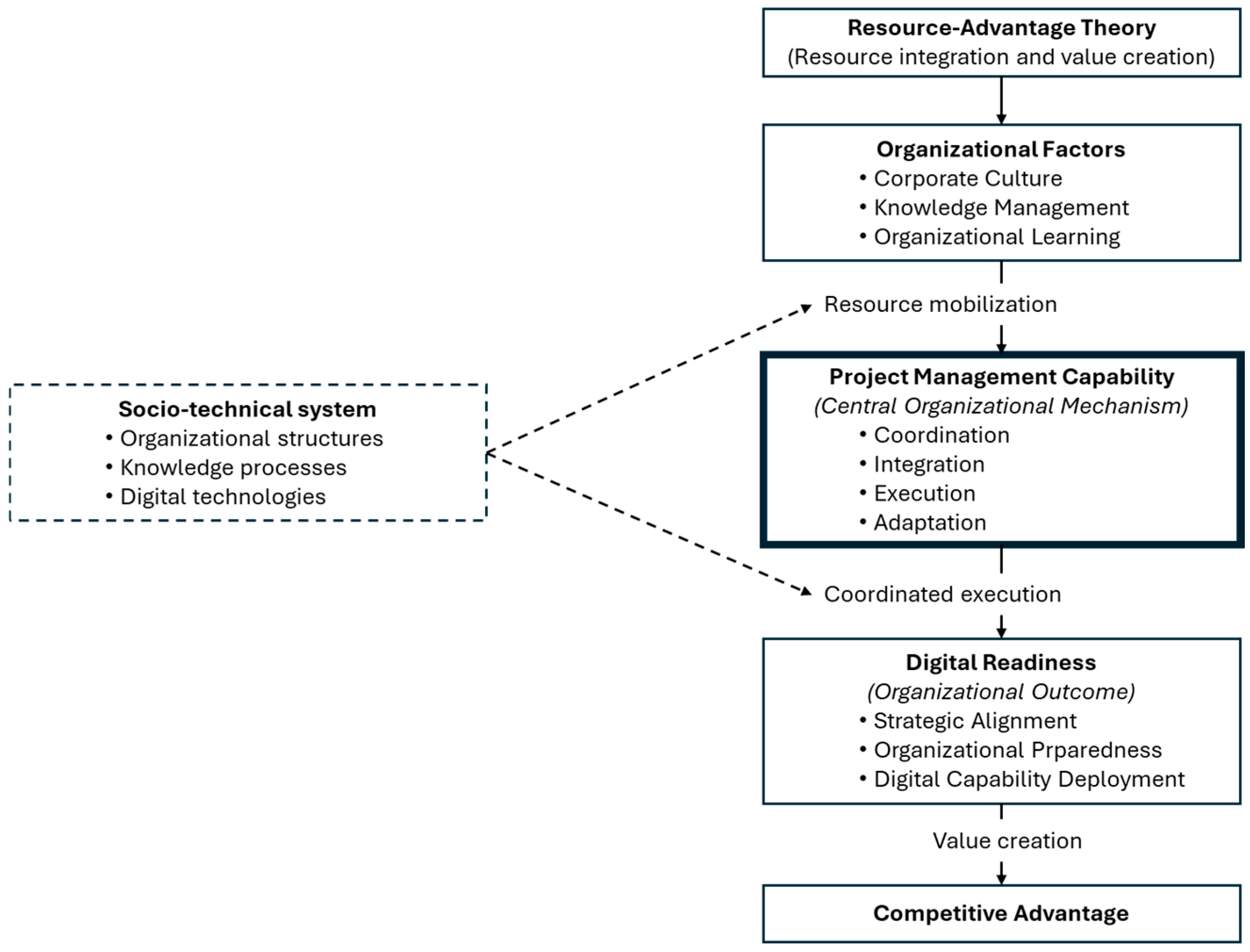
2.5. Conceptual Integration
- Resource-Advantage Theory: explains how value is created through resource integration;
- Organizational Factors: represent the internal resource base of the firm;
- Project Management Capability: acts as the mechanism that enables coordination and execution;
- Digital Readiness: represents the organizational outcome of this process and, simultaneously, the enabling precondition for digital transformation, understood as the systemic reconfiguration of organizational processes, structures, and value creation through digital technologies [32]. While digital readiness reflects the degree to which the organization is prepared to engage with digital change, digital transformation refers to the enacted process through which that change is realized in practice.
2.6. Conceptual Model
3. Methodology
3.1. Data Collection
3.2. Sample Selection
3.3. Data Analysis
3.4. Trustworthiness and Validity
4. Results
5. Discussion
I have 800 emails unread from the past, I don’t know, two years. So I can’t reply to all of them. And it’s a shame because I wish I could. And on top of that, we have the LinkedIn outreach that we need to do, and we have the client managing, and we have set up of new accounts, and we have to lead source new clients. I think more technology will be necessary (E1).
When I started talking about this, there was a lot of internal resistance, for example, from the technical director, who never embraced digital, never embraced online, never embraced technology. He used to say at the time that it was a trend, that it was just an idea, it was a trend that would pass. And the other consultants also thought it was impossible for someone to learn from a video and so on. I persisted, and today I don’t need to make much effort to show that this is the trend, period (C1—our translation).
We’re not necessarily natural marketers. We’re trying to do the work. We love the work and we love the projects, and we’re trying to make a company work and succeed so that we can do the project so we can do the work. Making the company work is like… It’s something we have to do, but we don’t necessarily… You know what I mean? I don’t know. It’s an interesting challenge. I am interested in that entrepreneurial stuff. We are a bit…we are entrepreneurs, but we’re not like… None of us have been to business school. None of us have really learnt. We don’t have that background. So I suppose we do the best we can and we do what we need to do. Our real passion, though, lies in the work (F3).
How has [Firm F] evolved since its inception? I think that the two who founded it, have always had disruptive minds. So, being them, perhaps they think, let’s say, that outside the box, I think that influences the leadership they have and how they present these ideas to the team, I think that influences it (F2).
All that knowledge had already been used, and instead of making calls via Zoom, it was kind of like from what we learned last time, we organized it through WhatsApp. Similarly, things like making the PDFs lighter so they wouldn’t consume too much data for the partners, so I did everything more personalized, according to what we learned from the first generation of Fellowship (F1).
If we don’t have a fixed person, and if we don’t give the necessary cadence, digitalization doesn’t happen, it doesn’t happen, mainly because I need someone responsible. I think that’s the main point, the person who will lead digitalization. But this person can’t do it alone while handling other tasks as well… (A2—our translation).
The founders are very open and provide ample space for experimentation. So, on the one hand, there are things that they bring, that they want to do, that they would like to try, but they also give space, that if someone comes and says from the team I want us to do this, ‘What do you think? Is there room for that? No?’ So, for me, culture is made on both sides. The leaders of an organization are key, but also, the culture of space to speak, to say if not to… to be like constructive criticism, and also to bring other alternatives and options (F1).
We have individual meetings for planning, daily stand-ups, and retrospectives within each department’s sprint. Additionally, we have two collective meetings during each 15-day sprint. One is a team meeting where everyone gets updated on everything happening within the company, including a bit of personal talk. We also have a monthly all-hands meeting, a four-hour session where I present major changes, new developments, a recap of the previous meeting, ongoing projects, and negotiations (A2—our translation).
6. Conclusions
6.1. Theoretical Contributions and Practical Implications
- Organizational factors represent the resource base;
- Project Management Capability functions as the central coordinating mechanism;
- Digital readiness emerges as an organizational outcome;
- And competitive advantage is achieved through effective resource integration.
6.2. Limitations and Future Recommendations
Author Contributions
Funding
Institutional Review Board Statement
Informed Consent Statement
Data Availability Statement
Acknowledgments
Conflicts of Interest
Appendix A

| English Version | Portuguese Version | |
|---|---|---|
| Block 1 | ||
| Central question—general objective | How would you describe the digitalization, that is, the insertion of digital technologies to create value, in your company? | Como você descreve a digitalização, ou seja, a inserção de tecnologias digitais para criar valor na sua empresa? |
| And how does it occur in your marketing activities? | E como ocorre esse processo nas suas atividades de marketing? | |
| Subquestions | Tell me about the company’s history and adoption of new technologies. What was the process like 10 years ago, and 5 years ago, leading up to the present moment? | Conte-me sobre a história da empresa e a adoção de novas tecnologias. Como foi o processo 10 anos atrás, e 5 anos, em uma regressão até o momento presente? |
| Are you strategically concerned with the long run? Describe how do you see the company in the future. | Vocês se preocupam estrategicamente com o longo-prazo? Descreva como você vê a empresa no futuro. | |
| Describe how do you try to create long-term value for your customers | Descreva como a sua empresa tenta criar valor de longo prazo para seus consumidores | |
| What are the main difficulties you face when trying to implement digital technologies? | Quais são as principais dificuldades que você enfrenta ao implementar novas tecnologias digitais? | |
| Please describe how is your relation with your clients, suppliers and stakeholders, in general | Por favor descreva a sua relação com clientes, fornecedores e stakeholders, em geral. | |
| Describe how do you think the relationship with other companies and stakeholders influences digitalization? | Descreva como a relação da empresa com outras empresas e stakeholders influencia a digitalização. | |
| Describe how environmental factors, such as the government, the economy and the country’s culture, influence the digitalization process | Descreva como fatores ambientais, como o governo, a economia e a cultura do país influenciam o processo de digitalização. | |
| And how about the digitalization’s drivers and barriers? How would you describe them? | E sobre os impulsionadores e barreiras da digitalização? Como você os descreveria? | |
| How would you describe the marketing strategy within your company? What are the difficulties? | Como você descreve a estratégia de marketing da sua empresa? Existem dificuldades? | |
| Describe your role in technology implementation and the companies’ strategy, please. | Descreva o seu papel na implementação de novas tecnologias e na estratégia empresarial, por favor. | |
| Block 2 | ||
| Central question—first specific objective | Describe how is the digitalization process according to the management of your company? That means the internal processes that can bring more efficiency to it. | Descreva é o processo de digitalização de acordo com a gestão na sua empresa? Ou seja, compreendendo os processos internos que podem ser mais efetivos com o uso de tecnologias digitais. |
| Subquestions | How do you think the digitalization of these processes affects long-term performance? You can think about it in a retrospective manner. | Como você acha que a digitalização desses processos influencia a performance de longo prazo? Pense de forma retrospectiva, desde a implementação até o momento presente. |
| Describe how organizational aspects are influenced and influenced by it? Like the culture and the organizational learning. | Descreva quais organizacionais influenciam e são influenciados por isso? Como a cultura e o aprendizado organizacional. | |
| Describe how interorganizational aspects are influenced and influenced by it? For example, your relationship with suppliers, customers and competitors. | Descreva quais aspectos inter-organizacionais influenciam e são influenciados por isso? Por exemplo, sua relação com fornecedores, consumidores e concorrentes. | |
| Describe how environmental aspects are influenced and influenced by it? For example, the market, the government, etc. | Descreva quais aspectos ambientais influenciam e são influenciados pela administração digital? Como o mercado, o governo, etc. | |
| Block 3 | ||
| Central question—second specific objective | And regarding the digital marketing strategy? That means, the channels you use to communicate with customers? | E com relação à estratégia de marketing digital, ou seja, os canais utilizados para estabelecer uma comunicação e um relacionamento com os consumidores? |
| Subquestions | How do you think the digitalization of these processes affects long-term performance? Again, you can think about it in a retrospective manner. | Como você acha que a digitalização desses processos influencia a performance de longo prazo? Novamente, pense de forma retrospectiva, desde a implementação até o momento presente. |
| Describe how organizational aspects are influenced and influenced by digital marketing? | Descreva quais organizacionais influenciam e são influenciados pelo marketing digital? | |
| Describe how interorganizational aspects are influenced and influenced by digital marketing? | Descreva quais aspectos inter-organizacionais influenciam e são influenciados pelo marketing digital? | |
| Describe how environmental aspects are influenced and influenced by digital marketing? | Descreva quais aspectos ambientais influenciam e são influenciados pelo marketing digital? | |
| Block 4 | ||
| Central question—fourth specific objective | And how about the digital sales channels? Describe how it works, please. | E com relação aos canais de venda digitais? Descreva como funcionam, por favor. |
| Subquestions | How do you think the digitalization of these processes affects long-term performance? | Como você acha que a digitalização desses processos influencia a performance de longo prazo? |
| Describe how organizational aspects are influenced and influenced by digital sales channels? | Descreva quais organizacionais influenciam e são influenciados pelos canais de venda digitais? | |
| Describe how interorganizational aspects are influenced and influenced by digital sales channels? | Descreva quais inter-organizacionais influenciam e são influenciados pelos canais de venda digitais? | |
| Describe how environmental aspects are influenced and influenced by digital sales channels? | Descreva quais ambientais influenciam e são influenciados pelos canais de venda digitais? | |
| Block 5 | ||
| Central question—first specific objective | And regarding the digitalization of your offer. How do you aggregate digital elements to it? For example: a QR Codes, digital payments, or any other benefit. | E com relação à digitalização da sua oferta? Como você agrega elementos digitais a ela? Por exemplo um QR Code ou pagamentos digitais, ou algum outro benefício digital. |
| Subquestions | Describe how do you think the digitalization of these processes affects long-term performance. | Descreva como você acha que a digitalização desses processos influencia a performance de longo prazo. |
| Describe how organizational aspects are influenced and influenced by digital services? | Descreva quais organizacionais influenciam e são influenciados pelos serviços digitais? | |
| Describe how interorganizational aspects are influenced and influenced by digital services? | Descreva quais aspectos inter-organizacionais influenciam e são influenciados pelos serviços digitais? | |
| Describe how environmental aspects are influenced and influenced by digital services? | Descreva quais aspectos ambientais influenciam e são influenciados pelos serviços digitais? | |
| Block 6 | ||
| Wrap-up question | Can I say that the main points of the marketing digitalization within your company strategy are [summary of the highlights]? Is there anything else you want to emphasize? | Posso dizer que os aspectos principais da digitalização de marketing na estratégia da sua empresa são [resumo dos pontos principais]? Tem mais alguma coisa que você gostaria de enfatizar? |
Appendix B
| Analysis Category | Examples that Are Sought to Be Observed | Factual Observations | Analyses or Interpretations | Post-Observational Reflections |
|---|---|---|---|---|
| How is digital administration carried out according to organizational, environmental, and interorganizational factors and its impact in the companies’ performance. | - Digital softwares, e.g., management systems, financial systems, software for administration, etc. - Relationship with suppliers and other stakeholders, strategic alliances, supply chain management. - Relation with governmental regulations and the market. - Organizational culture and structure. - Organizational management - Possible product personalization through digital means. - Inclusion of digital elements in the physic store. | |||
| How is digital marketing carried out according to organizational, environmental, and interorganizational factors and its impact in the companies’ performance. | - Digital marketing technologies, like social media management systems, online advertising, etc. - Communication and relationship with consumers. - Relation with suppliers and other stakeholders though digital marketing channels. - Content production and organizational structure. - Market trends. | |||
| How are digital sales channels carried out according to organizational, environmental, and interorganizational factors and its impact in the companies’ performance. | - Digital sales channels, like the management of e-commerce, applications, etc. - Analyses of data sales and the use of information. - Possible actuation in marketplaces and platforms. - Sales logistics through digital sales channels. | |||
| How are digital services carried out according to organizational, environmental, and interorganizational factors and its impact in the companies’ performance. | - Digital services technologies, like digital payments management. - The company’s willingness to enhance its offering with digital elements (according to its culture, management, etc.). - Digital maturity of consumers (acceptance of the offer) and competitor’s pressure. - New ways of better satisfy customers in a givenin each environmental setting. |
References
- Pingali, S.R.; Singha, S.; Arunachalam, S.; Pedada, K. Digital readiness of small and medium enterprises in emerging markets: The construct, propositions, measurement, and implications. J. Bus. Res. 2023, 164, 113973. [Google Scholar] [CrossRef] [Scilit]
- United Nations. Global Micro-, Small and Medium-Sized Enterprises Report 2024; United Nations: New York, NY, USA, 2024; Available online: https://www.un.org/sites/un2.un.org/files/globalmsmesreport2024.pdf (accessed on 3 February 2023).
- Dörr, L.; Fliege, K.; Lehmann, C.; Kanbach, D.K.; Kraus, S. A taxonomy on influencing factors towards digital transformation in SMEs. J. Small Bus. Strategy 2023, 33, 53–69. [Google Scholar] [CrossRef] [Scilit]
- Marolt, M.; Lenart, G.; Kljajić Borštnar, M.; Pucihar, A. Exploring digital transformation journey among micro, small-, and medium-sized enterprises. Systems 2024, 13, 1. [Google Scholar] [CrossRef] [Scilit]
- North, K.; Aramburu, N.; Lorenzo, O.J. Promoting digitally enabled growth in SMEs: A framework proposal. J. Enterp. Inf. Manag. 2020, 33, 238–262. [Google Scholar]
- Hunt, S.D.; Morgan, R.M. The comparative advantage theory of competition. J. Mark. 1995, 59, 1–15. [Google Scholar] [CrossRef] [Scilit]
- Varadarajan, R. Strategic marketing and marketing strategy: Domain, definition, fundamental issues and foundational premises. J. Acad. Mark. Sci. 2010, 38, 119–140. [Google Scholar]
- Hunt, S.D. Advancing marketing strategy in the marketing discipline and beyond: From promise, to neglect, to prominence, to fragment (to promise?). J. Mark. Manag. 2018, 34, 16–51. [Google Scholar] [CrossRef] [Scilit]
- Peter, M.K.; Kraft, C.; Lindeque, J. Strategic action fields of digital transformation: An exploration of the strategic action fields of Swiss SMEs and large enterprises. J. Strategy Manag. 2020, 13, 160–180. [Google Scholar] [CrossRef] [Scilit]
- Joensuu-Salo, S.; Kangas, E.; Mäkipelkola, J. Service innovation capability in social and health care smes: The impact of market orientation and technology orientation. J. Enterprising Cult. 2021, 29, 183–206. [Google Scholar] [CrossRef] [Scilit]
- Bharadwaj, A.; El Sawy, O.A.; Pavlou, P.A.; Venkatraman, N. Digital business strategy: Toward a next generation of insights. MIS Q. 2013, 37, 471–482. [Google Scholar] [CrossRef] [Scilit]
- Teece, D.J. Business models and dynamic capabilities. Long Range Plan. 2018, 51, 40–49. [Google Scholar] [CrossRef] [Scilit]
- Salume, P.K.; Barbosa, M.W.; Pinto, M.R.; Sousa, P.R. Key dimensions of digital maturity: A study with retail sector companies in brazil. RAM. Rev. Adm. Mackenzie 2021, 22, eRAMD210071. [Google Scholar] [CrossRef] [Scilit]
- Dolganova, O.I.; Deeva, E.A. Company readiness for digital transformations: Problems and diagnosis. Bus. Inform. 2019, 13, 59–72. [Google Scholar]
- Tekic, Z.; Koroteev, D. From disruptively digital to proudly analog: A holistic typology of digital transformation strategies. Bus. Horiz. 2019, 62, 683–693. [Google Scholar] [CrossRef] [Scilit]
- Omrani, N.; Maalaoui, A.; Leonelli, S.; Bertello, A. Drivers of digital transformation in SMEs. IEEE Trans. Eng. Manag. 2024, 71, 5030–5043. [Google Scholar] [CrossRef] [Scilit]
- Schein, E.H. Organizational Culture and Leadership, 4th ed.; John Wiley & Sons: San Francisco, CA, USA, 2010; Volume 2. [Google Scholar]
- Nonaka, I. A dynamic theory of organizational knowledge creation. Organ. Sci. 1994, 5, 14–37. [Google Scholar] [CrossRef] [Scilit]
- Weiner, B.J. A theory of organizational readiness for change. In Handbook on Implementation Science; Edward Elgar Publishing: Cheltenham, UK, 2020; pp. 215–232. [Google Scholar]
- Blut, M.; Wang, C. Technology readiness: A meta-analysis of conceptualizations of the construct and its impact on technology usage. J. Acad. Mark. Sci. 2020, 48, 649–669. [Google Scholar]
- Khin, S.; Hung Kee, D.M. Identifying the driving and moderating factors of Malaysian SMEs’ readiness for Industry 4.0. Int. J. Comput. Integr. Manuf. 2022, 35, 761–779. [Google Scholar] [CrossRef] [Scilit]
- Bollweg, L.; Lackes, R.; Siepermann, M.; Weber, P. Drivers and barriers of the digitalization of local owner operated retail outlets. J. Small Bus. Entrep. 2020, 32, 173–201. [Google Scholar]
- Davies, A.; Brady, T.; Hobday, M. Organizing for solutions: Systems seller vs. systems integrator. Ind. Mark. Manag. 2007, 36, 183–193. [Google Scholar] [CrossRef] [Scilit]
- Baxter, G.; Sommerville, I. Socio-technical systems: From design methods to systems engineering. Interact. Comput. 2011, 23, 4–17. [Google Scholar] [CrossRef] [Scilit]
- Chen, M.; Martins, T.S.; Zhang, L.; Dong, H. Digital transformation in project management: A systematic review and research agenda. Systems 2025, 13, 625. [Google Scholar] [CrossRef] [Scilit]
- Dong, H.; Dacre, N.; Baxter, D.; Ceylan, S. What is agile project management? Developing a new definition following a systematic literature review. Proj. Manag. J. 2024, 55, 668–688. [Google Scholar] [CrossRef] [Scilit]
- Hunt, S.D. Developing successful theories in marketing: Insights from resource-advantage theory. AMS Rev. 2011, 1, 72–84. [Google Scholar] [CrossRef] [Scilit]
- Hunt, S.D.; Madhavaram, S. Adaptive marketing capabilities, dynamic capabilities, and renewal competences: The “outside vs. inside” and “static vs. dynamic” controversies in strategy. Ind. Mark. Manag. 2020, 89, 129–139. [Google Scholar] [CrossRef] [Scilit]
- Warner, K.S.; Wäger, M. Building dynamic capabilities for digital transformation: An ongoing process of strategic renewal. Long Range Plan. 2019, 52, 326–349. [Google Scholar] [CrossRef] [Scilit]
- Varadarajan, R. Customer information resources advantage, marketing strategy and business performance: A market resources based view. Ind. Mark. Manag. 2020, 89, 89–97. [Google Scholar] [CrossRef] [Scilit]
- Hunt, S.D.; Madhavaram, S. Managerial action and resource-advantage theory: Conceptual frameworks emanating from a positive theory of competition. J. Bus. Ind. Mark. 2012, 27, 582–591. [Google Scholar] [CrossRef] [Scilit]
- Vial, G. Understanding digital transformation: A review and a research agenda. In Managing Digital Transformation; Routledge: London, UK, 2021; pp. 13–66. [Google Scholar]
- Hess, T.; Matt, C.; Benlian, A.; Wiesböck, F. Options for formulating a digital transformation strategy. In Strategic Information Management; Routledge: London, UK, 2020; pp. 151–173. [Google Scholar]
- Khin, S.; Ho, T.C. Digital technology, digital capability and organizational performance: A mediating role of digital innovation. Int. J. Innov. Sci. 2019, 11, 177–195. [Google Scholar] [CrossRef] [Scilit]
- Nahavandi, S. Industry 5.0—A human-centric solution. Sustainability 2019, 11, 4371. [Google Scholar] [CrossRef] [Scilit]
- Argyris, C.; Schön, D.A. Organizational learning: A theory of action perspective. Reis 1997, 77/78, 345–348. [Google Scholar] [CrossRef] [Scilit]
- Donate, M.J.; de Pablo, J.D.S. The role of knowledge-oriented leadership in knowledge management practices and innovation. J. Bus. Res. 2015, 68, 360–370. [Google Scholar] [CrossRef] [Scilit]
- Easterby-Smith, M.; Lyles, M.A.; Tsang, E.W.K. Inter-organizational knowledge transfer: Current themes and future prospects. J. Manag. Stud. 2008, 45, 677–690. [Google Scholar] [CrossRef] [Scilit]
- Hartnell, C.A.; Ou, A.Y.; Kinicki, A. Organizational culture and organizational effectiveness: A meta-analytic investigation of the competing values framework’s theoretical suppositions. J. Appl. Psychol. 2011, 96, 677. [Google Scholar] [CrossRef] [Scilit] [PubMed]
- Volberda, H.W.; Khanagha, S.; Baden-Fuller, C.; Mihalache, O.R.; Birkinshaw, J. Strategizing in a digital world: Overcoming cognitive barriers, reconfiguring routines and introducing new organizational forms. Long Range Plan. 2021, 54, 102110. [Google Scholar] [CrossRef] [Scilit]
- Okfalisa; Anggraini, W.; Nawanir, G.; Saktioto; Wong, K.Y. Measuring the effects of different factors influencing on the readiness of SMEs towards digitalization: A multiple perspectives design of decision support system. Decis. Sci. Lett. 2021, 10, 425–442. [Google Scholar] [CrossRef] [Scilit]
- Stake, R.E. The Art of Case Study Research; SAGE: Thousand Oaks, CA, USA, 1995. [Google Scholar]
- Taiminen, H.M.; Karjaluoto, H. The usage of digital marketing channels in SMEs. J. Small Bus. Enterp. Dev. 2015, 22, 633–651. [Google Scholar] [CrossRef] [Scilit]
- Lifintsev, D.; Wellbrock, W. Cross-cultural communication in the digital age. Estud. Comun. 2019, 1, 93–104. [Google Scholar]
- Mogaji, E.; Nguyen, N.P. Managers’ understanding of artificial intelligence in relation to marketing financial services: Insights from a cross-country study. Int. J. Bank Mark. 2022, 40, 1272–1298. [Google Scholar] [CrossRef] [Scilit]
- Rocha, C.F.; Quandt, C.O.; Deschamps, F.; Philbin, S.P. Understanding digital transformation challenges: Evidence from Brazilian and British manufacturers. In Designing Smart Manufacturing Systems; Academic Press: Cambridge, MA, USA, 2023; pp. 187–210. [Google Scholar]
- Dacre, N.; Santos, C.A.D.; Martins, T.S.; Dong, H. Industry 5.0 Imperatives and Project-Based Manufacturing: Collaborative Agility as a Translational Capability. Proj. Manag. J. 2026, 57, 260–276. [Google Scholar] [CrossRef] [Scilit]
- Creswell, J.W. Research Design: Qualitative, Quantitative, and Mixed Methods Approaches, 4th ed.; SAGE: Thousand Oaks, CA, USA, 2014. [Google Scholar]
- Malhotra, N.K. Pesquisa de Marketing: Uma Orientação Aplicada, 6th ed.; Bookman: Porto Alegre, Brazil, 2011. [Google Scholar]
- Denzin, N.K.; Lincoln, Y.S. The SAGE Handbook of Qualitative Research, 4th ed.; SAGE: Thousand Oaks, CA, USA, 2011. [Google Scholar]
- Yin, R.K. Qualitative Research from Start to Finish, 2nd ed.; Guilford Press: New York, NY, USA, 2016. [Google Scholar]
- Patton, M.Q. Qualitative Research and Evaluation Methods, 4th ed.; SAGE: Thousand Oaks, CA, USA, 2015. [Google Scholar]
- Bocconcelli, R.; Cioppi, M.; Pagano, A. SMEs and marketing: A systematic literature review. Ind. Mark. Manag. 2016, 58, 109–122. [Google Scholar] [CrossRef] [Scilit]
- Dutta, S.; Lanvin, B.; Rivera León, L.; Wunsch-Vincent, S. (Eds.) Global Innovation Index 2023: Innovation in the Face of Uncertainty; World Intellectual Property Organization (WIPO): Geneva, Switzerland, 2023. [Google Scholar]
- Moisander, J.; Valtonen, A. Qualitative Marketing Research: A Cultural Approach; SAGE: Thousand Oaks, CA, USA, 2006. [Google Scholar]
- Saldaña, J. The Coding Manual for Qualitative Researchers, 4th ed.; SAGE: Thousand Oaks, CA, USA, 2021. [Google Scholar]
- Varadarajan, R. Strategic marketing, marketing strategy and market strategy. AMS Rev. 2015, 5, 78–90. [Google Scholar] [CrossRef] [Scilit]
- Guba, E.G.; Lincoln, Y.S. Fourth Generation Evaluation; SAGE: Newbury Park, CA, USA, 1992. [Google Scholar]


| Organizational Dimension | Definition | References |
|---|---|---|
| Corporate Culture | The shared values, beliefs, unwritten norms, and practices that define the identity and work environment of an organization and influence how individuals within the organization interact. | [17,39] |
| Knowledge Management | Knowledge management refers to the systematic organizational processes through which knowledge is created, shared, integrated, and applied to support decision-making, innovation, and strategic outcomes. It functions as a core organizational capability that links individual expertise with collective learning and competitive advantage. | [18,37] |
| Organizational Learning | Organizational learning represents the organization’s capability to acquire, interpret, and apply knowledge by revising routines, practices, and underlying assumptions in response to feedback from the environment. It enables continuous adaptation, strategic renewal, and responsiveness in dynamic and uncertain contexts. | [36,38] |
| Firm | Country | Sector | Employees | Digital Profile | Respondents |
|---|---|---|---|---|---|
| A | Brazil | Internationalization Consultancy | 11 | Migration from consultancy services to a digital platform | CEO (A1), COO (A2), Marketing Manager (A3) |
| B | Real Estate | 23 | Digitalization of property acquisition process | General Manager, (B1) Marketing Consultant (B2) | |
| C | Education and Training | 19 | Expansion from in-person to online education | CEO (C1), Marketing Manager (C2), Operations Manager (C3) | |
| D | UK | Business Consultancy | 10 | Development of a proprietary digital platform | CEO (D1), Chief Commercial Officer (D2) |
| E | Financial Consultancy | 14 | Digitally enabled global service delivery | Head of Business (E1), Head of Marketing (E2) | |
| F | Non-profit | 10 | Development of digital learning solutions | CEO/Co-founder (F1), Director of Programmes (F2), Training Officer (F3) |
Disclaimer/Publisher’s Note: The statements, opinions and data contained in all publications are solely those of the individual author(s) and contributor(s) and not of MDPI and/or the editor(s). MDPI and/or the editor(s) disclaim responsibility for any injury to people or property resulting from any ideas, methods, instructions or products referred to in the content. |
© 2026 by the authors. Licensee MDPI, Basel, Switzerland. This article is an open access article distributed under the terms and conditions of the Creative Commons Attribution (CC BY) license.
Share and Cite
Proença, M.; Dos Santos, C.A.; Toaldo, A.M.M.; Morgan, A.; Martins, T.S. Organizational Factors and Digital Transformation: A Systems Perspective on Small Firms. Systems 2026, 14, 886. https://doi.org/10.3390/systems14080886
Proença M, Dos Santos CA, Toaldo AMM, Morgan A, Martins TS. Organizational Factors and Digital Transformation: A Systems Perspective on Small Firms. Systems. 2026; 14(8):886. https://doi.org/10.3390/systems14080886
Chicago/Turabian StyleProença, Marina, Carla Alessandra Dos Santos, Ana Maria Machado Toaldo, Artur Morgan, and Tomás Sparano Martins. 2026. "Organizational Factors and Digital Transformation: A Systems Perspective on Small Firms" Systems 14, no. 8: 886. https://doi.org/10.3390/systems14080886
APA StyleProença, M., Dos Santos, C. A., Toaldo, A. M. M., Morgan, A., & Martins, T. S. (2026). Organizational Factors and Digital Transformation: A Systems Perspective on Small Firms. Systems, 14(8), 886. https://doi.org/10.3390/systems14080886