
Article

Digital Transformation, Organizational Learning, and Supply Chain Resilience: An fsQCA Analysis

1
Institute for Disaster Management and Reconstruction, Sichuan University, Chengdu 610207, China
2
Business School, Sichuan University, Chengdu 610064, China
*
Author to whom correspondence should be addressed.
Systems 2026, 14(8), 1027; https://doi.org/10.3390/systems14081027
Submission received: 1 July 2026 / Revised: 10 August 2026 / Accepted: 13 August 2026 / Published: 20 August 2026
(This article belongs to the Special Issue Supply Chain and Business Model Innovation in the Digital Era)

Highlights

Please indicate how your work links to systems science via your contributions to systems practice, theory, and/or methodology.
  • Four configurations form two pathways to high supply chain resilience: ambidextrous learning and digital planning–coordination.
  • The absence of exploratory learning may constrain firms’ interpretation of unfamiliar disruption signals.
What are the main findings and/or the implications of the main findings?
  • Supply chain resilience can arise from alternative combinations of digital and learning capabilities.
  • Managers should match planning, coordination, and learning capabilities to disruption-related information needs.

Abstract

Global supply chains face increasingly frequent disruptions, which require organizations to strengthen supply chain resilience (SCR). Drawing on Organizational Information Processing Theory (OIPT), this study examines how digital transformation and organizational learning combine to enhance SCR. Using data from 61 Chinese high-technology firms, fuzzy-set qualitative comparative analysis (fsQCA) identifies two pathways to high SCR. The first is an ambidextrous learning-driven pathway. Exploitative and exploratory learning jointly help firms refine existing routines and develop adaptive responses to disruption-induced uncertainty. The second is a digitally driven pathway. Digital strategic planning and digital ecosystem coordination help firms structure disruption-related information and coordinate responses across supply chain partners. The configurations for non-high SCR further show that exploratory learning is important for interpreting unfamiliar signals and generating adaptive responses. These findings extend OIPT by showing that SCR emerges from distinct forms of fit between information processing requirements and organizational capabilities. They therefore provide a configurational explanation of resilience formation under uncertainty.

1. Introduction

Global supply chains are increasingly exposed to disruptions arising from pandemics, geopolitical conflicts, trade tensions, and technological changes. The COVID-19 pandemic severely affected international supply networks [1,2]. Prolonged geopolitical tensions and trade conflicts, including the US–China trade dispute, have also disrupted cross-border logistics, increased operational uncertainty, and reshaped manufacturing and sourcing strategies [3,4]. Rapid digitalization has introduced additional risks, such as cybersecurity threats and digital system vulnerabilities. These risks may undermine supply chain transparency and reliability [5,6]. Against this background, supply chain resilience (SCR) has become a critical capability for organizational survival and competitive advantage [7,8]. Although resilience was originally developed in ecological studies [9], it has been widely adopted in supply chain management to explain how supply chains anticipate, respond to, and recover from disruptions while maintaining operational continuity [8,10].
Existing research has provided important insights into the antecedents of SCR, including digital technologies [11,12], diversification strategies [13,14], and integration capabilities [15,16]. Xu et al. [17] found that digitally transformed firms exhibit greater resilience to supply chain disruptions, and that sourcing and geographic diversification strengthen this relationship. El Baz and Ruel [18] further showed that digitalization enhances SCR, which subsequently contributes to broader organizational performance. Recent OIPT-based studies have further demonstrated that AI use, supply chain digitalization, and information transparency can enhance resilience by strengthening organizational information processing capacity [19,20]. However, much of this literature tends to examine these antecedents as independent factors, paying less attention to how different capabilities interact to address disruption-induced uncertainty. This logic offers limited insight into how resilience emerges when multiple capabilities operate jointly, compensate for one another, or assume different roles across organizational contexts. This limitation is particularly consequential because supply chain disruptions generate multiple, interdependent information processing requirements that are unlikely to be adequately addressed by any single capability in isolation [21]. It depends on how firms combine technological and organizational capabilities to meet the information processing requirements created by supply chain disruptions. SCR should be understood as an outcome of a capability architecture in which technological and organizational conditions jointly operate through complementarity, substitution, and mutual reinforcement [22].
To address this gap, this study draws on Organizational Information Processing Theory (OIPT) and conceptualizes SCR as arising from the configurational fit between the information processing requirements generated by supply chain disruptions and organizational information processing capabilities [12,23]. OIPT proposes that organizational effectiveness under uncertainty depends on this fit. Building on this logic, the study focuses on two capability domains: digital transformation and organizational learning. Digital transformation strengthens technology-based information processing capacity by improving information visibility, transmission, and coordination across supply chain activities [12,23,24]. Organizational learning strengthens cognition-based information processing capacity. It enables firms to acquire, interpret, share, and apply knowledge in response to uncertainty [25]. Together, these capability domains explain how firms can build SCR through different forms of information processing fit.
This study uses fuzzy-set qualitative comparative analysis (fsQCA) to examine how multiple dimensions of digital transformation and organizational learning combine to generate SCR. This method captures the configurational nature of resilience formation. Different combinations of technological and learning capabilities may produce similar outcomes. This method captures the configurational nature of resilience formation. Different combinations of technological and learning capabilities may produce similar outcomes. The configurational approach also avoids assuming that more capabilities always produce greater resilience. It allows three mechanisms to be examined. First, complementarity occurs when technology-enabled and cognition-based capabilities reinforce one another. Second, substitution occurs when a strong combination in one domain reduces reliance on particular capabilities in another. Third, equifinality occurs when distinct capability architectures produce similarly high levels of SCR [26]. fsQCA also allows for equifinality and causal asymmetry. The conditions associated with high SCR may therefore differ from those associated with non-high SCR [26,27].
This study addresses two research questions: (1) How do digital transformation and organizational learning combine to shape information processing capabilities for SCR under uncertainty? (2) Which configurations of these capabilities lead to high and non-high SCR? By answering these questions, this study extends the application of OIPT to the SCR context and provides a configurational explanation of resilience formation. It also offers practical insights into how firms can align digital transformation and organizational learning with their information processing needs.
The remainder of this paper is organized as follows. Section 2 reviews the literature and develops the research framework. Section 3 describes the research design, including data collection, measurement, calibration, and fsQCA procedures. Section 4 presents the empirical results. Section 5 discusses the theoretical contributions and practical implications. Section 6 concludes with the main findings, limitations, and directions for future research.

2. Literature Review

2.1. Organizational Information Processing Theory (OIPT)

OIPT is a pivotal theoretical framework derived from the extension and adaptation of Information Processing Theory (IPT) to the organizational context. Its origin can be traced to the mid-20th century, rooted in Simon [28]’s insights on organizational decision-making and information handling. Galbraith [23,29] formally developed OIPT by shifting attention from individual cognition to the ways in which organizations manage environmental uncertainty and task complexity. Later [24], expanded OIPT by emphasizing the role of interdepartmental and interorganizational relations in information processing. Haußmann, et al. [30] supplemented the theory by introducing equivocality as a key factor alongside uncertainty. OIPT rests on three related propositions. First, organizations are information processing systems whose central challenge is to match information processing requirements with information processing capabilities [29]. Second, organizations can reduce their information processing requirements by creating slack resources and self-contained tasks. They can also increase processing capacity by investing in information systems and lateral relationships [30]. Third, organizational performance depends on the fit between information processing strategies and the level of uncertainty [24].
As global supply chains have become more complex and disruption-prone, OIPT has gained prominence in supply chain management research [24]. It provides a useful framework for explaining how information processing supports supply chain efficiency and resilience. OIPT-based studies have often treated digital technologies and digital transformation as important enablers of SCR. For instance, Chang, et al. [31] pointed out that blockchain technology can improve information transparency and sharing efficiency among supply chain partners, enhance information processing capacity, and further improve SCR. Xue, Yates and Ghadge [16] found that IoT-based information integration can reduce decision-making uncertainty by improving information processing speed and accuracy, and further promote SCR. Pan, Zou, Wang, Ma and Liu [19] revealed that the use of artificial intelligence has a significant, direct, positive effect on SCR. Supply chain efficiency and collaboration act as mediators in this relationship. Meanwhile, Tian and Cui [32] explored the relationship between digital transformation and SCR from the perspective of supply chain networks, confirming that digital transformation can significantly enhance the supply chain’s ability to process information related to disruptions, thereby improving resilience. Zhang et al. [33], drawing on a digital affordance perspective, found that the internal organizational environment exerts a stronger influence on enterprise digital transformation and SCR than technological attributes alone. Their findings also show that digital transformation improves organizational performance both directly and indirectly through SCR, whereas external market volatility constrains the development of resilience. Building on this line of research, Stroumpoulis and Kopanaki [34] found, based on evidence from Greek third-party logistics firms, that digital transformation contributes to capability development when combined with IT, human, and supply chain management resources, as well as a sustainability orientation. These developed capabilities subsequently support business performance and the formation of sustainable strategies. Although their study focuses on sustainable strategies rather than SCR directly, it provides relevant empirical evidence that the organizational effects of digital transformation depend on its integration with complementary resources and contextual conditions. Overall, prior research has established the value of digital technologies for information processing and SCR. However, these studies typically treat individual technologies or overall digitalization as uniformly beneficial antecedents, while paying insufficient attention to the internal architecture of information processing capabilities [22,35].
The fit logic of OIPT points to a more configurational explanation [24]. Information processing requirements are heterogeneous: some disruptions primarily require rapid access to data, whereas others demand interpreting equivocal signals, reconfiguring established processes, or coordinating actions across organizational boundaries [30,36]. Accordingly, no single capability can be assumed to provide a universally effective response [21]. Instead, comparable levels of information processing capacity may be achieved through distinct capability architectures in which specific capabilities complement, reinforce, or partially substitute for one another [35]. This reasoning provides the theoretical foundation for examining SCR through configurations of digital transformation and organizational learning, rather than treating these capabilities in isolation [22].

2.2. Supply Chain Resilience (SCR)

SCR has emerged as a critical organizational capability in today’s volatile global business environment [7,8]. Resilience was initially used in physics to describe a material’s capacity to absorb energy during deformation and fracture. The concept was later adopted across several research fields [37,38], including supply chain management [21,39]. Leading studies define SCR as the capability of a supply chain to respond to and recover from disruptions, emphasizing its dynamic rather than static nature [8,39,40,41,42]. Empirical research has operationalized and measured SCR using multi-item scales and quantitative indicators [41]. Adaptive capacity is assessed through the ability to adjust, maintain situational awareness, and manage risks [43]. Meanwhile, adaptive capacity is assessed through an organization’s ability to adapt, maintain situational awareness, and manage risks [44]. Strategic preparedness is conceptualized as the ability to identify process vulnerabilities, implement contingency plans, and improve supply chain visibility [45].
From the perspective of OIPT, the imperative for SCR can be traced directly to the information processing demands posed by environmental uncertainty [19,29]. Supply chain disruptions widen the gap between the information needed to respond and the information available to supply chain partners [19,46]. Globalization and increasing network interdependence further raise the volume, velocity, and variety of information required to maintain operational continuity [6,32]. Modern supply chain networks also amplify information asymmetries and processing difficulties. Firms often face inconsistent data standards, poor data quality, and ineffective data sharing among partners [31,47]. During a disruption, firms must quickly determine its occurrence, scope, and potential propagation across the network. They must then evaluate alternative responses and coordinate recovery actions with multiple partners [30,48]. When information processing capacity falls short of these demands, supply chains become vulnerable to delays in decision making, coordination failures, and cascading disruptions [16,46]. Building SCR therefore requires information processing capabilities that can adjust to the demands created by environmental volatility and disruption [12].

2.3. Configuration Framework

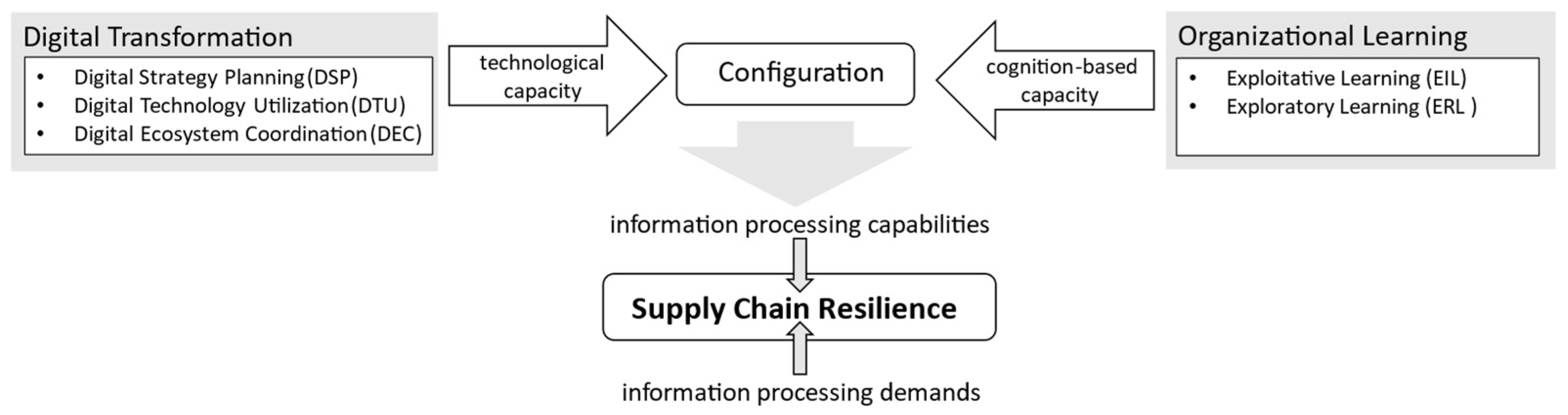
Recent evidence from the logistics sector shows that digital transformation produces organizational capabilities and strategic outcomes through its interaction with IT, human, and supply chain management resources [34]. This evidence reinforces the need to examine the organizational architecture within which digital capabilities are embedded. Building on OIPT, this study conceptualizes digital strategic planning (DSP), digital technology utilization (DTU), digital ecosystem coordination (DEC), exploitative learning (EIL), and exploratory learning (ERL) as interdependent components of an organizational information processing architecture rather than as independent predictors of SCR. Their contributions depend on how these capabilities are combined and, on the information processing functions they jointly perform within the overall configuration. Despite growing research on digital technology, digital transformation, and SCR from the perspective of OIPT, existing studies have often overlooked a key issue: technology application and organizational adaptation usually occur simultaneously and jointly shape SCR. This co-shaping mechanism is reflected in the complementary relationship between technology-based and cognition-based information processing capabilities.
Digital transformation represents technological capacity for information processing. It enhances supply chain information processing by accelerating information acquisition, improving transparency, and facilitating coordination among supply chain partners [12,19,31,32,47,49,50], but its three dimensions perform distinct and interdependent functions. First, DSP captures the extent to which firms embed digital solutions into supply chain planning and strategically important decision-making, thereby strengthening anticipatory capacity, structuring information flows, and supporting timely responses under uncertainty [51,52]. Second, DTU refers to the deployment and use of digital tools, platforms, and data-driven systems in operational and supply chain processes, which improves the speed, accuracy, and efficiency of information processing during disruptions [12,53]. Third, DEC denotes the use of digital technologies to connect systems, share information, and coordinate activities across internal units and external supply chain partners, thereby enhancing interorganizational visibility, information exchange, and collaborative response capacity [12,54,55]. These dimensions should not be treated as additive indicators of a homogeneous digital capability. Their effects on resilience depend on strategic orientation, operational deployment, and interorganizational coordination, as well as on how they are integrated to meet firms’ information processing requirements when responding to disruptions.
Organizational learning represents cognition-based information processing capacity. It enhances firms’ ability to absorb knowledge, interpret complex environmental signals, and accumulate experience in responding to disruptions [36,56]. By enabling supply chain partners to understand environmental uncertainty, interpret information about disruptions, and refine response strategies, organizational learning complements technology-based information processing capacity. It contributes to a more comprehensive organizational information processing system [57,58,59]. Building on March [25]’s framework, this study incorporates two learning modes: EIL and ERL.
EIL refers to firms’ ability to refine, extend, and apply existing knowledge, routines, and capabilities. From an OIPT perspective, EIL contributes to SCR by enabling firms to process disruption-related information through established routines, thereby improving response efficiency, operational stability, and recovery speed under uncertainty [60,61]. ERL, by contrast, refers to firms’ ability to search for new information, experiment with novel solutions, and develop knowledge beyond existing routines. It strengthens SCR by expanding firms’ cognitive information processing capacity, allowing them to identify emerging risks, interpret unfamiliar signals, and generate adaptive responses to novel disruptions [62,63].
The two learning modes are complementary rather than substitutive: EIL supports efficient information processing and implementation within established knowledge structures, whereas ERL facilitates adaptive organizational adjustment when those structures prove inadequate [25,56,61].
Technology-enabled and cognition-based capabilities may interact and reinforce one another because greater access to information does not automatically translate into effective organizational responses [35]. Digital transformation enhances the visibility, speed, and scope of information about disruptive events, whereas organizational learning determines how this information is interpreted, absorbed, and translated into action [54,55,56,57,58]. DTU and DEC may provide firms with extensive operational and partner-related information; however, this information contributes little to resilience when organizations lack either established routines for applying existing knowledge or the capacity to reinterpret unfamiliar signals [48,58]. Conversely, even at relatively low levels of digitalization, strong learning capabilities can support resilience, if firms can obtain sufficient information through existing channels and convert it into timely adaptive responses [56]. Digital and learning capabilities, therefore, become complementary when the former provides the information infrastructure and the latter supplies the interpretive and adaptive mechanisms required to act on that information [48,56].
When EIL and ERL operate jointly, firms can process disruption-related information through both established routines and novel interpretive frameworks, thereby developing an ambidextrous learning-oriented approach to information processing [25,61]. EIL helps maintain efficiency and operational continuity by applying existing knowledge and response routines. ERL helps firms identify emerging risks and develop alternative responses when existing procedures are inadequate [25,57]. Within this architecture, digital capabilities can enhance information accessibility and coordination [16]; nevertheless, the central mechanism lies in firms’ ability to interpret available information and convert it into reliable and adaptive action [58].
Although prior studies have examined the individual effects of digital transformation and organizational learning on SCR [50,58], limited attention has been paid to their joint influence. A configurational approach is particularly suitable for capturing the complex interdependencies among antecedent conditions in SCR formation [21,64,65]. Based on the above analysis, this study argues that appropriate configurations of digital transformation and organizational learning combine technology-based and cognition-based information processing capacities, thereby enhancing the supply chain’s overall information processing capability. Consistent with OIPT’s core proposition of fit between information processing requirements and capabilities [23,24,29], such configurations enable supply chains to better adapt to the dynamic information processing demands imposed by environmental volatility and disruptions [12]. Ultimately, SCR emerges from this fit between disruption-induced information requirements and available information processing capabilities [35].
These five conditions have different functional elements in the information processing architecture, and their contributions depend on the combination of other capabilities. One capability may play a core role in one configuration, be relatively secondary in another configuration, or even be absent in certain cases, but all can achieve high-SCR. This configuration logic allows for complementarity, substitution, and equivalence, and provides a theoretical basis and an assessment of isolated net effects for architectures with different capabilities [22,26,66].
Thus, the proposed theoretical framework is shown in Figure 1:

3. Methods

3.1. Fuzzy-Set Qualitative Comparative Analysis (fsQCA)

Grounded in set theory and Boolean algebra, fsQCA was developed by Ragin [67] and offers an innovative approach to examine how different configurations of antecedent conditions collectively lead to outcomes. Compared with csQCA and mvQCA, which are suitable for identifying categorical issues, fsQCA integrates case-based and variable-based quantitative analysis to extensively study organizational phenomena [68]. As fsQCA moves beyond linear analyses to capture the inherent interdependencies and nonlinear relationships among various factors [26], it has been widely used across business and management research [69].
This study adopts fsQCA for three theoretically informed reasons. First, fsQCA allows for investigating complexity [68] in this study, especially the aggregation and interdependence between digital transformation and organizational learning in enhancing SCR, rather than the individual bidextrous effects of digital transformation and organizational learning. Second, fsQCA emphasizes equifinality and reveals equivalence paths of combinations that can lead to high SCR, which can help deepen the understanding of SCR formation. Finally, fsQCA accommodates causal asymmetry [67], allowing distinct antecedent configurations for high versus non-high SCR outcomes, which aligns with the equifinality principle in complex systems [26]. Overall, fsQCA is appropriate for examining the nonlinear and context-dependent ways in which digital transformation and organizational learning jointly shape SCR.

3.2. Measures and Samples

The primary data were collected through a questionnaire survey using measurement scales adapted from established instruments and refined to fit the research context. The antecedent conditions include DSP, which was measured by Mishra et al. [13] through five planning- and decision-related elements; DTU was primarily adapted from the eight operations digitalization dimensions proposed by [70]; DEC was measured using the scale developed by Kindermann et al. [14]. The measures of EIL and ERL were adapted from Zhou and Wu [71] and comprised five items for each construct. Finally, SCR was measured through three dimensions—resistance, recovery, and absorption capabilities—based on Christopher and Peck [10] and Sheffi [72].
Respondents value each item based on their agreement with the descriptive sentence using a seven-point Likert scale (1 = strongly disagree, 7 = strongly agree). All measurement items can be seen in the questionnaire in Appendix A. To ensure questionnaire quality, the original scales were translated using a back-translation procedure and further refined based on pre-test feedback [21].
The survey targeted professionals engaged in supply chain-related functions in Chinese high-technology firms located in the innovation ecosystem of the University of Electronic Science and Technology of China (UESTC) Science Park. The sample covers sectors including big data and artificial intelligence, communications and the Internet of Things, and integrated circuits. This empirical context provides both comparability and organizational heterogeneity: Firms share similar external conditions, such as policy support from Chengdu’s Shuangliu District, access to digital infrastructure, and linkages to innovation, research, and talent networks. At the same time, they differ in firm size, business scope, and digitalization practices, thereby enabling meaningful comparative analysis. Respondents were drawn from procurement, production, logistics, sales, and R&D functions, as these positions are closely related to both digital transformation activities and supply chain operations. Data were collected through a dual-channel approach, yielding 21 responses from offline field visits and 52 from online distribution. This produced an initial pool of 73 responses. After removing duplicate submissions and responses with evident logical inconsistencies, 61 valid samples were retained, representing a valid response rate of 83.6%.
Table 1 reports the characteristics of respondents and their firms. The sample includes respondents from diverse supply chain-related functions and hierarchical positions, while the participating firms vary in size and revenue, providing a suitable basis for configurational comparison.

3.3. Data Quality Test

The measurement properties of our constructs were rigorously examined using SPSS 27 and AMOS 24. As presented in Table 2, all scales demonstrated excellent reliability, with Cronbach’s alpha coefficients exceeding the recommended threshold of 0.708 [73]. The Kaiser–Meyer–Olkin (KMO) measure of sampling adequacy yielded values above 0.80 for all constructs, suggesting the data were highly suitable for factor analysis [74].
Confirmatory factor analysis (CFA) results further supported the robustness of our measurement. All standardized factor loadings exceeded 0.70, providing strong evidence of indicator reliability [73]. The convergent validity was confirmed as both the average variance extracted (AVE) values and composite reliability (CR) coefficients surpassed the established benchmarks of 0.50 and 0.70, respectively [75], indicating exceptional internal consistency and convergent validity.

3.4. Calibrations

Data calibration is the distinctive feature and critical step in the fsQCA method [76]. While prior studies suggest that the values of 6, 4, and 2 can be used as thresholds for the 7-point Likert scale [77], these thresholds proved inappropriate for our study due to the minimum observed values exceeding two across all variables. Therefore, following prior research [21,78], we first conducted descriptive statistical analysis using SPSS, which revealed significant skewness and non-normal distribution in our data. To overcome the bias of calibrating directly with the Likert scale, we used sample distribution-based empirical anchors for calibration following mainstream QCA studies. Specifically, the thresholds for full in, crossover, and full out were set as 75%, 50%, and 25%, respectively [21,69,78]. Meanwhile, to assess whether the results were sensitive to this calibration choice, we nevertheless retained the scale-based semantic anchors of 2, 4, and 6 as an alternative calibration scheme in the robustness analysis. Moreover, to prevent unaffiliated cases with a membership degree of 0.5 after fuzzy set calibration, which would affect the final results, we added 0.001 to values with a membership degree of 0.5 to assign them to different truth table rows [67]. Table 3 shows the descriptive statistics and specific calibration outcomes.

4. Results

4.1. Analysis of Necessary Conditions

Before examining configurational sufficiency, we performed a necessity analysis to establish whether the outcome set is a subset of any individual condition set. Consistency is the central criterion, as it captures the extent to which cases exhibiting a given condition exhibit the outcome. Following Schneider and Wagemann [79], we adopt 0.90 as the consistency threshold for a necessary condition. As reported in Table 4, every antecedent condition in the high outcome group falls below this threshold. Hence, it can be argued that no single factor is necessary for high SCR. By contrast, in the non-high outcome group, the absence of DEC and ERL each exceeds 0.90, indicating that they are necessary for low resilience. These results suggest that the absence of either DEC or ERL is the principal driver of weak SCR [76]. Accordingly, we include these antecedent conditions in the subsequent fsQCA to investigate the configurations associated with high and low resilience.

4.2. Analysis of Sufficiency Conditions

We conducted a sufficiency analysis using a frequency benchmark of ≥1 to ensure that every configuration appearing at least once in the sample was retained, thus maximizing coverage [80]. At the same time, the raw consistency threshold was set at 0.80 to guarantee a strong association between each configuration and the outcome [67], and the proportional reduction inconsistency (PRI) threshold was set at 0.70 to balance solution parsimony against the heterogeneous effects of the antecedent conditions [66].

4.2.1. Configurational Pathways Associated with High SCR

The intermediate solution was used as the primary result and compared with the parsimonious solution to distinguish core from peripheral conditions [25,81]. The analysis identifies four configurations leading to high SCR, as reported in Table 5. Each configuration has a raw consistency score above 0.808, and the overall solution consistency reaches 0.808, exceeding the commonly accepted threshold for sufficiency. Based on their core-condition structures and theoretical mechanisms, the four configurations are further grouped into two broader pathways: Path H1 and Path H2. Path H1 comprises three sub-configurations, namely H1a, H1b, and H1c, whereas Path H2 consists of a single configuration. This grouping enhances interpretability by distinguishing broader configurational mechanisms from their specific variants. Overall, the high consistency and coverage values indicate that these configurations jointly provide a robust explanation for high SCR.
(1)
H1: Ambidextrous Learning driven configuration.
Path H1 represents an ambidextrous learning-driven pathway to high SCR, consisting of three sub-configurations (H1a, H1b, and H1c). Across these sub-configurations, EIL and ERL jointly constitute the core mechanism, while digital transformation dimensions appear only as peripheral conditions, either present or absent. This indicates that high SCR within Path H1 primarily arises from the combined effects of EIL and ERL, whereas digital transformation plays a limited or supportive role.
H1a is the most learning-centered sub-configuration: EIL and ERL are core present conditions, whereas DSP and DTU are peripheral absent conditions. With a consistency of 0.969, raw coverage of 0.212, and unique coverage of 0.051, H1a has the highest unique coverage among the high-SCR configurations, suggesting relatively strong stand-alone explanatory value.
H1b and H1c retain EIL and ERL as core present conditions but differ from H1a in that digital transformation dimensions serve as supportive peripheral conditions. H1b shows a consistency of 0.946, raw coverage of 0.707, and unique coverage of 0.011, while H1c shows a consistency of 0.948, raw coverage of 0.707, and unique coverage of 0.025. Their high raw coverage but low unique coverage indicates substantial overlap with other high-SCR configurations. Therefore, H1b and H1c are better interpreted as technology-supported variants within the broader H1 pathway rather than as highly distinctive stand-alone mechanisms.
Path H1 indicates that high SCR is primarily achieved through ambidextrous learning. Digital transformation does not constitute the core driver in this pathway. Instead, it complements learning-based information processing by enhancing information visibility, coordination, and operational responsiveness. Second, their shared core structure and relatively low unique coverage suggest they should not be interpreted as three distinct pathways. Instead, H1a, H1b, and H1c should be grouped into a unified family of ambidextrous learning-driven configurations. The original coverage rate is not additive. The same case may exhibit significant membership relationships in multiple fully configured scenarios. The low unique coverage rates of H1b and H1c indicate that they mainly explain overlapping cases rather than two independently distinct resilience mechanisms. The differences among them concern only the peripheral presence or absence of digital conditions and therefore represent empirical variants of the same underlying learning mechanism.
(2)
H2: Digitally driven configuration.
Path H2 is represented by a single configuration, in which DSP occupies the core position. DEC serves as a peripheral supporting condition, DTU is absent, and both modes of organizational learning remain peripheral. This pattern suggests that high SCR may also be achieved through a digitally driven pathway when strategic planning and ecosystem coordination are sufficiently developed, even if ambidextrous learning is not central. The configuration shows high consistency (0.946) but relatively limited raw coverage (0.134) and unique coverage (0.017). It should therefore be interpreted as a supplementary pathway. The configuration highlights the resilience-enhancing role of digital planning and coordination under specific conditions.

4.2.2. Configurational Pathways Associated with Non-High SCR

To account for causal asymmetry, we analyzed the configurations associated with non-high SCR separately. As shown in Table 6, the overall solution consistency was 0.917. The three configurations were therefore jointly sufficient for non-high SCR. The overall solution coverage was 0.911, indicating that the solution explained 91.1% of the membership in the non-high-SCR outcome.
Configuration NS1 (consistency = 0.943, raw coverage = 0.830, unique coverage = 0.004) and NS2 (consistency = 0.957, raw coverage = 0.829, unique coverage = 0.007) exhibit a broadly similar deficiency profile and differ in the core status of ERL, with four conditions absent. Meanwhile, they indicate consistency with the previous analysis of necessary conditions. That is, the absence of DEC and ERL act as core conditions in NS1 with the absence of DEC as a core condition in NS2. However, the extremely low unique coverage values of NS1 and NS2 suggest substantial empirical overlap and limited distinctiveness, and thus they are best interpreted as overlapping deficiency patterns rather than as differentiated mechanisms.
In contrast, NS3 exhibits a higher unique coverage (consistency = 0.802, raw coverage = 0.186, unique coverage = 0.080), suggesting that it represents a more distinctive non-high SCR. Specifically, the absence of ERL remains as the only core condition while all other conditions are peripherally present. Therefore, combining with previous analysis of necessary conditions, we argue that the absence of ERL could play a particularly salient role in causing non-high SCR.

4.3. Robustness Test

To ensure the robustness of our sufficiency analysis, we performed rigorous validation tests [79]. First, we replicated the analysis using a more stringent PRI consistency threshold (PRI ≥ 0.75) compared to our baseline threshold (PRI ≥ 0.70). Second, we conducted additional analyses with an enhanced frequency cutoff (frequency ≥ 2) versus our original criterion (frequency ≥ 1). The strong subset relationships observed between these alternative solutions and our primary model configurations [79] confirm the stability and reliability of our empirical findings. Moreover, to examine whether our findings are sensitive to calibration anchor selection, we recalibrated all variables using theory-grounded anchors (2, 4, 6) based on the 7-point Likert-scale semantics [77]. However, due to the central tendency bias inherent in Likert-scale data, most cases fell into the ambiguous fuzzy range, generating numerous contradictory configurations in the truth table. Consequently, the PRI consistency dropped below the acceptable threshold (<0.5), failing to yield valid configurations. We also replaced the calibration anchors with extreme percentiles (10th, 50th, and 90th percentiles) and re-conducted the analysis. The results of this robustness check are presented in Table 7. Both R1 and R2 retain EIL and ERL as core conditions. This alternative specification identified two configurational paths, with a solution consistency of 0.803 and a solution coverage of 0.927, indicating that the key goodness-of-fit indicators remained largely stable. Although the number of paths decreased and the discriminatory power among conditions was somewhat reduced, the core consistency metrics were sustained [66]. More importantly, EIL and ERL remained core conditions in both alternative configurations, preserving the central ambidextrous-learning mechanism identified in the baseline analysis.
The sensitivity analysis also revealed an important boundary condition: Although the learning-driven mechanism remained stable under different percentile anchors, the DSP and DEC determined by the baseline analysis did not recur under the calibration conditions of 10%, 50%, and 90%. The quantity and boundary conditions of the configuration are sensitive to the selection of anchors, while the core role of ambidextrous learning is relatively robust. These analyses support the robustness of the research findings related to organizational learning and should be more cautious when extending the more context-specific path of digital-driven approaches.

5. Discussion

5.1. Identifying SCR Pathways Based on OIPT

From the perspective of OIPT, SCR emerges from an effective fit between information processing requirements and organizational information processing capabilities under environmental uncertainty. The configurational results reveal that no single antecedent condition suffices to produce high SCR. Instead, SCR arises from different combinations of technology-driven and cognition-based information processing capabilities. To elucidate how each pathway operates, we traced back the corresponding case characteristics.

5.1.1. Ambidextrous Learning Driven SCR

Path H1 indicates that high SCR is mainly achieved through firms’ cognition-based information processing capabilities, specifically, ambidextrous learning. Digital transformation plays a supportive rather than a central role mainly by improving information visibility and transmission efficiency [48]. Thus, the key mechanism of H1 lies not in digitalization per se, but in firms’ ability to interpret, absorb, and transform available information into learning-based and adaptive responses that enhance SCR.
The three sub-configurations (H1a, H1b, and H1c) share the presence of EIL and ERL as core conditions. At the configurational level, the three H1 sub-configurations do not indicate a uniformly dominant digital transformation pattern; digital conditions appear in different peripheral forms, including process-oriented digital practices, technology utilization, and ecosystem coordination. This indicates that digitalization primarily provides an information environment, while resilience depends on firms’ ability to learn from and act on this information. Specifically, EIL enables firms to codify prior experience, refine established routines, correct operational deviations, and improve response efficiency. ERL complements this mechanism by supporting knowledge renewal, unfamiliar risk recognition, experimentation with alternative solutions, and adaptive adjustment under uncertainty.
The three H1 configurations differ primarily in the presence or absence of DSP, DTU, and DEC at the periphery. In particular, H1b and H1c have identical raw coverage values of 0.707, whereas their unique coverage values are only 0.011 and 0.025, respectively. These results indicate that the two configurations explain largely overlapping sets of cases and therefore should not be interpreted as empirically or theoretically independent pathways. Nevertheless, H1a, H1b, and H1c are retained separately in the results table for methodological transparency because they represent distinct configurational expressions generated by the fsQCA minimization procedure and differ in their peripheral digital conditions. Manually collapsing these configurations would obscure their conjunctural differences and would not constitute an equivalent Boolean simplification unless the minimization procedure itself produced such a simplification. At the theoretical level, however, the three configurations are consolidated into a single ambidextrous learning-driven configuration family rather than treated as three separate resilience mechanisms. Their low unique coverage directs theoretical attention toward their shared joint presence of EIL and ERL while the differences in DSP, DTU, and DEC are interpreted only as alternative forms of peripheral digital support.

5.1.2. Digitally Driven SCR

Path H2 represents a digital planning-coordination pathway to high SCR. The corresponding firm profile describes a micro-sized, R&D-oriented firm with fewer than 10 employees and annual revenue below CNY 500,000, as reported by a senior R&D manager, with limited internal resources but relatively direct managerial involvement in R&D and strategic decision-making. Such firms usually lack the scale and redundancy of resources required for extensive technology deployment or highly institutionalized learning routines [27]. DSP is therefore particularly important. It helps firms clarify supply chain priorities, allocate scarce resources to critical activities, and structure disruption-related information before uncertainty causes operational failure [13].
DEC further strengthens this pathway by extending the firm’s limited internal capacity through external connections. For small technology-oriented firms, SCR often depends on timely coordination with partners in production, delivery, technical support, and market response. DEC enables these firms to access external information, align decisions with partners, and maintain responsiveness across organizational boundaries [14]. Therefore, it captures a distinct resilience-building mechanism in which firms with limited organizational scale use digital planning to impose strategic order on uncertainty and use ecosystem coordination to compensate for internal resource constraints.

5.1.3. Asymmetry Analysis of Non-High SCR

The configurations for non-high SCR reveal different forms of misfit between disruption-induced information requirements and firms’ information processing capabilities [12]. NS1 is characterized by the core absence of DEC and ERL, together with weak DSP and DTU. Firms in this configuration lack cross-boundary information coordination and the capacity to reinterpret unfamiliar signals [14]. Disruption-related information is therefore likely to remain fragmented across supply chain actors. These firms also have limited ability to generate adaptive responses beyond existing routines.
NS2 reflects a coordination-related deficiency. The core absence of DEC, together with weak DSP, DTU, and EIL, indicates limited ecosystem-level information exchange and weak internal routines for organizing disruption-related information. Available information is therefore difficult to convert into stable and coordinated responses. NS3 presents a different pattern. DSP, DTU, DEC, and EIL are present; the core absence of ERL is associated with non-high SCR. This configuration indicates that when emergencies involve unfamiliar, ambiguous or rapidly changing signals, relying solely on information availability and routine-based processing is insufficient [30,36]. Digital capabilities can improve the visibility, integration, and transmission of disruption-related information [48]. EIL enables firms to interpret and respond to such information through established knowledge structures and operating routines. However, these capabilities are less effective when existing assumptions no longer provide an adequate basis for understanding emerging threats. Under such conditions, ERL performs a distinct information processing function by expanding the range of knowledge considered, encouraging firms to question established interpretations, search beyond existing solutions, and experiment with alternative responses [56,61,71]. In OIPT terms, ERL helps firms address information scarcity and equivocality, where the challenge lies in determining what unfamiliar signals mean and how to act on them [30]. Its absence creates a cognitive bottleneck: firms may possess extensive information and efficient processing routines, but it is unable to revise existing interpretations or develop responses beyond prior experience. This helps explain why greater digital visibility does not necessarily translate into high SCR when exploratory information processing is weak. Non-high SCR thus arises less from the simple absence of digital capabilities than from failures in cross-boundary coordination and exploratory information processing [61].
This bottleneck is particularly salient in high-technology industries, where rapid technological change and innovation pressure may reduce the continuing relevance of existing knowledge and increase the need for strategic flexibility [71]. Supply chain disruptions may therefore invalidate established assumptions rather than merely interrupt familiar routines [25,56,61]. Digital technologies can improve the visibility, integration, and transmission of information related to disruption [12,16,48] whereas EIL supports the application of accumulated experience and the refinement of established response routines [25,56]. However, when firms encounter unfamiliar technical or sourcing problems, resilience may require them to search for alternative technologies, suppliers, product designs, and process arrangements [62,72]. These activities rely on ERL because they require firms to move beyond existing knowledge structures, question established assumptions, and experiment with novel solutions [61].
The NS3 configuration, therefore, does not imply that ERL is a universally necessary condition for high SCR. Its consistency for high SCR remains below the conventional necessity threshold of 0.90 [79]. Instead, the results indicate an asymmetric bottleneck: the absence of ERL is associated with non-high SCR when digital capabilities and EIL are insufficient to address novel and equivocal disruption signals [22].

5.2. Theoretical Contributions

This study offers two theoretical contributions. First, it advances the application of OIPT to supply chain disruption research by specifying how information processing fit is achieved under uncertainty. OIPT emphasizes alignment between information processing requirements and overall capabilities or the contribution of individual technologies, yet existing applications often underexploit the internal composition of such capabilities [22,23,24,82]. The findings show that fit can arise through different capability architectures. In the learning-driven pathway, ambidextrous learning enables firms to interpret information, refine routines, and develop adaptive responses [25,26,27,56,57,71,72]. In the digital planning-coordination pathway, DSP structures disruption-related information, and ecosystem coordination extends information processing capacity beyond organizational boundaries [14,48,55]. Information processing capability is therefore not homogeneous. It comprises technology-based and learning-based mechanisms whose roles vary across organizational contexts.
Second, the study extends the SCR literature beyond factor-based explanations. Prior research has largely examined how individual antecedents, such as digital transformation, integration, or learning, affect SCR. The configurational results show that high SCR emerges from combinations of conditions rather than from any single factor [22,26,83]. The analysis of non-high SCR further shows that weak resilience is not simply the reverse of high resilience [67]. It is associated with specific capability gaps, particularly weak cross-boundary coordination and exploratory information processing. This finding helps explain why firms may fail to build resilience even when some digital capabilities or routine-based learning mechanisms are present [14,24,25,27,36,56,57]. The study provides a more nuanced account of both resilience formation and resilience failure under disruption.

5.3. Practical Implications

Managerially, the findings have implications for how firms allocate managerial attention and capability investment when facing supply chain disruptions. Digital transformation should not be treated as an independent remedy for resilience. Firms must assess whether their digital and learning capabilities address the information processing demands created by uncertainty [23]. Resilience-building should begin with identifying where disruption-related information is generated, how it moves across internal and external boundaries, and whether the firm has sufficient routines and interpretive capacity to convert such information into response actions.
For firms aligned with the learning-driven pathway, the main managerial task is to institutionalize both exploitation and exploration in supply chain operations [56,61]. Managers should not increase digital investment indiscriminately. Instead, they should ensure that digitally generated information can be absorbed, shared across functions, and converted into coordinated responses [36,48]. Learning mechanisms should be embedded in production, sales, logistics, and cross-functional coordination. EIL helps firms review prior disruptions, refine operating routines, and improve the speed and reliability of recovery. ERL helps firms identify unfamiliar risks, question established response patterns and develop alternatives when existing routines are insufficient [25]. Managers can establish post-disruption reviews to convert experience into standard operating procedures and update contingency plans regularly [40]. Cross-functional teams can also test alternative suppliers, materials, technologies, and process arrangements on a limited scale. In this pathway, digital tools should support knowledge acquisition, cross-functional sharing, and scenario simulation rather than substitute for organizational learning [51,59].
For firms closer to the digital planning-coordination pathway, especially small technology-oriented firms with limited internal resources, resilience depends on focused digital planning and selective external coordination. These firms may be unable to build extensive digital infrastructure or formal learning systems in the short term. Managers should therefore prioritize digital functions that directly support supply chain decisions, such as demand forecasting, inventory assessment, multi-site visibility, and the identification of critical bottlenecks [13]. DEC can compensate for internal resource constraints. Better information exchange with suppliers, customers, and technical partners extends processing capacity beyond organizational boundaries and preserves response flexibility during disruptions [14]. Firms with relatively strong digital visibility but weak ERL should not assume that additional data or systems will automatically improve resilience. They should establish mechanisms for interpreting abnormal signals, such as cross-functional risk meetings, external expert consultation, supplier co-development, and small-scale experimentation with alternative technologies and sourcing arrangements [58]. The managerial priority is to convert information availability into new response options rather than merely improving the efficiency of established routines.
The configurations for non-high SCR reveal two common practical weaknesses: insufficient cross-boundary coordination and weak exploratory information processing. Firms may possess digital tools and routine-based capabilities but still lack resilience if partner information remains fragmented. Resilience may also remain weak when unfamiliar signals are interpreted through overly rigid cognitive frames. Managers should therefore avoid equating information visibility with resilience. They should assess whether information from partners, markets, and internal operations can be interpreted jointly and translated into adaptive responses [23,83]. Building SCR requires digital connectivity and the organizational capacity to learn from uncertain and ambiguous information.
These recommendations apply primarily to high-technology firms that face disruption-induced uncertainty, technological complexity, and strong interorganizational dependence. They should be generalized cautiously to firms in stable environments, low-technology sectors, or supply chains with limited cross-boundary coordination requirements.

6. Conclusions

6.1. Research Findings

Drawing on OIPT, this study examines how digital transformation and organizational learning combine to shape SCR. Based on 61 valid samples of Chinese high-technology firms located in the University of Electronic Science and Technology of China (UESTC) Science Park and using fsQCA, the findings show that high SCR is not driven by a single condition but by distinct configurations of technology-based and learning-based information processing capabilities.
Two main pathways to high SCR are identified. The first is a learning-driven pathway, in which EIL and ERL jointly form the core mechanism. This suggests that firms can build resilience by refining existing routines while exploring new responses to disruption, even when digital transformation plays a more supportive role. The second is a digital planning–coordination pathway, in which DSP is central, and DEC provides complementary support. This pathway indicates that some firms can strengthen resilience by using digital planning to structure information on disruptions and by coordinating with the ecosystem to extend response capacity beyond organizational boundaries.
The configurations for non-high SCR further show that resilience failure is not simply the reverse of resilience formation. Weak SCR mainly reflects mismatches between disruption-induced information requirements and firms’ information processing capabilities. In particular, the absence of DEC weakens cross-boundary information coordination, while the absence of ERL limits firms’ ability to reinterpret unfamiliar signals and generate adaptive responses. These findings highlight that digital visibility alone is insufficient; information must also be coordinated, interpreted, and translated into action.

6.2. Limitations and Future Research

Although this study offers valuable insights, several limitations point to fruitful avenues for future research. First, the sample were collected from a single regional science-park ecosystem, including several high-technology sectors. The sectoral and organizational diversity of the sample provides some support for the transferability of the identified configurations across different high-technology contexts. Nevertheless, the concentration of the sample in one region limits the generalizability of the findings across different geographic and institutional environments. Future studies could therefore collect larger samples from multiple regions and industrial clusters and conduct comparative configurational analyses to examine whether the identified pathways vary across regional contexts. Second, the cross-sectional fsQCA design uncovers configurational patterns but cannot capture their evolution. Longitudinal studies could track the co-development of digital transformation and organizational learning capabilities, revealing how configurations shift as firms progress through successive stages of resilience building. Third, although the analysis highlights the significance of ERL, it does not specify which knowledge domains or exploration practices contribute most to resilience. Future work should compare activities such as technological experimentation, market scouting, and intra-organizational collaboration to identify those that most effectively enhance SCR under different contextual conditions.

Author Contributions

Conceptualization, C.Y. and Q.Y.; methodology, Q.Y.; software, C.Y. and Q.Y.; validation, C.Y. and Q.Y.; formal analysis, Q.Y.; investigation, Q.Y.; resources, C.Y.; data curation, C.Y.; writing—original draft preparation, C.Y. and Q.Y.; writing—review and editing, C.Y., Q.Y. and Y.L.; visualization, Q.Y.; supervision, Y.L.; project administration, Y.L.; funding acquisition, Y.L. All authors have read and agreed to the published version of the manuscript.

Funding

This research was supported by the Major Program of the National Social Science Foundation of China (Grant No. 23&ZD051) and the Civilization Mutual Learning and Global Governance Research Program of Sichuan University (no grant number was assigned). The APC was funded by the Corresponding Author.

Institutional Review Board Statement

The study was conducted in accordance with the Declaration of Helsinki, and the protocol was approved by the Ethics Committee of the Professor Committee of the Business School, Sichuan University (ER20250010) on 24 September 2025.

Informed Consent Statement

Informed consent for participation was obtained from all subjects involved in the study.

Data Availability Statement

The data presented in this study are available on request from the corresponding author due to respondents’ privacy.

Conflicts of Interest

The authors declare no conflicts of interest.

Abbreviations

The following abbreviations are used in this manuscript:
SCRSupply Chain Resilience
OIPTOrganizational Information Processing Theory
DSPDigital Strategic Planning
DTUDigital Technology Utilization
DECDigital Ecosystem Coordination
EILExploitative Learning
ERLExploratory Learning
UESTCUniversity of Electronic Science and Technology of China

Appendix A

  • Measures used in the questionnaires
  • All variables are measured on a seven-point scale:1 = “strongly disagree” to 7 = “strongly agree”
  • Digital Strategy Planning (α = 0.943)
  • A1. Digital transformation has significantly optimized our business process efficiency.
  • A2. We have reduced manual operational errors through automation tools such as RPA.
  • A3. Cross-departmental collaboration has become more efficient due to the use of digital tools such as ERP and OA systems
  • A4. Employees receive regular digital skills training (such as data analysis and the use of AI tools) and are encouraged to come up with innovative ideas for digital transformation
  • A5. The management has shown clear support for the advancement of digital transformation and has established a learning organizational culture that ADAPTS to rapid technological iterations
  • Digital Technology Utilization (α = 0.959)
  • B1. We have prepared the foundational resources (e.g., technology, equipment) and integrated IT platform architectures required for digital transformation activities.
  • B2. We effectively utilize digital technologies, including analytical models, algorithms, and hardware/software tools, to process, refine, and present data.
  • B3. We apply digital technologies across all aspects of product development, production services, and operations to achieve comprehensive enterprise digitization.
  • B4. We leverage digital technologies to enable intelligent operational decision-making and sustain continuous innovation.
  • B5. We use digital technologies to further promote openness, collaboration, and sustainable development.
  • Digital Ecosystem Coordination (α = 0.965)
  • C1. We can easily access partners’ IT system data through digital technologies.
  • C2. Our digital technologies seamlessly connect partners’ systems with our own.
  • C3. We exchange information with partners in real time using digital technologies.
  • C4. We aggregate relevant information from partners’ databases (e.g., operational data, customer performance) using digital technologies.
  • C5. Our adopted digital technologies are user-friendly for new partners and can be easily scaled to accommodate new IT applications or functionalities.
  • C6. Our digital technologies comply with standards widely accepted by existing and potential partners.
  • C7. Most of our digital technologies can be reused across other business applications.
  • Exploitative Learning (α = 0.933)
  • D1. We update existing knowledge for familiar products.
  • D2. We invest in technological developments that enhance current innovation-driven operational productivity.
  • D3. We strengthen problem-solving capabilities by identifying solutions close to existing methods for customer challenges.
  • D4. We refine skills in product development processes where the organization has extensive experience.
  • D5. We enhance knowledge and skills to improve the efficiency of existing innovation activities.
  • Exploratory Learning (α = 0.953)
  • E1. We acquire new production knowledge that is entirely novel to the organization.
  • E2. We learn industry-disruptive product development skills and processes.
  • E3. We gain new management and organizational skills critical to innovation.
  • E4. We develop skills in funding new technologies and training R&D personnel.
  • Resistance (α = 0.972)
  • F1. We strengthen innovation capabilities in previously unexplored domains.
  • F2. Our supply chain maintains strong operational continuity despite common disruptions (e.g., supplier shutdowns, transportation delays).
  • F3. Our supply chain remains stable in delivering products/services despite significant market demand fluctuations.
  • Recovery (α = 0.972)
  • G1. Our supply chain has sufficient redundancy resources (e.g., backup suppliers, inventory) to address unexpected risks.
  • G2. We rapidly activate contingency plans to restore supply chain operations after disruptions.
  • G3. Our supply chain achieves swift recovery to normal operational levels post-disruption.
  • Adaptability (α = 0.972)
  • H1. We have robust recovery processes and mechanisms to minimize losses from disruptions.
  • H2. We proactively collect and analyze supply chain risk data to derive lessons for improvement.
  • H3. We quickly adjust operational strategies and processes in response to supply chain risk events.
  • H4. We share risk management experiences with supply chain partners to collectively enhance resilience.

References

  1. Belhadi, A.; Kamble, S.; Jabbour, C.J.C.; Gunasekaran, A.; Ndubisi, N.O.; Venkatesh, M. Manufacturing and service supply chain resilience to the COVID-19 outbreak: Lessons learned from the automobile and airline industries. Technol. Forecast. Soc. Change 2021, 163, 120447. [Google Scholar] [CrossRef] [Scilit] [PubMed]
  2. Gölgeci, I.; Kuivalainen, O. Does social capital matter for supply chain resilience? The role of absorptive capacity and marketing-supply chain management alignment. Ind. Mark. Manag. 2020, 84, 63–74. [Google Scholar] [CrossRef] [Scilit]
  3. Zeng, K.; Wells, R.; Wilkins, A.; Gu, J. Bilateral Tensions, the Trade War, and US-China Trade Relations. Bus. Polit. 2022, 24, 399–429. [Google Scholar] [CrossRef] [Scilit]
  4. Golgeci, I.; Roscoe, S.; Gligor, D.M.; Oh, C.H. Advancing the sociopolitical view of supply chain management. Int. J. Oper. Prod. Manag. 2025, 45, 955–984. [Google Scholar] [CrossRef] [Scilit]
  5. Pandey, S.; Singh, R.K.; Gunasekaran, A.; Kaushik, A. Cyber security risks in globalized supply chains: Conceptual framework. J. Glob. Oper. Strategy Sourc. 2020, 13, 103–128. [Google Scholar] [CrossRef] [Scilit]
  6. Ivanov, D. Supply Chain Viability and the COVID-19 pandemic: A conceptual and formal generalisation of four major adaptation strategies. Int. J. Prod. Res. 2021, 59, 3535–3552. [Google Scholar] [CrossRef] [Scilit]
  7. Al Naimi, M.; Faisal, M.N.; Sobh, R.; Uddin, S.M.F. Antecedents and consequences of supply chain resilience and reconfiguration: An empirical study in an emerging economy. J. Enterp. Inf. Manag. 2021, 34, 1722–1745. [Google Scholar] [CrossRef] [Scilit]
  8. Ali, A.; Mahfouz, A.; Arisha, A. Analysing supply chain resilience: Integrating the constructs in a concept mapping framework via a systematic literature review. Supply Chain Manag. Int. J. 2017, 22, 16–39. [Google Scholar] [CrossRef] [Scilit]
  9. Holling, C.S. Resilience and stability of ecological systems. In Annual Review of Ecology and Systematics; Annual Reviews Inc.: San Mateo, CA, USA, 1973; Volume 4, pp. 1–23. [Google Scholar]
  10. Christopher, M.; Peck, H. Building the resilient supply chain. Int. J. Phys. Distrib. Logist. Manag. 2004, 15, 1–14. [Google Scholar] [CrossRef] [Scilit]
  11. Zangiacomi, A.; Oesterle, J.; Fornasiero, R.; Sacco, M.; Azevedo, A. The implementation of digital technologies for operations management: A case study for manufacturing apps. Prod. Plan. Control 2017, 28, 1318–1331. [Google Scholar] [CrossRef] [Scilit]
  12. Wong, C.W.; Lirn, T.-C.; Yang, C.-C.; Shang, K.-C. Supply chain and external conditions under which supply chain resilience pays: An organizational information processing theorization. Int. J. Prod. Econ. 2020, 226, 107610. [Google Scholar] [CrossRef] [Scilit]
  13. Mishra, R.; Kr Singh, R.; Gunasekaran, A. Digitalization of supply chains in Industry 4.0 environment of manufacturing organizations: Conceptualization, scale development & validation. Prod. Plan. Control 2024, 35, 1278–1297. [Google Scholar] [CrossRef] [Scilit]
  14. Kindermann, B.; Beutel, S.; de Lomana, G.G.; Strese, S.; Bendig, D.; Brettel, M. Digital orientation: Conceptualization and operationalization of a new strategic orientation. Eur. Manag. J. 2021, 39, 645–657. [Google Scholar] [CrossRef] [Scilit]
  15. Gillani, F.; Chatha, K.A.; Jajja, M.S.S.; Farooq, S. Implementation of digital manufacturing technologies: Antecedents and consequences. Int. J. Prod. Econ. 2020, 229, 107748. [Google Scholar] [CrossRef] [Scilit]
  16. Xue, Y.; Yates, N.; Ghadge, A. The relationship between IoT-based information integration, decision-making uncertainty, and supply chain performance. Int. J. Logist. Res. Appl. 2025. advance online publication. [Google Scholar] [CrossRef] [Scilit]
  17. Xu, Y.; Jia, F.; Wang, L.; Chen, L. Can digital transformation improve firm resilience to supply chain disruption? The role of diversification strategies. J. Purch. Supply Manag. 2024, 30, 100952. [Google Scholar] [CrossRef] [Scilit]
  18. El Baz, J.; Ruel, S. Achieving social performance through digitalization and supply chain resilience in the COVID-19 disruption era: An empirical examination based on a stakeholder dynamic capabilities view. Technol. Forecast. Soc. Change 2024, 201, 123209. [Google Scholar] [CrossRef] [Scilit]
  19. Pan, H.; Zou, N.; Wang, R.; Ma, J.; Liu, D. Artificial Intelligence Usage and Supply Chain Resilience: An Organizational Information Processing Theory Perspective. Systems 2025, 13, 724. [Google Scholar] [CrossRef] [Scilit]
  20. Wang, M.; Prajogo, D.; Gligor, D.M. From supply chain digitalization to resilience: The paradoxical role of supply chain transparency. Supply Chain Manag. Int. J. 2026. advance online publication. [Google Scholar] [CrossRef] [Scilit]
  21. Yin, W.L.; Ran, W.X.; Zhang, Z. A configuration approach to build supply chain resilience: From matching perspective. Expert Syst. Appl. 2024, 249, 123662. [Google Scholar] [CrossRef] [Scilit]
  22. Misangyi, V.F.; Greckhamer, T.; Furnari, S.; Fiss, P.C.; Crilly, D.; Aguilera, R. Embracing causal complexity: The emergence of a neo-configurational perspective. J. Manag. 2017, 43, 255–282. [Google Scholar]
  23. Galbraith, J.R. Organization Design: An Information Processing View. Interfaces 1974, 4, 28–36. [Google Scholar] [CrossRef] [Scilit]
  24. Tushman, M.L.; Nadler, D.A. Information processing as an integrating concept in organizational design. Acad. Manag. Rev. 1978, 3, 613–624. [Google Scholar] [CrossRef] [Scilit]
  25. March, J.G. Exploration and exploitation in organizational learning. Organ. Sci. 1991, 2, 71–87. [Google Scholar] [CrossRef] [Scilit]
  26. Fiss, P.C. Building better causal theories: A fuzzy set approach to typologies in organization research. Acad. Manag. J. 2011, 54, 393–420. [Google Scholar] [CrossRef] [Scilit]
  27. Al Omoush, K.; Lassala, C.; Ribeiro Navarrete, S. The role of digital business transformation in frugal innovation and SMEs’ resilience in emerging markets. Int. J. Emerg. Mark. 2025, 20, 366–386. [Google Scholar] [CrossRef] [Scilit]
  28. Simon, H.A. Administrative Behavior; A Study of Decision-Making Processes in Administrative Organization; Macmillan: New York, NY, USA, 1947; pp. xvi + 259. [Google Scholar]
  29. Galbraith, J.R. Designing Complex Organizations; Addison-Wesley Pub. Co.: Boston, MA, USA, 1973. [Google Scholar]
  30. Haußmann, C.; Dwivedi, Y.K.; Venkitachalam, K.; Williams, M.D. A Summary and Review of Galbraith’s Organizational Information Processing Theory. In Information Systems Theory: Explaining and Predicting Our Digital Society; Dwivedi, Y.K., Wade, M.R., Schneberger, S.L., Eds.; Springer: New York, NY, USA, 2012; Volume 2, pp. 71–93. [Google Scholar]
  31. Chang, A.; El-Rayes, N.; Shi, J. Blockchain Technology for Supply Chain Management: A Comprehensive Review. FinTech 2022, 1, 191–205. [Google Scholar] [CrossRef] [Scilit]
  32. Tian, Y.; Cui, L. Supply chain resilience and digital transformation: Perspectives from a supply chain network. Humanit. Soc. Sci. Commun. 2025, 12, 1738. [Google Scholar] [CrossRef] [Scilit]
  33. Zhang, S.; Hong, J.; Lau, K.H.; Tian, Y. How digital transformation enhances supply chain resilience and organisational performance: A digital affordance perspective. Ann. Oper. Res. 2026, 360, 1251. [Google Scholar] [CrossRef] [Scilit]
  34. Stroumpoulis, A.; Kopanaki, E. Examining the Relationship Between Sustainable Strategies, Digital Transformation and Organizational Context: Evidence from 3PL Companies in Greece. Sustainability 2025, 17, 8846. [Google Scholar] [CrossRef] [Scilit]
  35. Dubey, R.; Gunasekaran, A.; Childe, S.J.; Fosso Wamba, S.; Roubaud, D.; Foropon, C. Empirical investigation of data analytics capability and organizational flexibility as complements to supply chain resilience. Int. J. Prod. Res. 2021, 59, 110–128. [Google Scholar] [CrossRef] [Scilit]
  36. Busse, C.; Meinlschmidt, J.; Foerstl, K. Managing Information Processing Needs in Global Supply Chains: A Prerequisite to Sustainable Supply Chain Management. J. Supply Chain Manag. 2017, 53, 87–113. [Google Scholar] [CrossRef] [Scilit]
  37. Walker, B.; Hollin, C.S.; Carpenter, S.R.; Kinzig, A. Resilience, adaptability and transformability in social-ecological systems. Ecol. Soc. 2004, 9, 5. [Google Scholar] [CrossRef] [Scilit]
  38. Bruneau, M.; Chang, S.E.; Eguchi, R.T.; Lee, G.C.; O’Rourke, T.D.; Reinhorn, A.M.; Shinozuka, M.; Tierney, K.; Wallace, W.A.; von Winterfeldt, D. A framework to quantitatively assess and enhance the seismic resilience of communities. Earthq. Spectra 2003, 19, 733–752. [Google Scholar] [CrossRef] [Scilit]
  39. Sheffi, Y.; Rice, J.B., Jr. A Supply Chain View of the Resilient Enterprise. MIT Sloan Manag. Rev. 2005, 47, 41–48. [Google Scholar]
  40. Shen, Z.M.; Sun, Y. Strengthening supply chain resilience during COVID-19: A case study of JD.com. J. Oper. Manag. 2023, 69, 359–383. [Google Scholar] [CrossRef] [Scilit]
  41. Wang, X.; Zhang, M.; Qi, Y.; Wang, Q. Developing supply chain resilience: A supply network perspective. Supply Chain Manag. 2025, 30, 353–368. [Google Scholar] [CrossRef] [Scilit]
  42. Ponis, S.; Koronis, E. Supply Chain Resilience: Definition Of Concept And Its Formative Elements. J. Appl. Bus. Res. 2012, 28, 921–929. [Google Scholar] [CrossRef] [Scilit]
  43. Brandon-Jones, E.; Squire, B.; Autry, C.W.; Petersen, K.J. A contingent resource-based perspective of supply chain resilience and robustness. J. Supply Chain Manag. 2014, 50, 55–73. [Google Scholar] [CrossRef] [Scilit]
  44. Liu, Y.; Fang, W.; Feng, T.; Xi, M. Blockchain technology adoption and supply chain resilience: Exploring the role of transformational supply chain leadership. Supply Chain Manag. 2024, 29, 371–387. [Google Scholar] [CrossRef] [Scilit]
  45. Brusset, X.; Teller, C. Supply chain capabilities, risks, and resilience. Int. J. Prod. Econ. 2017, 184, 59–68. [Google Scholar] [CrossRef] [Scilit]
  46. Sihvonen, J.; Kauppi, K. A chief supply chain officer matters—But only when you are in trouble! Int. J. Oper. Prod. Manag. 2025, 45, 91–116. [Google Scholar] [CrossRef] [Scilit]
  47. Dindarian, A. Harnessing AI and Big Data to Build a Resilient Supply Chain: An Overview. In Emerging Technologies in Supply Chains: Towards Digital Transformation; Khojasteh, Y., Jahan Abadi, S.M.M., Eds.; Springer Nature: Cham, Switzerland, 2026; pp. 233–251. [Google Scholar]
  48. Gu, M.; Yang, L.; Huo, B. The impact of information technology usage on supply chain resilience and performance: An ambidexterous view. Int. J. Prod. Econ. 2021, 232, 107956. [Google Scholar] [CrossRef] [Scilit] [PubMed]
  49. Benzidia, S.; Makaoui, N.; Bentahar, O. The impact of big data analytics and artificial intelligence on green supply chain process integration and hospital environmental performance. Technol. Forecast. Soc. Change 2021, 165, 120557. [Google Scholar] [CrossRef] [Scilit]
  50. Hu, J.; Ma, J. Supply Chain Digitalization and Its Resilience: A Systematic Framework and Empirical Evidence. Systems 2026, 14, 194. [Google Scholar] [CrossRef] [Scilit]
  51. Mishra, D.; Luo, Z.W.; Hazen, B.; Hassini, E.; Foropon, C. Organizational capabilities that enable big data and predictive analytics diffusion and organizational performance: A resource-based perspective. Manag. Decis. 2019, 57, 1734–1755. [Google Scholar] [CrossRef] [Scilit]
  52. Cegielski, C.G.; Allison Jones-Farmer, L.; Wu, Y.; Hazen, B.T. Adoption of cloud computing technologies in supply chains: An organizational information processing theory approach. Int. J. Logist. Manag. 2012, 23, 184–211. [Google Scholar]
  53. Demsash, A.W.; Emanu, M.D.; Walle, A.D. Digital technology utilization and its associated factors among health science students at Mettu University, Southwest Ethiopia: A cross-sectional study. Inform. Med. Unlocked 2023, 38, 101218. [Google Scholar] [CrossRef] [Scilit]
  54. Constantinides, P.; Henfridsson, O.; Parker, G.G. Introduction—Platforms and infrastructures in the digital age. Inf. Syst. Res. 2018, 29, 381–400. [Google Scholar] [CrossRef] [Scilit]
  55. Kapoor, R. Ecosystems: Broadening the locus of value creation. J. Organ. Des. 2018, 7, 12. [Google Scholar] [CrossRef] [Scilit]
  56. Eryarsoy, E.; Özer Torgalöz, A.; Acar, M.F.; Zaim, S. A resource-based perspective of the interplay between organizational learning and supply chain resilience. Int. J. Phys. Distrib. Logist. Manag. 2022, 52, 614–637. [Google Scholar] [CrossRef] [Scilit]
  57. Liu, X.; Tse, Y.K.; Wang, S.; Sun, R. Unleashing the power of supply chain learning: An empirical investigation. Int. J. Oper. Prod. Manag. 2023, 43, 1250–1276. [Google Scholar] [CrossRef] [Scilit]
  58. Gao, Y.; Blankenship, S.; Coco, C. Organizational learning and supply chain resilience: A case study of two Chinese manufacturers during COVID-19. Dev. Learn. Organ. Int. J. 2025. advance online publication. [Google Scholar] [CrossRef] [Scilit]
  59. Jensen, J.C.; Cole, D.; Thornton, L.; Roath, A.; Richey, R.G. Learning Through Co-opetition: How Knowledge Sharing Builds Supply Chain Resilience. J. Supply Chain Manag. 2026, 62, 81–101. [Google Scholar] [CrossRef] [Scilit]
  60. Ambulkar, S.; Blackhurst, J.; Grawe, S. Firm’s resilience to supply chain disruptions: Scale development and empirical examination. J. Oper. Manag. 2015, 33–34, 111–122. [Google Scholar] [CrossRef] [Scilit]
  61. Eriksson, P.E.; Leiringer, R.; Szentes, H. The role of co-creation in enhancing explorative and exploitative learning in project-based settings. Proj. Manag. J. 2017, 48, 22–38. [Google Scholar] [CrossRef] [Scilit]
  62. Fan, Y.Y.; Stevenson, M. A review of supply chain risk management: Definition, theory, and research agenda. Int. J. Phys. Distrib. Logist. Manag. 2018, 48, 205–230. [Google Scholar] [CrossRef] [Scilit]
  63. Razak, G.M.; Hendry, L.C.; Stevenson, M. Supply chain traceability: A review of the benefits and its relationship with supply chain resilience. Prod. Plan. Control 2023, 34, 1114–1134. [Google Scholar] [CrossRef] [Scilit]
  64. Yin, W.; Ran, W. Supply chain diversification, digital transformation, and supply chain resilience: Configuration analysis based on FSQCA. Sustainability 2022, 14, 7690. [Google Scholar] [CrossRef] [Scilit]
  65. Yin, W. Identifying the pathways through digital transformation to achieve supply chain resilience: An fsQCA approach. Environ. Sci. Pollut. Res. 2023, 30, 10867–10879. [Google Scholar] [CrossRef] [Scilit] [PubMed]
  66. Greckhamer, T.; Furnari, S.; Fiss, P.C.; Aguilera, R.V. Studying configurations with qualitative comparative analysis: Best practices in strategy and organization research. Strateg. Organ. 2018, 16, 482–495. [Google Scholar] [CrossRef] [Scilit]
  67. Ragin, C.C. Measurement versus calibration: A set-theoretic approach. In The Oxford Handbook of Political Methodology; Box-Steffenmeier, J.M., Brady, H.E., Collier, D., Eds.; Oxford University: Oxford, UK, 2008; pp. 174–198. [Google Scholar]
  68. Zschoch, M.A. Configurational Comparative Methods: Qualitative Comparative Analysis (QCA) and Related Techniques. Can. J. Polit. Sci.-Rev. Can. Sci. Polit. 2011, 44, 743–746. [Google Scholar] [CrossRef] [Scilit]
  69. Karadağ, H.; Şahin, F.; Karamollaoğlu, N.; Saunila, M. Disentangling the dynamic digital capability, digital transformation, and organizational performance relationships in SMEs: A configurational analysis based on fsQCA. Inf. Technol. Manag. 2026, 27, 141–157. [Google Scholar] [CrossRef] [Scilit]
  70. Li, G. The Heterogeneous Impact of Digital Technology Utilization on Rural Household Income: Evidence from China. J. Knowl. Econ. 2025, 16, 7325–7349. [Google Scholar] [CrossRef] [Scilit]
  71. Zhou, K.Z.; Wu, F. Technological capability, strategic flexibility, and product innovation. Strateg. Manag. J. 2010, 31, 547–561. [Google Scholar] [CrossRef] [Scilit]
  72. Sheffi, Y. The Resilient Enterprise: Overcoming Vulnerability for Competitive Advantage; MIT Press: Cambridge, MA, USA, 2007. [Google Scholar]
  73. Hair, J.F.; Risher, J.J.; Sarstedt, M.; Ringle, C.M. When to use and how to report the results of PLS-SEM. Eur. Bus. Rev. 2019, 31, 2–24. [Google Scholar] [CrossRef] [Scilit]
  74. Kaiser, H.F. An index of factorial simplicity. Psychometrika 1974, 39, 31–36. [Google Scholar] [CrossRef] [Scilit]
  75. Fornell, C.; Larcker, D.F. Evaluating structural equation models with unobservable variables and measurement error. J. Mark. Res. 1981, 18, 39–50. [Google Scholar] [CrossRef] [Scilit]
  76. Ragin, C.C. Redesigning Social Inquiry: Fuzzy Sets and Beyond; University of Chicago Press: Chicago, IL, USA, 2009. [Google Scholar]
  77. Pappas, I.O.; Woodside, A.G. Fuzzy-set Qualitative Comparative Analysis (fsQCA): Guidelines for research practice in Information Systems and marketing. Int. J. Inf. Manag. 2021, 58, 102310. [Google Scholar] [CrossRef] [Scilit]
  78. Yang, Q.; Wei, L.; Lu, Y. Building resilience for social enterprises: An fsQCA analysis based on the institutional bricolage perspective. J. Bus. Res. 2026, 210, 116117. [Google Scholar] [CrossRef] [Scilit]
  79. Schneider, C.Q.; Wagemann, C. Set-Theoretic Methods for the Social Sciences: A Guide to Qualitative Comparative Analysis; Cambridge University Press: Cambridge, UK, 2012. [Google Scholar]
  80. Russo, I.; Confente, I.; Gligor, D.; Cobelli, N. A roadmap for applying qualitative comparative analysis in supply chain research: The reverse supply chain case. Int. J. Phys. Distrib. Logist. Manag. 2019, 49, 99–120. [Google Scholar] [CrossRef] [Scilit]
  81. Glaesser, J. Limited diversity and QCA solution types: Assumptions and their consequences. Qual. Quant. 2023, 57, 3485–3497. [Google Scholar] [CrossRef] [Scilit]
  82. Premkumar, G.; Ramamurthy, K.; Saunders, C.S. Information processing view of organizations: An exploratory examination of fit in the context of interorganizational relationships. J. Manag. Inf. Syst. 2005, 22, 257–294. [Google Scholar] [CrossRef] [Scilit]
  83. Ponomarov, S.Y.; Holcomb, M.C. Understanding the concept of supply chain resilience. Int. J. Logist. Manag. 2009, 20, 124–143. [Google Scholar] [CrossRef] [Scilit]
Figure 1. Theoretical framework.
Systems 14 01027 g001
Table 1. Sample characteristics.
VariableTypeNPercentage
Respondent age21–301931%
31–402744%
41–501321%
>5023%
Respondent DepartmentProcurement12%
Production1525%
Logistics12%
Sales1626%
R&D813%
Others2033%
Respondent job titleFrontline staff2236%
Supervisor1118%
Manager711%
Department head813%
Senior executive813%
Others58%
Employee numbers of
enterprises
<1035%
10–2023%
20–502541%
50–10058%
100–300813%
>3001830%
Annual
Revenue of enterprises (CNY)
<500,00047%
500,000–1 million35%
1–5 million1016%
5–10 million610%
10–50 million813%
50 million–100 million58%
100 million–1 billion1931%
>1 billion610%
Table 2. Reliability and validity tests.
VariablesCronbach’s αKMOFactor LoadingAVECR
DSP0.9430.8160.722~0.9500.7580.940
DTU0.9590.9000.864~0.9510.8270.960
DEC0.9650.8450.833~0.9340.8050.966
EIL0.9330.8680.830~0.8940.7400.934
ERL0.9530.8780.838~0.9490.8110.955
SCR0.9720.9070.840~0.9350.8000.973
Table 3. The descriptive statistics and threshold of calibration.
Descriptive StatisticsFuzzy Set Calibrations
VariablesMinMaxMeanSDFully out (Lower Quartiles)Cross over (Median)Fully in (Upper Quartiles)
DSP2.20075.9311.1975.0006.2007
DTU3.40076.0201.0615.2006.0007
DEC3.28675.8671.1934.7866.0007
EIL4.00075.8981.0205.0006.0007
ERL2.60075.8201.1974.8006.0007
SCR3.22275.7361.1284.9445.6677
Table 4. Necessity consistency and coverage for high and non-high SCR.
High SCRNot-High SCR
ConditionConsistencyCoverageConsistencyCoverage
DSP0.8080.8570.2700.277
~DSP0.3180.3110.8600.813
DTU0.8070.8830.2570.271
~DTU0.3340.3170.8890.817
DEC0.8510.9100.2500.258
~DEC0.3060.2970.9130.855
EIL0.8930.8820.2870.274
~EIL0.2650.2780.8770.888
ERL0.8830.9180.2670.268
~ERL0.2960.2950.9180.884
Table 5. Sufficient configurations for high SCR.
ConditionH1aH1bH1cH2
DSP
DTU
DEC
EIL
ERL
Raw coverage0.2120.7070.7070.134
Unique coverage0.0510.0110.0250.017
Consistency0.9690.9460.9480.946
Solution consistency0.808
Solution coverage0.945
⬤ = core causal condition present; ⨂ = core causal condition absent; ● = peripheral condition present; ⊗ = peripheral condition absent.
Table 6. Sufficient configurations for non-high SCR.
ConditionNS1NS2NS3
DSP
DTU
DEC
EIL
ERL
Raw coverage0.8300.8290.186
Unique coverage0.0040.0070.080
Consistency0.9430.9570.802
Solution consistency0.917
Solution coverage0.911
⨂ = core causal condition absent; ● = peripheral condition present; ⊗ = peripheral condition absent.
Table 7. High-SCR configurations under the 10th–50th–90th percentile calibration.
ConditionR1R2
DSP
DTU
DEC
EIL
ERL
Raw coverage0.2870.725
Unique coverage0.0780.515
Consistency0.9610.927
Solution consistency0.803
Solution coverage0.927
⬤ = core causal condition present; ⨂ = core causal condition absent; ● = peripheral condition present; ⊗ = peripheral condition absent.
Disclaimer/Publisher’s Note: The statements, opinions and data contained in all publications are solely those of the individual author(s) and contributor(s) and not of MDPI and/or the editor(s). MDPI and/or the editor(s) disclaim responsibility for any injury to people or property resulting from any ideas, methods, instructions or products referred to in the content.