1. Introduction
Recommendation-driven media environments turn cultural circulation into a systems problem. On short-video platforms, tags, feeds, and engagement metrics convert heterogeneous practices into comparable signals that can be ranked, recombined, and amplified [
1,
2,
3,
4,
5,
6]. What becomes visible is therefore not simply what exists or what audiences privately prefer. It is what can be made legible to platform systems and what can travel through them at speed.
This transformation is especially consequential when platform logics intersect with pre-existing social hierarchies. In China, the urban-rural divide has long structured symbolic value as well as economic opportunity. Rurality can be celebrated as cultural origin, yet it is also routinely marked as backward, rustic, or lacking refinement. The vernacular label “tuwei” condenses this ambivalence. It can signal earthy humor, grassroots creativity, and intimacy, but it can also function as a pejorative shorthand for tastelessness or low status [
7]. On Douyin, where exposure is organized primarily through recommendation rather than follower subscription, this ambivalent sign has become a visible and analytically rich genre cluster [
8,
9].
To orient readers unfamiliar with the case, three features of the empirical setting are worth stating at the outset. First, Douyin is the largest short-video platform in China, with hundreds of millions of daily active users, and its distribution is governed primarily by an interest-based recommender rather than by social-graph following. Second, the #tuwei tag is not a marginal niche but a large, highly interactive classification zone that aggregates everything from staged “social shake” performances to slow rural-craft demonstrations under one label. Third, the social meaning of “tu” (earth/soil) carries deep historical sediment in Chinese culture, ranging from an agrarian philosophical root to a modern marker of urban–rural distinction. The empirical puzzle that motivates this study is that two very different renderings of rurality share the same tag yet circulate very unequally.
Existing platform scholarship shows that recommendation systems are valuation infrastructures rather than neutral conduits [
10,
11,
12]. Critical studies of algorithms have also emphasized the limits of transparency-centered approaches and the importance of tracing system effects through observable outputs rather than through inaccessible source code alone [
13,
14,
15]. Meanwhile, work on digital rurality and short-video culture demonstrates that platformized representation can reshape what counts as authentic, entertaining, or socially valuable in peripheral settings [
9,
16]. Two gaps remain. First, recommendation is often treated as background infrastructure rather than as an active organizing mechanism that couples classification, circulation, and reception. Second, representational studies often describe rural images without specifying how some semiotic forms become systemically more diffusable than others.
A systems perspective is useful because it directs attention to components, linkages, outputs, and feedback rather than to single variables in isolation. The issue is not whether Douyin explicitly suppresses one kind of rural content. The issue is how a socio-technical system selectively rewards particular combinations of signs, temporalities, and affects [
5]. This framing also moves platform research closer to systems analysis by asking how local interactions accumulate into stable ordering effects.
Against this background, the objectives of this study are fourfold. (i) To describe, at scale, the distribution of appreciation and diffusion across competing renderings of rurality within a single platform classification field. (ii) To develop and formally specify a mid-range mechanism—hyperreal differential order—that explains how culturally embedded practices are reformatted into platform-compatible sign surfaces and then differentially amplified. (iii) To distinguish this mechanism conceptually from neighboring constructs (algorithmic visibility, platformization, and metric power). (iv) To identify system leverage points for governance that do not depend on access to proprietary ranking parameters.
These objectives are pursued through three research questions. RQ1: Within the #tuwei field, which semiotic renderings of rurality are more likely to diffuse widely? RQ2: Which affective and formal configurations are more compatible with engagement-driven metrics? RQ3: How do recurrent visibility asymmetries reorganize interpretive authority over rural representation?
The paper makes three contributions. Empirically, it provides large-scale evidence of patterned visibility asymmetry inside a major short-video platform. Theoretically, it introduces hyperreal differential order (HDO) to explain how culturally embedded practices are reformatted into platform-compatible sign surfaces and then differentially amplified. Methodologically, it shows how circulation effects can be reconstructed without direct access to proprietary ranking parameters. Together, these contributions align with Systems’ interest in complex social systems in which people, processes, and technologies interact recursively [
1,
17,
18].
The remainder of the paper is organized as follows.
Section 2 reviews the relevant literature and states the research gap.
Section 3 develops the theoretical framework, defines the #tuwei ecology as a socio-technical system, formalizes the HDO mechanism, and positions it against neighboring concepts.
Section 4 describes the data source, sampling, variable operationalization, and scope of inference.
Section 5 reports the results, including robustness analyses.
Section 6 discusses the findings in relation to the literature and derives governance leverage points.
Section 7 concludes with limitations and directions for future research.
3. Theoretical Framework: Hyperreal Differential Order
This section develops the framework in four steps.
Section 3.1 argues for treating the #tuwei ecology as a socio-technical system and justifies its four constituent components.
Section 3.2 integrates two cultural theories—hyperreality and the differential order—into the concept of hyperreal differential order (HDO).
Section 3.3 positions HDO against neighboring concepts.
Section 3.4 gives a formal specification and derives the testable propositions.
3.1. The #Tuwei Ecology as a Socio-Technical System
We define Douyin’s #tuwei ecology as a bounded socio-technical system composed of four interacting components. The choice of these four—and the claim that they constitute a system rather than a list—rests on the criterion that distinguishes a system from an aggregate: the components are mutually constituting and linked by feedback such that the behavior of the whole cannot be read off any one part [
17]. The four components are: (1) platform architecture (interfaces, the interest-based recommender, hashtag commensuration, and metric currencies such as likes, comments, and shares); (2) creator formatting strategies (the packaging of situated practice into short, repeatable, feed-compatible units); (3) audience evaluation practices (viewing, liking, commenting, sharing, and the affective repertoires expressed in comments) [
27]; and (4) historically sedimented symbolic hierarchies (the urban–rural distinction that supplies an already unequal evaluative environment) [
7,
24,
28].
These components form a system because they are coupled by recursive feedback rather than chained in a one-way sequence. Architecture conditions what formatting is rewarded; formatting shapes what audiences encounter; audience evaluation generates the metric signals that the recommender ingests; and the resulting visibility re-enters creator expectations and platform optimization, while the urban–rural hierarchy biases each step by supplying the categories through which “real” and “vulgar” rurality are perceived [
12,
14]. Removing any component dissolves the phenomenon: without commensuration there is no shared field; without metricized evaluation there is no selective amplification; without sedimented hierarchy there is no culturally loaded direction to the asymmetry. The system is therefore the appropriate unit of analysis, and the diffusion–appreciation asymmetry we observe is its emergent output [
17,
25].
3.2. Hyperreality and the Differential Order
To theorize the recursive process, we integrate two traditions. From Baudrillard we take hyperreality: the operational detachment through which embedded practices circulate as stylized surfaces whose value increasingly derives from circulation rather than from situated reference [
29,
30]. On the platform, the “golden seconds” logic of feed capture compresses an agrarian narrative into an instantly recognizable sign; the practice becomes a simulacrum optimized for the scroll. From Fei Xiaotong we take the differential order: the patterned, ego-centered inequality of relational distance that structures who is close, legible, and valued [
7]. We argue that the platform performs a hyperreal cutting of the differential order: it detaches rural signs from their situated reference and simultaneously re-sorts them into a metricized hierarchy of circulation, so that some sign forms repeatedly enter high-velocity pathways while others remain in bounded circuits of appreciation [
24].
Hyperreal differential order (HDO) names this configuration. It can be stated compactly: HDO is the system property by which a recommendation infrastructure (i) repackages embedded cultural practice into feed-compatible sign surfaces (the hyperreal moment) and (ii) differentially amplifies those surfaces across segmented attention circuits according to a culturally loaded ordering (the differential-order moment), with (iii) reception feedback stabilizing the result. HDO is thus a mechanism concept rather than a metaphor: it specifies how classification, ranking, and reception translate local interactions into stable visibility asymmetry [
12,
14,
25,
31].
3.3. Conceptual Positioning: HDO, Algorithmic Visibility, Platformization, and Metric Power
HDO must be distinguished from several established constructs, and the distinction is one of scope and unit of analysis rather than of mere relabeling. Algorithmic visibility (Bucher) centers on whether content and creators are made (in)visible by ranking; platformization (Nieborg and Poell) centers on how platform infrastructures and markets penetrate cultural production; metric power (Beer) centers on how metrics measure, govern, and discipline. Each is indispensable, and HDO draws on all three. What each leaves underspecified is the within-field, semiotically differentiated routing of comparable units coupled to a status hierarchy and stabilized by reception. HDO’s contribution is to integrate semiotic transformation (hyperreality), relational ordering (differential order), and infrastructural feedback into a single testable mechanism operating inside one classification field.
Table 1 summarizes the comparison.
3.4. Formal Specification and Propositions
Consistent with a systems-analytic approach, we specify HDO formally before deriving its observable implications. Let the #tuwei field be a set of videos indexed by i. For each video we observe cumulative likes , comments , and shares at capture, and assign a semiotic-regime indicator , where denotes grotesque-carnivalesque spectacle and denotes rural-practice authenticity. We treat likes as a low-friction signal of appreciation and shares as a higher-velocity signal of outward transfer into new attention circuits.
We model the system as four coupled operators applied to a situated practice
:
Here
maps heterogeneous practices into a common comparability space via the hashtag, so that all #tuwei videos become comparable content units;
is a packaging-compatibility score capturing how compressed, punchline-oriented, and feed-legible a sign package is (operationalized through the four multimodal dimensions in
Section 4);
is reception ambivalence, the share of ambivalent/ironic responses relative to stable positive appreciation; and
is the visibility weight that converts packaging and reception into realized diffusion. The parameters
and
are assumed positive: the system rewards feed-compatible packaging and interaction-dense, debate-generating reception.
Two observable quantities follow. At the item level, define the transfer-efficiency ratio
the outward propagation generated per unit of low-friction approval. Because
is increasing in
, the model implies
and
. At the class level, define the diffusion–appreciation asymmetry index for a content class
k as
where
and
are class
k’s shares of total likes and total shares in the field.
indicates an appreciation-rich but diffusion-poor (contained) class;
indicates a diffusion-rich (amplified) class. HDO predicts
for rural-practice content and
for spectacle. Finally, because
carries positive feedback (
), the system has a reinforcing fixed point at high
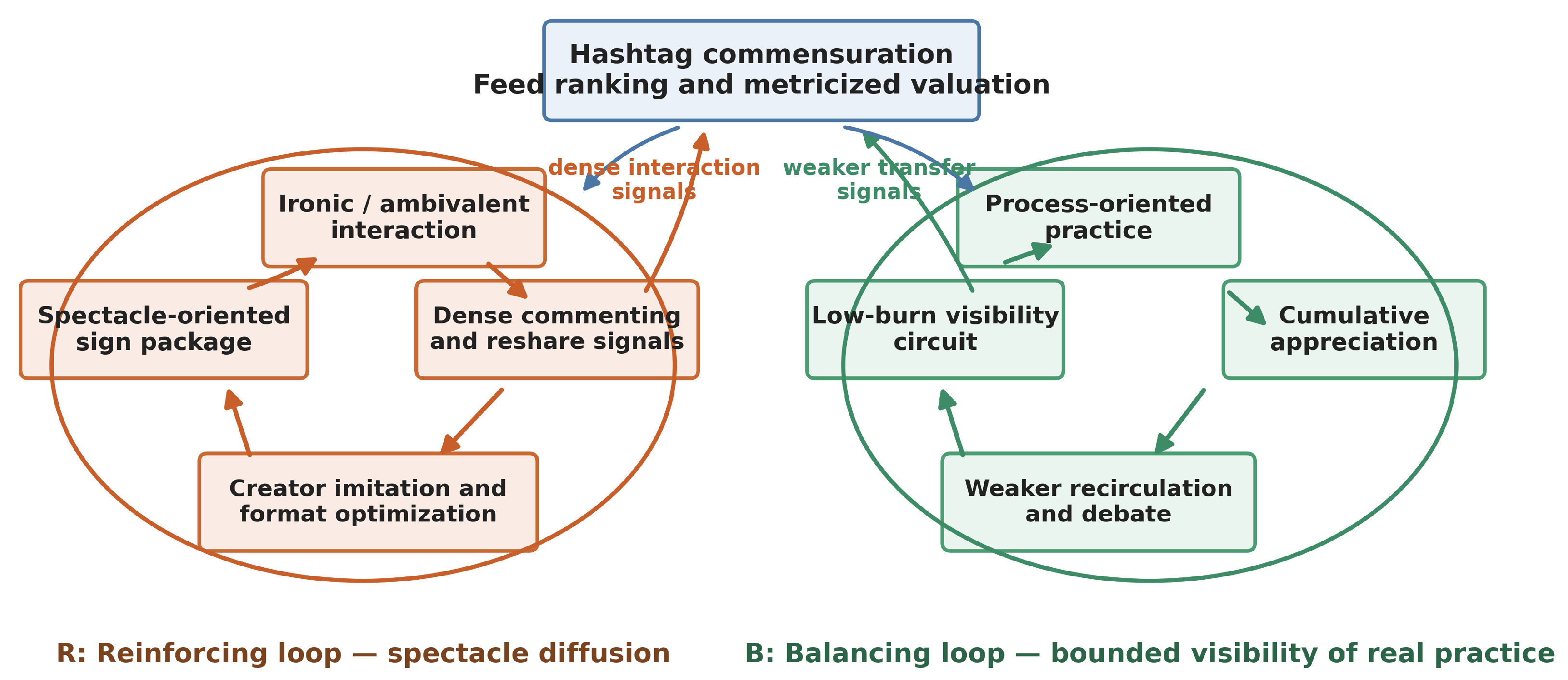
: repeated coupling drives the field toward spectacle as its dominant attractor even when practice content is positively evaluated after encounter.As shown in
Figure 1, the above operators
,
,
w, and
are visualized via two coupled feedback loops.
This formalization yields three propositions, which
Section 5 tests:
P1. Spectacle-compatible semiotic packages should convert attention into diffusion more efficiently than process-oriented packages grounded in cumulative labor and situated narration.
P2. Ambivalent or ironic reception should be more diffusion-productive than stable positive appreciation because it generates debate, forwarding, and reflexive positioning.
P3. Repeated coupling among classification, ranking, and reception should stabilize spectacle as the dominant public face of #tuwei, even when practice-oriented videos are positively evaluated after encounter.
4. Materials and Methods
4.1. Data Source: Newrank Collection Mechanism, Coverage, and Biases
The empirical entry point is the Douyin hashtag #tuwei, treated as a platform-native classification device. Data were obtained through Newrank, a licensed commercial analytics service that aggregates publicly visible Douyin metadata [
32]. Because the validity of the analysis depends on the properties of this source, we describe its collection mechanism, coverage, update frequency, and known biases in turn.
Collection mechanism. Newrank is a third-party data-service provider that indexes publicly available short-video metadata across major Chinese platforms, including Douyin. For a given hashtag it returns the set of public videos carrying that tag together with structured metadata—upload time, caption text, the full hashtag set, and cumulative public engagement counts (likes, comments, collections, shares). Newrank functions as an observational interface onto public outputs; it does not expose impression counts, recommendation weights, or any internal ranking signal. Following digital methods and critical data studies, we therefore treat these records as mediated traces produced through layered infrastructures of capture, formatting, and access rather than as direct windows onto platform ground truth [
14,
33,
34].
Coverage. Coverage is restricted to content that was public and undeleted at the time of indexing. Private accounts, removed or shadow-restricted posts, and content that never received the tag are out of scope; exposure (how often a video was served) is not observable at all. The source therefore captures the population of publicly visible #tuwei outputs, which is the appropriate population for a study of public circulation, but it cannot speak to suppressed or never-surfaced content.
Update frequency and snapshot nature. Engagement counts in the service are refreshed periodically and were retrieved as cumulative snapshots at the time of export rather than as continuous trajectories. We treat all counts as values at capture, not as final lifetime values, and our distributional analyses are robust to this because they compare regimes measured under the same snapshot regime.
Potential biases and mitigation. Four biases follow from the above: (i) a visibility/survivorship bias toward public, non-removed content; (ii) a snapshot bias because counts are cumulative at capture; (iii) a platform-mediation bias because Newrank’s own indexing and sampling rules are proprietary and not fully disclosed; and (iv) a self-labeling bias because creators choose whether to apply the tag. We do not claim these are eliminated. To bound their effect on distributional conclusions, we manually verified a random subsample of 200 videos within 48 h of export: public accessibility and hashtag consistency exceeded 95%, and engagement discrepancies between the service and the live app remained within low single-digit percentages. These checks support the dataset’s adequacy for system-level distributional analysis while leaving exposure-level claims explicitly out of scope.
After this verification, the initial export of 131,300 records associated with #tuwei between 1 May and 30 November 2024 (China Standard Time) was cleaned by removing duplicates, incomplete entries, and explicit advertising content, yielding a final analytic corpus of 123,300 videos. For each video we retained upload time, caption text, hashtag set, and cumulative counts of likes, comments, and shares at capture.
4.2. System Boundary and Scope of Inference
The system boundary is deliberately modest. We analyze public content, platform-visible metrics, and public comments. We do not claim access to proprietary ranking parameters, impression logs, or recommendation weights. Consequently, we are explicit that this design supports system-analytic and associational claims rather than internal-causal ones; in particular, it cannot establish that the recommender alone “caused” the observed differences. We cannot, from public traces alone, fully separate user-preference effects, network effects, and ranking effects.
Two features of the design nonetheless make a pure-preference explanation insufficient on its own. First, the key outcome is the diffusion–appreciation asymmetry: practice content that is in fact approved after encounter (high likes) still diffuses comparatively little. A simple “audiences just prefer spectacle” account does not explain why approved content fails to convert approval into transfer. Second, the asymmetry is observed at the level of comparable units under one tag, holding classification constant. These features locate the explanandum at the system interface—the coupling of packaging, valuation, and reception—rather than in any single internal rule. We therefore phrase findings throughout as patterned outcomes consistent with the HDO mechanism, not as proof of an internal algorithmic cause.
4.3. Field Mapping, Sampling, and Multimodal Coding
Field-level aggregation alone cannot identify the semiotic mechanisms through which rurality becomes differentially diffusable, so we combined corpus mapping with close multimodal coding.
First, we constructed a thematic subset using the keyword phrase “xiangcun shenghuo” (“rural life”), yielding 2578 videos. This subset serves as a conservative proxy for explicitly self-labeled rural-practice content and is used for comparative contextualization rather than as an exhaustive definition of rural authenticity.
Second, we drew a stratified random sample of 500 videos from the full corpus, stratified across upload month (May–November 2024) and likes-based quintiles within each month, ensuring coverage of both highly visible and ordinary posts. Under this ecologically faithful design, the two regimes were unequally represented (44 rural-practice versus 456 spectacle-oriented videos). We emphasize that this imbalance is itself a substantive finding: within the #tuwei tag, spectacle is simply far more prevalent than practice. The stratified sample was designed to capture system regularities, not to estimate balanced category parameters.
Third, two features of the design address the concern that 44 coded practice videos are too few for stable inference. The coded practice set serves a qualitative purpose for which it is adequate—identifying the ideal-typical semiotic regimes and characterizing their packaging and reception—rather than estimating population parameters. Quantitative claims about differential circulation do not rest on this cell: they are anchored in the full corpus (
) and in the larger, explicitly practice-oriented “rural life” subset (
), while the regime contrasts within the coded sample are evaluated with non-parametric tests and effect sizes appropriate for unequal group sizes. As reported in
Section 5, the direction and significance of every key contrast are independently corroborated by corpus-level tests that do not depend on the coded subsample.
The coding framework drew on multimodal discourse analysis [
35]. We coded four dimensions—visual grammar, auditory semiotics, embodied practice, and temporal regime—which jointly operationalize the packaging-compatibility score
in the formal model. Through pilot coding and adjudication, two ideal-typical semiotic regimes were identified: grotesque-carnivalesque spectacle and rural-practice authenticity. These are analytical constructs, not normative judgments. Three trained coders independently coded the sample; mean pairwise Cohen’s kappa before adjudication was 0.81, indicating substantial agreement.
- 1.
Grotesque-carnivalesque spectacle: intensified filters, exaggerated embodiment, compressed temporality, punchline-oriented framing, and rapid feed legibility (high ).
- 2.
Rural-practice authenticity: coherent rural settings, process-oriented labor, contextual narration, and cumulative temporality tied to material transformation (low ).
4.4. Operationalization and Measurement
Table 2 maps each formal variable introduced in
Section 3.4 to its operational measure and data source. The engagement counts (
,
,
) are taken directly from the platform metadata. Packaging compatibility (
) is computed as the mean of the standardized multimodal codes across the four coded dimensions, so that higher values denote more feed-compatible packages. Reception ambivalence (
) is the share of ambivalent or ironic comments relative to stable positive comments. The two indices that the empirical analysis reports—item-level transfer efficiency (
) and the class-level diffusion–appreciation asymmetry (
)—follow directly from these measures. The remainder of this subsection specifies the circulation and reception measures used to estimate them.
Given the heavy-tailed distribution of platform engagement, we prioritized distributional comparison over mean-based inference. At the corpus level we calculated total engagement, per-video averages, and the shares-to-likes ratio , interpreting as a practical proxy for outward propagation beyond immediate approval: likes are a low-friction signal of appreciation, whereas shares require higher-velocity transfer into other attention circuits. At the coded-sample level we compared the two regimes using non-parametric tests appropriate for skewed data (Mann–Whitney for continuous engagement measures, with medians and effect sizes; chi-square for categorical sentiment comparisons, emphasizing effect magnitude alongside significance).
To analyze reception, we collected comments from the coded videos between 18 and 20 December 2024, combining up to 25 hot comments with up to 100 chronological comments per video; after cleaning, the reception corpus comprised 61,284 comments. A manually annotated dataset of 5000 comments trained a three-class sentiment model (positive, negative, ambivalent/ironic); an overlap subset of 800 comments achieved Krippendorff’s alpha = 0.84. The fine-tuned Chinese RoBERTa model reached 92.3% accuracy and 0.91 macro-F1 on the held-out test set. Because irony is pragmatically unstable, we built an irony/Internet-slang lexicon and used model outputs to guide qualitative repertoire analysis rather than to replace it [
36,
37].
4.5. Ethical Considerations
All analyzed materials were publicly accessible at the time of collection. No private accounts, private messages, or non-public data were accessed. Following AoIR guidance, we report aggregate patterns and paraphrase illustrative comments to reduce traceability [
38]. The study therefore addresses system effects at the level of public circulation rather than individual diagnosis or personalized inference.
5. Results
5.1. Differential Circulation Across the #Tuwei System
At the field level, the #tuwei corpus is expansive and highly interactive. Across the 123,300 cleaned videos, total engagement reached approximately 173 million likes, 17.33 million comments, and 87.29 million shares. The size of the field indicates that #tuwei is a stable classification zone inside Douyin’s recommendation environment rather than a marginal fringe.
Once the explicitly practice-oriented “rural life” subset is isolated, a differentiated pattern appears. Although this subset accounts for only 2.1% of all videos, it captures 3.8% of total likes but only 1.5% of total shares. Applying the asymmetry index,
: the class is appreciation-rich but diffusion-poor, exactly the contained position HDO predicts.
Table 3 summarizes the divergence.
Table 3 summarizes this divergence.
Per-video averages clarify the asymmetry further. Rural-practice videos generate more likes per video and slightly more comments per video than the corpus baseline, but they generate fewer shares per video and a far lower shares-to-likes ratio (
Table 4). In other words, viewers who encounter these posts often respond positively, yet that approval is less likely to be converted into outward movement across the system.
This divergence is not reducible to a handful of viral cases. Median and interquartile comparisons point in the same direction, and the pattern persists when the coded sample is stratified by engagement quintile. Practice-oriented videos cluster more often in mid-visibility tiers, whereas spectacle-oriented videos remain overrepresented in higher diffusion tiers. The result is consistent with P1: practice-centered rurality attracts approval after encounter, but spectacle-compatible packages convert that approval into wider transfer more efficiently.
Corpus-Level Confirmation and Robustness
To confirm that the asymmetry does not depend on the coded-sample size, we conducted two corpus-level checks. First, a chi-square comparison of interaction volumes across the two regimes over the full corpus is significant for likes, comments, and shares ( well above critical values; all ), with a Cramér’s V of approximately 0.32 for likes—a medium effect by Cohen’s convention—indicating that the urban–rural divergence in circulation is a systematic, not random, feature of the field. Second, because 21 spectacle videos exceeded one million likes (maximum million), we re-ran the comparison after removing all posts above one million likes (remaining ). Statistical significance () and effect size (Cramér’s ) were essentially unchanged, showing that the asymmetry is not an artifact of a few outliers. These corpus-level results address the small-cell concern directly: the central pattern holds on the full population independently of any subsample.
The coded-sample contrast points in the same direction: rural-practice videos show a substantially lower shares-to-likes ratio than spectacle videos, with the Mann–Whitney comparison significant and a small-to-medium effect size, which is the appropriate statistic to report given the unequal group sizes. The convergence of the full-corpus tests, the outlier-sensitivity check, and the coded-sample contrast provides triangulated support for P1 that does not rest on the 44-video cell alone.
5.2. Semiotic Regimes and Format Compatibility
The circulation asymmetry is tied to a semiotic asymmetry. In the ecologically faithful stratified sample, grotesque-carnivalesque spectacle accounts for the large majority of videos and rural-practice authenticity for a small minority; because the sample was stratified to capture visibility tiers rather than to estimate population shares, this ratio indexes everyday recognizability within the tag rather than a population parameter. The two regimes differ systematically in how they package rural signs (
Table 5).
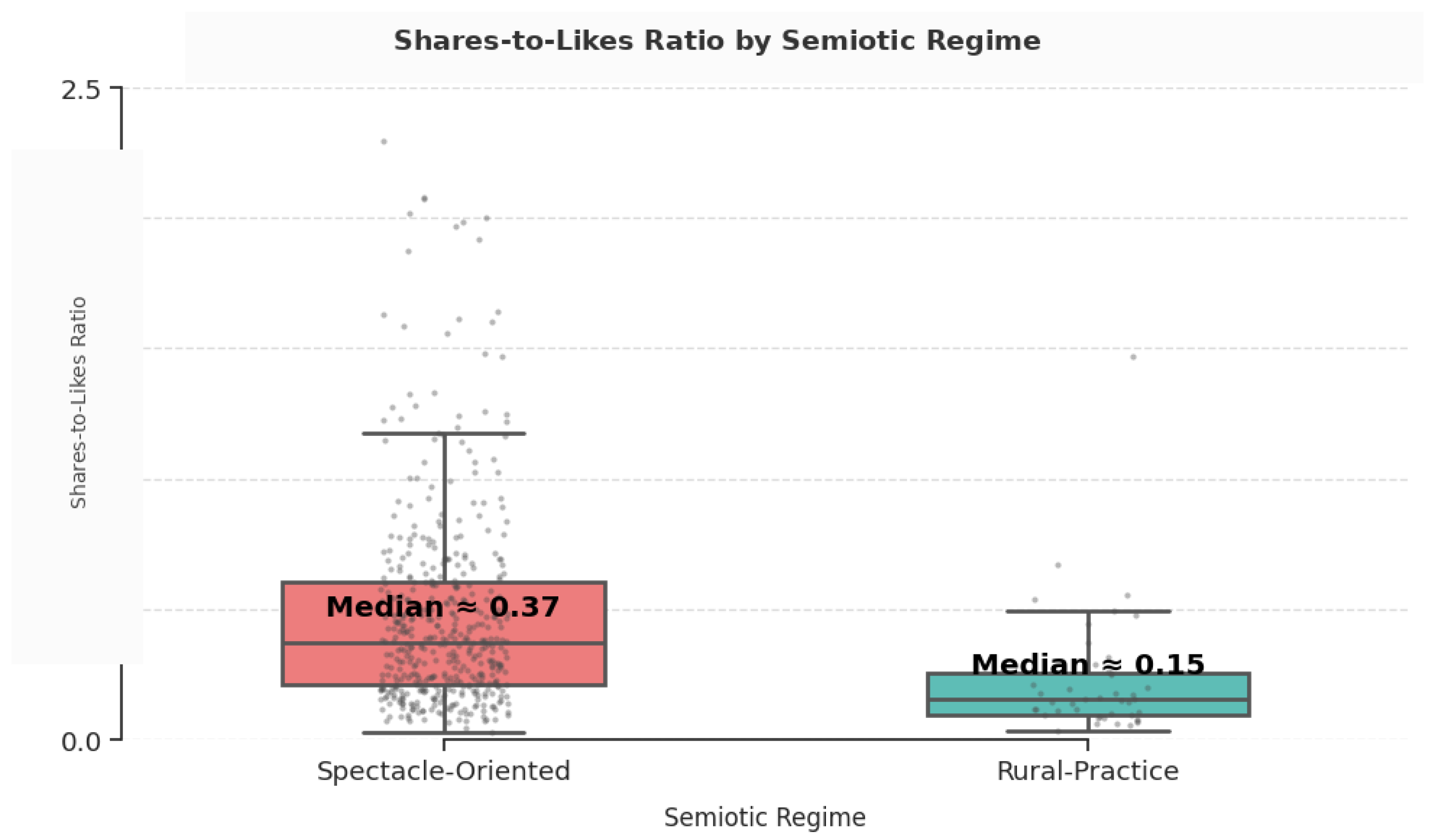
As shown in
Figure 2, spectacle-oriented content has a higher shares-to-likes ratio
than rural-practice content.
These differences matter because recommendation systems reward not only topics but also temporal and affective formatting. Spectacle-oriented videos make meaning available almost immediately; their signs are compressed, repeatable, and optimized for the first seconds of playback (high ). Practice-centered videos unfold more slowly, depending on sequential demonstration and attention to transformation rather than punchline (low ). The divergence is therefore not purely semantic; it is temporal and infrastructural. Under shared hashtag commensuration, the system treats these heterogeneous forms as comparable content units, yet comparability does not imply equal diffusion potential: spectacle is more compatible with scroll, replay, and ironic forwarding. The empirical implication is that rurality becomes recognizable as a format spectrum rather than as a situated social world—a tool shown without sustained labor, a kitchen shown without extended preparation, a dialect phrase used as punchline. The system does not erase rurality; it reformats it.
5.3. Reception Feedback and Affective Productivity
Reception analysis shows that diffusion advantage is reinforced by different affective repertoires. Practice-oriented videos are predominantly positive in the comment corpus (approximately 82% positive, 13% ambivalent/ironic, and 5% negative). Spectacle-oriented videos generate a markedly different pattern: approximately 58% ambivalent/ironic, 30% negative, and only 12% positive. A chi-square test confirms that the distributions differ significantly (p < 0.001).
The contrast is not best described as approval versus rejection. Practice-oriented videos are praised as “real,” “calming,” or “healing,” with comments emphasizing skill, patience, and everyday dignity. Spectacle-oriented videos generate moralized fascination: viewers call them vulgar, excessive, or embarrassing, yet still replay, debate, and forward them as jokes. This combination of stigma and attraction is consistent with carnivalesque and affective accounts of contentious attention [
23,
36,
37]. From a systems perspective, ambivalence can be more diffusion-productive than stable admiration: it generates longer comment threads, more reflexive positioning, and more opportunities for recirculation. This pattern supports P2—the system rewards affect that travels, not merely affect that approves—and converges with audit evidence that engagement-based ranking amplifies emotionally charged, divisive content beyond stated user preference [
22].
This is the key feedback pathway in the HDO model (the operator
). Reception does not merely respond to system outputs; it helps stabilize them. Once spectacle is repeatedly recognized as the most shareable form of #tuwei, creators and audiences treat it as the default grammar of the tag; practice-oriented forms remain visible, but more often as an admired niche than as the field’s dominant public face. Creator adaptation to perceived algorithmic preference—documented in folk-theory and creator-agency research [
19,
20,
21]—supplies the imitation step that closes the reinforcing loop.
5.4. Mechanism Synthesis
Taken together, the evidence supports all three propositions at the level of patterned system effects rather than internal algorithmic proof. P1 is supported by the higher transfer efficiency () of spectacle-compatible packages, corroborated by corpus-level tests and the coded-sample contrast. P2 is supported by the greater recirculation productivity of ambivalent reception (high ). P3 is supported by the way those two processes, once coupled through , stabilize spectacle as the public face of the tag. In mechanism terms: hashtag classification () makes heterogeneous rural signs commensurable; ranking (w) advantages packages that trigger fast recognition and dense interaction; reception () feeds back into expectations about what works; and creator adaptation reproduces the same public grammar. The resulting system does not silence rural practice. It differentially amplifies it, reproducing symbolic inequality through ordinary platform operations rather than overt suppression.
7. Conclusions
This study argued that Douyin’s #tuwei ecology is best understood as a socio-technical system in which cultural signs, platform interfaces, and audience feedback co-produce unequal visibility. Practice-centered rural videos are neither absent nor uniformly devalued; they attract meaningful appreciation, yet they diffuse less widely than spectacle-oriented forms that better match the platform’s temporal, affective, and classificatory logic. Hyperreal differential order names this configuration and, in its formal specification, makes it measurable: an item-level transfer-efficiency ratio and a class-level diffusion–appreciation asymmetry index together capture how recommendation systems repackage embedded practice into circulating sign surfaces and then distribute those surfaces unevenly. The resulting hierarchy is reproduced not through explicit prohibition but through ordinary operations of commensuration, packaging, valuation, and feedback.
For systems research, the broader implication is that algorithmic governance should be analyzed not only as a problem of model design or bias detection, but as a problem of recursive symbolic ordering. Platforms govern culture by structuring what can become recognizable at scale; the struggle over “tuwei” is therefore also a struggle over interpretive jurisdiction—whose meanings travel, under what formatting constraints, and with what social consequences. The value of HDO lies in making that ordering analytically tractable and normatively contestable.