Article

The Impact of Research Funding on AI Research Performance: A Resource–Structure–Performance (F-S-P) Perspective on Collaboration and Topic Diversity

1
Graduate School of Management of Technology, Sungkyunkwan University, Suwon 16419, Republic of Korea
2
Department of Systems Management Engineering, Sungkyunkwan University, Suwon 16419, Republic of Korea
*
Author to whom correspondence should be addressed.
Systems 2026, 14(7), 736; https://doi.org/10.3390/systems14070736 (registering DOI)
Submission received: 29 April 2026 / Revised: 14 June 2026 / Accepted: 16 June 2026 / Published: 24 June 2026
(This article belongs to the Special Issue Advancing Open Innovation in the Age of AI and Digital Transformation)

Abstract

Is research funding shaping innovation in the global AI competition? How research funding translates into innovation outcomes in the global artificial intelligence (AI) race remains insufficiently understood. Prior studies have largely focused on input–output relationships, providing limited insight into the structural mechanisms through which funding shapes innovation performance. This study examines whether research funding is associated with innovation through differences in collaboration structures and knowledge diversity within AI research ecosystems. Using an observed-variable path model estimated as a system of seemingly unrelated regressions (SUR), together with multi-group analysis, applied to 98,241 AI-related publications indexed in the Web of Science from 2011 to 2024, the study analyzes relationships among funding, structural change, and innovation outcomes across major national innovation systems. The results suggest that research funding is associated with higher research productivity and impact, partly through expanded collaborative networks. Funding appears modestly linked to greater thematic diversity, though this association is not robust across specifications, while interdisciplinary exploration tends to correspond with weaker short-term citation performance, suggesting a potential delay in the recognition of novel knowledge combinations. In addition, the extent to which funding translates into outcomes appears to vary across countries. These findings suggest that funding may be associated with AI innovation not only through greater research capacity but also through differences in the structure of knowledge ecosystems that influence how innovation emerges and is evaluated over time. The study points to the value of ecosystem-level perspectives and longer-term evaluation frameworks that extend beyond short-term performance indicators.

1. Introduction

Artificial intelligence (AI) is increasingly regarded not as a simple technical tool but as a general-purpose technology that may reshape how invention itself occurs [1]. By substantially reducing the cost of prediction, AI is reshaping how uncertainty is managed in decision-making, with potential long-term implications not only for how industries compete but also for the strategic environment at the national level [2]. Against this backdrop, AI is increasingly viewed not only as a means of improving economic productivity but as a strategic asset linked to national competitiveness and technological autonomy. Many countries have correspondingly expanded their policy and financial commitments in pursuit of technological leadership [3].
Recent global competition patterns show a tendency to shift beyond the achievements of individual technology development toward competition between complex innovation ecosystems where capital, data, talent, research institutions, and collaborative networks are mutually integrated [4,5]. In this context, recent work in innovation studies suggests that AI may also change how knowledge is produced and managed at the organizational and national levels, potentially serving as a basis for building long-term innovation capabilities [6]. Indeed, major nations including the United States and China, despite choosing divergent policy paths, exhibit a common strategic orientation: securing influence within the AI knowledge ecosystem through substantial public investment in research funding [7].
However, despite this heightened policy interest and investment expansion, academic understanding of the actual processes through which research funding translates into innovation outcomes remains limited. Existing science and technology policy research has primarily relied on an input–output approach, analyzing the relationship between the scale of research funding and metrics like the number of papers or citation counts [8]. While useful for macro-level performance evaluation, this approach has limitations in explaining how funding induces changes in researchers’ exploration strategies, the diversity of knowledge structures, and the formation of collaborative networks. In other words, the core mechanism linking research funding to innovation outcomes remains a ‘black box’ [9].
Meanwhile, academic discussions on the effects of research funding are divided. Some studies argue that stable research resources enable researchers to take risks and engage in long-term exploratory activities, thereby promoting innovation outcomes [10]. They contend that sufficient financial support can alleviate short-term performance pressures and enable experimental approaches to new knowledge domains, thereby laying the groundwork for radical innovation. Conversely, other studies point out that large-scale funding may reinforce dependence on existing research pathways or lead to inefficient resource allocation, showing that research productivity does not necessarily increase proportionally [11,12]. These contrasting perspectives suggest that the conditions and mechanisms through which research funding is associated with innovation may vary depending on context.
Particularly in the AI research ecosystem—a domain characterized by both high specialization and rapid technological convergence—empirical verification of how exclusivity in collaborative structures among researchers or structural biases in knowledge integration affect innovation outcomes remains insufficient. In the AI field, while arguments exist that expanded research investment strengthens research impact, concerns about potential centralization of collaborative networks or reduced research diversity are simultaneously raised, leading to inconsistent directions in funding effects. This highlights the need to analyze how funding changes structural attributes within the research ecosystem, beyond the simple presence or absence of external support. Therefore, to understand the association between research funding and innovation outcomes, an analytical framework is required that goes beyond directly linking inputs and outputs, simultaneously considering changes in the knowledge structures and collaborative networks existing between them.
Accordingly, this study conceptualizes research funding not merely as a financial input factor but as a potential coordinating mechanism that alters the structural characteristics of the research ecosystem. To this end, it proposes an analytical framework integrating resource dependence theory and social network theory to explain the funding–structure–outcome relationship. From a resource dependence perspective, sufficient funding can alleviate researchers’ short-term performance pressures, enabling exploratory research activities. From a social network perspective, such changes may lead to interdisciplinary collaboration and the formation of new connections [13].
This study utilizes AI-related papers indexed in Web of Science from 2011 to 2024 to conduct a comparative analysis of the five leading systems in global AI research (the United States, China, the European Union, Republic of Korea, and Japan). It measures knowledge diversity through Sentence-BERT (SBERT)-based topic modeling and derives structural relationships among researchers via large-scale collaboration network analysis. Furthermore, it applies an observed-variable path model (estimated as a system of seemingly unrelated regressions) to empirically examine the pathway through which research funding is associated with qualitative research outcomes via knowledge structures and collaboration networks. Through this analysis, the study aims to understand how the role of research funding is linked to changes in ecosystem structure, rather than being merely a matter of scale.
The research questions posed by this study are as follows.
  • Is research funding associated with both the academic impact and the societal diffusion of AI research outcomes?
  • Does research funding promote the convergence of heterogeneous knowledge, thereby meaningfully expanding the diversity of research topics?
  • Does research funding expand collaborative networks and guide effective utilization of structural gaps?
  • Is the association between research funding and research outcomes accounted for by the structural mediators of topic diversity and networks?
  • Do the structural expansion effects and outcome generation pathways of research funding differ according to the characteristics of each country’s research ecosystem?
In conclusion, this study conceptualizes research funding as a structural factor associated with differences in knowledge-production structures and collaborative ecosystems, aiming to expand beyond existing input–output focused discussions. Furthermore, by accounting for differences in national research environments, it aims to inform discussions of ecosystem structures and resource-allocation strategies relevant to AI innovation.

2. Literature Review and Hypotheses

Grounded in resource dependence theory and innovation theory, this chapter delineates the structural relationship patterns linking research funding to outcomes. By reconceptualizing research funding not merely as a simple input but as a resource that can support research autonomy and shape how knowledge is produced, it discusses both the direct and the structurally mediated effects of financial resources.

2.1. Research Funding and Performance: Direct Input–Output Effects

Research funding is associated with reduced environmental uncertainty for researchers and with exploratory innovation that carries the risk of failure. According to Pfeffer & Salancik [14]’s resource dependence theory, securing external resources is an essential mechanism for ensuring an organization’s survival and autonomy. This forms the ‘slack resources’ proposed by Cyert & March [15], providing a foundation that frees researchers from short-term performance pressures and enables more exploratory experimentation. Particularly in the AI field, where high-cost computing and data infrastructure and advanced human capital are central to competitiveness, funding plays an important role beyond basic research support, contributing to the continuity of research programs [9].
Previous studies have interpreted the pathway through which funding is associated with research output from the perspective of the Matthew Effect, i.e., the cumulative advantage where “the rich get richer” [16]. Abundant funding attracts superior equipment and personnel, enhancing the qualitative excellence of research, which in turn creates a virtuous cycle leading to high citation rates and journal publications [17,18,19]. Although Bornmann [8] cautioned that institutional pressure for performance can induce risk-averse tendencies among researchers, in today’s highly competitive and resource-intensive AI research environment, funding has become an increasingly important condition for producing high-quality research outcomes.
Furthermore, research funding may also facilitate the broader dissemination of knowledge. Research funding is associated with lower effective article processing charge (APC) barriers and with higher rates of open access publishing [20]. This reinforces the ‘public good nature of knowledge’ emphasized by Nelson [21], triggering immediate information consumption by the public and practitioners beyond academia [22,23]. In other words, funded outcomes tend to be associated with broader social diffusion beyond academic elites, and this influence is captured more sensitively through usage metrics than traditional citation indicators [24,25,26].
This study synthesizes these theoretical discussions to establish a multidimensional framework in which funding is associated with quantitative expansion (Quantity), qualitative deepening (Quality), and social diffusion (Impact), and aims to test the following hypothesis.
H1. 
Research funding is associated with the academic impact, quality, and social relevance of research outcomes.
H1a. 
citation counts.
H1b. 
journal prestige, SCImago Journal Rank (SJR).
H1c. 
cumulative journal impact, h-index.
H1d. 
short-term and cumulative usage counts.

2.2. Knowledge Integration and Topic Diversity

Heterogeneous knowledge combination and thematic diversity are widely regarded as central to scientific innovation. Since Schumpeter [25] defined innovation as “the new combination of existing factors of production,” knowledge recombination has been established as a core principle for generating scholarly achievements. Fleming [27] demonstrated that the combination of distant knowledge, transcending local exploration, is the source of disruptive innovation. Notably, Uzzi et al. [28] analyzed millions of papers to identify that ‘atypical combinations’ breaking from conventional knowledge structures are associated with the most highly cited research, suggesting that knowledge diversity can contribute to high-impact outcomes.
However, such knowledge integration is difficult to achieve without adequate resource support. According to March [29]’s theory of exploration and exploitation, resource scarcity forces researchers to focus on certain short-term outcomes, leading to the deepening of existing knowledge. Conversely, abundant resources enable exploration that crosses cognitive boundaries, even at the risk of failure. In other words, research funding acts as an institutional buffer that helps researchers overcome the inertia of relying on familiar methodologies and encourages attempts to integrate external knowledge, even when it entails high exploration costs [30].
This mechanism is especially relevant in the field of AI, the focus of this study. AI is less an independent technology in itself and more a general-purpose technology whose value is largely realized when combined with knowledge from other domains such as bio, finance, and manufacturing [1]. However, as Jones [31] pointed out in the knowledge burden hypothesis, the process of integrating disparate knowledge systems imposes substantial cognitive load and learning costs on researchers.
Therefore, research funding is associated with lower entry barriers, with reduced cognitive distance between heterogeneous knowledge, and with substantive convergence. Accordingly, this study hypothesizes that research funding increases the entropy of the knowledge ecosystem, thereby expanding structural diversity, and proposes the following hypothesis.
H2. 
Research funding is associated with researchers transcending existing research frameworks and integrating heterogeneous knowledge.
H2a. 
Rao’s Quadratic Entropy, indicating integration of heterogeneous topics.

2.3. The Dual Role of Collaboration Network Structure

Research funding is associated with researchers’ topic choices and with differences in the form of collaborative networks within innovation ecosystems. Securing resources may help researchers move beyond reliance on existing localized relationships and seek new partners across geographical and disciplinary boundaries.
This leverages the structural holes proposed by Burt [32], incentivizing researchers to access non-overlapping heterogeneous information and enjoy a controlling advantage as innovation brokers. However, network structures for academic achievement face the dual challenge of balancing the conflicting values of openness and cohesion. Coleman [33] argued that closed networks form bonding social capital, strengthening trust and norms among members to facilitate the sharing of complex knowledge. Conversely, Granovetter [34]’s ‘strength of weak ties’ and Uzzi [35]’s embeddedness paradox warned that excessive bonding can block the inflow of external knowledge, leading to information isolation (the Silo Effect). Particularly in the AI field, where technological change cycles are extremely short, innovation requires both an open structure for exploration and a cohesive structure for execution simultaneously [36].
This study proposes that research funding is a key factor in resolving these structural dilemmas. Abundant funding reduces structural constraints by offsetting transaction costs and uncertainty when researchers connect with heterogeneous external partners [30]. Simultaneously, it strengthens regional clusters by establishing dense collaborative networks among core researchers for large-scale projects [37,38]. In other words, funding moves researchers toward the center of the network, forming an optimal hybrid structure that is ‘open externally and cohesive internally’.
Therefore, this study hypothesizes that research funding simultaneously enhances both the quantitative expansion and structural efficiency of networks, and proposes the following hypothesis.
H3. 
Research funding is associated with more collaborative partners and greater structural efficiency of the network.
H3a. 
degree centrality, positive.
H3b. 
structural constraint, negative.
H3c. 
local clustering coefficient, positive.

2.4. Unpacking the Black Box: Structural Transformation as a Mediating Mechanism

To better understand the association between research funding and outcomes, we move beyond the conventional linear input–output perspective that assumes funding directly translates into results. Instead, it is helpful to examine the structural operating principles that may explain how resources are channeled into outcomes. Manso [39] argued that research funding functions as a motivational mechanism that stimulates researchers’ innovative tendencies by providing tolerance for failure and long-term reward systems, going beyond mere financial support. In other words, abundant funding may support the experimental freedom emphasized by Azoulay et al. [40], enabling researchers to break free from short-term performance pressures and undertake high-uncertainty exploratory research.
From the perspective of resource dependence theory, funding is a key controlling factor that reshapes researchers’ behavioral strategies and scope of exploration. Convergence research or identifying new partners inherently involves high search and coordination costs. Sufficient funding compensates for these transaction costs, thereby incentivizing researchers to deviate from established cognitive pathways and attempt heterogeneous knowledge integration and network expansion [41]. This implies that funding structurally increases the entropy of the research ecosystem, thereby enhancing the potential for recombination innovation as proposed by [27].
Therefore, research funding is not an independent variable that directly yields performance, but rather it forms a mediating pathway that first redesigns the infrastructure of knowledge production, namely knowledge diversity and network topology. These structural properties are associated with higher performance. In other words, funding provides the potential for innovation, while the actual manifestation of performance is determined by the properties exerted by the reconfigured knowledge and network structures.
Based on this theoretical discussion, this study posits that thematic diversity and collaborative-network structure are the key mediating pathways linking funding to outcomes, and formulates the following hypothesis.
H4. 
Topic diversity and collaborative-network structure are associated with mediating pathways linking research funding to research outcomes.
H4a. 
diversity–outcome association.
H4b. 
degree centrality positive, local clustering positive, structural constraint negative.
H4c. 
funding’s indirect association via both pathways.

2.5. Cross-National Comparison of AI Research Performance

The mechanisms through which research funding translates into knowledge production are deeply embedded in the distinctive institutional environments of each national research system [42,43]. This study proposes that this translation process unfolds along two analytically distinct pathways: the convergent universality of structural expansion, and the context-specific divergence of performance conversion.
This comparative perspective is particularly salient in the context of AI research, given the nature of the technology itself. As a general-purpose technology whose value is realized through recombination with heterogeneous knowledge domains spanning biomedicine, engineering, and social science [2], AI innovation is fundamentally sensitive to the structural conditions—collaborative openness, knowledge diversity, and institutional flexibility—that national funding environments either enable or constrain. Cross-national variation in funding effects thus reflects not merely differences in policy design, but deeper differences in each ecosystem’s structural readiness to accommodate the integrative demands of AI innovation.
This asymmetric relationship between investment and outcomes is well-established in prior research. Ding [44], analyzing data from 116 countries, demonstrated that while R&D investment is a necessary condition for national innovation performance, its effect is fundamentally conditioned by human capital, institutional quality, and economic development. On this basis, we distinguish two mechanisms. The physical expansion of collaborative networks through funding is a largely convergent and universal process [45], whereby the acquisition of external resources reduces the transaction costs of collaboration regardless of national context [14,46]. The efficiency with which such structural expansion converts into qualitative performance outcomes, however, varies considerably across countries, shaped by each system’s distinct knowledge diffusion pathways and institutional filters [47,48].
A separate consideration concerns the treatment of EU member states as a single comparative unit. We acknowledge the considerable internal heterogeneity across member states, but justify this aggregation on two grounds. EU research funding operates largely through supranational instruments such as the Horizon programme, which impose common evaluation criteria and open science requirements, thereby generating meaningful institutional homogeneity at the level of funding architecture [49]. Furthermore, the EU’s coordinated strategic orientation toward responsible and human-centric AI imparts a distinctive research character to EU-funded AI scholarship that meaningfully differentiates it from other national systems, a grouping convention consistently adopted in prior comparative analyses of national AI research ecosystems [7]. To verify that this aggregation is not driven by a small number of dominant member states, we additionally re-estimated the model separately for the five EU members with sufficient sample sizes (Germany, France, Italy, Spain, and the Netherlands) as a robustness check. The key structural and prestige paths (funding → journal prestige, funding → h-index, funding → degree, funding → clustering) are positive and consistent in direction across all five members, indicating that the pooled EU estimate reflects a shared pattern rather than the influence of any single country; only the sign of topic diversity (Rao’s Q) varies across members, mirroring the cross-national heterogeneity observed in the main analysis. Full per-country estimates are reported in Table A4. Papers affiliated with the United Kingdom are retained within the EU group to preserve continuity with the funding architecture in place over most of the 2011–2024 window; given the UK’s withdrawal from the EU, we treat this as a boundary assumption and note it as a limitation.
Grounded in this framework, we hypothesize that research funding universally expands structural capacity across all national contexts, while the conversion of that capacity into performance outcomes follows nationally differentiated pathways.
H5. 
Research funding is associated with expanded research structures in common across nations, while its association with the conversion of funding into outcomes varies by country.
H5a. 
degree centrality and Rao’s Q, common across nations.
H5b. 
cross-national differences in the magnitude and efficiency of outcome associations.

2.6. Research Gaps and Originality

The existing literature has reported that capital investment is strongly associated with performance creation [50], yet the structural operating principles of how resources transform the internal dynamics of the research ecosystem have been relatively under-examined. Recent bibliometric studies have examined funding effects on citation impact and the measurement of interdisciplinarity largely in isolation (e.g., Bol et al. [19]; Porter and Rafols [51]; Rafols et al. [52]), but have not integrated cognitive and social structural dimensions within a unified path-analytic framework applied specifically to AI research across multiple national systems. Most studies have focused heavily on macro-level input–output correlations, while only a few have examined the micro-level mechanisms of knowledge fusion induced by funding, the performance paradox caused by excessive network cohesion [53], and how these mechanisms differentiate based on national institutional environments. Therefore, this study reconceptualizes research funding not merely as a financial input but as a driver of structural reorganization, aiming to provide original insights as follows:
First, transcending the conventional linear input–output logic, this study elucidates the generative mechanisms connecting financial resources and research performance. By examining the impact of funding allocation on the diversity of research topics and collaborative networks, this research provides path-analytic evidence consistent with the interpretation that such structural transformations are associated with final outcomes. This offers theoretical implications for the existing literature by articulating the mediating pathway of resource → structure → performance, thereby addressing a gap in prior studies.
Second, it examines the paradox of structural duality and sunk costs in networks. It critically reexamines the conventional wisdom that more collaboration is always better, demonstrating a structural mechanism where funding-induced excessive network constraints can lead to redundant information, thereby hindering qualitative outcomes. This indicates that while funding is broadly associated with quantitative expansion, a structural saturation point appears to exist for qualitative outcomes, deepening theoretical discourse.
Third, it offers comparative institutional implications that integrate the universality and specificity of funding effects. Through comparative analysis of five major countries, it shows that structural expansion associated with funding is repeatedly observed across nations, while the efficiency of converting this into outcomes is path-dependent, varying according to each country’s national innovation system. This provides differentiated strategic implications for each nation through multi-group analysis.

3. Research Design and Methodology

3.1. Analytical Framework and Empirical Model Specification

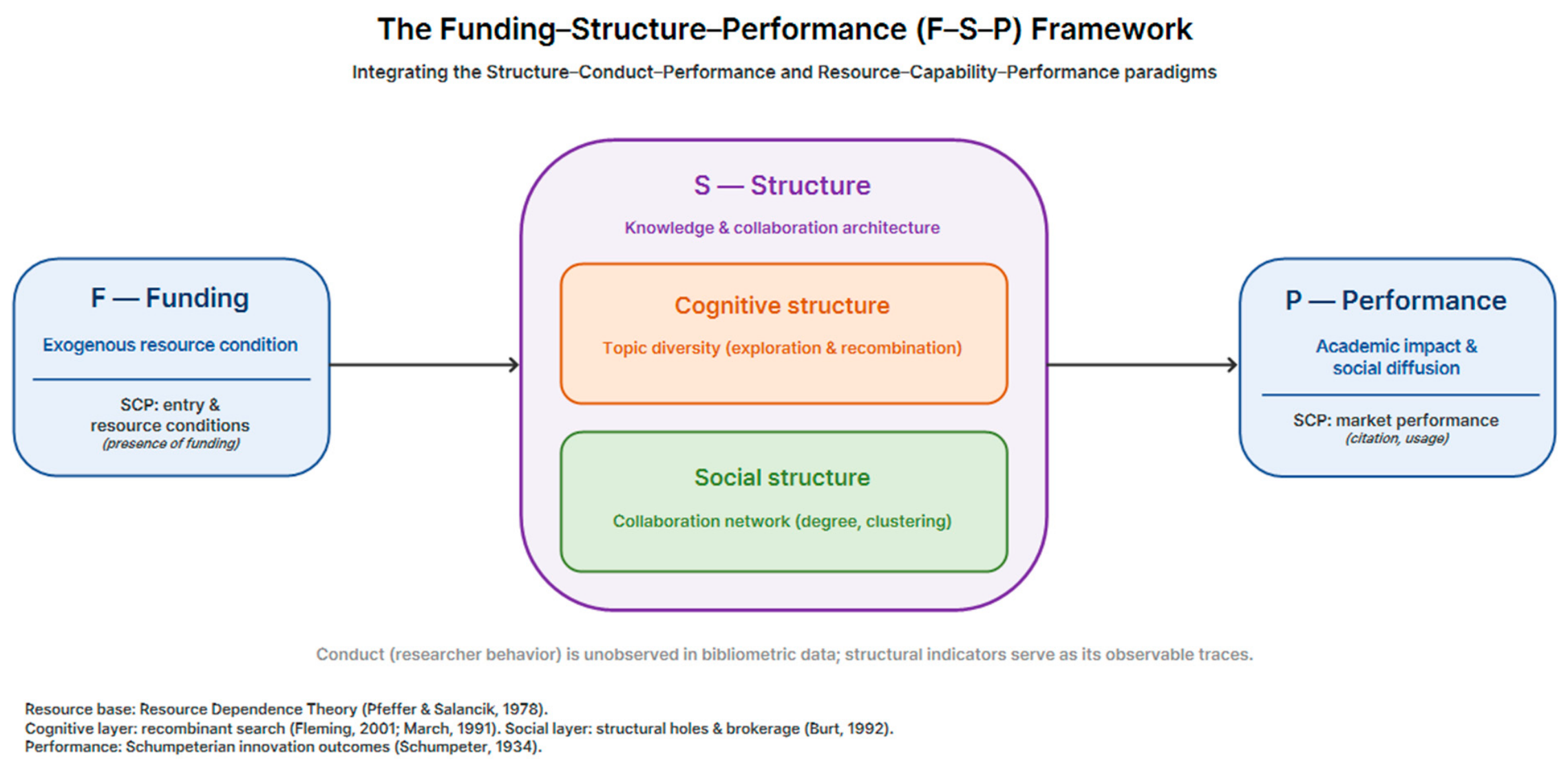
Controllable resources are associated with reduced environmental uncertainty, and the convergence of diverse knowledge alongside the integration of large networks, in the presence of funding, is associated with disruptive innovation performance. This study integrates key prior theories, as shown in Figure 1, to elucidate the process by which research funding is converted into outcomes. It reconfigures Nelson & Winter [54]’s evolutionary economic perspective and the Schumpeterian Regime Mark II to fit the modern R&D ecosystem, using this as the foundation for analysis within a resource-based structural transformation framework.
We label this framework Funding–Structure–Performance (F-S-P). Its logic builds on the classic structure–conduct–performance (SCP) intuition of industrial organization—that exogenous conditions shape the structure within which actors operate, and that structure in turn conditions performance—but it deepens and extends that intuition by grounding the structural layer in the resource-based view of the firm and in the evolutionary economics of Nelson and Winter [54]. In the SCP tradition the intervening ‘conduct’ of actors is treated as a behavioral black box; in resource-based and evolutionary terms, that intervening layer is more precisely understood as the capability through which an exogenous resource is converted into performance. We therefore treat funding as the exogenous resource condition (F), corresponding to the slack resources of resource dependence theory [14]; the knowledge and collaboration architecture of the research ecosystem—topic diversity and network structure—as the structural layer (S), which we interpret as the observable trace of the ecosystem’s absorptive and recombinant capability rather than as mere static structure; and academic impact and social diffusion as performance (P). This reading resolves the principal limitation of a purely SCP account: because the conduct, or capability, of individual researchers is not directly observable in bibliometric data, the structural indicators serve as its observable proxies, in keeping with the resource–capability–performance logic in which resources yield performance only insofar as they are mobilized through capabilities [25,27,29]. F-S-P is thus not a new theory but a synthesis: it transfers the SCP scheme to scientific production and integrates it with the resource-based and evolutionary view, so that the abbreviation F denotes Funding—the specific exogenous resource on which we focus, which is why the framework is equivalently read as Resource–Structure–Performance—and the S layer denotes capability-laden structure rather than market structure.
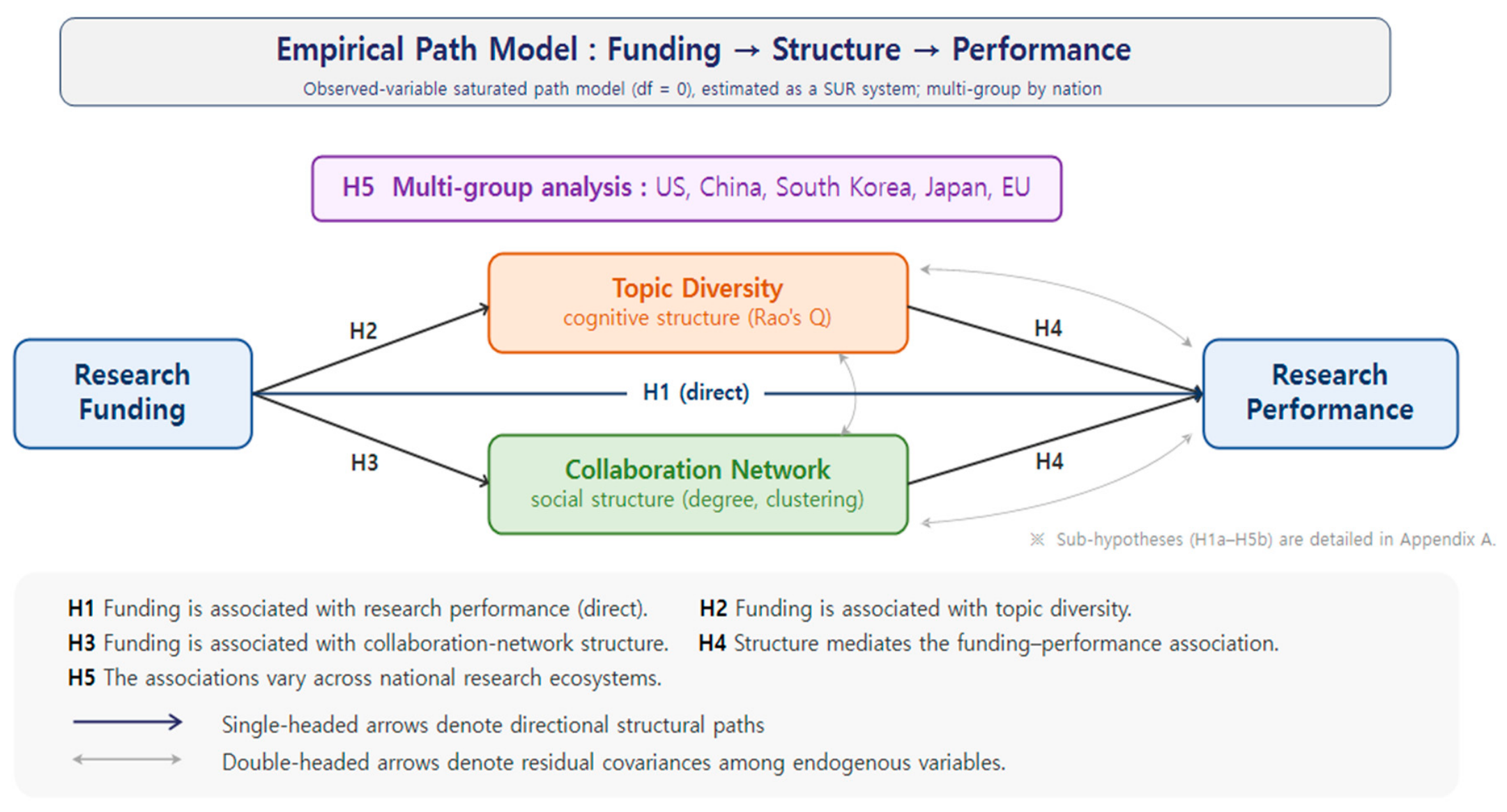
This analytical framework schematizes the mechanism by which two core engines operating within the research ecosystem cognitive structures and social structures interact to generate disruptive innovation when an exogenous resource, research funding, is injected. To translate this theoretical abstraction into an empirically testable form, this study designed a structural path analysis model by operationalizing each theoretical construct as an observable variable, as shown in Figure 2.
First, the theoretical resource base was operationalized as research funding. Following the resource dependence theory [14], external funding is treated as both a key factor associated with organizational expansion and a core input variable in this model. Second, the cognitive structure is embodied as thematic diversity reflecting knowledge recombination. Based on Fleming [27]’s innovation theory, the expansion of knowledge boundaries and exploration processes driven by funding are measured using a diversity indicator (Rao’s Quadratic Entropy). Third, social structure is concretized as a collaborative network. Based on Burt [32]’s structural hole theory, brokerage facilitated by funds and the expansion of physical connections are analyzed by substituting them with network structural attributes (Degree, Constraint, Clustering). Finally, innovative outcomes are defined as academic impact and social diffusion, signifying substantive influence beyond mere invention in the Schumpeter [25] sense.
Consequently, this empirical model clarifies the mechanism by which research funding is converted into research outcomes through dual structural pathways: thematic diversity and collaborative networks. This study applied a structural equation model with all variables as observed variables, simultaneously estimating structural paths among multiple endogenous variables within a unified system. For terminological consistency, we refer to the specification as an observed-variable path model and to the estimator as seemingly unrelated regression (SUR) throughout the paper. To prevent ambiguity, these two terms are not interchangeable in this study: “path model” denotes the model specification (how the observed variables are structurally linked), whereas “SUR” denotes the estimation method (how the path coefficients are computed); in a saturated, just-identified system the two coincide numerically. Specifically, by adopting a saturated structure that allows residual covariance among endogenous variables, it efficiently estimated path coefficients while simultaneously accounting for system-level error correlation. This estimation approach is mathematically equivalent to seemingly unrelated regression (SUR): in a just-identified path model with correlated residuals, the GLS estimator of the SEM reduces to the SUR estimator, thereby inheriting its efficiency gains [55,56].

3.2. Operational Definition of Variables

In the context of AI research, it has been increasingly recognized that a single performance indicator is insufficient to fully capture the quality and impact of research outcomes. Accordingly, this study constructs a multidimensional framework for research performance that reflects qualitative outcomes, quantitative impact, scholarly productivity, and immediate academic attention. To ensure consistency between the analytical model and variable operationalization, operational definitions are presented in Table 1 following the causal ordering specified in the structural equation modeling framework. The structure of variables in the analytical model is summarized as follows.
  • Independent variable: Research funding support.
  • Mediating variables:
    Knowledge diversity (Rao’s Quadratic Entropy, Q).
    Collaboration extensibility (Average Degree).
    Network constraint (Burt’s Constraint).
    Network cohesion (local clustering coefficient).
  • Dependent variable: Innovation performance.
    Citation, SJR, H-index, Usage 180 days and since 2013.
  • Grouping variable: National context.
(1)
Independent Variable: Research Funding (Resource Input)
The independent variable representing resource endowment is the presence or absence of research funding. A binary dummy variable coded as ‘1 (Funded)’ or ‘0 (Non-funded)’ based on the Funding Orgs information in the WoS data is used. This is to measure whether it is a key factor in structural change regarding resource allocation and to assess its effect.
(2)
Mediating Variables: Structural Transformation (Process)
Structural changes resulting from funding allocation are measured across two dimensions: knowledge structure and collaboration structure.
First, Rao’s Quadratic Entropy (Q) is employed to measure the convergence and heterogeneity of research topics [57]. A higher Q value indicates that a research team integrates more diverse and semantically distant knowledge elements, thereby capturing the impact of funding on topic diversity. Formally, Q is computed as the weighted sum of pairwise dissimilarities across all topic pairs, where pi and pj denote the proportional representation of topics i and j within the paper corpus, and dij denotes the semantic dissimilarity between topics i and j, operationalized as 1 − cosine similarity. Unlike a simple diversity count, Q weights each pair by their joint probability pipj, penalizing portfolios that concentrate on semantically proximate topics:
Q = Σi=1J Σj=1J dij·pi·pj
where Q is the knowledge diversity index, J is the total number of topics, pi, pj is the proportional prevalence of topics i and j, dij is the semantic dissimilarity between topics (1 − cosine similarity), and higher values indicate greater thematic diversity [57,58].
Second, to comprehensively identify collaborative networks, social network indicators proposed by Freeman [59] and Burt [32] are utilized for measurement. These indicators are broadly composed of three dimensions: extensibility, flexibility, and cohesion. Network extensibility reflecting the total volume of external collaborations held by the research team and its hub capacity is operationalized using Average Degree, defined as the mean number of co-authorship ties per author across all authors participating in a given paper:
Avg. Degree = (1/n)·Σj=1n kj
where n is number of authors, kj is number of collaboration ties of author j, and higher values reflect broader collaborative connectivity.
Third, structural constraints serve as an indicator measuring the degree of redundancy and closure within a network. They inversely reflect the ability to leverage structural holes and brokerage capabilities, thereby capturing the research team’s flexibility. Following Burt [32], the constraint imposed on author i by alter j is decomposed into a direct component capturing the proportion of i’s total relational investment directed toward j(pij) and an indirect component capturing the extent to which i’s other contacts q also connect to j, thereby closing potential structural holes. The exclusion condition q ≠ i, j ensures self-loops and the focal dyad are not double-counted. The individual constraint Cij is then squared to reflect the non-linear cost of dependence on a single contact, and summed over all alters to yield the aggregate constraint index Constrainti:
Cij = (pij + Σqij pjq·pqj)2,     Constrainti = Σj Cij
where pij is the normalized tie strength between actors i and j, Constrainti is the overall network constraint of actor i, and higher values indicate stronger network closure and fewer brokerage opportunities [32].
Fourth, clustering indicates the density of connections among collaboration partners and serves as a measure for evaluating cohesion and solidarity within the research team. The local clustering coefficient for node i is defined as the ratio of the number of edges actually present among i’s neighbors to the maximum possible number of such edges [60]:
Ci = 2|{ejk: vj, vkNi, ejkE}|/[ki(ki − 1)]
where Ci is the local clustering coefficient of author i, ki is the number of collaborators (degree), ejk is the collaboration ties among i’s collaborators, and values range from 0 to 1, with higher values indicating stronger local collaboration cohesion [60].
(3)
Dependent Variables: Innovation Performance (Output)
This study defines innovation performance from a Schumpeter [25] perspective as a composite of qualitative excellence, impact, and scholarly interest, and operationalizes it using five indicators. First, following the logic of Gonzalez-Pereira et al. [61,62], it reflects the structural influence of journals through the SJR. Second, it measures the technical contribution of knowledge using citation counts [63,64]. Third, the journal h-index Hirsch [65,66] was used to evaluate both the scale and qualitative level of achievements in a balanced manner. Finally, usage frequency Kurtz & Bollen [67,68] captured academic interest, but this was subdivided into long-term interest and short-term utilization to analyze knowledge consumption patterns at different points in time in a multidimensional way.
Data distribution diagnostics identified extreme positive skewness in citation and usage counts, which was corrected by applying a natural logarithm transformation (ln(X + 1)) to achieve normality. Furthermore, all independent and dependent variables with differing measurement units were ultimately Z-score standardized to enhance the precision of the analysis.
(4)
Grouping Variable: National Context
We assume that the effects of research funding may vary across countries depending on differences in institutional environments and technological maturity rather than following universal patterns. Accordingly, country is treated as a grouping variable to examine cross-national heterogeneity in structural relationships within the research model.
The country variable is categorized into five leading AI research regions (USA, China, EU, Republic of Korea, and Japan). This classification is grounded in the national innovation system (NIS) perspective. Lundvall [43] and Nelson [47] argue that national institutional routines and path dependencies shape how knowledge is generated, accumulated, and diffused, resulting in distinct innovation mechanisms across countries.
Based on this theoretical foundation, the full sample is divided by country, and multi-group path analysis is conducted. Because the model is saturated (df = 0), conventional measurement invariance tests (configural, metric, scalar) are not applicable: adding equality constraints across groups does not change the degrees of freedom in a just-identified system. Cross-national differences in path coefficients are therefore assessed using pairwise Z-tests for the equality of regression coefficients across independent samples (Paternoster et al. [69]), with bootstrap standard errors (1000 resamples). This approach directly tests whether the funding paths estimated for each country pair differ significantly, allowing country-specific variations in funding effects to be formally evaluated rather than merely described.
Table 1. Operational definitions and measurements of variables.
Research VariableDefinition (Theoretical Basis)Measurement MethodKey References
Independent VariableResearch
Funding
External resource infusion acting as a buffer against failure (slack resource in resource dependence theory).Dummy variable
F u n d i n g i = 1 i f   p a p e r   i   i s   f u n d e d 0 o t h e r w i s e
[14,17,50]
Mediating VariablesTopic Diversity
(Rao’s Q)
The degree of disparity and balance between disparate knowledge elements
(Cognitive Exploration).
Q = Σi=1J Σj=1J dij·pi·pj
( d i j : S e m a n t i c d i s t a n c e )
[51,52,57]
Hub Capability
(Degree)
The total volume of direct connections, representing network expansion (Social Capital: Volume).Avg. Degree = (1/n) Σj kj
(kj: co-authorship degree of author j)
[56,63,64]
Brokerage
(Constraint)
The lack of structural holes; lower constraint implies higher brokerage potential
(structural hole theory),
Granovetter (Weak Tie Theory).
Cij = (pij + Σqij piq·pqj)2
Constrainti = Σj Cij
(Inverse measure of Brokerage)
Constraint_i (aggregate)
[31,33,50]
Cohesion
(Clustering)
The density of local connections, representing trust and closure (Social Capital: Closure).Ci = 2|{ejk: vj, vkNi, ejkE}|
/[ki(ki − 1)]
ei: number of edges among the neighbors of node i,
ki: Number of neighbors
[60]
Dependent VariableQualitative Prestige
(SJR)
The scientific prestige of the journal, weighted by the reputation of citing sources. l n ( S J R + 1 )
(Log-transformed count)
[61,62]
Knowledge
Diffusion
(Citation)
The breadth of knowledge dissemination and academic impact. l n ( C i t a t i o n + 1 )
(Log-transformed count)
[59,66,67]
Productivity Impact
(Journal h-index)
A balanced metric of productivity and citation impact of the publishing venue. l n ( h _ i n d e x + 1 )
(Log-transformed count)
[60,68]
Immediate Attention
(Usage 180)
Short-term social interest and demand for the full text (last 180 days). l n ( U s a g e 180 + 1 )
(Log-transformed count)
[23,70,71]
Cumulative Interest
(Usage 2013)
Long-term data utility and social internalization of knowledge (since 2013). l n ( U s a g e 2013 + 1 )
(Log-transformed count)
[67,68]
Grouping VariableNational ContextHeterogeneity of national innovation systems (NISs),
EU member states (grouped).
Categorical
(US, CN, EU, KR, JP)
[42,43,47]

3.3. Data Collection and Preprocessing

To analyze the knowledge structure and collaborative networks of global AI research, we utilized the Web of Science (WoS) Core Collection. The analysis period was set from 2011, when AI research began to spread significantly, to 2024. Using the Topic search field, we selected only original articles by searching for “Artificial Intelligence” or “AI”. For cross-national comparative analysis, papers with at least one author affiliated with the US, China, Republic of Korea, Japan, or the EU were finalized as the sample. For the multi-group analysis, each paper was assigned to a single country group on the basis of the corresponding author’s primary affiliation, so that the five groups (US, China, Republic of Korea, Japan, and the EU) partition the full sample without double-counting.
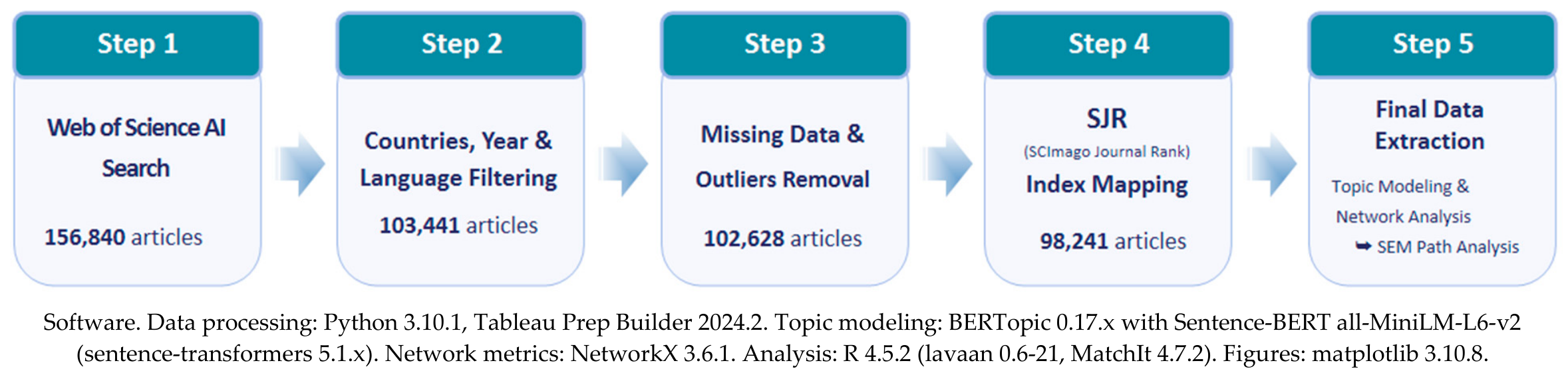
Python (3.10.1) and Tableau Prep (2024.2) were used for data cleaning and processing. During this process, duplicates were removed, and author names and institutional affiliations were standardized, including synonym handling. To ensure analytical precision, data with missing values in key variables like SJR were strictly excluded. Consequently, 98,241 papers were ultimately used for empirical analysis. The specific data collection and analysis procedures are as shown in the data analysis procedure in Figure 3.
Topic modeling and diversity. Thematic diversity was derived from paper abstracts using BERTopic. Document embeddings were generated with the Sentence-BERT model all-MiniLM-L6-v2, and topics were extracted with a CountVectorizer representation (English stop words, unigrams and bigrams, minimum document frequency of 10) together with a Maximal Marginal Relevance representation model (diversity = 0.4) to reduce redundancy among topic keywords. The number of topics was fixed at 50 to ensure interpretable and stable themes across the corpus; the twenty most prevalent topics are summarized in Table A6. To assess sensitivity to this choice, we additionally re-estimated the topic model with K = 30 and K = 70; document-level Rao scores were highly correlated across specifications (r = 0.97 with K = 30, r = 0.99 with K = 70), indicating that the diversity measure itself is robust to topic-count choice. The funding–diversity mean difference remained substantively negligible across all three specifications (|difference| ≤ 0.0005 in raw Rao units), consistent with the modest direct effect reported in our main analysis; at K = 30 the sign reversed but the magnitude (−0.0002) was effectively zero (see Table A7). For each paper, the topic distribution was converted into probabilities, and Rao’s Quadratic Entropy was computed using pairwise topic dissimilarities defined as one minus the cosine similarity between topic embeddings, so that papers combining semantically distant topics receive higher diversity scores. Domain-generic terms (e.g., “artificial,” “intelligence,” “learning,” “model”) were removed prior to modeling, and papers without abstracts were excluded from the diversity computation.
Collaboration network construction. A single co-authorship network was constructed over the full 2011–2024 study window, yielding 436,858 author nodes and 4,014,638 co-authorship edges. To mitigate author name ambiguity, each author was assigned a unique key using a hierarchical rule that prioritizes ORCID, then ResearcherID, and finally a name-plus-first-affiliation string when neither identifier was available. Degree, the local clustering coefficient, and Burt’s structural constraint were computed at the author level on this network. Because the structural variables enter the model at the paper level, each paper was assigned the mean of its co-authors’ values for each metric. An important methodological boundary applies here: because the network spans the entire study period, the structural position of a paper published in, say, 2015 is computed using co-authorship ties that may extend beyond that paper’s publication date. This temporal leakage means that the network measures do not strictly precede the performance outcomes they are paired with, which limits any directional inference from these paths. All results involving the network mediators (Degree, Constraint, Clustering) should therefore be read as cross-sectional structural associations rather than effects of prior network position on subsequent performance. Constructing time-respecting cumulative networks, such as year t−1 co-authorship graphs for papers published in year t, would address this concern and is a priority for future work.

3.4. Analytic Strategy: A Multi-Stage Methodological Framework

To identify the impact of research funding on the performance of the artificial intelligence research ecosystem through a dynamic mechanism mediated by the restructuring of knowledge and collaboration structures, a four-stage analysis was conducted.
First, we quantified the structural characteristics of the research ecosystem at cognitive and social levels. For the cognitive structure, we applied the Sentence-BERT embedding-based BERTopic algorithm to reflect the semantic content of papers [70,71]. Using the topic distribution of each paper, we converted the cosine similarity between embedding vectors into distance to calculate Rao’s Quadratic Entropy, measuring the degree of knowledge element fusion [57,72]. The social structure was constructed using Python NetworkX to build a co-author network of 98,241 papers, calculating connectivity, structural constraint, and clustering coefficient [31,56,57].
Second, we verified the statistical validity of the data prior to structural analysis. To address asymmetry, we applied natural logarithm transformation. To eliminate measurement bias arising from differences in measurement units, we standardized all continuous variables using Z-scores. We confirmed the absence of multicollinearity using the Variance Inflation Factor.
Third, the structural model was constructed using observed variables and adopted a saturated structure allowing residual covariance among endogenous variables, setting it to a just-identified state with zero degrees of freedom. In this case, due to its mathematical properties, the global fit index shows substantial goodness-of-fit, thus limiting its validity as a practical indicator of practical validity [73,74]. As this is a structural characteristic of simultaneous equation systems and a standard approach in SUR-based analysis [55,56,75], we utilized the statistical significance of individual path coefficients, bootstrapped confidence intervals, the coefficient of determination, and the system Wald test as core validity criteria rather than overall fit [76,77]. Estimation efficiency was enhanced using the SUR estimation framework, and the significance of mediating effects was verified through 1000 bootstrap iterations.
ηg = Bg ηg + Γg ξg + ζg
In the above equation, ηg is an endogenous variable vector encompassing knowledge diversity, collaborative structure, and research performance, while ξg is an exogenous variable vector representing the core independent variable, research funding. Matrix Bg captures the path coefficients between endogenous variables, Γg captures the direct effect of research funding, and ζg denotes the error term vector. The seemingly unrelated regression (SUR) methodology prevents information loss during individual estimation by controlling for correlations among error terms within a system of simultaneous equations. By maximizing statistical efficiency through this technique, this study derived more precise structural path coefficients describing how research funding is associated with the restructuring of knowledge and collaborative structures and with research outcomes [55,56]. The significance of mediating effects was verified through 1000 bootstraps [77]. Since this model exhibits a saturated structure with zero degrees of freedom for identification, the informativeness of global fit indices is limited. Therefore, the interpretation focused on the significance of individual path coefficients.

4. Empirical Results

4.1. Descriptive Statistics and Correlations

4.1.1. AI Research Growth and Funding Landscape

Prior to the formal validation of the structural model, we analyzed the time-series trends and distribution characteristics of the data to diagnose the evolutionary process and landscape of the global artificial intelligence research ecosystem. According to the annual growth trends in Table 2, the artificial intelligence field has recorded significant quantitative growth over the past decade. Both funded and unfunded research showed an upward growth trend, but a significant difference was observed in the magnitude and speed of increase. Funded research maintained a gradual increase from 691 papers in 2011 to 1329 papers in 2017, then encountered a steep inflection point starting from 1724 papers in 2018. This expansion accelerated to 2675 papers in 2019 and 4464 papers in 2020, culminating in 21,391 papers in 2024, an 88.42% surge from the previous year and the largest volume within the analyzed period. That an average of 65.49% of papers acknowledge external funding indicates that the presence of funding is strongly associated with AI knowledge production; because funding is measured as a binary indicator, this reflects the presence of funding rather than its amount.
Table 3 shows the top 10 funding agencies, showing that China and the United States account for the largest shares of funded AI research among the top funding agencies.
China shows a state-led pattern concentrated in a few large agencies, with four institutions ranking among the top, including the National Natural Science Foundation of China (NSFC) which recorded an overwhelming 16,149 projects. In contrast, the United States adopts a strategically dispersed support structure based on research objectives and fields, led by the National Institutes of Health (NIH, 7547 projects, 2nd place) and the National Science Foundation (NSF, 4476 projects, 4th place). The European Union (5673 projects) has built collaborative networks in solidarity with its regional institutions. The National Research Foundation of Korea (NRF, 3207 projects, 6th place) and the Japan Society for the Promotion of Science (JSPS, 2275 projects, 7th place) also demonstrate very high investment density relative to their populations, supporting Asia’s strong showing. This pronounced concentration and asymmetry in funding allocation reflects the projection of each nation’s unique AI innovation strategy onto the real-world ecosystem. It represents a significant endeavor requiring a multi-group analysis to meticulously identify the heterogeneous effects of national institutional environments on research outcome generation mechanisms.

4.1.2. Distribution and Correlation

The descriptive statistics analysis results in Table 4 demonstrate that the global artificial intelligence research ecosystem is governed by the power law, where a small group monopolizes knowledge production, a scale-free pattern well documented in network science and the science-of-science literature [78,79,80]. Key performance variables such as citation count, SJR, and usage frequency exhibited extreme positive skewness in the raw data. To correct this, a natural logarithm transformation (ln(X + 1)) was applied. Even after transformation, skewness persists, particularly in degree centrality, reaching 26.7323, indicating a severe imbalance in the distribution of network resources. Furthermore, it is observed that 65.49% of the total research relies on external funding, indicating a resource-intensive ecosystem. The non-normality and heteroscedasticity of this data can introduce standard error distortion in traditional estimation methods. To statistically control this, this study adopted bootstrap-based path analysis, firmly establishing the stability of the analytical model and the validity of the estimation results.
The correlation analysis of key variables in Table 5 illustrates the complex pattern linking research funding and performance indicators. Research funding shows a significant positive (+) relationship with most variables, but the correlation coefficients are low, below 0.15, except for h-index (0.21) and clustering coefficient (0.18). The correlation coefficient with the primary performance indicator, citations, also remains at 0.08. This is not consistent with a simple linear model in which funding directly translates into outcomes, and suggests that a more structural, mediated pattern may operate between the two variables. Furthermore, structural constraints exhibit a significant negative relationship with journal impact indicators (−0.10) and citation counts (−0.11 ***), suggesting that network openness may be an important condition associated with innovation outcomes.
Ultimately, research funding, knowledge diversity, collaborative networks, and research outcomes form a unified organic system. To overcome the statistical constraints inherent in simple bivariate correlations and establish precise mediating pathways and causal directions, the subsequent path analysis explores these statistical associations.

4.2. System Validation and Model Diagnostics

To examine the process by which research funding translates into research outcomes through knowledge structures and collaborative networks, this study applied an observed-variable structural path model in which residual covariances across equations are explicitly estimated. Because this configuration is mathematically equivalent to seemingly unrelated regression (SUR), the GLS estimator was adopted to enhance efficiency [55,56,76]. Considering the mathematical properties of a saturated structure, the validity was examined using diagnostic indicators at the equation system level instead of traditional global fit measures [75], and Table 6 presents the empirical analysis results.
Due to the nature of the saturated structure df = 0, the calculation of a traditional system-level Wald χ2 statistic is not applicable. The validity of the model was evaluated through bootstrap-based path-level significance tests, equation-level coefficients of determination, and residual correlation diagnostics [73,74,75]. Statistical significance was confirmed across major paths p < 0.001, indicating that the simultaneous estimation approach was appropriately applied. The equation-level coefficients of determination ranged from 0.001 to 0.076, reflecting that the generation of AI research outcomes is a complex phenomenon influenced by various macro-environmental factors beyond the input variables of this model. The residual correlation diagnostic index of 0.000 implies that the systematic correlation of error terms across equations was adequately controlled within the model. Furthermore, by applying robust standard errors based on 1000 bootstrap resamples, the issues of non-normality and heteroscedasticity in the large-scale observational data were mitigated, thereby securing statistical stability. In conclusion, the estimated path system of this study possesses the statistical validity required to conduct the analysis.

4.3. Structural Model Analysis: Unveiling the Black Box

This study empirically decomposed the pathways linking research funding to outcomes into direct associations and indirect associations operating via structural transformation. This is consistent with the interpretation that funding is associated with higher performance alongside differences in the cognitive and social structures of the research ecosystem, beyond being a mere input factor.

4.3.1. The Direct Effects of Research Funding

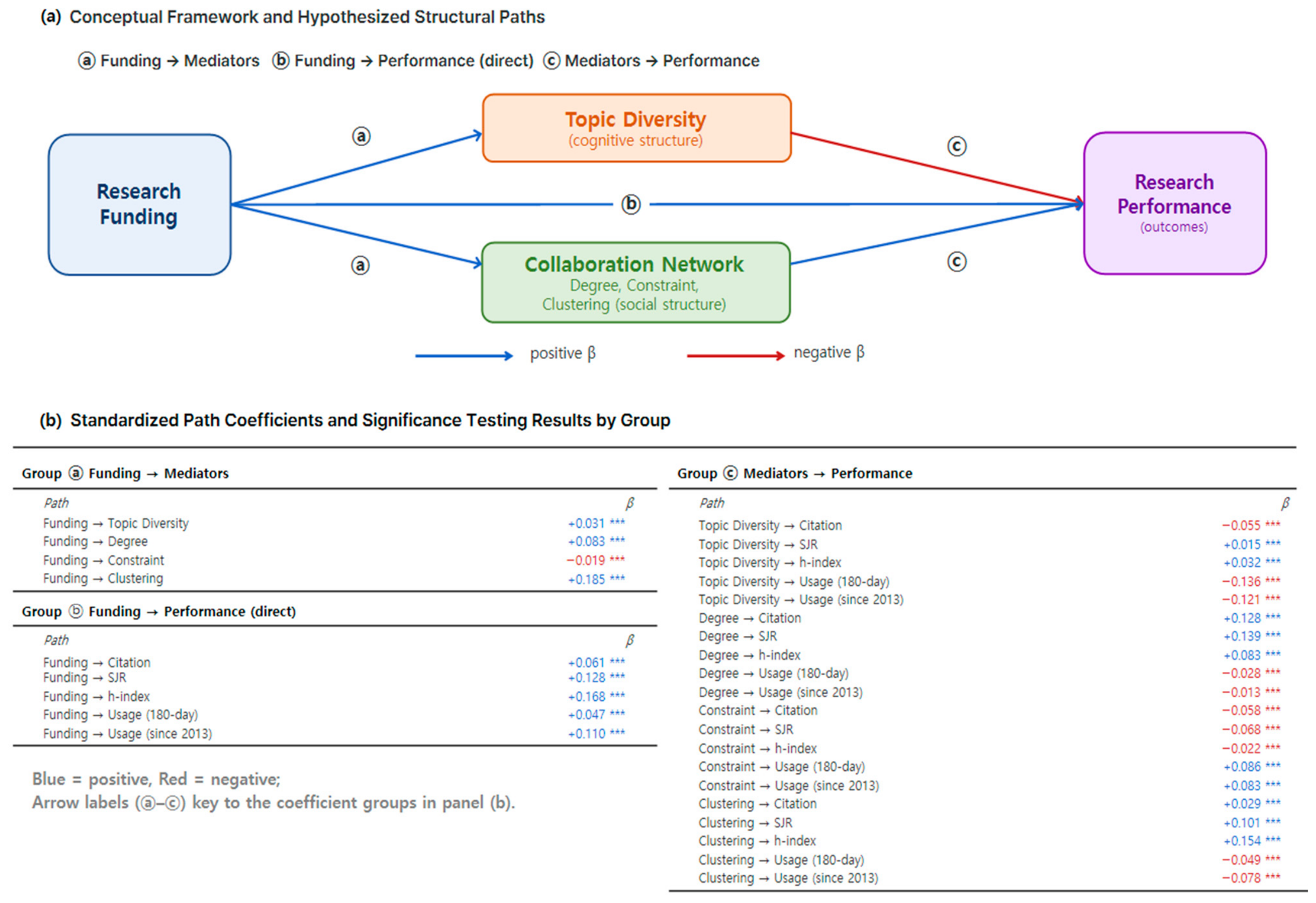
The path analysis results in Table 7 indicate that research funding shows a significant positive (+) association with performance indicators overall. It also shows varying and significant associations with knowledge and collaborative-network structures depending on variable attributes.
First, funding support is associated with higher quantitative and qualitative research performance indicators. Specifically, it demonstrated a significant positive effect on journal status (β = 0.128 ***) and researchers’ cumulative impact (β = 0.168 ***). It also significantly increased the number of citations (β = 0.061 ***), an indicator of academic impact, as well as the 180-day usage count (β = 0.047 ***) and cumulative usage count since 2013 (β = 0.110 ***), indicators of practical diffusion. This indicates that funding is associated with academic quality and diffusion, and hypotheses H1a, H1b, H1c, and H1d were all supported.
Second, research funding is strongly associated with broader knowledge structure and with differences in collaborative-network structure. It increased topic diversity (β = 0.031 ***) while simultaneously strengthening both the scale of collaboration (connection degree, β = 0.083 ***) and cohesion (regional clustering coefficient, β = 0.185 ***). Notably, it exerted a significant negative influence (β = −0.019 ***) on structural constraint, which signifies network closure. This is consistent with the interpretation that funding is associated with less entrenched information pathways and greater knowledge mediation through structural holes, indicating greater ecosystem openness. Therefore, hypotheses H2a, H3a, H3b, and H3c were also all accepted. Two interpretive caveats apply to H2a specifically. First, the effect is substantively small (β = 0.031, 95% CI [0.025, 0.037]), consistent with the known sensitivity of diversity indices such as Rao–Stirling entropy to category granularity and their limited discriminatory power at fine topic resolutions [57,72]. Second, the robustness check using K = 30 topics yields a sign reversal (Δ = −0.0002), although the magnitude is effectively zero; at K = 50 and K = 70 the sign is positive (Δ = +0.0005 in both cases). This pattern is in line with prior findings that interdisciplinarity and diversity measures are themselves classification-dependent and can shift with the chosen topic scheme [52]. Taken together, these results suggest that the positive association between funding and topic diversity is detectable but fragile, and should be treated as a tentative rather than a robust finding.
Finally, the impact of knowledge diversity and network structure on performance demonstrates conflicting patterns between scholarly depth and public utilization. While higher knowledge diversity and regional clustering significantly increased qualitative performance metrics such as journal status and researcher influence, practical usage frequency tended to decrease. Notably, lower structural constraints significantly improved citation counts (β = −0.058 ***) and journal status (β = −0.068 ***), supporting Burt [53]’s structural hole logic for citation-based outcomes. By contrast, in highly constrained, cohesive structures, usage frequency was positively associated with constraint. These results are consistent with the interpretation that open structures are associated with higher scholarly citation, while closed structures are associated with greater internal information consumption. Accordingly, hypotheses H4a and H4b, which tested direct effects, are partially supported.

4.3.2. Mediation Analysis: Indirect Effects

Table 8 presents the results of an analysis of indirect effects, showing how research funding is transferred to final outcomes via knowledge structures and network characteristics. Research funding manifests distinct mediating mechanisms depending on what is researched and with whom during the outcome creation process, indicating a complex pathway with opposing indirect associations through cognitive and social structures.
First, the mediating pathway from research funding → topic diversity → final outcomes shows a counterintuitive reverse pattern. While funding promotes heterogeneous convergence of research topics, this is associated with a significant negative indirect effect (β = −0.002 ***) on citation counts. This pattern suggests that while convergence research may support long-term innovation, it may be associated with greater difficulty of academic acceptance in the short term and delayed immediate citations. A significant negative indirect effect was also confirmed for short-term usage frequency, rejecting the path that assumed positive mediation through topic diversity.
Second, the path from research funding → collaborative-network structure → scholarly output generates a significant positive indirect effect. Connectivity, signifying outward expansion, acts as a key mediator increasing citation counts (β = 0.011 ***, VAF = 14%) and journal status (β = 0.011 ***, VAF = 7.2%). Furthermore, funding support reduces the structural constraints of network closure, which in turn is associated with higher citation counts, yielding a significant positive indirect effect (β = 0.001 ***). These patterns are consistent with the interpretation that network openness and structural brokerage, as facilitated by funding, are associated with enhanced academic performance, supporting the indirect pathway through network structure.
Third, the path Research Funding → Regional Clustering → Research Outcomes reveals a pattern of asymmetric mediation across performance types. Enhanced clustering is associated with a significant positive indirect effect on citation counts (β = 0.005 ***, VAF = 7.1%) and researcher influence (β = 0.029 ***, VAF = 13.9%), but with a significant negative indirect effect on short-term usage frequency (β = −0.009 ***, VAF = −30.1%). This pattern is consistent with cohesive collaborative structures being associated with greater mutual citation within internal academic communities and more limited outward information diffusion. One interpretive note on the VAF figure: the large magnitude of −30.1% reflects a suppressor mediation structure in which the direct association (Funding → Use_180, β = +0.047) and the indirect association run in opposite directions, making the total effect (β = 0.030) small and amplifying the ratio. The substantive interpretation accordingly rests on the direction and significance of the indirect path rather than on the VAF magnitude alone.
In conclusion, research funding is associated with academic achievements through the physical expansion of networks, while also exhibiting a dual mediating structure in which short-term outcomes may be attenuated through the cognitive complexity of convergent knowledge. Accordingly, hypothesis H4c, which tested the indirect effect, is partially supported.

4.3.3. National Heterogeneity Analysis: Comparative Perspective on Funding Efficiency

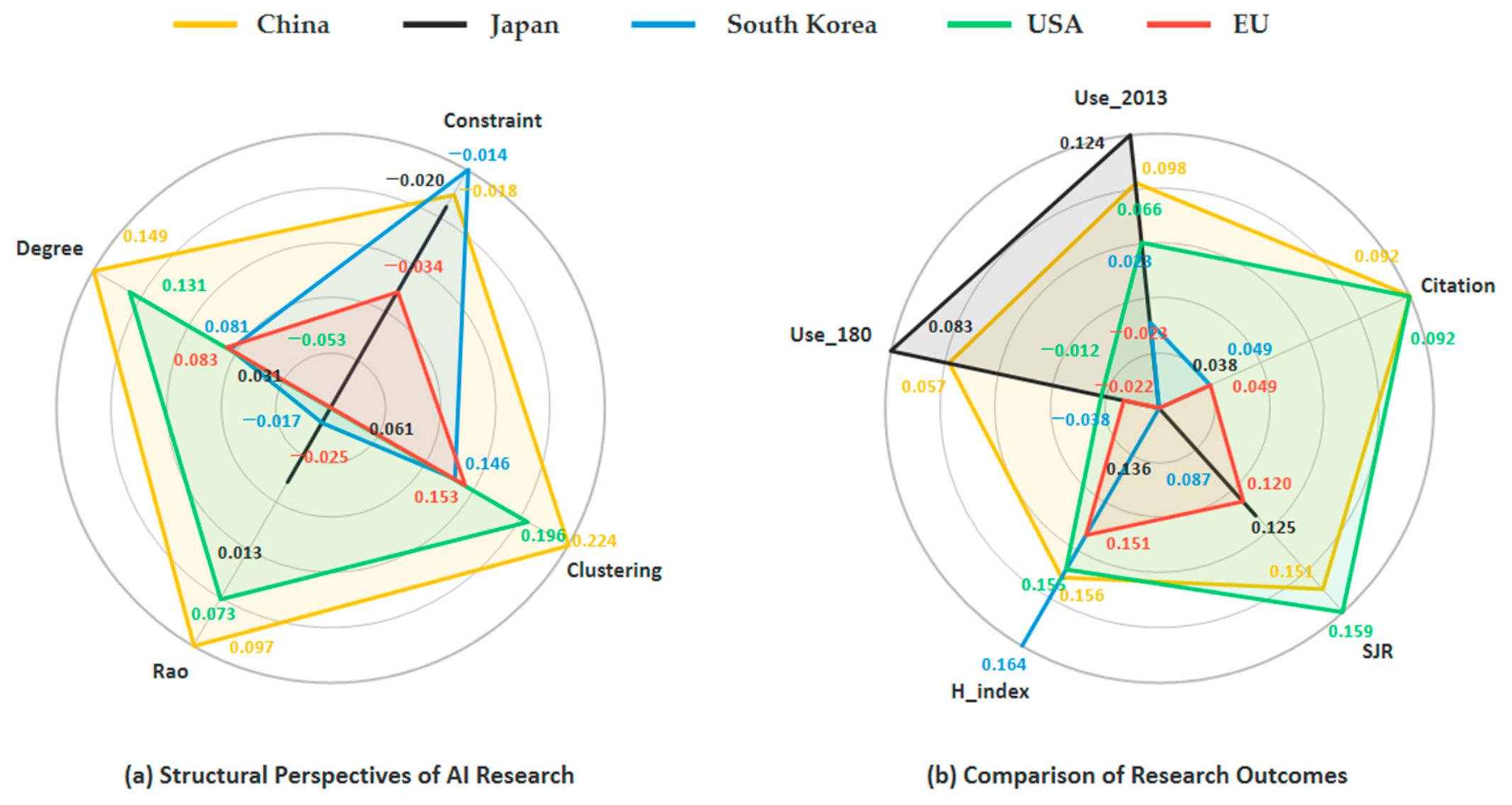
The mechanism by which research funding translates into outcomes manifests heterogeneously across countries, depending on their academic ecosystems and institutional contexts (Figure 4). Table 9 presents the results of a multi-group path analysis conducted on five major countries, confirming the asymmetry in funding efficiency between nations.
First, China’s research funding shows the strongest association with expanding collaborative networks among the five countries. It recorded the highest path coefficients in connectivity (β = 0.149 ***) and clustering (β = 0.224 ***), indicating that the presence of funding is associated with more rapid organization and stronger cohesion within research groups. This physical expansion is associated with higher citation counts (β = 0.092 ***) and journal impact (β = 0.151 ***), the most linear input–output pattern among the five countries.
Second, the United States demonstrates a pluralistic structure that simultaneously achieves network expansion and knowledge diversification. In addition to the expansion of connectivity (β = 0.131 ***), topic diversity (β = 0.073 ***) also yielded a significant positive effect. This suggests that the U.S. funding system provides an optimal environment that simultaneously encourages not only the expansion of research scale but also the convergence of heterogeneous knowledge and exploratory innovation.
Third, Korea demonstrates a compressed growth model where funding is concentrated on enhancing qualitative outcomes, such as publication in high-impact journals. While it significantly contributed to enhancing researcher influence (β = 0.164 ***) and journal status (β = 0.087 ***), the expansion of collaborative networks (β = 0.081 ***) was limited compared to the two major countries, and the path for easing structural constraints (β = −0.014) did not achieve statistical significance. This indicates that Korea’s innovation system operates more toward short-term academic status enhancement than open system diffusion.
Fourth, the European Union and Japan appear to follow distinct paths. The EU shows a significant negative association (β = −0.025 ***) between research funding and thematic diversity, which may suggest a pattern of knowledge concentration in which intra-regional resources are oriented toward specific strategic fields. Japan shows the weakest network expansion (β = 0.031) among the five countries, yet its journal-status association (β = 0.125 ***) is relatively strong, which may indicate a strategy of qualitative growth through small, closed research communities. Taken together, the patterns of ecosystem expansion and performance conversion associated with research funding appear to vary across countries, seeming to depend on each nation’s innovation system. While associations with network connectivity and clustering are broadly shared, the direction of the topic-diversity association varies across countries, which is consistent with the partial acceptance of Hypothesis H5a. The association between funding and outcomes, and its statistical significance, also varies with the innovation context rather than being uniform across all indicators; Hypothesis H5b is therefore also partially accepted.
Finally, to test whether these cross-national differences are statistically significant rather than merely descriptive, we conducted formal comparisons of the funding path coefficients across country groups using the Z-test for the equality of regression coefficients across independent samples (Paternoster, Brame, Mazerolle, & Piquero [69]). Across all ten pairwise country comparisons and nine structural and performance paths (90 tests in total), 57 (63.3%) of the coefficient differences are statistically significant (p < 0.05; |Z| up to 17.23). The most pronounced and consistent cross-national differences appear in the funding–collaboration paths (degree and clustering) and in the usage outcomes, whereas differences in the funding–constraint path are significant in only three of the ten comparisons. Full test statistics are reported in Table A8. These results confirm that the cross-national heterogeneity discussed above is statistically supported rather than a descriptive artifact of coefficient magnitudes.
We subjected these findings to three robustness checks, reported in Appendix B. First, to address the concern that the funding–performance association might reflect reverse selection rather than a structural pathway, we re-estimated the model on a propensity score-matched sample in which funded and unfunded papers were matched on publication year, country, field, and number of authors; every funding path retained its sign and significance, and all five performance outcomes remained positive and significant after matching (Table A3). Second, to rule out confounding by the rapid temporal growth of the field, we re-estimated all paths with publication-year fixed effects; although the explained variance for citations rises substantially once year dummies absorb cumulative citation growth, every structural and performance path retains its sign and significance (Table A2). Third, because SJR and the journal h-index are journal-level rather than article-level indicators, we re-estimated the model excluding them; the article-level coefficients are essentially unchanged (Table A5). Together, these checks indicate that the structural associations reported above are robust to selection on observables, to temporal trends, and to the choice of performance indicators, while—consistent with the cross-sectional design—they are best interpreted as structural associations rather than causal effects.

4.4. Summary of Hypothesis Testing

Empirical analysis results indicate that research funding is associated with performance both directly and through complex mediating pathways involving cognitive and social structures. The structural flow and results of the overall hypothesis verification are shown in Figure 5.
First, we examined the multidimensional direct effects and structural mediating role of research funding. Funding allocation exerted a significant positive (+) influence not only on qualitative indicators such as h-index (β = 0.168 ***) and journal status (β = 0.128 ***) but also on citation counts (β = 0.061 ***). This indicates that funding is associated with both quantitative and qualitative diffusion of outcomes. Furthermore, beyond the direct effects, the findings indicate that the domain operates through mediating pathways: knowledge structure and collaborative networks.
Second, we observed a paradoxical pattern in topic diversity and a differential role of network structure. Research funding expands topic diversity (β = 0.031 ***), but this increased diversity is associated with a significant negative effect (β = −0.055 ***) on citation counts. This pattern is consistent with the interpretation that convergent exploratory research encounters friction with existing knowledge systems, incurring short-term citation acceptance costs. Conversely, clustering associated with funding and reduced structural constraints form a significant positive mediating pathway to academic performance, suggesting that network structure is closely associated with innovation outcomes.
Third, the analysis points to heterogeneous patterns across national innovation systems. China shows the strongest associations with network connectivity and clustering among the five major countries in the presence of funding. The United States displays a comparatively balanced pattern, with associations to both network expansion and knowledge diversification. The European Union shows a significant negative association (β = −0.025 ***) with topic diversity, which may reflect knowledge concentration in specific domains. Korea shows a relatively consistent association with qualitative outcomes, while its topic-diversity pathway is not significant, which is consistent with the view that each nation’s R&D system is associated with distinct patterns.
The support and partial-support outcomes for each core hypothesis derived from this empirical analysis are summarized in Table 10. Detailed statistical figures and justification for specific pathways are provided in Appendix A and Appendix B.

5. Discussion and Implications

5.1. Discussion of Key Findings

This study empirically examined how research funding contributes to scientific outcomes through cognitive and social structural transformations within the knowledge ecosystem, moving beyond the view of funding as a simple input factor. The findings suggest that the effects of research funding may emerge not primarily through direct performance enhancement but through indirect mechanisms that reshape the structural conditions of the research environment, thereby extending conventional input–output approaches.
In interpreting these results, we distinguish associations by their strength rather than by statistical significance alone. The associations between funding and the structural variables are the most pronounced, particularly for local clustering (β = 0.185) and degree (β = 0.083), alongside a robust association with journal-level standing (h-index, β = 0.168). Other associations, while statistically significant, are modest in magnitude: the direct association between funding and citations (β = 0.061), for instance, is best read as detectable but substantively limited. Because the analysis draws on 98,241 publications, even small coefficients attain significance, so we emphasize 95% confidence intervals and effect sizes rather than p-values when assessing substantive importance. The association between funding and topic diversity (β = 0.031), though positive and significant, is correspondingly small and should be interpreted with caution.
The role of thematic diversity warrants particular care. We observe that greater topic diversity is associated with weaker short-term citation performance, but we are cautious about attributing this pattern to a single mechanism. One reading is that interdisciplinary and exploratory work faces delayed recognition because it sits at a greater cognitive distance from established audiences; an alternative reading is that diffuse thematic portfolios dilute the focus that concentrated citation communities tend to reward. The present cross-sectional design cannot adjudicate between these interpretations, and the cross-national variation in the sign of the diversity path reinforces this caution. We therefore treat the relationship between diversity and short-term impact as context-dependent and potentially time-lagged rather than uniformly positive or negative, and we identify lagged or panel designs as a priority for future work capable of separating delayed recognition from genuine dispersion effects.
In relation to the prior literature, the results support existing findings that identify positive associations between research investment and performance, while further indicating that these effects may unfold asymmetrically over time. In particular, the finding that research funding increases thematic diversity (Rao) while negatively affecting short-term citation performance suggests that exploratory and interdisciplinary research may experience delayed recognition due to greater cognitive distance from established knowledge domains. This provides empirical support for the limitations of evaluation systems centered on short-term performance indicators.
The mediating role of collaborative networks further indicates that research funding may function less as a direct producer of outcomes and more as a condition that reorganizes knowledge exchange and collaborative structures. These findings extend prior research emphasizing the importance of collaboration by demonstrating how funding can influence innovation through structural connectivity rather than merely increasing research volume within the AI research ecosystem. One finding that departs from the hypothesized direction warrants direct discussion: higher structural constraint was positively associated with short-term and cumulative usage counts (β = 0.086, β = 0.083), contrary to Burt’s [32,53] structural hole prediction that open networks yield superior outcomes. One interpretation is that closed, cohesive research communities generate intensive internal circulation of content within tightly knit citation circles, which may inflate usage counts relative to open-network contexts where content diffuses more broadly but less intensively across audiences. This distinction between depth of internal circulation and breadth of external diffusion may reflect a fundamental difference between citation-based and usage-based performance indicators, and merits investigation in future research combining bibliometric and readership data.
Cross-national comparisons further reveal that the pathways through which funding influences outcomes vary across national innovation systems. In the case of Korea, relatively strong individual-level qualitative performance was observed alongside limited expansion of collaborative networks, suggesting that long-term innovation capacity may depend less on the scale of resource inputs than on the connectivity of the research ecosystem.
Taken together, this study contributes to the literature by integrating resource–structure–performance relationships into a unified analytical perspective and highlights the need to reconsider research funding effects from an ecosystem structural viewpoint. The findings also point to the importance of policy discussions that move beyond short-term performance evaluation toward longer-term structural development.

5.2. Theoretical Contributions

This study seeks to extend the traditional input–output literature by reinterpreting the relationship from the perspective of structural transformation.
First, it offers empirical evidence consistent with an integrated Funding–Structure–Performance model that synthesizes the structure–conduct–performance scheme with the resource-based and evolutionary view of capability. Moving beyond existing research focused on the direct effects of funding, it identifies pathways through which funding may operate via the mediating roles of topic diversity and network structure. The pattern we observe—a modest direct association of funding with performance alongside substantially larger structurally mediated associations—is theoretically meaningful: it is consistent with the resource–capability–performance logic in which a resource such as funding yields performance not in itself but insofar as it is converted into, and mobilized through, the ecosystem’s absorptive and recombinant capability. Read in this light, the structural indicators are not static descriptors but observable traces of that capability, and research funding is better understood not as a direct antecedent of performance but as a resource condition whose value is realized through the capability-laden structure within which innovation is conceived. This reading also accommodates the cumulative, co-evolutionary character of the funding–performance relationship noted earlier (the Matthew effect [16]): rather than treating the residual funding–performance association that persists after matching as mere unmodelled endogeneity, the resource–capability–performance lens interprets it as a signature of the mutual reinforcement between accumulated capability and subsequent resource acquisition, a dynamic that a strictly unidirectional input–output model cannot capture.
Second, we extended March [29]’s exploration and exploitation theory from a resource-based perspective. Moving beyond existing theories that attributed exploratory behavior to individual researcher traits, the analysis points to a dual mechanism: abundant physical resources provide cognitive leeway to promote exploratory integration, while network cohesion enhances knowledge exploitation.
Third, it provides empirical evidence for the Paradox of Tie Strength in network cohesion. By showing that enhanced clustering is associated with stronger qualitative outcomes while excessive cohesion can hinder the integration of heterogeneous topics, it suggests that Uzzi [35]’s embeddedness theory remains relevant to contemporary AI research contexts.

5.3. Policy Implications

These results carry several implications for how AI R&D funding might be designed and evaluated.
First, the objective function of research funding could shift from short-term output generation toward ecosystem structural design. Rather than allocating resources merely to increase publication counts, budgets should be concentrated on facilitating convergence among isolated research groups and transforming closed networks into open architectures rich in structural holes. Providing stable, long-term support for exploratory research constitutes a significant mechanism for dismantling the structural rigidity of the academic ecosystem.
Second, it is worth considering a portfolio strategy optimized for each nation’s innovation trajectory. Leading nations should focus on heterogeneous knowledge exploration for disruptive innovation, while follower nations should concentrate on structural foundation work: systematically uniting fragmented researchers to expand the physical boundaries of their ecosystems.
Third, this research points to the value of evaluation frameworks that decouple short-term output metrics from longer-term knowledge diffusion. The observed pattern in which thematically diverse research tends to show weaker short-term citation performance suggests that exploratory and interdisciplinary work may require extended recognition windows. Prematurely applying short-term quantitative metrics to such research risks discouraging exactly the knowledge-boundary crossing that ecosystem-level innovation may depend on. Once outcomes begin to materialize, support that also builds infrastructure for structural brokerage may be warranted.

5.4. Limitations and Future Research

Although large-scale empirical analysis identified structural associations, this study has the following limitations.
First, the endogeneity problem where funding is prioritized for outstanding researchers cannot be fully excluded using cross-sectional WOS data alone. This study analyzed only the presence of funding and outcomes observed within the given dataset; established econometric approaches for cross-sectional and panel data, such as instrumental-variable or dynamic panel estimators [76], could further strengthen causal identification in future longitudinal designs.
Second, restricted to bibliometric data, the present research inherently excludes industrial ripple effects, including technology transfers and patents. Future studies mandate the integration of publications and patents to longitudinally track the time-lag impact, substantiating the commercialization trajectory of accumulated fundamental knowledge into applied technologies.
Third, the nature of cross-sectional data-based structural equation modeling inherently limits the ability to fully control for dynamic causal relationships. Follow-up research should include multi-year panel data analysis reflecting the cumulative nature of funding inputs and in-depth studies identifying asymmetric effects by source of funding (public vs. private).
Fourth, the technical heterogeneity within specific AI subdomains (e.g., computer vision, natural language processing) was not fully controlled. The effectiveness of bonding and bridging strategies may vary depending on the technological maturity of specific subfields, necessitating further exploration across micro-level mechanisms. Fifth, the topic-diversity measure itself has limited discriminatory power: the Rao–Stirling index varied within a narrow range across publications, and the funding–diversity association reversed sign at K = 30 (although the magnitude was effectively zero). This fragility means the diversity finding should be read as tentative; future work could adopt complementary diversity measures (e.g., the Leinster–Cobbold index or citation-based interdisciplinarity metrics) or analyze diversity at the author or research-cluster level to recover finer variation.
A further limitation concerns the measurement of funding. Research funding is operationalized as a binary indicator of whether a publication acknowledges external funding. The funding variable therefore captures the presence of acknowledged funding, not its amount, duration, competitiveness, source, or intensity. Because the Web of Science funding-acknowledgement field does not record these dimensions, finer measures such as funding scale or the number of distinct sources could not be constructed. Our findings should accordingly be read as associations with the presence of funding rather than with the magnitude of investment, and we caution against interpreting the funding coefficients as effects of funding intensity. Linking publications to project-level funding databases that record award size and type is a valuable direction for future research.
Relatedly, the collaboration-network measures are computed over the full study window rather than in a strictly time-respecting manner. As a result, collaborations occurring after a given publication may influence its measured network position, a form of temporal leakage. We therefore interpret the network results as cross-sectional structural associations rather than as directional or causal effects. Reconstructing time-respecting networks, such as cumulative co-authorship networks built only up to the year preceding each publication or annual networks combined with lagged network measures, would address this concern and is a priority for future work.
In addition, the interpretation that thematic diversity is associated with weaker short-term citation performance because interdisciplinary work receives delayed recognition is offered as a possible interpretation rather than a directly tested mechanism. Testing it would require time-resolved citation windows (e.g., 2-, 5-, and 10-year citations), interactions between diversity and publication age, or separate models for older and newer publications, analyses that the present cross-sectional design does not support and that we leave to future research.
Finally, although propensity score matching reduces imbalance on observed pre-treatment characteristics, it cannot rule out selection on unobserved factors, and the cross-sectional design means the results should still be read as structural associations rather than causal effects of funding.

6. Conclusions

In the context of intensifying global competition in AI, research funding appears to function not merely as financial support but as a structural factor associated with national innovation ecosystems. Drawing on a multidimensional analysis of 98,241 AI-related publications worldwide, this study examined how resource inputs may translate into qualitative research outcomes through transformations in knowledge structures and collaborative networks.
The findings suggest that successful R&D strategies in artificial intelligence depend not solely on the scale of capital investment, but also on the diversity of knowledge configurations and the quality of collaborative networks fostered by such investments. In particular, the observed tension between knowledge diversification and delayed short-term performance highlights a potential trade-off inherent in AI research development. This pattern points to the limitations of evaluation systems focused primarily on immediate performance indicators and points to the importance of longer-term structural investment perspectives.
Rather than offering prescriptive conclusions, this study provides an integrated resource–structure–performance perspective that may serve as a foundation for future discussions on the sustainable development of AI innovation ecosystems.
These conclusions should be read in light of the study’s design. Because the analysis is cross-sectional and the funding measure is a binary indicator of acknowledged support, the relationships we report are best understood as structural associations rather than causal effects, even though they remain robust to publication-year fixed effects and to propensity score matching on observed covariates. Establishing the direction and durability of these relationships will require longitudinal and quasi-experimental designs, which we identify as a priority for future research.

Author Contributions

Conceptualization, J.P. and K.T.C.; Methodology, J.P.; Software, J.P.; Validation, J.P. and K.T.C.; Formal analysis, J.P.; Writing—original draft preparation, J.P.; Writing—review and editing, J.P. and K.T.C.; Supervision, K.T.C. All authors have read and agreed to the published version of the manuscript.

Funding

This research received no external funding.

Institutional Review Board Statement

Not applicable.

Informed Consent Statement

Not applicable.

Data Availability Statement

The data used to support the findings of this study are included in the article.

Conflicts of Interest

The authors declare no conflicts of interest.

Appendix A. Summary of Full Hypothesis Testing Results

Table A1. Summary of full hypothesis testing results (H1a–H5b).
HypothesisIndependent VariableDependent VariableSpecific PathCoeff. (β)t-ValueResult
H1H1aFundingCitationFunding → Citation0.061 ***18.217Supported (+)
H1bSJRFunding → SJR0.128 ***39.664Supported (+)
H1ch_indexFunding → h_index0.168 ***53.567Supported (+)
H1dUse_180Funding → Use_1800.047 ***14.933Supported (+)
Use_2013Funding → Use_20130.110 ***33.104Supported (+)
H2H2aFundingRaoFunding → Rao0.031 ***10.445Supported (+)
H3H3aFundingDegreeFunding → Degree0.083 ***27.364Supported (+)
H3bConstraintFunding → Constraint−0.019 ***−5.528Supported (−)
H3cClusteringFunding → Clustering0.185 ***54.723Supported (+)
H4H4aRaoCitationRao → Citation−0.055 ***−17.612Significant (Negative)
SJRRao → SJR0.015 ***4.855Supported (+)
h_indexRao → h_index0.032 ***10.576Supported (+)
Use_180Rao → Use_180−0.136 ***−47.962Significant (Negative)
Use_2013Rao → Use_2013−0.121 ***−39.539Significant (Negative)
H4bDegreeCitationDegree → Citation0.128 ***6.196Supported (+)
SJRDegree → SJR0.139 ***5.520Supported (+)
h_indexDegree → h_index0.083 ***5.583Supported (+)
Use_180Degree → Use_180−0.028 ***−4.385Significant (Negative)
Use_2013Degree → Use_2013−0.013 *−2.467Significant (Negative)
ConstraintCitationConstraint → Citation−0.058 ***−6.363Supported (−)
SJRConstraint → SJR−0.068 ***−6.274Supported (−)
h_indexConstraint → h_index−0.022 **−3.076Supported (−)
Use_180Constraint → Use_1800.086 ***21.078Rejected (Positive)
Use_2013Constraint → Use_20130.083 ***21.128Rejected (Positive)
ClusteringCitationClustering → Citation0.029 ***6.415Supported (+)
SJRClustering → SJR0.101 ***21.117Supported (+)
h_indexClustering → h_index0.154 ***38.744Supported (+)
Use_180Clustering → Use_180−0.049 ***−14.292Significant (Negative)
Use_2013Clustering → Use_2013−0.078 ***−22.418Significant (Negative)
H4cFundingCitation (via Rao)ind_Rao_Citation−0.002 ***−9.104Significant (Negative)
SJR (via Rao)ind_Rao_SJR0.000 ***4.355Supported (+)
h_index (via Rao)ind_Rao_h_index0.001 ***7.315Supported (+)
Use_180 (via Rao)ind_Rao_Use_180−0.004 ***−10.323Significant (Negative)
Use_2013 (via Rao)ind_Rao_Use_2013−0.004 ***−10.330Significant (Negative)
Citation (via Degree)ind_Degree_Citation0.011 ***6.503Supported (+)
SJR (via Degree)ind_Degree_SJR0.011 ***5.756Supported (+)
h_index (via Degree)ind_Degree_h_index0.007 ***5.831Supported (+)
Use_180 (via Degree)ind_Degree_Use_180−0.002 ***−4.550Significant (Negative)
Use_2013 (via Degree)ind_Degree_Use_2013−0.001 *−2.518Significant (Negative)
Citation (via Constraint)ind_Constraint_Citation0.001 ***4.208Supported (+)
SJR (via Constraint)ind_Constraint_SJR0.001 ***4.171Supported (+)
h_index (via Constraint)ind_Constraint_h_index0.000 **2.673Supported (+)
Use_180 (via Constraint)ind_Constraint_Use_180−0.002 ***−5.333Significant (Negative)
Use_2013 (via Constraint)ind_Constraint_Use_2013−0.002 ***−5.348Significant (Negative)
Citation (via Clustering)ind_Clustering_Citation0.005 ***6.408Supported (+)
SJR (via Clustering)ind_Clustering_SJR0.019 ***20.289Supported (+)
h_index (via Clustering)ind_Clustering_h_index0.029 ***32.069Supported (+)
Use_180 (via Clustering)ind_Clustering_Use_180−0.009 ***−13.738Significant (Negative)
Use_2013 (via Clustering)ind_Clustering_Use_2013−0.014 ***−20.570Significant (Negative)
H5H5aFundingStructural Variables
(Rao, Degree, Constraint, Clustering)
Funding → Structure (Multi-Group)NetworkSupportedPartially
Supported
RaoRejected (Sign)
H5bResearch Performance
(Citation, SJR, h-index, Use_180, Use_2013)
Funding → Performance (Multi-Group),
MGA difference
PerformanceRejected (Sign)Partially
Supported
National HeterogeneitySupported
Note. N = 98,241. All reported coefficients are standardized (Beta). Bootstrap standard errors and 95% confidence intervals are based on 1000 resamples. * p < 0.05, ** p < 0.01, *** p < 0.001.

Appendix B. Supplementary Robustness Analyses

All coefficients are fully standardized (std.all) unless noted. N = 98,241. Estimator: observed-variable path model (SUR), saturated (df = 0).
Table A2. Funding effects with publication-year fixed effects.
R2Funding (β, Std.)Outcome
0.274+0.049Citation
0.063+0.130SJR
0.079+0.167Journal h-index
0.117+0.053Usage (180-day)
0.091+0.104Usage (since 2013)
After adding 13 year dummies, every funding path retains its sign and significance; the explained variance for citations rises from 0.036 to 0.274.
Table A3. Propensity score matching—ATT.
Approx. % ChangeATT (Δ ln)Outcome
+14.7%+0.137Citation
+11.5%+0.109SJR
+26.0%+0.231Journal h-index
+6.5%+0.063Usage (180-day)
+19.6%+0.179Usage (since 2013)
Nearest-neighbor 1:1 matching, 0.2 caliper, with replacement, on year, country, field, and number of authors. All outcomes remain positive and significant; interpreted as associations robust to selection on observables, not causal effects.
Table A4. EU member-state robustness—standardized funding paths by country.
RaoClusteringDegreeh-IndexSJRNCountry
−0.044+0.135+0.107+0.132+0.1084889Germany
+0.051+0.159+0.115+0.191+0.1552611France
−0.072+0.113+0.042+0.113+0.1244610Italy
−0.064+0.145+0.144+0.255+0.1763989Spain
+0.041+0.166+0.120+0.078+0.0901635The Netherlands
The four key structural and prestige paths are positive across all five members; only topic diversity (Rao) varies in sign. UK-affiliated papers are retained within the EU group for continuity (noted as a boundary assumption).
Table A5. Article-level coefficients with journal-level outcomes excluded.
ΔExcl. SJR & h-Index (β)Full Model (β)Outcome
<1 × 10⁻⁹+0.06058+0.06058Citation
<1 × 10⁻¹¹+0.04720+0.04720Usage (180-day)
<1 × 10⁻⁹+0.10966+0.10966Usage (since 2013)
In the saturated system each outcome equation is just-identified, so removing journal-level outcomes leaves article-level coefficients numerically unchanged.
Table A6. Representative topics from the BERTopic model (top 20 of 50 by document count).
ShareDocumentsTop KeywordsRepresentative ThemeTopic
21.5%21,153patients, clinical, images, patientClinical imaging & diagnosisT0
9.3%9181prediction, energy, power, forecastingEnergy demand & forecastingT1
6.3%6215human, language, users, knowledgeNLP & human–computer interactionT3
6.3%6161detection, image, network, deepObject detection & deep visionT2
5.2%5136technology, innovation, digital, businessTechnology innovation & digital businessT5
3.7%3613traffic, vehicles, vehicle, gameAutonomous vehicles & trafficT6
3.6%3540edge, iot, computing, networkEdge computing & IoTT8
3.6%3493students, education, teaching, teachersAI in educationT4
2.8%2724ethical, legal, moral, ethicsAI ethics, law & moralityT12
2.4%2347patients, cancer, breast, therapyOncology & cancer therapyT9
2.3%2213protein, cell, drug, cellsBioinformatics & drug discoveryT14
2.2%2203covid, 19, virus, pandemicCOVID-19 & epidemiologyT7
2.1%2070media, how, news, socialSocial media & newsT24
2.0%1934speech, eeg, recognition, emotionSpeech, EEG & emotion recognitionT10
1.9%1871urban, land, climate, spatialUrban, land & climate analyticsT17
1.8%1782cows, pregnancy, sperm, semenAnimal reproduction scienceT11
1.7%1690hdl, cholesterol, levels, groupLipid & metabolic healthT19
1.7%1634quantum, neuromorphic, computing, synapticQuantum & neuromorphic computingT13
1.6%1545health, among, american, indianPublic & indigenous healthT15
1.5%1465chemical, molecular, reaction, adsorptionChemical & molecular modelingT20
Topics were extracted with BERTopic (Sentence-BERT all-MiniLM-L6-v2; 50 topics; MMR diversity = 0.4). Themes are author-assigned summaries of the automatically generated keyword sets. Shares are computed over all topic-assigned documents.
Table A7. Robustness of Rao diversity to alternative topic counts.
Corr with K = 50ptDifferenceRao (Unfunded)Rao (Funded)nr_Topics (K)
0.966<0.001−3.41−0.00020.66570.665530
1.000<0.00111.55+0.00050.67390.674450
0.993<0.00112.10+0.00050.68580.686370
BERTopic was re-estimated with K = 30 and K = 70 using the same embedding (all-MiniLM-L6-v2), MMR diversity (0.4), and CountVectorizer settings as in the main analysis. Welch’s t-test compares Rao diversity between funded and unfunded papers. Pearson correlations with the K = 50 baseline confirm that document-level diversity rankings are nearly identical across specifications. Mean differences are substantively negligible (|difference| ≤ 0.0005), consistent with the modest direct effect of funding on diversity (β = 0.031) reported in the main analysis.
Table A8. Cross-national tests of coefficient equality (post hoc pairwise Z-tests).
PathEU–CNEU–USEU–KREU–JPCN–USCN–KRCN–JPUS–KRUS–JPKR–JP
Funding → Rao’s Q17.23 ***12.16 ***0.302.09 *5.73 ***9.11 ***5.63 ***5.93 ***2.97 **1.51
Funding → Degree0.324.01 ***4.13 ***6.13 ***4.95 ***4.33 ***6.35 ***7.14 ***8.57 ***2.49 *
Funding → Constraint1.352.21 *1.030.763.13 **0.260.062.10 *1.760.15
Funding → Clustering10.83 ***5.38 ***1.205.74 ***5.74 ***4.61 ***11.38 ***1.388.27 ***5.07 ***
Funding → Citation6.93 ***5.38 ***0.530.631.863.14 **4.23 ***2.15 *3.27 **0.87
Funding → SJR7.95 ***6.48 ***1.240.851.045.59 ***5.10 ***4.87 ***4.41 ***0.27
Funding → h-index1.370.252.17 *1.321.511.471.942.26 *1.182.60 **
Funding → Usage (180-day)10.24 ***1.121.396.54 ***8.57 ***6.45 ***0.591.885.62 ***5.34 ***
Funding → Usage (total)9.99 ***5.32 ***0.235.83 ***4.17 ***4.63 ***0.522.38 *2.89 **4.04 ***
Each cell reports the Z statistic for the equality of the funding path coefficient between two country groups, computed on unstandardized estimates following Paternoster et al. [69]; Z = |b1 − b2|/√(SE12 + SE22), bootstrap SE (1000 resamples). * p < 0.05, ** p < 0.01, *** p < 0.001. Of the 90 pairwise comparisons (9 paths × 10 country pairs), 57 (63.3%) are statistically significant. CN = China, US = United States, KR = Republic of Korea, JP = Japan.

References

  1. Cockburn, I.M.; Henderson, R.; Stern, S. The Impact of Artificial Intelligence on Innovation; NBER Working Paper No. 24449; National Bureau of Economic Research: Cambridge, MA, USA, 2018. [Google Scholar] [CrossRef]
  2. Agrawal, A.; Gans, J.; Goldfarb, A. Prediction Machines: The Simple Economics of Artificial Intelligence; Harvard Business Review Press: Boston, MA, USA, 2018. [Google Scholar]
  3. Fatima, S.; Desouza, K.C.; Dawson, G.S. National Strategic Artificial Intelligence Plans: A Multi-Dimensional Analysis. Econ. Anal. Policy 2020, 67, 178–194. [Google Scholar] [CrossRef]
  4. Lee, K. AI Superpowers: China, Silicon Valley, and the New World Order; Houghton Mifflin Harcourt: Boston, MA, USA, 2018. [Google Scholar]
  5. Ulnicane, I.; Knight, W.; Leach, T.; Stahl, B.C.; Wanjiku, W.G. Framing governance for a contested emerging technology: Insights from AI policy. Policy Soc. 2021, 40, 158–177. [Google Scholar] [CrossRef]
  6. Haefner, N.; Wincent, J.; Parida, V.; Gassmann, O. Artificial Intelligence and Innovation Management: A Review, Framework, and Research Agenda. Technol. Forecast. Soc. Change 2021, 162, 120392. [Google Scholar] [CrossRef]
  7. Roberts, H.; Cowls, J.; Morley, J.; Taddeo, M.; Wang, V.; Floridi, L. The Chinese approach to artificial intelligence: An analysis of policy, ethics, and regulation. AI Soc. 2021, 36, 59–77. [Google Scholar] [CrossRef]
  8. Bornmann, L. What is societal impact of research and how can it be assessed? A literature survey. J. Am. Soc. Inf. Sci. Technol. 2013, 64, 217–233. [Google Scholar] [CrossRef]
  9. Babina, T.; Fedyk, A.; He, A.; Hodson, J. Artificial intelligence, firm growth, and product innovation. J. Financ. Econ. 2024, 151, 103745. [Google Scholar] [CrossRef]
  10. Mazzucato, M. The Entrepreneurial State: Debunking Public vs. Private Sector Myths; Anthem Press: London, UK, 2013. [Google Scholar]
  11. Aghion, P.; Dewatripont, M.; Hoxby, C.; Mas-Colell, A.; Sapir, A. The governance and performance of universities: Evidence from Europe and the US. Econ. Policy 2010, 25, 7–59. [Google Scholar] [CrossRef]
  12. Fortin, J.-M.; Currie, D.J. Big science vs. little science: How scientific impact scales with funding. PLoS ONE 2013, 8, e65263. [Google Scholar] [CrossRef] [PubMed]
  13. Bozeman, B.; Corley, E. Scientists’ collaboration strategies: Implications for scientific and technical human capital. Res. Policy 2004, 33, 599–616. [Google Scholar] [CrossRef]
  14. Pfeffer, J.; Salancik, G.R. The External Control of Organizations: A Resource Dependence Perspective; Harper & Row: New York, NY, USA, 1978. [Google Scholar]
  15. Cyert, R.M.; March, J.G. A Behavioral Theory of the Firm; Prentice-Hall: Upper Saddle River, NJ, USA, 1963. [Google Scholar]
  16. Merton, R.K. The Matthew effect in science. Science 1968, 159, 56–63. [Google Scholar] [CrossRef]
  17. Jacob, B.A.; Lefgren, L. The impact of research grant funding on scientific productivity. J. Public Econ. 2011, 95, 1168–1177. [Google Scholar] [CrossRef] [PubMed]
  18. Payne, A.A. The Effects of Congressional Appropriation Committee Membership on the Distribution of Federal Research Funding to Universities. Econ. Inq. 2003, 41, 325–345. [Google Scholar] [CrossRef]
  19. Bol, T.; de Vaan, M.; van de Rijt, A. The Matthew Effect in Science Funding. Proc. Natl. Acad. Sci. USA 2018, 115, 4887–4890. [Google Scholar] [CrossRef] [PubMed]
  20. Wang, X.; Liu, C.; Mao, W.; Fang, Z. The Open Access Advantage Considering Citation, Article Usage and Social Media Attention. Scientometrics 2015, 103, 555–564. [Google Scholar] [CrossRef]
  21. Nelson, R.R. The simple economics of basic scientific research. J. Political Econ. 1959, 67, 297–306. [Google Scholar] [CrossRef] [PubMed]
  22. Piwowar, H.; Priem, J.; Larivière, V.; Alperin, J.P.; Matthias, L.; Norlander, B.; Farley, A.; West, J.; Haustein, S. The state of OA: A large-scale analysis of the prevalence and impact of open access articles. PeerJ 2018, 6, e4375. [Google Scholar] [CrossRef] [PubMed]
  23. Tennant, J.P.; Waldner, F.; Jacques, D.C.; Masuzzo, P.; Collister, L.B.; Hartgerink, C.H.J. The academic, economic and societal impacts of open access: An evidence-based review. F1000Research 2016, 5, 632. [Google Scholar] [CrossRef] [PubMed]
  24. Eysenbach, G. Citation advantage of open access articles. PLoS Biol. 2006, 4, e157. [Google Scholar] [CrossRef] [PubMed]
  25. Schumpeter, J.A. The Theory of Economic Development: An Inquiry into Profits, Capital, Credit, Interest, and the Business Cycle; Harvard University Press: Cambridge, MA, USA, 1934. [Google Scholar]
  26. Brody, T.; Harnad, S.; Carr, L. Earlier web usage statistics as predictors of later citation impact. J. Am. Soc. Inf. Sci. Technol. 2006, 57, 1060–1072. [Google Scholar] [CrossRef]
  27. Fleming, L. Recombinant uncertainty in technological search. Manag. Sci. 2001, 47, 117–132. [Google Scholar] [CrossRef]
  28. Uzzi, B.; Mukherjee, S.; Stringer, M.; Jones, B. Atypical combinations and scientific impact. Science 2013, 342, 468–472. [Google Scholar] [CrossRef] [PubMed]
  29. March, J.G. Exploration and exploitation in organizational learning. Organ. Sci. 1991, 2, 71–87. [Google Scholar] [CrossRef]
  30. Nohria, N.; Gulati, R. Is slack good or bad for innovation? Acad. Manag. J. 1996, 39, 1245–1264. [Google Scholar] [CrossRef] [PubMed]
  31. Jones, B.F. The burden of knowledge and the ‘death of the renaissance man’: Is innovation getting harder? Rev. Econ. Stud. 2009, 76, 283–317. [Google Scholar] [CrossRef]
  32. Burt, R.S. Structural Holes: The Social Structure of Competition; Harvard University Press: Cambridge, MA, USA, 1992. [Google Scholar]
  33. Coleman, J.S. Social capital in the creation of human capital. Am. J. Sociol. 1988, 94, S95–S120. [Google Scholar] [CrossRef] [PubMed]
  34. Granovetter, M.S. The strength of weak ties. Am. J. Sociol. 1973, 78, 1360–1380. [Google Scholar] [CrossRef]
  35. Uzzi, B. Social structure and competition in interfirm networks: The paradox of embeddedness. Adm. Sci. Q. 1997, 42, 35–67. [Google Scholar] [CrossRef]
  36. Guan, J.; Liu, N. Exploitative and Exploratory Innovations in Knowledge Network and Collaboration Network: A Patent Analysis in the Technological Field of Nano-Energy. Res. Policy 2016, 45, 97–112. [Google Scholar] [CrossRef]
  37. Defazio, D.; Lockett, A.; Wright, M. Funding incentives, collaborative dynamics and scientific productivity: Evidence from the EU framework programme. Res. Policy 2009, 38, 293–305. [Google Scholar] [CrossRef]
  38. Evans, T.S.; Lambiotte, R.; Panzarasa, P. Community structure and patterns of scientific collaboration in business and management. Scientometrics 2011, 89, 381–396. [Google Scholar] [CrossRef]
  39. Manso, G. Motivating innovation. J. Financ. 2011, 66, 1823–1860. [Google Scholar] [CrossRef]
  40. Azoulay, P.; Graff Zivin, J.S.; Manso, G. Incentives and creativity: Evidence from the academic life sciences. RAND J. Econ. 2011, 42, 527–554. [Google Scholar] [CrossRef]
  41. Heinze, T.; Shapira, P.; Rogers, J.D.; Senker, J.M. Organizational and institutional influences on creativity in scientific research. Res. Policy 2009, 38, 610–623. [Google Scholar] [CrossRef]
  42. Freeman, C. Technology Policy and Economic Performance: Lessons from Japan; Pinter Publishers: London, UK, 1987. [Google Scholar]
  43. Lundvall, B.-Å. (Ed.) National Systems of Innovation: Towards a Theory of Innovation and Interactive Learning; Pinter Publishers: London, UK, 1992. [Google Scholar]
  44. Ding, H. What Kinds of Countries Have Better Innovation Performance? A Country-Level fsQCA and NCA Study. J. Innov. Knowl. 2022, 7, 100215. [Google Scholar] [CrossRef]
  45. DiMaggio, P.J.; Powell, W.W. The iron cage revisited: Institutional isomorphism and collective rationality in organizational fields. Am. Sociol. Rev. 1983, 48, 147–160. [Google Scholar] [CrossRef]
  46. Katz, J.S.; Martin, B.R. What is research collaboration? Res. Policy 1997, 26, 1–18. [Google Scholar] [CrossRef]
  47. Nelson, R.R. (Ed.) National Innovation Systems: A Comparative Analysis; Oxford University Press: New York, NY, USA, 1993. [Google Scholar]
  48. Auranen, O.; Nieminen, M. University Research Funding and Publication Performance—An International Comparison. Res. Policy 2010, 39, 822–834. [Google Scholar] [CrossRef]
  49. European Commission. Proposal for a Regulation of the European Parliament and of the Council Laying Down Harmonised Rules on Artificial Intelligence (Artificial Intelligence Act); COM(2021) 206 Final; European Commission: Brussels, Belgium, 2021. [Google Scholar]
  50. Payne, A.A.; Siow, A. Does Federal Research Funding Increase University Research Output? Adv. Econ. Anal. Policy 2003, 3, 1018. [Google Scholar] [CrossRef]
  51. Porter, A.L.; Rafols, I. Is science becoming more interdisciplinary? Measuring and mapping six research fields over time. Scientometrics 2009, 81, 719–745. [Google Scholar] [CrossRef]
  52. Rafols, I.; Leydesdorff, L.; O’Hare, A.; Nightingale, P.; Stirling, A. How journal rankings can suppress interdisciplinary research: A comparison between innovation studies and business & management. Res. Policy 2012, 41, 1262–1282. [Google Scholar] [CrossRef]
  53. Burt, R.S. Structural holes and good ideas. Am. J. Sociol. 2004, 110, 349–399. [Google Scholar] [CrossRef] [PubMed]
  54. Nelson, R.R.; Winter, S.G. An Evolutionary Theory of Economic Change; Harvard University Press: Cambridge, MA, USA, 1982. [Google Scholar]
  55. Zellner, A. An efficient method of estimating seemingly unrelated regressions and tests for aggregation bias. J. Am. Stat. Assoc. 1962, 57, 348–368. [Google Scholar] [CrossRef]
  56. Greene, W.H. Econometric Analysis, 7th ed.; Prentice Hall: Upper Saddle River, NJ, USA, 2012. [Google Scholar]
  57. Stirling, A. A general framework for analysing diversity in science, technology and society. J. R. Soc. Interface 2007, 4, 707–719. [Google Scholar] [CrossRef] [PubMed]
  58. Rao, C.R. Diversity and dissimilarity coefficients: A unified approach. Theor. Popul. Biol. 1982, 21, 24–43. [Google Scholar] [CrossRef]
  59. Freeman, L.C. Centrality in social networks conceptual clarification. Soc. Netw. 1979, 1, 215–239. [Google Scholar] [CrossRef]
  60. Watts, D.J.; Strogatz, S.H. Collective dynamics of ‘small-world’ networks. Nature 1998, 393, 440–442. [Google Scholar] [CrossRef] [PubMed]
  61. González-Pereira, B.; Guerrero-Bote, V.P.; Moya-Anegón, F. A new approach to the metric of journals’ scientific prestige: The SJR indicator. J. Informetr. 2010, 4, 379–391. [Google Scholar] [CrossRef]
  62. Guerrero-Bote, V.P.; Moya-Anegón, F. A further step forward in measuring journals’ scientific prestige: The SJR2 indicator. J. Informetr. 2012, 6, 674–688. [Google Scholar] [CrossRef]
  63. Garfield, E. Citation analysis as a tool in journal evaluation. Science 1972, 178, 471–479. [Google Scholar] [CrossRef] [PubMed]
  64. Moed, H.F. Citation Analysis in Research Evaluation; Springer: Berlin/Heidelberg, Germany, 2005. [Google Scholar] [CrossRef]
  65. Hirsch, J.E. An index to quantify an individual’s scientific research output. Proc. Natl. Acad. Sci. USA 2005, 102, 16569–16572. [Google Scholar] [CrossRef] [PubMed]
  66. Braun, T.; Glänzel, W.; Schubert, A. A Hirsch-type index for journals. Scientometrics 2006, 69, 169–173. [Google Scholar] [CrossRef]
  67. Kurtz, M.J.; Bollen, J. Usage bibliometrics. Annu. Rev. Inf. Sci. Technol. 2010, 44, 1–64. [Google Scholar] [CrossRef]
  68. Chi, P.-S.; Glänzel, W. Comparison of Citation and Usage Indicators in Research Assessment in Scientific Disciplines and Journals. Scientometrics 2018, 116, 457–471. [Google Scholar] [CrossRef]
  69. Paternoster, R.; Brame, R.; Mazerolle, P.; Piquero, A. Using the correct statistical test for the equality of regression coefficients. Criminology 1998, 36, 859–866. [Google Scholar] [CrossRef]
  70. Reimers, N.; Gurevych, I. Sentence-BERT: Sentence embeddings using Siamese BERT-networks. In Proceedings of the 2019 Conference on Empirical Methods in Natural Language Processing, Hong Kong, China, 3–7 November 2019; pp. 3982–3992. [Google Scholar] [CrossRef]
  71. Grootendorst, M. BERTopic: Neural topic modeling with a class-based TF-IDF procedure. arXiv 2022, arXiv:2203.05794. [Google Scholar] [CrossRef]
  72. Rafols, I.; Meyer, M. Diversity and network coherence as indicators of interdisciplinarity: Case studies in bionanoscience. Scientometrics 2010, 82, 263–287. [Google Scholar] [CrossRef]
  73. Iacobucci, D. Structural Equation Modeling: Fit Indices, Sample Size, and Advanced Topics. J. Consum. Psychol. 2010, 20, 90–98. [Google Scholar] [CrossRef]
  74. Barrett, P. Structural Equation Modelling: Adjudging Model Fit. Pers. Individ. Differ. 2007, 42, 815–824. [Google Scholar] [CrossRef]
  75. Bollen, K.A. Structural Equations with Latent Variables; Wiley: New York, NY, USA, 1989. [Google Scholar]
  76. Wooldridge, J.M. Econometric Analysis of Cross Section and Panel Data, 2nd ed.; MIT Press: Cambridge, MA, USA, 2010. [Google Scholar]
  77. Preacher, K.J.; Hayes, A.F. Asymptotic and resampling strategies for assessing and comparing indirect effects in multiple mediator models. Behav. Res. Methods 2008, 40, 879–891. [Google Scholar] [CrossRef] [PubMed]
  78. Wasserman, S.; Faust, K. Social Network Analysis: Methods and Applications; Cambridge University Press: Cambridge, MA, USA, 1994. [Google Scholar] [CrossRef]
  79. Barabási, A.-L.; Albert, R. Emergence of scaling in random networks. Science 1999, 286, 509–512. [Google Scholar] [CrossRef] [PubMed]
  80. de Solla Price, D.J. Networks of scientific papers. Science 1965, 149, 510–515. [Google Scholar] [CrossRef] [PubMed]
Figure 1. Theoretical framework [14,25,27,29,32].
Systems 14 00736 g001
Figure 2. Structural equation model: Funding → Structure (Mediator) → Performance.
Systems 14 00736 g002
Figure 3. Data analysis procedure.
Systems 14 00736 g003
Figure 4. National heterogeneity in AI innovation: A dual-profile of structural dynamics and performance.
Systems 14 00736 g004
Figure 5. Structural model analysis results. (a) Path diagram of the structural model (research funding → mediators → research performance); (b) standardized path coefficients (N = 98,241; lavaan std.all; *** p < 0.001).
Systems 14 00736 g005
Table 2. Annual growth trajectory and funding dependency ratios in AI research.
YearTotal Publications (N)No. of AuthorsFunded Research (Nf)Non-Funded (Nnf)Funding Ratio
(%, Nf/N)
Annual Growth Rate
(Funded, %)
20111130559469143961.15-
20121200631677642464.6712.30
20131276662683544165.447.60
20141361704390046166.137.78
20151409855499441570.5510.44
201615448330105249268.135.84
201718889412132955970.3926.33
2018240812,519172468471.5929.72
2019380522,4342675113070.3055.16
2020679735,8734464233365.6866.88
202110,32757,0906858346966.4153.63
202214,44679,1529292515464.3235.49
202317,612100,68611,353625964.4622.18
202433,038190,81021,39111,64764.7588.42
Total98,241-64,33433,90765.49-
Table 3. Top 10 research funding institutions.
Research Funding AgenciesNationCount
National Natural Science Foundation of China (NSFC)China16,149
National Institutes of Health (NIH)USA7547
European Union (EU)EU5673
National Science Foundation (NSF)USA4476
National Key R&D Program of ChinaChina3458
National Research Foundation of Korea (NRF)Republic of Korea3207
Japan Society for the Promotion of Science (JSPS)Japan2275
Fundamental Research Funds for the Central UniversitiesChina1927
China Postdoctoral Science FoundationChina890
EPSRC (UK Research & Innovation-Engineering & Physical Sciences Research Council)EU733
Table 4. Descriptive statistics for key variables.
VariableNMeanStandard
Deviation
Minimum
Value
Maximum
Value
SkewnessKurtosisVIF
Funding98,2410.65490.47540.00001.0000−0.6515−1.57561.042
Citation98,2412.23891.30750.00009.53240.2557−0.1787
SJR98,2410.73390.39300.09534.49081.48903.7470
h_index98,2414.64790.84040.00007.2745−0.85532.3987
Use_18098,2411.03451.03540.00006.78781.00670.8106
Use_201398,2412.81181.27500.00008.71750.14160.0597
Rao98,2410.66680.00600.65110.68990.4711−0.32081.004
Degree98,2418.429812.68840.00001311.444326.73232161.76621.236
Constraint98,2410.54510.32060.00002.16670.1984−0.89631.266
Clustering98,2410.70210.34510.00001.0000−1.1486−0.09411.105
N = 98,241. VIF (Variance Inflation Factor) < 3.0, indicating no multicollinearity.
Table 5. Pearson correlations matrix of key variables.
FundingCitationSJRh_IndexUse_180Use_2013RaoDegreeConstraintClustering
Funding10.08 ***0.16 ***0.21 ***0.03 ***0.09 ***0.03 ***0.08 ***−0.02 ***0.18 ***
Citation0.08 ***10.39 ***0.29 ***0.27 ***0.58 ***−0.06 ***0.16 ***−0.11 ***0.04 ***
SJR0.16 ***0.39 ***10.54 ***0.24 ***0.25 ***0.02 ***0.18 ***−0.11 ***0.12 ***
h_index0.21 ***0.29 ***0.54 ***10.11 ***0.21 ***0.04 ***0.12 ***−0.03 ***0.19 ***
Use_1800.03 ***0.27 ***0.24 ***0.11 ***10.70 ***−0.13 ***−0.06 ***0.09 ***−0.03 ***
Use_20130.09 ***0.58 ***0.25 ***0.21 ***0.70 ***1−0.12 ***−0.04 ***0.07 ***−0.05 ***
Rao0.03 ***−0.06 ***0.02 ***0.04 ***−0.13 ***−0.12 ***1−0.04 ***0.02 ***0.04 ***
Degree0.08 ***0.16 ***0.18 ***0.12 ***−0.06 ***−0.04 ***−0.04 ***1−0.40 ***0.08 ***
Constraint−0.02 ***−0.11 ***−0.11 ***−0.03 ***0.09 ***0.07 ***0.02 ***−0.40 ***10.18 ***
Clustering0.18 ***0.04 ***0.12 ***0.19 ***−0.03 ***−0.05 ***0.04 ***0.08 ***0.18 ***1
N = 98,241. *** p < 0.001. All coefficients are fully standardized (std.all). SE and 95% CI are computed via bootstrap (1000 resamples). “Supported” indicates the estimated direction is consistent with the stated hypothesis; “Rejected” indicates the direction is opposite to the hypothesis; “Significant (Negative)” denotes a statistically significant negative association on a mediator-to-outcome path for which no directional hypothesis was specified a priori. Given N = 98,241, statistical significance is expected even for small coefficients; substantive importance is assessed by effect magnitude: paths with |β| ≥ 0.10 are considered moderately meaningful, while paths with |β| < 0.05 (e.g., Funding → Rao, Funding → Constraint) are statistically detectable but substantively small.
Table 6. System validation and model diagnostics.
Diagnostic ComponentStatisticInterpretation
Model structureSaturated (df = 0), just-identifiedPath coefficients estimated without over-identification constraints
Equation-level R2Rao = 0.001; Degree = 0.007; Constraint = 0.000;
Clustering = 0.034; Citation = 0.036; SJR = 0.066;
h_index = 0.076; Use_180 = 0.030; Use_2013 = 0.034
Explained variance per structural equation
All path significanceAll primary paths p < 0.001
(bootstrap Z-tests)
Simultaneous estimation validity confirmed at path level
Residual correlation index0.000Cross-equation error dependence controlled
Robust standard errorsBootstrap (1000 resamples)Robust against heteroskedasticity and non-normality
The saturated model structure (df = 0) precludes computation of a conventional system-level Wald χ2 statistic. System validity is instead evaluated through bootstrap-based path significance, equation-level R2, and residual correlation diagnostics [73,74]. Bootstrap SE is based on 1000 resamples.
Table 7. Path coefficients and hypothesis testing: direct effects.
HypothesisPathStd_BetaSEZLower_CIUpper_CIResult
(H1a)Funding → Citation0.061 ***0.00318.2170.05410.0671Supported (+)
(H1b)Funding → SJR0.128 ***0.00339.6640.12190.1346Supported (+)
(H1c)Funding → h_index0.168 ***0.00353.5670.16210.1744Supported (+)
(H1d-1)Funding → Use_1800.047 ***0.00314.9330.04100.0534Supported (+)
(H1d-2)Funding → Use_20130.110 ***0.00333.1040.10320.1162Supported (+)
(H2a)Funding → Rao0.031 ***0.00310.4450.02540.0371Supported (+)
(H3a)Funding → Degree0.083 ***0.00327.3640.07670.0885Supported (+)
(H3b)Funding → Constraint−0.019 ***0.003−5.528−0.0253−0.0120Supported (−)
(H3c)Funding → Clustering0.185 ***0.00354.7230.17820.1914Supported (+)
(H4a)Rao → Citation−0.055 ***0.003−17.612−0.0610−0.0488Significant (Negative)
(H4a)Rao → h_index0.032 ***0.00310.5760.02610.0380Supported (+)
(H4a)Rao → SJR0.015 ***0.0034.8550.00890.0209Supported (+)
(H4a)Rao → Use_180−0.136 ***0.003−47.962−0.1414−0.1303Significant (Negative)
(H4a)Rao → Use_2013−0.121 ***0.003−39.539−0.1273−0.1153Significant (Negative)
(H4b)Clustering → Citation0.029 ***0.0056.4150.02020.0380Supported (+)
(H4b)Clustering → h_index0.154 ***0.00438.7440.14650.1621Supported (+)
(H4b)Clustering → SJR0.101 ***0.00521.1170.09140.1101Supported (+)
(H4b)Clustering → Use_180−0.049 ***0.003−14.292−0.0555−0.0421Significant (Negative)
(H4b)Clustering → Use_2013−0.078 ***0.003−22.418−0.0845−0.0709Significant (Negative)
(H4b)Constraint → Citation−0.058 ***0.009−6.363−0.0763−0.0404Supported (−)
(H4b)Constraint → h_index−0.022 **0.007−3.076−0.0366−0.0081Supported (−)
(H4b)Constraint → SJR−0.068 ***0.011−6.274−0.0888−0.0465Supported (−)
(H4b)Constraint → Use_1800.086 ***0.00421.0780.07790.0939Rejected (Positive)
(H4b)Constraint → Use_20130.083 ***0.00421.1280.07530.0908Rejected (Positive)
(H4b)Degree → Citation0.128 ***0.0216.1960.08770.1689Supported (+)
(H4b)Degree → h_index0.083 ***0.0155.5830.05420.1128Supported (+)
(H4b)Degree → SJR0.139 ***0.0255.5200.08940.1878Supported (+)
(H4b)Degree → Use_180−0.028 ***0.006−4.385−0.0409−0.0156Significant (Negative)
(H4b)Degree → Use_2013−0.013 *0.005−2.467−0.0241−0.0028Significant (Negative)
* p < 0.05, ** p < 0.01, *** p < 0.001.
Table 8. Mediation analysis: indirect effects.
LabelPathInd. CoeffSEZCI LowerCI UpperVAFResult
(H4c)Funding → Rao → Citation−0.002 ***0.000−9.104−0.0021−0.0013−2.3%Significant (Negative)
(H4c)Funding → Rao → SJR0.000 ***0.0004.3550.00030.00070.3%Supported (+)
(H4c)Funding → Rao → h_index0.001 ***0.0007.3150.00070.00130.5%Supported (+)
(H4c)Funding → Rao → Use_180−0.004 ***0.000−10.323−0.0051−0.0034−14.2%Significant (Negative)
(H4c)Funding → Rao → Use_2013−0.004 ***0.000−10.330−0.0045−0.0031−4.3%Significant (Negative)
(H4c)Funding → Degree → Citation0.011 ***0.0026.5030.00740.013814.0%Supported (+)
(H4c)Funding → Degree → SJR0.011 ***0.0025.7560.00750.01537.2%Supported (+)
(H4c)Funding → Degree → h_index0.007 ***0.0015.8310.00460.00923.4%Supported (+)
(H4c)Funding → Degree → Use_180−0.002 ***0.001−4.550−0.0033−0.0013−7.8%Significant (Negative)
(H4c)Funding → Degree → Use_2013−0.001 *0.000−2.518−0.0020−0.0002−1.2%Significant (Negative)
(H4c)Funding → Constraint → Citation0.001 ***0.0004.2080.00060.00161.4%Supported (+)
(H4c)Funding → Constraint → SJR0.001 ***0.0004.1710.00070.00190.8%Supported (+)
(H4c)Funding → Constraint → h_index0.000 **0.0002.6730.00010.00070.2%Supported (+)
(H4c)Funding → Constraint → Use_180−0.002 ***0.000−5.333−0.0022−0.0010−5.3%Significant (Negative)
(H4c)Funding → Constraint → Use_2013−0.002 ***0.000−5.348−0.0021−0.0010−1.7%Significant (Negative)
(H4c)Funding → Clustering → Citation0.005 ***0.0016.4080.00370.00707.1%Supported (+)
(H4c)Funding → Clustering → SJR0.019 ***0.00120.2890.01680.020411.6%Supported (+)
(H4c)Funding → Clustering → h_index0.029 ***0.00132.0690.02680.030313.9%Supported (+)
(H4c)Funding → Clustering → Use_180−0.009 ***0.001−13.738−0.0103−0.0077−30.1%Significant (Negative)
(H4c)Funding → Clustering → Use_2013−0.014 ***0.001−20.570−0.0157−0.0130−16.2%Significant (Negative)
N = 98,241. Standardized coefficients are reported. VAF = (Indirect Effect/Total Effect) × 100. Bootstrap SE and 95% confidence intervals are based on 1000 resamples. * p < 0.05, ** p < 0.01, *** p < 0.001.
Table 9. Results of multi-group analysis: path coefficients by nation.
VariablePathEUChinaUSARepublic of KoreaJapan
Mediating VariablesFunding → Rao−0.025 ***0.097 ***0.073 ***−0.0170.013
Funding → Degree0.083 ***0.149 ***0.131 ***0.081 ***0.031
Funding → Constraint−0.034 ***−0.018 **−0.053 ***−0.014−0.020
Funding → Clustering0.153 ***0.224 ***0.196 ***0.146 ***0.061 ***
Dependent VariablesFunding → Citation0.049 ***0.092 ***0.092 ***0.049 ***0.038 *
Funding → SJR0.120 ***0.151 ***0.159 ***0.087 ***0.125 ***
Funding → h_index0.151 ***0.156 ***0.155 ***0.164 ***0.136 ***
Funding → Use_180−0.022 ***0.057 ***−0.012−0.038 **0.083 ***
Funding → Use_20130.023 ***0.098 ***0.066 ***0.0230.124 ***
N = 98,241. Values represent standardized path coefficients (Beta). All p-values for reported significant paths are 0.000. * p < 0.05, ** p < 0.01, *** p < 0.001.
Table 10. Summary of key research hypotheses and results.
HypothesisPath/DescriptionResultTotal_
Sub_Paths
Supported_Paths
H1Funding → Research PerformanceSupported55
H2Funding → Cognitive Structure (Variety)Tentatively Supported11
H3Funding → Social Network Structure (Degree, Clustering)Supported33
H4Structural Mediation Effects (Cognitive & Social Paths)Partially Supported4022
H5National Heterogeneity (Nation-specific Effects)Partially Supported97
(↔Rao, Use_180)
Full details of sub-hypotheses (H1a–H5b) are provided in Appendix A. For H4, the 40 sub-paths comprise 20 direct paths (Table 7, H4a/H4b rows) and 20 indirect paths (Table 8). Of the 40, 22 are directionally consistent with the hypothesized positive performance associations; the 18 inconsistent paths are those in which network mediators show negative associations with usage outcomes and structural constraint shows a positive association with usage—patterns discussed as unexpected findings in Section 5.1.
Disclaimer/Publisher’s Note: The statements, opinions and data contained in all publications are solely those of the individual author(s) and contributor(s) and not of MDPI and/or the editor(s). MDPI and/or the editor(s) disclaim responsibility for any injury to people or property resulting from any ideas, methods, instructions or products referred to in the content.