The Impact of Research Funding on AI Research Performance: A Resource–Structure–Performance (F-S-P) Perspective on Collaboration and Topic Diversity

Abstract
1. Introduction
- Is research funding associated with both the academic impact and the societal diffusion of AI research outcomes?
- Does research funding promote the convergence of heterogeneous knowledge, thereby meaningfully expanding the diversity of research topics?
- Does research funding expand collaborative networks and guide effective utilization of structural gaps?
- Is the association between research funding and research outcomes accounted for by the structural mediators of topic diversity and networks?
- Do the structural expansion effects and outcome generation pathways of research funding differ according to the characteristics of each country’s research ecosystem?
2. Literature Review and Hypotheses
2.1. Research Funding and Performance: Direct Input–Output Effects
2.2. Knowledge Integration and Topic Diversity
2.3. The Dual Role of Collaboration Network Structure
2.4. Unpacking the Black Box: Structural Transformation as a Mediating Mechanism
2.5. Cross-National Comparison of AI Research Performance
2.6. Research Gaps and Originality
3. Research Design and Methodology
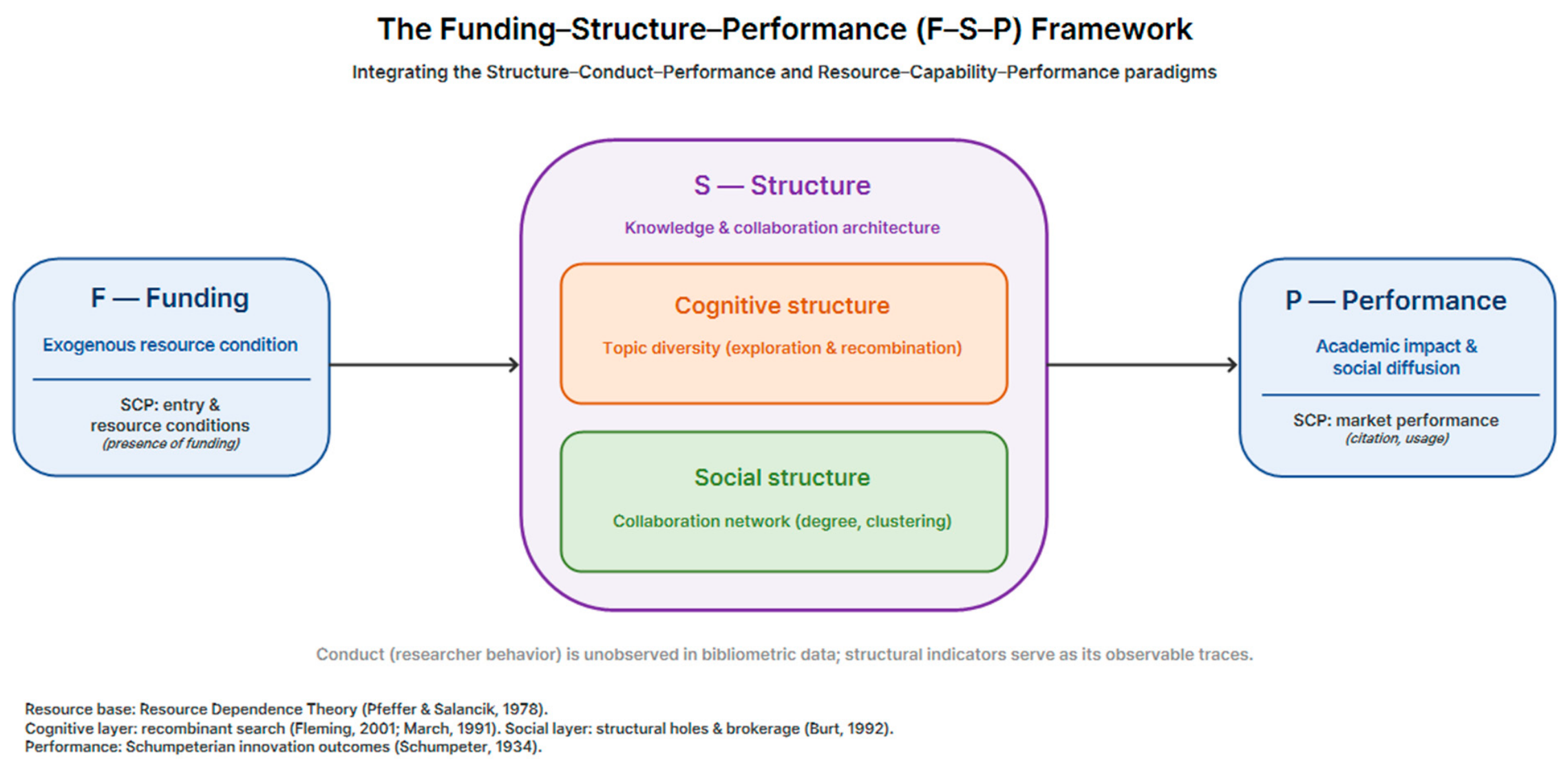
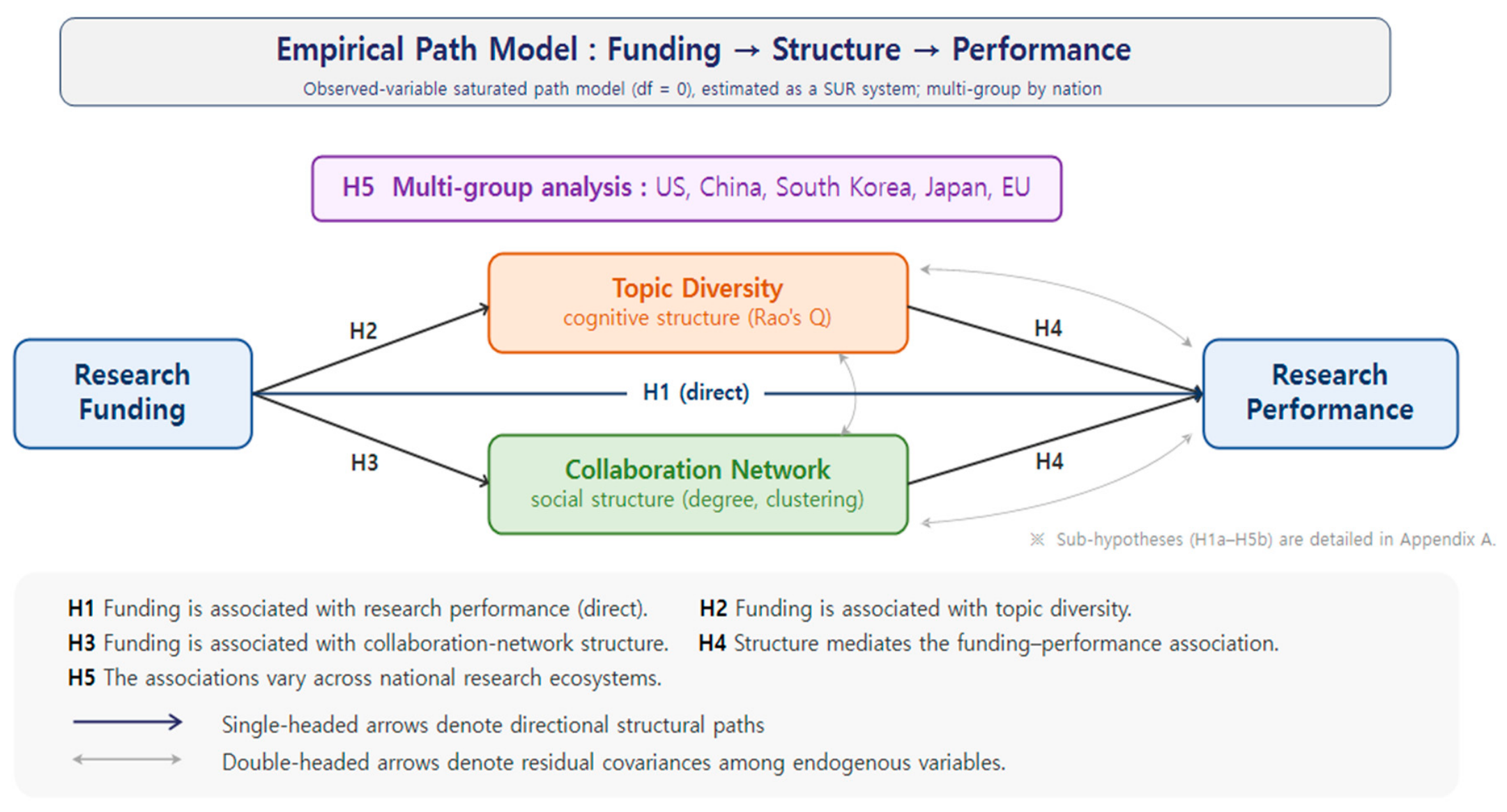
3.1. Analytical Framework and Empirical Model Specification
3.2. Operational Definition of Variables
- Independent variable: Research funding support.
- Mediating variables:
- –
- Knowledge diversity (Rao’s Quadratic Entropy, Q).
- –
- Collaboration extensibility (Average Degree).
- –
- Network constraint (Burt’s Constraint).
- –
- Network cohesion (local clustering coefficient).
- Dependent variable: Innovation performance.
- –
- Citation, SJR, H-index, Usage 180 days and since 2013.
- Grouping variable: National context.
- (1)
- Independent Variable: Research Funding (Resource Input)
- (2)
- Mediating Variables: Structural Transformation (Process)
- (3)
- Dependent Variables: Innovation Performance (Output)
- (4)
- Grouping Variable: National Context

| Research Variable | Definition (Theoretical Basis) | Measurement Method | Key References | |
|---|---|---|---|---|
| Independent Variable | Research Funding | External resource infusion acting as a buffer against failure (slack resource in resource dependence theory). | Dummy variable | [14,17,50] |
| Mediating Variables | Topic Diversity (Rao’s Q) | The degree of disparity and balance between disparate knowledge elements (Cognitive Exploration). | Q = Σi=1J Σj=1J dij·pi·pj | [51,52,57] |
| Hub Capability (Degree) | The total volume of direct connections, representing network expansion (Social Capital: Volume). | Avg. Degree = (1/n) Σj kj (kj: co-authorship degree of author j) | [56,63,64] | |
| Brokerage (Constraint) | The lack of structural holes; lower constraint implies higher brokerage potential (structural hole theory), Granovetter (Weak Tie Theory). | Cij = (pij + Σq≠ij piq·pqj)2 Constrainti = Σj Cij (Inverse measure of Brokerage) Constraint_i (aggregate) | [31,33,50] | |
| Cohesion (Clustering) | The density of local connections, representing trust and closure (Social Capital: Closure). | Ci = 2|{ejk: vj, vk ∈ Ni, ejk ∈ E}| /[ki(ki − 1)] ei: number of edges among the neighbors of node i, ki: Number of neighbors | [60] | |
| Dependent Variable | Qualitative Prestige (SJR) | The scientific prestige of the journal, weighted by the reputation of citing sources. | (Log-transformed count) | [61,62] |
| Knowledge Diffusion (Citation) | The breadth of knowledge dissemination and academic impact. | (Log-transformed count) | [59,66,67] | |
| Productivity Impact (Journal h-index) | A balanced metric of productivity and citation impact of the publishing venue. | (Log-transformed count) | [60,68] | |
| Immediate Attention (Usage 180) | Short-term social interest and demand for the full text (last 180 days). | (Log-transformed count) | [23,70,71] | |
| Cumulative Interest (Usage 2013) | Long-term data utility and social internalization of knowledge (since 2013). | (Log-transformed count) | [67,68] | |
| Grouping Variable | National Context | Heterogeneity of national innovation systems (NISs), EU member states (grouped). | Categorical (US, CN, EU, KR, JP) | [42,43,47] |
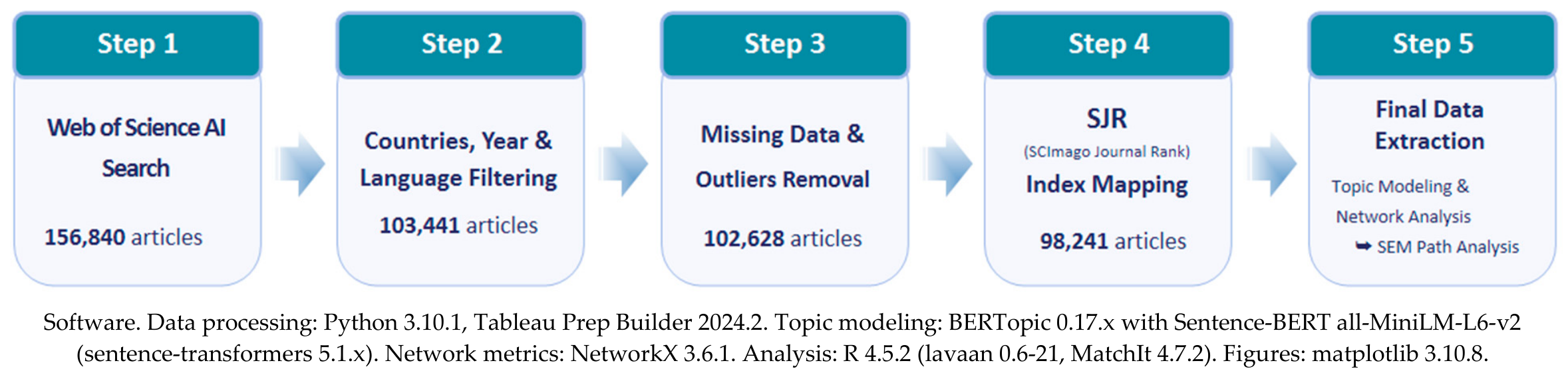
3.3. Data Collection and Preprocessing
3.4. Analytic Strategy: A Multi-Stage Methodological Framework
4. Empirical Results
4.1. Descriptive Statistics and Correlations
4.1.1. AI Research Growth and Funding Landscape
4.1.2. Distribution and Correlation
4.2. System Validation and Model Diagnostics
4.3. Structural Model Analysis: Unveiling the Black Box
4.3.1. The Direct Effects of Research Funding
4.3.2. Mediation Analysis: Indirect Effects
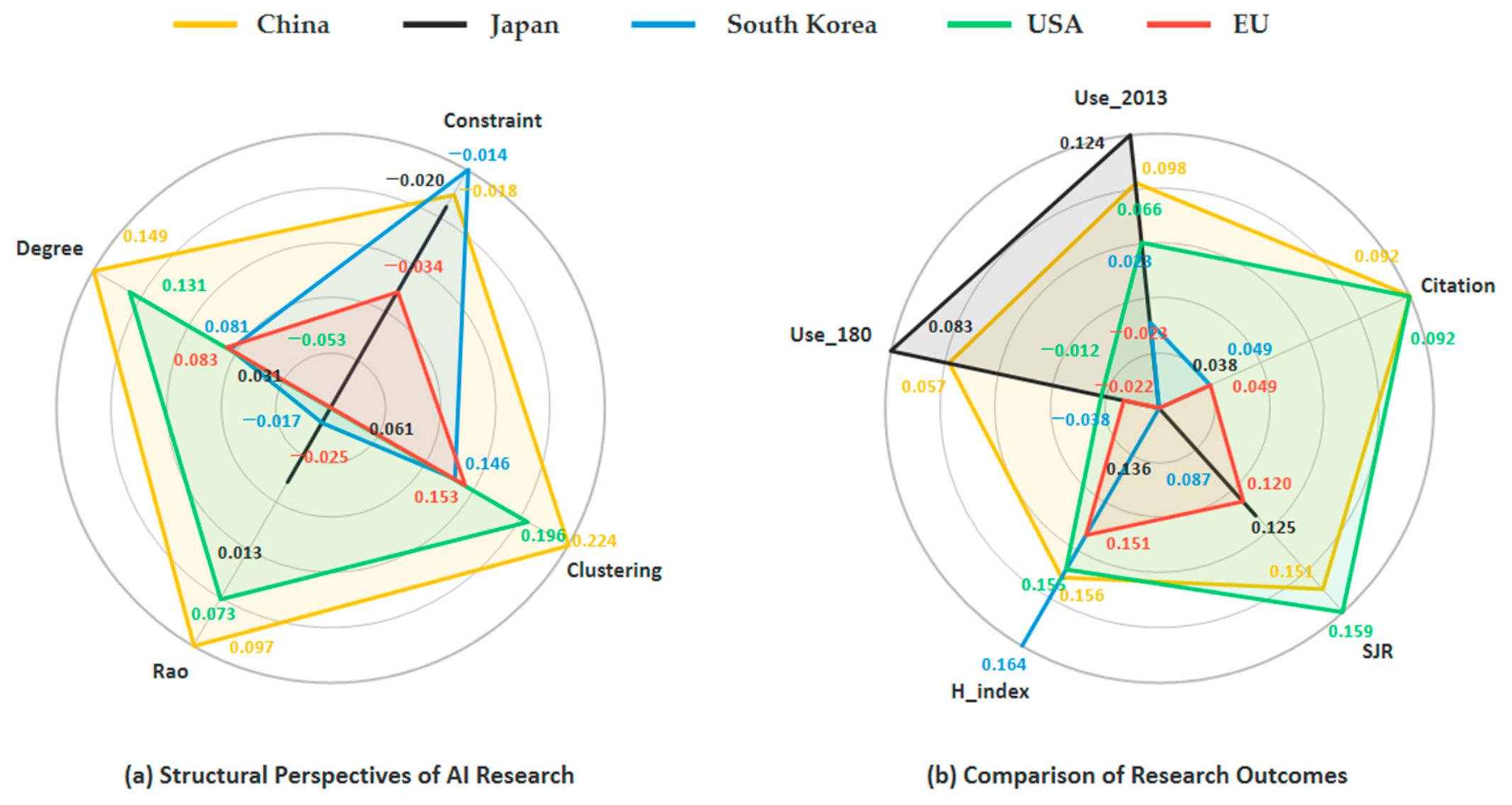
4.3.3. National Heterogeneity Analysis: Comparative Perspective on Funding Efficiency
4.4. Summary of Hypothesis Testing
5. Discussion and Implications
5.1. Discussion of Key Findings
5.2. Theoretical Contributions
5.3. Policy Implications
5.4. Limitations and Future Research
6. Conclusions
Author Contributions
Funding
Institutional Review Board Statement
Informed Consent Statement
Data Availability Statement
Conflicts of Interest
Appendix A. Summary of Full Hypothesis Testing Results
| Hypothesis | Independent Variable | Dependent Variable | Specific Path | Coeff. (β) | t-Value | Result | |
|---|---|---|---|---|---|---|---|
| H1 | H1a | Funding | Citation | Funding → Citation | 0.061 *** | 18.217 | Supported (+) |
| H1b | SJR | Funding → SJR | 0.128 *** | 39.664 | Supported (+) | ||
| H1c | h_index | Funding → h_index | 0.168 *** | 53.567 | Supported (+) | ||
| H1d | Use_180 | Funding → Use_180 | 0.047 *** | 14.933 | Supported (+) | ||
| Use_2013 | Funding → Use_2013 | 0.110 *** | 33.104 | Supported (+) | |||
| H2 | H2a | Funding | Rao | Funding → Rao | 0.031 *** | 10.445 | Supported (+) |
| H3 | H3a | Funding | Degree | Funding → Degree | 0.083 *** | 27.364 | Supported (+) |
| H3b | Constraint | Funding → Constraint | −0.019 *** | −5.528 | Supported (−) | ||
| H3c | Clustering | Funding → Clustering | 0.185 *** | 54.723 | Supported (+) | ||
| H4 | H4a | Rao | Citation | Rao → Citation | −0.055 *** | −17.612 | Significant (Negative) |
| SJR | Rao → SJR | 0.015 *** | 4.855 | Supported (+) | |||
| h_index | Rao → h_index | 0.032 *** | 10.576 | Supported (+) | |||
| Use_180 | Rao → Use_180 | −0.136 *** | −47.962 | Significant (Negative) | |||
| Use_2013 | Rao → Use_2013 | −0.121 *** | −39.539 | Significant (Negative) | |||
| H4b | Degree | Citation | Degree → Citation | 0.128 *** | 6.196 | Supported (+) | |
| SJR | Degree → SJR | 0.139 *** | 5.520 | Supported (+) | |||
| h_index | Degree → h_index | 0.083 *** | 5.583 | Supported (+) | |||
| Use_180 | Degree → Use_180 | −0.028 *** | −4.385 | Significant (Negative) | |||
| Use_2013 | Degree → Use_2013 | −0.013 * | −2.467 | Significant (Negative) | |||
| Constraint | Citation | Constraint → Citation | −0.058 *** | −6.363 | Supported (−) | ||
| SJR | Constraint → SJR | −0.068 *** | −6.274 | Supported (−) | |||
| h_index | Constraint → h_index | −0.022 ** | −3.076 | Supported (−) | |||
| Use_180 | Constraint → Use_180 | 0.086 *** | 21.078 | Rejected (Positive) | |||
| Use_2013 | Constraint → Use_2013 | 0.083 *** | 21.128 | Rejected (Positive) | |||
| Clustering | Citation | Clustering → Citation | 0.029 *** | 6.415 | Supported (+) | ||
| SJR | Clustering → SJR | 0.101 *** | 21.117 | Supported (+) | |||
| h_index | Clustering → h_index | 0.154 *** | 38.744 | Supported (+) | |||
| Use_180 | Clustering → Use_180 | −0.049 *** | −14.292 | Significant (Negative) | |||
| Use_2013 | Clustering → Use_2013 | −0.078 *** | −22.418 | Significant (Negative) | |||
| H4c | Funding | Citation (via Rao) | ind_Rao_Citation | −0.002 *** | −9.104 | Significant (Negative) | |
| SJR (via Rao) | ind_Rao_SJR | 0.000 *** | 4.355 | Supported (+) | |||
| h_index (via Rao) | ind_Rao_h_index | 0.001 *** | 7.315 | Supported (+) | |||
| Use_180 (via Rao) | ind_Rao_Use_180 | −0.004 *** | −10.323 | Significant (Negative) | |||
| Use_2013 (via Rao) | ind_Rao_Use_2013 | −0.004 *** | −10.330 | Significant (Negative) | |||
| Citation (via Degree) | ind_Degree_Citation | 0.011 *** | 6.503 | Supported (+) | |||
| SJR (via Degree) | ind_Degree_SJR | 0.011 *** | 5.756 | Supported (+) | |||
| h_index (via Degree) | ind_Degree_h_index | 0.007 *** | 5.831 | Supported (+) | |||
| Use_180 (via Degree) | ind_Degree_Use_180 | −0.002 *** | −4.550 | Significant (Negative) | |||
| Use_2013 (via Degree) | ind_Degree_Use_2013 | −0.001 * | −2.518 | Significant (Negative) | |||
| Citation (via Constraint) | ind_Constraint_Citation | 0.001 *** | 4.208 | Supported (+) | |||
| SJR (via Constraint) | ind_Constraint_SJR | 0.001 *** | 4.171 | Supported (+) | |||
| h_index (via Constraint) | ind_Constraint_h_index | 0.000 ** | 2.673 | Supported (+) | |||
| Use_180 (via Constraint) | ind_Constraint_Use_180 | −0.002 *** | −5.333 | Significant (Negative) | |||
| Use_2013 (via Constraint) | ind_Constraint_Use_2013 | −0.002 *** | −5.348 | Significant (Negative) | |||
| Citation (via Clustering) | ind_Clustering_Citation | 0.005 *** | 6.408 | Supported (+) | |||
| SJR (via Clustering) | ind_Clustering_SJR | 0.019 *** | 20.289 | Supported (+) | |||
| h_index (via Clustering) | ind_Clustering_h_index | 0.029 *** | 32.069 | Supported (+) | |||
| Use_180 (via Clustering) | ind_Clustering_Use_180 | −0.009 *** | −13.738 | Significant (Negative) | |||
| Use_2013 (via Clustering) | ind_Clustering_Use_2013 | −0.014 *** | −20.570 | Significant (Negative) | |||
| H5 | H5a | Funding | Structural Variables (Rao, Degree, Constraint, Clustering) | Funding → Structure (Multi-Group) | Network | Supported | Partially Supported |
| Rao | Rejected (Sign) | ||||||
| H5b | Research Performance (Citation, SJR, h-index, Use_180, Use_2013) | Funding → Performance (Multi-Group), MGA difference | Performance | Rejected (Sign) | Partially Supported | ||
| National Heterogeneity | Supported | ||||||
Appendix B. Supplementary Robustness Analyses
| R2 | Funding (β, Std.) | Outcome |
|---|---|---|
| 0.274 | +0.049 | Citation |
| 0.063 | +0.130 | SJR |
| 0.079 | +0.167 | Journal h-index |
| 0.117 | +0.053 | Usage (180-day) |
| 0.091 | +0.104 | Usage (since 2013) |
| Approx. % Change | ATT (Δ ln) | Outcome |
|---|---|---|
| +14.7% | +0.137 | Citation |
| +11.5% | +0.109 | SJR |
| +26.0% | +0.231 | Journal h-index |
| +6.5% | +0.063 | Usage (180-day) |
| +19.6% | +0.179 | Usage (since 2013) |
| Rao | Clustering | Degree | h-Index | SJR | N | Country |
|---|---|---|---|---|---|---|
| −0.044 | +0.135 | +0.107 | +0.132 | +0.108 | 4889 | Germany |
| +0.051 | +0.159 | +0.115 | +0.191 | +0.155 | 2611 | France |
| −0.072 | +0.113 | +0.042 | +0.113 | +0.124 | 4610 | Italy |
| −0.064 | +0.145 | +0.144 | +0.255 | +0.176 | 3989 | Spain |
| +0.041 | +0.166 | +0.120 | +0.078 | +0.090 | 1635 | The Netherlands |
| Δ | Excl. SJR & h-Index (β) | Full Model (β) | Outcome |
|---|---|---|---|
| <1 × 10⁻⁹ | +0.06058 | +0.06058 | Citation |
| <1 × 10⁻¹¹ | +0.04720 | +0.04720 | Usage (180-day) |
| <1 × 10⁻⁹ | +0.10966 | +0.10966 | Usage (since 2013) |
| Share | Documents | Top Keywords | Representative Theme | Topic |
|---|---|---|---|---|
| 21.5% | 21,153 | patients, clinical, images, patient | Clinical imaging & diagnosis | T0 |
| 9.3% | 9181 | prediction, energy, power, forecasting | Energy demand & forecasting | T1 |
| 6.3% | 6215 | human, language, users, knowledge | NLP & human–computer interaction | T3 |
| 6.3% | 6161 | detection, image, network, deep | Object detection & deep vision | T2 |
| 5.2% | 5136 | technology, innovation, digital, business | Technology innovation & digital business | T5 |
| 3.7% | 3613 | traffic, vehicles, vehicle, game | Autonomous vehicles & traffic | T6 |
| 3.6% | 3540 | edge, iot, computing, network | Edge computing & IoT | T8 |
| 3.6% | 3493 | students, education, teaching, teachers | AI in education | T4 |
| 2.8% | 2724 | ethical, legal, moral, ethics | AI ethics, law & morality | T12 |
| 2.4% | 2347 | patients, cancer, breast, therapy | Oncology & cancer therapy | T9 |
| 2.3% | 2213 | protein, cell, drug, cells | Bioinformatics & drug discovery | T14 |
| 2.2% | 2203 | covid, 19, virus, pandemic | COVID-19 & epidemiology | T7 |
| 2.1% | 2070 | media, how, news, social | Social media & news | T24 |
| 2.0% | 1934 | speech, eeg, recognition, emotion | Speech, EEG & emotion recognition | T10 |
| 1.9% | 1871 | urban, land, climate, spatial | Urban, land & climate analytics | T17 |
| 1.8% | 1782 | cows, pregnancy, sperm, semen | Animal reproduction science | T11 |
| 1.7% | 1690 | hdl, cholesterol, levels, group | Lipid & metabolic health | T19 |
| 1.7% | 1634 | quantum, neuromorphic, computing, synaptic | Quantum & neuromorphic computing | T13 |
| 1.6% | 1545 | health, among, american, indian | Public & indigenous health | T15 |
| 1.5% | 1465 | chemical, molecular, reaction, adsorption | Chemical & molecular modeling | T20 |
| Corr with K = 50 | p | t | Difference | Rao (Unfunded) | Rao (Funded) | nr_Topics (K) |
|---|---|---|---|---|---|---|
| 0.966 | <0.001 | −3.41 | −0.0002 | 0.6657 | 0.6655 | 30 |
| 1.000 | <0.001 | 11.55 | +0.0005 | 0.6739 | 0.6744 | 50 |
| 0.993 | <0.001 | 12.10 | +0.0005 | 0.6858 | 0.6863 | 70 |
| Path | EU–CN | EU–US | EU–KR | EU–JP | CN–US | CN–KR | CN–JP | US–KR | US–JP | KR–JP |
|---|---|---|---|---|---|---|---|---|---|---|
| Funding → Rao’s Q | 17.23 *** | 12.16 *** | 0.30 | 2.09 * | 5.73 *** | 9.11 *** | 5.63 *** | 5.93 *** | 2.97 ** | 1.51 |
| Funding → Degree | 0.32 | 4.01 *** | 4.13 *** | 6.13 *** | 4.95 *** | 4.33 *** | 6.35 *** | 7.14 *** | 8.57 *** | 2.49 * |
| Funding → Constraint | 1.35 | 2.21 * | 1.03 | 0.76 | 3.13 ** | 0.26 | 0.06 | 2.10 * | 1.76 | 0.15 |
| Funding → Clustering | 10.83 *** | 5.38 *** | 1.20 | 5.74 *** | 5.74 *** | 4.61 *** | 11.38 *** | 1.38 | 8.27 *** | 5.07 *** |
| Funding → Citation | 6.93 *** | 5.38 *** | 0.53 | 0.63 | 1.86 | 3.14 ** | 4.23 *** | 2.15 * | 3.27 ** | 0.87 |
| Funding → SJR | 7.95 *** | 6.48 *** | 1.24 | 0.85 | 1.04 | 5.59 *** | 5.10 *** | 4.87 *** | 4.41 *** | 0.27 |
| Funding → h-index | 1.37 | 0.25 | 2.17 * | 1.32 | 1.51 | 1.47 | 1.94 | 2.26 * | 1.18 | 2.60 ** |
| Funding → Usage (180-day) | 10.24 *** | 1.12 | 1.39 | 6.54 *** | 8.57 *** | 6.45 *** | 0.59 | 1.88 | 5.62 *** | 5.34 *** |
| Funding → Usage (total) | 9.99 *** | 5.32 *** | 0.23 | 5.83 *** | 4.17 *** | 4.63 *** | 0.52 | 2.38 * | 2.89 ** | 4.04 *** |
References
- Cockburn, I.M.; Henderson, R.; Stern, S. The Impact of Artificial Intelligence on Innovation; NBER Working Paper No. 24449; National Bureau of Economic Research: Cambridge, MA, USA, 2018. [Google Scholar] [CrossRef]
- Agrawal, A.; Gans, J.; Goldfarb, A. Prediction Machines: The Simple Economics of Artificial Intelligence; Harvard Business Review Press: Boston, MA, USA, 2018. [Google Scholar]
- Fatima, S.; Desouza, K.C.; Dawson, G.S. National Strategic Artificial Intelligence Plans: A Multi-Dimensional Analysis. Econ. Anal. Policy 2020, 67, 178–194. [Google Scholar] [CrossRef]
- Lee, K. AI Superpowers: China, Silicon Valley, and the New World Order; Houghton Mifflin Harcourt: Boston, MA, USA, 2018. [Google Scholar]
- Ulnicane, I.; Knight, W.; Leach, T.; Stahl, B.C.; Wanjiku, W.G. Framing governance for a contested emerging technology: Insights from AI policy. Policy Soc. 2021, 40, 158–177. [Google Scholar] [CrossRef]
- Haefner, N.; Wincent, J.; Parida, V.; Gassmann, O. Artificial Intelligence and Innovation Management: A Review, Framework, and Research Agenda. Technol. Forecast. Soc. Change 2021, 162, 120392. [Google Scholar] [CrossRef]
- Roberts, H.; Cowls, J.; Morley, J.; Taddeo, M.; Wang, V.; Floridi, L. The Chinese approach to artificial intelligence: An analysis of policy, ethics, and regulation. AI Soc. 2021, 36, 59–77. [Google Scholar] [CrossRef]
- Bornmann, L. What is societal impact of research and how can it be assessed? A literature survey. J. Am. Soc. Inf. Sci. Technol. 2013, 64, 217–233. [Google Scholar] [CrossRef]
- Babina, T.; Fedyk, A.; He, A.; Hodson, J. Artificial intelligence, firm growth, and product innovation. J. Financ. Econ. 2024, 151, 103745. [Google Scholar] [CrossRef]
- Mazzucato, M. The Entrepreneurial State: Debunking Public vs. Private Sector Myths; Anthem Press: London, UK, 2013. [Google Scholar]
- Aghion, P.; Dewatripont, M.; Hoxby, C.; Mas-Colell, A.; Sapir, A. The governance and performance of universities: Evidence from Europe and the US. Econ. Policy 2010, 25, 7–59. [Google Scholar] [CrossRef]
- Fortin, J.-M.; Currie, D.J. Big science vs. little science: How scientific impact scales with funding. PLoS ONE 2013, 8, e65263. [Google Scholar] [CrossRef] [PubMed]
- Bozeman, B.; Corley, E. Scientists’ collaboration strategies: Implications for scientific and technical human capital. Res. Policy 2004, 33, 599–616. [Google Scholar] [CrossRef]
- Pfeffer, J.; Salancik, G.R. The External Control of Organizations: A Resource Dependence Perspective; Harper & Row: New York, NY, USA, 1978. [Google Scholar]
- Cyert, R.M.; March, J.G. A Behavioral Theory of the Firm; Prentice-Hall: Upper Saddle River, NJ, USA, 1963. [Google Scholar]
- Merton, R.K. The Matthew effect in science. Science 1968, 159, 56–63. [Google Scholar] [CrossRef]
- Jacob, B.A.; Lefgren, L. The impact of research grant funding on scientific productivity. J. Public Econ. 2011, 95, 1168–1177. [Google Scholar] [CrossRef] [PubMed]
- Payne, A.A. The Effects of Congressional Appropriation Committee Membership on the Distribution of Federal Research Funding to Universities. Econ. Inq. 2003, 41, 325–345. [Google Scholar] [CrossRef]
- Bol, T.; de Vaan, M.; van de Rijt, A. The Matthew Effect in Science Funding. Proc. Natl. Acad. Sci. USA 2018, 115, 4887–4890. [Google Scholar] [CrossRef] [PubMed]
- Wang, X.; Liu, C.; Mao, W.; Fang, Z. The Open Access Advantage Considering Citation, Article Usage and Social Media Attention. Scientometrics 2015, 103, 555–564. [Google Scholar] [CrossRef]
- Nelson, R.R. The simple economics of basic scientific research. J. Political Econ. 1959, 67, 297–306. [Google Scholar] [CrossRef] [PubMed]
- Piwowar, H.; Priem, J.; Larivière, V.; Alperin, J.P.; Matthias, L.; Norlander, B.; Farley, A.; West, J.; Haustein, S. The state of OA: A large-scale analysis of the prevalence and impact of open access articles. PeerJ 2018, 6, e4375. [Google Scholar] [CrossRef] [PubMed]
- Tennant, J.P.; Waldner, F.; Jacques, D.C.; Masuzzo, P.; Collister, L.B.; Hartgerink, C.H.J. The academic, economic and societal impacts of open access: An evidence-based review. F1000Research 2016, 5, 632. [Google Scholar] [CrossRef] [PubMed]
- Eysenbach, G. Citation advantage of open access articles. PLoS Biol. 2006, 4, e157. [Google Scholar] [CrossRef] [PubMed]
- Schumpeter, J.A. The Theory of Economic Development: An Inquiry into Profits, Capital, Credit, Interest, and the Business Cycle; Harvard University Press: Cambridge, MA, USA, 1934. [Google Scholar]
- Brody, T.; Harnad, S.; Carr, L. Earlier web usage statistics as predictors of later citation impact. J. Am. Soc. Inf. Sci. Technol. 2006, 57, 1060–1072. [Google Scholar] [CrossRef]
- Fleming, L. Recombinant uncertainty in technological search. Manag. Sci. 2001, 47, 117–132. [Google Scholar] [CrossRef]
- Uzzi, B.; Mukherjee, S.; Stringer, M.; Jones, B. Atypical combinations and scientific impact. Science 2013, 342, 468–472. [Google Scholar] [CrossRef] [PubMed]
- March, J.G. Exploration and exploitation in organizational learning. Organ. Sci. 1991, 2, 71–87. [Google Scholar] [CrossRef]
- Nohria, N.; Gulati, R. Is slack good or bad for innovation? Acad. Manag. J. 1996, 39, 1245–1264. [Google Scholar] [CrossRef] [PubMed]
- Jones, B.F. The burden of knowledge and the ‘death of the renaissance man’: Is innovation getting harder? Rev. Econ. Stud. 2009, 76, 283–317. [Google Scholar] [CrossRef]
- Burt, R.S. Structural Holes: The Social Structure of Competition; Harvard University Press: Cambridge, MA, USA, 1992. [Google Scholar]
- Coleman, J.S. Social capital in the creation of human capital. Am. J. Sociol. 1988, 94, S95–S120. [Google Scholar] [CrossRef] [PubMed]
- Granovetter, M.S. The strength of weak ties. Am. J. Sociol. 1973, 78, 1360–1380. [Google Scholar] [CrossRef]
- Uzzi, B. Social structure and competition in interfirm networks: The paradox of embeddedness. Adm. Sci. Q. 1997, 42, 35–67. [Google Scholar] [CrossRef]
- Guan, J.; Liu, N. Exploitative and Exploratory Innovations in Knowledge Network and Collaboration Network: A Patent Analysis in the Technological Field of Nano-Energy. Res. Policy 2016, 45, 97–112. [Google Scholar] [CrossRef]
- Defazio, D.; Lockett, A.; Wright, M. Funding incentives, collaborative dynamics and scientific productivity: Evidence from the EU framework programme. Res. Policy 2009, 38, 293–305. [Google Scholar] [CrossRef]
- Evans, T.S.; Lambiotte, R.; Panzarasa, P. Community structure and patterns of scientific collaboration in business and management. Scientometrics 2011, 89, 381–396. [Google Scholar] [CrossRef]
- Manso, G. Motivating innovation. J. Financ. 2011, 66, 1823–1860. [Google Scholar] [CrossRef]
- Azoulay, P.; Graff Zivin, J.S.; Manso, G. Incentives and creativity: Evidence from the academic life sciences. RAND J. Econ. 2011, 42, 527–554. [Google Scholar] [CrossRef]
- Heinze, T.; Shapira, P.; Rogers, J.D.; Senker, J.M. Organizational and institutional influences on creativity in scientific research. Res. Policy 2009, 38, 610–623. [Google Scholar] [CrossRef]
- Freeman, C. Technology Policy and Economic Performance: Lessons from Japan; Pinter Publishers: London, UK, 1987. [Google Scholar]
- Lundvall, B.-Å. (Ed.) National Systems of Innovation: Towards a Theory of Innovation and Interactive Learning; Pinter Publishers: London, UK, 1992. [Google Scholar]
- Ding, H. What Kinds of Countries Have Better Innovation Performance? A Country-Level fsQCA and NCA Study. J. Innov. Knowl. 2022, 7, 100215. [Google Scholar] [CrossRef]
- DiMaggio, P.J.; Powell, W.W. The iron cage revisited: Institutional isomorphism and collective rationality in organizational fields. Am. Sociol. Rev. 1983, 48, 147–160. [Google Scholar] [CrossRef]
- Katz, J.S.; Martin, B.R. What is research collaboration? Res. Policy 1997, 26, 1–18. [Google Scholar] [CrossRef]
- Nelson, R.R. (Ed.) National Innovation Systems: A Comparative Analysis; Oxford University Press: New York, NY, USA, 1993. [Google Scholar]
- Auranen, O.; Nieminen, M. University Research Funding and Publication Performance—An International Comparison. Res. Policy 2010, 39, 822–834. [Google Scholar] [CrossRef]
- European Commission. Proposal for a Regulation of the European Parliament and of the Council Laying Down Harmonised Rules on Artificial Intelligence (Artificial Intelligence Act); COM(2021) 206 Final; European Commission: Brussels, Belgium, 2021. [Google Scholar]
- Payne, A.A.; Siow, A. Does Federal Research Funding Increase University Research Output? Adv. Econ. Anal. Policy 2003, 3, 1018. [Google Scholar] [CrossRef]
- Porter, A.L.; Rafols, I. Is science becoming more interdisciplinary? Measuring and mapping six research fields over time. Scientometrics 2009, 81, 719–745. [Google Scholar] [CrossRef]
- Rafols, I.; Leydesdorff, L.; O’Hare, A.; Nightingale, P.; Stirling, A. How journal rankings can suppress interdisciplinary research: A comparison between innovation studies and business & management. Res. Policy 2012, 41, 1262–1282. [Google Scholar] [CrossRef]
- Burt, R.S. Structural holes and good ideas. Am. J. Sociol. 2004, 110, 349–399. [Google Scholar] [CrossRef] [PubMed]
- Nelson, R.R.; Winter, S.G. An Evolutionary Theory of Economic Change; Harvard University Press: Cambridge, MA, USA, 1982. [Google Scholar]
- Zellner, A. An efficient method of estimating seemingly unrelated regressions and tests for aggregation bias. J. Am. Stat. Assoc. 1962, 57, 348–368. [Google Scholar] [CrossRef]
- Greene, W.H. Econometric Analysis, 7th ed.; Prentice Hall: Upper Saddle River, NJ, USA, 2012. [Google Scholar]
- Stirling, A. A general framework for analysing diversity in science, technology and society. J. R. Soc. Interface 2007, 4, 707–719. [Google Scholar] [CrossRef] [PubMed]
- Rao, C.R. Diversity and dissimilarity coefficients: A unified approach. Theor. Popul. Biol. 1982, 21, 24–43. [Google Scholar] [CrossRef]
- Freeman, L.C. Centrality in social networks conceptual clarification. Soc. Netw. 1979, 1, 215–239. [Google Scholar] [CrossRef]
- Watts, D.J.; Strogatz, S.H. Collective dynamics of ‘small-world’ networks. Nature 1998, 393, 440–442. [Google Scholar] [CrossRef] [PubMed]
- González-Pereira, B.; Guerrero-Bote, V.P.; Moya-Anegón, F. A new approach to the metric of journals’ scientific prestige: The SJR indicator. J. Informetr. 2010, 4, 379–391. [Google Scholar] [CrossRef]
- Guerrero-Bote, V.P.; Moya-Anegón, F. A further step forward in measuring journals’ scientific prestige: The SJR2 indicator. J. Informetr. 2012, 6, 674–688. [Google Scholar] [CrossRef]
- Garfield, E. Citation analysis as a tool in journal evaluation. Science 1972, 178, 471–479. [Google Scholar] [CrossRef] [PubMed]
- Moed, H.F. Citation Analysis in Research Evaluation; Springer: Berlin/Heidelberg, Germany, 2005. [Google Scholar] [CrossRef]
- Hirsch, J.E. An index to quantify an individual’s scientific research output. Proc. Natl. Acad. Sci. USA 2005, 102, 16569–16572. [Google Scholar] [CrossRef] [PubMed]
- Braun, T.; Glänzel, W.; Schubert, A. A Hirsch-type index for journals. Scientometrics 2006, 69, 169–173. [Google Scholar] [CrossRef]
- Kurtz, M.J.; Bollen, J. Usage bibliometrics. Annu. Rev. Inf. Sci. Technol. 2010, 44, 1–64. [Google Scholar] [CrossRef]
- Chi, P.-S.; Glänzel, W. Comparison of Citation and Usage Indicators in Research Assessment in Scientific Disciplines and Journals. Scientometrics 2018, 116, 457–471. [Google Scholar] [CrossRef]
- Paternoster, R.; Brame, R.; Mazerolle, P.; Piquero, A. Using the correct statistical test for the equality of regression coefficients. Criminology 1998, 36, 859–866. [Google Scholar] [CrossRef]
- Reimers, N.; Gurevych, I. Sentence-BERT: Sentence embeddings using Siamese BERT-networks. In Proceedings of the 2019 Conference on Empirical Methods in Natural Language Processing, Hong Kong, China, 3–7 November 2019; pp. 3982–3992. [Google Scholar] [CrossRef]
- Grootendorst, M. BERTopic: Neural topic modeling with a class-based TF-IDF procedure. arXiv 2022, arXiv:2203.05794. [Google Scholar] [CrossRef]
- Rafols, I.; Meyer, M. Diversity and network coherence as indicators of interdisciplinarity: Case studies in bionanoscience. Scientometrics 2010, 82, 263–287. [Google Scholar] [CrossRef]
- Iacobucci, D. Structural Equation Modeling: Fit Indices, Sample Size, and Advanced Topics. J. Consum. Psychol. 2010, 20, 90–98. [Google Scholar] [CrossRef]
- Barrett, P. Structural Equation Modelling: Adjudging Model Fit. Pers. Individ. Differ. 2007, 42, 815–824. [Google Scholar] [CrossRef]
- Bollen, K.A. Structural Equations with Latent Variables; Wiley: New York, NY, USA, 1989. [Google Scholar]
- Wooldridge, J.M. Econometric Analysis of Cross Section and Panel Data, 2nd ed.; MIT Press: Cambridge, MA, USA, 2010. [Google Scholar]
- Preacher, K.J.; Hayes, A.F. Asymptotic and resampling strategies for assessing and comparing indirect effects in multiple mediator models. Behav. Res. Methods 2008, 40, 879–891. [Google Scholar] [CrossRef] [PubMed]
- Wasserman, S.; Faust, K. Social Network Analysis: Methods and Applications; Cambridge University Press: Cambridge, MA, USA, 1994. [Google Scholar] [CrossRef]
- Barabási, A.-L.; Albert, R. Emergence of scaling in random networks. Science 1999, 286, 509–512. [Google Scholar] [CrossRef] [PubMed]
- de Solla Price, D.J. Networks of scientific papers. Science 1965, 149, 510–515. [Google Scholar] [CrossRef] [PubMed]


| Year | Total Publications (N) | No. of Authors | Funded Research (Nf) | Non-Funded (Nnf) | Funding Ratio (%, Nf/N) | Annual Growth Rate (Funded, %) |
|---|---|---|---|---|---|---|
| 2011 | 1130 | 5594 | 691 | 439 | 61.15 | - |
| 2012 | 1200 | 6316 | 776 | 424 | 64.67 | 12.30 |
| 2013 | 1276 | 6626 | 835 | 441 | 65.44 | 7.60 |
| 2014 | 1361 | 7043 | 900 | 461 | 66.13 | 7.78 |
| 2015 | 1409 | 8554 | 994 | 415 | 70.55 | 10.44 |
| 2016 | 1544 | 8330 | 1052 | 492 | 68.13 | 5.84 |
| 2017 | 1888 | 9412 | 1329 | 559 | 70.39 | 26.33 |
| 2018 | 2408 | 12,519 | 1724 | 684 | 71.59 | 29.72 |
| 2019 | 3805 | 22,434 | 2675 | 1130 | 70.30 | 55.16 |
| 2020 | 6797 | 35,873 | 4464 | 2333 | 65.68 | 66.88 |
| 2021 | 10,327 | 57,090 | 6858 | 3469 | 66.41 | 53.63 |
| 2022 | 14,446 | 79,152 | 9292 | 5154 | 64.32 | 35.49 |
| 2023 | 17,612 | 100,686 | 11,353 | 6259 | 64.46 | 22.18 |
| 2024 | 33,038 | 190,810 | 21,391 | 11,647 | 64.75 | 88.42 |
| Total | 98,241 | - | 64,334 | 33,907 | 65.49 | - |
| Research Funding Agencies | Nation | Count |
|---|---|---|
| National Natural Science Foundation of China (NSFC) | China | 16,149 |
| National Institutes of Health (NIH) | USA | 7547 |
| European Union (EU) | EU | 5673 |
| National Science Foundation (NSF) | USA | 4476 |
| National Key R&D Program of China | China | 3458 |
| National Research Foundation of Korea (NRF) | Republic of Korea | 3207 |
| Japan Society for the Promotion of Science (JSPS) | Japan | 2275 |
| Fundamental Research Funds for the Central Universities | China | 1927 |
| China Postdoctoral Science Foundation | China | 890 |
| EPSRC (UK Research & Innovation-Engineering & Physical Sciences Research Council) | EU | 733 |
| Variable | N | Mean | Standard Deviation | Minimum Value | Maximum Value | Skewness | Kurtosis | VIF |
|---|---|---|---|---|---|---|---|---|
| Funding | 98,241 | 0.6549 | 0.4754 | 0.0000 | 1.0000 | −0.6515 | −1.5756 | 1.042 |
| Citation | 98,241 | 2.2389 | 1.3075 | 0.0000 | 9.5324 | 0.2557 | −0.1787 | |
| SJR | 98,241 | 0.7339 | 0.3930 | 0.0953 | 4.4908 | 1.4890 | 3.7470 | |
| h_index | 98,241 | 4.6479 | 0.8404 | 0.0000 | 7.2745 | −0.8553 | 2.3987 | |
| Use_180 | 98,241 | 1.0345 | 1.0354 | 0.0000 | 6.7878 | 1.0067 | 0.8106 | |
| Use_2013 | 98,241 | 2.8118 | 1.2750 | 0.0000 | 8.7175 | 0.1416 | 0.0597 | |
| Rao | 98,241 | 0.6668 | 0.0060 | 0.6511 | 0.6899 | 0.4711 | −0.3208 | 1.004 |
| Degree | 98,241 | 8.4298 | 12.6884 | 0.0000 | 1311.4443 | 26.7323 | 2161.7662 | 1.236 |
| Constraint | 98,241 | 0.5451 | 0.3206 | 0.0000 | 2.1667 | 0.1984 | −0.8963 | 1.266 |
| Clustering | 98,241 | 0.7021 | 0.3451 | 0.0000 | 1.0000 | −1.1486 | −0.0941 | 1.105 |
| Funding | Citation | SJR | h_Index | Use_180 | Use_2013 | Rao | Degree | Constraint | Clustering | |
|---|---|---|---|---|---|---|---|---|---|---|
| Funding | 1 | 0.08 *** | 0.16 *** | 0.21 *** | 0.03 *** | 0.09 *** | 0.03 *** | 0.08 *** | −0.02 *** | 0.18 *** |
| Citation | 0.08 *** | 1 | 0.39 *** | 0.29 *** | 0.27 *** | 0.58 *** | −0.06 *** | 0.16 *** | −0.11 *** | 0.04 *** |
| SJR | 0.16 *** | 0.39 *** | 1 | 0.54 *** | 0.24 *** | 0.25 *** | 0.02 *** | 0.18 *** | −0.11 *** | 0.12 *** |
| h_index | 0.21 *** | 0.29 *** | 0.54 *** | 1 | 0.11 *** | 0.21 *** | 0.04 *** | 0.12 *** | −0.03 *** | 0.19 *** |
| Use_180 | 0.03 *** | 0.27 *** | 0.24 *** | 0.11 *** | 1 | 0.70 *** | −0.13 *** | −0.06 *** | 0.09 *** | −0.03 *** |
| Use_2013 | 0.09 *** | 0.58 *** | 0.25 *** | 0.21 *** | 0.70 *** | 1 | −0.12 *** | −0.04 *** | 0.07 *** | −0.05 *** |
| Rao | 0.03 *** | −0.06 *** | 0.02 *** | 0.04 *** | −0.13 *** | −0.12 *** | 1 | −0.04 *** | 0.02 *** | 0.04 *** |
| Degree | 0.08 *** | 0.16 *** | 0.18 *** | 0.12 *** | −0.06 *** | −0.04 *** | −0.04 *** | 1 | −0.40 *** | 0.08 *** |
| Constraint | −0.02 *** | −0.11 *** | −0.11 *** | −0.03 *** | 0.09 *** | 0.07 *** | 0.02 *** | −0.40 *** | 1 | 0.18 *** |
| Clustering | 0.18 *** | 0.04 *** | 0.12 *** | 0.19 *** | −0.03 *** | −0.05 *** | 0.04 *** | 0.08 *** | 0.18 *** | 1 |
| Diagnostic Component | Statistic | Interpretation |
|---|---|---|
| Model structure | Saturated (df = 0), just-identified | Path coefficients estimated without over-identification constraints |
| Equation-level R2 | Rao = 0.001; Degree = 0.007; Constraint = 0.000; Clustering = 0.034; Citation = 0.036; SJR = 0.066; h_index = 0.076; Use_180 = 0.030; Use_2013 = 0.034 | Explained variance per structural equation |
| All path significance | All primary paths p < 0.001 (bootstrap Z-tests) | Simultaneous estimation validity confirmed at path level |
| Residual correlation index | 0.000 | Cross-equation error dependence controlled |
| Robust standard errors | Bootstrap (1000 resamples) | Robust against heteroskedasticity and non-normality |
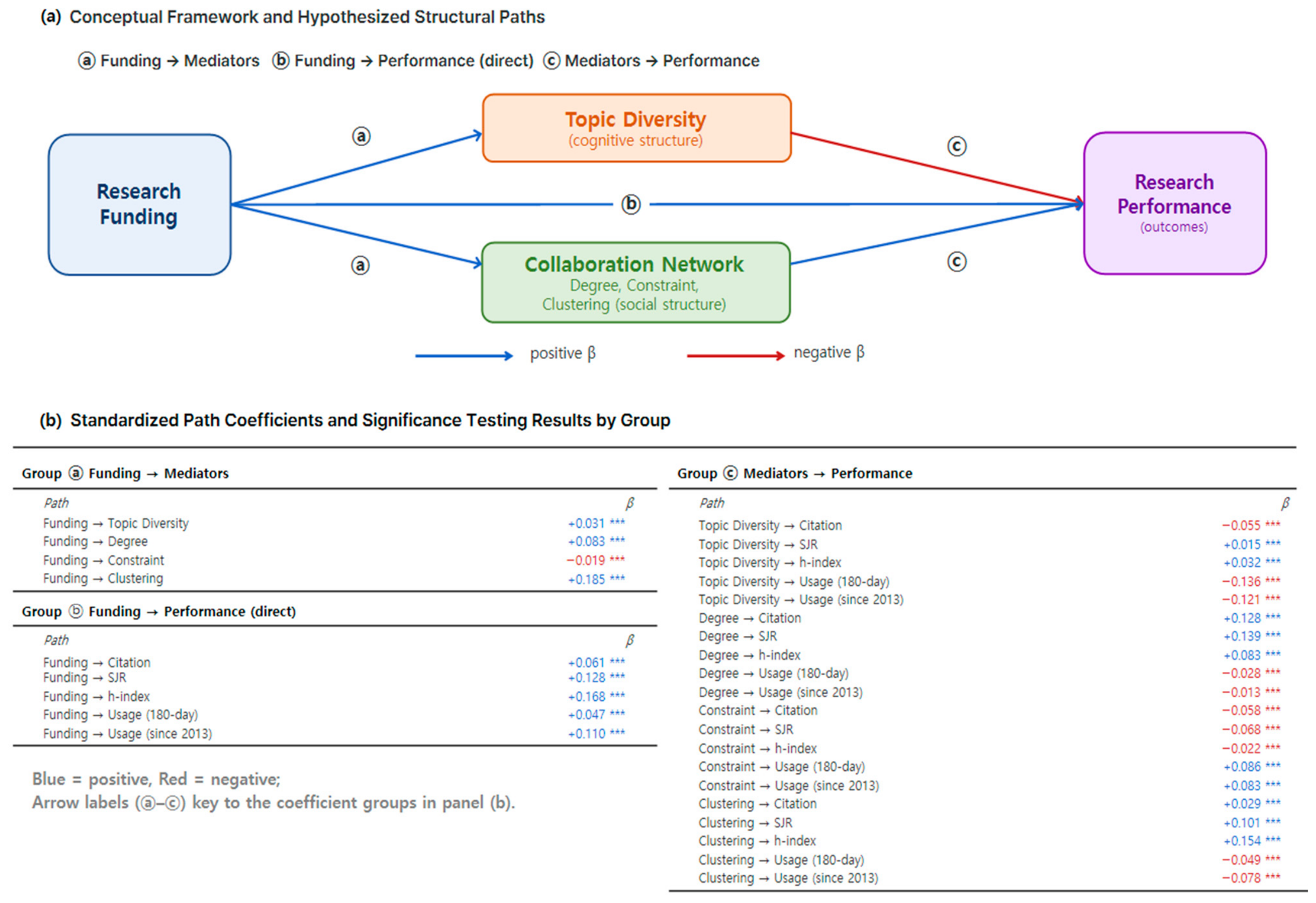
| Hypothesis | Path | Std_Beta | SE | Z | Lower_CI | Upper_CI | Result |
|---|---|---|---|---|---|---|---|
| (H1a) | Funding → Citation | 0.061 *** | 0.003 | 18.217 | 0.0541 | 0.0671 | Supported (+) |
| (H1b) | Funding → SJR | 0.128 *** | 0.003 | 39.664 | 0.1219 | 0.1346 | Supported (+) |
| (H1c) | Funding → h_index | 0.168 *** | 0.003 | 53.567 | 0.1621 | 0.1744 | Supported (+) |
| (H1d-1) | Funding → Use_180 | 0.047 *** | 0.003 | 14.933 | 0.0410 | 0.0534 | Supported (+) |
| (H1d-2) | Funding → Use_2013 | 0.110 *** | 0.003 | 33.104 | 0.1032 | 0.1162 | Supported (+) |
| (H2a) | Funding → Rao | 0.031 *** | 0.003 | 10.445 | 0.0254 | 0.0371 | Supported (+) |
| (H3a) | Funding → Degree | 0.083 *** | 0.003 | 27.364 | 0.0767 | 0.0885 | Supported (+) |
| (H3b) | Funding → Constraint | −0.019 *** | 0.003 | −5.528 | −0.0253 | −0.0120 | Supported (−) |
| (H3c) | Funding → Clustering | 0.185 *** | 0.003 | 54.723 | 0.1782 | 0.1914 | Supported (+) |
| (H4a) | Rao → Citation | −0.055 *** | 0.003 | −17.612 | −0.0610 | −0.0488 | Significant (Negative) |
| (H4a) | Rao → h_index | 0.032 *** | 0.003 | 10.576 | 0.0261 | 0.0380 | Supported (+) |
| (H4a) | Rao → SJR | 0.015 *** | 0.003 | 4.855 | 0.0089 | 0.0209 | Supported (+) |
| (H4a) | Rao → Use_180 | −0.136 *** | 0.003 | −47.962 | −0.1414 | −0.1303 | Significant (Negative) |
| (H4a) | Rao → Use_2013 | −0.121 *** | 0.003 | −39.539 | −0.1273 | −0.1153 | Significant (Negative) |
| (H4b) | Clustering → Citation | 0.029 *** | 0.005 | 6.415 | 0.0202 | 0.0380 | Supported (+) |
| (H4b) | Clustering → h_index | 0.154 *** | 0.004 | 38.744 | 0.1465 | 0.1621 | Supported (+) |
| (H4b) | Clustering → SJR | 0.101 *** | 0.005 | 21.117 | 0.0914 | 0.1101 | Supported (+) |
| (H4b) | Clustering → Use_180 | −0.049 *** | 0.003 | −14.292 | −0.0555 | −0.0421 | Significant (Negative) |
| (H4b) | Clustering → Use_2013 | −0.078 *** | 0.003 | −22.418 | −0.0845 | −0.0709 | Significant (Negative) |
| (H4b) | Constraint → Citation | −0.058 *** | 0.009 | −6.363 | −0.0763 | −0.0404 | Supported (−) |
| (H4b) | Constraint → h_index | −0.022 ** | 0.007 | −3.076 | −0.0366 | −0.0081 | Supported (−) |
| (H4b) | Constraint → SJR | −0.068 *** | 0.011 | −6.274 | −0.0888 | −0.0465 | Supported (−) |
| (H4b) | Constraint → Use_180 | 0.086 *** | 0.004 | 21.078 | 0.0779 | 0.0939 | Rejected (Positive) |
| (H4b) | Constraint → Use_2013 | 0.083 *** | 0.004 | 21.128 | 0.0753 | 0.0908 | Rejected (Positive) |
| (H4b) | Degree → Citation | 0.128 *** | 0.021 | 6.196 | 0.0877 | 0.1689 | Supported (+) |
| (H4b) | Degree → h_index | 0.083 *** | 0.015 | 5.583 | 0.0542 | 0.1128 | Supported (+) |
| (H4b) | Degree → SJR | 0.139 *** | 0.025 | 5.520 | 0.0894 | 0.1878 | Supported (+) |
| (H4b) | Degree → Use_180 | −0.028 *** | 0.006 | −4.385 | −0.0409 | −0.0156 | Significant (Negative) |
| (H4b) | Degree → Use_2013 | −0.013 * | 0.005 | −2.467 | −0.0241 | −0.0028 | Significant (Negative) |
| Label | Path | Ind. Coeff | SE | Z | CI Lower | CI Upper | VAF | Result |
|---|---|---|---|---|---|---|---|---|
| (H4c) | Funding → Rao → Citation | −0.002 *** | 0.000 | −9.104 | −0.0021 | −0.0013 | −2.3% | Significant (Negative) |
| (H4c) | Funding → Rao → SJR | 0.000 *** | 0.000 | 4.355 | 0.0003 | 0.0007 | 0.3% | Supported (+) |
| (H4c) | Funding → Rao → h_index | 0.001 *** | 0.000 | 7.315 | 0.0007 | 0.0013 | 0.5% | Supported (+) |
| (H4c) | Funding → Rao → Use_180 | −0.004 *** | 0.000 | −10.323 | −0.0051 | −0.0034 | −14.2% | Significant (Negative) |
| (H4c) | Funding → Rao → Use_2013 | −0.004 *** | 0.000 | −10.330 | −0.0045 | −0.0031 | −4.3% | Significant (Negative) |
| (H4c) | Funding → Degree → Citation | 0.011 *** | 0.002 | 6.503 | 0.0074 | 0.0138 | 14.0% | Supported (+) |
| (H4c) | Funding → Degree → SJR | 0.011 *** | 0.002 | 5.756 | 0.0075 | 0.0153 | 7.2% | Supported (+) |
| (H4c) | Funding → Degree → h_index | 0.007 *** | 0.001 | 5.831 | 0.0046 | 0.0092 | 3.4% | Supported (+) |
| (H4c) | Funding → Degree → Use_180 | −0.002 *** | 0.001 | −4.550 | −0.0033 | −0.0013 | −7.8% | Significant (Negative) |
| (H4c) | Funding → Degree → Use_2013 | −0.001 * | 0.000 | −2.518 | −0.0020 | −0.0002 | −1.2% | Significant (Negative) |
| (H4c) | Funding → Constraint → Citation | 0.001 *** | 0.000 | 4.208 | 0.0006 | 0.0016 | 1.4% | Supported (+) |
| (H4c) | Funding → Constraint → SJR | 0.001 *** | 0.000 | 4.171 | 0.0007 | 0.0019 | 0.8% | Supported (+) |
| (H4c) | Funding → Constraint → h_index | 0.000 ** | 0.000 | 2.673 | 0.0001 | 0.0007 | 0.2% | Supported (+) |
| (H4c) | Funding → Constraint → Use_180 | −0.002 *** | 0.000 | −5.333 | −0.0022 | −0.0010 | −5.3% | Significant (Negative) |
| (H4c) | Funding → Constraint → Use_2013 | −0.002 *** | 0.000 | −5.348 | −0.0021 | −0.0010 | −1.7% | Significant (Negative) |
| (H4c) | Funding → Clustering → Citation | 0.005 *** | 0.001 | 6.408 | 0.0037 | 0.0070 | 7.1% | Supported (+) |
| (H4c) | Funding → Clustering → SJR | 0.019 *** | 0.001 | 20.289 | 0.0168 | 0.0204 | 11.6% | Supported (+) |
| (H4c) | Funding → Clustering → h_index | 0.029 *** | 0.001 | 32.069 | 0.0268 | 0.0303 | 13.9% | Supported (+) |
| (H4c) | Funding → Clustering → Use_180 | −0.009 *** | 0.001 | −13.738 | −0.0103 | −0.0077 | −30.1% | Significant (Negative) |
| (H4c) | Funding → Clustering → Use_2013 | −0.014 *** | 0.001 | −20.570 | −0.0157 | −0.0130 | −16.2% | Significant (Negative) |
| Variable | Path | EU | China | USA | Republic of Korea | Japan |
|---|---|---|---|---|---|---|
| Mediating Variables | Funding → Rao | −0.025 *** | 0.097 *** | 0.073 *** | −0.017 | 0.013 |
| Funding → Degree | 0.083 *** | 0.149 *** | 0.131 *** | 0.081 *** | 0.031 | |
| Funding → Constraint | −0.034 *** | −0.018 ** | −0.053 *** | −0.014 | −0.020 | |
| Funding → Clustering | 0.153 *** | 0.224 *** | 0.196 *** | 0.146 *** | 0.061 *** | |
| Dependent Variables | Funding → Citation | 0.049 *** | 0.092 *** | 0.092 *** | 0.049 *** | 0.038 * |
| Funding → SJR | 0.120 *** | 0.151 *** | 0.159 *** | 0.087 *** | 0.125 *** | |
| Funding → h_index | 0.151 *** | 0.156 *** | 0.155 *** | 0.164 *** | 0.136 *** | |
| Funding → Use_180 | −0.022 *** | 0.057 *** | −0.012 | −0.038 ** | 0.083 *** | |
| Funding → Use_2013 | 0.023 *** | 0.098 *** | 0.066 *** | 0.023 | 0.124 *** |
| Hypothesis | Path/Description | Result | Total_ Sub_Paths | Supported_Paths |
|---|---|---|---|---|
| H1 | Funding → Research Performance | Supported | 5 | 5 |
| H2 | Funding → Cognitive Structure (Variety) | Tentatively Supported | 1 | 1 |
| H3 | Funding → Social Network Structure (Degree, Clustering) | Supported | 3 | 3 |
| H4 | Structural Mediation Effects (Cognitive & Social Paths) | Partially Supported | 40 | 22 |
| H5 | National Heterogeneity (Nation-specific Effects) | Partially Supported | 9 | 7 (↔Rao, Use_180) |
Disclaimer/Publisher’s Note: The statements, opinions and data contained in all publications are solely those of the individual author(s) and contributor(s) and not of MDPI and/or the editor(s). MDPI and/or the editor(s) disclaim responsibility for any injury to people or property resulting from any ideas, methods, instructions or products referred to in the content. |
© 2026 by the authors. Licensee MDPI, Basel, Switzerland. This article is an open access article distributed under the terms and conditions of the Creative Commons Attribution (CC BY) license.
Share and Cite
Park, J.; Cho, K.T. The Impact of Research Funding on AI Research Performance: A Resource–Structure–Performance (F-S-P) Perspective on Collaboration and Topic Diversity. Systems 2026, 14, 736. https://doi.org/10.3390/systems14070736
Park J, Cho KT. The Impact of Research Funding on AI Research Performance: A Resource–Structure–Performance (F-S-P) Perspective on Collaboration and Topic Diversity. Systems. 2026; 14(7):736. https://doi.org/10.3390/systems14070736
Chicago/Turabian StylePark, JooHyun, and Keun Tae Cho. 2026. "The Impact of Research Funding on AI Research Performance: A Resource–Structure–Performance (F-S-P) Perspective on Collaboration and Topic Diversity" Systems 14, no. 7: 736. https://doi.org/10.3390/systems14070736
APA StylePark, J., & Cho, K. T. (2026). The Impact of Research Funding on AI Research Performance: A Resource–Structure–Performance (F-S-P) Perspective on Collaboration and Topic Diversity. Systems, 14(7), 736. https://doi.org/10.3390/systems14070736