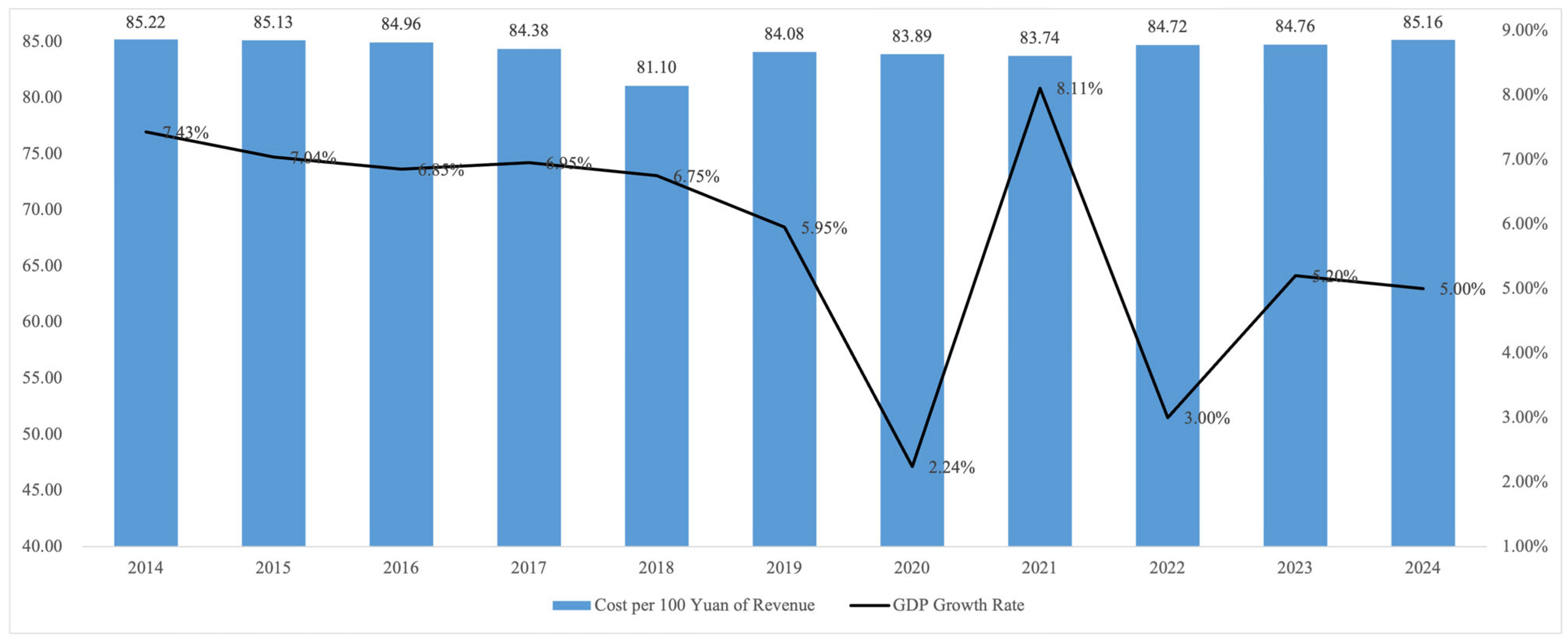
The Double-Edged Sword: How Does Corporate ESG Responsibility Fulfillment Shape Cost Stickiness?





Abstract
1. Introduction
2. Theoretical Analysis and Hypotheses Development
2.1. The Impact of Corporate ESG Responsibility Fulfillment on Cost Stickiness
2.2. The Moderating Effects of Environmental Sensitivity, Managerial Overconfidence, and State Ownership
2.2.1. Environmental Sensitivity
2.2.2. Managerial Overconfidence
2.2.3. State Ownership
3. Research Design
3.1. Sample Selection and Data Source
3.2. Variable Definition
3.2.1. Dependent Variable
3.2.2. Independent Variable
3.2.3. Moderating Variables
3.2.4. Control Variables
3.3. Model Specifications
4. Empirical Results and Discussions
4.1. Descriptive Statistics
4.2. Pearson Correlation Analysis
4.3. Baseline Regression Analysis
4.4. Robustness and Endogeneity Tests
4.4.1. Lagged Effect of ESG Responsibility Fulfillment
4.4.2. Alternative Measure of ESG Responsibility Fulfillment
4.4.3. Excluding the Impact of the COVID-19 Pandemic
4.4.4. Introducing Instrumental Variable
5. Further Investigations
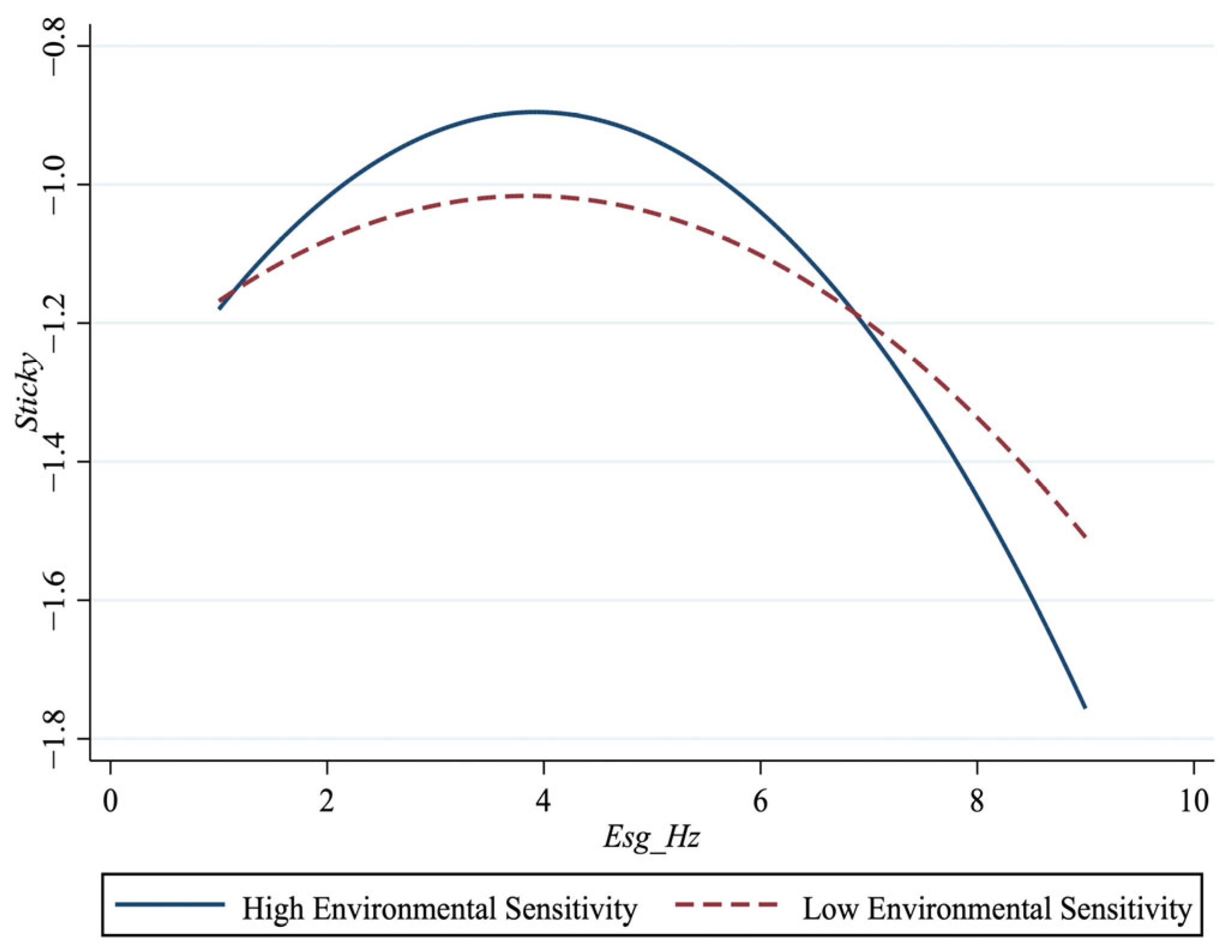
5.1. Corporate ESG Responsibility Fulfillment, Environmental Sensitivity, and Cost Stickiness
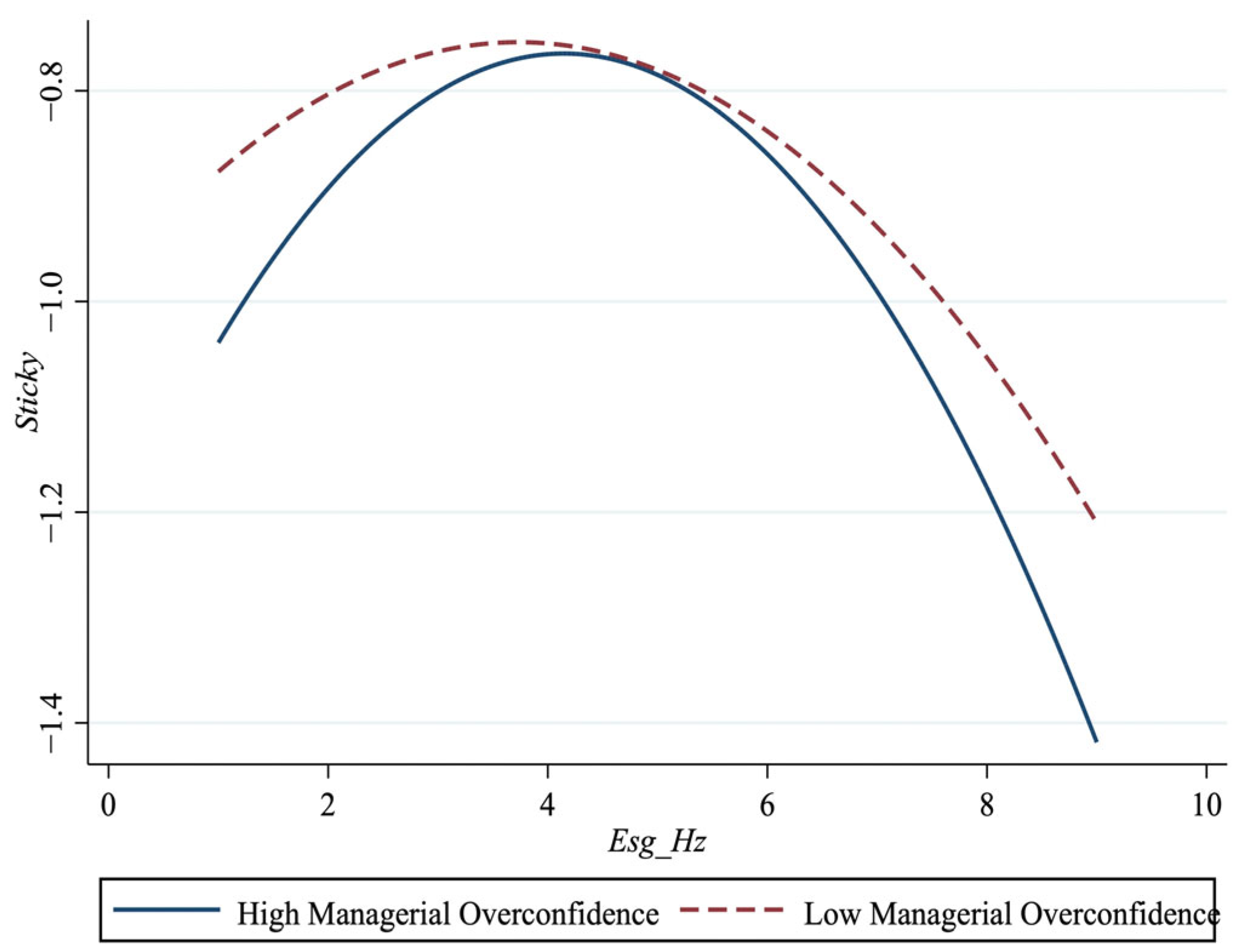
5.2. Corporate ESG Responsibility Fulfillment, Managerial Overconfidence, and Cost Stickiness
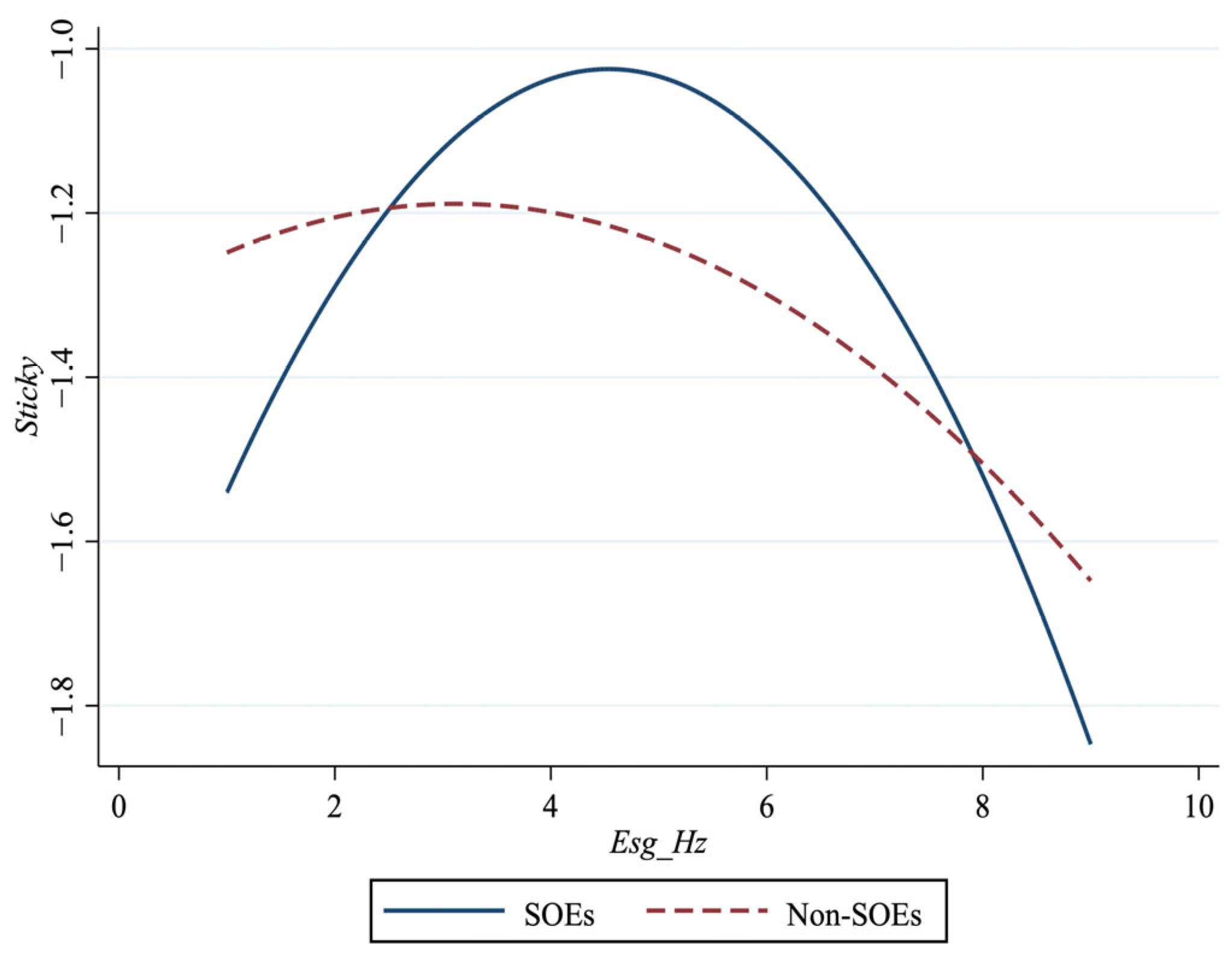
5.3. Corporate ESG Responsibility Fulfillment, State Ownership, and Cost Stickiness
6. Research Conclusions and Implications
6.1. Research Conclusions
6.2. Managerial Implications
6.3. Limitations and Future Research Directions
Author Contributions
Funding
Institutional Review Board Statement
Informed Consent Statement
Data Availability Statement
Acknowledgments
Conflicts of Interest
| 1 | Detailed Information: https://www.chindices.com/esg-ratings.html accessed on 20 January 2023. |
References
- Jiang, X.; Shen, J.H.; Lee, C.-C.; Chen, C. Supply-side structural reform and dynamic capital structure adjustment: Evidence from Chinese-listed firms. Pac.-Basin Financ. J. 2021, 65, 101482. [Google Scholar] [CrossRef]
- Noreen, E. Conditions under which activity-based cost systems provide relevant costs. J. Manag. Account. Res. 1991, 3, 159–168. [Google Scholar] [CrossRef]
- Anderson, M.C.; Banker, R.D.; Janakiraman, S.N. Are selling, general, and administrative costs “sticky”? J. Account. Res. 2003, 41, 47–63. [Google Scholar] [CrossRef]
- Askarany, D.; Parsaei, M.; Ghanbari, N. Business Strategy, Short-Term Debt, and Cost Stickiness. Comput. Econ. 2024, 64, 1913–1936. [Google Scholar] [CrossRef]
- Costa, M.D.; Habib, A. Cost stickiness and firm value. J. Manag. Control 2023, 34, 235–273. [Google Scholar] [CrossRef]
- Warganegara, D.L.; Tamara, D. The impacts of cost stickiness on the profitability of Indonesian firms. Int. J. Econ. Manag. Eng. 2014, 8, 3621–3624. [Google Scholar]
- Ibrahim, A.E.A.; Ali, H.; Aboelkheir, H. Cost stickiness: A systematic literature review of 27 years of research and a future research agenda. J. Int. Account. Audit. Tax. 2022, 46, 100439. [Google Scholar] [CrossRef]
- Dierynck, B.; Landsman, W.R.; Renders, A. Do managerial incentives drive cost behavior? Evidence about the role of the zero earnings benchmark for labor cost behavior in private Belgian firms. Account. Rev. 2012, 87, 1219–1246. [Google Scholar] [CrossRef]
- Liu, X.; Liu, X.; Reid, C.D. Stakeholder orientations and cost management. Contemp. Account. Res. 2019, 36, 486–512. [Google Scholar]
- Chen, C.X.; Lu, H.; Sougiannis, T. The agency problem, corporate governance, and the asymmetrical behavior of selling, general, and administrative costs. Contemp. Account. Res. 2012, 29, 252–282. [Google Scholar]
- Gantchev, N.; Sevilir, M.; Shivdasani, A. Activism and empire building. J. Financ. Econ. 2020, 138, 526–548. [Google Scholar] [CrossRef]
- Chen, J.V.; Kama, I.; Lehavy, R. A contextual analysis of the impact of managerial expectations on asymmetric cost behavior. Rev. Account. Stud. 2019, 24, 665–693. [Google Scholar] [CrossRef]
- Yang, D. Mergers, CEO hubris, and cost stickiness. Emerg. Mark. Financ. Trade 2015, 51, S46–S63. [Google Scholar] [CrossRef]
- Banerjee, S.; Homroy, S.; Slechten, A. Stakeholder preference and strategic corporate social responsibility. J. Corp. Financ. 2022, 77, 102286. [Google Scholar] [CrossRef]
- Zhang, C.; Zhang, S.; Zhou, Z.; He, B. Merging Economic Aspirations with Sustainability: ESG and the Evolution of the Corporate Development Paradigm in China. Sustainability 2025, 17, 9108. [Google Scholar] [CrossRef]
- Elfenbein, D.W.; McManus, B. A greater price for a greater good? Evidence that consumers pay more for charity-linked products. Am. Econ. J. Econ. Policy 2010, 2, 28–60. [Google Scholar] [CrossRef]
- Alda, M. The environmental, social, and governance (ESG) dimension of firms in which social responsible investment (SRI) and conventional pension funds invest: The mainstream SRI and the ESG inclusion. J. Clean. Prod. 2021, 298, 126812. [Google Scholar] [CrossRef]
- He, G.; Liu, Y.; Chen, F. Research on the impact of environment, society, and governance (ESG) on firm risk: An explanation from a financing constraints perspective. Financ. Res. Lett. 2023, 58, 104038. [Google Scholar] [CrossRef]
- Eliwa, Y.; Aboud, A.; Saleh, A. ESG practices and the cost of debt: Evidence from EU countries. Crit. Perspect. Account. 2021, 79, 21. [Google Scholar] [CrossRef]
- Zhang, D.Y.; Wang, C.; Dong, Y. How Does Firm ESG Performance Impact Financial Constraints? An Experimental Exploration of the COVID-19 Pandemic. Eur. J. Dev. Res. 2022, 35, 219–239. [Google Scholar] [CrossRef] [PubMed]
- Miles, M.P.; Covin, J.G. Environmental marketing: A source of reputational, competitive, and financial advantage. J. Bus. Ethics 2000, 23, 299–311. [Google Scholar] [CrossRef]
- Brogi, M.; Lagasio, V. Environmental, social, and governance and company profitability: Are financial intermediaries different? Corp. Soc. Responsib. Environ. Manag. 2019, 26, 576–587. [Google Scholar] [CrossRef]
- Zhou, Y.; Zhang, N.; Wu, C.-H.; Wang, Y.; Zhang, X.; Zhang, D. The Impact of Supply Chain ESG Management on Supply Chain Resilience With Emerging IT Technologies: Based on Supply Chain Network Capabilities. J. Organ. End. User Comput. 2024, 36, 1–31. [Google Scholar] [CrossRef]
- Li, N.; Li, G.; Xue, J. Does ESG protect firms equally during crises? The role of supply chain concentration. Omega 2025, 130, 103171. [Google Scholar] [CrossRef]
- Margolis, J.D.; Elfenbein, H.A.; Walsh, J.P. Does It Pay to Be Good…and Does It Matter? A Meta-Analysis of the Relationship Between Corporate Social and Financial Performance. Working Paper. Available online: https://ssrn.com/abstract=1866371 (accessed on 15 June 2026).
- Treepongkaruna, S.; Kyaw, K.; Jiraporn, P. ESG controversies and corporate governance: Evidence from board size. Bus. Strategy Environ. 2024, 33, 4218–4232. [Google Scholar] [CrossRef]
- Nguyen, D.T.; Hoang, T.G.; Tran, H.G. Help or hurt? The impact of ESG on firm performance in S&P 500 non-financial firms. Australas. Account. Bus. Financ. J. 2022, 16, 91–102. [Google Scholar] [CrossRef]
- Wang, Z.; Lu, W.; Liu, M. Corporate social responsibility overinvestment in mergers and acquisitions. Int. Rev. Financ. Anal. 2021, 78, 101944. [Google Scholar] [CrossRef]
- Yu, N.; Liu, D.; Wan, H.; Chen, C. Water resource tax and corporate cost stickiness: Evidence from China’s reform. J. Account. Emerg. Econ. 2026, 1–30. [Google Scholar] [CrossRef]
- Han, S.; Rezaee, Z.; Tuo, L. Is cost stickiness associated with management earnings forecasts? Asian Rev. Account. 2020, 28, 173–211. [Google Scholar]
- Zhong, T.; Sun, F.; Zhou, H.; Lee, J.Y. Business strategy, state-owned equity and cost stickiness: Evidence from Chinese firms. Sustainability 2020, 12, 1850. [Google Scholar] [CrossRef]
- Yang, X.; Li, Z.; Qiu, Z.; Wang, J.; Liu, B. ESG performance and corporate technology innovation: Evidence from China. Technol. Forecast. Soc. Change 2024, 206, 123520. [Google Scholar] [CrossRef]
- Lin, H.; Gu, X.; Bao, X. Corporate ESG performance and bankruptcy risk. Financ. Res. Lett. 2025, 76, 106987. [Google Scholar] [CrossRef]
- Liu, D.; Jin, S. How does corporate ESG performance affect financial irregularities? Sustainability 2023, 15, 9999. [Google Scholar] [CrossRef]
- Shi, J.; Yang, J.; Li, Y. Supply network position and firm performance: Evidence from Chinese listed manufacturing companies. J. Bus. Econ. Manag. 2019, 20, 1258–1277. [Google Scholar] [CrossRef]
- Ketokivi, M.; Mahoney, J.T. Transaction cost economics as a theory of supply chain efficiency. Prod. Oper. Manag. 2020, 29, 1011–1031. [Google Scholar] [CrossRef]
- Liu, Y.; Jin, M. Does supply chain network centrality affect firm cost stickiness? Financ. Res. Lett. 2023, 58, 104459. [Google Scholar] [CrossRef]
- Kohtamäki, M.; Parida, V.; Patel, P.C.; Gebauer, H. The relationship between digitalization and servitization: The role of servitization in capturing the financial potential of digitalization. Technol. Forecast. Soc. Change 2020, 151, 119804. [Google Scholar] [CrossRef]
- Jiang, W.; Yang, W. ESG disclosure and corporate cost stickiness: Evidence from supply-chain relationships. Econ. Lett. 2024, 238, 111697. [Google Scholar] [CrossRef]
- Yuan, X.Y.; Li, Z.F.; Xu, J.H.; Shang, L.X. ESG disclosure and corporate financial irregularities-Evidence from Chinese listed firms. J. Clean. Prod. 2022, 332, 129992. [Google Scholar] [CrossRef]
- Hillman, A.J.; Keim, G.D. Shareholder value, stakeholder management, and social issues: What’s the bottom line? Strateg. Manag. J. 2001, 22, 125–139. [Google Scholar] [CrossRef]
- Bag, S.; Dhamija, P.; Bryde, D.J.; Singh, R.K. Effect of eco-innovation on green supply chain management, circular economy capability, and performance of small and medium enterprises. J. Bus. Res. 2022, 141, 60–72. [Google Scholar] [CrossRef]
- Xiao, Z.; Huang, X.; Chen, H. The impact of corporate ESG performance on buyers’ bargaining power in the industrial chain: Evidence from China. Financ. Res. Lett. 2024, 60, 104906. [Google Scholar] [CrossRef]
- Kang, K.; Luan, X.; Shen, W.; Ma, Y.; Wei, X. The Strategies of the Poverty-Alleviation Supply Chain with Government Subsidies and Cost Sharing: Government-Led or Market-Oriented? Sustainability 2020, 12, 4050. [Google Scholar] [CrossRef]
- Cippiciani, F.A.; Savoia, J.R.; de Mariz, F.; Bergmann, D.R. ESG and Risk: Global Evidence of Nonlinear Relation. Bus. Strategy Environ. 2026, 1–24. [Google Scholar] [CrossRef]
- Huang, D.Z.X. Environmental, social and governance factors and assessing firm value: Valuation, signalling and stakeholder perspectives. Account. Financ. 2022, 62, 1983–2010. [Google Scholar]
- Hasan, I.; Kobeissi, N.; Liu, L.; Wang, H. Corporate social responsibility and firm financial performance: The mediating role of productivity. J. Bus. Ethics 2018, 149, 671–688. [Google Scholar]
- Hong, N.T.P.; Trang, N.T. The Effect of Corporate Social Responsibility on Cost Stickiness in Companies Listed on Vietnam Stock Market. Corp. Soc. Responsib. Environ. Manag. 2026, 33, 1573–1593. [Google Scholar]
- Buchanan, B.; Cao, C.X.; Chen, C. Corporate social responsibility, firm value, and influential institutional ownership. J. Corp. Financ. 2018, 52, 73–95. [Google Scholar] [CrossRef]
- Le, A.-T.; Tran, T.P. Corporate governance and labor investment efficiency: International evidence from board reforms. Corp. Gov. Int. Rev. 2022, 30, 555–583. [Google Scholar] [CrossRef]
- Ma, X.; Ma, W.; Zhao, X.; Zhou, X.; Si Mohammed, K. Increasing Burdens or Reducing Costs: Influence of Corporate Social Responsibility on Cost Stickiness. J. Knowl. Econ. 2024, 15, 2136–2155. [Google Scholar]
- Suchman, M.C. Managing legitimacy: Strategic and institutional approaches. Acad. Manag. Rev. 1995, 20, 571–610. [Google Scholar] [CrossRef]
- Cao, Z.; Zhang, H.; Hang, Z.; Zhou, D.; Jing, B. Does the Responsibility System for Environmental Protection Targets Enhance Corporate High-Quality Development in China? Energies 2022, 15, 3650. [Google Scholar] [CrossRef]
- Tu, Z.; Hu, T.; Shen, R. Evaluating public participation impact on environmental protection and ecological efficiency in China: Evidence from PITI disclosure. China Econ. Rev. 2019, 55, 111–123. [Google Scholar] [CrossRef]
- Wang, L.; Chen, C.; Zhu, B. Earnings pressure, external supervision, and corporate environmental protection investment: Comparison between heavy-polluting and non-heavy-polluting industries. J. Clean. Prod. 2023, 385, 135648. [Google Scholar] [CrossRef]
- Yang, H.; Yuan, P. Environmental protection investment on performance of heavy-polluting enterprises: Evidence from China’s A-share listed companies. Environ. Sci. Pollut. Res. 2024, 31, 20383–20398. [Google Scholar] [CrossRef] [PubMed]
- Xu, F.; Yang, M.; Li, Q.; Yang, X. Long-term economic consequences of corporate environmental responsibility: Evidence from heavily polluting listed companies in China. Bus. Strategy Environ. 2020, 29, 2251–2264. [Google Scholar] [CrossRef]
- Porter, M.E.; Kramer, M.R. Corporate Philanthropy: Taking the High Ground. Found. Strategy Group 2003, 13, 1–12. [Google Scholar]
- Zhang, Q.; Yu, Z.; Kong, D. The real effect of legal institutions: Environmental courts and firm environmental protection expenditure. J. Environ. Econ. Manag. 2019, 98, 102254. [Google Scholar] [CrossRef]
- Langer, E.J. The illusion of control. J. Personal. Soc. Psychol. 1975, 32, 311. [Google Scholar] [CrossRef]
- Zhang, S.; Chen, Z. Experts on the board: How do IT-savvy directors promote corporate digital innovation? Econ. Anal. Policy 2025, 85, 791–817. [Google Scholar] [CrossRef]
- Zhang, S.; Wang, K.; Chen, Z.; Zhang, C. Haste Makes Waste: How Do Patient Institutional Investors Deflate Corporate Digital Innovation Bubbles? Emerg. Mark. Financ. Trade 2025, 1–20. [Google Scholar] [CrossRef]
- Weinstein, N.D. Unrealistic optimism about future life events. J. Personal. Soc. Psychol. 1980, 39, 806–820. [Google Scholar] [CrossRef]
- Ibrahim, A.E.A. Economic growth and cost stickiness: Evidence from Egypt. J. Financ. Report. Account. 2015, 13, 119–140. [Google Scholar] [CrossRef]
- Kuang, Y.F.; Mohan, A.; Qin, B. CEO overconfidence and cost stickiness. Manag. Control Account. 2015, 2015, 26–32. [Google Scholar]
- Koo, J.-H.; Yang, D. Managerial Overconfidence, Self-Attribution Bias, and Downwardly Sticky Investment: Evidence from Korea. Emerg. Mark. Financ. Trade 2018, 54, 144–161. [Google Scholar]
- Chen, C.X.; Nasev, J.; Wu, S.Y.-C. CFO Overconfidence and Cost Behavior. J. Manag. Account. Res. 2022, 34, 117–135. [Google Scholar]
- Cheng, H.; Fan, H.; Hoshi, T.; Hu, D. State ownership, political connection, and innovation subsidies in China. J. Jpn. Int. Econ. 2024, 71, 101287. [Google Scholar] [CrossRef]
- Cull, R.; Li, W.; Sun, B.; Xu, L.C. Government connections and financial constraints: Evidence from a large representative sample of Chinese firms. J. Corp. Financ. 2015, 32, 271–294. [Google Scholar] [CrossRef]
- Li, J.; Luo, Z. Product market competition and cost stickiness: Evidence from China. Manag. Decis. Econ. 2021, 42, 1808–1821. [Google Scholar] [CrossRef]
- Bai, C.-E.; Li, D.D.; Tao, Z.; Wang, Y. A multitask theory of state enterprise reform. J. Comp. Econ. 2000, 28, 716–738. [Google Scholar] [CrossRef]
- Prabowo, R.; Hooghiemstra, R.; Van Veen-Dirks, P. State Ownership, Socio-political Factors, and Labor Cost Stickiness. Eur. Account. Rev. 2018, 27, 771–796. [Google Scholar]
- Chen, Y.; Ma, Y. Financing constraints, internal control quality and cost stickiness. J. Bus. Econ. Manag. 2021, 22, 1231–1251. [Google Scholar] [CrossRef]
- Xiao, Z.; Niu, Q.; Yun, F.; Ye, Y. The impact of state-owned capital on labor cost stickiness in private firms: Evidence from China. Econ. Model. 2024, 141, 106906. [Google Scholar] [CrossRef]
- Tang, Y.; Qiao, X.; Chen, H. ESG performance and investment expansion: Evidence from Chinese listed firms. Financ. Res. Lett. 2024, 69, 106072. [Google Scholar] [CrossRef]
- Weiss, D. Cost behavior and analysts’ earnings forecasts. Account. Rev. 2010, 85, 1441–1471. [Google Scholar] [CrossRef]
- Kreilkamp, N.; Teichmann, S.; Wöhrmann, A. The Effect of Cost Stickiness on Peer-Based Valuation Models. Eur. Account. Rev. 2021, 30, 913–938. [Google Scholar] [CrossRef]
- Deegan, C.; Gordon, B. A study of the environmental disclosure practices of Australian corporations. Account. Bus. Res. 1996, 26, 187–199. [Google Scholar] [CrossRef]
- Yu, S.; Xu, L.; Du, P.; Qin, Z.; Zhong, Q.; Zhao, T. The impact of air pollution on corporate environmental information disclosure–Evidence from heavy pollution industries in China. Financ. Res. Lett. 2024, 59, 104793. [Google Scholar] [CrossRef]
- Wu, X.; Chen, S.; Guo, J.; Gao, G. Effect of air pollution on the stock yield of heavy pollution enterprises in China’s key control cities. J. Clean. Prod. 2018, 170, 399–406. [Google Scholar] [CrossRef]
- Pan, A.; Liu, W.; Wang, X. Managerial overconfidence, debt capacity and merger & acquisition premium. Nankai Bus. Rev. Int. 2019, 10, 570–590. [Google Scholar] [CrossRef]
- Wei, Z. The effect of manager overconfidence on capital structure. J. Ind. Technol. Econ. 2018, 37, 3–12. [Google Scholar]
- Yu, M.; Li, W.; Pan, H. Managers’ overconfidence and Enterprise risk-taking. J. Financ. Res. 2013, 1, 149–163. [Google Scholar]
- Wen, Z.; Hau, K.-T.; Chang, L. A comparison of moderator and mediator and their applications. Acta Psychol. Sin. 2005, 37, 268. [Google Scholar]
- Chen, Y.; Xu, J. Digital transformation and firm cost stickiness: Evidence from China. Financ. Res. Lett. 2023, 52, 103510. [Google Scholar] [CrossRef]
- Xu, J.; Sim, J.W. Are costs really sticky and biased? Evidence from manufacturing listed companies in China. Appl. Econ. 2017, 49, 5601–5613. [Google Scholar] [CrossRef]
- Guenther, T.W.; Riehl, A.; Rößler, R. Cost stickiness: State of the art of research and implications. J. Manag. Control 2014, 24, 301–318. [Google Scholar]
- Lin, Y.; Li, S. Supply chain resilience, ESG performance, and corporate growth. Int. Rev. Econ. Financ. 2025, 97, 103763. [Google Scholar] [CrossRef]
- Whicker, L.; Bernon, M.; Templar, S.; Mena, C. Understanding the relationships between time and cost to improve supply chain performance. Int. J. Prod. Econ. 2009, 121, 641–650. [Google Scholar] [CrossRef]
- Zhang, Y.; Xiong, T. More ESG Practices, Higher Financial Performance? The U-Shaped Pattern in China’s Agricultural and Food Firms. Agribusiness 2026, 42, 641–652. [Google Scholar]
- Tang, H. The Effect of ESG Performance on Corporate Innovation in China: The Mediating Role of Financial Constraints and Agency Cost. Sustainability 2022, 14, 3769. [Google Scholar] [CrossRef]
- Zumente, I.; Lāce, N. ESG Rating—Necessity for the Investor or the Company? Sustainability 2021, 13, 8940. [Google Scholar] [CrossRef]
- Zhang, D.; Zheng, W. Does COVID-19 make the firms’ performance worse? Evidence from the Chinese listed companies. Econ. Anal. Policy 2022, 74, 560–570. [Google Scholar] [CrossRef] [PubMed]
- Finne, G.; Haga, J.; Sundvik, D. Cost behaviour and reporting frequency during the COVID-19 outbreak. Account. Bus. Res. 2024, 54, 491–520. [Google Scholar] [CrossRef]
- Tang, T.; Yang, L. Shaping corporate ESG performance: Role of social trust in China’s capital market. China Financ. Rev. Int. 2024, 14, 34–75. [Google Scholar]



| 3 First-Level Pillar Indicators | Environmental Pillar | Social Pillar | Governance Pillar |
|---|---|---|---|
| 16 Second-Level Thematic Indicators | Climate Change Resource Utilization Environmental Pollution Environmentally Friendly Practices Environmental Management | Human Capital Product Responsibility Supply Chain Social Contribution Data Security and Privacy | Shareholder Rights Governance Structure Disclosure Quality Governance Risk External Sanctions |
| 44 Third-Level Key Indicators | Greenhouse Gas Emissions, Carbon Reduction Pathways, Climate Change Mitigation, Sponge Cities, Green Finance Land Use and Biodiversity, Water Resource Consumption, Material Consumption Industrial Emissions, Hazardous Waste, Electronic Waste Renewable Energy, Green Buildings, Green Factories Sustainable Certification, Supply Chain Environmental Management, Environmental Penalties | Employee Health and Safety, Employee Incentives and Development, Employee Relations Quality Certification, Product Recalls, Customer Complaints Supplier Risk and Management, Supply Chain Relationships Inclusive Growth, Community Investment, Employment, Technological Innovation Data Security and Privacy | Shareholder Rights Protection ESG, Risk Control, Board Structure, Management Stability ESG External Assurance, Information Disclosure Credibility Major Shareholder Behavior, Debt Repayment Ability, Legal Litigation, Tax Transparency External Sanctions Business Ethics, Anti-Corruption and Bribery |
| Variable Type | Variables | Definition | Measurement Method |
|---|---|---|---|
| Dependent Variable | Sticky | Cost Stickiness | Measurements are conducted based on the model proposed by Weiss (2010) [76]. |
| Independent Variable | Esg_Hz | ESG Responsibility Fulfillment | Based on the Huazheng ESG rating system, the C to AAA ratings are assigned values from 1 to 9, respectively. |
| Moderating Variables | Pollu | Environmental Sensitivity | If a company belongs to a heavy-polluting industry, it is assigned a value of 1; otherwise, it is assigned a value of 0. |
| Oc | Managerial Overconfidence | Following the scoring approach of Wei (2018) [82], we code the variable as 1 if the total score is greater than or equal to the sample mean, and 0 otherwise. | |
| Soe | State Ownership | If a company is state-owned, it is assigned a value of 1; otherwise, it is assigned a value of 0. | |
| Control Variables | Ai | Asset Intensity | Total assets at the end of the fiscal year/Total revenue. |
| Ei | Employee Intensity | The number of employees at the end of the fiscal year/Total revenue. | |
| Firmage | Firm Age | Ln (The number of years since the company’s establishment + 1). | |
| Board | Board Size | Ln (The number of directors + 1). | |
| Dual | CEO-Chair Duality | Equal to 1 if the chairperson and CEO are the same individual and 0 otherwise. | |
| Size | Firm Size | Ln (Total assets at the end of the fiscal year). | |
| ROA | Profitability | Net profit/Total assets at the end of the fiscal year. | |
| Indep | Proportion of Independent Directors | The number of independent directors/The total number of board directors. | |
| Growth | Growth Capacity | Total revenue in the current year/Total revenue in the previous year − 1 | |
| TobinQ | Market Value | Corporate market value/Total assets. |
| Variables | Obs | Mean | SD | Min | Median | Max |
|---|---|---|---|---|---|---|
| Sticky | 36,048 | −0.2480 | 1.1390 | −9.2836 | −0.1334 | 7.9199 |
| Esg_Hz | 36,048 | 4.1488 | 1.0988 | 1.0000 | 4.0000 | 9.0000 |
| Ai | 36,048 | 1.0340 | 0.0322 | 0.8862 | 1.0314 | 1.3543 |
| Ei | 36,048 | 0.3536 | 0.0398 | 0.2165 | 0.3545 | 0.4546 |
| FirmAge | 36,048 | 3.0034 | 0.3175 | 1.0986 | 3.0445 | 4.3041 |
| Board | 36,048 | 2.1089 | 0.1965 | 1.6094 | 2.1972 | 2.7081 |
| Dual | 36,048 | 0.3041 | 0.4600 | 0.0000 | 0.0000 | 1.0000 |
| Size | 36,048 | 22.2908 | 1.2962 | 19.5245 | 22.0938 | 26.4523 |
| ROA | 36,048 | 0.0309 | 0.0641 | −0.5562 | 0.0328 | 0.2223 |
| Indep | 36,048 | 0.3774 | 0.0535 | 0.2857 | 0.3636 | 0.6000 |
| Growth | 36,048 | 0.1223 | 0.3697 | −0.6735 | 0.0757 | 5.0755 |
| TobinQ | 36,048 | 2.0044 | 1.3131 | 0.7946 | 1.5989 | 17.6759 |
| Variables | Sticky | Esg_Hz | Ai | Ei | FirmAge | Board | Dual | Size | ROA | Indep | Growth | TobinQ |
|---|---|---|---|---|---|---|---|---|---|---|---|---|
| Sticky | 1.0000 | |||||||||||
| Esg_Hz | 0.0248 *** | 1.0000 | ||||||||||
| Ai | −0.0403 *** | −0.0494 *** | 1.0000 | |||||||||
| Ei | −0.0087 * | 0.1609*** | −0.2474 *** | 1.0000 | ||||||||
| FirmAge | 0.0040 | −0.0343 *** | 0.0090 * | 0.0057 | 1.0000 | |||||||
| Board | 0.0088 * | 0.0340*** | −0.0353 *** | 0.2111 *** | 0.0580 *** | 1.0000 | ||||||
| Dual | −0.0171 *** | −0.0092 * | 0.0228 *** | −0.0863 *** | −0.0959 *** | −0.1935 *** | 1.0000 | |||||
| Size | 0.0119 ** | 0.2292 *** | −0.0840 *** | 0.5206 *** | 0.1873 *** | 0.2678 *** | −0.1809 *** | 1.0000 | ||||
| ROA | 0.1546 *** | 0.2118 *** | −0.1998 *** | 0.0601 *** | −0.0824 *** | 0.0283 *** | 0.0064 | 0.0421 *** | 1.0000 | |||
| Indep | 0.0046 | 0.0596 *** | 0.0271 *** | −0.0379 *** | −0.0249 *** | −0.5630 *** | 0.1214 *** | −0.0173 *** | −0.0122 ** | 1.0000 | ||
| Growth | 0.0604 *** | −0.0033 | −0.1247 *** | −0.0139 *** | −0.0769 *** | −0.0010 | 0.0162 *** | 0.0307 *** | 0.2299 *** | −0.0023 | 1.0000 | |
| TobinQ | 0.0115 ** | −0.0801 *** | 0.0320 *** | −0.1883 *** | −0.0627 *** | −0.1118 *** | 0.0782 *** | −0.3765 *** | 0.1259 *** | 0.0428 *** | 0.0677 *** | 1.0000 |
| Variables | (1) | (2) | (3) | (4) | (5) | (6) |
|---|---|---|---|---|---|---|
| Sticky | Sticky | Sticky | Sticky | Sticky | Sticky | |
| Esg_Hz | −0.0070 | −0.0102 | −0.0103 | 0.0729 *** | 0.0586 ** | 0.0749 *** |
| (−1.2006) | (−1.4241) | (−1.4288) | (3.0734) | (2.2112) | (2.6190) | |
| Esg_Hz2 | −0.0099 *** | −0.0086*** | −0.0106 *** | |||
| (−3.5958) | (−2.7535) | (−3.1315) | ||||
| Ai | −0.4671 * | 0.9308 * | 0.7362 | −0.4787 * | 0.9242 * | 0.7241 |
| (−1.8401) | (1.8077) | (1.4241) | (−1.8875) | (1.7948) | (1.4010) | |
| Ei | −0.8321 *** | 0.2715 | 0.1489 | −0.8320 *** | 0.2790 | 0.1500 |
| (−4.3182) | (0.5168) | (0.2796) | (−4.3246) | (0.5312) | (0.2818) | |
| FirmAge | 0.0517 ** | 0.1303 ** | 0.2586 ** | 0.0544 *** | 0.1413*** | 0.2595 ** |
| (2.5579) | (2.4873) | (2.1388) | (2.6894) | (2.6902) | (2.1457) | |
| Board | 0.0701 | 0.0020 | 0.0052 | 0.0690 | 0.0028 | 0.0063 |
| (1.6113) | (0.0250) | (0.0658) | (1.5855) | (0.0356) | (0.0790) | |
| Dual | −0.0416 *** | 0.0161 | 0.0151 | −0.0418 *** | 0.0160 | 0.0150 |
| (−2.9770) | (0.7290) | (0.6849) | (−2.9927) | (0.7247) | (0.6799) | |
| Size | 0.0073 | −0.0705 *** | −0.0691 *** | 0.0098 | −0.0702 *** | −0.0680 *** |
| (1.0704) | (−3.6034) | (−3.4161) | (1.4224) | (−3.5933) | (−3.3630) | |
| ROA | 2.6879 *** | 3.9853 *** | 3.9543 *** | 2.6703 *** | 3.9782 *** | 3.9475 *** |
| (17.8192) | (20.3930) | (20.2200) | (17.6972) | (20.3750) | (20.2141) | |
| Indep | 0.3384 ** | 0.6055** | 0.6125 ** | 0.3460 ** | 0.6177 ** | 0.6236 ** |
| (2.2778) | (2.4924) | (2.5226) | (2.3297) | (2.5436) | (2.5696) | |
| Growth | 0.0780 *** | 0.0632 *** | 0.0566 *** | 0.0762 *** | 0.0618 *** | 0.0555 *** |
| (4.7657) | (3.4354) | (3.0156) | (4.6610) | (3.3584) | (2.9588) | |
| TobinQ | −0.0077 | −0.0080 | −0.0123 | −0.0064 | −0.0081 | −0.0120 |
| (−1.2877) | (−1.1064) | (−1.5587) | (−1.0676) | (−1.1219) | (−1.5184) | |
| _cons | −0.1002 | −0.4363 | −0.6061 | −0.3028 | −0.6039 | −0.7868 |
| (−0.3031) | (−0.6943) | (−0.7920) | (−0.8986) | (−0.9536) | (−1.0228) | |
| FirmFE | No | Yes | Yes | No | Yes | Yes |
| YearFE | No | No | Yes | No | No | Yes |
| F | 41.7070 | 48.5683 | 45.1135 | 39.5256 | 45.6370 | 42.4559 |
| R2 | 0.0261 | 0.1848 | 0.1865 | 0.0263 | 0.1849 | 0.1867 |
| N | 36,048 | 36,048 | 36,048 | 36,048 | 36,048 | 36,048 |
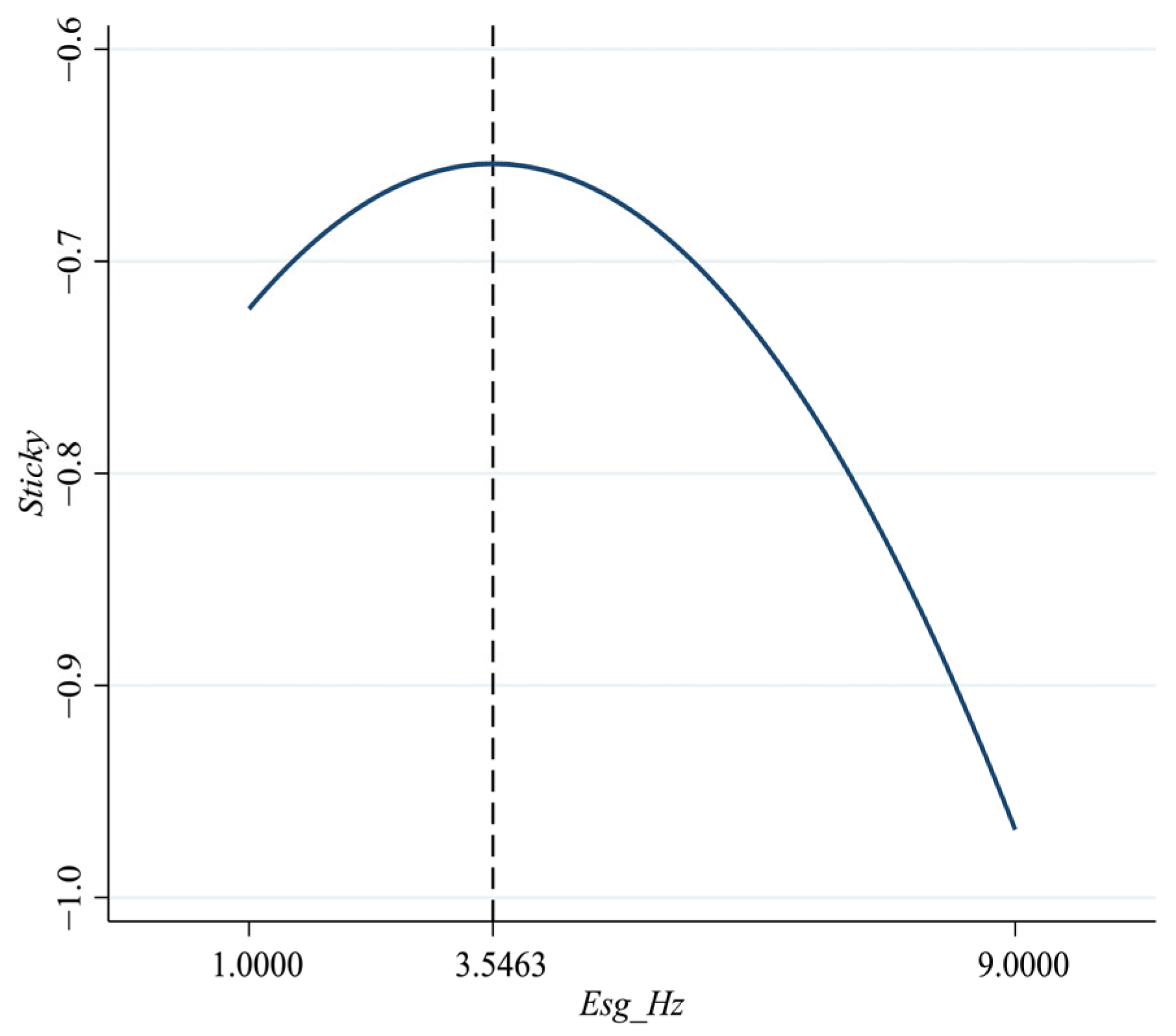
| Data range of Esg_Hz | [1.000, 9.000] |
| Extreme point | 3.5463 |
| Overall test of presence of a Inverse U shape | t = 2.43, p = 0.0076 |
| Variables | Introducing Lagged Independent Variable | Alternative Measure of ESG Responsibility Fulfillment | Excluding the Impact of the COVID-19 Pandemic | Introducing Instrumental Variable | ||||
|---|---|---|---|---|---|---|---|---|
| (1) | (2) | (3) | (4) | (5) | (6) | (7) | (8) | |
| Sticky | Sticky | Sticky | Sticky | Esg_Hz | Sticky | Esg_Hz | Sticky | |
| L1_Esg_Hz | 0.0130 | 0.0873 ** | ||||||
| (1.4356) | (2.3501) | |||||||
| L1_Esg_Hz2 | −0.0093 ** | |||||||
| (−2.0477) | ||||||||
| Esg_Bg | −0.0009 | 0.0153 ** | ||||||
| (−0.4290) | (2.1121) | |||||||
| Esg_Bg2 | −0.0002 ** | |||||||
| (−2.3159) | ||||||||
| Esg_Hz | −0.0182 | 0.0927 ** | 0.9525 * | |||||
| (−1.6359) | (2.1445) | (1.9114) | ||||||
| Esg_Hz2 | −0.0146 *** | −0.1128 * | ||||||
| (−2.7039) | (−1.9331) | |||||||
| IV | 0.2136 *** | |||||||
| (10.2023) | ||||||||
| Ai | 0.7166 | 0.7083 | 0.0096 | −0.0118 | −0.0515 | −0.0418 | −0.7496 * | −0.7530 *** |
| (1.2937) | (1.2788) | (0.0107) | (−0.0131) | (−0.0715) | (−0.0579) | (−1.7361) | (−2.6760) | |
| Ei | 0.0429 | 0.0491 | 1.8191** | 1.8591** | 0.8079 | 0.8360 | 1.0396 ** | −0.9245 *** |
| (0.0750) | (0.0858) | (1.9932) | (2.0341) | (1.1343) | (1.1723) | (2.0077) | (−4.6106) | |
| FirmAge | 0.2480 | 0.2545 | −0.1747 | −0.1660 | 0.1951 | 0.1991 | −0.1722 | 0.0882 *** |
| (1.5992) | (1.6406) | (−0.8727) | (−0.8290) | (1.0288) | (1.0494) | (−1.0628) | (3.0355) | |
| Board | −0.0115 | −0.0104 | −0.1877 | −0.1890 | −0.0234 | −0.0193 | 0.0634 | 0.0593 |
| (−0.1286) | (−0.1166) | (−1.6277) | (−1.6384) | (−0.2207) | (−0.1822) | (0.7926) | (1.3037) | |
| Dual | 0.0260 | 0.0262 | 0.0150 | 0.0166 | 0.0409 | 0.0410 | −0.0058 | −0.0424 *** |
| (1.0891) | (1.0978) | (0.3582) | (0.3948) | (1.3648) | (1.3664) | (−0.2582) | (−2.8831) | |
| Size | −0.0807 *** | −0.0801 *** | −0.0958 *** | −0.0928 *** | −0.0901 *** | −0.0902 *** | 0.2423 *** | 0.0296 ** |
| (−3.4397) | (−3.4171) | (−2.8572) | (−2.7515) | (−3.0579) | (−3.0590) | (10.7728) | (2.4298) | |
| ROA | 4.2072 *** | 4.2056 *** | 3.5362 *** | 3.5353 *** | 4.3141 *** | 4.3075*** | 1.3266 *** | 2.3663 *** |
| (19.6674) | (19.6701) | (9.1583) | (9.1506) | (14.4288) | (14.4457) | (10.3529) | (9.3939) | |
| Indep | 0.6104** | 0.6247** | −0.5020 | −0.5016 | 0.7262 ** | 0.7597 ** | 1.2294 *** | 0.3576 ** |
| (2.3340) | (2.3897) | (−1.3554) | (−1.3526) | (2.2756) | (2.3795) | (5.1335) | (2.3298) | |
| Growth | 0.0385 * | 0.0380 * | 0.0575 ** | 0.0578 ** | 0.0337 | 0.0334 | −0.1196*** | 0.0685 *** |
| (1.8969) | (1.8714) | (2.2038) | (2.2113) | (1.4457) | (1.4318) | (−7.6171) | (3.7997) | |
| TobinQ | −0.0176 ** | −0.0174 ** | −0.0094 | −0.0092 | −0.0210** | −0.0203* | −0.0341*** | 0.0095 |
| (−1.9857) | (−1.9644) | (−0.6238) | (−0.6110) | (−2.0284) | (−1.9587) | (−5.1099) | (0.9325) | |
| _cons | −0.3078 | −0.4807 | 2.3542* | 1.9656 | 0.7249 | 0.4817 | −1.7435** | −2.2940 * |
| (−0.3559) | (−0.5526) | (1.7828) | (1.4564) | (0.6547) | (0.4343) | (−2.1582) | (−1.8980) | |
| FirmFE | Yes | Yes | Yes | Yes | Yes | Yes | Yes | Yes |
| YearFE | Yes | Yes | Yes | Yes | Yes | Yes | Yes | Yes |
| F | 41.0384 | 38.1930 | 10.3013 | 9.8817 | 22.1562 | 21.1402 | 43.8312 | 39.4321 |
| R2 | 0.2193 | 0.2194 | 0.1702 | 0.1705 | 0.2460 | 0.2463 | 0.4885 | −0.0045 |
| Kleibergen-Paap rk LM | 51.717 *** | |||||||
| Cragg-Donald Wald F | 113.543 [16.38] | |||||||
| N | 27,826 | 27,826 | 10,997 | 10,997 | 17,695 | 17,695 | 36,048 | 36,048 |
| Variables | Environmental Sensitivity | Managerial Overconfidence | State Ownership |
|---|---|---|---|
| (1) | (2) | (3) | |
| Sticky | Sticky | Sticky | |
| Esg_Hz | 0.1335 *** | 0.1047 *** | 0.0653 ** |
| (4.7301) | (2.8620) | (2.2869) | |
| Esg_Hz2 | −0.0174 *** | −0.0144 *** | −0.0113 *** |
| (−5.2335) | (−3.2819) | (−3.1785) | |
| Pollu | −0.1215 | ||
| (−0.9363) | |||
| Pollu*Esg_Hz | 0.1209 ** | ||
| (2.0862) | |||
| Pollu*Esg_Hz2 | −0.0150 ** | ||
| (−2.1262) | |||
| Oc | −0.2721 *** | ||
| (−2.7374) | |||
| Oc*Esg_Hz | 0.1111 ** | ||
| (2.3661) | |||
| Oc*Esg_Hz2 | −0.0116 ** | ||
| (−2.0835) | |||
| Soe | −0.5703 *** | ||
| (−4.9425) | |||
| Soe*Esg_Hz | 0.2966 *** | ||
| (5.6743) | |||
| Soe*Esg_Hz2 | −0.0283 *** | ||
| (−4.6593) | |||
| Ai | 1.1850 ** | 0.7697 | 1.2068 ** |
| (2.4503) | (1.5963) | (2.5530) | |
| Ei | −0.1262 | 0.0409 | 0.1488 |
| (−0.2547) | (0.0815) | (0.3092) | |
| FirmAge | 0.1643 *** | 0.1595 *** | 0.1224 ** |
| (3.2570) | (3.1464) | (2.4317) | |
| Board | 0.0307 | 0.0673 | 0.0329 |
| (0.3968) | (0.8962) | (0.4273) | |
| Dual | 0.0079 | 0.0292 | 0.0229 |
| (0.3763) | (1.3677) | (1.0939) | |
| Size | −0.0651 *** | −0.0541 *** | −0.0614 *** |
| (−3.5481) | (−2.9366) | (−3.3234) | |
| ROA | 3.9622 *** | 3.9986 *** | 3.9675 *** |
| (21.0694) | (21.1095) | (21.1136) | |
| Indep | 0.5728 ** | 0.5692 ** | 0.6519 *** |
| (2.4633) | (2.4986) | (2.8517) | |
| Growth | 0.0589 *** | 0.0575 *** | 0.0671 *** |
| (3.2839) | (3.3660) | (3.7870) | |
| TobinQ | −0.0082 | −0.0032 | −0.0062 |
| (−1.1646) | (−0.4817) | (−0.8830) | |
| _cons | −1.1157 * | −0.9654 * | −1.0939 * |
| (−1.8637) | (−1.6486) | (−1.8338) | |
| FirmFE | Yes | Yes | Yes |
| YearFE | Yes | Yes | Yes |
| F | 43.0611 | 42.5154 | 44.5688 |
| R2 | 0.1918 | 0.1958 | 0.1928 |
| N | 35,698 | 35,206 | 35,591 |
Disclaimer/Publisher’s Note: The statements, opinions and data contained in all publications are solely those of the individual author(s) and contributor(s) and not of MDPI and/or the editor(s). MDPI and/or the editor(s) disclaim responsibility for any injury to people or property resulting from any ideas, methods, instructions or products referred to in the content. |
© 2026 by the authors. Licensee MDPI, Basel, Switzerland. This article is an open access article distributed under the terms and conditions of the Creative Commons Attribution (CC BY) license.
Share and Cite
Zhang, C.; Zhang, S.; Zhou, Z.; Wang, K. The Double-Edged Sword: How Does Corporate ESG Responsibility Fulfillment Shape Cost Stickiness? Systems 2026, 14, 705. https://doi.org/10.3390/systems14060705
Zhang C, Zhang S, Zhou Z, Wang K. The Double-Edged Sword: How Does Corporate ESG Responsibility Fulfillment Shape Cost Stickiness? Systems. 2026; 14(6):705. https://doi.org/10.3390/systems14060705
Chicago/Turabian StyleZhang, Changjiang, Sihan Zhang, Zhepeng Zhou, and Kongwen Wang. 2026. "The Double-Edged Sword: How Does Corporate ESG Responsibility Fulfillment Shape Cost Stickiness?" Systems 14, no. 6: 705. https://doi.org/10.3390/systems14060705
APA StyleZhang, C., Zhang, S., Zhou, Z., & Wang, K. (2026). The Double-Edged Sword: How Does Corporate ESG Responsibility Fulfillment Shape Cost Stickiness? Systems, 14(6), 705. https://doi.org/10.3390/systems14060705