Article

The Double-Edged Sword: How Does Corporate ESG Responsibility Fulfillment Shape Cost Stickiness?


1
School of Economics and Management, Nanjing Tech University, Nanjing 211816, China
2
School of Economics and Management, Southeast University, Nanjing 211189, China
*
Author to whom correspondence should be addressed.
Systems 2026, 14(6), 705; https://doi.org/10.3390/systems14060705 (registering DOI)
Submission received: 14 April 2026 / Revised: 15 June 2026 / Accepted: 16 June 2026 / Published: 19 June 2026
(This article belongs to the Section Systems Practice in Social Science)

Abstract

Fulfilling corporate ESG responsibilities enhances a firm’s sustainable development capabilities but also comes at an economic cost. This study investigates whether firms should invest heavily in ESG or maintain moderate ESG practices to balance cost efficiency and resilience. Using a sample of A-share listed companies in China from 2012 to 2024, we employ OLS regression models to explore the impact of ESG responsibility fulfillment on cost stickiness and the factors that influence this relationship. The study finds that (1) there is an inverted U-shaped relationship between corporate ESG responsibility fulfillment and cost stickiness; (2) the turning point lies between the B and CCC Huazheng ESG rating levels. Below this level, ESG responsibility fulfillment reduces cost stickiness, while above it, excessive ESG fulfillment increases cost stickiness; (3) environmental sensitivity, managerial overconfidence, and state ownership amplify this non-linear effect, making the reduction or increase in cost stickiness more pronounced. This paper deepens the understanding of the drivers of cost stickiness from the perspective of ESG responsibility fulfillment, offering new insights for future research on cost behavior and providing valuable guidance for firms seeking to optimize cost management through ESG strategies.

1. Introduction

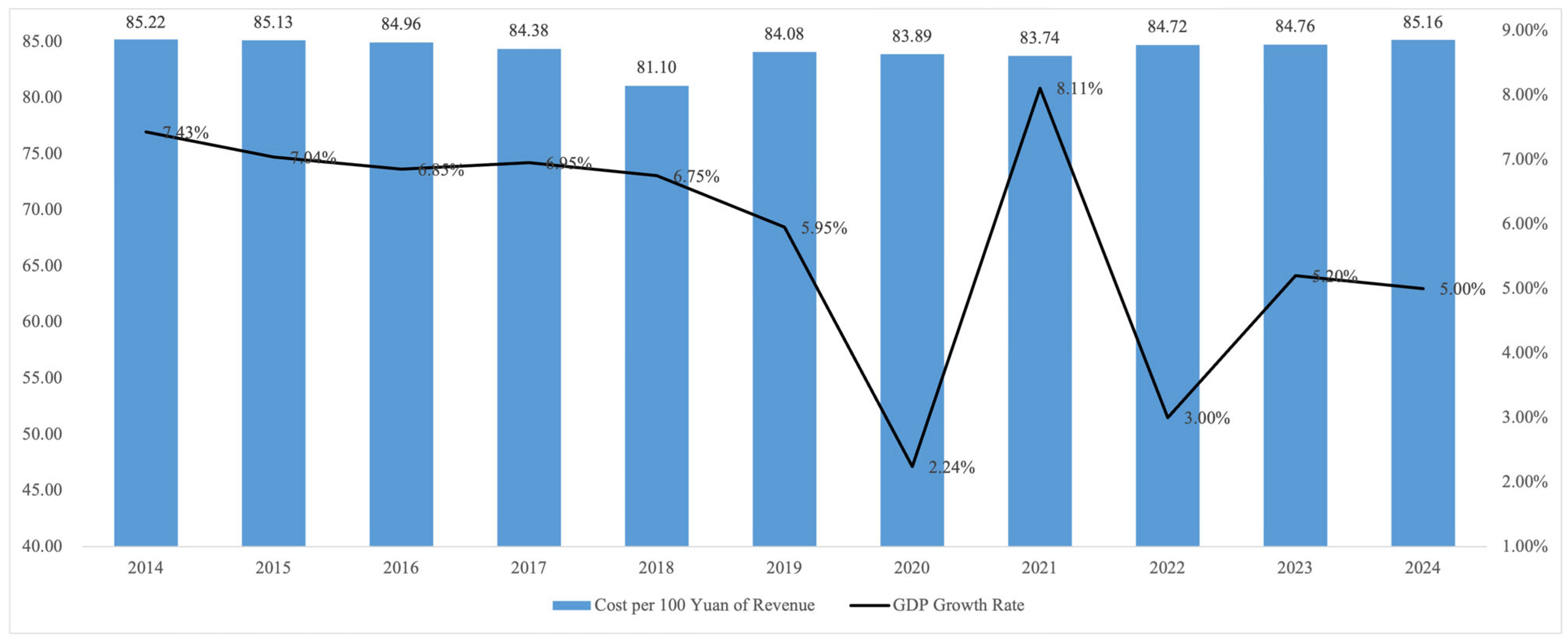
As global economic growth slows, cost reduction and efficiency improvement have become crucial strategies for companies aiming to achieve sustainable development. In recent years, China has been actively promoting and deepening supply-side structural reforms, with “cost reduction” being a key priority to foster high-quality economic development [1]. Traditional cost behavior theory suggests that changes in costs and revenues are symmetrical, with firms consistently striving to minimize costs [2]. However, Anderson et al. (2003) empirically challenged this assumption, arguing that in practice, the reduction in costs is often smaller than the decline in revenues, indicating that costs are sticky [3]. This phenomenon of cost stickiness is also prevalent in China. As illustrated in Figure 1, although China’s GDP growth rate fluctuated considerably between 2014 and 2024, the cost per 100 yuan of revenue of industrial enterprises remained persistently high and exhibited only limited variation. This pattern suggests that firms may face difficulties in adjusting operating costs promptly in response to changes in the external economic environment, reflecting a certain degree of cost stickiness. Excessive cost stickiness undoubtedly has numerous adverse effects on firms, including increased financial risks [4], decreased market value [5], and declining corporate performance [6]—threatening both micro-level enterprises and macroeconomic stability [7].
As a result, research into the causes of cost stickiness has continuously deepened. Scholars have found that cost adjustments, managerial self-interest, and managerial overconfidence are key factors contributing to cost stickiness. The cost adjustment theory argues that when firms downsize or reduce operations, they incur additional losses and costs, which impedes their willingness to dispose of redundant resources when revenues decline [8,9]. The managerial self-interest theory suggests that managers, motivated by a desire to build a personal empire, seek to expand their control over resources [10]. Since cost-cutting would harm their immediate benefits, they typically resist reducing costs [11]. Meanwhile, the overconfidence theory proposes that managers, often irrational, tend to hold overly optimistic views about future market conditions and perceive revenue declines as temporary, which leads them to maintain current cost levels [12,13]. Although existing studies have thoroughly explored the causes of cost stickiness, they have predominantly focused on internal organizational factors, neglecting the significance of external environmental influences and stakeholders. In fact, as business operations become increasingly complex, firms and their external stakeholders are becoming deeply intertwined, blurring traditional organizational boundaries. Cost management is no longer a closed, isolated process, and the traditional framework for analyzing cost stickiness needs to be expanded.
In response to the escalating global environmental and resource challenges, society has shifted its focus from purely assessing the economic outcomes of companies to demanding that they enhance environmental, social, and governance (ESG) performance. As a result, fulfilling ESG responsibilities has become a vital strategy for companies seeking stakeholders’ support [14,15]. A growing body of research demonstrates that proactive ESG engagement enables firms to build a positive social reputation [16], attract ESG-sensitive groups [17], and alleviate financing constraints, including through financial incentives that encourage green bond issuance [18], thereby increasing market value and improving financial performance [19,20,21,22]. Additionally, fulfilling ESG responsibilities offers a pathway for involving stakeholders in cost management. By enhancing ESG performance, companies are better positioned to form stable, mutually beneficial relationships with upstream and downstream supply chain partners [23], securing more favorable transaction terms and reducing the costs associated with conflicts of interest, friction, and disputes [24]. While the benefits of fulfilling ESG responsibilities are clear, implementing an ESG strategy requires significant financial investment [25]. Importantly, some companies may encounter excessive costs, particularly related to ESG disclosure, which can impose a financial burden without clear or immediate benefits to investors or shareholders [26]. This suggests that firms may struggle to accurately identify the returns from ESG initiatives, leading to over-investment and inefficient allocation of resources [27,28]. Although ESG engagement can yield reputational and financial advantages, the associated costs, particularly when the benefits are uncertain, may offset these gains. Despite the rapid growth of ESG investments, research remains limited on how ESG responsibility fulfillment affects corporate cost behavior, particularly in terms of cost stickiness and the mechanisms through which these effects operate. Addressing this gap, the present study examines the non-linear impact of ESG responsibility fulfillment on cost stickiness and identifies firm characteristics that influence this relationship.
Based on this, this study uses a sample of A-share listed companies on the Shanghai Stock Exchange (SSE) and the Shenzhen Stock Exchange (SZSE) from 2012 to 2024 and reveals the nonlinear, inverted-U-shaped impact of corporate ESG responsibility fulfillment on cost stickiness. Furthermore, we examine the moderating effects of environmental sensitivity, managerial overconfidence, and state ownership on the relationship between ESG fulfillment and cost stickiness. Accordingly, this study makes marginal contributions in the following aspects:
First, this study extends the literature on the determinants of cost stickiness. Cost management has long attracted substantial scholarly attention, and academic understanding of the formation mechanisms of cost stickiness has become increasingly sophisticated. However, prior studies have mainly interpreted its driving factors from perspectives such as government taxation [29], managerial earnings forecasts [30], and business strategy [31]. These factors are largely economic in nature and intuitively related to firms’ cost adjustment decisions. As society has entered the twenty-first century, public concern over issues such as environmental pollution and labor treatment has become increasingly salient, and the fulfillment of ESG responsibilities has become a crucial factor for modern firms seeking success in the business environment. The participation of multiple stakeholders and the resulting ESG-related investments are likely to affect firms’ cost management decisions. Therefore, it is necessary to incorporate ESG responsibility fulfillment, as a non-economic behavioral factor, into the analysis of the determinants of cost stickiness.
Second, our findings deepen the understanding of the economic consequences of corporate ESG responsibility fulfillment. Overall, the existing literature has generally expressed support for firms’ engagement in ESG activities. Most studies emphasize that fulfilling ESG responsibilities can help firms improve innovation performance [32], reduce bankruptcy risk [33], and decrease financial misconduct [34], thereby enabling them to build significant competitive advantages and achieve long-term sustainable development. However, ESG responsibility fulfillment is not costless. It requires substantial financial resources and inevitably reshapes firms’ cost structures. In contrast to prior studies that primarily emphasize the positive outcomes of ESG engagement, our study reveals a potential dark side of corporate ESG responsibility fulfillment from the perspective of cost stickiness. This helps the literature develop a more balanced and objective understanding of the consequences of ESG engagement.
Finally, beyond simply incorporating ESG responsibility fulfillment and cost stickiness into a unified research framework, we further examine the moderating roles of firms’ environmental characteristics, managerial attributes, and ownership structures. This analysis helps scholars better understand the contingency process through which ESG responsibility fulfillment affects cost stickiness. It also provides useful implications for policymakers and corporate managers, suggesting how to develop feasible, context-specific ESG responsibility strategies and cost management practices under different conditions.

2. Theoretical Analysis and Hypotheses Development

2.1. The Impact of Corporate ESG Responsibility Fulfillment on Cost Stickiness

The healthy development of enterprises relies on strong supply chain relationships, particularly within the evolving business environment. The extent of division of labor and collaboration between upstream and downstream firms continues to intensify, with activities such as resource allocation and product manufacturing within the supply chain continuously influencing enterprise cost structures [35]. Specifically, the adjustment cost theory posits that reducing resources typically incurs adjustment costs, causing firms to adopt a generally negative attitude toward resource reduction [30]. Excessive redundant resources, in turn, exacerbate cost stickiness. From the perspective of transaction costs, these adjustment costs within the supply chain system are commonly manifested as “hassle costs.” In other words, firms must negotiate with upstream and downstream enterprises to terminate or modify existing contracts during economic downturns to adjust their purchasing and sales plans for cost reduction and efficiency improvements [36]. Consequently, negotiations, breaches of contract, and other related issues generate additional transaction costs [37].
As a novel strategic orientation, the ESG development strategy integrates environmental, social, and governance responsibilities, with its core objective being to transition the enterprise’s value creation perspective from explicit short-term performance to implicit long-term value [38]. Recent research shows that ESG disclosures by customer firms can reduce suppliers’ cost stickiness, especially when suppliers and customers are geographically or industrially distant [39]. Enterprises that actively fulfill ESG responsibilities typically no longer fixate on individual economic benefits but are committed to coordinating and consolidating their relationships with various stakeholders [40]. This commitment maximizes the creation of diverse and comprehensive value for a broad range of stakeholders [41]. In recent years, with the increasing recognition of ESG concepts and the expansion of ESG-sensitive groups, all parties within the supply chain system have begun to seek enterprises with high levels of ESG responsibility. They aim to establish good and stable supply chain relationships to continuously benefit from cooperation and transactions [42]. Consequently, enterprises with outstanding ESG responsibility can occupy a proactive position within the supply chain, thereby gaining greater bargaining power [43]. This allows them to negotiate flexibly and enjoy preferential benefits when altering contracts or scaling back operations, reducing unnecessary transaction costs arising from friction and disputes. In this manner, lower adjustment costs can alleviate the challenges associated with resource reduction for enterprises, significantly enhancing their willingness to reduce costs and improve efficiency, ultimately contributing to the suppression of cost stickiness.
However, fulfilling ESG responsibilities requires enterprises to invest substantial financial, material, and human resources [44]. Recent evidence shows that the relationship between ESG engagement and firm performance is nonlinear. While moderate ESG investment generally reduces financial risk and improves outcomes, its marginal benefits diminish beyond certain thresholds, and excessive ESG efforts may even temporarily increase risk [45]. On the one hand, an increasing number of managers recognize that actively fulfilling ESG responsibilities can help enterprises build a strong social reputation, thereby assisting in expanding market share, improving financial performance, and achieving sustainable development [46,47]. Sustained CSR investments can contribute to greater cost stickiness, as firms are reluctant to reduce spending on socially responsible activities even when revenues decline [48], potentially leading to excessive ESG investment and further reinforcing cost stickiness [49]. On the other hand, valuing and protecting employee rights is a crucial dimension of ESG responsibility fulfillment. This means that enterprises must exercise great caution in aspects such as salary adjustments and personnel dismissals to avoid criticism from ESG responsibility fulfillment shortcomings [50]. As a result, necessary cost-cutting and efficiency-improving measures, such as reducing staff and cutting benefits, will be restricted, making it more difficult to timely and effectively suppress cost stickiness [51].
Based on the above analysis, this paper assumes that the relationship between enterprise ESG responsibility fulfillment and cost stickiness is not purely linear. Moderate ESG responsibility fulfillment helps enterprises build strong supply chain relationships and reduce related adjustment costs, thereby inhibiting cost stickiness. However, when ESG responsibility fulfillment exceeds a certain threshold, excessive investment in and emphasis on ESG responsibilities can increase the cost burden on enterprises, ultimately exacerbating cost stickiness. Therefore, this paper proposes the following hypothesis:
H1. 
An inverted U-shaped relationship exists between corporate ESG responsibility fulfillment and cost stickiness.

2.2. The Moderating Effects of Environmental Sensitivity, Managerial Overconfidence, and State Ownership

2.2.1. Environmental Sensitivity

Legitimacy theory posits that organizations can only attain legitimate status by adhering to the norms, values, and belief systems constructed by society, thereby ensuring their survival and development [52]. As China’s economy gradually transitions to a high-quality development model, government departments have successively introduced various policies and regulations to urge enterprises to achieve green transformation, thereby optimizing and protecting the ecological environment [53]. Concurrently, the environmental awareness of the general public has been continuously increasing, leading to strong negative attitudes toward corporate behaviors such as environmental pollution and destruction [54].
In scenarios with low environmental sensitivity, enterprises face minimal external pressure and typically enjoy greater flexibility in fulfilling ESG responsibilities (particularly in the environmental pillar) [55]. They can dynamically adjust their ESG fulfillment levels based on objective circumstances without facing excessive resistance from stakeholders, thereby making it easier to achieve cost reduction and efficiency improvements by cutting ESG investments [56]. Conversely, enterprises with high environmental sensitivity are under increased scrutiny from stakeholders, making the need to enhance ESG fulfillment levels more urgent. They are compelled to continuously expand environmental investments and improve their negative image of being “highly polluting and energy-intensive” through various means, such as promoting clean production and undertaking green innovations [57]. While this helps them avoid regulatory risks, address public concerns, and maintain a legitimate status [58,59], it undoubtedly leads to a significant accumulation of redundant ESG-related resources within the organization. Therefore, as environmental sensitivity increases, the inhibitory and enhancing effects of ESG responsibility fulfillment on cost stickiness become more pronounced.
Based on the above analysis, this paper proposes the following hypothesis:
H2a. 
Environmental sensitivity positively moderates the inverted U-shaped relationship between corporate ESG responsibility fulfillment and cost stickiness.

2.2.2. Managerial Overconfidence

Overconfidence is a specialized term within the field of psychology. Langer (1975) defined overconfidence as a cognitive bias in which individuals tend to overestimate the likelihood of their own success while underestimating the probability of their failure [60]. Extensive psychological research has established that overconfidence is a pervasive psychological phenomenon. As managers of publicly listed companies are traditionally regarded as successful individuals and social elites, they play a pivotal role in the company’s operational development and participate in key decision-making processes that influence significant company matters [61,62]. Consequently, the psychological trait of overconfidence among managers of publicly listed companies is generally more pronounced than in the general population [63].
Compared to their non-overconfident counterparts, overconfident managers tend to perceive declines in company revenue as merely incidental and temporary fluctuations [64]. Relying on their extensive experience and knowledge, they believe that company performance will rapidly improve [65]. Consequently, to avoid losses resulting from inadequate ESG responsibility fulfillment, overconfident managers often maintain or even increase existing levels of ESG investment [66]. Such actions further reinforce the double-edged sword effect of ESG responsibility fulfillment on cost stickiness. On the one hand, stable and proactive ESG fulfillment indeed helps enterprises maintain relationships with upstream and downstream suppliers, thereby fully exerting its inhibitory effect on cost stickiness. On the other hand, irrational ESG decisions resulting from managerial overconfidence undoubtedly increase enterprise expenditures during market downturns, exacerbating the accumulation of redundant resources within the organization and intensifying the enhancement of cost stickiness [67]. Therefore, we propose the following hypothesis:
H2b: 
Managerial overconfidence positively moderates the inverted U-shaped relationship between corporate ESG responsibility fulfillment and cost stickiness.

2.2.3. State Ownership

In China, listed companies can be categorized into state-owned and non-state-owned entities based on ownership structure, which jointly drive the prosperity and development of the national economy. The inherent differences in ownership structures may objectively distort various production and business activities, including cost management, ultimately leading to disparities in cost stickiness between these two types of listed companies.
Benefiting from close relationships with government departments, state-owned listed companies typically find it easier to obtain government subsidies [68]. Financial institutions are also more willing to provide loans to state-owned listed companies due to their “political connections” [69], which means that even in the face of unfavorable conditions such as declining business, overcapacity, and continuous losses, state-owned listed companies can entirely rely on their resource advantages to ensure normal operations [70]. At the same time, state-owned listed companies usually need to undertake certain non-economic obligations, fulfilling social responsibilities such as rural revitalization and public welfare donations [31,71]. Thus, actively fulfilling ESG responsibilities becomes a unique “rigid necessity” for them to some extent. Therefore, state-owned listed companies tend to maintain high levels of ESG investment to foster good stakeholder relationships and cultivate a positive public image [72]. Additionally, thanks to their resource endowments, even in a sluggish external market, state-owned listed companies lack the intrinsic motivation to reduce ESG fulfillment levels to achieve cost reduction and efficiency improvements. In contrast, non-state-owned listed companies face more substantial financing constraints and relatively less external support [73]. To survive and develop in a market characterized by survival of the fittest, they can only cut non-essential operating expenditures to enhance efficiency and reduce costs [74]. This means that non-state-owned listed companies will be more cautious and conservative in fulfilling ESG responsibilities, weakening the relationship between ESG fulfillment and cost stickiness. In summary, this paper proposes the following hypothesis:
H2c: 
State ownership positively moderates the inverted U-shaped relationship between corporate ESG responsibility fulfillment and cost stickiness.

3. Research Design

3.1. Sample Selection and Data Source

Consistent with previous studies examining ESG and cost stickiness [75,76], this study selects A-share listed companies on the SSE and the SZSE from 2012 to 2024 as the initial research sample and then filters the raw data based on the following criteria: (1) Excluding sample companies from the financial and insurance industries; (2) Excluding sample companies with significant missing critical data that cannot be supplemented; (3) Excluding sample companies with abnormal trading or operating statuses, such as those under special treatment (ST) or facing delisting warnings (*ST). Additionally, all continuous variables are winsorized at the 1% and 99% levels to prevent extreme values from affecting the research results. Ultimately, the study obtained 36,048 firm-year observations, encompassing a total of 4742 listed companies.
The financial data used in this study primarily originate from the China Stock Market and Accounting Research Database (CSMAR), while the corporate ESG responsibility fulfillment data are sourced from the Wind Financial Terminal (WIND). Other data were manually collected and compiled from listed companies’ annual reports and official announcements from the SSE and the SZSE.

3.2. Variable Definition

3.2.1. Dependent Variable

Cost Stickiness (Sticky). In academic research, cost stickiness is primarily measured using the ABJ model [3] and the Weiss model [76]. The former is commonly applied to calculate industry-level cost stickiness, while the latter focuses on the firm level. Accordingly, this paper employs the Weiss model to measure cost stickiness in the sampled companies. The specific calculation model is as follows:
S t i c k y i , t = log Δ Cost Δ Sales i , m log Δ Cos t Δ Sales i , n
In this model, the calculation method for Δ Cost is Cost i , m - Cos t i , m 1 , representing the rate of change in total operating costs for the corresponding quarter. The calculation method for Δ Sales is Sales i , m - Sales i , m 1 , representing the rate of change in total operating revenue for the corresponding quarter. Here, m refers to the first quarter within an accounting year where total operating revenue experiences a downward fluctuation closest to the year-end, while n refers to the first quarter within an accounting year where total operating revenue experiences an upward fluctuation closest to the year-end. Essentially, the model examines, from a quarterly perspective, the disparity between the magnitude of upward and downward changes in total operating costs when total operating revenue fluctuates within an accounting year. It is important to note that the cost stickiness results calculated by this model can be positive or negative. When the result is negative, it indicates that cost stickiness indeed exists in the listed company, and the smaller the value, the stronger the cost stickiness. When Sticky is positive, it suggests greater cost variability and a higher degree of cost flexibility. In such cases, a larger value corresponds to weaker overall cost stickiness [77].

3.2.2. Independent Variable

ESG Responsibility Fulfillment (Esg_Hz). With the growing international recognition of ESG investment concepts, numerous third-party ESG rating agencies have emerged worldwide, including well-known entities such as Thomson Reuters, MSCI, FTSE Russell, and Bloomberg. Although these agencies have developed relatively mature ESG rating systems over time, China’s unique social institutions, economic structure, and development patterns mean that Chinese enterprises also exhibit distinctive characteristics in terms of ESG responsibility fulfillment. In recent years, many professional rating agencies have appeared in China. When evaluating corporate ESG responsibility fulfillment, these agencies fully consider the nation’s specific context. Among the various localized ESG rating systems, the ESG rating framework introduced by Sino-Securities Index Information Services (Shanghai, China) Co., Ltd. (Huazheng ESG rating) has been widely applied in academic research.
Built upon the architecture of mainstream international ESG systems, the Huazheng ESG rating incorporates practical considerations of China’s ESG investment environment, ESG practices, ESG disclosure, and ESG-related policies. It also organically integrates uniquely Chinese ESG elements—such as penalties imposed by the China Securities Regulatory Commission (CSRC) and initiatives like rural revitalization—into its rating system. Ultimately, it has formed a rating framework comprising 3 first-level pillar indicators, 16 s-level thematic indicators, 44 third-level key indicators, nearly 80 fourth-level base indicators, and over 300 underlying data indicators1. Leveraging artificial intelligent algorithms like natural language processing (NLP), this system constructs a large ESG-related dataset, and currently, its coverage includes all A-share listed companies. Accordingly, this paper adopts the Huazheng ESG rating as the standard measure of ESG responsibility fulfillment for the sample enterprises. Following existing research practices, the nine rating tiers—AAA, AA, A, BBB, BB, B, CCC, CC, and C—are assigned values from 9 to 1 in descending order of quality. Table 1 presents the key indicators included in the Huazheng ESG rating system.

3.2.3. Moderating Variables

Environmental Sensitivity (Pollu). There is currently no scholarly consensus on determining a firm’s environmental sensitivity. Deegan and Gordon (1996) suggested that industry clustering can indirectly identify environmental sensitivity [78]. To be specific, the more severe the pollution in the industry to which a firm belongs, the higher the firm’s environmental sensitivity. Following the approaches of Yu et al. (2024) and Wu et al. (2018), this study identifies heavy-polluting industries based on the “Notice on the Issuance of the Directory for Classified Management of Environmental Verification for Listed Companies” issued by the Ministry of Ecology and Environment of the People’s Republic of China (formerly the Ministry of Environmental Protection), as well as the secondary industry classifications outlined in the 2012 revision of the “Guidelines for the Industry Classification of Listed Companies” by the CSRC [79,80]. According to these criteria, the following 15 industries are considered heavy-polluting: B06 (Coal Mining and Washing), B07 (Oil and Gas Extraction), B08 (Ferrous Metal Ore Mining and Dressing), B09 (Non-ferrous Metal Ore Mining and Dressing), C17 (Textile Industry), C19 (Leather, Fur, Feather (Down) and Related Products, and Footwear), C22 (Paper and Paper Products), C25 (Petroleum Processing, Coking, and Nuclear Fuel Processing), C26 (Chemical Raw Materials and Chemical Products Manufacturing), C28 (Chemical Fiber Manufacturing), C29 (Rubber and Plastic Products), C30 (Non-metallic Mineral Products), C31 (Ferrous Metal Smelting and Rolling Processing), C32 (Non-ferrous Metal Smelting and Rolling Processing), and D44 (Electricity and Heat Production and Supply Industry). If a firm belongs to one of these heavy-polluting industries in a given year, its Pollu is assigned 1; otherwise, 0.
Managerial Overconfidence (Oc). As an abstract psychological construct, managerial overconfidence has not yet been measured in a fully standardized manner in the existing literature. A relatively common approach is to construct a composite scoring system that evaluates managers’ psychological and personal characteristics across multiple dimensions [81]. Following Wei (2018) and Yu et al. (2013), we measure managerial overconfidence from four dimensions, namely gender, age, educational attainment, and CEO-chair duality, and then aggregate these indicators and calculate their arithmetic mean to obtain a composite score [82,83]. To facilitate analysis of the moderating effect, we further construct a dummy variable, Oc, based on the sample mean of the composite score: Oc equals 1 if the score is greater than or equal to the mean, and 0 otherwise.
State Ownership (Soe). Chinese enterprises display pronounced differences in ownership structure, and state-owned and non-state-owned firms may objectively differ in ESG responsibility strategies, cost management activities, and other aspects. Therefore, this study assigns a value of 1 to state-owned enterprises and 0 to non-state-owned enterprises, thereby investigating how ownership structure moderates the relationship between corporate ESG responsibility fulfillment and cost stickiness.

3.2.4. Control Variables

Following Tang et al. (2024) and Weiss (2010) [75,76], this study selects a series of control variables that may influence corporate cost stickiness, including Asset Intensity (Ai), Employee Intensity (Ei), Firm Age (Firmage), Firm Size (Size), Board Size (Board), CEO-Chair Duality (Dual), Profitability (ROA), Proportion of Independent Directors (Indep), Growth Capacity (Growth), and Market Value (TobinQ). Additionally, this study controls for firm-fixed effects (FirmFE) and year-fixed effects (YearFE). The definitions and measurement methods of these control variables are presented in Table 2.

3.3. Model Specifications

Drawing on the approach of Wen et al. (2005), this study constructs the following models to test the previously proposed hypotheses [84]. Models (2) and (3) are utilized to identify the type of relationship between corporate ESG responsibility fulfillment and cost stickiness. Meanwhile, Models (4), (5), and (6) further explore the moderating effects of environmental sensitivity, managerial overconfidence, and state ownership, respectively. To mitigate potential within-firm autocorrelation, standard errors are clustered at the firm level throughout all regression analyses.
Sticky i , t = α 0 + α 1 Esg _ Hz i , t + α 2 Controls i , t + FirmFE + YearFE + ε i , t
Sticky i , t = β 0 + β 1 Esg _ Hz i , t + β 2 Esg _ Hz i , t 2 + β 3 Controls i , t + FirmFE + YearFE + ε i , t
Sticky i , t = γ 0 + γ 1 Esg _ Hz i , t + γ 2 Esg _ Hz i , t 2 + γ 3 Pollu i , t + γ 4 Pollu * Esg _ Hz i , t + γ 5 Pollu * Esg _ Hz i , t 2 + γ 6 Controls i , t + FirmFE + YearFE + ε i , t
Sticky i , t = δ 0 + δ 1 Esg _ Hz i , t + δ 2 Esg _ Hz i , t 2 + δ 3 Oc i , t + δ 4 Oc * Esg _ Hz i , t + δ 5 Oc * Esg _ Hz i , t 2 + δ 6 Controls i , t + FirmFE + YearFE + ε i , t
Sticky i , t = θ 0 + θ 1 Esg _ Hz i , t + θ 2 Esg _ Hz i , t 2 + θ 3 Soe i , t + θ 4 Soe * Esg _ Hz i , t + θ 5 Soe * Esg _ Hz i , t 2 + θ 6 Controls i , t + FirmFE + YearFE + ε i , t

4. Empirical Results and Discussions

4.1. Descriptive Statistics

We conduct descriptive statistical analyses on the variables included in the baseline regression. As shown in Table 3, the mean Sticky value is −0.2480, and the median is −0.1334, indicating that the phenomenon of cost stickiness is generally prevalent among the sampled listed companies, aligning with the conclusions drawn by previous scholars [85,86]. However, Sticky’s minimum and maximum values are −9.2836 and 7.9199, respectively, and the standard deviation is 1.1390. These findings suggest a pronounced polarization in cost stickiness across different sampled companies, reflecting substantial variations in their cost management strategies, measures, and capabilities. Meanwhile, the mean of Esg_Hz is 4.1488, placing it between the B and BB rating tiers, which indicates that, on average, the sampled companies’ ESG responsibility fulfillment is relatively acceptable. This may be attributable to the recent widespread adoption of ESG investment concepts and the influence of related policies and regulations. Nonetheless, it is noteworthy that the standard deviation of the ESG variable is 1.0988—relatively large—and the values range from 1.0000 to 9.0000, implying significant disparities and pronounced heterogeneity in ESG responsibility fulfillment among the sampled companies.

4.2. Pearson Correlation Analysis

This study first conducts Pearson correlation tests to obtain a preliminary understanding of the relationships among the variables. As reported in Table 4, the correlation coefficient between Esg_Hz and Sticky is 0.0248 and is significant at the 1% level. This result provides initial evidence that Esg_Hz is positively associated with Sticky. However, such evidence is based only on the bivariate correlation between the two variables and does not account for other firm characteristics or potential confounding factors. Therefore, more rigorous multivariate regression analyses are still required before any further inference can be drawn regarding the relationship between corporate ESG responsibility fulfillment and cost stickiness.

4.3. Baseline Regression Analysis

Table 5 examines the impact of corporate ESG responsibility fulfillment on cost stickiness. As shown in columns (1) to (3), the coefficient on Esg_Hz remains statistically insignificant across all specifications, whether without fixed effects, with only firm-fixed effects, or under the most stringent two-way fixed-effects model. This suggests that the association between corporate ESG responsibility fulfillment and cost stickiness may not be purely linear. This is in line with the literature arguing that cost functions underlying managerial decision-making are not strictly linear, as downward adjustments in costs are often smaller than upward adjustments for the same level of activity change, a phenomenon commonly referred to as “cost stickiness” or “cost remanence” [87].
We therefore further incorporate the squared term of Esg_Hz into the model. As reported in column (6), after controlling for both firm and year fixed effects, the coefficients on Esg_Hz and Esg_Hz2 are 0.0749 and −0.0106, respectively, both significant at the 1% level. The economic interpretation of the Sticky index is inverse to that of cost stickiness: a smaller Sticky value indicates stronger cost stickiness, whereas a larger value suggests weaker cost stickiness and greater cost variability. Therefore, the observed inverted U-shaped relationship in the regression actually reflects the association between corporate ESG responsibility fulfillment and the Sticky index, rather than a direct inverted U-shaped relationship with cost stickiness.
In economic terms, the impact of ESG responsibility fulfillment on cost stickiness exhibits a “decrease-then-increase” pattern: at moderate levels of ESG responsibility fulfillment, firms can effectively mitigate cost stickiness by establishing robust supply chain relationships and reducing resource adjustment costs, consistent with evidence that ESG performance and strengthened supply chain resilience jointly improve operational efficiency and reduce adjustment frictions in production processes [88]. This mechanism is also aligned with the view that integrating cost and time considerations in supply chain management can enhance process efficiency and reduce non-value-added activities, thereby improving cost control and mitigating cost asymmetry [89]. However, when ESG responsibility fulfillment is excessively high, maintaining substantial ESG investment and upholding employee and social responsibilities may constrain firms’ ability to cut costs or adjust resources, thereby increasing cost stickiness, consistent with evidence that excessive ESG engagement can generate high initial costs and reduce short-term flexibility before efficiency gains are fully realized [90]. This pattern highlights the double-edged effect of ESG responsibility fulfillment—moderate ESG engagement helps suppress cost stickiness, whereas excessive ESG activities may instead exacerbate it—thus supporting hypothesis H1.
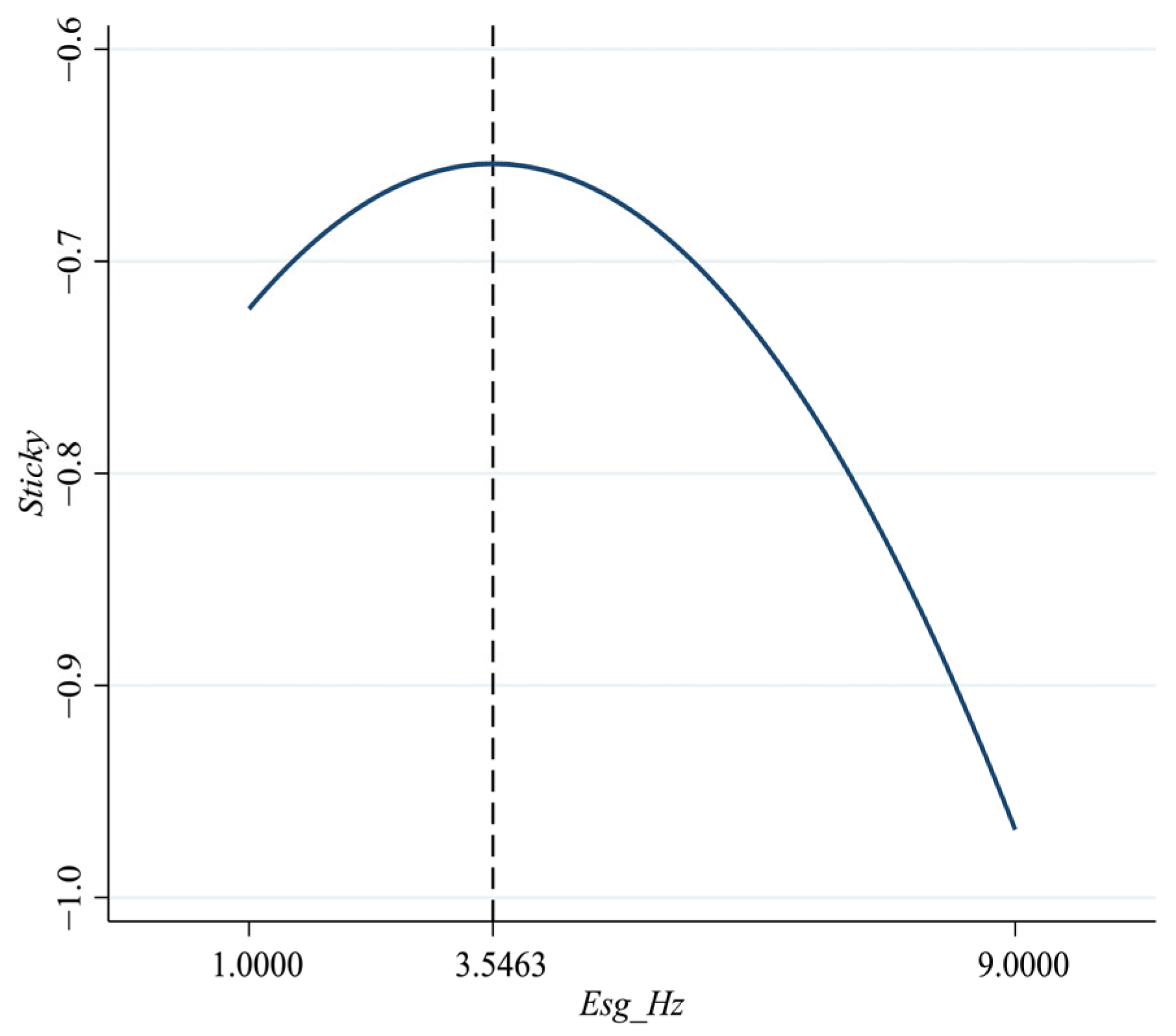
To more vividly illustrate the effect of corporate ESG responsibility fulfillment on cost stickiness, this paper plots the inverted U-shaped relationship between the two variables, as shown in Figure 2. The estimated turning point is 3.5463, which falls within the observed range of corporate ESG responsibility fulfillment [1.0000, 9.0000]. Similarly, the U-test results reported in Table 6 further corroborate the existence of an inverted U-shaped relationship. In addition, according to the Huazheng ESG rating scale, the estimated turning point lies between the B and CCC ratings, indicating that firms at this intermediate level of ESG responsibility fulfillment experience the strongest effect on cost stickiness.

4.4. Robustness and Endogeneity Tests

4.4.1. Lagged Effect of ESG Responsibility Fulfillment

In fact, corporate ESG responsibility fulfillment is a complex and systematic practice that requires sustained commitment over time. Prior research has suggested that the benefits associated with improved ESG performance often take a considerable period to materialize and are subject to substantial uncertainty [91]. By the same token, although the resources devoted to ESG initiatives may be directly reflected in firms’ current expenses, their substantive effects on cost structure may also emerge only gradually. This suggests that the impact of ESG responsibility fulfillment on cost stickiness may be lagged rather than contemporaneous. To examine this possibility, we replace the core explanatory variable in the baseline model with its one-period lag, L1_Esg_Hz, and re-estimate the regressions. As shown in column (1) of Table 7, before introducing the squared term, the regression coefficient of L1_Esg_Hz is 0.0130, which is not significant, indicating that the relationship between corporate ESG responsibility fulfillment and cost stickiness is not linear. After introducing the squared term, as illustrated in column (2), the regression coefficients of L1_Esg_Hz and L1_Esg_Hz2 are 0.0873 and −0.0093, respectively, both significant at the 5% level. These results provide strong evidence that our earlier conclusion remains reliable even after more cautiously accounting for the possibility that the causal effect of ESG responsibility fulfillment may unfold with a lag.

4.4.2. Alternative Measure of ESG Responsibility Fulfillment

Variations in system design, indicator selection, and weight allocation among different rating agencies may lead to discrepancies in ESG responsibility assessments for the same company [92]. To mitigate the impact of rating divergences on the research conclusions, this study re-measures the original independent variable Esg_Hz using the corporate ESG performance scores (Esg_Bg) published by another professional rating agency, Bloomberg. Subsequently, we reintegrate them into the model for regression analysis. As shown in column (3) of Table 7, before adding the squared term, the regression coefficient of Esg_Bg is −0.0009, which is not significant, indicating that the relationship between corporate ESG responsibility fulfillment and cost stickiness is not linear. As illustrated in column (4), after incorporating the squared term, the regression coefficients of Esg_Bg and Esg_Bg2 are 0.0153 and −0.0002, respectively, both significant at the 5% level, further confirming the existence of an inverted U-shaped relationship between corporate ESG responsibility fulfillment and cost stickiness. Therefore, our conclusion remains robust even after changing the measurement method of corporate ESG responsibility fulfillment.

4.4.3. Excluding the Impact of the COVID-19 Pandemic

This study’s initial research sample covers the period from 2012 to 2024. During this period, the COVID-19 outbreak spread globally in 2020, exerting significant impacts on various aspects of the economy and society. For enterprises, on the one hand, under the influence of the sudden public health emergency, the market demand for goods and services rapidly declined, resulting in a sharp decrease in operating revenue, and businesses faced tremendous challenges, compelling them to reduce costs and improve efficiency proactively [93]. On the other hand, to effectively control the pandemic, local governments had to frequently adjust epidemic prevention policies, further increasing the uncertainty faced by enterprises and leading them to adopt more conservative and cautious cost management strategies [94]. Therefore, to eliminate the disturbance caused by the COVID-19 pandemic on the research results, this study excluded samples after 2020 and re-ran the regression analysis. As shown in column (5) of Table 7, before considering the squared term, the regression coefficient of Esg_Hz is −0.0182, which is not significant, negating a linear relationship between corporate ESG responsibility fulfillment and cost stickiness. As illustrated in column (6), after incorporating the squared term, the regression coefficients of Esg_Hz and Esg_Hz2 are 0.0927 and −0.0146, respectively, both significant at the 1% level, indicating the existence of an inverted U-shaped relationship between corporate ESG responsibility fulfillment and cost stickiness, further confirming the robustness of this study’s conclusion.

4.4.4. Introducing Instrumental Variable

The level of ESG responsibility fulfillment may be influenced by various unobserved factors, such as managerial long-term strategic preferences, corporate culture, regional policy tendencies, or supply chain structures, all of which may simultaneously affect firms’ cost adjustment behavior, thereby creating endogeneity between ESG and cost stickiness [95]. Therefore, this study employs an instrumental variable approach to mitigate such issues.
We use the average ESG score of other firms in the same industry or region in the same year as the instrumental variable (IV). Regarding instrument relevance, firms within the same industry or region are likely to exhibit peer effects, which may lead them to influence each other’s ESG responsibility practices, thereby driving convergence in ESG performance. From the perspective of the exclusion restriction, this variable captures only the external ESG environment faced by firms at the industry or regional level, reflecting general sustainability norms, peer pressure, and institutional diffusion, and ultimately affects firms’ likelihood of engaging in ESG activities rather than directly influencing their own operations or cost adjustment decisions. In other words, industry- and region-level ESG performance does not directly enter a firm’s internal cost structure or resource adjustment process, as these processes are primarily driven by managerial decisions, demand fluctuations, and adjustment frictions. Overall, this instrumental variable is unlikely to directly affect an individual firm’s cost stickiness except through its impact on the firm’s own ESG engagement.
In the first-stage regression (column (7), Table 7), IV is significantly positively associated with Esg_Hz (coefficient = 0.2136, p < 0.01), indicating that the IV effectively predicts firms’ ESG levels. In the second-stage regression (column (8), Table 7), after adjusting for the instrumental variable, the coefficients of Esg_Hz and Esg_Hz2 are 0.9525 (p < 0.1) and −0.1128 (p < 0.1), respectively, both significant. In addition, the Kleibergen–Paap rk LM statistic is 51.717 and is significant at the 1% level, indicating no underidentification problem. The Cragg-Donald Wald F-statistic substantially exceeds the Stock-Yogo critical threshold at the 10% level, indicating that weak instrument concerns are unlikely to bias the estimations. These results further confirm the inverted U-shaped relationship between corporate ESG responsibility fulfillment and cost stickiness.

5. Further Investigations

5.1. Corporate ESG Responsibility Fulfillment, Environmental Sensitivity, and Cost Stickiness

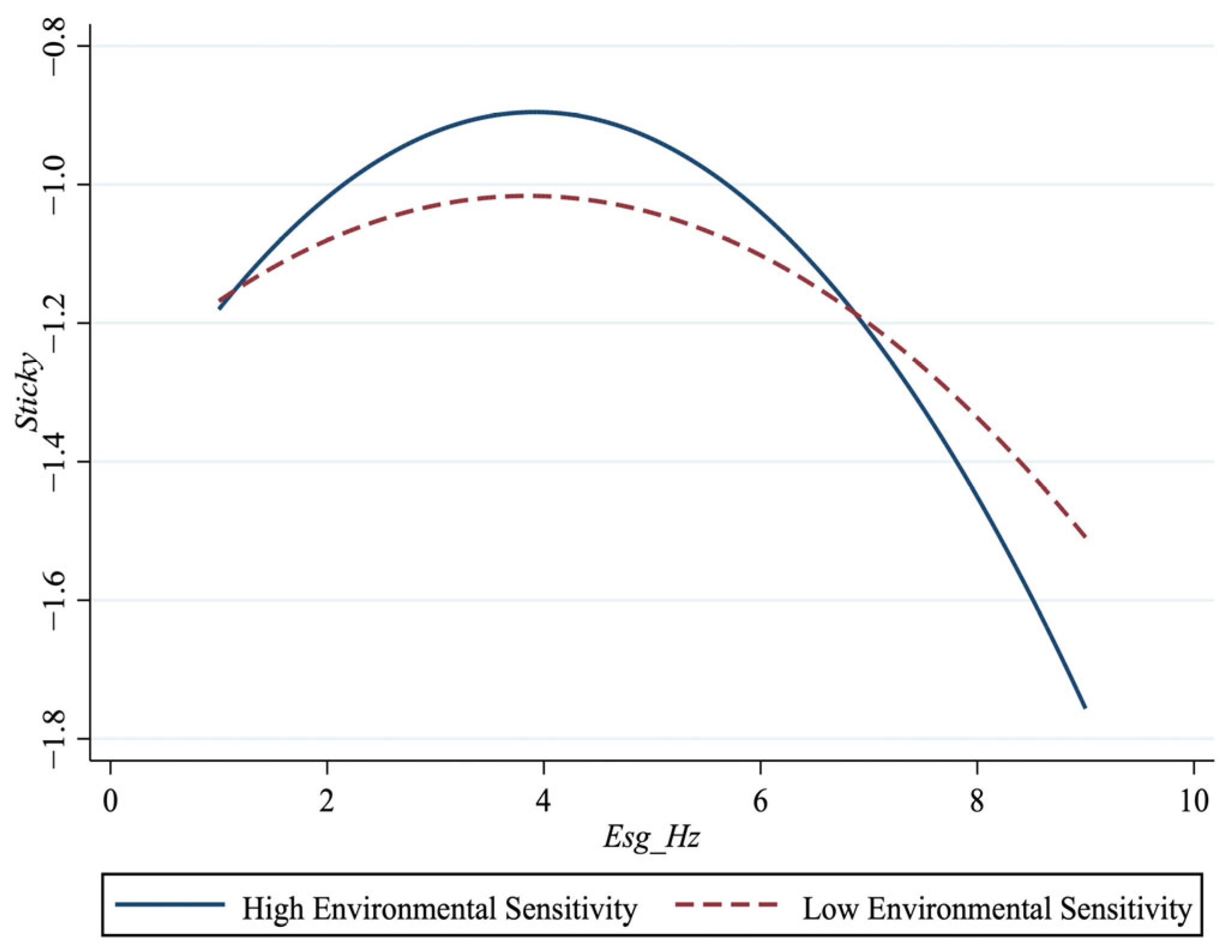
Column (1) in Table 8 reports the regression results regarding the moderating effect of environmental sensitivity. The interaction terms Pollu*Esg_Hz and Pollu*Esg_Hz2 are both significant at the 5% level, with regression coefficients of 0.1209 and −0.00150, respectively. These coefficients have the same signs as those of Esg_Hz and Esg_Hz2 in model (3), indicating that environmental sensitivity positively moderates the inverted U-shaped relationship between corporate ESG responsibility fulfillment and cost stickiness. The higher the environmental sensitivity, the more pronounced the inverted U-shaped impact of corporate ESG responsibility fulfillment on cost stickiness, thereby validating hypothesis H2a.
To illustrate the moderating effect of environmental sensitivity more clearly, this paper presents a moderating effect diagram, as shown in Figure 3. As environmental sensitivity increases, the inverted U-shaped curve between corporate ESG responsibility fulfillment and cost stickiness becomes steeper. This result indicates that higher environmental sensitivity enhances the suppressing effect of ESG responsibility fulfillment on cost stickiness, but when ESG responsibility fulfillment reaches a certain level, it also contributes to the enhancement of cost stickiness.

5.2. Corporate ESG Responsibility Fulfillment, Managerial Overconfidence, and Cost Stickiness

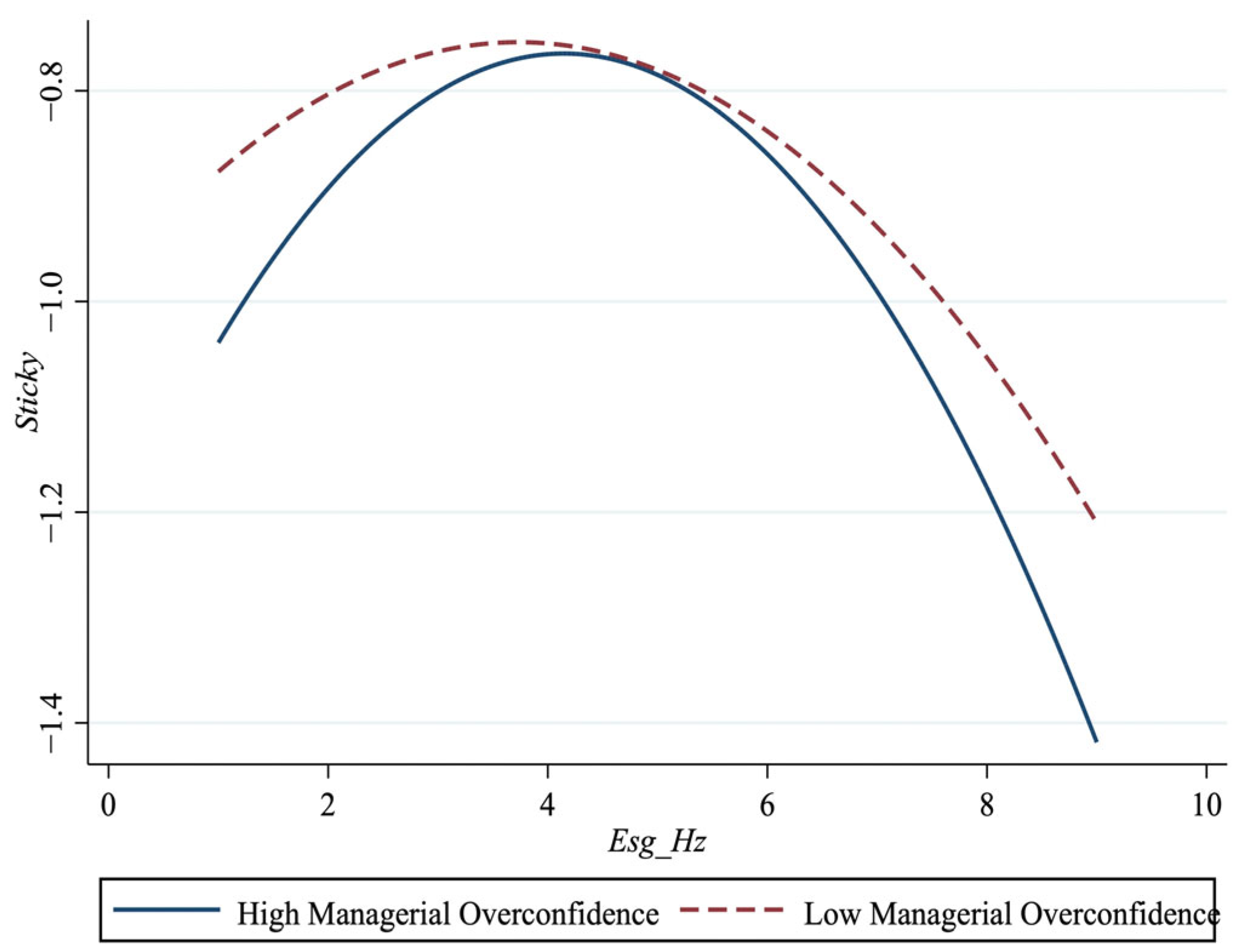
Column (2) in Table 8 reports the regression results regarding the moderating effect of managerial overconfidence. The interaction terms Oc*Esg_Hz and Oc*Esg_Hz2 are both significant at the 5% level, with regression coefficients of 0.1111 and −0.0116, respectively. These coefficients have the same signs as those of Esg_Hz and Esg_Hz2 in model (3), indicating that managerial overconfidence positively moderates the inverted U-shaped relationship between corporate ESG responsibility fulfillment and cost stickiness. The higher the degree of managerial overconfidence, the more pronounced the inverted U-shaped relationship between corporate ESG responsibility fulfillment and cost stickiness, thereby validating hypothesis H2b.
To illustrate the moderating effect of managerial overconfidence more vividly, we present a moderating effect diagram, as shown in Figure 4. In cases where managerial overconfidence is high, the inverted U-shaped curve between corporate ESG responsibility fulfillment and cost stickiness becomes steeper and slightly upward-shifted. This result indicates that the higher the degree of managerial overconfidence, the stronger the suppressing effect of ESG responsibility fulfillment on cost stickiness. However, when ESG responsibility fulfillment reaches a certain level, it significantly stimulates an increase in cost stickiness.

5.3. Corporate ESG Responsibility Fulfillment, State Ownership, and Cost Stickiness

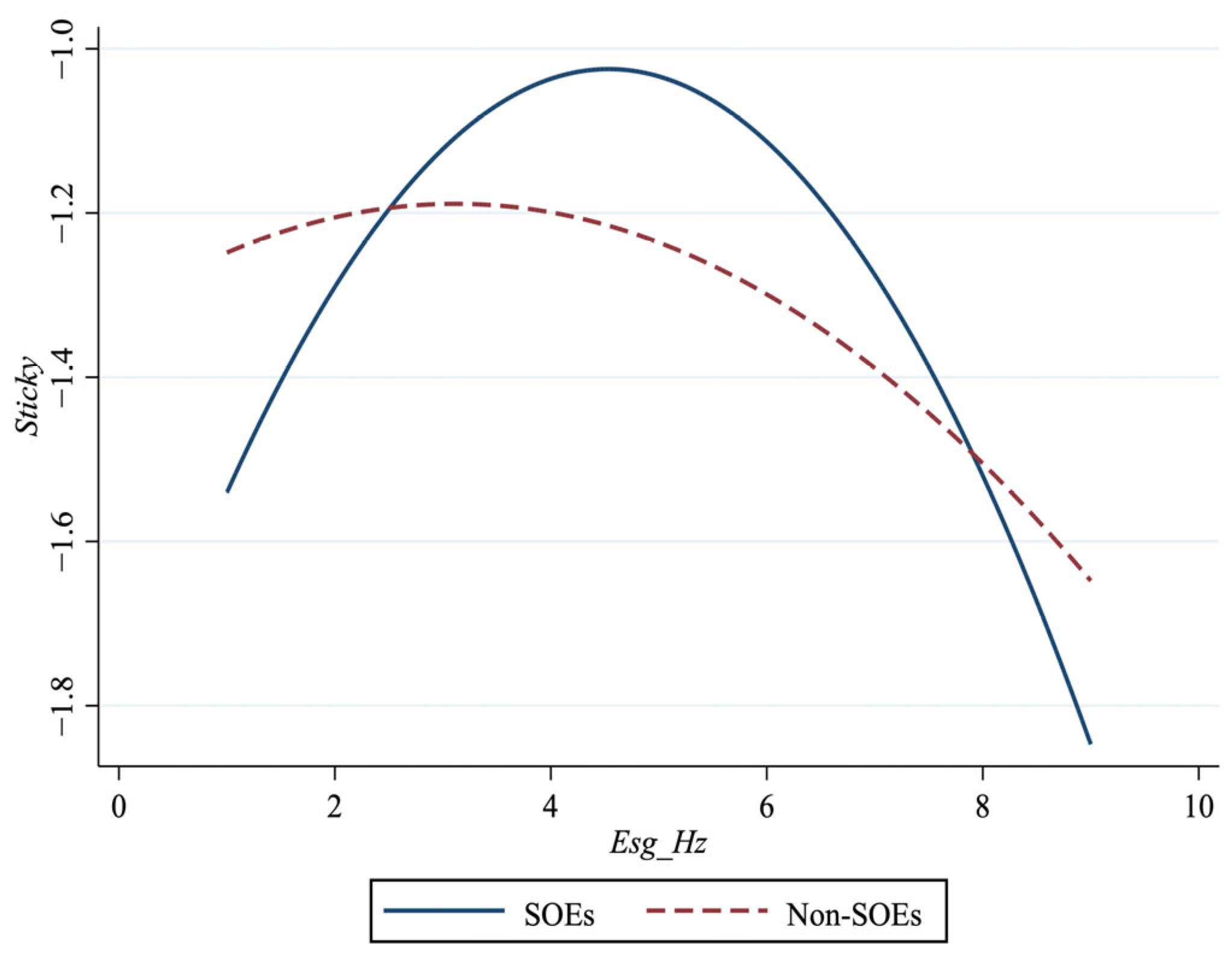
Column (3) in Table 8 reports the regression results regarding the moderating effect of state ownership. The interaction terms Soe*Esg_Hz and Soe*Esg_Hz2 are both significant at the 1% level, with regression coefficients of 0.2966 and −0.0283, respectively. These coefficients have the same signs as those of Esg_Hz and Esg_Hz2 in model (3), indicating that state ownership positively moderates the inverted U-shaped relationship between corporate ESG responsibility fulfillment and cost stickiness. In state-owned listed companies, the inverted U-shaped relationship between corporate ESG responsibility fulfillment and cost stickiness is more pronounced, thereby validating hypothesis H2c.
To more clearly present the moderating effect of state ownership, this paper presents a moderating effect diagram, as shown in Figure 5. Compared to non-state-owned listed companies, the inverted U-shaped curve between ESG fulfillment and cost stickiness in state-owned listed companies becomes steeper, consistent with evidence that state ownership is associated with higher adjustment costs and stronger cost stickiness in firms with state capital participation [74]. This means that for state-owned listed companies, the suppressing effect of ESG fulfillment on cost stickiness is relatively more substantial. However, when ESG fulfillment exceeds a specific threshold, its enhancing effect on cost stickiness also becomes more evident.

6. Research Conclusions and Implications

6.1. Research Conclusions

This study utilizes a sample of A-share listed companies on the SSE and the SZSE from 2012 to 2024 to thoroughly analyze the nonlinear impact of corporate ESG responsibility fulfillment on cost stickiness. Additionally, it explores the contingency process of this relationship from the perspectives of environmental sensitivity, managerial overconfidence, and state ownership. Our main findings are as follows: (1) A complex inverted U-shaped relationship exists between corporate ESG responsibility fulfillment and cost stickiness, indicating that ESG fulfillment has a double-edged sword effect on cost stickiness. (2) The turning point of this relationship is between the Huazheng B and CCC ratings (Esg_Hz ≈ 3.5463). Below this rating, ESG fulfillment significantly inhibits corporate cost stickiness, whereas above this rating, ESG fulfillment stimulates an increase in cost stickiness. (3) Environmental sensitivity, managerial overconfidence, and state ownership positively moderate the nonlinear relationship between ESG responsibility fulfillment and cost stickiness. In the context of the burgeoning ESG concept, the conclusions of this study provide empirical evidence and theoretical explanations for the impact of corporate ESG responsibility fulfillment on cost stickiness and its boundary conditions.

6.2. Managerial Implications

Based on the main research findings, this paper offers the following managerial implications. (1) Enterprises should recognize the positive significance of ESG responsibility fulfillment in suppressing cost stickiness and continue to implement the ESG development strategy. For enterprises, actively fulfilling ESG responsibilities is not merely a passive response to external demands but also helps garner stakeholders’ favor and support. This, in turn, facilitates and aids enterprises in adopting cost-reduction and efficiency-improvement measures, thereby establishing a mutually beneficial and high-quality development framework both internally and externally. (2) Enterprises should approach ESG investments rationally, as excessive ESG fulfillment can stimulate increased cost stickiness instead. Objectively, fulfilling ESG responsibilities requires enterprises to incur corresponding economic costs, which not only diverts funds from other production and business activities but also profoundly impacts the internal cost structure of the enterprise. Therefore, enterprises should exercise moderation and act within their means when fulfilling ESG responsibilities, striving to avoid the loss of control over cost stickiness due to over-investment. (3) When utilizing ESG strategies for cost management, enterprises should comprehensively consider factors such as industry characteristics, managerial traits, and ownership structure. The impact of ESG responsibility fulfillment on cost stickiness involves complex contingency mechanisms. Therefore, enterprises should objectively and thoroughly assess the characteristics of their internal and external environments, carefully determine and dynamically adjust the optimal level of ESG fulfillment to maximize its positive effects in suppressing cost stickiness.

6.3. Limitations and Future Research Directions

Although this study systematically analyzes the nonlinear relationship between corporate ESG responsibility fulfillment and cost stickiness, several limitations remain. First, the sample is limited to Chinese A-share listed companies. As a result, the findings may be influenced by China’s specific institutional environment, market characteristics, and regulatory context, which may limit the international generalizability of the conclusions. Second, this study mainly employs a composite ESG score to measure corporate ESG responsibility fulfillment and does not further distinguish the heterogeneous effects of the environmental (E), social (S), and governance (G) dimensions. Different ESG pillars may exert distinct influences on firms’ cost adjustment behavior and underlying mechanisms.
Based on these limitations, future research could be extended in several directions. First, future studies could expand the sample to firms from different countries or regions to compare how institutional environments shape the relationship between ESG responsibility fulfillment and cost stickiness, thereby enhancing the external validity of the findings. Second, future research could further disaggregate ESG into its environmental, social, and governance dimensions to examine their individual effects and underlying mechanisms on cost stickiness, thereby providing a deeper understanding of how ESG responsibility fulfillment influences corporate cost behavior.

Author Contributions

Conceptualization, S.Z. and C.Z.; methodology, S.Z. and K.W.; software, S.Z. and K.W.; validation, C.Z. and Z.Z.; formal analysis, S.Z.; investigation, S.Z. and K.W.; data curation, S.Z. and Z.Z.; writing—original draft preparation, S.Z.; writing—review and editing, C.Z. and all authors; supervision, C.Z. and Z.Z.; and funding acquisition, C.Z. All authors have read and agreed to the published version of the manuscript.

Funding

This work was supported by the National Natural Science Foundation of China (71273129).

Institutional Review Board Statement

Not applicable.

Informed Consent Statement

Not applicable.

Data Availability Statement

The data presented in this study is available on request from the corresponding author.

Acknowledgments

The authors are grateful to the editors, as well as the anonymous reviewers for valuable suggestions and comments that helped us improve our paper significantly.

Conflicts of Interest

The authors declare that they have no known competing financial interests or personal relationships with other people or organizations that could have appeared to influence the work reported in this paper.

Note

1
Detailed Information: https://www.chindices.com/esg-ratings.html accessed on 20 January 2023.

References

  1. Jiang, X.; Shen, J.H.; Lee, C.-C.; Chen, C. Supply-side structural reform and dynamic capital structure adjustment: Evidence from Chinese-listed firms. Pac.-Basin Financ. J. 2021, 65, 101482. [Google Scholar] [CrossRef]
  2. Noreen, E. Conditions under which activity-based cost systems provide relevant costs. J. Manag. Account. Res. 1991, 3, 159–168. [Google Scholar] [CrossRef]
  3. Anderson, M.C.; Banker, R.D.; Janakiraman, S.N. Are selling, general, and administrative costs “sticky”? J. Account. Res. 2003, 41, 47–63. [Google Scholar] [CrossRef]
  4. Askarany, D.; Parsaei, M.; Ghanbari, N. Business Strategy, Short-Term Debt, and Cost Stickiness. Comput. Econ. 2024, 64, 1913–1936. [Google Scholar] [CrossRef]
  5. Costa, M.D.; Habib, A. Cost stickiness and firm value. J. Manag. Control 2023, 34, 235–273. [Google Scholar] [CrossRef]
  6. Warganegara, D.L.; Tamara, D. The impacts of cost stickiness on the profitability of Indonesian firms. Int. J. Econ. Manag. Eng. 2014, 8, 3621–3624. [Google Scholar]
  7. Ibrahim, A.E.A.; Ali, H.; Aboelkheir, H. Cost stickiness: A systematic literature review of 27 years of research and a future research agenda. J. Int. Account. Audit. Tax. 2022, 46, 100439. [Google Scholar] [CrossRef]
  8. Dierynck, B.; Landsman, W.R.; Renders, A. Do managerial incentives drive cost behavior? Evidence about the role of the zero earnings benchmark for labor cost behavior in private Belgian firms. Account. Rev. 2012, 87, 1219–1246. [Google Scholar] [CrossRef]
  9. Liu, X.; Liu, X.; Reid, C.D. Stakeholder orientations and cost management. Contemp. Account. Res. 2019, 36, 486–512. [Google Scholar]
  10. Chen, C.X.; Lu, H.; Sougiannis, T. The agency problem, corporate governance, and the asymmetrical behavior of selling, general, and administrative costs. Contemp. Account. Res. 2012, 29, 252–282. [Google Scholar]
  11. Gantchev, N.; Sevilir, M.; Shivdasani, A. Activism and empire building. J. Financ. Econ. 2020, 138, 526–548. [Google Scholar] [CrossRef]
  12. Chen, J.V.; Kama, I.; Lehavy, R. A contextual analysis of the impact of managerial expectations on asymmetric cost behavior. Rev. Account. Stud. 2019, 24, 665–693. [Google Scholar] [CrossRef]
  13. Yang, D. Mergers, CEO hubris, and cost stickiness. Emerg. Mark. Financ. Trade 2015, 51, S46–S63. [Google Scholar] [CrossRef]
  14. Banerjee, S.; Homroy, S.; Slechten, A. Stakeholder preference and strategic corporate social responsibility. J. Corp. Financ. 2022, 77, 102286. [Google Scholar] [CrossRef]
  15. Zhang, C.; Zhang, S.; Zhou, Z.; He, B. Merging Economic Aspirations with Sustainability: ESG and the Evolution of the Corporate Development Paradigm in China. Sustainability 2025, 17, 9108. [Google Scholar] [CrossRef]
  16. Elfenbein, D.W.; McManus, B. A greater price for a greater good? Evidence that consumers pay more for charity-linked products. Am. Econ. J. Econ. Policy 2010, 2, 28–60. [Google Scholar] [CrossRef]
  17. Alda, M. The environmental, social, and governance (ESG) dimension of firms in which social responsible investment (SRI) and conventional pension funds invest: The mainstream SRI and the ESG inclusion. J. Clean. Prod. 2021, 298, 126812. [Google Scholar] [CrossRef]
  18. He, G.; Liu, Y.; Chen, F. Research on the impact of environment, society, and governance (ESG) on firm risk: An explanation from a financing constraints perspective. Financ. Res. Lett. 2023, 58, 104038. [Google Scholar] [CrossRef]
  19. Eliwa, Y.; Aboud, A.; Saleh, A. ESG practices and the cost of debt: Evidence from EU countries. Crit. Perspect. Account. 2021, 79, 21. [Google Scholar] [CrossRef]
  20. Zhang, D.Y.; Wang, C.; Dong, Y. How Does Firm ESG Performance Impact Financial Constraints? An Experimental Exploration of the COVID-19 Pandemic. Eur. J. Dev. Res. 2022, 35, 219–239. [Google Scholar] [CrossRef] [PubMed]
  21. Miles, M.P.; Covin, J.G. Environmental marketing: A source of reputational, competitive, and financial advantage. J. Bus. Ethics 2000, 23, 299–311. [Google Scholar] [CrossRef]
  22. Brogi, M.; Lagasio, V. Environmental, social, and governance and company profitability: Are financial intermediaries different? Corp. Soc. Responsib. Environ. Manag. 2019, 26, 576–587. [Google Scholar] [CrossRef]
  23. Zhou, Y.; Zhang, N.; Wu, C.-H.; Wang, Y.; Zhang, X.; Zhang, D. The Impact of Supply Chain ESG Management on Supply Chain Resilience With Emerging IT Technologies: Based on Supply Chain Network Capabilities. J. Organ. End. User Comput. 2024, 36, 1–31. [Google Scholar] [CrossRef]
  24. Li, N.; Li, G.; Xue, J. Does ESG protect firms equally during crises? The role of supply chain concentration. Omega 2025, 130, 103171. [Google Scholar] [CrossRef]
  25. Margolis, J.D.; Elfenbein, H.A.; Walsh, J.P. Does It Pay to Be Good…and Does It Matter? A Meta-Analysis of the Relationship Between Corporate Social and Financial Performance. Working Paper. Available online: https://ssrn.com/abstract=1866371 (accessed on 15 June 2026).
  26. Treepongkaruna, S.; Kyaw, K.; Jiraporn, P. ESG controversies and corporate governance: Evidence from board size. Bus. Strategy Environ. 2024, 33, 4218–4232. [Google Scholar] [CrossRef]
  27. Nguyen, D.T.; Hoang, T.G.; Tran, H.G. Help or hurt? The impact of ESG on firm performance in S&P 500 non-financial firms. Australas. Account. Bus. Financ. J. 2022, 16, 91–102. [Google Scholar] [CrossRef]
  28. Wang, Z.; Lu, W.; Liu, M. Corporate social responsibility overinvestment in mergers and acquisitions. Int. Rev. Financ. Anal. 2021, 78, 101944. [Google Scholar] [CrossRef]
  29. Yu, N.; Liu, D.; Wan, H.; Chen, C. Water resource tax and corporate cost stickiness: Evidence from China’s reform. J. Account. Emerg. Econ. 2026, 1–30. [Google Scholar] [CrossRef]
  30. Han, S.; Rezaee, Z.; Tuo, L. Is cost stickiness associated with management earnings forecasts? Asian Rev. Account. 2020, 28, 173–211. [Google Scholar]
  31. Zhong, T.; Sun, F.; Zhou, H.; Lee, J.Y. Business strategy, state-owned equity and cost stickiness: Evidence from Chinese firms. Sustainability 2020, 12, 1850. [Google Scholar] [CrossRef]
  32. Yang, X.; Li, Z.; Qiu, Z.; Wang, J.; Liu, B. ESG performance and corporate technology innovation: Evidence from China. Technol. Forecast. Soc. Change 2024, 206, 123520. [Google Scholar] [CrossRef]
  33. Lin, H.; Gu, X.; Bao, X. Corporate ESG performance and bankruptcy risk. Financ. Res. Lett. 2025, 76, 106987. [Google Scholar] [CrossRef]
  34. Liu, D.; Jin, S. How does corporate ESG performance affect financial irregularities? Sustainability 2023, 15, 9999. [Google Scholar] [CrossRef]
  35. Shi, J.; Yang, J.; Li, Y. Supply network position and firm performance: Evidence from Chinese listed manufacturing companies. J. Bus. Econ. Manag. 2019, 20, 1258–1277. [Google Scholar] [CrossRef]
  36. Ketokivi, M.; Mahoney, J.T. Transaction cost economics as a theory of supply chain efficiency. Prod. Oper. Manag. 2020, 29, 1011–1031. [Google Scholar] [CrossRef]
  37. Liu, Y.; Jin, M. Does supply chain network centrality affect firm cost stickiness? Financ. Res. Lett. 2023, 58, 104459. [Google Scholar] [CrossRef]
  38. Kohtamäki, M.; Parida, V.; Patel, P.C.; Gebauer, H. The relationship between digitalization and servitization: The role of servitization in capturing the financial potential of digitalization. Technol. Forecast. Soc. Change 2020, 151, 119804. [Google Scholar] [CrossRef]
  39. Jiang, W.; Yang, W. ESG disclosure and corporate cost stickiness: Evidence from supply-chain relationships. Econ. Lett. 2024, 238, 111697. [Google Scholar] [CrossRef]
  40. Yuan, X.Y.; Li, Z.F.; Xu, J.H.; Shang, L.X. ESG disclosure and corporate financial irregularities-Evidence from Chinese listed firms. J. Clean. Prod. 2022, 332, 129992. [Google Scholar] [CrossRef]
  41. Hillman, A.J.; Keim, G.D. Shareholder value, stakeholder management, and social issues: What’s the bottom line? Strateg. Manag. J. 2001, 22, 125–139. [Google Scholar] [CrossRef]
  42. Bag, S.; Dhamija, P.; Bryde, D.J.; Singh, R.K. Effect of eco-innovation on green supply chain management, circular economy capability, and performance of small and medium enterprises. J. Bus. Res. 2022, 141, 60–72. [Google Scholar] [CrossRef]
  43. Xiao, Z.; Huang, X.; Chen, H. The impact of corporate ESG performance on buyers’ bargaining power in the industrial chain: Evidence from China. Financ. Res. Lett. 2024, 60, 104906. [Google Scholar] [CrossRef]
  44. Kang, K.; Luan, X.; Shen, W.; Ma, Y.; Wei, X. The Strategies of the Poverty-Alleviation Supply Chain with Government Subsidies and Cost Sharing: Government-Led or Market-Oriented? Sustainability 2020, 12, 4050. [Google Scholar] [CrossRef]
  45. Cippiciani, F.A.; Savoia, J.R.; de Mariz, F.; Bergmann, D.R. ESG and Risk: Global Evidence of Nonlinear Relation. Bus. Strategy Environ. 2026, 1–24. [Google Scholar] [CrossRef]
  46. Huang, D.Z.X. Environmental, social and governance factors and assessing firm value: Valuation, signalling and stakeholder perspectives. Account. Financ. 2022, 62, 1983–2010. [Google Scholar]
  47. Hasan, I.; Kobeissi, N.; Liu, L.; Wang, H. Corporate social responsibility and firm financial performance: The mediating role of productivity. J. Bus. Ethics 2018, 149, 671–688. [Google Scholar]
  48. Hong, N.T.P.; Trang, N.T. The Effect of Corporate Social Responsibility on Cost Stickiness in Companies Listed on Vietnam Stock Market. Corp. Soc. Responsib. Environ. Manag. 2026, 33, 1573–1593. [Google Scholar]
  49. Buchanan, B.; Cao, C.X.; Chen, C. Corporate social responsibility, firm value, and influential institutional ownership. J. Corp. Financ. 2018, 52, 73–95. [Google Scholar] [CrossRef]
  50. Le, A.-T.; Tran, T.P. Corporate governance and labor investment efficiency: International evidence from board reforms. Corp. Gov. Int. Rev. 2022, 30, 555–583. [Google Scholar] [CrossRef]
  51. Ma, X.; Ma, W.; Zhao, X.; Zhou, X.; Si Mohammed, K. Increasing Burdens or Reducing Costs: Influence of Corporate Social Responsibility on Cost Stickiness. J. Knowl. Econ. 2024, 15, 2136–2155. [Google Scholar]
  52. Suchman, M.C. Managing legitimacy: Strategic and institutional approaches. Acad. Manag. Rev. 1995, 20, 571–610. [Google Scholar] [CrossRef]
  53. Cao, Z.; Zhang, H.; Hang, Z.; Zhou, D.; Jing, B. Does the Responsibility System for Environmental Protection Targets Enhance Corporate High-Quality Development in China? Energies 2022, 15, 3650. [Google Scholar] [CrossRef]
  54. Tu, Z.; Hu, T.; Shen, R. Evaluating public participation impact on environmental protection and ecological efficiency in China: Evidence from PITI disclosure. China Econ. Rev. 2019, 55, 111–123. [Google Scholar] [CrossRef]
  55. Wang, L.; Chen, C.; Zhu, B. Earnings pressure, external supervision, and corporate environmental protection investment: Comparison between heavy-polluting and non-heavy-polluting industries. J. Clean. Prod. 2023, 385, 135648. [Google Scholar] [CrossRef]
  56. Yang, H.; Yuan, P. Environmental protection investment on performance of heavy-polluting enterprises: Evidence from China’s A-share listed companies. Environ. Sci. Pollut. Res. 2024, 31, 20383–20398. [Google Scholar] [CrossRef] [PubMed]
  57. Xu, F.; Yang, M.; Li, Q.; Yang, X. Long-term economic consequences of corporate environmental responsibility: Evidence from heavily polluting listed companies in China. Bus. Strategy Environ. 2020, 29, 2251–2264. [Google Scholar] [CrossRef]
  58. Porter, M.E.; Kramer, M.R. Corporate Philanthropy: Taking the High Ground. Found. Strategy Group 2003, 13, 1–12. [Google Scholar]
  59. Zhang, Q.; Yu, Z.; Kong, D. The real effect of legal institutions: Environmental courts and firm environmental protection expenditure. J. Environ. Econ. Manag. 2019, 98, 102254. [Google Scholar] [CrossRef]
  60. Langer, E.J. The illusion of control. J. Personal. Soc. Psychol. 1975, 32, 311. [Google Scholar] [CrossRef]
  61. Zhang, S.; Chen, Z. Experts on the board: How do IT-savvy directors promote corporate digital innovation? Econ. Anal. Policy 2025, 85, 791–817. [Google Scholar] [CrossRef]
  62. Zhang, S.; Wang, K.; Chen, Z.; Zhang, C. Haste Makes Waste: How Do Patient Institutional Investors Deflate Corporate Digital Innovation Bubbles? Emerg. Mark. Financ. Trade 2025, 1–20. [Google Scholar] [CrossRef]
  63. Weinstein, N.D. Unrealistic optimism about future life events. J. Personal. Soc. Psychol. 1980, 39, 806–820. [Google Scholar] [CrossRef]
  64. Ibrahim, A.E.A. Economic growth and cost stickiness: Evidence from Egypt. J. Financ. Report. Account. 2015, 13, 119–140. [Google Scholar] [CrossRef]
  65. Kuang, Y.F.; Mohan, A.; Qin, B. CEO overconfidence and cost stickiness. Manag. Control Account. 2015, 2015, 26–32. [Google Scholar]
  66. Koo, J.-H.; Yang, D. Managerial Overconfidence, Self-Attribution Bias, and Downwardly Sticky Investment: Evidence from Korea. Emerg. Mark. Financ. Trade 2018, 54, 144–161. [Google Scholar]
  67. Chen, C.X.; Nasev, J.; Wu, S.Y.-C. CFO Overconfidence and Cost Behavior. J. Manag. Account. Res. 2022, 34, 117–135. [Google Scholar]
  68. Cheng, H.; Fan, H.; Hoshi, T.; Hu, D. State ownership, political connection, and innovation subsidies in China. J. Jpn. Int. Econ. 2024, 71, 101287. [Google Scholar] [CrossRef]
  69. Cull, R.; Li, W.; Sun, B.; Xu, L.C. Government connections and financial constraints: Evidence from a large representative sample of Chinese firms. J. Corp. Financ. 2015, 32, 271–294. [Google Scholar] [CrossRef]
  70. Li, J.; Luo, Z. Product market competition and cost stickiness: Evidence from China. Manag. Decis. Econ. 2021, 42, 1808–1821. [Google Scholar] [CrossRef]
  71. Bai, C.-E.; Li, D.D.; Tao, Z.; Wang, Y. A multitask theory of state enterprise reform. J. Comp. Econ. 2000, 28, 716–738. [Google Scholar] [CrossRef]
  72. Prabowo, R.; Hooghiemstra, R.; Van Veen-Dirks, P. State Ownership, Socio-political Factors, and Labor Cost Stickiness. Eur. Account. Rev. 2018, 27, 771–796. [Google Scholar]
  73. Chen, Y.; Ma, Y. Financing constraints, internal control quality and cost stickiness. J. Bus. Econ. Manag. 2021, 22, 1231–1251. [Google Scholar] [CrossRef]
  74. Xiao, Z.; Niu, Q.; Yun, F.; Ye, Y. The impact of state-owned capital on labor cost stickiness in private firms: Evidence from China. Econ. Model. 2024, 141, 106906. [Google Scholar] [CrossRef]
  75. Tang, Y.; Qiao, X.; Chen, H. ESG performance and investment expansion: Evidence from Chinese listed firms. Financ. Res. Lett. 2024, 69, 106072. [Google Scholar] [CrossRef]
  76. Weiss, D. Cost behavior and analysts’ earnings forecasts. Account. Rev. 2010, 85, 1441–1471. [Google Scholar] [CrossRef]
  77. Kreilkamp, N.; Teichmann, S.; Wöhrmann, A. The Effect of Cost Stickiness on Peer-Based Valuation Models. Eur. Account. Rev. 2021, 30, 913–938. [Google Scholar] [CrossRef]
  78. Deegan, C.; Gordon, B. A study of the environmental disclosure practices of Australian corporations. Account. Bus. Res. 1996, 26, 187–199. [Google Scholar] [CrossRef]
  79. Yu, S.; Xu, L.; Du, P.; Qin, Z.; Zhong, Q.; Zhao, T. The impact of air pollution on corporate environmental information disclosure–Evidence from heavy pollution industries in China. Financ. Res. Lett. 2024, 59, 104793. [Google Scholar] [CrossRef]
  80. Wu, X.; Chen, S.; Guo, J.; Gao, G. Effect of air pollution on the stock yield of heavy pollution enterprises in China’s key control cities. J. Clean. Prod. 2018, 170, 399–406. [Google Scholar] [CrossRef]
  81. Pan, A.; Liu, W.; Wang, X. Managerial overconfidence, debt capacity and merger & acquisition premium. Nankai Bus. Rev. Int. 2019, 10, 570–590. [Google Scholar] [CrossRef]
  82. Wei, Z. The effect of manager overconfidence on capital structure. J. Ind. Technol. Econ. 2018, 37, 3–12. [Google Scholar]
  83. Yu, M.; Li, W.; Pan, H. Managers’ overconfidence and Enterprise risk-taking. J. Financ. Res. 2013, 1, 149–163. [Google Scholar]
  84. Wen, Z.; Hau, K.-T.; Chang, L. A comparison of moderator and mediator and their applications. Acta Psychol. Sin. 2005, 37, 268. [Google Scholar]
  85. Chen, Y.; Xu, J. Digital transformation and firm cost stickiness: Evidence from China. Financ. Res. Lett. 2023, 52, 103510. [Google Scholar] [CrossRef]
  86. Xu, J.; Sim, J.W. Are costs really sticky and biased? Evidence from manufacturing listed companies in China. Appl. Econ. 2017, 49, 5601–5613. [Google Scholar] [CrossRef]
  87. Guenther, T.W.; Riehl, A.; Rößler, R. Cost stickiness: State of the art of research and implications. J. Manag. Control 2014, 24, 301–318. [Google Scholar]
  88. Lin, Y.; Li, S. Supply chain resilience, ESG performance, and corporate growth. Int. Rev. Econ. Financ. 2025, 97, 103763. [Google Scholar] [CrossRef]
  89. Whicker, L.; Bernon, M.; Templar, S.; Mena, C. Understanding the relationships between time and cost to improve supply chain performance. Int. J. Prod. Econ. 2009, 121, 641–650. [Google Scholar] [CrossRef]
  90. Zhang, Y.; Xiong, T. More ESG Practices, Higher Financial Performance? The U-Shaped Pattern in China’s Agricultural and Food Firms. Agribusiness 2026, 42, 641–652. [Google Scholar]
  91. Tang, H. The Effect of ESG Performance on Corporate Innovation in China: The Mediating Role of Financial Constraints and Agency Cost. Sustainability 2022, 14, 3769. [Google Scholar] [CrossRef]
  92. Zumente, I.; Lāce, N. ESG Rating—Necessity for the Investor or the Company? Sustainability 2021, 13, 8940. [Google Scholar] [CrossRef]
  93. Zhang, D.; Zheng, W. Does COVID-19 make the firms’ performance worse? Evidence from the Chinese listed companies. Econ. Anal. Policy 2022, 74, 560–570. [Google Scholar] [CrossRef] [PubMed]
  94. Finne, G.; Haga, J.; Sundvik, D. Cost behaviour and reporting frequency during the COVID-19 outbreak. Account. Bus. Res. 2024, 54, 491–520. [Google Scholar] [CrossRef]
  95. Tang, T.; Yang, L. Shaping corporate ESG performance: Role of social trust in China’s capital market. China Financ. Rev. Int. 2024, 14, 34–75. [Google Scholar]
Figure 1. GDP growth rate and industrial enterprises’ cost per 100 yuan of revenue in China from 2014 to 2024.
Systems 14 00705 g001
Figure 2. The inverted U-shaped relationship between corporate ESG responsibility fulfillment and cost stickiness.
Systems 14 00705 g002
Figure 3. The moderating effect of environmental sensitivity.
Systems 14 00705 g003
Figure 4. The moderating effect of managerial overconfidence.
Systems 14 00705 g004
Figure 5. The moderating effect of state ownership.
Systems 14 00705 g005
Table 1. Summary of the Huazheng ESG rating system indicators.
3 First-Level Pillar IndicatorsEnvironmental PillarSocial PillarGovernance Pillar
16 Second-Level Thematic IndicatorsClimate Change
Resource Utilization
Environmental Pollution
Environmentally Friendly Practices
Environmental Management
Human Capital
Product Responsibility
Supply Chain
Social Contribution
Data Security and Privacy
Shareholder Rights
Governance Structure
Disclosure Quality
Governance Risk
External Sanctions
44 Third-Level Key IndicatorsGreenhouse Gas Emissions, Carbon Reduction Pathways, Climate Change Mitigation, Sponge Cities, Green Finance
Land Use and Biodiversity, Water Resource Consumption, Material Consumption
Industrial Emissions, Hazardous Waste, Electronic Waste
Renewable Energy, Green Buildings, Green Factories
Sustainable Certification, Supply Chain Environmental Management, Environmental Penalties
Employee Health and Safety, Employee Incentives and Development, Employee Relations
Quality Certification, Product Recalls, Customer Complaints
Supplier Risk and Management, Supply Chain Relationships
Inclusive Growth, Community Investment, Employment, Technological Innovation
Data Security and Privacy
Shareholder Rights Protection
ESG, Risk Control, Board Structure, Management Stability
ESG External Assurance, Information Disclosure Credibility
Major Shareholder Behavior, Debt Repayment Ability, Legal Litigation, Tax Transparency
External Sanctions
Business Ethics, Anti-Corruption and Bribery
Table 2. Variable definitions and measurement methods.
Variable TypeVariablesDefinitionMeasurement Method
Dependent VariableStickyCost StickinessMeasurements are conducted based on the model proposed by Weiss (2010) [76].
Independent VariableEsg_HzESG Responsibility FulfillmentBased on the Huazheng ESG rating system, the C to AAA ratings are assigned values from 1 to 9, respectively.
Moderating VariablesPolluEnvironmental SensitivityIf a company belongs to a heavy-polluting industry, it is assigned a value of 1; otherwise, it is assigned a value of 0.
OcManagerial OverconfidenceFollowing the scoring approach of Wei (2018) [82], we code the variable as 1 if the total score is greater than or equal to the sample mean, and 0 otherwise.
SoeState OwnershipIf a company is state-owned, it is assigned a value of 1; otherwise, it is assigned a value of 0.
Control VariablesAiAsset IntensityTotal assets at the end of the fiscal year/Total revenue.
EiEmployee IntensityThe number of employees at the end of the fiscal year/Total revenue.
FirmageFirm AgeLn (The number of years since the company’s establishment + 1).
BoardBoard SizeLn (The number of directors + 1).
DualCEO-Chair DualityEqual to 1 if the chairperson and CEO are the same individual and 0 otherwise.
SizeFirm SizeLn (Total assets at the end of the fiscal year).
ROAProfitabilityNet profit/Total assets at the end of the fiscal year.
IndepProportion of Independent DirectorsThe number of independent directors/The total number of board directors.
GrowthGrowth CapacityTotal revenue in the current year/Total revenue in the previous year − 1
TobinQMarket ValueCorporate market value/Total assets.
Table 3. Descriptive statistics of the variables.
VariablesObsMeanSDMinMedianMax
Sticky36,048−0.24801.1390−9.2836−0.13347.9199
Esg_Hz36,0484.14881.09881.00004.00009.0000
Ai36,0481.03400.03220.88621.03141.3543
Ei36,0480.35360.03980.21650.35450.4546
FirmAge36,0483.00340.31751.09863.04454.3041
Board36,0482.10890.19651.60942.19722.7081
Dual36,0480.30410.46000.00000.00001.0000
Size36,04822.29081.296219.524522.093826.4523
ROA36,0480.03090.0641−0.55620.03280.2223
Indep36,0480.37740.05350.28570.36360.6000
Growth36,0480.12230.3697−0.67350.07575.0755
TobinQ36,0482.00441.31310.79461.598917.6759
Table 4. Results of Pearson correlation analysis.
VariablesStickyEsg_HzAiEiFirmAgeBoardDualSizeROAIndepGrowthTobinQ
Sticky1.0000
Esg_Hz0.0248 ***1.0000
Ai−0.0403 ***−0.0494 ***1.0000
Ei−0.0087 *0.1609***−0.2474 ***1.0000
FirmAge0.0040−0.0343 ***0.0090 *0.00571.0000
Board0.0088 *0.0340***−0.0353 ***0.2111 ***0.0580 ***1.0000
Dual−0.0171 ***−0.0092 *0.0228 ***−0.0863 ***−0.0959 ***−0.1935 ***1.0000
Size0.0119 **0.2292 ***−0.0840 ***0.5206 ***0.1873 ***0.2678 ***−0.1809 ***1.0000
ROA0.1546 ***0.2118 ***−0.1998 ***0.0601 ***−0.0824 ***0.0283 ***0.00640.0421 ***1.0000
Indep0.00460.0596 ***0.0271 ***−0.0379 ***−0.0249 ***−0.5630 ***0.1214 ***−0.0173 ***−0.0122 **1.0000
Growth0.0604 ***−0.0033−0.1247 ***−0.0139 ***−0.0769 ***−0.00100.0162 ***0.0307 ***0.2299 ***−0.00231.0000
TobinQ0.0115 **−0.0801 ***0.0320 ***−0.1883 ***−0.0627 ***−0.1118 ***0.0782 ***−0.3765 ***0.1259 ***0.0428 ***0.0677 ***1.0000
Note: *, **, and *** indicate significance at the significance level of 10%, 5%, and 1%, respectively.
Table 5. Baseline regression results of corporate ESG responsibility fulfillment’s impact on cost stickiness.
Variables(1)(2)(3)(4)(5)(6)
StickyStickyStickyStickyStickySticky
Esg_Hz−0.0070−0.0102−0.01030.0729 ***0.0586 **0.0749 ***
(−1.2006)(−1.4241)(−1.4288)(3.0734)(2.2112)(2.6190)
Esg_Hz2 −0.0099 ***−0.0086***−0.0106 ***
(−3.5958)(−2.7535)(−3.1315)
Ai−0.4671 *0.9308 *0.7362−0.4787 *0.9242 *0.7241
(−1.8401)(1.8077)(1.4241)(−1.8875)(1.7948)(1.4010)
Ei−0.8321 ***0.27150.1489−0.8320 ***0.27900.1500
(−4.3182)(0.5168)(0.2796)(−4.3246)(0.5312)(0.2818)
FirmAge0.0517 **0.1303 **0.2586 **0.0544 ***0.1413***0.2595 **
(2.5579)(2.4873)(2.1388)(2.6894)(2.6902)(2.1457)
Board0.07010.00200.00520.06900.00280.0063
(1.6113)(0.0250)(0.0658)(1.5855)(0.0356)(0.0790)
Dual−0.0416 ***0.01610.0151−0.0418 ***0.01600.0150
(−2.9770)(0.7290)(0.6849)(−2.9927)(0.7247)(0.6799)
Size0.0073−0.0705 ***−0.0691 ***0.0098−0.0702 ***−0.0680 ***
(1.0704)(−3.6034)(−3.4161)(1.4224)(−3.5933)(−3.3630)
ROA2.6879 ***3.9853 ***3.9543 ***2.6703 ***3.9782 ***3.9475 ***
(17.8192)(20.3930)(20.2200)(17.6972)(20.3750)(20.2141)
Indep0.3384 **0.6055**0.6125 **0.3460 **0.6177 **0.6236 **
(2.2778)(2.4924)(2.5226)(2.3297)(2.5436)(2.5696)
Growth0.0780 ***0.0632 ***0.0566 ***0.0762 ***0.0618 ***0.0555 ***
(4.7657)(3.4354)(3.0156)(4.6610)(3.3584)(2.9588)
TobinQ−0.0077−0.0080−0.0123−0.0064−0.0081−0.0120
(−1.2877)(−1.1064)(−1.5587)(−1.0676)(−1.1219)(−1.5184)
_cons−0.1002−0.4363−0.6061−0.3028−0.6039−0.7868
(−0.3031)(−0.6943)(−0.7920)(−0.8986)(−0.9536)(−1.0228)
FirmFENoYesYesNoYesYes
YearFENoNoYesNoNoYes
F41.707048.568345.113539.525645.637042.4559
R20.02610.18480.18650.02630.18490.1867
N36,04836,04836,04836,04836,04836,048
Note: *, **, and *** indicate significance at the level of 10%, 5%, and 1%, respectively; T-statistics for the regression coefficients are in parentheses.
Table 6. U-test results.
Data range of Esg_Hz[1.000, 9.000]
Extreme point3.5463
Overall test of presence of a Inverse U shapet = 2.43, p = 0.0076
Table 7. Results of robustness and endogeneity tests.
VariablesIntroducing Lagged Independent VariableAlternative Measure of ESG Responsibility FulfillmentExcluding the Impact of the COVID-19 PandemicIntroducing Instrumental Variable
(1)(2)(3)(4)(5)(6)(7)(8)
StickyStickyStickyStickyEsg_HzStickyEsg_HzSticky
L1_Esg_Hz0.01300.0873 **
(1.4356)(2.3501)
L1_Esg_Hz2 −0.0093 **
(−2.0477)
Esg_Bg −0.00090.0153 **
(−0.4290)(2.1121)
Esg_Bg2 −0.0002 **
(−2.3159)
Esg_Hz −0.01820.0927 ** 0.9525 *
(−1.6359)(2.1445) (1.9114)
Esg_Hz2 −0.0146 *** −0.1128 *
(−2.7039) (−1.9331)
IV 0.2136 ***
(10.2023)
Ai0.71660.70830.0096−0.0118−0.0515−0.0418−0.7496 *−0.7530 ***
(1.2937)(1.2788)(0.0107)(−0.0131)(−0.0715)(−0.0579)(−1.7361)(−2.6760)
Ei0.04290.04911.8191**1.8591**0.80790.83601.0396 **−0.9245 ***
(0.0750)(0.0858)(1.9932)(2.0341)(1.1343)(1.1723)(2.0077)(−4.6106)
FirmAge0.24800.2545−0.1747−0.16600.19510.1991−0.17220.0882 ***
(1.5992)(1.6406)(−0.8727)(−0.8290)(1.0288)(1.0494)(−1.0628)(3.0355)
Board−0.0115−0.0104−0.1877−0.1890−0.0234−0.01930.06340.0593
(−0.1286)(−0.1166)(−1.6277)(−1.6384)(−0.2207)(−0.1822)(0.7926)(1.3037)
Dual0.02600.02620.01500.01660.04090.0410−0.0058−0.0424 ***
(1.0891)(1.0978)(0.3582)(0.3948)(1.3648)(1.3664)(−0.2582)(−2.8831)
Size−0.0807 ***−0.0801 ***−0.0958 ***−0.0928 ***−0.0901 ***−0.0902 ***0.2423 ***0.0296 **
(−3.4397)(−3.4171)(−2.8572)(−2.7515)(−3.0579)(−3.0590)(10.7728)(2.4298)
ROA4.2072 ***4.2056 ***3.5362 ***3.5353 ***4.3141 ***4.3075***1.3266 ***2.3663 ***
(19.6674)(19.6701)(9.1583)(9.1506)(14.4288)(14.4457)(10.3529)(9.3939)
Indep0.6104**0.6247**−0.5020−0.50160.7262 **0.7597 **1.2294 ***0.3576 **
(2.3340)(2.3897)(−1.3554)(−1.3526)(2.2756)(2.3795)(5.1335)(2.3298)
Growth0.0385 *0.0380 *0.0575 **0.0578 **0.03370.0334−0.1196***0.0685 ***
(1.8969)(1.8714)(2.2038)(2.2113)(1.4457)(1.4318)(−7.6171)(3.7997)
TobinQ−0.0176 **−0.0174 **−0.0094−0.0092−0.0210**−0.0203*−0.0341***0.0095
(−1.9857)(−1.9644)(−0.6238)(−0.6110)(−2.0284)(−1.9587)(−5.1099)(0.9325)
_cons−0.3078−0.48072.3542*1.96560.72490.4817−1.7435**−2.2940 *
(−0.3559)(−0.5526)(1.7828)(1.4564)(0.6547)(0.4343)(−2.1582)(−1.8980)
FirmFEYesYesYesYesYesYesYesYes
YearFEYesYesYesYesYesYesYesYes
F41.038438.193010.30139.881722.156221.140243.831239.4321
R20.21930.21940.17020.17050.24600.24630.4885−0.0045
Kleibergen-Paap rk LM 51.717 ***
Cragg-Donald Wald F 113.543
[16.38]
N27,82627,82610,99710,99717,69517,69536,04836,048
Note: *, **, and *** indicate significance at the level of 10%, 5%, and 1%, respectively; T-statistics for the regression coefficients are in parentheses. [16.38] is the critical value for the Stock-Yogo weak identification test at the 10% significance level.
Table 8. Regression results of the moderating effects of environmental sensitivity, managerial overconfidence, and ownership structure.
VariablesEnvironmental SensitivityManagerial OverconfidenceState Ownership
(1)(2)(3)
StickyStickySticky
Esg_Hz0.1335 ***0.1047 ***0.0653 **
(4.7301)(2.8620)(2.2869)
Esg_Hz2−0.0174 ***−0.0144 ***−0.0113 ***
(−5.2335)(−3.2819)(−3.1785)
Pollu−0.1215
(−0.9363)
Pollu*Esg_Hz0.1209 **
(2.0862)
Pollu*Esg_Hz2−0.0150 **
(−2.1262)
Oc −0.2721 ***
(−2.7374)
Oc*Esg_Hz 0.1111 **
(2.3661)
Oc*Esg_Hz2 −0.0116 **
(−2.0835)
Soe −0.5703 ***
(−4.9425)
Soe*Esg_Hz 0.2966 ***
(5.6743)
Soe*Esg_Hz2 −0.0283 ***
(−4.6593)
Ai1.1850 **0.76971.2068 **
(2.4503)(1.5963)(2.5530)
Ei−0.12620.04090.1488
(−0.2547)(0.0815)(0.3092)
FirmAge0.1643 ***0.1595 ***0.1224 **
(3.2570)(3.1464)(2.4317)
Board0.03070.06730.0329
(0.3968)(0.8962)(0.4273)
Dual0.00790.02920.0229
(0.3763)(1.3677)(1.0939)
Size−0.0651 ***−0.0541 ***−0.0614 ***
(−3.5481)(−2.9366)(−3.3234)
ROA3.9622 ***3.9986 ***3.9675 ***
(21.0694)(21.1095)(21.1136)
Indep0.5728 **0.5692 **0.6519 ***
(2.4633)(2.4986)(2.8517)
Growth0.0589 ***0.0575 ***0.0671 ***
(3.2839)(3.3660)(3.7870)
TobinQ−0.0082−0.0032−0.0062
(−1.1646)(−0.4817)(−0.8830)
_cons−1.1157 *−0.9654 *−1.0939 *
(−1.8637)(−1.6486)(−1.8338)
FirmFEYesYesYes
YearFEYesYesYes
F43.061142.515444.5688
R20.19180.19580.1928
N35,69835,20635,591
Note: *, **, and *** indicate significance at the level of 10%, 5%, and 1%, respectively; T-statistics for the regression coefficients are in parentheses.
Disclaimer/Publisher’s Note: The statements, opinions and data contained in all publications are solely those of the individual author(s) and contributor(s) and not of MDPI and/or the editor(s). MDPI and/or the editor(s) disclaim responsibility for any injury to people or property resulting from any ideas, methods, instructions or products referred to in the content.