This is an early access version, the complete PDF, HTML, and XML versions will be available soon.
Open AccessArticle
Aircraft Digital Twin Ecosystems for Lifecycle Planning and Management in Sustainable Aviation Transport Systems
by
Igor Kabashkin
 Igor Kabashkin
Engineering Faculty, Transport and Telecommunication Institute, Lauvas 2, LV-1019 Riga, Latvia
Systems 2026, 14(6), 678; https://doi.org/10.3390/systems14060678 (registering DOI)
Submission received: 6 May 2026
/
Revised: 4 June 2026
/
Accepted: 10 June 2026
/
Published: 12 June 2026
Abstract
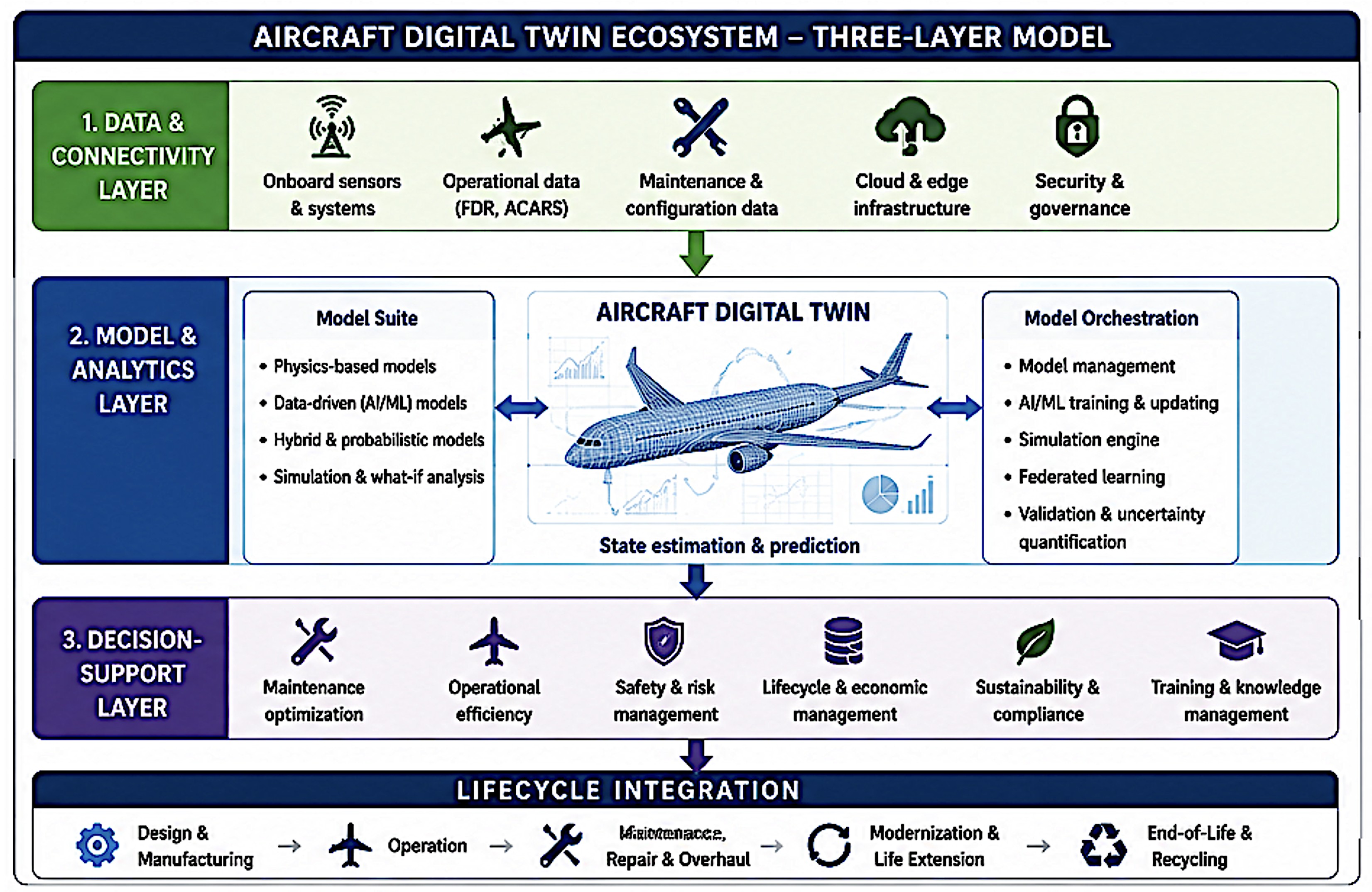
Aircraft digital twins are increasingly used for diagnostics, prognostics, and predictive maintenance, but their role as lifecycle-oriented, multi-stakeholder decision-support ecosystems remains insufficiently developed. This paper addresses this gap by proposing a conceptual systems-engineering framework for an aircraft digital twin ecosystem supporting sustainable aviation transport management. The framework integrates physics-based, data-driven, hybrid, probabilistic, and federated modelling approaches and includes a three-layer ecosystem model, formal mathematical representation of aircraft and digital twin lifecycle evolution, federated model updating, lifecycle decision-support scenarios, reference architecture, validation and trustworthiness principles, and a five-level maturity model. Representative aviation industrial cases are used to interpret the framework. The analysis shows that current industrial practice already contains elements of predictive maintenance, fleet analytics, engine health monitoring, and cloud-enabled MRO optimization, but full aircraft-level lifecycle governance, sustainability trade-off analysis, federated validation, and multi-stakeholder decision orchestration remain underdeveloped. The proposed framework positions aircraft digital twins as asset-level instruments for lifecycle planning, coordinated governance, and sustainability-oriented decision support.
Share and Cite
MDPI and ACS Style
Kabashkin, I.
Aircraft Digital Twin Ecosystems for Lifecycle Planning and Management in Sustainable Aviation Transport Systems. Systems 2026, 14, 678.
https://doi.org/10.3390/systems14060678
AMA Style
Kabashkin I.
Aircraft Digital Twin Ecosystems for Lifecycle Planning and Management in Sustainable Aviation Transport Systems. Systems. 2026; 14(6):678.
https://doi.org/10.3390/systems14060678
Chicago/Turabian Style
Kabashkin, Igor.
2026. "Aircraft Digital Twin Ecosystems for Lifecycle Planning and Management in Sustainable Aviation Transport Systems" Systems 14, no. 6: 678.
https://doi.org/10.3390/systems14060678
APA Style
Kabashkin, I.
(2026). Aircraft Digital Twin Ecosystems for Lifecycle Planning and Management in Sustainable Aviation Transport Systems. Systems, 14(6), 678.
https://doi.org/10.3390/systems14060678
Note that from the first issue of 2016, this journal uses article numbers instead of page numbers. See further details
here.
Article Metrics
Article Access Statistics
For more information on the journal statistics, click
here.
Multiple requests from the same IP address are counted as one view.