

AI Adoption in Local Government: Productivity, Systemic Risk, and Institutional Resilience: Evidence from a PRISMA 2020 Review



Abstract
1. Introduction
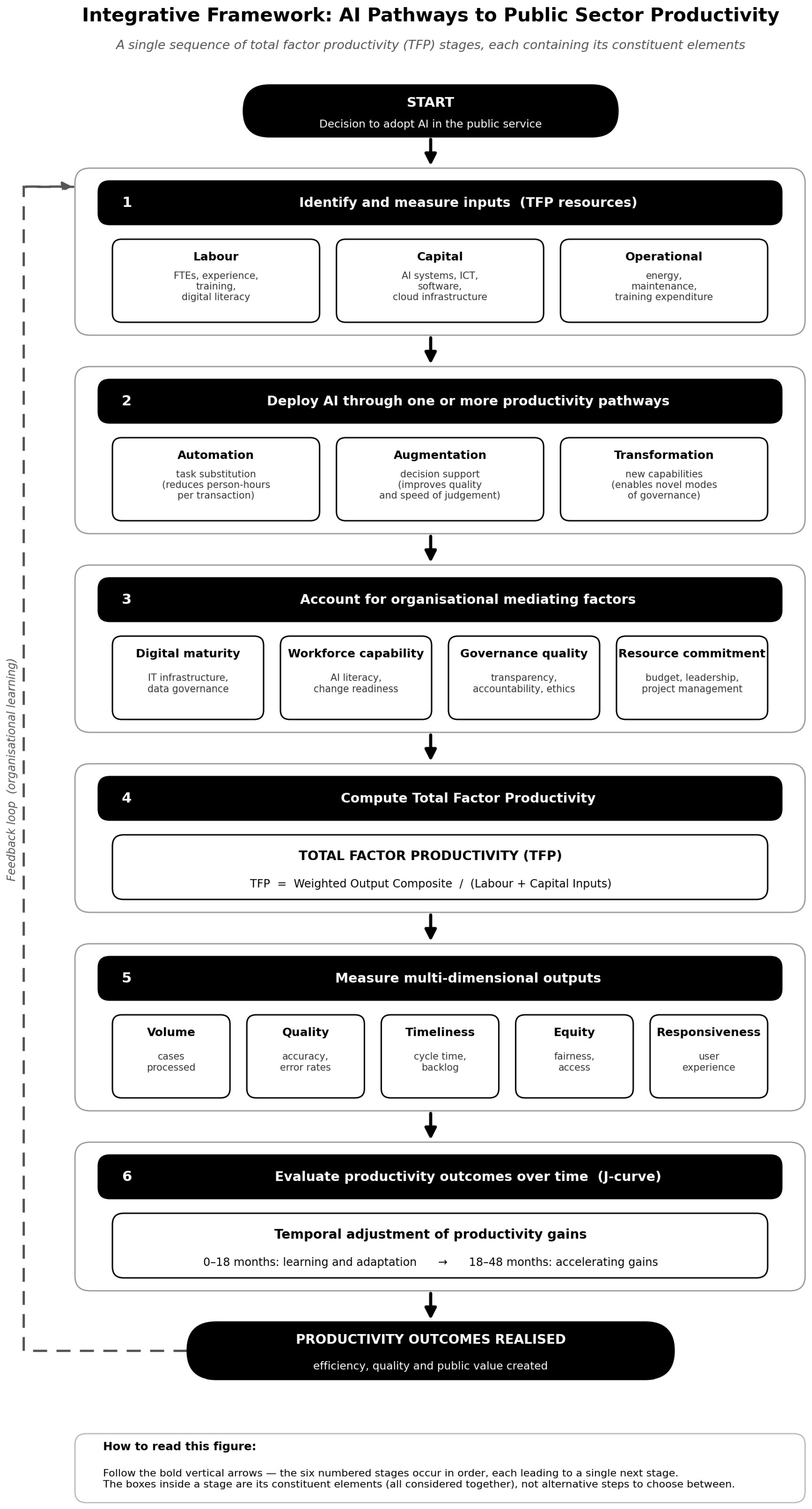
2. Conceptual Framework: AI, Productivity, and Public Value
2.1. Theoretical Foundations
2.2. Productivity in Public Administration: Foundations
2.3. AI Pathways to Productivity
2.4. Integrating Public Value
2.5. Operationalisation: The Measurement Model
2.6. Theoretical Propositions
3. Methodology
3.1. Research Design and Methodological Rationale
3.2. Systematic Review Protocol and PRISMA 2020 Framework
3.3. Data Sources and Search Strategy
- AI technologies: (“artificial intelligence” OR “machine learning” OR “deep learning” OR “natural language processing” OR “computer vision” OR “robotic process automation” OR “chatbot” OR “predictive analytics” OR “generative AI”).
- Government contexts: (“public sector” OR “government” OR “public administration” OR “municipal” OR “local government” OR “city administration” OR “e-government” OR “smart government”).
- Outcome measures: (“productivity” OR “efficiency” OR “performance” OR “cost reduction” OR “time saving” OR “process improvement” OR “automation” OR “service delivery”).
3.4. Inclusion and Exclusion Criteria
- Study type: Peer-reviewed journal articles and peer-reviewed conference proceedings with a valid DOI. This restriction ensures verifiable academic quality and accessible sourcing for audit purposes.
- Empirical design: Studies reporting original quantitative, qualitative, or mixed-methods data collection. Purely theoretical or conceptual papers were excluded given the objective of synthesising measured productivity evidence.
- Substantive focus: Studies examining AI implementation within government administrative processes. This includes citizen-facing service delivery, back-office operations, regulatory functions, financial administration, and public workforce management.
- Outcome specification: Studies reporting at minimum one operationalised measure of productivity, efficiency, process performance, or service delivery improvement—enabling extraction of effect sizes or comparable performance indicators.
- Language: English, Spanish, French, or German. These languages reflect the authors’ reading capabilities and cover the primary languages of European public administration scholarship. To identify relevant non-English records despite running the primary Boolean search in English, two complementary procedures were applied. First, the three databases used (Web of Science, Scopus, and Google Scholar) index titles and abstracts in English for the vast majority of indexed non-English-language journals, so studies originally published in Spanish, French, or German with English-language metadata were retrieved by the English search strings. Second, a supplementary search was conducted in each of the three other languages by running translated versions of the AI-technologies, government-context, and outcome-measure clusters (e.g., “inteligencia artificial”, “administración pública”, “productividad”; “intelligence artificielle”, “administration publique”, “productivité”; “künstliche Intelligenz”, “öffentliche Verwaltung”, “Produktivität”) in Google Scholar, where language-restricted search is reliable. Of the 68 included studies, 61 were published in English, 4 in Spanish, 2 in French, and 1 in German; the translated search strings and the full multilingual record counts are provided in Supplementary Materials.
- Publication period: January 2015 to December 2025, consistent with the rationale set out in Section 3.3.
- Purely conceptual, normative, or theoretical papers without empirical data collection were excluded, as they do not contribute measurable productivity evidence to the synthesis.
- Studies of AI in non-administrative government domains—specifically defence, military intelligence, clinical healthcare delivery, and judicial proceedings—were excluded on the grounds that these domains involve fundamentally different organisational logics, regulatory regimes, and outcome metrics from administrative productivity.
- Technology description papers, vendor white papers, and system architecture reports without assessed outcome data were excluded.
- Publications pre-dating January 2015.
- Grey literature—government reports, consultancy documents, and institutional white papers—was excluded from the systematic review corpus. Such sources are cited contextually where relevant to illustrate policy and institutional contexts (e.g., the Madrid AI Roadmap [44] and ALIA documentation [25]) but do not form part of the evidence synthesis.
3.5. Study Selection Process and Inter-Rater Reliability
3.6. Quality Assessment
3.7. Data Extraction and Analytical Approach
3.8. Reliability, Validity, and Bias Control
3.9. Madrid Secondary Analysis
4. Results: Evidence Synthesis
4.1. Descriptive Characteristics of Included Studies
4.2. Findings by AI Pathway
4.2.1. Automation Pathway (n = 28 Studies)
4.2.2. Augmentation Pathway (n = 22 Studies)
4.2.3. Transformation Pathway (n = 18 Studies)
4.3. Evidence Quality Assessment
4.4. Mediating Factors: Synthesis
5. Discussion
5.1. Interpreting the Evidence
5.2. Madrid in Context: Institutional Enablers and Barriers
5.3. Theoretical Implications
5.4. Policy Implications for Mid-Sized European Cities
6. Limitations and Future Research Agenda
6.1. Study Limitations
6.2. Future Research Agenda
7. Conclusions
Supplementary Materials
Author Contributions
Funding
Institutional Review Board Statement
Data Availability Statement
Conflicts of Interest
References
- Pollitt, C. Public Management Reform: A Comparative Analysis—Into the Age of Austerity, 4th ed.; Oxford University Press: Oxford, UK, 2018. [Google Scholar]
- OECD. The OECD Digital Government Policy Framework: Six Dimensions of a Digital Government; OECD Public Governance Policy Papers No. 02; OECD Publishing: Paris, France, 2020. [Google Scholar] [CrossRef] [Scilit]
- Dunleavy, P.; Margetts, H.; Bastow, S.; Tinkler, J. New public management is dead—Long live digital-era governance. J. Public Adm. Res. Theory 2006, 16, 467–494. [Google Scholar] [CrossRef] [Scilit]
- Atkinson, T. Atkinson Review: Final Report on Measurement of Government Output and Productivity for the National Accounts; Palgrave Macmillan: Basingstoke, UK, 2005. [Google Scholar]
- Van Dooren, W.; Bouckaert, G.; Halligan, J. Performance Management in the Public Sector, 2nd ed.; Routledge: Abingdon, UK, 2015. [Google Scholar] [CrossRef] [Scilit]
- European Committee of the Regions. Informe Anual de la UE Sobre el Estado de las Regiones y las Ciudades 2025; European Committee of the Regions: Brussels, Belgium, 2025; Available online: https://cor.europa.eu (accessed on 13 March 2026).
- ESPON EGTC. DESIRE—Analysis on Provision of Public Services in Disadvantaged Territories; ESPON: Luxembourg, 2024. [Google Scholar]
- Council of the European Union. Recommendation on Spain’s Medium-Term Fiscal-Structural Plan; Council of the EU: Brussels, Belgium, 2025. [Google Scholar]
- Acemoglu, D.; Restrepo, P. Robots and jobs: Evidence from US labor markets. J. Polit. Econ. 2020, 128, 2188–2244. [Google Scholar] [CrossRef] [Scilit]
- Brynjolfsson, E.; McAfee, A. The Second Machine Age: Work, Progress, and Prosperity in a Time of Brilliant Technologies; W.W. Norton: New York, NY, USA, 2014. [Google Scholar]
- Wirtz, B.W.; Weyerer, J.C.; Geyer, C. Artificial intelligence and the public sector—Applications and challenges. Int. J. Public Adm. 2019, 42, 596–615. [Google Scholar] [CrossRef] [Scilit]
- Berryhill, J.; Heang, K.K.; Clogher, R.; McBride, K. Hello, World: Artificial Intelligence and Its Use in the Public Sector; OECD Working Papers on Public Governance No. 36; OECD: Paris, France, 2019. [Google Scholar]
- Raisch, S.; Krakowski, S. Artificial intelligence and management: The automation–augmentation paradox. Acad. Manag. Rev. 2021, 46, 192–210. [Google Scholar] [CrossRef] [Scilit]
- Haenlein, M.; Kaplan, A. A brief history of artificial intelligence: On the past, present, and future of artificial intelligence. Calif. Manag. Rev. 2019, 61, 5–14. [Google Scholar] [CrossRef] [Scilit]
- Lacity, M.C.; Willcocks, L.P. A new approach to automating services. MIT Sloan Manag. Rev. 2016, 58, 41–49. [Google Scholar]
- Ranerup, A.; Henriksen, H.Z. Digital discretion: Unpacking human and technological agency in automated decision making in Sweden’s Social Insurance Agency. Soc. Policy Adm. 2019, 53, 507–522. [Google Scholar] [CrossRef] [Scilit]
- Soni, L.; Taneja, A. Harnessing AI for sustainable smart cities: Impact, innovations, and use cases. In Artificial Intelligence (AI) for IT Energy Efficiency and Green AI for Environment Sustainability; Raj, P., Sharma, D.P., Dutta, P.K., Prasad, B.S., Soundarabai, P.B., Eds.; Springer: Cham, Switzerland, 2026; pp. 471–496. [Google Scholar] [CrossRef] [Scilit]
- Janssen, M.; van der Voort, H. Adaptive governance: Towards a stable, accountable and responsive government. Gov. Inf. Q. 2016, 33, 1–5. [Google Scholar] [CrossRef] [Scilit]
- Fountain, J.E. Building the Virtual State: Information Technology and Institutional Change; Brookings Institution Press: Washington, DC, USA, 2001. [Google Scholar]
- Mergel, I.; Edelmann, N.; Haug, N. Defining digital transformation: Results from expert interviews. Gov. Inf. Q. 2019, 36, 101385. [Google Scholar] [CrossRef] [Scilit]
- Criado, J.I.; Gil-Garcia, J.R. Creating public value through smart technologies and strategies. Int. J. Public Sect. Manag. 2019, 32, 438–450. [Google Scholar] [CrossRef] [Scilit]
- Meijer, A.; Bolívar, M.P.R. Governing the smart city: A review of the literature on smart urban governance. Int. Rev. Adm. Sci. 2016, 82, 392–408. [Google Scholar] [CrossRef] [Scilit]
- Wirtz, B.W.; Müller, W.M. An integrated artificial intelligence framework for public management. Public Manag. Rev. 2019, 21, 1076–1100. [Google Scholar] [CrossRef] [Scilit]
- European Parliament and Council. Regulation (EU) 2024/1689 of the European Parliament and of the Council Laying Down Harmonised Rules on Artificial Intelligence (Artificial Intelligence Act); Official Journal of the EU: Brussels, Belgium, 2024. [Google Scholar]
- Government of Spain. National Artificial Intelligence Strategy (ENIA 2024); Ministry for Digital Transformation and Civil Service: Madrid, Spain, 2024. [Google Scholar]
- Janssen, M.; Kuk, G. The challenges and limits of big data algorithms in technocratic governance. Gov. Inf. Q. 2016, 33, 371–377. [Google Scholar] [CrossRef] [Scilit]
- Gil-Garcia, J.R.; Pardo, T.A.; Burke, G.B. Conceptualizing smartness in government: An integrative and multi-dimensional view. Gov. Inf. Q. 2016, 33, 524–534. [Google Scholar] [CrossRef] [Scilit]
- Comin, D. Total factor productivity. In The New Palgrave Dictionary of Economics; Durlauf, S.N., Blume, L.E., Eds.; Palgrave Macmillan: London, UK, 2008. [Google Scholar]
- Moore, M.H. Creating Public Value: Strategic Management in Government; Harvard University Press: Cambridge, MA, USA, 1995. [Google Scholar]
- Brynjolfsson, E.; Li, D.; Raymond, L. Generative AI at work. Q. J. Econ. 2025, 140, 889–942. [Google Scholar] [CrossRef] [Scilit]
- Dunleavy, P.; Carrera, L. Growing the Productivity of Government Services; Edward Elgar: Cheltenham, UK, 2013. [Google Scholar]
- Meijer, A.; Thaens, M. Predictive policing: Review of benefits and drawbacks. Int. J. Public Adm. 2021, 44, 1176–1188. [Google Scholar] [CrossRef] [Scilit]
- Savaget, P.; Chiarini, T.; Evans, S. Empowering political contestation and collective action with AI. Nat. Mach. Intell. 2019, 1, 394–397. [Google Scholar] [CrossRef]
- Dunleavy, P.; Margetts, H. Design principles for essentially digital governance. In Proceedings of the 111th Annual Meeting of the American Political Science Association, San Francisco, CA, USA, 3–6 September 2015. [Google Scholar]
- Lindgren, I.; Madsen, C.Ø.; Hofmann, S.; Melin, U. Close encounters of the digital kind: A research agenda for the digitalization of public services. Gov. Inf. Q. 2019, 36, 427–436. [Google Scholar] [CrossRef] [Scilit]
- Criado, J.I.; Sandoval-Almazán, R.; Gil-Garcia, J.R. Artificial intelligence and public administration: Understanding actors, governance, and policy from micro, meso, and macro perspectives. Public Policy Adm. 2024, 40, 173–184. [Google Scholar] [CrossRef] [Scilit]
- Secchi, L.; Caeiro, J.C.; Ramos Pinto, R.; Arenilla Sáez, M. Administrative reforms in Portugal and Spain: From bureaucracy to digital transition. Int. Rev. Adm. Sci. 2024, 91, 8–26. [Google Scholar] [CrossRef] [Scilit]
- Criado, J.I.; Villodre, J. Delivering public services through social media in European local governments. Local Gov. Stud. 2021, 47, 312–332. [Google Scholar] [CrossRef] [Scilit]
- European Commission. Local Government AI Deployment Survey; Joint Research Centre: Brussels, Belgium, 2025. [Google Scholar]
- Mehr, H.; Ash, H.; Fellow, D. Artificial Intelligence for Citizen Services and Government; Ash Center for Democratic Governance and Innovation: Cambridge, MA, USA, 2017. [Google Scholar]
- Fung, A. Putting the public back into governance: The challenges of citizen participation and its future. Public Adm. Rev. 2015, 75, 513–522. [Google Scholar] [CrossRef] [Scilit]
- Gil-Garcia, J.R.; Helbig, N.; Ojo, A. Being smart: Emerging technologies and innovation in the public sector. Gov. Inf. Q. 2014, 31, I1–I8. [Google Scholar] [CrossRef] [Scilit]
- Trist, E.L.; Bamforth, K.W. Some social and psychological consequences of the longwall method of coal-getting. Hum. Relat. 1951, 4, 3–38. [Google Scholar] [CrossRef] [Scilit]
- Ayuntamiento de Madrid. Madrid Artificial Intelligence Roadmap 2023–2025; Ayuntamiento de Madrid: Madrid, Spain, 2025; Available online: https://www.madrid.es (accessed on 13 March 2026).
- Ayuntamiento de Madrid. AI Platform Procurement Contract: Evolution and Maintenance; Ayuntamiento de Madrid: Madrid, Spain, 2025; Available online: https://contrataciondelestado.es (accessed on 13 March 2026).
- Yin, R.K. Case Study Research and Applications: Design and Methods, 6th ed.; SAGE: Thousand Oaks, CA, USA, 2018. [Google Scholar]
- Solow, R.M. Technical change and the aggregate production function. Rev. Econ. Stat. 1957, 39, 312–320. [Google Scholar] [CrossRef] [Scilit]
- Page, M.J.; McKenzie, J.E.; Bossuyt, P.M.; Boutron, I.; Hoffmann, T.C.; Mulrow, C.D.; Shamseer, L.; Tetzlaff, J.M.; Akl, E.A.; Brennan, S.E.; et al. The PRISMA 2020 statement: An updated guideline for reporting systematic reviews. BMJ 2021, 372, n71. [Google Scholar] [CrossRef] [Scilit] [PubMed]
- Moher, D.; Liberati, A.; Tetzlaff, J.; Altman, D.G.; PRISMA Group. Preferred reporting items for systematic reviews and meta-analyses: The PRISMA statement. Ann. Intern. Med. 2009, 151, 264–269. [Google Scholar] [CrossRef] [PubMed]
- Caragliu, A.; Del Bo, C.; Nijkamp, P. Smart cities in Europe. J. Urban Technol. 2011, 18, 65–82. [Google Scholar] [CrossRef] [Scilit]
- Orlikowski, W.J. Using technology and constituting structures: A practice lens for studying technology in organisations. Organ. Sci. 2000, 11, 404–428. [Google Scholar] [CrossRef] [Scilit]
- Picazo-Vela, S.; Gutiérrez-Martínez, I.; Luna-Reyes, L.F. Understanding risks, benefits, and strategic alternatives of social media applications in the public sector. Gov. Inf. Q. 2012, 29, 504–511. [Google Scholar] [CrossRef] [Scilit]
- Sousa, W.G.; Melo, E.R.P.; Bermejo, P.H.R.S.; Farias, R.A.S.; Gomes, A.O. How and where is artificial intelligence in the public sector going? A literature review and research agenda. Gov. Inf. Q. 2019, 36, 101392. [Google Scholar] [CrossRef] [Scilit]
- Bozeman, B. Public Values and Public Interest: Counterbalancing Economic Individualism; Georgetown University Press: Washington, DC, USA, 2007. [Google Scholar]
- Moore, M.H.; Hartley, J. Innovations in governance. Public Manag. Rev. 2008, 10, 3–20. [Google Scholar] [CrossRef] [Scilit]
- Brynjolfsson, E.; Hitt, L.M. Computing productivity: Firm-level evidence. Rev. Econ. Stat. 2003, 85, 793–808. [Google Scholar] [CrossRef] [Scilit]
- Willcocks, L.; Lacity, M.; Craig, A. The IT function and robotic process automation. OUWP 2015, 16, 1–43. [Google Scholar]
- van der Aalst, W.M.P.; Bichler, M.; Heinzl, A. Robotic process automation. Bus. Inf. Syst. Eng. 2018, 60, 269–272. [Google Scholar] [CrossRef] [Scilit]
- Acemoglu, D.; Restrepo, P. Tasks, automation, and the rise in US wage inequality. Econometrica 2022, 90, 1973–2016. [Google Scholar] [CrossRef] [Scilit]
- Noy, S.; Zhang, W. Experimental evidence on the productivity effects of generative AI. Science 2023, 381, 187–192. [Google Scholar] [CrossRef] [Scilit] [PubMed]
- Parasuraman, R.; Riley, V. Humans and automation: Use, misuse, disuse, abuse. Hum. Factors 1997, 39, 230–253. [Google Scholar] [CrossRef] [Scilit]
- Gil-Garcia, J.R.; Pardo, T.A.; Nam, T. What makes a city smart? Identifying core components and proposing an integrative and comprehensive conceptualization. Inf. Polity 2015, 20, 61–87. [Google Scholar] [CrossRef] [Scilit]
- Margetts, H.; Dorobantu, C. Rethink government with AI. Nature 2019, 568, 163–165. [Google Scholar] [CrossRef] [Scilit] [PubMed]
- Alford, J.; Hughes, O. Public value pragmatism as the next phase of public management. Am. Rev. Public Adm. 2008, 38, 130–148. [Google Scholar] [CrossRef] [Scilit]
- Dwivedi, A.V. Why AI cannot be an agent of equality: A critique of technological utopianism and the category error of algorithmic justice. Emerg. Media 2025, 3, 428–450. [Google Scholar] [CrossRef] [Scilit]
- O’Neil, C. Weapons of Math Destruction: How Big Data Increases Inequality and Threatens Democracy; Crown: New York, NY, USA, 2016. [Google Scholar]
- Bovens, M.; Zouridis, S. From street-level to system-level bureaucracies: How information and communication technology is transforming administrative discretion and constitutional control. Public Adm. Rev. 2002, 62, 174–184. [Google Scholar] [CrossRef] [Scilit]
- Busuioc, M. Accountable artificial intelligence: Holding algorithms to account. Public Adm. Rev. 2021, 81, 825–836. [Google Scholar] [CrossRef] [Scilit] [PubMed]
- Panarese, P.; Grasso, M.M.; Solinas, C. Algorithmic bias, fairness, and inclusivity: A multilevel framework for justice-oriented AI. AI Soc. 2026, 41, 2803–2825. [Google Scholar] [CrossRef] [Scilit]
- Eubanks, V. Automating Inequality: How High-Tech Tools Profile, Police, and Punish the Poor; St. Martin’s Press: New York, NY, USA, 2018. [Google Scholar]
- Obermeyer, Z.; Powers, B.; Vogeli, C.; Mullainathan, S. Dissecting racial bias in an algorithm used to manage the health of populations. Science 2019, 366, 447–453. [Google Scholar] [CrossRef] [Scilit] [PubMed]
- Virani, A.; van der Wal, Z. Performance Regimes and Governance Design: Balancing Quality, Timeliness, and Responsiveness in Public Service Delivery. Public Adm. Rev. 2023, 83, 112–128. [Google Scholar] [CrossRef] [Scilit]
- Gębczyńska, M.; Brajer-Marczak, R. Performance management models in public administration. Int. J. Public Adm. 2020, 43, 521–534. [Google Scholar] [CrossRef] [Scilit]
- Boyne, G.A.; Meier, K.J.; O’Toole, L.J.; Walker, R.M. Public Service Performance: Perspectives on Measurement and Management; Cambridge University Press: Cambridge, UK, 2006. [Google Scholar] [CrossRef] [Scilit]
- Fernández-i-Marín, X.; Jiménez, G.; Pau, I.; Prats, J. Administrative capacity and implementation speed. Gov. Inf. Q. 2023, 40, 101802. [Google Scholar] [CrossRef] [Scilit]
- Kulal, A.; Rahiman, H.U.; Suvarna, H.; Abhishek, N.; Dinesh, S. Enhancing public service delivery effi-ciency: Exploring the impact of AI. J. Open Innov. Technol. Mark. Complex. 2024, 10, 100329. [Google Scholar] [CrossRef] [Scilit]
- Petticrew, M.; Roberts, H. Systematic Reviews in the Social Sciences: A Practical Guide; Blackwell: Oxford, UK, 2006. [Google Scholar] [CrossRef] [Scilit]
- LeCun, Y.; Bengio, Y.; Hinton, G. Deep learning. Nature 2015, 521, 436–444. [Google Scholar] [CrossRef] [Scilit] [PubMed]
- Cohen, J. A coefficient of agreement for nominal scales. Educ. Psychol. Meas. 1960, 20, 37–46. [Google Scholar] [CrossRef] [Scilit]
- Landis, J.R.; Koch, G.G. The measurement of observer agreement for categorical data. Biometrics 1977, 33, 159–174. [Google Scholar] [CrossRef] [Scilit]
- Guyatt, G.H.; Oxman, A.D.; Vist, G.E.; Kunz, R.; Falck-Ytter, Y.; Alonso-Coello, P.; Schünemann, H.J.; GRADE Working Group. GRADE: An emerging consensus on rating quality of evidence and strength of recommendations. BMJ 2008, 336, 924–926. [Google Scholar] [CrossRef] [Scilit] [PubMed]
- Popay, J.; Roberts, H.; Sowden, A.; Petticrew, M.; Arai, L.; Rodgers, M.; Britten, N. Guidance on the Conduct of Narrative Synthesis in Systematic Reviews; ESRC Methods Programme: Lancaster, UK, 2006. [Google Scholar] [CrossRef] [Scilit] [PubMed]
- Borenstein, M.; Hedges, L.V.; Higgins, J.P.T.; Rothstein, H.R. Introduction to Meta-Analysis; Wiley: Chichester, UK, 2009. [Google Scholar] [CrossRef] [Scilit] [PubMed]
- Scott, J. A Matter of Record: Documentary Sources in Social Research; Polity Press: Cambridge, UK, 1990. [Google Scholar]
- Richardson, R.; Schultz, J.; Crawford, K. Dirty data, bad predictions. NYU Law Rev. 2019, 94, 192–233. [Google Scholar]
- Vogl, T.M.; Seidelin, C.; Ganesh, B.; Bright, J. Smart technology and the emergence of algorithmic bureaucracy: Artificial intelligence in UK local authorities. Public Adm. Rev. 2020, 80, 946–961. [Google Scholar] [CrossRef] [Scilit]
- Acemoglu, D.; Johnson, S.; Lelarge, C.; Van Reenen, J.; Zilibotti, F. Taxes, regulations, and the value of U.S. and European firms. Rev. Econ. Stud. 2022, 89, 2279–2329. [Google Scholar]
- Desouza, K.C.; Dawson, G.S.; Chenok, D. Designing, developing, and deploying artificial intelligence systems: Lessons from and for the public sector. Bus. Horiz. 2020, 63, 205–213. [Google Scholar] [CrossRef] [Scilit]
- Blundell, R.; Costa Dias, M. Alternative approaches to evaluation in empirical microeconomics. J. Hum. Resour. 2009, 44, 565–640. [Google Scholar] [CrossRef] [Scilit]
- Shadish, W.R.; Cook, T.D.; Campbell, D.T. Experimental and Quasi-Experimental Designs for Generalized Causal Inference; Houghton Mifflin: Boston, MA, USA, 2002. [Google Scholar]
- Greenwood, D.J.; Levin, M. Introduction to Action Research: Social Research for Social Change, 2nd ed.; SAGE: Thousand Oaks, CA, USA, 2007. [Google Scholar]
- Tong, A.; Flemming, K.; McInnes, E.; Oliver, S.; Craig, J. Enhancing transparency in reporting the synthesis of qualitative research: ENTREQ. BMC Med. Res. Methodol. 2012, 12, 181. [Google Scholar] [CrossRef] [Scilit] [PubMed]

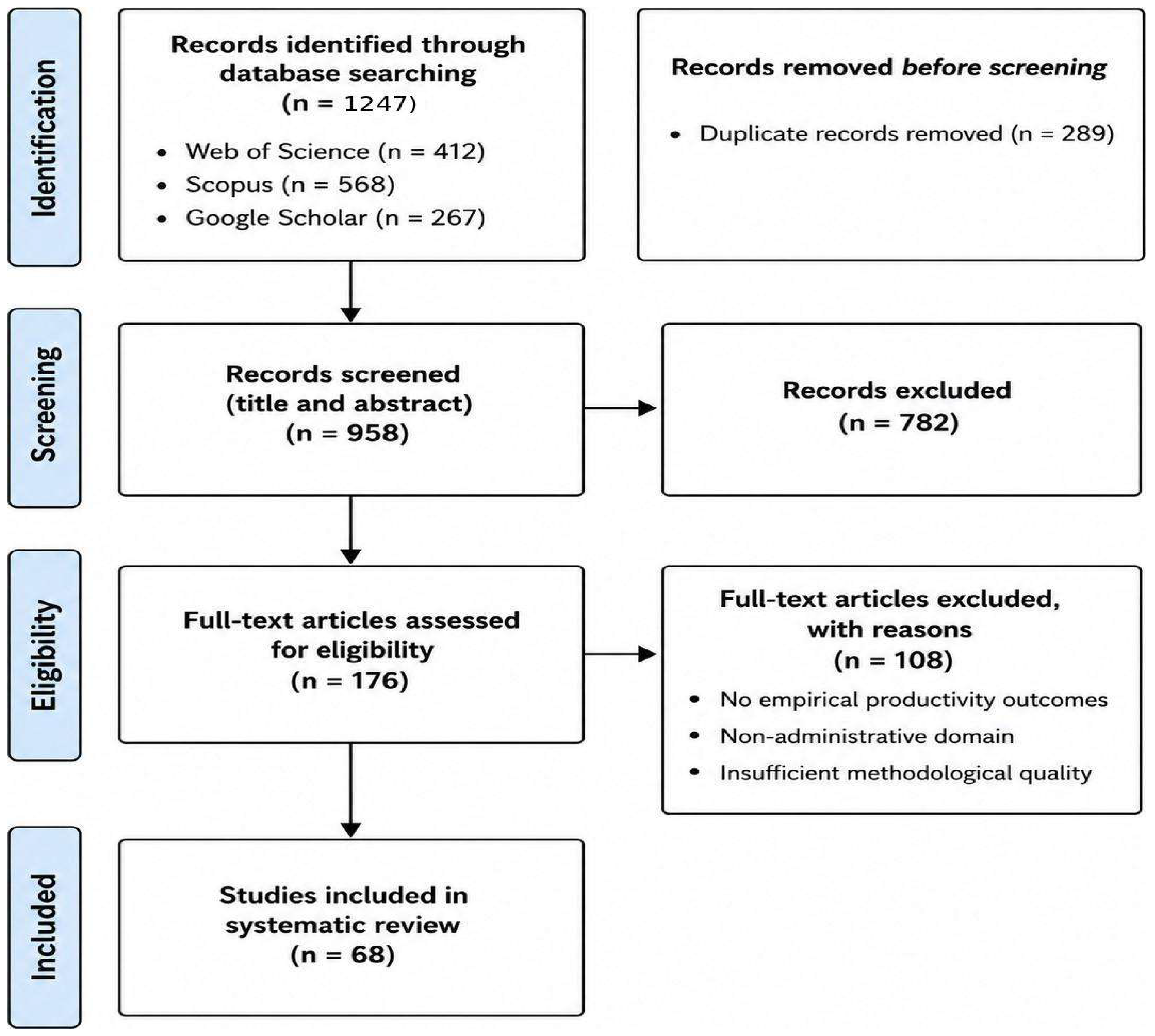

| Selection Stage | Number of Records |
|---|---|
| Initial records identified | 1247 |
| — Web of Science | 412 |
| — Scopus | 568 |
| — Google Scholar | 267 |
| Duplicates removed | 289 |
| Records screened (title/abstract) | 958 |
| Records excluded | 782 |
| Full-text articles assessed for eligibility | 176 |
| Full-text articles excluded (with reasons) | 108 |
| Studies included in final review | 68 |
| Characteristic | Category | n | % |
|---|---|---|---|
| Region | Western Europe | 31 | 45.6% |
| North America | 16 | 23.5% | |
| East Asia | 11 | 16.2% | |
| Other regions | 10 | 14.7% | |
| Government Level | National/Federal | 38 | 55.9% |
| Regional/State | 18 | 26.5% | |
| Local/Municipal | 12 | 17.6% | |
| AI Technology | Robotic Process Automation (RPA) | 28 | 41.2% |
| Machine Learning/Predictive Analytics | 22 | 32.4% | |
| Natural Language Processing/Chatbots | 14 | 20.6% | |
| Computer Vision/Sensor AI | 4 | 5.9% | |
| Evidence Quality | High Quality | 22 | 32.4% |
| Moderate Quality | 34 | 50.0% | |
| Low Quality | 12 | 17.6% |
| Pathway | Studies (n) | Percentage (%) |
|---|---|---|
| Automation (Task Substitution) | 28 | 41.2 |
| Augmentation (Decision Support) | 22 | 32.4 |
| Transformation (New Capabilities) | 18 | 26.5 |
| Total | 68 | 100.0 |
Disclaimer/Publisher’s Note: The statements, opinions and data contained in all publications are solely those of the individual author(s) and contributor(s) and not of MDPI and/or the editor(s). MDPI and/or the editor(s) disclaim responsibility for any injury to people or property resulting from any ideas, methods, instructions or products referred to in the content. |
© 2026 by the authors. Licensee MDPI, Basel, Switzerland. This article is an open access article distributed under the terms and conditions of the Creative Commons Attribution (CC BY) license.
Share and Cite
Ogunrinde, A.; De-Pablos-Heredero, C. AI Adoption in Local Government: Productivity, Systemic Risk, and Institutional Resilience: Evidence from a PRISMA 2020 Review. Systems 2026, 14, 671. https://doi.org/10.3390/systems14060671
Ogunrinde A, De-Pablos-Heredero C. AI Adoption in Local Government: Productivity, Systemic Risk, and Institutional Resilience: Evidence from a PRISMA 2020 Review. Systems. 2026; 14(6):671. https://doi.org/10.3390/systems14060671
Chicago/Turabian StyleOgunrinde, Abayomi, and Carmen De-Pablos-Heredero. 2026. "AI Adoption in Local Government: Productivity, Systemic Risk, and Institutional Resilience: Evidence from a PRISMA 2020 Review" Systems 14, no. 6: 671. https://doi.org/10.3390/systems14060671
APA StyleOgunrinde, A., & De-Pablos-Heredero, C. (2026). AI Adoption in Local Government: Productivity, Systemic Risk, and Institutional Resilience: Evidence from a PRISMA 2020 Review. Systems, 14(6), 671. https://doi.org/10.3390/systems14060671