1. Introduction
In a rapidly evolving, digitally interconnected global economy, small and medium enterprises (SMEs) must explore and exploit emerging technological opportunities to remain competitive and ensure long-term survival. Artificial intelligence (AI) presents transformative potential in this regard, enabling SMEs to improve operational efficiency, strengthen competitive positioning, and respond more adaptively to changing market demands [
1]. Integration of AI technologies supports the dynamic capabilities of SMEs, facilitating swift responses to environmental uncertainty, the redesign of business processes, and the sustainability of long-term competitiveness [
2,
3]. Globally, evidence suggests that 91% of SMEs using AI report direct revenue gains, underscoring the strategic imperative of AI adoption for enterprise growth [
4].
The intention of SMEs to adopt AI technologies is shaped by a complex interplay of organisational, technological, situational, and individual factors [
2,
5]. Among these, leadership has emerged as a central driver, influencing strategic direction while cultivating environments that support data-driven decision-making, innovation, and the development of essential employee competencies for digital transformation [
6,
7]. The adoption of AI within SMEs is thus closely related to the presence of strong digital leadership capabilities: leaders who possess the competencies to understand AI technologies, communicate their benefits, and integrate them effectively into organisational processes are better positioned to initiate adoption [
8,
9].
Despite growing scholarly attention to the intersection of digital leadership and technology adoption, research focusing specifically on Nigerian SMEs remains scarce. Nigeria, Africa’s largest economy, hosts more than 41 million SMEs that collectively contribute approximately 48% of national GDP and account for 84% of total employment [
10]. However, existing accounts of weak AI adoption among African SMEs overwhelmingly focus on external and resource-based constraints such as infrastructural deficits, financing gaps, scarce digital skills, and institutional gaps [
7,
11,
12,
13]. Far less attention has been paid to an internal, agentic explanation: why firms possessing comparable basic resources nevertheless differ markedly in whether they initiate AI adoption at all. We argue that this divergence is rooted substantially in digital leadership, the strategic, relational, and adaptive competencies of owner-managers who must first recognise AI’s relevance, frame its value, and marshal organisational commitment before any technical or financial enabler can take effect. In this way, the digital leadership deficit, rather than capital or infrastructure alone, constitutes a core bottleneck that restricts AI adoption in much of the African SME sector. This reframing both motivates the present study and structures its research design, which isolates leadership capability as the focal antecedent while accounting for the resource and structural factors that prior work has emphasised.
Furthermore, existing research has predominantly examined direct relationships between leadership and technology adoption, with limited attention to the mechanisms through which digital leadership capabilities translate into adoption intention. Individual leadership traits do not act on collective firm decisions in isolation; their value must be converted into organisational capacity through shared norms and collaborative routines [
14]. The organisational innovation climate is the shared perception that an organisation encourages and supports innovative behaviour and therefore may serve as a critical mediating mechanism, since leaders who foster innovation-supportive environments amplify the translation of their capabilities into organisational technology adoption decisions [
15,
16]. Additionally, firm size may moderate these relationships, as larger SMEs typically have greater resources, more formalised structures, and stronger absorptive capacity than their smaller counterparts [
17].
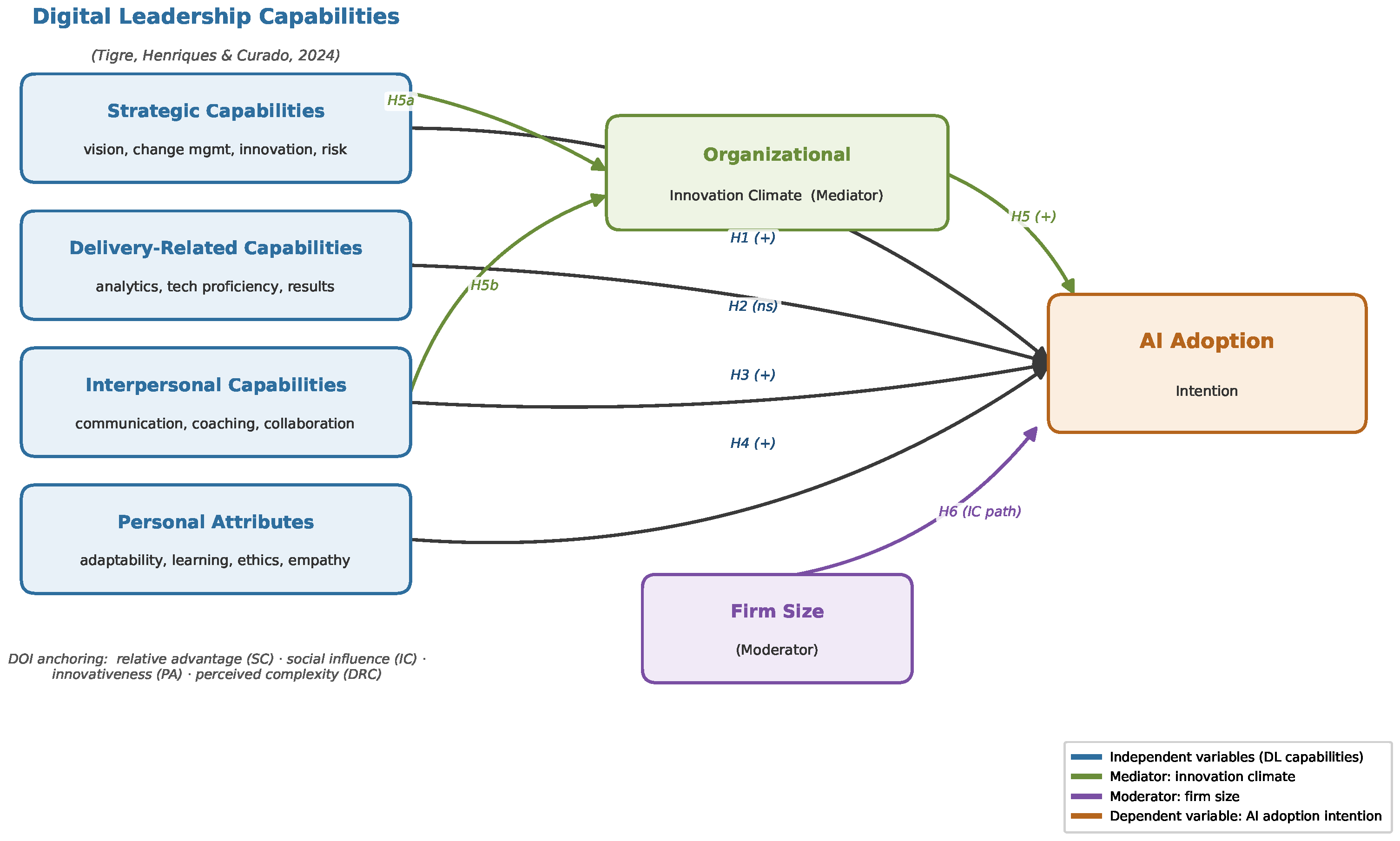
Accordingly, this study pursues four primary objectives: (1) to empirically examine the direct effects of four dimensions of digital leadership capabilities, strategic, delivery-related, interpersonal, and personal attributes on AI adoption intention among Nigerian SMEs; (2) to investigate the mediating role of the organisational innovation climate in the relationship between digital leadership capabilities and AI adoption intention; (3) to evaluate the moderating effect of firm size on the associations between the dimensions of digital leadership capability and AI adoption intention; and (4) to generate evidence-based recommendations for policymakers and SME support agencies seeking to accelerate AI adoption within Nigeria’s SME sector. Situating the study within this framework embeds it in a broader research agenda: AI increasingly functions not only as a driver of operational efficiency but also as a catalyst for the green and sustainable transformation of firms operating under resource constraints, with digital leadership shaping the initial conditions and trajectory of this transformation [
18].
This study offers three principal contributions. Theoretically, it extends Diffusion of Innovation Theory and the Tigre–Henriques-Curado digital leadership model to the context of small and medium-sized enterprises (SMEs) in developing economies. It conceptualises the organisational innovation climate as the transmission mechanism that links individual leader competencies to collective adoption intentions, thereby elucidating why leadership capabilities require an organisational conduit to influence firm-level decision-making. Empirically, it delivers one of the first capability-disaggregated PLS-SEM examinations of digital leadership and artificial intelligence (AI) adoption among African SMEs. By estimating mediation and moderation effects within a unified structural model, it simultaneously identifies both the underlying causal pathway and the firm size-contingent boundary of the effect, rather than analysing these dimensions in isolation. Practically, it translates these results into segment-specific and capability-specific recommendations for owner-managers, as well as for the design of differentiated SME support and training policies.
6. Conclusions
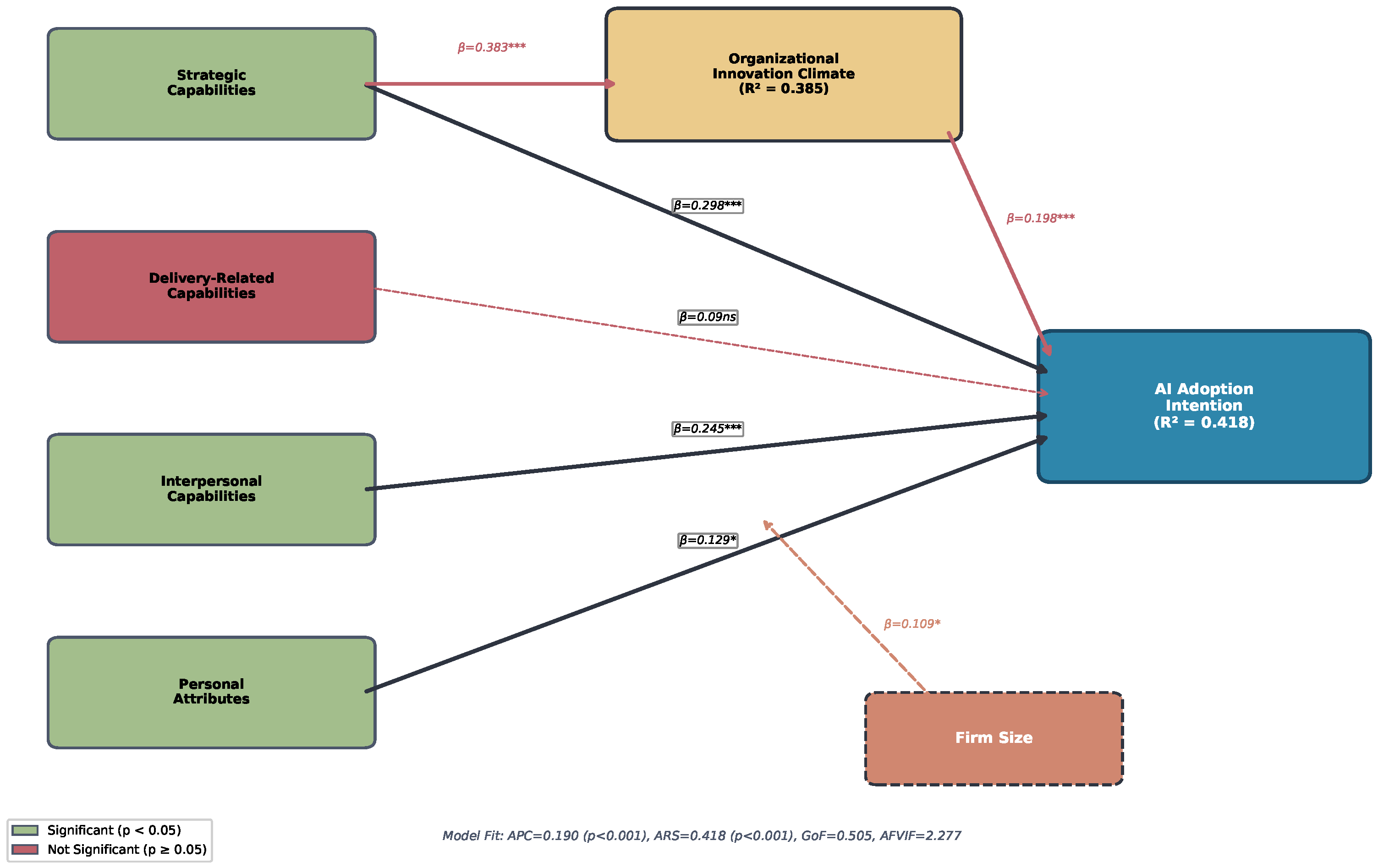
This study examined the influence of four dimensions of digital leadership capability on the intention to adopt AI among Nigerian SMEs, integrating the organisational innovation climate as a mediator and the size of the firm as a moderator within a PLS-SEM framework. Based on 306 valid responses, the findings lead to several conclusions. First, strategic capabilities are the strongest driver of the intention of adopting AI, followed by interpersonal capabilities and personal attributes. Delivery-related capabilities, while positively associated, do not significantly predict the intention to adopt. This hierarchy demonstrates that cognitive, strategic, and relational leadership dimensions outweigh operational competencies in shaping pre-adoption decisions. Second, organisational innovation climate partially mediates the influence of strategic and interpersonal capabilities on AI adoption intention, revealing that leadership’s effect on adoption is amplified when organisations cultivate innovation-supportive environments.
Third, firm size moderates the interpersonnel relationship between onal capabilities, AI adoption, and intention relationdium-sized enterprises showing stronger effects, indicating that relational leadership competencies operate more effectively in organisations with sufficient structural complexity to benefit from enhanced communication and collaboration.
These findings translate into segment-specific rather than generic guidance. For micro-enterprise owners (fewer than 10 employees), the priority is strategic-cognitive: because relational competence has a thin social field at this scale, owners should first build a clear understanding of AI’s concrete business value and a feasible adoption plan before investing in execution tooling, avoiding blind expenditure on operational digital capability that the firm cannot yet exploit. For small firms, the emphasis shifts towards pairing that strategic cognition with the early formalisation of an innovation-supportive climate. For medium-sized firms, where the interpersonal pathway is strongest, managers should emphasise communication, coaching, and team cooperation to forge organisational consensus around AI adoption. For policymakers and SME-support agencies, capacity-building should be hierarchical and differentiated: training for micro-firms should emphasise AI’s commercial value and transformation planning; courses for medium firms should centre on team collaboration and innovation climate construction; and programmes should be regionally calibrated to local digital infrastructure conditions, so that better-resourced states accelerate application while less-developed states first build owner-manager digital cognition.
This study acknowledges several limitations that guide future research. First, the cross-sectional design precludes causal inference and cannot rule out reciprocal effects among leadership, climate, and adoption intention; longitudinal panels that track how leadership capabilities shape AI adoption trajectories over time, or quasi-experimental designs, would establish temporal ordering. Second, although the sample captures Nigeria’s most commercially active SME ecosystem, it is drawn from a single geopolitical zone, so cross-zone and cross-country comparative studies are needed to test the generalisability of the leadership–adoption mechanism across differing institutional and infrastructural settings. Third, future work should explore additional mediating mechanisms (e.g., technology readiness, organisational learning culture) and moderating variables (e.g., industry sector, founder digital experience, leader educational background) that may further explain the leadership–adoption nexus in developing economies. Finally, as AI adoption matures, the agenda should extend from technology adoption to human-centric system design, examining how SMEs can integrate AI in ways that keep human well-being, sustainability, and resilience central: the orientation of the emerging Industry 5.0 paradigm [
67] and the work linking Industry 5.0 with green supply chain management for sustainable development in resource-constrained economies [
68].