Article

Why High Participation but Low Quality? The Policy Implementation Paradox and Micro-Mechanism of Online Public Services Under the Systems Engineering Education Perspective

1
School of Economics and Management, Southeast University, Nanjing 211189, China
2
College of Management and Economics, Tianjin University, Tianjin 300072, China
3
School of Economics and Management, North China Electric Power University, Beijing 102206, China
*
Author to whom correspondence should be addressed.
Systems 2026, 14(6), 637; https://doi.org/10.3390/systems14060637
Submission received: 10 April 2026 / Revised: 20 May 2026 / Accepted: 29 May 2026 / Published: 3 June 2026
(This article belongs to the Special Issue Systems Engineering Education: Design, Practice and Development)

Abstract

Ensuring that government-led large-scale online public services evolve from formal participation to substantive quality represents a key governance challenge. This study extends the Unified Theory of Acceptance and Use of Technology (UTAUT) by integrating value identity as a core value-rational driver and by taking self-reported teaching practice quality as the ultimate outcome variable. Based on a cross-sectional survey of 2226 teachers analyzed via structural equation modeling, our findings reveal a stark ‘Governance Paradox’: at the aggregate level, both Behavioral Intention (β = −0.213) and Social Influence (β = −0.098) are unexpectedly associated with lower self-reported teaching practice quality, despite Value Identity being a powerful predictor of intention (β = 0.900). We conceptualize this statistical paradox not as an anomaly, but as a diagnostic for misaligned subsystems within a complex socio-technical system. Crucially, this paradox is systematically resolved through multi-group analysis; disaggregating the sample by institutional context reveals the expected positive relationships within homogeneous subgroups. This suggests that hidden heterogeneity and contextual factors are responsible for distorting the aggregate picture. Theoretically, this research offers two contributions: it reframes statistical aggregation artifacts as a systems-diagnostic framework for governance and introduces “Motivation Fusion” as a micro-foundational mechanism to explain the institutional and psychological conditions that produce such artifacts. Practically, the study provides a micro-foundational diagnostic framework for designing more targeted and effective public service policies.

1. Introduction

Globally, large-scale online education services supported by public finance have become a crucial strategic instrument and initiative for promoting educational equity, service modernization, and the digital transformation of public governance. In such initiatives, a central governance challenge is not simply whether key actors participate, but whether broad-based participation can be converted into high-quality and sustainable service outcomes, rather than devolving into formalism. Under the dual policy background of China’s “Double Reduction” reform and the “Education Informatization 2.0” strategy—a national plan aimed at deeply integrating digital technology into all facets of education, moving beyond infrastructure to focus on pedagogical innovation and data-driven governance—government-led online public service programs represent an important institutional innovation in the reconfiguration of the basic education service system. Their effectiveness depends fundamentally on the sustained and high-quality engagement of teachers as frontline service providers.
Systems engineering education emphasizes holistic coupling, subsystem coordination, heterogeneous governance and closed-loop feedback, which is suitable for analyzing large systems. This complexity calls for a systems engineering perspective, which emphasizes holistic coupling, subsystem coordination, and closed-loop feedback, making it exceptionally suitable for analyzing large-scale socio-technical systems like public education. From this vantage point, government-led online public services are not isolated cases of technology use-scale socio-technical systems of public education services. However, government-led online public services should not be treated as isolated cases of technology use. Rather, they constitute complex educational socio-technical systems in which policy objectives, school organizations, teacher motivations, digital platforms, support mechanisms, and evaluation arrangements are dynamically coupled. In such systems, teachers are not merely individual users of technology; they are also policy implementers embedded within multiple institutional layers. Accordingly, the quality of online public service delivery is produced through interactions among interdependent subsystems, rather than through a simple linear pathway from intention to behavior.
A salient governance dilemma has emerged in practice: teachers often demonstrate high formal participation under administrative mobilization, yet such participation does not necessarily correspond to high-quality teaching practice. This “high participation but low quality” phenomenon points to a deeper problem of policy implementation and system conversion. Drawing from a systems engineering perspective, we theorize that this phenomenon is not an anomaly but a predictable ‘Governance Paradox’: a macro-level diagnostic signal rooted in the unexamined complexity and heterogeneity of the educational system. From a systems engineering education perspective, when diverse subsystems (e.g., teachers with different motivations, working in different contexts) are analyzed as a single monolithic block, the aggregate results can be profoundly misleading due to statistical artifacts like suppression effects. The relationships observed at the macro-level may mask, or even contradict, the true mechanisms operating at the micro or subsystem level. The key issue lies not only in whether participation is mobilized, but in whether the educational service system can effectively convert motivational inputs into substantive teaching outputs. This raises an important theoretical question: how should we understand the process through which teachers’ motivational orientations are associated with differences in teaching quality in a public service system characterized by strong institutional pressure and contextual heterogeneity?
The classic Unified Theory of Acceptance and Use of Technology (UTAUT) is widely used to explain technology adoption intention (Venkatesh et al. [1]). Yet its direct application to teachers’ participation in public online services reveals two major limitations and profound theoretical tensions.
First, the limitation of the theoretical endpoint. UTAUT and its related research predominantly conclude with “behavioral intention”. Methodologically, this overlooks the well-documented “intention-behavior gap” (Sheeran & Webb [2]). On a practical level, this focus on intention fails to address the critical transformation from technology “adoption” to “meaningful and effective implementation” (Burton-Jones & Gallivan [3]), thus offering limited insight into the quality of practice. Consequently, the existing framework fails to provide a micro-level explanation for the prevalent “high intention-low quality” paradox, a phenomenon likely indicative of “symbolic adoption” behavior driven by institutional pressures (DiMaggio & Powell [4]).
Second, the mismatch of theoretical premises. The core constructs of the classic UTAUT model (e.g., performance expectancy) are rooted in instrumental rationality and the assumption of individual benefit maximization. This premise may exhibit systemic explanatory deficits when applied to behaviors driven by public service motivation, such as professionalism and social responsibility (Perry & Wise [5]). Although some studies have begun to integrate models to explore technology use in the Chinese context (Yu et al. [6]), they either focus on conventional teaching scenarios or on students as the research subjects. A significant theoretical and empirical gap remains in elucidating the complete ‘motivation-to-quality’ transformation chain for teachers in a public service context, and how this mechanism is systematically affected by diverse institutional and individual circumstances.
To address these limitations, this study reconstructs the UTAUT framework by incorporating a systems engineering education perspective. Systems engineering education emphasizes holistic analysis, subsystem coordination, contextual heterogeneity, feedback regulation, and system optimization under complex constraints. Guided by this perspective, we conceptualize teacher participation in online public services as a system conversion process, in which motivation, organizational support, platform usability, social influence, and institutional context jointly shape the transformation from participation to quality. We therefore introduce Value Identity as a core value-rational antecedent and extend the dependent variable from behavioral intention to self-reported Teaching Practice Quality.
This study seeks to answer three research questions: (1) What core motivations are associated with teachers’ high-quality engagement in online public services? (2) Why does the “intention-practice gap” evolve into a governance paradox, and can it be explained as an aggregation artifact? (3) How do institutional contexts moderate the motivation-quality conversion mechanism?
The contributions of this study are threefold. First, it extends technology acceptance research by embedding value rationality into the analysis of digital public services. Second, reframes aggregation artifacts not as statistical noise but as a diagnostic tool for identifying hidden heterogeneity in complex educational systems. Third, it contributes to systems engineering education by demonstrating that the governance of online public services should be understood as a problem of system design, subsystem coupling, and adaptive optimization rather than a mere issue of individual willingness to use technology.

2. Literature Review and Research Hypotheses

To systematically explain the transformation from teacher motivation to self-reported Teaching Practice Quality in public online services, this study develops a dual-dimensional analytical framework that integrates value rationality and instrumental rationality while embedding the analysis within a systems engineering education perspective. From this perspective, teacher participation is not an isolated individual behavior but part of a complex educational service system composed of interdependent technical, organizational, social, and institutional subsystems. Therefore, understanding participation quality requires attention not only to motivational antecedents but also to system coupling, contextual heterogeneity, and output conversion efficiency.
The classic UTAUT model explains technology acceptance mainly through performance expectancy, effort expectancy, social influence, and facilitating conditions. These constructs are useful for analyzing users’ perceptions of utility, usability, and external influence (Venkatesh & Bala [7]). However, in public education service contexts, teachers’ participation cannot be reduced to a pure cost–benefit calculation. Their behavior is also shaped by professional identity, public values, and institutional arrangements. Accordingly, this study extends UTAUT in two ways: first, by introducing Value Identity as a core construct reflecting value rationality; second, by extending the outcome variable from behavioral intention to self-reported Teaching Practice Quality, which more directly captures the substantive performance of the educational service system.

2.1. Core Drivers of Teacher Participation: The Interplay of Value and Instrumental Rationality

2.1.1. The Dominant Role of Value Rationality: Value Identity (VI)

In the public service domain, individual behavior is driven by more than mere calculations of personal gain; it is deeply rooted in an identification with and commitment to public values. Public Service Motivation (PSM) theory has established that an intrinsic drive to serve the public and contribute to society forms the core of the motivational structure for public sector employees (Ritz et al. [8]). Within the “Double Reduction” policy context, which emphasizes the public good of education and teacher dedication, it is highly probable that teachers’ motivation transcends instrumental considerations, elevating to an identification with values such as educational equity and student development. This study introduces “Value Identity” (VI) as a core construct, operationalized as teachers’ perception of whether participating in the online service aligns with their professional ideals and promotes educational fairness. When the sense of professional identity and mission gained from participation outweighs the actual effort, their intention to participate will be exceptionally strong. More importantly, unlike extrinsic incentives, this autonomous motivation, stemming from intrinsic values, is more likely to translate into high-quality, responsible teaching practices (Ryan & Deci [9]; Deci et al. [10]). We further posit that in environments with relatively scarce external incentives or resources (e.g., non-selective schools, rural areas), intrinsic value will play a more critical role as “psychological capital” (Luthans & Youssef-Morgan [11]), serving as the core driver to overcome external limitations.
From a systems engineering education perspective, Value Identity can also be understood as an internal stabilizing force within the educational service system. When external incentives or material conditions are insufficient, value identity functions as a self-regulating mechanism that sustains system performance. It is therefore likely not only to strengthen behavioral intention but also to improve the quality of teaching practice, particularly in less advantaged institutional contexts. Based on this, we propose:
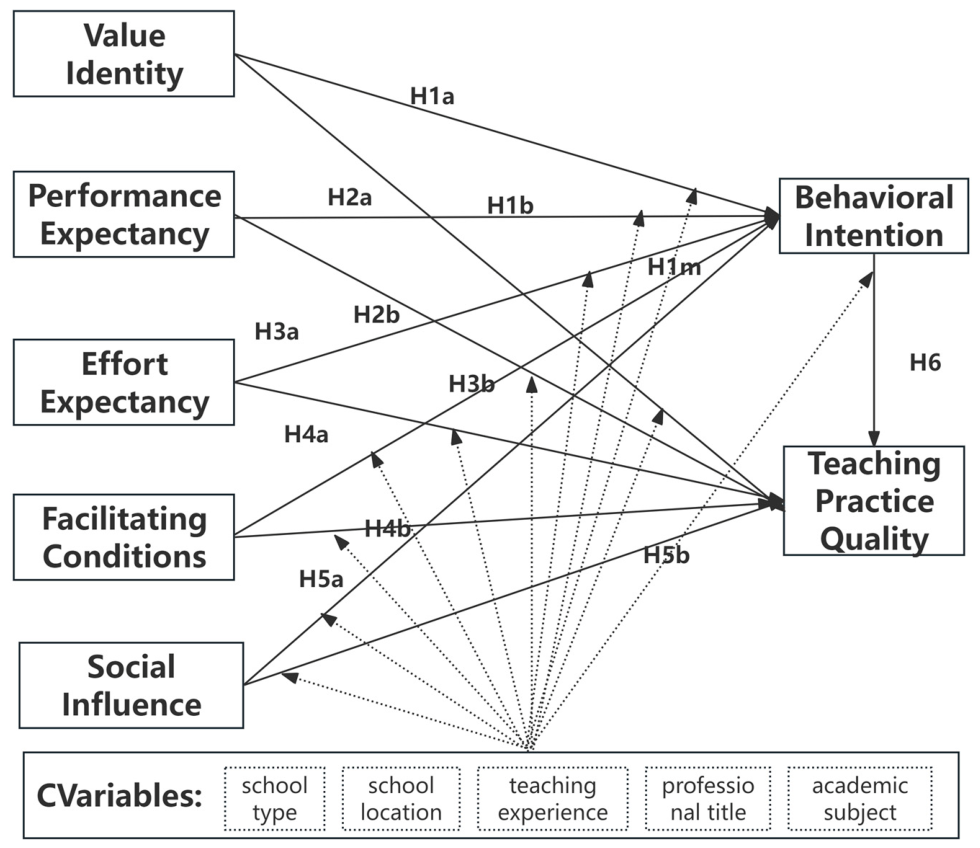
H1a: 
Value Identity positively predicts teachers’ behavioral intention (BI).
H1b: 
Value Identity positively predicts their self-reported Teaching Practice Quality (TPQ).
H1: 
Contextual variables moderate these relationships.

2.1.2. The Foundational Role of Instrumental Rationality: Performance Expectancy (PE) and Effort Expectancy (EE)

Although value rationality may dominate in public service settings, instrumental rationality remains an important component of teacher decision-making. Performance Expectancy (PE), the perceived belief that using a technology will enhance job performance, is a proven key predictor in traditional technology adoption research (Scherer et al. [12]). As rational actors, teachers naturally assess whether participation can improve their teaching efficiency or professional reputation (Jin et al. [13]). Crucially, while both VI and PE tap into user motivation, they stem from fundamentally different rationales. VI represents a form of value rationality, where behavior is driven by an intrinsic belief in its inherent ‘rightness’ or moral-professional alignment. In contrast, PE is rooted in instrumental-rationality, driven by a utilitarian calculation of costs and benefits (i.e., ‘Will this help me do my job better?’). While we expect both to positively predict behavioral intention, the unique, value-laden context of public policy implementation suggests that the interplay between these two motivations may be more complex than in typical technology adoption scenarios. Effort Expectancy (EE), the perceived ease of use, directly relates to the cognitive cost of participation. For teachers, who generally face heavy workloads, a complex platform would significantly increase extraneous cognitive load, encroaching on the cognitive resources available for core teaching activities. This would not only suppress participation intention but also directly impair practice quality (Sweller et al. [14]). The influence of these instrumental considerations is also context-dependent: in more competitive environments, PE may be more salient; in environments with weak technical support, EE becomes a critical threshold. From a systems perspective, when this subsystem is well designed, teachers can devote more cognitive and emotional resources to substantive teaching tasks, thereby improving the efficiency of the motivation-to-quality conversion. Based on this, we propose:
H2a: 
Performance expectancy positively influences BI.
H2b: 
Performance expectancy positively influences TPQ.
H3a: 
Effort expectancy positively influences BI.
H3b: 
Effort expectancy positively influences TPQ.
H2/H3: 
Contextual variables moderate these relationships.

2.2. External Influence Mechanisms on ‘Motivation-to-Quality’ Transformation: Organizational Support and Social Pressure

Teachers’ decisions and practices do not occur in a vacuum but are profoundly shaped by their organizational and social environments. This study categorizes external influences into supportive and coercive mechanisms.

2.2.1. Supportive Mechanism: Facilitating Conditions (FC)

Facilitating Conditions (FC), the perceived organizational and technical support available, are crucial external resources for enabling behavior, In the present study, facilitating conditions are conceptualized as a core component of the support subsystem in the educational service system. Ample organizational support (e.g., training, technical help) can systematically enhance teachers’ self-efficacy by providing successful experiences and imitable role models. Teacher self-efficacy is a well-established core internal resource for tackling challenges and ensuring high-quality teaching practice. FCs are not only the foundation for smooth participation but also the objective prerequisite for achieving high-quality practice. In relatively resource-constrained contexts, such support may generate a stronger compensatory effect, thereby improving system performance more substantially (e.g., rural teachers). Based on this, we propose:
H4a: 
Facilitating conditions positively influence BI.
H4b: 
Facilitating conditions positively influence TPQ.
H4: 
Contextual variables moderate these relationships.

2.2.2. Coercive Mechanism: Social Influence (SI)

Social Influence (SI) refers to the impact of school leaders, colleagues, organizational norms, and peer expectations on teachers’ participation. From a systems engineering education perspective, social influence belongs to the social-organizational coordination subsystem, the social pressure from significant others, is particularly potent in the strong organizational culture of schools. Its mechanism is twofold. On one hand, pressure from leadership or peer participation can serve as an effective mobilization tool, increasing behavioral intention. On the other hand, focus theory of normative conduct distinguishes between descriptive norms (what others do) and injunctive norms (what is approved of). When social influence primarily reflects the compliance pressure of the former, it may only lead to formalistic participation rather than high-quality practice. The process by which this external pressure is converted into internal motivation and high-quality behavior is complex (Yu et al. [6]) and may even negatively impact quality by “crowding out” intrinsic motivation. We anticipate that the nature (pressure source vs. support network) and effect of SI will vary with the organizational environment (administrative directiveness) and individual characteristics (professional development stage) (Vescio et al. [15]). Based on this, we propose:
H5a: 
Social influence positively influences BI.
H5b: 
The effect of social influence on TPQ is complex and moderated by contextual variables.

2.3. The Governance Paradox: Suppression Effects and the Moderated Intention-Practice Link

A foundational premise of behavioral science, consolidated in canonical models like the Unified Theory of Acceptance and Use of Technology (UTAUT), posits that behavioral intention (BI) is the most proximal and powerful positive antecedent of actual behavior (Venkatesh & Bala [7]). In the context of our study, this principle would predict a direct, positive association between a teacher’s intention to engage and the quality of their subsequent teaching practice. However, a significant body of research on the “intention-behavior gap” has robustly demonstrated that this link is not automatic, but is frequently attenuated by a host of contextual and personal factors (Sheeran & Webb [2]).
We extend this insight by theorizing that in a complex, top-down policy implementation system, this gap can manifest as a ‘Governance Paradox’: a situation where aggregate-level statistical analysis yields findings that appear to contradict established micro-foundational theory. We conceptualize this paradox not as a substantive causal anomaly, but as a diagnostic signal of unmodeled system heterogeneity. The precise statistical mechanism often underlying this phenomenon is a suppression effect within a multivariate regression model (Maassen & Bakker [16]; MacKinnon, Krull & Lockwood [17]). A suppression effect occurs when a predictor’s relationship with an outcome becomes unexpectedly negative or is significantly weakened after controlling for another predictor. This typically arises under conditions of high multicollinearity, a condition we can anticipate and which requires careful diagnostic checking via metrics such as the Variance Inflation Factor (VIF).
Crucially, we argue that the high multicollinearity anticipated in our model is not a mere statistical artifact to be “fixed,” but is itself a substantive theoretical finding. We propose it is the empirical signature of “Motivation Fusion”—a phenomenon where, within a value-laden policy context, the powerful value-rational driver (Value Identity) conceptually absorbs and statistically overshadows the variance of more instrumental (Performance Expectancy) and volitional (Behavioral Intention) drivers. This intense overlap of motivational constructs creates the ideal statistical conditions for a suppression effect to emerge in the aggregated sample. Specifically, when the strong, shared variance driven by Value Identity is controlled for in the model, the remaining, unique variance of Behavioral Intention may paradoxically exhibit a negative relationship with the outcome.
Therefore, we predict that a direct test of the BI→TPQ path in the aggregate sample will be misleading, yielding a paradoxical negative coefficient due to this suppression mechanism. We posit that the true, underlying positive relationship, as stipulated by theory, can only be revealed by disaggregating the data. By partitioning the sample into more homogeneous subgroups based on key contextual factors, we can mitigate the conditions that produce the suppression effect and unmask the authentic association. This analytical strategy transforms the paradox from a problem into a diagnostic tool.
This leads to our formal hypotheses, which are structured to explicitly test this entire theoretical sequence:
H6: 
Behavioral Intention is positively associated with self-reported Teaching Practice Quality.
(This hypothesis represents the foundational theoretical expectation, which we predict will not be supported at the aggregate level.)
H6-mod: 
Contextual variables moderate the relationship between Behavioral Intention and self-reported Teaching Practice Quality, such that the paradoxical negative association (suppression effect) observed at the aggregate level is resolved, and the underlying positive association predicted by H6 is revealed within homogeneous subgroups.
Based on the preceding analysis, this study constructs the theoretical model shown in Figure 1.
This Table 1 outlines the theoretical framework and the complete set of hypotheses guiding this study.

3. Methods

3.1. Participants and Procedure

The target population for this study comprised primary and secondary school teachers in mainland China who had participated in the government-led Online Service Program. The recruitment for this program dictated our sampling strategy, which is best characterized as a large-scale purposive sampling with voluntary participation. Specifically, the program was designed to invite all teachers holding first-level professional titles and above within targeted regions, with a stronger recruitment effort directed towards senior-titled teachers. Electronic questionnaires distributed between February and April 2022. This period was characterized by the widespread and intensive use of online education modalities across China, largely driven by the ongoing COVID-19 pandemic. This unique context likely heightened the salience of the policy and the constructs under investigation, providing a rich setting for our research. After data screening and quality checks, a final valid sample of 2226 teachers was retained for analysis. As a minimal-risk anonymous educational survey, this study was exempt from ethics committee approval, with voluntary and anonymous participation under informed consent for academic use only.
As a direct result of this purposive sampling frame, the sample is, by design, skewed towards experienced educators, as shown in Table 2 (e.g., 68.4% with 20+ years of experience; 50.7% with senior or higher titles). While this composition is not representative of the entire Chinese teacher population, it holds significant theoretical and policy value. This cohort represents the professional backbone and opinion leaders within the education system. Studying the implementation dynamics within this policy-critical group provides a crucial litmus test for the program’s effectiveness. The findings from this sample are therefore particularly insightful for understanding how a policy is received by its most experienced and qualified implementers.

3.2. Measures

The measurement framework was designed to capture both motivational antecedents and system-level enabling conditions. Performance Expectancy, Effort Expectancy, Social Influence, and Facilitating Conditions represent core elements of the human–technology, social-organizational, and support subsystems within the online public service system. Value Identity captures the value-rational orientation of teachers as public service actors. Behavioral Intention reflects teachers’ willingness to remain engaged in the system, whereas self-reported Teaching Practice Quality represents teachers’ own assessment of the substantive output quality of the educational service system. All items were measured on a five-point Likert scale (ranging from 1 = “Strongly Disagree” to 5 = “Strongly Agree”). The items, originally in Mandarin, were translated into English for this publication using a standard back-translation procedure to ensure semantic equivalence (Brislin [18]).
The measurement of the antecedent variables aimed to capture the multidimensional motivational structure driving teacher participation. To ensure theoretical continuity, the items for the four core UTAUT constructs were sourced from foundational literature. Specifically, items for Performance Expectancy (PE) and Facilitating Conditions (FC) were directly adapted from Venkatesh et al. [1]. The measure for Effort Expectancy (EE) integrated classic items on “perceived ease of use” from Davis et al. [19]. The measure for Social Influence (SI) combined core items on “subjective norm” from Ajzen [20]. As the core theoretical innovation of this study, the measure for Value Identity (VI) was operationalized by integrating insights from Public Service Motivation (PSM) theory (Perry & Wise [5]) and Self-Determination Theory (SDT) (Ryan & Deci [9]), focusing on the intrinsic professional value teachers derive from participation.
The measurement of the outcome variables was designed to delineate the critical transformation from behavioral intention to practice quality. The measure for Behavioral Intention (BI) drew upon established items from Venkatesh et al. [1], Bhattacherjee’s [21] Information Systems Continuance Model, and Ajzen’s [20] Theory of Planned Behavior (TPB). As the ultimate dependent variable, Self-Reported Teaching Practice Quality (TPQ) was assessed through a multidimensional scale integrating theories of Pedagogical Content Knowledge (PCK) (Shulman [22]), the Community of Inquiry (CoI) framework (Garrison et al. [23]) to provide a holistic evaluation of professional practice.
To ensure content validity and contextual appropriateness, the draft questionnaire was subjected to a pre-test and cognitive interviews with an expert panel consisting of 10 frontline teachers and 3 educational technology specialists. Based on their feedback, the wording of several items was refined. All measurement items were adapted from mature scales and revised through expert interviews and pre-test to ensure content validity (see Table 3).

3.3. Data Analysis Strategy

Data analysis was performed using SPSS 26.0 for descriptive statistics and AMOS 27.0 for confirmatory factor analysis (CFA) and multi-group structural equation modeling (SEM), driven by its strength in assessing the overall goodness-of-fit between a proposed theory and observed data, a central tenet of our systems perspective. Following the two-step approach of Fornell and Larcker [24], we first tested the reliability and validity of the measurement model and then estimated the structural model. To examine whether the paradoxical relationships observed in the aggregate model reflected hidden system heterogeneity, multi-group structural equation modeling was further conducted across key contextual variables, including school type, urban–rural location, teaching experience, professional title, and subject area. From the perspective of systems engineering education, this approach serves as a form of subsystem diagnosis, enabling the identification of heterogeneous conversion mechanisms and differential paths toward system optimization.
First, the measurement model was assessed. Internal consistency reliability was evaluated using Cronbach’s alpha (α). Confirmatory factor analysis (CFA) was performed to assess convergent and discriminant validity. Following the guidelines of research, the acceptance thresholds were set as follows: Cronbach’s α > 0.7, composite reliability (CR) > 0.7, and average variance extracted (AVE) > 0.5. Discriminant validity was tested using the Fornell–Larcker criterion, which requires that the square root of the AVE for each construct exceeds its correlation coefficients with all other constructs. Second, upon establishing the reliability and validity of the measurement model, the structural model was tested to examine the main effect hypotheses. Model fit was evaluated against the criteria recommended by Hu & Bentler [25]: chi-square/degrees of freedom ratio (CMIN/DF) < 3 (or < 5 under less strict criteria), comparative fit index (CFI) and Tucker–Lewis index (TLI) > 0.90, and root mean square error of approximation (RMSEA) < 0.08. Finally, to investigate the proposed moderating effects and explore whether the counterintuitive results in the main model were attributable to an aggregation fallacy arising from group heterogeneity, multi-group SEM was employed.
Given that all focal constructs were measured through a single self-report questionnaire administered to the same respondents at one point in time, the study may be susceptible to common method bias. To assess this possibility, both Harman’s single-factor test and a single-factor CFA were conducted. Harman’s test showed that four factors with eigenvalues greater than 1 were extracted from the 31 items, with the first unrotated factor accounting for 66.436% of the total variance. We further estimated a single-factor CFA model by loading all items onto one latent construct as a stricter diagnostic of common method bias.

4. Results

The analysis of the 2226 valid survey responses was conducted in a rigorous, sequential manner. The process involved three key stages: first, an examination of the measurement model to ensure the reliability and validity of the constructs; second, an assessment of the structural model’s fit with the observed data; and finally, a systematic test of the proposed hypotheses through path analysis and multi-group comparisons.

4.1. Measurement Model Examination

4.1.1. Reliability and Convergent Validity

As presented in Table 4, the measurement model demonstrates strong reliability and convergent validity. Cronbach’s alpha (α) coefficients for all constructs ranged from 0.900 to 0.972, composite reliability (CR) values were between 0.897 and 0.982, and average variance extracted (AVE) values ranged from 0.688 to 0.915. Furthermore, all standardized factor loadings (λ) were robust, falling between 0.687 and 0.949. All indicators comfortably exceeded their respective recommended thresholds (Cronbach’s α > 0.7, CR > 0.7, AVE > 0.5, λ > 0.6), confirming the high quality of the measurement scales.
The hypothesized seven-factor measurement model was tested using confirmatory factor analysis (CFA). The results indicated an acceptable fit to the data (χ2/df = 8.653, CFI = 0.969, RMSEA = 0.059, SRMR = 0.037), while the χ2/df ratio is elevated, a known tendency in models with large sample sizes (N > 500); the strong performance of other key indices confirms a good overall model fit according to contemporary standards (Hu & Bentler [25]).
To address the potential for common method variance (CMV) inherent in single-source, cross-sectional data, we employed a series of diagnostic procedures recommended. First, procedural remedies were implemented during the survey design, such as guaranteeing anonymity and varying item formats. Second, we conducted a rigorous post hoc statistical test. While the Harman’s single-factor test is often reported, we utilized the more stringent single-factor confirmatory factor analysis (CFA). In this test, a model where all 31 measurement items were loaded onto a single latent construct was estimated. This model yielded a very poor fit to the data (χ2/df = 77.848, CFI = 0.674, TLI = 0.655, RMSEA = 0.186). This poor fit stands in stark contrast to the acceptable fit of our proposed seven-factor measurement model (χ2/df = 8.653, CFI = 0.969), indicating that a single method factor cannot account for the observed variance. Thus, we conclude that CMV is not a substantial threat to the validity of our findings.

4.1.2. Discriminant Validity Test

Discriminant validity, a cornerstone of construct validation, was evaluated through a rigorous, two-stage protocol designed to probe the theoretical architecture of our model.
First, the foundational Fornell–Larcker [24] criterion was applied. As presented in Table 5, the square root of the Average Variance Extracted (AVE) for each construct surpassed all corresponding inter-construct correlations, providing initial, conventional assurance of discriminant validity. This established that each construct possessed unique variance.
The analysis then advanced to the more discerning Heterotrait–Monotrait Ratio (HTMT) criterion (Henseler et al. [26]), a test particularly suited to scrutinizing the fine-grained distinctions between conceptually proximate constructs. It is at this juncture that a seemingly methodological anomaly revealed itself as a profound theoretical insight. While most construct pairs demonstrated robust separation (HTMT < 0.85), the ratios between Value Identity (VI), Performance Expectancy (PE), and Behavioral Intention (BI) were exceptionally high (VI–PE ≈ 0.956; VI–BI ≈ 0.941), decisively exceeding even the most lenient thresholds.
A conventional interpretation would treat these elevated HTMT values as evidence of measurement failure. However, a more theoretically informed perspective suggests they may represent the empirical signature of a critical, context-driven phenomenon: Motivation Fusion. We propose to define this as a socio-psychological state a socio-psychological state, induced by a powerful and value-laden institutional environment, where distinct motivational pillars coalesce into a singular, unified construct. Within the systemic context of this national policy, for a teacher, to identify with the policy’s values (VI) is inextricably to believe in its efficacy (PE) and to commit to its enactment (BI). The theoretical distinctions, so clear in a vacuum, have collapsed under the institutional pressure, rendering them nearly indistinguishable at the measurement level because they have become phenomenologically fused in the minds of the actors.
Therefore, this finding is not a limitation to be overcome, but the very heart of our discovery. The Motivation Fusion observed here is the micro-foundational mechanism that generates the statistical artifact of high multicollinearity. This multicollinearity, in turn, is the engine that produces the macro-level Governance Paradox. This entire causal chain, from micro-psychology to macro-policy failure, forms the central theoretical contribution of this paper, which we elaborate upon in Section 5.

4.2. Structural Model and Hypothesis Testing

4.2.1. Structural Model Fit

The fit of the structural model was evaluated using a range of standard indices. The chi-square statistic was significant (χ2 = 2250.621, df = 405, p < 0.001), and the chi-square/degrees of freedom ratio (CMIN/DF) was 5.557. While this value is slightly above the stringent threshold of 5, it is generally considered acceptable for large sample sizes (N = 2226), where the chi-square statistic is known to be overly sensitive. Crucially, all other key fit indices indicated an excellent model fit: the Root Mean Square Error of Approximation (RMSEA) was 0.045 (<0.08), the Comparative Fit Index (CFI) was 0.982 (>0.95), and the Tucker–Lewis Index (TLI) was 0.979 (>0.95). Taken together, these indices provide strong evidence that the proposed structural model fits the observed data well (see Table 6).

4.2.2. Main Effect Model Testing

  • Overall Model Explanatory Power
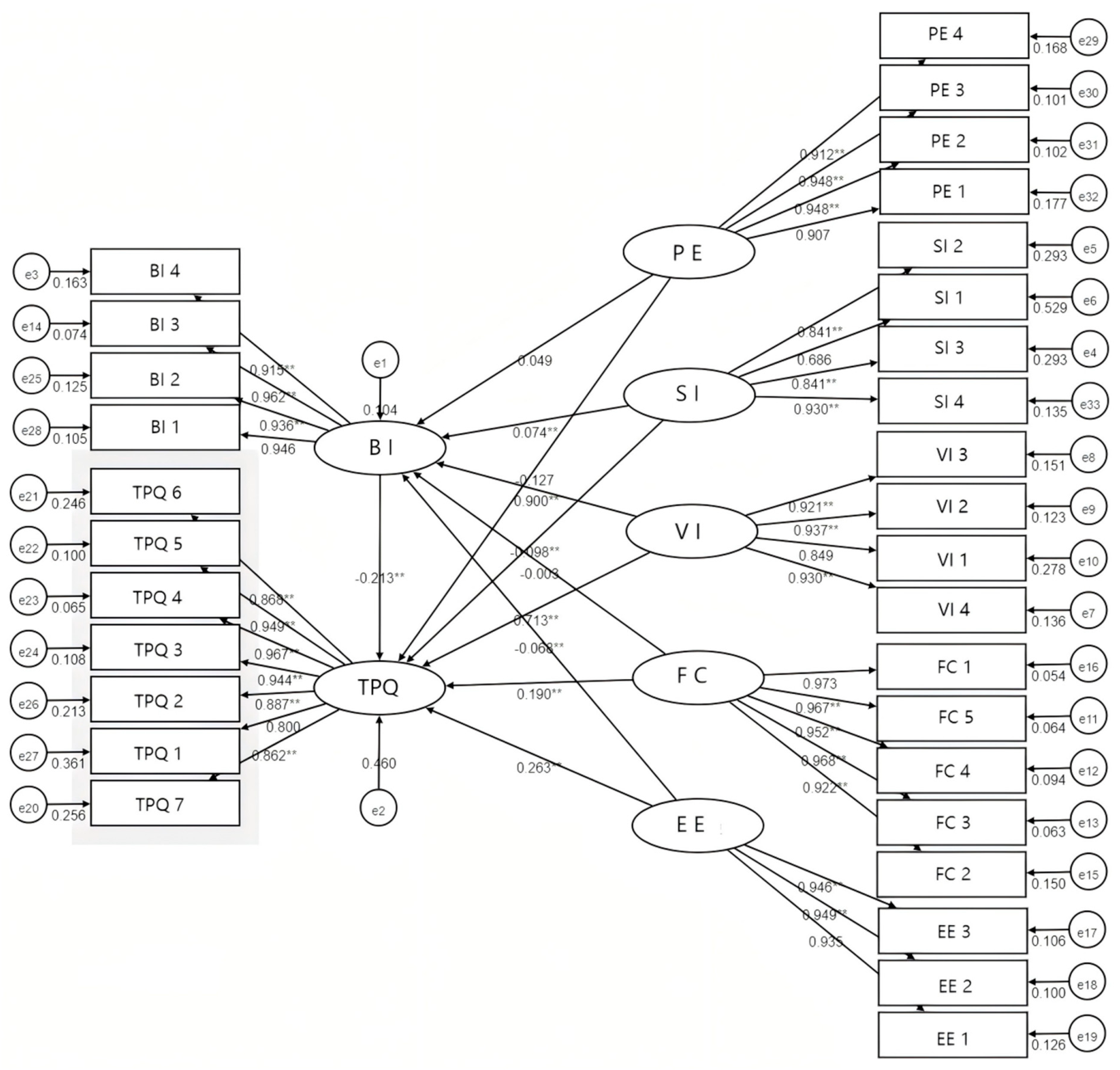
The structural equation model (SEM) demonstrated substantial explanatory power for the key dependent variables. Specifically, the model accounted for 89.6% of the variance in Behavioral Intention (BI) (R2 = 0.896) and 54.0% of the variance in self-reported Teaching Practice Quality (TPQ) (R2 = 0.540). The exceptionally high R2 for BI is not interpreted as simple predictive success but rather as a statistical consequence of the “Motivation Fusion” phenomenon, reflecting the substantial conceptual and empirical overlap between Value Identity and Behavioral Intention in this specific context. The detailed path analysis results are presented in Table 7 and Figure 2.
2.
Hypothesis Testing: Antecedents of Behavioral Intention (BI)
The analysis of BI’s antecedents revealed a dominant motivational driver and several other significant (and partially unexpected) relationships.
Primacy of Value-Driven Motivation: Hypothesis H1a was strongly supported. Value Identity (VI) emerged as the single most dominant predictor of BI (β = 0.900, p < 0.001). The substantial effect size of this path suggests that, in the context of a policy emphasizing the public good of education, teachers’ value identity is strongly associated with their intention to participate.
Influence of Social and Effort Factors: Hypothesis H5a was supported, as Social Influence (SI) had a significant positive effect on BI (β = 0.074, p < 0.001). In an unexpected turn, H3a was statistically significant but in the opposite direction of the hypothesis. Effort Expectancy (EE) showed a slight but significant negative influence on BI (β = −0.068, p < 0.01). This counterintuitive finding will be explored further in the discussion section.
Insignificant Effects of Instrumental Factors: Hypotheses H2a and H4a were not supported. Neither Performance Expectancy (PE) (β = 0.049, p > 0.05) nor Facilitating Conditions (FC) (β = −0.003, p > 0.05) had a significant direct impact on BI. This result suggests that in this public service context, traditional instrumental considerations based on personal benefit (performance) or resource convenience have been superseded by deeper value-driven motivations.
3.
Hypothesis Testing: Antecedents of self-reported Teaching Practice Quality (TPQ)
Three factors were identified as direct and positive drivers of TPQ. Direct Drivers of High-Quality Practice: In line with our hypotheses, Value Identity (VI) (β = 0.713, p < 0.001; supporting H1b), Effort Expectancy (EE) (β = 0.263, p < 0.001; supporting H3b), and Facilitating Conditions (FC) (β = 0.190, p < 0.001; supporting H4b) were all significant positive predictors of TPQ. This confirms that teachers’ value beliefs, the platform’s ease of use, and adequate organizational support are key elements in ensuring high-quality teaching outcomes.
4.
Empirical Confirmation of the Governance Paradox Hypothesis
The aggregate structural model shows a pattern consistent with our central hypothesis. As theoretically anticipated, the analysis revealed two significant and counterintuitive negative pathways, which is consistent with the presence of a governance paradox potentially driven by aggregation bias.
Most notably, the path from Behavioral Intention to TPQ was unexpectedly negative and significant (β = −0.213, p < 0.001), and the path from Social Influence to TPQ was also negative and significant (β = −0.098, p < 0.01). These counterintuitive findings provide initial empirical evidence for the ‘Governance Paradox’ we theorized in Section 2.3. Rather than refuting the intention-practice link, these results are consistent with the presence of a statistical suppression effect driven by the dominant VI construct in a heterogeneous sample.
However, from a systems engineering education perspective, they are more appropriately interpreted as symptoms of system-level aggregation bias, whereby multiple heterogeneous subsystems with different conversion logics are compressed into a single statistical structure. The appearance of these negative paths thus provides empirical support for the proposition that policy implementation quality is shaped by hidden contextual heterogeneity and misalignment among mobilization, support, and evaluation subsystems.

4.2.3. Methodological Prerequisite: Measurement Invariance Testing

A foundational prerequisite for comparing path coefficients across different groups is the establishment of measurement invariance. Therefore, prior to testing our moderation hypotheses, we performed multi-group confirmatory factor analysis to assess configural and metric invariance for each of the five grouping variables (school type, location, experience, title, and gender). The results, detailed in Appendix A, confirmed that metric invariance was robustly supported in all cases (ΔCFI < 0.01). This confirms that the constructs were understood and measured equivalently across subgroups, providing the necessary methodological license to proceed with a meaningful comparison of the structural paths.

4.2.4. Resolution of the Paradox: Unveiling the True Mechanisms via Multi-Group Analysis

Having empirically confirmed the existence of the governance paradox, we proceeded to the decisive second stage of our analysis: resolving it through multi-group SEM. The central finding of this study is the complete and consistent reversal of the paradoxical negative paths upon disaggregation. As hypothesized, the path from Behavioral Intention to self-reported Teaching Practice Quality (BI → TPQ) became significantly and robustly positive within all homogeneous subgroups (e.g., Selective: β = 0.557, p < 0.01; Non-selective: β = 0.659, p < 0.001; Urban: β = 0.507, p < 0.001; Rural: β = 0.684, p < 0.001). Likewise, the path from Social Influence to TPQ also turned consistently positive across all subgroups. See Table 8.
This confirms that the aggregate paradox was not the reflection of a true negative causal relationship, but a statistical manifestation of hidden subsystem heterogeneity. In systems terms, the overall model concealed the fact that different subsystems exhibited distinct conversion efficiencies between motivation, participation, and quality. More importantly, it validates our theoretical framework and enables us to move to the next stage of analysis: explaining why the strength of these now-positive relationships differs so systematically across contexts, which reveals the deeper governance mechanisms at play. The key findings are synthesized into the following four thematic area.
  • Asymmetric Empowerment of Supportive Resources: A Compensatory Effect for Disadvantaged Groups
Contrary to the conventional wisdom of the “Matthew effect,” this study finds that the utility of foundational supportive resources is significantly amplified among teacher groups with relatively fewer resources or less professional experience, exhibiting a positive “compensatory effect.”
Utility of Technical Usability (Effort Expectancy): The quality-enhancing effect of platform usability on self-reported Teaching Practice Quality is significantly stronger for rural teachers (b = 0.756), teachers with <20 years of experience (b = 0.750), and teachers with intermediate titles (b = 0.756) compared to their urban (b = 0.578), more experienced (b = 0.657), and senior-titled (b = 0.624) counterparts. This indicates that for these groups, an easy-to-use platform acts as a critical “empowerment lever” to overcome technical barriers and ensure a baseline of quality.
Efficacy of Organizational Support (Facilitating Conditions): The positive impact of organizational support on self-reported Teaching Practice Quality is significantly stronger for rural teachers (b = 0.732), teachers with <20 years of experience (b = 0.752), teachers with intermediate titles (b = 0.745), and STEM teachers (b = 0.723). This provides a crucial policy insight: targeted resource allocation to teachers in relatively disadvantaged regions, at earlier career stages, or in specific subject areas can yield higher marginal returns.
2.
The Dual Moderating Effect of External Pressure: Coexistence of Mobilization and Conversion Discounting
Social influence acts as a double-edged sword. In highly competitive institutional settings, it serves as an “amplifier” for behavioral mobilization but can simultaneously lead to a “discounting” of the efficiency with which intention is converted into high-quality practice.
Mobilization Effect Amplified in High-Stakes Environments: The path from “Social Influence → Behavioral Intention” is significantly stronger in selective schools (b = 0.733), urban areas (b = 0.763), and for teachers with less experience (b = 0.808) or intermediate titles (b = 0.738). This suggests that in environments characterized by more intense performance expectations and peer competition, external normative pressures are more readily translated into individual participation motivation.
Conversion Efficiency Diminished in High-Pressure Environments: Crucially, the positive effect of “Behavioral Intention → self-reported Teaching Practice Quality” is significantly weaker in selective schools (b = 0.557) compared to non-selective schools (b = 0.659, p = 0.002). This pattern of diminished efficiency is also observed for urban teachers, more experienced teachers, and those with senior titles. This finding precisely clarifies that high intention driven by external pressures may lead to “strategic compliance” rather than “substantive engagement,” resulting in a discounted conversion to high-quality practice.
3.
The Buffering and Resilience Effect of Intrinsic Motivation: Enhanced Value Conversion in Non-Advantaged Contexts
As the core internal driver, the positive impact of Value Identity (VI) on practice quality is universal. However, its conversion efficiency also exhibits significant group differences, demonstrating greater “resilience” in non-advantaged environments. The positive effect of “Value Identity→ self-reported Teaching Practice Quality” is significantly stronger in non-selective schools (b = 0.725), for rural teachers (b = 0.723), and for teachers in their earlier career stages (b = 0.727 for <20 years; b = 0.731 for intermediate titles). This powerfully indicates that for teachers in less-advantaged institutional settings, the intrinsic value identity derived from their professional beliefs serves as a more critical form of “psychological capital” that enables them to overcome external resource constraints and deliver high-quality practice.
4.
The Direct Gain Effect of Social Networks: Knowledge Spillovers During Experience Accumulation
Distinct from its role as an indirect pressure source, the social network itself exerts a direct, positive influence on self-reported Teaching Practice Quality, an effect that is most pronounced for teachers in the experience accumulation phase of their careers. The path coefficient for “Social Influence → self-reported Teaching Practice Quality” is significantly higher for teachers with <20 years of experience (b = 0.651) and intermediate titles (b = 0.591) compared to their more senior colleagues. This highlights the knowledge spillover function of professional communities. For teachers still accumulating professional expertise, the modeling, guidance, and shared experiences from their peer group are more effectively absorbed and translated into substantive improvements in their teaching practice.

5. Discussion

This study’s central finding is the resolution of a key governance puzzle: why high formal participation in a government-led online service fails to translate into high-quality practice. Our results suggest this is not an individual-level anomaly but a system-level phenomenon, best understood through a systems engineering lens as a problem of inefficient conversion and subsystem misalignment. Two core insights emerge from the discussion.

5.1. General Discussion

This study introduced and empirically validated a “paradox-driven” framework for understanding policy implementation, demonstrating how Governance Paradox can be leveraged as a theoretical tool to diagnose hidden fissures in policy execution. Our first key finding within this framework is a fundamental shift in the core motivation of public service providers, whereas Value Identity (VI) emerges as the dominant determinant. This discovery not only offers a robust revision of the instrumental rationality assumption inherent in UTAUT but also serves as a profound validation of Public Service Motivation (PSM) theory within the context of digital public services. It corroborates recent research highlighting the central role of value beliefs in driving teachers’ technology integration behaviors (Cheng et al. [27]). In the significant policy arena of “Double Reduction,” which emphasizes the public-good nature of education, the impetus for high-quality practice among teachers—acting as “street-level bureaucrats”—no longer stems from personalized performance gains. Instead, it is driven by an identification with public values, empathy for service recipients, and a commitment to their professional mission (Ritz et al. [8]). This study confirms that teachers’ high-quality practice is driven by Value Identity centered on educational equity and public responsibility, which is precisely the resistance of frontline educators to the instrumentalization and commercialization of education. This resonates with the call by Burton-Jones & Gallivan [3] to understand the “depth” of technology use, not merely its “breadth.” This provides a crucial insight for motivating frontline public service personnel in digital governance: technology empowerment must be coupled with value guidance. A purely “managerialist” approach reliant on performance assessment may fail to address the core essence of public service delivery quality.
Although the present design does not permit strong causal inference, the coexistence of negative aggregate paths and positive within-group paths is more consistent with hidden system heterogeneity than with a uniformly negative relationship between participation-related factors and self-reported teaching practice quality. Accordingly, the paradox identified in this study is best interpreted as a diagnostic manifestation of aggregation bias within a differentiated policy implementation system.

5.2. Theoretical Implications: Governance Diagnosis and Motivation Fusion

This study offers two primary theoretical contributions that stem directly from confronting the model’s apparent statistical anomalies. First, at the macro-level, we reframe aggregation fallacies as a diagnostic tool for governance. Second, at the micro-level, we identify a substantive phenomenon of “Motivation Fusion” that explains the source of these fallacies.

5.2.1. A Systems-Diagnostic Framework for Governance Paradoxes

This study’s primary theoretical contribution is the conceptualization of statistical aggregation artifacts as a diagnostic instrument for systems-level governance. From a systems engineering perspective, the observed ‘Governance Paradox’—where aggregate-level data contradict established micro-foundational theories—is not interpreted as model failure but as symptomatic of misaligned or poorly coupled subsystems. The paradox, therefore, functions as a critical indicator, signaling deep structural heterogeneity and inefficient conversion mechanisms within the broader policy system.
Our approach advances methodological practice by treating multi-group analysis not merely as a test for moderation, but as the analytical equivalent of subsystem decomposition. By disaggregating the system into its constituent parts based on institutional logic (e.g., selective vs. non-selective schools), we move beyond a monolithic view of policy implementation. This decomposition allows for the diagnosis of subsystem-specific dynamics. For instance, the resolution of the negative BI→TPQ path into a weak but positive relationship within the selective school subsystem provides a specific diagnosis: this subsystem is characterized by what we term ‘inefficient coupling,’ where high intention is only weakly converted into self-reported quality, a phenomenon we attribute to strategic compliance.
Ultimately, this framework offers a methodological bridge for the perennial micro-macro problem in organizational and policy research. It provides a replicable procedure to empirically trace how macro-level contextual variables structurally alter micro-level psychological processes, leading to counter-intuitive system-level outcomes. By reframing statistical anomalies as valuable diagnostic data, our work moves the field from macro-level policy assessment towards micro-foundational systems diagnosis, offering a more granular and actionable understanding of policy implementation failures.

5.2.2. The Discovery of Motivation Fusion (The Micro-Level Contribution)

Second, at the micro-level, the study identifies and theorizes “Motivation Fusion.” As foreshadowed by the tension between the Fornell and Larcker [24] and HTMT results, the extreme empirical overlap between Value Identity (VI), Performance Expectancy (PE), and Behavioral Intention (BI) is not a methodological artifact, but a substantive phenomenon. Our findings suggest that in a context imbued with strong public service values, such as China’s “Double Reduction” policy, teachers’ motivational structures undergo a transformation. The instrumental logic of PE (“Is this useful?”) and the declarative intention of BI (“I will use it”) become conceptually subsumed and absorbed by the overarching value-rational judgment of VI (“Using this is the right and proper thing to do”).
This “Motivation Fusion” provides the powerful micro-level explanation for the macro-level patterns observed in our structural model. It explains precisely why VI exhibits such an overwhelmingly large path coefficient (β = 0.900) while the traditionally powerful PE becomes non-significant. The explanatory power of PE has not vanished; rather, it has been integrated into, and is now expressed through, the dominant lens of value identity. This discovery challenges future research to move beyond treating these motivations as independent predictors and to instead explore the conditions under which they fuse or remain distinct.

5.2.3. Illustrating the Mechanisms: Strategic Compliance, Performance Exhaustion, and the Duality of Social Influence

The power of our two-tiered theoretical framework is best illustrated by how it explains the specific patterns uncovered in the multi-group analysis. Strategic Compliance and Performance Exhaustion: The resolution of the negative BI→TPQ path reveals that in highly competitive and regulated environments (i.e., selective/urban schools), the conversion efficiency of intention into quality is significantly attenuated. This empirically supports our proposition of “strategic compliance,” where high intention is driven by the need to meet formalistic metrics rather than deep engagement. A deeper mechanism can be characterized as “performance exhaustion.” When institutional pressure becomes excessive, teachers must allocate substantial cognitive resources to navigating formal assessment criteria, which directly crowds out the resources needed for high-quality practice. This explains why higher intention in these contexts fails to translate into higher quality.
The Duality of Social Influence: Similarly, the disaggregation of the SI path empirically disentangles its dual nature. In high-pressure environments, where SI acts as a coercive mobilization tool, it is associated with lower-quality compliance. Conversely, for early-career teachers, where SI appears to function as a “professional support network” for knowledge sharing, it is associated with higher quality practice. This demonstrates how our diagnostic approach can reveal the multifaceted, even contradictory, roles that a single construct can play across different system contexts.

5.3. Asymmetrical Empowerment of Facilitating Conditions: Empirical Evidence for Precision Governance

Our research finds that foundational resources, such as platform usability and organizational support (i.e., Facilitating Conditions), exhibit a significantly stronger “compensatory effect” on practice quality among relatively disadvantaged groups, such as teachers in rural areas or with junior professional titles. This finding challenges the common “Matthew effect” assumption in resource allocation, suggesting that for resource-scarce groups, the marginal utility of external support is greatest. This finding provides strong empirical support for the principle of a “compensatory effect.” For teachers who already lack resources, external support (e.g., a user-friendly platform, timely technical training) is a critical asset for building pedagogical “capability” and creating “opportunities,” making its impact far more pronounced than on resource-saturated groups. This provides robust empirical evidence for implementing “precision governance” and “differentiated empowerment.” From the perspective of systems engineering education, the uneven allocation of technical support, organizational resources and platform functions between urban and rural schools, selective and non-selective schools is exactly the key obstacle to the standardization of schooling and the equalization of public services (Xue & Li [28]). Therefore, the precision empowerment strategy for disadvantaged groups proposed in this study is highly consistent with the goal of schooling standardization and public education equalization.
It demonstrates that during the push for equalization of basic public services, targeted resource allocation to disadvantaged groups can effectively bridge capability gaps and leverage quality improvements, yielding higher marginal policy benefits. This holds significant policy design value for ensuring that technological dividends genuinely benefit all, rather than exacerbating the digital divide.
Based on the empirical finding that the compensatory effect of existing resources is stronger among disadvantaged groups, governance should abandon the one-size-fits-all model and implement a differentiated precision empowerment strategy. Governance should shift from universal mobilization to system-based precision empowerment. A one-size-fits-all model of participation assessment and support is inadequate for groups embedded in different institutional contexts. Policymakers should instead design differentiated support architectures according to subsystem characteristics. For rural schools, early-career teachers, and other relatively disadvantaged groups, governance should prioritize foundational capacity building, including platform usability optimization, targeted pedagogical training, and responsive technical support. For urban schools, selective schools, and senior teachers, governance should focus more on reducing excessive formal pressure, strengthening professional autonomy, and supporting innovation-oriented collaboration.
In addition, considering the dynamic and systematic nature of online public education services, it is necessary to improve the governance system from the perspectives of feedback mechanisms and thinking cultivation to ensure the adaptability and long-term effectiveness of policy implementation. A closed-loop feedback mechanism should be established to improve system adaptability. Because online public education services are dynamic socio-technical systems, schools and education authorities should regularly monitor mismatches among motivational structures, support conditions, platform operation, and quality outcomes across different teacher groups. Such feedback would enable adaptive intervention, continuous diagnosis, and iterative system optimization. At the same time, teacher development and program management should incorporate systems engineering education explicitly. Teachers, school leaders, and platform designers should be encouraged to understand online public services not only as digital tools but as interdependent systems involving instructional design, organizational coordination, policy implementation, and quality feedback. Strengthening systems thinking among participants can improve their ability to manage complexity, coordinate resources, and contribute to long-term system improvement.

5.4. Interpreting an Unexpected Finding: The Negative Effect of Effort Expectancy

An anomalous finding within our model is the weak, negative path from Effort Expectancy (EE) to Behavioral Intention (BI) (β = −0.068, p < 0.01), which deviates from the canonical UTAUT. This result, however, becomes interpretable when considering both the statistical model and the specific context of this study. Statistically, in a model with an overwhelmingly dominant predictor such as Value Identity (VI) (β = 0.900), the potential for suppression effects on weaker, correlated predictors is high. A small negative coefficient can thus emerge as a statistical artifact of the regression equation rather than representing a substantive negative relationship.
More fundamentally, this statistical artifact is rooted in the mature socio-technical context of the program. The online service platform is a long-established system, and the teacher participants are, by and large, experienced and proficient users. In such mature adoption stages, instrumental factors like ease of use (Effort Expectancy) often transition from being active drivers of motivation to being baseline ‘hygiene factors’. Their presence is expected and no longer sufficient to increase intention, especially when compared to profound intrinsic motivators like value alignment. The diminished, and ultimately artifactual, role of EE in our model therefore provides an important insight: in value-laden, mandatory-use public service contexts, the motivational calculus shifts decisively away from instrumental concerns towards intrinsic, value-based drivers.
This interpretation of the EE→BI path as a contextualized artifact must be clearly distinguished from the a priori theoretical construct of the “Governance Paradox” (i.e., the negative BI/SI→TPQ paths). The latter was a hypothesized, system-level phenomenon rooted in the logic of aggregation paradoxes, which our multi-group analysis was designed to test and subsequently resolve. The former, in contrast, is a post hoc finding that reflects the specific boundary conditions of a mature implementation environment. This distinction is critical for maintaining theoretical precision.

6. Practical Implications

To resolve the structural contradiction between formal participation and substantive quality in online public education services, governance reform must transcend linear, compliance-oriented management and embrace a systems engineering perspective. Drawing from our systems-diagnostic findings, we propose a multi-level governance architecture. At its core, this architecture involves the concurrent optimization of three primary operational subsystems: the technical, the organizational, and the evaluation. Encapsulating these is a superordinate framework of systemic governance, which ensures adaptive learning and dynamic integration across the entire system. This integrated approach facilitates a paradigm shift from universal mobilization to precision empowerment and from behavioral compliance to value-led incentivization. Targeted recommendations are as follows:

6.1. Technical Subsystem: Enhance Usability and Targeted Support to Realize Protective Empowerment for Disadvantaged Groups

The technical subsystem serves as the foundational infrastructure for high-quality teaching practice. Platform design and resource allocation should prioritize usability, accessibility, and contextual fit to reduce extraneous cognitive load and bridge the digital divide. For rural teachers, early-career teachers, and other relatively disadvantaged groups, simplified interfaces, streamlined workflows, and responsive technical assistance generate a strong compensatory effect, lowering participation barriers and securing a baseline of high-quality engagement. This approach embodies protective empowerment, which strengthens basic capabilities and stabilizes practice quality for resource-constrained groups. For urban teachers, senior teachers, and those in selective schools, advanced modules for instructional innovation and data-driven reflection can be deployed to match their professional needs. Such differentiated technical design improves motivational conversion efficiency and mitigates the “high-participation, low-quality” paradox caused by misaligned human–technology interfaces.

6.2. Organizational Subsystem: Cultivate Professional Learning Communities and Advance Value-Added Empowerment

The organizational subsystem regulates motivational mobilization and social interaction patterns. To avoid over-reliance on top-down administrative pressure, governance should shift toward supportive professional learning communities that transform coercive social influence into collaborative knowledge spillover. For disadvantaged groups, the focus remains on protective empowerment via strengthened training, targeted guidance, and resource provision to boost teacher self-efficacy. For urban, selective, and senior teachers, the emphasis shifts to value-added empowerment, which entails institutional de-pressurization by reducing simplistic quantitative metrics, expanding instructional autonomy, and supporting cross-school collaboration and advanced pedagogical research. This restructuring weakens strategic compliance induced by institutional pressure and redirects teacher motivation toward intrinsic professional commitment, thereby strengthening the translation of behavioral intention into high-quality practice.

6.3. Evaluation Subsystem: Replace Compliance-Oriented Metrics with Value-Led, Quality-Centered Governance

The evaluation subsystem functions as the core steering mechanism aligning individual behavior with systemic goals. To curb formalism, governance tools must be reoriented from behavioral compliance management to value-led incentivization, given that intrinsic value identity represents the fundamental driver of high-quality practice. Over-reliance on superficial indicators such as login frequency, participation duration, and task completion should be reduced. Instead, a multidimensional quality evaluation framework should be established, integrating student feedback, peer review, instructional design quality, exemplary case reviews, and long-term developmental outcomes. This shift from “quantity” to “quality” guides teachers away from symbolic participation toward deep, meaningful engagement. Meanwhile, institutional recognition of effective practice helps activate and reinforce public service motivation (PSM), making it the endogenous engine for sustainable, high-quality development.

6.4. Systemic Governance: Build Closed-Loop Feedback and Embed Systems Thinking for Adaptive Optimization

As a dynamic socio-technical system, online public education services require continuous adaptive governance. A closed-loop feedback mechanism should be established to regularly monitor mismatches among motivational structures, support conditions, platform operation, and practice quality across heterogeneous teacher groups. Such feedback enables real-time diagnosis, adaptive intervention, and iterative system optimization. Furthermore, systems thinking should be explicitly embedded in teacher development and platform management. Teachers, school leaders, and platform designers should view online public services not merely as digital tools but as interdependent systems involving instructional design, organizational coordination, policy implementation, and quality feedback. Strengthening systems thinking enhances stakeholders’ capacity to manage complexity, coordinate cross-subsystem resources, and sustain long-term system improvement, providing intellectual and operational guarantees for high-quality policy implementation.

7. Conclusions

7.1. Principal Findings and Theoretical Contributions

This study investigated the perplexing governance paradox in online public service delivery where high formal participation by teachers did not translate into high-quality teaching practices. Our integrated systems engineering framework revealed two core theoretical contributions. First, methodologically, we demonstrated how a counter-intuitive statistical finding—a suppression effect leading to a Governance Paradox—can be leveraged as a powerful diagnostic tool for uncovering systemic misalignments rather than being dismissed as model error. Second, theoretically, we introduced and empirically validated the concept of ‘Motivation Fusion’, a micro-level mechanism wherein intense policy pressure fuses value-rational and volitional motives, creating the high multicollinearity (HTMT = 0.941) that statistically underpins the paradox. This fusion pattern provides micro-foundational evidence for institutional over-coupling mechanisms, wherein top-down mandates collapse distinct motivational channels into a single, undifferentiated response.

7.2. Practical and Policy Implications

The findings suggest a necessary recalibration of policy implementation strategy, moving from a monolithic, top-down focus on participation rates to a differentiated, micro-level diagnosis and management of the system’s subsystems. For policymakers, this means recognizing that ‘one-size-fits-all’ mandates can create unintended motivational conflicts; instead, resources should be directed toward building robust technical infrastructure, cultivating supportive school climates, and designing evaluation metrics that reward substantive quality over mere compliance. For educational administrators, this study provides a diagnostic map to identify and support specific teacher subgroups—such as novice teachers or those in less-developed regions—who are most vulnerable to the system’s dysfunctional pressures. By deconstructing the system into its interdependent subsystems, our multi-group analysis identified the specific levers—such as enhancing technical proficiency, fostering an innovative organizational climate, and reforming evaluation standards—that can decouple this fusion and restore the positive link between intention and high-quality practice.

7.3. Limitations and Future Research Directions

While this study provides significant insights, its limitations illuminate pathways for future inquiry. First, our reliance on cross-sectional, self-reported data means our findings establish strong associations but cannot definitively infer causality. The dependent variable, while robustly measured, captures teachers’ perceptions of quality. Future research should triangulate these findings with longitudinal designs and objective, multi-source measures of teaching quality (e.g., classroom observation, student outcomes). Second, while metric invariance was robustly established, justifying our comparison of path coefficients, the lack of full scalar invariance means that direct comparisons of latent construct means across groups would be inappropriate. Our study, focused on moderating effects (i.e., differences in path strengths), is therefore not compromised by this limitation. However, future research aiming to compare absolute levels of, for instance, ‘Value Identity’ between urban and rural teachers would need to address this issue. Finally, the findings are situated within the specific context of China’s ‘Double Reduction’ policy; future studies should test the generalizability of the Governance Paradox and Motivation Fusion concepts in other policy domains and national contexts. The theoretical and diagnostic framework developed here offers a promising and replicable model for such endeavors.

Author Contributions

Conceptualization, Q.H. and Q.L.; methodology, F.W.; software, T.Z.; validation, X.J. and X.H.; formal analysis, F.W.; investigation, T.Z.; resources, Q.L.; data curation, Q.H.; writing—original draft preparation, Q.H.; writing—review and editing, F.W.; visualization, X.J. and X.H.; supervision, Q.L.; project administration, Q.H.; funding acquisition, Q.L. All authors have read and agreed to the published version of the manuscript.

Funding

This research was funded by the 2023 National Educational Science Planning Project (Grant No. BIA230179): Research on the Ecosystem and Institutional Integrated Innovation of Internationalization at Home in Chinese Education.

Institutional Review Board Statement

This study is an anonymous questionnaire survey for primary and secondary school teachers, belonging to an educational social science investigation. The research risk does not exceed the minimum risk and does not involve human experiments, biological samples, sensitive personal information, or commercial interests. According to Article 32 of the “Ethical Review Measures for Human Life Sciences and Medical Research” (2023) and the educational research ethics norms, this study meets the ethical exemption conditions and does not require approval from an ethics committee. The research follows the principles of informed consent, anonymity and confidentiality, and voluntary participation. All data are only used for academic analysis.

Informed Consent Statement

Informed consent for participation was obtained from all subjects involved in the study.

Data Availability Statement

Data is contained within the article.

Acknowledgments

We are extremely grateful to Qing Luo from Tianjin University for her guidance on the framework of this research and valuable suggestions. We also wish to express our gratitude to all the scholars who provided their insights.

Conflicts of Interest

The authors declare no conflicts of interest.

Appendix A. Results of Measurement Invariance Tests Across Groups

Grouping VariableModelχ2dfCFITLIRMSEAΔCFI (vs. Configural)Invariance Supported?
School LocationConfigural7115.828420.9750.9710.058--
Metric7149.318660.9740.9720.0570.001Yes
GenderConfigural7098.458420.9760.9720.058--
Metric7151.098660.9740.9710.0570.002Yes
Teaching Exp.Configural7103.558420.9750.9710.058--
Metric7138.148660.9740.9720.0570.001Yes
Prof. TitleConfigural7089.138420.9760.9720.057--
Metric7143.98660.9740.9710.0570.002Yes
School TypeConfigural7121.68420.9750.9710.058--
Metric7153.288660.9740.9720.0570.001Yes

References

  1. Venkatesh, V.; Morris, M.G.; Davis, G.B. User Acceptance of Information Technology: Toward a Unified View. MIS Q. 2003, 27, 425–478. [Google Scholar] [CrossRef]
  2. Sheeran, P.; Webb, T.L. The intention–behavior gap. Soc. Personal. Psychol. Compass 2016, 10, 503–518. [Google Scholar] [CrossRef]
  3. Burton-Jones, A.; Gallivan, M.J. Toward a Deeper Understanding of System Usage in Organizations: A Multilevel Perspective. MIS Q. 2007, 31, 657–679. [Google Scholar] [CrossRef]
  4. DiMaggio, P.J.; Powell, W.W. The Iron Cage Revisited: Institutional Isomorphism and Collective Rationality in Organizational Fields. Am. Sociol. Rev. 1983, 48, 147–160. [Google Scholar] [CrossRef]
  5. Perry, J.L.; Wise, L.R. The motivational bases of public service. Public Adm. Rev. 1990, 50, 367–373. [Google Scholar] [CrossRef]
  6. Yu, T.; Dai, J.; Wang, C. Adoption of blended learning: Chinese university students’ perspectives. Palgrave Commun. 2023, 9, 16. [Google Scholar] [CrossRef]
  7. Venkatesh, V.; Bala, H. Technology Acceptance Model 3 and a Research Agenda on Interventions. Decis. Sci. 2008, 39, 273–315. [Google Scholar] [CrossRef]
  8. Ritz, A.; Brewer, G.A.; Neumann, O. Public Service Motivation: A Systematic Literature Review and Outlook. Public Adm. Rev. 2016, 76, 414–426. [Google Scholar] [CrossRef]
  9. Ryan, R.M.; Deci, E.L. Self-determination theory and the facilitation of intrinsic motivation, social development, and well-being. Am. Psychol. 2000, 55, 68–78. [Google Scholar] [CrossRef]
  10. Deci, E.L.; Olafsen, A.H.; Ryan, R.M. Self-Determination Theory in Work Organizations: The State of a Science. Annu. Rev. Organ. Psychol. Organ. Behav. 2017, 4, 19–43. [Google Scholar] [CrossRef]
  11. Luthans, F.; Youssef-Morgan, C.M. Psychological Capital: An Evidence-Based Positive Approach. Annu. Rev. Organ. Psychol. Organ. Behav. 2017, 4, 339–366. [Google Scholar] [CrossRef]
  12. Scherer, R.; Siddiq, F.; Tondeur, J. The technology acceptance model (TAM): A meta-analytic structural equation modeling approach to explaining teachers’ adoption of digital technology in education. Comput. Educ. 2019, 128, 13–35. [Google Scholar] [CrossRef]
  13. Jin, X.L.; Zhou, Z.; Lee, M.K.O. Why users keep answering questions in online question answering communities: A theoretical and empirical investigation. Int. J. Inf. Manag. 2013, 33, 93–104. [Google Scholar] [CrossRef]
  14. Sweller, J.; van Merriënboer, J.J.G.; Paas, F. Cognitive Architecture and Instructional Design: 20 Years Later. Educ. Psychol. Rev. 2019, 31, 717–741. [Google Scholar] [CrossRef]
  15. Vescio, V.; Ross, D.; Adams, A. A review of research on the impact of professional learning communities on teaching practice and student learning. Teach. Teach. Educ. 2008, 24, 80–91. [Google Scholar] [CrossRef]
  16. Maassen, G.H.; Bakker, A. Suppressor variables in path models. Sociol. Methods Res. 2001, 30, 197–226. [Google Scholar] [CrossRef]
  17. MacKinnon, D.P.; Krull, J.L.; Lockwood, C.M. Equivalence of the mediation, confounding and suppression effect. Prev. Sci. 2000, 1, 173–181. [Google Scholar] [CrossRef]
  18. Brislin, R.W. Back-Translation for Cross-Cultural Research. J. Cross-Cult. Psychol. 1970, 1, 185–216. [Google Scholar] [CrossRef]
  19. Davis, F.D.; Bagozzi, R.P.; Warshaw, P.R. User acceptance of computer technology: A comparison of two theoretical models. Manag. Sci. 1989, 35, 982–1003. [Google Scholar] [CrossRef]
  20. Ajzen, I. The theory of planned behavior. Organ. Behav. Hum. Decis. Process. 1991, 50, 179–211. [Google Scholar] [CrossRef]
  21. Bhattacherjee, A. Understanding information systems continuance: An expectation-confirmation model. MIS Q. 2001, 25, 351–370. [Google Scholar] [CrossRef]
  22. Shulman, L.S. Knowledge and teaching: Foundations of the new reform. Harv. Educ. Rev. 1987, 57, 1–23. [Google Scholar] [CrossRef]
  23. Garrison, D.R.; Anderson, T.; Archer, W. Critical inquiry in a text-based environment: Computer conferencing in higher education. Internet High. Educ. 2000, 2, 87–105. [Google Scholar] [CrossRef]
  24. Fornell, C.; Larcker, D.F. Evaluating structural equation models with unobservable variables and measurement error. J. Mark. Res. 1981, 18, 39–50. [Google Scholar] [CrossRef]
  25. Hu, L.T.; Bentler, P.M. Cutoff criteria for fit indexes in covariance structure analysis: Conventional criteria versus new alternatives. Struct. Equ. Model. A Multidiscip. J. 1999, 6, 1–55. [Google Scholar] [CrossRef]
  26. Henseler, J.; Ringle, C.M.; Sarstedt, M. A New Criterion for Assessing Discriminant Validity in Variance-Based Structural Equation Modeling. J. Acad. Mark. Sci. 2015, 43, 115–135. [Google Scholar] [CrossRef]
  27. Cheng, S.L.; Lu, L.; Xie, K. Understanding teacher technology integration from expectancy-value perspectives. Teach. Teach. Educ. 2020, 91, 103062. [Google Scholar] [CrossRef]
  28. Xue, E.; Li, J. Standardization of compulsory schooling in China: Politics, practices, challenges and suggestions. Educ. Philos. Theory 2022, 54, 2108–2120. [Google Scholar] [CrossRef]
Figure 1. Theoretical Model.
Systems 14 00637 g001
Figure 2. Path validation results. ** p < 0.01.
Systems 14 00637 g002
Table 1. Summary of Research Hypotheses.
Theoretical DimensionConceptual BasisCore ConstructHypothesis IDHypothesis Statement
Core DriversValue RationalityValue Identity (VI)H1aValue Identity positively predicts teachers’ behavioral intention.
H1bValue Identity positively predicts their self-reported Teaching Practice Quality.
H1Contextual variables, moderate the effects of Value Identity on behavioral intention and practice quality.
Instrumental RationalityPerformance Expectancy (PE)H2aPerformance expectancy positively influences teachers’ behavioral intention.
H2bPerformance expectancy positively influences their self-reported Teaching Practice Quality.
H2Contextual variables, moderate the effects of performance expectancy on behavioral intention and practice quality.
Effort Expectancy (EE)H3aEffort expectancy positively influences teachers’ behavioral intention.
H3bEffort expectancy positively influences their self-reported Teaching Practice Quality.
H3Contextual variables, moderate the effects of effort expectancy on behavioral intention and practice quality.
External Influence MechanismsSupportive MechanismFacilitating Conditions (FC)H4aFacilitating conditions positively influence teachers’ behavioral intention.
H4bFacilitating conditions positively influence their self-reported Teaching Practice Quality.
H4Contextual variables, moderate the effects of facilitating conditions on behavioral intention and practice quality.
Coercive MechanismSocial Influence (SI)H5aSocial influence positively influences teachers’ behavioral intention.
H5bThe effect of social influence on self-reported Teaching Practice Quality is moderated by contextual variables.
Core Transformation PathBI → TPQBehavioral Intention (BI) & self-reported Teaching Practice Quality (TPQ)H6Behavioral intention positively influences self-reported Teaching Practice Quality.
H6-modContextual variables, moderate the effect of behavioral intention on self-reported Teaching Practice Quality.
Contextual variables include: School Type (Selective/Non-selective), School Location (Urban/Rural), Teaching Experience (≥20 years/<20 years), Professional Title (Senior/Intermediate & lower), and Subject Taught (Humanities/STEM).
Table 2. Demographic Profile of the Sample (N = 2226).
VariableCategoryFrequency (n)Percentage (%)
School TypeSelective/general school95743.00%
Non-selective Schools126957.00%
School LocationUrban Schools68130.60%
Rural Schools154569.40%
Teaching Experience20 years or more152368.40%
Less than 20 years70331.60%
Professional TitleSenior or higher112950.70%
Intermediate or lower109749.30%
Subject TaughtHumanities & Social Sciences116252.20%
STEM, Arts, & Physical Ed.106447.80%
Table 3. Measurement Items, Codes, and Theoretical Sources.
ConstructCodeItemSource & Theoretical Correspondence
Performance Expectancy (PE)PE1Participating in the online service reinforces my ‘student-centered’ philosophy in my daily teaching.Venkatesh et al. [1]. Corresponds to the original dimension of ‘enhancing job performance,’ contextualized here as improving teaching philosophy.
PE2Participating in the online service improves my digital teaching competency, which benefits my professional development.Corresponds to ‘enhancing job effectiveness,’ specified as the growth of professional digital skills.
PE3Participating in the online service deepens my understanding of students’ learning difficulties, providing valuable insights for my offline teaching.Corresponds to the ‘usefulness’ dimension, where the service provides diagnostic information that benefits core job tasks.
PE4The platform’s micro-lecture resources and student data analytics help me focus on student problems and improve classroom efficiency.Directly corresponds to ‘improving job productivity’ through data-driven pedagogical precision.
Effort Expectancy (EE)EE1The layout and interface of the platform are user-friendly and easy for me to use.Davis et al. [19]. Measures ‘perceived ease of use,’ focusing on the cognitive load of the user interface.
EE2Interacting with students on the platform is convenient and efficient.Measures ‘perceived ease of use’ in the context of core interactive workflows.
EE3The functions of the platform are easy to operate; I am very satisfied with them.A holistic evaluation of ‘perceived ease of use’ concerning system functionality.
Social Influence (SI)SI1My school incorporates outstanding performance in the online service into teacher evaluations and regularly commends excellent participants.Corresponds to coercive/normative influence from organizational leadership through formal institutional pressure.
SI2My school actively promotes the online service, seeks to understand teachers’ needs, and provides help when problems arise.Measures a supportive organizational climate, a form of non-coercive but significant environmental influence.
SI3My school organizes experience-sharing sessions and encourages teachers to use platform resources in their regular classes.Venkatesh et al. [1]. Measures normative influence from peer groups through knowledge sharing and encouragement.
SI4Most of my colleagues recognize the value of the online service and support my participation.Ajzen [20]. A classic measure of ‘subjective norm’ from important others (colleagues).
Value Identity (VI)VI1I believe that the online service is a meaningful form of online teaching.Perry & Wise [5]. Measures value congruence and sense of meaning, aligning with public service motivation.
VI2Participating in the online service helps students in need, which makes me feel that my personal values are realized.Perry & Wise [5]; Ryan & Deci [9]. Measures the intrinsic psychological rewards from altruistic behavior, linking PSM’s ‘compassion’ with SDT’s need for ‘competence’.
VI3The online service gives students more channels to access high-quality education.Perry & Wise [5]. Measures ‘commitment to the public interest,’ reflecting teachers’ pursuit of the social value of educational equity.
VI4The personalized tutoring provided by the online service complements classroom learning and promotes students’ holistic development.Teacher professional ethics. Measures the perceived professional value of the service in fostering student development.
Facilitating Conditions (FC)FC1The resources and functions provided on the platform are very helpful for my tutoring activities.Measures perceived support from the technological infrastructure itself.
FC2When I encounter operational problems, I can quickly get help from the program coordination team.Measures the perceived accessibility of technical support (i.e., a help desk).
FC3The training activities organized by the program coordination team effectively support my participation.Measures perceived support from organizational training resources.
FC4The best-practice cases and strategy guides shared by the program team provide effective support for my tutoring.Measures perceived support from knowledge resources, which goes beyond basic technical help.
FC5The support staff from the program team are always responsive and solve my problems promptly, ensuring my work runs smoothly.Measures the quality and responsiveness of organizational support, a higher-level facilitating condition.
Behavioral Intention (BI)BI1For me, participating in the online service is a good thing to do.Ajzen [20]. Measures the overall ‘attitude toward the behavior,’ a foundation of intention.
BI2I find it enjoyable to help students solve their problems through the online service.Corresponds to intrinsic or hedonic motivation, measuring the affective rewards of the behavior.
BI3Overall, I am satisfied with the online service program.Bhattacherjee [21]. Measures user satisfaction, a core antecedent in the IS Continuance Model.
BI4Overall, I intend to continue participating in the online service.A direct measure of future behavioral intention, the core indicator of the construct.
self-reported Teaching Practice Quality (TPQ)TPQ1I can quickly diagnose students’ learning weaknesses based on their questions and adopt effective teaching strategies.Shulman [22]. Measures a core competency of Pedagogical Content Knowledge (PCK): diagnostic assessment and adaptive teaching.
TPQ2When I encounter a question I am unsure about, I honestly inform the student and suggest appropriate channels for help.Teacher professional ethics. Measures teaching integrity and professional responsibility.
TPQ3I am able to establish a good cooperative learning relationship with students online.Garrison et al. [23]. Measures teacher-student relationship quality and ‘social presence’ from the CoI framework.
TPQ4During online tutoring, I consciously encourage students to ask questions to stimulate their interest in communication.Garrison et al. [23]. Measures the ‘facilitating discourse’ function of ‘teaching presence’ in the CoI framework.
TPQ5When tutoring students with difficulties, I also incorporate education on their emotional attitudes and values.Measures the application of the ‘ethics of care’ and the practice of holistic education.
TPQ6During online tutoring, I can reasonably control the duration of a session to within 30 min.Classroom Management. Measures instructional design and organization, a component of ‘teaching presence.’
TPQ7During online tutoring, I intervene in a timely manner to address students’ inappropriate behaviors to ensure the quality of the session.Classroom Management. Measures online classroom management skills necessary for maintaining order and effectiveness.
Table 4. Analysis of Reliability and Convergent Validity.
ConstructStandardized Factor Loadings (λ)AVEComposite Reliability (CR)McDonald’s Omega (ω) *Cronbach’s α
Effort Expectancy (EE)0.935–0.9490.8890.960.9670.96
Facilitating Conditions (FC)0.922–0.9730.9150.9820.9760.972
Value Identity (VI)0.843–0.9440.8390.9540.9590.951
Social Influence (SI)0.907–0.9480.8630.9620.9410.9
Performance Expectancy (PE)0.687–0.9300.6880.8970.9670.961
Behavioral Intention (BI)0.915–0.9620.8830.9680.9740.967
self-reported Teaching Practice Quality (TPQ)0.799–0.9490.8070.9670.9750.967
* McDonald’s Omega (ω) is reported alongside Cronbach’s alpha (α) as a more robust estimator of internal consistency, particularly when factor loadings are heterogeneous or scales are multidimensional. Composite reliability (CR) and average variance extracted (AVE) are reported as standard indicators of convergent validity. Standardized factor loadings (λ) are all significant at p < 0.001.
Table 5. Discriminant Validity: Pearson Correlations and Square Roots of AVEs.
ConstructEEFCVIPESIBITPQ
Effort Expectancy (EE)0.943
Facilitating Conditions (FC)0.880.957
Value Identity (VI)0.7950.8080.916
Performance Expectancy (PE)0.590.640.6590.829
Social Influence (SI)0.750.7820.9140.6930.929
Behavioral Intention (BI)0.7280.750.9020.6540.8820.94
self-reported Teaching Practice Quality (TPQ)0.6880.6920.680.450.6310.6070.898
Note: Diagonal values (in bold) are the square roots of the AVEs.
Table 6. Goodness-of-Fit Indices for the Structural Model.
Fit IndexRecommended ValueMeasured ValueConclusion
Absolute Fit Indices
Chi-square/df (CMIN/DF)<55.557Acceptable
Root Mean Square Error of Approx. (RMSEA)<0.080.045Yes
Goodness of Fit Index (GFI)>0.900.937Yes
Adjusted Goodness of Fit Index (AGFI)>0.900.923Yes
Standardized Root Mean Square Residual (SRMR)<0.080.028Yes
Root Mean Square Residual (RMR)<0.050.018Yes
Incremental Fit Indices
Tucker–Lewis Index (TLI)>0.900.979Yes
Comparative Fit Index (CFI)>0.900.982Yes
Incremental Fit Index (IFI)>0.900.982Yes
Normed Fit Index (NFI)>0.900.978Yes
Parsimonious Fit Indices
Parsimony Normed Fit Index (PNFI)>0.500.852Yes
Parsimony Comparative Fit Index (PCFI)>0.500.855Yes
Parsimony Goodness of Fit Index (PGFI)>0.500.765Yes
Note: CMIN/DF is considered acceptable given the large sample size.
Table 7. Path Coefficients of the Structural Model.
PathHypothesisStandardized Coefficient (β)S.E.C.R.p-ValueResult
PE → BIH2a0.0490.0580.9420.346Not Supported
EE → BIH3a−0.068 **0.026−2.8370.005Not supported; significant in opposite direction
SI → BIH5a0.074 ***0.0164.509<0.001Supported
VI → BIH1a0.900 ***0.06915.418<0.001Supported
FC → BIH4a−0.0030.02−0.1520.879Not Supported
BI → TPQH6−0.213 ***0.056−3.3780.001Not supported; significant in opposite direction
PE → TPQH2b−0.1270.082−1.5390.124Not Supported
EE → TPQH3b0.263 ***0.046.388<0.001Supported
SI → TPQH5b−0.098 ***0.025−3.471<0.001Not supported; significant in opposite direction
VI → TPQH1b0.713 ***0.1285.844<0.001Supported
FC → TPQH4b0.190 ***0.0315.557<0.001Supported
Note: *** p < 0.001, ** p < 0.01.
Table 8. Results of the Moderating Variable Test.
PathModeratorGroup 1Group 2Δχ2(1)p-Value
EE → TPQUrban–RuralUrban (0.578 ***)Rural (0.756 ***)31.12<0.001
Experience≥20 years (0.657 ***)<20 years (0.750 ***)8.2<0.01
TitleSenior (0.624 ***)Intermediate (0.756 ***)18.49<0.001
EE → BIExperience≥20 years (0.701 ***)<20 years (0.783 ***)7.13<0.01
TitleSenior (0.697 ***)Intermediate (0.761 ***)4.9<0.05
SubjectSTEM (0.695 ***)Humanities (0.756 ***)4.39<0.05
FC → TPQUrban–RuralUrban (0.622 ***)Rural (0.732 ***)11.72<0.001
Experience≥20 years (0.660 ***)<20 years (0.752 ***)8.2<0.01
TitleSenior (0.639 ***)Intermediate (0.745 ***)11.99<0.001
SubjectHumanities (0.661 ***)STEM (0.723 ***)4.05<0.05
SI → BISchool TypeNon-selective (0.602 ***)Selective (0.733 ***)16.83<0.001
Urban–RuralRural (0.606 ***)Urban (0.763 ***)21.91<0.001
Experience≥20 years (0.606 ***)<20 years (0.808 ***)33.58<0.001
TitleSenior (0.602 ***)Intermediate (0.738 ***)18.03<0.001
SubjectSTEM (0.610 ***)Humanities (0.706 ***)9.02<0.01
SI → TPQExperience≥20 years (0.386 ***)<20 years (0.651 ***)41.49<0.001
TitleSenior (0.358 ***)Intermediate (0.591 ***)38.06<0.001
VI → TPQSchool TypeSelective (0.632 ***)Non-selective (0.725 ***)8.98<0.01
Urban–RuralUrban (0.612 ***)Rural (0.723 ***)11.8<0.001
Experience≥20 years (0.653 ***)<20 years (0.727 ***)5.04<0.05
TitleSenior (0.630 ***)Intermediate (0.731 ***)10.64<0.01
SubjectHumanities (0.650 ***)STEM (0.714 ***)4.19<0.05
BI → TPQSchool TypeSelective (0.557 ***)Non-selective (0.659 ***)9.27<0.01
Urban–RuralUrban (0.507 ***)Rural (0.684 ***)26.79<0.001
Experience≥20 years (0.572 ***)<20 years (0.680 ***)9.08<0.01
TitleSenior (0.552 ***)Intermediate (0.674 ***)12.96<0.001
Note: β represents the standardized path coefficient. Δχ2(1) is the Chi-Square difference test with one degree of freedom, testing for a significant difference between the path coefficients of the two groups. *** p < 0.001. The p-value in the final column refers to the significance of the difference between group coefficients.
Disclaimer/Publisher’s Note: The statements, opinions and data contained in all publications are solely those of the individual author(s) and contributor(s) and not of MDPI and/or the editor(s). MDPI and/or the editor(s) disclaim responsibility for any injury to people or property resulting from any ideas, methods, instructions or products referred to in the content.