Article

Digital Readiness and Blockchain Adoption in E-Commerce SMEs: A Configurational Analysis of Perceived Benefits and Costs

1
Institute for Sustainability Studies, Wenzhou-Kean University, Wenzhou 325060, China
2
Graduate School of Knowledge Service & Consulting, Hansung University, Seoul 02876, Republic of Korea
3
International Trade at the College of Social Sciences, Konkuk University, Seoul 05029, Republic of Korea
*
Author to whom correspondence should be addressed.
These authors contributed equally to this work.
Systems 2026, 14(6), 619; https://doi.org/10.3390/systems14060619 (registering DOI)
Submission received: 26 March 2026 / Revised: 17 May 2026 / Accepted: 28 May 2026 / Published: 1 June 2026

Abstract

Blockchain offers significant potential to enhance transparency, traceability, and trust in e-commerce supply chains, yet adoption among small- and medium-sized enterprises (SMEs) remains uneven due to its simultaneous advantages and implementation complexity. This study conceptualizes blockchain adoption as the outcome of an organizational evaluative system shaped by digital readiness and dual cognitive assessments. Using survey data from 548 Chinese e-commerce SMEs, we examine how AI familiarity, representing digital preparedness, shapes perceived benefits and perceived costs, thereby influencing adoption intention. Structural equation modeling shows that AI familiarity increases perceived benefits, reduces perceived costs, and strengthens adoption intention both directly and indirectly, suggesting that prior technological exposure recalibrates internal benefit–cost evaluations. Perceived benefits promote adoption intention, whereas perceived costs inhibit it, confirming the central role of evaluative integration. Response surface analysis reveals that adoption intention depends on the configuration of benefits and costs: intention rises when benefits exceed costs, and benefits exert a stronger influence, indicating asymmetric weighting. Multi-group SEM suggests that the structural relationships remain broadly stable across domestic- and internationally oriented firms. By modeling blockchain adoption as a structured evaluative process conditioned by digital readiness, this study contributes to a more integrated understanding of organizational technology adoption under digital complexity.

1. Introduction

Blockchain technologies have been widely recognized as having transformative potential for digital commerce, supply chain management, and interorganizational coordination [1,2]. Extant research has highlighted blockchain’s technical advantages, such as immutability, transparency, auditability, and decentralized trust, as key mechanisms that can reduce information asymmetry and improve transactional reliability [3,4]. Despite this promise, empirical studies consistently report that organizational adoption of blockchain remains limited and uneven, particularly among small- and medium-sized enterprises (SMEs) [5]. Prior findings attribute this slow diffusion to high implementation complexity, integration challenges, cybersecurity concerns, and limited digital capacity within firms [6,7]. SMEs, which constitute the backbone of many economies, typically operate with significant resource constraints, lower digital maturity, and heightened sensitivity to implementation risks. These characteristics make SMEs a particularly salient and theoretically rich context for examining the benefit–cost evaluation processes underlying blockchain adoption.
While these studies provide valuable descriptive and conceptual insights, they reflect a broader limitation in how blockchain adoption has been studied: the dominant approach treats adoption drivers as isolated variables rather than as interacting components within an organizational decision system [8,9,10,11]. This fragmentation manifests in three critical gaps.
First, prior research has largely examined either positive or negative aspects of blockchain adoption independently, but rarely their joint configuration [8,9]. Studies emphasize perceived benefits (e.g., transparency, traceability) or perceived barriers (e.g., complexity, cost) as separate predictors of adoption intention. Yet adoption decisions in complex digital contexts are not formed through isolated perceptions. Rather, they reflect a structured evaluative process in which perceived benefits and perceived costs operate simultaneously and interactively within the organizational decision architecture [12,13]. Without examining how these dual forces are integrated—specifically, whether their configuration exhibits congruence effects, asymmetric weighting, or nonlinear patterns—our understanding of blockchain adoption as a systemic evaluative outcome remains incomplete.
Second, although scholars widely acknowledge the role of digital readiness in shaping adoption decisions, empirical research has largely relied on general measures of IT capability or organizational innovativeness [14,15]. Little is known about how specific forms of technological exposure, such as AI familiarity, function as conditioning inputs that recalibrate the evaluative system itself [12,16]. AI familiarity represents a rapidly emerging dimension of digital readiness and may function not merely as an antecedent variable but as a mechanism that shapes how perceived benefits and perceived costs are assessed, weighted, and integrated within the decision process. From a systems perspective, this suggests that digital readiness operates dynamically—restructuring the internal logic of evaluation rather than simply adding a positive bias toward innovation.
Third, while internationalization pressures are frequently invoked as important contextual drivers for technological upgrading among SMEs, prior studies seldom investigate whether the underlying evaluative mechanisms remain structurally invariant across firms serving domestic versus foreign customers [17]. If blockchain adoption emerges from an organizational decision system, it becomes critical to assess whether this evaluative architecture remains structurally stable across different market orientations, or whether external institutional pressures fundamentally reconfigure how benefits and costs are processed. Without such examination, we cannot determine whether observed adoption patterns reflect universal cognitive structures or context-dependent adaptations.
Taken together, these gaps point to a fundamental conceptual limitation: blockchain adoption among SMEs has been studied as the sum of independent predictors rather than as the emergent outcome [11] of an integrated evaluative system. Such a system would comprise (1) digital readiness as a conditioning input that shapes evaluative parameters, (2) benefit–cost assessment as the core processing mechanism, and (3) contextual factors as boundary conditions under which the system operates. The absence of research integrating these three components within a coherent systems framework leaves critical questions unanswered: How does prior technological exposure recalibrate firms’ evaluation of new innovations? How do benefits and costs combine configurally to produce adoption intentions? And are these evaluative mechanisms robust or contingent upon market context?
We focus on Chinese e-commerce SMEs for several reasons. China hosts the world’s largest e-commerce market, where SMEs play a critical role in cross-border trade through platforms such as Alibaba and JD.com. In addition, the Chinese government has actively promoted blockchain and related digital infrastructures through policy initiatives and pilot programs, creating a conducive yet complex environment for studying adoption dynamics. At the same time, Chinese SMEs operate in an institutional context characterized by rapid digitalization alongside institutional voids, making them an ideal setting for examining how digital readiness shapes technology adoption under uncertainty.
The present study addresses these gaps by modeling SMEs’ blockchain adoption as an integrated evaluative system and empirically testing a framework that integrates (1) AI familiarity as a digital readiness driver [16], (2) a dual-path evaluation of blockchain through perceived benefits and perceived costs [9,18], and (3) a configurational examination of benefit–cost alignment using response surface analysis (RSA) [19,20]. Rather than treating these elements as independent predictors, we examine how their interaction shapes adoption intention within a coherent decision structure.
Furthermore, by incorporating customer internationalization and evaluating whether structural pathways differ across domestic- and foreign-oriented firms through multigroup structural equation modeling (MG-SEM), we assess the robustness of this evaluative system under varying market conditions [18,21].
This multidimensional approach contributes to the literature in several ways. Conceptually, we introduce AI familiarity as a specific and theoretically meaningful dimension of digital readiness that shapes how firms interpret both the advantages and burdens of blockchain [15,16]. Methodologically, we employ response surface analysis to uncover asymmetric and nonlinear patterns in the benefit–cost configuration, highlighting how adoption intention reflects the relative dominance of interacting evaluative forces [20,22]. Empirically, we provide one of the few SEM-based examinations of blockchain adoption among e-commerce SMEs in China and test whether the underlying evaluative system differs across internationalization contexts [18].
Collectively, these contributions suggest that blockchain adoption among SMEs is not merely the result of isolated perceptual drivers but emerges from the interaction between digital readiness, dual-path evaluations, and contextual market orientation within an organizational decision system. This perspective offers a more integrated understanding of technological adoption in increasingly complex digital systems and provides practical insights for accelerating blockchain diffusion among SMEs.
The remainder of this paper is organized as follows: Section 2 reviews the literature on blockchain adoption, the Technology Acceptance Model (TAM), and Innovation Diffusion Theory (IDT). Section 3 develops hypotheses linking AI familiarity, perceived benefits and costs, and blockchain adoption intention, including configurational effects. Section 4 describes the research methodology, data collection procedures, and measurement validation. Section 5 presents the empirical results from the SEM, response surface, and multi-group SEM analyses. Section 6 discusses the key findings, theoretical contributions, practical implications, limitations, and directions for future research.

2. Literature Review

2.1. Blockchain Adoption

This section reviews the current landscape of blockchain adoption research, establishing the empirical context within which our theoretical framework operates. Blockchain has emerged as a foundational digital infrastructure capable of transforming transactions, verification processes, and information flows across interconnected organizational systems. Early research in management and information systems highlights blockchain’s capacity to provide immutability, transparency, traceability, and decentralized trust, making it particularly relevant for supply chain management, financial services, logistics, and e-commerce [3,4]. From a managerial standpoint, blockchain is conceptualized as a technology that can reduce opportunistic behaviors, enhance data integrity, and improve coordination among ecosystem partners [23].
Despite these advantages, scholars consistently note that blockchain adoption remains uneven and slower than expected. Key barriers include high implementation complexity, lack of standardization, cybersecurity concerns, and difficulties integrating blockchain with legacy systems [6,8]. As a result, many firms perceive blockchain as a high-risk innovation requiring substantial organizational change, new governance structures, and significant investments. These contrasting attributes—transformative potential on one hand and substantial organizational burdens on the other—suggest that adoption decisions involve balancing competing considerations rather than responding to isolated drivers.
A growing body of research has examined blockchain adoption specifically among small- and medium-sized enterprises (SMEs). SMEs often lack the financial resources, technical expertise, and human capital needed for full-scale deployment, making them particularly sensitive to blockchain’s complexity and uncertainties [24]. This makes them a critical context for studying technology adoption, as their decision-making processes are often more susceptible to perceived risks and resource constraints compared to larger firms. Prior studies show that SMEs adopt blockchain primarily when the perceived benefits clearly outweigh the perceived costs, for example, improved trust, enhanced supply chain visibility, fraud reduction, and greater efficiency in cross-border transactions [25,26,27]. This pattern indicates that adoption is shaped by an evaluative process in which positive and negative perceptions are jointly considered within organizational decision-making.
In emerging economies, SMEs tend to adopt blockchain more selectively, with adoption patterns shaped by cross-country institutional and market conditions, as evidenced by studies in contexts such as India [9]. For e-commerce-focused SMEs, blockchain is particularly appealing because it can authenticate goods, streamline payment verification, and reduce disputes. These firms operate in a dynamic environment where transparency and trust are paramount, making blockchain a potentially transformative yet complex solution. However, adoption remains hindered by low digital readiness, inadequate IT infrastructure, and limited managerial familiarity with advanced digital technologies [27]. Taken together, these findings suggest that blockchain adoption among SMEs reflects not only resource constraints but also how firms perceive and respond to both the opportunities and challenges that blockchain presents, underscoring its theoretical and practical relevance as a research context.

2.2. Technology Acceptance Model (TAM)

To examine how organizations evaluate and decide to adopt blockchain technologies, we employ two complementary theoretical frameworks. The Technology Acceptance Model (TAM) provides the foundational logic for understanding cognitive evaluations in technology adoption decisions. It has been one of the most influential frameworks for explaining the adoption of new digital technologies in organizational settings. Originally proposed by Davis [28], TAM argues that two core cognitive evaluations shape users’ technology acceptance: perceived usefulness and perceived ease of use. Perceived usefulness reflects the expected performance gains derived from using a technology, while perceived ease of use captures the degree to which the technology is perceived as free of effort. Rather than operating independently, these constructs form a structured evaluative basis through which users develop attitudes and behavioral intentions. However, empirical studies often examine their effects separately, with perceived usefulness increasing adoption intentions and perceived ease of use reducing resistance to adoption [29,30,31,32].
In the context of emerging technologies, TAM has been widely applied to analyze adoption decisions under conditions of uncertainty and rapid technological change. Scholars have consistently shown that when firms believe a technology will improve efficiency, productivity, transparency, or decision accuracy, adoption intentions increase [30,31]. Conversely, when the technology is perceived as difficult to integrate, complex to operate, or resource-intensive, adoption likelihood decreases [32]. This logic is particularly relevant for blockchain adoption, where high perceived usefulness and high perceived complexity frequently coexist [33]. As such, adoption does not emerge from a single dominant perception but from how positive and negative evaluations are assessed within organizational decision-making.
For small- and medium-sized enterprises (SMEs), TAM-based studies highlight the crucial role of managerial digital literacy, operational fit, and perceived resource constraints. SMEs often adopt technologies only when perceived usefulness clearly outweighs expected implementation difficulties [31,32,34]. Thus, TAM provides a foundational basis for distinguishing the two core perceptual components in our model: perceived benefits and perceived costs. This distinction allows a more nuanced understanding of blockchain adoption by recognizing that positive and negative evaluations are jointly considered rather than reduced to a single aggregate attitude construct [35,36,37].
Despite its widespread use, TAM has also been criticized for oversimplifying technology adoption by reducing it to a small set of perceptual drivers and treating them as largely additive, thereby contributing to a theoretical “logjam” in IS research [38,39]. Such parsimonious structures tend to underplay the role of contextual influences and the possibility that different evaluative dimensions may interact in complex ways within organizational decision systems [40]. In this study, we address these limitations by explicitly distinguishing perceived benefits from perceived costs and by examining their joint configuration, rather than modeling them as independent, additive predictors of adoption intention.

2.3. Innovation Diffusion Theory (IDT)

Complementing TAM’s focus on individual-level cognitive evaluations, Innovation Diffusion Theory (IDT) offers a broader organizational and systemic perspective on technology adoption. Proposed by Rogers [37], it explains adoption as a process shaped by how individuals and organizations evaluate the characteristics of an innovation. IDT explains adoption as a process shaped by how individuals and organizations evaluate the characteristics of an innovation. Two of the most influential attributes highlighted in IDT are relative advantage and complexity. Relative advantage refers to the degree to which an innovation is perceived to offer superior performance compared to existing practices, while complexity concerns how difficult the innovation is perceived to understand and implement [41]. Together, these attributes frame adoption as an evaluative process in which competing perceptions are assessed before a decision is formed.
These attributes have been central to understanding organizational adoption of advanced digital technologies. Technologies with strong perceived relative advantages tend to diffuse faster because they promise efficiency gains, improved coordination, or enhanced decision-making [42,43]. Conversely, innovations perceived as complex or technically demanding face adoption resistance, particularly in environments with limited technological readiness [42,44]. Relative advantage and complexity represent competing evaluative forces that shape adoption outcomes within organizational decision-making processes. Research on information systems adoption frequently operationalizes these attributes as perceived benefits and perceived risks or costs, extending IDT’s conceptual structure to modern digital innovations [45,46].
IDT is particularly relevant for SMEs because their adoption behavior is often shaped by managerial perceptions rather than formalized technology evaluation processes [47]. When owners or managers believe that a technology provides clear strategic value or operational improvement, diffusion occurs more readily [48,49]. When the technology is perceived as opaque, expensive, or incompatible with existing systems, adoption slows or stalls [48]. In this sense, diffusion reflects how SMEs interpret and integrate the perceived advantages and burdens of an innovation within their broader decision logic. These characteristics make IDT a suitable theoretical foundation for examining blockchain adoption in e-commerce SMEs.
While IDT offers a useful lens on innovation characteristics, its application to organizational settings requires careful adaptation. The original formulation is largely rooted in individual-level adoption, whereas organizational decisions about complex digital technologies involve collective evaluation processes and firm-level perceptions. Accordingly, we treat relative advantage and complexity as organizational assessments embedded within a broader decision system, and we examine how these perceptions operate together with digital readiness and contextual conditions to shape blockchain adoption among SMEs.

2.4. Blockchain Adoption Through the Lens of IDT

Having established TAM and IDT as complementary analytical lenses—the former emphasizing cognitive evaluation and the latter emphasizing innovation characteristics—this section applies these frameworks specifically to blockchain adoption, demonstrating how blockchain’s attributes align with the dual-path benefit–cost evaluation logic central to both theories. Blockchain has been recognized as an innovation that embodies both strong relative advantages and significant complexity [50]. This dual nature positions blockchain as a technology whose adoption can be effectively explained through the principles of Innovation Diffusion Theory [51,52]. The relative advantages of blockchain include transparency, immutability, decentralization, and enhanced trust in transactions [4,53]. These characteristics can improve supply chain visibility, reduce fraud, authenticate digital records, and facilitate cross-border commerce [53,54]. Studies consistently report that such advantages serve as powerful motivators for adoption in sectors like logistics, finance, and e-commerce [4].
At the same time, blockchain also exhibits substantial complexity, which hinders diffusion. Organizations often face challenges such as high implementation costs, technical requirements, interoperability limitations, regulatory uncertainty, and the need for specialized human capital [55,56,57]. SMEs are particularly sensitive to these issues because they operate with fewer resources and lower digital maturity. As a result, research finds that many SMEs adopt blockchain only when perceived advantages are sufficiently strong to offset perceived costs or risks [18]. This pattern reinforces the view that adoption reflects the balancing of competing evaluative forces rather than the dominance of a single attribute.
Applying IDT to blockchain adoption therefore requires recognizing both sides of the innovation [4]. Prior research suggests that firms assess both blockchain’s performance-enhancing potential and its implementation complexity when forming adoption decisions [18,55]. In this sense, blockchain adoption reflects how organizations evaluate competing technological attributes within their decision context. These findings suggest that blockchain adoption decisions involve evaluating both performance advantages and implementation burdens, consistent with IDT’s core logic [55]. In addition, blockchain’s suitability for cross-border transactions makes it especially relevant for SMEs engaged in international e-commerce, where traceability and trust mechanisms are critical [27]. IDT thus provides a theoretical foundation for examining how firms interpret and respond to blockchain’s dual nature when forming adoption intentions.

3. Hypothesis Development

3.1. AI Familiarity as a Digital Readiness Driver

Digital readiness reflects the extent to which organizations possess the technological awareness, competencies, and cognitive preparedness necessary to evaluate and adopt advanced digital innovations [58,59,60]. Prior research emphasizes that firms with greater exposure to emerging technologies tend to develop stronger technological literacy, higher analytical capacity, and more refined assessments of potential benefits and risks [8]. In this regard, AI familiarity, defined as the firm’s accumulated experience with, exposure to, and routine use of artificial intelligence in its operations, serves as a critical dimension of organizational digital readiness [61,62]. Firms that actively use or understand AI technologies are more likely to be open to experimentation, maintain a stronger innovation mindset, and interpret new digital tools through a more informed and confident lens [63,64].
From a decision-system perspective, AI familiarity does not merely function as a direct antecedent of adoption intention. Rather, it shapes how firms structure their evaluation of emerging technologies. Organizations with higher AI familiarity tend to recognize the strategic advantages of data-driven and trust-enhancing technologies more readily [65,66]. Because they are accustomed to algorithmic systems, automation, and digital infrastructures, they may assign greater weight to blockchain’s perceived benefits, such as increased transparency, security, and coordination efficiency [67]. At the same time, AI-familiar firms often possess stronger digital competencies and problem-solving capabilities, which can mitigate uncertainty and reduce the perceived costs or burdens associated with adopting complex technologies [62,68]. In this sense, AI familiarity conditions how perceived advantages and perceived burdens are assessed and integrated within organizational decision-making.
Finally, stronger digital readiness fosters openness to innovation, leading firms with high AI familiarity to exhibit greater willingness to adopt additional advanced technologies such as blockchain [14,69]. This effect operates through two pathways: indirectly, by recalibrating how firms assess blockchain’s benefits and costs (via H1a, H1b, H2a, and H2b), and directly, by fostering a general innovation orientation that increases receptivity to emerging technologies [12,16].
Based on this reasoning, we propose the following hypotheses:
H1a. 
Higher levels of AI familiarity will be positively associated with firms’ perceived benefits of adopting blockchain technologies.
H1b. 
Higher levels of AI familiarity will be negatively associated with firms’ perceived costs of adopting blockchain technologies.
H1c. 
Higher levels of AI familiarity will be positively associated with firms’ intentions to adopt blockchain technologies.

3.2. Perceptions on Adoption Intention

A central premise in technology adoption research is that organizations evaluate innovations through a dual assessment of their expected benefits and anticipated costs, and these evaluations jointly drive adoption intention [48,69]. Building on the Technology Acceptance Model and Innovation Diffusion Theory, scholars consistently show that firms are more likely to adopt a technology when they believe it will enhance performance, improve efficiency, strengthen coordination, or create strategic value [32,49,70]. Such perceived benefits constitute a core positive component within the evaluative process underlying adoption decisions, particularly for digital innovations that promise operational transparency, fraud reduction, and trust enhancement, as is the case with blockchain technologies in e-commerce [32,70]. At the same time, the adoption of complex technologies involves the cognitive appraisal of perceived costs, including implementation difficulty, integration challenges, uncertainty, and required resource commitments [68]. Prior studies emphasize that these perceived burdens reduce organizations’ willingness to adopt emerging technologies, particularly when firms have limited digital capabilities or operate with resource constraints [69,71]. For SMEs, perceived costs are often heightened due to limited technical expertise, higher sensitivity to financial risk, and the need to maintain continuity in daily operations [68,69,71]. Consequently, negative evaluations such as anticipated complexity or risk can directly counterbalance the influence of perceived benefits on adoption intention. Beyond these direct perceptual effects, the evaluative pathways also mediate the influence of digital readiness on adoption outcomes. As hypothesized in Section 3.1, AI familiarity shapes how firms assess blockchain’s benefits and costs (H1a, H1b). These perceptual shifts, in turn, influence adoption intention through the mechanisms described above [72]. Thus, perceived benefits and perceived costs function not only as direct drivers of adoption intention but also as mediating mechanisms through which AI familiarity exerts its influence [9,73].
Based on this theoretical foundation, we propose the following hypotheses:
H2a. 
Perceived benefits of blockchain will positively influence firms’ intentions to adopt blockchain technologies.
H2b. 
Perceived costs of blockchain will negatively influence firms’ intentions to adopt blockchain technologies.
H2c. 
AI familiarity will indirectly influence blockchain adoption intention through perceived benefits and perceived costs.

3.3. Benefit–Cost Fit and Asymmetric Effects

Firms rarely evaluate new technologies based purely on standalone perceptions of benefits or costs. Instead, adoption decisions emerge from the joint configuration of these perceptions, consistent with fit perspectives and discrepancy theories in organizational research [74,75]. When firms perceive that the advantages of a technology adequately compensate for its potential burdens, adoption becomes more likely; when costs overshadow benefits, skepticism intensifies [49,76]. This integrative evaluative logic makes response surface analysis (RSA) an appropriate approach for examining how blockchain adoption intention arises from the interaction between perceived benefits and perceived costs.
Blockchain technologies display a dual-nature profile, combining performance- enhancing features such as transparency and traceability with high implementation complexity, integration challenges, and governance requirements [9,76]. Because of this duality, firms rely not only on the independent effects of benefits and costs but also on their relative alignment within the broader evaluative process.
Response surface analysis enables the examination of several configurational patterns. First, along the line of congruence—where perceived benefits equal perceived costs—we assess whether adoption intentions increase linearly as both perceptions rise [77]. Such a pattern would suggest that balanced, high-magnitude evaluations promote adoption even when benefits and costs are equivalent. Second, we examine whether this relationship exhibits curvature, indicating that the rate of change in adoption intention accelerates or decelerates as congruent perceptions increase [78]. While linear effects reflect proportional responses, curvature reveals threshold dynamics or saturation points in the evaluative system. Such curvature would be consistent with fit theory arguments that evaluative systems may exhibit threshold or saturation effects as jointly high levels of benefits and costs are processed.
Third, decision-making theory indicates that optimal motivational conditions may not occur at perfect congruence but when one dimension exceeds the other [78]. We therefore test whether the response surface ridge—the peak of adoption intention—deviates from the line of congruence, signaling that firms prefer benefit-dominant configurations. Fourth, along the line of incongruence—where perceived benefits differ from perceived costs—we explore whether adoption intention varies curvilinearly depending on which dimension is higher and by how much [78]. Curvature along the line of incongruence would indicate that specific misalignment patterns between benefits and costs (e.g., high–low vs. low–high configurations) generate distinct adoption outcomes.
Finally, we examine whether firms exhibit differential sensitivity to benefits versus costs. Prior research suggests that in high-uncertainty technological contexts, potential performance gains may weigh more heavily than equivalent increases in perceived burdens [77,78,79,80]. This asymmetry would manifest as a stronger positive coefficient for benefits than the absolute negative coefficient for costs, revealing systematic weighting patterns within the organizational decision system. In SME contexts facing competitive and resource pressures, potential performance gains can therefore be framed and weighted as strategic opportunities that dominate implementation burdens within the evaluative system [80].
Building on these theoretical arguments, particularly from fit and discrepancy theories [74,75], and incorporating insights from ambivalence and asymmetric weighting in decision logic under uncertainty [77,78], we propose that the configuration of perceived benefits and costs will systematically influence blockchain adoption intention. The interplay between these dual perceptions is not merely additive but involves complex evaluative processes where congruence, incongruence, and the relative dominance of one over the other play crucial roles in shaping organizational decisions.
Based on these theoretical arguments, we propose the following hypotheses:
H3a. 
Along the line of congruence (where perceived benefits equal perceived costs), a positive linear effect on adoption intention will be observed.
H3b. 
Along the line of congruence, a significant curvature (quadratic effect) will be observed.
H3c. 
The ridge of the response surface will deviate from the line of congruence, indicating that the optimal condition occurs when perceived benefits exceed perceived costs.
H3d. 
Along the line of incongruence (where perceived benefits differ from perceived costs), a significant curvature will be observed.
H3e. 
Increases in perceived benefits will have a stronger positive effect on adoption intention than the negative effect of increases in perceived costs (asymmetry effect).

3.4. Customer Internationalization as a Contextual Moderator

Research on digital transformation and global supply chains suggests that firms’ technological decisions are shaped not only by internal capabilities but also by the broader external environments in which they operate [81,82]. One of the most influential contextual factors is customer internationalization, defined as the extent to which a firm’s primary customers are domestic or foreign. Firms serving foreign markets typically face greater requirements for transparency, certification, verification, and cross-border coordination [83,84]. These firms encounter higher levels of institutional complexity, logistical uncertainty, and demands for digital traceability, conditions that may increase the perceived relevance and strategic value of blockchain technologies [9,85,86].
Prior research in international business and supply chain management argues that interaction with foreign buyers increases firms’ exposure to global standards, advanced digital tools, and stricter governance mechanisms [84]. As a result, internationally oriented firms may assign greater weight to technologies that enhance trust, reduce information asymmetry, and support auditable transactions. In contrast, firms serving domestic customers often rely more heavily on localized relationships and informal governance structures, potentially reducing the perceived urgency or value of adopting complex emerging technologies such as blockchain [87].
From a configurational perspective, these contextual differences suggest that the evaluative relationships among AI familiarity, perceived benefits, perceived costs, and adoption intention may not operate uniformly across firms. Firms with foreign customers, facing heightened demands for transparency, traceability, and secure cross-border transactions, are likely to interpret AI familiarity and blockchain-related perceptions through a global competitiveness lens, amplifying the perceived performance-enhancing aspects of blockchain and moderating cost sensitivities [88]. This context further strengthens perceived benefits, such as improved supply chain visibility and reduced fraud in international trade, thereby increasing responsiveness to benefit signals. Concurrently, experience with complex international logistics and regulatory environments may lead to a more nuanced assessment of implementation costs, potentially moderating initial cost sensitivities as firms recognize the long-term strategic value of blockchain.
Conversely, domestically oriented firms, often operating in less complex environments, may weigh cost-related concerns more heavily and exhibit weaker responsiveness to benefit-based motivations primarily emphasized in international transactions [9]. This suggests that customer internationalization acts as a boundary condition, influencing the salience and weighting of benefits and costs within the organizational evaluative system.
Accordingly, we propose the following:
H4. 
The structural relationships among AI familiarity, perceived benefits, perceived costs, and adoption intention will differ depending on whether a firm’s primary customers are domestic or foreign.
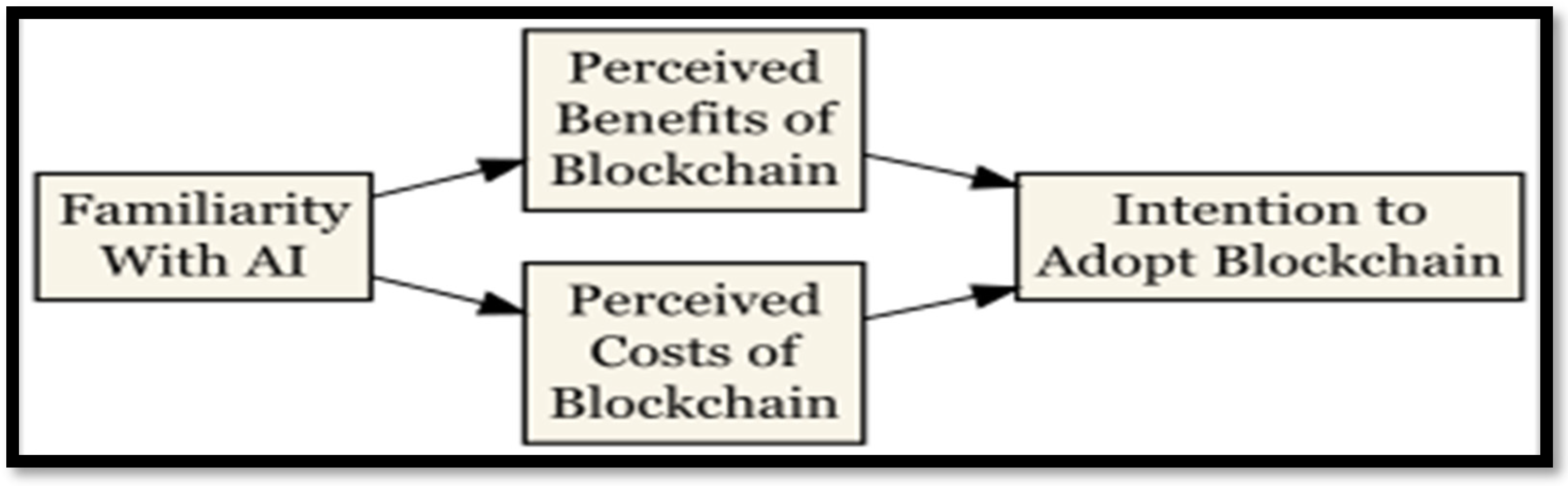
Figure 1 presents the research framework guiding this study. The model proposes that firms’ familiarity with artificial intelligence (AI) enhances their perceptions of blockchain technologies by increasing perceived benefits and reducing perceived costs. These two perceptual factors function as evaluative pathways through which AI familiarity shapes firms’ intentions to adopt blockchain.
Perceived benefits are expected to strengthen adoption intention, whereas perceived costs weaken it. Importantly, the framework recognizes that the joint configuration of benefits and costs, rather than each factor alone, shapes adoption patterns, allowing for the examination of congruence and asymmetry effects through response surface analysis. Finally, customer internationalization (domestic vs. foreign customers) is incorporated as a contextual condition under which the strength and structure of these relationships may vary.

4. Empirical Approach

4.1. Survey Instrument and Data Collection

To collect high-quality data efficiently, this study collaborated with Changsha Ranxing Information Technology Company Limited, a professional research firm with substantial experience in large-scale survey administration. Data were collected using the Wenjuanxing mobile application, one of China’s most widely used platforms for distributing and managing online questionnaires. The survey provider pre-screened respondents based on the qualification criteria (i.e., SMEs with fewer than 500 employees and firms engaged in e-commerce activities). Only eligible respondents were allowed to participate in the survey, ensuring that the collected data represented the target population. While the screening question in Figure 2 allowed for a broad interpretation of respondent roles (e.g., including family members involved in the business), the survey did not collect more granular information regarding whether respondents were owners, top managers, operational employees, or family representatives. Consequently, the study cannot determine the exact proportion of responses provided by formal managerial decision-makers versus family-associated participants. This limitation should be considered when interpreting the findings at the firm level, as some responses may reflect perceived organizational evaluations rather than officially authorized strategic positions. Therefore, the results are more appropriately interpreted as representing SME-associated organizational perceptions rather than fully verified firm-level executive assessments. Future research should apply stricter respondent qualification procedures and explicitly distinguish managerial roles to strengthen organizational-level validity and generalizability.
Using a non-probability sampling approach through a professional online panel platform, 548 valid responses were retained after applying multiple data quality screening procedures, including the exclusion of responses completed in less than 300 s as part of the overall data quality screening procedure. Because respondent recruitment and invitation procedures were managed directly by the panel provider, the exact number of survey invitations distributed and the corresponding response rate were not available to the research team. The survey instrument was developed by adapting validated items from previous literature. Measures capturing demographic attributes, firm size, firm age, and business characteristics were derived from earlier instruments used in SME-focused studies [87,88]. Items measuring perceived benefits of blockchain adoption were adapted from [89,90]. Measures assessing perceived costs or risks associated with blockchain implementation drew from prior research [55,91,92]. Adoption intention items followed the scale used by [33], originally based on [92]. All constructs employed a 7-point Likert-type response format. To ensure data quality, qualification screening was implemented by the survey provider prior to participation (Figure 2).
To ensure linguistic consistency and cultural suitability, the questionnaire was initially prepared in English and subsequently translated into Mandarin Chinese. The translated survey was evaluated by two native Mandarin-speaking academics with doctoral training in Western institutions. A back-translation procedure was then employed to confirm conceptual alignment and reduce potential semantic inconsistencies between the original and translated versions. This multi-stage translation approach helped strengthen the validity and clarity of the measurement instrument in the Chinese context. Prior to the main data collection, a pilot study involving 14 participants was conducted to evaluate the clarity, readability, and overall comprehensibility of the survey items, as well as to estimate completion time. Feedback from the pilot participants led to several minor refinements in wording and phrasing, improving the accessibility and contextual appropriateness of the final questionnaire, following established methodological recommendations [93,94].

4.2. Construct Measurement

All constructs were measured using multi-item scales adapted from established prior literature. Respondents rated each item using a seven-point Likert scale ranging from 1 (“strongly disagree”) to 7 (“strongly agree”). Familiarity with AI was assessed with four items capturing the firm’s exposure to, awareness of, and routine use of artificial intelligence in its business operations. Consistent with the operational focus of the present study, the scale reflects practical technological exposure and general organizational experience with AI-related tools rather than deep AI capability or advanced organizational AI maturity as conceptualized in broader digital capability frameworks such as Mikalef and Gupta [60]. Perceived risks (or costs) of blockchain adoption were measured using four items reflecting concerns related to technical skills, data security, data storage, and vendor-associated vulnerabilities. Perceived benefits of blockchain adoption were captured with four items evaluating improvements in transparency, efficiency, security, and supply-chain accountability. Intention to adopt blockchain technologies was assessed using five items indicating firms’ willingness, future plans, and strategic prioritization of blockchain usage. All measurement items used in this study are provided in Appendix A.

4.3. Descriptive Statistics and Measurement Validation

Table 1 summarizes the demographic and organizational characteristics of the 548 e-commerce SMEs included in this study. Approximately half of the firms are medium-sized (53.28%), while the remaining 46.72% are small enterprises, indicating a balanced representation across SME categories.
Regarding the types of products and services sold online, the largest share of firms operate in clothing (31.20%) and household goods (28.83%), followed by technology-related items (18.25%) and B2B transactions (18.61%). Service-oriented e-commerce businesses such as banking or hospitality constitute a smaller proportion of the sample (3.10%). This suggests that blockchain adoption may be evaluated across a diverse range of e-commerce sectors rather than being concentrated in a single vertical.
In terms of market orientation, two-thirds of the firms primarily serve foreign customers (66.97%), while one-third operate domestically (33.03%). A similar distribution is observed for supplier bases, with 66.06% sourcing from foreign suppliers and 33.94% from domestic suppliers. This indicates that international supply chain involvement is highly prevalent among e-commerce SMEs in the sample, providing a meaningful context for examining differences in blockchain adoption across global vs. domestic supply chains.
Firm maturity is also well distributed: 33.94% have been in business for 1–5 years, 38.87% for 6–10 years, and 27.19% for more than ten years. This variation ensures sufficient heterogeneity in organizational experience that may influence technology adoption behaviors. Finally, more than half of the firms (51.46%) are located in second-tier cities, followed by third-/fourth-tier cities (29.20%), while smaller proportions are located in first-tier cities (9.85%) and township/rural areas (9.49%). This distribution reflects the geographic dispersion of China’s e-commerce ecosystem beyond major metropolitan hubs.
Overall, the descriptive statistics suggest a diverse and representative sample of Chinese e-commerce SMEs, suitable for analyzing how AI familiarity, perceived benefits, and perceived risks jointly influence blockchain adoption intentions across varying organizational and market conditions.

4.4. Empirical Results

Table 2 reports the results of the reliability and convergent validity assessment for all latent constructs in the measurement model. All constructs demonstrate excellent internal consistency, with Cronbach’s alpha values ranging from 0.85 to 0.96, well above the commonly accepted threshold of 0.70. The Composite Reliability (CR) values also exceed 0.70 for every construct, confirming the stability and internal coherence of the measurement items.
In addition, all constructs exhibit strong convergent validity. The Average Variance Extracted (AVE) values range between 0.59 and 0.82, surpassing the recommended minimum value of 0.50 [95]. This indicates that each construct successfully captures a substantial proportion of variance from its measurement items. Overall, the results confirm that the measurement scales used in this study demonstrate robust reliability and convergent validity, supporting their suitability for use in subsequent structural model analyses.
Table 3 presents the Heterotrait–Monotrait (HTMT) ratios used to assess discriminant validity among the four latent constructs: AI Familiarity, Perceived Costs, Perceived Benefits, and Adoption Intention. All HTMT values fall between 0.57 and 0.86, which are below the conservative threshold of 0.85 and also below the more liberal criterion of 0.90 [96].
These results indicate that each construct is empirically distinct and captures a unique conceptual domain. In particular, the correlations among constructs do not exceed problematic levels, implying that the survey items are not excessively overlapping. Therefore, the HTMT analysis provides strong support for adequate discriminant validity within the measurement model.
To assess the potential for common method bias, Harman’s single-factor test was conducted. The results showed that the first factor accounted for less than 50% of the total variance, suggesting that common method bias is unlikely to be a serious concern in this study. A single-factor CFA model was estimated to further assess the potential for common method bias. The single-factor model demonstrated poor fit to the data (CFI = 0.836, TLI = 0.812, RMSEA = 0.146, SRMR = 0.080), indicating that common method bias is unlikely to seriously affect the results. In addition, the use of established measurement scales and the assurance of respondent anonymity further reduce the likelihood of systematic bias.
AI familiarity constitutes a critical dimension of organizational digital readiness, reflecting firms’ accumulated experience with advanced data-driven technologies and their capability to understand, evaluate, and apply new digital tools. Organizations that have previously engaged with AI tend to develop stronger technological literacy, enhanced analytical competencies, and more accurate assessments of innovation-related benefits and risks [12]. In this context, AI familiarity functions as a foundational cognitive resource that shapes how firms interpret the strategic value and operational implications of blockchain technologies.
The results of the measurement and structural model reported in Table 4 empirically validate this conceptualization. AI familiarity exhibits a strong positive influence on perceived benefits of blockchain (β = 0.666, p < 0.001), indicating that organizations with more extensive familiarity with AI are better positioned to appreciate blockchain’s advantages, including enhanced transparency, traceability, and coordination efficiency. Such firms tend to approach novel technologies with an innovation-oriented mindset, interpreting blockchain through a lens enriched by prior exposure to complex digital systems. Conversely, AI familiarity shows a significant negative effect on perceived costs (β = −0.624, p < 0.001), suggesting that technologically competent firms perceive lower implementation burdens, reduced uncertainty, and fewer integration challenges. This pattern reflects the logic that prior technological experience reduces cognitive and operational barriers to adopting additional digital innovations, particularly those requiring sophisticated data infrastructures and algorithmic understanding. AI familiarity also exerts a direct positive effect on adoption intention (β = 0.137, p < 0.001), though its magnitude is smaller than the indirect pathways. This suggests that digitally prepared firms display a general openness toward innovation, increasing their likelihood of adopting blockchain even after accounting for detailed cost–benefit judgments. Together, these findings support H1a–H1c, confirming that AI familiarity enhances firms’ perceptions of blockchain’s value, reduces perceived barriers, and strengthens overall adoption intention. Viewed from an evaluative perspective, AI familiarity acts as an input that systematically shifts the internal benefit–cost evaluative system toward more favorable adoption judgments.
Beyond the role of digital readiness, the results further corroborate the importance of firms’ perceptual evaluations in shaping their behavioral intentions regarding blockchain adoption. Consistent with core assumptions in the Technology Acceptance Model and Innovation Diffusion Theory, the SEM estimates indicate that perceived benefits strongly and positively influence adoption intention (β = 0.439, p < 0.001). Organizations that expect blockchain to deliver operational improvements or create strategic advantages are substantially more willing to adopt the technology. Conversely, perceived costs demonstrate a significant negative effect on adoption intention (β = −0.521, p < 0.001), highlighting that concerns about resource requirements, technical complexity, and implementation risks dampen willingness to adopt blockchain—a dynamic especially salient for resource-constrained SMEs. These results support H2a–H2b and reaffirm the centrality of cost–benefit cognition in organizational technology adoption. In other words, adoption intention reflects how the evaluative system integrates positive and negative appraisals into a coherent decision outcome.
Importantly, AI familiarity also exerts significant indirect effects on adoption intention through both perceived benefits and perceived costs. The indirect effect through perceived benefits (0.666 × 0.439 = 0.292) and through perceived costs (−0.624 × −0.521 = 0.325) jointly constitute a total indirect effect of 0.617, which substantially exceeds the direct effect (0.137). This pattern supports H2c and indicates that the evaluative pathway constitutes the primary mechanism through which AI familiarity influences blockchain adoption intention. Firms familiar with AI not only recognize more favorable benefit structures but also discount perceived risks, and these evaluative shifts significantly elevate their intention to adopt blockchain. This mediation pattern highlights that AI familiarity contributes to adoption decisions both directly, by fostering a general innovation orientation, and indirectly, by shaping the perceptual framework through which blockchain is evaluated.
The SEM and multi-group SEM analyses were estimated using robust maximum likelihood estimation (MLR) in the lavaan package. All skewness and kurtosis values were within acceptable ranges (maximum absolute skewness = 0.141; maximum absolute kurtosis = 1.337), indicating no severe departures from normality. The overall adequacy of the proposed model is supported by the model fit indices reported in Table 4. The structural model demonstrates excellent incremental fit (CFI = 0.973; TLI = 0.968) and acceptable absolute fit (RMSEA = 0.060; SRMR = 0.099), indicating that the hypothesized relationships provide a coherent representation of the data. Although the SRMR value is slightly above the conventional 0.08 guideline suggested by Hu and Bentler [97], previous methodological research has suggested that SRMR values below 0.10 may still indicate acceptable fit in relatively complex SEM models with multiple latent constructs and indicators [98]. Although the chi-square statistic is significant, this is expected given the sample size. The combination of robust CFI/TLI values and acceptable RMSEA benchmarks confirms that the theoretical model aligns well with observed patterns in firms’ technological evaluations and adoption intentions.
Taken together, the findings provide consistent empirical evidence that digital readiness, operationalized through AI familiarity, plays an important role in shaping how firms evaluate and intend to adopt blockchain technologies. AI familiarity enhances benefit perceptions, reduces perceived barriers, and increases adoption intention both directly and indirectly. Alongside this, firms’ evaluations of benefits and costs function as core determinants of adoption behavior, reinforcing established theoretical models of technological decision-making within organizational contexts.
Table 5 presents the result of response surface analysis examining the configurational effects of perceived benefits and costs on blockchain adoption intention. Consistent with H3a, the linear additive effect along the line of congruence (LOC), where perceived benefits equal perceived costs, was positive and significant (a1 = 0.248, p = 0.037). This indicates that when firms perceive benefits and costs to rise together at similar magnitudes, their intention to adopt blockchain also increases, suggesting that congruent and mutually reinforcing evaluations strengthen adoption willingness. However, contrary to H3b, there was no evidence of significant curvature along the LOC (a2 = −0.119, p = 0.261), indicating that the adoption intention does not follow a U-shaped or inverted-U pattern when benefits and costs increase in tandem.
In support of H3c, the ridge of the response surface significantly deviated from the LOC (a3 = 1.175, p < 0.001), demonstrating that the optimal condition for adoption intention occurs not when benefits and costs are balanced, but when perceived benefits exceed perceived costs. This deviation highlights that firms prioritize value-enhancing attributes of blockchain more strongly than they are deterred by associated implementation burdens. In contrast, the predicted curvature along the line of incongruence (LOIC), where benefits and costs differ, was not statistically significant (a4 = 0.027, p = 0.270), providing no support for H3d. This suggests that adoption intention does not vary in a curvilinear pattern as the discrepancy between benefits and costs widens. Instead, the results underline that it is the specific configuration of benefits and costs, rather than their simple difference, that governs the behavior of the evaluative system.
Finally, consistent with H3e, the results reveal a clear asymmetry in the relative influence of benefits and costs on adoption intention. The positive effect of perceived benefits (b1 = 0.712, p < 0.001) was substantially stronger than the negative effect of perceived costs (b2 = −0.463, p < 0.001), indicating that firms weigh potential advantages of blockchain more heavily than potential drawbacks. This asymmetry demonstrates that optimism regarding blockchain’s value plays a more dominant role in shaping organizational adoption decisions than concerns about cost or risk. Taken together, the RSA findings highlight that while congruent increases in benefits and costs promote adoption intention, the most favorable conditions arise when firms perceive benefits to substantially outweigh costs. This pattern underscores that blockchain adoption emerges from particular benefit–cost configurations within the organizational evaluative system, rather than from isolated main effects.
Figure 3 illustrates the joint effects of perceived benefits (BEN_c) and perceived costs (COST_c) on blockchain adoption intention (INT_c). The color gradient on the surface represents the level of adoption intention, with darker blue indicating lower values and lighter blue indicating higher values. The surface rises sharply as perceived benefits increase, confirming their strong positive influence, while higher perceived costs reduce adoption intention, producing the downward slope along the COST_c axis. The ridge of the surface shifts away from the line of congruence (BEN = COST), indicating that the highest adoption intention occurs when benefits exceed costs. The surface also displays clear asymmetry: increases in benefits have a stronger positive effect than the negative effect of increasing costs, visually supporting the asymmetry hypothesis. Overall, the plot corroborates the RSA findings that benefit–cost configurations meaningfully shape firms’ adoption intentions.
To assess whether customer internationalization moderates the structural relationships among AI familiarity, perceived benefits, perceived costs, and adoption intention, a multi-group SEM analysis was conducted (Table 6). Panel A shows that the standardized structural coefficients were broadly similar across foreign- and domestic-oriented firms. AI familiarity positively influenced perceived benefits in both foreign-oriented firms (β = 0.589) and domestic-oriented firms (β = 0.618), while negatively influencing perceived costs in both groups (β = −0.427 and β = −0.616, respectively). Likewise, perceived benefits positively predicted blockchain adoption intention, whereas perceived costs negatively predicted adoption intention across both groups. These findings suggest that the structural relationships are broadly comparable across customer segments.
Panel B reports the chi-square difference test comparing the unconstrained and constrained multi-group SEM models. The test was not statistically significant (Δχ2 = 8.149, p = 0.148), indicating that constraining the structural paths to be equal across groups did not significantly worsen model fit. Therefore, customer internationalization does not significantly moderate the structural relationships among AI familiarity, perceived benefits, perceived costs, and blockchain adoption intention, and H4 is not supported. This finding suggests that the evaluative mechanisms underlying blockchain adoption remain relatively stable across domestic- and foreign-oriented SMEs.


5. Discussion

5.1. Interpretation of Findings

The findings of this study refine current understandings of how e-commerce SMEs evaluate and decide to adopt blockchain technologies by conceptualizing adoption as the outcome of an internal evaluative system rather than a reaction to isolated technological attributes. The results show that firms’ prior familiarity with AI meaningfully shapes their cognitive assessments of blockchain. This form of digital readiness functions as a conditioning input within the organizational decision system, influencing how subsequent technological signals are interpreted and weighted. Firms accustomed to working with AI appear more capable of framing blockchain not as a disruptive threat but as an extension of their existing digital trajectory. Thus, readiness for advanced technologies is grounded not only in infrastructure or formal capability, but also in accumulated experiential knowledge that restructures how new innovations are cognitively processed.
The analyses further demonstrate that blockchain adoption emerges from the integration of perceived benefits and perceived costs within this evaluative system. Consistent with established technology adoption theories, benefits increase adoption intention while costs diminish it. However, the configurational assessment captured through response surface analysis reveals that adoption cannot be fully explained through independent linear effects. Instead, adoption intention is governed by the specific configuration of benefit–cost perceptions. The response surface analysis reveals three key patterns. First, adoption intentions increase linearly along the line of congruence, indicating that balanced evaluations promote adoption even when benefits and costs are equivalent. Second, the ridge of the response surface deviates from congruence, signaling that the optimal condition arises when perceived benefits exceed perceived costs. Third, benefits exert a stronger influence than costs, revealing asymmetric weighting within the decision system. Importantly, the absence of significant curvature effects along both the line of congruence (H3b) and the line of incongruence (H3d) provides additional theoretical insight. Rather than exhibiting threshold dynamics or saturation points along the aggregated line of congruence, the evaluative system appears to operate through broadly linear integration and asymmetric weighting (H3e). However, the significant quadratic coefficients for perceived benefits (b3) and perceived costs (b5) indicate that the individual evaluative dimensions still contain nonlinear tendencies. The non-significant curvature along the line of congruence (a2) therefore reflects the partial offsetting of these opposing quadratic components at the aggregate level, producing an overall pattern that appears approximately linear when benefits and costs increase together. This pattern suggests that firms process benefit–cost configurations proportionally rather than through complex nonlinear thresholds, clarifying the computational structure of organizational decision-making in blockchain adoption contexts. This linear processing, even under uncertainty, indicates a pragmatic, opportunity-oriented evaluation logic in which strategic gains are prioritized over anticipated burdens through systematic integration. From a systems perspective, the decision outcome reflects how the evaluative structure organizes and integrates competing appraisals into a coherent adoption judgment.
The rejection of H3b and H3d warrants further discussion. We hypothesized curvature effects based on the expectation that threshold dynamics or saturation points might emerge when benefits and costs increase congruently or diverge. The absence of these patterns points to several possibilities. First, SMEs may rely on relatively simple, more linear evaluation heuristics under resource constraints, without engaging in more complex nonlinear processing of benefit–cost information. Second, blockchain’s dual nature (high perceived benefits and high perceived costs) may be sufficiently salient within the observed range that saturation effects do not arise in practice. Third, methodological factors—such as measurement granularity or sample size—may limit the ability to detect subtle curvature. Future research should examine these possibilities using larger samples and finer-grained perceptual measures to determine whether the linear pattern we observe reflects a genuine evaluative tendency or design constraints.
From a systems perspective, these configurational findings raise an important question: does the evaluative architecture remain stable across different organizational contexts, or do external market conditions fundamentally reconfigure how benefits and costs are processed? The multigroup SEM results provide insight into this structural robustness. Although firms serving foreign customers operate under different regulatory and competitive pressures, the standardized structural relationships among AI familiarity, perceived benefits, perceived costs, and adoption intention remain invariant. This indicates a high degree of structural stability in the underlying decision system. The non-significant chi-square difference suggests no substantive divergence in the evaluative mechanisms across groups. In practical terms, customer internationalization does not reconfigure the internal cognitive architecture through which blockchain is assessed; instead, firms across market orientations appear to rely on a similar benefit–cost integration logic.
Several factors may help explain why H4 was not supported. First, the shared institutional context of China’s platform-driven e-commerce ecosystem may impose similar digital and governance pressures on both domestic- and foreign-oriented firms, which could reduce the salience of customer internationalization as a differentiating condition. Second, the domestic subsample (n = 181) is smaller than the foreign subsample (n = 367), which may have reduced the statistical sensitivity of the multi-group SEM to detect subtle differences in structural paths. Although the overall sample size was sufficient to detect moderate-to-large group differences in structural relationships, smaller contextual variations between domestic- and foreign-oriented firms may have remained undetected. Accordingly, the non-significant moderation result for H4 should be interpreted cautiously, particularly with respect to potentially small effect-size differences across groups. Third, it is plausible that some “domestic-oriented” firms in our sample still engage in occasional or informal cross-border transactions, blurring the distinction between the two groups. Future research should therefore examine this moderation in more institutionally diverse contexts and with more granular measures of internationalization intensity.
Overall, the findings suggest that blockchain adoption among e-commerce SMEs is shaped more decisively by internal digital readiness and evaluative configuration than by external market positioning. AI familiarity restructures how technological signals are interpreted, and adoption intention ultimately reflects the patterned integration of perceived advantages and burdens within a structurally stable organizational decision system.

5.2. Theoretical Contributions

This study advances the literature on digital innovation and blockchain adoption by reframing technology adoption as the outcome of an organizational evaluative system rather than as the product of isolated perceptual drivers. While prior research has frequently applied the Technology Acceptance Model (TAM) or Innovation Diffusion Theory (IDT) independently, often emphasizing discrete constructs such as perceived usefulness or complexity, our study extends these foundational theories. We move beyond their traditional linear, individual-level focus by demonstrating that blockchain adoption emerges from a structured dual-path evaluation process where perceived benefits and perceived costs are processed in parallel and interactively within an organizational decision architecture. This reconceptualization offers a novel theoretical mechanism by showing how TAM and IDT’s core constructs are not merely aggregated but dynamically integrated within a systemic evaluative framework, providing a more holistic understanding of technology adoption in complex organizational settings.
The study further contributes to theorizing on digital readiness by specifying AI familiarity as a concrete mechanism that conditions the internal functioning of this evaluative system. Unlike much of the existing literature that treats readiness as a broad organizational capability or a static infrastructural attribute, our findings reveal that AI familiarity actively restructures the evaluative logic itself. It influences not only direct adoption intention but, more critically, the internal appraisal and weighting of perceived benefits and costs, thereby offering a more granular and process-oriented understanding of how digital readiness operates. This perspective clarifies digital transformation as a cumulative cognitive trajectory, where prior exposure to advanced technologies recalibrates the organization’s decision architecture for subsequent innovations, highlighting a novel theoretical mechanism for how readiness impacts adoption.
A third significant contribution arises from the configurational analysis of benefit–cost perceptions. By employing response surface analysis, this study demonstrates that adoption intention is governed not merely by the magnitude of benefits and costs but by their specific configuration and interplay within the evaluative system. The findings reveal novel configurational patterns, including both asymmetry (benefits exert a stronger influence than costs) and ridge deviation (optimal adoption occurs when perceived benefits exceed perceived costs), which extend existing fit and discrepancy theories. We show that it is not just about a general ‘fit’ but the *nature* of that fit and the *asymmetric weighting* of competing evaluations that drives adoption outcomes. Furthermore, the absence of significant curvature effects along both the line of congruence (H3b) and the line of incongruence (H3d) provides crucial theoretical insight. This suggests that rather than exhibiting complex nonlinear thresholds or saturation points, the evaluative system operates through proportional linear integration and asymmetric weighting (H3e). This clarifies the computational structure of organizational decision-making in blockchain adoption contexts, indicating that firms process benefit–cost configurations in a more pragmatic, linear fashion, even under uncertainty. This extends fit and discrepancy theories by showing that equilibrium is not necessarily optimal; rather, positive dominance within the configuration drives stronger adoption outcomes, highlighting that technological decisions are structurally patterned phenomena shaped by how competing evaluations are integrated within a bounded system.
Finally, the multigroup analysis contributes to theory by demonstrating structural stability of the evaluative mechanisms across different market orientations. This study identifies customer internationalization as a crucial boundary condition. Although firms serving foreign customers operate under distinct institutional and competitive conditions, our findings reveal that the standardized structural relationships among AI familiarity, benefit–cost perceptions, and adoption intention remain invariant. This invariance is a novel theoretical insight, suggesting that the internal logic of the organizational decision system is remarkably robust across contextual variations. Rather than fundamentally altering the core evaluative structure, customer internationalization may exert its influence through other pathways, such as heightened exposure intensity to blockchain or specific institutional incentives. By identifying this structural stability, the study delineates the boundary conditions under which blockchain adoption mechanisms operate consistently, providing a more nuanced understanding of context’s role.
Taken together, these contributions advance technology adoption theory beyond linear attitudinal models toward a configurational understanding of how organizations integrate digital readiness, competing evaluations, and contextual conditions into structured adoption judgments.

5.3. Practical Implications

The findings of this study provide important implications for managers, policymakers, and ecosystem actors seeking to facilitate blockchain adoption among e-commerce SMEs. Most fundamentally, the results suggest that technological adoption is not triggered solely by external incentives or financial subsidies but by the internal calibration of the organizational evaluative system. AI familiarity significantly shifts how firms interpret both the benefits and the costs of blockchain. For managers, this implies that building digital readiness should be understood as a cumulative learning process that reshapes the firm’s internal decision architecture. Integrating AI tools into routine operations, analytics, and workflow systems does more than improve performance; it gradually conditions the organization to evaluate subsequent digital innovations with greater confidence and reduced perceived uncertainty.
For Chinese e-commerce SME managers, our findings suggest several concrete actions over the short to medium term. First, managers can deliberately build AI familiarity by piloting a small set of AI tools (e.g., customer service chatbots, demand-forecasting or recommendation systems) in routine operations, and by documenting lessons learned across departments. Second, they can design focused blockchain proof-of-concept projects on one or two product lines where traceability and trust are most critical, such as higher-value or export-oriented items, to make perceived benefits visible to internal and external stakeholders. Third, rather than attempting to implement blockchain in isolation, SMEs can reduce perceived costs by partnering with logistics providers, platform operators, or industry associations that provide shared technical infrastructures and standardized protocols. These steps directly enhance digital readiness, amplify perceived benefits, and mitigate perceived implementation burdens, thereby strengthening the evaluative conditions under which blockchain adoption becomes viable for SMEs.
For policymakers, the results suggest that support programs should not only subsidize blockchain infrastructure but also invest in building SMEs’ AI-related digital readiness, for example through targeted training, shared service platforms, and pilot projects in e-commerce clusters outside major metropolitan areas. Such initiatives can strengthen both the perceived benefits of blockchain and the evaluative capacity needed for SMEs to adopt it in a sustainable way.
The strong influence of perceived benefits on adoption intention indicates that managers and technology providers must actively shape the benefit signals entering the evaluative system. SMEs appear particularly responsive to value-based narratives tied to transparency, traceability, fraud reduction, and cross-border coordination. Rather than presenting blockchain as a technically sophisticated solution, practitioners should emphasize concrete operational gains through pilot projects, simulations, and demonstrable efficiency improvements. When performance-enhancing attributes are clearly visible, the internal evaluation process becomes more favorable, increasing the likelihood of adoption.
At the same time, perceived costs continue to act as a constraining force within the evaluative structure. Concerns related to integration complexity, data security, and implementation risk weaken adoption intention even when benefits are recognized. Policymakers therefore should move beyond simple financial incentives and focus on reducing structural uncertainty. Establishing shared technical infrastructures, standardized compliance guidelines, and collaborative knowledge networks can lower the cognitive and operational burdens associated with blockchain. By stabilizing the cost dimension of the evaluation process, such initiatives help prevent risk perceptions from dominating adoption judgments.
The response surface findings further suggest that adoption is governed by the configuration of benefits and costs rather than by isolated changes in either dimension. Effective intervention strategies should therefore pursue dual calibration: simultaneously amplifying visible benefits while containing perceived costs. Programs that combine demonstration effects with capability-building support are likely to generate stronger adoption momentum than initiatives addressing only one side of the evaluation. The observed asymmetry—where benefits exert a stronger influence than costs—also implies that highlighting value creation may produce greater behavioral impact than focusing solely on risk mitigation.
Finally, the structural stability observed across domestic and internationally oriented firms offers an important practical insight. Because the underlying evaluative mechanisms remain consistent across market contexts, policies and managerial interventions designed to strengthen digital readiness and recalibrate benefit–cost perceptions can be applied broadly across SME segments. While firms serving foreign markets may experience stronger external pressure to modernize, the internal logic governing adoption decisions appears robust and transferable. This stability suggests that scalable digital capacity-building programs can be implemented without extensive segmentation by customer orientation.
In practical terms, our results suggest that accelerating blockchain diffusion among SMEs requires shaping organizational evaluative processes rather than relying on one-off technological promotion. Sustainable adoption is more likely when digital readiness, perceived value, and perceived burden are managed as interdependent elements within a coherent decision system.

5.4. Limitations and Future Research

Although this study provides new insights into blockchain adoption among e-commerce SMEs, several limitations suggest promising directions for future research.
First, the empirical analysis relies on cross-sectional survey data, which restricts the ability to capture the dynamic evolution of firms’ evaluative systems over time. Technology adoption is rarely static; as blockchain infrastructures mature and implementation experiences accumulate, organizations may recalibrate how they weight perceived benefits and costs. Longitudinal or panel-based designs could examine how digital readiness reshapes decision architectures across different stages of technological diffusion. Such research would enable a more process-oriented understanding of how evaluative systems evolve under conditions of technological uncertainty.
Second, AI familiarity was conceptualized as a key dimension of digital readiness, yet digital readiness is inherently multidimensional. Factors such as organizational learning culture, IT governance arrangements, knowledge integration routines, or prior exposure to adjacent digital innovations may also influence how benefit–cost evaluations are structured. Future studies could develop a more comprehensive system-level model of digital readiness, examining how multiple readiness components jointly condition evaluative mechanisms rather than operating independently.
Third, the study focuses on Chinese e-commerce SMEs, a context characterized by advanced platform ecosystems and rapid digitalization. While this environment provides a fertile setting for examining emerging technologies, institutional, regulatory, and infrastructural differences across countries may alter how organizations configure perceived benefits and costs. Comparative cross-national research could test whether the structural patterns identified here—particularly asymmetry and ridge deviation—remain stable across diverse technological ecosystems. Such investigations would clarify the contextual robustness of organizational evaluative systems in digital transformation.
Fourth, although response surface analysis revealed meaningful configurational effects, the study concentrated on perceived benefits and perceived costs as the core evaluative dimensions. While our findings indicate that these dimensions operate through linear integration and asymmetric weighting rather than complex curvature patterns, blockchain adoption may also involve additional layers of assessment, including ecosystem trust, regulatory legitimacy, interoperability requirements, and concerns regarding data governance or sovereignty. Future research could expand the evaluative configuration by incorporating these dimensions, examining whether more complex multidimensional systems exhibit the nonlinear threshold effects that were not observed in the dual-path benefit–cost structure.
Finally, while the multigroup analysis demonstrated structural stability across customer orientations, other contextual moderators may exert stronger influence on evaluative mechanisms. Variables such as supply-chain complexity, cybersecurity exposure, digital platform dependency, or firm-level digital maturity could reshape how readiness translates into benefit–cost appraisals. Identifying such conditions would refine the boundary specifications of adoption models and contribute to a more nuanced understanding of when and how organizational decision systems vary across environments.
Taken together, these limitations point toward a broader research agenda that conceptualizes digital innovation adoption as an evolving organizational evaluative system shaped by readiness, contextual pressures, and multidimensional perception structures. Advancing this perspective requires moving beyond static, single-context analyses toward dynamic and comparative investigations of how organizations recalibrate their decision architectures in increasingly complex digital systems.

6. Conclusions

This study conceptualized blockchain adoption among e-commerce SMEs as the outcome of an organizational evaluative system shaped by AI-based digital readiness and dual benefit–cost assessments. Using survey data from 548 Chinese e-commerce SMEs and employing SEM, response surface analysis, and multi-group SEM, we demonstrated that AI familiarity enhances perceived benefits, reduces perceived costs, and strengthens adoption intention through both direct and indirect pathways. Response surface analysis revealed asymmetric configurational patterns: benefits exert a stronger influence than costs, and optimal adoption conditions arise when perceived benefits exceed perceived costs. Despite differences in market orientation (domestic versus foreign customers), the underlying evaluative mechanisms remain structurally stable across SME segments. These findings suggest that blockchain adoption is better understood as an evaluative process conditioned by digital readiness and benefit–cost configurations, offering actionable insights for policymakers and managers seeking to accelerate blockchain diffusion among SMEs.

Author Contributions

Conceptualization, R.K.M. and H.K.J.; methodology, R.K.M. and J.M.K.; software, J.M.K.; validation, J.M.K.; formal analysis, J.M.K. and S.P.S.; investigation, R.K.M. and H.K.J.; resources, J.M.K.; data curation, J.M.K. and S.P.S.; writing—original draft preparation, R.K.M. and H.K.J.; writing—review and editing, R.K.M., H.K.J., S.P.S. and J.M.K.; visualization, J.M.K.; supervision, J.M.K.; project administration, J.M.K. All authors have read and agreed to the published version of the manuscript.

Funding

This research received no external funding.

Institutional Review Board Statement

This study was conducted in accordance with the ethical principles of the Declaration of Helsinki and was approved by the Ethics Committee of Wenzhou-Kean University under an exempt review protocol (Application No. WKUIRB2025-212).

Informed Consent Statement

Informed consent was obtained from all subjects involved in the study.

Data Availability Statement

The data gathered and used in this study is available upon reasonable request to the corresponding author.

Conflicts of Interest

The authors declare no conflicts of interest.

Abbreviations

The following abbreviations are used in this manuscript:
SMEsSmall- and Medium-sized Enterprises
ITInformation Technology
AIArtificial Intelligence
B2BBusiness-to-Business
RSAResponse Surface Analysis
MG-SEMMulti-Group Structural Equation Modeling
TAMTechnology Acceptance Model
IDTInnovation Diffusion Theory
CRComposite Reliability
HTMTHeterotrait–Monotrait (ratio)
CFIComparative Fit Index
TLITucker–Lewis Index
RMSEARoot Mean Square Error of Approximation
LOCLine of Congruence

Appendix A. Survey Instrument and Measurement Items

All constructs were measured using multi-item scales that were conceptually adapted from established prior literature, with item wordings tailored to the context of blockchain adoption by e-commerce SMEs. Respondents rated each item using a seven-point Likert scale ranging from 1 (“strongly disagree”) to 7 (“strongly agree”).
ConstructCodeMeasurement Item
AI FamiliarityQ9Our company considers AI technologies during business discussions and planning.
Q10Our company is familiar with AI technologies such as ChatGPT, GPT-5.4 or DeepSeek-V3.2.
Q11Our company sometimes uses AI for business purposes.
Q12Using AI for tasks at our company is considered normal.
Perceived Costs of Blockchain AdoptionQ13Our company is concerned about having the knowledge and skills required to adopt blockchain technology.
Q14Our company is concerned about data security and confidentiality risks associated with blockchain adoption.
Q15Our company is concerned about the storage and management of blockchain data.
Q16Our company is concerned about security risks associated with interactions with vendors that may have their own security vulnerabilities.
Perceived Benefits of Blockchain AdoptionQ17The adoption of blockchain technology in our organization can improve transparency in transactions and increase trust among stakeholders.
Q18The adoption of blockchain technology in our organization can improve the speed and efficiency of transactions compared to traditional methods.
Q19The adoption of blockchain technology in our organization can reduce the risk of data breaches and unauthorized access to sensitive information.
Q20The adoption of blockchain technology in our organization can improve accountability and transparency in supply chains.
Intention to Adopt BlockchainQ21Our company intends to use blockchain technology to solve business problems if it proves effective.
Q22Our company intends to use blockchain technology wherever possible to address important organizational concerns.
Q23Our company expects to use blockchain technology as part of its business processes in the future.
Q24Our company would adopt blockchain technology or a similar system for future transactions.
Q25The adoption of blockchain technology or a similar system is important for the future success of our company.

References

  1. Lumineau, F.; Wang, W.; Schilke, O. Blockchain governance—A new way of organizing collaborations? Organ. Sci. 2021, 32, 500–521. [Google Scholar] [CrossRef]
  2. Zhang, S.; Zhang, X.; Wang, B.; Dan, B. Quality Information Disclosure and Blockchain Technology Adoption of Competitive Suppliers on the Third-Party E-Commerce Platform. J. Theor. Appl. Electron. Commer. Res. 2025, 20, 127. [Google Scholar] [CrossRef]
  3. Kouhizadeh, M.; Sarkis, J. Blockchain practices, potentials, and perspectives in greening supply chains. Sustainability 2018, 10, 3652. [Google Scholar] [CrossRef]
  4. Treiblmaier, H. The impact of the blockchain on the supply chain: A theory-based research framework and a call for action. Supply Chain Manag. Int. J. 2018, 23, 545–559. [Google Scholar] [CrossRef]
  5. Paun, C.; Ivascu, C.; Olteteanu, A.; Dantis, D. The Main Drivers of E-Commerce Adoption: A Global Panel Data Analysis. J. Theor. Appl. Electron. Commer. Res. 2024, 19, 2198–2217. [Google Scholar] [CrossRef]
  6. Casino, F.; Dasaklis, T.K.; Patsakis, C. A systematic literature review of blockchain-based applications: Current status, classification and open issues. Telemat. Inform. 2019, 36, 55–81. [Google Scholar] [CrossRef]
  7. Kaur, J.; Kumar, S.; Narkhede, B.E.; Dabić, M.; Rathore, A.P.S.; Joshi, R. Barriers to blockchain adoption for supply chain finance: The case of Indian SMEs. Electron. Commer. Res. 2024, 24, 303–340. [Google Scholar] [CrossRef]
  8. Janssen, M.; Weerakkody, V.; Ismagilova, E.; Sivarajah, U.; Irani, Z. A framework for analysing blockchain technology adoption: Integrating institutional, market and technical factors. Int. J. Inf. Manag. 2020, 50, 302–309. [Google Scholar] [CrossRef]
  9. Queiroz, M.M.; Fosso Wamba, S. Blockchain adoption challenges in supply chain: An empirical investigation of the main drivers in India and the USA. Int. J. Inf. Manag. 2019, 46, 70–82. [Google Scholar] [CrossRef]
  10. Cyert, R.M.; March, J.G. A Behavioral Theory of the Firm; Prentice-Hall: Englewood Cliffs, NJ, USA, 1963. [Google Scholar]
  11. Anderson, P. Perspective: Complexity theory and organization science. Organ. Sci. 1999, 10, 216–232. [Google Scholar] [CrossRef]
  12. Vial, G. Understanding digital transformation: A review and a research agenda. In Managing Digital Transformation; Springer: Cham, Switzerland, 2021; pp. 13–66. [Google Scholar]
  13. Brous, P.; Janssen, M.; Herder, P. The dual effects of the Internet of Things (IoT): A systematic review of the benefits and risks of IoT adoption by organizations. Int. J. Inf. Manag. 2020, 51, 101952. [Google Scholar] [CrossRef]
  14. Warner, K.S.; Wäger, M. Building dynamic capabilities for digital transformation: An ongoing process of strategic renewal. Long Range Plan. 2019, 52, 326–349. [Google Scholar] [CrossRef]
  15. Pingali, S.R.; Singha, S.; Arunachalam, S.; Pedada, K. Digital readiness of small and medium enterprises in emerging markets: The construct, propositions, measurement, and implications. J. Bus. Res. 2023, 164, 113973. [Google Scholar] [CrossRef]
  16. Holmström, J. From AI to digital transformation: The AI readiness framework. Bus. Horiz. 2022, 65, 329–339. [Google Scholar] [CrossRef]
  17. Rakshit, S.; Islam, N.; Mondal, S.; Paul, T. Influence of blockchain technology in SME internationalization: Evidence from high-tech SMEs in India. Technovation 2022, 115, 102518. [Google Scholar] [CrossRef]
  18. Wong, L.W.; Leong, L.Y.; Hew, J.J.; Tan, G.W.H.; Ooi, K.B. Time to seize the digital evolution: Adoption of blockchain in operations and supply chain management among Malaysian SMEs. Int. J. Inf. Manag. 2020, 52, 101997. [Google Scholar] [CrossRef]
  19. Humberg, S.; Nestler, S.; Back, M.D. Response surface analysis in personality and social psychology: Checklist and clarifications for the case of congruence hypotheses. Soc. Psychol. Personal. Sci. 2019, 10, 409–419. [Google Scholar] [CrossRef]
  20. Edwards, J.R.; Parry, M.E. On the use of polynomial regression equations as an alternative to difference scores in organizational research. Acad. Manag. J. 1993, 36, 1577–1613. [Google Scholar] [CrossRef]
  21. Henseler, J.; Ringle, C.M.; Sarstedt, M. Testing measurement invariance of composites using partial least squares. Int. Mark. Rev. 2016, 33, 405–431. [Google Scholar] [CrossRef]
  22. Shanock, L.R.; Baran, B.E.; Gentry, W.A.; Pattison, S.C.; Heggestad, E.D. Polynomial regression with response surface analysis: A powerful approach for examining moderation and overcoming limitations of difference scores. J. Bus. Psychol. 2010, 25, 543–554, Erratum in J. Bus. Psychol. 2013, 29, 161. [Google Scholar] [CrossRef]
  23. Saberi, S.; Kouhizadeh, M.; Sarkis, J.; Shen, L. Blockchain technology and its relationships to sustainable supply chain management. Int. J. Prod. Res. 2019, 57, 2117–2135. [Google Scholar] [CrossRef]
  24. Asante Boakye, E.; Zhao, H.; Coffie, C.P.K.; Asare-Kyire, L. Seizing technological advancement: Determinants of blockchain supply chain finance adoption in Ghanaian SMEs. Technol. Anal. Strateg. Manag. 2024, 36, 2774–2790. [Google Scholar] [CrossRef]
  25. Iranmanesh, M.; Maroufkhani, P.; Asadi, S.; Ghobakhloo, M.; Dwivedi, Y.K.; Tseng, M.L. Effects of supply chain transparency, alignment, adaptability, and agility on blockchain adoption in supply chain among SMEs. Comput. Ind. Eng. 2023, 176, 108931. [Google Scholar] [CrossRef]
  26. Bin Hameed, H.; Creazza, A. Exploring the adoption of blockchain by a small and medium-sized enterprise: An Italian action research case study. Bus. Process Manag. J. 2025, 31, 1–19. [Google Scholar] [CrossRef]
  27. Treiblmaier, H.; Sillaber, C. The impact of blockchain on e-commerce: A framework for salient research topics. Electron. Commer. Res. Appl. 2021, 48, 101054. [Google Scholar] [CrossRef]
  28. Davis, F.D. Perceived usefulness, perceived ease of use, and user acceptance of information technology. MIS Q. 1989, 13, 319–340. [Google Scholar] [CrossRef] [PubMed]
  29. Song, Y.; Qiu, X.; Liu, J. The impact of artificial intelligence adoption on organizational decision-making: An empirical study based on the technology acceptance model in business management. Systems 2025, 13, 683. [Google Scholar] [CrossRef]
  30. Oliveira, T.; Thomas, M.; Baptista, G.; Campos, F. Mobile payment: Understanding the determinants of customer adoption and intention to recommend the technology. Comput. Hum. Behav. 2016, 61, 404–414. [Google Scholar] [CrossRef]
  31. Faiz, F.; Le, V.; Masli, E.K. Determinants of digital technology adoption in innovative SMEs. J. Innov. Knowl. 2024, 9, 100610. [Google Scholar] [CrossRef]
  32. Cai, C.; Zhang, X.; Zhu, Q.; Li, X. The Impact of Perceived Benefits on Blockchain Adoption in Supply Chain Management. Sustainability 2023, 15, 6634. [Google Scholar] [CrossRef]
  33. Nazir, M.A.; Khan, M.R. Identification of roles and factors influencing the adoption of ICTs in the SMEs of Pakistan by using an extended Technology Acceptance Model (TAM). Innov. Dev. 2024, 14, 189–215. [Google Scholar] [CrossRef]
  34. Schepers, J.; Wetzels, M. A meta-analysis of the technology acceptance model: Investigating subjective norm and moderation effects. Inf. Manag. 2007, 44, 90–103. [Google Scholar] [CrossRef]
  35. Joo, K.; Hwang, J. Exploring Consumers’ Technology Acceptance Behavior Regarding Indoor Smart Farm Restaurant Systems: Focusing on the Value-Based Adoption Model and Value–Attitude–Behavior Hierarchy. Systems 2025, 13, 189. [Google Scholar] [CrossRef]
  36. Venkatesh, V.; Davis, F.D. A theoretical extension of the technology acceptance model: Four longitudinal field studies. Manag. Sci. 2000, 46, 186–204. [Google Scholar] [CrossRef]
  37. Rogers, E.M. Diffusion of Innovations, 5th ed.; Free Press: New York, NY, USA, 2003. [Google Scholar]
  38. Bagozzi, R.P. The legacy of the technology acceptance model and a proposal for a paradigm shift. J. Assoc. Inf. Syst. 2007, 8, 244–254. [Google Scholar] [CrossRef]
  39. Benbasat, I.; Barki, H. Quo vadis TAM? J. Assoc. Inf. Syst. 2007, 8, 211–218. [Google Scholar] [CrossRef]
  40. Maroufkhani, P.; Tseng, M.L.; Iranmanesh, M.; Ismail, W.K.W.; Khalid, H. Big data analytics adoption: Determinants and performances among small to medium-sized enterprises. Int. J. Inf. Manag. 2020, 54, 102190. [Google Scholar] [CrossRef]
  41. Rogers, E.M.; Singhal, A.; Quinlan, M.M. Diffusion of Innovations. In An Integrated Approach to Communication Theory and Research; Littlejohn, S.W., Foss, K.A., Eds.; Routledge: New York, NY, USA, 2014; pp. 432–448. [Google Scholar]
  42. Verhoef, P.C.; Broekhuizen, T.; Bart, Y.; Bhattacharya, A.; Dong, J.Q.; Fabian, N.; Haenlein, M. Digital transformation: A multidisciplinary reflection and research agenda. J. Bus. Res. 2021, 122, 889–901. [Google Scholar] [CrossRef]
  43. Oliveira, T.; Thomas, M.; Espadanal, M. Assessing the determinants of cloud computing adoption: An analysis of the manufacturing and services sectors. Inf. Manag. 2014, 51, 497–510. [Google Scholar] [CrossRef]
  44. Hubert, M.; Blut, M.; Brock, C.; Zhang, R.W.; Koch, V.; Riedl, R. The Influence of Acceptance and Adoption Drivers on Smart Home Usage. Eur. J. Mark. 2019, 53, 1073–1098. [Google Scholar] [CrossRef]
  45. Nikou, S. Factors Driving the Adoption of Smart Home Technology: An Empirical Assessment. Telemat. Inform. 2019, 45, 101283. [Google Scholar] [CrossRef]
  46. Awa, H.O.; Ojiabo, O.U.; Orokor, L.E. Integrated Technology–Organization–Environment (TOE) Taxonomies for Technology Adoption. J. Enterp. Inf. Manag. 2017, 30, 893–921. [Google Scholar] [CrossRef]
  47. Puklavec, B.; Oliveira, T.; Popovič, A. Understanding the Determinants of Business Intelligence System Adoption Stages: An Empirical Study of SMEs. Ind. Manag. Data Syst. 2018, 118, 236–261. [Google Scholar] [CrossRef]
  48. Venkatesh, V.; Thong, J.Y.L. Unified Theory of Acceptance and Use of Technology: A Synthesis and the Road Ahead. J. Assoc. Inf. Syst. 2016, 17, 328–376. [Google Scholar] [CrossRef]
  49. Lu, L.; Liang, C.; Gu, D.; Ma, Y.; Xie, Y.; Zhao, S. What advantages of blockchain affect its adoption in the elderly care industry? A study based on the technology–organisation–environment framework. Technol. Soc. 2021, 67, 101786. [Google Scholar] [CrossRef]
  50. Maythu, Y.; Kwok, A.O.; Teh, P.L. Blockchain technology diffusion in tourism: Evidence from early enterprise adopters and innovators. Heliyon 2024, 10, e24675. [Google Scholar] [CrossRef]
  51. Chhina, S.; Chadhar, M.; Firmin, S.; Tatnall, A. Navigating blockchain adoption: An examination of actor alignment with the Diffusion of Innovation principles. Blockchain Res. Appl. 2024, 5, 100228. [Google Scholar] [CrossRef]
  52. Kshetri, N. Blockchain’s roles in meeting key supply chain management objectives. Int. J. Inf. Manag. 2018, 39, 80–89. [Google Scholar] [CrossRef]
  53. Queiroz, M.M.; Telles, R.; Bonilla, S.H. Blockchain and supply chain management integration: A systematic review of the literature. Supply Chain Manag. Int. J. 2020, 25, 241–254. [Google Scholar] [CrossRef]
  54. Toufaily, E.; Zalan, T.; Dhaou, S.B. A framework of blockchain technology adoption: An investigation of challenges and expected value. Inf. Manag. 2021, 58, 103444. [Google Scholar] [CrossRef]
  55. Choi, D.; Chung, C.Y.; Seyha, T.; Young, J. Factors affecting organizations’ resistance to the adoption of blockchain technology in supply networks. Sustainability 2020, 12, 8882. [Google Scholar] [CrossRef]
  56. Kshetri, N.; Voas, J. Blockchain-enabled e-voting. IEEE Softw. 2018, 35, 95–99. [Google Scholar] [CrossRef]
  57. Michelotto, F.; Joia, L.A. Organizational digital transformation readiness: An exploratory investigation. J. Theor. Appl. Electron. Commer. Res. 2024, 19, 3283–3304. [Google Scholar] [CrossRef]
  58. Lokuge, S.; Sedera, D.; Grover, V.; Dongming, X. Organizational readiness for digital innovation: Development and empirical calibration of a construct. Inf. Manag. 2019, 56, 445–461. [Google Scholar] [CrossRef]
  59. Machado, C.G.; Winroth, M.; Almström, P.; Ericson Öberg, A.; Kurdve, M.; AlMashalah, S. Digital organisational readiness: Experiences from manufacturing companies. J. Manuf. Technol. Manag. 2021, 32, 167–182. [Google Scholar] [CrossRef]
  60. Raisch, S.; Krakowski, S. Artificial intelligence and management: The automation–augmentation paradox. Acad. Manag. Rev. 2021, 46, 192–210. [Google Scholar] [CrossRef]
  61. Mikalef, P.; Gupta, M. Artificial intelligence capability: Conceptualization, measurement calibration, and empirical study on its impact on organizational creativity and firm performance. Inf. Manag. 2021, 58, 103434. [Google Scholar] [CrossRef]
  62. An, M.; Lin, J.; Luo, X.R. The impact of human AI skills on organizational innovation: The moderating role of digital organizational culture. J. Bus. Res. 2024, 182, 114786. [Google Scholar] [CrossRef]
  63. Xue, F.; Jin, S. Artificial Intelligence Adoption, Innovation Efficiency, and Governance Mechanisms: Evidence from China. Systems 2025, 13, 1062. [Google Scholar] [CrossRef]
  64. Horowitz, M.C.; Kahn, L.; Macdonald, J.; Schneider, J. Adopting AI: How familiarity breeds both trust and contempt. AI Soc. 2024, 39, 1721–1735. [Google Scholar] [CrossRef]
  65. Murire, O.T. Artificial Intelligence and Its Role in Shaping Organizational Work Practices and Culture. Adm. Sci. 2024, 14, 316. [Google Scholar] [CrossRef]
  66. Polas, M.R.H.; Jahanshahi, A.A.; Kabir, A.I.; Sohel-Uz-Zaman, A.S.M.; Osman, A.R.; Karim, R. Artificial intelligence, blockchain technology, and risk-taking behavior in the 4.0IR Metaverse Era: Evidence from Bangladesh-based SMEs. J. Open Innov. Technol. Mark. Complex. 2022, 8, 168. [Google Scholar] [CrossRef]
  67. Ali, O.; Murray, P.A.; Muhammed, S.; Dwivedi, Y.K.; Rashiti, S. Evaluating organizational level IT innovation adoption factors among global firms. J. Innov. Knowl. 2022, 7, 100213. [Google Scholar] [CrossRef]
  68. Dehghani, M.; Kennedy, R.W.; Mashatan, A.; Rese, A.; Karavidas, D. High interest, low adoption. A mixed-method investigation into the factors influencing organisational adoption of blockchain technology. J. Bus. Res. 2022, 149, 393–411. [Google Scholar] [CrossRef]
  69. Chittipaka, V.; Kumar, S.; Sivarajah, U.; Bowden, J.L.H.; Baral, M.M. Blockchain Technology for Supply Chains Operating in Emerging Markets: An Empirical Examination of the Technology–Organization–Environment (TOE) Framework. Ann. Oper. Res. 2023, 327, 465–492. [Google Scholar] [CrossRef]
  70. Wang, Y.; Han, J.H.; Beynon-Davies, P. Understanding Blockchain Technology for Future Supply Chains: A Systematic Literature Review and Research Agenda. Supply Chain Manag. Int. J. 2019, 24, 62–84. [Google Scholar] [CrossRef]
  71. Restrepo-Morales, J.A.; Ararat-Herrera, J.A.; López-Cadavid, D.A.; Camacho-Vargas, A. Breaking the Digitalization Barrier for SMEs: A Fuzzy Logic Approach to Overcoming Challenges in Business Transformation. J. Innov. Entrep. 2024, 13, 84. [Google Scholar] [CrossRef]
  72. Wang, C.; Wang, H.; Li, Y.; Dai, J.; Gu, X.; Yu, T. Factors Influencing University Students’ Behavioral Intention to Use Generative Artificial Intelligence: Integrating the Theory of Planned Behavior and AI Literacy. Int. J. Hum.-Comput. Interact. 2025, 41, 6649–6671. [Google Scholar] [CrossRef]
  73. Said, N.; Potinteu, A.E.; Brich, I.; Buder, J.; Schumm, H.; Huff, M. An Artificial Intelligence Perspective: How Knowledge and Confidence Shape Risk and Benefit Perception. Comput. Hum. Behav. 2023, 149, 107855. [Google Scholar] [CrossRef]
  74. Edwards, J.R. The Study of Congruence in Organizational Behavior Research: Critique and a Proposed Alternative. Organ. Behav. Hum. Decis. Process. 1994, 58, 51–100. [Google Scholar] [CrossRef]
  75. Harrison, D.A. Pitching Fits in Applied Psychological Research: Making Fit Methods Fit Theory. In Perspectives on Organizational Fit; Ostroff, C., Judge, T.A., Eds.; Psychology Press: New York, NY, USA, 2007. [Google Scholar]
  76. Kouhizadeh, M.; Saberi, S.; Sarkis, J. Blockchain technology and the sustainable supply chain: Theoretically exploring adoption barriers. Int. J. Prod. Econ. 2021, 231, 107831. [Google Scholar] [CrossRef]
  77. Ng, K.C.; Zhang, X.; Thong, J.Y.L.; Tam, K.Y. Protecting against threats to information security: An attitudinal ambivalence perspective. J. Manag. Inf. Syst. 2021, 38, 732–764. [Google Scholar] [CrossRef]
  78. Moody, G.D.; Lowry, P.B.; Galletta, D.F. It’s complicated: Explaining the relationship between trust, distrust, and ambivalence in online transaction relationships using polynomial regression analysis and response surface analysis. Eur. J. Inf. Syst. 2017, 26, 379–413. [Google Scholar] [CrossRef]
  79. Başer, M.Y.; Büyükbeşe, T.; Durmaz, Y. “Yes, It’s Cute, But How Can I Be Sure It’s Safe or Not?” Investigating the Intention to Use Service Robots in the Context of Privacy Calculus. Int. J. Hum.-Comput. Interact. 2024, 40, 6151–6166. [Google Scholar] [CrossRef]
  80. Tiwari, S.; Sharma, P.; Jha, A.K. Digitalization & COVID-19: An Institutional-Contingency Theoretic Analysis of Supply Chain Digitalization. Int. J. Prod. Econ. 2024, 267, 109063. [Google Scholar] [CrossRef]
  81. Bennich, A. The Digital Imperative: Institutional Pressures to Digitalise. Technol. Soc. 2024, 76, 102436. [Google Scholar] [CrossRef]
  82. Katsikeas, C.; Leonidou, L.; Zeriti, A. Revisiting international marketing strategy in a digital era: Opportunities, challenges, and research directions. Int. Mark. Rev. 2020, 37, 405–424. [Google Scholar] [CrossRef]
  83. Goedhuys, M.; Sleuwaegen, L. International standards certification, institutional voids and exports from developing country firms. Int. Bus. Rev. 2016, 25, 1344–1355. [Google Scholar] [CrossRef]
  84. Wamba, S.F.; Queiroz, M.M.; Trinchera, L. Dynamics between blockchain adoption determinants and supply chain performance: An empirical investigation. Int. J. Prod. Econ. 2020, 229, 107791. [Google Scholar] [CrossRef]
  85. Hastig, G.M.; Sodhi, M.S. Blockchain for supply chain traceability: Business requirements and critical success factors. Prod. Oper. Manag. 2020, 29, 935–954. [Google Scholar] [CrossRef]
  86. Sheng, S.; Zhou, K.Z.; Li, J.J.; Guo, Z. Institutions and opportunism in buyer–supplier exchanges: The moderated mediating effects of contractual and relational governance. J. Acad. Mark. Sci. 2018, 46, 1014–1031. [Google Scholar] [CrossRef]
  87. N’Dri, A.B.; Su, Z. Successful configurations of technology–organization–environment factors in digital transformation: Evidence from exporting small and medium-sized enterprises in the manufacturing industry. Inf. Manag. 2024, 61, 104030. [Google Scholar] [CrossRef]
  88. Marjerison, R.K.; Jun, J.Y.; Kim, J.M. The Moderating Effects of Operations and Supply Chain Issues on Digital Readiness, Value Creation, and Firm Satisfaction. Systems 2025, 13, 369. [Google Scholar] [CrossRef]
  89. Avdimiotis, S.; Moschotoglou, P. Knowledge Spillover through Blockchain Network in Tourism: Development and Validation of Tblock Questionnaire. Knowledge 2022, 2, 337–346. [Google Scholar] [CrossRef]
  90. Jaradat, Z.; Al-Hawamleh, A.; Al Shbail, M.O.; Hamdan, A. Does the Adoption of Blockchain Technology Add Intangible Benefits to the Industrial Sector? Evidence from Jordan. J. Financ. Report. Account. 2023, 22, 327–349. [Google Scholar] [CrossRef]
  91. Autry, C.W.; Grawe, S.J.; Daugherty, P.J.; Richey, R.G., Jr. The effects of technological turbulence and breadth on supply chain technology acceptance and adoption. J. Oper. Manag. 2010, 28, 522–536. [Google Scholar] [CrossRef]
  92. Kost, R.G.; Rosa, J.C. Impact of survey length and compensation on validity, reliability, and sample characteristics for ultrashort-, short-, and long- research participant perception surveys. J. Clin. Transl. Sci. 2018, 2, 31–37. [Google Scholar] [CrossRef]
  93. Meade, A.W.; Craig, S.B. Identifying careless responses in survey data. Psychol. Methods 2012, 17, 437–455. [Google Scholar] [CrossRef] [PubMed]
  94. Fornell, C.; Larcker, D.F. Evaluating structural equation models with unobservable variables and measurement error. J. Mark. Res. 1981, 18, 39–50. [Google Scholar] [CrossRef]
  95. Kline, R.B. Principles and Practice of Structural Equation Modeling, 5th ed.; Guilford Publications: New York, NY, USA, 2023. [Google Scholar]
  96. Henseler, J.; Ringle, C.M.; Sarstedt, M. A new criterion for assessing discriminant validity in variance-based structural equation modeling. J. Acad. Mark. Sci. 2015, 43, 115–135. [Google Scholar] [CrossRef]
  97. Hu, L.-t.; Bentler, P.M. Cutoff criteria for fit indexes in covariance structure analysis: Conventional criteria versus new alternatives. Struct. Equ. Model. 1999, 6, 1–55. [Google Scholar] [CrossRef]
  98. Iacobucci, D. Structural equations modeling: Fit indices, sample size, and advanced topics. J. Consum. Psychol. 2010, 20, 90–98. [Google Scholar] [CrossRef]
Figure 1. Structural Model of the Relationships among Key Variables.
Systems 14 00619 g001
Figure 2. Qualification Questions Used to Determine Survey Eligibility.
Systems 14 00619 g002
Figure 3. Response Surface Interpretation. Note: The color gradient represents the level of blockchain adoption intention (INT_c).
Systems 14 00619 g003
Table 1. Sample Characteristics.
VariableCategoryn%
Company SizeSmall (<49)25646.72%
Medium (50–500)29253.28%
Goods/Services Sold OnlineB2B10218.61%
Household Goods15828.83%
Clothing17131.20%
Technology Items10018.25%
Services (Banking, Hospitality/Tourism)173.10%
Customer BaseDomestic18133.03%
Foreign36766.97%
Supplier BaseDomestic18633.94%
Foreign36266.06%
Years in Business1–5 Years18633.94%
6–10 Years21338.87%
>10 Years14927.19%
City TierFirst-tier City549.85%
Second-tier City28251.46%
Third/Fourth-tier City16029.20%
Township/Rural529.49%
Table 2. Reliability & Convergent Validity.
Construct# of ItemsLoading RangeCronbach’s αComposite Reliability (CR)AVE
AI Familiarity40.798–0.8160.8840.8840.656
Perceived Costs40.892–0.9040.9420.9420.803
Perceived Benefits40.754–0.7940.8530.8540.594
Adoption Intention50.898–0.9060.9560.9560.815
Notes: # = number of measurement items.
Table 3. Discriminant Validity.
Construct(1)(2)(3)(4)
AI Familiarity (1)0.6170.5760.678
Perceived Benefits (2)0.6170.7630.865
Perceived Costs (3)0.5760.7630.859
Adoption Intention (4)0.6780.8650.859
Note. HTMT < 0.85 or 0.90 indicates discriminant validity is acceptable.
Table 4. Standardized Path Coefficients.
PathEstimateStd. Errorz-Valuep-ValueStd. Effect
AI → Benefits0.8930.06513.801<0.0010.666
AI → Costs−0.7980.063−12.588<0.001−0.624
AI → Adoption Intention0.3460.0933.707<0.0010.137
Benefits → Adoption Intention0.8240.0948.780<0.0010.439
Costs → Adoption Intention−1.0260.125−8.190<0.001−0.521
Notes: Model fit indices indicate acceptable-to-excellent fit: χ2(114) = 340.564, CFI = 0.973, TLI = 0.968, RMSEA = 0.060 (90% CI: 0.053–0.068), SRMR = 0.099. Robust corrections yield similar results (Robust CFI = 0.974, Robust RMSEA = 0.059), supporting the adequacy of the proposed SEM model. The SEM analyses were estimated using robust maximum likelihood estimation (MLR).
Table 5. RSA Results.
(A) RSA Full Polynomial Regression Coefficients.
ParameterLabelEstimateSECI (Lower)CI (Upper)Betap-ValueSig.
Interceptb00.2430.0650.1160.3690.133<0.001***
BEN_cb10.7120.0730.5680.8560.447<0.001***
COST_cb2−0.4630.048−0.558−0.369−0.455<0.001***
BEN_c2b30.1050.0460.0140.1950.0840.024*
BEN_c × COST_cb4−0.0730.054−0.1780.032−0.0680.171n.s.
COST_c2b5−0.1510.021−0.192−0.109−0.180<0.001***
(B) Surface Test Results.
TestLabelEstimateSECI (Lower)CI (Upper)p-ValueSig.
a1: Linear effect on LOCa10.2480.1190.0150.4820.037*
a2: Curvature on LOCa2–0.1190.106−0.3270.0890.261n.s.
a3: Ridge shift from LOCa31.1750.0351.1061.244<0.001***
a4: Curvature on LOICa40.0270.025−0.0210.0760.270n.s.
a5: Asymmetry effecta50.2550.0460.1650.345<0.001***
Notes: SE = Standard Error; CI = Confidence Interval; LOC = Line of Congruence; LOIC = Line of Incongruence. p-values are two-tailed. *** p < 0.001; ** p < 0.01; * p < 0.05; n.s. = not significant.
Table 6. Multi-Group SEM: Structural Path Comparison (Foreign vs. Domestic Firms).
(A) Standardized Path Coefficients (Foreign & Domestic).
PathForeign (Std.)Domestic (Std.)
AI → Benefits0.5890.618
AI → Costs−0.427−0.616
Benefits → Intention0.5420.482
Costs → Intention−0.483−0.449
AI → Intention0.1260.107
(B) Structural Invariance Test.
Invariance TypeChi-Square Diffp-ValueConclusion
Regressions8.1490.148Invariant
Disclaimer/Publisher’s Note: The statements, opinions and data contained in all publications are solely those of the individual author(s) and contributor(s) and not of MDPI and/or the editor(s). MDPI and/or the editor(s) disclaim responsibility for any injury to people or property resulting from any ideas, methods, instructions or products referred to in the content.