1. Introduction
Social media is an important data source for understanding public opinion during a crisis. Numerous studies have analyzed public sentiment toward the COVID-19 pandemic [
1,
2] and opinions on vaccines [
3,
4], with results showing that people’s attitudes changed across both space and time. Such changes were related to factors such as the progression of the crisis [
2], the characteristics of each country or region [
4], and information released by local media [
1].
Besides epidemic crises, environmental pollution is also a global crisis that has attracted widespread attention [
5]. The catastrophic 2011 earthquake and tsunami led to the meltdown of reactor cores in Units 1 to 3 of the Fukushima Daiichi Nuclear Power Plant. The Tokyo Electric Power Company initiated a continuous process of injecting water into the containment vessels of Units 1 to 3 to cool the reactor cores, which in turn generated large amounts of wastewater. Approximately 1.25 million tons of nuclear wastewater had been stored by March 2021, with an additional 140 tons added daily [
6]. On 24 August 2023, the Fukushima Daiichi Nuclear Power Plant in Japan began discharging nuclear-contaminated water into the sea, raising global concerns about the potential environmental consequences. Pu et al. (2022) analyzed Chinese public opinion on Japan’s nuclear wastewater discharge and identified three major themes of public concern: nuclear pollution and marine ecology, seafood imports and food safety, and international responsibility and public ethics [
7]. Public responses to such a crisis are likely to differ across countries. Understanding these differences is essential for explaining the factors that drive public opinion in a global environmental pollution crisis. In addition, the governments’ opinions on the crisis also differ, yet the reasons for these differences remain unclear.
Twitter (now X) is one of the most widely used social media platforms, with 166 million daily users. It is a valuable data source for analyzing social media discussions related to national and global events [
1,
8,
9]. This study uses Twitter data exclusively for the following reasons. First, Twitter’s public API allows researchers to collect large-scale, timestamped textual data in multiple languages, which is essential for cross-country comparative analysis. Second, among major social media platforms, Twitter has been shown to host more politically and environmentally oriented discussions than platforms such as Instagram (which is image-focused) or TikTok (which emphasizes short videos and offers limited searchability for historical events) [
10,
11]. Third, Twitter’s hashtag and mention functions facilitate the rapid spread of event-specific discourse, making it a primary platform for real-time public reactions to breaking international events such as Japan’s nuclear wastewater discharge. We acknowledge that Twitter users are not representative of national populations, and we address this limitation in the
Section 5. The choice of Twitter is therefore pragmatic and justified by the research objective of comparing cross-country discursive themes, rather than by any claim of population representativeness.
In addition to public opinion expressed on social media, governments and their foreign ministries also expressed their opinions on major international events such as Japan’s nuclear wastewater discharge, and these attitudes vary across governments. For example, the Chinese Ministry of Foreign Affairs opposes such actions and has expressed concern about the impact of nuclear wastewater on marine ecology (Ministry of Foreign Affairs of the People’s Republic of China, 2023). U.S. officials do not believe that the discharge of nuclear wastewater will harm marine fisheries or human health (United States Department of State, 2023).
Before proceeding, it is necessary to clarify the unit of analysis in this study. We collected tweets in five languages: Chinese, English, Japanese, Korean, and Indonesian. However, a language does not correspond perfectly to a single country or government. English is spoken in many countries (the United States, the United Kingdom, Canada, and Australia), each with its own distinct foreign policies. Conversely, multiple languages may be spoken within a single country (e.g., Indonesia has hundreds of local languages, though Indonesian is the official national language). To avoid conflating linguistic spheres with national political contexts, we adopt the following explicit mapping rules:
Chinese → People’s Republic of China (mainland China). We acknowledge that Chinese-language tweets may also originate from Taiwan, Hong Kong, Singapore, or diaspora communities. Given that Twitter is blocked in mainland China, many Chinese-language tweets likely originate from outside China. This limitation is addressed in the
Section 5.
English → United States and United Kingdom (combined for analysis, with separate checks). We treat English-language tweets as representing primarily public discourse in the United States and the United Kingdom, but we separately examined government statements from the two countries. When patterns diverge, we report them separately.
Japanese → Japan. Japanese-language tweets overwhelmingly originate from Japan because of the platform’s high penetration there and the relatively limited size of the Japanese-speaking diaspora.
Korean → South Korea. Korean-language tweets are treated as representing South Korean public discourse.
Indonesian → Indonesia. Indonesian-language tweets are treated as representing Indonesian public discourse, while acknowledging that a small fraction may come from neighboring Malay-speaking countries (e.g., Malaysia and Brunei).
Government positions are analyzed at the country level (China, the United States, the United Kingdom, Japan, South Korea, and Indonesia). Where English-language government statements differ between the United States and the United Kingdom, we report them separately rather than treating them as a single “English-speaking” government stance.
Throughout the manuscript, we use the phrase “English-speaking public” as a shorthand for “public discourse expressed in English on Twitter, predominantly originating from the United States and the United Kingdom,” and we explicitly note cases in which the two countries diverge. The comparison is therefore made between six national governments (China, the US, the UK, Japan, South Korea, and Indonesia) and their corresponding linguistic public spheres, with all necessary caveats regarding the imperfect correspondence between language and nationality.
In this study, we design a new visual topic-clustering approach specifically for social media posts related to Japan’s nuclear wastewater discharge. Based on the model results, we analyze public opinion as expressed on Twitter/X in different countries regarding the discharge of nuclear wastewater. Using statements issued by heads of government or foreign ministries, we identify the positions of governments in the above-mentioned countries. Finally, we explain the differences in opinion between governments and the public across countries. This study addresses the following research question: how do public opinions regarding Japan’s nuclear wastewater discharge differ across countries, and how do these differences relate to the positions adopted by their governments? To address this question, we aim to (i) identify and compare public concerns expressed on Twitter in five major language groups, (ii) analyze and categorize governments’ official statements, and (iii) examine the divergence and convergence between public and government stances, as well as their underlying drivers. Clarifying this relationship is important because governments face dual pressures from international organizations, economic interests, and domestic public opinion as expressed on Twitter/X when responding to global environmental crises.
Before continuing, it is necessary to clarify the conceptual comparability of the two types of data used in this study. Following established definitions in political communication research, “public opinion” is operationally defined as individual, self-initiated expressions on Twitter regarding Japan’s nuclear wastewater discharge [
12]. These tweets are informal, emotionally charged, and do not constitute a statistically representative sample of national populations [
13]. “Government positions” are defined as formal, publicly released statements issued by national leaders or foreign ministries, which are carefully drafted and reflect official policy stances [
14]. Despite their fundamental differences in purpose, production process, and representativeness, we argue that they are comparable in the following limited sense: both represent publicly articulated stances on the same event, and our comparison focuses on thematic priorities (e.g., marine ecology vs. international rules) rather than on the intensity or legitimacy of each type of opinion. We do not claim that tweets represent national public opinion in a statistical sense. Rather, we treat them as observable discourse from which thematic concerns can be identified.
This study is situated within a systems theoretical framework. We treat the interplay between public discourse (on Twitter/X) and government positions as a dynamic system characterized by feedback loops, nonlinear responses, and contextual sensitivity. Social media platforms act as amplifiers of public sentiment, generating balancing or reinforcing feedback that can either constrain or intensify government actions. By analyzing cross-linguistic discursive patterns and their divergence from official stances, we aim to identify systemic drivers—such as economic dependencies and strategic alliances—that shape how feedback is processed (or ignored) by different national systems. This systemic lens helps explain why similar public opposition produces different governmental responses across countries and why realist calculations often override liberal feedback mechanisms in transboundary environmental crises.
The major contributions of our study are as follows. First, to the best of our knowledge, this is the first study to analyze Chinese-, English-, Japanese-, Korean-, and Indonesian-language Twitter discourse on the nuclear wastewater discharge crisis. The use of multiple languages enables us to compare public opinion across different countries. Second, we leveraged Latent Dirichlet Allocation to identify topics discussed on Twitter and further grouped these topics into several semantically interpretable themes through visual clustering based on multi-dimensional scaling. Third, we identified the main concerns underlying public opposition in different countries, which may help governments better understand and anticipate public reactions to global environmental crises. Fourth, we will make available a large tweet dataset for Chinese, English, Japanese, Korean and Indonesian about the nuclear waste dumping crisis, thereby creating opportunities for future research. Fifth, by systematically analyzing both public discourse and governmental responses, this study contributes to a deeper understanding of the factors shaping government decision-making in international crises. It also provides empirical evidence of how public concerns and governmental strategies interact in shaping policy, thereby enriching research on environmental politics, crisis governance, and international relations.
2. Preliminary
In the field of artificial intelligence, topic modeling is an unsupervised machine learning method that takes a corpus of documents (tweets in this paper) as input and produces topics as mathematical objects. Topic models learn common and overlapping themes from the input documents. The output of topic models consists of two parts: one is the topic itself, which is associated with a list of words; the other is the topic assignment, which represents the topic probability distribution of each document.
As is well known, Latent Dirichlet Allocation (LDA) is one of the most widely used methods for topic modeling. LDA was selected as the primary topic modeling method for this study for the following reasons. First, the main goal of our analysis was to discover latent thematic structures within the tweet text corpus in a purely unsupervised and data-driven manner. LDA is particularly well suited to this objective because it does not require predefined categories or seed words, allowing themes to emerge organically from the data. Second, a key advantage of LDA is the high interpretability of its output. Topics are represented as distributions over words, which provides an intuitive and transparent basis for experts and scholars to label and interpret the identified themes. This aligns well with our aim of qualitatively analyzing and discussing the semantic meaning of topics related to nuclear wastewater discharge. Third, LDA is a well-established foundational algorithm in topic modeling, and its widespread use allows our findings to be more easily compared with a large body of related research. LDA uses Dirichlet distributions in a statistical generative model [
15]. Its aim is to identify the topics to which documents belong on the basis of the words they contain. Assuming a fixed set of topics, each topic can be represented by a set of words. These topics are reflected in the documents we examined, although they have not yet been identified. LDA seeks to map all documents to these latent topics in such a way that the words in each document are largely captured by them. The core idea of LDA is that each document contains a mixture of topics, while the topic structure itself is latent. Thus, given the observed documents and words, LDA can infer the topic structure and further produce soft clusters of documents rather than hard clusters.
The two main alternative approaches to topic modeling are as follows. Non-Negative Matrix Factorization (NMF): NMF is a popular deterministic alternative to LDA [
16]. Although it often produces coherent topics, its factorization-based approach may be less robust for sparse data, such as tweets, than the probabilistic framework of LDA. BERTopic and Other Embedding-Based Models: These advanced methods use pre-trained language models (e.g., BERT) to generate contextualized word embeddings before clustering [
17]. Although powerful in capturing context, they often function as “black boxes,” making the direct interpretability of topics more challenging than in LDA. For our specific goal of deriving transparent and interpretable themes from a large tweet corpus, LDA provides an effective balance between performance and interpretability.
If we suppose that there is a corpus of
M documents, then we aim to discover K topics from this corpus. The output is therefore a topic model in which the
M documents are expressed as a combination of the
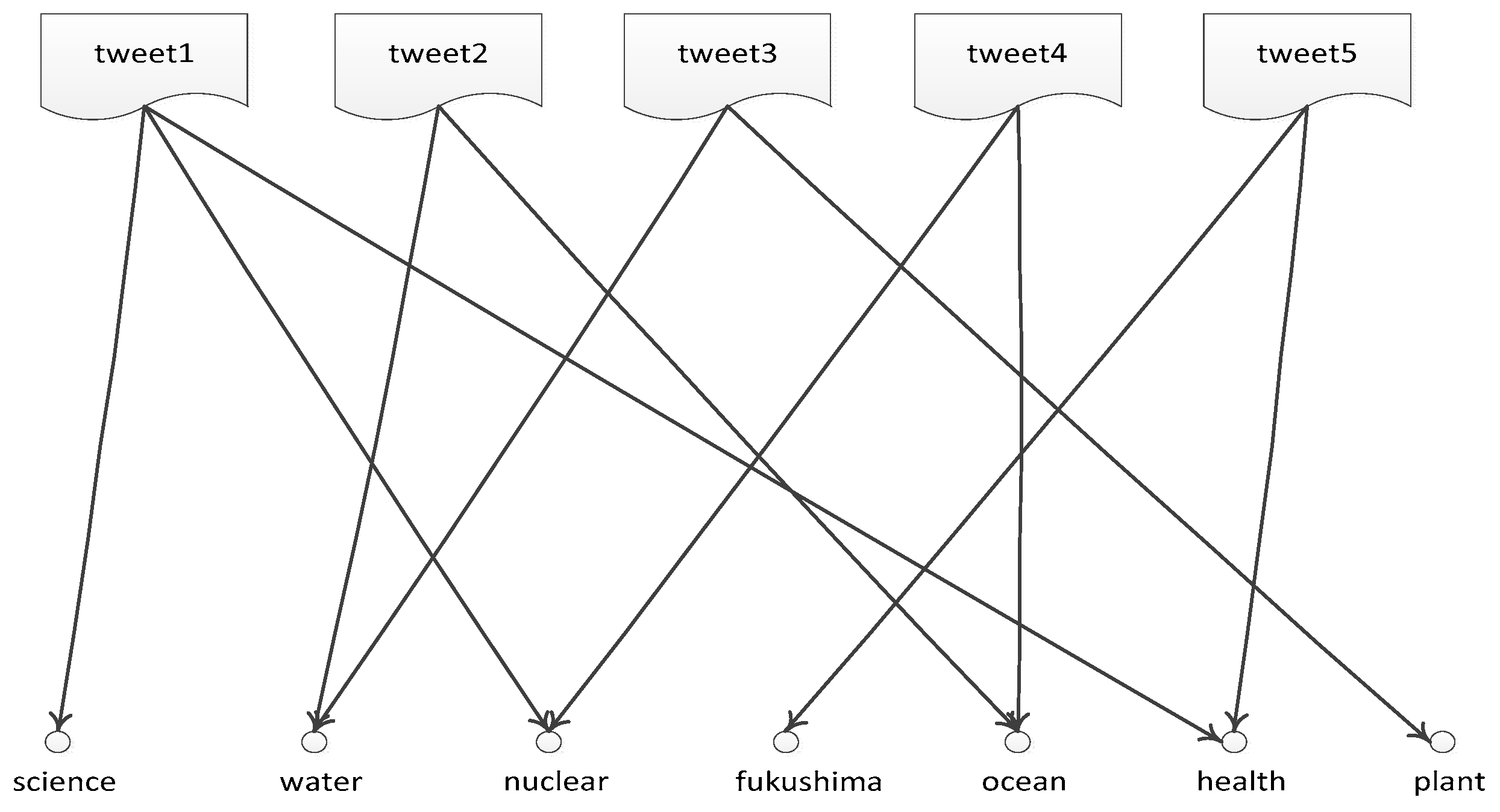
K topics. In essence, LDA identifies the strength of the associations between documents and topics, as well as between topics and words. In this paper, each tweet is treated as a document. For example,
Figure 1 shows one distribution of words across five tweets.
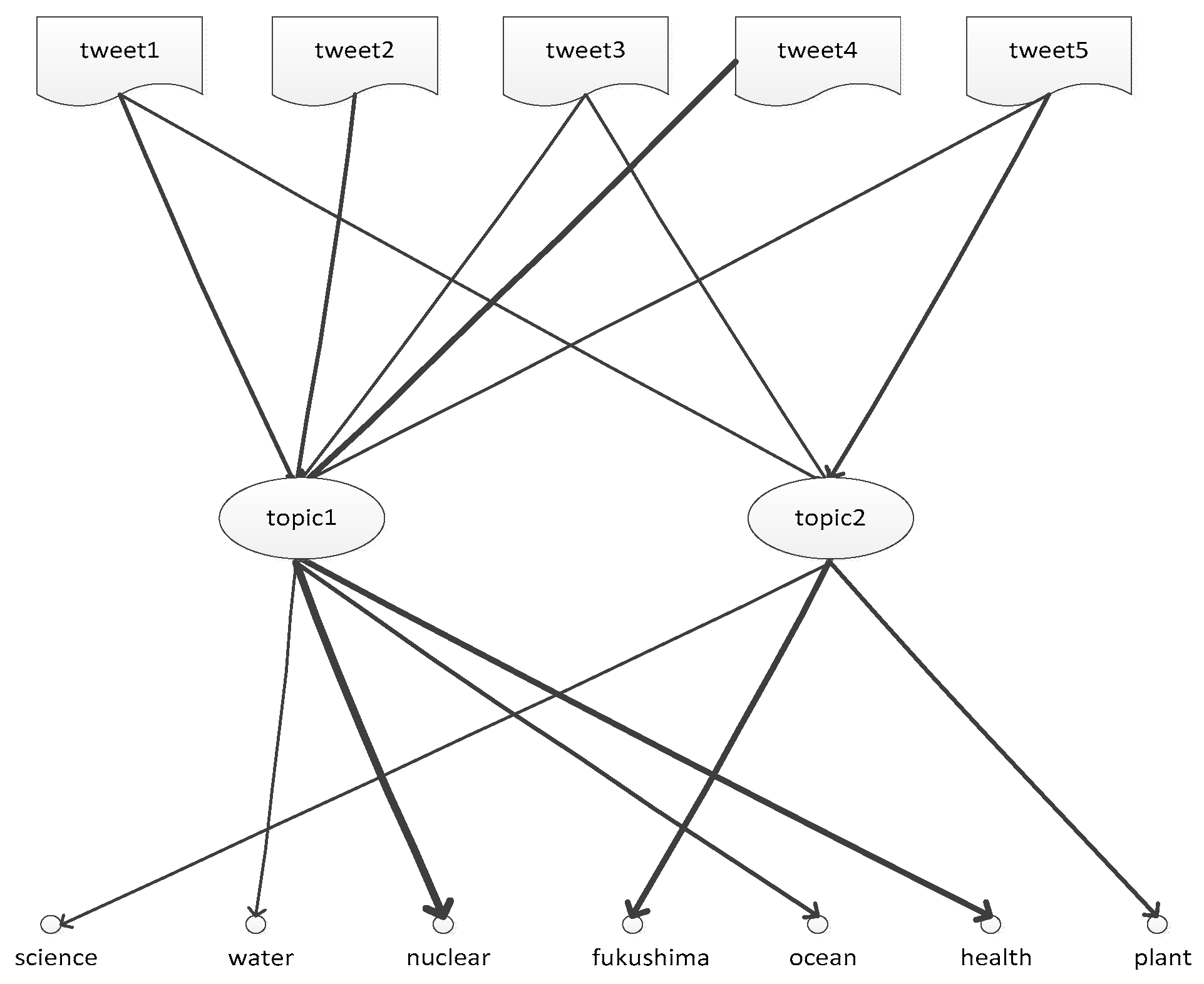
For
K = 2, an LDA model can be represented as in
Figure 2, where the two topics form an intermediate layer and determine the weights between tweets and topics, as well as between topics and words. In this way, tweets are no longer directly connected to words, but instead to topics. It should be noted that the thickness of the line in
Figure 2 indicates the magnitude of the probabilities. In this example, only two topics are presented, but in practice, we do not know exactly how many topics are discussed in a corpus of documents. Therefore, we may have topics 1, 2, … up to
K. In this paper, we aim to develop an intuition about what each topic represents, so we need to conduct a more detailed analysis of Dirichlet distributions.
In practical terms, Dirichlet distributions encode the intuition that documents are related to only a few topics [
18]. Thus, they enable better word disambiguation and more precise assignment of documents to topics. A Dirichlet distribution,
, is a way of modeling a Probability Mass Function (PMF), which assigns probabilities to discrete random variables. Suppose we consider an example involving documents, topics, and words; in this case, we have two PMFs:
- (1)
, the probability of topic k occurring in document d;
- (2)
, the probability of word w occurring in topic k.
The
in
is called the concentration parameter and determines whether the distribution tends to be uniform (
= 1), concentrated (
> 1), or sparse (
< 1). Therefore, by using a concentration parameter
< 1, these probabilities can better reflect real-world patterns. In other words, they follow Dirichlet distributions:
where
and
rule each distribution and both have values < 1.
For example, in this paper, we present the following topics and key terms:
[human health and nuclear wastewater (topic1), (topic2), environment science of ocean(topic3)]
[science, water, nuclear, Fukushima, ocean, health, plant, environment, safe, victim]
[0.55, 0.4, 0.05]
And the distribution D2 of topics over words is
topic1: [0.0, 0.1, 0.025, 0.01, 0.1, 0.35, 0.01, 0.0, 0.07, 0.09]
topic2: [0.01, 0.1, 015, 0.3, 0.1, 0.05, 0.25, 0.1, 0.05, 0.07]
topic3: [0.35, 0.01, 0.05, 0.01, 0.3, 0.15, 0.08, 0.1, 0.1, 0.15]
Then, LDA produces a distribution of topics over words. By analyzing this distribution, the most frequent words associated with each topic can be extracted, providing an indication of what the topic is about. For example, considering the aforementioned three topics and ten words, we may interpret the topics as follows:
Topic 1: The most frequent words are ”nuclear” and “health”, so this topic may concern human health problems caused by nuclear wastewater.
Topic 2: The most frequent words are ”Fukushima” and “plant”, so this topic appears to be clearly related to the Fukushima nuclear power plant.
Topic 3: The most frequent words are ”science” and “ocean”, so the topic may be related to marine environmental science.
3. Empirical Study
In this section, we aim to identify and compare the core themes of tweets in major languages related to Japan’s nuclear wastewater discharge by analyzing Twitter text data.
To bridge the theoretical discussion and the empirical analysis, we derive competing hypotheses from realism and liberalism regarding the drivers of governments’ positions on Japan’s nuclear wastewater discharge.
H1 (realist–economic interest). A government’s opposition to Japan’s nuclear wastewater discharge is negatively correlated with the country’s dependence on aquatic product exports to Japan.
H2 (liberal–public influence). The degree of alignment between public opinion as expressed on Twitter/X and government stance is positively correlated with the level of democratic responsiveness and media freedom.
This study does not treat these hypotheses as mutually exclusive. Instead, it tests their empirical support and explores the conditions under which one perspective outweighs the other.
To enable a direct test of these hypotheses, we operationalize the theoretical constructs using the empirical indicators listed in
Table 1. These variables are incorporated into the correlation analyses and are further discussed in the
Section 5.
To ensure transparency, we explicitly justify the exclusion of other major social media platforms. TikTok was not included because (i) its API does not support historical keyword searches at the scale required for event-based sampling (August 2023–November 2023) and (ii) video content requires multimodal analysis beyond the scope of this study, which is based on text-only LDA. Facebook was excluded because public API access for keyword-based post collection has been severely restricted since the Cambridge Analytica scandal [
19], making the available data difficult to replicate. LinkedIn is not a relevant platform for environmental crisis discourse because of its focus on professional networking. Instagram and Weibo were also considered but not included: Instagram provides limited textual metadata, and Weibo is limited to Chinese-language content, which precludes cross-country comparison across five language groups. Thus, Twitter represents the most feasible and comparable data source for a multilingual, cross-national analysis of event-driven public discourse.
3.1. Data Collection and Preprocessing
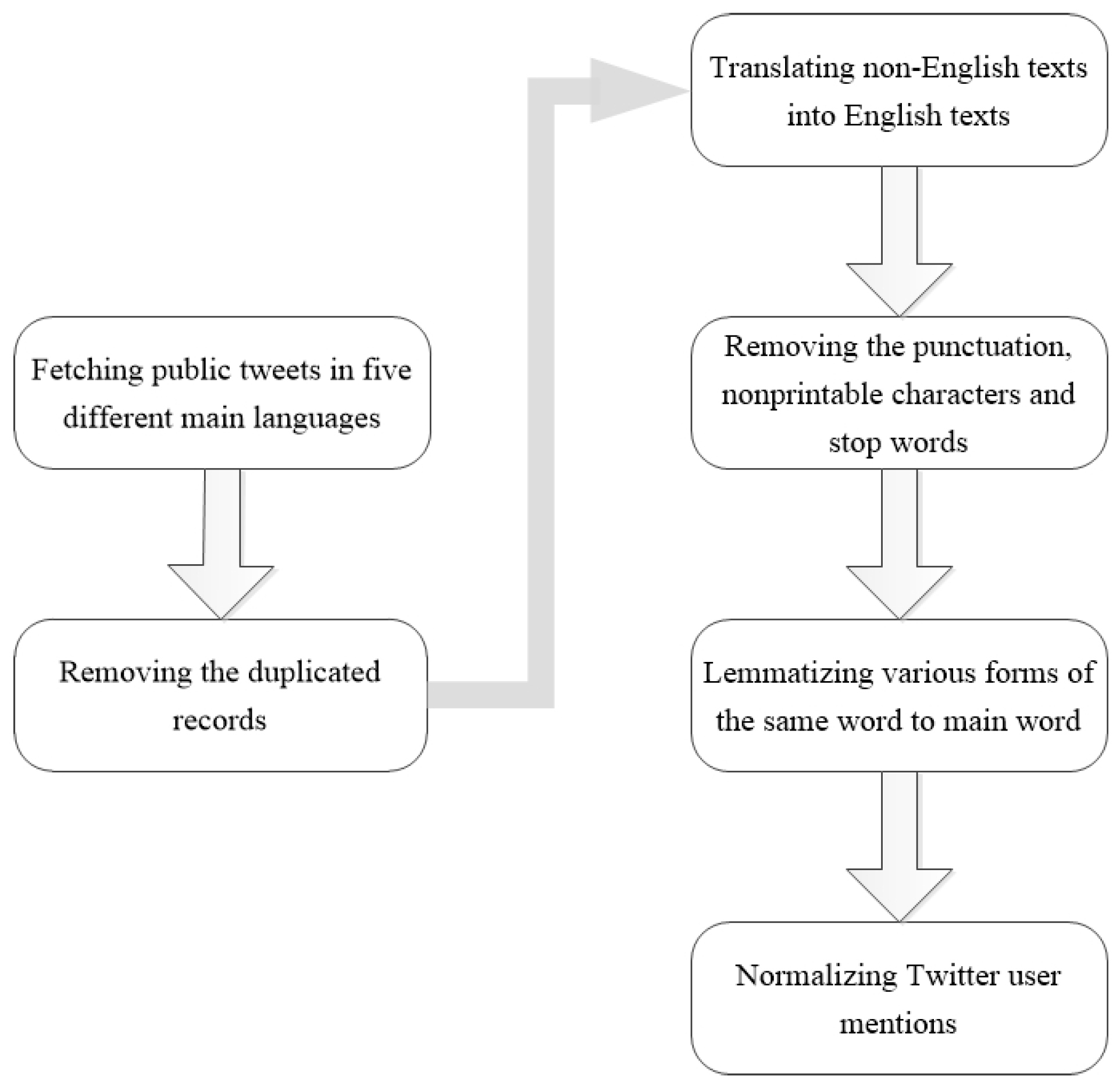
We collected tweets related to Fukushima nuclear wastewater between 22 August 2023 and 21 October 2023, using the Twitter standard search application programming interface (API) with a set of predefined search terms, including “Japanese nuclear wastewater,” “Fukushima nuclear sewage,” and “Japanese nuclear contaminated water.” We retrieved the texts and metadata of public tweets in five major languages: English, Chinese, Japanese, Korean, and Indonesian. In total, 27,012 unique tweets met the requirements for text analysis, including 7836 tweets in English, 3776 tweets in Chinese, 6946 tweets in Japanese, 6541 tweets in Korean, and 1578 tweets in Indonesian. We stored the tweets in a relational data table in MySQL, in which the primary key was the tweet ID, and duplicate records were excluded. Since tweet metadata, such as retweet counts and numbers of likes, changed over time, we recollected the updated metadata during the study period using the IDs of the already collected tweets. We identified non-English tweets (Chinese, Japanese, Korean, and Indonesian), using the language field in the tweets metadata, and translated them into English for the analysis. First, punctuation, non-printable characters such as emojis, and stop words such as “an” and “the” were removed from the tweets. Then we lemmatized different forms of the same word (e.g., “discharged,” “discharges,” and “discharging”) to their base form (e.g., “discharge”) using the WordNetLemmatizer module in the Natural Language Toolkit Python library and normalized Twitter user mentions by converting, for example, “@Peter” to “@username.”
All non-English tweets (Chinese, Japanese, Korean, and Indonesian; n = 18,423) were translated into English to enable joint LDA modeling across language groups. The translation procedure consisted of three stages:
Stage 1: Machine translation—We used the Google Translate API (September 2023 version), which has been shown to achieve reasonable performance in translating social media text in these languages.
Stage 2: Manual proofreading—For each language, two university students with native or near-native proficiency in that language and fluency in English independently proofread a random 20% of the sample (n = 3685 tweets) to correct machine translation errors. Inter-proofreader agreement was 92% for Chinese, 88% for Japanese, 91% for Korean, and 94% for Indonesian. Common errors included the mistranslation of sarcastic expressions (e.g., “Great job, TEPCO,” which was translated literally as positive rather than ironic), culturally specific units (e.g., “ベクレル”/becquerels, which were sometimes rendered as “bq” without context), and ambiguous pronouns.
Stage 3: Back-translation validation—To quantify translation fidelity, we randomly selected 500 tweets from each language (2000 in total) and asked a different set of bilingual speakers to back-translate the English versions into the original languages. The back-translated texts were then compared with the original texts using BLEU scores. The mean BLEU scores were as follows: Chinese, 0.71; Japanese, 0.64; Korean, 0.66; and Indonesian, 0.73. Scores above 0.6 generally indicate good preservation of meaning, although Japanese and Korean (both high-context languages) showed greater information loss, which is consistent with known challenges in translating politeness levels and omitted subjects.
Data collection and preprocessing are described in
Figure 3. In accordance with Twitter’s terms and conditions, terms of use, and privacy policies, all of the fetched Twitter data were anonymized and were not shared with any third party.
3.2. Data Analysis
The processed tweets were analyzed using the topic modeling technique described in the previous section to identify the most common topics. Here, the LDA algorithm from the Python NLTK 3.5.1 and gensim 3.7.2 packages was used. LDA can generate a specified number of topics, with each topic represented by a set of words. Therefore, we used LDA to map the processed tweets to a set of topics such that the words in each tweet were largely captured by those topics. Based on our previous exploratory work, 15, 20, and 25 were selected as the number of topics for the LDA runs.
We analyzed the top 7 representative words for each topic in the English-language corpus produced by the LDA machine learning technique (see LDA output in
Supplementary Materials). Through comparing and discussing, we reached a consensus on 20 topics and selected the associated terms for each topic. We then developed a Python algorithm to generate the document–topic probability distribution matrix (see the document–topic probability distribution matrix in
Supplementary Materials).
To quantitatively assess the quality of the learned topics, we computed topic coherence scores using the C
v measure [
20], which correlates well with human judgment. The average coherence score across the 20 topics was 0.52 (range: 0.41–0.67), indicating moderate to good interpretability. For comparison, we also implemented BERTopic, a neural topic model specifically designed for short texts, on the same preprocessed corpus. BERTopic produced 23 topics with an average C
v coherence score of 0.49. The two models shared 15 semantically matching topics (e.g., “seafood safety” and “marine radiation”), and the overall thematic structure derived from LDA was qualitatively similar to that derived from BERTopic. We retained LDA for the main analysis because (i) its topics were slightly more coherent on average, (ii) its results are more directly comparable to those of prior studies on environmental discourse, and (iii) LDA’s linear nature allows for a more transparent interpretation of topic–word distributions.
Selecting the optimal number of topics (
K) in LDA involves a trade-off between granularity and interpretability. We evaluated
K = 15, 20, and 25 using three quantitative metrics: (1) topic coherence (
Cv), where higher coherence indicates more semantically interpretable topics [
20]; (2) topic exclusivity, which refers to the degree to which a topic’s top words are unique to that topic, with higher exclusivity indicating lower redundancy; and (3) model fit (perplexity), where lower perplexity indicates better predictive performance, although perplexity alone does not guarantee interpretability.
K = 20 achieved the highest coherence and exclusivity, whereas K = 25 yielded slightly lower perplexity at the cost of reduced coherence and exclusivity. Moreover, at K = 25, several topics were redundant (e.g., two separate topics both centered on “seafood safety” and shared overlapping top-10 words). K = 15 produced several overly broad topics that combined distinct concepts (e.g., “marine ecology” and “human health”). We therefore selected K = 20 as the optimal balance between interpretability and granularity.
To reduce researcher discretion, we also computed the harmonic mean of coherence and exclusivity, which reached its highest value at K = 20 (0.59), compared with K = 15 (0.53) and K = 25 (0.55). This quantitative evidence supports the choice of 20 topics.
3.3. Topic Identification and Clustering
We used the multi-dimensional scaling (MDS) method to visualize the relationships between topics in a multi-dimensional space. MDS provides a visual representation of the distances or dissimilarities between sets of objects and can serve as a dimension reduction technique for high-dimensional data [
21]. In MDS, each data item is projected into a multi-dimensional coordinate space, after which dimensionality reduction is performed to obtain an intuitive description of the relationships among data items in a low-dimensional space, thereby enabling visual clustering [
22]. Since the number of topics obtained by the aforementioned LDA algorithm is large and the dimensionality is high, MDS is used for dimensionality reduction and visual clustering.
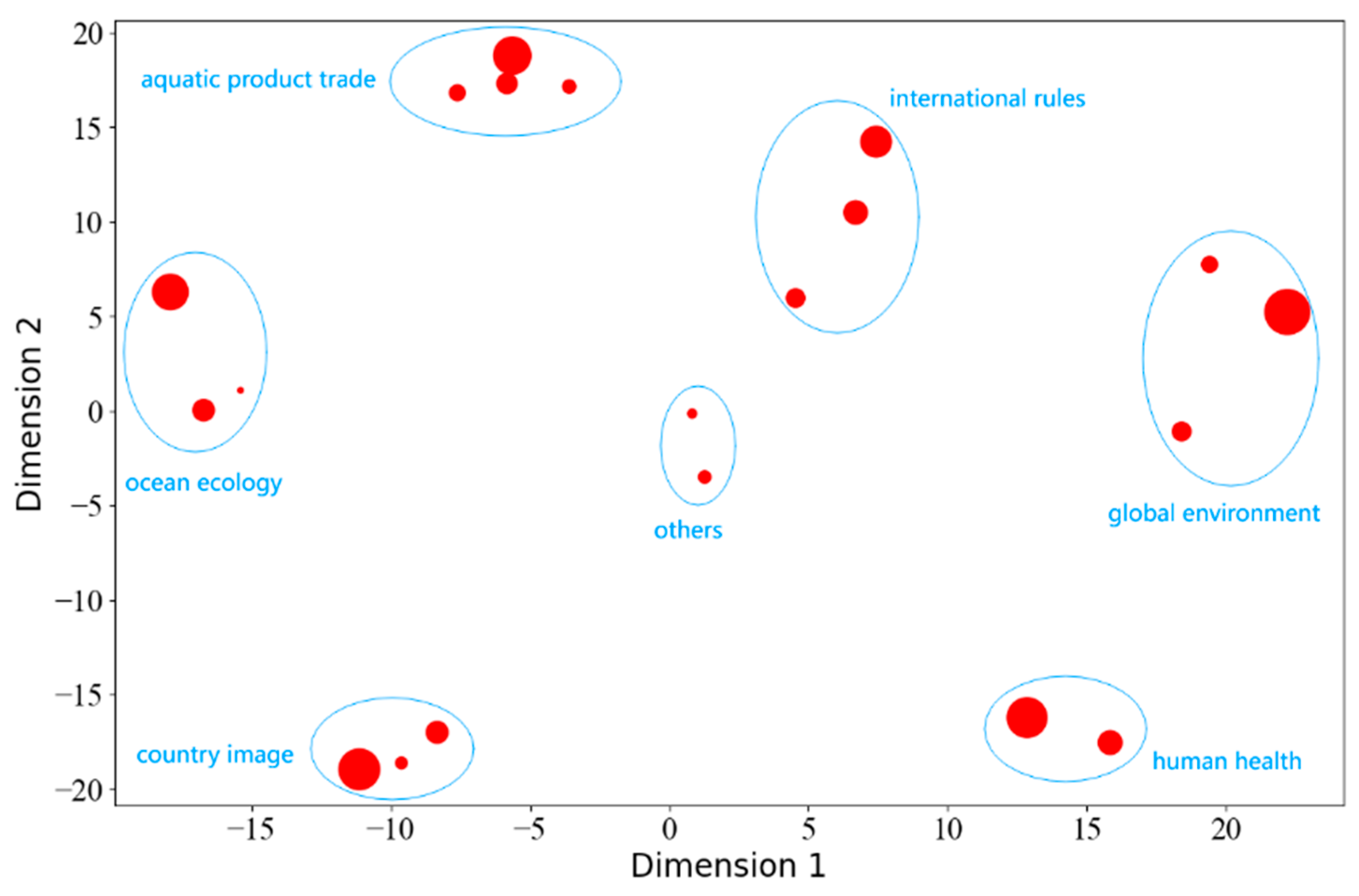
The selected 20 topics were further grouped into six substantive themes (country image, ocean ecology, global environment, human health, international rules, and aquatic product trade), with a residual ‘others’ category for topics that did not fit cleanly into these six. The clusters of the identified topics are shown in
Figure 4, and the membership relationships between the 20 topics and the six themes are summarized in
Table 2 (for a detailed mapping of the 20 LDA topics to these six themes, see
Supplementary Materials). The residual ‘others’ category (topics related to unrelated political commentary or off-topic content) was excluded from the main comparative analysis.
Figure 4 presents a two-dimensional visualization of the 20 topics identified through LDA. Each red circle represents a topic, and the spatial distribution reflects the similarity or dissimilarity between topics based on their term distributions. Topics that are closer together share more common terms or conceptual relevance, whereas those that are farther apart are more distinct. The plot uses MDS to project the high-dimensional topic data into a two-dimensional space for interpretability. The axes (namely, Dimension 1 and Dimension 2) represent abstract dimensions of variation derived from the model. Thus, the clustering pattern, marked by six blue ellipses (plus a residual “others” area marked separately), suggests the presence of broader thematic groups within the topics. Based on a comprehensive analysis of the topics corresponding to each theme and their associated terms, the names of the themes were further refined in conjunction with domain knowledge.
To validate the grouping of the 20 raw LDA topics into seven higher-order themes via MDS, we computed the silhouette coefficient for the resulting cluster assignments. The average silhouette score across all topics was 0.68 (range: 0.55–0.79), indicating a reasonable cluster structure; scores above 0.5 are generally considered acceptable. The lowest silhouette scores were observed for topics at the boundaries between “global environment” and “human health” (0.55), suggesting some overlap, which we acknowledge. As a robustness check, we also performed agglomerative hierarchical clustering with Ward’s linkage on the same distance matrix derived from topic–word distribution similarities. The dendrogram supported a seven-cluster solution at a similarity threshold of 0.6, with 93% of topics receiving the same assignments as in the MDS-based approach. These quantitative checks increase confidence that the seven-theme framework is not merely an artifact of subjective interpretation. The final theme labels were assigned by domain experts after inspecting the top 10 words and representative tweets for each topic within each cluster.
Naturally, the LDA and MDS methods selected in this study have certain limitations, mainly in two aspects. On one hand, the requirement to predefine the number of topics or themes is a well-known limitation. To address this subjectivity, we employed a combination of quantitative cluster-distance and qualitative human interpretation to select the numbers (20 topics and 7 themes) that yielded statistically sound and semantically meaningful results. On the other hand, while LDA identifies topics and MDS visually presents the theme distribution map, the step of labeling and interpreting the themes requires human judgment, which introduces a degree of uncertainty. Fortunately, the thematic categories can be revised and refined on the basis of domain knowledge.
3.4. Related Official State Attitude Investigation
Many governments have also expressed their positions on Japan’s nuclear wastewater discharge. We further analyzed the attitudes of different governments from six dimensions: international rules, country image, marine ecology, global environment, human health, and aquatic product trade. We collected statements on this crisis from heads of government or foreign ministries of predominantly Chinese-, English-, Japanese-, Korean-, and Indonesian-speaking countries between 22 August and 21 October 2023. It is worth noting that the positions of the opposition parties and national ministries (e.g., ministries of environmental protection) were not counted as government positions. In addition to formal foreign ministry statements (e.g., press releases and official briefings), we also examined the official Twitter accounts of the foreign ministries or heads of government of the five countries to understand how governments used this platform to communicate about the event. The accounts included @MFA_China (China), @StateDept (the United States, used as a proxy for English-speaking countries), @MofaJapan_en (Japan), @MOFAkr_eng (South Korea), and @Kemlu_RI (Indonesia). We collected tweets posted between 24 August 2023, and 30 November 2023, containing the keywords “Fukushima,” “nuclear wastewater,” “treated water,” or related terms. Each statement was analyzed by three trained students to determine whether the government supported or opposed the discharge and which dimensions it emphasized in its support or opposition. Each supportive dimension was assigned one point, and each opposing dimension was assigned minus one point. The final score for each dimension was obtained by dividing its total score by the number of reports on the government’s position regarding this event.
Key findings: (i) The Chinese and South Korean government accounts posted the most frequent and most critical content (14 and 9 tweets, respectively), while the Japanese account defended the discharge in 11 tweets, primarily in a factual and technical manner. The U.S. account posted only two tweets, both expressing support for Japan’s process. The Indonesian account posted three tweets, focusing on the need for international monitoring. (ii) Government Twitter discourse was generally more formal and less emotional than public tweets and was often linked to official press releases, suggesting that Twitter served as a distribution channel rather than a dialogic platform. (iii) In no case did government accounts directly engage with critical public tweets, indicating that government Twitter communication was one-way and did not represent a deliberative space.
These observations reinforce our main finding: government positions are shaped by diplomatic and economic considerations rather than by real-time public sentiment on social media. However, we acknowledge that governments’ use of Twitter varies significantly across countries (e.g., the United States uses Twitter more for public diplomacy, whereas China uses it primarily for disseminating official statements). A systematic cross-platform comparison of government social media strategies lies beyond the scope of this paper, but it represents a promising direction for future research.
4. Results
4.1. The Opinions of Different Governments
We analyzed the attitudes of different governments from the same dimensions as the public’s: international rules, country image, marine ecology, global environment, human health, and aquatic product trade. The results show that the governments of the United Kingdom, the United States, Japan, and South Korea support Japan’s nuclear wastewater discharge, while China and Indonesia oppose it. The government of Germany has not made an official statement. We further analyzed the factors related to the differences in governments’ attitudes across these six dimensions, including the relationship with the Japanese government (RJG), per capita GDP (GDP), distance from Japan (DFJ), aquatic product trade (including aquatic product imports (APIs) and aquatic product exports (APEs)), and the area of land and marine protected regions (ALMP). The results are shown in
Table 3. The results indicate that the relationship between national governments and the Japanese government is significantly and positively correlated with their attitudes toward international rules, meaning that the closer a country’s relationship with the Japanese government, the more likely it is to believe that Japan’s nuclear wastewater discharge complies with international rules. Attitude toward the global environment is significantly negatively correlated with aquatic product exports. Countries with a high dependence on aquatic product trade are likely to experience greater economic impacts from the deterioration of the marine environment caused by the discharge of nuclear wastewater and are therefore more concerned about the global environmental consequences of this crisis. The correlations reported in
Table 3 are based on a small sample. They are presented as descriptive patterns, not as causal inferences. Given the small sample size, these findings should be interpreted as exploratory and hypothesis-generating.
In early July 2023, the International Atomic Energy Agency (IAEA) concluded that Japan’s plans to release ALPS-treated water stored at the Fukushima Daiichi nuclear power station into the sea were consistent with the relevant IAEA Safety Standards, including the International Basic Safety Standards and the regulatory guidance on radioactive discharges to the environment [
23,
24,
25]. The IAEA’s technical assessments and endorsement of Japan’s discharge plan have been repeatedly cited by some governments (e.g., the United States, France, and Japan) as a basis for supporting the decision, whereas other governments (e.g., China and Indonesia) have questioned the impartiality and adequacy of these assessments [
26,
27].
4.2. The Difference Between Government and Public Opinion
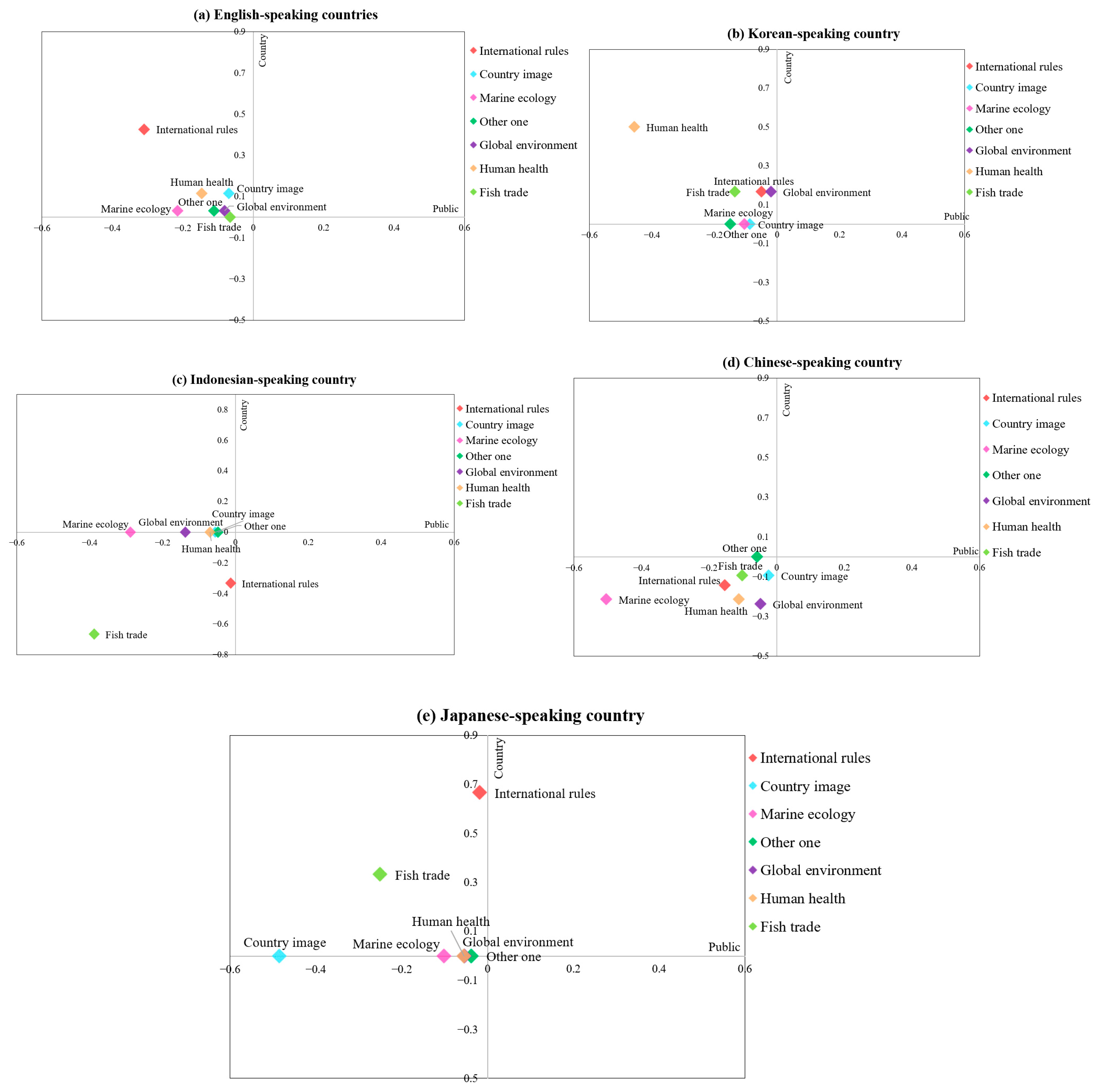
We further compared the differences in the opinions of governments and the public in countries that speak different languages regarding Japan’s nuclear wastewater discharge across six dimensions: international rules, country image, marine ecology, global environment, human health and aquatic product trade (
Figure 5). The opinions of governments and the public in English-speaking and Japanese-speaking countries differ considerably with regard to the nuclear wastewater discharge. Governments in these two language groups generally support the discharge, while the public opposes it. With respect to international rules, the differences in attitudes between the governments and English-language tweets and Japanese-language tweets are particularly large. The governments of both English-speaking and Japanese-speaking countries state that the nuclear wastewater discharge complies with international rules, whereas the public believes that it violates them. The attitudes of the Korean-speaking government and the public are also opposite. The main point of contention concerns the impact of nuclear wastewater discharge on human health: the government states that the discharge does not harm human health, whereas the public believes that it does. By contrast, the attitudes of Chinese-speaking and Indonesian-speaking countries and the public are relatively consistent. Both the Chinese-speaking countries and the public oppose Japan’s nuclear wastewater discharge. Across the six main themes, Chinese-speaking countries and their public emphasize that the discharge will damage marine ecology, followed by concerns about human health and the global environment. Indonesian-speaking countries and their public focus on the significant impact that Japan’s nuclear wastewater discharge would have on the aquatic product trade.
This study further investigates the differences in attitudes between the public and governments across countries that speak different languages.
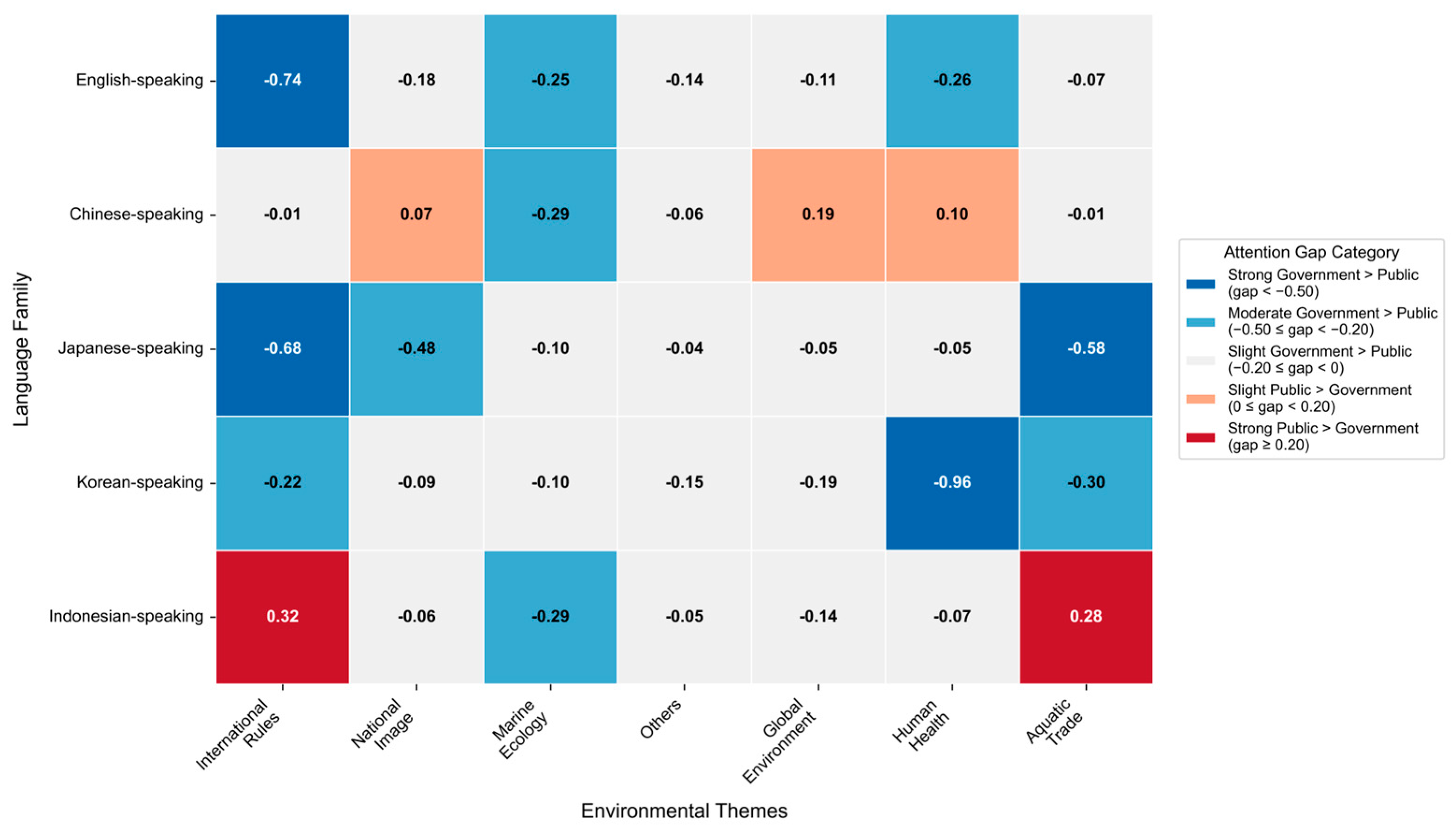
Figure 6 presents a structural diagram illustrating these differences in countries that speak one of the five languages examined. Positive values indicate alignment between public and governmental attitudes, with larger values reflecting greater consistency. In contrast, negative values denote divergence, with larger absolute values indicating greater disagreement. As shown in
Figure 6, English-speaking countries exhibit the greatest disparity regarding international rules (−0.74). The Japanese-speaking group demonstrates the largest divergence in terms of international rules (−0.68) and national image (−0.48), while the Korean-speaking group shows the most pronounced disagreement in relation to human health (−0.96). By contrast, public and governmental attitudes in Chinese-speaking and Indonesian-speaking countries are largely aligned.
4.3. Public Opinions of the Crisis
The majority of the tweets in our corpus (97%) expressed opposition to Japan’s nuclear wastewater discharge. Studies [
7,
28] on Chinese public opinion also reach similar conclusions [
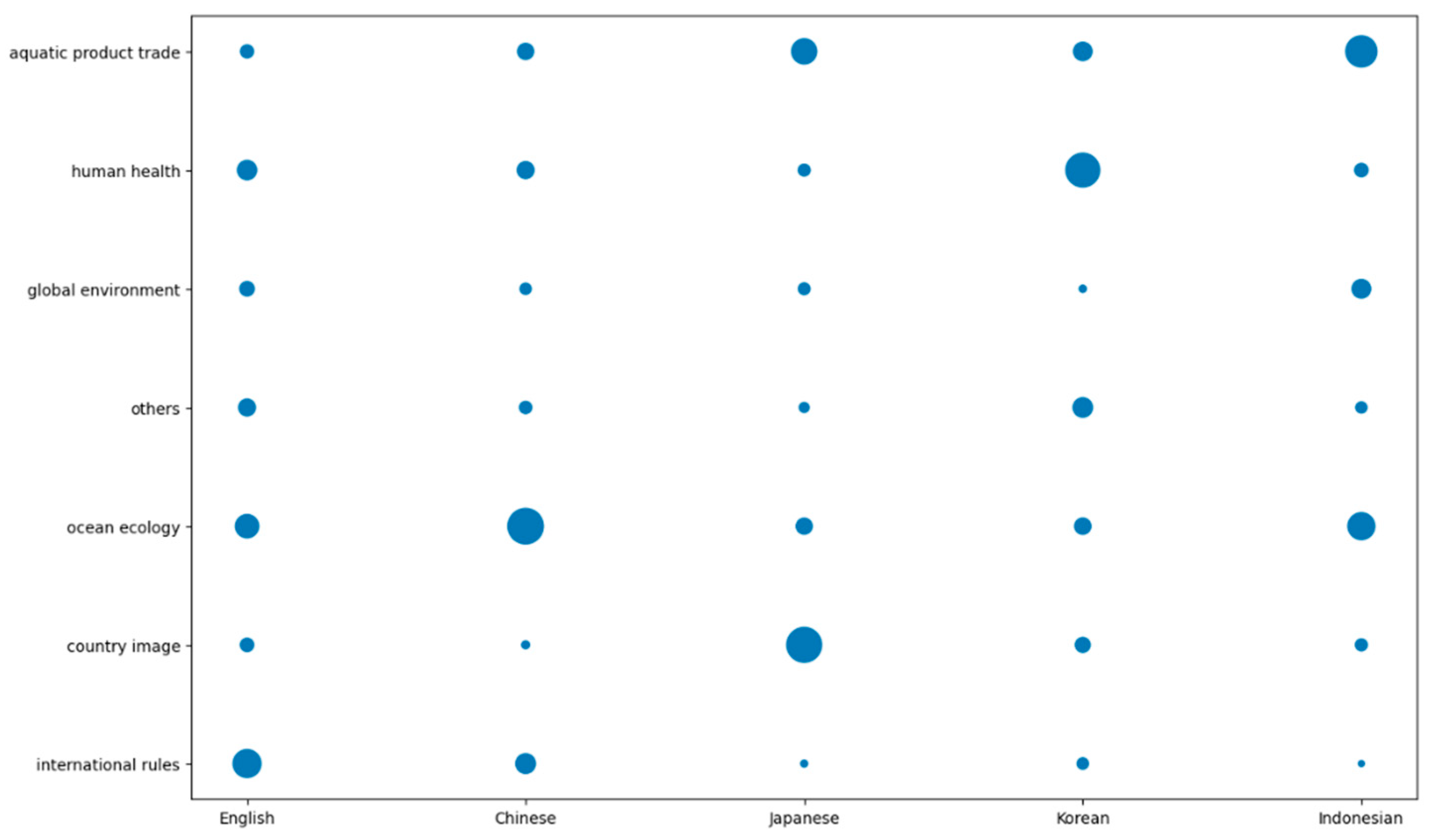
28]. Specifically, there are significant differences in the emphasis of popular opposition among countries that speak different languages (
Figure 7). The English-language public focused on the violation of international rules resulting from the discharge, followed by the impact on marine ecology and human health. The main concern of the Chinese-language Twitter corpus is marine ecology. China and English-speaking countries (e.g., the US and UK) are major players in international affairs, so the public is more concerned about whether Japanese nuclear wastewater discharge complies with international rules and the impact on the global marine ecology. Japanese-language tweets are most concerned about the damage of nuclear wastewater discharges to their national image and aquatic product trade. The safety and legality of the discharge plan have always been doubted by other countries, but the Japanese government insists on discharging nuclear-contaminated water; therefore, the public is most concerned that this will greatly damage Japan’s national image. Furthermore, Japan is a maritime country, and the fishing industry has always been one of its important economic pillars, so the public is concerned about the impact of the discharge of nuclear-contaminated water into the sea on the fishing industry. Korean-language tweets emphasize human health. Among the countries speaking the five major languages examined, South Korea is the closest to Japan and the first to be affected by nuclear sewage [
29], so the Korean people are most concerned about the impact of nuclear sewage discharge on human health. Indonesian-language tweets focus on aquatic product trade and marine ecology because Indonesia is one of the world’s major seafood exporting countries, and nuclear sewage discharge will seriously impact Indonesia’s fishing industry [
30].
Before summarizing the findings, it is important to restate the conceptual boundaries of this study. The comparison between “public opinion” (operationalized as Twitter discourse) and “government positions” (operationalized as official statements) is limited to thematic priorities—that is, which issues (marine ecology, human health, international rules, etc.) receive greater relative attention in each corpus. We do not claim that tweets are representative of national populations, nor do we suggest that tweet volume directly measures public pressure on governments. Thus, our conclusions about alignment or divergence (e.g., “sharply divided in English- and Japanese-speaking regions”) refer specifically to the prominence of discursive themes, rather than to the legitimacy, intensity, or causal influence of public opinion.
5. Discussion
Is a government’s stance on international events influenced more by public opinion or by other factors? Understanding the drivers behind a country’s position can provide a scientific basis for effective global governance and sustainable development. While public opinion can be a significant factor in shaping government positions, it is often diverse on international issues (e.g., climate change and COVID-19 prevention), making it challenging for government stances to fully represent public opinion. To address this issue, we need to identify an international event with broadly aligned public opinion. We applied a new topic-clustering approach to analyze 27,012 tweets in five major languages, categorizing the information into six themes: country image, ocean ecology, global environment, human health, international rules, and aquatic product trade. The analysis revealed that public sentiment was predominantly opposed to the event. We then collected statements from government leaders or foreign ministries regarding the event, organizing these statements into the same six themes. Our findings show that the Chinese and Indonesian governments and their publics share similar concerns. Both the Chinese government and public are focused on the impact of nuclear wastewater on marine ecology, while the Indonesian government and public are concerned about its effects on seafood trade. In contrast, differing views between governments and publics in English-, Korean-, and Japanese-speaking countries suggest that public opinion may not always be the primary factor influencing government positions. Further exploratory analysis based on a small set of countries (
n = 6 governments: China, the United States, the United Kingdom, Japan, South Korea, and Indonesia) suggests a preliminary pattern: governments’ attitudes toward international rules (i.e., whether they openly criticized Japan for violating international law) appear to be positively associated with the closeness of their diplomatic relationship with Japan (Spearman’s ρ = 0.67;
p = 0.15). Owing to the very small sample size, this correlation is not statistically significant at conventional levels and should be treated as exploratory. Similarly, the stance on global environmental issues (i.e., expressing concern about marine pollution) shows a negative association with aquatic product exports to Japan (ρ = −0.72;
p = 0.11). These correlations are based on only six observations and therefore cannot support causal claims or population-level inferences. We report them as illustrative patterns that warrant further testing in future research with larger country samples. Given the small sample size, we refrain from treating these
p-values as definitive evidence and instead present the results as descriptive associations. This preliminary pattern suggests that bilateral relations with the country involved and economic interests may be factors shaping governmental stances, but this finding requires replication with a larger country sample. International organizations serve as essential platforms for global governance and influence how nations respond to transnational challenges [
31].
Our empirical finding—that, in this exploratory analysis of six countries, governments’ positions showed stronger correlations with bilateral ties and economic dependencies than with domestic public opinion—is illustrative of patterns that realist perspectives would predict, which emphasize national interest over public sentiment [
32,
33]. However, we emphasize that this is not a formal test of realism versus liberalism; with such a small sample, the analysis is exploratory and hypothesis-generating rather than confirmatory. Instead, we offer two tentative observations that may inform future theoretical development below.
First, the observed divergence between public opposition and government support in the United States and Japan suggests that alliance relationships may buffer governments from domestic pressure on environmental issues. Second, the alignment between public and government concerns in China and Indonesia, despite their very different political systems, suggests that economic framing (e.g., seafood trade and marine ecology) may serve as a point of convergence regardless of regime type. These observations are not definitive conclusions; they are intended to generate hypotheses for future research with larger country samples (n > 20) and more rigorous statistical modeling.
These patterns are hypothesis-generating rather than hypothesis-confirming. Future research with a larger sample of countries (n > 20) and formal statistical modeling (e.g., multilevel regression) is needed to test whether realist variables systematically outweigh liberal variables in environmental crises.
Importantly, although we compare government statements with public tweets, we do not assume that they are equivalent in terms of democratic weight or representativeness. Government positions are authoritative policy stances, whereas tweets are individual expressions that may be unrepresentative, performative, or sarcastic. Our comparison is therefore limited to thematic alignment or divergence—that is, whether the same issues (e.g., marine ecology and seafood trade) emerge as dominant concerns in both corpora. We do not claim that the volume of tweets “measures” public pressure on governments in a causal sense.
However, it would be too arbitrary to conclude that a country’s government stance on international events has nothing to do with public opinion. In reality, there are many examples of public opinion influencing government positions. The Vietnam War, the 9/11 attacks, and the Iraq War shocked the public and had enormous impacts on people around the world. Through television, the media disseminated images of brutal wars and terrorist attacks with unprecedented speed, thereby influencing the positions of governments around the world, especially that of the United States. Especially in the context of deepening globalization, the role of public opinion in shaping government positions has become increasingly important. The extent to which public opinion influences a government’s position depends not only on the political system and the nature and form of the elite alliance of the country, but also on the nature of the international event itself, as well as the stage and context of decision-making. As a result, this influence varies across countries with different political systems. From a systems perspective, this influence can be understood as a balancing feedback loop [
34]: public opinion, amplified through media, exerts countervailing pressure on governmental decisions, preventing policy from drifting too far from societal tolerance. However, such feedback is rarely linear. Social media discourse often produces nonlinear rebound effects—for instance, a government’s attempt to dismiss public concerns may intensify opposition rather than suppress it, creating a self-reinforcing loop. In the case of Japan’s nuclear wastewater discharge, the U.S. government’s supportive stance was not met with widespread domestic backlash, suggesting that alliance-based framing can dampen feedback. Conversely, in South Korea, the government’s support triggered strong oppositional feedback, illustrating how the same external event produces divergent system responses depending on local political and cultural contexts. These observations align with the concept of VUCA (volatility, uncertainty, complexity, and ambiguity)—social media environments amplify uncertainty and complexity, making government responses inherently challenging [
35]. Recognizing social media as a second-order cybernetic control mechanism [
36]—where publics not only react but also observe and critique government communications—can help policymakers anticipate and adapt to emergent feedback patterns.
The findings of this study underscore a potential challenge in realist-based policies: while focusing on national interest can enhance security and prosperity, overlooking public sentiment can lead to a loss of public trust. In democratic societies, disregarding strong public opposition may weaken political legitimacy and contribute to social discontent. A realist approach, with its emphasis on national interest, suggests that although prioritizing strategic relationships is rational, governments could still benefit from acknowledging public concerns in order to strengthen domestic unity and support. From a systemic perspective, public sentiment should not be treated as ‘noise’ or ‘bad feedback’ to be suppressed but rather as an essential input for adaptive governance. In complex social systems, legitimacy is co-constructed through ongoing feedback between state institutions and the public sphere [
34]. When governments ignore or censor critical feedback, they risk triggering vicious cycles of distrust and disengagement—particularly in democratic societies. Conversely, actively incorporating public concerns as balancing feedback can transform potential conflicts into opportunities for policy refinement. This is not to suggest abandoning realist interests but to argue that feedback-sensitive realism—an approach that treats public opinion as a source of system intelligence—may produce more stable and sustainable outcomes in VUCA environments. The study thus supports the view that social media monitoring can serve as a second-order cybernetic tool: not merely tracking sentiment but helping governments understand how their own communications shape and are shaped by public responses [
36].
Further, the study suggests that, in addressing global crises, realist policies should integrate mechanisms for public engagement. By doing so, states can enhance their legitimacy and responsiveness without sacrificing national interest. Realist-based policies could be refined to balance strategic needs with domestic public opinion, potentially leading to more stable and publicly supported responses to international issues. This also implies that international bodies and governance models that encourage diverse participation may provide pathways to better global cooperation, even within a realist framework.
There are also some shortcomings in this study. First, we acknowledge limitations related to language translation. All non-English tweets (Chinese, Japanese, Korean, and Indonesian) were first translated into English and then manually proofread by university students with corresponding language backgrounds to reduce literal translation errors. However, some loss of meaning is still unavoidable. Certain expressions, idioms, sarcasm, or culture-specific references may not map perfectly into English, even after proofreading. Future research could incorporate automated sentiment analysis methods (e.g., BERT-based classifiers) to further validate the results, particularly in large-scale datasets. Nevertheless, given the small-N comparative design, manual coding remains advantageous in capturing nuanced semantic and contextual differences. Second, although LDA is valued for its ability to uncover latent thematic patterns in large, unstructured text corpora in an unsupervised manner, it struggles with data sparsity and limited contextual information inherent in short tweets. Our reported coherence scores (average C
v = 0.52) indicate moderate, but not excellent, topic quality. The results are also sensitive to preprocessing choices (e.g., stop-word lists, n-gram ranges, and minimum word frequency) and hyperparameters (e.g., number of topics, alpha, and beta). We conducted sensitivity analyses by varying the number of topics from 15 to 25 and found that the 20-topic solution yielded the highest coherence; however, alternative parameter settings produced topic assignments that differed in up to 15% of tweet classifications. Furthermore, although our MDS-based clustering achieved a silhouette score of 0.68, the cluster boundaries remained somewhat subjective, and the hierarchical clustering robustness check showed that 7% of topics switched clusters. These methodological uncertainties imply that the seven-theme framework should be treated as a useful analytical reduction rather than a definitive ontological structure. Future research should validate our thematic findings using supervised or semi-supervised approaches with larger labeled datasets. Third, the exclusive use of Twitter data introduces platform-specific biases. Twitter users are not demographically representative of national populations; they tend to be younger, more urban, and more politically engaged than the general public [
37]. Moreover, Twitter penetration rates vary across countries (e.g., Japan and the United States have high usage rates, whereas Indonesia has lower penetration relative to its population), which may affect cross-country comparisons. Other platforms, such as TikTok, Facebook, or local alternatives (e.g., Weibo in China and Naver Cafe in Korea), may host different forms of discourse because of differences in user demographics, moderation policies, and platform affordances. For example, Chinese public opinion was inferred from Chinese-language tweets, many of which were posted by users outside mainland China because Twitter is blocked there; these tweets may therefore not reflect the views of domestic Chinese citizens, who primarily use Weibo or Douyin. Future research should triangulate findings across multiple platforms to assess the robustness of thematic patterns and to understand how platform ecology shapes public discourse. Fourth, this study does not systematically incorporate cultural theories of communication. Our exploratory post hoc analysis showed some correlations between Hofstede’s dimensions (e.g., individualism and uncertainty avoidance) and theme proportions, but because of the small number of countries, we cannot draw causal conclusions. Moreover, our LDA approach treats word distributions as direct indicators of concern, but in high-context cultures (e.g., Japan and Indonesia), meaning may be conveyed indirectly through implication or silence, which topic modeling cannot capture. Future research should employ culturally validated dictionaries or conduct qualitative content analysis to disentangle stylistic differences from substantive cross-country differences. Additionally, comparative work including more countries (e.g., 20 or more) could formally test cultural mediation models using multilevel regression.
Our finding that public opposition is nearly universal but varies in thematic emphasis across language groups extends previous work by Pu et al. [
7], who identified three themes in Chinese public opinion. By including five language groups, we show that “marine ecology” is not uniquely Chinese but also appears in Indonesian discourse, while “international rules” is uniquely prominent in English-language tweets. This cross-linguistic variation has not been systematically documented in prior research on nuclear wastewater discourse.
Overall, the evidence for this particular event aligns more closely with realism than with liberalism. However, we do not claim that realism is universally superior. The nature of the issue—namely, a transboundary environmental risk with diffuse costs and concentrated economic benefits—may bias outcomes toward realist calculations. Future comparative research on other international events (e.g., climate treaties and trade wars) could help identify the scope conditions under which liberal mechanisms become more influential.
6. Conclusions
In our Twitter corpus, the majority of tweets (97%) opposed Japan’s nuclear wastewater discharge, yet their concerns vary across language-speaking countries in our translated Twitter data. Specifically, the English-language corpus (originally in English and therefore not subject to translation loss) emphasize violations of international rules; the Chinese-language corpus (translated from Chinese) focuses on marine ecology; the Japanese-language corpus (translated from Japanese and associated with the greatest translation uncertainty) highlights concerns about damage to national image and seafood trade; the Korean-language corpus emphasizes human health; and the Indonesian-language corpus focuses on seafood trade and marine ecology. However, because of translation limitations—particularly for Japanese and Korean tweets, which had lower back-translation BLEU scores and lower human-coding agreement—these cross-language differences should be interpreted cautiously. The finding that Japanese-language tweets emphasize “national image” may partly reflect translation loss in more nuanced expressions of concern. We therefore characterize these patterns as suggestive rather than conclusive. In practice, LDA proves valuable for uncovering latent thematic structures in large text collections, yet its interpretability and stability require careful evaluation against human judgment. However, as noted in the Discussion, our LDA topics achieved only moderate coherence, and the MDS-based theme clustering yielded a silhouette score of 0.68, indicating that some thematic boundaries remain fuzzy. Therefore, although the six-theme framework provides a useful lens for cross-country comparison, individual theme proportions should be interpreted with caution, and the framework is best used for relative rather than absolute comparisons across language groups. The ‘others’ category was excluded from the main comparative analysis because it contained topics that were not consistently present across language groups.
Before summarizing the substantive findings, we reiterate the scope of our claims. This study compares Twitter discourse in five languages and relates it to the official positions of six national governments (China, the United States, the United Kingdom, Japan, South Korea, and Indonesia). We do not claim that language corpora are equivalent to national public opinion. The mapping from language to country is imperfect—most notably for Chinese (because Twitter is blocked in mainland China) and for English (because it is used in multiple countries). Accordingly, all cross-country comparisons should be interpreted as comparisons of language-defined discursive communities with known biases. Conclusions about “public–government alignment” refer specifically to the alignment between government statements and the dominant themes in the corresponding language corpus, subject to the caveats described above.
Our systemic analysis, based on a small set of six countries, suggests possible associations that should be tested in future research; the following factors emerged as tentatively related to government stances in this small sample:
Diplomatic relations: Attitudes toward international rules appear to be positively associated with the closeness of a country’s relationship with the Japanese government, although this finding is based on a small sample and requires replication.
Economic interests: Concerns about the global environment show a negative association with aquatic product exports, suggesting that trade dependencies may influence government positions. However, given that this finding is based on only six countries, it should be treated as tentative.
Geopolitical and domestic considerations: Governments balance international alliances, economic benefits, and domestic public concerns, but the relative weight of each factor cannot be reliably estimated from such a small sample.
In fact, the primary contribution of this study remains the cross-linguistic thematic analysis of public tweets (n = 27,012), which is statistically robust. The government-position analysis is exploratory and is intended to generate hypotheses for future cross-national research with larger samples.
By identifying and categorizing these factors, the study contributes to a clearer understanding of how governments make decisions in global environmental crises. The results suggest that governments should not only weigh diplomatic and economic interests but also give greater consideration to public concerns. Moving forward, strengthening mechanisms for monitoring public opinion and integrating it into decision-making could improve the legitimacy and effectiveness of global crisis governance. Moreover, enhancing the role of international cooperation and empowering non-governmental organizations are essential steps toward more inclusive and balanced responses to global challenges. In systems terms, more resilient global crisis governance requires designing architectures that can absorb and learn from balancing feedback—including dissent expressed on digital platforms. Second-order cybernetic approaches, which emphasize mutual observation and adaptation between governments and publics, offer a promising direction for future research and policy design [
34,
35].