1. Introduction
A growing academic interest was identified regarding the effect and implications of digitalization (including platform-based ecosystems, e-commerce, artificial intelligence, and big data) in accounting and audit fields [
1,
2]. Human capital skills and risk adaptation are considered important concerns regarding the normal and adapted evolution of professionals in those fields. Reporting processes, control mechanisms, and business strategies are subjects of a complete restructuring process in a technology-driven world, but digitalization’s impact comes with more than big changes. The role of accounting in decision-making also has different shades.
Academicians focused primarily on opportunities, but there is a lack of theoretical and legal basis for the usage of new digital technologies [
1,
3,
4]. As the literature is developing and past studies focused on predictions, future research is expected to bring evidence for the effectiveness of digital technologies [
1]. While in the public sector, the efficiency of data science was proved, the impact of the risks and transparency of financial statements of private entities is still in question [
4]. Agostino et al. [
4] identified a need to assess the organizational impact of digital tools in the reporting process and stakeholder trust. Thus, auditing is framed as a feedback mechanism necessary to maintain the integrity of the financial system despite technological innovations.
From a systems science perspective, the financial reporting ecosystem can be considered a complex system, within which the external audit functions as a critical monitoring subsystem. Digital transformation (DT) is not just a simple technological change but a complete systemic restructuring of reporting processes, control mechanisms, and business strategies. In this framework, the audit fee ceases to be a simple market price, becoming a quantifiable indicator of the resources required by the audit subsystem to process complex inputs, such as intangible assets. It also has the role of maintaining the entropy of the reporting system at a level that ensures stakeholder trust. Digitalization impacts auditors from three main perspectives: audit is a client-based service, auditors add value to the costumers beyond the checker role, and auditors relied on technology to reduce costs [
2].
The audit fees research followed two main directions: evaluating the competitiveness of the audit market considering the small number of service providers (especially for the listed entities) and examining the independence of the audit process, usually using proxies as low-balling and non-audit services [
5]. There is no perfect proxy to measure audit quality, as quality must be seen in the decision context [
6]. Audit quality research evolved from simple questions and proxies to explore details in differences across various audit firms, audit offices, and even audit partners, but also to which extent some complex and multidisciplinary proxies are impacting the output of the audit process [
7,
8,
9].
Audit quality is a complex process influenced by multiple factors: the inputs of the audit process (such as testing procedures, technologies used, and the individuals involved in the audit), the auditing process itself, audit firms, and the outputs of the audit [
10]. In the past, studies which examined the demand side of the audit process used almost exclusively input factors as proxies for audit quality as the audit fees [
11].
The literature employs a significant number of indicators to measure audit quality, without reaching a consensus on the most effective indicators of audit quality. Audit quality depends on the intentions and competencies present within the client companies and audit service providers [
11]. While audit quality provides assurance for financial quality, financial quality is a component of a firm’s reporting system. Small changes in accounting policies could lead to major updates to information systems.
As outputs of the audit process, the most visible are the audit report and audited financial statements [
12]. Since for large entities, the presentation of factual data in cash flows is insufficient, reporting is conducted based on accrual accounting, which includes, in addition to factual data, certain forecasts and complex estimates [
10]. Dechow et al. [
13] note that the reported profit is a function of the company’s financial performance over a specific period.
Auditor independence is arguably the most critical characteristic of auditing. Given that the primary link between the audit client and auditor is the audit fee, this study investigates the factors that influence audit fees as a dependent variable. From the multitude of indicators that can be used to determine audit quality, this paper will focus on discretionary accruals and their impact on audit fees.
The audit attributes were mainly studied in the United States (US), United Kingdom (UK) and Asiatic countries. Even if size’s influence over audit fees is clear, other attributes are still facing mixed results in the research field [
5]. While previous studies have focused on opportunities and predictions, there is a scarcity of empirical evidence regarding the actual effectiveness of digital technologies and an insufficient theoretical and legal foundation for their use. There is an identified need to evaluate the organizational impact of digital tools in the reporting process and stakeholder trust, an aspect that remains questionable, especially in the private sector.
Digitalization should reduce human error by providing automated processes and clear workflows, but its implementation could create errors in the first steps. Intangible assets are considered difficult to understand by investors. The investors’ knowledge is different compared with auditors’ knowledge, but we tested if the asset structure (intangible divided by total) is affecting the audit fees. Despite the growing interest, the existing literature on audit pricing in this context yields inconsistent results, reflecting a research problem rooted in the lack of a longitudinal perspective on how technology adoption impacts audit effort.
The purpose of this study is to investigate the dynamics of audit reconfiguration in the digital age, exploring how monitoring systems manage information entropy to maintain stakeholder trust based on stakeholders’ theory. To achieve this goal, the objective is to measure the impact of digital transformation on audit fees. We are interested in how entities’ digitalization shapes their relationship with their service providers from a cost perspective. The audit market is known for having relatively few service providers, especially for listed entities [
14]. We consider that intangible assets (excluding goodwill) integrate digital tools into accounting and management systems, and auditor–auditee relationships are a feedback mechanism of corporate governance. Intangible assets (excluding goodwill) are also a reliable proxy because they directly reflect capitalized investments in software, licenses, and digital management systems, which are the pillars of technological transformation. By excluding goodwill, we isolate assets that have a specific utility in reporting and control processes. Moreover, intangible assets capture distinct dimensions of DT: infrastructure through software, innovation capacity (through capitalized R&D), and intellectual capital through patents and databases. This paints a more complete picture of a firm’s DT configuration than a simple IT spending figure would.
We used a combined approach of mainly input factors and discretionary accruals as an output factor to analyze audit fees. The sample consists of 1170 European companies listed on the stock exchange from 2018 to 2023. By applying fixed effects and OLS regressions, the expected results will highlight the direct relationship between audit fees and the complexity of the asset structure, corroborating that high information entropy requires increased audit effort to maintain reporting fidelity. Intangible assets to total assets function as a quantifiable indicator of systemic disruption, with intangible assets introducing a high degree of information entropy that requires increased audit effort in the initial phase. Subsequently, through the adaptation process described by the learning curve, the audit team reduces this entropy, as demonstrated by cost optimization starting from the second year.
This research contributes to the literature by assessing the impact of digitalization on audit fees, adding to the few existing studies that have investigated the audit–auditee relationship from a cost perspective, in a similar context.
The study continues with a literature review and quantitative analysis of the data obtained to investigate the implications of digital technologies in accounting systems. The paper concludes with the discussions and conclusions of the research, highlighting the limits and future directions for further research.
2. Literature Review and Hypotheses
While intangible assets and research and development expenses (R&D) become increasingly important as competitive advantages for companies, auditors must adapt to the new environmental conditions [
15]. The declared scope of the audit process is to enhance the trust of the stakeholders in the fact that the financial reports of an entity reflect faithfully the reality of its economic activities [
12,
16]. Audit fees can be considered an audit input quality proxy, whereas discretionary accruals are considered more of an output indirect quality indicator [
12].
Although previous research has extensively documented the impact of intangible asset risk on audit fees, the current literature remains fragmented and predominantly static. A significant gap exists in understanding the temporal dynamics of technology adoption in auditing. Specifically, existing studies fail to explain why the promised efficiency benefits of digitalization are not immediately reflected in costs. By integrating complex adaptive systems theory and the learning curve, this study addresses this gap, demonstrating that digitalization functions as an initial disturbance of entropy before leading to systemic resource optimization.
The investment rate in intangible assets surpassed the investment rate in tangible assets in recent years [
15]. A study by Yin et al. [
17] using a longitudinal panel of Chinese A-share listed companies found that auditors are charging fee premiums for technological disruptions, and the effect is mediated by the auditor effort.
Managers may use the flexibility provided by accrual accounting to opportunistically alter financial performance. There are also situations where managers use accrual accounting to reduce information asymmetry between themselves and investors [
18]. Opportunistically used discretionary accruals can increase audit fees because the likelihood of these accruals materializing in the future is lower, thereby increasing audit risk. Gul et al. [
19] demonstrated that although there is a positive correlation between audit fees and discretionary accruals, this effect is diminished when managers hold equity in the company. The permissiveness of the auditor regarding earnings manipulation was seen as a way to measure audit quality [
20].
According to DeFond and Zhang [
11], introducing a measure of financial reporting quality is an effective way to gain insights into audit quality, as auditing is a subsystem of financial reporting. Audit is a critical subsystem of financial reporting, responsible for validating information flow between managers and shareholders. This systemic perspective allows for understanding how the digital transformation of the audited entity requires a recalibration of procedures and resources in the audit subsystem to maintain the quality of financial output. However, for this mechanism to function optimally, external audit services must be of high quality [
21]. Accruals are a common problem for auditors as they are related to high-risk accounts such as inventories and receivables [
19].
The research in this area evolved to analyze the impact of more complex topics on earnings management. Christensen et al. [
22] determined that auditor characteristics are the most significant perceived factor in audit quality, with financial restatements indicating potential issues with audit quality, based on surveys of auditors and non-professional investors. Hasan et al. [
23] investigated earnings management as a proxy for financial reporting and assessed how audit committees’ moderate earnings management through audit quality, focusing on Malaysian companies from 2013 to 2018, with company size and financial leverage as control variables. Hay et al. [
5] highlighted that audit fees reflect market competitiveness and influence auditor quality and independence, noting the impact of the relatively small number of international audit firms.
Kacer et al. [
24] examined audit fees for Big Four audits in the UK, finding that company size was the main determinant. They assessed complexity and audit risk using various financial metrics. Their study used fixed effects and least squares methods for estimation. Several researchers [
19,
25] view audit fees as indicative of audit quality, with high fees potentially signaling either a more extensive audit effort or concerns about auditor independence [
26].
Audit fees have frequently been studied in relation to audit quality, which is crucial for ensuring that financial statements comply with reporting standards. The audit fees are a key link between auditors and clients, but they should not compromise auditor independence.
Krishnan and Tanyi [
27] investigated how unusual audit fees affect audit quality, finding that abnormal fees impact quality only when there is a shortage of human capital in the audit firm.
In Europe, since 2006, the publication of the audit partner’s name in financial statements has been mandated by the Council Directive 2006/43/EC [
28]. This measure could lead to higher audit fees and an increased risk of the audit partner becoming involved in political processes [
29]. In response, the PCAOB introduced an indirect method of auditor identification [
30]. Bédard et al. [
31] assessed whether the method of auditor identification (direct vs. indirect) impacts audit quality using eight quality indicators. Their results showed no significant difference in audit quality based on the method of auditor identification.
Recent studies have researched the auditor expertise in industry (usually proxied by auditor’s market share in audit services market, calculated as auditors’ fees in one industry divided by total audit fees obtained in the same industry). The understanding of clients’ activities comes with the needed expertise, which enhances auditors’ capability of fulfilling their responsibilities [
32]. The literature identifies a positive effect of auditor expertise on audit fees [
32,
33,
34].
In a study which investigated the interaction between audit fees and earnings management, Martinez and Moraes [
20] found that smaller than expected audit fees tend to predict higher values for discretionary accruals. The models developed in 1995 by Dechow [
13] for detecting discretionary accruals vary in complexity, using either total estimates or separating discretionary estimates from the remaining estimates. The Jones model defines accruals in accounting through increases in sales and fixed assets [
18]. Dechow et al. [
6] argued that the Jones model is susceptible to both Type 1 and Type 2 errors. While the modified Jones Model [
13] reduces Type 2 errors, it becomes more susceptible to Type 1 errors. The model developed by Kothari et al. [
35], which has been used in subsequent studies [
21], includes ROA as a measure of profitability (ratio of net income to total assets). The literature suggests that his model may significantly diminish the statistical power of the test [
6], which is preferred when financial performance is important to the model.
Gandía and Huguet [
36] stated that in the case of mandatory audits, higher fees predict less discretionary accruals. A study on managers in the banking sector highlighted the fact that electronic audits are considered to have a positive impact on financial information reliability and an efficient accounting system has a moderating effect on the relationship between electronic audits and accounting information credibility [
37].
Intangible assets are an expression of value creation in the context of the actual digital revolution [
38]. Intangible assets are non-monetary assets without a physical foundation, such as software, technical knowledge, implementation of new systems or processes, and different forms of abstract capital, such as digital platforms, brand names, data flows, research and development, and patents [
39]. We can consider that intangible assets could reflect digitalization in an economic environment.
Some prior studies found, using the frequency of keywords related to digital transformation in the annual report, that audit fees are increased in the context of digitalization [
17,
40,
41].
2.1. Stakeholders’ Theory as a System Perspective
The audit process is an integrated part of reporting [
10,
14], but auditors and auditees are part of the same system, giving and receiving feedback to and from each other [
11].
Digitalization impacts the information environment in ways that serve stakeholders’ interests like traceability, real-time monitoring [
42], and governance support [
43]. Automating the systems that generate accounting information reduces the possibility of earnings manipulation. Better oversight is allowed when the data are transmitted in real time, and more reliable information systems provide a more robust basis to verify financial statements. Technologies bridged by digitalization reinforce stakeholders’ theory goal of reducing the information asymmetry between agents and stakeholders [
43].
Stakeholders’ theory originates from the management literature and was introduced by Freeman in 1984 [
44], who identified four key stakeholders for managers and the entity they are managing: owners, employees, customers, and suppliers. Stakeholders’ theory accentuates the role of external audit in protecting involved parties’ interests, as high-quality audits build up the credibility of reporting [
45,
46]. Stakeholders’ theory is usually paired with agency theory when in the context of reporting or corporate governance [
45,
47,
48]. In agency theory, the focus is on the relationship between the owners and managers.
Stakeholders’ influence is a systemic approach of the organization, integrating the relationships between involved parties in a framework which includes resources, industries, and socio-politics [
2]. Stakeholders’ theory treats an organization as multiple actors interacting within a system [
46], and auditors are the actors validating the information flow, closing the information gap between internal and external [
49].
The research undertaken extends stakeholder theory by integrating it into systems science. The theoretical contribution consists of operationalizing information theory to quantify how digitalization initially increases systemic entropy, leading to an adjustment of audit fees to maintain stakeholder trust. In addition, we extend the applicability of the theory through the lens of the learning curve model, demonstrating that the relationship between investment in digitalization and the cost of quality assurance for stakeholders is a dynamic and non-linear one, characterized by an initial phase of adaptation followed by systemic efficiency.
2.2. Hypotheses Development
Auditors’ pricing decisions are made based on client characteristics [
2,
15]. Intangible assets are assets which are not physical and imply particularities, which classify them as difficult to understand by investors [
50]. Auditors are integrating the complexities introduced by the digital transformation into fees’ structure [
17]. Intangible assets also implies higher inherent risks, as they are easier to seal and harder to monitor than tangible assets, needing better governance mechanisms to obtain investors’ trust [
51]. Intangible assets acquired externally are viewed by the auditors as high-risk items because verifying valuation assertion is more difficult than for physical assets [
15]. The audit process is a mechanism of corporate governance, so a higher level of intangible assets should be associated with higher audit fees if the structure of assets is considered more difficult to understand by reporting users, but auditor knowledge is different compared with other users’ knowledge. The impact of assets’ structure on the audit fees is not completely clear. Even if there are studies that found a significant effect [
15,
52], a study undertaken on a sample of 143 companies listed on the Teheran Stock Exchange shows no effects [
53].
H1. Asset structure is positively associated with audit fees.
According to a study which used questionnaires as research methods, digitalization in accounting systems positively affects the accuracy of accounting information, resulting in better decision-making [
54]. Even if digitalization has its benefits, in the public sector, hidden costs related to them were identified. Digitalization increases learning costs, as employees need to obtain digital competencies to be able to use instruments and tools introduced with technology development. Correlated with the learning curve associated with the digitalization process, psychological costs can arise while employees try to adapt to new processes and tools [
55]. While employees are facing difficulties in adapting to new tools and processes, the same should be true for audit teams, which will need more resources to perform the audit. Thus, the audit process goes through a disruption phase before reaching efficiency. We consider that audit fees should be higher when there is an important increase in the value of intangible assets.
H2. Audit fees are higher in the first year when intangible assets increase.
A study on Italian companies revealed that 1 euro invested in intangibles can generate a return ranging between 2 and 3 euros per year [
56]. Another study found that identifiable intangible assets have a positive effect on firm performance, while goodwill and research and development also have this effect on the performance [
57]. Intangible assets used to be a residual asset category in the past but proved to be more profitable than tangible assets [
39]. While digitalization and intangible assets should be profitable, profitability could also occur from cost reductions. If the reporting process is digitalized and well implemented, we consider that this should also be reflected in a decrease in audit fees. Auditors rely on accounting systems to perform their job [
37], so a reliable digital system could mean less work for auditors.
H3. Audit fees are lower starting in the second year after an increase in intangible assets.
In summary, although the previous literature provides contradictory results, the panel data that will be tested allows us to demonstrate that both perspectives can be correct, but at different times: digital transformation increases fees in the adaptation phase (H2) but reduces them once the learning curve is covered. The selected sample mitigates anomalies specific to restricted subsets of data, providing a robust basis for validating hypotheses and allowing the generalization of the results to advanced economies. The European context offers a mixed framework between the strict and uniform EU audit regulations and the heterogeneity of national governance structures. Thus, it allows isolation of the impact of digital transformation from other macroeconomic factors, providing empirical evidence that is difficult to obtain in homogeneous markets such as the US.
As our study is not an experimental design, we can only observe the correlation, but not the causality.
3. Materials and Methods
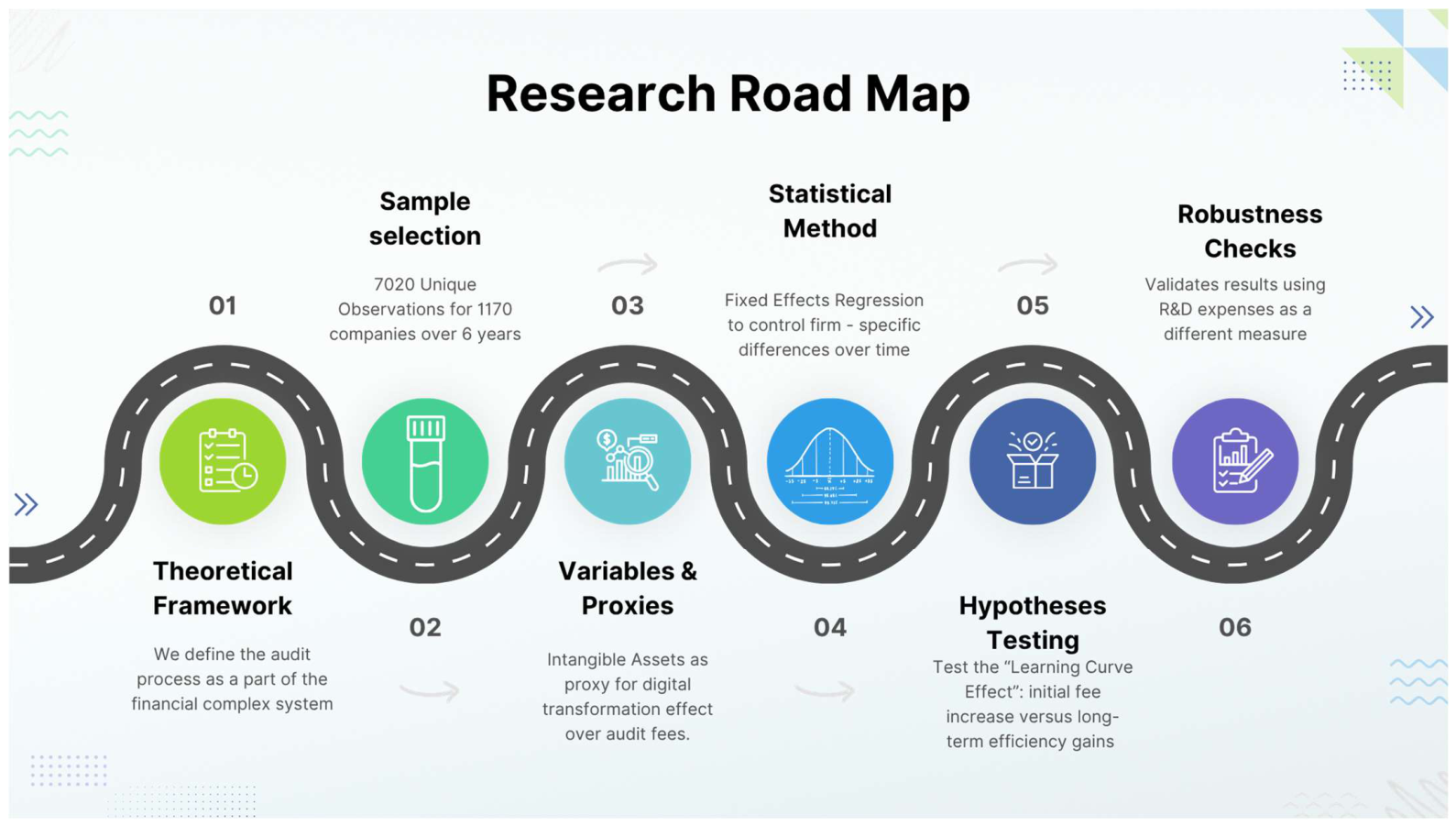
To ensure the transparency and replicability of our empirical analysis, we structured the research as a logical path in six fundamental steps, illustrated in
Figure 1.
Previous research on the relationship between digital transformation and audit fees has yielded inconsistent results, mainly due to a static focus that overlooks the temporal dynamics of technology adoption. While some studies emphasize the demand for higher fees, driven by risk, others point to efficiency gains on the supply side. We address these inconsistencies using longitudinal panel data that capture the transition from the point of adaptation to long-term efficiency. Examining this relationship within the European harmonized audit framework, country-specific aspects were considered while maintaining regulatory consistency. This provides a generalizable explanation of how auditors progress along the digital learning curve.
The sample was selected from non-financial listed companies in Europe, with audit information data downloaded from the Audit Analytics database and financial data extracted from the Orbis database. The aforementioned databases are frequently used in the research community [
32,
58,
59]. The reference period was 2016–2023, the period in which the auditors’ report format includes the key audit matters section [
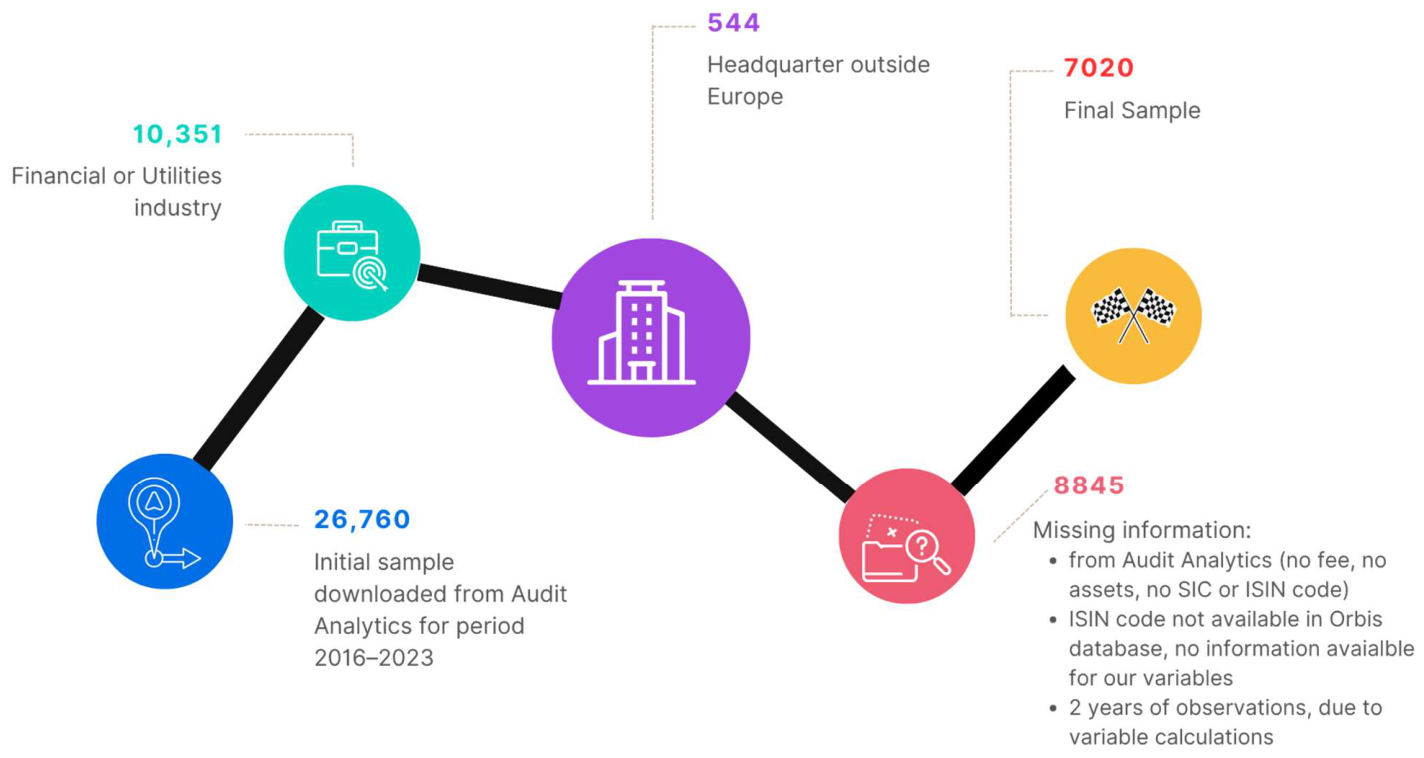
50]. The initial sample consisted of 26,760 observations. In the first stage, we eliminated the financial and utilities industries because they are subject to a more complex legal environment [
60], as well as companies outside Europe. Even if large assets are a characteristic of the financial and utilities industries, they are usually easier to audit than other activities implying higher inventories, receivables, or knowledge-based assets [
61]. Including financial and utilities industries in the sample can increase the effect size of the results, which are outliers in terms of their size and complexity. In the next step, only companies with available information for the entire period under review were included in the sample; thus, 8845 observations were eliminated.
The final sample consisted of 7020 observations from 1170 companies, for the period 2018–2023. The large sample provides the statistical power needed to overcome the limitations of country-specific studies.
The sample construction can be observed in
Figure 2.
As we can see from
Figure 2, one of our difficulties was compiling the data from two different databases, which led to a significant reduction in observations.
To test the hypotheses, we constructed the following regression model, using variables stated regarding audit fees and audit quality review studies [
12,
61]:
Different types of intangible assets are used as variables of interest (VOI) as used in studies measuring firm performance [
57]. First, we used the percentage of intangible assets in total assets as a proxy for asset structure [
57]. Secondly, we used the increase (or decrease) in intangible assets as a variable of interest, considering the increase as an introduction of new processes or software. Our third hypothesis was tested using the increase in intangible assets in the prior year, considering that a one-year frame could be enough that auditors will adapt to new digital transformations. Considering the limits of public data, where direct investments in technology are not standardized when reported, we considered that the most relevant available indicator is IATA. In the proposed model, IATA functions as a quantifiable indicator of systemic disruptions. Intangible assets introduce a high degree of information entropy that requires increased audit effort in the initial phase. Subsequently, through the adaptation process described by the learning curve, the audit team reduces this entropy being associated with cost optimization starting from the second year.
In the model, we have included audit quality measures proxied by restatements and discretionary accruals [
62,
63,
64,
65] calculated using the Jones Model [
18]. Both measures mentioned are outputs of the audit process, restatements appear when significant errors were included in previous reports, and discretionary accruals are considered unusual accrual changes, compared with previous years. The discretionary accruals are calculated using prior year figures for total assets and revenues. Also, one of our variables of interest (IATA_increase_t − 1) was calculated using a two-year lag. Lagging of variable (t − 1) was specifically applied to reduce the risk of simultaneity and reverse causality, providing a clearer perspective on the sequentiality of events.
We also included audit and firm-related control variables in the model. We have included in the model a dummy variable for auditors’ specialization (the auditor is considered a specialist if it has a higher proportion of fees in an industry, calculated as percent from auditor fees in total fees in industry) and a dummy variable for auditor size where 1 indicates that the service provider is one of the Big4 audit companies. To control audit-related influences, we have included in the model the difference between the year-end and audit report date (RepLag), if the auditor changed in the respective year (AuCh). For client-related control, we have used the total assets (TA), and the Leverage (Lev) for inherent risks as a size measure. We have transformed data using the natural logarithm instead of raw data for some variables to improve the linear relationship that those variables have with the audit fees.
The proposed regression model assesses the dynamics of the audit system through three key components. Inputs: Audit fees (lnFees) and auditor effort, influenced by the complexity of digital assets. Process: Technological adaptation and the learning curve of the audit team, measured by the variation in intangible assets over time (IATA_increase). Outputs: Reporting quality, monitored through indirect proxies, such as regularization commitments (ADAC) and restatements (Rest) (
Table 1).
We opted for panel data regressions using fixed effects (FE) and OLS regressions based on the results obtained from the Breusch–Pagan and Hausmann tests. Fixed effects control time-invariant factors, allowing us to isolate digital transformation and the subsequent adaptation process within the same entity. The FE model is usually more suitable, as OLS regression does not deal with sample heterogeneity. Standard errors were clustered at the firm level to control for autocorrelation and heteroscedasticity within the same entity. At the same time, the use of an extensive transcontinental sample overcomes the limitations of static cross-sectional studies, providing high external validity under the harmonized legal framework of the European Union. We also used the independent variable IATA with time lag to validate the Learning Curve model in the context of digitalization.
We used Stata Standard Edition (18.5) software developed by StataCorp LLC. (College Station, TX, USA) to test and statistically validate the hypotheses.
4. Results
4.1. Descriptive Statistics and Correlations Matrix
The descriptive statistics of variables can be found in
Table 2.
According to
Table 2, the mean value for lnFees is 12.6 and the standard deviation is 1.6. Similar results were obtained by Chang et al. [
32], with a mean of 13.3 and a standard deviation of 1.33. The nature of the sample (companies within 30 different European countries) explains a higher value for the standard deviation.
The assets’ structure has a mean of 8% intangible assets in the total assets of companies from the sample, with a maximum of 52%. The variations (in both forms) of different assets range from −0.8 to 6, with a mean close to 0.2 in both cases. To mitigate the potential bias from extreme values and ensure the robustness of the results, all continuous variables were winsorized at the 1st and 99th percentiles, according to standard econometric practices [
10,
66].
The mean value for discretionary accruals measurement is 0.2, and the standard deviation is 0.4. We have a small number of cases of restatements, with a mean of less than 1%.
In
Table 3, the correlation matrix of all variables is presented.
We can see that all the variables used in the model are significantly correlated to the audit fee, except the restatements, implying that they are properly selected for predicting dependent variable variation (
Table 3). The size (TA) presents a higher correlation with audit fees than other selected variables.
The highest correlation with the audit fees of audit-related control is the report lag. The correlation mentioned is negative, so the audit fees should be lower when the time needed for conducting the audit is less. Report lag has a decreasing effect on the audit fee, but a similar small effect is visible for auditor change.
We can observe that the relationship between audit fees and the asset’s structure is positive and significant, with a coefficient of 0.079, while the variance in intangible assets has a decreasing effect on the audit fees. At first sight, there are some clues that indicate that a more complex structure (with more intangible assets) could lead to higher audit fees, but variances in intangible assets could reduce the audit fee.
Absolute discretionary accruals have a significant positive impact on audit fees with a coefficient of 0.43, but even if the restatements have a positive impact, this is not significant. That could be explained by the small number of restated financial statements in the sample. The specialization of auditors can also increase audit fees.
4.2. Regression Results
Fixed effects regression and OLS results are presented in
Table 4. The first three columns represent fixed effects regression results, while the last three columns represent OLS regression results. The model predicts audit fees variation well enough with an overall R
2 value of 0.24 (for FE regression) and average R
2 score value of 0.76 (OLS regression). Also, VIF was calculated and as the maximum level obtained was 1.81 and the mean is 1.19, it can be considered that multicollinearity is not a serious concern.
All the variables’ influences are significant, except for discretionary accruals. As a general observation, client’s related attributes have a higher predictive value than audit-related attributes.
As can be observed in
Table 4, the only differences between the models are the type of regression used (fixed effects for 1, 2, and 3 and OLS for 4, 5, and 6) and the VOI proxy (asset structure in 1 and 4, variance in current year for 2 and 5, and variance in previous year in 3 and 6). We have decided to add the OLS regression because we are analyzing the sample with a general view, but we are also interested in the variation for each entity. The sample contains entities from different industries, so they can be structurally different, and the fixed effect model corrects the structural differences between entities, so we could analyze the evolution in time.
For the structure of assets (models 1 and 4), when fixed effects regression is used, the results state that the impact on the audit fees is positive, being associated with an increase, but this is not significant. At the same time, OLS regression will indicate a positive impact on the audit fees, concomitant to an increase. If the intangible assets minus goodwill reported to total assets’ rapport increases by 1%, it might lead to an increase in audit fees by 0.191 units. There is a highly probable correlation between asset structure and audit fee. Overall, entities with a structure of assets inclined to the intangible are more expensive to be audited. The results presented in
Table 4 indicate mixed evidence for H1. In the OLS regression (Model 4), the coefficient for IATA is positive and highly significant (1.039), suggesting that, across the European context, companies with a higher share of digital assets pay higher audit fees, highlighting the structural complexity of these entities. However, in the fixed effects model (Model 1), although the sign remains positive, the coefficient loses statistical significance.
The lack of significance in the FE model for the static variable IATA can be explained by the small variation in the time of the asset structure in the sample of companies selected for the 6 years. However, the hypothesis is supported longitudinally for the dynamic variables: the variation in intangible assets (IATA_increase_t and IATA_increase_t − 1) is significant in the FE model. The results demonstrate that auditors react immediately to the digital transformation process within the same company. Therefore, we consider H1 to be partially supported.
When we look at the variance in intangible assets, we can observe an increase in the audit fee, which is significant only in fixed effects regression. Our second hypothesis is confirmed (H2). Changes in intangible assets’ structure correlate with higher audit fees in the first year. The reason could be that audit teams need to adapt to processes, systems, and other intangible assets, which could consume more resources on the auditor side. Anyhow, the audit fees start to decrease when the variance in intangible assets from the prior year was used.
The third hypothesis is confirmed (H3), which means that reporting process implementations or investment in new systems and programs are associated with a decrease in costs for auditees, but only after an adaptation period. The results obtained indicate a negative association between past intangible assets and current fees, suggesting a possible cost optimization after a period of auditor adaptation.
While discretionary accruals do not significantly impact the audit fees, restatements in financial reporting are associated with higher audit fees, but when the evolution in time is measured, the association is negative. Restatements could appear because of complexity, but an error which is corrected could increase the trust in auditees.
From the data processing, we can see the sign reversal of the restating variable (Rest). In the OLS models (4, 5, and 6), the coefficient is positive and significant, indicating that, across the sample, companies that restate their financial statements tend to pay higher audit fees. However, in the fixed effects models (1, 2, and 3), which control for invariant firm characteristics, the impact of restatements on the temporal evolution of fees becomes negative.
Client communication is important in auditors’ work, so when the partners are trustworthy, the relationship is stronger. Industry specialization is associated with higher audit fees, which is in line with prior studies stating that Big4 or industry specialists are charging fee premiums for higher audit quality [
15], even if some studies stated that specialization is not necessarily related to higher quality [
26]. The auditor change is impacting the audit fees in a negative manner, which can mean that the auditor can be changed when the service provider is offering smaller fees. Of course, we must mention that Big4 companies provide services for 73% of the auditees from our sample.
While the reporting lag is associated with smaller fees, when the evolution in time is analyzed, the effect becomes positive. The OLS result is opposite to the results obtained by Zhang et al. [
15]. We can assume that big auditees are prioritized when the auditor makes the plan in resource allocation. Smaller and less complex clients could be left for the end of the busy season if the work needed could be done in less time.
Leverage effect is significant and positive, similarly to prior studies. Higher financial risk is associated with higher fees [
65,
67,
68].
4.3. Robustness Test
To test the robustness of the model, we replace the main proxy (IATA) with capitalized research and development (R&D) expenditures as an alternative measure of a firm’s digital transformation. R&D-based innovation often generates complex intangible assets, which require additional audit effort and increase valuation risk. We addressed potential endogeneity issues through two strategies: (1) using fixed-effects (FE) regressions to control for time-invariant factors that could simultaneously influence R&D expenses and (2) including a robust set of control variables to reduce the risk of missing relevant variables.
The results of our analysis are presented in
Table 5. The model used is presented in Equation (1), LnRD being in this case the variable of interest.
Table 5 includes the results of fixed effects regression (1) and OLS regression (2). This distinguished category of intangible assets is associated with an increase in audit fees in our second regression, and the impact is not significant in our first regression. While the OLS model shows that firms with high R&D expenses pay fee premiums, the FE model provides a conservative view of their evolution over time. The results remain consistent even when using different proxies for reporting quality (Modified Jones and Performance Adjusted models), confirming the validity of the proposed econometric model.
The OLS regression result is similar to those obtained in prior studies. Zhang et al. [
15] discussed in their study how R&D influences the ratio of intangible assets to total assets. Their results are significant and positive, but the coefficient is lower in this case. The difference in variables presented in this study is that in our study, the goodwill was subtracted from the intangible assets before calculating the ratio. The sample used in this study contains more than 70 thousand observations for the period 2000–2019 for US companies, and was tested using an OLS regression.
The main model was constructed to include the variables with the greatest theoretical support as determinants of audit fees, ensuring a framework that is not affected by multicollinearity. Additional control variables were used exclusively to retest the model in the robustness analysis. This approach allowed us to confirm the stability of the sign and magnitude of our variables of interest, demonstrating that the identified association between digitalization and audit fees is robust to alternative model specifications. Instead of absolute values for discretionary accruals, in our second set we have used original (signed) values of discretionary accruals (DAC). We have replaced the industry specialist with a dummy variable for auditor size (Big4) [
15,
24]. Other variables included were a dummy variable, for reporting the year end date, where 1 represents the entities with a different end for the reporting period than the end of December (Not Busy Season—NBS) [
15]; dummy variable for the opinion type where 1 means a modified opinion (Opinion) [
66]; inherent risk (IR) calculated as (inventory + accounts receivables)/total assets [
69,
70]; and return on assets (ROA) [
21]. We have kept in our regression the VOI (IATA/IATAIncrease_t/IATAincrease_t − 1) and the logarithm for total assets as a measure of the entity’s size (TA). To mitigate the potential bias from extreme values and ensure the robustness of the results, all continuous variables were winsorized at the 1st and 99th percentiles, according to standard econometric practices [
10,
66].
The results of additional robustness test are presented in
Table 6.
Even if the coefficient values for our VOI are not the same, the results are consistent in sign and significance. The DAC and Opinion indicators are only validated in the OLS model, with the correlation being negative. Big4 is validated in all models at different significance levels with a direct relationship with the variables of interest. The correlation of VOI with IR is negative and significant in all models similar to those in the literature [
69,
70]. Only in the OLS model are the correlations of VOI with NBS (positive) and with ROA (negative) significant.
5. Discussion
Stakeholders’ theory argues that entities can shape their operating environment by prioritizing transparency and integrity [
45]. Stakeholders’ influence is seen as a form of system that enhances environment complexity. The reporting system includes feedback between auditors and auditees, and the audit fee is shaped under the effects of that feedback.
Audit fees have also been studied in relation to intangible assets by Prabhawa and Nasih [
71]. The research was based on the risk management component of the relationship and used the natural logarithm of intangible assets as the variable of interest. Based on a sample of Indonesian listed companies from 2010 to 2018, the research results showed a positive and significant correlation between the studied variables.
The literature provides information that auditors who specialize in digitalization will require a special premium for their skills [
2]. Intangible assets are related to firm value estimate challenges and higher litigation risk for auditors [
17,
71].
The correlation between asset structure and audit cost is explored in an innovative way by Gao et al. [
72], who analyzed the impact of trade secrecy protection on fees. The authors show that more rigorous protection of these assets attracts higher audit fees, as auditors have to make additional efforts to verify the validity and risk assessment of these complex intangibles [
72]. This result validates our hypothesis (H1) that a high share of digital assets increases the basic audit effort due to inherent risk and structural complexity.
While the results regarding the structure of assets are in line with the prior literature [
2,
15,
17,
69,
73], this study goes beyond, analyzing the evolution in the time of the relationship between auditors and auditees from a cost perspective, which is our original contribution to the literature.
The results obtained highlight a two-phase systemic adaptation to digital transformation. In the first phase, the growth of intangible assets disrupts the system, increasing the complexity and inherent risk of financial data flows. This stage requires an additional allocation of human and technological capital from the audit subsystem to calibrate to the new client structure, which explains the increase in fees (H2). However, the confirmation of H3 demonstrates a long-term systemic optimization. As the audit team progresses through the learning curve, digital tools are effectively integrated into the management and accounting systems. Thus, the system reaches a new equilibrium point, where the assimilated technological efficiency is associated with a reduction in resources consumed and, implicitly, audit costs.
Although the ADAC variable is not statistically significant in our regression model, we chose to retain it because of its fundamental theoretical importance. The inclusion of ADAC is necessary to control the quality of the financial output, given that auditing is a subsystem of the reporting process. Through this approach, we ensure that the observed impact of digital transformation on audit fees is not influenced by auditor efforts to manage the risks associated with the manipulation of financial results, thus providing increased systemic validity to the econometric model.
The divergence of the sign of the Rest variable reflects two distinct dimensions of the monitoring process within the audit subsystem. The positive coefficient in the OLS model highlights that restatements are perceived cross-sectionally as an indicator of high complexity and inherent risk. Firms with past financial errors require more rigorous audit procedures and an increased allocation of resources to increase reporting transparency, which justifies an additional fee. The negative coefficient in the fixed-effects model suggests that once a firm goes through the process of correcting an error (restate), transparency improves and the auditor’s confidence in management’s honesty increases. From a systemic perspective, the act of restatement functions as a feedback loop that reduces informational entropy. After removing the initial uncertainty through correction, the auditor may perceive a lower residual risk, allowing for a downward recalibration of effort and, implicitly, fees in subsequent years.
The results of retesting the model with an alternative set of control variables (DAC, Big4, NBS, Opinion, IR and ROA) demonstrate a consistency of the empirical evidence. The robustness of the model to changing proxies for reporting and auditor quality suggests that the identified associations are not driven by circumstantial factors, but reflect a systemic process of auditor adaptation to the complexity of intangible assets.
A summary of our results can be found in
Table 7.
This study makes a significant contribution to the literature by moving from a mechanistic view of audit pricing to a systemic complexity paradigm. While previous research has often provided inconsistent results regarding the impact of intangible assets on audit fees, the study addresses this discrepancy by capturing the temporal dynamics of technology adoption.
Summarizing the contributions of the aforementioned research, the current research addresses an important gap: while digitalization promises improved governance [
48], it initially introduces high information entropy related to the complexity of new intangible assets [
71]. Our study extends this logic by associating the learning curve effect with the audit fees, to reflect this transition from initial systemic disruption to long-term resource optimization.
6. Conclusions
Audit fees were investigated in a large amount of research. We analyzed the way in which digitalization impacts audit fees. A more digital asset structure could be considered more difficult to understand by financial users, which could lead to higher costs in monitoring financial activity, translating to higher audit fees. One of the digitalization effects is to decrease costs, so we consider that an increase in intangible assets could lead to smaller costs of audit fees, but as the implementation period could lead to potential errors and adaptability costs, we assume that a higher increase in intangible assets in the current year would lead to higher audit fees. We also expect that starting with the second year, audit fees will decrease, correlated with an increase in intangible assets in the prior year. As our study is observational, we cannot confirm causality, only association.
The first hypothesis stated that the structure of assets (intangible assets divided by total assets) impacts the audit fee. The results support the hypothesis, as a higher portion of intangible assets in the total assets is associated with higher fees, but only in OLS regression, with FE results being insignificant.
We also considered the increase in intangible assets in our study. We considered that higher increases in intangible assets in the current year are connected to increases in audit fees. The hypothesis was validated in the FE model, as the audit fees increased with an increase in intangible assets, while OLS results were not significative. We have also tested if an increase in intangible assets in the prior year had an effect on decreasing audit fees. The assumption is correct; our results support this hypothesis. We conclude that digitalization measured by intangible assets variance decreases audit fees, but at first sight, a learning or adaptation period for auditors is needed for audit fees to be decreased.
The results indicated that digital transformation has a dual effect on the audit fees. A more intangible asset structure is associated with an increasing effect on the audit fees, but ultimately, the increase in intangible assets is correlated to a decrease in fees only after the audit team navigates the learning curve.
This study contributes to systems science by demonstrating that digital transformation functions as a driver of systemic evolution. Although the introduction of new technologies initially increases complexity and costs (system entropy), adaptation mechanisms—described here by the learning curve—allow the audit system to reach a state of superior efficiency. We contribute to the literature by analyzing the digitalization impact of audit fees on a large sample of European countries.
We conclude that digitalization not only reshapes the business relationship but also optimizes the functioning of the entire corporate governance system in the long term. Digital transformation is not just a technological upgrade, but also a reconfiguration of the internal structure of the audit system. Our study provides evidence that it ultimately leads to more efficient and sustainable monitoring practices, ensuring the long-term resilience of financial markets.
Despite the use of an extensive set of control variables in the robustness analyses, we acknowledge certain inherent limitations. The proxies used, although validated by the literature, mainly capture structural and financial dimensions, potentially omitting the technological expertise of auditors or the qualitative nuances of audit opinions.
Potentially omitted independent and control variables are a limitation of our study, as all empirical models suffer from this problem to some extent. Although our study uses a robust panel methodology with fixed effects, the interpretation of the results must be made in the context of potential omitted variables that could influence the dynamics of audit fees. Possible variables that could have been used, if more data had been available, include governance aspects, audit committee effectiveness, cybersecurity risks, and financial reporting comparability.
We also used public information obtained from secondary data sources (databases), thus leading to missing information for some companies or compilation errors, which needed to be excluded from the sample. The study identifies the effect of intangible assets only on a short period, but the sustainability in time should be investigated in the future.
Further research could use textual analysis to extract the frequency of words associated with digitalization as a different proxy for digitalization. Another research direction may be to conduct a sample analysis by industry or country. The impact of technology on the relationship between the degree of digitalization and supplier pricing decisions could also be analyzed from other financial services providers’ perspectives. Furthermore, the literature would be enriched with studies developing experimental designs to test the causality, not only association.