Article

Exploring the Entrepreneurial Behavior of Commercial Aerospace Enterprises Within the Chinese Aerospace System: A Combination of PLS-SEM and FsQCA Methods


1
Faculty of International Tourism and Management, City University of Macau, Macau 999078, China
2
Department of Business Administration, Shanxi Polytechnic College, Taiyuan 237016, China
3
School of Business, Nanfang College, Guangzhou 510970, China
*
Authors to whom correspondence should be addressed.
Systems 2026, 14(5), 584; https://doi.org/10.3390/systems14050584
Submission received: 16 April 2026 / Revised: 11 May 2026 / Accepted: 18 May 2026 / Published: 20 May 2026
(This article belongs to the Section Systems Practice in Social Science)

Abstract

The growth of commercial aerospace enterprises (CAEs) has injected new vitality into the entire aerospace system. Nevertheless, there remains a research gap concerning the entrepreneurial behavior of these enterprises, which is primarily driven by commercial demands and technological innovation. Drawing on network embeddedness theory and complex system theory, this study proposes a conceptual framework that links the structural and relational embeddedness of aerospace system subnetworks to entrepreneurial behavior, while examining the mediating roles of perceived organizational resilience and perceived environmental uncertainty. The moderating role of transformational leadership is evaluated using the trait activation theory. A two-phase quantitative design was employed, combining Partial Least Squares Structural Equation Modeling (PLS-SEM) and fuzzy-set Qualitative Comparative Analysis (fsQCA). Empirical analysis using a sample of 265 CAEs in China revealed several key findings: (1) the structural position of CAEs within the aerospace system network, along with informational resources formed through relationships, can enhance perceived organizational resilience and reduce perceived environmental uncertainty, thereby promoting entrepreneurial behavior; (2) entrepreneurs’ transformational leadership can effectively enhance the positive relationship between perceived organizational resilience and their entrepreneurial behavior; (3) two distinct configurations lead to high entrepreneurial behavior among CAEs. The study concludes with corresponding theoretical and practical implications.

1. Introduction

The development of commercial aerospace enterprises is serving as a transformative force, profoundly driving the evolution of the aerospace industry from a state-led model toward a diverse commercial ecosystem [1,2]. This shift has reconfigured the industry into a complex system embedded within multiple overlapping networks, such as supply chains, industrial clusters, and innovation communities, where traditional boundaries are increasingly blurred [3]. Existing research recognizes that the behavior of commercial aerospace enterprises is influenced by a confluence of factors, including their network position, resource endowment, and external environment [4]. However, prior studies have predominantly examined these factors in isolation or treated the enterprise network relationship as a static determinant of outcomes. A significant and unresolved gap lies in understanding the micro-psychological and cognitive mechanisms through which enterprises interpret their embedded network conditions and translate these structural and relational realities into concrete entrepreneurial actions. Specifically, it remains unclear how an enterprise’s position and ties within the aerospace system network shape its perceptions of its own capabilities and the external environment, which in turn drive entrepreneurial behavior. This cognitive translation process between network structure and strategic action is critically under-theorized. Therefore, this study aims to explore a core research question: How does the embeddedness of commercial aerospace enterprises within the aerospace system network influence their perceptions of organizational resilience and environ-mental uncertainty, and ultimately drive their entrepreneurial behavior?
To address this gap, this study integrates network embeddedness theory with complex systems theory. This integration moves beyond prior work that combines network and behavioral perspectives by providing a multi-level, process-oriented framework [5]. It explicitly links the meso-level structural properties of networks to the macro-level dynamics of the industry as a complex system, and crucially, channels this link through the micro-level cognitive perceptions of entrepreneurs. Network embeddedness theory provides the foundation for analyzing how an enterprises’ structural and relational position within socio-economic networks affects its access to critical resources and information [6,7,8]. Yet, strategic action is not a direct output of structure; it is filtered through managerial cognition of the systemic context [9]. Complex systems theory views the aerospace industry as a dynamic and adaptive system [10,11], which highlights two key entrepreneurial perceptions that act as critical filters: perceived organizational resilience, defined as an internal assessment of adaptive capacity [12], and perceived environmental uncertainty, understood as an assessment of external dynamism [13]. The novelty of our framework lies in theorizing these perceptions as the pivotal mediating constructs that translate embeddedness into action, a pathway not systematically elaborated in earlier research.
Furthermore, this study introduces transformational leadership, grounded in trait activation theory [14], as a key boundary condition. This addresses another underexplored aspect: how internal leadership can activate or suppress the influence of cognitive perceptions on behavior, thereby explaining heterogeneous entrepreneurial responses to similar network conditions. Thus, this study constructs an integrated framework to examine how structural and relational embeddedness influence entrepreneurial behavior through the mediators of perceived resilience and uncertainty, and how transformational leadership moderates these mediated paths. In doing so, this research seeks to make two key contributions. Theoretically, it offers a more precise and mechanistic model to bridge the network–behavior divide in entrepreneurship literature, particularly for complex, high-tech industries. Practically, it provides insights for managers on leveraging network positioning and for policymakers on fostering ecosystem conditions that enhance entrepreneurial cognition and action. To achieve this, a two-phase quantitative research design is adopted, combining PLS-SEM and fsQCA to analyze data from 265 commercial aerospace enterprises in China. Through this design, the study aims to: (1) uncover the mediating mechanisms linking network embeddedness to behavior; (2) clarify the moderating role of transformational leadership; and (3) identify multiple equifinal pathways leading to high entrepreneurial activity.

2. Literature Review and Hypothesis Development

2.1. Aerospace System and Networks

The aerospace system constitutes a complex technological assemblage comprising the equipment, facilities, organizations, knowledge, and personnel essential for space activities [15,16]. Traditionally, it has been characterized as a state-led, mission-oriented, and hierarchically organized closed system [17], with its core consisting of launch vehicles, spacecraft, launch sites, tracking, telemetry, and command networks, as well as supporting R&D and production infrastructures [15,18]. The operation of such a system has historically relied heavily on planning directives and administrative coordination, marked by exceptionally high technological barriers, long investment cycles, and concentrated risks [15,19].
Driven by technological advances and policy liberalization, the aerospace system is undergoing structural evolution, increasingly differentiating into multiple interrelated yet functionally distinct networks [2]. These include research and development (R&D) collaboration networks focused on key technological breakthroughs, supply chain and manufacturing networks centered around core enterprises, and industrial clusters formed through geographical agglomeration or innovation-chain cooperation [20]. Furthermore, Social networks, including strong ties based on kinship and weaker ties with other enterprises and institutions [21], also play a significant role in information flow and resource integration. These networks are not isolated; rather, they are nested within the broader space system, collectively forming a multi-layered, dynamically evolving complex network ecosystem that provides the structural context for the actions of various participants.

2.2. Commercial Aerospace Enterprises and Entrepreneurial Behavior

A commercial aerospace enterprise is a market-oriented legal entity that generates profit by providing aerospace products, technologies, or services [22]. Compared to traditional state-owned aerospace institutions, such enterprises typically demonstrate greater flexibility and innovativeness in organizational structure, financing models, technological pathways, and market strategies [23]. Their core entrepreneurial activities involve identifying and leveraging opportunities for technology commercialization in the aerospace sector, engaging in innovation that includes the development of new launch vehicles, the expansion of satellite application services, and the exploration of space resources [24]. According to a report by Xinhua News Agency, China’s state news agency, an official from the China National Space Administration stated that the number of commercial aerospace enterprises in China has now surpassed 600 [25]. The emergence and scaling of such enterprises signal a shift in space activities from purely state-led projects toward a diverse and dynamic commercial system.
The entrepreneurial behavior of commercial aerospace enterprises is driven and constrained by multiple factors. On one hand, it is shaped by the enterprise’s own resource endowments [26]. In particular, an enterprise’s position and relational ties within the aerospace industry network serve as key channels for accessing critical technologies and market information [27]. How an enterprise strategically builds, embeds itself in, and utilizes these networks to overcome resource constraints represents a key variable in its entrepreneurial success [28]. On the other hand, entrepreneurial behavior is also profoundly influenced by internal resilience conditions, such as the ability to withstand risks [29], and external environmental factors, such as aerospace policies and regulations [30]. Therefore, understanding the mechanisms of entrepreneurial behavior in commercial aerospace requires theoretical perspectives with greater explanatory power.

2.3. Theoretical Framework

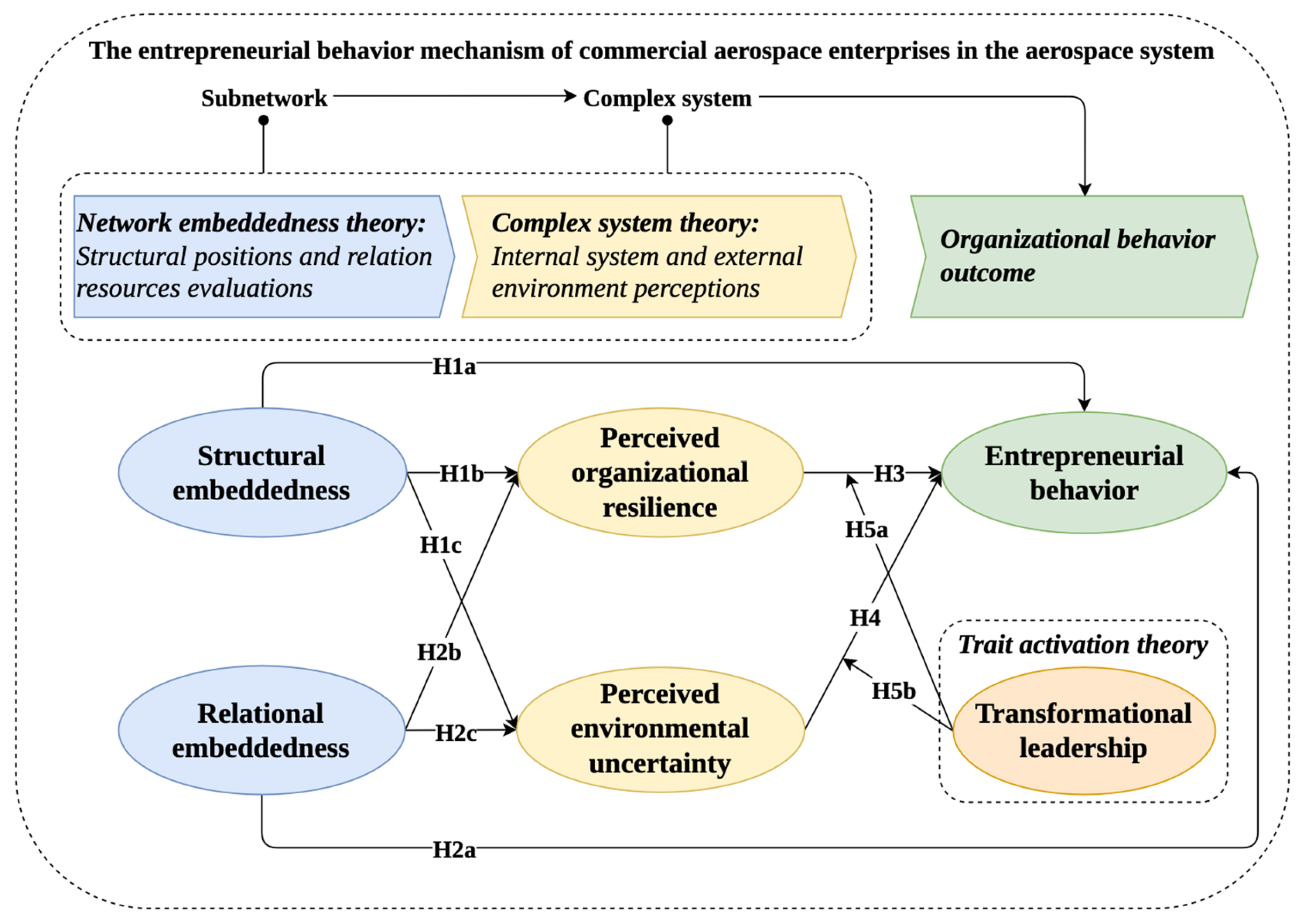
To elucidate how the structural and relational conditions of an enterprises’ network environment translate into entrepreneurial action, this study develops an integrated framework anchored in network embeddedness theory, complemented by complex systems theory and trait activation theory. Each theory addresses a distinct level of analysis and a specific part of the causal chain.
Network embeddedness theory serves as the foundational meso-level lens for this study. It conceptualizes enterprises not as isolated actors but as entities whose economic actions and outcomes are shaped by their positions within and the nature of their ties to a broader socio-economic network [6]. This theory is central because the commercial aerospace sector is inherently collaborative and network-dependent [8]; an enterprise’s access to critical resources, information, and legitimacy is fundamentally mediated by its network relationships [7,9]. This study focus on its two core, complementary dimensions: structural embeddedness refers to the pattern of connections in the network, which influences the breadth and non-redundancy of information and resource flows accessible to an enterprise [31]; relational embeddedness, in contrast, concerns the strength and consistency of ties between entities, emphasizing the role of trust, reciprocity, and the emotional bonds formed through these relationships [32].
While network embeddedness theory explains the situational antecedents, it does not fully explain how these structural conditions are subjectively interpreted by decision-makers to motivate action. This requires a macro-level context and a micro-level psychological bridge. Complex systems theory provides the necessary macro-level context. It frames the commercial aerospace industry as a dynamic, adaptive system composed of heterogeneous, interacting agents [33,34]. This perspective shifts the focus from static network features to the systemic conditions that enterprises must navigate—namely, volatility, interdependence, and emergent change. Its key role in our framework is to conceptualize the critical cognitive filters through which entrepreneurs interpret their networked situation: perceived environmental uncertainty, which captures their appraisal of the dynamism and unpredictability of the external system [35]; and perceived organizational resilience, which captures their assessment of their enterprises’ capacity to adapt and persist within that system [36]. Thus, complex systems theory allows us to theorize that network embeddedness influences behavior not directly, but by first shaping these pivotal entrepreneurial perceptions of the system.
Trait activation theory provides the crucial micro-level link from perception to action. It posits that individuals’ behavioral traits are expressed in response to relevant situational cues [37]. In the context of this study, the perceptions of resilience and uncertainty constitute the salient situational appraisal. Transformational leadership, characterized by the ability to inspire, intellectually stimulate, and motivate towards a vision, is introduced as a key entrepreneurial trait [38]. The role of this theory is to specify the boundary condition: it moderates the strength of the relationship between perceptions and behavior. A transformational leadership style is hypothesized to amplify the behavioral response to perceptions of resilience and mitigate the behavioral inhibition caused by perceptions of uncertainty. Therefore, this study’s integrated framework posits a multi-level causal pathway: an enterprises’ meso-level network embeddedness shapes entrepreneurs’ macro-level perceptions of their systemic context, which in turn, are activated into entrepreneurial behavior at the micro-level, contingent on the presence of transformational leadership. This addresses the core gap regarding how network conditions are cognitively processed and behaviorally enacted.

2.4. Hypothesis Development and Research Model

2.4.1. Influence of Structural and Relational Embeddedness

Structural embeddedness confers advantages that shape both entrepreneurial opportunities and entrepreneurs’ cognitive appraisal of their context. First, a central network position or one that bridges structural holes provides efficient access to diverse, non-redundant information flows [27]. This informational advantage enhances opportunity recognition, allowing enterprises to identify novel combinations of technologies or unmet market needs, thereby fostering entrepreneurial behavior. Second, centrality often signals legitimacy and status within an industry ecosystem [39]. This legitimacy advantage lowers the perceived cost and risk of new ventures, as stakeholders are more inclined to support a well-connected actor, further promoting entrepreneurship.
Regarding cognitive appraisal, structural embeddedness influences perceived organizational resilience. A well-connected enterprise can more rapidly access and recombine external resources—such as technical expertise, complementary assets, or financial backing—during disruptions [40]. The awareness of this resource mobilization capacity, stemming from one’s network position, strengthens the entrepreneur’s perception that the organization can withstand and adapt to shocks, enhancing perceived organizational resilience. Concerning environmental uncertainty, an enterprise embedded in the core of the network is more likely to receive early and varied signals about technological, regulatory, or market shifts from its multiple connections [41]. While the environment remains complex, this informational reach can provide a greater sense of predictability and control. Therefore, we argue that structural embeddedness tends to reduce entrepreneurs’ perceived environmental uncertainty, as it mitigates ignorance about the environment, though it may not eliminate inherent dynamism. Hence, the following hypothesis is proposed:
H1. 
Structural embeddedness positively affects (a) entrepreneurial behavior and (b) perceived organizational resilience but negatively affects (c) perceived environmental uncertainty.
Different forms of relational embeddedness within networks lead to variations in resource flows and enterprises’ control over these resources, which may influence entrepreneurial behavior [42]. The optimal functioning of a network relies on the complementary effects of both strong and weak ties [21]. Strong ties, such as those with family, relatives, or close friends, provide social resources, information, and emotional support. These facilitate the identification and selection of relevant information by commercial aerospace entrepreneurs, thereby improving their ability to manage network relationships and make better decisions [43]. Additionally, weak ties, which are characterized by connections with entities such as other companies, industry associations, and diverse organizations, enable the transmission of informational resources and thereby encourage entrepreneurial initiatives. Strong ties are rooted in kinship or deep emotional bonds, whereas weak ties are characterized by diverse, non-personal connections [21]. The synergistic combination of both—deep trust for execution and wide bridging for exploration—provides a robust relational foundation for entrepreneurial behavior. However, an over-reliance on strong, cohesive ties may also lead to network closure, insulating the enterprise from novel information and creating path dependency [42], a potential downside noted here but focusing on the net positive effect for hypothesis development. Thus, rather than merely pursuing a high number of connections, enterprises benefit from establishing high-quality linkages and cooperative partnerships [44].
The quality of relationships directly shapes perceived capabilities and environmental readings. Trust and reciprocity in relationships ensure that partners are more willing to share sensitive information, provide mutual aid during crises, and engage in joint problem-solving [45]. This relational security provides a buffer against disruptions, as entrepreneurs perceive they can rely on their key partners for support, thereby strengthening perceived organizational resilience. Furthermore, in a high-uncertainty environment, trusted partners act as critical filters and validators of ambiguous information [46]. Insights gained through reliable relationships are viewed as more credible, reducing the perceived ambiguity and complexity of the external world. Consequently, high relational embeddedness can help reduce perceived environmental uncertainty by providing a trusted channel for sense-making. Thus, the hypothesis is proposed:
H2. 
Relational embeddedness positively affects (a) entrepreneurial behavior and (b) perceived organizational resilience but negatively affects (c) perceived environmental uncertainty.

2.4.2. Perceived Organizational Resilience and Perceived Environmental Uncertainty

When entrepreneurs perceive a high level of organizational resilience, they develop stronger confidence in the enterprise’s ability to manage uncertainty effectively. This collective belief alters how they assess and respond to risky opportunities [47]. A systematically cultivated risk-taking culture helps reinforce such confidence, enabling the enterprise to sustain commitment to entrepreneurial projects even in uncertain environments. In the commercial aerospace network, for example, entrepreneurs’ perception of organizational resilience provides the psychological security needed to approve ambitious, high-risk initiatives [45]. The conviction that the organization can recover from potential setbacks encourages a more proactive entrepreneurial stance. Thus, the following hypothesis is proposed:
H3. 
Perceived organizational resilience positively affects entrepreneurial behavior.
In contrast, when entrepreneurs perceive high levels of environmental uncertainty, their attention tends to shift toward threat assessment, often at the expense of exploring entrepreneurial opportunities [48]. Such sustained vigilance focuses cognitive resources on immediate risks, leaving little room for creative thinking and pattern recognition, thereby hindering entrepreneurial initiative [49]. In the commercial space sector, entrepreneurs overly preoccupied with regulatory or technological shifts may overlook novel business models, ultimately restraining entrepreneurial action. Therefore, the following hypothesis is proposed:
H4. 
Perceived environmental uncertainty negatively affects entrepreneurial behavior.

2.4.3. The Moderating Role of Transformational Leadership

Transformational leadership is defined as a leadership style that inspires, motivates, and stimulates followers to achieve exceptional outcomes and innovate beyond expectations [50]. In the commercial aerospace network, where technical failures and regulatory obstacles are common, this leadership approach is particularly relevant. Transformational leaders reframe setbacks as manageable challenges rather than catastrophic failures, enabling more effective resource mobilization during crises [51]. Rather than viewing perceived organizational resilience merely as a means of survival, they treat it as a platform for entrepreneurial experimentation, utilizing recovery periods to explore new approaches and refine business models [52]. Through transformational leadership, perceived organizational resilience is thus converted into concrete opportunities for entrepreneurial development, motivating teams to sustain entrepreneurial engagement even under pressure.
Transformational leadership mitigates the negative impact of perceived environmental uncertainty on entrepreneurial behavior, primarily through enhancing tolerance for ambiguity and maintaining strategic persistence [53,54]. Transformational leaders remain focused on long-term objectives amid environmental fluctuations, reframing uncertainty as an opportunity rather than merely a threat [55]. At the cognitive and behavioral levels, they tend to adopt more adaptive approaches when dealing with ambiguous or threatening information [56]. For instance, faced with regulatory ambiguity or market volatility that might deter less confident leaders, entrepreneurs with transformational leadership can sustain their commitment to promising commercial aerospace projects. In doing so, they transform perceived uncertainty into a managed entrepreneurial process. Hence, the following hypothesis is proposed:
H5. 
Transformational leadership strengthens the positive relationships of (a) perceived organizational resilience on entrepreneurial behavior. Conversely, transformational leadership inhibits the negative relationship between (b) perceived environmental uncertainty and entrepreneurial behavior.
Figure 1 illustrates the hypothesized research model.

3. Methodology

3.1. Measurement Items and Pilot Study

To ensure the scale’s validity, all measurement items were mostly adapted from mature scales in previous studies. The four items to measure structural embeddedness were adopted from Xie et al. [31]. Relational embeddedness was measured by the items from Granovetter’s [6] framework of strong and weak ties and synthesizing insights from China-context studies by Bian [57] and Yang [58]. Perceived organizational resilience was based on the four-item scale of Mallak [59]. Perceived environmental uncertainty was measured by the items from Judge and Miller [60]. Transformational Leadership was measured using four items adapted from Carless et al. [61]. Entrepreneurial Behavior was measured using three items adapted from Reynolds [62] and Simsek [63]. This study controlled demographic variables (i.e., gender, age, education, years of work experience within the commercial aerospace network), totaling four items. All questionnaire items were graded on a seven-point Likert scale ranging from 1 (strongly disagree) to 7 (strongly agree). The measurement items for each construct are presented in Table A1.
This study was conducted in China. Therefore, we first adhered to the back-translation procedure to translate all measurement items from English to Chinese, ensuring conceptual equivalence and translational validity. Subsequently, the measurement items were validated in three stages. In the initial stage, a panel of 7 experts (including 2 professors specializing in innovation management, 2 senior researchers from the aerospace sector, and 3 doctoral candidates with relevant industry research experience) was invited to review the questionnaire. Their feedback focused on the clarity, contextual relevance, and comprehensibility of the items within the commercial aerospace network. Prior to participation, all experts were informed of the study’s purpose, assured of the confidentiality of their feedback, and provided verbal consent. In the second stage, after refining potentially ambiguous items based on the expert review, a small-scale pretest was administered (n = 30). The wording of the questions was further adjusted according to the participants’ feedback. The final stage involved a pilot study with a larger sample (n = 100) to finalize the instrument. Preliminary tests were conducted to assess the reliability and validity of the scales and the hypothesized relationships. As the results met the required psychometric thresholds, the finalized questionnaire was distributed for the main data collection.

3.2. Sampling and Data Collection

The sample selection process utilized a combination of purposive and snowball sampling techniques to obtain typical samples of the commercial aerospace enterprises. To ensure the relevance and quality of the data collected, this study established specific eligibility criteria for selecting participants from commercial aerospace enterprises. These criteria were designed to identify individuals with substantial experiential knowledge and decision-making authority. The criteria stipulated that eligible participants must: (1) be at least 18 years of age; (2) hold a founding, executive, or senior strategic decision-making role (e.g., Founder, Director, or Head of Business/Strategy/R&D) within a commercial aerospace enterprise; and (3) have a minimum of one year of direct experience in the commercial aerospace or a closely related high-tech sector. Adherence to these criteria was crucial for this study, as it ensured that the insights gathered were derived from informed and experienced professionals, thereby aligning the sample directly with the research purposes on leadership and management practices. All participants in the main survey provided informed consent electronically before proceeding to the questionnaire. The consent form clearly stated the study’s academic purpose, the voluntary nature of participation, the right to withdraw at any time without consequence, and the measures in place to ensure anonymity and confidentiality. Anonymity was protected by ensuring that no personally identifiable information (e.g., name, email, IP address) was stored with the survey responses. Confidentiality was maintained by aggregating data for analysis and storing the anonymized dataset on a password-protected secure server accessible only to the research team.
The purposive sampling phase began with the compilation of a list of commercial aerospace enterprises. This list was sourced from multiple channels: industry reports, professional networking platforms, conference proceedings, and the industry network of the third author, who actively participates in conferences within the commercial aerospace field. Within these enterprises, we identified individuals whose public professional profiles indicated they were likely to meet the eligibility criteria. Table A2 presents a brief introduction of an anonymized commercial aerospace enterprise from the sample. These qualified individuals were then contacted directly and invited to participate in the study by completing the online survey questionnaire. Subsequently, the snowball sampling technique was employed to expand the participant pool beyond those initially identified through purposive sampling. Upon completion of the survey, respondents were provided with an option to voluntarily refer other qualified colleagues or industry peers who also met the study’s eligibility criteria. All referrals were conducted in a manner that protected the anonymity of both the referrer and the referred party. This method proved highly effective in accessing a specialized and often hard-to-reach professional population, as personal referrals helped establish trust and considerably improved the survey response rate. The distribution of the questionnaire continued iteratively until a predetermined sample size, deemed sufficient for statistical analysis, was successfully achieved.
Between June 2024 and March 2025, survey data were initially collected from 312 commercial aerospace enterprises. To ensure data quality, a rigorous screening process was applied. Responses were removed if they (a) were completed in an unreasonably short time (less than half the median completion time), (b) showed clear straight-lining patterns, or (c) failed the attention check items embedded in the questionnaire. After applying these criteria, 265 complete and valid responses were retained for final analysis, yielding a valid response rate of approximately 85%. This sample of 265 respondents forms the basis for all subsequent analyses reported in this study. The 23-item measurement model necessitated a sample size of 115–230 respondents, aligning with Hair et al.’s [64] recommended observation-to-variable ratio of 5:1 to 10:1. The final sample of 265 exceeds the upper bound of this range, providing adequate statistical power for the PLS-SEM and fsQCA analyses. While a definitive official census of all commercial aerospace enterprises in China is not publicly available, the scale of the industry is evident. According to a report by Xinhua News Agency, China’s state news agency, an official from the China National Space Administration stated that the number of commercial aerospace enterprises in China has now surpassed 600 [25]. The sample, drawn from diverse sources, therefore represents a substantial and meaningful proportion of this emerging industry population, enhancing the credibility and contextual relevance of the findings.
All participants were based in China. To assess non-response bias, we compared early and late respondents on all study variables [65]. No significant differences were found, suggesting that non-response bias is unlikely to be a concern in this study. The demographic profile of the final sample (n = 265) is presented in Table 1. The data reveal a concentration of respondents in the 50–59 age bracket (73.6%). This distribution is consistent with the unique developmental trajectory of China’s commercial aerospace sector. The industry began to commercialize and open to private capital largely in the mid-to-late 2010s. A significant portion of its founding and senior talent therefore originated from the state-owned aerospace and defense ecosystem, where individuals accumulated decades of technical and managerial experience. Consequently, the high prevalence of leaders aged 50–59 is not an anomaly but a reflection of the industry’s specific historical and human capital context, where seasoned professionals with deep institutional knowledge and networks are pivotal. Participants were predominantly male (97.7%), reflecting the current gender demographics of the senior leadership and engineering ranks in this high-tech, heavy-industry sector. In terms of education, most held a Bachelor’s (49.4%) or Master’s degree (36.6%), with 14.0% possessing a Doctorate, underscoring the highly technically qualified nature of the sample. Regarding work experience within the commercial aerospace network, over half (57.0%) had 3–5 years of direct experience, aligning with the relatively recent formation of many private enterprises in this domain.

3.3. Data Analysis Methods

This two-phase study employs Partial Least Squares Structural Equation Modeling (PLS-SEM) and fuzzy-set Qualitative Comparative Analysis (fsQCA 3.0) to examine how network embeddedness shapes entrepreneurial behavior within the commercial aerospace sector. The mixed-methods design is justified by the complementary strengths of each approach. PLS-SEM is used to test the average net effects of the hypothesized relationships in the model, providing generalizable insights into the strength and significance of individual paths. Conversely, fsQCA is employed to uncover the complex causal configurations of conditions that are sufficient for the outcome, acknowledging that multiple, equifinal paths may lead to high entrepreneurial behavior. This combination allows for a more nuanced understanding that is both general and specific [66].
PLS-SEM was used to test the hypothesized relationships. This method was selected for several reasons aligned with our research objectives and data characteristics: (1) it is prediction-oriented, suitable for an exploratory study aiming to predict entrepreneurial behavior; (2) it makes minimal assumptions about data distribution, which is appropriate for our sample; (3) it can effectively handle complex models with multiple latent constructs, mediators, and a moderator, as in our study; and (4) it is robust with smaller sample sizes, though our sample of 265 is adequate [67,68]. Using SmartPLS 4.1.1.1, this study first assessed the reflective measurement model for reliability and validity. Then, bootstrapping with 5000 subsamples was performed to generate standard errors and confidence intervals for the path coefficients, allowing for a rigorous test of the direct, mediating, and moderating effects [69,70]. To assess common method bias (CMB), this study conducted Harman’s single-factor test. Additionally, variance inflation factor (VIF) analysis was performed to examine potential multicollinearity among the constructs.
While PLS-SEM effectively examines the average net effects between constructs, its symmetric, linear nature may not capture causal complexity—such as equifinality, conjunctural causation, and causal asymmetry [71,72]. To address this, fsQCA was applied in the second phase to analyze how different combinations of antecedent conditions jointly influence high entrepreneurial behavior. Following established procedures, we first calibrated the raw data into fuzzy sets, assigning membership scores between 0 and 1. The calibration used the direct method, with three qualitative anchors: full membership (75th percentile), the crossover point (50th percentile), and full non-membership (25th percentile). The analysis then involved constructing a truth table and applying logical minimization to derive sufficient solution configurations for the outcome (high entrepreneurial behavior). This study used a consistency threshold of 0.75 and a frequency threshold of 3 to ensure robust and meaningful configurations. The analysis distinguished between necessary conditions, which must be present for the outcome, and sufficient conditions, which are combinations of conditions that lead to the outcome. Together, the two-phase analytical strategy offers findings that are both generalizable and contextually nuanced, yielding practical insights for management in the commercial aerospace network. This methodological choice aligns with the growing application of fsQCA in entrepreneurship research. For instance, recent fsQCA studies have investigated topics such as national entrepreneurial attitudes and activity [73], the antecedents of opportunity-driven entrepreneurship within the context of sustainable development [74], and the role of open innovation ecosystem models in facilitating product innovation [75].

4. Findings and Discussion

4.1. Phase One: Verification of the Entrepreneurial Behavior Model

4.1.1. Measurement Model Assessment

As demonstrated in Table 2, all factor loadings were above 0.7. The average variance extracted (AVE) values varied from 0.671 to 0.701, each exceeding the 0.50 criterion [64]. Internal consistency and convergent validity were confirmed, with both Cronbach’s α and composite reliability (CR) ranging from 0.817 to 0.875, above the 0.7 threshold (Table 3). Discriminant validity was established, as inter-construct correlations did not reach the square root of the related AVE values [76], and all heterotrait–monotrait (HTMT) ratios were under 0.90 [77]. Harman’s single-factor test revealed no substantial common method bias, with variance accounted for at 32.702%—significantly lower than the 50% cut-off suggested by Fuller et al. [78]. Additionally, all variance inflation factor (VIF) values were below 5, indicating absence of multicollinearity.

4.1.2. Structural Model Assessment and Hypothesis Testing

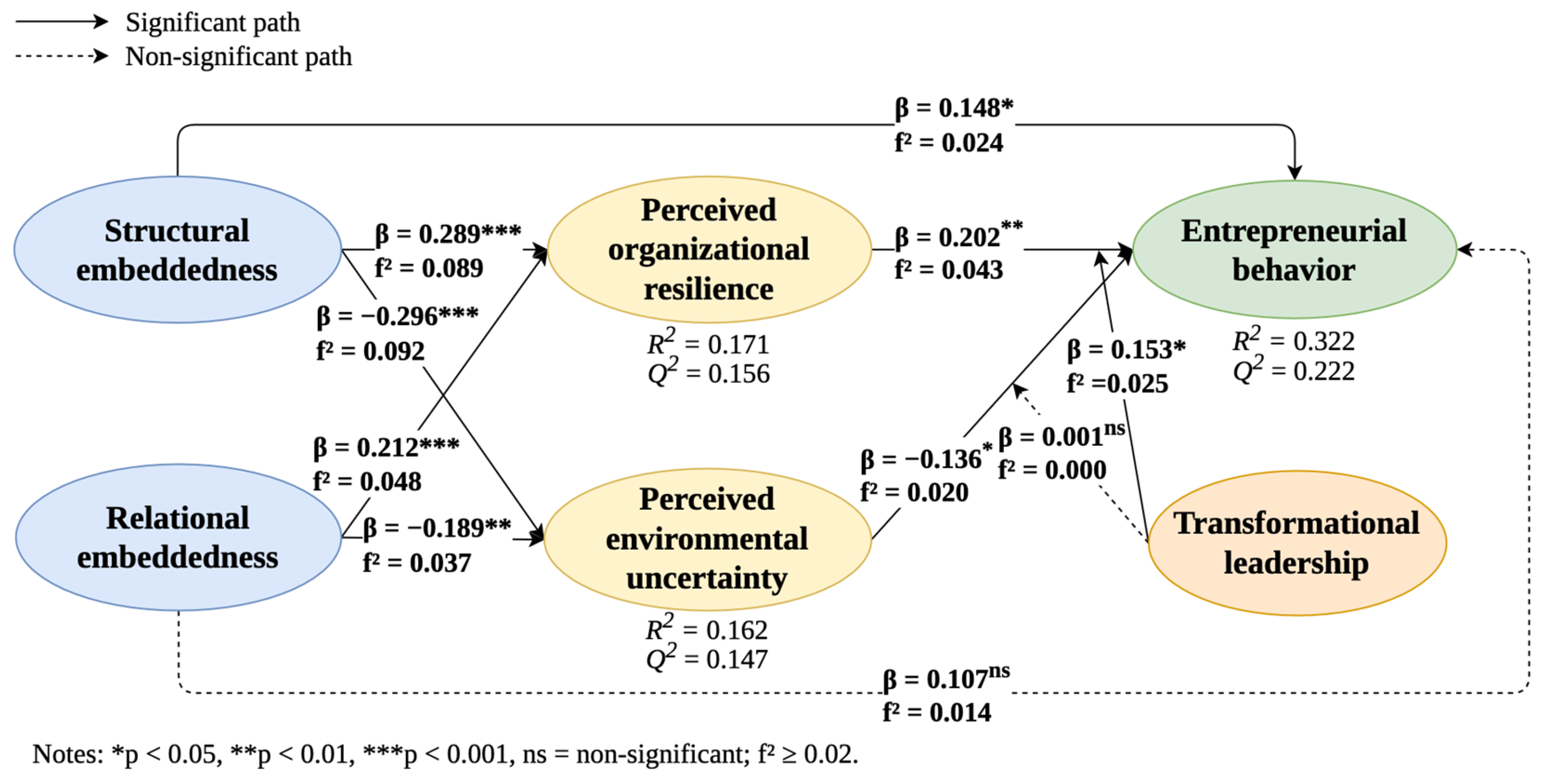
The direct path estimates are summarized in Figure 2. Structural embeddedness showed a significant positive effect on entrepreneurial behavior (β = 0.148, p < 0.05, f2 = 0.024) and on perceived organizational resilience (β = 0.289, p < 0.001, f2 = 0.089), while exerting a negative influence on perceived environmental uncertainty (β = −0.296, p < 0.001, f2 = 0.092), thus supporting H1. Relational embeddedness was positively associated with perceived organizational resilience (β = 0.212, p < 0.001, f2 = 0.048) and negatively associated with perceived environmental uncertainty (β = −0.189, p < 0.01, f2 = 0.037), supporting H2b and H2c, respectively. However, its effect on entrepreneurial behavior was not significant (β = 0.107, p= 0.087, f2 = 0.014); therefore, H2a was not supported. In the capital-intensive and highly regulated commercial aerospace sector, strong relational embeddedness may prioritize risk mitigation and compliance over the exploratory actions typically associated with entrepreneurial behavior. Furthermore, perceived organizational resilience positively affected entrepreneurial behavior (β = 0.202, p < 0.01, f2 = 0.043), confirming H3. Conversely, perceived environmental uncertainty had a significant negative impact on entrepreneurial behavior (β = −0.136, p < 0.05, f2 = 0.020), in support of H4.
Transformational leadership significantly strengthens the positive relationship between perceived organizational resilience and entrepreneurial behavior (β = 0.153, p < 0.05, f2 = 0.025), confirming H5a. However, transformational leadership does not significantly mitigate the negative relationship between perceived environmental uncertainty and entrepreneurial behavior (β = 0.001, p = 0.989, f2 = 0.000); thus, H5b is not supported. This may be attributed to the fact that, in the context of commercial aerospace entrepreneurship, environmental uncertainty is often perceived as an exogenous and dominant factor, whose constraining effect on entrepreneurial action may outweigh the moderating influence of leadership. As shown in Figure 2, the model explains a substantial proportion of variance in the endogenous constructs (e.g., R2 = 0.322 for entrepreneurial behavior). Critically, the Q2 values (all > 0.14) confirm that these relationships possess strong predictive relevance, while the f2 values indicate the presence of substantive effect sizes [79]. Additionally, the model shows a good fit, as indicated by a standardized root mean square residual (SRMR) value of 0.05, which is below the recommended threshold of 0.08.
Mediation analysis was conducted using 5000 bootstrap samples with 95% bias-corrected confidence intervals, in line with established guidelines for complex path modeling [80]. All reported indirect effects are statistically significant, as their confidence intervals do not include zero [81]. The results are presented in Table 4. Both structural (β = 0.246, 95% CI [0.131, 0.360], p < 0.001) and relational embeddedness (β = 0.176, 95% CI [0.052, 0.293], p < 0.01) exhibited significant total effects on entrepreneurial behavior in the commercial aerospace network. The analysis of specific indirect paths revealed that structural embeddedness exerts a positive indirect effect on entrepreneurial behavior through both perceived organizational resilience (β = 0.058, 95% CI [0.021, 0.103], p < 0.01) and perceived environmental uncertainty (β = 0.040, 95% CI [0.005, 0.081], p < 0.05). The total indirect effect of structural embeddedness was also significant (β = 0.098, 95% CI [0.052, 0.154], p < 0.001), accounting for 39.84% (0.098/0.246) of its total effect. Since the direct effect of structural embeddedness on entrepreneurial behavior remained significant, perceived organizational resilience and perceived environmental uncertainty each act as partial mediators in this relationship.
Similarly, relational embeddedness showed a significant indirect effect on entrepreneurial behavior through perceived organizational resilience (β = 0.043, 95% CI [0.012, 0.082], p < 0.05). The indirect effect through perceived environmental uncertainty was also statistically significant (β = 0.026, 95% CI [0.003, 0.059]), as the confidence interval did not include zero, even though the associated p-value exceeded 0.05. This interpretation is consistent with the bootstrap confidence interval criterion for determining significance in mediation analysis [82]. The total indirect effect of relational embeddedness was significant (β = 0.069, 95% CI [0.030, 0.116], p < 0.01), accounting for 39.2% of its total effect. Because the direct effect was not significant, both perceived organizational resilience and perceived environmental uncertainty act as full mediators in this relationship.

4.2. Phase Two: Fuzzy-Set Qualitative Comparative Analysis

4.2.1. Data Calibration and Necessary Analysis

Following established protocols [83], the data were first calibrated into fuzzy-set membership scores using fsQCA 3.0 software. This process transforms raw values into a continuous scale from 0 (full non-membership) to 1 (full membership), with 0.5 representing the point of maximum ambiguity [84]. Calibration employed the quartile method, where the 75th percentile, mean, and 25th percentile served as anchors for full membership, the crossover point, and full non-membership, respectively [66,85].
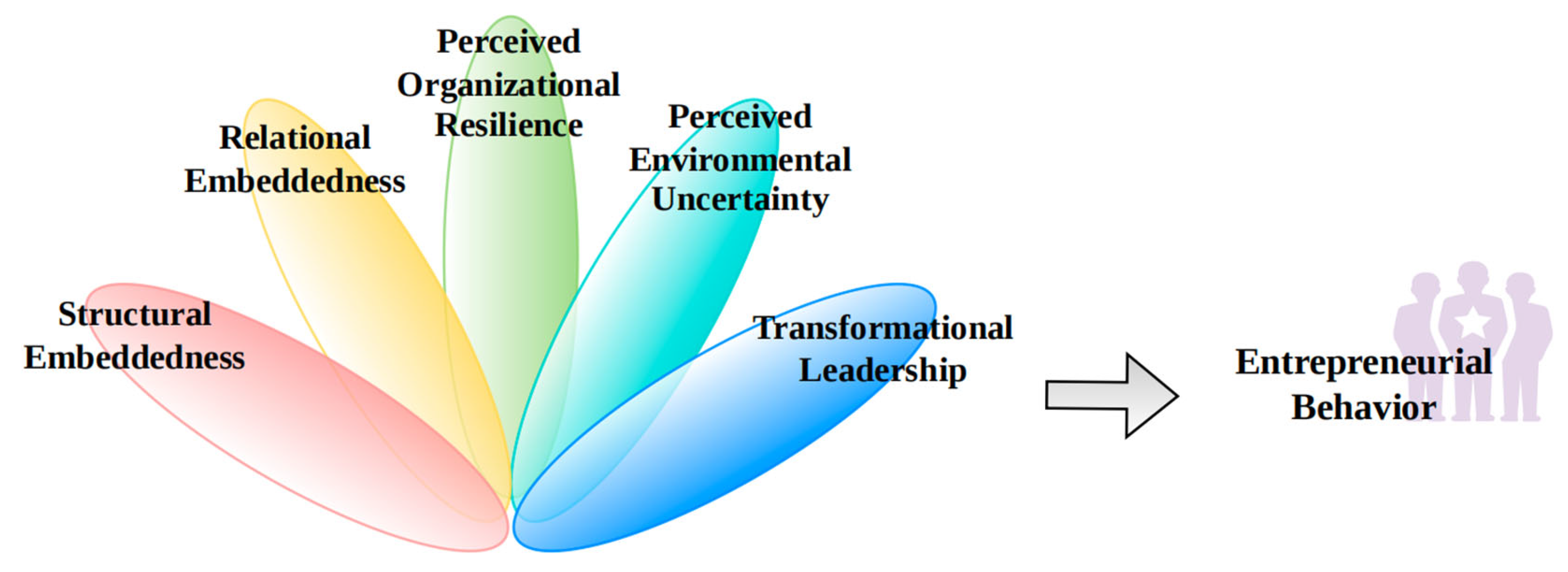
Subsequently, a necessity analysis was conducted with entrepreneurial behavior (EB) as the outcome condition. The necessity of both the presence and absence of each antecedent condition (SE, RE, POR, PEU, TL) for EB was evaluated (see Figure 3). Consistency, which ranges from 0 to 1, measures the degree to which the data support a necessary relationship [86]. A condition is typically considered necessary if its consistency exceeds 0.90 [83]. As presented in Table 5, the consistency scores for all conditions ranged from 0.411 to 0.708, all below the 0.90 threshold. This indicates that no single condition is necessary for high levels of EB. Therefore, the conditions were carried forward for configurational analysis to examine how they combine to jointly influence the outcome.

4.2.2. Truth Table Construction

Following Ragin’s [83] framework, a truth table was constructed listing all 32 logically possible combinations (25) of the five antecedent conditions. Configurations (rows) that did not meet a frequency threshold of 3 (30 rows met this threshold) or a consistency benchmark of 0.75 (3 rows ultimately met this threshold) were excluded from the subsequent analysis. Among the two solution types generated by fsQCA, the intermediate solution was selected for interpretation due to its optimal balance between explanatory completeness and analytical clarity. Table 6 shows that two configurations lead to high entrepreneurial behavior. Among the derived configurations, the two most notable solutions are summarized as follows. Solution 1 (S1) demonstrates good consistency (0.891) and the highest raw coverage (0.351) among all configurations. In contrast, Solution 2 (S2) exhibits the highest overall consistency (0.892), with a relatively higher raw coverage of 0.375. In both solutions, structural embeddedness (SE) and perceived organizational resilience (POR) function as core conditions, while perceived environmental uncertainty (PEU) is absent as a core condition. A key distinction between the two configurations lies in their peripheral conditions: relational embeddedness (RE) acts as a peripheral condition in S1, whereas transformational leadership (TL) serves as the peripheral condition in S2. The overall solution coverage is 0.416, and the overall solution consistency is 0.884, indicating that these two configurations collectively have strong explanatory power and consistency.
The solution coverage of 0.416 indicates that the two identified configurations account for approximately 41.6% of the cases exhibiting high entrepreneurial behavior (EB) in our sample. This acknowledges that a substantial proportion of cases (about 58.4%) are not explained by these specific recipes. This is a common and expected outcome in fsQCA, which aims to identify sufficient (but not necessary) conditions for an outcome, recognizing the principle of equifinality—that multiple, distinct pathways can lead to the same result [83]. The unexplained variance suggests that other combinations of the five antecedent conditions examined, or conditions not included in the present model (e.g., enterprise size, access to specific types of funding, or particular technological capabilities), may constitute alternative, equally effective pathways to high EB for other subsets of commercial aerospace enterprises. Based on the high consistency scores (0.884 for the overall solution) for an enterprise that the cases covered, the two configurations are highly reliable sufficient conditions. Therefore, while S1 and S2 provide robust and parsimonious explanations for a significant subset of high-performing enterprises, they do not claim to be exhaustive, leaving room for future research to uncover additional entrepreneurial recipes within this complex industry.

4.3. General Discussion

This study employs a two-phase quantitative approach to unravel the mechanisms driving entrepreneurial behavior within the complex network of the commercial aerospace sector. The PLS-SEM analysis first delineated the net effects and mediating pathways among key constructs, revealing how network embeddedness translates into entrepreneurial action through perceptual filters. Complementing this, the fsQCA identified two distinct, equifinal configurations that lead to high entrepreneurial behavior, highlighting the causal complexity and multiple pathways to entrepreneurial success. This integrated discussion synthesizes these findings to provide a nuanced understanding of entrepreneurship in this high-stakes, systemic context.
The finding that structural embeddedness exerts a significant positive influence on entrepreneurial behavior corroborates the core tenet of network embeddedness theory, which posits that a central network position grants access to diverse information and resources critical for opportunity recognition and exploitation [27,46]. Conversely, the non-significant direct effect of relational embeddedness on entrepreneurial behavior presents a notable divergence from some prior research emphasizing the role of strong ties in facilitating entrepreneurial action [87]. This finding invites a more nuanced interpretation that aligns with the dual nature of relational ties suggested in our theoretical framing. The commercial aerospace sector is characterized by extreme capital intensity, protracted R&D cycles, and stringent regulatory oversight. Within this specific context, the dense, trust-based networks typified by relational embeddedness may consequently prioritize risk mitigation, compliance assurance, and the reinforcement of established norms. Thus, while relational embeddedness provides crucial support for resilience and sense-making, its direct net effect on proactive, exploratory entrepreneurial behavior appears attenuated, potentially because the same strong ties that foster trust and cooperation may also reinforce path dependency and caution, offsetting a direct promotional effect on entrepreneurial action.
The mediation analysis further clarifies these mechanisms. Both structural embeddedness and relational embeddedness significantly enhance perceived organizational resilience and reduce perceived environmental uncertainty, which in turn respectively promote and inhibit entrepreneurial behavior. This dual mediation supports and extends the complex systems theory perspective, demonstrating that network attributes are cognitively processed by entrepreneurs as assessments of internal adaptive capacity and external predictability. Specifically, the result of an enterprise that accesses broad networks and trusted relationships provides an informational and resource-based shock absorber, boosting confidence in the organization’s resilience [45], while also offering a channel for entrepreneurs to make sense of a turbulent environment, which is associated with a lower perception of uncertainty [88]. The significant indirect effects underscore that network value is substantially realized through shaping these critical entrepreneurial perceptions, with perceived environmental uncertainty acting as a significant perceptual pathway rather than a deterministic constraint.
Regarding the moderating role of transformational leadership, the results are nuanced. Transformational leadership effectively strengthens the positive relationship between perceived organizational resilience and entrepreneurial behavior. This supports trait activation theory, indicating that a leader’s ability to inspire and intellectually stimulate teams is activated in contexts of perceived resilience, transforming latent confidence into concrete, forward-looking entrepreneurial initiatives [52]. In the commercial aerospace setting, such leaders can frame the organization’s resilient capacity as a platform for ambitious experimentation. However, transformational leadership did not significantly buffer the negative impact of perceived environmental uncertainty on entrepreneurial behavior, contrasting with literature suggesting leadership can mitigate uncertainty’s paralyzing effects [88]. A plausible explanation is that in this sector, uncertainties stemming from technological frontiers, regulatory shifts, and geopolitical factors are so profound and exogenous that they act as dominant, quasi-objective constraints. The moderating capacity of individual leadership traits may be overwhelmed by these macro-systemic forces, limiting their efficacy in this particular pathway.
Transitioning to the configurational perspective, the fsQCA results reveal that high entrepreneurial behavior is not the product of a single optimal condition but can be achieved through multiple causal recipes. The two core solutions share a common architecture: the joint presence of structural embeddedness and perceived organizational resilience as core conditions, coupled with the absence of perceived environmental uncertainty as a core condition. This universal pattern powerfully emphasizes that in the commercial aerospace system, a favorable structural position combined with a strong sense of internal adaptive capacity is fundamental, while a prevailing sense of uncontrollable external ambiguity is fundamentally incompatible with high entrepreneurship. The solutions differ in their peripheral, contributing conditions: Solution 1 incorporates relational embeddedness, while Solution 2 incorporates transformational leadership.
This divergence points to two distinct archetypes of entrepreneurial pathways. Solution 1 highlights a network-relational path. Here, the entrepreneur leverages a broad structural position, feels the organization is resilient, and importantly, complements this with deep, trust-based relational ties. This configuration may be particularly characteristic of enterprises that develop through tightly integrated consortia, family office investments, or sustained university partnerships, where relational capital is likely to supply the essential trust and coordination required to execute complex, long-term projects. Solution 2 outlines a leadership-agency path. In this configuration, the entrepreneur’s transformational leadership qualities serve as the critical supplemental factor. This path appears to align closely with the profile of startups led by visionary founders, suggesting that the leader’s capacity to communicate a clear strategic direction and motivate the team plays a decisive role in translating a favorable network position and a resilient organizational culture into concrete entrepreneurial outcomes. Both represent viable, context-dependent routes to success, underscoring the equifinal nature of entrepreneurship in this complex ecosystem. These interpretations, while grounded in the logical consistency of the configurations, are presented as plausible propositions derived from the findings, which future research with qualitative or case-based data could further investigate and refine.

5. Implications, Limitations and Future Research Directions

5.1. Theoretical Implications

This study offers three primary contributions to the theory, which are framed within the context of studying perceived rather than objective network embeddedness. It refines network embeddedness theory by delineating distinct mechanisms, contributes to complex systems theory by specifying key micro-level cognitive pathways, and clarifies the boundary conditions of trait activation theory within a highly constrained industry context.
First, this study refines network embeddedness theory by clarifying the differential roles of its core dimensions as subjectively perceived by entrepreneurs. While confirming that a perceived central structural position directly facilitates entrepreneurial action by providing information and legitimacy [27], the study reveals that perceived relational embeddedness operates through a more indirect, fully mediated pathway. The non-significant direct effect of perceived relational ties on entrepreneurial behavior, coupled with their strong role in building perceived resilience and reducing uncertainty, offers a critical nuance. It suggests that in the capital-intensive and regulated commercial aerospace sector, the perceived deep trust and strong ties emphasized by relational embeddedness [6,32] may prioritize stability and risk mitigation over exploratory initiatives. This supports and contextualizes arguments that strong ties can sometimes constrain radical innovation [46], demonstrating a specific boundary condition within high-stakes systemic industries—based on entrepreneurial perception of their ties.
Second, this study contributes to complex systems theory by exploring the cognitive mechanisms through which macro-systemic network properties may influence micro-level entrepreneurial action. It provides empirical support for the view that an enterprise’s perceived structural and relational embeddedness within the aerospace system does not automatically translate into behavior, but that its influence is almost entirely channeled through entrepreneurs’ perceptions. This finding examines a core premise of complex systems theory by treating perceived organizational resilience [12] and perceived environmental uncertainty [13] as the critical interpretive filters that translate perceived network conditions into action. It illustrates how actors within a complex system subjectively translate their networked position into assessments of adaptive capacity and external predictability, which can subsequently drive strategic behavior. Thus, the primary contribution here is to theorize and validate ‘perceived embeddedness’ as the crucial cognitive bridge between the objective system structure and entrepreneurial action.
Third, the research clarifies a boundary condition for trait activation theory. The results confirm that transformational leadership effectively strengthens the positive relationship between perceived organizational resilience and entrepreneurial behavior. This supports the theory’s premise that situational cues, such as a sense of organizational robustness (which itself stems from perceived network conditions), can activate latent leadership traits to produce proactive outcomes [37]. However, the finding that such leadership does not significantly mitigate the constraining effect of perceived environmental uncertainty is equally important. It indicates that in contexts characterized by profound exogenous uncertainties, such as those in the commercial aerospace sector, the potency of this individual trait may be overwhelmed by overwhelming systemic constraints, even when those constraints are filtered through perception. This boundary condition refines the theory’s application, suggesting that the activating power of situational cues has limits when facing dominant environmental forces [56].
In summary, this study’s theoretical implications are interconnected. It demonstrates that perceived network embeddedness shapes critical systemic perceptions, which in turn influence entrepreneurship. The effectiveness of individual agency, in the form of transformational leadership, is subsequently contingent upon the nature of these perceptions. By integrating network embeddedness theory, complex systems theory, and trait activation theory through the lens of managerial perception, the research provides a more integrated framework for understanding entrepreneurial behavior in complex, technology-driven ecosystems.

5.2. Managerial Implications

This study proposes three consolidated managerial implications for entrepreneurs and executives in the commercial aerospace network. These implications are designed to form a coherent and actionable framework, moving beyond a set of isolated recommendations.
First, managers must develop and maintain a dual network strategy. A central structural position within the broader aerospace ecosystem is fundamental, as it directly provides the diverse information flow and legitimacy necessary for entrepreneurial action. Therefore, actively cultivating connections with a wide range of actors, such as other enterprises, research institutions, and government bodies, is a strategic imperative. Concurrently, deep relational embeddedness with key partners serves a vital, though different, function. These strong, trust-based ties are crucial for building the organization’s perceived resilience and for transforming ambiguous environmental signals into reliable intelligence. Managers should therefore not only expand their network’s breadth but also intentionally invest in the quality of core relationships. This combined approach creates a supportive infrastructure where the broad network supplies opportunities and the deep relationships provide the stability and insight to act upon them confidently.
Second, leadership has a direct responsibility to shape the key organizational perceptions that mediate entrepreneurial behavior. The study identifies perceived organizational resilience and perceived environmental uncertainty as the primary cognitive filters through which network advantages are translated into action. Consequently, a core managerial task is to actively build and communicate the organization’s adaptive capacities. This involves creating processes for rapid learning and resource reconfiguration, thereby making the enterprise genuinely feel more robust. Furthermore, leaders must systematically use their trusted networks to monitor and interpret the external environment. The goal is to reduce ambiguity by clarifying regulatory, technological, and market shifts, thereby lowering the perceived uncertainty that constrains entrepreneurial initiative. By managing these perceptions, leaders effectively unlock the latent value of their network positions.
Third, success requires diagnosing the organization’s specific configuration of assets and aligning strategy accordingly, as there is no single optimal path. The study reveals two equifinal configurations leading to high entrepreneurship. One path leverages strong relational capital and is well-suited for enterprises embedded in dense alliances or consortia. The other path activates transformational leadership and is effective for visionary, founder-led ventures. Critically, both configurations share the same core conditions: a strong structural network position and high perceived organizational resilience, coupled with low perceived environmental uncertainty. The practical implication is that managers must conduct an honest assessment of their enterprise’s distinctive strengths. The strategic priority is to deliberately reinforce the chosen configuration. This is achieved either by deepening alliance-based execution for the relational path, or by strengthening visionary leadership and culture for the agency path, in order to channel inherent advantages into sustained entrepreneurial outcomes.

5.3. Limitations and Future Research Directions

This study provides meaningful insights into the entrepreneurial behavior of commercial aerospace enterprises. However, several limitations should be acknowledged, which also point to directions for future research. First, the empirical data were collected exclusively from commercial aerospace enterprises in China. The Chinese commercial aerospace sector operates within a unique institutional and policy environment. Therefore, the generalizability of the findings to commercial aerospace enterprises in other countries with different regulatory frameworks, market structures, and innovation ecosystems requires further verification. Future research should test the proposed model in other national contexts, such as the United States or Europe, to examine the potential boundary conditions of the theoretical framework. Second, this study focused on two core dimensions of embeddedness: structural and relational. However, other network attributes, such as the dynamics of network evolution, the diversity of network partners, or the co-existence of multiple overlapping networks (e.g., R&D collaboration, supply chain, social networks), may also significantly influence entrepreneurial processes. Future research could incorporate these more nuanced network features to develop a richer understanding.
Third, the data for enterprise-level constructs, such as organizational resilience, relied on single informants (CEOs or founders). While these key informants possess comprehensive strategic knowledge, this approach carries the risk of key informant bias. Future studies could strengthen the findings by employing multiple respondents per enterprise to mitigate this potential bias. Fourth, this study relies on cross-sectional survey data, which fundamentally limits the ability to make strong causal claims and to fully address endogeneity concerns, such as reverse causality. Although the hypothesized relationships are grounded in theory and procedural remedies were employed, the potential for common method bias, despite statistical checks, and the inability to conclusively establish the direction of relationships remain inherent constraints of the design. While the two-phase analytical approach (PLS-SEM and fsQCA) provides robust insights into net effects and configurations, future research would greatly benefit from longitudinal or experimental designs that can more rigorously establish temporal precedence and causality among the core constructs.
Fifth, the conceptualization and operationalization of perceived environmental uncertainty, while grounded in established scales, presents a limitation. As a perceptual measure, it captures entrepreneurs’ subjective assessments, which may not fully align with objective environmental conditions and could be influenced by other unmeasured factors. The role of this construct as a mediator, though statistically significant, should be interpreted as one important cognitive pathway within a more complex nomological network. Future research could strengthen this aspect by employing multi-method assessments of uncertainty or by examining its interaction with more objective indicators of environmental dynamism. Finally, the two identified configurations leading to high entrepreneurial behavior (the network-relational path and the leadership-agency path) provide valuable typologies. Future research should test the robustness and prevalence of these configurations in other samples. Furthermore, qualitative case studies following these distinct archetypes could offer deeper, process-oriented insights into how the combinations of conditions unfold in practice over time. Addressing these limitations in future work will help build a more comprehensive, dynamic, and universally applicable theory of entrepreneurship in high-tech, systemic industries like commercial aerospace.

Author Contributions

Conceptualization, Z.H. and K.-L.P.; Methodology, Z.H., L.M. and K.-L.P.; Software, Z.H. and L.M.; Validation, Z.H., L.M., K.-L.P., S.W. and S.Z.; Forma analysis, Z.H. and L.M.; Investigation, Z.H., L.M. and K.-L.P.; Resources, K.-L.P. and S.Z.; Data curation, Z.H., L.M. and K.-L.P.; Writing—original draft, Z.H. and L.M.; Writing—review & editing, K.-L.P., S.W. and S.Z.; Visualization, Z.H. and L.M.; Supervision, K.-L.P.; Project administration, S.Z.; Funding acquisition, S.Z. All authors have read and agreed to the published version of the manuscript.

Funding

This research was funded by the Young Innovative Talents Project of Guangdong Provincial Department of Education, grant number 2024WQNCX054.

Institutional Review Board Statement

Ethical review and approval for this study were waived, as it qualified for exemption under the national regulations of China. Specifically, Article 32 of the Chinese “Ethical Review Measures for Life Sciences and Medical Research Involving Humans” (issued by the National Health Commission of the People’s Republic of China, the Ministry of Education, the Ministry of Science and Technology, and the National Administration of Traditional Chinese Medicine, Order No. 4, 2023) stipulates that research utilizing anonymized data, which poses no more than minimal risk and involves no sensitive personal or commercial information, may be exempt from full ethical review.

Informed Consent Statement

Informed consent was obtained from all subjects involved in the study.

Data Availability Statement

The raw data supporting the conclusions of this article will be made available by the authors on request. Public sharing is limited in accordance with the data management and sovereignty policies of the authors’ institutions, which govern the stewardship of research outputs. While the survey was anonymous and collected no personal identifiers, the complete dataset is maintained under institutional guidelines. We are committed to facilitating transparent research and will provide the data to qualified researchers for verification purposes under a standard data access agreement that ensures appropriate use and citation.

Acknowledgments

The authors sincerely thank the entrepreneurs from the commercial aerospace sector who participated in this study. We also gratefully acknowledge the institutional support received for this research, as well as the valuable and constructive feedback provided by the editors and anonymous reviewers. During the preparation of this study, the authors used ChatGPT-5 in order to improve language and readability. The authors have reviewed and edited the output and take full responsibility for the content of this publication.

Conflicts of Interest

The authors declare no conflicts of interest.

Appendix A

Table A1. Measurement items.
ConstructItemsSources
Structural Embeddedness
  • My enterprise collaborates with other enterprises in the commercial aerospace network.
[31]
  • My enterprise interacts with government departments in the commercial aerospace network.
  • My enterprise interacts with intermediaries in the commercial aerospace network.
  • My enterprise interacts with research institutions in the commercial aerospace network.
Relational Embeddedness
  • Family, relatives, or friends within the commercial aerospace network provide effective social resource support for my enterprise.
[6,57,58]
  • My enterprise has easy access to industry information from family, relatives, or friends in the commercial aerospace network.
  • I often get emotional support from my family, relatives, or friends.
  • Heterogeneous resources are often passed to my enterprise through weak ties in the commercial aerospace network.
Perceived Organizational Resilience
  • My enterprise can rapidly design solutions in response to emergent situations in the commercial aerospace network.
[59]
  • My enterprise encourages critical questioning of new projects within the commercial aerospace network to ensure decision-making robustness.
  • My enterprise is capable of systematically evaluating potential risks in the commercial aerospace network.
  • My enterprise leverages multiple information sources to coordinate actions in the commercial aerospace network.
Perceived Environmental Uncertainty
  • The direction of core technology development in the commercial aerospace network is unpredictable.
[60]
  • Market demand for commercial aerospace fluctuates unpredictably.
  • Changes in government regulations for commercial aerospace are usually anticipated by my enterprise. *
  • My enterprise can generally anticipate the competitive actions of rivals in the commercial aerospace network. *
Transformational Leadership
  • I communicate a clear and positive vision of the future within the commercial aerospace network.
[61]
  • I encourage thinking about problems in new ways and questions assumptions within the commercial aerospace network.
  • I foster trust, involvement and cooperation among team members within the commercial aerospace network.
  • I instill pride and respect in others and they inspire me by being highly competent within the commercial aerospace network.
Entrepreneurial Behavior
  • My enterprise has been expanding a new business unit into commercial aerospace.
[62,63]
  • My enterprise is making a new business plan for commercial aerospace.
  • My enterprise is making a business investment in commercial aerospace.
* Reverse question.
Table A2. An example of an anonymized enterprise profile.
CategoryAnonymized Description
Core Identity
  • A privately owned commercial aerospace enterprise, described in its materials as a pioneer in its region focused on the development of reusable commercial launch vehicles and spacecraft.
Establishment
  • Founded in the early 2020s.
Headquarters
  • Located in a major urban and technology center in China.
Business Scope
  • Development of reusable launch vehicles and commercial spacecraft.
Mission & Vision
  • Corporate mission emphasizes safe, reliable, and cost-effective commercial space access. The long-term vision is to become a leading commercial space transportation provider in its region.
Technical RoadmapFollows a three-phase strategy:
  • Phase 1 (4–5 years): Develop and demonstrate a reusable suborbital launch vehicle for commercial missions.
  • Phase 2 (6–10 years): Develop and operate a reusable orbital-class launch vehicle for missions such as space station servicing and point-to-point transportation.
  • Phase 3 (12–15 years): Pursue advanced missions including lunar and deep-space exploration.
Flagship Product
  • Its first-generation vehicle is a fully reusable suborbital launch system. Published technical highlights include a pusher-style abort system (where engines are recovered with the capsule), high-precision return and landing capabilities, and a claimed high reusability rate. The system is designed for operational efficiency and mission flexibility.
Funding & Key Milestones
  • Secured seed round and angel round financing in the mid-2020s.
  • Reportedly secured its first commercial launch contract shortly after founding.
  • Presented technical work at a major national aerospace academic conference.
  • Served as the lead unit for a national-level pre-research project on multifunctional suborbital vehicles.
  • Completed assembly of a prototype test vehicle.
  • Closed an oversubscribed Angel+ round of financing.
Partnerships
  • Has established research collaborations with a major domestic university and strategic cooperation agreements with other aerospace industry entities.
Industry Position
  • Portrays itself as a pioneer in the domestic commercial launch sector, building upon national aerospace heritage while developing innovative, commercially optimized vehicle designs.

References

  1. Peng, K.-L.; Kou, I.E.; Chen, H. Space Economics. In Space Tourism Value Chain: When East Meets West; Springer Nature: Singapore, 2024; pp. 139–148. [Google Scholar] [CrossRef]
  2. Del Canto Viterale, F. Transitioning to a New Space Age in the 21st Century: A Systemic-Level Approach. Systems 2023, 11, 232. [Google Scholar] [CrossRef]
  3. Jose, L.A., Jr.; Brintrup, A.; Salonitis, K. Analysing the evolution of aerospace ecosystem development. PLoS ONE 2020, 15, e0231985. [Google Scholar] [CrossRef]
  4. Speldekamp, D.; Knoben, J.; Saka-Helmhout, A. Clusters and firm-level innovation: A configurational analysis of agglomeration, network and institutional advantages in European aerospace. Res. Policy 2020, 49, 103921. [Google Scholar] [CrossRef]
  5. Su, H.; Liang, Y.; Wen, T. Structural embeddedness, entrepreneurial behavior, and firm performance in the industry network of small tourism enterprises: The moderating role of relational embeddedness and leadership self-efficacy. J. Hosp. Tour. Manag. 2023, 56, 431–442. [Google Scholar] [CrossRef]
  6. Granovetter, M. Economic Action and Social Structure: The Problem of Embeddedness. Am. J. Sociol. 1985, 91, 481–510. [Google Scholar] [CrossRef]
  7. Arranz, N.; Arroyabe, M.F.; Fernandez de Arroyabe, J.C. Network Embeddedness in Exploration and Exploitation of Joint R&D Projects: A Structural Approach. Br. J. Manag. 2020, 31, 421–437. [Google Scholar] [CrossRef]
  8. Ferraris, A.; Santoro, G.; Scuotto, V. Dual relational embeddedness and knowledge transfer in European multinational corporations and subsidiaries. J. Knowl. Manag. 2018, 24, 519–533. [Google Scholar] [CrossRef]
  9. Beal, B.D.; Neesham, C. Systemic corporate social responsibility: Micro-to-macro transitions, collective outcomes and self-regulation. Soc. Responsib. J. 2016, 12, 209–227. [Google Scholar] [CrossRef]
  10. Wang, X.; Li, Z.; Cheng, F. How Business Environments Affect Enterprise Vitality: A Complex Adaptive Systems Theory Perspective. Systems 2025, 13, 864. [Google Scholar] [CrossRef]
  11. Ding, S.; Wang, L.; Zhou, Q. Study on Evolution Mechanism of Agricultural Trade Network of RCEP Countries—Complex System Analysis Based on the TERGM Model. Systems 2025, 13, 593. [Google Scholar] [CrossRef]
  12. Sabatino, M. Economic crisis and resilience: Resilient capacity and competitiveness of the enterprises. J. Bus. Res. 2016, 69, 1924–1927. [Google Scholar] [CrossRef]
  13. Zayadin, R.; Zucchella, A.; Anand, A.; Jones, P.; Ameen, N. Entrepreneurs’ Decisions in Perceived Environmental Uncertainty. Br. J. Manag. 2023, 34, 831–848. [Google Scholar] [CrossRef]
  14. Wu, J.; Pan, W.; Chen, S.; Deng, B. The stimulation mechanism of students’ entrepreneurial intention in entrepreneurship course: A trait activation theory perspective. Front. Psychol. 2022, 13, 1031435. [Google Scholar] [CrossRef]
  15. Brintrup, A.; Wang, Y.; Tiwari, A. Supply Networks as Complex Systems: A Network-Science-Based Characterization. IEEE Syst. J. 2017, 11, 2170–2181. [Google Scholar] [CrossRef]
  16. Koch, W. AI for Aerospace and Electronic Systems: Technical Dimensions of Responsible Design. IEEE Aerosp. Electron. Syst. Mag. 2023, 38, 106–111. [Google Scholar] [CrossRef]
  17. Melamed, A.; Rao, A.; de Rohan Willner, O.; Kreps, S. Going to outer space with new space: The rise and consequences of evolving public-private partnerships. Space Policy 2024, 68, 101626. [Google Scholar] [CrossRef]
  18. Watson, M.D. System Exergy: System Integrating Physics of Launch Vehicles and Spacecraft. J. Spacecr. Rocket. 2018, 55, 451–461. [Google Scholar] [CrossRef]
  19. Bachelor, G.; Brusa, E.; Ferretto, D.; Mitschke, A. Model-Based Design of Complex Aeronautical Systems Through Digital Twin and Thread Concepts. IEEE Syst. J. 2020, 14, 1568–1579. [Google Scholar] [CrossRef]
  20. Wang, H.; Tao, J.; Peng, T.; Brintrup, A.; Kosasih, E.E.; Lu, Y.; Tang, R.; Hu, L. Dynamic inventory replenishment strategy for aerospace manufacturing supply chain: Combining reinforcement learning and multi-agent simulation. Int. J. Prod. Res. 2022, 60, 4117–4136. [Google Scholar] [CrossRef]
  21. Lechner, C.; Dowling, M. Firm networks: External relationships as sources for the growth and competitiveness of entrepreneurial firms. Entrep. Reg. Dev. 2003, 15, 1–26. [Google Scholar] [CrossRef]
  22. Zhang, M.; Yang, X. China’s emerging commercial space industry: Current developments, legislative challenges, and regulatory solutions. Acta Astronaut. 2023, 202, 9–16. [Google Scholar] [CrossRef]
  23. Sénéchal-Perrouault, L. Chinese Commercial Space Launchers: Historical Perspective; Policy Framework. Space Policy 2023, 66, 101572. [Google Scholar] [CrossRef]
  24. Giraldi, L. A Comprehensive Overview of the Growing Global Space Economy: From Government Leadership to Commercial Opportunities and Ecosystem Development. In Space Economy SEWA—Start, Evolve, or Walk Away: A Comprehensive Guide to Disruptive Innovation and Entrepreneurship Evolution in an Emerging Multi-Trillion-Dollar Sector; Springer Nature: Cham, Switzerland, 2025; pp. 5–18. [Google Scholar] [CrossRef]
  25. Xinhua News Agency. China’s Space Authority Sets Up New Department to Oversee Commercial Space Sector; Xinhua News Agency: Beijing, China, 2025. Available online: https://english.www.gov.cn/news/202511/30/content_WS692b9763c6d00ca5f9a07da0.html (accessed on 30 November 2025).
  26. Cai, L.; Peng, X.; Wang, L. The characteristics and influencing factors of entrepreneurial behaviour: The case of new state-owned firms in the new energy automobile industry in an emerging economy. Technol. Forecast. Soc. Change 2018, 135, 112–120. [Google Scholar] [CrossRef]
  27. Burt, R.S. Structural Holes and Good Ideas. Am. J. Sociol. 2004, 110, 349–399. [Google Scholar] [CrossRef] [PubMed]
  28. Wu, C.; Tian, F.; Zhou, L. The impact of incubator network strategy on the entrepreneurial performance of start-ups: A resource bricolage perspective. Innovation 2025, 27, 302–321. [Google Scholar] [CrossRef]
  29. Dahmen, P. Organizational resilience as a key property of enterprise risk management in response to novel and severe crisis events. Risk Manag. Insur. Rev. 2023, 26, 203–245. [Google Scholar] [CrossRef]
  30. Yan, Y. Maintaining Long-Term Sustainability of Outer Space Activities: Creation of Regulatory Framework to Guide the Asia-Pacific Space Cooperation Organization and Selected Legal Issues. Space Policy 2019, 47, 51–62. [Google Scholar] [CrossRef]
  31. Xie, X.M.; Zuo, L.L.; Zeng, S.X.; Tam, V.W.Y. The impacts of network structures and network form on corporate innovative performance: Evidence from high-tech sectors. Asian J. Technol. Innov. 2014, 22, 185–203. [Google Scholar] [CrossRef]
  32. Coleman, J.S. Social Capital in the Creation of Human Capital. Am. J. Sociol. 1988, 94, S95–S120. [Google Scholar] [CrossRef]
  33. Gabbai, J.M. Complexity and the Aerospace Industry: Understanding Emergence by Relating Structure to Performance Using Multi-Agent Systems. Ph.D. Thesis, The University of Manchester, Manchester, UK, 2005. [Google Scholar]
  34. Allen, P.M. A complex systems approach to learning in adaptive networks. Int. J. Innov. Manag. 2001, 5, 149–180. [Google Scholar] [CrossRef]
  35. Gangi, F.; Mustilli, M.; Daniele, L.M.; Coscia, M. The sustainable development of the aerospace industry: Drivers and impact of corporate environmental responsibility. Bus. Strategy Environ. 2022, 31, 218–235. [Google Scholar] [CrossRef]
  36. Hokmabadi, H.; Rezvani, S.M.H.S.; de Matos, C.A. Business Resilience for Small and Medium Enterprises and Startups by Digital Transformation and the Role of Marketing Capabilities—A Systematic Review. Systems 2024, 12, 220. [Google Scholar] [CrossRef]
  37. Tett, R.P.; Toich, M.J.; Ozkum, S.B. Trait Activation Theory: A Review of the Literature and Applications to Five Lines of Personality Dynamics Research. Annu. Rev. Organ. Psychol. Organ. Behav. 2021, 8, 199–233. [Google Scholar] [CrossRef]
  38. Schiuma, G.; Schettini, E.; Santarsiero, F.; Carlucci, D. The transformative leadership compass: Six competencies for digital transformation entrepreneurship. Int. J. Entrep. Behav. Res. 2021, 28, 1273–1291. [Google Scholar] [CrossRef]
  39. Zimmerman, M.A.; Zeitz, G.J. Beyond Survival: Achieving New Venture Growth by Building Legitimacy. Acad. Manag. Rev. 2002, 27, 414–431. [Google Scholar] [CrossRef]
  40. Teece, D.; Peteraf, M.; Leih, S. Dynamic Capabilities and Organizational Agility: Risk, Uncertainty, and Strategy in the Innovation Economy. Calif. Manag. Rev. 2016, 58, 13–35. [Google Scholar] [CrossRef]
  41. Podolny, J.M. Networks as the Pipes and Prisms of the Market. Am. J. Sociol. 2001, 107, 33–60. [Google Scholar] [CrossRef]
  42. Gulati, R.; Nohria, N.; Zaheer, A. Strategic networks. Strateg. Manag. J. 2000, 21, 203–215. [Google Scholar] [CrossRef]
  43. Hernández-Maestro, R.M.; González-Benito, Ó. Rural Lodging Establishments as Drivers of Rural Development. J. Travel Res. 2014, 53, 83–95. [Google Scholar] [CrossRef]
  44. Hadjielias, E.; Christofi, M.; Tarba, S. Knowledge hiding and knowledge sharing in small family farms: A stewardship view. J. Bus. Res. 2021, 137, 279–292. [Google Scholar] [CrossRef]
  45. Kahn, W.A.; Barton, M.A.; Fellows, S. Organizational Crises and the Disturbance of Relational Systems. Acad. Manag. Rev. 2013, 38, 377–396. [Google Scholar] [CrossRef]
  46. Uzzi, B. Social structure and competition in interfirm networks: The paradox of embeddedness. In The Sociology of Economic Life; Routledge: New York, NY, USA, 2018; pp. 213–241. [Google Scholar]
  47. Bock, A.J.; Opsahl, T.; George, G.; Gann, D.M. The Effects of Culture and Structure on Strategic Flexibility during Business Model Innovation. J. Manag. Stud. 2012, 49, 279–305. [Google Scholar] [CrossRef]
  48. Staw, B.M.; Sandelands, L.E.; Dutton, J.E. Threat Rigidity Effects in Organizational Behavior: A Multilevel Analysis. Adm. Sci. Q. 1981, 26, 501–524. [Google Scholar] [CrossRef]
  49. Shepherd, D.A.; McMullen, J.S.; Jennings, P.D. The formation of opportunity beliefs: Overcoming ignorance and reducing doubt. Strateg. Entrep. J. 2007, 1, 75–95. [Google Scholar] [CrossRef]
  50. Khan, I.U.; Amin, R.U.; Saif, N. Individualized Consideration and Idealized influence of transformational Leadership: Mediating Role of Inspirational Motivation and Intellectual stimulation. Int. J. Leadersh. Educ. 2025, 28, 1322–1332. [Google Scholar] [CrossRef]
  51. Pillai, R. Transformational leadership for crisis management. In Handbook of Research on Crisis Leadership in Organizations; Edward Elgar Publishing: Cheltenham, UK, 2013; pp. 47–66. [Google Scholar]
  52. Haynie, J.M.; Shepherd, D.; Mosakowski, E.; Earley, P.C. A situated metacognitive model of the entrepreneurial mindset. J. Bus. Ventur. 2010, 25, 217–229. [Google Scholar] [CrossRef]
  53. Woods, R.D. The Effects of Transformational Leadership, Trust, and Tolerance of Ambiguity on Organization Culture in Higher Education. Ph.D. Thesis, Regent University, Virginia Beach, VA, USA, 2004. [Google Scholar]
  54. Hameiri, L.; Nir, A. Perceived uncertainty and organizational health in public schools: The mediating effect of school principals’ transformational leadership style. Int. J. Educ. Manag. 2016, 30, 771–790. [Google Scholar] [CrossRef]
  55. Hmieleski, K.M.; Baron, R.A. When does entrepreneurial self-efficacy enhance versus reduce firm performance? Strateg. Entrep. J. 2008, 2, 57–72. [Google Scholar] [CrossRef]
  56. Geier, M.T. Leadership in Extreme Contexts:Transformational Leadership, Performance Beyond Expectations? J. Leadersh. Organ. Stud. 2016, 23, 234–247. [Google Scholar] [CrossRef]
  57. Bian, Y. Bringing Strong Ties Back in: Indirect Ties, Network Bridges, and Job Searches in China. Am. Sociol. Rev. 1997, 62, 366–385. [Google Scholar] [CrossRef] [PubMed]
  58. Yang, M.M.-h. Gifts, Favors, and Banquets: The Art of Social Relationships in China; Cornell University Press: Ithaca, NY, USA, 2016. [Google Scholar]
  59. Mallak, L.A. Measuring resilience in health care provider organizations. Health Manpow. Manag. 1998, 24, 148–152. [Google Scholar] [CrossRef]
  60. Judge, W.Q.; Miller, A. Antecedents and Outcomes of Decision Speed in Different Environmental Contexts. Acad. Manag. J. 1991, 34, 449–463. [Google Scholar] [CrossRef]
  61. Carless, S.A.; Wearing, A.J.; Mann, L. A Short Measure of Transformational Leadership. J. Bus. Psychol. 2000, 14, 389–405. [Google Scholar] [CrossRef]
  62. Reynolds, P.D. Who Starts New Firms?—Preliminary Explorations of Firms-in-Gestation. Small Bus. Econ. 1997, 9, 449–462. [Google Scholar] [CrossRef]
  63. Simsek, Z.; Lubatkin, M.H.; Floyd, S.W. Inter-Firm Networks and Entrepreneurial Behavior: A Structural Embeddedness Perspective. J. Manag. 2003, 29, 427–442. [Google Scholar] [CrossRef]
  64. Hair, J.F., Jr.; Hult, G.T.M.; Ringle, C.M.; Sarstedt, M.; Danks, N.P.; Ray, S. Partial Least Squares Structural Equation Modeling (PLS-SEM) Using R: A Workbook; Springer Nature: Cham, Switzerland, 2021. [Google Scholar] [CrossRef]
  65. Armstrong, J.S.; Overton, T.S. Estimating Nonresponse Bias in Mail Surveys. J. Mark. Res. 1977, 14, 396–402. [Google Scholar] [CrossRef]
  66. Greckhamer, T.; Furnari, S.; Fiss, P.C.; Aguilera, R.V. Studying configurations with qualitative comparative analysis: Best practices in strategy and organization research. Strateg. Organ. 2018, 16, 482–495. [Google Scholar] [CrossRef]
  67. Hair, J.F. A Primer on Partial Least Squares Structural Equation Modeling (PLS-SEM); Sage Publications: Thousand Oaks, CA, USA, 2014. [Google Scholar]
  68. Chin, W.W. The partial least squares approach to structural equation modeling. In Modern Methods for Business Research; Psychology Press: London, UK, 1998; pp. 295–336. [Google Scholar]
  69. Shmueli, G.; Sarstedt, M.; Hair, J.F.; Cheah, J.-H.; Ting, H.; Vaithilingam, S.; Ringle, C.M. Predictive model assessment in PLS-SEM: Guidelines for using PLSpredict. Eur. J. Mark. 2019, 53, 2322–2347. [Google Scholar] [CrossRef]
  70. Hair, J.F.; Sarstedt, M.; Ringle, C.M.; Mena, J.A. An assessment of the use of partial least squares structural equation modeling in marketing research. J. Acad. Mark. Sci. 2012, 40, 414–433. [Google Scholar] [CrossRef]
  71. Bollen, K.A.; Pearl, J. Eight Myths About Causality and Structural Equation Models. In Handbook of Causal Analysis for Social Research; Morgan, S.L., Ed.; Springer: Dordrecht, The Netherlands, 2013; pp. 301–328. [Google Scholar] [CrossRef]
  72. Woodside, A.G. Moving beyond multiple regression analysis to algorithms: Calling for adoption of a paradigm shift from symmetric to asymmetric thinking in data analysis and crafting theory. J. Bus. Res. 2013, 66, 463–472. [Google Scholar] [CrossRef]
  73. Beynon, M.J.; Jones, P.; Pickernell, D. Country-level entrepreneurial attitudes and activity through the years: A panel data analysis using fsQCA. J. Bus. Res. 2020, 115, 443–455. [Google Scholar] [CrossRef]
  74. Cervelló-Royo, R.; Moya-Clemente, I.; Perelló-Marín, M.R.; Ribes-Giner, G. Sustainable development, economic and financial factors, that influence the opportunity-driven entrepreneurship: An fsQCA approach. J. Bus. Res. 2020, 115, 393–402. [Google Scholar] [CrossRef]
  75. Xie, X.; Wang, H. How can open innovation ecosystem modes push product innovation forward? An fsQCA analysis. J. Bus. Res. 2020, 108, 29–41. [Google Scholar] [CrossRef]
  76. Hair, J.F.; Risher, J.J.; Sarstedt, M.; Ringle, C.M. When to use and how to report the results of PLS-SEM. Eur. Bus. Rev. 2019, 31, 2–24. [Google Scholar] [CrossRef]
  77. Henseler, J.; Ringle, C.M.; Sarstedt, M. A new criterion for assessing discriminant validity in variance-based structural equation modeling. J. Acad. Mark. Sci. 2015, 43, 115–135. [Google Scholar] [CrossRef]
  78. Fuller, C.M.; Simmering, M.J.; Atinc, G.; Atinc, Y.; Babin, B.J. Common methods variance detection in business research. J. Bus. Res. 2016, 69, 3192–3198. [Google Scholar] [CrossRef]
  79. Cohen, J. Statistical Power Analysis for the Behavioral Sciences; Routledge: London, UK, 2013. [Google Scholar] [CrossRef]
  80. Hayes, A.F. Introduction to Mediation, Moderation, and Conditional Process Analysis: A Regression-Based Approach; Guilford Publications: New York, NY, USA, 2022. [Google Scholar]
  81. Cohen, J.; Cohen, P.; West, S.G.; Aiken, L.S. Applied Multiple Regression/Correlation Analysis for the Behavioral Sciences; Routledge: New York, NY, USA, 2013. [Google Scholar] [CrossRef]
  82. Preacher, K.J.; Hayes, A.F. Asymptotic and resampling strategies for assessing and comparing indirect effects in multiple mediator models. Behav. Res. Methods 2008, 40, 879–891. [Google Scholar] [CrossRef]
  83. Ragin, C.C. Redesigning Social Inquiry: Fuzzy Sets and Beyond; University of Chicago Press: Chicago, IL, USA, 2009. [Google Scholar]
  84. Schneider, C.Q.; Wagemann, C. Set-Theoretic Methods for the Social Sciences: A Guide to Qualitative Comparative Analysis; Cambridge University Press: Cambridge, UK, 2012. [Google Scholar]
  85. Fiss, P.C. Building Better Causal Theories: A Fuzzy Set Approach to Typologies in Organization Research. Acad. Manag. J. 2011, 54, 393–420. [Google Scholar] [CrossRef]
  86. Rihoux, B. Qualitative Comparative Analysis (QCA) and Related Systematic Comparative Methods:Recent Advances and Remaining Challenges for Social Science Research. Int. Sociol. 2006, 21, 679–706. [Google Scholar] [CrossRef]
  87. Elfring, T.; Hulsink, W. Networks in Entrepreneurship: The Case of High-technology Firms. Small Bus. Econ. 2003, 21, 409–422. [Google Scholar] [CrossRef]
  88. Bouty, I. Interpersonal and Interaction Influences on Informal Resource Exchanges Between R&D Researchers Across Organizational Boundaries. Acad. Manag. J. 2000, 43, 50–65. [Google Scholar] [CrossRef]
Figure 1. Research model.
Systems 14 00584 g001
Figure 2. Structural model analysis results.
Systems 14 00584 g002
Figure 3. Conceptual framework of the fsQCA.
Systems 14 00584 g003
Table 1. Participant demographics (n = 265).
DemographicCategoriesFrequencyPercent (%)
GenderMale25997.7
Female62.3
Age18–2931.1
30–39155.7
40–49228.3
50–5919573.6
≥603011.3
Education levelBachelor’s degree13149.4
Master’s degree9736.6
Doctoral degree3714
Years of work experience1 year269.8
2 years7729
3–5 years15157
Over 5 years114.2
Table 2. Mean, Standard Deviation (S.D.), and factor loadings.
Construct/ItemsMeanS.D.Factor LoadingsVIF
Structural Embeddedness (SE)
SE 14.431.7010.8422.109
SE 24.5511.6040.8321.973
SE 34.5211.5610.8722.289
SE 44.4571.6390.8562.198
Relational Embeddedness (RE)
RE 14.2791.6840.8662.293
RE 24.3211.6390.8312.142
RE 34.3091.5980.8111.76
RE 44.2911.60.8642.172
Perceived Organizational Resilience (POR)
POR 14.5961.4740.8261.892
POR 24.6191.4260.7961.783
POR 34.6941.5030.8411.921
POR 44.6751.4640.8111.692
Perceived Environmental Uncertainty (PEU)
PEU 13.6421.6190.8372.153
PEU 23.5891.6350.8612.24
PEU 33.6231.6550.852.059
PEU 43.6231.6260.8411.992
Transformational Leadership (TL)
TL 14.341.6250.8091.882
TL 24.3961.5530.7911.79
TL 34.4231.5450.8632.111
TL 44.431.6380.8822.343
Entrepreneurial Behavior (EB)
EB 14.261.5910.8731.922
EB 24.3511.6280.8321.762
EB 34.2381.5490.861.774
Table 3. Reliability and validity test results.
ConstructCronbach’s AlphaCRAVEFornell–Larcker Criterion/HTMT
SEREPORPEUTLEB
SE0.8730.8750.7240.8510.3950.4220.4110.4040.461
RE0.8650.8740.7110.3450.8430.3540.3320.3390.385
POR0.8370.840.6710.3620.3110.8190.5180.4040.497
PEU0.8690.8720.718−0.362−0.291−0.4420.8470.3940.45
TL0.8580.8740.7010.3480.2970.346−0.3420.8370.437
EB0.8170.8220.7310.3890.3320.416−0.3820.370.855
Notes: (1) Fornell and Larcker: the diagonal elements (in bold) represent the square root of the AVE, while the off-diagonal elements below the diagonal are the inter-construct correlations. (2) Heterotrait–Monotrait Ratio (HTMT) values are displayed above the diagonal.
Table 4. Mediation analysis results.
Effect TypesPathβ (p-Value)95% CIResults
IndirectSE → POR →EB0.058 (0.005 **)[0.021, 0.103]Partial mediation
SE → PEU →EB0.040 (0.038 *)[0.005, 0.081]Partial mediation
RE → POR → EB0.043 (0.018 *)[0.012, 0.082]Full mediation
RE →PEU → EB0.026 (0.075 ns)[0.003, 0.059]Full mediation
Total indirectSE → EB0.098 (0.000 ***)[0.052, 0.154]Supported
RE → EB0.069 (0.002 **)[0.030, 0.116]Supported
DirectSE → EB0.148 (0.013 *)[0.025, 0.263]Supported
RE → EB0.107 (0.087 ns)[−0.022, 0.225]Rejected
Total effectSE → EB0.246 (0.000 ***)[0.131, 0.360]Supported
RE → EB0.176 (0.004 **)[0.052, 0.293]Supported
Notes: * p < 0.05, ** p < 0.01, *** p < 0.001; ns = non-significant.
Table 5. Analysis of necessary conditions for predicting EB.
ConditionsHigh EBLow EB
ConsistencyCoverageConsistencyCoverage
SE0.6610.6380.4420.441
~SE0.4200.4210.6370.661
RE0.6350.5960.5180.503
~RE0.4710.4860.5840.624
POR0.7080.6800.4350.433
~POR0.4110.4130.6790.706
PEU0.4750.4500.6550.643
~PEU0.6240.6360.4400.464
TL0.6620.6400.4460.447
~TL0.4280.4270.6400.663
Table 6. Main configurations for high EB.
ConfigurationSolutions
S1S2
Structural Embeddedness (SE)
Relational Embeddedness (RE)
Perceived Organizational Resilience (POR)
Perceived Environmental Uncertainty (PEU)
Transformational Leadership (TL)
Raw coverage0.3510.375
Unique coverage0.0410.066
Consistency0.8910.892
Solution coverage0.416
Solution consistency0.884
Note: ● represents the presence of peripheral conditions, ⬤ represents the presence of core conditions, ⊗ denotes the absence of core conditions, and a blank space indicates a “don’t care” condition.
Disclaimer/Publisher’s Note: The statements, opinions and data contained in all publications are solely those of the individual author(s) and contributor(s) and not of MDPI and/or the editor(s). MDPI and/or the editor(s) disclaim responsibility for any injury to people or property resulting from any ideas, methods, instructions or products referred to in the content.