Will Employees Still Speak up Under Algorithmic Management? The Differential Effects of Distinct Algorithmic Functions—Evidence from the Meituan Platform in China


Abstract
1. Introduction
2. Theory and Hypotheses
2.1. Signaling Theory
2.2. Algorithmic Management Functions and Voice
2.3. Algorithmic Management Functions and Felt Responsibility for Constructive Change
2.4. Felt Responsibility for Constructive Change and Voice
2.5. The Moderating Role of Work Locus of Control
2.6. Moderated Mediation
3. Method
3.1. Participants and Procedure
3.2. Measures
4. Results
4.1. Analytical Strategy
4.2. Correlation Analysis
4.3. Confirmatory Factor Analysis
4.4. Hypothesis Testing
4.5. Supplementary Analyses
5. Discussion
5.1. Theoretical Implications
5.2. Practical Implications
5.3. Limitations and Future Directions
Author Contributions
Funding
Institutional Review Board Statement
Informed Consent Statement
Data Availability Statement
Conflicts of Interest
References
- Morrison, E.W. Employee voice behavior: Integration and directions for future research. Acad. Manag. Ann. 2011, 5, 373–412. [Google Scholar] [CrossRef]
- Morrison, E.W. Employee voice and silence. Annu. Rev. Organ. Psychol. Organ. Behav. 2014, 1, 173–197. [Google Scholar] [CrossRef]
- Morrison, E.W. Employee voice and silence: Taking stock a decade later. Annu. Rev. Organ. Psychol. Organ. Behav. 2023, 10, 79–107. [Google Scholar] [CrossRef]
- Detert, J.R.; Burris, E.R. Leadership behavior and employee voice: Is the door really open? Acad. Manag. J. 2007, 50, 869–884. [Google Scholar] [CrossRef]
- Liang, J.; Farh, C.I.C.; Farh, J.L. Psychological antecedents of promotive and prohibitive voice: A two-wave examination. Acad. Manag. J. 2012, 55, 71–92. [Google Scholar] [CrossRef]
- Jarrahi, M.H.; Newlands, G.; Lee, M.K.; Wolf, C.T.; Kinder, E.; Sutherland, W. Algorithmic management in a work context. Big Data Soc. 2021, 8, 20539517211020332. [Google Scholar] [CrossRef]
- Kellogg, K.C.; Valentine, M.A.; Christin, A. Algorithms at work: The new contested terrain of control. Acad. Manag. Ann. 2020, 14, 366–410. [Google Scholar] [CrossRef]
- Keegan, A.; Meijerink, J. Algorithmic management in organizations? From edge case to center stage. Annu. Rev. Organ. Psychol. Organ. Behav. 2025, 12, 395–422. [Google Scholar] [CrossRef]
- Meijerink, J.; Bondarouk, T. The duality of algorithmic management: Toward a research agenda on HRM algorithms, autonomy and value creation. Hum. Resour. Manag. Rev. 2023, 33, 100876. [Google Scholar] [CrossRef]
- Zhang, C.; Ma, Y.; Zhang, W.; Lin, W. Can Control Enable Creativity? Revisiting the Role of Algorithmic Control in Employee Innovation. Comput. Hum. Behav. Rep. 2025, 21, 100916. [Google Scholar] [CrossRef]
- He, X.; Antonczak, L.; Burger-Helmchen, T. Revisiting ba: How generative AI transforms knowledge creation. J. Knowl. Manag. 2026, 30, 846–869. [Google Scholar] [CrossRef]
- Pachidi, S.; Berends, H.; Faraj, S.; Huysman, M. Make way for the algorithms: Symbolic actions and change in a regime of knowing. Organ. Sci. 2021, 32, 18–41. [Google Scholar] [CrossRef]
- Connelly, B.L.; Certo, S.T.; Ireland, R.D.; Reutzel, C.R. Signaling theory: A review and assessment. J. Manag. 2011, 37, 39–67. [Google Scholar] [CrossRef]
- Fuller, J.B.; Marler, L.E.; Hester, K. Promoting felt responsibility for constructive change and proactive behavior: Exploring aspects of an elaborated model of work design. J. Organ. Behav. Int. J. Ind. Occup. Organ. Psychol. Behav. 2006, 27, 1089–1120. [Google Scholar]
- Morrison, E.W.; Phelps, C.C. Taking charge at work: Extrarole efforts to initiate workplace change. Acad. Manag. J. 1999, 42, 403–419. [Google Scholar] [CrossRef]
- Starzyk, A.; Sonnentag, S. When do low-initiative employees feel responsible for change and speak up to managers? J. Vocat. Behav. 2019, 115, 103342. [Google Scholar] [CrossRef]
- Ng, T.W.H.; Sorensen, K.L.; Eby, L.T. Locus of control at work: A meta-analysis. J. Organ. Behav. Int. J. Ind. Occup. Organ. Psychol. Behav. 2006, 27, 1057–1087. [Google Scholar] [CrossRef]
- Spector, P.E. Development of the work locus of control scale. J. Occup. Psychol. 1988, 61, 335–340. [Google Scholar] [CrossRef]
- Liang, T.; Zhang, Y.; Xiang, D.; Zhu, L. Voice in the algorithmic era: How perceived algorithmic control influences gig workers’ voice behavior. Front. Psychol. 2025, 16, 1637658. [Google Scholar] [CrossRef]
- Parent-Rocheleau, X.; Parker, S.K. Algorithms as work designers: How algorithmic management influences the design of jobs. Hum. Resour. Manag. Rev. 2022, 32, 100838. [Google Scholar] [CrossRef]
- Röttgen, C.; Dzaack, H.; Herbig, B.; Weinmann, T.; Müller, A. Algorithmic management: Psychological measurement and associations with work design and mental strain. BMC Psychol. 2025, 13, 1327. [Google Scholar] [CrossRef] [PubMed]
- Lee, M.K.; Kusbit, D.; Metsky, E.; Dabbish, L. Working with machines: The impact of algorithmic and data-driven management on human workers. In Proceedings of the 33rd Annual ACM Conference on Human Factors in Computing Systems, Seoul, Republic of Korea, 18–23 April 2015; pp. 1603–1612. [Google Scholar]
- Rosenblat, A.; Stark, L. Algorithmic labor and information asymmetries: A case study of Uber’s drivers. Int. J. Commun. 2016, 10, 27. [Google Scholar]
- Mohlmann, M.; Zalmanson, L. Hands on the Wheel: Navigating Algorithmic Management and Uber Drivers’ Autonomy. ICIS Proc. 2017, 3. Available online: https://aisel.aisnet.org/icis2017/DigitalPlatforms/Presentations/3 (accessed on 14 May 2026).
- Duggan, J.; Sherman, U.; Carbery, R.; McDonnell, A. Algorithmic management and app-work in the gig economy: A research agenda for employment relations and HRM. Hum. Resour. Manag. J. 2020, 30, 114–132. [Google Scholar] [CrossRef]
- Ajunwa, I.; Crawford, K.; Schultz, J. Limitless worker surveillance. Calif. Law Rev. 2017, 105, 735. [Google Scholar]
- Gal, U.; Jensen, T.B.; Stein, M.K. Breaking the vicious cycle of algorithmic management: A virtue ethics approach to people analytics. Inf. Organ. 2020, 30, 100301. [Google Scholar] [CrossRef]
- Newlands, G. Algorithmic surveillance in the gig economy: The organization of work through Lefebvrian conceived space. Organ. Stud. 2021, 42, 719–737. [Google Scholar] [CrossRef]
- Curchod, C.; Patriotta, G.; Cohen, L.; Neysen, N. Working for an algorithm: Power asymmetries and agency in online work settings. Adm. Sci. Q. 2020, 65, 644–676. [Google Scholar] [CrossRef]
- Rahman, H.A. The invisible cage: Workers’ reactivity to opaque algorithmic evaluations. Adm. Sci. Q. 2021, 66, 945–988. [Google Scholar] [CrossRef]
- Wu, X.; Liu, Q.; Qu, H.; Wang, J. The effect of algorithmic management and workers’ coping behavior: An exploratory qualitative research of Chinese food-delivery platform. Tour. Manag. 2023, 96, 104716. [Google Scholar] [CrossRef]
- Piasna, A. Algorithms of time: How algorithmic management changes the temporalities of work and prospects for working time reduction. Camb. J. Econ. 2024, 48, 115–132. [Google Scholar] [CrossRef]
- Duggan, J.; Carbery, R.; McDonnell, A.; Sherman, U. Algorithmic HRM control in the gig economy: The app-worker perspective. Hum. Resour. Manag. 2023, 62, 883–899. [Google Scholar] [CrossRef]
- Nilsson, K.H.; Matilla-Santander, N.; Lee, M.K.; Brulin, E.; Bodin, T.; Håkansta, C. Algorithmic management and occupational health: A comparative case study of organizational practices in logistics. Saf. Sci. 2025, 187, 106863. [Google Scholar] [CrossRef]
- Edwards, M.R.; Zubielevitch, E.; Okimoto, T.; Parker, S.; Anseel, F. Managerial control or feedback provision: How perceptions of algorithmic HR systems shape employee motivation, behavior, and well-being. Hum. Resour. Manag. 2024, 63, 691–710. [Google Scholar] [CrossRef]
- Arain, G.A.; Hameed, I.; Crawshaw, J.R. Servant leadership and follower voice: The roles of follower felt responsibility for constructive change and avoidance-approach motivation. Eur. J. Work Organ. Psychol. 2019, 28, 555–565. [Google Scholar] [CrossRef]
- Galvin, B.M.; Randel, A.E.; Collins, B.J.; Johnson, R.E. Changing the focus of locus (of control): A targeted review of the locus of control literature and agenda for future research. J. Organ. Behav. 2018, 39, 820–833. [Google Scholar] [CrossRef]
- Robert, V.; Vandenberghe, C. Locus of control and leader–member exchange: A dimensional, contextualized, and prospective analysis. Front. Psychol. 2020, 11, 537917. [Google Scholar] [CrossRef]
- Sprung, J.M.; Jex, S.M. Work locus of control as a moderator of the relationship between work stressors and counterproductive work behavior. Int. J. Stress Manag. 2012, 19, 272. [Google Scholar] [CrossRef]
- Padmanabhan, S. The impact of locus of control on workplace stress and job satisfaction: A pilot study on private-sector employees. Curr. Res. Behav. Sci. 2021, 2, 100026. [Google Scholar] [CrossRef]
- Cui, T.; Tan, B.; Shi, Y. Fostering humanistic algorithmic management: A process of enacting human-algorithm complementarity. J. Strateg. Inf. Syst. 2024, 33, 101838. [Google Scholar] [CrossRef]
- Zhang, X.; Yu, D.; Yang, J. Discovering the Dark Side of AI and Algorithmic HRM: Evidence from Negative Experiences of Employees on Online Delivery Platforms. Sage Open 2025, 15, 21582440251405329. [Google Scholar] [CrossRef]
- Cai, Y.; Wang, C. Effect of Transparency of Algorithmic Performance Management on Proactive Work Behavior: Role of Motivation to Improve Performance and Psychological Ownership. Int. J. Asian Bus. Inf. Manag. (IJABIM) 2024, 15, 1–17. [Google Scholar] [CrossRef]
- Zhou, L.; Lei, X.; Cooke, F.L.; Huang, X.; Zhang, J. The dual effects of algorithmic management on platform workers: An attribution perspective. Hum. Resour. Manag. 2025, 64, 1687–1707. [Google Scholar] [CrossRef]
- Mostafa, A.M.S.; Farley, S.; Zaharie, M. Examining the boundaries of ethical leadership: The harmful effect of co-worker social undermining on disengagement and employee attitudes. J. Bus. Ethics 2021, 174, 355–368. [Google Scholar] [CrossRef]
- Wang, X.; Zhang, Z.; Liang, S.; Yang, Z.; Su, C. Faultlines and Miners’ Safety Behaviour: Role of Emotional Exhaustion and Safety Self-Efficacy. Small Group Res. 2026. Advance online publication. [Google Scholar]
- Brislin, R.W. Back-translation for cross-cultural research. J. Cross-Cult. Psychol. 1970, 1, 185–216. [Google Scholar] [CrossRef]
- Van Dyne, L.; LePine, J.A. Helping and voice extra-role behaviors: Evidence of construct and predictive validity. Acad. Manag. J. 1998, 41, 108–119. [Google Scholar] [CrossRef]
- Shin, D.; Rasul, A.; Fotiadis, A. Why am I seeing this? Deconstructing algorithm literacy through the lens of users. Internet Res. 2022, 32, 1214–1234. [Google Scholar] [CrossRef]
- De Jong, A.; De Ruyter, K.; Wetzels, M. Linking employee confidence to performance: A study of self-managing service teams. J. Acad. Mark. Sci. 2006, 34, 576–587. [Google Scholar] [CrossRef]
- Hayes, A.F. Introduction to Mediation, Moderation, and Conditional Process Analysis: A Regression-Based Approach; Guilford Publications: New York, NY, USA, 2017. [Google Scholar]
- Preacher, K.J.; Hayes, A.F. SPSS and SAS procedures for estimating indirect effects in simple mediation models. Behav. Res. Methods Instrum. Comput. 2004, 36, 717–731. [Google Scholar] [CrossRef]
- Liang, X.; Guo, G.; Shu, L.; Gong, Q.; Luo, P. Investigating the double-edged sword effect of AI awareness on employee’s service innovative behavior. Tour. Manag. 2022, 92, 104564. [Google Scholar] [CrossRef]
- O’brien, R.M. A caution regarding rules of thumb for variance inflation factors. Qual. Quant. 2007, 41, 673–690. [Google Scholar] [CrossRef]
- Xia, Y.; Liu, M.; Zhang, W.; Liu, Y. Do innovation requirements always boost innovation? The moderating influence of creative Self-Efficacy. J. Bus. Res. 2026, 205, 115915. [Google Scholar] [CrossRef]
- Kim, Y.J.; Lam, C.F.; Oh, J.; Sohn, W. Employee constructive voice: An integrative review and a dyadic approach. J. Manag. 2023, 49, 430–473. [Google Scholar] [CrossRef]
- Huang, X.; Wilkinson, A.; Barry, M. The role of contextual voice efficacy on employee voice and silence. Hum. Resour. Manag. J. 2024, 34, 960–974. [Google Scholar] [CrossRef]
- Nyfoudi, M.; Kwon, B.; Wilkinson, A. Employee voice in times of crisis: A conceptual framework exploring the role of Human Resource practices and Human Resource system strength. Hum. Resour. Manag. 2024, 63, 537–553. [Google Scholar] [CrossRef]
- Chauhan, A.S.; Mathur, G. Encouraging employee voice behaviour through organisational support and felt obligation for constructive change. Int. J. Trade Glob. Mark. 2023, 17, 172–184. [Google Scholar] [CrossRef]
- Rubbab, U.-E.; Naqvi, S.M.M.R.; Irshad, M.; Zakariya, R. Impact of supervisory delegation on employee voice behavior: Role of felt obligation for constructive change and voice climate. Eur. J. Train. Dev. 2023, 47, 769–787. [Google Scholar] [CrossRef]
- Podsakoff, P.M.; MacKenzie, S.B.; Podsakoff, N.P. Sources of method bias in social science research and recommendations on how to control it. Annu. Rev. Psychol. 2012, 63, 539–569. [Google Scholar] [CrossRef]
- Podsakoff, P.M.; MacKenzie, S.B.; Lee, J.-Y.; Podsakoff, N.P. Common method biases in behavioral research: A critical review of the literature and recommended remedies. J. Appl. Psychol. 2003, 88, 879. [Google Scholar] [CrossRef]
- Farh, J.L.; Tsui, A.S.; Xin, K.; Cheng, B.S. The influence of relational demography and guanxi: The Chinese case. Organ. Sci. 1998, 9, 471–488. [Google Scholar] [CrossRef]
- Wang, S.; Zhang, W.; Wang, Z.; Ma, Y.; Zhang, C. Will differential leaders be welcomed? The justice-driven path to followership behavior. Curr. Psychol. 2025, 44, 18–32. [Google Scholar] [CrossRef]
- Bian, Y.; Ang, S. Guanxi networks and job mobility in China and Singapore. Soc. Forces 1997, 75, 981–1005. [Google Scholar] [CrossRef]




| Mean | SD | 1 | 2 | 3 | 4 | 5 | 6 | 7 | 8 | 9 | 10 | 11 | 12 | 13 | 14 | 15 | |
|---|---|---|---|---|---|---|---|---|---|---|---|---|---|---|---|---|---|
| Transparency | 3.99 | 1.57 | 0.870 | ||||||||||||||
| Explainability | 3.93 | 1.56 | 0.037 | 0.873 | |||||||||||||
| Trust | 4.06 | 1.56 | 0.118 * | 0.069 | 0.889 | ||||||||||||
| Efficacy | 4.01 | 1.55 | −0.033 | 0.105 * | −0.090 | 0.919 | |||||||||||
| Gender | 1.48 | 0.50 | 0.079 | −0.099 | 0.008 | −0.003 | -- | ||||||||||
| Age | 34.79 | 8.17 | −0.057 | 0.015 | 0.038 | −0.029 | −0.113 * | -- | |||||||||
| Education level | 2.44 | 0.99 | 0.042 | 0.002 | 0.017 | −0.017 | −0.018 | 0.201 ** | -- | ||||||||
| Tenure | 17.96 | 13.78 | −0.048 | 0.049 | 0.030 | −0.003 | −0.081 | 0.859 ** | 0.108 * | -- | |||||||
| Algorithmic Directing | 4.01 | 1.72 | 0.027 | 0.014 | −0.017 | 0.020 | 0.022 | −0.038 | −0.064 | −0.003 | 0.929 | ||||||
| Algorithmic Scheduling | 3.96 | 1.72 | 0.073 | −0.047 | −0.047 | 0.062 | −0.014 | −0.069 | −0.093 | −0.044 | 0.582 ** | 0.894 | |||||
| Algorithmic Monitoring | 3.69 | 1.79 | 0.015 | 0.010 | −0.032 | 0.040 | 0.080 | −0.010 | −0.041 | −0.009 | 0.492 ** | 0.471 ** | 0.885 | ||||
| Algorithmic Feedback | 3.84 | 1.77 | −0.001 | −0.019 | 0.061 | −0.056 | −0.048 | −0.011 | 0.124 * | 0.006 | −0.218 ** | −0.287 ** | −0.314 ** | 0.876 | |||
| Work Locus of Control | 4.03 | 1.53 | 0.057 | 0.065 | −0.068 | 0.004 | −0.019 | −0.085 | −0.026 | −0.091 | −0.073 | −0.009 | −0.105 | 0.113 * | 0.959 | ||
| Felt Responsibility for Constructive Change | 4.00 | 1.64 | 0.000 | 0.048 | 0.071 | 0.005 | −0.059 | 0.036 | 0.010 | 0.011 | −0.681 ** | −0.614 ** | −0.563 ** | 0.366 ** | 0.115 * | 0.922 | |
| Voice | 4.21 | 1.60 | −0.003 | 0.027 | 0.078 | −0.038 | −0.037 | −0.073 | −0.023 | −0.056 | −0.401 ** | −0.370 ** | −0.364 ** | 0.281 ** | 0.119 * | 0.441 ** | 0.918 |
| Model | χ2 | df | χ2/df | CFI | TLI | RMSEA | SRMR |
|---|---|---|---|---|---|---|---|
| Seven-factor Model: DI, SCH, MO, FB, FRCC, VO, WLC | 798.779 | 644 | 1.510 | 0.976 | 0.974 | 0.026 | 0.032 |
| Six-factor Model: DI+SCH, MO, FB, FRCC, VO, WLC | 1061.782 | 650 | 1.517 | 0.936 | 0.931 | 0.042 | 0.043 |
| Five-factor Model: DI+SCH+MO, FB, FRCC, VO, WLC | 1244.585 | 655 | 1.518 | 0.909 | 0.902 | 0.051 | 0.049 |
| Four-factor Model: DI+SCH+MO+FB, FRCC, VO, WLC | 1460.146 | 659 | 1.518 | 0.876 | 0.868 | 0.059 | 0.058 |
| Three-factor Model: DI+SCH+MO+FB+FRCC, VO, WLC | 2103.771 | 662 | 1.524 | 0.777 | 0.763 | 0.079 | 0.079 |
| Two-factor Model: DI+SCH+MO+FB+FRCC+VO, WLC | 2287.133 | 664 | 1.530 | 0.748 | 0.734 | 0.083 | 0.082 |
| One-factor Model: DI+SCH+MO+FB+FRCC+VO+WLC | 4898.874 | 665 | 1.513 | 0.344 | 0.306 | 0.135 | 0.239 |
| Variable | Felt Responsibility for Constructive Change | Voice | |||||||
|---|---|---|---|---|---|---|---|---|---|
| Model | Model 2 | Model 3 | Model 4 | Model 5 | Model 6 | Model 7 | Model 8 | Model 9 | |
| Gender | −0.129 (0.130) | −0.232 (0.140) | −0.015 (0.148) | −0.098 (0.166) | −0.114 (0.127) | −0.194 (0.138) | −0.014 (0.147) | −0.105 (0.165) | −0.069 (0.156) |
| Age | 0.005 (0.016) | 0.009 (0.017) | 0.023 (0.018) | 0.030 (0.020) | 0.001 (0.016) | 0.004 (0.017) | 0.019 (0.018) | 0.032 (0.020) | −0.029 (0.019) |
| Education level | −0.066 (0.067) | −0.091 (0.073) | −0.044 (0.076) | −0.091 (0.086) | −0.038 (0.066) | −0.079 (0.071) | −0.022 (0.076) | −0.089 (0.086) | −0.009 (0.081) |
| Tenure | −0.002 (0.009) | −0.007 (0.010) | −0.011 (0.010) | −0.014 (0.012) | 0.001 (0.009) | −0.002 (0.010) | −0.009 (0.010) | −0.016 (0.012) | 0.007 (0.011) |
| Transparency | 0.016 (0.041) | 0.052 (0.045) | 0.005 (0.047) | 0.001 (0.053) | 0.005 (0.041) | 0.049 (0.044) | −0.002 (0.047) | −0.001 (0.052) | −0.014 (0.050) |
| Explainability | 0.050 (0.042) | 0.004 (0.045) | 0.052 (0.048) | 0.052 (0.053) | 0.040 (0.041) | −0.004 (0.044) | 0.048 (0.047) | 0.052 (0.053) | 0.004 (0.050) |
| Trust | 0.060 (0.042) | 0.044 (0.045) | 0.053 (0.047) | 0.049 (0.053) | 0.056 (0.041) | 0.053 (0.044) | 0.060 (0.047) | 0.056 (0.053) | 0.050 (0.050) |
| Efficacy | 0.021 (0.042) | 0.052 (0.045) | 0.032 (0.047) | 0.030 (0.053) | 0.019 (0.041) | 0.058 (0.044) | 0.020 (0.047) | 0.035 (0.053) | −0.043 (0.050) |
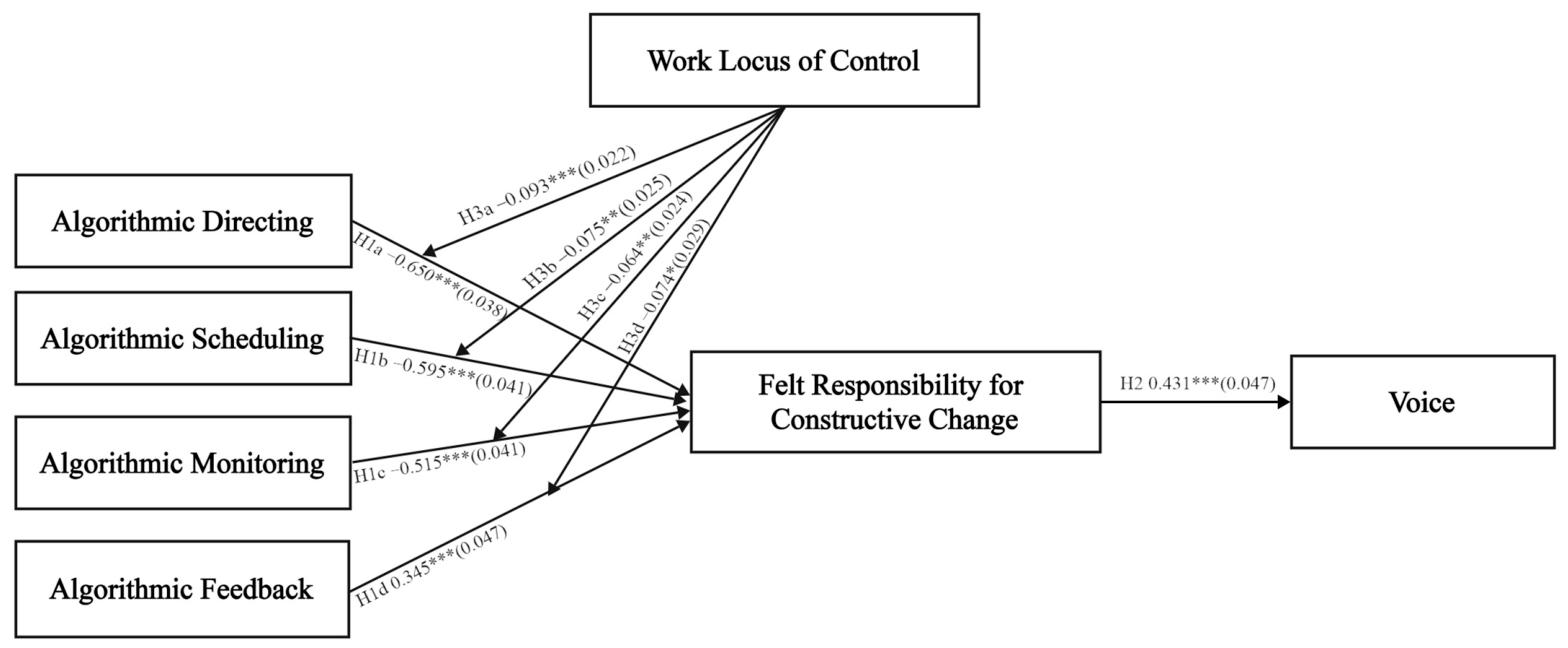
| Algorithmic Directing | −0.650 (0.038) *** | −0.224 (0.108) * | |||||||
| Algorithmic Scheduling | −0.595 (0.041) *** | −0.248 (0.120) * | |||||||
| Algorithmic Monitoring | −0.515 (0.041) *** | −0.231 (0.112) * | |||||||
| Algorithmic Feedback | 0.345 (0.047) *** | 0.661 (0.134) *** | |||||||
| Work Locus of Control | 0.460 (0.103) *** | 0.419 (0.109) *** | 0.313 (0.105) ** | 0.346 (0.116) ** | |||||
| Felt Responsibility for Constructive Change | 0.431 (0.047) *** | ||||||||
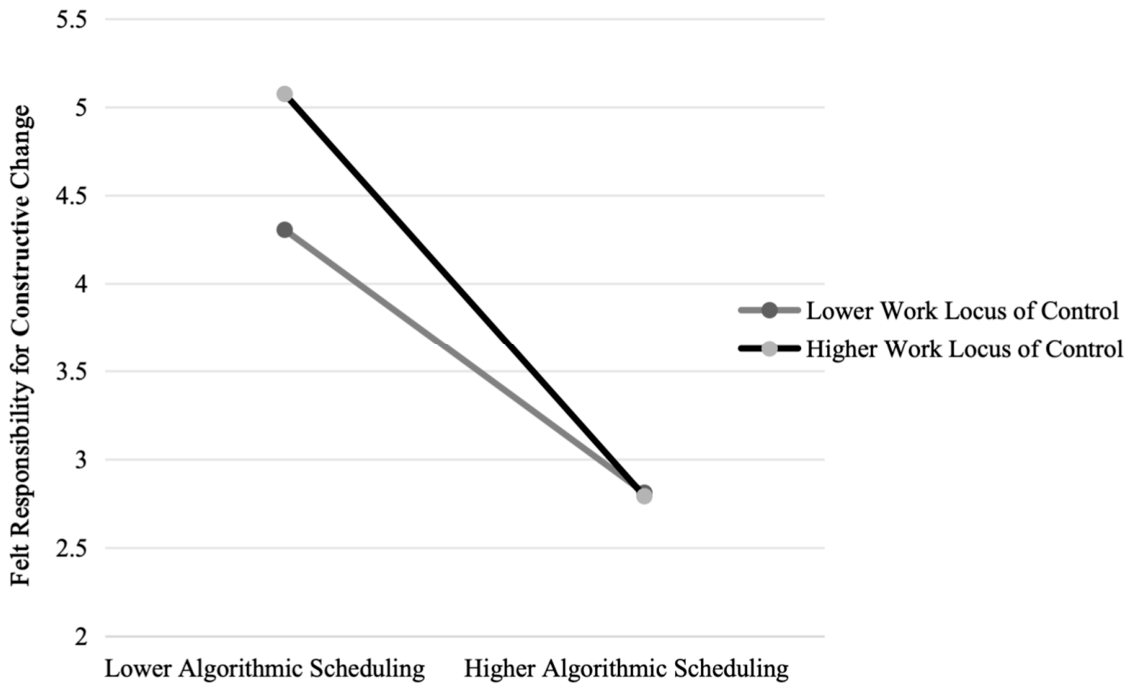
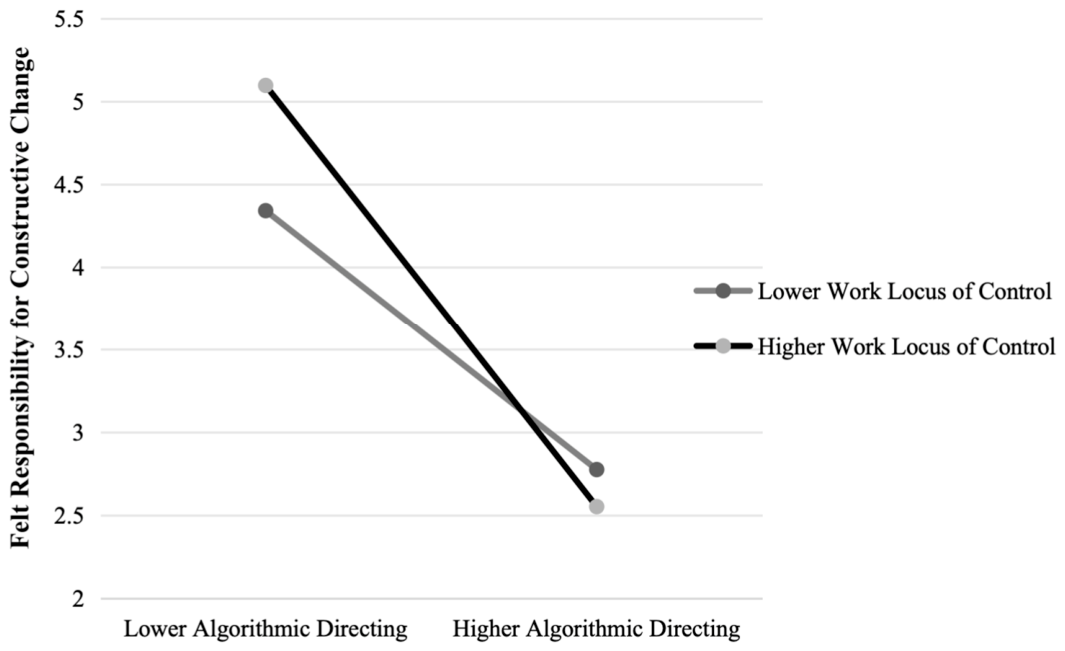
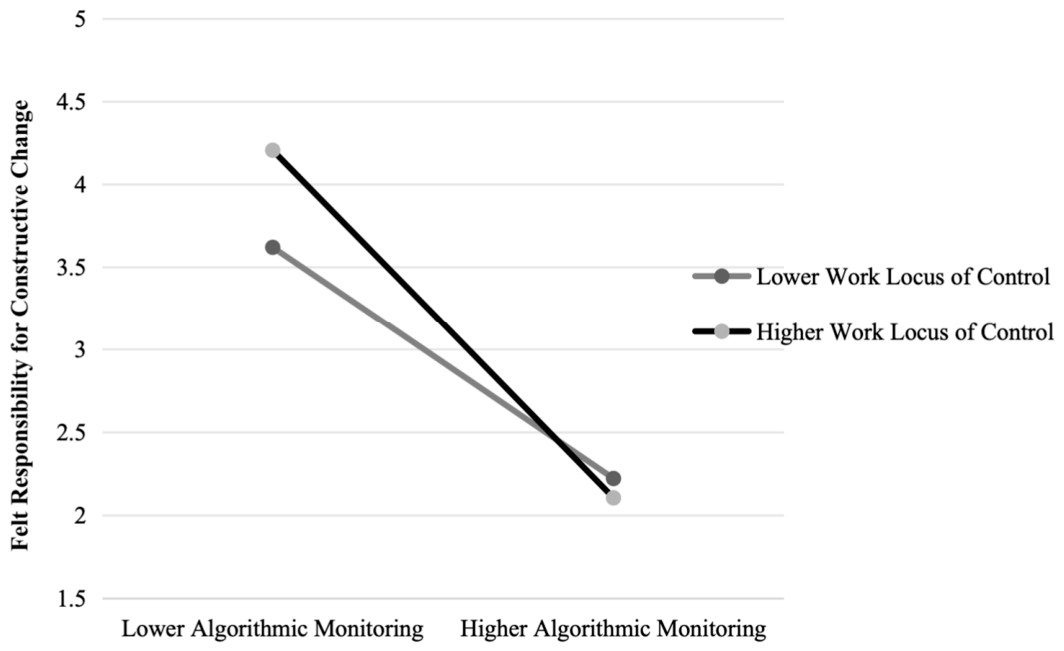
| Algorithmic Directing× Work Locus of Control | −0.093 (0.022) *** | ||||||||
| Algorithmic Scheduling× Work Locus of Control | −0.075 (0.025) ** | ||||||||
| Algorithmic Monitoring× Work Locus of Control | −0.064 (0.024) ** | ||||||||
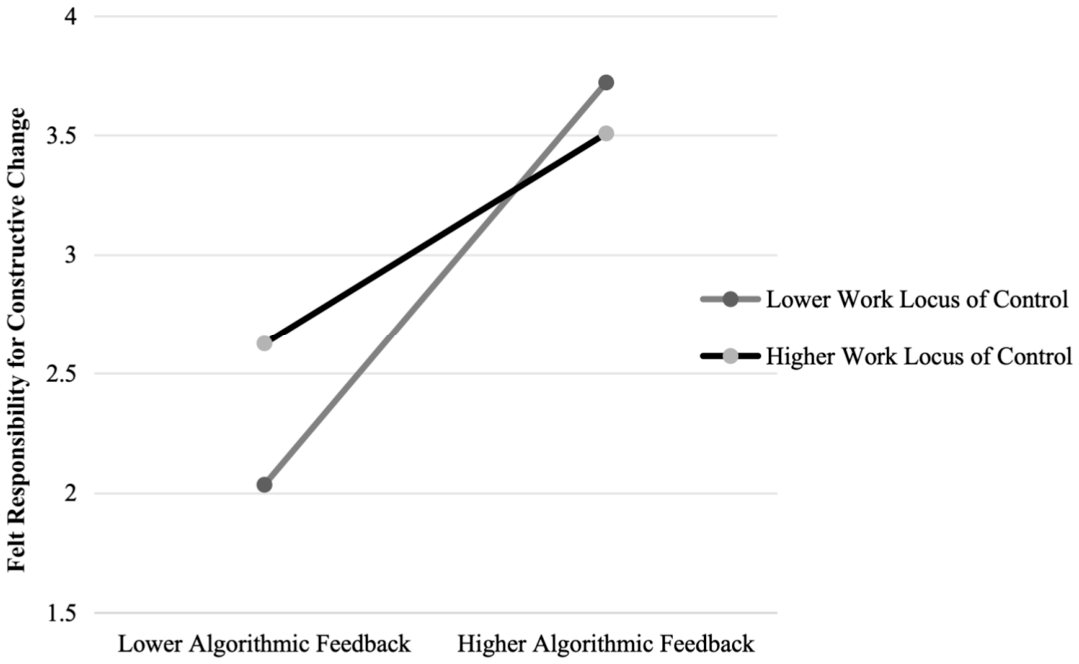
| Algorithmic Feedback× Work Locus of Control | −0.074 (0.029) * | ||||||||
| R2 | 0.473 | 0.391 | 0.326 | 0.148 | 0.503 | 0.418 | 0.343 | 0.170 | 0.208 |
| Level | Effect | S.E. | 95% CI |
|---|---|---|---|
| Conditional direct effects at different values of Work locus of control | |||
| (Algorithmic Directing → Felt Responsibility for Constructive Change) | |||
| −1 SD | −0.456 | 0.059 | [−0.572, −0.340] |
| +1 SD | −0.741 | 0.043 | [−0.826, −0.655] |
| (Algorithmic Scheduling → Felt Responsibility for Constructive Change) | |||
| −1 SD | −0.436 | 0.065 | [−0.564, −0.309] |
| +1 SD | −0.667 | 0.047 | [−0.760, −0.575] |
| (Algorithmic Monitoring → Felt Responsibility for Constructive Change) | |||
| −1 SD | −0.391 | 0.060 | [−0.509, −0.273] |
| +1 SD | −0.587 | 0.050 | [−0.685, −0.489] |
| (Algorithmic Feedback → Felt Responsibility for Constructive Change) | |||
| −1 SD | 0.476 | 0.072 | [0.336, 0.617] |
| +1 SD | 0.249 | 0.058 | [0.136, 0.363] |
| Conditional indirect effects at different values of Work locus of control | |||
| (Algorithmic Directing → Felt Responsibility for Constructive Change → Voice) | |||
| −1 SD | −0.136 | 0.039 | [−0.219, −0.065] |
| +1 SD | −0.222 | 0.055 | [−0.329, −0.113] |
| Difference | −0.085 | 0.031 | [−0.156, −0.032] |
| (Algorithmic Scheduling → Felt Responsibility for Constructive Change → Voice) | |||
| −1 SD | −0.144 | 0.037 | [−0.224, −0.078] |
| +1 SD | −0.220 | 0.049 | [−0.320, −0.127] |
| Difference | −0.076 | 0.034 | [−0.150, −0.017] |
| (Algorithmic Monitoring → Felt Responsibility for Constructive Change → Voice) | |||
| −1 SD | −0.132 | 0.033 | [−0.200, −0.072] |
| +1 SD | −0.199 | 0.042 | [−0.287, −0.120] |
| Difference | −0.066 | 0.030 | [−0.133, −0.017] |
| (Algorithmic Feedback → Felt Responsibility for Constructive Change → Voice) | |||
| −1 SD | 0.182 | 0.037 | [0.116, 0.259] |
| +1 SD | 0.095 | 0.036 | [0.030, 0.169] |
| Difference | −0.087 | 0.041 | [−0.171, −0.010] |
| Hypothesis | Results |
|---|---|
| Hypothesis 1a: Algorithmic directing is negatively related to felt responsibility for constructive change. | Supported |
| Hypothesis 1b: Algorithmic scheduling is negatively related to felt responsibility for constructive change. | Supported |
| Hypothesis 1c: Algorithmic monitoring is negatively related to felt responsibility for constructive change. | Supported |
| Hypothesis 1d: Algorithmic feedback is positively related to felt responsibility for constructive change. | Supported |
| Hypothesis 2: Felt responsibility for constructive change is positively related to voice. | Supported |
| H3a: Work locus of control moderates the relationship between algorithmic directing and felt responsibility for constructive change. | Supported |
| H3b: Work locus of control moderates the relationship between algorithmic scheduling and felt responsibility for constructive change. | Supported |
| H3c: Work locus of control moderates the relationship between algorithmic monitoring and felt responsibility for constructive change. | Supported |
| H3d: Work locus of control moderates the relationship between algorithmic feedback and felt responsibility for constructive change. | Supported |
| H4a: The indirect negative effect of algorithmic directing on voice through felt responsibility for constructive change is stronger for employees with an external work locus of control than for those with an internal work locus of control. | Supported |
| H4b: The indirect negative effect of algorithmic scheduling on voice through felt responsibility for constructive change is stronger for employees with an external work locus of control than for those with an internal work locus of control. | Supported |
| H4c: The indirect negative effect of algorithmic monitoring on voice through felt responsibility for constructive change is stronger for employees with an external work locus of control than for those with an internal work locus of control. | Supported |
| H4d: The indirect positive effect of algorithmic feedback on voice through felt responsibility for constructive change is stronger for employees with an internal work locus of control than for those with an external work locus of control. | Supported |
Disclaimer/Publisher’s Note: The statements, opinions and data contained in all publications are solely those of the individual author(s) and contributor(s) and not of MDPI and/or the editor(s). MDPI and/or the editor(s) disclaim responsibility for any injury to people or property resulting from any ideas, methods, instructions or products referred to in the content. |
© 2026 by the authors. Licensee MDPI, Basel, Switzerland. This article is an open access article distributed under the terms and conditions of the Creative Commons Attribution (CC BY) license.
Share and Cite
Lin, W.; Zhang, M.; Zhang, W.; Zhang, C. Will Employees Still Speak up Under Algorithmic Management? The Differential Effects of Distinct Algorithmic Functions—Evidence from the Meituan Platform in China. Systems 2026, 14, 569. https://doi.org/10.3390/systems14050569
Lin W, Zhang M, Zhang W, Zhang C. Will Employees Still Speak up Under Algorithmic Management? The Differential Effects of Distinct Algorithmic Functions—Evidence from the Meituan Platform in China. Systems. 2026; 14(5):569. https://doi.org/10.3390/systems14050569
Chicago/Turabian StyleLin, Wanliang, Mingyu Zhang, Wenjia Zhang, and Can Zhang. 2026. "Will Employees Still Speak up Under Algorithmic Management? The Differential Effects of Distinct Algorithmic Functions—Evidence from the Meituan Platform in China" Systems 14, no. 5: 569. https://doi.org/10.3390/systems14050569
APA StyleLin, W., Zhang, M., Zhang, W., & Zhang, C. (2026). Will Employees Still Speak up Under Algorithmic Management? The Differential Effects of Distinct Algorithmic Functions—Evidence from the Meituan Platform in China. Systems, 14(5), 569. https://doi.org/10.3390/systems14050569