1. Introduction
The increasing technological complexity and rapid obsolescence cycles characteristic of contemporary innovation paradigms make it increasingly difficult for firms to rely exclusively on closed, internal R&D pipelines [
1,
2]. In open innovation settings, enterprises are required to extend their search beyond organizational boundaries in order to access knowledge that cannot be generated efficiently in-house [
1,
3]. Universities and public research institutes are particularly important in this regard because they provide frontier scientific knowledge, specialized human capital, analytical infrastructures, and early access to emerging technological trajectories [
4,
5]. However, the value of such boundary-spanning collaboration is neither immediate nor automatic. External academic knowledge must be identified, assimilated, recombined with existing firm-specific assets, and ultimately transformed into more efficient production processes and higher-value commercial outputs [
6]. Recent review evidence likewise suggests that the effects of IUR collaboration are multidimensional and cannot be fully captured by narrow innovation-output indicators alone, which underscores the importance of examining broader economic consequences such as productivity [
7,
8,
9].
From a theoretical perspective, the productivity consequences of IUR collaboration can be understood at the intersection of open innovation, the knowledge-based view of the firm, and endogenous growth theory [
1,
3,
10,
11]. Open innovation emphasizes that firms improve performance by purposefully sourcing and combining external knowledge with internal capabilities [
12,
13]. The knowledge-based view further suggests that the economic value of external knowledge depends not only on access itself but also on the firm’s ability to absorb, interpret, and redeploy that knowledge within its own routines and production processes [
6,
14]. Endogenous growth theory adds that knowledge accumulation and recombination are central drivers of productivity improvement, implying that external scientific knowledge may enhance firm-level efficiency when it is successfully integrated into production [
15,
16]. Taken together, these perspectives suggest that IUR collaboration should not be understood simply as a bilateral linkage or a symbolic innovation activity but as a system-level mechanism through which external knowledge, internal capability, and institutional support jointly shape productivity outcomes.
For this reason, the productivity consequences of IUR collaboration have become an increasingly important research issue. Much of the existing literature has focused on intermediate innovation outputs, such as patent counts, new product outcomes, or R&D expenditure, rather than on productivity itself [
4,
7,
17]. While such studies have generated valuable evidence on how university–industry linkages stimulate knowledge creation, they leave open a more fundamental question: whether and how these collaborations improve a firm’s underlying productive efficiency [
18,
19]. This distinction matters because TFP captures not only technological invention but also the commercialization, allocation, and efficiency consequences of innovation activities [
20]. More broadly, productivity is widely recognized as a key driver of economic growth and well-being, and productivity differences remain substantial both across and within economies [
21].
Recent evidence, including studies in the Chinese context, suggests that IUR collaboration may enhance firm productivity [
22,
23]. However, existing research remains underdeveloped in at least three respects. First, the knowledge-acquisition logic linking academic collaboration to productivity improvement has not been sufficiently formalized within a clear production framework. Existing studies offer limited theoretical explanation of how externally acquired knowledge enters the production process and affects firm-level TFP [
24,
25]. Second, the conditions under which external knowledge can be effectively transformed into productivity gains remain insufficiently explored. Internal routines, environmental pressures, and policy support are often examined separately, even though they are likely to operate jointly [
14,
26,
27]. Third, much of the literature still treats IUR collaboration as an isolated bilateral linkage. From a systems perspective, however, IUR should be understood as part of a broader innovation system in which internal organizational capabilities, external environmental dynamics, and institutional interventions interact to shape productivity outcomes [
28,
29].
Accordingly, this study identifies a research gap at the intersection of open innovation, knowledge acquisition, and firm productivity. Existing studies have not yet provided a sufficiently integrated explanation of how external knowledge obtained through IUR collaboration is translated into firm-level TFP within a broader innovation system. In particular, the literature has not adequately connected three dimensions that are central to this transformation process: the firm’s internal ability to absorb external knowledge, the external dynamism that alters the value of existing routines and knowledge stocks, and the institutional support that can reduce the costs and risks of commercialization. Without bringing these dimensions into a unified framework, it remains difficult to explain why similar forms of IUR collaboration generate different productivity consequences across firms and contexts.
This article differs from prior studies in three main ways. First, unlike research that emphasizes patenting or other intermediate innovation outcomes, this study focuses on TFP as a more comprehensive indicator of whether collaborative knowledge is ultimately converted into productive efficiency [
22,
23,
30]. Second, unlike studies that consider absorptive capacity, environmental conditions, or government support in isolation, this paper examines these contingencies jointly, thereby capturing the conditional and systemic nature of productivity gains from external knowledge sourcing [
7,
14,
27,
31]. Third, rather than treating IUR collaboration simply as a direct explanatory variable, we embed it within an augmented production framework that links micro-level knowledge acquisition to firm efficiency outcomes. In doing so, we aim to clarify not only whether IUR collaboration matters but also why and under what conditions it matters.
China provides a particularly informative setting for examining these issues. Official statistics show that China’s R&D expenditure reached RMB 3.9262 trillion in 2025, equivalent to 2.80% of GDP, while the value of technology contract transactions reached RMB 7.5734 trillion in the same year, indicating the expanding scale of knowledge production, transfer, and commercialization in the national innovation system. In addition, China’s gross enrollment ratio in higher education reached 60.2% in 2023, reflecting the broadening educational and research base that underpins university knowledge supply. Policy initiatives such as the 2016 Science and Technology Innovation Plan and the 2018 Guidelines on Strengthening Industry–University Collaboration further reinforced the strategic role of collaborative innovation in linking academic knowledge to industrial upgrading.
Against this backdrop, this study adopts a systems-oriented perspective on the relationship between IUR collaboration and firm-level TFP. We argue that the productivity effect of IUR collaboration is conditional rather than automatic, because the translation of external knowledge into productive efficiency depends on the joint configuration of multiple system components. Specifically, external knowledge must be absorbed by the firm, adapted to changing environmental conditions, and supported by institutional arrangements that reduce the costs and uncertainties of commercialization [
32]. In this sense, the effect of IUR collaboration is better understood as an emergent outcome of an innovation system than as a direct consequence of collaboration alone.
To formalize this argument, we embed external knowledge acquisition into an augmented production framework and examine how its productivity effects vary with three key contingencies: absorptive capacity, environmental dynamism, and government innovation subsidies. Absorptive capacity reflects the internal ability of the firm to recognize, assimilate, and apply external knowledge. Environmental dynamism captures the volatility of the external context in which existing knowledge may depreciate more rapidly, thereby altering the marginal value of newly acquired knowledge. Government innovation subsidies represent an institutional mechanism that can reduce the costs and risks associated with transforming collaborative knowledge into productive outcomes. Taken together, these factors provide a system-level explanation of why the productivity returns to IUR collaboration vary across firms and contexts.
Empirically, the analysis draws on an unbalanced panel of 24,227 firm-year observations for 3540 Chinese A-share non-financial listed firms over the period 2011–2024. This setting makes it possible to examine whether IUR collaboration is associated with higher firm-level TFP and whether this relationship depends on internal, external, and institutional contingencies in a large and policy-relevant emerging economy.
This study contributes to the literature in three main ways. First, it shifts the focus of the IUR literature from intermediate innovation outputs to structural productivity consequences. Second, it develops a more explicit and economically grounded explanation of how external knowledge is translated into TFP through the interaction of multiple contingencies. Third, it provides large-sample evidence from an important emerging-economy context, thereby enriching broader discussions on open innovation, firm productivity, and the functioning of innovation systems.
The remainder of the paper is organized as follows.
Section 2 develops the theoretical framework and hypotheses.
Section 3 presents the research design.
Section 4 reports the empirical results.
Section 5 discusses the implications of the findings.
Section 6 concludes.
2. Literature Review and Hypothesis Development
2.1. IUR Collaboration, Knowledge Acquisition, and Firm TFP
The theoretical basis for linking IUR collaboration to firm productivity lies at the intersection of open innovation, the knowledge-based view of the firm, and endogenous growth theory [
3,
10,
20]. These perspectives share a common implication: firms can improve performance not only through internally generated knowledge but also through the acquisition, recombination, and effective utilization of external knowledge. In this context, universities and public research institutes represent important sources of frontier scientific knowledge, specialized research capabilities, and exploratory technological opportunities [
5]. Collaborative patenting can therefore be understood as a formal mechanism through which firms gain access to and internalize externally generated knowledge.
Existing studies provide important evidence that university–industry collaboration can stimulate patenting, innovation output, and knowledge diffusion [
4,
7]. However, three limitations remain. First, much of the literature emphasizes intermediate innovation outcomes while paying insufficient attention to whether collaborative knowledge is ultimately translated into productivity gains [
33]. Second, studies that do examine productivity often treat the effect of collaboration as relatively direct, without clarifying the knowledge-conversion mechanism through which external scientific inputs enter the firm’s production system [
23]. Third, the boundary conditions of this process are usually examined in a fragmented way, with absorptive capacity, environmental conditions, and institutional support discussed separately rather than as interacting components of a broader innovation system [
34]. These limitations make it difficult to explain why seemingly similar IUR collaborations generate heterogeneous productivity outcomes across firms and contexts.
To formalize the knowledge-conversion mechanism, we build on the knowledge production function proposed by Griliches (1979) [
11] and specify firm output as an augmented Cobb–Douglas production function:
where
denotes firm-level technical efficiency. Rather than treating productivity as an unexplained residual, we model it as a function of the firm’s economically useful knowledge stock:
where
captures the elasticity of productivity with respect to knowledge capital. Economically,
> 0 implies that a larger effective knowledge stock improves production efficiency by enhancing process quality, reducing resource misallocation, and increasing the productivity of conventional inputs. From a systems perspective, this means that firm performance is shaped not only by capital, labor, and materials but also by the interaction between the production subsystem and the knowledge subsystem embedded within the firm.
Traditionally, the knowledge stock is associated mainly with internal R&D. However, under open innovation and inter-organizational spillovers, a firm’s effective knowledge stock should incorporate both internal R&D investment (
) and external knowledge acquired through IUR collaboration (
). Following this logic, the composite knowledge stock can be represented in parsimonious log-linear form as:
where
and
capture the respective contributions of internal and external knowledge to the effective knowledge stock. This representation is adopted for analytical tractability. It does not imply that internal and external knowledge are identical in function; rather, it provides a convenient way to capture their joint contribution to the firm’s productive knowledge base. Compared with a linear specification, which implies perfect substitution, and a Leontief-type specification, which implies rigid complementarity, this log-linear representation provides a tractable approximation for theoretical derivation without imposing either polar case. Economically, a larger
indicates that collaborative knowledge acquired through IUR plays a stronger role in raising effective productivity, whereas a larger
implies greater dependence on internally generated knowledge. More broadly, this specification is consistent with a systems perspective in which firm productivity depends on the configuration of multiple knowledge inputs rather than on any single source in isolation.
Substituting Equation (3) into Equation (2) yields:
In Equation (4), captures the productivity elasticity of the effective knowledge stock, while and describe the respective contributions of internal and external knowledge to that stock. Economically, the relative magnitudes of these parameters indicate how firms balance internal learning and external sourcing within the knowledge-production process.
Taking the partial derivative of productivity with respect to external collaborative knowledge gives:
Equation (5) shows that if externally acquired knowledge contributes positively to the firm’s effective knowledge stock ( > 0), and if knowledge capital enhances technical efficiency ( > 0), then IUR collaboration will increase firm-level TFP. Economically, this implies that the value of IUR collaboration lies not in collaboration per se but in its ability to expand the firm’s effective knowledge frontier and improve the productivity of existing capital and labor. From a systems perspective, IUR collaboration functions as an external knowledge input whose productivity effect depends on whether external scientific resources can be meaningfully coupled with the firm’s internal production system.
This productivity-enhancing effect may arise through several channels. First, IUR collaboration broadens the firm’s technological opportunity set by exposing it to scientific approaches and production solutions that would be costly or time-consuming to generate internally [
35,
36]. Second, it improves problem-solving quality by combining academic analytical knowledge with the firm’s application-specific and market-oriented knowledge [
37]. Third, it reduces the screening, experimentation, and validation costs associated with identifying viable technological alternatives [
38]. Accordingly, we propose the following hypothesis:
Hypothesis 1. IUR collaboration is positively associated with firm TFP.
2.2. Absorptive Capacity as an Internal Contingency
The productivity returns to external knowledge acquisition are unlikely to be uniform across firms [
39]. A central internal condition is absorptive capacity, defined as the firm’s ability to recognize, assimilate, and apply new external knowledge. Subsequent research further distinguishes between potential absorptive capacity and realized absorptive capacity, but both imply that firms differ substantially in their ability to convert external knowledge into economically useful outcomes [
40,
41].
This issue is particularly salient in university-linked innovation because academic knowledge is often tacit, abstract, and cognitively distant from immediate production needs [
42]. Without sufficient internal scientific and organizational capability, firms may gain access to external knowledge but still fail to transform it into efficiency improvements [
43]. Existing studies generally agree that absorptive capacity strengthens firms’ ability to benefit from external knowledge, but most analyses focus on innovation output rather than productivity itself, and they rarely embed this mechanism in a unified production-based framework [
23,
44,
45]. This leaves unresolved the question of how absorptive capacity changes the productivity return to collaborative knowledge.
To formalize this mechanism, let
denote absorptive capacity. Effective external knowledge can then be expressed as:
Equation (6) captures the basic idea that absorptive capacity scales the amount of external knowledge a firm can usefully convert. Rather than imposing only a level shift, however, we allow absorptive capacity to also amplify the elasticity of effective knowledge with respect to external collaboration; that is, we generalize Equation (3) by letting the contribution of external knowledge to the effective knowledge stock depend on absorptive capacity, with the baseline specification recovered as the special case in which this dependence is switched off. Combining this generalized knowledge-stock specification with Equation (2) gives:
The cross-partial derivative is:
If , absorptive capacity strengthens the productivity effect of IUR collaboration. Economically, this means that firms with stronger absorptive capacity can extract more productive value from the same amount of external knowledge because they face lower cognitive, organizational, and coordination frictions in knowledge conversion. In other words, absorptive capacity raises the marginal productivity of collaborative knowledge rather than merely improving firm performance in a general sense. From a systems perspective, absorptive capacity is an internal subsystem that governs whether external knowledge can be effectively translated into productivity gains.
Firms with stronger internal R&D bases, richer technical vocabularies, and more developed engineering routines are better positioned to interpret academic knowledge, communicate effectively with university partners, and embed newly acquired ideas into production processes [
7,
45,
46]. By contrast, firms with weak absorptive capacity may access external knowledge but fail to convert it into usable production capability, leading to much lower productivity returns from collaboration. Accordingly, we propose:
Hypothesis 2. Absorptive capacity positively moderates the relationship between IUR collaboration and firm TFP.
2.3. Environmental Dynamism as an External Contingency
Environmental dynamism refers to the rate and unpredictability of change in the firm’s external operating environment, including technological turbulence, shifts in demand, and competitive volatility [
47,
48]. Prior research shows that such dynamism affects the value of organizational capabilities by increasing uncertainty, accelerating obsolescence, and raising the premium on rapid adaptation [
49,
50]. However, most studies discuss environmental dynamism as a contextual condition for innovation or strategic flexibility, rather than explaining how it alters the productivity return to externally sourced knowledge [
49,
51,
52]. This makes it necessary to clarify its role within a knowledge-based production framework.
While Equation (3) describes the composition of the effective knowledge stock at a given point in time, the following formulation captures its dynamic evolution. To capture this effect, we model the firm’s knowledge stock dynamically as follows:
where
denotes new knowledge investment, including both internal R&D and knowledge acquired through IUR collaboration. We further assume that the depreciation rate of existing knowledge depends positively on environmental dynamism:
When environmental dynamism rises, previously accumulated knowledge becomes obsolete more rapidly. Under such conditions, firms cannot rely solely on existing routines or incremental internal search. They must renew and update their knowledge base more quickly, and external knowledge obtained through IUR collaboration becomes more valuable. Economically, this implies that the marginal productivity of newly acquired collaborative knowledge rises when environmental change accelerates, because external knowledge helps firms respond more effectively to technological obsolescence and market turbulence. The implication is therefore not simply that dynamic environments are beneficial or harmful in themselves but that they increase the relative economic value of new external knowledge by reducing the usefulness of legacy routines. From a systems perspective, environmental dynamism represents an external condition that changes the returns to the innovation system by shortening the effective life of existing knowledge.
In highly dynamic environments, university collaboration can help firms identify new technological trajectories, reduce search delay, and reconfigure production more rapidly. In relatively stable environments, by contrast, the incremental value of costly external collaboration is likely to be smaller because legacy routines and existing knowledge stocks remain more useful for longer periods. Therefore, we expect the productivity benefit of IUR collaboration to be stronger when environmental dynamism is high. Accordingly, we propose:
Hypothesis 3. Environmental dynamism positively moderates the relationship between IUR collaboration and firm TFP.
2.4. Government Innovation Subsidies as an Institutional Contingency
Government innovation subsidies introduce an important institutional condition into the IUR–productivity relationship. Existing research suggests that subsidies may either crowd out private innovation effort or complement it by alleviating financial constraints and reducing the risks of exploratory investment [
26,
27]. In the specific context of IUR collaboration, the complementary mechanism is more plausible because university-linked innovation often involves high uncertainty, long development cycles, and substantial commercialization costs [
53]. Yet prior studies mostly assess the direct effect of subsidies on innovation outcomes, rather than examining how subsidies alter the productivity conversion of collaborative knowledge [
54,
55,
56].
Let
denote innovation subsidies, and let the cost of converting external academic knowledge into productivity-enhancing knowledge capital be
. If subsidies and collaborative knowledge are complementary, then the marginal cost of knowledge conversion decreases as subsidy support increases:
Equation (11) implies that subsidies strengthen the productivity effect of IUR collaboration by lowering the cost of transforming external knowledge into usable production capability. Economically, this means that subsidies relax financing constraints, reduce commercialization risk, and support the complementary investments required to move university-generated knowledge from invention to application. In this sense, subsidies do not merely add resources; they improve the efficiency of knowledge conversion by lowering the marginal cost of transforming collaborative knowledge into productive capability. From a systems perspective, government subsidies act as an institutional coordination mechanism that improves the coupling between external knowledge supply and firm-level productivity realization.
In practice, subsidies can finance prototype testing, pilot production, organizational restructuring, and other costly transition activities that are often necessary for converting academic knowledge into actual production gains [
27]. The productivity effect of IUR collaboration should therefore be stronger when firms receive more targeted innovation support. Accordingly, we propose:
Hypothesis 4. Government innovation subsidies positively moderate the relationship between IUR collaboration and firm TFP.
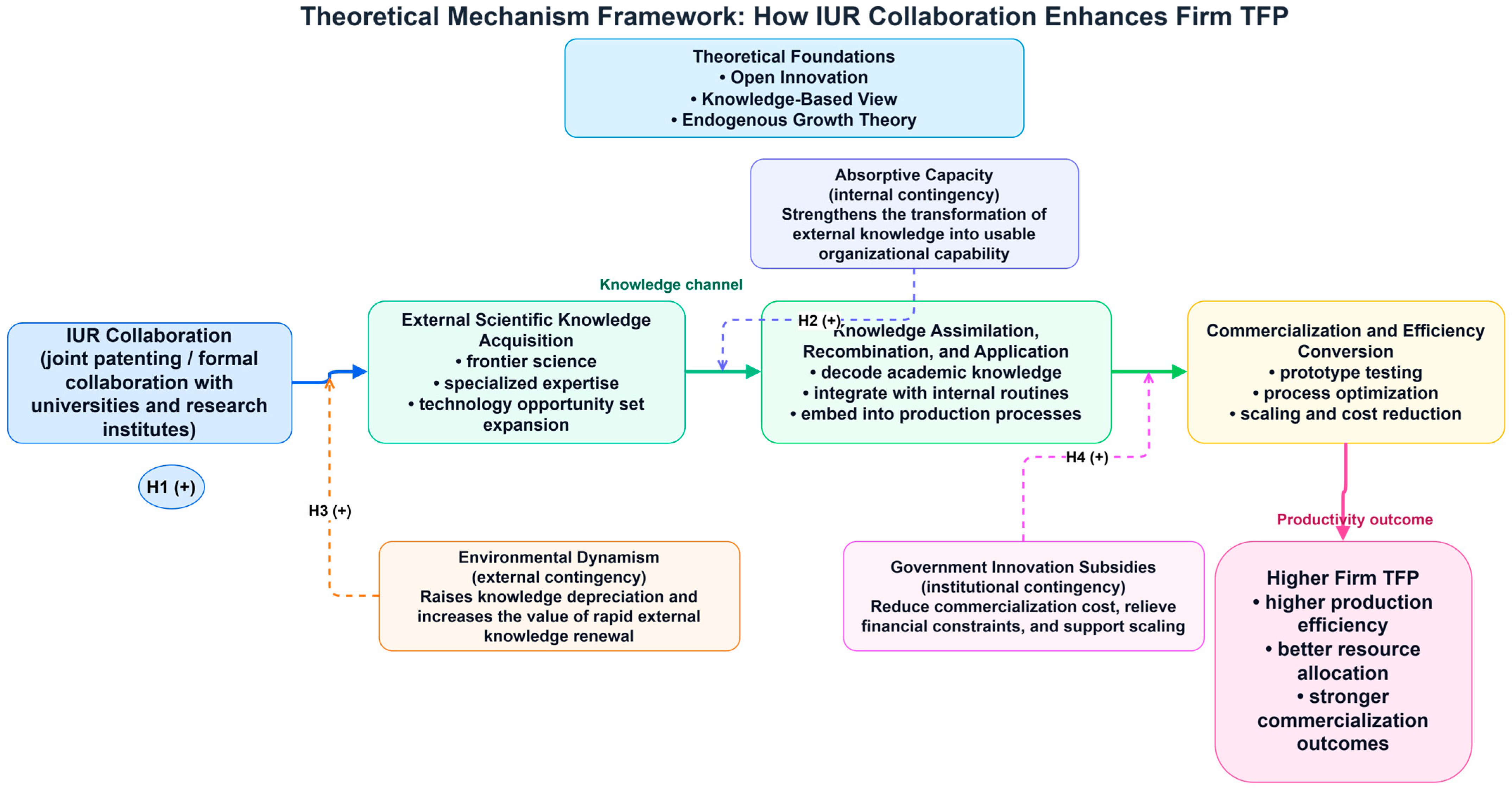
For clarity,
Figure 1 presents the literature-based conceptual framework of the IUR–TFP relationship. Drawing on open innovation, the knowledge-based view, and endogenous growth theory, the framework conceptualizes collaborative knowledge acquisition as the main pathway through which external scientific knowledge enters the firm’s production system. The productivity effect is conditioned by three interacting system components: absorptive capacity as an internal capability, environmental dynamism as an external condition, and government innovation subsidies as an institutional support mechanism.
4. Empirical Results
4.1. Descriptive Statistics
Table 2 details the distributional properties of the core variables utilized in the analysis. The dependent variable, TFP, possesses a mean of 9.124 and a standard deviation of 1.026, indicating considerable dispersion in productive efficiency across the Chinese corporate landscape. The principal explanatory variable, IUR collaboration, displays a highly skewed, left-censored distribution. While the mean sits at 0.127, the median value is rigidly zero, reflecting the economic reality that formal collaborative patenting with academic institutions is a highly concentrated activity undertaken by a distinct sub-population of technologically active frontier firms.
The moderator variables similarly exhibit vast structural heterogeneity. Absorptive capacity (AC) shows a standard deviation of 4.707 against a mean of 4.728. Environmental dynamism (ED) varies massively from a minimum of 0.064 to a maximum of 9.831, proving that the selected sample successfully encompasses both highly stable legacy manufacturing industries and highly volatile, technology-driven sectors subject to rapid obsolescence. This vast variance establishes an ideal empirical bedrock for testing the interaction parameters proposed in the theoretical framework.
4.2. Baseline Estimates
Table 3 reports the baseline relationship between IUR collaboration and firm-level TFP. Column (1) presents a parsimonious specification including only IUR together with industry and year fixed effects. The coefficient on IUR is positive and statistically significant, indicating that firms engaged in formal collaborative patenting with universities or research institutes tend to exhibit higher productivity than non-collaborating firms. Column (2) adds the full set of firm-level control variables. The coefficient on IUR declines substantially but remains positive and significant, suggesting that part of the raw correlation is explained by observable differences in firm characteristics, while a positive association still remains after these factors are taken into account.
Column (3) reports the preferred baseline specification, which additionally includes the main effects of the three moderating variables before their interaction terms are introduced. The coefficient on IUR remains positive and statistically significant at 0.0228. Because the dependent variable is measured in logarithms, this estimate implies that IUR collaboration is associated with an increase in TFP of approximately 2.3%, holding other factors constant. Evaluated at one standard deviation of IUR intensity, the estimated productivity gain is about 0.97%, which is modest but economically meaningful in the context of firm-level productivity. This result is consistent with Hypothesis 1 and with the theoretical argument that externally acquired knowledge contributes positively to the firm’s effective knowledge stock.
The main effects of absorptive capacity (AC) and environmental dynamism (ED) in Column (3) are negative, whereas the coefficient on government innovation subsidies (SUB) is statistically insignificant. These main effects should be interpreted with caution, because in the interaction models their economic meaning is conditional on the level of IUR collaboration. In the absence of effective external knowledge conversion, higher R&D intensity may involve short-run cost pressure, while greater environmental dynamism may accelerate the obsolescence of existing knowledge stocks. Their substantive interpretation therefore depends on the moderating specifications reported below.
4.3. Robustness Tests
To ensure the structural integrity of the findings,
Table 4 (Panel A) documents an extensive battery of robustness checks. The core positive relationship between IUR collaboration and TFP remains remarkably stable across a wide variety of structural perturbations. Replacing the LP-estimated TFP with an alternative residual-based measure (Column 1) confirms the result is not merely a statistical artifact of the specific semi-parametric inversion method employed. Implementing a one-period lag on the focal IUR variable (Column 2) helps alleviate immediate contemporaneous simultaneity concerns, while increasing the strict winsorization threshold to the 5th and 95th percentiles (Column 4) mathematically proves that the effect is not driven by anomalous extreme distribution tails.
Further, adjusting for global macro-shocks by excluding the COVID-19 pandemic year of 2020 (Column 5), utilizing bootstrapped standard errors to correct for any unknown heteroskedasticity profiles (Column 6), and applying a specific Tobit estimator to handle the left-censored mass of zeros in the IUR patent count variable (Column 7) all consistently confirm a positive and statistically significant coefficient. The foundational relationship linking external academic knowledge integration to commercial efficiency proves highly resilient.
These results suggest that the positive IUR–TFP relationship is not a fragile artifact of a particular estimator, outlier treatment, or sample adjustment. While the exact magnitude varies across specifications, the sign and statistical significance remain stable, which strengthens confidence that the baseline result reflects a meaningful empirical pattern rather than a purely mechanical outcome of model selection.
4.4. Addressing Endogeneity
Because firms do not enter IUR collaboration randomly, the baseline fixed-effects estimates may still be affected by reverse causality and omitted-variable bias. More productive firms may be more attractive partners to universities, while unobserved factors such as strategic orientation, managerial quality, or firm-specific technological needs may jointly influence both collaboration choices and productivity outcomes. To address these concerns, Panel B of
Table 4 reports a set of supplementary endogeneity and selection checks based on 2SLS, System GMM, Heckman correction, and propensity-score matching.
Column (1) reports the 2SLS estimate, which uses two excluded instruments: (i) the industry-year peer-firm IUR collaboration rate, defined as the leave-one-out average IUR intensity of all other firms in the same 2-digit industry and year, and (ii) the second-order lag of own IUR. The intuition is that a denser peer collaboration environment may affect the focal firm’s probability of entering IUR collaboration by shaping local knowledge networks, collaboration norms, and access opportunities, while lagged collaboration captures predetermined variation in collaboration propensity. Conditional on the included firm-level controls as well as industry and year fixed effects, these instruments are not expected to affect the focal firm’s current TFP except through their influence on IUR participation. The estimated coefficient on IUR remains positive at 0.0347, somewhat larger than the baseline estimate. Since the dependent variable is measured in logarithms, this coefficient implies a productivity premium of approximately 3.5%. The IV diagnostics also support the relevance and admissibility of the instrument set. The Cragg–Donald Wald F-statistic of 24.310 exceeds the Stock–Yogo 10% maximal IV size critical value of 16.38, and the first-stage F-statistic of 31.42 is well above the conventional threshold of 10, suggesting that weak-instrument concerns are limited. The Kleibergen–Paap rk LM statistic rejects under-identification at the 1% level, indicating that the excluded instruments are sufficiently correlated with IUR. In addition, the Hansen J statistic does not reject the over-identifying restrictions, which provides support for the joint exogeneity of the instrument set. Taken together, these results reduce concern that the positive 2SLS estimate is driven by weak or invalid instruments.
Column (2) applies a two-step system-GMM estimator to the same moment conditions and yields a quantitatively similar inference; the Arellano–Bond AR(1) test rejects no first-order serial correlation in the differenced residuals (p < 0.01) while the AR(2) test does not reject no second-order correlation (p = 0.234), which together with the Hansen J statistic supports the validity of the GMM moment conditions. This specification is included to address the possibility that firm productivity is dynamically persistent and that a static regression may therefore understate the role of past productivity in current outcomes. The GMM coefficient on IUR remains positive and close in magnitude to the 2SLS estimate, suggesting that the baseline result is not driven solely by static specification choices. Instead, the positive association between IUR collaboration and TFP remains visible even after accounting for dynamic persistence and endogeneity in a panel-data setting.
Column (3) presents the Heckman two-stage correction, which addresses the possibility that firms self-select into IUR collaboration on the basis of unobserved characteristics. The coefficient on IUR remains positive and significant, while the inverse Mills ratio is statistically insignificant. This result suggests that selection on unobservables is unlikely to be the dominant source of bias in the baseline estimates.
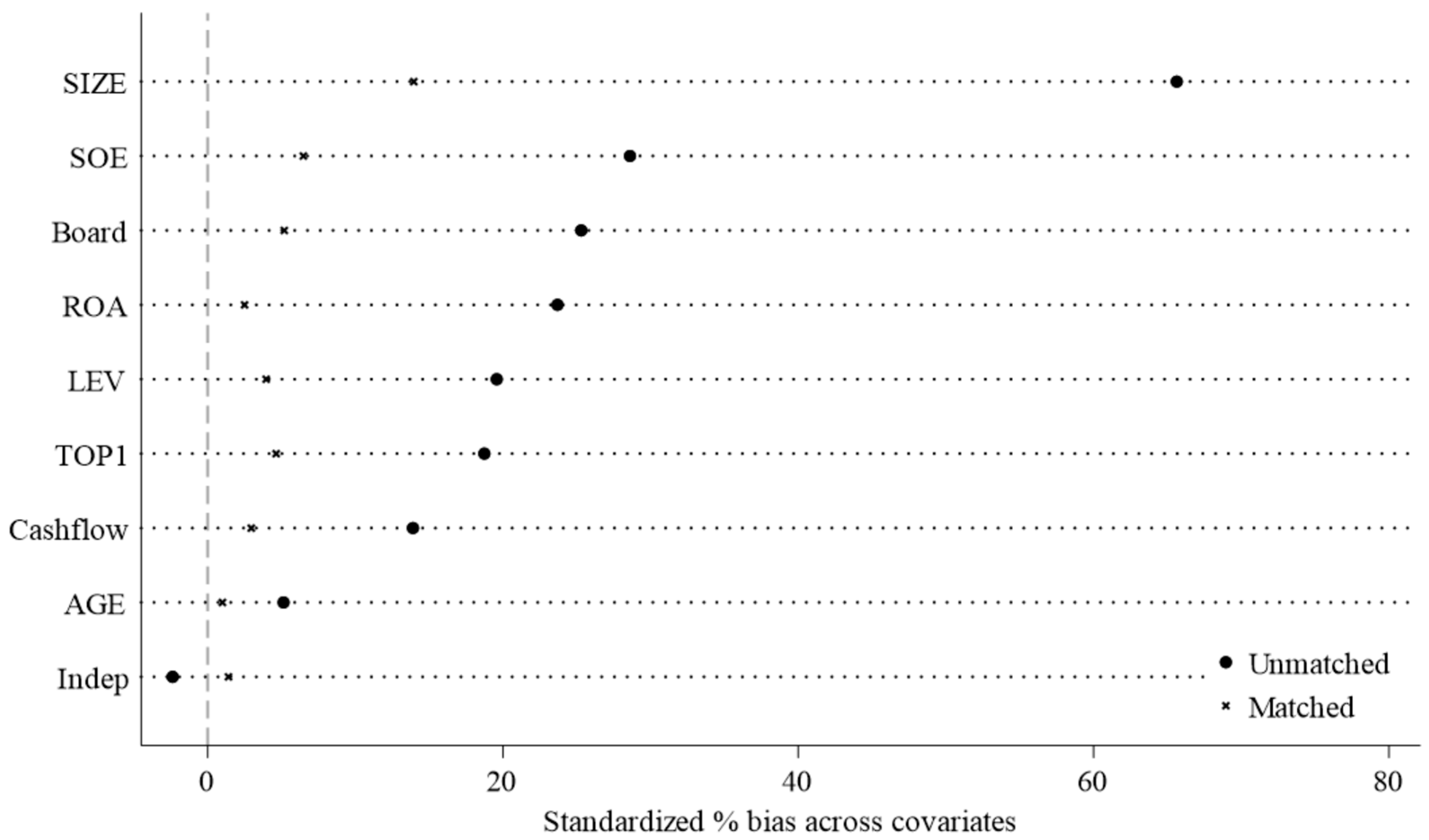
Column (4) reports the PSM-OLS estimate. After matching collaborating firms to observationally similar non-collaborating firms, the coefficient on IUR remains positive and significant.
Figure 2 further shows that the matching procedure substantially improves covariate balance between the two groups. The matched sample exhibits a clear reduction in standardized bias across the observed covariates, particularly for firm size, SOE status, board size, leverage, and ownership concentration. This pattern suggests that the matching procedure improves comparability between collaborating and non-collaborating firms, thereby increasing confidence that the PSM estimates in
Table 4 are less likely to be driven by observable selection differences.
Overall, the fixed-effects, IV, GMM, Heckman, and matching estimates point in the same direction. Although none of these approaches provides experimental identification, their convergence strengthens confidence that IUR collaboration is associated with a meaningful productivity premium rather than a purely spurious correlation.
4.5. Moderating Effects
Table 5 presents the empirical evaluation of the conditional hypotheses mathematically formalized in the theoretical framework. The interaction models specifically analyze the cross-partial derivatives dictating the structural translation of external knowledge into production efficiency. Because all continuous variables were rigorously mean-centered prior to estimation, the main effect of IUR precisely represents the productivity return evaluated at the average level of the respective moderator.
In Column (1), the interaction term between IUR collaboration and absorptive capacity (
) is positive and highly significant (0.0065,
t = 3.3370). This confirms the mathematical formalization of Hypothesis 2:
. The organizational capacity to decode complex academic knowledge acts as a strict mathematical multiplier. Firms possessing deeper internal R&D infrastructures integrate external knowledge with substantially less friction, extracting a demonstrably larger TFP yield per unit of collaborative academic patenting [
40,
65].
Column (2) evaluates environmental dynamism. The positive and significant interaction (
, 0.0272,
t = 2.5872) validates Hypothesis 3. Linking this explicitly to the knowledge depreciation model derived earlier, when severe market turbulence (
) induces rapid obsolescence (
) of the internal proprietary knowledge base, the strategic economic necessity of external acquisition rises exponentially. In turbulent sectors, the agile integration of academic knowledge provides the requisite technological flexibility to swiftly update production matrices, whereas highly stable sectors require significantly less costly external intervention [
66,
67].
Column (3) rigorously assesses the institutional parameter of innovation subsidies. The interaction (
) yields a profoundly positive and massive coefficient (7.0259,
t = 3.0077). Validating Hypothesis 4, this confirms a condition of super modular complementarity [
68]. Subsidies effectively relax the binding financial constraints and lower the immense marginal costs associated with the arduous commercialization and prototyping phases of university-born patents [
27,
69,
70].
When all three interactions are entered simultaneously in Column (4), the coefficients remain positive, with two significant at conventional levels and the third significant at the 10% level. This pattern suggests that the three moderators capture related but distinct mechanisms. Overall, the results support the view that the productivity effect of IUR collaboration is conditional on internal capability, external environment, and institutional support, rather than being a uniform average effect across firms.
4.6. Cross-Sectional Heterogeneity
Table 6 purposefully decomposes the full sample to determine whether the structural productivity relationship deviates across core firm ownership structures and classical factor intensities. The structural and institutional divide between State-Owned Enterprises (SOEs) and Non-State-Owned Enterprises (Non-SOEs) in China is notoriously stark. Column (1) shows that for SOEs, the IUR coefficient is statistically insignificant. Conversely, Column (2) reveals a highly significant, massive positive effect specifically for Non-SOEs (0.0439,
t = 3.7677). This sharp dichotomy suggests that Non-SOEs—operating under much harder budget constraints and significantly sharper market competition—face severe existential pressure to aggressively translate academic collaboration into tangible productive efficiency. In contrast, SOEs, shielded by soft budget constraints and implicit state guarantees, may engage in university collaboration primarily for political policy-compliance or signaling purposes rather than strict economic optimization.
Analyzing the sample through the traditional macroeconomic lens of factor-intensity (Columns 5–7), the strongest magnitude of the productivity effect appears conclusively in Capital-intensive industries (0.0695, t = 2.9062), followed sequentially by Technology-intensive sectors. Strikingly, Labor-intensive industries yield a negative and significant coefficient. This exact pattern is entirely consistent with the structural mathematical modeling of the knowledge-augmented production function: advanced academic knowledge spills over most efficiently into environments where complex, specialized physical capital () forms the rigid backbone of the production matrix. Capital-intensive firms can deeply embed new algorithms, process controls, and material sciences generated by academic partners into automated advanced manufacturing lines, yielding massive TFP gains. In contrast, labor-intensive firms lack the capital structure necessary to leverage high-level scientific patents.
5. Discussion
The results suggest that IUR collaboration is positively associated with firm-level total factor productivity, but this effect should not be interpreted as automatic or universal. By focusing on TFP rather than intermediate innovation outputs, this study extends prior research that has mainly emphasized patenting or innovation performance [
71,
72]. The findings are broadly consistent with recent evidence from China showing that university–industry collaboration can improve firm productivity [
22,
23], but they also refine that literature by showing that the productivity value of collaboration depends on the broader innovation system in which firms operate [
28,
72].
More specifically, the productivity gains from IUR collaboration are conditional on internal capability, external environment, and institutional support. The positive interaction between IUR and absorptive capacity indicates that external academic knowledge becomes more valuable when firms possess the internal R&D and organizational capability needed to absorb and apply it [
45,
73,
74]. The positive interaction with environmental dynamism suggests that collaboration is especially useful when technological and market conditions change rapidly, because external knowledge helps firms renew routines that would otherwise depreciate more quickly [
31,
51,
75]. The positive interaction with innovation subsidies further implies that public support can improve the productivity conversion of collaborative knowledge by reducing commercialization frictions [
27,
54,
55]. Taken together, these results support a systems-based interpretation: the productivity effect of IUR collaboration emerges from the joint configuration of internal, external, and institutional conditions rather than from collaboration alone.
At the same time, the findings invite several qualifications. The productivity premium is not uniform across all firms; it is weaker or absent in some groups, including parts of the labor-intensive and state-owned segments of the sample. This means that the claim “IUR collaboration improves productivity” should be interpreted with caution and understood as conditional rather than general. In addition, the IUR measure is based on formal joint patenting and therefore cannot capture informal collaboration, tacit knowledge exchange, or other non-patented channels [
4,
76]. Although the empirical analysis includes multiple robustness and endogeneity checks, the results should still be interpreted as strong evidence of a productivity-enhancing relationship rather than definitive experimental proof of causality. These limitations point to future research directions, including richer measures of collaboration, cleaner policy shocks for identification, and comparative work across firm types, sectors, and national settings.
6. Conclusions
This study examines whether IUR collaboration improves firm-level TFP and under what conditions such effects are more likely to emerge. Building on an augmented knowledge-production framework, the study conceptualizes IUR collaboration as a channel through which firms acquire external knowledge and translate it into productive efficiency. It further argues that this process is not automatic but depends on the interaction between internal capability, external environment, and institutional support. Using an unbalanced panel of Chinese A-share listed firms over 2011–2024, the empirical analysis provides evidence consistent with this argument.
Three main conclusions emerge. First, IUR collaboration is positively associated with firm-level TFP, suggesting that collaborative knowledge acquisition contributes not only to innovation outputs but also to broader production efficiency. Second, this productivity effect is conditional rather than uniform. Firms with stronger absorptive capacity, firms operating in more dynamic environments, and firms receiving greater innovation subsidies derive larger productivity gains from collaboration. Third, the gains from IUR collaboration are heterogeneous across organizational and industrial settings, with stronger effects observed in non-state-owned enterprises, high-technology firms, and capital-intensive sectors.
The study contributes to the literature in ways that both build on and differ from existing research. Prior studies on university–industry collaboration have mainly emphasized patenting, innovation output, and knowledge diffusion [
4,
7,
8,
9], while a smaller number of recent studies have begun to show that IUR collaboration may also improve firm productivity [
22,
23]. Building on this emerging literature, the present study extends the discussion in three respects. First, it shifts the analytical focus from whether collaboration generates innovation outputs to whether collaborative knowledge is ultimately translated into firm-level production efficiency. In this sense, the paper complements prior research by showing that the value of IUR collaboration should be evaluated not only in terms of invention or knowledge creation but also in terms of productivity consequences [
11,
15,
20]. Second, whereas existing studies often discuss absorptive capacity, environmental conditions, or policy support as relevant contingencies, they are usually examined separately rather than within an integrated framework [
14,
27]. This paper brings these dimensions together within a single framework and shows that the productivity effect of IUR collaboration is conditional rather than uniform. This comparative perspective helps explain why similar forms of collaboration may generate different outcomes across firms and contexts [
28,
29]. Third, compared with prior empirical work that treats IUR collaboration mainly as an external explanatory factor [
22,
23], this study embeds collaborative knowledge acquisition in an augmented knowledge-production framework and thereby provides a more explicit account of how external knowledge enters the firm’s effective knowledge stock. In this respect, the paper contributes not only additional empirical evidence but also a more integrated theoretical interpretation of the IUR–TFP relationship.
The findings also carry practical implications. For firms, the results indicate that collaboration with universities is unlikely to generate strong productivity gains unless it is supported by internal absorptive capacity. For universities and research institutes, the findings suggest that the effectiveness of knowledge transfer depends partly on the capability and industrial context of partner firms. For policymakers, the evidence implies that support for IUR collaboration should focus not only on increasing the volume of collaborative activity but also on improving the conditions under which collaborative knowledge can be commercialized and integrated into production. In particular, targeted innovation subsidies may be more effective when they help firms overcome the financing and organizational frictions associated with knowledge conversion.
Several limitations should be acknowledged. The measure of IUR collaboration is based on formal joint patenting and therefore cannot fully capture informal collaboration, tacit knowledge exchange, or personnel-based knowledge transfer. In addition, although the analysis incorporates multiple robustness and endogeneity checks, the results should still be interpreted with appropriate caution in causal terms. Finally, the study focuses on Chinese listed firms, which may limit the generalizability of the findings to other organizational and institutional settings.
These limitations point to several directions for future research. Subsequent studies may employ more granular measures of collaboration, such as contract-level cooperation, joint laboratories, technology licensing, or researcher mobility. Future work may also exploit cleaner policy shocks or institutional reforms to strengthen causal identification. More broadly, comparative research across sectors, firm types, and national innovation systems would help clarify how the productivity consequences of IUR collaboration vary under different structural conditions.