Digital Thread-Based Business Process Collaboration in Digital Manufacturing Systems: Modeling and Data-Driven Mechanisms

 , ,
, ,
Abstract
1. Introduction
2. DT-Based Business Collaboration Architecture and Paradigm
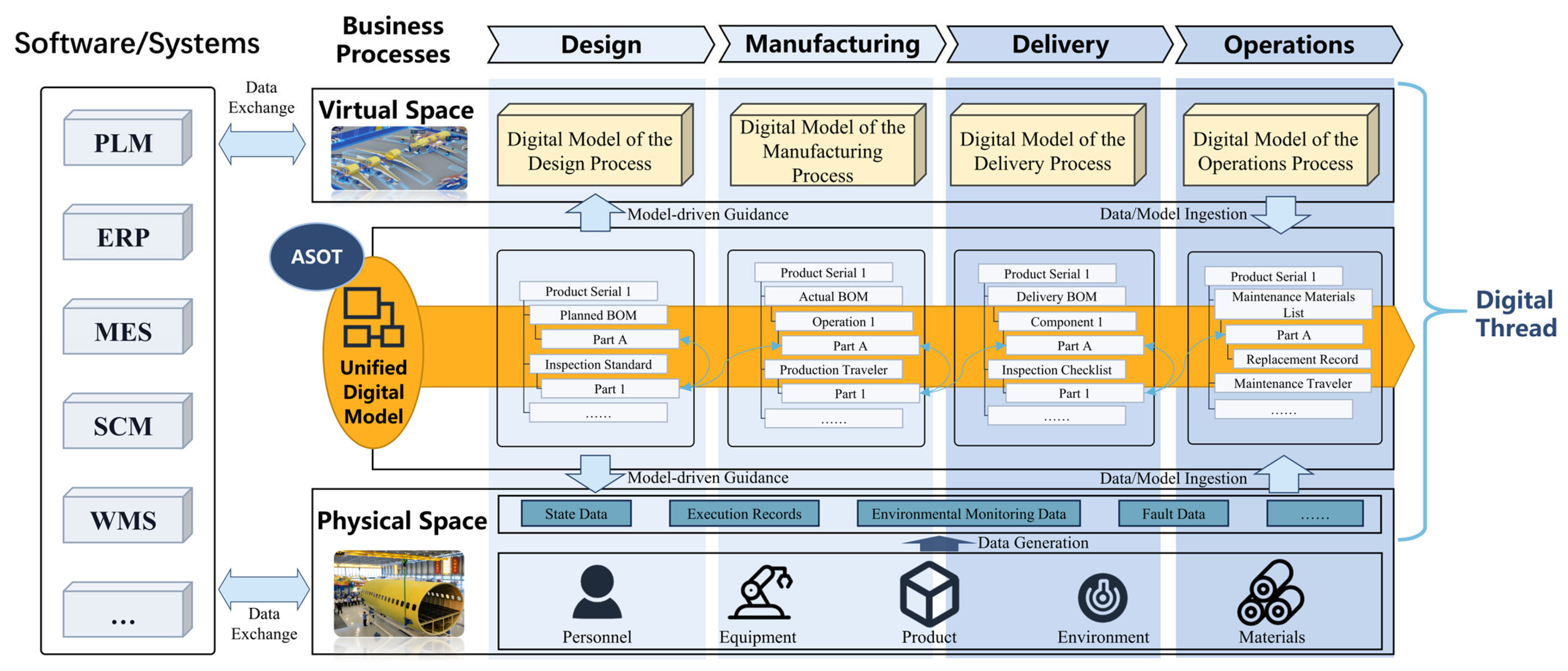
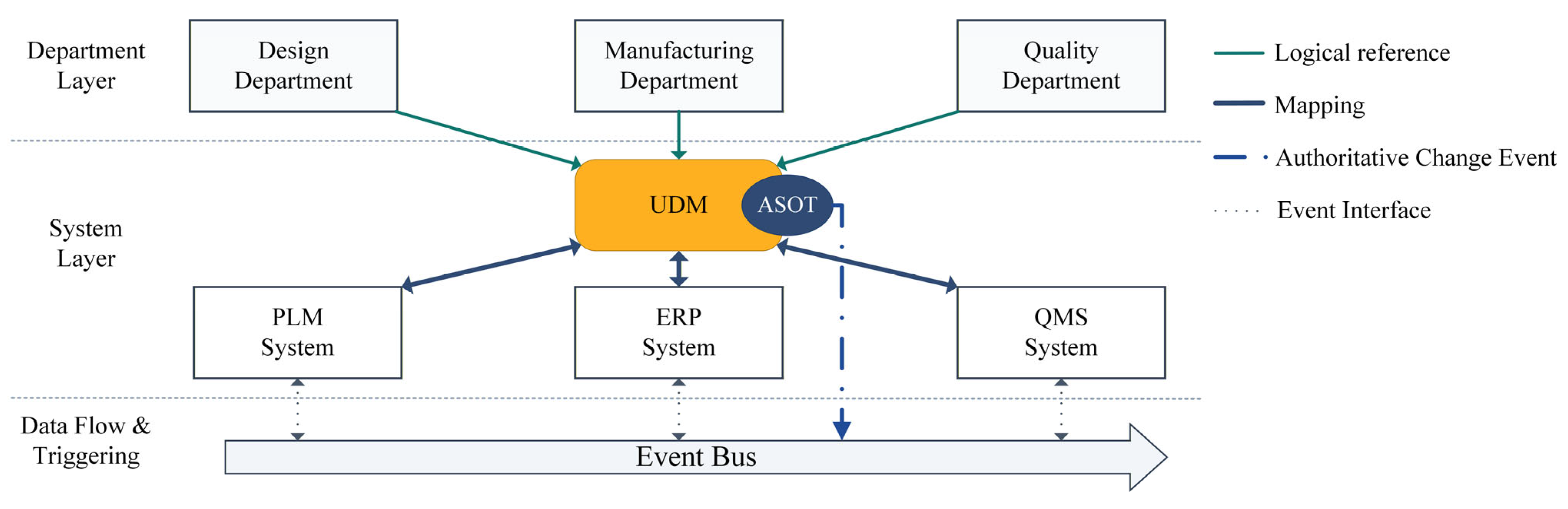
2.1. DT-Based Business Collaboration Architecture
2.2. DT-Based Business Collaboration Paradigm
3. DT-Based Business Process Modeling and Collaboration Mechanism
3.1. DT-Based Business Process Modeling Method
- Null. The data item exists in the UDM only as a specification/definition, and no versioned instance accessible to business activities has been created; therefore, the data object is not retrievable in this state.
- Working. The latest version instance of the data item is currently involved in an ongoing write operation, and the write privilege is exclusively held by a specific business activity. A data item in the Working state is mutually exclusive with other concurrent write requests targeting its latest version; however, collaborators are permitted to read historical Released versions of the item on demand.
- Released. The data item is not subject to any ongoing write operation and remains in a stable, referenceable state. Historical Released versions are frozen and can only be read for reference, while the latest Released version can serve as an authoritative version baseline provided by the ASoT to downstream entities.
3.2. A DT-Based Business Process Collaboration Mechanism
3.2.1. Concurrency Collaboration Constraints
3.2.2. Design of the DT-Based Business Collaboration Mechanism
- Activity state awareness and readiness determination. The event bus listens for state transition events of data objects in the UDM. For any not yet executed activity , once an update event is captured for any item in its input set , the system triggers the evaluation of . If , a is enqueued in the pending queue;
- Resource scheduling and concurrency locking. For any activity a in the pending queue, the system continuously monitors the workload of its responsible department according to . If , one unit of resource capacity is allocated and the load is updated as . The activity a is then formally started. Meanwhile, for all , the data state is set to Working, and a state transition event is published via the event bus. If , the activity remains in the pending queue and waits;
- State publication and closed-loop feedback. During the execution of activity a, for any , once an update/write operation on d is committed, the state of d is updated to Released. When the data states of all become Released, activity a is considered completed, and the department resources are released by updating the load as .
Algorithm 1: DT-Based Business Collaboration Mechanism Input: A; Cap(r); Load(r); UDM states Output: time-stamped execution trace
1:
2:
3: do
4:
5:
6:
7:; Record start events in Trace
8: Advance t to the earliest completion time of activities in Run
9:
10: Move completed activities from Run to Done; Record finish events in Trace
11: End while
4. Simulation Experiments
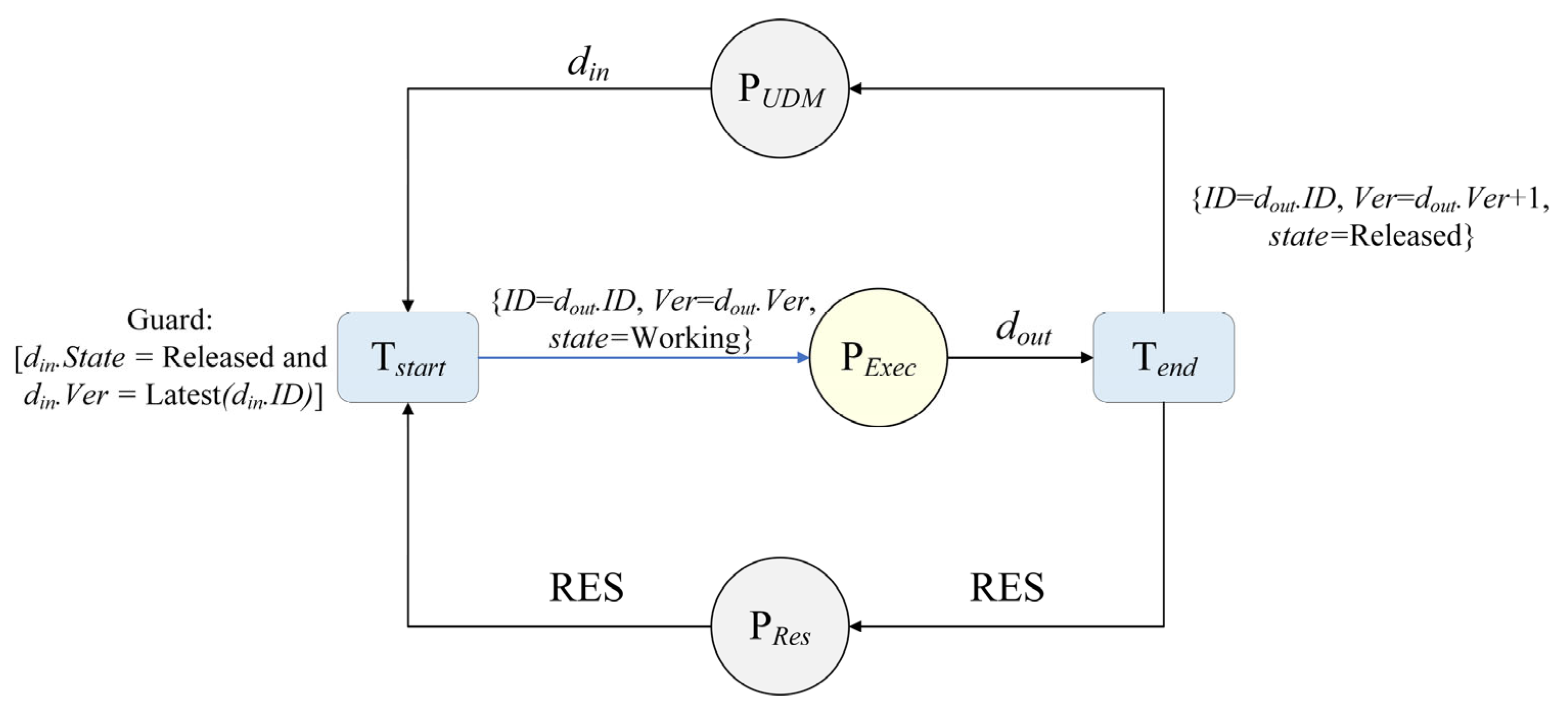
4.1. TCPN-Based Mapping of Business Collaboration Model
- Token and color set mapping. Define the color set DATA with attributes {ID, Ver, State}. Each business data object is represented by a unique DATA token, and the token’s location corresponds to its current state. Define the color set RES as a counting unit; its token count represents the currently available concurrent resource capacity of a responsible department.
- Place mapping. The global repository place stores DATA tokens whose state is Released, representing ASoT versions that can be referenced. The resource place stores RES tokens. The execution place stores DATA tokens in the Working state; when a token enters , it is removed from , thereby realizing an exclusive lock over the data object at the structural level. Meanwhile, incorporates a time delay to emulate the execution time of a business activity.
- Transition and control logic mapping. The start transition reads and removes from those DATA tokens that satisfy the guard rule ; simultaneously, it consumes one RES token from , updates the DATA token state to Working, and pushes it into . The end transition updates the version number of DATA token, changes its state to Released, and returns it to ; meanwhile, it returns the RES token back to .
4.2. Simulation Experiment Design
4.2.1. Experimental Scenario and Dataset
4.2.2. Configuration of Comparison Groups
- Baseline model S0. This scenario simulates the traditional business process collaboration mechanism, in which the data produced by upstream activities are released for downstream use only after the upstream activities have fully completed and the corresponding documents have been archived. Under this mode, downstream activities must strictly wait for upstream completion, even if the required critical data have already been generated during execution.
- Collaboration model S1. This scenario applies the DT-based business collaboration mechanism proposed in this paper and allows data to circulate in a fine-grained manner. In the simulation, data release follows an accompaniment style publishing strategy, under which upstream activities can make intermediate data progressively available to downstream entities during execution, thereby supporting data state driven collaboration.
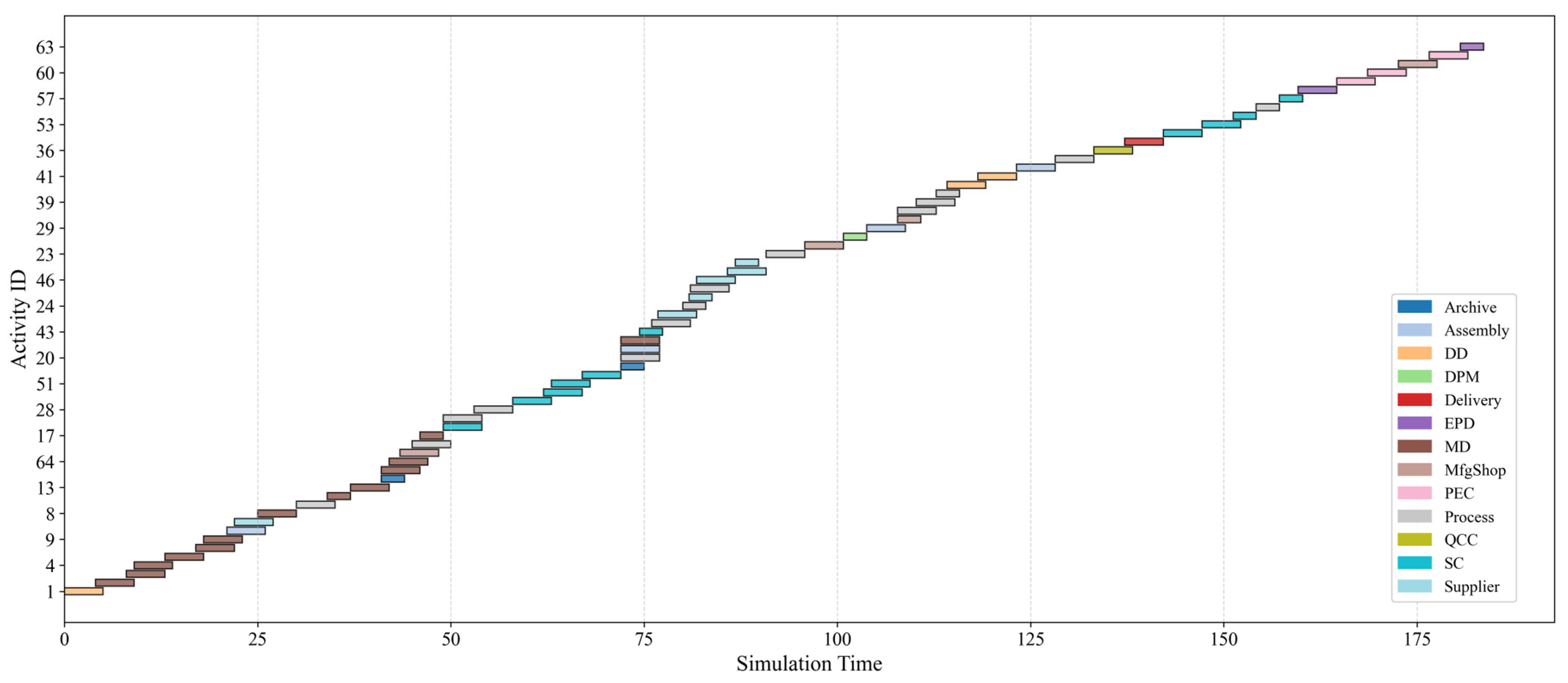
4.2.3. Analysis of Experimental Results
5. Conclusions
Author Contributions
Funding
Institutional Review Board Statement
Informed Consent Statement
Data Availability Statement
Conflicts of Interest
References
- Gupta, S.; Joshi, D.; Jagtap, S.; Trollman, H.; Haddad, Y.; Yuksek, Y.A.; Salonitis, K.; Raut, R.; Narkhede, B. From failure to success: A framework for successful deployment of Industry 4.0 principles in the aerospace industry. Int. J. Ind. Eng. Oper. Manag. 2024, 6, 277–298. [Google Scholar] [CrossRef]
- Reijers, H.A. Business Process Management: The evolution of a discipline. Comput. Ind. 2021, 126, 103404. [Google Scholar] [CrossRef]
- Lin, D.; Ishida, T. Collaboration of local process views in interorganizational business process. IEICE Trans. Inf. Syst. 2014, 97, 1119–1126. [Google Scholar] [CrossRef]
- Zeng, Q.T.; Lu, F.M.; Liu, C.; Duan, H.; Zhou, C.H. Modeling and verification for cross-department collaborative business processes using extended Petri nets. IEEE Trans. Syst. Man Cybern. Syst. 2014, 45, 349–362. [Google Scholar] [CrossRef]
- Yongchareon, S.; Yu, J.; Zhao, X.; Liu, C.F. A view framework for modeling and change validation of artifact-centric inter-organizational business processes. Inf. Syst. 2015, 47, 51–81. [Google Scholar] [CrossRef]
- Jankovic, M.; Ljubicic, M.; Anicic, N.; Marjanovic, Z. Enhancing BPMN 2.0 informational perspective to support interoperability for cross-organizational business processes. Comput. Sci. Inf. Syst. 2015, 12, 1101–1120. [Google Scholar] [CrossRef]
- Wiśniewski, P.; Kluza, K.; Kucharska, E.; Ligęza, A. Spreadsheets as interoperability solution for business process representation. Appl. Sci. 2019, 9, 345. [Google Scholar] [CrossRef]
- Lazarte, I.M.; Thom, L.H.; Iochpe, C.; Chiotti, O.; Villarreal, P.D. A distributed repository for managing business process models in cross-organizational collaborations. Comput. Ind. 2013, 64, 252–267. [Google Scholar] [CrossRef]
- Zeng, Q.; Sun, S.X.; Duan, H.; Liu, C.; Wang, H.Q. Cross-organizational collaborative workflow mining from a multi-source log. Decis. Support Syst. 2013, 54, 1280–1301. [Google Scholar] [CrossRef]
- Hedberg, T., Jr.; Krima, S.; Camelio, J.A. Method for enabling a root of trust in support of product data certification and traceability. J. Comput. Inf. Sci. Eng. 2019, 19, 041003. [Google Scholar] [CrossRef]
- Mas, F.; Menéndez, J.L.; Oliva, M.; Gómez, A.; Ríos, J. Collaborative engineering paradigm applied to the aerospace industry. In Proceedings of the IFIP WG5.1 10th International Conference on Product Lifecycle Management, Nantes, France, 6–10 July 2013. [Google Scholar] [CrossRef]
- Wang, J.; Meng, Z.; Gao, D.; Feng, L. Construction of an integrated framework for complex product design manufacturing and service based on reliability data. Machines 2022, 10, 555. [Google Scholar] [CrossRef]
- Tao, F.; Qi, Q.; Liu, A.; Kusiak, A. Data-driven smart manufacturing. J. Manuf. Syst. 2018, 48, 157–169. [Google Scholar] [CrossRef]
- Abdel-Aty, T.A.; Negri, E. Conceptualizing the digital thread for smart manufacturing: A systematic literature review. J. Intell. Manuf. 2024, 35, 3629–3653. [Google Scholar] [CrossRef]
- Chown, B. Applying a single source of truth approach to the information needed for Functional Safety. In Proceedings of the 2018 IEEE/AIAA 37th Digital Avionics Systems Conference (DASC), London, UK, 23–27 September 2018. [Google Scholar] [CrossRef]
- West, T.D.; Pyster, A. Untangling the digital thread: The challenge and promise of model-based engineering in defense acquisition. Insight 2015, 18, 45–55. [Google Scholar] [CrossRef]
- Singh, V.; Willcox, K.E. Engineering design with digital thread. AIAA J. 2018, 56, 4515–4528. [Google Scholar] [CrossRef]
- Bajaj, M.; Hedberg, T., Jr. System lifecycle handler—Spinning a digital thread for manufacturing. In Proceedings of the INCOSE International Symposium, Washington, DC, USA, 7–12 July 2018. [Google Scholar] [CrossRef]
- Singh, V.; Willcox, K.E. Decision-making under uncertainty for a digital thread-enabled design process. J. Mech. Des. 2021, 143, 091707. [Google Scholar] [CrossRef]
- Siedlak, D.J.L.; Pinon, O.J.; Schlais, P.R.; Schmidt, T.M.; Mavris, D.N. A digital thread approach to support manufacturing-influenced conceptual aircraft design. Res. Eng. Des. 2018, 29, 285–308. [Google Scholar] [CrossRef]
- Zhang, Q.; Liu, J.; Chen, X. A literature review of the digital thread: Definition, key technologies, and applications. Systems 2024, 12, 70. [Google Scholar] [CrossRef]
- Goher, K.; Shehab, E.; Al-Ashaab, A. Model-Based Definition and Enterprise: State-of-the-art and future trends. Proc. Inst. Mech. Eng. Part B J. Eng. Manuf. 2021, 235, 2288–2299. [Google Scholar] [CrossRef]
- Corallo, A.; Del Vecchio, V.; Lezzi, M.; Luperto, A. Model-based enterprise approach in the product lifecycle management: State-of-the-art and future research directions. Sustainability 2022, 14, 1370. [Google Scholar] [CrossRef]
- David, J.; Järvenpää, E.; Lobov, A. Digital threads via knowledge-based engineering systems. In Proceedings of the 2021 30th Conference of Open Innovations Association FRUCT, Oulu, Finland, 27–29 October 2021. [Google Scholar] [CrossRef]
- Lu, Y.; Xu, X.; Wang, L. Smart manufacturing process and system automation–a critical review of the standards and envisioned scenarios. J. Manuf. Syst. 2020, 56, 312–325. [Google Scholar] [CrossRef]
- Bachelor, G.; Brusa, E.; Ferretto, D.; Mitschke, A. Model-based design of complex aeronautical systems through digital twin and thread concepts. IEEE Syst. J. 2019, 14, 1568–1579. [Google Scholar] [CrossRef]
- Panetto, H.; Dassisti, M.; Tursi, A. ONTO-PDM: Product-driven ONTOlogy for Product Data Management interoperability within manufacturing process environment. Adv. Eng. Inform. 2012, 26, 334–348. [Google Scholar] [CrossRef]
- Pang, T.Y.; Pelaez Restrepo, J.D.; Cheng, C.T.; Yasin, A.; Lim, H.; Miletic, M. Developing a digital twin and digital thread framework for an ‘Industry 4.0′Shipyard. Appl. Sci. 2021, 11, 1097. [Google Scholar] [CrossRef]
- Lin, Z.; Liu, Z.; Yan, J.; Zhang, Y.; Chen, C.; Qi, B.; Guo, J. Digital thread-driven cloud-fog-edge collaborative disturbance mitigation mechanism for adaptive production in digital twin discrete manufacturing workshop. Int. J. Prod. Res. 2024. [Google Scholar] [CrossRef]
- Jiménez-Galea, J.J.; Martín-Martín, M.Á.; Martín-Béjar, S. Digitalization of Legacy Machining Tools: A Case Study of a Manual Drill Press. Heritage 2026, 9, 73. [Google Scholar] [CrossRef]
- Sun, S.; Zheng, X.; Villalba-Díez, J.; Ordieres-Meré, J. Data handling in industry 4.0: Interoperability based on distributed ledger technology. Sensors 2020, 20, 3046. [Google Scholar] [CrossRef]




Disclaimer/Publisher’s Note: The statements, opinions and data contained in all publications are solely those of the individual author(s) and contributor(s) and not of MDPI and/or the editor(s). MDPI and/or the editor(s) disclaim responsibility for any injury to people or property resulting from any ideas, methods, instructions or products referred to in the content. |
© 2026 by the authors. Licensee MDPI, Basel, Switzerland. This article is an open access article distributed under the terms and conditions of the Creative Commons Attribution (CC BY) license.
Share and Cite
Zhang, Y.; Lei, S.; Lai, X.; Zhao, K.; Liu, X.; Su, X.; Zhang, Y.; Li, C. Digital Thread-Based Business Process Collaboration in Digital Manufacturing Systems: Modeling and Data-Driven Mechanisms. Systems 2026, 14, 524. https://doi.org/10.3390/systems14050524
Zhang Y, Lei S, Lai X, Zhao K, Liu X, Su X, Zhang Y, Li C. Digital Thread-Based Business Process Collaboration in Digital Manufacturing Systems: Modeling and Data-Driven Mechanisms. Systems. 2026; 14(5):524. https://doi.org/10.3390/systems14050524
Chicago/Turabian StyleZhang, Yingyao, Shuai Lei, Xiao Lai, Kuo Zhao, Xianhui Liu, Xingbo Su, Yimeng Zhang, and Chao Li. 2026. "Digital Thread-Based Business Process Collaboration in Digital Manufacturing Systems: Modeling and Data-Driven Mechanisms" Systems 14, no. 5: 524. https://doi.org/10.3390/systems14050524
APA StyleZhang, Y., Lei, S., Lai, X., Zhao, K., Liu, X., Su, X., Zhang, Y., & Li, C. (2026). Digital Thread-Based Business Process Collaboration in Digital Manufacturing Systems: Modeling and Data-Driven Mechanisms. Systems, 14(5), 524. https://doi.org/10.3390/systems14050524