
Article

Machine Learning-Based Systemic Assessment of Political Instability Effects on Firm Performance
School of Economics and Trade, Hunan University, Changsha 410006, China
*
Author to whom correspondence should be addressed.
Systems 2026, 14(5), 513; https://doi.org/10.3390/systems14050513
Submission received: 9 December 2025 / Revised: 25 December 2025 / Accepted: 4 January 2026 / Published: 6 May 2026
(This article belongs to the Section Systems Practice in Social Science)

Abstract

This study rigorously examines the impact of political instability (POI) on firm performance (FPER) using high-dimensional panel data from 2006 to 2022, drawn from the World Bank Enterprise Survey (WBES) for 60 economies. Using advanced machine learning-based econometric techniques, including Double-Selection LASSO Regression (DSLR) and Partialing-Out LASSO Regression (POLR), the analysis reveals that POI significantly reduces FPER across the sampled countries. These findings remain robust across a series of validation tests, including alternative estimation approaches such as Cross-Fit Partialing-Out LASSO Regression (CF-POLR) and Bayesian Model Averaging (BMA), the use of alternative FPER proxies—employment growth (FEMG), innovation (IINN), and labor productivity (FLP)—and the substitution of POI with government regulation (REG). Mediation analysis further indicates that operational costs (OCOST) and firm investment (FINV) significantly and partially mediate the total effect of POI on FPER. In contrast, financial constraints (FCST) do not emerge as a significant mediator. The moderation analysis shows that political connections (PC) substantially attenuate the negative impact of POI on FPER. Heterogeneity analyses demonstrate that small, young, and capital-intensive firms are more severely affected by POI than medium and large, older, technology-intensive, and labor-intensive firms. Additionally, firm ownership-based heterogeneity indicates that state-owned enterprises experience slightly stronger adverse effects from fluctuations in POI than non-state-owned firms. Based on these empirical insights, policymakers need to promote institutional stability and provide direct support for vulnerable young and small firms to reduce the adverse effects of POI on FPER. Ultimately, this boosts economic flexibility in politically unstable markets by managing key growth drivers.

1. Introduction

The world is currently experiencing widespread political unrest, including global violence, domestic conflicts, and government changes. This instability can significantly impact business operations and investments in affected countries, as industries often hesitate to operate in uncertain economic conditions [1]. Political instability remains one of the biggest challenges facing firms in the modern business environment [2]. When governments face frequent policy changes, an uncertain transfer of power, and institutional weakness, firms operating in these regions face unprecedented threats to their operational continuity and strategic planning [3]. The volatility inherent in unstable political environments disrupts business operations at multiple levels, exerting a cascading effect that weakens both short-term performance and long-term competitive positioning [4]. In regions marked by geopolitical tensions and political conflicts, such as Eastern Europe during the Russia-Ukraine war, firms challenge instant financial threats alongside enduring strategic vulnerabilities that fundamentally alter their prospects for survival and growth [2].
The concept of firm performance is multidimensional, extending beyond traditional financial metrics [5]. The current understanding of firm performance includes financial indicators such as return on assets and a profitability composite, as well as non-financial factors such as operating efficiency, market competitiveness, employee satisfaction, and stakeholder value addition [6]. Pathways that drive firm performance are complex at both the organizational and environmental levels, involving internal capabilities and external contextual factors [7]. Internal drivers consist of investments in human capital, technological innovation, R&D spending, and the level of strategic decision-making autonomy [8]. External drivers include macroeconomic indicators, competitive market dynamics, regulatory frameworks, and the quality of the institutional environment [9,10]. The relationship between political uncertainty and firm performance has gained increased attention recently, as scholars and policymakers seek to understand how instability affects firms’ activities [11,12]. Recent research has explored factors affecting firm performance from geographical [13,14], corporate governance [15,16], and institutional [17,18] perspectives, whereas only a few studies have considered political factors [19]. While economic research has traditionally focused on how political instability affects macroeconomic growth [20,21], there is a rising need to investigate how political instability influences micro-level firm activities, where economic and political conditions are tightly linked. Several studies have analyzed how political uncertainty affects firm investment [22], cash holdings [23], stock market liquidity [24,25], and, less frequently, firm performance. These studies employed the political uncertainty index as a proxy for instability, following [26]. Furthermore, existing research often centers on specific regions, such as the Middle East [27], South America [28], or African countries [29]. Consistent findings indicate that political instability impairs firm performance across various dimensions, including sales, productivity, and innovation—mainly by increasing uncertainty and disrupting operations. Moreover, this study fills a significant gap in the current literature by examining political uncertainty beyond its macroeconomic implications, focusing on its direct effect on firm performance [30], and highlighting the complex relationship between economic and political factors and their influence on firm performance.
This study advances the literature by introducing a detailed, layered mechanism that illustrates how political instability affects firm performance, specifically highlighting operational costs, investment capabilities, and financial constraints.
First, we explore the moderating influence of political connections, suggesting that these ties can offer privileged access to resources and mitigate the adverse effects of Political instability. Utilizing firm-level data from the World Bank Enterprise Surveys across 60 economies, our analysis disaggregates results by firm size, age, ownership type (private vs. state-owned), and sector (capital-intensive, labor-intensive, and technology-driven).
Second, this research uniquely integrates three operational mechanisms- investment behavior, financial constraints, and operational costs- to explore how institutional deterioration impacts measurable firm performance, filling a significant empirical theoretical gap.
Third, methodologically, the study employs advanced machine learning-based econometric techniques, including Double-Selection LASSO Regression (DSLR) and Partialing-Out LASSO Regression (POLR), baseline analysis, accompanied by robustness checks that incorporate Cross-Fit Partialing-Out LASSO Regression (CF-POLR) and Bayesian Model Averaging (BMA). It uncovers previously hidden heterogeneity in how the effects of political instability on firm performance vary across the distribution of firm performance. By integrating these new aspects—mechanistic pathways, political connections, firm diversity, robustness analysis, and advanced econometric methods—our research offers unmatched explanatory depth and practical insight into the relationship between political instability and firm performance in global economies. This study contributes to the literature on political unrest and firm performance by combining transaction cost theory, institutional theory, and the resource-based view. It clarifies how political instability restricts firms’ access to resources and increases transaction costs, while also highlighting that it heightens policy uncertainty, leading firms to pursue short-term, risk-averse strategies and to reduce long-term investments.
This paper is structured as follows: The pertinent literature and the development of the study’s hypotheses are reviewed in Section 2. The empirical approach, including the variables and data sources employed, is described in Section 3. The empirical results are presented in Section 4, and Section 5 concludes, offers recommendations, and provides policy implications for further reading.

2. Literature Review and Hypothesis Development

2.1. Political Instability and Firm Performance

This study explores the economic impacts of political conflict, drawing on a range of research findings. Dalyop [11] examined the relationship between political instability and economic growth in Africa, focusing on factors like government spending and inflation. Hosny [26] found that political unrest negatively influences firm productivity in the Middle East. Ref. [31] demonstrated that uncertainty about public debt reduces consumer and business confidence, which, in turn, affects output and investment. Ref. [32] observed that political uncertainty in Brazil leads to wider credit spreads and currency depreciation. Montes & Nogueira [28] emphasized that political instability hampers business performance in South America by reducing investment. Orlova & Sun [33] confirmed that political risk diminishes the efficiency of U.S. firms. Trakarnsirinont et al. [12] linked political instability to investment and employment challenges in Thailand. Ultimately, countries facing political uncertainty struggle to foster economic growth and attract investors [34]. This is illustrated by Cazals & Léon [29], who found that election-related instability increases trade regulation and corruption in Africa. Both internal and external factors influence performance. Another study across African countries Found That Political unrest has a significant and adverse influence on investment, primarily affecting larger firms’ capital provision decisions [35]. Political interference is detrimental primarily to firm performance in Pakistan’s highly uncertain political environment; mitigation of operational risks strengthens the effect [36], and also for Ethiopia, significant negative links have been reported where ‘high levels of political instability have strong negative associations with economic growth and firm-level outcomes’ [37]. The channels through which political unrest harms firm performance include lower capital expenditure, limited access to the capital market, and higher perceived expropriation risk as well as reduced innovation investments and discouraged human capital accumulation, where geopolitical settings such as Eastern Europe suffer particularly severe underperformance in firms facing both short-run financial stress from conflict and longer-term strategic exposure that significantly erodes profitability [2]. Export-oriented companies are particularly susceptible to political upheavals; for instance, Bangladeshi manufacturing organizations experience significantly lower export sales and probabilities when political uncertainty rises [38], while such negative implications become more pronounced in developing markets due to weak institutional infrastructure and poor enforcement of property rights as well as regulatory predictability [3,39].
However, a widespread body of empirical evidence has shown that the negative relationship between political instability and firm performance is not universal nor immutable, but that quality of corporate governance, firm-level adaptive capabilities, ownership identity, and institutional context heavily moderate or even reverse the anticipated detrimental effects, pointing to the theoretical inadequacy of simple institutional determinism. Evidence from Pakistan shows that corporate governance reforms introduced in 2012 had a positive impact on firm performance, especially in an environment characterized by intense political instability and shifts in ideology, demonstrating that effective governance structures can significantly mitigate the performance-suppressing effects of political unrest [40]. In addition, a study by Zhang et al. [41] demonstrates that firm ownership, firm size, the international investment community, and government connections function as powerful defensive barriers. A recent study from China shows that overseas firms with significant scale, government links, and unified investment connections effectively mitigate the adverse political turnover effects that overcome smaller local competitors—indicating that political instability’s performance influence depends on whether firms have resources and associations that permit adaptive responses. Local suggestions further complicate the aggressive relationship, with studies on North Macedonia finding both direct adverse effects and delayed positive changes through economic reallocation mechanisms that eventually benefit well-positioned firms [42].
This research is based on three key foundational theories: (1) Institutional Theory suggests that firms operate within formal and informal rules—such as laws, norms, and cultural expectations—that shape their behavior. Political instability disrupts these institutions by creating uncertain regulatory environments, weak property rights, and unpredictable policies. This instability increases compliance costs, leads to arbitrary contract enforcement, and raises expropriation risks. (2) Resource-Based View suggests that valuable, rare, and inimitable resources accumulated over time (e.g., brand equity, long-term contracts, and financial reserves) can become a source of competitive advantage, especially during systemic shocks. (3) Transaction Cost Economics suggests that firms choose governance structures such as markets, hierarchies, or hybrids to minimize costs of contracting, monitoring, and enforcement. Political instability increases transaction costs due to legal enforcement uncertainty, opportunistic behavior (e.g., suppliers demanding renegotiations due to inflation or policy shifts), and higher business costs (e.g., tariffs and sudden regulations). As a result, it discourages long-term investments, reduces operational efficiency, and harms overall performance [43]. For example, sudden changes in taxation or nationalization can erode investor confidence, leading to capital outflows and a decline in productivity. Based on previous studies and foundational theories, we propose a hypothesis:
H1: 
Political instability significantly undermines firms’ performance.

2.2. The Mechanism Through Which Political Instability Shakes Firm Performance

A mechanism analysis is critical because it distinguishes between verifying that political instability damages firm performance and explaining why. It isolates the particular channels, such as operational Costs, investment decisions, or financial constraints, through which the effect on firm performance operates. This is more than a correlation and elevates sluggish reward processing into an explanation, not just something we see as a function of that region. It also shows why some companies suffer more than others, and offers practical ideas for managers and policymakers to create focused strategies rather than issuing generic warnings. Ultimately, it is the key to making the research both academically rigorous and practically valuable.

2.2.1. Operational Cost

Political instability significantly increases operational costs. When a country faces political instability, unpredictable conditions can raise business expenses [34]. Political uncertainty may also increase due to changes in government regulations. Ongoing government shifts can introduce new policies, and taxes can increase a firm’s operating costs. New tax policies and controls on imports and exports can raise expenses for companies that rely on international trade. These substantial changes can be costly and time-consuming for businesses [44]. Conflicts create unclear production and operating costs, elevating the risk of firms exiting the market. Mwatu [45] examined the connection between the intensity of election periods in Kenya and the exports of flower companies. The findings show that exports decreased by 38 percent in volume that year, while more advanced production methods led to a 16 percent rise in operating costs. Additionally, a study by Cazals and Léon [29] found that firms in African countries face challenges in accessing credit before and after elections. This research indicates that elections influence costly decisions such as investments. Evidence from developed nation’s shows that political instability, political risks, and firms’ awareness of these factors affect their long-term growth and behavior [46]. Another study by Baker et al. [47] found that during election seasons and periods of political uncertainty, many small firms face financing difficulties. They struggle to maintain their market presence and to secure credit due to political instability and a lack of political connections. Transaction Cost Economics theory [48] suggests that firms choose governance structures such as markets, hierarchies, or hybrids to minimize the costs of contracting, monitoring, and enforcement. Political instability increases transaction costs due to legal enforcement uncertainty, opportunistic behavior (e.g., suppliers demanding renegotiations due to inflation or policy shifts), and higher business costs (e.g., tariffs and sudden regulations). After going through the related literature and on Transaction Cost Theory, our hypothesis is
H2a: 
Political instability significantly increases firms’ operational costs, resulting in a clear negative impact on their performance.

2.2.2. Investment Decision

The institutional theory holds that society’s formal and informal institutions, such as rules and regulations, shape firms’ behavior. Political instability can weaken these institutions, increasing uncertainty and leading to a decline in firm performance. Politically unstable conditions harm investment in the contest for access to credit, preventing potential firms from capitalizing on the latest technology and hiring skilled employees to increase production [28]. Firms face a decline in investment and a lower investment-attractiveness ratio, along with a decrease in return on investment, due to instability within the state. In the same way, political instability weakens and distracts from FDI flows by increasing operational costs [49]. Finance is vital for business performance and sales growth [50]. During crises and periods of political uncertainty, financial firms often restrict operations, slowing growth for those struggling to access credit. Agency theory indicates that this political instability can significantly reduce a firm’s value. Rashid and Jabeen [51] found a positive relationship between a firm’s performance and its access to credit, highlighting the challenges many companies face. Additionally, Khan and Upadhayaya [52] revealed that business assurance encourages long-term investment growth, while political instability creates obstacles that diminish business confidence. Thus, according to the above-mentioned previous studies on how political instability affects investment and following institutional theory, we hypothesize the following:
H2b: 
Political instability may lead to a decline in firm investment and, consequently, a decrease in firm performance.

2.2.3. Financial Constraints

The RBV theory [53] recommends that firms gain a competitive advantage by utilizing valuable, rare, unique, and non-substitutable assets. However, political instability hampers access to critical resources, such as skilled labor and financing [53]. Firms in such environments face difficulties retaining talent and securing loans, often reallocating resources to managing political risks rather than innovation, thereby weakening their competitive edge [42]. Therefore, political instability undermines firm performance by depleting or misallocating essential resources. Previous studies have shown that financial hurdles to innovation and investment are strongly correlated with agency costs [54]. Several firms with significant free cash flows are expected to invest in unproductive projects. In contrast, financially distressed firms will face agency cost problems due to insufficient funds to invest in productive projects [55]. A study by Ming and Liu [56] found that political instability affects the tourism sector, leading to declines in firms’ performance. This study examines how the long-term financial development of the tourism industry dropped following anti-corruption efforts. This study explains that, due to unstable political conditions, tourism industry demand declined, affecting firms’ financial performance. This study proves how political instability influences the travel industry and its performance in developing countries. The research by Wellalage and Locke [57] examined the influence of official credit on financial constraints in small and medium-sized businesses in developing countries. This research study stated that financing is a crucial factor in finance. Bakhouche [58] finds a connection between investment and external finance in the Gulf region. The study found that external finance is disinclined to provide funding. When firms lack finance, their operations and development decline in the market. Oudgou [59] examines the factors of financial constraint in MENA region companies by focusing on the current situation and challenges, and finds that political instability is one of the main practical constraints on firm performance. In countries with political unrest, the main effect is that it hinders businesses from advancing. Thus, our hypothesis of the study is
H2c: 
Political instability increases financial constraints for firms, resulting in a decline in their performance.

2.3. The Moderator Role of Political Connections

When firms aim to enter a new market, they often prioritize building relationships with the local government, particularly when the business environment is politically unstable. However, research suggests that relying heavily on government links can harm a firm’s performance [60]. Firms seek political connections because they can help mitigate political instability and increase the chances of firm growth [61]. Earlier studies have indicated that moderate political networks can help businesses establish good standing and achieve growth [62]. These studies also show that politically aligned companies have greater market power than independent businesses. Additionally, local governments control key resources, such as land and credit, and wield discretionary power. Therefore, forming political connections with government officials can alleviate financing constraints and improve firm performance [63]. The RBV theory is distinctive in showing that firms with political resources are better positioned to continue their operations in politically unstable conditions [53,64]. Firms with strong political resource foundations can invest in political risk-mitigating strategies, such as insurance, diversification, and raising awareness, to protect their interests [53,65]. Finally, politically associated businesses can access relevant information about policy changes and use resources to avoid risks stemming from political uncertainty, thus ensuring self-protection, compared to non-politically associated companies [66]. Therefore, we propose the following hypothesis.
H3: 
Political connections can help alleviate the adverse effects of political instability on a firm’s performance.

3. Method and Materials

3.1. Econometric Model Specification

In this study, following Cazals & Léon [29], Ali et al. [36], Hosny [27], Orlova & Sun [33], and Kpari [67], we construct the baseline econometric model as follows:
F P E R i c t = β 0 + β 1 P O I i c t + β k k = 2 n X i c t + δ i + μ c + σ t + ε i c t
where F P E R and P O I act as primary dependent and independent variables of the study, respectively, the subscripts i , c , and t denote firm i belonging to country c in period t , respectively. X Denotes the selected country-level and firm-level control variables that affect F P E R alongside P O I . Factors such as δ i , μ c , and show firm, country, and time-specific fixed effects, respectively. These specific fixed effects are used to isolate all firms, country, and time-varying factors, such as political environment, institutional quality, and macroeconomic conditions, that confound the relationship between P O I and F P E R . Finally, ε i c t is the error term of the specified econometric model.

3.2. Estimation Strategy

This study employs advanced machine learning methods to estimate Equation (1) and examine the impact of POI on FPER. This approach is adopted to address key limitations inherent in traditional econometric models—such as overfitting, inefficiency, and violations of statistical assumptions, including multicollinearity and heteroskedasticity—in high-dimensional settings [68]. To mitigate these issues, the study uses regularization-based techniques that enable robust variable selection across diverse data structures [69].
To robustly estimate FPER using the specified explanatory variables, this study employs advanced regularization techniques from the LASSO family. Standard LASSO, Adaptive LASSO, and Elastic Net LASSO are first applied to visualize coefficient paths and evaluate model stability via cross-validation. Subsequently, to estimate the long-run impact of POI on FPER in the selected nations, the analysis implements advanced inferential LASSO methods—including Double Selection LASSO Regression (DSLR), Partialing-Out LASSO Regression (POLR), and Cross-Fit Partialing-Out Regression (CF-POLR)—following the methodological framework of Ofori et al. [70].

3.2.1. Double-Selection LASSO Regression (DSLR)

The Double Selection LASSO Regression (DSLR) model, following the approach of Belloni et al. [71], provides the primary analytical framework for this study. Its mathematical formulation is expressed as follows:
E [ Y | d , x ] = φ ω ´ + ψ ξ ´
In this specification, φ represents a set of J focal explanatory variables of primary analytical interest, distinct from ψ , which denotes a set of p control covariates. The Double-Selection LASSO Regression (DSLR) methodology provides coefficient estimates, standard errors, and confidence intervals for the J focal predictors, while rigorously accounting for the high-dimensional complexity introduced by the p control variables.

3.2.2. Partialing-Out LASSO Regression (POLR)

The Partialing-Out LASSO Regression (POLR) method offers a significant advantage by enhancing the precision of statistical inference, particularly as model complexity increases. Following the approaches of Belloni et al. [71] and Chernozhukov et al. [72], the POLR estimator is formulated as follows:
E [ Y | d , x ] = ϑ ω ´ + X ξ ´
where ϑ represent the set of j focal predictors of primary interest, distinct from X , which comprises p high-dimensional confounding factors, mirroring the DSLR framework, the POLR yields valid coefficient estimates, computes robust standard errors, and constructs confidence intervals for these j key regressors, while effectively controlling for the potentially large set of p nuisance variables.

3.2.3. Cross-Fit Partialing-Out LASSO Regression (CF-POLR)

The Cross-fit Partialing-Out LASSO Regression (CF-POLR), often termed double/debiased machine learning, enhances inference by integrating penalized estimation with orthogonal moment conditions to mitigate the regularization bias inherent in standard LASSO procedures. By relaxing strict sparsely requirements, this cross-fitting approach reduces the risk of excluding relevant confounders, permitting the inclusion of a broader, theory-informed covariate set. It is operationalized through sample splitting and cross-validation, in which parameters are iteratively estimated on complementary subsets and then used to debias the final estimator, thereby improving stability and expanding the admissible covariate space [73]. The model is formally specified as follows:
E Y d , x = d α ´ + ξ 0 + X ξ ´
This specification distinguishes between the fixed set of J target variables, denoted by d , and the potentially high-dimensional set of p control variables in x , whose dimensionality may grow with the sample size. To preserve a sparse representation essential for regularization, the parameter vector y is constrained such that the number of its non-zero coefficients remains bounded. For a comprehensive technical exposition of the LASSO framework, see [73].

3.3. Bayesian Model Averaging (BMA) Technique

To enhance the robustness of empirical results, this study applies BMA to evaluate the impact of selected predictors on FPER. BMA addresses model uncertainty by systematically considering various combinations of explanatory variables and weighing each model according to its posterior probability. This probability is derived using Bayes’ Theorem, in which the posterior distribution incorporates both the model’s prior probability and the likelihood of the observed data. The posterior probability of model M D j given the data y is defined a
P M j | F P E R = l F P E R M j P M j h = 1 2 k l F P E R M h P M h = h = 1 2 k l F P E R M h P M h l F P E R M j P M j 1
where L Y M j denotes the marginal likelihood of the data under model M j , obtained by integrating the likelihood over the parameter space with respect to the model-specific prior l A E P M j = p ( A E P | α , β j , σ , M j ) p ( α , β j , σ , M j ) d α d β j d σ . The denominator ensures that the posterior probabilities sum to one over the space of all 2 k possible models. For complete derivations and implementation details, we refer to [74]. A uniform prior is assigned across all candidate models to ensure impartiality in evaluation, thereby giving each specification equal weight [75]. This is consistent with earlier work of [74], where he employed Zellner’s g-prior, with the hyperparameter calibrated as
g = 1 m a x ( N , K 2 )
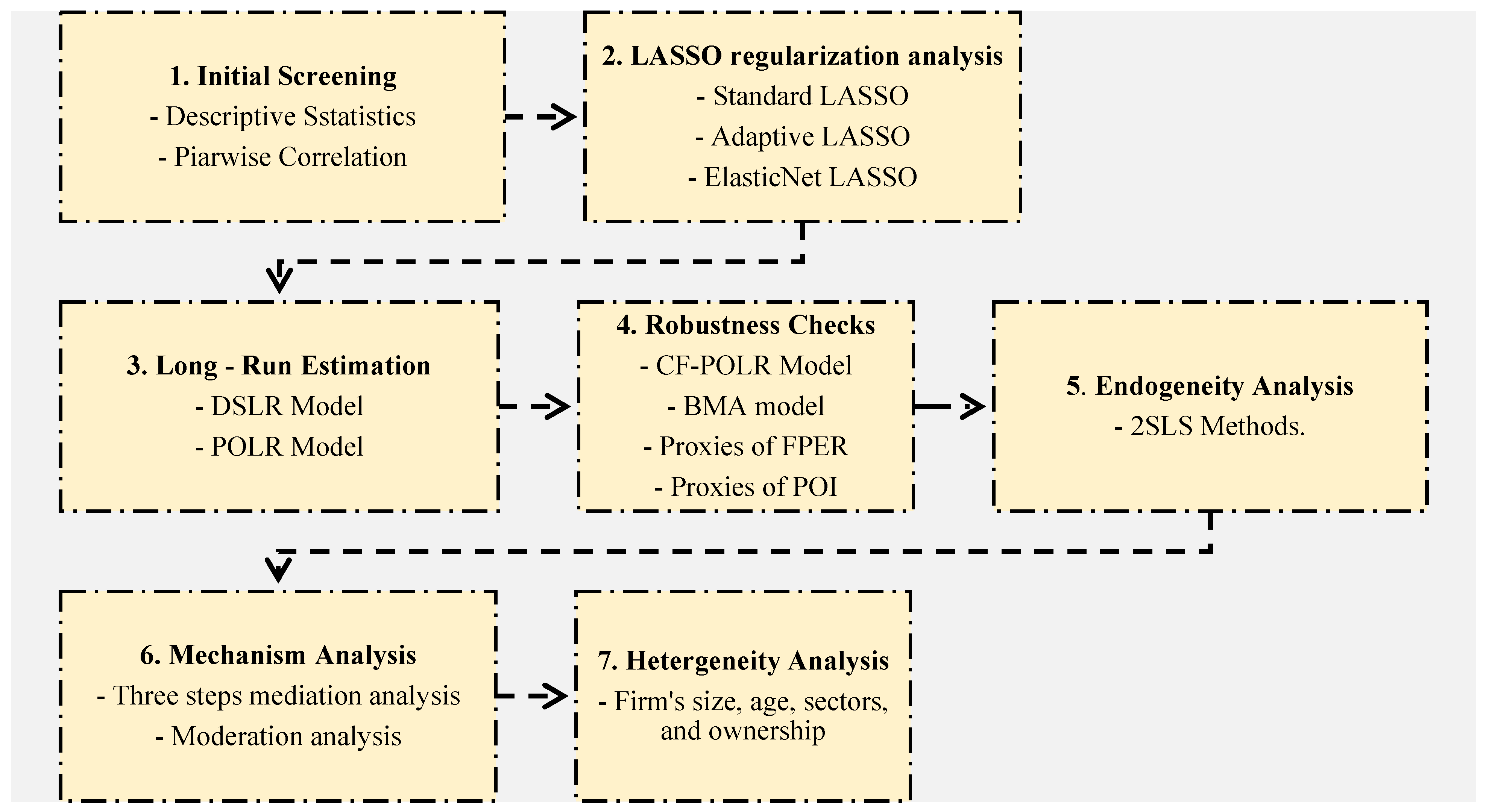
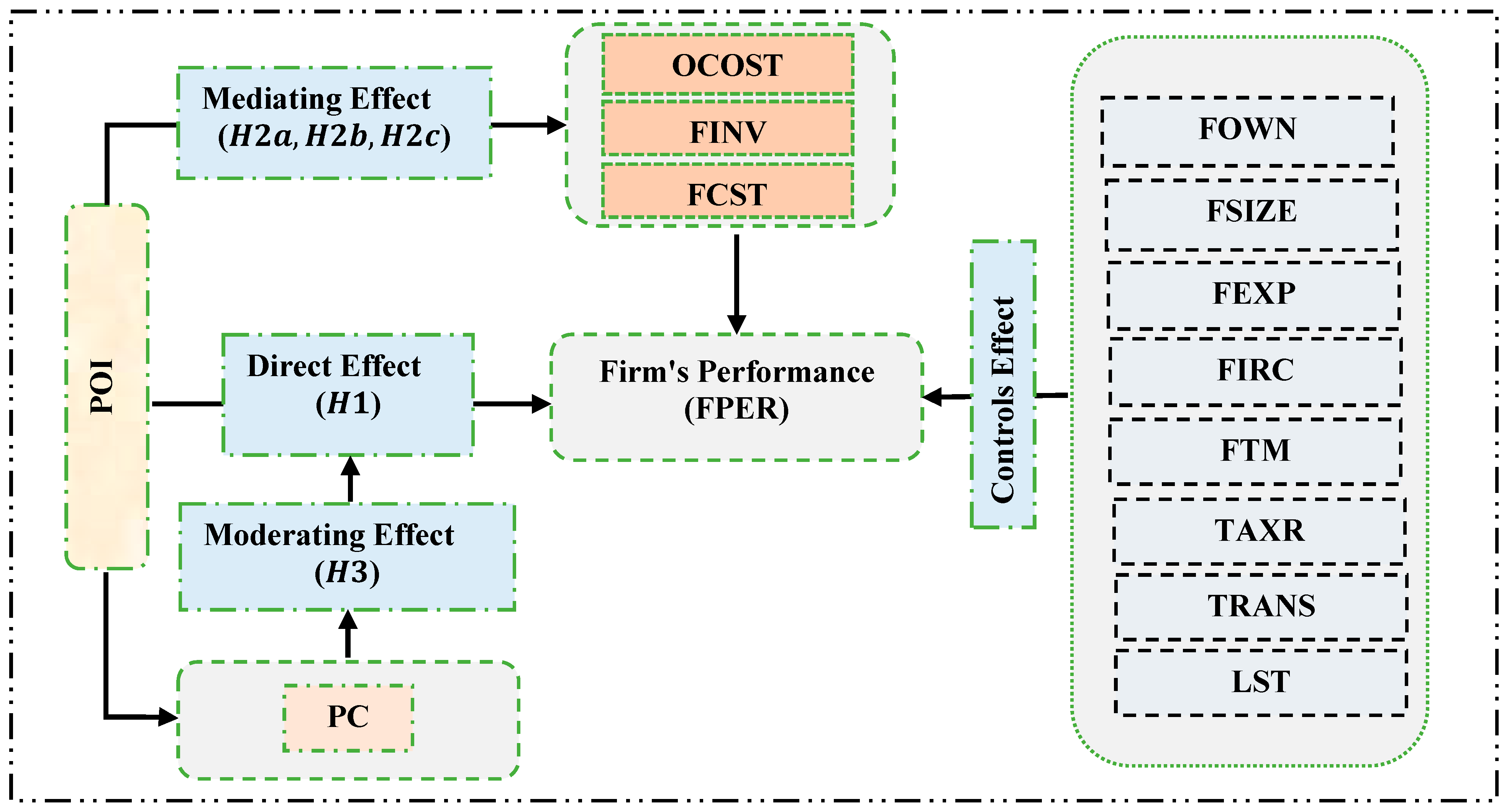
The research design is summarized visually in two complementary diagrams. Figure 1 provides a procedural overview of the analytical workflow, from data processing to final heterogeneity analysis. Figure 2 illustrates the study’s conceptual model, delineating the hypothesized causal pathways, direct effects (H1), indirect effects (H2a, H2b, H2c, and H3), and control structures that define the core relationships examined.

3.4. Data

This study utilizes a high-dimensional, firm-level panel dataset derived from the WBES database. The sample spans 60 economies over the period 2006–2022 and comprises 28,894 observations, constructed based on country-year aggregation. The WBES dataset covered many aspects of the firm level, such as labor productivity, total annual sales, political instability, the legal structure, and demographic factors, all detailed by the survey [76]. The duration of the data collection is chosen based on the convenience of the data for the study’s selected variables. We restricted our analysis to these waves to ensure consistency in the measurement of political instability across survey rounds and countries. The selected years feature uniform question phrasing and comparable survey methodologies, reducing measurement error and enhancing comparability across time. Data is used exclusively from the manufacturing sector to determine the influence of the key factor of POI on FPER. Manufacturing firms typically face more direct and acute effects of POI on operations and investment decisions due to their capital intensity and longer project horizons compared to service or retail sectors. This homogeneity improves internal validity by reducing Sectoral heterogeneity that might confound analysis. We examine our hypotheses using firm-level data from the WBES, which are linked to FPER and POI across selected economies. This is one of the most complete and consistent cross-country surveys conducted in countries.

3.5. Variable Selection Procedure

3.5.1. Dependent Variable

Firm performance (FPER) is our primary dependent variable in this study. FPER is defined as the real annual sales growth rate of firm i, calculated as the difference between real sales in the current period t and those in the previous period t − 3. We use the question from the World Bank Enterprise Survey: “In the fiscal year, what were this establishment’s total annual sales for all products?” A similar method for measuring firm real annual sales growth has been used by Kalyuzhnova and Belitski [77], Priya and Sharma [76], Chaoyi Chen, et al. [78], Diogo Lourenço and Jorge Cerdeira [79], and Hosny [27].

3.5.2. Independent Variable

Our primary independent variable is Political Instability (POI). POI happens when a country’s government, political system, and institutions face uncertainty. The subjective assessment used by the firm manager measures how POI affects current operations for surveyed firms. Responses range from 0 (no obstacle) to 4 (severe obstacle), with categories and codes as follows: (i) no obstacle = 0; (ii) minor obstacle = 1; (iii) moderate obstacle = 2; (iv) major obstacle = 3; and (v) very severe obstacle = 4. The higher the codes, the more political instability the firm may experience. We use the survey question: “To what degree is political instability an obstacle to the current operations of this establishment?” A similar approach is used by Cazals A, Léon F [29], Bahri M, et al. [80], Ouédraogo E, et al. [81], and Ibrahim, and Ngahane [35].

3.5.3. Control Variables

The selection of control variables is informed by the Literature. Additionally, to accurately estimate the impact of POI on FPER, we add firm-level and country-level control variables: (1) Firm Age (FAG), which we measure as a firm’s duration and incorporate into the regression in logarithmic form; Priya P and Sharma C adopt the same measure [76], and Xu and Yang [82]. (2) Firm Ownership (FOWN), which is differentiated, permitting the share of companies paid-in capital by each type of stakeholder in that year, If the state’s paid-in capital exceeds 50% of the firm’s total paid-in capital, the firm is state-owned. We assign a value of 1 to state-owned firms and 0 otherwise. Priya and Chandan Sharma adopt the same measure [35]. (3) Firm Size (FSIZE), quantified as the logarithm of the number of employees, following Diogo Lourenço and Jorge Cerdeira [78] and Xu and Yang [82]. (4) Firm Exports (FEXP), measured by the proportion of total sales that are exported directly, following Lourenço and Cerdeira [79]. (5) Firm Internationally Recognized Quality Certification (FIRC), a dummy variable that equals 1 if the firm has an internationally recognized quality certification, and zero if otherwise, following Kul Kapri [67]; (6) Percentage of female top managers (FTM), which is measured by the percentage of females in the total number of top managers, following Kapri [67];. (7) Tax Rate (TAXR), a categorical variable identifying tax rate as a major or very severe obstacle to firm operations. We categorized the nature of the obstacle and coded it as (i) No obstacle = 0; (ii) minor obstacle; (iii) moderate obstacle = 2; (iv) major obstacle = 3; (v) very severe obstacle = 4. Following Lourenço and Cerdeira [79]. (8) Infrastructure (TRANS), which is measured by the question “the degree to which transport is an obstacle to the current operations of this establishment”? A percentage of the firm’s reports indicate that transportation is a key obstacle to limiting the firm’s operations. The degrees are divided into different codes: as (i) No obstacle = 0; (ii) minor obstacle; (iii) moderate obstacle = 2; (iv) major obstacle = 3; and (v) very severe obstacle = 4. According to Kalyuzhnova and Belitski [77]. (9) The legal status (LST) categorical variable indicates the legal status of the firm. 0—shareholding firm with shares trade in the stock market; 1—shareholding firm with non-traded shares or shares traded privately; 2—sole proprietorship; 3—partnership; 4—limited; and 5—Others, following Priya and Sharma [76].
The definitions of all variables are provided in Appendix A. Table 1 presents the detailed descriptive statistics. As reported, the FPER has a mean of 57.327 and a standard deviation of 41.988, with values ranging from −9 to 650. The POI shows a mean of 0.894 and a standard deviation of 1.131, ranging from 0 to 4. The variance inflation factor (VIF) for all regression variables is 1.09, well below the conventional threshold of 10, indicating that multicollinearity does not pose a significant concern in the econometric specification. Table 2 reports the pairwise correlation coefficients among the selected variables. The results reveal a negative correlation between FPER and POI, which preliminarily suggests that higher POI is associated with lower FPER. Overall, the correlations among the variables are modest in magnitude.

4. Empirical Analysis Results

4.1. Baseline Analysis Results

Before implementing the inferential LASSO ML procedures, this study applied three variable-selection algorithms—Standard LASSO, Adaptive LASSO, and Elastic Net LASSO—to identify the most relevant determinants of F P E R in the selected economies. Table 3 reports the selection process outcomes and lists the variables retained by each of the three estimators. The comparison of Mean Squared Error (MSE) values further indicates the relative predictive performance of the models; in this case, the Standard LASSO and Elastic Net LASSO exhibit lower MSEs than the Adaptive LASSO, suggesting superior predictive accuracy.
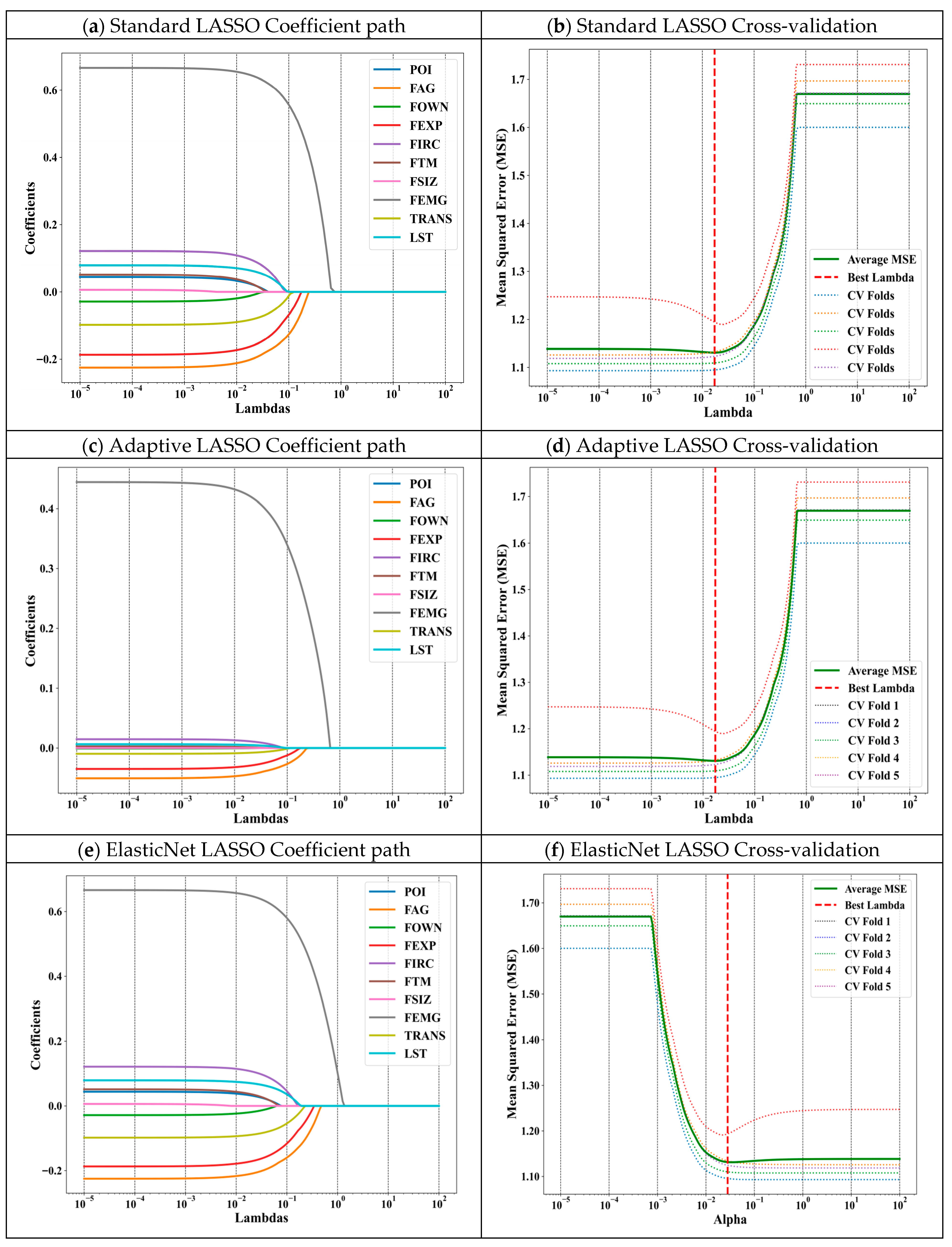
Figure 3 presents the coefficient path plots (a), (c), and (e) and the cross-validation curves (b), (d), and (f) for the Standard, Elastic Net, and Adaptive LASSO models, respectively. The coefficient paths illustrate how each variable’s coefficient evolves as the penalization parameter changes, with coefficients shrinking toward zero as the optimal lambda increases. The cross-validation plots show model performance across a range of penalty values, identifying the minimum MSE (green line) and the optimal lambda (red dashed line). In contrast, the remaining dashed lines represent the individual cross-validation folds.
Table 4 presents the baseline regression results estimated using DSLR and POLR. The findings are remarkably consistent across both approaches, with nearly identical coefficient estimates and standard errors, underscoring the robustness and stability of the empirical results. While both models, including DSLR and POLR, indicate a negative and statistically significant relationship between POI and FPER, this study focuses on the results of the POLR ML technique. According to the outcomes POLR techniques in column (6), political instability decreases the firm-level sales growth rate, as indicated by its negative and significant coefficients. Notably, 1% increase in the level of POI led to 0.601% increase in FPER, at 1% significance level.
The robust negative relationship between POI and FPER, as estimated by the advanced ML models, can be interpreted through key economic mechanisms. First, POI increases policy uncertainty, deterring long-term capital investment and strategic planning as firms face unpredictable changes in regulation, taxation, and property rights. Second, it elevates operational risk by disrupting supply chains, contractual enforcement, and access to essential public services, thereby raising transaction costs and eroding productivity. Third, POI often triggers macroeconomic volatility—including currency fluctuations and inflationary pressures—which directly compromises firm profitability and sales growth. Consequently, the estimated 0.601% decline in FPER per 1% increase in POI quantifies the tangible economic cost of a volatile governance environment, where firms are compelled to prioritize short-term survival over value-creating activities, ultimately stifling aggregate economic growth.
Our main findings are consistent with the most recent empirical studies. For instance, study by Ouédraogo et al. [81] supports our results. Ouédraogo et al. [81] use data from the WBES 2016 dataset, covering 361 firms from the Ivory Coast, and find that political instability has a statistically significant negative correlation with firm performance. The study by Hosny [27] also supports our results. Hosny [27] used firm-level data from the European Bank for Reconstruction and Development (EBRD), the European Investment Bank (EIB), and the World Bank, which include more than 6000 private firms across eight countries in the MENA region. The author found that political instability has a negative relationship with firm performance. Our main findings are also consistent with Montes & Nogueira [28], who ascertain that political uncertainty decreases firm performance, thereby negatively influencing it. Furthermore, the findings from Cazals & Léon [29], Ali et al. [36], Hosny [27], Orlova & Sun [33], and Kpari [67] also support our findings. Thus, Hypothesis H1 is verified.

4.2. Robustness Checks

To verify the robustness and validity of the main findings derived from the inferential LASSO models—including DSLR and POLR—this study conducts a series of robustness checks using alternative econometric specifications, as well as alternative proxies for the primary dependent and independent variables.

4.2.1. Robustness Checks Using Alternative Econometric Specifications

To assess the validity of the initial findings, we conduct robustness checks using two advanced econometric techniques: Cross-fit Partialling-out LASSO Regression (CF-POLR) and Bayesian Model Averaging (BMA). The CF-POLR ML approach integrates robust LASSO procedures and corrects for estimation bias inherent in conventional LASSO models by leveraging moment conditions [73]. In addition, BMA provides a systematic framework for addressing model uncertainty. It applies Bayesian inference for model selection, estimation, and prediction, thereby yielding more reliable and low-risk forecasts [74,75]. The robustness check results obtained from CF-POLR and BMA, reported in Columns (1) and (2) of Table 5, show that both approaches yield findings consistent with the baseline estimates presented in Table 3, thereby reinforcing the robustness and credibility of the main results.

4.2.2. Robustness Checks Using Alternative Proxies of FPER and POI

The research examines various conditions that impact firm performance, potentially leading to predetermined notions among stakeholders. Therefore, our model uses different measures of these variables to ensure its robustness. Specifically, we use alternative indicators to gauge firm performance following the methodology proposed by Jain [83]. The first one is the percentage of annual employment growth (FEMG), measured by the percentage increase in permanent employees. The second one is the incidence of innovation (IINN). We assign a value of 1 if the firm introduced new products in the last three years and zero if otherwise. The third one is labor productivity (FLP), measured as annual output per laborer. The estimated effects of POI on FEMG, IINN, and FLP are reported in Columns (3)–(5) of Table 5. The results indicate that POI exerts a significant negative effect on FEMG and a negative but statistically insignificant effect on IINN and FLP, further confirming the validity and direction of the baseline findings presented in Table 3.
Moreover, we also employ government-imposed labor regulations (REG) as an additional proxy for POI. REG is measured using responses to the survey item “law and labor regulation”, with categories coded as follows: No obstacle, Minor, Moderate, Major, and Very severe—corresponding to scores of 0, 1, 2, 3, and 4, respectively. The estimated effect of REG on FPER, reported in Column (6) of Table 5, shows that a 1% increase in REG is associated with a 0.631% decline in FPER, further verifying the robustness of the baseline findings.

4.3. Endogeneity Results

Endogeneity represents a fundamental challenge in empirical economic analysis because it undermines the credibility of regression-based inferences. Statistically, endogeneity arises when the error term is partially predictable from the explanatory variables [84]. Its most common sources include omitted variables, simultaneity, measurement error, and selection bias [85]. In applied research, endogeneity leads to model misspecification, thereby complicating and often preventing the identification of causal relationships between economic variables [84]. Moreover, in probabilistic settings, endogeneity emerges when the explanatory and outcome variables influence each other or are jointly affected by unobserved factors [86]. Such problems are pervasive in empirical studies, including those on economic growth, where incomplete measurement of key determinants and the difficulty of assuming homogeneous effects across countries or contexts make quantitative inference particularly demanding [86].
To ensure that our baseline results are not affected by endogeneity, we employ a two-stage least squares (2SLS) approach using two instrumental variables (IVs): the average level of political instability (APOI) and War & Conflict (W&C). Following Kapri [67], the use of APOI is justified for several reasons. First, it is highly relevant because it reflects the broader political environment that simultaneously influences multiple firms, while being less susceptible to individual firm-specific shocks, thereby reducing potential bias. Second, APOI captures standard political shocks that affect all firms operating under the same national conditions, helping to isolate the firm-specific impact of POI. Third, it mitigates omitted variable bias and improves estimation precision. A strong statistical correlation with POI further supports its relevance.
The 1st–2nd-stage 2SLS results, reported in Columns (1) and (2) of Table 6, indicate that APOI significantly increases POI, while POI significantly reduces FPER at the 1% significance level. This confirms that APOI is a strong predictor of POI within our sample. The logic is straightforward: if other firms in the same country, industry, and year report higher levels of POI, it is highly likely that firm i faces similar political conditions. This shared exposure satisfies the IV relevance criterion and supports the validity of the baseline estimates.
We also employ W&C as a second IV, defined as whether a country engaged in armed conflict with a neighboring state within the past 20 years (coded 1 if yes, 0 otherwise). This variable fulfills the requirements of a valid IV for several reasons. Conflicts between neighboring countries often generate spillover effects that compromise internal political stability through increased migration pressures, social tension, resource strain, and heightened risks of domestic conflict. Wars also expose countries to external security threats, prompting rises in military spending, disruptions in trade and investment, and elevated political and economic uncertainty—all of which can shape firms’ perceptions of political obstacles.
The results in Columns (3) and (4) of Table 6 confirm the relevance of W&C: the 1st stage estimates show that W&C significantly increases POI, and the 2nd stage estimates reveal that POI significantly reduces FPER. These findings indicate that POI, amplified by past or ongoing conflict, exerts a detrimental effect on FPER outcomes.
The validity of the instrumental variable approach is supported by comprehensive diagnostic tests. First, the Kleibergen–Paap LM statistic rejects the null of under identification. Second, the first-stage relevance is confirmed by an exceptionally strong Sanderson-Windmeijer F-test of excluded instruments. This is consistent with the Cragg-Donald and Kleibergen–Paap Wald F statistics, which vastly exceed the Stock–Yogo critical values, decisively ruling out weak instrument concerns. Consequently, weak-instrument-robust inference tests (Anderson–Rubin Wald test; Stock–Wright LM S statistic) confirm the statistical significance of the endogenous regressor. Overall, these results verify that the baseline estimates are robust and free from endogeneity concerns.

4.4. Mechanism Analysis Results

Building on the information presented in Section 2.2 and Section 2.3, we conduct a mechanism analysis by introducing the potential channels through which POI affects FPER, using both mediating and moderating frameworks as follows.

4.4.1. Mediation Analysis Results

Given that the results of long-term estimation and robustness checks have confirmed the significant and negative effect of POI on FPER, this study uses a three-step mediation analysis, with operational cost increases (OCOST), investment (FINV), and financial constraints (FCST) as mediating variables, as discussed in Section 2.2. The OCOST is measured by the WBES question asking whether the firm’s respondent considers POI to be the biggest problem affecting operational costs. A dummy variable indicates that an increase in POI will lead to higher operational costs and financial constraints. Additionally, according to the WBES survey, the FINV equals 1 if the respondent considers it a significant obstacle and 0 otherwise. Moreover, FCST is measured by categorical variables indicating the firm’s financial requirements and requests applied for a loan or line of credit. If a firm has applied for a loan, then FCST equals 1; otherwise, it equals 0, following Priya & Sharma [76]. This study confirms it in parallel WBES contexts for capturing barriers to financing access. This description directly measures active claims for external finance, reflecting the true meaning of credit controlling under Political instability [76]. There are many indicators for measuring financial constraints, such as the KZ index introduced by [87], which captures internal financing frictions in public firms and requires balance sheet data, which is unavailable in WBES. For this reason, we used WBES data and created a dummy variable, a direct behavioral measure: WBES standardized, which captures Political Instability-induced rationing and aligns with RBV theory. Therefore, the mediating role of OCOST, FINV, and FCST in the link to the effect of POI on FPER can be formulated as follows:
M e d i c t = φ 0 + φ 1 P O I i c t + k = 1 n ϕ k X k i c t + μ ´ i + μ ´ t + ε i c t
F P E R i c t = ϑ 0 + ϑ 1 P O I i c t + ϑ 2 M i c t + k = 1 n ψ k X k i c t + δ i + μ t + ε i c t
F P E R i t = ϑ 0 + ϑ 2 φ 0 + ϑ 1 + ϑ 2 φ 1 P O I i c t + k = 1 n ψ k + k = 1 n ϑ 2 ϕ k X i c t + ρ i + τ t + ε i c t
where M e d i t represents our mediating variables, such as OCOST, INV, and FCST, ϑ 1 Shows the direct effect, ϑ 2 φ 1 presents the indirect impact, and ϑ 1 + ϑ 2 φ 1 indicates the total effect of the P O I on the F P E R .
The mediation analysis results presented in Table 7 show that higher levels of POI are associated with increased OCOST and FCST, and reduced FINV. Columns (2) and (6) indicate that a one-unit increase in POI raises OCOST and FCST by approximately 0.007 and 0.309 units, respectively, whereas FINV decreases by 0.007 units. These findings suggest that OCOST and FINV operate as significant partial mediators in the relationship between POI and FPER. Specifically, the absolute values of the direct effects of POI (0.595 and 0.512) in Columns (3) and (5) are smaller than the absolute value of the total impact of POI (0.601) in Column (1). In contrast, the mediating role of FCST is not statistically significant, as the direct effect of POI in Column (7) remains identical to the total impact reported in Column (1). Overall, the evidence indicates that higher levels of POI increase operational and financial costs and reduce investment, thereby negatively affecting firms’ economic performance. Collectively, the mediating analysis results confirm H2a, H2b, and H2c.
These results provide empirical support for transaction cost theory, institutional theory, and the resource-based view. In line with transaction cost theory, policy instability increases negotiation costs for both buyers and sellers, amplifies uncertainty about contract fulfillment, and intensifies information asymmetry. Firms operating in politically unstable environments, therefore, experience elevated transaction and operational costs, ultimately reducing profitability [83,88]. Priya and Sharma [76] similarly demonstrate that periods of political instability and crisis impose additional operational and transaction burdens on firms.
From an institutional theory perspective, POI is typically accompanied by frequent regulatory changes and elevated policy uncertainty [22]. A stable policy environment is essential for planning and executing long-term investments. As policy uncertainty rises, firms often postpone or scale back their investment activities [89]. Finally, firms facing high FCST generally have lower credit ratings, which restrict their access to financial support, including loans from government agencies or commercial banks. This limited access to external finance constrains their ability to undertake new projects or expand operations [76,77].

4.4.2. Moderating Analysis Results

To empirically analyze the moderating role of Political Connection (PC), this study estimates the following econometric model:
F P E R i t = ξ 0 + ξ 1 P O I i c t + ξ 2 P C i c t + ξ 3 P O I i c t × P C i c t + k = 1 n η k X k i c t + ζ i + ν t + ε i c t
where P C i t represents our moderating variables, ξ 1 shows the direct effect, ξ 2 presents the direct impact of moderating factor, and ξ 3 indicates the indirect effect of the POI on the FPER through the moderating variable.
The results in Column (8) of Table 7 show that the adverse effect of POI on FPER decreases substantially—from −0.601 in Column (1) to −0.058—once PC is introduced as a moderating variable. In addition, PC itself has a positive and statistically significant impact on FPER at the 1% level. The interaction term (POI × PC) is also statistically significant, indicating that PC mitigates the adverse effect of POI on firm performance. In other words, firms with stronger PC are better able to buffer or offset the negative performance consequences of POI. This suggests that firms operating under high levels of POI may benefit from strengthening their relationships with local government actors.
The significant moderating role of PC is consistent with previous empirical findings by Wellalage et al. [57] and Cumming et al. [90], which show that politically connected firms tend to enjoy easier access to finance, face fewer operational barriers, and exhibit superior performance. Therefore, the results provide strong support for H3.

4.5. Heterogeneity Analysis Results

We have divided our primary dataset based on the firm’s size (small = 5–19 employees, medium = 20–99 employees, and large = 100 or more), firms’ age (young with 10 years old, and old with more than 10 years old), sectors (technology-intensive, labor-intensive, and capital-intensive), and firms’ ownership (SOFs = state-owned firms, and Non-SOFs = non-state-owned firms).
The results of the heterogeneity analysis are presented in Panels A and B of Table 8. Results in Columns (1)–(3) of Panel A show that smaller firms face the brunt of POI more than large firms. The cause might be that large firms have better trading efficiency, which affects public officials and firm performance. Similarly, Columns (4)–(5) in Panel A of Table 7 show that increased POI creates challenges for young firms, which create difficulties and disrupt their operations. During the POI, young firms lose investor assurance, hamper economic development, and face the main problem of lower performance. On the other hand, the old FPER and POI are positively and significantly related. The coefficient value indicates that during the period of POI, FPER is improving positively. We suggest that older firms are more recognized and own significant resources, deeper market awareness, and a stronger network, both business and political. During POI that cripple younger and smaller competitors, these resilient old firms may actually benefit. They can obtain distressed assets at lower prices, capture the market share of failing rivals, and leverage their established reputations to maintain customer and creditor trust. This finding aligns with the Resource-Based View, suggesting that valuable, rare, and inimitable resources accumulated over time (e.g., brand equity, long-term contracts, and financial reserves) can become a source of competitive advantage, especially during systemic shocks. According to Coad et al. [88], researchers examined the performance of firms associated with firm age from 1998 to 2006 in the Spanish manufacturing sector. They found that old-age firms have experience dealing with increasing productivity levels, profit, larger size, a lower debt ratio, and high equity ratios.
Moreover, Columns (1)–(3) in Panel B of Table 8 show the heterogeneous effect of POI on FPER based on different sectors. The results indicate that the adverse POI effects are more profound in capital-intensive sectors, while labor- and technology-intensive firms receive smaller effects. The reason might be that capital-intensive sectors need considerable long-term investment and are highly susceptible to POI. This susceptibility stems from factors such as political disorder, near-future policies, and infrastructure troubles, delicate expropriation risk, deteriorated property rights, and constrained access to finance. These aspects discourage investment and hamper the development of firms within such sectors in politically unstable conditions.
Furthermore, Columns (4)–(5) in Panel B of Table 8 depict the impacts of POI on FPER based on firms’ ownership heterogeneity, indicating that the adverse effect of POI on FPER is slightly more substantial for state-owned (SOEs) firms than non-state-owned (Non-SOEs) firms. The reason might be that state-owned firms are closely associated with local governments, so government policies more easily influence their performance. However, firms can adopt feasible strategies and better management to adjust their performance. This result is consistent with the findings of Aguilera et al. [91], who argued that non-SOEs can implement the right strategies on time and under unstable conditions, aiming to connect with adequate resources.

4.6. Discussions

The comprehensive empirical results of this study substantiate a significant and multifaceted economic narrative regarding the detrimental impact of POI on FPER. The consistently negative and statistically significant relationship, rigorously validated through inferential machine learning techniques (DSLR, POLR), robustness checks with alternative estimators (CF-POLR, BMA) and variable proxies, and endogeneity-corrected models, quantifies a tangible economic cost. Specifically, a 1% increase in POI corresponds to a 0.601% decline in FPER. This core finding, aligned with recent empirical work by Ouédraogo et al. [81], Hosny [27], Montes & Nogueira [28], Cazals & Léon [29], Ali et al. [36], Orlova & Sun [33], and Kpari [67], confirms Hypothesis H1 and establishes POI as a critical drag on firm-level economic activity.
The economic meaning of this relationship is elucidated through the identified mediation channels. The results demonstrate that POI elevates operational costs (OCOST) and financial constraints (FCST) while reducing investment (FINV), thereby eroding firm profitability. This mechanistic pathway provides empirical support for transaction cost theory [83,88] and the resource-based view. As posited by Priya and Sharma [76], POI imposes additional transactional and operational burdens on firms, increasing negotiation costs and information asymmetry. Furthermore, the reduction in investment under high policy uncertainty aligns with institutional theory perspectives, wherein frequent regulatory changes discourage long-term capital commitments [22,89].
The heterogeneity analysis reveals that the economic burden of instability is not uniformly distributed but falls disproportionately on specific firm types. Smaller, younger, and capital-intensive enterprises exhibit greater vulnerability, a finding consistent with the Resource-Based View that highlights their relative scarcity of resilient, inimitable resources. Conversely, older firms may possess accumulated advantages—such as brand equity, financial reserves, and established networks—that enable them to withstand or even capitalize on turbulent periods, as suggested by Coad et al. [92]. This distributive effect implies that POI can stifle competition and innovation by disproportionately hampering the very firms that often drive market dynamism and employment growth.
The significant moderating role of political connections (PC) has critical real-world implications. While confirming that PC can buffer the negative impact of POI—supporting findings by Wellalage et al. [57] and Cumming et al. [90]—this result underscores a potential institutional failure. It suggests that in unstable environments, firm resilience may become contingent on informal networks rather than formal institutional quality, potentially incentivizing rent-seeking and distorting fair competition. This reinforces the need for policies that strengthen formal institutional channels.
Finally, the heightened sensitivity of state-owned enterprises (SOEs) to POI fluctuations highlights a specific governance challenge. Their performance’s close linkage to the political environment suggests they may act as conduits for political risk into the economy. This underscores the necessity of governance reforms to enhance their operational autonomy and insulate them from political cycles, as their inefficiency under instability can have broad fiscal and economic repercussions.
In conclusion, the results collectively demonstrate that POI functions as a pervasive tax on FPER, transmitted through increased costs and uncertainty, and levied most heavily on the most vulnerable economic actors. The policy implication is unequivocal: fostering a predictable, transparent, and well-governed institutional environment is not merely a political virtue but an economic prerequisite for unlocking firm-level growth, encouraging equitable competition, and achieving sustainable development.

5. Conclusions and Policy Recommendations

5.1. Conclusions

This study provides a rigorous examination of the impact of political instability (POI) on firm performance (FPER) using comprehensive high-dimensional panel data from 60 economies over the period 2006–2022, drawn from the World Bank Enterprise Surveys (WBES). Using advanced machine learning-based econometric techniques, including DSLR and POLR LASSO, we find that POI significantly reduces FPER across the sampled countries. These findings remain robust across multiple verification strategies, including alternative econometric models such as Cross-fit POLR and Bayesian Model Averaging (BMA), as well as the use of alternative proxies for both FPER—namely, firms’ employment growth (FEMG), innovation (IINN), and labor productivity (FLP)—and POI, measured through government-imposed regulations (REG). Collectively, these robustness checks reaffirm the adverse effect of POI on FPER.
Based on the detailed empirical results, this study presents two predominant conclusions. First, the theoretical implication is that the connection between political instability and firm performance is not merely direct but operates through detailed, measurable microeconomic mechanisms. The significant mediating roles of operational costs and firm investment confirm and cover transaction cost theory and the resource-based view, validating that political instability acts as an institutional tax that increases the price of doing business and restrains long-term capital provision. Moreover, the moderating role of political connections poses a severe contingency, suggesting that institutional voids can be partially filled by informal networks, thereby purifying institutional and political economy theories. The heterogeneous effects, where small, young, and capital-intensive firms bear a disparate burden, provide a strong empirical foundation for the Resource-Based View, underlining how firm-specific resource endowments shape vulnerability to external shocks. Collectively, these results support a multi-theoretical framework that integrates institutional, resource-based, and transaction cost perspectives to describe firm-level outcomes in unstable political environments fully.
Second, the practical implications are both targeted and systemic. Policymakers must highlight institutional reforms that increase political probability and the rule of law to reduce operational and investment uncertainties quantified in this study. Direct, structured sustenance such as risk insurance, investment guarantees, and efficient regulatory practices should be concentrated on the most vulnerable segments: small, young, and capital-intensive firms. At the same time, the moderating effect of political connections underscores the urgent need to strengthen public-private communication channels, reduce firms’ dependence on informal networks, and foster a more equitable business environment. For corporate leaders, especially in state-owned enterprises that show heightened compassion, the results highlight the essentiality of building operational resilience and strategic independence to buffer against political variations. Finally, implementing these measures will not only shield individual firms but also strengthen overall economic flexibility, supporting constant growth even in politically unstable markets.

5.2. Policy Implications

Based on the empirical findings, several targeted policy recommendations emerge. First, to mitigate the adverse effects of political instability on firm performance, a foundational priority is to establish transparent and predictable institutional frameworks that reduce policy uncertainty and reinforce the rule of law. Second, policies should explicitly aim to buffer firms from political shocks by implementing long-term conflict-prevention strategies and safeguarding institutional continuity. Third, direct interventions—such as investment incentives, operational cost reductions, and enhanced credit access—can counteract the transmission channels through which instability erodes firm-level outcomes. Fourth, the evidence underscores the need to formalize public-private engagement and policy communication, thereby reducing firms’ reliance on informal political networks for resilience. Fifth, a differentiated approach to firm support is warranted, with targeted assistance including risk insurance and financial guarantees directed towards small, young, and capital-intensive enterprises that exhibit greater vulnerability. Concurrently, enhancing the governance and operational autonomy of state-owned enterprises is crucial to insulate them from political fluctuations.

5.3. Limitations and Future Research

Despite its contributions, this study faces several limitations that should be acknowledged. First, by focusing solely on manufacturing firms to maintain sample homogeneity, the findings may not extend to other sectors—such as technology or services—whose resource configurations differ under the Resource-Based View. Second, the use of a subjective measure of political instability may introduce bias, suggesting the need to incorporate more objective indicators, such as government turnover rates or geopolitical risk indices, to enhance validity. Third, although the analysis spans 60 economies, it does not account for potential regional heterogeneity, despite institutional theory’s emphasis on region-specific institutional environments. Future research could address these limitations by examining additional sectors, integrating both subjective and objective instability measures, and conducting regional comparisons to uncover contextual differences.

Author Contributions

Conceptualization, Y.D., J.K., H.J. and S.M.M.; methodology, Y.D., J.K., H.J. and S.M.M.; software, Y.D., J.K., H.J. and S.M.M.; validation, Y.D., J.K., H.J. and S.M.M.; formal analysis Y.D., J.K., H.J. and S.M.M.; investigation, Y.D., J.K., H.J. and S.M.M.; resources, Y.D., J.K., H.J. and S.M.M.; data curation, Y.D., J.K., H.J. and S.M.M.; writing—original draft preparation, Y.D., J.K., H.J. and S.M.M.; writing—review and editing, Y.D., J.K., H.J. and S.M.M.; visualization, Y.D., J.K., H.J. and S.M.M.; supervision, Y.D.; project administration, Y.D.; funding acquisition, Y.D. All authors have read and agreed to the published version of the manuscript.

Funding

This research was funded by grants from the “National Social Science Foundation of China (21FJLB007)” and “The APC was funded by Y.D”.

Data Availability Statement

The data supporting this study’s findings are available from the corresponding author upon reasonable request.

Conflicts of Interest

The authors declare no conflicts of interest.

Appendix A

Table A1. Variable names, definitions, and sources.
VariablesDefinition [Measurement]Source
FPERThe real annual sales growth rate measures firm performance [ASG = (Real_d2/Real_n3)1/3 − 1] × 100. Real_d2 is sales for the current year. Real_n3 is sales for 3 years prior. Exponent 1/3 = annualizes the 3 year growth period].WBES
POIPolitical instability, subjective assessment of the degree to which political instability hinders current operations for surveyed firms [No obstacle = 0; Minor obstacle = 1; moderate obstacle = 2; Major obstacle = 3; Very severe obstacle].WBES
FAGA firm’s operation duration is incorporated into the regression in logarithmic form [Years].WBES
OWNFirm ownership, differentiated by stakeholder type, permits the share of companies’ paid-in capital held by each type of stakeholder in that year. If the percentage of paid-in capital owned by the state is greater than 50%, the firm is state-owned [State-owned = 1
Otherwise = 0].
WBES
FSIZEFirm size, quantified as the logarithm of the number of employees [No. of employees].WBES
FEXPFirm exports are measured as the proportion of total sales exported directly [Percentage].WBES
FIRCA firm with an internationally recognized quality certification. A dummy variable that equals 1 if the firm has an internationally recognized quality certification, and 0 if otherwise [State-owned = 1, Otherwise = 0].WBES
FTMPercentage of female top managers [Percentage].WBES
TAXRTax rate is a categorical variable identifying tax rate as a major or very severe obstacle to firm operations [No obstacle = 0; Minor obstacle = 1; Moderate obstacle = 2; Major obstacle = 3; Very severe obstacle.].WBES
TRANSInfrastructure is measured by the subjective assessment of the degree to which transport is an obstacle to the current operations of firms [No obstacle = 0; Minor obstacle = 1; Moderate obstacle = 2; Major obstacle = 3; Very severe obstacle.].WBES
LSTThe categorical variable indicates the legal status of the firm [0-shareholding firm with shares traded in the stock market; 1-shareholding firm with non-traded shares or shares traded privately; 2-sole proprietorship; 3-partnership; 4-limited; and 5-others].WBES
FEMGMeasured by the percent of Annual growth of permanent employees [AEG = [(workers t/workers t−3)1/3 − 1] × 100].WBES
FLPAnnual labor output (total sales/No. of permanent workers) growth rate [ALP = [(productivity, t/Productivity,t−3)1/3 − 1] × 100].WBES
IINNThe firm introduced new products in the last three years [Yes = 1, Otherwise = 0].WBES
OCOSTMeasured by the WBES question of whether the respondent of the firm considers political instability to be the biggest problem that affects the operational costs [Yes = 1, Otherwise = 0].WBES
FINVMeasured by the WBES question of whether the respondents of the firm consider finance to be a major obstacle to operation and growth [Yes = 1, Otherwise = 0].WBES
FCSTMeasured by categorical variables indicating the firm’s financial requirements and requests applied for a loan or line of credit [Yes = 1, Otherwise = 0].WBES

References

  1. Ezcurra, R. Individualism and political instability. Eur. J. Political Econ. 2021, 66, 101959. [Google Scholar] [CrossRef]
  2. Reyad, H.M.; Ayesha, M.; Iqbal, M.M.; Zariyawati, M.A. The role of ESG in enhancing firm resilience to geopolitical risks: An eastern European perspective. Bus. Strat. Dev. 2024, 7, e70027. [Google Scholar] [CrossRef]
  3. Boamah, N.A.; Ofori-Yeboah, F.; Appiah, K.O. Political environment, employee tenure security and firm performance in middle-income economies. J. Econ. Dev. 2023, 25, 226–243. [Google Scholar] [CrossRef]
  4. Kolade, O.; Egbetokun, A. Spiritual Capital, Entrepreneurial Resilience and Firm-Level Performance in Turbulent Environments. 2018. Available online: https://nomadit.co.uk/conference/dsa2018/paper/42889 (accessed on 23 November 2025).
  5. Moussa, T.; Krasnikova, N.; Postoyeva, M.; Hawas, A.; Helfaya, A. Sustainability Performance, Cost of Debt, and Institutional Environment Quality: Global Evidence from the Hospitality and Tourism Industry. Bus. Strat. Environ. 2026, 35, 1712–1734. [Google Scholar] [CrossRef]
  6. Atugeba, I.L.A.; Acquah-Sam, E. The nexus between corporate governance, political environments, and firm performance: A comparative study of Ghana and Kenya. Corp. Gov. Int. J. Bus. Soc. 2024, 25, 962–991. [Google Scholar] [CrossRef]
  7. Abdullahi, N.; Odeh, J.A.; Alaga, M.N. Business environment and the performance of Small and Medium Enterprises (SMEs) in Abuja. Br. J. Interdiscip. Res. 2025, 2, 35–64. [Google Scholar] [CrossRef]
  8. Fallahieh, M.S.; Mohezar, S.; Kanapathy, K. Data Analytics Capability Transforms Risk Management and Firm Performance. Glob. Bus. Organ. Excel. 2024, 44, 50–65. [Google Scholar] [CrossRef]
  9. Sun, F. The Cross Cultural Relativity of Institutional Environment for Economic Transaction Governance. Bus. Manag. Stud. 2025, 11, 15. [Google Scholar] [CrossRef]
  10. Yang, J.J.; Mowahed, S.M.; Sharif Zada, M.W. Impact of Imports and Exports on Inflation Rate in Afghanistan: Does Political Instability Matter? BRICS J. Econ. 2025, 6, 119–140. [Google Scholar] [CrossRef]
  11. Dalyop, G.T. Political Instability and Economic Growth in Africa. Int. J. Econ. Policy Stud. 2018, 13, 217–257. [Google Scholar] [CrossRef]
  12. Trakarnsirinont, W.; Jitaree, W.; Buachoom, W.W. Political Uncertainty and Financial Firm Performance: Evidence from the Thai Economy as an Emerging Market in Asia. Economies 2023, 11, 18. [Google Scholar] [CrossRef]
  13. Bernard, A.B.; Moxnes, A.; Saito, Y.U. Production Networks, Geography, and Firm Performance. J. Political Econ. 2019, 127, 639–688. [Google Scholar] [CrossRef]
  14. Moaniba, I.M.; Su, H.-N.; Lee, P.-C. Geographic distance between co-inventors and firm performance: The moderating roles of interfirm and cross-country collaborations. Technol. Forecast. Soc. Change 2020, 157, 120070. [Google Scholar] [CrossRef]
  15. Bhagat, S.; Bolton, B. Corporate governance and firm performance: The sequel. J. Corp. Financ. 2019, 58, 142–168. [Google Scholar] [CrossRef]
  16. Wang, J.Y.; Wang, J.L.; Liao, H.Y. Does Corporate Governance Enhance Firm Performance and Reduce Firm Risk? Evidence from Taiwanese Listed Companies. J. Econ. Manag. 2019, 15, 61–91. [Google Scholar]
  17. Wei, Z.; Shen, H.; Zhou, K.Z.; Li, J.J. How Does Environmental Corporate Social Responsibility Matter in a Dysfunctional Institutional Environment? Evidence from China. J. Bus. Ethics 2015, 140, 209–223. [Google Scholar] [CrossRef]
  18. Alam, A.; Uddin, M.; Yazdifar, H.; Shafique, S.; Lartey, T. R&D investment, firm performance and moderating role of system and safeguard: Evidence from emerging markets. J. Bus. Res. 2020, 106, 94–105. [Google Scholar] [CrossRef]
  19. Hu, Y.; Yin, C. Reprint of: Political uncertainty, corporate social responsibility, and firm performance. Br. Account. Rev. 2025, 57, 101566. [Google Scholar] [CrossRef]
  20. Bloom, N. The Impact of Uncertainty Shocks. Econometrica 2009, 77, 623–685. [Google Scholar] [CrossRef]
  21. Handley, K.; Limão, N. Trade and Investment under Policy Uncertainty: Theory and Firm Evidence. Am. Econ. J. Econ. Policy 2015, 7, 189–222. [Google Scholar] [CrossRef]
  22. An, H.; Chen, Y.; Luo, D.; Zhang, T. Political uncertainty and corporate investment: Evidence from China. J. Corp. Financ. 2016, 36, 174–189. [Google Scholar] [CrossRef]
  23. Xu, N.; Chen, Q.; Xu, Y.; Chan, K.C. Political uncertainty and cash holdings: Evidence from China. J. Corp. Financ. 2016, 40, 276–295. [Google Scholar] [CrossRef]
  24. Çolak, G.; Durnev, A.; Qian, Y. Political Uncertainty and IPO Activity: Evidence from U.S. Gubernatorial Elections. J. Financ. Quant. Anal. 2017, 52, 2523–2564. [Google Scholar] [CrossRef]
  25. Kwabi, F.O.; Adegbite, E.; Ezeani, E.; Wonu, C.; Mumbi, H. Political uncertainty and stock market liquidity, size, and transaction cost: The role of institutional quality. Int. J. Financ. Econ. 2023, 29, 2030–2048. [Google Scholar] [CrossRef]
  26. Caldara, D.; Iacoviello, M. Measuring Geopolitical Risk. Am. Econ. Rev. 2022, 112, 1194–1225. [Google Scholar] [CrossRef]
  27. Hosny, A. Political Stability, Firm Characteristics and Performance: Evidence from 6,083 Private Firms in the Middle East. Rev. Middle East Econ. Financ. 2017, 13, 20170005. [Google Scholar] [CrossRef]
  28. Montes, G.C.; Nogueira, F.D. Effects of economic policy uncertainty and political uncertainty on business confidence and investment. J. Econ. Stud. 2021, 49, 577–602. [Google Scholar] [CrossRef]
  29. Cazals, A.; Léon, F. Perception of political instability in election periods: Evidence from African firms. J. Comp. Econ. 2023, 51, 259–276. [Google Scholar] [CrossRef]
  30. Nguyen, T.H.P.; Bao, H.H.G. Economic and political uncertainty and firm-level stock returns in Vietnam: The moderating role of leverage. Econ. Financ. Lett. 2025, 12, 143–157. [Google Scholar] [CrossRef]
  31. Mumtaz, H.; Surico, P. Policy uncertainty and aggregate fluctuations. J. Appl. Econ. 2018, 33, 319–331. [Google Scholar] [CrossRef]
  32. Hillier, D.; Loncan, T. Political uncertainty and Stock returns: Evidence from the Brazilian Political Crisis. Pac.-Basin Financ. J. 2019, 54, 1–12. [Google Scholar] [CrossRef]
  33. Orlova, S.; Sun, L. Firm-level political risk and labor performance. Int. Rev. Financ. Anal. 2024, 96, 103697. [Google Scholar] [CrossRef]
  34. Witte, C.T.; Burger, M.J.; Pennings, E. When political instability devaluates home-host ties. J. World Bus. 2020, 55, 101077. [Google Scholar] [CrossRef]
  35. Ibrahim, N.N.; Ngahane, D.F.N. Effects of Political Instability on Private Investment: Empirical Investigation from African Firms. S. Asian J. Soc. Stud. Econ. 2024, 21, 15–36. [Google Scholar] [CrossRef]
  36. Ali, S.; Ahmad, A.; Asghar, F.; Elsetouhy, S. Corporate Governance as a Bridge: Examining the Impact of Political Intervention and Managerial Autonomy on Firm Performance in Pakistan. Reg. Trib. 2025, 4, 127–140. [Google Scholar] [CrossRef]
  37. Ayal, B.A.; Bishaw, E.B.; Aynalem, M.M.; Bekalu, K.Y. Political Instability and Its Consequences for Economic Growth in Ethiopia: A Time Series Analysis. J. Econ. Adm. Sci. 2024, 30, 459–472. [Google Scholar] [CrossRef]
  38. Hassen, N.T.; Lema, M.; Nemera, G. Firm-specific and institutional factors as export performance catalysts: Insights from a developing economy. Cogent Soc. Sci. 2024, 10, 2392294. [Google Scholar] [CrossRef]
  39. Eldomiaty, T.I.; Apaydin, M.; El-Sehwagy, A.; Rashwan, M.H. Institutional quality and firm-level financial performance: Implications from G8 and MENA Countries. Cogent Econ. Financ. 2023, 11, 2220249. [Google Scholar] [CrossRef]
  40. Shakri, I.H.; Yong, J.; Xiang, E. Corporate governance and firm performance: Evidence from political instability, political ideology, and corporate governance reforms in Pakistan. Econ. Politics 2024, 36, 1633–1663. [Google Scholar] [CrossRef]
  41. Zhang, J.; Rodrigues, S.B.; Jiang, J.; Zhou, C. Political turnover, power and performance of foreign firms. Multinatl. Bus. Rev. 2025, 33, 431–461. [Google Scholar] [CrossRef]
  42. Holburn, G.L.F.; Zelner, B.A. Political capabilities, policy risk, and international investment strategy: Evidence from the global electric power generation industry. Strat. Manag. J. 2010, 31, 1290–1315. [Google Scholar] [CrossRef]
  43. Peng, M.W. Institutional Transitions and Strategic Choices. Acad. Manag. Rev. 2003, 28, 275–296. [Google Scholar] [CrossRef]
  44. Tran, D.V.; Nguyen, C.; Hoang, K. Policy Uncertainty and Bank Stability: Investigation from Supply-Side Effect. Int. Financ. 2025, 28, 66–91. [Google Scholar] [CrossRef]
  45. Mwatu, S.M. Institutions and export performance: Firm level evidence from Kenya. Int. Rev. Econ. 2022, 69, 487–506. [Google Scholar] [CrossRef]
  46. Kurecic, P.; Kokotovic, F. The Relevance of Political Stability on FDI: A VAR Analysis and ARDL Models for Selected Small, Developed, and Instability Threatened Economies. Economies 2017, 5, 22. [Google Scholar] [CrossRef]
  47. Baker, S.; Baksy, A.; Bloom, N.; Davis, S.; Rodden, J. Elections, Political Polarization, and Economic Uncertainty; National Bureau of Economic Research: Cambridge, MA, USA, 2020. [Google Scholar] [CrossRef]
  48. Williamson, O.E. Transaction Cost Economics. In Handbook of New Institutional Economics; Springer Nature: Berlin, Germany, 2008; pp. 41–65. Available online: https://link.springer.com/chapter/10.1007/978-3-540-69305-5_4 (accessed on 3 January 2026).
  49. Bano, S.; Zhao, Y.; Ahmad, A.; Wang, S.; Liu, Y. Why Did FDI Inflows of Pakistan Decline? From the Perspective of Terrorism, Energy Shortage, Financial Instability, and Political Instability. Emerg. Mark. Financ. Trade 2018, 55, 90–104. [Google Scholar] [CrossRef]
  50. Gillan, S.L.; Koch, A.; Starks, L.T. Firms and Social responsibility: A Review of ESG and CSR Research in Corporate Finance. J. Corp. Financ. 2021, 66, 101889. [Google Scholar] [CrossRef]
  51. Rashid, A.; Jabeen, N. Financial frictions and the cash flow–external financing sensitivity: Evidence from a panel of Pakistani firms. Financ. Innov. 2018, 4, 15. [Google Scholar] [CrossRef]
  52. Khan, H.; Upadhayaya, S. Does business confidence matter for investment? Empir. Econ. 2019, 59, 1633–1665. [Google Scholar] [CrossRef]
  53. Barney, J. Resource-based theories of competitive advantage: A ten-year retrospective on the resource-based view. J. Manag. 2001, 27, 643–650. [Google Scholar] [CrossRef]
  54. Ünlü, H.; Alshebami, A.S. Source of fund, financial constraints, political instability, and firm innovation: Empirical evidence from Arab Spring countries. J. Sustain. Financ. Invest. 2022, 12, 195–213. [Google Scholar] [CrossRef]
  55. Dai, L.; Zhang, B. Political Uncertainty and Finance: A Survey. Asia-Pac. J. Financ. Stud. 2019, 48, 307–333. [Google Scholar] [CrossRef]
  56. Ming, Y.; Liu, N. Political uncertainty in the tourism industry: Evidence from China’s anti-corruption campaign. Curr. Issues Tour. 2020, 24, 2573–2587. [Google Scholar] [CrossRef]
  57. Wellalage, N.H.; Locke, S. Formal credit and innovation: Is there a uniform relationship across types of innovation? Int. Rev. Econ. Financ. 2020, 70, 1–15. [Google Scholar] [CrossRef]
  58. Bakhouche, A. Assessing the Innovation-finance Nexus for SMEs: Evidence from the Arab Region (MENA). J. Knowl. Econ. 2021, 13, 1875–1895. [Google Scholar] [CrossRef] [PubMed]
  59. Oudgou, M. Financial and Non-Financial Obstacles to Innovation: Empirical Evidence at the Firm Level in the MENA Region. J. Open Innov. Technol. Mark. Complex. 2021, 7, 28. [Google Scholar] [CrossRef]
  60. Schweizer, D.; Walker, T.; Zhang, A. Cross-border acquisitions by Chinese enterprises: The benefits and disadvantages of political connections. J. Corp. Financ. 2019, 57, 63–85. [Google Scholar] [CrossRef]
  61. Ovtchinnikov, A.V.; Reza, S.W.; Wu, Y. Political Activism and Firm Innovation. J. Financ. Quant. Anal. 2019, 55, 989–1024. [Google Scholar] [CrossRef]
  62. Eissa, A.M.; Eliwa, Y. The effect of political connections on firm performance: Evidence from Egypt. Asian Rev. Account. 2021, 29, 362–382. [Google Scholar] [CrossRef]
  63. Song, M.; Ai, H.; Li, X. Political connections, financing constraints, and the optimization of innovation efficiency among China’s private enterprises. Technol. Forecast. Soc. Change 2015, 92, 290–299. [Google Scholar] [CrossRef]
  64. Lee, S.; Chen, G. Understanding financial resilience from a resource-based view: Evidence from US state governments. Public Manag. Rev. 2021, 24, 1980–2003. [Google Scholar] [CrossRef]
  65. Freeman, R.E.; Dmytriyev, S.D.; Phillips, R.A. Stakeholder Theory and the Resource-Based View of the Firm. J. Manag. 2021, 47, 1757–1770. [Google Scholar] [CrossRef]
  66. Pham, A.V. Political risk and cost of equity: The mediating role of political connections. J. Corp. Financ. 2019, 56, 64–87. [Google Scholar] [CrossRef]
  67. Kapri, K. Impact of political instability on firm-level export decisions. Int. Rev. Econ. Financ. 2019, 59, 98–105. [Google Scholar] [CrossRef]
  68. James, G.; Witten, D.; Hastie, T.; Tibshirani, R. An Introduction to Statistical Learning; Springer Texts in Statistics; Springer: New York, NY, USA, 2021. [Google Scholar]
  69. Tibshirani, R. Regression Shrinkage and Selection Via the Lasso. J. R. Stat. Soc. Ser. B Stat. Methodol. 1996, 58, 267–288. [Google Scholar] [CrossRef]
  70. Ofori, I.K.; Obeng, C.K.; Asongu, S.A. What Really Drives Economic Growth in Sub-Saharan Africa? Evidence from the Lasso Regularization and Inferential Techniques. J. Knowl. Econ. 2024, 15, 144–179. [Google Scholar] [CrossRef]
  71. Belloni, A.; Chernozhukov, V.; Hansen, C. High-Dimensional Methods and Inference on Structural and Treatment Effects. J. Econ. Perspect. 2014, 28, 29–50. [Google Scholar] [CrossRef]
  72. Chernozhukov, V.; Hansen, C.; Spindler, M. Valid Post-Selection and Post-Regularization Inference: An Elementary, General Approach. Annu. Rev. Econ. 2015, 7, 649–688. [Google Scholar] [CrossRef]
  73. Chernozhukov, V.; Chetverikov, D.; Demirer, M.; Duflo, E.; Hansen, C.; Newey, W.; Robins, J. Double/debiased machine learning for treatment and structural parameters. Econ. J. 2018, 21, C1–C68. [Google Scholar] [CrossRef]
  74. Fernández, C.; Ley, E.; Steel, M.F. Benchmark priors for Bayesian model averaging. J. Econ. 2001, 100, 381–427. [Google Scholar] [CrossRef]
  75. Aller, C.; Ductor, L.; Grechyna, D. Robust determinants of CO2 emissions. Energy Econ. 2021, 96, 105154. [Google Scholar] [CrossRef]
  76. Priya, P.; Sharma, C. Reinforcing the effects of corruption and financial constraints on firm performance: Normal versus crisis period in developing economies. Econ. Model. 2023, 127, 106463. [Google Scholar] [CrossRef]
  77. Kalyuzhnova, Y.; Belitski, M. The impact of corruption and local content policy in on firm performance: Evidence from Kazakhstan. Resour. Policy 2019, 61, 67–76. [Google Scholar] [CrossRef]
  78. Chen, C.; Pinar, M.; Stengos, T. Bribery, regulation and firm performance: Evidence from a threshold model. Empir. Econ. 2023, 66, 405–430. [Google Scholar] [CrossRef]
  79. Lourenço, D.; Cerdeira, J. Too much of a good thing? The concave impact of corruption on firm performance. Cogent Bus. Manag. 2024, 11, 2378916. [Google Scholar] [CrossRef]
  80. Bahri, M.; Sakka, O.; Kallal, R. The impact of corruption on the export intensity of SMEs in Tunisia: Moderating effects of political instability and regulatory obstacles. J. Entrep. Emerg. Econ. 2020, 13, 1134–1151. [Google Scholar] [CrossRef]
  81. Lompo, E.; Ouédraogo, E.; Ouédraogo, I. Political Instability and Firm Performance: A Microeconomic Evidence from Ivory Coast. Am. J. Econ. Bus. Adm. 2020, 12, 49–55. [Google Scholar] [CrossRef]
  82. Xu, S.; Yang, Z. Anti-corruption and firm innovation: Political path dependence perspective. Post-Communist Econ. 2024, 36, 906–929. [Google Scholar] [CrossRef]
  83. Jian, J.-H.; Hu, D.; Tian, H.; Long, C.; Yang, F. Political uncertainty, officials’ characteristics heterogeneity and firm cost stickiness. Econ. Anal. Policy 2023, 78, 776–791. [Google Scholar] [CrossRef]
  84. Parsons, C.A.; Titman, S. Capital Structure and Corporate Strategy. In Handbook of Empirical Corporate Finance; Elsevier: Amsterdam, The Netherlands, 2008; pp. 203–234. [Google Scholar] [CrossRef]
  85. Wooldridge, J.M. Econometric Analysis of Cross Section and Panel Data; JSTOR; The MIT Press: Cambridge, MA, USA, 2010; Available online: https://www.jstor.org/stable/j.ctt5hhcfr (accessed on 3 January 2026).
  86. Esping-Andersen, G.; Przeworski, A. Quantitative Cross-national Research Methods. Int. Encycl. Soc. Behav. Sci. 2015, 18, 12649–12655. [Google Scholar] [CrossRef]
  87. Kaplan, S.N.; Zingales, L. Do Investment-Cash Flow Sensitivities Provide Useful Measures of Financing Constraints? Q. J. Econ. 1997, 112, 169–215. [Google Scholar] [CrossRef]
  88. Kim, O.S. Does Political Uncertainty Increase External Financing Costs? Measuring the Electoral Premium in Syndicated Lending. J. Financ. Quant. Anal. 2018, 54, 2141–2178. [Google Scholar] [CrossRef]
  89. Jens, C.E. Political uncertainty and investment: Causal evidence from U.S. gubernatorial elections. J. Financ. Econ. 2017, 124, 563–579. [Google Scholar] [CrossRef]
  90. Cumming, D.; Rui, O.; Wu, Y. Political instability, access to private debt, and innovation investment in China. Emerg. Mark. Rev. 2016, 29, 68–81. [Google Scholar] [CrossRef]
  91. Aguilera, R.V.; Crespi-Cladera, R.; Martín-Oliver, A.; Pascual-Fuster, B. Ownership, Control, and Productivity: Family Firms in Comparative Perspective. J. Manag. 2024, 51, 3321–3351. [Google Scholar] [CrossRef]
  92. Coad, A.; Holm, J.R.; Krafft, J.; Quatraro, F. Firm age and performance. J. Evol. Econ. 2017, 28, 1–11. [Google Scholar] [CrossRef]
Figure 1. Empirical analysis steps of the study.
Systems 14 00513 g001
Figure 2. Conceptual Framework of the Study.
Systems 14 00513 g002
Figure 3. The coefficient path plots (a,c,e) and the Cross-validation plot (b,d,f) based on the Standard, ElasticNet, and Adaptive LASSO techniques, respectively.
Systems 14 00513 g003
Table 1. Descriptive statistics analysis results.
Panel A: Descriptive Statistics Results.
VariablesObs.MeanStd. Dev.MinMaxVIF1/VIF
F P E R 28,8943.5951.2170.0006.476--
P O I 28,8940.8951.1320.0004.0001.0000.844
F A G 28,8943.3540.5441.0984.5951.1300.886
F O W N 28,8940.02780.3300.00050.0001.1200.895
F E X P 28,8940.2320.4220.0001.0001.1000.906
FIRC28,89419.66411.6280.00074.0001.1000.907
F T M 28,8943.8381.3283.0009.0481.0800.922
F S I Z E 28,8948.27322.2260.000100.0001.1100.904
T A X R 28,8941.4721.2780.0004.0001.0200.977
T R A N S 28,8941.1201.1920.0004.0001.0000.997
L S T 28,8941.8311.0850.0005.0001.1800.998
Mean VIF 1.090
Note: This table reports the descriptive statistics and multicollinearity test results.
Table 2. Pairwise correlation analysis results.
VariablesFPERPOIFAGFOWNFEXPFIRCFTMFSIZETAXRTRANSLST
FPER1.000
POI−0.051 ***1.000
(0.000)
FAG−0.190 ***0.0071.000
(0.000)(0.239)
FOWN−0.043 ***0.0030.033 ***1.000
(0.000)(0.604)(0.000)
FEXP−0.130 ***0.015 ***0.033 ***0.0031.000
(0.000)(0.009)(0.000)(0.624)
FRIC0.035 ***0.014 **0.133 ***0.0040.217 ***1.000
(0.000)(0.016)(0.000)(0.472)(0.000)
FTM−0.066 ***0.0000.330 ***0.0060.039 ***0.057 ***1.000
(0.000)(0.994)(0.000)(0.330)(0.000)(0.000)
FSIZE−0.013 **0.012 **0.132 ***0.027 ***0.208 ***0.228 ***0.033 ***1.000
(0.022)(0.035)(0.000)(0.000)(0.000)(0.000)(0.000)
TAXR−0.187 ***0.024 ***0.118 ***0.028 ***−0.009−0.024 ***0.021 ***−0.014 **1.000
(0.000)(0.000)(0.000)(0.000)(0.144)(0.000)(0.000)(0.019)
TRANS−0.122 ***0.0080.060 ***0.013 **0.025 ***−0.002−0.037 ***0.011 *0.302 ***1.000
(0.000)(0.167)(0.000)(0.023)(0.000)(0.782)(0.000)(0.054)(0.000)
LST0.108 ***−0.008−0.116 ***−0.031 ***−0.070 ***−0.043 ***−0.028 ***−0.078 ***−0.038 ***−0.023 ***1.000
(0.000)(0.159)(0.000)(0.000)(0.000)(0.000)(0.000)(0.000)(0.000)(0.000)
Note: This table reports the pairwise correlation matrix of the selected variables. p-values are presented in parentheses below the correlation coefficients. *, ** and *** indicate significance at the 10%, 5% and 1% levels, respectively.
Table 3. Variables Selection Procedure.
VariablesStandard LASSOAdaptive LASSOElasticNet Estimator
FPER
POI
FAG
FOWN
FEXP
FIRC
FTM
FSIZE
TAXR
TRANS
LST
MSE1.0231.0351.023
Note: This table lists all selected drivers of FPER based on the Standard, Adaptive and ElasticNet LASSO approaches, and the notation ‘✓’, show the identified explanatory variables. At first, we have included a large set of explanatory variables as main influential factor of FPER in Standard, Adaptive and ElasticNet LASSO models, then, we just reported those factors which are classified as important influential variables on FPER, and we have removed from the above list those variables which are not identified as significant driver of FPER.
Table 4. Baseline analysis results.
VariablesDSLR ML ResultsPOLR ML Results
(1)(2)(3)(4)(5)(6)
FPERFPERFPERFPERFPERFPER
POI−1.192 ***−0.573 ***−0.579 ***−1.188 ***−0.555 ***−0.601 ***
(0.181)(0.179)(0.172)(0.181)(0.179)(0.172)
FAG −0.0030.005 −0.0050.004
(0.013)(0.013) (0.013)(0.013)
FOWN −2.326 ***−0.777 −2.406 ***−0.790
(0.715)(0.587) (0.745)(0.535)
FSIZ −0.002 **−0.003 *** −0.002 **−0.003 ***
(0.001)(0.001) (0.001)(0.001)
FEXP −0.256 ***−0.262 *** −0.254 ***−0.259 ***
(0.013)(0.013) (0.013)(0.013)
FIRC 1.267 ***0.969 ** 1.186 **0.880 *
(0.491)(0.486) (0.490)(0.485)
FTM −0.028−0.051 *** −0.026−0.045 **
(0.018)(0.018) (0.018)(0.018)
TAXR 12.340 ***13.743 *** 12.235 ***13.576 ***
(0.451)(0.447) (0.451)(0.445)
TRANS 0.2290.101 0.2240.116
(0.179)(0.174) (0.178)(0.174)
LST −0.402 **−0.881 *** −0.393 **−0.900 ***
(0.195)(0.194) (0.196)(0.194)
Country FEYESYESYESYESYESYES
Time FENONOYESNONOYES
Firm FENONOYESNONOYES
Wald X243.311214.121414.9342.991191.151393.01
Prob. X20.0000.0000.0000.0000.0000.000
N28,89428,89428,89428,89428,89428,894
Standard errors in parentheses * p < 0.1, ** p < 0.05, *** p < 0.01.
Table 5. Robustness checks.
VariablesCF-POLRBMAProxies of FPERProxy of POI
(1)(2)(3)(4)(5)(6)
FPERFPERFEMGIINNFLPFPER
POI−0.591 ***−0.913 ***−0.827 ***−0.001−0.021
(0.172)(0.208)(0.194)(0.002)(0.022)
REG −0.631 ***
(0.177)
ControlsYESYESYESYESYESYES
Country FEYESYESYESYESYESYES
Time FEYESYESYESYESYESYES
Firm FEYESYESYESYESYESYES
Wald X21387.39-1114.351507.592716.601391.62
Prob. X20.000-0.0000.0000.0000.000
N28,89428,89428,89428,89428,89428,894
Standard errors in parentheses *** p < 0.01.
Table 6. Endogeneity analysis results using 2SLS method.
VariablesIV = Average of POIIV = W&C
1st Stage Result2nd Stage Result1st Stage Result2nd Stage Result
(1)(2)(3)(4)
POIFPERPOIFPER
POI −0.508 ** −0.123 **
(0.117) (0.061)
A P O I 0.035 ***
(0.010)
W&C 0.059 **
0.028
ControlsYESYESYESYES
Country FEYESYESYESYES
Time FEYESYESYESYES
Firm FEYESYESYESYES
Kleibergen–Paap rk LM statistic241.18 ***241.15 ***88.17 ***88.17 **
Sanderson–Windmeijer F-test531.20 ***531.19 ***117.801 ***117.804 ***
Cragg–Donald Wald F statistic124.39 ***124.38 ***93.38 ***93.38 **
Anderson–Rubin Wald test32.63 *** 45.21 ***
Stock–Wright LM S statistic32.39 *** 48.87 ***
F-Stat.55.1458.6458.6440.44
F-Stat-Prob.0.0000.0000.0000.000
R2-0.621-0.584
N28,89428,89428,89428,894
Note: This table presents results from an endogeneity analysis using the average of political instability (POI) and war & conflict (W&C) as instrumental variables (IVs), employing the 2SLS methodology. Standard errors are presented in parentheses below the coefficients. **, and *** indicate significance at 5%, and 1%, respectively.
Table 7. Mechanism analysis results.
VariablesBaseline ResultMediating Role of OCOSTMediating Role of
FINV
Mediating Role of FCSTModerating Role of PC
(1)(2)(3)(4)(5)(6)(7)(8)
FPEROCOSTFPERFINVFPERATFFPERFPER
POI−0.601 ***0.007 ***−0.595 ***−0.007 ***−0.512 ***0.309 *−0.601 ***−0.058 *
(0.172)(0.002)(0.172)(0.001)(0.172)(0.173)(0.172)(0.034)
OCOST −0.797 *
(0.423)
FINV 12.832 ***
(1.855)
FCST −0.002
(0.006)
PC 0.263 ***
(0.087)
POI × PC 0.074 **
(0.031)
ControlsYESYESYESYESYESYESYESYES
Country FEYESYESYESYESYESYESYESYES
Time FEYESYESYESYESYESYESYESYES
Firm FEYESYESYESYESYESYESYESYES
Wald X21393.0167.531394.373013.101456.0641.231396.001605.00
Prob. X20.0000.0000.0000.0000.0000.0000.0000.000
N28,89428,89428,89428,89428,89428,89428,89428,894
Standard errors in parentheses * p < 0.1, ** p < 0.05, *** p < 0.01.
Table 8. Heterogeneity analysis results.
Panel A: Heterogeneity analysis based on the firm’s size and the firm’s age.
VariablesFirm’s sizeFirm’s age
(1)(2)(3)(4)(5)
SmallMediumLargeYoungOld
POI−1.621 ***
(0.288)
−0.271 ***
(0.080)
−0.181 ***
(0.308)
−1.232 *
(0.606)
0.426 *
(0.191)
ControlsYESYESYESYESYES
Country FEYESYESYESYESYES
Time FEYESYESYESYESYES
Firm FEYESYESYESYESYES
Wald X21965.321487.251189.511002.281491.72
Prob. X20.0000.0000.0000.0000.000
N817811,1339377123227,658
Panel B: Heterogeneity analysis based on sectors and ownership.
VariablesSectorsOwnership
LaborTechnologyCapitalSOEsNon-SOEs
POI−0.180 ***
(0.230)
−0.707 ***
(0.424)
−1.770 ***
(0.399)
−0.667 *
(0.305)
−0.456 *
(0.222)
ControlsYESYESYESYESYES
Country FEYESYESYESYESYES
Time FEYESYESYESYESYES
Firm FEYESYESYESYESYES
Wald X21504.541087.121485.461143.821880.89
Prob. X20.0000.0000.0000.0000.000
N17,29139117692666022,233
Standard errors in parentheses * p < 0.1, *** p < 0.01.
Disclaimer/Publisher’s Note: The statements, opinions and data contained in all publications are solely those of the individual author(s) and contributor(s) and not of MDPI and/or the editor(s). MDPI and/or the editor(s) disclaim responsibility for any injury to people or property resulting from any ideas, methods, instructions or products referred to in the content.