Machine Learning-Based Systemic Assessment of Political Instability Effects on Firm Performance

Abstract
1. Introduction
2. Literature Review and Hypothesis Development
2.1. Political Instability and Firm Performance
2.2. The Mechanism Through Which Political Instability Shakes Firm Performance
2.2.1. Operational Cost
2.2.2. Investment Decision
2.2.3. Financial Constraints
2.3. The Moderator Role of Political Connections
3. Method and Materials
3.1. Econometric Model Specification
3.2. Estimation Strategy
3.2.1. Double-Selection LASSO Regression (DSLR)
3.2.2. Partialing-Out LASSO Regression (POLR)
3.2.3. Cross-Fit Partialing-Out LASSO Regression (CF-POLR)
3.3. Bayesian Model Averaging (BMA) Technique
3.4. Data
3.5. Variable Selection Procedure
3.5.1. Dependent Variable
3.5.2. Independent Variable
3.5.3. Control Variables
4. Empirical Analysis Results
4.1. Baseline Analysis Results
4.2. Robustness Checks
4.2.1. Robustness Checks Using Alternative Econometric Specifications
4.2.2. Robustness Checks Using Alternative Proxies of FPER and POI
4.3. Endogeneity Results
4.4. Mechanism Analysis Results
4.4.1. Mediation Analysis Results
4.4.2. Moderating Analysis Results
4.5. Heterogeneity Analysis Results
4.6. Discussions
5. Conclusions and Policy Recommendations
5.1. Conclusions
5.2. Policy Implications
5.3. Limitations and Future Research
Author Contributions
Funding
Data Availability Statement
Conflicts of Interest
Appendix A

| Variables | Definition [Measurement] | Source |
|---|---|---|
| FPER | The real annual sales growth rate measures firm performance [ASG = (Real_d2/Real_n3)1/3 − 1] × 100. Real_d2 is sales for the current year. Real_n3 is sales for 3 years prior. Exponent 1/3 = annualizes the 3 year growth period]. | WBES |
| POI | Political instability, subjective assessment of the degree to which political instability hinders current operations for surveyed firms [No obstacle = 0; Minor obstacle = 1; moderate obstacle = 2; Major obstacle = 3; Very severe obstacle]. | WBES |
| FAG | A firm’s operation duration is incorporated into the regression in logarithmic form [Years]. | WBES |
| OWN | Firm ownership, differentiated by stakeholder type, permits the share of companies’ paid-in capital held by each type of stakeholder in that year. If the percentage of paid-in capital owned by the state is greater than 50%, the firm is state-owned [State-owned = 1 Otherwise = 0]. | WBES |
| FSIZE | Firm size, quantified as the logarithm of the number of employees [No. of employees]. | WBES |
| FEXP | Firm exports are measured as the proportion of total sales exported directly [Percentage]. | WBES |
| FIRC | A firm with an internationally recognized quality certification. A dummy variable that equals 1 if the firm has an internationally recognized quality certification, and 0 if otherwise [State-owned = 1, Otherwise = 0]. | WBES |
| FTM | Percentage of female top managers [Percentage]. | WBES |
| TAXR | Tax rate is a categorical variable identifying tax rate as a major or very severe obstacle to firm operations [No obstacle = 0; Minor obstacle = 1; Moderate obstacle = 2; Major obstacle = 3; Very severe obstacle.]. | WBES |
| TRANS | Infrastructure is measured by the subjective assessment of the degree to which transport is an obstacle to the current operations of firms [No obstacle = 0; Minor obstacle = 1; Moderate obstacle = 2; Major obstacle = 3; Very severe obstacle.]. | WBES |
| LST | The categorical variable indicates the legal status of the firm [0-shareholding firm with shares traded in the stock market; 1-shareholding firm with non-traded shares or shares traded privately; 2-sole proprietorship; 3-partnership; 4-limited; and 5-others]. | WBES |
| FEMG | Measured by the percent of Annual growth of permanent employees [AEG = [(workers t/workers t−3)1/3 − 1] × 100]. | WBES |
| FLP | Annual labor output (total sales/No. of permanent workers) growth rate [ALP = [(productivity, t/Productivity,t−3)1/3 − 1] × 100]. | WBES |
| IINN | The firm introduced new products in the last three years [Yes = 1, Otherwise = 0]. | WBES |
| OCOST | Measured by the WBES question of whether the respondent of the firm considers political instability to be the biggest problem that affects the operational costs [Yes = 1, Otherwise = 0]. | WBES |
| FINV | Measured by the WBES question of whether the respondents of the firm consider finance to be a major obstacle to operation and growth [Yes = 1, Otherwise = 0]. | WBES |
| FCST | Measured by categorical variables indicating the firm’s financial requirements and requests applied for a loan or line of credit [Yes = 1, Otherwise = 0]. | WBES |
References
- Ezcurra, R. Individualism and political instability. Eur. J. Political Econ. 2021, 66, 101959. [Google Scholar] [CrossRef]
- Reyad, H.M.; Ayesha, M.; Iqbal, M.M.; Zariyawati, M.A. The role of ESG in enhancing firm resilience to geopolitical risks: An eastern European perspective. Bus. Strat. Dev. 2024, 7, e70027. [Google Scholar] [CrossRef]
- Boamah, N.A.; Ofori-Yeboah, F.; Appiah, K.O. Political environment, employee tenure security and firm performance in middle-income economies. J. Econ. Dev. 2023, 25, 226–243. [Google Scholar] [CrossRef]
- Kolade, O.; Egbetokun, A. Spiritual Capital, Entrepreneurial Resilience and Firm-Level Performance in Turbulent Environments. 2018. Available online: https://nomadit.co.uk/conference/dsa2018/paper/42889 (accessed on 23 November 2025).
- Moussa, T.; Krasnikova, N.; Postoyeva, M.; Hawas, A.; Helfaya, A. Sustainability Performance, Cost of Debt, and Institutional Environment Quality: Global Evidence from the Hospitality and Tourism Industry. Bus. Strat. Environ. 2026, 35, 1712–1734. [Google Scholar] [CrossRef]
- Atugeba, I.L.A.; Acquah-Sam, E. The nexus between corporate governance, political environments, and firm performance: A comparative study of Ghana and Kenya. Corp. Gov. Int. J. Bus. Soc. 2024, 25, 962–991. [Google Scholar] [CrossRef]
- Abdullahi, N.; Odeh, J.A.; Alaga, M.N. Business environment and the performance of Small and Medium Enterprises (SMEs) in Abuja. Br. J. Interdiscip. Res. 2025, 2, 35–64. [Google Scholar] [CrossRef]
- Fallahieh, M.S.; Mohezar, S.; Kanapathy, K. Data Analytics Capability Transforms Risk Management and Firm Performance. Glob. Bus. Organ. Excel. 2024, 44, 50–65. [Google Scholar] [CrossRef]
- Sun, F. The Cross Cultural Relativity of Institutional Environment for Economic Transaction Governance. Bus. Manag. Stud. 2025, 11, 15. [Google Scholar] [CrossRef]
- Yang, J.J.; Mowahed, S.M.; Sharif Zada, M.W. Impact of Imports and Exports on Inflation Rate in Afghanistan: Does Political Instability Matter? BRICS J. Econ. 2025, 6, 119–140. [Google Scholar] [CrossRef]
- Dalyop, G.T. Political Instability and Economic Growth in Africa. Int. J. Econ. Policy Stud. 2018, 13, 217–257. [Google Scholar] [CrossRef]
- Trakarnsirinont, W.; Jitaree, W.; Buachoom, W.W. Political Uncertainty and Financial Firm Performance: Evidence from the Thai Economy as an Emerging Market in Asia. Economies 2023, 11, 18. [Google Scholar] [CrossRef]
- Bernard, A.B.; Moxnes, A.; Saito, Y.U. Production Networks, Geography, and Firm Performance. J. Political Econ. 2019, 127, 639–688. [Google Scholar] [CrossRef]
- Moaniba, I.M.; Su, H.-N.; Lee, P.-C. Geographic distance between co-inventors and firm performance: The moderating roles of interfirm and cross-country collaborations. Technol. Forecast. Soc. Change 2020, 157, 120070. [Google Scholar] [CrossRef]
- Bhagat, S.; Bolton, B. Corporate governance and firm performance: The sequel. J. Corp. Financ. 2019, 58, 142–168. [Google Scholar] [CrossRef]
- Wang, J.Y.; Wang, J.L.; Liao, H.Y. Does Corporate Governance Enhance Firm Performance and Reduce Firm Risk? Evidence from Taiwanese Listed Companies. J. Econ. Manag. 2019, 15, 61–91. [Google Scholar]
- Wei, Z.; Shen, H.; Zhou, K.Z.; Li, J.J. How Does Environmental Corporate Social Responsibility Matter in a Dysfunctional Institutional Environment? Evidence from China. J. Bus. Ethics 2015, 140, 209–223. [Google Scholar] [CrossRef]
- Alam, A.; Uddin, M.; Yazdifar, H.; Shafique, S.; Lartey, T. R&D investment, firm performance and moderating role of system and safeguard: Evidence from emerging markets. J. Bus. Res. 2020, 106, 94–105. [Google Scholar] [CrossRef]
- Hu, Y.; Yin, C. Reprint of: Political uncertainty, corporate social responsibility, and firm performance. Br. Account. Rev. 2025, 57, 101566. [Google Scholar] [CrossRef]
- Bloom, N. The Impact of Uncertainty Shocks. Econometrica 2009, 77, 623–685. [Google Scholar] [CrossRef]
- Handley, K.; Limão, N. Trade and Investment under Policy Uncertainty: Theory and Firm Evidence. Am. Econ. J. Econ. Policy 2015, 7, 189–222. [Google Scholar] [CrossRef]
- An, H.; Chen, Y.; Luo, D.; Zhang, T. Political uncertainty and corporate investment: Evidence from China. J. Corp. Financ. 2016, 36, 174–189. [Google Scholar] [CrossRef]
- Xu, N.; Chen, Q.; Xu, Y.; Chan, K.C. Political uncertainty and cash holdings: Evidence from China. J. Corp. Financ. 2016, 40, 276–295. [Google Scholar] [CrossRef]
- Çolak, G.; Durnev, A.; Qian, Y. Political Uncertainty and IPO Activity: Evidence from U.S. Gubernatorial Elections. J. Financ. Quant. Anal. 2017, 52, 2523–2564. [Google Scholar] [CrossRef]
- Kwabi, F.O.; Adegbite, E.; Ezeani, E.; Wonu, C.; Mumbi, H. Political uncertainty and stock market liquidity, size, and transaction cost: The role of institutional quality. Int. J. Financ. Econ. 2023, 29, 2030–2048. [Google Scholar] [CrossRef]
- Caldara, D.; Iacoviello, M. Measuring Geopolitical Risk. Am. Econ. Rev. 2022, 112, 1194–1225. [Google Scholar] [CrossRef]
- Hosny, A. Political Stability, Firm Characteristics and Performance: Evidence from 6,083 Private Firms in the Middle East. Rev. Middle East Econ. Financ. 2017, 13, 20170005. [Google Scholar] [CrossRef]
- Montes, G.C.; Nogueira, F.D. Effects of economic policy uncertainty and political uncertainty on business confidence and investment. J. Econ. Stud. 2021, 49, 577–602. [Google Scholar] [CrossRef]
- Cazals, A.; Léon, F. Perception of political instability in election periods: Evidence from African firms. J. Comp. Econ. 2023, 51, 259–276. [Google Scholar] [CrossRef]
- Nguyen, T.H.P.; Bao, H.H.G. Economic and political uncertainty and firm-level stock returns in Vietnam: The moderating role of leverage. Econ. Financ. Lett. 2025, 12, 143–157. [Google Scholar] [CrossRef]
- Mumtaz, H.; Surico, P. Policy uncertainty and aggregate fluctuations. J. Appl. Econ. 2018, 33, 319–331. [Google Scholar] [CrossRef]
- Hillier, D.; Loncan, T. Political uncertainty and Stock returns: Evidence from the Brazilian Political Crisis. Pac.-Basin Financ. J. 2019, 54, 1–12. [Google Scholar] [CrossRef]
- Orlova, S.; Sun, L. Firm-level political risk and labor performance. Int. Rev. Financ. Anal. 2024, 96, 103697. [Google Scholar] [CrossRef]
- Witte, C.T.; Burger, M.J.; Pennings, E. When political instability devaluates home-host ties. J. World Bus. 2020, 55, 101077. [Google Scholar] [CrossRef]
- Ibrahim, N.N.; Ngahane, D.F.N. Effects of Political Instability on Private Investment: Empirical Investigation from African Firms. S. Asian J. Soc. Stud. Econ. 2024, 21, 15–36. [Google Scholar] [CrossRef]
- Ali, S.; Ahmad, A.; Asghar, F.; Elsetouhy, S. Corporate Governance as a Bridge: Examining the Impact of Political Intervention and Managerial Autonomy on Firm Performance in Pakistan. Reg. Trib. 2025, 4, 127–140. [Google Scholar] [CrossRef]
- Ayal, B.A.; Bishaw, E.B.; Aynalem, M.M.; Bekalu, K.Y. Political Instability and Its Consequences for Economic Growth in Ethiopia: A Time Series Analysis. J. Econ. Adm. Sci. 2024, 30, 459–472. [Google Scholar] [CrossRef]
- Hassen, N.T.; Lema, M.; Nemera, G. Firm-specific and institutional factors as export performance catalysts: Insights from a developing economy. Cogent Soc. Sci. 2024, 10, 2392294. [Google Scholar] [CrossRef]
- Eldomiaty, T.I.; Apaydin, M.; El-Sehwagy, A.; Rashwan, M.H. Institutional quality and firm-level financial performance: Implications from G8 and MENA Countries. Cogent Econ. Financ. 2023, 11, 2220249. [Google Scholar] [CrossRef]
- Shakri, I.H.; Yong, J.; Xiang, E. Corporate governance and firm performance: Evidence from political instability, political ideology, and corporate governance reforms in Pakistan. Econ. Politics 2024, 36, 1633–1663. [Google Scholar] [CrossRef]
- Zhang, J.; Rodrigues, S.B.; Jiang, J.; Zhou, C. Political turnover, power and performance of foreign firms. Multinatl. Bus. Rev. 2025, 33, 431–461. [Google Scholar] [CrossRef]
- Holburn, G.L.F.; Zelner, B.A. Political capabilities, policy risk, and international investment strategy: Evidence from the global electric power generation industry. Strat. Manag. J. 2010, 31, 1290–1315. [Google Scholar] [CrossRef]
- Peng, M.W. Institutional Transitions and Strategic Choices. Acad. Manag. Rev. 2003, 28, 275–296. [Google Scholar] [CrossRef]
- Tran, D.V.; Nguyen, C.; Hoang, K. Policy Uncertainty and Bank Stability: Investigation from Supply-Side Effect. Int. Financ. 2025, 28, 66–91. [Google Scholar] [CrossRef]
- Mwatu, S.M. Institutions and export performance: Firm level evidence from Kenya. Int. Rev. Econ. 2022, 69, 487–506. [Google Scholar] [CrossRef]
- Kurecic, P.; Kokotovic, F. The Relevance of Political Stability on FDI: A VAR Analysis and ARDL Models for Selected Small, Developed, and Instability Threatened Economies. Economies 2017, 5, 22. [Google Scholar] [CrossRef]
- Baker, S.; Baksy, A.; Bloom, N.; Davis, S.; Rodden, J. Elections, Political Polarization, and Economic Uncertainty; National Bureau of Economic Research: Cambridge, MA, USA, 2020. [Google Scholar] [CrossRef]
- Williamson, O.E. Transaction Cost Economics. In Handbook of New Institutional Economics; Springer Nature: Berlin, Germany, 2008; pp. 41–65. Available online: https://link.springer.com/chapter/10.1007/978-3-540-69305-5_4 (accessed on 3 January 2026).
- Bano, S.; Zhao, Y.; Ahmad, A.; Wang, S.; Liu, Y. Why Did FDI Inflows of Pakistan Decline? From the Perspective of Terrorism, Energy Shortage, Financial Instability, and Political Instability. Emerg. Mark. Financ. Trade 2018, 55, 90–104. [Google Scholar] [CrossRef]
- Gillan, S.L.; Koch, A.; Starks, L.T. Firms and Social responsibility: A Review of ESG and CSR Research in Corporate Finance. J. Corp. Financ. 2021, 66, 101889. [Google Scholar] [CrossRef]
- Rashid, A.; Jabeen, N. Financial frictions and the cash flow–external financing sensitivity: Evidence from a panel of Pakistani firms. Financ. Innov. 2018, 4, 15. [Google Scholar] [CrossRef]
- Khan, H.; Upadhayaya, S. Does business confidence matter for investment? Empir. Econ. 2019, 59, 1633–1665. [Google Scholar] [CrossRef]
- Barney, J. Resource-based theories of competitive advantage: A ten-year retrospective on the resource-based view. J. Manag. 2001, 27, 643–650. [Google Scholar] [CrossRef]
- Ünlü, H.; Alshebami, A.S. Source of fund, financial constraints, political instability, and firm innovation: Empirical evidence from Arab Spring countries. J. Sustain. Financ. Invest. 2022, 12, 195–213. [Google Scholar] [CrossRef]
- Dai, L.; Zhang, B. Political Uncertainty and Finance: A Survey. Asia-Pac. J. Financ. Stud. 2019, 48, 307–333. [Google Scholar] [CrossRef]
- Ming, Y.; Liu, N. Political uncertainty in the tourism industry: Evidence from China’s anti-corruption campaign. Curr. Issues Tour. 2020, 24, 2573–2587. [Google Scholar] [CrossRef]
- Wellalage, N.H.; Locke, S. Formal credit and innovation: Is there a uniform relationship across types of innovation? Int. Rev. Econ. Financ. 2020, 70, 1–15. [Google Scholar] [CrossRef]
- Bakhouche, A. Assessing the Innovation-finance Nexus for SMEs: Evidence from the Arab Region (MENA). J. Knowl. Econ. 2021, 13, 1875–1895. [Google Scholar] [CrossRef] [PubMed]
- Oudgou, M. Financial and Non-Financial Obstacles to Innovation: Empirical Evidence at the Firm Level in the MENA Region. J. Open Innov. Technol. Mark. Complex. 2021, 7, 28. [Google Scholar] [CrossRef]
- Schweizer, D.; Walker, T.; Zhang, A. Cross-border acquisitions by Chinese enterprises: The benefits and disadvantages of political connections. J. Corp. Financ. 2019, 57, 63–85. [Google Scholar] [CrossRef]
- Ovtchinnikov, A.V.; Reza, S.W.; Wu, Y. Political Activism and Firm Innovation. J. Financ. Quant. Anal. 2019, 55, 989–1024. [Google Scholar] [CrossRef]
- Eissa, A.M.; Eliwa, Y. The effect of political connections on firm performance: Evidence from Egypt. Asian Rev. Account. 2021, 29, 362–382. [Google Scholar] [CrossRef]
- Song, M.; Ai, H.; Li, X. Political connections, financing constraints, and the optimization of innovation efficiency among China’s private enterprises. Technol. Forecast. Soc. Change 2015, 92, 290–299. [Google Scholar] [CrossRef]
- Lee, S.; Chen, G. Understanding financial resilience from a resource-based view: Evidence from US state governments. Public Manag. Rev. 2021, 24, 1980–2003. [Google Scholar] [CrossRef]
- Freeman, R.E.; Dmytriyev, S.D.; Phillips, R.A. Stakeholder Theory and the Resource-Based View of the Firm. J. Manag. 2021, 47, 1757–1770. [Google Scholar] [CrossRef]
- Pham, A.V. Political risk and cost of equity: The mediating role of political connections. J. Corp. Financ. 2019, 56, 64–87. [Google Scholar] [CrossRef]
- Kapri, K. Impact of political instability on firm-level export decisions. Int. Rev. Econ. Financ. 2019, 59, 98–105. [Google Scholar] [CrossRef]
- James, G.; Witten, D.; Hastie, T.; Tibshirani, R. An Introduction to Statistical Learning; Springer Texts in Statistics; Springer: New York, NY, USA, 2021. [Google Scholar]
- Tibshirani, R. Regression Shrinkage and Selection Via the Lasso. J. R. Stat. Soc. Ser. B Stat. Methodol. 1996, 58, 267–288. [Google Scholar] [CrossRef]
- Ofori, I.K.; Obeng, C.K.; Asongu, S.A. What Really Drives Economic Growth in Sub-Saharan Africa? Evidence from the Lasso Regularization and Inferential Techniques. J. Knowl. Econ. 2024, 15, 144–179. [Google Scholar] [CrossRef]
- Belloni, A.; Chernozhukov, V.; Hansen, C. High-Dimensional Methods and Inference on Structural and Treatment Effects. J. Econ. Perspect. 2014, 28, 29–50. [Google Scholar] [CrossRef]
- Chernozhukov, V.; Hansen, C.; Spindler, M. Valid Post-Selection and Post-Regularization Inference: An Elementary, General Approach. Annu. Rev. Econ. 2015, 7, 649–688. [Google Scholar] [CrossRef]
- Chernozhukov, V.; Chetverikov, D.; Demirer, M.; Duflo, E.; Hansen, C.; Newey, W.; Robins, J. Double/debiased machine learning for treatment and structural parameters. Econ. J. 2018, 21, C1–C68. [Google Scholar] [CrossRef]
- Fernández, C.; Ley, E.; Steel, M.F. Benchmark priors for Bayesian model averaging. J. Econ. 2001, 100, 381–427. [Google Scholar] [CrossRef]
- Aller, C.; Ductor, L.; Grechyna, D. Robust determinants of CO2 emissions. Energy Econ. 2021, 96, 105154. [Google Scholar] [CrossRef]
- Priya, P.; Sharma, C. Reinforcing the effects of corruption and financial constraints on firm performance: Normal versus crisis period in developing economies. Econ. Model. 2023, 127, 106463. [Google Scholar] [CrossRef]
- Kalyuzhnova, Y.; Belitski, M. The impact of corruption and local content policy in on firm performance: Evidence from Kazakhstan. Resour. Policy 2019, 61, 67–76. [Google Scholar] [CrossRef]
- Chen, C.; Pinar, M.; Stengos, T. Bribery, regulation and firm performance: Evidence from a threshold model. Empir. Econ. 2023, 66, 405–430. [Google Scholar] [CrossRef]
- Lourenço, D.; Cerdeira, J. Too much of a good thing? The concave impact of corruption on firm performance. Cogent Bus. Manag. 2024, 11, 2378916. [Google Scholar] [CrossRef]
- Bahri, M.; Sakka, O.; Kallal, R. The impact of corruption on the export intensity of SMEs in Tunisia: Moderating effects of political instability and regulatory obstacles. J. Entrep. Emerg. Econ. 2020, 13, 1134–1151. [Google Scholar] [CrossRef]
- Lompo, E.; Ouédraogo, E.; Ouédraogo, I. Political Instability and Firm Performance: A Microeconomic Evidence from Ivory Coast. Am. J. Econ. Bus. Adm. 2020, 12, 49–55. [Google Scholar] [CrossRef]
- Xu, S.; Yang, Z. Anti-corruption and firm innovation: Political path dependence perspective. Post-Communist Econ. 2024, 36, 906–929. [Google Scholar] [CrossRef]
- Jian, J.-H.; Hu, D.; Tian, H.; Long, C.; Yang, F. Political uncertainty, officials’ characteristics heterogeneity and firm cost stickiness. Econ. Anal. Policy 2023, 78, 776–791. [Google Scholar] [CrossRef]
- Parsons, C.A.; Titman, S. Capital Structure and Corporate Strategy. In Handbook of Empirical Corporate Finance; Elsevier: Amsterdam, The Netherlands, 2008; pp. 203–234. [Google Scholar] [CrossRef]
- Wooldridge, J.M. Econometric Analysis of Cross Section and Panel Data; JSTOR; The MIT Press: Cambridge, MA, USA, 2010; Available online: https://www.jstor.org/stable/j.ctt5hhcfr (accessed on 3 January 2026).
- Esping-Andersen, G.; Przeworski, A. Quantitative Cross-national Research Methods. Int. Encycl. Soc. Behav. Sci. 2015, 18, 12649–12655. [Google Scholar] [CrossRef]
- Kaplan, S.N.; Zingales, L. Do Investment-Cash Flow Sensitivities Provide Useful Measures of Financing Constraints? Q. J. Econ. 1997, 112, 169–215. [Google Scholar] [CrossRef]
- Kim, O.S. Does Political Uncertainty Increase External Financing Costs? Measuring the Electoral Premium in Syndicated Lending. J. Financ. Quant. Anal. 2018, 54, 2141–2178. [Google Scholar] [CrossRef]
- Jens, C.E. Political uncertainty and investment: Causal evidence from U.S. gubernatorial elections. J. Financ. Econ. 2017, 124, 563–579. [Google Scholar] [CrossRef]
- Cumming, D.; Rui, O.; Wu, Y. Political instability, access to private debt, and innovation investment in China. Emerg. Mark. Rev. 2016, 29, 68–81. [Google Scholar] [CrossRef]
- Aguilera, R.V.; Crespi-Cladera, R.; Martín-Oliver, A.; Pascual-Fuster, B. Ownership, Control, and Productivity: Family Firms in Comparative Perspective. J. Manag. 2024, 51, 3321–3351. [Google Scholar] [CrossRef]
- Coad, A.; Holm, J.R.; Krafft, J.; Quatraro, F. Firm age and performance. J. Evol. Econ. 2017, 28, 1–11. [Google Scholar] [CrossRef]


| Panel A: Descriptive Statistics Results. | |||||||
|---|---|---|---|---|---|---|---|
| Variables | Obs. | Mean | Std. Dev. | Min | Max | VIF | 1/VIF |
| 28,894 | 3.595 | 1.217 | 0.000 | 6.476 | - | - | |
| 28,894 | 0.895 | 1.132 | 0.000 | 4.000 | 1.000 | 0.844 | |
| 28,894 | 3.354 | 0.544 | 1.098 | 4.595 | 1.130 | 0.886 | |
| 28,894 | 0.0278 | 0.330 | 0.000 | 50.000 | 1.120 | 0.895 | |
| 28,894 | 0.232 | 0.422 | 0.000 | 1.000 | 1.100 | 0.906 | |
| FIRC | 28,894 | 19.664 | 11.628 | 0.000 | 74.000 | 1.100 | 0.907 |
| 28,894 | 3.838 | 1.328 | 3.000 | 9.048 | 1.080 | 0.922 | |
| 28,894 | 8.273 | 22.226 | 0.000 | 100.000 | 1.110 | 0.904 | |
| 28,894 | 1.472 | 1.278 | 0.000 | 4.000 | 1.020 | 0.977 | |
| 28,894 | 1.120 | 1.192 | 0.000 | 4.000 | 1.000 | 0.997 | |
| 28,894 | 1.831 | 1.085 | 0.000 | 5.000 | 1.180 | 0.998 | |
| Mean VIF | 1.090 | ||||||
| Variables | FPER | POI | FAG | FOWN | FEXP | FIRC | FTM | FSIZE | TAXR | TRANS | LST |
|---|---|---|---|---|---|---|---|---|---|---|---|
| FPER | 1.000 | ||||||||||
| POI | −0.051 *** | 1.000 | |||||||||
| (0.000) | |||||||||||
| FAG | −0.190 *** | 0.007 | 1.000 | ||||||||
| (0.000) | (0.239) | ||||||||||
| FOWN | −0.043 *** | 0.003 | 0.033 *** | 1.000 | |||||||
| (0.000) | (0.604) | (0.000) | |||||||||
| FEXP | −0.130 *** | 0.015 *** | 0.033 *** | 0.003 | 1.000 | ||||||
| (0.000) | (0.009) | (0.000) | (0.624) | ||||||||
| FRIC | 0.035 *** | 0.014 ** | 0.133 *** | 0.004 | 0.217 *** | 1.000 | |||||
| (0.000) | (0.016) | (0.000) | (0.472) | (0.000) | |||||||
| FTM | −0.066 *** | 0.000 | 0.330 *** | 0.006 | 0.039 *** | 0.057 *** | 1.000 | ||||
| (0.000) | (0.994) | (0.000) | (0.330) | (0.000) | (0.000) | ||||||
| FSIZE | −0.013 ** | 0.012 ** | 0.132 *** | 0.027 *** | 0.208 *** | 0.228 *** | 0.033 *** | 1.000 | |||
| (0.022) | (0.035) | (0.000) | (0.000) | (0.000) | (0.000) | (0.000) | |||||
| TAXR | −0.187 *** | 0.024 *** | 0.118 *** | 0.028 *** | −0.009 | −0.024 *** | 0.021 *** | −0.014 ** | 1.000 | ||
| (0.000) | (0.000) | (0.000) | (0.000) | (0.144) | (0.000) | (0.000) | (0.019) | ||||
| TRANS | −0.122 *** | 0.008 | 0.060 *** | 0.013 ** | 0.025 *** | −0.002 | −0.037 *** | 0.011 * | 0.302 *** | 1.000 | |
| (0.000) | (0.167) | (0.000) | (0.023) | (0.000) | (0.782) | (0.000) | (0.054) | (0.000) | |||
| LST | 0.108 *** | −0.008 | −0.116 *** | −0.031 *** | −0.070 *** | −0.043 *** | −0.028 *** | −0.078 *** | −0.038 *** | −0.023 *** | 1.000 |
| (0.000) | (0.159) | (0.000) | (0.000) | (0.000) | (0.000) | (0.000) | (0.000) | (0.000) | (0.000) |
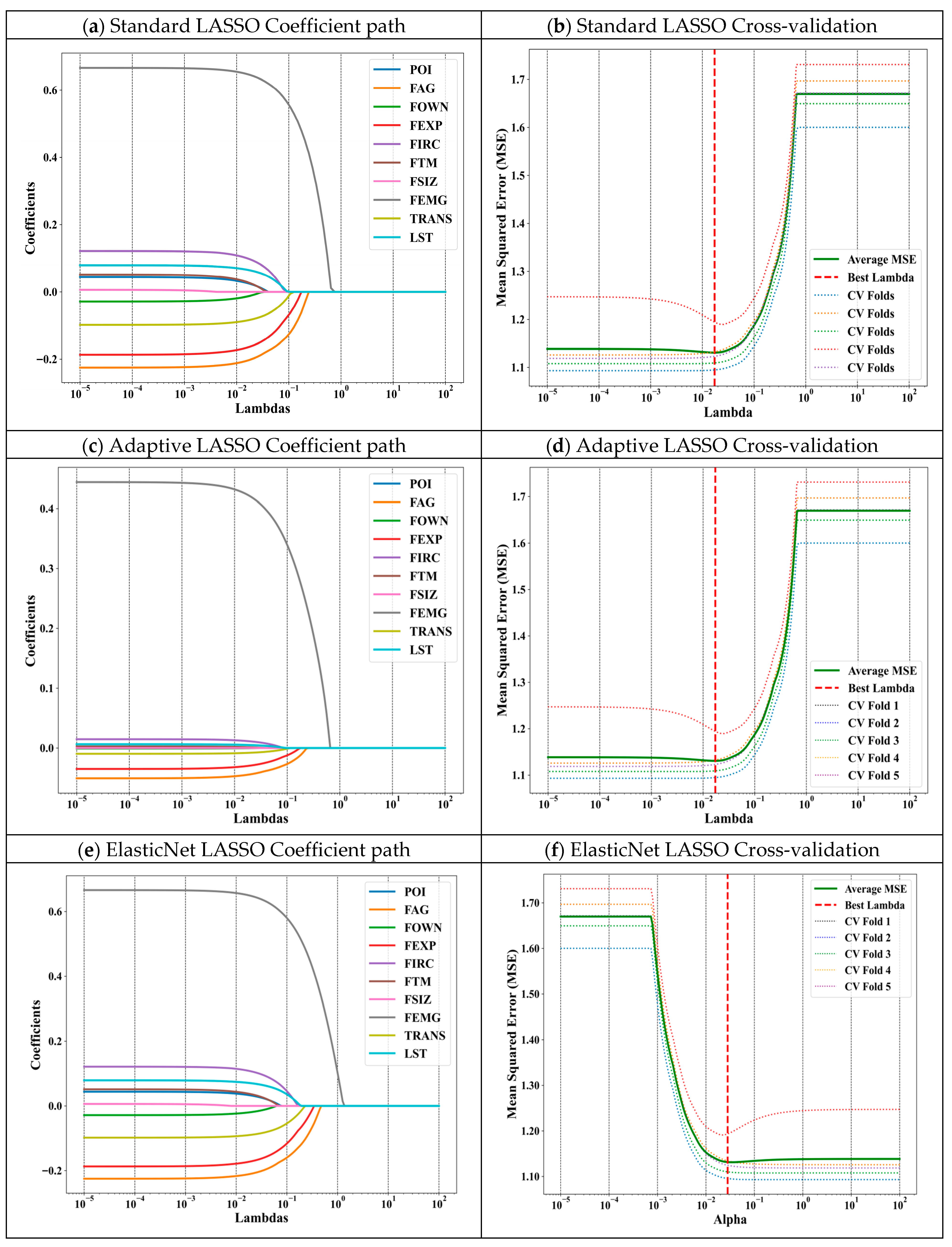
| Variables | Standard LASSO | Adaptive LASSO | ElasticNet Estimator |
|---|---|---|---|
| FPER | ✓ | ✓ | ✓ |
| POI | ✓ | ✓ | ✓ |
| FAG | ✓ | ✓ | ✓ |
| FOWN | ✓ | ✓ | ✓ |
| FEXP | ✓ | ✓ | ✓ |
| FIRC | ✓ | ✓ | ✓ |
| FTM | ✓ | ✓ | ✓ |
| FSIZE | ✓ | ✓ | ✓ |
| TAXR | ✓ | ✓ | ✓ |
| TRANS | ✓ | ✓ | ✓ |
| LST | ✓ | ✓ | ✓ |
| MSE | 1.023 | 1.035 | 1.023 |
| Variables | DSLR ML Results | POLR ML Results | ||||
|---|---|---|---|---|---|---|
| (1) | (2) | (3) | (4) | (5) | (6) | |
| FPER | FPER | FPER | FPER | FPER | FPER | |
| POI | −1.192 *** | −0.573 *** | −0.579 *** | −1.188 *** | −0.555 *** | −0.601 *** |
| (0.181) | (0.179) | (0.172) | (0.181) | (0.179) | (0.172) | |
| FAG | −0.003 | 0.005 | −0.005 | 0.004 | ||
| (0.013) | (0.013) | (0.013) | (0.013) | |||
| FOWN | −2.326 *** | −0.777 | −2.406 *** | −0.790 | ||
| (0.715) | (0.587) | (0.745) | (0.535) | |||
| FSIZ | −0.002 ** | −0.003 *** | −0.002 ** | −0.003 *** | ||
| (0.001) | (0.001) | (0.001) | (0.001) | |||
| FEXP | −0.256 *** | −0.262 *** | −0.254 *** | −0.259 *** | ||
| (0.013) | (0.013) | (0.013) | (0.013) | |||
| FIRC | 1.267 *** | 0.969 ** | 1.186 ** | 0.880 * | ||
| (0.491) | (0.486) | (0.490) | (0.485) | |||
| FTM | −0.028 | −0.051 *** | −0.026 | −0.045 ** | ||
| (0.018) | (0.018) | (0.018) | (0.018) | |||
| TAXR | 12.340 *** | 13.743 *** | 12.235 *** | 13.576 *** | ||
| (0.451) | (0.447) | (0.451) | (0.445) | |||
| TRANS | 0.229 | 0.101 | 0.224 | 0.116 | ||
| (0.179) | (0.174) | (0.178) | (0.174) | |||
| LST | −0.402 ** | −0.881 *** | −0.393 ** | −0.900 *** | ||
| (0.195) | (0.194) | (0.196) | (0.194) | |||
| Country FE | YES | YES | YES | YES | YES | YES |
| Time FE | NO | NO | YES | NO | NO | YES |
| Firm FE | NO | NO | YES | NO | NO | YES |
| Wald X2 | 43.31 | 1214.12 | 1414.93 | 42.99 | 1191.15 | 1393.01 |
| Prob. X2 | 0.000 | 0.000 | 0.000 | 0.000 | 0.000 | 0.000 |
| N | 28,894 | 28,894 | 28,894 | 28,894 | 28,894 | 28,894 |
| Variables | CF-POLR | BMA | Proxies of FPER | Proxy of POI | ||
|---|---|---|---|---|---|---|
| (1) | (2) | (3) | (4) | (5) | (6) | |
| FPER | FPER | FEMG | IINN | FLP | FPER | |
| POI | −0.591 *** | −0.913 *** | −0.827 *** | −0.001 | −0.021 | |
| (0.172) | (0.208) | (0.194) | (0.002) | (0.022) | ||
| REG | −0.631 *** | |||||
| (0.177) | ||||||
| Controls | YES | YES | YES | YES | YES | YES |
| Country FE | YES | YES | YES | YES | YES | YES |
| Time FE | YES | YES | YES | YES | YES | YES |
| Firm FE | YES | YES | YES | YES | YES | YES |
| Wald X2 | 1387.39 | - | 1114.35 | 1507.59 | 2716.60 | 1391.62 |
| Prob. X2 | 0.000 | - | 0.000 | 0.000 | 0.000 | 0.000 |
| N | 28,894 | 28,894 | 28,894 | 28,894 | 28,894 | 28,894 |
| Variables | IV = Average of POI | IV = W&C | ||
|---|---|---|---|---|
| 1st Stage Result | 2nd Stage Result | 1st Stage Result | 2nd Stage Result | |
| (1) | (2) | (3) | (4) | |
| POI | FPER | POI | FPER | |
| POI | −0.508 ** | −0.123 ** | ||
| (0.117) | (0.061) | |||
| 0.035 *** | ||||
| (0.010) | ||||
| W&C | 0.059 ** | |||
| 0.028 | ||||
| Controls | YES | YES | YES | YES |
| Country FE | YES | YES | YES | YES |
| Time FE | YES | YES | YES | YES |
| Firm FE | YES | YES | YES | YES |
| Kleibergen–Paap rk LM statistic | 241.18 *** | 241.15 *** | 88.17 *** | 88.17 ** |
| Sanderson–Windmeijer F-test | 531.20 *** | 531.19 *** | 117.801 *** | 117.804 *** |
| Cragg–Donald Wald F statistic | 124.39 *** | 124.38 *** | 93.38 *** | 93.38 ** |
| Anderson–Rubin Wald test | 32.63 *** | 45.21 *** | ||
| Stock–Wright LM S statistic | 32.39 *** | 48.87 *** | ||
| F-Stat. | 55.14 | 58.64 | 58.64 | 40.44 |
| F-Stat-Prob. | 0.000 | 0.000 | 0.000 | 0.000 |
| R2 | - | 0.621 | - | 0.584 |
| N | 28,894 | 28,894 | 28,894 | 28,894 |
| Variables | Baseline Result | Mediating Role of OCOST | Mediating Role of FINV | Mediating Role of FCST | Moderating Role of PC | |||
|---|---|---|---|---|---|---|---|---|
| (1) | (2) | (3) | (4) | (5) | (6) | (7) | (8) | |
| FPER | OCOST | FPER | FINV | FPER | ATF | FPER | FPER | |
| POI | −0.601 *** | 0.007 *** | −0.595 *** | −0.007 *** | −0.512 *** | 0.309 * | −0.601 *** | −0.058 * |
| (0.172) | (0.002) | (0.172) | (0.001) | (0.172) | (0.173) | (0.172) | (0.034) | |
| OCOST | −0.797 * | |||||||
| (0.423) | ||||||||
| FINV | 12.832 *** | |||||||
| (1.855) | ||||||||
| FCST | −0.002 | |||||||
| (0.006) | ||||||||
| PC | 0.263 *** | |||||||
| (0.087) | ||||||||
| POI × PC | 0.074 ** | |||||||
| (0.031) | ||||||||
| Controls | YES | YES | YES | YES | YES | YES | YES | YES |
| Country FE | YES | YES | YES | YES | YES | YES | YES | YES |
| Time FE | YES | YES | YES | YES | YES | YES | YES | YES |
| Firm FE | YES | YES | YES | YES | YES | YES | YES | YES |
| Wald X2 | 1393.01 | 67.53 | 1394.37 | 3013.10 | 1456.06 | 41.23 | 1396.00 | 1605.00 |
| Prob. X2 | 0.000 | 0.000 | 0.000 | 0.000 | 0.000 | 0.000 | 0.000 | 0.000 |
| N | 28,894 | 28,894 | 28,894 | 28,894 | 28,894 | 28,894 | 28,894 | 28,894 |
| Panel A: Heterogeneity analysis based on the firm’s size and the firm’s age. | |||||
| Variables | Firm’s size | Firm’s age | |||
| (1) | (2) | (3) | (4) | (5) | |
| Small | Medium | Large | Young | Old | |
| POI | −1.621 *** (0.288) | −0.271 *** (0.080) | −0.181 *** (0.308) | −1.232 * (0.606) | 0.426 * (0.191) |
| Controls | YES | YES | YES | YES | YES |
| Country FE | YES | YES | YES | YES | YES |
| Time FE | YES | YES | YES | YES | YES |
| Firm FE | YES | YES | YES | YES | YES |
| Wald X2 | 1965.32 | 1487.25 | 1189.51 | 1002.28 | 1491.72 |
| Prob. X2 | 0.000 | 0.000 | 0.000 | 0.000 | 0.000 |
| N | 8178 | 11,133 | 9377 | 1232 | 27,658 |
| Panel B: Heterogeneity analysis based on sectors and ownership. | |||||
| Variables | Sectors | Ownership | |||
| Labor | Technology | Capital | SOEs | Non-SOEs | |
| POI | −0.180 *** (0.230) | −0.707 *** (0.424) | −1.770 *** (0.399) | −0.667 * (0.305) | −0.456 * (0.222) |
| Controls | YES | YES | YES | YES | YES |
| Country FE | YES | YES | YES | YES | YES |
| Time FE | YES | YES | YES | YES | YES |
| Firm FE | YES | YES | YES | YES | YES |
| Wald X2 | 1504.54 | 1087.12 | 1485.46 | 1143.82 | 1880.89 |
| Prob. X2 | 0.000 | 0.000 | 0.000 | 0.000 | 0.000 |
| N | 17,291 | 3911 | 7692 | 6660 | 22,233 |
Disclaimer/Publisher’s Note: The statements, opinions and data contained in all publications are solely those of the individual author(s) and contributor(s) and not of MDPI and/or the editor(s). MDPI and/or the editor(s) disclaim responsibility for any injury to people or property resulting from any ideas, methods, instructions or products referred to in the content. |
© 2026 by the authors. Licensee MDPI, Basel, Switzerland. This article is an open access article distributed under the terms and conditions of the Creative Commons Attribution (CC BY) license.
Share and Cite
Khan, J.; Deng, Y.; Jan, H.; Mowahed, S.M. Machine Learning-Based Systemic Assessment of Political Instability Effects on Firm Performance. Systems 2026, 14, 513. https://doi.org/10.3390/systems14050513
Khan J, Deng Y, Jan H, Mowahed SM. Machine Learning-Based Systemic Assessment of Political Instability Effects on Firm Performance. Systems. 2026; 14(5):513. https://doi.org/10.3390/systems14050513
Chicago/Turabian StyleKhan, Junaid, Yuping Deng, Hira Jan, and Shah Mir Mowahed. 2026. "Machine Learning-Based Systemic Assessment of Political Instability Effects on Firm Performance" Systems 14, no. 5: 513. https://doi.org/10.3390/systems14050513
APA StyleKhan, J., Deng, Y., Jan, H., & Mowahed, S. M. (2026). Machine Learning-Based Systemic Assessment of Political Instability Effects on Firm Performance. Systems, 14(5), 513. https://doi.org/10.3390/systems14050513