Article

Evolutionary Dynamics of Openness, Dependence, and Regulation in AI Computing Power Innovation Ecosystem

by
Zhengrui Li
,
Qingjin Wang
*,
Shuai Huang
and
Tian Lan
School of Business, Qingdao University, Qingdao 266071, China
*
Author to whom correspondence should be addressed.
Systems 2026, 14(5), 505; https://doi.org/10.3390/systems14050505
Submission received: 14 March 2026 / Revised: 16 April 2026 / Accepted: 30 April 2026 / Published: 2 May 2026
(This article belongs to the Section Artificial Intelligence and Digital Systems Engineering)

Abstract

Driven by the rapid proliferation of generative artificial intelligence, the computing power industry is undergoing a paradigm shift from traditional linear supply chains toward complex, interdependent innovation ecosystems. This study investigates the evolutionary dynamics of the computing power ecosystem, specifically examining the strategic interplay between antitrust regulation and vertical integration. We construct a tripartite evolutionary game framework involving the government regulators, leading computing power incumbents, and downstream AI innovators. By deriving evolutionarily stable strategies, we analyze the underlying mechanisms of system transitions and employ numerical simulations to explore key parametric sensitivities. The theoretical analysis suggests that the evolution of the AI computing power innovation ecosystem manifests distinct stage-based progressions and threshold-driven bifurcation characteristics—potentially transitioning from an initial efficiency-based state of “natural monopoly and passive dependence” during the industry’s emergence, through transitionary states such as the “comfort zone trap” or “regulatory stalemate” during the expansion phase, and ultimately converging toward a mature configuration of “co-opetition and endogenous growth.” The model suggests that downstream AI firms may benefit from advancing vertical integration, achieving hardware–software co-optimization through self-developed domain-specific architectures, The analysis further implies that the leading computing power firm could strengthen its ecological niche by opening its underlying interfaces and software stacks to maintain its ecological niche as the industry cornerstone in integrated form. For the government, it is necessary to establish precise dynamic intervention and orderly exit mechanisms.

1. Introduction

The rapid surge in computational demand driven by the artificial intelligence industry, combined with prohibitively high infrastructure costs and a highly concentrated supply structure, has rendered AI computing power a critical domain in urgent need of structural reconfiguration [1]. As the engine of the digital economy, AI computing power has emerged as a core pillar of technological competitiveness, underpinning the entire value chain from generative model training to large-scale inference. It accounts for more than 50% of capital expenditures among leading technology firms. With the exponential growth in the parameter scale of large language models, the energy efficiency and cost control of computing infrastructure have become decisive challenges for the sustainable development of AI [2]. Moreover, the natural monopoly formed by the first-mover advantages of dominant computing power providers (e.g., Nvidia) has resulted in an inverted pyramid structure within the supply chain, significantly amplifying the risk of single-vendor lock-in and further intensifying cost pressures on downstream AI innovators. Innovation, in this context, involves reshaping value chains through novel technological architectures and organizational arrangements to meet efficiency requirements while generating greater ecosystem-wide value [3]. Computing power vertical integration refers to the strategic practice whereby downstream AI firms such as Google and Meta deeply integrate chip design with application scenarios, replacing general-purpose hardware with self-developed, workload-specific architectures and open software stacks, thereby creating computing ecosystems that substantially reduce total cost of ownership while precisely matching task-specific requirements [4]. Advancing vertical integration in computing power can effectively weaken monopolistic pricing power, enhance system-level energy efficiency, and improve supply chain security [5].
Innovation driven by computing power vertical integration is essentially a complex process of system evolution that spans the specification of algorithmic requirements, the customized development of specialized architectures, and the large-scale deployment of a software–hardware co-evolutionary ecosystem [6]. Its operational dynamics are jointly shaped by external regulatory regimes, strategic interactions along the upstream-downstream industrial chain, and strategic games among multiple core stakeholders [3]. Existing studies predominantly adopt an external-environment perspective, focusing on antitrust policy instruments—such as penalty-based deterrence and innovation-oriented incentives—as well as the market feedback effects of open standards alliances [7,8,9]. They also examine coopetition strategies within the industrial chain, including the use of interoperability standards and bargaining mechanisms to mitigate supplier lock-in and opportunistic pricing [10], thereby fostering greater diversity within the computing power ecosystem [11]. The capital intensity and technological risks associated with AI computing power vertical integration continue to rise. Simultaneously, the complexity of software–hardware coordination increases with advances in heterogeneous computing architectures and the debugging of hyperscale clusters debugging [12]. Consequently, downstream AI firms commonly face binding total cost of ownership constraints at the model deployment stage, creating an urgent reliance on breakthroughs in specialized architectures or foundational software stacks. Against the backdrop of intertwined antitrust regulation and technological transformation, existing fragmented and unidimensional studies provide limited guidance for the successful transformation of the computing power industry. In particular, existing research has paid insufficient attention to the strategic interactions among key stakeholders within the computing power ecosystem—namely, how leading firms’ decisions regarding ecosystem openness or closure shape downstream firms’ vertical integration incentives, how downstream firms’ make-or-buy choices in turn constrain or redirect the leading firms’ competitive strategies, and how government regulators dynamically calibrate the intensity of antitrust enforcement and innovation subsidies in response to evolving market structures. These interdependent strategic decisions do not operate in isolation; rather, they form a tightly coupled co-evolutionary system in which each actor’s payoff is contingent on the simultaneous choices of the others. The absence of an integrated analytical framework that captures these multi-actor strategic interdependencies represents a critical gap, as it prevents both scholars and policymakers from understanding the conditions under which the industry transitions from monopolistic lock-in to diversified competition, or becomes trapped in suboptimal equilibria such as regulatory stalemates and comfort-zone dependence. Given that computing power innovation constitutes a highly capital-intensive, high-barrier, and multi-actor complex system, there is an urgent need for systematic research and mature theoretical frameworks that jointly consider the interaction between market mechanisms and non-market strategies, so as to support the long-term, sustainable evolution of the AI computing power industry.
Innovation ecosystems are now widely regarded as a necessary analytical foundation for understanding complex technological evolution, as they conceptualize research problems as interdependent systems rather than isolated entities [13]. Innovation ecosystems shape processes of joint value creation and co-evolution by encouraging both competition and collaboration between leading firms and downstream actors, thereby enabling access to resources and complementary assets that extend beyond the scope and capabilities of individual firms (e.g., complementary assets such as the CUDA or PyTorch ecosystems) [14]. Moreover, innovation ecosystem theory emphasizes the importance of innovation actors’ attention to the external environment, their capacity to coordinate with and adapt to it—particularly the antitrust regulatory environment—and their ability to co-develop alongside institutional and market conditions [15]. Accordingly, this study applies innovation ecosystem theory to AI computing power innovation, systematically examining the internal interactions and evolutionary trajectories of multiple stakeholders under the influence of antitrust regulation.
Furthermore, evolutionary game theory has been recognized as a particularly suitable analytical framework for exploring the evolutionary mechanisms of such complex systems [16]. The intrinsic features of EGT-bounded rationality, dynamic evolution, and population-level interaction-render it a powerful tool for modeling the stylized strategic dynamics of representative actors within computing power innovation ecosystems [17]. Central to this framework is the concept of evolutionary stable strategies: over prolonged interactions, ecosystem participants continuously adapt their strategies in response to the accumulation of vertical integration capabilities and perturbations arising from external factors such as antitrust penalties and innovation incentives, eventually converging toward an optimal steady state of system evolution [18]. Despite its extensive application in other domains, however, there remains a notable lack of mathematically grounded modeling and simulation-based analysis addressing the specific game structures of the AI computing power industry, the competitive dynamics among multiple stakeholders, and the mechanisms through which the system adapts to the dual forces of antitrust regulation and endogenous technological rents.
To address these gaps, this study constructs a tripartite evolutionary game model involving “leading computing power firms,” “downstream AI firms,” “and government regulators.” Unlike standard tripartite evolutionary games in related domains that treat firms as independent payoff-maximizing actors and technological architecture as exogenous background conditions, the marginal contribution of this study lies in systematically integrating innovation ecosystem theory into the game framework. This integration reconceptualizes strategic interactions as competition and coordination around ecosystem control, complementary assets, interface openness, and value appropriation. In this framework, leading computing power firms are not merely upstream suppliers, but ecosystem orchestrators that shape standards, interfaces, and the distribution of network value; downstream AI enterprises are not simply buyers, but potential architectural challengers whose vertical integration decisions can reshape ecosystem boundaries; and the government is not only a regulator, but also an institutional actor that influences the evolutionary direction of ecosystem governance through antitrust enforcement and innovation incentives. This theoretical integration contributes beyond a conventional evolutionary game in three respects. First, it shifts the analytical focus from isolated bilateral transactions to structurally interdependent ecosystem relationships. Second, it extends the payoff logic from static profit competition to ecosystem-level mechanisms such as migration frictions, network expansion, compatibility, and retained ecosystem value. Third, it enables equilibrium outcomes to be interpreted not merely as stable strategic combinations, but as distinct evolutionary configurations of the AI computing power ecosystem. This integrated perspective is particularly suitable for the AI computing context, where technological competition is deeply embedded in software–hardware complementarities, platform dependence, standard-setting power, and co-evolving regulatory institutions. Accordingly, this research seeks to elucidate the co-evolutionary mechanisms of stakeholder strategies within the AI computing power innovation ecosystem, to explore pathways to break single-pole dependence and achieve endogenous industrial growth, addressing the following three core research questions from an EGT perspective:
  • Under different combinations of antitrust penalties and total cost of ownership (TCO) optimization incentives, what evolutionary stable strategies emerge within the AI computing power innovation ecosystem?
  • For key stakeholders, how do critical parameters drive strategic reversals and shifts in game equilibria?
  • What are the specific evolutionary paths and boundary conditions through which the AI computing power innovation ecosystem transitions from natural monopoly in its early stages to diversified co-opetition in its mature phase?

2. Literature Review

2.1. Computing Power Vertical Integration Innovation in the AI Industry

Driven by the pressing challenges of surging generative AI computing costs and single-vendor lock-in, computing power vertical integration innovation has emerged as a salient and visible trend in the technology industry [19]. At its core, vertical integration innovation refers to a strategic approach that deeply couples upper-layer algorithmic requirements with lower-layer hardware architectures, thereby introducing domain-specific architectures into the computing market [20]. Representative examples include Google’s Tensor Processing Units (TPUs), AWS’s Trainium and Inferentia chips, Meta’s MTIA inference accelerator, and Microsoft’s Maia AI chip, all of which have contributed to the expansion of high-performance computing capabilities across both cloud and edge environments [21]. Consequently, cultivating vertical integration capabilities in computing power has been elevated to a core strategic agenda for many technology giants and unicorn firms, aimed at strengthening ecosystem competitiveness in the post-Moore era and securing supply chain autonomy [22].
Research on the driving mechanisms of AI computing power vertical integration innovation has primarily developed along two dimensions: external and internal. From an external perspective, government regulation, market structure, and technological paradigms constitute the three principal drivers of vertical innovation [23,24,25]. From the standpoint of industrial governance, governments seek to rebalance market structures through policy instruments, including antitrust regulation and innovation incentives [26], with the objective of lowering entry barriers without undermining platform economies of scale, curbing the abuse of market dominance, and fostering competition across diversified technological trajectories [27]. In contrast, market mechanisms function as both the selection device and feedback provider for vertical integration innovation [28]. Scholars in innovation economics have argued that vertical integration can enhance economic performance by minimizing total cost of ownership, improving energy efficiency ratios, strengthening bargaining power, and capturing proprietary advantages arising from software–hardware co-design [29,30,31].
Internally, the platform–complementor paradigm long dominated the organization of computing power innovation [32]. However, as critical technological barriers have intensified, downstream firms have increasingly shifted toward in-house strategies to pursue full-stack collaborative innovation spanning chips, systems, and applications, thereby strengthening control over key technological layers [33]. Simultaneously, the prohibitive non-recurring engineering costs of custom chip development—encompassing advanced-node tape-out expenses exceeding hundreds of millions of dollars per iteration, the acquisition of specialized talent in hardware–software co-design, and multi-year validation cycles—impose severe capital thresholds that deter all but the largest hyperscalers from pursuing in-house silicon strategies. This transition is accompanied by substantial migration challenges, which extend beyond mere technical heterogeneity to entail reconstructing an entire complementary asset structure: compiler toolchains, kernel-level operator libraries, distributed training frameworks, and community-maintained model repositories must all be rebuilt or adapted to function on alternative architectures [34]. Accordingly, the selection of computing power technology trajectories must simultaneously satisfy strategic goal alignment, ecosystem compatibility, resource complementarity, and firms’ absorptive capacity in order to mitigate systemic integration risks [35]. From a governance perspective, open standards and interoperable interfaces can alleviate migration frictions and facilitate ecosystem coordination [36], whereas the lock-in effects in this domain operate through multiple reinforcing channels: high switching costs arising from architecture-specific code dependencies, exclusionary licensing agreements that restrict cross-platform portability, and excessive sunk-cost investments in proprietary chips that create escalating commitment traps. These mechanisms jointly constrain downstream firms’ exit options and foster opportunistic pricing by dominant suppliers, thereby constraining the formation of sustainable commercialization loops for innovation [37,38].
Overall, existing studies predominantly focus on macro-level external conditions of computing power innovation and internal technical metrics. In contrast, relatively limited attention has been paid to the strategic interactions among key stakeholders within the computing power ecosystem—namely leading firms, downstream innovators, and regulators—as well as the dynamic decision-making processes of vertical integration and their feedback mechanisms with external regulatory environments. To effectively examine the internal–external co-evolutionary dynamics of AI computing power vertical integration innovation, systematic investigation, mature theoretical frameworks, and rigorous methodological approaches are urgently required.

2.2. Innovation Ecosystems

With the expansion of digital platform-based business models, innovation ecosystems have become a central analytical framework in research on strategic management and technology management [13,15]. The concept was originally introduced by Moore [39], drawing on a biological metaphor to describe collaborative networks of cross-industry actors organized around shared value creation. Building on this foundation, Adner [40] defined innovation ecosystems as coordinated structures composed of interdependent organizations and individuals that collectively enable the development of new products and technologies. Compared with general business ecosystems, AI computing power innovation ecosystems place greater emphasis on the realization of specific value propositions and breakthroughs along distinct technological trajectories. Their core characteristics are reflected in the high degree of interdependence between software and hardware actors within a given technological architecture, as well as in the co-evolution of algorithmic demands and chip architectures [23,41,42,43].
At the level of governance mechanisms, scholarly inquiry has undergone a substantive shift from an emphasis on collaborative coordination structures toward an analysis grounded in power competition. Early studies predominantly examined how core platforms coordinate complementors through interface design and institutional arrangements to maximize overall system value [44,45,46]. More recent work, however, increasingly conceptualizes innovation ecosystems as arenas of strategic interaction among heterogeneous actors competing for control over critical resources and technological standards [47,48]. This literature demonstrates that dominant firms occupying central ecosystem positions often leverage bottleneck assets to establish structural advantages [49], reinforcing control over peripheral actors through path dependence and switching costs. Such asymmetric power configurations indicate that ecosystem evolution is fundamentally a dynamic contest over technological standard leadership and value appropriation.
Although prior research has illuminated the hierarchical organization of ecosystems and the sources of monopolization from largely static perspectives, it remains insufficient for capturing dynamic evolutionary processes within complex techno-political and economic contexts. On the one hand, existing studies tend to focus on the formation mechanisms of monopolistic structures, while providing limited and insufficiently granular analysis of the strategies employed by technologically dominant firms to impede the decoupling of dependent actors when facing potential challengers. On the other hand, under real-world conditions characterized by the coexistence of ongoing antitrust scrutiny and technological decoupling, the ways in which external regulatory forces intervene in and reshape the equilibrium of inter-firm strategic interactions have yet to receive systematic theoretical attention. This reconceptualization of ecosystem evolution as a dynamic power contest rather than a static coordination problem carries a direct methodological implication: the three structurally pivotal roles identified above, namely the ecosystem orchestrators, the architectural challengers, and the institutional regulator, constitute a natural tripartite game structure that requires an evolutionary rather than static analytical framework. Consequently, there is a clear need to adopt a dynamic game-theoretic perspective to more rigorously examine the evolutionary trajectories and governance boundaries of AI computing power innovation ecosystems under the dual constraints of regulatory pressure and technological competition.

2.3. Evolutionary Game Theory

Originating from the seminal work of Smith and Price on evolutionarily stable strategies in biology [16], Evolutionary Game Theory (EGT) was subsequently introduced into the economic domain by scholars such as Friedman [50], marking a paradigmatic shift from biological evolution to socio-economic dynamics. Unlike traditional game theory, which relies on static equilibrium analysis based on perfect rationality, EGT is grounded in the assumption of bounded rationality. It formalizes the collective learning mechanisms and strategy diffusion processes through replicator dynamic equations and evolutionarily stable strategies. In the AI computing industry, the high frequency of technological iteration and the uncertainty of regulatory policies prevent market entities from possessing complete information at the initial stage; instead, they rely primarily on dynamic assessments of the external environment and internal payoffs to revise their decisions [51]. The dynamic adaptability and path-dependence inherent in EGT accurately capture the long-term strategic trajectory between incumbent leaders maintaining monopolies and downstream enterprises seeking vertical breakthroughs, thereby providing a robust mathematical framework for analyzing multi-agent strategic interactions [52].
Regarding application, extant research has extensively utilized EGT in the fields of semiconductor supply chains and digital platform governance. In hardware supply chain research, scholars have employed this theory to explore chip capacity allocation and technology diffusion paths [53,54]; however, these studies are often confined to tactical games within a single supply chain link, lacking a macro-level examination of ecosystem-level competition. In the governance of the platform economy, existing literature focuses on quantifying the impact of antitrust penalties and R&D subsidies on pricing strategies but frequently treats technical architecture as a fixed variable, thereby overlooking the endogenous drive of firms to restructure industrial boundaries through vertical integration [55,56].
Addressing the aforementioned research gaps, existing literature has yet to deeply explore the evolutionary mechanisms of the AI computing ecosystem under the dual drivers of antitrust regulation and endogenous technological change. Existing models struggle to explain how downstream enterprises in mature markets, in the absence of strong external sanctions, surpass the critical threshold of the “make-or-buy” decision to achieve a path transition from unilateral dependence to autonomous control. Consequently, this study introduces EGT into the domain of vertical integration innovation in AI computing. By constructing a tripartite game model involving the government, leading enterprises, and downstream innovators, this research aims to reveal the strategic elucidate thresholds and stable evolutionary dynamics within a complex system intertwining technology, economics, and regulation.

3. Assumptions and Variables

3.1. Three Players

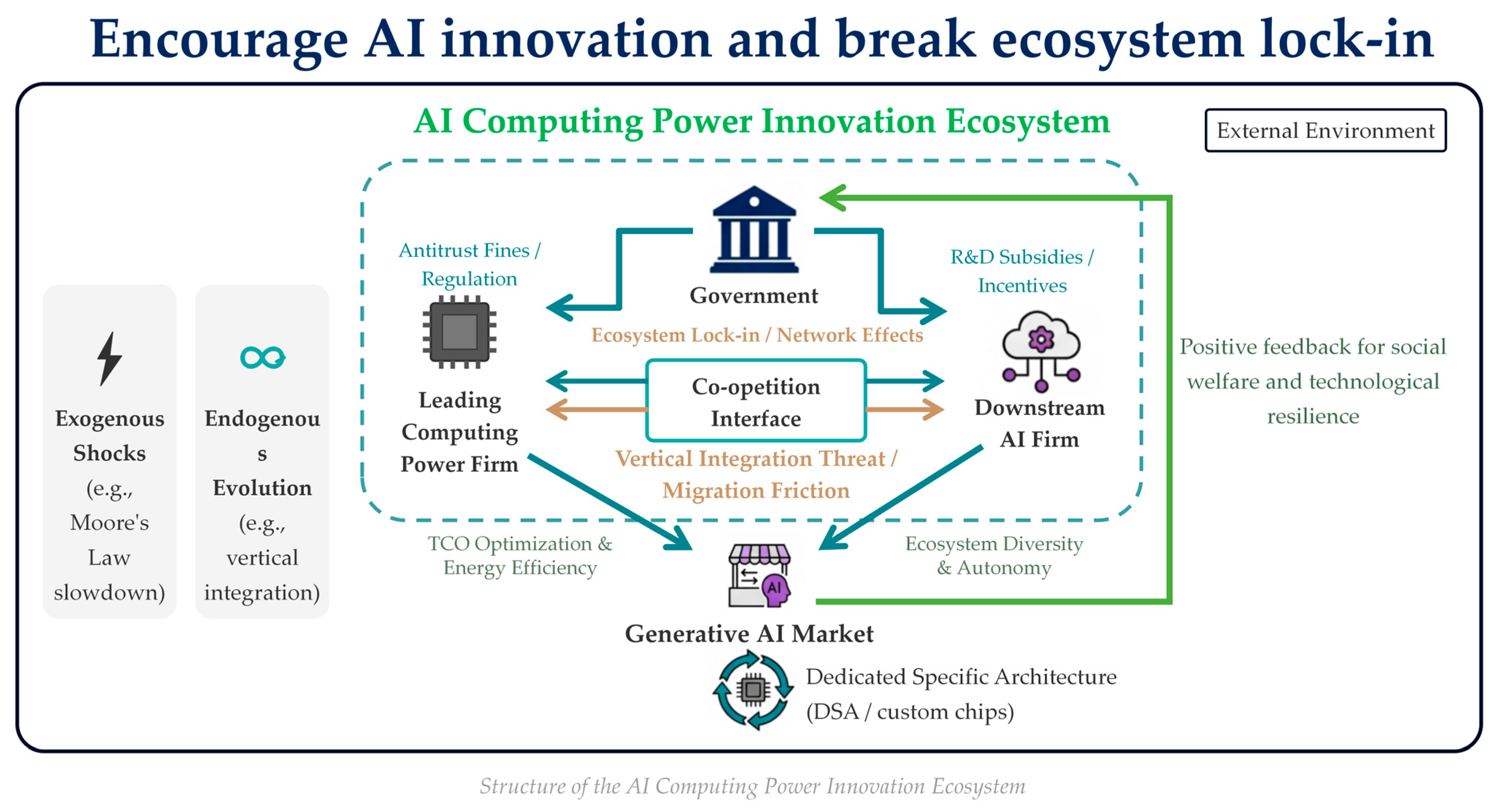
The innovation ecosystem examined in this study comprises three analytically representative stakeholder groups, as shown in Figure 1: leading computing power firms, downstream AI firms, and government. This tripartite abstraction is adopted as a theory-building device for isolating the dominant strategic mechanisms that shape the long-run evolution of the AI computing power ecosystem. In reality, the ecosystem involves a broader set of actors, including cloud service providers, chip designers, model developers, system integrators, financial capital, and multiple layers of public institutions and substantial heterogeneity exists within each category. However, from the perspective of ecosystem evolution, the central strategic tensions can be traced to three structurally pivotal roles: architectural controller over foundational computing infrastructure, dependency restructuring by major downstream adopters, and institutional intervention by public authorities. Accordingly, the model abstracts these roles into three representative players in order to preserve analytical tractability while retaining the ecosystem’s core co-evolutionary logic.
First, the ecosystem includes the leading computing power firms as the core infrastructure provider. While these firms may differ in their technological architectures, degrees of ecosystem openness, scopes of vertical integration, and governance mechanisms for complementors, they share a fundamental characteristic: they possess de facto control over the definition, allocation, and pricing of foundational computing power. For this reason, the study abstracts them as a representative upstream actor.
Second, while downstream AI firms vary in market positioning, scale, and technological capabilities, they are analytically comparable as they confront a shared strategic dilemma: whether to remain embedded within the incumbent leading firm’s computing power ecosystem, or to pursue vertical integration through in-house infrastructure development and ecosystem reconstruction. Accordingly, these actors are abstracted as downstream AI innovators.
Third, the government is modeled as a representative institutional actor that shapes ecosystem evolution through regulation and policy intervention. In practice, public governance in the AI computing power industry is dispersed across multiple agencies and policy domains, including competition regulation, industrial upgrading, technological sovereignty, fiscal support, export control, and national security. These policy objectives sometimes move in a different direction. However, for the purpose of examining the directional impact of public intervention on ecosystem evolution, the present study analytically aggregates these functions into a unified governmental actor. This actor supervises market fairness while offering innovation incentives and preventing abuses of market dominance.
Throughout the evolutionary game process, all stakeholders are assumed to exhibit bounded rationality. Due to information asymmetry and technological uncertainty, they cannot identify optimal strategies instantaneously, but instead adjust their behaviors through repeated interactions and learning mechanisms. It is important to note that, consistent with the evolutionary game tradition, the model operates at the population level: the strategy proportions represent the share of each actor type adopting a given strategy within the relevant population, rather than the probability of a single firm’s choice. This population-level interpretation is critical for understanding how the model accommodates within-group heterogeneity: even though individual downstream firms differ in their capabilities and constraints, the replicator dynamics capture the aggregate strategic tendency of the population as a whole.

3.2. Strategy Sets

During the evolution of the AI computing power innovation ecosystem, the government may choose either an active regulation strategy or a non-intervention strategy. Let the probability of adopting active regulation be denoted by z , and the probability of laissez-faire governance by 1 z . Although this binary abstraction simplifies the diversity of real-world policy instruments, it captures the aggregate directional stance of governmental intervention and is consistent with the standard discrete-strategy approach in evolutionary game theory. Within the active regulation strategy, the model further distinguishes between two functionally complementary policy instruments: the antitrust fine F , which captures punitive deterrence against monopolistic conduct, and the innovation subsidy S , which captures incentive-based support for downstream vertical integration. Under winner-takes-all market conditions, the leading computing power firm faces a strategic trade-off between maintaining high monopoly rents and expanding network externalities. The binary abstraction adopted here captures the polar cases of this continuum and is consistent with the standard approach in evolutionary game theory, where discrete strategy types represent idealized archetypes around which population-level dynamics cluster. Accordingly, it may choose either an “ecosystem win–win” strategy or a “chip hegemony” strategy. Let x denote the probability of choosing openness, and 1 x the probability of maintaining a closed ecosystem. Correspondingly, downstream AI firms—motivated by total cost of ownership optimization and supply-chain security—may replace general-purpose GPUs with domain-specific architectures through in-house development. They therefore choose between independent and dependent strategies. Let y denote the probability of choosing independent development, and 1 y the probability of remaining deeply dependent on incumbent computing power suppliers.

3.3. Cost Structure

If the leading computing power firm adopts a closed strategy, it incurs costs associated with maintaining its technological moat, such as enforcing ecosystem exclusivity agreements. Conversely, if it chooses openness, while moat maintenance costs are reduced, the firm bears potential market share erosion caused by core technology spillovers. This loss of moat value is denoted as C l o s s . As the principal initiators of vertical integration innovation, downstream AI firms pursuing independent development incur substantial non-recurring engineering costs, including chip design talent acquisition, tape-out expenses, and software stack adaptation. These costs are denoted by C s e l f . In addition, early-stage self-development entails architecture migration frictions and supply-chain disruption risks, generating opportunity costs and risk premia denoted by C r i s k . If downstream firms instead choose dependence, they must pay high premiums embedded in general-purpose computing power, reflected in an elevated total cost of ownership. For the government, choosing active regulation entails antitrust investigation, litigation, and enforcement costs, denoted by C g o v . Moreover, if either the leading firms or downstream firms violate antitrust regulations or abuse market dominance, they are subject to fines or compliance costs denoted by F .

3.4. Payoff Structure

At the initial stage of the game, all actors operate within a saturated market environment characterized by established baseline revenues. The baseline payoffs of the leading computing power firm, downstream AI firms, and the government are denoted by R 1 , R 2 , and aggregate social welfare W , respectively. When the leading firms adopt an open strategy ( x = 1 ) and downstream firms choose dependence ( y = 0 ), strong ecosystem network effects emerge. In the context of innovation ecosystems theory, this represents joint value co-creation between leaders and complementors, generating an ecosystem network expansion value denoted by V n e t . The distribution of this value reflects the ecosystem’s power structure: the leading firms retain a proportion μ V n e t , where μ ( 0,1 ) is the ecosystem value retention coefficient, while downstream firms obtain efficiency gains of ( 1 μ ) V n e t .
If downstream AI firms successfully pursue independent development ( y = 1 ), the incremental payoff from vertical integration through domain-specific architectures—stemming from TCO reduction, energy efficiency improvements, and workload-specific optimization—is denoted by Δ R 2 b . By contrast, the payoff from remaining dependent on general-purpose computing power is Δ R 2 a , with Δ R 2 b > Δ R 2 a in technologically mature stages. Technological Absorption and friction: To capture technological absorption frictions, a coefficient θ [ 0,1 ) is introduced. Given substantial software stack incompatibilities and tacit knowledge barriers in migrating away from CUDA-based ecosystems, θ reflects the degree of dissipation during technology transfer. Accordingly, the effective net payoff from self-development is ( 1 θ ) Δ R 2 b . A higher θ implies weaker absorptive capacity and may result in pseudo-innovation, where realized returns fall below those of continued dependence.
Government Welfare and Policy Instruments: Government payoffs depend on changes in aggregate social welfare. Under active regulation ( z = 1 ), the government collects antitrust fines F and obtains additional innovation and security benefits from enhanced competition, denoted by I 2 . If regulation is absent and leading firms’ monopoly structures solidify, social welfare declines to a lower level I 1 , where I 2 > I 1 . To stimulate innovation, the government may provide R&D subsidies or tax credits S to downstream firms that pursue independent development. Finally, if the leading firm maintains a closed strategy while downstream firms successfully decouple through self-development, the leading firms suffer permanent market share losses due to the erosion of core customer relationships. The specific model parameters and their significance are presented in Table 1.

4. Tripartite Payoff Matrix

According to the game model assumptions presented above and the setting of parameters, the payoff matrix is shown in Table 2.

4.1. Construction of Replicator Dynamic Equations

4.1.1. Expected Payoffs and Replicator Dynamics for the Computing Power Leader

The probability of the Computing Power Leader choosing the “Ecosystem Win–Win Mode” is x , and the probability of choosing the “Chip Hegemony Mode” is 1 x .
Expected Return L 1 (Chip Hegemony):
L 1 = y ( 1 z ) R 1 + y z ( R 1 F ) + ( 1 y ) ( 1 z ) ( R 1 + Δ R 1 a ) + ( 1 y ) z ( R 1 + Δ R 1 a F ) = R 1 + ( 1 y ) Δ R 1 a z F
Expected Return L 2 (Ecosystem Win–Win):
L 2 = y ( R 1 C l o s s + μ V n e t ) + ( 1 y ) ( R 1 + Δ R 1 a C l o s s + V n e t ) = R 1 + ( 1 y ) Δ R 1 a C l o s s + V n e t y ( 1 μ ) V n e t
Average Expected Return L :
L = x L 2 + ( 1 x ) L 1
Replicator Dynamic Equation F ( x ) :
F ( x ) = d x d t = x ( L 2 L ) = x ( 1 x ) ( L 2 L 1 ) F ( x ) = x ( 1 x ) [ V n e t C l o s s y ( 1 μ ) V n e t + z F ]

4.1.2. Expected Returns and Equations for the Downstream AI Firm

The probability of the Downstream AI Firm choosing the “Independent Control Strategy” is y , and the probability of choosing the “Deep Dependency Strategy” is 1 y .
Expected Return P 1 (Independent Control):
P 1 = x 1 z R 2 + Δ R 2 b θ C s e l f + x z R 2 + Δ R 2 b θ C s e l f + S + 1 x 1 z ( R 2 + Δ R 2 b C s e l f ) + ( 1 x ) z ( R 2 + Δ R 2 b C s e l f + S ) = R 2 + Δ R 2 b C s e l f + x ( 1 θ ) C s e l f + z S
Expected Return P 2 (Deep Dependency):
P 2 = x ( R 2 + Δ R 2 a ) + ( 1 x ) ( R 2 + Δ R 2 a C r i s k ) = R 2 + Δ R 2 a ( 1 x ) C r i s k
Average Expected Return P :
P = y P 1 + 1 y P 2
Replicator Dynamic Equation F ( y ) :
F ( y ) = d y d t = y ( P 1 P ) = y ( 1 y ) ( P 1 P 2 ) F y = y 1 y Δ R 2 b Δ R 2 a C s e l f + C r i s k + x 1 θ C s e l f x C r i s k + z S

4.1.3. Expected Returns and Equations for the Government

The probability of the Government choosing “Regulation” is z , and the probability of choosing “Non-Regulation” is 1 z .
Expected Return G 1 (Non-Regulation):
G 1 = x [ y ( W + I 1 ) + ( 1 y ) W ] + ( 1 x ) [ y ( W + I 1 D ) + ( 1 y ) ( W D ) ] = W + y I 1 1 x D
Expected Return G 2 (Regulation):
G 2 = x [ y ( W + I 2 C g o v S ) + ( 1 y ) ( W C g o v ) ] + ( 1 x ) [ y ( W + I 2 D + F C g o v S ) + ( 1 y ) ( W D + F C g o v ) ] = W + y I 2 S 1 x D F C g o v
Average Expected Return G :
G = z G 2 + 1 z G 1
Replicator Dynamic Equation F ( z ) :
F ( z ) = d z d t = z ( G 2 G ) = z ( 1 z ) ( G 2 G 1 ) F z = z 1 z y I 2 I 1 S + 1 x F C g o v

4.2. Jacobian Matrix Form

Based on the derived expected returns and replicator dynamic equations, the Jacobian matrix J of the system is a 3 × 3 matrix obtained by taking the partial derivatives of the three-party dynamic equations with respect to the strategy probabilities x , y , z .
The Replicator Dynamic Equation System:
F ( x ) = x ( 1 x ) [ V n e t C l o s s y ( 1 μ ) V n e t + z F ] F ( y ) = y ( 1 y ) [ Δ R 2 b Δ R 2 a C s e l f + C r i s k + x ( ( 1 θ ) C s e l f C r i s k ) + z S ] F ( z ) = z ( 1 z ) [ y ( I 2 I 1 S ) + ( 1 x ) F C g o v ]
Jacobian Matrix J:
J = F ( x ) x F ( x ) y F ( x ) z F ( y ) x F ( y ) y F ( y ) z F ( z ) x F ( z ) y F ( z ) z
Substituting the full parameters, the Jacobian Matrix elements are:
J = ( 1 2 x ) [ V n e t C l o s s y ( 1 μ ) V n e t + z F ] x ( 1 x ) ( 1 μ ) V n e t x ( 1 x ) F y ( 1 y ) [ ( 1 θ ) C s e l f C r i s k ] ( 1 2 y ) [ A ] * y ( 1 y ) S z ( 1 z ) F z ( 1 z ) ( I 2 I 1 S ) ( 1 2 z ) [ y ( I 2 I 1 S ) + ( 1 x ) F C g o v ]
(Note: The middle term [ A ] * represents [ Δ R 2 b Δ R 2 a C s e l f + C r i s k + x ( C r i s k ( 1 θ ) C s e l f ) + z S ] )

4.3. Stability Analysis of Equilibrium Points

By sequentially substituting the eight pure strategy points into the Jacobian matrix, we obtain the respective eigenvalues for each configuration, which are summarized in Table 3.

5. Equilibrium Analysis and Evolutionary Interpretation

The propositions identify the formal conditions under which specific equilibrium configurations emerge within the model; the conclusions draw out the strategic and policy implications of these equilibria within the model’s logic; and the illustrative case interpretations offer plausible real-world analogies that highlight the model’s relevance to observed industry dynamics. These case interpretations are not intended as direct empirical validations of the model but rather as heuristic illustrations that connect theoretical mechanisms to recognizable patterns in the AI computing power industry.

5.1. Ecosystem Emergence Stage: Low-Level Monopoly Lock-In and Passive Dependence

Proposition 1.
Natural Monopoly Lock-in under Early-Stage Scale Economies— E 1 0 , 0 , 0 .
When the parameter conditions V n e t C l o s s < 0 ,   Δ R 2 b Δ R 2 a C s e l f + C r i s k < 0 , and F C g o v < 0 are satisfied, the ESS of the system is E 1 ( 0,0 , 0 ) . In this equilibrium, the leading computing power firm is predicted to adopt a closed strategy, downstream AI firms are expected to remain in a deep dependency Strategy, and the government is predicted to refrain from regulation. Within the model, the system settles into a natural monopoly sustained by first-mover advantages. This stability can be understood, within the model framework, as arising from the aggregation of rational cost–benefit calculations under early-stage market conditions. For the leading firm, during the initial surge of deep learning, network effects from ecosystem openness are limited, and the potential gains V n e t are far outweighed by the expected losses from weakening its technological moat C l o s s . Within the model’s payoff structure, rational profit maximization therefore favors a closed strategy leveraging proprietary hardware–software stacks. For downstream AI firms, extremely high sunk costs C s e l f and cross-architecture migration frictions render self-developed chips highly uncertain and time-consuming. Although dependence entails vendor lock-in and bargaining power loss C r i s k , the immediate performance and iteration benefits Δ R 2 a from general-purpose GPUs dominate early-stage vertical integration returns, leading firms to rationally choose dependence to accelerate time-to-market and minimize total cost of ownership. For the government, early-stage market concentration is commonly interpreted as the outcome of technological selection rather than anticompetitive conduct. High enforcement costs C g o v , combined with relatively low fines F and concerns about suppressing nascent innovation, induce regulators to adopt a laissez-faire stance in pursuit of aggregate welfare maximization.
  • Conclusion 1
The ESS E 1 ( 0 , 0 , 0 ) suggests the presence of an efficiency-based natural monopoly within the model setting during the early phase of AI industry development. Although diversified technological supply is desirable in the long run, early-stage scale economies and ecosystem advantages lead to a stable supply-demand lock-in between leading firms and downstream AI firms within the modeled framework. This lock-in can be interpreted, within this model, as reflecting the logic of innovation-driven economies of scale rather than market failure. Absent paradigm-shifting technologies or heightened antitrust scrutiny triggered by excessive monopoly rents, the system remains trapped in this high-efficiency, low-competition equilibrium under the specified parameter conditions.
  • Illustrative Case Interpretation 1
Mechanism E 1 ( 0 , 0 , 0 ) can be interpreted as broadly analogous to observed patterns during the early deep learning era (2012–2017). During this period, leading firms tended to achieve dominance through technological superiority rather than explicit exclusion—a pattern broadly consistent with the model’s prediction of closure-driven monopoly under low V n e t conditions. Downstream actors such as Facebook FAIR, and early OpenAI were broadly inclined to rely on incumbent GPUs due to prohibitive ASIC development costs and the need for rapid algorithmic iteration. Governments largely treated concentration as the natural reward for innovation and refrained from intervention, thereby contributing to a market-driven lock-in equilibrium.

5.2. Industrial Expansion Phase: Multi-Path Coordinated Transition

Proposition 2.
Strong Regulation and Weak Market Response Stalemate— E 4 ( 0 , 0 , 1 ) .
When the parameters of the game satisfy F C g o v > 0 ,   V n e t C l o s s + F < 0 , and Δ R 2 b Δ R 2 a C s e l f + S < 0 , the ESS of the system is E 4 ( 0 , 0 , 1 ) . Under this equilibrium, the leading computing power firm adopts a closed ecosystem strategy, downstream AI firms choose deep dependence, and the government opts for active regulation, forming a distinctive stalemate characterized as a strong regulation–weak market response configuration. This equilibrium emerges from rational recalculations by all three actors under newly imposed constraints. For the government, antitrust fines F exceed administrative enforcement costs C g o v , implying that regulation no longer constitutes a fiscal burden but instead generates positive social returns. Consequently, the government establishes continuous regulatory intervention to restrain the potential disorderly expansion of monopoly power. For the leading computing power firm, although exposed to antitrust investigations and potential fines, the losses associated with opening the core ecosystem—namely erosion of technological moats C l o s s and potential market share dilution—substantially exceed the expected penalties. As a result, fines may be internalized as routine compliance costs within the modeled payoff structure, and monopoly rents are preserved through sustained ecosystem closure, reflecting a classic pattern of regulatory capture or fine internalization. For downstream AI firms, despite the availability of innovation subsidies S , the high sunk costs of in-house chip development C s e l f and significant cross-architecture migration frictions render the net payoff of vertical integration negative. From a short-term shareholder value and time-to-market perspective, reliance on incumbent general-purpose computing infrastructure remains the dominant choice, which may prevent policy incentives from translating into substantive autonomous innovation within the model setting.
  • Conclusion 2
The ESS E 4 ( 0 , 0 , 1 ) suggests, within the model’s payoff structure, potential limitations of fine-based antitrust regulation, pointing to a possible mismatch between regulatory intent and industrial response under the assumed conditions. Although intensified legal enforcement establishes governmental authority, excessively high technological barriers dilute the deterrent effect of regulation. As long as monopoly rents exceed antitrust penalties and innovation incentives fail to cover downstream firms’ experimentation and software stack migration costs, the system remains locked in this equilibrium. Escaping E 4 therefore may require a policy shift away from ex post punishment toward ex ante structural interventions, particularly the promotion of open standards that fundamentally lower ecosystem switching costs and reshape firms’ payoff matrices.
  • Illustrative Case Interpretation 2
Mechanism E 4 ( 0 , 0 , 1 ) can be interpreted as broadly analogous to the “awakening phase” of antitrust regulation during the industrial expansion period (2017–2020), characterized by the coexistence of regulatory pressure and market inertia. In practice, regulators launched antitrust investigations against major technology firms and decisively blocked Nvidia’s proposed acquisition of Arm, providing an illustrative example of strong regulatory intervention ( z = 1 ) . Nevertheless, despite policy support and early self-development attempts by downstream firms such as Amazon, large-scale deployment of foundation models continued to rely heavily on H100 GPUs, a pattern plausibly attributable to the formidable barriers of the CUDA ecosystem and the immaturity of alternatives. Leading firms were often able to absorb litigation costs without fundamentally altering their closed hardware–software integration strategies. This pattern is consistent with a situation in which regulatory deterrence was established, but structural imbalances on the technology supply side remained unresolved, producing a situation that can be described as regulatory restraint without market realignment.
Proposition 3.
Market Prosperity and Latent Ecosystem Lock-in— E 2 ( 1 , 0 , 0 ) .
Equilibrium E 2 When the system parameters satisfy C l o s s V n e t < 0 ,   Δ R 2 b Δ R 2 a θ C s e l f < 0 , and C g o v < 0 , the ESS of the system is E 2 ( 1,0 , 0 ) . In this equilibrium, the leading computing power firm adopts an ecosystem co-opetition strategy, downstream AI firms remain deeply dependent, and the government chooses non-intervention, resulting in a configuration of market prosperity coexisting with latent lock-in. This state can be understood, within the model, as a rational transition grounded in platform economics logic. For the leading firms, as the AI industry enters an exponential growth phase, network externalities generated by ecosystem openness V n e t , consistent with Metcalfe’s Law, substantially outweigh potential losses from weakened intellectual property moats C l o s s . To secure actual platform standard dominance, the firm proactively lowers entry barriers by opening interfaces and toolchains, thereby maximizing ecosystem stickiness. For downstream AI firms, however, high cross-architecture migration frictions θ render autonomous development prohibitively costly. Given the dominance of dependency rents Δ R 2 a and strong time-to-market pressures, firms rationally free-ride on the incumbent ecosystem and focus on application-layer innovation. For the government, observable technological spillovers and the absence of overt abuse of market dominance imply that the administrative cost of regulation C g o v exceeds marginal social welfare gains, leading to regulatory withdrawal in accordance with administrative efficiency principles.
  • Conclusion 3
ESS ( 1 , 0 , 0 ) suggests a comfort zone trap in which surface-level industrial prosperity conceals deep structural vulnerabilities. While this mechanism accelerates early technology diffusion and fuels explosive application-layer growth, it is built upon a highly concentrated infrastructure base. The absence of vertical integration incentives for downstream firms and external antitrust pressure significantly undermines ecosystem diversity and systemic resilience. Moreover, E 2 constitutes a highly adhesive equilibrium that is difficult to escape through market forces alone, necessitating a strategic regulatory reorientation toward interoperability promotion to enable long-term competitive vitality.
  • Illustrative Case Interpretation 3
Mechanism E 2 ( 1 , 0 , 0 ) can be seen as broadly consistent with the platform-driven expansion phase of generative AI (2020–2023), characterized by software stack–based ecosystem lock-in. During this period, leading firms such as Nvidia strategically expanded full-stack toolchains to capture network expansion gains and prevent fragmentation. Downstream AI firms—including SaaS startups and mid-sized cloud providers—often reduced architectural diversification due to severe iteration delays associated with alternative hardware, concentrating instead on upper-layer models and applications. Observing robust innovation and market dynamism, governments temporarily refrained from antitrust intervention. The resulting structure can be viewed as resembling a modern replication of the Wintel alliance, featuring platform-dominated standard-setting power and deep technological path dependence.
Proposition 4.
Hardcore Decoupling under Commercial Competition—E3 (0,1,0).
When the parameters of the evolutionary game satisfy μ V n e t C l o s s < 0 ,   Δ R 2 b C s e l f > Δ R 2 a C r i s k ,   and   F + ( I 2 I 1 ) < C g o v + S , the evolutionary stable strategy of the system is E3 (0,1,0). Under this equilibrium, the leading computing power firm assesses that the value of preserving its technological moat through ecosystem closure outweighs the recoverable network value obtained from opening the ecosystem to a single dominant downstream player. Consequently, it maintains a closed strategy. Downstream AI firms, by contrast, face either prohibitively high total cost of ownership associated with general-purpose computing or substantial performance losses under highly specialized workloads. Even in the absence of government incentives, the model predicts that their scale advantages and returns from vertical integration would be sufficient to offset the sunk costs of in-house chip development, incentivizing them to pursue in-house silicon strategies. leading them to decisively pursue in-house silicon strategies. For the government, cost–benefit calculations indicate that market forces have already endogenously induced technological diversification. The marginal social benefits of continued regulation or subsidization are insufficient to justify administrative costs and fiscal expenditures. Accordingly, in line with the principle of subsidiarity, the government withdraws from active intervention.
  • Conclusion 4
The evolutionary stable strategy E 3 ( 0 , 1 , 0 ) suggests, within the model, a scale-economy-driven logic of vertical specialization and can be interpreted as representing a spontaneous market outcome oriented toward extreme energy efficiency under the assumed payoff conditions. The core driving force of this mechanism lies in the maturation of downstream AI firms’ endogenous technological capabilities and their commercial imperative to reduce TCO. This transition marks a strategic shift from the consumption of general-purpose computing resources toward the definition of domain-specific architectures. Unlike the policy-backed decoupling embodied in E7, E3 represents a purely profit-driven form of market segmentation. Hyperscalers with ultra-large-scale workloads voluntarily sever their dependence on general-purpose GPUs to achieve tight algorithm–hardware co-optimization in the absence of government intervention. Meanwhile, the leading computing power firm, having lost bargaining leverage over these flagship customers and anticipating that ecosystem openness would not recover customized demand which means a very small μ , rationally reinforces closure to lock in the remaining long-tail market. Although this equilibrium results in localized ecosystem fragmentation, it substantially enhances the operational efficiency of leading downstream firms and, within the model’s evolutionary framework, points toward signals the industry’s potential transition into an oligopolistic coexistence regime characterized the presence of both general-purpose chips and specialized ASICs.
  • Illustrative Case Interpretation 4
This mechanism E 3 ( 0 , 1 , 0 ) can be interpreted as broadly analogous to the commercial strategic interaction between Google TPU and Nvidia (2016–present). During this period, downstream AI firms such as Google, seeking to support massive search and Transformer-based workloads, identified fundamental limitations of general-purpose GPUs in terms of energy efficiency and workload-specific optimization. Despite the absence of government mandates for in-house development, Google leveraged its strong software-stack definition capabilities to launch the TPU and construct the XLA ecosystem, thereby completing a vertical integration trajectory from the application layer down to hardware architecture. Simultaneously, the leading computing power firm did not respond by opening its CUDA infrastructure to Google, but instead continued supplying general-purpose solutions to firms lacking self-development capabilities. This pattern of path separation based on comparative advantage can be understood as being shaped by cost rationality and strategic interaction among dominant firms, with the government acting merely as a market observer. This observed configuration is broadly consistent with the strategic logic predicted by the E3 mechanism.

5.3. Ecosystem Maturity Phase: Stable States of Autonomy and Symbiosis

Proposition 5.
Security-Oriented Strategic Segmentation— E 7 ( 0 , 1 , 1 ) .
When the parameters satisfy μ V n e t C l o s s + F < 0 , Δ R 2 a Δ R 2 b + C s e l f C r i s k S < 0 ,   and   C g o v F + I 1 I 2 + S < 0 , the evolutionary stable strategy becomes E 7 ( 0,1 , 1 ) . This equilibrium gives rise to a security-driven strategic segmentation characterized by distinctly non-market decision logic. For the leading computing power firm, although antitrust pressure or compliance costs F are present and certain sensitive clients are foregone, the risk of erosion of core technological barriers due to ecosystem openness C l o s s far exceeds potential returns. As a result, the firm strategically exits these segments while maintaining ecosystem closure to safeguard its commercial core. For downstream AI firms—primarily those operating in defense, national security, or critical infrastructure domains—the strategic choice is governed by security constraints. Although developing specialized chips or independent technology stacks entails high costs C s e l f , government procurement programs and R&D innovation subsidies S , combined with the imperative to avoid opaque supply-chain risks C r i s k , render security autonomy more valuable than commercial convenience. For the government, the preservation of national security and technological leadership I 2 justifies the fiscal and regulatory costs. The security premium associated with sovereign computing infrastructures exceeds administrative expenditures, prompting the government to actively fulfill its public goods provision role by sustaining this independent ecosystem through targeted transfers.
  • Conclusion 5
The evolutionary stable strategy E 7 ( 0,1 , 1 ) highlights, within the theoretical framework, the potential trade-off between efficiency and security. It suggests that, in the absence of commercial network externalities, strategic public intervention can sustain autonomous innovation ecosystems in specific domains under the modeled conditions. Within the model, this outcome does not reflect market selection but rather represents dual-track strategic regime: while the system sacrifices the coordination efficiency of the mainstream commercial ecosystem, it ensures controllability and sovereignty over critical technologies. The objective function thus shifts from economic efficiency maximization to security utility maximization. This mechanism is typically observed in defense technologies, aerospace, and highly sensitive data-processing sectors. To maintain stability, policy instruments must move away from broad-based market incentives toward targeted backstop mechanisms, creating secure innovation enclaves insulated from the black-box dependencies of commercial technology giants.
  • Illustrative Case Interpretation 5
Mechanism E 7 ( 0 , 1 , 1 ) can be interpreted as the isolation of defense-oriented and critical-infrastructure computing systems from (2019–present). In this context, although the general-purpose GPUs of leading firms offer superior performance, their closed-source drivers and globally distributed supply chains fail to meet the extreme requirements of institutions such as the Department of Defense regarding supply-chain transparency and data sovereignty. Moreover, firms have limited incentives to open core architectures for niche classified markets. Downstream AI firms—including Palantir, Anduril, and traditional defense contractors—face stringent compliance constraints and supply-chain risks. Supported by large-scale government defense procurement and trusted foundry programs, they abandon compatibility with the mainstream CUDA ecosystem and instead construct fully auditable, sovereign computing stacks based on FPGAs or specialized ASICs. Guided by a bottom-line security logic and supported through instruments such as the Defense Production Act and dedicated budgetary allocations, the government sustains this ecosystem despite its high economic costs. The resulting configuration can be interpreted as a localized non-market strategic isolation, in which a trusted computing ecosystem operates independently from Silicon Valley’s dominant commercial platforms under strong state support.
Proposition 6.
High-Level Co-opetition Equilibrium— E 8 ( 1 , 1 , 1 ) .
When the parameters of the evolutionary game satisfy C l o s s μ V n e t F < 0 , Δ R 2 b Δ R 2 a θ C s e l f + S < 0 ,   and   C g o v + S ( I 2 I 1 ) < 0 , the evolutionary stable strategy of the system is E 8 ( 1 , 1 , 1 ) . Under this equilibrium, the three actors form a capability-driven, regulation-supported, and ecosystem-compatible high-level dynamic balance. For downstream AI firms, prior technological accumulation within an open ecosystem significantly reduces cross-architecture migration frictions θ . As a result, the vertical optimization gains from self-developed or adapted architectures Δ R 2 b , combined with innovation incentives S , exceed the performance dividends of continued reliance on general-purpose chips Δ R 2 a plus experimentation costs. To capture higher technological rents and bargaining power, firms voluntarily complete a strategic transition from technology followers to ecosystem definers.
For the government, although downstream firms have acquired autonomous innovation capabilities and the leading firms have adopted an open strategy, regulators continue to maintain active oversight based on antitrust and market fairness considerations I 2 . The social welfare gains generated by openness in computing infrastructure significantly exceed the associated incentive and administrative costs. Sustained regulation prevents incumbent firms from leveraging accumulated advantages to reestablish exclusionary dominance and helps institutionalize a competitive landscape characterized by the coexistence of multiple technological trajectories.
For the leading computing power firm, facing both downstream vertical integration and regulatory pressure, ecosystem cooperation becomes a rational compromise in a stock-based competitive environment. Maintaining closure would not only incur substantial compliance costs F but also result in the loss of key flagship customers. By contrast, although openness entails the sacrifice of excess monopoly rents, it enables the firm to retain part of the network value through global ecosystem inertia μ V n e t . When μ V n e t + F > C l o s s , the firm successfully transforms from a monopolistic gatekeeper into a collaborative infrastructure provider.
  • Conclusion 6
The evolutionary stable strategy E 8 ( 1 , 1 , 1 ) represents the optimal steady state under the joint alignment of policy guidance and market mechanisms. It depicts an ideal configuration in which public policy safeguards and firms’ endogenous capabilities are highly synchronized during the mature phase of the computing power industry.
This mechanism identifies, within the model, a potentially robust triangular support structure: downstream AI firms may secure competitiveness through vertical integration, governments can gain legitimacy by safeguarding market fairness, and leading computing power firms may maintain their core positions through retained ecosystem value. The resulting Nash equilibrium exhibits strong immunity to supplier lock-in risks.
Compared with E4, E8 theoretically illustrates the potential effectiveness of innovation incentives S and open standards within the model’s payoff structure. It illustrates that moderate and well-calibrated policy intervention can facilitate firms’ breakthroughs across ecosystem migration barriers and foster the formation of endogenous technological competitiveness rather than crowding it out.
  • Illustrative Case Interpretation 6
Mechanism E 8 ( 1 , 1 , 1 ) can be interpreted as the contemporary co-opetition multi-ecosystem landscape (2022–2025), as illustrated by the dual-track coexistence between Google’s JAX and TPU and leading computing power firms.
In this context, Google operates large-scale TPU clusters to process core internal workloads such as Search, YouTube, and Gemini training, achieving a closed-loop system characterized by autonomy and ultra-low TCO. Simultaneously, Google Cloud continues to procure substantial quantities of H100 GPUs to serve external customers and satisfy general-purpose computing demand. To ensure that GPUs remain the preferred option on Google Cloud, leading computing power firms proactively adapt their products to Google-led frameworks such as JAX and TensorFlow, thereby adopting an open strategy.
Government agencies focus primarily on maintaining fair competition in cloud service markets and preventing dominant firms from leveraging computing power advantages to monopolize downstream applications. This stage may be understood as characterized by a dual-track strategy: general-purpose workloads rely on incumbent solutions for flexibility, while core workloads employ self-developed chips for extreme cost efficiency. Cooperation at the cloud-service layer coexists with competition at the architectural level, reflecting a mature co-opetition regime.
Proposition 7.
Endogenous Market Steady State— E 5 ( 1 , 1 , 0 ) .
When the parameters satisfy C l o s s μ V n e t < 0 , Δ R 2 a Δ R 2 b + θ C s e l f < 0 , and I 2 I 1 < S + C g o v , the evolutionary stable strategy of the system is E 5 ( 1,1 , 0 ) . In this equilibrium, downstream AI firms decisively pursue independent R&D even in the absence of external incentives S . This outcome is driven by accumulated technological capabilities that significantly reduce cross-architecture migration frictions θ , as well as scale effects that dilute marginal R&D costs. Consequently, the vertical optimization gains from customized architectures Δ R 2 b , together with the premium from avoiding supplier lock-in, fully offset R&D investments, marking a complete endogenization of innovation incentives.
For the leading computing power firm, although excess monopoly rents are no longer attainable, an open strategy ( x = 1 ) allows it to retain its foundational ecosystem role by exporting core standards and IP architectures. Network value retention μ V n e t compensates for moat erosion, enabling the firm to establish a profitable integration-based business model.
For the government, since the market has spontaneously achieved technological autonomy and ecosystem openness, the marginal social welfare gains from continued regulation ( I 2 I 1 ) fall below the costs of administrative maintenance and incentive provision. In line with the subsidiarity principle and administrative efficiency, the government exits intervention and reallocates resource coordination authority back to the market.
  • Conclusion 7
The evolutionary stable strategy E 5 ( 1 , 1 , 0 ) represents, within the model, the theoretical endogenous steady state of industry evolution under the assumed conditions of full capability maturation and successful policy exit. Unlike E8, which relies on policy correction of market failures, this mechanism is grounded in firms’ genuine comparative advantages and the ecosystem rationality of leading firms. Supported entirely by endogenous incentives, this equilibrium exhibits the highest resilience to external shocks. With fiscal transfers and administrative intervention withdrawn, the system operates efficiently and achieves Pareto-optimal social welfare. The key policy implication is that innovation incentives S and regulation C g o v must incorporate explicit exit strategies. Once firms’ absorptive and integrative capabilities are sufficient to sustain profitable self-development, governments should decisively scale back intervention to prevent policy dependence and enable a smooth transition from the early mature-stage E8 equilibrium to the fully market-driven E5 state.
  • Illustrative Case Interpretation 7
Mechanism E 5 ( 1 , 1 , 0 ) may be interpreted as a forward-looking scenario broadly consistent with a domain-specific architecture dominated ubiquitous computing era (2030+), which may represent an extreme-efficiency configuration in the post-Moore’s Law period. In this scenario, the marginal utility of general-purpose GPUs declines, while edge computing becomes pervasive. With the rise of embodied intelligence and large-scale world simulation, downstream AI firms—such as global robotic network operators—leverage mature AI-assisted chip design tools to dramatically lower customization thresholds. To achieve ultra-low latency and maximum energy efficiency across massive terminal networks, firms may increasingly adopt ASICs optimized for proprietary algorithms, potentially making in-house development the default strategy for minimizing TCO.
Leading computing power firms, in turn, transition into IP licensors or standard setters analogous to the Arm model, opening core architectures to maintain standard universality. At this stage, markets may reach a mature state in which government intervention becomes less necessary, and a fully market-driven, pluralistic autonomous ecosystem emerges.
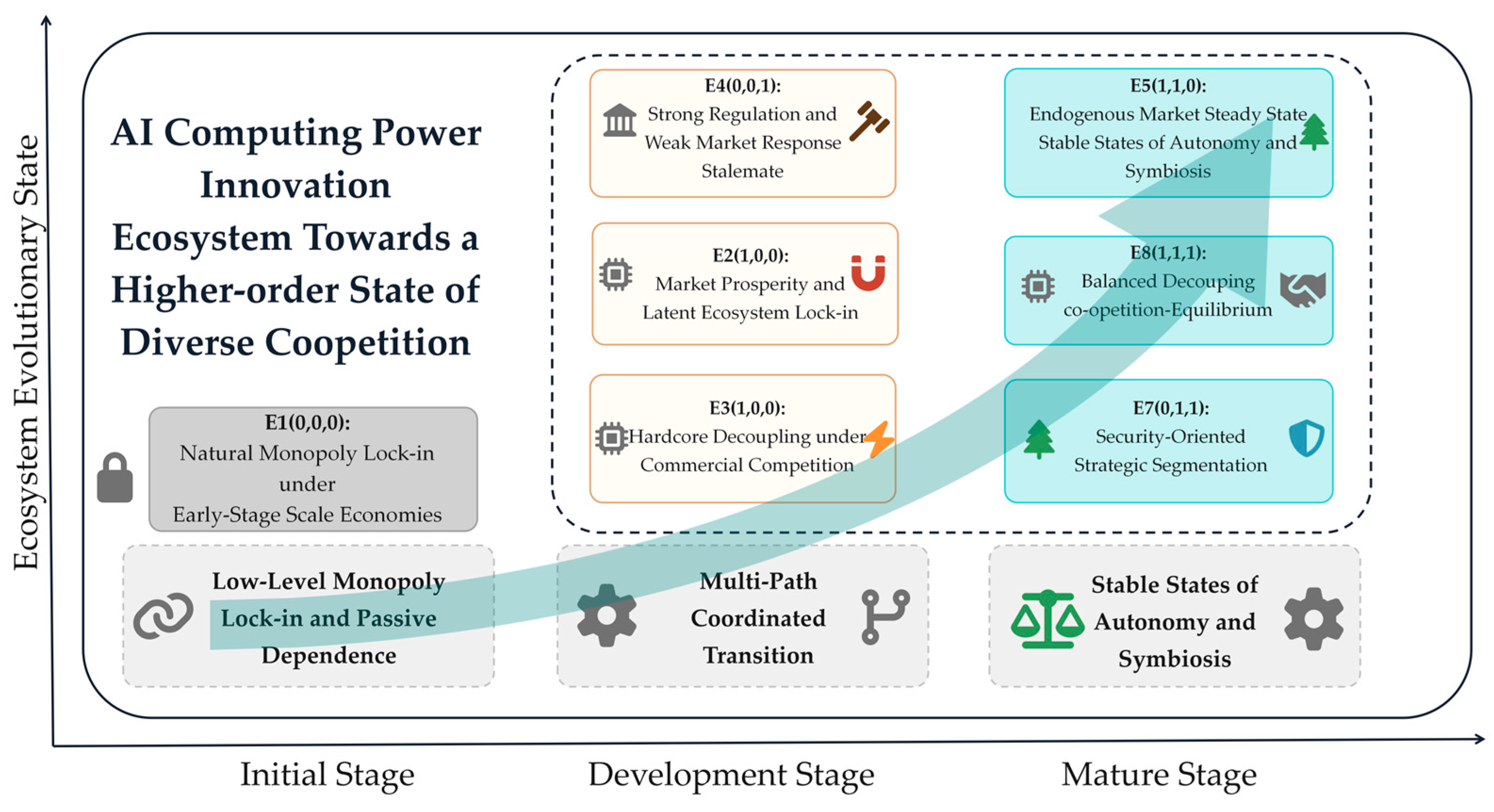
To synthesize the preceding analysis of tripartite strategic interactions, Table 4 and Figure 2 provides a concise mapping of the identified evolutionarily stable strategies to their corresponding phases in the AI computing power industry. Real-world analogies are only heuristic illustrations of the model mechanism.

6. Simulation Analysis

6.1. Baseline Parameter Calibration

To verify the validity of the theoretical derivations and dynamic mechanisms regarding the tripartite strategic evolution within the aforementioned AI computing power innovation ecosystem, and to further investigate the dynamic impacts of critical parameters on the system’s evolutionary stages and steady-state bifurcation trajectories, this study conducts a numerical simulation analysis using MATLAB2024a.
The construction and calibration of the baseline parameter values draw on three complementary sources of evidence: industry-based factual constraints, case-based comparative calibration, and literature-based theoretical benchmarking. First, at the industry-information level, the study systematically reviews publicly available disclosures from AI computing-related firms, with particular reference to the annual reports, capital expenditure disclosures, and business descriptions of representative firms such as NVIDIA, Alphabet, Meta, Cerebras Systems, and Groq. These materials are further combined with public information on the AI chip market structure and the general policy environment surrounding innovation support and market regulation, to calibrate the relative relationships and plausible ranges of the key parameters in the model.
Second, the study conducts a comparative analysis of representative cases, including the R&D subsidy incentives for downstream self-developed chips under the U.S. CHIPS and Science Act and antitrust scrutiny over NVIDIA’s dominant market position. Particular attention is paid to the interaction patterns among the focal actors, so as to ensure that the parameter settings capture the key mechanisms observed in real-world scenarios and remain aligned with the underlying logic of industrial evolution.
Finally, at the theoretical level, this study extensively draws on the parameter assignment logic and numerical simulation treatment adopted in high-quality evolutionary game studies [57,58], while conducting context-specific calibration and relational normalization in light of the present research setting. For parameters that are difficult to quantify directly and differ substantially in scale, the calibration focuses on preserving the relative strength, directional effects, and threshold ordering among key variables, thereby enhancing the theoretical consistency and comparability of the parameter system. On this basis, the baseline parameter set reported in Table 5 is used as the calibrated reference point for the subsequent simulation analysis, and the robustness of the main evolutionary tendencies is further examined through parameter variation under key scenarios. To clarify the scope of the simulation findings, the subsequent analysis explicitly distinguishes between robust and conditional results.

6.2. Analysis of the Evolutionary Path in the Initial Stage

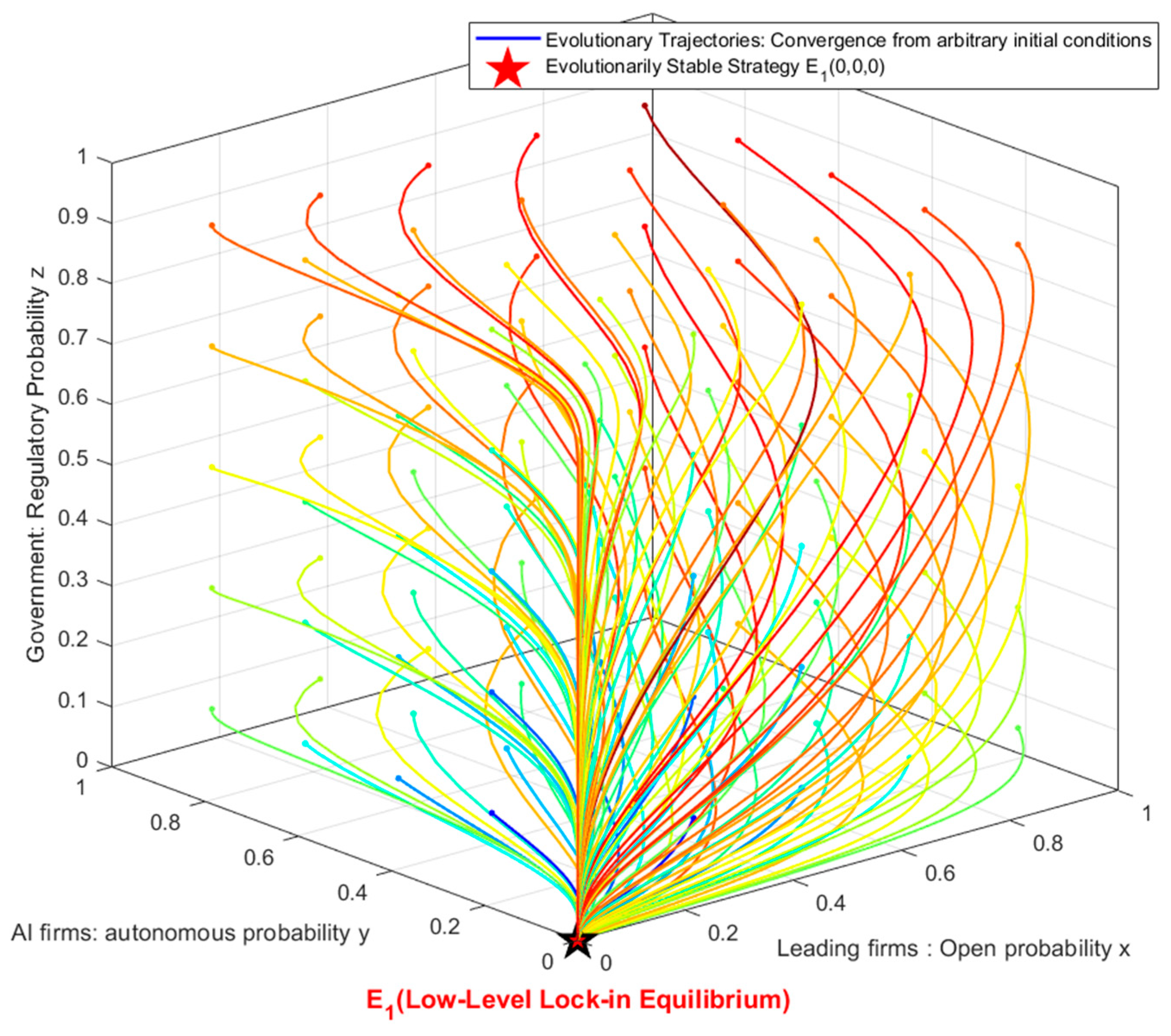
The simulation results reported in Figure 3 suggest that, under the specified parameter conditions, regardless of the players’ initial strategic intentions, the system ultimately converges to the equilibrium point E 1 ( 0 , 0 , 0 ) , thereby validating Proposition 1. This outcome suggests that, during the early stage of industry emergence, the leading computing power firm tends to adopt a closed strategy in order to maximize the returns from its technological moat. Downstream AI firms, driven by considerations of short-term commercial efficiency, rationally choose a deep dependence strategy, while the government adheres to a laissez-faire approach and refrains from regulatory intervention. Consequently, the three actors become locked into an efficiency-based natural monopoly equilibrium. Although downstream firms exhibit latent incentives to reduce total cost of ownership, such incentives are constrained by several structural factors. These include the absence of fully realized early-stage network effects V n e t , extremely high cross-architecture migration frictions θ , and prohibitive sunk costs associated with self-developed architectures C s e l f . Under these conditions, the payoff from maintaining a closed ecosystem significantly exceeds that from opening it for the leading firms, while the administrative cost of regulation C g o v exceeds the marginal social welfare gains obtainable at this stage. As a result, the system becomes locked into a single-supplier path dependence.
The steady state E 1 ( 0 , 0 , 0 ) suggests the structural lock-in characteristics of the computing power industry during its formative stage under a fully market-driven evolutionary game. Although diversified competition represents the long-term ideal, the combined constraints of short-term commercial rationality and high technological barriers prevent market forces alone from disrupting the stable configuration of leader dominance–downstream dependence. High switching costs impede spontaneous evolutionary transitions toward a multi-technology coexistence regime. Breaking this natural monopoly Nash equilibrium requires the introduction of strong exogenous variables—such as antitrust fines F or innovation subsidies S —to reshape the payoff structure and guide the system toward a more competitive evolutionary phase.

6.3. Development Stage Simulation Analysis

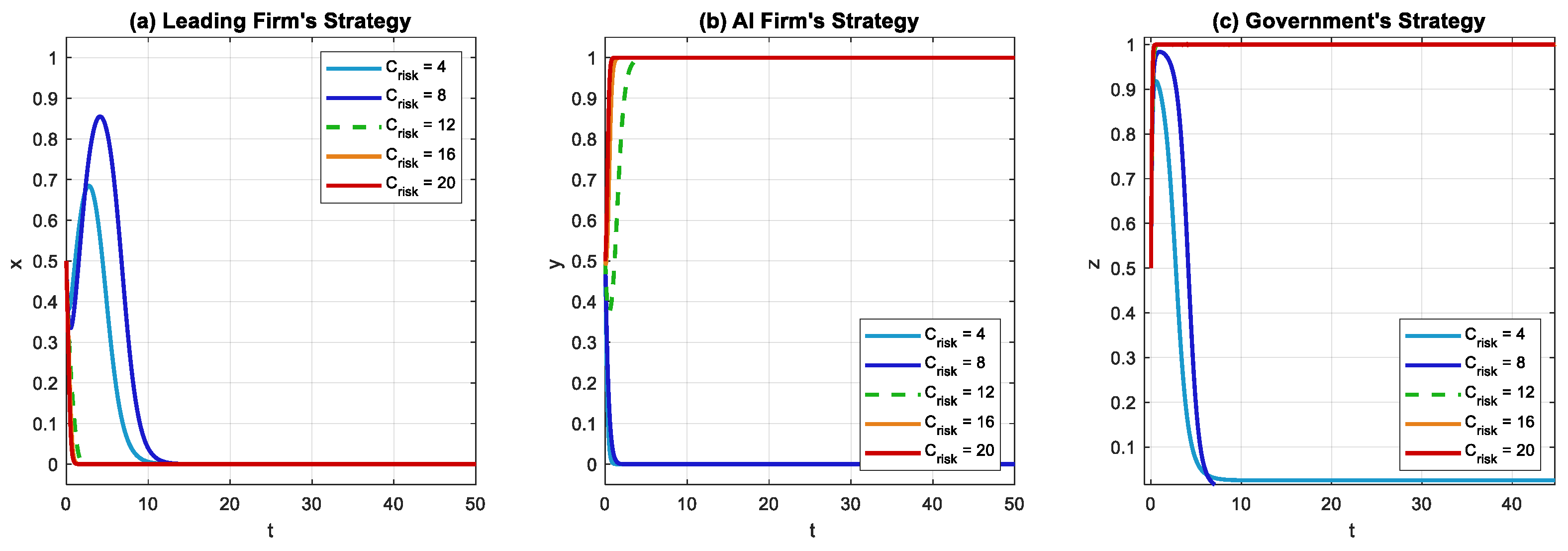
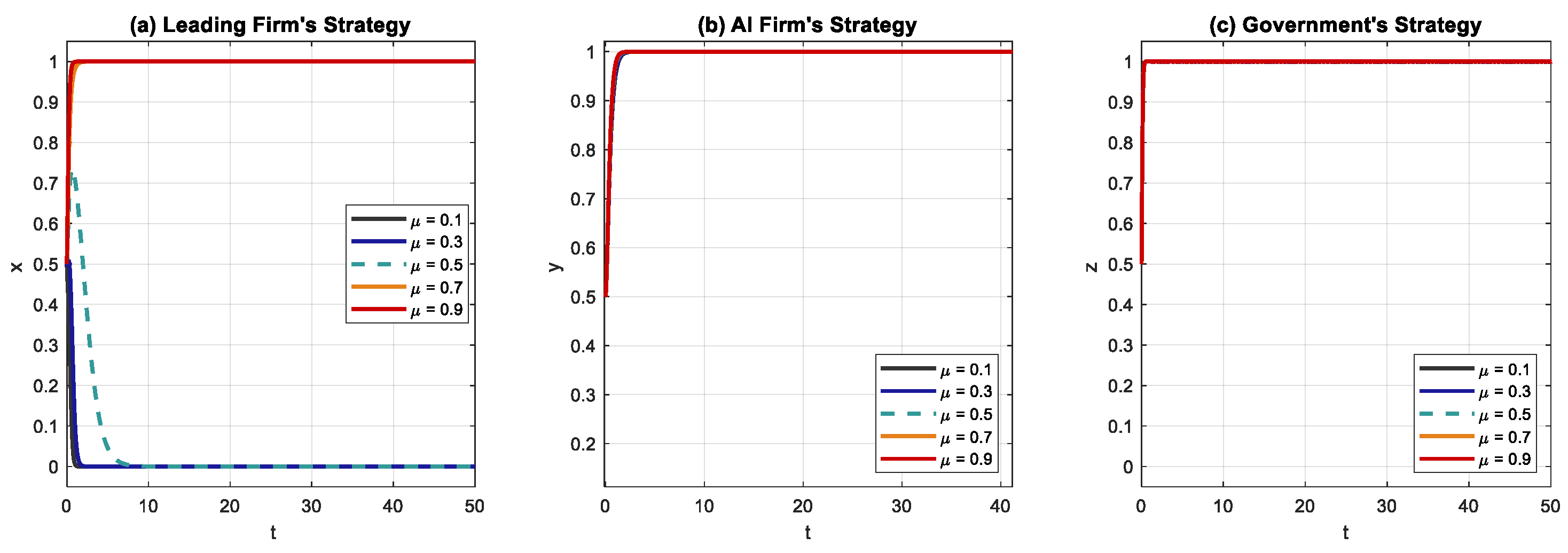
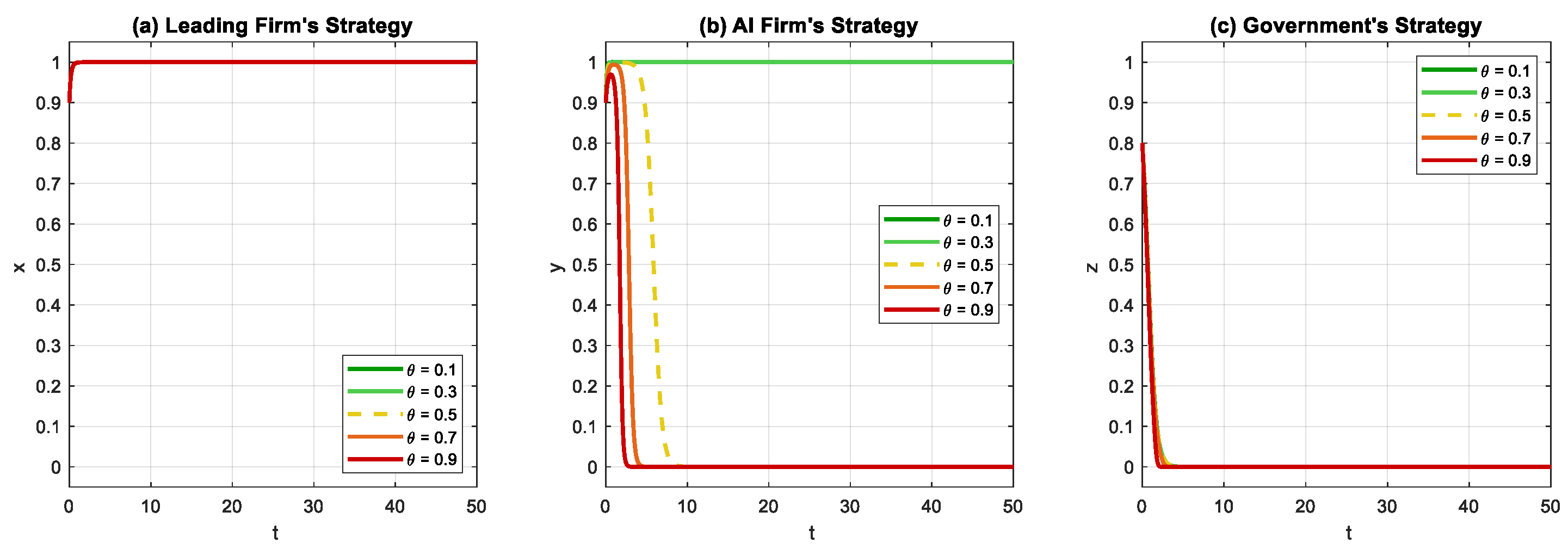
During the stage of coordinated innovation development, the system exhibits three possible cooperative mechanisms: E 2 ( 1 , 0 , 0 ) , E 3 ( 0 , 1 , 0 ) ,   a n d   E 4 ( 0 , 0 , 1 ) . Setting the initial strategy vector to ( x , y , z ) = ( 0.5 , 0.5 , 0.5 ) , we analyze how parameter variations influence the evolutionary trajectories of the system.

6.3.1. Analysis of the Inducing Mechanism of Market Network Effect

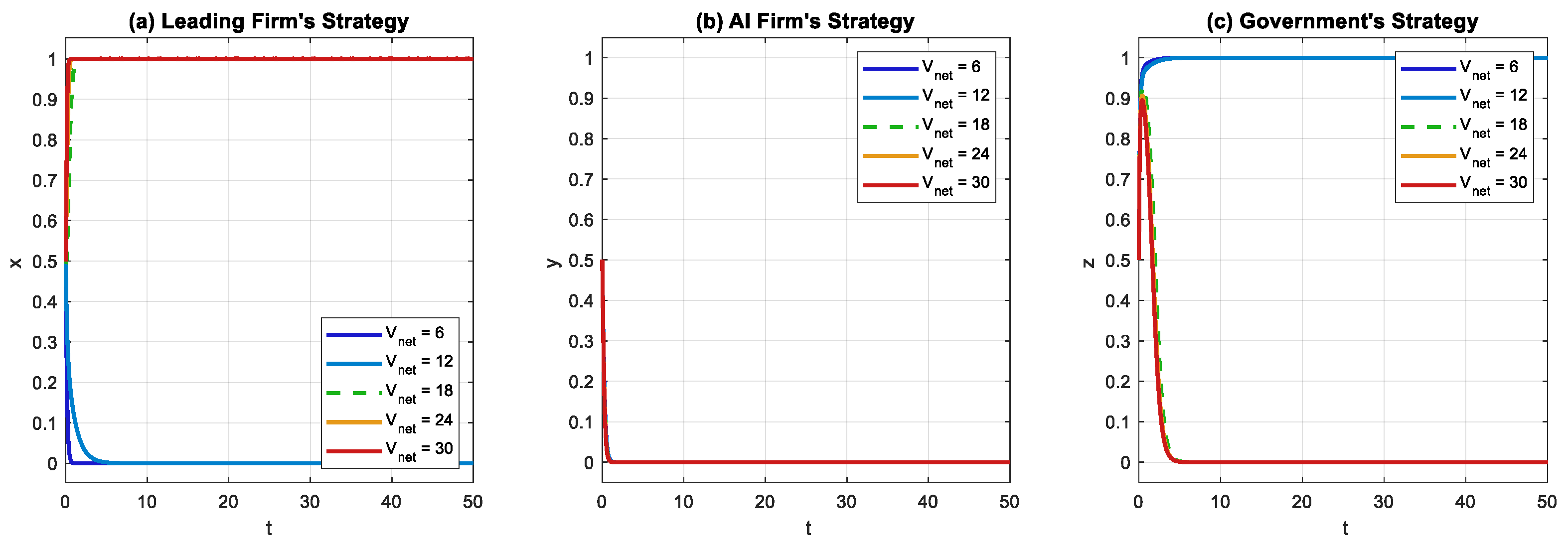
To isolate the independent impact of market expansion-induced network externalities, this section specifies a weak-regulation baseline by setting antitrust penalties at F = 3 and innovation incentives at S = 2 , while maintaining low supply chain disruption risk ( C r i s k = 5 ) to exclude short-term capacity shocks. Consistent with Metcalfe’s Law, the model simulates the exponential expansion associated with the generative AI surge. Network expansion returns V n e t are parameterized as five incremental levels { 6 , 12 , 18 , 24 , 30 } , capturing the transition from returns below monopoly rents to levels substantially exceeding them. The evolutionary trajectories of the tripartite strategies are then examined.
As shown in Figure 4, the system exhibits a threshold bifurcation under the specified parameter configuration. Once V n e t exceeds the critical value ( V n e t = 16 ) , the leading computing firm tends to shift from defensive closure to openness, suggesting that, within this parameter range, marginal network gains can outweigh monopoly protection incentives during expansion phases. However, downstream AI firms remain locked in an efficiency trap within the simulated parameter settings, regardless of ecosystem openness. Faced with substantial short-term rents and narrow commercialization windows, they prioritize rapid deployment over long-horizon vertical integration. The agility advantages of platform dependence consistently dominate the delayed returns of self-development, leading strategies to converge toward persistent reliance. Consequently, partial de-monopolization at the platform level coexists with reinforced structural dependence at the technological base. Regulatory responses display polarization. When scale effects induce voluntary openness, antitrust intervention recedes due to diminished enforcement necessity. In contrast, under low network returns and continued closure, downstream firms abandon self-development; yet routine low-level penalties still marginally exceed enforcement costs, sustaining regulatory engagement without structural transformation.
These results highlight the limits of endogenous market expansion under the simulated conditions. While scale effects can induce ecosystem openness, they do not eliminate downstream cost asymmetries and may even intensify platform dependence. Within the tested parameter space, where self-development costs substantially exceed platform adoption costs, market-driven growth alone is therefore insufficient to trigger vertical integration. The simulation results suggest that, within the modeled framework, structural decoupling within the computing innovation ecosystem would require either high-intensity exogenous shocks, such as severe supply chain disruptions, or coordinated policy interventions capable of fundamentally altering the tripartite payoff structure.

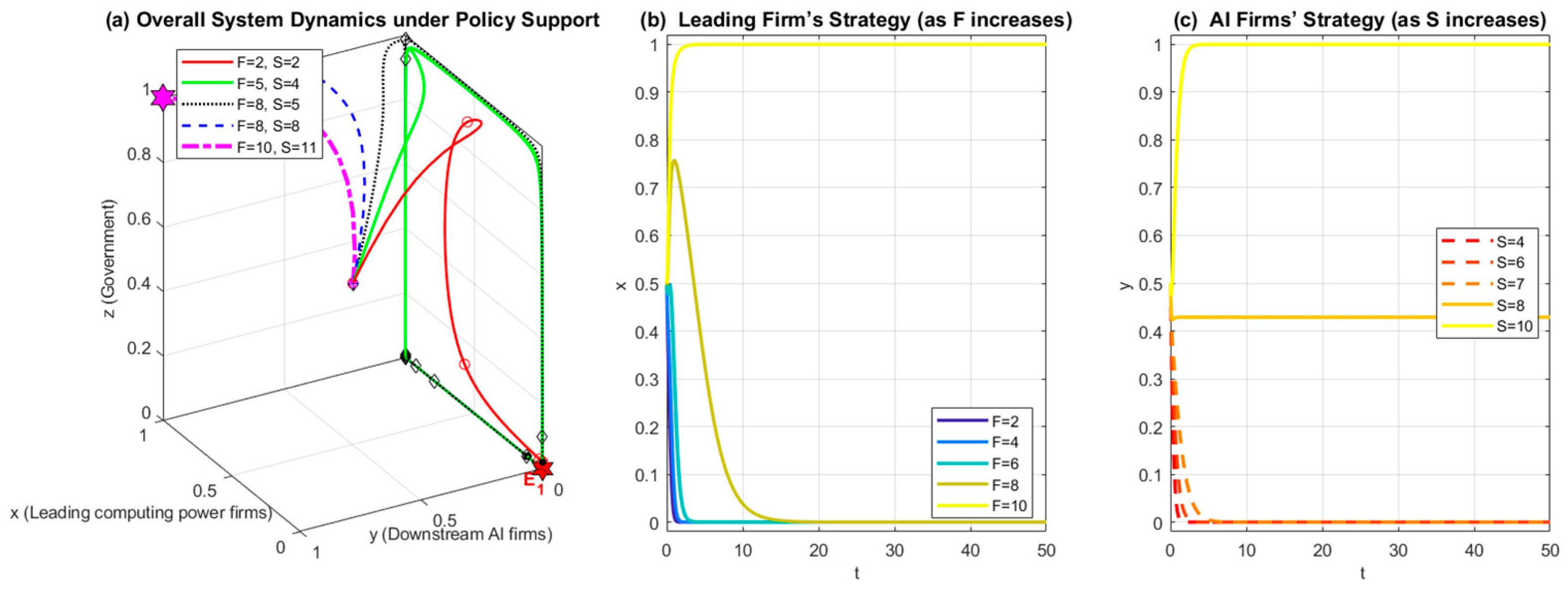
6.3.2. Simulation Result Analysis of Government Regulation and Subsidy Intensity

By varying the levels of antitrust penalties and innovation incentives, this study evaluates how the government’s “regulation–incentive” policy mix shapes the system’s evolutionary trajectory. As shown in Figure 5a, the synchronous intensification of F and S induces a transition from E1 to E8. This shift suggests that, under the simulated policy parameter combinations, sufficiently high external intervention can function as an important mechanism through which the system moves from an efficiency-dominated single-equilibrium regime to a pluralistic, competitive, and structurally mature configuration.
Figure 5b illustrates that increases in antitrust penalties drive the leading computing power firm from a closed monopolistic strategy toward ecological compatibility, progressively enhancing its openness orientation. Elevated compliance costs raise the opportunity cost of maintaining closure, thereby incentivizing interface openness. However, under moderate penalty intensity, openness follows an inverted trajectory—initially rising, subsequently declining, and ultimately converging toward zero. From a game-theoretic perspective, this nonlinear pattern reflects a violation of incentive compatibility constraints. Under moderate penalties, leading firms initially interpret regulatory signals as credible threats and respond with exploratory openness to reduce compliance exposure. Yet as downstream AI firms progressively strengthen their vertical integration capabilities, the leading firms’ ability to internalize network externality rents through ecosystem expansion diminishes accordingly. At this juncture, the moderate penalty level no longer compensates for the accelerating erosion of the technological moat, causing the incentive compatibility condition for sustained openness to collapse. The firm consequently reverts to defensive closure as its dominant strategy, because the expected payoff from absorbing routine fines while preserving residual monopoly rents exceeds that from maintaining an open ecosystem with shrinking value retention. This dynamic suggests a conditional regulatory threshold effect: under the assumed payoff structure, as downstream technological capacity expands, deterrence intensity must be correspondingly strengthened to sustain an open-system equilibrium. The qualitative direction of this effect is robust, but the rate at which deterrence must escalate depends on the assumed relationship between downstream capability growth and leading firms’ openness returns.
Figure 5c shows that downstream firms’ vertical integration strategies exhibit a pronounced threshold bifurcation rather than a gradual linear response to innovation incentives S. When S remains below the critical threshold, initial policy signals generate transient exploratory surges in the early evolutionary phase, yet the subsidies are insufficient to offset the aggregate migration costs encompassing chip tape-out, software stack reconstruction, and architecture rebuilding. As a result, the expected net returns from self-development remain negative, and downstream firms rationally abandon exploratory commitments, with y converging toward zero and the system stabilizing in a platform dependence equilibrium. When S approaches the critical value, the system enters a transitional zone where subsidies partially offset migration costs, producing a mixed-strategy steady state at an intermediate level. Only when S decisively exceeds the threshold do innovation incentives fully reverse the payoff ordering between vertical integration and continued dependence, driving y to converge toward unity and enabling downstream firms to complete a strategic transition from technology followers to ecosystem definers. This bifurcation pattern reveals that innovation subsidies operate as a discrete regime-switching mechanism within the modeled payoff structure: marginal increases in S below the critical threshold produce negligible effects on terminal equilibrium outcomes, whereas crossing the threshold triggers a qualitative shift in the system’s evolutionary trajectory. The policy implication is that fragmented or incremental subsidy provision risks generating only transient behavioral responses without altering structural outcomes, and that effective intervention must be calibrated to credibly surpass the full ecosystem migration cost in order to induce irreversible strategic commitment by downstream firms.
The regulation–incentive policy mix represents a pivotal institutional lever for overcoming natural monopoly lock-in in the computing power industry. Government instruments significantly shape both the openness decisions of leading firms and the vertical integration strategies of downstream actors, yet nonlinear coupling effects among policy tools warrant careful calibration. Moderate policy interventions that fail to cross the incentive compatibility threshold generate only transient behavioral responses, as rational actors exploit policy signals for low-cost exploration while retaining the option to revert once the insufficiency of support becomes apparent. First, fragmented or low-intensity incentives should be avoided. Targeted industrial mechanisms—such as tax credits or strategic public procurement—must be calibrated to exceed firms’ ecosystem migration thresholds, ensuring that downstream firms’ expected payoff from irreversible vertical integration dominates that from continued platform dependence. Second, antitrust enforcement should be dynamically adjusted. As downstream firms’ technological bargaining power strengthens, deterrence intensity must increase proportionally to counteract dominant firms’ defensive closure tendencies, so that the incentive compatibility condition for sustained openness is maintained throughout the co-evolutionary process rather than only at the initial regulatory intervention stage. Such adaptive governance is essential to sustaining ecosystem openness and long-run competitive vitality.

6.3.3. The Forcing Mechanism of Supply Chain Risk

To assess the coercive effect of supply-side uncertainty on firms’ technological trajectories, this section simulates the impact of supply chain volatility on vertical integration decisions under conditions of capacity bottlenecks and vendor lock-in. To isolate the risk mechanism, a weak-regulation baseline is imposed: the government provides no incentive sufficient to offset in-house R&D costs, and ecosystem openness yields remain low, reflecting a benchmark scenario in which the leading firms sustain exclusionary barriers. Within this setting, supply chain lock-in risk C r i s k —including bargaining power erosion and discriminatory capacity allocation—is specified as the key variable. According to the payoff structure, downstream firms adopt independent R&D when the net payoff of self-development exceeds that of continued dependence. Analytical derivation yields a transition threshold of C r i s k > 12 under the baseline payoff specification. This threshold value is model-specific; the robust finding is the existence of a critical risk level above which business continuity concerns dominate cost efficiency considerations, inducing a strategic shift toward vertical integration. The simulation therefore examines whether, once this threshold is exceeded, the system can shift from deep dependence to vertical integration solely under business continuity pressure, even absent substantial policy incentives.
Figure 6 reveals a pronounced bifurcation dynamic. Downstream AI firms exhibit strong risk sensitivity: under low-risk conditions, the comparative advantage of general-purpose computing sustains a stable purchase equilibrium; once risk surpasses the critical threshold, business security considerations dominate cost efficiency, and strategies rapidly converge toward full in-house development. At the system level, a stress-acceleration effect emerges. Under high-risk exposure, the leading computing firm maintains defensive closure, while the government—anticipating welfare losses from structural imbalance—shifts toward active regulation. The system thus bypasses intermediate states and locks into an adversarial equilibrium characterized by incumbent closure, downstream vertical integration, and regulatory intervention.
This analysis complements Section 6.3.1 by clarifying the dual role of risk internalization in industrial evolution. First, supply chain uncertainty functions as a mechanism for breaking path dependence under high-risk parameter scenarios. When market incentives are insufficient, the shadow cost of capacity insecurity exerts stronger strategic pressure than moderate subsidies, compelling firms to internalize lock-in risk in their decision calculus. Second, risk-induced vertical integration entails allocative efficiency losses and therefore represents a second-best equilibrium. While it enhances firm-level technological autonomy, it does so at the cost of weakened specialization and increased duplication of investment. Third, industrial policy should adjust accordingly. As downstream self-development capabilities mature, regulatory emphasis should shift from static antitrust defense toward interoperability-oriented ecosystem reconstruction. Promoting open standards and compatibility frameworks can steer the system from fragmented vertical silos toward an open, competitive–cooperative equilibrium that balances autonomy with systemic efficiency.

6.4. Mature-Stage Simulation Analysis

6.4.1. The Bifurcation Effect of Ecosystem Compatibility: Coopetition (E8) Versus Confrontation (E7)

This section simulates the strategic configuration of the system in the mature stage of industrial evolution. At this stage, the expansion benefits of network externalities exceed the erosion of technological moat advantages ( V n e t > C l o s s ), indicating that market scale is sufficient to sustain the economic viability of an open ecosystem. The key parameter adjustment reflects the transcendence of endogenous technological dividends: given downstream AI firms’ deep specialization in domain-specific architectures, the returns to vertical integration through in-house R&D are set marginally higher than those from purchasing general-purpose chips ( Δ R 2 b > Δ R 2 a ) , capturing the substitution effect of accumulated technological capabilities over follower strategies. Under this baseline, the ecosystem value retention coefficient μ is introduced as the critical order parameter. A gradient range of μ is specified to simulate the transition from a fragmented technology stack to a highly interoperable ecosystem environment. Initial strategic inclinations of all actors are set to neutral in order to test the robustness of evolutionary outcomes.
As shown in Figure 7, the simulation exhibits multiple coexisting steady states. When μ falls below a critical threshold, ecosystem fragmentation prevents the leading computing firm from offsetting barrier losses through openness gains; the firm’s strategy converges toward closure, and the system stabilizes in a confrontational equilibrium ( E 7 ). By contrast, high compatibility enhances the firm’s capacity to appropriate retained network value, inducing a shift toward openness and steering the system toward a co-opetition equilibrium ( E 8 ). Under the assumed conditions where Δ R 2 b > Δ R 2 a , downstream AI firms display what appears to be an irreversible ratchet effect. Regardless of fluctuations in μ, once endogenous vertical integration returns surpass the substitution threshold of general-purpose alternatives—such as the technological replacement of GPUs by Google’s TPU—in-house R&D remains the dominant strategy. The system thereby exits platform-dependent prosperity and enters a structurally autonomous phase. Government regulation exhibits pronounced policy stickiness. As diversified competition continuously generates antitrust dividends, positive externalities reinforce sustained regulatory engagement. In the absence of new cost constraints, endogenous withdrawal incentives remain weak—a mechanism further examined in Section 6.4.2.
This analysis elucidates the dialectical relationship between vertical integration and ecosystem compatibility. First, technological internalization possesses economic irreversibility. Once downstream firms surpass the break-even point of independent R&D, their autonomy becomes structurally insulated from fluctuations in the leading firms’ strategy. Accordingly, policy intervention should prioritize accelerating this payoff reversal threshold. Second, interoperability standards define the industry’s terminal configuration. Given the consolidation of vertical integration, the system’s trajectory—whether toward inefficient fragmentation or efficient coopetition—depends entirely on the compatibility parameter μ . Policy emphasis should therefore shift from singular innovation incentives toward standard governance. By promoting open-framework interoperability and interface standardization, regulators can enhance ecosystem compatibility, induce leading firms to abandon exclusionary barriers, and maximize the retention of global ecosystem value while preserving a diversified competitive foundation.

6.4.2. Technological Endogenization and the Policy Exit Mechanism (E5)

This section examines the boundary conditions and evolutionary dynamics of public policy withdrawal in the mature stage of industry development. The system is initialized in a high-level competitive state [ 0.9 , 0.9 , 0.8 ] , simulating a scenario in which the government attempts deregulation during a period of industrial prosperity. To formalize the economic constraint underpinning policy exit, government administrative costs are set at C g o v = 10 and innovation subsidies at S = 12 , such that aggregate regulatory expenditures exceed marginal social welfare gains. This specification generates an endogenous withdrawal incentive within the evolutionary framework. To evaluate the robustness of firms’ vertical integration capacity, the return to in-house R&D is set at Δ R 2 b = 15 , marginally exceeding the payoff from reliance on general-purpose technology Δ R 2 a = 12 . The ecosystem migration cost coefficient θ —capturing software stack adaptation complexity—is treated as the central control variable. A gradient range of θ is simulated to observe system trajectories following the withdrawal of external policy support.
As shown in Figure 8, the simulation results suggest that, under the specified parameter conditions, as regulatory intensity rapidly converges toward zero due to diminishing marginal utility, downstream AI firms’ strategic evolution becomes highly sensitive to θ . When firms possess strong software–hardware co-design capabilities (low θ ), the excess vertical returns derived from domain-specific architectures remain sufficient to cover R&D experimentation costs even in the absence of subsidies. Positive profit margins are sustained, self-development stabilizes at a high-level equilibrium, and the system transitions toward a market-based Pareto-optimal steady state under government exit. Conversely, for firms facing substantial ecosystem migration barriers (high θ ), the removal of policy support exposes the full R&D cost structure, erodes total cost of ownership advantages, and induces strategic retreat toward platform dependence. In the absence of endogenous profitability, premature deregulation generates systemic path reversal.
This analysis suggests that, under the specified parameter conditions endogenous profitability parity constitutes a critical condition for full policy withdrawal. Exit timing should not be determined solely by industry scale or temporal milestones, but rather anchored in firms’ ecosystem migration efficiency and comparative vertical returns. Only when in-house architectures generate durable advantages over general-purpose alternatives can firms withstand market-driven adjustment. Given the tension between fiscal constraints and supply chain fragility, a gradual sunsetting mechanism is recommended. Direct factor-based subsidies should be progressively reoriented toward indirect instruments such as standard governance and interoperability facilitation. Such a calibrated transition alleviates fiscal pressure while providing firms with a sufficient adjustment window to consolidate software stack capabilities and optimize cost structures, thereby mitigating the risk of abrupt policy discontinuity and evolutionary reversal.

7. Conclusions and Implications

This study employs a tripartite evolutionary game framework to examine the co-evolutionary dynamics of stakeholder strategies within the AI computing innovation ecosystem under the dual forces of antitrust regulation and vertical integration. The theoretical findings reveal pronounced path dependence and nonlinear sensitivity in the strategic choices of the three principal actors within the modeled framework. Their decisions respond asymmetrically to variations in total cost of ownership, ecosystem migration costs, and regulatory deterrence intensity. The interaction between these endogenous strategic adjustments and the external regulatory environment constitutes the core evolutionary mechanism of the AI computing ecosystem, enabling its transition from an efficiency-based natural monopoly characterized by unilateral dependence toward a pluralistic competitive configuration marked by ecological co-prosperity. In mature market conditions, where antitrust enforcement and innovation incentives gradually recede, the dominance of endogenous technological dividends—specifically the returns to vertical integration—combined with enhanced ecosystem compatibility, facilitates convergence toward a Pareto-optimal equilibrium in terms of aggregate social welfare.
These findings offer several practical implications for strategic decision-making.
First, for government regulators, the model suggests that an incentive-compatible, threshold-crossing regulatory design may be beneficial. Policy design could consider enabling a calibrated transition from intensive intervention toward standard-based governance. The analysis implies that, in the early stage of industrial development, a coordinated use of subsidies and penalties must reach sufficient intensity to overcome ecosystem migration cost barriers and induce irreversible strategic commitment from downstream firms, rather than merely signaling regulatory intent. At maturity, however, identifying an appropriate exit strategy becomes critical once firms possess sustainable endogenous profitability. Regulatory emphasis should shift from direct fiscal intervention toward the promotion of interoperability standards, thereby preventing ecosystem re-closure while minimizing administrative costs and preserving allocative efficiency. It should be noted that the optimal policy configuration is likely to vary across national contexts. In economies with established hyperscalers possessing strong vertical integration capabilities, the policy priority may shift earlier toward standard governance and regulatory exit, as endogenous market forces can sustain diversified competition. In contrast, latecomer economies or regions facing technological access constraints may need to maintain higher-intensity subsidies and strategic procurement for a longer period to nurture domestic architectural capabilities before a market-driven equilibrium becomes feasible.
Second, the model identifies a specific payoff inflection for leading computing firms: when retained ecosystem network value combined with avoided compliance costs exceeds the loss from technological moat erosion, openness becomes the payoff-dominant strategy. Under simultaneous regulatory pressure and rising customer self-development capabilities, adherence to a closed ecosystem risks not only accumulating compliance penalties but also the permanent loss of customers who have crossed the vertical integration payoff reversal threshold. A defensive strategic transformation—entailing calibrated openness of foundational interfaces and software stacks—allows the firm to transition from extracting excess monopoly rents to capturing network-based ecosystem value retention. Critically, the firm’s investment in ecosystem compatibility directly governs whether this transition leads to a co-opetition equilibrium or degenerates into confrontational fragmentation, thereby preserving its structural centrality within the industry architecture.
Third, for downstream AI firms, proactive vertical integration constitutes a critical pathway toward cost optimization and supply chain autonomy. The model suggests that exclusive reliance on external procurement exposes firms to a comfort-zone trap in which surface-level prosperity conceals deepening structural dependence. The binding constraint on successful transition is not chip design expenditure per se, but rather the reduction in cross-architecture migration friction through sustained investment in software stack adaptation, compiler toolchain portability, and operator library reconstruction. Firms may need to reduce cross-architecture migration frictions and leverage domain-specific architectures to achieve software–hardware co-optimization. Continuous engagement with policy developments and deep participation in open-source communities such as PyTorch further support the transition from dependent positioning to technological leadership.

8. Theoretical Contributions and Limitations

This study makes three theoretical contributions. First, it extends the application of evolutionary game theory from conventional supply-chain or platform governance settings to an innovation ecosystem context in which strategic interaction is shaped not only by prices, costs, and regulation, but also by ecosystem architecture, interface openness, compatibility, and value co-creation. In doing so, the study reconceptualizes the strategic behavior of the three actors as ecosystem governance choices rather than isolated transactional decisions. Second, the integration of innovation ecosystem theory changes the interpretation of the model’s core variables and equilibrium outcomes. Specifically, variables such as network expansion value, migration friction, and ecosystem value retention coefficient are not merely technical or economic parameters; they capture ecosystem-specific mechanisms related to complementarities, switching barriers, standard control, and appropriability. Correspondingly, the resulting ESS configurations should be understood not simply as stable strategic combinations, but as distinct evolutionary states of the ecosystem, such as lock-in, regulatory stalemate, fragmented decoupling, and mature co-opetition. Third, the study contributes a context-specific explanation for the combination of innovation ecosystem theory and evolutionary game theory. AI computing power competition is fundamentally characterized by deep software–hardware interdependence, strong platform externalities, high migration costs, and continuous co-evolution between firms’ technological strategies and public regulation. Under such conditions, neither static industrial organization logic nor conventional game-theoretic analysis alone is sufficient to explain how the industry evolves from dependence on a dominant platform toward diversified and partially endogenous technological autonomy. By integrating the two perspectives, this study offers a more structurally grounded explanation of how ecosystem governance, vertical integration, and regulation jointly shape long-run industrial evolution.
Several limitations warrant consideration. First, parameter calibration in the simulation is based on publicly available financial reports of listed firms, industry analyses. Although these sources provide plausible approximations, future research should incorporate granular firm-level operational data or longitudinal panel datasets to conduct more rigorous empirical validation of the model’s quantitative implications. Second, for analytical tractability, the model abstracts the AI computing power ecosystem into three representative actors and stylized binary strategy sets. This necessarily omits important within-group heterogeneity, particularly among downstream AI firms with different scales, technical capabilities, cloud dependence structures, and strategic autonomy, as well as potential tensions within government across competition, industrial, and security objectives. While such simplifications are appropriate for isolating the dominant strategic mechanisms of ecosystem evolution, future research could extend the present framework by introducing heterogeneous firm types, multi-level state actors, or stage-specific policy functions. Third, the generalizability of the findings is context-bound. The analytical setting reflects the institutional and industrial characteristics of the United States, including the presence of powerful downstream hyperscalers within a mature market economy. Accordingly, the conclusions should be interpreted within the institutional conditions of the digital economy and may not directly extend to latecomer economies or regions subject to technological sanctions. While our tripartite evolutionary game focuses on micro-level policy mechanisms within domestic ecosystems, the spatiotemporal evolution of global innovation and trade networks also presents a critical macro-environmental constraint for computing power ecosystems [59,60]. Therefore, future research may examine AI computing ecosystems under geopolitical constraints, explore catch-up strategies among late-stage stakeholders, and conduct cross-regional comparative analyses to evaluate the structural divergences between the model and alternative developmental trajectories.

Author Contributions

Conceptualization, Z.L. and Q.W.; methodology, Z.L.; software, Z.L.; validation, S.H. and T.L.; formal analysis, Z.L.; investigation, S.H.; resources, Q.W.; data curation, Z.L.; writing—original draft preparation, Z.L.; writing—review and editing, Z.L.; visualization, S.H.; supervision, Q.W. All authors have read and agreed to the published version of the manuscript.

Funding

This study was funded by the National Social Science Foundation of China, grant number 23AGL001.

Institutional Review Board Statement

Not applicable.

Informed Consent Statement

Not applicable.

Data Availability Statement

The data used to support the findings of this study are available from the corresponding author upon request.

Acknowledgments

The authors have reviewed and edited the output and take full responsibility for the content of this publication.

Conflicts of Interest

The funders had no role in the design of the study; in the collection, analyses, or interpretation of data; in the writing of the manuscript; or in the decision to publish the results.

References

  1. Cao, Y.; Chen, Y.; Fan, X.; Fu, H.; Xu, B. Advanced design for high-performance and AI chips. Nano-Micro Lett. 2026, 18, 13. [Google Scholar] [CrossRef]
  2. Duan, S.; Wang, D.; Ren, J.; Lyu, F.; Zhang, Y.; Wu, H.; Shen, X. Distributed Artificial Intelligence Empowered by End-Edge-Cloud Computing: A Survey. IEEE Commun. Surv. Tutor. 2023, 25, 591–624. [Google Scholar] [CrossRef]
  3. Adner, R. Ecosystem as structure: An actionable construct for strategy. J. Manag. 2017, 43, 39–58. [Google Scholar] [CrossRef]
  4. Yao, J.; Zhang, S.; Yao, Y.; Wang, F.; Ma, J.; Zhang, J.; Chu, Y.; Ji, L.; Jia, K.; Shen, T.; et al. Edge-Cloud Polarization and Collaboration: A Comprehensive Survey for AI. IEEE Trans. Knowl. Data Eng. 2023, 35, 6866–6886. [Google Scholar] [CrossRef]
  5. Rosa, L.; Foschini, L.; Corradi, A. Empowering Cloud Computing With Network Acceleration: A Survey. IEEE Commun. Surv. Tutor. 2024, 26, 2729–2768. [Google Scholar] [CrossRef]
  6. Jia, Z.; Xue, J.; Shi, L.; Li, J.; He, M. Efficient Resource Allocation in Computing Power Networks Considering Similar Task Merging: A Lyapunov Optimization-Based DRL Approach. IEEE Internet Things J. 2025, 12, 23118–23138. [Google Scholar] [CrossRef]
  7. Campagna, J.M.; Bhada, S.V. Strategic Adoption of Digital Innovations Leading to Digital Transformation: A Literature Review and Discussion. Systems 2024, 12, 118. [Google Scholar] [CrossRef]
  8. Floerecke, S.; Lehner, F.; Schweikl, S. Cloud computing ecosystem model: Evaluation and role clusters. Electron. Mark. 2021, 31, 923–943. [Google Scholar] [CrossRef]
  9. Jyoti, C.; Efpraxia, Z. Understanding and exploring the value co-creation of cloud computing innovation using resource based value theory: An interpretive case study. J. Bus. Res. 2023, 164, 113970. [Google Scholar] [CrossRef]
  10. Opara-Martins, J.; Sahandi, R.; Tian, F. Critical Analysis of Vendor Lock-in and Its Impact on Cloud Computing Migration: A Business Perspective. J. Cloud Comput. Adv. Syst. Appl. 2016, 5, 4. [Google Scholar] [CrossRef]
  11. Shirvani, M.H.; Rahmani, A.M.; Sahafi, A. An Iterative Mathematical Decision Model for Cloud Migration: A Cost and Security Risk Approach. Softw. Pract. Exp. 2017, 48, 449–485. [Google Scholar] [CrossRef]
  12. Hoozemans, J.; Peltenburg, J.; Nonnemacher, F.; Hadnagy, A.; Al-Ars, Z.; Hofstee, H.P. Fpga acceleration for big data analytics: Challenges and opportunities. IEEE Circuits Syst. Mag. 2021, 21, 30–47. [Google Scholar] [CrossRef]
  13. Granstrand, O.; Holgersson, M. Innovation ecosystems: A conceptual review and a new definition. Technovation 2020, 90, 102098. [Google Scholar] [CrossRef]
  14. Secundo, G.; Spilotro, C.; Gast, J.; Corvello, V. The transformative power of artificial intelligence within innovation ecosystems: A review and a conceptual framework. Rev. Manag. Sci. 2025, 19, 2697–2728. [Google Scholar] [CrossRef]
  15. Jacobides, M.G.; Cennamo, C.; Gawer, A. Towards a theory of ecosystems. Strateg. Manag. J. 2018, 39, 2255–2276. [Google Scholar] [CrossRef]
  16. Smith, J.M.; Price, G.R. The Logic of Animal Conflict. Nature 1973, 246, 15–18. [Google Scholar] [CrossRef]
  17. Granstrand, O. A cooperative game theory systems approach to the value analysis of (innovation) ecosystems. Technovation 2024, 130, 102926. [Google Scholar] [CrossRef]
  18. Zhang, R.-J.; Tai, H.-W.; Cao, Z.-X.; Cheng, K.-T.; Wei, C.-C. Innovation ecosystem based on low-carbon technology: Value co-creation mechanism and differential game analysis. Technol. Forecast. Soc. Change 2025, 210, 123852. [Google Scholar] [CrossRef]
  19. Nogueira, P.; Pereira, L.; Simões, A.; Dias, A.; Lopes da Costa, R. Vertical Integration Dynamics to Innovate in Technology Business. Informatics 2023, 10, 25. [Google Scholar] [CrossRef]
  20. Hennessy, J.L.; Patterson, D.A. A new golden age for computer architecture. Commun. ACM 2019, 62, 48–60. [Google Scholar] [CrossRef]
  21. Norrie, T.; Patil, N.; Yoon, D.H.; Kurian, G.; Li, S.; Laudon, J.; Young, C.; Jouppi, N.; Patterson, D. The design process for Google’s training chips: TPUv2 and TPUv3. IEEE Micro 2021, 41, 56–63. [Google Scholar] [CrossRef]
  22. Leiserson, C.E.; Thompson, N.C.; Emer, J.S.; Kuszmaul, B.C.; Lampson, B.W.; Sanchez, D.; Schardl, T.B. There’s plenty of room at the Top: What will drive computer performance after Moore’s law? Science 2020, 368, eaam9744. [Google Scholar] [CrossRef]
  23. Jacobides, M.G.; Brusoni, S.; Candelon, F. The evolutionary dynamics of the artificial intelligence ecosystem. Strategy Sci. 2021, 6, 412–435. [Google Scholar] [CrossRef]
  24. Luitse, D. Platform power in AI: The evolution of cloud infrastructures in the political economy of artificial intelligence. Internet Policy Rev. 2024, 13, 1–44. [Google Scholar] [CrossRef]
  25. Ahmed, N.; Wahed, M.; Thompson, N.C. The growing influence of industry in AI research. Science 2023, 379, 884–886. [Google Scholar] [CrossRef]
  26. Ulnicane, I.; Knight, W.; Leach, T.; Stahl, B.C.; Wanjiku, W.-G. Framing governance for a contested emerging technology: Insights from AI policy. Policy Soc. 2021, 40, 158–177. [Google Scholar] [CrossRef]
  27. Taeihagh, A. Governance of artificial intelligence. Policy Soc. 2021, 40, 137–157. [Google Scholar] [CrossRef]
  28. Lu, Y.; Zhou, Y. A review on the economics of artificial intelligence. J. Econ. Surv. 2021, 35, 1045–1072. [Google Scholar] [CrossRef]
  29. Tan, L.; Lai, X.; Zhao, Y.; Zhong, Y. Artificial Intelligence and the Emergence of New Quality Productive Forces: A Machine Learning Perspective. Mathematics 2026, 14, 135. [Google Scholar] [CrossRef]
  30. Chen, M.; Tang, X.; Liu, H.; Gu, J. The impact of supply chain concentration on integration and business performance. Int. J. Prod. Econ. 2023, 257, 108781. [Google Scholar] [CrossRef]
  31. Li, P.; Tan, D.; Wang, G.; Wei, H.; Wu, J. Retailer’s vertical integration strategies under different business modes. Eur. J. Oper. Res. 2021, 294, 965–975. [Google Scholar] [CrossRef]
  32. Cenamor, J. Complementor competitive advantage: A framework for strategic decisions. J. Bus. Res. 2021, 122, 335–343. [Google Scholar] [CrossRef]
  33. Chen, L.; Yi, J.; Li, S.; Tong, T.W. Platform Governance Design in Platform Ecosystems: Implications for Complementors’ Multihoming Decision. J. Manag. 2022, 48, 630–656. [Google Scholar] [CrossRef]
  34. Heimburg, V.; Schreieck, M.; Wiesche, M. Complementor value co-creation in generative AI platform ecosystems. J. Manag. Inf. Syst. 2025, 42, 491–528. [Google Scholar] [CrossRef]
  35. Engert, M.; Evers, J.; Hein, A.; Krcmar, H. Sustaining complementor engagement in digital platform ecosystems: Antecedents, behaviours and engagement trajectories. Inf. Syst. J. 2023, 33, 1151–1185. [Google Scholar] [CrossRef]
  36. Saadatmand, F.; Lindgren, R.; Schultze, U. Configurations of platform organizations: Implications for complementor engagement. Res. Policy 2019, 48, 103770. [Google Scholar] [CrossRef]
  37. Khan, H.N.; Hounshell, D.A.; Fuchs, E.R.H. Science and research policy at the end of Moore’s law. Nat. Electron. 2018, 1, 14–21. [Google Scholar] [CrossRef]
  38. Ryan-Charleton, T.; Galavan, R.J. Multimarket contact between partners and strategic alliance survival. Strateg. Manag. J. 2024, 45, 1988–2017. [Google Scholar] [CrossRef]
  39. Moore, J.F. Predators and prey: A new ecology of competition. Harv. Bus. Rev. 1993, 71, 75–86. [Google Scholar] [PubMed]
  40. Adner, R. Match your innovation strategy to your innovation ecosystem. Harv. Bus. Rev. 2006, 84, 98. [Google Scholar]
  41. Arenal, A.; Armuña, C.; Feijoo, C.; Ramos, S.; Xu, Z.; Moreno, A. Innovation ecosystems theory revisited: The case of artificial intelligence in China. Telecommun. Policy 2020, 44, 101960. [Google Scholar] [CrossRef]
  42. Li, W.; Song, Y.; Wang, S. Intelligent Computing, Computational Power, Computational Power Networks and Technology Ecosystems. In Proceedings of the 2024 IEEE 14th International Conference on Electronics Information and Emergency Communication (ICEIEC), Beijing, China, 24–25 May 2024; pp. 1–8. [Google Scholar] [CrossRef]
  43. McInnes, L.C.; Heroux, M.A.; Draeger, E.W.; Siegel, A.; Coghlan, S.; Antypas, K. How community software ecosystems can unlock the potential of exascale computing. Nat. Comput. Sci. 2021, 1, 92–94. [Google Scholar] [CrossRef]
  44. Autio, E. Orchestrating ecosystems: A multi-layered framework. Innovation 2021, 24, 96–109. [Google Scholar] [CrossRef]
  45. Gamidullaeva, L.; Tolstykh, T.; Bystrov, A.; Radaykin, A.; Shmeleva, N. Cross-Sectoral Digital Platform as a Tool for Innovation Ecosystem Development. Sustainability 2021, 13, 11686. [Google Scholar] [CrossRef]
  46. Aagaard, A.; Rezac, F. Governing the interplay of inter-organizational relationship mechanisms in open innovation projects across ecosystems. Ind. Mark. Manag. 2022, 105, 131–146. [Google Scholar] [CrossRef]
  47. Zhang, X.; Cui, R.; Ji, Y. Exploring Innovation Ecosystem with Multi-Layered Heterogeneous Networks of Global 5G Communication Technology. Sustainability 2024, 16, 1380. [Google Scholar] [CrossRef]
  48. Ranganathan, R.; Chen, J.; Ghosh, A. Shaping Ecosystem Rules: Complementarities, Interdependencies, and Firms’ Success in Coordinating Ecosystems Via Standard-Setting. Organ. Sci. 2025, 36, 2061–2479. [Google Scholar] [CrossRef]
  49. Yuan, Y.; Ma, D. Actor Network Model of the Construction Mechanism of a Technology Standardization Innovation Ecosystem—Haier Case Study. Systems 2025, 13, 285. [Google Scholar] [CrossRef]
  50. Friedman, D. Evolutionary games in economics. Econom. J. Econom. Soc. 1991, 59, 637–666. [Google Scholar] [CrossRef]
  51. Shalf, J. The future of computing beyond Moore’s Law. Philos. Trans. R. Soc. A Math. Phys. Eng. Sci. 2020, 378, 20190061. [Google Scholar] [CrossRef]
  52. Nowak, M.A.; Sigmund, K. Evolutionary dynamics of biological games. Science 2004, 303, 793–799. [Google Scholar] [CrossRef]
  53. Yuan, Y.; Zhao, J.; Liu, J.; Yu, J. An Evolutionary Game Approach to Enhancing Semiconductor Supply Chain Security in China: Collaborative Governance and Policy Optimization. Mathematics 2025, 13, 3224. [Google Scholar] [CrossRef]
  54. Li, Q.; Li, Y.; Yuan, T.; Chen, D. Analysis of Security Threats in the Supply Chain of ICT Products Based on Evolutionary Game Theory. Group Decis. Negot. 2023, 32, 1183–1209. [Google Scholar] [CrossRef]
  55. Zhang, G.; Chen, C.; Xie, J.; Hu, Q. Analysis of government subsidy strategies in the supply chain of science and technology innovation platform. PLoS ONE 2025, 20, e0323627. [Google Scholar] [CrossRef]
  56. Long, J.; Zheng, S. Dynamic complexity of Stackelberg-Bertrand game with one-way R&D spillovers, effective information and government subsidies. PLoS ONE 2025, 20, e0328071. [Google Scholar] [CrossRef]
  57. Hu, R.; Fang, H.; Liu, W. How Do Vertical Alliances Form in Agricultural Supply Chains?—An Evolutionary Game Analysis Based on Chinese Experience. Sustainability 2025, 17, 7975. [Google Scholar] [CrossRef]
  58. Ma, X.; Wang, J. Simulation Analysis of Artificial Intelligence Technology Diffusion under Market Competition and Policy Incentives Based on Complex Network Evolutionary Game Models. Systems 2024, 12, 242. [Google Scholar] [CrossRef]
  59. Yang, H.; Wei, S.; Zhou, H.; Hu, F.; Chen, Y.; Hu, H. The global industrial robot trade network: Evolution and China’s rising international competitiveness. Systems 2025, 13, 361. [Google Scholar] [CrossRef]
  60. Hu, F.; Qiu, L.; Wei, S.; Zhou, H.; Bathuure, I.A.; Hu, H. The spatiotemporal evolution of global innovation networks and the changing position of China: A social network analysis based on cooperative patents. R&D Manag. 2024, 54, 574–589. [Google Scholar]
Figure 1. Structure of the AI computing power innovation ecosystem.
Systems 14 00505 g001
Figure 2. Dynamic evolution of AI computing power innovation ecosystem.
Systems 14 00505 g002
Figure 3. Three-dimensional evolution path in the initial stage.
Systems 14 00505 g003
Figure 4. Effects of Network Expansion Value on the Evolutionary Game System.
Systems 14 00505 g004
Figure 5. Effects of Policy Support on the Evolutionary Game System.
Systems 14 00505 g005
Figure 6. Effects of Chain Risk Loss on the Evolutionary Game System.
Systems 14 00505 g006
Figure 7. Effects of ecosystem value retention coefficient on the Evolutionary Game System.
Systems 14 00505 g007
Figure 8. Effects of Friction Coefficient on the Evolutionary Game System.
Systems 14 00505 g008
Table 1. Parameter Definitions and Explanations.
EntityParameterDefinition
Computing Power Leader R 1 Base Revenue
Δ R 1 a Dependency Premium Revenue
C l o s s Market Loss
C d e p Monopoly Rent Revenue
V n e t Network Expansion Value
μ Ecosystem Value Retention Coefficient
Downstream AI Firm R 2 Base Revenue
Δ R 2 a Performance Bonus Revenue
Δ R 2 b Self-development Extra Revenue
C s e l f Self-development Cost
C r i s k Supply Chain Risk Loss
θ Cross-architecture Migration Friction
Government W Base Social Welfare
I 1 Innovation Welfare (Baseline)
I 2 Innovation Welfare (Regulated)
D Monopoly Social Loss
F Antitrust Fine
C g o v Regulation Implementation Cost
S Innovation subsidy
Table 2. Payoff Matrix Construction.
GovernmentComputing Leader StrategyAI Firm Strategy
Independent   Control   Strategy   ( y ) Deep   Dependency   Strategy   ( 1 y )
Regulation ( z )Ecosystem Win–Win Mode ( x ) R 1 C l o s s + μ V n e t
R 2 + Δ R 2 b θ C s e l f + S
W + I 2 C g o v S
R 1 + Δ R 1 a C l o s s
+ V n e t
R 2 + Δ R 2 a
W C g o v
Chip Hegemony Mode ( 1 x ) R 1 F
R 2 + Δ R 2 b C s e l f + S
W + I 2 D + F C g o v S
R 1 + Δ R 1 a F
R 2 + Δ R 2 a C r i s k
W D + F C g o v
Non-Regulation
( 1 z )
Ecosystem Win–Win Mode ( x ) R 1 C l o s s + μ V n e t
R 2 + Δ R 2 b θ C s e l f
W + I1
R 1 + Δ R 1 a C l o s s
+ V n e t
R 2 + Δ R 2 a
W
Chip Hegemony Mode ( 1 x ) R 1
R 2 + Δ R 2 b C s e l f
W + I1D
R 1 + Δ R 1 a
R 2 + Δ R 2 a C r i s k
WD
Table 3. Stability Analysis of Equilibrium Points.
Equilibrium   Point   ( x , y , z ) Eigenvalue   λ 1 Eigenvalue   λ 2 Eigenvalue   λ 3
E 1 ( 0 , 0 , 0 ) V n e t C l o s s Δ R 2 b Δ R 2 a C s e l f + C r i s k F C g o v
E 2 ( 1 , 0 , 0 ) C l o s s V n e t Δ R 2 b Δ R 2 a θ C s e l f C g o v
E 3 ( 0 , 1 , 0 ) μ V n e t C l o s s Δ R 2 a Δ R 2 b + C s e l f C r i s k I 2 I 1 S + F C g o v
E 4 ( 0 , 0 , 1 ) V n e t C l o s s + F Δ R 2 b Δ R 2 a C s e l f + C r i s k + S C g o v F
E 5 ( 1 , 1 , 0 ) C l o s s μ V n e t Δ R 2 a Δ R 2 b + θ C s e l f I 2 I 1 S C g o v
E 6 ( 1 , 0 , 1 ) C l o s s V n e t F Δ R 2 b Δ R 2 a θ C s e l f + S C g o v
E 7 ( 0 , 1 , 1 ) μ V n e t C l o s s + F Δ R 2 a Δ R 2 b + C s e l f C r i s k S C g o v F + I 1 I 2 + S
E 8 ( 1 , 1 , 1 ) C l o s s μ V n e t F Δ R 2 a Δ R 2 b + θ C s e l f S C g o v + I 1 I 2 + S
Table 4. Summary of Ecosystem Evolutionary Configurations.
ESS PointIndustry Evolution PhaseConfigurationIllustrative Case Interpretation
E 1 ( 0 , 0 , 0 ) Ecosystem Emergence StageNatural Monopoly Lock-inEarly deep learning era (2012–2017); market-driven lock-in without intervention.
E 4 ( 0 , 0 , 1 ) Industrial Expansion PhaseRegulatory StalemateAwakening phase of antitrust (2017–2020); regulatory scrutiny lacking structural realignment.
E 2 ( 1 , 0 , 0 ) Latent Lock-in under ProsperityGenerative AI expansion (2020–2023); a modern replication of the Wintel alliance.
E 3 ( 0,1 , 0 ) Hardcore DecouplingGoogle TPU vs. NVIDIA (2016–present); scale-economy-driven vertical specialization.
E 7 ( 0 , 1 , 1 ) Ecosystem Maturity PhaseSecurity-Oriented SegmentationDefense-oriented computing systems (2019–present); sovereign computing stacks.
E 8 ( 1 , 1 , 1 ) High-Level Co-opetitionMulti-ecosystem landscape (2022–2025); dual-track coexistence of custom ASICs and GPUs.
E 5 ( 1 , 1 , 0 ) Endogenous Steady StateUbiquitous computing era (2030+); fully market-driven pluralistic autonomous ecosystem.
Table 5. Initial Parameter Values of the Game System.
Initial Parameter Values
C l o s s C d e p V n e t μ R 2 Δ R 2 a Δ R 2 b
168150.5151210
W I 1 I 2 D F C g o v S
2053510322
Δ R 1 a C r i s k θ C s e l f R 1
1550.61020
Disclaimer/Publisher’s Note: The statements, opinions and data contained in all publications are solely those of the individual author(s) and contributor(s) and not of MDPI and/or the editor(s). MDPI and/or the editor(s) disclaim responsibility for any injury to people or property resulting from any ideas, methods, instructions or products referred to in the content.