Article

Structural Evolution and Functional Differentiation of the Global Container Port Network: A Systems Perspective (2014–2024)


School of Maritime Economics and Management, Dalian Maritime University, Dalian 116026, China
*
Author to whom correspondence should be addressed.
Systems 2026, 14(5), 498; https://doi.org/10.3390/systems14050498

Submission received: 10 March 2026 / Revised: 13 April 2026 / Accepted: 20 April 2026 / Published: 1 May 2026
(This article belongs to the Section Supply Chain Management)

Abstract

Port competition is increasingly shaped by network structures and differentiated functional roles rather than isolated capacity-based comparisons. This study investigates the structural evolution and functional differentiation of the global container port network from a systems perspective by integrating port-cluster identification with role-based functional evaluation. A CONCOR-based approach is employed to delineate structurally cohesive port clusters, while the rank-sum ratio (RSR) method is used to assess ports’ dominant functional roles, including High-Efficiency core, Bridge-Control, and free-form bridging functions. Based on a comparative analysis of network data for 2014 and 2024, the results reveal a transition from a relatively dispersed and multi-polar configuration toward a more concentrated and hierarchical system. Three recurrent spatial structures are identified, reflecting differentiated patterns of trunk connectivity, corridor organisation, and adaptive network flexibility. Functionally, core hubs have expanded their coverage of mainline services, Bridge-Control ports have become increasingly concentrated at strategic chokepoints and transition zones, and free-form bridging ports have enhanced routing flexibility by linking structurally non-overlapping subnetworks. These findings advance understanding of the evolving structure and interdependence of global port competition and provide insights for system-level coordination, cluster-based governance, and coordinated infrastructure planning.

1. Introduction

With the deepening of economic globalisation, port competition has evolved from a narrow focus on throughput growth toward a more systemic process shaped by global supply-chain integration and network connectivity [1]. Rather than competing in isolation, ports increasingly operate as interdependent nodes within complex maritime networks, where their competitive positions are conditioned by spatial configuration, functional specialisation, and connectivity patterns.
Existing studies on global port competition often rely on aggregate performance indicators, implicitly assuming that ports operate within a unified competitive field [1,2]. While such approaches provide useful benchmarks, they tend to understate the extent of market segmentation arising from geographical separation, differentiated routing structures, and functional positioning within maritime networks [3]. For example, although Shanghai and Rotterdam occupy similar positions in global throughput rankings, their primary route structures and hinterland linkages differ substantially, resulting in limited direct rivalry between the two ports.
Another limitation of conventional competitiveness assessment lies in its emphasis on general-purpose indicators, such as total throughput or route coverage, to evaluate ports with fundamentally different operational roles [4]. In practice, ports fulfil diverse functions within the global transport system. Container ports depend on dense liner networks and high turnover efficiency, while bulk and liquid ports derive competitiveness from specialised facilities, dedicated logistics chains, and regulatory requirements. Aggregated evaluation frameworks may therefore obscure functional differentiation and overlook the distinct competitive logic governing different port roles [5].
From a methodological perspective, port competitiveness is frequently assessed using composite indices, weighted scoring models, or efficiency-based approaches such as DEA [6]. These methods implicitly assume cardinal comparability across ports, whereby performance differences can be meaningfully aggregated into a single composite score. However, such approaches are often less effective in capturing the relative positioning of ports within functionally differentiated networks, where competitive advantage is expressed through role dominance, connectivity patterns, and structural position rather than absolute performance magnitudes. Against this background, and based on the conceptual and methodological gaps identified above, this study addresses three central research questions: (1) What major structural clusters can be identified in the global container port network, and how did these clusters evolve between 2014 and 2024? (2) How did the spatial organisation and route connectivity of these clusters change over time? (3) How did port functional roles within and across clusters differentiate during this period?
To address these questions, this study adopts a network-structural and role-based perspective to examine the global container port system. The Convergence of Iterated Correlations (CONCOR) method is used to identify structurally cohesive port clusters with similar connectivity profiles, reflecting shared positions within the maritime network. Building on this clustering structure, port functions are evaluated using the Rank-Sum Ratio (RSR) method, which enables the identification of dominant functional roles through ranking-based assessment. Three functional roles are distinguished: (a) High-Efficiency Core Ports, characterised by low route redundancy and high connectivity efficiency; (b) Bridge-Control Ports, which coordinate flows across strategic corridors and chokepoints; and (c) Free-Form Bridge Ports, which enhance network flexibility by linking structurally non-overlapping subnetworks.
Based on this integrated CONCOR–RSR framework, this study examines the structural evolution and functional reconfiguration of the global container port network between 2014 and 2024. The contributions of this study are threefold. First, at the empirical level, it provides a cluster-based representation of the global port network that highlights structural segmentation and interdependence. Second, at the methodological level, it introduces a role-oriented evaluation framework that captures functional differentiation beyond aggregate performance metrics. Third, at the theoretical level, it advances existing literature by showing that global port competition should be understood not simply as rivalry between individual ports, but as a dynamic process shaped by the co-evolution of cluster structure, functional role differentiation, and network interdependence within the maritime system.
The remainder of the paper is organised as follows. Section 2 reviews the literature on community detection and role-based port evaluation. Section 3 describes the data, variable construction, and the CONCOR–RSR methodology. Section 4 presents the baseline structure and functional roles of the global container port network. Section 5 examines the structural and functional evolution of port clusters between 2014 and 2024. Section 6 discusses the theoretical and practical implications of the findings. Section 7 concludes with limitations and directions for future research.

2. Literature Review

Under intensifying globalisation and increasing supply chain competition, ports have evolved from isolated terminals into strategic hubs embedded in complex maritime networks. A broad consensus suggests that port groups should transition from pure competition to coopetition, enhancing international competitiveness through functional division and coordinated development [7,8,9]. Against this background, network-based approaches have become increasingly important in port and maritime studies, as they help reveal the macro-organisation, internal logic, and relational structure of shipping systems [10]. Building on this perspective, existing research has mainly developed along two lines: community detection and structural analysis, on the one hand, and functional evaluation and role differentiation, on the other.

2.1. Community Detection

At the identification stage, community detection approaches can be broadly classified into density-oriented and position-oriented categories [11,12]. The former focuses on structural density—which nodes are closely interconnected—whereas the latter identifies role similarity, grouping nodes that occupy equivalent positions in the network. Density-oriented methods, such as modularity maximisation, compare intra-community connectivity against a random baseline to maximise the modularity index (Q) and identify dense subgraphs [13,14,15]. Representative algorithms include Girvan–Newman (edge-betweenness removal) [13], Louvain (greedy modularity optimisation) [15], and Leiden (enhanced quality and scalability) [16]. These algorithms are effective in detecting localized, high-density clusters, representing groups of strongly connected nodes within the broader network.
In contrast, position-oriented methods such as CONCOR (Convergence of Iterated Correlations) focus on role or structural equivalence: nodes that display similar tie patterns to others are assigned to the same position or role [17]. This perspective is particularly relevant to maritime studies, where earlier network-based research has already shown that ports and shipping systems should be analysed as interconnected structures rather than as isolated infrastructure units [18,19]. When the analytical focus shifts from geographic agglomeration to functional structure, CONCOR can therefore be more effectively combined with role measurement, providing a methodological bridge from structural identification to functional evaluation. Empirical studies consistently find that port networks exhibit small-world and scale-free properties, together with distinct community structures [18,19,20,21,22]. Trans-ocean trunk trades generally form core communities, whereas regional and local services create smaller, peripheral clusters [17]. Consequently, community partitions reflect geographical–economic linkages; for instance, the China–Southeast Asia community is centred on Singapore, while Western Europe is anchored by Rotterdam [17]. Within the global container shipping network, community formation is driven mainly by geographical proximity and trade flow intensity, with regional clustering reinforced by distance and trade preferences (Kang and Wu, 2022) [17]. Geographically, major identified regions include Western Europe and China–Southeast Asia, together with sub-communities such as West Africa–South America, the Mediterranean littoral, and the South China Sea region [17,22]. Trade-relation analyses further reveal trans-Pacific communities led by Asian hubs such as Shanghai, Ningbo, and Hong Kong, and trans-Atlantic communities centred on European hubs such as Rotterdam and Hamburg. Additional Atlantic and Pacific subnetworks include New York–Antwerp and Singapore–Sydney linkages [17,22].
More broadly, this body of research has established the methodological foundation for analysing port systems through network topology, centrality, connectivity, hub hierarchy, and nodal roles [20,23,24]. However, relatively less attention has been paid to integrating structural cluster identification with role-based functional evaluation in a unified framework, especially over a longer period of network evolution. This is precisely the point at which the present study seeks to contribute.

2.2. Functional Identification

In recent years, port competitiveness evaluation has gradually shifted toward multi-method frameworks that integrate subjective and objective approaches, increasingly incorporating sustainability dimensions. A robust assessment of port competitiveness requires the integration of multi-source data covering infrastructure, operational capacity, economic contribution, and environmental sustainability. It also requires selecting or combining appropriate methods according to the study’s objectives and data characteristics. This integrated approach helps overcome the limitations of single-method designs—such as subjective weighting bias and data standardisation issues—and provides more rigorous decision-support evidence.
For instance, studies on China’s coastal ports have combined entropy-weighted TOPSIS (EW-TOPSIS) with Porter’s Diamond Model to construct comprehensive frameworks encompassing infrastructure and operational scale [8]. In European contexts, the Fuzzy Best–Worst Method (FBWM) has been used to determine key indicator weights, integrating both transport cost and time [25].
The selection of data dimensions generally depends on research objectives and data availability. Common infrastructure indicators include berth count, quay length, yard area, and channel depth [26], together with handling equipment capacity and customs clearance efficiency [27]. Operational scale indicators typically include container throughput, total cargo volume, foreign trade cargo throughput, the number of shipping routes, and vessel calls [28,29,30]. Hinterland economic indicators usually include port-city GDP, regional output, and import–export volumes [27,28]. Service and efficiency indicators cover average container dwell time, throughput rate, operational efficiency [25,31], as well as transport cost, transit time, and customer satisfaction [31,32]. Furthermore, sustainability indicators—including environmental investment, energy consumption per unit of GDP, and green-port policy measures—have gained increasing prominence [27,31]. A growing body of literature now draws on these multi-dimensional datasets. The choice of method depends on data type: entropy weighting and TOPSIS are typically applied to quantitative data, whereas fuzzy evaluation and Delphi techniques are better suited for qualitative assessment [28,31].
Depending on research objectives, competitiveness rankings often use TOPSIS-type or catastrophe progression models [28], while determinant analyses typically adopt factor analysis or regression models [25,32]. Overall, evaluation approaches can be grouped into two methodological families: Multi-Criteria Decision Analysis (MCDA) and statistical or econometric models, which respectively emphasise the integration of qualitative and quantitative analysis. MCDA methods are well suited to multi-indicator and hierarchical assessments. EW-TOPSIS derives indicator weights through entropy measures and ranks ports by their distance to the positive and negative ideal solutions; it is widely applied in large-sample, quantitatively oriented studies [18]. The Analytic Hierarchy Process (AHP) organises indicators hierarchically and applies expert judgement with consistency verification, allowing qualitative factors such as service quality and policy environment to be incorporated, especially in small-sample or knowledge-intensive contexts [26]. In practice, these approaches are often integrated to balance objective weighting with expert input [28,32].
In contrast, statistical and econometric approaches place greater emphasis on data-driven quantitative analysis. Factor analysis and ELECTRE are frequently used for dimensionality reduction and to extract core indicators, such as a port’s hardware facilities and service performance levels. ELECTRE can also classify ports into distinct competitiveness tiers [28]. The Fuzzy Comprehensive Evaluation (FCE) method captures qualitative dimensions—including service quality and customer satisfaction—by combining survey data with fuzzy aggregation, effectively addressing ambiguity that conventional quantitative methods cannot resolve [26,32].

2.3. Gaps and Critique

The conceptual paradigm for defining port competitive boundaries has shifted from geography-dominated delineation toward function-driven association [33,34,35]. Earlier studies classified competing ports primarily by geographical proximity (Verhoeven, 2010) [33] or throughput overlap (Ducruet and Notteboom, 2022) [36], effectively equating spatial adjacency with competitive intensity [37]. Although complex network approaches such as modularity optimisation can partially reveal cluster structures (Fortunato and Hric, 2016) [38], their emphasis on topological connectivity—often neglecting cargo-route functional homophily—tends to misclassify ports that are functionally divergent but structurally proximate. This methodological gap highlights the need for a multi-dimensional integration of geographical and functional similarity. The enhanced CONCOR-based homophily clustering developed in this study directly addresses this issue.
Competitiveness assessment frameworks are likewise evolving from aggregate scoring toward role-based differentiation [11]. Traditional approaches such as Data Envelopment Analysis (DEA) and the Analytic Hierarchy Process (AHP) implicitly assume that shippers act as fully rational agents who maximise absolute performance outcomes (Swait, 2001) [39]. Empirical evidence instead supports the notion of bounded rationality, where shippers prioritise relative rankings on critical attributes—such as schedule reliability—rather than marginal differences in composite scores (Chen, Zeng, and Li, 2023) [8,20].
Despite growing recognition of functional heterogeneity, much of the literature remains anchored in a hub–feeder dichotomy and rarely operationalises dynamic roles such as High-Efficiency core ports or brokerage/control nodes (Kaluza et al., 2010) [24]. To address this limitation, the proposed Rank-Sum Ratio (RSR) scheme embeds discrete shipper preferences into role-specific assessments, thereby relaxing the linearity constraints inherent in conventional continuous-scoring models. Understanding port network evolution therefore requires a transition from static topology toward dynamic space–function coupling. Many studies still rely on sequential comparisons of topological metrics—such as centrality shifts—while overlooking the interactions between geographical attributes and network functionalities (Verschuur et al., 2022) [35]. Key questions remain under-explored, such as how strategic nodes (e.g., strait ports) recalibrate brokerage capacity under route reconfiguration, or how regional integration redistributes functional hierarchies. This study introduces a three-dimensional space–function–time framework that quantifies asymmetric evolution in corridor specialisation and provides a mechanism-based interpretation of port network transformations in the post-globalisation era.
Finally, the ongoing mismatch between linear aggregation and behavioural complexity underscores the need for methodological innovation. Mainstream evaluation approaches rely heavily on linear compensatory scoring and continuous indices, both of which are ill-suited to capture shippers’ discrete ranking behaviour [40]. Although the Rank-Sum Ratio (RSR) has been widely applied for ordinal evaluation in fields such as health and education, its use in port studies has largely been confined to efficiency ranking, disconnected from functional role identification. Taken together, these conceptual and methodological gaps motivate three research questions. First, what major structural clusters can be identified in the global container port network, and how did these clusters evolve between 2014 and 2024? Second, how did the spatial organisation and route connectivity of these clusters change over time? Third, how did port functional roles within and across clusters differentiate during this period?

3. Method

3.1. Homophily-Based Port Identification

By utilizing clustering techniques and network similarity measures, we identify groups of ports that exhibit strong homophilic tendencies, facilitating a deeper understanding of their roles and interactions within global maritime networks. This method not only highlights the structural patterns of port relationships but also provides insights into potential synergies and competitive dynamics that may emerge within the broader shipping network.
  • Step 1: Data and study design
The selection of two time windows corresponds to the pre-global integration stage (Tpre = 2014) and the post-global reconfiguration stage (Tpost = 2024). Container ports that meet the UNCTAD criteria for each year are compiled to construct and compare the global shipping network.
  • Step 2: From endpoint & flow attributes to edges
As outlined in Section 3.3, the Rank-Sum Ratio (RSR) is introduced as the multimodal fusion engine. A comprehensive connectivity measure is derived for each directed port pair (i, j) based on two dimensions of port endpoint strength and shipping route flow intensity. The effective edges are then extracted according to the threshold, which is calculated in Section 3.3, and a directed weighted adjacency matrix is constructed.
A = a i j
where a i j quantifies the interaction intensity between port i and port j .
  • Step 3: Correlation Matrix Initialization
It is proposed that the adjacency matrix A R N × N be represented as a matrix of size N × N, in which N signifies the number of ports. This matrix is herein referred to as the adjacency matrix. For each port i , the following definition is proposed: r i is to be understood as the row vector given by r i = [ a i 1 , a i 2 , , a i N ] . The Pearson correlation coefficient, denoted by ρ i j ( 1 ) , between port i and port j is computed as:
ρ i j ( 1 ) = C o v r i , r j σ r i σ r j
where C o v ( ) is covariance and σ is standard deviation.
  • Step 4: Iterative Re-correlation
For iteration k 1 , compute the updated correlation matrix R k + 1 by correlating the row vectors of R k :
ρ i j ( k + 1 ) = m = 1 N   ρ i m k ρ ¯ i k ρ j m k ρ ¯ j k m = 1 N   ρ i m k ρ ¯ i k 2 m = 1 N   ρ j m k ρ ¯ j k 2
where e ρ ¯ i k = 1 N m = 1 N   ρ i m k . The iteration terminates when m a x i , j   ρ i j k + 1 ρ i j k < ϵ
  • Step 5: Hierarchical Clustering
The converged matrix R K is then clustered using a method of agglomerative hierarchical clustering with average linkage. The distance between clusters C p and C q is defined as:
d ( C p , C q ) = 1 C p C q i C p   j C q   ( 1 ρ i j K )
The optimal partition is selected by maximizing the modularity Q :
Q = 1 2 M i j   C i j k i k j 2 M δ ( c i , c j )
where M = i j   C i j , k i = j   C i j , C i is the community of port i , and δ ( · ) is the Kronecker delta.

3.2. Quantification of Port Attributes

The present study utilises a range of six structural-hole and network measures to quantify port-level functional dynamics across two global observation periods (2014 and 2024): Degree, EffSize, Efficiency, Constraint, Ego-betweenness, and Indirect Connections. These indicators not only capture ports’ structural positions within the network but also provide a basis for identifying their functional roles. Drawing on structural hole theory [41] and role-based network analysis [42], this study treats efficiency and low redundancy as the primary manifestations of core hub functions [43,44]; regards brokerage-related indicators, such as ego-betweenness, as key representations of control and transshipment coordination capacity [45] and considers indirect connections and non-redundant connectivity as important features of flexible and brokerage-based bridging functions [41,44]. On this basis, the subsequent analysis classifies ports into three functional categories: High-Efficiency Core Ports, Bridge-Control Ports, and Free-Form Bridge Ports.
  • Constra: The constraint function, as defined by Burt (1992) [41], is a measurement of the extent to which ties are concentrated and mutually redundant. Higher values indicate that ego networks are tighter and more constrained.
C o n s t r a i = j   p i j + k   p i k p k j 2 , p i j = w i j q   w i q
where p i j is the dependency between port i and port j , and p i k p k j reflects indirect dependence through k .
  • Ego Bet: The ego betweenness of a port is defined as the frequency with which that port is situated on the shortest paths between pairs of its neighbours in its ego-network. Higher values indicate stronger local brokerage.
E g o B e t ( i ) = j < k N i   σ j k i σ j k ,
where σ j k is the total number of shortest paths between neighbors j and k , and σ j k ( i ) is the number of such paths that pass through port i .
  • Indirect Connections: The term indirect connections refers to the measurement of ports that can be accessed via two-step paths. Higher values indicate a broader reach and a stronger cross-regional influence.
Indirect   Connections i = j   k i   A i k A k j
where A i k and A k j represent the shipping route connections between ports i and k and k and j , respectively.
  • Degree: Degree is t is used to denote the number of direct links possessed by a port. Higher values indicate stronger centrality in the network.
D e g r e e i = j   A i j
where A i j = 1 if a valid direct route exists between ports i and j , otherwise A i j = 0.
  • EffSize: EffSize is employed to denote the number of unique, non-redundant connections possessed by a port. Higher values indicate stronger bridging roles.
E f f S i z e i = d i 2 t i d i
where d i is the degree of port i , and t i is the number of links among port i ’s neighbors.
  • Efficiency: Efficiency reflected in its utilisation of its connections. Higher values indicate reduced redundancy and optimised resource utilisation.
Efficiency i = E f f S i z e i d i
where Efficiency i is the EffSize of port i , and d i is its degree.
The indicators, derived from structural hole and centrality theories, are adapted to the context of port networks. Collectively, these elements provide a substantial foundation for the subsequent analysis of port roles, network structure, and functional evolution.

3.3. Quantification of Shipping Route Attributes

To characterise maritime route performance, this study adopts a two-dimensional measurement framework that combines nodal connectivity with route-flow intensity. Nodal connectivity is represented by the Port Liner Shipping Connectivity Index (PLSCI), which captures the extent to which a port is embedded in the global liner shipping network. Route-flow intensity is measured by combining the Liner Shipping Bilateral Connectivity Index (LSBCI) with cargo-value flow information, thereby reflecting both the operational strength of bilateral shipping links and their associated economic significance.

3.3.1. Nodal Strength

The Port Liner Shipping Connectivity Index (PLSCI) has been developed to measure the overall connectivity of a port. The model is constructed from six components, each weighted equally, and each component is normalised by its maximum value. The final score is indicative of the extent to which a port is integrated into the global liner shipping network.
  • Number of Scheduled Ship Calls per Week (S1): Reflects the frequency of port activity and service regularity.
  • Total Scheduled Container Shipping Capacity (S2): Indicates the total handling capacity available for container trade.
  • Number of Regular Liner Shipping Services (S3): Captures the diversity of liner services operating at the port.
  • Number of Liner Shipping Companies (S4): Measures the competitiveness and attractiveness of the port to carriers.
  • Size of the Largest Ship (S5): represents the port’s capacity to handle large vessels and economies of scale.
  • Number of Other Ports Connected (S6): Shows the breadth of the port’s direct global reach.
The components, when considered collectively, provide a comprehensive view of a port’s connectivity and its role in the global shipping network.
P L S C I = S 1 S m a x + S 2 S m a x + + S 6 S m a x × 100
where:
S 1 , S 2 , , S 6 are the normalized values of the six components; S m a x is the maximum value of each component across all ports.

3.3.2. Flow Intensity

  • Freight flows
The Liner Shipping Bilateral Connectivity Index (LSBCI) measures the strength of shipping connections between country pairs. It combines five normalized components to reflect both direct and indirect connectivity, as well as competitiveness.
  • Transshipment Volume (T1): This study quantifies cargo redirected via intermediary countries.
  • Direct Shipping Routes (T2): Measures the efficiency and capacity of direct bilateral maritime links.
  • One-Transshipment Connectivity (T3): Evaluates indirect routing potential using a single intermediary node.
  • Shipping Service Competition (T4): Gauges market diversity through operator presence or service frequency.
  • Weakest Route’s Largest Vessel (T5): Indicates scalability limitations of the least competitive link.
L S B C I = T 1 T m a x + T 2 T m a x + + T 5 T m a x × 100
2.
Trade flows
To evaluate the economic significance of different routes, cargo values are used as weights. Three types of routes are considered:
  • Transshipment Route (R1): Cargo moves via an intermediate hub, emphasizing its role as a trade bridge.
  • Connecting Route (R2): Links between the transshipment hub and final destination, indicating its logistical support function.
  • Direct Route (R3): Cargo shipped directly from origin to destination, representing the most basic trade linkage.

3.4. Comprehensive Evaluation

The evaluation indicators are then ranked, and the average rank value is utilised as the evaluation criterion. This approach is well-suited to synthesising evaluations across indicators with differing measurement units.

3.4.1. Intra-Modal Normalization

In order to ensure the maintenance of quantitative information, a linear mapping is established between the raw data and the ranks. Scale conflicts are resolved through rank transformation.
Step 1: Rank Transformation: Convert raw indicators within each modality to ranks ( R i j )
For benefit-type indicators:
R i j = 1 + ( n 1 ) X i j min X 1 j , X n j , , X n j max X 1 j , X n j , , X n j min X 1 j , X n j , , X n j
For cost-type indicators:
R i j = 1 + ( n 1 ) max X 1 j , X n j , , X n j X i j max X 1 j , X n j , , X n j min X 1 j , X n j , , X n j
Step 2: Min–Max Normalization: Apply min–max scaling to achieve dimensionless values.
For positive indicators, the value is normalized by the formula:
z i j = X i j X m i n X m a x X m i n
For negative indicators, the formula is:
z i j = X m a x X i j X m a x X m i n

3.4.2. Entropy Weight Method

Following rank transformation of raw data, traditional weighting methods remain susceptible to biases from dimensional scale variations and skewed data distributions. The Entropy Weight Method effectively mitigates pseudo-dominant modalities arising from these measurement discrepancies. Thus, this study adopts the Entropy Weight Method to ensure weight assignment is exclusively governed by inherent data distribution characteristics.
Step 1: Entropy Weighting: Calculate indicator weights to balance modality influences:
For the information entropy:
e j = 1 ln n i = 1 n   Z i j l n Z i j
where Z i j is the normalized value for the i t h evaluation object and the j t h indicator.
For the weight for each indicator is calculated as:
w j = 1 e j k = 1 m   1 e k
Step 2: WRSR Calculation: Compute integrated evaluation scores
W R S R i = 1 n j = 1 m   w j R i j

3.4.3. Probit Regression and Binning

Conventional binning methodologies are predicated on the manual determination of thresholds. In contrast, the Probit regression approach employed in this study establishes objective categorization criteria through probit transformation and regression model predictions.
Step 1: Frequency Distribution: Sort WRSR values and calculate cumulative percentages.
P i = F i n × 100 % ,
Step 2: Probit Transformation: Convert percentages via inverse normal distribution.
Step 3: Linear Regression: Establish the WRSR–probit relationship.
W R S R ^ = α + β × p r o b i t
The regression coefficients b and intercept a are calculated using the least squares method:
b = X i X ¯ Y i Y ¯ ( X i X ¯ ) 2 ,
a = Y ¯ b X ¯
where X ¯ is the mean of the probit values, and Y ¯ is the mean of the WRSR values.
The evaluation objects are sorted into bins based on the estimated WRSR values obtained from the regression model.

4. Baseline Structure of the Global Container Port Network

4.1. Baseline Cluster Structure

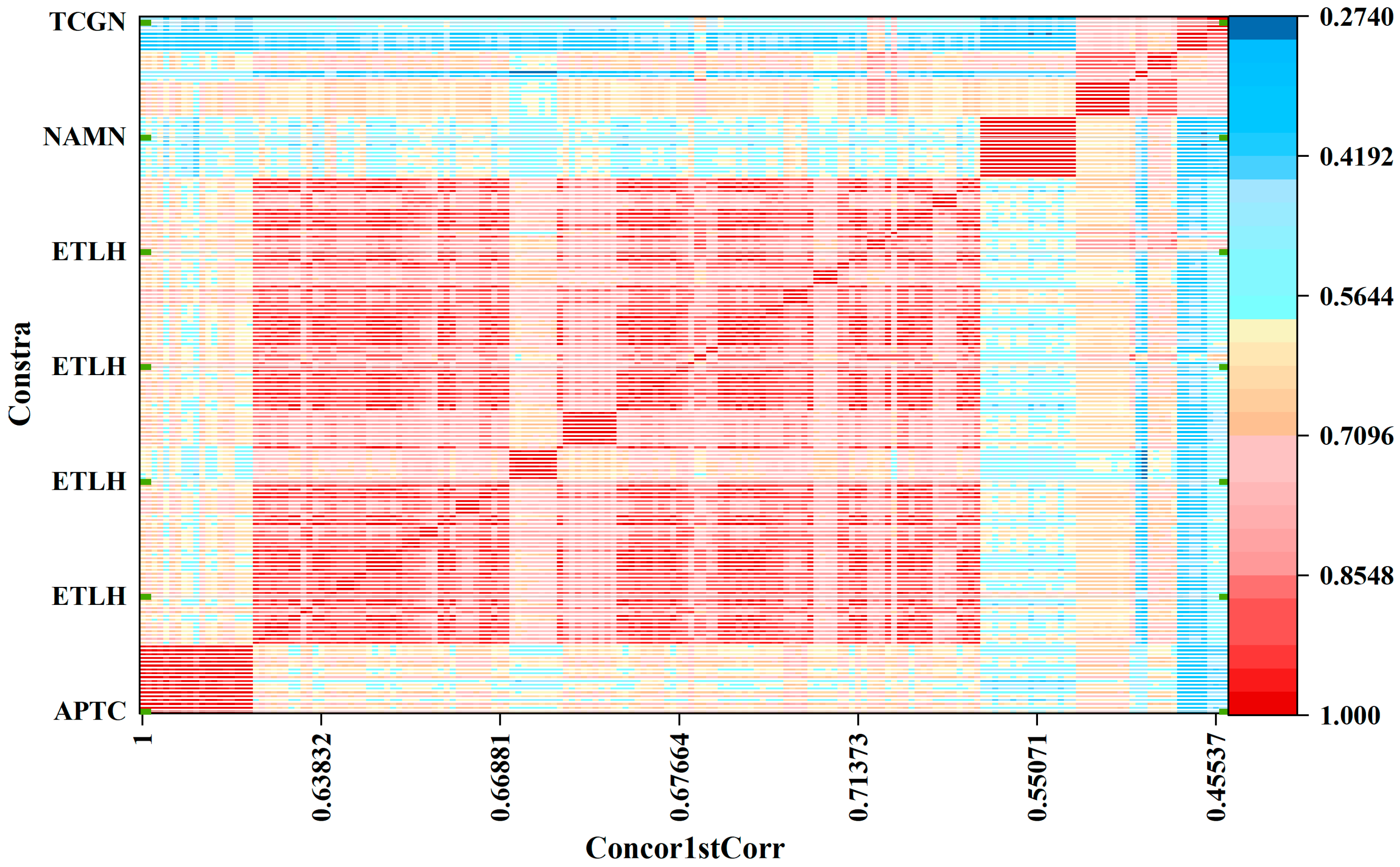
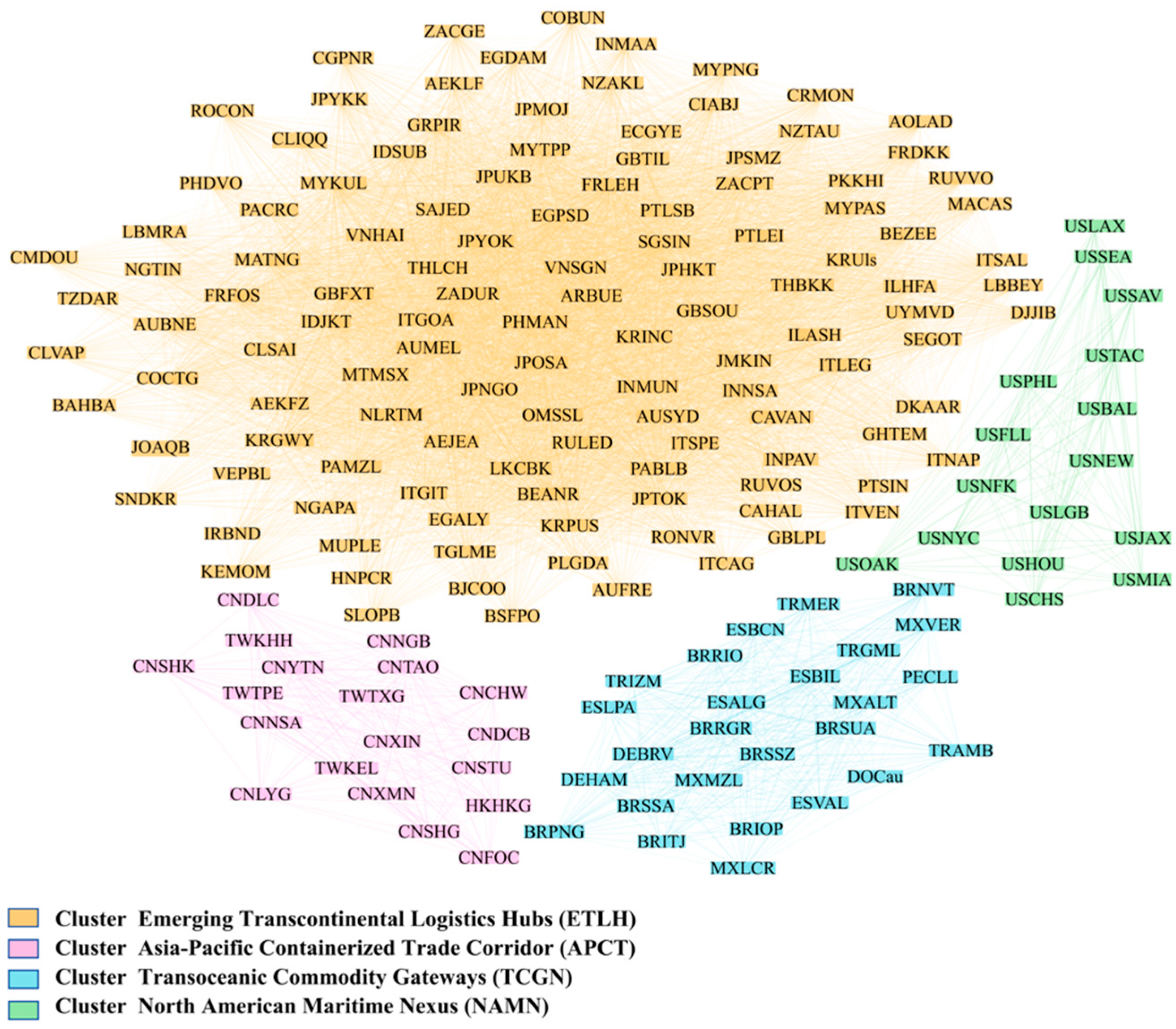
To establish a reference configuration for subsequent evolutionary analysis, this section first outlines the baseline structure of the global container port network in 2014. Based on the CONCOR results, the network can be partitioned into four structurally cohesive clusters, each characterised by distinct spatial patterns and connectivity profiles (Figure 1). These clusters include Emerging Transcontinental Logistics Hubs (ETLH), the Asia–Pacific Containerised Trade Corridor (APCT), Transoceanic Commodity Gateways (TCGN), and the North American Maritime Nexus (NAMN). Together, they capture the major functional and geographical segments of the global container shipping system at the baseline stage. The following subsections examine the structural characteristics and functional implications of each cluster in detail.

4.1.1. Cluster: Emerging Transcontinental Logistics Hubs (ETLH)

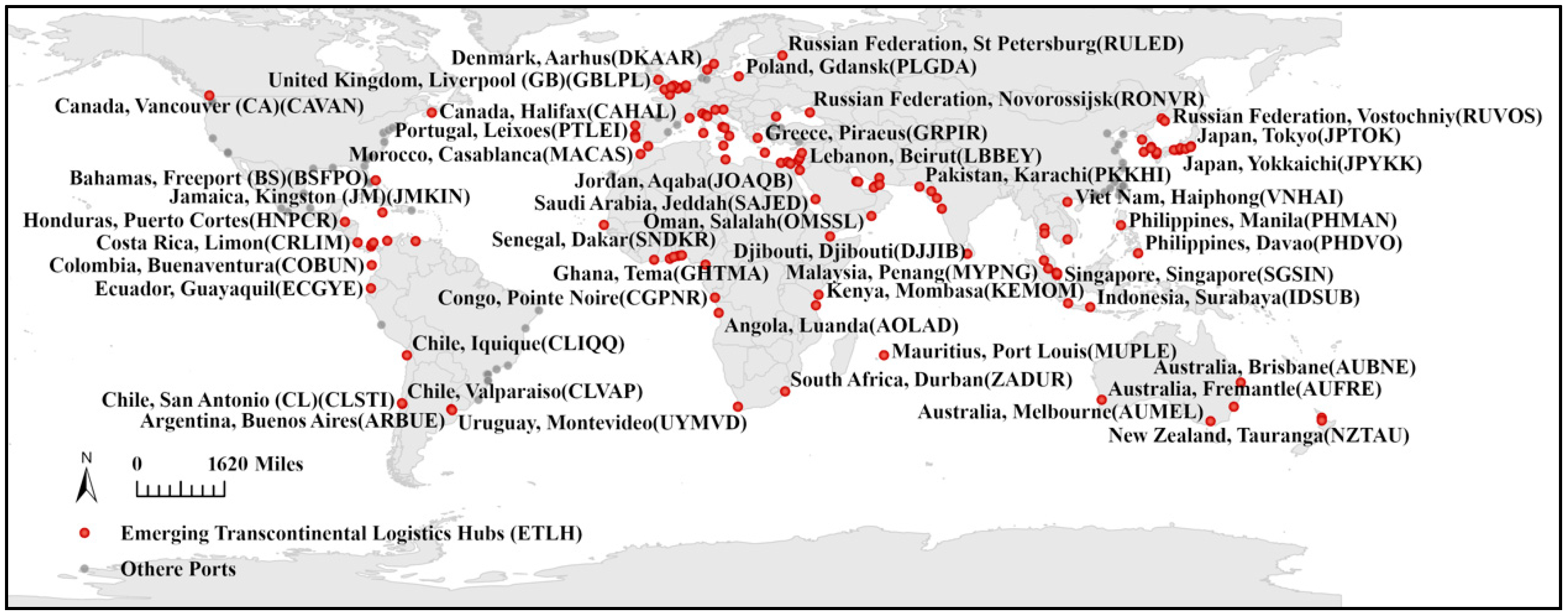
Spatially, the ETLH cluster exhibits a dispersed, transcontinental configuration. It includes ports distributed across East Africa (e.g., Dar es Salaam, Mombasa), West Africa and Central America (e.g., Lomé, Cotonou, Cristóbal), South Asia and the Indian Ocean (e.g., Bandar Abbas, Port Louis), Oceania (e.g., Fremantle, Sydney, Melbourne, Brisbane, Auckland, Tauranga), the Mediterranean and Northern Europe (e.g., Gdańsk, Koper, Venice), and the west coast of South America (e.g., Valparaíso, Iquique). Several ports in this cluster are located near strategic maritime chokepoints or major ocean passages. Overall, ETLH displays a hybrid spatial structure that links intercontinental shipping corridors with regional and local hinterland systems (Figure 2).
Functionally, the ETLH cluster is characterised by a hybrid role linking intercontinental shipping corridors with regional feeder and hinterland distribution systems. Major hub ports within the Shanghai–Ningbo–Shenzhen range are deeply embedded in Trans-Pacific and Asia–Europe liner services, while medium- and smaller ports rely on dense feeder, coastal, and river-borne networks to support high-frequency connections with inland manufacturing centres.

4.1.2. Cluster: Asia–Pacific Containerised Trade Corridor (APCT)

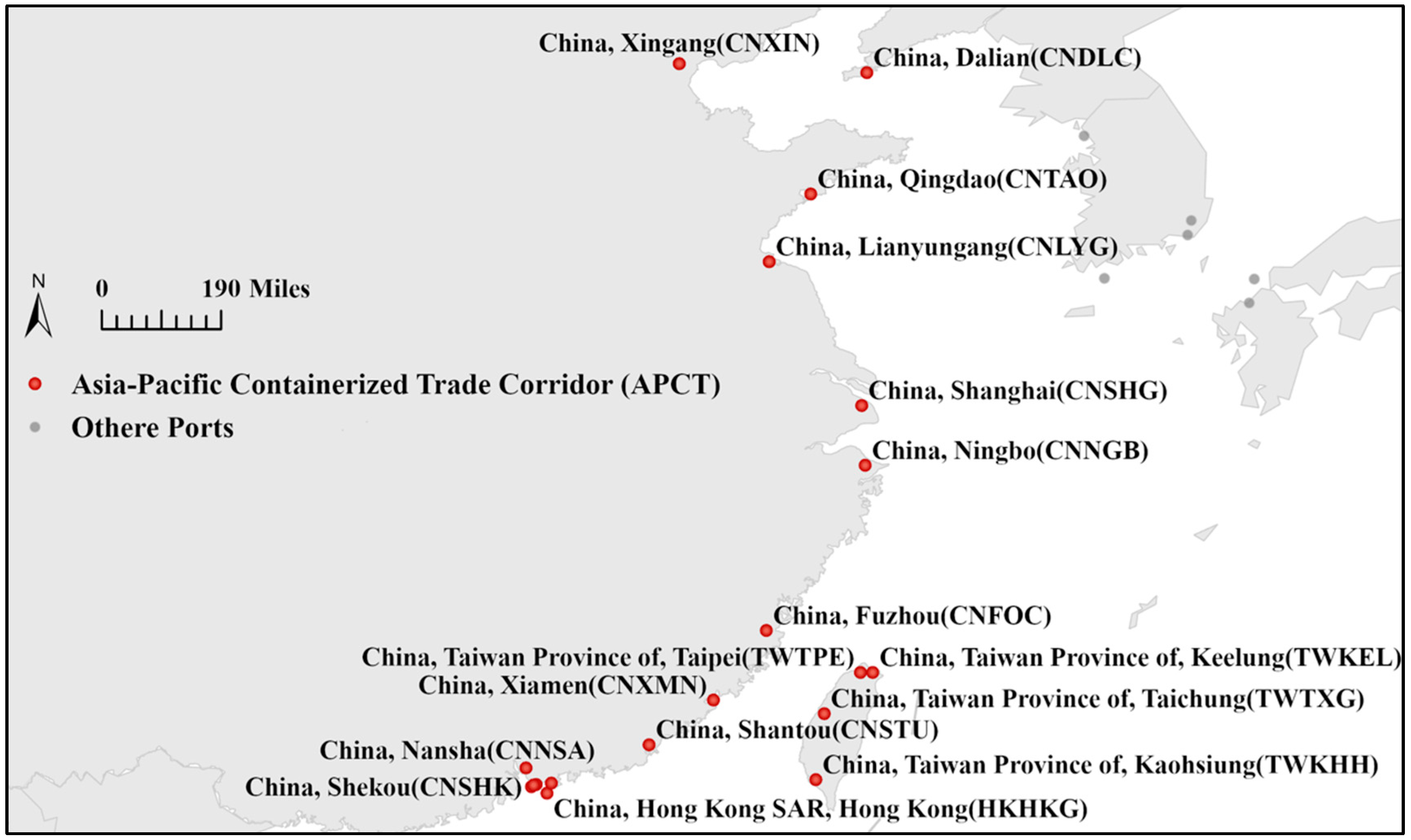
Spatially, the APCT cluster forms a highly concentrated, corridor-shaped configuration along the East Asian coastline. It encompasses major ports in mainland China and Taiwan, including Dalian and Qingdao in the Bohai Rim, Shanghai and Ningbo in the Yangtze River Delta, Xiamen and Fuzhou along the Fujian coast, ports in the Pearl River Delta (e.g., Nansha, Yantian, Shekou, Chiwan, Huangpu), and Keelung, Taichung, and Kaohsiung in Taiwan. The spatial pattern corresponds closely to major river mouths and industrial coastal zones, reflecting strong integration with the Bohai Rim, Yangtze River Delta, and Pearl River Delta hinterlands (Figure 3).
Functionally, the APCT cluster is characterised by a dominant role as a global container trunk corridor combined with intensive inland distribution.
Major hub ports within the Shanghai–Ningbo–Shenzhen range are deeply embedded in Trans-Pacific and Asia–Europe liner services, while medium- and smaller ports rely on dense feeder, coastal, and river-borne networks to support high-frequency connections with inland manufacturing centres.

4.1.3. Cluster: Transoceanic Commodity Gateways (TCGN)

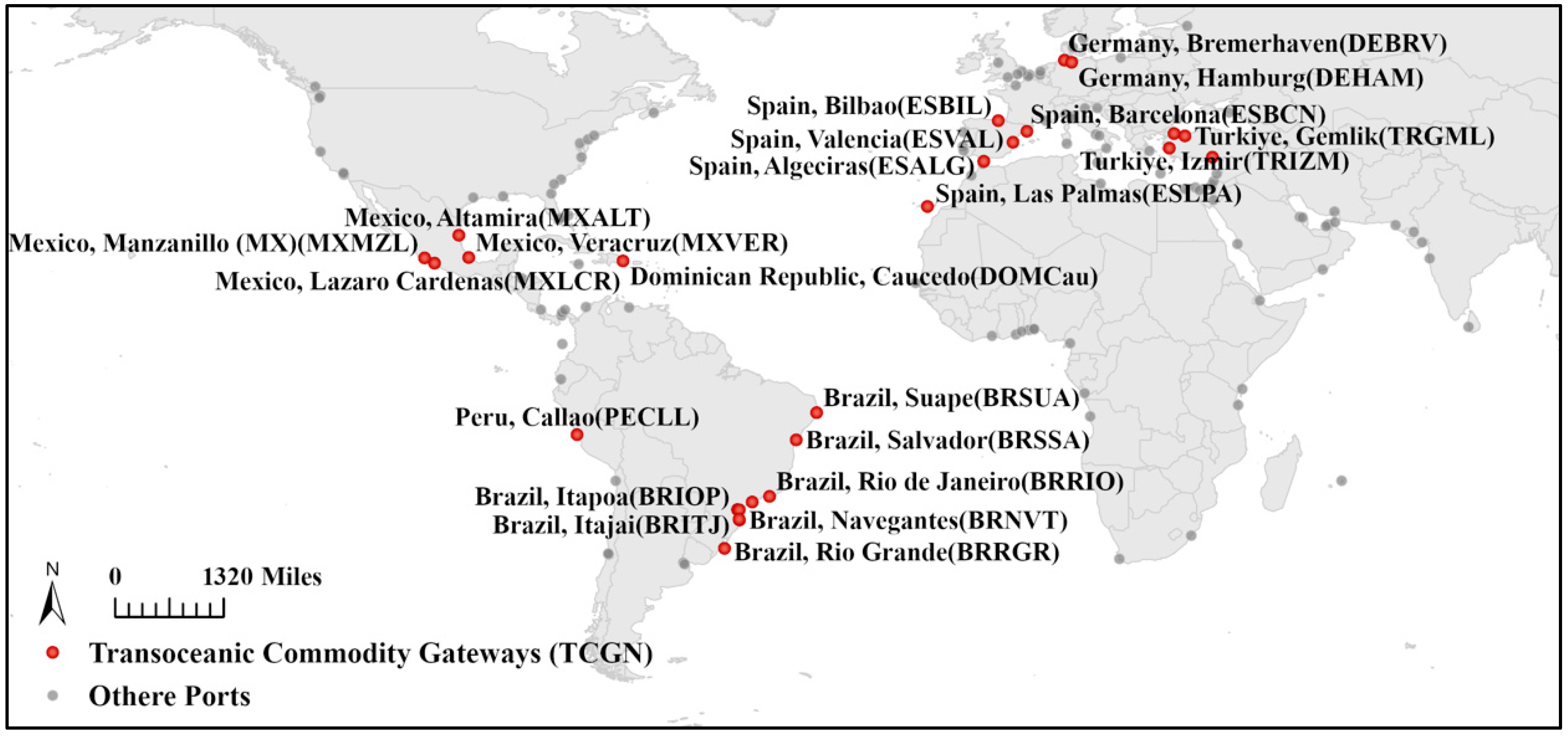
Spatially, the TCGN cluster demonstrates a transoceanic and inter-hemispheric configuration linking Europe, Africa, and the Americas. The northern sub-cluster consists of major Euro-Mediterranean ports such as Valencia, Barcelona, Algeciras, Gioia Tauro, Fos, Hamburg, and Bremerhaven, forming a dense gateway belt. The southern sub-cluster includes key Atlantic ports in South and Latin America, including Santos, Rio de Janeiro, Paranaguá, Itajaí, Callao, Veracruz, and Manzanillo. Together, these sub-clusters are connected through major Atlantic shipping lanes, forming an integrated transoceanic system (Figure 4).
In functional terms, TCGN ports exhibit a dominant role as commodity-oriented gateways with transoceanic relay functions. Euro-Mediterranean ports combine transshipment and hub operations with regional short-sea services, while South American and Mexican ports primarily support resource exports and intercontinental trade flows. The cluster thus integrates commodity-export gateways with long-distance maritime relay functions.

4.1.4. Cluster: North American Maritime Nexus (NAMN)

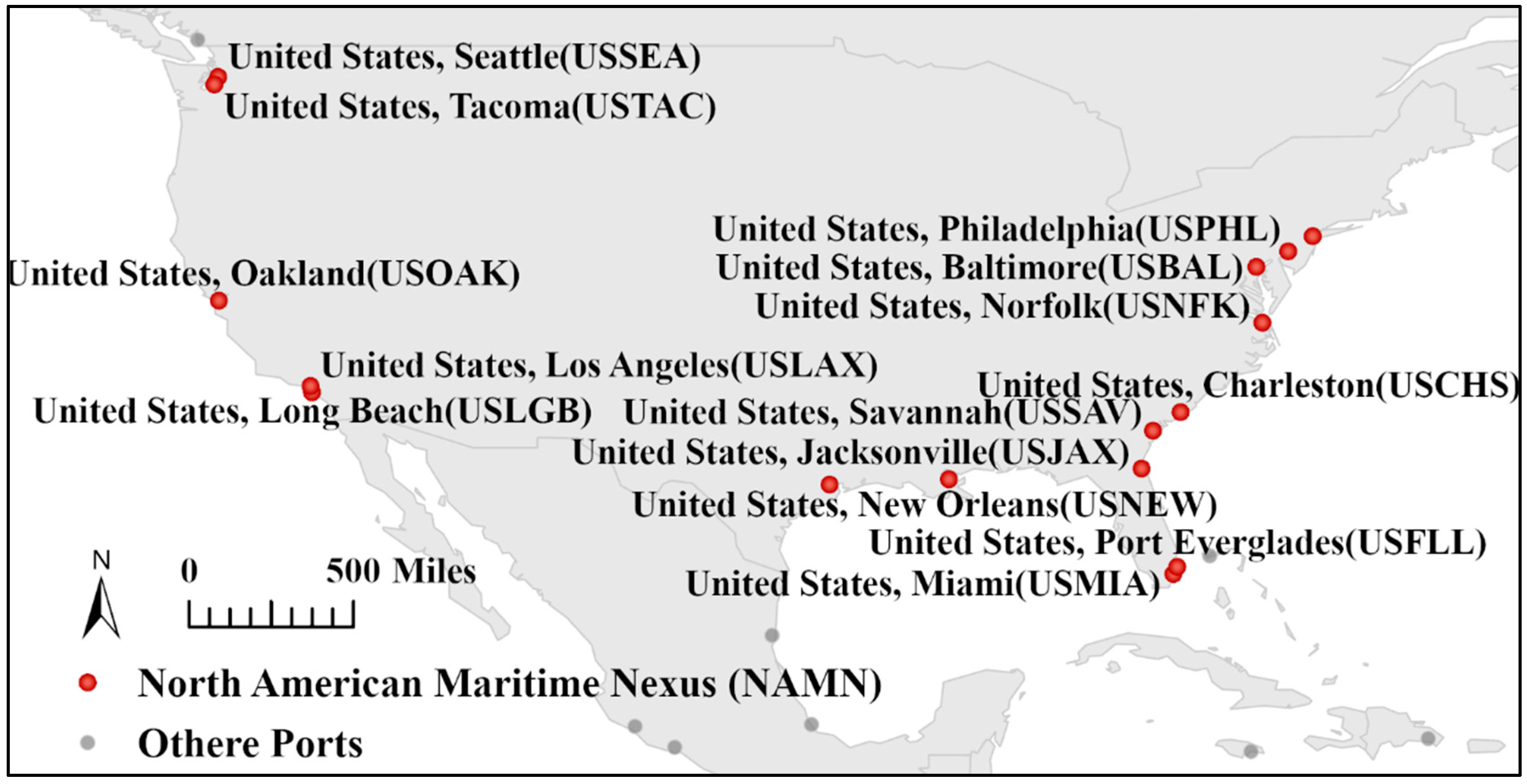
Spatially, the NAMN cluster is characterised by a gateway-oriented configuration concentrated along the North American Pacific, Atlantic, and Gulf coasts. It includes major West Coast ports such as Los Angeles, Long Beach, Oakland, Seattle, and Tacoma, as well as East Coast and Gulf ports including New York–New Jersey, Savannah, Norfolk, Charleston, Houston, and New Orleans. These ports are typically located at large bays or river mouths and are closely integrated with inland transport systems through extensive rail and highway networks (Figure 5).
Functionally, NAMN ports perform a dominant role as intercontinental gateways combined with inland distribution centres. West Coast ports serve as primary entry points for Trans-Pacific trunk services linking East Asia and North America, while East Coast and Gulf ports support Trans-Atlantic, Caribbean, and Latin American connections. Through strong intermodal integration, the cluster facilitates deep inland penetration of maritime cargo flows.

4.2. Baseline Functional Roles

In this section, the Weighted Rank-Sum Ratio (WRSR) method is employed to comprehensively evaluate port functional performance. Prior to this, node attributes are measured using the structural-hole approach, as summarised in Table 1, while the logic for identifying different functional port roles has been defined in the Method section on the basis of role-based network analysis and structural-hole theory. The RSR critical thresholds are then applied to categorise ports, with the 84.13th percentile serving as the cut-off for functional-port identification. Based on these criteria, ports are classified into three functional categories—High-Efficiency Core Ports, Bridge-Control Ports, and Free-Form Bridge Ports—thus providing a more structured view of functional coordination patterns among clusters in the global maritime network.

4.2.1. High-Efficiency Core Ports

High-Efficiency Core Ports are characterised by low route redundancy and high connectivity efficiency. Their dominant functional role is to operate as cargo-consolidation hubs with extensive route coverage, supporting large-scale and high-frequency trade flows and enhancing overall network efficiency. In 2014, High-Efficiency Core Ports exhibited a cross-regional and multi-centred spatial pattern. Within ETLH, ports such as Singapore, Colombo, Antwerp, Rotterdam, Pusan, and Jebel Ali functioned as global gateways, forming a multi-centred consolidation network spanning Europe, the Middle East, South Asia, and Southeast Asia. In APCT, ports along mainland China and Taiwan—including Shanghai, Ningbo, Qingdao, Hong Kong, Kaohsiung, Xiamen, and Yantian—formed an export-oriented corridor closely integrated with manufacturing hinterlands. In TCGN, ports such as Bremerhaven, Hamburg, Algeciras, Valencia, and Barcelona served as key European gateways. Collectively, High-Efficiency Core Ports in 2014 constituted a multi-polar hub system, with East–West trunk routes forming the backbone of the global maritime network (Table 2).

4.2.2. Bridge-Control Ports

Bridge-Control Ports are characterised by strong brokerage capacity and intermediation power along major shipping corridors. Their dominant functional role is to coordinate transit flows across regions, stabilising inter-regional logistics and enhancing route control. In 2014, Bridge-Control Ports displayed a spatial pattern combining regional aggregation centres with intercontinental connectors. Within ETLH, ports in Southeast and South Asia—such as Jakarta, Surabaya, Ho Chi Minh City, Haiphong, Manila, Nhava Sheva, Mundra, and Chittagong—served as intermediary nodes linking East–West trunk routes with regional feeder systems. Mediterranean and Middle Eastern ports including Piraeus, Marsaxlokk, Tanger Med, Alexandria, Port Said, and Jeddah functioned as strategic gateways connecting Europe and Asia and reinforcing both north–south and east–west flows. In TCGN, ports such as Santos and Mersin facilitated commodity exports and strengthened Atlantic connectivity, while in NAMN/NAIMN, ports including Los Angeles, Charleston, and Norfolk integrated Trans-Pacific and Trans-Atlantic services with North American hinterlands. Overall, Bridge-Control Ports in 2014 played a central role in maintaining inter-regional corridor continuity and network stability (Table 3).

4.2.3. Free-Form Bridge Ports

Free-Form Bridge Ports are characterised by high routing flexibility and multi-interface connectivity. Their dominant functional role is to extend and reconfigure maritime routes by linking structurally non-redundant nodes across fragmented subnetworks, thereby enhancing adaptability. In 2014, Free-Form Bridge Ports exhibited a pattern of lateral, cross-regional connectivity. Within ETLH, ports such as Singapore, Rotterdam, Antwerp, Le Havre, Algeciras, Barcelona, and Valencia leveraged broad international coverage to support flexible routing across the Atlantic, Mediterranean, and Indian Ocean systems. Within APNA, ports including Qingdao, Ningbo, Shanghai, Hong Kong, Xiamen, Yantian, Keelung, and Kaohsiung formed a multi-interface coastal network in East Asia, offering diversified routing options for Trans-Pacific and intra-Asian services. In TCGN, Hamburg and Bremerhaven enhanced lateral connectivity across North European, Mediterranean, and Atlantic corridors. Collectively, Free-Form Bridge Ports functioned as route extenders, increasing redundancy, flexibility, and resilience within the global maritime network (Table 4).

5. Structural and Functional Evolution of Port Clusters

5.1. Cluster Evolution Analysis

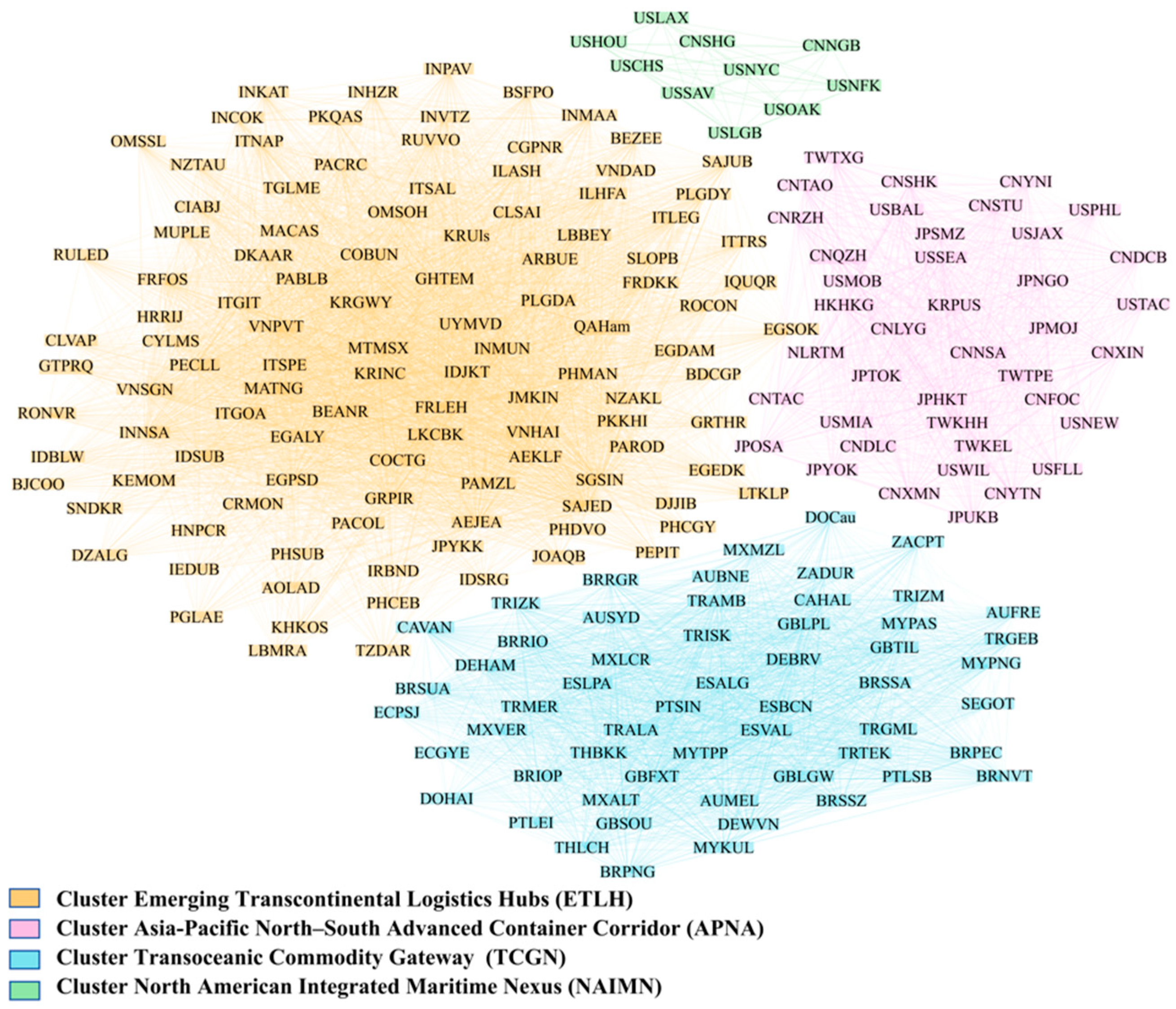
This chapter analyses the spatial distribution and evolution of route connectivity across four major clusters—ETLH, APCT/APNA (2024), TCGN, and NAMN/NAIMN (2024)—based on port classifications from 2014 and 2024. A comparison of Figure 6 and Figure 7 not only shows that each cluster experienced changes in spatial distribution and route connectivity between 2014 and 2024 but also highlights several distinct evolutionary tendencies, including the expansion of ETLH toward South and Southeast Asia, the increased coastal concentration of APNA along the China–Taiwan corridor, the relative stability of the Europe–South America configuration in TCGN, and the strengthened gateway pattern of NAIMN across North America.

5.1.1. Cluster Emerging Transcontinental Logistics Hubs (ETLH)

Spatially, the ETLH cluster in 2024 retains its globally dispersed configuration while exhibiting notable evolutionary adjustments. As shown in Figure 7, this evolution is most clearly visible in the denser presence of member ports along the South Asia–Southeast Asia interface, which strengthens the visual continuity of the Indian Ocean–Africa–Southeast Asia corridor. Compared with 2014, member ports remain concentrated along the East African coast, the South Asia–Indian Ocean region, and Central American corridors. New additions in South Asia (India: Cochin, Kattupalli, Visakhapatnam) and Southeast Asia (Cambodia: Sihanoukville; Vietnam: Da Nang, Vung Tau) have expanded the cluster’s coverage of Asian hinterlands. Meanwhile, ports in Oceania such as Tauranga and Auckland remain within the cluster, while the number of South American nodes has slightly decreased. Overall, ETLH has evolved toward a configuration characterised by strengthened transoceanic hubs and enhanced regional hinterland integration.
Functionally, the ETLH cluster exhibits a dominant role characterised by strengthened long-distance trunk access combined with expanded regional feeder connectivity. The inclusion of Indian and Southeast Asian ports has enhanced capacity along the Indian Ocean–Southeast Asia–Africa maritime corridor. At the same time, established African and Latin American ports continue to support transoceanic transport and regional redistribution. Compared with 2014, ETLH in 2024 provides a broader set of long-distance access points and improved feeder-based hinterland distribution, forming a two-layer structure linking transoceanic trunk routes with regional connectivity.

5.1.2. Cluster Asia-Pacific North–South Advanced Container Corridor (APNA)

Spatially, the APNA cluster in 2024 displays a pronounced concentration along the China–Taiwan coastal corridor. This pattern is particularly evident in Figure 7, where the cluster appears as a more continuous and tightly packed coastal belt than in 2014, visually reinforcing the interpretation of APNA as a north–south corridor structure rather than a looser Asia-Pacific grouping. Compared with 2014, core nodes in the Yangtze River Delta (Shanghai, Ningbo, Zhoushan), the Pearl River Delta (Shenzhen, Nansha, Shekou, Chiwan, Yantian, Huangpu), and Taiwan (Keelung, Taichung, Kaohsiung) remain stable. Newly incorporated northern ports—Taicang (Jiangsu) and Rizhao, Yantai, and Lianyungang (Shandong)—extend the corridor northward, forming a more continuous south–north spatial structure. Port spacing along the corridor has decreased, while river–sea and coastal multimodal networks have expanded their coverage of industrial hinterlands, transforming the former Asia–Pacific Containerised Trade Corridor (APCT) into the Asia–Pacific North–South Advanced Container Corridor (APNA).
Functionally, the APNA cluster demonstrates a dominant role combining global trunk-line gateway functions with intensified inland distribution. The integration of newly added northern ports with existing core hubs has expanded access points to Trans-Pacific and Asia–Europe routes, increasing overall route density. Concurrently, coastal and river–sea feeder services have intensified, strengthening cargo collection and distribution across the Yangtze River Delta, Bohai Rim, and Pearl River Delta hinterlands.

5.1.3. Cluster Transoceanic Commodity Gateways (TCGN)

Spatially, the TCGN cluster in 2024 maintains a stable Europe–South America network while exhibiting limited expansion toward the Asia–Pacific region. Compared with the more visible reconfigurations in ETLH and APNA, Figure 7 shows that the overall Europe–South America alignment of TCGN remains visually coherent, indicating a relatively stable transoceanic gateway structure over the period. Core European, Mediterranean, and Northern European ports—including Gioia Tauro, Fos, Valencia, Barcelona, Bilbao, Bremerhaven, Hamburg, Izmir, Ambarli, and Mersin—continue to dominate, forming a resilient hub-and-coastal node structure. South American and Mexican ports such as Santos, Itajaí, Salvador, Rio de Janeiro, Paranaguá, Veracruz, Callao, and Posorja largely retain their previous configuration, with a small number of new additions (e.g., Pecém in Brazil) enhancing coastal coverage. Overall, the spatial pattern represents a stable Europe-centred hub–South American coastal export system.
Functionally, the TCGN cluster exhibits a dominant role as a transoceanic gateway system supporting commodity exports and long-distance relay services. European ports continue to connect Asia and North America through long-haul container routes while supporting regional distribution networks. South American ports remain pivotal in exporting bulk commodities to Europe, North America, and inter-American markets. The inclusion of new nodes has improved coastal feeder efficiency, reinforcing internal connectivity within the cluster.

5.1.4. Cluster North American Integrated Maritime Nexus (NAIMN)

Spatially, the NAIMN cluster in 2024 remains concentrated at major deep-water ports and coastal gateways across North America. In Figure 7, this evolution is reflected in a more clearly defined coastal gateway pattern spanning both the Pacific and Atlantic seaboards, which visually supports the interpretation of NAIMN as a more integrated continental maritime system. Compared with 2014, West Coast ports (Los Angeles, Long Beach, Oakland, Seattle, Tacoma) and East Coast and Gulf ports (New York/New Jersey, Savannah, Norfolk, Charleston, Baltimore, Miami, Jacksonville, Houston, New Orleans) retain a stable spatial layout along the continental margins. These ports are located near major bays or river mouths and are directly connected to Trans-Pacific and Trans-Atlantic corridors, while maintaining strong inland linkages through integrated rail and highway networks. The cluster has evolved from the former North American Maritime Nexus (NAMN) into the North American Integrated Maritime Nexus (NAIMN).
Functionally, the NAIMN cluster performs a dominant role as a North American gateway system integrating transoceanic mainlines with inland distribution networks. West Coast ports support high-frequency Trans-Pacific services and coordinate inland distribution toward the Midwest and other key hinterlands. East Coast and Gulf ports maintain connectivity across Trans-Atlantic, Caribbean, and Latin American routes. Through strengthened multimodal integration and cluster-level coordination, the NAIMN continues to enhance inland accessibility and system-level connectivity.

5.2. Port Functional Structure Evolution Analysis

Between 2014 and 2024, a noticeable reconfiguration occurred in the spatial distribution of High-Efficiency Core Ports. The most evident change is the emergence of new consolidation hubs in Asia. Ports such as Haiphong and Ho Chi Minh City in Vietnam, Jakarta in Indonesia, and Mundra and Nhava Sheva in India entered the group of core ports, reflecting the strengthening hub roles of Southeast and South Asian ports within the global maritime system. In North America, the Port of New York/New Jersey also emerged as a new core node, indicating reinforced Trans-Atlantic and intra-American connectivity. By contrast, the European core-port structure remained relatively stable, with Rotterdam, Antwerp, and major Spanish ports retaining their central positions. Overall, the spatial pattern of High-Efficiency Core Ports evolved from a predominantly East–West bipolar configuration toward a more diversified and multi-polar hub structure.
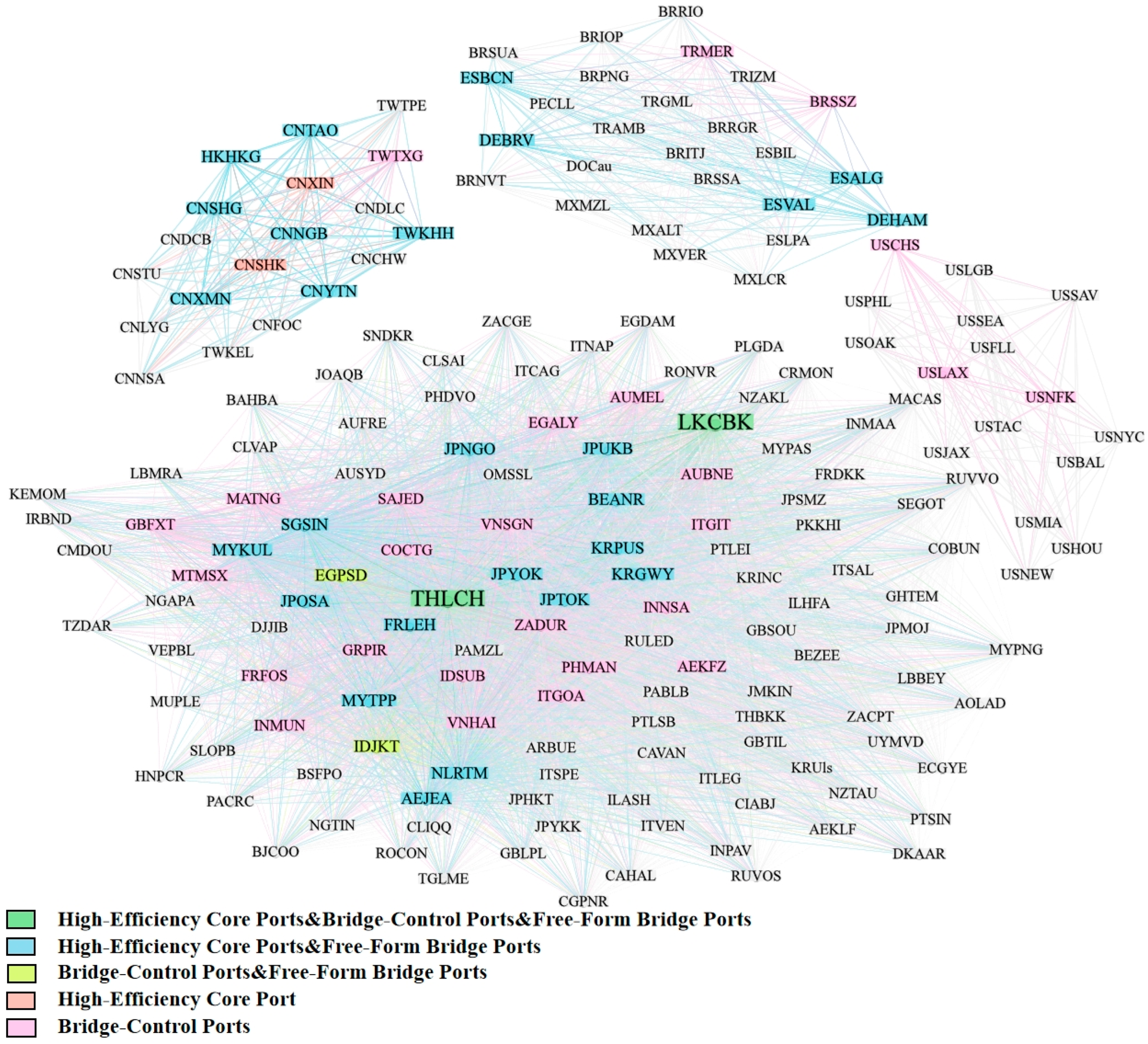
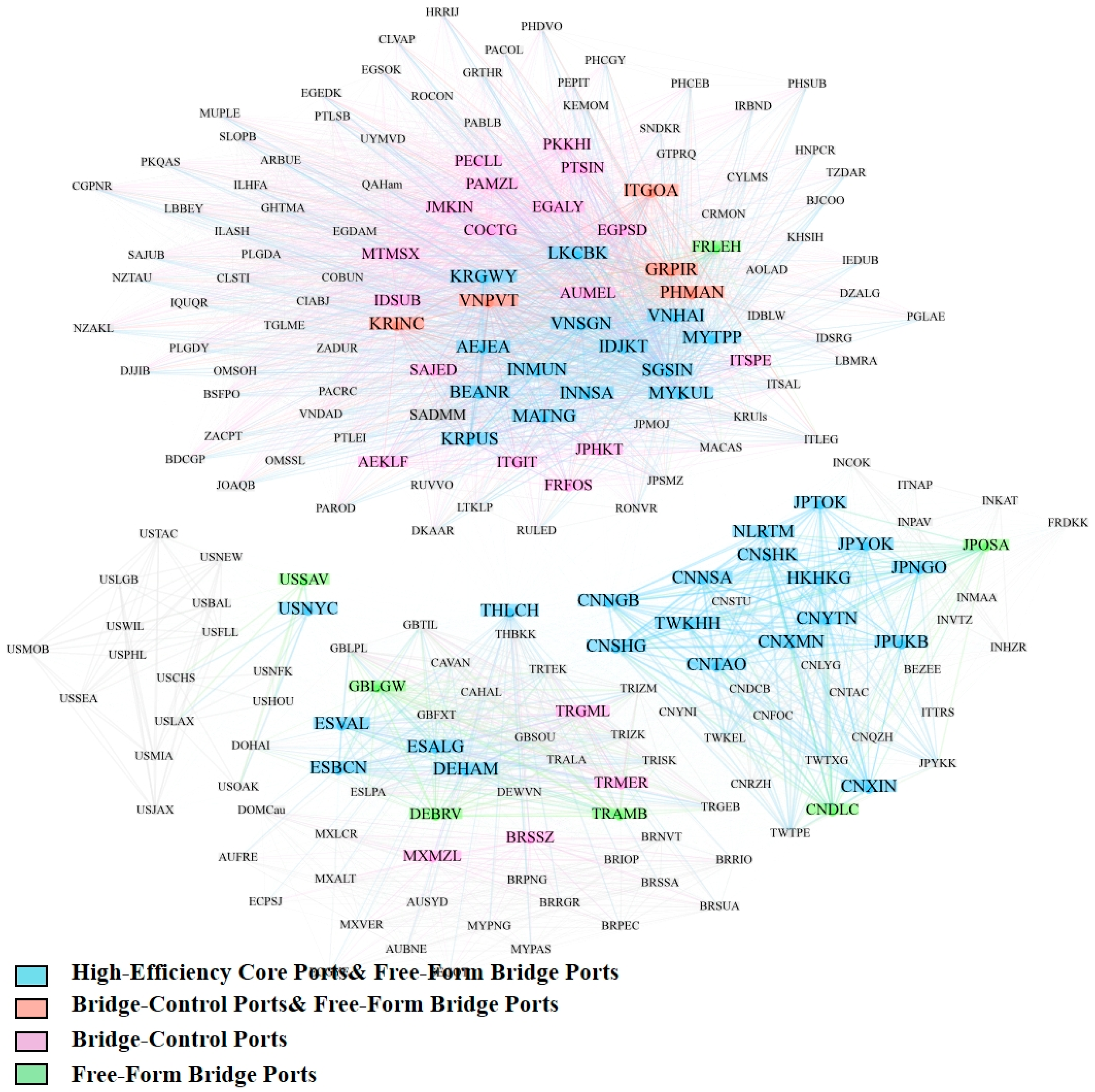
A comparison of Figure 8 and Figure 9 shows that Bridge-Control Ports expanded their functional coverage and spatial influence substantially between 2014 and 2024. Rather than appearing mainly as regionally clustered intermediaries, these ports increasingly form a more continuous cross-regional chain linking East Asia, South Asia, the Middle East, Europe, and the Americas. In Asia, the East Asia–South Asia–Middle East corridor was reinforced by newly identified Bridge-Control nodes such as Incheon, Khalifa, and Karachi, complementing established ports including Haiphong, Manila, and Surabaya. In the Americas, ports such as Kingston, Santos, Manzanillo, and Callao emerged as important transshipment and coordination nodes, illustrating the growing inter-regional coordination role of Latin America and the Caribbean. Within Europe, Piraeus, Marsaxlokk, and several Italian gateways maintained their strategic positions, while Sines appeared as an additional control node strengthening Atlantic gateway functions. Overall, Bridge-Control Ports evolved from regionally concentrated intermediaries toward a more cross-continental network configuration, characterised by multi-regional coordination.
During the same period, Free-Form Bridge Ports also experienced notable expansion in both spatial distribution and functional scope. In Figure 8 and Figure 9, this evolution is reflected in a visibly broader and more dispersed distribution of free-form bridging roles, suggesting increasing routing flexibility and a higher degree of functional substitutability across regions. In Asia, established flexible hubs such as Singapore, Ho Chi Minh City, and Jakarta were joined by new ports including Vung Tau, Incheon, and several ports along China’s southern coast, forming a dense and highly substitutable routing network across Southeast and Northeast Asia. In Europe, alongside traditional nodes such as Rotterdam and Antwerp, new free-form hubs including London Gateway, Ambarli, and Bremerhaven emerged, indicating a shift toward a more multi-nodal routing structure. Across the Atlantic, ports such as Savannah and New York/New Jersey entered the free-form bridging system, enhancing cross-regional flexibility between the North American East Coast and Eurasia. These developments indicate an expansion of free-form bridging functions from a predominantly Euro–Asian orientation toward more diversified trans-Atlantic and trans-Pacific configurations.
Taken together, three structural patterns can be observed in the global port network over the past decade. First, a more clearly defined hierarchical hub system has emerged, reflecting increasing functional differentiation among port clusters. Second, functional optimisation has progressed through polycentric configurations that support coordination and cluster-based governance. Third, the incorporation of emerging-market ports has reduced previous spatial and functional gaps, strengthening overall network coverage and adaptability. These patterns illustrate how the global port system has adjusted its functional structure in response to changing trade geographies and evolving maritime connectivity.

6. Discussion and Implications

First, port-cluster restructuring does not manifest itself as a single pattern of spatial expansion or regional concentration, but instead exhibits differentiated features such as transregional extension, coastal integration, the maintenance of long-distance linkages, and gateway–hinterland articulation. This result echoes studies that understand port systems as multi-scalar logistics networks and port–hinterland coupled systems, and also indicates that different types of port clusters follow distinct restructuring trajectories in terms of spatial organisation and functional linkage [46,47,48]. On this basis, rather than merely reaffirming existing conclusions, this study refines the identification of port-cluster restructuring by incorporating the characteristics of inter-port connectivity and analyses its specific manifestations across different spatial scales and functional dimensions.
Specifically, the expansion of the ETLH cluster toward South and Southeast Asia indicates that corridor formation is reflected not only in the concentration of routes but also in the strengthening of linkages among maritime gateways, inland industrial corridors, and special economic zones [46,47]. The consolidation of APNA along the China–Taiwan coastal corridor, meanwhile, suggests that coastal concentration cannot be understood solely through competition and hierarchical differentiation; in highly connected coastal systems, feeder linkages, river–sea intermodality, and synchronised logistics operations can also generate functional complementarity [48,49]. At the same time, the relative stability of TCGN and the transformation of NAMN into NAIMN further indicate that the persistence and restructuring of long-distance corridors depend not only on geography but also on sustained policy coordination, infrastructure upgrading, and inland accessibility [47,48]. In this sense, this study advances the discussion of port-cluster evolution from a port-centred explanatory framework toward a multi-scalar understanding that places greater emphasis on the joint effects of corridor linkages, hinterland integration, and institutional coordination.
A second contribution lies in revealing the evolving functional architecture of maritime networks. Existing studies have typically emphasised the stabilising role of major hubs and gateway ports in global shipping systems, and have mainly understood port positions in terms of gateway status, hub status, or centrality [50,51]. Building on this literature, this study further refines the functional division of ports by considering their positions in inter-port connectivity, their bridging capacity, and their stabilizing roles within the network. Our findings partly support existing arguments about the stabilizing role of core ports but also show that key ports in maritime networks cannot be adequately understood through a simple gateway–hub distinction. Instead, they exhibit a more fine-grained functional division [51].
Specifically, High-Efficiency Core Ports primarily perform an anchoring role in network organization, whereas different types of bridging ports fulfil differentiated organizational functions in inter-regional connectivity, flow coordination, and network adaptation. In particular, the expansion of Bridge-Control Ports from regionally concentrated nodes to cross-continental intermediaries highlights the importance of intermediary ports in coordinating inter-regional flows, especially at chokepoints and transition zones [51,52]. This finding resonates with studies that move beyond simple hub-and-spoke hierarchies and emphasise the strategic role of intermediate nodes in network organisation. Likewise, the spatial and functional expansion of Free-Form Bridge Ports suggests that maritime resilience depends not only on stable hubs and fixed corridors but also on flexible bridging capacity, route redundancy, and the ability to reconfigure paths under disruption [53,54]. Compared with interpretations that privilege relatively fixed hierarchies, our results indicate that adaptive bridging configurations are becoming increasingly important for integrating emerging-market nodes and sustaining network resilience under changing geopolitical and logistical conditions [54,55].
Overall, these findings suggest that the global port system is evolving toward a more multipolar, corridor-based, and functionally differentiated structure. Theoretically, this study contributes to port and network studies in three respects. First, it suggests that port regionalization is increasingly cross-regional rather than territorially bounded. Second, it shows that gateway performance should be understood relationally through corridor coordination and hinterland integration. Third, it demonstrates that maritime network stability depends not only on dominant core hubs but also on intermediary and redundant nodes that support flexibility and resilience. Taken together, these results move beyond a simple competition-centred interpretation of port development and support a more networked understanding grounded in role differentiation, complementarity, and multi-scalar coordination.

7. Conclusions

Port competition is increasingly shaped by network structures and differentiated functional roles rather than isolated capacity-based comparisons. This study examines the structural evolution and functional differentiation of the global container port network by integrating cluster identification with role-based evaluation within a complex network framework. A CONCOR-based approach is employed to identify structurally cohesive port clusters, while the Rank-Sum Ratio (WRSR) method is used to assess ports’ dominant functional roles, including High-Efficiency Core Ports, Bridge-Control Ports, and Free-Form Bridge Ports.
Using comparative network data for 2014 and 2024, the analysis reveals a transition from relatively homogeneous port-to-port competition toward cluster-constrained and role-oriented dynamics. Four major clusters—Emerging Transcontinental Logistics Hubs (ETLH), Asia–Pacific North–South Advanced Container Corridor (APNA), Transoceanic Commodity Gateways (TCGN), and North American Integrated Maritime Nexus (NAIMN)—exhibit distinct yet interconnected evolutionary trajectories. ETLH develops a dual-layer structure linking transoceanic trunk routes with expanding regional hinterlands; APNA shows pronounced north–south densification along the East Asian coastline; TCGN maintains a stable Europe–South America gateway configuration; and NAIMN reinforces gateway–hinterland integration across North America.
Functionally, the results indicate increasing differentiation and interdependence among port roles. High-Efficiency Core Ports anchor mainline services and diffuse operational and environmental standards, contributing to a shift toward a more multipolar hub system. Bridge-Control Ports evolve into cross-continental intermediaries coordinating flows at strategic chokepoints, while Free-Form Bridge Ports enhance redundancy and flexible connectivity by linking structurally non-overlapping subnetworks.
From a theoretical perspective, the study contributes to the literature by moving beyond approaches that treat port competition, cluster structure, and port function as separate analytical dimensions. Existing studies have often focused either on aggregate port performance or on network structure alone. By integrating cluster-based structural analysis with role-based functional differentiation, this study shows that the evolution of the global port system is shaped by the co-development of structural clustering, functional specialisation, and network interdependence. This extends existing literature by showing that structural clustering and functional role differentiation are not separate analytical dimensions, but mutually constitutive processes in the evolution of the global port system. In this sense, global port competition should be understood less as isolated rivalry among individual ports and more as a relational and system-level process embedded in clusters, corridors, and differentiated nodal roles.
From a practical perspective, the findings imply that port governance and infrastructure planning should move beyond isolated port-level expansion strategies. Because the results show that port performance and influence are increasingly conditioned by cluster membership, corridor position, and intermediary functions, effective governance depends more on coordination across complementary roles than on uniform competition alone. This means that policymakers and port authorities should place greater emphasis on cluster-based governance, corridor coordination, and differentiated role allocation among core hubs, bridge-control nodes, and flexible bridging ports. In particular, strengthening interoperability between major gateways, intermediate coordinating ports, and feeder-linked hinterlands may be more effective than pursuing undifferentiated capacity expansion across all ports.
This study also has several limitations that point to directions for future research. First, the analysis is based on a comparative design using two benchmark years, and future studies could extend the temporal scope to capture more continuous evolutionary dynamics. Second, additional data on cargo structure, shipping alliances, hinterland logistics, and geopolitical disruptions could further enrich the interpretation of port functional change. Third, future research may combine the present framework with other network-analytic or causal approaches to explore how structural change, functional differentiation, and strategic port behaviour interact over time.

Author Contributions

Conceptualization, J.Y. and Y.L.; Methodology, J.Y. and Y.L.; Formal analysis, J.Y.; Investigation, J.Y. and Y.L.; Resources, Y.L.; Data curation, J.Y.; Writing—original draft preparation, J.Y.; Writing—review and editing, J.Y., Y.L. and Q.H.; Visualization, J.Y.; Supervision, Y.L. and Q.H.; Project administration, Y.L. and Q.H.; Funding acquisition, Y.L. and Q.H. All authors have read and agreed to the published version of the manuscript.

Funding

This research was funded by the Dalian Science and Technology Innovation Think Tank Project, grant number DLKX2025ZD02.

Institutional Review Board Statement

Not applicable.

Informed Consent Statement

Not applicable.

Data Availability Statement

The data used in this study were obtained from publicly available liner shipping network sources and processed by the authors for the purposes of analysis. The processed data supporting the findings of this study, including cluster membership and functional role classification results for 2014 and 2024, are available from the corresponding author upon reasonable request.

Conflicts of Interest

The authors declare no conflicts of interest.

Abbreviations

The following abbreviations are used in this manuscript:
CONCORConvergence of Iterated Correlations
WRSRWeighted Rank-Sum Ratio
DEAData Envelopment Analysis
AHPAnalytic Hierarchy Process
MCDAMulti-Criteria Decision Analysis
ELECTREElimination and Choice Expressing Reality
ETLHEmerging Transcontinental Logistics Hubs
APCTAsia–Pacific Containerised Trade Corridor
APNAAsia–Pacific North–South Advanced Container Corridor
TCGNTransoceanic Commodity Gateways
NAMNNorth American Maritime Nexus
NAIMNNorth American Integrated Maritime Nexus

References

  1. Wang, J.; Mo, L.; Ma, Z. Evaluation of port competitiveness along China’s “Belt and Road” based on the entropy-TOPSIS method. Sci. Rep. 2023, 13, 42755. [Google Scholar] [CrossRef] [PubMed]
  2. Wang, M.; Childerhouse, P.; Abareshi, A. Global logistics and supply chain integration in the digital era: A focus on China’s Belt and Road Initiative. J. Int. Logist. Trade 2024, 22, 58–79. [Google Scholar] [CrossRef]
  3. Lau, Y.-Y.; Chen, Q.; Poo, M.C.-P. Maritime transport resilience: A systematic literature review on the current state of the art, research agenda and future research directions. Ocean Coast. Manag. 2024, 251, 107086. [Google Scholar] [CrossRef]
  4. Xu, Z.; Liu, Y.; Zhang, H. Improving the resilience of maritime supply chains: The integration of ports and inland transporters in duopoly markets. Front. Eng. Manag. 2023, 10, 51–66. [Google Scholar] [CrossRef]
  5. Hussein, K.; Song, D.-W. Port supply chain integration and sustainability: A resource-based view. Int. J. Logist. Manag. 2024, 35, 504–530. [Google Scholar] [CrossRef]
  6. Yap, W.Y.; Yang, Z. Geopolitical tension and shipping network disruption: Analysis of the Red Sea crisis on container port calls. J. Transp. Geogr. 2024, 121, 104004. [Google Scholar] [CrossRef]
  7. Mdanat, M.F.; Al Hur, M.; Bwaliez, O.M.; Samawi, G.A.; Khasawneh, R. Drivers of port competitiveness among low-, upper-, and high-income countries. Sustainability 2024, 16, 11198. [Google Scholar] [CrossRef]
  8. Chen, S.; Zeng, Q.; Li, Y. Integrated operations planning in highly electrified container terminals considering time-of-use tariffs. Transp. Res. Part E Logist. Transp. Rev. 2023, 171, 103034. [Google Scholar] [CrossRef]
  9. Guo, L.; Yang, D.; Yang, Z. Port integration method in multi-port regions (MPRs) based on the maximal social welfare of the external transport system. Transp. Res. Part A Policy Pract. 2018, 110, 243–257. [Google Scholar] [CrossRef]
  10. Jarumaneeroj, P.; Barnett Lawton, J.; Svindland, M. An evolution of the Global Container Shipping Network: Port connectivity and trading community structure (2011–2017). Marit. Econ. Logist. 2024, 26, 283–306. [Google Scholar] [CrossRef]
  11. Roll, Y.; Hayuth, Y. Port performance comparison applying data envelopment analysis (DEA). Marit. Policy Manag. 1993, 20, 153–161. [Google Scholar] [CrossRef]
  12. Yuen, A.C.-L.; Zhang, A.; Cheung, W. Port competitiveness from the users’ perspective: An analysis of major container ports in China and its neighboring countries. Res. Transp. Econ. 2012, 35, 34–40. [Google Scholar] [CrossRef]
  13. Girvan, M.; Newman, M.E.J. Community structure in social and biological networks. Proc. Natl. Acad. Sci. USA 2002, 99, 7821–7826. [Google Scholar] [CrossRef] [PubMed]
  14. Lancichinetti, A.; Fortunato, S. Limits of modularity maximization in community detection. Phys. Rev. E 2011, 84, 066122. [Google Scholar] [CrossRef] [PubMed]
  15. Zhao, Y.; Levina, E.; Zhu, J. Consistency of community detection in networks under degree-corrected stochastic block models. Ann. Stat. 2012, 40, 2266–2292. [Google Scholar] [CrossRef]
  16. Tang, F.; Zhao, X.; Li, C. Community detection in multilayer networks based on matrix factorization and spectral embedding method. Mathematics 2023, 11, 1573. [Google Scholar] [CrossRef]
  17. Kang, L.; Wu, W. Global container port network linkages and topology in 2021. Sensors 2022, 22, 5889. [Google Scholar] [CrossRef]
  18. Chen, Z. Port logistics function evaluation model based on entropy weight TOPSIS method. Discret. Dyn. Nat. Soc. 2022, 2022, 5006900. [Google Scholar] [CrossRef]
  19. Ducruet, C.; Notteboom, T.E. Maritime constellations: A complex network approach to shipping and ports. Marit. Policy Manag. 2012, 39, 151–168. [Google Scholar] [CrossRef]
  20. Li, G.; Zhang, X.; Jiang, L.; Wang, C.; Huang, R.; Liu, Z. An approach for traffic pattern recognition integration of ship AIS data and port geospatial features. Geo-Spat. Inf. Sci. 2024, 27, 2048–2075. [Google Scholar] [CrossRef]
  21. Jiang, L.; Wang, G.; Feng, X.; Yu, T.; Lei, Z. Study on cascading failure vulnerability of the 21st-century Maritime Silk Road container shipping network. J. Transp. Geogr. 2024, 117, 103891. [Google Scholar] [CrossRef]
  22. Blondel, V.D.; Guillaume, J.-L.; Lambiotte, R.; Lefebvre, E. Fast unfolding of communities in large networks. J. Stat. Mech. Theory Exp. 2008, 2008, P10008. [Google Scholar] [CrossRef]
  23. Zhao, C.; Wang, Y.; Gong, Y.; Brown, S.; Li, R. The evolution of the port network along the Maritime Silk Road: From a sustainable development perspective. Mar. Policy 2021, 126, 104426. [Google Scholar] [CrossRef]
  24. Kaluza, P.; Kölzsch, A.; Gastner, M.T.; Blasius, B. The complex network of global cargo ship movements. J. R. Soc. Interface 2010, 7, 1093–1103. [Google Scholar] [CrossRef]
  25. Carlini, E.; Di Gangi, D.; de Lira, V.M.; Kavalionak, H.; Spadon, G. Spatial Network Analysis of Container Port Operations: The Worldwide Maritime Network Perspective. Netw. Spat. Econ. 2022, 22, 1147–1186. [Google Scholar] [CrossRef]
  26. Wang, L.; Zhou, Z.; Yang, Y.; Wu, J. Green efficiency evaluation and improvement of Chinese ports: A cross-efficiency model. Transp. Res. Part D Transp. Environ. 2020, 88, 102590. [Google Scholar] [CrossRef]
  27. Parola, F.; Risitano, M.; Ferretti, M.; Panetti, E. The drivers of port competitiveness: A critical review. Transp. Rev. 2017, 37, 116–138. [Google Scholar] [CrossRef]
  28. Yeo, G.-T.; Roe, M.; Dinwoodie, J. Evaluating the competitiveness of container ports in Korea and China. Transp. Res. Part A Policy Pract. 2008, 42, 910–921. [Google Scholar] [CrossRef]
  29. Luo, M.; Chen, F.; Zhang, J. Relationships among port competition, cooperation and competitiveness: A literature review. Transp. Policy 2022, 118, 1–9. [Google Scholar] [CrossRef]
  30. Lorenčič, V.; Twrdy, E.; Lep, M. Cruise port performance evaluation in the context of port authority: An MCDA approach. Sustainability 2022, 14, 4181. [Google Scholar] [CrossRef]
  31. Mickiene, R.; Valioniene, S. Port performance in container transport logistics: A multi-stakeholder perspective. Transp. Policy 2018, 73, 25–40. [Google Scholar] [CrossRef]
  32. Lirn, T.C.; Thanopoulou, H.A.; Beresford, A.K.C. An application of AHP on transhipment port selection: A global perspective. Marit. Econ. Logist. 2004, 6, 70–91. [Google Scholar] [CrossRef]
  33. Verhoeven, P. A review of port authority functions: Towards a renaissance? Marit. Policy Manag. 2010, 37, 247–270. [Google Scholar] [CrossRef]
  34. Chunaev, P. Community detection in node-attributed social networks: A survey. Comput. Sci. Rev. 2020, 37, 100286. [Google Scholar] [CrossRef]
  35. Verschuur, J.; Koks, E.E.; Hall, J.W. Ports’ criticality in international trade and global supply-chains. Nat. Commun. 2022, 13, 5760. [Google Scholar] [CrossRef] [PubMed]
  36. Ducruet, C.; Notteboom, T.E. Revisiting port system delineation through an analysis of maritime interdependencies among seaports. GeoJournal 2022, 87, 1831–1859. [Google Scholar] [CrossRef]
  37. Wan, Z.; Ge, J.; Chen, J. Energy-Saving Potential and an Economic Feasibility Analysis for an Arctic Route between Shanghai and Rotterdam: Case Study from China’s Largest Container Sea Freight Operator. Sustainability 2018, 10, 921. [Google Scholar] [CrossRef]
  38. Fortunato, S.; Newman, M.E.J. 20 years of network community detection. Nat. Phys. 2022, 18, 848–850. [Google Scholar] [CrossRef]
  39. Swait, J. Choice set generation within the generalized extreme value family of discrete choice models. Transp. Res. Part B Methodol. 2001, 35, 643–666. [Google Scholar] [CrossRef]
  40. Cinelli, M.; Kadziński, M.; Gonzalez, M.; Słowiński, R. How to support the application of multiple criteria decision analysis? Let us start with a comprehensive taxonomy. Omega 2020, 96, 102261. [Google Scholar] [CrossRef]
  41. Burt, R.S. Structural Holes: The Social Structure of Competition; Harvard University Press: Cambridge, MA, USA, 1992. [Google Scholar]
  42. Borgatti, S.P.; Everett, M.G. Models of core/periphery structures. Soc. Netw. 2000, 21, 375–395. [Google Scholar] [CrossRef]
  43. Latora, V.; Marchiori, M. Efficient behavior of small-world networks. Phys. Rev. Lett. 2001, 87, 198701. [Google Scholar] [CrossRef]
  44. Burt, R.S. Structural holes and good ideas. Am. J. Sociol. 2004, 110, 349–399. [Google Scholar] [CrossRef]
  45. Freeman, L.C. Centrality in social networks: Conceptual clarification. Soc. Netw. 1979, 1, 215–239. [Google Scholar] [CrossRef]
  46. Notteboom, T.E.; Rodrigue, J.-P. Port regionalization: Towards a new phase in port development. Marit. Policy Manag. 2005, 32, 297–313. [Google Scholar] [CrossRef]
  47. Rodrigue, J.-P.; Notteboom, T. Foreland-based regionalization: Integrating intermediate hubs with port hinterlands. Res. Transp. Econ. 2010, 27, 19–29. [Google Scholar] [CrossRef]
  48. Sdoukopoulos, E.; Boile, M. Port-hinterland concept evolution: A critical review. J. Transp. Geogr. 2020, 86, 102775. [Google Scholar] [CrossRef]
  49. Bai, X.; Lam, J.S.L. Dynamic regional port cluster development: Case of the ports across Taiwan Strait. GeoJournal 2015, 80, 619–636. [Google Scholar] [CrossRef]
  50. Wang, Y.; Cullinane, K. Determinants of port centrality in maritime container transportation. Transp. Res. Part E Logist. Transp. Rev. 2016, 95, 326–340. [Google Scholar] [CrossRef]
  51. Xu, M.; Pan, Q.; Muscoloni, A.; Xia, H.; Cannistraci, C.V. Modular gateway-ness connectivity and structural core organization in maritime network science. Nat. Commun. 2020, 11, 2849. [Google Scholar] [CrossRef] [PubMed]
  52. Zhang, Q.; Pu, S.; Yin, M. Identifying transshipment hubs in a global container shipping network: An approach based on reinforced structural holes. J. Mar. Sci. Eng. 2023, 11, 1585. [Google Scholar] [CrossRef]
  53. Calatayud, A.; Mangan, J.; Palacin, R. Vulnerability of international freight flows to shipping network disruptions: A multiplex network perspective. Transp. Res. Part E Logist. Transp. Rev. 2017, 108, 195–208. [Google Scholar] [CrossRef]
  54. Xu, M.; Deng, W.; Zhu, Y.; Lü, L. Assessing and improving the structural robustness of global liner shipping system: A motif-based network science approach. Reliab. Eng. Syst. Saf. 2023, 239, 109576. [Google Scholar] [CrossRef]
  55. Zhang, D.; Tao, J.; Wan, C.; Huang, L.; Yang, M. Resilience analysis of maritime transportation networks: A systematic review. Transp. Saf. Environ. 2024, 6, tdae009. [Google Scholar] [CrossRef]
Figure 1. CONCOR-based clustering heatmap of the global container port network.
Systems 14 00498 g001
Figure 2. Spatial distribution of cluster emerging transcontinental logistics hubs.
Systems 14 00498 g002
Figure 3. Spatial distribution of Cluster Asia-Pacific Characterised Trade Corridor.
Systems 14 00498 g003
Figure 4. Spatial distribution of Cluster Transoceanic Commodity Gateways.
Systems 14 00498 g004
Figure 5. Spatial distribution of Cluster North American Maritime Nexus.
Systems 14 00498 g005
Figure 6. Cluster division in 2014.
Systems 14 00498 g006
Figure 7. Cluster division in 2024.
Systems 14 00498 g007
Figure 8. Port functional structure within each cluster in 2014.
Systems 14 00498 g008
Figure 9. Port functional structure within each cluster in 2024.
Systems 14 00498 g009
Table 1. Criteria for Identifying Port Functional Roles.
Port TypeHigh-Efficiency Core PortsBridge-Control PortsFree-Form Bridge Ports
Key Structural-Hole MetricsEffSize/EfficiencyEgo Bet/IndirectConstra/Density
Structural CharacteristicsLow route redundancy; high connectivity efficiencyStrong control over transit and intermediation along routesHigh routing freedom; connects structurally non-redundant (non-overlapping) ports
Functional Role in the Maritime-Route NetworkCargo consolidation hubs with broad route coverageCoordination and distribution nodes across multiple regionsCross-regional dispatch nodes; rapid path reconfigures
Strategic ValueImproves resource allocation efficiency; supports large-scale trade flowsEnsures inter-regional connectivity; enhances path control and system stabilityStrengthens network adaptability; facilitates integration of emerging markets
RSR Critical Threshold (Fitted)
(2014/2024)
0.8447-/0.8416-0.7633-/0.7188-1.0145-/1.0560-
Table 2. Scores of High-Efficiency Core Ports.
Cluster
(2014)
PortFunctional Score (2014/2024)Cluster
(2024)
PortFunctional Score (2014/2024)Cluster
(2024)
APTCNansha(New functions added/1.0058)APNAXiamen(0.8676/0.9966)APNA
Hong Kong SAR(1.0765/1.0365)Xingang(0.8609/0.8933)
Qingdao(0.9472/1.0888)Yantian(0.889/0.9356)
Shekou(0.8543/1.0605)Ningbo(1.0424/1.17)NAIMN
Taiwan Province of China(0.9569/0.9795)Shanghai(1.1199/1.2432)
ETLHOsaka(0.8817/Loss of function)APNAYokohama(1.0586/1.0481)APNA
Kobe(1.0275/0.9165)Rotterdam(1.1814/1.1448)
Nagoya(0.9671/0.8879)Pusan(1.2998/1.3103)
Tokyo(0.9778/0.9227)Singapore(1.4301/1.4309)ETLH
Le Havre(0.9291/Loss of function)ETLHColombo(0.8746/1.074)
Haiphong(New functions added/0.9492)Antwerp(1.1474/1.1236)
Ho Chi Minh City(New functions added/0.9715)Kwangyang (0.9122/0.8989)
Jakarta(New functions added/0.8825)Jebel Ali(1.0967/1.1052)
Tanger Med(New functions added/0.9638)Port Klang(1.227/1.2012)TCGN
Mundra(New functions added/1.0257) Tanjung Pelepas(1.001/0.9423)
Nhava Sheva(New functions added/1.0155)Laem Chabang(0.9042/0.9105)
TCGNHamburg(1.0138/0.929)TCGNBarcelona(0.9205/0.9047)TCGN
Algeciras(0.938/0.9564)Valencia(0.9891/0.9879)
Bremerhaven(0.8965/Loss of function)
NAMNNew York/New Jersey (New functions added/0.8772)NAIMN
Table 3. Scores of Bridge-Control Ports.
Cluster
(2014)
PortFunctional Score (2014/2024)Cluster (2024)PortFunctional Score
(2014/2024)
Cluster
(2024)
ETLHBrisbane(1.5827/Loss of function)TCGNDammam(New functions added/1.077)ETLH
Durban(1.0543/Loss of function)Khalifa(New functions added/1.077)
Felixstowe(0.9359/Loss of function)Surabaya(1.3249/1.077)
Laem Chabang(0.8519/Loss of function)Manila(1.0906/0.9237)
Haiphong(1.2238/Loss of function)ETLHCartagena (1.1596/1.077)
Ho Chi Minh City(0.9821/Loss of function)Piraeus(1.0229/0.9237)
Jakarta(0.9152/Loss of function)Marsaxlokk(1.189/1.6271)
Tanger Med(0.995/Loss of function)Alexandria(1.1339/1.077)
Colombo(0.8866/Loss of function)Port Said(0.9054/1.077)
Mundra(1.0717/Loss of function)Fos(1.1112/1.077)
Nhava Sheva(1.0381/Loss of function)Genoa(0.8958/0.9237)
Kingston(New functions added/1.6271)Gioia Tauro(1.0086/1.077)
Karachi(New functions added/1.077)Jeddah(0.9581/0.9237)
Manzanillo(New functions added/1.6271) Sines(New functions added/1.077)TCGN
La Spezia(New functions added/1.077) Melbourne(1.267/1.077)
Incheon(New functions added/0.9237)Hakata(New functions added/1.077)APNA
Khor Fakkan(1.4173/-)
TCGNCallao(New functions added/1.6271)ETLHSantos(0.9698/0.9237)TCGN
Manzanillo(New functions added/1.077)TCGNMersin(0.8776/0.9237)
Gemlik(New functions added/0.9237)
NAMNCharleston(0.9254/Loss of function)NAIMNNorfolk(0.8602/Loss of function)NAIMN
Los Angeles(0.8688/Loss of function)
APTCTaiwan Province of China(0.9467/0.811)APNA
New portVung Tau(-/0.9237)ETLH
Table 4. Free-Form Bridge Ports core.
Cluster
(2014)
PortFunctional Score (2014/2024)Cluster
(2024)
PortFunctional Score (2014/2024)Cluster
(2024)
NAMNNew York/New Jersey (New functions added/1.1775)NAIMNSavannah (New functions added/1.1775)NAIMN
APTCQingdao (1.0333/1.1775)APNAXiamen (0.9892/1.1775)APNA
Nansha (New functions added/1.1775)Yantian (1.0071/1.1775)
ETLHPort Said (0.995/Loss of function)ETLHColombo (1.0134/1.1775)ETLH
Manila (New functions added/1.1775)Antwerp (1.248/1.765)
Piraeus (New functions added/1.1775)Kwangyang (1.0631/1.1775)
Genoa (New functions added/1.1775)Jebel Ali (1.2033/1.765)
Incheon (New functions added/1.1775)Tokyo (1.0982/1.1775)APNA
Jeddah (New functions added/1.1775)Yokohama (1.1696/1.1775)
Haiphong (New functions added/1.1775)Rotterdam (1.3183/1.765)
Ho Chi Minh City (New functions added/1.1775)Pusan (1.3825/1.765)
Tanger Med (New functions added/1.1775)Osaka (1.0198/1.1775)
Mundra (New functions added/1.1775)Kobe (1.13/1.1775)
Nhava Sheva (New functions added/1.1775)Nagoya (1.0888/1.1775)
Le Havre (1.0477/1.1775)Port Klang (1.278/1.765)TCGN
Singapore (1.4976/1.765)Tanjung Pelepas (1.1082/1.1775)
Jakarta (1.001/1.1775)Laem Chabang (1.0404/1.1775)
New portVung Tau (-/1.1775)ETLHLondon Gateway (-/1.1775)TCGN
Disclaimer/Publisher’s Note: The statements, opinions and data contained in all publications are solely those of the individual author(s) and contributor(s) and not of MDPI and/or the editor(s). MDPI and/or the editor(s) disclaim responsibility for any injury to people or property resulting from any ideas, methods, instructions or products referred to in the content.