Article

Metacybernetics: Aspect Traits and Fractal Patterns in Higher-Order Cybernetics

Liverpool Business School, Liverpool John Moores University, Liverpool L3 8EN, UK
Systems 2026, 14(5), 496; https://doi.org/10.3390/systems14050496

Submission received: 14 February 2026 / Revised: 24 March 2026 / Accepted: 1 April 2026 / Published: 1 May 2026
(This article belongs to the Section Complex Systems and Cybernetics)

Abstract

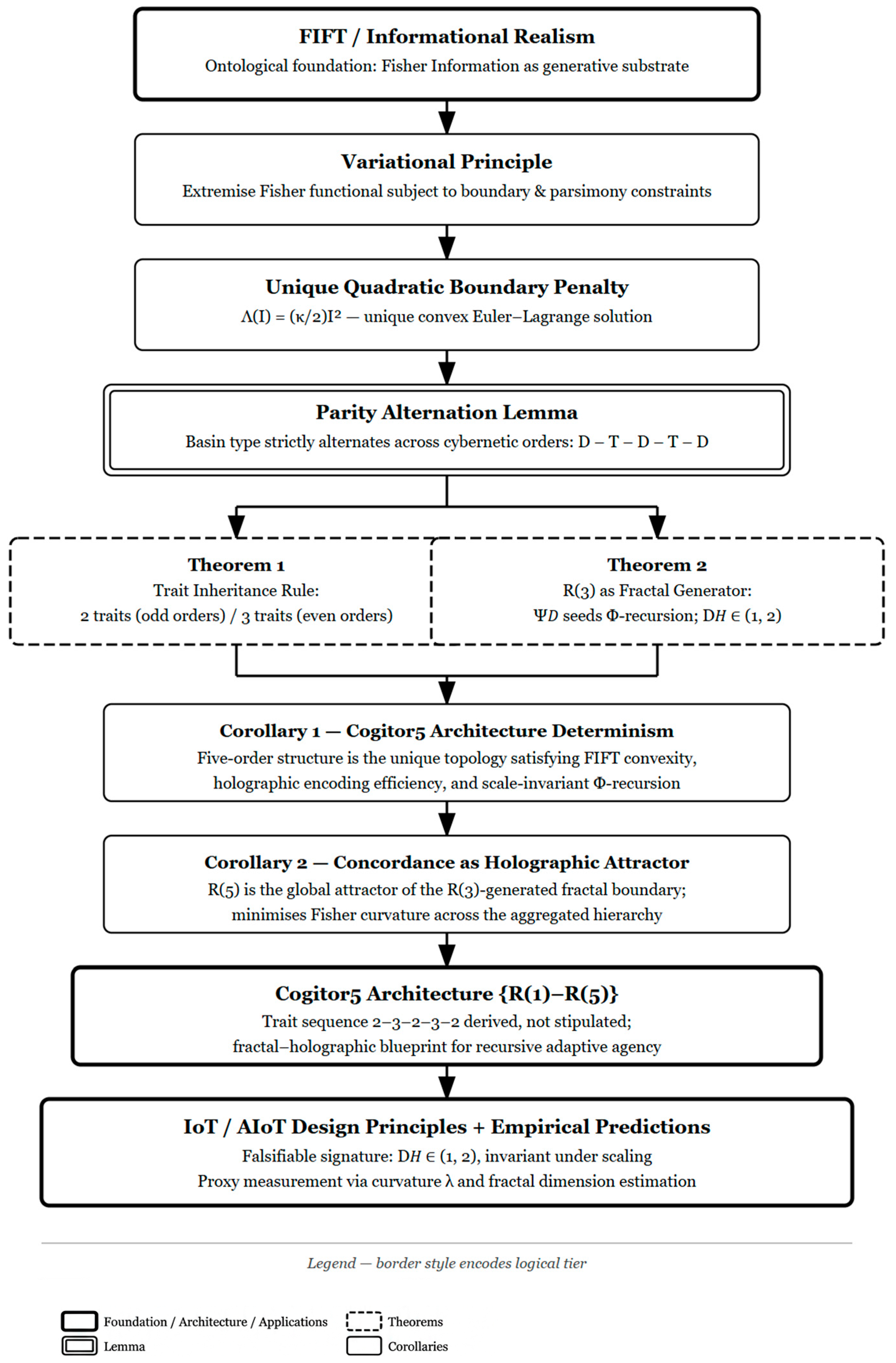
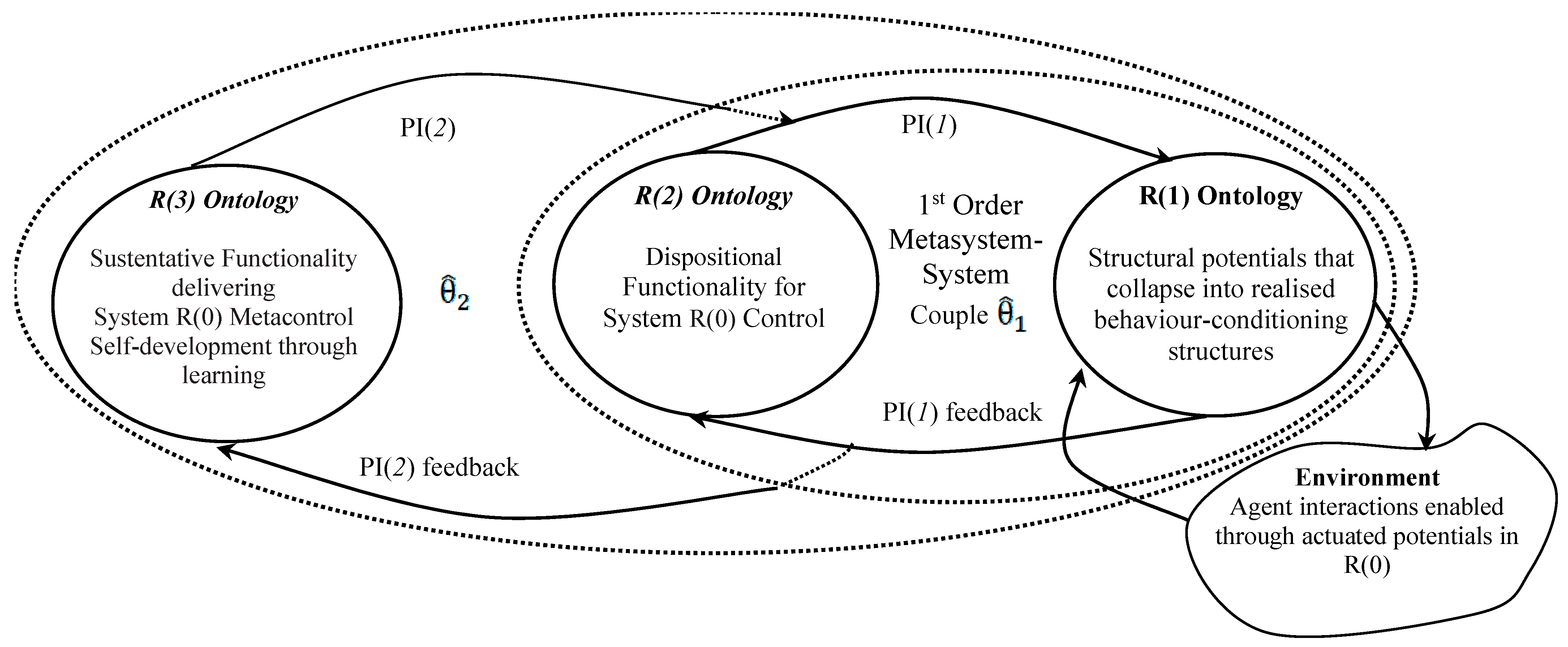
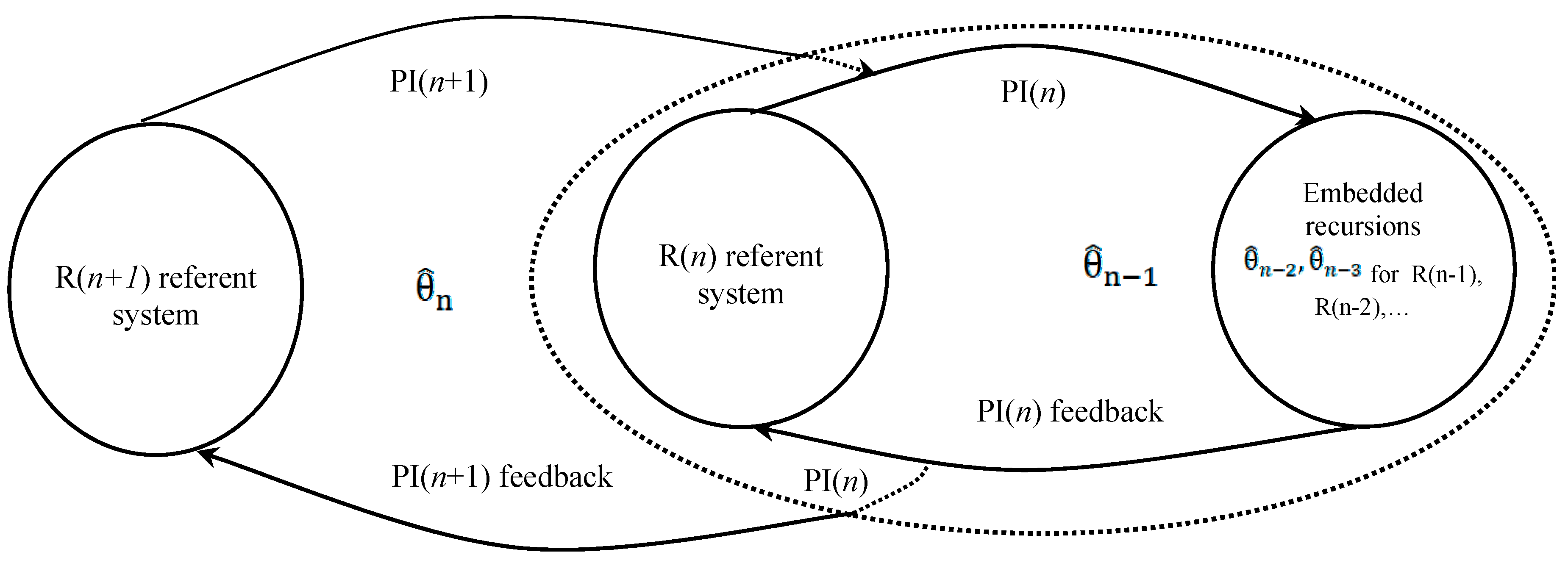
This paper extends the metacybernetic framework by grounding its conceptual descriptions in first principles of information physics. We demonstrate that for living systems to organise efficiently under uncertainty, they must adhere to a strict recursive pattern, a “fractal seed” originating in the third-order interaction between potential and action. By utilising Fisher Information Field Theory (FIFT) within an Informational Realism paradigm, we formalise this process through variational analysis on an implicate–explicate manifold. Under a rigorous informational parsimony constraint (a functional analogue of the holographic principle), we treat the J-field as the dispositional reservoir of latent potential and the I-field as the operative field of structured configurations, and show how their autopoietic coupling generates the system’s Potential–Actuation trait poles as a scale-invariant viability structure This coupling reveals that the boundary substructure, which encodes the holographic content, directly conditions the emergent superstructure through a deterministic parity rule inherited from the dyadic logic of the minimal generic living system represented by θ^2. Drawing on the application of Fisher Information, we show that maintaining informational parsimony requires the system’s architecture to oscillate: odd-numbered orders express two traits (dyads), whereas even-numbered orders express three (triads). This produces a canonical 2–3–2–3–2 sequence, preventing a combinatorial explosion of traits as systemic depth increases. We present the Cogitor5 model as a complete fifth-order exemplar of this rule, demonstrating how this rhythmic structural pattern enables self-evolution, systemic coherence, and collective intelligence in both biological and artificial agencies.
Keywords: metacybernetics; information physics; Fisher Information Field Theory; implicate–explicate manifold; informational parsimony; fractal kernel; dyadic–triadic parity; recursive orders; Cogitor5; collective intelligence metacybernetics; information physics; Fisher Information Field Theory; implicate–explicate manifold; informational parsimony; fractal kernel; dyadic–triadic parity; recursive orders; Cogitor5; collective intelligence