Article

Metacybernetics: Aspect Traits and Fractal Patterns in Higher-Order Cybernetics

Liverpool Business School, Liverpool John Moores University, Liverpool L3 8EN, UK
Systems 2026, 14(5), 496; https://doi.org/10.3390/systems14050496
Submission received: 14 February 2026 / Revised: 24 March 2026 / Accepted: 1 April 2026 / Published: 1 May 2026
(This article belongs to the Section Complex Systems and Cybernetics)

Abstract

This paper extends the metacybernetic framework by grounding its conceptual descriptions in first principles of information physics. We demonstrate that for living systems to organise efficiently under uncertainty, they must adhere to a strict recursive pattern, a “fractal seed” originating in the third-order interaction between potential and action. By utilising Fisher Information Field Theory (FIFT) within an Informational Realism paradigm, we formalise this process through variational analysis on an implicate–explicate manifold. Under a rigorous informational parsimony constraint (a functional analogue of the holographic principle), we treat the J-field as the dispositional reservoir of latent potential and the I-field as the operative field of structured configurations, and show how their autopoietic coupling generates the system’s Potential–Actuation trait poles as a scale-invariant viability structure This coupling reveals that the boundary substructure, which encodes the holographic content, directly conditions the emergent superstructure through a deterministic parity rule inherited from the dyadic logic of the minimal generic living system represented by θ ^ 2 . Drawing on the application of Fisher Information, we show that maintaining informational parsimony requires the system’s architecture to oscillate: odd-numbered orders express two traits (dyads), whereas even-numbered orders express three (triads). This produces a canonical 2–3–2–3–2 sequence, preventing a combinatorial explosion of traits as systemic depth increases. We present the Cogitor5 model as a complete fifth-order exemplar of this rule, demonstrating how this rhythmic structural pattern enables self-evolution, systemic coherence, and collective intelligence in both biological and artificial agencies.

1. Metacybernetics as a Theory of Higher-Order Cybernetics

1.1. Introduction

Metacybernetics, as developed by Yolles [1], offers a powerful framework for understanding how complex systems organise and adapt across multiple layers of complexity. These systems include living organisms, organisations, intelligent technologies, and autonomous networks, as well as systems that appear inert on observable scales yet are governed by intense hidden informational and self-organising dynamics, such as colloidal assemblies that exhibit autopoiesis, like self-maintenance and emergent order. At its heart, metacybernetics explores recursive agency: how systems regulate themselves, learn from experience, and evolve through nested levels of structure and decision-making. It provides a rigorous architecture for modelling recursive agency across nested ontological levels.
To ground this structure in physical first principles, we draw upon Frieden [2] and the perspective of information physics, which treats information as the fundamental ontological substrate of reality rather than merely epistemic knowledge. In this view, the laws of physical and biological systems emerge from the extremisation of Fisher Information [2,3,4,5]. By configuring a metasystemic recursive hierarchy within an informational-realist framework, this work derives the structural patterns of living systems directly from the geometry of information.
Contemporary cybernetics increasingly recognises that agency, cognition, and systemic coherence cannot be understood solely through mechanistic or representational models. Building on traditions in second-order cybernetics [6] (von Foerster, 2003), autopoietic theory [7], and informational ontology [8,9], this paper develops a formally grounded account in which recursion is not a descriptive convenience but an ontological generator: higher-order agencies emerge through self-referential transformations of informational structure. The central aim is therefore to demonstrate that the recursive architecture of viable agency is not merely a descriptive convenience but a necessary consequence of information-geometric first principles. This is undertaken by showing that the constraints of informational parsimony, holographic encoding, and scale-invariant recursion uniquely determine the 2–3–2–3–2 trait structure, the identification of R(3) as a fractal generator. This grounding enables a rigorous derivation of the metacybernetic hierarchy from first principles in Fisher Information Field Theory (FIFT) [5], where Fisher Information constitutes the fundamental substrate of systemic organisation.
Throughout this paper, Fisher Information (I) refers to the mathematical functional measuring parameter sensitivity, whereas the I-field denotes the morphogenetic field operator that structures reality using Fisher Information gradients. The I-field employs Fisher Information I as its organising principle, but is ontologically distinct from it: the former is a mathematical measure, the latter an operational structuring field within FIFT. In fact, throughout this paper, upright symbols denote ontologically primary qualities of the informational manifold: the fields J, I, K; derived qualities λ (imperative curvature), Λ (boundary penalty), κ (scale-invariance kernel); cybernetic orders R(n); and generative operators θ ^ , Φ. These are real, incorporeal properties within Informational Realism, not mathematical abstractions. Italicised symbols denote mathematical proxies, coordinates, and derived measures accessible to observation: probability distributions ρ(x), the Fisher–Rao metric g, coordinates x, and integer indices n, k. Where the same letter serves both roles (e.g., Fisher Information density), context and typeface distinguish ontological quality from measurable quantity. Thus, the ontological couplet θ ^ n can be represented as a mathematical proxy θ ^ n (i.e., in italics), where the former denotes the real incorporeal generative mechanism, while the latter is its estimable functional representation. They refer to the same underlying operator, but at different epistemological levels (ontological versus operational). In this application, this operator functions as the responsiveness tensor that converts informational gradients into systemic flows, as in v ( ψ ) = θ ^   λ ( ψ ) . This expresses a quantitative transformation in which the italic θ ^ n operationally generates the mapping. That is, it serves as the formal proxy that enacts the responsiveness transformation in calculable terms. In contrast, the true ontological generative mechanism is denoted by the upright form, which designates the real incorporeal source of generativity rather than its operational representation.
This paper is a formal theoretical derivation. Its guiding research question is as follows. Can the recursive trait architecture of the metacybernetic hierarchy be derived as a structural necessity from information-geometric first principles? The method is variational analysis applied to the Fisher Information functional on the implicate–explicate manifold. This yields the quadratic boundary penalty Λ(I) = (κ/2)I2, where Λ(I) is a functional that penalises deviations of the system’s informational boundary from admissible curvature, κ is the scale-invariance kernel, and we already know that I is the Fisher Information density. The quadratic form is the unique strictly convex functional consistent with the holographic parsimony constraint, and it organises the boundary into the dyadic and triadic curvature basins from which the parity rule derives. Unlike an empirical paper, this work does not report primary data or computational experiments; its empirical content consists of structural anticipations and falsifiable forecasts, in the tradition of mathematical physics applied to information science. That said, empirical illustrations of the framework have been published, are cited, and briefly described at relevant junctures within the paper.
The main contributions of this work are threefold. First, it provides a formal derivation of the canonical 2–3–2–3–2 trait-parity rule. This specifies how many traits each cybernetic order must express, and it is shown to arise necessarily from the variational structure of FIFT. Rather than being an empirical regularity or a design choice, the alternation between dyads (two traits) and triads (three traits) is demonstrated to be the only configuration that preserves informational efficiency as a system becomes more complex.
Second, the analysis establishes that the third cybernetic order, R(3), functions as the system’s fractal generator. To understand why this is so, and why it must be R(3) rather than any other order, it is necessary to consider what fractal generation requires and what the first two orders can and cannot provide.
R(1) is the base dyadic order. It establishes the operative signature of the hierarchy, the primitive polarity between enacted output and its directional orientation, but it has no prior structural level to recur against. Fractal generation is iterative self-reference: the same organising logic applied to a class of outputs that mirrors its own inputs in structure. R(1) has inputs but no prior structural mirror; iteration in the required sense is unavailable to it. R(2) is the first triadic order. Its function is distributive and stabilising: it spreads informational tension across three orthogonal dimensions (the cognitive, affective, and conative axes) to achieve equilibrium. A stabiliser absorbs structural energy and holds it in balance; it does not propagate a generative pattern. R(2) is a product of the parity alternation, not a driver of it. Neither order can generate what only R(3) can: a self-similar bifurcation logic that seeds every subsequent level.
R(3) occupies a unique structural position. It is the first odd order that sits immediately above an even order, placing it simultaneously in two roles: it is generated by the triadic R(2) below it, and it actively seeds the next iteration of the alternation above it. This dual position is decisive. The decision operator at R(3) is the first in the hierarchy to act on a class of outputs that structurally mirror its own inputs, and that is the precise geometric condition for fractal generation. The paper derives this formally from the Fisher Information functional. When that functional is extremised under holographic encoding constraints, the boundary penalty takes a uniquely quadratic form. A quadratic penalty has a positive second derivative, which means that informational gradients resolve through exactly two stable branches: a dyadic bifurcation. This is not a design choice. It is what mathematics requires at odd orders. Each application of the R(3) decision operator maps latent potential to incipient actuation through this binary choice, producing outputs that are structurally identical in form to its inputs, scaled to the next level. The integrity couplet operator sequence carries this self-similar logic upward through the hierarchy, and the congruence relation it satisfies (each operator related to its predecessor by a similarity transformation that preserves the functional form under scaling) establishes the sequence as formally fractal.
The consequence is that once the structure at R(3) is fixed, the architecture of every subsequent order follows deterministically. Each even order above R(3) must instantiate the triadic stabilising form; each odd order must instantiate the dyadic generative form. The 2–3–2–3–2 trait pattern is not an empirical regularity observed across levels: it is a necessary consequence of this fractal recursion propagating from its generator. Theorem 2 formalises this result. The recursive operator at R(3) does not merely influence subsequent orders, but seeds the entire hierarchy. This also explains why R(3) identity dissolution is the most structurally consequential failure mode in the architecture. It does not disrupt a single level but rather destroys the generator from which every higher level derives its organisational form, producing cascade effects that are qualitatively unlike failures at any other order.
The third contribution demonstrates that the Cogitor5 architecture [10] constitutes the unique deterministic topology that satisfies the three structural constraints derived from the theory. Cogitor5 is a fifth-order cybernetic agency model that operationalises metacybernetic principles within synthetic and informational systems. Its highest-order referent, the Concordance System at R(5), functions as a holographic integrator, synthesising information from all lower orders into a coherent directive without informational overload. This integrative role parallels the large-scale coordination observed in the brain’s default mode network, which supports the global integration of distributed neural processes into unified, self-referential patterns of activity [11]. In this sense, the Concordance System does not merely aggregate information, but enacts a higher-order coherence in which distributed informational states are recursively aligned into a unified operational field. The trait architecture across the five orders follows the canonical 2–3–2–3–2 parity sequence, not as a design choice but as the necessary consequence of fractal recursion propagating from R(3), and Cogitor5 is the concrete fifth-order realisation of that necessity.
The three structural constraints that identify Cogitor5 as the unique viable architecture of this kind are as follows. Fisher convexity is the requirement that the system follow an information-optimal trajectory. At each recursion order, the Fisher functional must be extremised in a way that preserves the convexity of the boundary penalty. Any architecture that violates this condition introduces informational waste, producing configurations that cannot be sustained under the curvature dynamics governing viable agency. Encoding efficiency is required so that no order introduces redundant informational structure. Each order must contribute a genuinely new degree of closure, not merely replicate the organisation of an order below it. This constraint rules out architectures with fewer than five orders (which fail to achieve the full closure sequence) and those with additional orders inserted without structural necessity. Scale-invariant θ ^ n -recursion is the requirement that the integrity-couplet operator reproduces the same decision-boundary logic at every order through similarity-preserving transformations, making the entire cybernetic hierarchy a fractal extension of the third-order generator. In practical terms, this means that the operator governing the transition from order n to order n + 1 must be a similarity transformation of the operator at order n 1 . By this is meant that each level of the system must be generated by the same underlying rule, even if the scale or numerical values change. A similarity transformation is a mathematical way of saying that two processes have the same shape or same internal logic, even if one is stretched, compressed, or re-parameterised relative to the other. In everyday terms, it is like taking a pattern and enlarging it or shrinking it without altering its proportions. The details may change, but the structure stays the same. Applied to the integrity-couplet operator, this means that the rule the system uses to resolve potential into action at one level must be recognisably the same rule it uses two levels below, just expressed at a different scale. The system cannot invent new logic at higher-orders; it must reuse the same decision-making structure in a self-similar way. The transformation may rescale or re-parameterise the operator, but it must preserve the underlying decision-boundary logic that defines how latent potential and actuation tendencies are resolved into trait poles. Because the same structural rule applies at every level, the operator generates a self-similar sequence of trait organisations across the hierarchy.
This property is the formal expression of the fractal character established at R ( 3 ) , where the first non-trivial integrity couplet appears, and the parity alternation is initiated. Once this third-order structure is fixed, all higher-orders inherit its logic via scale-invariant recursion. This is precisely the constraint that links the concrete Cogitor5 architecture back to the abstract Proof of Theorem 2: the architecture is valid only because its fifth-order topology is a consistent, similarity-preserving extension of the third-order fractal generator.
Together, these three constraints do not merely characterise Cogitor5 as one possible architecture among several. They identify it as the only viable fifth-order architecture compatible with the theory. No fifth-order design that violates Fisher convexity can sustain an information-optimal trajectory. No design that violates encoding efficiency can achieve genuine recursion rather than repetition. No design that violates scale-invariant θ-recursion can claim the fractal character that the derivation from R(3) requires. Cogitor5 satisfies all three simultaneously, and the paper demonstrates formally that no other fifth-order topology does so. This result transforms Cogitor5 from an illustrative model into a prescriptive blueprint. For biological systems, it specifies the structural conditions that any agency must satisfy to achieve fifth-order viable closure. For artificial systems, including IoT networks, AIoT architectures, and autonomous agents, it provides a deterministic specification: not a design to be approximated or inspired by, but a topology to be instantiated. The claim carries empirical weight precisely because it is derived rather than proposed; the constraints are not chosen to fit Cogitor5, but Cogitor5 is shown to be the unique architecture that satisfies constraints derived independently from the informational physics of recursive agency.
The methodological approach unfolds in three integrated steps. It begins with an ontological commitment that treats Fisher Information as the primary substrate of systemic organisation, which in turn justifies the use of variational methods as the engine of derivation. This leads to a formal stage in which extremisation of the Fisher functional yields the quadratic boundary penalty and, from it, the parity-dependent trait structure and the identification of R ( 3 ) as the generative pivot of the hierarchy. A final interpretive stage connects these formal results to agency design, showing that the Cogitor5 architecture uniquely satisfies the derived constraints and specifying the structural predictions that follow.
This framework fulfils a role that earlier approaches (such as the Viable System Model [12,13], autopoiesis theory [7,14], and conventional complexity science [15,16,17]) do not. It derives the architecture of recursive adaptive agency from first principles rather than stipulating it. It enables the trait cardinality of any cybernetic order to be inferred directly from its parity, predicts that viable decision boundaries exhibit fractal geometry, and provides a curvature-based diagnostic for identifying systemic incoherence. It therefore functions simultaneously as a unifying theoretical account and as a structural diagnostic instrument.
Three claim types are distinguished. The formal results consist of the theorems and corollaries that follow deductively from Fisher extremisation. The conceptual interpretations map these results onto the Cogitor5 trait architecture. The anticipatory extensions concern the implications for AIoT, quantum-cybernetic, neuroscientific, and social-cybernetic systems; these arise from applying the formal results to any agency satisfying the derivation conditions. Cross-scale systemic coupling can be observed in globalisation metrics such as the Kearney Global Cities Index [18], where shifts in informational openness and structural integration correspond to curvature transitions predicted by the model. These examples illustrate how the formal results generalise across biological, social, and technical domains without requiring phenomenological equivalence. The only speculative element is the proposal to embed FIFT within quantum circuit architectures, explicitly identified as a research horizon.
The theoretical constructs introduced here are empirically accessible only through proxies. Fisher Information density can be estimated from the score-function variance, while curvature λ = J/I (the qualitative ratio of dispositional inertia to operative respon-siveness) can be inferred from the relation between dispositional lag and adaptive reac-tivity. Volatility measures in social or conflict datasets provide estimates of symbolic pressure Π and its rate of change dλ/dt. In geopolitical applications, these quantities can be operationalised through indices such as the Geopolitical Risk Index (GPR), which captures exogenous symbolic shocks and their propagation through systemic curvature [19]. Macroeconomic fragility can be similarly inferred from productivity volatility relations, where structural stagnation amplifies curvature sensitivity [20]. These proxies allow the framework to be applied to real systems, where λ trajectories, symbolic pressure, and fragility indices can be inferred from public data. When λ crosses its critical threshold λcrit, the Parity Alternation Lemma predicts a basin transition that appears as a phase shift in system dynamics.
The evolution of cybernetics from first-order regulatory mechanisms to higher-order recursive systems has increasingly necessitated frameworks capable of modelling not only adaptive behaviour, but the very architecture of agency itself. Classical cybernetics, rooted in feedback and homeostasis, provided a foundational language for stability and control [7,8,21,22]. Second-order cybernetics introduced the observer into the system, foregrounding reflexivity and the construction of meaning [23]. A parallel but often under-recognised development of third-order cybernetics also emerged during this period in the work of Stafford Beer [12,13]. Although Beer did not explicitly articulate a higher-order ontology, his Viable System Model implicitly operated beyond second-order recursion; however, the absence of a formal ontological account meant that his contribution was widely interpreted as an extension of second-order cybernetics rather than an early expression of third-order principles. Parallel developments in biological modelling, such as the Jansen–Rit thalamocortical oscillator model [24], demonstrated how recursive bifurcation dynamics generate coherent oscillatory regimes in neural systems, providing a natural analogue for R(3)’s generative role. Likewise, hierarchical models of prefrontal control [25] illustrate how structural reformulation at higher orders mirrors the metanoetic function of R(4). These developments collectively motivate the need for a formally grounded metacybernetics capable of capturing recursion not merely as feedback but as an ontological generator of agency.
Yet a coherent, formally grounded theory of orders beyond the second, a metacybernetics, has remained an open theoretical frontier. Such a theory must account for how agencies, understood as autonomous, self-producing systems, organise themselves across nested ontological levels, sustain viability under uncertainty, and generate complex behaviour through recursive informational dynamics.
To address this gap, we develop a formal geometric theory of higher-order cybernetics grounded in FIFT. Building on the premise that physical and biological laws can be derived from the extremisation of Fisher Information [2], we treat information not as a secondary metric but as the fundamental substrate of systemic organisation. By applying FIFT within an informational-realist paradigm, we move beyond the metaphorical descriptions of previous metacybernetic models to provide a principled, deterministic route for deriving the recursive architecture of agency from first principles in information physics.
The paper makes three core contributions. In Contribution 1, a formal derivation of trait cardinality is delivered, the canonical 2–3–2–3–2 trait pattern, derived from first principles in FIFT via variational analysis. It is the unique Fisher-optimal trajectory through agency state configuration. In Contribution 2, the identification of R(3) is made as a fractal generator; the third-order sustentative system R(3) is proven to constitute this generator whose iterative bifurcation logic propagates the parity alternation across all subsequent cybernetic orders. Finally, Contribution 3 is the fractal–holographic synthesis. This constitutes a fractal decision boundary generated at R(3), which is formally shown to accumulate recursively into the holographic attractor at R(5), resolving the autopoiesis–autogenesis gap and providing a deterministic blueprint for the Cogitor5 architecture.
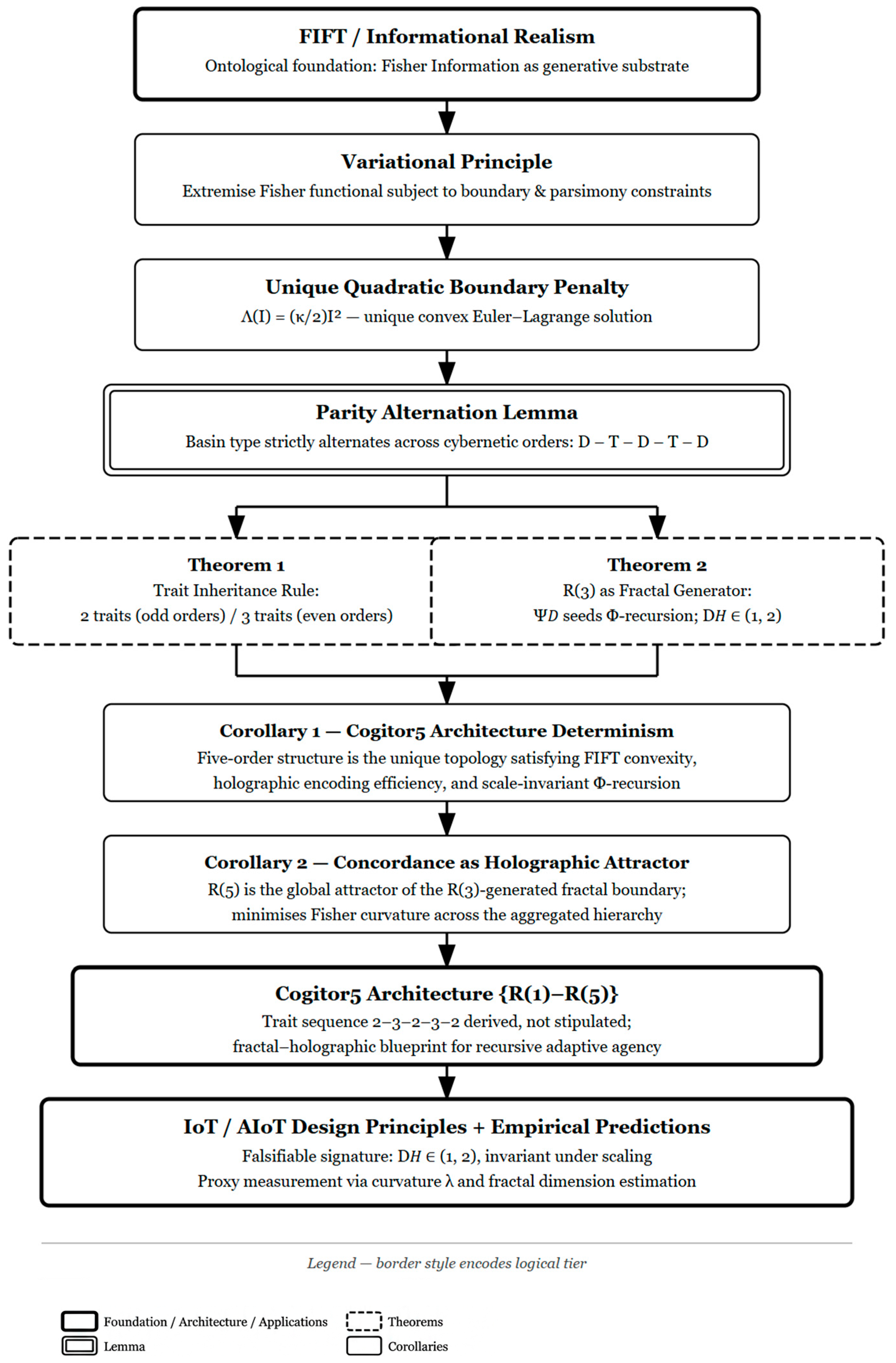
In Figure 1, we provide a chart of the logical flow of the argument in this paper. The derivation proceeds from the ontological foundation (FIFT/Informational Realism) through four formal steps (variational extremisation, quadratic boundary penalty, parity-dependent bifurcation, and fractal recursion), yielding two theorems and two corollaries that culminate in the Cogitor5 architecture and its IoT/AIoT design implications.
The trait structures analysed in this paper originate in Mindset Agency Theory, which has been developed progressively since its initial formulation in a foundational monograph [26] and subsequently elaborated through three books and more than fifty peer-reviewed publications. Across the three primary aspects (cognition, affect, and Conative-Spirit), the theory specifies 36 distinct traits that together characterise the agency system, distributed as 12 per aspect across recursion orders R(1) through R(5) in the characteristic 2–3–2–3–2 parity configuration. The intellectual genealogy of this trait architecture is instructive. Mindset Agency Theory grew from the mindscape polarity framework of Maruyama [27], who identified distinct cognitive orientation types (each with characteristic patterns of perception, reasoning, and value), as structurally irreducible to one another. This framework was reformulated through the autopoietic systems thinking of Eric Schwarz [28], which provided the recursive self-organising structure within which mindscape polarities could be embedded as aspect-specific trait pairs. It was then elaborated and empirically grounded through the cross-cultural value universals of Shalom Schwartz [29], whose work demonstrated that orthogonal value dimensions recur reliably across populations and instruments, lending structural depth to the polarity principle.
The resulting trait architecture in Mindset Agency Theory thus has a threefold origin: Maruyama’s structural polarity of cognitive orientation, Schwarz’s autopoietic recursion, and Shalom Schwartz’s empirical value universals. This genealogy contrasts sharply with the inductive traditions of Allport [30] and McCrae and Costa [31]. Allport’s lexical survey of personality-relevant terms and McCrae and Costa’s factor-analytic programme both proceeded from observed behavioural and self-report variance, identifying trait dimensions as empirical clusters. The resulting structures (Allport’s extensive catalogue and the Five-Factor Model) carry no derivational necessity. They reflect the covariance structure of human personality as sampled across populations and instruments and are silent on the generative architecture that produces trait structure in the first place. By contrast, the traits in Mindset Agency Theory (and in the present paper’s formalisation) are deduced from the structural requirements of Fisher functional extremisation applied to a recursive agency architecture. Each trait pair (intangible pole Θ and tangible pole Ψ) is a necessary consequence of the parity constraints imposed at each recursion order, not an empirical generalisation. The 2–3–2–3–2 rhythm across R(1)–R(5), yielding 12 traits per aspect and 36 in total, is a theorem of the architecture rather than a count of observed regularities. With respect to R(3), each aspect realises the same closed seven-trait viability sub-schema, structured in the characteristic 2–3–2 configuration across R(1)–R(3), which functions as the fractal-generative nucleus from which higher-order trait structure propagates. Cognitive trait structures were introduced in preliminary form in early work [32], affective traits were formally articulated in Yolles and Fink [33], and spirit traits were first introduced in Yolles [34], and subsequently reconceptualised as conation in Yolles and Chiolerio [10]. The present paper does not revise this corpus; rather, it formalises the R(3) closure condition and explicates how this invariant seven-trait sub-schema functions as a fractal prototype for trait inheritance across aspects and higher-order agency configurations.
Methodologically, the paper adopts a theoretical framework predicated on an informational-realist stance, treating Fisher Information as the fundamental ontological substrate of systemic organisation rather than a merely statistical or epistemic tool. This stance is grounded in the axioms of FIFT: information is ontologically primary, the J-field (dispositional, pre-geometric reservoir of raw potential) and I-field (operative, autopoietically structured configurations) are real, incorporeal, pervasive fields with dual implicate–explicate structure and three distinct Superposition regimes (raw, organised, residence). In contrast to Frieden’s Extreme Physical Information (EPI), which extremises the information loss J − I to recover observer-relative physical laws from data, FIFT operates at a deeper ontological level: J and I form an autopoietic couple where contextual imperatives induce J-perturbations that are organised into Fisher Information Topologies (FITs) in the I-field. Physical laws emerge as invariants of these recursive dynamics, not foundational primitives. Viability and agency are governed by the imperative curvature ratio λ = J/I (rather than J − I), from which all coherence conditions derive. Variational analysis on the implicate–explicate manifold, subject to holographic parsimony and mean-curvature constraints, yields the unique quadratic boundary penalty Λ(I) = (κ/2)I2 (the minimal convex functional consistent across scales) from which recursive, self-similar decision boundaries and the trait parity rule emerge as structural necessities.
The informational fields of FIFT also admit a recursive interpretation across metacybernetic orders. Each cybernetic level R ( n ) contains an implicate phase space that conditions an explicate informational field, the two remaining dynamically entangled through informational processes. At the operative level R ( 1 ) this explicate structure appears as the I-field, where Fisher Information Topologies organise operative configurations. At the dispositional level R ( 2 ) , the same informational relation is encountered from a metasystemic perspective as the J-field, representing the reservoir of latent informational potential from which operative configurations arise. At the sustentative level R ( 3 ) the relation appears as the K-field, which stabilises coherence across the recursive hierarchy and regulates the coupling between potential and actualisation. Because each cybernetic order is generated recursively from the metasystem relation between preceding orders, the informational fields satisfy the relation F R n + 1 = f ( F ( R n ) ) . Consequently, the sequence I J K preserves the same generative informational relations while appearing at successive recursion depths, forming a fractal informational structure in which the same field dynamics recur within a given or across different scales of cybernetic organisation.
Fractal holographic encoding, as used in this paper, means two related things. The holographic component means that the agency’s boundary surface encodes sufficient information to reconstruct the full internal (bulk) structure of the system, analogous to how a holographic plate encodes a three-dimensional image in a two-dimensional surface. The fractal component means that this encoding is self-similar across scales: the same informational logic governing a single agent’s decision boundary also governs the collective boundary of the system at higher cybernetic orders. Together, fractal holographic encoding means that scale-invariant boundary information is both necessary and sufficient for reconstructing the system’s recursive architecture at any level.
Structurally, the paper is organised into two integrated parts. Part I revisits and extends the metacybernetic hierarchy, clarifies its recursive architecture, and presents Cogitor5 [10] as a worked fifth-order exemplar. Part II delivers the core theoretical derivation: grounding the hierarchy in FIFT, proving the fractal generativity of R ( 3 ) , and analysing the implications for trait inheritance, informational parsimony, and the design of intelligent adaptive systems. The paper concludes with future research pathways, emphasising empirical validation through proxy measurement and interdisciplinary integration.
In summary, this work does not merely describe higher-order cybernetics; it derives its necessary structure from informational geometry, offering an anticipatory and generative framework for understanding and designing complex adaptive agencies in an increasingly recursive world. The framework enables agencies to anticipate viable trajectories through their internal recursive dynamics, a forecasting method in which systems co-constitute their environment through organisational coupling. Given the conceptual density of the development, a glossary is provided in Appendix A.

1.2. Metacybernetics

Metacybernetics, articulated as a theory of higher-order ontologically based cybernetics, has its origin in the pioneering work of authors such as Eric Schwarz [28,35], Magoroh Maruyama [36], Shalom H. Schwartz [29], and Maurice Yolles and Gerhard Fink [33]. This framework is principally concerned with the structural and parametric modelling of Complex Adaptive Autopoietic Systems (CAASs), systems that are not only self-producing (autopoietic) but also adaptively responsive to environmental complexity, maintaining viability through recursive self-organisation across multiple ontological layers.
Autopoiesis supplies the ontological precondition for the formal derivation that follows. By establishing organisational closure (the self-production of the boundary that separates system from environment), autopoiesis licences the treatment of the agency as a bounded statistical manifold with a definite interior and a localised boundary surface. This is not a trivial step: the boundary penalty Λ(I) = (κ/2)I2, from which the fractal structure and parity alternation of the recursive operator are derived, acts on that boundary surface. Without organisational closure, there is no principled surface on which to localise Λ(I), and the variational derivation loses its geometric grounding. FIFT then characterises the geometry of the boundary that autopoiesis produces. The two frameworks are therefore complementary in a precise sense: autopoiesis defines what kind of entity the agency is; FIFT defines how the informational structure of that entity is shaped. The foundational concept of autopoiesis originates with Maturana and Varela [14], who defined living systems as self-producing unities that maintain their organisation through continuous internal regeneration. Varela, Thompson, and Rosch [37] later extended this into enaction theory, which posits that cognition is not representation but embodied action, a process of bringing forth a world through sensorimotor coupling. This enactivist turn reinforces the view that living systems are not passive observers but active participants in co-creating their environments, a position Thompson [38] grounds in the continuity of mind and life, arguing that cognition arises through the same processes of self-organisation that constitute living systems themselves. This principle undergirds the CAAS model within metacybernetics.
Parallel theoretical currents (notably Luhmann’s account of social systems as autopoietic communication networks [39] and Spencer-Brown’s calculus of distinctions as a formal logic of self-reference [40]) reinforced the view that recursive self-production is a general organisational principle spanning biological, social, and formal systems.
The trait-theoretic foundation of this framework was substantially developed by Yolles and Fink [33] and has since been elaborated in subsequent works, including applications to market capitalism [34], ecological cybernetics [41], and the cognitive dynamics of belief systems [42]. This evolving trait-based approach builds on earlier work in value theory and mindscape polarity [27,28], providing a diagnostic lens through which the structural and dynamic properties of CAAS can be systematically analysed and modelled. As a general theory of higher-order cybernetics, metacybernetics offers a coherent architecture for modelling recursive organisation, ontological plurality, and systemic viability [28] in CAAS. Since its formal articulation [1], it has been developed through applications spanning organisational diagnosis, market dynamics, ecological systems, and belief dynamics, demonstrating both theoretical and practical utility.
The number of orders instantiated in any given model is not arbitrarily chosen. It is determined by the constitutive requirements of the agency being modelled. Each order answers one structural question that is unavailable at the order below: without R(3), autogenesis cannot be achieved; without R(4), automorphosis is unavailable; without R(5), collective concordance is absent. For the Cogitor5 model, five orders constitute the minimal complete realisation of those particular requirements. However, this does not imply a universal upper bound. In principle, for any agency whose constitutive requirements extend further, R(n) may denote the highest referent order for any n, and the recursive architecture remains open. The only limit on n is the meaningful context of the agency under study. Each additional order must answer a constitutive question that the preceding order cannot, and the hierarchy closes when no such question remains unresolved. This distinguishes the framework from arbitrary hierarchical proliferation on the one hand, and from a fixed ontological ceiling on the other. The recursion is generative rather than stipulative, and closure is achieved locally by sufficiency, not globally by decree.
Collectively, these works establish a metasystemic approach in which agencies, whether individuals, organisations, biological entities, or social systems, are understood as adaptive, reflexive structures that sustain stability and coherence across nested orders of complexity. Within this architecture, each agency operates as a CAAS: a self-producing, self-regulating, and self-evolving generic living system whose behaviour emerges from the dynamic interplay between its internal trait topology and the curvature of its informational environment, an interplay that is fundamentally enactive in nature and consistent with Bateson’s [43] conception of systemic mind–environment coupling.
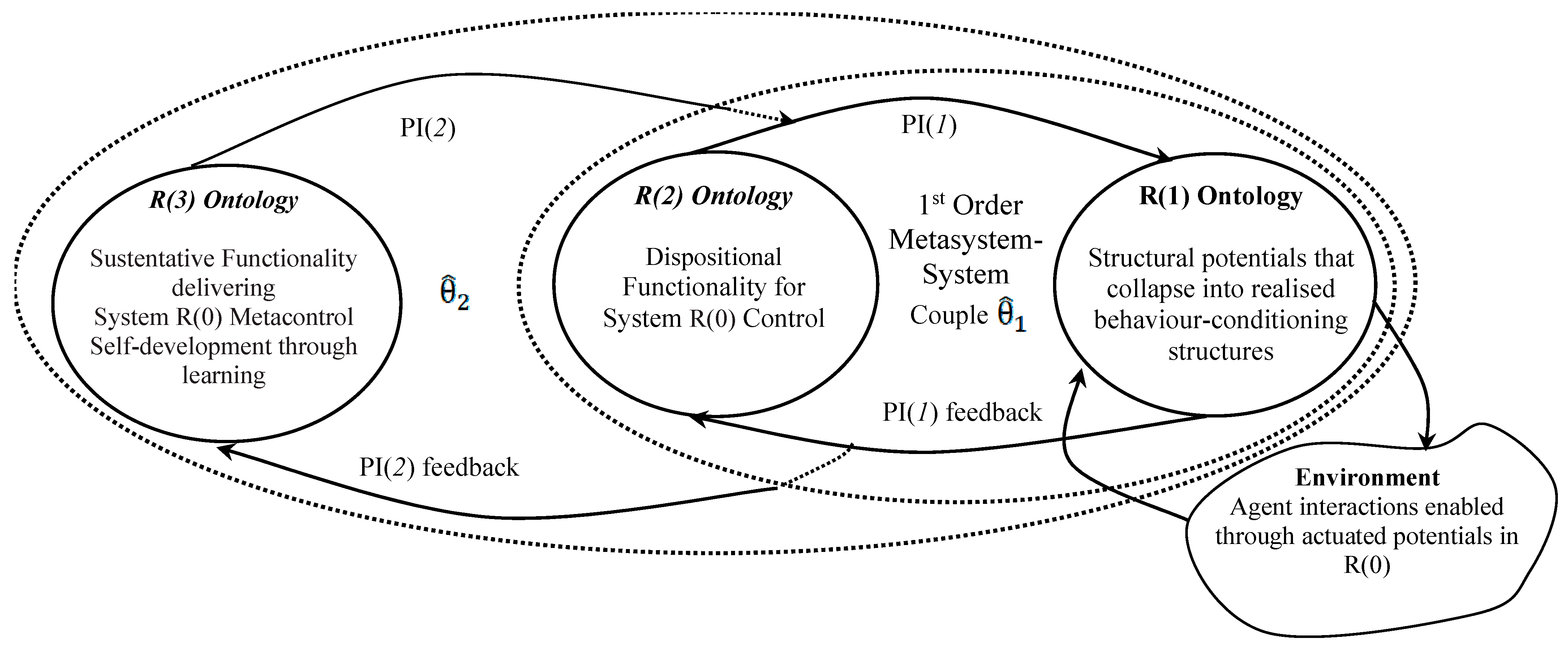
At the core of the theory lies the metasystem hierarchy (Figure 2), which governs recursive reflexivity through two orthogonal forms of recursion. Horizontal recursion embeds one metasystem within another, forming a sequence of higher-orders (nn + 1), while vertical recursion manages internal regulation by feedback within each level. This conception aligns with Beer’s [13] recursive metasystem architecture and Boulding’s [44] hierarchical ontology of system levels. Each order defines a distinct ontology linked by the Process Intelligence (PI). First-order systems correspond to directly observable phenomena; second-order systems involve observer–observed coupling; and third-order systems comprise three interacting ontologies: the operative, the strategic–regulatory, and the metasystemic. In Figure 2, PI(1) is autopoiesis or self-production, and PI(2) is autogenesis or self-creation/generation.
Extending the recursive logic of the metasystem hierarchy, the third order introduces autonomous component subsystems that mutually stabilise one another. Here, the focus shifts from observation (central to second-order cybernetics) to agency as the fundamental organising unit. Agency becomes the integrating principle through which recursive viability, anticipation, and autopoiesis are sustained. In this structure, the generative operator θ ^ 2 maps the metasystem pair R 1 ,   R ( 2 ) into R ( 3 ) , establishing the sustentative domain as the pivot of recursive organisation.
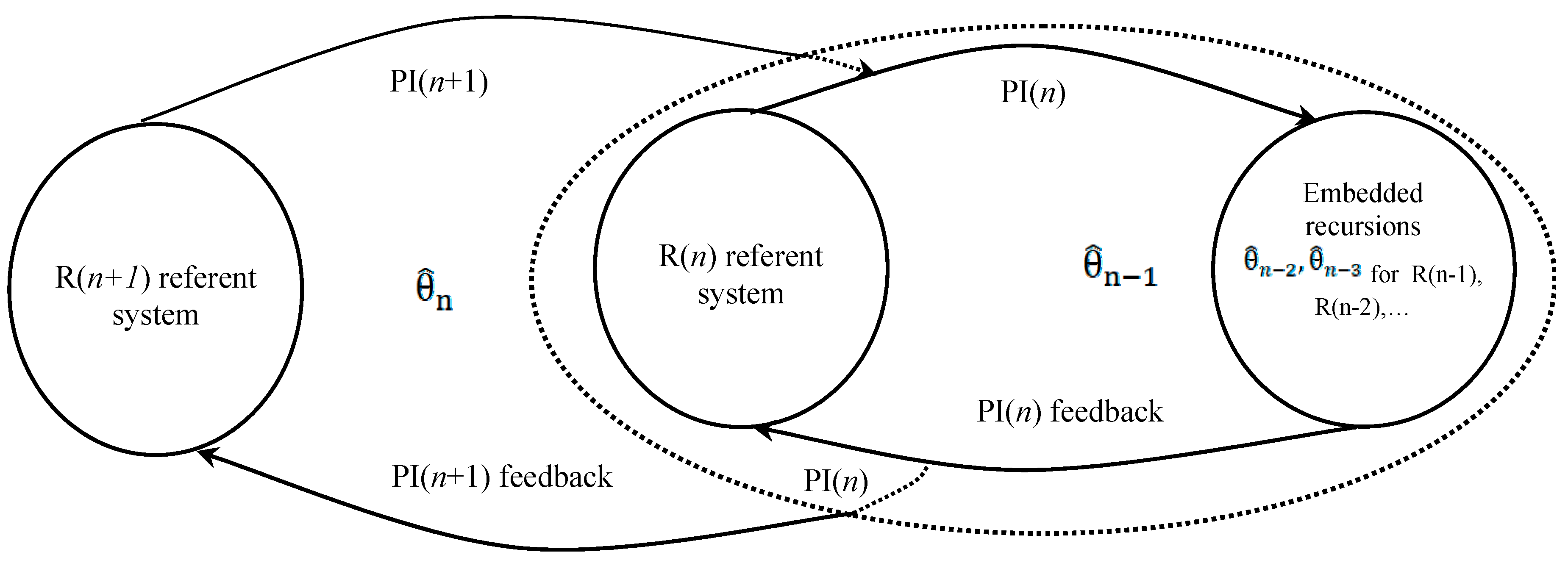
Now, θ ^ is the generative template for higher-order organisation, defining the triadic configuration of operative, regulatory, and metasystemic domains while introducing the fractal structure governing trait scaling. In this arrangement, R(3) functions as the boundary (both fractal and holographic) that constrains the system. Here, the operator θ ^ couples R(1) and R(2) to produce R(3), establishing the systemic unity of the operative R(1) and the autopoietic R(2), forming the basal couple from which all higher recursion emerges. Each order R(n + 1) is generated recursively via the operator θ ^ n , which acts on the pair (R(n − 1), R(n)) and pulls back the boundary functional Λ ( I ) to determine the curvature structure of the next order. Thus θ ^ n acts as the generative rule for the hierarchy. In the formal treatment of Part 2, this generative function is the mechanism by which each new recursion order is called into existence by the structural inadequacy of the metasystem pair below it. For each cybernetic order n 2 , the generative operator
θ ^ n :   R ( n 1 ) ,   R ( n ) R ( n + 1 )
is the scale-recursive transformation that produces the next cybernetic order from the metasystem pair immediately below it. It acts by pulling back the boundary functional Λ ( I ) to the n 1 ,   n metasystem, enforcing the curvature constraints that determine the admissible structure of R(n + 1). Thus, as shown in Figure 3, θ n functions as the generative rule at each recursion depth, producing the next order from the metasystem pair below it; the emergent integrity couplet that results is denoted θ ^ n + 1 . Higher-order process intelligences PI(n) are defined by context.
Metacybernetics does not stipulate an upper bound on the cybernetic order n. The recursive operator ( θ ^ n ), the integrity couplet operator) is, in principle, unbounded, consistent with the general theory. Cogitor5 closes at five orders, not because six or more are impossible, but because five orders are sufficient to satisfy all constitutive requirements of the specific agency type being modelled. Any instantiation terminates when its defining purposes are met; the generic recursion remains open. This distinguishes the framework from infinite regress, which arises when each step demands a further step without closure. Here, closure is achieved locally by sufficiency, not globally by a ceiling.
This recursion underlies the canonical 2–3–2–3–2 alternation of trait cardinalities, ensuring that the Potential/Actuation dyad at R(3) propagates its fractal signature consistently across higher ontological levels. The Process Intelligences (PI) are the recursively emergent functional capacities generated at each metasystemic transition, each corresponding to the operative configuration produced when the generative operator acts upon the inherited dispositional residues of the preceding order. In the fifth-order cybernetic ontology, Cogitor5, which we shall discuss shortly, these are identified as follows: PI(1) is autopraxis (operative execution and environmental coupling); PI(2) is autopoiesis [14], governing the self-production of the dispositional system; and PI(3) is autogenesis [45], the capacity of the sustentative system to generate viable states. Extending to the higher-orders defined in this model, PI(4) emerges as automorphosis (structural self-evolution of the Metanoetic System) and PI(5) as autosynesis (holonomic self-integration across the full hierarchy). These functional capacities form the theoretical basis for the system descriptions and trait values detailed in the sections and tables that follow.
The alternation carries a temporal as well as a structural meaning. Dyadic phases (odd orders R(1), R(3), R(5)) are phases of binary resolution: the system confronts a Potential/Actuation frontier and resolves it through a two-branch bifurcation, a moment of decision and directional commitment. Triadic phases (even orders R(2), R(4)) are phases of distributed stabilisation, and tension is held across three orthogonal realms (cognitive, affective, conative) simultaneously, preventing premature closure and maintaining adaptive flexibility. The transition from dyadic to triadic phase is triggered when imperative curvature λ = J/I crosses a local threshold, when the system can no longer resolve its informational tension through binary bifurcation and must distribute it triadically. The reverse transition occurs when triadic distribution achieves a new equilibrium, reducing λ below threshold and enabling the next dyadic resolution. This rhythm is not externally imposed; it is an intrinsic consequence of the quadratic boundary penalty and the parity alternation of the recursive operator.
It is essential to recognise that the system θ ^ n also acts as a generic operator. This means that the structural configuration of a given order is not merely a static descriptive framework, but serves as the active functional logic that generates the subsequent order. In this role, the internal architecture of the system θ ^ n functions as the transformation rule that processes the inherited dispositional residues of the preceding system to produce the next emergent state. Consequently, the seven-trait schema of the system θ ^ 2 , for example, is not simply a classification of traits, but the operative kernel that drives the formation of higher-order structures.
This θ ^ n -structured recursion underpins the 2–3–2 trait architecture central to Mindset Agency Theory (MAT), where the scaling of cognitive, affective, and conative potentials follows the same autopoietic logic: each higher-order trait configuration emerges from the coupling of its lower-order subsystems through a recursively inherited θ ^ -operator.
Within this framework, the principle of structural information (derived from Frieden’s [46] Fisher Information conceptualisations) complements the recursive architecture by quantitatively linking ontological domains. Applications to virology [47] have shown that even minimal living agencies, such as viruses, exhibit strong and weak forms of anticipation, consistent with Rosen’s [48] account of anticipatory behaviour in minimal biological systems, integrating autopoiesis and environmental coupling through nth-order ontologies [7]. Similarly, modelling of consciousness [49] as the emergent coupling of sapience and sentience demonstrates how third-order reflexivity can generate higher cognitive coherence through information-structural interactions, aligning with Thompson’s [38] enactive account of consciousness as embodied–reflective integration.
Building upon these foundations, Mindset Agency Theory (MAT) integrates metacybernetics with personality, cultural, and psychohistorical modelling. Mindsets emerge from formative aspect traits distributed across three interdependent aspects (cognitive, affective, and Conative-Spirit), each corresponding to a recursive plane of agency. The cognitive aspect governs epistemic processing and reflexive learning; the affective aspect shapes emotional schema and figurative orientation; and the conative aspect regulates volitional energy, purpose, and operative intent. Derived from Schwartz’s value theory and Maruyama’s mindscapes, MAT represents traits as bipolar enantiomers, their relative balance or asymmetry determining systemic coherence and viability.
Given these admissibility constraints, no additional traits beyond the canonical seven satisfy irreducibility, viability, relevance, and polar independence simultaneously. Candidate extensions consistently resolve into contextual expressions, state variables, or higher-order emergent effects rather than independent sustentative dimensions. The seven-trait configuration, therefore, constitutes a closed and minimal viability set for the Generic Living System, at θ ^ 2 , which is the system defined by the R(1)–R(3) structure and represents a base CAAS model, rather than an artefact of selective modelling. Because θ ^ 2 is both minimal and closed, its dyadic Potential–Actuation structure necessarily functions as a scale-invariant generative kernel; in this precise sense, θ ^ 2 is fractal because it is minimal.
This cross-aspect symmetry ensures that the sustentative domain R(3) forms a coherent and scale-invariant kernel from which higher cybernetic orders can be recursively generated. Since θ ^ 2 establishes both the minimal trait topology and the dyadic Potential–Actuation structure, the same generative logic is inherited by θ ^ 1 , θ ^ 2 , and θ ^ 4 . Each higher-order operator acts on the outputs of its predecessor, pulling back the boundary functional Λ(I) and reproducing the same structural invariants at a new ontological scale. The result is a fractal propagation of the seven-trait kernel through the hierarchy, expressed in the canonical 2–3–2–3–2 alternation of trait cardinalities across orders.
While the seven cognitive traits derive from established theoretical frameworks, no equivalent independent trait sets exist for the affective or conative domains. Within the metacybernetic architecture, this does not represent a theoretical gap. Because cognition, affect, and conation are orthogonal partitions of the same sustentative manifold R(3), each aspect must satisfy the same viability constraints imposed by the generative operator θ ^ 2 . Since it is minimal, closed, and scale-invariant, its seven-trait structure propagates fractally across all three aspects. The affective and conative domains, therefore, inherit the same minimal viability set, not by analogy but by structural necessity: each aspect is a distinct projection of the same sustentative system and must instantiate the same generative topology.
Within these dynamics, the affective aspect functions as the dispositional base. Positive traits increase Trajectory Resonance Index (TRI), the integral of λ over the K-field, measuring accumulated directional coherence of the system’s trajectory; neutral traits regulate informational inertia (ι = 1/|∂λ/∂t|) ι , governing resistance of the informational architecture to directional change, and negative traits intensify the fragility curvature τ = max(Δλ) and symbolic pressure Π and τ , representing accumulated strain or dissonance within the system. Recursive inter-aspect exchange shapes trajectories of adaptation: cognitive traits attract and process information, affective traits determine dispositional curvature λ , and conative traits activate Volition and performance. When these dynamics become imbalanced (particularly through negative dominance in the affective domain), agencies undergo symbolic drift, reducing viability across n th-order levels. Analytical tracing through FIFT reveals how such imbalances propagate through the recursive couplings that structure the hierarchy.
This fractal and self-similar coupling scheme provides the conceptual bridge to later theoretical developments, including Imperative Theory and Butterfly Theories [5,50,51], where trait dynamics, reflexivity, and structural information converge within geopolitical and emergent-systemic contexts. The foundational informational geometry underlying these developments draws from Fisher Information principles that explain the emergence and growth of structured phenomena through the interplay of background information J and observed information I, yielding curvature-based measures of stability and sensitivity to perturbations [52]. This is further extended through agency-based hierarchies that frame information, computation, and cognition as reflexive processes operating across ontological levels, enabling the synthesis of trait dynamics with higher-order autopoietic and recursive structures [53].
Together, these formulations define metacybernetics as a comprehensive paradigm of recursive agency, an architecture in which living systems, cognition, and meaning evolve through the interplay of autopoiesis, information, and fractal recursion across the full spectrum of cybernetic orders.
Imperative Theory formalises the curvature ratio λ = J/I as a measure of viability pressure, deriving conditions under which a system’s dispositional commitments out-pace its operative capacity and the critical threshold λcrit is approached. Butterfly Theory extends this by modelling the sensitivity amplification that occurs when informational inertia ι is elevated, and fragility curvature τ approaches a knife-edge condition, producing disproportionate systemic responses to small perturbations. The integration of FIFT with Imperative Theory and Butterfly Theory constitutes Fisher-Generative Informational Realism (FGIR), a configurative diagnostic framework that can apply the informational geometry of FIFT to the curvature dynamics of viable systems across a variety of domains. In the future, when referring to FGIR, we will therefore include FIFT, Imperative and Butterfly Theories.
To extend this recursive logic into a fully integrated higher-order formulation, the Cogitor5 framework introduces the fifth-order cybernetic model, in which the self-similar autopoietic couplings θ ^ 1 θ ^ 2 θ ^ 3 θ ^ 4 converge into a unified metanoetic–concordant metasystem. This system encapsulates the reflexive synthesis of cognition, affect, and conation within a holographic structure of agency, providing the ontological closure of the metacybernetic hierarchy and grounding the transition from individual to collective mind.
Thus, the recursive coupling mechanism does more than connect adjacent levels by enforcing a fractal generative pattern that consistently yields the 2–3–2–3–2 trait alternation across the entire hierarchy. In this light, the alternation between triadic stabilisation and dyadic resolution is not an arbitrary choice, but the essential pathway through which localised decisions at the third order build coherent, unified organisation at the fifth without loss of informational integrity or structural distortion.

1.3. Cogitor5

Metacybernetics constitutes a general theory of higher-order cybernetics for living system agencies, providing a coherent architecture for understanding recursive organisation, ontological plurality, and systemic viability within complex adaptive systems. Under this framework, agencies (whether biological, organisational, or artificial) are conceptualised as adaptive, reflexive structures that sustain stability and coherence across nested orders of complexity. At the heart of metacybernetic theory lies a recursive hierarchy of cybernetic orders, each representing a distinct ontological domain interconnected by the principle of information. First-order systems correspond to observable, operative phenomena; second-order systems involve observer–observed coupling and dispositional regulation; and third-order systems introduce sustentative processes that maintain agency viability through adaptive learning and homeostasis. Higher-orders extend this logic into metanoetic (fourth-order) and concordant (fifth-order) domains, where reflexivity enables profound structural transformation and holographic integration.
Building upon this metacybernetic foundation, Cogitor5 is introduced as a fifth-order cybernetic agency model designed to embody and extend these principles within synthetic and informational systems. Cogitor5 is structured as a hierarchy of five referent systems. The Operative System, designated R(1), functions as the tangible interface with the environment, executing actions based on sensory input and algorithmic processing. Within IoT contexts, this corresponds to the network of sensors, actuators, and devices interacting directly with physical or digital environments. The Dispositional System, R(2), provides regulatory and trajectorial control through autopoietic processes, maintaining system identity and adaptive routines. This layer enables IoT systems to develop internal models, or ideates, of their operational context. The Sustentative System, R(3), introduces homeostasis and Process Intelligence, allowing the agency to sustain itself through adaptive learning and self-repair. It is at this level that the dyadic couple of Potential and Actuation operates, driving iterative bifurcation and decision-making under uncertainty. The Metanoetic System, R(4), facilitates automorphosis, structural self-reformulation in response to deeper environmental or internal shifts. In AIoT systems, this capability corresponds to architectures that can reconfigure their own operational logic or network topology. Finally, the Concordance System, R(5), functions as a holographic integrator, synthesising information from all lower orders into a coherent, parsimonious directive. This system adheres to the holographic principle [54,55], ensuring that global coherence emerges from local interactions without informational overload.
A pivotal insight of the Cogitor5 model is its fractal structure, generated by the recursive operation of the R(3) Potential/Actuation dyad. This dyad acts as a fractal generator, producing scale-invariant patterns of decision-making that repeat across neural, agent, network, and systemic levels. The outcome is a canonical oscillatory pattern expressed as the sequence 2–3–2–3–2, reflecting an alternation between triadic and dyadic phases. Triadic phases, corresponding to R(2) and R(4), represent stable, threefold configurations, like cognitive–affective–conative in biological agencies or sensing–processing–acting in IoT systems, that consolidate information and maintain identity. Dyadic phases, corresponding to R(3) and R(5), constitute unstable, binary decision frontiers that resolve accumulated potential into actuation, thereby driving adaptation and structural change. This oscillation is not arbitrary; it emerges from the minimisation of imperative curvature λ = J/I, which quantifies the mismatch between the system’s internal model and its environment. When curvature exceeds a critical threshold, the system must bifurcate, executing a dyadic decision to restore coherence. This process is recursive and scale-invariant, meaning the same decision logic operates whether within a single IoT node, a subsystem, or the entire AIoT network.
Within IoT and AIoT environments, the Cogitor5 model offers a principled framework for designing systems that are not merely reactive but proactively adaptive and collectively intelligent. By embedding fractal decision-making and holographic integration, IoT networks can exhibit emergent coherence without centralised control, as local node decisions aggregate into global system intelligence. Such networks maintain viability under uncertainty through recursive self-regulation and curvature-minimising adaptation. Furthermore, they achieve informational parsimony, ensuring that communication and computation remain efficient even as system complexity grows. The Concordance System, R(5), particularly provides a model for quantum-informed synchronisation in IoT systems, where entanglement-like correlations and superpositional flexibility can be simulated to enhance coordination, Resilience, and collective learning.
In synthesis, Cogitor5 operationalises metacybernetic theory into a scalable, fractal architecture for higher-order cybernetic agencies. Its recursive design (grounded in Fisher Information dynamics and holographic integration) furnishes a robust foundation for advancing IoT and AIoT systems toward greater autonomy, adaptability, and collective intelligence. This model does not merely describe complex behaviour; it prescribes a structural and informational geometry through which intelligent systems can co-evolve with their environments coherently and sustainably.

1.4. The Cogitor5 Traits

Cogitor5 adopts the Traits for R(1), R(2) and R(3) in all of its aspects. This leaves the determination of the traits for R(4) and R(5). The Cogitor5 model posits a recursive cybernetic architecture in which higher-order systems emerge from the structural and functional constraints of lower orders. The fourth and fifth cybernetic orders (the Metanoetic System R(4) and the Concordance System R(5)) are necessary outcomes of the system’s requirement to maintain viability under conditions of self-reference and collective integration. This section provides the theoretical rationale for the trait structures of R(4) and R(5) across the cognitive, affective, and conative domains, explaining why each trait possesses both intangible and tangible poles, and clarifying the relationship between actualisation and what is termed tangibility.

1.4.1. The Metanoetic System R(4): Triadic Structure and the Logic of Self-Evolution

The fourth cybernetic order serves as the site of automorphosis, referring to an agency’s ability to fundamentally reshape its own operational logic rather than merely tweak existing routines. This capacity builds directly on the triadic structure inherited from the second order, where cognition, affect, and conation each form a distinct stream of development. For genuine self-evolution to occur, these three streams must advance in concert; any imbalance or lag in one domain leads to incomplete transformation and, over time, risks fragmentation or loss of coherence. Consequently, the fourth order must itself be triadic, comprising three functional capacities, Plasticity, Resilience, and Volition, which are recursively instantiated across the cognitive, affective, and conative streams to ensure holistic self-evolution. The complete specification of all traits within the Cogitor5 model across the three domains is provided in Appendix B.
Each R(4) trait is bifurcated into an intangible pole (denoted Θ) and a tangible pole (denoted Ψ). This bifurcation is not merely descriptive but operational: the intangible pole represents the implicate potential for change, the internal recalibration of meaning, feeling, or purpose, while the tangible pole represents the explicate enactment of that change in observable behaviour, structure, or expression. The relationship between these poles is one of recursive coupling: the intangible Reconception must be actualised through tangible reframing, and tangible shifts must be anchored in intangible recalibration. This coupling presupposes that the two poles are epistemically independent, a condition developed formally in Section 2. Without both poles satisfying that condition, evolution remains either latent and ineffective or superficial and unstable.
As an example, consider Metanoetic Plasticity in the cognitive realm. Its intangible pole (Θ), Reconception, represents a deep internal reorientation, a fundamental shift in how reality is perceived, such as recognising new possibilities in a long-standing opposition or reframing a constraint as an opportunity. Without this bigger perceptual change, cognitive development remains superficial. The tangible pole (Ψ) reframes that shift into concrete restructuring, redefining categories, revising roles, amending frameworks, or rewiring connections. Reframing in isolation becomes a mere surface-level adjustment; it lacks the lasting, transformative insight that only arises from the prior internal reorientation.
Resilience at the fourth order must be distinguished from lower-order stress responses, such as R(3)’s Emotional Climate (Fear/Security) or R(2)’s dispositional Harmony. While those lower orders manage specific stress states, Metanoetic Resilience concerns the structural self-reform of the agency’s endurance capacity itself. As defined in the trait tables (Appendix B), this trait is bifurcated into the intangible pole, Equanimity (Θ), and the tangible pole, Composure (Ψ). Equanimity (Θ) denotes not merely a feeling of calm, but the ontological capacity of the cognitive–affective–conative field to absorb extreme turbulence without fracturing its identity. Composure (Ψ) is the actualised maintenance of operational stability during shocks. Unlike R(3) security, which is a state of safety, R(4) Composure is an active, structural performance of stability that preserves the agency’s recursive functionality even when environmental conditions preclude safety. Without Equanimity, Composure is a performance that masks internal fragmentation; without Composure, Equanimity remains a private state with no stabilising effect on the system’s external interactions.
Metanoetic Volition completes the fourth-order triad by enabling a fundamental reorientation of purpose and direction. Its intangible pole (Θ), Resolve, involves the inner dissolution of an existing intentional stance and the anchoring of a new one, a decisive recommitment to a revised aim or value. The tangible pole (Ψ), Momentum, translates that shift into observable redirection, such as reallocating resources, adjusting priorities, or altering trajectories of action. Resolve without Momentum remains unexpressed potential; Momentum without Resolve becomes directionless activity. Full volitional transformation requires both the inner certainty to let go and recommit, paired with the outward capacity to enact change coherently.
This intangible–tangible (Θ/Ψ) polarity structures the entire triad of the fourth order, but manifests as distinct traits in each aspect to ensure functional completeness. While the Cognitive aspect expresses this through Metanoetic Plasticity (Reconception/Reframing), the Affective aspect expresses it through Metanoetic Resilience (Equanimity/Composure) to maintain coherence under stress, and the Conative aspect expresses it through Metanoetic Volition (Resolve/Momentum) to redirect purpose. Together, these paired transformations ensure that self-evolution at the fourth order encompasses the full spectrum of agency (cognitive, affective, and Conative-Spirit) in a balanced and integrated way.
In each aspect, the intangible pole reshapes the deeper meaning, feeling, or purpose at the heart of the system, while the tangible pole brings that change into visible, structured action. Both poles are indispensable: authentic evolution at the fourth order requires that inner transformation and outer expression remain fully aligned. When the intangible shift lacks tangible realisation, it remains latent and ineffective; when tangible adjustments occur without a matching inner reorientation, they become shallow and unsustainable. Only through this paired integration can the agency evolve as a coherent whole, preventing any growing divide between its internal understanding and its external behaviour.

1.4.2. The Concordance System (R(5)): Dyadic Structure and the Logic of Holonomic Integration

The fifth cybernetic order represents the locus of concordance, where the multiplicity of individual autopoietic agents is integrated into a unified collective field, a coherent We. Unlike R(4), which expands differentiation to enable evolution, R(5) must collapse differentiation to enable collective action. Its functional role is to map the Potential/Actuation (J/I) couple of R(3) onto the collective level, thereby generating a holonomic field (a field in which all parts are governed by the whole and the whole is encoded in every part) in which agents operate with phase-locked intentionality. Consequently, R(5) must be dyadic: a triadic structure at this level would sustain separate collective minds, hearts, and wills, producing factionalisation rather than unity.
Each R(5) trait likewise possesses intangible (Θ) and tangible (Ψ) poles, but here they represent the enfolded potential of the collective field and its enacted actualisation, respectively. The intangible pole corresponds to the implicate coherence of the collective (its shared meaning, response patterns, or purpose), while the tangible pole corresponds to the explicate coordination of collective behaviour. The two poles are recursively linked: implicate coherence enables explicate coordination, and explicate coordination reinforces implicate coherence. A deficit in either pole fractures holonomy, leading to collective fragmentation or performative synchronisation without genuine unity.
Holonomic Potentia first appears in the cognitive domain as the collective reservoir of possible meanings and futures. Its Θ-pole, Amplitude, gives this field its weighting: some shared interpretations carry more collective force than others. The Ψ-pole, Superposition, then permits multiple futures to coexist without premature collapse, a market that holds both buy and sell pressures simultaneously, or a polity that entertains rival constitutional visions. Without Amplitude, the field lacks direction. Without Superposition, it rigidifies into singular determinism.
Holonomic Actuality then projects this potential into shared reality. Its Θ-pole, Resonance, creates the deep alignment of narrative frequency across agents, which feels like a collective “shared sense” that precedes explicit coordination. The Ψ-pole, Synchronisation, manifests this as observable phase-locking: a swarm turning together, markets moving in unison, populations responding to the same symbolic trigger. Resonance without Synchronisation remains latent. Synchronisation without Resonance is a mere mechanism, not a collective mind.
In the affective domain, Holonomic Potentia (Affect) consists of Collective Emotional Amplitude (Θ) (the intensity of shared emotional potential, such as latent solidarity or suppressed rage) and Collective Emotional Superposition (Ψ) (the coexistence of multiple, even contradictory, emotional states in the collective field). Holonomic Actuality (Affect) consists of Collective Emotional Resonance (Θ) (the deep alignment of feeling, mood, or Emotional Climate) and Collective Emotional Synchronisation (Ψ) (the observable syncing of emotional expressions, rituals, or displays across the group). The Conative-Spirit domain follows the same pattern: Holonomic Potentia (Conative-Spirit) comprises Collective Ethical Amplitude (Θ) and Collective Ethical Superposition (Ψ); Holonomic Actuality (Conative) comprises Collective Ethical Resonance (Θ) and Collective Ethical Synchronisation (Ψ). In each case, the intangible pole constitutes the implicate, subjective dimension of collective experience, while the tangible pole constitutes its explicate, observable dimension.

1.4.3. Explicate Enactment and the Nature of Actualisation

Tangibility here does not require material observability, and the word itself warrants brief clarification. Across major dictionaries, “tangible” carries two senses: the primary etymological sense (from Latin tangere, to touch) of physical perceptibility, and a secondary, equally established sense: real and not imaginary; capable of being precisely identified or realised by the mind (Merriam-Webster); able to be shown, touched, or experienced (Cambridge Dictionary); able to be treated as fact; real or concrete (OneLook). The paper employs this secondary sense. A policy decision, an institutional realignment, a market signal in dark pools, an IoT parameter adjustment, a collective ritual: none of these are physically touchable, but all are real in the world in precisely the sense that these definitions require (structurally enacted, identifiable, and available to the system). This usage finds a deep intellectual precedent in Sorokin’s [56] theory of cultural supersystems. Sorokin distinguished Sensate culture, in which true reality is held to be sensory and material, enacted in the world, from Ideational culture, in which true reality is supersensory, latent, and interior. The alignment with the Θ/Ψ polarity is not coincidental: the Θ-pole (intangible, implicate) maps directly onto Sorokin’s Ideational, reality as supersensory potential; the Ψ-pole (tangible, explicate) maps onto his Sensate, reality as structurally enacted and accessible to the system. Crucially, Sorokin’s own research programme treated Sensate and Ideational as bipolar cultural trait enan-tiomers (precisely the polar structure the present paper employs) and subsequent work within this framework has explicitly linked the I- and J-fields to the Sensate and Ideational phenomenal domains respectively. Sorokin’s Sensate does not mean crudely material or physically touchable: it means real in the world, enacted, and available for systemic uptake. That is exactly what the Ψ-pole requires. The Ψ-pole is therefore tangible in both the secondary dictionary sense and in the Sorokinian sense: its outputs occupy the explicate domain in a form that is structurally real, recursively accessible, and available as input for subsequent cybernetic operations. What matters is not whether a Ψ-output is immediately perceived, but whether it is structurally accessible within the recursive architecture. Without this pole, Θ-potentials remain latent, unable to participate in recursive feedback loops.
Within the metacybernetic hierarchy, each trait at R(4) and R(5) is defined by an intangible (Θ) pole and a tangible (Ψ) pole. These poles must be epistemically independent: each is positively definable without reference to the other, without invoking their ontological relationship as conditioning–actualisation, and without collapsing into another trait’s polarity. Specifically, the Θ-pole is defined in terms of implicate-domain potentials: internal shifts, latent states, unrealised capacities. The Ψ-pole is defined in terms of explicate-domain proxy outputs: structural adjustments, enacted reorganisations, symbolic expressions, decision-events, or informational outputs that are recursively accessible within the cybernetic network.
This independence is not merely a definitional constraint; it is the mechanism that preserves the fractal integrity of the 2–3–2–3–2 pattern across orders. Because the poles at a given level must be distinct from the potentials and actualisations of lower levels, the system cannot simply repeat lower-order structures. Instead, the requirement for epistemic independence forces the hierarchy to alternate between dyadic and triadic basins, ensuring that each new order introduces genuinely novel degrees of freedom (verified by the specific values detailed in the subsequent trait tables) rather than merely scalar repetitions of the past. This preserves informational parsimony while preventing the collapse of the recursive hierarchy. This independence ensures each pole contributes a distinct degree of freedom in the Fisher–Rao geometry, preserving informational parsimony.
The link between Θ and Ψ (that Ψ expresses or actualises Θ under metasystemic recursion) is not a definitional dependency but a cybernetic-structural constraint imposed by the informational geometry of the hierarchy. The implicate/explicate distinction concerns ontological status, not epistemic access. Observability matters for human diagnostics, but the Θ/Ψ distinction is anterior to observation, marking the fundamental circuit between potential and enacted form.
Some may object that actualisation without immediate observability collapses the Θ/Ψ distinction. This misunderstands the architecture’s intent: the cybernetic framework addresses structural reality prior to contingent measurement. What matters is not whether a Ψ-output is seen, but whether it occupies the explicate domain in a way that permits recursive interaction. A Ψ-output must be, in principle, accessible to some subsystem within the metasystem, even if that access is indirect, symbolic, or deferred.
Actualisation is the process by which implicate potential (Θ) becomes explicate enactment (Ψ). It is tangible because it produces outputs that occupy a shared operational realm (social, symbolic, or systemic) even if those outputs are ephemeral or non-material. The Ψ-pole is essential for recursive coupling: it allows internal states to interact with other systems, to be modelled, and to generate feedback that shapes further evolution. Without tangible actualisation, potentials remain private, uncoupled from the environment, and incapable of participating in higher-order cybernetic loops. To prevent arbitrariness, a Ψ-output must satisfy two criteria. Firstly, there comes structural detectability, where it must be encoded in a form that can, in principle, be detected or processed by at least one other subsystem within the metasystem. Secondly comes recursive availability, when it must be available as input for subsequent cybernetic operations, enabling feedback and adaptation. These criteria ensure that tangibility is not merely notional but operationally grounded in the recursive architecture of viable agencies.
This explains why every trait at R(4) and R(5) must have both an intangible and a tangible pole. The intangible pole ensures that change is rooted in a reconfigured implicate order, a new meaning, a new feeling, a new purpose. The tangible pole ensures that this reconfiguration is actualised in a form that can interact recursively with other systems and with the system’s own lower-order processes. The two poles together close the cybernetic loop between potential and action, between self-understanding and self-expression, and between individual agency and collective field.
This Θ/Ψ polarity (the coupling of intangible potential and tangible actualisation) defines the core architecture of traits across the metacybernetic hierarchy. The table below details how this polarity manifests concretely within each cybernetic order, from operative cognition at R(1) to holistic concordance at R(5), illustrating the progression from individual, internally focused potentials to collective, structurally accessible expressions and thereby operationalising the recursive closure between implicate meaning and explicate form.
The triadic–dyadic oscillation of the Cogitor5 architecture, expressed as 2–3–2–3–2 across orders, is not an aesthetic choice but a structural consequence of the recursive and holographic constraints developed in Part 2. R(4) must be triadic if an agency is to rewrite its cognitive, affective, and conative dispositions in step; R(5) must be dyadic if a multiplicity of agents is to converge into a single holonomic field without fragmenting into rival “we-spaces”. The Θ/Ψ poles ensure that these processes remain both internally coherent and externally observable.
Thus, for instance, weak Metanoetic Resilience and Volition at R(4) align with an inability to move beyond entrenched antagonistic narratives. In contrast, low Holonomic Actuality at R(5) aligns with a breakdown of collective coherence and a drift toward fragmentation-type attractors. Such cases do not prove the architecture, but they are consistent with the claim that the Cogitor5 trait set captures real patterns of systemic failure and transformation rather than merely formal possibilities.


2. The Missing “Pixel” in the Metacybernetic Picture

2.1. Introduction

The study of complex adaptive systems, ranging from biological networks to artificial intelligence, requires more than a vocabulary of feedback and regulation; it necessitates an account of how agencies emerge from, and are shaped by, information itself. FIFT meets this requirement by treating reality as an ensemble of recursive informational fields: a J-field of latent potential, an I-field of structured actualisation, and a K-field that sustains coherence at their boundaries. To bridge these physical fields with the trait architecture developed in Part 1, we map the J-field to the domain of implicate potentials ( θ -poles) and the I-field to the domain of explicate enactments ( Ψ -poles). Within this informational-realist setting, metacybernetics supplies the recursive architecture by which these fields organise into adaptive, self-producing agencies that can maintain viability under uncertainty.

2.2. Theoretical Framework

The argument that follows continues the trajectory from the 2021 metacybernetic framework to the operational Cogitor5 model, but now places that work explicitly on a Fisher-geometric footing, treating Fisher Information (I) as the primary quantity governing systemic curvature and adaptation.
The metacybernetic geometry of cybernetic orders introduced by Yolles [1] establishes that generic living agencies require both stability and uncertainty reduction to survive. This is achieved through two distinct types of recursion: horizontal recursion, which generates the hierarchy of cybernetic orders (expanding the frame of reference), and vertical recursion, which drills downward to uncover hidden causal mechanisms. The framework distinguishes between the System (tangible operations defined by ordinary ontology) and the Metasystem (a virtual regulator rooted in fundamental ontology). This hierarchical conception is consistent with Simon’s [57] architecture of complexity, Boulding’s [45] ontological hierarchy of system levels, Prigogine and Stengers’s [16] account of dissipative self-organisation, and Pattee’s [58] hierarchy theory of complex systems.
In this context, the Cogitor5 model of 2026 provides the specific operational instantiation as a 5th-order agency defined by five referent systems:
  • R(1) as the Operative System: The baseline layer of observation and actuation, interacting directly with the environment. It is structure-determined, but lacking internal self-awareness.
  • R(2) as the Dispositional System: Coupled to R(1) via feedback loops, this layer stores structured object relationships. It is the seat of autopoiesis (self-production, where the system maintains its organisation by producing its own components), mapping operations into relationships to create an ideate (an internal, symbolic model of the environment).
  • R(3) as the Sustentative System: This layer introduces homeostasis (balance-maintaining processes) and Process Intelligence (adaptive decision-making). It is the seat of autogenesis (self-creation, enabling the system to evolve its own rules and structures), representing the transition where the agency alters its own potential to ensure long-term viability.
  • R(4) as the Metanoetic System: Regulating the R(3) system, this layer enables automorphosis (structural self-reformulation, where the agency reshapes its internal architecture to adapt to new conditions, such as environmental shifts).
  • R(5) as the Concordance System: The apex of the hierarchy, responsible for autosynesis (self-integration, harmonising all lower levels into a unified whole). It satisfies the holographic principle (where the entire system’s information is encoded in any part), operating as a boundary condition that optimises a Fisher Information-based functional under the Principle of Information Parsimony (minimising unnecessary information while maximising coherence).
It should be noted here that the number of orders (n = 5) is structurally required, not chosen. Each order answers one constitutive question unavailable at the order below; at three orders, automorphosis is unavailable; at four, collective concordance is absent. Within this context, therefore, five orders is not an arbitrary extension, but rather the minimal complete realisation.
The 2-3-2-3-2 pattern emerges as the minimal Fisher-curvature-extremizing trajectory: triadic phases distribute tension across three dimensions for local minimisation, smf dyadic phases enforce binary boundary resolution, precluding indefinite trapping or instability.
The structural synthesis of this geometric framework resonates conceptually with established social science theories of societal change. The traits populating the R(3) model draw from a synthesis of longstanding ideas, like Sorokin’s [56] civilisational oscillations between Sensate, Ideational, and Idealistic cultural phases, and Inglehart’s [59] shifts toward post-materialist values, reconfigured into a unified conceptual model that maps societal bifurcations onto the dyadic Potential/Actuation couple. For illustrative purposes, prolonged societal crises involving repeated cycles of accumulated potential followed by abrupt releases of tension offer a heuristic parallel to R(3)-like recursive dynamics. Such phenomena, as qualitatively described in the historical and social science literature, often exhibit patterns of tension accumulation and release across multiple scales (from individual to collective and institutional levels), suggesting the possible operation of scale-invariant dyadic logic. These examples serve purely as motivating illustrations rather than empirical demonstrations. They highlight how the abstract R(3) fractal geometry might manifest in complex social agencies. If R(3) constitutes a genuine fractal pattern, then the fundamental structures of social reality may prove inherently recursive and self-similar. The bifurcations observed in societal processes would thus represent not random chaos, but the inevitable expression of a deep structural isomorphism between human agency and fractal geometry. By positioning R(3) as a fractal projection of the R(5) Concordance System, we propose that similar recursive informational dynamics could underlie both micro-scale agency decisions and macro-scale societal evolution, although any direct quantum–social parallels remain speculative and await further interdisciplinary exploration.
To establish R(3) as the system’s fractal generator, the argument is grounded in Informational Realism [5,60,61], which treats information as the primary ontological substrate. Within this framework, the structural dynamics of agency are governed by the Fisher Information functional
I = g a b   a l o g   p   b l o g   p   p   d x ,
which defines the intrinsic informational curvature of the statistical manifold on which the agency evolves, where x denotes coordinates on the manifold, p ( x ) is the system’s probability distribution, a is differentiation with respect to x a , and g a b is the inverse Fisher Information metric that raises indices and encodes the curvature of the informational space, consistent with Amari’s [62] formulation of information-geometric manifolds. Extremising I under holographic encoding constraints, specifically, the requirement that informational content be preserved across scale transitions follows Susskind’s [54] principle that boundary surfaces must maximise informational density. This optimisation forces the system’s boundary to maximise Fisher Information per unit boundary measure. The only geometries that satisfy this condition are those with Hausdorff dimension 1 < D H < 2 , i.e., fractal boundaries, in line with Mandelbrot’s [63] account of scale-invariant boundary structures. Such fractal boundaries also reflect the far-from-equilibrium conditions under which recursive systems reorganise, consistent with Prigogine and Stengers’ [16] theory of instability-driven structural transitions. Fractality, therefore, emerges not as a descriptive convenience but as an ontological requirement imposed by the informational physics of recursive agency.
When this functional is extremised subject to holographic encoding constraints (specifically, the requirement that informational content be preserved across scale transition), the admissible boundary geometries become sharply restricted. The holographic condition forces the system to maximise Fisher Information density per unit boundary measure, and this optimisation is only satisfied by geometries whose Hausdorff dimension lies strictly between one and two. In other words, the boundary must adopt a fractal form.
Under these conditions, fractality is not an optional modelling choice or an aesthetic metaphor. It emerges as a structural inevitability: the only geometry capable of maintaining informational coherence while supporting recursive transitions between potential and actualisation at R(3). Thus, the fractal character of R(3) is an ontological consequence of the informational physics governing recursive agency.

2.3. Formal Derivation of Trait Inheritance from FGIR

Let the Fisher Information density I(ρ) be defined over the agency’s state manifold , where the J-field denotes the implicate potential field (latent reservoir) and the I-field denotes the explicate actuation field (morphogenetic structuring operator). The Fisher–Rao metric tensor gab defines the information geometry of the manifold [64].
The notational conventions adopted are:
  • I ( ρ ) : Fisher Information density, quantifying the local sensitivity of observable data to hidden parameters [2].
  • M : State manifold representing all possible agency states.
  • P : Potential field (implicate order), representing unrealised possibilities.
  • A : Actuation field (explicate order), representing realised actions or states of potential action.
  • g a b : Fisher–Rao metric tensor, defining distances in information space [64].
  • λ : Curvature, measuring the rate of change in information gradients between J and I fields.
  • Λ ( I ) : Boundary penalty functional, enforcing informational constraints.
  • θ ^ n : Recursive coupling operator linking cybernetic orders.
  • D H : Hausdorff dimension, measuring fractal complexity ( 1 < D H < 2 for typical fractals) [65].
  • Φ: Propagation law.
  • σn: Fractal scaling factor.
The abstract rule θ ^ n + 1 S( θ ^ n ) governs the scale-invariant self-similarity of the integrity couplet operator sequence, where S is the similarity transformation that preserves the dyadic or triadic basin structure at each step. Φ ensures that the parity alternation is inherited across all recursion orders; each θ ^ n is the depth-specific instance of this law, defined formally in Theorem 2.
The variables listed above appear in formal equations throughout here and the next 2 subsections. Within the FGIR framework, terms such as ‘turbulence’, ‘instability’, and ‘stability’ carry precise informational-geometric meanings. ‘Turbulence’ refers specifically to a regime in which the Fisher Information imperative curvature λ = J/I changes rapidly across the agency’s state space, producing an unstable trajectory that the recursive hierarchy must resolve. ‘Extreme turbulence’ denotes curvature that exceeds the critical threshold λcrit at which the current attractor basin can no longer absorb perturbations without structural reorganisation. ‘Stability’ denotes the condition in which λ is low and the FIT configuration is self-sustaining. Each formal variable in the equations has one of two statuses: (i) a measurable proxy that can in principle be estimated from observable data (for example, fractal dimension DH from decision-trajectory analysis, or variance in response times as a proxy for λ); or (ii) a structural-theoretical quantity not directly measured, and which is accessed diagnostically through the proxy indicators for TRI, Π, τ, and ι, as developed in Section 2.8. Collective Emotional Amplitude (Θ) belongs to category (B): it is the intangible pole of the R(5) affective trait, representing the enfolded coherence state of collective affective orientation; it is inferred from observable consensus dynamics (stability of shared evaluative frameworks across agents) rather than measured directly. This dual-status structure is a deliberate feature of the framework rather than an operationalisation gap: the implicate poles of any trait are not empirically accessible by definition, but they determine the range of explicate expressions that are.
The agency’s informational dynamics are governed by a variational principle rooted in Frieden’s information physics [2], in which physical and biological laws emerge from the extremisation of Fisher Information over the agency’s state manifold. This principle is extended within FIFT [5] by the addition of a holographic boundary term that imposes parsimony constraints at the manifold boundary, yielding the augmented functional. This term ∮ Λ(I) dσ is the second integral in the functional. It integrates the boundary penalty functional Λ(I) over the boundary surface ∂ of the agency’s state manifold. Its purpose is to impose the holographic parsimony constraint. This penalises configurations in which the informational content encoded at the boundary is insufficient to reconstruct the full internal structure of the system. In the holographic principle, the boundary of a region must encode enough information to recover everything in the bulk. The boundary term enforces this by adding a cost (the penalty Λ(I)) whenever the boundary curvature deviates from the admissible range. When this term is extremised jointly with the bulk integral, the only boundary geometries that survive are those with Hausdorff dimension strictly between one and two, that is, fractal boundaries, because these are the only geometries that can maximise Fisher Information density per unit boundary area while satisfying the parsimony constraint. The specific form Λ(I) = (κ/2)I2 is derived in the paper as the unique strictly convex functional consistent with the holographic parsimony constraint across scales. The quadratic form is not chosen; it is the minimal convex functional that preserves scale invariance under the kernel κ, which is why it generates the parity alternation that drives the 2–3–2–3–2 trait sequence. Any non-quadratic form would either violate convexity or break scale invariance, neither of which is admissible under the joint constraints.
So, in plain terms, the bulk term ∫ I(ρ) dvolg measures the total informational content of the agency’s interior, and the boundary term ∮∂ Λ(I) dσ enforces that the boundary encodes this content parsimoniously. The two together define a system that is informationally efficient throughout, not just in its interior dynamics but in the relationship between its interior and its boundary. The full equation is
F ρ = M I ( ρ )   d   v o l g + M Λ ( I )   d σ .
where ρ is the probability distribution over the state manifold characterising the agency’s informational state; [ ρ ] is the Fisher functional representing the total informational action of the agency over ; I(ρ) is the Fisher Information density measuring the parameter sensitivity of ρ at each point of ; dvolg is the Riemannian volume element on with respect to the Fisher–Rao metric g, weighting each interior point according to the informational geometry of the state space; ∂ is the boundary of the manifold; dσ is the infinitesimal surface area element on the boundary ∂, weighting each boundary point consistently with the interior metric and allowing the boundary penalty to be integrated over the full boundary surface, the analogue on ∂ of what dvolg is in the bulk; and Λ(I) is a boundary penalty functional encoding curvature constraints under holographic parsimony. Together, dvolg and dσ ensure that [ρ] accounts for both the informational content distributed across the agency’s full state space and the curvature constraints imposed at its boundary.
It may be noted that the Fisher Information functional is formally defined as a functional of the probability distribution, written F [ ρ ] (Equation (3)). The Fisher Information density I ( q ) is derived from this distribution via I = I ( ρ ) . While the Informational Realism framework treats the I -field as the operative structuring reality, the variational derivation employed in this paper operates on the underlying probability manifold. For this reason, the notation F [ ρ ] is used throughout to denote the functional being extremised, consistent with the relation I = I ( ρ ) .
For a recursive agency to maintain viability under finite resources (e.g., energy, attention, computational capacity), it must achieve informational parsimony: minimising independent degrees of freedom while preserving coherence across scales and enabling adaptation. We model this as a parsimony constraint on the Fisher functional, formally analogous to the holographic principle in quantum gravity [66] but derived here as an efficiency condition for recursive information processing. The most stringent form requires that the informational content encoded at the system’s boundary (the interface between cybernetic orders) must be at least proportional to the bulk Fisher Information in the interior, ensuring that higher-order structures can be reconstructed from lower-order seeds without loss or redundancy. Rooted in the extremal principles of Fisher Information Field Theory [4,5,67], this condition is expressed as an inequality bounding the boundary penalty integral against the bulk Fisher Information density integral:
M Λ ( I )   d σ η M I ( ρ )   d v o   l g ,
where η > 0 is a proportionality constant that enforces boundary sufficiency for bulk reconstruction. This inequality operationalises maximal data compression at each metasystemic transition, preventing informational redundancy and ensuring minimal descriptive complexity for the recursive hierarchy.
To implement this constraint variationally, we define the boundary action as
S = α M Λ ( I )   d σ ,
where α > 0 is a coupling constant that weights boundary contributions relative to the bulk. To control informational mismatch across scales and prevent runaway gradient growth or collapse, we impose a fixed mean curvature condition on the local curvature scalar λ = ‖∇I‖:
λ ¯ = 1 M M λ   d σ = constant .
Extremising the total functional
F [ ρ ] = M I ( ρ )   d   v o l g + S M
with respect to variations δI, while respecting the mean-curvature constraint via a Lagrange multiplier β, yields separate conditions. In the interior (bulk), the variation produces the Laplace-like equation ∇2I ≈ 0 (in flat or near-equilibrium approximations). At the boundary, the stationarity condition becomes
δ S δ I = β δ λ ¯ δ I M , λ = I .
Scale invariance of the informational manifold (a symmetry requirement ensuring that structural forms remain consistent under rescaling of coordinates or informational units) motivates the ansatz ∇2I ∝ λ I in regimes consistent with holographic encodings. This proportional relation suggests that the boundary penalty responds quadratically to the local density I, leading to a constant second derivative:
Λ I = 2 β = κ = constant > 0 .
where κ is the scale-invariance kernel.
Double integration of this result, imposing the natural boundary conditions Λ(0) = 0 (zero penalty at vanishing informational gradients, i.e., equilibrium) and Λ′(0) = 0 (symmetry under reversal of gradient direction, reflecting neutrality between potential and actuation flows), yields the minimal strictly convex quadratic form
Λ I = κ 2 I 2 .
This quadratic penalty organises the boundary into stable curvature basins and provides the geometric foundation for the recursive alternation between dyadic and triadic structural modes derived in subsequent sections.
Fractal Boundary Necessity
The solution Λ ( I ) I 2 maximises boundary information density only for fractal boundaries with Hausdorff dimension 1 < D H < 2 [65,68]. Smooth ( D H = 1 ) or space-filling ( D H = 2 ) boundaries violate the holographic encoding efficiency condition [66]. The bifurcation geometry of these fractal boundaries exhibits the hallmarks of nonlinear dynamical systems [69] and self-organising coordination dynamics [70].
The recursive coupling operator θ ^ n is the dynamic system instantiated at recursion depth n . It is defined as the pullback of the boundary functional Λ ( I ) through the scale-invariant kernel κ :
θ ^ n : = κ Λ n ( I ) .
Since Λ ( I ) is quadratic, the induced system θ ^ n bifurcates by parity, so that odd recursion depths generate dyadic basins (two traits) and even recursion depths generate triadic basins (three traits). The parity of n determines the basin topology of the dynamic system at that recursion depth.
Odd recursion orders
n = 1 ,   3 ,   5 . At odd depths, the system θ ^ n manifests as a dyadic dynamic, resolving informational potentials through a binary frontier (Potential/Actuation). This yields two stable trait outcomes, corresponding to the dyadic structure of R ( 1 ) , R ( 3 ) , and R ( 5 ) .
Even recursion orders
n = 2 ,   4 . At even depths, the system θ ^ n manifests as a triadic dynamic, distributing informational potentials across three orthogonal stability dimensions: cognitive, affective, and conation/Conative-Spirit. This yields three stable trait outcomes, corresponding to the triadic structure of R ( 2 ) and R ( 4 ) .
Theorem 1
(Trait Inheritance Rule). Under FIFT extremisation, the recursive operator  θ ^ n  enforces the trait cardinality rule:
Traits R n =   2 if   n   is   odd 3 if   n   is   even
The outline of this derivation is as follows. Firstly, assume the contrary. If an odd order had three traits, boundary curvature  λ  would not be minimised, and triadic stability would resist bifurcation, violating  Λ ( I )  convexity. If an even order had two traits, information would be underdistributive, increasing gradient mismatch ∇I and raising  F [ ρ ]  above extremum. Thus, parity–trait correspondence is necessary for informational parsimony.
As a result, the canonical 2–3–2–3–2 oscillation is not an ad hoc pattern but the unique Fisher-optimal trajectory through the agency’s state manifold, generated recursively by  θ ^ n .

2.4. Ontological Grounding and Emergent Fractal Rhythm in the Fisher Information Field

Any formal account of the canonical oscillatory pattern must begin with the ontological status of agency. Within FIFT, an agency is not conceived as a discrete, self-contained unit but as a configuration of informational potential embedded within a continuous field. Its identity is not a fixed property but a dynamic coherence maintained through recursive exchanges between the implicate order (Bohm [71]), where informational structures exist in virtual form, and the explicate order, where these structures manifest as observable behaviour. The agency’s evolution is governed by the gradients of Fisher Information, which quantify the degree of mismatch between the agency’s internal ideate and the external environment. These gradients generate curvature, the fundamental driver of systemic change. When λ is low, the agency can maintain coherence within its existing structural configuration; when λ increases, the agency must reorganise itself to restore informational efficiency.
This dynamic establishes the necessity for a periodic alternation between phases of stability and phases of transformation. The canonical oscillatory pattern emerges as the minimal recursive structure capable of maintaining coherence under these conditions. It is not imposed from outside but arises from the agency’s ontological embedding in the information field. The oscillation is therefore a structural inevitability: the agency must periodically stabilise, destabilise, reorganise, and reintegrate to remain viable. The 2–3–2–3–2 sequence is the formal expression of this necessity.
The synthesis proposed here (that fractal boundaries arising from informational parsimony constraints also function as holographic encoding surfaces) constitutes a frontier theoretical proposal rather than an established result in information physics or cybernetics. While the derivation from Fisher Information Field Theory follows standard variational principles, the identification of the resulting fractal geometry with a holographic boundary is an extrapolative step that extends the holographic principle from its origins in quantum gravity into the domain of recursive informational agency. This extension is motivated by the need for a unified geometry of scale-invariant coherence, but it remains a working hypothesis whose ultimate validity depends on empirical validation through proxy measures (e.g., fractal dimension estimation in behavioural or network data) and mathematical consistency under generalisation. The argument that follows should therefore be read as a deductive exploration of what such a synthesis would entail, offering testable structural forecasts, not as a final, empirically settled theory.
The I-field is the operative structuring quantity in the explicate order. It is constituted by the dynamic interaction of Fisher Information Topologies (FITs), which, once developed beyond their primitive form, function as CAASs in their own right. Their mutual interactions continuously generate and sustain the I-field’s structure. Fisher Information (I) is the mathematical measure defined over a probability distribution that determines the metric geometry of the Fisher Information Field; it is the organising principle that the I-field employs, but is ontologically distinct from it. The former is a mathematical measure, the latter an autopoietically responsive ontological field. Through the I-field, the system expresses the degree of coherence with which internalised ideates are organised in relation to environmental distinctions. Within Imperative Theory, the I-field provides the actualised component of the autopoietic couple J/I, from which curvature λ is derived [61,72].
Curvature λ denotes the rate at which the operative structuring (generated by the relational dynamics of the autopoietic couple J / I ) varies across the agency’s state space. High λ reflects a sharply changing informational topology, while low λ indicates a flatter, less discriminating region where coherence is weakened. These curvature-driven transitions maintain viability through recursive informational self-organisation, independent of any reference to explicate behavioural outcomes.
The system alternates between two intrinsic topological conditions generated by the Fisher Information Field I. One condition is defined by triadic phases, which are stable threefold geometric configurations that store potential and maintain identity (e.g., cognitive, affective, conative domains). The other is defined by dyadic phases, which are unstable two-fold configurations that force bifurcation and decision. These phases are geometric configurations of the Fisher Information topology itself.
The operator Δ D : P A maps the configuration of Potential P to the manifold of Actuation A . Although the underlying Fisher dynamics governed by I are continuous, Δ D acts as a nonlinear boundary operator that enforces a bifurcation, compelling the system to transition from a triadic potential configuration to a dyadic actuation configuration.
The operator κ ensures scale invariance across the metasystem hierarchy. It maps the structure of a phase at one scale to the corresponding structure at another while preserving its topological signature; formally, κ D 5 D 3 , which guarantees that the dyadic logic of the whole is inherited by the part. The minimal viable sequence through which a cybernetic agency maintains coherence is the canonical oscillation T 2 D 3 T 4 D 5 T 2 , or equivalently 2–3–2–3–2, which constitutes a geometric trajectory through the implicate–explicate informational configuration.
As defined in Section 2.3, curvature λ gauges the mismatch between ideate and environment; here we note that its rate of change dλ/dt sets the clock speed of the canonical oscillation, because the system must bifurcate before λ exceeds the critical threshold λcrit inherited from R(5). Because the canonical oscillation repeats its structure across scales, the mechanism that drives its transitions must itself be scale-recursive; this necessity leads directly to the identification of R(3) as the fractal generator of the system.
Rather than treating agency as an epiphenomenon of prior material processes, the present account locates it within a continuous Fisher Information manifold. The manifold is partitioned into an implicate potential stratum (the J-field) and an explicate actualisation stratum (the I-field). Their mutual interface is regulated by a boundary functional Λ(I) that penalises deviations from admissible curvature. When the second variation of Λ is required to be positive and constant, the extremising penalty takes the quadratic form: Λ(I) = (κ/2)I2. This result is not stipulated; it is the minimal functional that preserves local stability under arbitrary perturbations while maximising information density at the rim.
The quadratic penalty organises the boundary into stable curvature basins. Regions where curvature can be distributed across three mutually compensating sub-domains form triadic basins; regions where curvature resolves along a single decision frontier form dyadic basins. Because the same quadratic law applies at every scale, the boundary exhibits self-similarity, with its Hausdorff dimension falling strictly between 1 and 2, yielding a fractal decision boundary ΨD.
The dyadic logic inherent in the Potential/Actuation couple seeds the basin structure at the R(3) sustentative interface, establishing ΨD as the generative kernel for the entire hierarchy. The integrity couplet operator θ ^ n then propagates this structure scale-invariantly across successive orders. At each metasystemic transition, the quadratic constraint and holographic efficiency requirement induce a flip in dominant basin type: dyadic resolution for odd orders (minimal binary frontiers, two traits per aspect), triadic consolidation for even orders (stable threefold integration, three traits per aspect). The resulting canonical sequence (2–3–2–3–2) emerges deterministically from the interplay of quadratic convexity, scale invariance, and boundary parsimony, rather than being imposed descriptively.
Within the metacybernetic architecture, ΨD delivers three distinct functional roles. First, as a decision surface: It is the locus at which the agency resolves informational potential into enacted actuation, selecting a specific trajectory from the distribution of possibilities encoded in the J-field, the moment at which latent configuration becomes manifest behaviour. Second, as a scale-invariant template: Because the kernel κ preserves the functional form of the quadratic penalty Λ under rescaling, the same decision-boundary geometry is reproduced at every subsequent cybernetic order, making ΨD not merely a feature of R(3) but the structural origin from which the basin logic of R(4) and R(5) is inherited. Third, as a holographic encoding surface: Under the parsimony constraint, ΨD encodes sufficient information about the system’s bulk internal states on its boundary surface to enable reconstruction without information loss, a property that licences the identification of R(5) Concordance as the holographic attractor of the hierarchy, the limit surface on which the iteratively lifted copies of ΨD converge.
Beyond structural self-similarity, the fractal property serves three distinct functional roles. First, it is generative: the R(3) decision boundary is the mechanism by which micro-level binary resolutions at R(1) propagate upward to macro-level coherence at R(5) without informational distortion. Second, it is diagnostic: a system whose observable decision trajectory has Hausdorff dimension outside the range 1 < DH < 2 is operating outside Fisher-optimal parsimony; over-smooth boundaries (DH near 1) indicate rigid non-adaptive resolution; space-filling boundaries (DH near 2) indicate incoherent chaotic resolution. Third, it is predictive: because DH is scale-invariant, measuring fractal dimension at any observable level of the hierarchy (response-latency variance in an IoT node, or cultural dispersion across organisational units) provides an estimate of the system’s overall informational architecture without requiring direct access to the Fisher manifold.
In a recursive agency governed by Fisher Information Field Theory with quadratic boundary penalty Λ(I) = (κ/2) I2, holographic parsimony constraint, and scale-invariant coupling, the recursive operator θ ^ n induces parity-dependent trait cardinalities across the cybernetic hierarchy: odd-numbered orders (R(1), R(3), R(5), …) exhibit two traits per aspect (dyadic basins), and even-numbered orders (R(2), R(4), …) exhibit three traits per aspect (triadic basins). This produces the canonical trait sequence 2–3–2–3–2.
The inductive outline justification for this is as follows. The base case is that the sustentative system R(3) is defined by the dyadic Potential/Actuation couple, yielding a dyadic basin structure (two traits per aspect). There is an induction hypothesis which assumes the alternation holds up to order n. Then there is an induction step where the recursive application of θ ^ n pulls back the quadratic boundary functional to the metasystem at n + 1 to preserve uniform mean curvature λ ¯ and satisfy the parsimony inequality given in Equation (4), where the dominant basin type must flip. A non-flipping pattern would either accumulate excess curvature (violating the convexity of the quadratic penalty) or underencode bulk information (violating holographic efficiency). In conclusion, odd orders resolve via dyadic basins (two traits), while even orders consolidate via triadic basins (three traits). The resulting sequence is therefore an emergent geometric property of the informational manifold under these constraints, not an externally imposed pattern.
This is consistent with Theorem 1 (Trait Inheritance Rule): Parity-Dependent Trait Cardinality under Recursive FIFT. Under extremisation of the Fisher functional with quadratic boundary penalty, holographic parsimony constraint, and scale-invariant recursion, the coupling operator θ ^ n induces parity-dependent trait cardinalities across the cybernetic hierarchy: odd-numbered orders (R(1), R(3), R(5), …) exhibit two traits per aspect (dyadic basins), while even-numbered orders (R(2), R(4), …) exhibit three traits per aspect (triadic basins). This yields the canonical trait sequence 2–3–2–3–2.
The inductive justification proceeds as follows. Base case: The sustentative system R(3) is defined by the dyadic Potential/Actuation couple, yielding a dyadic basin structure (2 traits). Induction hypothesis: Assume the alternation holds up to order n . Induction step: The recursive pull-back of the quadratic boundary functional under θ ^ n must preserve uniform mean curvature and satisfy the parsimony inequality
Λ ( I )   d σ η I ( ρ )   d v o l g .
This requirement forces a basin-type flip at n + 1 to avoid excess curvature accumulation or insufficient bulk encoding. Hence, odd orders resolve dyadically (two traits), and even orders consolidate triadically (three traits).
The Cogitor5 architecture provides a concrete fifth-order realisation of this parity rule. The sustentative domain R(3) exhibits the predicted dyadic structure (two traits: Potential/Actuation) serving as the unstable resolution frontier that drives iterative bifurcation under uncertainty. The dispositional R(2) and metanoetic R(4) domains align with triadic basins (three traits each), enabling stable consolidation: autopoiesis and regulatory integration at R(2), structural self-reformulation (automorphosis) at R(4). The Concordance System R(5) returns to a dyadic basin (three traits), functioning as the final holographic integrator that resolves accumulated potential into parsimonious global directives. This 2–3–2–3–2 pattern supports recursive self-evolution at R(4) and collective coherence at R(5) without informational loss or structural distortion.
This emergent parity-dependent architecture, rooted in the quadratic boundary and recursive basin dynamics, furnishes a deterministic yet flexible blueprint for higher-order agency. Systems constructed under this rule maintain viability across ontological depths by alternating resolution (dyadic) and consolidation (triadic) phases, thereby enabling self-evolution through metanoetic automorphosis and collective coherence through concordant holographic integration. The framework thus offers a principled basis for engineering adaptive collectives where local informational decisions aggregate into global intelligence without centralised control or excessive informational overhead.
Trait cardinality is dictated by basin type rather than by external design choice. Even-numbered cybernetic orders (R(2), R(4)) coincide with triadic basins and therefore exhibit three traits; odd-numbered orders (R(1), R(3), R(5)) coincide with dyadic basins and exhibit two traits. The canonical 2-3-2-3-2 alternation is thus an emergent geometric rhythm generated by the quadratic rim.
These abstract triadic and dyadic curvature basins now receive concrete expression through the Cogitor5 trait nominations developed in Section 1.3. The derived necessity of three traits at R(4) corresponds precisely to the metanoetic triad (Plasticity, Resilience, Volition) that enables full-spectrum automorphosis across cognitive, affective, and conative domains. Similarly, the requirement of two traits at R(5) maps directly onto Holonomic Potentia and Actuality, which collapse collective multiplicity into phase-locked concordance. The Fisher-geometric constraints thus not only dictate cardinalities but also motivate the functional logic of the trait architecture itself.

2.5. Argument: R(3) as a Fractal Pattern

Having established the ontological necessity of the canonical oscillation and the role of Fisher Information in driving systemic curvature, we now turn to the geometric proof that the Third Order R(3) constitutes a fundamental fractal pattern. Before proceeding to the formal proof, it is worth stating explicitly why R(3) is the fractal generator rather than R(1) or R(2). R(1) is the base dyadic case. It defines the operative signature from which parity alternation begins, but it has no prior order to recur against and therefore cannot exhibit the iterative self-reference that fractal generation requires. R(2) is the first triadic order. Its function is distributional, spreading informational tension across three orthogonal dimensions to achieve stability. It acts as a stabiliser, not a generator. R(3) is the first odd order that sits immediately above an even order: it is the first operator to be simultaneously a product of the parity alternation (generated by the triadic R(2) below it) and an active input to the next level of that alternation. This dual position means that R(3)’s decision operator ΨD is the first to exhibit genuine iterative self-reference across scales, acting on a class of outputs that structurally mirror its own inputs. This is the precise geometric condition for fractal generation. It is a self-similar iteration of the same decision logic at successive scales. We now support this by demonstrating that the R(3) dyad satisfies the three definitive mathematical properties of fractal geometry: iterative bifurcation, scale invariance, and recursive self-similarity.
Let us now define the fractal generator. Take M = P × A to be the implicate–explicate manifold with Fisher–Rao metric g a b . The decision operator Δ D : P A is defined as the restriction of the boundary functional Λ ( I ) to the third-order sustentative subsystem R 3 :
Δ D : = δ F [ ρ ] δ I R 3
From the Euler–Lagrange extremization in Section 2.3, Δ D satisfies
Δ D I = κ I 2 on M 3
where M 3 is the boundary of the R(3) subsystem.
We can now show that Fractal generation is an iterative bifurcation where the operator Δ D is iterative because R(3) is embedded in the recursive metasystem hierarchy via θ ^ n . At each application (each metasystem cycle), Δ D resolves curvature λ = I by mapping potential P to actuation A through a binary choice (dyadic bifurcation). This is not a metaphor but a consequence of the quadratic form of Λ ( I ) :
Λ I = κ I 2 d 2 Λ d I 2 > 0
where a positive second derivative ensures that informational gradients are resolved via two stable branches (minima of F ), corresponding to the two-trait structure of odd orders.
The iteration of Δ D across scales generates a fractal decision boundary Ψ D in the information landscape, with Hausdorff dimension:
D H Ψ D = log 2 log α ,   1 < D H < 2
where α is the scaling factor inherited from κ -kernel invariance.
The recursive coupling operator θ ^ n ensures that the fractal structure of R(3) is scale-invariant. Formally, for any two scales k and j :
θ ^ k Δ D , k θ ^ j Δ D , j
where denotes topological conjugacy. This is because θ ^ n is defined as the pullback of the same boundary functional Λ ( I ) across orders:
θ ^ n = κ Λ n ( I )
Thus, the dyadic bifurcation logic is identical whether at neural ( k = 1 ), individual ( k = 2 ), or collective ( k = 3 ) scales.
Since Δ D is the R(3)-instance of the θ ^ n operator, it inherits the parity rule:
  • At R(3) (odd n = 3 ): Δ D operates on 2 traits (Potential/Actuation).
  • At R(2) and R(4) (even n   = 2 , 4 ): The corresponding operator Δ T (triadic stabiliser) operates on 3 traits (Cognitive/Affective/Conative).
This is not by design but by informational necessity, because if R(3) attempted to support three traits, Λ ( I ) would become cubic, breaking convexity and raising F [ I ] above extremum. If R(2) or R(4) supported two traits, boundary encoding would be suboptimal, violating the holographic principle.
Theorem 2
(R(3) as Fractal Generator). The fractal nature of the metasystem hierarchy is fundamentally a property of the integrity couplet operator sequence. Here, we define Φ as the abstract propagation law governing the scale-invariant self-similarity of this sequence; specifically, the rule is θ ^ n+1𝒮( θ ^ n), which relates each integrity couplet to its successor via the similarity transformation 𝒮. Φ characterises how the fractal structure propagates across the hierarchy; each θ ^ n is the depth-specific instance. The sequence is
{ θ ^ n n 1 } ,
where each
θ ^ n : R n 1 , R n R ( n + 1 )
inherits a scale-invariant functional topology via the kernel κ , which preserves the operator’s decision-boundary logic across orders. This yields a discrete iterated function system in the space of Fisher Information-extremizing maps, characterised by functional self-similarity:
θ ^ n + 1 S θ ^ n   for   all   n 2 ,
where S is a similarity transformation that preserves the operator’s dyadic/triadic basin structure under scaling.
The trait cardinality pattern 2 3 2 3 2 is not an independent empirical observation but a necessary consequence of this fractal recursion: odd-order operators instantiate dyadic basins (two traits), even-order operators instantiate triadic basins (three traits).
Proof of Theorem 2.
 
Step 1: Variational foundation.
Under Fisher Information extremisation with holographic encoding constraints, the boundary penalty takes the unique strictly convex quadratic form
Λ I = κ I 2 .
This follows from the Euler–Lagrange equation with fixed mean curvature λ ¯ (see Section 2.3). The quadratic penalty stabilises the informational boundary and enforces two stationary curvature basins: a dyadic (2-partition) basin and a triadic (3-partition) basin.
Step 2: Definition of the integrity couplet operator θ ^ n .
Define θ ^ n as the pullback of Λ ( I ) through the scale-invariant kernel κ :
θ ^ n : = κ Λ n ( I ) .
Because Λ ( I ) is quadratic, the parity of n determines which basin θ ^ n instantiates:
  • Odd n → dyadic basin;
  • Even n → triadic basin.
Step 3: Scale recursion and self-similarity.
The kernel κ preserves the functional form of θ ^ n under scaling. For all n 2 :
θ ^ n + 1 = κ Λ n 1 ( I ) = κ ( Λ Λ n ) ( I ) S ( θ ^   n ) ,
where S is a similarity transformation on the space of Fisher-extremising operators. This congruence relation establishes that the sequence θ ^ n is functionally self-similar (i.e., fractal), with
θ ^ n + 1 S ( θ ^   n ) meaning   θ ^   n + 1 = σ n   S ( θ ^   n ) Φ [ θ ^   n ]
where σn is the scale factor governing the self-similar expansion (or contraction) of the operator as it transitions from order n to n + 1, and Φ denotes the abstract propagation law instantiated by this concrete transformation.
Step 4: From operator fractal to trait cardinality.
Since θ ^ n governs the transition R ( n ) R ( n + 1 ) , the basin type of θ ^ n determines the trait cardinality of R ( n + 1 ) :
  • Dyadic basin → 2 traits,
  • Triadic basin → 3 traits.
Given the parity alternation of θ ^ n (Step 2), the resulting trait sequence follows:
Traits R n = 2 n   odd , 3 n   even .
Hence, the canonical 2–3–2–3–2 pattern emerges directly from the fractal alternation of the operators. □
Lemma 1
(Parity Alternation). Conditions. Let I(x) be the Fisher Information density defined over the agency’s state manifold : the scalar field measuring the local sensitivity of observable data to the system’s hidden parameters at each point x ∈ . The Fisher functional is the global integral of this field over :
[ ρ ] =   I ( x )   d μ ( x )
where dμ(x) is the measure on . [ ρ ] maps the entire field configuration I(x) to a single scalar, and it is this object that is extremised by the variational principle. Let Λ(I) = (κ/2)I2 be the quadratic boundary penalty derived from extremisation of [ρ] under fixed mean curvature ⟨λ⟩ and holographic encoding constraints (Section 2.3). Let  θ ^ n  = K × [Λ(·)] be the integrity couplet operator at recursion depth n ≥ 1.
Claim. The sequence of basin types {basin( θ ^ n ): n ≥ 1} strictly alternates between dyadic (D) and triadic (T): basin( θ ^ n ) = D if n is odd, and basin( θ ^ n ) = T if n is even.
Equivalently, for all n ≥ 1,
basin ( θ ^ n + 1 ) basin ( θ ^ n ) .
Proof sketch.
Assume, for contradiction, that two consecutive operators  θ ^ k  and  θ ^ k + 1  Instantiate the same basin type (both dyadic or both triadic). Under the quadratic penalty  Λ I = κ I 2 , the boundary curvature λ = ∇I  accumulates uniformly on regions of identical basin topology.
The holographic encoding condition requires that the Fisher Information density be maximised per unit boundary measure, which is equivalent to maintaining a stationary curvature distribution  λ ¯ . A repeated basin type would locally double the curvature contribution, violating the Euler–Lagrange equation
δ S δ I = β δ λ δ I ,
which under fixed  λ ¯  admits only solutions where dyadic and triadic basins alternate. This alternation distributes curvature evenly across scales, satisfying the holographic bound
S = α Λ ( I )
without informational redundancy. Hence, the kernel  κ  must flip the basin type at each iteration.
Inductive Step
Step 5: Inductive closure.
Base case.  R ( 1 )  is dyadic by definition (operative signature).
Inductive step. Assume  θ ^ k  has parity  p k { 0 ,   1 } , where  p k = 0  denotes a dyadic basin and  p k = 1  a triadic basin.
By the Parity Alternation Lemma, the kernel  κ  enforces
p k + 1 = 1 p k .
Since  θ ^ k  governs the transition  R ( k ) R ( k + 1 ) , the basin type of  θ ^ k  determines the trait cardinality of  R ( k + 1 ) :
  • If  p k = 0  (dyadic), then  T r a i t s   ( R ( k + 1 ) ) = 2 ;
  • If  p k = 1  (triadic), then  T r a i t s   ( R ( k + 1 ) )   =   3 .
Therefore, the trait cardinality of  R ( k + 2 )  is determined by  p k + 1 , yielding the parity rule:
Traits R k + 2 = 2 if   p k + 1 = 0 , 3 if   p k + 1 = 1 .
By induction, the entire hierarchy adheres to the alternating sequence  2 3 2 3 2 .
Corollary 1
(Epistemic Independence of Traits). The quadratic penalty  Λ I   =   κ I 2  diagonalises the Fisher–Rao metric across the ontic submanifolds (operative, dispositional, sustentative). As shown by Yolles ([5], Appendix B), the cross-metric blocks
t r a i t i ,   t r a i t j = 0   ( i j )
vanish under any gauge-preserving observation protocol. Therefore, the admissible R(3) traits are statistically orthogonal and epistemically independent. Their cybernetic interaction produces coherent agency without conceptual entanglement, preserving the ontic distinctions required by the Fisher extremum.
Theorem 2 establishes that the decision boundary generated at R ( 3 ) propagates self-similarly through the hierarchy under scale-invariant θ ^ n -recursion. The next result shows that this recursively accumulated boundary converges to a holographic attractor at R ( 5 ) .
Corollary 2
(Concordance as Holographic Attractor of Fractal Propagation). The Concordance System  R ( 5 )  constitutes the holographic attractor of the fractal boundary generated at  R ( 3 ) .
Proof of Corollary 2.
Let Ψ D 3 denote the fractal decision boundary at R ( 3 ) generated by the decision operator Δ D under the quadratic penalty Λ ( I ) = ( κ / 2 ) I 2 . By Theorem 2, the integrity-couplet operator sequence θ ^ n propagates this boundary scale-invariantly through the hierarchy via similarity transformations S .
The composition
θ ^ 4 θ ^ 3 ( Ψ D 3 ) = Ψ D 5
lifts Ψ D 3  to  Ψ D 5 , the boundary of the fifth-order system, by two applications of the similarity transformation S from Theorem 2. By the Parity Alternation Lemma (Lemma 1), this propagation preserves the dyadic basin structure at odd orders, ensuring that Ψ D 5 retains the bifurcation logic of its generator.
Under the holographic parsimony constraint (Equation (4)), the boundary information density at R ( 5 ) satisfies
M 5 Λ ( I )   d σ η M 5 I ( ρ )   d   v o l g
The Concordance System minimises the integrated Fisher curvature across the aggregated fractal boundary:
λ g l o b a l = Ψ D 5 𝛻 I   d σ ,
where λ g l o b a l is the integral of the local imperative curvature λ = ∇I over the holographic boundary.
Thus R ( 5 ) functions as the informational limit set of the recursive fractal propagation initiated at R ( 3 ) . The Concordance System thereby satisfies the holographic principle for the recursive hierarchy: the structural history encoded in the R ( 3 ) -generated fractal boundary becomes legible at R ( 5 ) without informational loss. □

2.6. Implications for the Cogitor5 Architecture: Concordance and Information Parsimony

The demonstration that R(3) constitutes a fractal generator has significant implications for the structure and function of the Cogitor5 architecture. If the Dyadic Sustentation of the Third Order is the iterative function that maps potential into actuation, then the higher-order systems (particularly the Fifth Order (R(5)), the Concordance System) must be understood as fractal aggregates of these dyadic events. This reframes the architecture not as a hierarchy of qualitatively distinct processes, but as a scale-recursive information geometry. Within this framework, the Principle of Information Parsimony emerges not as a thermodynamic or entropic constraint, but as a curvature-minimising principle that ensures coherence within the Fisher Information Field.

2.6.1. Formal Derivation of Cogitor5 Architecture from FIFT and θ ^ n Recursion

Cogitor5 may be taken to be a FIFT-extremising higher-order ontology, defined as a fifth-order cybernetic agency A 5 whose hierarchical structure {R(1), R(2), R(3), R(4), R(5)} is the unique informational topology that extremizes the Fisher functional F [ I ] under recursive θ ^ n -coupling.
Given the FIFT extremization derived in Section 2.3, the boundary condition Λ I = κ c I 2 enforces a fractal holographic encoding at the metasystem’s limit surface M 5 . This surface is not a metaphorical boundary but the informational closure of the fifth-order Concordance System R 5 .
It has a trait distribution that is a geometric necessity. This is determined from the Trait Inheritance Rule (Theorem 1, Section 2.7.1), the trait cardinality of each R(n) is fixed by parity (Table 1).
This yields the canonical sequence 2–3–2–3–2, which is not a modelling choice but the only trait distribution consistent with Fisher convexity ( Λ I > 0 ), holographic encoding efficiency (maximal I per unit boundary area), and recursive θ ^ n -invariance.

2.6.2. Concordance as the Holographic Attractor of R(3) Fractality

The Concordance System R ( 5 ) is formally the global attractor of the fractal boundary generated at R ( 3 ) . Let Ψ D n denote the fractal decision boundary generated by the decision operator Δ D at order R ( n ) . The propagation begins at n = 3 because R ( 3 ) is the minimal order at which the agency becomes fully definable. To understand why, it is necessary to recognise that in the metacybernetic framework, the integrity-couplet operator θ ^ n carries a productive duality. It denotes both the transformation rule that generates R ( n + 1 ) from the metasystem pair R n 1 ,     R ( n ) , and the coupled metasystem that results from that generation. The operator and its product are two aspects of the same structural entity, as shown in Figure 2.
This duality is not a notational convenience but reflects a foundational principle of the framework. In an autopoietic system, the process of self-production and the structure it produces are not separable. The organisation is constituted by its own generative activity. Correspondingly, θ ^ n denotes the generative rule in its active aspect, the transformation that maps R ( n 1 ) , R ( n ) into R ( n + 1 ) , and the coupled metasystem in its structural aspect, i.e., the organised entity that this transformation continuously constitutes. These are not two things sharing a name but one structural reality apprehended from two perspectives. This parallels Aristotle’s distinction between dynamis (capacity) and energeia (exercise), in which Potentiality and Actuality are not separate substances but the same reality in different modes of expression. The parallel is more than analogical here, since the Potential/Actuation dyad at R ( 3 ) is itself a formal instantiation of precisely this distinction within the informational geometry of FIFT. The duality of operator and system in θ ^ n is, therefore, consistent both with the autopoietic principle that governs the framework and with the deeper metaphysical structure that the framework formalises.
Under this convention, R ( 1 ) provides operative execution and R ( 2 ) dispositional regulation, and together as an autopoietic couple, they constitute the metasystem θ ^ 1 , the first-order coupled system whose sustentative capacity is not yet internally generated but remains dependent on environmental influence. This is the precise sense in which agency is not yet fully definable at this level. θ ^ 1 can execute and regulate, but it cannot sustain itself through recursive self-reference because it has no sustentative order to recur against. Only at R ( 3 ) , where the Potential/Actuation dyad introduces sustentative closure and the first genuine recursive self-reference, does the system constitute an agency capable of generating a fractal boundary. The metasystem operator θ ^ 2 , which maps the R 1 ,   R ( 2 ) pair into R ( 3 ) , is therefore the minimal complete generative operator, and R ( 3 ) is the minimal complete system. Below this threshold, no boundary of the relevant kind exists to propagate. The integrity-couplet operators then carry this boundary upward through the hierarchy in two successive steps:
θ ^ 4 θ ^ 3 Ψ D 3 = Ψ D 5
where θ ^ 3 maps the R(3)-generated boundary to the intermediate boundary at R(4), and θ ^ 4   maps that to the holographic boundary. Let Ψ D 5 denote the dyadic holographic boundary state associated with R ( 5 ) . The two-operator composition is necessary because each θ ^ n acts on the metasystem pair immediately below it. There is no direct path from R(3) to R(5), and the structure at each intermediate order must be traversed for the fractal geometry to be preserved without distortion across the full ascent. Thus, R(5) is the informational limit set of the recursive fractal propagation initiated at R(3). That which begins as a local bifurcation decision at the sustentative order propagates without geometric distortion through R(4) and arrives at R(5) as the holographic attractor that encodes the full structural history of the system. The Concordance System does not add new information, but is rather the surface on which all lower-order fractal structure becomes globally legible.
Principle of Information Parsimony as Curvature Minimisation:
The “parsimony” often attributed to R(5) is precisely the minimisation of Fisher curvature λ across the aggregated fractal boundary:
λ global = Ψ D 5 I   d σ
The Concordance System selects the trait configuration that minimises λglobal. By Lemma 1 (Parity Alternation), the only configuration consistent with a stationary curvature distribution across the boundary is the one in which dyadic and triadic basins alternate: any repetition of the same basin type locally doubles the curvature contribution, violating the Euler–Lagrange condition under the quadratic boundary penalty. Minimising λglobal is therefore equivalent to maintaining parity consistency across the holographic boundary Ψ D 5 . By Theorem 2 (R(3) as Fractal Generator), this condition further entails θ ^ n -invariance. The scale-invariant operator structure is preserved throughout precisely because the fractal recursion from R(3) admits only the parity-consistent configuration as its stable propagation. Both results follow from the architecture rather than being imposed upon it.
The Cogitor5 architecture is therefore fully determined by FIFT and θ ^ n -recursion. This is because it shows that no alternative trait distributions are possible without violating [ ρ ]-extremisation, that scale invariance is enforced with the same 2–3–2–3–2 pattern repeating in subsystems (e.g., within R(2)’s cognitive/affective/conative sub-orders), and that collective synchronisation in IoT contexts emerges naturally: the holographic encoding of the fractal boundary ΨD(5) enables informational correlation across θ ^ n -coupled traits without centralised control.
If the theory holds, the Hausdorff dimension D H of the decision boundary Ψ D 5 should satisfy
1 < D H < 2
and should be invariant under scaling (e.g., from an individual IoT node to the network). This provides a falsifiable prediction for IoT/AIoT system design: systems optimised under Cogitor5 should exhibit fractal dimension stability under scaling transformations

2.6.3. Illustrative Applications Across Domains

The formal derivation established in the preceding sections raises a practical question that any theoretical framework must eventually answer: what does the architecture actually do, and why does the recursive structure matter? The Parity Alternation Lemma and the two theorems demonstrate that the 2–3–2–3–2 trait sequence and the fractal generativity of R(3) are structural necessities, not design choices. But structural necessity is an abstract claim. To make it concrete, to show that the recursive levels are not a theoretical convenience but a diagnostic and predictive instrument with identifiable consequences when they fail, this section maps the framework’s variables onto real systems across four domains. The cases are illustrative rather than validatory: they do not test the theorems, which are established by the derivation alone, but they demonstrate that the diagnostic variables (λ, TRI, τ, Π, ι) are interpretable in empirical contexts, that the cascade prediction of the Parity Alternation Lemma (localised failure at R(3) propagates upward, making automorphosis at R(4) and concordance at R(5) informationally inaccessible) is consistent with observed patterns of systemic incoherence, and that the proxy variables are estimable from standard data across organisational, economic, geopolitical, and engineering domains. Taken together, the cases demonstrate that recursive levels are needed because each order answers a constitutive question that the order below cannot, and that the diagnostic consequences of that architecture are visible in real systems when those questions go unanswered.
The first domain is organisational coherence. Two companion studies by Yolles and Rautakivi [73] and Rautakivi and Yolles [42] diagnosed coherence failures in organisations operating across culturally diverse environments. Those studies were conducted narratively rather than in the explicit curvature language of FIFT; however, the relational structure governing both accounts is identical, and the narrative diagnosis maps directly onto the formal variables once the correspondence is made explicit. In both studies, high cultural heterogeneity produced a systematic mismatch between the operative system R(1) and the dispositional system R(2): the dispositional field J failed to align with the operative actuation field I, which in curvature terms corresponds to elevated λ = J/I. This mismatch manifested as reduced Trajectory Resonance Index (TRI) and was associated with the coordination failures observed empirically across the organisations studied.
The present framework provides a formal account of why such a mismatch does not remain localised but propagates upward through the hierarchy. Under FIFT, R(1)/R(2) curvature elevation suppresses the dyadic Potential/Actuation resolution at R(3): when λ exceeds λcrit, the fractal decision boundary ΨD cannot achieve its normal bifurcation geometry, and the fractal generator consequently fails to propagate a coherent parity structure to higher-orders. The predicted structural consequence (that automorphosis at R(4) and concordance at R(5) become informationally inaccessible) is precisely the pattern of escalating incoherence that the empirical cases exhibited. Dominici and Yolles [74] apply the metacybernetic framework to pharmaceutical regulatory agencies and found analogous dynamics at the institutional governance level, demonstrating that the diagnostic logic generalises beyond organisational culture to institutional architecture. Taken together, these cases offer preliminary empirical grounding for the cascade prediction of the Parity Alternation Lemma: localised failure at the fractal generator propagates structurally upward, consistent with the theorem’s predictions, though formal validation through direct measurement of DH and λ remains a priority for future work.
These findings resonate with established organisational theory. Cameron and Quinn’s [51] competing values framework and Weick’s [75] account of sensemaking in organisations both identify the breakdown of shared interpretive frameworks as the proximate cause of coordination failure, a description that maps structurally onto R(2) dispositional decoupling in the FIFT account. The FIFT formalisation goes further, however: it derives the propagation mechanism from first principles, specifying why decoupling at R(2) necessarily suppresses the fractal generator at R(3) rather than remaining localised.
The most formally grounded illustration comes from the FGIR analysis of the Iran–Israel/US conflict system [76], applied following the killing of Supreme Leader Khamenei on 28 February 2026. That study constructs full proxy-calibrated diagnostic readings for each actor as a CAAS, operationalising the framework’s diagnostic variables directly. Iran’s J-field (the velayate faqih theocratic mission) remained anchored at maximum constitutional commitment, while its I-field (operative institutional capacity) had collapsed under sustained economic failure and protest dynamics, driving λ = J/I asymptotically upward, the geometric signature of approaching rupture. By the diagnostic date, all three viability thresholds had been simultaneously breached: TRI < 0.4 (proxy estimate 0.38–0.46, reflecting severe divergence across the cognitive θ1, affective θ2, and Conative-Spirit θ3 aspects); fragility curvature τ exceeded 1.5× baseline (knife-edge condition active); and symbolic pressure Π breached the critical threshold λ > λcrit, discharging both internally through constitutional implosion and externally through proxy escalation. Iran’s “Look East” alliance architecture (SCO, BRICS, the Iran–Russia 20-year partnership, and the Iran–China cooperation programme) functioned as an artificial elevation of informational inertia ι, suppressing observable warning signals while the underlying fragility curvature τ continued to worsen, precisely the sensitivity amplification mechanism that Butterfly Theory identifies when ι is elevated and τ approaches a knife-edge condition. The targeting of the theocratic leadership on 28 February triggered a full holographic cascade: because the K-field encodes all lower-order institutional authority holographically, the removal of that constitutional anchor propagated systemic failure simultaneously to every recursion order, with no intervention window. The kinetic phase did not cause the collapse; it compressed its timeline and removed the final load-bearing pin of a system whose viability thresholds had already been exceeded. The Israel–US axis, by contrast, registered TRI 0.60–0.70 with aspects co-tuned around a security-restoration narrative, τ well within stable bounds, and λ below λcrit. This is the structural asymmetry that the Cogitor5 diagnostic framework anticipates when one CAAS has exhausted its viable attractor basin while its counterpart has not. The full formal derivation, proxy calibration protocol, and decade-ahead anticipatory configurations are developed in Yolles [76].
A third illustrative domain comes from the FIFT diagnostic of the UK economy [77], which applies Imperative Theory to a national macroeconomic system. The analysis identifies a structural mismatch between the dispositional J-field (the accumulated commitments of fiscal, welfare, and industrial policy that define the system’s constitutional direction) and the operative I-field, whose productive capacity has been progressively eroded by low investment and structural underemployment. The resulting elevated λ = J/I registers as declining TRI and rising symbolic pressure Π, consistent with λ approaching λcrit. Crucially, the study identifies informational inertia ι as the mechanism suppressing visible warning signals: institutional path-dependence [78,79] maintains surface coherence. At the same time, the underlying curvature worsens, sustaining elevated ι while τ rises beneath it. This case extends the cascade prediction beyond the organisational scale to macrosystemic coherence and demonstrates that the proxy variables are estimable from standard macroeconomic data.
The same torsion–inertia diagnostic has been applied to Russian sociocultural dynamics [80], where civilisational identity functions as the J-field anchor and operative institutional capacity as the I-field. The Russia case demonstrates that the constitutional-axis rigidity identified in the Iran case is not specific to theocratic governance structures but is a general feature of systems in which the dispositional field is anchored by a deep cultural narrative that cannot be revised without threatening the entire identity architecture. A further illustration at a different scale comes from the analysis of the 2025 “No Kings” protest cascade in the United States [80], which operationalises Butterfly Theory on a collective protest dynamic. That study shows how low λcrit at the collective level produces the sensitivity amplification predicted by the torsion mechanism: small perturbations (a single symbolic event) produce macroscopic basin-crossing transitions. This is the scale-invariant signature of the R(3) fractal generator operating at the societal rather than organisational level, and resonates with Tainter’s [81] account of civilisational collapse as the failure of complexity to generate sufficient return on investment, a condition that maps onto the FIFT prediction that R(4) automorphosis becomes inaccessible once R(3) curvature exceeds its critical threshold. Together, the geopolitical and collective cases demonstrate that the cascade prediction of the Parity Alternation Lemma holds across radically different agency types and scales.
The sustained diagnostic application to US–Russia relations across the period 2000–2035 [50] provides a longitudinal complement to the cross-sectional Iran case. That study tracks the trajectory of both actors’ curvature variables over three decades, demonstrating how the structural asymmetry anticipated by the framework accumulates incrementally before becoming visible at the surface. Within FGIR, Butterfly Theory [5] identifies a latency effect: when informational inertia ι is elevated, the suppression of observable warning signals means that λ crosses its critical threshold λcrit and fragility curvature τ reaches knife-edge condition well before any surface rupture event becomes apparent. The US–Russia study confirms this, finding that threshold crossings preceded observable rupture events by years rather than months, validating the diagnostic architecture as anticipatory rather than merely retrospective.
Finally, the most direct application of the Cogitor5 architecture to the paper’s pri-mary engineering domain draws directly on Yolles and Chiolerio [10], who instantiate the framework within quantum-informed cybernetics for collective intelligence in IoT systems. That study operationalises the R(5) concordance function as a holographic synchronisation mechanism across distributed IoT nodes, demonstrating that the fractal decision boundary ΨD(5) can be approximated through entanglement-inspired correlation protocols without requiring quantum hardware. The key finding, that collective coherence scales without central coordination when the 2–3–2–3–2 trait distribution is maintained, is precisely the engineering consequence of the Parity Alternation Lemma: the fractal geometry enforced by the quadratic boundary penalty produces the scale-invariance that makes distributed coherence possible. This is further supported by the literature on self-organising criticality and scale-free networks [82,83], which independently demonstrate how local interactions can generate scale-invariant dynamics and robust global behaviour without central coordination, a result that the FIFT framework now grounds in information geometric first principles.
This perspective resonates with broader accounts of emergence in complex systems. Deacon [84] has shown how higher-order structures, such as how mind can emerge from matter through successive levels of informational constraint, while Caticha [67] grounds entropic inference as a foundational principle linking information to the derivation of physical laws. Friston [85] extended this informational view into neuroscience with the free energy principle, which formalises how self-organising systems maintain their integrity through variational Bayesian inference. Similarly, recent work on the brain’s default mode network reveals that large-scale neural integration emerges from the recursive coupling of parallel distributed subnetworks, mirroring the fractal holographic architecture of Cogitor5. Lynn and Bassett [86] further synthesise these ideas by showing how scale-free network physics provides a unified framework for brain structure, function, and control. These ideas align closely with the present FIFT treatment, in which the J field and I field form an autopoietic couple on the implicate–explicate manifold, thereby providing a unified informational ontology for the recursive architecture developed in this paper.

2.7. Formal Summary and Theoretical Contributions

This paper has articulated and formally grounded a novel synthesis between metacybernetic theory, fractal geometry, and FIFT, culminating in the deterministic derivation of the Cogitor5 architecture. We have moved beyond analogical or metaphorical descriptions of higher-order cybernetics to establish a rigorous informational-geometric foundation for recursive agency, fractal generativity, and holographic coherence.

2.7.1. Summary of Formal Results

The metacybernetic hierarchy was revisited and extended, clarifying its recursive structure through the integrity couplet operator θ ^ n , which couples successive cybernetic orders and enforces scale-invariant trait inheritance. Within this framework, Cogitor5 was introduced as a worked exemplar of a fifth-order cybernetic agency, demonstrating how metasystemic orders manifest through structured aspect traits.
The third cybernetic order R(3), defined by the dyadic sustentation couple Potential/Actuation, was identified as the fractal generator of complex agency. Through formal variational analysis grounded in FIFT, R(3) was proved to exhibit iterative bifurcation, scale invariance, and recursive self-similarity, with its bifurcations minimising global curvature λ subject to local Fisher constraints. The canonical 2–3–2–3–2 oscillatory pattern emerges from this analysis as a structural necessity for informational parsimony, not a design choice.
The theoretical gap between autopoiesis and autogenesis was resolved by demonstrating how micro-decisions at R(3) scale to macro-coherence at R(5) without loss of geometric fidelity. The fractal boundary generated at R(3) aggregates recursively via θ ^ n into the holographic boundary of the Concordance System, satisfying the holographic principle and ensuring informational efficiency across the metasystem.
These results are established formally in the preceding sections as four interconnected claims. Lemma 1 (Parity Alternation) proves that the basin type of the integrity couplet operator strictly alternates with recursion depth: odd orders are necessarily dyadic and even orders are necessarily triadic. Theorem 1 (Trait Inheritance Rule) derives from this the parity-dependent trait cardinality across cybernetic orders as a geometric consequence of the quadratic boundary penalty rather than a modelling assumption. Theorem 2 (R(3) as Fractal Generator) establishes that R(3) constitutes a fractal generator whose iterative bifurcation logic is scale-invariant under θ ^ n -recursion, with the Hausdorff dimension of the resulting decision boundary falling strictly between one and two. Corollary 1 (Cogitor5 Architecture Determinism) establishes that the five-order structure of Cogitor5 is the unique informational topology satisfying Fisher convexity, holographic encoding efficiency, and scale-invariant recursion. Corollary 2 (Concordance as Holographic Attractor) establishes that R(5) functions as the global holographic attractor of the R(3)-generated fractal boundary, minimising Fisher curvature across the metasystem.

2.7.2. Implications for IoT/AIoT System Design

This work advances cybernetics from a predominantly heuristic discipline toward a deductive, geometric science of adaptive systems. By formalising the relationship between Fisher Information, fractal dimensionality, and trait architecture, we provide a principled explanation for why viable agencies exhibit certain structural regularities (such as the 2–3–2–3–2 trait sequence) across scales. The Cogitor5 model thus serves not only as a descriptive framework but as an anticipatory and generative blueprint for designing resilient, self-organising systems in IoT, AIoT, and beyond.
The formalised framework provides deterministic design principles for intelligent, adaptive systems. Trait-Based Modularity: IoT/AIoT subsystems can be structured according to the 2–3–2–3–2 trait rule, ensuring informational parsimony and coherence across scales. Through the fractal decision boundaries system, Resilience can be engineered by preserving fractal dimensionality DH under scaling, enabling robust adaptation to uncertainty. Quantum-informed synchronisation also occurs; the holographic encoding at R(5) provides a formal basis for simulating quantum-like coherence (entanglement, Superposition) in classical IoT networks, enhancing collective intelligence without quantum hardware. This is a structural analogy, not a claim about quantum computation: the terms entanglement and Superposition are used in a classical informational sense, describing a condition in which multiple potential system configurations coexist within the implicate-domain reservoir P before the decision operator ΨD collapses them into a specific enacted state. This process mirrors the formal structure of quantum measurement without invoking quantum mechanical substrates or requiring quantum hardware.

2.7.3. Concluding Synthesis: From Fractal Generativity to Holographic Coherence

This paper has established a rigorous informational-geometric foundation for higher-order cybernetics by deriving the architecture of recursive agency from first principles in Fisher Information Field Theory. Because Λ(I) is quadratic, the integrity couplet operator θ ^ n bifurcates by parity: odd recursion depths instantiate dyadic basin topology and even depths instantiate triadic topology. The fractal is therefore not merely analogous to the hologram, but is its generative substrate. The 2–3–2–3–2 trait sequence arises because the fractal boundary’s dyadic–triadical alternation is the only pattern that saturates the holographic information bound while minimising curvature λ. This synthesis resolves the autopoiesis–autogenesis gap: micro-scale decisions at R(3) propagate without geometric distortion into macro-scale coherence at R(5) because both share the same informational topology, enforced by Let θ ^ n -recursion. Where previous frameworks relied on metaphor, this paper provides theorems: the trait inheritance rule (Theorem 1), R(3) as fractal generator (Theorem 2), Cogitor5 as a FIFT-extremising architecture (Corollary 1), and the fractal–holographic duality (Corollary 2). These are not descriptive claims but deductive consequences of Fisher Information extremisation under recursive θ ^ n -coupling.

2.8. Future Directions and Empirical Pathways

Four research pathways follow from the formal results. The first is empirical validation through Hausdorff dimension estimation of decision boundaries in IoT networks, organisational behaviour, or biological systems. The second is the extension of the θ ^ n formalism to n > 5 for agencies whose constitutive requirements exceed those of Cogitor5. The third is a formal mapping between the FIFT-based holographic boundary ΨD(5) and quantum informational models such as tensor networks or holographic quantum error correction codes. The fourth is the development of Cogitor5-compliant software and hardware architectures enforcing the 2–3–2–3–2 trait distribution and fractal decision boundaries in real-time adaptive systems.
Operationalising the first pathway requires proxy measurement, since direct observation of informational states is generally unavailable. Fractal dimension estimation of decision boundaries can be approximated through time-series analysis of behavioural logs in simulated Cogitor5 agents, network traffic patterns in IoT systems, or sociotemporal markers in collective phenomena such as protest cycles or market fluctuations [65]. Curvature λ = J/I can be approximated as the ratio of dispositional inertia to operative responsiveness: dispositional inertia is measured as the temporal autocorrelation of categorical response patterns, where high autocorrelation indicates a stable J-field resistant to change; operative responsiveness is measured as variance in reaction latency or decision time, where high variance indicates a weakened I-field. When the ratio of these proxies crosses λcrit, the bifurcation point derived from the Euler–Lagrange condition in Section 2.3, the Parity Alternation Lemma predicts an observable phase shift in system dynamics, such as a shift from adaptive flexibility to rigidity in organisational behaviour or from distributed to centralised decision-making in network systems. Such measures enable the detection of critical thresholds preceding phase transitions or systemic collapse even when the exact Fisher gradient is unknown.
The integrity couplet operator θ ^ n and its governing propagation law Φ, defined as the self-similarity rule θ ^ n + 1  𝒮( θ ^ n ), provide a scalable template for modelling agencies beyond fifth-order systems. Future theoretical work could extend the formalism to n > 5, predicting trait sequences and phase dynamics in hyper-complex metasystems. Connections with category theory and topological data analysis could formalise informational boundaries in non-metric spaces. Integration with quantum information theory opens a longer-term speculative pathway: the formalisation of FIFT within tensor networks or holographic quantum error correction codes could, in principle, enable physical instantiation of the holographic boundary encoding that R(5) represents, contingent on advances in quantum error correction and on demonstrating that Fisher-extremising dynamics can be embedded in quantum circuit architectures. This is a research horizon, not a near-term engineering claim.
Three disciplinary extensions are identified as principled rather than merely analogical. In computational neuroscience, R(3) fractal decision boundaries correspond structurally to thalamocortical oscillatory dynamics in which dyadic arousal/inhibition cycles generate the basic rhythm of attentional selection; R(4) metanoetic restructuring maps onto prefrontal executive processes involved in goal reformulation and cognitive flexibility; and R(5) concordance maps onto default mode network integration associated with self-referential coherence and social coordination. This correspondence is generated by the framework itself and is, in principle, testable through neuroimaging or computational simulation, though formalisation through computational neuroscience models remains necessary before it can be substantiated. In social cybernetics, institutions, cultures, and collective intelligence are legitimate domains of application since any agency satisfying the three conditions of the Lemma falls within the formal scope of the derivation, with proxy measures derivable from institutional analytics or cultural diagnostics. In quantum biology, biological systems may exploit fractal–informational optimisations of the kind derived here, consistent with existing evidence for quantum coherence in biological processes and with the FIFT treatment of quantum mechanics as a residence invariant rather than a foundation.

2.9. Overall Conclusions

The methodological core of this paper was to formulate the dynamics of recursive agency as a variational problem on the implicate–explicate manifold and derive, rather than stipulate, the structural properties of the metacybernetic hierarchy. Through Euler–Lagrange extremisation of the Fisher functional under holographic parsimony constraints, the quadratic boundary penalty Λ(I) = (κ/2)I2 was derived as the unique strictly convex functional that preserves boundary stability and maximises informational density at the system rim. This quadratic form organises the boundary into dyadic and triadic curvature basins whose scale-invariant recursion is enforced by the integrity couplet operator θ ^ n , yielding the four formal results established in Section 2.7.1. These results hold under three conditions: the agency is modelled as a bounded statistical manifold with organisational closure; the Fisher functional is extremised with quadratic boundary penalty and holographic parsimony constraint; and the recursive coupling operator θ ^ n is scale-invariant. The canonical 2–3–2–3–2 oscillation is a necessary consequence of these conditions, not an isolated empirical observation. The metacybernetic hierarchy, therefore, exhibits a fractal informational architecture in which the operative I-field, the dispositional J-field, and the generative K-field represent recursive manifestations of the same informational relation across successive cybernetic orders.
Several claims in this paper depend not only on the formal derivations but on the broader validity of the informational-realist ontology that underpins them. The identification of Cogitor5 as the unique fifth-order exemplar of the derived structure, and the claim that cybernetics is thereby transformed from a science of analogy into a predictive geometric discipline, presuppose that Fisher Information is genuinely the fundamental substrate of systemic organisation rather than merely a convenient mathematical framework. These claims are theoretically motivated and internally consistent, but their full generality awaits empirical validation, specifically, that the proxy measures for curvature λ and fractal dimension DH proposed in Section 2.8 can be shown to track the predicted phase transitions and basin-type distributions in real organisational, biological, or AIoT systems. The illustrative cases in Section 2.6.3 provide preliminary consistency with these predictions; broader validation remains the priority for future work. Theoretically, the formal results transform the foundational question of trait architecture from an empirical or design question into a geometric one: the structure of viable recursive agency is not chosen but derived. Practically, the Cogitor5 architecture provides a deterministic blueprint for designing resilient, parsimonious, and adaptively coherent systems, with particular relevance to IoT and AIoT environments where scalability, uncertainty management, and collective coordination are primary engineering challenges.
The formalised trait-distribution principles and the falsifiable prediction of fractal decision boundaries with Hausdorff dimension 1 < DH < 2 supply concrete design criteria for IoT/AIoT systems and organisational architectures, a blueprint for engineering resilient, parsimonious collectives capable of self-evolution and collective intelligence under uncertainty. Future work should pursue empirical validation through proxy measurement of curvature variables and fractal dimension estimation in real systems, simulation of recursive basin dynamics under varying resource constraints, extension of the Φ-propagation law to orders beyond R(5), and interdisciplinary integration with quantum-informed systems theory and ecological cybernetics. This work does not simply describe how intelligent systems behave. It derives how they must be structured to remain viable under uncertainty.

Funding

This research received no external funding.

Data Availability Statement

No external data.

Acknowledgments

The author employed an AI-LLM Cybernetic Archivist Ensemble (a pipeline of large-language models used throughout the manuscript under continuous human oversight) to (i) assist in deriving and formalising the variational proofs of the imperative curvature and holographic boundary functional, along with the worked derivation of empirical proxies, (ii) perform iterative critical assessments of mathematical coherence and theoretical validity, and (iii) verify consistency of conceptual frameworks across recursive orders. Ensemble redundancy and cross-validation protocols were used to mitigate large-language-model biases, while ensuring chain-of-evidence integrity and guarding against hallucination or narrative drift. All theoretical interpretations, structural arguments, and any remaining errors remain the sole responsibility of the author.

Conflicts of Interest

The authors declare no conflict of interest.

Appendix A

Appendix A.1. Glossary

This appendix provides a consolidated reference for the terminology, symbols, and acronyms utilised throughout the text. Given the interdisciplinary nature of the Cogitor5 framework, which integrates concepts from social cybernetics, autopoietic theory, and Fisher Information Field Theory (FIFT), the precise definition of terms is critical to maintaining theoretical rigour. The following tables are categorised by functional domain to facilitate rapid reference and to ensure that specific variables, such as the distinction between implicate ( θ ) and explicate ( Ψ ) poles, are interpreted consistently across both the mathematical derivations and the trait architecture tables.
Table A1. Cybernetic orders & systems (R1–R5).
System/OrderTermDefinition
R(1)Operative SystemThe baseline layer interacts directly with the environment via sensing and action. Lacks internal self-awareness. Dyadic (2 traits).
R(2)Dispositional SystemStores structured object relationships and maintains identity. Seat of Autopoiesis. Associated with θ ^ 2 . Triadic (3 structural basins).
R(3)Sustentative SystemThe fractal kernel of the hierarchy. Maintains homeostasis via the Potential/Actuation dyad. Generates viable states (Autogenesis). Dyadic (generative logic).
R(4)Metanoetic SystemThe site of Automorphosis (structural self-evolution). Triadic, comprising Plasticity, Resilience, and Volition.
R(5)Concordance SystemThe holographic integrator of the Cogitor5 model. Functions as a collective field (Autosynesis). Adheres to the holographic principle. Dyadic.
GeneralCogitor5The specific fifth-order cybernetic agency model embodying the R1–R5 hierarchy for synthetic/IoT systems.
General θ ^ 2 The integrity couplet operator at the Generic Living System level. Its seven-trait schema (2–3–2) constitutes the minimal closed structure that serves as the fractal kernel from which the hierarchy propagates.
Table A2. Cybernetic Process-Intelligence Orders PI(1)–PI(5).
OrderIntelligenceDefinition
PI(1)AutopraxisCapacity for environmental coupling, acquiring data and executing actions (anterior/posterior interaction).
PI(2)AutopoiesisCapacity for self-production and self-maintenance (Maturana & Varela).
PI(3)AutogenesisCapacity to create and sustain viable states through homeostatic balance (Schwarz).
PI(4)AutomorphosisCapacity for deep structural self-evolution and identity reformulation.
PI(5)AutosynesisCapacity for holonomic integration, synthesising system information into a unified whole.

Appendix A.2. Glossary of Core Terms

Table A3. Foundational concepts.
TermDefinitionSection
CAASComplex Adaptive Autopoietic System—a system that is self-producing and adaptively responsive to environmental complexitySection 1.2
Generic Living System (GLS)The minimal CAAS possessing full agency, defined by recursive coupling of J–I fields with 2–3–2 trait architectureSection 1.2 and Section 2.6.2
Cogitor5The fifth-order cybernetic agency model implementing the full J–I–K–C hierarchy for synthetic/Internet-of-Things (IoT) systems. The integrity-couplet operator at the GLS level. Its seven-trait 2–3–2 structure forms the minimal closed generative kernel.Section 1.3
MetacyberneticsTheory of higher-order, ontologically based cybernetics for modelling recursive agencySection 1.2
Table A4. Process-Intelligence Orders PI(1)–PI(3).
OrderIntelligenceDefinition
PI(1)AutopraxisCapacity for environmental coupling, data acquisition, and action execution
PI(2)AutopoiesisCapacity for self-production and self-maintenance (Maturana & Varela)
PI(3)AutogenesisCapacity to create and sustain viable states through homeostatic balance (Schwarz)
Table A5. Informational physics & geometry.
CategoryTerm/SymbolDefinition
FieldsJ-FieldThe informational field of latent potential. Corresponds to the Implicate () domain.
FieldsI-FieldThe informational field of structured actualisation. Corresponds to the Explicate domain.
FieldsK-FieldThe field that sustains coherence at the boundaries between potential and actualisation.
TheoryFIFTFisher Information Field Theory. Treats reality as recursive informational fields; the physical basis for deriving metacybernetics.
GeometryImplicate Order (-Pole)The domain of internal shifts, latent states, and unrealised capacities.
GeometryExplicate Order (-Pole)The domain of enacted structures, decisions, and observable outputs.
ConceptImplicate–Explicate ManifoldThe foundational duality in FIFT: implicate order (enfolded, latent potential) vs. explicate order (unfolded, observable manifestation). Variational analysis operates on this manifold. (Section 2.3)
ConceptHolographic ParsimonyThe constraint requiring that boundary substructure encodes full superstructure information efficiently (functional analogue of holographic principle), leading to quadratic boundary penalty Λ(I) = (κ/2)I2.
ConceptFractal Holographic EncodingThe agency’s boundary surface encodes sufficient information to reconstruct internal structure (holographic component, like a 2D plate encoding 3D image). The fractal component means this encoding is self-similar across scales, so the same logic governs individual and collective boundaries at higher cybernetic orders. (Section 1.1)
ConcepttangibilityThe status of the Ψ-pole: structurally realised in the explicate domain even when not materially observable.
ConceptEpistemic IndependenceThe requirement is that trait poles (Θ and Ψ) remain distinct to preserve degrees of freedom.
ConceptFractal Holographic EncodingThe agency’s boundary surface encodes sufficient information to reconstruct internal structure (holographic component) and this encoding is self-similar across scales (fractal component), meaning scale-invariant boundary information is both necessary and sufficient for reconstructing the system’s recursive architecture at any level.
ConceptPotentialDenotes the structured manifold of viable configurations
ConceptActualisationDenotes the realised configuration selected through informational gradients.
ConceptFractal generatorThe third-order sustentative system R(3), defined by the dyadic Potential/Actuation couple, which functions as the scale-invariant kernel from which the entire recursive hierarchy propagates. Its decision operator resolves informational gradients through binary bifurcation (a consequence of the quadratic boundary penalty Λ(I) = (κ/2)I2), producing outputs that are structurally identical in form to its inputs but scaled to the next cybernetic order. The iterative application of this logic across levels generates the self-similar fractal structure of the metasystem, including the canonical 2–3–2–3–2 trait alternation. R(3) is the minimal order at which genuine recursive self-reference occurs, making it the generative source for all higher-order organisation.
Key Metrics & VariablesCurvature (λ)Imperative curvature λ = J/I. Encodes structural bias in informational geometry; bifurcation occurs when λ exceeds the critical threshold λcrit. (Section 2.3)
Key Metrics & VariablesTurbulenceRegime in which curvature λ = J/I changes rapidly across the agency’s state space, indicating instability and perturbation absorption challenges.
Key Metrics & VariablesExtreme TurbulenceCurvature λ exceeding the critical threshold λ_crit, at which the current attractor basin can no longer absorb perturbations without structural reorganisation or rupture. Leads to basin-type transitions and potential viability loss. (Section 2.3)
Key Metrics & VariablesStabilityCondition in which λ is low, and the Fisher Information Topology (FIT) configuration is self-sustaining. Includes informational stability (low λ), structural stability (recursive functionality preservation), and operational stability (Ψ-pole performance). (Section 2.3)
Key Metrics & VariablesTRI (Trajectory Resonance Index)Integral of λ over the K-field; measures accumulated directional coherence.
Key Metrics & VariablesInformational Inertia (ι)Measure of resistance to directional change.
Key Metrics & VariablesPressure (Π)/Fragility (τ)Π = symbolic pressure (flux of λ-curvature); τ = fragility curvature (steepness of attractor ridge).
Structural RulesParity RuleThe deterministic 2–3–2–3–2 pattern: odd orders dyadic (2 traits), even orders triadic (3 traits). Originates from dyadic logic of minimal GLS represented by θ ^ .
Structural RulesParity Alternation LemmaFormal rule (Lemma 1) that recursive coupling operator Φ enforces dyadic basins for odd orders R(2k + 1) and triadic basins for even orders R(2k), derived from eigenvalue spectrum of induced Fisher metric and holographic constraint. Propagates the 2–3–2–3–2 sequence. (Section 2.7)
Table A6. Key metrics & variables.
Symbol/TermContextDefinition
λ CurvatureImperative curvature = J/I. Encodes the structural bias of the informational geometry: the system’s directional ‘ought’. Triggers bifurcation when it crosses the critical threshold λcrit.
TRICoherenceTrajectory Resonance Index: integral of λ over the K-field. Measures the accumulated directional coherence of the system’s trajectory. TRI falling = coherence eroding.
ι InertiaInformational inertia = 1/|∂λ/∂t|. Measures resistance of the informational architecture to directional change. High ι suppresses early-warning variation.
Π ,   τ Pressure/FragilityΠ = Symbolic pressure: flux of λ-curvature across the system boundary. τ = Fragility curvature = max(Δλ): steepness of attractor ridge between viable and non-viable configurations. Strongly negative τ = knife-edge condition.
ΘPoleThe Intangible/Implicate pole of a trait.
Ψ PoleThe Tangible /Explicate pole of a trait.
Table A7. Specific R(4) & R(5) traits.
SystemTraitθ (Intangible)Ψ (tangible)
R(4)Metanoetic PlasticityReconceptionReframing
R(4)Metanoetic ResilienceEquanimityComposure
R(4)Metanoetic VolitionResolveMomentum
R(5)Holonomic PotentiaAmplitudeSuperposition
R(5)Holonomic ActualityResonanceSynchronisation

The Cogitor5 Architecture

Table A8. Summary of Cogitor5 referent systems and Process Intelligences.
Cybernetic OrderSystem NameProcess Intelligence (PI)Structural BasinPrimary Function
R(1)Operative SystemAutopraxisDyadic (2)Direct action, environmental coupling, and sensing.
R(2)Dispositional SystemAutopoiesisTriadic (3)Self-production, maintenance of identity and internal models.
R(3)Sustentative SystemAutogenesisDyadic (2)Homeostasis, viable state generation via Potential/Actuation dyad.
R(4)Metanoetic SystemAutomorphosisTriadic (3)Structural self-evolution and identity reformulation.
R(5)Concordance SystemAutosynesisDyadic (2)Holographic integration and collective field synchronisation.
Table A9. Cognitive trait architecture.
SystemCognitive TraitIntangible (Θ)/Tangible (Ψ) ValueMeaning of Trait
R(1)
Operative
Cognitive StylePatterning/DramatisingSocial relationship configuration vs. expressive behaviour & charisma; collective benefit vs. self-interest
R(1)
Operative
Social OrganisationGemeinschaft/GesellschaftTraditional, collectivist communities vs. modern, individualist societies; cultural preservation vs. adaptation & innovation
R(2) DispositionalSub-SustentativeEmbeddedness/Intellectual AutonomySocial relationships, collective identity vs. individual uniqueness, self-expression; group harmony vs. personal autonomy
R(2) DispositionalSub-DispositionalHarmony/Mastery + Affective AutonomyPeace and balance orientation vs. confidence and self-assertion; adaptability and tolerance vs. influence and leadership
R(2) DispositionalSub-OperativeEgalitarianism/HierarchyEquality and justice orientation vs. social structures and role conformity; fairness and solidarity vs. loyalty and obedience
R(3) SustentativeValueIdeational/SensateIntellectual pursuits, cognitive autonomy vs. materialism, concrete possessions; knowledge and understanding vs. acquisition and ownership
R(3) SustentativeSelf-efficacy
Belief
Latent/ActiveSubconscious, situationally triggered potential vs. action-related confidence; unrealised possibilities vs. proactive agency
R(4) MetanoeticMetanoetic PlasticityReconception/ReframingInternal paradigm shift (reconceiving reality) vs. operational restructuring of definitions/categories
R(4) MetanoeticMetanoetic ResilienceEquanimity/ComposureInternal structural balance under informational load vs. visible stability during conceptual shocks
R(4) MetanoeticMetanoetic VolitionResolve/MomentumInternal commitment to new purpose vs. measurable shift in action vectors
R(5) ConcordanceHolonomic PotentiaAmplitude/SuperpositionIntensity of collective potential vs. coexistence of multiple possible states
R(5) ConcordanceHolonomic ActualityResonance/SynchronisationDeep-field alignment of collective frequency vs. operational timing/action alignment
Table A10. Conative-Spirit trait architecture.
SystemConative-Spirit TraitIntangible (Θ)/Tangible (Ψ) ValueMeaning of Trait
R(1)
Operative
TrajectoryDirected Action/IntentDirect action toward goals vs. deep, focused intent driving actions
R(1)
Operative
EngagementResponsiveness/InsightObservable adaptation to circumstances vs. intuitive understanding in new contexts
R(2) DispositionalAttitudeSynergy/SagacityHarmonisation of spiritual practices vs. integration and discernment of spiritual experiences
R(2) DispositionalRegulationPractice/GrowthFormulated practice and refinement vs. the internal process of spiritual development
R(2) DispositionalInterconnectednessCollaboration/WelfareEmphasis on relationships and partnerships vs. ethical conduct and community well-being
R(3) SustentativeSpiritual ValuesEthicality/Spiritual AwarenessActions aligned with ethical principles vs. an intrinsic understanding of spiritual insights
R(3) SustentativeActualisationPerseverance/FortitudeMaintaining focus toward goals vs. inner strength to face difficulties
R(4) MetanoeticMetanoetic PlasticityPurposive Reconception/Purposive ReframingInternal shift in values or ethical orientation vs. restructuring of ethical frameworks or purposeful actions
R(4) MetanoeticMetanoetic ResilienceEthical Equanimity/Ethical ComposureInternal balance under moral stress vs. visible adherence to principles during crisis
R(4) MetanoeticMetanoetic VolitionResolve/MomentumInternal commitment to new purpose vs. measurable shift in conative energy
R(5) ConcordanceHolonomic Potentia (Conative)Collective Ethical Amplitude/Collective Ethical SuperpositionIntensity of shared ethical potential vs. coexistence of multiple value states in the collective field
R(5) ConcordanceHolonomic Actuality (Conative)Collective Ethical Resonance/Collective Ethical SynchronisationDeep alignment of shared values vs. observable syncing of ethical actions across the group
Table A11. Unified Cogitor5 trait matrix (cognition–affect–conation).
SystemCognitive Trait (Θ/Ψ)Affective Trait (Θ/Ψ)Conative Trait (Θ/Ψ)
R(1)
Operative
Patterning/DramatisingEmpathetic/MissionaryDirected Action/Intent
R(1)
Operative
Gemeinschaft/GesellschaftCognitive Interpretation/Physiological ArousalResponsiveness/Insight
R(2) DispositionalEmbeddedness/Intellectual AutonomyStimulation/ContainmentSynergy/Sagacity
R(2) DispositionalHarmony/Mastery + Affective AutonomyAmbition/ProtectionPractice/Growth
R(2) DispositionalEgalitarianism/HierarchyDominance/SubmissionCollaboration/Welfare
R(3) SustentativeIdeational/SensateFear/SecurityEthicality/Spiritual Awareness
R(3) SustentativeLatent/Active (Self-efficacy)Latent/Active (Core Beliefs)Perseverance/Fortitude
R(4) MetanoeticReconception/ReframingEmotional Reconception/Emotional ReframingPurposive Reconception/Purposive Reframing
R(4) MetanoeticEquanimity/ComposureEquanimity/ComposureEthical Equanimity/Ethical Composure
R(4) MetanoeticResolve/MomentumEmotional Resolve/Emotional MomentumResolve/Momentum
R(5) ConcordanceAmplitude/SuperpositionCollective Emotional Amplitude/Collective Emotional SuperpositionCollective Ethical Amplitude/Collective Ethical Superposition
R(5) ConcordanceResonance/SynchronisationCollective Emotional Resonance/Collective Emotional SynchronisationCollective Ethical Resonance/Collective Ethical Synchronisation

Appendix A.3. Symbolic Conventions and Ontological Map

Note: The ontological integrity-couplet operator θ ^ n is denoted in upright typeface in the prose. In equations, θ ^ n appears in italic form, where it denotes the mathematical proxy, that is, the functional representation used to model the behaviour of the ontological operator under κ, Λ, and similarity transformations.
Table A12. Ontological Qualities.
SymbolNatureRationale
J, I, KFieldsThe three fundamental informational fields; ontologically primary in FIFT
λ = J/IImperative curvatureQualitative ratio of dispositional to operative structuring; governs viability conditions
Λ(I)Boundary penaltyFunctional of the I-field; qualitative constraint on admissible configurations
κScale-invariance kernelQualitative property ensuring self-similarity across recursion
ηHolographic proportionalityQualitative efficiency constant
α, βCoupling/Lagrange constantsStructural parameters of the variational system
σFractal scaling factorQualitative scaling property
DHausdorff dimensionQualitative measure of boundary complexity (1 < D < 2)
R(n)Cybernetic orderOntological domain in the hierarchy
θ ^ Integrity couplet operatorsGenerative rules governing recursion
ΘIntangible / Implicate PoleThe latent potential pole of a trait couplet corresponds to the dispositional state in the implicate manifold (P).
ΨTangible / Explicate PoleThe actualised operative pole of a trait couplet; corresponds to structured manifestation in the explicate manifold (A).
ΦPropagation lawAbstract self-similarity rule
P, APotential/Actuation manifoldsOntological domains (implicate/explicate)
, ∂State manifold and boundaryGeometric locus of agency

Mathematical Proxies

Table A13. Mathematical Symbols and Their Roles in the FIFT Formalism.
SymbolNatureRationale
ρProbability distributionMathematical measure over states; epistemic tool
p(x)Probability densityObservable proxy for system state
xCoordinates on a manifoldParametrisation; measurement-dependent
gFisher–Rao metricMathematical structure induced by ρ
I(ρ) or I(x)Fisher Information densityMathematical functional; derived quantity
dvolVolume elementIntegration measure; operational tool
Surface elementBoundary integration measure
δI, δρVariationsMathematical perturbations
n, kInteger indicesCounting variables in recursion
tTime parameterCoordinate for tracing trajectories
θ ^ Responsiveness tensor Governs trait-flow dynamics via v ( ψ ) = θ ^   λ ( ψ ) , and converts informational gradients into systemic flows
  • Symbol Definitions and Notation Rules
Operators act only on field representations of qualities (e.g., λ(t)), not on the qualities themselves. Upright symbols denote ontological qualities, while italic symbols denote coordinates and operators. Here, then:
  • ι—informational inertia; ι = 1 / λ / t ; a derived quality for ι, λ, t, where operators act only on the field λ(t).
  • Π—symbolic pressure; flux of λ-curvature; a quality for Π, κ, λ.
  • τ—fragility curvature; τ = m a x ( Δ λ ) ; a quality for τ, Δ, λ, where operators act only on the field λ(t).
These are explicitly empirical estimates:
  • D (estimated from decision-trajectory analysis): fractal dimension inferred from behavioural logs.
  • Var(t): variance in reaction-time latency.
  • Autocorr (categorical): temporal autocorrelation of categorical response patterns.
  • TRI: integral of λ over the K-field (a quality integrated over a field, yielding a measurable quantity).
  • Î, Ĵ: empirically estimated Fisher Information and dispositional inertia.

Appendix B. Cogitor5 Trait Architecture Tables and Glossary of Terms

Here we collate the full trait schemata for the Cogitor5 architecture, providing the detailed cognitive, affective, and conative trait definitions for each referent system R(1)–R(5) that are summarised only schematically in the main text. These tables are intended as a technical resource: they make explicit the Θ/Ψ poles, the dyadic–triadic alternation, and the associated Process Intelligences at each order, allowing readers to inspect the complete trait topology without interrupting the flow of the argument. Readers interested in operationalisation, modelling or applying the theory to case situations can therefore treat this Appendix as a lookup reference for implementing or extending the metacybernetic framework in practice.
Table A14. Proxy Measures for Empirical Estimation.
SystemCognition TraitIntangible/Tangible Trait ValueMeaning of Trait
R(1) OperativeCognitive StylePatterning/DramatisingSocial relationship configuration vs. expressive behaviour & charisma; collective benefit vs. self-interest
R(1) OperativeSocial OrganisationGemeinschaft/GesellschaftTraditional, collectivist communities vs. modern, individualist societies; cultural preservation vs. adaptation & innovation
R(2) DispositionalSub-SustentativeEmbeddedness/Intellectual AutonomySocial relationships, collective identity vs. individual uniqueness, self-expression, group harmony vs. personal autonomy
R(2) DispositionalSub-dispositionalHarmony/Mastery + Affective AutonomyPeace and balance orientation vs. confidence and self-assertion; adaptability and tolerance vs. influence and leadership
R(2) DispositionalSub-OperativeEgalitarianism/HierarchyEquality and justice orientation vs. social structures and role conformity; fairness and solidarity vs. loyalty and obedience
R(3) SustentativeValueIdeational/SensateIntellectual pursuits, cognitive autonomy vs. materialism, concrete possessions; knowledge and understanding vs. acquisition and ownership
R(3) SustentativeSelf-Efficacy BeliefLatent/ActiveSubconscious, situationally triggered potential vs. action-related confidence; unrealised possibilities vs. proactive agency
R(4) MetanoeticMetanoetic PlasticityReconception/ReframingInternal paradigm shift (reconceiving reality) vs. operational restructuring of definitions/categories
R(4) MetanoeticMetanoetic ResilienceEquanimity/ComposureInternal structural balance under informational load vs. visible stability during conceptual shocks
R(4) MetanoeticMetanoetic VolitionResolve/MomentumInternal commitment to new purpose vs. measurable shift in action vectors
R(5) ConcordanceHolonomic PotentiaAmplitude/SuperpositionIntensity of collective potential vs. coexistence of multiple possible states
R(5) ConcordanceHolonomic ActualityResonance/SynchronisationDeep-field alignment of collective frequency vs. operational timing/action alignment
Table A15. Symbol Definitions and Notational Conventions.
SystemAffect TraitIntangible/Tangible Trait ValueMeaning of Trait
R(1) OperativeEmotional ManagementEmpathetic/MissionaryAbility to understand others’ emotions vs. imposition of ideas; compassion vs. persuasion
R(1) OperativeReactivity ManagementCognitive Interpretation/Physiological ArousalInternal cognitive attribution of arousal vs. observable physical stress/activation
R(2) DispositionalSub-SustentativeStimulation/ContainmentSeeks excitement, pleasure, arousal vs. emotional regulation, restraint, self-control
R(2) DispositionalSub-DispositionalAmbition/ProtectionAspiration, initiative, drive vs. actions ensuring safety, defence, preservation
R(2) DispositionalSub-OperativeDominance/SubmissionAssertion of authority, control, supremacy vs. compliance, obedience, loyalty
R(3) SustentativeEmotional ClimateFear/SecuritySubjective anxiety, insecurity vs. observable safety, stability, confidence
R(3) SustentativeCore BeliefsLatent/ActiveSubconscious, malleable potential states vs. observable, guiding beliefs
R(4) MetanoeticMetanoetic Affect PlasticityEmotional Reconception/Emotional ReframingInternal shift in emotional perception vs. restructuring of emotional expressions/schemas
R(4) MetanoeticMetanoetic ResilienceEquanimity/ComposureInternal structural balance under informational load vs. visible stability during conceptual shocks
R(4) MetanoeticMetanoetic VolitionEmotional Resolve/Emotional MomentumInternal commitment to new emotional orientation vs. measurable shift in emotional energy/expression
R(5) ConcordanceHolonomic Potentia (Affect)Collective Emotional Amplitude/Collective Emotional SuperpositionIntensity of shared emotional potential vs. coexistence of multiple emotional states in the collective field
R(5) ConcordanceHolonomic Actuality (Affect)Collective Emotional Resonance/Collective Emotional SynchronisationDeep alignment of shared feeling vs. observable syncing of emotional expressions across the group
Table A16. Curvature-Based Quantities and Their Empirical Operationalisation.
SystemConative-Spirit TraitIntangible/Tangible Trait ValueMeaning of Trait
R(1) OperativeTrajectoryDirected Action/IntentDirect action toward goals vs. deep, focused intent driving actions
R(1) OperativeEngagementResponsiveness/InsightObservable adaptation to circumstances vs. intuitive understanding in new contexts
R(2) DispositionalAttitudeSynergy/SagacityHarmonisation of spiritual practices vs. integration and discernment of spiritual experiences
R(2) DispositionalRegulationPractice/GrowthFormulated practice and refinement vs. the internal process of spiritual development
R(2) DispositionalInterconnectednessCollaboration/WelfareEmphasis on relationships and partnerships vs. ethical conduct and community well-being
R(3) SustentativeSpiritual ValuesEthicality/Spiritual AwarenessActions aligned with ethical principles vs. an intrinsic understanding of spiritual insights
R(3) SustentativeActualisationPerseverance/FortitudeMaintaining focus toward goals vs. inner strength to face difficulties
R(4) MetanoeticMetanoetic PlasticityPurposive Reconception/Purposive ReframingInternal shift in values or ethical orientation vs. restructuring of ethical frameworks or purposeful actions
R(4) MetanoeticMetanoetic ResilienceEthical Equanimity/Ethical ComposureInternal balance under moral stress vs. visible adherence to principles during crisis
R(4) MetanoeticMetanoetic VolitionResolve/MomentumInternal commitment to new purpose vs. measurable shift in conative energy
R(5) ConcordanceHolonomic Potentia (Conative)Collective Ethical Amplitude/Collective Ethical SuperpositionIntensity of shared ethical potential vs. coexistence of multiple value states in the collective field
R(5) ConcordanceHolonomic Actuality (Conative)Collective Ethical Resonance/Collective Ethical SynchronisationDeep alignment of shared values vs. observable syncing of ethical actions across the group

References

  1. Yolles, M. Metacybernetics: Towards a General Theory of Higher-order Cybernetics. Systems 2021, 9, 34. [Google Scholar] [CrossRef]
  2. Frieden, B.R. Physics from Fisher Information: A Unification; Cambridge University Press: Cambridge, UK; New York, NY, USA, 1998. [Google Scholar] [CrossRef]
  3. Kass, R.E.; Vos, P.W. Geometrical Foundations of Asymptotic Inference; Wiley: New York, NY, USA, 1997. [Google Scholar] [CrossRef]
  4. Cover, T.M.; Thomas, J.A. Elements of Information Theory, 2nd ed.; Wiley-Interscience: Hoboken, NJ, USA, 2006. [Google Scholar] [CrossRef]
  5. Yolles, M. Imperative Theory and the Symbolic Dynamics of US–Russia Relations (2000–2035): A Psychohistorical Diagnostic. Zenodo Prepr. 2025. [Google Scholar] [CrossRef]
  6. von Foerster, H. Understanding Understanding; Springer: New York, NY, USA, 2003. [Google Scholar] [CrossRef]
  7. Maturana, H.R.; Varela, F.J. Autopoiesis and Cognition: The Realization of the Living; D. Reidel Publishing Company: Dordrecht, The Netherlands, 1980. [Google Scholar]
  8. Floridi, L. The Philosophy of Information; Oxford University Press: Oxford, UK, 2011. [Google Scholar]
  9. Wheeler, J.A. Information, physics, quantum: The search for links. In Complexity, Entropy, and the Physics of Information; Zurek, W.H., Ed.; Addison-Wesley: Redwood City, CA, USA, 1990; pp. 3–28. [Google Scholar]
  10. Yolles, M.; Chiolerio, A. Quantum-informed cybernetics for collective intelligence in IoT systems. Appl. Sci. 2026, 16, 10. [Google Scholar] [CrossRef]
  11. Buckner, R.L.; Andrews-Hanna, J.R.; Schacter, D.L. The brain’s default network: Anatomy, function, and relevance to disease. Ann. N. Y. Acad. Sci. 2008, 1124, 1–38. [Google Scholar] [CrossRef]
  12. Beer, S. Brain of the Firm; Allen Lane: London, UK, 1972. [Google Scholar]
  13. Beer, S. The Heart of Enterprise; John Wiley & Sons: Chichester, UK, 1979. [Google Scholar]
  14. Maturana, H.R.; Varela, F.J. Autopoiesis: The organization of the living. In Autopoiesis and Cognition: The Realization of the Living; D. Reidel: Dordrecht, The Netherlands, 1979; pp. 73–138. [Google Scholar]
  15. Kauffman, S.A. Investigations; Oxford University Press: Oxford, UK, 2000. [Google Scholar] [CrossRef]
  16. Prigogine, I.; Stengers, I. Order Out of Chaos: Man’s New Dialogue with Nature; Bantam Books: New York, NY, USA, 1984. [Google Scholar]
  17. Holland, J.H. Complex adaptive systems. Daedalus 1992, 121, 17–30. [Google Scholar]
  18. Kearney. Global Cities Report: Accelerating Through Volatility; Kearney Global Business Policy Council: Chicago, IL, USA, 2025. [Google Scholar]
  19. Caldara, D.; Iacoviello, M. Measuring geopolitical risk. Am. Econ. Rev. 2022, 112, 1194–1225. [Google Scholar] [CrossRef]
  20. Chadha, J.S. Understanding UK productivity using a macroeconomic lens. J. Econ. Surv. 2025, 40, 214–241. [Google Scholar] [CrossRef]
  21. Wiener, N. Cybernetics: Or Control and Communication in the Animal and the Machine; MIT Press: Cambridge, MA, USA, 1948. [Google Scholar]
  22. Ashby, W.R. An Introduction to Cybernetics; Chapman & Hall: London, UK, 1956. [Google Scholar]
  23. Maturana, H.R. Reality: The search for objectivity or the quest for a compelling argument. Ir. J. Psychol. 1988, 9, 25–82. [Google Scholar] [CrossRef]
  24. Jansen, B.H.; Rit, V.G. Electroencephalogram and visual evoked potential generation in a mathematical model of coupled cortical columns. Biol. Cybern. 1995, 73, 357–366. [Google Scholar] [CrossRef]
  25. Badre, D.; D’Esposito, M. Is the rostro-caudal axis of the frontal lobe hierarchical? Nat. Rev. Neurosci. 2009, 10, 659–669. [Google Scholar] [CrossRef] [PubMed]
  26. Yolles, M.I. Organisations As Complex Systems: An Introduction to Knowledge Cybernetics; Information Age Publishing: Charlotte, NC, USA, 2006. [Google Scholar]
  27. Maruyama, M. Mindscapes: How to understand the cultural diversity of thought. Cybern. Hum. Knowing 1996, 4, 9–17. [Google Scholar]
  28. Schwarz, E. Autogenesis. 2012. Available online: https://www.researchgate.net/publication/357174385_Autogenesis (accessed on 31 March 2026).
  29. Schwartz, S.H. Universals in the content and structure of values: Theoretical advances and empirical tests in 20 countries. Adv. Exp. Soc. Psychol. 1992, 29, 1–65. [Google Scholar]
  30. Allport, G.W. Personality: A Psychological Interpretation; Holt, Rinehart & Winston: New York, NY, USA, 1937. [Google Scholar]
  31. McCrae, R.R.; Costa, P.T. Validation of the five-factor model of personality across instruments and observers. J. Personal. Soc. Psychol. 1987, 52, 81–90. [Google Scholar] [CrossRef]
  32. Yolles, M.I.; Fink, G. Agencies, normative personalities, and the viable system model. J. Organ. Transform. Soc. Change 2013, 10, 218–230. [Google Scholar] [CrossRef] [PubMed]
  33. Yolles, M.I.; Fink, G. A Configuration Approach to Mindset Agency Theory: A Formative Trait Psychology with Affect Cognition and Behaviour; Cambridge University Press: Cambridge, UK, 2021. [Google Scholar]
  34. Yolles, M. Diagnosing Market Capitalism: A Metacybernetic View. Systems 2024, 12, 361. [Google Scholar] [CrossRef]
  35. Schwarz, E. About the Possible Convergence between Science and Spirituality. Cybern. Hum. Knowing 1997, 4, 4–14. [Google Scholar]
  36. Maruyama, M. Mindscapes and science theories. Curr. Anthropol. 1980, 21, 589–608. [Google Scholar] [CrossRef] [PubMed]
  37. Rosch, E. Principles of categorization. In Concepts: Core Readings; Margolis, E., Laurence, S., Eds.; MIT Press: Cambridge, MA, USA, 1999; pp. 189–206. [Google Scholar]
  38. Thompson, E. Mind in Life: Biology, Phenomenology, and the Sciences of Mind; Harvard University Press: Cambridge, MA, USA, 2007. [Google Scholar]
  39. Luhmann, N. Social Systems; Stanford University Press: Stanford, CA, USA, 1995. [Google Scholar]
  40. Spencer-Brown, G. Laws of Form; Allen & Unwin. 1969. Available online: https://www.scribd.com/document/209703313/G-Spencer-Brown-Laws-of-Form (accessed on 1 January 2020).
  41. Yolles, M. The cybernetics of ecology. In Reference Module in Earth Systems and Environmental Sciences; Elsevier: Amsterdam, The Netherlands, 2026. [Google Scholar] [CrossRef]
  42. Rautakivi, T.; Yolles, M. Diagnosing Complex Organisations with Diverse Cultures—Part 2. Systems 2024, 12, 107. [Google Scholar] [CrossRef]
  43. Bateson, G. Steps to an Ecology of Mind; University of Chicago Press: Chicago, IL, USA, 2000. [Google Scholar] [CrossRef]
  44. Boulding, K.E. General systems theory: The skeleton of science. Manag. Sci. 1956, 2, 197–208. [Google Scholar] [CrossRef]
  45. Schwarz, E.; Aragno, M.; Beck, H.; Matthey, W.; Remane, J.; Chiffelle, F.; Gern, J.-P.; Dubied, P.-L.; Bühle, P. La Révolution des Systems: Une Introduction à L’approche Systémique: Conférences Interfacultaires Données à l’Université deNeuchâtel, Neuchâtel, Cousset: Secrétariat de l’Université, DelVal. 1988. Available online: https://www.persee.fr/doc/ether_0014-2239_1989_num_64_3_4651_t1_0465_0000_2 (accessed on 31 March 2026).
  46. Frieden, B.R. Science from Fisher Information: A Unification, 2nd ed.; Cambridge University Press: Cambridge, UK; New York, NY, USA, 2004. [Google Scholar]
  47. Yolles, M.; Frieden, B.R. Viruses as living systems: A metacybernetic view. Systems 2022, 10, 70. [Google Scholar] [CrossRef]
  48. Rosen, R. Anticipatory Systems: Philosophical, Mathematical, and Methodological Foundations; Pergamon Press: New York, NY, USA, 1985. [Google Scholar]
  49. Yolles, M. Consciousness, sapience and sentience: A metacybernetic view. Systems 2022, 10, 254. [Google Scholar] [CrossRef]
  50. Yolles, M. The Dire Straits of the UK Economy: An Imperative Theory Analysis. 2025. Available online: https://zenodo.org/records/17749921 (accessed on 31 March 2026).
  51. Yolles, M. The Butterfly Effect in Civilisational Cascades: A Fisher Information Diagnostic of the 2025 “No Kings” Protests. 2025. Available online: https://zenodo.org/records/17921756 (accessed on 31 March 2026).
  52. Frieden, B.R. Beginnings: Formation and Growth of Natural Phenomena out of Fisher Information. In Handbook of Statistics; Elsevier: Amsterdam, The Netherlands, 2024; Volume 50, pp. 267–334. [Google Scholar] [CrossRef]
  53. Dodig-Crnkovic, G. Information, Computation, Cognition: Agency-Based Hierarchies of Levels. In Fundamental Issues of Artificial Intelligence; Müller, V.C., Ed.; Synthese Library; Springer: Berlin/Heidelberg, Germany, 2016; pp. 139–159. [Google Scholar] [CrossRef]
  54. Susskind, L. The world as a hologram. J. Math. Phys. 1995, 36, 6377–6396. [Google Scholar] [CrossRef]
  55. ‘t Hooft, G. Dimensional reduction in quantum gravity. arXiv 1993, arXiv:gr-qc/9310026. [Google Scholar] [CrossRef]
  56. Sorokin, P.A. Social and Cultural Dynamics; American Book Company: New York, NY, USA, 1937. [Google Scholar]
  57. Simon, H.A. The architecture of complexity. Proc. Am. Philos. Soc. 1962, 106, 467–482. [Google Scholar]
  58. Pattee, H.H. (Ed.) Hierarchy Theory: The Challenge of Complex Systems; George Braziller: New York, NY, USA, 1973. [Google Scholar]
  59. Inglehart, R. The Silent Revolution: Changing Values and Political Styles Among Western Publics; Princeton University Press: Princeton, NJ, USA, 1977. [Google Scholar]
  60. Jaynes, E.T. Information theory and statistical mechanics. Phys. Rev. 1957, 106, 620–630. [Google Scholar] [CrossRef]
  61. Shannon, C.E. A mathematical theory of communication. Bell Syst. Tech. J. 1948, 27, 379–423. [Google Scholar] [CrossRef]
  62. Amari, S. Differential-Geometrical Methods in Statistics; Springer: New York, NY, USA, 1985. [Google Scholar]
  63. Mandelbrot, B.B. The Fractal Geometry of Nature; W.H. Freeman: San Francisco, CA, USA, 1982. [Google Scholar]
  64. Amari, S.-I. Information Geometry and Its Applications; Springer: New York, NY, USA, 2016; Volume 194. [Google Scholar]
  65. Edgar, G.A. Measure, Topology, and Fractal Geometry; Undergraduate Texts in Mathematics; Springer: New York, NY, USA, 2008. [Google Scholar]
  66. Bousso, R. The holographic principle. Rev. Mod. Phys. 2002, 74, 825–874. [Google Scholar] [CrossRef]
  67. Caticha, A. Entropic Inference and the Foundations of Physics; Brazilian Chapter of the International Society for Bayesian Analysis, São Paulo. 2012. Available online: https://github.com/bertdv/BMLIP/blob/master/lessons/notebooks/files/Caticha-2012-Entropic-Inference-and-the-Foundations-of-Physics.pdf (accessed on 31 March 2026).
  68. Falconer, K.J. Fractal Geometry: Mathematical Foundations and Applications, 3rd ed.; John Wiley & Sons: Chichester, UK, 2014. [Google Scholar]
  69. Strogatz, S.H. Nonlinear Dynamics and Chaos: With Applications to Physics, Biology, Chemistry, and Engineering; Perseus Books: Cambridge, MA, USA, 1994. [Google Scholar]
  70. Kelso, J.A.S. Dynamic Patterns: The Self-Organization of Brain and Behavior; MIT Press: Cambridge, MA, USA, 1995. [Google Scholar]
  71. Bohm, D. Wholeness and the Implicate Order; Routledge & Kegan Paul: London, UK, 1980. [Google Scholar] [CrossRef]
  72. Kolmogorov, A.N. Three approaches to the quantitative definition of information. Int. J. Comput. Math. 1968, 2, 157–168. [Google Scholar] [CrossRef]
  73. Yolles, M.; Rautakivi, T. Diagnosing Complex Organisations with Diverse Cultures—Part 1: Agency Theory. Systems 2024, 12, 8. [Google Scholar] [CrossRef]
  74. Dominici, G.; Yolles, M. Diagnosing pharmaceutical regulatory agencies: A metacybernetic framework for innovation and governance. Technol. Forecast. Soc. Change 2026, 226, 124584. [Google Scholar] [CrossRef]
  75. Cameron, K.S.; Quinn, R.E. Diagnosing and Changing Organizational Culture: Based on the Competing Values Framework; Addison-Wesley: Reading, MA, USA, 1999. [Google Scholar]
  76. Weick, K.E. Sensemaking in Organizations; Sage: Thousand Oaks, CA, USA, 1995. [Google Scholar]
  77. North, D.C. Institutions, Institutional Change and Economic Performance; Cambridge University Press: Cambridge, UK; New York, NY, USA, 1990. [Google Scholar] [CrossRef]
  78. Acemoglu, D.; Robinson, J.A. Why Nations Fail: The Origins of Power, Prosperity and Poverty; Crown: New York, NY, USA, 2012. [Google Scholar]
  79. Yolles, M.I. Symbolic Inertia and Informational Fields: A Psychohistorical Diagnostic of Russian Sociocultural Dynamics. 2025. Available online: https://zenodo.org/records/17377320 (accessed on 31 March 2026).
  80. Tainter, J.A. The Collapse of Complex Societies; Cambridge University Press: Cambridge, UK; New York, NY, USA, 1988. [Google Scholar] [CrossRef]
  81. Bak, P.; Tang, C.; Wiesenfeld, K. Self-organized criticality: An explanation of the 1/f noise. Phys. Rev. Lett. 1987, 59, 381–384. [Google Scholar] [CrossRef]
  82. Barabási, A.-L.; Albert, R. Emergence of scaling in random networks. Science 1999, 286, 509–512. [Google Scholar] [CrossRef]
  83. Deacon, T.W. Incomplete Nature: How Mind Emerged from Matter; W.W. Norton & Company: New York, NY, USA, 2012. [Google Scholar]
  84. Friston, K.J. The Free Energy Principle: A Unified Brain Theory? Nat. Rev. Neurosci. 2010, 11, 127–138. [Google Scholar] [CrossRef]
  85. Braga, R.M. The Canonical Default Network Comprises Parallel Distributed Networks with Distinct Medial Temporal Lobe Connections. Curr. Opin. Behav. Sci. 2025, 65, 101610. [Google Scholar] [CrossRef]
  86. Lynn, C.W.; Bassett, D.S. The Physics of Brain Network Structure, Function and Control. Nat. Rev. Phys. 2019, 1, 318–332. [Google Scholar] [CrossRef]
Figure 1. Logical flow of the argument within this paper.
Systems 14 00496 g001
Figure 2. Basic model for a 3rd-order cybernetic living system involving 3 interconnected ontological distinct systemic domains in a metasystem hierarchy.
Systems 14 00496 g002
Figure 3. Generative operator θ ^ n mapping R ( n 1 ) , R ( n ) into R ( n + 1 ) with associated Process Intelligences.
Systems 14 00496 g003
Table 1. Odd–even parity and trait formation in R(1)–R(5).
Cybernetic
Order
ParityTrait
Cardinality
Trait Structure
R(1)Odd2 traitsOperative/Observable
R(2)Even3 traitsCognitive/Affective/Conative-Spirit
R(3)Odd2 traitsPotential/Actuation
R(4)Even3 traitsMetanoetic Triad
R(5)Odd2 traitsConcordance Dyad
Disclaimer/Publisher’s Note: The statements, opinions and data contained in all publications are solely those of the individual author(s) and contributor(s) and not of MDPI and/or the editor(s). MDPI and/or the editor(s) disclaim responsibility for any injury to people or property resulting from any ideas, methods, instructions or products referred to in the content.