Ubiquitous Virtual Cognitive Practice Mode in Engineering Management Utilizing Web Map Panoramas: Application and Effectiveness Analysis




Abstract
1. Introduction
2. Literature Review
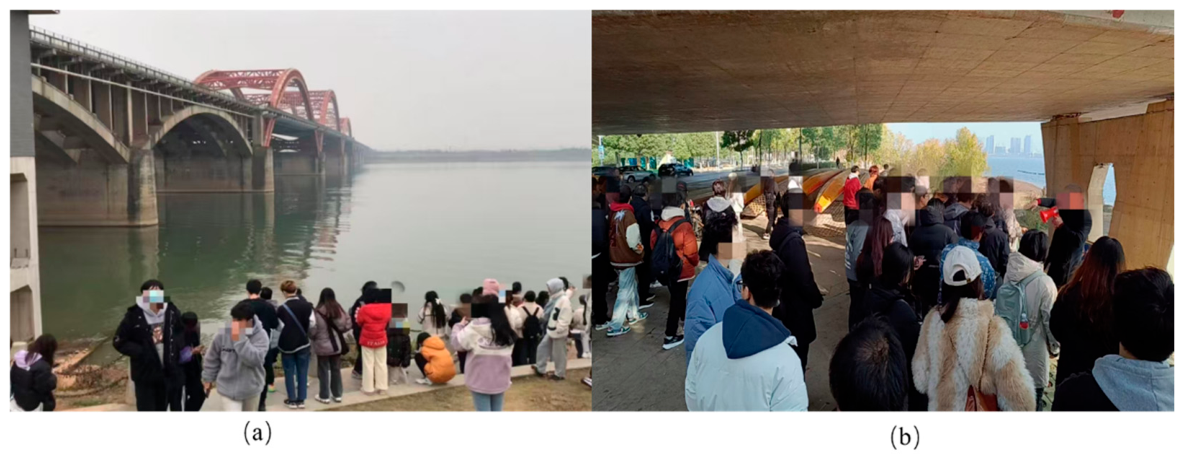
2.1. Existing Offline Cognitive Practice Modes
2.2. Existing Online Virtual Learning Modes
2.3. U-Learning
3. Methodology
3.1. Research Questions and Hypotheses
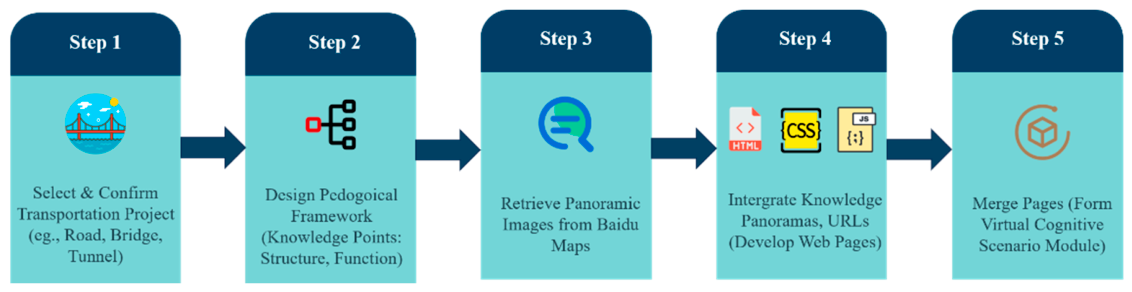
3.2. Design and Development of the VCP Mode
- (1)
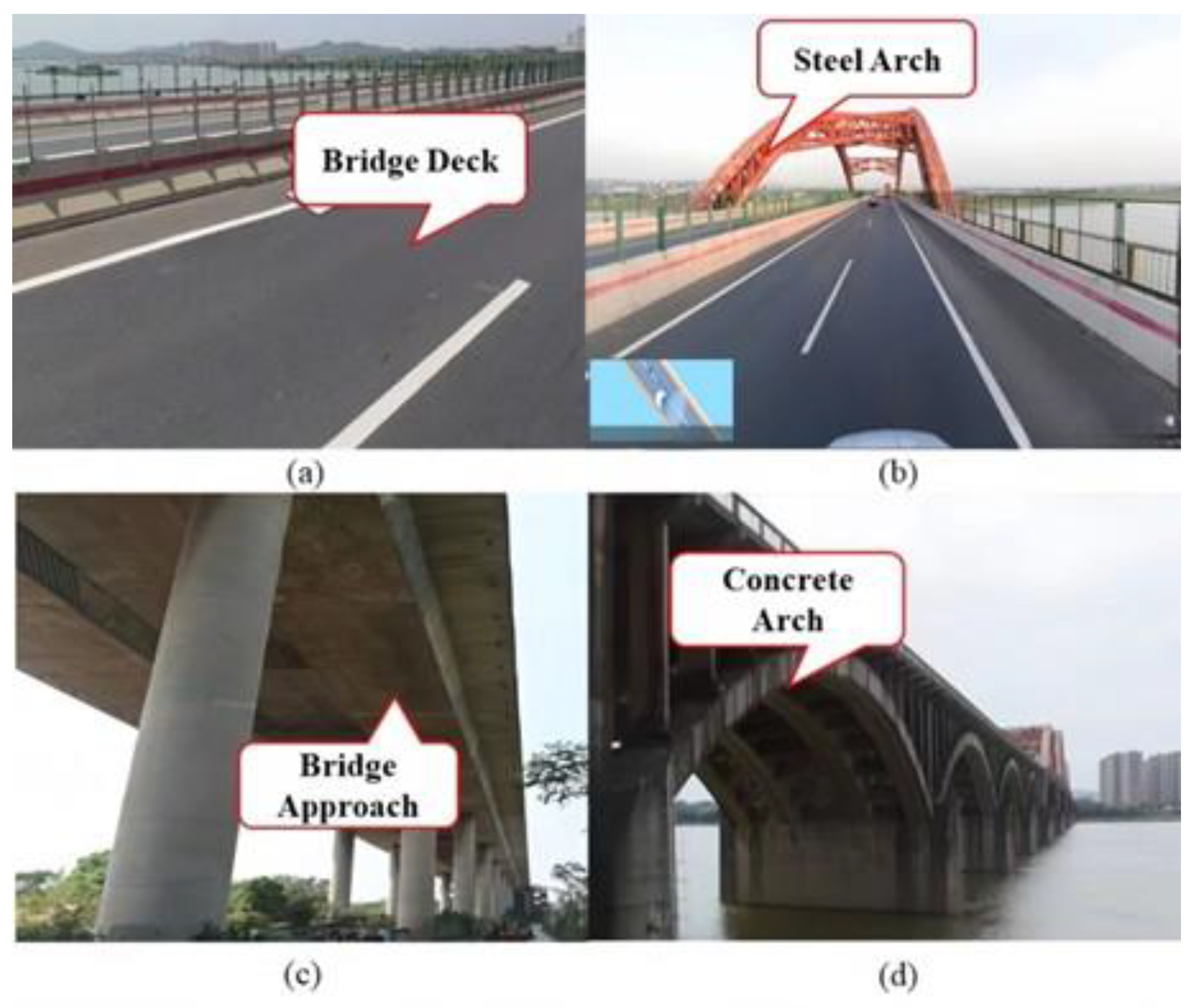
- Creation of virtual cognitive scenarios
- (2)
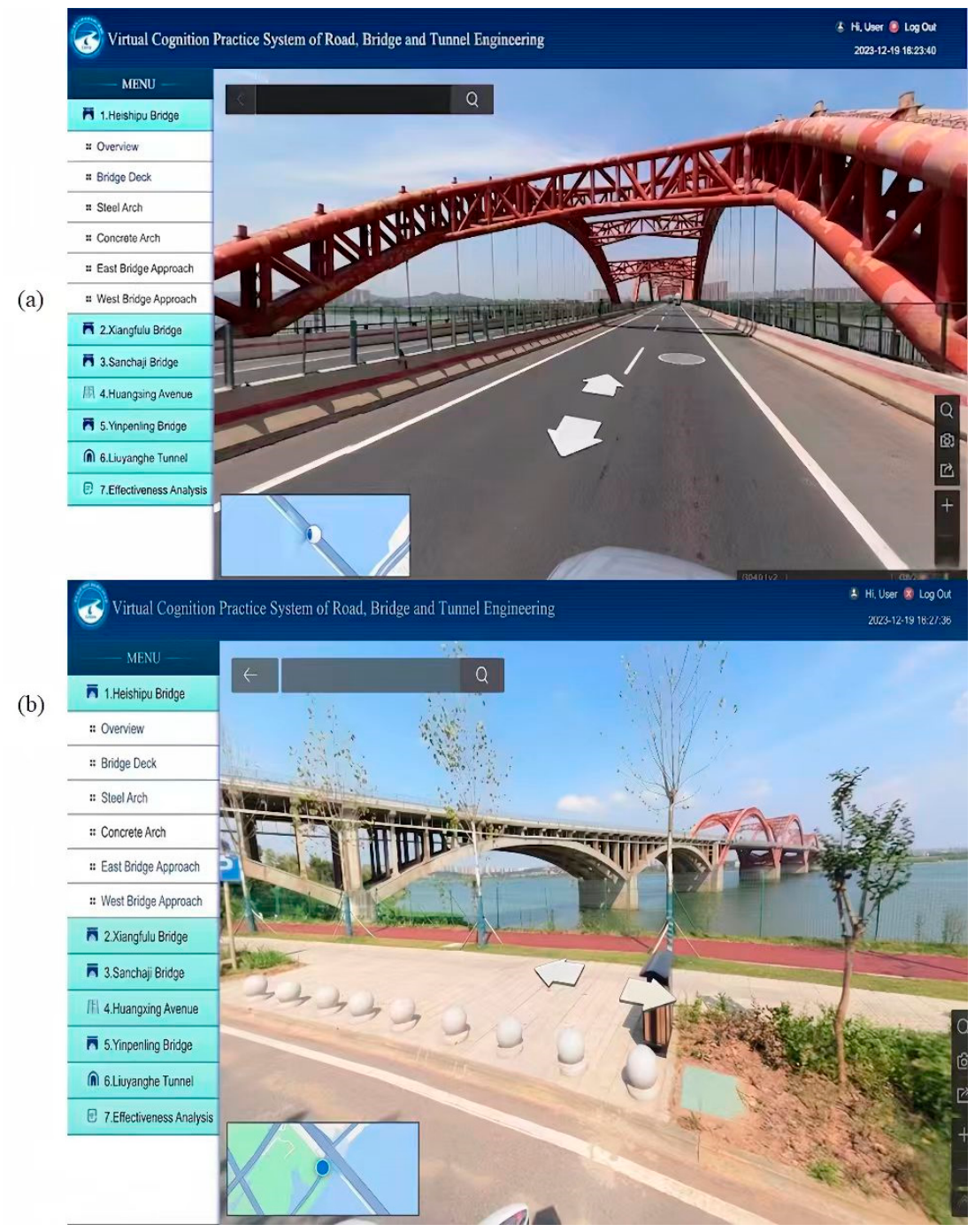
- Development of the VCP system
3.3. Application of the VCP Mode
3.4. Questionnaire Survey
3.5. Data Analysis Techniques for Hypothesis Verification
4. Data Analysis and Results
- (1)
- Basic information about respondents and objective knowledge assessment
- (2)
- Evaluation of subjective experience
- (3)
- Difference analysis
5. Discussion
5.1. Discussion of Results and Suggestions
5.2. Theoretical and Practical Contributions
6. Conclusions
Author Contributions
Funding
Institutional Review Board Statement
Informed Consent Statement
Data Availability Statement
Acknowledgments
Conflicts of Interest
References
- Olayiwola, J.; Yusuf, A.O.; Akanmu, A.A.; Murzi, H.; Gao, X.; Afsari, K. Construction practice knowledge for complementing classroom teaching during site visits. Smart Sustain. Built Environ. 2025, 14, 119–139. [Google Scholar] [CrossRef]
- Saqan, E.I.; Ashmawy, A.K. An alternative approach for practical experience in undergraduate engineering curricula. In Proceedings of the 2018 World Engineering Education Forum-Global Engineering Deans Council (WEEF-GEDC), Albuquerque, NM, USA, 12–16 November 2018; pp. 1–6. [Google Scholar]
- Pidal, I.M.; Cerezal, J.S.; Gutiérrez, L.H.; Pérez, E.S. Learning experience on applied geology in civil engineering curricula by using university cooperation and practical trips. In Proceedings of the EDULEARN11 Proceedings, Barcelona, Spain, 4–6 July 2011; pp. 4892–4899. [Google Scholar]
- Jaselskis, E.; Ruwanpura, J.; Becker, T.; Silva, L.; Jewell, P.; Floyd, E. Innovation in construction engineering education using two applications of internet-based information technology to provide real-time project observations. J. Constr. Eng. Manag. 2011, 137, 829–835. [Google Scholar] [CrossRef]
- García-Alberti, M.; Suárez, F.; Chiyón, I.; Mosquera Feijoo, J.C. Challenges and experiences of online evaluation in courses of civil engineering during the lockdown learning due to the COVID-19 pandemic. Educ. Sci. 2021, 11, 59. [Google Scholar] [CrossRef]
- Watson, M.K.; Barrella, E.M.; Skenes, K. Development of self-directed learning readiness among undergraduate engineering students during the COVID-19 pandemic. J. Civ. Eng. Educ. 2024, 150, 04023014. [Google Scholar] [CrossRef]
- Hew, K.F.; Huang, W.; Du, J.; Jia, C. Using chatbots to support student goal setting and social presence in fully online activities: Learner engagement and perceptions. J. Comput. High. Educ. 2023, 35, 40–68. [Google Scholar] [CrossRef]
- Lozano-Galant, F.; Porras, R.; Mobaraki, B.; Calderón, F.; Gonzalez-Arteaga, J.; Lozano-Galant, J.A. Enhancing Civil Engineering Education through Affordable AR Tools for Visualizing BIM Models. J. Civ. Eng. Educ. 2024, 150, 05024003. [Google Scholar] [CrossRef]
- Shojaei, A.; Mahdavian, A.; Rokooei, S.; Al-Bayati, A. Use of Virtual Site Visits in Construction Management Distance Education. In Proceedings of the Construction Research Congress 2022, San Antonio, TX, USA, 11–13 April 2022; pp. 182–191. [Google Scholar]
- Yi, X.; Feng, W.; He, Y.; Wang, F. How to Harness LLMs in Project-Based Learning: Empirical Evidence for Individual Autonomy and Moderate Constraints in Engineering Education. Systems 2025, 13, 1112. [Google Scholar] [CrossRef]
- Zhang, J.X.; Xie, H.Y.; Li, H. Improvement of students problem-solving skills through project execution planning in civil engineering and construction management education. Eng. Constr. Archit. Manag. 2019, 26, 1437–1454. [Google Scholar] [CrossRef]
- Quadir, B.; Yang, J.C.; Wang, W. Factors influencing the acquisition of English skills in an English learning environment using Rain Classroom. Interact. Learn. Environ. 2024, 32, 1–19. [Google Scholar] [CrossRef]
- Grant, S.; Qi, G.Y.; Lan, Y.-J.; Cheng, P.-Y. Fostering academic citizenship through ubiquitous technologies in an online academic conference. Educ. Technol. Soc. 2024, 27, 18–34. [Google Scholar]
- Alkhafaji, A.; Fallahkhair, S.; Haig, E. A theoretical framework for designing smart and ubiquitous learning environments for outdoor cultural heritage. J. Cult. Herit. 2020, 46, 244–258. [Google Scholar] [CrossRef]
- Vallejo-Correa, P.; Monsalve-Pulido, J.; Tabares-Betancur, M. A systematic mapping review of context-aware analysis and its approach to mobile learning and ubiquitous learning processes. Comput. Sci. Rev. 2021, 39, 100335. [Google Scholar] [CrossRef]
- Looi, C.-K.; Sun, D.; Xie, W. Exploring students’ progression in an inquiry science curriculum enabled by mobile learning. IEEE Trans. Learn. Technol. 2014, 8, 43–54. [Google Scholar] [CrossRef]
- Cárdenas-Robledo, L.A.; Peña-Ayala, A. Ubiquitous learning: A systematic review. Telemat. Inform. 2018, 35, 1097–1132. [Google Scholar] [CrossRef]
- Lu, C.; Chang, M.; Kinshuk; Huang, E.; Chen, C.-W. Context-aware mobile role playing game for learning. In The New Development of Technology Enhanced Learning: Concept, Research and Best Practices; Springer: Berlin/Heidelberg, Germany, 2014; pp. 131–146. [Google Scholar]
- Jayathilaka, R.; Wijewickrama, M.; Edwards, D.J. Developing a holistic teaching and learning framework for construction management education: A systematic literature review. Eng. Constr. Archit. Manag. 2025, 32, 258–284. [Google Scholar] [CrossRef]
- Abbasnejad, B.; Soltani, S.; Wong, P. A systematic review of online learning and teaching strategies during the COVID-19 pandemic: Implications for the construction management sector. Smart Sustain. Built Environ. 2024, 13, 934–959. [Google Scholar] [CrossRef]
- Liu, D.; Lei, X.; Huang, Y.; Liu, W.; Zhang, J. Competency requirements for engineering management undergraduates in the era of intelligent construction. J. Asian Archit. Build. Eng. 2025, 24, 3916–3939. [Google Scholar] [CrossRef]
- Sun, Y.; Albeaino, G.; Gheisari, M.; Eiris, R. Online site visits using virtual collaborative spaces: A plan-reading activity on a digital building site. Adv. Eng. Inform. 2022, 53, 101667. [Google Scholar] [CrossRef]
- Onecha, B.; Cornadó, C.; Morros-Cardona, J.; Pons-Valladares, O. Interactive 360 website versus on-site visits for architecture students to achieve readiness in construction practice. In Proceedings of the EDULEARN22 Proceedings, Palma, Spain, 4–6 July 2022; pp. 3091–3096. [Google Scholar]
- Arslan, G. Design of a web-based virtual construction site visit for education of civil engineering student (Part I). In Towards a Vision for Information Technology in Civil Engineering; American Society of Civil Engineers: Reston, VA, USA, 2004; pp. 1–8. [Google Scholar]
- Goh, B.H.; Yuen, C.W.; Onn, C.C. Factors Associated with Travel Patterns Among Mixed-Use Development Residents in Klang Valley, Malaysia, Before and During COVID-19: Mixed-Method Analysis. Systems 2025, 13, 1045. [Google Scholar] [CrossRef]
- Sofi-Karim, M.; Bali, A.O.; Rached, K. Online education via media platforms and applications as an innovative teaching method. Educ. Inf. Technol. 2023, 28, 507–523. [Google Scholar] [CrossRef]
- Cheng, H.N.; Liu, Z.; Sun, J.; Liu, S.; Yang, Z. Unfolding online learning behavioral patterns and their temporal changes of college students in SPOCs. In Learning Analytics; Routledge: Abingdon, UK, 2018; pp. 34–46. [Google Scholar]
- Liu, Y. Application of mobile learning in college English teaching under the background of “internet+”. In Innovative Computing: IC 2020; Springer: Berlin/Heidelberg, Germany, 2020; pp. 275–281. [Google Scholar]
- Dou, W.; Song, X. Construction of hybrid English courses based on mobile software assisted teaching in Chinese universities. In Proceedings of the Proceedings of the 2020 8th International Conference on Information and Education Technology, Okayama, Japan, 28–30 March 2020; pp. 36–41. [Google Scholar]
- Ramachandran, R.; Sparck, E.M.; Levis-Fitzgerald, M. Investigating the effectiveness of using application-based science education videos in a general chemistry lecture course. J. Chem. Educ. 2019, 96, 479–485. [Google Scholar] [CrossRef]
- Ranga, J.S. Customized videos on a YouTube channel: A beyond the classroom teaching and learning platform for general chemistry courses. J. Chem. Educ. 2017, 94, 867–872. [Google Scholar] [CrossRef]
- Urban, H.; Pelikan, G.; Schranz, C. Augmented reality in AEC education: A case study. Buildings 2022, 12, 391. [Google Scholar] [CrossRef]
- Kiat, L.B.; Ali, M.B.; Abd Halim, N.D.; Ibrahim, H.B. Augmented reality, virtual learning environment and mobile learning in education: A comparison. In Proceedings of the 2016 IEEE Conference on e-Learning, e-Management and e-Services (IC3e), Langkawi, Malaysia, 10–12 October 2016; pp. 23–28. [Google Scholar]
- Naveed, Q.N.; Choudhary, H.; Ahmad, N.; Alqahtani, J.; Qahmash, A.I. Mobile learning in higher education: A systematic literature review. Sustainability 2023, 15, 13566. [Google Scholar] [CrossRef]
- Weiser, M. The Computer for the 21st Century. Sci. Am. 1991, 265, 94–105. [Google Scholar] [CrossRef]
- Karakaya, K.; Bozkurt, A. Mobile-assisted language learning (MALL) research trends and patterns through bibliometric analysis: Empowering language learners through ubiquitous educational technologies. System 2022, 110, 102925. [Google Scholar] [CrossRef]
- Ruiz-Calleja, A.; Bote-Lorenzo, M.L.; Asensio-Perez, J.I.; Villagra-Sobrino, S.L.; Alonso-Prieto, V.; Gomez-Sanchez, E.; Garcia-Zarza, P.; Serrano-Iglesias, S.; Vega-Gorgojo, G. Orchestrating ubiquitous learning situations about Cultural Heritage with Casual Learn mobile application. Int. J. Hum.-Comput. Stud. 2023, 170, 102959. [Google Scholar] [CrossRef]
- Khlaisang, J.; Teo, T. An innovation-based virtual flipped learning system in a ubiquitous learning environment the 21st century skills of higher education learners. Educ. Technol. Soc. 2024, 27, 100–116. [Google Scholar]
- Tan, T.-H.; Lin, M.-S.; Chu, Y.-L.; Liu, T.-Y. Educational affordances of a ubiquitous learning environment in a natural science course. J. Educ. Technol. Soc. 2012, 15, 206–219. [Google Scholar]
- Muñoz-Cristóbal, J.A.; Prieto, L.P.; Asensio-Pérez, J.I.; Martínez-Monés, A.; Jorrín-Abellán, I.M.; Dimitriadis, Y. Deploying learning designs across physical and web spaces: Making pervasive learning affordable for teachers. Pervasive Mob. Comput. 2014, 14, 31–46. [Google Scholar] [CrossRef]
- Lee, S.-M.; Park, M. Reconceptualization of the context in language learning with a location-based AR app. Comput. Assist. Lang. Learn. 2020, 33, 936–959. [Google Scholar] [CrossRef]
- Wong, L.-H.; Looi, C.-K.; Aw, G.P. Does seamless learning translate seamlessly?: A decade of experiences in adapting seamless learning designs for various subjects, levels and technological settings. In Scaling up ICT-Based Innovations in Schools: The Singapore Experience; Springer: Berlin/Heidelberg, Germany, 2021; pp. 269–289. [Google Scholar]
- Hwang, G.-J.; Chien, S.-Y. Definition, roles, and potential research issues of the metaverse in education: An artificial intelligence perspective. Comput. Educ. Artif. Intell. 2022, 3, 100082. [Google Scholar] [CrossRef]
- Abad-Segura, E.; González-Zamar, M.-D.; Infante-Moro, J.C.; Ruipérez García, G. Sustainable management of digital transformation in higher education: Global research trends. Sustainability 2020, 12, 2107. [Google Scholar] [CrossRef]
- Huang, C.L.; Luo, Y.F.; Yang, S.C.; Lu, C.M.; Chen, A.-S. Influence of students’ learning style, sense of presence, and cognitive load on learning outcomes in an immersive virtual reality learning environment. J. Educ. Comput. Res. 2020, 58, 596–615. [Google Scholar] [CrossRef]
- Wagiri, F.; Sitindjak, R.H.I. Incorporating Mobile Augmented Reality into Ubiquitous Learning Models to Enhance Student Experience in Interior Design Education. Am. J. Educ. Res. 2024, 12, 176–186. [Google Scholar] [CrossRef]
- Xue, C.; Jin, C.; Zhou, L.; Li, G. Exploring the distribution of city street greenery from eye-level: An application of Baidu Map panoramic images data. Geogr. Tidsskr.-Dan. J. Geogr. 2022, 122, 73–86. [Google Scholar] [CrossRef]
- Tsukuda, T.; Mutoh, N.; Nakano, A.; Itamiya, T.; Tani-Ishii, N. Study of Root Canal Length Estimations by 3D Spatial Reproduction with Stereoscopic Vision. Appl. Sci. 2023, 13, 8651. [Google Scholar] [CrossRef]



| Questionnaire Division | Question Type | Assessed Knowledge/Competencies | Specific Question Examples |
|---|---|---|---|
| Basic information about respondents | Single-choice | Sample Demographics: Establishing sample characteristics and prior on-site experience. | “Which class Cohort do you belong to?” “Gender.” |
| Objective Knowledge Assessment | Single-choice (Direct testing) | Engineering Parameter Recognition: Ability to observe and identify specific geometric and material parameters. Structural Classification: Competency to categorize infrastructure based on force characteristics and structural forms observed in the VCP. | “How many lanes does the Liuyanghe Tunnel have? (Options: 4, 6, or 8 lanes)” |
| Evaluation of subjective experience | 5-point Likert Scale and Multiple-choice | Pedagogical Integration Attitudes: Students’ analytical judgment on the system’s advantages, disadvantages, and its value as a substitute or complement. | “Rate the visual recognition effect of tunnel emergency facilities (e.g., vehicle and pedestrian cross passages) on a scale of 1 to 5.” |
| Question | Choice | Cohort | Summation | χ2 (df) | Value of p | |
|---|---|---|---|---|---|---|
| A | B | |||||
| 1 | Yes | 68.0% | 85.1% | 78.3% | 7.1 (2) | 0.028 |
| No | 10.0% | 2.3% | 5.4% | |||
| Uncertain | 22.0% | 12.6% | 16.3% | |||
| Question | Choice | Cohort | Summation | χ2 (df) | Value of p | |
|---|---|---|---|---|---|---|
| A | B | |||||
| 2 | Yes | 88.3% | 90.8% | 89.8% | 1.6 (2) | 0.457 |
| No | 5.0% | 2.3% | 3.4% | |||
| Uncertain | 6.7% | 6.9% | 6.8% | |||
Disclaimer/Publisher’s Note: The statements, opinions and data contained in all publications are solely those of the individual author(s) and contributor(s) and not of MDPI and/or the editor(s). MDPI and/or the editor(s) disclaim responsibility for any injury to people or property resulting from any ideas, methods, instructions or products referred to in the content. |
© 2026 by the authors. Licensee MDPI, Basel, Switzerland. This article is an open access article distributed under the terms and conditions of the Creative Commons Attribution (CC BY) license.
Share and Cite
Huang, Y.; Liu, F.; Liu, D.; Liu, W.; Bu, R. Ubiquitous Virtual Cognitive Practice Mode in Engineering Management Utilizing Web Map Panoramas: Application and Effectiveness Analysis. Systems 2026, 14, 492. https://doi.org/10.3390/systems14050492
Huang Y, Liu F, Liu D, Liu W, Bu R. Ubiquitous Virtual Cognitive Practice Mode in Engineering Management Utilizing Web Map Panoramas: Application and Effectiveness Analysis. Systems. 2026; 14(5):492. https://doi.org/10.3390/systems14050492
Chicago/Turabian StyleHuang, Yao, Fubin Liu, Dingli Liu, Weijun Liu, and Rongwei Bu. 2026. "Ubiquitous Virtual Cognitive Practice Mode in Engineering Management Utilizing Web Map Panoramas: Application and Effectiveness Analysis" Systems 14, no. 5: 492. https://doi.org/10.3390/systems14050492
APA StyleHuang, Y., Liu, F., Liu, D., Liu, W., & Bu, R. (2026). Ubiquitous Virtual Cognitive Practice Mode in Engineering Management Utilizing Web Map Panoramas: Application and Effectiveness Analysis. Systems, 14(5), 492. https://doi.org/10.3390/systems14050492