Article

Efficiency and Effectiveness of Artificial Intelligence Integration in the Business Environment

by
Mircea-Constantin Șcheau
1,2,*,
Liviu-Marian Matac
3,
Paul-Tiberius Coman
3,
Gabriel Niță
1,
Alina-Iuliana Tăbîrcă
4,
Daniel Danilov
4,
Larisa Găbudeanu
2 and
Valentin Radu
4
1
Institute of European Studies, Babeș-Bolyai University, 400084 Cluj-Napoca, Romania
2
Faculty of Automation, Computer Science and Electronics, University of Craiova, 200585 Craiova, Romania
3
Faculty of Accounting and Management Information Systems, Bucharest University of Economic Studies, 010374 Bucharest, Romania
4
Faculty of Economics, Valahia University of Targoviste, 130004 Targoviste, Romania
*
Author to whom correspondence should be addressed.
Systems 2026, 14(4), 439; https://doi.org/10.3390/systems14040439
Submission received: 15 March 2026 / Revised: 14 April 2026 / Accepted: 16 April 2026 / Published: 17 April 2026
(This article belongs to the Special Issue Advancing Open Innovation in the Age of AI and Digital Transformation)

Abstract

The growing integration of AI in business systems has intensified the need for empirical evidence on how organizational capability, governance orientation, and performance-related expectations shape AI adoption. This study examines how AI integration is perceived in terms of efficiency and effectiveness in relation to governance considerations and analyses the extent to which technological competence influences implementation intention. A quantitative research design was employed based on a structured questionnaire administered online to 248 respondents from diverse organizational contexts in Romania between September and December 2025, using a non-probabilistic sampling approach. The data collection procedure followed a voluntary participation approach, and the analysis includes descriptive statistics, reliability analysis, ANOVA, correlation analysis, and multiple regression. The findings indicate that AI is primarily associated with operational performance benefits, while governance-related perceptions play a contextual rather than a direct role in shaping implementation intention. Technological competence and resource adequacy emerge as the main factors associated with AI adoption, whereas favorable attitudes toward AI do not independently predict implementation decisions. The study contributes to the literature by introducing the Capability–Governance–Performance (CGP) framework as an integrative analytical perspective that explains how internal capabilities, governance considerations, and performance expectations jointly shape AI implementation intentions. It also provides empirical evidence from a transition-to-economic context, contributing to a more integrated understanding of AI adoption.

1. Introduction

Artificial Intelligence has become a central component of contemporary electronic and information systems, profoundly influencing how organizations design, manage, and optimize business processes. Advances in machine learning, data analytics, and intelligent automation enable AI-driven systems to process large-scale data, support real-time decision-making, and automate complex operational tasks [1,2]. In business environments, these capabilities position AI as an integral element of organizational information architecture that directly affects performance and decision processes.
The integration of AI into business systems has accelerated alongside Industry 4.0 digital transformation initiatives. AI-based applications are increasingly embedded in enterprise systems, enhancing operational efficiency and managerial effectiveness through data-driven insights and adaptive system behavior [3,4,5]. Empirical evidence suggests that AI-enabled systems can significantly reduce processing times, improve forecasting accuracy, optimize resource allocation, and support decision-making processes [6]. These systems rely on advanced data infrastructures and continuously learning algorithmic models that process operational data streams in real time [7].
The integration of AI also introduces important governance and risk-related challenges. The opacity of advanced AI models raises concerns regarding transparency, explainability, and accountability in organizational decision-making [8]. In addition, AI systems create new categories of operational and security risks, including data vulnerabilities and compliance issues [9]. In response, regulatory and standardization initiatives, such as the OECD AI Principles, the NIST AI Risk Management Framework, and the European Artificial Intelligence Act, emphasize transparency, robustness, and accountability as core requirements for AI deployment [10,11,12]. These developments highlight the need to assess AI integration not only in terms of performance, but also in relation to control and risk dimensions.
From a theoretical perspective, AI integration can be examined through organizational capability frameworks. The Resource-Based View (RBV) suggests that AI technologies may function as strategic resources, while the dynamic capabilities perspective emphasizes the role of organizational learning and adaptation in leveraging AI systems [13]. Also, the dynamic capabilities perspective emphasizes the role of organizational learning and managerial orchestration in leveraging AI systems to adapt to changing environmental conditions [14].
Recent research emphasizes that AI adoption is shaped by the interaction between organizational capabilities, governance structures, and contextual constraints. Studies grounded in the dynamic capabilities perspective show that AI capability enhances innovation and organizational performance when supported by adaptive processes [15,16]. At the same time, research on responsible AI highlights the importance of governance frameworks, ethical alignment, and institutional oversight in ensuring trustworthy deployment [17], while SME-focused evidence indicates that adoption remains constrained by resource limitations, data availability, and weak governance structures [18]. More recent contributions suggest that long-term performance depends on the alignment between governance mechanisms, innovation capabilities, and AI adoption rather than on technology implementation alone [19]. Therefore, the literature remains fragmented, with limited empirical evidence on how these dimensions jointly shape AI implementation intention, supporting the need for an integrative perspective that captures their interdependencies.
Although prior research provides important insights into AI adoption and its organizational implications, several limitations remain evident. Existing studies often examine performance outcomes or governance challenges separately, without systematically addressing their interaction [20,21]. Moreover, empirical evidence from transition economies remains limited, despite the growing relevance of AI adoption in such contexts [22]. There is also a need for quantitative analyses that link AI integration to performance-related perceptions while accounting for risk and control considerations.
Addressing these gaps, the present study investigates the efficiency and effectiveness of AI integration in the business environment through a quantitative analysis of survey data collected in Romania. The study examines how technological competence, organizational characteristics, and risk perceptions shape attitudes toward AI integration. Efficiency and effectiveness are approached as perception-based performance outcomes associated with AI-enabled applications, rather than as directly measured constructs.
The research is guided by the following questions:
RQ1: How is AI integration perceived in terms of efficiency and effectiveness within business environments in interaction with the governance of AI?
RQ2: What is the relationship between technological competence and the intention to integrate AI into organizational processes?
In addition, the study introduces an integrative perspective on AI adoption structured around the interaction between organizational capability, governance orientation, and performance-related expectations. This perspective is formalized through the Capability–Governance–Performance (CGP) framework, which conceptualizes AI adoption as a multidimensional organizational process shaped by the alignment of internal readiness, control mechanisms, and perceived outcomes.
The study contributes to the literature by integrating capability, governance, and performance-related dimensions into a unified analytical perspective and by providing empirical evidence from a transition economy context. These findings challenge predominantly attitudinal explanations of AI adoption and highlight the role of structural readiness.

2. Materials and Methods

The integration of AI within management information systems (MIS) represents a structural transformation in how organizations generate, process, and utilize information for strategic and operational decision-making. AI extends the analytical capacity of traditional MIS by enabling real-time data processing, pattern recognition, and predictive modeling, thereby enhancing both the speed and precision of managerial actions [23,24]. Unlike conventional information systems that rely primarily on structured historical datasets, AI-based systems incorporate machine learning and deep learning techniques that can adapt to dynamic environments and evolving datasets [25]. This adaptive capacity enables organizations to shift from reactive to anticipatory decision-making frameworks, thereby strengthening their ability to align operational efficiency with strategic effectiveness. Furthermore, AI-enhanced MIS contributes to competitive positioning by facilitating deeper data interpretation, improving customer responsiveness, and optimizing internal workflows [26]. In this sense, AI does not function merely as a technological upgrade but as a systemic capability embedded within organizational architecture.

2.1. Theoretical Background

In recent economic and management literature, efficiency and effectiveness are increasingly conceptualized as complementary rather than substitutable dimensions of organizational performance, particularly in technology-intensive environments. Efficiency continues to denote the optimization of input-output relationships, emphasizing cost minimization, process speed, and resource utilization. At the same time, effectiveness reflects the extent to which organizations achieve strategic objectives and generate value aligned with stakeholder expectations. Recent studies emphasize that in digitalized business environments, efficiency gains achieved through automation do not automatically translate into effectiveness unless they are strategically aligned with organizational goals and market demands [27,28]. This distinction has become especially relevant as firms adopt advanced digital technologies that optimize processes locally but may fail to enhance overall organizational performance if strategic coherence is lacking.
Empirical evidence from recent studies indicates that AI-driven analytics and automation can significantly enhance operational efficiency by reducing process variability, improving forecasting accuracy, and enabling real-time decision support [29]. At the same time, the contribution of AI to effectiveness depends on how well algorithmic outputs are integrated into managerial decision-making and governance structures. Poorly governed AI systems may increase operational efficiency while undermining effectiveness through biased decisions, lack of transparency, or misalignment with organizational strategy [30].
The broader economic environment plays a critical role in mediating the impact of artificial intelligence on both efficiency and effectiveness. Organizations operate within competitive and regulatory ecosystems characterized by rapid technological change, increasing data intensity, and growing institutional scrutiny of AI use. From a macroeconomic perspective, AI adoption is associated with productivity growth and structural transformation, but these effects are uneven and context dependent [31]. At the firm level, recent research highlights that AI integration enhances performance primarily in environments where complementary assets, including digital infrastructure, human capital, and regulatory readiness, are sufficiently developed [32]. Consequently, the effectiveness of AI in improving organizational outcomes cannot be evaluated independently of the economic and institutional context in which it is deployed. This approach reinforces the need for analytical approaches that jointly consider technological capabilities, performance outcomes, and environmental constraints when assessing AI integration in business environments.
From a broader Industry 4.0 perspective, AI-driven digital transformation reshapes organizational performance by integrating automation, data analytics, and intelligent process optimization. Empirical evidence indicates that AI integration improves business process efficiency by accelerating routine operations, reducing processing time, and enhancing decision accuracy [33,34]. At the same time, the effectiveness of these improvements depends on the organization’s ability to embed AI capabilities within strategic planning and governance mechanisms [35]. The theoretical alignment with resource-based view and dynamic capabilities perspectives suggests that AI functions as a strategic asset only when supported by complementary digital infrastructure and human capital development [36,37]. Consequently, the evaluation of AI integration in business environments requires a multidimensional framework that simultaneously captures operational optimization, strategic alignment, and institutional readiness, rather than focusing exclusively on isolated performance indicators. This integrated perspective strengthens the conceptual foundation of the present study by positioning AI as a catalyst for organizational transformation within complex economic ecosystems.
Therefore, in AI-enabled business systems, efficiency and effectiveness are widely recognized as interrelated yet analytically distinct dimensions of organizational performance that must be examined jointly to capture the real impact of artificial intelligence integration. Recent studies in operations management and business process research emphasize that efficiency gains generated through AI, including increased automation speed, reduced error rates, and improved resource utilization, do not automatically translate into organizational effectiveness unless they are aligned with strategic objectives and decision-making structures [27,38]. Empirical evidence shows that organizations may achieve short-term efficiency gains through AI deployment yet face difficulties converting these gains into effective strategic outcomes due to misalignment between algorithmic outputs and managerial processes [39]. This conceptual distinction highlights the need to analyze AI integration beyond isolated performance metrics, focusing instead on how efficiency-enhancing technologies contribute to system-level effectiveness within complex business environments.
Technological competence represents a critical conceptual factor shaping organizational engagement with artificial intelligence systems. Recent information systems research demonstrates that technological competence extends beyond technical proficiency to include the ability to critically evaluate, govern, and integrate AI-enabled systems into organizational processes [40]. As AI technologies become more complex and less transparent, higher levels of technological competence are often associated with more differentiated and cautious organizational attitudes toward AI integration, rather than unconditional adoption [41]. This approach suggests that technologically competent actors are more aware of data dependencies, model limitations, and governance requirements inherent in AI systems. Consequently, technological competence influences how expected efficiency and effectiveness gains are assessed, acting as a moderating dimension that shapes organizational readiness and strategic decision-making in AI-driven economic environments [20,42].
Although prior research provides valuable insights into AI adoption, organizational performance, and governance-related challenges, existing studies tend to examine these dimensions in a fragmented manner. A significant part of the literature focuses either on performance outcomes associated with AI integration or on governance and risk-related considerations, without systematically addressing their interaction within a unified analytical framework. In addition, much of the empirical evidence is derived from highly digitalized environments, with limited attention to transition economies and heterogeneous organizational contexts. Consequently, there remains a need for integrative approaches that jointly examine capability-related factors, governance orientation, and performance-related expectations in shaping AI adoption at the organizational level. The present study addresses this gap by proposing a unified analytical perspective that captures the interaction among these dimensions.
Building on the theoretical perspectives discussed above, the present study adopts an integrative conceptual lens that links organizational capability, governance orientation, and performance-related outcomes in the context of AI integration. From a resource-based and dynamic-capabilities perspective, technological competence and resource availability are enabling conditions that shape an organization’s ability to deploy AI systems effectively. At the same time, governance mechanisms, including risk awareness, regulatory alignment, and control structures, define the institutional context within which AI operates. Also, performance-related perceptions, reflected in expected efficiency gains and effectiveness improvements, provide the motivational dimension for adoption. These three dimensions are conceptualized in this study as the CGP framework, which assumes that isolated factors do not determine AI integration outcomes; rather, the interaction among organizational readiness, governance orientation, and perceived performance benefits determines outcomes. This framework guides both the empirical operationalization of variables and the interpretation of results.
The CGP framework is conceptualized in this study as an integrative analytical framework, intended to structure the relationships among capability, governance, and performance-related expectations, rather than as a formally validated predictive model. Therefore, the framework serves as a theoretically grounded lens that organizes the empirical analysis by linking internal readiness, institutional and control-related considerations, and anticipated performance outcomes. Such an approach is consistent with prior research in information systems and digital transformation, where integrative frameworks are used to capture complex, multidimensional phenomena that are not fully reducible to single-model specifications [4,43]. Accordingly, the CGP framework should be understood as a conceptual structuring device that guides empirical analysis and supports the interpretation of the relationships examined in this study, while also providing a basis for future research aimed at formal model testing and validation.
From a theoretical perspective, the CGP framework assumes that the three dimensions are structurally interrelated in shaping organizational orientations toward AI adoption and implementation intention. Organizational capability is expected to exert a positive influence on adoption decisions, as it reflects internal readiness in terms of technological competence, data availability, and resource adequacy, factors that recent empirical research has identified as important enablers of AI deployment and organizational performance [20]. At the same time, performance-related expectations are assumed to reinforce adoption motivation by emphasizing anticipated efficiency and effectiveness gains associated with AI-enabled systems, particularly in relation to process optimization, decision support, and business value creation [34]. By contrast, governance orientation is expected to play a conditioning role in the adoption process, since increased awareness of risks, regulatory requirements, and control mechanisms may shape the extent to which organizations are willing to implement AI in practice, especially under conditions of growing emphasis on responsible AI and institutional accountability [40]. Taken together, these relationships suggest that AI adoption is not driven by isolated factors, but by the alignment between internal capabilities, performance expectations, and governance considerations within a broader socio-technical system.

2.2. Methodological Framework

This study employs a quantitative research design to empirically assess the efficiency and effectiveness of AI integration in business environments. The methodological approach is grounded in the information systems and electronic business research tradition, where survey-based empirical methods are commonly employed to capture organizational perceptions, technological capabilities, and performance-related outcomes [43]. A cross-sectional design was selected to obtain a structured snapshot of organizational attitudes toward AI integration over a defined temporal interval, allowing examination of relationships among technological competence, perceived efficiency gains, and control-related considerations.
The methodological framework aligns with prior empirical studies on digital transformation and AI adoption in organizational contexts, which emphasize the suitability of quantitative survey methods for analyzing technology-related perceptions across heterogeneous business environments [44,45]. By focusing on measurable indicators derived from standardized survey items, the study ensures comparability with existing research while maintaining sufficient flexibility to capture context-specific characteristics.
The study was conducted in accordance with general ethical principles applicable to social science and business research. Participation was voluntary, and respondents were informed of the study’s academic purpose. No personally identifiable information was collected or processed, ensuring respondent anonymity and data confidentiality.
Primary data were collected through a structured questionnaire administered to respondents operating in diverse organizational contexts in Romania. The data collection period extended from September 2025 to December 2025, ensuring temporal consistency and minimizing short-term contextual distortions. The questionnaire was distributed electronically through professional and academic networks using a non-probabilistic convenience sampling approach. This sampling strategy was considered appropriate for the exploratory purpose of the study, as it enabled access to respondents with relevant organizational exposure to digital technologies and AI-related applications. The target group included individuals occupying operational, specialist, or managerial roles, allowing the collection of informed organizational perspectives on AI integration. A total of 264 questionnaires were collected, of which 16 incomplete responses were excluded during the data screening stage. Consequently, 248 valid responses were retained for analysis. Preliminary data screening also confirmed the absence of duplicate entries or invalid response patterns.
Respondents were selected based on their direct or indirect familiarity with digital technologies and AI-related organizational practices. The sample reflects diversity in organizational size, sectoral affiliation, and technological maturity. This heterogeneity is consistent with the study’s objective of capturing AI integration dynamics across different business environments rather than limiting the analysis to a single industry or organizational type. Although the sampling approach does not allow for full statistical generalization, it is suitable for identifying patterns and relationships in an exploratory study of organizational AI adoption.
The research instrument consists of 21 survey items (Q1–Q21) designed to capture demographic characteristics, technological competence, organizational context, attitudes toward AI integration, perceived efficiency gains, and control-related considerations. The questionnaire was developed based on a synthesis of validated instruments used in prior studies on technology adoption, AI-enabled systems, and organizational performance. Most items were measured using Likert scales, with response categories reflecting increasing levels of agreement, intensity, or importance. The survey items were developed through a synthesis of prior literature on AI adoption, digital transformation, and organizational performance to capture key dimensions of technological capability, performance-related expectations, and governance-related considerations. The wording of the items was adapted to reflect the business context of AI integration and to ensure clarity and relevance for respondents with diverse organizational backgrounds.
For analytical purposes, Likert-scale variables were treated as continuous, a common approach in empirical research when response scales provide sufficient granularity and approximate interval properties [46,47]. Given the five-point scale and the sample size (N = 248), the use of parametric techniques was considered appropriate. Normality was assessed at the construct level (OperationalAI and GovImpact), and no severe deviations were identified. The original coding direction of all variables was retained throughout the analysis, with higher values indicating lower agreement for Likert-scale items. This coding scheme was explicitly taken into account in the interpretation of the statistical results.
This approach enables the application of parametric statistical techniques, including descriptive statistics and correlation analysis. To ensure content validity, the wording of the items was carefully aligned with the conceptual dimensions investigated in the study, namely technological competence, efficiency, effectiveness, and control-related perceptions. The questionnaire’s internal structure allows aggregation of conceptually related items into composite indicators that are statistically justified.
The grouped variables used in the empirical analysis should be interpreted as analytical composites rather than as fully validated latent constructs. Efficiency and effectiveness-related aspects were not measured using separate dedicated scales but were inferred from survey items that reflected perceived operational and organizational benefits of AI integration. Accordingly, the aggregated variables were employed for exploratory analytical purposes, based on conceptual coherence and internal consistency considerations.
The empirical design reflects the CGP framework by operationalizing three interrelated dimensions. Organizational capability is captured through variables such as technological experience, data availability, and resource adequacy. Governance orientation is reflected in constructs related to risk awareness and regulatory or control-related perceptions (Q19–Q21). Performance-related expectations are operationalized through items associated with operational AI use (Q15–Q18), which capture perceived efficiency and effectiveness gains.
Reliability and validity were addressed through both procedural and statistical measures. Content validity was ensured by systematically aligning survey items with constructs identified in the literature on AI integration, digital transformation, and organizational performance. The questionnaire design was informed by established conceptual frameworks and empirical instruments, reducing the risk of construct underrepresentation. Internal consistency was assessed by using multiple items to capture the same conceptual dimension. Reliability indicators, such as Cronbach’s alpha, were used to evaluate the coherence of aggregated measures. Cronbach’s alpha was computed for the aggregated constructs. The OperationalAI construct (Q15–Q18) shows moderate internal consistency (α = 0.682), reflecting the heterogeneous nature of operational AI perceptions. The GovImpact construct (Q19–Q21) demonstrates strong internal consistency (α = 0.853), indicating a cohesive perception of governance and impact-related dimensions. Values exceeding commonly accepted thresholds were interpreted as evidence of satisfactory internal consistency. In contrast, borderline values were assessed considering the exploratory nature of the study and the diversity of organizational contexts represented in the sample.
To improve the interpretability of the measurement structure, the exploratory factor analysis (EFA) was considered by excluding items with low factor loadings and substantial cross-loadings. EFA was conducted on selected items from Q15–Q20 to examine whether the grouped variables are broadly consistent with a two-dimensional structure corresponding to OperationalAI and GovImpact (Table 1).
The refined EFA indicates improved interpretability of the grouped variables, with a clearer separation between governance-related and operational AI-related items. The governance-related factor is primarily represented by items associated with certification, standardization, oversight, and auditing, with factor loadings ranging from 0.571 to 0.787. The operational factor is defined by items related to AI use in process-related and performance-oriented activities, with loadings ranging from 0.509 to 0.744. The resulting dimensions are interpreted as analytical composites rather than as fully validated latent constructs. All retained items exhibit factor loadings above 0.50, which supports their inclusion in the refined exploratory structure.
These results should be interpreted as exploratory in measurement terms. Although the grouping of items is supported by conceptual coherence, internal consistency, and exploratory factor-analytic evidence, the present study does not claim construct-level validation in a confirmatory sense. Accordingly, the aggregated variables are used as analytical composites for empirical interpretation rather than as formally validated latent constructs comparable to standardized multi-item scales typically developed and validated through confirmatory approaches in prior literature [43,48]. At the same time, the presence of cross-loadings suggests partial overlap between the identified dimensions, indicating limited discriminant validity. Therefore, these grouped variables are better understood as analytically useful classifications than as fully distinct latent constructs. This methodological limitation should be considered when interpreting the findings.

3. Results

The analysis follows a structured approach, beginning with verification of statistical assumptions and instrument reliability, followed by descriptive statistics, group comparisons, correlation analysis, and regression modeling. This sequence allows for a progressive examination of AI-related perceptions, moving from general descriptive patterns to inferential and multivariate explanations of implementation intention. All statistical analyses were conducted using parametric techniques, justified by prior assumption testing, and significance levels were evaluated at conventional thresholds.

3.1. Descriptive Analysis

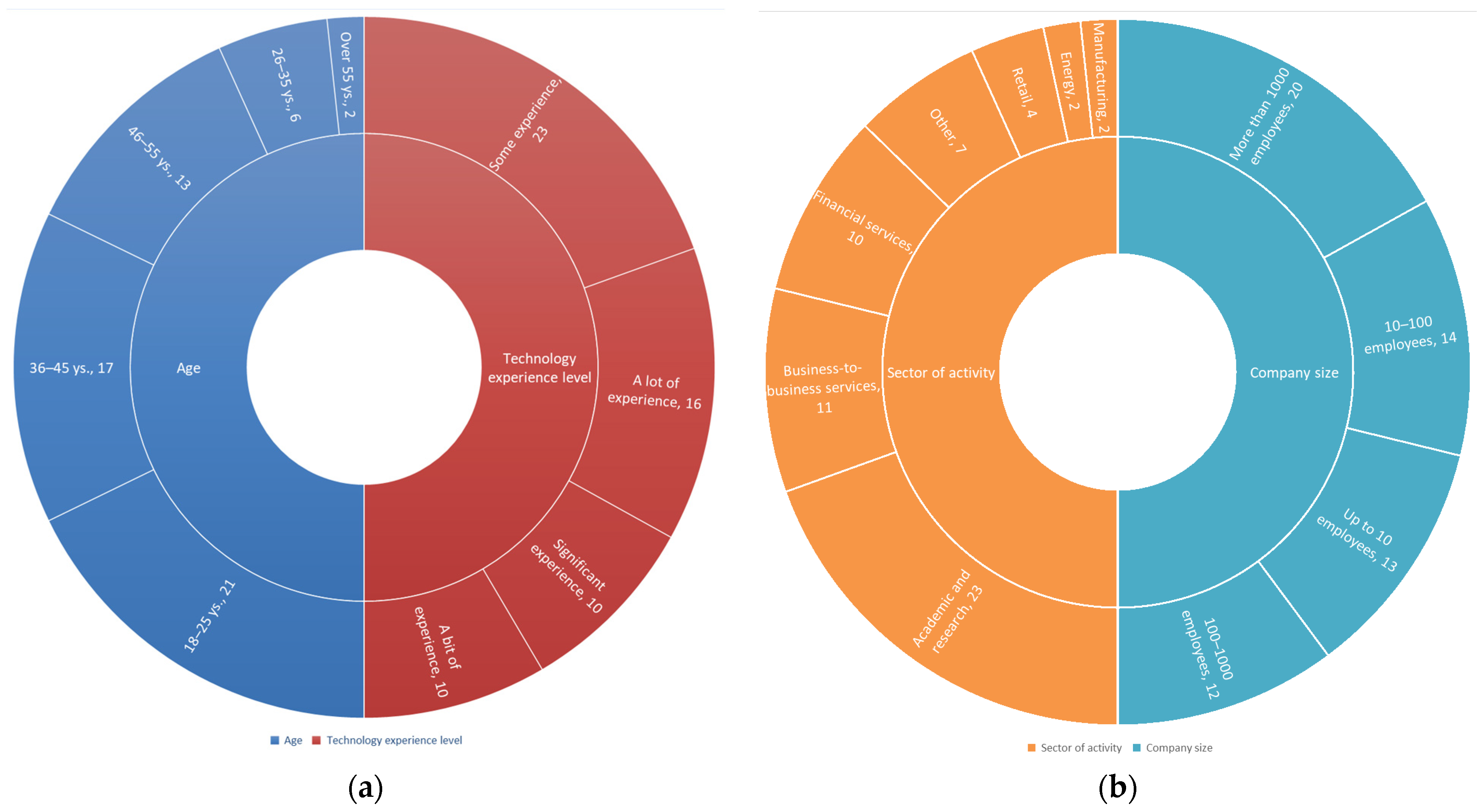
The sample comprised 248 valid responses from individuals operating in diverse organizational contexts. Figure 1 presents the demographic and organizational characteristics of the respondents.
Prior to conducting parametric statistical analyses, the underlying assumptions of normality and homogeneity of variances were examined. Normality was assessed using the Shapiro–Wilk test for the composite construct scores and the overall AI attitude index (Table 2).
The overall AI attitude score did not significantly deviate from a normal distribution (W = 0.974, p = 0.201), supporting the application of parametric statistical procedures. Although minor deviations from normality were observed in several individual construct scores, skewness and kurtosis remained within acceptable ranges, indicating approximately symmetric distributions. Given the five-point Likert measurement scale and the sample size (N = 248), parametric tests were considered appropriate. Homogeneity of variances was evaluated using Levene’s test prior to group comparisons. The results indicated that the assumption of equal variances was met (p > 0.05), supporting the use of a standard one-way ANOVA and independent-samples t-tests.
For the item-level descriptive results presented in Table 3, the original coding direction of the Likert scale was retained, where lower values indicate stronger agreement and higher values indicate stronger disagreement.
Interpreted according to the original coding direction of the scale, lower mean values indicate stronger agreement, whereas higher mean values indicate stronger disagreement. The item-level descriptive results, therefore, suggest a differentiated rather than uniformly positive pattern of perceptions toward AI integration. Respondents show stronger agreement with several operational and customer-related AI applications, particularly those linked to data collection, monitoring, analytics, and employee support. In contrast, more restrictive or explicitly negative statements tend to receive higher mean values and lower agreement levels. Overall, the pattern indicates a pragmatic but conditional orientation toward AI integration.
Higher levels of agreement are observed for selected operational and customer-related AI applications, particularly those linked to data collection, analytics, monitoring, and service-related support. This pattern suggests that respondents are more receptive to AI use in clearly defined operational contexts, especially where its contribution to information processing and decision support is more immediately visible.
At the item level, one of the clearest patterns is observed for Q17.3 (“AI is not useful”), which records a mean of M = 3.645 and a high proportion of disagreement responses (61.3%). These results suggest that respondents reject explicitly negative statements about the usefulness of AI.
Respondents associate AI primarily with efficiency gains in data processing and employee productivity, as well as improvements in customer relationship management effectiveness. At the same time, the coexistence of positive performance expectations and support for Certification, auditing, and regulatory control suggests that AI adoption is perceived as a conditional process, dependent on robust risk-mitigation frameworks.
Given these heterogeneous yet generally positive perceptions, the next step of the analysis examines whether attitudes toward AI differ significantly across organizational characteristics such as sector, company size, technological experience, and AI implementation intention. These differences are tested using a one-way ANOVA and an independent-samples t-test.
The one-way ANOVA results showed that sector of activity was the only factor associated with statistically significant differences in overall AI attitude (F = 2.412, p = 0.039), indicating that perceptions of AI integration vary meaningfully across organizational domains (Table 4).
The corresponding effect size was substantial (η2 = 0.218), suggesting that sector membership accounts for a non-trivial proportion of variance in the overall AI attitude score. In contrast, no statistically significant group differences were found for company size, AI implementation intention group, or technology experience level. These results indicate that, within this sample, overall attitudes toward AI integration are relatively stable across firm size, self-reported technology experience, and intention categories. In contrast, the organizational sector emerges as the main differentiating factor.
The independent variables used in both the t-test and regression analyses were derived directly from the survey instrument. They included organizational readiness, technological competence, and an attitudinal orientation toward AI integration. The following predictors were defined:
  • Technological Experience (TechExp) was measured using Q2, which captured respondents’ self-reported level of technology experience. This ordinal variable reflects perceived digital competence and familiarity with technological systems.
  • HasData (Q7) measures whether the organization has the data infrastructure needed to feed AI models. Lower values indicate greater confidence in data availability within the organization.
  • HasResources (Q9) captures perceived adequacy of financial, human, and technical resources necessary for AI implementation. This variable operationalizes structural readiness and internal implementation capacity.
  • KnowsRisks (Q10) assesses respondents’ awareness of risks associated with the use of artificial intelligence tools. Given the original Likert coding, lower values indicate greater awareness of AI-related risks.
  • OperationalAI (Q15–Q18) represents the mean score of items referring to operational AI use, including performance monitoring, KPI reporting, customer analytics, and employee activity optimization. This construct captures performance-oriented acceptance of AI integration.
  • GovImpact (Q19–Q21) represents the mean score of items addressing governance mechanisms, regulatory oversight, customer relationship applications, and broader structural or labor-market implications of AI. This construct reflects institutional and systemic awareness associated with AI deployment.
For the independent samples t-test, only respondents with clearly defined intention categories (“Yes”, N = 100) and (“No”, N = 40) were included, while the intermediate category (“Not sure”, N = 108) was excluded to allow a direct comparison between distinct intention groups, and the results are presented in Table 5.
The t-test results indicate that technological competence and organizational resource capacity are the primary distinguishing factors between adopters and non-adopters. At the same time, general AI attitudes and governance perceptions do not, at the bivariate level, independently differentiate the groups. This finding reinforces the regression results and supports the interpretation that AI implementation intention is driven more by capability and structural readiness than by abstract attitudinal support.
As a robustness check, Mann–Whitney U tests were conducted for the main comparisons. This non-parametric approach is appropriate for ordinal data and does not assume normality. The results were consistent with the parametric analyses. Statistically significant differences between the “Yes” and “No” AI implementation intention groups were confirmed for both OperationalAI and GovImpact, supporting the robustness of the findings under non-parametric assumptions (Table 6).

3.2. Correlation Analysis

Pearson correlation analysis was conducted to examine the linear relationships between the grouped attitudinal constructs derived from Q15–Q18 (OperationalAI) and Q19–Q21 (GovImpact), using the original Likert scale orientation. Lower values, therefore, reflect stronger agreement with the respective AI-related statements, whereas higher values reflect weaker agreement (Table 7).
Within the Q15–Q18 cluster, inter-item correlations are predominantly moderate and positive, indicating internal coherence among statements addressing performance optimization and AI-enabled process enhancement. These results suggest that respondents do not treat these operational applications as isolated phenomena, but rather as related aspects of AI integration within organizational workflows.
Within the Q15–Q18 item block, the strongest inter-item association was observed between Q18_3 and Q18_4 (r = 0.842), indicating a very strong alignment between these two employee-activity-related statements. Additional high correlations were found among the Q18 sub-items (e.g., Q18_1 and Q18_2, r = 0.737) and within related operational statements Q16_1 and Q16_2.
Similarly, correlations within the Q19–Q21 cluster demonstrate moderate positive associations, reflecting conceptual alignment between customer relationship use, governance frameworks, and perceived structural impact (Table 8). Although these correlations are generally weaker than those observed in the operational block, they remain statistically meaningful, indicating that governance sensitivity forms a consistent, though distinct, attitudinal dimension.
Within the Q19–Q21 block, the strongest inter-item association was observed between Q20_5 and Q20_6 (r = 0.771), indicating strong internal coherence among governance-related statements. High correlations were also present within the customer-relationship sub-block Q19 and within the governance sub-block Q20, while cross-block correlations between Q20 and Q21 were generally moderate (Q20_5 and Q21_3, r = 0.551).
The results indicate a positive and statistically significant correlation between OperationalAI and GovImpact, suggesting that respondents who report more favorable perceptions of operational AI applications (e.g., KPI monitoring, customer analytics, productivity enhancement) also tend to report more favorable perceptions of governance-related and structural AI dimensions. This relationship supports the interpretation that operational acceptance and institutional awareness are not independent attitudes, but rather interconnected components of a broader pro-AI orientation.

3.3. Regression Analysis

An OLS regression model was estimated to predict AI implementation intention from organizational readiness variables (technology experience, data availability, resources, risk knowledge) and two attitudinal constructs (Q15 and Q20) (Table 9).
The multiple regression model predicting AI implementation intention was statistically significant (F = 2.158, p = 0.025), explaining 39.1% of the variance in the dependent variable (R2 = 0.391; Adj. R2 = 0.210; N = 248). Although the model is statistically significant, the relatively modest adjusted R2 indicates a limited explanatory capacity, suggesting that AI implementation intention is influenced by additional factors not captured in the present model.
Among the independent variables, Technological Experience (TechExp) emerged as a significant positive predictor (B = 0.212, p = 0.029), suggesting that higher technological competence is associated with stronger AI implementation intention. Perceived organizational resources (HasResources) were also statistically significant (B = −0.231, p = 0.048), indicating that resource-related conditions play a meaningful role in shaping adoption decisions, with the effect direction interpreted according to the original coding scheme. The negative coefficient for HasResources should be interpreted in relation to the variable’s original coding scheme, where higher values suggest lower perceived resource availability. Accordingly, the observed negative relationship indicates that greater resource adequacy is associated with higher AI implementation intention, consistent with theoretical expectations. The governance-related construct (GovImpact) showed a marginal effect (B = −0.378, p = 0.053), suggesting a potential but not fully significant influence on implementation intention. In contrast, age, company size, data availability, risk awareness, operational AI attitudes, and sector controls did not show statistically significant independent effects (p > 0.05).
Consequently, the estimated model is a multiple linear regression:
Y i = β 0 + β 1 Age i + β 2 TechExp i + β 3 CompanySize i + β 4 HasData i + β 5 HasResources i + β 6 KnowsRisks i + β 7 OperationalAI i + β 8 GovImpact i + k = 2 7 γ k Sector k + ε i
The results determined from Table 9 are:
Ŷ = 2.023 0.097 · A g e + 0.212 · T e c h E x p + 0.087 · C o m p a n y S i z e 0.010 · H a s D a t a 0.231 · H a s R e s o u r c e s 0.094 · K n o w s R i s k s 0.103 · O p e r a t i o n a l A I 0.378 · G o v I m p a c t + 0.597 · S e c t o r _ 2 + 0.450 · S e c t o r _ 3 + 0.327 · S e c t o r _ 4 1.058 · S e c t o r _ 5 + 0.283 · S e c t o r _ 6 + 0.455 · S e c t o r _ 7
where AI_Intention is the dependent variable coded as 0 = No, 1 = Not sure, and 2 = Yes; Age, TechExp, CompanySize, HasData, HasResources, and KnowsRisks are ordinal variables as coded in the dataset. OperationalAI is the mean score of items Q15–Q18 (original Likert coding, no reverse coding), and GovImpact is the mean score of items Q19–Q21 (original coding). Sector_2 … Sector_7 are dummy variables for sector categories, equal to 1 if the respondent belongs to that sector and 0 otherwise; the reference category is Sector_1 (all sector dummies = 0). Ŷ denotes the predicted AI implementation intention, and ε is the error term.
Ŷ = 2.023 0.291 + 0848 + 0.174 0.040 0.462 0.376 0.361 1.138 + 0.450 = 0.831
Ŷ ≈ 0.831 lies between 0 and 2 and is closer to 1 (Not sure) than to 2 (Yes), indicating that the predicted AI implementation intention for this respondent is more aligned with uncertainty rather than a clear intention to adopt AI.

4. Discussion

The findings of this study provide a structured perspective on how AI integration is perceived at the organizational level and on the factors associated with implementation intention. In this study, efficiency and effectiveness-related perceptions are approached indirectly through performance-oriented AI applications rather than through separate validated measurement scales. The results indicate that AI is predominantly associated with operationally visible benefits, particularly in areas such as data processing, KPI monitoring, and employee productivity. This pattern suggests a pragmatic orientation toward AI adoption, where organizations prioritize applications with immediate and measurable performance implications rather than broader strategic transformation. At the same time, governance-related perceptions, although positively evaluated, appear to play a contextual rather than a central role in shaping adoption decisions.
Regarding RQ1, the positive correlations between operational AI perceptions and governance-related considerations suggest that AI adoption is not perceived exclusively as a technical or efficiency-driven process, but also as embedded within institutional and control-related frameworks. In relation to RQ2, the regression results highlight that AI implementation intention is primarily associated with capability-related factors. Technological experience and resource adequacy emerge as significant predictors, while attitudinal variables and governance perceptions do not exhibit independent explanatory power. This finding suggests that favorable perceptions of AI are insufficient in the absence of structural readiness.
The results should be interpreted as indicative associations rather than strong predictive relationships. Overall, the findings reveal a cautious but generally positive orientation toward AI integration, characterized by strong support for operational applications, moderate endorsement of governance mechanisms, and a limited translation of positive attitudes into implementation intention. This pattern reinforces the importance of organizational readiness as a key enabling condition for AI adoption.

4.1. Theoretical Implications

This study contributes to the literature by advancing an integrative perspective on AI adoption through the CGP framework. The findings challenge purely attitudinal models by demonstrating that performance-related perceptions do not independently explain implementation intention, as their effect becomes insignificant when organizational capability variables are introduced. This suggests that existing models focusing primarily on perceived usefulness and acceptance may overestimate the role of attitudes in organizational adoption contexts.
From a theoretical integration perspective, the CGP framework can be positioned in relation to established models of technology adoption. Compared to the Technology Acceptance Model (TAM), which emphasizes perceived usefulness and ease of use as primary drivers of adoption, the present findings suggest that performance-related perceptions alone are not sufficient to explain implementation intention, as they do not exert a statistically significant independent effect in the regression model. Similarly, in contrast to the Technology-Organization-Environment (TOE) framework, which incorporates organizational and environmental factors, the CGP framework places stronger emphasis on the interaction between internal capability and governance orientation, highlighting that institutional and control-related considerations operate not merely as contextual factors, but as integral components shaping adoption conditions. At the same time, while the RBV and dynamic capabilities perspectives recognize the importance of internal resources and competencies, the CGP framework extends these approaches by explicitly integrating governance and performance expectations within a unified analytical structure. In this study, the CGP framework contributes by offering a more integrated socio-technical perspective, in which AI adoption is understood as the outcome of alignment between capability, governance, and performance-related expectations, rather than as a function of isolated determinants.
Furthermore, the study extends resource-based and dynamic capabilities perspectives by explicitly integrating governance and performance expectations into a unified analytical structure. The results indicate that AI functions as a strategic resource only when supported by sufficient technological competence and resource availability, while governance awareness provides a contextual framework that shapes how such capabilities are operationalized.

4.2. Managerial Implications

The findings of this study provide several practical implications for organizations seeking to implement AI technologies in business environments. The results indicate that technological competence represents a critical enabling factor, suggesting that organizations should invest in the development of digital skills through structured training programs, continuous learning initiatives, and the integration of AI-related competencies into existing roles. In practice, this may involve internal training programs focused on data literacy, analytics capabilities, and the interpretation of AI-generated outputs, particularly for employees involved in operational and decision-making processes.
At the same time, resource availability emerges as a key determinant of implementation intention, indicating that organizations should ensure adequate allocation of financial, technical, and human resources for AI projects. This includes investments in data infrastructure, software solutions, and specialized personnel capable of supporting AI deployment. Organizations may benefit from adopting a gradual implementation approach, starting with pilot projects in areas where AI applications generate immediate and observable benefits, such as performance monitoring, customer analytics, or process automation. A multi-dimensional approach allows organizations to reduce uncertainty, build internal expertise, and progressively scale artificial intelligence initiatives.
The findings also highlight the importance of governance mechanisms as enabling rather than restrictive elements. Organizations should operate governance through clear internal policies, risk assessment procedures, and monitoring practices that ensure responsible AI use. In practical terms, this may involve establishing internal guidelines for AI deployment, implementing periodic audits of AI systems, and aligning organizational practices with emerging regulatory frameworks. By embedding governance within operational processes, organizations can enhance trust, transparency, and long-term sustainability of AI applications.
The results suggest the existence of a gap between positive attitudes toward AI and actual implementation decisions. This implies that managerial action is required to translate favorable perceptions into concrete strategies. Leadership should articulate clear AI adoption strategies, define implementation roadmaps, and integrate AI-related objectives into organizational planning processes. In this sense, successful AI adoption depends not only on technological and financial readiness but also on strategic alignment and managerial commitment.

4.3. Limitations

Several limitations should be considered when interpreting the findings of this study. The cross-sectional research design restricts the ability to infer causality among the dimensions of capability, governance orientation, and performance perception within the proposed CGP framework. The relationships identified reflect perceived associations at a specific point in time rather than dynamic organizational processes unfolding during different stages of AI integration. In addition, the reliance on self-reported data may introduce perceptual bias, as respondents’ evaluations may not fully reflect objective organizational conditions. The sampling approach also limits the generalizability of the findings. Although the sample includes diverse organizational contexts, it is based on a non-probabilistic method and is geographically concentrated, which may reduce applicability to other environments.
A further limitation concerns construct operationalization. Although conceptually grouped items were used to reflect performance-related and governance-related dimensions of AI integration, efficiency and effectiveness were not measured as separate validated constructs. The aggregated variables should be interpreted as exploratory analytical groupings rather than as formally validated latent dimensions. The exploratory nature of certain construct blocks, particularly those with moderate internal consistency, further suggests that some dimensions of AI-related perception may require refinement or reconceptualization in future empirical settings.

4.4. Future Research

Future research may extend the CGP framework by adopting longitudinal designs to capture the temporal evolution of AI adoption decisions and by incorporating objective performance indicators to complement perceptual measures. Testing the model across different countries or regulatory regimes would allow a deeper examination of how governance orientation interacts with institutional maturity to shape implementation intention.
Future studies could integrate additional mediating or moderating variables, such as organizational culture, leadership style, digital transformation maturity, or innovation strategy, to refine the model’s explanatory architecture. Expanding the framework to include structural equation modeling or multilevel analysis could also provide greater insight into the interdependence among capability, governance, and performance dimensions.

5. Conclusions

This study addressed the research gap identified by providing an integrated analysis of how organizational capability, governance orientation, and performance-related perceptions jointly shape AI implementation intention in a transition economy context. The findings indicate that AI adoption is primarily associated with structural readiness, particularly technological competence and resource availability, rather than with attitudinal support alone.
By introducing the CGP framework, the study offers an integrative perspective that captures the interaction between capability, governance, and performance expectations. The results suggest that AI integration should be understood as a multidimensional organizational process dependent on the alignment between internal readiness, governance structures, and perceived performance benefits.
Given the exploratory nature of the study, the conclusions of this study should be interpreted considering its empirical scope and methodological limitations. The results reflect statistically identified associations within a specific transitional context and should not be generalized beyond similar organizational and institutional settings. Further empirical research is required to validate and extend the framework.

Author Contributions

Conceptualization, M.-C.Ș., L.G., P.-T.C. and G.N.; methodology, A.-I.T., V.R. and L.-M.M.; software, P.-T.C., D.D. and G.N.; validation, M.-C.Ș., L.G. and L.-M.M.; formal analysis, A.-I.T., P.-T.C. and G.N.; investigation, L.G., D.D. and L.-M.M.; resources, M.-C.Ș. and L.G.; data curation, A.-I.T., V.R., P.-T.C. and G.N.; writing—original draft preparation, M.-C.Ș., P.-T.C., L.-M.M., L.G., G.N. and V.R.; writing—review and editing, M.-C.Ș., D.D. and V.R.; visualization, M.-C.Ș., P.-T.C., L.-M.M., L.G., G.N. and V.R.; supervision, L.-M.M. and V.R.; project administration, M.-C.Ș.; funding acquisition, D.D. All authors have read and agreed to the published version of the manuscript.

Funding

This research received no external funding.

Institutional Review Board Statement

Approved by the Ethics Committee of Valahia University of Târgoviște (No. 1799 on 11 August 2025).

Informed Consent Statement

Informed consent was obtained from all subjects involved in the study.

Data Availability Statement

The authors will make the raw data supporting this article’s conclusions available upon request.

Conflicts of Interest

The authors declare no conflicts of interest.

Abbreviations

The following abbreviations are used in this manuscript:
AIArtificial Intelligence
AI RMFArtificial Intelligence Risk Management Framework
ANOVAAnalysis of Variance
BUnstandardized Regression Coefficient
CGPCapability–Governance–Performance Integration Framework
EFAExploratory factor analysis
EU European Union
KPIKey Performance Indicator
MISManagement Information Systems
NSample Size
NISTNational Institute of Standards and Technology
OECDOrganization for Economic Co-operation and Development
OLSOrdinary Least Squares
pProbability Value/Significance Level
RBVResource-Based View
RQResearch Question
SDStandard Deviation
SEStandard Error
TAMTechnology Acceptance Model
TOETechnology–Organization–Environment Framework

References

  1. Zong, Z.; Guan, Y. AI-driven intelligent data analytics and predictive analysis in Industry 4.0: Transforming knowledge, innovation, and efficiency. J. Knowl. Econ. 2025, 16, 864–903. [Google Scholar] [CrossRef]
  2. Ojeda, A.M.; Valera, J.B.; Diaz, O. Artificial intelligence of big data for analysis in organizational decision-making. Glob. J. Flex. Syst. Manag. 2025, 26, 515–527. [Google Scholar] [CrossRef]
  3. Vial, G. Understanding digital transformation: A review and a research agenda. J. Strateg. Inf. Syst. 2019, 28, 118–144. [Google Scholar] [CrossRef]
  4. Verhoef, P.C.; Broekhuizen, T.; Bart, Y.; Bhattacharya, A.; Dong, J.Q.; Fabian, N.; Haenlein, M. Digital Transformation: A Multidisciplinary Reflection and Research Agenda. J. Bus. Res. 2021, 122, 889–901. [Google Scholar] [CrossRef]
  5. Dwivedi, Y.K.; Kshetri, N.; Hughes, L.; Slade, E.L.; Jeyaraj, A.; Kar, A.K.; Baabdullah, A.M.; Koohang, A.; Raghavan, V.; Ahuja, M.; et al. Opinion Paper: “So What If ChatGPT Wrote It?” Multidisciplinary Perspectives on Opportunities, Challenges and Implications of Generative Conversational AI for Research, Practice and Policy. Int. J. Inf. Manag. 2023, 71, 102642. [Google Scholar] [CrossRef]
  6. Füller, J.; Hutter, K.; Wahl, J.; Bilgram, V.; Tekic, Z. How AI Revolutionizes Innovation Management—Perceptions and Implementation Preferences of AI-Based Innovators. Technol. Forecast. Soc. Change 2022, 178, 121598. [Google Scholar] [CrossRef]
  7. Javaid, M.; Haleem, A.; Singh, R.P.; Suman, R. Artificial Intelligence Applications for Industry 4.0: A Literature-Based Study. J. Ind. Integr. Manag. 2022, 7, 83–111. [Google Scholar] [CrossRef]
  8. Floridi, L.; Cowls, J.; Beltrametti, M.; Chatila, R.; Chazerand, P.; Dignum, V.; Luetge, C.; Madelin, R.; Pagallo, U.; Rossi, F.; et al. AI4People—An ethical framework for a good AI society. Minds Mach. 2018, 28, 689–707. [Google Scholar] [CrossRef]
  9. Ribeiro, J.; Lima, R.; Eckhardt, T.; Paiva, S. Robotic process automation and artificial intelligence in Industry 4.0. Procedia Comput. Sci. 2021, 181, 51–58. [Google Scholar] [CrossRef]
  10. Yeung, K. Recommendation of the Council on Artificial Intelligence (OECD). Int. Leg. Mater. 2020, 59, 27–34. [Google Scholar] [CrossRef]
  11. NIST. Artificial Intelligence Risk Management Framework (AI RMF 1.0); National Institute of Standards and Technology: Gaithersburg, MD, USA, 2023. [CrossRef]
  12. European Union. Regulation (EU) 2024/1689 of the European Parliament and of the Council of 13 June 2024 Laying Down Harmonised Rules on Artificial Intelligence (Artificial Intelligence Act). The Official Journal of the European Union, 12 July 2024. Available online: https://artificialintelligenceact.eu (accessed on 28 January 2026).
  13. Barney, J. Firm resources and sustained competitive advantage. J. Manag. 1991, 17, 99–120. [Google Scholar] [CrossRef]
  14. Teece, D.J.; Pisano, G.; Shuen, A. Dynamic capabilities and strategic management. Strateg. Manag. J. 1997, 18, 509–533. [Google Scholar] [CrossRef]
  15. Gao, Y.; Liu, S.; Yang, L. Artificial Intelligence and Innovation Capability: A Dynamic Capabilities Perspective. Int. Rev. Econ. Finance 2025, 98, 103923. [Google Scholar] [CrossRef]
  16. Almheiri, H.M.; Ahmad, S.Z.; Khalid, K.; Ngah, A.H. Examining the Impact of Artificial Intelligence Capability on Dynamic Capabilities, Organizational Creativity and Organization Performance in Public Organizations. J. Syst. Inf. Technol. 2025, 27, 1–20. [Google Scholar] [CrossRef]
  17. Madanchian, M.; Taherdoost, H. Ethical Theories, Governance Models, and Strategic Frameworks for Responsible AI Adoption and Organizational Success. Front. Artif. Intell. 2025, 8, 1619029. [Google Scholar] [CrossRef] [PubMed]
  18. Sánchez, E.; Calderón, R.; Herrera, F. Artificial Intelligence Adoption in SMEs: Survey Based on TOE–DOI Framework, Primary Methodology and Challenges. Appl. Sci. 2025, 15, 6465. [Google Scholar] [CrossRef]
  19. Alves, M.; Martinho, D.; Marcão, R.; Sobreiro, P. Generative AI Adoption in B2B Firms: Ethical Governance, Innovation Capabilities, and Long-Term Competitive Performance. Systems 2026, 14, 410. [Google Scholar] [CrossRef]
  20. Neiroukh, S.; Emeagwali, O.L.; Aljuhmani, H.Y. Artificial Intelligence Capability and Organizational Performance: Unraveling the Mediating Mechanisms of Decision-Making Processes. Manag. Decis. 2025, 63, 3501–3532. [Google Scholar] [CrossRef]
  21. Attard-Frost, B.; Lyons, K. AI Governance Systems: A Multi-Scale Analysis Framework, Empirical Findings, and Future Directions. AI Ethics 2025, 5, 2557–2604. [Google Scholar] [CrossRef]
  22. Wang, X. How Does Artificial Intelligence Accelerate the Energy Transition? Learning from Empirical Experience in OECD Countries. J. Environ. Manag. 2025, 391, 126397. [Google Scholar] [CrossRef]
  23. Li, F.; Xu, J. Revolutionizing AI-Enabled Information Systems Using Integrated Big Data Analytics and Multi-Modal Data Fusion. IEEE Access 2025, 13, 212316–212340. [Google Scholar] [CrossRef]
  24. Ramzan, M.; Farooq, M.; Adeeb, H. (Eds.) Transformative Impact of Artificial Intelligence on Management Information Systems; IGI Global: Hershey, PA, USA, 2025. [Google Scholar]
  25. Arun, M.; Barik, D.; Othman, N.A.; Praveenkumar, S.; Tudu, K. Investigating the Performance of AI-Driven Smart Building Systems through Advanced Deep Learning Model Analysis. Energy Rep. 2025, 13, 5885–5899. [Google Scholar] [CrossRef]
  26. Babu, T.; Nair, R.R.; Kishore, S. Applications of Artificial Intelligence and Machine Learning in Industry 4.0. In Artificial Intelligence and Machine Learning for Industry 4.0; Wiley: Hoboken, NJ, USA, 2025; pp. 107–143. [Google Scholar] [CrossRef]
  27. Mithas, S.; Chen, Z.; Saldanha, T.J.V.; de Oliveira Silveira, G. How will artificial intelligence and emerging technologies transform operations management? Prod. Oper. Manag. 2022, 31, 4475–4487. [Google Scholar] [CrossRef]
  28. Mikalef, P.; Conboy, K.; Lundström, J.E.; Popovič, A. Thinking responsibly about responsible AI and ‘the dark side’ of AI. Eur. J. Inf. Syst. 2022, 31, 257–268. [Google Scholar] [CrossRef]
  29. Weinzierl, S.; Zilker, S.; Dunzer, S.; Matzner, M. Machine Learning in Business Process Management: A Systematic Literature Review. Expert Syst. Appl. 2024, 233, 124181. [Google Scholar] [CrossRef]
  30. Al-Surmi, A.; Bashiri, M.; Koliousis, I. AI-Based Decision Making: Combining Strategies to Improve Operational Performance. Int. J. Prod. Res. 2022, 60, 4464–4486. [Google Scholar] [CrossRef]
  31. Aghion, P.; Antonin, C.; Bunel, S. Artificial Intelligence, Growth and Employment: The Role of Policy. Econ. Stat. 2019, 510–512, 149–164. [Google Scholar] [CrossRef]
  32. Mhlanga, D. Artificial intelligence in the industry 4.0, and its impact on poverty, innovation, infrastructure development, and the sustainable development goals: Lessons from Emerging Economies? Sustainability 2021, 13, 5788. [Google Scholar] [CrossRef]
  33. Wamba-Taguimdje, S.-L.; Fosso Wamba, S.; Kala Kamdjoug, J.R.; Tchatchouang Wanko, C.E. Influence of Artificial Intelligence (AI) on Firm Performance: The Business Value of AI-Based Transformation Projects. Bus. Process Manag. J. 2020, 26, 1893–1924. [Google Scholar] [CrossRef]
  34. Perifanis, N.A.; Kitsios, F. Investigating the Influence of Artificial Intelligence on Business Value in the Digital Era of Strategy: A Literature Review. Information 2023, 14, 85. [Google Scholar] [CrossRef]
  35. Le Dinh, T.; Vu, M.C.; Tran, G.T. Artificial Intelligence in SMEs: Enhancing Business Functions through Technologies and Applications. Information 2025, 16, 415. [Google Scholar] [CrossRef]
  36. Helfat, C.E.; Kaul, A.; Ketchen, D.J., Jr.; Barney, J.B.; Chatain, O.; Singh, H. Renewing the Resource-Based View: New Contexts, New Concepts, and New Methods. Strateg. Manag. J. 2023, 44, 1357–1390. [Google Scholar] [CrossRef]
  37. Moderno, O.B.; Braz, A.C.; Nascimento, P.T. Robotic Process Automation and Artificial Intelligence Capabilities Driving Digital Strategy: A Resource-Based View. Bus. Process Manag. J. 2024, 30, 105–134. [Google Scholar] [CrossRef]
  38. Abbasi, M.; Nishat, R.I.; Bond, C.; Graham-Knight, J.B.; Lasserre, P.; Lucet, Y.; Najjaran, H. A Review of AI and Machine Learning Contribution in Business Process Management (Process Enhancement and Process Improvement Approaches). Bus. Process Manag. J. 2025, 31, 1414–1452. [Google Scholar] [CrossRef]
  39. Vudugula, S.; Chebrolu, S.K.; Bhuiyan, M.; Rozony, F.Z. Integrating Artificial Intelligence in Strategic Business Decision-Making: A Systematic Review of Predictive Models. Int. J. Sci. Interdiscip. Res. 2023, 4, 1–26. [Google Scholar] [CrossRef]
  40. Dennehy, D.; Griva, A.; Pouloudi, N.; Dwivedi, Y.K.; Mäntymäki, M.; Pappas, I.O. Artificial Intelligence (AI) and Information Systems: Perspectives to Responsible AI. Inf. Syst. Front. 2023, 25, 1–7. [Google Scholar] [CrossRef]
  41. Viskova-Robertson, A. Trust and Integration: AI Adoption and Socio-Technical Systems. In Building Trust in the Generative Artificial Intelligence Era; Paliszkiewicz, J., Gołuchowski, J., Mądra-Sawicka, M., Chen, K., Eds.; Routledge: London, UK, 2025; pp. 193–203. [Google Scholar] [CrossRef]
  42. Song, Y.; Qiu, X.; Liu, J. The Impact of Artificial Intelligence Adoption on Organizational Decision-Making: An Empirical Study Based on the Technology Acceptance Model in Business Management. Systems 2025, 13, 683. [Google Scholar] [CrossRef]
  43. Creswell, J.W.; Creswell, J.D. Research Design: Qualitative, Quantitative, and Mixed Methods Approaches, 5th ed.; SAGE Publications: Thousand Oaks, CA, USA, 2018. [Google Scholar]
  44. Hoang, H. Navigating the Digital Landscape: An Exploration of the Relationship between Technology-Organization-Environment Factors and Digital Transformation Adoption in SMEs. SAGE Open 2024, 14, 21582440241276198. [Google Scholar] [CrossRef]
  45. Park, I.; Kim, D.; Moon, J.; Kim, S.; Kang, Y.; Bae, S. Searching for New Technology Acceptance Model under Social Context: Analyzing the Determinants of Acceptance of Intelligent Information Technology in Digital Transformation and Implications for the Requisites of Digital Sustainability. Sustainability 2022, 14, 579. [Google Scholar] [CrossRef]
  46. Jamieson, S. Likert scales: How to (ab)use them. Med. Educ. 2004, 38, 1217–1218. [Google Scholar] [CrossRef]
  47. Norman, G. Likert scales, levels of measurement and the “laws” of statistics. Adv. Health Sci. Educ. 2010, 15, 625–632. [Google Scholar] [CrossRef] [PubMed]
  48. Henseler, J.; Ringle, C.M.; Sarstedt, M. A New Criterion for Assessing Discriminant Validity in Variance-Based Structural Equation Modeling. J. Acad. Mark. Sci. 2015, 43, 115–135. [Google Scholar] [CrossRef]
Figure 1. Respondent profile: (a) Description of demographics; (b) Description of organizational characteristics. Source: Author’s results.
Systems 14 00439 g001
Table 1. Exploratory factor analysis results for items Q15–Q21.
ItemFactor 1
(GovImpact)
Factor 2
(OperationalAI)
Q15_1 AI could be used 0.558
Q15_4 AI is mostly used with minor adjustments 0.509
Q16_2 AI to identify additional KPIs 0.540
Q17_1 We already use AI0.4160.509
Q17_4 Generative AI only 0.686
Q17_5 Generative or other AI types 0.744
Q18_1 AI improves employee efficiency0.4440.568
Q18_3 Only generative AI is useful 0.700
Q18_4 Generative or other AI useful 0.694
Q19_1 Customized services 0.512
Q19_3 Monitor contract progress0.5270.424
Q20_1 Assurance regarding AI services is useful0.602
Q20_2 standardization useful0.764
Q20_3 Certification before use is useful0.787
Q20_4 Independent Certification useful0.701
Q20_5 Authority oversight is useful0.63
Q20_6 Periodic independent auditing is preferable0.571
Note: Factor loadings below |0.40| are not displayed for clarity. Source: Author’s results.
Table 2. Shapiro–Wilk test for constructs and aggregate score.
VariableNWpSkewnessKurtosis
Q15_AI_risk_mitigation2480.9380.0037−0.5022.003
Q16_AI_KPI_reporting2480.9700.12820.0040.081
Q17_AI_customer_data2480.9810.45900.0960.245
Q18_AI_employee_activity2480.9510.0156−0.1450.518
Q19_AI_customer_relationship2480.9560.0269−0.013−0.781
Q20_AI_risk_prevention_measures2480.9630.0577−0.3940.314
Q21_AI_trends2480.9620.0542−0.2090.705
AI_attitude_overall2480.9740.20130.1181.663
Source: Author’s results.
Table 3. Item-Level Descriptive Statistics.
ItemStatementMeanSDAgree
(1–2)
Disagree (4–5)
Q15_AI_risk_mitigationAI could be used2.5971.06311.343.5
No AI could be used3.4521.18351.624.2
Partial AI with manual implementation2.5000.98811.346.8
AI is mostly used with minor adjustments2.6941.03416.140.3
Q16_AI_KPI_reportingAI for data collection and reporting2.2260.89511.369.4
AI to identify additional KPIs2.3551.04216.159.7
AI cannot be used for KPI reporting3.2101.17546.835.5
Q17_AI_customer_dataWe already use AI2.8871.18927.435.5
AI is useful2.3551.14714.554.8
AI is not useful3.6451.21661.319.4
Generative AI only2.8061.09927.441.9
Generative or other AI types2.5811.08017.746.8
Q18_AI_employee_activityAI improves employee efficiency2.3061.0809.761.3
AI improves activity accuracy2.5001.18417.758.1
Only generative AI is useful2.8061.08424.241.9
Generative or other AI is useful2.6941.06517.745.2
AI is not useful for employees3.5161.32754.824.2
Q19_AI_customer_relationshipCustomized services2.1450.8844.867.7
Answering client questions2.3231.05211.356.5
Monitor contract progress2.5651.05011.343.5
Respond to complaints2.4031.04714.556.5
Q20_AI_risk_prevention_measuresAssurance regarding AI services is useful2.1770.8406.567.7
Standardization useful2.3230.98812.961.3
Certification before use is useful2.3391.02311.358.1
Independent Certification useful2.3710.99611.353.2
Authority oversight useful2.3061.09514.559.7
Periodic independent auditing is preferable2.3391.03912.959.7
Q21_AI_trendsAI reduces jobs > 60%2.5321.12719.454.8
AI reduces jobs < 60%2.8551.11425.840.3
AI creates new activities2.3231.08312.961.3
AI doubles unemployment3.1291.26141.933.9
AI eliminates some activities2.2740.9959.758.1
Source: Author’s results.
Table 4. The one-way ANOVA results.
FactorFpη2
Sector2.4120.0390.218
Company size0.9590.4190.050
AI implementation intention2.1660.1240.068
Technology experience0.4710.7040.025
Source: Author’s results.
Table 5. Independent samples t-test results.
VariableNYES
Mean
SDNNO
Mean
SDMean Difft (Welch)pCohen’s d
TechExp1003.84001.0279403.50001.08010.34000.85280.40640.3225
HasData1001.76000.9256402.10000.5676−0.3400−1.31860.1984−0.4429
HasResources1001.44000.7681402.30000.6749−0.8600−3.27030.0041−1.1894
KnowsRisks1001.68000.9000402.30000.6749−0.6200−2.22060.0369−0.7794
OperationalAI1002.64710.4869402.92350.7326−0.2765−1.10010.2923−0.4445
GovImpact1002.30670.5256402.84000.9854−0.5333−1.62170.1329−0.6753
Source: Author’s results.
Table 6. Robustness check using the Mann–Whitney U test.
VariableGroupNMean RankSum of RanksUZp-Value
OperationalAIYes10058.965306.501211.50−2.6070.009
OperationalAINo4077.622949.50
GovImpactYes10058.495264.001169.00−2.8260.005
GovImpactNo4078.742992.00
Source: Author’s results.
Table 7. Pearson Correlation within the Operational AI Construct.
ItemQ15_1Q15_2Q15_3Q15_4Q16_1Q16_2Q16_3Q17_1Q17_2Q17_3Q17_4Q17_5Q18_1Q18_2Q18_3Q18_4Q18_5
Q15_11.000
Q15_2−0.1141.000
Q15_30.3670.0421.000
Q15_40.3030.0350.5381.000
Q16_10.477−0.2370.2410.3421.000
Q16_20.4130.0010.3820.4530.6161.000
Q16_3−0.0760.615−0.162−0.054−0.217−0.0351.000
Q17_10.3400.0370.4820.4250.3790.311−0.1241.000
Q17_20.281−0.2170.3330.2180.4960.373−0.2390.5111.000
Q17_3−0.0620.410−0.123−0.049−0.1360.1400.649−0.232−0.2021.000
Q17_40.1290.0680.1360.3800.2950.3470.3490.3720.3810.3041.000
Q17_50.2500.0740.2610.4120.3200.3820.1350.5120.4530.0350.7181.000
Q18_10.595−0.1740.2690.3500.5720.383−0.1680.3980.427−0.0160.2720.3511.000
Q18_20.423−0.1760.4560.4350.4800.425−0.1590.5650.3020.0230.3280.3980.7371.000
Q18_30.3440.1330.1230.4290.1470.2940.2380.3900.2140.1340.5870.5740.4430.4341.000
Q18_40.3380.0730.1320.4350.2630.3800.0910.4250.2780.0920.4810.6140.5110.5400.8421.000
Q18_5−0.1290.653−0.163−0.062−0.279−0.0280.718−0.087−0.2410.5220.1590.028−0.375−0.3760.002−0.1651.000
Source: Author’s results.
Table 8. Pearson Correlation Coefficient within the Governance Construct.
ItemQ19_1Q19_2Q19_3Q19_4Q20_1Q20_2Q20_3Q20_4Q20_5Q20_6Q21_1Q21_2Q21_3Q21_4Q21_5
Q19_11.000
Q19_20.6361.000
Q19_30.6340.6781.000
Q19_40.5730.6530.7291.000
Q20_10.3840.3050.4240.3091.000
Q20_20.3580.4970.5170.4430.6611.000
Q20_30.1980.4140.3990.2830.5770.7011.000
Q20_40.1610.3690.4550.3100.7040.5930.6951.000
Q20_50.1060.3540.3600.2620.4210.5890.6810.6911.000
Q20_60.2130.3630.3930.2340.3620.6100.6460.6370.7711.000
Q21_10.1520.2540.1990.0930.003−0.0100.0400.0700.2770.2081.000
Q21_20.1380.1380.0430.0090.1860.0430.0580.2270.1850.2410.5071.000
Q21_30.2930.5110.4430.3310.2960.4830.5060.4040.5510.4980.5150.2571.000
Q21_40.0270.055−0.0680.010−0.177−0.218−0.200−0.091−0.017−0.0090.5160.5390.2331.000
Q21_50.0840.0860.0220.1440.0190.1750.3420.1440.3130.2580.3800.0960.4640.3241.000
Source: Author’s results.
Table 9. OLS Regression Model.
Regresion
Model
N248
R20.391247447
Adj. R20.2099169
F2.157647748
p (F)0.025079048
PredictorBSEtp
const2.0230.6862.9470.0050
Age−0.0970.087−1.1180.2692
TechExp0.2120.0942.2480.0293
CompanySize0.0870.0910.9580.3427
HasData−0.0100.117−0.0840.9330
HasResources−0.2310.114−2.0310.0479
KnowsRisks−0.0940.105−0.8950.3753
OperationalAI−0.1030.183−0.5630.5759
GovImpact−0.3780.191−1.9820.0534
Sector_2.00.5970.3961.5080.1383
Sector_3.00.4500.3661.2280.2256
Sector_4.00.3270.3910.8380.4061
Sector_5.0−1.0580.762−1.3890.1714
Sector_6.00.2830.6130.4620.6461
Sector_7.00.4550.4251.0690.2907
Source: Author’s results.
Disclaimer/Publisher’s Note: The statements, opinions and data contained in all publications are solely those of the individual author(s) and contributor(s) and not of MDPI and/or the editor(s). MDPI and/or the editor(s) disclaim responsibility for any injury to people or property resulting from any ideas, methods, instructions or products referred to in the content.