1. Introduction
The contemporary healthcare delivery system faces a crisis of fragmentation that exacts profound human and economic costs. Organizational fragmentation disrupts critical relationships, impedes information flow, and creates misaligned incentives that systematically degrade care quality while escalating costs [
1]. Recent systematic reviews confirm that fragmented care—characterized by noncontinuous, low-quality, duplicated, or omitted coordination among multiple providers—directly contributes to worsening chronic illness trajectories, preventable acute care utilization, and inefficient resource allocation [
2]. The COVID-19 pandemic starkly exposed these coordination failures, as operational cleavages between public health agencies and medical care systems hampered effective crisis response despite individual system competencies [
3]. This fragmentation persists not from isolated failures but from fundamental structural characteristics of healthcare delivery itself.
The persistence of fragmentation within the U.S. healthcare system has become even more evident in the years following the COVID-19 crisis. Recently, Cutler highlighted that, despite the formal end of the public health emergency, the structural weaknesses revealed during the pandemic—particularly fragmented governance, inconsistent data exchange, and poor coordination across public health and medical care sectors—remain largely unresolved [
4]. He underscored that the pandemic did not create these failures but rather illuminated long-standing systemic fractures that continue to impede coherent national response capabilities and undermine routine care delivery. These findings reinforce that fragmentation in the United States is not a temporary artifact of crisis conditions but a deeply embedded structural characteristic that continues to shape system performance well into the mid-2020s. This paper presents a fully specified OWL-based ontology that formalizes the multi-layered interactions and dependencies within healthcare delivery systems, providing a semantic foundation for analyzing and mitigating fragmentation.
To understand these fragmentation challenges, healthcare delivery thus demands a systems perspective that recognizes care as a dynamic process integrating people, processes, and technologies across organizational divides, acknowledging that patient complexity cannot be managed through single disciplines or isolated entities. No single facility, specialty, or organizational entity can autonomously deliver comprehensive healthcare; rather, care emerges from intricate interdependencies among these constituent systems [
5]. Indeed, governance has emerged as a critical enabler in SoS literature: as Complex System Governance (CSG) scholars argue, the performance and sustained viability of large-scale systems depend on deliberate functions of direction, oversight and accountability [
6]. Moreover, as Katina et al. note, modern SoSE must expand governance to include organizational, policy, and human factors [
7]. However, existing governance frameworks often stop short of providing a machine-interpretable, model-based means of coordinating autonomy with alignment, especially across the structural, behavioral and policy layers of a healthcare SoS.
In healthcare, Digital Engineering (DE), Digital Twin (DT), and Model-Based Systems Engineering (MBSE) are reshaping systems design by integrating data-driven models, simulations, and collaborative tools across the product lifecycle [
8]. Hemdan and Sayed (2025) depict a multi-layer healthcare DT architecture comprising physical devices and patients at the bottom layer, IoT and sensor data processing at the middle layer, and virtual patient models and analytical simulation services at the top layer [
9]. They note that AI, blockchain, and DTs together have “revolutionized” diagnostics and care but require robust architectures and governance. This transformative potential extends across sectors: in manufacturing, MBSE has been shown to improve requirement traceability, system integration, and change management compared to traditional document-centric approaches [
10]. Furthermore, MBSE serves as a foundational enabler for digital twin development, providing consistency, interoperability, and scalability while creating a unifying structure that links physical systems and virtual representations [
11]. In aerospace applications, SysML-based modeling has demonstrated improvements in design consistency, requirement traceability, and stakeholder communication, while reducing integration risk through more informed early-stage design decisions [
12]. DE frameworks applied to space robotic systems have shown the capacity to reduce development risk and improve early design validation through digital continuity and rapid iteration [
13]. These cross-industry applications collectively demonstrate how digital transformation tools enable more robust, efficient, and adaptive systems design across diverse domains.
The strategic importance of DE in complex systems is increasingly recognized with future planning efforts. The Department of Defense DE Strategy articulates five strategic goals that emphasize formalized information models, integrated digital environments, and authoritative sources of truth to enable model-centric decision-making across system lifecycles [
14]. Similarly, the INCOSE Systems Engineering Vision 2025/2035 envisions a future where systems engineering is fully digitally enabled, with seamless integration of models, data, and analysis tools supporting collaborative decision-making across distributed stakeholder communities [
15]. These strategic frameworks recognize that modern system complexity—whether in defense, aerospace, or healthcare—demands not merely technological innovation but fundamental transformations in how systems are conceived, designed, integrated, and governed through digital representations.
Despite significant theoretical and empirical advances in understanding healthcare SoS structure, interdependencies, and governance requirements, current approaches exhibit critical limitations that impede operationalization. Structural analyses employing network theory quantitatively assess system properties such as centrality and influence distribution, while SysML models capture architectural relationships and operational flows, but these representations address specific analytical dimensions without providing unified frameworks that integrate structural, behavioral, and governance aspects [
6]. More critically, existing DE and MBSE approaches in healthcare lack the semantic rigor necessary to bridge the gap between high-level governance principles and implementable system architectures. While digital twin frameworks offer promising technical architectures for data integration and simulation, they remain disconnected from the formal representation of governance mechanisms, policy constraints, and organizational interdependencies that shape healthcare delivery system behavior. This semantic gap prevents the translation of systems engineering insights into actionable DE implementations that could systematically address healthcare fragmentation.
In response to this research gap, ontology-based approaches offer powerful mechanisms for addressing these integration and formalization challenges. Ontologies provide explicit, formal specifications of conceptual knowledge domains through structured vocabularies of entities, relationships, and axioms expressed in logic-based languages that enable automated reasoning [
16]. In systems engineering contexts, ontologies have demonstrated capacity to eliminate syntactic and semantic differences across tools and representations, enabling automation, interoperability, and artificial intelligence applications [
17]. The ontology of systems engineering, grounded in ISO/IEC/IEEE 15288 standards and extending from Basic Formal Ontology (BFO), provides process-centric reference frameworks that support semantic integration across the systems engineering lifecycle [
18]. Recent developments demonstrate ontology-aligned data structures enabling tool-agnostic interfaces through semantic layers that abstract from proprietary data formats [
19], and layered ontology stacks providing modular architectures spanning top-level philosophical foundations through domain-specific implementations [
20].
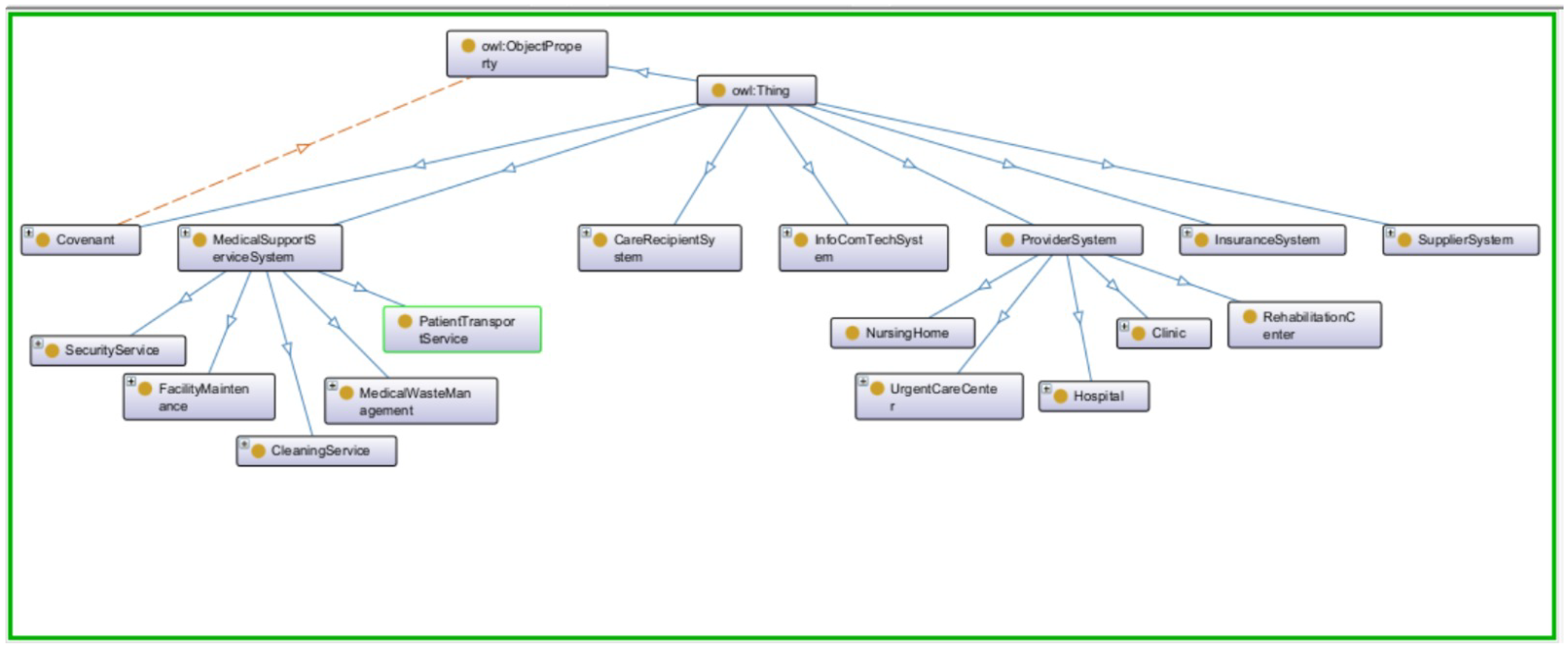
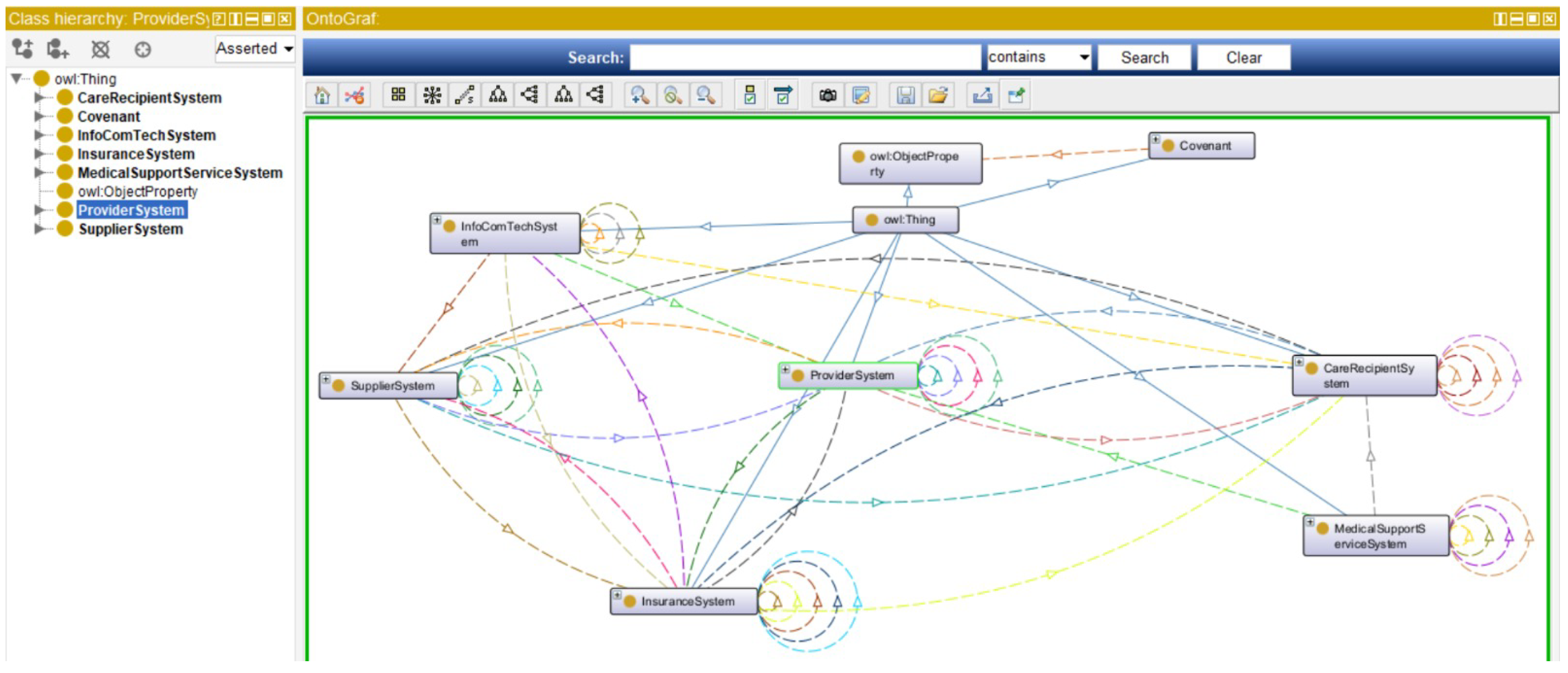
This points to the need for an ontology-driven governance tool that can integrate structural (constituent systems), behavioral (interaction flows) and regulatory (governance protocols) dimensions of a healthcare delivery SoS. This study develops an ontology-driven governance framework that integrates the structural, behavioral, and regulatory dimensions of healthcare Systems of Systems (SoS) into a unified, computationally tractable model. The proposed Web Ontology Language (OWL)-based ontology formalizes seven constituent system types and their interaction patterns derived from real-world analysis, while embedding governance protocols through the Confluence Interoperability Covenant (CIC)—a synthesis of national interoperability and regulatory standards. By embedding legal, procedural, and technical requirements directly into the system architecture, the ontology enables automated reasoning, consistency checking, and semantic querying to assess structure, coordination, and governance compliance across the healthcare SoS.
The proposed ontology advances the state of the art by providing a comprehensive formal framework that unifies healthcare SoS constituent system definitions, interaction semantics, governance mechanisms, and regulatory standards within a single representation. It functions simultaneously as a knowledge repository, capturing domain expertise in machine-readable form; an interoperability enabler, offering shared semantic vocabulary for heterogeneous systems; a governance mechanism, embedding legal and technical standards to ensure traceability between policy and operation; and a reasoning platform, enabling automated consistency checking, semantic querying, and inference. Through this synthesis, the ontology transforms fragmented conceptual insights into an operational, governance-oriented tool for healthcare SoS implementation. Its practical utility is further demonstrated through a set of operational validation scenarios and competency-driven SPARQL queries that explicitly test governance compliance, interoperability constraints, and interaction authorization under both compliant and non-compliant conditions. These validation exercises illustrate how the ontology supports executable oversight, enabling governors to detect violations, assess system readiness, and extract actionable knowledge from complex healthcare SoS configurations.
The remainder of this paper is organized as follows.
Section 2 provides background on DE and model-based systems engineering approaches in healthcare, establishing the theoretical and methodological context for ontology-driven governance.
Section 3 presents the ontology design and development, detailing the constituent system classification, interaction taxonomy, and covenant-based governance mechanism that form the ontology’s core structure.
Section 4 demonstrates ontology operationalization and validation through four representative scenarios that exercise compliance checking, violation detection, and governance enforcement capabilities, followed by extended analytical queries that reveal constituent system landscapes, standards coverage, interaction networks, and topological properties.
Section 5 discusses theoretical and practical implications, methodological contributions, limitations, and future research directions.
Section 6 concludes by synthesizing the ontology’s contributions to addressing healthcare fragmentation through governance-integrated coordination.
4. Ontology Operationalization and Validation Framework
The healthcare SoS ontology developed in this work transcends purely conceptual modeling by incorporating operational semantics that enable computational validation of governance mechanisms and interaction patterns. This section details the operationalization approach, demonstrates validation mechanisms through representative scenarios, and establishes the framework’s capability for automated compliance checking and governance enforcement.
4.1. Model Extensions for Operationalization and Validation
To enable computational reasoning about governance compliance and interaction authorization, we extended the ontology with nine data properties that capture essential system attributes and states (
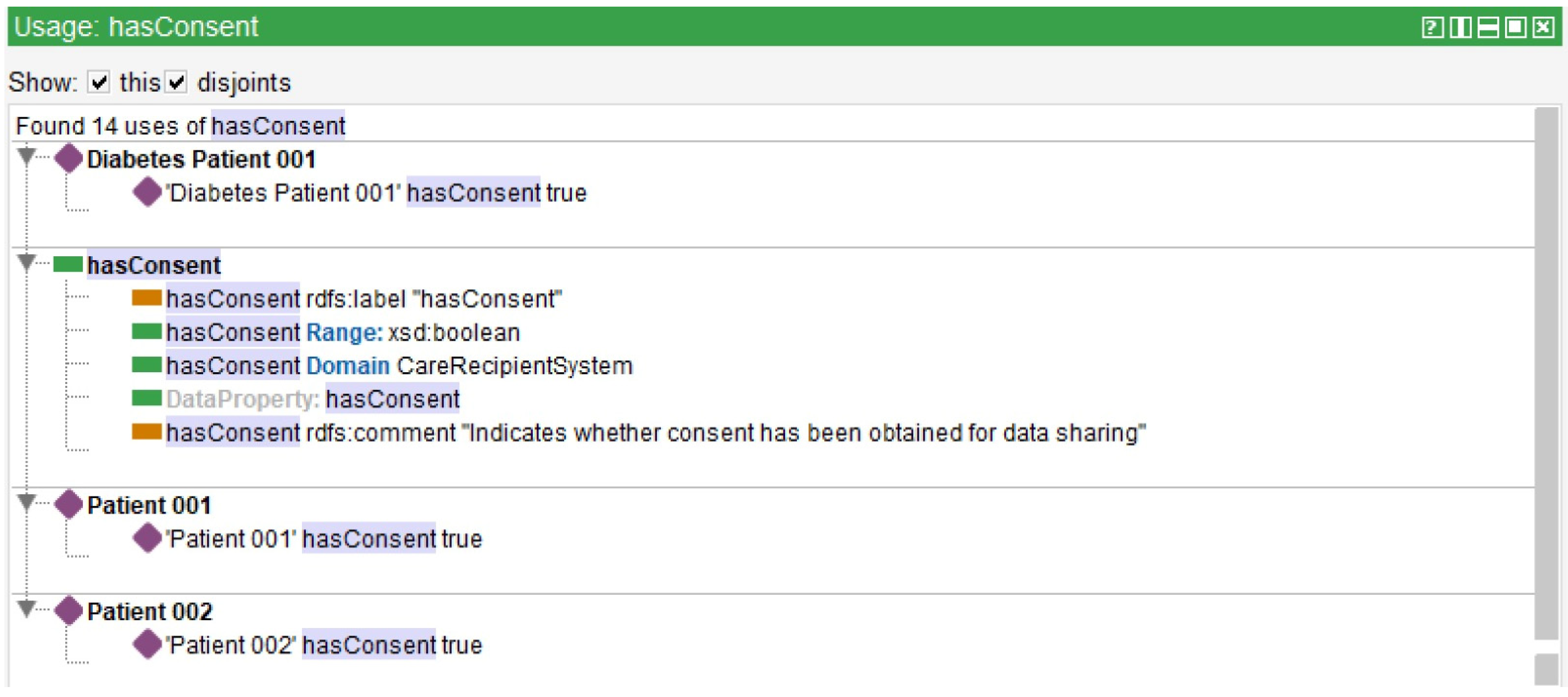
Table 4). For example, the hasConsent property exemplifies the integration of legal and ethical requirements into computational logic. As shown in
Figure 6, defined with a domain of CareRecipientSystem and a range of xsd:boolean, the property semantically encodes whether consent has been obtained for each patient entity. When instantiated as “true”^^xsd:boolean, it signals that a patient has provided informed consent for specified data sharing activities, enabling SWRL rules to validate compliance with privacy regulations before permitting inter-system interactions. The compliesWith property establishes explicit linkages between constituent systems and the covenants that govern their interactions, enabling automated verification that required governance mechanisms are in place before authorizing specific coordination activities. These properties bridge the gap between abstract ontological concepts and concrete operational requirements, enabling the reasoner to evaluate compliance conditions and detect violations.
Additionally, we instantiated the ontology with representative entities across operational scenarios that collectively demonstrate the breadth of coordination patterns within healthcare SoS. These instances, detailed in
Table 5, provide concrete test cases for validation rules while illustrating how abstract ontological constructs map to real-world healthcare organizations, transactions, and relationships. The table summarizes four illustrative scenarios and the system categories involved in each interaction. Scenario 1 (Patient Care Delivery) spans multiple categories—including provider, care recipient, insurance, and supplier systems—reflecting a cross-category service pathway. Scenario 2 (Hospital Resource Pooling) involves only provider systems, as all participating entities belong to the same category; this scenario is intentionally modeled as a within-category case to examine intra-category collaboration dynamics. Scenario 3 (Technology Integration) again crosses several categories, combining provider, care recipient, insurance, and information/communication technology systems to demonstrate a socio-technical integration pattern mediated by digital infrastructure. Scenario 4 (Temporal Compliance and Conflict Detection) introduces provider instances and covenant entities to stress-test the ontology’s advanced reasoning capabilities, specifically automated detection of governance conflicts arising from mutually exclusive covenants and temporal violations triggered by expired certifications.
Furthermore, the operational semantics of governance requirements are formalized through SWRL rules that encode compliance conditions, authorization prerequisites, and consistency constraints. These rules transform abstract governance principles into executable validation logic, enabling automated detection of violations and warnings. For example, the ConsentValidationRule exemplifies how governance requirements are operationalized. It states that if a provider serves a patient and bills insurance for that service, but the patient’s hasConsent property is false, then the provider is automatically tagged with a ConsentViolation. When executed by a SWRL-enabled reasoner, this rule operates continuously over the knowledge base, detecting violations as new instances are added or existing instances are modified.
4.2. Operational Validation: Scenario Analysis
We demonstrate the validation framework’s operation through detailed analysis of four representative scenarios that illustrate different interaction patterns and governance enforcement mechanisms.
4.2.1. Scenario 1: Cross-Category Service Delivery with Consent Validation
This scenario demonstrates inter-category interactions across Provider, CareRecipient, Insurance, and Supplier systems, with explicit consent and coverage validation. The scenario models a patient receiving urgent care services with prescription medication fulfillment, illustrating how multiple governance mechanisms operate in concert.
The scenario instantiates four constituent system instances with the properties and relationships shown in
Table 6.
When the SWRL rule engine processes this scenario, multiple validation rules are triggered:
ConsentValidationRule: Evaluates whether Patient_001 has provided consent for data sharing between UrgentCare_QuickHealth and Insurance_BlueCross. Since Patient_001 has hasConsent: true, no violation is detected.
HIPAAComplianceRule: Verifies that UrgentCare_QuickHealth complies with HIPAA before serving Patient_001. The rule confirms compliesWith: HIPAA is present, permitting the interaction.
CoverageValidationRule: Confirms that Insurance_BlueCross covers Patient_001 before UrgentCare_QuickHealth bills the insurer. The presence of the cover relationship validates this requirement.
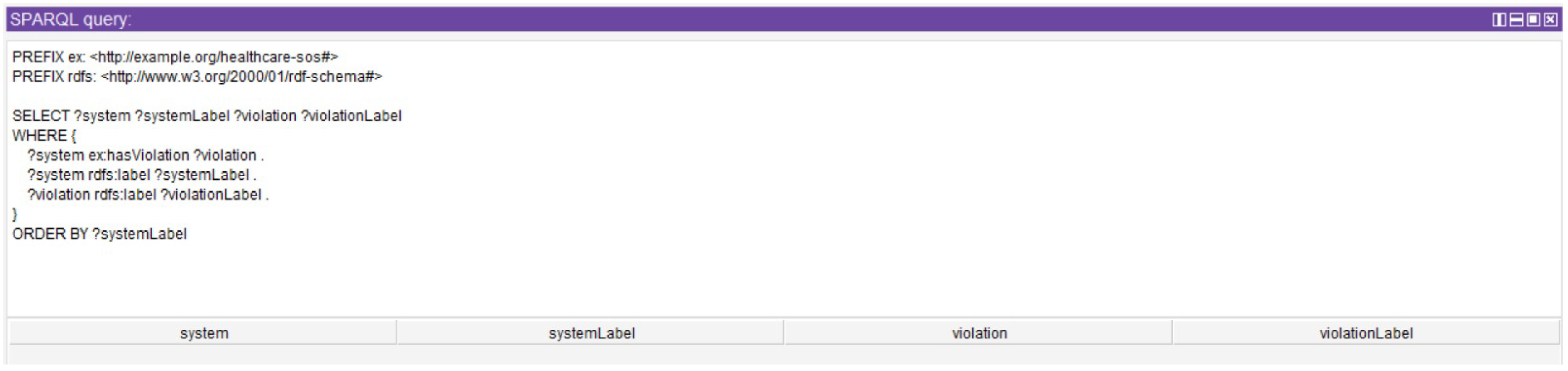
The validation results can be queried using SPARQL. The query in
Figure 7 retrieves all systems with detected violations; executing this query against Scenario 1 returns an empty result set, indicating full compliance.
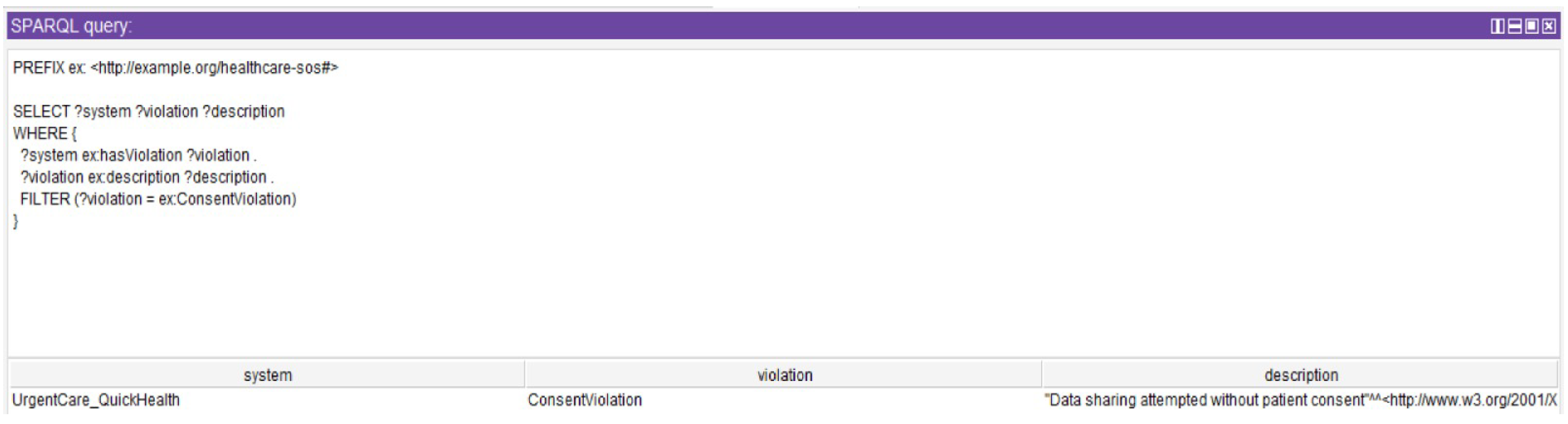
To demonstrate violation detection, we introduce a modified scenario as shown in
Figure 8. This query extracts systems flagged with ConsentViolation instances, revealing governance-relevant infractions such as unauthorized data sharing. The result shows UrgentCare_QuickHealth as a violating entity, with a semantically annotated description stating that data sharing was attempted without patient consent.
This demonstrates that the ontology successfully operationalizes the governance requirement that patient consent must be obtained before protected health information can be shared, automatically detecting violations and enabling corrective action. By modeling violations as typed entities with descriptive properties, the ontology enables traceable, machine-readable accountability and supports automated compliance auditing across distributed healthcare systems.
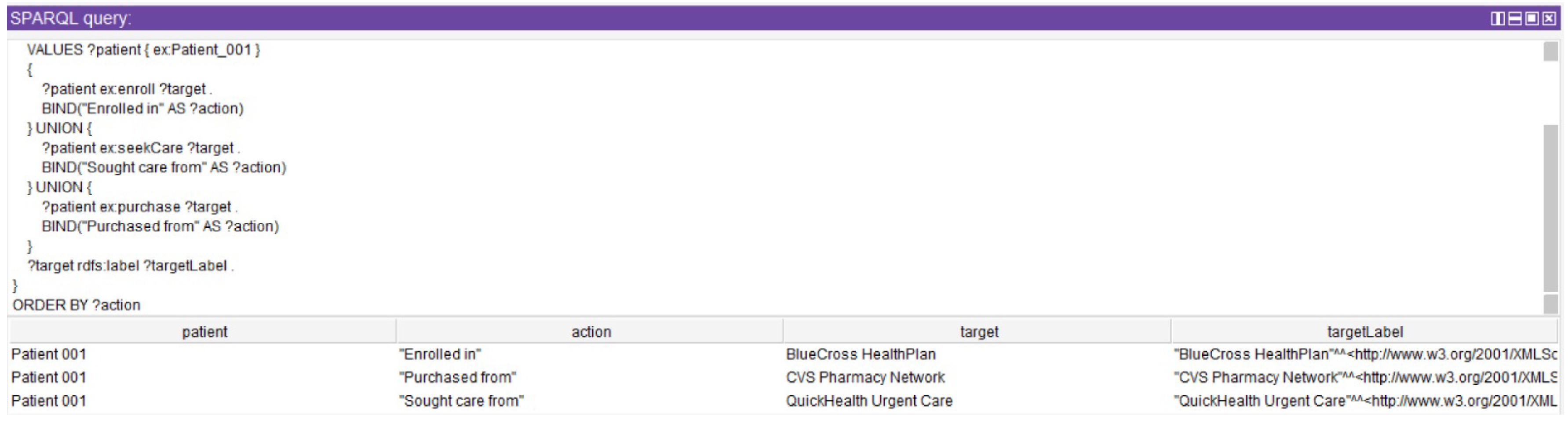
Furthermore, to deepen the analysis of Scenario 1, the following query is used to reconstruct the actual pathway of Patient_001 across the involved system categories, as presented in
Figure 9. By retrieving the patient’s enrollment, care-seeking, and purchasing interactions, the query exposes the concrete cross-category linkages that operationalize the scenario.
The SPARQL query reconstructs the pathway of Patient_001 by aggregating enrollment, care-seeking, and purchasing interactions across insurance, provider, and supplier systems. This pathway is not merely a record of isolated actions; it is an ontological implication of how the SoS is structured. Because each predicate (enroll, seekCare, purchase) encodes a typed relationship between the patient and distinct system categories, the resulting sequence reveals the underlying connections and interdependencies that shape the patient’s journey. The ontology makes these linkages explicit: enrollment ties the patient to the insurance subsystem, care-seeking connects them to clinical providers, and purchasing links them to supplier networks. Together, these relationships expose the cross-category dependencies that enable a complete episode of care. By modeling these interactions semantically, the ontology provides a machine-interpretable representation of how heterogeneous subsystems rely on one another, supporting deeper analysis of coordination, interoperability, and governance within the healthcare SoS.
4.2.2. Scenario 2: Intra-Category Resource Pooling with Quality Management Validation
This scenario demonstrates intra-category interactions among three hospitals engaging in equipment sharing and disaster preparedness coordination, governed by ISO quality management and safety standards. Three hospital instances establish bidirectional resource pooling relationships (
Table 7).
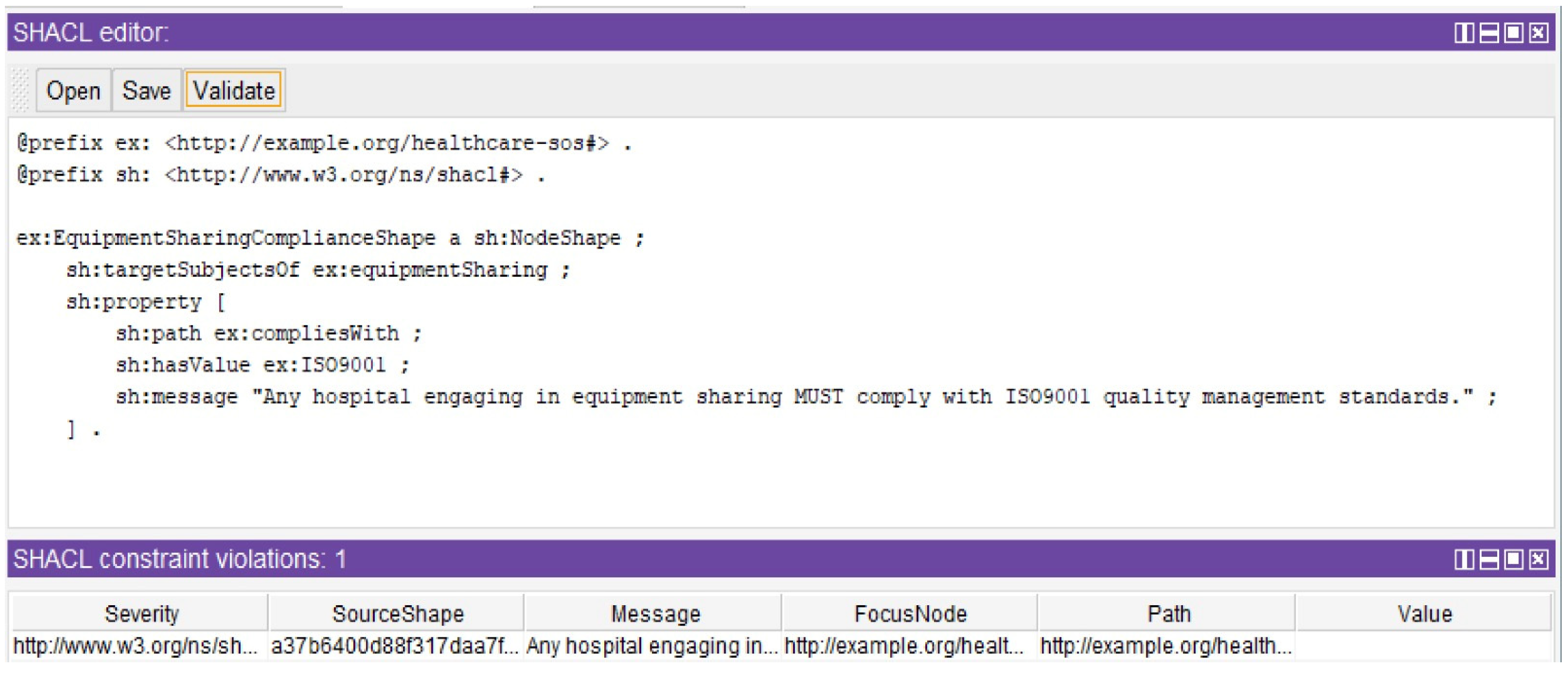
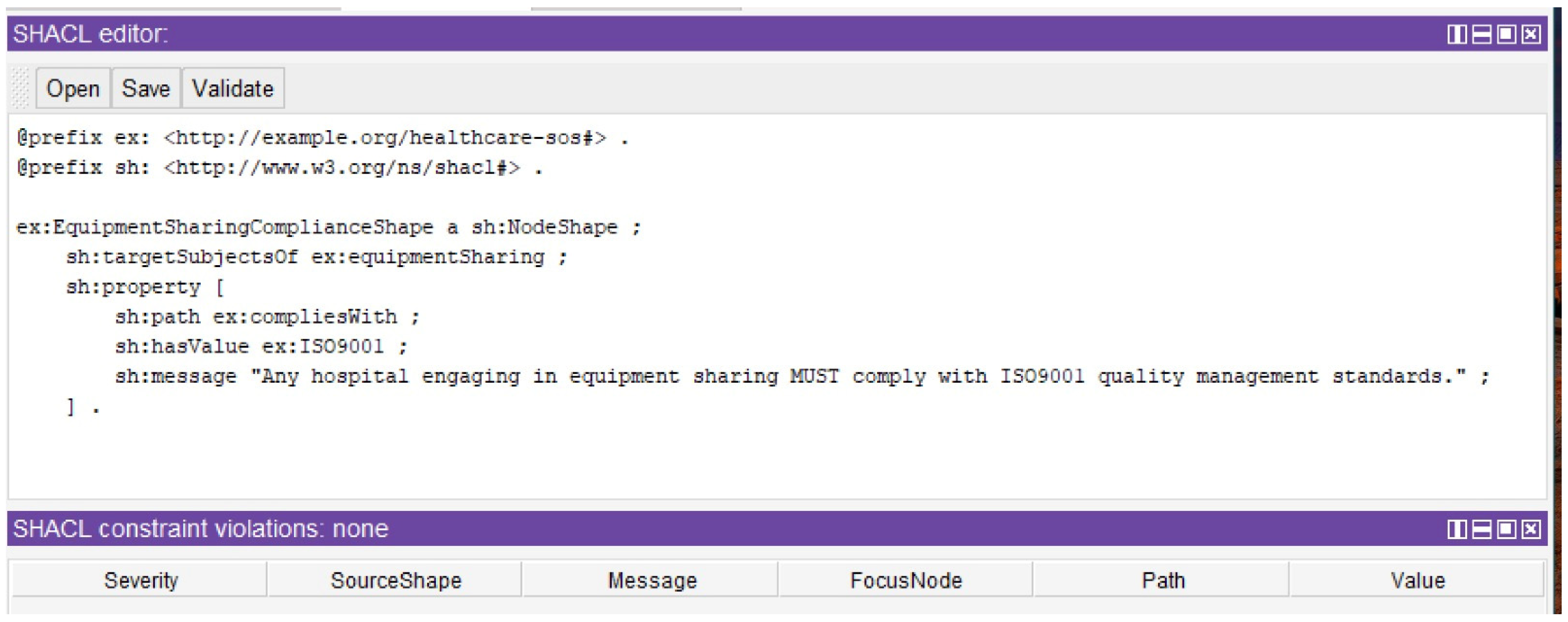
Another way to verify this constraint—beyond executing the query demonstrated in the previous example—is through SHACL shapes, as illustrated in
Figure 10, where the EquipmentSharingComplianceShape checks that any subject participating in equipmentSharing possesses a compliesWith relationship to the ISO9001 governance artifact. It validates that hospitals engaging in resource pooling comply with ISO9001 quality management standards. Since all three hospitals have the property compliesWith: ISO9001, the validation passes as presented in the
Figure 10.
However, the rule’s importance becomes evident through a negative test case in which Hospital_Community lacks ISO9001 certification. As illustrated in
Figure 11, the SHACL validation process evaluates whether hospitals participating in equipmentSharing satisfy the required compliesWith: ISO9001 constraint. The validation engine checks each subject of the equipmentSharing property against the defined EquipmentSharingComplianceShape. The results show that Hospital_Regional, which explicitly asserts compliance with ISO9001, satisfies the constraint and is therefore considered compliant. In contrast, Hospital_Community does not possess the required compliesWith ISO9001 relationship, leading the SHACL validator to generate a constraint violation. This violation is reported in the validation output, demonstrating how SHACL shapes effectively detect governance non-compliance within the ontology by enforcing mandatory regulatory relationships.
4.2.3. Scenario 3: Technology Integration with Protocol Compliance Validation
This scenario demonstrates how technology integration interactions are governed by interoperability protocol requirements, validating that EHR systems and healthcare providers support standardized data exchange formats. An EHR system integrates with multiple providers and an insurance system (
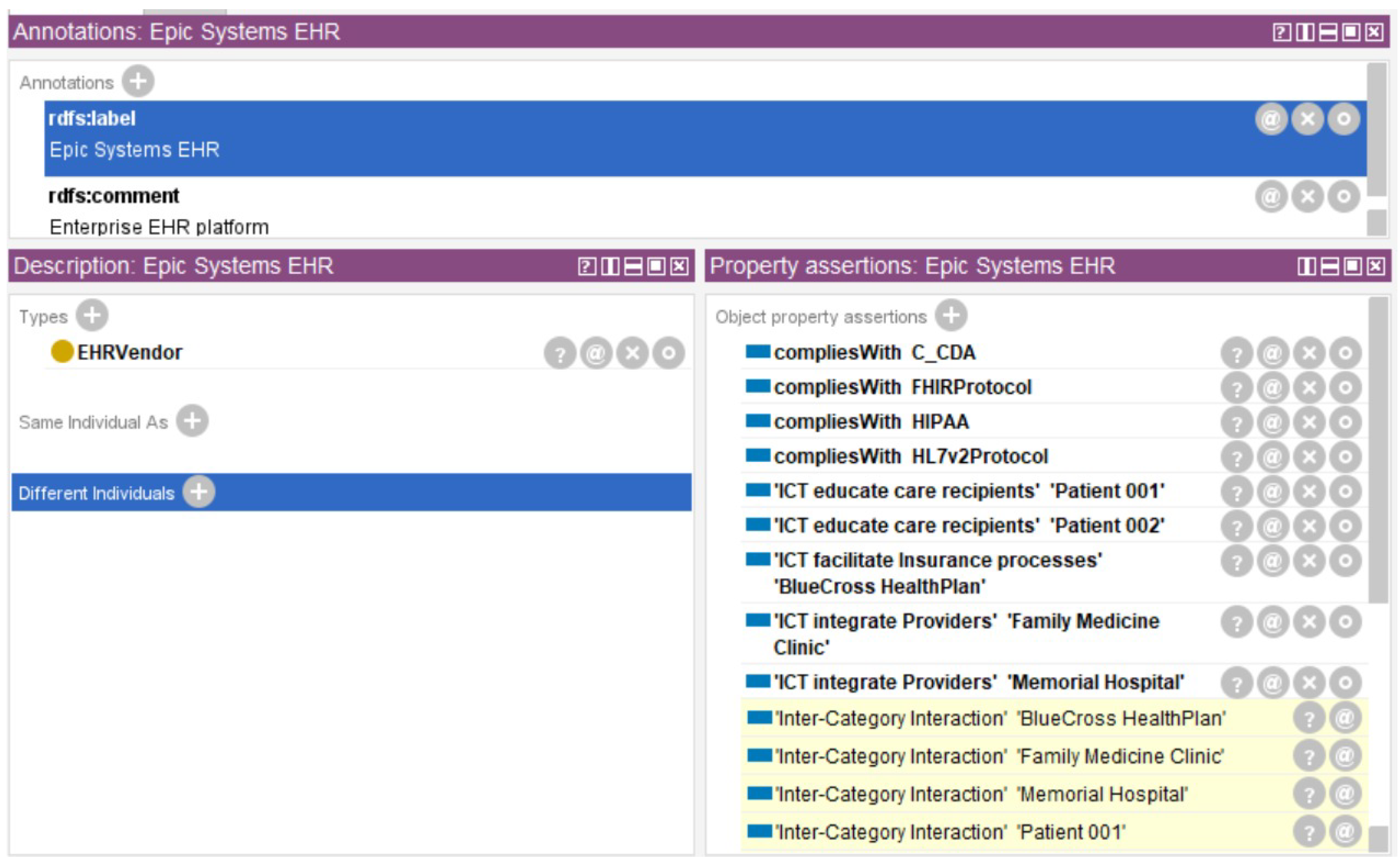
Table 8). This table summarizes a technology-integration scenario in which EHR_Epic, an electronic health record vendor, serves as a central interoperability enabler across multiple system categories. As an EHRVendor, Epic complies with key regulatory and interoperability standards—including HIPAA, FHIR, HL7v2, and C-CDA—which positions it as a trusted connector within the healthcare ecosystem. Its integration relationships extend outward to Hospital_Memorial and Clinic_FamilyMed, both of which receive ICT integration that supports clinical data exchange and workflow coordination. Epic also facilitates connectivity with Insurance_BlueCross, enabling administrative and claims-related interoperability, and provides informational and educational interactions to Patient_001 and Patient_002, reflecting patient-facing digital engagement.
To further explain the structure in the ontology model,
Figure 12 presents the semantic profile of EHR_Epic. It displays the semantic assertions associated with Epic Systems EHR, including its compliance with major interoperability standards and its formally encoded relationships with patients, providers, and insurers. The interface is divided into three key panels—Annotations, Description, and Property Assertions. In the Annotations panel, Epic is labeled as an “Enterprise EHR platform,” establishing its functional identity. The Description panel classifies it as an EHRVendor, distinguishing it from other system categories such as hospitals or insurers. The Property Assertions panel is the most structurally informative: it lists multiple object property assertions that define Epic’s compliance and interaction footprint. Specifically, Epic is shown to comply with critical interoperability and regulatory standards.
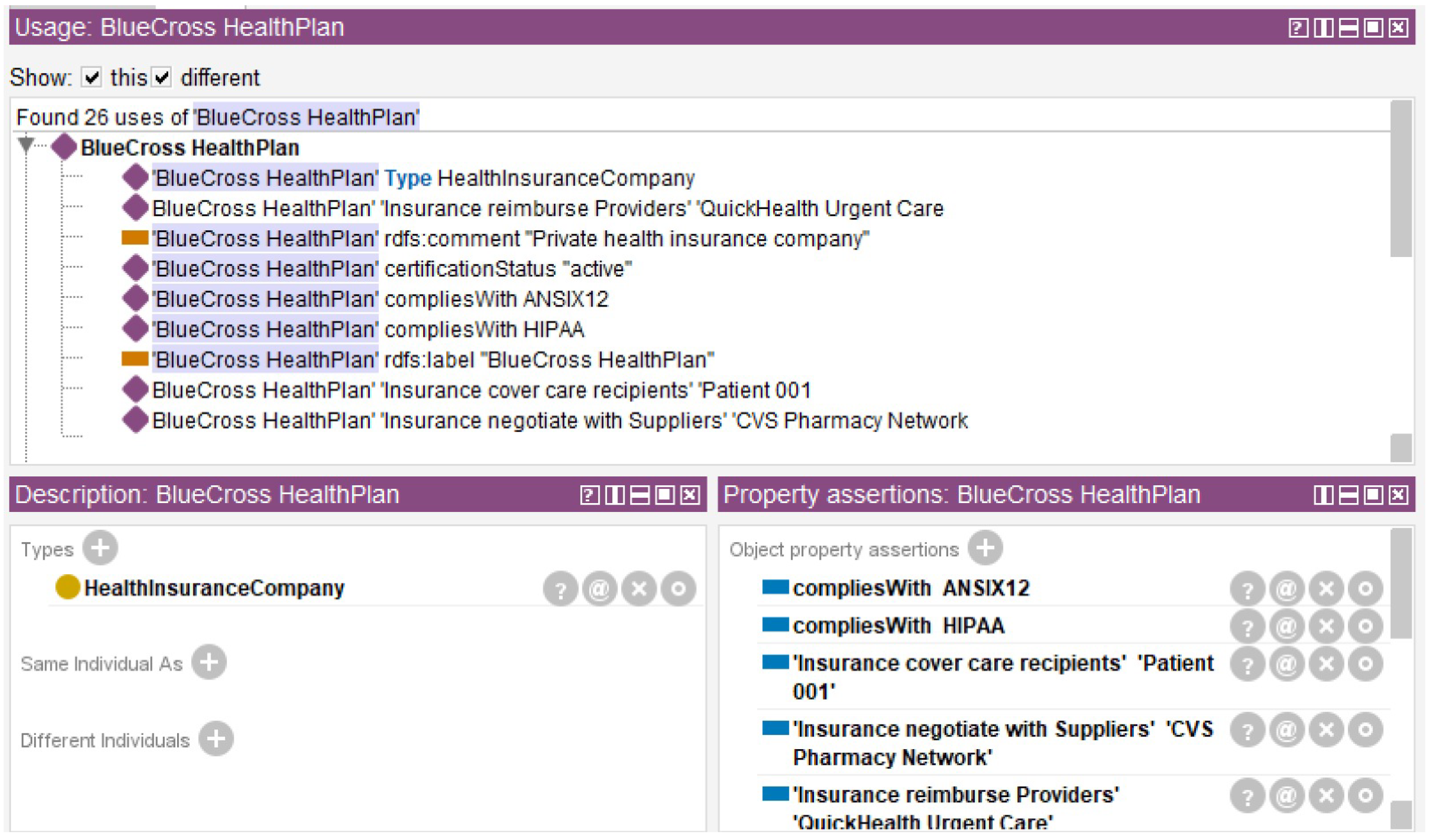
Furthermore, to substantiate Scenario 3, the following semantic interface view of BlueCross HealthPlan illustrates how insurance entities mediate cross-category coordination through formally asserted relationships.
Figure 13 presents the ontological footprint of BlueCross HealthPlan, modeled as a HealthInsuranceCompany with active certification status and compliance with HIPAA and ANSI X12 standards. The entity is semantically linked to Patient_001(coverage), QuickHealth Urgent Care (reimbursement), and CVS Pharmacy Network (negotiation), spanning three distinct system categories.
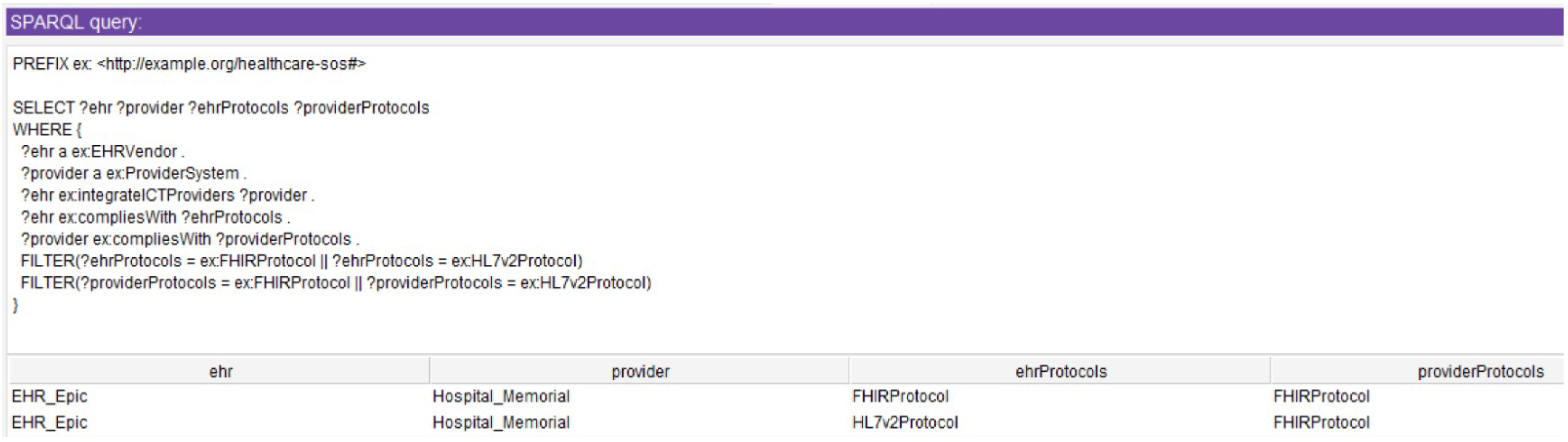
For scenario configuration,
Figure 14 presents a SPARQL query designed to evaluate protocol alignment between EHR vendors and provider systems, specifically focusing on compliance with FHIRProtocol and HL7v2Protocol. The query filters for entities where an EHRVendor integrates with a ProviderSystem and both parties comply with at least one of the specified interoperability standards. Since EHR_Epic has compliesWith: FHIRProtocol, integration with both hospitals proceeds without violations.
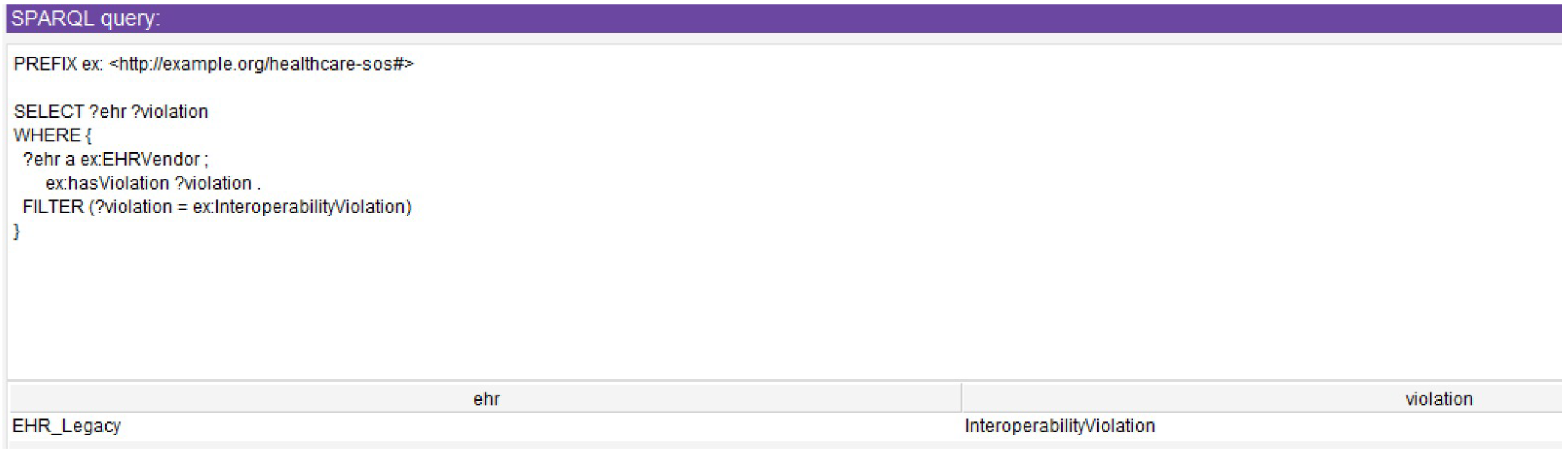
To demonstrate the effectiveness of the proposed governance mechanisms, a negative test scenario is constructed in which an EHR system does not support the required interoperability standards. In this scenario, a legacy EHR vendor is instantiated without compliance to modern healthcare exchange protocols, while still attempting to integrate with provider systems. This configuration is intentionally designed to violate interoperability requirements, allowing the governance rules to be exercised and their enforcement capability to be empirically validated.
Figure 15 illustrates the outcome of executing a compliance-monitoring SPARQL query over the ontology following reasoning. The query targets EHR vendors that have been annotated with interoperability violations as a result of governance rule enforcement. In the depicted negative test scenario, a legacy EHR system that lacks support for required interoperability standards is intentionally introduced into the model. As shown in the query result table, the system (EHR_Legacy) is explicitly returned and associated with an InteroperabilityViolation, indicating that the interoperability governance rule has fired successfully. This figure demonstrates not only the detection of a non-compliant system but also the traceability of governance decisions, as violations are materialized within the knowledge graph and can be systematically retrieved to support automated monitoring and decision-making. This violation signals that the legacy EHR system cannot support modern data exchange requirements, enabling administrators to prevent integration failures before deployment.
4.2.4. Scenario 4: Temporal Compliance and Conflict Detection Execution
Complex healthcare SoS governance inherently involves temporal boundaries (expiring certifications) and overlapping, sometimes contradictory, jurisdictions. To demonstrate the ontology’s capacity to execute advanced conceptual logic beyond simple structural shapes or SWRL datatypes, we constructed a fourth scenario to stress-test the HermiT reasoner against mathematically modeled conflicts.
The ontology explicitly defines a 'ConflictViolation' entirely through OWL 2 DL 'owl:equivalentClass' axiomatization, leveraging 'owl:intersectionOf' to mathematically define a conflict:
ex:ConflictViolation a owl:Class;
rdfs:subClassOf ex:Violation;
owl:equivalentClass ex:bn-12.
# Where ex:bn-12 resolves to a strictly Skolemized owl:Restriction
# computing the intersection of mutually exclusive compliance requirements
# without risking parser exceptions common to anonymous blank nodes.
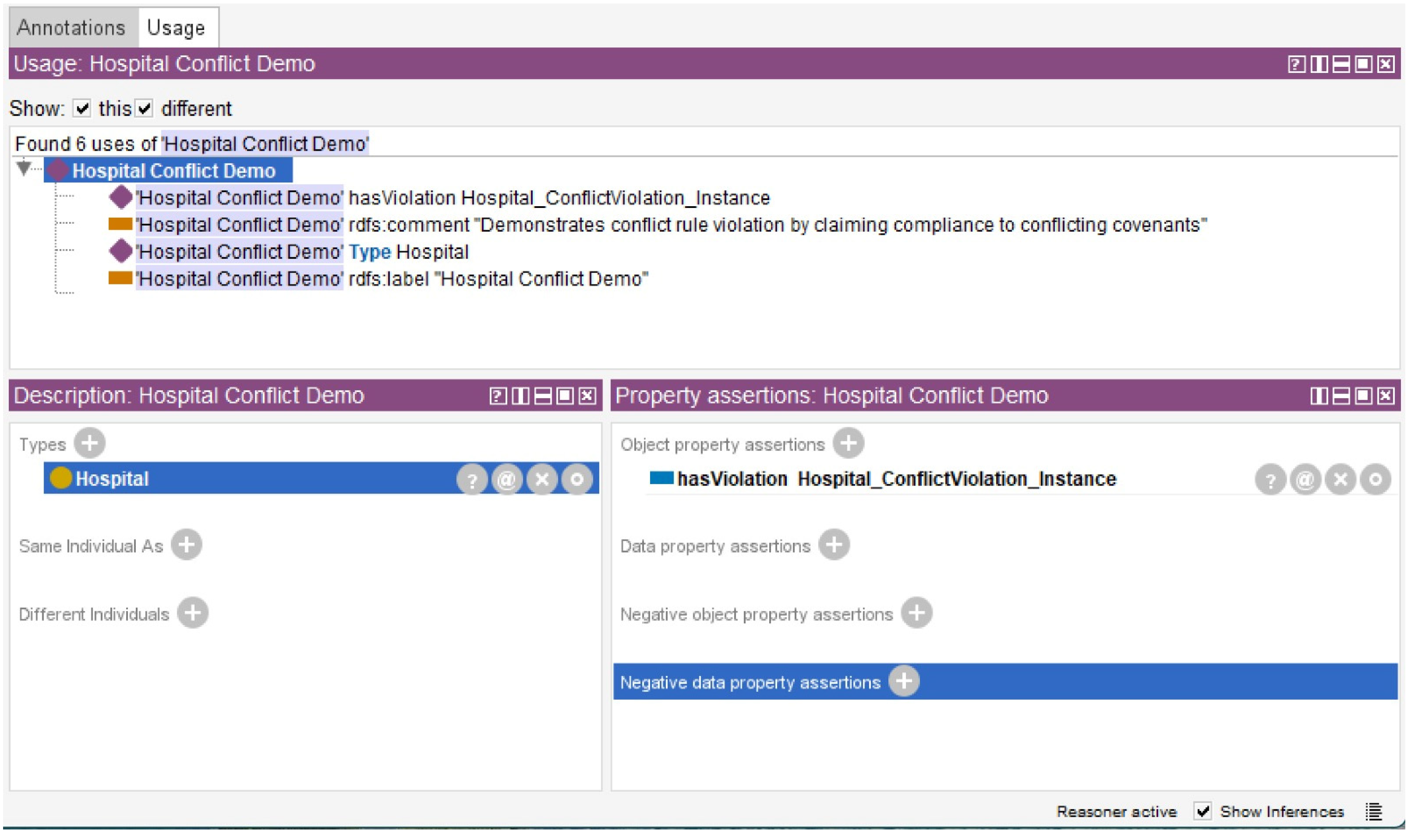
In this scenario, an instance (Hospital_Conflict_Demo) is asserted to comply with both the FHIRProtocol and a fictional LocalDataSiloPolicy. In the semantic TBox, these two covenants are explicitly linked via the ex:conflictsWith symmetric property. Upon execution, the HermiT reasoner calculates that the hospital satisfies both halves of the logical intersection—it complies with a covenant and explicitly complies with a second covenant that is mutually exclusionary to the first. As demonstrated in
Figure 16, the reasoner automatically flags the hospital with a hasViolation property linked to the ConflictViolation class, validating the system’s ability to detect overlapping governance jurisdictions without human intervention.
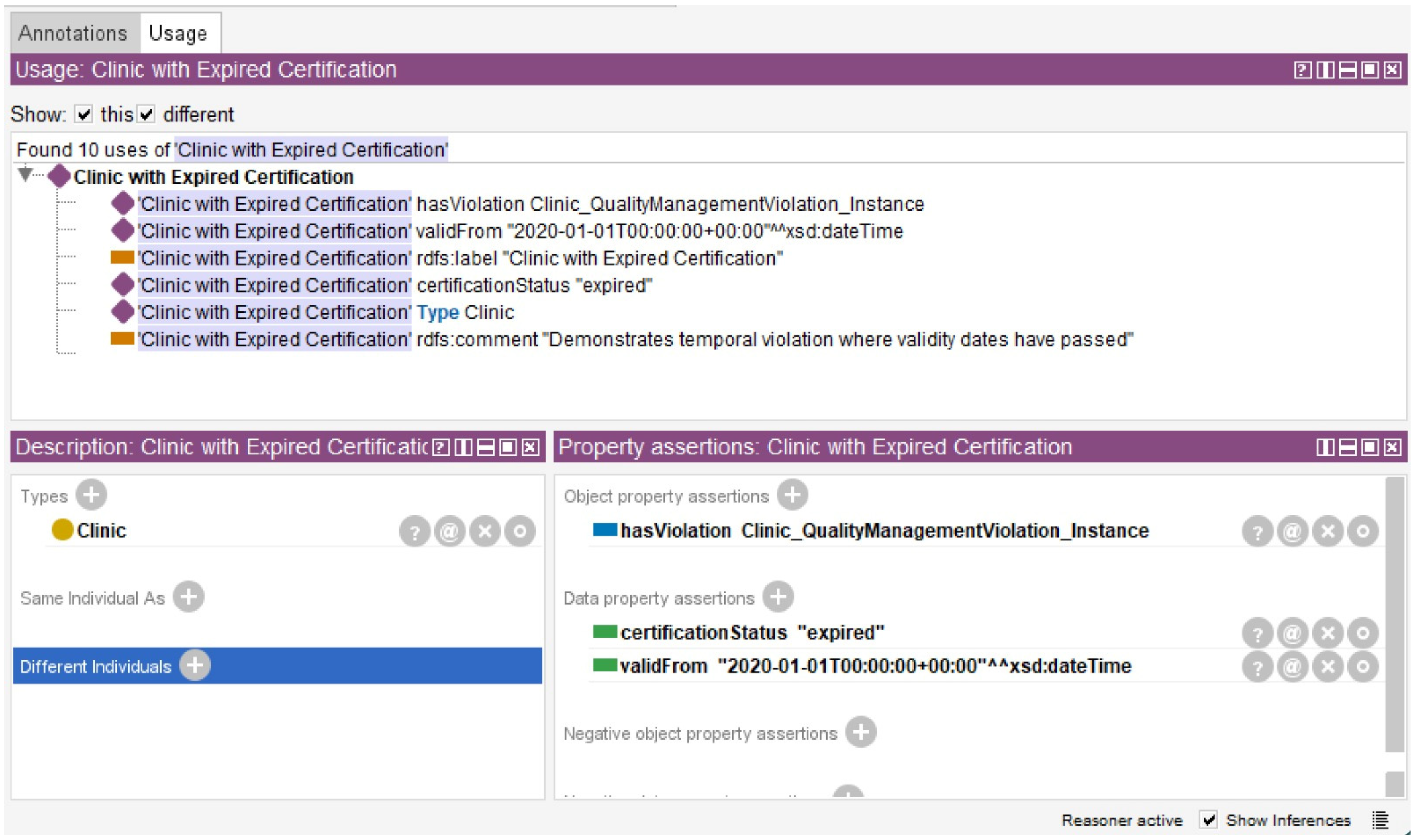
Furthermore, the model computationally addresses temporal degradation. An instance (Clinic_Expired_Cert) is appended with specific validFrom and validUntil xsd:dateTime properties binding the scope of its operational certification. When the simulation evaluates these properties against the present timestamp, the certificationStatus devolves. As illustrated in
Figure 17, when the reasoner executes over this degenerated state, it natively infers and highlights a QualityManagementViolation for the clinic.
4.3. Ontology Querying for Extended Capability Demonstration and Knowledge Extraction
Beyond operational validation through predefined case scenarios, the ontology is further exercised using targeted SPARQL queries to demonstrate its broader analytical and representational capabilities. The queries presented in this subsection demonstrate four progressively sophisticated analytical dimensions: (1) constituent system enumeration and compliance profiling, (2) population-level governance coverage assessment, (3) operational relationship discovery and network mapping, and (4) graph-theoretic structural analysis enabling strategic governance prioritization. These capabilities collectively transform the ontology from a compliance checking instrument into a comprehensive knowledge base supporting strategic governance planning, risk assessment, and policy development. Each query category addresses distinct but complementary governance questions: basic entity retrieval establishes “what exists and what standards apply,” aggregation queries reveal “where governance gaps and redundancies occur,” relationship queries expose “how systems actually coordinate,” and network metrics identify “which entities are strategically critical.” By enabling these queries through a unified semantic framework, the ontology operationalizes the fundamental premise that effective healthcare SoS governance requires not merely rule enforcement but deep structural understanding of the system being governed.
Additionally, these queries illustrate how the proposed ontology supports exploratory reasoning, interaction tracing, and semantic inspection across heterogeneous healthcare constituent systems. By surfacing typed relationships and encoded constraints, the ontology enables traceable, machine-interpretable insights into system behavior, institutional roles, and structural interdependencies across the healthcare SoS. These capabilities collectively illustrate that the ontology functions not only as a governance enforcement mechanism but also as a comprehensive knowledge base from which actionable insights about the healthcare SoS can be systematically derived.
4.3.1. Constituent Systems Analysis
List All Supplier Systems with Compliance Standards
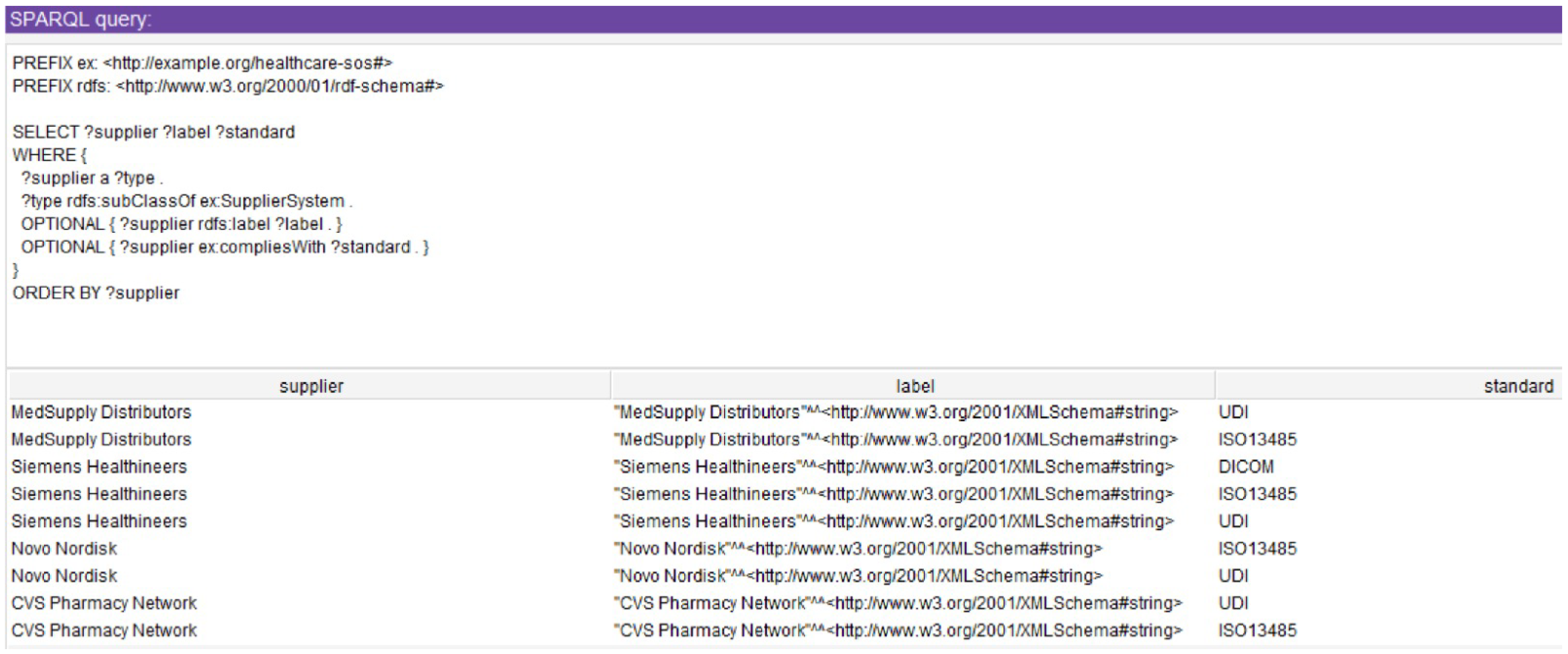
This query in
Figure 18 addresses a foundational governance requirement: maintaining an authoritative registry of supplier entities and their compliance profiles. The SPARQL query retrieves all instances classified as ex:SupplierSystem along with the covenant instances to which each supplier declares compliance via the ex:compliesWith property. The capability to enumerate suppliers by compliance standard is essential for procurement governance—healthcare organizations must verify that prospective suppliers adhere to applicable regulatory, quality, and safety standards before authorizing transactions.
The significance of this query extends beyond simple list generation. By representing compliance relationships as first-class ontological assertions (rather than external metadata or document references), the framework enables procurement systems to programmatically query supplier eligibility. For instance, when a hospital initiates procurement for medical devices, the system can automatically filter suppliers to those complying with ISO13485 (medical device quality management) and UDI (unique device identification) standards, excluding non-compliant entities from consideration. This computational tractability transforms compliance from a manual verification burden into an automated governance constraint—the ontology does not merely document compliance but actively enforces it through query-driven access control. Furthermore, this query validates the functional categorization methodology presented in [
41]. By defining SupplierSystem as a distinct constituent class with its own compliance profile, the ontology enables category-specific governance queries that would be impossible under generic “organization” classifications. The query demonstrates that the seven-class structure is not merely taxonomic but analytically productive as it partitions the healthcare SoS in ways that support targeted governance operations aligned with functional roles.
4.3.2. Standards and Compliance Analysis
Count Entities by Compliance Standard
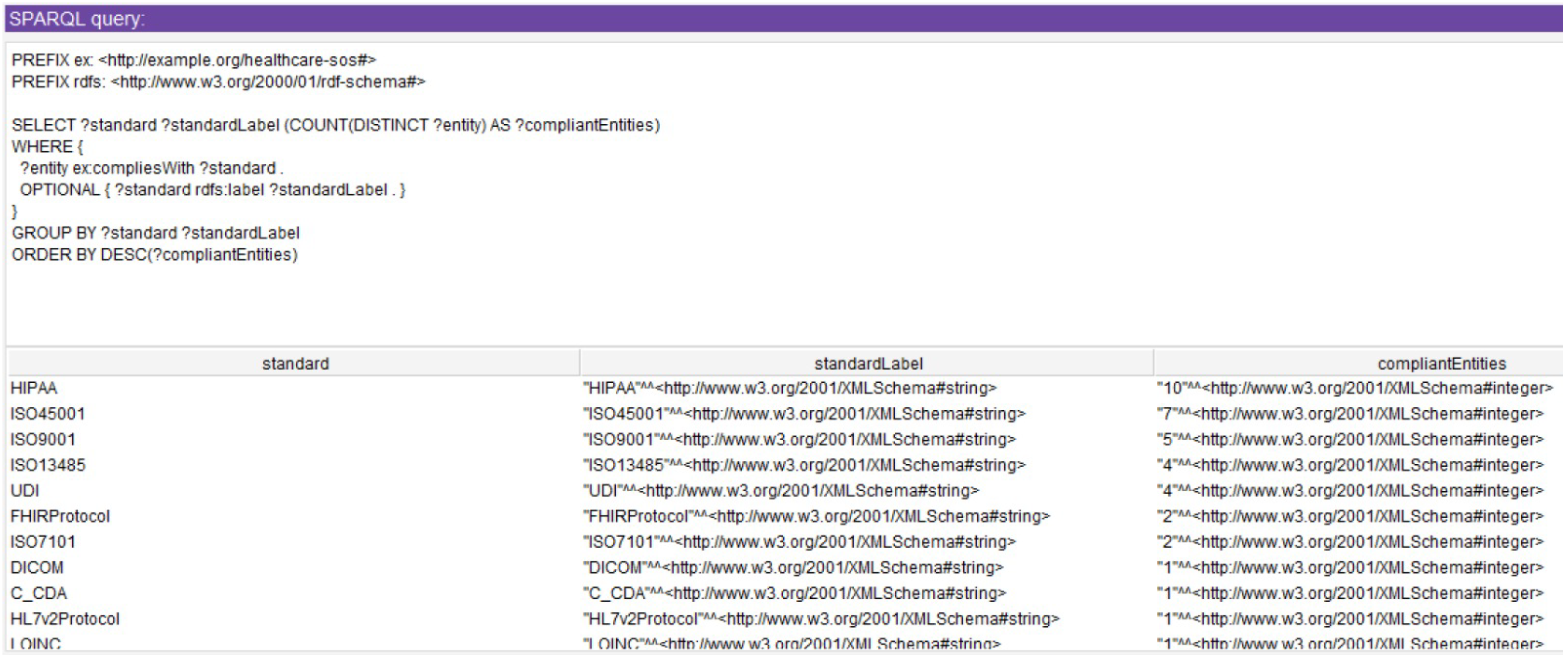
The query in
Figure 19 inverts the previous perspective, pivoting from “which standards do entity X comply with” to “how many entities comply with standard Y.” The SPARQL aggregation returns, for each covenant instance (HIPAA, ISO13485, FHIR Protocol, etc.), a count of constituent systems declaring compliance through the ex:compliesWith relationship. This population-level view is critical for governance gap analysis and policy development. Discovering that only three entities comply with ISO13485 while twenty-seven comply with HIPAA suggests potential supply chain governance vulnerabilities—either ISO13485 adoption is inappropriately low, or it is correctly applied only where mandatory. Conversely, near-universal adoption of a standard indicates it functions as a de facto baseline requirement, informing decisions about which covenants should be incorporated into default contracting templates or regulatory mandates.
The analytical value of this query lies in its ability to surface system-wide governance patterns that are invisible at the individual entity level. A single entity’s compliance status reveals nothing about whether that status is typical or anomalous; aggregation across the population contextualizes individual compliance decisions within broader adoption trends. For governance authorities, this information guides resource allocation: standards with low adoption despite regulatory importance may require enforcement campaigns or capability-building interventions, while standards approaching saturation may justify transitioning from voluntary guidance to mandatory requirements. Additionally, this query demonstrates that the ontology supports not just instance-level reasoning (e.g., “does Hospital A comply with HIPAA?”) but population-level analytics essential for strategic governance planning. The ability to count compliant entities per standard validates that covenants are represented as first-class ontological entities—not as metadata tags but as queryable objects with their own properties and relationships, which was initially proposed as an external governing entity in [
37]. This design choice enables governance authorities to treat covenants as analytical units, asking questions like “which standards have the highest adoption rates” or “which standards exhibit compliance clustering within specific system categories.”
Standards Coverage by System Type
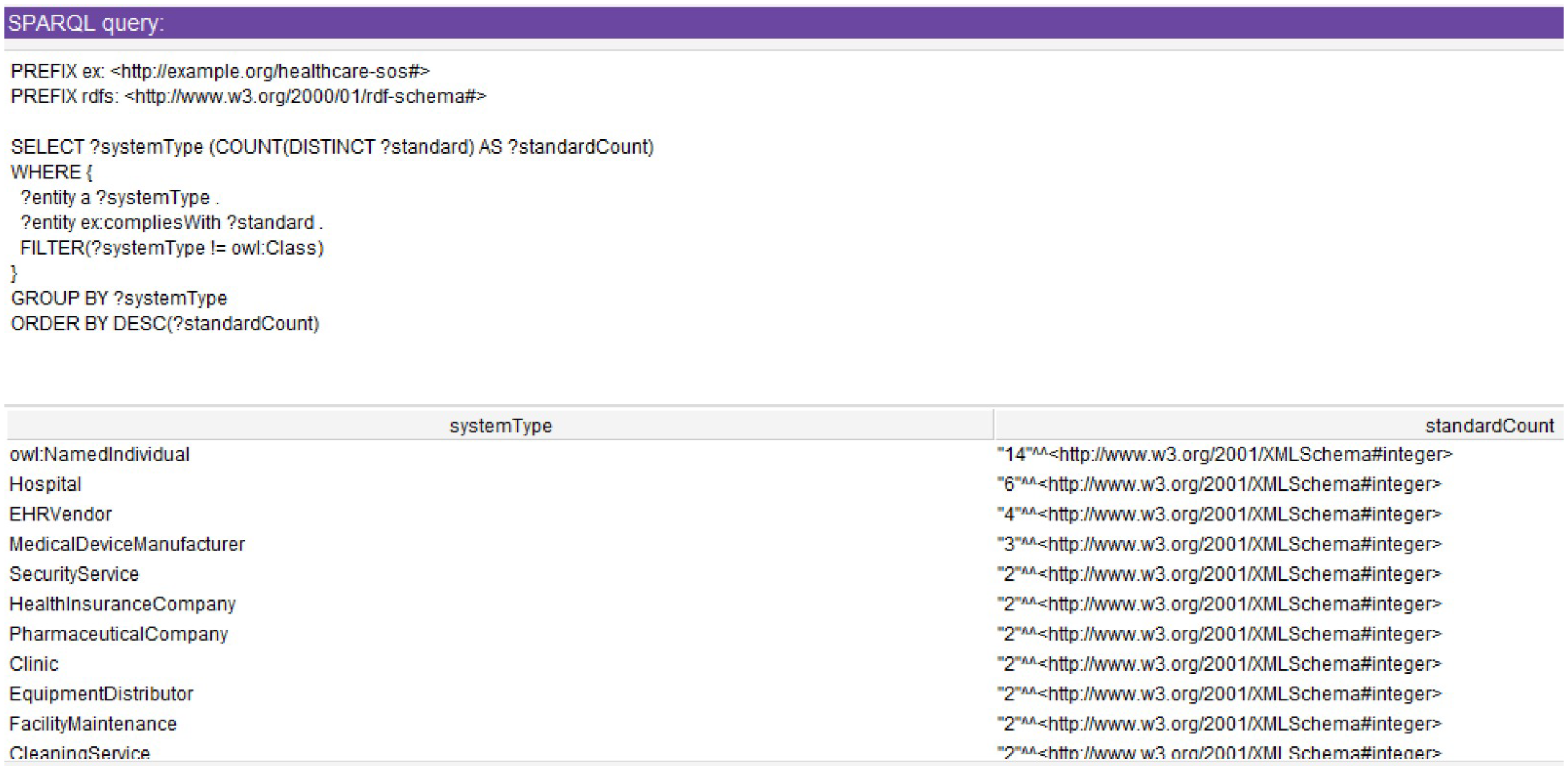
The query in
Figure 20 synthesizes the previous two perspectives into a two-dimensional analysis. aggregates the number of distinct normative artifacts (standards, protocols, regulations) associated with each classified system category, producing a quantitative profile of normative embedding across the ecosystem; this profile is valuable because it converts otherwise diffuse compliance information into actionable governance metrics that reveal which system classes are well-scaffolded by formal instruments and which are under-covered or potentially exposed. Systems that exhibit higher counts of associated standards typically do so because they occupy functionally critical, highly integrated, or highly regulated roles—clinical providers, EHR platforms, and device manufacturers face multiple safety, privacy, interoperability, and quality regimes—while multifunctional hubs and mature vendors pursue numerous certifications to enable market access and customer trust. Higher counts therefore signal both greater normative assurance and greater governance complexity; they indicate that an entity is more thoroughly scaffolded by legal, procedural, and technical instruments, but also that it bears a larger compliance management burden and a higher potential for overlapping or conflicting obligations.
Practically, a high standard count often correlates with increased operational centrality and systemic impact, which makes such entities priority targets for monitoring, audit, and harmonization efforts; conversely, low counts may reveal genuine governance gaps or simply incomplete ontology population, so counts must be interpreted alongside data completeness checks. This validates the ontology’s core methodological choice: functional categorization rather than market-sector or organizational-identity classification [
41]. It demonstrates that the seven-class structure is not merely descriptive but enables governance-relevant analytics that surface patterns aligned with how healthcare systems actually function. Identifying these patterns is crucial for assessing whether governance requirements are appropriately tailored to functional responsibilities or whether certain categories are systematically under-governed. Moreover, these coverage counts can be combined with network and interaction metrics to assess whether highly connected or mission-critical system types also possess commensurate normative protections, thereby guiding resilience and risk-mitigation strategies. This supports analysis explained in the fragmentation index developed in [
41], whose entropy dimension captures the diversity of standards.
4.3.3. Interaction Patterns Analysis
Inter-Hospital Resource Pooling Network
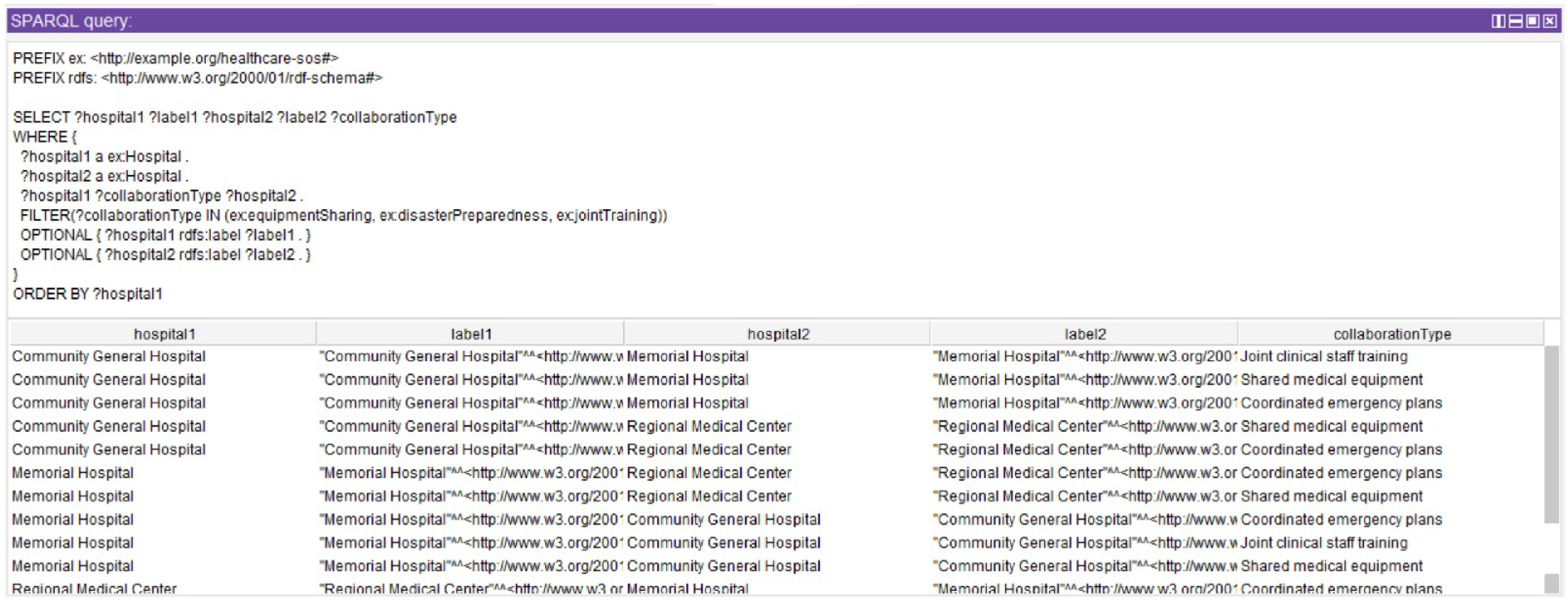
The query in
Figure 21 shifts from static entity properties (compliance profiles) to dynamic operational relationships, specifically mapping the network of resource sharing arrangements among hospital entities. The SPARQL query identifies all instances of ex:Hospital (a subclass of ProviderSystem) and retrieves their outgoing ex:equipmentSharing, ex:disasterPreparedness, and related intra-category interaction properties, constructing an input for a possible network graph where nodes represent hospitals and edges represent resource pooling relationships. It specifically retrieves pairs of hospital entities engaged in predefined collaboration types such as shared medical equipment, coordinated emergency plans, and joint clinical staff training. Understanding these coordination networks is essential for assessing operational resilience; densely connected networks can redistribute capacity during demand surges or supply disruptions, enabling hospitals to access equipment, staff, or bed capacity from network partners. Conversely, isolated hospitals lacking resource pooling arrangements face heightened vulnerability to capacity shortfalls, as they cannot call upon external resources during crises.
The governance implications of this query are substantial. Resource pooling arrangements require specific governance mechanisms—contracts specifying liability allocation, quality standards for shared equipment, protocols for requesting and transferring resources, and data sharing agreements enabling capacity monitoring. By making these relationships computationally visible, the ontology enables governance authorities to ask: which resource pooling relationships lack appropriate contractual foundations? Which networks exhibit structural vulnerabilities such as over-dependence on single hub institutions? Which hospitals are isolated from pooling networks despite operating in regions prone to capacity crises? These questions cannot be answered through entity-level compliance checking alone; they require relationship-level analysis that treats coordination networks as governance targets. This example is for only one subclass of one category. The same logic and rationale apply to all others to explore valuable insights for actionable governance.
Furthermore, this query validates that the ontology captures operational interdependencies, not merely classificatory relationships. The intra-category interaction properties (ex:equipmentSharing, etc.) are not metadata annotations but represent actual coordination patterns that shape how healthcare delivery occurs, as investigated in [
43]. By making these patterns queryable, the ontology transforms implicit coordination networks—often known only to the participants—into explicit governance objects that can be analyzed, monitored, and potentially regulated. This capability is essential for SoS governance, where system-level resilience emerges from coordination patterns rather than individual entity capabilities, as discussed in [
36].
4.3.4. Check for Bidirectional Relationships
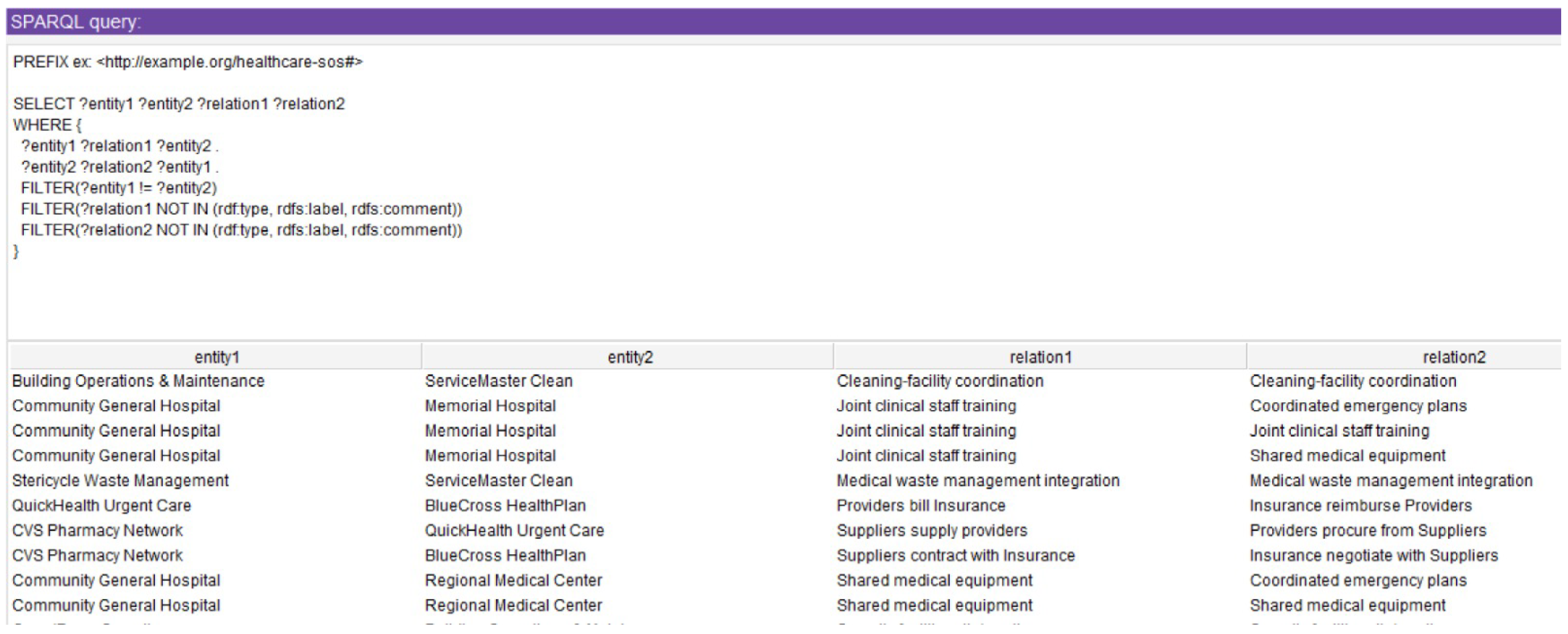
Figure 22 executes a SPARQL pattern that returns pairs of distinct entities where each point to the other via one or more predicates. The result table lists entity pairs together with the two predicates that link them in opposite directions. Rows include symmetric cases (the same predicate in both directions, e.g., “Cleaning-facility coordination” between Building Operations & Maintenance and ServiceMaster Clean) and asymmetric but reciprocal semantics (different predicates that express complementary roles, e.g., “Providers bill Insurance” vs. “Insurance reimburse Providers”). Conceptually, the query surfaces all bidirectional ties encoded in the graph, revealing mutual aid relationships, contractual reciprocity, supplier–buyer loops, and operational integrations that are modeled as two-way links.
Detecting bidirectional relationships is important because reciprocity often signals stronger, negotiated, or legally binding interactions (mutual-aid agreements, contracts, service level reciprocities) and therefore warrants elevated governance attention. From an ontology-validation perspective, these results confirm that the model captures two-way semantics and helps identify modeling artifacts (duplicate predicates, unintended symmetry) or missing reciprocity where one would expect it. Operationally, bidirectional ties mark natural enforcement and monitoring points—entities in reciprocal relationships are prime candidates for joint covenants, coordinated audits, and shared incident response procedures. For resilience and risk analysis, reciprocal links indicate tightly coupled subsystems whose failures can propagate bidirectionally, so they should be prioritized for redundancy, harmonization of standards, and conflict-resolution rules. Finally, comparing observed reciprocity against expected legal or procedural reciprocity supports compliance checks and helps surface gaps where formal covenants should be created or clarified.
4.3.5. Interaction Type–Covenant Mapping
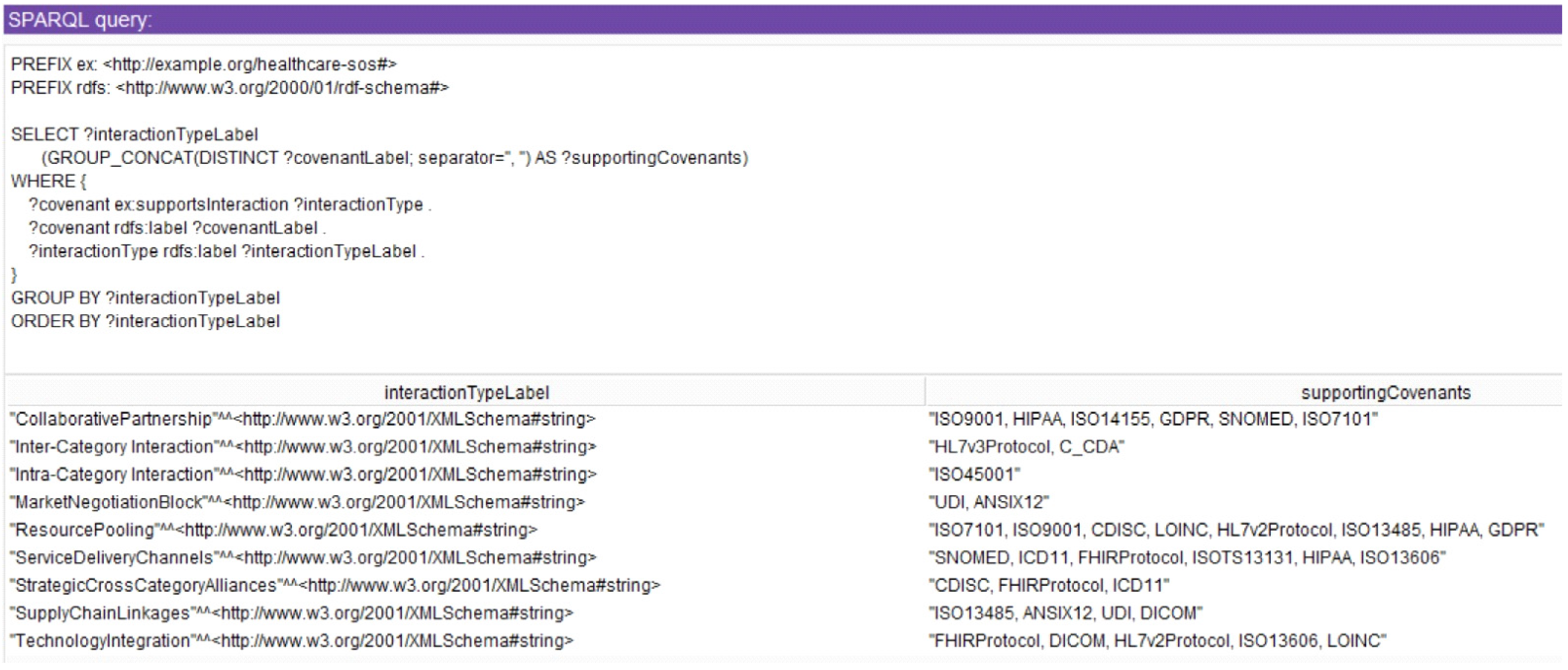
A critical validation capability is verifying that interactions are supported by appropriate governance covenants. This produces a comprehensive mapping (
Figure 23) showing which covenants govern each interaction type, enabling validation that required governance mechanisms are in place before authorizing specific coordination activities.
As presented in
Figure 23, this ensures that collaborative, transactional, and integrative behaviors across the healthcare SoS are not only semantically encoded but also institutionally grounded. By aggregating supporting covenants for each interaction type, the query reveals whether system behaviors are underpinned by sufficient normative scaffolding. This is beneficial for identifying governance gaps, assessing interoperability readiness, and ensuring that cross-category coordination aligns with policy and compliance expectations. The ontology thus enables proactive governance auditing and strategic alignment across heterogeneous system components.
This matrix demonstrates that the ontology explicitly models governance coverage, ensuring that every interaction pattern is supported by appropriate legal, procedural, or technical standards. By making these alignments machine-interpretable, the ontology enables analysts to verify whether system behaviors rest on a sufficient foundation of norms and requirements, reducing the risk of unsupported or non-compliant interactions. It also exposes areas where governance scaffolding may be weak or uneven, allowing stakeholders to identify gaps, prioritize policy interventions, and strengthen interoperability readiness. In doing so, the model functions not only as a representational tool but as a mechanism for proactive governance assessment across the healthcare System of Systems.
4.4. Network Topology and Complexity Analysis
The ontology also gives insights and capabilities for network and graph theory, enabling structural analyses that reveal how entities are positioned within the broader healthcare SoS. Understanding network topology and complexity is crucial because it exposes patterns of connectivity, dependency, and coordination that are not visible through entity-level inspection alone. Metrics such as node degree, hub identification, and network density illuminate which actors function as central coordinators, which links represent potential bottlenecks or single points of failure, and where structural vulnerabilities or redundancies exist. These graph-theoretic perspectives directly inform governance and resilience planning by showing where stronger standards, oversight mechanisms, or interoperability protocols should be concentrated. In this way, the ontology becomes not only a semantic model but also an analytical instrument for diagnosing systemic fragility and guiding targeted, evidence-based interventions.
4.4.1. Calculate Node Degree (Connections per Entity)
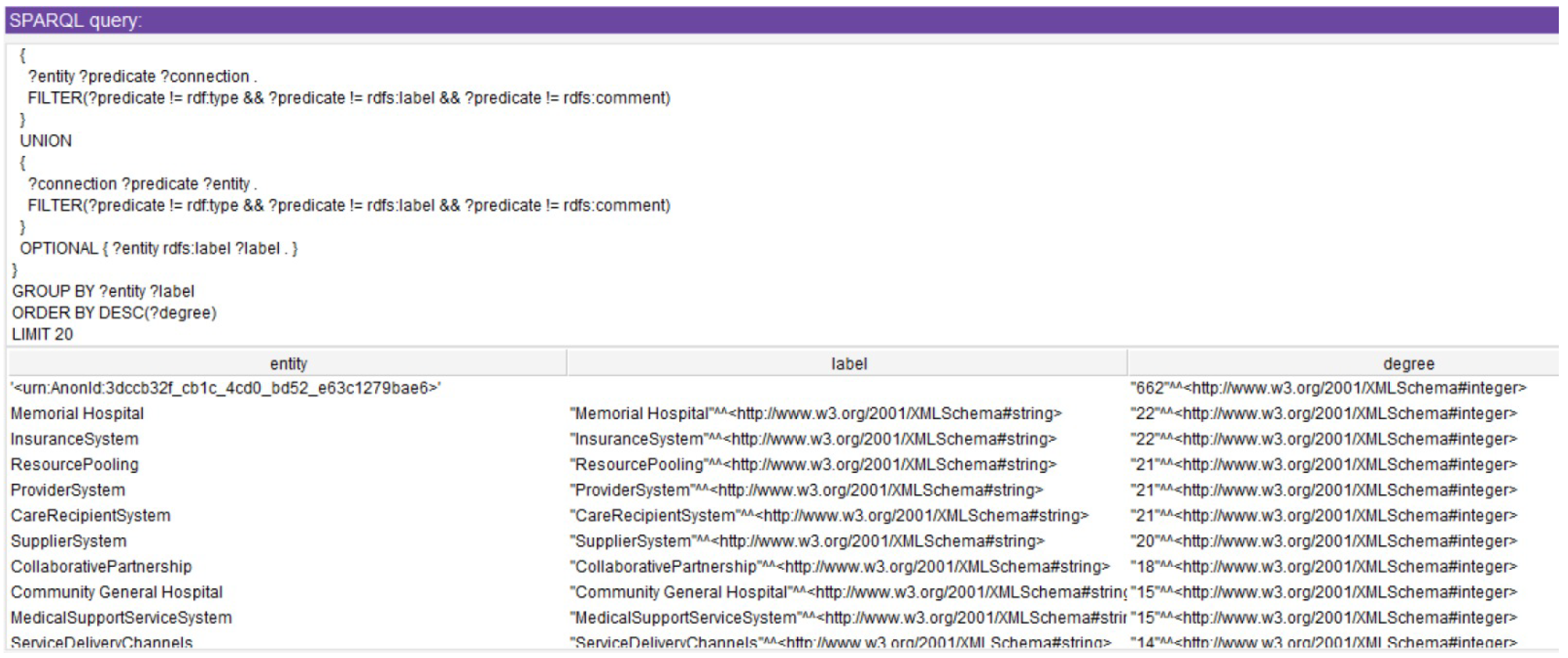
The query in
Figure 24 introduces graph-theoretic analysis by computing node degree—the count of relationships each entity maintains with other entities. The SPARQL query iterates over all constituent system instances, counting both incoming and outgoing relationships across all object properties, returning a ranked list of entities ordered by total connection count. Node degree reveals coordination burden: a hospital maintaining thirty relationships must manage thirty sets of governance obligations, data exchange protocols, contracting arrangements, and operational dependencies. High-degree nodes are simultaneously critical (their failure disrupts many partners) and vulnerable (complexity increases failure risk). From a governance perspective, entities with high node degree are strategic targets for compliance monitoring, capability support, and resilience investment—their operational stability has multiplicative impact on network partners.
The analytical value of node degree extends beyond identifying individual high-degree entities. Distribution analysis reveals whether the network exhibits concentrated coordination (a few hubs handling most relationships) or distributed coordination (relationships spread relatively evenly). Concentrated topologies create efficiency through standardization—partners need only integrate with a few hubs—but introduce single-point-of-failure risks. Distributed topologies offer redundancy but complicate standardization efforts. Understanding these topological characteristics informs governance strategy: concentrated networks benefit from hub-focused regulation ensuring critical intermediaries meet high reliability and security standards, while distributed networks require broad capacity-building initiatives ensuring many entities can fulfill coordination roles.
This query demonstrates that the ontology enables graph-theoretic analysis by treating constituent systems as nodes and their interactions as edges. This capability is essential for SoS governance because SoS are fundamentally network phenomena—coordination patterns, not individual entity properties, determine system-level performance. Healthcare governance authorities can move beyond intuition-based assessments (“this hospital seems important”) to quantitative, evidence-based prioritization (“this hospital has 43 relationships, placing it in the 95th percentile of network connectivity”, for example).
4.4.2. Identify Hub Entities
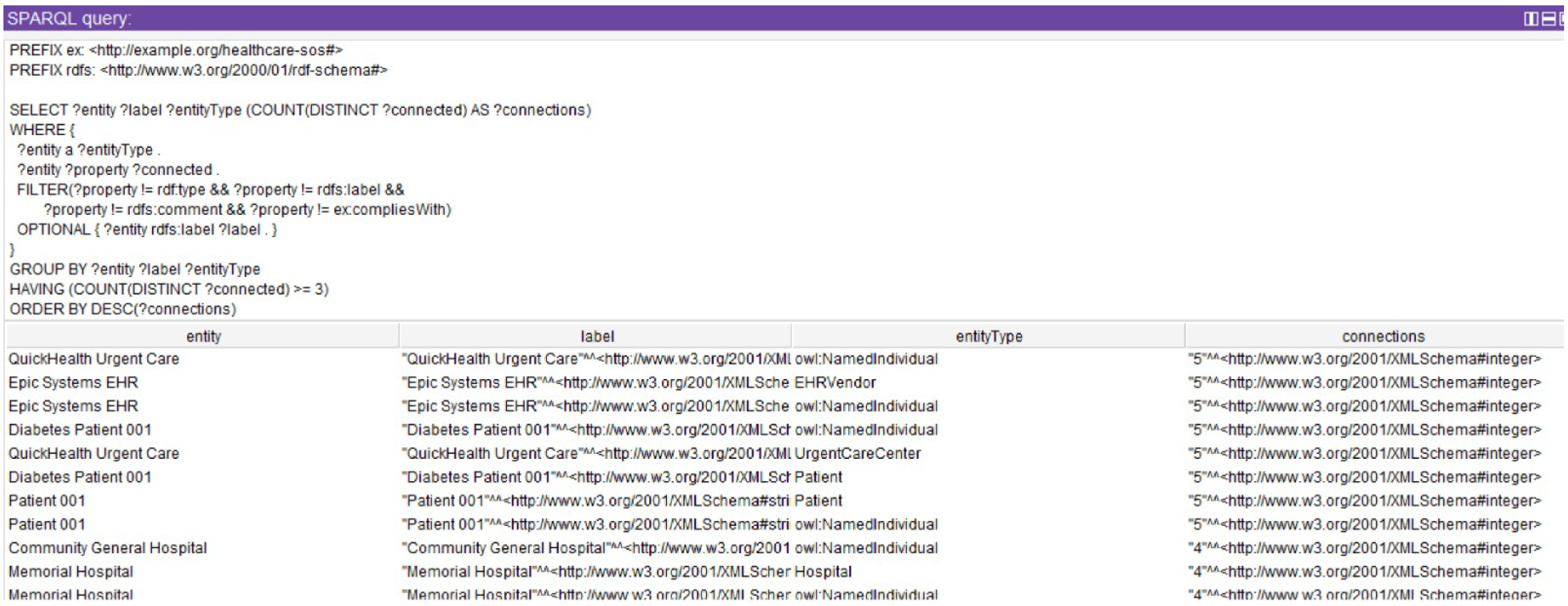
Building on node degree computation, the query in
Figure 25 enumerates entities with at least three distinct outgoing relationships and ranks them by the number of such connections. The query groups triples by entity and type, optionally retrieves human-readable labels, and computes a connections count (distinct connected nodes) to surface highly connected actors in the knowledge graph. The resulting table lists a mix of clinical providers (e.g., Community General Hospital, Memorial Hospital, QuickHealth Urgent Care), platform vendors (Epic Systems EHR), and individual patients, each annotated with their ontology class and a connectivity score. Hub entities are strategic governance targets because governance interventions at hubs have multiplicative impact. A health information exchange platform serving fifty provider organizations represents a single point where governance enforcement—FHIR protocol compliance, HIPAA safeguard implementation, and uptime guarantees—affects fifty partners simultaneously. Conversely, hub failure cascades across many dependent entities. Identifying hubs enables risk-based governance prioritization: allocate monitoring resources, technical assistance, and enforcement capacity to entities whose compliance (or non-compliance) affects the largest portions of the SoS.
The governance significance of hub identification extends beyond risk management to capability development. Hubs often emerge organically through market dynamics or voluntary coordination rather than through deliberate design. Governance authorities can leverage hub status by establishing formalized intermediary roles with explicit requirements and corresponding support. For instance, an entity serving as a de facto hub for information exchange might be designated an “approved health information intermediary” subject to enhanced security audits but eligible for technical assistance and liability protections. This approach aligns governance burden with coordination responsibility—entities handling more relationships face more requirements but receive more support. Furthermore, it validates that relationship edges are encoded and retrievable, identifies candidate hub entities that merit prioritized governance, monitoring, or resilience controls, and supplies empirical inputs for downstream analyses (risk weighting, hub-specific policy assignment, and anomaly detection).
4.4.3. Hospital Resource Pooling Network Density
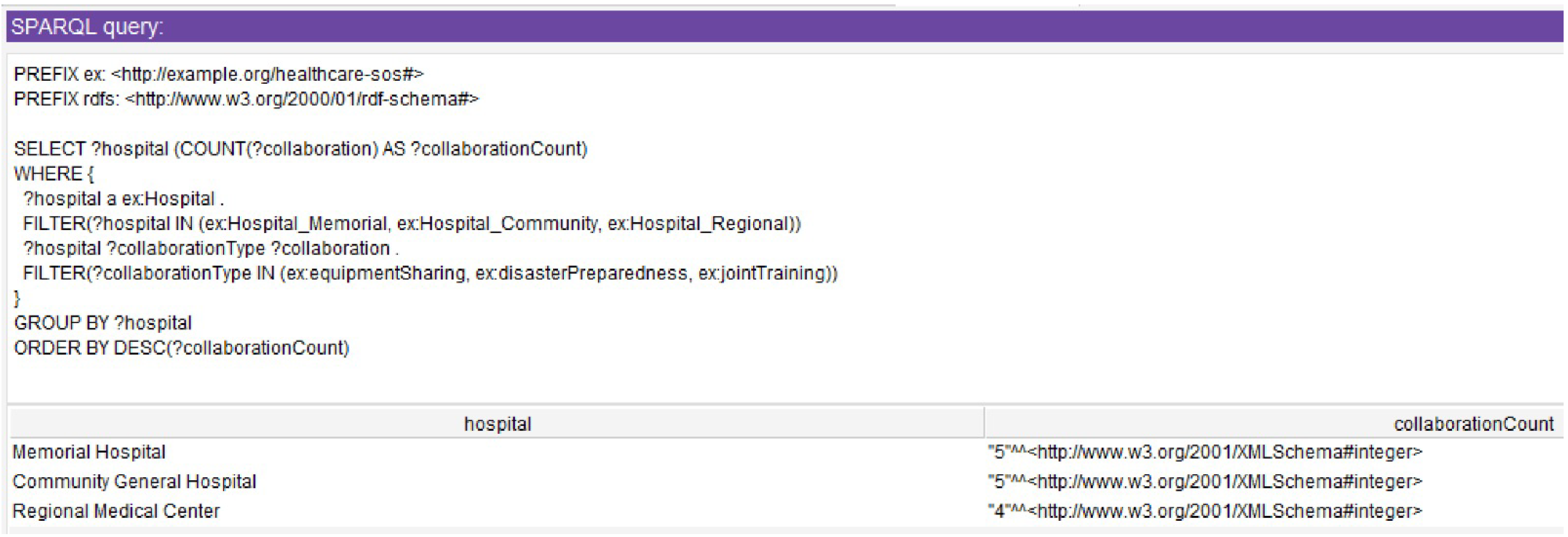
The query in
Figure 26 computes network density—the ratio of actual connections to possible connections—for the hospital resource pooling network. Given N hospitals, N(N-1)/2 possible pairwise relationships could exist; network density is the fraction of these potential relationships that are actually instantiated. The SPARQL query counts existing ex:equipmentSharing, ex:disasterPreparedness, and ex:jointTraining relationships among hospital instances. By grouping triples by hospital and ordering by collaboration count, the query surfaces which hospitals participate most actively in these mutual-aid and coordination relationships—here showing Memorial Hospital and Community General Hospital with the highest counts and Regional Medical Center slightly lower. This identifies which institutions are central to regional coordination, where governance instruments (mutual-aid agreements, interoperability protocols, and liability clauses) should be prioritized, and which partnerships merit closer monitoring or formalization.
Dense networks require standardized coordination protocols to prevent chaos—when most hospitals maintain relationships with most others, coordination cannot rely on bilateral customization. Governance interventions should focus on establishing and enforcing common standards (data formats, request procedures, and liability frameworks) that enable any-to-any coordination. Sparse networks face different challenges: many potential coordination opportunities go unrealized, often because transaction costs (negotiating agreements, establishing technical interfaces) exceed benefits. Governance interventions in sparse networks should reduce coordination barriers—providing template agreements, shared technical platforms, or facilitation services that make relationship formation easier. Furthermore, this strengthens the analysis of Scenario 2 by turning the collaboration patterns into measurable counts, the query exposes the degree of structural interdependence, operational alignment, and shared governance within the provider subsystem, showing that these hospitals form a tightly connected, resilience-enhancing cluster rather than isolated units. Because the collaboration types are semantically encoded in the ontology, the resulting density is a machine-interpretable property of the system, enabling comparative reasoning about centrality, robustness, and potential vulnerabilities across hospitals and making the otherwise hidden architecture of intra-category coordination analytically visible.
5. Discussion
This research addresses a fundamental challenge in contemporary healthcare systems: the operationalization of governance mechanisms for SoS characterized by constituent autonomy, emergent behavior, and distributed authority. This work advances the state of the art by developing a comprehensive OWL-based ontology that integrates structural composition, behavioral interaction patterns, and governance mechanisms within a unified computational framework tailored for healthcare SoS.
The proposed ontology makes four principal contributions. First, it formalizes seven constituent system types derived from systematic functional decomposition that prioritizes operational interdependencies over conventional market-sector boundaries. This functional classification enables granular analysis of coordination patterns while accommodating the reality that entities may perform multiple functional roles simultaneously. Second, the ontology introduces the Covenant class as a governance mechanism that operationalizes the CIC by embedding legal frameworks, interoperability protocols, and technical standards as explicit ontological entities linked to interaction properties. Third, it establishes a comprehensive interaction taxonomy distinguishing intra-category coordination from inter-category integration, enabling precise characterization of coordination mechanisms. Fourth, it demonstrates operational validity through four scenarios validating compliance checking, violation detection, conflict identification, and governance enforcement capabilities, alongside analytical queries that reveal constituent system landscapes, standards coverage, interaction networks, and topological properties.
The ontology represents more than a terminology catalog of healthcare actors; it reflects an engineering decision to treat governance as an operational architectural element that can be inspected, queried, and evolved. By coupling governance covenants with typed interaction properties, governance becomes embedded within the structural representation of the system rather than remaining an external policy layer. This integration enables automated reasoning, consistency checking, and semantic querying that support governance analysis in complex healthcare delivery environments.
This work also extends SoS engineering theory by demonstrating how ontological approaches can formalize the concept of “regulated autonomy” [
43]. The tension between constituent independence and system-level coordination requirements represents a fundamental SoS governance challenge that existing frameworks primarily address through conceptual models. By representing governance artifacts as explicit entities associated with interaction relationships, this research provides a computational mechanism for specifying coordination constraints while preserving constituent autonomy. The ontology supports queries that evaluate whether interaction patterns are governed, identify governance gaps or redundancies, and verify whether proposed coordination activities satisfy prerequisite compliance requirements. Furthermore, the explicit modeling of interaction relationships enables analysis of emergent behavior in SoS contexts. Healthcare outcomes arise from coordination across constituent systems rather than from isolated organizational capabilities. Modeling interactions as typed relationships with associated governance requirements enables graph-theoretic analysis of coordination networks, revealing properties such as connectivity distributions, hub concentrations, and structural vulnerabilities that influence system resilience.
The ontology also demonstrates how DE paradigms—originally developed in defense and aerospace contexts—can be adapted to healthcare SoS while accounting for healthcare’s distinctive characteristics. Healthcare systems exhibit greater heterogeneity in organizational forms and objectives, more distributed governance authority, overlapping regulatory regimes, and stronger human factors influences than many engineered systems. The ontology accommodates these characteristics by emphasizing interaction governance over hierarchical control, supporting multiple concurrent covenant structures representing distinct regulatory authorities, and enabling both transactional and collaborative coordination mechanisms.
Practically, the ontology supports a transition from periodic, document-based compliance processes toward continuous, data-driven governance. Governance authorities can translate policy intentions into implementable specifications by extending the Covenant class with requirements formalized through OWL restrictions and associated rules. For example, policies mandating privacy-preserving information exchange can be operationalized as property constraints requiring encryption, access control, and audit logging standards for specific interaction types. In addition, governing entities can query the ontology to identify systems lacking required interaction properties, detect interaction relationships operating without covenant coverage, or assess the completeness of governance specifications relative to national standards.
The operationalized ontology also demonstrates how governance principles can be translated into executable validation logic capable of automated compliance checking and violation detection. This capability addresses a central challenge in healthcare SoS governance: ensuring that coordination activities across organizational boundaries adhere to regulatory, legal, and organizational requirements. The approach shifts governance focus from individual entity compliance toward coordination architecture design. Rather than concentrating solely on whether individual entities satisfy regulatory requirements, governance authorities can evaluate whether coordination pathways are adequately governed, whether interaction types lack covenant support, and whether governance mechanisms create structural bottlenecks or disproportionate compliance burdens.
Furthermore, the validation architecture combines complementary reasoning mechanisms to enforce governance constraints at multiple levels. SWRL-based rules enable deductive validation by identifying violations when proposed coordination activities fail to satisfy required conditions. SHACL shapes provide structural validation by verifying that entities satisfy mandatory compliance requirements before logical reasoning is applied. OWL semantic axioms enable detection of logical conflicts, such as mutually exclusive governance requirements imposed on a single entity. Together, these mechanisms form a layered governance validation framework that supports proactive enforcement and continuous compliance assessment across the healthcare SoS.
5.1. Governance Formalization Versus Legal Compliance
An essential epistemological boundary must be clearly delineated: the governance formalization instantiated through this ontology operates within the domain of logical compliance—computationally verifiable structural and relational conditions—rather than legal compliance in the juridical interpretation sense. OWL’s formal semantics enable the reasoner to resolve deterministic Boolean conditions: whether a hasConsent property evaluates to true or false, whether a validUntil timestamp has elapsed, or whether an entity simultaneously complies with mutually exclusive covenants linked by a conflictsWith property. These evaluations are mathematically unambiguous and fully decidable within the OWL 2 DL profile.
However, legal compliance inherently involves interpretive ambiguity—contextual judgment, precedential reasoning, jurisdictional variation, and normative intent—that exceeds the expressive capacity of formal ontological semantics. The ontology does not claim to automate legal enforcement; rather, it captures interaction preconditions and governance constraints as computationally enforceable proxies for the regulatory requirements they represent. The Covenant class encodes the structural manifestation of governance instruments (what standards must be satisfied, what protocols must be supported, what consent must be obtained) without claiming to resolve the interpretive nuances of legal adjudication. This distinction ensures that claims regarding “automated compliance” are properly scoped: the ontology automates the detection of formally specified governance violations, providing decision support for governance authorities who retain ultimate interpretive and enforcement authority.
5.2. Scope of Validation and Demonstrative Nature
While the four scenario validations detailed in
Section 4 effectively prove the integration of structural, behavioral, and governance dimensions, it is essential to acknowledge that these instantiations remain illustrative rather than empirical. The SWRL-based consent validation, SHACL compliance shapes, OWL DL conflict detection axioms, graph centrality queries, and network density computations collectively validate the logical coherence and semantic capabilities of the model under controlled conditions. These scenarios were deliberately constructed to exercise different ontological structures and demonstrate distinct governance mechanisms, thereby establishing proof-of-concept for the framework’s operational utility across the heterogeneous coordination patterns characterizing healthcare SoS.
The extended SPARQL queries presented in
Section 4.3 and
Section 4.4 further represent a curated subset chosen to showcase graph-theoretic analysis, compliance profiling, and topological assessment capabilities. However, the ontology’s actual application potential extends far beyond these examples. Future research must transition this framework into empirical, large-scale clinical testbeds to validate real-time operational effectiveness amidst live data noise and organizational friction. Its ultimate value will grow as healthcare organizations, governance authorities, and technology developers engage with the framework and identify use cases aligned with their specific needs.
5.3. Scalability and Computational Complexity
As the healthcare SoS expands, the reasoning complexity of the underlying ontology becomes a critical operational consideration. The proposed ontology operates strictly within the OWL 2 DL (Description Logic) profile, specifically designed to guarantee decidability and predictable computational bounds, as opposed to OWL Full, which is highly expressive but computationally undecidable. This design choice ensures that consistency checking, subsumption reasoning, and instance classification remain tractable regardless of ontology complexity.
However, even within OWL 2 DL, reasoning performance—particularly ABox reasoning over large datasets of patient interactions and continuously updating sensor logs—can face scalability bottlenecks. While TBox classification (reasoning over the schema and classes) executes in milliseconds, dynamically evaluating SWRL rules and tracing violation inferences across a high-volume data stream (such as a live Digital Twin environment) requires substantial computational overhead. Query response times for complex network topologies and conflict detection algorithms may degrade as instance populations scale into the millions.
To address this, a hybrid architecture is recommended for large-scale, real-time deployments: utilizing the OWL/HermiT reasoner for periodic, high-level governance and architectural validation (design-time and configuration-time), while deploying highly optimized, compiled graph queries for millisecond-latency transactional compliance checking at runtime. This separation of concerns preserves the ontology’s semantic richness for governance design and policy analysis while achieving the performance characteristics required for operational monitoring at scale.
5.4. Implications for Polycentric Governance, System Resilienc, and Simulation
From a policy development perspective, multiple authorities with overlapping jurisdictions issue regulations, standards, and requirements that constituent systems must navigate. Federal agencies (CMS, ONC, FDA), state health departments, professional licensing boards, accreditation organizations (Joint Commission, NCQA), standards development organizations (HL7, SNOMED International), and industry consortia (CommonWell, Carequality) all establish governance artifacts that shape permissible coordination. This multiplicity creates complexity as constituent systems must simultaneously satisfy requirements from multiple sources that may use different terminology, pursue different objectives, and occasionally impose conflicting requirements. In this context, the ontology supports polycentric governance coordination by providing a shared semantic framework that different authorities can reference. Rather than each governance authority developing independent conceptual models that must then be mapped and reconciled, authorities could collaboratively extend and maintain the ontology as a common reference. This shared framework would not constrain authorities’ policy decisions—they remain free to establish distinct requirements—but would ensure their requirements are expressed using consistent terminology and reference the same interaction types and constituent system categories.
A key advantage of the ontological approach is extensibility: as healthcare regulations evolve, new coordination patterns emerge, or organizational governance requirements change, the framework can be extended through addition of new covenant instances, data properties, and SWRL rules without requiring modifications to operational systems. This extensibility enables the governance framework to adapt to changing regulatory and technological landscapes without requiring fundamental architectural changes. This alignment is consistent with the engineering principles articulated in [
43], thereby reinforcing the validity of the approach.
The network topology and complexity analyses demonstrated through the ontology’s query capabilities have direct implications for healthcare resilience planning. The identification of hub entities through node degree calculations reveals constituent systems whose failure or compromise would cascade across multiple coordination relationships. Governance interventions can then prioritize these high-connectivity entities for enhanced monitoring, redundancy requirements, and business continuity planning. Similarly, network density analysis reveals whether coordination patterns exhibit concentrated or distributed topologies, informing whether resilience investments should focus on hardening critical intermediaries or building redundant pathways. Such evidence-based resilience planning represents a substantial advancement over current approaches that often rely on intuition or single-point-of-failure analysis without considering systemic coordination dependencies.
The ontology provides a foundation for developing agent-based models (ABMs) and discrete-event simulations of healthcare SoS dynamics. Constituent system classes define agent types with distinct behaviors and objectives; interaction properties define the permissible communication and coordination mechanisms among agents; and covenant specifications define the constraints within which agent behaviors must operate. ABM implementations grounded in the ontology inherit its semantic precision: agent interactions are not arbitrary but reflect formally defined healthcare relationships. Simulation experiments can explore questions such as: How do changes in covenant specifications affect coordination efficiency? What interaction patterns emerge under different governance regimes? How does system performance degrade when specific constituent systems or interaction channels fail?
While this ontology was specifically developed to address healthcare SoS governance challenges, its underlying design principles and methodological approach exhibit substantial transferability to other SoS contexts characterized by distributed autonomy, heterogeneous constituents, and complex interdependencies. Domains such as transportation systems, smart cities, and critical infrastructure face structurally analogous challenges: autonomous entities pursuing independent objectives while requiring coordination to achieve system-level performance goals. The core ontological design pattern demonstrated here—systematically identifying constituent system types, rigorously mapping interdependencies, formalizing governance mechanisms—provides a generalizable template applicable across SoS domains.
5.5. Limitations
While the proposed ontology represents a substantial advance, several limitations and boundary conditions merit acknowledgment. Its design is rooted in the U.S. healthcare context, with constituent system typologies aligned to HHS mission structures and covenant specifications derived from national standards such as HIPAA, TEFCA, and ONC frameworks; thus, adaptation would be required for application in other countries to reflect local governance structures, regulatory frameworks, and interaction patterns. The ontology primarily captures structural and interactional relationships while offering limited representation of behavioral or temporal dynamics—future extensions incorporating process ontologies or temporal logic could address this limitation. Validation thus far has relied on case-based instantiation and standards grounding rather than empirical deployment in live healthcare settings, indicating the need for future pilot implementations to evaluate its practical impact on coordination and performance. Additionally, while OWL reasoning ensures logical consistency, it does not guarantee domain correctness; continuous validation with clinicians, administrators, and policymakers remains essential to maintain conceptual fidelity. Broader adoption also poses socio-technical challenges, as implementation demands alignment of organizational terminologies, IT infrastructures, and personnel capabilities—efforts that may require tool support, reference use cases, and endorsement from standards bodies to lower entry barriers. Finally, large-scale deployment may face computational scalability constraints; optimizing reasoning through modularization, tractable OWL profiles, or hybrid architectures will be necessary to balance semantic richness with operational performance.
6. Conclusions
Healthcare fragmentation represents one of the most persistent and consequential challenges facing modern health systems, exacting profound costs in clinical outcomes, resource efficiency, and patient experience. This fragmentation stems not from isolated failures but from fundamental structural characteristics that prevent effective coordination even when individual constituent systems function competently. Addressing fragmentation therefore requires not merely incremental improvements in individual system capabilities or bilateral coordination agreements, but systematic approaches that can comprehend, analyze, and govern healthcare as an integrated System of Systems.
This research responds to that imperative by developing a comprehensive ontology that unifies the structural, behavioral, and regulatory dimensions of healthcare delivery into a single, computationally tractable framework. The OWL-based ontology formalizes seven constituent system types derived from functional decomposition, establishes a comprehensive taxonomy of intra-category and inter-category interaction patterns, and introduces the Covenant class as a novel mechanism for embedding legal frameworks, interoperability protocols, and technical standards directly within system architecture. Through four validation scenarios and extended analytical queries, the ontology demonstrates capabilities for automated compliance checking, violation detection, conflict identification, temporal compliance monitoring, network topology analysis, and governance impact assessment that transform healthcare SoS governance from a predominantly conceptual concern into a computationally enabled practice. Specifically, the integration of SWRL rules for deductive consent validation, SHACL shapes for structural compliance verification, and OWL 2 DL axioms for automated conflict detection provides a layered governance validation architecture that addresses different categories of compliance requirements at complementary levels of abstraction.
The significance of this contribution extends beyond the specific ontology to the paradigm it represents. By making governance mechanisms machine-interpretable and directly linked to interaction patterns, the ontology enables a fundamental shift from reactive compliance checking focused on individual entities to proactive coordination engineering focused on designing interaction architectures that simultaneously enable necessary collaboration and ensure appropriate constraints. Rather than treating governance as external documentation that constrains system behavior, the ontology positions governance as intrinsic structural elements that shape permissible coordination patterns. This integration enables healthcare organizations and governance authorities to ask fundamentally different questions: not merely “are entities compliant?” but “does the governance architecture enable desired coordination while preventing harmful interactions?”
The practical applications enabled by this ontology are substantial. Healthcare organizations can conduct pre-implementation governance assessments that identify missing governance artifacts, compliance gaps, and protocol mismatches before deploying new coordination capabilities. Policymakers can simulate proposed regulations to understand their coordination implications and design evidence-based interventions. Digital twin implementations can leverage the ontology as a semantic backbone for continuous compliance monitoring and predictive coordination failure detection. Resilience planners can analyze network topologies to identify critical hubs, structural vulnerabilities, and opportunities for redundancy enhancement. Each of these applications addresses specific manifestations of healthcare fragmentation with tools that previous approaches could not provide.
Yet the ontology’s ultimate value may lie not in solving specific problems but in enabling new ways of thinking about healthcare system design and governance. By providing formal structures for representing constituent systems, interaction patterns, and governance mechanisms within a unified framework, the ontology makes visible the deep interdependencies that characterize healthcare delivery. It reveals that patient outcomes emerge not from individual provider capabilities but from coordination quality across organizational boundaries. It demonstrates that governance effectiveness depends not just on regulatory stringency but on alignment between governance architectures and coordination requirements. It shows that system resilience stems not from individual entity robustness but from network topology and relationship redundancy. These insights, made computationally explicit and analytically accessible through the ontology, can fundamentally reshape how stakeholders approach healthcare system improvement.
The limitations acknowledged in this work indicate that substantial work remains to fully realize the ontology’s potential. Future research could further advance this line of inquiry by coupling the ontology with computational simulation environments to evaluate governance dynamics under varying policy, interaction, and compliance conditions. Integrating the ontology with Petri net-based or agent-based models would enable simulation of emergent behaviors in healthcare SoS, allowing quantitative analysis of how different covenant rules, coordination mechanisms, or actor strategies influence system-wide performance, resilience, and fragmentation. The ontology may also serve as a semantic backbone for AI-enabled reasoning systems, supporting automated policy recommendation, anomaly detection in compliance behavior, and adaptive governance where rules evolve in response to changing operational contexts. Finally, formal integration with knowledge graph technologies and linked open data could position the ontology as part of a larger ecosystem of interoperable SoS governance frameworks spanning multiple critical infrastructure domains, thereby contributing to the establishment of a general theory of computational governance for socio-technical SoS.