Measuring Complexity at the Requirements Stage: Spectral Metrics as Development Effort Predictors
 , , ,
, , ,  and
and 
Abstract
1. Introduction
2. Background
2.1. Complexity and Its Metrics in Engineered Systems
2.1.1. Defining and Measuring Complexity in Engineered Systems
- Information-Theoretic Metrics:Shannon’s entropy [26] remains foundational in complexity measurement, quantifying system uncertainty. Expanding on this, Gell-Mann and Lloyd [27] introduced effective complexity, distinguishing structured information from randomness—a distinction critical for understanding organized versus disorganized complexity in engineered systems [28]. Information-theoretic approaches have found renewed application in recent years, with spectral entropy being utilized to assess the complexity of requirements specifications and system architectures [7]. These metrics provide a mathematical basis for quantifying the information content and structural organization inherent in system descriptions.
- Graph-Theoretic Approaches: Structural metrics leverage the eigenvalue distributions of adjacency matrices to evaluate system complexity through network representations [29]. Gutman and Zhou’s [13] Laplacian Energy metric and Nikiforov’s [14] Graph Energy metric have been particularly influential in quantifying topological complexity. These foundational works established the basis for spectral analysis of system architectures, enabling the assessment of connectivity patterns and interaction structures [30]. Building upon these classical metrics, Pugliese and Nilchiani [17] developed a generalized framework for spectral structural complexity metrics that unified distinct measures through variations in mathematical functions, coefficients, and matrix representations. This framework was successfully applied to cyber-physical systems, demonstrating the predictive power of Graph Energy in assessing system resilience and identifying tipping points where systems transition from stable to unstable states [31,32]. Recent advances have extended spectral complexity analysis to directed graphs [33], though the current work focuses on undirected representations to maintain consistency with established architectural complexity frameworks [8,17].
- Structural Complexity Models: Sinha and de Weck [8] validated a structural complexity metric that integrated graph-theoretic principles with system architecture considerations. That model, widely applied in cyber-physical systems, captures connectivity, modularity, and system organization. That seminal work established empirical validation methodologies that linked complexity metrics to observable system properties and development challenges. Lopez and Thomas [34] extended that framework to space systems modeled in SysML, adapting the adjacency-matrix-based complexity metric for hierarchical decomposition across multiple system levels. Subsequent research extended these structural approaches to address multiple design constraints [35], Pareto-optimization of complexity versus modularity trade-offs [36], and integrative complexity measures that provided alternative perspectives on system decomposition [37]. Recent work has further explored how modularity and interdependence in cyber-physical systems can be analyzed using bio-inspired graph modeling approaches that draw from ecological systems theory [38], demonstrating the cross-pollination of complexity concepts across disciplinary boundaries. Similarly, Bhatnager et al. [12] proposed structural complexity metrics for SysML models, demonstrating that quantifying model complexity can predict development effort and inform engineering decisions. Beyond spectral approaches, graph-theoretic metrics such as McCabe’s Cyclomatic Complexity [39] have been widely applied in software engineering to measure logical complexity based on the number of linearly independent paths through a program’s control flow graph. While originally developed for software code, such structural metrics provide complementary perspectives to spectral analysis and have been adapted for system-level complexity assessment.
2.1.2. Implications for Systems Engineering
2.2. Spectral Structural Complexity Metrics
2.2.1. Graph Energy
2.2.2. Laplacian Graph Energy
2.2.3. Normalized Laplacian Graph Energy
2.2.4. Natural Connectivity
2.3. Complexity in Requirements Engineering
2.3.1. Existing Complexity Metrics in Requirements Engineering
2.3.2. Bridging the Gap with Spectral Metrics
- Capturing latent structural dependencies within requirements;
- Identifying clusters of interdependent requirements;
- Quantifying complexity beyond text-based heuristics, offering a rigorous mathematical framework for analyzing requirement interactions.
3. Methodology and Setup
3.1. Extending Metrics to Requirements Engineering
- 1.
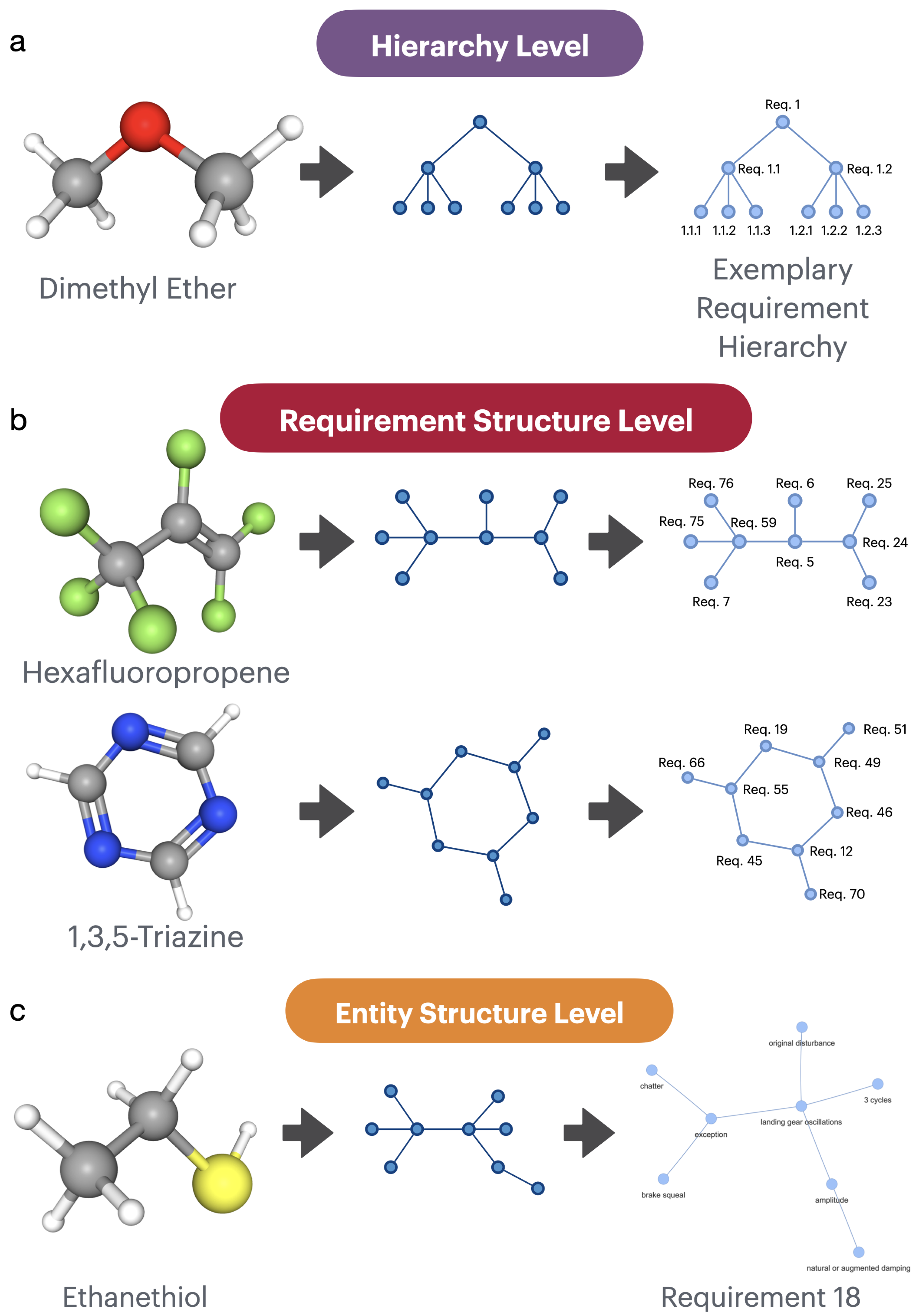
- Hierarchy Layer: The parent–child decomposition of requirements.
- 2.
- Requirement Layer: The direct dependencies and cross-references between requirement statements.
- 3.
- Entity Layer: The interaction of physical components and actors defined within the text, revealing implicit functional couplings.
3.2. Metrics Framework
3.2.1. Component, Interface, and Topological Complexity
- 1.
- Component complexity (): The inherent complexity of individual elements within the system, determined by their internal structure and properties.
- 2.
- Interface complexity (): The complexity introduced by connections between components, modeled as , reflecting that interfaces between complex components are themselves more complex.
- 3.
- Topological complexity: The complexity arising from the overall arrangement and connectivity pattern of the system, captured through the matrix representation and its spectral properties.

3.2.2. Metrics Evaluated
- Graph Energy (GE): Defined by Gutman [45] as the sum of absolute eigenvalues of the adjacency matrix, Graph Energy captures global structural properties including path lengths, clustering patterns, and structural regularity [13]. Originally derived from Hückel’s [57] molecular orbital theory in quantum chemistry, this metric leverages the eigenvalue spectrum to quantify structural complexity [45].
- Cyclomatic Complexity: Originally developed by McCabe [39] for software control flow analysis, Cyclomatic Complexity counts the number of linearly independent paths through a graph structure. For a graph G with n nodes, e edges, and p connected components: . McCabe and Butler argued that complexity assessments should be conducted before implementation to understand underlying complexity [58]. While this metric does not satisfy all of Weyuker’s criteria for complexity measures [59], it has been related to cost and effort in software development projects and is adapted here for structural complexity assessment.
- Density: Network density measures overall connectedness of a structure, computed as for undirected graphs, where e is edges and n is nodes. While density does not measure complexity directly, it has been used to assess attributes similar to system complexity in real networks [60,61]. Higher density may signal increased verification effort and potential rework cycles in change management.
- Absolute Density: A size-adjusted density measure originally developed for social networks [62] that accounts for network circumference, radius, and diameter, enabling comparisons across networks of different scales. This addresses the limitation that standard density naturally declines as networks grow [61].
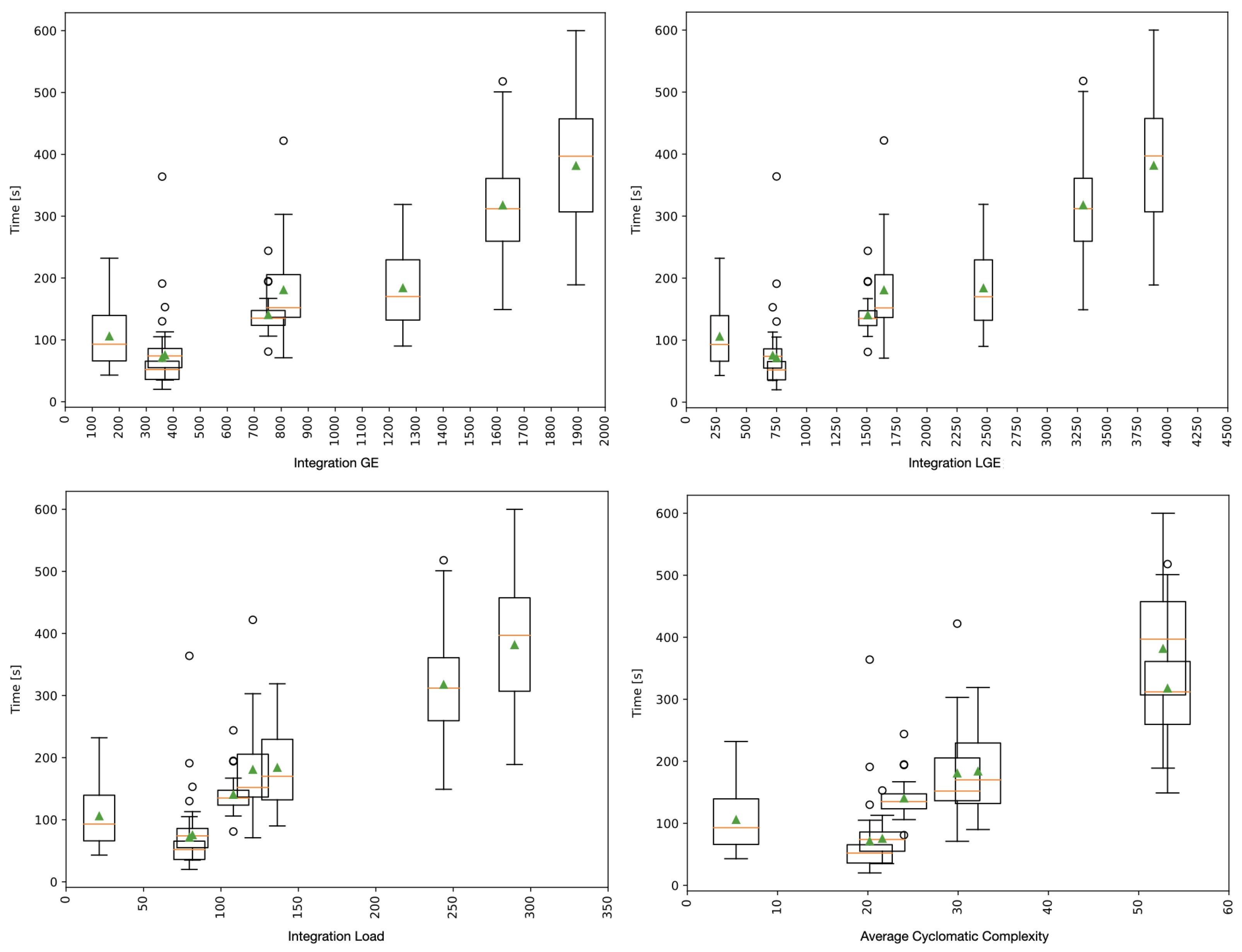
- Load (L): Defined as the total number of loops in a given network structure. Loops represent circular connections that can be problematic for satisfying requirements and managing changes, as modifications may propagate through circular dependencies. Due to its relevance to validation/verification processes and change management, this loop count is denoted as Load to distinguish it from components of other metrics [10]:where represents the loops in the network. Integration Load computes this value for each integration task.
3.3. Experimental Design: Molecular Integration Case Study
4. Results
4.1. Overall Case Study Results
4.2. Requirement-Specific Analysis Results
4.2.1. Molecule-Level Metrics
4.2.2. Integration-Level Metrics
4.2.3. Effectiveness of Spectral Metrics Versus Density
4.2.4. Mixed-Effects Analysis
4.3. Application to Requirements Complexity
4.3.1. From Molecular Models to Requirements Structures
4.3.2. Predicting Integration Challenges
4.3.3. Domain Agnosticism and Broader Applicability
5. Discussion
5.1. Implications for Systems Development
5.1.1. Complexity, Development Time, and Cost
5.1.2. Impact on System Quality Attributes
- Difficult change implementation and reduced maintainability: Complex interdependencies make it difficult to modify individual requirements without affecting others, increasing the effort and risk associated with system updates or engineering changes.
- Increased testing effort: Requirements with high Cyclomatic Complexity and integration load require more extensive verification activities, as the number of logical paths and interaction combinations grows.
- Decreased reliability: The correlation between complexity and human error suggests that complex requirement structures are more prone to misinterpretation during implementation, potentially introducing defects that affect system reliability.
5.1.3. Resource Allocation and Risk Mitigation
- Identify complexity hotspots: Requirements or requirement clusters exhibiting unusually high Graph Energy or Integration Load values warrant additional scrutiny and potentially decomposition into simpler structures.
- Inform staffing decisions: Integration activities involving high-complexity requirement sets may require more experienced engineers or larger teams to manage the increased cognitive load.
- Prioritize risk mitigation: Requirements with high structural complexity represent elevated risk areas where additional reviews, prototyping, or early integration testing may be warranted.
- Support trade-off decisions: When design alternatives exist, complexity metrics provide quantitative input for selecting approaches that minimize integration challenges.
- Monitor complexity trends: By tracking complexity metrics over time, teams can detect unnoticed increases or jumps in complexity—often referred to as complexity creep—before consequences become visible and even potentially irrevocable [16].
- Benchmark against previous projects: Comparing complexity levels against other or previous projects enables identification of disproportionate complexity levels, allowing teams to flag specifications that deviate significantly from established baselines.
5.2. Integration of Metrics into Requirements Engineering
5.2.1. A Framework for Metric Integration
5.2.2. Contrast with Traditional Requirements Engineering Metrics
- 1.
- Structural depth: Spectral metrics capture topological properties through eigenvalue decomposition of adjacency and Laplacian matrices. The eigenvalue spectrum encodes information about path lengths, clustering patterns, and structural regularity that text-based metrics cannot access. Two requirement sets with identical word counts and readability scores may exhibit vastly different spectral complexity values if their dependency structures differ.
- 2.
- Empirical grounding: Unlike many traditional RE metrics, which are proposed based on intuition or analogy to software metrics, the spectral metrics validated in this study demonstrate direct correlation with human performance on integration tasks. This empirical foundation provides confidence that measured complexity reflects actual cognitive and effort demands.
- 3.
- Early applicability: Spectral metrics can be computed as soon as requirements exist in textual form, before architectural decisions constrain design options. Traditional architectural complexity metrics [8] require sufficiently developed system representations that may not be available until later development phases.
5.2.3. Practical Usage and Implementation Considerations
5.3. Threats to Validity
5.3.1. Limitations of the Molecular Analogy
5.3.2. Participant Variability and Sample Size
5.3.3. Scaling to Large, Complex Systems
5.3.4. Scope of Validated Metrics
5.3.5. Comparison with Traditional RE Metrics
6. Conclusions
6.1. Summary of Contributions
6.1.1. Isomorphic Experimental Methodology for Complexity Metric Validation
6.1.2. Empirical Validation of Spectral Metrics as Effort Predictors
6.1.3. Preliminary Foundation for Extending Complexity Assessment to Requirements Engineering, Pending Direct Validation
6.1.4. A Framework for Proactive Complexity Management
6.2. Future Work
6.2.1. Integration with Large Language Models
6.2.2. Machine Learning for Complexity Forecasting
6.2.3. Direct Validation on Requirements Integration Tasks
6.2.4. Scaling to Industrial Systems
6.2.5. Comparative Validation Against Traditional Metrics
Author Contributions
Funding
Institutional Review Board Statement
Informed Consent Statement
Data Availability Statement
Conflicts of Interest
Abbreviations
| AI | Artificial Intelligence |
| GE | Graph Energy |
| ICC | Intraclass Correlation Coefficient |
| IRB | Institutional Review Board |
| LGE | Laplacian Graph Energy |
| LLM | Large Language Model |
| NC | Natural Connectivity |
| NLGE | Normalized Laplacian Graph Energy |
| NLP | Natural Language Processing |
| OLS | Ordinary Least Squares |
| RE | Requirements Engineering |
| REML | Restricted Maximum Likelihood |
Appendix A. Supplementary Figure

References
- Pugliese, A. Development of Spectral Structural Complexity Metrics in Cyber-Physical Systems. Ph.D. Thesis, Stevens Institute of Technology, Hoboken, NJ, USA, 2018. [Google Scholar]
- Sturtevant, D.J. System Design and the Cost of Architectural Complexity. Ph.D. Thesis, Massachusetts Institute of Technology, Cambridge, MA, USA, 2013. [Google Scholar]
- Hussain, A.; Mkpojiogu, E.O.; Kamal, F.M. The role of requirements in the success or failure of software projects. Int. Rev. Manag. Mark. 2016, 6, 306–311. [Google Scholar]
- Mukherjee, I. Understanding information system failures from the complexity perspective. J. Soc. Sci. 2008, 4, 308–319. [Google Scholar] [CrossRef]
- Lindemann, U.; Reichwald, R. Integriertes Änderungsmanagement; Springer: Berlin/Heidelberg, Germany, 1998. [Google Scholar]
- Boznak, R.G. When doing it right the first time is not enough. Qual. Prog. 1994, 27, 74. [Google Scholar]
- Sinha, K.; de Weck, O.L. A network-based structural complexity metric for engineered complex systems. In Proceedings of the 2013 IEEE International Systems Conference (SysCon), Orlando, FL, USA, 15–18 April 2013; pp. 426–430. [Google Scholar]
- Sinha, K.; de Weck, O.L. Empirical validation of structural complexity metric and complexity management for engineering systems. Syst. Eng. 2016, 19, 193–206. [Google Scholar] [CrossRef]
- Azmat, Z.; Siddiqui, M.A. Analyzing project complexity, its dimensions and their impact on project success. Systems 2023, 11, 417. [Google Scholar] [CrossRef]
- Vierlboeck, M. Structural Complexity of System Requirements and Its Implications for the Development Process. Ph.D. Thesis, Stevens Institute of Technology, Hoboken, NJ, USA, 2023. [Google Scholar]
- Salado, A.; Nilchiani, R. The concept of problem complexity. Procedia Comput. Sci. 2014, 28, 539–546. [Google Scholar] [CrossRef]
- Bhatnager, A.; Gullapalli, L.B.; de Saqui-Sannes, P.; Vingerhoeds, R.A. Measuring the Complexity of SysML Models. Systems 2025, 13, 1128. [Google Scholar] [CrossRef]
- Gutman, I.; Zhou, B. Laplacian energy of a graph. Linear Algebra Its Appl. 2006, 414, 29–37. [Google Scholar] [CrossRef]
- Nikiforov, V. The energy of graphs and matrices. J. Math. Anal. Appl. 2007, 326, 1472–1475. [Google Scholar] [CrossRef]
- Vierlboeck, M.; Dunbar, D.; Nilchiani, R. Natural Language Processing to Extract Contextual Structure from Requirements. In Proceedings of the 2022 IEEE International Systems Conference (SysCon), Montreal, QC, Canada, 25–28 April 2022; pp. 1–8. [Google Scholar]
- Vierlboeck, M.; Nilchiani, R.; Blackburn, M. Natural Language Processing to assess structure and complexity of system requirements. Syst. Eng. 2025, 28, 100–109. [Google Scholar] [CrossRef]
- Pugliese, A.; Nilchiani, R. Developing Spectral Structural Complexity Metrics. IEEE Syst. J. 2019, 13, 3619–3626. [Google Scholar] [CrossRef]
- Mehraj, A.; Zhang, Z.; Systä, K. A tertiary study on AI for requirements engineering. In International Working Conference on Requirements Engineering: Foundation for Software Quality; Springer: Cham, Switzerland, 2024; pp. 159–177. [Google Scholar]
- Tikayat Ray, A.; Cole, B.F.; Pinon Fischer, O.J.; Bhat, A.P.; White, R.T.; Mavris, D.N. Agile methodology for the standardization of engineering requirements using large language models. Systems 2023, 11, 352. [Google Scholar] [CrossRef]
- Sheard, S.A.; Mostashari, A. A Complexity Typology for Systems Engineering. INCOSE Int. Symp. 2010, 20, 933–945. [Google Scholar] [CrossRef]
- Vandergriff, L.J. System engineering in the 21st century-implications from complexity theory. In Symposium on Complex Systems Engineering; RAND Corporation: Santa Monica, CA, USA, 2007. [Google Scholar]
- Weaver, W. Science and complexity. Am. Sci. 1948, 36, 536–544. [Google Scholar]
- Richardson, K.A.; Cilliers, P.; Lissack, M. Complexity science: A ‘grey’ science for the ‘stuff in between’. In Proceedings of the First International Conference on Systems Thinking in Management, Geelong, Australia, 8–10 November 2000; pp. 532–537. [Google Scholar]
- Sinha, K. Structural Complexity and Its Implications for Design of Cyber-Physical Systems. Ph.D. Thesis, Massachusetts Institute of Technology, Cambridge, MA, USA, 2014. [Google Scholar]
- Dahia, S.; Szabo, C. Detecting Emergent Behavior in Complex Systems: A Machine Learning Approach. In SIGSIM-PADS ’24: Proceedings of the 38th ACM SIGSIM Conference on Principles of Advanced Discrete Simulation; Loper, M., Pellegrini, A., Eds.; ACM International Conference Proceeding Series; Association for Computing Machinery: New York, NY, USA, 2024; pp. 81–87. [Google Scholar]
- Shannon, C.E. A mathematical theory of communication. Bell Syst. Tech. J. 1948, 27, 379–423. [Google Scholar] [CrossRef]
- Gell-Mann, M.; Lloyd, S. Information measures, effective complexity, and total information. Complexity 1996, 2, 44–52. [Google Scholar] [CrossRef]
- Snowden, D.J.; Boone, M.E. A leader’s framework for decision making. Harv. Bus. Rev. 2007, 85, 68. [Google Scholar]
- Herrera, M.; Pérez-Hernández, M.; Kumar Parlikad, A.; Izquierdo, J. Multi-agent systems and complex networks: Review and applications in systems engineering. Processes 2020, 8, 312. [Google Scholar] [CrossRef]
- Strogatz, S.H. Exploring complex networks. Nature 2001, 410, 268–276. [Google Scholar] [CrossRef]
- Edwards, C.M.; Nilchiani, R.R.; Ganguly, A.; Vierlboeck, M. Evaluating the Tipping Point of a Complex System: The Case of Disruptive Technology. Syst. Eng. 2024, 27, 745–758. [Google Scholar] [CrossRef]
- Edwards, C.M.; Nilchiani, R.R.; Miller, I.M. Impact of Graph Energy on a Measurement of Resilience for Tipping Points in Complex Systems. Syst. Eng. 2024, 27, 530–544. [Google Scholar] [CrossRef]
- Mezić, I.; Fonoberov, V.A.; Fonoberova, M.; Sahai, T. Spectral Complexity of Directed Graphs and Application to Structural Decomposition. Complexity 2019, 2019, 9610826. [Google Scholar] [CrossRef]
- Lopez, V.E.P.; Thomas, L.D. Metric for Structural Complexity Assessment of Space Systems Modeled Using the System Modeling Language. Aerospace 2022, 9, 612. [Google Scholar] [CrossRef]
- Sinha, K.; Han, S.Y.; Suh, E.S. Design structure matrix-based modularization approach for complex systems with multiple design constraints. Syst. Eng. 2020, 23, 211–220. [Google Scholar] [CrossRef]
- Sinha, K.; Suh, E.S. Pareto-optimization of complex system architecture for structural complexity and modularity. Res. Eng. Des. 2018, 29, 123–141. [Google Scholar] [CrossRef]
- Sinha, K.; Suh, E.S.; de Weck, O. Integrative complexity: An alternative measure for system modularity. J. Mech. Des. 2018, 140, 051101. [Google Scholar] [CrossRef]
- Payne, E.M.; Hossain-Mckenzie, S.S.; Jacobs, N.; Davis, K.R.; Layton, A. Analyzing Cyber-Physical Modularity and Interdependence Using Bio-Inspired Graph Modeling. IEEE Access 2024, 12, 126188–126199. [Google Scholar] [CrossRef]
- McCabe, T.J. A complexity measure. IEEE Trans. Softw. Eng. 1976, SE-2, 308–320. [Google Scholar] [CrossRef]
- Collopy, P.D.; Hollingsworth, P.M. Value-driven design. J. Aircr. 2011, 48, 749–759. [Google Scholar] [CrossRef]
- Nilchiani, R.R.; Pugliese, A. A Systems Complexity-Based Assessment of Risk in Acquisition and Development Programs; Technical Report, Acquisition Research Program; Naval Postgraduate School: Monterey, CA, USA, 2017. [Google Scholar]
- Sinha, K.; de Weck, O.L. Structural complexity metric for engineered complex systems and its application. In Proceedings of the 14th International DSM Conference, Kyoto, Japan, 13–14 September 2012; pp. 181–194. [Google Scholar]
- Chung, F.R. Spectral Graph Theory; American Mathematical Society: Providence, RI, USA, 1997; Volume 92. [Google Scholar]
- Spielman, D.A. Spectral graph theory and its applications. In Proceedings of the 48th Annual IEEE Symposium on Foundations of Computer Science (FOCS’07), Providence, RI, USA, 21–23 October 2007; pp. 29–38. [Google Scholar]
- Gutman, I. The energy of a graph: Old and new results. In Algebraic Combinatorics and Applications; Springer: Berlin/Heidelberg, Germany, 2001; pp. 196–211. [Google Scholar]
- Gutman, I. Hyperenergetic and hypoenergetic graphs. In Selected Topics on Applications of Graph Spectra; Mathematical Institute: Serbia, Belgrade, 2011; pp. 113–135. [Google Scholar]
- Wu, J.; Barahona, M.; Tan, Y.-J.; Deng, H.-Z. Natural connectivity of complex networks. Chin. Phys. Lett. 2010, 27, 078902. [Google Scholar] [CrossRef]
- Cavers, M.; Fallat, S.; Kirkland, S. On the normalized Laplacian energy and general Randić index R-1 of graphs. Linear Algebra Its Appl. 2010, 433, 172–190. [Google Scholar] [CrossRef]
- Halstead, M.H. Elements of Software Science (Operating and Programming Systems Series); Elsevier Science Inc.: Amsterdam, The Netherlands, 1977. [Google Scholar]
- Berry, D.M.; Kamsties, E. Ambiguity in Requirements Specification. In Perspectives on Software Requirements; do Prado Leite, J.C.S., Doorn, J.H., Eds.; Springer US: Boston, MA, UA, 2004; pp. 7–44. [Google Scholar]
- Berry, D.M.; Daudjee, K.; Dong, J.; Fainchtein, I.; Nelson, M.A.; Nelson, T.; Ou, L. User’s manual as a requirements specification: Case studies. Requir. Eng. 2004, 9, 67–82. [Google Scholar] [CrossRef]
- Kamsties, E.; Berry, D.M.; Paech, B. Detecting ambiguities in requirements documents using inspections. In Proceedings of the First Workshop on Inspection in Software Engineering (WISE’01), Paris, France, 23 July 2001; Volume 13. [Google Scholar]
- Hein, P.H.; Kames, E.; Chen, C.; Morkos, B. Reasoning support for predicting requirement change volatility using complex network metrics. J. Eng. Des. 2022, 33, 811–837. [Google Scholar] [CrossRef]
- Wang, R.; Huang, R.; Qu, B. Network-Based Analysis of Software Change Propagation. Sci. World J. 2014, 2014, 237243. [Google Scholar] [CrossRef]
- Arena, M.V.; Younossi, O.; Brancato, K.; Blickstein, I.; Grammich, C.A. Why Has the Cost of Fixed-Wing Aircraft Risen? A Macroscopic Examination of the Trends in U.S. Military Aircraft Costs over the Past Several Decades; RAND Corporation: Santa Monica, CA, USA, 2008. [Google Scholar]
- Blackburn, M. Skyzer: A Concept of Operations for a Humanitarian UAV; Technical Report; Systems Engineering Research Center (SERC): Hoboken, NJ, USA, 2018. [Google Scholar]
- Hückel, E. Quantentheoretische Beiträge zum Benzolproblem. Z. Phys. 1931, 70, 204–286. [Google Scholar] [CrossRef]
- McCabe, T.J.; Butler, C.W. Design complexity measurement and testing. Commun. ACM 1989, 32, 1415–1425. [Google Scholar] [CrossRef]
- Weyuker, E.J. Evaluating software complexity measures. IEEE Trans. Softw. Eng. 1988, 14, 1357–1365. [Google Scholar] [CrossRef]
- Leskovec, J.; Kleinberg, J.; Faloutsos, C. Graphs over time: Densification laws, shrinking diameters and possible explanations. In Proceedings of the Eleventh ACM SIGKDD International Conference on Knowledge Discovery in Data Mining, Chicago, IL, USA, 21–24 August 2005; pp. 177–187. [Google Scholar]
- Lei, M.; Liu, L.; Wei, D. An improved method for measuring the complexity in complex networks based on structure entropy. IEEE Access 2019, 7, 159190–159198. [Google Scholar] [CrossRef]
- Scott, J. Social Network Analysis. Sociology 1988, 22, 109–127. [Google Scholar] [CrossRef]
- Nakagawa, S.; Schielzeth, H. A general and simple method for obtaining R2 from generalized linear mixed-effects models. Methods Ecol. Evol. 2013, 4, 133–142. [Google Scholar] [CrossRef]
- Bashir, H.A.; Thomson, V. Estimating design effort for GE hydro projects. Comput. Ind. Eng. 2004, 46, 195–204. [Google Scholar] [CrossRef]
- Bashir, H.A.; Thomson, V. Estimating Design Complexity. J. Eng. Des. 1999, 10, 247–257. [Google Scholar] [CrossRef]



| Level | Metric | Type |
|---|---|---|
| Molecule | Total Cyclomatic Complexity | Structural |
| Molecule | Average Cyclomatic Complexity | Structural |
| Molecule | Average GE | Spectral |
| Molecule | Average LGE | Spectral |
| Molecule | Average Density | Structural |
| Molecule | Average Absolute Density | Structural |
| Integration | Integration GE | Spectral |
| Integration | Integration LGE | Spectral |
| Integration | Integration Density | Structural |
| Integration | Integration Absolute Density | Structural |
| Integration | Integration Density Delta | Structural |
| Integration | Integration Load | Composite |
| Metric | |||||||
|---|---|---|---|---|---|---|---|
| Value | p-Val | Value | p-Val | Value | p-Val | ||
| GE | 0.61 | 46.84 | 0.00 | 0.20 | 0.00 | ||
| 0.62 | 75.12 | 0.00 | 0.08 | 0.07 | 0.00 | 0.00 | |
| LGE | 0.61 | 49.80 | 0.00 | 0.08 | 0.00 | ||
| 0.61 | 63.71 | 0.00 | 0.05 | 0.00 | 0.00 | 0.14 | |
| NLGE | 0.15 | 42.78 | 0.07 | 3.76 | 0.00 | ||
| 0.19 | −107.81 | 0.03 | 13.10 | 0.00 | −0.13 | 0.00 | |
| NC | 0.36 | −304.54 | 0.00 | 18.90 | 0.00 | ||
| 0.37 | −24.23 | 0.93 | −4.57 | 0.84 | 0.48 | 0.29 | |
| LNC | 0.42 | −393.11 | 0.00 | 19.28 | 0.00 | ||
| 0.47 | 1510.04 | 0.00 | −117.22 | 0.00 | 2.39 | 0.00 | |
| NLNC | 0.18 | −169.81 | 0.00 | 15.05 | 0.00 | ||
| 0.20 | −711.90 | 0.01 | 65.26 | 0.01 | −1.13 | 0.04 | |
| GEn | 0.23 | −336.04 | 0.00 | 352.38 | 0.00 | ||
| 0.24 | 403.50 | 0.34 | −733.13 | 0.23 | 390.94 | 0.08 | |
| LGEn | 0.26 | −275.81 | 0.00 | 126.68 | 0.00 | ||
| 0.26 | 149.77 | 0.66 | −115.84 | 0.55 | 33.88 | 0.21 | |
| NLGEn | 0.04 | −129.76 | 0.21 | 84.70 | 0.00 | ||
| 0.16 | −5439.48 | 0.00 | 3133.20 | 0.00 | −433.49 | 0.00 | |
| NCn | 0.38 | −139.58 | 0.00 | 701.41 | 0.00 | ||
| 0.42 | 292.34 | 0.01 | −1431.02 | 0.01 | 2453.78 | 0.00 | |
| LNCn | 0.14 | 52.42 | 0.02 | 78.77 | 0.00 | ||
| 0.15 | −34.13 | 0.58 | 207.66 | 0.02 | −40.97 | 0.13 | |
| NLNCn | 0.02 | 683.91 | 0.00 | −497.75 | 0.03 | ||
| 0.15 | −41,625.84 | 0.00 | 83,834.22 | 0.00 | −41,966.46 | 0.00 | |
| Metric | Correlation (r) | 95% CI |
|---|---|---|
| Total Cyclomatic Complexity | 0.8919 | [0.504, 0.9804] |
| Average Cyclomatic Complexity | 0.9125 | [0.5822, 0.9843] |
| Average Graph Energy | 0.9420 | [0.7059, 0.9897] |
| Average Laplacian Graph Energy | 0.9426 | [0.7086, 0.9898] |
| Average Density | −0.4163 | [−0.8667, 0.4081] |
| Average Absolute Density | −0.3446 | [−0.8443, 0.4756] |
| Metric | Correlation (r) | 95% CI |
|---|---|---|
| Integration GE | 0.9545 | [0.7631, 0.992] |
| Integration LGE | 0.9572 | [0.7758, 0.9925] |
| Integration Load | 0.9546 | [0.7636, 0.992] |
| Integration Density | −0.3627 | [−0.8501, 0.4594] |
| Integration Absolute Density | −0.4720 | [−0.883, 0.3486] |
| Integration Density Delta | 0.3626 | [−0.4595, 0.8501] |
| Metric | SE | t | p | ICC | |||
|---|---|---|---|---|---|---|---|
| Int. LGE | 0.0835 | 0.0044 | 18.89 | <0.001 | 0.625 | 0.678 | 0.141 |
| Int. GE | 0.1713 | 0.0092 | 18.71 | <0.001 | 0.621 | 0.674 | 0.138 |
| Int. Load | 1.2114 | 0.0647 | 18.72 | <0.001 | 0.621 | 0.674 | 0.138 |
| Avg. GE | 0.4818 | 0.0268 | 17.97 | <0.001 | 0.605 | 0.655 | 0.127 |
| Avg. LGE | 0.2359 | 0.0131 | 18.00 | <0.001 | 0.606 | 0.656 | 0.127 |
| Avg. Cyclomatic | 6.3155 | 0.3847 | 16.41 | <0.001 | 0.568 | 0.612 | 0.103 |
| Total Cyclomatic | 0.5048 | 0.0326 | 15.47 | <0.001 | 0.542 | 0.583 | 0.090 |
Disclaimer/Publisher’s Note: The statements, opinions and data contained in all publications are solely those of the individual author(s) and contributor(s) and not of MDPI and/or the editor(s). MDPI and/or the editor(s) disclaim responsibility for any injury to people or property resulting from any ideas, methods, instructions or products referred to in the content. |
© 2026 by the authors. Licensee MDPI, Basel, Switzerland. This article is an open access article distributed under the terms and conditions of the Creative Commons Attribution (CC BY) license.
Share and Cite
Vierlboeck, M.; Pugliese, A.; Nilchiani, R.R.; Grogan, P.T.; Sugganahalli Natesh Babu, R. Measuring Complexity at the Requirements Stage: Spectral Metrics as Development Effort Predictors. Systems 2026, 14, 364. https://doi.org/10.3390/systems14040364
Vierlboeck M, Pugliese A, Nilchiani RR, Grogan PT, Sugganahalli Natesh Babu R. Measuring Complexity at the Requirements Stage: Spectral Metrics as Development Effort Predictors. Systems. 2026; 14(4):364. https://doi.org/10.3390/systems14040364
Chicago/Turabian StyleVierlboeck, Maximilian, Antonio Pugliese, Roshanak Rose Nilchiani, Paul T. Grogan, and Rashika Sugganahalli Natesh Babu. 2026. "Measuring Complexity at the Requirements Stage: Spectral Metrics as Development Effort Predictors" Systems 14, no. 4: 364. https://doi.org/10.3390/systems14040364
APA StyleVierlboeck, M., Pugliese, A., Nilchiani, R. R., Grogan, P. T., & Sugganahalli Natesh Babu, R. (2026). Measuring Complexity at the Requirements Stage: Spectral Metrics as Development Effort Predictors. Systems, 14(4), 364. https://doi.org/10.3390/systems14040364