Article

A Novel Stress Testing Framework for Assessing and Optimizing Emergency Material Supply Chains: A Case Study of Ibuprofen Emergency Production Under Extraordinary Demand Surges


1
School of Management, Beijing Institute of Technology, Beijing 100081, China
2
Institute of National Security and Development Studies, Beijing Institute of Technology, Beijing 100081, China
*
Author to whom correspondence should be addressed.
Systems 2026, 14(4), 352; https://doi.org/10.3390/systems14040352
Submission received: 6 February 2026 / Revised: 20 March 2026 / Accepted: 23 March 2026 / Published: 25 March 2026
(This article belongs to the Special Issue Simulation and Digital Twins in Humanitarian Supply Chain Management)

Abstract

Extraordinary emergencies trigger disruptive demand surges that frequently exceed the operational limits of existing supply chains. While traditional studies focus on optimizing stock resource efficiency, the mobilization of emergency production to generate incremental resources is critical under extreme shocks. However, a standardized methodology for assessing the “stress tolerance limit” of emergency material supply chains (EMSCs) remains lacking. This paper establishes a theoretical framework for EMSC stress testing, integrating conceptual definitions, operational mechanisms, and a standardized implementation procedure. To demonstrate its practical applicability, a multi-objective mathematical model is developed and applied to a case study of ibuprofen production during a sudden crisis. By identifying structural bottlenecks such as production latency and supply lead-time gaps, the results validate that the proposed framework provides a reproducible quantitative approach for evaluating EMSC supply capacity. This study offers guidance for prepositioned inventory and dynamic capacity reserve, fundamentally enhancing societal risk mitigation capabilities under extreme stress.

1. Introduction

Recently, extraordinary emergencies—ranging from large-scale natural disasters and public health crises to geopolitical conflicts—have become characterized by their increasing frequency, concurrence, and rapid evolution. These events exert profound impacts on socioeconomic stability and human safety. Distinct from routine emergencies, the defining feature of these events is a “disruptive” surge in demand for emergency supplies within an extremely compressed timeframe. For instance, during the “golden hours” following a catastrophic earthquake, demand for life-saving materials such as hemostatic agents and splints often surges by dozens or even hundreds of times. Similarly, in the early stages of a public health crisis, demand for personal protective equipment and antipyretics can increase to several hundred times baseline levels within days. Such extraordinary stress frequently exceeds the routine defense capabilities of EMSCs, pushing their carrying capacity to, or even beyond, their physical limits. Consequently, quantifying the resilience boundaries and response limits under extreme stress has become a critical challenge in emergency management.
Traditional studies have largely focused on optimizing the efficiency of existing stock resources [1,2,3,4,5], primarily through refined route planning [4,5,6], facility location-allocation [3], and standardized inventory strategies to maximize the utility of available assets [1,2]. However, under extraordinary demand surges, optimizing existing resource configurations is often insufficient to mitigate massive supply–demand gaps. In such cases, the mobilization of emergency production to generate incremental resources becomes the pivotal pathway for bridging these gaps. This incremental supply depends on EMSCs, which transform raw materials into finished products. However, emergency management still lacks a systematic and standardized methodology to define and evaluate the “stress tolerance limit” of EMSCs under extreme shocks. In this study, “stress tolerance limit” is defined as the maximum supply a system (EMSCs) can provide without altering its fundamental structure. To address this gap, this paper proposes an EMSC stress testing framework to simulate extreme environments and evaluate the supply capacity of incremental production. This framework provides a basis for analyzing operational mechanisms and implementation procedures in emergency production, with significant theoretical and practical implications.
In terms of theoretical significance, this study advances the emergency management framework for extraordinary emergencies by defining the conceptual foundations of EMSC stress testing and clarifying its operational mechanisms under extreme demand surges. The proposed framework offers a novel perspective for evaluating the “resilience boundaries” of supply chain systems, thereby addressing a critical methodological gap in system limit assessment.
In terms of practical value, this study establishes a standardized implementation procedure for stress testing, providing a reproducible and actionable quantitative evaluation framework for government agencies and supply assurance departments. By developing a representative mathematical model and demonstrating its end-to-end application, this study enables decision-makers to identify internal structural bottlenecks—such as production latency and supply lead-time gaps—before a crisis occurs. Consequently, this framework provides guidance for optimizing prepositioned inventory strategies and dynamic capacity reserve plans, thereby enhancing societal risk mitigation capabilities under extreme stress.
Section 2 reviews the literature on emergency supply assurance, stress testing, and emergency capacity mobilization, identifying a critical gap in assessing the “stress tolerance limit” of EMSCs under extraordinary demand surges. Section 3 establishes a theoretical framework for EMSC stress testing, defining its conceptual boundaries, operational logic, and implementation procedures. Section 4 develops a mathematical model as a representative application of the proposed framework. Recognizing that various models can be constructed depending on specific stress testing needs, this section demonstrates how to translate the theoretical framework into a quantitative model by specifying problem assumptions and objective functions. Section 5 applies the stress testing framework established in Section 3, using ibuprofen emergency production as a case study. Section 6 concludes the paper by summarizing the main research content of this study and proposing potential directions for future research to further expand its theoretical and practical value.

2. Literature Review

2.1. Emergency Supply Assurance Under Extraordinary Demand Surges

The rising frequency of extreme events, including public health emergencies and large-scale natural disasters, has propelled emergency supply assurance and logistics resilience to the forefront of research. These crises are typically characterized by sudden demand surges, constrained supply capacities, and high uncertainty, placing severe stress on supply networks.
In the literature, two related concepts are often used: humanitarian supply chains (HSCs) and EMSCs. HSCs, also referred to as humanitarian logistics and supply chains, are cross-organizational relief networks coordinated by governments, international organizations, and non-governmental organizations to alleviate human suffering during disasters, wars, or health crises. They typically feature multi-stakeholder collaboration, heavy reliance on donations, high demand uncertainty, and temporary, event-driven network structures [7,8]. In contrast, EMSCs focus on the production, stockpiling, allocation, and distribution of essential supplies such as medicines, protective equipment, and food, usually embedded within national or regional emergency management frameworks, relying on institutionalized reserves, pre-established logistics infrastructures, and government-led mobilization mechanisms [9,10]. Structurally, both HSCs and EMSCs can be abstracted as multi-layer network flow systems. In much of the literature, differing terminology often reflects context rather than distinct analytical content.
Existing studies on emergency supply assurance under extraordinary demand surges can be categorized into three major research streams: logistics network and distribution optimization, supply chain resilience assessment, and multi-stakeholder coordination mechanisms.
The first stream addresses network and distribution optimization using operations research methods, modeling key decisions including facility location, inventory positioning, routing, and resource allocation. Recent studies increasingly incorporate stochastic disruptions and scenario planning, evolving from simple inventory management to complex pre-positioning and allocation strategies. For example, Eberhardt et al. [1] proposed a scenario-driven multi-objective optimization model integrating facility layout and resource allocation while accounting for warehouse failures and route disruptions. Anvari et al. [2] considered lateral transshipment and road vulnerability to improve allocation fairness. Che et al. [3] applied a distributionally robust optimization framework for strategic stockpile placement. Transport and distribution planning has also been emphasized. Shi et al. [4] studied a truck–drone delivery model for post-disaster scenarios, while Chang et al. [10] proposed a two-stage stochastic model to optimize distribution center location and fleet sizing. Specialized applications have emerged, including the Regional Vulnerability Index developed by Kar and Jenamani [5] for vaccine distribution, and Rajabi et al. [11] quantifying resilience strategies in pharmaceutical supply chains under surge demand.
The second research stream investigates supply chain resilience and system recovery capabilities. Existing research on supply chain resilience has developed a multi-dimensional analytical framework. One stream focuses on constructing quantitative resilience metrics to evaluate the ability of logistics networks to maintain service performance under disruptions, including studies on resilience quantification methods [12], performance measurement, and resilience indicators and metrics [13,14]. Another stream develops mathematical models using approaches such as stochastic capacity planning, network simulation, and digital twin modeling to analyze how supply chains restore operational performance through capacity reconfiguration and coordinated adjustments after disruptions [15]. In addition, related studies examine resilience principles and strategies [16], as well as resilience-based supplier selection and other decision-making issues among supply chain stakeholders [14]. For instance, Li et al. [3] proposed a resilience framework for urban logistics balancing efficiency with equity under lockdowns, while Chen and Wen [17] identified critical nodes in knowledge-intensive supply chains and proposed strategies to mitigate cascading failures.
The third research stream examines multi-stakeholder coordination and governance mechanisms in emergency response systems. Because emergency supply systems typically involve multiple actors (including government agencies, manufacturing firms, logistics service providers, and demand-side organizations), many recent studies employ game-theoretic approaches to analyze strategic interactions among these stakeholders. For instance, Li et al. [18] developed a four-party evolutionary game model to analyze the behavioral dynamics among government agencies, logistics coordinators, suppliers, and demand-side actors. In addition, some studies have begun integrating digital technologies into emergency decision-support systems. Ni et al. [19], for example, used natural language processing techniques to automatically generate emergency logistics plans, providing data-driven solutions for complex emergency management.
A critical synthesis of current literature reveals that while the optimization of static inventory and distribution networks has reached a high level of maturity, research on the dynamic conversion of emergency production capacity remains relatively fragmented. Most existing frameworks emphasize the efficient allocation of “on-hand” stocks, yet they often overlook the inherent operational limits of supply chains when faced with disruptive demand surges that exceed initial reserves. Current studies frequently treat supply chain resilience as a qualitative attribute or a recovery speed metric, rather than a quantifiable boundary condition. There is a notable methodological gap in quantifying the “stress tolerance limit” of these systems. Consequently, developing a standardized stress-testing paradigm—one that integrates incremental resource mobilization with structural bottleneck identification—is imperative to transition from reactive relief to proactive, high-pressure resilience management.

2.2. Supply Chain Stress Testing

Research on supply chain stress testing remains limited, characterized by a dual but fragmented progression in theoretical conceptualization and technical application. The absence of a unified conceptual framework has resulted in a fragmented academic landscape.
In terms of theoretical development, early inquiries were pioneered by Yao and You [20], who introduced the migration of financial stress testing methodologies into the supply chain domain. Subsequently, Yao and Chen [21] proposed six post-stress-test strategies from the perspective of resilient supply chains. In our previous work, we defined supply chain stress by incorporating the “extreme load logic” from physics, a concept briefly reviewed in Section 3.1. More recently, Ivanov and Dolgui [22] introduced the “human-centric ecosystem viability” framework, integrating resilience with sustainability for long-term crisis management. However, these theoretical explorations have yet to coalesce into a systematic and widely accepted framework.
On the technical application front, empirical studies remain limited. While Ivanov and Dolgui [22] discussed the potential of Supply Chain Digital Twins (SCDT) in crisis management, their work lacked comprehensive empirical validation. In a significant methodological advancement, Diem et al. [23] utilized a “Supply Network Stress-Testing” (SNST) approach to evaluate food security. By constructing a cascading disruption model based on data from 23,001 nodes in the Austrian pork supply chain, they identified critical facilities vulnerable to severe systemic shortages. Furthermore, while Ivanov and Gusikhin [24] proposed a hierarchical SCDT framework, it relies on speculative data in low-visibility, deep-tier scenarios, leading to limitations in both authenticity and real-time updates.
In summary, significant research gaps persist. Theoretically, there is no consensus on a standardized framework for the definitions, objects, and operational mechanisms of stress testing. Technically, existing applications are often confined to isolated micro-scenarios with limited coverage, failing to establish a dynamic government-enterprise linkage for bottleneck identification and resource mobilization. This study proposes a comprehensive framework to address these gaps. To ensure terminological precision, we define our research object specifically as EMSCs. Unlike HSCs, characterized by ad hoc coordination, EMSCs leverage established reserve systems and commercial networks, offering a stable structural foundation and quantifiable operational parameters that are more conducive to institutionalized and embedded stress testing.

2.3. Emergency Capacity Mobilization and Production Flexibility

The intersection of emergency mobilization and supply chain flexibility has emerged as a research focal point in disaster management. This shift reflects a transition from static inventory buffering to the dynamic conversion of production capacity. A substantial body of literature employs mathematical modeling to analyze the operational mechanisms of super conventional supply. These studies can be broadly categorized into two research streams: mobilization system assessment and strategic coordination of resource deployment.
In the realm of system assessment, system dynamics (SD) is widely utilized to encapsulate the complex feedback loops and temporal dependencies inherent in mobilization processes. For instance, Shi et al. [25] investigated the resilience of emergency mobilization chains under coupled disruptions, identifying restoration efficiency and mobilization intensity as pivotal determinants of systemic recovery. Similarly, Li [26] developed an SD-based model for manufacturing firms to reveal the underlying logic governing super-conventional supply surges. Beyond SD, diverse analytical tools have been introduced to enhance assessment precision. He et al. [27] leveraged fuzzy set theory to evaluate the collaborative advantages within urban clusters, while Wang et al. [28] proposed a “structure-process-result” framework for more accurate mobilization evaluations. Within the global humanitarian context, Barbarosoglu and Arda [29] employed two-stage stochastic programming to quantify the disruptive impact of information asymmetry on mobilization. Furthermore, Liu and Li [30] introduced a structural flexibility index as a streamlined tool for system design under extreme pressure.
Regarding strategic coordination and resource deployment, various stochastic and deterministic programming methods have been applied to address coordination challenges. Guo et al. [31] established a tripartite joint reserve model involving the government, manufacturers, and suppliers via option contracts, highlighting that upstream raw material reserves are indispensable for downstream production continuity. Similarly, Gong et al. [32] utilized the NSGA-II algorithm to optimize the multi-objective planning of emergency production tasks. Their findings indicate that the synchronous provision of essential elements—such as raw materials and capital—is critical for mission fulfillment. Decision-making during the mobilization phase is further complicated by stochastic demand and budget constraints. This necessitates advanced frameworks, such as the stochastic mixed-integer programming model with Lagrangian relaxation proposed by Liu et al. [33]. Additionally, Li et al. [34] analyzed the synergistic impacts of inventory, capacity reserves, and R&D investment, proposing optimal resource allocation strategies under government budget constraints. In the humanitarian sector, Kovacs et al. [35] emphasized that standardization and cross-sector collaboration serve as universal strategies for effective response.
From the technical perspective of manufacturing essence, production flexibility defines the ultimate boundary of mobilization [36]. Liu and Li [30] introduced a structural flexibility index to explain capacity shrinkage, offering a simplified tool for system design under extreme pressure. The foundational production theory by Corsten and Goessinger [37] established a design framework for output flexibility, while Palominos et al. [38] empirically confirmed through simulation that machine flexibility is the primary driver of rapid responsiveness in labor-intensive industries.
Overall, these studies underscore that the transition from a steady state to an emergency response hinges on the integration of analytical modeling, strategic optimization, and structural flexibility. However, research gaps remain. Existing studies are predominantly based on post hoc analyses of mobilization actions, providing insufficient support for the strategic pre-positioning of mobilization policies.

2.4. Summary and Research Gap Analysis

The existing body of literature provides a robust foundation for understanding emergency logistics, emergency supply assurance, and the mechanisms of production mobilization. As synthesized in the preceding sections, scholarly efforts have transitioned from static inventory optimization to dynamic, multi-stakeholder coordination and flexible capacity expansion. Mathematical modeling has become the approach for dissecting these complex systems.
However, a critical synthesis of current research reveals three significant gaps that this study aims to address:
  • Overemphasis on static stock allocation versus dynamic incremental supply: Current emergency resource support research focuses heavily on optimizing and allocating existing stock resources (pre-positioned inventory). There is a lack of analytical tools to measure the system’s capability to generate incremental resources through emergency production under extreme shocks. While allocation is vital, the “upper limit” of supply chain support is defined by its production mobilization capacity, which remains under-quantified.
  • Lack of standardized stress tolerance measurement: Although supply chains are frequently subjected to “stressful” scenarios in models, there is no standardized methodology to evaluate the “stress tolerance limit” of these systems. Most studies treat resilience as a general recovery attribute rather than a measurable boundary, failing to provide a clear answer to how much demand surge a specific production-supply configuration can withstand before systemic failure.
  • Neglect of production-supply latency gaps: Although capacity mobilization is recognized as vital, few studies have quantified the structural bottlenecks where production latency and supply lead-time gaps intersect during a disruptive demand surge. Existing models often assume idealized mobilization, failing to account for the systemic failure that occurs when these gaps exceed a critical threshold.

3. Theoretical Framework for EMSC Stress Testing

3.1. Stress Connotation and Evolution in EMSCs

The logic of stress testing for EMSCs is predicated on a precise definition of the nature of “stress”. Given that this study primarily focuses on the execution mechanisms and mathematical modeling of stress testing, the fundamental theories regarding stress have been extensively discussed in our previous work [9]. Therefore, this section provides only a concise review of the core tenets to maintain the logical consistency of the research.
  • Nature and sources of stress: Stress in EMSCs is defined as the extraordinary demand imposed on the system under extreme disaster scenarios. Unlike market-driven fluctuations, this stress manifests as a non-stationary load generated by the synergy of three key factors: mandatory administrative mobilization orders (coerciveness), the survival imperatives of affected populations (urgency), and corporate social responsibility (driving force). Consequently, stress is characterized by the demand for emergency supplies within specified time constraints under a regulated economic environment.
  • Evolutionary patterns and critical thresholds of stress: Concomitant with the progression of an emergency, stress evolution follows a dynamic trajectory encompassing five distinct phases: latency, triggering, formation, outbreak, and relief. The objective of stress testing is to evaluate the system’s ultimate bearing capacity during the “outbreak phase”. Accordingly, this study focuses on the stress peak—a critical phase characterized by the maximum supply–demand gap and the most acute system vulnerability.

3.2. Operational Logic of Stress Testing

3.2.1. Background and Conceptual Definition

(1)
Background of ESMC Stress Testing: Extraordinary Emergencies
Under extraordinary emergencies, traditional supply-side interventions (e.g., stockpiling, requisitioning, and procurement) augment supply via existing social reserves. However, the inherent uncertainty and extreme urgency of such catastrophes lead to an explosive surge in demand within a condensed timeframe. Under these circumstances, existing social stock resources often prove insufficient to bridge the massive supply–demand gap, resulting in a severe deficit.
Consequently, satisfying this deficit necessitates the generation of incremental resources, which are provided through expedited production within the EMSC. Therefore, characterized by the stress profiles of EMSCs, this study defines the process of providing incremental materials through emergency production to alleviate systemic pressure as the extraordinary supply (ES) of EMSCs.
Accordingly, the Extraordinary Supply Capacity of the Emergency Material Supply Chain (EMSC-ESC) is defined as the actual volume of finished products that can be manufactured and delivered to the disaster zone within a specific duration under crisis conditions. It represents an extant, deployable capability that is readily available for direct utilization in emergency response operations.
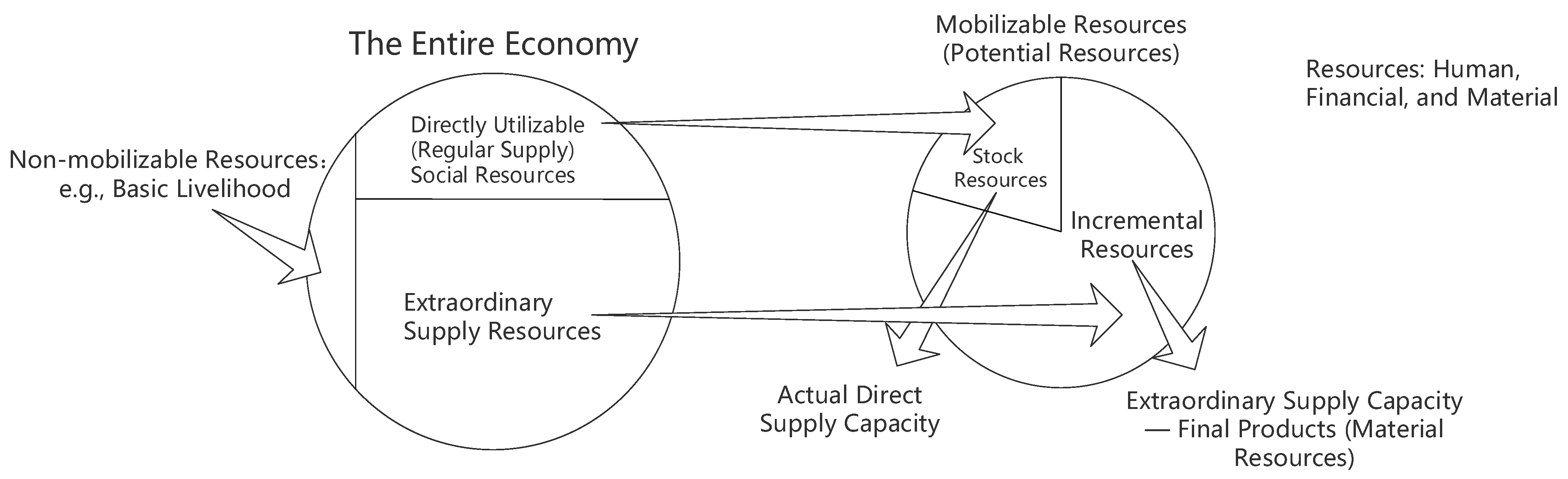
To prevent conceptual confusion, it is necessary to distinguish among EMSC-ESC, the extraordinary supply capacity of emergency materials (EM-ESC), and the emergency material mobilization potential (EM-MP). Their logical interrelationships are illustrated in Figure 1.
E f f e c t i v e   S u p p l y   =   P o t e n t i a l × η
As illustrated in Figure 1, from a macroeconomic perspective, national resources are categorized into non-mobilizable and mobilizable resources (potential resources). EM-MP originates from these potential resources embedded within the national economic system. It represents the theoretical maximum supply of finished emergency products that can be generated through mobilization mechanisms—such as stockpile deployment, expedited production, requisitioning, and emergency imports—to address a crisis. Notably, EM-MP constitutes a latent, unutilized capacity. EM-MP is the theoretical upper bound of all mobilizable resources.
In actual rescue operations, effective supply is transformed from potential resources through mobilization and logistical processes. As shown in Equation (1), η represents a specific transformation coefficient that quantifies the efficiency of converting latent EM-MP into deliverable products within the time window T. The analytical operationalization of this transition is realized through material flow dynamics under temporal constraints. Mathematically, EMSC-ESC is defined as the maximum supply capacity derived from the optimization model under a specific stress scenario S (T, d), where T denotes the response time window and d represents the demand intensity.
To further clarify the scope, EM-ESC refers to the actual volume of finished products that can be produced, mobilized, and ultimately transported to the disaster zone under crisis conditions. The distinction between EM-ESC and EMSC-ESC (the focus of this study) lies in their resource composition: the former encompasses both the transfer of existing stocks and the conversion of incremental resources. The conversion of potential resources into EMSC-ESC is realized through material flow processes (production and logistics) subject to temporal constraints.
(2)
Conceptual Definition of ESMCs Stress Testing
Building upon our previous research concerning the generation of EMSCs, the internal demand-supply chain constitutes the fundamental driver of systemic formation and operation [9]. Under this mechanism, supply is driven by demand pull, striving to continuously narrow the supply–demand gap. Consequently, this study defines the assessment of coordination levels within the demand-supply chain under crisis conditions as the “Stress Testing of the Emergency Material Supply Chain.”
As a forward-looking analytical tool, stress testing evaluates the potential impacts of specific events or fluctuating environmental variables on supply chain integrity. The essence of this methodology lies in assessing supply capacity under varying stress intensities and scenario combinations to pinpoint systemic bottlenecks. In the face of substantial demand volatility, the responsiveness of a supply chain hinges on the supply capacity of the supply side. Consequently, the EMSC-ESC—the dynamic variation in the supply capacity of finished products—is established as the core observational metric for the stress testing conducted in this study.

3.2.2. Operational Mechanism of EMSC Stress Testing

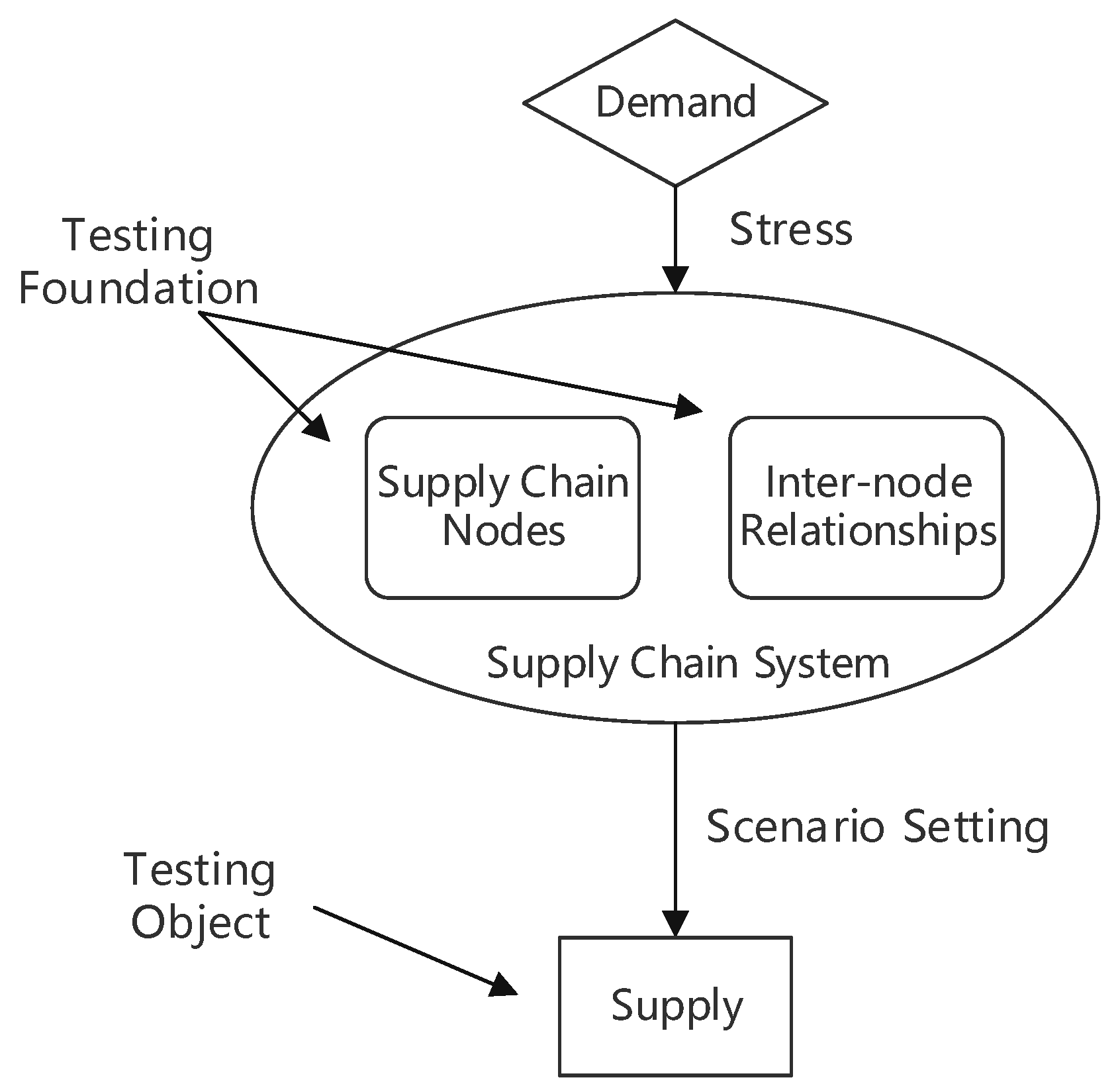
The operational mechanism of EMSC stress testing is a dynamic process driven by demand, transmitted through systemic structures, and characterized by supply-response feedback. This core logic can be synthesized into four coupled stages. Figure 2 illustrates the operational mechanism of EMSC stress testing.
(1)
Stress setting: Stress testing originates from perturbations in the external environment. According to the principle of demand-pull coordination, the explosive surge in material demand triggered by extraordinary emergencies serves as the fundamental driver of the system. This demand shock exerts vertical “stress” upon the supply chain network. Within the operational model, stress is parameterized into varying demand intensities to simulate the initial stress of the system under “peak load” conditions. This stage aims to evaluate whether the supply response can effectively synchronize with dynamically evolving demand trajectories.
(2)
Structural transmission: The EMSC system, comprising nodes and their intricate interrelationships, serves as the physical foundation for the stress testing. According to the principle of BOM-based cascading transmission, demand pressure at the finished product level does not remain localized; instead, it propagates upstream through the supply network. At this stage, the stress test evaluates the structural resilience of the system—specifically, how stress flows across manufacturing and transportation nodes and whether the law of flow conservation within systemic boundaries is breached due to localized overload.
(3)
Scenario mapping: Through scenario configuration, abstract stress is operationalized into concrete constraint variables, such as transportation disruptions or manufacturing shutdowns. This stage embodies the perturbation-response mechanism: by injecting disturbances into specific scenario combinations, the test observes the deviation of systemic performance (e.g., supply fulfillment rate) from a steady state toward a non-steady state. Scenario setting functions as a “stress converter,” enabling the precise diagnosis of the system’s robustness boundaries under diverse extreme environments.
(4)
Capacity assessment: The ultimate object of the stress test is the actual output of the supply side. Governed by the mechanism of capacity compensation and resource conversion, the system activates its EMSC-ESC to counteract demand-induced stress. The evaluative culminates in an assessment of whether the incremental supply—generated through regular conversion, latent resource extraction, and capacity expansion—can effectively bridge the supply–demand gap under specific scenarios and stress intensities. If the supply response fails to cover the imposed stress, the corresponding node or path is identified as a systemic bottleneck.

3.3. Composition of EMSC-ESC

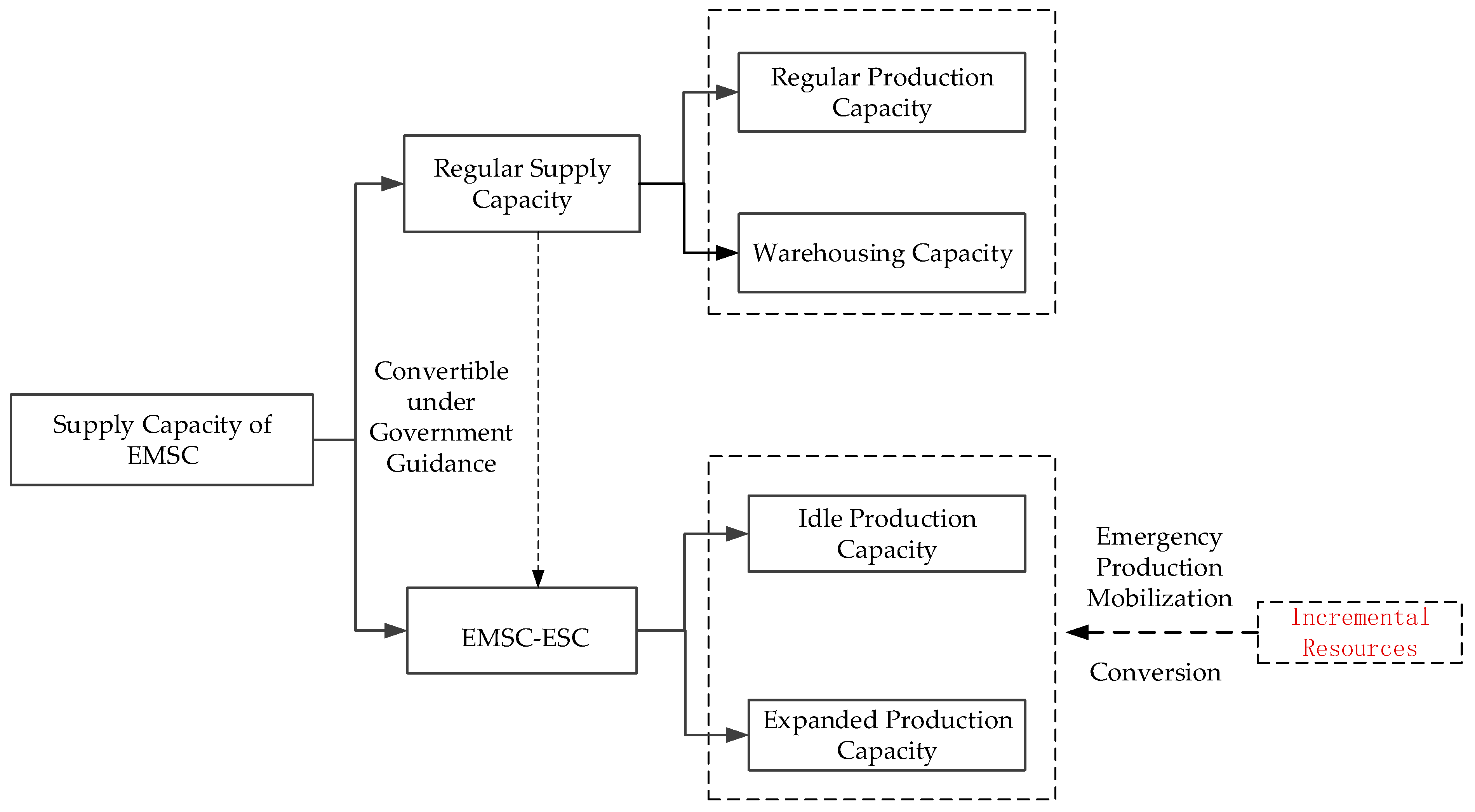
EMSC-ESC is fundamentally an incremental supply feedback realized through multi-level resource mobilization within EMSCs under extreme stress. Rather than a monolithic attribute, EMSC-ESC is synthesized from the flexible reconfiguration of internal production, the intensive extraction of latent resources, and the dynamic expansion of external resources. Consequently, this study defines EMSC-ESC as an integrated metric derived from the conversion of the following three capacities. The underlying logical relationships are illustrated in Figure 3, with the detailed analysis provided below:
(1)
Conversion of regular production capacity
In this study, the output generated from a firm’s input of production resources and factors under normal conditions is defined as “regular production capacity.” This, combined with warehousing capacity, constitutes the regular supply capacity.
Upon the occurrence of an extraordinary emergency, firms designated by government directives transition into functional nodes within EMSCs. Under state guidance, all or part of the regular supply capacity can be converted into EMSC-ESC.
Consider an instant noodle manufacturer as an illustrative case: under normal operations, the firm allocates resources to fulfill commercial orders for the consumer market. However, in response to an emergency demand for food supplies in a disaster area, the government may assign emergency production mandates. To alleviate supply–demand imbalances, the firm redirects the resources originally intended for the commercial market toward the urgent production of emergency materials. If the firm maintains its original production schedule and fulfills the emergency mandate simply by redesignating the end-use of the products, this process exemplifies the direct conversion of regular production capacity into EMSC-ESC.
(2)
Conversion of idle production capacity
If maintaining the baseline production level proves insufficient to meet emergency demand, firms must commit additional production resources and factors to expand output. This incremental supply is typically realized through intensified labor, such as overtime shifts. Idle capacity is defined as supply increments from fully utilizing existing production lines without structural reconfigurations. By injecting requisite production factors on demand, the system maximizes its operational throughput to deliver products to disaster-affected areas.
For instance, to meet government-mandated emergency deadlines, an instant noodle manufacturer redirects regular capacity and intensifies labor through overtime. This intensive utilization of existing assets and labor exemplifies the conversion of idle production capacity into EMSC-ESC.
(3)
Conversion of expanded production capacity
In the wake of extraordinary emergencies, the catastrophic supply–demand gap often exceeds the maximum output of firms, even when they are operating at full capacity. This strain is frequently compounded by capacity degradation caused by the event itself, such as physical damage to equipment during earthquakes or labor shortages during public health crises. From a systemic perspective, addressing such extreme deficits necessitates a structural reconfiguration of EMSCs. This involves integrating new nodes (firms) and optimizing inter-node coordination to facilitate rapid conversion or expansion through resource reorganization and intensified technical investment.
Consequently, this study defines expanded production capacity as the incremental supply generated by mobilizing external firms that possess either latent capacity or the potential for emergency production. By reconfiguring production factors and injecting fresh capital and technology, these entities are integrated into the emergency manufacturing network to swiftly bridge the supply gap.
Although these capabilities originate from distinct resources, they are consolidated into a unified observational variable (EMSC-ESC) in the subsequent stress testing model. This integrated approach enables a comprehensive evaluation of the supply chain’s total output efficacy and its coordination with evolving demand trajectories under varying stress intensities.

3.4. Implementation Procedure of the Stress Testing

The implementation of EMSC stress testing follows an integrated logical framework. The proposed procedure transitions from “goal setting” to “quantitative evaluation” through the following four critical stages:
(1)
Identification of the stress testing objects
Defining the specific categories of emergency supplies and their corresponding supply chain echelons while delineating the system’s physical boundaries and BOM-based transmission logic under designated emergency scenarios.
(2)
Construction of the stress testing scenarios
Mapping exogenous uncertainties—such as logistical disruptions, capacity impairments, and demand surges—into a parameterized set of model inputs. This stage establishes multi-level stress intensities ranging from “mild” to “extreme” to simulate diverse pressure conditions.
(3)
Development of the testing system model
Formulating a computational model that characterizes the operational principles of EMSCs to serve as the testing platform. This framework remains agnostic to specific modeling paradigms, accommodating various approaches such as multi-objective programming, system dynamics, or digital twin models. It is designed to capture stress injections and quantify the system’s response states under varying workloads.
(4)
Performance evaluation and bottleneck identification
Executing the model to observe the evolutionary trajectories of key performance indicators. By assessing supply–demand alignment and systemic stability, this stage detects robustness boundaries and identifies deep-seated structural bottlenecks that trigger supply failure.

4. Model Construction for EMSC Stress Testing

4.1. Problem Description and Assumptions

To demonstrate the operationalization of the proposed stress testing framework, this study develops a multi-objective programming model as the platform for stress testing. This modeling approach is selected for its ability to capture the complex trade-offs inherent in emergency response, where the system must simultaneously optimize conflicting objectives. Prior to formulating the stress testing model for EMSC, it is necessary to define the core objectives of emergency support missions and formalize the underlying stress testing problems.

4.1.1. Characterization of Stress Testing

(1)
Mission Objectives
Following the onset of extraordinary emergencies, the timely, scientific, and equitable distribution of end products to demand points is critical for minimizing casualties and economic losses. Given that the primary recipients—disaster victims—have an urgent need for relief materials, the resulting pressure on the emergency supply chain is manifested in both temporal and quantitative dimensions. Consequently, the stress testing problem addressed in this study can be summarized into two core challenges:
  • Accelerating the emergency production to shorten lead times;
  • Optimizing the allocation of final products across heterogeneous demand points to mitigate the impact of material shortages.
The primary objective of this study is to evaluate the performance of the emergency supply chain in fulfilling the overarching goals defined by the governing authorities. Drawing on practical emergency management experience, the paramount priority is to complete relief missions within the shortest possible timeframe. Consequently, from the perspective of the responsible entities, the overarching mission requirement is translated into a temporal optimization problem aimed at minimizing completion time.
In actual extraordinary emergency operations, a massive gap between supply and demand often necessitates the scientific allocation of scarce resources among diverse demand points, which are inherently heterogeneous depending on the disaster’s severity. Consequently, responsible authorities seek to minimize the disutility caused by resource insufficiencies, focusing on the minimization of negative utility losses caused by shortages.
This rationale establishes the overarching objective for the assessment in this study: the evaluation of emergency supply capacity is conducted based on the fulfillment of the strategic goals predefined by decision-makers.
(2)
Problem Formulation
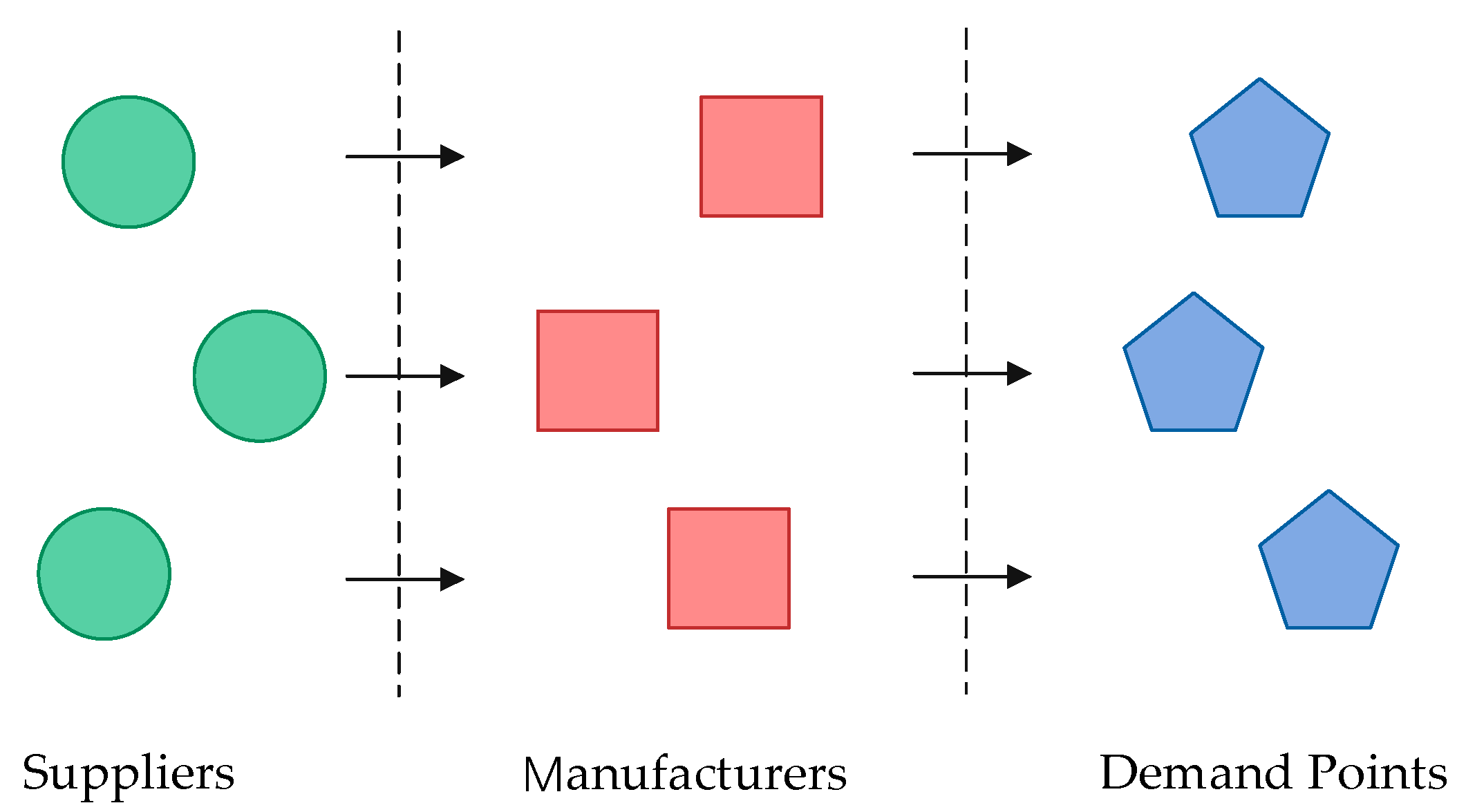
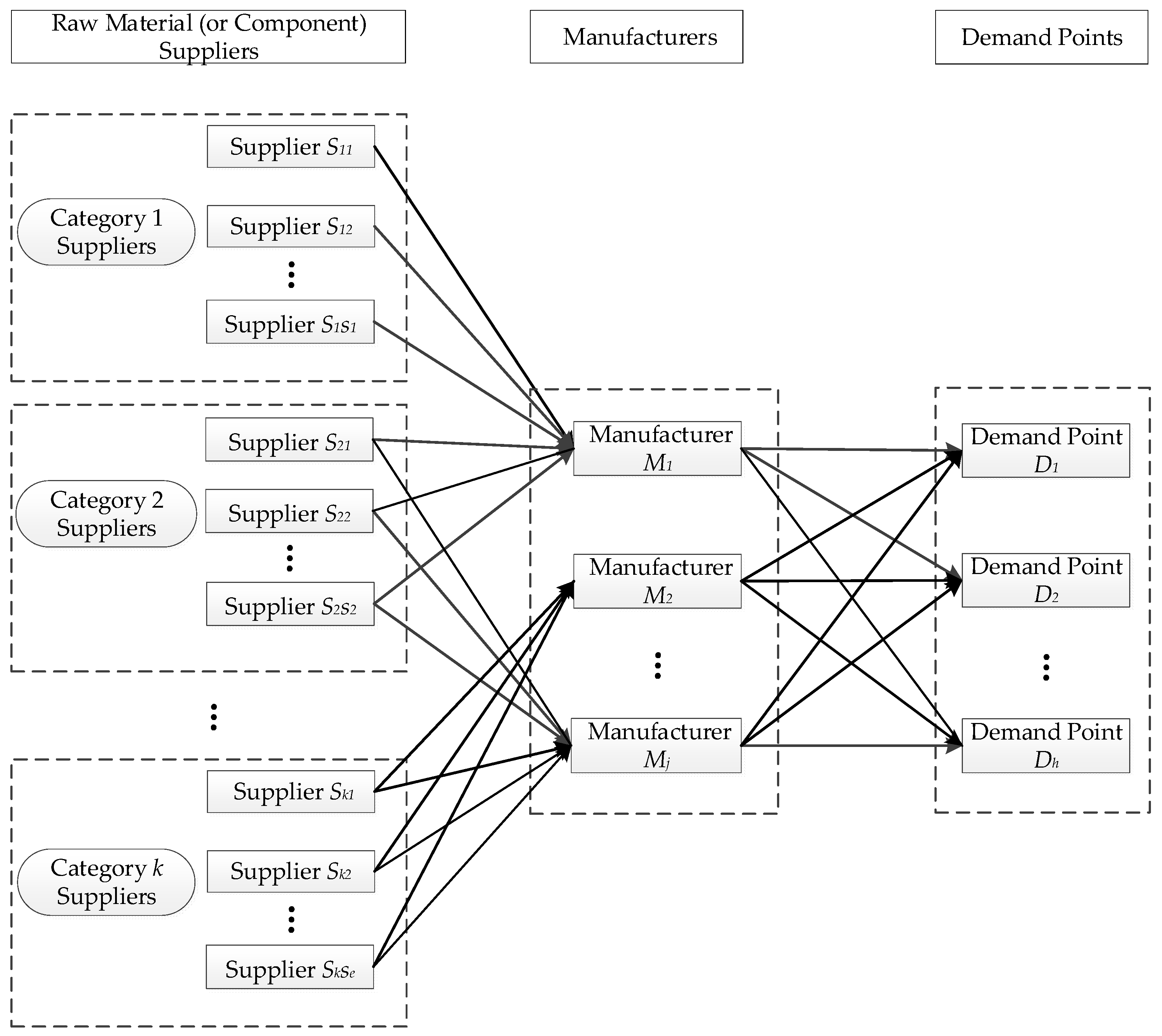
This study proposes a representative tri-level supply chain model to articulate the core theoretical constructs. Under extraordinary emergencies, the primary mission of the EMSC is to achieve an extreme response to surging demands through the coordinated scheduling of multi-level internal resources. Consequently, the problem is conceptualized as a three-echelon EMSC response network comprising raw material suppliers, emergency material manufacturers, and disaster-affected demand points.
Within this integrated chain, the production mission is driven by exogenous demand gaps at the demand points. Suppliers are responsible for providing standardized components, while manufacturers commence emergency production only upon the arrival of all requisite materials. To counteract extreme demand pressure, the system integrates the EMSC-ESC of all internal nodes to bolster the overall supply level. Given the variations in capacity conversion rates and logistical lead times, as well as the heterogeneous utility of supplies across demand points, the optimization focuses on balancing two conflicting objectives through the strategic allocation of resources and tasks:
  • Minimizing the system-wide maximum completion time: This includes the entire process from material preparation at the suppliers and manufacturing to final delivery at demand points, ensuring the most rapid response;
  • Minimizing the weighted shortage loss: This aims to mitigate the negative impacts of supply deficits by considering the specific urgency levels and product utilities associated with different demand areas.
(3)
Conceptual Model for Stress Testing
As shown in Figure 4, the model utilizes a three-tier supply-manufacturer-demand structure where upstream nodes optimize operations based on downstream demand. By prioritizing the emergency production and provisioning of incremental capacity, the model abstracts the demand side into points and abstracts away internal scheduling mechanisms.

4.1.2. Model Assumptions

To focus the research on its core objectives while maintaining practical relevance, the following assumptions are established:
(1)
Deterministic Demand: The model considers a production mission for a single category of multiple emergency supplies. The total demand is exogenous and predefined by decision-makers, calculated as the difference between the total requirements and current deployable reserves.
(2)
Multi-level Mobilization Capacity: A selection of potential raw material suppliers (hereafter “suppliers”) and emergency material manufacturers (hereafter “manufacturers”) is available within the resource database. The decision-maker can activate different mobilization levels—regular production, production under extraordinary working hours, and production at maximum capacity—depending on the specific conditions of the entities. Consequently, the production capacity per unit time for each entity is assumed to be known and depends on the selected mobilization level.
(3)
Supplier Categorization: Multiple classes of suppliers exist, each providing distinct categories of raw materials or components. Suppliers within the same class provide homogeneous materials. Transport occurs only after the completion of assigned production tasks at each node.
(4)
Manufacturer Diversity and Constraints: Manufacturers are capable of producing multiple types of end-products, with their initial product portfolios predefined. This aligns with industrial reality, where manufacturers possess multi-product capabilities but restrict production lines based on historical market share and competitive strategies.
(5)
Heterogeneous Utility: The production of different end-products requires varying sets of components. Due to differences in functional characteristics across product models, the utility generated by each product varies.
(6)
Component Standardization: For the same product model, the types of components required remain identical across different manufacturers, reflecting the functional and structural consistency of standardized emergency supplies.
(7)
Production and Distribution Logic: Manufacturers rely entirely on external suppliers for components, and production commences exclusively after all required materials have arrived. Parallel production lines are allocated, each dedicated to a specific demand point. These production lines possess operational flexibility, allowing for equipment changeovers (setup transitions) to sequentially manufacture different categories of end-products required by that node. Furthermore, the distribution phase follows a node-specific batching rule: products are dispatched to a demand point immediately after all required product types for that node are completed.
(8)
Spatial Utility and Boundaries: The disaster area consists of multiple demand points with varying utility levels depending on the severity of the disaster. The model focuses on the upstream production and delivery process and excludes intra-demand point distribution.
(9)
Determined Logistics: The transport routes and modes for materials and end-products between nodes are predetermined, rendering transportation lead times constant and known.
(10)
Lossless Transformation: No loss or damage occurs to raw materials, components, or end-products during the transportation process.
(11)
Optimized Resilience: Both suppliers and manufacturers respond to disruptions optimally, and no backordering or delivery delays are permitted.

4.2. Mathematical Formulation

4.2.1. Notations

The fundamental parameters of the mathematical model are described as follows (see Table 1):
The problem formulation is shown in Figure 5.

4.2.2. Stress Testing Model for Emergency Material Supply Chains

In the context of extraordinary emergencies, a larger gap between the supply and demand of relief materials typically correlates with increased casualties and economic losses. Specifically, the marginal loss incurred by affected populations at demand points exhibits an increasing trend relative to the magnitude of the shortage. This implies a convex relationship between material deficits and the resulting disutility, where the marginal impact intensifies as the unmet demand expands.
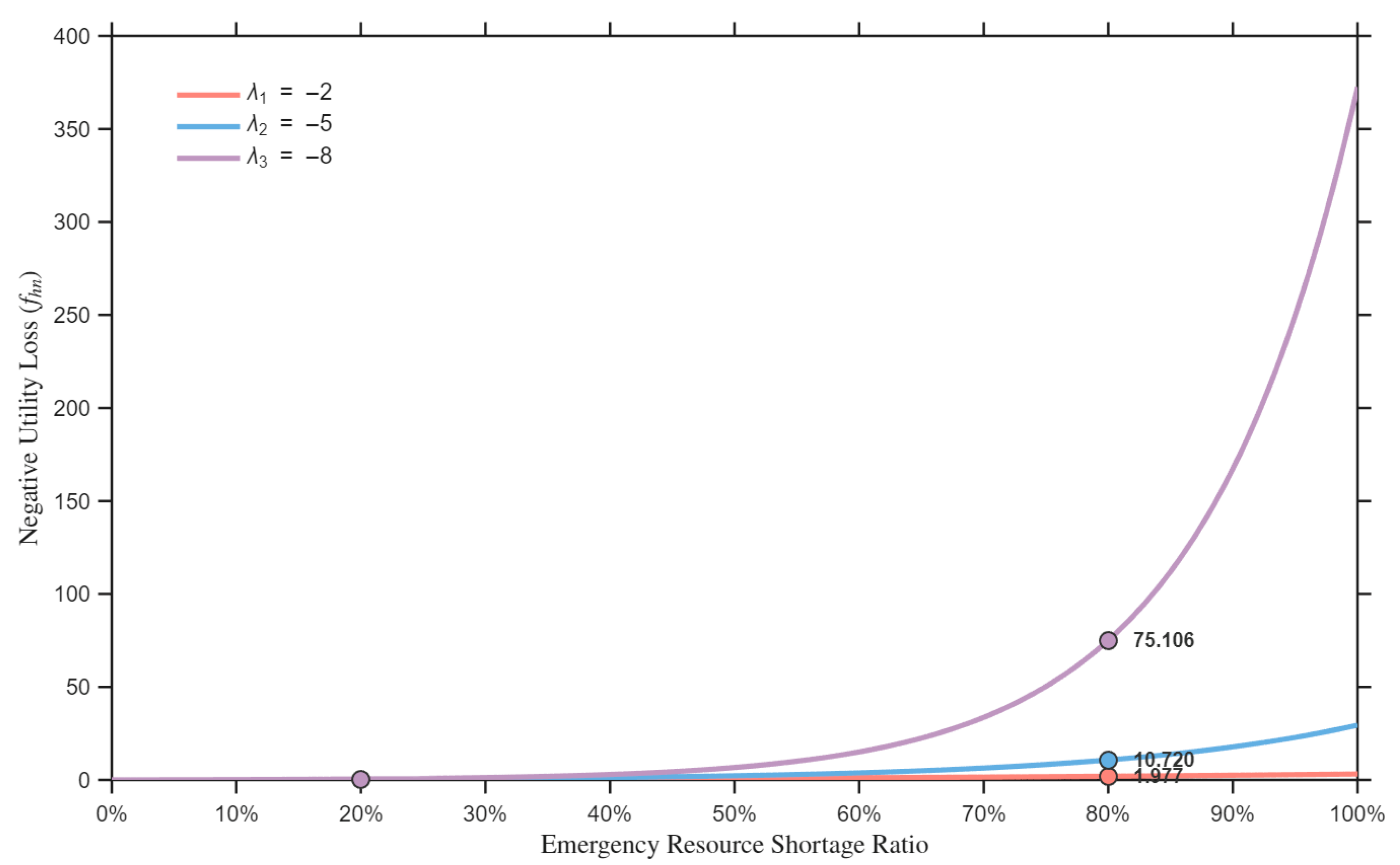
To quantify the disutility arising from resource scarcities, an exponential utility function, denoted as f h n · : + + , is incorporated into this section. Accordingly, the negative utility loss function f h n p h n for the shortage of the n-th type of emergency material at demand point D h is formulated as follows:
f h n p h n d h n = 1 e λ n p h n d h n λ n   λ n < 0
In Equation (2), the shortage of the n-th emergency material at the h-th demand point is defined as the discrepancy between the total demand and the quantity supplied through emergency production. Specifically, the deficit of material n at demand point h is expressed as:
p h n = d h n j = 1 J e j h n
In Equation (3), where d h n denotes the demand for product n at demand point h, and j = 1 J e j h n represents the total quantity of product n supplied by all manufacturers to the same point. In Equation (2), the parameter λ n exerts a significant influence on the disutility associated with material shortages. As λ n approaches zero, a lower weight is assigned to penalize large deficits. Conversely, as λ n increases, the model exhibits heightened sensitivity to severe shortages at any specific demand point, emphasizing the strategic priority of averting critical supply failures across the entire network.
To further elucidate the disutility function, we consider a large-scale earthquake as a representative case. In this context, drinking water, medical supplies, and thermal equipment are categorized as critical relief materials with distinct utility profiles. Specifically, drinking water is vital for physiological survival and disease prevention. In regions with high temperatures or disrupted supply chains, even brief shortages can trigger severe health crises, necessitating a paramount focus on utility weight. Medical supplies are essential for stabilizing vital signs and preventing infection; shortages may lead to the rapid deterioration or mortality of the injured, thereby commanding a high weight, particularly for trauma cases. In contrast, while thermal equipment provides necessary shelter against harsh environments and secondary hazards (e.g., hypothermia or infectious diseases), its utility weight is typically lower relative to the immediate life-sustaining roles of water and medicine.
Based on Equation (2), the nonlinear disutility functions for emergency material shortages are plotted in Figure 6, assuming a shortage ratio of [1, 100]. Following the preceding analysis, curves λ 1 =   8 , λ 2   =   5 , and λ 3 =   2 correspond to drinking water, medical supplies, and thermal equipment, respectively. As illustrated in Figure 6, the disutility incurred at demand points increases monotonically with the magnitude of the shortage. This trend captures the nonlinear relationship between material deficits and the resulting negative utility losses, indicating accelerating socio-economic costs associated with severe supply gaps.
At a 20% shortage level relative to the total demand, the disutility losses for the three material categories are 0.4941, 0.3437, and 0.2459, respectively. These relatively low values indicate a manageable shortage level, where supply coverage remains high and most demand can still be satisfied. In this scenario, the minimal utility loss implies that supply reaches most individuals, potentially excluding only the most resilient segments of the population. In contrast, when the shortage reaches 80%, the corresponding disutility values escalate significantly to 75.1056 (152-fold increase), 10.7196 (31.19-fold increase), and 1.9765 (8.04-fold increase). Such acute deficits signify that only a marginal fraction of required materials reaches the demand point. Consequently, vulnerable groups—including the severely injured, the elderly, and children—are likely to be deprived of adequate resources, leading to catastrophic utility losses and a high probability of severe secondary disasters.
Building upon the aforementioned analysis, this section develops a baseline optimization model aimed at simultaneously minimizing the total duration of the emergency production mission and the resulting negative utility losses. The mathematical formulation is established as follows:
min Z 1 = max k K , i I k , j J , h H j J q k i j x k i j s S s p c k i ( s ) l 1 s + t k i j x k i j + n N e j h n z j h n m M m p c j n ( m ) l 2 m + t j h min ( 1 , n N z j h n )
min Z 2 = h H α h n N f h n p h n
s.t.
d h n j J e j h n = p h n 0 , h H , n N
i I k q k i j n N h H b m k j n e j h n , k K , j J
s S l 1 s = 1
m M l 2 m = 1
q k i j 0 , e j h n 0 ,   k K , i I , j J , h H , n N
x k i j q k i j M ¯ x k i j , z j h n e j h n M ¯ z j h n ,   k K , i I , j J , h H , n N
In the proposed model, Equation (4) presents the first objective function, which aims to minimize the maximum lead time across all potential production-distribution paths. The total duration of each path is formulated as the sum of four stages: (i) the component processing time at the supplier, (ii) the raw material transportation time, (iii) the manufacturing duration of end-products, and (iv) the final distribution time to the demand point. By applying the max operator, the model identifies the critical bottleneck of the supply chain—specifically, the path with the longest completion time. Minimizing this maximum value ensures that the latest arrival of emergency supplies is as early as possible, thereby improving the overall response efficiency. Equation (5) focuses on minimizing the utility loss associated with emergency production and supply tasks.
Regarding the constraints, Equation (6) defines the supply–demand deviation, ensuring that supply gaps for finished products remain non-negative. Equation (7) defines the material balance for components; specifically, it requires that for each manufacturer, the total supply of each component k must be sufficient to support the production and delivery of finished products to their respective demand points. Equations (8) and (9) ensure only one mobilization level is selected for suppliers and manufacturers, respectively. Specifically, in actual mobilization task assignments, the decision-maker can designate a specific mobilization level for suppliers or manufacturers, choosing among regular production, production under extraordinary hours, or production at maximum capacity. Equation (10) enforces non-negativity constraints on variables representing raw material supplies from suppliers and finished products delivered by manufacturers. Finally, Equation (11) defines relationships between the primary decision variables and intermediate variables.

5. Application: Ibuprofen Emergency Production Under Demand Surges

To demonstrate the operationalization of the proposed stress testing framework, this section develops a numerical case study based on a representative emergency scenario with surging demand. Utilizing the assessment model formulated in Section 4, we conduct a stress testing analysis and discuss the findings in detail.
To demonstrate the operationalization of the proposed stress testing framework, this chapter develops a numerical case study based on a representative emergency scenario characterized by a surge in demand. Utilizing the assessment model formulated in Section 4, the study conducts stress testing to quantify the EMSC-ESC and analyze system performance. Given that the stress testing model involves a trade-off between the completion time and the shortage loss, the multi-objective particle swarm optimization (MOPSO) algorithm is employed as the computational engine. Although this study does not primarily focus on algorithmic innovation, MOPSO provides an efficient mechanism to capture the Pareto-optimal frontier and visualize the dynamic degradation of systemic performance under varying stress intensities.

5.1. Identification of the Stress Testing Objects

5.1.1. Case Background Description

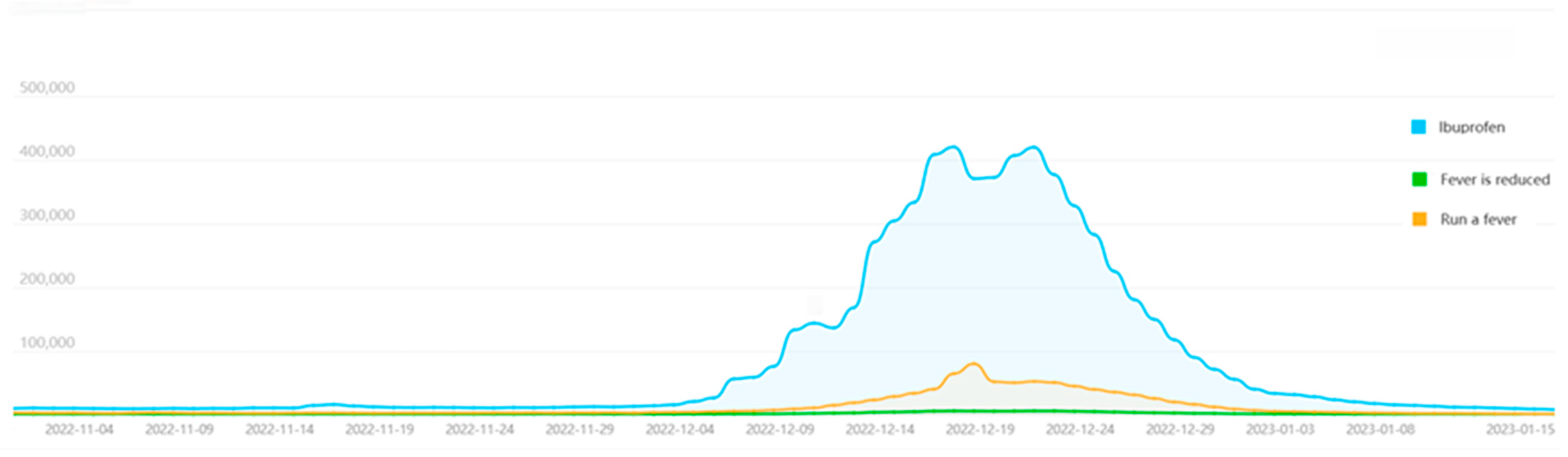
The COVID-19 pandemic represents one of the most significant public health emergencies globally. It is characterized by rapid transmission, extensive infection range, and substantial challenges to containment. Following the transition of China’s pandemic response into a “normalized prevention and control” phase, a series of policy adjustments occurred on 11 November 2022. The Standing Committee of the Political Bureau of the CPC Central Committee deployed twenty measures to further optimize prevention and control, including the cessation of “secondary close contact” identification. During this period, infections increased significantly, resulting in a surge in demand for antipyretic medications. From 4 December 2022, to 5 January 2023, the Baidu search index for keywords such as “ibuprofen” exhibited a sharp increase (see Figure 7).
In accordance with these optimized national measures and the evolving viral variants, the Beijing municipal government implemented ten refined measures on 7 December 2022, which emphasized “guaranteed provision of basic pharmaceutical needs.” Subsequently, a significant increase in the procurement of antipyretics, particularly ibuprofen, was observed across Beijing. Subsequently, the Ministry of Industry and Information Technology (MIIT) fully initiated medical supply production and organized the emergency manufacturing of antipyretic drugs to ensure supply stability.

5.1.2. Testing Objects

Following Section 5.1.1, ibuprofen is chosen as the testing object due to its representative role in the emergency supply of antipyretic medications in Beijing. The emergency production mission involves three primary dosage forms: ibuprofen tablets and sustained-release capsules for adults, and oral suspensions mainly for pediatric use but also suitable for adults.
  • Suppliers
The core input for production is the ibuprofen active pharmaceutical ingredient (API). Shandong Xinhua Pharmaceutical and Hubei Biocause Pharmaceutical are the leading domestic producers, forming a duopoly that ensured domestic API self-sufficiency during the 2022 emergency period. Shandong Xinhua Pharmaceutical, the largest global ibuprofen API producer, has an annual capacity of 8000 tons, accounting for 86% of domestic capacity. During the 2022 emergency supply period, 80% of its capacity was allocated to meet domestic pharmaceutical manufacturers’ urgent requirements. Hubei Biocause Pharmaceutical, with an annual capacity of 3500 tons, serves as the second-largest domestic supplier.
Beyond APIs, the manufacturing of finished ibuprofen products requires pharmaceutical excipients and packaging materials. Based on the material categories, this study classifies raw material suppliers into seven clusters: API, pharmaceutical excipients (comprising binders, tablet-specific excipients, sustained-release capsule-specific excipients, capsule shells, and suspension-specific excipients), and packaging materials. Accordingly, 16 enterprises are identified as representative raw material suppliers (see Appendix A Table A1 for details).
  • Manufacturers
Four pivotal enterprises are identified as the primary manufacturers responsible for the majority of the supply during this emergency period. Two dominant API producers were included: Shandong Xinhua Pharmaceutical, with vertically integrated API and finished-product capabilities (mainly tablets and capsules), and Hubei Biocause Pharmaceutical, focusing solely on tablet production. Additionally, two major manufacturers in Beijing are included to ensure local supply security: Beijing Honglin Pharmaceutical, specializing in sustained-release capsules, and Beijing Hanmi Pharmaceutical, specializing in oral suspensions.
  • Demand points
Three central state-owned enterprises (Sinopharm, China Resources, and Genertec) are designated as the demand points. Under the centralized coordination of MIIT, these entities served as the official core units for stabilizing ibuprofen supply in Beijing. Their localized warehousing, production, and distribution bases provided geographical and resource advantages for near-site response, enabling rapid allocation and delivery of emergency supplies.
The relevant parameters for the stress testing are derived from data collected and processed by the authors, as shown in Appendix A. Detailed descriptions are omitted here for brevity.

5.2. Construction of the Stress Testing Scenarios

To demonstrate the framework’s operability, a single demand-surge scenario is presented. In practice, the proposed framework is highly flexible and capable of supporting a diverse range of complex composite scenarios—such as simultaneous demand spikes and capacity impairments or increased logistical latencies—by calibrating input parameters and design constraints for comparative analysis. Iterative testing across scenarios allows decision-makers to design optimization strategies that improve systemic resilience.
The scenario in this study is based on actual emergency supply missions coordinated by China’s MIIT. This specific case simulates extreme demand-side fluctuations where an abrupt surge in ibuprofen demand creates a massive supply–demand gap. Based on these emergency requirements, decision-makers formulated emergency production guarantee missions for three primary demand points (see Table 2). A 10-day administrative deadline defines the “stress” in this scenario, enabling evaluation of the ibuprofen supply chain’s ESC under high-pressure policy directives. Parameter values for the model are detailed in Appendix A Table A1, Table A2, Table A3, Table A4, Table A5 and Table A6.

5.3. Algorithm Selection and Performance Verification

The stress testing model necessitates a trade-off between completion time and shortage loss. While this study does not primarily focus on algorithmic innovation, selecting an efficient and stable computational engine is essential to ensure the accuracy and reliability of the resulting Pareto-optimal frontier. To justify the selection of the solver, we evaluate and compare three widely used multi-objective algorithms: NSGA-II, MOEA/D, and MOPSO.

5.3.1. Benchmarking and Comparative Results

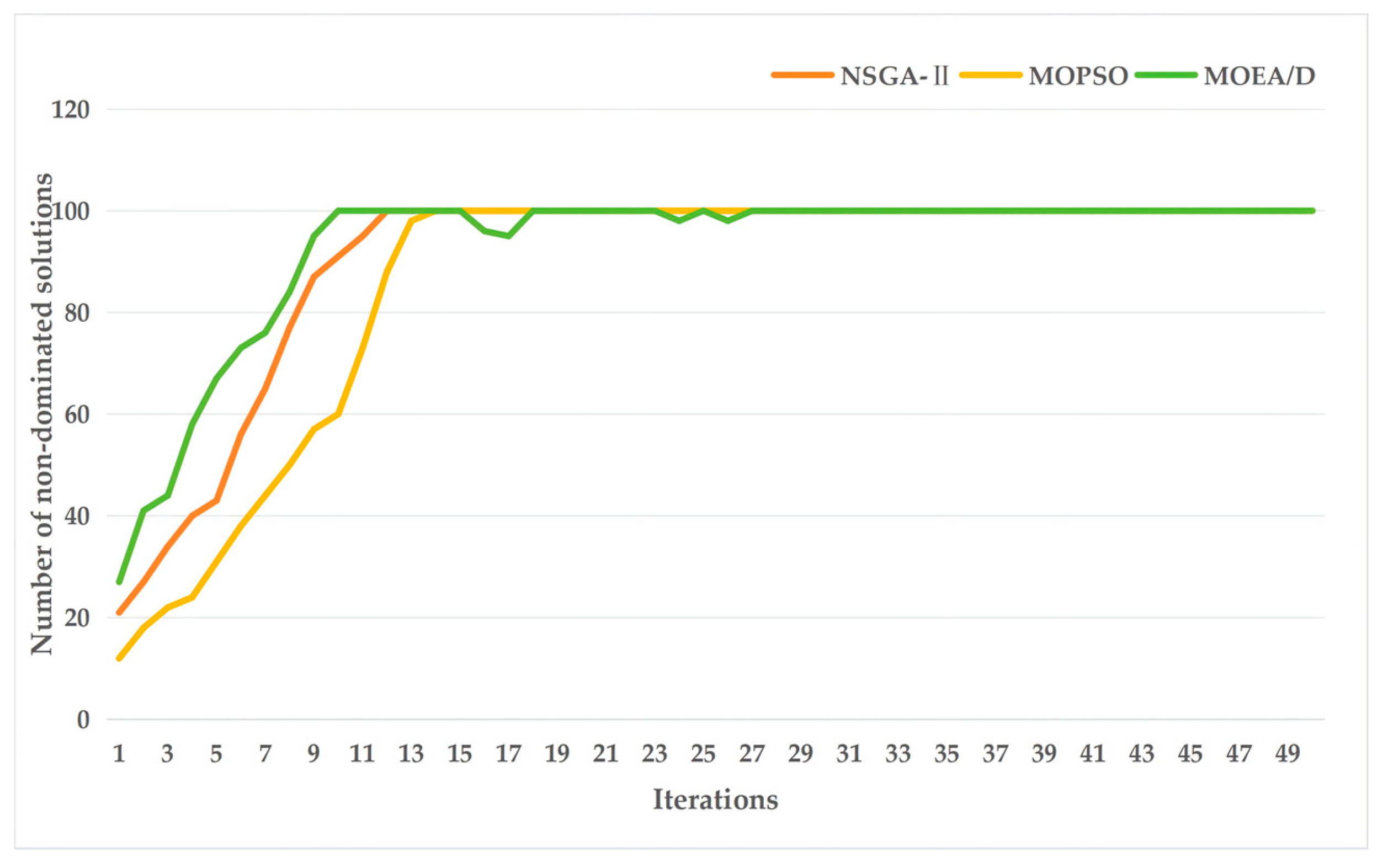
A benchmarking experiment was conducted with a consistent setup: a population size of 100, a maximum of 50 generations, and 5 independent runs for each algorithm to mitigate stochastic influence. The quantitative performance metrics, including Hypervolume (HV), Inverted Generational Distance (IGD), and Average Coverage Metric (CM), are summarized in Table 3 and Table 4.
As shown in Table 3, MOPSO outperforms the other two algorithms in both convergence and diversity metrics. Specifically, MOPSO achieved the highest HV (0.808878) and the lowest IGD (0.019733), indicating its superior ability to identify a high-quality Pareto-optimal frontier. While MOPSO requires a longer computational time (averaging 697.33 s), the trade-off is justified by the significantly higher precision required for emergency material supply chain stress testing.
Furthermore, the Average Coverage Metric (CM) results in Table 4 reinforce these findings. MOPSO demonstrates a clear dominance in terms of solution quality, dominating 65.2% of the solutions generated by NSGA-II and 62% of those by MOEA/D. These results provide a robust justification for selecting MOPSO as the most suitable solver for this specific goal programming model.
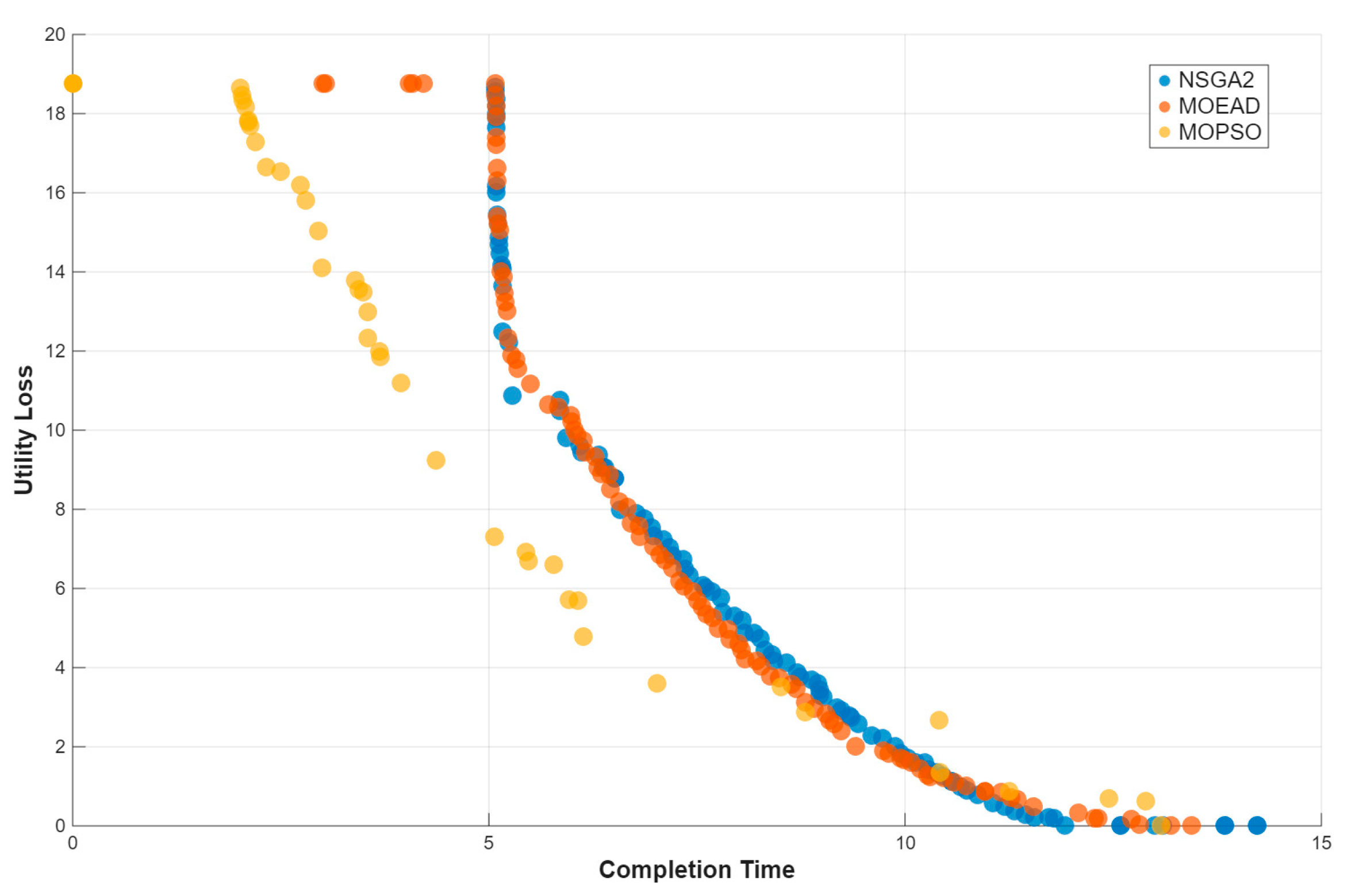
To provide a visual comparison of the search capabilities, the final Pareto-optimal frontiers obtained by the three algorithms are plotted in Figure 8. It is evident that the MOPSO frontier (represented by the yellow points) is more continuous and positioned closer to the ideal objective point than those of NSGA-II and MOEA/D. This visual evidence confirms that MOPSO achieves a better balance between minimizing completion time and reducing shortage loss, consistent with the quantitative findings in Table 3 and Table 4.

5.3.2. Convergence, Sensitivity, and Scalability Analysis

The stability and computational performance of the algorithm were assessed to ensure the reliability of the optimization results.
(1)
Convergence and Iteration Stability
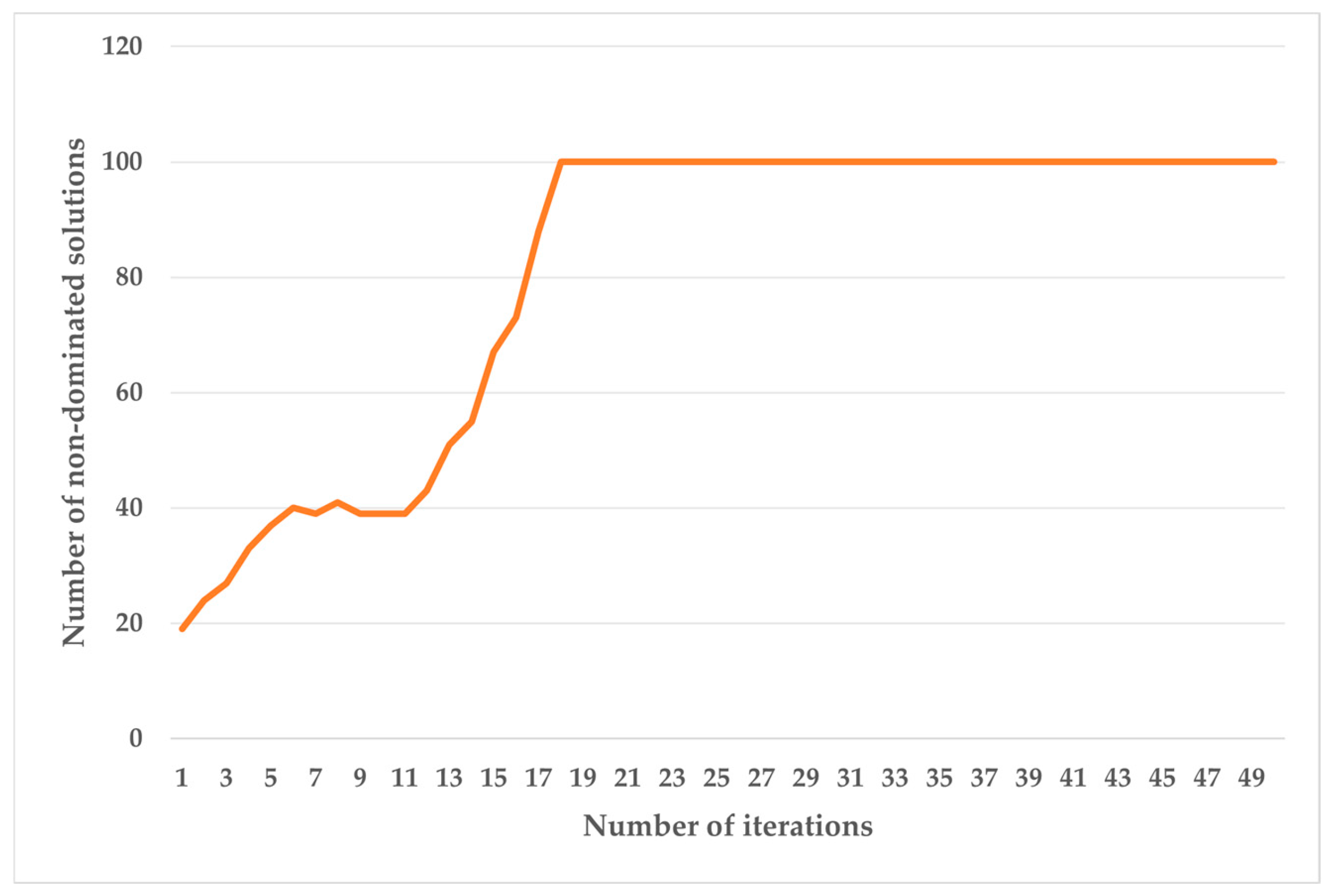
To verify whether 50 generations are sufficient for the model to converge, we monitored the evolution of the Pareto-optimal set across varying iteration counts. As illustrated in Figure 9, the number of non-dominated solutions stabilizes significantly after the 35th generation. Analysis of 50 independent runs confirms that the algorithm reliably identifies a stable and diverse Pareto front within 50 generations, with additional iterations offering minimal improvement.
(2)
Scalability and Computational Complexity
The scalability of the MOPSO algorithm was evaluated by analyzing its computational overhead relative to the model complexity. Despite operational constraints of the proposed model, the average CPU execution time remained stable at 697.33 ± 7.01 s per run. This high degree of statistical consistency across 50 independent trials demonstrates that the algorithm is robust against stochastic fluctuations and maintains predictable performance. The results suggest that the MOPS framework can scale effectively to larger supply chain networks without exponential computational cost increases.
(3)
Target Space Sensitivity Analysis
To investigate the MOPSO algorithm’s search precision, a cross-sectional analysis was performed during 1–50 generations of iteration. The distribution of solutions was monitored by selecting those nearest to a 10-day deadline at different iteration stages. This provides a detailed view of how the algorithm refines solution distribution and enhances objective-space density at a critical decision point.
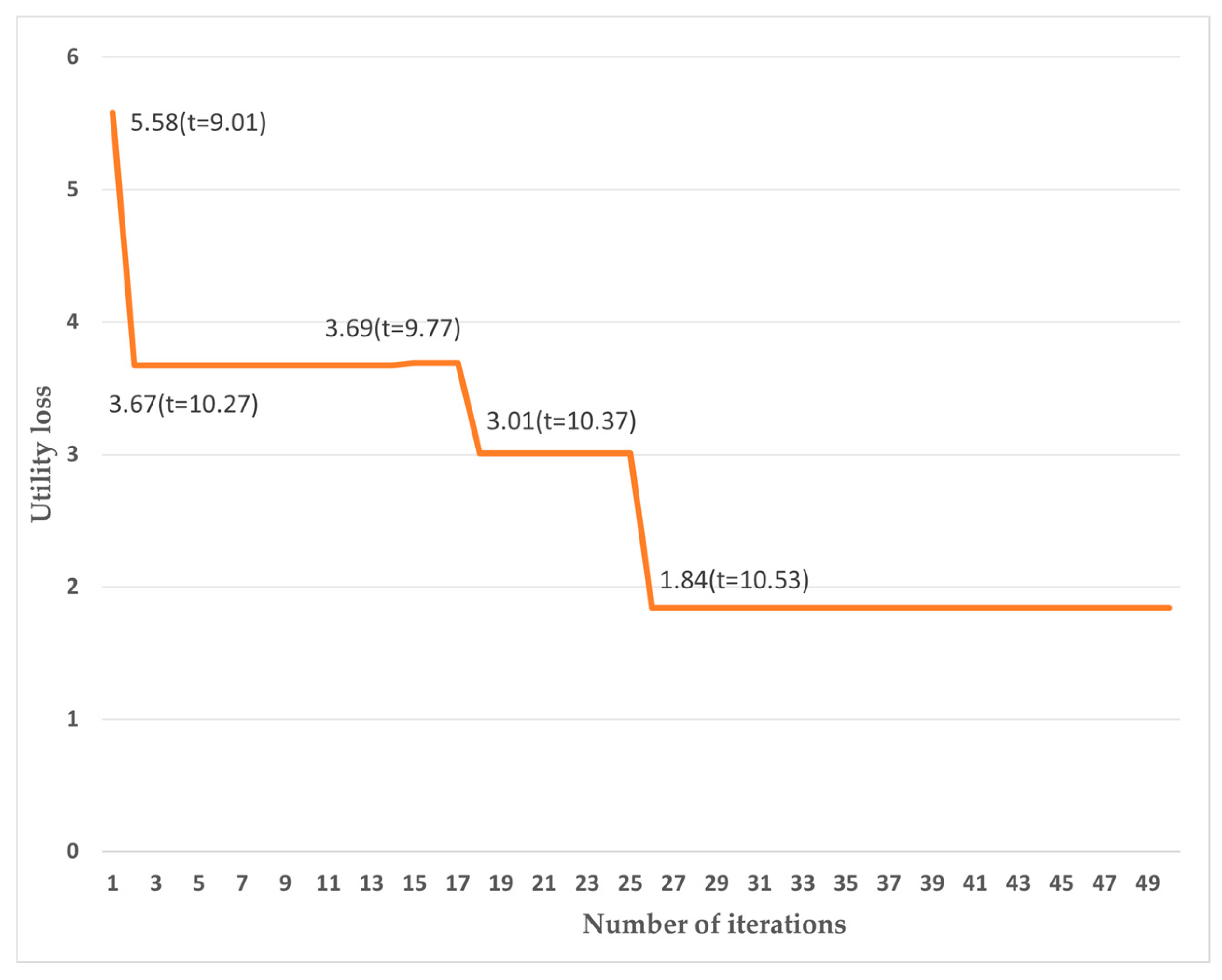
Figure 10 and Figure 11 demonstrate clear evidence of solution convergence. The utility loss exhibited a stepwise optimization, dropping from an initial 5.58 (completion time = 9.01) to a stable minimum of 1.84 (completion time = 10.53). During the intermediate stage (generations 15–17), a minor fluctuation in utility loss was observed around 3.69. This fluctuation reflects the MOPSO algorithm’s dynamic search process, where the archive is updated with new non-dominated solutions before gravitating toward a more precise local optimum.
Notably, the convergence process continues even after the external archive reaches its full capacity at the 18th generation, as depicted in Figure 10. Between the 18th and 26th iterations, the utility loss in this specific cross-section further decreased from 3.01 (completion time = 10.37) to 1.84 (completion time = 10.53), remaining constant thereafter. This secondary refinement phase confirms that the algorithm’s leader selection mechanism effectively eliminates suboptimal points in favor of high-precision solutions closer to the theoretical limit. Ultimately, the 67% reduction in utility loss proves the MOPSO algorithm’s superior convergence stability and its ability to capture the most stringent trade-offs in emergency material supply chain stress testing.

5.4. Analysis of Stress Testing Results

Following algorithmic verification (Section 5.3), MOPSO is applied to stress-test the ibuprofen supply chain. Configurations: population size and external archive capacity = 100; evolution over 50 generations; inertia weight = 0.7; cognitive and social learning factors = 1.5, balancing global exploration and local exploitation.

5.4.1. Overall Analysis of Stress Testing Results

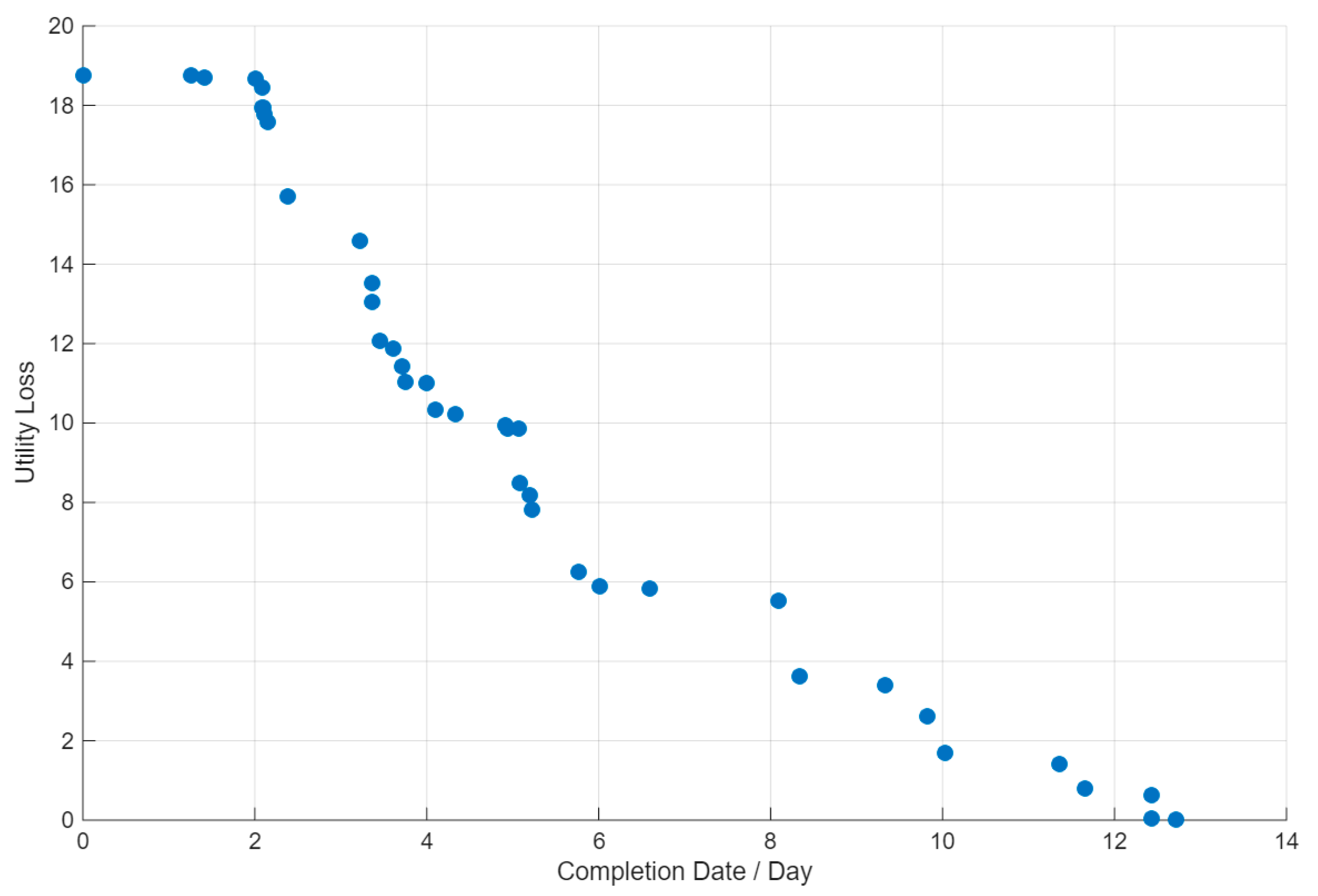
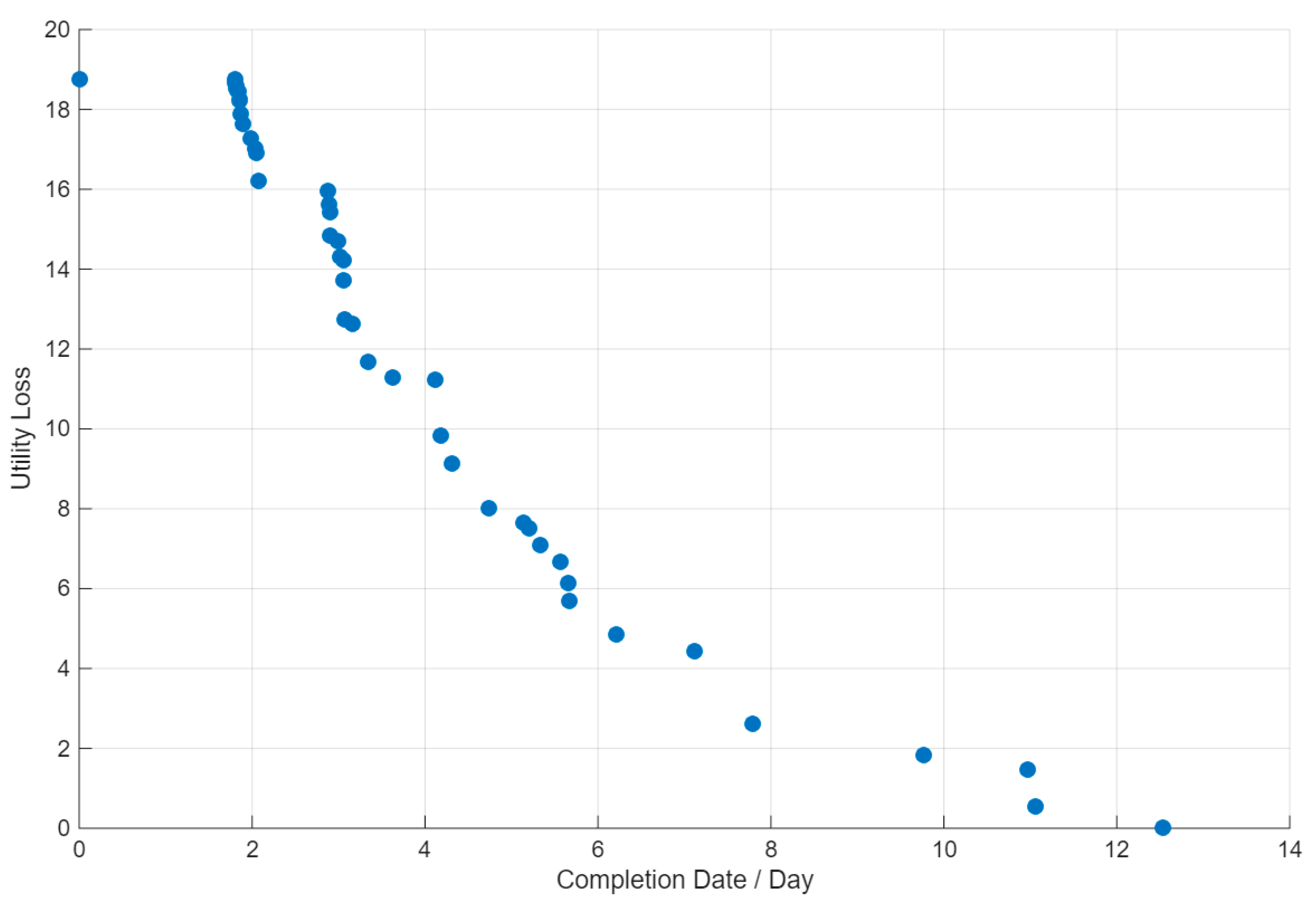
As illustrated by the Pareto front in Figure 12, utility loss and completion date exhibit a typical negative correlation. This trend indicates that reducing the response time inevitably comes at the cost of increased utility loss and vice versa, which is consistent with practical operational logic. Under fixed resource constraints, prioritizing rapid response can lead to supply shortages at specific demand points, especially those that are remote or lower-priority. For detailed interpretation and to guide optimization, the Pareto front trajectory is divided into four phases:
  • Phase I (Days 1–2): Response Vacuum.
When the completion date is set before the 2-day threshold, the utility loss remains stagnant at its peak (approximately 18.8), showing virtually no downward trend. This confirms a severe “response vacuum” during the initial post-shock period. Even with the immediate initiation of mobilization, the generation of incremental resources is physically constrained by the production capacities of node enterprises and fixed inter-node transportation lead times. Consequently, these resources cannot be converted into an effective supply within the first two days, quantitatively identifying production latency as the primary structural bottleneck of the ibuprofen supply chain under extreme stress. This finding also indirectly proves one of the core arguments of this paper: that finished emergency products are the fundamental cornerstone for measuring EMSC-ESC.
Optimization Direction: Pre-positioning strategy (pre-positioned inventory and front-loaded logistics). Since emergency incremental production of ibuprofen cannot provide immediate relief during this period, the focus of optimization must be placed on strategic pre-positioning of stock resources. The primary objective is to circumvent the inherent latency of emergency production mobilization. Based on the simulation results, the initial two days constitute a “response dead zone”. To hedge against the utility vacuum before emergency production mobilization takes effect, the government should maintain physical reserves of finished ibuprofen near core demand points, sufficient to cover at least two days of peak demand. This provides a precise quantitative baseline for effective pre-positioning of capacity.
  • Phase II (Days 3–6): EMSC-ESC Activation.
Within the temporal threshold of 3 to 6 days, the utility loss drops rapidly from 18 to below 6.3. During this stage, the ibuprofen supply chain enters a concentrated release phase of its EMSC-ESC. This corresponds to the activation of the EMSC-ESC in the model, where, through a government-led capacity conversion, potential societal resources are converted into actual supply, thereby flattening the demand curve. This indirectly validates a core argument of this paper: that mobilizing emergency production to provide incremental resources is vital under extreme shocks.
Optimization Direction: Capacity transformation and activation efficiency. During this capacity activation phase, the bottleneck lies in the transformation of production capacity. Efforts should be intensified to optimize the “government-led transformation mechanism.” By designing an effective mobilization mechanism, the supply capabilities of raw material suppliers and manufacturers can be enhanced. High-efficiency matching mechanisms should be implemented to facilitate the activation of supply capabilities at each node. Specifically, support or incentive mechanisms can be designed for core node enterprises to further drive the release of production capacity and the efficiency of logistical transportation.
  • Phase III (Days 7–10): Bottleneck Transition.
Compared to the previous period, the slope of the Pareto front diminishes significantly during this stage. The curve does not descend smoothly but instead manifests as a series of discrete “steps”. This ladder-like distribution reflects the system’s dual optimization mechanism: the continuous activation of manufacturer nodes and the dynamic adjustment of production capacity levels. The current model allows for three distinct capacity grades, meaning the reduction in utility loss is achieved through a combination of expanding the mobilization scope and escalating the production intensity of individual nodes.
Optimization Direction: Dynamic capacity reserve planning. This phase provides a design basis for a “synergistic capacity reserve plan”. In responding to a surge in ibuprofen demand, scaling up production grades is as vital as adding new active nodes. Strategically, diversifying node functions and pre-configuring high-level capacity reserves are more effective. This approach mitigates utility loss better than simply speeding up a single-level production system.
  • Phase IV (Day 11+): Long-tail depletion.
During this period, the utility loss enters a “long-tail region,” where the rate of decline becomes extremely slow. At this stage, production capacity is no longer the bottleneck; instead, the system is constrained by “lead-time gaps”.
Optimization Direction: Transition from the production side to the distribution side. The focus of optimization should further shift from the “production side” to the “distribution side.” This involves optimizing the multi-tier supply chain network topology to reduce the physical distance between manufacturers and demand locations. To address the residual utility loss, an assessment should be conducted on the necessity of establishing more distributed auxiliary production sites rather than relying solely on large-scale manufacturers. Such a strategy aims to break the resilience ceiling imposed by fixed logistical time delays. Specifically for this case, authorities should prioritize mobilizing a broader range of local manufacturers within Beijing to substitute for large-scale suppliers located outside the Beijing region.

5.4.2. Performance Evaluation Under the 10-Day Administrative Mandate

As established in the previous stress testing scenario, the system is subjected to a rigorous pressure intensity requiring the completion of all supply tasks within a 10-day window. This section evaluates whether the ibuprofen supply chain can successfully fulfill this mandate under the given constraints. To provide a granular view of the mobilization results, the specific task fulfillment status for a representative solution under the 10-day time constraint is detailed in Appendix A Table A7, Table A8, Table A9, Table A10 and Table A11.
In Figure 12, for the data point closest to the 10-day mark, the utility loss is approximately 2.63, which is achieved by activating Level 3 mobilization for both suppliers and manufacturers. Although mobilizing EMSC-ESC significantly reduces the initial utility loss from its peak of 18.8, the system still exhibits an unavoidable 14% residual utility loss within this timeframe. By synthesizing the results from Appendix A Table A7, Table A8, Table A9, Table A10 and Table A11, the following strategic optimization mechanisms are proposed:
  • Priority Activation based on Marginal Utility-Lead Time
To achieve the steepest decline in the utility loss slope, the system should prioritize activating node combinations with high marginal utility and minimal lead times. Mobilization should focus on M1 (P2, ibuprofen capsules) and M3 (P1, ibuprofen tablet). According to Appendix A Table A11, M1 completes 2,884,666 units of P2 in just 2.29 days, while M3 provides a massive volume of 20,686,513 units of P1 in 6.01 days. Matching these manufacturers with suppliers from Appendix A Table A10, such as S22 (10,131 units in 0.01 days) and S51 (1,184,961 units in 0.24 days), effectively compresses the “Response Vacuum” identified in Phase I.
  • Front-loaded Logistics for Long Cycles
For high-volume tasks with extended cycles, such as M3 producing Ibuprofen Tablets (20,686,513 units over 6.01 days per Appendix A Table A11), “front-loaded logistics” is vital. As this cycle consumes over half of the 10-day window, initiating high-frequency shipments from suppliers like S52 (5,418,370 units per Appendix A Table A10) before batch completion hedges against rigid production delays.
  • Incentivizing Local Auxiliary Flexibility
To address severe shortages—such as the 55.58% satisfaction rate for P1 at D3 (Appendix A Table A7) and the low 19.83% satisfaction for Ibuprofen Capsules P2 at D2 by M3 (Appendix A Table A8)—the mechanism should leverage Beijing’s pharmaceutical clusters. Rapid production line switching within these local clusters can effectively bridge critical supply gaps. For instance, since M1 reaches 72.69% satisfaction for P2 at D1 (Appendix A Table A8), repurposing local resources reduces transportation lead times, which remain the primary bottleneck for Beijing’s short-term recovery under extreme demand shocks.
The analysis provided above represents the results for a specific solution (production scheme) under the 10-day window. In actual stress testing by decision-makers, multiple test cycles should be executed across various pressure scenarios to facilitate a comprehensive analysis and formulate more scientific mobilization plans. However, as the primary innovation of this study lies in the proposal of the stress-testing framework, this section does not perform exhaustive cyclic testing and analysis.

5.4.3. Sensitivity Analysis of Demand Variations

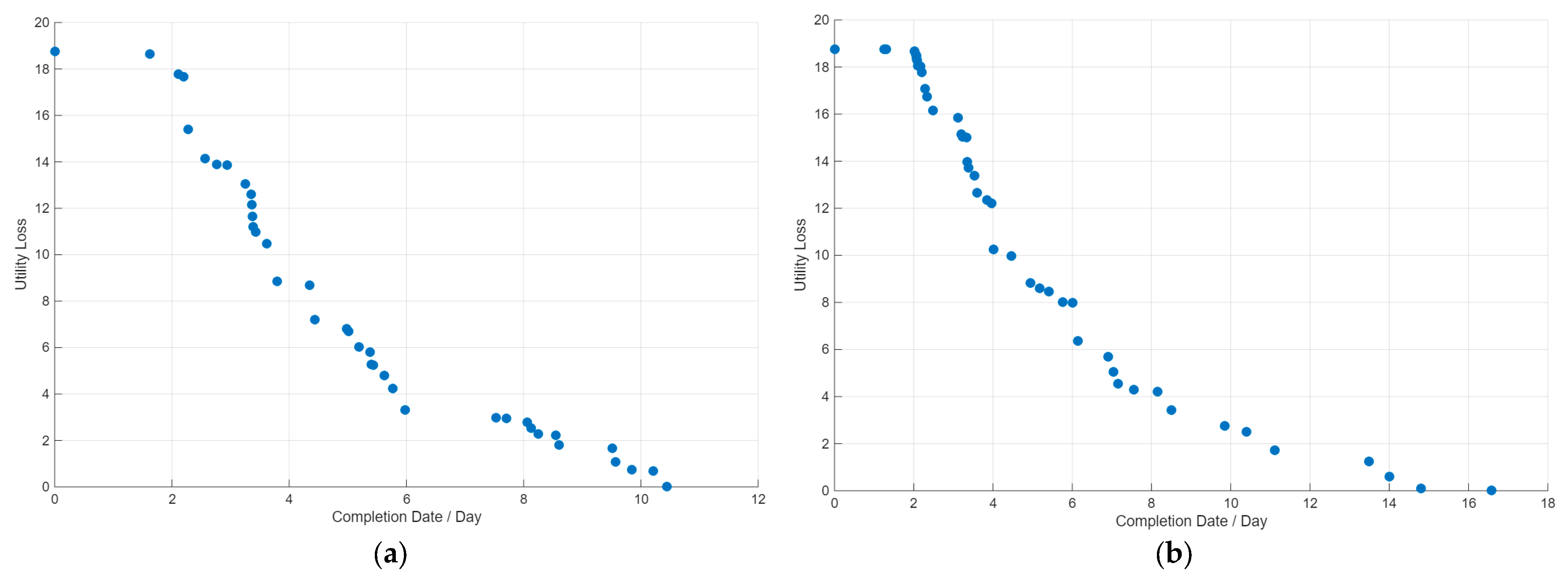
Keeping other model parameters constant, stress testing was conducted by decreasing and increasing the demand level by 20%, with the results illustrated in Figure 13. The asymmetric drift of the Pareto front in Figure 12 and Figure 13 profoundly reveals the nonlinear response mechanism of the EMSC-ESC to demand fluctuations. When demand decreases by 20%, the total recovery period is shortened from the baseline of approximately 13 days to about 10.5 days. Concurrently, the initial descent rate of utility loss accelerates significantly. This indicates that the alleviated pressure effectively compresses the initial response vacuum period. Conversely, when demand surges by 20, the massive tasks directly hit the rigid ceiling of the EMSC-ESC, forcing the total recovery period to stretch to nearly 16.5 days.
Focusing on the point corresponding to the administrative directive to complete the production task within 10 days. Under the alleviated pressure scenario, the system’s utility loss drops to approximately 0.7, essentially completing the emergency production task for ibuprofen. However, under the demand surge scenario, the system’s utility loss remains stagnant at roughly 2.8. More severely, under the surge pressure, the 10-day mark merely represents the beginning of a prolonged “long-tail depletion phase”. This demonstrates that extreme demand shocks not only affect delivery time for ibuprofen medication but also amplify the constraints of EMSC-ESC bottlenecks, leaving the demand for ibuprofen still not fully satisfied.

5.4.4. Sensitivity Analysis of Transportation Lead Times

During mobilization, the government typically coordinates with traffic management departments to open “green channels” for transportation, ensuring priority passage for relief supplies and enhancing logistics turnover efficiency. Therefore, this section simulates a scenario of enhanced transport capacity within the ibuprofen supply chain under the protection of green channels.
Given the constraints of actual physical distances and to maintain practical relevance, this section conducts only this single testing scenario for comparison with the baseline scenario in Figure 12. The system response is evaluated based on a 10% reduction in transportation lead times, as illustrated in Figure 14.
Comparative analysis of Figure 12 and Figure 14 shows an overall downward and leftward shift of the Pareto front, demonstrating the distinct practical significance of opening “green channels” for optimizing the EMSC-ESC. While the absolute displacement is limited by geographical constraints, the downward drift is most evident within the 6–8–day interval and at the 10-day administrative directive point, where the residual utility loss drops from the baseline’s 2.63 to approximately 1.5. This confirms that faster logistics turnover effectively hedges rigid production time and significantly improves the delivery efficiency for ibuprofen medication, serving as an indispensable link in enhancing the EMSC-ESC.

6. Conclusions

This study proposes a novel stress testing framework for EMSCs, aimed at evaluating extraordinary supply capabilities under extreme demand shocks. Through its application to the ibuprofen emergency production supply chain, the framework demonstrates its efficacy in identifying strategic optimization directions and quantifying systemic bottlenecks. These insights enable policymakers to proactively develop robust mobilization contingency plans. Future research could extend this framework within more advanced computational environments, such as digital twin models. Additionally, further investigations could involve designing a broader range of complex stress testing scenarios to more comprehensively examine the multi-dimensional facets of EMSCs. To further validate the framework’s generalizability, future studies should also apply it to other types of emergency supplies (e.g., medical equipment, personal protective equipment, or food supplies) by collecting empirical data from those sectors, thereby broadening the research’s practical impact.

Author Contributions

Conceptualization, Q.C. and J.Z.; Data curation, Q.C.; Formal analysis, Q.C.; Funding acquisition, J.Z.; Investigation, Q.C.; Methodology, Q.C.; Project administration, J.Z.; Resources, Q.C.; Software, Q.C.; Supervision, J.Z.; Validation, Q.C.; Visualization, Q.C.; Writing—original draft, Q.C.; Writing—review and editing, Q.C. All authors have read and agreed to the published version of the manuscript.

Funding

This work was supported by the Ministry of Industry and Information Technology Major Policy Research project [grant number: BIT-RDC-202327441002]; the Beijing Municipal Social Science Foundation project [grant number: 20JCC067]; and the China Academy of Engineering’s Strategic Research and Advisory Project [grant number: 2022-HY-06].

Data Availability Statement

Data are contained within the article. The original contributions presented in the study are included in the article material; further inquiries can be directed to the corresponding author.

Conflicts of Interest

The authors declare no conflicts of interest.

Abbreviations

The following abbreviations are used in this manuscript:
EMSCsemergency material supply chains
HSCshumanitarian supply chains
SDsystem dynamics
ESextraordinary supply
EMSC-ESCthe extraordinary supply capacity of the emergency material supply chain
EM-MPemergency material mobilization potential
EM-ESCthe extraordinary supply capacity of emergency materials
MOPSOthe multi-objective particle swarm optimization
APIactive pharmaceutical ingredient

Appendix A

Table A1. Suppliers Production Capacity.
Component TypeComponent
Name
Supplier DescriptionMobilization Level 1Mobilization Level 2Mobilization Level 3Unit
1Ibuprofen APIS111st supplier of Ibuprofen API (Shandong Xinhua)12,00015,00022,000kg/day
S122nd supplier of Ibuprofen API (Hubei Biocause)960010,00013,000kg/day
2BindersS211st supplier of binders (Beijing Fengli Jingqiu)550,000650,000700,500kg/day
S222nd supplier of binders (Anhui Sunhere)400,000780,000880,000kg/day
3Tablet-specific ExcipientsS311st supplier of tablet excipients (Shandong Liaocheng Ahua)5007001000kg/day
S322nd supplier of tablet excipients (Huzhou Zhanwang)450650800kg/day
4SR Capsule ExcipientsS411st supplier of SR capsule excipients (Zhejiang Conba)350500600kg/day
S422nd supplier of SR capsule excipients (Jiangsu Target Bio)350400500kg/day
5Capsule Shell CarriersS511st supplier of capsule carriers (Huangshan Capsule)3,200,0004,000,0005,000,000capsules/day
S522nd supplier of capsule carriers (Zhejiang Shaxing)2,000,0003,100,0004,000,000capsules/day
6Suspension ExcipientsS611st supplier of suspension excipients (Guangxi Sugar Group)80014002000t/day
S622nd supplier of suspension excipients (Shandong Futaste)4609001500t/day
S633rd supplier of suspension excipients (Jiangsu Ruijia)4206501000t/day
7Pharmaceutical PackagingS711st supplier of packaging (Beijing)260,000380,000500,000sets/day
S722nd supplier of packaging (Shandong)320,000650,000800,000sets/day
S733rd supplier of packaging (Hubei)250,000480,000600,000sets/day
Table A2. Manufacturers Production Capacity.
Manufacturer Manufacturer NameProduct TypeMobilization Level 1Mobilization Level 2Mobilization Level 3Unit
M1Beijing HonglinP1000
P2160,0003,500,000480,000SR Capsules
P3000
M2Beijing HanmiP1000
P2000
P3700016,00023,000Bottle
M3Shandong XinhuaP11,065,5001,246,0001,565,000Piece
P2105,000155,000195,000SR Capsules
P3000
M4Hubei BiocausP1380,000690,000950,000Piece
P2000
P3000
Table A3. Bill of Materials (BOM).
ManufacturerProduct TypeIbuprofen APIBinderTablet
Excipient
S/R Capsule
Excipient
Capsule ShellSuspension ExcipientPackaging Material
M1P10000000
P20.000320.0002200.000141.0800.036
P30000000
M2P10000000
P20000000
P30.0021600000.02161.08
M3P10.000220.000180.00003240000.0108
P20.000320.0002200.000141.0800.045
P30000000
M4P10.000220.000180.00003240000.0108
P20000000
P30000000
Table A4. Transportation Lead Time from Suppliers to Manufacturers.
ManufacturerM1M2M3M4
Supplier
S11110.10.5
S122.52.50.50.1
S210.50.522.5
S222211
S31110.51.5
S323321.5
S412.52.521.5
S42221.51
S51221.51
S522.52.521.5
S614443
S62110.51.5
S63221.51
S710.50.500
S72000.50
S730000.5
Table A5. Transportation Lead Time from Manufacturers to Demand Points.
Demand PointD1D2D3
Manufacturer
M10.21 0.25 0.17
M20.25 0.29 0.21
M31.00 1.08 1.04
M42.50 2.58 2.54
Table A6. Other Parameters Used in the Model.
Parameters
α 1 0.86
α 2 0.9
α 3 0.95
λ 1 −1.8
λ 2 −1.4
λ 3 −1.2
Table A7. Degree of demand fulfilment.
Demand PointProduct TypeTargeted DemandActual SupplyShortageSatisfaction Rate
D1P115,200,00011,582,2533,617,74776.20%
D1P21,350,0001,350,0000100.00%
D1P3156,000118,19737,80375.77%
D2P114,800,00011,049,9113,750,08974.66%
D2P21,200,0001,041,242158,75886.77%
D2P3148,000115,68632,31478.17%
D3P113,200,0007,336,4905,863,51055.58%
D3P21,100,0001,100,0000100.00%
D3P3138,000113,29224,70882.10%
Table A8. Manufacturer’s Production Task Completion Status.
ManufacturerDemand Point Product TypeActual SupplyDemandSatisfaction Rate
M1D1P2981,3771,350,00072.69%
M1D2P2803,2891,200,00066.94%
M1D3P21,100,0001,100,000100.00%
M2D1P3118,197156,00075.77%
M2D2P3115,686148,00078.17%
M2D3P3113,292138,00082.10%
M3D1P15,801,10915,200,00038.17%
M3D1P2368,6231,350,00027.31%
M3D2P19,406,57414,800,00063.56%
M3D2P2237,9531,200,00019.83%
M3D3P15,478,83013,200,00041.51%
M3D3P25,781,14415,200,00038.03%
M4D1P11,643,33714,800,00011.10%
M4D2P11,857,66013,200,00014.07%
M4D3P1981,3771,350,00072.69%
Table A9. Supplier Provides Component Flow Details.
Supplier ManufacturerComponent Flow
S11M1626
S11M34613
S12M1659
S12M21855
S12M352
S12M44497
S21M1396
S21M3720
S21M42222
S22M1263
S22M39640
S22M4228
S31M3205
S31M4612
S32M3634
S32M4160
S41M3265
S42M12294
S42M311
S51M1870,873
S51M3314,088
S51M13,868,442
S51M31,549,928
S61M2655
S62M25278
S63M21567
S71M1127,475
S71M2527,096
S72M3472,124
S73M4100,248
Table A10. Supplier Production Status.
Supplier Production QuantityProduction Time (Days)
S1152390.238136364
S1270630.543307692
S2133380.004765168
S2210,1310.0115125
S318170.817
S327940.9925
S412650.441666667
S4223054.61
S511,184,9610.2369922
S525,418,3701.3545925
S616550.3275
S6252783.518666667
S6315671.567
S71654,5711.309142
S72472,1240.590155
S73100,2480.16708
Table A11. Manufacturer’s Production Status.
Manufacturer Product TypeProduction QuantityProduction Time (Days)
M1P22,884,6662.291666667
M2P3347,1755.139
M3P120,686,5136.010590415
M3P2606,5761.890374359
M4P19,282,1416.085414737

References

  1. Eberhardt, K.; Rosenberg, S.; Kaiser, F.K.; Schultmann, F. A Cooperative Covering Model for Optimizing Critical Supply Networks under Disruption Risks. Ann. Oper. Res. 2025, 357, 909–944. [Google Scholar] [CrossRef]
  2. Anvari, M.; Anvari, A.; Boyer, O. A Prepositioning Model for Prioritized Demand Points Considering Lateral Transshipment. J. Humanist. Logist. Supply Chain Manag. 2023, 13, 433–455. [Google Scholar] [CrossRef]
  3. Che, A.; Li, J.; Chu, F.; Chu, C. Optimizing Emergency Supply Pre-Positioning for Disaster Relief: A Two-Stage Distributionally Robust Approach. Comput. Oper. Res. 2024, 166, 106607. [Google Scholar] [CrossRef]
  4. Shi, Y.; Zhang, K.; Zhang, J.; Chen, M.; Yang, J.; Guo, H. Dynamic Truck-Drone Cooperative Delivery of Emergency Supplies Considering Secondary Disasters. Transp. Res. Pt. e-Logist. Transp. Rev. 2026, 206, 104543. [Google Scholar] [CrossRef]
  5. Kar, B.; Jenamani, M. Optimizing a Multimodal Hub and Spoke Network for Vaccine Distribution Using Regional Vulnerability Index during Healthcare Emergencies. J. Humanist. Logist. Supply Chain Manag. 2025, 15, 366–390. [Google Scholar] [CrossRef]
  6. Wang, Z.; Huo, J.; Lam, J.S.L. The Vehicle Routing Programming of Municipal Solid Waste Collection under Cognitive Uncertainty. Transp. J. 2025, 64, e12025. [Google Scholar] [CrossRef]
  7. Quispe, M.F.C.; Couto, A.S.; de Brito, I.; Cunha, L.R.A.; Siqueira, R.M.; Yoshizaki, H.T.Y. Humanitarian Logistics Prioritization Models: A Systematic Literature Review. Logistics 2024, 8, 60. [Google Scholar] [CrossRef]
  8. Kovacs, G.; Spens, K.M. Humanitarian Logistics and Supply Chain Management: The Start of a New Journal. J. Humanist. Logist. Supply Chain Manag. 2011, 1, 5–14. [Google Scholar] [CrossRef]
  9. Chen, Q.; Zhang, J. Evolution Model of Emergency Material Supply Chain Stress Based on Stochastic Petri Nets—A Case Study of Emergency Medical Material Supply Chains in China. Systems 2025, 13, 423. [Google Scholar] [CrossRef]
  10. Sodhi, M.S.; Tang, C.S.; Willenson, E.T. Research Opportunities in Preparing Supply Chains of Essential Goods for Future Pandemics. Int. J. Prod. Res. 2023, 61, 2416–2431. [Google Scholar] [CrossRef]
  11. Rajabi, R.; Shadkam, E.; Khalili, S.M. Design and Optimization of a Pharmaceutical Supply Chain Network under COVID-19 Pandemic Disruption. Sustain. Oper. Comput. 2024, 5, 102–111. [Google Scholar] [CrossRef]
  12. Heckmann, I.; Comes, T.; Nickel, S. A Critical Review on Supply Chain Risk—Definition, Measure and Modeling. Omega-Int. J. Manag. Sci. 2015, 52, 119–132. [Google Scholar] [CrossRef]
  13. Behzadi, G.; O’Sullivan, M.J.; Olsen, T.L. On Metrics for Supply Chain Resilience. Eur. J. Oper. Res. 2020, 287, 145–158. [Google Scholar] [CrossRef]
  14. Parkouhi, S.V.; Ghadikolaei, A.S. A Resilience Approach for Supplier Selection: Using Fuzzy Analytic Network Process and Grey VIKOR Techniques. J. Clean Prod. 2017, 161, 431–451. [Google Scholar] [CrossRef]
  15. Gao, Y.; Feng, Z.; Zhang, S. Managing Supply Chain Resilience in the Era of VUCA. Front. Eng. Manag. 2021, 8, 465–470. [Google Scholar] [CrossRef]
  16. Kamalahmadi, M.; Parast, M.M. A Review of the Literature on the Principles of Enterprise and Supply Chain Resilience: Major Findings and Directions for Future Research. Int. J. Prod. Econ. 2016, 171, 116–133. [Google Scholar] [CrossRef]
  17. Chen, J.; Wen, H. The Application of Complex Network Theory for Resilience Improvement of Knowledge-Intensive Supply Chains. Oper. Manag. Res. 2023, 16, 1140–1161. [Google Scholar] [CrossRef]
  18. Li, L.; Yang, X.; Wang, Y. Modeling Multi-Stakeholder Coordination for Emergency Resource Networks: An Evolutionary Game Perspective. Expert Syst. Appl. 2026, 303, 130697. [Google Scholar] [CrossRef]
  19. Ni, W.; Shen, Q.; Liu, T.; Zeng, Q.; Xu, L. Generating Textual Emergency Plans for Unconventional Emergencies-A Natural Language Processing Approach. Saf. Sci. 2023, 160, 106047. [Google Scholar] [CrossRef]
  20. Yao, W.X.; You, J.M. A Probe into the Method of Controlling the Extreme Risk of Supply Chain Based on Pressure Testing. Econ. Surv. 2010, 5, 86–90. [Google Scholar] [CrossRef]
  21. Yao, W.X.; Chen, Q. The Treatment after Supply Chain Stress Test from the Perspective of Resilience. Sci. Technol. Manag. Res. 2015, 35, 193–197. [Google Scholar]
  22. Ivanov, D.; Dolgui, A. Stress Testing Supply Chains and Creating Viable Ecosystems. Oper. Manag. Res. 2022, 15, 475–486. [Google Scholar] [CrossRef]
  23. Diem, C.; Schueller, W.; Gerschberger, M.; Stangl, J.; Conrady, B.; Gerschberger, M.; Thurner, S. Supply Network Stress-Testing of Food Security on the Establishment-Level. Int. J. Prod. Res. 2025, 63, 3259–3283. [Google Scholar] [CrossRef]
  24. Ivanov, D.; Gusikhin, O. Supply Chain Digital Twin Design and Implementation at Scale: A Case Study at the Ford Motor Company and Generalizations. Omega 2026, 139, 103447. [Google Scholar] [CrossRef]
  25. Shi, W.; Kong, Z.; Wang, M.; He, J. System Dynamics Analysis of Emergency Materials Mobilization Chain Resilience under the Coupling of Multiple Disruptions. Chin. J. Manag. Sci. 2025, 33, 177–188. [Google Scholar] [CrossRef]
  26. Li, Z. The Model of Production Emergency Mobilization Capability Based on SD. Sci. Technol. Manag. Res. 2016, 36, 190–195. [Google Scholar]
  27. He, X.; Kong, Z.-J. Evaluation research on cooperative basis of regional emergency mobilization based on vague set decision method. J. Saf. Environ. 2022, 22, 885–891. [Google Scholar] [CrossRef]
  28. Wang, W.; Xiao, Q.-D. Structure-Process-Result: Evaluation Index Construction of Urban Community Emergency Mobilization Ability. Math. Pract. Theory 2024, 54, 99–109. [Google Scholar] [CrossRef]
  29. Barbarosoglu, G.; Arda, Y. A Two-Stage Stochastic Programming Framework for Transportation Planning in Disaster Response. J. Oper. Res. Soc. 2004, 55, 43–53. [Google Scholar] [CrossRef]
  30. Liu, T.; Li, M. Structural Flexibility Indices with Shrinking Capacities in Cross Production. Int. J. Prod. Res. 2012, 50, 393–407. [Google Scholar] [CrossRef]
  31. Guo, K.; Gong, L.; Ji, Q. Emergency supplies reserve strategies considering supplier feedstock assurance under option contracts. Syst. Eng.-Theory Pract. 2025. online first. Available online: https://link.cnki.net/urlid/11.2267.N.20250908.1119.002 (accessed on 5 February 2026).
  32. Gong, L.-J.; Zhang, J.-H. Multi-objective Emergency Production Assignment Model Based on NSGA-II. Oper. Res. Manag. Sci. 2019, 28, 7–13. [Google Scholar]
  33. Liu, Y.-J.; Wang, W.-F.; Lei, H.-T.; Guo, B. Mobilization optimization method for large-scale emergency earthquake disaster relief with uncertain demands. Syst. Eng.-Theory Pract. 2013, 33, 2910–2919. [Google Scholar]
  34. Li, M.; Xiao, Q.; Yu, J.; Yang, Y. Resilient Supply Chain Design Integrating Capacity Reservation and New Technology Research and Development. J. Syst. Manag. 2025. online first. Available online: https://link.cnki.net/urlid/31.1977.n.20250826.1751.002 (accessed on 5 February 2026).
  35. Kovacs, G.; Sigala, I.F. Lessons Learned from Humanitarian Logistics to Manage Supply Chain Disruptions. J. Supply Chain Manag. 2021, 57, 41–49. [Google Scholar] [CrossRef]
  36. Altay, N.; Heaslip, G.; Kovacs, G.; Spens, K.; Tatham, P.; Vaillancourt, A. Innovation in Humanitarian Logistics and Supply Chain Management: A Systematic Review. Ann. Oper. Res. 2023, 335, 965–987. [Google Scholar] [CrossRef]
  37. Corsten, H.; Goessinger, R. Output Flexibility of Service Enterprises—an Analysis Based on Production Theory. Int. J. Prod. Econ. 2006, 104, 296–307. [Google Scholar] [CrossRef]
  38. Palominos, P.; Quezada, L.; Moncada, G. Modeling the Response Capability of a Production System. Int. J. Prod. Econ. 2009, 122, 458–468. [Google Scholar] [CrossRef]
Figure 1. Resource and Supply Capacity Relationship.
Systems 14 00352 g001
Figure 2. Operational Mechanism of EMSC Stress Testing.
Systems 14 00352 g002
Figure 3. Supply Capacity of EMSC.
Systems 14 00352 g003
Figure 4. The Conceptual Model for EMSCs.
Systems 14 00352 g004
Figure 5. Problem Formulation.
Systems 14 00352 g005
Figure 6. Non-linear Utility Loss Function under Emergency Resource Shortage.
Systems 14 00352 g006
Figure 7. Baidu Search Index for Keywords Including Ibuprofen. Data source: website of Baidu search index.
Systems 14 00352 g007
Figure 8. Comparison of Pareto-Optimal Frontiers Among NSGA-II, MOEA/D, and MOPSO.
Systems 14 00352 g008
Figure 9. The Number of Non-Dominated Solutions Over 50 Iterations.
Systems 14 00352 g009
Figure 10. Archive Size Under Different Iteration Counts.
Systems 14 00352 g010
Figure 11. Utility Loss Under Different Iteration Counts.
Systems 14 00352 g011
Figure 12. Pareto Front.
Systems 14 00352 g012
Figure 13. Sensitivity of the Pareto Frontier to Demand Fluctuations. (a) 20% Demand Reduction; (b) 20% Demand Surge.
Systems 14 00352 g013
Figure 14. Sensitivity of the Pareto Frontier to Transportation Lead Times Fluctuations.
Systems 14 00352 g014
Table 1. Notations used in the stress testing model.
CategorySymbolDescription
SetsKSet of all components (raw materials), kK
ISet of all suppliers, iI
IkSubset of suppliers providing component k, k K I k I , I k I k =
NSet of all final emergency products, nN
JSet of all manufacturers, jJ
HSet of all demand points, hH
SSet of all mobilization levels for suppliers, s ∈ S, S = {1,2,3}
MSet of all mobilization levels for manufacturers, mM, M = {1,2,3}
Parameters s p c k i ( s ) The production capacity per unit time of supplier i for component k under mobilization level s
m p c j n ( m ) The production capacity per unit time per dedicated production line of manufacturer j for product n under mobilization level m
tkijTransportation time of component k from supplier i to manufacturer j
tjhTransportation time of end-products from manufacturer j to demand point h
dhnDemand for product n at demand point h
α h Importance weight of demand point h based on disaster severity
λ n Utility loss weight of product n
b m k j n Unit consumption of component k required for manufacturer j to produce product n
M ¯ A sufficiently large positive constant (Big-M)
Decision VariablesqkijQuantity of component k supplied by supplier i to manufacturer j
ejhnQuantity of product n delivered by manufacturer j to demand point h
xkijBinary variable: 1 if supplier i serves manufacturer j for component k; 0 otherwise
zjhnBinary variable: 1 if manufacturer j serves demand point h for product n; 0 otherwise
l1sBinary variable: 1 if the decision-maker activates level s mobilization for suppliers; 0 otherwise
l2mBinary variable: 1 if the decision-maker activates level m mobilization for manufacturers; 0 otherwise
Table 2. Ibuprofen production guarantee missions.
IbuprofenP1 (Tabs)P2 (SR Capsules)P3 (Bottles)
Demand Points
D1 (Sinopharm)15,200,0001,350,000156,000
D2 (China Resources)14,800,0001,200,000148,000
D3 (Genertec)13,200,0001,100,000138,000
Table 3. Quantitative performance comparison (Mean ± SD).
AlgorithmHVIGDCPU Time (s)
NSGA-II0.723144 ± 0.0266540.047868 ± 0.003182446.37 ± 5.6
MOPSO0.808878 ± 0.0230900.019733 ± 0.003973697.33 ± 7.01
MOEAD0.727810 ± 0.0303270.030182 ± 0.027164443.68 ± 9.05
Table 4. Average coverage metric (CM) matrix.
NSGA-IIMOPSOMOEA/D
NSGA-II00.0660.252
MOPSO0.65200.62
MOEAD0.6160.0820
Disclaimer/Publisher’s Note: The statements, opinions and data contained in all publications are solely those of the individual author(s) and contributor(s) and not of MDPI and/or the editor(s). MDPI and/or the editor(s) disclaim responsibility for any injury to people or property resulting from any ideas, methods, instructions or products referred to in the content.