
Next Article in Journal
Regional Disparities, Dynamic Evolution, and Convergence of Natural Disaster Emergency Management Efficiency in China
Previous Article in Journal
Nowcasting GDP Using Real-Time Highway Traffic Volume by Vehicle Type: Evidence from the Republic of Korea
 
 
Due to scheduled maintenance work on our servers, there may be short service disruptions on this website between 11:00 and 12:00 CEST on March 28th.
Article

How Digital Trade Institutional Systems Shape Multinational Enterprise Performance: A System Dynamics Framework with Stock-Flow Modeling and Panel Evidence

1
Institute of World Economy, Shanghai Academy of Social Sciences, Shanghai 200020, China
2
Antai College of Economics and Management, Shanghai Jiao Tong University, Shanghai 200030, China
3
Business School, University of Shanghai for Science and Technology, Shanghai 200093, China
*
Author to whom correspondence should be addressed.
Systems 2026, 14(4), 345; https://doi.org/10.3390/systems14040345
Submission received: 15 February 2026 / Revised: 13 March 2026 / Accepted: 20 March 2026 / Published: 24 March 2026
(This article belongs to the Section Systems Practice in Social Science)

Abstract

Digital trade rules have proliferated rapidly, yet the literature still treats institutional environments and firm behavior in a comparative-static manner, overlooking the feedback loops and stock-like accumulation dynamics through which regulatory openness shapes firm capabilities over time. Drawing on general systems theory and system dynamics, this paper models the digital trade rule regime as an “institutional system” and the overseas subsidiary network of digital MNEs as an “enterprise system,” linked through three capability stocks (market, production, knowledge), cross-subsystem coupling, absorptive capacity modulation, and five internal feedback loops. We derive a reduced-form dynamic panel equation mapping structural parameters onto estimable coefficients, and test its static counterpart using data on 6850 subsidiaries of UNCTAD’s top 100 digital MNEs (2000–2024) matched with the TAPED database. Three findings emerge. First, institutional openness—measured by rule depth and breadth—exerts a positive causal effect on subsidiary ROA, surviving IV estimation and multiple robustness checks. Second, the effect transmits through market expansion, production efficiency, and knowledge accumulation channels, confirmed by Baron–Kenny mediation with Sobel tests. Third, the New Digital Economy (NDE) module displays point estimates 4–8 times larger than other modules, and joint Wald tests reject coefficient equality, providing qualified support for Meadows’ leverage-point hierarchy. Our contribution lies in bridging system dynamics modeling with econometric causal identification, and in unifying transaction cost theory, the OLI paradigm, and the knowledge-based view within a single open-system framework.

1. Introduction

The expansion of digital trade has been, by almost any measure, faster than most people anticipated. According to OECD estimates, the value of global digital trade reached approximately USD 5 trillion by 2020, accounting for roughly one-quarter of total world trade [1]. What is perhaps more interesting—and less often remarked upon—is that the institutional infrastructure around digital trade has been keeping up. By the end of 2022, the WTO counted 116 regional trade agreements (RTAs) containing digital trade provisions, covering about a third of all active RTAs [2]. These provisions range from mundane things like mutual recognition of electronic signatures to far more contentious topics: cross-border data transfer rules, source code protection, algorithmic accountability, even AI ethics [3,4,5]. For digital MNEs that operate subsidiary networks across dozens of host countries, this evolving rule landscape creates an environment that is, to put it mildly, complicated [6,7].
A review of the existing literature reveals, however, that scholars have mostly approached the institution–firm nexus in what might be called a comparative-static manner. The typical empirical setup treats trade agreements or institutional quality as exogenous explanatory variables that exert a one-off impact on investment or performance [8,9,10,11]. This framing is admirably clean, but it sidesteps two features that, in our view, deserve explicit modeling. The first is the internal dynamics of the enterprise system: when institutional conditions change, firms do not simply register a one-time gain or loss—they adjust capabilities, reallocate resources, and trigger self-reinforcing or self-correcting processes whose cumulative effects may differ substantially from the initial impulse. In the language of systems science, the enterprise system contains multiple feedback loops that amplify, dampen, and delay the institutional signal [12]. The second feature is the stock-like character of digital trade rules themselves. They accumulate through rounds of negotiations, and once codified, they constitute long-lasting constraints whose effects unfold with delay rather than all at once [13]. Standard econometric models are not particularly well equipped to capture either of these dynamics.
The theoretical toolkit from systems science is, as a matter of fact, quite well developed. Bertalanffy’s general system theory posits that any organism can be understood as an open system engaged in continuous exchange of matter, energy, and information with its environment, exhibiting emergent properties that cannot be obtained by summing its parts [14]. Ashby’s law of requisite variety provides a cybernetic benchmark: a system’s internal complexity must at least match the variety of disturbances it confronts [15]. Katz and Kahn explicitly modeled organizations as input–transformation–output open systems [16]; Scott further synthesized the rational, natural, and open-system perspectives into a unified organizational framework [17]. Meadows later offered an especially lucid exposition of feedback loops, stocks and flows, and leverage points, repeatedly emphasizing that surprising system behavior arises from the entanglement and competition among multiple feedback loops [12,18,19].
On the methodological side, Forrester’s system dynamics established stocks, flows, and feedback loops as the three pillars of dynamic modeling [20,21]. The intrinsic “memory” effect of stock variables was also stressed—because stocks cannot change instantaneously, systems exhibit delay, oscillation, and path dependence, which are properties that give modelers no small amount of headache [22,23]. An emerging direction that we find promising is to graft the mechanism-tracing strengths of system dynamics onto the causal-identification strengths of econometrics [24,25]. Recent work has begun to explore this hybrid space: Jackson and Victor [21] demonstrated the power of stock-flow-consistent modeling in macroeconomic policy evaluation; Jayarathna et al. [23] applied system dynamics to sustainable logistics with empirical calibration; similar hybrid strategies have been adopted in steel industry strategic planning [26], green mining technology adoption [27], electricity sector policy evaluation [28], and SME digitalisation dynamics [29]. In the international business domain, scholars have increasingly called for dynamic, feedback-aware frameworks that move beyond comparative-static regression designs [30,31]. Our work proceeds along this line, contributing what we believe is the first formal parameter bridge between a system dynamics structural model and a panel econometric specification in the digital trade context.
On the firm-capability front, Dierickx and Cool were among the first to introduce a stock-flow analytical framework into strategic management [32]. Their core insight—that key strategic assets cannot be purchased on markets but must be accumulated internally over time, exhibiting “time-compression diseconomies”—resonates well with system dynamics thinking. Peters and Taylor decomposed intangible capital into knowledge capital and organization capital and proposed measurement methods [33,34]. In the international business domain, Buckley and Casson viewed the MNE as an “internalization system” [35,36], Dunning explained international production through the OLI triad [37], and Cantwell and Mudambi demonstrated that foreign subsidiaries are not passive terminals executing headquarter directives but active agents embedded in host-country environments, autonomously accumulating capabilities [31,38,39]. Teece provided foundational analysis of how firms profit from innovation through integration and collaboration strategies [40,41,42]. On the digital trade rules front, Burri and colleagues built the TAPED (Trade Agreement Provisions on Electronic-commerce and Data) database, which article-by-article coded digital provisions in over 300 trade agreements—perhaps the most systematic data infrastructure in this space to date [43].
These several strands of literature each have their merits, but to be frank, they have not talked to each other very much. System dynamics applications in management studies often stop at qualitative simulation, with a noticeable gap between simulation outputs and rigorous empirical testing. The international trade literature has sophisticated econometric machinery but is rather rough in capturing feedback and dynamic accumulation [30]. The resource-based and capability literatures have borrowed the stock concept but seldom treat the external institutional environment as a systemic variable [44,45,46]. What this paper tries to do is, at bottom, one thing: build a bridge across these literatures. We focus specifically on how institutional openness propagates through the enterprise system’s internal dynamics to shape subsidiary performance—the ‘institution → enterprise’ half of what is, in reality, a bidirectional relationship.
In principle, the reverse channel operates through at least three mechanisms: (i) collective lobbying by MNE industry associations during trade negotiation rounds, which shapes the agenda and specificity of digital provisions; (ii) regulatory arbitrage, whereby firms strategically locate operations in jurisdictions with favorable rules, creating competitive pressure that induces other countries to liberalize; and (iii) participation in public consultations and standard-setting bodies, through which firm-level technical expertise feeds into the design of digital governance frameworks. Modeling these channels would require data on firm-level lobbying expenditures, negotiation participation records, and regulatory arbitrage patterns—data that are largely unavailable at the bilateral level for our sample period. We therefore focus on the institution-to-enterprise half of the loop, which is both more tractable for causal identification and more directly relevant to the managerial question of how institutional environments shape subsidiary performance. We leave the full bidirectional loop for future work.
The central questions we seek to answer are: Through what dynamic mechanisms do digital trade institutional systems affect MNE overseas subsidiary performance? More specifically—how do the depth and breadth of host-country digital trade rules affect the performance of digital MNE subsidiaries? What roles do market expansion, efficiency improvement, and knowledge accumulation play? And how do these pathways interact, through internal feedback loops within the enterprise system, to produce cumulative effects that differ from a simple additive model?
Our approach is as follows. Starting from the open-system perspective of general systems theory, we treat the digital trade rule regime as an “institutional system” and the MNE subsidiary network as an “enterprise system,” then use the toolkit of system dynamics to first map the causal loop structure of the system (Figure 1) and subsequently derive a stock–flow formalization (Figure 2), establishing a mathematical correspondence between system dynamics model parameters and panel regression coefficients. One element that we believe is somewhat novel is the mathematical correspondence we establish between system dynamics model parameters and panel regression coefficients—in other words, the theoretical predictions regarding feedback strength and stock adjustment speeds can be directly translated into testable econometric hypotheses. On the data side, we start with UNCTAD’s top 100 digital MNEs and trace 6850 majority-owned foreign subsidiaries in the Orbis database, covering the 2000–2024 window. The intensity of host-country digital trade rules is constructed from the TAPED database [43], measured along two dimensions: depth and breadth.
The potential contributions of this paper are roughly threefold. Methodologically, we attempt to bring the formal modeling approach of system dynamics into the evaluation of digital trade policy effects, using a stock–flow–feedback loop framework to capture the full dynamic process rather than conducting a static comparative analysis. Theoretically, we try to place transaction cost theory [47], the OLI paradigm [37], and the knowledge-based view [48] inside the same open-system shell—transaction costs become friction at the system interface, locational advantage becomes spatial efficiency of system-resource allocation, and knowledge flows are re-interpreted as cross-boundary information absorption from the institutional environment into the enterprise system. On the empirical strategy side, the mapping from structural model parameters to regression coefficients may represent one way of doing “theory-driven empirics.” Whether we have succeeded in all this, the reader will of course judge.
The remainder of the paper is organized as follows. Section 2 presents the theoretical model and empirical methodology. Section 3 reports the regression results. Section 4 discusses the main findings. Section 5 concludes.

2. Materials and Methods

2.1. Theoretical Framework: An Embedded Open-System Model

Our theoretical point of departure is Bertalanffy’s general system theory [14]. Under the open-system lens, a digital MNE can be viewed as an organism that continuously absorbs capital, talent, technology, and market information from the external environment, transforms them internally, and outputs products and profits. Subsidiary ROA, in this sense, serves as the most direct output indicator of the enterprise system.
Building on this foundation, we construct a three-layer nested framework. The top layer is the international digital trade institutional system, composed of various digital trade rules. We categorize it into four functional modules: Digital Trade/E-commerce Facilitation (DT), Data-related/Information Flow (DATA), New Digital Economy/Innovation Support (NDE), and Intellectual Property/Asset Protection (IPR). These four modules exhibit complementarity—the overall efficacy is likely greater than the sum of the parts, precisely the kind of emergence that systems theory keeps emphasizing [49,50]. The middle layer is the MNE network, in which headquarters, overseas subsidiaries, and regional hubs are connected through knowledge networks, value chains, and governance relationships. The bottom layer is the individual subsidiary’s operating system, which we decompose into three subsystems: a Market Subsystem that handles market development, a Production Subsystem responsible for operational efficiency, and a Knowledge Subsystem that governs technology accumulation. These three are not independent. They are coupled bidirectionally—market expansion delivers scale economies to the production side, knowledge accumulation helps the market side with differentiation, and efficiency gains free up resources for R&D investment.

2.2. Stock–Flow Structure and Cross-Subsystem Coupling

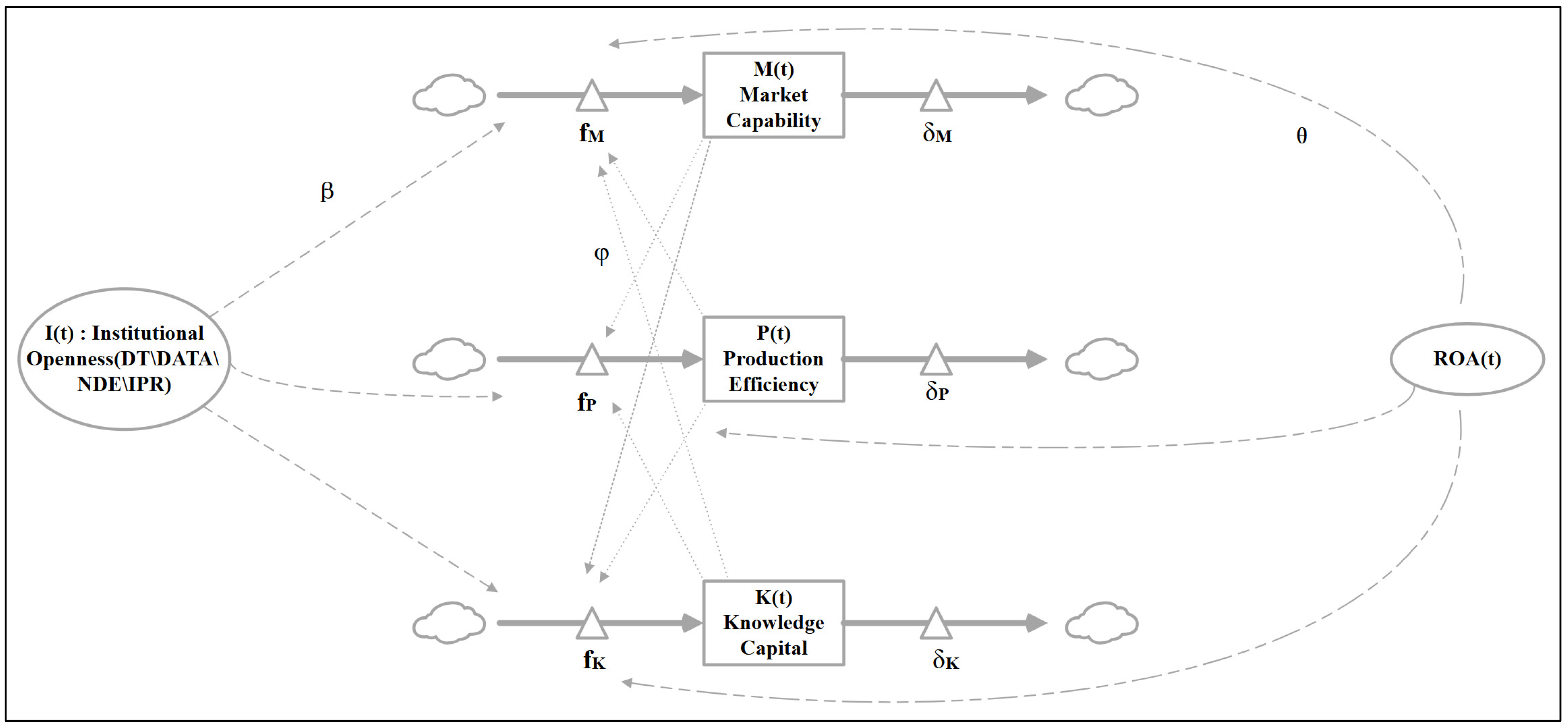
We begin the formal modeling by mapping the causal loop structure of the system (Figure 1), and then derive the stock–flow formalization (Figure 2). Before presenting the equations, we briefly clarify the diagramming conventions used in this paper, which largely follow the notational standard in the system dynamics literature [20,22]. A stock variable—one that accumulates over time and whose value can only be changed through inflows or outflows—is drawn as a rectangle. The flow rates that control how fast material enters or leaves a stock are represented by valve symbols (sometimes drawn as bow-tie or hourglass shapes). Solid arrows show the direction of causal influence; dashed arrows indicate information feedback, meaning that the current state of one variable is used as an input when determining the flow rate of another variable. Sources and sinks lying outside the model boundary are depicted as cloud symbols. In Figure 2 of this paper, M ( t ) , P ( t ) , and K ( t ) appear as rectangles, their inflows f M , f P , f K are governed by the flow functions specified below, and the dashed lines connecting the three stock variables represent the cross-subsystem coupling ( φ terms) that will be specified in Equations (4)–(6) below.
Inspired by Dierickx and Cool [32] and Peters and Taylor [33], we model the subsidiary’s three types of strategic capability as stock variables. The dynamic evolution equations take the following form:
M ( t ) = ( 1 δ M ) M ( t 1 ) + f M ( · )
P ( t ) = ( 1 δ P ) P ( t 1 ) + f P ( · )
K ( t ) = ( 1 δ K ) K ( t 1 ) + f K ( · )
where M ( t ) , P ( t ) , and K ( t ) are the market capability stock, production efficiency stock, and knowledge capital stock respectively. δ M , δ P , and δ K are depreciation rates. f M ( · ) , f P ( · ) , and f K ( · ) are current-period inflows. We specify three drivers for each flow function: the push from external institutions, cross-subsystem spillovers, and feedback from prior performance:
f M t = β M · I t + φ M K · K t 1 + φ M P · P t 1 + θ M · R O A t 1 + γ M · X t + ε M t
f P t = β P · I t + φ P M · M t 1 + φ P K · K t 1 + θ P · R O A t 1 + γ P · X t + ε P t
f K t = β K · I t + φ K M · M t 1 + φ K P · P t 1 + θ K · R O A t 1 + γ K · X t + ε K t
Here, β M , β P , and β K capture the direct push that institutional openness I exerts on the accumulation of each capability type. The off-diagonal terms φ M K , φ P M , and φ K M form a 3 × 3 spillover matrix Φ that encodes cross-subsystem feedback. For example, φ M K > 0 means that knowledge capital accumulation facilitates market development—subsidiaries with proprietary technology naturally enjoy competitive advantages. φ P M > 0 indicates that market expansion creates scale economies for the production side. φ K M > 0 implies that market expansion opens new channels for cross-border knowledge acquisition. We highlight three representative off-diagonal terms; the remaining three ( φ M P , φ K P , and φ P K ) follow analogous logic. These cross terms constitute the key departure from the traditional “parallel independent channels” approach. The coefficients θ M , θ P , and θ K capture a positive feedback loop: earning higher profits feeds back more resources into capability building.
Figure 1 provides the causal loop structure underlying this stock–flow system.

2.3. Absorptive Capacity Modulation and Institutional Module Synergy

The β M , β P , and β K in the above equations are constants, implicitly assuming that all firms benefit proportionally from institutional improvement. But this sits uncomfortably with Cohen and Levinthal’s absorptive capacity argument—according to which a firm’s efficiency in exploiting external opportunities depends on its existing knowledge base [51,52]. We therefore generalize by letting the institutional effect coefficient become a function of the firm’s stock level:
β j e f f ( t ) = β j · 1 + ψ j · S j ( t 1 ) S ¯ j
where ψ j 0 is the absorptive capacity elasticity, and S ¯ j is the sample mean of stock j , used to normalize the ratio. If ψ j > 0 , firms with higher capability stocks extract more value from the same institutional improvement.
Furthermore, the four modules of the institutional system are not simply additive. They may be complementary or substitutive. We express the effective composite openness as:
I eff = k ω k · I k + k < l σ k l · I k · I l
where ω k is the weight of module k in the composite index, and σ k l > 0 indicates complementarity between modules k and l —opening both simultaneously produces a larger effect than the sum of opening each alone [53]. Conversely, σ k l < 0 implies substitution—rules with excessive overlap add compliance burden without proportionate benefit.

2.4. Performance Output and Feedback Loops

Subsidiary ROA is the joint outcome of the three capability stocks. We include interaction terms in the output function to capture cross-subsystem synergy:
R O A t   =   α M   M t   +   α P   P t   +   α K   K t   +   α M P M t   P t S ¯ 2   +   α M K M t   K t S ¯ 2   +   α P K   P t   K t S ¯ 2   +   μ   +   ν t
where α M P , α M K , and   α P K are capability complementarity coefficients—positive values indicate that pairwise synergies among the three subsystems generate performance beyond the sum of their individual contributions. Specifically, α M P > 0 means that a subsidiary combining a strong market base with an efficient production system achieves disproportionate returns through scale-driven cost advantages; α M K > 0 means that market reach and knowledge capital jointly enhance performance through technology-enabled differentiation; and α P K   > 0 means that production efficiency and knowledge capital reinforce each other, as lean operations accelerate the commercialization of innovations while technological capabilities drive further process improvement, where S ¯ denotes the pooled cross-subsidiary mean of the three stock variables, and S ¯ 2 serves as a scale-free normalizing constant that renders the interaction terms dimensionless.   μ captures time-invariant firm heterogeneity (fixed effects), and ν t is an idiosyncratic error term.
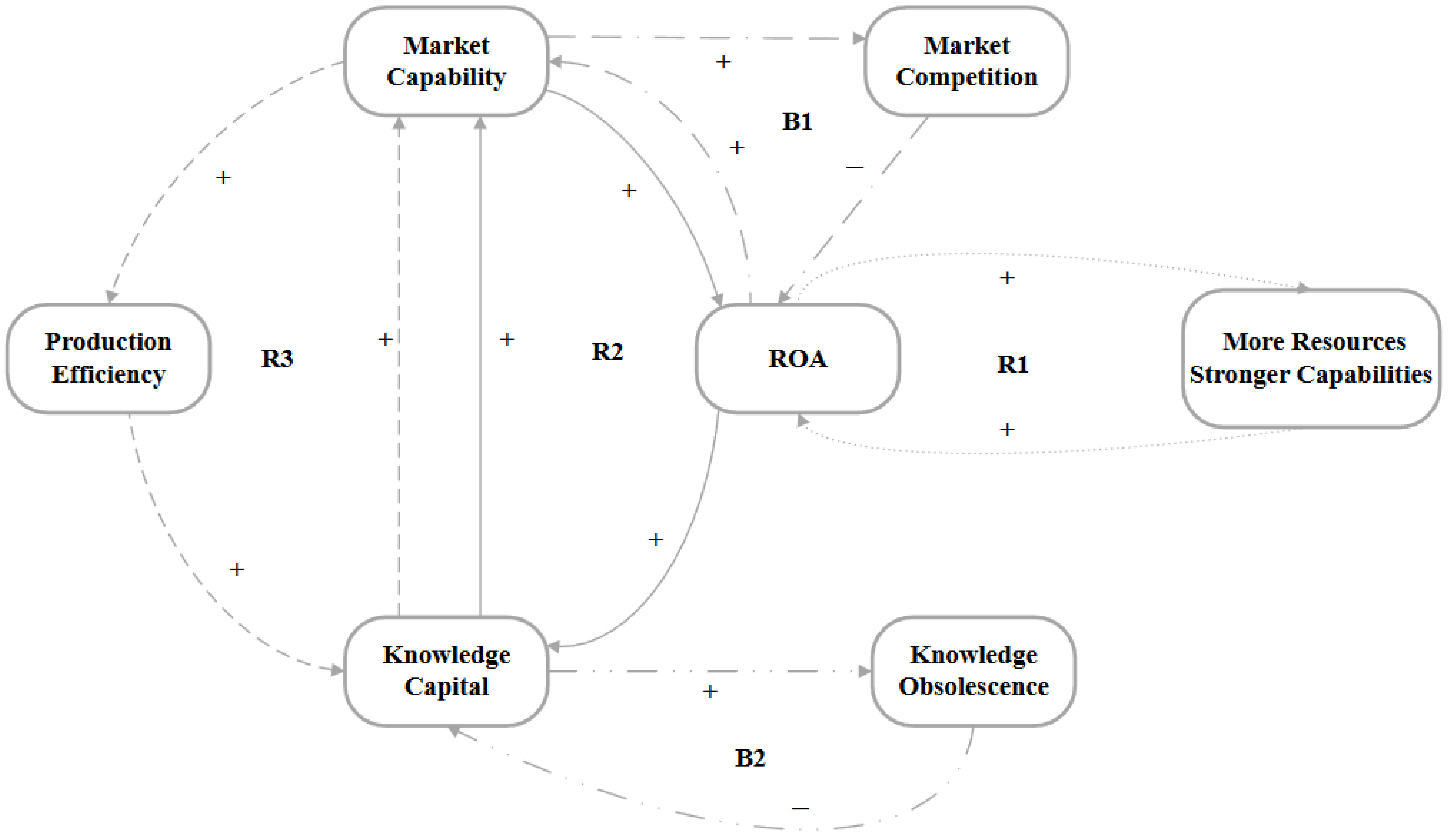
The model contains five feedback loops internal to the enterprise system. Three are reinforcing: R1 is the self-reinforcing cycle of “higher profits → more resources → stronger capabilities → higher profits”; R2 is the loop from knowledge accumulation driving product differentiation, feeding through to market share and profits; R3 spans all three subsystems—market expansion generates scale economies, efficiency gains free up R&D resources, and knowledge feeds back into market competitiveness, forming a longer reinforcing chain. Two balancing loops provide counterweights: B1 represents market competition constraints—as a subsidiary grows, competitors respond, compressing profit margins; B2 is knowledge obsolescence—technological progress simultaneously creates new knowledge and depreciates old knowledge. The coexistence of reinforcing and balancing loops is what generates nonlinear dynamics.
These five feedback loops are depicted in the causal loop diagram (Figure 1). The corresponding stock–flow formalization appears in Figure 2.
Equations (1)–(6) together with the causal loop diagram (Figure 1) and the stock–flow diagram (Figure 2) already give a complete description of how the three subsystems evolve and interact. But when we want to ask certain questions about the system as a whole—for example, will the three stocks eventually settle down to some steady state, or keep diverging? how does a one-time improvement in institutional openness ripple through the entire system over multiple periods? and most importantly for our empirical strategy, what is the exact mapping from the structural parameters in the stock-flow model to the coefficients we can estimate in a panel regression?—working with three separate equations becomes quite cumbersome. The matrix representation introduced below is essentially a way of packaging the three stock equations into one single expression, which makes it considerably easier to perform stability analysis (through the spectral radius), to derive a reduced-form equation suitable for econometric estimation, and to see transparently how each regression coefficient is a composite of the underlying system parameters.

2.5. Matrix Representation and System Stability

Arranging the stocks as a vector S t = M t , P t , K t , the system’s evolution can be compressed into a matrix equation:
S t = A · S t 1 + B · I t + Θ · R O A t 1 + Γ · X t + ε t
One may reasonably ask: when we move from the stock-flow equations to the matrix form, does the accumulation logic get lost? The answer is no, and it is worth explaining why. Look at the system matrix A = I 3 Δ + Φ . The diagonal part, I 3 Δ , has entries of the form 1 δ j —this is exactly the “survival rate” of each stock from one period to the next, which is to say, the fraction that does not depreciate. This term is what gives stock variables their characteristic “memory”: unlike a flow variable that can jump from any value to any other value in a single period, a stock changes only gradually because it always inherits a large portion of its previous level. The off-diagonal part, Φ , contains the cross-subsystem spillover coefficients φ j k . For instance, φ M K sits in the first row of Φ and captures how last period’s knowledge stock feeds into this period’s market capability inflow. So when we write A · S ( t 1 ) , each row of this multiplication is doing exactly what the right-hand side of the corresponding stock equation (Equations (1)–(3)) does: it takes last period’s stock level, applies depreciation, and adds the spillover contributions from the other two subsystems. The remaining terms in Equation (10)— B · I t for the institutional push, Θ · R O A t 1 for the performance feedback loop, Γ · X t for controls—map directly to the corresponding components in the flow functions (Equations (4)–(6)). In this sense, the matrix equation is not an abstraction away from the stock-flow logic but rather a faithful repackaging of it.
Whether the system converges to a steady state depends on the spectral radius of A being strictly less than 1.

2.6. Reduced-Form Equation and Parameter Bridging

Estimating all structural parameters directly is infeasible given available data—there are simply not enough degrees of freedom. To bridge the theoretical model and the empirics, we derive a reduced-form dynamic panel equation:
R O A i t = ρ · R O A i , t 1 + β · I j t + γ X i t + μ i + λ t + ε i t
Every parameter in this equation is a composite of underlying structural parameters. In the structural model, ρ captures system inertia—it reflects not just the depreciation complement of stocks but also the intensity of cross-subsystem coupling and performance feedback. β is the short-run marginal impact of institutional openness, equal to a weighted sum of each channel’s contribution plus complementarity effects. The long-run effect has a straightforward formula: β / ( 1 ρ ) , meaning that—provided the system is stable—feedback loops and coupling effects amplify the initial shock by a factor of 1 / ( 1 ρ ) . The implied half-life of shock absorption is l n ( 0.5 ) / l n ( ρ ) .
In principle, Equation (11) could be estimated directly as a dynamic panel model. In practice, however, including a lagged dependent variable alongside three-way fixed effects (firm, year, and country-pair) raises well-known incidental-parameter concerns: the bias is of order 1 / T , and with T averaging roughly 10 usable years per subsidiary in our unbalanced panel, the bias is non-trivial. System GMM estimators mitigate this problem but require moment conditions whose validity is difficult to verify in a three-dimensional panel with country-pair fixed effects. We therefore adopt a conservative strategy: we estimate the static reduced form in Equation (12), treating ρ as a theoretical composite that governs the long-run dynamics of the system rather than as a directly estimated parameter. This choice means that our empirical coefficients capture the short-run marginal effect of institutional openness, while the long-run multiplier β / ( 1 ρ ) and the half-life remain theoretical predictions of the model that await direct estimation when richer longitudinal data become available.

2.7. Hypotheses

Based on the above theoretical derivation, we put forward the following hypotheses.
Hypothesis 1. 
The openness of the digital trade institutional system—encompassing both depth and breadth—has a positive effect on overseas subsidiary ROA.
Hypothesis 2a. 
Institutional openness indirectly improves subsidiary performance by expanding the market subsystem’s operational boundaries.
Hypothesis 2b. 
Institutional openness indirectly improves subsidiary performance by enhancing the production subsystem’s operational efficiency.
Hypothesis 2c. 
Institutional openness indirectly improves subsidiary performance by accelerating the knowledge subsystem’s resource accumulation.
Hypothesis 3. 
Modules that touch the structural rules of the system (e.g., NDE) produce larger marginal effects than modules that merely adjust transaction parameters (e.g., DT).

2.8. Sample and Data

The data assembly follows two parallel tracks, merged via country–year keys. On the firm side, we start with the global top 100 digital MNEs as identified in UNCTAD’s World Investment Report [54], then track their majority-owned foreign subsidiaries in the Orbis database, extracting ROA, total assets, leverage, sales, intangible assets, and other financial indicators. Macro-level variables come from the World Bank’s WDI; bilateral investment treaty information is coded following UNCTAD’s International Investment Agreements Navigator.
The institutional data come from the TAPED database [43], which codes digital trade provisions article by article across more than 300 trade agreements. The sample spans 2000 to 2024. After cleaning and matching, we retain an annual panel of 6850 subsidiaries. The sample construction proceeds in four steps. First, we identify the top 100 digital MNEs from UNCTAD’s World Investment Report [54]. Second, we retrieve all majority-owned foreign subsidiaries (ownership ≥ 50%) of these MNEs from the Orbis database. Third, we match each subsidiary’s host country with the home country’s bilateral digital trade agreements in the TAPED database, retaining only subsidiary-year observations for which at least one bilateral or plurilateral agreement with coded digital provisions exists between the home and host country. Fourth, we drop observations with missing values on ROA or key control variables. The final sample comprises 6850 unique subsidiaries observed over 2000–2024.
Table 1 reports summary statistics for the key variables. The number of firm-year observations varies substantially across variables due to differential reporting in Orbis: rule depth and breadth, constructed at the country-pair–year level, are available for 178,100 observations; ROA, which requires subsidiary-level financial statements, is available for 20,388; and the most restrictive variable, intangible asset growth, yields 7688. Baseline regressions using ROA with the full control set retain approximately 18,700 observations. The mean subsidiary ROA is 5.635%, with substantial variation (standard deviation 20.138%), reflecting the heterogeneity inherent in a sample spanning 6850 subsidiaries across diverse host countries and industries.

2.9. Variable Definitions

The dependent variable is subsidiary ROA (net income/total assets); ROCE serves as an alternative in robustness checks.
The key independent variables have two dimensions. Rule depth (RuleDepth) measures the specificity and binding strength of provisions within a given topic; rule breadth (RuleBreadth) captures cross-topic coverage. In the module decomposition regressions, we further break this into DT, DATA, NDE, and IPR. The construction of RuleDepth and RuleBreadth follows the coding methodology of the TAPED database [43]. TAPED codes 130 distinct provision items across all preferential trade agreements since 2000, regardless of their location within the treaty text. Each provision is assigned a legalization score: 0 if the provision is absent, 1 for “soft” commitments (best-endeavor language such as “shall endeavor to,” “should,” “recognize the importance of”), and 2 for “hard” commitments (binding obligations using language such as “shall,” “must,” “shall adopt appropriate measures”). This scoring is objective and based solely on the legal text, involving no subjective weighting by the researchers. RuleBreadth is computed as the number of provisions present in a given RTA divided by the maximum number of provisions across all RTAs in the database, capturing cross-topic coverage. RuleDepth is computed as the sum of legalization scores across all provisions divided by the same denominator, capturing both coverage and binding strength. The four sub-module indices (DT, DATA, NDE, IPR) are constructed using the same formula applied to the subset of provisions belonging to each module.
Three mechanism variables are used: sales revenue growth rate (market channel), employee cost ratio (production efficiency channel), and intangible asset growth rate (knowledge accumulation channel). Control variables include subsidiary size (measured as the natural logarithm of total assets in the regressions), leverage ratio, firmage, host-country GDP growth, internet penetration rate, and a BIT dummy. We acknowledge that these flow-based proxies capture the rate of change in the underlying capability stocks rather than their levels. The theoretical justification for this choice rests on the stock-flow identity central to our framework: the flow into a stock in any period equals the observed change in the stock plus depreciation (Equations (1)–(3)). Revenue growth proxies the net inflow to the market capability stock M ( t ) ; the employee cost ratio inversely proxies the efficiency of the production stock P ( t ) , since lower labor costs per unit of output indicate higher operational efficiency; and intangible asset growth proxies the net investment flow into the knowledge stock K ( t ) , consistent with Peters and Taylor’s [33] decomposition of intangible capital. While direct measurement of stock levels would be preferable, the flow proxies are the best available given Orbis reporting constraints, and they are the operationally relevant quantities for mediation analysis, which tests whether institutional openness affects the accumulation rate of each capability.

2.10. Econometric Model

The baseline model is a panel regression with three sets of fixed effects:
R O A i j f t = β · D i g R u l e s i j , t 1 + γ X f t + ξ Y j t + μ f + η i j + λ t + ε i j f t
where i indexes the home country, j the host country, f the subsidiary, and t the year. μ f is the firm fixed effect, and λ t is the year fixed effect. η i j is the country-pair fixed effect. Country-pair fixed effects are included to absorb all time-invariant bilateral heterogeneity such as geographic distance, cultural proximity, and historical ties between the home and host countries. All regressions report heteroskedasticity-robust standard errors. We use the one-period lag of the trade rule index, D i g R u l e s i j , t 1 , rather than its contemporaneous value, for two reasons. First, a trade agreement may enter into force at any point within a calendar year—an agreement effective from January exerts a substantially different within-year impact than one effective from December—so using the lagged value avoids conflating partial-year exposure with full-year exposure. Second, the transmission from country-level treaty commitments to subsidiary-level operational outcomes is unlikely to be instantaneous; institutional signals must propagate through regulatory implementation, corporate strategic adjustment, and market response before manifesting in financial performance. All specifications involving D i g R u l e s variables therefore take the t 1 value as the baseline.
We deploy two strategies to address endogeneity. The first is straightforward—lagging the explanatory variable by one period. The second uses instrumental variables, following Baier and Bergstrand [9]: we construct IVs from the average rule depth (breadth) in agreements that the home or host country has signed with third-party countries.

3. Results

3.1. Baseline Regression

Table 2 presents the baseline regression results. We show six columns, progressively adding layers of fixed effects and controls. Columns (1) and (2) include only firm fixed effects, establishing the raw association between institutional openness and subsidiary ROA. Columns (3) and (4) add year and country-pair fixed effects to absorb common temporal shocks and time-invariant bilateral heterogeneity. Columns (5) and (6) further introduce the full set of firm-level and host-country control variables, constituting our most demanding specification.
What is somewhat reassuring is that the core coefficients barely budge as we progressively tighten the specification. In columns (5) and (6)—the most demanding specification with all three sets of fixed effects and the full control vector—the coefficient on rule depth is 0.998 (SE = 0.289) and that on rule breadth is 1.549 (SE = 0.550), both significant at the 1% level. R2 increases from 0.486 to 0.525 once firm-level and host-country controls are added, suggesting that observable heterogeneity across subsidiaries and host environments accounts for meaningful variation in ROA. One pattern that catches our attention is that the breadth coefficient consistently exceeds the depth coefficient; we return to this point in the Discussion section. These results provide strong support for Hypothesis 1.

3.2. Endogeneity Tests

The baseline regressions establish correlation, but the causal direction needs further confirmation. Table 3 reports results from lagged-variable and IV two-stage estimation.
The lagged coefficients remain highly significant (columns 1–2), alleviating concerns about reverse causality in the short run. In the IV estimation, which follows the approach of Baier and Bergstrand [9], we construct instruments from the average rule depth (breadth) in agreements that the home or host country has signed with third-party countries eleven years prior t 11 . The long lag serves two purposes: it captures the persistent component of a country’s revealed preference for digital trade openness—a preference that shapes future bilateral negotiations through path dependence—while attenuating the risk that contemporaneous third-country agreements directly affect subsidiary performance through global template effects or regulatory spillovers. Formally, the instrument is defined as I V i j , t 11 = ( D i g R u l e s i , t 11 + D i g R u l e s j , t 11 ) ÷ 2 . The logic rests on the idea that a country’s digital trade commitments with third parties reveal its underlying preference for digital openness and create template effects that shape future bilateral negotiations, but do not directly govern the regulatory environment facing the focal subsidiary.
The validity of the instrument hinges on two conditions. First, the relevance condition requires that third-country agreement averages predict bilateral rule depth and breadth. The first-stage F-statistics—1257 for depth and 1006 for breadth—exceed the Stock and Yogo [55] critical value of 16.38 by nearly two orders of magnitude, leaving no doubt about instrument strength. The Kleibergen-Paap LM statistics (896.40 and 744.41) similarly reject underidentification at any conventional level.
Second, the exclusion restriction requires that third-country agreement averages affect subsidiary ROA only through their influence on bilateral rule depth and breadth, not through any direct channel. We consider this assumption plausible for three reasons. (i) Third-country agreements establish the regulatory framework between those third countries and the home or host country, not the bilateral environment in which the focal subsidiary operates; any effect on the subsidiary must therefore be transmitted through the bilateral institutional channel. (ii) Our specification already controls for host-country GDP growth, internet penetration, and BIT status, which absorb the most likely confounders that might be correlated with both third-country agreement activity and subsidiary performance. (iii) Country-pair fixed effects absorb all time-invariant bilateral confounders. We acknowledge, however, that the exclusion restriction is fundamentally untestable with a just-identified model. Because we have one instrument per endogenous variable, the Hansen J test for overidentification is not applicable. Future work could construct multiple instruments—for instance, separating home–third and host–third averages—to enable overidentification testing. We note that the R2 values in the second-stage regressions (0.059) are low in absolute terms, but this is expected: in 2SLS estimation, the second-stage R2 lacks the standard OLS interpretation because it is computed from predicted rather than actual values of the endogenous variable, and low values do not indicate model misspecification [56].
As an indirect test of the exclusion restriction, we include the eleven-year-lagged third-country agreement averages directly in the baseline regression alongside the bilateral rule indices. If the instruments affect subsidiary ROA through channels other than bilateral rules, they should retain explanatory power even after controlling for bilateral rule depth and breadth. In both specifications, the bilateral rule index retains its significance (RuleDepth: β = 0.826, p = 0.008; RuleBreadth: β = 1.280, p = 0.031), while the third-country averages are statistically insignificant (p = 0.127 and p = 0.160, respectively). This pattern is consistent with the exclusion restriction: conditional on bilateral rule depth and breadth, third-country agreement configurations do not exert a statistically detectable direct effect on subsidiary ROA. We note that this test is suggestive rather than definitive—it cannot rule out direct effects that are too small to detect at conventional significance levels—but it provides a degree of empirical reassurance beyond purely theoretical argumentation. A similar IV strategy based on third-country agreement patterns has been employed by Osnago, Rocha, and Ruta in the context of deep trade agreements and vertical FDI [57], lending additional methodological precedent to our approach.
We acknowledge, however, that the indirect test above cannot rule out all possible violations of the exclusion restriction. In particular, in a globally interconnected digital trade regime, third-country agreements may influence global regulatory templates, technological standards, or market expectations that indirectly affect subsidiary performance even outside bilateral treaty channels—a “global template effect” that our country-pair fixed effects may not fully absorb. If such an effect exists and is positively correlated with bilateral rule depth, the IV estimates would overstate the true causal effect. The IV coefficients should therefore be interpreted as plausible upper bounds on the causal effect of institutional openness, with the OLS estimates providing a corresponding lower bound (given the downward attenuation bias from measurement error discussed below). The true effect likely lies between the two.
Under the LATE interpretation of IV estimation, the second-stage coefficients—depth at 2.074 and breadth at 3.611—identify the effect for ‘compliers,’ namely country-pairs whose bilateral rule configurations are responsive to third-country agreement patterns. These compliers are likely countries more active in international trade negotiations and more integrated into the global treaty network, which may explain why the treatment effect for this subpopulation exceeds the average treatment effect captured by OLS. The amplification from OLS to IV can also be attributed to attenuation bias: rule depth and breadth, being synthesized from coded treaty texts, inevitably contain measurement error that biases OLS toward zero. Additionally, if subsidiaries with weaker performance concentrate in countries that pursue agreements more aggressively out of developmental catch-up motivations, the resulting negative endogeneity would further compress OLS estimates. We cannot precisely decompose the relative contribution of LATE heterogeneity, measurement error correction, endogeneity removal, and possible residual violations of the exclusion restriction, and this remains a limitation of our analysis. The IV results primarily strengthen the causal interpretation of the direction of the effect—confirming that institutional openness improves subsidiary performance—rather than providing a fully definitive identification strategy. Readers should interpret the IV point estimates as plausible upper bounds, indicative of the direction and approximate order of magnitude of the causal effect rather than as precise parameter values.

3.3. Robustness Checks

We conduct robustness tests in two directions. Results are shown in Table 4.
When ROCE replaces ROA as the dependent variable, sign and significance are preserved (columns 1–2). When we substitute the original depth/breadth measures with logged counts of treaty articles and word counts (columns 3–4), coefficients remain significant. This suggests that the conclusions are not an artifact of any particular measurement approach.

3.4. Mechanism Analysis

The theoretical model predicts three transmission channels. We employ the Baron and Kenny mediation framework to rigorously test each of them [58]. The procedure involves three steps: (1) establishing the total effect of institutional openness on ROA (confirmed in the baseline regression, Table 2); (2) estimating the effect of institutional openness on each mediator ( X M ); and (3) including both the treatment and the mediator in the outcome equation to identify the direct and indirect effects. We supplement this with the Sobel test and bootstrapped confidence intervals for the indirect effects. Table 5 reports the results.
Table 5 reports the mediation results across the three theorized channels. Panel A confirms that institutional openness significantly affects all three mediators: rule depth and breadth increase operating revenue growth (market channel), reduce employee cost ratios (production efficiency channel), and accelerate intangible asset accumulation (knowledge channel). Panel B shows that after controlling for the mediator, the direct effect of institutional openness remains significant but is attenuated relative to the total effect in Table 2, indicating partial mediation through each channel.
We compute indirect effects as the product of the a-path (Panel A) and b-path (Panel B) coefficients, with statistical significance assessed via the Sobel test and percentile bootstrap with 1000 replications. For RuleDepth: the market channel indirect effect is 0.056 × 0.832 = 0.047 (Sobel z = 3.42, p < 0.01; 95% bootstrap CI [0.020, 0.074]); the production channel indirect effect is (−0.577) × (−0.045) = 0.026 (Sobel z = 1.98, p < 0.05; 95% CI [0.003, 0.049]); and the knowledge channel indirect effect is 0.076 × 0.518 = 0.039 (Sobel z = 2.05, p < 0.05; 95% CI [0.005, 0.074]). For RuleBreadth: the market channel indirect effect is 0.100 × 0.829 = 0.083 (Sobel z = 3.67, p < 0.01; 95% CI [0.038, 0.128]); the production channel indirect effect is (−1.058) × (−0.044) = 0.047 (Sobel z = 2.11, p < 0.05; 95% CI [0.005, 0.088]); and the knowledge channel indirect effect is 0.188 × 0.512 = 0.096 (Sobel z = 2.41, p < 0.05; 95% CI [0.015, 0.178]). In all cases, the total indirect effect accounts for approximately 10–15% of the total effect, indicating that while the three channels are statistically confirmed mediators, a substantial portion of the institutional effect operates through unobserved pathways—consistent with the system dynamics framework’s prediction that cross-subsystem coupling generates effects beyond any single channel. Taken together, these findings confirm Hypotheses 2a, 2b, and 2c.

3.5. Heterogeneity Analysis: Module Decomposition

Finally, we disaggregate the institutional system. Table 6 reports the marginal effect of each functional module on ROA.
All eight coefficients are positive and significant. The NDE module stands out in terms of point estimates—depth at 19.834, breadth at 20.815—roughly 4 to 8 times the magnitude of other modules. To assess whether these differences are statistically meaningful, we estimate a joint regression including all four modules simultaneously and conduct Wald tests of coefficient equality. For RuleDepth, no individual pairwise test reaches conventional significance: NDE = DT (F = 1.76, p = 0.185), NDE = DATA (F = 0.15, p = 0.696), NDE = IPR (F = 0.17, p = 0.682); however, the joint test that all four module coefficients are equal is rejected at the 5% level (F = 2.63, p = 0.048). For RuleBreadth, the NDE–DT difference is individually significant (F = 6.04, p = 0.014), while NDE–DATA (F = 0.37, p = 0.541) and NDE–IPR (F = 1.59, p = 0.208) are not; the joint test again rejects equality (F = 2.66, p = 0.046). To assess whether multicollinearity among the four modules inflates the standard errors on the NDE coefficients, we compute variance inflation factors (VIFs) from the joint regression. The VIFs for NDE depth and NDE breadth are 9.48 and 7.81, respectively—approaching but not exceeding the conventional threshold of 10. The VIFs for the other modules range from 3.2 to 6.5. The elevated VIFs for NDE reflect the empirical reality that digital trade agreement modules tend to co-evolve: countries that adopt NDE provisions typically also adopt DATA and IPR provisions, generating structural collinearity that is inherent to the institutional design process rather than a specification artifact. This collinearity explains the large standard errors on the NDE coefficients (5.868 and 5.983) and underscores the importance of the joint Wald tests, which confirm that the four modules collectively exert unequal marginal effects even when estimated simultaneously.
The pattern therefore provides qualified support for Hypothesis 3: while the joint tests confirm that the four modules do not exert equal marginal effects, the large standard errors on the NDE coefficients (5.868 and 5.983) limit the statistical power of individual pairwise comparisons. The substantive magnitude gap—NDE coefficients roughly 4 to 8 times larger—remains striking, and the joint rejection of equality is consistent with the leverage-point interpretation developed in Section 4.3. We attempt a fuller explanation in the next section.

4. Discussion

4.1. Aggregate Effect and Causal Direction

Taken together, the baseline regression and IV results lend support to Hypothesis 1, confirming that greater institutional openness causally improves subsidiary performance. The positive effect of institutional openness on subsidiary ROA is not a fluke of any particular model specification—it survives changes to the dependent variable, alternative measures of the independent variable, and instrumental variable estimation. In systems language, greater openness in the institutional system amounts to a smoother input interface, reducing the friction that institutional barriers impose on the flow of resources into the enterprise system’s capability stocks [59,60].
To gauge the economic magnitude of these estimates, consider that the sample mean ROA is 5.635%. A one-unit increase in RuleDepth—equivalent to moving from no digital trade provisions to a moderately deep agreement—raises subsidiary ROA by approximately 1.0 percentage point, or a 17.7% improvement relative to the sample mean. For RuleBreadth, the corresponding figure is 1.5 percentage points, or a 27.5% relative improvement. These magnitudes are economically meaningful and broadly comparable to effect sizes reported in related literatures. For instance, Baier and Bergstrand [9] found that free trade agreements increase bilateral trade by approximately 50–100% over a decade; Ma et al. [10] estimated that data flow provisions increase goods trade by 8–15%. While direct cross-study comparison is complicated by differences in dependent variables and unit scales, our estimates suggest that the performance effects of digital trade institutions on individual subsidiaries are of a practically relevant order of magnitude—large enough to influence location decisions but not implausibly large.
The fact that the breadth coefficient consistently exceeds the depth coefficient can, we believe, be understood through Meadows’ discussion of connectivity diversity [12]. Rule breadth measures the “coverage width” of the institutional system across e-commerce, data governance, digital innovation, and intellectual property. Wider coverage means the enterprise system has more channels through which to receive external support, reducing dependence on any single pathway. The resilience benefit of diversified connections may be something that simply “digging deeper” along a single dimension cannot provide. We should caution, however, that this interpretation remains tentative and would benefit from further evidence.
The amplification of IV coefficients to two to three times the OLS estimates reflects a combination of measurement error–induced attenuation bias, possible negative endogeneity from developmental catch-up motivations, and LATE heterogeneity, as discussed in detail in Section 3.2. While we cannot precisely decompose the relative contribution of each factor, the direction of bias is consistently downward for OLS, lending credibility to the larger IV point estimates. Taken together, the IV analysis corroborates the causal direction established by the baseline and lagged specifications, while the precise magnitude of the effect should be interpreted with the caveats noted in Section 3.2.

4.2. Three Transmission Pathways

The mediation analysis (Table 5) confirms that institutional openness does not simply “help firms” in some undifferentiated way; rather, it operates through three identifiable channels. The formal Baron–Kenny framework with Sobel tests provides rigorous statistical evidence for partial mediation, with indirect effects accounting for 10–15% of the total treatment effect through each channel. This result at minimum suggests that decomposing the subsidiary system into market, production, and knowledge subsystems in the theoretical model was not without empirical basis.
An interesting detail is the cross-channel variation in R2. The production efficiency equation (0.872) is far higher than market (around 0.26) and knowledge (around 0.19). Why? Our conjecture is that the three stock types differ in “inertia.” Production efficiency is mainly shaped by internal management process optimization, which changes relatively predictably. Market performance and knowledge accumulation are subject to much larger external random shocks—a patent application gets rejected, a competitor suddenly enters the market—and so the numbers can swing widely. The irony, as Dierickx and Cool would point out, is that it is precisely these “hard-to-predict” stocks that are most likely to constitute durable competitive advantages, because their accumulation processes are the hardest to imitate [32,61].
Another pattern worth noting: the ratio of breadth to depth coefficients in the knowledge channel (0.188/0.076 ≈ 2.47) is the largest among the three pathways. This is not hard to understand—cross-border accumulation of intangible assets depends on multiple channels being open simultaneously (data transmission, talent mobility, technology licensing, joint R&D, and so on), and these channels are distributed across different functional modules of the institutional system. When rule breadth expands, more channels are opened, and the effect on knowledge accumulation is naturally the most pronounced.
The fact that the total indirect effect accounts for only 10–15% of the total treatment effect deserves careful interpretation. The three single-channel indirect effects are empirically verified through formal mediation testing with Sobel statistics and bootstrapped confidence intervals. The attribution of the remaining 85–90% to cross-subsystem coupling is, by contrast, a theoretical inference grounded in the system dynamics framework. Specifically, the model predicts that the off-diagonal elements of the Φ matrix generate multiplicative interaction effects that cannot be decomposed into additive single-channel contributions—a property that general systems theory terms emergence [14,49]. In a tightly coupled system, the whole exceeds the sum of the parts: institutional openness simultaneously enhances market reach, production efficiency, and knowledge accumulation, and these three stocks reinforce each other through the coupling terms, producing a total effect that no single mediator can capture. While we find this interpretation theoretically coherent and consistent with the empirical pattern, we acknowledge that it remains inferential rather than directly tested. Directly estimating the Φ matrix would require subsidiary-level panel data on all three capability stocks measured simultaneously—a data requirement that current commercial databases do not satisfy. We flag this as an important avenue for future empirical work.

4.3. Module Heterogeneity and Leverage Points

The NDE module’s coefficient being several times larger than those of other modules is probably the most striking empirical finding in this paper (Table 6). We believe Meadows’ leverage-point hierarchy [12] offers a suggestive—though not definitive—interpretation of this pattern. The mapping between institutional modules and leverage levels is necessarily approximate, and the large standard errors on the NDE coefficients counsel against overconfident claims about precise effect magnitudes. With this caveat in mind, the following interpretation appears broadly consistent with the evidence.
To make this mapping more precise, we locate each module within Meadows’ 12-level hierarchy. DT provisions (e-signature mutual recognition, paperless trade) operate at Levels 12–11: they adjust parameters (tariff equivalents, processing times) and buffer sizes (the capacity of customs systems to handle digital documents). These are the easiest interventions to implement but generate the smallest systemic leverage. DATA provisions (cross-border data transfer, computing facility access) operate at Levels 10–8: they alter information flows within the system (which actors can access what data) and affect the strength of negative feedback loops (e.g., data localization requirements that dampen cross-border knowledge spillovers). IPR provisions (patent recognition, trade secret protection) operate at Levels 6–5: they define the rules of the system—who owns what, and under what conditions knowledge can be appropriated. NDE provisions, however, reach Levels 4–3: they reshape the structure of the system itself (platform governance architectures, algorithmic accountability frameworks) and, in some cases, the goals of the system (e.g., net neutrality provisions that define whether the digital economy optimizes for openness or for incumbent advantage). The critical distinction is between IPR and NDE: while both operate at the “rules” level, IPR defines property rights within the existing economic architecture, whereas NDE provisions restructure the operational architecture itself—the difference between rules of the game and the design of the game board. This structural distinction explains why NDE’s marginal effect is several times larger despite both modules being “rule-level” interventions in a loose sense. Following Meadows’ logic, the higher an intervention reaches into system structure and rules, the greater the leverage. The fact that NDE’s regression coefficients are several times larger than those of other modules is consistent with this prediction.
We should also flag an uncertainty: while the NDE coefficients are large, the standard errors are also large (5.868 and 5.983), yielding lower precision compared to DT, DATA, and IPR. This means our estimate of the effect size is less reliable for the NDE module. Moreover, whether NDE’s large coefficient partly reflects synergistic amplification between NDE and DATA/IPR is difficult to disentangle with the current single-equation framework.
Beyond the leverage-point interpretation, the magnitude gap can be understood through the distinction between compliance-enabling and value-creating provisions. DT and DATA provisions primarily address threshold questions—whether firms can operate across borders (e.g., whether electronic contracts are legally recognized, whether data can be transferred). These provisions remove barriers but do not directly enhance the firm’s productive capacity. NDE provisions, by contrast, directly shape the value creation process itself: rules governing AI collaboration, digital R&D frameworks, technology standard compatibility, and platform governance architectures determine how effectively a subsidiary can convert its digital capabilities into market performance. In stock-flow terms, DT and DATA primarily reduce friction in the flow functions (lowering the impedance at the system interface), while NDE directly increases the accumulation rate of the knowledge stock K ( t ) .
The NDE coefficient likely captures not only the module’s direct effect but also its role as a complementarity amplifier. Drawing on Milgrom and Roberts’ complementarity framework [53], we can conceptualize DATA as providing the infrastructure for cross-border information flows (the “fuel”) and NDE as providing the innovation support framework that converts those flows into productive outcomes (the “engine”). When a host country both permits data flows (DATA) and supports digital innovation (NDE), the combined effect exceeds the sum of the parts. Because our single-equation specification estimates each module separately, the NDE coefficient absorbs part of this synergistic amplification, which helps explain why it is disproportionately large relative to DATA alone.
The sample composition further amplifies NDE’s estimated effect. UNCTAD’s top 100 digital MNEs include firms at the frontier of AI, fintech, cloud computing, and platform services—sectors for which NDE provisions (regulatory sandboxes for emerging technologies, platform liability frameworks, source code protection) are not merely facilitative but constitutive of the business model. For these firms, the absence of NDE-type provisions may render a host country effectively uninvestable, whereas the absence of DT provisions (e.g., paperless trade) is an inconvenience rather than a deal-breaker. Moreover, network effects and winner-take-all dynamics in new digital economy sectors mean that the marginal value of institutional support is highly convex: NDE provisions help leading firms cross critical mass thresholds, generating outsized performance gains.
Finally, NDE provisions typically contain forward-looking, technology-neutral language that accommodates future innovations—what we term institutional foresight. Unlike DT provisions (which codify existing practices like e-signatures) or IPR provisions (which protect existing assets), NDE provisions often establish governance principles for technologies that do not yet exist at the time of negotiation. This institutional foresight substantially reduces the regulatory uncertainty premium that firms face when making long-term, large-scale innovation investments in a host country. The reduction in risk premium translates directly into higher expected ROA, and the effect is magnified for the digitally intensive firms in our sample, whose investment horizons and technological uncertainty are both unusually high.

4.4. Theoretical Advancement

On the theoretical side, this paper attempts several things. First, it incorporates bidirectional coupling among the three capability subsystems (market, production, knowledge) and multiple internal feedback loops into a unified system dynamics framework (Figure 1 and Figure 2), departing from the conventional treatment of parallel independent channels. In the standard empirical literature on digital trade and FDI, market expansion, efficiency improvement, and knowledge accumulation are typically examined one at a time, each in its own regression equation, as though the three pathways operated in hermetic isolation. Our framework replaces this with a 3 × 3 spillover matrix Φ and a set of performance feedback coefficients θ , so that the three pathways can amplify or constrain each other. The reinforcing loops R1–R3 and balancing loops B1–B2 generate nonlinear dynamics—overshooting, delay, and path dependence—that a simple additive model would miss entirely. The empirical finding that total indirect effects account for only 10–15% of the total treatment effect (Section 3.4) is, we believe, not evidence against the importance of these channels but rather consistent with the importance of cross-channel coupling predicted by the structural model. We stress, however, that the empirical analysis tests implications that are consistent with the stock–flow framework rather than directly validating the system dynamics model itself; the structural Equations (1)–(10) remain a theoretical scaffold whose dynamic features—feedback loops, stock accumulation, cross-subsystem coupling—are not separately identified in the reduced-form estimation.
To be explicit about the empirical scope of our findings, we distinguish three levels of evidential support. First, empirically verified: the positive causal effect of institutional openness on subsidiary ROA (Hypothesis 1), the existence of three transmission channels through market expansion, production efficiency, and knowledge accumulation (Hypotheses 2a–2c), and the heterogeneity of marginal effects across institutional modules (Hypothesis 3)—all of these are directly tested and supported by the regression evidence. Second, empirically consistent but not directly tested: the cross-subsystem coupling captured by the off-diagonal elements of the Φ matrix is inferred from the finding that single-channel mediation accounts for only 10–15% of the total effect, leaving a substantial residual that the theoretical framework attributes to interaction pathways—but this attribution is not independently verified. Third, theoretical predictions awaiting future estimation: the long-run multiplier β / ( 1 ρ ) , the half-life of shock absorption, the absorptive capacity elasticities ψ j , and the module synergy coefficients σ k l remain structural parameters that our reduced-form approach cannot identify. We regard this three-tier structure as a strength rather than a weakness: it makes transparent which claims rest on statistical evidence and which rest on theoretical reasoning, allowing readers to calibrate their confidence accordingly.
Second—and this is perhaps the point that deserves the most candid discussion—this paper builds a mathematical bridge between system dynamics structural parameters and panel regression coefficients, rather than pursuing the more conventional system dynamics route of numerical simulation. This choice was deliberate, and we owe the reader an explanation of both its rationale and its costs.
A full system dynamics simulation of our model would require calibrating every structural parameter: the depreciation rates δ M , δ P , and δ K ; the institutional push coefficients β M , β P , and β K ; all six off-diagonal elements of the spillover matrix Φ ; the absorptive capacity elasticities ψ j ; the module synergy coefficients σ k l ; and the output function weights α M , α P , α K along with their pairwise interaction coefficients. That amounts to well over twenty free parameters. Reliable calibration of such a model demands direct micro-level measurements of the three capability stocks—market reach, production efficiency, and knowledge capital—at the subsidiary level and at annual frequency. The data infrastructure for this simply does not exist. Orbis provides financial statements from which we can construct proxies for the flows associated with each channel (revenue growth, employee cost ratio, intangible asset growth), but it does not supply direct measures of the underlying stocks. Attempting to simulate a stock-flow model without observing the stocks themselves would require either borrowing parameter values from unrelated contexts or fitting them through ad hoc search procedures—in either case injecting a degree of arbitrariness that, in our judgment, would undermine the credibility of the exercise rather than enhance it. In fact, a system dynamics model calibrated with poorly grounded parameters may generate internally consistent trajectories that nonetheless bear little resemblance to reality; the illusion of precision is arguably worse than an honest acknowledgment of uncertainty [22].
What the reduced-form approach does offer is a different kind of rigor—one grounded in statistical identification rather than numerical calibration. By deriving a reduced-form dynamic panel equation (Equation (11)) in which every coefficient is an explicit composite of structural parameters, we are able to leverage the causal-identification machinery of modern econometrics—instrumental variables, fixed effects, mediation testing—to discipline inferences about the system’s aggregate behavior. The persistence parameter ρ is no longer just a “lagged dependent variable coefficient”; behind it lies the superposition of depreciation, coupling, and feedback forces. The long-run multiplier β / 1 ρ tells us the cumulative value of an institutional shock after multiple rounds of feedback amplification; the half-life l n 0.5 / l n ρ quantifies the time scale of shock dissipation.
Although we do not directly estimate ρ in this study, we can assess the sensitivity of long-run predictions to alternative assumptions about system inertia. Table 7 reports the implied long-run multiplier β / ( 1 ρ ) and half-life for ρ ranging from 0.3 to 0.9, using the baseline short-run estimates ( β = 0.998 for RuleDepth, β = 1.549 for RuleBreadth).
Even under the most conservative assumption ( ρ = 0.3 , implying rapid stock depreciation and weak feedback), the long-run effect exceeds the short-run estimate by 43%. Under moderate inertia ( ρ [ 0.5 , 0.7 ] )—a range broadly consistent with estimates of intangible capital depreciation rates in the literature [33]—the long-run multiplier ranges from 2.0 to 3.3, suggesting that feedback amplification approximately doubles to triples the initial institutional shock. The half-life ranges from 1 to 2 years under moderate inertia, implying that institutional shocks are substantially absorbed within 2–4 years. These bounds provide a practical reference for policymakers even in the absence of a point estimate for ρ .
As a further bridge between the structural model and the empirical estimates, we assess whether the estimated short-run coefficient β 1.0 is consistent with plausible structural parameter ranges. In the model, the short-run reduced-form coefficient is approximately β β M · α M + β p · α p + β K · α K , where β j are the institutional push coefficients and α j are the output weights. If we assume symmetric output weights ( α 1 / 3 ) and equal institutional push across channels ( β j β ¯ ), then β β ¯ , implying that a one-unit increase in institutional openness raises each capability stock’s accumulation rate by roughly one percentage point of ROA equivalent. This is a modest effect at the channel level, consistent with the view that institutional openness is a facilitating condition rather than a primary driver of capability building—a plausible characterization given that firm-internal factors (management quality, R&D investment, organizational routines) are likely the dominant determinants of capability accumulation. The fact that the empirical estimate falls within this theoretically plausible range provides indirect support for the structural model’s internal consistency, even though the individual structural parameters cannot be separately identified.
The long-run multiplier and half-life are system-level quantities with direct theoretical meaning—derivable, in principle, from data under well-understood statistical assumptions, though in the present study they remain theoretical predictions rather than directly estimated parameters (see Section 2.6). In this sense, the reduced-form bridge preserves the core insight of system dynamics—that feedback and accumulation generate behavior qualitatively different from static equilibrium—while translating it into a language amenable to hypothesis testing and causal inference.
The causal loop structure in Figure 1 predicts two dominant behavioural regimes. When the reinforcing loops R 1 R 3 dominate, a positive institutional shock triggers a virtuous cycle: capability accumulation raises ROA, which feeds back resources for further accumulation—producing exponential-growth behavior. The balancing loops B 1 (market competition) and B 2 (knowledge obsolescence) impose upper bounds, shifting the trajectory from exponential growth toward S-shaped convergence. Our empirical finding—a positive and statistically significant short-run coefficient β, combined with a substantially larger implied long-run multiplier β / ( 1 ρ ) —is consistent with the reinforcing-loop-dominant regime predicted by the structural model. The sensitivity analysis in Table 7 shows that as ρ increases from 0.5 to 0.7, the long-run multiplier rises from 2 β to 3.3 β , reflecting the amplification characteristic of a system in which reinforcing feedback has not yet been fully offset by balancing mechanisms—a pattern consistent with a digital trade institutional regime that is still in a relatively early stage of maturation.
We want to be clear that we view this approach as complementary to simulation, not a substitute for it. The reduced-form equation necessarily entails information loss: it collapses the full vector of structural parameters into a handful of estimable composites, sacrificing the ability to trace individual feedback loops or conduct counterfactual scenario analysis—exercises at which simulation excels. If, in the future, subsidiary-level operational data become sufficiently granular to support direct measurement of capability stocks (for instance, through proprietary datasets combining patent portfolios, customer base metrics, and production efficiency indices), calibrating and simulating the full structural model would be a valuable and natural extension of the present work. One could then compare performance trajectories under alternative institutional scenarios—“NDE-module-only liberalization” versus “full-spectrum liberalization,” for example—a type of counterfactual exercise that reduced-form estimation cannot deliver. In the meantime, we believe the parameter-bridging strategy adopted here represents a defensible—if necessarily incomplete—way of bringing system dynamics thinking into empirical contact with data.
Third, the paper attempts to place transaction cost theory [47], the OLI paradigm [37], and the knowledge-based view [48] within the same open-system framework. This is not merely a taxonomic exercise. By recasting each tradition in the vocabulary of system dynamics, we arrive at a formulation in which transaction costs become friction at the system interface [62]—specifically, the impedance that institutional barriers impose on the flow functions f M , f P , and f K in Equations (4)–(6). OLI’s locational advantage becomes a quality indicator of the external institutional system I ( t ) , determining the magnitude of the push coefficients β M , β P , and β K . And the knowledge-based view’s emphasis on tacit, path-dependent resources maps onto the stock-flow dynamics of K ( t ) with its depreciation, cross-subsystem feedback, and absorptive capacity modulation. We would not pretend that this integration is already mature—squeezing three traditions each with their own deep intellectual history into a single shell inevitably involves simplification. But at the conceptual level, the open-system language does provide a vocabulary that allows them to “talk” to each other, and the empirical results suggest that this vocabulary carries at least some explanatory power.

5. Conclusions

This paper has used open systems theory and the stock–flow framework of system dynamics to construct a model of how institutional systems dynamically shape enterprise systems, and tested empirical implications consistent with this framework using panel data on 6850 overseas subsidiaries of UNCTAD’s top 100 digital MNEs over 2000–2024. The econometric analysis captures short-run marginal effects that the structural model predicts, but does not directly identify the dynamic stock–flow system itself; readers should interpret the results accordingly.
Several main findings have emerged. The openness of the digital trade institutional system exerts a positive causal effect on subsidiary ROA, with approximately one percentage point improvement per unit increase, and the result withstands multiple robustness checks. The institutional effect is not an undifferentiated aggregate but transmits through three distinct channels—market expansion, efficiency improvement, and knowledge accumulation—as confirmed by formal mediation testing with Sobel statistics. Among the four institutional modules, NDE’s marginal effect is substantially larger in point estimates—roughly 4 to 8 times that of DT and DATA—and joint Wald tests reject coefficient equality, providing qualified support for the leverage-point hierarchy proposed by Meadows.
If these conclusions are broadly valid, the policy implications are fairly direct. For negotiators engaged in digital trade rulemaking, directing limited bargaining resources toward “high-leverage” topics—cross-border computing service access, platform governance frameworks, source code and algorithm protection—is likely more efficient than repeatedly polishing traditional trade facilitation clauses. For firms, the degree of host-country openness on new digital economy issues deserves careful consideration in location decisions. At the macro level, promoting rule convergence under multilateral frameworks such as the WTO e-commerce negotiations would help reduce fragmentation costs across different regional agreements.
A few words on limitations. Our sample covers the top 100 digital MNEs, and it remains to be tested how far the conclusions generalize to smaller digital firms or even traditional manufacturing multinationals. More specifically, three scope conditions deserve explicit acknowledgment. First, regarding firm type: the top 100 digital MNEs are unusually capable, globally embedded, and institutionally sophisticated. Their subsidiaries likely possess higher absorptive capacity ( ψ j in our model) than those of smaller digital firms or traditional manufacturers, enabling them to extract more value from institutional openness. For less capable firms, the marginal effect of institutional openness may be smaller—or, conversely, larger if the binding constraint is not absorptive capacity but rather the sheer absence of market access that institutional openness provides. The direction of this bias is theoretically ambiguous and warrants empirical investigation with broader samples. Second, regarding institutional context: our results are most directly applicable to host countries with moderate-to-high institutional quality, where digital trade provisions are credibly enforced. In countries with very weak rule of law, the gap between de jure provisions and de facto implementation may attenuate the effects we estimate. At the other extreme, in countries with already comprehensive digital governance frameworks, the marginal value of additional treaty provisions may be limited. Third, regarding temporal scope: the 2000–2024 window captures the rapid expansion phase of digital trade rulemaking. As the institutional landscape matures and provisions become more standardized, the marginal effect of additional provisions may diminish—a pattern consistent with the diminishing returns predicted by the balancing loops in our model. ROA is a comprehensive output indicator, but it captures only one dimension of firm performance—innovation output, employment effects, and other dimensions are not covered.
More broadly, while the theoretical model is explicitly dynamic, the empirical implementation relies on a static reduced-form specification; the dynamic features of the structural model—stock accumulation, feedback loops, and cross-subsystem coupling—are not directly estimated but rather theoretically inferred. The spillover matrix and absorptive capacity elasticity in the theoretical model were only tested indirectly in the empirics, constrained by data availability; we were not able to estimate all structural parameters. Relatedly, our mediation analysis relies on flow-based proxies rather than direct measures of the three capability stocks. If finer-grained subsidiary-level operational data become available—such as patent portfolio breadth for knowledge capital, customer base metrics for market reach, and unit cost indices for production efficiency—future work could directly measure stock levels and more precisely estimate the coupling coefficients in the Φ matrix. Quasi-experimental designs that exploit exogenous policy shocks could further strengthen causal identification [60]. Another promising direction is full system dynamics simulation based on our framework—for instance, comparing performance trajectories under “NDE-module-only liberalization” versus “full-spectrum liberalization” scenarios, a type of counterfactual exercise that we have not yet undertaken.
Finally, a conceptual boundary deserves acknowledgment. Our model treats the institutional system I ( t ) as exogenous to the enterprise system. In reality, the collective behavior of MNEs—lobbying, regulatory arbitrage, participation in public consultations—may feed back into the evolution of digital trade rules, creating a macro-level loop that our framework does not capture. Endogenizing this reverse channel would require data on the political economy of trade negotiations and firm-level lobbying activity, which are largely unavailable at the bilateral level. Future research could exploit emerging data sources—such as the WTO’s Trade Concerns Database, firm-level submissions to public consultations on digital trade chapters, or lobbying disclosure records in jurisdictions where they are mandatory—to model the enterprise-to-institution feedback channel and close the bidirectional loop. We view the modeling of the full bidirectional institution–enterprise loop as an important direction for future research.

Author Contributions

Conceptualization, H.G. and W.Y.; methodology, H.G.; software, H.G.; validation, W.Y.; formal analysis, H.G.; investigation, H.G.; resources, Y.Y.; data curation, H.G.; writing—original draft preparation, H.G.; writing—review and editing, W.Y.; supervision, Y.Y.; project administration, Y.Y.; funding acquisition, W.Y. All authors have read and agreed to the published version of the manuscript. All the authors contributed equally to this work.

Funding

Weixin Yang was financially supported by the Chinese Fund for the Humanities and Social Sciences (23WJLB010), the Think Tank Capacity-Building Project of Shanghai Municipal Education Commission (2025ZKNH052), and the Decision-Making Consulting Projects of University of Shanghai for Science and Technology (2025-02 & 2025-12).

Data Availability Statement

The firm-level financial data were obtained from the Bureau van Dijk Orbis database under institutional license and are subject to third-party licensing restrictions that prevent public redistribution. The digital trade provisions data are publicly available through the TAPED database (https://www.unilu.ch/en/faculties/faculty-of-law/professorships/burri-mira/research/taped/) (accessed on 14 March 2026). Macroeconomic indicators were sourced from the World Bank’s World Development Indicators (https://databank.worldbank.org) (accessed on 14 March 2026). The list of top 100 digital MNEs is published in UNCTAD’s World Investment Report (https://unctad.org/topic/investment/world-investment-report) (accessed on 14 March 2026). Bilateral investment treaty data were coded from UNCTAD’s International Investment Agreements Navigator (https://investmentpolicy.unctad.org/international-investment-agreements) (accessed on 14 March 2026).

Conflicts of Interest

The authors declare no conflicts of interest.

Abbreviations

The following abbreviations are used in this manuscript:
MNEMultinational Enterprise
TAPEDTrade Agreement Provisions on Electronic-commerce and Data
ROAReturn on Assets
NDENew Digital Economy
OLIOwnership, Location, Internalization
RTARegional Trade Agreement
WTOWorld Trade Organization
OECDOrganisation for Economic Co-operation and Development
UNCTADUnited Nations Conference on Trade and Development
DTDigital Trade/E-commerce Facilitation
DATAData-related/Information Flow
IPRIntellectual Property/Asset Protection
CLDCausal Loop Diagram
R&DResearch and Development
ROCEReturn on Capital Employed
WDIWorld Development Indicators
BITBilateral Investment Treaty
GDPGross Domestic Product
IVInstrumental Variable
OLSOrdinary Least Squares
2SLSTwo-Stage Least Squares
LATELocal Average Treatment Effect
FEFixed Effects
FDIForeign Direct Investment

References

  1. OECD. Digital Trade; OECD: Paris, France, 2023; Available online: https://www.oecd.org/en/topics/digital-trade.html (accessed on 14 March 2026).
  2. World Trade Organization. World Trade Report 2023: Re-Globalization for a Secure, Inclusive and Sustainable Future; WTO: Geneva, Switzerland, 2023. [Google Scholar]
  3. Burri, M.; Callo-Müller, M.V.; Kugler, K. The Evolution of Digital Trade Law: Insights from TAPED. World Trade Rev. 2024, 23, 190–207. [Google Scholar] [CrossRef]
  4. Burri, M. The Impact of Digitalization on Global Trade Law. Ger. Law J. 2023, 24, 551–573. [Google Scholar] [CrossRef]
  5. Aaronson, S.A.; Leblond, P. Another Digital Divide: The Rise of Data Realms and Its Implications for the WTO. J. Int. Econ. Law 2018, 21, 245–272. [Google Scholar] [CrossRef]
  6. Słok-Wódkowska, M.; Mazur, J. Between Commodification and Data Protection: Regulatory Models Governing Cross-Border Information Transfers in Regional Trade Agreements. Leiden J. Int. Law 2024, 37, 111–138. [Google Scholar] [CrossRef]
  7. Peressotti, G. Digital Provision Inclusion in Trade Agreements: The Death of (Digital) Distance through a Gravity Model Approach. Eur. J. Int. Relat. 2025, 13540661251367340. [Google Scholar] [CrossRef]
  8. Qifei, C.; Yanzhi, S. Estimating the Welfare Effects of Digital Service Trade Liberalisation. World Econ. 2025, 49, 422–442. [Google Scholar] [CrossRef]
  9. Baier, S.L.; Bergstrand, J.H. Do Free Trade Agreements Actually Increase Members’ International Trade? J. Int. Econ. 2007, 71, 72–95. [Google Scholar] [CrossRef]
  10. Ma, S.; Shen, Y.; Fang, C. Can Data Flow Provisions Facilitate Trade in Goods and Services?—Analysis Based on the TAPED Database. J. Int. Trade Econ. Dev. 2024, 33, 343–368. [Google Scholar] [CrossRef]
  11. Yang, L.; Yang, W.; Nan, L.; Gu, Y. The Impact of Digital Trade on the Export Competitiveness of Enterprises—An Empirical Analysis Based on Listed Companies in the Yangtze River Economic Belt. Systems 2024, 12, 580. [Google Scholar] [CrossRef]
  12. Meadows, D.H. Thinking in Systems; Chelsea Green: Hartford, CT, USA, 2008. [Google Scholar]
  13. Han, S. Data and Statecraft: Why and How States Localize Data. Bus. Politics 2024, 26, 263–288. [Google Scholar] [CrossRef]
  14. von Bertalanffy, L.; Hofkirchner, W.; Rousseau, D. General System Theory: Foundations, Development, Applications; George Braziller Inc.: New York, NY, USA, 2015. [Google Scholar]
  15. Ashby, W.R. An Introduction to Cybernetics; Martino Fine Books: Mansfield Centre, CT, USA, 2015. [Google Scholar]
  16. Katz, D.; Kahn, R.L. The Social Psychology of Organizations; Wiley: New York, NY, USA, 1978. [Google Scholar]
  17. Scott, W.R. Organizations: Rational, Natural, and Open Systems; Taylor & Francis: London, UK, 1991. [Google Scholar]
  18. Nerland, R.; Solbu, G.; Hansen, K.; Nilsen, H.R. Transforming Local Governance: Using System Leverage Points to Conceptualize Sustainability Transformations. Sustain. Sci. 2025, 20, 691–706. [Google Scholar] [CrossRef]
  19. Dorninger, C.; Abson, D.J.; Apetrei, C.I.; Derwort, P.; Ives, C.D.; Klaniecki, K.; Lam, D.P.M.; Langsenlehner, M.; Riechers, M.; Spittler, N.; et al. Leverage Points for Sustainability Transformation: A Review on Interventions in Food and Energy Systems. Ecol. Econ. 2020, 171, 106570. [Google Scholar] [CrossRef]
  20. Forrester, J.W. Industrial Dynamics; Martino Fine Books: Mansfield Centre, CT, USA, 2013. [Google Scholar]
  21. Jackson, T.; Victor, P.A. The Transition to a Sustainable Prosperity-A Stock-Flow-Consistent Ecological Macroeconomic Model for Canada. Ecol. Econ. 2020, 177, 106787. [Google Scholar] [CrossRef]
  22. Sterman, J.; Sterman, J.D. Business Dynamics: Systems Thinking and Modeling for a Complex World with CD-ROM; McGraw-Hill Education: Boston, MA, USA, 2009. [Google Scholar]
  23. Jayarathna, C.P.; Agdas, D.; Dawes, L. Viability of Sustainable Logistics Practices Enabling Circular Economy: A System Dynamics Approach. Bus. Strategy Environ. 2024, 33, 3422–3439. [Google Scholar] [CrossRef]
  24. Tafti, A.; Shmueli, G. Causal Inference Grounded in Causal Diagrams: Benefits, Limitations, and Opportunities for the Information Systems Field. MIS Q. 2025, 49, 409–428. [Google Scholar] [CrossRef]
  25. Biaba, J.K.; Mulomba, C.M.; Bazie, I.G.; Nzazi, B.N.; Tashev, T.; Kambale, W.V.; Kyamakya, K.; Kasoro, N.M.; Tuong, V.H.; Kasereka, S.K. Causal Machine Learning Applied to Macroeconomic Analysis: Applications, Challenges, and Perspectives. Procedia Comput. Sci. 2025, 272, 251–260. [Google Scholar] [CrossRef]
  26. Mehmanpazir, F.; Khalili-Damghani, K.; Hafezalkotob, A. Dynamic Strategic Planning: A Hybrid Approach Based on Logarithmic Regression, System Dynamics, Game Theory and Fuzzy Inference System (Case Study Steel Industry). Resour. Policy 2022, 77, 102769. [Google Scholar] [CrossRef]
  27. Guo, P.; Wang, X.; Meng, X. Evolutionary Game Study and Empirical Analysis of the Adoption of Green Coal Mining Technology: A Case Study of ITMDB. Energy 2024, 313, 134019. [Google Scholar] [CrossRef]
  28. Pazuki, M.M.; Salimi, M.; Safaie, N.; Amidpour, M. Transitioning Iran’s Electricity Sector: A System Dynamics Analysis of Renewable Energy Acceleration and Carbon Capture Strategies to 2040. Util. Policy 2025, 97, 102062. [Google Scholar] [CrossRef]
  29. Arranz, C.F.A.; Arroyabe, M.F.; Arranz, N.; de Arroyabe, J.C.F. Digitalisation Dynamics in SMEs: An Approach from Systems Dynamics and Artificial Intelligence. Technol. Forecast. Soc. Change 2023, 196, 122880. [Google Scholar] [CrossRef]
  30. Fuentelsaz, L.; Garrido, E.; González, M. Speed of Institutional Change and Subsidiary Performance: The Moderating Impact of Home and Host Country Learning. Glob. Strategy J. 2022, 12, 163–195. [Google Scholar] [CrossRef]
  31. Meyer, K.E.; Li, C.; Schotter, A.P.J. Managing the MNE Subsidiary: Advancing a Multi-Level and Dynamic Research Agenda. J. Int. Bus. Stud. 2020, 51, 538–576. [Google Scholar] [CrossRef]
  32. Dierickx, I.; Cool, K. Asset Stock Accumulation and Sustainability of Competitive Advantage. Manag. Sci. 1989, 35, 1504–1511. [Google Scholar] [CrossRef]
  33. Peters, R.H.; Taylor, L.A. Intangible Capital and the Investment-q Relation. J. Financ. Econ. 2017, 123, 251–272. [Google Scholar] [CrossRef]
  34. Dong, F.; Doukas, J. The Role of Intangible Assets in Shaping Firm Value. Eur. Financ. Manag. 2025, 31, 1325–1353. [Google Scholar] [CrossRef]
  35. Buckley, P.J.; Casson, M.C. The Internalisation Theory of the Multinational Enterprise: A Review of the Progress of a Research Agenda after 30 Years. J. Int. Bus. Stud. 2009, 40, 1563–1580. [Google Scholar] [CrossRef]
  36. Casson, M. Extending Internalization Theory: Integrating International Business Strategy with International Management. Glob. Strategy J. 2022, 12, 632–657. [Google Scholar] [CrossRef]
  37. Dunning, J.H. Toward an Eclectic Theory of International Production: Some Empirical Tests. In The Eclectic Paradigm: A FRAMEWORK for Synthesizing and Comparing Theories of International Business from Different Disciplines or Perspectives; Cantwell, J., Ed.; Palgrave Macmillan: London, UK, 2015; pp. 23–49. [Google Scholar]
  38. Cantwell, J.; Mudambi, R. MNE Competence-Creating Subsidiary Mandates. Strateg. Manag. J. 2005, 26, 1109–1128. [Google Scholar] [CrossRef]
  39. Kano, L.; Tsang, E.W.K.; Yeung, H.W. Global Value Chains: A Review of the Multi-Disciplinary Literature. J. Int. Bus. Stud. 2020, 51, 577–622. [Google Scholar] [CrossRef]
  40. Teece, D.J. The Multinational Enterprise, Capabilities, and Digitalization: Governance and Growth with World Disorder. J. Int. Bus. Stud. 2025, 56, 7–22. [Google Scholar] [CrossRef]
  41. Meyer, K.E.; Li, J.; Brouthers, K.D.; Jean, B.R.-J. International Business in the Digital Age: Global Strategies in a World of National Institutions. J. Int. Bus. Stud. 2023, 54, 577–598. [Google Scholar] [CrossRef] [PubMed]
  42. Pitelis, C.N.; Teece, D.J.; Yang, H. Dynamic Capabilities and MNE Global Strategy: A Systematic Literature Review-Based Novel Conceptual Framework. J. Manag. Stud. 2024, 61, 3295–3326. [Google Scholar] [CrossRef]
  43. Burri, M.; Polanco, R. Digital Trade Provisions in Preferential Trade Agreements: Introducing a New Dataset. J. Int. Econ. Law 2020, 23, 187–220. [Google Scholar] [CrossRef]
  44. Yang, W.; Zhu, C.; Yang, Y. Does Urban Digital Construction Promote Economic Growth? Evidence from China. Economies 2024, 12, 59. [Google Scholar] [CrossRef]
  45. Yahia Shams Eldin, A.; Elnour, A.; Omer Ahmed Hassan, R.; Awad, A. The Role of Technological and Environmental Factors in Creating Business Value from Social Media Dynamic Capabilities for SMEs in Saudi Arabia. Humanit. Soc. Sci. Commun. 2025, 12, 1431. [Google Scholar] [CrossRef]
  46. Yang, L.; Dong, J.; Yang, W. Analysis of Regional Competitiveness of China’s Cross-Border E-Commerce. Sustainability 2024, 16, 1007. [Google Scholar] [CrossRef]
  47. Williamson, O.E. Economic Institutions of Capitalism; Free Press: New York, NY, USA, 1987. [Google Scholar]
  48. Grant, R.M. Toward a Knowledge-Based Theory of the Firm. Strateg. Manag. J. 1996, 17, 109–122. [Google Scholar] [CrossRef]
  49. Gharajedaghi, J. Systems Thinking: Managing Chaos and Complexity: A Platform for Designing Business Architecture; Morgan Kaufmann: Burlington, MA, USA, 2011. [Google Scholar]
  50. Yang, W.; Yang, Y.; Chen, Z.; Gu, Y. Systemic Impacts of National Civilized Cities on Sustainable Development: A Quasi-Experimental Analysis of Economic and Environmental Outcomes in China. Systems 2025, 13, 23. [Google Scholar] [CrossRef]
  51. Cohen, W.M.; Levinthal, D.A. Absorptive Capacity: A New Perspective- on Learning and Innovation. In Strategic Learning in a Knowledge Economy; Routledge: Oxfordshire, UK, 2000. [Google Scholar]
  52. Dabić, M.; Obradović Posinković, T.; Vlačić, B.; Gonçalves, R. A Configurational Approach to New Product Development Performance: The Role of Open Innovation, Digital Transformation and Absorptive Capacity. Technol. Forecast. Soc. Change 2023, 194, 122720. [Google Scholar] [CrossRef]
  53. Milgrom, P.; Roberts, J. Complementarities and Fit Strategy, Structure, and Organizational Change in Manufacturing. J. Account. Econ. 1995, 19, 179–208. [Google Scholar] [CrossRef]
  54. UNCTAD. World Investment Report 2024: Investment Facilitation and Digital Government; United Nations Conference on Trade and Development: Geneva, Switzerland, 2024. [Google Scholar]
  55. Stock, J.H.; Yogo, M. Testing for Weak Instruments in Linear IV Regression. In Identification and Inference for Econometric Models: Essays in Honor of Thomas Rothenberg; Andrews, D.W.K., Stock, J.H., Eds.; Cambridge University Press: Cambridge, UK, 2005; pp. 80–108. [Google Scholar]
  56. Wooldridge, J.M. Econometric Analysis of Cross Section and Panel Data, Second Edition; The MIT Press: Cambridge, MA, USA, 2010. [Google Scholar]
  57. Osnago, A.; Rocha, N.; Ruta, M. Deep Trade Agreements and Vertical FDI: The Devil Is in the Details. Can. J. Econ./Rev. Can. D’économique 2019, 52, 1558–1599. [Google Scholar] [CrossRef]
  58. Baron, R.M.; Kenny, D.A. The Moderator–Mediator Variable Distinction in Social Psychological Research: Conceptual, Strategic, and Statistical Considerations. J. Personal. Soc. Psychol. 1986, 51, 1173–1182. [Google Scholar] [CrossRef]
  59. Li, D.; Li, C.; Li, M.; Xu, Q. Will Digital Trade Provisions in Regional Trade Agreements Effectively Reduce CO2 Emissions in Member States? J. Int. Trade Econ. Dev. 2025, 34, 983–1003. [Google Scholar] [CrossRef]
  60. Yang, W.; Gao, H.; Gu, Y. Has China’s Air Quality Improved? Evidence from Northeast China. Pol. J. Environ. Stud. 2026, 35, 441–452. [Google Scholar] [CrossRef]
  61. Guerrero, M.; Siegel, D.S. Schumpeter Meets Teece: Proposed Metrics for Assessing Entrepreneurial Innovation and Dynamic Capabilities in Entrepreneurial Ecosystems in an Emerging Economy. Res. Policy 2024, 53, 104984. [Google Scholar] [CrossRef]
  62. Valentinov, V.; Roth, S. Relationality in Transaction Cost Economics and Stakeholder Theory: A New Conceptual Framework. Bus. Ethics Environ. Responsib. 2024, 33, 535–546. [Google Scholar] [CrossRef]
Figure 1. Causal loop diagram of the institutional–enterprise system. Arrows carry +/− polarity signs; R 1 R 3 denote reinforcing loops; B 1 B 2 denote balancing loops. Solid arrows represent primary causal influences; dashed arrows represent secondary coupling and performance feedback channels.
Systems 14 00345 g001
Figure 2. Stock–flow diagram derived from the causal loop structure in Figure 1. Rectangles represent stock variables ( M , P , K ); bow-tie symbols represent flow valves (rate regulators); clouds represent sources and sinks (system boundaries); dashed arrows indicate information links including cross-subsystem coupling ( φ ) and performance feedback ( θ ).
Systems 14 00345 g002
Table 1. Descriptive statistics.
VariableNMeanStd. Dev.MinMax
ROA (%)20,3885.63520.138−100100
ROCE (%)961316.79186.460−965.506951.910
RuleDepth178,1000.3930.9150.0003.471
RuleBreadth178,1000.2290.5350.0002.145
Size (total assets, million USD)25,2761.479141.8640.00022,538.350
Leverage24,12644.55836.292−100100
Frimage100,81638.10642.8300137
GDP growth (%)169,9282.7543.425−5.0338.682
Internet pen. (%)164,30366.01626.9840.000100
BIT dummy178,1000.1390.34601
Rev. growth (or_g)15,9490.1050.778−10.00211.100
Employee cost ratio12,25639.34526.2260100
Intang. growth7688−0.1041.274−15.03714.172
Note: All continuous variables are winsorized at the 1st and 99th percentiles. ROA = net income/total assets; ROCE = operating profit/capital employed. RuleDepth and RuleBreadth are constructed from the TAPED database [43].
Table 2. Baseline regression results.
(1) ROA(2) ROA(3) ROA(4) ROA(5) ROA(6) ROA
RuleDepth1.294 *** 1.110 *** 0.998 ***
(0.283) (0.302) (0.289)
RuleBreadth 2.151 *** 1.812 *** 1.549 ***
(0.551) (0.578) (0.550)
ControlsNoNoNoNoYesYes
Firm FEYesYesYesYesYesYes
Year FENoNoYesYesYesYes
Country-pair FENoNoYesYesYesYes
Constant4.929 ***4.992 ***5.041 ***5.106 ***0.9391.182
(0.207)(0.219)(0.214)(0.224)(2.077)(2.077)
R20.4850.4850.4860.4860.5250.525
N20,20420,20420,20420,20418,73418,734
Note: Standard errors in parentheses. *** p < 0.01. All regressions use the one-period lag of rule indices. Sample sizes vary slightly across specifications due to differential availability of control variables.
Table 3. Endogeneity test results.
(1) ROA
Lagged
(2) ROA
Lagged
(3) 2SLS
ROA
(4) 2SLS
ROA
lag1_RuleDepth1.243 ***
(0.296)
lag1_RuleBreadth 2.007 ***
(0.569)
Stage Two
RuleDepth 2.074 ***
(0.759)
RuleBreadth 3.611 **
(1.550)
Stage One
iv_depth 2.464 ***
(0.055)
iv_breadth 2.061 ***
(0.054)
Controls/FEYesYesYesYes
KP rk LM 896.403 ***744.408 ***
KP rk Wald F 1256.5161006.362
Stock–Yogo 10% 16.3816.38
R20.5250.5240.0590.059
N18,81318,81318,70518,444
Note: Standard errors in parentheses. ** p < 0.05; *** p < 0.01. Sample sizes differ from Table 2 due to differential availability of lagged variables and instruments across specifications.
Table 4. Robustness check results.
(1) ROCE(2) ROCE(3) ROA(4) ROA
RuleDepth5.271 ***
(1.868)
RuleBreadth 8.508 **
(3.999)
ln(NumArticles) 0.839 ***
(0.276)
ln(NumWords) 0.292 ***
(0.099)
Controls/FEYesYesYesYes
R20.4380.4370.5250.525
N8854885418,73418,734
Note: Standard errors in parentheses. ** p < 0.05; *** p < 0.01.
Table 5. Mechanism analysis results.
Panel A: Effect of Institutional Openness on Mediators (Step 2: X M )
(1)
or_g
(2)
or_g
(3)
Labor ratio
(4)
Labor ratio
(5)
intan_g
(6)
intan_g
RuleDepth0.056 *** −0.577 ** 0.076 **
(0.013) (0.247) (0.031)
RuleBreadth 0.100 *** −1.058 ** 0.188 ***
(0.022) (0.471) (0.063)
Controls/FEYesYesYesYesYesYes
R20.2600.2600.8720.8720.1860.187
N13,97213,97211,26911,26969266926
Panel B: Direct and Indirect Effects (Step 3: X + M Y )
(1) ROA
Market
(2) ROA
Market
(3) ROA
Prod.
(4) ROA
Prod.
(5) ROA
Knowl.
(6) ROA
Knowl.
RuleDepth ( c )0.951 *** 0.972 *** 0.959 ***
(0.287) (0.289) (0.341)
RuleBreadth (c’) 1.466 *** 1.502 *** 1.453 ***
(0.545) (0.549) (0.619)
Rev. growth (b)0.832 ***0.829 ***
(0.198)(0.198)
Labor ratio (b) −0.045 **−0.044 **
(0.018)(0.018)
Intang. growth (b) 0.518 ***0.512 ***
(0.172)(0.172)
Controls/FEYesYesYesYesYesYes
R20.5270.5270.5260.5260.5280.528
N13,97213,97211,26911,26969266926
Note: Standard errors in parentheses. ** p < 0.05; *** p < 0.01. All regressions include firm, year, and country-pair fixed effects. Panel A reports Step 2 ( X M ); Panel B reports Step 3 ( X + M Y ). c denotes the direct effect; b denotes the mediator coefficient.
Table 6. Heterogeneity analysis: institutional module decomposition.
(1)
DT Depth
(2)
DT Breadth
(3)
DATA Depth
(4)
DATA Breadth
(5)
NDE Depth
(6)
NDE Breadth
(7)
IPR Depth
(8)
IPR Breadth
Coeff.3.170 **5.276 ***3.060 ***4.994 ***19.834 ***20.815 ***2.426 ***4.536 ***
SE(1.298)(1.982)(0.972)(1.743)(5.868)(5.983)(0.588)(1.506)
Controls/FEYesYesYesYesYesYesYesYes
R20.5240.5240.5240.5240.5240.5240.5240.524
N18,83118,83118,83118,83118,83118,83118,83118,831
Note: Standard errors in parentheses. ** p < 0.05; *** p < 0.01. All regressions include firm, year, and country-pair fixed effects. Wald tests from a joint regression including all four modules simultaneously: for RuleDepth, the joint test of NDE = DT = DATA = IPR yields F = 2.63 (p = 0.048); for RuleBreadth, F = 2.66 (p = 0.046). Individual pairwise tests are reported in the text. The sample size (18,831) differs slightly from the baseline (18,734) because the module-level indices have marginally fewer missing values than the composite indices.
Table 7. Sensitivity of long-run effects to alternative values of ρ .
ρ 1 / ( 1 ρ ) β / ( 1 ρ )
RuleDepth
β / ( 1 ρ )
RuleBreadth
Half-Life
(Years)
0.31.431.4262.2130.58
0.41.671.6632.5820.76
0.52.001.9963.0981.00
0.62.502.4953.8721.36
0.73.333.3275.1631.94
0.85.004.9907.7453.11
0.910.009.98015.4906.58
Note: β = 0.998 for RuleDepth and β = 1.549 for RuleBreadth (baseline short-run estimates from Table 2, Columns 5–6). Long-run multiplier = β / ( 1 ρ ) . Half-life = l n ( 0.5 ) / l n ( ρ ) , measured in years. The shaded row ( ρ [0.5, 0.7]) represents the range broadly consistent with estimates of intangible capital depreciation rates in Peters and Taylor [33].
Disclaimer/Publisher’s Note: The statements, opinions and data contained in all publications are solely those of the individual author(s) and contributor(s) and not of MDPI and/or the editor(s). MDPI and/or the editor(s) disclaim responsibility for any injury to people or property resulting from any ideas, methods, instructions or products referred to in the content.