Article

CSR Dimensions, Business Model Innovation, and Sustainability Performance: Evidence from Chinese Manufacturing SMEs

1
Faculty of Humanities and Social Sciences, Macao Polytechnic University, Macao 999078, China
2
Department of Accountancy and Finance, University of Otago, Dunedin 9054, New Zealand
*
Author to whom correspondence should be addressed.
These authors contributed equally to this work.
Systems 2026, 14(4), 340; https://doi.org/10.3390/systems14040340
Submission received: 11 February 2026 / Revised: 16 March 2026 / Accepted: 18 March 2026 / Published: 24 March 2026

Abstract

Despite growing scholarly interest in the CSR–sustainability nexus, the mechanisms through which distinct CSR dimensions translate into corporate sustainability performance (CSP) remain theoretically underspecified, particularly among small and medium-sized enterprises (SMEs) in emerging economies. This study aims to address this gap by collecting survey data from 473 small and medium-sized enterprises (SMEs) in the Chinese manufacturing industry to explore the relationship between corporate social responsibility, business model innovation, and corporate sustainability performance. This study also includes four dimensions of corporate social responsibility: CSR to the environment (CSRET), CSR to employees (CSRES), CSR to the community (CSRCY), CSR to consumers (CSRCR). Combining structural equation modeling (SEM) with qualitative case evidence, results indicate that all four CSR dimensions—CSRET, CSRES, CSRCY, and CSRCR—positively affect business model innovation (BMI), and BMI, in turn, significantly promotes the development of corporate sustainability performance (CSP). Bootstrap-based mediation tests confirm that BMI serves as a significant mediator in all four CSR-CSP pathways. These findings extend stakeholder theory and the resource-based view by demonstrating how socially oriented organizational commitments are channeled into sustainability outcomes through business model reconfiguration within China’s unique institutional context.

1. Introduction

The way we manage our lives and work has been influenced by the limited availability of resources globally, prompting both individuals and organizations to seek innovative strategies for resource conservation that will benefit future generations. An expanding body of research is dedicated to exploring the shift towards sustainability, particularly emphasizing the enduring transformation of socio-technical systems (such as energy, transport, and water systems) to meet essential human requirements, including heating, food, and mobility [1]. Simultaneously, companies are coming to understand the importance of innovation in business models. From one angle, the decline of conventional competitive advantages, attributed to the standardization of business models, has forced numerous companies to perpetually refine their business strategies [2,3]. On the other hand, enterprises are encountering escalating challenges in obtaining customer orders as a result of the swift rise in personalized consumer preferences. To foster growth, firms must create innovative business models [4]. In addition, earlier studies have significantly highlighted the connection between sustainable development and business models, particularly from the viewpoint of the corporate sector [5].
The concept of corporate social responsibility (CSR) is strategically designed to mitigate negative impacts on the environment. In the business realm, both researchers and industry professionals are exploring the principles of CSR alongside sustainable development. Their objective is to elucidate how modern companies craft CSR strategies and execute sustainable development initiatives, ultimately enhancing both environmental and societal outcomes [6]. Consequently, the necessity of adopting CSR strategies and practices to promote sustainable development has emerged as a central concern for regulatory agencies, industry practitioners, and academic researchers [7]. The notion of corporate social responsibility is closely linked to the innovation of business models. Various research studies have indicated that participating in CSR initiatives that resonate with sustainability objectives, such as facilitating equitable growth and focusing on economically disadvantaged consumers, can lead to significant innovation in business models [8,9]. Moreover, the current body of literature highlights the importance of CSR as a foundation for innovation in corporate management, promoting the integration of CSR into corporate governance frameworks [10,11].
Business model innovation (BMI) refers to the process of integrating novel activities, creating distinctive links among those activities, or modifying how activities are performed within an organization, thereby enabling firms to provide outstanding value to their customers and gain a competitive advantage [12,13]. Driven by societal needs, the concept of business model innovation has garnered considerable interest across multiple research initiatives [14]. Chesbrough along with Lindgardt et al. suggested that developing innovative business models tends to yield greater profits compared to innovating products or processes [15,16]. Furthermore, sustainable business models may offer additional advantages, including enhanced risk management and adaptability, while also creating opportunities for growth and value generation [17]. Consequently, organizations are increasingly focused on integrating sustainable practices [18]. As noted by Faber et al., improving sustainability generally requires changes, innovations, or adjustments in how an organization interacts with its environment or supports ecosystem dynamics [19]. According to Adams et al., the ability to innovate is crucial for companies operating in the context of sustainable development, regardless of whether the approach taken consists of minor incremental changes or significant, disruptive innovations [20]. Additionally, the concept of business model innovation is gaining recognition as a viable method for successfully integrating sustainability into corporate strategies [21].
Although extensive research has been carried out regarding the influence of business model innovation on sustainable development, there remains a notable lack of clarity, conceptual agreement, and uniformity in how the terms “business model,” “business model innovation,” and “sustainable business model” are applied [5]. Moreover, a dearth of established theoretical foundations can be observed in the fields of economics or business studies [22]. Additionally, some existing literature reveals that there is no general consensus on the characteristics, classifications, and boundaries of these concepts, leading to divergent perspectives that hinder or even obstruct progress in these areas [23]. The limited number of case studies and empirical research in this domain underscores the lack of a solid theoretical basis [24].
In a similar vein, Pieroni et al., Carayannis et al., and Kajtazi et al. highlight the necessity for further inquiry in the relatively overlooked area of sustainability, particularly through empirical studies [25,26,27]. Conversely, existing literature regarding CSR predominantly focuses on larger corporations, often overlooking the difficulties faced by small and medium enterprises. However, some research suggests that participation in corporate social responsibility initiatives can provide various benefits for these smaller companies [28]. Although existing studies point to a potential relationship between corporate social responsibility and innovation in business models, the empirical evidence is still inadequate to conclusively establish the need to incorporate corporate social responsibility into business models [29]. Additionally, scholarly discourse has provided valuable insights into the essence of corporate social responsibility, business models, and their influence on corporate sustainable performance. Nevertheless, the comprehension of the precursors guiding their interconnectedness is still progressing. Significantly, the empirical inquiry into the correlation amidst corporate social responsibility, innovation in business models, and sustainable corporate performance remains restricted. Furthermore, the Chinese institutional context adds particular complexity to this relationship: China’s evolving environmental regulations, state-driven CSR mandates, and the distinctive position of manufacturing SMEs in global supply chains create institutional pressures that may shape how CSR is operationalized and how it drives BMI and CSP in ways that differ markedly from firms in developed economies [30].
Therefore, to address these research gaps, this study examines the relationship between corporate social responsibility, business model innovation (BMI), and corporate sustainability performance (CSP) in small and medium-sized enterprises in the Chinese manufacturing industry, aiming to contribute to the creation of a sustainable business environment. Additionally, this study considers four dimensions of corporate social responsibility, namely CSR to the environment (CSRET), CSR to employees (CSRES), CSR to the community (CSRCY), and CSR to the consumer (CSRCR). Furthermore, this study utilizes the structural equation modeling method and data analysis using SPSS 27.0 and AMOS software 23.0. In order to achieve the research objectives, the following specific research questions are proposed:
(1)
Drawing on an in-depth case study of Firm A in China and integrating qualitative evidence from interviews, explores how corporate social responsibility is translated into enhanced sustainability performance through business model innovation.
(2)
Do all four dimensions of corporate social responsibility have an impact on business model innovation?
(3)
Does business model innovation have an impact on corporate sustainability performance?
This study makes three interrelated contributions. Theoretically, it extends stakeholder theory and the resource-based view (RBV) by positioning BMI as a dynamic capability through which heterogeneous CSR dimensions—environmental, employee, community, and consumer—are translated into sustainability performance outcomes; this moves beyond descriptive applications of these frameworks toward a mechanism-oriented explanation. Methodologically, it adopts a sequential mixed-methods design in which qualitative case evidence from Firm A is used to inductively surface the micro-processes underlying the CSR-BMI-CSP pathways identified in the SEM analysis, and it further employs bootstrapped mediation analysis to formally establish BMI’s indirect role. Contextually, by focusing on Chinese manufacturing SMEs operating under institutional pressures from state environmental policies and global supply chain demands, the study provides boundary conditions for the generalizability of CSR–sustainability relationships identified predominantly in Western, large-firm contexts.
The remainder of this study is organized as follows. In Section 2, the theoretical foundations and relevant conceptual context are explored. Section 3 presents the theoretical framework underpinning the investigative model along with the research hypotheses. The methodology utilized in this study and interview content are outlined in Section 4. Meanwhile, Section 5 highlights the findings from the empirical analysis. Finally, Section 6 and Section 7 introduce the conclusions drawn from this research, along with discussions, contributions, limitations, and suggestions for future studies.

2. Literature Review

2.1. Corporate Social Responsibility

The worldwide attention towards the concept of corporate social responsibility (CSR) has increased with the progress of economic globalization [31]. China, as a significant participant in the global capital industry chain, has also experienced profound influence, in recent times, concerns such as the quality and safety of domestic products, labor protection, and environmental deterioration have arisen, underscoring the pressing need to address CSR matters [32]. Hence, scholars have advocated for companies to acknowledge the indispensability of fulfilling social responsibility, adopt a long-term perspective, and not solely prioritize short-term gains but also examine the potential negative consequences of their corporate actions while pursuing profits [33,34].
In recent years, as societal expectations of business have continued to increase, our understanding of corporate social responsibility has also expanded, being recognized as a societal construct [35,36,37]. Most definitions of corporate social responsibility encompass four key aspects. The first dimension is philanthropic responsibility, which entails the organization engaging in voluntary and charitable initiatives for the betterment of the local community. The second dimension is ethical responsibility, which encompasses the organization’s adherence to both legal and moral standards, providing ethical leadership. The third dimension is legal responsibility, encompassing the company’s compliance with laws, protection of consumer rights, preservation of the environment, and fulfillment of contractual obligations. Lastly, economic responsibility involves the pursuit of profit maximization and cost minimization. In addition, the concept of corporate social responsibility has been defined in multiple manners within the literature, ranging from responsibilities towards stakeholders to meeting the triple bottom line, which includes the environment, society, and economy [38].
To delve into the topic, this study draws upon the work of Farooq et al., who examine the four aspects of corporate social responsibility, namely CSR towards the environment (CSRET), CSR towards employees (CSRES), CSR towards the community (CSRCY), and CSR towards consumers (CSRCR) [39]. Carroll’s four-part CSR pyramid—encompassing economic, legal, ethical, and philanthropic responsibilities—provides an influential framework for understanding these obligations as layered but interrelated [40]. The four stakeholder-oriented dimensions adopted in this study represent a contextual reinterpretation of Carroll’s pyramid: CSRET maps onto the ethical and philanthropic layers by addressing obligations to the natural environment; CSRES reflects the ethical layer through commitments to employee well-being; CSRCY operationalizes philanthropic responsibilities toward local communities; and CSRCR captures legal and ethical obligations to consumers. This four-dimension structure is also consistent with the triple bottom line logic [41] insofar as environmental and community dimensions address ecological and social pillars, while employee and consumer dimensions speak to social governance. By situating these dimensions within established theoretical frameworks, the study moves beyond a purely empirical classification toward a theoretically grounded decomposition of CSR.
Furthermore, existing research highlights that stakeholders bear the majority of corporate social responsibility obligations [36]. Serra-Cantallops et al. argue that companies must effectively cater to the interests of both shareholders and stakeholders based on core definitions and dimensions of corporate social responsibility [42]. As per stakeholder theory, the organizational management should ensure not only significant returns on investment for shareholders but also the welfare of stakeholders, encompassing customers, suppliers, employees, the community, and the environment [43]. Simultaneously, the theory emphasizes the importance of value creation as the primary objective for any organization, with this value being shared among the organization’s internal and external stakeholders [36].

2.2. Business Model and Innovation

The research literature extensively explores the organization of companies in order to generate and distribute value from their core activities. An organizational scheme called a business model displays the operating procedures of a company and is widely regarded as essential for value creation and distribution [24]. As stated by Osterwalder and Pigneur, an organization’s business model embodies the core principle by which it generates, delivers, and captures value [44]. In contrast, Teece distinguishes a business model as a conceptually based model rather than exclusively a fiscal-oriented model, offering rationale, information, and proof to illustrate a company’s ability in generating and delivering value to its customers [22]. Rayna et al. contend that there exists a general consensus on the four primary components of a business model: value proposition, value creation, value capture, and value delivery and communication [45]. According to the research conducted by Abdelkafi and Täuscher, it is suggested that a business model functions as a feedback loop that generates value for customers, captures value, and redistributes value to nature [46]. However, as mentioned previously, there isn’t a singular and stringent concept that is universally utilized to define a business model. In the study conducted by [47], it is asserted that within the realm of digital technologies like the Internet of Things, big data, and cloud computing, the business model plays a crucial role in enabling manufacturing companies to attain economic advantages that are sustainable in nature. Remarkable transformations have taken place within business models in the past decade, as highlighted by Zhou et al. [48].
Due to the immaturity of theoretical research on business models, the academic community lacks a consistent conclusion regarding the study of business model innovation. Scholars from diverse perspectives, fields, and objectives have proposed various interpretations [2,49]. As stated by Chesbrough, business model innovation relies more on trial and error, as well as subsequent adaptation, rather than foresight [50]. According to Pieroni et al., the combination of technological progress and business frameworks has revolutionized the concept of business model innovation by redefining the impact of business operations [27]. Furthermore, various scholars have highlighted the significance of generating value for corporations, clients, and society as the core principle of business model innovation. As a result, the concept of business model innovation entails developing unique business models through the adjustment of value generation procedures or the alteration of an organization’s current activity system [44,51]. Furthermore, an escalating number of researchers are focusing their efforts on the convergence of sustainable development, AI, advanced learning, and massive data regarding the innovation of business models. Prior investigations propose that although there is no universally recognized explanation of business model innovation, it is widely acknowledged that it frequently exerts a significant influence on the whole organization and is regarded as a fundamental issue within the sphere of business models [52,53]. In the sustainability context, Lewandowski proposed an influential framework for designing business models for the circular economy, emphasizing that value creation, delivery, and capture mechanisms must be systematically reconfigured to align commercial objectives with resource stewardship [54]. This perspective informs the present study’s conceptualization of BMI as a sustainability-enabling mechanism.

2.3. Corporate Sustainability

Ensuring sustainable development, at its core, encompasses meeting existing demands while ensuring the capability of forthcoming generations to fulfill their respective requirements. Once a consensus is reached regarding the collective responsibility of all members of society to promote sustainability, it becomes essential for companies to take responsible actions. Corporate sustainable development refers to a process of long-term organizational change aimed at enhancing companies’ capacity to improve their economic, environmental, and social dimensions [55]. The topic of corporate sustainable development has recently gained significant attention in academia, among practitioners, and within regulatory bodies, as it is widely recognized as crucial for the success of business organizations [6,56,57,58,59].
The process of transforming corporate sustainability involves reevaluating strategies and developing new capabilities to integrate the needs of both internal and external stakeholders into a company’s production experiences and activities [60,61]. Furthermore, the significance of promoting sustainable growth in businesses has been emphasized by Schaltegger et al. [62]. They argue that companies aiming for sustainable development should prioritize the creation of value that not only satisfies the needs of all stakeholders but also takes into account the preservation of the natural environment. In a broader framework, Dyllick and Hockerts have defined corporate sustainable development as a comprehensive business procedure that aims to meet the expectations of stakeholders, including shareholders, employees, and customers, while simultaneously safeguarding the company’s resources and ensuring the well-being of future stakeholders [63]. Consequently, the primary focus of the company should be to sustain and enhance social, economic, and environmental assets, or alternatively, to perpetuate sustainability.

3. Research Hypothesis Development

3.1. CSR and BMI

Drawing from relevant literature and grounded in stakeholder theory and the resource-based view, corporate social responsibility influences BMI through four conceptually distinct mechanisms, each corresponding to a specific stakeholder dimension [64]. CSRET primarily reshapes the firm’s value creation architecture: environmental commitments compel firms to redesign production processes, substitute materials, and restructure supply chains, thereby generating efficiency-enhancing and green-innovation-oriented BMI [65]. This mechanism operates predominantly through the resource reconfiguration logic of the RBV, whereby green capabilities become a source of competitive differentiation. CSRES, by contrast, activates the micro-foundations of innovation: investments in employee welfare and development strengthen organizational identification and psychological safety, which, in turn, enable employees to engage proactively in bottom-up innovation initiatives [66]. This pathway is consistent with human capital perspectives on BMI, whereby socially embedded employee capabilities serve as a distributed innovation resource. CSRCY operates through stakeholder network logic: community engagement enables firms to access localized knowledge, build social legitimacy, and establish partnerships that open access to new market segments, thereby stimulating externally oriented BMI. This mechanism aligns with the stakeholder theory perspective that diverse stakeholder relationships provide firms with informational and relational resources for innovation [43]. Finally, CSRCR influences BMI through market signaling and demand-side legitimacy: firms that proactively safeguard consumer rights and communicate ethical standards build brand equity and customer trust, creating incentives and market conditions favorable to product and service innovation [67]. Together, these four mechanisms suggest that CSR dimensions do not uniformly drive BMI but rather activate complementary pathways through which social commitments are transformed into organizational innovation. In light of these, the subsequent research hypotheses are proposed:
H1a. 
CSR to environment has a significant positive impact on BMI.
H1b. 
CSR to employees has a significant positive impact on BMI.
H1c. 
CSR to community has a significant positive impact on BMI.
H1d. 
CSR to consumers has a significant positive impact on BMI.

3.2. BMI and CSP

Based on a proposal from Foss and Saebi, the notion of business model innovation (BMI) includes modifications in the entire framework or its modular parts, featuring different levels of novelty [68]. Researchers have divided BMI into two main types: disruptive innovation and sustaining innovation. As indicated by Christensen and Markman, the impacts of disruptive innovation can lead to the development of products that are more compact, affordable, and easier to access or use for particular consumer segments [69,70]. According to Chen, both forms of BMI can bring substantial value and create competitive advantages via the company’s design or architecture [28]. Additionally, Kajtazi et al. emphasize the significance and interrelation of BMI across multiple business functions, such as organizational structure, culture, and the distribution of authority and responsibilities [27]. It is important to recognize that BMI is vital in the framework of corporate sustainable development, tackling various challenges related to this field.
In the field of scientific research, significant attention has been directed towards sustainable value propositions. These propositions are essential to the foundation of sustainable business models [71]. A key element of innovation in sustainable business models centers on the idea of a sustainable value proposition. The main goal is to produce shared value for all stakeholders, which encompasses shareholders, employees, and customers. Essentially, companies aim to cultivate and distribute value in the most inventive and imaginative manner by leveraging advanced technologies. This, in turn, has a positive impact on the sustainable growth and development of the business. Moreover, scholarly research suggests that organizations foster business model innovation (BMI) by reshaping value propositions and effectively generating and acquiring value for clients and suppliers [13]. Empirical findings indicate that companies strategically modifying their current business models can retain a competitive edge and amplify their current income and earnings [72].
As part of the business model, incorporating information technology into business operations will change how customer segments are categorized in connection with the company’s offerings. Furthermore, Mostaghe et al. suggest that the effect of information technology on consumer segmentation not only improves the attractiveness of such classification but also promotes the organization’s sustainable growth [73]. Digitalization significantly influences customer relationships by bridging the gap between companies and consumers, thereby improving service or product delivery. At the same time, customers gain a better insight into their selected products or services through feedback from earlier users [74]. This automated and digital approach significantly reduces time consumption and environmental impact, thereby enhancing its sustainability and eco-friendliness [27]. Research conducted by Aftab et al. provides evidence that introducing business model innovation in firms based in the Western Balkan region positively affects their sustainable development [75].
This research suggests that innovations in business models positively influence the sustainability performance of organizations. Initially, these innovations can allow firms to achieve a competitive edge in the marketplace by fulfilling customer demands through diverse business models, lowering expenses, or enhancing the value of their offerings. Such advancements assist firms in boosting their market share, entering new markets, and staying competitive in a constantly evolving business landscape, thus fostering the company’s sustainable development. Second, the innovation of business models enables firms to identify, generate, and deliver new forms of value. By rethinking components such as value propositions, customer interactions, and revenue structures, organizations can enhance economic, social, and environmental benefits. This innovation supports companies in attaining sustainable growth, allowing for more enduring operations through novel strategies. Third, the transformation of business models can steer the course of industry evolution and motivate firms to elevate the societal impact of their offerings, which includes embracing social responsibilities, improving employee well-being, and contributing positively to communities and the environment. This approach aids companies in making a more favorable societal impact. Additionally, the role of business model innovation in promoting corporate sustainability may also influence factors like strategic partnerships, supply chain development, and talent cultivation, ultimately impacting overall company performance.
Importantly, the foregoing theoretical reasoning implies that BMI functions not merely as an outcome of CSR but as a mediating mechanism through which CSR commitments are converted into sustainability performance gains. From a dynamic capabilities perspective [22], BMI represents the firm’s capacity to reconfigure its activity system in response to social and environmental pressures, thereby enabling CSR to achieve concrete sustainability outcomes beyond its direct reputational effects. This study therefore proposes that BMI partially mediates the relationship between each CSR dimension and CSP, a proposition that will be formally tested using bootstrapped indirect effect estimation. In conclusion, the following research hypothesis is put forward:
H2. 
BMI has a significant positive impact on the CSP.

4. Methodology

4.1. Scale Development

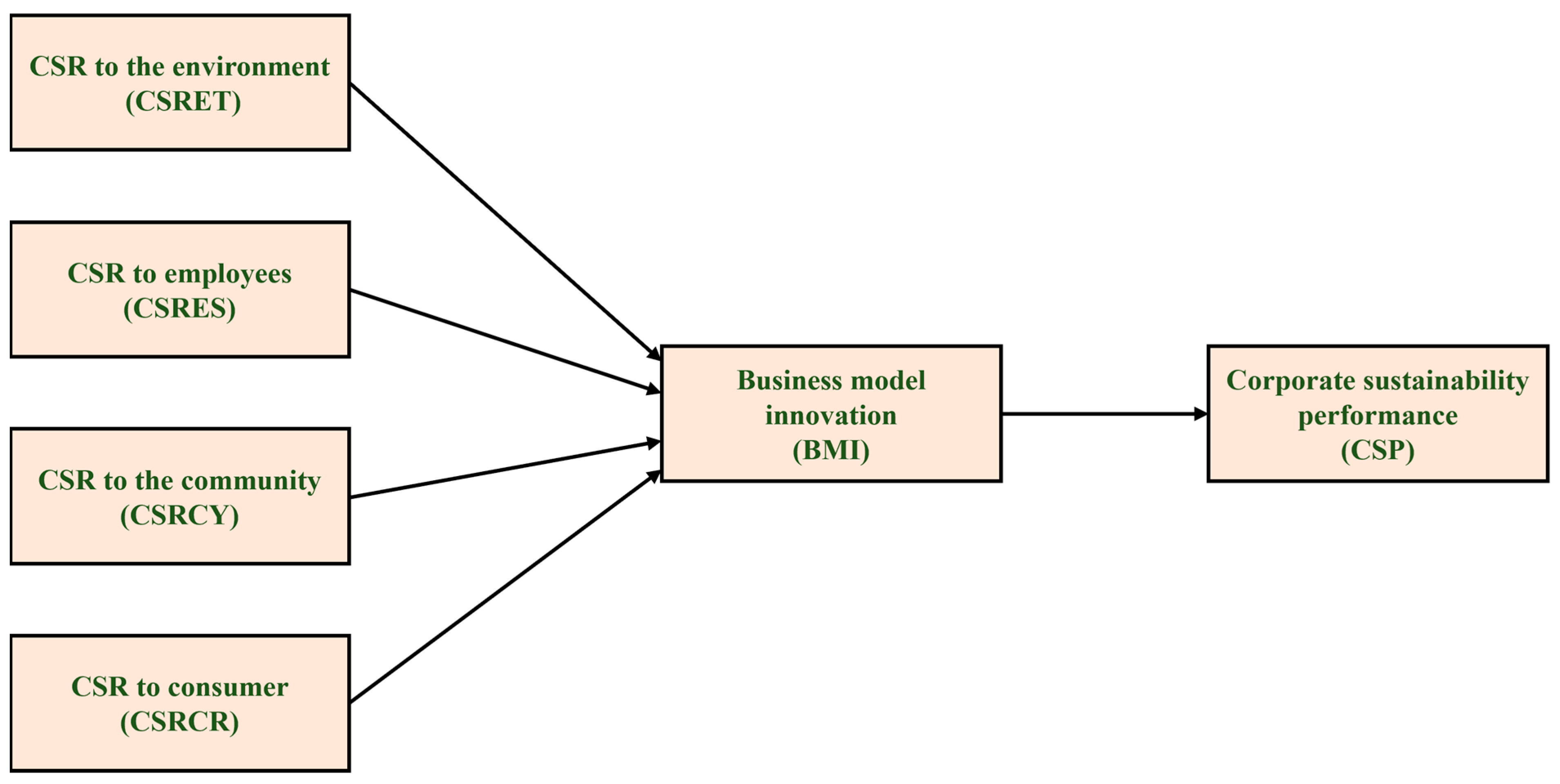
The above-mentioned theoretical discourse and hypothesis development form the foundation for constructing the theoretical framework of this research. Consequently, Figure 1 portrays the model employed in this study. This model encompasses six crucial factors: CSR towards the environment (CSRET), CSR towards employees (CSRES), CSR towards the community (CSRCY), CSR towards consumers (CSRCR), Business Model Innovation (BMI), and Corporate Sustainability Performance (CSP). Its purpose is to examine the interconnections amid these variables, with the intention of assisting small and medium-sized enterprises in attaining sustainable development objectives. To ensure the validity of the measurement items, we employed relevant literature and validated scales, making necessary modifications as presented in Table 1. In line with [39] research, three measurement items were employed for each aspect of CSR, namely CSR towards the environment, employees, community, and consumers. Moreover, taking cues from [53,76], and customizing accordingly, three items were used to assess Business Model Innovation. Lastly, Corporate Sustainability Performance was gauged using six measurement items [77].
Furthermore, this research utilized a Likert scale for scoring, which spanned seven points from “strongly disagree” (1) to “strongly agree” (7). Additionally, revisions were made to all items to reduce linguistic differences, ensuring accurate representation of the measured variables within the Chinese context. The survey questionnaire was divided into three parts. The first part outlined the aim of the study, while the second part gathered important demographic information, including gender, age, educational background, work experience, and other pertinent details. In the final section, participants were asked to evaluate each measurement related to the variables explored in this research.

4.2. Data Collection

The data for this research was obtained from small and medium-sized manufacturing companies in China. To maintain precision and dependability, the data gathering procedure was conducted in two phases. The sampling frame for both phases was drawn from the China National Enterprise Credit Information Publicity System database, which lists registered manufacturing SMEs across multiple provinces. Stratified by industry type (automotive, electronics, food and beverages, woodworking, and textiles), the sampling ensured cross-industry representation and organizational diversity, capturing firms with varying levels of CSR engagement and BMI activity. The first phase involved pilot surveys administered to a randomly selected sub-sample of 100 firms. A total of one hundred surveys were disseminated, of which 97 valid responses were obtained, yielding an impressive response rate of 97.000%. No incorrect samples were found due to inconsistencies or significant missing information. Subsequently, the gathered data underwent thorough reliability and validity assessments. Any metrics that did not satisfy the specified criteria were discarded. Additionally, informed by the experiences gathered during the research process and the feedback from the participants, appropriate adjustments were made to the questionnaire items.
Respondents were randomly selected from small and medium-sized manufacturing firms in China, particularly targeting individuals in managerial and executive roles who have extensive experience within these organizations. A total of 500 questionnaires were distributed, yielding 481 completed responses. After omitting 8 questionnaires due to significant missing data or poor quality of completion, we ended up with 473 valid samples, which resulted in an impressive effective response rate of 94.600%. It is important to emphasize that great care was exercised to maintain the confidentiality of all information provided by each participant.
The choice of small and medium-sized enterprises (SMEs) within the Chinese manufacturing sector as the focus for this research examining the relationship among corporate social responsibility (CSR), innovation in business models, and corporate sustainability performance is based on several strong justifications. To begin with, SMEs serve as a fundamental component of the Chinese economy, contributing notably to both industrial output and job creation. However, they encounter distinct challenges and opportunities when it comes to incorporating CSR into their business practices. This unique context makes them a fitting group for exploring the ways in which CSR efforts can drive innovation in business models. Secondly, the manufacturing industry in China is undergoing swift transformation, propelled by both changes in domestic policies aimed at sustainability and pressures from the global marketplace. Analyzing this sector facilitates an exploration of the effects of CSR within a fast-paced and high-stakes context. Furthermore, the imperative for innovation in business models and improvement of corporate sustainability among these SMEs is intensified by the necessity to remain competitive in a swiftly changing market while also complying with strict environmental regulations and societal demands for sustainable practices. Finally, the variety of CSR dimensions—such as environmental, employee, community, and consumer aspects—among the SMEs in this sector offers an extensive perspective on how various components of CSR can affect innovation and sustainability outcomes.

4.3. Mixed-Methods Data Analysis

The sequential mixed-methods design adopted in this study integrates qualitative case evidence with quantitative SEM analysis in a specific and deliberate manner. The qualitative case study of Firm A was not designed as a pilot instrument pre-test, nor as a scale validation exercise. Rather, it serves two distinct purposes within the overall research design. First, preceding the quantitative analysis, the case provides theoretical elaboration of the CSR-BMI-CSP mechanisms: by examining how CSR is enacted within a real organizational context, the case evidence grounds the hypothesized pathways in observed organizational practices, thereby enhancing the interpretive credibility of the SEM model. Second, following the quantitative results, the case provides a mechanistic explanation for the statistical relationships identified: where SEM confirms that specific CSR dimensions predict BMI (e.g., the stronger effect of CSRCY and CSRCR versus CSRES), the case evidence illuminates the organizational processes and managerial interpretations that underlie these differential effects. This integration strategy reflects a “theory elaboration” logic in which qualitative evidence deepens understanding of quantitatively established relationships rather than merely illustrating them [78].
To facilitate statistical analysis, this study utilized SPSS and AMOS software. The first step was to conduct tests for common method biases, carry out factor analysis, and evaluate the model fit of the research model. Subsequently, an assessment was performed to examine the reliability, validity, and discriminant validity of the model. Finally, a thorough evaluation of all pathways within the research model and its hypotheses was conducted. It is acknowledged that both Harman’s single-factor test and the CFA comparison method, while widely used, have recognized limitations in fully ruling out common method variance [79]. Future research employing longitudinal data collection or objective archival measures would further strengthen causal inferences.

4.4. A Case Analysis and Qualitative Interview

To complement the quantitative survey data and provide deeper mechanistic insights, we conducted an in-depth case study of Firm A, a representative SME in China’s manufacturing sector. This research elucidates how corporate social responsibility (CSR) is translated into enhanced sustainability performance through business model innovation (BMI). By integrating qualitative evidence from interviews with top executives and employees, the findings move beyond treating CSR as a peripheral or reputational activity and instead demonstrate how CSR becomes embedded in the firm’s core value creation logic. In doing so, the case offers fine-grained insights into the micro-processes through which CSR informs strategic decision-making and organizational innovation.
(1)
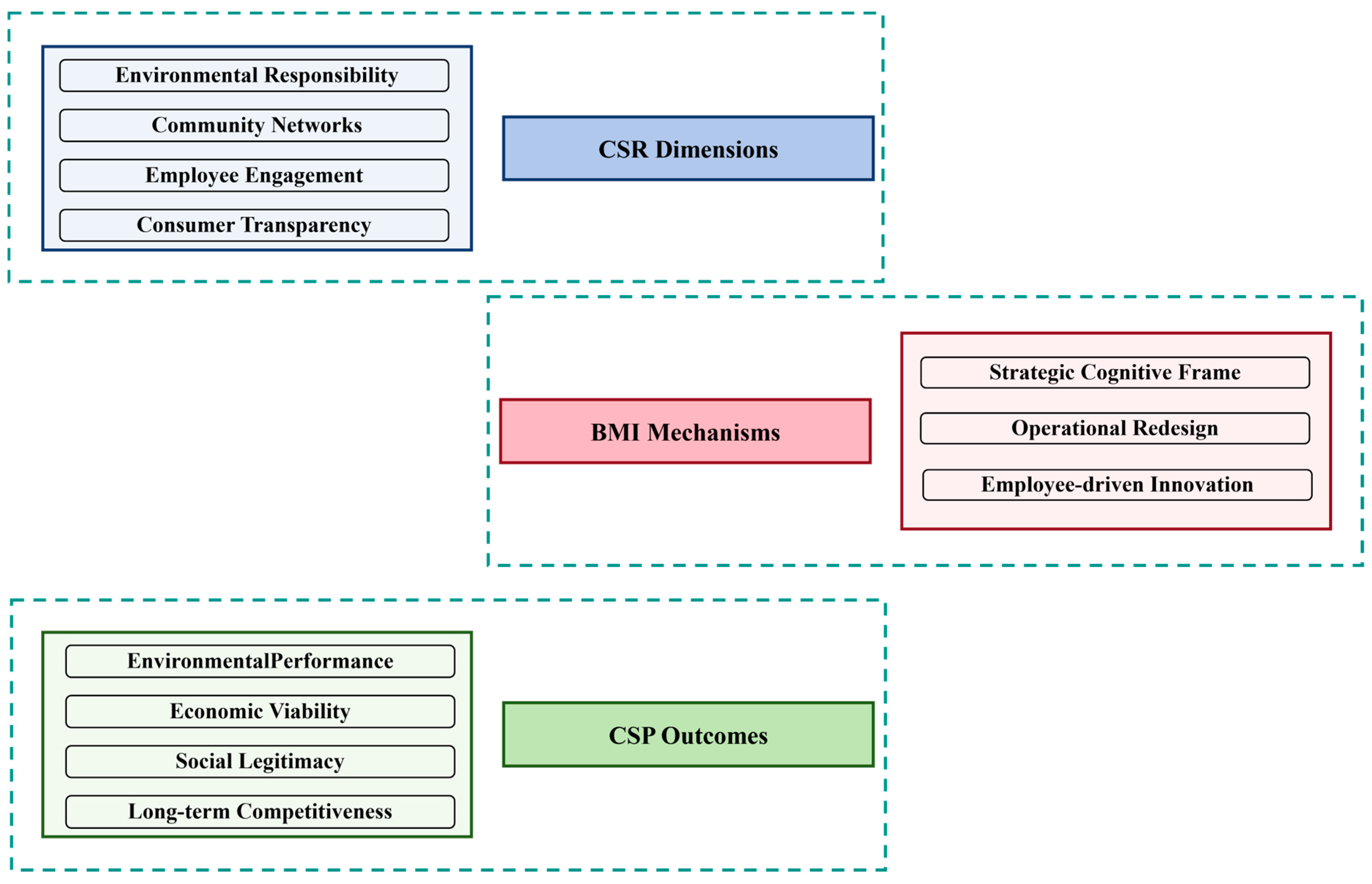
CSR as a strategic cognitive frame enabling business model innovation.
A central insight emerging from the case is that CSR functions as a strategic cognitive frame rather than merely a compliance-oriented or symbolic practice. Senior executives consistently articulated CSR as an integral component of the firm’s long-term competitive positioning. As the CEO noted:
“We do not see CSR as an obligation imposed from outside. It is a way to rethink how we design products and enter markets, and ultimately how we sustain our competitive advantage.”
This framing is theoretically important because it suggests that CSR shapes managerial attention and problem framing, thereby influencing which business model opportunities are perceived as legitimate and desirable. Not only generating innovation outcomes, CSR reorients strategic also priorities and legitimizes experimentation with novel value propositions. This finding extends prior CSR research that emphasizes external legitimacy or reputational benefits by highlighting its internal cognitive and strategic role in guiding business model design choices.
(2)
Operationalizing CSR through business model design choices.
At the operational level, CSR was translated into concrete business model innovations, particularly in relation to environmental responsibility and stakeholder integration. Environmental initiatives were not implemented as isolated operational adjustments but were incorporated into broader changes in production processes and supply chain configurations. As the COO explained:
“Environmental responsibility pushed us to rethink how our production system works. By redesigning processes and introducing greener materials, we reduced waste and energy use, while also improving cost efficiency.”
This evidence illustrates how CSR-driven environmental goals acted as a catalyst for reconfiguring key activities and resources within the firm’s business model. Importantly, these changes generated both ecological and economic value, underscoring the role of BMI as a mechanism that reconciles social responsibility with commercial viability. Within the boundary conditions of this case, CSR thus appears to facilitate sustainability outcomes by encouraging firms to search for efficiency-enhancing and value-creating innovations rather than treating responsibility as a cost burden.
(3)
Employee-centered CSR and the micro-foundations of innovation.
Another salient finding concerns the role of employee-focused CSR in enabling bottom-up contributions to business model innovation. Interview data indicate that investments in employee well-being and development strengthened organizational identification and encouraged proactive engagement in innovation-related activities. According to the human resources manager:
“When employees feel that the company genuinely cares about their development, they are more willing to share ideas and participate in innovation projects.”
From a theoretical perspective, this suggests that CSR reshapes employees’ interpretations of their roles within the organization, lowering perceived risks associated with proposing novel ideas and increasing intrinsic motivation to contribute to change initiatives. Employees themselves echoed this sentiment. As one interviewee remarked:
“Participating in CSR projects made me feel that my work has a broader meaning. It motivated me to think differently about how we serve customers.”
These observations point to the micro-foundations through which CSR supports BMI, highlighting how responsibility-oriented practices can mobilize distributed innovative capacity within the organization. This insight complements existing BMI research by emphasizing the importance of socially grounded employee engagement in sustaining innovation processes (see Figure 2).
(4)
CSR to the community as a strategic enabler of business model innovation.
Community-oriented CSR plays a key role in driving business model innovation by helping firms integrate social value into their core strategies. Firm A’s community engagement is viewed not just as philanthropy but as a strategic lever for long-term growth. As a senior manager explained:
“Our involvement in community initiatives isn’t just about giving back; it’s about building long-term relationships that open up new markets and enhance our brand image.”
This aligns with dynamic capabilities theory, which highlights how community-driven insights enhance the firm’s ability to innovate and adapt. Community CSR initiatives create a feedback loop, enabling Firm A to continuously refine its business model, opening doors to new market segments while fostering societal goodwill.
In practice, this strategic approach not only enhances legitimacy but also drives market expansion. For instance, Firm A’s collaboration with local organizations led to innovative, socially responsible products that appealed to new customer segments.
(5)
CSR to consumers as a competitive differentiator.
Consumer-facing CSR, focused on ethical products and consumer welfare, is central to Firm A’s innovation strategy. As a marketing executive noted:
“Today’s consumers care deeply about the origins of the products they buy. We have adjusted our business model to offer products that not only meet ethical standards but also provide clear value in terms of environmental impact and social responsibility.”
This aligns with consumer behavior theory, where CSR initiatives address growing consumer demand for sustainability. By integrating CSR into product design and marketing, Firm A differentiates itself in a competitive market and builds consumer loyalty.
From a resource-based view (RBV), CSR-driven innovations serve as a unique resource, enhancing the firm’s value proposition. The firm’s commitment to ethical practices creates stronger brand equity and customer trust, which in turn drives long-term sales growth.
In practice, CSR to consumers is not only a response to ethical consumer demand but also a source of competitive advantage. Firm A’s sustainability efforts have led to product innovations that meet consumer preferences, resulting in increased market share and customer retention.
(6)
Integrative mechanisms linking CSR, BMI, and sustainability performance.
Synthesizing the interview evidence, the case reveals an integrative mechanism whereby CSR influences sustainability performance indirectly through its impact on business model innovation. Rather than exerting a uniform effect, different CSR dimensions play distinct but complementary roles. Environmental responsibility primarily drives changes in value creation and delivery mechanisms, while employee-oriented CSR strengthens the organizational conditions necessary for continuous innovation. Consistent with this interpretation, frequently recurring themes in the interview data—such as “innovation”, “long-term value”, and “employee participation”—underscore the close coupling between CSR practices and business model reconfiguration.

5. Empirical Analysis

5.1. Demographic Information

Table 2 presents the demographic information of the respondents. It can be observed that 53.488% of the sample respondents were male, and 46.512% were female. The majority of respondents fell within the age range of 20–40 years (44.820%) and 40–60 years (52.643%). Additionally, most of the respondents held an undergraduate degree (38.266%). In terms of work experience, the highest proportion of respondents (39.535%) had 10–15 years of experience. Regarding job positions, 15.433% were marketing managers, 16.702% were plant managers, 15.645% were R&D managers, 14.799% were purchasing managers, 17.548% were production managers, and 3.171% had other positions. Furthermore, the industries in which the surveyed companies operated included automotive (20.719%), electronics (21.987%), food and beverages (23.890%), woodworking and furniture (18.816%), and textiles and clothing (14.588%). Finally, the highest percentage of companies surveyed fell within the age range of 30–60 years (27.484%).

5.2. Common Method Bias

To assess the possible risk of common method bias (CMB) within this study, two separate approaches were utilized. The first method employed for this evaluation was the Harman’s single-factor test. In addition, exploratory factor analysis was performed on all measurement items through the use of SPSS 22.0 software. The results from the analysis of the reduced dimensions showed no indications that CMB influenced the research dataset. This finding was corroborated by the fact that the initial unrotated factor explained merely 28.980% of the variance, which is below the accepted threshold of 50% [79].
In addition, consistent with the study conducted by [80], a comprehensive assessment of CMB was executed utilizing the CFA comparison method (refer to Table 3). To begin, all measurement items were consolidated into a single-factor model, designated as Model 1. Following this, in accordance with the original CFA, the theoretically related variables and measurement items were integrated into Model 2, which functions as a multi-factor model. A chi-square values comparison between the two models was performed as part of the testing procedure. The results from this comparative evaluation indicated that ∆χ2 = 45.119, ∆df = 21, p = 0.002, which is below 0.05, implying that the study did not demonstrate CMB.

5.3. Exploratory Factor Analysis

A factor analysis aimed at exploration was conducted using the scale applied in this research, with SPSS version 27.0 and the principal component analysis method. The KMO (Kaiser–Meyer–Olkin) statistic obtained from this analysis was 0.858, exceeding the minimum acceptable value of 0.7. Additionally, the Bartlett Test of Sphericity resulted in a value of 5553.444, accompanied by 210 degrees of freedom (df) and a significance level of 0.000, which is below the 0.05 threshold, thus suggesting that the dataset is appropriate for exploratory factor analysis.
Utilizing the gravel diagram to identify various factors, a technique for maximum variance rotation was applied to ensure the eigenvalues of these factors exceeded 1. Following the extraction of six factors and the elimination of measurement items that exhibited cross-loadings among multiple factors, the different measurement indicators were organized according to their respective factors. Table 4 displays the findings of the exploratory factor analysis, demonstrating that all factor loadings for the measurement items surpassed 0.600, and every Cronbach’s alpha value was higher than 0.700. These findings suggest that the exploratory factor analysis conducted in this research has produced a positive analytical result.

5.4. Confirmatory Factor Analysis

To assess the constructive differentiation among the variables, a confirmatory factor analysis (CFA) was conducted, as detailed in Table 5. The analysis outcomes indicated that the six-factor model demonstrated a superior fit compared to the alternative five models (c2/df = 1.099, RMSEA = 0.015, CFI = 0.997, IFI = 0.997, TLI = 0.996, SRMR = 0.027). A comparative evaluation of the multi-factor models validated the robust discriminant validity of the six distinct first-order variables featured in this research, emphasizing their function in representing separate constructs. Additionally, these findings endorse the suitability of applying the six-factor model for empirical analysis within the framework of this study, aligning with recognized research standards.

5.5. Model Fit Test

The evaluation of the fit indices for the research model is presented in Table 6. The results indicate that the CMID/DF is below 5.000, GFI exceeds 0.800, AGFI is above 0.800, CFI is higher than 0.900, TLI surpasses 0.900, and both RMSEA and SRMR are under 0.080. All these fit indices have exceeded their critical thresholds, confirming that the research model demonstrates a robust fit.

5.6. Measurement Model Analysis

To assess the scale, this study conducted tests to determine reliability, validity, and discriminant validity regarding the measurement model. Initially, Cronbach’s alpha (CA) and composite reliability (CR) were employed to assess the scale’s reliability. The results of the analysis (refer to Table 6) reveal that all CA values for the variables exceeded the required minimum of 0.7 [85,86]. Moreover, [86] pointed out that a CR value greater than 0.95 indicates a high degree of homogeneity among the variables, suggesting potential measurement redundancy. The findings from the study did not show any CR values beyond 0.95; however, they all exceeded the minimum threshold of 0.7 (see Table 7), thus satisfying the criteria for internal consistency reliability.
Following this, the average variance extracted (AVE) was utilized in this research to assess construct validity [86]. According to academic standards, the AVE for each construct should exceed 0.50 [87]. The results indicate that the AVE values for all variables exceeded the minimum required threshold of 0.5, demonstrating that the measurement scale employed in this study possesses robust construct validity.
Ultimately, the results from the discriminant validity assessment (refer to Table 8) reveal that the square root of the AVE for each variable surpasses the correlation coefficients among these variables, implying that the discriminant validity established in this study is justified [87].

5.7. Structural Model Analysis

The results of the hypothesis analysis are shown in Table 9, all research hypotheses have received support. Specifically, the Unstd (β) value between CSRET and BMI is 0.200, with a Z value of 3.411, and p < 0.01. This indicates a close and positive relationship between CSRET and BMI. Additionally, when verifying the relationship between CSRES and BMI, found that the path’s β value is 0.117, with a Z value of 2.104, p < 0.05, thus supporting the hypothesis of a significant positive impact of CSRES on BMI. Similarly, the hypotheses between CSRCY and BMI, between CSRCR and BMI, as well as between BMI and CSP, are supported.

5.8. Mediation Effect Analysis

Utilizing the methodology described by [88], this study employed the bootstrap technique to explore the potential existence of a mediating effect. Initially, a confidence interval of 95% was established, followed by the creation of 1000 bootstrap samples. Analyses conducted with AMOS software 23.0 indicated that a mediating effect is evident when the Z value exceeds 1.96, and both the Bias-Corrected and Percentile confidence intervals do not encompass 0. Conversely, if 0 is part of the interval, it signifies that a mediating effect is not present.
According to the results in Table 10, the indirect effect intervals for all pathways do not contain 0 not only in the bias-corrected 95% confidence intervals, but also in the percentile 95% confidence intervals, and the Z-value is greater than 1.96. Therefore, all these mediating effects are significant.

6. Conclusions and Discussions

In recent times, concerns related to environmental matters like the alterations in climate conditions have garnered significant attention. Furthermore, there is an increasing demand on businesses to bear the responsibility of addressing the rising societal challenges [89]. In order to tackle the global apprehensions pertaining to the environment and meet the expectations of stakeholders, organizations are compelled to implement environmentally friendly practices and tackle societal issues [90,91]. The implementation of such practices is imperative for ensuring operational effectiveness and long-term survival [92]. Meanwhile, it has been argued by [93] that economic growth coupled with industrialization and urbanization contributes to an increased strain on the ecological environment, especially in developing nations [94]. Consequently, business model innovation has become a focal point of attention in both theoretical and empirical research, as it possesses the potential to create sustainable competitive advantages and deliver exceptional value to various stakeholders.
Against this backdrop, the empirical findings of this study offer several theoretically interpretable insights. Examining the differential magnitudes of the four CSR–BMI paths illuminates nuances that aggregate CSR treatments obscure. CSRCY (β = 0.249) and CSRCR (β = 0.253) exhibit stronger standardized effects on BMI than CSRET (β = 0.191) and CSRES (β = 0.115). This pattern is theoretically interpretable through stakeholder salience theory [95]: community and consumer stakeholders tend to exert more immediate legitimacy and market pressures on Chinese manufacturing SMEs than regulatory environmental bodies or internal employee constituencies, thereby creating stronger incentive structures for BMI. The comparatively weaker CSRES-BMI path may reflect the structural constraint that employee-driven innovation in SMEs is limited by resource scarcity and hierarchical decision-making cultures, suggesting a boundary condition for the human capital pathway. These differential effects caution against treating CSR as a monolithic driver of innovation and underscore the importance of the dimensional disaggregation approach adopted in this study.

6.1. Theoretical Contributions

This study advances theoretical understanding of the CSR-BMI-CSP nexus along three dimensions. First, by disaggregating CSR into four stakeholder-oriented dimensions and demonstrating their differential effects on BMI, it contests monolithic treatments of CSR and refines stakeholder theory by establishing that the salience of different stakeholder groups—community, consumers, environment, and employees—produces heterogeneous innovation effects. Second, by formally establishing BMI’s mediating role through bootstrapped indirect effect analysis, the study provides the first empirical test of BMI as a dynamic capability mechanism through which CSR obligations are converted into sustainability performance outcomes in the SME context. Third, by embedding these findings within China’s institutional context, it establishes boundary conditions for the generalizability of CSR-innovation theories developed primarily in Western, large-firm settings.
Beyond these core contributions, the present study responds to calls for mechanism-level research in BMI scholarship [68] by moving beyond variance-explanation toward process-level theorization. Prior quantitative studies have established that CSR positively predicts sustainability outcomes but have rarely identified the organizational mechanisms that enable this translation. By formally testing BMI as a mediating pathway and triangulating statistical results with qualitative case evidence, this study bridges that explanatory gap and provides a more causally grounded account of the CSR–sustainability relationship.
The SME focus also contributes a theoretically important boundary condition. Prior CSR–sustainability research has predominantly relied on large, publicly listed firms with dedicated CSR departments and substantial organizational slack. By demonstrating that the CSR-BMI-CSP mechanism operates robustly among resource-constrained manufacturing SMEs, the study suggests that BMI’s mediating function does not require organizational scale as a prerequisite. This finding extends stakeholder theory and the RBV to smaller organizational contexts and to firms in emerging economies, broadening the boundary conditions under which these theories apply.

6.2. Practical Contributions

This study not only brings theoretical innovations but also offers practical guidance. Companies can motivate themselves to engage in business model innovation and enhance their sustainable development capabilities by fulfilling their social responsibilities. Meanwhile, when engaging in business model innovation, companies should pay more attention to the sustainable development of society and the environment, achieving a win–win situation for both economic and social benefits. The findings of this study can provide strategic guidance for businesses, helping them adapt more flexibly and inclusively to the constantly changing business environment and driving them towards a more sustainable development direction. In addition, this study not only provides reference for the sustainable development of small and medium-sized enterprises in the Chinese manufacturing industry and lays the groundwork for improving relevant policies but also offers solutions for business model innovation and sustainable development issues in more developing countries.
Based on the research conclusions, the following specific recommendations are provided to promote the sustainable development of businesses: (1) Companies can fulfill their environmental responsibility by implementing green supply chain management, reducing energy consumption and carbon emissions, and utilizing renewable energy. In business model innovation, environmental protection concepts should be integrated throughout the entire value chain, from product design to production, sales, and service, with a focus on environmental protection. (2) Companies should focus on employee rights, provide a good working environment and benefits, encourage employee participation in decision-making, and enhance their skills. Establishing employee training programs, health management systems, and mechanisms for employee participation in decision-making can improve employee satisfaction and loyalty, stimulate employee innovation, and thereby drive business model innovation. (3) Companies should prioritize consumer rights and interests protection, providing high-quality products and services, and paying attention to consumer needs and opinions. Establishing a sound customer service system, strengthening product quality management and after-sales service, engaging in public welfare activities, effectively responding to societal concerns about product quality, safety, and environmental protection, can enhance the company’s brand image and market competitiveness, driving business model innovation. (4) Companies should establish partnerships with the community, support local community sustainable development, fulfill their social responsibility, and promote a positive social image. For example, engaging in volunteer services, making charitable donations, or supporting local education and employment opportunities.
Additionally, this study also confirms that business model innovation is one of the important means to promote the sustainable development performance of enterprises. In order to achieve sustainable development, companies can take the following measures: (1) Continuously innovating products and services to meet the diverse needs of consumers, while focusing on the environmental performance and social responsibility of products, and using this as the basis to develop green and sustainable business models. (2) Introducing the concept of a circular economy to promote the recycling of resources, reduce emissions and waste, and maximize resource utilization through methods such as product reuse, remanufacturing, and redesign for recycling, in order to minimize the negative impact on the environment. (3) Actively adopting new technologies to improve production efficiency and product quality, reduce energy consumption, and minimize environmental pollution, while enhancing the company’s competitiveness through technological innovation. (4) Integrate social responsibility into the business model, prioritize employee rights, fulfill environmental obligations, focus on community development, enhance consumer rights protection, and thereby establish a positive corporate image and gain social recognition.
Moreover, listed firms in China need to disclose corporate social responsibility (CSR) information. With the continuous refinement of the green credit policy framework and the adoption of national dual carbon targets (carbon peak by 2030 and carbon neutrality by 2060), manufacturing SMEs face pressures both from government compliance mandates and from supply chain customers demanding ESG-aligned sourcing. Therefore, policy interventions should fully leverage existing institutional mechanisms. For example, integrating CSR performance metrics into the current enterprise credit rating system would create market-based incentives for SMEs to invest in CSR dimensions that foster business model innovation (BMI). At the same time, the generalizability of these findings to other emerging economies with different regulatory architectures should be explored in future comparative studies. This research offers significant perspectives on government regulation and policy formulation. The results can guide the creation of focused policies that encourage responsible business behavior while also fostering economic development and social well-being. In light of the findings, the subsequent suggestions are put forth to enhance and refine government regulation and policy-making.
To promote environmental regulation and incentives: (1) Implement a “green tax” system that differentiates between polluters and eco-friendly businesses, rewarding those that invest in sustainable practices. (2) Establish a “green procurement” policy that mandates government agencies to prioritize products and services from companies with strong CSRET. (3) Create a “green innovation fund” to support SMEs in the manufacturing sector to develop and adopt environmentally sustainable technologies.
To promote employee well-being and enhance workforce development: (1) Implement health and safety regulations within the workplace, imposing sanctions for violations, to reinforce the commitment to CSRES. (2) Establish a “CSR certification” initiative aimed at organizations that excel in employee welfare, granting them a competitive advantage in government contract opportunities. (3) Advocate for the incorporation of continuous learning and skill enhancement programs into corporate CSR frameworks, thereby nurturing a workforce that is more resilient and adaptable.
To enhance community engagement and social influence: (1) Establish a “community impact assessment” requirement for new manufacturing projects, ensuring that CSRCY is considered in the planning phase. (2) Implement a “social investment tax credit” for companies that invest in community development projects, incentivizing social responsibility. (3) Create a “community partnership fund” to facilitate collaborations between businesses and local communities, fostering mutual benefits.
To promote consumer responsibility and ethical practices: (1) Implement rigorous labeling requirements for products adhering to specific CSR criteria, enabling consumers to make educated decisions. (2) Establish a “consumer protection” system that encompasses actions against misleading marketing tactics, thereby advancing CSR. (3) Create a “CSR disclosure platform” that allows companies to share their CSR initiatives publicly, thereby increasing transparency and accountability.


7. Research Limitations and Future Perspectives

This research has contributed both in theory and practice, but there are limitations that need to be addressed in future studies. First, the data for this research was only acquired from small and medium-sized enterprises operating in the Chinese manufacturing sector; hence, future research could incorporate sample data from other industries. Furthermore, given the rapid expansion of China’s high-tech industry and associated environmental pressures, future scholars could extend this research framework to high-tech firms and examine whether the CSR-BMI-CSP pathways differ from those observed in manufacturing SMEs. Second, the qualitative case study relies on a single firm (Firm A), which, while providing valuable mechanistic insights, limits the diversity of organizational contexts represented. Future research employing multiple comparative cases, including firms with contrasting CSR profiles such as high versus low engagement or operating in different regulatory environments, would strengthen the explanatory reach of the qualitative component and enable theoretical replication across varied contexts. Third, despite employing Harman’s single-factor test and a CFA comparison approach to assess common method bias (CMB), these methods have well-documented limitations in fully ruling out method variance [79]. The application of more rigorous CMB controls, including the marker variable technique, the latent method factor approach, or the use of longitudinal survey designs, is recommended for future studies. Additionally, this study does not distinguish between state-owned and private enterprises, which may exhibit systematically different CSR motivations and BMI capacities under China’s institutional environment; future research should examine whether the CSR-BMI-CSP pathways differ across ownership types.

Author Contributions

Conceptualization, M.X. and Z.T.; methodology, M.X. and Z.T.; software, Z.T.; validation, M.X.; formal analysis, Z.T.; investigation, M.X.; resources, M.X.; data curation, Z.T.; writing—original draft preparation, M.X. and Z.T.; writing—review and editing, Z.T.; visualization, Z.T.; supervision, M.X.; project administration, M.X.; funding acquisition, M.X. All authors have read and agreed to the published version of the manuscript.

Funding

This research received no external funding.

Institutional Review Board Statement

Ethical approval was not required for this study according to the relevant local regulations in China. This research was based on anonymous surveys involving enterprise managers and did not include any clinical trials, sensitive personal data, or biomedical interventions. According to the Measures for the Ethical Review of Biomedical Research Involving Humans issued by the National Health Commission of the PRC (2016) (https://www.gov.cn/zhengce/zhengceku/2023-02/28/content_5743658.htm, accessed on 1 August 2025), social science research involving anonymous questionnaires that do not collect sensitive personal data is exempt from formal ethical review. This exemption was confirmed prior to the commencement of this study. This study adhered to the principles of the Declaration of Helsinki (2013 revision) and complied with all applicable local regulations regarding research ethics and academic integrity.

Informed Consent Statement

Informed consent was obtained from all subjects involved in the study. Oral informed consent was obtained instead of written consent due to the nature of the study, which involved minimal risk to participants and no collection of sensitive personal data. All participants were informed of the study’s purpose, confidentiality measures, and their right to withdraw at any time prior to participation.

Data Availability Statement

The data presented in this study are available on request from the corresponding author.

Conflicts of Interest

The authors declare no conflicts of interest.

References

  1. Markard, J.; Raven, R.; Truffer, B. Sustainability transitions: An emerging field of research and its prospects. Res. Policy 2012, 41, 955–967. [Google Scholar] [CrossRef]
  2. Jin, Y.; Ji, S.; Liu, L.; Wang, W. Business model innovation canvas: A visual business model innovation model. Eur. J. Innov. Manag. 2022, 25, 1469–1493. [Google Scholar] [CrossRef]
  3. Santandrea, M.; Agasisti, T.; Giorgino, M.; Patrucco, A.S. Business models in the search for efficiency: The case of public financial intermediaries. Public Money Manag. 2018, 38, 234–243. [Google Scholar] [CrossRef]
  4. Feng, Q.; Shanthikumar, J.G. How Research in Production and Operations Management May Evolve in the Era of Big Data. Prod. Oper. Manag. 2018, 27, 1670–1684. [Google Scholar] [CrossRef]
  5. Boons, F.; Lüdeke-Freund, F. Business models for sustainable innovation: State-of-the-art and steps towards a research agenda. J. Clean. Prod. 2013, 45, 9–19. [Google Scholar] [CrossRef]
  6. Orazalin, N.; Baydauletov, M. Corporate social responsibility strategy and corporate environmental and social performance: The moderating role of board gender diversity. Corp. Soc. Responsib. Environ. Manag. 2020, 27, 1664–1676. [Google Scholar] [CrossRef]
  7. Orazalin, N. Do board sustainability committees contribute to corporate environmental and social performance? The mediating role of corporate social responsibility strategy. Bus. Strategy Environ. 2020, 29, 140–153. [Google Scholar] [CrossRef]
  8. Dembek, K.; York, J.; Singh, P.J. Creating value for multiple stakeholders: Sustainable business models at the Base of the Pyramid. J. Clean. Prod. 2018, 196, 1600–1612. [Google Scholar] [CrossRef]
  9. Rotondo, F.; Corsi, K.; Giovanelli, L. The social side of sustainable business models: An explorative analysis of the low-cost airline industry. J. Clean. Prod. 2019, 225, 806–819. [Google Scholar] [CrossRef]
  10. Spieth, P.; Schneider, S.; Clauß, T.; Eichenberg, D. Value drivers of social businesses: A business model perspective. Long Range Plan. 2019, 52, 427–444. [Google Scholar] [CrossRef]
  11. Liao, M.; Gao, Z.a.; Zhou, J.; Li, D. Business model innovation driven by corporate social responsibility in a digital innovation ecosystem: Evidence from Chinese manufacturers. Manag. Decis. Econ. 2025, 46, 2103–2119. [Google Scholar] [CrossRef]
  12. Amit, R.; Zott, C. Creating value through business model innovation. MIT Sloan Manag. Rev. 2011, 53, 41–49. [Google Scholar]
  13. Casadesus-Masanell, R.; Zhu, F. Business model innovation and competitive imitation: The case of sponsor-based business models. Strateg. Manag. J. 2013, 34, 464–482. [Google Scholar] [CrossRef]
  14. Rodriguez, R.; Molina-Castillo, F.-J.; Svensson, G. Enterprise resource planning and business model innovation: Process, evolution and outcome. Eur. J. Innov. Manag. 2020, 23, 728–752. [Google Scholar] [CrossRef]
  15. Chesbrough, H. Business model innovation: It’s not just about technology anymore. Strategy Leadersh. 2007, 35, 12–17. [Google Scholar] [CrossRef]
  16. Lindgardt, Z.; Reeves, M.; Stalk, J.G.; Deimler, M.; Deimler, M.; Sinha, J.; Rhodes, D.; Lesser, R. Business Model Innovation: When the Game Gets Tough, Change the Game; John Wiley & Sons, Inc.: Hoboken, NJ, USA, 2012; pp. 291–298. [Google Scholar]
  17. Choi, J.; Wang, H. Stakeholder relations and the persistence of corporate financial performance. Strateg. Manag. J. 2009, 30, 895–907. [Google Scholar] [CrossRef]
  18. Tsalis, T.A.; Malamateniou, K.E.; Koulouriotis, D.; Nikolaou, I.E. New challenges for corporate sustainability reporting: United Nations’ 2030 Agenda for sustainable development and the sustainable development goals. Corp. Soc. Responsib. Environ. Manag. 2020, 27, 1617–1629. [Google Scholar] [CrossRef]
  19. Faber, N.; Jorna, R.; Engelen, J.V. The sustainability of “sustainability”—A study into the conceptual foundations of the notion of “sustainability”. J. Environ. Assess. Policy Manag. 2005, 7, 1–33. [Google Scholar] [CrossRef]
  20. Adams, R.; Bessant, J.; Jeanrenaud, S.; Overy, P.; Denyer, D. Innovating for Sustainability: A Systematic Review of the Body of Knowledge; Network for Business Sustainability: London, ON, Canada, 2012. [Google Scholar]
  21. Jolink, A.; Niesten, E. Sustainable Development and Business Models of Entrepreneurs in the Organic Food Industry. Bus. Strategy Environ. 2015, 24, 386–401. [Google Scholar] [CrossRef]
  22. Teece, D.J. Business Models, Business Strategy and Innovation. Long Range Plan. 2010, 43, 172–194. [Google Scholar] [CrossRef]
  23. Zott, C.; Amit, R.; Massa, L. The Business Model: Recent Developments and Future Research. J. Manag. 2011, 37, 1019–1042. [Google Scholar] [CrossRef]
  24. Evans, S.; Vladimirova, D.; Holgado, M.; Van Fossen, K.; Yang, M.; Silva, E.A.; Barlow, C.Y. Business Model Innovation for Sustainability: Towards a Unified Perspective for Creation of Sustainable Business Models. Bus. Strategy Environ. 2017, 26, 597–608. [Google Scholar] [CrossRef]
  25. Pieroni, M.P.P.; McAloone, T.C.; Pigosso, D.C.A. Business model innovation for circular economy and sustainability: A review of approaches. J. Clean. Prod. 2019, 215, 198–216. [Google Scholar] [CrossRef]
  26. Carayannis, E.G.; Grigoroudis, E.; Sindakis, S.; Walter, C. Business Model Innovation as Antecedent of Sustainable Enterprise Excellence and Resilience. J. Knowl. Econ. 2014, 5, 440–463. [Google Scholar] [CrossRef]
  27. Kajtazi, K.; Rexhepi, G.; Sharif, A.; Ozturk, I. Business model innovation and its impact on corporate sustainability. J. Bus. Res. 2023, 166, 114082. [Google Scholar] [CrossRef]
  28. Chen, C.-H. The mediating effect of corporate culture on the relationship between business model innovation and corporate social responsibility: A perspective from small-and medium-sized enterprises. Asia Pac. Manag. Rev. 2022, 27, 312–319. [Google Scholar] [CrossRef]
  29. Nascimento, L.d.S.; Trizotto, R.C.A.; Sott, M.K.; Lago, N.C.; Pivoto, D.; Costa Júnior, J.C.d.; Cortimiglia, M.N. Sustainable business model innovation: Bibliometric review and maturity matrix for benchmarking social, environmental and economic dimensions. Benchmarking Int. J. 2025, 32, 1–28. [Google Scholar] [CrossRef]
  30. Matten, D.; Moon, J. Reflections on the 2018 Decade Award: The Meaning and Dynamics of Corporate Social Responsibility. Acad. Manag. Rev. 2020, 45, 7–28. [Google Scholar] [CrossRef]
  31. Wijethilake, C.; Lama, T. Sustainability core values and sustainability risk management: Moderating effects of top management commitment and stakeholder pressure. Bus. Strategy Environ. 2019, 28, 143–154. [Google Scholar] [CrossRef]
  32. Chen, X. Corporate Social Responsibility and Stock Price Crash Risk—Moderating Effect Analysis of Social Capital. Am. J. Ind. Bus. Manag. 2020, 10, 600–618. [Google Scholar] [CrossRef][Green Version]
  33. Balcerowicz, L. Corporate social responsibility: Some clarifications and Questions. In The True Value of CSR: Corporate Identity and Stakeholder Perceptions; Springer: Berlin/Heidelberg, Germany, 2015; pp. 15–28. [Google Scholar]
  34. Tran, P.Q.; Le, T.T. Do corporate social responsibility drive sustainable corporate performance in emerging economy? Mediation roles of green innovation and corporate image. Asia-Pac. J. Bus. Adm. 2025, 17, 1–29. [Google Scholar] [CrossRef]
  35. Dahlsrud, A. How corporate social responsibility is defined: An analysis of 37 definitions. Corp. Soc. Responsib. Environ. Manag. 2008, 15, 1–13. [Google Scholar] [CrossRef]
  36. Mengke, Z.; Yan, H.; Yifan, J. A virtuous circle brought about by corporate social responsibility—A study of the dynamic relationship between social capital, social responsibility and corporate value. Corp. Soc. Responsib. Environ. Manag. 2023, 30, 2953–2968. [Google Scholar] [CrossRef]
  37. Tao, Z. Do not walk into darkness in greenhushing: A cross-cultural study on why Chinese and South Korean corporations engage in greenhushing behavior. Bus. Strategy Dev. 2024, 7, e401. [Google Scholar] [CrossRef]
  38. Bowen, H.R. Social Responsibilities of the Businessman, 1st ed.; University of Iowa Press: Iowa City, IA, USA, 2013. [Google Scholar]
  39. Farooq, M.; Farooq, O.; Jasimuddin, S.M. ‘Employees response to corporate social responsibility: Exploring the role of employees’ collectivist orientation. Eur. Manag. J. 2014, 32, 916–927. [Google Scholar] [CrossRef]
  40. Carroll, A.B. The pyramid of corporate social responsibility: Toward the moral management of organizational stakeholders. Bus. Horiz. 1991, 34, 39–48. [Google Scholar] [CrossRef]
  41. Elkington, J.; Rowlands, I.H. Cannibals with forks: The triple bottom line of 21st century business. Altern. J. 1999, 25, 42. [Google Scholar] [CrossRef]
  42. Serra-Cantallops, A.; Peña-Miranda, D.D.; Ramón-Cardona, J.; Martorell-Cunill, O. Progress in Research on CSR and the Hotel Industry (2006–2015). Cornell Hosp. Q. 2018, 59, 15–38. [Google Scholar] [CrossRef]
  43. Freeman, R.E. Strategic Management: A Stakeholder Approach; Cambridge University Press: Cambridge, UK, 2010. [Google Scholar]
  44. Osterwalder, A.; Pigneur, Y. Business Model Generation: A Handbook for Visionaries, Game Changers, and Challengers; John Wiley & Sons: Hoboken, NJ, USA, 2013. [Google Scholar]
  45. Rayna, T.; Striukova, L.; Darlington, J.; Joergensen, K.A.; Taps, S.B.; Brunoe, T.D.; Nielsen, K. Open Innovation, Co-Creation and Mass Customisation: What Role for 3D Printing Platforms? In Proceedings of the 7th World Conference on Mass Customization, Personalization, and Co-Creation (MCPC 2014), Aalborg, Denmark, 4–7 February 2014; Lecture Notes in Production Engineering; Springer International Publishing AG: Cham, Switzerland, 2014; pp. 425–435. [Google Scholar]
  46. Abdelkafi, N.; Täuscher, K. Business Models for Sustainability From a System Dynamics Perspective. Organ. Environ. 2016, 29, 74–96. [Google Scholar] [CrossRef]
  47. Chen, J.; Zhang, R.; Wu, D. Equipment Maintenance Business Model Innovation for Sustainable Competitive Advantage in the Digitalization Context: Connotation, Types, and Measuring. Sustainability 2018, 10, 3970. [Google Scholar] [CrossRef]
  48. Zhou, N.; Pan, L.; Tian, Y.; Zhu, N.; Cai, X.; Gao, J. How sustainable business model innovation and green technology innovation interact to affect sustainable corporate performance. Front. Environ. Sci. 2023, 11, 1049295. [Google Scholar] [CrossRef]
  49. Omidvar, M.; Confetto, M.G.; Palazzo, M. Business Model Innovation: A Bridge Between Corporate Social Responsibility and Successful Performance for Medium-Size Enterprises (SMEs) in the Digital Era. Systems 2025, 13, 378. [Google Scholar] [CrossRef]
  50. Chesbrough, H. Business Model Innovation: Opportunities and Barriers. Long Range Plan. 2010, 43, 354–363. [Google Scholar] [CrossRef]
  51. Schneider, S.; Spieth, P. Business model innovation: Towards an integrated future research agenda. Int. J. Innov. Manag. 2013, 17, 1340001. [Google Scholar] [CrossRef]
  52. Zhang, W.; Daim, T.; Zhang, Q. Understanding the disruptive business model innovation of E-business microcredit: A comparative case study in China. Technol. Anal. Strateg. Manag. 2018, 30, 765–777. [Google Scholar] [CrossRef]
  53. Pedersen, E.R.G.; Gwozdz, W.; Hvass, K.K. Exploring the Relationship Between Business Model Innovation, Corporate Sustainability, and Organisational Values within the Fashion Industry. J. Bus. Ethics 2018, 149, 267–284. [Google Scholar] [CrossRef]
  54. Lewandowski, M. Designing the Business Models for Circular Economy—Towards the Conceptual Framework. Sustainability 2016, 8, 43. [Google Scholar] [CrossRef]
  55. Carroll, A.B.; Shabana, K.M. The Business Case for Corporate Social Responsibility: A Review of Concepts, Research and Practice. Int. J. Manag. Rev. 2010, 12, 85–105. [Google Scholar] [CrossRef]
  56. Matuszewska-Pierzynka, A. Relationship between corporate sustainability performance and corporate financial performance: Evidence from U.S. companies. Equilibrium 2021, 16, 885–906. [Google Scholar] [CrossRef]
  57. Zaman, R.; Jain, T.; Samara, G.; Jamali, D. Corporate Governance Meets Corporate Social Responsibility: Mapping the Interface. Bus. Soc. 2022, 61, 690–752. [Google Scholar] [CrossRef]
  58. Liao, L.; Lin, T.; Zhang, Y. Corporate Board and Corporate Social Responsibility Assurance: Evidence from China. J. Bus. Ethics 2018, 150, 211–225. [Google Scholar] [CrossRef]
  59. Islam, T.; Islam, R.; Pitafi, A.H.; Xiaobei, L.; Rehmani, M.; Irfan, M.; Mubarak, M.S. The impact of corporate social responsibility on customer loyalty: The mediating role of corporate reputation, customer satisfaction, and trust. Sustain. Prod. Consum. 2021, 25, 123–135. [Google Scholar] [CrossRef]
  60. Hart, S.L.; Dowell, G.; Ketchen, D.J.; Barney, J.B.; Wright, M. Invited Editorial: A Natural-Resource-Based View of the Firm: Fifteen Years After. J. Manag. 2011, 37, 1464–1479. [Google Scholar] [CrossRef]
  61. Melville, N.P. Information Systems Innovation for Environmental Sustainability. MIS Q. 2010, 34, 1–21. [Google Scholar] [CrossRef]
  62. Schaltegger, S.; Hansen, E.G.; Lüdeke-Freund, F. Business Models for Sustainability: Origins, Present Research, and Future Avenues. Organ. Environ. 2016, 29, 3–10. [Google Scholar] [CrossRef]
  63. Dyllick, T.; Hockerts, K. Beyond the business case for corporate sustainability. Bus. Strategy Environ. 2002, 11, 130–141. [Google Scholar] [CrossRef]
  64. Tao, Z.; Chao, J. Unlocking new opportunities in the industry 4.0 era, exploring the critical impact of digital technology on sustainable performance and the mediating role of GSCM practices. Innov. Green Dev. 2024, 3, 100160. [Google Scholar] [CrossRef]
  65. Halkos, G.; Skouloudis, A. Corporate social responsibility and innovative capacity: Intersection in a macro-level perspective. J. Clean. Prod. 2018, 182, 291–300. [Google Scholar] [CrossRef]
  66. McWilliams, A.; Siegel, D. Corporate Social Responsibility: A Theory of the Firm Perspective. Acad. Manag. Rev. 2001, 26, 117–127. [Google Scholar] [CrossRef]
  67. Wang, Z.; Sarkis, J. Corporate social responsibility governance, outcomes, and financial performance. J. Clean. Prod. 2017, 162, 1607–1616. [Google Scholar] [CrossRef]
  68. Foss, N.J.; Saebi, T. Fifteen Years of Research on Business Model Innovation: How Far Have We Come, and Where Should We Go? J. Manag. 2017, 43, 200–227. [Google Scholar] [CrossRef]
  69. Christensen, C.M.; McDonald, R.; Altman, E.J.; Palmer, J.E. Disruptive Innovation: An Intellectual History and Directions for Future Research. J. Manag. Stud. 2018, 55, 1043–1078. [Google Scholar] [CrossRef]
  70. Markman, G.D.; Waldron, T.L. Small Entrants and Large Incumbents: A Framework of Micro Entry. Acad. Manag. Perspect. 2014, 28, 179–197. [Google Scholar] [CrossRef]
  71. Bocken, N.M.P.; Short, S.W.; Rana, P.; Evans, S. A literature and practice review to develop sustainable business model archetypes. J. Clean. Prod. 2014, 65, 42–56. [Google Scholar] [CrossRef]
  72. Kapoor, R.; Klueter, T. Decoding the Adaptability–Rigidity Puzzle: Evidence from Pharmaceutical Incumbents’ Pursuit of Gene Therapy and Monoclonal Antibodies. Acad. Manag. J. 2015, 58, 1180–1207. [Google Scholar] [CrossRef]
  73. Mostaghel, R.; Oghazi, P.; Parida, V.; Sohrabpour, V. Digitalization driven retail business model innovation: Evaluation of past and avenues for future research trends. J. Bus. Res. 2022, 146, 134–145. [Google Scholar] [CrossRef]
  74. Samsudin, W. The Evolution of Relationship Marketing (RM) Towards Customer Relationship Management (CRM): A Step towards Company Sustainability. Inf. Manag. Bus. Rev. 2010, 1, 88–96. [Google Scholar] [CrossRef]
  75. Aftab, J.; Veneziani, M.; Wei, F.; Abid, N.; Aftab, F. Corporate Social Responsibility and Business Excellence: Examining the Serial Mediation of Green Entrepreneurial Orientation and Differentiation Strategy. Corp. Soc. Responsib. Environ. Manag. 2025, 32, 3621–3638. [Google Scholar] [CrossRef]
  76. Hu, B.; Zhang, T.; Yan, S. How Corporate Social Responsibility Influences Business Model Innovation: The Mediating Role of Organizational Legitimacy. Sustainability 2020, 12, 2667. [Google Scholar] [CrossRef]
  77. Wijethilake, C. Proactive sustainability strategy and corporate sustainability performance: The mediating effect of sustainability control systems. J. Environ. Manag. 2017, 196, 569–582. [Google Scholar] [CrossRef]
  78. Lee, T.W.; Mitchell, T.R.; Sablynski, C.J. Qualitative Research in Organizational and Vocational Psychology, 1979–1999. J. Vocat. Behav. 1999, 55, 161–187. [Google Scholar] [CrossRef]
  79. Podsakoff, P.M.; MacKenzie, S.B.; Lee, J.-Y.; Podsakoff, N.P. Common method bias in behavioral research: A critical review of the literature and recommended remedies. J. Appl. Psychol. 2003, 88, 879–903. [Google Scholar] [CrossRef]
  80. Mossholder, K.W.; Bennett, N.; Kemery, E.R.; Wesolowski, M.A. Relationships between Bases of Power and Work Reactions: The Mediational Role of Procedural Justice. J. Manag. 1998, 24, 533–552. [Google Scholar] [CrossRef]
  81. Malhotra, N.K.; Lopes, E.; Veiga, R.T. Structural equation modeling with Lisrel: An initial vision. Braz. J. Mark. 2014, 13, 28–43. [Google Scholar] [CrossRef]
  82. Bagozzi, R.P.; Yi, Y. On the evaluation of structural equation models. J. Acad. Mark. Sci. 1988, 16, 74–94. [Google Scholar] [CrossRef]
  83. Bentler, P.M.; Bonett, D.G. Significance tests and goodness of fit in the analysis of covariance structures. Psychol. Bull. 1980, 88, 588–606. [Google Scholar] [CrossRef]
  84. Hu, L.-T.; Bentler, P.M. Cutoff criteria for fit indexes in covariance structure analysis: Conventional criteria versus new alternatives. Struct. Equ. Model. 1999, 6, 1–55. [Google Scholar] [CrossRef]
  85. Hair, J.F.; Hult, G.T.M.; Ringle, C.M.; Sarstedt, M. A Primer on Partial Least Squares Structural Equation Modeling (PLS-SEM), 2nd ed.; Sage: Los Angeles, CA, USA, 2017. [Google Scholar]
  86. Hair, J.F.; Risher, J.J.; Sarstedt, M.; Ringle, C.M. When to use and how to report the results of PLS-SEM. Eur. Bus. Rev. 2019, 31, 2–24. [Google Scholar] [CrossRef]
  87. Fornell, C.; Larcker, D.F. Evaluating Structural Equation Models with Unobservable Variables and Measurement Error. J. Mark. Res. 1981, 18, 39–50. [Google Scholar] [CrossRef]
  88. Hayes, A.F. Beyond Baron and Kenny: Statistical Mediation Analysis in the New Millennium. Commun. Monogr. 2009, 76, 408–420. [Google Scholar] [CrossRef]
  89. Ren, S.; Tang, G.; Jackson, S.E. Green human resource management research in emergence: A review and future directions. Asia Pac. J. Manag. 2018, 35, 769–803. [Google Scholar] [CrossRef]
  90. Meuer, J.; Koelbel, J.; Hoffmann, V.H. On the Nature of Corporate Sustainability. Organ. Environ. 2020, 33, 319–341. [Google Scholar] [CrossRef]
  91. Mani, V.; Gunasekaran, A.; Papadopoulos, T.; Hazen, B.; Dubey, R. Supply chain social sustainability for developing nations: Evidence from India. Resour. Conserv. Recycl. 2016, 111, 42–52. [Google Scholar] [CrossRef]
  92. Paillé, P.; Chen, Y.; Boiral, O.; Jin, J. The Impact of Human Resource Management on Environmental Performance: An Employee-Level Study. J. Bus. Ethics 2014, 121, 451–466. [Google Scholar] [CrossRef]
  93. Xu, P.; Chen, L.; Dai, H. Pathways to Sustainable Development: Corporate Digital Transformation and Environmental Performance in China. Sustainability 2023, 15, 256. [Google Scholar] [CrossRef]
  94. Liu, Y.; Kumar, S.; Liu, H.; Li, S.; Zhou, Z. ESG performance, digital transformation, and green innovation. Humanit. Soc. Sci. Commun. 2025, 12, 1739. [Google Scholar] [CrossRef]
  95. Mitchell, R.K.; Agle, B.R.; Wood, D.J. Toward a Theory of Stakeholder Identification and Salience: Defining the Principle of who and What Really Counts. Acad. Manag. Rev. 1997, 22, 853–886. [Google Scholar] [CrossRef]
Figure 1. Theoretical model of the study.
Systems 14 00340 g001
Figure 2. Conceptual framework of CSR-BMI-CSP mechanisms.
Systems 14 00340 g002
Table 1. Measurement items.
VariablesMeasurement Items VariablesSources
CSR to the environment (CSRET)CSRET1: My company participates in activities aimed at preserving and improving the quality of nature.[39]
CSRET2: My company invests in creating a better life for future generations.
CSRET3: My company’s goal is to achieve sustainable development with future generations in mind.
CSR to employees (CSRES)CSRES1: My company’s policy encourages employees to develop their skills and careers.[39]
CSRES2: My company’s management is primarily concerned with the needs and aspirations of its employees.
CSRES3: My company implements a flexible policy to provide employees with a good work–life balance.
CSR to the community (CSRCY)CSRCY1: My company makes donations to charitable organizations.[39]
CSRCY2: My company supports non-governmental organizations working in problematic areas.
CSRCY3: My company contributes to activities and projects that promote social well-being.
CSR to consumer (CSRCR)CSRCR1: My company protects consumer rights beyond what is required by law.[39]
CSRCR2: My company provides customers with complete and accurate information about its products.
CSRCR3: Customer satisfaction is important to my company.
Business model innovation (BMI)BMI1: My company’s primary objective is to innovate and enhance foundational procedures and operations encompassing varying aspects such as design, logistics, marketing, and more.[53,76]
BMI2: The primary objective of my company lies in fostering connections with fresh strategic collaborators in the business realm, encompassing suppliers, distributors, end users, and others.
BMI3: The main area of interest for my company revolves around creating innovative instruments to construct and foster customer connections (individualized assistance, affiliations, incentive structures, and more).
Corporate sustainability performance (CSP)CSP1: My company reduces the environmental impact of production processes or eliminates environmentally harmful processes.[77]
CSP2: My company reduces the likelihood of environmental accidents by improving processes.
CSP3: My company creates derivative technologies that can be profitably utilized in other business areas.
CSP4: My company reduces the cost of inputs to achieve the same outputs.
CSP5: My company communicates to the public the company’s environmental impacts and risks.
CSP6: My company considers the interests of stakeholders in its investments by establishing a formal dialog.
Table 2. Demographic information of respondents (n = 473).
CategoriesOptionsFrequencyPercentage (%)
GenderFemale22046.51%
Male25353.49%
Age20–4021244.82%
40–6024952.64%
>60122.54%
Education levelWithout20.42%
Junior High School and below163.38%
Polytechnic school479.94%
Senior High School8818.61%
Junior college10321.78%
Undergraduate18138.27%
Postgraduate and PHD and above367.61%
Work Experience0–5 years7916.70%
5–10 years8317.55%
10–15 years18739.54%
>15 years12426.22%
PositionCEO7916.70%
Marketing manager7315.43%
Plant manager7916.70%
R&D manager7415.65%
Purchasing manager7014.80%
Production manager8317.55%
Others153.17%
Industry typeAutomotive9820.72%
Electronics10421.99%
Food and beverages11323.89%
Woodworking and furniture8918.82%
Textiles and clothing6914.59%
Firm age0–10 years10722.62%
10–30 years12426.22%
30–60 years13027.48%
>60 years11223.68%
Table 3. CMB test.
Table 3. CMB test.
Modelχ2df∆χ2∆dfp
Single-factor191.31317445.119210.002
Multi-factor146.194153
Table 4. Exploratory factor analysis.
VariablesItemsLoadingEigenvaluesExplain the Variation Amount/%Explain the Cumulative Variation Amount/%Cronbach’s α
Corporate sustainability performance (CSP)CSP10.851 4.604 21.925 21.925 0.938
CSP20.844
CSP30.841
CSP40.840
CSP50.854
CSP60.861
CSR to consumer (CSRCR)CSRCR10.871 2.455 11.692 33.617 0.887
CSRCR20.881
CSRCR30.880
CSR to the community (CSRCY)CSRCY10.873 2.356 11.220 44.836 0.852
CSRCY20.882
CSRCY30.889
CSR to the environment (CSRET)CSRET10.841 2.276 10.838 55.674 0.834
CSRET20.860
CSRET30.845
CSR to employees (CSRES)CSRES10.835 2.208 10.513 66.187 0.816
CSRES20.840
CSRES30.857
Business model innovation (BMI)BMI10.830 2.202 10.488 76.675 0.814
BMI20.837
BMI30.836
Table 5. Confirmatory factor analysis.
Fit Indicatorsc2dfc2/dfRMSEACFIIFITLISRMR
Six-factor model191.313 1741.099 0.015 0.997 0.997 0.996 0.027
Five-factor model695.527 1793.886 0.078 0.905 0.906 0.889 0.083
Four-factor model1335.378 1837.297 0.116 0.788 0.789 0.757 0.113
Three-factor model2119.923 18611.392 0.148 0.644 0.646 0.599 0.140
Two-factor model2355.275 18812.528 0.156 0.601 0.603 0.555 0.155
One-factor model2891.020 18915.296 0.174 0.503 0.505 0.448 0.150
Note: Six-factor model: CSRET, CSRES, CSRCY, CSRCR, BMI, CSP; Five-factor model: CSRET + CSRES, CSRCY, CSRCR, BMI, CSP; Four-factor model: CSRET + CSRES + CSRCY, CSRCR, BMI, CSP; Three-factor model: CSRET + CSRES + CSRCY + CSRCR, BMI, CSP; Two-factor model: CSRET + CSRES + CSRCY + CSRCR + BMI, CSP; One-factor model: CSRET + CSRES + CSRCY + CSRCR + BMI + CSP.
Table 6. Model fit test.
Fit IndicatorsModel Test ValuesReference StandardsConclusionStandard Sources
CMID/DF1.654<5.000 AcceptableExcellent[81]
<3.000 Excellent
GFI0.941>0.800 AcceptableExcellent[82]
>0.900 Excellent
AGFI0.926>0.800 AcceptableExcellent[81]
>0.900 Excellent
CFI0.978>0.900 AcceptableExcellent[83,84]
>0.950 Excellent
TLI0.975>0.900 AcceptableExcellent[83,84]
>0.950 Excellent
RMSEA0.037<0.080 AcceptableExcellent[83,84]
<0.050 Excellent
SRMR0.077<0.080 AcceptableAcceptable[83,84]
<0.050 Excellent
Table 7. Reliability and validity test.
VariablesItemsUnstd.S.E.ZpStd.Cronbach’s αCRAVE
CSR to the environment (CSRET)CSRET11.000 0.7790.834 0.838 0.633
CSRET21.291 0.080 16.236 ***0.807
CSRET31.201 0.074 16.181 ***0.801
CSR to employees (CSRES)CSRES11.000 0.7530.816 0.817 0.598
CSRES21.184 0.081 14.570 ***0.778
CSRES31.142 0.078 14.624 ***0.789
CSR to the community (CSRCY)CSRCY11.000 0.8030.852 0.858 0.669
CSRCY21.325 0.075 17.641 ***0.814
CSRCY31.173 0.066 17.854 ***0.836
CSR to consumer (CSRCR)CSRCR11.000 0.8410.887 0.887 0.724
CSRCR20.911 0.043 21.045 ***0.844
CSRCR31.020 0.047 21.570 ***0.868
Business model innovation (BMI)BMI11.000 0.7410.814 0.815 0.595
BMI21.019 0.070 14.485 ***0.781
BMI31.104 0.076 14.540 ***0.791
Corporate sustainability performance (CSP)CSP11.000 0.8620.938 0.939 0.718
CSP20.934 0.039 23.685 ***0.838
CSP30.970 0.041 23.603 ***0.837
CSP40.879 0.037 24.009 ***0.845
CSP50.911 0.037 24.580 ***0.856
CSP60.988 0.041 24.111 ***0.847
Note: *** p < 0.01.
Table 8. Discriminant validity test.
CSPBMICSRCRCSRCYCSRESCSRET
CSP0.848
BMI0.343 0.771
CSRCR0.380 0.281 0.851
CSRCY0.343 0.221 0.022 0.818
CSRES0.294 0.140 0.095 0.065 0.773
CSRET0.358 0.237 0.226 0.042 0.128 0.796
Note: Values in bold are AVE open root value.
Table 9. Research hypothesis test.
HypothesisPathUnstd. (β)S.E.ZpStd.Test Results
H1aCSRET → BMI0.200 0.059 3.411 ***0.191 Support
H1bCSRES → BMI0.117 0.055 2.104 ** 0.115 Support
H1cCSRCY → BMI0.214 0.044 4.857 ***0.249 Support
H1dCSRCR → BMI0.182 0.039 4.638 ***0.253 Support
H2BMI → CSP0.659 0.093 7.062 ***0.378 Support
Note: ** p < 0.05; *** p < 0.01.
Table 10. Mediation effect analysis.
Effect TypesPoint EstimateProduct of CoefficientBootstrapping
Bias-Corrected 95% CIPercentile 95% CI
SEZLowerUpperpLowerUpperp
CSRET → BMI → CSP0.119 0.036 3.306 0.060 0.202 ***0.056 0.196 ***
CSRES → BMI → CSP0.076 0.035 2.171 0.009 0.148 **0.009 0.148 **
CSRCY → BMI → CSP0.069 0.019 3.632 0.039 0.117 ***0.035 0.109 ***
CSRCR → BMI → CSP0.090 0.026 0.001 0.047 0.147 ***0.046 0.144 ***
Note: ** p < 0.05; *** p < 0.01.
Disclaimer/Publisher’s Note: The statements, opinions and data contained in all publications are solely those of the individual author(s) and contributor(s) and not of MDPI and/or the editor(s). MDPI and/or the editor(s) disclaim responsibility for any injury to people or property resulting from any ideas, methods, instructions or products referred to in the content.