AI-Based Model for Maintaining Good Healthcare Quality Against Cybersecurity Risks


Abstract
1. Introduction
- How are good health and well-being managed alongside machine life?
- Does modern technology protect the environmental conditions that allow us to maintain good health and well-being?
- Learning the potential cardiac risks, future cardiac attacks, and cardiac symptoms associated with technology-based lifestyles and the mental conditions of busy environments; exploring the extent to which users and service providers can utilize AI-based quantum proactive systems for cardiovascular diseases.
- Building an efficient theoretical framework for an AI-based quantum proactive system that provides early predictions on IQN-based services between users’ devices, specifically for those using wearables and continuous monitoring facilities.
- Developing AI-based quantum algorithms and solutions using AI, quantum routing, and sensor technologies while ensuring that these techniques are secure, cost-effective, and have low energy consumption with maximum energy efficiency (EE).
- Maintaining AI-based quantum proactive systems and wearable and monitoring devices for cardiovascular diseases while addressing environmental challenges during healthcare service delivery.
2. Literature Review
2.1. Integration of AI-Based Models and Quantum Sensors to Maintain Good Healthcare
2.2. Advanced AI and Security Models for Mitigating Cybersecurity Risks
2.3. Governance, Risk Management, and the Ethics of AI-Based Healthcare Quality
2.4. Research Gaps in Recent Studies
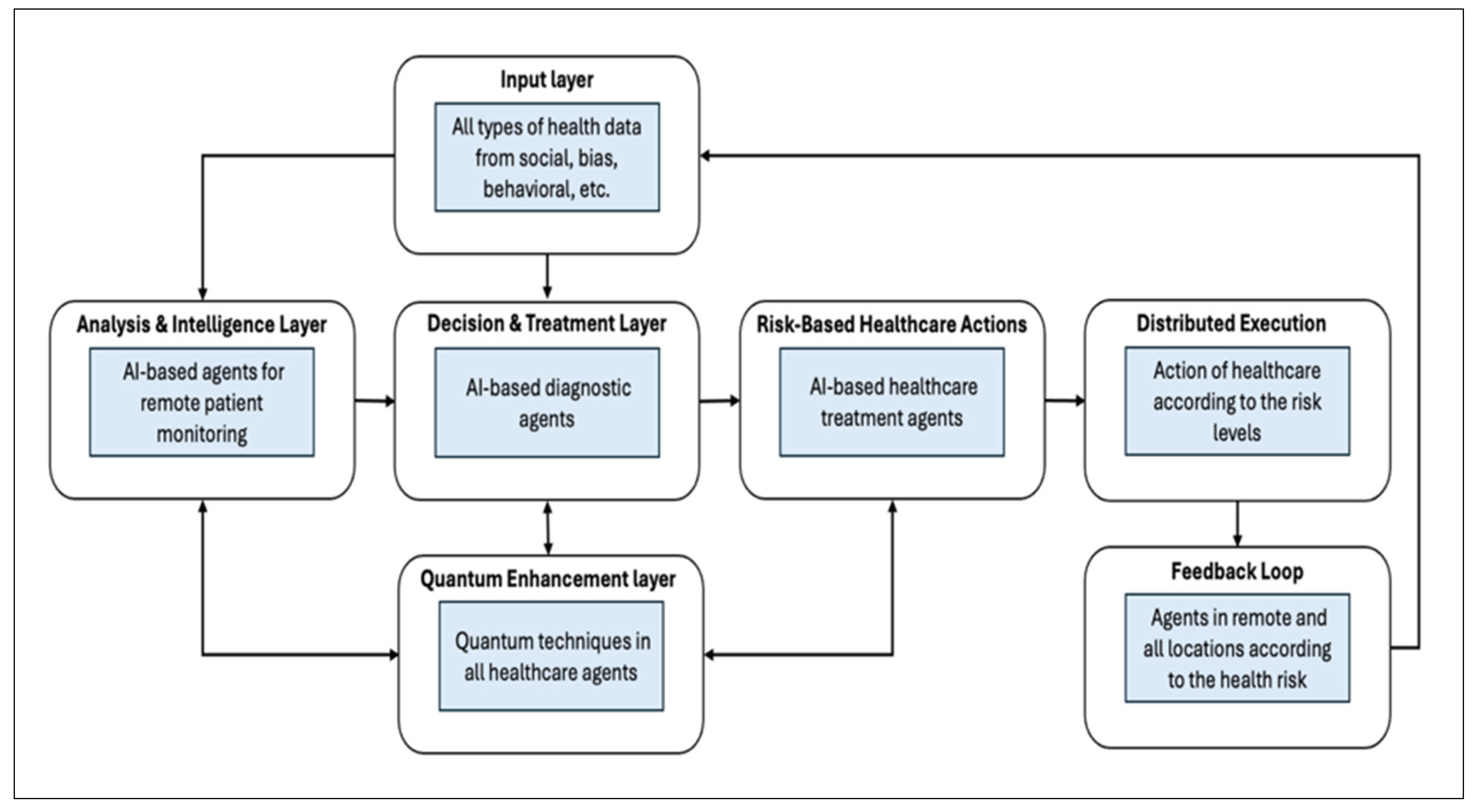
- Hybrid quantum architecture: Quantum modules handle optimization tasks to improve computational quality and system performance.
- Learning efficiency: For AI agents, the enhancement layer integrates advanced AI algorithms to improve learning capabilities through machine learning techniques, particularly reinforcement learning and probabilistic models. This supports users and trainees in understanding emerging healthcare challenges and related applications.
- Faster optimization: AI agents in healthcare development improve technical performance by efficiently solving optimization problems related to resource allocation and healthcare management.
- Energy optimization and scalability: The quantum enhancement layer can be conceptually viewed as a cognitive accelerator that supports neural-inspired processing and energy-efficient computation. It enables faster reasoning, broader exploration of solution spaces, and improved handling of uncertainty, such as identifying optimal states and system configurations.
3. Proposed Research
- High-dimensional computation and data representation: Quantum-based techniques can model complex and nonlinear relationships in cardiac symptom prediction, such as correlations among blood pressure, cholesterol levels, and ECG patterns.
- Quantum architecture with hybrid techniques: Hybrid quantum–classical models enable improved prediction and detection of heart-related conditions and identification of subtle risk patterns in cardiac data. Examples include quantum–classical dual neural networks and other integrated architectures.
- Optimization of accuracy across KPIs: To enhance predictive performance in evaluating heart disease-related KPIs, quantum optimization methods—such as quantum-inspired genetic algorithms or quantum convolutional neural networks (QCNNs)—can be applied.
3.1. Problem Statement
↓
→ Quantum approach→ 90% quality
↓
→ Quantum approach → 94% quality
↓
→ Quantum sensor approach → 92% quality
↓
→ Proposed approach → 95% quality
3.2. Proposed Model
- Quantum algorithms: They revolutionize healthcare solutions with maximum security and high quality. Furthermore, it enhances the healthcare facilities with drug discovery, medical imaging, molecular modelling, personalized medicine, etc. They allow healthcare researchers to analyze the complex datasets and support the quantum computers, which are faster than traditional computers. These algorithms may be used: Variational Quantum Eigensolver (VQE) for molecular simulation, Quantum Approximate Optimization Algorithm (QAOA) for treatment planning, and Quantum Phase Estimation (QPE).
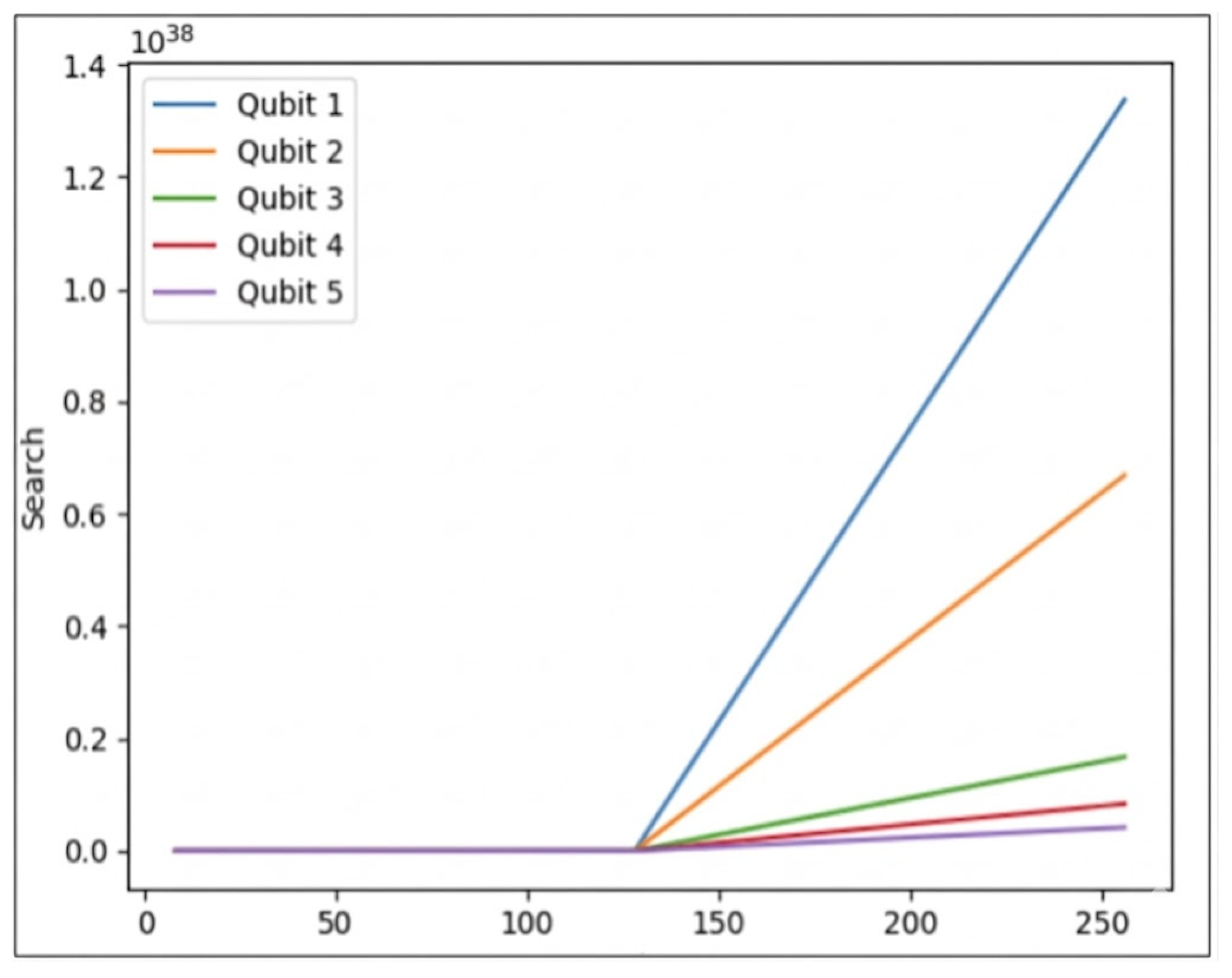
- Quantum optimization: Leverages quantum algorithms like Grover’s algorithm for search optimization and improves imaging quality and ensures faster diagnostics with optimized procedures.
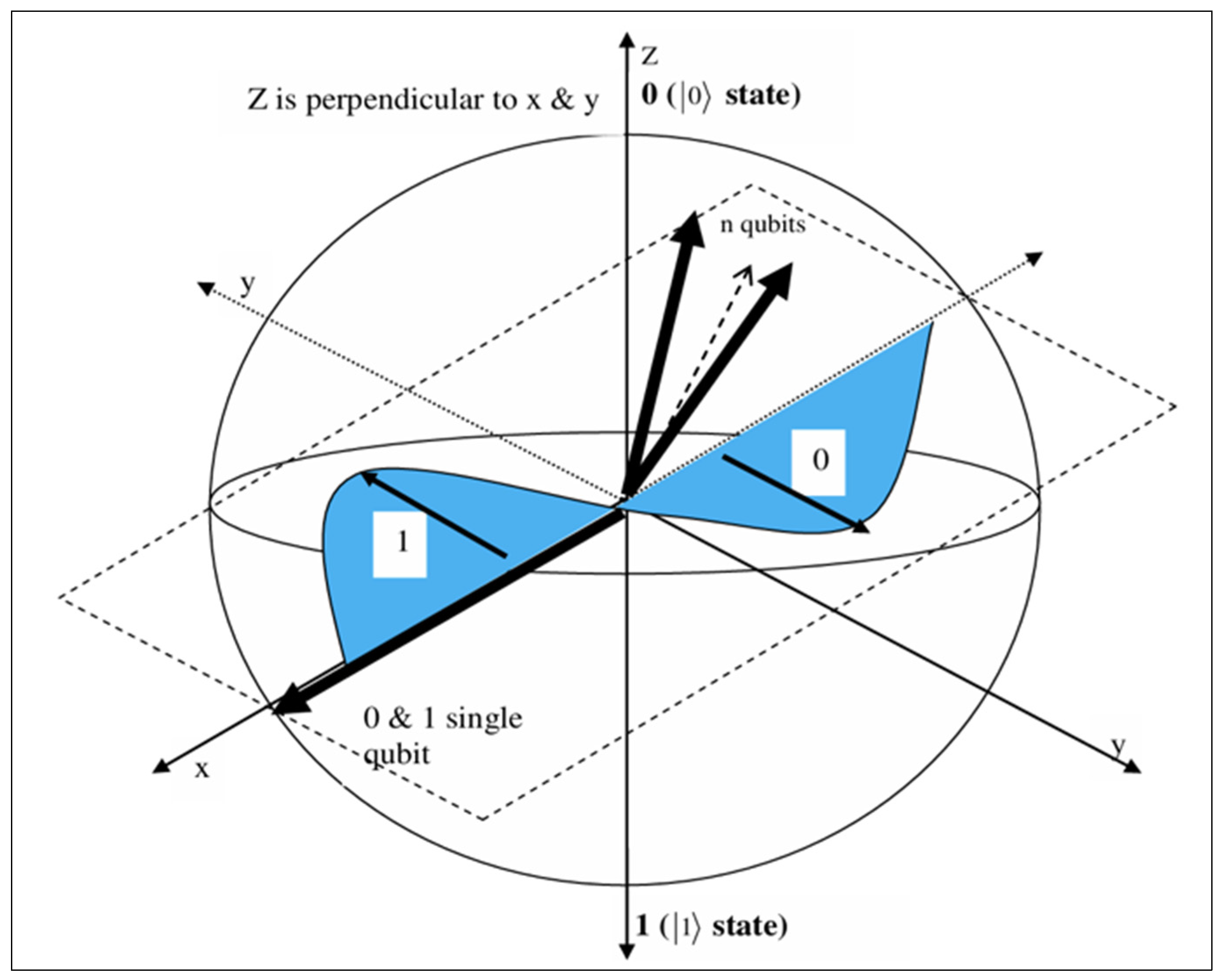
- Quantum machine learning (QML): Utilizes quantum computing for accelerating ML algorithms by leveraging quantum superposition and entanglement.
- Quantum neural network architectures: Includes Quantum Convolutional Neural Networks (QCNNs) and secure Quantum Recurrent Neural Networks (QRNNs), which are effective for handling variable-length input sequences and processing temporal data from wireless sensors with nonlinear characteristics. Communication using quantum network integration and emerging algorithms remains an active research area.
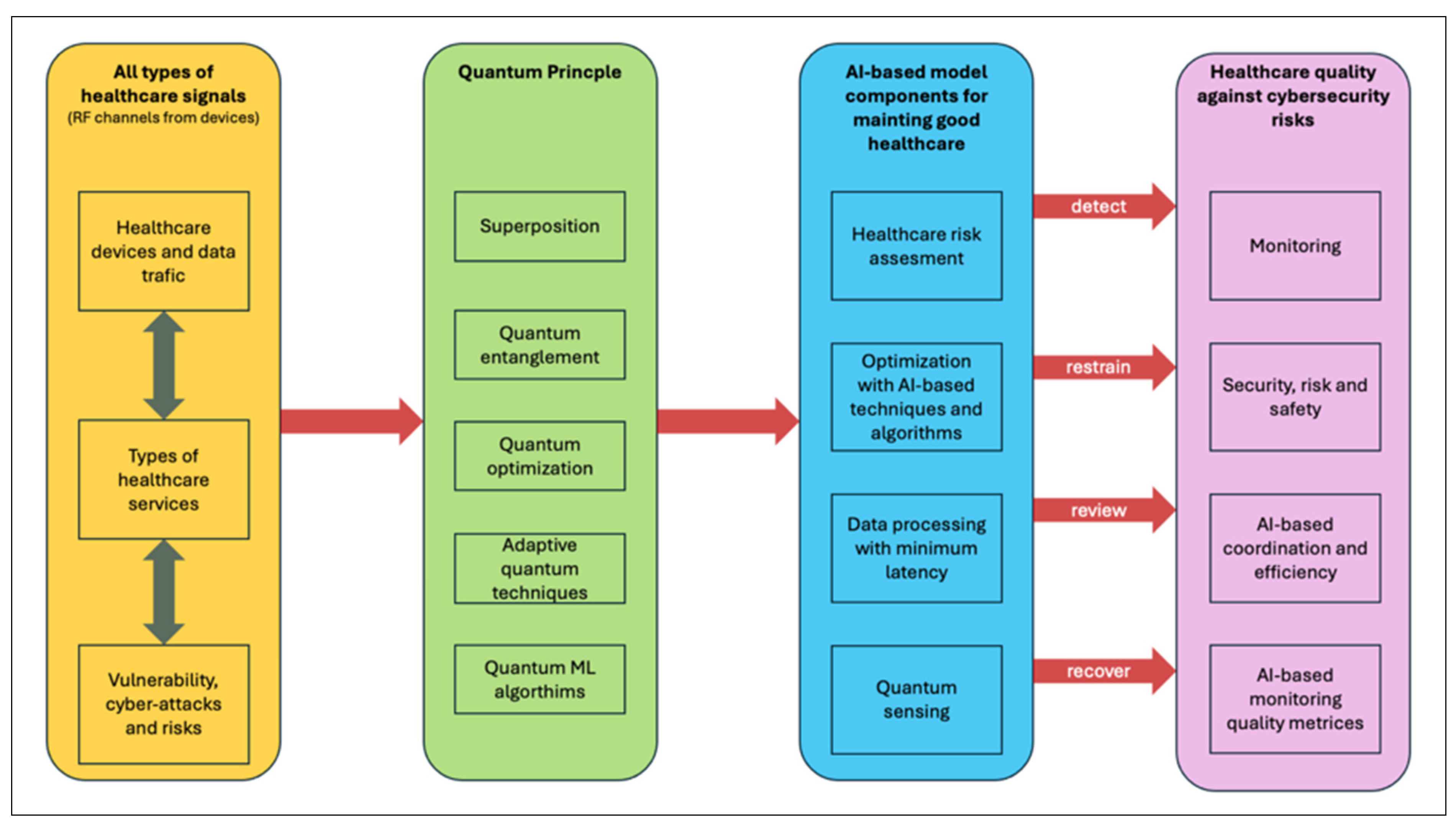
3.3. Methodology
- AI models (e.g., CNN, RNN, etc.): The proposed model can denoise quantum sensor outputs, correct drift, and calibration errors, and extract weak signals embedded in noise when healthcare devices are operational.
- Invisible AI patterns: AI-related biases may arise because such patterns are not easily detectable by humans. For example, within neural activity measurements, energy accuracy may be influenced by subtle gravitational anomalies, minor magnetic field variations, or micro-scale changes in biological or material properties.
4. Results
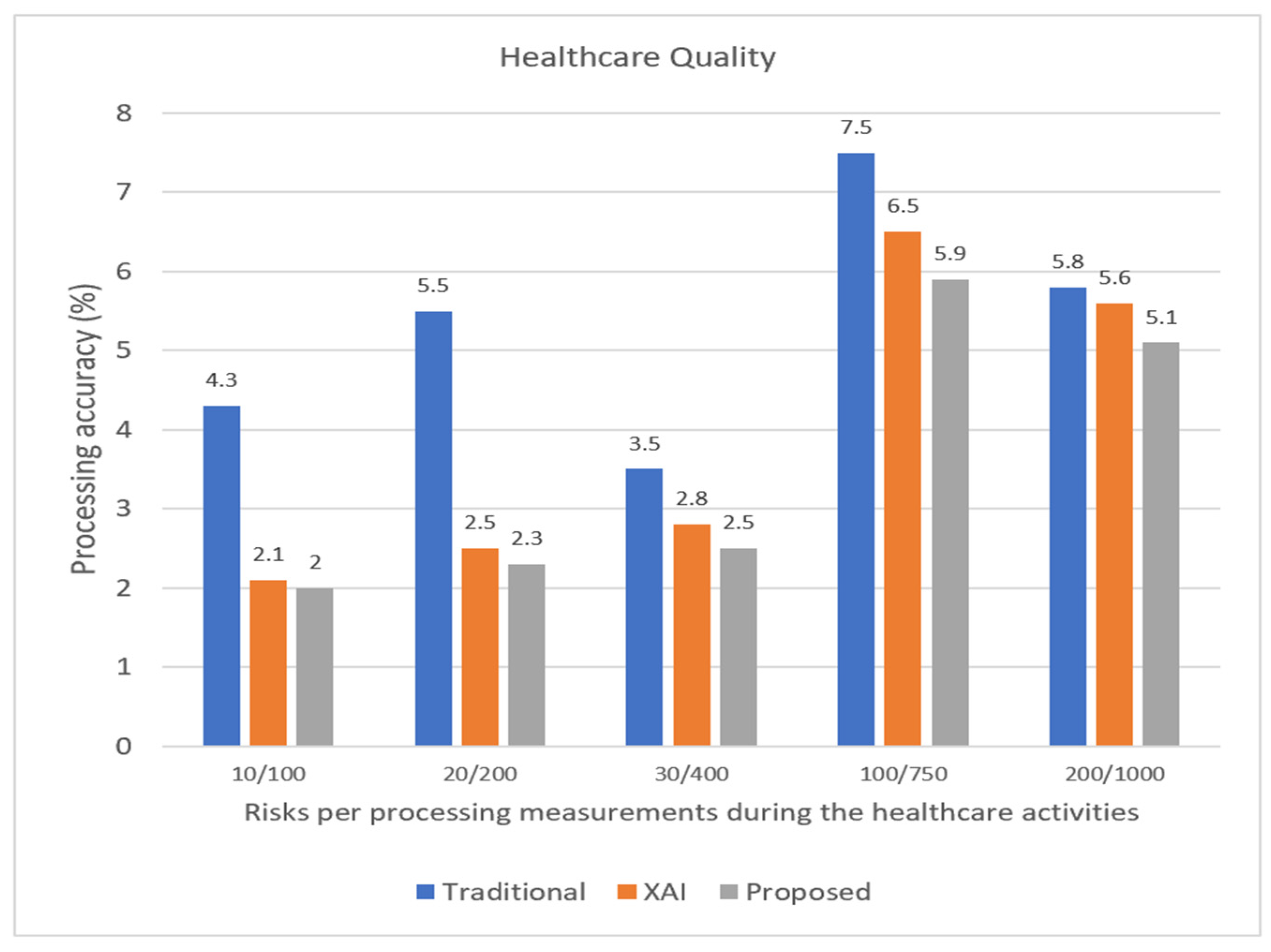
4.1. Quality Based on Security Resilience
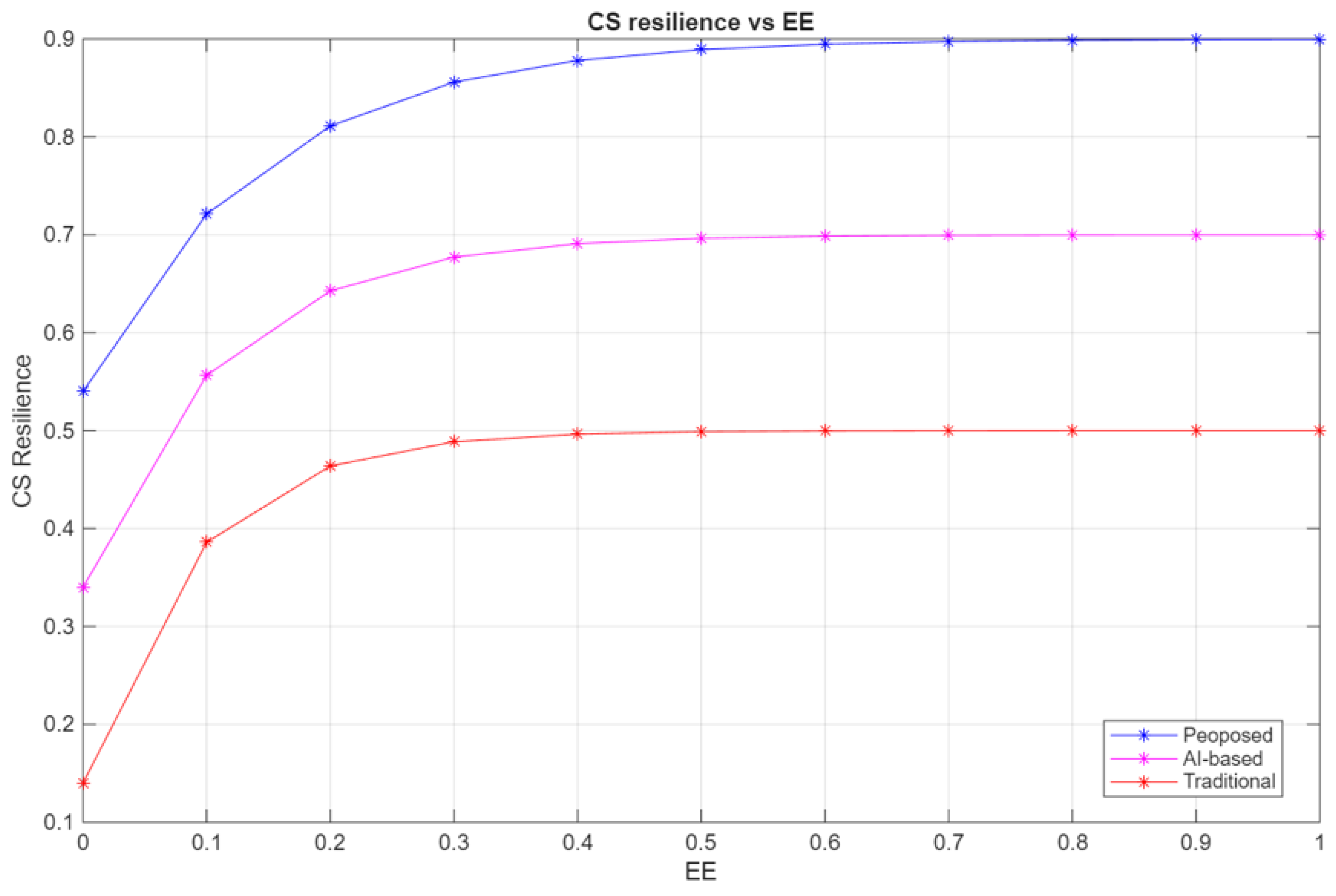
4.2. Cybersecurity Resilience Against the Energy Efficiency (EE)
5. Discussion and Analysis
- Superposition Principle: Artificial super intelligence (ASI) may generate novel scientific hypotheses or AI models for healthcare solutions, potentially improving healthcare quality.
- Entangled Realities: ASI reasoning may represent complex, interconnected logical processes that help understand complex healthcare conditions, including brain-related disorders.
5.1. Traditional AI and Proposed Models
- Theoretical and Technical Foundations: The proposed framework establishes theoretical and technical foundations for improving cardiac-related measurements. This framework is expected to encourage researchers to explore AI-based quantum technologies in other specialized cardiac healthcare applications within digital health.
- Practical Monitoring Tools: The development of practical AI-based quantum monitoring tools supports the implementation of the proposed framework by applying validated AI algorithms and quantum communication protocols.
- Protocol Extensions: Extensions of existing software-based protocols related to cardiac healthcare, including traditional routing and quantum routing protocols, can support dynamically changing time response requirements alongside varying risk and security levels. These capabilities are particularly important in critical and harsh digital healthcare environments and can improve the efficiency of proactive healthcare systems.
5.2. Quality in Healthcare Management
6. Challenges
- Quantum XAI (QXAI) for healthcare: Ethical privacy, security, bias in quantum AI models, and trust in AI-based healthcare systems remain major challenges. Mental healthcare solutions require higher transparency to identify biases and errors through glass-box approaches rather than black-box models. While conventional XAI can support some healthcare monitoring tasks, QXAI is expected to improve future healthcare system security, robustness, and quality.
- QXAI in quantum key distribution (QKD): QKD provides ultra-secure data encryption for healthcare applications. Based on quantum mechanical principles, QKD enables secure communication for healthcare service providers across various environments and operational conditions.
- Quantum decoherence: Quantum decoherence represents the difficulty of maintaining stable quantum states when high-sensitivity quantum sensors are deployed in complex healthcare environments. When quantum systems lose their quantum properties, wearable quantum sensors may become less effective, potentially increasing security risks under environmental disturbances.
6.1. Quantum Computing in Healthcare Beyond 2030
- Drug usage: Time management, drug scheduling, and dosage frequency can be optimized using quantum sorting algorithms in advanced healthcare services.
- Disease modeling: Real-time disease modeling is a major challenge, especially for immune-related conditions. Quantum computing is expected to improve processing speed for faster healthcare decision-making.
6.2. Organs’ Sensation Risks and Quantum Sensors
6.3. Mental Healthcare with Neuron Communication
6.4. AI-Based Models and Their Applications with Possible Challenges
7. Conclusions and Future Work
Author Contributions
Funding
Data Availability Statement
Acknowledgments
Conflicts of Interest
Abbreviations
| AI | Artificial Intelligence |
| APT | Advanced Persistent Threat |
| AQT | Adaptive Quantum Techniques |
| ASI | Artificial Super Intelligence |
| AT | Assistive Technology |
| CPS | Cyber-Physical Systems |
| DL | Deep Learning |
| DoS | Denial-of-Service |
| EABOA | Enhanced Adaptive Butterfly Optimization Algorithm |
| EE | Energy Efficiency |
| EHR | Electronic Health Record |
| EoT | Edge of Things |
| GA | Grover’s Algorithm |
| IDS | Intrusion Detection System |
| IoMT | Internet of Medical Things |
| IoT | Internet of Things |
| IQNs | Integrated Quantum Networks |
| MDR | Medical Device Regulation |
| ML | Machine Learning |
| NCD | non-communicable disease |
| OoC | Organ-on-a-Chip |
| QAOA | Quantum Approximate Optimization Algorithm |
| QC | Quantum Computing |
| QCNN | Quantum Convolutional Neural Network |
| QKD | Quantum Key Distribution |
| QML | Quantum Machine Learning |
| QPE | Quantum Phase Estimation |
| QRNN | Quantum Recurrent Neural Network |
| Qubits | Quantum Bits |
| QXAI | Quantum XAI |
| SQUID | Superconducting Quantum Interference Device |
| VoT | Velocity of Thought |
| VQE | Variational Quantum Eigensolver |
| XAI | Explainable AI |
References
- Islam, S.M.R.; Kwak, D.; Kabir, M.H.; Hossain, M.; Kwak, K.-S. The internet of things for health care: A comprehensive survey. IEEE Access 2015, 3, 678–708. [Google Scholar] [CrossRef]
- Shickel, B.; Tighe, P.J.; Bihorac, A.; Rashidi, P. Deep EHR: A survey of recent advances in deep learning techniques for electronic health record (EHR) analysis. IEEE J. Biomed. Health Inform. 2017, 22, 1589–1604. [Google Scholar] [CrossRef]
- Haleem, A.; Javaid, M.; Singh, R.P.; Suman, R. Telemedicine for healthcare: Capabilities, features, barriers, and applications. Sens. Int. 2021, 2, 100117. [Google Scholar] [CrossRef]
- Eric, T. Deep Medicine: How Artificial Intelligence Can Make Healthcare Human Again; Basic Books: Hachette UK; London, UK, 2019. [Google Scholar]
- Das, A.K.; Wazid, M.; Kumar, N.; Khan, M.K.; Choo, K.-K.R.; Park, Y. Design of secure and lightweight authentication protocol for wearable devices environment. IEEE J. Biomed. Health Inform. 2017, 22, 1310–1322. [Google Scholar] [CrossRef]
- Bhosale, K.S.; Nenova, M.; Iliev, G. A study of cyber attacks: In the healthcare sector. In 2021 Sixth Junior Conference on Lighting (Lighting); IEEE: Piscataway, NJ, USA, 2021; pp. 1–6. [Google Scholar]
- Algarni, A.M.; Thayananthan, V. Digital Health: The Cybersecurity for AI-based healthcare communication. IEEE Access 2025, 13, 5858–5870. [Google Scholar] [CrossRef]
- Kruse, C.S.; Frederick, B.; Jacobson, T.; Monticone, D.K. Cybersecurity in healthcare: A systematic review of modern threats and trends. Technol. Health Care 2017, 25, 1–10. [Google Scholar] [CrossRef]
- McLeod, A.; Dolezel, D. Cyber-analytics: Modeling factors associated with healthcare data breaches. Decis. Support Syst. 2018, 108, 57–68. [Google Scholar] [CrossRef]
- Conti, M.; Dehghantanha, A.; Franke, K.; Watson, S. Internet of Things security and forensics: Challenges and opportunities. Future Gener. Comput. Syst. 2018, 78, 544–546. [Google Scholar] [CrossRef]
- IBM Security. Cost of a Data Breach Report 2025, the AI Oversight Gap; IBM Corporation: Armonk, NY, USA, 2025. [Google Scholar]
- Shojaei, P.; Vlahu-Gjorgievska, E.; Chow, Y.-W. Security and privacy of technologies in health information systems: A systematic literature review. Computers 2024, 13, 41. [Google Scholar] [CrossRef]
- Khraisat, A.; Gondal, I.; Vamplew, P.; Kamruzzaman, J. Survey of intrusion detection systems: Techniques, datasets and challenges. Cybersecurity 2019, 2, 20. [Google Scholar] [CrossRef]
- Axelsson, S. The base-rate fallacy and the difficulty of intrusion detection. ACM Trans. Inf. Syst. Secur. (TISSEC) 2000, 3, 186–205. [Google Scholar] [CrossRef]
- Merlano, C. Enhancing cyber security through artificial intelligence and machine learning: A literature review. J. Cybersecur. 2024, 6, 89–116. [Google Scholar] [CrossRef]
- Xin, Y.; Kong, L.; Liu, Z.; Chen, Y.; Li, Y.; Zhu, H.; Gao, M.; Hou, H.; Wang, C. Machine learning and deep learning methods for cybersecurity. IEEE Access 2018, 6, 35365–35381. [Google Scholar] [CrossRef]
- Buczak, A.L.; Guven, E. A survey of data mining and machine learning methods for cyber security intrusion detection. IEEE Commun. Surv. Tutor. 2015, 18, 1153–1176. [Google Scholar] [CrossRef]
- Kim, J.; Kim, J.; Kim, H.; Shim, M.; Choi, E. CNN-based network intrusion detection against denial-of-service attacks. Electronics 2020, 9, 916. [Google Scholar] [CrossRef]
- Chalapathy, R.; Khoa, N.L.D.; Chawla, S. Robust deep learning methods for anomaly detection. In Proceedings of the 26th ACM SIGKDD International Conference on Knowledge Discovery & Data Mining; ACM: New York, NY, USA, 2020; pp. 3507–3508. [Google Scholar]
- Pise, A.A.; Almuzaini, K.K.; Ahanger, T.A.; Farouk, A.; Pant, K.; Pareek, P.K.; Nuagah, S.J. Enabling artificial intelligence of things (AIoT) healthcare architectures and listing security issues. Comput. Intell. Neurosci. 2022, 2022, 8421434. [Google Scholar] [CrossRef]
- Arefin, S.; Simcox, M. AI-Driven Solutions for Safeguarding Healthcare Data: Innovations in Cybersecurity. Int. Bus. Res. 2024, 17, 74–86. [Google Scholar] [CrossRef]
- Sendelj, R.; Ognjanovic, I. Cybersecurity challenges in healthcare. In Achievements, Milestones and Challenges in Biomedical and Health Informatics; IOS Press: Amsterdam, The Netherlands; Athens, Greece, 2022; pp. 190–202. [Google Scholar]
- Chintala, S. Data privacy and security challenges in AI-driven healthcare systems in India. J. Data Acquis. Process. 2022, 37, 2769–2778. [Google Scholar]
- Zhang, H.; Wang, Z.; Teng, C.; Kumar, S.; Li, X.; Min, R. Wearable cardiorespiratory sensor for real-time monitoring with smartphone integration. IEEE Trans. Instrum. Meas. 2023, 73, 7000710. [Google Scholar] [CrossRef]
- Anbazhagu, U.V.; Priyadharshini, K.; Deepajothi, S.; Haripriya, M.P.; Banu, E.A. Quantum Computing in Healthcare Using AI-Driven Medical Technologies. In Modern SuperHyperSoft Computing Trends in Science and Technology; IGI Global Scientific Publishing: Hershey, PA, USA, 2025; pp. 367–398. [Google Scholar]
- Baral, B.; Roy, T.D. Integrating Quantum Principles with Classical Transfer Learning Approaches for Pneumonia Detection from Chest Radiographs. In 2024 4th International Conference on Sustainable Expert Systems (ICSES); IEEE: Piscataway, NJ, USA, 2024; pp. 1042–1049. [Google Scholar]
- Tripathi, A.; Rathore, R. AI in Disease Surveillance—An Overview of How AI Can Be Used in Disease Surveillance and Outbreak Detection in Real-World Scenarios. In AI in Disease Detection: Advancements and Applications; Wiley: New York, NY, USA, 2025; pp. 337–359. [Google Scholar]
- Chehimi, M.; Elhattab, M.; Saad, W.; Vardoyan, G.; Panigrahy, N.K.; Assi, C.; Towsley, D. Reconfigurable intelligent surface (RIS)-assisted entanglement distribution in fso quantum networks. IEEE Trans. Wirel. Commun. 2025, 24, 3132–3148. [Google Scholar] [CrossRef]
- Gobinath, A.; Rajeswari, P.; Kumar, S.N.; Anandan, M. Quantum Robotics in Health Care: Innovations and Applications. In The Quantum Evolution; CRC Press: Boca Raton, FL, USA, 2025; pp. 211–225. [Google Scholar]
- Yadavalli, N.; Ponnaluri, V.D.N.S.; Allagadda, K.K.R.; Vysyaraju, P.R.; Srinivas, P.V.V.S.; Rama Krishna Rao, T.K. Quantum Networks-Driven Deep Learning Framework for Predicting Testicular Cancer Risk Factors Advancing Precision Medicine. In AI and Quantum Network Applications in Business and Medicine; IGI Global Scientific Publishing: Hershey, PA, USA, 2025; pp. 157–172. [Google Scholar]
- Bommala, H.; Raja, J.; Latha, P.; Thilagam, T.; Valarmathi, P.; Sudhakar, M. Blockchain for Pharmaceutical Data Management and Quantum Computing Innovations. In AI-Powered Advances in Pharmacology; IGI Global: Hershey, PA, USA, 2025; pp. 201–234. [Google Scholar]
- Prakash, K.A.; Gowda, D.; Kottala, S.Y.; Dudi, B.; Mohammed, S.A. Quantum Cryptography and Healthcare Security: Safeguarding Patient Data in Medical Systems. In Advancing Cyber Security Through Quantum Cryptography; IGI Global: Hershey, PA, USA, 2025; pp. 197–230. [Google Scholar]
- Prajapat, S.; Kumar, D.; Kumar, P. Quantum image encryption protocol for secure communication in healthcare networks. Clust. Comput. 2025, 28, 3. [Google Scholar] [CrossRef]
- Ranjith, J.; Mahantesh, K.; Tilak Babu, S.B.G.; Ashok Kumar, N.; Rama Prasad, M.V.; Hariram, V. Optimising AI Network Resource Allocation in Healthcare with Quantum-Inspired Techniques. In AI and Quantum Network Applications in Business and Medicine; IGI Global Scientific Publishing: Hershey, PA, USA, 2025; pp. 101–118. [Google Scholar]
- Flöther, F.F. Early quantum computing applications on the path towards precision medicine. In Implementation of Personalized Precision Medicine; Academic Press: New York, NY, USA, 2025; pp. 83–96. [Google Scholar]
- Ishikawa, K.; Ohmichi, H.; Umesato, Y.; Terasaki, H.; Tsukuma, H.; Iwata, N.; Tanaka, T.; Kawamura, A.; Sakata, K.; Sainohara, T.; et al. The guideline of the personal health data structure to secure safety healthcare: The balance between use and protection to satisfy the patients’ needs. Int. J. Med. Inform. 2007, 76, 412–418. [Google Scholar] [CrossRef] [PubMed][Green Version]
- Rostami, M.; Burleson, W.; Koushanfar, F.; Juels, A. Balancing security and utility in medical devices? In Proceedings of the 50th Annual Design Automation Conference; ACM: New York, NY, USA, 2013; pp. 1–6. [Google Scholar]
- Pistorius, C. Developments in emerging digital health technologies. DeltaHedron Innov. Insight 2017, 1, 12–19. [Google Scholar]
- Ramasamy, L.K.; Khan, F.; Shah, M.; Prasad, B.V.V.S.; Iwendi, C.; Biamba, C. Secure smart wearable computing through artificial intelligence-enabled internet of things and cyber-physical systems for health monitoring. Sensors 2022, 22, 1076. [Google Scholar] [CrossRef]
- Klonoff, A.N.; Lee, W.-A.; Xu, N.Y.; Nguyen, K.T.; DuBord, A.; Kerr, D. Six digital health technologies that will transform diabetes. J. Diabetes Sci. Technol. 2023, 17, 239–249. [Google Scholar] [CrossRef]
- Tan, T.F.; Thirunavukarasu, A.J.; Jin, L.; Lim, J.; Poh, S.; Teo, Z.L.; Ang, M.; Chan, R.V.P.; Ong, J.; Turner, A.; et al. Artificial intelligence and digital health in global eye health: Opportunities and challenges. Lancet Glob. Health 2023, 11, e1432–e1443. [Google Scholar] [CrossRef]
- Kelly, B.S.; Quinn, C.; Belton, N.; Lawlor, A.; Killeen, R.P.; Burrell, J. Cybersecurity considerations for radiology departments involved with artificial intelligence. Eur. Radiol. 2023, 33, 8833–8841. [Google Scholar] [CrossRef]
- Vaisakhkrishnan, K.; Ashok, G.; Mishra, P.; Kumar, T.G. Guarding Digital Health: Deep learning for attack detection in Medical IoT. Procedia Comput. Sci. 2024, 235, 2498–2507. [Google Scholar] [CrossRef]
- Gupta, L.; Salman, T.; Ghubaish, A.; Unal, D.; Al-Ali, A.K.; Jain, R. Cybersecurity of multi-cloud healthcare systems: A hierarchical deep learning approach. Appl. Soft Comput. 2022, 118, 108439. [Google Scholar] [CrossRef]
- Ikharo, B.; Obiagwu, A.; Obasi, C.; Hussein, S.U.; Akah, P. Security for internet-of-things enabled e-health using blockchain and artificial intelligence: A novel integration framework. In 2021 1st International Conference on Multidisciplinary Engineering and Applied Science (ICMEAS); IEEE: Piscataway, NJ, USA, 2021; pp. 1–4. [Google Scholar]
- Alshehri, M. Blockchain-assisted cyber security in medical things using artificial intelligence. Electron. Res. Arch. 2023, 31, 708–728. [Google Scholar] [CrossRef]
- Ameen, A.H.; Mohammed, M.A.; Rashid, A.N. Dimensions of artificial intelligence techniques, blockchain, and cyber security in the Internet of medical things: Opportunities, challenges, and future directions. J. Intell. Syst. 2023, 32, 20220267. [Google Scholar] [CrossRef]
- Yadulla, A.R.; Yenugula, M.; Kasula, V.K.; Konda, B.; Thumma, B.Y.R. Comprehensive Analysis of IoT Security: Threats, Detection Methods, and Defense Strategies. J. Internet Things 2025, 7, 19–48. [Google Scholar] [CrossRef]
- Miriam, H.; Doreen, D.; Robin, C.R.R. Secured Cyber Security Algorithm for Healthcare System Using Blockchain Technology. Intell. Autom. Soft Comput. 2023, 35, 1889–1906. [Google Scholar] [CrossRef]
- Chakraborty, C.; Nagarajan, S.M.; Devarajan, G.G.; Ramana, T.V.; Mohanty, R. Intelligent AI-based healthcare cyber security system using multi-source transfer learning method. ACM Trans. Sens. Netw. 2023. [Google Scholar] [CrossRef]
- Algarni, A.M.; Thayananthan, V. Cybersecurity for Analyzing Artificial Intelligence (AI)-Based Assistive Technology and Systems in Digital Health. Systems 2025, 13, 439. [Google Scholar] [CrossRef]
- Ksibi, S.; Jaidi, F.; Bouhoula, A. A comprehensive study of security and cyber-security risk management within e-Health systems: Synthesis, analysis and a novel quantified approach. Mob. Netw. Appl. 2023, 28, 107–127. [Google Scholar] [CrossRef]
- Thomasian, N.M.; Adashi, E.Y. Cybersecurity in the internet of medical things. Health Policy Technol. 2021, 10, 100549. [Google Scholar] [CrossRef]
- Jalali, M.S.; Razak, S.; Gordon, W.; Perakslis, E.; Madnick, S. Health care and cybersecurity: Bibliometric analysis of the literature. J. Med. Internet Res. 2019, 21, e12644. [Google Scholar] [CrossRef] [PubMed]
- Biasin, E.; Kamenjašević, E.; Ludvigsen, K.R. Cybersecurity of AI medical devices: Risks, legislation, and challenges. In Research Handbook on Health, AI and the Law; Edward Elgar Publishing Ltd.: Cheltenham, UK, 2024; pp. 57–74. [Google Scholar]
- Bertl, M. News analysis for the detection of cyber security issues in digital healthcare: A text mining approach to uncover actors, attack methods and technologies for cyber defense. Young Inf. Sci. 2019, 4, 1–15. [Google Scholar]
- Musbahi, O.; Syed, L.; Le Feuvre, P.; Cobb, J.; Jones, G. Public patient views of artificial intelligence in healthcare: A nominal group technique study. Digit. Health 2021, 7, 20552076211063682. [Google Scholar] [CrossRef]
- Arafa, A.; Sheerah, H.A.; Alsalamah, S. Emerging digital technologies in healthcare with a spotlight on cybersecurity: A narrative review. Information 2023, 14, 640. [Google Scholar] [CrossRef]
- Radanliev, P.; De Roure, D. Advancing the cybersecurity of the healthcare system with self-optimising and self-adaptative artificial intelligence (part 2). Health Technol. 2022, 12, 923–929. [Google Scholar] [CrossRef] [PubMed]
- Thayananthan, V. Analysis of Quantum Computing and Trellis Coding based on PUM Codes. Int. J. Comput. Appl. 2021, 30, 8–12. [Google Scholar] [CrossRef]
- Van Chien, T.; Duc, B.T.; Tung, N.X.; Nguyen, V.D.; Khalid, W.; Chatzinotas, S.; Hanzo, L. Single-and Multi-Objective Stochastic Optimization for Next-Generation Networks in the Generative AI and Quantum Computing Era. arXiv 2026, arXiv:2601.02175. [Google Scholar]
- Dontu, S.; Vallabhaneni, R.; Addula, S.R.; Pareek, P.K.; Hussein, R.R. Enhanced adaptive butterfly optimizer based feature selection for protecting the data in industry based WSN. In 2024 International Conference on Intelligent Algorithms for Computational Intelligence Systems (IACIS); IEEE: Piscataway, NJ, USA, 2024; pp. 1–6. [Google Scholar]
- Qian, Y.; Lin, Y.-C.; Hejazi, S.; Clarke, K.; Watson, K.; Chen, X.; Kumbella, N.-M.; Quimbo, J.; Dinizulu, A.; Henin, S.; et al. Quantum Sensing MRI for Noninvasive Detection of Neuronal Electrical Activity in Human Brains. arXiv 2026, arXiv:2601.16423. [Google Scholar] [CrossRef]





| Name of Sensing Technology | Technology Classification | Description |
|---|---|---|
| Aspirin-based carbon dot | Quantum dots | All connections must be active and available, accessible in all environmental conditions |
| Nitrogen-doped graphene quantum dot | Quantum dots | Authorized hubs and systems should be used to set the secure communication links on time |
| Quantum dot–DNA bioconjugate | Quantum dots | AI-based healthcare data and DNA must be validated for robustness of cybersecurity |
| Wearable pulse oximeter | Quantum dots | Healthcare wearable devices are set for pulse monitoring |
| Magnetic-field quantum sensors | Quantum sensing | Sensors in healthcare enhance the sensing of each magnetic field or wave related to health issues |
| Nanodiamond quantum sensing | Quantum sensing | Nanotechnology in healthcare supports the treatment of neurodegenerative diseases |
| Quantum 3D imaging | Quantum imaging | Quantum-based healthcare depends on quantum imaging for validating the identification |
| Superconducting quantum interference device (SQUID) | Quantum imaging | AI-based healthcare devices, including SQUID, are used to improve the accuracy of healthcare solutions |
| NVision Polarizer | Quantum resonance | Quantum energy in neurons supports the treatment of brain function, which affects healthcare |
| Ref. | Focused Research | Critical Analysis | Comments |
|---|---|---|---|
| [38] | Foundational analysis of interconnected healthcare trajectories. | Correctly predicted data-intensive shifts but lacks specific cybersecurity mechanisms for high-velocity data. | Justifies the need for high-performance architectural designs in healthcare. |
| [39,53] | AI-enabled IoT/CPS and IoMT cybersecurity challenges. | Robust in connectivity; however, lacks proactive risk prediction and adaptive defense modeling for evolving threats. | Motivated the inclusion of AI-based diagnostic agents for adaptive intrusion detection. |
| [40,41] | AI-driven clinical transformation in diabetes and global eye health. | Primary focus is on clinical outcomes; limited emphasis on cybersecurity robustness or infrastructure protection. | Highlighted the necessity of integrating “security-by-design” within AI clinical applications. |
| [42,55] | Regulatory considerations and legal risks of AI medical devices. | Strong focus on policy and risk; however, lacks implementation-level technical cybersecurity frameworks. | Supports the inclusion of regulatory-aware governance within the AI–quantum framework. |
| [43,50] | Deep learning and transfer learning for IoMT attack detection. | High detection accuracy but remains largely reactive; lacks integration with holistic healthcare infrastructures. | Reinforced the need for multi-layered, proactive threat intelligence and diagnostic agents. |
| [45,46,47,48,49] | Blockchain–AI integration for healthcare data integrity. | Excellent decentralized integrity; however, scalability and latency overhead remain significant practical barriers. | Motivated a hybrid layer using optimization to reduce computational overhead. |
| [51] | Security analysis of AI-based assistive technologies (AT). | Identifies critical AT vulnerabilities but lacks predictive, self-healing security modeling. | Encouraged the inclusion of specialized protection for assistive healthcare devices. |
| [54,56] | Bibliometric and text-mining analysis of cybersecurity trends. | Provides macro-level landscape insights; lacks a functional implementation or technical framework. | Validated identified research gaps and justified the proposed unified AI–quantum model. |
| [57] | Public perception and ethics of AI in healthcare. | Addresses trust and ethical concerns but does not explore technical cybersecurity depth or resilience. | Reinforced the importance of transparency and bias mitigation in healthcare treatment agents. |
| [58,59] | Emerging technologies and self-adaptive AI for cybersecurity. | Introduces self-optimization but lacks integration with quantum sensing or unified architectural governance. | Directly inspired our proactive, adaptive AI–quantum integrated architecture. |
| Healthcare Quality | Quantum Dots | Quantum Sensing | Quantum Imaging | Quantum Resonance |
|---|---|---|---|---|
| Diagnostic accuracy (>90%) | 91 | 90 | 92 | 95 |
| Reliability of diagnosing tools (>99%) | 99.4 | 99.6 | 99.7 | 99.9 |
| Security, risks and privacy (>95%) | 99 | 97 | 96 | 98.2 |
| Duration of the infection rate (<10 m/s) | 5 ms | 2 ms | 3 ms | 1 ms |
| Healthcare risk values (<1%) | 20 | 10 | 14 | 9 |
| Monitoring time in healthcare (<1 ms) | 0.1 | 0.5 | 0.7 | 0.3 |
| Biometrics Based on Thoughts | Assume That Possible Used Neuron in a Specific Behavior | Bias Based on the Observed Biometrics | Scientific Accuracy with KPIs |
|---|---|---|---|
| Gait (hand or leg veins) | 10,000 | High | Fastest thought |
| Voice (levels of sound) | 500 | Low | Very slow thought |
| Face (eye and iris movement) | 1000 | Medium | Average speed of thought |
| Features in Healthcare | Human (Clinician) | Traditional AI Deployment | Proposed Model |
|---|---|---|---|
| Accessible primary and personalized healthcare functions | Personalized patient care, complex health conditions | AI enables personalized treatment plans by analyzing patient data with reasonable security and quality according to the medical history, genetics, and lifestyle factors | A combination of AI and quantum principles provides efficient and secure accessibility when personalized data are considered |
| Context awareness and healthcare assistants | Patients’ history with health administrative tasks | The patients’ administrative burdens and context awareness are simplified with minimized errors, allowing them to focus more on patient care | AI algorithms allow researchers to validate the quantum sensor data of patients’ private history |
| Decision-making for maintaining good health against security risks | Experience of good healthcare in different conditions | Although decision-making depends on the accuracy of AI algorithms, the quality of the data is important because inaccurate or biased data can result in incorrect predictions, which can have serious consequences in a healthcare setting | The proposed approach in this model provides maximum security in healthcare, where quantum sensors reduce biases in decision-making |
| Administrative issues of healthcare services | Cost analysis against the security risks | AI can streamline administrative issues, reduce healthcare errors, and improve the quality of services, which facilitates preventive care of all types of long-term diseases and illnesses | AI must ensure security risks in healthcare services, but some complex services involved with biases need to be removed. Here, quantum techniques improve the healthcare quality in all services |
| Users’ language and translation | Enabling healthcare with multiple users | AI algorithms and AI-based translation tools support patients who are struggling to understand the general healthcare procedures. AI personal agents or assistants may be used for translating data when AI-based agents also enhance the translation facilities | AI-based agents enhance the quantum procedures that are used in all types of programming translations, which include the users’ languages |
| Role of healthcare with wearable devices | Manual settings with wearable health technologies | AI algorithms allow wearable devices to check the calibration of the devices incorporated with the sensors and devices connected to the wearable devices | With enhanced quantum precision medicine to wearable health technologies and quantum algorithms, the future of IQN in healthcare is poised for significant progress |
| Intelligent approach of digital healthcare and surgery | Setting automation approaches in healthcare hubs and surgery | Although the AI algorithms and robotic systems improve the quality of healthcare, setting automation and real-time surgical navigation become more affordable and accessible in healthcare facilities worldwide | These quantum techniques and developments will further reduce recovery times, minimize surgical risks, and improve overall patient care and privacy issues |
Disclaimer/Publisher’s Note: The statements, opinions and data contained in all publications are solely those of the individual author(s) and contributor(s) and not of MDPI and/or the editor(s). MDPI and/or the editor(s) disclaim responsibility for any injury to people or property resulting from any ideas, methods, instructions or products referred to in the content. |
© 2026 by the authors. Licensee MDPI, Basel, Switzerland. This article is an open access article distributed under the terms and conditions of the Creative Commons Attribution (CC BY) license.
Share and Cite
Algarni, A.M.; Thayananthan, V. AI-Based Model for Maintaining Good Healthcare Quality Against Cybersecurity Risks. Systems 2026, 14, 315. https://doi.org/10.3390/systems14030315
Algarni AM, Thayananthan V. AI-Based Model for Maintaining Good Healthcare Quality Against Cybersecurity Risks. Systems. 2026; 14(3):315. https://doi.org/10.3390/systems14030315
Chicago/Turabian StyleAlgarni, Abdullah M., and Vijey Thayananthan. 2026. "AI-Based Model for Maintaining Good Healthcare Quality Against Cybersecurity Risks" Systems 14, no. 3: 315. https://doi.org/10.3390/systems14030315
APA StyleAlgarni, A. M., & Thayananthan, V. (2026). AI-Based Model for Maintaining Good Healthcare Quality Against Cybersecurity Risks. Systems, 14(3), 315. https://doi.org/10.3390/systems14030315