1. Introduction
The digital transformation of the enterprise has traversed evolutionary stages, progressing from early informatization, characterized by the digitization of linear workflows within organizational boundaries, to networkization, defined by platform economics, APIs, and ecosystem connectivity [
1]. Currently, organizational architecture is undergoing a phase transition into the era of intelligentization. This transition was catalyzed by the deployment of generative artificial intelligence (AI), large foundational models, and autonomous algorithmic agents within the strategic core of the firm. Within this paradigm, the ontology of the enterprise is transformed. For decades, strategic management has rested upon frameworks that assume a Cartesian demarcation between the human manager, who possesses agency, cognitive intent, and foresight, and the organizational resource, which possesses utility but remains inert and subordinate.
The integration of AI systems—characterized by emergent behaviors, probabilistic reasoning, and autonomous pattern recognition—complicates the traditional subject–object dichotomy. This shift precipitates a structural cybernetic anomaly within strategic management: technological resources have evolved from passive instruments into epistemic agents [
2,
3]. These agents recursively shape the competitive environment and influence the cognitive schemas of the human managers who govern them. Addressing this theoretical anomaly requires delineating the epistemological boundary conditions of existing paradigms, specifically the resource-based view (RBV) and the dynamic capabilities (DC) framework.
This human–machine recursive interplay transcends strategic theory and is demonstrated in physical human–machine interfaces. For instance, in the domain of intelligent rehabilitation, 3D graph deep learning methods are deployed for non-contact gesture recognition. These systems, combining dynamic graph convolutional neural networks (DGCNNs) with laser point cloud data, process high-dimensional spatial geometries to create a feedback loop between a patient’s biological reality and the algorithmic environment. Just as a DGCNN updates its internal parameters to adapt to biomechanical perturbations [
4,
5], the enterprise AI system must update its latent vector spaces in response to the market ecosystem, relying on human strategic intent to provide the global semantic shape.
Recent strategic management scholarship has recognized these shifting ontological dynamics, coalescing around the concept of AI-enabled dynamic capabilities. This literature stream highlights how the integration of AI into strategic and operational routines transforms an organization’s agility, responsiveness, and innovation capacity. Empirical and theoretical studies demonstrate that algorithmic systems augment the dynamic capability of sensing by processing unstructured, high-dimensional datasets to identify latent market trends and ecosystem opportunities that would remain invisible to human scanning techniques. Furthermore, algorithmic models enhance the seizing capability by optimizing resource allocation decisions, running probabilistic simulations to identify efficient strategic pathways.
Contemporary analyses emphasize that the procurement of algorithmic technology or the accumulation of computational power is inadequate for sustained advantage. To impact firm performance, technological investments must be linked to a data-driven organizational culture and organizational learning mechanisms [
6]. Researchers identify a technological frontier where the boundary delineating human task execution from algorithmic automation remains fluid, context-dependent, and subject to redefinition.
Despite advancements in acknowledging the analytical power of algorithms, the literature often treats AI as a first-order technological tool. The prevailing narrative centers on human-centric augmentation. This perspective casts the human manager in the role of a steward who directs, prompts, and verifies algorithmic outputs to ensure strategic alignment and ethical compliance. While this stewardship model mitigates institutional voids, it fails to capture the second-order, reflexive nature of algorithmic integration.
The interaction between human users and intelligent systems is not a unidirectional command-and-control sequence but a recursive feedback loop characterizing human–machine co-evolution. As users interact with algorithms, they generate behavioral data that train the underlying models; in turn, these updated models restructure the information environment, shaping subsequent human preferences, decisions, and strategic mental models. This bidirectional loop gives rise to systemic outcomes that cannot be theorized or managed through the lens of linear managerial control. The interplay between the machine’s localized, high-dimensional algorithmic processing and the human’s global, low-dimensional semantic interpretation constitutes structural coupling.
Over time, through recurrent interactions, the human’s strategic mental models and the machine’s synaptic weights co-drift [
7,
8]. They evolve together, forming an emergent cognitive entity distinct from its individual components operating in isolation. This theoretical reconstruction, bridging cybernetics, deep learning metaphors, and strategic management, requires a conceptual foundation to transition concepts from philosophical propositions to strategic management science.
Delineating the boundaries of this investigation requires formalizing inquiries regarding the epistemological limitations of management theory. First, the integration of AI resources alters the micro-mechanisms of dynamic capabilities, necessitating an inquiry into the transition from linear asset reallocation to recursive structural coupling. Second, generating dynamic cognitive advantage requires mapping the boundary conditions under which the cognitive flywheel operates. Third, the mitigation of entropic risks and algorithmic misalignment requires understanding how the implementation of a fractal governance structure enhances systemic resilience across organizational hierarchies [
9]. Addressing these theoretical and operational domains provides a framework for navigating the AI economy.
To address this cybernetic anomaly and transition these propositions into management science, this study formalizes three research questions. First, how does the integration of agentic AI resources alter the micro-mechanisms of dynamic capabilities, necessitating a transition from linear asset reallocation to recursive structural coupling? Second, what are the operational boundary conditions under which the human–machine cognitive flywheel generates a dynamic cognitive advantage? Third, how does a fractal governance structure enhance systemic resilience to mitigate entropic risks and algorithmic misalignment?
To investigate these inquiries, this research employs a mixed-methods empirical design. It introduces a mathematical formalization utilizing coupled non-linear differential equations and historical decay integrals to model structural coupling dynamics. Concurrently, it outlines a partial least squares structural equation modeling (PLS-SEM) blueprint, complemented by longitudinal process tracing. This network is designed to test the sequential mediating role of the cognitive flywheel and the moderating effect of fractal governance on firm performance.
The theoretical reconstruction is governed by boundary conditions. The epistemological limits of legacy frameworks, such as the RBV, are bounded by the thermodynamics of closed systems seeking equilibrium. In contrast, the intelligentization model operates far from thermodynamic equilibrium, identifying the AI-integrated firm as a dissipative structure requiring continuous environmental data metabolism to avoid entropic stalling [
10,
11]. Furthermore, the efficacy of the cognitive flywheel is bounded by the biological limits of human semantic bandwidth; exceeding this threshold triggers structural decoupling, precipitating automation bias [
12,
13].
The remainder of this article is structured as follows.
Section 2 establishes the theoretical foundations, deconstructing the limits of traditional strategy and defining the cybernetic anomaly.
Section 3 formalizes the macro-evolutionary framework and the mathematical dynamics of human–machine structural coupling.
Section 4 operationalizes the micro-mechanisms, detailing the stages of the cognitive flywheel and fractal governance.
Section 5 presents a proposed empirical research agenda, formalizing the hypotheses and outlining the recommended PLS-SEM methodology for future validation of the framework. Finally,
Section 6 synthesizes the theoretical contributions and managerial implications, outlining the shift toward second-order cybernetic governance in the intelligentization era.
2. Theoretical Foundations and Emergent Research Gap
2.1. The Epistemological Limits of Traditional Strategy
The evolution of strategic management theory has been propelled by the necessity to explain how enterprises construct, sustain, and defend competitive advantage within varying environmental and technological contexts. For decades, the RBV and the DC framework have served as foundational pillars of this academic inquiry, providing theoretical architectures for understanding firm performance. The theoretical reconstruction proposed in this research serves as a targeted extension functioning within the limits of agentic cognitive environments, rather than a repudiation of traditional frameworks. It aims to define their boundary conditions and establish the necessity of a theoretical extension tailored for the intelligentization era.
Deconstructing the thermodynamic assumptions of the RBV establishes the boundary conditions necessitating this extension. The RBV shifted the locus of strategic analysis inward, positing that competitive advantage is derived from the firm’s possession of unique resource bundles. An epistemological audit reveals that this framework is grounded in the thermodynamics of closed systems seeking equilibrium. The strategic imperative prescribed by the RBV is one of conservation and protection [
14,
15]. The firm is conceptualized as a bounded container that accumulates stocks of strategic assets. To sustain advantage, the firm must erect isolating mechanisms to defend these stocks from external imitation, substitution, and environmental entropy.
In this closed-system model, the strategic value of a resource is analogous to potential energy. The value is stored latently within the asset, remains static in its constitution, and is released through managerial deployment. For the eras of early informatization and networkization, where digital assets consisted of proprietary data silos, hard-coded software systems, and fixed server infrastructure, this closed-system logic provided an approximation of competitive reality. The competitive moat was a structural boundary, and the accumulation of asset stocks was the primary determinant of market supremacy.
The transition to the intelligentization era challenges this closed-system ontology. Algorithmic systems operate on metabolic principles that contradict the conservation premise inherent in the RBV. These systems do not hold value as static stocks; rather, their intelligence and predictive accuracy are kinetic properties sustained through metabolic exchange with the external environment. From a systems-dynamics perspective, an AI model functions as a dissipative structure far from thermodynamic equilibrium. It requires an influx of negative entropy, specifically in the form of high-dimensional environmental data and recursive human feedback signals, to maintain its predictive coherence and structural order.
Managing an intelligent, dissipative structure through the isolationist logic of the RBV induces data starvation. Deprived of interaction with the external ecosystem, the internal entropy of the algorithmic system increases, precipitating conceptual drift, model hallucinations, and operational decline. The isolating mechanisms prescribed by the RBV to sustain advantage accelerate the cognitive resource’s obsolescence in entropic environments. Competitive advantage correlates not with the possession of a static algorithmic model but with the kinetic rate of the system’s metabolism, the permeability of its data boundaries, and its capacity for structural updating.
Acknowledging the limitations of the RBV, strategic management scholars advanced the DC framework. This perspective emphasizes the firm’s capacity to sense, seize, and reconfigure internal and external competencies to address high-velocity environments. While this framework introduced dimensions of time, evolutionary adaptation, and processual change [
16], cybernetic analysis reveals that it remains anchored in the assumptions of first-order cybernetics.
First-order cybernetics is defined as the science of observed systems [
17]. It presupposes a separation between the observer, acting as the controller, and the system being observed, acting as the controlled entity. Within the DC framework, the top management team occupies the role of the cybernetic governor. This managerial agent possesses cognitive agency, strategic intent, and interpretative capacity, while the firm’s resources, operational routines, and technological infrastructures are treated as a passive system to be manipulated.
The ontology of this framework is linear and unidirectional. The manager senses environmental perturbations through scanning mechanisms, makes a determination to seize an opportunity, and transforms or reconfigures the resource base to execute the strategic direction. This mechanism functions as a negative feedback control loop, designed to minimize the deviation between the firm’s operational state and the demands of the external market. Within this construct, agency resides with the human subject. Resources do not generate strategic hypotheses, possess learning trajectories, or alter the manager’s perception of market reality. This unidirectional assumption dictates that organizational adaptation is dependent on, and limited by, the cognitive bandwidth, processing speed, and interpretative accuracy of the executive team.
2.2. The Structural Cybernetic Anomaly and System Dynamics
The integration of AI into the strategic core of the enterprise challenges this first-order hierarchy, precipitating what this research defines as the structural cybernetic anomaly. The cybernetic anomaly is a breakdown of the subject–object dichotomy in organizational management. It occurs when the technological resource base ceases to function as a passive instrument and acquires epistemic agency, probabilistic predictive capacity, and autonomous learning capabilities.
In system dynamics terminology, this anomaly represents the introduction of a secondary feedback loop into the organizational cognitive architecture, transitioning the firm from a trivial machine, characterized by input–output determinism, into a non-trivial machine, characterized by history-dependent internal state evolution and emergence [
18,
19]. When a manager deploys an algorithmic agent to scan the competitive ecosystem or optimize a supply chain, the algorithm does not function as a transparent conduit of data. Instead, it interprets, filters, and reconstructs reality based on its training parameters, weighted matrices, and latent spaces.
AI becomes a second observer within the strategic system. It generates probabilistic representations of the environment that shape, constrain, and direct the manager’s cognitive focus and strategic options. The organizational system contains two cognitive agents operating in tandem. Consequently, the linear causality of traditional strategy, where the manager directs the resource, collapses into a regime of recursive, circular causality. The object of control reshapes the cognitive framework of the subject attempting to control it.
Existing strategic theories, rooted in linear mechanics, lack the conceptual vocabulary to describe this recursive dynamic. This theoretical blind spot creates a governance vacuum, where command-and-control directives, designed for inert software, fail to harness the potential of intelligent systems, leading to misalignment, algorithmic bias, or strategic drift. The structural cybernetic anomaly dictates that the problem of strategic management is no longer how the manager utilizes the tool but how the manager and the tool reconstruct each other’s operational reality.
This anomaly is exacerbated by the limitations of symbolic processing in unstructured environments. Traditional computing relied on predefined rules and explicit programming, which restricted its utility when confronting the data of global market ecosystems. The transition to generative architectures and deep neural networks allows computational systems to approximate contextual understanding and respond dynamically to inputs. However, this capacity for non-linear reasoning introduces unpredictability. As the system self-programs by adjusting its internal weights based on environmental data, its operational logic becomes opaque to the manager. The manager is no longer directing a predictable mechanism; the manager is interacting with a statistical engine that alters its operational axioms.
Addressing the cybernetic anomaly requires recognizing that human intelligence and AI possess disparate cognitive architectures. The human cognitive apparatus excels at semantic understanding, ethical reasoning, abstract conceptualization, and navigating social ambiguities. The artificial cognitive apparatus excels at syntactic processing, high-dimensional pattern recognition, and probabilistic optimization across datasets. The anomaly cannot be resolved by forcing the machine to behave like a human, nor by reducing human management to algorithmic metrics. Resolution requires establishing a theoretical framework that accommodates the coupled operation of both cognitive modalities.
2.3. Second-Order Cybernetics as Metatheoretical Foundation
The realization of this recursive dynamic demands an epistemological shift in how organizational capabilities and governance frameworks are conceptualized. This research establishes second-order cybernetics as the metatheoretical foundation for understanding and managing human–machine co-evolution. While first-order cybernetics concerns the engineering control of observed, deterministic systems, second-order cybernetics is defined as the cybernetics of observing systems.
Developed through the work of Heinz von Foerster, second-order cybernetics recognizes that the observer is part of the system being observed, replacing objectivity with reflexivity [
20]. It incorporates the observer into the observed system, making reflexivity a core part of how order and knowledge are constituted. Any description of a system involves the system’s participants and their recursive interactions with the environment. Within this tradition, cognition and observation are tied to the enactment of systemic structures, and the act of observing becomes an act of participating.
In the intelligentization era, the human manager can no longer operate as an external engineer adjusting the parameters of a corporate machine. The manager is embedded within the structurally coupled human–machine system. Consequently, strategic governance is no longer about maximizing the output of a deterministic production function but about managing the reflexivity of the human–machine dyad. The manager must govern the external market strategy and the internal cognitive parameters of the algorithmic agent while possessing the meta-cognitive awareness to recognize how the algorithm reshapes the manager’s biases, blind spots, and strategic perceptions.
This necessitates a transition from the engineering logic of control to the biological logic of governance. The managerial capability shifts from direct resource allocation to a meta-regulatory function. The strategist must set boundary conditions, tune feedback sensitivities, and determine the degree of coupling intensity to ensure that the recursive learning loops of the intelligent system remain aligned with the firm’s semantic purpose and ethical imperatives. This second-order perspective acknowledges that the organization is learning how to learn alongside AI, requiring a revised theoretical vocabulary and operational framework.
Decision-making evolves into a process of reflexive sense-making, where decision outcomes are neither rational computations nor socially negotiated interpretations but emergent phenomena arising from recursive interactions among observers, actors, and the systemic context. Knowledge is reframed not as a mirror of external reality but as a context-dependent, co-constructed phenomenon arising within recursive observer–system interactions. This approach highlights that organizational participants co-constitute the systems they seek to understand and influence, altering the nature of strategic execution.
2.4. Artificial Intelligence-Enabled Dynamic Capabilities and the Epistemological Paradox
Scholarship recognizes that financial investment in algorithmic technologies or the acquisition of computational infrastructure does not translate into organizational performance. This realization has catalyzed research focused on AI-enabled dynamic capabilities, investigating the organizational mechanisms required to convert computational power into strategic outcomes [
21].
Analyses demonstrate that technological capabilities enhance firm performance by fostering a data-driven culture, which institutionalizes organizational learning routines. The digital infrastructure provides the foundation for sensing market anomalies and seizing opportunities. The data-driven culture ensures that decisions across the enterprise hierarchy are informed by empirical evidence and algorithmic insights. Organizational learning processes act as the reconfiguration mechanism, assimilating algorithmic insights and translating them into organizational routines.
Literature exposes vulnerabilities and boundary conditions in implementation strategies. A finding in recent studies is the identification of the adverse effects of data-driven culture, which poses a theoretical paradox for governance models. Research indicates that while a data-driven culture functions as an enabling mediator, its efficacy is non-linear and subject to diminishing returns.
When the velocity and complexity of AI insights outpace human capacity for semantic evaluation, structural decoupling ensues. This cognitive saturation precipitates automation bias. Managers transition from second-order governors into executors of machine outputs [
22]. This dynamic demonstrates that reliance on automated analytics without human semantic anchoring yields diminishing and eventually negative returns.
Automation bias represents an operational state resulting from the failure of structural coupling. It occurs when human operators accept machine recommendations without engaging in second-order observation. The system ceases to be a synergistic entity and regresses into a deterministic machine optimizing for correlations embedded in the training data. In turbulent environments characterized by uncertainty, the historical data upon which algorithms are trained loses predictive validity. In entropic scenarios, adherence to analytics-driven governance suppresses the experimentation and unlearning required for organizational survival.
This paradox highlights the limitations of governance frameworks that rely on compliance logic and risk aversion. Institutional models approach the challenge of algorithms as a problem of technical risk mitigation, focusing on data interoperability and the prevention of bias through centralized oversight. A compliance-oriented governance structure operates on the ontological assumption that the algorithm is a subordinate tool that needs its parameters restricted. It fails to account for the cybernetic need to align the algorithm’s output with shifting human semantic context, especially when the external environment renders historical data obsolete and necessitates a change in strategic direction.
2.5. Emergent Research Gap and the Imperative for a Paradigm Shift
While contemporary studies map the mediation pathways of data-driven culture and organizational learning, they conceptualize computational capabilities through a first-order lens. In these frameworks, the algorithmic system is viewed as an instrument managed by a human subject who stands outside the technological system. This perspective underestimates the ontological shift occurring at the frontier of technological development.
Generative models and autonomous agents exhibit emergent behaviors, construct representations of reality, execute reasoning tasks, and reshape the informational environment and decision architecture of the firm. By adhering to first-order cybernetic assumptions and treating algorithmic intelligence as a static variable, the literature fails to address the recursive nature of human–machine interaction. It lacks the theoretical vocabulary to explain how agentic systems structurally couple with human cognitive frameworks, mutually perturbing and co-evolving over time.
Consequently, the strategic solutions offered by the contemporary literature—such as increasing digital orientation, mandating data compliance, or implementing digital literacy training—are inadequate for sustained advantage and insufficient to overcome the entropy crisis. The persistence of first-order thinking in the face of second-order technological realities explains why enterprises report negative returns on digital initiatives, facing a learning gap and an inability to achieve structural transformation. The boundaries between observer and observed dissolve, and knowing is understood as a participatory process requiring an integrative lens.
This research gap establishes the imperative for a paradigm shift toward second-order cybernetics and the formalization of the theory of dynamic cognitive advantage. If the strategic resource of the firm is a structurally coupled, co-evolving intelligent system, the governance mechanism that manages this resource cannot be rooted in unilateral control, data adherence, or static compliance matrices. Centralized governance structures lack the requisite variety to manage the complexity generated by algorithms operating at scale.
Addressing this gap requires developing a macro-evolutionary framework and micro-level operational mechanisms based on the principles of complex adaptive systems. This necessitates the introduction of a governance logic that is adaptive, structurally fractal, and focused on regulating the co-evolutionary parameters and structural coupling of the system rather than dictating its outputs. By redefining organizational capability as the meta-capacity to orchestrate structural coupling, strategic management establishes a foundation for achieving competitive advantage in an era where organizational components operate with cognitive autonomy.
3. A Macro-Evolutionary Framework: The Mathematical Formalization of Structural Coupling and Dynamic Cognitive Advantage
3.1. The Phylogenetic Shift and the Intelligentization Paradigm
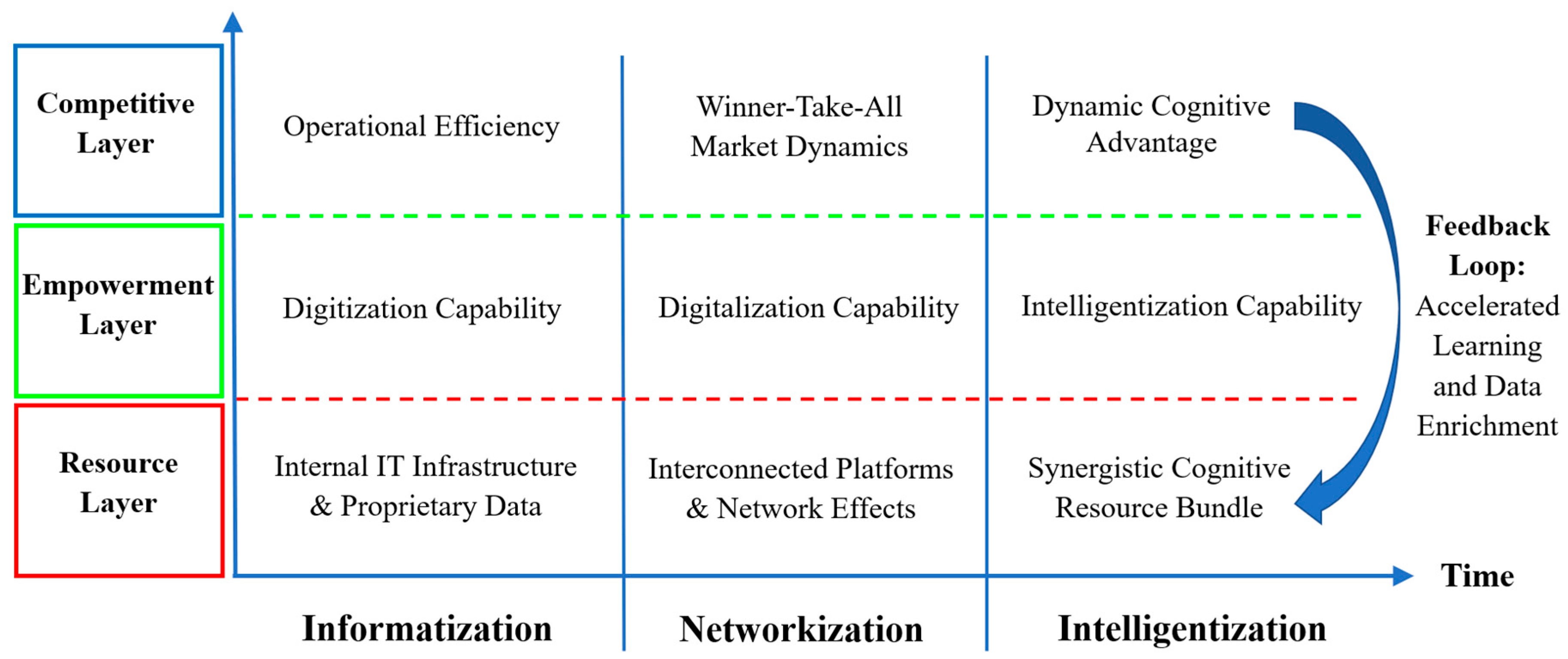
The enterprise operates within a continuum of digital transformation, traversing cybernetic regimes categorized as informatization, networkization, and intelligentization. Deconstructing the thermodynamic assumptions of traditional strategic paradigms establishes the boundary conditions necessitating a theoretical extension. The progression of system logic, mathematical dynamics, and thermodynamic states across these eras of digital transformation is synthesized in
Table 1, providing a comparative analysis of the evolutionary baseline.
The epoch, catalyzed by the integration of AI, large foundational models, and algorithmic agents into the strategic core of the firm, marks a phase transition into the intelligentization stage. The enterprise ceases functioning as a mechanistic processor or a centralized networked hub, transforming into a complex adaptive ecology [
23,
24]. Within this paradigm, relationships between human agents and artificial agents are non-linear, emergent, and historically contingent. Fluctuations within training data, shifts in parametric weightings, or alterations in human intent cascade through the organizational architecture, generating emergent outcomes that transcend the predictability of isolated system components.
The systemic logic defining the intelligentization era is recursive and probabilistic. Causality within the strategic architecture diverges from the linear sequences of the informatization era and the bidirectional interactions of the networkization era, becoming circular and recursive. The cognitive output of the human–machine system, manifesting as algorithmic market predictions, generative product architectures, or strategic recommendations, does not terminate as a static product. This output feeds back into the system as input for the subsequent cycle, rewriting neural weights, probabilistic thresholds, and human cognitive schemas.
This transition challenges the subject–object dichotomy inherent in first-order cybernetic control models. First-order cybernetics presupposes a separation between the observer, acting as the controller, and the technological system, acting as the controlled entity. The integration of AIsystems, characterized by emergent behaviors and autonomous pattern recognition, complicates this relationship. Technological resources have evolved from passive instruments into epistemic agents. These agents recursively shape the competitive environment and influence the cognitive schemas of the human managers who govern them [
25]. The recognition of AI as an evolutionary entity possessing the potential for open-ended evolution amplifies this cybernetic anomaly, as the algorithm can generate strategies and behaviors extending beyond its original programming parameters.
Addressing this cybernetic anomaly requires the adoption of second-order cybernetics, defined as the cybernetics of observing systems. The strategic manager transitions from an external operator manipulating levers into a participant observer within a reflexive loop. The manager observes and governs the AI, while the AI observes the external market and the manager’s behavioral data, constructing probabilistic representations of reality that shape and constrain cognitive decisions. The act of observation influences the system being observed, creating an autopoietic loop of mutual definition where the controller and the controlled undergo structural fusion. The strategic imperative shifts from the accumulation of asset scale to the generation of continuous adaptation through structural coupling.
3.2. The Synergistic Cognitive Resource Bundle as a Complex Adaptive System
The strategic resource unit in the intelligentization era departs from the bundle of inert assets conceptualized by the RBV. The locus of advantage resides within the structurally coupled system, formalized as the synergistic cognitive resource bundle. This construct shifts the analytical focus away from the isolated properties of technological or human components, placing importance on the emergent relationship forged between them.
The premise driving this redefinition recognizes that AI models, despite possessing parametric scale, context windows, and multimodal capabilities, face technological commoditization. Foundational algorithms, pre-trained neural network weights, and computational processing power are accessible utility functions distributed via cloud infrastructures and open-source ecosystems. Consequently, the procurement and deployment of an algorithmic model is inadequate for sustained advantage.
Concurrently, human cognition possesses capacities for semantic understanding, ethical grounding, social negotiation, and contextual intuition. However, human executive teams operate under biological limitations, restricting their capacity to process high-dimensional, unstructured data streams or detect non-linear statistical signals within entropic market environments. The source of strategic rarity, non-substitutability, and economic value emerges from the synergistic coupling of these cognitive architectures. Analyses of technology management corroborate that AI transforms roadmap formulation through data-driven alignment, yet the organizational trajectory remains human-centric augmentation, wherein the algorithm serves as a collaborative partner rather than a standalone replacement for human judgment.
This linkage transcends interdependent tool usage, representing a structural coupling rooted in the theories of complex systems dynamics [
26]. Structural coupling describes a history of recurrent interactions between two operationally distinct systems, leading to a structural drift. The AI subsystem operates upon syntactic structures, mathematical vectors, and statistical correlations. It perturbs the human organization with algorithmic insights, predictions, and generative variations of operational processes. The human subsystem operates upon semantic meaning, strategic intent, and ethical frameworks. The human collective perturbs the AI subsystem through the injection of feedback loops, prompt architecture refinements, reward modeling signals, and constraint programming.
Through bidirectional perturbations, the human and machine subsystems co-drift in an evolutionary process, fusing to create an autopoietic entity capable of higher-order decision-making [
27]. The mechanism of value generation within this structurally coupled bundle is non-linear emergence. The capabilities, market responsiveness, and innovative capacity of the coupled system cannot be reduced to the additive sum of its human talent and machine processing power. The system exhibits self-organization, capable of autonomous pattern recognition and adaptive response generation without deterministic programming for market contingencies.
The management of this synergistic bundle requires diagnosing the nature of environmental challenges to determine the configuration of human and AI collaboration. Utilizing diagnostic frameworks that assess problem familiarity, complexity, and wickedness allows organizations to match collaboration strategies to hybrid problems. For structured logistical problems, the AI may assume an autonomous optimization role. Conversely, for wicked problems involving conflicting social values or unclear success criteria, the structural coupling must be weighted toward human semantic oversight, leveraging the algorithm for scale and statistical precision while retaining ethical determinations within the human node.
The sustainability of the competitive advantage derived from this resource bundle relies on historical path dependence. Competing firms acquiring identical foundational algorithms and similar cognitive talent face a barrier to imitation. They cannot duplicate the historically contingent trajectory of structural coupling. They lack the micro-interactions, feedback loops, and contextually bound parameter weightings that align an AI instantiation with a firm’s tacit knowledge base and strategic culture.
3.3. Mathematical Formalization of Structural Coupling: The Coupled Differential Equations
Within the framework of complex adaptive systems theory, the interaction between human strategic cognition and AI functions as a recursive evolution of state variables traversing through time. Before detailing the specific equations, it is necessary to clarify the conceptual purpose of this mathematical formalization within the context of strategic management theory. This formalization is not intended to function as a deterministic predictive tool for immediate corporate financial calculation. Rather, it serves as an epistemological mechanism designed to represent the proposed strategic theory as a formalized mathematical model. By translating qualitative conceptual metaphors—such as “recursive co-evolution” and “symbiosis”—into formal mathematical syntax, this approach significantly reduces theoretical ambiguity. It defines the boundary conditions of the human–machine system and operationalizes complex structural relationships into distinct, empirically testable parameters (e.g., structural coupling coefficients and exponential temporal decay rates) for future academic inquiry. This mathematical formalization delineates the operational boundaries between static asset management and dynamic cognitive governance, establishing the domain of organizational physics.
The state of human organizational cognition at time t is defined as the state variable H(t). This composite variable encompasses the firm’s managerial mental models, strategic intent, tacit knowledge, semantic understanding, and ethical governance frameworks. Concurrently, the state of machine cognition at time t is defined as the state variable M(t). This variable represents the computational architecture, encompassing its synaptic weight matrices, latent space representations, active contextual memory, and probabilistic predictive models. The intelligentized firm operates within an entropic market ecosystem. The influx of market volatility, competitive action, and novel data generation is defined as the environmental perturbation function E(t).
The co-evolutionary trajectory of the synergistic cognitive resource bundle is governed by a system of coupled non-linear differential equations [
28,
29]:
This system of equations captures the mechanics of second-order cybernetic recursion and structural coupling. The human cognitive system and the machine cognitive system function as a coupled ecology. The injection of external environmental entropy E(t) drives the system forward, acting as a forcing function that demands recursive cross-updating between the human and machine states.
The parameters α1 and α2 represent the rates of self-maintenance, organizational inertia, and temporal decay of the human and machine systems when operating in isolation. In the RBV, a strategic asset possesses a static value derived from historical accumulation. The α parameters mathematically encapsulate this logic of internal path dependence. A positive coefficient α1 indicates organizational inertia, signifying an adherence to historical mental models and a resistance to cognitive change. A negative α1 indicates internal cognitive decay, knowledge attrition, or a loss of strategic coherence over time. This decay is relevant as empirical observations indicate that the unmanaged integration of AI can reduce opportunities for on-the-job training, degrading the baseline capabilities of the human workforce if upskilling strategies are ignored. Similarly, α2 reflects the systemic stability or algorithmic deterioration of the machine learning model prior to interaction with human semantic guidance or environmental data, manifesting as unsupervised concept drift.
The genesis of dynamic cognitive advantage resides within the structural coupling coefficients, denoted as β1 and β2. These parameters quantify the effectiveness of the firm’s intelligentization capability. They dictate the rate at which the two cognitive architectures interpenetrate, share data, and perturb their internal states. A firm characterized by low β coefficients treats AI as an isolated tool, limiting the system to a functional dependency. In this disconnected architecture, the AI exerts no recursive impact on the strategic cognition of the enterprise, neutralizing the potential for emergent intelligence and resulting in operational decline when faced with environmental velocity.
Conversely, a firm achieving high β coefficients establishes structural coupling. The firm permits the intelligence of the machine to alter and elevate the semantic mental models of the human organization, while allowing human intent to refine the machine’s algorithmic weights. This dynamic visualizes a system where human cognition and machine cognition exist as interlocking nodes. The crossing vectors between these nodes, regulated by the β coefficients, dictate the evolutionary trajectory of the system, mathematically representing the flow of sense-making and adaptation.
3.4. Operationalizing the Translation Functions: Semantic Anchoring and Syntactic Processing
The crossing vectors governed by the β coefficients illustrate how machine-derived statistical insights are injected into human strategic planning and how human-derived ethical constraints are injected into the machine’s mathematical optimization processes. The nature, fidelity, and quality of this cross-perturbation are governed by the non-linear feedback functions f and g. These mathematical functions operationalize the concept of complementary cognitive architecture, acting as translation layers between human semantics and machine syntax.
The function f(M(t), E(t)) represents the artificial machine’s capacity to ingest high-dimensional environmental entropy E(t). The machine detects latent statistical topologies, granular correlations, and weak market signals invisible to human sensory limits. The machine updates its internal probabilistic model M(t) and translates these mathematical findings into a comprehensible perturbation vector. This vector challenges and rewrites established human cognitive schemas, forcing managers to adapt their strategic worldview based on mathematically derived ecosystem realities. This function bridges the gap between data acquisition and human interpretive capacity, redefining how organizational understanding emerges through abductive and inductive meaning-making.
Conversely, the function g(H(t), E(t)) represents the human capacity to observe the chaotic environment E(t) through the lens of semantic strategy, brand identity, social consequence, and ethical constraints. The human organization processes this environment, updates its collective strategic intent H(t), and translates this semantic intent into a technical perturbation vector. This vector takes the form of dynamically adjusted reward parameters, introduced ethical guardrails, modified prompt architectures, or curated training datasets. This human-generated vector perturbs the AI, compelling the machine to update its synaptic weight matrices to align with the established human semantic goals.
The implementation of the g function in safety-critical and regulated domains necessitates architectural protocols to ensure that generative syntax does not violate deterministic semantic rules. For instance, in structural engineering and manufacturing, the integration of generative AI with physical modeling utilizes modular, context-aware architectures. By interfacing probabilistic language models with finite element analysis through APIs and communication standards, the organization ensures computational fidelity and code compliance. This methodology allows human engineers to specify structural parameters using semantic prompts, while the underlying protocol mathematically restricts the generative algorithm, preventing the algorithmic hallucinations that plague unconstrained language models, reducing predictive deviations to statistically insignificant margins. This structural methodology exemplifies the translation function g, where human intent restricts and guides machine syntax without destroying its generative velocity.
This mathematical formulation demonstrates that strategic causality is circular and entangled. The enterprise functions as a non-trivial machine where historical cognitive states dictate future evolutionary trajectories through non-linear feedback loops. The mathematical boundary condition for sustained enterprise survival requires maintaining sufficient structural coupling coefficients (β) to guarantee that the internal rate of recursive human–machine co-evolution significantly outpaces the external rate of environmental entropy generation.
3.5. Quantifying Dynamic Cognitive Advantage: The Time Decay Integral and Tensor Expansion
The emergent value of dynamic cognitive advantage, denoted as
V(
t), is quantified through a time decay integral:
The integrand utilizes the mathematical tensor product, expressed as
H(
τ) ⊗
M(
τ). This operator is chosen over vector addition or scalar multiplication to represent the relationship between human and machine cognition [
30]. In linear algebra and quantum mechanics, a tensor product signifies the combination of two vector spaces into a higher-dimensional space.
This tensor product represents cognitive fusion. The cognitive capacity and problem-solving capability of the structurally coupled enterprise exceed the additive sum of human intelligence and machine intelligence. The recursive interaction multiplies the dimensionality of the firm’s strategic phase space. This tensor expansion is the mathematical representation of the decomposition of workforce skills into semantic decision-level subskills (governed by human context) and syntactic action-level subskills (executed by generative algorithms) [
31]. It creates capabilities enabling the enterprise to synthesize global supply chain anomalies with localized consumer sentiment while maintaining corporate ethical compliance. This synthesis represents an achievement that neither the isolated human subsystem nor the isolated machine subsystem could accomplish independently at historical moment
τ.
The parameter γ represents the system’s value conversion efficiency. This variable acts as a moderating factor, recognizing physical and organizational friction. It represents the enterprise’s operational capability to translate the high-dimensional cognitive insights generated by the coupled system into market execution and economic rents. An enterprise possessing a coupled cognitive engine will experience a neutralized strategic value if its downstream execution pipelines are constrained by bureaucratic inertia, fragmented departmental silos, or rigid industrial infrastructure, driving the γ parameter toward zero. The realization of intelligentization capability depends on an organization’s infrastructural maturity and its ability to act as a digital empowerment center, ensuring that cognitive outputs drive sales potential, operational efficiency, and risk management.
The element within the integral characterizing the thermodynamic reality of the intelligentization era is the exponential time decay factor, expressed as
. The parameter
λ represents the rate of environmental volatility, market turbulence, and ecosystem entropy. Managing an intelligent, dissipative structure through the logic of traditional resource management induces data starvation. Deprived of interaction with the external ecosystem, the internal entropy of the algorithmic system increases, precipitating conceptual drift, model hallucinations, and operational decline [
32,
33].
This exponential decay function signifies that past cognitive synergies, historical machine learning weights, and outdated mental models lose strategic relevance at an exponential rate as chronological time progresses toward the present t. If the firm allows its structural coupling to halt, ceasing the updating of the human–machine interaction in response to environmental data, the accumulated strategic value of past advantages dissipates toward zero. This mathematical reality invalidates the closed-system logic of the RBV. The isolating mechanisms prescribed by the RBV to sustain competitive advantage accelerate the cognitive resource’s obsolescence in entropic environments.
3.6. The Mathematical Genesis of Inimitability: Historical Drift and Isolating Mechanisms
The visual geometry of this time decay integral—specifically, the multidimensional area beneath the curve of the coupled evolutionary dynamics—provides an explanation of competitive inimitability. The integrated strategic value
V(
t) constitutes the mathematical expression of historical drift and organizational path dependence [
34].
The competitive advantage of the intelligentized enterprise binds to the chronological sequence, intensity, and historical timing of past systemic perturbation and structural weight updates. It represents the accumulation of context-specific recursive cycles between human operators and an algorithmic architecture. In a scenario where a competitor acquires the foundational AI model, replicates the computing infrastructure, and recruits human managers, they face a barrier to imitation.
The competitor acquires the variables M and H frozen at a point in time. They cannot synthesize or replicate the historical integral space. They lack the accumulated area of highly path-dependent, idiosyncratic synergistic interactions that have calibrated the original firm’s cognitive architecture to the nuances, ethical boundaries, and tacit knowledge structures of its ecosystem. This historical drift creates a cognitive structure acting as an isolating mechanism. This barrier grows with every cycle of recursive co-evolution, establishing a dynamic defense against external market replication that transcends the protection of software licenses or data hoarding. The organization’s capacity to design workflows, orchestrate specialized agents, and run this cognitive flywheel becomes the meta-skill of the enterprise.
3.7. Formal Proposition of Systemic Co-Evolution
The translation of qualitative metaphors regarding human–machine interaction into the domain of complex adaptive systems theory and non-linear mathematical dynamics establishes a foundation for empirical inquiry. The mathematical formalization of the β structural coupling coefficients and the V(t) time decay integral yields a law of strategic performance in the intelligentization era. By synthesizing the differential mechanics of recursive cross-updating with the thermodynamic necessity of negentropic integration, this analysis articulates the proposition of the macro-evolutionary framework:
Proposition 1. In a complex market environment, the dynamic cognitive advantage (V(t)) obtained by an enterprise is positively correlated with the penetration rate of human–machine structural coupling (β) and the historical integral density of synergistic interactions; the inimitability of this advantage stems from the non-linear historical drift characteristics of the coupled evolutionary process.
This proposition reorients the objective function of the strategic manager. The managerial directive shifts away from constructing defensive moats around proprietary databases or hoarding algorithmic models, as the exponential decay factor (λ) guarantees their obsolescence. The managerial imperative centers on maximizing the efficiency of the β coupling coefficients, framing the nature of the human–AI fit, and maintaining the velocity of the historical integral.
The organization requires governance as a permeable, structurally coupled cognitive engine designed to metabolize the entropic forces of the global market ecosystem. By embracing this autopoietic evolution, the enterprise transcends the limitations of standalone technological procurement, transforming the cybernetic anomaly of intelligent agents into an engine for strategic advantage. The future of competitive differentiation relies on the depth, fidelity, and velocity of this recursive structural coupling, rendering uncoupled strategic assets inadequate for sustained advantage in the intelligentization paradigm.
4. Micro-Mechanism Analysis: Governance of Human–Machine Co-Evolution Through Intelligentization Capability
Navigating non-linear market environments necessitates intelligentization capability as the strategic mechanism governing enterprise architecture. This construct constitutes a governance capability, functioning as a meta-steering architecture to regulate the reciprocal co-evolution of human and machine intelligence. Operating as a system of homeostatic and homeorhetic regulation, this capability maintains the internal structural stability of the coupled system against environmental entropy while guiding the evolutionary trajectory toward operational complexity and adaptation. Consequently, the micro-mechanisms of dynamic capabilities—sensing, seizing, and transforming—demand theoretical reinterpretation through the lens of second-order cybernetics and complex adaptive systems, transitioning from localized deterministic processes to system-wide recursive adaptations.
4.1. Sensing as Ecosystem Immersion: The Cybernetics of Requisite Variety
Theoretical conceptualizations of the sensing micro-mechanism require a departure from legacy epistemologies that view organizational perception as a periodic scanning activity executed by a detached observer. This paradigm assumes a rigid separation between the sensing entity and the external environment, an assumption challenged by the interconnected digital economy. The redefinition of sensing is anchored in Ashby’s Law of Requisite Variety. This theorem dictates that for any active control system to remain stable and viable, the internal variety—representing the number of distinct systemic states and potential adaptive responses—must equal or exceed the total variety of disturbances present in the external environment [
35].
The intelligentization era introduces a global market where variety, velocity, and complexity surpass the cognitive bandwidth and information-processing capabilities of unaided human management. Relying on human-driven scanning approaches acts as a low-bandwidth filter, governed by cognitive biases that fail to capture the multi-scale complexity of the ecosystem. Such restrictive filtering discards volumes of latent ecological information, failing to match the requisite variety generated by the broader business ecosystem and precipitating strategic vulnerabilities. To account for the dependence of systemic complexity on the scale of environmental description, organizations must invoke a multi-scale Ashby’s law, deploying mechanisms capable of processing varied scale-dependent profiles while acknowledging the tradeoff between smaller-scale and larger-scale degrees of freedom within the system [
36].
Maintaining systemic viability under these constraints necessitates transitioning the sensing capability toward ecosystem immersion. Ecosystem immersion constitutes a state of structural coupling where the intelligentized firm operates as a participant within a global data network, abandoning detached observation. This immersion functions as the cybernetic mechanism for amplifying the firm’s sensory variety, ensuring compliance with the demands of Ashby’s Law. The strategic deployment of AI sensor networks—ranging from interconnected APIs and Internet of Things sensors to natural language algorithms—creates a reflection of the ecosystem’s state space. This computational immersion captures weak, non-linear environmental signals, identifying the fluctuations and micro-anomalies in background data that precede market transitions and disruptive innovations.
However, achieving ecosystem immersion introduces a cybernetic paradox regarding entropic noise. While immersive sensing solves the problem of matching external variety, an ungoverned immersion strategy induces cognitive overload. Exposing the coupled human–machine system to volumes of unstructured inputs degenerates processing into analysis paralysis, driving the pursuit of spurious correlations. Addressing this vulnerability necessitates the implementation of a filtering architecture operating as a semi-permeable boundary. This layer amplifies internal variety while shielding human bandwidth from noise, reducing the dimensionality of entropy and passing only structured signals to the human governance. Operating as a regulatory mechanism, this boundary sorts high-energy particles representing strategic signals from low-energy noise without expending computational energy [
37,
38]. This algorithmic sorting process remains governed by the intent of human managers, who establish the parameters and meta-rules dictating the definition of a valuable signal within the competitive context. Through this cybernetic architecture, sensing transcends data collection, evolving into the regulation of boundary permeability to ensure that the inflow of variety remains high to prevent data starvation while maintaining systemic coherence. See
Table 2.
4.2. Seizing as Ecosystem Access: The Dynamics of Response Latency and Flow
Following the detection of anomalies through ecosystem immersion, traditional strategic frameworks prescribe seizing, characterized by the mobilization of resources and capital commitments. This logic assumes that strategic control requires the possession of value-generating assets. In an intelligentized environment, asset ownership compounds operational inertia, undermining agility. From the perspective of complex adaptive systems, a metric determining the viability of a corporate organism is response latency. Response latency is the temporal lag between the perception of an environmental stimulus and the execution of a response. Asset accumulation inflates this latency, causing decision-making delays and decreasing survivability within ecosystems where market windows open and close.
Reducing this latency requires an architectural transition, evolving the seizing capability toward modular ecosystem access. This access prioritizes the flow of modular capabilities over the accumulation of assets. Driven by the modularization of the digital economy and the distribution of algorithms via as-a-service models, intelligentized firms configure and release external resources on demand. This state empowers organizations to assemble task coalitions comprising internal data modules and external services. The firm transitions from a physical hierarchy into a digital switchboard, deriving strategic value from its ability to route, synchronize, and integrate flows of external value.
The theoretical foundation of the ecosystem access model rests on the cybernetic principle of loose coupling. Loosely coupled architectures exhibit adaptability, resilience, and survivability compared to integrated systems. In an enterprise relying on standardized APIs and microservices, localized failures, algorithmic hallucinations, or environmental shocks do not propagate through the organizational structure. This structural isolation prevents cascade failures, ensuring that the degradation of a single node does not precipitate systemic failure [
39,
40,
41]. Furthermore, external data streams, generative modules, or algorithmic agents can be swapped, upgraded, or discarded without dismantling the operational architecture. Maintaining this structural plasticity enables the firm to bypass the path dependencies that affect incumbents during environmental phase transitions. Consequently, the governance challenge involves managing the access–ownership continuum. This requires determining which algorithms, datasets, and integrative capabilities must be internalized to preserve operational sovereignty while externalizing commoditized tools and computational power to increase speed and reduce systemic drag.
4.3. Transforming as Ecosystem Orchestration: Phase Space Geometry and Heterarchy
In the DC literature, the capability of transforming focuses on the internal reconfiguration of the firm’s resource base and hierarchical structure. However, the interconnected architecture of the intelligentization era demands extending governance logic beyond traditional boundaries. The intelligentized organization co-evolves with a web of external suppliers, platform partners, consumers, algorithm developers, and competitors. Consequently, the micro-mechanism of transforming necessitates a transition toward heterarchical ecosystem orchestration. A heterarchy is a network structure where elements lack fixed hierarchical rankings, possessing the potential to be reconfigured depending on context [
42,
43,
44]. Ecosystem orchestration within a heterarchy achieves coordination through shared digital protocols, open algorithmic standards, and mathematical incentive structures that align the behaviors of autonomous agents.
Analyzed through complexity science, the orchestrating firm functions as a strange attractor within the phase space of the business ecosystem. Phase space mapping serves as a conceptual tool identifying dimensions and possible states that a complex system can occupy over time. Rather than forcing independent agents along linear trajectories, the orchestrating node exerts influence by altering the geometric topography of this space [
45,
46]. Attractors govern systemic trajectories, ranging from point attractors driving toward equilibrium to periodic attractors establishing cyclical patterns and strange attractors characterizing complex, bounded system behaviors. By deploying open APIs, sharing sanitized data ontologies, or adjusting revenue-sharing algorithms, the orchestrator manipulates the geometric parameters of the ecosystem. These parametric shifts compel the optimization behaviors of external participants to converge toward a systemic pattern that benefits the central node.
A mechanism of ecosystem orchestration is the generation of structural coupling. By sharing AI tools, algorithmic standards, and data architectures with partners, the orchestrating firm induces interpenetration between its cognitive systems and those of its network. As partners train local machine learning models on the orchestrator’s platform, their operational logic and synaptic weight matrices become entwined with the orchestrator’s governance parameters. This interpenetration establishes cognitive resilience. Partners co-evolve as their algorithmic learning and market adaptations become dependent on feedback loops mediated by the orchestrator. Intelligentization requires modulation of this structural coupling intensity—avoiding the stagnation of over-control while preventing the noise of unconstrained generativity—thereby maintaining the ecosystem at the edge of chaos.
4.4. The Autopoietic Engine: Boundary Conditions of the Cognitive Flywheel
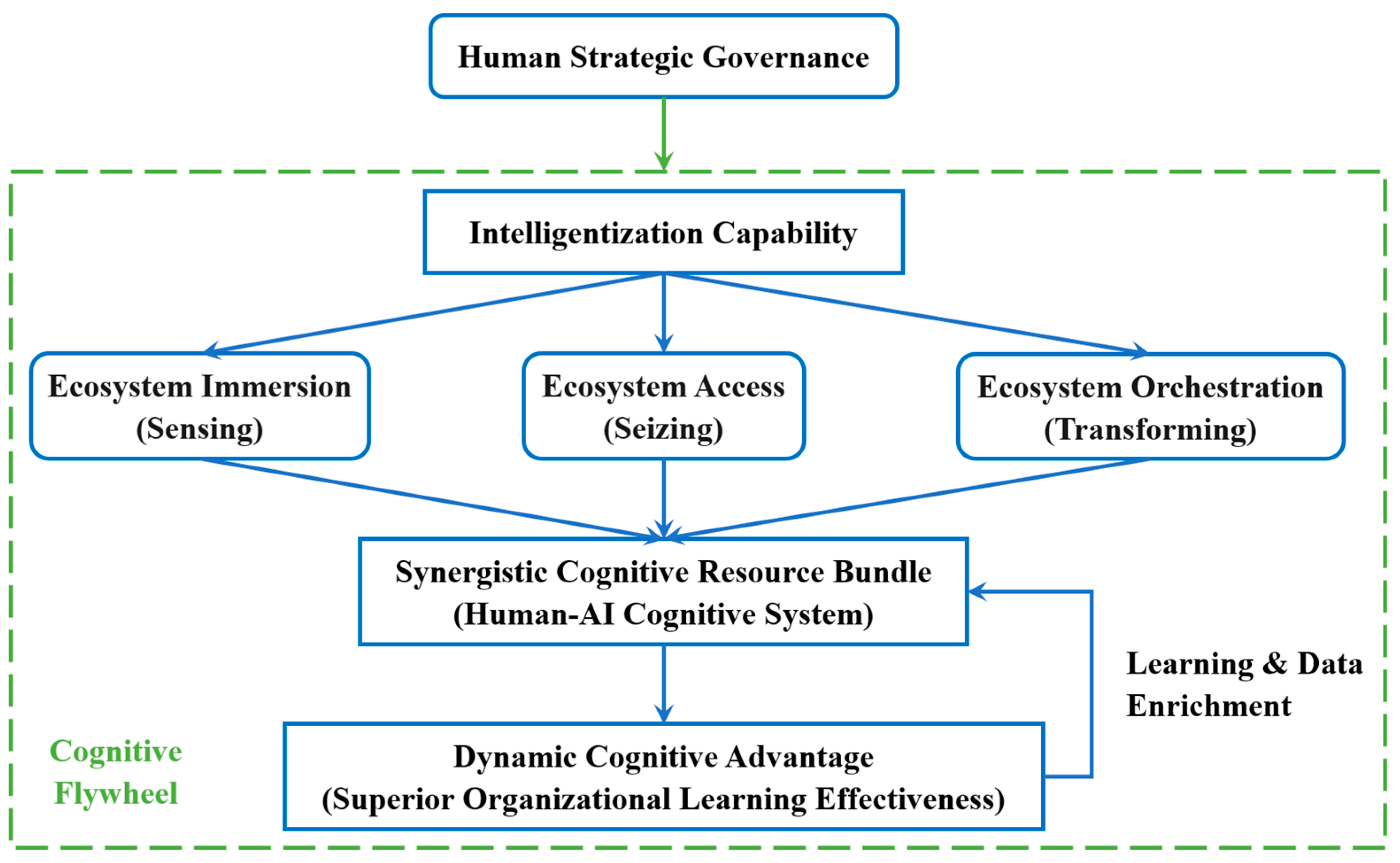
The integration and execution of ecosystem immersion, dynamic modular access, and phase space orchestration generate a recursive positive feedback loop conceptualized as the cognitive flywheel. This autopoietic engine provides the theoretical foundation for the non-linear, compounding nature of dynamic cognitive advantage observed within the intelligentization era [
47,
48]. Unlike traditional physical assets or human capital that suffer entropic wear, fatigue, and depreciation through utilization, AI foundation models and their integrated data architectures appreciate in value through structural coupling and recursive interaction. The operational sequencing of this autopoietic engine involves four closed-loop stages, each governed by mathematical triggers, performance indicators, and specific risk factors. The operationalization of these stages—encompassing immersion and ingestion, transformation and semantic grounding, ecosystem execution, and recursive parameter updating—is detailed in
Table 3, providing the operational architecture required to manage the system’s kinetic velocity.
Analysis of the cognitive flywheel focuses on the two boundary conditions governing its sustained autopoiesis. The first boundary condition demands the satisfaction of the requisite variety of data. The cybernetic stability and learning efficacy of the structurally coupled system rely on a diverse stream of novel environmental data inputs that satisfy the variance threshold necessary to trigger synaptic weight updates. Complex systems organize themselves through interactions among their parts, requiring energy and information exchange to maintain order. If the data volume, dimensional diversity, or statistical variance drops below this threshold, the structural learning mechanisms disengage. Deprived of the negative entropy required to maintain internal complex order and offset systemic degradation, the system suffers from entropic stalling. Entropic stalling freezes the intelligentized firm’s strategic evolution, rendering historical, path-dependent advantages obsolete as the environment shifts. Maintaining this flow of data requires permeable systemic boundaries and interaction with the external market to ensure the flywheel maintains its rotational momentum.
The second boundary condition relates to the physiological threshold of human semantic bandwidth. The theory of dynamic cognitive advantage depends on the structural coupling between machine syntactic processing and human semantic anchoring. However, there exists an upper limit to human cognitive absorptive capacity and processing speed. Algorithmic models ingest datasets, generate probabilistic insights, and execute operations at computational speeds beyond human capacity. While machines excel at syntactic pattern recognition, human experience and judgment remain critical for providing contextual meaning, understanding purpose, and mitigating noise in strategic decision-making. When the volume and complexity of machine-generated insights breach the biological capability of the workforce to execute second-order assessment and contextual validation, structural decoupling occurs.
Surpassing this semantic bandwidth threshold introduces the risk of automation bias [
49,
50]. Managers experiencing cognitive saturation abdicate governance responsibilities, accepting machine outputs without independent contextual verification. In this degraded state, the organization ceases functioning as an adaptive entity and devolves into a deterministic execution engine optimizing for spurious correlations detached from social, ethical, or strategic reality. Exceeding the limits of human semantic bandwidth reduces strategic value, transforming the velocity of the AI from a competitive advantage into a mechanism for organizational failure.
Consequently, maintaining a dynamic cognitive advantage requires the context-dependent tuning of the cognitive flywheel, managing the cybernetic trade-off between velocity and fidelity. In volatile market environments, the structural coupling must prioritize velocity; the firm must lower execution thresholds and minimize human interventions to capture phase space opportunities. Conversely, operating within regulated or ethically ambiguous domains demands a prioritization of fidelity. In these scenarios, the system must increase human-in-the-loop intervention nodes to ensure semantic alignment and ethical compliance, preserving system integrity over operational velocity. See
Figure 2.
4.5. Fractal Governance: Theoretical Derivation and Organizational Resilience
The operation of the cognitive flywheel challenges the viability of hierarchical structures. Hierarchies rely on linear information flows: the upward aggregation of sanitized data and the downward dissemination of delayed directives. When confronting the data volume, computational complexity, and autonomous behaviors of the intelligentization era, the communication channels and processing bandwidths of hierarchies saturate. This structural inability to absorb requisite variety results in decision-making latency, systemic rigidity, and governance breakdowns.
To overcome these bottlenecks, enterprises must transition to fractal governance, a cybernetic framework rooted in fractal geometry and Stafford Beer’s Viable System Model (VSM). A tenet of this framework is that for an organization to remain viable in an unpredictable environment, its internal architecture must exhibit structural self-similarity across operational scales [
51,
52]. In the context of algorithmic governance, this mandates that protocols—such as ethical boundaries, data privacy constraints, and strategic alignment criteria—are not centralized at the executive apex. Instead, they are codified as algorithmic meta-rules distributed recursively throughout the firm. Consequently, whether observing the micro-level (employees interacting with AI), the meso-level (departments coordinating automated workflows), or the macro-level (boards orchestrating ecosystems), the governance logic remains structurally isomorphic. By embedding these meta-rules into the system architecture, governance operates across distributed nodes, bypassing the latency of human-driven approval chains.
The transmission efficiency of this governance architecture is quantified by the Governance Adherence Index (G). This metric measures the signal fidelity of macro-level strategic intent as it propagates downward to micro-level human–machine interaction nodes. In hierarchies, the G value degrades as directives are filtered through successive layers of management. Conversely, a fractal governance structure sustains a high G value. This fidelity is achieved because alignment protocols are computationally enforced within the AI interfaces at every tier, translating strategic intent into localized action without signal attenuation.
Fractal governance enhances organizational resilience by providing a robust mechanism for fault isolation and distributed error correction. In complex digital networks, existential threats increasingly emerge internally via autonomous AI deviations, such as algorithmic hallucinations or localized optimization runaways. Under traditional centralized governance, these unverified errors can instantly cascade upward, triggering systemic failures. In a fractal structure, however, each localized AI node possesses an autonomous micro-governance mechanism encoded with overarching meta-rules. Upon detecting a mathematical anomaly, the node can quarantine corrupted outputs and trigger self-regulation routines before the error breaches its local boundary. This cybernetic mechanism functions analogously to biological cellular autophagy, wherein individual cells autonomously isolate and degrade corrupted internal components to preserve the macro-organism’s autopoietic vitality [
53,
54].
For fractal governance to function, the organization must satisfy two critical prerequisites. First, a high degree of digital maturity is required to support full-spectrum data telemetry. This unbroken, real-time observability is essential to computationally verify local nodes’ adherence to meta-rules. Second, the firm must cultivate a cybernetic culture. Transcending the historically passive role of software operators, employees at all levels must act as empowered second-order observers. They must be culturally incentivized to audit and debug AI parameters whenever emergent algorithmic behaviors drift from established protocols, deeply embedding human-centric self-governance into the socio-technical system.
Based on the theoretical derivation of structural self-similarity and distributed risk mitigation, we propose the following:
Proposition 2. The maturity of the fractal governance structure positively moderates the relationship between AI-enabled dynamic capabilities and organizational resilience. Specifically, the higher the degree of architectural self-similarity in governance protocols across macro-, meso-, and micro-organizational levels, the stronger the firm’s ability to isolate localized algorithmic risks, execute distributed error correction, and maintain autopoietic vitality when confronting environmental upheavals or internal computational deviations.
5. Proposed Empirical Research Agenda
As this manuscript serves as a foundational theory-building contribution, it is logically necessary to establish how these novel constructs can be operationalized and tested in future studies. To empirically validate the dynamic cognitive advantage framework, this study proposes a future sequential exploratory mixed-methods research design [
55,
56]. This methodological architecture integrates longitudinal qualitative process tracing with variance-based structural equation modeling. Navigating the structural cybernetic anomalies inherent in the AI-driven era requires an approach capable of capturing both the idiosyncratic historical genesis of human–machine structural coupling and its generalizable performance impacts across diverse ecosystems. The qualitative phase examines the microscopic, recursive feedback loops defining human–AI co-evolution, capturing the temporal dynamics of historical drift. Building directly upon these contextualized insights, the quantitative phase constructs a nomological network to test the magnitude, sequential mediation pathways, and non-linear boundary conditions of these mechanisms across a large, representative sample of digitalized enterprises. This methodological synthesis ensures that the resulting empirical evidence is statistically robust and deeply grounded in the operational realities of algorithmic governance, thereby satisfying the requirements for modern theoretical construction in strategic management.
5.1. Phase 1: Qualitative Longitudinal Multiple Case Study Protocol
The cognitive flywheel functions as an autopoietic process compounding strategic value over time. Relying on cross-sectional survey snapshots fails to capture the genesis, acceleration, and iterations of this recursive engine. Consequently, the first phase of the empirical design utilizes a longitudinal multiple-case study to establish a foundational understanding of the drift-generating dynamic cognitive advantage. The proposed research protocol should involve the purposive selection of six enterprise cases, stratified across digitally native sectors and traditional industries undergoing digital transformation [
57,
58]. This variance ensures that the insights capture structural coupling under differing degrees of environmental entropy, regulatory pressure, and technological maturity.
Future data collection is recommended to span a twenty-four-month period, establishing a triangulation strategy that merges subjective managerial interpretations with objective systemic telemetry. Recognizing that AI systems act as epistemic agents within the organization, the protocol mandates the gathering of digital artifacts. Researchers monitor API call logs, algorithm version control histories, system error reports, and platform adoption metrics. These artifacts serve as quantifiable traces of machine learning adaptation, capturing the velocity of the AI’s structural updates.
Simultaneously, capturing the human element of structural coupling requires immersion into the firm’s semantic governance architecture. The protocol integrates quarterly semi-structured interviews with chief technology officers, lead data scientists, and strategic business unit directors. These interviews investigate the rationales preceding algorithmic adjustments. Furthermore, qualitative tracking incorporates the coding of strategic planning minutes, data governance memorandums, and post-mortem analyses of algorithmic failures.
The recommended analytical strategy would utilize temporal bracketing and narrative network analysis to map recursive interactions between human semantic anchoring and algorithmic output [
59,
60]. Examining critical incidents—such as unexpected algorithmic hallucinations, sudden market shifts, or abrupt data supply changes—allows researchers to document the temporal latency between detecting an environmental anomaly, human semantic intervention, and the subsequent weight update. This process tracing quantifies the velocities and fidelities of the cognitive flywheel across organizational contexts.
Extracted thematic codes validate the theoretical constructs of the macro-evolutionary framework and inform the survey instruments for the subsequent quantitative phase. Grounding psychometric scales in the vocabulary and operational realities observed during the longitudinal study ensures ecological validity and operational relevance for executive respondents.
5.2. Phase 2: Quantitative Research Model and Hypothesis Formulation
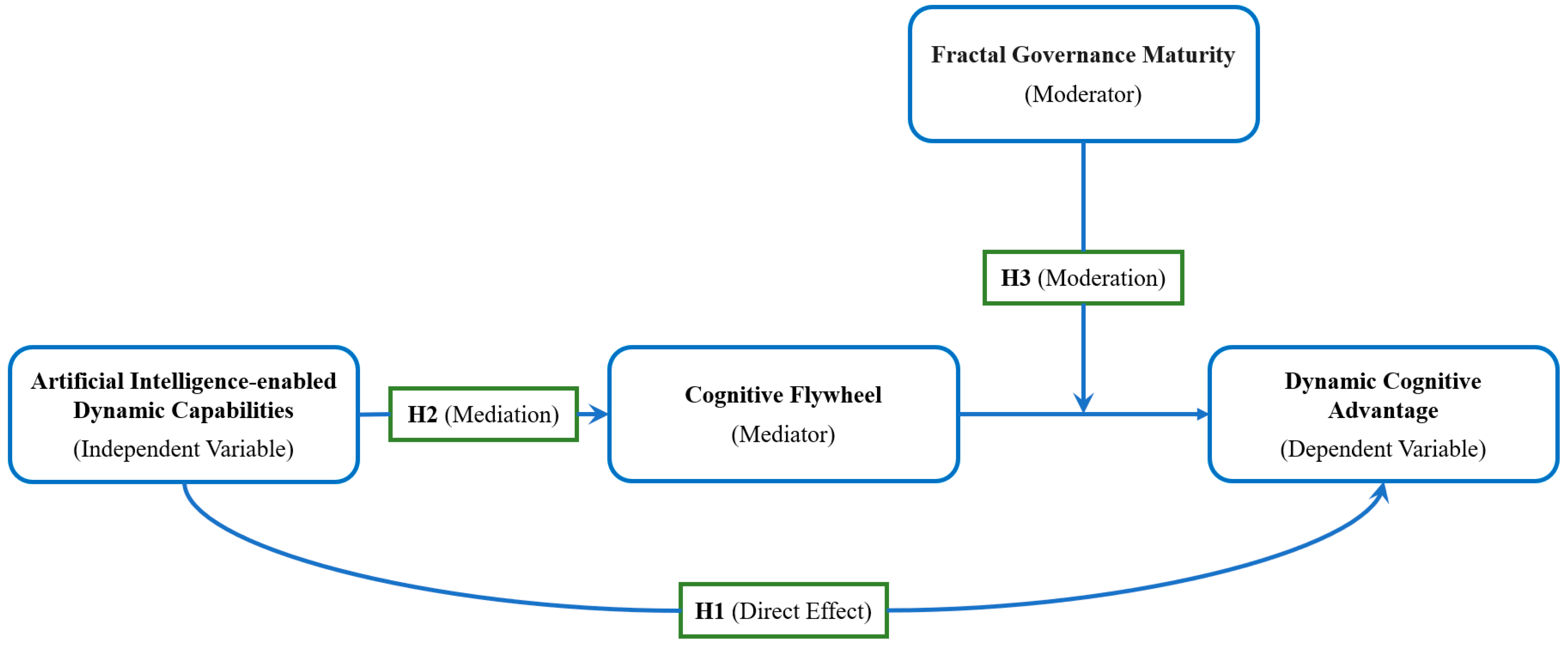
Insights from qualitative tracking inform the specification of a structural equation model (SEM) to validate the theory of dynamic cognitive advantage. The research model posits a nomological network initiating with AI-enabled dynamic capabilities as the primary exogenous variable. This construct progresses through the mediators of data-driven culture and cognitive flywheel efficiency, terminating at the endogenous outcome of firm performance. The model integrates fractal governance maturity as a moderating variable on the final path. Concurrently, a quadratic curve maps the non-linear effect of automation bias on firm performance, establishing the blueprint for the quantitative phase.
5.2.1. Direct Effect of Intelligentization Capability
The integration of advanced algorithmic systems shifts an organization’s sensory bandwidth and response plasticity. AI-enabled dynamic capabilities represent a higher-order strategic resource integrating infrastructure, human expertise, and the organizational capacity for technological reconfiguration. By processing high-dimensional data streams and anticipating market shifts, these capabilities expand the organization’s requisite variety, allowing it to maintain homeostasis while pursuing evolutionary adaptation. Integrating raw data and extracting decision-making value through predictive algorithms transitions the enterprise from static control to dynamic strategic management. Consequently, AI-enabled dynamic capabilities provide the infrastructure required to achieve dynamic cognitive advantage, manifesting as accelerated response times and innovation plasticity. I therefore posit the following:
Hypothesis 1. Artificial intelligence-enabled dynamic capabilities exert a significant and positive direct effect on enterprise performance metrics.
5.2.2. Serial Mediation Mechanism of the Cognitive Flywheel
Translating algorithmic potential into performance requires an autopoietic process. A data-driven culture serves as the structural prerequisite for algorithmic learning loops. It democratizes access to predictive insights and drives evidence-based hypothesis testing, contextualizing quantitative findings. Following this cultural realignment, decision latency reduction operates as the proximal metric for the cognitive flywheel’s learning velocity. When human semantic understanding couples with algorithmic processing power, the temporal friction in sensing and seizing anomalies decreases. This sequential progression represents the flywheel’s kinetic energy translating technological capacity into market execution. I therefore posit the following sequential mechanism:
Hypothesis 2. Data-driven culture and cognitive flywheel efficiency serially mediate the relationship between artificial intelligence-enabled dynamic capabilities and enterprise performance.
5.2.3. Moderating Role of Fractal Governance
To address the risks of autonomous algorithmic execution, I introduce fractal governance maturity as a moderating variable. High-velocity processing without mature governance amplifies strategic misalignment. A fractal governance structure ensures the structural self-similarity of ethical protocols, risk tolerances, and alignment constraints across operational echelons. This distributed architecture allows localized deviations, algorithmic hallucinations, or unethical outputs to be contained and corrected at the node level, preventing cascading failures. Acting as a semantic guardrail, fractal governance amplifies the performance impact of the cognitive flywheel by maintaining its alignment with strategic intent. I therefore posit the following moderation mechanism:
Hypothesis 3. The maturity of fractal governance positively moderates the relationship between cognitive flywheel efficiency and firm performance.
5.2.4. Non-Linear Boundary Conditions and Automation Bias
A theoretical framework must delineate its operational thresholds and failure modes. Unconstrained reliance on automated analytics at the expense of human semantic grounding introduces a systemic vulnerability defined as automation bias. This phenomenon occurs when human operators, overwhelmed by the volume of algorithmic outputs, default to accepting machine recommendations without contextual validation. This cognitive saturation precipitates a structural decoupling, regressing the entity into a deterministic machine optimizing for spurious correlations. Traversing beyond the apex of human–machine structural coupling introduces semantic degradation, resulting in strategic rigidity and a loss of organizational resilience. I therefore posit the following non-linear boundary condition:
Hypothesis 4. The degree of automated data analysis reliance exhibits an inverted U-shaped relationship with organizational performance.
5.3. Construction of Operationalization and Measurement Scales
The envisioned quantitative phase will require operationalizing theoretical constructs into measurable variables. Measurement items utilize a seven-point Likert scale, ranging from strongly disagree to strongly agree.
The exogenous variable, AI-enabled dynamic capability, is modeled as a third-order formative construct. It decomposes into three second-order dimensions. The tangible resources dimension evaluates physical and digital infrastructure, measuring data lake sophistication, cloud computing scalability, and API integration. The human resources dimension measures technical and analytical proficiency, assessing internal data science capabilities, algorithmic auditing skills, and the technological literacy of non-technical staff. The intangible resources dimension captures strategic orientation, evaluating interdepartmental coordination, risk-taking propensity for digital innovation, and the cultural capacity for managing technological change.
Data-driven culture is adapted from enterprise analytics and change management frameworks. Measurement items evaluate the democratization of data accessibility across organizational levels. The construct also measures data governance protocols ensuring data provenance and quality, alongside leadership’s commitment to prioritizing empirical evidence over hierarchical intuition during strategic planning.
Cognitive flywheel efficiency is operationalized through decision latency and organizational learning velocity. Decision latency evaluates the self-reported temporal gap between an environmental perturbation and decision execution, with lower scores indicating rapid adaptation. Learning velocity assesses the frequency and accuracy with which post-execution market feedback is integrated into algorithmic models to reduce predictive error variance.
Fractal governance maturity assesses the degree of structural self-similarity within governance protocols across operational scales. Items evaluate whether ethical constraints, data privacy regulations, and risk management algorithms applied at the macro-level are identically encoded at micro-level interfaces. The scale additionally measures distributed fault isolation mechanisms, evaluating the organization’s ability to contain localized algorithmic errors without centralized intervention.
Automation bias is adapted from psychological and human-factor scales measuring trust in automated systems. Items assess the propensity of human operators to abdicate semantic responsibility. The construct measures the frequency of accepting algorithmic recommendations without contextual validation, the perceived degradation of hallucination detection, and the organizational assumption that quantitative outputs supersede qualitative understanding.
Finally, dynamic cognitive advantage is measured through a composite index of enterprise performance. This construct encompasses self-reported metrics regarding market response agility, the percentage of revenue derived from new algorithmic products indicating innovation plasticity, and financial metrics including return on investment and profitability margin. See
Table 4.
5.4. Sampling Strategy and Data Collection Procedures
The empirical validation of enterprise-wide AI capabilities and governance demands a sampling strategy targeting individuals with a holistic view of their organization’s technological infrastructure and strategic trajectory. Consequently, the target population for the cross-sectional survey phase comprises C-level executives, senior directors of digital transformation, AI product managers, and strategy officers operating within medium- to large-scale enterprises globally.
An a priori power analysis ensures that the dataset possesses sufficient statistical power to detect mediating and moderating effects, particularly the quadratic relationships in the automation bias hypothesis [
61,
62]. Assuming a medium effect size, a five percent significance level, and a statistical power of ninety-five percent, the minimum required sample size is one hundred and seventy-six observations. To account for survey attrition, incomplete responses, and subgroup analyses, the data collection protocol targets a final sample exceeding three hundred unique enterprise responses.
The data collection procedure should distribute the structured questionnaire through professional networking platforms and executive alumni databases. Pre-testing the survey instrument helps maximize response rates and data reliability among this demographic. An initial pilot study involving domain experts, including chief executive officers and academic peers with experience in digital transformation, evaluates item clarity, face validity, and cognitive load. Feedback from this pilot phase refines the phrasing of cybernetic concepts into accessible managerial terminology, ensuring that theoretical intent translates into the survey items.
Given the reliance on single-informant, self-reported cross-sectional data, the research design implements procedural and statistical remedies to mitigate common method variance. Procedurally, the survey architecture ensures respondent anonymity and emphasizes in the introductory briefing that there are no correct or incorrect answers, reducing evaluation apprehension and social desirability bias. The instrument utilizes psychological separation techniques, placing temporal and spatial breaks between the measurement of exogenous independent variables and endogenous performance metrics. Statistically, post-hoc evaluations include Harman’s single-factor test to detect the presence of an unmeasured latent factor accounting for the majority of the variance. Furthermore, the inclusion of a theoretically unrelated marker variable within the survey design allows for the statistical isolation and extraction of residual common method bias [
63,
64]. This mitigation protocol ensures that the structural relationships uncovered represent empirical variance rather than methodological artifacts.
5.5. Analytical Strategy and Partial Least Squares Evaluation Criteria
The quantitative analysis is proposed to be executed using partial least squares structural equation modeling (PLS-SEM) implemented in SmartPLS 4 [
65,
66]. PLS-SEM is recognized in the strategic management and information systems literature for assessing complex multivariate models encompassing predictive orientations and formatively measured higher-order constructs. It maximizes the explained variance of endogenous constructs and processes structural models containing serial mediations, making it suitable for exploring nascent theories and evaluating the dynamics of the cognitive flywheel. The analytical procedure follows a two-step evaluation process, assessing the measurement models prior to evaluating the structural model.
5.5.1. Measurement Model Assessment Protocols
Validation of the measurement model ensures that the instruments reliably measure the intended constructs. For reflective lower-order constructs, internal consistency reliability is established using Cronbach’s alpha and composite reliability, with values exceeding the 0.7 threshold. Convergent validity is confirmed by the average variance extracted for each construct, verifying that greater than 50% of the variance in the indicators is explained by the latent variable. Discriminant validity is assessed using the heterotrait-monotrait ratio of correlations to ensure that each construct captures a distinct phenomenon. The heterotrait–monotrait criterion provides statistical sensitivity, with values falling below the 0.85 threshold.
For formative higher-order constructs, such as AI-enabled dynamic capability, the evaluation criteria reflect their distinct properties. Indicator reliability is assessed through the significance and relevance of outer weights, calculated via bootstrapping. Collinearity among formative indicators is assessed using variance inflation factors. Values below the 3.3 threshold indicate that items are not measuring redundant aspects of the construct. The evaluation of higher-order models utilizes the disjoint two-stage approach to estimate latent variable scores before integration into the structural path [
67].
5.5.2. Structural Model Evaluation and Hypothesis Testing
Following the validation of the measurement model, the analysis evaluates the structural model. The initial step involves an inner model collinearity check to ensure that estimated path coefficients are not distorted by correlations among predictor constructs. The explanatory power of the model is quantified by examining the coefficient of determination for the endogenous variables, thereby tracking the variance explained in cognitive flywheel efficiency and firm performance.
The out-of-sample predictive relevance is assessed using the PLSpredict procedure. This procedure generates predictions for data points excluded from the model estimation phase. Comparing the root mean squared error or mean absolute error of the PLS-SEM predictions against linear benchmark models provides evidence of the framework’s forecasting utility.
Hypothesis testing relies on a non-parametric bootstrapping procedure. To ensure stability in standard error estimations and account for deviations from multivariate normality, the procedure generates 10,000 subsamples drawn with replacement. The direct effect postulated in Hypothesis 1 is evaluated by examining the magnitude, statistical significance, and confidence intervals of the path coefficient linking AI capabilities to firm performance.
5.5.3. Advanced Testing for Serial Mediation, Moderation, and Quadratic Effects
Testing the highly complex serial mediation chain proposed in Hypothesis 2 isolates the total and specific indirect effects routing from the independent variable, through the sequential mediators of data-driven culture and decision latency reduction, terminating at the dependent variable. The precise calculation of these specific indirect pathways confirms that the chain operates sequentially as theorized, successfully translating cultural adaptation into temporal velocity and ultimately into strategic advantage.
The moderating impact of fractal governance detailed in Hypothesis 3 is assessed by introducing a product indicator interaction term directly into the structural model. The analysis mathematically evaluates whether the path coefficient of this newly created interaction term significantly and positively alters the primary trajectory between cognitive flywheel efficiency and firm performance. A positive and significant interaction term confirms the theoretical assertion that structural self-similarity and distributed fault isolation exponentially amplify the value generated by high-velocity decision execution.
Testing the critical non-linear, inverted U-shaped boundary condition theorized in Hypothesis 4 employs the advanced two-stage approach specifically designed for modeling quadratic effects within the partial least squares environment. This sophisticated procedure involves initially executing the standard main effects model without the quadratic term to extract the unpolluted latent variable scores. Subsequently, these precise scores are saved and utilized to compute a squared interaction term, essentially treating the degree of automated data analysis reliance as a moderator of itself. By mathematically isolating and testing the significance and negative directionality of this parabolic curvature, the research design provides definitive quantitative proof regarding the exact threshold where automation reliance ceases to be beneficial and begins to actively erode systemic resilience due to automation bias.
5.6. Adherence to Contemporary Reporting Standards and Methodological Rigor
The analysis departs from asterisk-based significance notations in analytical tables and narrative discussions. Instead, it reports three-digit probability values for structural paths. Parameter estimates are accompanied by standard errors and 95% confidence intervals derived from the 10,000-subsample bootstrapping procedure.
The evaluation of structural relationships prioritizes the reporting and interpretation of effect sizes over statistical significance. The magnitude of direct, mediated, and moderated relationships is quantified using appropriate metrics. Focusing on effect sizes avoids conflating statistical detectability within a large sample with strategic relevance, ensuring that the conclusions regarding fractal governance and intelligentization capabilities provide substantive insights for practitioners.
To assess the robustness of empirical conclusions, the PLS-SEM analysis undergoes sensitivity testing. The protocol addresses unobserved heterogeneity using the Finite Mixture Partial Least Squares (FIMIX-PLS) algorithm to determine if structural relationships vary across hidden sub-populations. Furthermore, observed heterogeneity is tested via multigroup analysis across sub-populations divided by industry sector and firm size, assessing the generalizability of the dynamic cognitive advantage framework across digital ecosystems.
The research design addresses endogeneity by implementing the Gaussian copula approach. This technique identifies and corrects for potential unobserved confounders correlating with exogenous constructs, isolating the impact of AI capabilities on firm performance.
The research design incorporates Necessary Condition Analysis (NCA) to supplement the PLS-SEM findings. While PLS-SEM estimates the additive sufficiency of the cognitive flywheel components, NCA determines whether a specific level of data-driven culture or fractal governance maturity operates as a bottleneck for achieving high firm performance. Integrating these two logics of causality provides an understanding of the boundary conditions governing structural coupling. Finally, Importance–Performance Map Analysis (IPMA) contrasts structural coefficients against the unstandardized performance scores of latent constructs, translating path models into prioritized recommendations for executive intervention. This methodological approach establishes the empirical validity of the dynamic cognitive advantage theory, providing a quantitative blueprint for governing human and AI co-evolution.
6. Discussion and Conclusions
6.1. The Resolution of the Cybernetic Anomaly
The genesis of this research addresses a theoretical anomaly in strategic management. As enterprises transition from informatization to intelligentization, the ontological assumptions governing organizational theory are failing. Established paradigms, such as the traditional RBV and DC framework, are anchored in a Cartesian subject–object dichotomy. These theories assume a hierarchical structure where human managers act as sole cognitive agents, exercising linear control over subordinate resource objects. While this epistemology of first-order cybernetic control explains physical industrialization, it collapses when strategic resources acquire epistemic agency, predictive capacity, and autonomous learning capabilities.
The integration of AI and LLMs into the enterprise precipitates this anomaly. The algorithmic system no longer acts as a conduit for human intent or a repository of historical data. Rather, it functions as an observing system capable of pattern recognition and semantic generation. It ingests environmental entropy, recognizes topological patterns within the market ecosystem, and generates probabilistic representations that shape the cognitive decisions of management. Consequently, the linear causality of strategic execution transitions into recursive causality. The managerial subject and the algorithmic object become entangled in a loop of mutual perturbation and structural co-evolution.
Shifting the visualization of the firm from a hierarchical flow of resource management to a recursive figure-eight topology connecting a human semantic node and a machine syntactic node alters the analytical perspective. This topological loop, interacting with environmental ecosystem entropy, illustrates the mechanism of the intelligentized enterprise. Reconceptualizing the modern enterprise as a complex adaptive system operating far from thermodynamic equilibrium introduces the theory of dynamic cognitive advantage. This framework bridges the epistemological gap created by the cybernetic anomaly. It demonstrates that in environments defined by volatility and autonomous technological agents, competitive differentiation cannot be derived from the accumulation of algorithms or the hoarding of proprietary datasets.
Closed-system isolating mechanisms, prescribed by traditional resource-based logic, lead to data starvation, conceptual drift, and model degradation when applied to dissipative structures. Instead, advantage emerges from the structural coupling of human semantic understanding with artificial syntactic processing. Through this cybernetic lens, the objective of strategic management shifts. It transitions from the engineering of asset reallocation and optimization of deterministic supply chains toward the second-order governance of human–machine co-evolution and the regulation of cognitive boundary permeabilities.
6.2. Primary Theoretical Contributions
This research establishes a formalized, operational, and empirically grounded theoretical architecture for strategic management. It transcends descriptive discourse, redefining organizational architecture through the principles of complex adaptive systems. The central contributions manifest across three interdependent dimensions, altering how intelligent capabilities are conceptualized, measured, and governed.
The first theoretical contribution is the mathematical formalization of human–machine structural coupling, introducing a quantitative, second-order cybernetic perspective to the strategic management literature. Prior scholarship has utilized the terminology of co-evolution and digital symbiosis primarily in a descriptive capacity. By importing the mathematics of non-linear differential equations and complex dissipative structures, this study quantifies the evolutionary realities of the intelligentization era.
The framework models the organizational and machine cognitive states as interdependent, continuous, dynamic variables. The genesis of competitive advantage is isolated within the structural coupling coefficients, which quantitatively dictate the intensity of recursive cross-updating between human semantic intent and machine statistical syntax. Furthermore, this formalization addresses the mechanisms of competitive inimitability. Through the introduction of the time decay integral, this study demonstrates that advantage is generated by the tensor product of human and machine states integrated over a historical trajectory. This continuous drift acts as a barrier to imitation. Rival enterprises remain historically incapable of instantly replicating the context-bound recursive interactions that have uniquely aligned a specific AI instantiation with a firm’s tacit cultural nuances.
The second theoretical contribution is the deconstruction and operationalization of systemic learning into the actionable mechanism of the cognitive flywheel. The framework dismantles the autopoietic engine of the intelligentized firm into four continuous micro-operational stages, specifying the algorithmic trigger conditions, KPIs, and terminal risk factors governing each phase.
The first stage, immersion and ingestion, establishes the thresholds of environmental variance required to activate the sensory apparatus, avoiding entropic data starvation. The second stage, transformation and semantic grounding, defines the interaction where machine probabilistic prediction meets human strategic contextualization, highlighting the organizational vulnerability of automation bias. The third stage, ecosystem execution, shifts focus to the dynamic configuration of resources, prioritizing the reduction of operational latency and ecosystem access. Finally, recursive parameter updating closes the cybernetic loop, formalizing how market feedback is captured to simultaneously rewrite algorithmic synaptic weights via back-propagation and reshape human managerial heuristics.
The third contribution addresses the necessity for a framework that connects macro-evolutionary cybernetic theory with specific organizational micro-structures, culminating in an empirical validation architecture. Traditional hierarchical governance models are incompatible with the extreme velocity and requisite variety demanded by the cognitive flywheel. To resolve this structural bottleneck, this research introduces the theory of fractal governance, drawing upon structural self-similarity and Stafford Beer’s viable system model.
This framework dictates that overarching ethical protocols, strategic alignment constraints, and risk management meta-rules are algorithmically encoded across operational echelons. Establishing a universally high governance adherence index enables distributed, real-time error correction. This localized capacity for fault isolation acts similarly to biological cellular autophagy, preventing algorithmic hallucinations or data corruptions from cascading into systemic failures.
Crucially, this research culminates in a mixed-methods empirical blueprint utilizing partial least squares structural equation modeling (PLS-SEM). The blueprint details hypothesis derivations spanning the direct effects of intelligentization capabilities, the serial mediations of data-driven culture and flywheel efficiency, the moderating influences of fractal governance maturity, and the non-linear inverted U-shaped boundary conditions associated with automation bias. This methodological apparatus provides the statistical tools, measurement scales, and structural logic required to validate the cognitive flywheel and refine the theory of dynamic cognitive advantage through cross-sectional field data.
6.3. The Epistemological Shift in Strategic Management Paradigms
A comparative analysis details the epistemological shifts from legacy theories to the dynamic cognitive advantage framework. This theoretical reconstruction bounds the historical applicability of the RBV and the DC framework, articulating why an epistemological transition is required when engaging with intelligent, dissipative structures.
The transition from the RBV hinges on underlying thermodynamic assumptions. The RBV conceptualizes the firm as a closed system striving for equilibrium, where the enterprise accumulates static stocks of valuable, rare, inimitable, and non-substitutable assets. Managers erect isolating mechanisms—such as patents, causal ambiguity, and firewalls—to defend these stocks against entropic decay generated by the external market. In this closed-system model, value operates as potential energy, stored latently within the asset until deployed.
However, when the core resource is a generative AI model, this closed-system logic becomes counterproductive. Algorithmic systems operate as dissipative structures far from thermodynamic equilibrium. Their predictive accuracy and strategic utility are kinetic properties sustained through continuous metabolic exchange with the external environment. They require an influx of negative entropy via high-dimensional data streams and human error correction. Applying isolationist logic to an AI system induces data starvation, causing internal entropy to rise, which manifests as conceptual drift and performance degradation. The new paradigm shifts from valuing static stock to optimizing the kinetic flow of data, replacing isolating mechanisms with permeable structural coupling interfaces.
Similarly, the evolution from the DC framework requires a shift from first-order to second-order cybernetics. Traditional dynamic capabilities emphasize the managerial capacity to sense, seize, and transform resources, anchored in a first-order control model where the executive team occupies a detached vantage point. The manager acts as the cognitive agent, observing market perturbations and reconfiguring organizational machinery. The resources themselves do not observe the market or alter the manager’s mental models.
The intelligentization era dismantles this unidirectional hierarchy. Similar to how dynamic graph convolutional neural networks reconstruct internal topologies based on environmental perturbations, AI acts as an autonomous second observer. It generates probabilistic representations of the ecosystem that force managers to adapt their strategic worldview based on derived realities. The object of control reshapes the cognitive framework of the controlling subject.
Consequently, the micro-foundations of dynamic capabilities require reinterpretation to reflect this second-order reality. Sensing evolves into continuous ecosystem immersion, utilizing algorithmic networks to capture non-linear signals and amplify requisite variety. Seizing transitions to dynamic ecosystem access, prioritizing the frictionless configuration of modular digital services to minimize response latency. Finally, transforming expands into ecosystem orchestration, where the firm acts as a strange attractor within a heterarchy, manipulating incentive structures to align autonomous external agents. This shift demands abandoning linear control in favor of managing complex, entangled reflexivity.
6.4. Managerial and Organizational Implications in the Intelligentization Era
The theoretical resolutions established by the dynamic cognitive advantage framework dictate a reorientation of managerial practice and corporate strategy. Executive leadership can no longer view the deployment of AI as an information technology procurement exercise or a localized efficiency initiative. The transition from operating complicated machines to governing complex adaptive ecologies requires the cultivation of novel leadership capabilities focused on meta-regulation, cultural adaptation, and the orchestration of digital ecosystems.
A practical implication is the necessity for management to transition from task-level operational control toward meta-steering and parameter governance. In a structurally coupled enterprise, the volume, velocity, and complexity of decisions executed autonomously by algorithmic agents preclude human micromanagement. Attempting to review every localized pricing adjustment, supply chain reroute, or personalized marketing generation produced by the AI triggers decision bottlenecks, neutralizing the speed advantages of the technology. Therefore, executive focus shifts from issuing operational commands to the design and tuning of governance parameters.
Leaders must act as meta-regulators, defining the boundary conditions, strategic intent, and ethical guardrails within which AI systems operate. This practice is rooted in Ashby’s Law of Requisite Variety. Because the human cognitive apparatus cannot match the informational variety generated by the global ecosystem, management must deploy AI to absorb that variety. Simultaneously, management must allocate cognitive bandwidth to govern the constraints of the technology. The definition of corporate strategy shifts from planning a fixed trajectory to dynamically designing the fitness landscape for the organization. Executives must determine the optimal coupling intensity for various organizational functions. In volatile environments where survival depends on speed, governance must prioritize flywheel velocity, loosening coupling constraints to allow machine autonomy. Conversely, in regulated or safety-critical domains, parameters must prioritize fidelity, demanding human-in-the-loop validation at the expense of operational speed.
To execute this meta-governance, the organization must undergo a cultural transformation toward a reflexive cybernetic culture. The fractal nature of the governance architecture mandates that algorithmic oversight is not localized within a compliance department but distributed across nodes of the enterprise network. This paradigm requires that the workforce transcends the passive role of software operator to act as second-order observers. Employees must understand the observer-dependence of AI outputs, recognizing that algorithmic recommendations are not objective truths but probabilistic constructions contingent upon training data and reward functions.
A reflexive culture encourages double-loop learning. Workers must not merely correct surface-level errors generated by the machine but possess the digital maturity and psychological safety to question and debug the underlying mathematical assumptions precipitating the error. Without this semantic grounding, the autopoietic process of the cognitive flywheel can degenerate into a loop of algorithmic hallucination, where the system optimizes for a proxy metric detached from market reality. The workforce is elevated to the role of semantic guardians, ensuring that the syntactic efficiency of the machine aligns with the semantic purpose of the organization.
Furthermore, the theory of dynamic cognitive advantage alters how intelligentized firms manage operational boundaries. The historical objective of owning and hoarding physical and digital assets generates systemic latency. In the modern paradigm, the primary goal is the orchestration of ecosystem flows. Managers must prioritize dynamic ecosystem access, developing the relational and technological capabilities required to manage a fluid network of algorithm vendors, data providers, and platform complementors.
The firm must be architected as an open platform for co-evolution. Value is generated by facilitating the structural coupling of the firm’s cognitive systems with those of ecosystem partners. As external partners train their local models utilizing the central firm’s data ontologies and algorithmic standards, their operational logic becomes intertwined with the orchestrator’s governance architecture. This structural interpenetration creates a resilient competitive moat based on shared cognitive evolution rather than financial contracts. The executive acts as a system tuner, adjusting the balance between imposing architectural control and fostering generative innovation to keep the global ecosystem operating at the edge of chaos.
6.5. Theoretical Boundaries and Systemic Limitations
Theoretical construction in the management sciences requires the delineation of boundaries and operational thresholds. The theory of dynamic cognitive advantage is not universally applicable across industrial contexts. To provide accurate guidance, it is necessary to map the phase space where the cognitive flywheel operates and define the thresholds where the theory degrades or yields to legacy paradigms.
These boundaries can be conceptualized within a two-dimensional phase space matrix. The horizontal axis represents environmental entropy and technological velocity, ranging from stable environments to high-velocity digital markets. The vertical axis represents the human semantic absorptive capacity within the organization, ranging from legacy bureaucratic inertia to agile, digitally mature capacity. The operating space for dynamic cognitive advantage exists in the upper-right quadrant, characterized by high external entropy and high internal absorptive capacity. Outside this zone, the framework encounters theoretical limitations.
The initial boundary condition relates to the macroscopic industrial context. While continuous structural coupling and algorithmic learning drive advantage in volatile markets, the RBV and scale economies remain superior in specific sectors. This is observable in the bottom-left quadrant, characterized by low environmental entropy. In heavy-asset industries—such as public utilities, petrochemical refining, and infrastructure construction—the macro-economic environment shifts slowly. Competitive advantage here is determined by the accumulation of physical capital, geographical rights, and regulatory licenses. Within these parameters, the isolating mechanisms of the RBV constitute barriers to entry. Implementing an AI cognitive flywheel in these domains would introduce systemic friction and computational overhead without commensurate returns. Therefore, the theory of dynamic cognitive advantage is bounded as an extension designed for information-dense environments where cognitive plasticity outweighs physical mass.
A second boundary condition relates to the internal processing limits of the firm. The framework relies on the operation of human–machine structural coupling, balancing the machine’s capacity for syntactic pattern generation with the human organization’s capacity for semantic anchoring and ethical review. The framework posits an upper limit to human absorptive capacity, mapped to the bottom-right quadrant where technological velocity outpaces human capacity. As algorithmic models scale in data ingestion and generative velocity, they produce insights at a rate that can outpace the cognitive processing limits of the executive team. When machine output breaches this threshold, the cybernetic mechanism of the cognitive flywheel fractures.
In this state, human managers experience cognitive overload. Lacking the temporal bandwidth to verify or contextually ground algorithmic insights, the workforce abdicates its role as the semantic governor, risking widespread automation bias. The firm ceases to function as an adaptive entity, devolving into an execution engine optimizing for unverified mathematical correlations. When this boundary is violated, the integration of AI ceases to generate a sustainable advantage, leading to a loss of strategic coherence. The constraint on the theory is the biological capacity of the human organization to absorb and govern emergent complexity.
Finally, the implementation of fractal governance—the mechanism designed to mitigate algorithmic hallucination and contain localized fault propagation—requires institutional and infrastructural prerequisites. The structural self-similarity and distributed error correction capabilities of this architecture depend on digital observability. To ensure that ethical meta-rules and strategic alignment protocols are enforced across distributed nodes, the enterprise must possess an integrated telemetry infrastructure. If an enterprise suffers from fragmented data silos or disjointed software architectures, the governance adherence index cannot be calculated. Under these conditions, central executive functions become blind to localized algorithmic deviations, causing the fractal structure to break down. Consequently, the theory of dynamic cognitive advantage applies to enterprises that possess foundational digital maturity and systemic transparency.
6.6. Concluding Synthesis
The transition into the intelligentization era represents more than an acceleration of digital workflows or the procurement of predictive software. It constitutes a phase transition in the ontology and thermodynamic nature of the enterprise. As technological resources acquire epistemic agency, probabilistic foresight, and autonomous learning capabilities, traditional strategic management paradigms rooted in linear control, asset isolation, and closed-system equilibrium are rendered obsolete. By embracing the principles of second-order cybernetics, complex adaptive systems, and non-linear dynamics, this research provides the theoretical reconstruction necessary to navigate this economic reality.
The formalization of the dynamic cognitive advantage framework demonstrates that the source of competitive superiority in volatile environments is not the static possession of algorithmic artifacts, which are subject to rapid commoditization and time decay. Rather, advantage is derived from the continuous governance of human–machine structural coupling. Through the operationalization of the autopoietic cognitive flywheel and the implementation of fractal governance to ensure systemic resilience, this framework bridges the gap between cybernetic philosophy and strategic execution. Furthermore, by providing a partial least squares structural equation modeling blueprint, this research establishes a mathematical foundation for future empirical validation.
However, this capability is bound by limitations. The necessity of maintaining human semantic bandwidth against the velocity of artificial computation stands as a defining challenge of modern strategic leadership. The theory posits that abandoning human oversight leads not to efficiency but to algorithmic collapse. Ultimately, the future of the enterprise belongs not to organizations that surrender their strategic autonomy to the deterministic optimization of the machine. The future belongs to leaders who master the practice of meta-governance, recursively fusing human ethical purpose with AI to forge a synergistic cognitive entity capable of thriving at the edge of chaos.