
A Dynamic Risk Assessment System for Expressway Lane-Changing: Integrating Bayesian Networks and Markov Chains Under High-Density Traffic



Abstract
1. Introduction
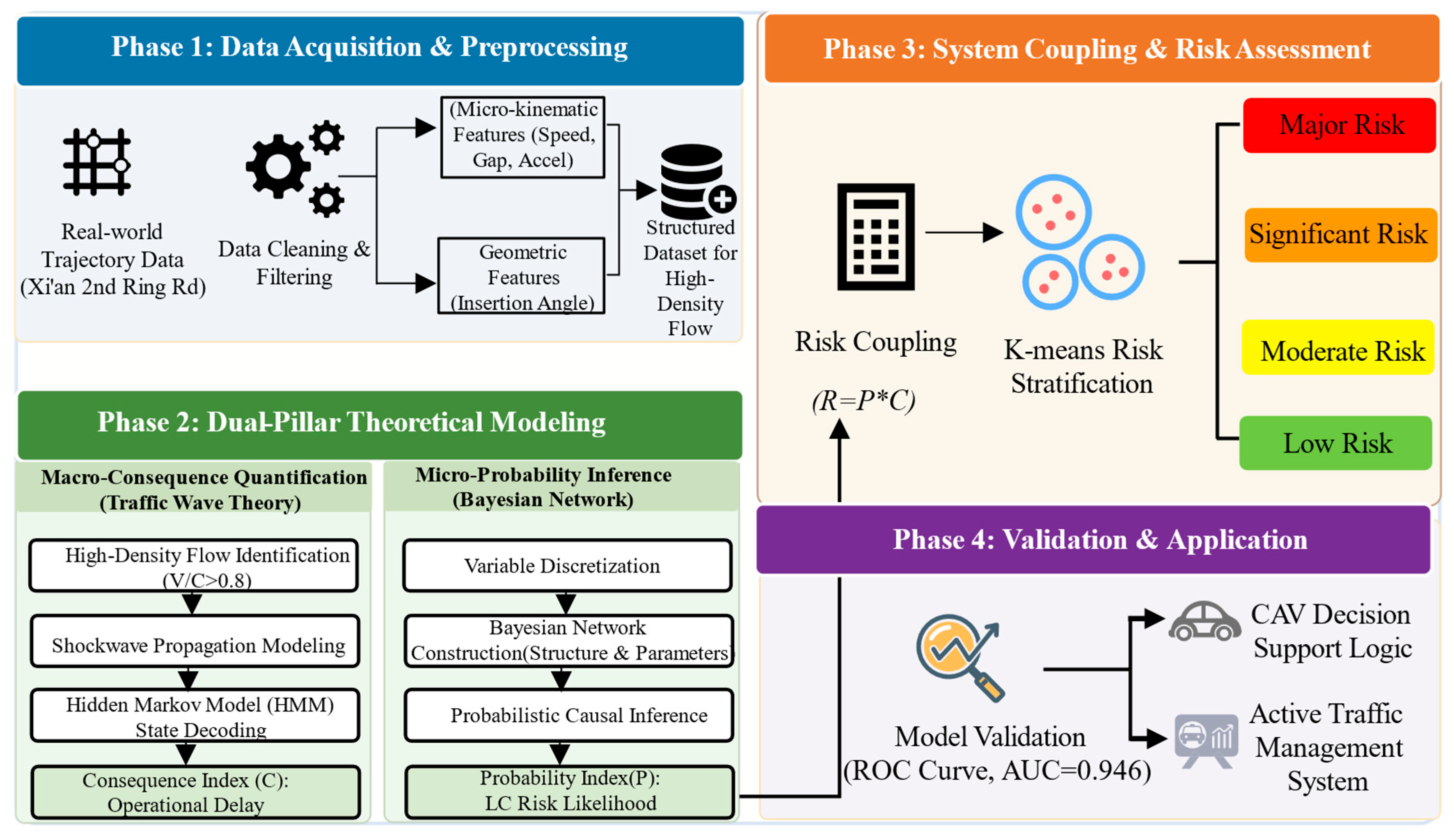
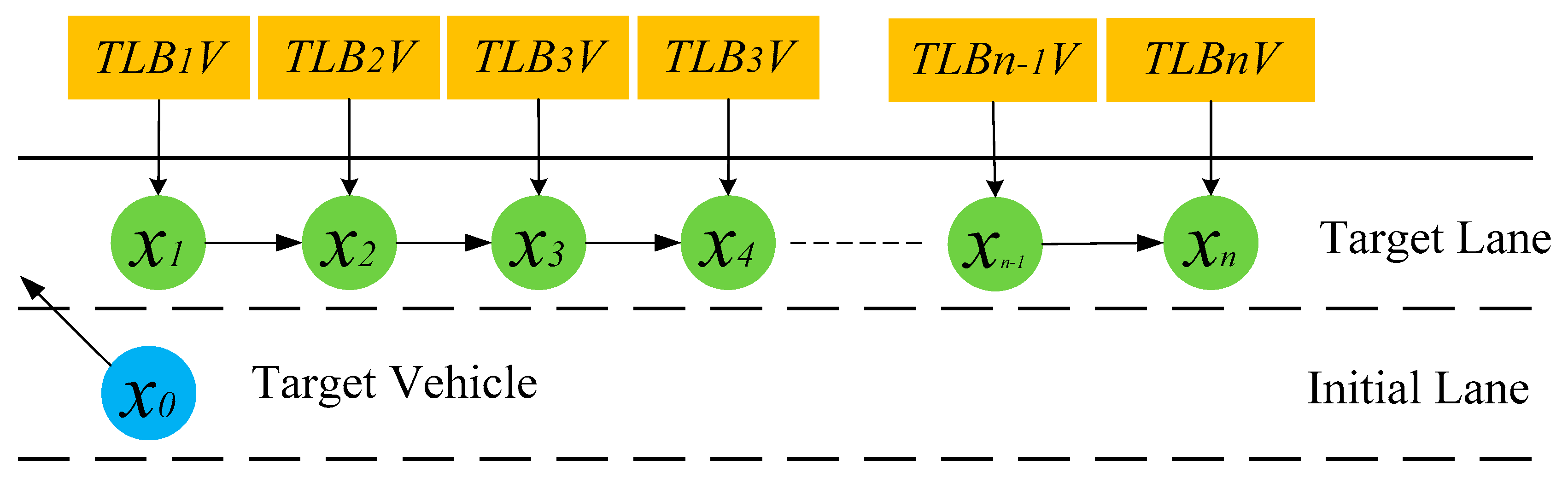
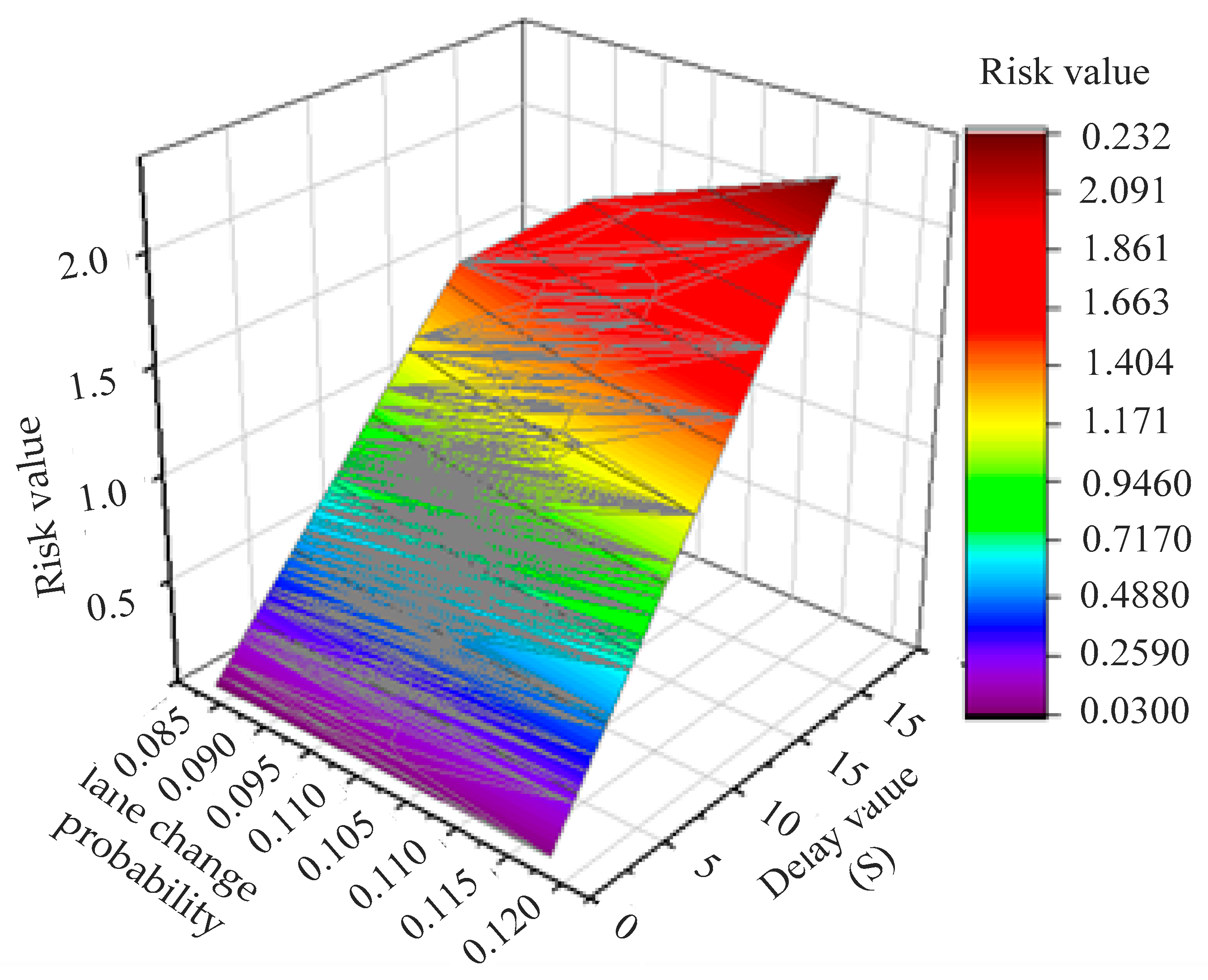
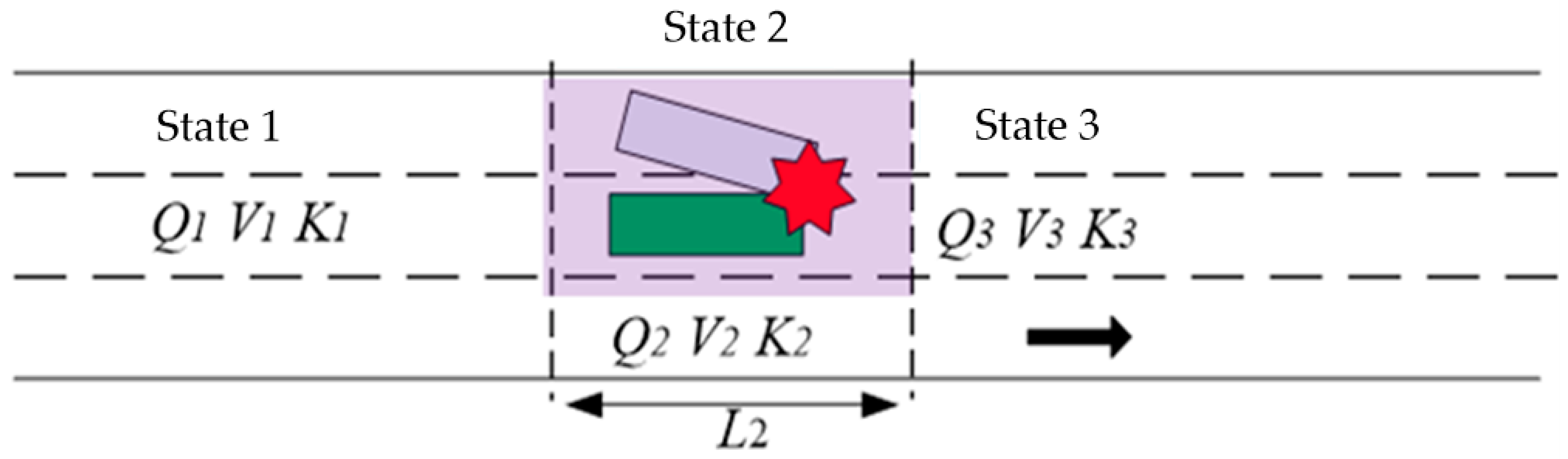
- System-Theoretic Risk Definition: We redefine risk as the product of LC Probability and Operational Consequence. Unlike traditional collision-based metrics, we utilize Hidden Markov Models (HMM) to quantify the systemic consequence by calculating the operational delay propagated through the following vehicle platoon.
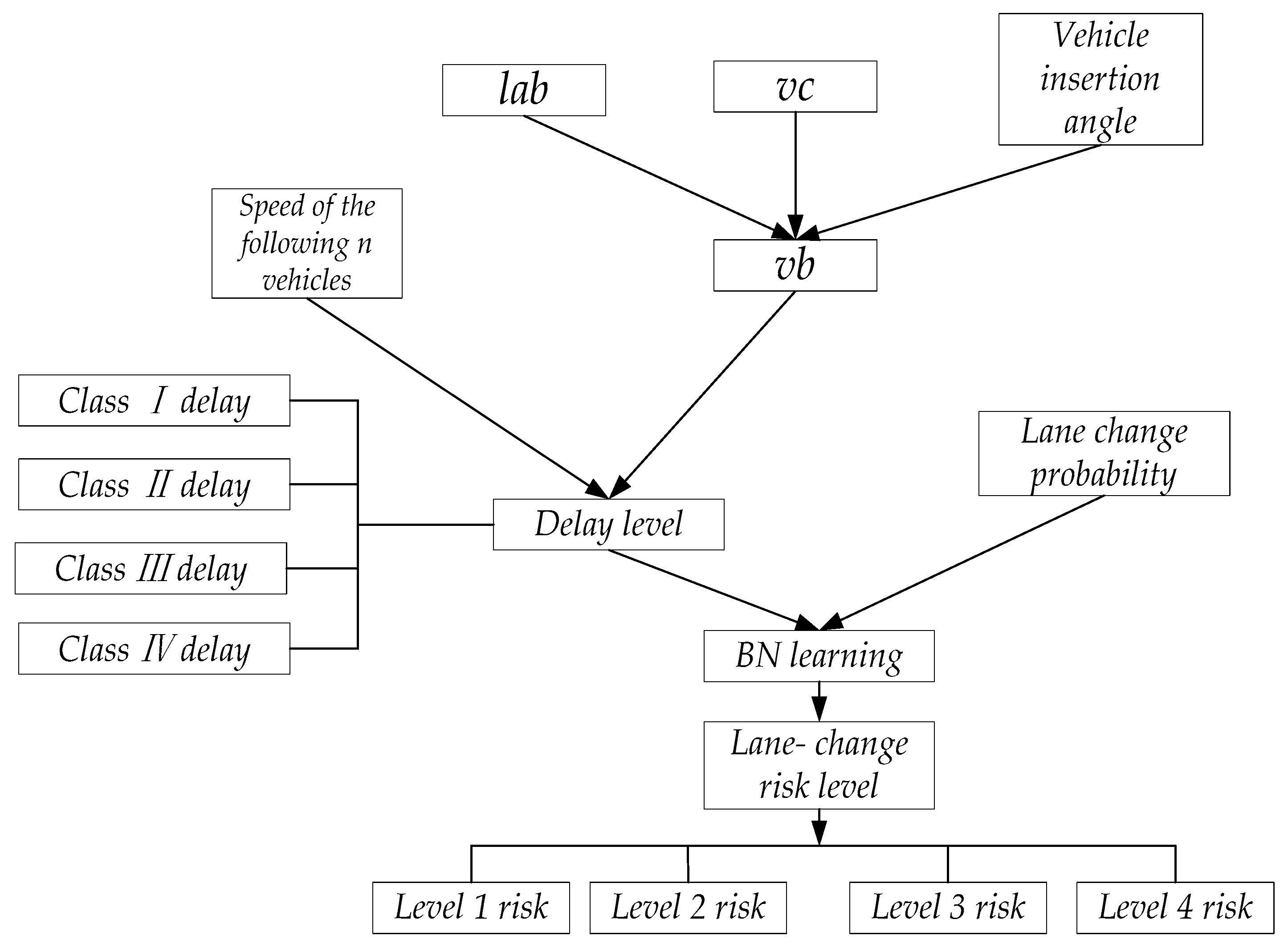
- Explainable Probabilistic Modeling: We construct a Bayesian Network (BN) that integrates the geometric feature of “Insertion Angle” with kinematic variables. This structure allows for causal reasoning and the dynamic updating of risk beliefs under uncertainty, addressing the “black box” limitation of pure deep learning approaches.
- Dynamic Risk Zoning and Validation: Based on the coupled risk values, we establish a dynamic clustering model to categorize risk into four distinct levels. This provides a quantifiable and actionable standard for real-time traffic monitoring and future Connected and Autonomous Vehicle (CAV) decision logic.
2. Related Work
3. Materials and Methods
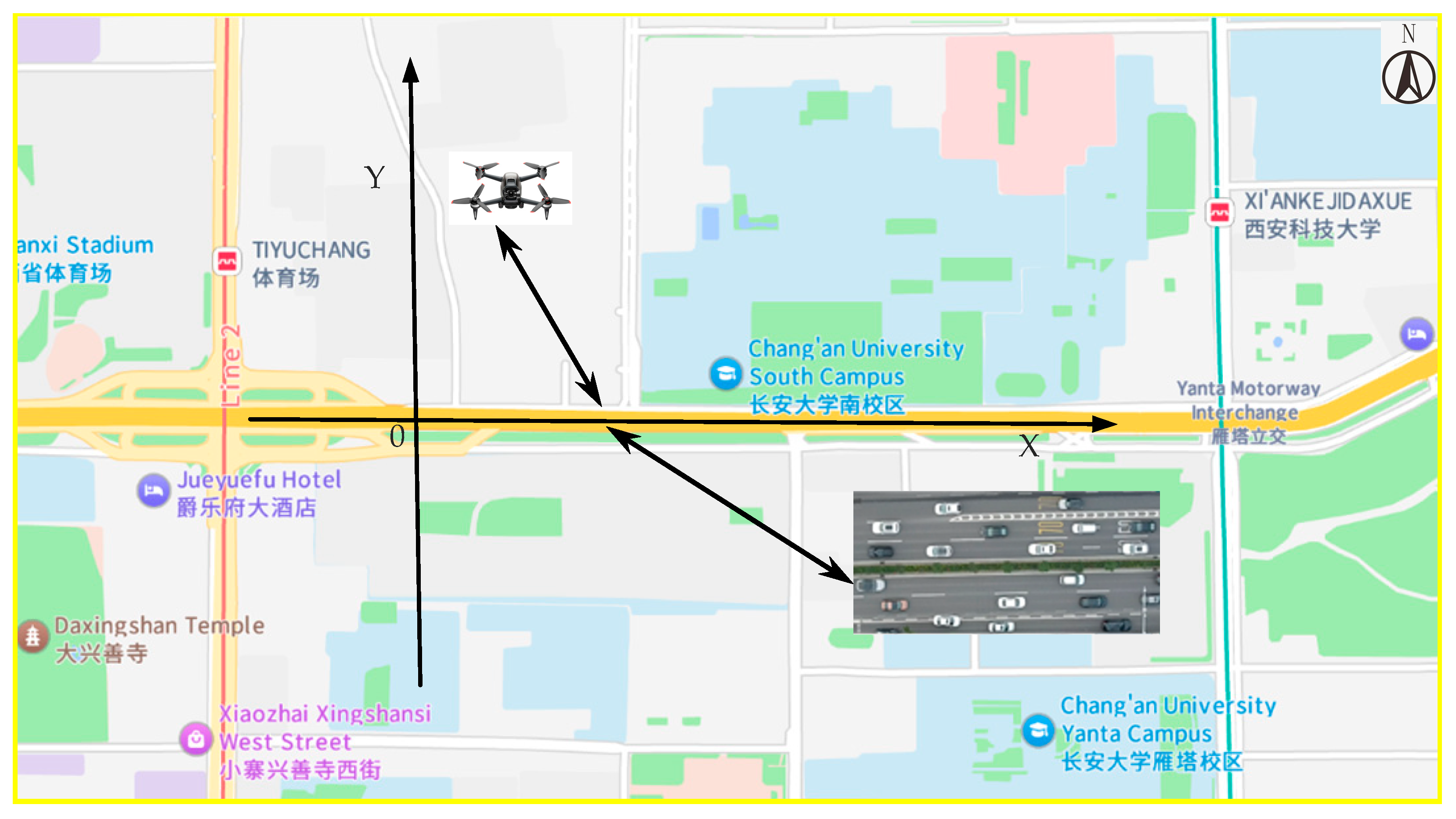
3.1. Section Selection and Data Investigation
- A wide field of vision free from tree obstruction should be maintained to facilitate continuous aerial video recording of the traffic flow via drones;
- It should be far away from on-ramps and off-ramps, as vehicles merging into or exiting the main road at these ramps will interfere with vehicles operating normally on the expressway;
- Priority should be given to sections separated by white dashed lines, since lane changing is permitted here—whereas drivers would violate traffic rules if lane changing is conducted across white solid dividing lines;
- The section length should be as long as possible, ensuring that the observed vehicles can travel forward as a continuous traffic flow.
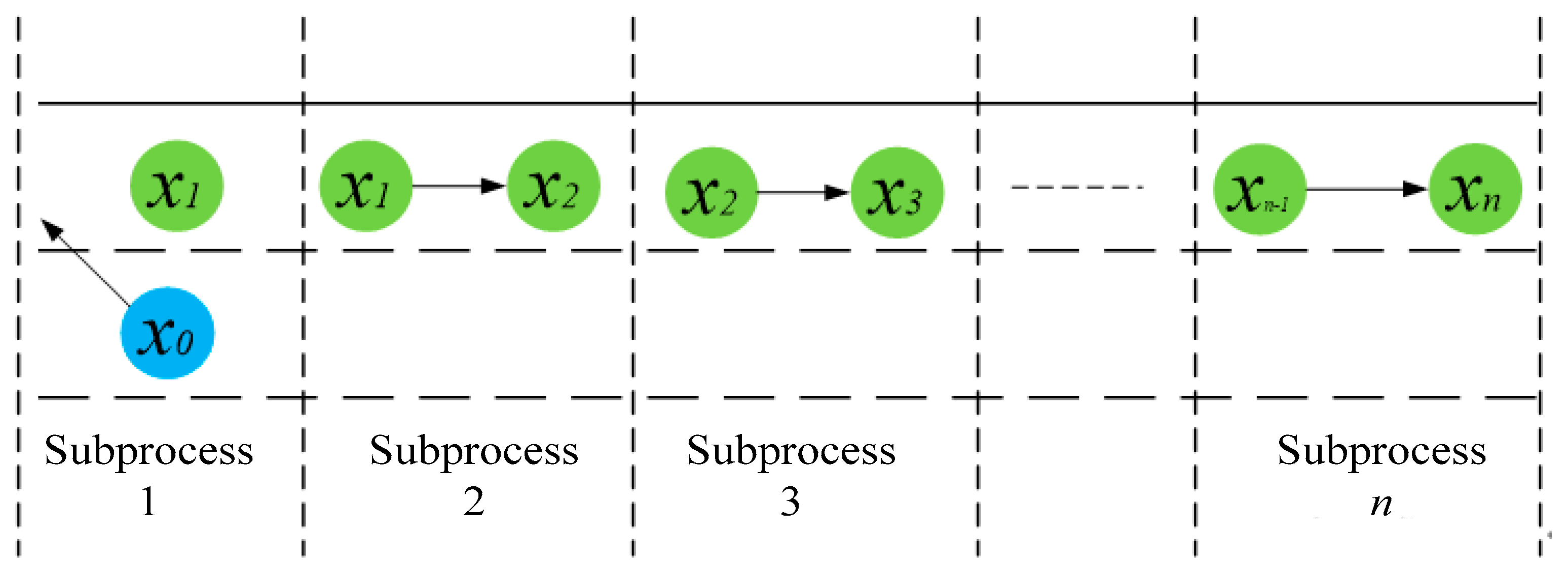
3.2. Estimation of the Occurrence Probability of Vehicle Lane-Changing Risks
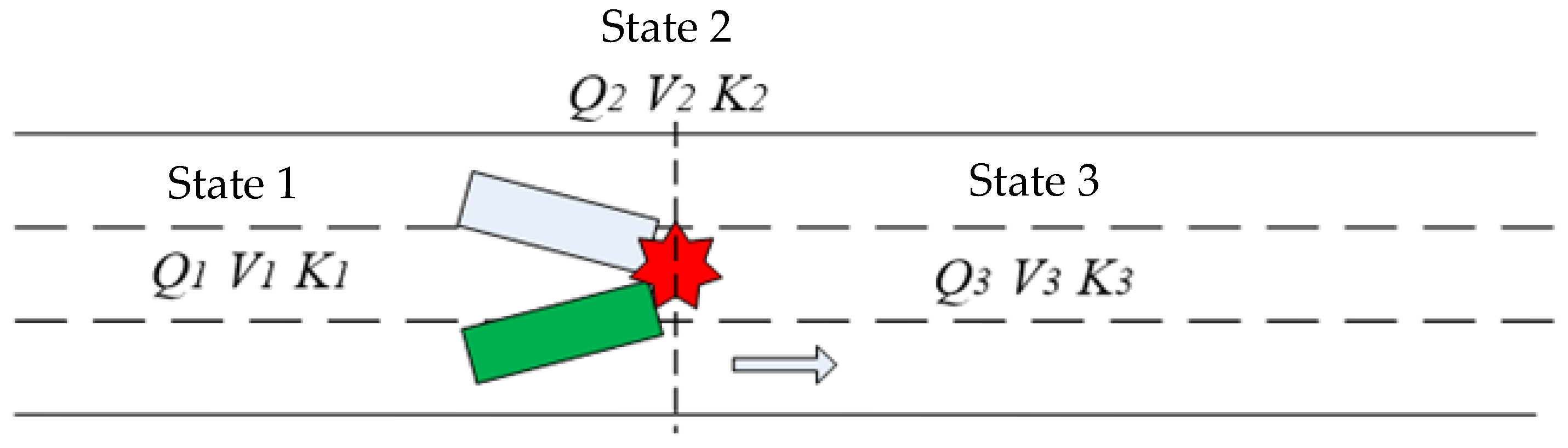
3.3. Estimation of Vehicle Lane-Changing Consequences
3.4. Overall Model Framework
- (1)
- denotes the set of all possible values of hidden states, where , and n is the number of possible values of hidden states. Specifically, this study defines three discrete hidden states for the following vehicle’s operational status: State I for accelerating, State II for constant speed, and State III for decelerating. The hidden state at time t can be denoted as , with . In general, hidden states can transition arbitrarily between each other; the state at time t + 1 is only affected by the state at time t, not by the states at any other times.
- (2)
- M denotes the set of all possible values of observation states, where and m is the number of possible values of observation states. The observation state at time t can be denoted as , with .
- (3)
- ∏ denotes the initial probability distribution of hidden states, where and .
- (4)
- A denotes the state transition matrix, where and . It represents the probability that the hidden state at time t + 1 is given that the hidden state at time t is .
- (5)
- B denotes the observation state generation matrix, where and . It represents the probability that the observation state at time t is given that the hidden state at time t is .
3.5. Model Construction and Analysis
3.5.1. Construction of the BN Model
- (1)
- Discretization of Model Parameters
- (2)
- Construction of the BN Structure
- (3)
- Parameter Learning and Update
3.5.2. Validity Test of the BN Model
3.5.3. Accuracy Test of the BN Model
4. Results and Discussion
4.1. Model Performance Evaluation
4.2. Risk Stratification and Distribution
4.3. Discussion
4.3.1. The Critical Role of Geometric Aggressiveness
4.3.2. Systemic Implications for CAVs and Traffic Management
4.3.3. Limitations and Future Directions
5. Conclusions
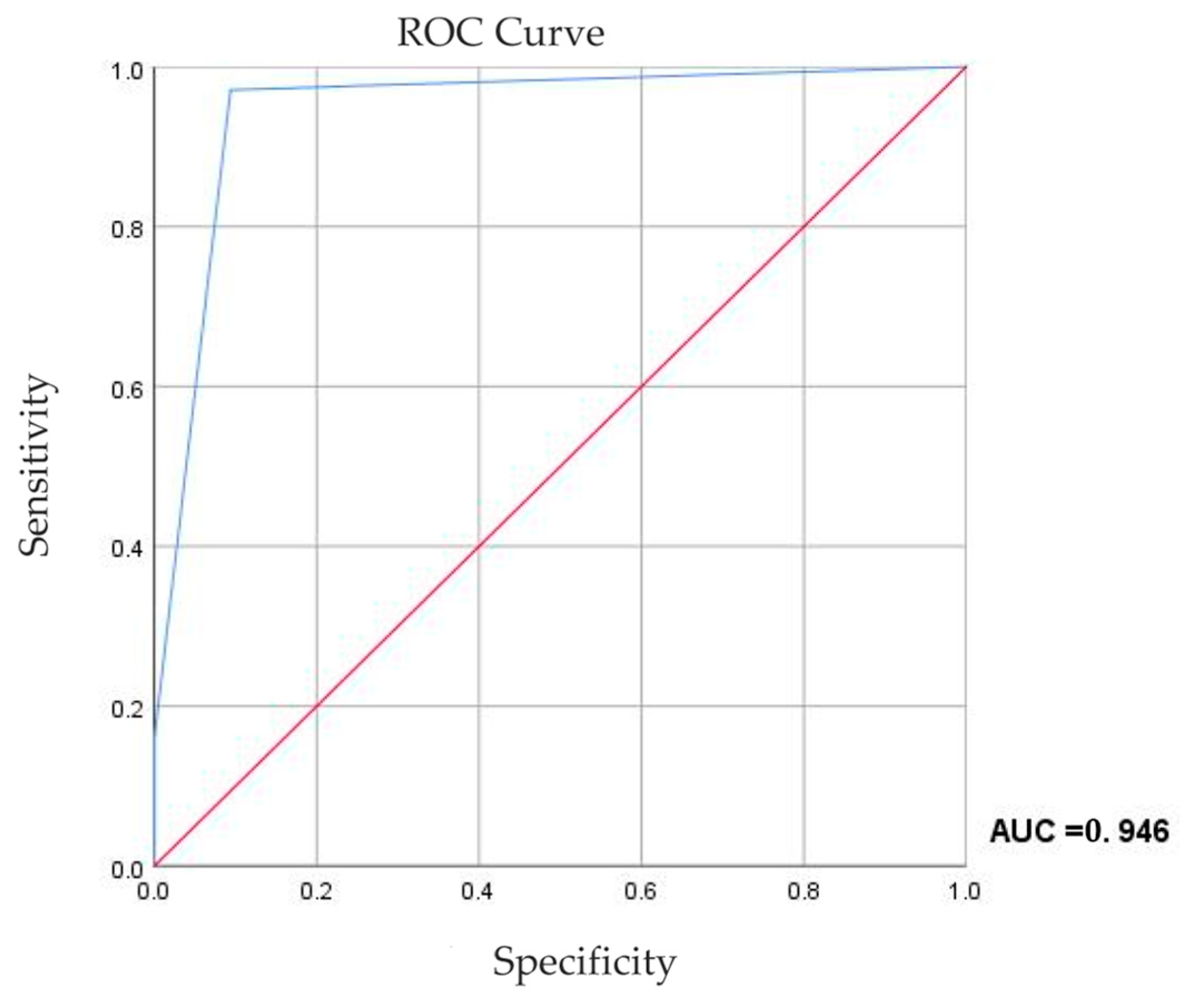
- The proposed framework successfully integrates the stochastic probability of an LC maneuver with its operational consequence. Empirical validation on the Xi’an Second Ring Road dataset demonstrates that the coupled model achieves an Area Under the Curve (AUC) of 0.946, significantly outperforming single-indicator models. This confirms that systemic risk is best represented as the product of “Geometric Aggressiveness” (Probability) and “Flow Vulnerability” (Consequence).
- Among the extracted precursors, the Insertion Angle (θ) was identified as the most critical geometric proxy for risk. Sensitivity analysis reveals a non-linear threshold effect: when θ exceeds 15°, the likelihood of inducing a high-consequence shockwave increases threefold, regardless of the available longitudinal gap.
- Using K-means clustering, the continuous risk values were effectively partitioned into four actionable levels. The results indicate that while 75% of lane changes (Low and Moderate Risk) are benign, the top 5% (Major Risk, R ≥ 2.091) are responsible for the majority of traffic breakdown events, validating the Pareto principle in traffic safety.
Author Contributions
Funding
Data Availability Statement
Acknowledgments
Conflicts of Interest
References
- Xu, C.; Liu, P.; Wang, W.; Li, Z. Evaluation of the impacts of traffic states on crash risks on freeways. Accid. Anal. Prev. 2012, 47, 162–171. [Google Scholar] [CrossRef] [PubMed]
- Arman, M.A.; Tampère, C.M. Traffic Flow Crystallization Method for Trajectory Approximation and Lane Change Inference. IEEE Trans. Intell. Transp. Syst. 2025, 26, 9305–9325. [Google Scholar] [CrossRef]
- Huang, H.; Peng, Y.; Wang, J.; Luo, Q.; Li, X. Interactive risk analysis on crash injury severity at a mountainous freeway with tunnel groups in China. Accid. Anal. Prev. 2018, 111, 56–62. [Google Scholar] [CrossRef]
- Li, Z.; Liao, H.; Tang, R.; Li, G.; Li, Y.; Xu, C. Mitigating the impact of outliers in traffic crash analysis: A robust Bayesian regression approach with application to tunnel crash data. Accid. Anal. Prev. 2023, 185, 107019. [Google Scholar] [CrossRef]
- Liu, J.; Yu, H.; Yang, G.; Li, Z.; Liu, P. Accounting for temporal instability in macro-level crash frequency modeling: A framework integrating high-resolution traffic dynamic patterns and spatiotemporal approaches. Anal. Methods Accid. Res. 2026, 49, 100417. [Google Scholar] [CrossRef]
- Cheng, K.; Sun, D.; Qin, D.; Cai, J.; Chen, C. Deep learning approach for unified recognition of driver speed and lateral intentions using naturalistic driving data. Neural Netw. 2024, 179, 106569. [Google Scholar] [CrossRef]
- Lacherre, J.; Castillo-Sequera, J.L.; Mauricio, D. Factors, Prediction, and Explainability of Vehicle Accident Risk Due to Driving Behavior through Machine Learning: A Systematic Literature Review, 2013–2023. Computation 2024, 12, 131. [Google Scholar] [CrossRef]
- Kim, J.; Kum, D. Collision Risk Assessment Algorithm via Lane-Based Probabilistic Motion Prediction of Surrounding Vehicles. IEEE Trans. Intell. Transp. Syst. 2018, 19, 2965–2976. [Google Scholar] [CrossRef]
- Yang, Q.; Li, P.; Lv, D.; Hu, G.; Wang, X. The impact of vehicle lane-changing on the speed and delay of vehicles in the target lane based on the GMM-HMM. Sci. Rep. 2025, 15, 09014. [Google Scholar] [CrossRef]
- Yang, Q.; Li, P.; Yang, F.; Lu, W. Lane-Changing Risk Prediction on Urban Expressways: A Mixed Bayesian Approach for Sustainable Traffic Management. Sustainability 2025, 17, 7061. [Google Scholar] [CrossRef]
- Xing, G.; Ma, Y.; Chen, S.; Wang, F.; Zhang, J.; Xing, Y. The effects of radius and longitudinal slope of extra-long freeway spiral tunnels on driving behavior: A practical engineering design case. Tunn. Undergr. Space Technol. 2024, 152, 105967. [Google Scholar] [CrossRef]
- Ashraf, M.T.; Dey, K. Incorporating real-time weather conditions into analyzing clearance time of freeway accidents: A grouped random parameters hazard-based duration model with time-varying covariates. Accid. Anal. Prev. 2026, 226, 108353. [Google Scholar] [CrossRef] [PubMed]
- Ouyang, P.; Guo, Y.; Liu, P.; Chen, T.; Yu, H. An approach for evaluating traffic safety of expressway weaving segments: Investigating risk patterns of lane-changing conflicts. J. Transp. Saf. Secur. 2025, 17, 125–157. [Google Scholar] [CrossRef]
- Li, Y.; Pan, B.; Wu, Y.; Xing, L.; Chen, Z. Developing a Dynamic Speed Control System for Mixed Traffic Flow to Reduce Collision Risks Near Freeway Bottlenecks. IEEE Trans. Intell. Transp. Syst. 2023, 24, 12560–12581. [Google Scholar] [CrossRef]
- Mikulec, R.; Semela, M.; Bradáč, A.; Tokař, S.; Bilík, M.; Křižák, M.; Belák, M.; Kledus, R.; Haring, A.; Rábek, V. Obsolete or Viable? Revision of Lane-Change Manoeuvre Duration Empirical Calculation. Energies 2021, 14, 8439. [Google Scholar] [CrossRef]
- Li, Y.; Cai, J.; Wang, X.; Ouyang, S. Driving style characteristics based lane-changing intention recognition research for truck drivers near highway ramps. Traffic Inj. Prev. 2025, 26, 296–307. [Google Scholar] [CrossRef] [PubMed]
- Xu, B.; Dong, C.; Li, P.; Wang, M.; Sun, D. On-road driving risk assessment of regular passenger buses based on multi-source data integration. J. Transp. Saf. Secur. 2025, 17, 1418–1442. [Google Scholar] [CrossRef]
- Zheng, L.; Liu, W. A Comprehensive Investigation of Lane-Changing Risk Recognition Framework of Multi-Vehicle Type Considering Key Features Based on Vehicles’ Trajectory Data. Electronics 2024, 13, 1097. [Google Scholar] [CrossRef]
- Luo, T.; Wang, J.; Fu, T.; Shangguan, Q.; Fang, S. Risk prediction for cut-ins using multi-driver simulation data and machine learning algorithms: A comparison among decision tree, GBDT and LSTM. Int. J. Transp. Sci. Technol. 2023, 12, 862–877. [Google Scholar] [CrossRef]
- Shangguan, Q.; Wang, J.; Lei, C.; Fu, T.; Fang, S.; Fu, L. Modelling the impact of risky cut-in and cut-out manoeuvers on traffic platooning safety with predictability and explainability. Transp. A Transp. Sci. 2025, 1–26. [Google Scholar] [CrossRef]
- Shangguan, Q.; Fu, T.; Wang, J.; Fang, S.; Fu, L. A proactive lane-changing risk prediction framework considering driving intention recognition and different lane-changing patterns. Accid. Anal. Prev. 2022, 164, 106500. [Google Scholar] [CrossRef]
- Xing, Y.; Wu, Y.; Wang, H.; Wang, L.; Li, L.; Peng, Y. Failed lane-changing detection and prediction using naturalistic vehicle trajectories. J. Saf. Res. 2024, 90, 100–112. [Google Scholar] [CrossRef]
- Chen, Q.; Huang, H.; Li, Y.; Lee, J.; Long, K.; Gu, R.; Zhai, X. Modeling accident risks in different lane-changing behavioral patterns. Anal. Methods Accid. Res. 2021, 30, 100159. [Google Scholar] [CrossRef]
- Ma, Y.; Zhang, J.; Lu, J.; Chen, S.; Xing, G.; Feng, R. Prediction and analysis of likelihood of freeway crash occurrence considering risky driving behavior. Accid. Anal. Prev. 2023, 192, 107244. [Google Scholar] [CrossRef]
- Zhang, Y.; Chen, Y.; Gu, X.; Sze, N.N.; Huang, J. A proactive crash risk prediction framework for lane-changing behavior incorporating individual driving styles. Accid. Anal. Prev. 2023, 188, 107072. [Google Scholar] [CrossRef]
- Jiao, Y.; Calvert, S.C.; van Cranenburgh, S.; van Lint, H. A unified probabilistic approach to traffic conflict detection. Anal. Methods Accid. Res. 2025, 45, 100369. [Google Scholar] [CrossRef]
- Yang, M.; Yang, X.; Mu, C.; Zhu, S. Influence factors and model selection for conflict risk in different car-following behaviors: Insights from automated and human-driven vehicles. Accid. Anal. Prev. 2026, 224, 108286. [Google Scholar] [CrossRef] [PubMed]
- Sheikh, M.S.; Peng, Y. Modeling collision risk for unsafe lane-changing behavior: A lane-changing risk index approach. Alex. Eng. J. 2024, 88, 164–181. [Google Scholar] [CrossRef]
- Yang, L.; Zhang, J.; Lyu, N.; Zhao, Q. Predicting lane change maneuver and associated collision risks based on multi-task learning. Accid. Anal. Prev. 2024, 209, 107830. [Google Scholar] [CrossRef] [PubMed]
- Pervez, A.; Huang, H.; Lee, J.; Han, C.; Li, Y.; Zhai, X. Factors affecting injury severity of crashes in freeway tunnel groups: A random parameter approach. J. Transp. Eng. Part A Syst. 2022, 148, 04022006. [Google Scholar] [CrossRef]
- Su, H.; Wang, N.; Wang, X. Collision Risk Assessment of Lane-Changing Vehicles Based on Spatio-Temporal Feature Fusion Trajectory Prediction. Electronics 2025, 14, 3388. [Google Scholar] [CrossRef]
- Xu, D.; Liu, M.; Yao, X.; Lyu, N. Integrating Surrounding Vehicle Information for Vehicle Trajectory Representation and Abnormal Lane-Change Behavior Detection. Sensors 2023, 23, 9800. [Google Scholar] [CrossRef]
- Ren, X.; Bai, L.; Liu, P.; Wong, W.; Liu, J.; Kong, S.; Xu, B. Collision risk identification and prediction considering heterogeneous braking patterns using large-scale pre-collision trajectories. Accid. Anal. Prev. 2025, 224, 108312. [Google Scholar] [CrossRef]
- Zhao, J.; Li, Z.; Liu, P.; Zheng, Q. Capturing short-term spatiotemporal traffic states for crash severity prediction in urban areas using explainable machine learning models. J. Transp. Saf. Secur. 2025, 17, 1443–1479. [Google Scholar] [CrossRef]
- Ma, X.; Zhou, Y.; Lu, J.; Wong, Y.D.; Zhang, J.; Chen, J.; Gu, C. Assessing the impact of car-following driving style on traffic conflict risk using asymmetric behavior model and explainable machine learning. Accid. Anal. Prev. 2025, 211, 107904. [Google Scholar] [CrossRef]
- Gao, J.; Liu, N.; Li, H.; Li, Z.; Xie, C.; Gou, Y. Reinforcement Learning Decision-Making for Autonomous Vehicles Based on Semantic Segmentation. Appl. Sci. 2025, 15, 1323. [Google Scholar] [CrossRef]
- Gao, M.; Nishimura, H. Collision Avoidance Strategy by Utilizing Safety Envelope for Automated Driving System: Hazardous Situation Case. Systems 2026, 14, 89. [Google Scholar] [CrossRef]
- Jiang, X.; Guo, Z.; Li, M.; Hu, X. A Dynamic Zoning Cooperative Control Method for Urban Road Traffic Flow in a Connected Traffic Environment. IEEE Trans. Intell. Transp. Syst. 2025, 26, 22926–22944. [Google Scholar] [CrossRef]
- Wang, Y.; Deng, H.; Chen, G. Lane-Change Gaming Decision Control Based on Multiple Targets Evaluation for Autonomous Vehicle. Transp. Res. Rec. 2021, 2675, 254–267. [Google Scholar] [CrossRef]
- Wen, X.; Huang, C.; Jian, S.; He, D. Analysis of discretionary lane-changing behaviours of autonomous vehicles based on real-world data. Transp. A Transp. Sci. 2025, 21, 2288636. [Google Scholar] [CrossRef]
- Tan, H.; Lu, G.; Wang, Z.; Hua, J.; Liu, M. A unified risk field-based driving behavior model for car-following and lane-changing behaviors simulation. Simul. Model. Pract. Theory 2024, 136, 102991. [Google Scholar] [CrossRef]
- Jalil, K.; Xia, Y.; Zhao, J. Advancements in collision avoidance techniques for internet-connected vehicles: A comprehensive review of methods and challenges. Eng. Appl. Artif. Intell. 2025, 160, 111836. [Google Scholar] [CrossRef]
- Lozia, Z.; Guzek, M. System to Assist the Driver During a Single Lane Change Maneuver, in the Conditions of Danger Arising from a Change in the Condition of the Road Surface. Appl. Sci. 2024, 14, 11398. [Google Scholar] [CrossRef]
- Li, P.F.; Shi, J.J.; Liu, X.M. Cooperative and Competitive Lane-Changing Behavior Characteristics of Urban Expressways. J. Highw. Transp. Res. Dev. 2017, 11, 88–95. [Google Scholar] [CrossRef]





| Insertion Angle | 0–3.0° | 3.0–6.0° | 6.0–9.0° | 9.0–12.0° | 12.0–15.0° |
| Lane-Change Percentage | 3.90% | 13.03% | 13.43% | 12.19% | 10.91% |
| Insertion Angle | 15.0–18.0° | 18.0–21.0° | 21.0–24.0° | 24.0–27.0° | >27° |
| Lane-Change Percentage | 10.73% | 10.21% | 9.66% | 8.90% | 7.05% |
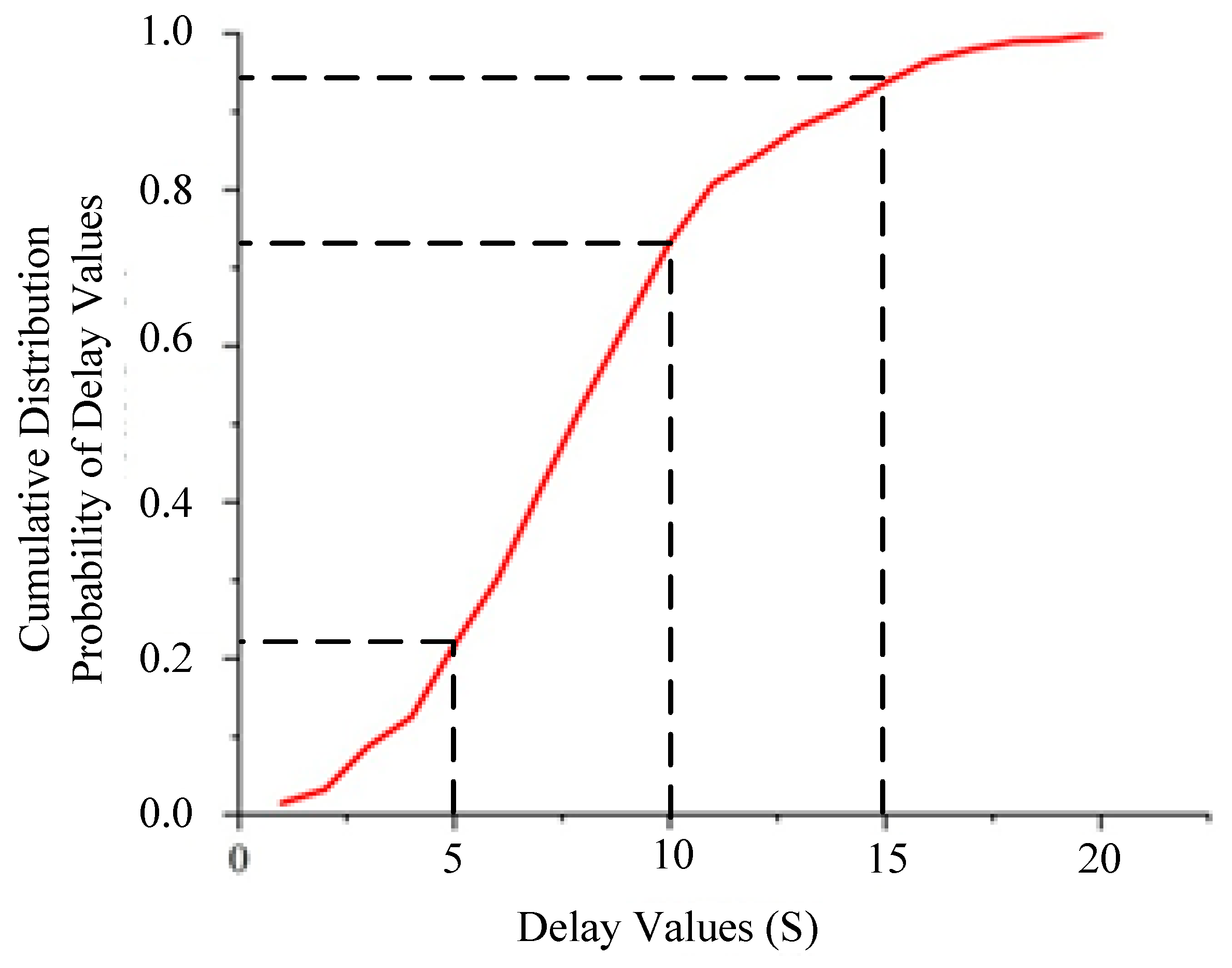
| Delay Categories | Value Range (s) |
|---|---|
| Class IV Delay | 0.0 s ≤ -- < 5.0 s |
| Class III Delay | 5.0 s ≤ -- < 10.0 s |
| Class II Delay | 10.0 s ≤ -- < 15.0 s |
| Class I Delay | ≥15.0 s |
| Delay | Class IV Delay | |||||||||
| Angle | ||||||||||
| Low Risk | 0.7 | 0.77 | 0.67 | 0.4 | 0.4 | 0.63 | 0.5 | 0.57 | 0.5 | 0.5 |
| Moderate Risk | 0.67 | 0.83 | 0.57 | 0.4 | 0.75 | 0.57 | 0.4 | 0.63 | 0.63 | 0.67 |
| Significant Risk | 0.67 | 0.68 | 0.09 | 0.3 | 0.44 | 0.29 | 0.5 | 0.57 | 0.5 | 0.54 |
| Major Risk | 0.1 | 0.02 | 0.14 | 0.09 | 0.1 | 0.07 | 0.09 | 0.09 | 0.1 | 0.04 |
| Delay | Class III Delay | |||||||||
| Angle | ||||||||||
| Low Risk | 0.1 | 0.08 | 0.11 | 0.2 | 0.2 | 0.13 | 0.17 | 0.14 | 0.17 | 0.17 |
| Moderate Risk | 0.11 | 0.06 | 0.14 | 0.2 | 0.08 | 0.14 | 0.2 | 0.13 | 0.13 | 0.11 |
| Significant Risk | 0.11 | 0.23 | 0.73 | 0.5 | 0.33 | 0.43 | 0.17 | 0.14 | 0.17 | 0.31 |
| Major Risk | 0.75 | 0.8 | 0.29 | 0.55 | 0.6 | 0.64 | 0.73 | 0.45 | 0.7 | 0.6 |
| Delay | Class II Delay | |||||||||
| Angle | ||||||||||
| Low Risk | 0.1 | 0.08 | 0.11 | 0.2 | 0.2 | 0.13 | 0.17 | 0.14 | 0.17 | 0.17 |
| Moderate Risk | 0.11 | 0.06 | 0.14 | 0.2 | 0.08 | 0.14 | 0.2 | 0.13 | 0.13 | 0.11 |
| Significant Risk | 0.11 | 0.05 | 0.09 | 0.1 | 0.11 | 0.14 | 0.17 | 0.14 | 0.17 | 0.08 |
| Major Risk | 0.1 | 0.16 | 0.29 | 0.27 | 0.2 | 0.21 | 0.09 | 0.36 | 0.1 | 0.32 |
| Delay | Class I Delay | |||||||||
| Angle | ||||||||||
| Low Risk | 0.1 | 0.08 | 0.11 | 0.2 | 0.2 | 0.13 | 0.17 | 0.14 | 0.17 | 0.17 |
| Moderate Risk | 0.11 | 0.06 | 0.14 | 0.2 | 0.08 | 0.14 | 0.2 | 0.13 | 0.13 | 0.11 |
| Significant Risk | 0.11 | 0.05 | 0.09 | 0.1 | 0.11 | 0.14 | 0.17 | 0.14 | 0.17 | 0.08 |
| Major Risk | 0.05 | 0.02 | 0.29 | 0.09 | 0.1 | 0.07 | 0.09 | 0.09 | 0.1 | 0.04 |
| No. | Training Samples | Test Samples | ||
|---|---|---|---|---|
| Risk Value (True Value) | Risk Value (Predicted Value) | Risk Value (True Value) | Risk Value (Predicted Value) | |
| 1 | 1 | 1 | 1 | 1 |
| 2 | 1 | 1 | 1 | 1 |
| 3 | 1 | 1 | 1 | 2 |
| · | · | · | · | |
| 134 | 2 | 2 | 2 | 2 |
| Levels | Meaning |
|---|---|
| AUC < 0.5 | The model does not conform to the actual situation |
| AUC = 0.5 | The model is ineffective |
| 0.5 < AUC ≤ 0.7 | The model has low accuracy |
| 0.7 < AUC ≤ 0.9 | The model has moderate accuracy |
| 0.9 < AUC | The model has high accuracy |
| Risk Levels | Meaning | Range | Level Colors |
|---|---|---|---|
| Level 3 | Low Risk | 0.03–0.717 |  |
| Level 3 | Moderate Risk | 0.717–1.404 |  |
| Level 2 | Significant Risk | 1.404–2.091 |  |
| Level 1 | Major Risk | >2.091 |  |
Disclaimer/Publisher’s Note: The statements, opinions and data contained in all publications are solely those of the individual author(s) and contributor(s) and not of MDPI and/or the editor(s). MDPI and/or the editor(s) disclaim responsibility for any injury to people or property resulting from any ideas, methods, instructions or products referred to in the content. |
© 2026 by the authors. Licensee MDPI, Basel, Switzerland. This article is an open access article distributed under the terms and conditions of the Creative Commons Attribution (CC BY) license.
Share and Cite
Yang, Q.; Li, P. A Dynamic Risk Assessment System for Expressway Lane-Changing: Integrating Bayesian Networks and Markov Chains Under High-Density Traffic. Systems 2026, 14, 306. https://doi.org/10.3390/systems14030306
Yang Q, Li P. A Dynamic Risk Assessment System for Expressway Lane-Changing: Integrating Bayesian Networks and Markov Chains Under High-Density Traffic. Systems. 2026; 14(3):306. https://doi.org/10.3390/systems14030306
Chicago/Turabian StyleYang, Quantao, and Peikun Li. 2026. "A Dynamic Risk Assessment System for Expressway Lane-Changing: Integrating Bayesian Networks and Markov Chains Under High-Density Traffic" Systems 14, no. 3: 306. https://doi.org/10.3390/systems14030306
APA StyleYang, Q., & Li, P. (2026). A Dynamic Risk Assessment System for Expressway Lane-Changing: Integrating Bayesian Networks and Markov Chains Under High-Density Traffic. Systems, 14(3), 306. https://doi.org/10.3390/systems14030306