1. Introduction
Production planning constitutes a critical challenge in modern industrial systems [
1]. Optimizing production plans can significantly improve manufacturing efficiency, specifically by eliminating scheduling conflicts, shortening production cycles, increasing resource utilization, and reducing production disruptions on the factory floor. As the core component of production planning, the job shop scheduling problem (JSP) persistently confronts multifaceted challenges [
2]. Notably, conventional JS approaches often fail to ensure task-specific resource flexibility, rendering them inadequate for evolving industrial demands—particularly given the increasing adoption of flexible manufacturing systems and widespread automation [
3,
4]. Unlike traditional job shop scheduling problems, the flexible job shop scheduling problem (FJSP) introduces greater flexibility in machine selection, capacity allocation, and task processing order. These advancements are of great significance for improving corporate competitiveness and operational feasibility. Since its formal introduction in 1990 [
5], the flexible job shop scheduling problem (FJSP) has attracted widespread attention from researchers worldwide due to its closer alignment with actual scheduling needs. Given that FJSP represents a classic NP-hard problem [
6], where obtaining exact solutions within polynomial time is generally infeasible, heuristic and metaheuristic algorithms have emerged as practical approaches for identifying feasible solutions in real-world applications. Recent algorithmic advancements include the following: Wang et al. developed a Pareto-based dual-population cooperative evolutionary algorithm (CEA-TP), which decouples operation sequencing and machine assignment subproblems while incorporating a crowding similarity mechanism for Pareto archive maintenance, thereby enhancing non-dominated solution quality in multi-objective FJSP [
7]. He et al. proposed an improved African vulture optimization algorithm (IAVOA) featuring tri-level encoding and dynamic neighborhood search operations, effectively optimizing dual-resource-constrained scheduling scenarios [
8]. Meng et al. designed an improved genetic algorithm (IGA) addressing collaborative optimization challenges in multi-AGV flexible job shop scheduling [
9]. Lv et al. introduced an enhanced Harris hawk optimization algorithm (GNHHO) that integrates elite preservation strategies and chaotic perturbation mechanisms to mitigate premature convergence in conventional approaches [
10]. Long et al. devised a dynamic self-learning artificial bee colony algorithm (DSLABC) employing Q-learning for adaptive search dimension adjustment, thereby improving both efficiency and robustness in dynamic FJSP environments [
11]. Pablo et al. presented an enhanced memetic algorithm (EMA) combining evolutionary computation with tabu search to optimize energy consumption in fuzzy FJSP scenarios [
12]. Liu et al. established a hybrid salp swarm algorithm (MHSSA) incorporating Lévy flight strategies to enhance solution set performance for green scheduling in double-flexible job shops [
13]. Boudjemline et al. developed a genetic algorithm-based multi-objective framework (GA-FJSSP) utilizing steady-state selection and hybrid crossover strategies for efficient FJSP resolution [
14]. Qu et al. proposed a variable-speed flexible job shop scheduling strategy considering operation-dependent energy consumption, constructed a multi-energy consumption fusion model, and proposed a multi-objective evolutionary algorithm (MOEA/D-DDWA) with dynamic diffusion weight adjustment to effectively optimize the completion time and total energy consumption [
15]. Bezoui et al. proposed a preference-integrated multi-objective genetic algorithm based on a non-compensatory reference level model to guide the search toward solutions better aligned with decision-maker aspirations in flexible job shop scheduling [
16].
In real-world FJSP scenarios, scheduling models that consider machine availability constraints are more representative of actual production environments. This consideration also improves the stability of production plans. Recent research progress on FJSP problems that include machine preventive maintenance includes the following: Pal et al. proposed a multi-agent system (MAS) enabling decentralized decision-making through bidding mechanisms between job and machine agents, explicitly embedding maintenance windows into the bidding process [
17]. Yan et al. designed a deep Q-network (DQN)-based agent framework that dynamically adjusts maintenance windows and learns optimal job assignment-maintenance timing policies via a decaying ε-greedy strategy [
18]. Wöcker et al. formulated a mixed-integer programming (MIP) model with local search algorithms to optimize joint scheduling of parallel machines [
19]. Baykasoğlu et al. developed a GRASP (Greedy Randomized Adaptive Search Procedure)-based framework, integrating local reordering to minimize average tardiness, schedule instability, and makespan [
20]. Gupta et al. employed response surface methodology to analyze interactions between stochastic machine failures and preventive maintenance on scheduling performance [
21]. Zhao et al. established two mixed-integer linear programming (MILP) models based on machine positioning and operation sequencing, complemented by a QVNS-Q algorithm to enhance large-scale problem-solving efficiency [
22]. An et al. constructed a multi-objective optimization framework accounting for imperfect preventive maintenance (PM) models and accelerated convergence using an enhanced NSGA-III/ARV algorithm [
23]. Soofi et al. introduced a robust fuzzy stochastic programming model hybridizing genetic algorithms with vibration-damping optimization to address dual-resource-constrained scheduling [
24]. Although these studies have advanced the optimization of flexible job shop scheduling problems by considering material handling factors, they have failed to adequately address the interdependencies between machine preventive maintenance factors and scheduling dynamics.
In actual manufacturing processes, workpiece machining is not entirely completed on a single machine; therefore, workpiece handling between different machines is necessary during production. For flexible job shop scheduling problems (FJSP) that include workpiece handling constraints, recent methodological advancements include the following: Wu et al. proposed an adaptive population NSGA-III (APNSGA-III) algorithm with dual control strategies, optimizing energy consumption and weight parameters in multi-objective flexible flow shop scheduling. Their model explicitly accounts for energy expenditure during transportation, setup, unloading, and idle phases, along with job weight considerations [
25]. Zhang et al. developed a hybrid brain storm optimization (BSO) and Q-learning algorithm for distributed flexible flow shop scheduling, enhancing job allocation through variable neighborhood search refinement [
26]. Yunusoğlu et al. established a constraint programming (CP)-based multi-objective scheduling model addressing flexible flow shop sub-batch scheduling with setup and transportation resource constraints, augmented by CP-guided large neighborhood search iterations [
27]. Zhang et al. designed a learning-driven multi-objective cooperative artificial bee colony algorithm (L-MCABC) for distributed flexible flow shops integrating preventive maintenance and transportation operations [
28]. Wang et al. introduced a multi-domain stratified sampling MOGA-DE (MDSS-MOGA-DE) algorithm, specifically optimizing scheduling with maintenance and transportation processes through hybrid genetic and differential evolution strategies [
29]. Xuan et al. formulated an artificial immune differential evolution (AIDE) algorithm to resolve sequence-dependent setup times and transportation scheduling in distributed heterogeneous flexible flow shops [
30]. Li et al. proposed a bi-population balanced multi-objective evolutionary algorithm (BPBMO) for steel production systems, addressing distributed flexible flow shop scheduling with fuzzy processing times and crane transportation [
31]. Although these studies have made significant progress, they have overlooked the impact of variations in processing speed levels on energy consumption, which is crucial for the optimization results of FJSP.
In summary, although the existing literature has investigated the FJSP from various perspectives, few studies have integrated constraints such as machining speeds, machine preventive maintenance plans, and workpiece handling into FJSP research. In practical workshop scheduling, equipment failures and maintenance activities can disrupt the smooth execution of scheduling schemes, leading to resource conflicts, increased energy consumption, and extended makespan. To reduce equipment failures in real-world production, preventive maintenance must be performed periodically or conditionally on machine tools. Although preventive maintenance activities consume planned cycle time, they can reduce or avoid machine failures, thereby improving the stability and reliability of the production system and enhancing the feasibility of production plans. With the implementation of Just-In-Time (JIT) production and enterprises’ increasing emphasis on order delivery punctuality, the requirement for material punctuality within workshops is increasingly heightened. If the production scheduling scheme ignores workpiece transportation time and only considers processing time, workpieces or materials may not arrive at the corresponding workstations on time during the production process, thus hindering the progress of the entire production line. Furthermore, modern machine tools offer multiple speed levels. Selecting the appropriate processing speed during workpiece processing can shorten the production cycle and reduce energy consumption. To solve these issues, this study proposes a green scheduling method for FJSP that considers workpiece handling and machine pre-maintenance. By constructing a multi-objective optimization model incorporating constraints such as preventive maintenance plans and workpiece handling, this method rationally schedules operation sequences, machine assignments, and machining speed selection to minimize maximum makespan and total energy consumption. An Improved Multi-Objective Discrete Grey Wolf Optimization (IMOD-GWO) algorithm is proposed to solve this FJSP problem. Finally, experiments validate the efficacy of the proposed method.
This study innovatively introduces factors such as workpiece handling time, equipment preventive maintenance, and variable processing speed into the traditional flexible job shop scheduling problem. A multi-objective scheduling model is established with optimization goals of minimizing maximum makespan (Cmax) and total energy consumption (Etotal). To effectively solve this complex problem, an Improved Multi-Objective Discrete Grey Wolf Optimization (IMOD-GWO) algorithm is proposed, which integrates the Jaya, introduces mutation operators, and employs distributed computing.
The rest of this paper is arranged as follows:
Section 2: Problem description and mathematical model for WHMPM-FJSP. This chapter introduces the flexible job shop scheduling problem and formulates a mathematical model with constraints on workpiece handling and machine preventive maintenance, aiming to minimize makespan and total energy consumption.
Section 3: Algorithm design. This chapter presents the proposed IMOD-GWO algorithm, detailing its workflow, key components, and operating mechanisms.
Section 4: Experimental analysis. This chapter conducts experiments on benchmark instances, including parameter tuning, ablation studies, and comparative analyses to verify the effectiveness and performance of the algorithm.
Section 5: Conclusions. This chapter summarizes the research contributions, discusses limitations, and outlines potential directions for future work.
3. Improved Multi-Objective Discrete Grey Wolf Optimization
The GWO algorithm solves optimization problems by dividing the gray wolf population into different hierarchical groups (α, β, δ, and ω wolves). The α, β, δ, and ω wolves guide the search process, while the subordinate ω wolves follow their instructions. This algorithm primarily simulates three hunting behaviors of gray wolves: surrounding the target, pursuing the prey, and attacking the prey. The distance formula and position formula for grey wolves searching for prey:
In Equations (18) and (19), the variable
t stands for the present iteration count.
A and
C are vectors of coefficients.
Xp and
X signify the position vectors of the prey and the grey wolf, respectively.
In Equations (20) and (21), the convergence factor, denoted as
a, undergoes
a linear reduction from 2 to 0 across multiple iterations;
r1 and
r2 are random vectors with components uniformly distributed in the interval [0, 1].
In Equation (22),
Dα,
Dβ, and
Dδ signify the distances between the α, β, and δ wolves and their subordinate counterparts, respectively. Meanwhile,
Xα,
Xβ, and
Xδ indicate the locations of the α, β, and δ wolves.
Within the Grey Wolf Optimization (GWO) algorithm, the pursuit and capture of prey are steered by the three most well-adapted dominant wolves (α, β, and δ). These dominant wolves then lead and guide the subordinate wolves (ω) throughout these processes. Specifically, Equation (21) defines the step size and direction for ω wolves moving toward the leaders, while Equation (22) determines their updated positions. Through dynamic parameter adjustments during iterations, the wolf population ultimately converges to optimal solutions.
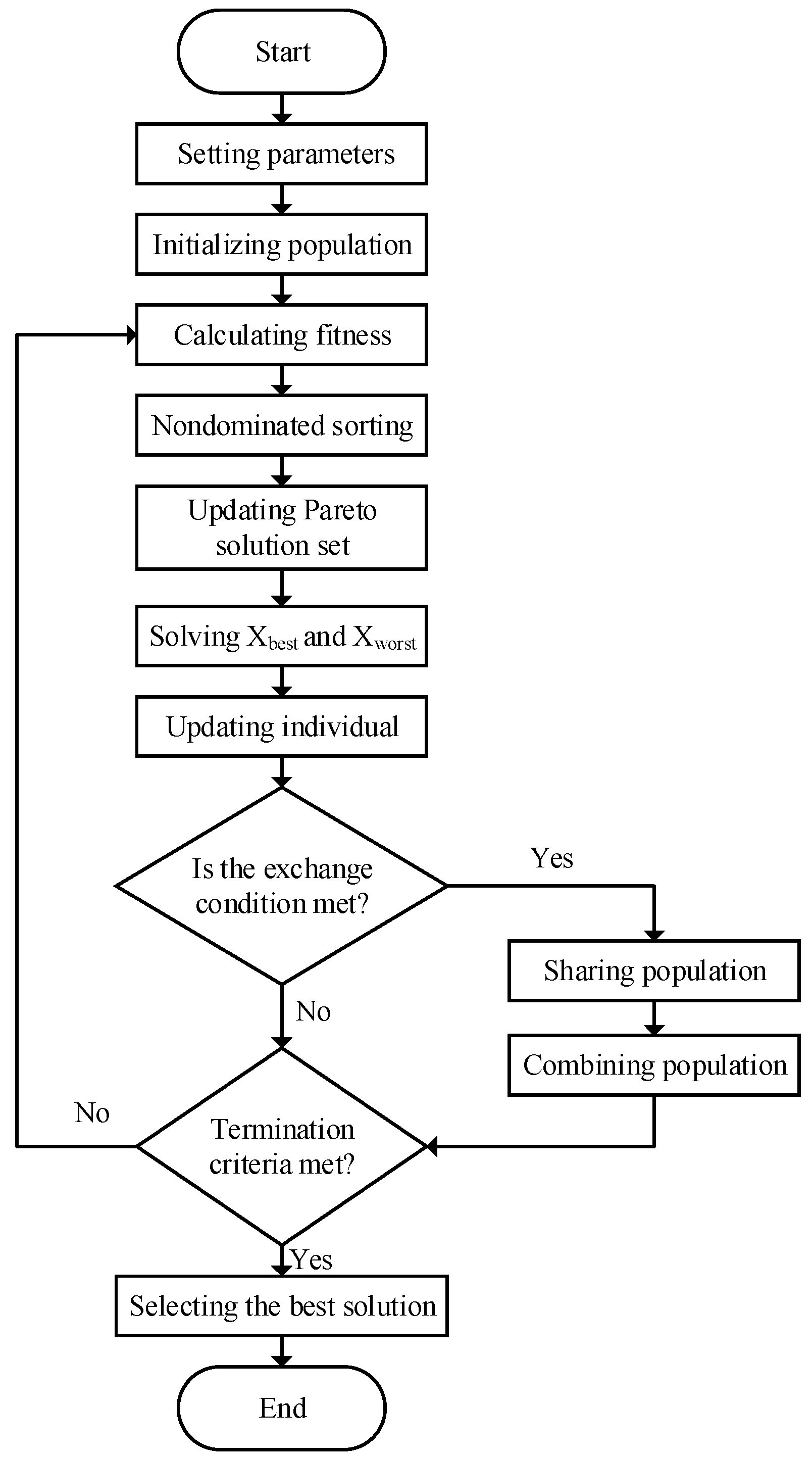
The traditional GWO algorithm is primarily used for single-objective continuous optimization problems. To apply it to discrete job shop scheduling problems, this study proposes an IMOD-GWO. The key steps of IMOD-GWO include encoding, decoding, population initialization, individual updating, and Pareto ranking. The workflow of IMOD-GWO is illustrated in
Figure 1. The algorithm features four key innovations: (1) Hybrid population initialization: Multiple strategies are combined to generate high-quality initial solutions. (2) Nonlinear worst solution avoidance: Inspired by Jaya, a nonlinear avoidance factor dynamically adjusts exploration to escape local optima. (3) Mutation operators: Introduced to enhance population diversity during iterations. (4) Distributed parallel computation: Three subpopulations cooperate to balance exploration and exploitation, preventing premature convergence.
3.1. Coding
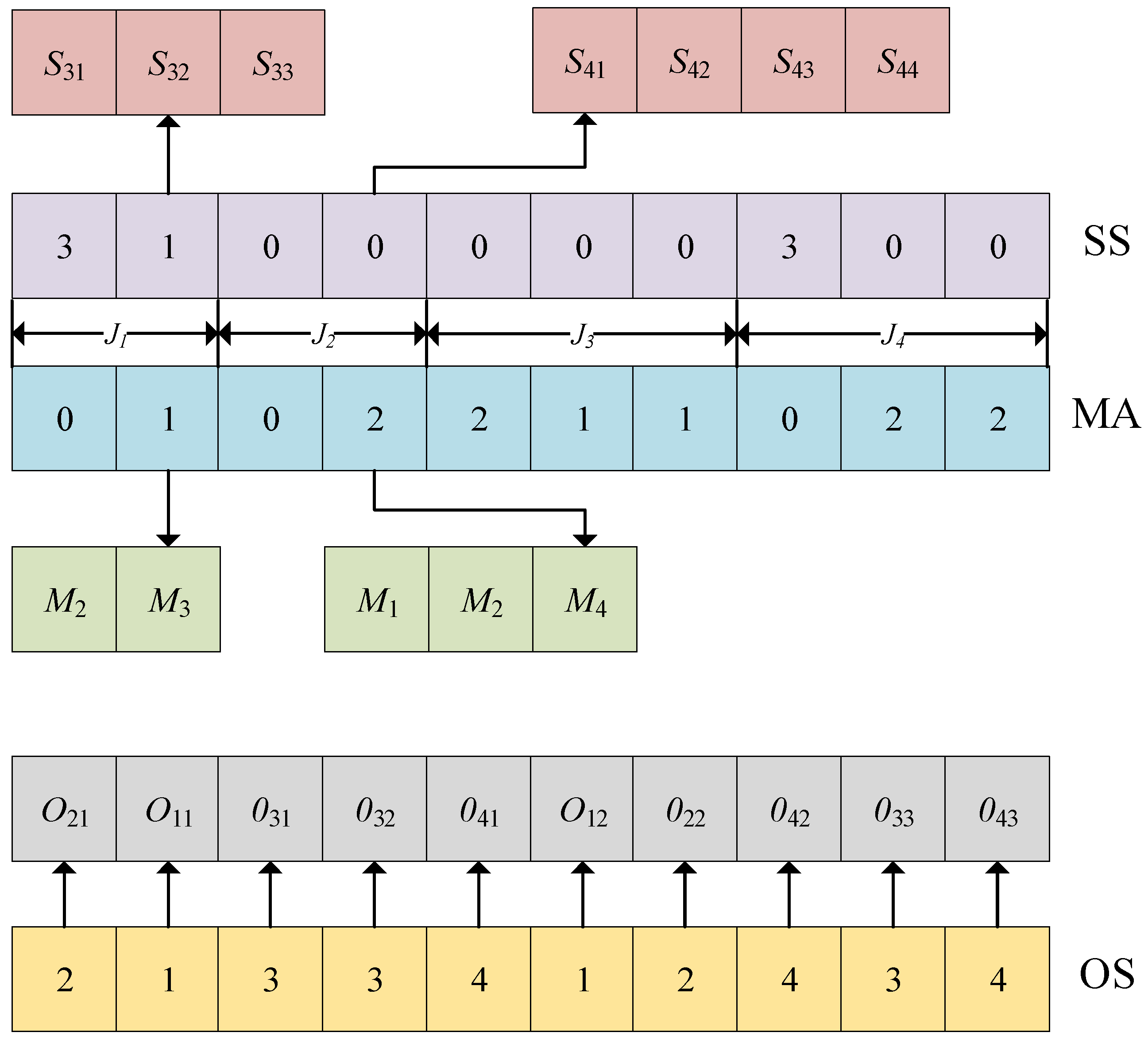
This study adopts a three-layer encoding scheme based on operation sequence (OS), machine assignment (MA), and machining speed selection (SS) to represent solutions, where the total encoding length corresponds to the number of operations. The OS layer consists of workpiece indices, where each occurrence of a workpiece index
i represents a specific operation of that workpiece. A feasible OS encoding requires that the number of occurrences of any workpiece
i equals its total number of operations
ni. The MA layer encodes machine indices assigned to each operation in the order of ascending workpiece numbers, directly mapping each operation to its designated machine. Similarly, the SS layer encodes speed-level indices for each operation on its assigned machine, specifying the selected machining speed. For example, as shown in
Table 2, machine
M1 offers four speed levels (12, 6, 3, 2.4) for processing operation
O11 of workpiece
J1. The resulting encoding in
Figure 2 demonstrates an OS sequence of (
O21,
O11,
O31,
O32,
O41,
O12,
O22,
O42,
O33,
O43), with the MA layer indicating that
O12 is assigned to
M3 and
O22 to
M4, while the SS layer specifies speed level 2 (
S32) for
O12 on
M3 and speed level 1 (
S32) for
O22 on
M4. This three-layer encoding effectively integrates operation sequencing, machine assignment, and speed selection, providing a structured and easily understandable solution representation method for subsequent decoding and optimization processes.
3.2. Decoding
The decoding process is a crucial step in converting the encoded solution into an executable scheduling plan. This study uses operating system-based encoding to sequence the operations while simultaneously utilizing the MA layer and SS layer to determine the processing equipment and speed level for each operation. To accommodate machine preventive maintenance constraints, all operations must ensure that maintenance tasks are completed within their predefined time windows. The specific decoding rules are as follows:
- (1)
First operation on a newly used machine. If operation Oi1 (the first operation of workpiece Ji) is assigned to machine Ml and Ml is used for the first time, Oi1 starts processing immediately on Ml;
- (2)
Non-first operation on a newly used machine. If operation Oij (not the first operation of workpiece Ji) is assigned to machine Ml and Ml is newly used, Oij is transported to Ml immediately after its predecessor Oij−1 completes and then begins processing on Ml;
- (3)
First operation on a reused machine. If operation Oi1 (the first operation of workpiece Ji) is assigned to machine Ml, which has been previously used in the schedule, Oi1 must wait until Ml finishes its prior tasks before starting;
- (4)
Non-first operation on a reused machine. If operation Oij (not the first operation of workpiece Ji) is assigned to machine Ml, which has been used before, Oij is transported to Ml after its predecessor Oij−1 completes and must wait until Ml finishes its prior operations before starting processing.
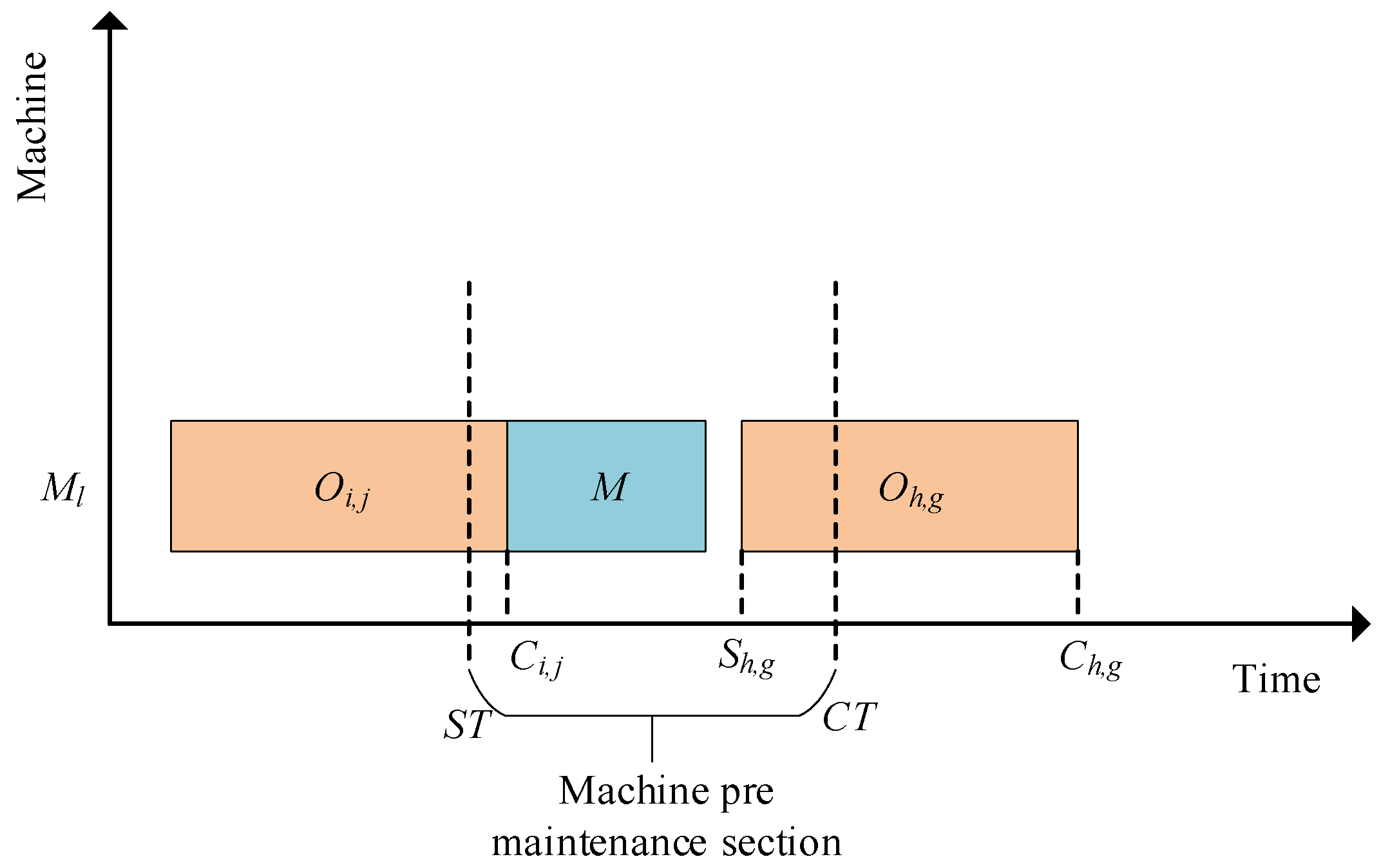
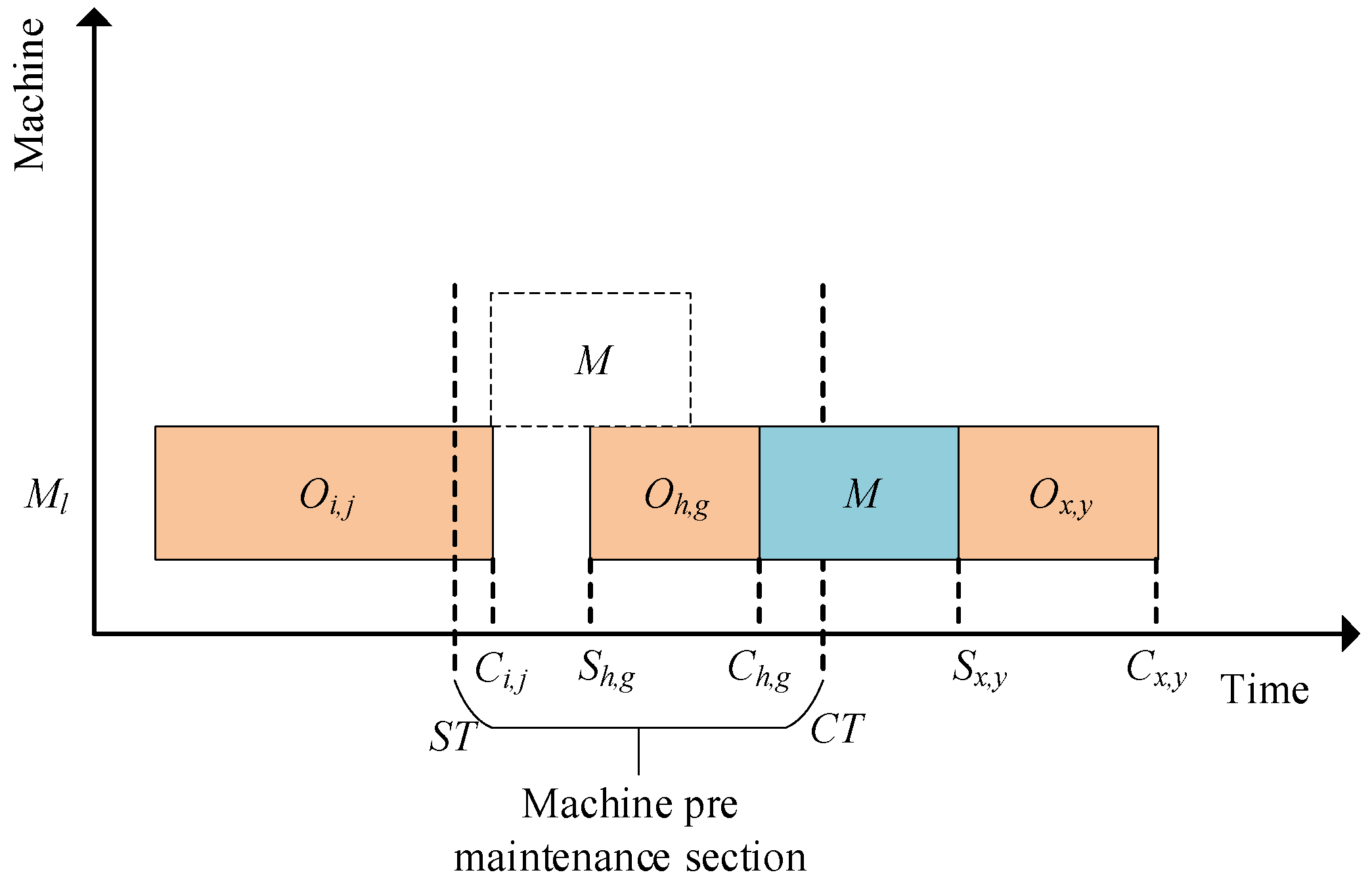
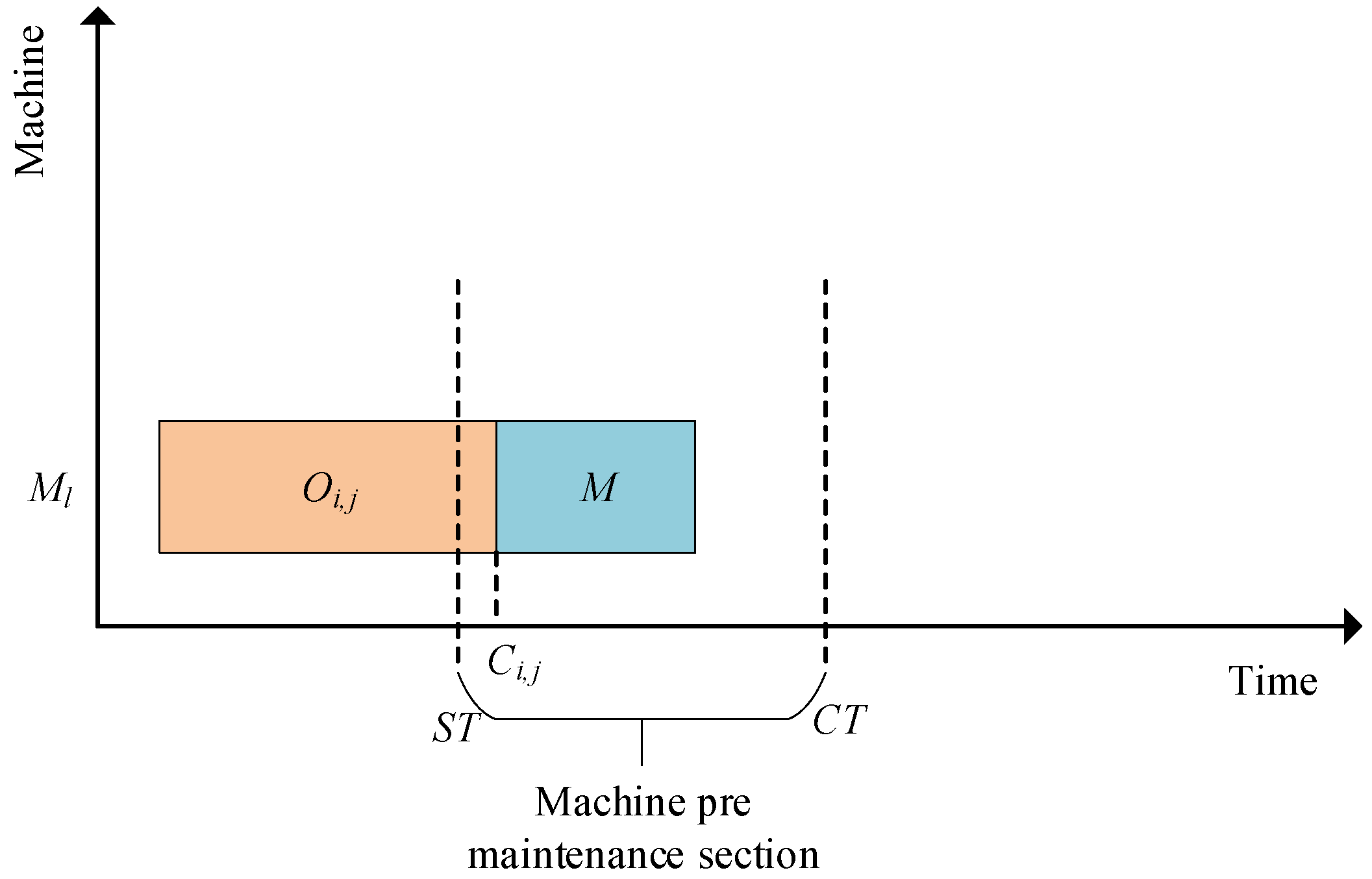
This decoding method rigorously enforces preventive maintenance constraints, ensuring that maintenance tasks are initiated within their time windows (e.g., ETkq ≤ mstkq ≤ LTkq). The generated schedules satisfy both processing sequence requirements and machine reliability criteria, significantly enhancing feasibility and practicality. To ensure machine preventive maintenance during processing operations, the following scenarios are addressed:
- (1)
The first scenario for determining machine preventive maintenance time windows during processing operations is illustrated in
Figure 3.
In this scenario, operations Oij and Ohg are processed on machine Ml, with their start and completion times satisfying Constraint (25). The preventive maintenance of machine Ml begins at time Cij, which represents the finish time of operation Oij.
- (2)
The second scenario for determining machine preventive maintenance time windows during processing operations is illustrated in
Figure 4.
In this scenario, operations Oij, Ohg, and Oxy are processed on machine Ml, with their start and completion times satisfying Constraint (26). The preventive maintenance of machine Ml begins at time Chg, which represents the finish time of operation Ohg.
- (3)
The third scenario for determining machine preventive maintenance time windows during processing operations is illustrated in
Figure 5.
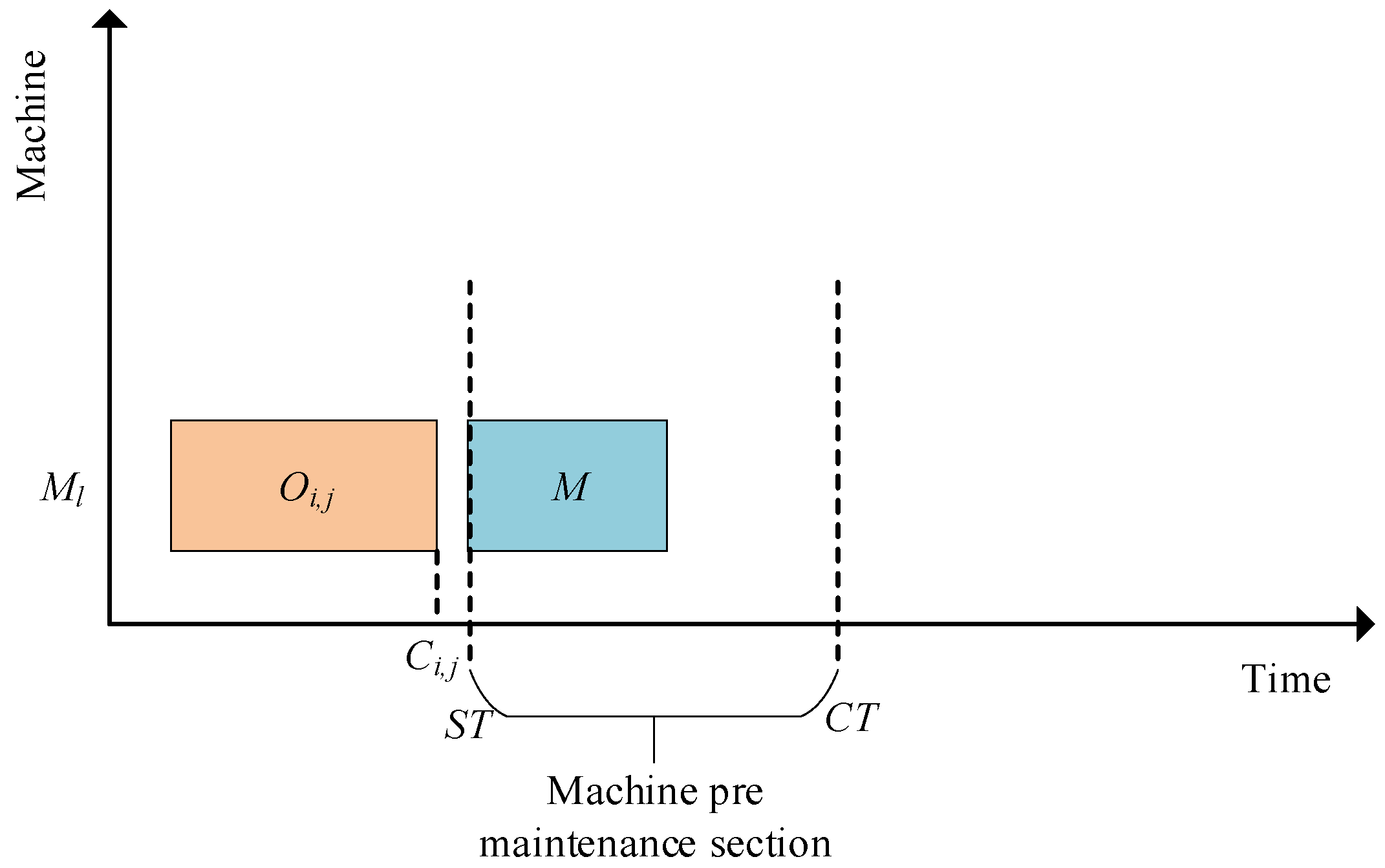
In this scenario, operation Oij is processed on machine Ml, and Oij is the final operation assigned to Ml. The completion time of Oij satisfies Constraint (27), and the preventive maintenance of machine Ml begins at time Cij, which represents the finish time of operation Oij.
- (4)
The fourth scenario for determining machine preventive maintenance time windows during processing operations is illustrated in
Figure 6.
In this scenario, operation Oij is processed on machine Ml, and Oij is the final operation assigned to Ml. The completion time of Oij satisfies Constraint (28), and the preventive maintenance of machine Ml begins at time ST, which represents the scheduled earliest start time of maintenance.
3.3. Population Initialization
An initial population of superior quality is of great significance in enhancing the convergence rate and optimization effectiveness of the algorithm. In relation to the optimization goals of minimizing the maximum completion time and the overall energy consumption investigated in this research, the population initialization approach put forward by Zhang et al. is utilized to create the initial population [
32]. The article covers random selection, global selection, and local selection. In random selection, the OS, MA, and SS are generated randomly within the feasible solution space under technological constraints to enhance population diversity; global selection selects machines and speed levels based on shop-floor-level global information, such as machine workload balance, processing efficiency, and energy consumption characteristics, aiming to construct individuals with superior global performance, shorter makespan, and lower total energy consumption; local selection focuses on individual operations by preferentially selecting machines and speed levels that minimize local processing time or energy consumption, emphasizing the exploitation of local optimal solutions.
In this method, the OS layer uses random encoding, while the MA layer is created by integrating three different strategies: global selection, local selection, and random selection. However, this study improves upon the original method by introducing the selection of machine speed levels. Specifically, the operating system layer is still generated randomly. The machine allocation layer and the SS layer are jointly generated using a hybrid strategy of global selection, local selection, and random selection. This refined approach not only guarantees the variety of the initial population but also efficiently integrates features specific to the problem, offering top-notch initial solutions for the subsequent optimization procedures. As a result, it substantially boosts the overall efficiency of the algorithm.
3.4. Individual Update
The individual update mechanisms described in Equations (18)–(24) are suitable for continuous optimization challenges. However, they cannot be directly applied to discrete optimization problems. To achieve effective individual updates, this study proposes the following customized update strategies:
- (1)
Select the individual within the population that has the worst fitness, denoted as
Xworst. Leveraging the “avoiding worst solutions” principle from the Jaya,
Xi wolf is steered away from
Xworst wolf by performing reverse crossover between
Xi and
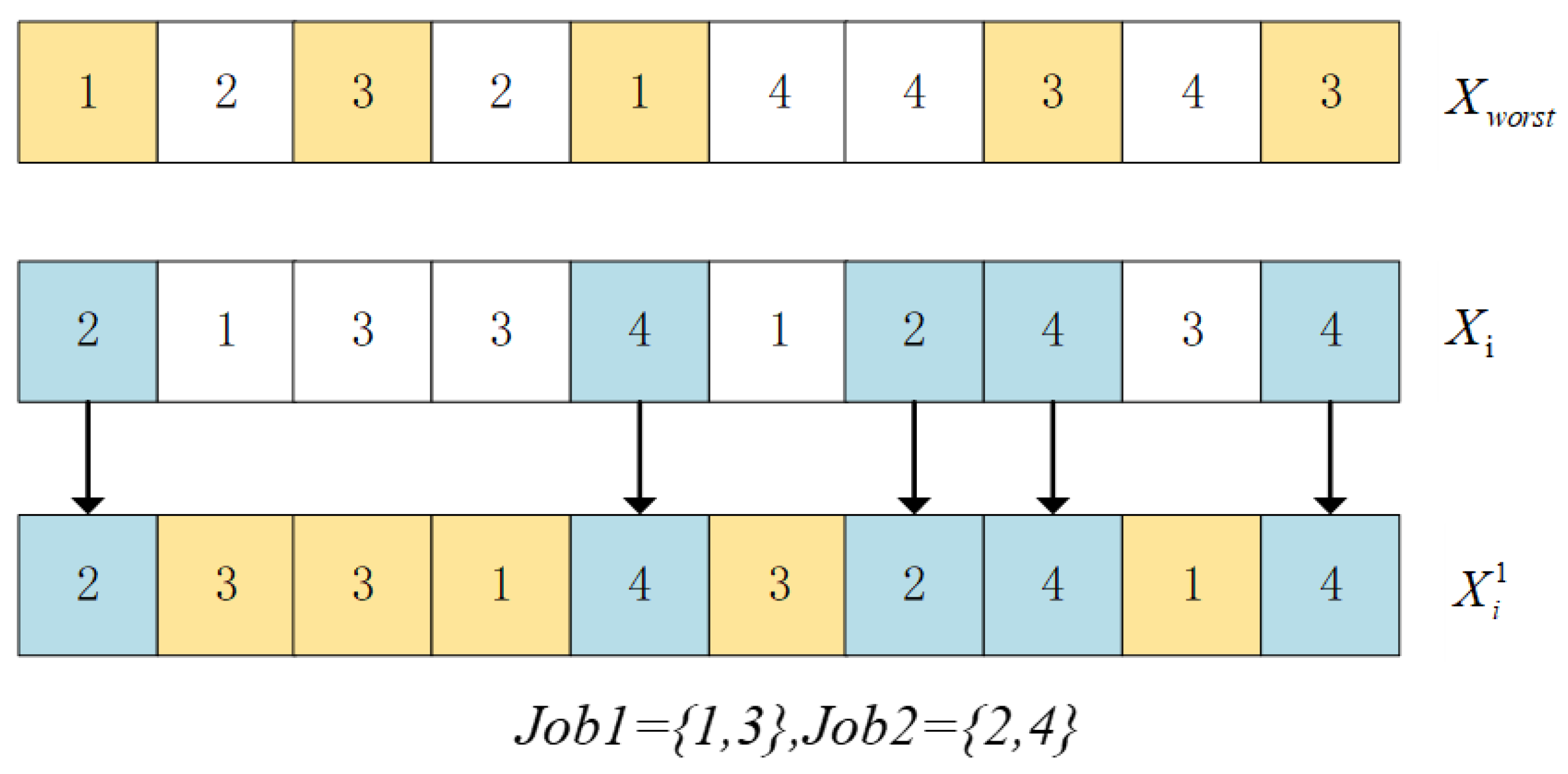
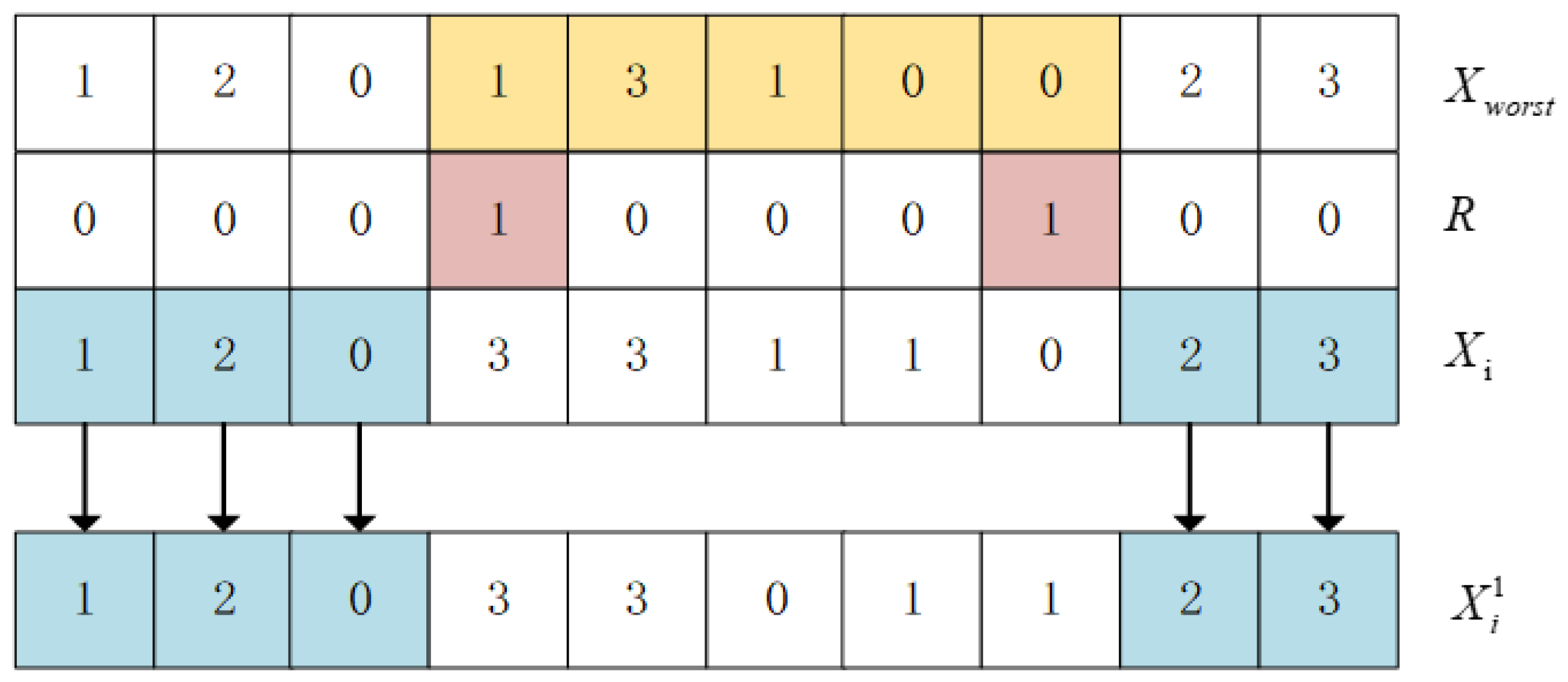
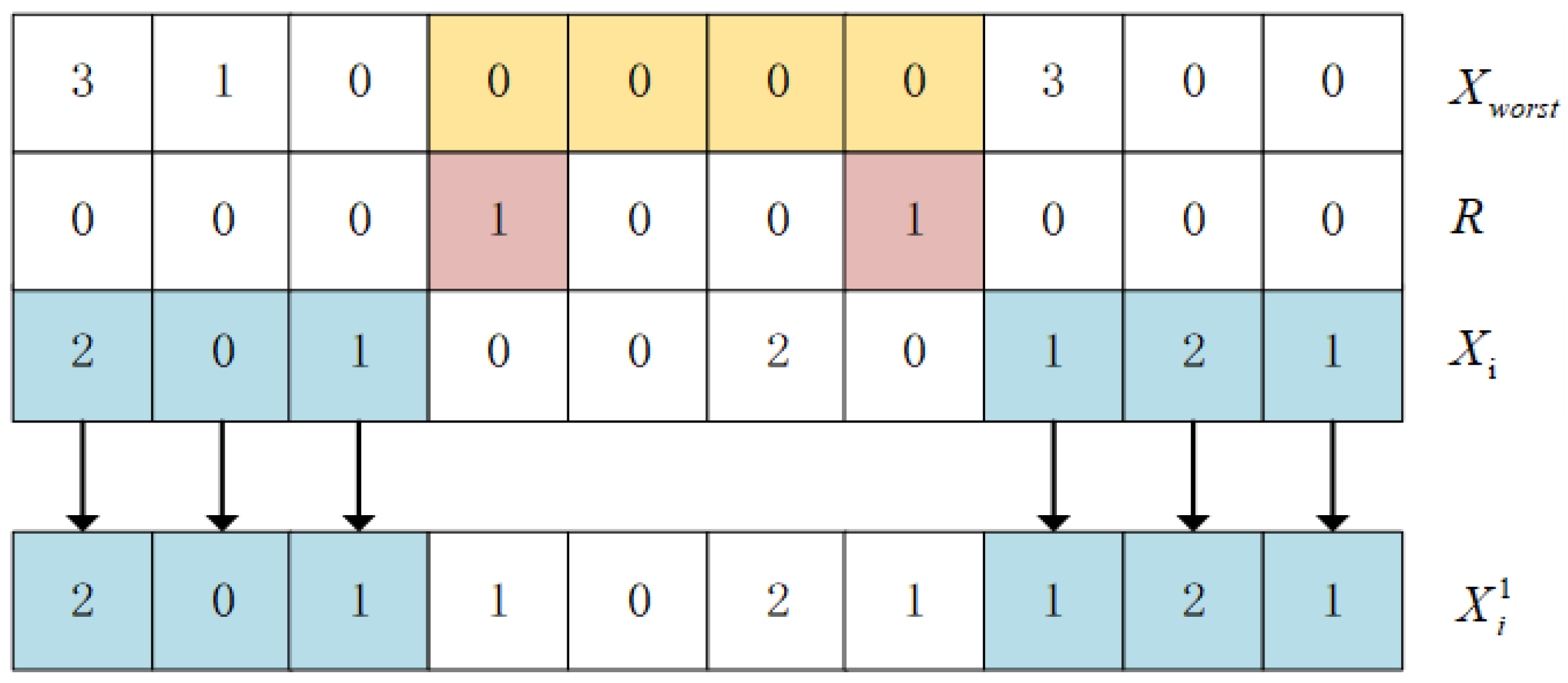
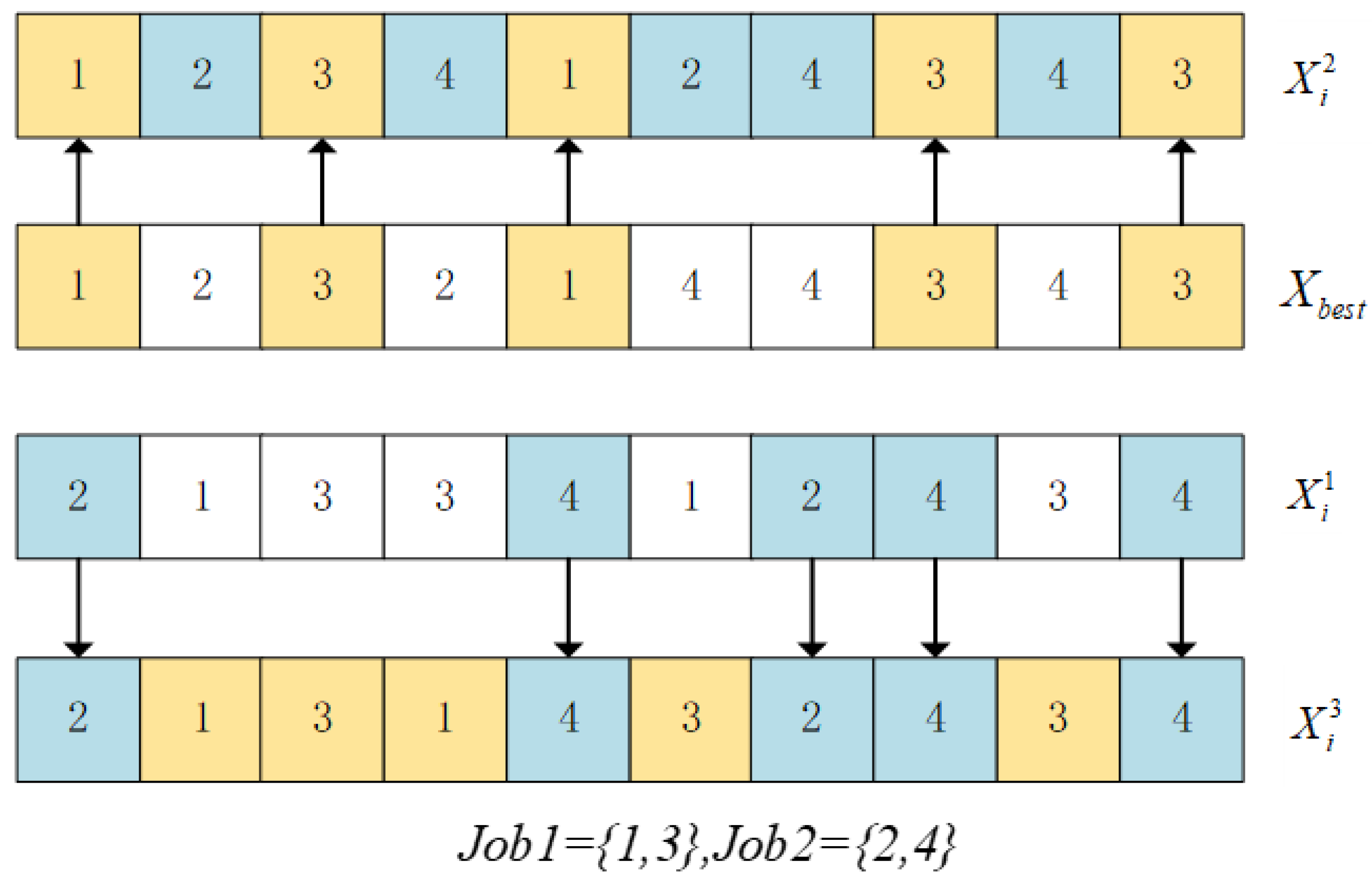
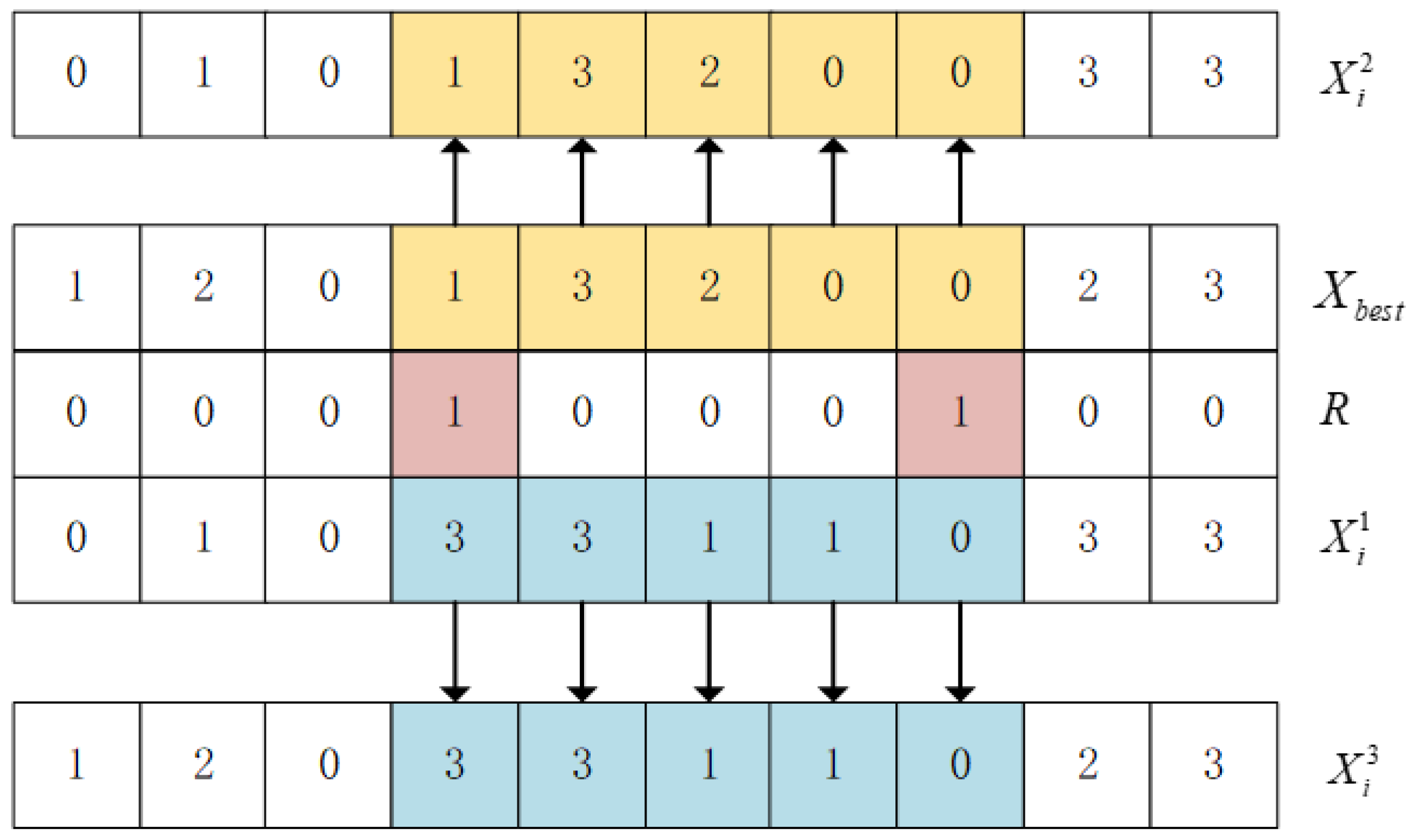
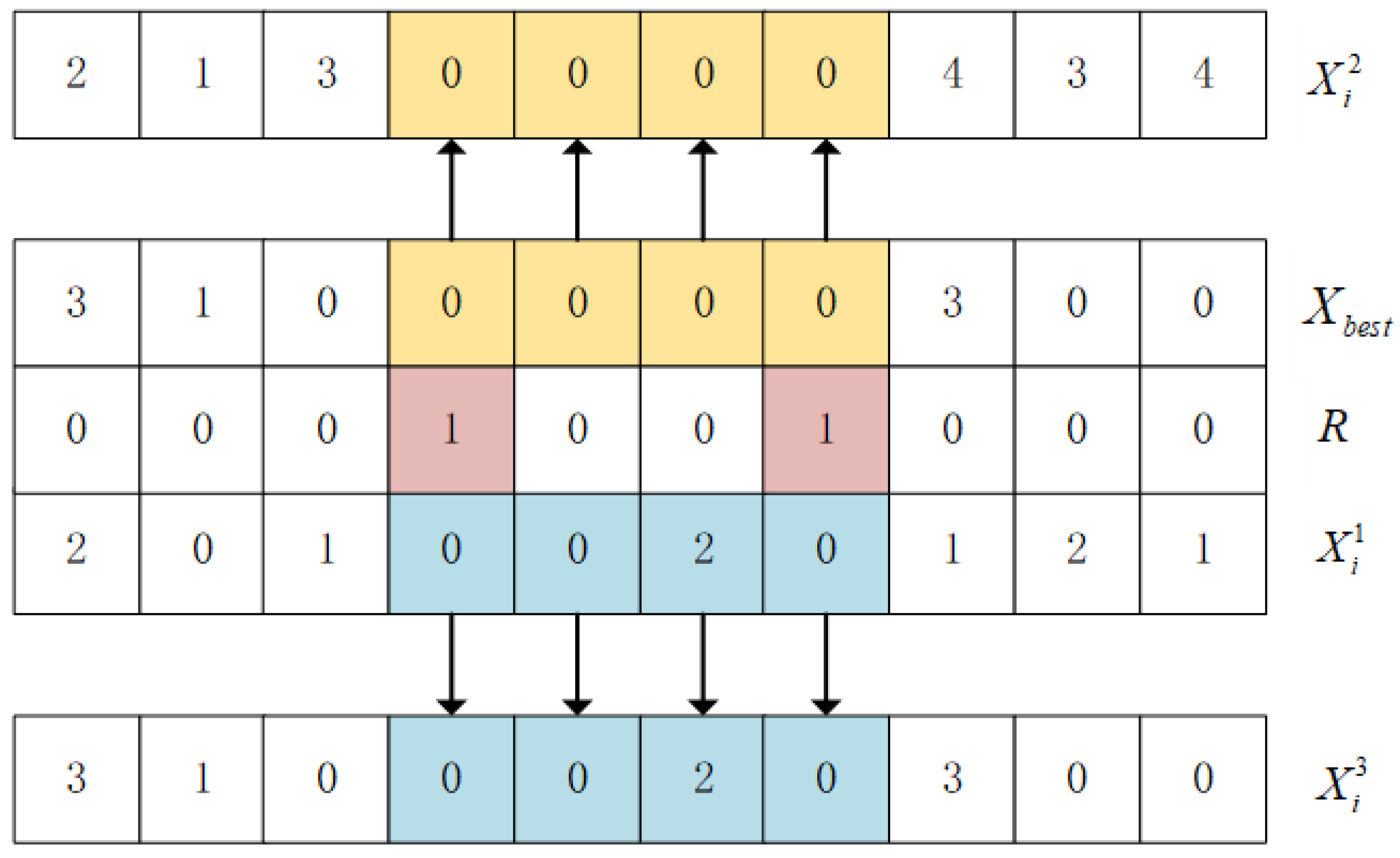
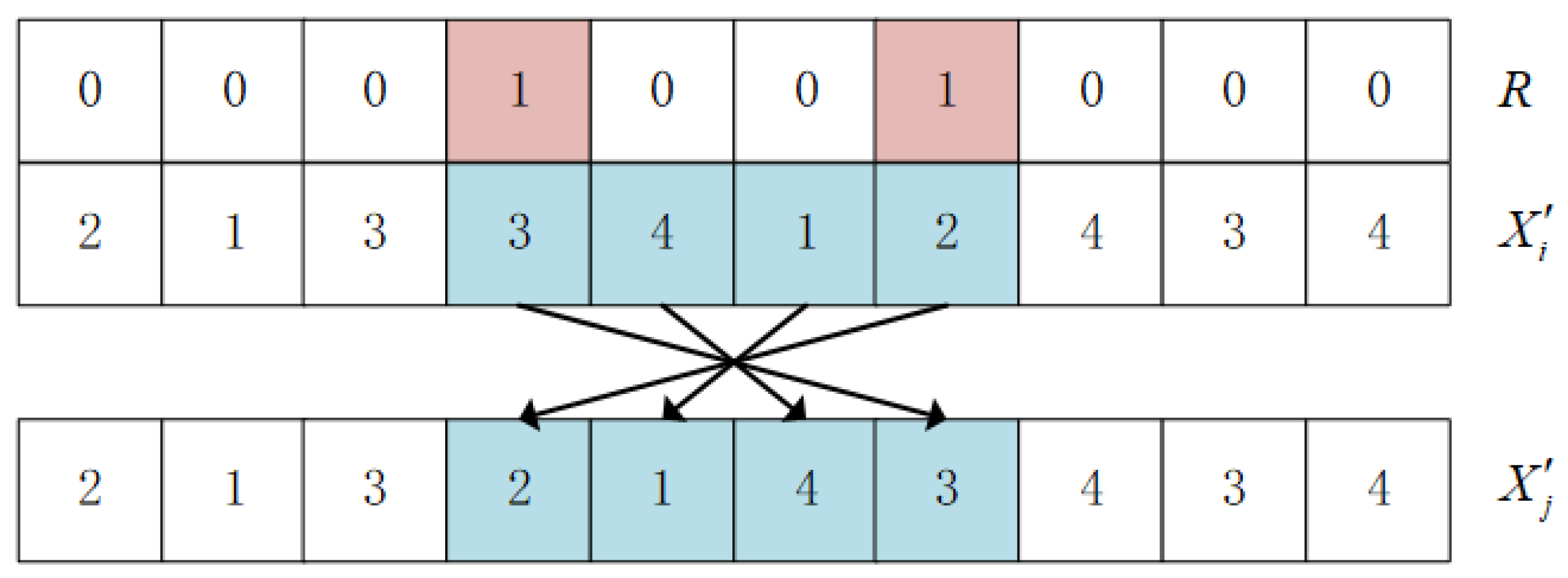
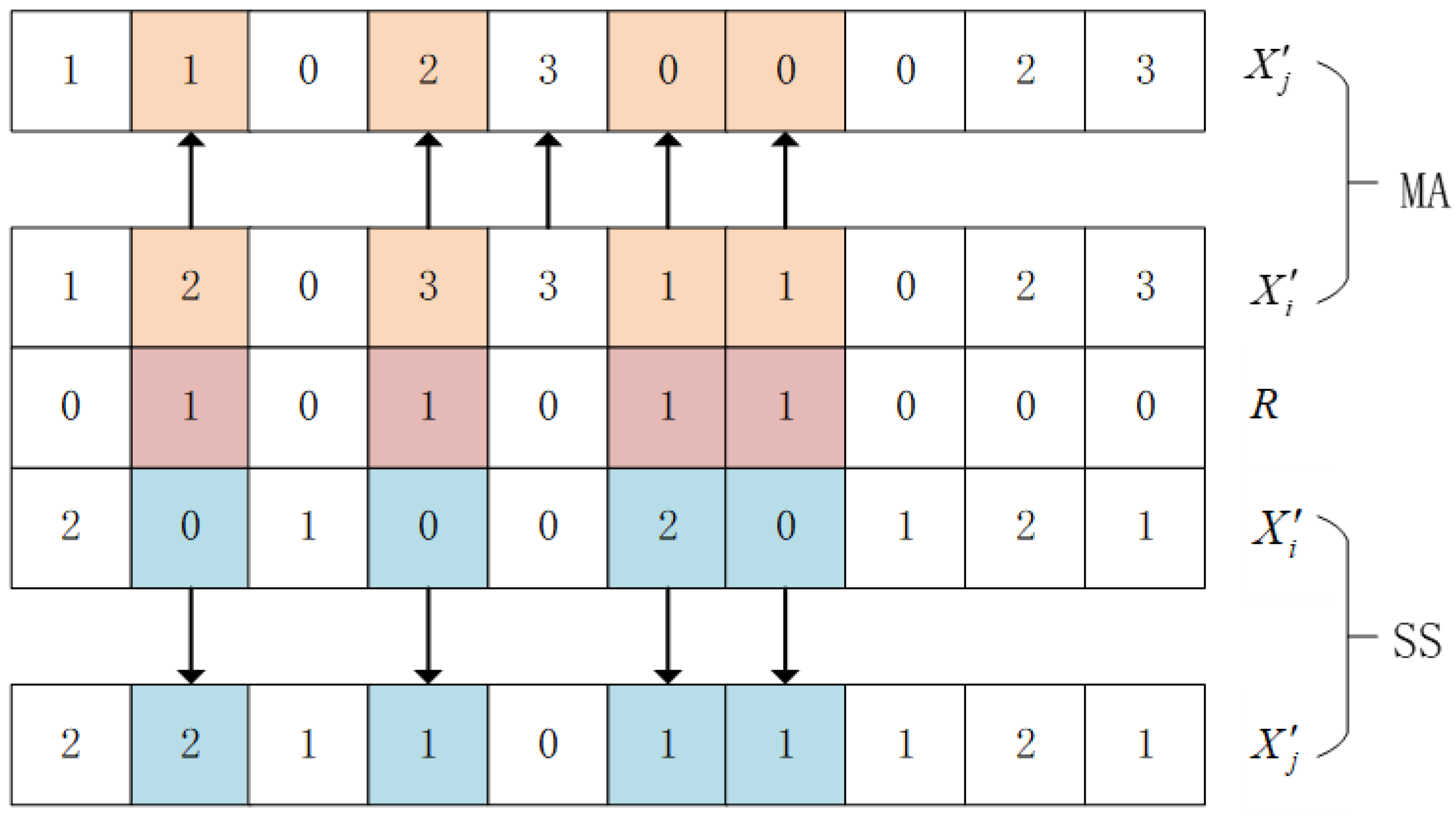
Xworst using POX and TPX to generate new individuals. Under this method, the update mechanisms for the OS, MA, and SS layers are illustrated in
Figure 7,
Figure 8 and
Figure 9, respectively.
The reverse crossover operation for the OS layer involves the following steps: First, the workpieces are partitioned into two groups in a random manner, Job1 and Job2. The workpiece indices of Xi corresponding to positions within Job2 are retained. Meanwhile, the remaining positions are filled in reverse order by utilizing the workpiece indices of Xworst from Job1. This method ensures precedence constraints are maintained while introducing diversity into the operation sequence through reverse crossover.
For the MA layer reverse crossover, the machine assignments at corresponding positions of Xi and Xworst are compared. If they are identical, a different feasible machine (excluding the one assigned by Xworst) is randomly selected; if only one feasible machine exists, Xworst’s assignment is retained. If they are different, Xi’s machine assignment is preserved. This mechanism enhances diversity while ensuring solution feasibility and alignment with machine capabilities.
For the SS layer reverse crossover, the speed levels at corresponding positions of Xi and Xworst are compared. If they are identical, a different feasible speed level (excluding the one selected by Xworst) is randomly chosen; if the machine has only one available speed level, Xworst’s selection is retained. If they are different, Xi’s speed level is preserved. This approach ensures diversity in speed selection while maintaining energy efficiency and adhering to machine-specific speed constraints.
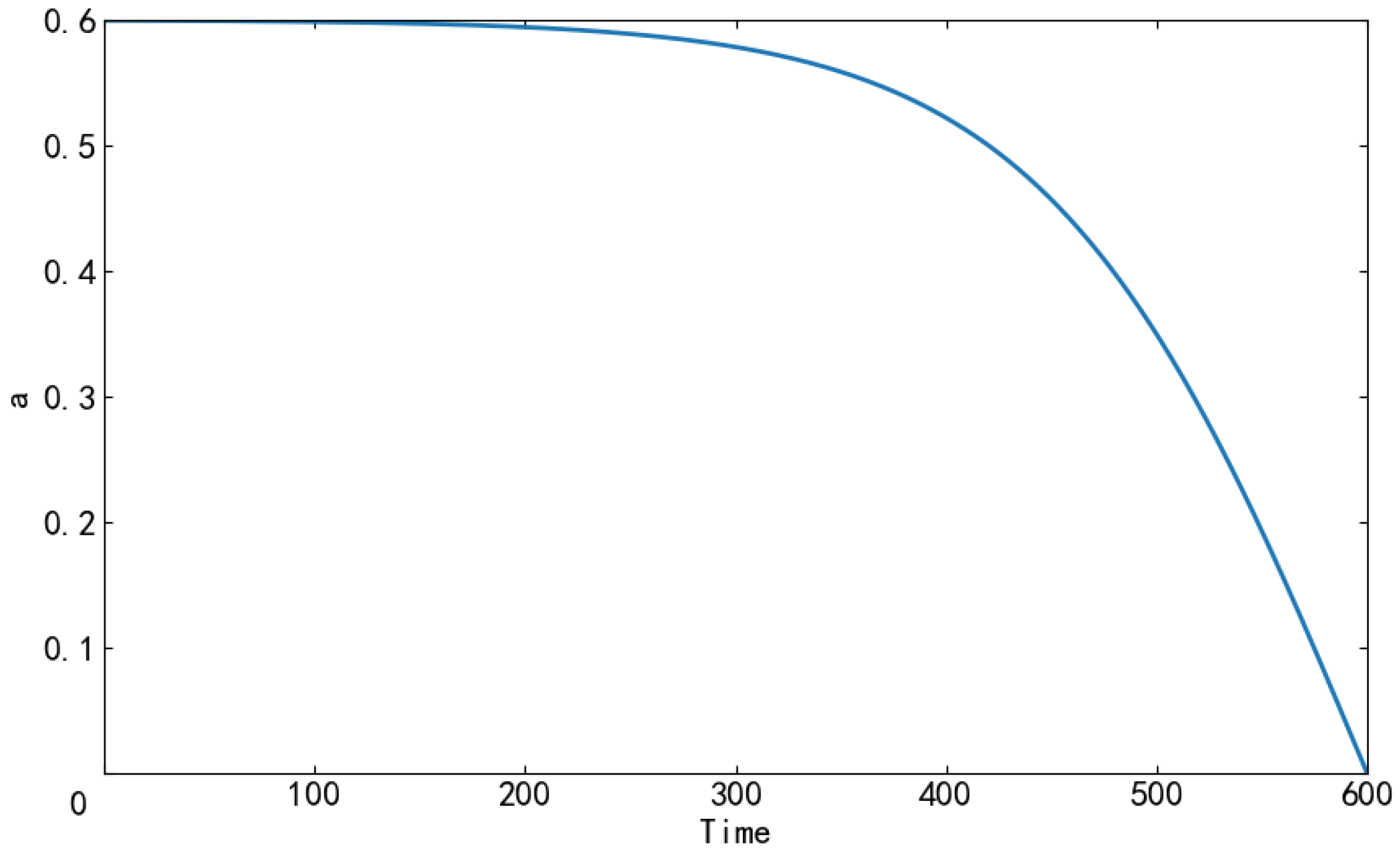
This method enhances the GWO framework by incorporating the “worst solution avoidance” strategy from the Jaya algorithm, thereby promoting population diversity during the early iterations. However, to ensure convergence in later stages, a nonlinear worst solution avoidance factor is introduced to dynamically regulate the avoidance intensity. The factor is defined as Equation (29).
In Equation (29), amax denotes the maximum probability of the avoidance factor, itermax denotes the overall quantity of iterations, and iter indicates the present iteration.
Figure 10 illustrates the variation curve of the nonlinear worst solution avoidance factor. During the initial iterations, the slope of the nonlinear avoidance factor curve is small, with a higher avoidance factor value, indicating that the algorithm prioritizes global exploration by maintaining population diversity and searching broadly across the solution space for an extended period. In later iterations, the curve exhibits a steep slope and a lower avoidance factor value, signifying a shift to local exploitation, where the algorithm rapidly converges within a refined search region.
- (2)
Select the fittest solutions (α, β, and δ wolves), then randomly choose one of the three fittest solutions (α, β, or δ wolf) as
Xbest. Guide
wolf toward
Xbest using POX and TPX to generate new individuals
and
. The update mechanisms for the OS, MA, and SS layers are detailed in
Figure 11,
Figure 12 and
Figure 13, respectively.
- (3)
The fittest individual
is selected from
and
. A mutation operation is then applied to
with a predefined probability, generating a new individual
. The mutation mechanisms for the OS and MA/SS layers are illustrated in
Figure 14 and
Figure 15, respectively.
In the OS layer’s mutation operation, two positions within individual are randomly chosen. Subsequently, the encoding sequence between these two selected positions is reversed.
For the MA and SS layers, a random multi-point mutation is applied to individual . The mutation selects machines or speed levels with the minimum processing time for the corresponding operations. If multiple machines or speed levels have the same minimum processing time, one is randomly chosen.
3.5. Pareto Sort
In the context of a combinatorial optimization problem featuring n minimization goals, a solution x is considered to outperform another solution y (represented as x < y) when the subsequent conditions are satisfied:
- (1)
for all objectives j ∈ {1,2,…,n};
- (2)
for at least one objective j ∈ {1,2,…,n}.
fj(x) and fj(y), respectively, denote the values of the j-th objective function for solutions x and y. A solution is referred to as non-dominated when it is not dominated by any other solution in the population. The non-dominated sorting method is a useful way to establish dominance relations in multi-objective optimization. It categorizes all solutions in the population into multiple non-dominated ranks (fronts). Solutions of a higher level have superiority over at least one solution in lower levels. Conversely, solutions of a lower level are outperformed by at least one solution in higher levels. Solutions that belong to the same level do not dominate one another (no solution in the rank dominates another).
3.6. Distributed Computing Framework
This study adopts a tri-population parallel cooperation strategy, in which three independent IMOD-GWO optimize their respective populations simultaneously. The strategy involves five key steps: initialization, independent evolution, periodic migration, integration and refinement, and termination. During the initialization phase, each subpopulation generates individuals that satisfy technological constraints while taking into account the conditions specific to the problem to ensure the quality of the initial solutions and maintain population diversity.
Subsequently, each subpopulation undergoes independent evolution according to the IMOD-GWO rules, including position updating, leader selection, and adaptive parameter adjustment, allowing exploration of different regions of the solution space and effectively preventing premature convergence. After a predefined number of iterations, periodic migration is performed among subpopulations, in which selected individuals (high-quality) are exchanged. The migrated individuals are then integrated into the recipient populations for integration and refinement, replacing low-quality individuals and expanding population size, followed by continued iterative optimization to improve overall solution quality.
The evolution and migration process continues until the termination condition is met, such as reaching the maximum number of iterations or achieving a target fitness threshold. This design combines the computational efficiency of parallel processing with the global search advantages of multi-population cooperation. Independent evolution of subpopulations prevents premature convergence, while periodic migration promotes the propagation of high-quality solutions, thereby enhancing global exploration capability and convergence speed.
By preserving the simplicity of the standard IMOD-GWO, this strategy significantly improves optimization performance through intelligent inter-population interactions. Moreover, it can be easily extended to distributed computing environments for large-scale optimization tasks, making it particularly suitable for complex multimodal optimization problems.
3.7. Optimal Scheme Selection Method
In the multi-objective optimization problems explored in this study, conflicting objectives such as minimizing completion time and total energy consumption often make it impossible to find a single optimal solution. Instead, a set of non-dominated solutions forms the Pareto front. Among methods for choosing a final solution from the Pareto front, the normalized weighted sum method is widely adopted in production scheduling and other multi-criteria decision-making domains due to its simplicity and efficiency. This approach transforms multi-objective optimization into a single-objective problem by normalizing and weighting individual objectives. For a problem with
n objectives, the mathematical formulation is defined as
In Equation (30),
wj represents the weight coefficients for each normalized objective
. The normalized value of the
j-th objective function
fj(
x), denoted as
, is calculated by Equation (30).
In Equation (31), fj,max and fj,min represent the maximum value and minimum value of the objective fj, respectively.
This paper uses the Fuzzy Analytic Hierarchy Process (FAHP) to determine the weight values of each objective. FAHP is a multi-attribute decision-making method that was developed by introducing fuzzy mathematics into the traditional Analytic Hierarchy Process (AHP). Its core objective is to address the problem of imprecise evaluation caused by the fuzziness and uncertainty of human judgment in the decision-making process, thus making the resulting judgments more accurate and reliable.
The FAHP method, based on fuzzy consistency matrices, mainly involves the following calculation steps:
- (1)
Establish the fuzzy complementary judgment matrix A.
Experts performed pairwise comparisons of the indicators, resulting in a fuzzy judgment matrix
A = (
aij)
n×n, where the fuzzy values
aij in the matrix are based on a 0.1–0.9 scale. The scale and definition of the fuzzy value
aij are shown in
Table 3.
- (2)
Calculate the weight vector W.
Among them, i and j represent row coordinates and column coordinates, respectively.
- (3)
Calculate the feature matrix W*.
Let
W = (
W1,
W2,···,
Wn)
T be the weight vector of the fuzzy judgment matrix
A, and the sum of
Wi in
W is 1. Let
After calculating the data at each position of the
n ×
n matrix using the values in the weight vector
W, an
n-order matrix is obtained:
W* is called the characteristic matrix of judgment matrix A.
- (4)
Calculate compatibility index I.
Let matrices
A = (
aij)
n×n and
B = (
bij)
n×n both be fuzzy judgment matrices, denoted as
Compatibility index for A and B.
- (5)
Consistency check.
Calculate the compatibility index I(A,W*) between the fuzzy judgment matrix A and its feature matrix W. If I(A,W*) ≤ α, the consistency test is considered to have passed. The smaller the value of α, the higher the requirement for consistency in the fuzzy judgment matrix by the decision maker. Generally, α = 0.1 can be taken.
In solving multi-objective decision-making problems, decision-makers typically evaluate the relative importance of each objective based on practical requirements and assign corresponding weights to reflect their priorities. To determine the best solution from multi-objective optimization results, this study proposes a two-stage decision-making method integrating Pareto front filtering and normalized weighted summation. Specifically, firstly, based on the Pareto front elimination method, solutions with unsatisfactory performance are removed from the Pareto solution set, narrowing down candidate solutions. Secondly, for the remaining Pareto solutions, the normalized weighted sum method is applied to compute a comprehensive score by normalizing objectives and summing their weighted values, thereby selecting the solution with optimal balanced performance. This method reduces decision-making complexity while ensuring the final solution aligns with practical requirements and achieves a balanced trade-off between conflicting objectives. By combining elimination and aggregation in two stages, it provides an efficient and practical framework for multi-objective optimization in industrial scheduling.
4. Experiment
4.1. Experimental Data
Since there are no existing test instances suitable for the problem under study, this paper extends the classic Brandimarte instance to generate 15 test instances. The scale of these test instances is detailed in
Table 4.
As shown in
Table 5, the table defines the parameter ranges for generating each experiment. In this table, each range indicates that the value of the corresponding parameter will be randomly generated within the given interval. The experiments assume that preventive maintenance tasks are required for 30% of the total machines.
4.2. Parameter Experimentation
Algorithm parameters significantly affect performance; therefore, it is necessary to select appropriate parameter configurations for the IMOD-GWO algorithm. To this end, this study employs a five-level orthogonal experimental design method.
Table 6 lists the factors studied and their corresponding levels. The factors in
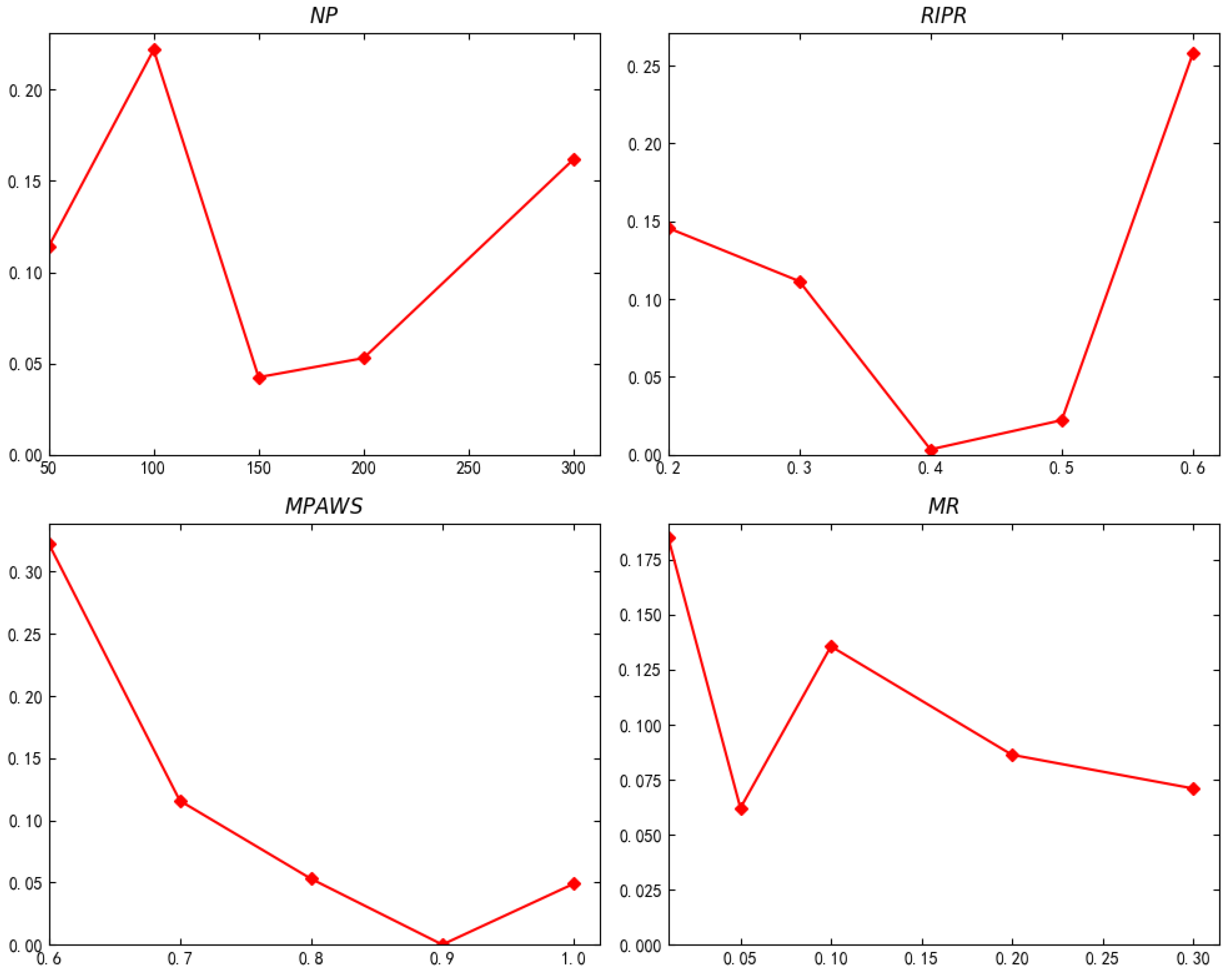
Table 6 include the following parameters: population size (NP), Random Initialization Population Ratio (RIPR), Maximum Probability of Avoiding Worst Solutions (MPAWS), and Mutation Rate (MR). Based on the parameter settings in
Table 6, an orthogonal experimental plan comprising 25 parameter combinations is designed, with detailed results presented in
Table 7.
To validate the effectiveness and superiority of the IMOD-GWO, the parameter experiments are conducted using the medium-scale benchmark instance Mk09. Each parameter group in
Table 7 is executed 20 times with a 10 min runtime per iteration. All programs are implemented in Python 3.12 on a hardware platform equipped with 32 GB of RAM and an Intel Core™ i5-12400F CPU (2.50 GHz). The Intel Core™ i5-12400F processor was sourced from Intel Corporation, with the manufacturing location in the United States. The 32 GB of RAM is sourced from Kingbank Silver Knight, DDR4 3200, and the manufacturing location is Guangdong Province, China.
After each algorithm run, a set of reference solutions that are non-dominated is produced. Subsequently, the non-dominated solution subsets associated with all 25 parameter groups are combined into a comprehensive non-dominated solution set. The evaluation of the performance for each parameter group is evaluated using the average response value (
AvgRV), as shown in
Table 6. A greater AvgRV implies that the parameter combination has better performance. The calculation of the AvgRV is carried out in the following manner:
In Equation (36), AvgRVμ denotes the average response value for the μ-th parameter group. Nrnds(θ) denotes the quantity of elements within the non-dominated reference set that is derived from the θ-th run of the IMOD-GWO, while Nsubndsμ(θ) indicates the contribution (number of solutions) of the μ-th parameter group to the reference set during the θ-th run.
Based on the data in
Table 7,
Table 8 summarizes the algorithm’s performance at each factor level, and the corresponding trends are shown in
Figure 16. The results indicate that the optimal parameter configuration for the algorithm is
PSet_1 = {
NP = 100,
RIPR = 60%,
MPAWS = 0.6,
MR = 0.01}. However, the results in
Table 7 show that
PSet_2 (Group 10 parameters) achieves the highest performance. Furthermore, as demonstrated in
Table 8, the maximum probability of
MPAWS exhibits the most significant impact on algorithm performance, indicating that the algorithm is most sensitive to variations in this parameter. Thus,
MPAWS requires prioritized attention during parameter optimization.
To refine the parameter configuration for the IMOD-GWO, supplementary experiments were conducted by incorporating PSet_1 into the original 25 parameter groups. The results reveal that PSet_2 (AvgRV = 0.6780) significantly outperforms PSet_1 (AvgRV = 0.3348). Based on these findings, we recommend adopting PSet_2 as the standard parameter configuration for the IMOD-GWO.
In this study, coverage (C), inverted generational distance (IGD), and error rate (ER) are used to systematically evaluate the effectiveness and superiority of the improved algorithm.
- (1)
Coverage (C): The coverage metric measures the proportion of solutions in one algorithm’s Pareto set dominated by solutions from another algorithm’s Pareto set.
In Equation (37), PF1 and PF2 denote the non-dominated solution sets generated by two algorithms. A higher C(PF1, PF2) indicates that PF1 is superior. C(PF1, PF2) = 1 indicates that all solutions in PF2 are dominated by some solutions in PF1. C(PF1, PF2) = 0 indicates that no solution in PF1 dominates any solution in PF2.
- (2)
Inverted generational distance (IGD): The core mechanism of IGD index is to realize the comprehensive quantitative evaluation of the convergence and distribution characteristics of the solution set by calculating the spatial distance between the approximate front (PF) and the reference front (PF*).
In Equation (38), PF* denotes the non-dominated solution set. |PF*| denotes the number of solutions in PF*. dis(x,y) denotes the Euclidean distance between solutions x and y in the multi-objective space. A smaller IGD(PF1, PF*) indicates better performance of PF1. In this research, PF* for each test case is formed by aggregating non-dominated solution sets obtained from 20 independent runs of each algorithm.
- (3)
Error rate (ER): The error rate reflects how closely a Pareto set approximates the true Pareto front.
A smaller ER value indicates that the algorithm provides more non-dominated solutions aligned with PF*, with a lower proportion of “useless” solutions (not in PF*).
This article assumes the existence of three experts who provide fuzzy complementary judgment matrices regarding the maximum completion time and energy consumption, namely
A1,
A2, and
A3.
According to Equation (32), [W1,W2]1 = [0.5500,0.4500], [W1,W2]2 = [0.6000,0.4000], and [W1,W2]3 = [0.4500,0.5500].
Next, obtain
,
, and
through Equations (33) and (34).
Finally, by using Equation (35), I(A1,) = 0.0250, I(A2,) = 0.2000, and I(A3,) = 0.0250 are obtained. The obtained I(A,W*) values are all less than α = 0.1, proving that all three sets of fuzzy judgment matrices have passed the consistency test. The final weight is calculated by taking the arithmetic mean of the weights of the three groups to obtain W1 = 0.5333 and W2 = 0.4667.
4.3. Ablation Experiment
To verify the effectiveness of the improved strategies in the IMOD-GWO algorithm, this paper systematically combined different permutations of these strategies, resulting in the 16 algorithm variants listed in
Table 9. The strategies include the following:
INIT is hybrid population initialization,
JAYA is Jaya-based worst solution avoidance strategy,
MUT is a mutation strategy, and
DIST is distributed computing strategy.
In this study, PSet_2 = {NP = 100, RIPR = 60%, MPAWS = 0.6, MR = 0.1} will be set as the parameters of all algorithms. The 16 algorithms are run 20 times on the medium-scale MK09 example, each run for 10 min, and the union of each generation of solutions of each algorithm is obtained. The C value of each algorithm and IMOD-GWO, IGD, and ER values of each algorithm are calculated. The index C1 is C(X, IMOD-GWO) of the corresponding algorithm X and IMOD-GWO, C2 is C(IMOD-GWO, X), the index IGD is the reverse generation distance of the corresponding algorithm X and IMOD-GWO, ER is the error rate of the union of each generation of solutions of each algorithm to the total solution set, and the IGD and ER values in bold are the best among the 16 algorithms.
As can be seen from
Table 10, under the extended MK09 example, most algorithms yielded a C1 value of 0, and most algorithms yielded a C2 value of 1. This indicates that the solution obtained by the IMOD-GWO algorithm is superior. A dominance relationship exists between the GWO-IM, GWO-IJD, and GWO-IMD algorithms, as well as the IMOD-GWO algorithm, but the IMOD-GWO algorithm dominates the others to a greater extent. This means that the Pareto front solutions of IMOD-GWO can cover the Pareto front solutions of the other 15 algorithms, and its Pareto front is superior to the Pareto fronts obtained by the other 15 algorithms. The performance comparison of different GWO variants and component combinations demonstrates the effectiveness of the proposed IMOD-GWO framework. Single-component enhancements (I, J, M, D) significantly reduce IGD values compared to the GWO, indicating improved Pareto front approximation. Combining two or three components further decreases IGD, although some combinations show minor trade-offs in coverage indicators (C1/C2). Among all tested variants, IMOD-GWO achieves the lowest IGD (3.1127) and a substantially reduced error ratio (ER = 0.4761), highlighting its superior ability to balance convergence and diversity. These results suggest that while individual components contribute to performance, the integrated design and coordinated operation of multiple components, including the tri-population strategy, is the key factor driving overall algorithmic effectiveness under identical time constraints, confirming the advantage of the proposed approach in solving the WHMPM-FJSP. The ER and IGD of IMOD-GWO are smaller than those of other algorithms, which means that IMOD-GWO’s Pareto frontier is closer to the real Pareto frontier.
4.4. Comparison Experiments
To verify the performance of the IMOD-GWO algorithm in the FJSP considering workpiece handling and machine preventive maintenance, an extended Brandimarte example was selected for the experiment, and the experimental results were compared with those of the NSGA-II algorithm, the multi-objective Jaya algorithm, and the MOWPA [
33] algorithm. All three comparison algorithms were executed using their default settings, without a multi-population framework, and each algorithm was run for 10 min. The comparison results are presented in
Table 11. Among them, the variable
n stands for the quantity of workpieces, and the variable
m stands for the number of machines. The set of non-dominated solutions for IGD is formed by combining the Pareto solutions obtained from four algorithms running 20 times on each example.
As is evident from
Table 11, (1) the results of C(NSGA-II,IMOD-GWO), C(MO-Jaya,IMOD-GWO), and C(MOWPA,IMOD-GWO) in most of the examples are 0, and the results of C(IMOD-GWO,NSGA-II), C(IMOD-GWO,NSGA-II), and C(IMOD-GWO, MOWPA) in most of the examples are 1, which shows that the IMOD-GWO’s Pareto frontier is significantly better than the Pareto frontier obtained by the NSGA-II, the MO-Jaya and the MOWPA in quality. (2) The results of IGD(IMOD-GWO) in all examples are smaller than those of IGD(NSGA-II), IGD(MO-Jaya), and IGD(MOWPA), which shows that the IMOD-GWO’s Pareto frontier is closer to the real Pareto frontier. (3) The results of ER(IMOD-GWO) in all examples are smaller than those of ER(NSGA-II), ER(MO-Jaya), and ER(MOWPA), which shows that IMOD-GWO obtains fewer invalid solutions and obtains better solutions. (4) Comparing the results of C, IGD, and ER calculations, the IMOD-GWO performs more stably in the test case, which shows that the IMOD-GWO put forward in this research can effectively solve the scheduling problem of flexible job shops considering workpiece handling and machine pre-maintenance.
The main reasons why the IMOD-GWO is put forward in this research to obtain a better Pareto frontier are as follows: (1) High-quality initialization population. This paper uses global, local, and random selection strategies to generate encodings for the machine layer and processing speed layer. The process layer encoding is generated using a random selection strategy to optimize the maximum completion time. Simultaneously, the randomly generated individuals can increase the diversity of the population. (2) Improved individual update mechanism. The idea of “staying away from the worst solution” in Jaya is introduced. By adding the factor away from the worst solution and distributed computing, IMOD-GWO effectively avoids becoming trapped in the problem of local optimal solutions. In addition, a mutation factor is incorporated to ensure that the population maintains its variety during the iteration process, thereby further improving the algorithm’s global exploration capacity.
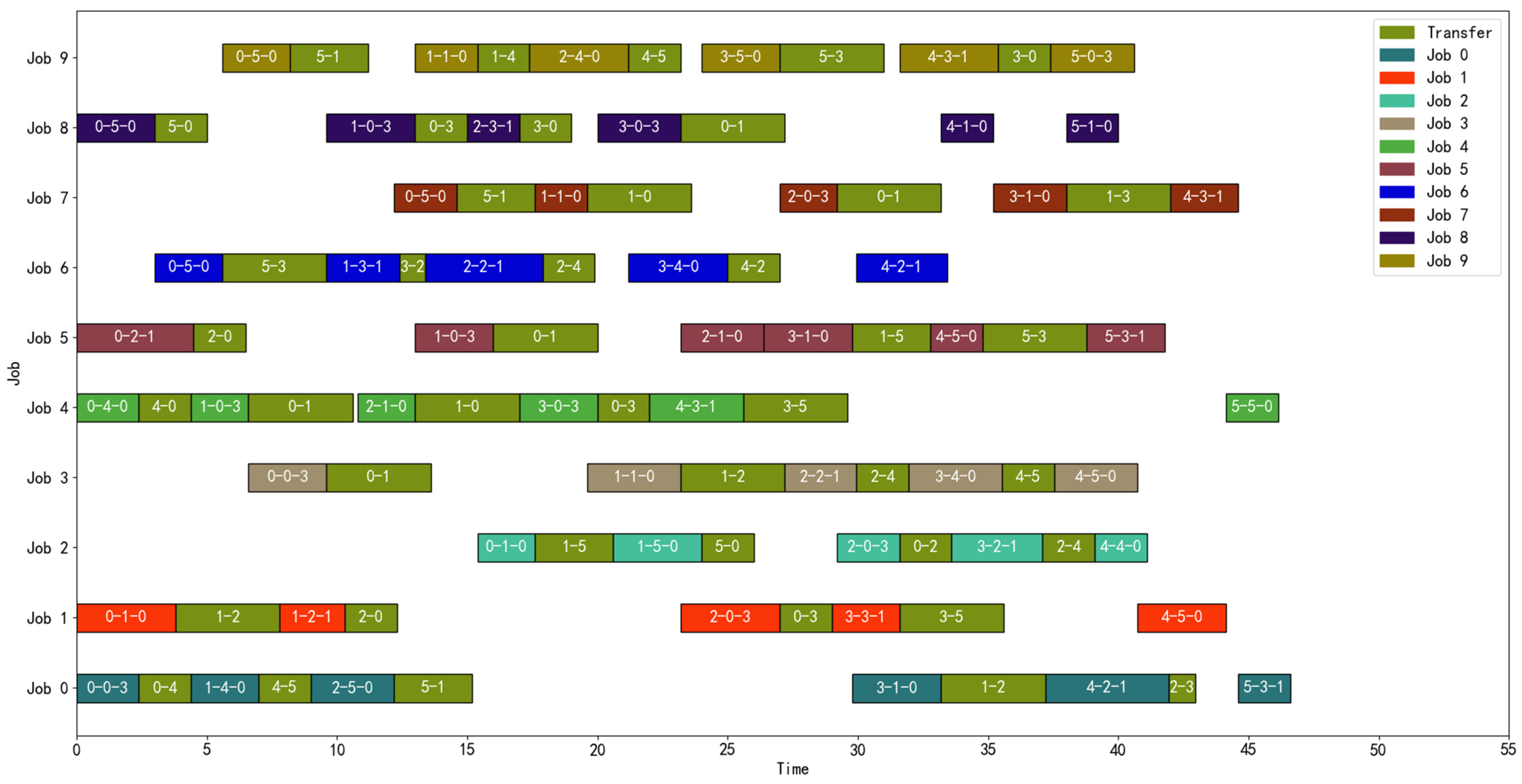
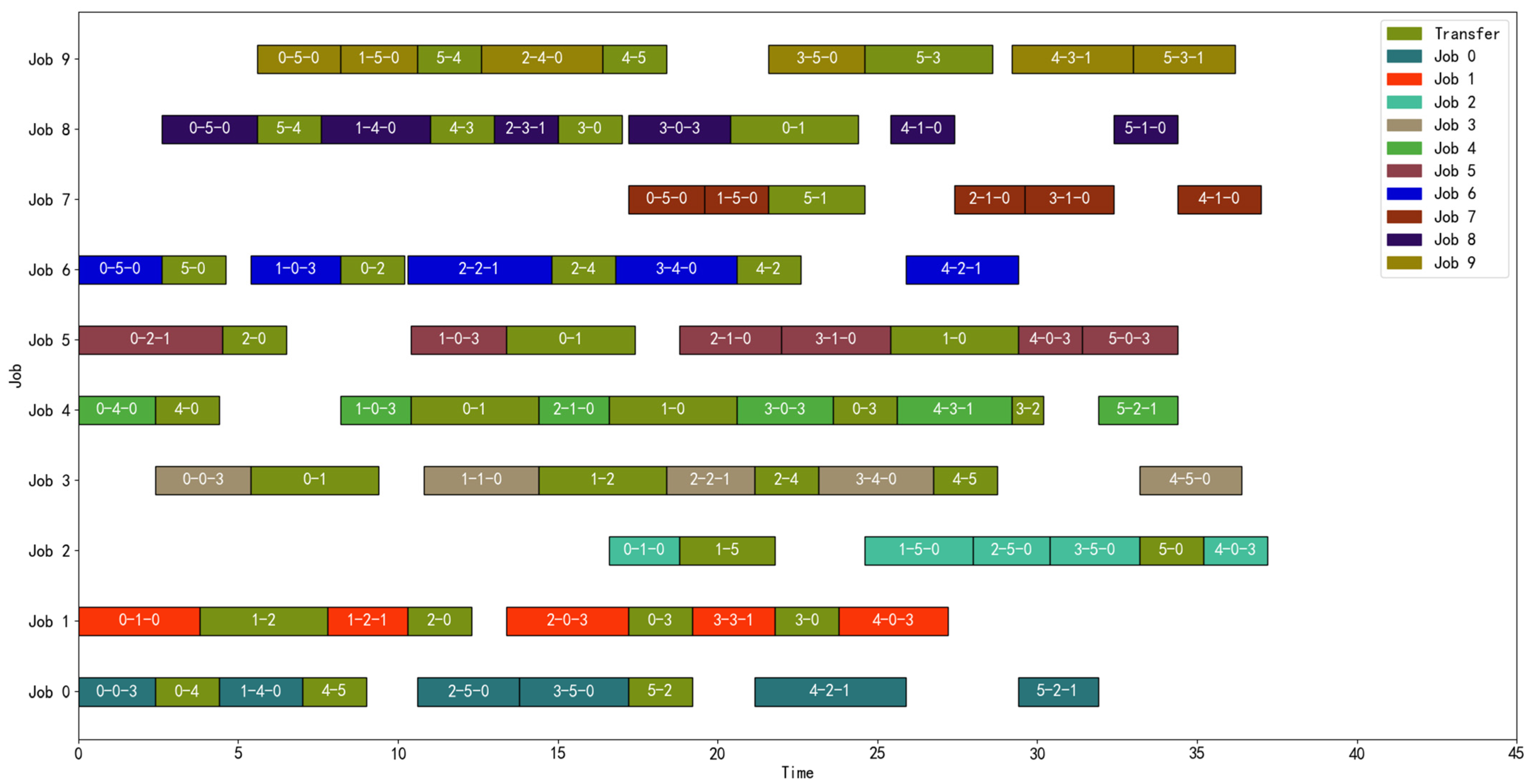
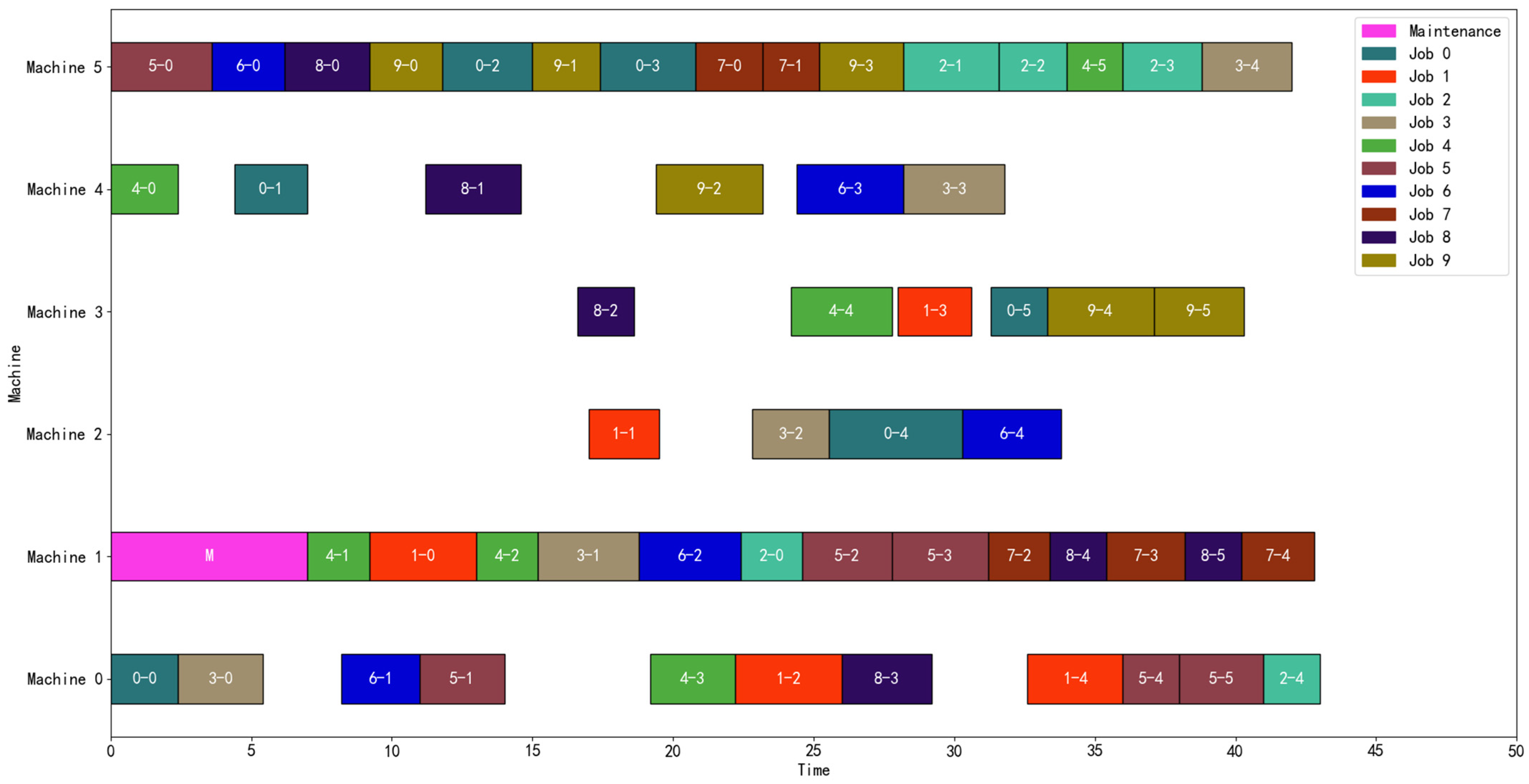
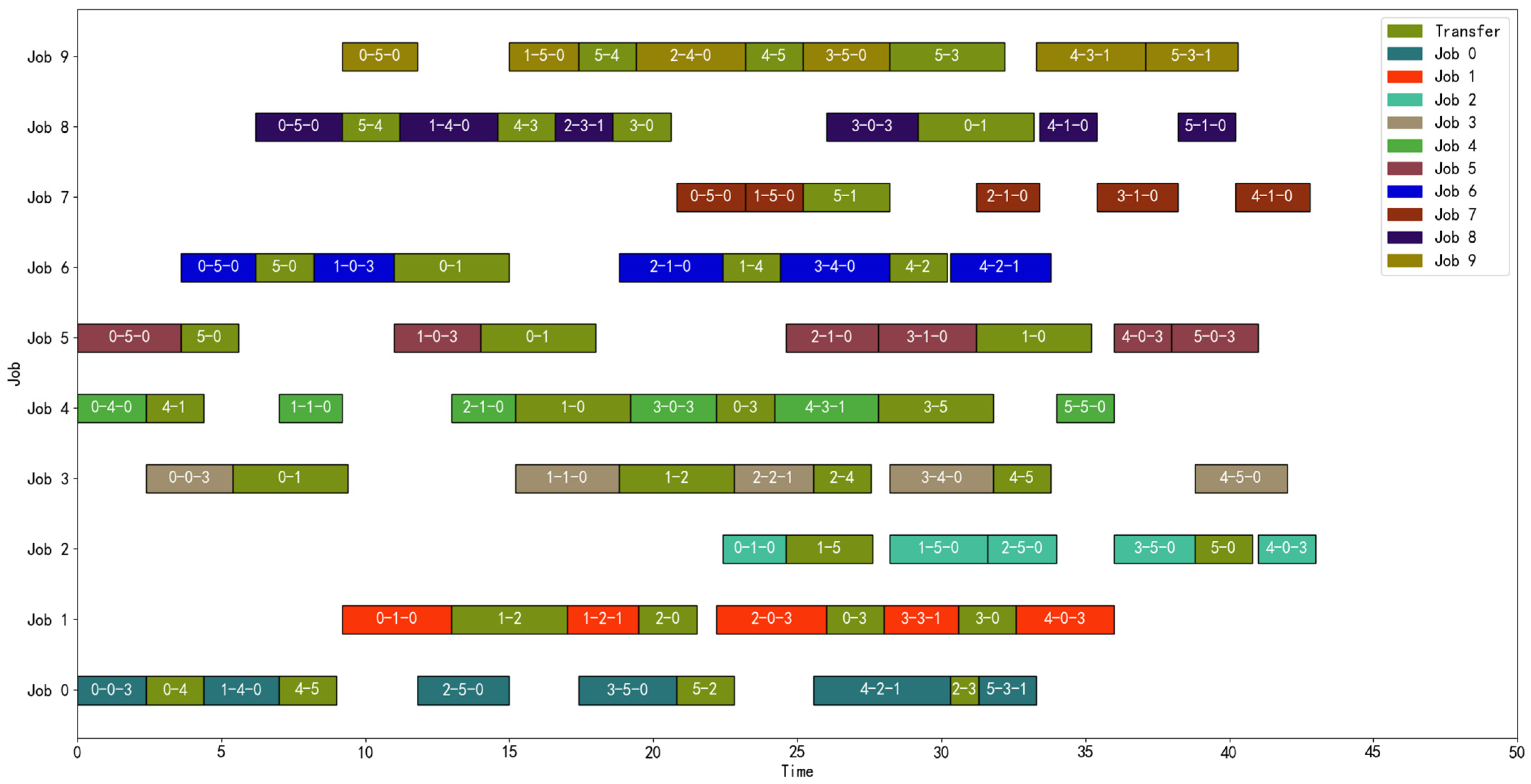
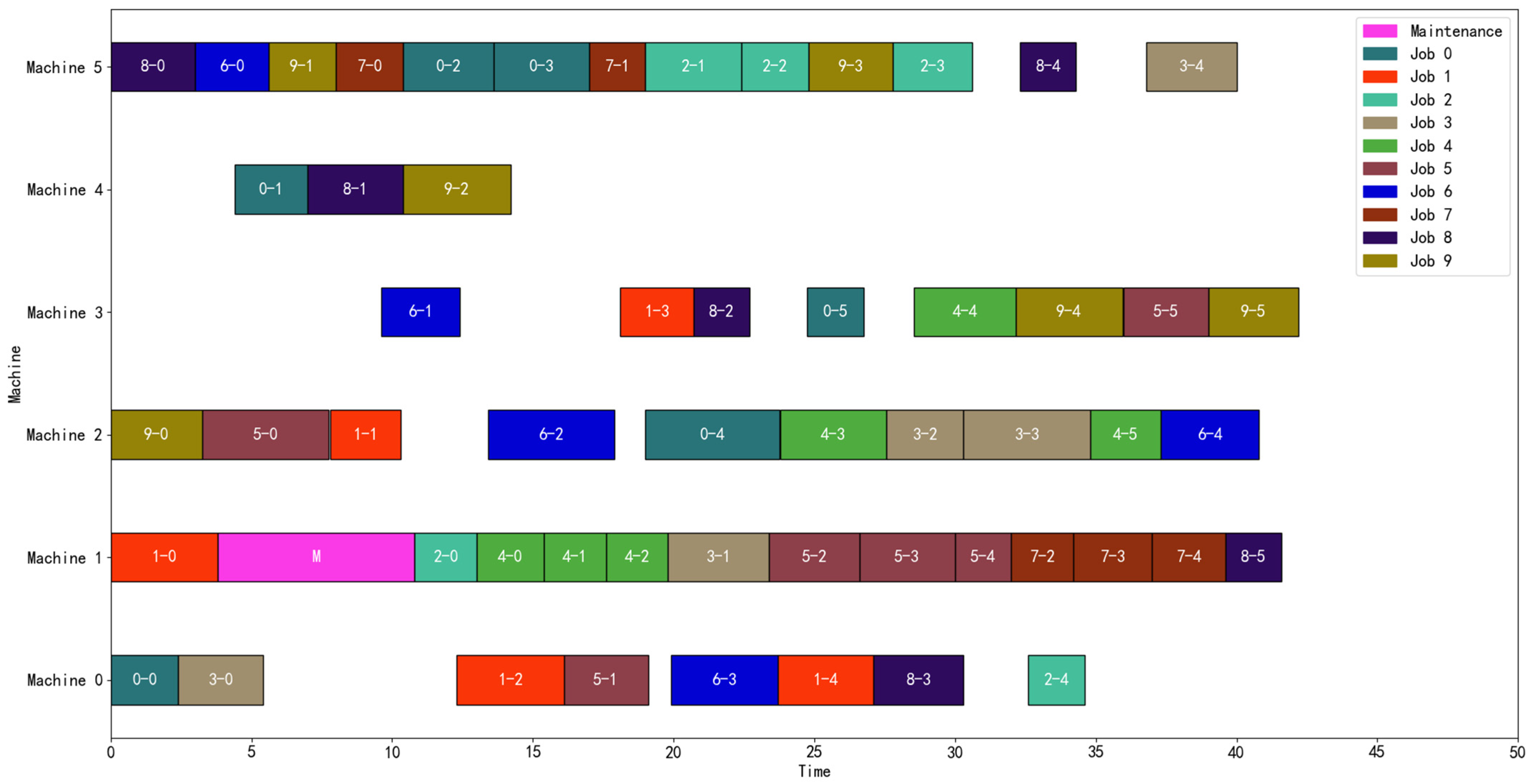
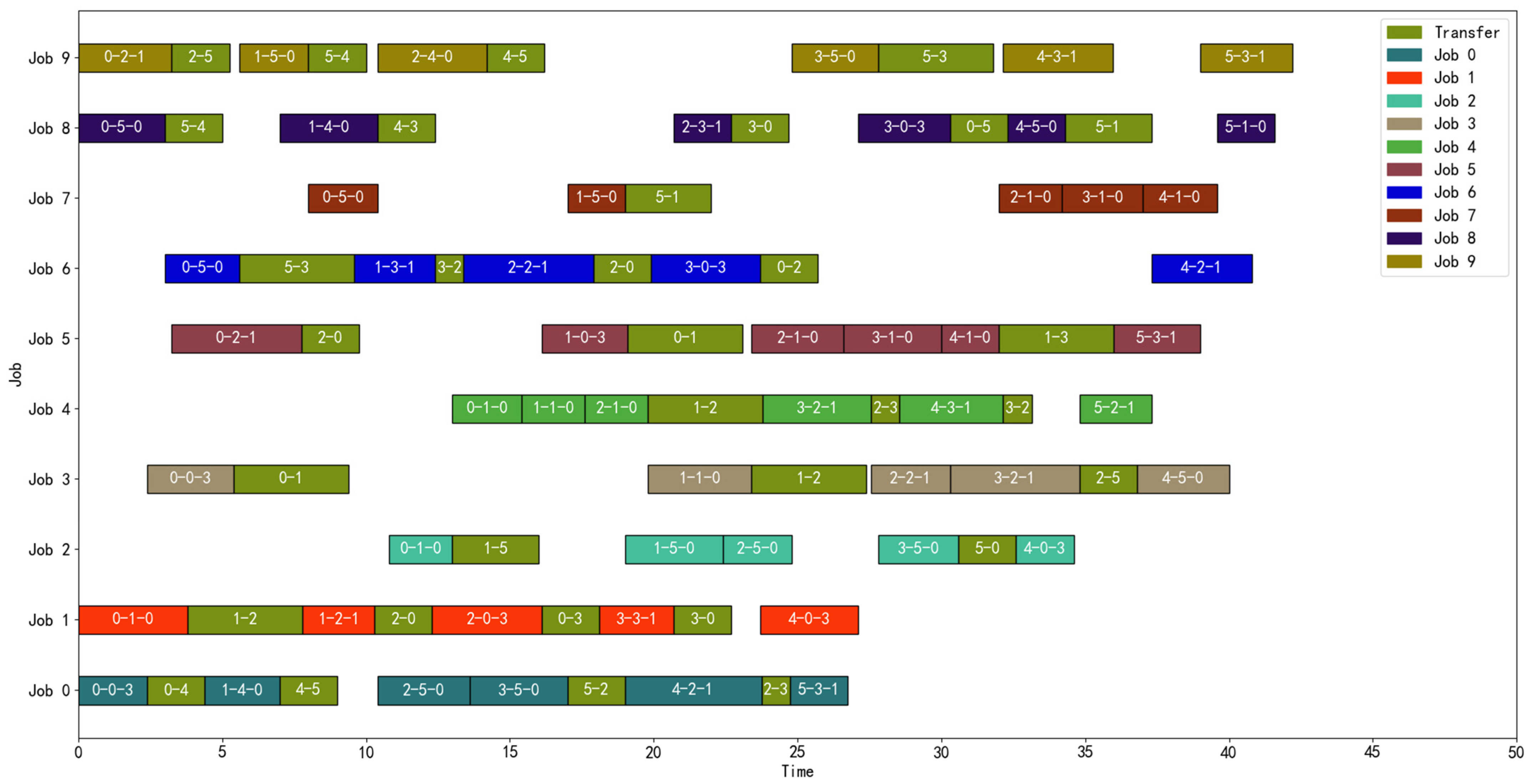
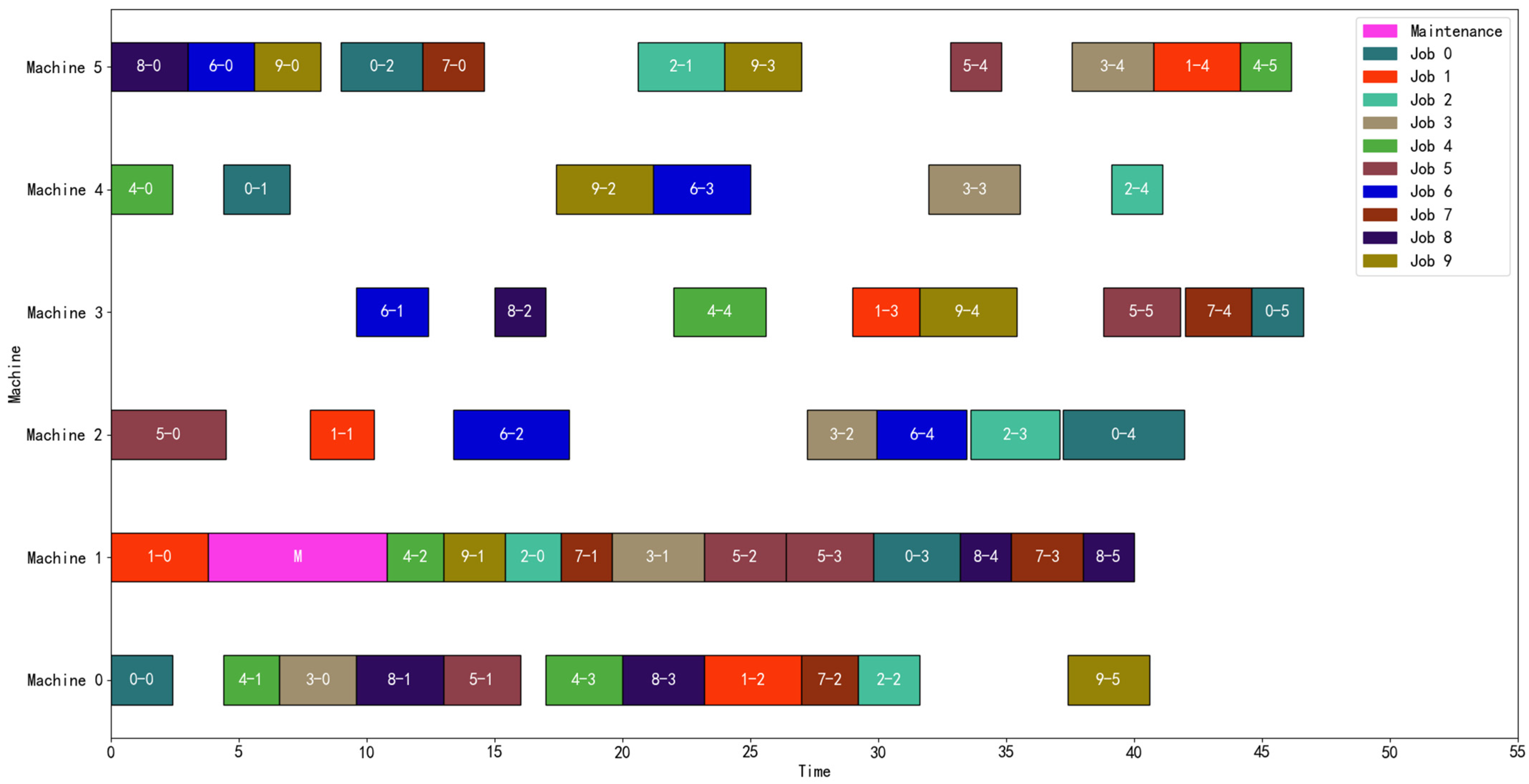
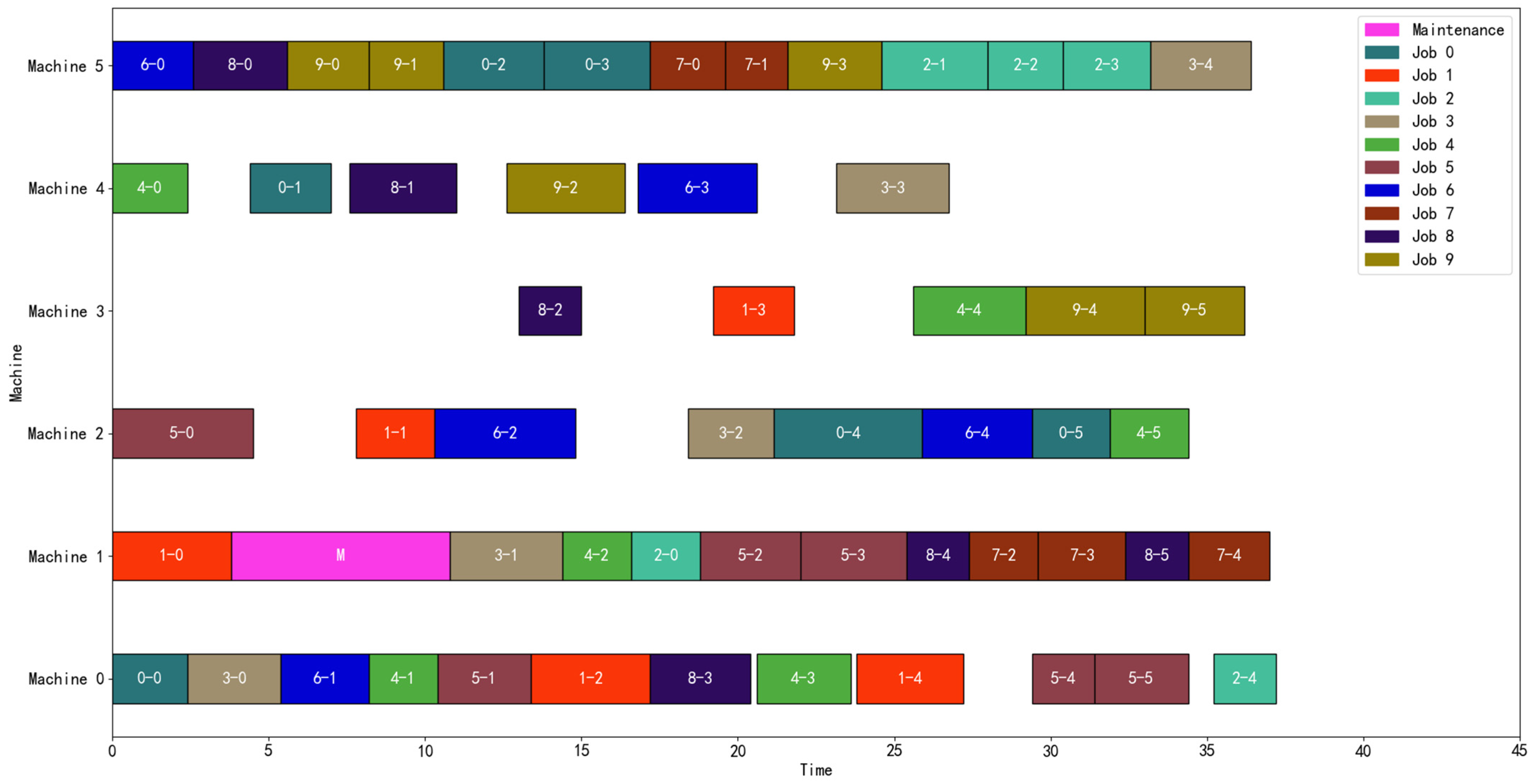
The calculation results of the three evaluation indicators C, IGD, and ER show that the IMOD-GWO designed in this study is able to acquire a more optimized scheduling scheme than the three comparison algorithms, NSGA-II, MO-Jaya, and MOWPA, when solving the scheduling problem of flexible job shops considering workpiece handling and machine pre-maintenance. To more intuitively compare the performance of various algorithms, this paper uses the extended case MK01 as an example and employs the fuzzy hierarchical analysis method to determine the weights of the maximum completion time and total energy consumption, which are 0.5333 and 0.4667, respectively. The machine pre-maintenance time is configured to 0 for the earliest time of machine 1, 5 for the latest time, and 7 for the maintenance time; the optimal scheduling scheme is selected from the NSGA-II’s Pareto frontiers, MO-Jaya’s Pareto frontiers, and IMOD-GWO’s Pareto frontiers at one time, and the Gantt charts shown in
Figure 17,
Figure 18,
Figure 19,
Figure 20,
Figure 21,
Figure 22,
Figure 23 and
Figure 24 are drawn. In the Gantt chart of machine and time, the label in the maintenance color block is machine pre-maintenance, and the label in other color blocks is workpiece–process; in the Gantt chart of workpiece and time, the label in the transfer color block is machine before handling–handling target machine, and the label in other color blocks is process–processing machine–processing speed. Comparing the Gantt chart, we can see that the comparison algorithm can obtain similar pre-maintenance schedules, but the completion period is significantly longer than the scheduling scheme obtained by IMOD-GWO in this research. The maximum completion time and total energy consumption of the optimal scheduling scheme of each algorithm are shown in
Table 11, where the bold indicates the best among the four algorithms.
As can be seen from
Table 12, in most extended examples, the optimal scheduling scheme obtained by the IMOD-GWO algorithm is superior to the other three algorithms in terms of both maximum completion time and total energy consumption. However, in small-scale examples, the optimal scheme obtained by the IMOD-GWO algorithm is not entirely superior to the schemes obtained by the other three algorithms. In a small part of small-scale examples, the optimal solution obtained by the other three algorithms will be smaller than the optimal solution obtained by the IMOD-GWO in terms of the optimization goal of maximum completion time, but in medium- and large-scale examples, the optimal solution obtained by the IMOD-GWO is completely better than the optimal solution obtained by the other three algorithms. In all medium- and large-scale examples, the optimal solution obtained by the IMOD-GWO is better than the optimal solution obtained by the other three algorithms in terms of the two optimization goals of maximum completion time and total energy consumption. This shows that the IMOD-GWO is more efficient in solving the scheduling problem of flexible job shops, considering workpiece handling and machine pre-maintenance, especially when dealing with medium and large-scale problems, and the IMOD-GWO is capable of yielding superior solutions.