1. Introduction
This section first provides background on electric bus (EB) transit operations and charging infrastructure coordination. It then discusses the research motivation and summarizes the main contributions of this study.
1.1. Background
Urban public transit systems are undergoing a profound transformation driven by the global push toward sustainable transportation and low-carbon development. Among the various alternative fuel transit technologies, battery EBs have emerged as a dominant solution because they produce zero tailpipe emissions and can be deployed using existing depot-based charging infrastructures. For instance, Beijing deployed over 16,000 EBs by the end of 2023, accounting for more than 70% of the city’s bus fleet, while Shenzhen achieved near-complete electrification of its public bus fleet as early as 2017 [
1,
2]. These trends indicate that large-scale electrification of urban transit fleets is not only feasible but rapidly becoming the operational norm.
Unlike conventional diesel buses, however, EBs operate within a tightly constrained energy system. Their limited battery capacity makes charging an essential component of daily operations. Consequently, EB transit operations must be viewed as an integrated system consisting of multiple interdependent subsystems, including vehicle scheduling, charging infrastructure utilization, battery energy management, and depot capacity planning. Decisions made for one subsystem inevitably affect the performance and feasibility of the others. For example, insufficient charging capacity can lead to vehicle queuing and schedule disruptions, while overly conservative charging strategies can increase fleet size and overall system costs.
At present, most electric bus systems rely on plug-in charging at depots or dedicated charging stations. While plug-in charging offers high deployment flexibility and avoids the high capital cost of battery-swapping facilities, it introduces additional operational complexities. Charging activities consume a substantial amount of time and often occur concurrently during off-peak periods, which leads to competition for limited charger resources. To alleviate these issues, transit agencies increasingly adopt partial charging strategies, allowing charging durations to vary according to operational needs. This flexibility further strengthens the coupling between bus schedules and charging infrastructure, transforming the problem from a traditional vehicle scheduling task into a system-level resource coordination and optimization problem.
From a systems perspective, EB fleet operation can be characterized as a cyber-physical urban transit energy system, where the fleet subsystem and the charging-infrastructure subsystem interact dynamically through energy consumption, charging demand, and operational constraints. Therefore, optimizing bus schedules without simultaneously considering charger allocation may lead to infeasible or inefficient system-wide decisions. A coordinated framework that integrates fleet assignment and charging scheduling is essential for improving resource utilization, reducing infrastructure investment, and enhancing the overall efficiency and reliability of the EB transit system.
1.2. Research Motivation and Paper Contributions
Motivated by the tight coupling between electric bus trip assignment and plug-in charger utilization, this study proposes a system-level joint scheduling framework that integrates fleet scheduling and charging operations under battery SOC dynamics and charger capacity constraints. The contributions are fourfold.
- (1)
A system-level joint scheduling framework is proposed for the integrated optimization of electric bus fleet operations and charging infrastructure utilization in urban transit systems. The framework captures the interactions among fleet assignment, battery state-of-charge (SOC) dynamics, and charger capacity in a unified modeling structure.
- (2)
A continuous-time mixed-integer linear programming (MILP) model is developed to represent the coupled scheduling decisions for buses and chargers. This formulation improves modeling fidelity and better reflects real-world EB operational processes.
- (3)
An efficient solution strategy is developed by combining a Lagrangian relaxation-based decomposition with a linear programming-based (LP-based) diving heuristic. This approach separates fleet and charger scheduling decisions, reduces computational complexity, and ensures the feasibility of the integrated system schedules.
- (4)
Extensive benchmark experiments and a real-world case study demonstrate that the proposed framework achieves significant improvements in system-level performance, including reductions in fleet size, charger investment, and total operating cost.
The remainder of this paper is organized as follows.
Section 2 reviews the related literature and summarizes research gaps.
Section 3 defines the joint scheduling problem and presents the continuous-time MILP formulation.
Section 4 develops the Lagrangian relaxation-based solution approach.
Section 5 reports computational results on benchmark instances and a real-world case study.
Section 6 concludes the paper and discusses future research.
2. Literature Review
To address these challenges, this study proposes a joint scheduling framework that explicitly models the interactions between the EB fleet subsystem and the charging-infrastructure subsystem. By treating vehicle scheduling and charger scheduling as coupled decisions within a unified system architecture, the proposed framework aims to minimize total system cost while maintaining operational feasibility and battery energy constraints. The following section reviews the relevant literature and highlights the research gaps that motivate our system-oriented approach.
The problem investigated in this study is an extension of the classical transit vehicle scheduling problem (VSP), which concerns the assignment of buses to a predefined set of timetabled trips while accounting for various operational constraints, such as multiple depots, heterogeneous vehicle fleets, and depot capacity limitations [
3]. According to the number of depots involved, transit VSPs are commonly classified into the single-depot vehicle scheduling problem (SDVSP) and the multiple-depot vehicle scheduling problem (MDVSP). The SDVSP can be solved in polynomial time and has been efficiently addressed by several exact solution methods, including the successive shortest path algorithm [
4] and the auction algorithm [
5]. In contrast, the MDVSP has been shown to be NP-hard, and a variety of exact approaches based on column generation have been proposed to tackle this problem [
6,
7,
8]. To handle large-scale instances, numerous heuristic and metaheuristic methods have also been developed for the MDVSP [
9,
10,
11,
12]. More recently, several extensions of the classical MDVSP have been explored by incorporating timetable flexibility [
7,
13,
14] and travel time uncertainty [
15,
16,
17].
The introduction of alternative fuel buses into transit systems fundamentally alters the classical vehicle scheduling problem, as vehicles are subject to limited onboard energy and can only refuel at designated locations. To address this setting, the alternative fuel vehicle scheduling problem (AF-VSP) has been proposed, in which route-related constraints, such as maximum travel distance or maximum operating time, are incorporated to capture fuel consumption considerations. This class of problems is also commonly referred to as vehicle scheduling problems with route constraints (VSP-RC). Existing studies on AF-VSP or VSP-RC are directly applicable to transit systems operating compressed natural gas buses, biodiesel buses, and hybrid diesel buses [
18,
19], and can be extended to electric bus operations adopting battery swapping strategies [
20]. Beyond assigning vehicles to trips, these studies typically determine refueling decisions and examine how the available infrastructure can support vehicle operations. However, in most AF-VSP and VSP-RC formulations, refueling time is simplified as a constant parameter. This modeling assumption limits their applicability to plug-in electric bus scheduling, where charging activities are time consuming, location specific, and need to be explicitly represented.
The electric bus scheduling problem (EBSP) under the plug-in charging strategy is more complicated than general AF-VSPs since the charge gained is set to follow certain formulations over charging time. These formulations are typically expressed in either linear or nonlinear forms. Linear charging models assume a constant charging rate and have been adopted to simplify the charging process [
21,
22,
23,
24,
25]. Nonlinear formulations explicitly distinguish between the constant-current (CC) and constant-voltage (CV) charging phases, in which the charging rate remains stable during the CC phase but decreases substantially during the CV phase [
2,
26,
27]. Regardless of the specific charging formulation adopted, tracking the battery SOC is essential in EBSP studies to ensure that operational feasibility is maintained. Building on these modeling considerations, recent EBSP studies have further explored more flexible and system-oriented decision settings, including partial recharging strategies to enhance system efficiency [
22,
26,
28,
29,
30,
31,
32]. Other recent directions include integrated optimization of EB scheduling and charging infrastructure deployment [
23,
24,
33], the consideration of operational uncertainties to improve solution robustness [
34,
35], and the incorporation of real-time operational control to enhance the responsiveness of EB systems [
36,
37]. For broader discussions on charging infrastructure planning and vehicle scheduling problems in EB systems, readers are referred to the comprehensive review articles by Perumal et al. [
38] and Zhou et al. [
39].
Solution approaches for AF-VSPs and electric vehicle scheduling problems can generally be classified into two categories, namely column generation-based methods and heuristic or metaheuristic approaches. The former are most commonly applied to AF-VSPs with simplified charging processes, such as constant refueling times. For instance, Li [
20] developed column generation-based algorithms to solve an EBSP with route distance constraints, in which EBs could be recharged through either battery swapping or fast charging at dedicated stations. Adler and Mirchandani [
19] proposed a branch-and-price algorithm for the multiple-depot AF-VSP, which was formally defined and formulated as an integer programming model. Wu et al. [
40] developed a tailored branch-and-price method to address the multi-depot EBSP while accounting for time-of-use electricity tariffs and grid peak load considerations.
To address large-scale instances and more complex operational settings, a variety of heuristic and metaheuristic methods have also been proposed, particularly for EBSPs adopting plug-in charging strategies. For example, Wen et al. [
28] designed an adaptive large neighborhood search heuristic for an EBSP involving multiple depots and partial charging decisions. Rogge et al. [
21] proposed a grouping genetic algorithm to jointly address EB scheduling, fleet composition, and charging infrastructure optimization. Li et al. [
41] developed a cooperative optimization model for large-scale EB networks that jointly optimizes bus service schedules and charging schedules under fast-charging techniques and proposed an integrated adaptive large neighborhood search algorithm to enhance computational efficiency.
Despite extensive research on EBSP, three gaps remain. First, many studies determine vehicle schedules and charging decisions sequentially, implicitly assuming sufficient charging infrastructure, which overlooks the interdependence between charger capacity and schedule feasibility. Second, deadhead travel to access sparsely located charging stations is often ignored, potentially underestimating time, energy consumption, and labor costs. Third, discretized-time formulations may be too coarse to capture continuous and dynamic charging operations. Addressing these gaps, this paper studies a system-level joint scheduling problem for battery electric bus fleets and plug-in charging infrastructure and develops a continuous-time MILP model and an efficient decomposition-based solution method.
3. Problem Description and Model Formulation
This section presents the problem that was considered in this study and the corresponding mathematical modeling framework. We first describe the operational setting and decision variables and then formulate the system-level optimization model.
3.1. Problem Description
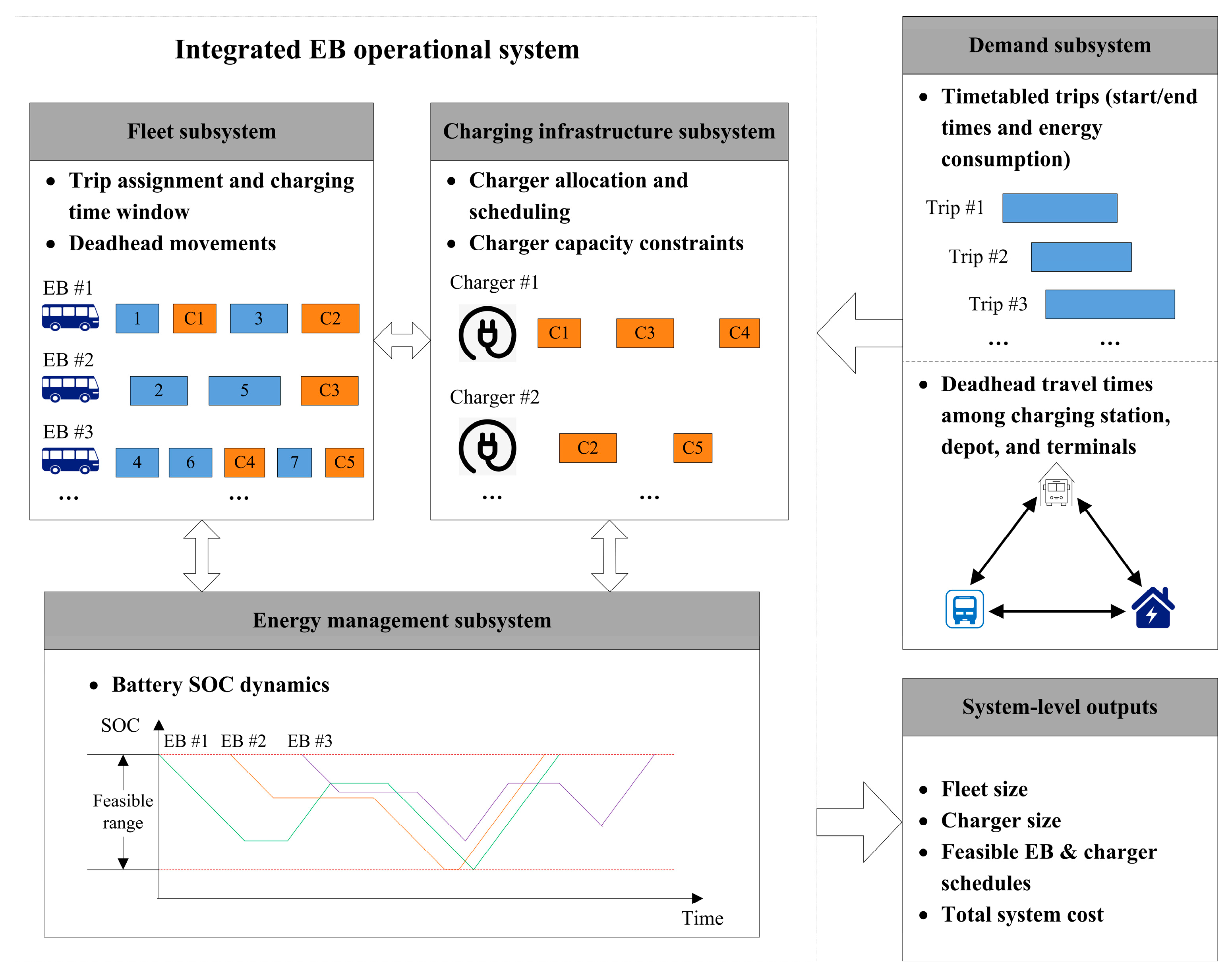
This study considers the operation of an urban EB transit system as an integrated operational system composed of three tightly coupled subsystems: the fleet subsystem, the charging-infrastructure subsystem, and the energy management subsystem. The objective is to determine coordinated scheduling decisions across these subsystems so as to minimize the total system cost while ensuring operational feasibility. The system architecture is illustrated in
Figure 1.
The fleet subsystem consists of a homogeneous set of EBs that depart from the depot each morning and sequentially serve a predefined set of timetabled trips. Each trip is characterized by a fixed start time, end time, and energy consumption, and must be assigned to exactly one EB. Between consecutive trips, an EB may either proceed directly to the next trip or detour to a charging station for battery recharging.
The charging-infrastructure subsystem includes a limited number of plug-in chargers located at a charging station that may or may not be co-located with the depot. Chargers can serve one EB at a time and charging events must be scheduled in such a way that no charger processes overlap charging activities. Therefore, charger availability acts as a shared resource that constrains the feasible operation of the fleet subsystem.
The energy management subsystem models the battery SOC dynamics of each EB. The SOC decreases as buses perform trips or deadhead travel and increases during charging. Each charging event is defined by its start time, end time, and charging duration, and may involve either partial or full charging. The SOC constraints link the fleet scheduling and charger scheduling decisions, making the problem inherently system-level in nature.
From a systems perspective, the daily operation of the electric bus network can be viewed as a multi-layer coordination problem, where the sequencing of trips in the fleet subsystem determines charging demand, and the allocation of chargers in the infrastructure subsystem determines whether this demand can be satisfied within the available time windows. The joint optimization problem therefore seeks to simultaneously determine: (i) the number of EBs required, (ii) the number of chargers required, (iii) the assignment and sequencing of trips for each EB, (iv) the timing and duration of each charging event, and (v) the charger schedules for the charging infrastructure. This integrated decision process enables efficient utilization of both fleet and charging resources and supports system-wide operational planning for urban electric bus transit systems.
Within the considered station-based plug-in charging paradigm, the proposed framework supports flexible and partial charging decisions with continuous time scheduling. As a result, different charging strategies—ranging from frequent, short recharges to less frequent, longer charging sessions—are endogenously determined by the optimization model rather than imposed exogenously.
3.2. Modeling for Electric Bus Scheduling System
The modeling framework is developed based on a network representation that captures vehicle circulation, energy evolution, and charging resource interactions. We first introduce the network construction, followed by the detailed mathematical formulation.
3.2.1. Network Construction
To capture the coupled operation of the electric bus fleet and the charging infrastructure, the proposed joint scheduling problem is mapped onto a directed multigraph . The node set consists of two categories: trip service nodes and potential charging-event nodes, reflecting the interaction between the fleet subsystem and the charging subsystem. The trip service nodes include all trips, each corresponding to a passenger service task . In addition, two dummy nodes, labeled 0 and , are introduced to represent the virtual start and end states of a bus schedule within the fleet subsystem.
For each trip , two potential charging-event nodes, denoted by and , are defined: represents a charging opportunity immediately preceding trip , capturing most intermediate charging possibilities; represents the charging event following trip when trip is the last task assigned to a bus, i.e., the final recharge before returning to the depot. Similarly, two dummy charging-event nodes, denoted by and , are introduced to represent the virtual start and end of charging schedules. Collectively, these nodes form the decision layer linking vehicle movement and energy replenishment within the system.
The arc set
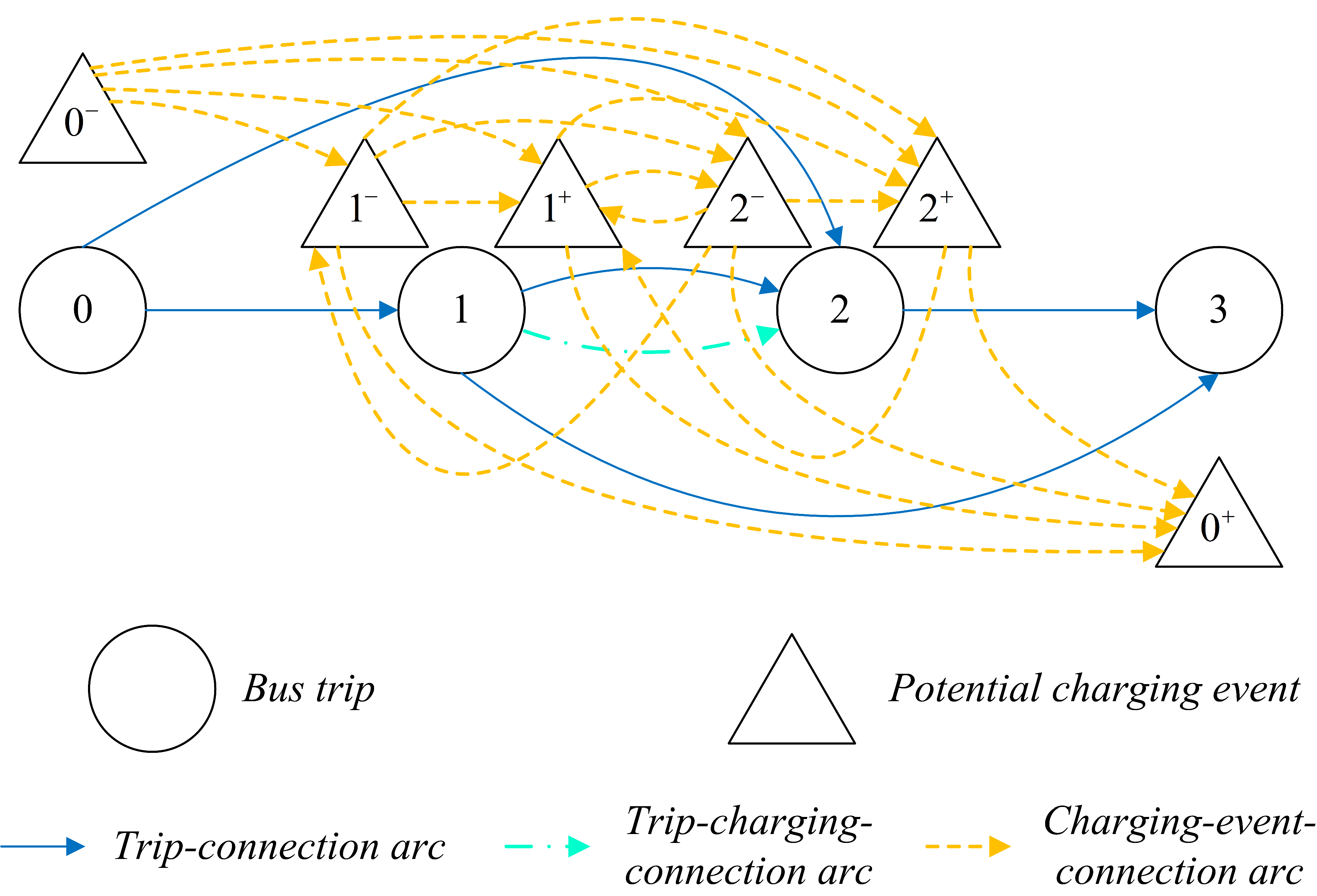
is composed of three types of arcs, each reflecting a specific interaction or resource flow between system components. The first type, termed trip-connection arcs, connect the trip nodes
and
, indicating that both trips can be consecutively served by the same electric bus, with or without intermediate charging. These arcs model vehicles flow within the fleet subsystem. The second type, referred to as trip-charging-connection arcs, also connect trip nodes
and
, but explicitly represent the case where a charging activity occurs between them. These arcs capture the coupling between the fleet subsystem and the charging subsystem, where vehicle schedules generate charging demand. The third type, termed charging-event-connection arcs, connect pairs of charging-event nodes, such as
,
,
, or
. These arcs indicate that the corresponding charging activities can be sequentially performed by the same charger, modeling the resource allocation and flow within the charging-infrastructure subsystem. An illustrative multigraph for a simple instance with two trips is shown in
Figure 2. The first two arc types are directed because trip start and end times are fixed, while charging-event-connection arcs may be bidirectional since the timing of charging events is decision dependent.
To ensure that the multigraph accurately reflects system feasibility, all candidate node pairs are examined to determine the existence of each arc type while eliminating infeasible connections. For any two trip nodes, such as and , feasibility without intermediate charging is assessed from both temporal and SOC perspectives. The temporal condition requires , where and denote the end time of trip and the start time of trip , and denotes the deadhead travel time between these two trips. The SOC feasibility is , where , denote the consumption from trips; , , and represent consumption from the associated deadhead travel; and , are the allowable battery SOC limits.
When the SOC condition above is violated but the temporal condition holds, the possibility of inserting a charging event between trips is evaluated. The corresponding trip–charging–connection arc is retained if the following condition is satisfied: , where is the full charging time required to restore the battery from to . This conservative condition ensures that all potentially feasible charging-mediated transitions are preserved in the system network. Additionally, even when trips and are directly feasible, a trip-charging-connection arc is only included if the maximum energy gain from detouring to the charging station offsets the additional deadhead energy consumption. Finally, a trip-connection arc is established whenever trips and can be consecutively performed by the same bus, regardless of whether intermediate charging occurs.
Charging-event-connection arcs are defined based on the feasible time windows of charging events and the charger setup time . For a final charging node , its feasible time window is determined by its earliest end time and latest start time, and a connection to node is established if the two windows can be sequentially processed by the same charger. For intermediate charging nodes, such as , the feasible time window depends on the predecessor trip from which the bus arrives. A charging-event-connection arc is established between two such nodes whenever there exists a pair of predecessor trips whose charging windows are compatible within the charger setup time constraint.
3.2.2. Mathematical Formulation
The multigraph constructed above serves as a compact representation of all feasible interactions between bus trip chains and charging activities. On the fleet side, selecting a trip-connection arc is modeled by , meaning that a bus serves trip immediately after trip (with dummy nodes representing pull-out and pull-in). For trip pairs where an intermediate recharge is allowed, we use to indicate that the transition from to is realized via a charging detour; this choice switches the corresponding travel/cost accounting from a direct deadhead move to a charging-mediated move and triggers the associated charging event in the model.
On the charging infrastructure side, each selected charging event is assigned continuous start/end times and is linked to battery feasibility through SOC variables that propagate along the chosen trip sequence. The charging-event-connection arcs are activated by the z-variables to sequence charging events on the same charger, enforcing non-overlap and setup time . Accordingly, the objective function aggregates (i) fleet deployment costs from pull-out/pull-in arcs, (ii) operating costs for direct and charging-mediated connections, and (iii) charger holding costs induced by the number of charger sequences. This network-to-model mapping motivates the mixed-integer formulation presented next.
Based on the above description, we summarize the sets, parameters, and decision variables used in the model in
Table 1.
The objective is to minimize the total investment and operational costs of the EB transit system, which is formulated as:
The objective function in Equation (1) consists of three cost components. The first term represents the fleet deployment cost, which corresponds to bus pull-out and pull-in from the depot in the fleet layer. The second term accounts for the operational travel and energy-related cost, representing direct trip-to-trip connections and charging-mediated connections in the fleet–energy coupling layer. The third term represents the charging-infrastructure holding cost, reflecting the capacity and scheduling of chargers in the infrastructure layer.
The following constraints ensure that each trip is served exactly once and that bus flows are conserved.
Constraints (2)–(4) define the feasible operation of the fleet subsystem, ensuring that each bus schedule starts at the depot, ends at the depot, and serves each trip exactly once. Constraint (5) enforces that a charging-mediated trip transition can only occur if the corresponding trip connection is selected.
The charging time constraints are formulated as follows.
Constraints (7)–(9) define the feasible time window of charging event , i.e., if a charging activity occurs between trips and . They further imply that when trips and are consecutively performed without charging, and that when is the first trip performed by an EB. Similarly, constraints (10)–(12) restrict the feasible time window of charging event . These constraints define the feasible time windows of charging activities. They ensure that charging events are temporally consistent with trip completion and departure, thus forming the interface between the fleet subsystem and the energy subsystem.
The SOC constraints are formulated as follows.
Constraint (13) forces to be zero if no connection exists between trips and . Constraints (14)–(17) define the propagation of the SOC level from a preceding trip node , accounting for deadhead travel, trip energy consumption, and possible intermediate charging. Constraint (18) ensures that is determined by exactly one predecessor. Constraint (19) enforces that sufficient SOC is retained for the bus to return to the charging station after completing a trip, while also preventing the SOC from exceeding the upper bound. Constraints (20) and (21) ensure that the EB is fully charged after completing all assigned trips. These constraints capture the energy–resource flow of the system, ensuring that every bus maintains feasible SOC levels across trip execution and charging decisions.
The charger scheduling constraints are formulated as follows.
Constraints (22) and (23) require each charger schedule to start from the source node and terminate at the sink node. Constraints (24)–(25) and (26)–(27) are flow-conservation constraints defined on each potential charging-event node and , respectively, ensuring that whenever a charging event occurs, it is assigned to exactly one charger. Constraints (28)–(31) further enforce the temporal feasibility for two charging events to be consecutively processed by the same charger, requiring that the time gap between the completion of the preceding charging event and the start of the subsequent one is no less than the setup time . These constraints, therefore, model the resource allocation and capacity limits of the charging-infrastructure subsystem.
4. Lagrangian-Relaxation-Based Approach
To efficiently solve the proposed system-level mixed-integer programming model, this section develops a Lagrangian relaxation-based solution approach. We first outline the overall decomposition framework, and then we describe the formulation of the resulting subproblems and the associated heuristic.
4.1. Approach Framework
Although the proposed joint scheduling model is formulated as a mixed-integer linear program (MILP) and can be solved by commercial solvers, its practical scalability is limited by the large number of decision variables and the strong coupling among system components. To address this issue, we develop a Lagrangian relaxation-based solution framework from a systems engineering perspective.
The central idea of the approach is to exploit the multi-layer structure of the urban electric bus transit system. Specifically, the system consists of two interdependent subsystems: i) the EB fleet scheduling subsystem, which determines vehicle assignment, trip sequencing, and battery SOC evolution and ii) the charging-infrastructure scheduling subsystem, which allocates charging events to available chargers. To enable decomposition, the decision variables are partitioned accordingly. The first group contains the variables , , , , , , , and , which govern the operational and energy decisions within the fleet subsystem. The second group includes the variables , , , and , which represent charger allocation decisions within the charging-infrastructure subsystem.
Under this partition, constraints (24)–(31) link variables from both subsystems and are, therefore, treated as coupling constraints that capture subsystem interactions. Each coupling constraint is associated with a Lagrangian multiplier, collected in the vector . By relaxing these constraints and incorporating them into the objective function, we obtain a Lagrangian-relaxed system model. Maximizing the relaxed problem with respect to yields the Lagrangian dual problem.
For a given multiplier, such as vector
, the relaxed model decomposes naturally into two independent subproblems: (i) a fleet scheduling subproblem, representing the operational decisions of electric buses, and (ii) a charger scheduling subproblem, representing the allocation of charging activities to chargers. Solving these subproblems provides a relaxed system solution
and a corresponding lower bound
on the optimal system cost. However, because the coupling constraints are relaxed,
may not be feasible for the original integrated system. To recover feasibility and generate an upper bound, we design an LP-based diving heuristic that reconstructs a feasible charger schedule consistent with the fleet decisions. This process repairs
into the feasible solution
, producing an upper bound
. The heuristic details are provided in
Section 4.3.
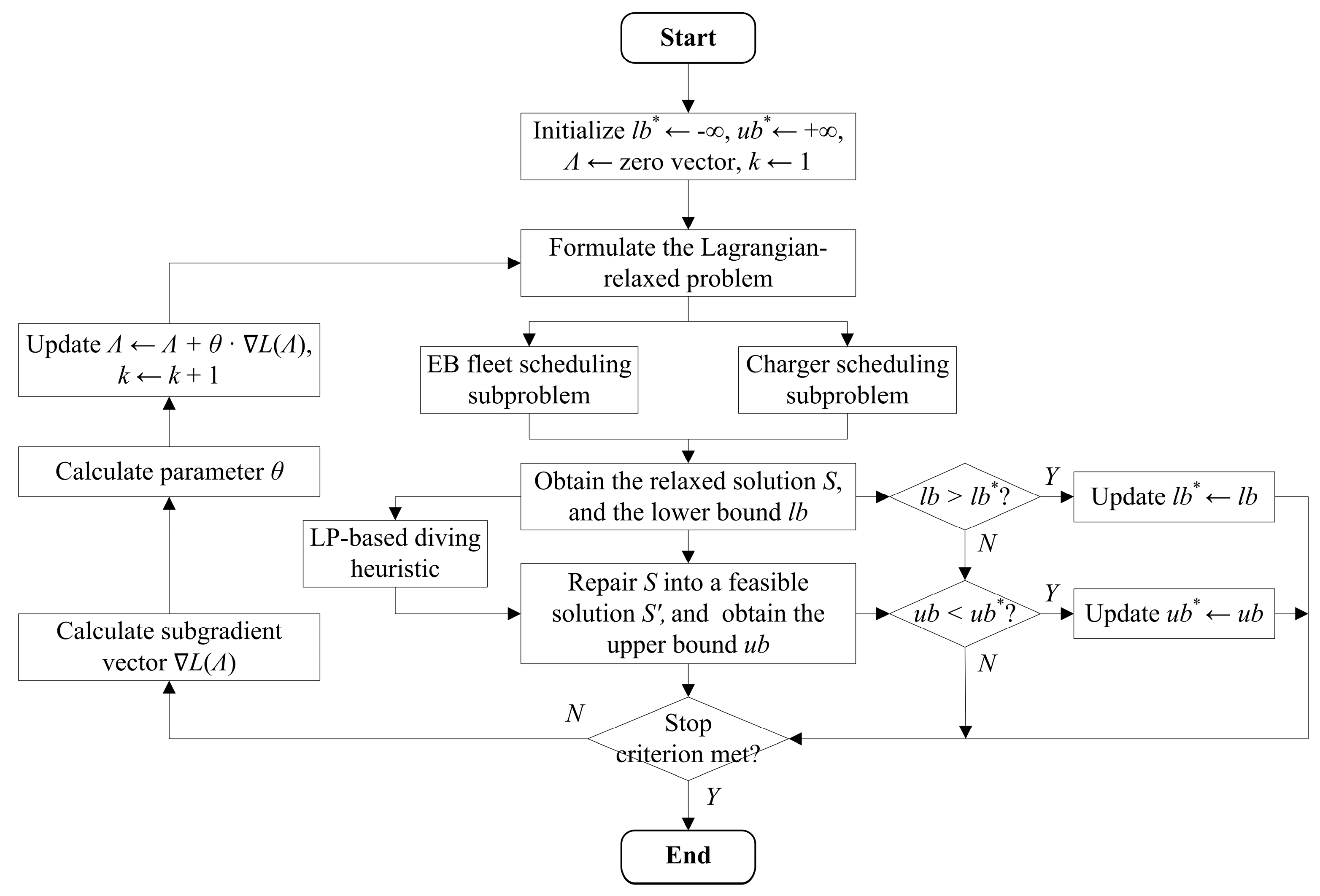
The multiplier vector is updated iteratively using a subgradient-based coordination mechanism, which reflects the feedback between the fleet subsystem and the charging subsystem. At initialization, all multipliers are set to zero. At each iteration, the relaxed solution is evaluated against the relaxed coupling constraints to compute the subgradient and is defined as the mismatch between charger demand and charger capacity. The multipliers are then updated as: , where the step size is adaptively calculated based on the current duality gap.
The overall algorithm thus operates as a hierarchical coordination process between system subsystems, progressively tightening the dual bound while guiding the relaxed solution toward system-wide feasibility. The full solution framework is illustrated in
Figure 3. The algorithm terminates when either: (i) the relative optimality gap between the best upper bound
and lower bound
falls below a predefined threshold
, or (ii) the number of iterations reaches the preset maximum
.
4.2. Formulation of the Subproblems
Within the proposed Lagrangian relaxation framework, a set of multipliers is introduced to capture the interactions between the fleet scheduling subsystem and the charging-infrastructure subsystem. Specifically, constraints (24)–(27), which govern the assignment consistency of charging events, are associated with multipliers , while constraints (28)–(31), which impose the temporal feasibility of charger operations, are assigned multipliers . By dualizing these coupling constraints and embedding them into the objective function, the original integrated system model is transformed into a relaxed system model. Under this relaxation, the decision variables corresponding to bus operations and energy management are separated from those corresponding to charger allocation and infrastructure utilization, enabling the joint problem to be decomposed into two subsystem-level optimization problems.
The first subproblem corresponds to the EB fleet scheduling subsystem, which determines trip sequencing and SOC evolution while accounting for the shadow prices imposed by charger constraints. The relaxed fleet scheduling problem is formulated as:
subject to constraints (2)–(21). Compared with the original joint system model, this fleet scheduling subproblem is significantly smaller in scale, allowing it to be efficiently solved using a commercial solver.
The second subproblem corresponds to the charging-infrastructure scheduling subsystem, which is formulated as:
subject to constraints (22), (23) and (32). This subproblem has a simple 0–1 structure and represents the allocation of charging events to chargers under the relaxed system constraints. Because no additional coupling remains, the charger scheduling decisions can be obtained analytically by examining the signs and magnitudes of the adjusted objective coefficients. This enables an efficient evaluation of the charging subsystem.
After solving the fleet scheduling subproblem and the charging-infrastructure scheduling subproblem, their solutions are integrated to produce the optimal solution of the Lagrangian relaxed system. The corresponding relaxed objective value is calculated as:
which provides a lower bound on the total system cost of the original joint scheduling problem.
4.3. LP-Based Diving Heuristic
The solution of the Lagrangian relaxed problem provides a coordinated plan for the EB fleet scheduling subsystem, including trip assignments and the corresponding charging activities embedded within each bus schedule. However, because the charger allocation constraints are relaxed in the dual problem, this solution does not necessarily yield an executable plan for the charging-infrastructure subsystem. As a result, the relaxed solution may violate charger capacity or sequencing feasibility. To restore system-wide feasibility, we design an LP-based diving heuristic that acts as a feasibility-recovery mechanism at the infrastructure level. This heuristic translates the charging demands implied by the fleet schedules into a feasible charger scheduling plan, thereby repairing the relaxed solution and producing an upper bound for the original joint system.
Given the relaxed solution
, all charging activities embedded in the EB schedules are first identified and collected into a set
. Each element
represents a charging event characterized by its start and end times in the fleet schedule. For each charging event
, the charging duration is defined as:
, which is treated as a fixed input for the repair procedure. Furthermore, from the fleet schedules, the earliest feasible start time
and the latest feasible completion time
are derived. The actual start time
is then considered a decision variable in the charger scheduling repair problem. For any pair of charging events
, if the temporal condition
holds, the two events can be consecutively processed by the same charger. In this case, a binary sequencing variable
is introduced. In addition, two dummy nodes, 0 and
, are introduced to represent the source and sink of each charger schedule. Based on these definitions, the charger scheduling repair problem is formulated as:
subject to:
The objective in (36) minimizes the number of chargers required to process all charging events, while constraints (37)–(42) enforce flow conservation and temporal feasibility for charger operations. Their interpretations are fully consistent with the charger scheduling constraints in the original integrated system model.
To ensure this repair problem to be computationally efficient, the heuristic first relaxes all binary variables to continuous variables within transforming the MILP into a LP. Based on the resulting fractional solution, the sequencing variable with the largest value is selected and fixed to one. This fixing decision is added as a constraint, and the corresponding variable is removed from the set of decision variables. The reduced LP is then re-solved. This iterative “diving” process continues until all sequencing variables become integer-valued, yielding a feasible charger schedule that is consistent with the fleet-level charging demands.
5. Computational Experiments
In this section, we first design a series of benchmark experiments to evaluate the effectiveness of the proposed integrated electric bus–charging system optimization framework. The performance of the Lagrangian relaxation-based solution approach is assessed by comparing it with directly solving the system-level MILP model using Gurobi. Sensitivity analyses are conducted to examine the impacts of key system parameters, followed by a real-world case study to demonstrate the applicability of the framework and its ability to generate coordinated schedules for both electric buses and charging infrastructure.
The algorithm is implemented in Java (JDK 1.8) and executed on a Windows 10 laptop with an Intel Core i7-8550 CPU and 32 GB of RAM. All optimization models are solved using Gurobi 11.0.1.
5.1. Benchmark Instances
This subsection introduces the benchmark instances used to evaluate the computational performance and solution quality of the proposed approach. We first describe the experimental setup, followed by the computational results and sensitivity analyses.
5.1.1. Experimental Setup
Benchmark instances are generated on a Euclidean plane representing the physical layout of the transit system, with five bus terminals and one centrally located charging station. All trips are scheduled within a daily operating horizon from 6:00 a.m. to 8:00 p.m. For each trip, the start time and duration are randomly generated, and its origin and destination terminals are selected from five terminals. Deadhead travel time is proportional to Euclidean distance, and the corresponding trip and deadhead energy consumption are calculated using a predefined conversion coefficient. This setup captures the coupled vehicle–energy dynamics of the system.
The benchmark instances are intentionally designed to represent transit systems with different operational scales and spatial characteristics. By varying the number of trips, trip-duration distributions, and deadhead travel distances, the benchmark scenarios emulate systems ranging from small, compact urban networks to larger and more spatially dispersed transit operations. This design allows us to evaluate the scalability and robustness of the proposed system-level joint scheduling framework under diverse urban operating contexts.
The one-time ownership cost of an EB is set to RMB and is converted into an amortized daily ownership cost of 603 RMB, assuming an expected service life of 10 years and an annual discount rate of 5%. Similarly, the one-time ownership cost of a charger is set to RMB and corresponds to 35 RMB per day. The deadhead travel-cost-per-unit time is set to 3 RMB. The allowable battery SOC range is set to and with a charging duration min and a setup time min. The planning horizon is min. For the Lagrangian relaxation algorithm, the stopping gap is , and the maximum number of iterations is . Each relaxed fleet subproblem is solved by Gurobi until either the relative gap reaches 1% or the computation time exceeds 60 s.
5.1.2. Computational Results
To reflect variability in operational demand and network structure, we consider two trip-duration settings (short trip and long trip) and two spatial scales of the transit system (short and long deadhead travel). Trip durations are generated from truncated normal distributions
and
, while the network dimensions are set to 25 × 25 min and 50 × 50 min, respectively. The combination of these factors results in four benchmark scenarios. For each scenario, ten instances are generated with the number of trips ranging from 15 to 70. Each instance is solved using both Gurobi and the proposed Lagrangian relaxation-based approach. The results are summarized in
Table 2,
Table 3,
Table 4 and
Table 5.
Across all scenarios, the results demonstrate the contrasting scalability characteristics of the two solution approaches. For small system instances (up to approximately 30–35 trips), Gurobi is able to solve the integrated scheduling model to optimality within the specified time limits. Among the tested instances, 17 are solved to proven optimality, all with a zero-optimality gap (Gap1). However, as the system size increases, the computational burden rises rapidly due to the strong coupling between the fleet and charging subsystems. Consequently, the optimality gaps reported by Gurobi increase significantly, reaching values between 0.46% and 9.81% for larger instances.
For the same 17 optimally solved instances, the proposed approach recovers identical objective values in most cases while typically requiring less computational time. For larger instances where Gurobi cannot reach optimality within the time limit, the proposed method continues to produce high-quality system schedules, with the internal convergence gap (Gap2) consistently below 1%. This indicates that the algorithm terminates upon reaching the predefined acceptable system-level optimality threshold. Furthermore, the objective comparison (Gap3) shows that 11 instances yield better solutions than those obtained by Gurobi within the same time constraints, while the remaining gaps remain below 1%. These findings highlight the robustness and effectiveness of the proposed decomposition framework for large-scale system scheduling.
A cross-scenario comparison further reveals that the performance of Gurobi deteriorates markedly as both trip durations and deadhead travel distances increase, especially under the long trip scenarios. For example, in the short trip and short deadhead scenario (
Table 2), Gurobi solves instances with up to 45 trips optimally. In contrast, under the long trip and long deadhead scenario (
Table 5), only instances with at most 25 trips are solved optimally. This degradation reflects the rapidly growing combinatorial complexity of the coupled system model. By comparison, the proposed Lagrangian relaxation-based approach maintains stable solution quality and moderate computational time increases across all scenarios. These results demonstrate that the proposed framework effectively captures the interaction between subsystems while preserving computational tractability, making it more suitable for large-scale system planning and operation.
5.1.3. Sensitivity Analysis
From a system-intervention perspective, the sensitivity analyses can be interpreted as examining different operational strategies that shift the balance between fleet-related measures (e.g., battery capability) and infrastructure-related measures (e.g., charger capacity and utilization). This enables us to identify the conditions under which different intervention levels become dominant in joint system optimization. To this end, we first analyze the impact of the effective driving range of electric buses. In the benchmark experiments, the baseline driving range of a fully charged battery is set to 250 min, and the SOC consumption of both trips and deadhead travel is scaled proportionally. In this analysis, the driving range varies from 125 to 375 min, and the corresponding energy-consumption coefficients are adjusted accordingly.
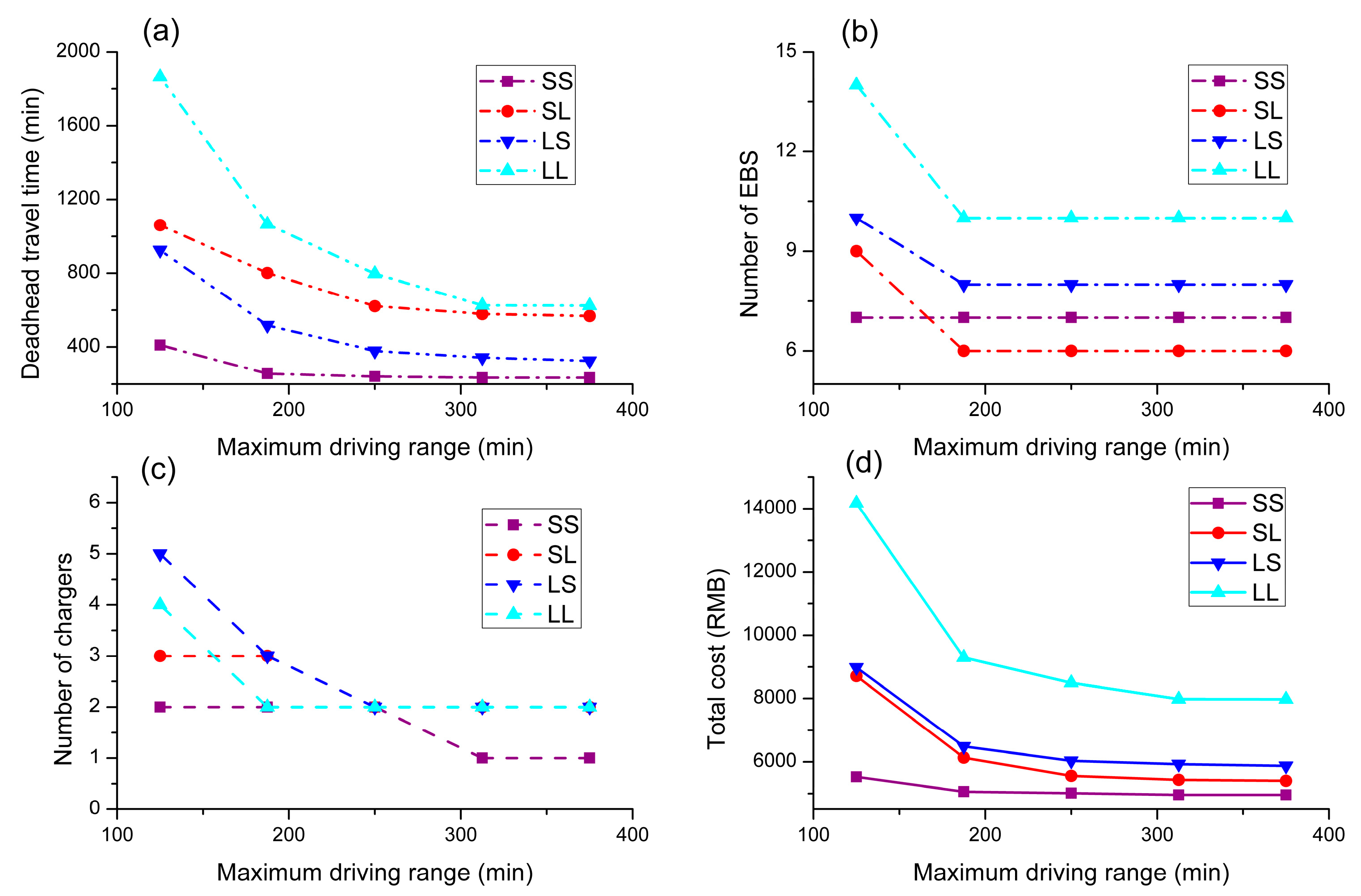
Four representative operating environments are tested by combining short and long trip durations with short and long deadhead travel times, each consisting of 40 trips. All instances are solved using the proposed Lagrangian relaxation-based framework. The aggregated results are reported in
Table 6, and the overall system performance trends are illustrated in
Figure 4.
As shown in
Figure 4, increasing the EB driving range consistently reduces the total deadhead travel time, fleet size, charger requirements, and overall system cost across all scenarios. A larger driving range decreases the frequency of charging detours, thereby improving the interaction efficiency between the fleet and charging subsystems. When the driving range increases from 125 to 375 min, the total deadhead travel time decreases by 43–66%. Under more demanding conditions (LL setting), the required number of buses and chargers also decreases noticeably, leading to total cost reductions between 10% and 44%. These results indicate that, under energy-constrained operating environments, improving vehicle-side capabilities (i.e., increasing driving range) is a highly effective intervention, as it simultaneously reduces charging demand, charger deployment levels, and fleet size.
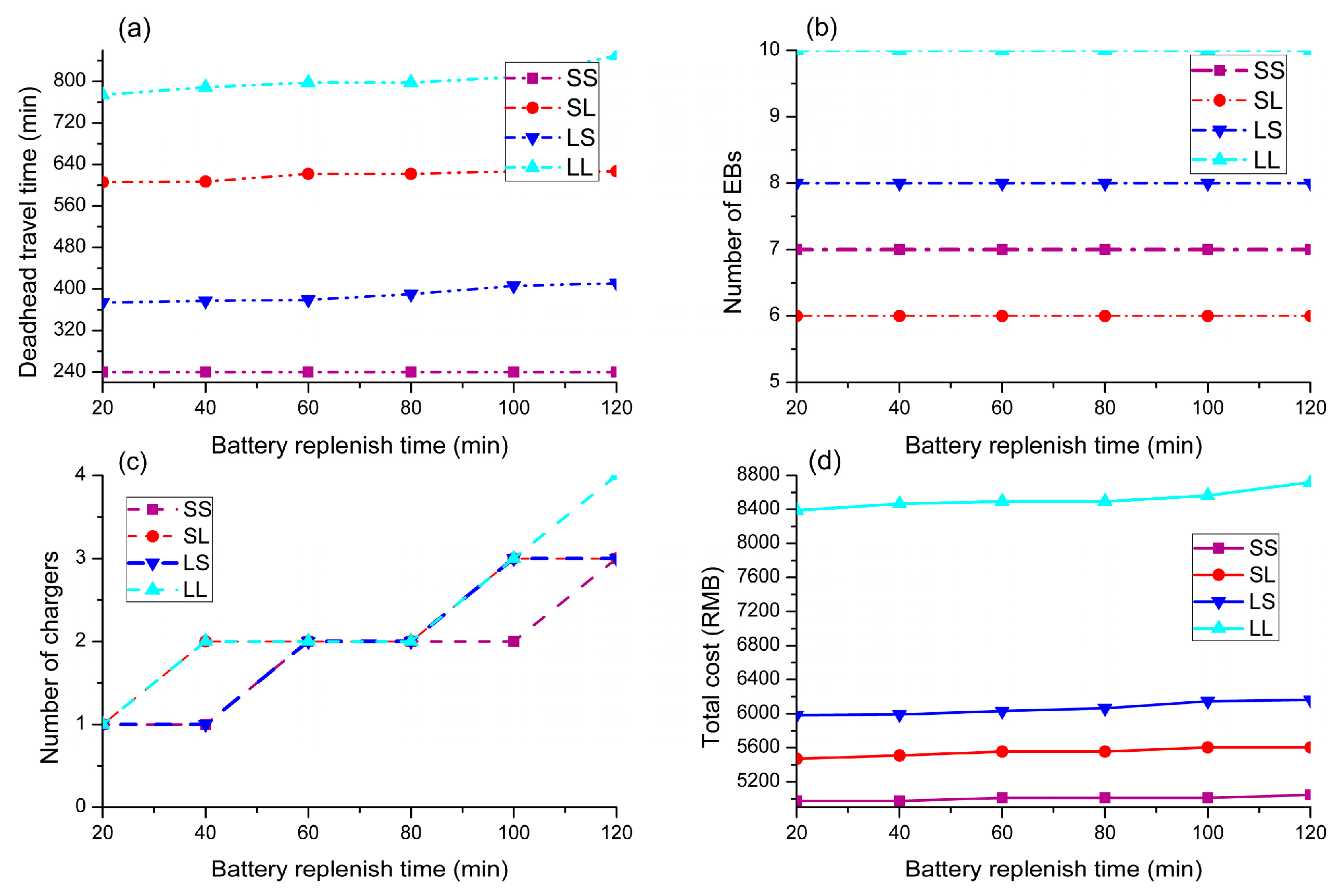
Next, we analyze the effect of the battery replenishment time, which reflects the performance of the charging-infrastructure subsystem. The charging duration varies from 20 to 120 min. The results are summarized in
Table 7 and illustrated in
Figure 5.
As the charging duration increases, the total deadhead travel time rises in most scenarios (by approximately 3–10%), and the number of chargers increases by two to three units, particularly under large-scale network conditions. In contrast, the required number of electric buses remains unchanged. Consequently, the total system cost increases only marginally (about 1–4%). Therefore, when charging technology becomes slower, the system effectively mitigates the adverse impacts through increased charger deployment rather than additional fleet resources. This suggests that under infrastructure-constrained or technology-limited conditions, infrastructure-oriented interventions, such as deploying additional chargers, become the dominant strategy to maintain system feasibility and performance.
5.2. Real-World Case Study
To demonstrate the practical relevance and system-level applicability of the proposed framework, we conduct a real-world case study based on the
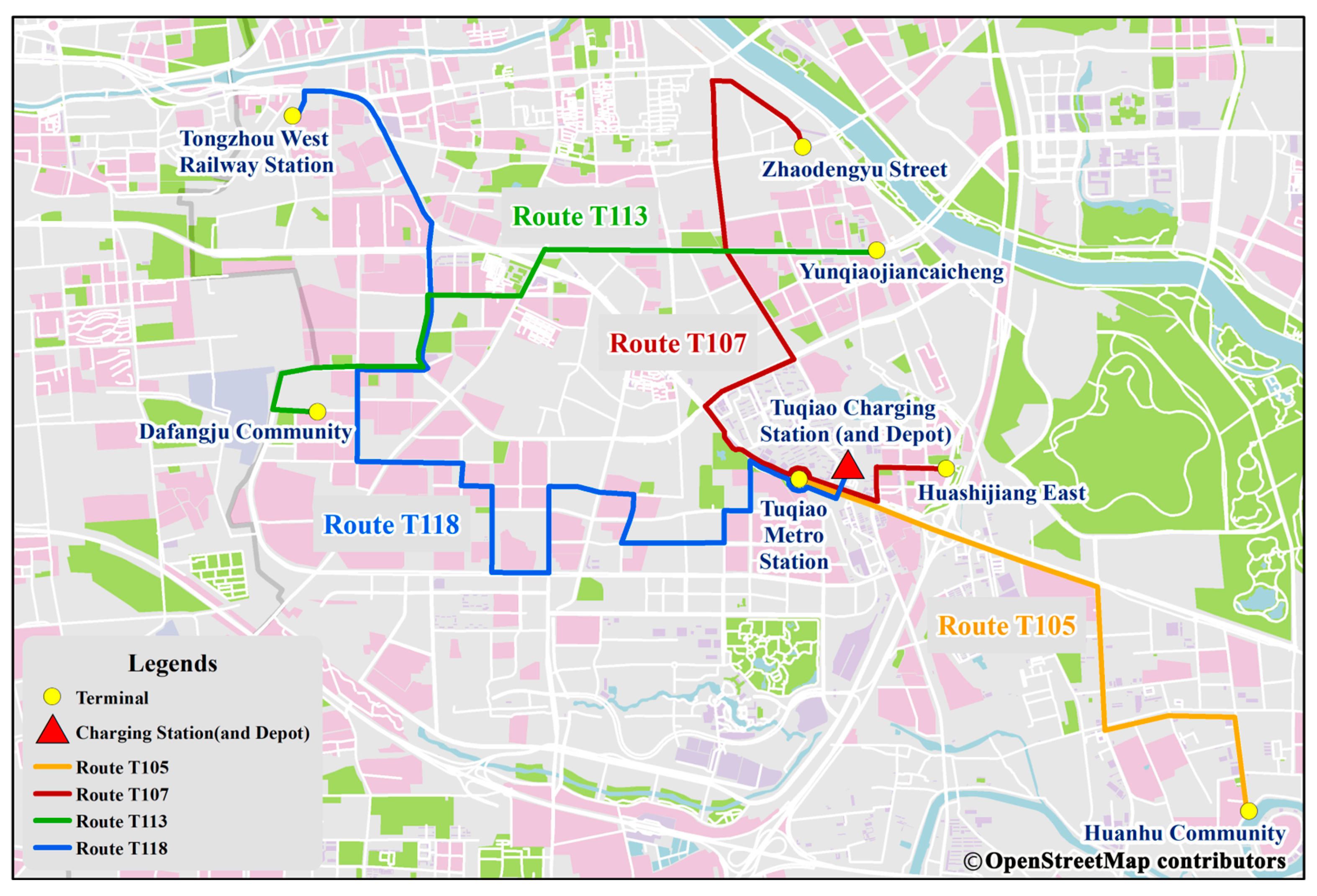
Tuqiao EB charging station in Beijing. The system under consideration includes four bus routes, namely T105, T107, T113, and T118, which primarily provide feeder services connecting residential areas with nearby metro stations. The physical layout of the routes and the charging station is shown in
Figure 6, and the main operational characteristics are summarized in
Table 8.
From the official timetables, all trips operating between 6:00 a.m. and 8:00 p.m. are extracted, generating a set of 139 trips. Each trip represents a complete round-trip service on a given route. In the actual operating system, buses are permitted to detour to the charging station only after arriving at one of four designated terminals: Tuqiao Metro Station, Yunqiaojiancaicheng, Huashijiang East, and Tuqiao Depot. The corresponding deadhead distances between these terminals and the charging station are listed in
Table 9.
The four routes are operated by a homogeneous fleet of 12 m electric buses, each with an approximate driving range of 80 km. The time required to recharge the battery from its minimum to maximum SOC is about 30 min, and the average cruising speed is set to 400 m/min. All remaining parameters follow the benchmark settings.
Table 10 compares the current real-world operating configuration with the optimized schedules generated by the proposed Lagrangian relaxation-based system framework. The results reveal significant improvements in overall system coordination. The required fleet size is reduced from 22 to 13 buses, and the number of chargers decreases from five to two, leading to substantial reductions in both vehicle investment and infrastructure costs.
Although the total deadhead travel time increases slightly, this change is not caused by charging operations. In fact, the number of charging events decreases from 79 to 53, indicating improved charging efficiency. The additional deadhead travel mainly arises from cross-route vehicle dispatching, which enhances vehicle utilization across the system and is a key contributor to the reduced fleet size. Overall, the total system cost is reduced from 13,969 to 8608, corresponding to a 38.3% cost reduction, thereby validating the effectiveness of the proposed joint scheduling framework in real-world electric bus transit systems.
The detailed optimized bus schedules are provided in
Table 11, where “C” denotes a charging event. The corresponding charging schedules for each charger are shown in
Table 12, with the start and end times of each charging event specified. Together, these results illustrate how the fleet subsystem and the charging-infrastructure subsystem are jointly coordinated within the proposed system framework, further confirming its applicability to practical operations.
6. Conclusions
This study addresses the joint operational design of an integrated EB transit system composed of the fleet subsystem and the charging-infrastructure subsystem. A system-level MILP model is developed to minimize total investment and operating cost while explicitly capturing vehicle circulation, battery energy evolution, charging event timing, and charger resource allocation. To enhance computational tractability for large-scale systems, we propose a Lagrangian relaxation-based decomposition framework that separates fleet scheduling from charger scheduling, together with an LP-based diving heuristic that restores feasibility and ensures coordinated system operation.
The effectiveness of the proposed modeling and solution framework is verified through both benchmark experiments and a real-world case study. The main findings are summarized as follows.
- (1)
System-level computational performance. The proposed decomposition framework demonstrates superior scalability and robustness compared with direct MILP solving. While Gurobi can solve only 17 instances with up to 30–35 trips optimally, its performance deteriorates rapidly as the coupling between fleet and charging decisions intensifies. In contrast, the proposed approach consistently provides high-quality system schedules with stable computation times and in 11 instances achieves better solutions than Gurobi within the same time limits.
- (2)
Impact of battery and charging parameters on system coordination. Sensitivity analyses show that extending the EB driving range significantly improves system efficiency by reducing charging frequency and cross-terminal detours: increasing the driving range from 125 to 375 min leads to reductions of 43–66% in deadhead travel time and up to 44% in total system cost. This indicates that, under energy-constrained operating conditions, vehicle-side improvements are a highly effective intervention, as they simultaneously alleviate charging demand and reduce charger requirements. In contrast, increasing the required charging time mainly affects the charging subsystem, resulting in higher charger demand while leaving fleet size unchanged. The overall cost increase remains moderate (by 1–4%), suggesting that when charging technology or charging capacity becomes bottlenecked, infrastructure-oriented interventions play a dominant role in maintaining system feasibility and performance.
- (3)
Practical system-level benefits. In the Beijing Tuqiao case study, the optimized schedules reduce the required fleet size from 22 to 13 buses and the number of chargers from five to two, resulting in a 38.3% decrease in total system cost. Although deadhead travel time increases slightly, the number of charging events decreases substantially, implying that improved cross-route vehicle coordination enhances overall resource utilization across the system.
Future research can extend the proposed framework in several directions. First, empirical validation using data from multiple cities or regions would help assess the transferability of the framework across different urban and operational contexts. Second, the modeling framework can be expanded to incorporate alternative charging paradigms, such as en-route charging or wireless charging, thereby capturing a broader range of electric bus charging strategies. Third, integrating electricity pricing mechanisms, regulatory constraints, and power-grid capacity limitations would further strengthen the coupling between transit operations and energy systems, enabling more comprehensive system-level planning and decision making.