1. Introduction
The preservation of cultural heritage carries strategic global significance not only for safeguarding the physical traces of the past, but also for ensuring the continuity of identity, belonging, and collective memory. While UNESCO’s 1972 World Heritage Convention seeks to protect cultural and natural heritage sites of “Outstanding Universal Value,” it simultaneously establishes effective management as a compulsory requirement [
1]. However, governance in serial World Heritage properties, particularly transboundary ones, is a complex process shaped by different national legal systems, institutional capacities and cultural priorities [
2]. This complexity requires approaching heritage conservation not simply as a technical practice, but as a multilayered, multi-actor field of governance.
Transboundary serial heritage properties stand out as spatial embodiments of both shared historical ties and international cooperation, positioning them as key instruments of “cultural diplomacy” [
3,
4]. Conservation action in such contexts carries the potential to strengthen political and cultural relations among states. Thus, these heritage sites represent the social process that enables peacebuilding, shared memory, and collective identity formation in addition to the preservation of physical assets [
5]. However, this collaboration often requires carefully balancing issues of sovereignty and shared responsibility [
6].
The governance literature offers valuable conceptual tools for understanding this complex landscape. Ostrom’s [
7] common-pool resource management framework conceptualizes heritage as a “shared resource,” emphasizing the critical roles of stakeholder trust, mutual monitoring, and participation. Kooiman’s [
8] interactive governance model highlights state-market-society interplay as the foundation of governance. More recently, the adaptive governance approach has defined governance as a non-linear process grounded in learning and continual adjustment [
9]. Considered together, these theoretical perspectives underscore that the management of transboundary serial heritage requires the coordinated operation of network-based relationships across multiple scales.
Consequently, transboundary serial heritage sites serve as both challenging and dynamic environments for testing governance models. Their management depends on complex, multi-stakeholder processes that bring together national and local authorities, scientific committees, community representatives, and international organizations. This structure requires the establishment of conservation objectives as well as institutionalized negotiation and shared decision-making cultures. Along with these, governance challenges at transboundary heritage sites extend beyond technical conservation concerns to include issues of coordination, trust, participation, and cultural diplomacy. Therefore, understanding how governance functions in these multi-level and multi-actor environments has become a central question for both World Heritage research and international heritage policy.
This study performs a comparative analysis of the governance models of transboundary serial World Heritage, aiming to identify common patterns among institutional structures, cooperation mechanisms and decision-making processes. The research examines the management plans and periodic reports of fifteen transboundary World Heritage properties. Based on the findings, governance models were classified under four main types and the collaboration systems of the sites were evaluated using a six-stage maturity model. Ultimately, this paper contributes to literature by repositioning the governance of transboundary serial heritage as a descriptive exercise of current practice and as a domain of cultural heritage management that functions as collective diplomacy, trust-building, and social learning beyond national boundaries.
This article consists of ten main chapters. Chapter one outlines the conceptual and institutional framework of the governance paradigm within the UNESCO World Heritage system; it discusses the structural dynamics and the dimension of cultural diplomacy that complicate governance in transboundary heritage sites, based on the literature. Chapter two describes the methodological design of the research; it identifies the fifteen transboundary World Heritage sites included in the analysis, the types of documents used, and the comparative-thematic analysis approach. Chapter three presents the empirical essence of the study, starting with the thematic and geographical classification of the 28 transboundary cultural heritage sites on the UNESCO World Heritage List. It then proceeds to a detailed examination of the governance mechanisms of 15 specific sites for which governance plans are accessible, detailing their institutional frameworks, stakeholder roles, and operational coordination strategies. Chapter four evaluates the common themes that stand out in transboundary heritage governance within an analytical framework; it holistically addresses the dimensions of institutional multi-leveling, coordination mechanisms, monitoring and standardization processes, community participation, and cultural diplomacy. Chapter five classifies governance structures under a typological synthesis based on these common themes and identifies four dominant governance models. Chapter six relates these models to their levels of institutional maturity, presenting the developmental patterns of collaborative structures within a comparative framework. Chapter seven discusses the findings in relation to the existing governance and heritage literature and evaluates the theoretical contributions of the study. Chapter eight discusses the limitations of the study and outlines future research directions. Chapter nine summarizes the main findings of the research and presents the main implications for the governance of transboundary World Heritage sites. The final chapter offers a guiding perspective on the future of transboundary heritage governance by developing policy and practice recommendations.
1.1. UNESCO’s Governance Paradigm
The 1972 UNESCO World Heritage Convention initially provided the most comprehensive international framework focused on Outstanding Universal Value and the physical conservation of heritage. Over time, however, this approach moved towards integrating contemporary concepts such as sustainability, community participation, and multi-actor governance. Feilden and Jokilehto [
10] describe this evolution as a shift from a conservation paradigm to a management paradigm.
The UNESCO Operational Guidelines [
1] have made the presence of an appropriate management system a fundamental criterion for every World Heritage property. While UNESCO does not prescribe a binding model for this system, it defines a flexible framework that can be adapted to local conditions. Lixinski [
6] refers to this as a normative gap: although the framework is articulated as a principle at the international level, its interpretation at the national level remains open-ended. Consequently, the UNESCO framework functions less as a technical standard and more as a platform for negotiation among stakeholders. In practice, the World Heritage system reflects two core understandings of governance: first, the implementation-focused, control-oriented hierarchical governance networks described by Jessop [
11]; and second, the broader understanding of governance as “the management of the common affairs of political communities,” articulated by Healey [
12].
Since the 2000s, management approaches have evolved toward a holistic framework. Post-2010 updates emphasize the principles of integration, participation, and continuity [
5]. To implement these principles, management systems need to shift from traditional and linear models to organizational frameworks that can effectively manage complexity at multiple scales. Albert and Ringbeck [
13] highlight the need for adaptive and multi-level governance approaches to ensure effective management. This approach redefines the role of stakeholders, enabling a shift from passive consultation to active co-management. Ostrom’s [
7] common-pool resource management framework conceptualizes heritage properties as shared resources, emphasizing collective action capacity rather than centralized authority. Trust, mutual monitoring, and shared responsibility become essential components of enduring governance. Kooiman [
8], through the development of the interactive governance model, further defines governance as a dynamic interaction between the state, market, and civil society.
The adaptive governance approach that is adapted from broader governance literature and increasingly applied to cultural heritage conceptualizes heritage systems as social–ecological systems capable of responding to changing political, ecological, and social contexts in a flexible manner [
9]. This approach prioritizes the institutionalization of feedback mechanisms, risk management strategies, and learning-based monitoring systems.
1.2. Governance Challenges in Transboundary Heritage Sites
Transboundary World Heritage properties are sites that share common historical, cultural or natural values but are managed under different national legal frameworks and administrative cultures [
2]. Although transboundary sites are not a new trend within the World Heritage List, interest in such properties has grown since the first examples were inscribed [
14]. As spaces where national legal systems, cultural identities, and administrative traditions intersect, these sites reveal both the potential and the limitations of UNESCO’s governance approach. Brumann and Berliner [
2] describe them as transnational arenas of negotiation, arguing that World Heritage functions not only as a conservation mechanism but also as a tool for diplomatic interaction and identity construction.
The management system for serial nominations was incorporated into the Operational Guidelines in [
15] and later codified as Paragraph 114 in the 2005 Guidelines [
16]. According to Paragraph 114, a management system or mechanism ensuring coordinated management among the separate components of a serial property is required and must be documented at the time of nomination. This provision remained unchanged until 2019. In the most recent version of the Guidelines [
17], an additional emphasis was introduced highlighting whether serial properties are “national or international.” In this regard, the 2005 Operational Guidelines [
16], which made Management Plans mandatory, also detail how a “management system” should be structured for serial heritage.
Governance in transboundary World Heritage sites is increasingly understood as a network-based and interaction-oriented process rather than a centralized administrative structure. Rhodes [
18] emphasizes that governance operates through distributed authority among multiple actors, a situation specific to transboundary heritage contexts. The effectiveness of these network-based structures depends on moving beyond formal hierarchy towards a more relational and collaborative form of interaction. In this context, Kooiman’s [
8] interactive governance approach emphasizes coordination, negotiation, and shared responsibility among stakeholders, while adaptive governance highlights the importance of learning, flexibility, and feedback in managing complex and evolving systems [
19]. This perspective offers a concise theoretical framework for interpreting the dynamics of collaboration in transboundary heritage management.
Transboundary serial heritage properties encourage neighborly relations among states, requiring the series to be evaluated as a whole in terms of shared management responsibilities [
20]. Joint management becomes possible when stakeholders collaborate for the protection and sustainable use of the cultural assets. Svels and Sande [
21] identify six levels of joint management: no cooperation, dialogue and communication, negotiation and consultation, planning and coordination, cooperation and full coordination. These stages illustrate the range of interaction forms and participation levels among stakeholders, revealing the diversity of joint management models.
Transboundary World Heritage properties encompass both institutional and diplomatic complexities within their management processes. Because these sites are part of more than one state, discrepancies in national legislation, administrative cultures, and budgetary policies can result in coordination weaknesses [
2]. For this reason, governance requires an international integration capacity where shared objectives go beyond nationally focused conservation paradigms.
Meskell [
4] observes that transboundary heritage sites are frequently subject to political sensitivities, with historical narratives and identity politics influencing management processes. In some cases, when states prioritize national interests overusing heritage as a tool for cultural diplomacy, cooperation mechanisms may weaken due to issues of trust [
3]. Thus, cooperation is not merely technical coordination but also a diplomatic process of negotiation.
Differences in institutional capacity between countries further generate governance inconsistencies. Sites in Europe generally benefit from robust budgets, professional secretariats, and long-term planning structures, whereas examples in Africa and Asia often face more constrained capacities [
2]. These disparities directly have an impact on reporting regularity, the institutionalization of monitoring indicators and the effectiveness of community participation processes.
The serial nature of these sites which require the management of multiple components creates an increased need for coordination in data management, communication, and decision-making processes. This structure makes the standardization of monitoring and evaluation systems critical. However, because monitoring indicators often differ across national scales, transboundary comparability remains limited.
The success of governance in transboundary serial heritage properties depends on simultaneously strengthening political cooperation, institutional capacity, and technical compatibility. What is needed is a management model that both institutionalizes collaboration and supports adaptive learning.
1.3. Cultural Diplomacy Context
UNESCO’s institutional framework positions World Heritage properties not only as spaces for safeguarding cultural and natural values, but also as instruments of international peace and cultural dialogue. In the post-2010 Operational Guidelines, the principles of cooperation, integration, community participation, and sustainability have steadily acquired a central role. Today, the success of heritage conservation is measured not merely by the existence of a management plan, but also by elements such as the level of coordination among stakeholders, data-sharing practices, and the transparency of decision-making processes [
5].
The cultural diplomacy literature identifies transboundary heritage sites as key components of soft power strategies [
3]. By making historical ties shared by different countries visible, these properties foster international dialogue and mutual understanding. Meskell [
4] argues that cultural heritage is also a political domain of discourse, and that conservation practices cannot be understood independently of diplomatic relations.
Cultural diplomacy is not solely an intergovernmental process; it also requires the participation of communities at the site level, as representation and legitimacy are fundamental aspects of heritage governance. In this respect, UNESCO encourages the inclusion of local actors in decision-making processes, especially in transboundary contexts, thereby extending the diplomatic function of heritage to the societal level [
1]. UNESCO’s guidance conceptualizes the protection of transboundary serial heritage sites along the axes of conservation + cooperation + diplomacy. However, operationalizing these three dimensions in practice requires institutionalized coordination mechanisms and multi-actor governance networks.
1.4. Research Gap and Positioning of the Study
While governance theories [
7,
8,
9] offer strong conceptual tools for understanding multi-actor systems, their operational implications for transboundary and serial heritage contexts have been only minimally explored. Moreover, although the cultural diplomacy dimension is conceptually addressed in the literature [
3,
4], there is a lack of analytical studies that explain how this dimension is integrated into governance models. Existing research also lacks a comparative methodology for evaluating the maturity levels of cooperation processes.
Most studies that address transboundary serial heritage management within the World Heritage framework focus predominantly on natural sites [
20,
21,
22,
23]. However, there are also works examining cultural landscapes [
24,
25]. Another significant contribution in this field is the study by Adie and Amore [
26], which discusses transboundary heritage management and multi-stakeholder governance in detail through the example of the Prehistoric Pile Dwellings.
This study, by contrast, constitutes one of the first systematic comparative analyses of the management systems of transboundary serial World Heritage properties. It offers a holistic and comparative perspective across fifteen different sites. This expansive scope enables a systematic assessment of management plans based on institutional structures and cooperation models, making both shared themes and contextual differences visible. Through these contributions, the study introduces a new conceptual dimension to the cultural heritage governance literature.
2. Materials and Methods
2.1. Case Selection
This study focuses on transboundary serial cultural heritage properties inscribed on the UNESCO World Heritage List. Between 26 October 2025 and 9 November 2025, a total of 28 transboundary World Heritage sites were identified in a search conducted using the UNESCO World Heritage List database’s own filtering system and selecting the “transboundary” and “cultural” category. Of these, 15 sites for which management plans were accessible through UNESCO’s official website were selected as the sample, enabling a detailed examination of their governance structures.
2.2. Data Collection Method
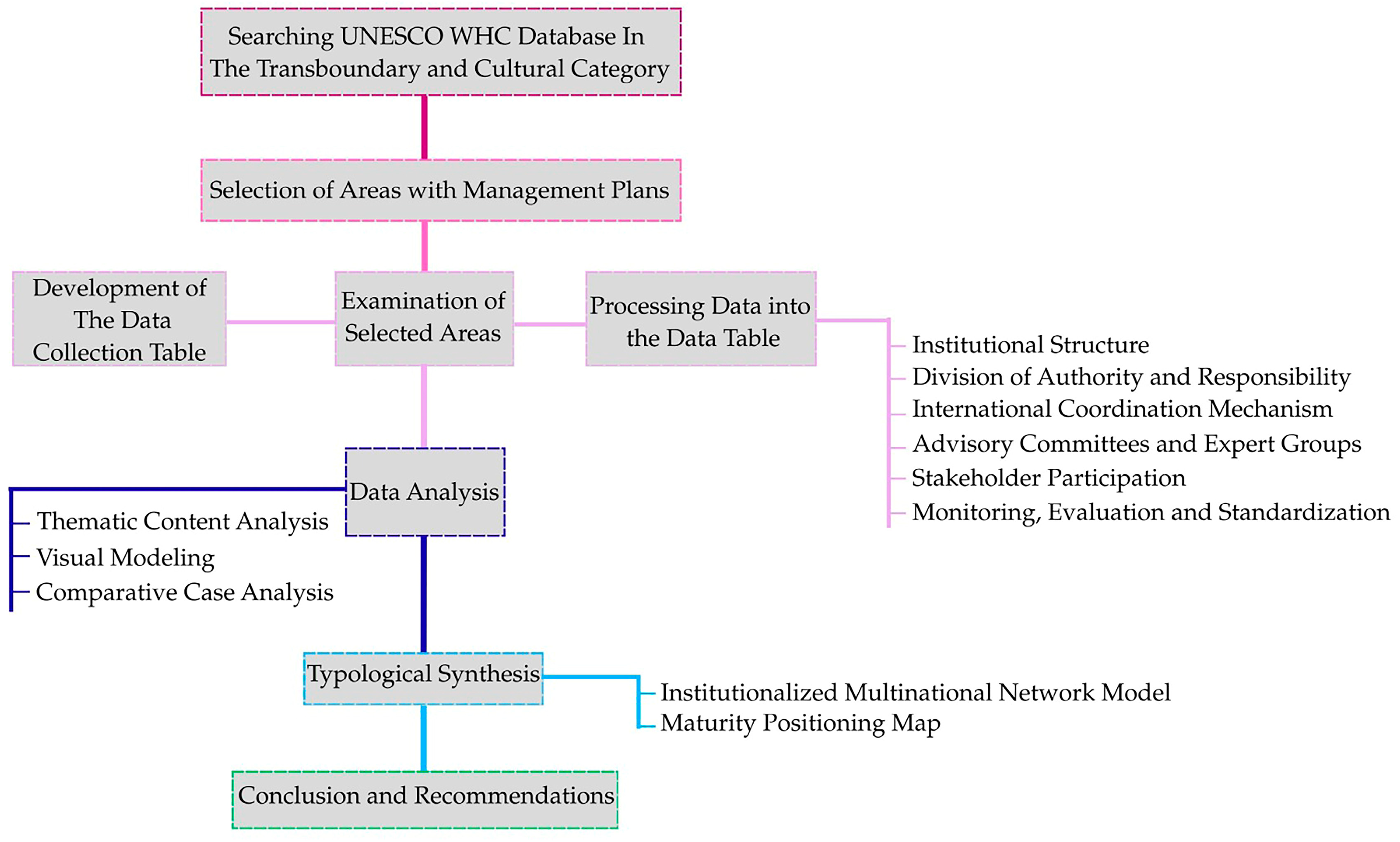
The research design is grounded in an inductive model-building logic, aiming to develop general theories derived from the governance structures of the selected sites. The methodology of the study is schematically illustrated in
Figure 1.
Primary data sources include UNESCO World Heritage Centre’s official database and the management plans of the selected properties. The analytical framework of the study is informed by the governance principles outlined in UNESCO’s Operational Guidelines and is supported by theoretical perspectives from the literature, including [
5,
6,
7,
8,
9,
10,
11,
12,
13].
To systematically analyze the governance structure of each site, evaluations were conducted under the following core categories: institutional structure, division of authority and responsibility, international coordination mechanisms, advisory and expert groups, stakeholder participation, and monitoring/evaluation processes. The fifteen sites were labeled alphabetically as “Heritage Site (HS)” from HS1 to HS15, and the extracted data were recorded in a data-collection table prepared in Excel.
2.3. Analysis Method
Since document review techniques were used in the analysis and comparison of management plans, the research has qualitative research characteristics. Data analysis is based on examining and comparing the collected information within a thematic framework.
Thematic Content Analysis: Data extracted from the management plans and organized under thematic categories in the data table were explained through descriptive analysis. This research utilized the Thematic Content Analysis method, a qualitative research approach. The ability to transform the collected data into datasets allows researchers to categorize the data [
27]. The primary reason for choosing the Thematic Content Analysis method in this research is its dynamic structure, which allows for the re-examination of themes during the analysis process. Themes do not need to remain fixed; on the contrary, they can be reshaped through continuous interaction with the data [
28]. This flexibility enabled an in-depth evaluation of the data.
The texts obtained from the management plans were grouped into four main themes and subheadings and explained using descriptive analysis. Descriptive analysis is an analytical technique that involves interpreting the obtained data in accordance with predetermined themes and examining the results within cause-and-effect relationships [
29]. These themes are:
Division of Authority and Responsibility (National/Local Government, Stakeholder Participation)
International Coordination Mechanism (Board of Directors, Cooperation Agreements, Joint Working Groups)
Advisory Committees and Expert Groups
Monitoring and Evaluation
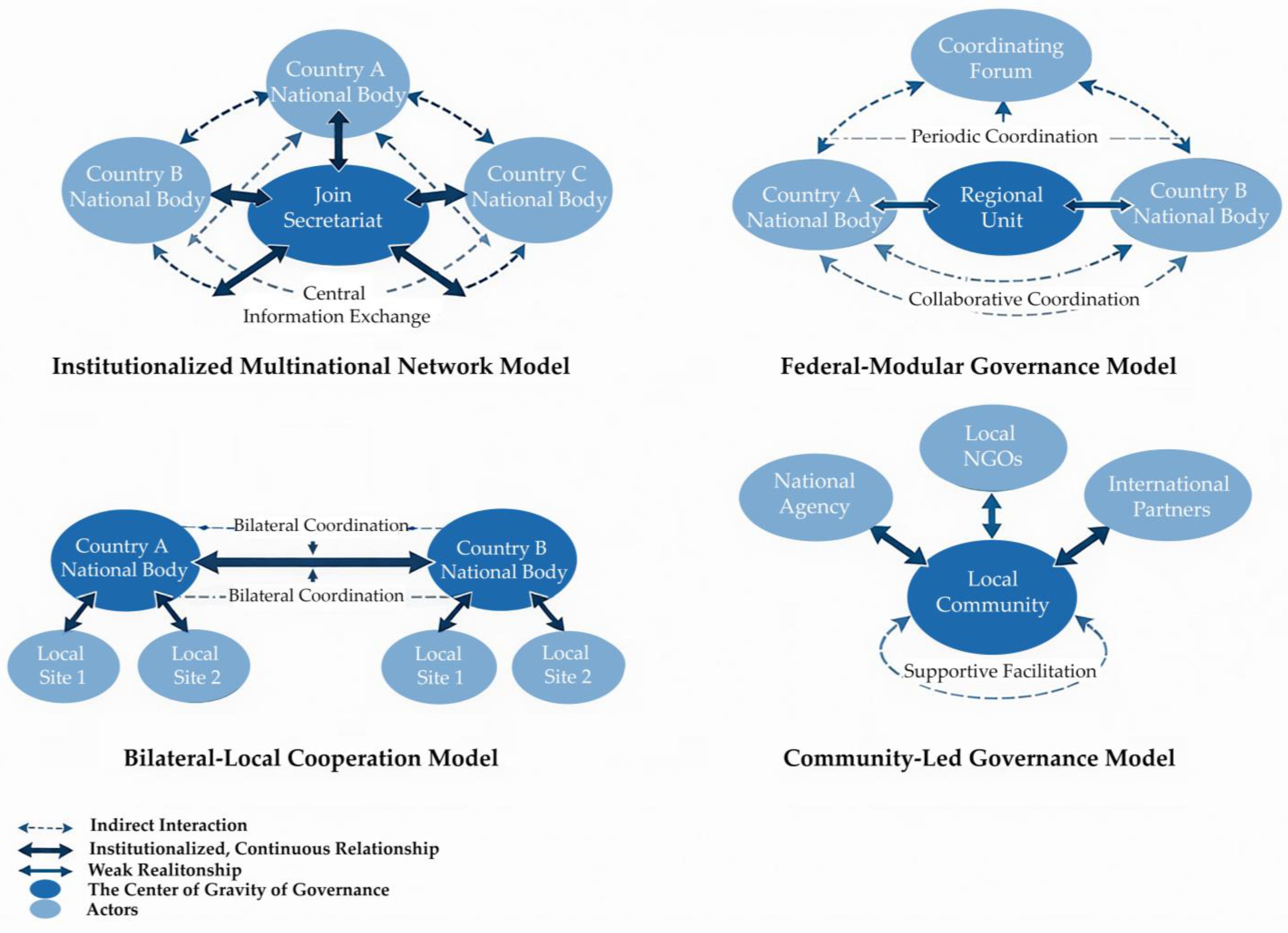
Visual Modeling: To systematically decode the multi-layered governance of transboundary sites, this research uses visual modeling as a primary analytical tool. These organizational diagrams function as conceptual maps that delineate the flow of authority and the intensity of international coordination. Each model was constructed through an inductive process, translating administrative hierarchies and operational mechanisms from official management plans into standardized visual formats. These visuals allow for a spatial reading of governance, revealing patterns such as the highly symmetrical structures of Institutionalized Multinational Networks versus the linear links of Bilateral Local Cooperation. Ultimately, these models are used as the empirical foundation for the Maturity Positioning Map, enabling a transition from qualitative document analysis to a comparative typological synthesis of institutional maturity across diverse legal contexts.
Comparative Case Analysis: The relational description and analysis in this study were conducted through comparison. According to Neumann [
30], comparison is a research perspective rather than a research technique. It focuses on the similarities and differences between the units being compared and draws generalizations from this.
A similar approach was adopted in this study, and the fifteen areas examined were evaluated cross-referenced to make visible the diversity and functioning of institutional structures. The comparison was made through the variables of institutional structure, coordination style, participation scale, and monitoring continuity.
The primary aim of this comparative approach is to identify recurring governance patterns and management maturity benchmarks that reach beyond individual national contexts. By placing diverse sites within a shared analytical framework, the study seeks to determine how different levels of institutionalization influence the continuity of coordination. Therefore, this comparison aims to move beyond descriptive site summaries to establish a typological basis for understanding how cultural diplomacy and administrative capacity intersect in the sustainable management of transboundary heritage.
2.4. Evaluation and Typological Synthesis
At this stage, data obtained through comparative case analysis were evaluated to enable a conceptual reclassification of governance systems. This analysis revealed the similarities and differences between the management plans and forms of institutional cooperation in the areas examined. The comparative analysis revealed that governance systems fall into four main types. The comparative analysis results show that governance systems cluster under four basic types: (1) Institutionalized Multinational Network, (2) Federal-Modular, (3) Bilateral-Local Cooperation and (4) Community-Led Models.
This typological framework laid the groundwork for the development of the Cooperation Maturity Level Map, which positions the areas according to their level of institutional maturity. The evaluation process revealed not only structural differences but also the interdependence, institutional flexibility, and multi-level coordination dynamics in the functioning of the systems.
3. Findings
3.1. Characteristics of Transboundary UNESCO World Heritage Sites
As introduced earlier in this study, UNESCO’s World Heritage List includes 28 transboundary heritage sites in the cultural category. These sites belong within the boundaries of 51 different countries spanning from the USA to Japan, from Albania to Peru. Among these 51 countries, Germany is the one that encompasses the most amount of transboundary cultural heritage sites with 9 entries in World Heritage List.
Although these transboundary sites are all under the “cultural” tag, they represent a vast thematic spectrum reflecting diverse historical processes and geographical contexts. Across the 28 recognized sites, five primary thematic categories emerge: frontier and military systems, routes and exchange networks, industrial and scientific milestones, human settlements and social reform, and cultural landscapes. As mentioned in
Section 2, this study focuses on a representative sample of 15 of these sites for which the management plans were readily available through the UNESCO database; however, a broader look at the remaining properties reveals the extreme diversity of the transboundary category.
In the category of military systems, while this research analyzes the Frontiers of the Roman Empire (Danube and Lower German Limes) and the Venetian Works of Defense, other entries such as the original Hadrian’s and Antonine Walls (UK/Germany) highlight different eras of imperial strategy. Similarly, the global network of trade is represented by sites like the Qhapaq Ñan in South America, one of the most complex transboundary sites on the list, spanning six countries, and the Heritage of Mercury (Almadén and Idrija) between Spain and Slovenia.
Thematic diversity is also evident in industrial and scientific sites. Beyond the Erzgebirge Mining Region and the Struve Geodetic Arc analyzed here, the list includes the Fagus Factory and the Nord-Pas de Calais Mining Basin, which illustrate the cross-border exchange of modern architectural and industrial techniques. In terms of social reform, the Colonies of Benevolence and Moravian Church Settlements are complemented by the global reach of The Architectural Work of Le Corbusier, which spans seven countries across three continents, representing the first truly global modern movement.
A striking difference within all the transboundary heritage sites is the regional and conceptual breadth. Some of the sites included in the primary analysis, such as Koutammakou (Togo/Benin) or the Stone Circles of Senegambia, focus heavily on cultural landscapes and living traditions. These sites often rely on community-led governance rather than the highly institutionalized multinational networks seen in European examples. By recognizing all of these heritage sites, it becomes clear that transboundary heritage is not just a European phenomenon of administrative cooperation, but a global diplomatic tool that adapts to various legal, cultural, and communal contexts. This research uses the 15 core sites and their management plans to illustrate these diverse management maturity levels, offering a systematic framework that can be applied to the broader UNESCO list.
3.2. Governance Models in Selected Sites for Analysis
3.2.1. HS1 Colonies of Benevolence
Located across the borders of Belgium and the Netherlands, the Colonies of Benevolence constitute a cultural landscape composed of nineteenth-century agricultural settlement schemes developed as social reform initiatives to combat poverty. The management plan aims to preserve the cultural landscape, sustain community participation, and maintain the continuity of social memory. The governance model is multi-layered, operating within the distinct legal frameworks of the two states, while joint protocols ensure coherence and continuity.
In Belgium, the Agentschap Onroerend Erfgoed and in the Netherlands, the Rijksdienst voor het Cultureel Erfgoed serve as the principal authorities responsible for conservation and restoration. Both institutions play a critical role in preserving the agricultural heritage and maintaining community engagement. Local municipalities handle visitor management, the preservation of the historical fabric, and regional development decisions. Residents, volunteer organizations, museums, and universities actively participate in conservation processes [
31].
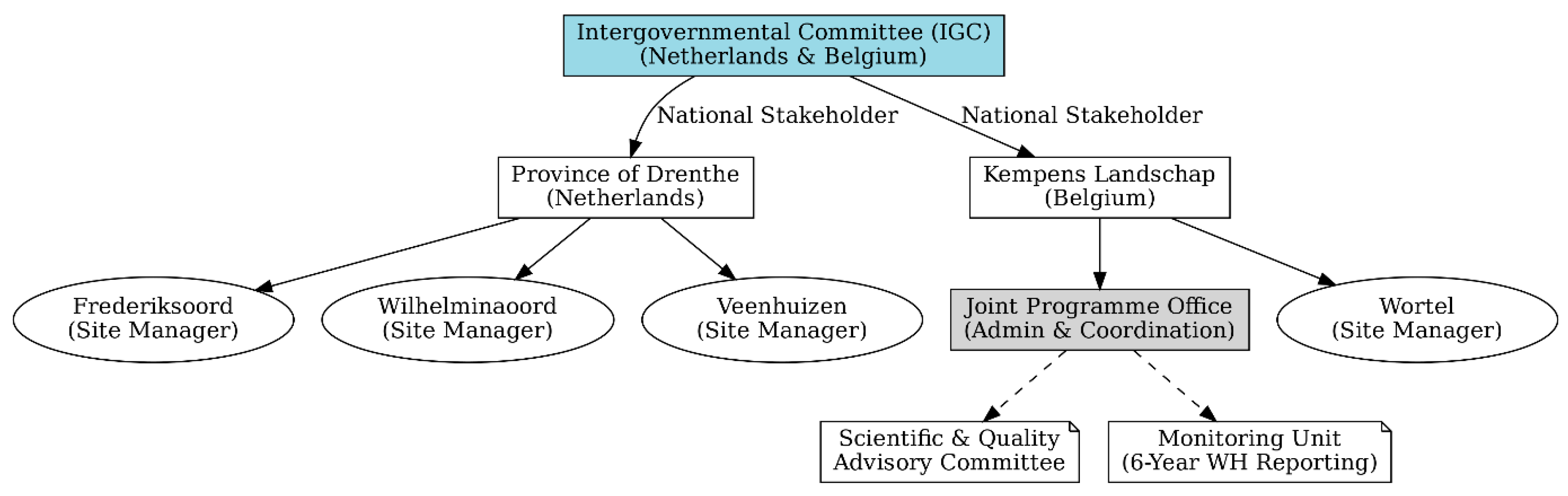
The two countries coordinate cross-border knowledge exchange, strategic planning, and conservation strategies through a joint management board (
Figure 2). Annual meetings support shared governance on matters such as tourism management and strengthening local participation. Monitoring based on common indicators is conducted biannually, and scientific events are organized to enhance the global visibility of the site [
32].
Committees composed of historians, architects, cultural heritage specialists, and local representatives provide guidance on sustainable management, conservation priorities and community engagement [
32].
3.2.2. HS2 Curonian Spit
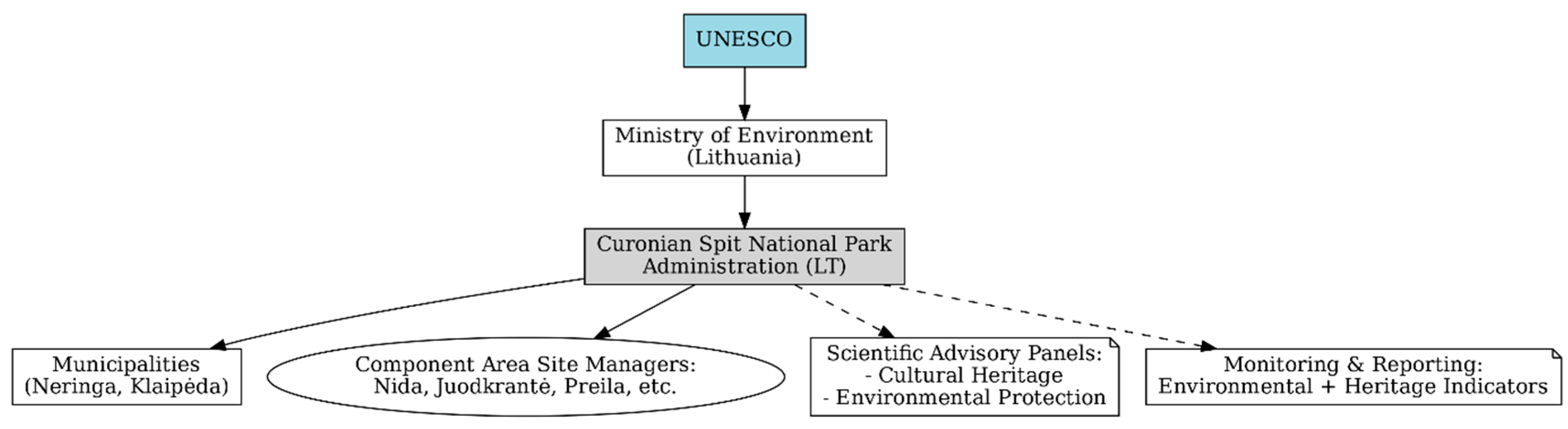
Stretching between Lithuania and Russia, the Curonian Spit is a unique natural–cultural landscape where fragile dune ecosystems coexist with enduring local cultural traditions. Although each country implements its own management plan, protocols supporting joint strategies in the face of environmental threats strengthen transboundary cooperation [
33].
In Lithuania, the Kursiu Nerija National Park Administration, and in Russia, the Kurshskaya Kosa National Park Administration are responsible for ecosystem management, forest protection, and the preservation of traditional fishing culture. Local governments oversee visitor flow management, infrastructure development, and community participation. Traditional crafts and fishing practices constitute essential elements through which local communities contribute to conservation.
Bilateral agreements between the two states facilitate data sharing, ecosystem management, and the harmonization of tourism strategies. Working groups composed of ecologists, historians, and cultural heritage specialists convene at least once a year to evaluate conservation priorities (
Figure 3). Scientific conferences, field studies, and monitoring processes based on shared indicators further support conservation efforts [
33].
Scientists, local community leaders, fishers, and tourism representatives provide strategic guidance to support sustainable management and the preservation of cultural integrity.
3.2.3. HS3 Erzgebirge/Krušnohoří Mining Region
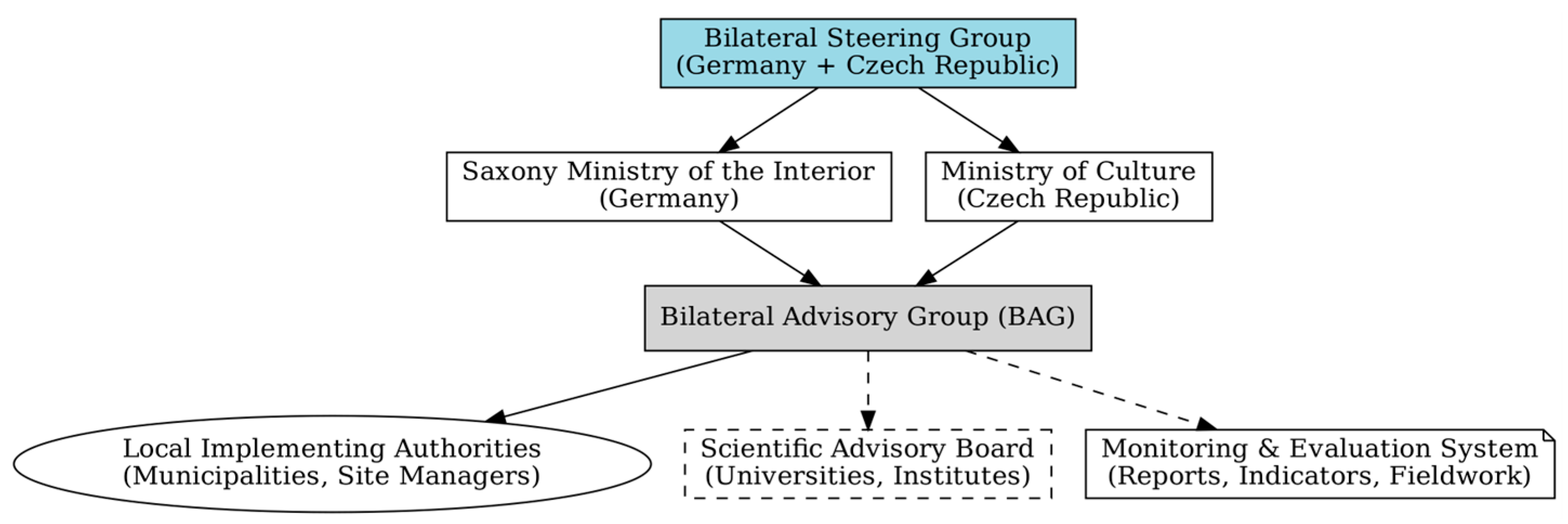
Located along the border between Germany and the Czech Republic, the Erzgebirge/Krušnohoří Mining Region is an extensive industrial landscape that preserves the traces of 800 years of mining history. The management plan focuses on the holistic preservation of historical mining structures, underground networks, and the broader landscape. This site represents one of the strongest examples of cross-border cooperation and operates through a complex governance structure (
Figure 4). Although each country applies different conservation regimes, coordination is achieved through a shared management framework [
34].
In Germany, the Sächsisches Staatsministerium für Wissenschaft, Kultur und Tourismus (SMWK), and in the Czech Republic, the Národní památkový ústav (NPÚ), are responsible for the preservation of the mining region, the sustainable use of geological heritage, and the development of tourism strategies. Local governments oversee day-to-day conservation of historical mining structures, community communication, and infrastructure development. Local communities play an active role in maintaining traditional mining culture.
Germany and the Czech Republic have established a joint management board to support the cross-border governance structure. This board meets regularly to strengthen transboundary cooperation, facilitate data sharing, and undertake strategic planning. Working groups composed of mining engineers and geologists coordinate conservation and research processes. Annual meetings and technical reporting ensure continuity in management.
Committees composed of geologists, mining engineers, historians, and local community representatives provide guidance for restoration projects, the evaluation of scientific data, and the sustainable use of the heritage. Educational activities and local stakeholder participation constitute key components of the management plan.
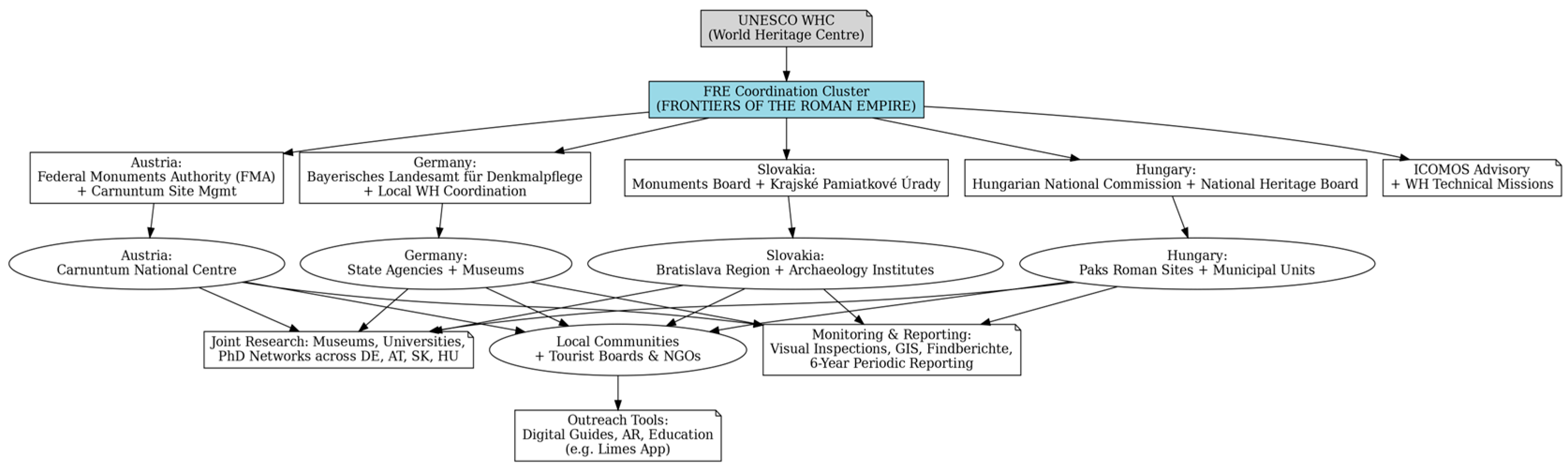
3.2.4. HS4 Frontiers of the Roman Empire—The Danube Limes (Western Segment)
Shared by Germany, Austria, and Slovakia, the Danube Limes represents the western segment of the northern frontier defense system of the Roman Empire. The management plan focuses on the holistic preservation of the archaeological heritage and the development of a multinational, sustainable governance structure. The region operates through a multi-actor coordination system involving four countries, ensuring alignment at national, regional, and local levels [
35], (
Figure 5).
Each country is responsible for safeguarding the remains within its borders: in Austria, the Bundesdenkmalamt; in Germany, the Landesamt für Denkmalpflege; in Slovakia, the Pamiatkový úrad SR; and in Hungary, the Forster Centre serve as the main authorities. Local governments manage daily tasks such as infrastructure development, community communication, and visitor management. Teams of archaeologists and historians guide scientific research and fieldwork.
A multinational management committee coordinates cross-border cooperation, strategic planning, and data sharing. Joint working groups carry out field research and ensure the collection of scientific data. Annual monitoring and evaluation processes support the harmonization of conservation strategies. Archaeological excavations, conservation policies, and tourism infrastructure projects are implemented through continuous information exchange among participating countries.
Scientific committees composed of archaeologists and historians provide guidance on the preservation of the site and the accuracy of collected data. Due to the site’s international significance, global experts also contribute to the development of management strategies [
36].
3.2.5. HS5 Frontiers of the Roman Empire—The Lower German Limes
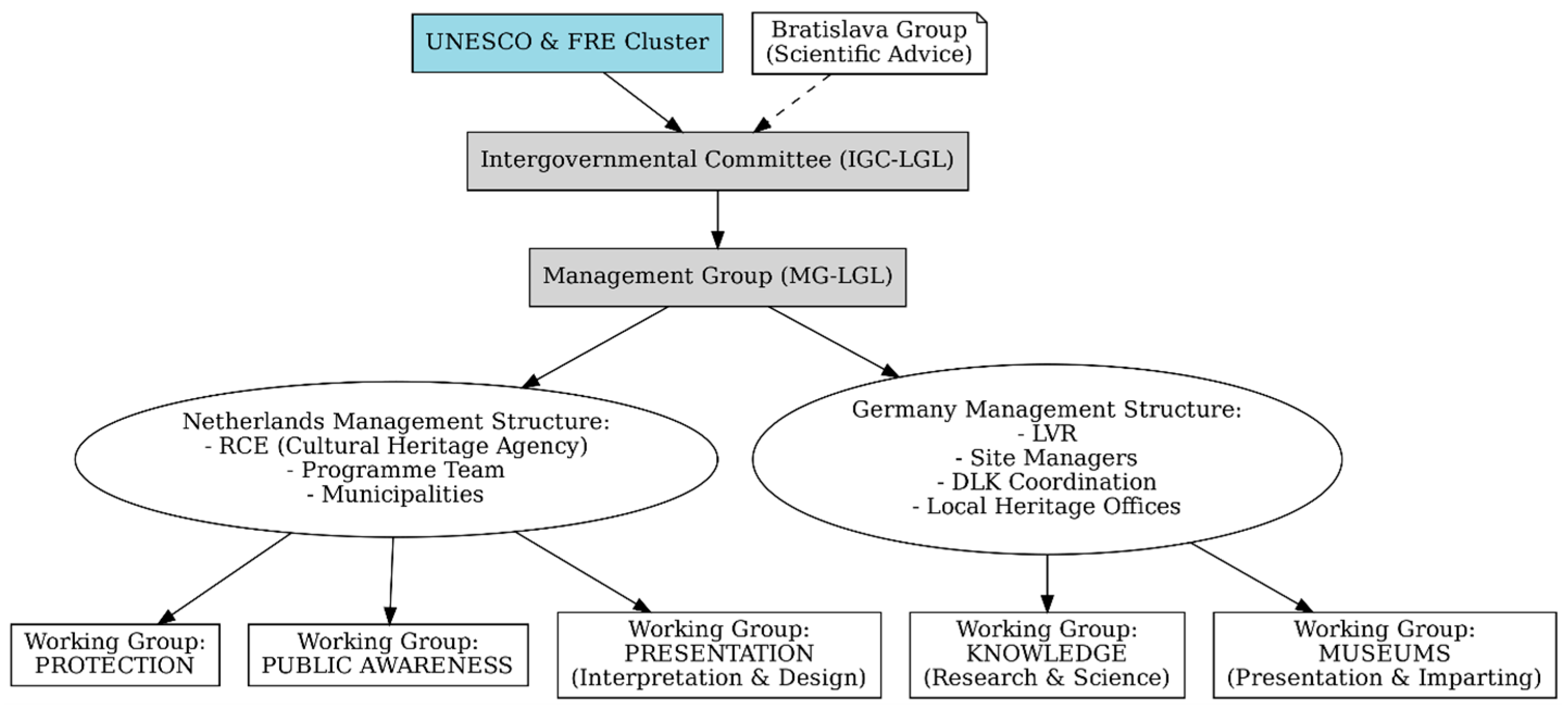
Extending along the border between Germany and the Netherlands, the Lower German Limes is a multi-component heritage site representing the northwestern defensive frontier of the Roman Empire. The area consists of extensive military remains, border outposts, forts, and road networks. The management plan aims to ensure sustainable preservation through contemporary tools such as digital documentation, risk analysis, and community engagement. The governance model is based on cross-border cooperation and local community participation, managed through joint planning by relevant cultural institutions in the two countries [
37].
In Germany, the Landesamt für Denkmalpflege Rheinland-Pfalz and the Archäologische Landesamt NRW, and in the Netherlands, the Rijksdienst voor het Cultureel Erfgoed (RCE), are responsible for conservation. Local governments manage visitor services, infrastructure improvements, and community involvement. Archaeologists, historians, and engineers play active roles in field research and restoration processes.
A joint management board established by Germany and the Netherlands coordinates data sharing, strategic planning, and the alignment of transboundary conservation practices (
Figure 6). Joint expert working groups coordinate field activities. International conferences, symposia, and military history workshops support the promotion of the site and the exchange of knowledge. This board meets regularly to strengthen cross-border cooperation, facilitate data sharing, and develop strategic plans.
Committees composed of archaeologists, historians, and engineers provide guidance on conservation strategies and data accuracy. These boards provide strategic guidance on preserving the scientific value of the field and ensuring data accuracy. Due to the site’s international nature, global experts also contribute to the development of management policies [
38].
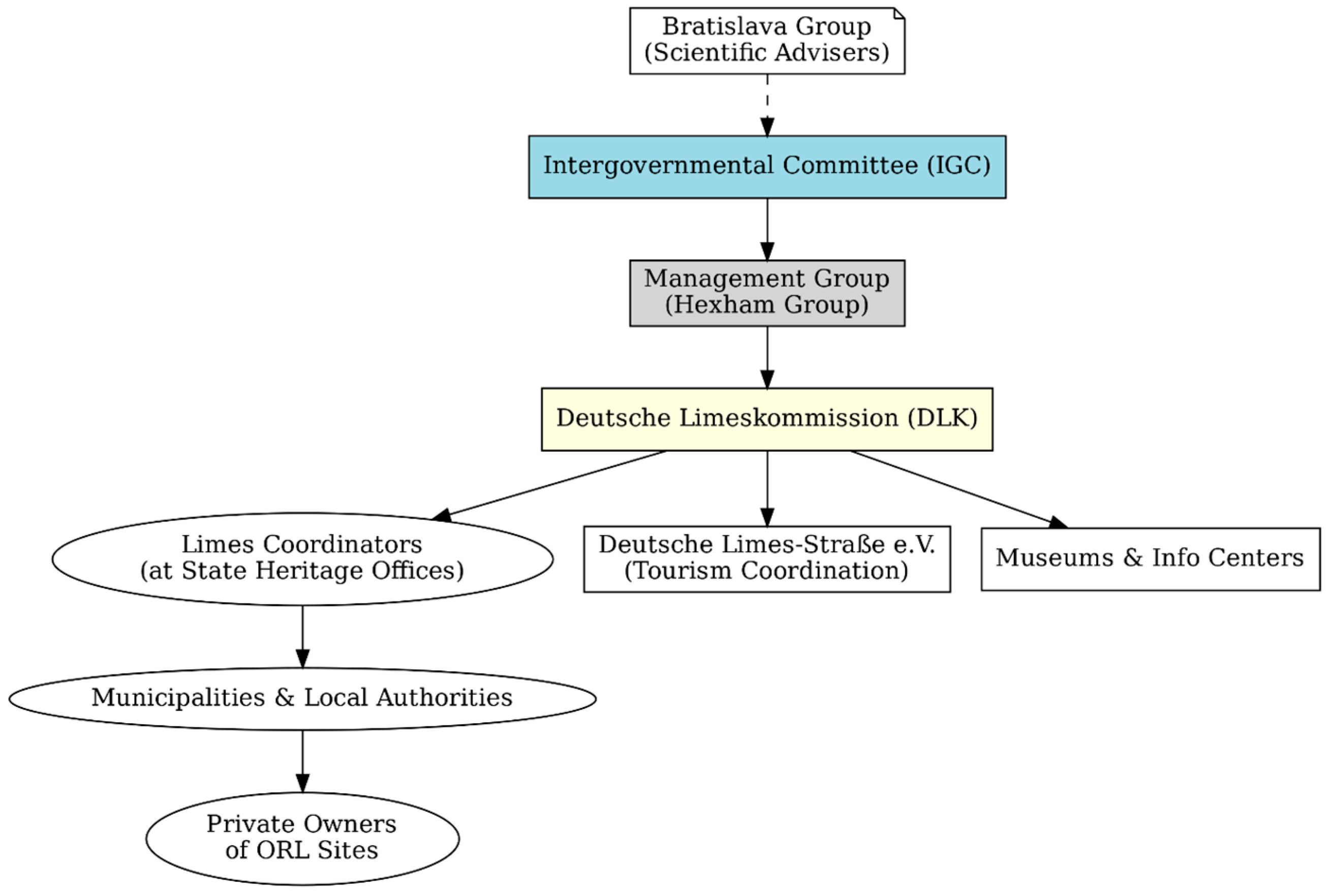
3.2.6. HS6 Frontiers of the Roman Empire—The Upper German-Raetian Limes
The Upper German–Raetian Limes constitutes a significant section of the Roman frontier system in southern Germany, comprising extensive military landscapes made up of walls, forts, and watchtowers. The management plan aims to ensure both the physical preservation of the site and the transmission of its cultural significance. Because the site spans several German federal states and includes a component in the United Kingdom, the governance structure is highly multi-layered [
39], (
Figure 7).
In Germany, the Landesamt für Denkmalpflege institutions in Baden-Württemberg and Bavaria are responsible for the conservation, restoration, and research activities of the site. Local governments oversee daily processes such as infrastructure management, visitor services, and community communication. Archaeologists, historians, and engineers participate in the working groups that guide fieldwork and scientific investigations.
Germany coordinates data sharing, field research, and restoration projects through national-level management boards. Joint expert groups undertake scientific data collection and research activities. Annual reporting ensures the continuity of conservation strategies. International conferences and symposia are regularly organized to support knowledge exchange and promote the military heritage of the site.
Advisory committees composed of archaeologists, engineers, and historians provide guidance on restoration efforts, conservation priorities, and sustainable management. Technical consultation from global experts further strengthens the development of management strategies [
39].
3.2.7. HS7 Funerary & Memory Sites of WWI
This site, shared between Belgium and France, consists of monuments, cemeteries, and memorial landscapes that preserve the memory of World War I. The monumental cemeteries are managed within the respective legal frameworks of each country but in a coordinated manner shaped by a shared culture of commemoration and emphasis on sustaining collective memory. The management plan adopts a holistic approach that integrates visitor management, educational programs and landscape design [
40].
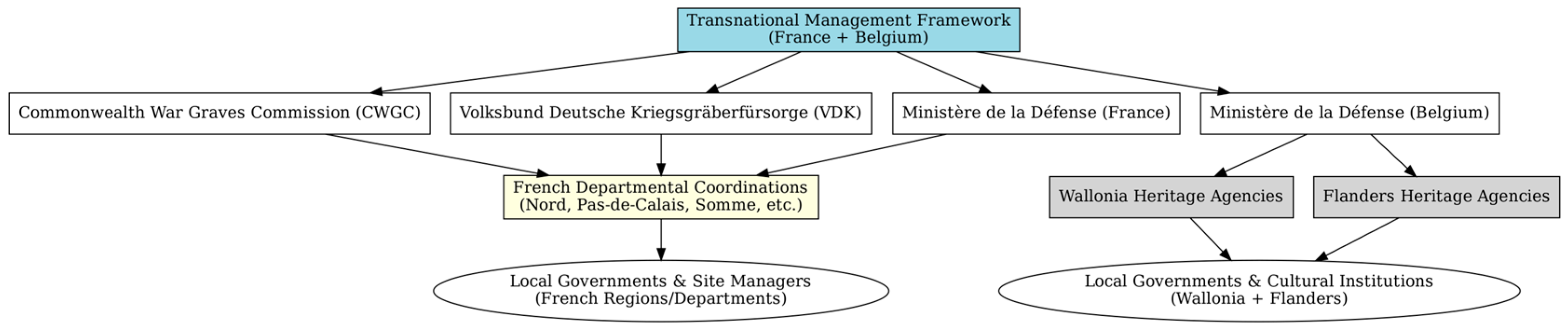
Both countries are responsible for the preservation of cemeteries and monuments within their respective borders. In Belgium, the Commonwealth War Graves Commission (CWGC) and War Heritage Institute (WHI) serve as the primary institutions, while in France, the Ministère des Armées and Office National des Anciens Combattants et Victimes de Guerre (ONACVG) hold the main responsibilities. Local authorities play active roles in cemetery maintenance, visitor flow management, and regional planning processes. Volunteer groups, NGOs, and veterans’ associations contribute to maintenance, restoration, and educational projects, organizing activities that strengthen historical awareness among younger generations.
Belgium and France have signed international agreements and protocols that regulate the status of cemeteries, responsibilities for their maintenance, and the organization of commemorative ceremonies. Joint working groups composed of cultural heritage experts, historians, and archaeologists enhance cross-border cooperation and knowledge exchange (
Figure 8). Educational programs, school visits, and virtual tours emphasize the impacts of war and the importance of peace. Periodic reporting is conducted through visitor data, maintenance activities and digital archives.
Advisory committees made up of specialists provide guidance for scientific research, the evaluation of restoration projects, and the development of management strategies. The site is managed in close collaboration with Commonwealth nations and other allied states, contributing to the preservation of shared historical heritage and collective memory [
40].
3.2.8. HS8 Koutammakou
Koutammakou represents the cultural landscape shaped by the traditional earth architecture of the Batammariba people and is located across the borders of Benin and Togo. The updated 2023 management plan places the preservation of traditional knowledge systems at its core, addressing architectural heritage, rituals, and oral knowledge transmission together. National heritage laws, along with local customary practices, jointly shape the governance framework. The governance model is locally oriented, grounded in the strong cultural bonds and customary authority structures of local communities [
41].
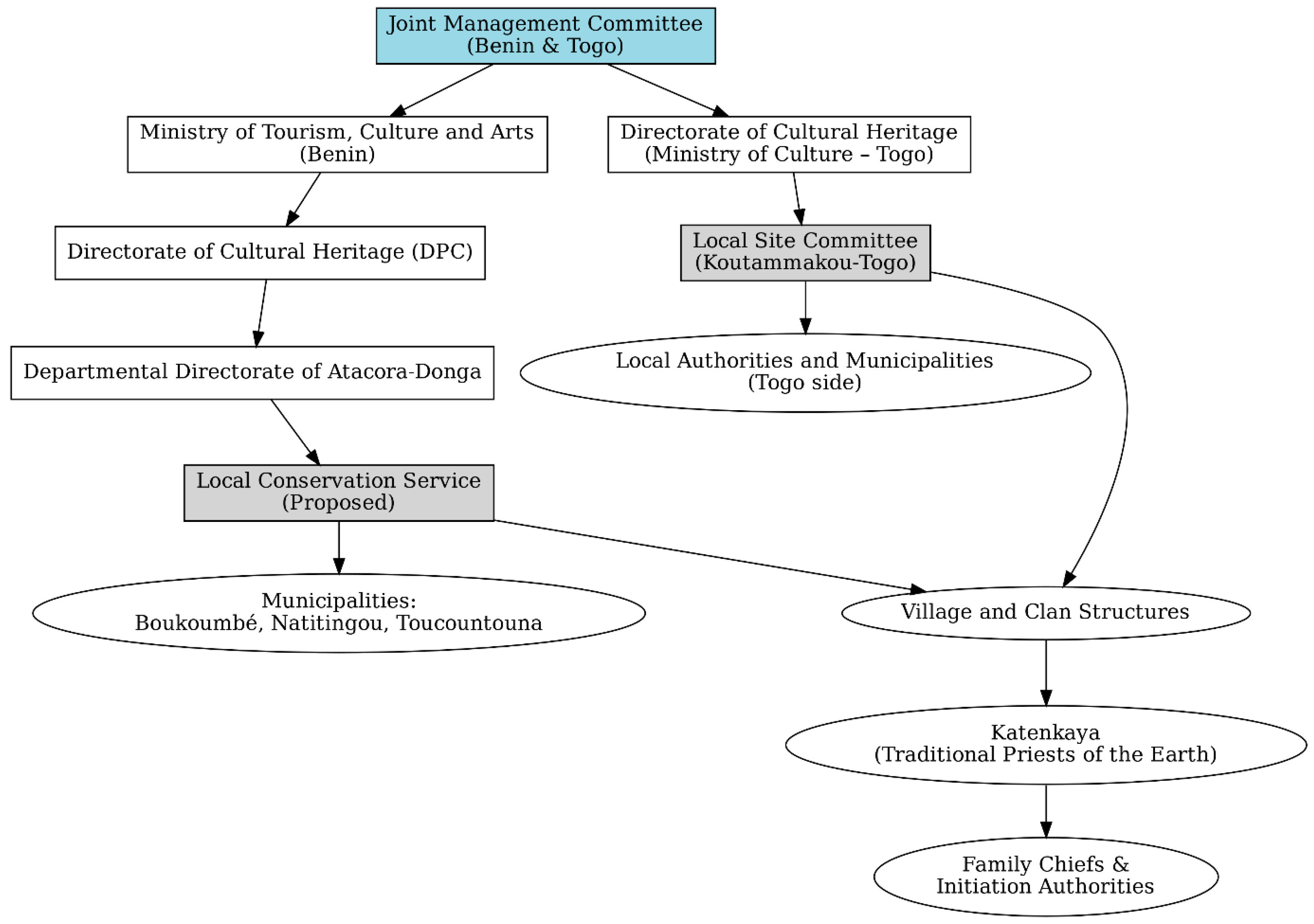
The governments of Togo and Benin provide financial and technical support at the national level; however, management is largely in the hands of local communities. The Batammariba people, through traditional leaders and community councils, are responsible for the preservation and sustainable management of the site. Community leaders and elders play a decisive role in safeguarding ritual spaces, maintaining social cohesion, and transmitting traditional knowledge.
With UNESCO’s support, Benin and Togo have established cross-border cooperation protocols that include shared commitments to heritage conservation and community empowerment (
Figure 9). Regular exchange of knowledge between local communities on traditional architecture, agricultural methods and nature conservation practices strengthen cultural sustainability and community solidarity.
Committees composed of traditional leaders and community representatives contribute to the development of management plans and the integration of modern conservation methods with traditional knowledge. Educational programs for residents aim to enhance cultural heritage awareness and ensure the transmission of knowledge to younger generations [
41].
3.2.9. HS9 Moravian Church Settlements
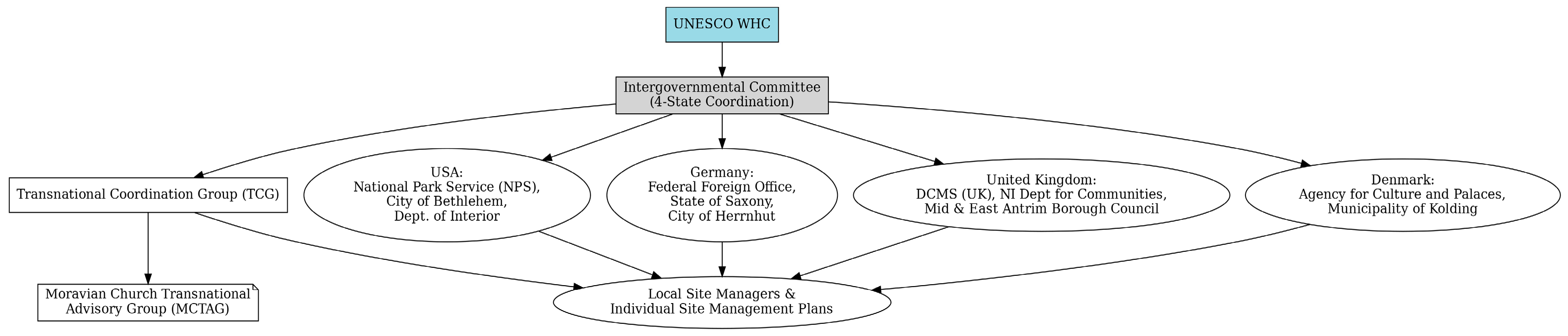
Moravian Church Settlements encompass communities located in Germany, the United States, Denmark, and the United Kingdom, which from the eighteenth century onward served as centers of a religious, social, and cultural movement. These settlements reflect the disciplined social structure, distinctive architecture, and community-based way of life of the Moravian Church. The management plan focuses on the preservation and joint stewardship of the Transatlantic Moravian settlements and is implemented in line with a shared faith-based understanding of cultural heritage. The governance model is grounded in religious leadership and community-based decision-making mechanisms. Each country undertakes actions in accordance with its own legal framework, supported by heritage conservation, education, and community engagement initiatives [
42], (
Figure 10).
Historically, the settlements were governed by church congregations; each settlement functioned as an independent community with its own internal organizational structure. This governance model is based on social harmony, religious discipline, and social solidarity. The Moravian Church plays a central role in overseeing the spiritual, social, and economic dimensions of the settlements, establishing norms, coordinating educational programs, and making strategic decisions to ensure sustainability. Local municipalities and conservation organizations collaborate with church communities to preserve the historic fabric and transmit heritage to future generations.
The global network of the Moravian Church facilitates the preservation of shared heritage across countries by supporting knowledge exchange, financial assistance, and cultural exchange programs. Regular conferences and working groups enable experience-sharing and the identification of common objectives. A proposed five-year monitoring and evaluation cycle supports the continuity and harmonization of management strategies.
Each settlement has expert committees responsible for the preservation and restoration of historic structures; these committees provide strategic guidance on architectural conservation and the cultural education of local communities. Community advisory boards enable direct participation of residents in decision-making processes, strengthening social cohesion and supporting the continuity of cultural heritage [
43].
3.2.10. HS10 Prehistoric Rock Art Sites in the Côa Valley and Siega Verde
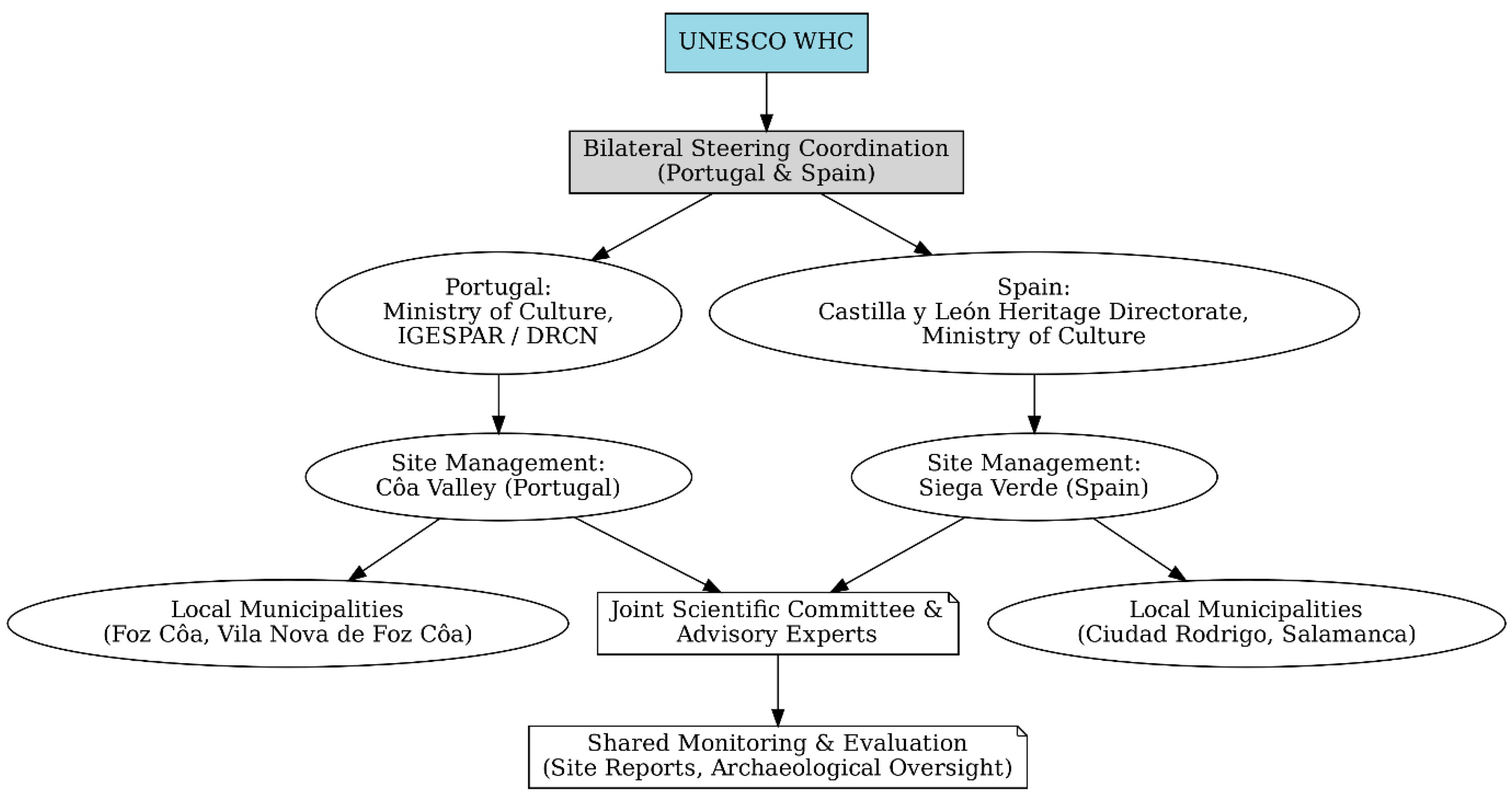
The Côa Valley and Siega Verde comprise an extensive cultural landscape of prehistoric rock engravings and paintings located across the borders of Portugal and Spain. The governance model is multi-layered, founded on scientific research, documentation, and visitor management, and emphasizes both cross-border cooperation and the participation of local communities (
Figure 11). The management plan seeks to establish a balanced approach between conservation and public interpretation [
44].
In Portugal, the Fundação Côa Parque, and in Spain, Patrimonio Nacional along with regional heritage agencies, are responsible for the site. These institutions coordinate the management of archaeological areas, tourism strategies, and scientific research activities. Local governments handle daily tasks such as visitor management, community communication, and infrastructure development, while guides, museums, and municipal bodies serve as key stakeholders in ensuring sustainability. Expert groups composed of archaeologists and historians guide conservation and research activities in the field.
Cooperation protocols between Portugal and Spain facilitate joint strategy development and data sharing. Joint working groups consisting of archaeologists, historians, and cultural heritage specialists coordinate field research and scientific data collection. The preservation of rock art is supported through international symposia, conferences, and cultural events. Monitoring and evaluation processes are carried out using visual documentation, visitor data, and indicators based on conservation status.
Committees composed of archaeologists and historians provide guidance on restoration, documentation, and the development of management strategies. Local communities participate in tourism policymaking and conservation processes, contributing to the strengthening of governance at a societal level. Through educational programs, cultural heritage awareness is enhanced and the local economy is supported [
44].
3.2.11. HS11 Stone Circles of Senegambia
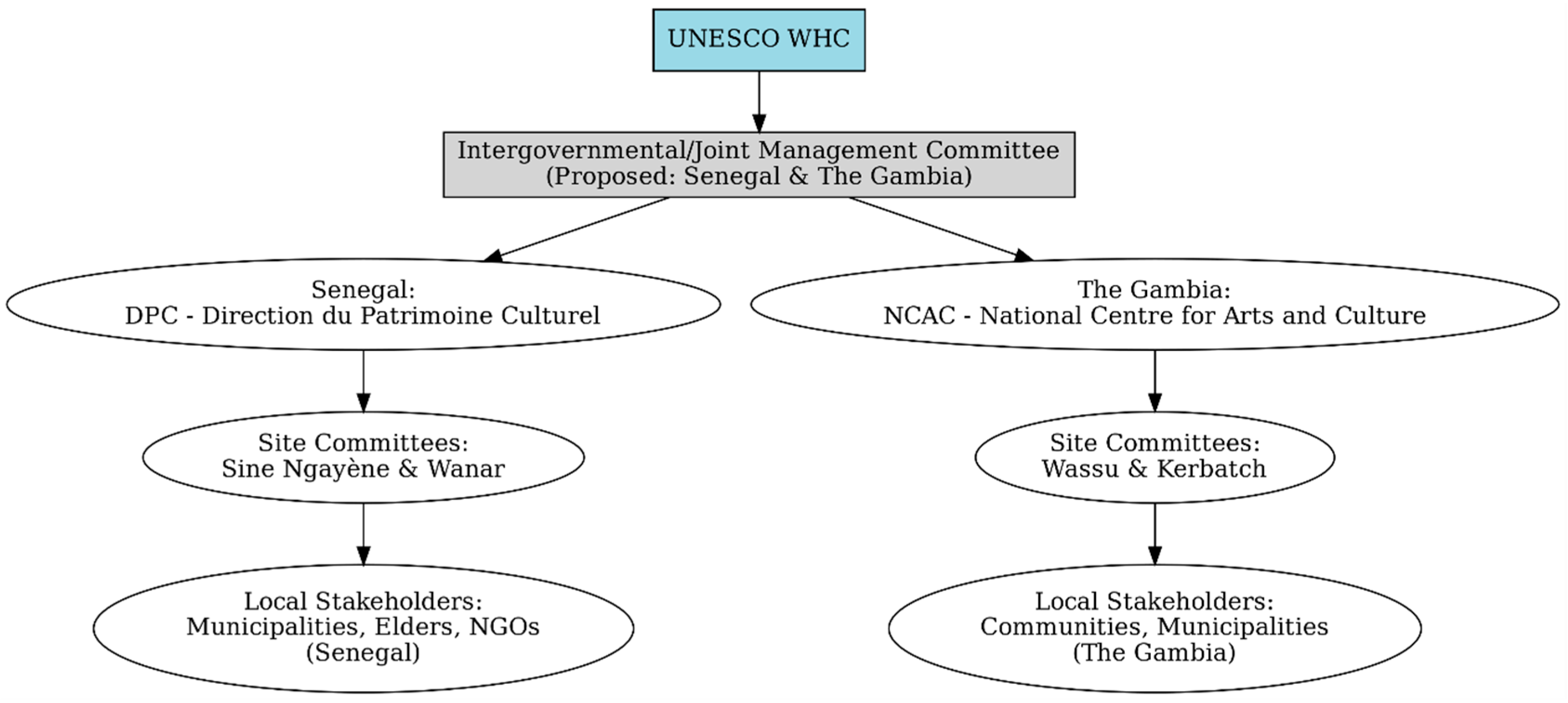
The Stone Circles of Senegambia, located across the borders of Senegal and The Gambia, have the largest concentrations of megalithic circles in West Africa. The site features prehistoric burial structures, ritual areas, and significant archaeological remains. The management plan focuses on documentation, awareness-raising activities, and the clarification of site boundaries, with the overarching aim of preserving the megalithic heritage and supporting community-based sustainable development. The governance structure is grounded in traditional leadership and cross-border cooperation [
45], (
Figure 12).
In Senegal, the Direction du Patrimoine Culturel, and in The Gambia, the National Centre for Arts and Culture (NCAC), are responsible for conservation. Both institutions oversee the preservation of the stone circles, visitor management, and the support of scientific research. Community leaders make critical decisions regarding the preservation of the sanctity of burial sites. Local communities play a central role in maintaining cultural integrity; community leaders safeguard the sanctity of burial sites and ensure the transmission of traditional knowledge. Archaeologists, anthropologists, and historians play active roles in the research and documentation of the site.
Cooperation protocols signed between Senegal and The Gambia include provisions for information sharing, joint conservation strategies, and the harmonization of tourism management. Joint working groups composed of scholars provide strategic guidance for the investigation and preservation of the site. Cultural events, educational programs, and exhibitions enhance local participation and raise broader awareness of the site’s historical significance. Monitoring mechanisms are implemented through field observations and UNESCO reporting processes.
Committees composed of local leaders, conservation specialists, and cultural heritage advisors make critical decisions aimed at safeguarding traditional knowledge and strengthening sustainable management. Expert committees provide scientific guidance for archaeological excavations and restoration projects [
46].
3.2.12. HS12 Struve Geodetic Arc
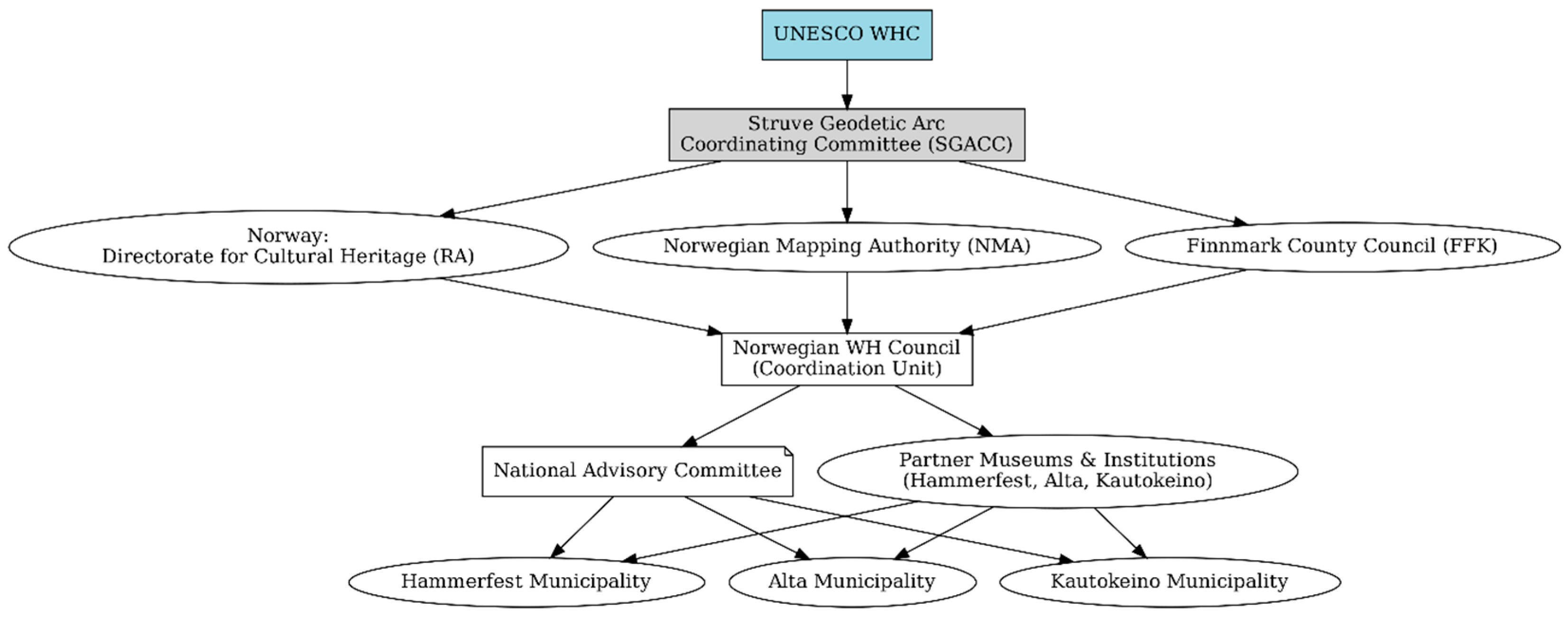
The Struve Geodetic Arc, spanning Belarus, Estonia, Finland, Latvia, Lithuania, Moldova, Norway, Russia, Sweden, and Ukraine, is a historic geodetic chain used in the measurement of the Earth’s surface. Owing to its scientific and cultural significance, the site possesses a unique governance structure. The management plan focuses on preserving the authenticity of the station points, maintaining the scientific value of the arc, and supporting international cooperation. The governance system is shaped through multinational coordination, scientific advisory committees, and the participation of local authorities [
47], (
Figure 13).
The components of the Struve Geodetic Arc within each country are preserved by national geodesy and cartography agencies (e.g., Estonian Land Board, Kartverket, Lantmäteriet, National Land Survey of Finland). Local governments maintain the monuments, manage visitor services, and oversee community communication. Geodesists, cartographers, and historians play critical roles in safeguarding and promoting the scientific value of the site.
Cooperation among geodetic institutions in the ten countries is facilitated through data sharing, joint research projects, and scientific conferences. International working groups harmonize conservation and management strategies through regular meetings. Annual reporting and technical assessments support strategic planning. Conferences and workshops strengthen knowledge exchange among experts and enhance the visibility of the site’s scientific heritage.
Advisory committees composed of geodesists and cartographers provide guidance on conservation priorities, data accuracy, and management strategies. Technical meetings coordinated through UNESCO enable multinational data exchange and integrated conservation. Contributions from international experts reinforce the global dimension of the management model [
47].
3.2.13. HS13 the Architectural Work of Le Corbusier, an Outstanding Contribution to the Modern Movement
Le Corbusier’s works represent some of the most significant examples of the Modern Movement and encompass 17 buildings located across seven countries, namely Argentina, Belgium, France, Germany, India, Japan, and Switzerland. The management plan aims to preserve the authenticity, universal value, and functional continuity of these buildings, and is grounded in multinational cooperation and a collective heritage approach [
48].
Each country is responsible for the preservation of the Le Corbusier buildings located within its borders. Key authorities include the Ministère de la Culture in France, the Swiss Federal Office of Culture in Switzerland, the Archaeological Survey of India, and the Agency for Cultural Affairs in Japan. Local governments undertake duties such as visitor management, routine maintenance, and communication with local communities; professional architectural associations, universities, and museums serve as important stakeholders. The works are extensively studied by architects and scholars, and these insights are integrated into their conservation and interpretation processes.
The Le Corbusier Foundation plays a central role in global coordination, providing guidance on documentation, conservation, and the promotion of the works. The multinational structure requires robust coordination supported by data sharing, joint restoration projects, and scientific conferences. Annual reporting and quality control mechanisms ensure consistency in conservation practices. International conferences and symposia further strengthen knowledge exchange among architectural historians and specialists (
Figure 14).
Advisory committees composed of architects and cultural heritage specialists offer strategic guidance on conservation priorities and sustainable management. Architectural experts, engineers, and historians in the respective countries provide consultancy to ensure alignment between local practices and international standards [
48].
3.2.14. HS14 Great Spa Towns of Europe
The Great Spa Towns of Europe encompass eleven historic spa towns located across seven countries (Austria, Belgium, the Czech Republic, France, Germany, Italy, and the United Kingdom & Northern Ireland). These towns embody the spa culture that, from the eighteenth century onward, became a symbol of health, social life, and architectural development in Europe. The management plan aims to ensure the sustainable preservation of these towns and maintain their heritage value through shared governance. The governance structure is founded on multi-layered organization and cross-border cooperation [
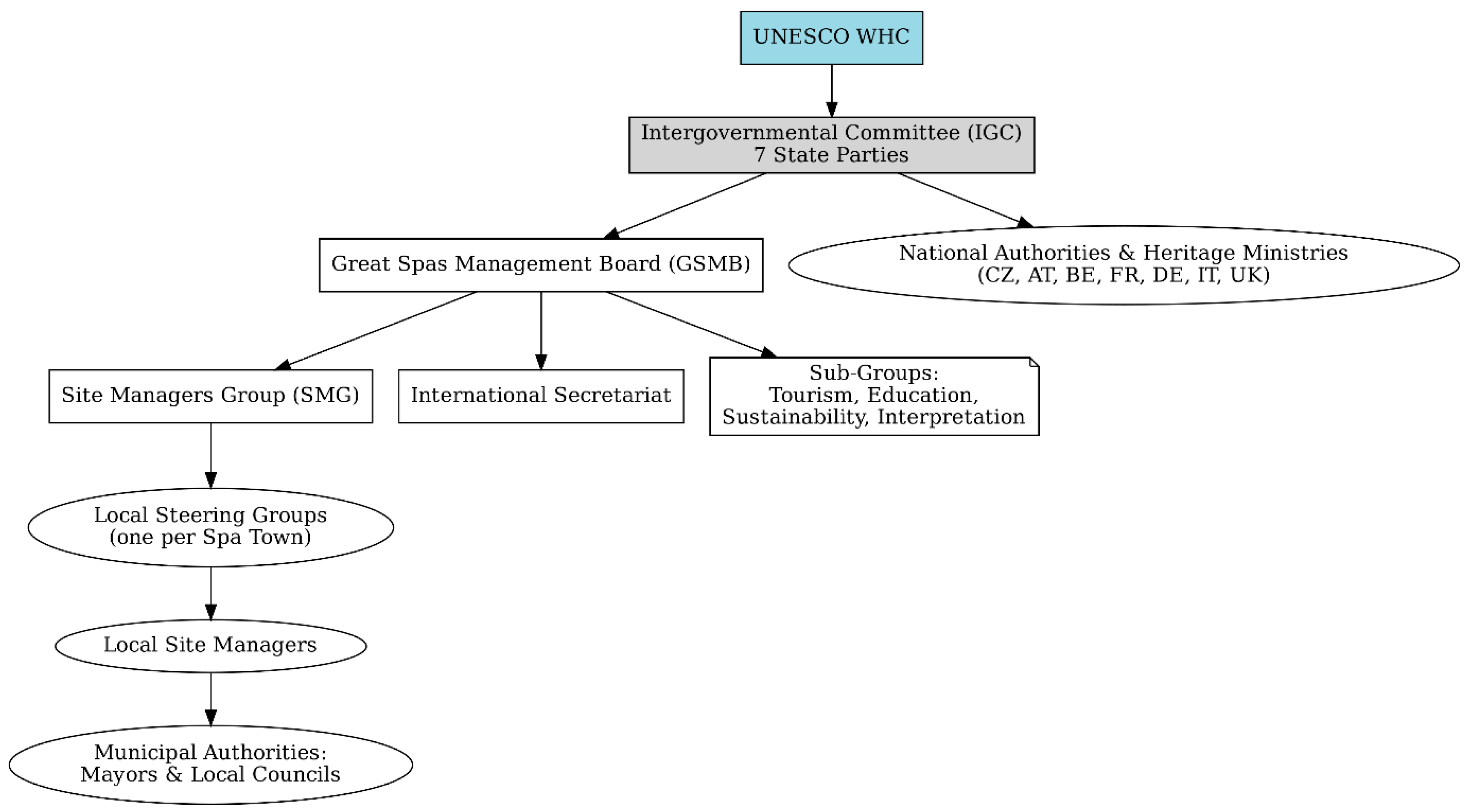
49], (
Figure 15).
Each country is responsible for the preservation of its own spa towns. In Germany and Austria, the relevant monument protection agencies; in the Czech Republic, the Národní památkový ústav; in Italy, the Ministero della Cultura; and in the United Kingdom, Historic England play leading roles. Local governments coordinate architectural heritage conservation, sustainable tourism, and community engagement, while tourism offices and health institutions also participate in management processes. Each town has its own management board that oversees the preservation of historic structures, the management of thermal water resources, and local participation.
The Great Spa Towns of Europe Association coordinates the multinational structure of the property and provides guidance for the development of global conservation strategies. International working groups composed of historians, architects, urban planners, and heritage experts harmonize conservation and management approaches. Regular conferences and symposia are held to enhance the cultural and health tourism potential of the towns, and periodic evaluation processes based on indicators are conducted.
Committees composed of architects, historians, and urban planners provide strategic guidance on architectural conservation, the development of health tourism, and the strengthening of social cohesion. Experts support the integration of each country’s practices into a coherent, holistic conservation framework [
49].
3.2.15. HS15 Venetian Works of Defence Between the 16th and 17th Centuries: Stato da Terra—Western Stato da Mar
This serial property encompasses the defensive systems constructed by the Venetian Republic during the sixteenth and seventeenth centuries across the Mediterranean and the Adriatic, located within the borders of Italy, Croatia, and Montenegro. These structures were designed to protect maritime trade routes and strategically important military zones. The management plan integrates the preservation of historical heritage with local development and international cooperation grounded in peace. The governance model is based on multinational collaboration and strong participation from local authorities [
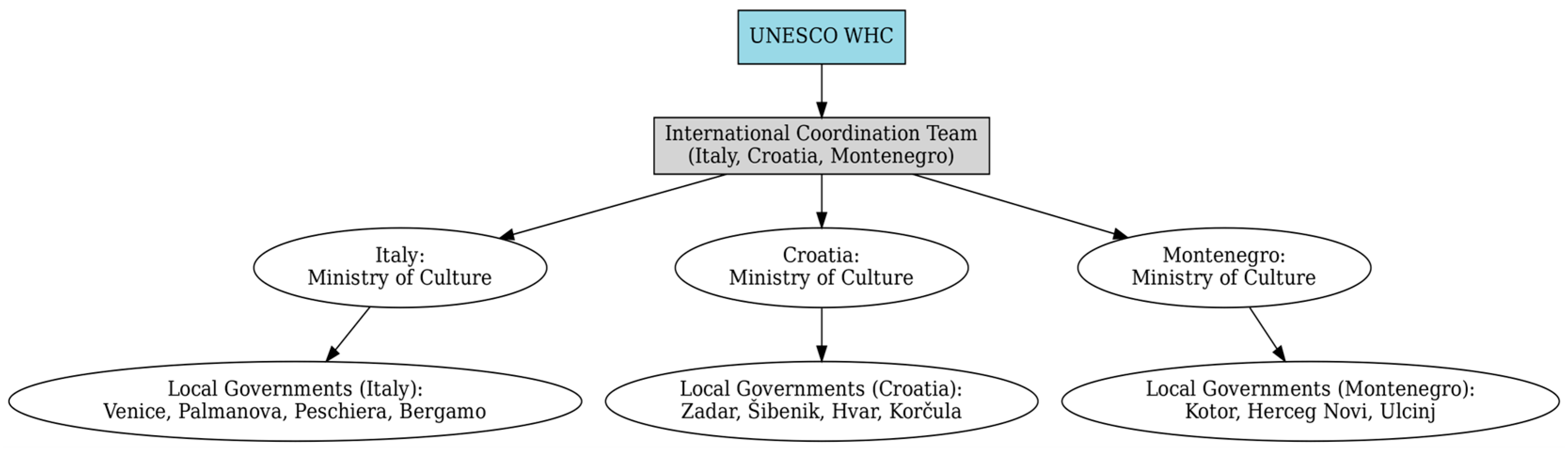
50], (
Figure 16).
Each country is responsible for the preservation of the defensive structures within its territory: in Italy, the Ministero della Cultura; in Croatia, the Ministarstvo kulture i medija; and in Montenegro, the relevant Ministry of Culture serve as the principal authorities. Local governments oversee the day-to-day management of historic structures, the development of tourism strategies, and communication with local communities. Expert groups composed of military historians, engineers, and architects play a critical role in restoration decisions and technical conservation processes.
International networks such as the Transnational Network of Fortified Heritage coordinate the multinational structure of the site and develop shared frameworks for scientific research, cultural activities, and tourism strategies. Working groups composed of historians, architects, engineers, and heritage specialists ensure consistent implementation through joint technical documents and coordination meetings. Monitoring is conducted through annual technical inspections and reporting. International conferences, symposia, and military history workshops support the promotion of the site and facilitate knowledge exchange.
Advisory committees composed of military historians, engineers, and architects provide strategic guidance on the preservation of defensive structures, sustainable management, and the strengthening of social benefits. Experts from the participating countries contribute to the development of a management framework that aligns technical and cultural dimensions [
50].
4. Evaluation of Governance Models: Shared Themes in Transboundary Heritage Governance
4.1. Institutional Multilevel Structure and Governance Hierarchy
Across all fifteen transboundary serial World Heritage properties analyzed, governance systems are structured around a multilayered institutional configuration. These layers form a vertical coordination line that extends from international norm-setting and diplomatic alignment to national policy harmonization and local implementation units. The effectiveness of this line depends on the existence of competent institutions and the depth of communication among them.
The data shows that federal and regional structures play a strong role particularly in European examples (HS3, HS4, HS5, HS14). In these cases, local governments emerge as key actors with high operational capacity, while national authorities assume responsibilities related to coordination and resource management. In contrast, African examples (HS8, HS11) exhibit a bottom-up governance structure in which community leadership is prominent. This contrast indicates that institutional maturity and social legitimacy are distributed across different scales depending on the geographical context.
All sites examined in the study possess scientific advisory mechanisms; however, the degree of influence these bodies exert varies considerably. In HS12 and HS13, scientific advisory committees participate directly in decision-making processes, whereas in other cases their roles tend to be project-based or limited to reporting. This suggests that governance models grounded in scientific expertise are not yet fully institutionalized across all sites.
Overall, governance in transboundary serial properties is multilevel and asymmetrical. While national authorities are the most influential actors in many systems, the role of local communities and expert networks in decision-making varies significantly depending on contextual factors.
4.2. Institutional Coordination Mechanisms
Institutional coordination is one of the primary determinants of management effectiveness in transboundary serial World Heritage properties. Across the fifteen sites examined, the need to harmonize national conservation practices within international platforms is widely recognized. However, the degree to which such coordination is institutionalized varies significantly among the sites.
In European cases (HS3, HS4–HS6, HS14), international coordination is carried out through multinational secretariats or federal structures. In these systems, joint management boards, scientific advisory committees, and thematic working groups convene periodically, and processes related to budgeting, monitoring, and evaluation are aligned with shared standards. These arrangements can be considered strong examples of institutionalized network governance.
In African examples such as HS8 and HS11, coordination is carried out primarily through bilateral protocols and project-based agreements. In these contexts, limited institutional resources and differing administrative frameworks restrict the long-term sustainability of coordination mechanisms. In large, multi-country networks such as HS12, cooperation is robust at the technical level yet remains weaker in administrative and political coordination.
The data indicates that international coordination is not merely an institutional requirement but also a diplomatic negotiation practice. Joint secretariat structures help institutionalize trust among participating states, whereas relationships based solely on project-based collaboration struggle to create sustainable governance in the long term. Ultimately, the governance of transboundary heritage is shaped at the intersection of political diplomacy and institutional resilience.
4.3. Monitoring, Evaluation and Standardization
Joint monitoring and information management constitute two of the most critical functional domains determining the governance effectiveness of transboundary serial heritage properties. As emphasized in UNESCO’s Operational Guidelines [
1], monitoring systems in multi-actor contexts are expected not only to collect data but also to support information sharing and mutual learning processes. The fifteen sites examined in this study implement this principle to varying degrees.
In several advanced cases (HS3, HS4–HS6, HS14), joint monitoring is conducted through digital platforms, with visitor statistics and conservation status reports stored in shared databases. This structure represents a strong application of a knowledge-based governance model. Furthermore, periodic meetings and thematic reports ensure methodological alignment among participating states. Files such as HS12 and HS13 have institutionalized monitoring through annual reporting mechanisms, enabling international comparison of data and facilitating joint evaluation. In African examples (HS8 and HS11), monitoring is mostly conducted at the national level, and cross-border data sharing is limited, resulting in weaker learning loops.
Overall, a direct correlation was observed between joint monitoring capacity and governance maturity. The regularity of data sharing, the standardization of common indicators, and the presence of digital information systems emerge as key factors that enhance the continuity and transparency of transboundary governance networks.
4.4. Community Participation and Cultural Diplomacy
The sustainability of governance in transboundary serial World Heritage properties depends not only on institutional capacity but also on the ways in which local communities are incorporated into management processes. UNESCO’s Policy Document for the Integration of a Sustainable Development Perspective into the World Heritage Convention [
51] emphasizes that the principle of “participation” is an integral component of heritage management.
In European examples (HS3, HS4, HS5, HS6, HS14, HS15), community participation is generally institutionalized through advisory councils, tourism management platforms, civil society networks, volunteer organizations, and educational programs. These structures strengthen communication among stakeholders while simultaneously contributing to cultural diplomacy. The inclusion of local communities in decision-making processes enhances the social legitimacy of conservation practices and supports the economic sustainability of heritage sites. In contrast, in African examples (HS8, HS11) and HS10, community participation is shaped more through traditional knowledge systems and local leadership mechanisms. In these contexts, management processes become negotiation spaces grounded in trust between local authorities and national institutions. Thus, governance becomes not only an institutional practice but also a culturally embedded form of legitimacy.
These variations demonstrate that a “single participation model” cannot be applied across the UNESCO heritage system; legitimacy is produced in context-specific ways. Legitimacy refers to the acceptance of management processes not only institutionally but also socially, and community participation constitutes the primary foundation of this acceptance [
5,
6,
7,
8,
9,
10,
11,
12,
13,
14,
15,
16,
17,
18,
19,
20,
21,
22,
23,
24,
25,
26,
27,
28,
29,
30,
31,
32,
33,
34,
35,
36,
37,
38,
39,
40,
41,
42,
43,
44,
45,
46,
47,
48,
49,
50,
51,
52]. The influence of participation on decision-making directly shapes the quality and continuity of governance.
Cultural diplomacy emerges as a distinct element of soft power in these sites. The preservation of shared heritage makes historical ties between countries visible and functions as a tool for peacebuilding. Sites such as HS7 and HS15 illustrate how cultural heritage becomes rearticulated through diplomatic symbolism.
Together, community participation and cultural diplomacy reinforce both the social legitimacy and international visibility of transboundary heritage governance. The continuity of participation mechanisms democratizes decision-making processes and strengthens intercultural dialogue among states, thereby enhancing the diplomatic value of heritage.
5. Typological Classification of Shared Themes
When the governance structures of the fifteen transboundary serial World Heritage properties analyzed in this study are evaluated in terms of their degree of institutionalization, forms of coordination, and modes of community participation, they can be grouped under four predominant governance models. Each model generates a distinctive configuration of international cooperation, cultural diplomacy, and local participation within its specific context.
Figure 17 visualizes the organizational logic and inter-actor relationship patterns of the four fundamental governance models defined in the study through typological prototypes. The center is used as the focal point of governance. Interactions between actors are represented by arrows. The thick arrow represents an institutionalized, continuous network of relationships, while the dashed and thin arrows represent weak and indirect relationships. The diagrams aim to interpret governance success not only through the existence of institutions but also through the intensity of coordination between these institutions, decision-making centers, and interaction patterns.
5.1. Institutionalized Multinational Network Model
This model is characterized by multinational unions or secretariat structures. Management plans are implemented through networks that ensure coordination at the international level. Governance continuity is maintained through shared monitoring indicators, joint databases, and annual reporting systems. Management plans are based on common objectives, and decision-making processes operate within a multi-actor framework. The model is defined by a high degree of institutional maturity and strong diplomatic coordination. This group focuses on areas where multinational network structures preserve institutional memory, ensure standardization in monitoring processes, and offer a sustainable governance model based on cultural diplomacy. These sites are generally Europe-centered and supported by well-funded network structures. HS7, HS12, HS13, and HS14 fall within this category.
5.2. Federal–Modular Model
This model is particularly characteristic of complex administrative systems in Europe, defined by multilevel planning and mechanisms of regional representation. In these sites, decision-making processes are shared across national and local levels within a multi-actor structure. National institutions maintain their own systems while integrating modularly around common objectives, with coordination achieved through shared guiding principles and periodic meetings. The governance structure generally functions as a “federal network”; a strong coordination chain exists between regional authorities, national institutions, and scientific committees. This structure provides a flexible and scalable foundation for coordination models. HS3, HS4, HS5, HS6, and HS15 fall within this category.
5.3. Bilateral–Local Cooperation Model
This model features a flexible coordination structure developed between two countries but primarily dependent on implementation at the local level. Management plans are typically framed through memoranda of understanding signed between two national institutions. Despite limited institutional infrastructure and weaker central capacity, these sites are distinguished by strong local implementation capabilities. Therefore, governance exhibits a structure with high local implementation power and weak central capacity. Coordination is organized around specific themes (environment, tourism, monitoring); the lack of permanent institutional structures is the main limitation of this model. HS1, HS2, HS9, and HS10 fall within this category.
5.4. Community-Led Model
This model represents an alternative governance paradigm grounded not in institutional capacity but in cultural continuity and the authority of local communities. Management plans are typically shaped through oral traditions, ritual knowledge, and decisions made by local councils. In these sites, sustainability is achieved through the continuity of cultural practices. Community knowledge and cultural norms play a decisive role in decision-making processes. While this structure provides strong social legitimacy and flexibility, its institutional continuity at the international level may remain limited. HS8 and HS11 exemplify this model.
6. Categorization of Management Models: Corporate Governance and Maturity Map
Building on Svels and Sande [
20] who highlight the complexities encountered in transboundary serial heritage sites, particularly regarding coordination, participation, and governance maturity within multinational management models, and emphasize the need for more flexible, network-based governance structures, Yang et al. [
53] expand this approach by conceptualizing different forms of coordination through collaboration typologies and levels of management maturity. The analysis conducted in this study reveals that each of the four governance types exhibits varying degrees of institutional maturity.
The Corporate Governance and Maturity Positioning Map developed within this research is designed to assess the levels of institutionalization and continuity observed across the fifteen transboundary serial World Heritage sites.
Each level is defined according to the formal structure of inter-state cooperation, the degree of institutionalization, the regularity of information sharing, and the transparency of decision-making mechanisms.
Definitions of Maturity Levels
Cooperation is at an early stage; management plans operate primarily at the national level, and cross-border coordination remains minimal. Collaboration occurs mostly through UNESCO, and no shared data-exchange or monitoring system exists. Site:
HS11—Due to national capacity limitations, cooperation is mostly in the formative stages.
Basic protocols have been established between the participating states, and cooperation is largely project-based. Institutional continuity is weak. Sites:
HS2—Limited to ecological cooperation protocols and periodic coordination mechanisms.
HS8—Based on traditional community management, but with weak coordination at the national level.
Joint working groups and regular meetings are in place; cooperation is organized around specific themes such as environment, tourism, or monitoring. Sites:
HS1—Bilateral governance commissions and shared implementation strategies.
HS9—Periodic consultation meetings based on historical and cultural networks.
HS10—Joint monitoring initiatives based on archaeological conservation and tourism.
Joint management boards and coordination offices have been established; monitoring and planning processes are carried out in parallel. Institutional networks and monitoring indicators are shared. Sites:
HS3—Permanent management board and thematic monitoring system between the two countries.
HS4 HS5 HS6 HS15—Advanced coordination with joint reporting and monitoring indicators.
Multinational unions or secretariat structures make collaboration permanent. Management plans are based on shared objectives, and decision-making and budgeting processes are integrated at the international level. Sites:
HS7—Full institutionalization with a permanent secretariat, shared archive and documentation system.
HS12—Example of multi-country monitoring indicators and data standardization.
HS13—International coordination through the Fondation Le Corbusier.
Collaboration extends beyond conservation to include cultural diplomacy and sustainable development policies. Management is carried out by independent international networks. Site:
HS14—Operates as a multi-layered, continuous governance network through the Association of Great Spa Towns of Europe.
The majority of the fifteen sites examined cluster between Levels 3 and 4. This pattern indicates that while institutional cooperation and joint management models have become widespread in transboundary heritage, fully established multinational secretariat structures remain limited.
This distribution also demonstrates that UNESCO’s 2021 Operational Guidelines [
17] principle of “sustainable governance networks” is implemented most systematically in Europe. In African examples, despite strong local legitimacy, lower institutional continuity results in lower maturity levels. The primary determinant of effective management is not merely the existence of institutions but the connectivity and coordination capacity among them.
7. Discussion
This study examined the governance models that emerge in the management of transboundary serial World Heritage properties through a comparative analytical framework. The findings demonstrate that, across different geographical contexts, these models exhibit both shared patterns and structural divergences. The results reveal that the management of transboundary heritage is not merely an administrative task but rather a complex and dynamic field of governance shaped by scientific knowledge, multi-actor interaction, and cultural diplomacy.
Although the fifteen sites analyzed possess management plans with broadly similar formal components, they vary significantly in terms of implementation capacity, coordination density, and monitoring mechanisms. Governance in these contexts is not defined by a single centralized authority but by a polycentric arrangement involving international organizations, expert networks, national institutions, local governments, and communities.
The key determinants of governance effectiveness are not the mere presence of institutions, but the intensity of interactions among stakeholders, the continuity of coordination, and the degree of trust established between them. Sites with high levels of governance maturity exhibit active involvement from state institutions, international expert networks, local authorities, and communities, producing more stable and consistent outcomes. In these areas, digital databases, shared monitoring systems, and regular reporting enable continuous learning and knowledge exchange across countries. In lower-maturity cases, discontinuities in decision-making, limited coordination, and fragile trust among stakeholders weaken overall governance capacity.
An important dimension of this discussion is that management systems are not static structures; they are dynamic and adaptive frameworks responsive to changing circumstances. The flexible nature of UNESCO guidelines allows countries to reflect their own administrative mechanisms and cultural practices within their governance models. While this flexibility encourages innovative approaches, it also leads to management inconsistencies.
Another central finding is that governance models are shaped by geographical, cultural, and political contexts. Federal states demonstrate more modular and layered structures, whereas community-led models are influenced strongly by traditional knowledge systems and local authority relations. The role of transboundary heritage in cultural diplomacy forms a core pillar of the discussion. Beyond conservation, serial properties serve as symbolic tools of soft power, mutual trust-building, and shared identity formation, offering a cultural foundation that supports diplomatic relations.
Community participation emerges as a critical factor for the sustainability of governance systems. Where participatory processes are strong, management practices receive greater societal acceptance, indicating that sustainability depends not only on technical sophistication but also on social legitimacy. Conversely, where participation is weak, implementation capacity and long-term sustainability are adversely affected.
The study shows that governance success is closely linked to the quality of inter-institutional interaction, joint monitoring capacity, and cultural diplomacy processes. Shared monitoring indicators, digital information systems, thematic expert networks, and regular communication cycles accelerate learning processes between countries.
The results align closely with key insights in the transboundary heritage governance literature. The study demonstrates that despite differing legal and institutional structures, common forms of cooperation have emerged. This resonates with Albert and Ringbeck’s [
13] framing of adaptive governance. The diplomatic and administrative negotiation processes identified correspond with Brumann and Berliner’s [
2] characterization of transboundary sites as transnational arenas of negotiation. Labadi’s [
5] emphasis on the increasingly holistic, participatory, and integrative nature of UNESCO governance is reflected clearly in cases with institutionalized monitoring systems and thematic cooperation networks. Furthermore, the normative gaps described by Lixinski [
6] manifest through variations in governance culture, institutional capacity, and political priorities across countries. Consistent with Labadi [
5] and Lixinski [
6], the findings confirm that governance effectiveness within the UNESCO framework depends less on legal conformity and more on trust-building and a culture of information-sharing among stakeholders. The Corporate Governance and Maturity Model developed in this study makes these interactional processes visible and highlights differences in governance capacity between countries, demonstrating the inherently multi-actor and multi-level nature of governance in transboundary heritage sites. An important point is that transboundary heritage sites are arenas of cultural diplomacy. The form of governance affects not only the conservation process but also international relations and shared memory. If governance is inclusive, a climate of trust is created and diplomacy flourishes. However, if governance is based on unilateral interests or national pressures, cooperation weakens. This conclusion confirms the findings regarding the political sensitivity of transboundary heritage [
3,
4].
The findings also align with Ostrom’s [
7] common-pool resource management approach, which underscores the importance of trust, graduated coordination, and robust monitoring mechanisms. Governance capacity is more sustainable where these elements are strengthened. This supports Kooiman’s [
8] interactive governance model, which recognizes the critical roles of international organizations, local institutions, academic bodies, and communities. Monitoring cycles and flexible collaboration structures also confirm patterns of adaptive governance described by Chaffin et al. [
9].
The study’s primary contribution to the literature is its typological classification of governance models derived from management plan data across fifteen sites, offering one of the first comparative analyses of the practical dynamics of four distinct governance models. In doing so, it advances both theoretical and applied understandings of governance in transboundary serial heritage properties.
This study goes beyond the approaches in the existing literature that mostly address the management of transboundary World Heritage sites through normative principles or singular case narratives, and examines governance within a comparative, typological, and process-oriented analytical framework. First, the study conceptualizes governance not as a static administrative arrangement, but as a multi-level, network-based, and learning-driven process, integrating Ostrom’s [
7] shared resource management, Kooiman’s [
8] interaction-based governance, and adaptive governance literature within the context of transboundary heritage. In this respect, the research establishes a conceptual bridge between theoretical approaches that are often addressed in a scattered manner in the heritage management literature.
The four governance prototypes and six-stage collaborative maturity framework developed not only describe the management practices of transboundary heritage sites but also make them analytically classifiable and comparable. This provides a contextual and scalable answer to the “single model or multiple models?” dilemma frequently encountered in governance studies.
Finally, the study provides a relational reading of the legacy governance literature by demonstrating that governance success is determined not only by the existence of institutional structures but also by the intensity of interaction among actors, trust relationships, and the continuity of learning cycles.
From a practical standpoint, the typological framework developed in this study allows for a realistic assessment of the existing governance capacities of the sites when preparing UNESCO nomination files, management plans, and periodic reports. This enables the development of incremental and contextually sensitive improvement strategies, rather than forcing sites into a single “ideal management model.”
It reveals that joint monitoring systems, data-sharing mechanisms, and institutional coordination tools play a decisive role in governance success, offering a prioritization guide for site managers. Particularly for countries with limited institutional capacity, the critical structural components become clearly visible.
The research considers transboundary heritage sites not only as objects of conservation but also as functional spaces for cultural diplomacy, trust-building, and international cooperation, linking heritage management to foreign policy, regional cooperation, and sustainable development agendas. In this respect, the study provides a concrete reference for increasing the impact of heritage policies implemented within the framework of UNESCO.
Overall, the discussion demonstrates that there is no single ideal model for managing transboundary serial heritage properties and by demonstrating that the effectiveness of transboundary cooperation depends not only on geographical scope but also on institutional maturity and inter-actor trust, the study introduces a new analytical dimension to the field. Governance is a multilayered, adaptive, and interaction-based process that varies according to context, institutional infrastructure, diplomatic relations, and the level of trust between actors. Strengthening the connection between theoretical perspectives in the transboundary heritage governance literature and real-world practice remains an essential step for advancing the field.
8. Limitations of the Study and Future Research Areas
A significant limitation of the study is that the number of sites analyzed is limited to 15, as only online accessible management plans were evaluated. The findings cannot be directly generalized to transboundary sites without management plans, those still in the nomination process, or those outside the UNESCO framework. Furthermore, the predominantly European geographical distribution limits the universal generalizability of the findings.
The governance models and maturity levels developed in the study are based on a qualitative comparative analysis approach and are not validated by quantitative performance indicators. Therefore, it provides an explanatory framework for typologies and governance structures; it does not claim to be a model that measures causal relationships.
The study was conducted based on existing management plans and UNESCO documents. These documents reflect the formal governance structures of the sites; however, they do not fully encompass local interactions, decision-making processes, relationship networks, field observations, and stakeholder opinions in practice.
These limitations, rather than invalidating the study’s findings, point to the complex and context-sensitive nature of governance in transboundary heritage sites. It also reveals significant research gaps for future field-based, quantitative, and long-term research.
The study points to the need for a more detailed examination of serial heritage management dynamics, particularly in Africa, Asia, and Latin America. Future research should address these limitations through fieldwork, stakeholder interviews, and expanded geographic sampling, focusing especially on how legal frameworks affect management outcomes.
Testing the developed governance models and cooperation maturity levels in different categories of heritage sites is important for assessing the generalizability of the framework.
Mixed-methods studies, where qualitative findings are supported by quantitative indicators, can enable a more measurable analysis of the relationships between governance effectiveness, stakeholder engagement, and monitoring capacity.
Furthermore, studies that measure and address the impact of cultural diplomacy and international relations on transboundary heritage sites through comparative analyses will more strongly link heritage management to the global governance literature.
9. Conclusions
This study has provided a holistic analysis of how governance evolves in transboundary serial World Heritage properties by examining institutional diversity, multi-actor relationship networks, and cross-border cooperation dynamics within a comparative framework. Despite their diverse geographical, cultural, and administrative contexts, the fifteen sites analyzed collectively demonstrate that polycentric structures, inter-actor interaction, learning-based coordination, and participatory practices constitute the core framework of governance. However, differences in implementation vary depending on the specific geographical and administrative context of each region. Furthermore, it has been determined that governance in such regions is not merely a matter of technical coordination, but a complex structure situated at the intersection of diplomatic, social, and cultural interaction processes. This highlights the need for a flexible and adaptable approach in the search for a universal model for cross-border regions.
The typological analysis conducted in this research shows that four main governance models—shaped by different institutional capacities and geographical dynamics—are applied at varying scales across transboundary sites. The visual framework (
Table 1) reveals the relational transitions in governance models and maturity levels and the balance this process strikes between organizational continuity and community engagement. Governance forms can transform into one another through ongoing adaptive learning.
The study’s findings highlight the need for a multi-layered policy-level approach to ensuring sustainable governance at transboundary World Heritage sites, along with the institutionalization of cultural diplomacy, knowledge sharing, and trust-building.
10. Recommendations
Based on the research findings, several policy and practice recommendations are proposed.
Standardized joint monitoring indicators should be developed at both national and international levels to enhance comparability and strengthen evidence-based decision-making;
Digital networks that facilitate the exchange of information and experience among countries and stakeholders should be institutionalized;
Capacity-building mechanisms that encourage the active involvement of local communities in governance cycles should be established so that social legitimacy and long-term resilience are achieved.
These recommendations, aligned with UNESCO’s sustainable heritage management approach, aim to enhance the resilience of transboundary heritage sites not only as instruments of cultural diplomacy but also as platforms for shared learning.
Transboundary series heritage sites, as hybrid management spaces that existing management theories alone cannot explain, require a multi-actor collaboration model that transcends national borders for their sustainable management. By analyzing the institutional architecture of management plans, this study has illuminated the scientific, diplomatic, and societal dimensions of heritage governance and demonstrated the need for an inclusive and flexible approach. Transboundary serial properties function as spatial laboratories for international cooperation, shared learning, and cultural dialogue; accordingly, strengthening governance also entails building the institutional foundations of cultural diplomacy itself.