


Abstract
Although numerous studies have examined the impact of high-speed rail (HSR) on regional economic development, few have explored this relationship from a network perspective—a research gap this paper seeks to fill. Specifically, this paper aims to clarify the theoretical mechanism through which the HSR network affects the spatial evolution of regional industries, focusing on the new industry entry. We improve the local spread model by incorporating the HSR network as a key component and perform empirical analyses using the Spatial Durbin Model (SDM) and spatial mediation effect model, drawing on data from Chinese A-share-listed companies. The findings indicate that China’s regional industries underwent spatial evolution characterized by “diffusive agglomeration”. In terms of direct effects, connectivity ranks as the most influential HSR network indicator; however, when both direct and spillover effects are taken into account, accessibility becomes the primary factor, underscoring its vital role in reshaping the spatial distribution of industries. Additionally, the HSR network exerts a slightly stronger impact on industrial spatial diffusion (fueled by knowledge spillovers) than on industrial agglomeration (driven by market size), and its attraction to new industry entry is notably greater in peripheral regions than in core regions. These results demonstrate that HSR, characterized by “transporting people rather than goods”, mainly facilitates the exchange of knowledge, technology and information instead of reducing freight costs, offering valuable insights for optimizing regional industrial layouts.
1. Introduction
Studies in evolutionary economic geography offer a key insight: industrial spatial evolution is not a matter of random chance. Rather, it unfolds dynamically—shaped by geographical proximity, knowledge spillovers, and the movement of key production factors [1,2,3,4]. As a pivotal achievement of technological advancement in global transportation, HSR has not only reshaped economic interactions among regions but also redefined the distribution of production factors such as capital and labor—an outcome driven by its unique ability to compress time and space. With the large-scale construction of transportation infrastructure, the development of HSR has transcended single lines to form an integrated cross-regional network, and China’s HSR network is a typical case in this regard. Since the Beijing–Tianjin HSR was opened in 2008, China’s HSR network has experienced unprecedented expansion; by the end of 2025, it covered an operational mileage of over 50,000 km, establishing the world’s largest and most technologically advanced HSR network. The expansion of this network has upgraded the time–space compression effect from individual lines to the entire network, redefining inter-regional economic connections and resource allocation. Different from single HSR lines, the HSR network—characterized by interconnected nodes and interwoven lines—serves as a channel for China’s factor mobility, enabling the rapid flow of knowledge, capital, and labor across broader regions, reducing transaction costs and facilitating knowledge spillover, which essentially constitutes the external driving force for the evolution of industrial space.
Empirical studies on the impact of HSR on regional industrial development are abundant, with its effects roughly categorized into two inter-related core dimensions. The direct impact dimension refers to HSR’s role in directly improving industrial operational efficiency and boosting related industries by shortening spatiotemporal distances and reducing production factor mobility costs [5,6,7]. The indirect dimension, on which this paper focuses, involves HSR fostering long-term regional industrial structure optimization, industrial layout rationalization, and industrial collaborative development through transmission effects [8,9,10]. With the gradual networking of HSR, scholars have explored the construction planning [11], organizational models [12], and structural characteristics [13] of global HSR networks. In contrast, few studies have adopted appropriate network models and indicators to examine the relationship between the HSR network and regional spatial economic linkages—despite growing scholarly attention to this area. Existing relevant literature mainly employs social network analysis methods, using indicators such as degree centrality and betweenness centrality to measure regions’ positional importance within the HSR network [14,15,16]. However, most of these studies still rely on the analytical framework of individual HSR lines, failing to establish a theoretical framework for the HSR–economy nexus from a network perspective. At the same time, some achievements have been made in research on the spatial evolution of regional industries. Most of these studies focus on describing the static results of industrial spatial layout, mainly analyzing the distribution characteristics of industrial locations in specific periods [17,18] and agglomeration levels [19,20]. Some studies also analyze the changes in the location development of certain industries from a dynamic perspective [21,22], but they do not deeply explore the underlying influencing mechanisms.
In summary, existing research on HSR networks and regional industrial spatial evolution has certain achievements but also obvious gaps, including the lack of a network perspective in HSR–economy research and insufficient attention to the dynamic mechanism of industrial spatial evolution. Therefore, the marginal contributions of this paper are mainly reflected in two aspects. On the one hand, this paper adopts the network description method of Space L to construct a weighted directed network of China’s HSR, in order to clearly reflect the inherent directionality of HSR services. The weight of each connecting edge in the network is determined by the operating frequency of HSR services. On this basis, using social network analysis methods, three core indicators—degree centrality, betweenness centrality, and closeness centrality—are selected to measure the connectivity, transitivity, and accessibility of each region in the network. Furthermore, the coefficient of variation method is used to construct a comprehensive HSR network index to more comprehensively describe the structural position and development level of each region in the HSR network. On the other hand, this paper takes “new industry entry” as a key analytical perspective to accurately identify the important dynamic nodes in the spatial evolution of regional industries. The entry of new industries not only reflects the structural adjustment of industrial spatial layout but also serves as a core indicator of regional industrial vitality and development potential. To closely focus on the core theme of “evolution”, we define a four-year period as a complete evolutionary cycle. By systematically analyzing the occurrence of new industry entry and the number of new industries in a region at the end of each evolutionary cycle, we comprehensively depict the dynamic process of regional industrial spatial evolution under the influence of the HSR network, thereby remedying the gap in existing research where the dynamic nature of industrial evolution has not been fully taken into account.
Based on the above research perspectives and core issues, we integrate the HSR network into the local spread (LS) model. The traditional LS model is an endogenous economic growth model, its core premise involves integrating knowledge spillover effects into a spatial analytical framework, positing that the impact of capital stock spillover on the cost of new capital formation displays substantial spatial heterogeneity, thereby conferring a “localized” attribute to knowledge spillovers [23]. Through mathematical derivation, we clarify the internal mechanism linking the HSR network to industrial spatial evolution, building a systematic theoretical framework for our analysis. On the empirical front, we build a three-dimensional (time–city–industry) database using data from Chinese A-share-listed companies. First, we describe the key characteristics of China’s regional industrial spatial evolution from 2008 to 2020. Then, by combining the Spatial Durbin Model (SDM) and the spatial mediation effect model, we tackle three crucial questions: What direct impact does the HSR network have on new industry entry, and what spatial spillover effects does it bring about? What transmission mechanism underpins the path “HSR network → market size/knowledge spillover → new industry entry → spatial agglomeration or diffusion”? Are there differences in these effects between core and peripheral regions? Answering these questions enables us to provide a comprehensive evaluation of the impact of the HSR network on the spatial evolution of regional industries.
2. The Innovated LS Model
We integrate HSR network into the traditional LS model. To put it plainly, the key mechanism in action is as follows: HSR network development has generally reduced transportation costs—cutting down travel time and reducing freight expenses. These cost cuts have lowered the cost of cross-regional business transactions and strengthened knowledge spillover activities, which in turn have influenced the spatial distribution of industries. Further still, network effects have magnified this process over broader spatial scopes—stretching the HSR network’s impact well beyond individual lines or regions.
2.1. Model Assumptions and Analytical Framework
We construct a typical 2 × 2 × 3 economy comprising two regions (region 0 and region 1), two factors (labor and knowledge capital), and three sectors (traditional sector A, industrial sector M, and knowledge-creating sector I). The aggregate labor force in the overall economy is denoted by , while the total stock of knowledge capital is expressed as , with the latter exhibiting a growth rate of g. Within region 0, the labor force and knowledge capital are denoted as L and K, respectively, with corresponding shares of and . Furthermore, the total expenditure (total market size) of the entire economy is , where region 0’s expenditure is denoted by E, accounting for of the total expenditure share. Given that the production of each differentiated manufactured product requires a fixed input of one unit of knowledge capital, the total stock of knowledge capital is equivalent to the number of firms in the economy. This yields the following identities: and . Here, stands for the economy-wide firm count, while denotes the proportion of firms located in region 0. Corresponding variables for region 1 are marked with “*”.
Traditional products incur no transaction costs either between regions or within regions. Therefore, . Here, and denote the sale prices of traditional products in regions 0 and 1, while and represent labor wages in regions 0 and 1. Labor constitutes a variable cost, with each unit of industrial products consuming units of labor. Inter-regional trade in industrial products incurs “iceberg” transaction costs: for every () unit transported, only one unit reaches its destination. Intra-regional trade incurs no transaction costs. The knowledge-creating sector I utilizes labor to produce new knowledge capital, requiring units of labor input per unit created. The marginal costs of making one unit of knowledge capital in regions a and b are and , as detailed in Equation (1):
where represents the ease of knowledge spillover, and . Taking region 0 as an example, the larger the value of λ, the easier it is for knowledge from region 1 to spill over to region 0, the greater the value of A, and the lower the cost of forming new knowledge. Additionally, knowledge capital depreciates at the rate of .
2.1.1. Utility Function
Since consumers can consume across periods, the problem of intertemporal utility maximization arises. Assuming the consumer’s intertemporal elasticity of substitution is 1, the utility functions for each period are expressed in logarithmic form as follows:
where represents the consumer’s discount rate, which is also the discount rate for capital owners. Consumer preferences are identical across regions, with the total utility function defined as C, where and denote the consumption quantities of industrial products and traditional products, respectively. represents the proportion of total consumer expenditure allocated to industrial products. The sub-utility derived from consuming the industrial products set can be expressed using a Constant Elasticity of Substitution.
denotes the substitution elasticity between any two industrial products, where refers to the consumption quantity of the industrial product i and stands for the price of the industrial product i. Further constructing and solving the Lagrange equation for yields the following:
where refers to the quantity of industrial products that are both produced and consumed locally in region 0, denotes the quantity of industrial products produced in region 0 and consumed in region 1, denotes the quantity of industrial products produced and consumed within region 1, and denotes the quantity of industrial products produced in region 1 and consumed in region 0; , , , and represent the corresponding industrial product sale prices. Due to the existence of iceberg transaction costs, and ; E and represent the total expenditure (total income) for regions 0 and region 1, respectively; and denote the industrial product price indices for regions 0 and region 1, respectively, as follows:
2.1.2. Production Function
The production function for profit maximization in the enterprise-producing product j is as follows:
where represents the return on unit knowledge capital in region 0, denotes the output decision of the industrial sector in region 0, and indicates the production cost of the enterprise. Solving the Lagrange equation for yields the following:
Since prices are identical across enterprises, the subscript j can be omitted. denotes the price of locally produced and locally sold industrial products, while represents the price of locally produced industrial products sold outside the region. Assuming is measured in units of , we have and . This model incorporates Tobin’s q to measure the relationship between the value of knowledge capital and its creation costs. Under spatial equilibrium conditions, this relationship can be expressed as follows:
Here, v represents the value per unit of knowledge capital, which equals the present value derived from its long-term revenue stream. Under long-term equilibrium conditions, the current revenue from knowledge capital is fixed, i.e., . Furthermore, considering that the stock of knowledge capital accumulates at a rate of g, capital depreciates at a fixed rate , and capital owners discount future revenues , the current value of a unit of capital can be expressed as follows:
2.1.3. Introducing the HSR Network
H denotes the HSR network. T and D represent, respectively, the effects of HSR network development on reducing time costs associated with inter-regional economic activities and lowering freight transportation costs. Consequently, the following relationship holds:
2.2. Derivation of Long-Term Equilibrium
We employ , , and g to represent the general equilibrium conditions for industrial spatial evolution.
2.2.1. Enterprise Production Location
Under general equilibrium conditions, the capital return rates of region 0 and region 1 are equal, i.e., . Taking region 0 as an example, its total industrial output is (here omitting the subscript j), and the enterprise’s sales revenue is . Under monopolistic competition, the enterprise’s sales revenue equals its production costs. Combining Equations (4), (5) and (7), we obtain the following:
where represents the degree of trade liberalization between regions 0 and 1. Since each enterprise utilizes one unit of knowledge capital, . Let . Furthermore,
The profit functions for regions 0 and 1 are expressed as follows:
Solving the equilibrium expression yields the following formula:
Formula (14) reveals that the spatial distribution of industries depends on the difference in market size between regions, i.e., (). Therefore, when region 0’s market size exceeds region 1’s, as inter-regional transaction costs decrease, region 0 will attract more enterprises.
2.2.2. Inter-Regional Income Gap
Assuming equal labor forces in both regions, the expenditure share of region 0 depends on its capital stock share and equilibrium growth rate. Expenditure equals factor income minus new knowledge capital expenditure, where factor income comprises labor income and knowledge capital returns, and new knowledge capital expenditure includes compensation for knowledge capital depreciation and expenditure to maintain its growth at g. Combining with Equation (9), region 0’s expenditure is . Similarly, region 1’s expenditure is . Total expenditure for the entire economy is . Combining Equations (8), (9) and (13), we obtain the following:
Using () as a measure of inter-regional income imbalance, Equation (15) indicates that inter-regional income imbalance expands as the gap in knowledge capital endowments widens and decreases as the growth rate corresponding to the knowledge capital stock rises.
2.2.3. Equilibrium Growth Rate Corresponding to Knowledge Capital Stock
Since knowledge spillovers are constrained by spatial distance, the productivity of knowledge-creating sector I is influenced by the spatial layout of local industries. Combining Equations (1) and (8), and substituting for , the growth rate of the stock of knowledge capital is generated.
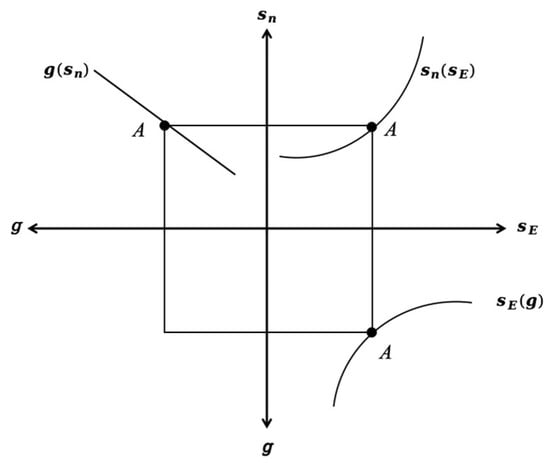
Equation (16) indicates that spatial industrial agglomeration (higher ) implies lower innovation costs, as the knowledge capital stock exhibits a higher growth rate under such conditions. This equilibrium growth rate also represents the system’s overall economic growth rate. The relationship among , , and g under general equilibrium conditions is illustrated in Figure 1
Figure 1.
Inter-relationship among , , and g under general equilibrium conditions (point A represents the initial equilibrium point). Image Source: Authors’ own creation.
2.3. The Mechanism of the HSR Network’s Influence on the Spatial Evolution of Regional Industries
2.3.1. Market Size Effect: Industrial Spatial Agglomeration Driven by the HSR Network
The “iceberg” costs of inter-regional industrial products () encompass both explicit transportation costs and implicit transaction costs [24]. Reductions influence the former in freight costs (D), while the latter is affected by savings in time value (T):
where denotes the spatial distance between manufacturers outside the region and region 0. Differentiating equilibrium expression (14) with respect to D and T yields the following:
Formulas (18) and (19) reveal that regions with larger market sizes and stronger economic development stand to gain more from the financial activities generated by HSR network connectivity.
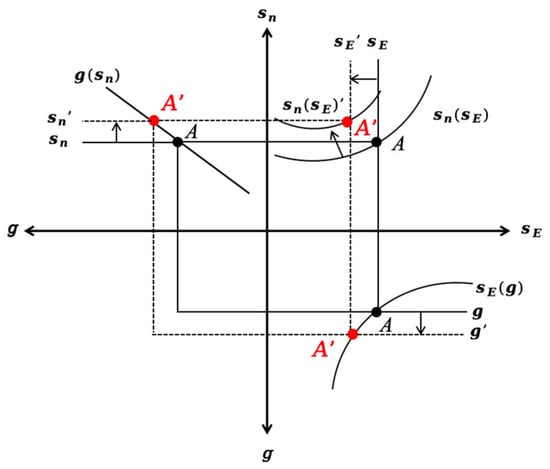
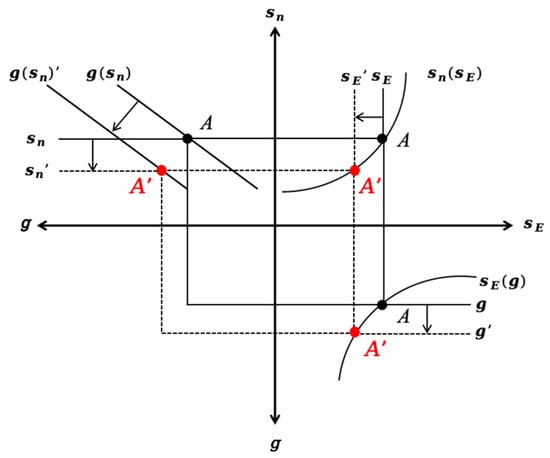
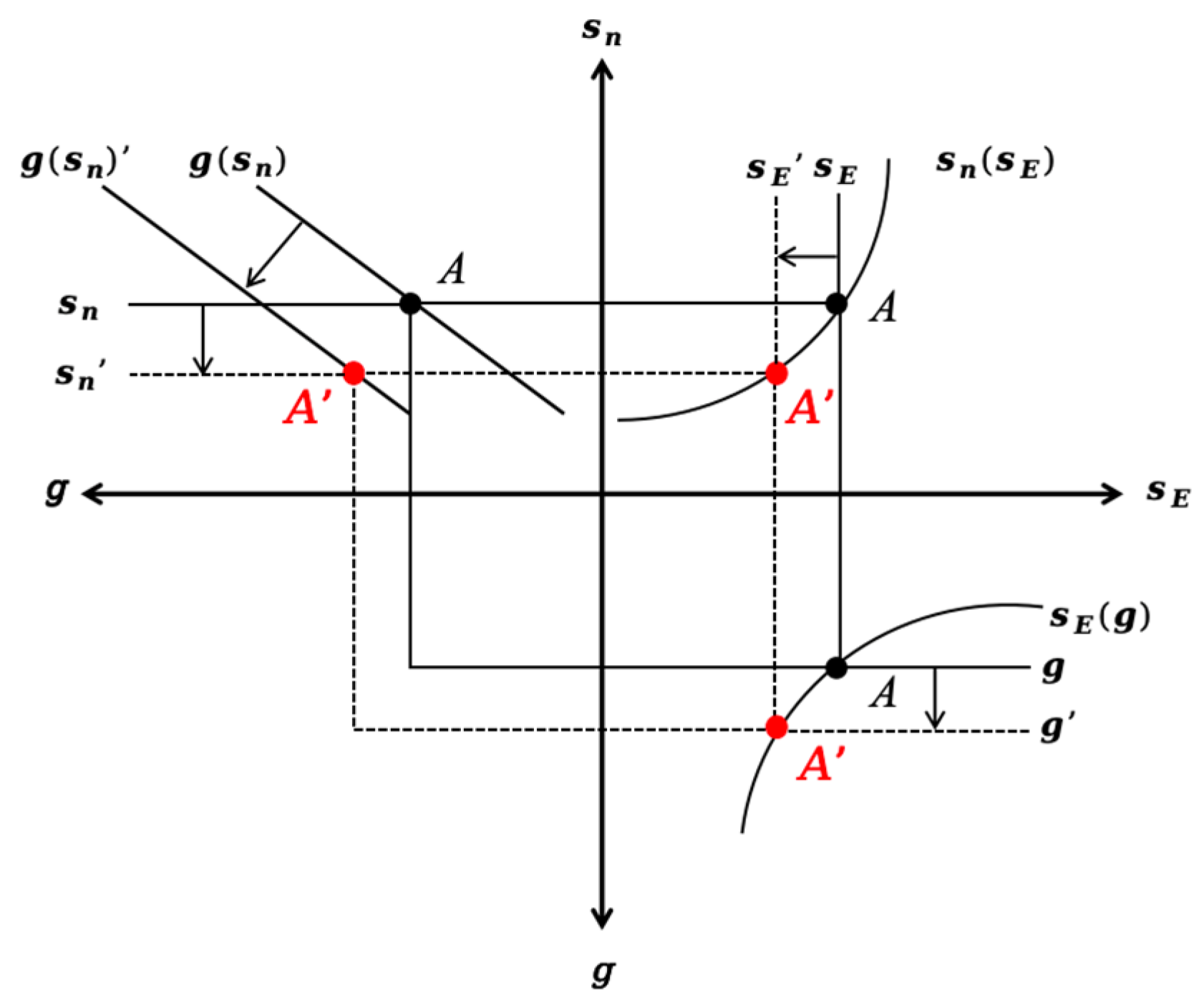
As shown in Figure 2, the reduction in inter-regional transaction costs brought about by the HSR network shifts the curve upward in the first quadrant. This enhances the attractiveness of enterprises in regions with larger market size and stronger economic development, thereby increasing industrial spatial concentration driven by the local market effect. Simultaneously, as the increases, the equilibrium growth rate of knowledge capital also rises. Existing studies indicate that HSR can release the market scale effect through multiple channels. On the one hand, factor mobility reflects the market’s spatial distribution. HSR significantly shortens the temporal distance between regions, improves factor allocation efficiency, breaks traditional market segmentation, and strengthens the market advantages of core regions. It also enhances enterprises’ market accessibility and reduces transaction costs [25,26,27], further increasing core regions’ attractiveness to enterprises. On the other hand, by tapping into freight potential and promoting logistics cost reduction [28,29], HSR not only consolidates the market scale advantages of core regions but also affects the development of peripheral regions through the market linkage effect, resulting in development disparities between them. Based on this, Hypothesis 1 and Hypothesis 2 are proposed.
Figure 2.
Industrial spatial agglomeration induced by market size through the HSR network (A’ represents the new equilibrium point). Image source: Modified from “Richard Baldwin, Rikard Forslid et al. Economic Geography and Public Policy [M]. Princeton University Press, 2003, P. 431” [30].
Hypothesis 1:
After regional access to the HSR network, the market size effect—driven by reduced freight costs and time savings—enhances the attractiveness of firms in core regions with larger markets, thereby increasing industrial spatial agglomeration and boosting the overall economic growth rate.
Hypothesis 2:
After regional access to the HSR network, the market size effect—driven by reduced freight costs and time savings—diminishes the attractiveness of firms in peripheral regions, yet narrows the nominal income gap between these regions and core regions.
2.3.2. Knowledge Spillover Effect: Industrial Spatial Diffusion Induced by the HSR Network
HSR primarily transports people, who constitute the most effective medium for information transmission. Face-to-face interactions enable the most efficient transfer of knowledge, technology, and information. As a result, the advancement of the HSR network significantly enhances inter-regional knowledge spillovers. Thus, the following relationship holds:
By differentiating H with respect to equilibrium expressions (14), (15) and (16), we obtain the following:
Formula (21) demonstrates that the expansion of the HSR network reduces the degree of spatial agglomeration of industries in regions with higher knowledge intensity by promoting inter-regional knowledge spillover. This facilitates the entry of new industries into peripheral regions with lower knowledge intensity and economic growth, ultimately driving industrial spatial diffusion.
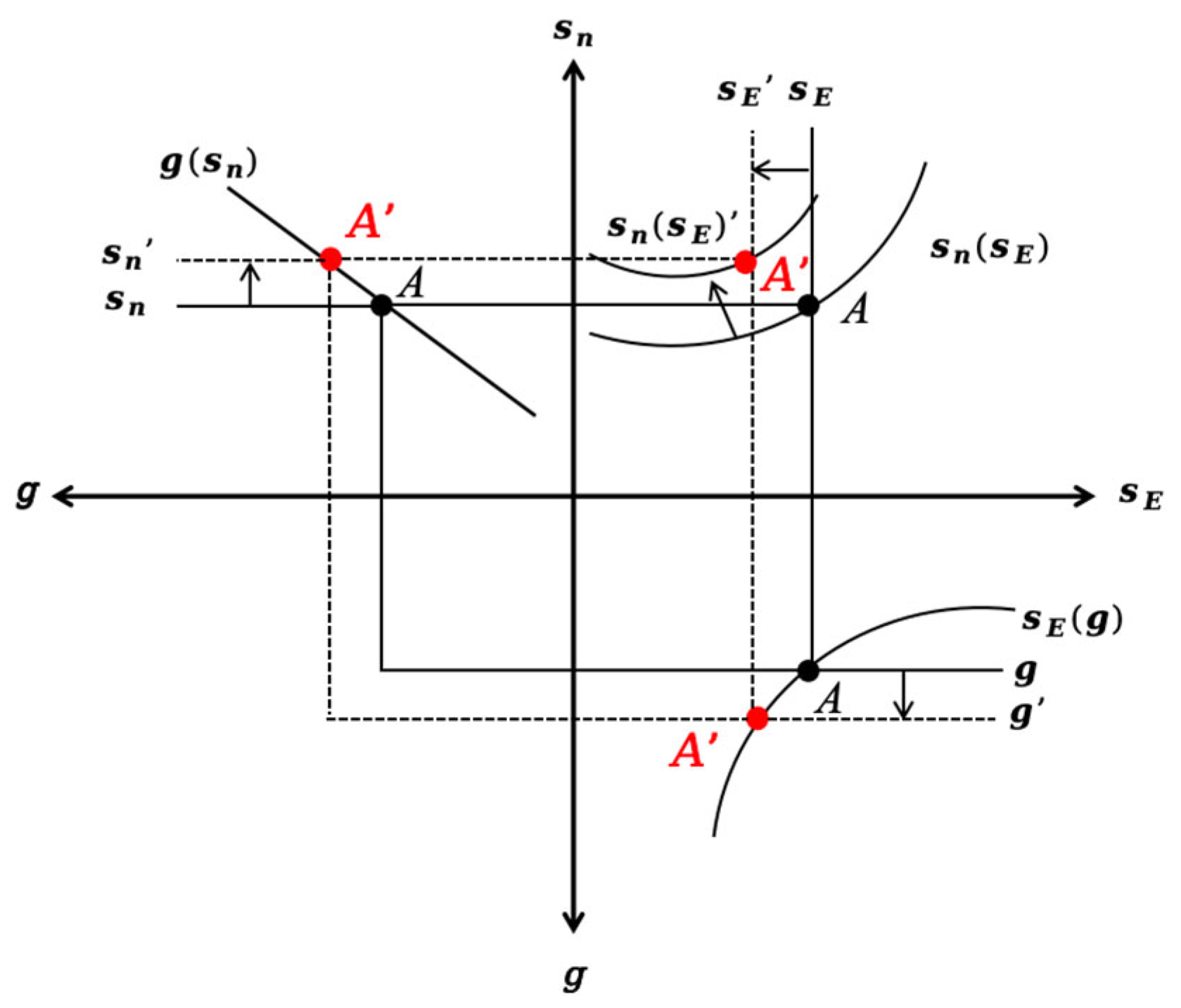
As shown in Figure 3, increased inter-regional knowledge spillover activities facilitated by the HSR network shift the second-quadrant curve to the left, raising the equilibrium economic growth rate. The high-growth economic environment attracts more enterprises into the market, weakening the monopoly power of existing enterprises and reducing the income of capital owners. This narrows the nominal income gap between regions and drives enterprises to relocate from core regions with higher knowledge intensity to peripheral regions with lower knowledge intensity. At this point, the “price index” gap and the nominal income gap change in the same direction, thereby reducing the actual income gap between regions.
Figure 3.
Industrial spatial diffusion induced by knowledge spillover through the HSR network (A’ represents the new equilibrium point). Image source: Modified from “Richard Baldwin, Rikard Forslid et al. Economic Geography and Public Policy [M]. Princeton University Press, 2003, P. 434” [30].
It should be noted that the spatial connection of industrial activities and the inter-city diffusion of knowledge are not only driven by high-speed rail, but can also be realized through multiple transportation and communication modes, and the actual industrial spatial evolution is the result of the joint action of multiple paths. Online meeting methods break through the spatial constraints of inter-city communication, reduce the cost of explicit information transmission to a certain extent, and have become an important supplement to inter-city communication in the digital era; air travel, with its advantages in long-distance passenger transport, also plays a role in connecting core regions with remote peripheral regions. However, there are obvious differentiated characteristics and complementary relationships between these modes and HSR in promoting industrial diffusion. For online communication, it is difficult to transmit tacit knowledge such as technical experience, industrial insights and management skills that rely on on-site observation, emotional interaction and real-time feedback, while the offline face-to-face communication facilitated by HSR can make up for this deficiency, which is the core premise of effective knowledge spillover and industrial collaborative cooperation [31,32]. For air travel, although it has a speed advantage in long-distance travel, its high time cost related to airport access and waiting, low travel frequency and poor accessibility to urban centers make it difficult to meet the demand of frequent inter-city travel for enterprise personnel in the process of industrial spatial expansion, especially for medium and short-distance inter-city links in urban agglomerations and metropolitan areas [33,34]. In contrast, HSR has the characteristics of high frequency, short waiting time, high accessibility to urban central areas and low medium–short distance travel cost, which are more in line with the travel demands of regular face-to-face communication and on-site research between core and peripheral cities, and thus HSR forms a unique advantage in driving the diffusion of industrial activities to adjacent urban areas [35]. The focus here is on the mechanism by which the HSR network influences the spatial evolution of regional industries through knowledge spillover. It does not deny the role of other transportation and communication methods, but rather, based on the research background of the spatial distribution of new industries across regions, explores the independent and direct role of HSR in multi-modal transportation and communication systems. Based on this, Hypothesis 3 and Hypothesis 4 are proposed.
Hypothesis 3:
After regional access to the HSR network, reduced freight costs and time savings have enhanced knowledge spillovers, leading to a decline in the level of industrial spatial agglomeration within knowledge-intensive core regions, while contributing to an increase in the overall economic growth rate.
Hypothesis 4:
After regional access to the HSR network, due to the knowledge spillover effect brought about by the reduction in freight costs and the time savings, it is conducive for the less knowledge-intensive peripheral regions to attract new industry to enter, and it also reduces the actual income gap with the more knowledge-intensive regions.
3. Material and Methods
3.1. Model Specification
The First Law of Geography posits that all phenomena are interconnected, with proximity strengthening these connections [36]. We employ the spatial panel model to investigate the relationship between the HSR network and the spatial evolution of regional industries.
3.1.1. Moran’s Index for Spatial Analysis
In this paper, the global Moran’s Index (Moran’s I) is utilized to check for spatial autocorrelation in the spatial evolution process of regional industries, as shown in Equation (22).
where N denotes the quantity of node regions, and represent the measured values corresponding to node regions i and j, respectively, stands for the average value of all observed data, refers to the spatial weight matrix, and is defined as the total of all spatial weights. The spatial weight matrix is central to spatial economic models. We construct a geographic distance matrix to capture the geographic connections among regions.
Spatial adjacency between regions is characterized by their relative distance, as follows.
Here, represents the geographic spatial matrix, stands for the geographic distance separating regions i and j, r is the Earth’s radius (set to 6371 km), and are the latitudes of regions i and j, is the difference in latitude between the two regions, and is the difference in longitude. Latitude and longitude values must be converted to radians for calculation.
3.1.2. Spatial Baseline Regression Model
We explore the research question by constructing an SDM, as detailed below.
Among these, represents the beginning of an industrial evolution cycle, while denotes the end of such a cycle, indicates the number of regional new industries entering at the end of an industrial evolution cycle, signifies the central position of different regions within the HSR network, and constitutes a series of control variables. denotes the time trend variable, represents the region-specific fixed effects that remain constant over time, and signifies the independently and identically distributed random error term. , , , and are the parameters to be estimated. Additionally, denotes the spatial spillover effect associated with new industrial entry at the regional level.
3.1.3. Spatial Mediation Effect Model
To investigate the mechanism through which the HSR network affects the spatial evolution of regional industries, we employ a three-step approach to construct a spatial mediation-effect model.
Here, M denotes the mediating variable.
3.2. Variable Selection
3.2.1. Core Dependent Variable: Entry of New Industries
Drawing on the methodologies of Liu [37] and He [38], we measure industrial spatial evolution by assessing whether new industries enter after the conclusion of an evolutionary cycle.
- (1)
- Revealed Comparative Advantage (RCA)
We construct the RCA index using data on listed enterprises from prefecture-level cities to characterize regional patterns of new industry entry.
Here, c denotes region, m denotes industry, t denotes time, and represents the development situation of industry m within region c during the t-th year. To determine a widely accepted threshold value for RCA [39], we adopt the self-service method developed by Tian [40]. The main steps are as follows:
(1) Calculate the standardized comparative advantage index (cRCA) for each industry.
(2) Determine the threshold of the actual cRCA distribution (mRCA) under the 5% significance level through multiple sampling. We set the number of samples to 1000.
(3) If the cRCA of industry m in region c exceeds the mRCA of industry m, then industry m is regarded as possessing a comparative advantage in region c.
We use the number of employees to measure the development level of industries.
- (2)
- Measurement of New Industrial Entry (Entry)
We adopt the methodology proposed by Li et al. [41] to measure the entry of regional new industries. If industry m in region c satisfies during year t of an evolutionary cycle, and at the end of the cycle in year t + T, then industry m is considered to have entered region c. Conversely, if industry m consistently satisfies throughout the entire evolutionary cycle, it is deemed not to have entered region c, as illustrated below.
At the end of an evolutionary cycle, if the new industry m enters region c, then ; otherwise, . Following the approach of Coniglio et al. [42] and Zhu et al. [43], we set T = 4. Therefore, industry-level data must be aggregated to the regional level to form a balanced panel dataset, as follows.
Here, denotes the number of new industries entering region c at the end of an industrial evolution cycle.
3.2.2. The HSR Network Indicators
Due to the directional nature of HSR services, we have constructed a weighted directed network of the Chinese HSR system to better simulate its actual development. The weight of each connection is represented by the frequency of HSR operations, and the importance of different regions in the HSR network is evaluated using centrality indicators. Common centrality indicators include degree centrality and betweenness centrality [44], which mainly measure the connectivity and transitivity. Additionally, we have further employed closeness centrality to assess the accessibility of different regions in the HSR network.
- (1)
- Degree Centrality
Degree centrality denotes the quantity of nodes connected to a specific node. In the HSR network, regions with direct connections to more regions exhibit stronger connectivity.
represents the degree centrality, where N represents the set of regions within the HSR network. If there is HSR service between region i and j, ; otherwise, . () represents the HSR service intensity between region i and j (or region j and i), expressed as the daily operational frequency of HSR services.
- (2)
- Betweenness Centrality
Betweenness centrality gauges how often a node falls on the shortest path between other nodes in a network. If the region lies on the “shortest path” between two other regions, it is considered to control interactions between those regions, indicating stronger transitivity.
where is the betweenness centrality; denotes the count of shortest paths between regions j and k; and refers to how many times region i lies on the shortest path connecting regions j and k.
- (3)
- Closeness Centrality
Closeness centrality denotes the reciprocal of the average shortest path length linking a given node and all other nodes within the network. A region with higher closeness centrality indicates greater accessibility, as it enables faster connections to other regions. The indicator draws upon the methodology established by Wasserman et al. [45].
represents closeness centrality; denotes the number of fully connected regions within the network in the t-th year; and indicates the shortest path distance linking regions i and j.
- (4)
- HSR Network Index (HN)
No single metric can fully capture the interaction relationships between regions. Therefore, we represent the overall centrality of a certain region within the HSR network using a composite index [46,47], as detailed below:
Among these, represents the HSR network index in year t; , , and denote the respective weights for the corresponding centrality metrics. The weights determined via the coefficient of variation method are 0.2717867, 0.1520743, and 0.576139, respectively. The calculated varies between 0 and 100.
3.2.3. Other Variables
The mediating variables and control variables are shown in the Table 1.
Table 1.
The mediating variables and control variables.
We employ the perpetual inventory method to measure the accumulation of physical capital on the basis of the annual fixed-asset investment data, using 2008 as the base year, as follows:
where denotes the capital stock of region c during the t-th year; denotes the fixed asset investment of region c during the t-th year; denotes the average fixed asset growth rate of region c from 2008 to 2020; is the fixed asset investment price index for different regions (we use provincial-level data as a proxy); and is the fixed asset depreciation rate in year t, and we use 10.96% as the reference value [50].
3.3. Sample Selection
3.3.1. Selection and Processing of Enterprise Samples
Our research sample database consists of Chinese A-share-listed companies during the period from 2008 to 2020. The sample data are sourced from the CSMAR database and have undergone cross-verification and manual refinement with the CNRDS database. The initial sample underwent screening according to the following process: (1) exclusion of samples subject to ST (Special Treatment) and *ST (Delisting Risk Warning); (2) exclusion of samples with missing key data, and application of 1% tail trimming to eliminate the impact of outliers; and (3) aggregation of data to the regional-industry level based on the location and industry affiliation of listed companies.
3.3.2. Adjustment of Two-Digit Industry Categories
The industry data covered in this paper span 2008–2020, during which China’s national economic industry classification followed two standards: GB/T4754-2011 [51] and GB/T4754-2017 [52]. To enable cross-year comparability, we align these two standards to establish a unified classification system comprising 19 categories and 90 industries. Following data processing and industry category adjustments, we ultimately obtain observational data for 81 industries across 250 prefecture-level cities from 2008 to 2020, totaling 263,250 observations. Furthermore, we aggregate industry data to the prefecture-level city level, resulting in 2250 panel data points.
3.3.3. Determination of Node Regions in the HSR Network
By the end of 2020, China’s HSR network had covered 95% of cities with a permanent population of over one million, including most prefecture-level cities. Thus, this study selected 250 prefecture-level and above cities (either connected or potentially connected to the HSR network) as research samples. Cities not yet integrated into the HSR network, termed “isolated nodes”, had zero relevant indicators and did not affect the indicator values of HSR-connected cities [53]. HSR operational data were retrieved from China’s official 12,306 platform, covering all high-speed trains prefixed with C, D, and G. Data from multiple HSR stations within the same city were consolidated; for instance, Beijing South Station and Beijing West Station were unified as “Beijing”.
4. Analysis of the Characteristics of China’s Regional Industrial Spatial Evolution from 2008 to 2020
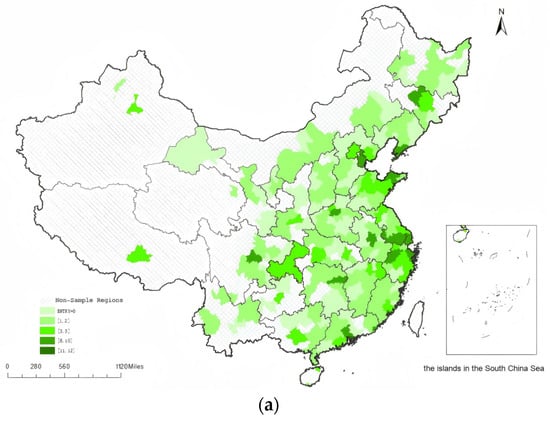
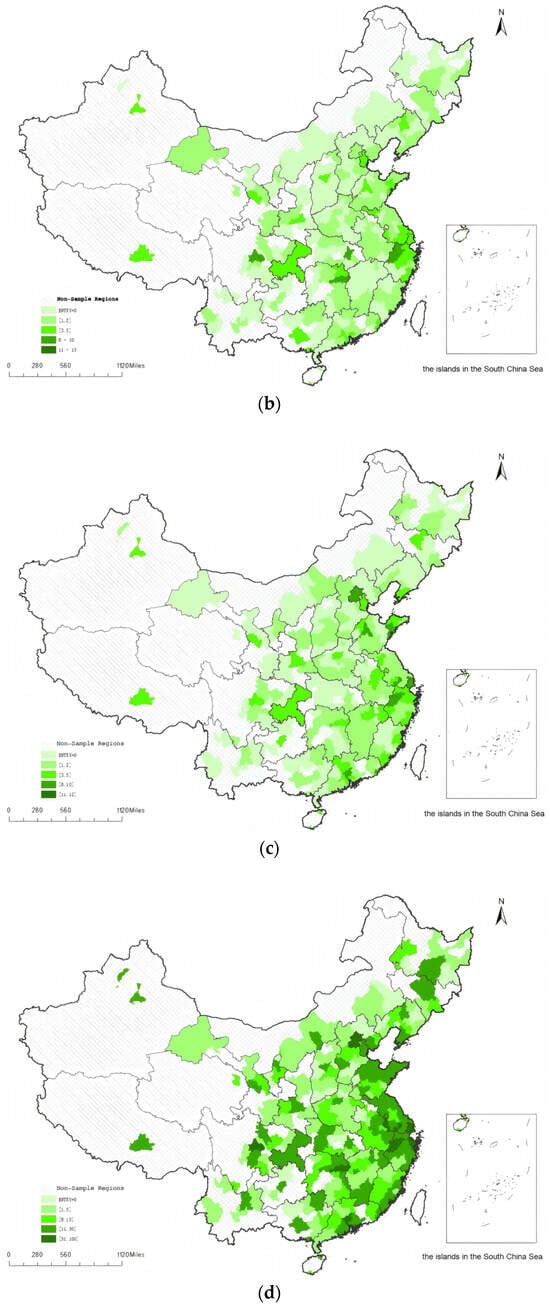
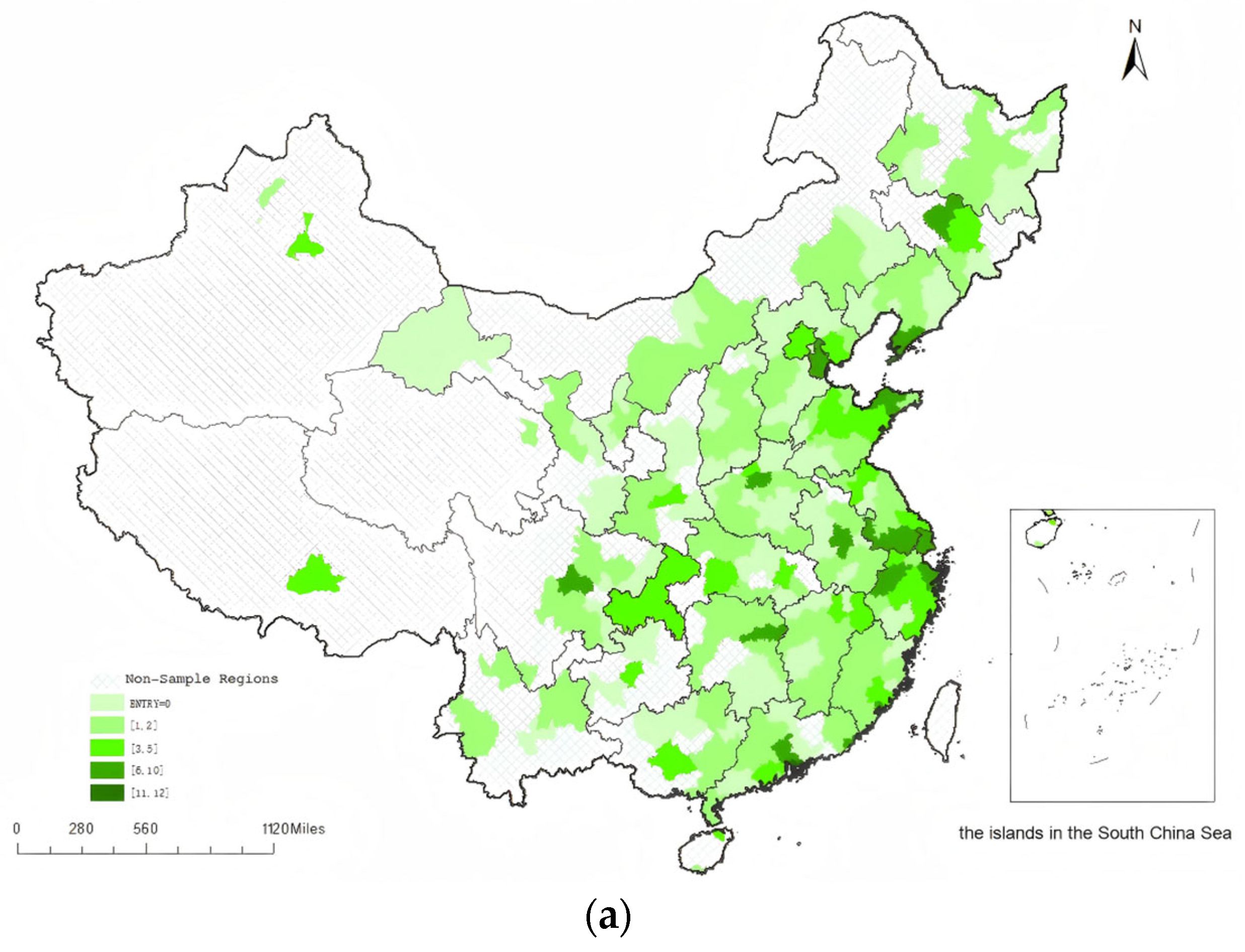
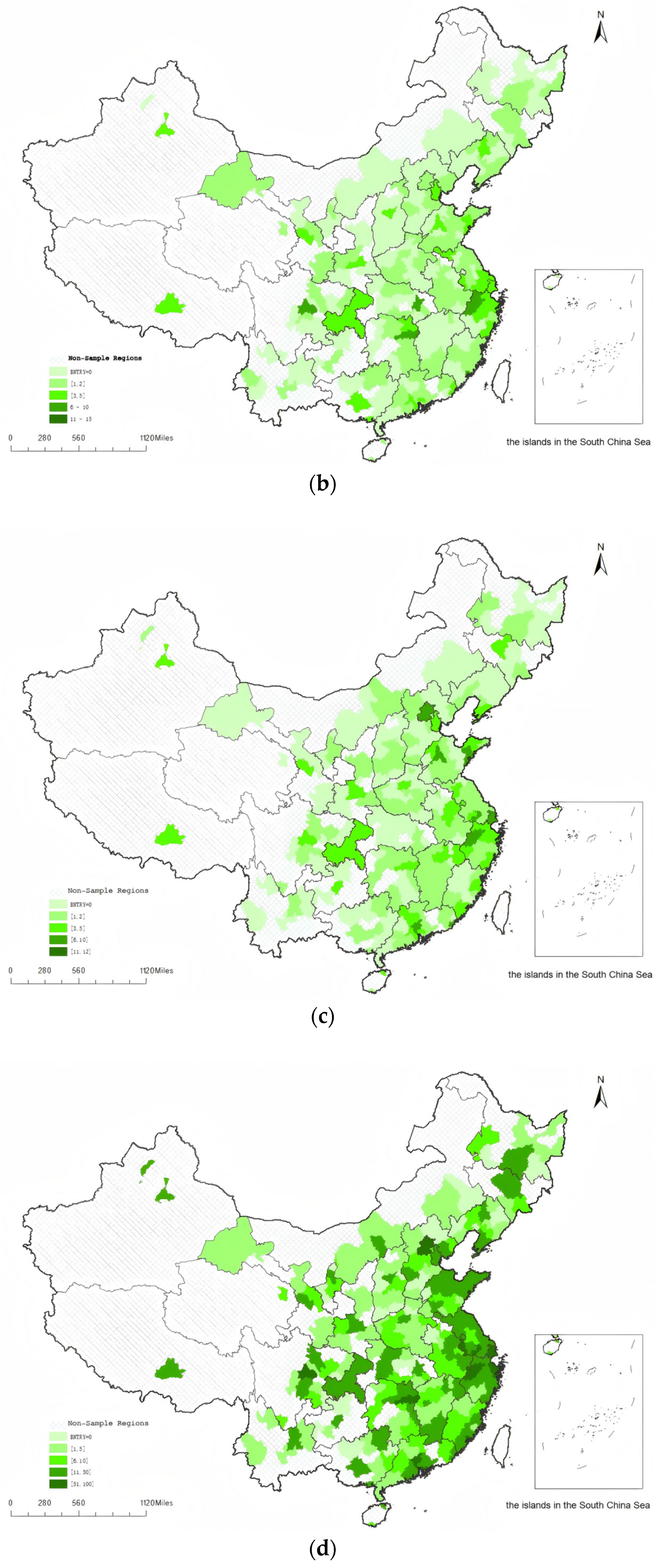
Over the period 2008–2020, a total of 3235 new industries cropped up in our study regions. To gain insight into the spatial evolution of China’s regional industries, we examine three industrial evolution cycles: 2008–2012, 2012–2016, and 2016–2020, as shown in Figure 4; the color scale in the map represents different ranges of the number of new industries.
Figure 4.
A Diagram illustrating the characteristics of regional industrial spatial evolution (2008–2012, 2012–2016, 2016–2020, and by the end of 2020). Image source: Authors’ illustration. (a) 2008–2012, (b) 2012–2016, (c) 2016–2020, and (d) 2008–2020.
Over the 2008–2020 period, China’s regional industrial spatial evolution exhibited a spatio-temporal distribution characterized by “initial overall agglomeration followed by directional diffusion”—culminating in the evolutionary outcome of “diffusive agglomeration.” The first chart in Figure 4 depicts the spatial distribution of new industry entry across China spanning 2008 to 2012. Predominantly, new industry entry clustered in the Yangtze River Delta (YRD) and Pearl River Delta (PRD) urban agglomerations during this phase. Of note, the three cities with the highest number of new industry entry were Shenzhen (12 industries), Hangzhou (10 industries), and Suzhou (10 industries)—a tie for second place between the latter two. The second chart in Figure 4 outlines the spatial spread of new industry entry in China over the 2012–2016 cycle. In contrast to the prior industrial evolution cycle, this phase displayed a “horizontal diffusion” spatial pattern—with diffusion primarily unfolding along the middle reaches of the Yangtze River. For cities with six or more new industry entries, the share of those located in central and western China rose markedly: Wuhan led this group with eight new entries, followed by Chengdu (seven) and Changsha (six). The third chart in Figure 4 illustrates the spatial distribution of new industry entry across China over the 2016–2020 period. Over this timeframe, new industry entries exhibited a “vertical diffusion” spatial pattern—with key diffusion areas spreading outward from China’s eastern coastal regions. Beyond that, northern China saw growth in the number of cities welcoming new industry entries. Case in point: Beijing, Qingdao, and Jinan logged eight, seven, and six new industry entries each. The last chart in Figure 4 presents the spatial spread of new industry entry across China by the close of 2020. It can be seen that new industry entry presents a “diffusive agglomeration” pattern, mainly manifested in the spatial diffusion of industries among the YRD, PRD, Beijing-Tianjin-Hebei Region (BTH), Central Yangtze River Region (CYR), and Chengdu-Chongqing Region (CY), as well as the spatial agglomeration in the core areas of these urban agglomerations. Table 2 shows the number of new industries in each region and their regional rankings.
Table 2.
The number of new industries in the region and their regional rankings.
5. Baseline Regression Analysis
5.1. The Spatial Correlation Analysis Results Based on Global Moran’s I
Table 3 presents the global Moran’s I values for the entry of new industries across regions. All values are positive and statistically significant, indicating a positive spatial correlation in the regional distribution of new industrial entries. Based on this, we employ a spatial econometric model to examine the impact of the HSR network.
Table 3.
Moran’s I of regional industrial spatial evolution.
5.2. Benchmark Regression Results on the Impact of the HSR Network on the Spatial Evolution of Regional Industries
Table 4 presents both the OLS regression results without spatial factors and the SDM regression results incorporating spatial factors.
Table 4.
Benchmark regression results estimated by the model: the OLS regression and the SDM regression.
Without considering spatial factors, model (1) indicates that regions with a higher HN have a greater possibility of new industries entering. Similarly, when considering spatial factors, models (2) to (5) show that the higher the centrality of the region in the HSR network, the greater the possibility of new industries entering. The order of influence on regional industrial spatial evolution, from strongest to weakest, is connectivity (0.191026) accessibility (0.116829) transitivity (0.107675). Regression results of control variables show that ins, financial, capital and highway significantly affect the spatial evolution of regional industries. Among them, ins has a positive effect on new industry entry at the 5% significance level; financial has a significant negative effect at the 1% level, possibly due to the crowding-out effect from fiscal expenditure concentrated on existing industries; and capital positively promotes regional new industry entry at the 1% significance level, indicating the pivotal role of traditional production factor accumulation. In addition, highway has a significant positive impact, confirming that an improved transportation network is fundamental, leading and strategic for regional economic development. Furthermore, we decompose the impact of the HSR network on new industry entry across regions into direct effects and spillover effects. The direct effect refers to the economic impact generated by the development of HSR in a specific region itself. The spillover effect represents the influence of the development of HSR in adjacent regions on the economic activities of this region. This is shown in Table 5.
Table 5.
Decomposition of the effects of the HSR network on regional industrial spatial evolution.
From the perspective of direct effects, access to the HSR network significantly promotes the entry of new industries into a region. Among the various HSR network indicators, the magnitude of influence follows this order: connectivity (0.196399) > accessibility (0.143953) > transitivity (0.115371). Regarding spillover effects, the development of the HSR network in neighboring regions exerts a significant influence on local economic activities, with the effect sizes ranked as accessibility (6.271291) > transitivity (1.387917) > connectivity (0.969531). Finally, in terms of total effects of the HSR network on regional new industrial entry, the impact ranking is accessibility (6.415244) > transitivity (1.503288) > connectivity (1.165930). It is worth noting that the ranking of total effects is consistent with that of spillover effects, and accessibility is significantly superior to those of connectivity and transitivity. This observation implies that the improvement of accessibility in node regions within the HSR network can effectively surmount geographical barriers, and facilitate the rapid cross-regional mobility of production factors, technological achievements, and human resources, thereby serving as the core driving force for the infiltration of new industries into these regions. Further in-depth analysis reveals that the contribution of spillover effects is substantially higher than direct effects. This result demonstrates that the entry of new industries is not geographically segregated; instead, it exhibits a prominent characteristic of “neighborhood linkage”, which reflects the interdependent relationship between adjacent regions in industrial development.
6. Analysis of Influencing Mechanism and Heterogeneity
On one hand, we investigate the mechanisms through which the HSR network affects regional industrial spatial evolution, focusing on market size and knowledge spillovers, and assess the relative magnitude of each. On the other hand, we analyze the heterogeneous impacts of the HSR network across “core-periphery” regions.
6.1. Analysis of the Influencing Mechanism
6.1.1. The HSR Network Influences Industrial Spatial Evolution Through Market Size
We investigate the impact of the HSR network on regional market size, and examine whether this influence serves as a mediating pathway through which the HSR network affects the entry of new industries (see Table 6 and Table 7).
Table 6.
Regression results of the impact of the HSR network on the regional market size.
Table 7.
Impact of the HSR network and market size on regional industrial spatial evolution.
Considering spatial factors, models (1) to (4) indicate that the higher the central position of the region in the HSR network, the greater the positive impact on its market size. As the “leading capital” for economic activities, the HSR network, by reducing generalized transportation costs, has changed the spatial layout of capital, labor and other factor resources, accelerated product production and exchange, and thereby expanded the market size. Furthermore, we explore the impact of the HSR network on the entry of new industries through its influence on market size.
When incorporating both the HSR network and market size variables into the model while accounting for spatial factors, models (1)–(4) reveal that all coefficients for the HSR network indicators (except ) and market size are significantly positive. This confirms the mediating role of market size in the process where the HSR network influences regional industrial spatial evolution. From the perspective of action mechanisms, the HSR network narrows the temporal and spatial gaps between regions and cuts down the flow costs of production factors. This not only effectively expands the market radiation range of various regions but also drives the agglomeration of production factors in advantaged regions. In turn, the market size effect facilitates the entry of new industries, ultimately exerting a fundamental influence on the spatial evolution of regional industrial systems.
6.1.2. The HSR Network Influences Industrial Spatial Evolution Through Knowledge Spillovers
We investigate the impact of the HSR network on regional knowledge spillover, and examine whether this influence serves as a mediating pathway through which the HSR network affects the entry of new industries (see Table 8 and Table 9).
Table 8.
Regression results of the impact of the HSR network on the regional knowledge spillover.
Table 9.
Impact of HSR network and knowledge spillover on regional industrial spatial evolution.
Considering spatial factors, models (1)–(4) reveal that, apart from , the higher a region’s centrality within the network, the greater the positive impact on its knowledge spillovers. As the primary mode of rapid passenger transport along major corridors, HSR primarily serves knowledge-based labor with relatively high time costs. Labor is the most efficient carrier of knowledge and information, and the networked development of HSR promotes increased knowledge spillover between regions through mechanisms of human capital mobility, learning and collaborative innovation, and investment and transactions. Furthermore, we explore the impact of the HSR network on the entry of new industries through its influence on knowledge spillover.
When incorporating both the HSR network and knowledge spillovers into the model while accounting for spatial factors, results from models (1)–(4) reveal that all coefficients for HSR network indicators (except ) and knowledge spillover are significantly positive. This confirms the mediating role of knowledge spillover in the process of the HSR network’s impact on the spatial evolution of regional industries. In terms of the operational mechanism, the optimization of the HSR network has strengthened inter-regional connectivity. By breaking down geographical obstacles in knowledge dissemination, it cuts the costs of knowledge exchange and diffusion, speeds up the cross-regional mobility of knowledge factors such as technology, talents and information, and further drives the entry of new industries in various regions through the effect of knowledge spillovers. This process, in turn, exerts a profound influence on the upgrading of regional industrial structures and the reconstruction of their spatial patterns.
6.2. Heterogeneity Analysis of Core-Periphery Regions
In China’s urban ecosystem, there are 36 core cities. Economic data from 2022 indicate that the GDP of these 36 core cities accounted for 38.42% of the national total. The list of core cities and their spatial distribution is presented in Table 10.
Table 10.
Distribution of 36 core cities in China.
We primarily investigate the heterogeneous impact of the HSR network on the spatial evolution of industries in “core-periphery” regions with markedly different socioeconomic development levels.
6.2.1. Analysis of the Impact of the HSR Network on Core Regions
Table 11 presents both OLS regression results without spatial factors and SDM regression results incorporating spatial factors.
Table 11.
Regression results of the impact of the HSR network on the core regions.
Without accounting for spatial factors, model (1) indicates that a higher HSR network index in core regions is associated with a greater likelihood of new industrial entry. When incorporating spatial factors, models (2)–(5) reveal that the higher centrality of core regions within the HSR network increases new industrial entry probability. The transitivity effect outweighs the connectivity effect, while accessibility shows no significant influence on new industry entry in core regions. Based on the core conclusions of Section 6.1.1, the time value gains and freight cost cuts brought by the HSR network have together reduced inter-regional transaction costs and enhanced knowledge spillover behaviors. The presence of network effects has further amplified this trend, and in turn exerted a far-reaching impact on the spatial evolution of regional industries. Notably, driven by the market size effect, the HSR network has optimized the operation mechanism of “geographic proximity”, which has increased the appeal of core regions to enterprises and thus promoted the spatial agglomeration of industries. This empirical finding verifies the logical framework: “HSR network → market size → new industry entry → spatial agglomeration.”
6.2.2. Analysis of the Impact of HSR Network on Peripheral Regions
Table 12 presents both the OLS regression results without spatial factors and the SDM regression results incorporating spatial factors.
Table 12.
Regression results of the impact of the HSR network on the peripheral regions.
Without accounting for spatial factors, model (1) indicates that a higher HSR network index in peripheral regions is associated with a greater likelihood of new industrial entry. When incorporating spatial factors, models (2)–(5) reveal that higher centrality in the HSR network within peripheral regions correlates with greater new industrial entry likelihood. Among these, connectivity exerts a more decisive influence than accessibility, while transitivity shows no significant effect on industrial entry in peripheral regions. Based on the main conclusions of Section 6.1.2, the time savings and freight cost reductions induced by the HSR network have collectively reduced inter-regional transaction costs and promoted the growth of knowledge spillover activities. The existence of network effects has further strengthened this process, which eventually exerts a significant impact on the spatial evolution of regional industries. Specifically, under the influence of the knowledge spillover effect, the HSR network has loosened the constraints imposed by “geographical proximity”, making it easier for peripheral regions with low knowledge intensity to attract enterprise inflows and thereby facilitating the spatial diffusion of industries. This finding confirms the logical framework put forward in this paper, namely “HSR network → knowledge spillover → new industry entry → spatial diffusion”.
7. Conclusions, Policy Implications and Future Research
We extend the traditional LS model by integrating the HSR network as a core mechanism, thereby explaining the theoretical path of the HSR network’s impact on the spatial evolution of regional industries from the perspective of new industry entry. Based on data from Chinese A-share-listed companies, this paper uses the SDM and spatial mediation effect model to conduct empirical tests.
7.1. Main Research Conclusions
- (1)
- The derivation results of the innovative LS model show that the impact of the HSR network is realized through two different mechanisms. On the one hand, driven by the market size effect, the HSR network enhances the attractiveness of core regions with larger markets to new firms, thereby accelerating the spatial agglomeration of industries in these regions. On the other hand, by reducing geographical resistance to knowledge flow, the HSR network strengthens the knowledge spillover effect, making peripheral regions with lower knowledge intensity more attractive to new firms and promoting the spatial diffusion of industries toward peripheral regions.
- (2)
- The analysis of the characteristics of the spatial evolution of China’s regional industries shows that from 2008 to 2020, a total of 3235 new industries entered the sample regions. This evolution process is characterized by initial large-scale spatial concentration, followed by gradual directional diffusion, and finally, an evolutionary outcome of “diffusive agglomeration.” The cities with the highest number of new industry entries are Hangzhou, Shanghai, and Guangzhou.
- (3)
- Both OLS and SDM regression results confirm that regions with higher network centrality are more likely to have new industry entry. The relative impact of different HSR network indicators is in the order of connectivity (0.191026) > accessibility (0.116829) > transitivity (0.107675). However, when both direct and spillover effects are considered, the influence ranking changes to accessibility (6.415244) > transitivity (1.503288) > connectivity (1.165930), indicating that accessibility has the strongest total effect through both local attraction and inter-regional spillover effects.
- (4)
- Mechanism analysis shows that the HSR network has a stronger impact on new industry entry through knowledge spillovers than through market size effects. Specifically, the estimated coefficient of the knowledge spillover effect is 1.429699, while that of the market size effect is 1.399637. This finding confirms the key role of HSR’s unique “transporting people, not goods” operation mode, which is more effective in promoting the exchange of knowledge, technology, and information than in reducing the physical transportation costs of goods.
- (5)
- Heterogeneity analysis shows that the impact of the HSR network on new industry entry is stronger in peripheral regions (0.567598) than in core regions (0.363887). Therefore, HSR is a modern transportation mode that combines fairness and efficiency, balancing individual equity and spatial equity. Furthermore, spillover effect analysis shows that new industry entry in core regions is dominated by competitive relationships, while in peripheral regions it is dominated by cooperative relationships.
7.2. Policy Implications
Integrating the above findings with practical requirements, three targeted policy proposals are put forward to leverage the HSR network for advancing high-quality coordinated regional industrial development. First, optimize the HSR network layout by prioritizing accessibility. Specifically, strengthen line connections within core regions, and fill the gaps in HSR corridors and multi-modal transportation integration in peripheral regions. This will improve connectivity in peripheral regions and fully exert the radiation effects of HSR. Second, implement region-specific policies in response to the heterogeneous impact of the HSR network on core and peripheral regions—given that such impact is more notable in the latter. For core regions, efforts should be made to pursue high-end industrial upgrading and gradual industrial expansion. In contrast, peripheral regions ought to tap into their local resource endowments to undertake supporting industries and construct distinctive industrial clusters, so as to enhance in-depth regional collaboration. Third, improve cross-regional knowledge-sharing mechanisms. Taking advantage of HSR’s passenger-transport feature, it is necessary to establish integrated platforms for knowledge exchange and achievement commercialization, facilitate two-way talent flow between core and peripheral regions, refine cross-regional intellectual property protection and profit-sharing systems, and reinforce peripheral regions’ capacity to absorb and transform knowledge, thereby maximizing the industrial empowerment effect of knowledge spillovers.
7.3. Future Research Directions
Despite its systematic analysis of the HSR network’s impact on new industry entry, this study has certain limitations that point to clear avenues for future research. First, future studies can refine industrial classification criteria. We compile data from 81 industries based on China’s National Economic Industry Classification, while subsequent work may subdivide industries by functional attributes—such as national pillar industries and strategic emerging industries. Focusing on these differentiated sectors enables in-depth exploration of the HSR network’s heterogeneous impact mechanisms on new industry entry across various industries, thereby enriching research connotations and providing more targeted industrial development insights. Second, case study methodologies can be integrated to verify the applicability of the identified heterogeneous characteristics and policy implications. Typical core-peripheral regions, such as the YRD and PRD, can be selected as research objects. Through in-depth field surveys and micro-data analysis, the actual performance of the HSR network’s impact on new industry entry in specific regions can be examined, which helps validate the reliability of research conclusions and enhance the practical guiding value of the proposed policies.
Author Contributions
Conceptualization, M.L. and H.L.; methodology, M.L.; validation, M.L., H.L. and X.K.; data curation, M.L.; writing—original draft preparation, M.L., H.L. and H.W.; writing—review and editing, M.L., X.K.; supervision, H.W.; project administration, H.L.; funding acquisition, H.W. All authors have read and agreed to the published version of the manuscript.
Funding
This work is financially supported by the China Academy of Railway Sciences Group Co., Ltd. Scientific Research Project (2024YJ156).
Data Availability Statement
The raw data supporting the conclusions of this article will be made available by the authors on request.
Conflicts of Interest
The authors declare that this study received funding from China Academy of Railway Sciences Group Co., Ltd. The funder provided relevant data on the construction of the HSR network for this study.
References
- Boschma, R.; Minondo, A.; Navarro, M. Related variety and regional growth in Spain. Pap. Reg. Sci. 2012, 91, 241–256. [Google Scholar] [CrossRef] [Scilit]
- Neffke, F.; Henning, M.; Boschma, R. How do regions diversify over time? Industry relatedness and the development of new growth paths in regions. Econ. Geogr. 2011, 87, 237–265. [Google Scholar] [CrossRef] [Scilit]
- Tanner, A.N. The emergence of new technology-based industries: The case of fuel cells and its technological relatedness to regional knowledge bases. J. Econ. Geogr. 2015, 16, 611–635. [Google Scholar] [CrossRef] [Scilit]
- He, C.; Yan, Y.; Rigby, B. Regional industrial evolution in China. Pap. Reg. Sci. 2018, 97, 173–199. [Google Scholar] [CrossRef] [Scilit]
- Dong, X. High-speed railway and urban sectoral employment in China. Transp. Res. Part A Policy Pract. 2018, 116, 603–621. [Google Scholar] [CrossRef] [Scilit]
- Matas, A.; Raymond, J.L.; Roig, J.L. Evaluating the impacts of HSR stations on the creation of firms. Transp. Policy 2020, 99, 396–404. [Google Scholar] [CrossRef] [Scilit]
- Jin, W.; Zhu, S. High-speed rail network and regional convergence/divergence in industrial structure. Socio-Econ. Plan. Sci. 2023, 87, 101546. [Google Scholar] [CrossRef] [Scilit]
- Zhao, M.; Liu, X.; Derudder, B.; Zhong, Y.; Shen, W. Mapping producer services networks in mainland Chinese cities. Urban Stud. 2015, 52, 3018–3034. [Google Scholar] [CrossRef] [Scilit]
- Xuan, H.; Lu, J.; Yu, Y. The impact of high-speed rail opening on the spatial agglomeration of high-end service industry. Financ. Trade Econ. 2019, 40, 117–131. [Google Scholar]
- Zhang, Y.; Xu, D. Service on the rise, agriculture and manufacturing in decline: The labor market effects of high-speed rail services in Spain. Transp. Res. Part A Policy Pract. 2023, 171, 103617. [Google Scholar] [CrossRef] [Scilit]
- Xu, W.; Zhou, J.; Qiu, G. China’s high-speed rail network construction and planning over time: A network analysis. J. Transp. Geogr. 2018, 70, 40–54. [Google Scholar] [CrossRef] [Scilit]
- Zhong, Y.; Guo, W. High-speed rail network spatial structure and organization model in China. Geogr. Sci. 2020, 40, 79–88. [Google Scholar]
- Xu, S.; Wang, F.; Wang, K. Evaluation and optimization analysis of high-speed rail network structure in Northeast China under the background of northeast revitalization. Reg. Sustain. 2021, 2, 349–362. [Google Scholar] [CrossRef] [Scilit]
- Zhou, W.; Yang, R.; Hou, X. High-speed rail network, location advantage, and regional innovation. Econ. Rev. 2021, 4, 75–95. [Google Scholar]
- Tian, M.; Wang, Y.; Wang, Y. High-speed rail network and urban agglomeration economies: Research from the perspective of urban network externalities. Socio-Econ. Plan. Sci. 2022, 85, 101442. [Google Scholar] [CrossRef] [Scilit]
- Li, M.; Li, H.; Wang, K.; Shen, S. Dynamic network relationship between transportation and urban economy: A case study of China’s high-speed rail as a new transportation technology. Res. Transp. Econ. 2023, 102, 101360. [Google Scholar] [CrossRef] [Scilit]
- Coşar, A.K.; Guner, N.; Tybout, J. Firm dynamics, job turnover, and wage distributions in an open economy. Am. Econ. Rev. 2016, 106, 625–663. [Google Scholar] [CrossRef] [Scilit]
- Zhao, L. Spatial pattern evolution and spatial transformation trend of industry in China. Geogr. Sci. 2021, 41, 387–396. [Google Scholar]
- Liang, J.; Goetz, S.J. Technology intensity and agglomeration economies. Res. Policy 2018, 47, 1990–1995. [Google Scholar] [CrossRef] [Scilit]
- Zeng, P.; Huang, L.; Wei, X. Research on the spatial pattern evolution of China’s urban agglomerations’ three industries and its influencing factors. Stat. Decis. 2023, 39, 112–116. [Google Scholar]
- Desmet, K.; Henderson, J.V. The geography of development within countries. Handb. Reg. Urban Econ. 2015, 5, 1457–1517. [Google Scholar]
- Mao, F.; Gao, Y.; Zhou, C. Evolution characteristics of spatial patterns of digital industry and its driving factors in the Yangtze River Economic Belt. Geogr. Res. 2022, 41, 1593–1609. [Google Scholar]
- Baldwin, R.; Martin, P.; Ottaviano, G. Global income divergence, trade and industrialization: The geography of growth take off. J. Econ. Growth 2001, 6, 5–37. [Google Scholar] [CrossRef] [Scilit]
- Coase, R.H. The Nature of the Firm; London Oxford University Press: Oxford, UK, 1991. [Google Scholar]
- Bernard, A.B.; Moxnes, A.; Saito, Y.U. Production networks, geography and firm performance. J. Political Econ. 2019, 127, 639–688. [Google Scholar] [CrossRef] [Scilit]
- Pan, S.; Ye, D. Research on the impact of transport infrastructure on market segmentation—Evidence from high-speed rail opening and cross-district M&A of listed companies. Public Financ. Res. 2021, 3, 115–129. [Google Scholar]
- Liu, C.; Wu, Q.; Liu, Q. Transportation infrastructure, market access and firm productivity: A competition and resource reallocation perspective. Econ. Res. J. 2020, 55, 140–158. [Google Scholar]
- Shao, S.; Tian, Z.; Yang, L. High speed rail and urban service industry agglomeration: Evidence from China’s Yangtze River Delta Region. J. Transp. Geogr. 2017, 64, 174–183. [Google Scholar] [CrossRef] [Scilit]
- Li, M.; Li, H. Impacts of high-speed rail on regional economic growth: An empirical analysis of the moderated mediation effects. Transp. Res. Rec. 2023, 2678, 476–492. [Google Scholar] [CrossRef] [Scilit]
- Baldwin, R.E.; Forslid, R.; Martin, P.; Ottaviano, G.I.P.; Robert-Nicoud, F. Economic Geography and Public Policy; Princeton University Press: Princeton, NJ, USA, 2003. [Google Scholar]
- Zhao, J.; Huang, J.; Liu, F. China high-speed railways and stock price crash risk. Manag. World 2018, 34, 157–168+192. [Google Scholar]
- Ma, G.; Cheng, X.; Yang, E. How does transportation infrastructure affect capital flows—A study from high-speed rail and cross-region investment of listed companies. China Ind. Econ. 2020, 6, 5–23. [Google Scholar]
- Wan, Y.L.; Ha, H.K.; Yoshida, Y.; Zhang, A. Airlines’ reaction to high-speed rail entries: Empirical study of the Northeast Asian market. Transp. Res. Part A Policy Pract. 2016, 94, 532–557. [Google Scholar] [CrossRef] [Scilit]
- Chu, Y.; Ai, Y.; Wu, Z.; Zhang, H. Study on travel choice behavior of medium and long distance intercity passengers in the context of air-rail competition. Transp. Policy 2025, 170, 163–177. [Google Scholar] [CrossRef] [Scilit]
- Yi, W.; Long, X.; Lin, Z. Does distance affect university knowledge spillover—Empirical evidence from the opening of Chinese high-speed rail. China Ind. Econ. 2021, 9, 99–117. [Google Scholar]
- Tobler, W.R. A computer movie simulating urban growth in the Detroit region. Econ. Geogr. 1970, 46, 234–240. [Google Scholar] [CrossRef] [Scilit]
- Liu, X.; He, C. Research on technological linkages and urban industrial growth. Geogr. Res. 2016, 35, 717–730. [Google Scholar]
- He, C.; Qi, F.; Sheng, H. Venture capital, government-guided funds, and regional industrial evolution. Reg. Econ. Rev. 2024, 1, 13–21. [Google Scholar]
- O’Donoghue, D.; Gleave, B. A note on methods for measuring industrial agglomeration. Reg. Stud. 2004, 38, 419–427. [Google Scholar] [CrossRef] [Scilit]
- Tian, Z. Measuring agglomeration using the standardized location quotient with a bootstrap method. J. Reg. Anal. Policy 2013, 43, 186–197. [Google Scholar]
- Li, W.; He, C. Pathways of regional industrial evolution in China: A study based on technological relatedness and technological complexity. Prog. Geogr. 2021, 40, 620–634. [Google Scholar] [CrossRef] [Scilit]
- Coniglio, N.D.; Lagravinese, R.; Vurchio, D.; Armenise, M. The pattern of structural change: Testing the product space framework. Ind. Corp. Change 2018, 27, 763–785. [Google Scholar] [CrossRef] [Scilit]
- Zhu, S.; He, C.; Zhou, Y. How to jump further and catch up? Path-breaking in an uneven industry space. J. Econ. Geogr. 2017, 17, 521–545. [Google Scholar] [CrossRef] [Scilit]
- Wu, F.; Hao, L.; Wang, X.; Yue, H. The potential development pattern of service industries in eastern Chinese cities based on high-speed rail connectivity: A social network analysis perspective. Econ. Geogr. 2020, 40, 145–154. [Google Scholar]
- Wasserman, S.; Faust, K. Social network analysis: Methods and applications. Contemp. Sociol. 1995, 91, 219–220. [Google Scholar]
- Cao, W.; Feng, X.; Zhang, H. The structure and spatial properties of the high-speed railway network in China: A complex network perspective. J. Rail Transp. Plan. Manag. 2019, 9, 46–56. [Google Scholar] [CrossRef] [Scilit]
- Tian, M. Study on the Impact of High-Speed Railway Network Infrastructure on Agglomeration Economics in Cities Along the Route; China University of Geosciences: Wuhan, China, 2021. [Google Scholar]
- Li, S. Has the patent protection system enhanced Chinese industrial enterprises’ technological innovation enthusiasm? The ‘threshold effect’ based on patent protection intensity and regional economic development level. Financ. Trade Res. 2016, 28, 13–24. [Google Scholar]
- Liu, W.; Zhang, L. Economic development potential and human capital quality. Manag. World 2020, 36, 8–24+230. [Google Scholar]
- Shan, H. Re-estimation of China’s capital stock K: 1952–2006. J. Quant. Econ. Tech. Econ. 2008, 25, 17–31. [Google Scholar]
- GB/T 4754-2011; Industrial Classification for National Economic Activities. Standards Press of China: Beijing, China, 2011.
- GB/T 4754-2017; Industrial Classification for National Economic Activities. Standards Press of China: Beijing, China, 2017.
- Liu, S.; Wan, Y.; Zhang, A. Does China’s high-speed rail development lead to regional disparities? A network perspective. Transp. Res. Part A Policy Pract. 2020, 138, 299–321. [Google Scholar] [CrossRef] [Scilit]

Disclaimer/Publisher’s Note: The statements, opinions and data contained in all publications are solely those of the individual author(s) and contributor(s) and not of MDPI and/or the editor(s). MDPI and/or the editor(s) disclaim responsibility for any injury to people or property resulting from any ideas, methods, instructions or products referred to in the content. |
© 2026 by the authors. Licensee MDPI, Basel, Switzerland. This article is an open access article distributed under the terms and conditions of the Creative Commons Attribution (CC BY) license.