
Burnout Risk Management Framework (BRMF) in Project-Based Organizations: Emotional Intelligence Systemic Lever


Abstract
1. Introduction
2. Literature Synthesis
2.1. Defining PBOs as a Dynamic System
2.2. Burnout—Imbalance Between System Requirements (Load) and System Resources (Autonomy, Reward)
2.3. Systems Thinking and System Dynamics
2.4. Emotional Intelligence—Adaptive Capacity of the System for Early Detection and Regulation of Emotional Disturbances in the Team
3. Methodology
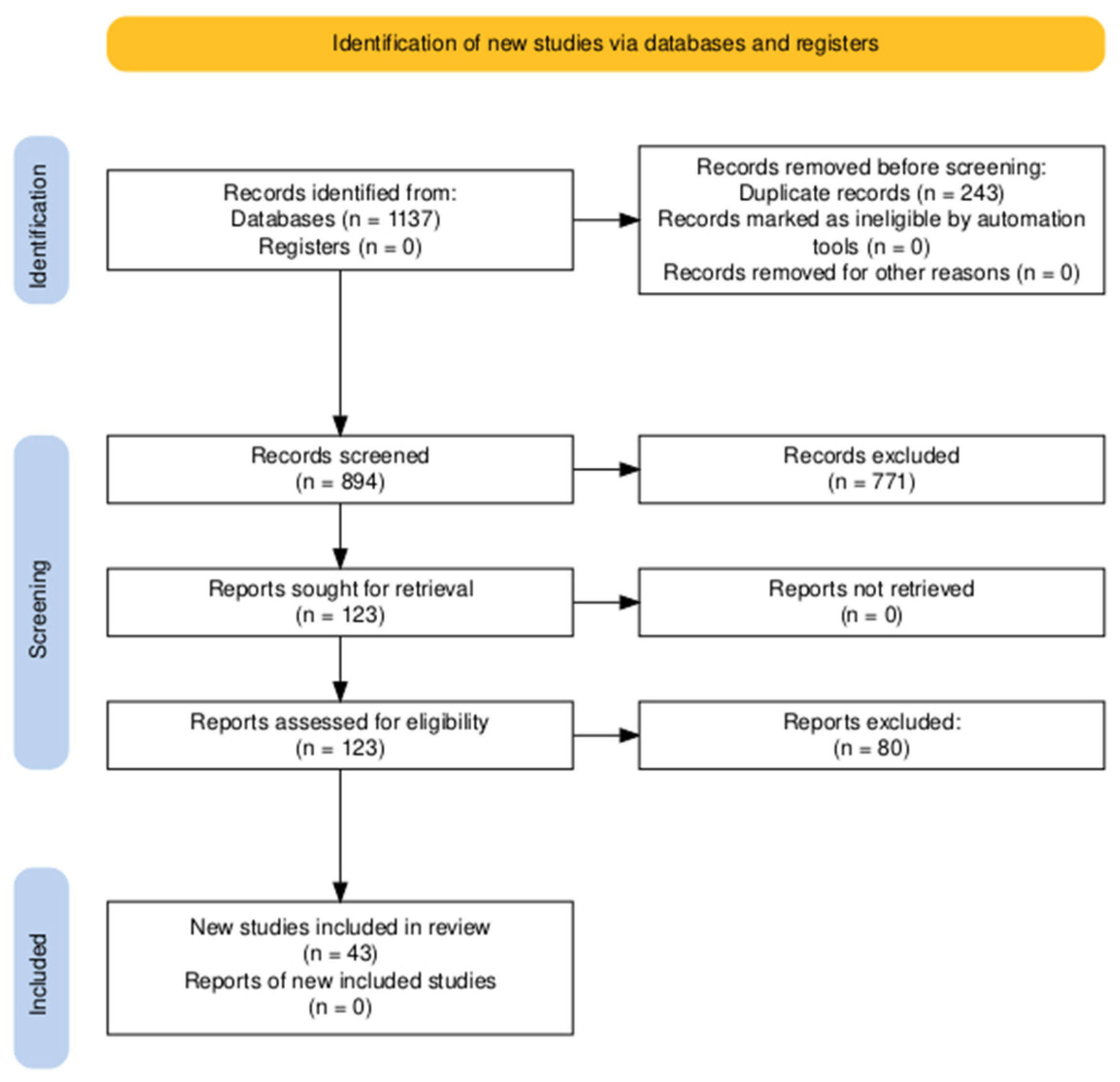
3.1. Data Collection and Systematic Literature Review
- Cluster 1 (Context and Phenomenon): This cluster aims to locate the intersection between the project environment and the burnout phenomenon. To enhance precision, the general term “Project Management” was replaced with contextual variables such as “Project-Based Organisation” and “Project Team”, utilised with a wildcard operator (*) to capture various grammatical forms (e.g., organisations, organizational). The search was restricted to the fields of Business, Social Sciences, and Psychology, explicitly excluding technical and engineering disciplines.
- Cluster 2 (The Role of EI and Leadership): This cluster was subject to rigorous methodological refinement. Initial iterations revealed that terms such as “Leadership” and “Resilience” generated a significant volume of extraneous results from medicine (e.g., patient resilience) and engineering (e.g., material resilience). Consequently, the syntax was restricted to specific roles (“Project Manager”, “Project Leader”), and the psychological constructs were further refined (e.g., “Psychological Resilience”). Additionally, an exclusion filter was applied to the fields of Medicine, Nursing, and Environmental Science.
- Cluster 3 (Systems Methodology): Focused on identifying methodological analogues that apply a systems approach to Human Resource Management. The search was directed at the intersection of the SM toolkit and specific HR issues such as Workload and Stress Management. The results were strictly limited to the fields of Business, Management and Accounting to avoid publications from computer science and software engineering.
- Inclusion Criteria: Peer-reviewed journal articles and proceedings from leading international conferences; English-language publications; studies that explicitly examine the link between organisational structure, workload, and mental well-being, or the application of systems methods within the social sciences;
- Exclusion Criteria: “Grey” literature (unpublished manuscripts, working papers), with the exception of foundational reports from global institutions (e.g., PMI); articles with a purely clinical or medical focus on burnout that do not address organisational determinants; technical project management publications that ignore the human factor (e.g., those focused solely on software scheduling tools).
3.2. Research Design and Methodological Framework of System Dynamics
- State Variables (Stocks/States): Elements that represent the accumulations within the system over time;
- Auxiliary Variables and Parameters (Auxiliaries): Factors that influence the rate of change in the flows.
- Reinforcing Loops (R): Modelling processes of escalation and destabilisation.
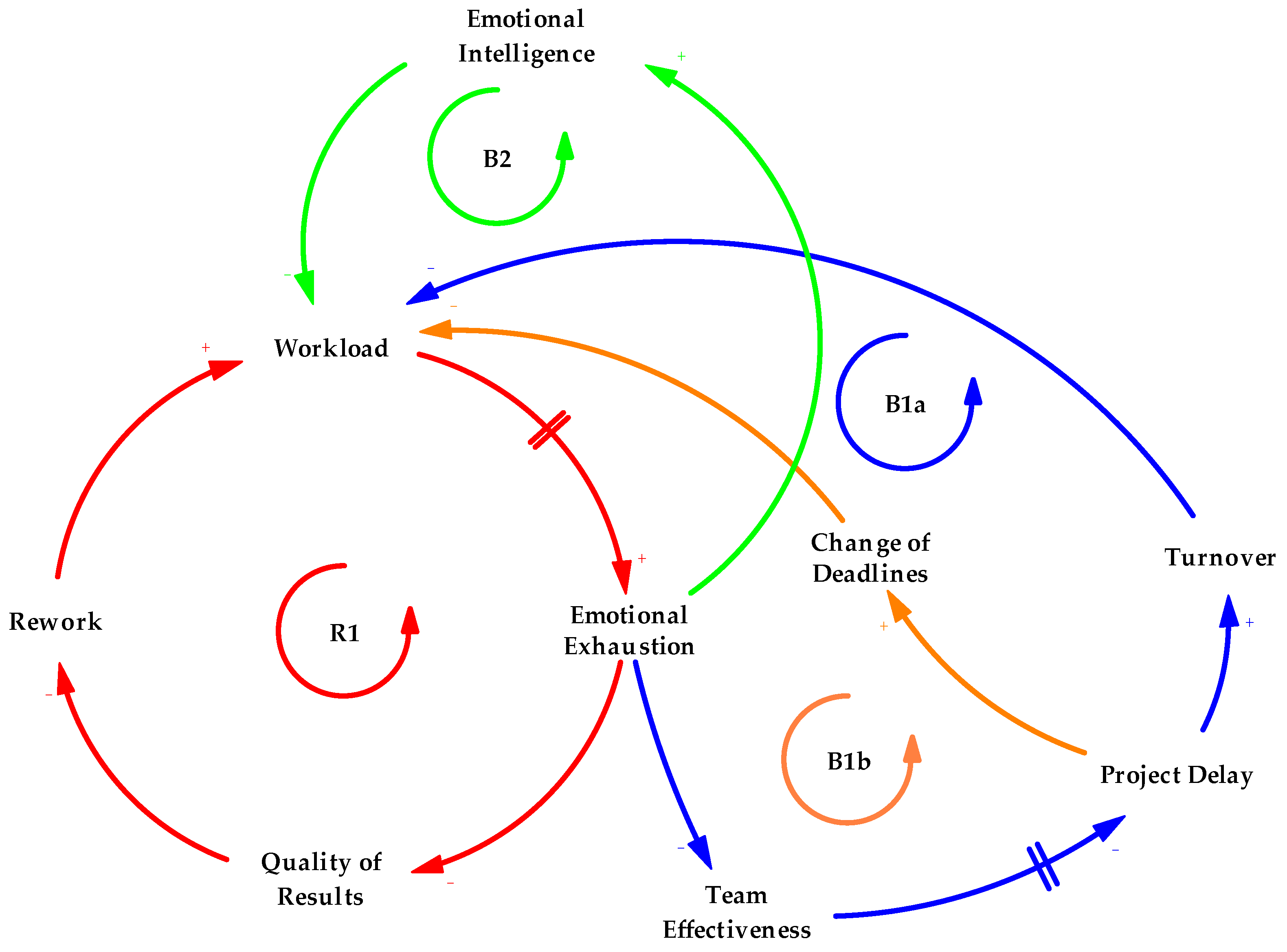
- Balancing Loops (B): Modelling processes of control and goal-seeking behaviour. At this stage, EI was integrated into the structure not as a passive factor, but as an active regulatory mechanism creating a novel balancing loop within the system architecture.
4. Results and Discussion
4.1. Identification of Key Variables in the Burnout System
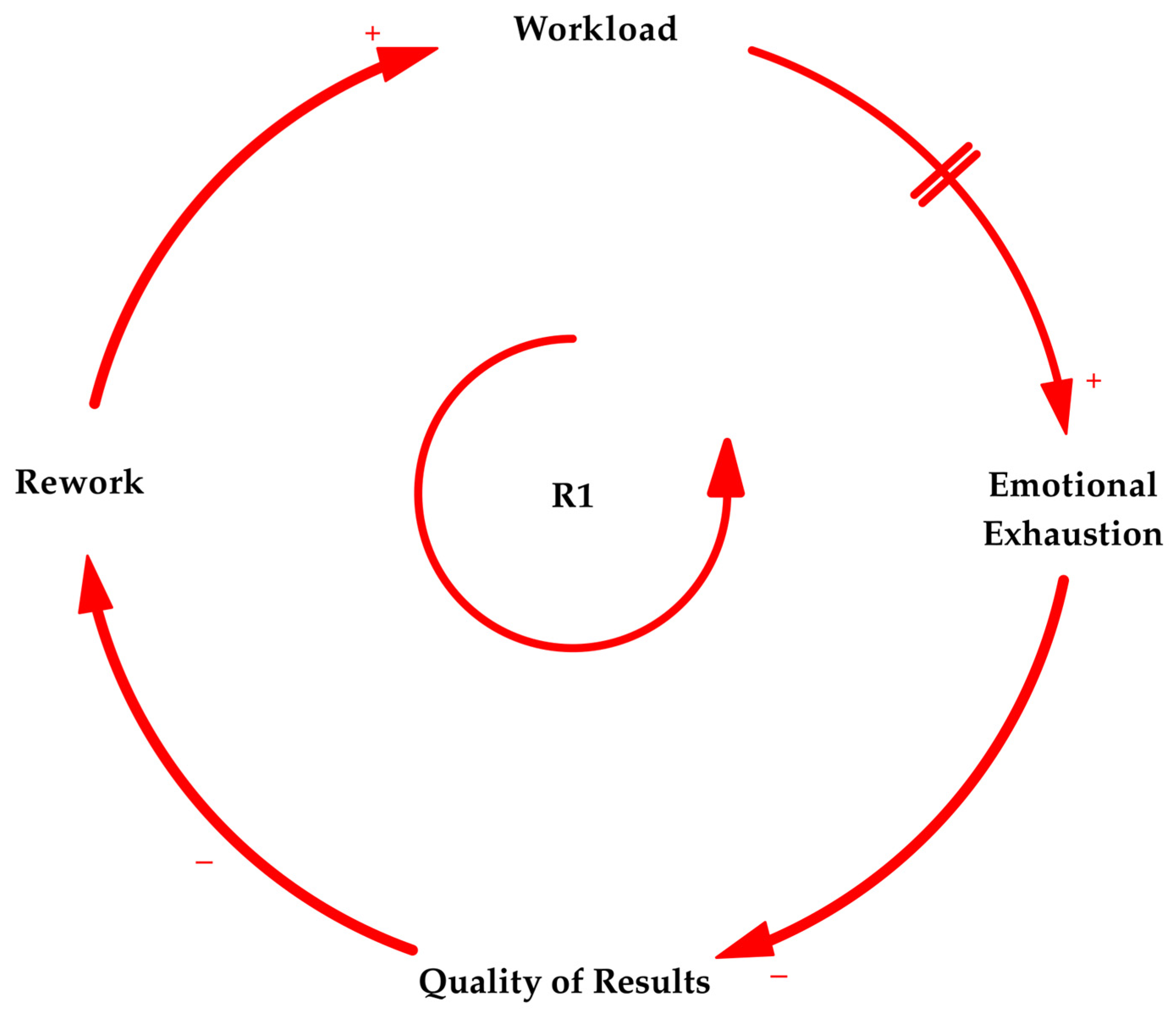
- The Exhaustion Cycle (Reinforcing Loop—R1): The central destabilising mechanism is identified as a Reinforcing Loop (R1). It describes the pathological causal chain where increased Workload generates an accumulation of Emotional Exhaustion. This state leads to an erosion of Operational Effectiveness due to diminished team motivation. Within the project environment, reduced productivity results in Backlog Accumulation, which secondary increases the pressure on the team, closing the “vicious cycle” of systemic collapse [58,59].
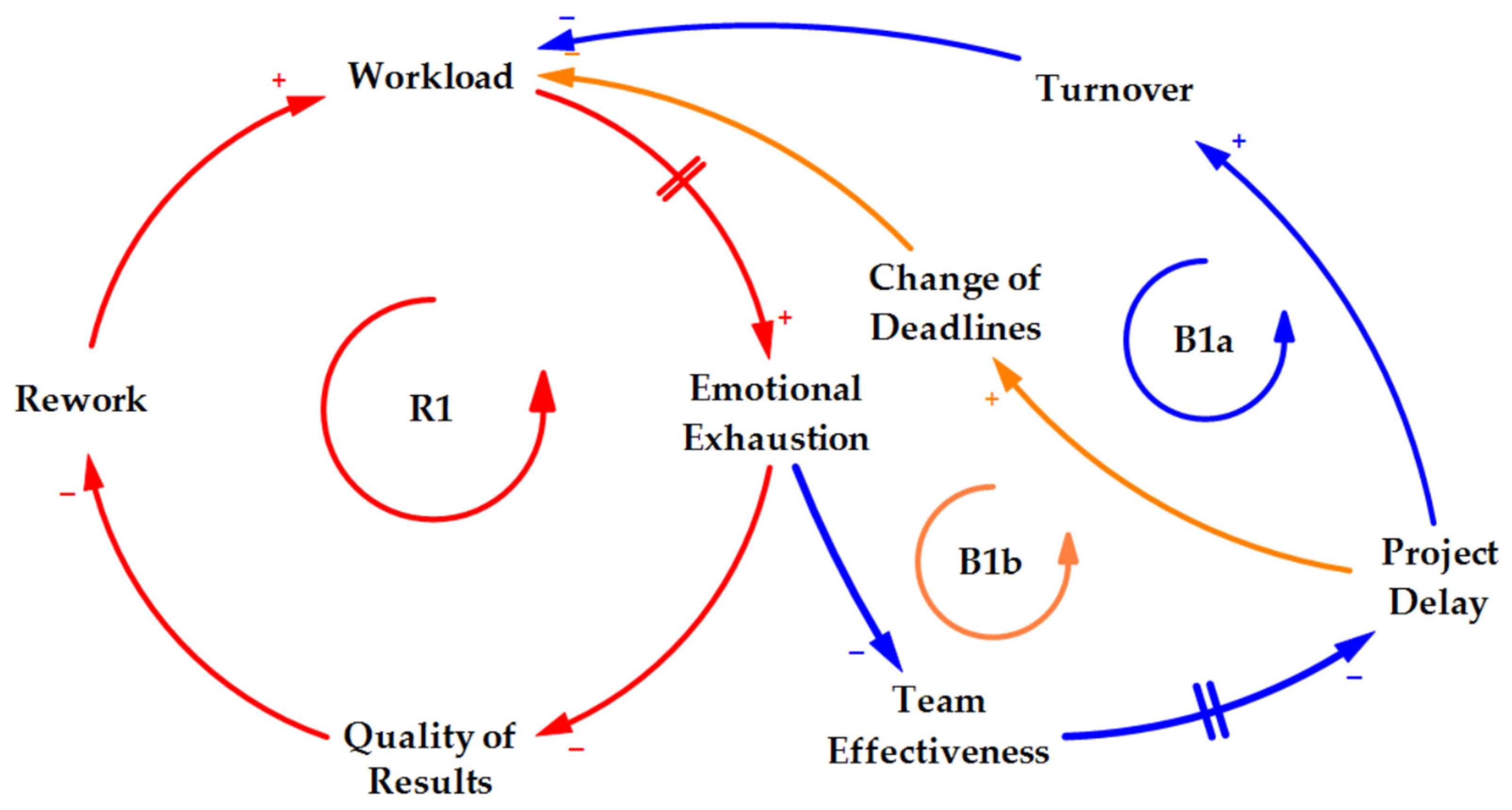
- The Administrative Control Loop (Balancing Loop—B1): Functioning in parallel is a Balancing Loop (B1), representing the standard managerial response. This mechanism involves structural interventions such as resource reallocation, deadline adjustments, or formal task redistribution. The function of B1 is to act as a homeostatic regulator, attempting to restore system equilibrium through organisational changes. However, as the model will demonstrate, purely administrative measures within B1 are frequently delayed due to Time Delays, necessitating the introduction of a more sophisticated, adaptive control mechanism (B2).
4.2. The Burnout Causal Loop Diagram (BCLD)
- Positive Link (→ +/s): Indicates direct proportionality, where a change in the independent variable (the cause) triggers a change in the dependent variable (the effect) in the same direction (increase → increase; decrease → decrease).
- Negative Link (→−/o): Indicates inverse proportionality, where a change in the cause generates a change in the effect in the opposite direction.
- Increased workload leads to the accumulation of Emotional Exhaustion (↑ Workload → ↑ Exhaustion). It is crucial to note that this link is characterised by an inherent Time Delay, as exhaustion is a state variable (stock) that accumulates gradually, often masking early symptoms of dysfunction.
- Reaching critical levels of exhaustion leads to the erosion of Quality of Results (↑ Exhaustion → (−) ↓ Quality). This represents the first negative link in the chain.
- Deteriorated quality, in turn, generates an increased Need for Rework and corrections (↓ Quality → (−) ↑ Rework). Since low quality leads to a higher volume of corrections (inverse relationship), this link is mathematically defined as the second negative link in the structure.
- The increased volume of rework is added to the current tasks, closing the loop by secondarily increasing the total Workload (↑ Rework → (+) ↑ Workload).
- Entropic Regulation (B1a): Balancing through Self-Destruction (Turnover)
- 2.
- Adaptive Regulation (B1b): Balancing through Flexibility (Deadline Adjustment)
- R1 embodies the forces of positive feedback (divergence and the escalation of tension);
- B1 embodies the forces of negative feedback (convergence and regulation).
- Escalation Dynamics (R-Loops):
- b.
- Stabilisation Dynamics (B-Loops):
- In the absence of adequate control, the dominance of the Reinforcing Loop leads to a systemic collapse—a state where accumulated exhaustion exceeds the recovery capacity at both individual and team levels;
- Conversely, if the balancing mechanisms are active and possess high sensitivity to weak signals (such as early dips in motivation or micro-shifts in behaviour), the system successfully neutralises deviations and prevents burnout.
4.3. Systemic Synthesis: The Dialectics of R1 and B1 Interaction
- The Autocatalytic Logic of R1: As a positive feedback mechanism, R1 operates through an energy deficit financing model. Any initial increase in workload induces a secondary accumulation of exhaustion; without active stabilising constraints, this transforms temporary functional load into pathological chronic stress. From a thermodynamic perspective, R1 acts as the entropic vector, progressively eroding the organisation’s adaptive capacity to the point of structural collapse.
- The Negentropic Response of B1: In opposition, loop B1 functions as the system’s immune response. It transcends simple compensation by providing a meta-mechanism for organisational learning. By decoding systemic signals—such as time delays and declines in effectiveness—the system recalibrates its internal parameters through task reallocation, revision of time horizons, or increased autonomy.
- Pathological Regulation: Stabilisation through structural destruction (turnover, “quiet quitting”), which alleviates pressure in the short term but leads to long-term resource impoverishment;
- Adaptive Managerial Reaction: Constructive restructuring that enhances systemic resilience. This is where the leverage points of the model are located—specifically in the manager’s capacity to transform the kinetic energy of pressure into organisational learning.
4.4. Emotional Intelligence as a Systemic Lever for Control and as a Meta-Variable
- Functional Vector 1: Workload Transparency
- b.
- Functional Vector 2: Signal Interpretation and Adaptive Regulation
4.5. Boundary Conditions: Structural Primacy and the Limits of EI
4.6. Nature of the Contribution: Theoretical Plausibility and Hypothesis Generation
4.7. Practical Operationalisation: A Diagnostic Dashboard
5. Conclusions
Author Contributions
Funding
Data Availability Statement
Conflicts of Interest
Abbreviations
| BRMF | Burnout Risk Management Framework |
| CLD | Causal Loop Diagram |
| EI | Emotional Intelligence |
| R1 | Reinforcing Loop 1 |
| B1 | Balancing Loop 1 |
| B2 | Balancing Loop 2 |
| PBOs | Project-Based Organisations |
| PRISMA | Preferred Reporting Items for Systematic Reviews and Meta-Analyses |
| SLR | Systematic Literature Review |
| JD-Rs | Job Demands-Resources |
| PDCA | Plan, Do, Check, Act |
| HRM | Human Resource Management |
| WoS | Web of Science |
| CAS | Complex Adaptive System |
| BCLD | Burnout Causal Loop Diagram |
| SM | System Dynamics |
Appendix A

| № | Ref. ID | First Author/Year | Title | Thematic Code |
|---|---|---|---|---|
| 1 | [2] | Sloot et al. (2024) | Change in a project-based organization: The mutual shaping of institutional logics and change programs | Justifies the context of PBOs and their institutional dynamics. |
| 2 | [3] | Edú-Valsania et al. (2022) | Burnout: A Review of Theory and Measurement | Provides a theoretical foundation for defining and measuring the burnout phenomenon. |
| 3 | [4] | Tang et al. (2025) | Burnout and Stress: New Insights and Interventions | Contemporary insights into stress and burnout, supporting the necessity for new interventions. |
| 4 | [5] | Bes et al. (2023) | Organizational interventions and occupational burnout: a meta-analysis with focus on exhaustion | Meta-analysis confirming the significance of organisational interventions. |
| 5 | [6] | Wang, M. (2024) | The effects of mindfulness-based interventions on alleviating academic burnout in medical students: a systematic review and meta-analysis | Examines individual strategies that complement the focus on organisational dependencies. |
| 6 | [9] | Chevalier et al. (2025) | Emotional intelligence, transformational leadership, and team satisfaction during the COVID-19 period in Belgium | Links EI with team satisfaction under crisis conditions. |
| 7 | [10] | Tamer et al. (2025) | The Importance of Emotional Intelligence in Managers and Its Impact on Employee Performance Amid Turbulent Times | Highlights the role of the manager and their EI in team performance within turbulent environments. |
| 8 | [11] | Waris et al. (2024) | Perspectives on artificial intelligence in times of turbulence: Theoretical background to applications | Analysed EI in project management, supporting the thesis of EI as a systemic lever. |
| 9 | [12] | Sankaran et al. (2023) | How do project-oriented organizations enhance innovation? An institutional theory perspective | Organisational perspective on PBOs, focused on innovation and structure. |
| 10 | [13] | Meslec et al. (2023) | Multiple teams, multiple projects, multiple groups at the intersection of (multiple) research fields: A bibliometric study | Bibliometric review of multi-project work as a primary source of workload. |
| 11 | [14] | Korhonen-Kurki et al. (2024) | Leverage points for sustainability transformation: Identifying past and future changes in the Finnish (circular) plastic packing system | Utilises the concept of “Leverage points”. |
| 12 | [15] | Sazvar et al. (2022) | A hybrid decision-making framework to manage occupational stress in project-based organizations | Proposes a hybrid framework for stress in PBOs. |
| 13 | [16] | Aliu et al. (2023) | Towards a New Paradigm of Project Management: A Bibliometric Review | Outlines the new paradigm in project management, incorporating well-being. |
| 14 | [17] | Anderson et al. (2023) | Opportunities for system dynamics research in operations management for public policy | Argues for the application of System Dynamics (SD) in solving complex managerial problems. |
| 15 | [18] | Veldhuis et al. (2020) | A Proof-of-Concept System Dynamics Simulation Model of the Development of Burnout and Recovery Using Retrospective Case Data | Direct precedent: utilizing System Dynamics (SD) for burnout simulation. |
| 16 | [21] | Govindaras et al. (2023) | Sustainable Environment to Prevent Burnout and Attrition in Project Management | Examines the sustainable environment in project management as burnout prevention. |
| 17 | [23] | Kovács et al. (2023) | The prevalence and risk factors of burnout and its association with mental issues and quality of life among Hungarian postal workers: a cross-sectional study | Investigates burnout risk factors, useful for the parameterisation of the model. |
| 18 | [24] | Bakker & de Vries (2021) | Job Demands-Resources theory and self-regulation: new explanations and remedies for job burnout | Job Demands-Resources (JD-R) theory—the foundation of the balancing loop (B1). |
| 19 | [25] | Karam et al. (2020) | Integrating systems thinking skills with multi-criteria decision-making technology to recruit employee candidates | Integrates systems thinking with managerial decision-making. |
| 20 | [26] | Dishop & Good (2022) | A dynamic system of job performance with goals and leadership changes as shocks | Examines dynamic systems and leadership shocks (changes). |
| 21 | [27] | Shoman et al. (2022) | Holistic Assessment of Factors Associated with Exhaustion, the Main Symptom of Burnout: A Meta-Analysis of Longitudinal Studies. | Additional theoretical support for measuring burnout. |
| 22 | [28] | Hwang & Yi (2025) | Finding the paths between job demand–resources and turnover intention of community mental health nurses in Korea | Analyses the relationship between workload and turnover through the JD-R model. |
| 23 | [29] | Yousef et al. (2024) | The effect of job and personal demands and resources on healthcare workers’ wellbeing: A cross-sectional study | Explores personal resources and well-being, supporting the need for EI as a resource. |
| 24 | [30] | Karanikas et al. (2020) | Symbiotic types of systems thinking with systematic management in occupational health and safety | Links systems thinking with occupational health and safety (OHS) conditions. |
| 25 | [31] | Meier et al. (2025) | Systems thinking approach to human resources development in public health supply chains | Applies systems thinking to human resource development (HRD). |
| 26 | [32] | Knobel & Naweed (2023) | How does the regulatory context influence systems thinking in work health and safety (WHS) inspectors? | Explores how context influences the systems thinking of health and safety inspectors. |
| 27 | [33] | Nolan-McSweeney et al. (2023) | Interviews with rail industry leaders about systems thinking in the management of organisational change and risk management | Managerial insights into systems thinking for risk and change management. |
| 28 | [34] | Kunc (2024) | The Systems Thinking Approach to Strategic Management. Systems | Methodological support for a systemic approach in strategic management. |
| 29 | [35] | Babysheva et al. (2025) | Systems Thinking and Human Resource Management in Healthcare: A Scoping Review of Core Applications Across Health System Levels | Review of systems thinking in HRM, relevant to the BRMF. |
| 30 | [38] | David (2024) | Human Resource Management in Complex Environments: A Viable Model Based on Systems Thinking | Model for HRM in complex environments based on systems thinking. |
| 31 | [39] | Cassidy et al. (2022) | How to do (or not to do)…using causal loop diagrams for health system research in low and middle-income settings | Practical guide for using Causal Loop Diagrams (CLDs). |
| 32 | [40] | Veldhuis et al. (2025) | The influence of causal loop diagrams on systems thinking and information utilization in complex problem-solving | Investigates how CLDs improve complex problem-solving. |
| 33 | [44] | Midlage (2025) | Emotional intelligence in the workplace: Enhancing team dynamics | Focus on EI for enhancing team dynamics. |
| 34 | [45] | Tamrin et al. (2025) | A Review of Emotional Intelligence—Based Multi-Criteria Framework for Selecting Construction Project Managers in Malaysia | Criteria for selecting project managers based on EI. |
| 35 | [46] | Johennesse & Pressley (2023) | The influence of emotional intelligence in the workplace environment: A literature review | Literature review on the impact of EI on the work environment. |
| 36 | [47] | Yasmeen et al. (2024) | Exploring Emotional Intelligence, Remote Work Dynamics, Team Collaboration, and Adaptive Leadership for Enhanced Success in the Digital Workplace | Links EI with adaptive leadership and success in the digital era. |
| 37 | [48] | Marfu et al. (2025) | Harnessing emotional and cultural intelligence for corporate sustainability in Indonesia: Examining psychological con-tracts, task interdependence, and environmentally sustainable project performance | Examines EI as a factor for sustainable project performance. |
| 38 | [49] | Pérez Domínguez (2024) | Employees’ Emotional Intelligence and Job Satisfaction: The Mediating Role of Work Climate and Job Stress | Confirms the role of EI in reducing occupational stress. |
| 39 | [50] | Muneer et al. (2022) | A Quantitative Study of the Impact of Organizational Culture, Communication Management, and Clarity in Project Scope on Constructions’ Project Success with Moderating Role of Project Manager’s Competencies to Enhance Constructions Management Practices | Highlights manager competence as a moderator of project success. |
| 40 | [51] | Hashmi et al. (2024) | Impact of Emotional Intelligence on Professional Performance and Stress Resilience Among Healthcare Practitioners | Links EI with stress resilience and professional performance. |
| 41 | [52] | Montenegro et al. (2021) | Impact of Construction Project Managers’ Emotional Intelligence on Project Success | Empirical evidence of the impact of manager’s EI on project success. |
| 42 | [53] | Rodrigues & Matos (2024) | The Relationship Between Managers’ Emotional Intelligence and Project Management Decisions | Links EI with managerial decision-making in a project context. |
| 43 | [54] | Saccardi & Masthoff (2025) | Adapting emotional support in teams: Productivity, emotional stability, and conscientiousness | Examines emotional support within teams for stability and productivity. |
References
- Bocean, C.G. Project based organization—An integrated approach. Manag. Mark. 2011, 9, 265–273. Available online: https://www.researchgate.net/publication/227367695_PROJECT_BASED_ORGANIZATION_-_AN_INTEGRATED_APPROACH (accessed on 9 January 2026).
- Sloot, R.N.; Troje, D.; Voordijk, J.T.; Volker, L. Change in a project-based organization: The mutual shaping of institutional logics and change programs. Int. J. Proj. Manag. 2024, 42, 102589. [Google Scholar] [CrossRef]
- Edú-Valsania, S.; Laguía, A.; Moriano, J.A. Burnout: A Review of Theory and Measurement. Int. J. Environ. Res. Public Health 2022, 19, 1780. [Google Scholar] [CrossRef]
- Tang, Y.; Raffone, A.; Wong, S. Burnout and Stress: New Insights and Interventions. Sci. Rep. 2025, 15, 8335. [Google Scholar] [CrossRef] [PubMed]
- Bes, I.; Shoman, Y.; Al-Gobari, M.; Rousson, V.; Canu, I.G. Organizational interventions and occupational burnout: A meta-analysis with focus on exhaustion. Int. Arch. Occup. Environ. Health 2023, 96, 1211–1223. [Google Scholar] [CrossRef] [PubMed]
- Wang, Z.; Wu, P.; Hou, Y.; Guo, J.; Lin, C. The effects of mindfulness-based interventions on alleviating academic burnout in medical students: A systematic review and meta-analysis. BMC Public Health 2024, 24, 1414. [Google Scholar] [CrossRef]
- Turner, J.; Keegan, A. The versatile project-based organization: Governance and operational control. Eur. Manag. J. 1999, 17, 296–309. [Google Scholar] [CrossRef]
- Parida, B.C. Emotional intelligence and workplace adaptability: Mechanisms for thriving in dynamic environments. IUJ J. Manag. 2025, 13, 6. Available online: https://journal.iujharkhand.edu.in/June-2025/Emotional-Intelligence-and-Workplace-Adaptability.html (accessed on 9 January 2026).
- Chevalier, S.; Perot, A.; Klenkenberg, S.; Dumoulin, F.; Declaye, J.; Stipulante, S.; Ghuysen, A.; Paquay, M. Emotional intelligence, transformational leadership, and team satisfaction during the COVID-19 period in Belgium. Front. Organ. Psychol. 2025, 3, 1578835. [Google Scholar] [CrossRef]
- Tamer, N. The Importance of Emotional Intelligence in Managers and Its Impact on Employee Performance Amid Turbulent Times. Adm. Sci. 2025, 15, 300. [Google Scholar] [CrossRef]
- Waris, M.; Ahmed, R.; Hussain, W.; Hiraj, T.; Bhatti, K. AI and emotional intelligence in project management: A systematic literature review. In Perspectives on Artificial Intelligence in Times of Turbulence: Theoretical Background to Applications; Khan, H.U., Khan, S., Ali, A., Eds.; IGI Global: Hershey, PA, USA, 2024; pp. 137–160. [Google Scholar] [CrossRef]
- Sankaran, S.; Killen, C.P.; Pitsis, A. How do project-oriented organizations enhance innovation? An institutional theory perspective. Front. Eng. Manag. 2023, 10, 427–438. [Google Scholar] [CrossRef]
- Meslec, N.; Curseu, P.L.; Fodor, O.C.; Batistič, S.; Kenda, R. Multiple teams, multiple projects, multiple groups at the intersection of (multiple) research fields: A bibliometric study. Front. Psychol. 2023, 14, 1027349. [Google Scholar] [CrossRef]
- Korhonen-Kurki, K.; Horn, S.; Entsalo, H.; Turunen, T.; D’Amato, D.; Riechers, M.; Närhi, J. Leverage points for sustainability transformation: Identifying past and future changes in the Finnish (circular) plastic packing system. Ecol. Econ. 2024, 219, 108136. [Google Scholar] [CrossRef]
- Sazvar, Z.; Nayeri, S.; Mirbagheri, R.; Tanhaeean, M.; Fallahpour, A.; Wong, K.Y. A hybrid decision-making framework to manage occupational stress in project-based organizations. Soft Comput. 2022, 26, 12445–12460. [Google Scholar] [CrossRef]
- Aliu, J.; Oke, A.E.; Kineber, A.F.; Ebekozien, A.; Aigbavboa, C.O.; Alaboud, N.S.; Daoud, A.O. Towards a New Paradigm of Project Management: A Bibliometric Review. Sustainability 2023, 15, 9967. [Google Scholar] [CrossRef]
- Anderson, E.G.; Keith, D.R.; Lopez, J. Opportunities for system dynamics research in operations management for public policy. Prod. Oper. Manag. 2023, 32, 13947. [Google Scholar] [CrossRef]
- Veldhuis, G.A.; Sluijs, T.; Van Zwieten, M.H.; Bouwman, J.; Wiezer, N.M.; Wortelboer, H.M. A Proof-of-Concept System Dynamics Simulation Model of the Development of Burnout and Recovery Using Retrospective Case Data. Int. J. Environ. Res. Public Health 2020, 17, 5964. [Google Scholar] [CrossRef] [PubMed]
- Sterman, J.D. System dynamics: Tools for learning in a complex world. Calif. Manag. Rev. 2001, 43, 8–25. Available online: https://faculty.sites.iastate.edu/tesfatsi/archive/tesfatsi/SystemDynamics.JohnSterman2001.pdf (accessed on 9 January 2026). [CrossRef]
- Bredin, K.; Söderlund, J. Project-Based Organizations. In Human Resource Management in Project-Based Organizations; Palgrave Macmillan: London, UK, 2011; pp. 23–39. Available online: https://link.springer.com/chapter/10.1057/978-0-230-29751-7_2 (accessed on 9 January 2026).
- Govindaras, B.; Wern, T.S.; Kaur, S.; Haslin, I.A.; Ramasamy, R.K. Sustainable Environment to Prevent Burnout and Attrition in Project Management. Sustainability 2023, 15, 2364. [Google Scholar] [CrossRef]
- Bakker, A.; Demerouti, E.; Sanz-Vergel, A. Job Demands–Resources Theory: Ten Years Later. Annu. Rev. Organ. Psychol. Organ. Behav. 2023, 10, 25–53. [Google Scholar] [CrossRef]
- Kovács, M.; Muity, G.; Szapáry, Á.; Nemeskéri, Z.; Váradi, I.; Kapus, K.; Tibold, A.; Zalayné, N.M.; Horvath, L.; Fehér, G. The prevalence and risk factors of burnout and its association with mental issues and quality of life among hungarian postal workers: A cross-sectional study. BMC Public Health 2023, 23, 75. [Google Scholar] [CrossRef]
- Bakker, A.B.; de Vries, J.D. Job Demands-Resources theory and self-regulation: New explanations and remedies for job burnout. Anxiety Stress Coping. 2021, 34, 1–21. [Google Scholar] [CrossRef] [PubMed]
- Karam, S.; Nagahi, M.; Dayarathna, V.L.; Ma, J.; Jaradat, R.; Hamilton, M. Integrating systems thinking skills with multi-criteria decision-making technology to recruit employee candidates. Expert Syst. Appl. 2020, 160, 113585. [Google Scholar] [CrossRef]
- Dishop, C.R.; Good, V. A dynamic system of job performance with goals and leadership changes as shocks. J. Bus. Res. 2022, 139, 602–613. [Google Scholar] [CrossRef]
- Shoman, Y.; Rousson, V.; Bianchi, R.; Guseva Canu, I. Holistic Assessment of Factors Associated with Exhaustion, the Main Symptom of Burnout: A Meta-Analysis of Longitudinal Studies. Int. J. Environ. Res. Public Health 2022, 19, 13037. [Google Scholar] [CrossRef] [PubMed]
- Hwang, E.; Yi, Y. Finding the paths between job demand–resources and turnover intention of community mental health nurses in Korea. Int. Nurs. Rev. 2025, 72, e70004. [Google Scholar] [CrossRef]
- Yousef, C.C.; Farooq, A.; Amateau, G.; Abu Esba, L.C.; Burnett, K.; Alyas, O.A. The effect of job and personal demands and resources on healthcare workers’ wellbeing: A cross-sectional study. PLoS ONE 2024, 19, e0303769. [Google Scholar] [CrossRef]
- Karanikas, N.; Popovich, A.; Steele, S.; Horswill, N.; Laddrak, V.; Roberts, T. Symbiotic types of systems thinking with systematic management in occupational health & safety. Saf. Sci. 2020, 128, 104752. [Google Scholar] [CrossRef]
- Meier, E.; Brown, A.N.; Chovitz, B.; Zwinkels, D.; Egharevba, M.; McHenry, B.; Kabatende, J.; Gege Buki, I.K. Systems thinking approach to human resources development in public health supply chains. J. Humanit. Logist. Supply Chain. Manag. 2025, 15, 276–293. [Google Scholar] [CrossRef]
- Knobel, P.; Naweed, A. How does the regulatory context influence systems thinking in work health and safety (WHS) inspectors? Saf. Sci. 2023, 166, 106237. [Google Scholar] [CrossRef]
- Nolan-McSweeney, M.; Ryan, B.; Cobb, S. Interviews with rail industry leaders about systems thinking in the management of organisational change and risk management. Saf. Sci. 2023, 164, 106168. [Google Scholar] [CrossRef]
- Kunc, M. The Systems Thinking Approach to Strategic Management. Systems 2024, 12, 213. [Google Scholar] [CrossRef]
- Babysheva, V.; Neiterman, E.; Bigelow, P.; Yessis, J. Systems Thinking and Human Resource Management in Healthcare: A Scoping Review of Core Applications Across Health System Levels. Systems 2025, 13, 1001. [Google Scholar] [CrossRef]
- Sun, D.; Hyland, P.; Cui, H. A Designed Framework for Delivering Systems Thinking Skills to Small Business Managers. Systems 2014, 2, 297–312. [Google Scholar] [CrossRef]
- Sankaran, S.; Haslett, T.; Sheffield, J. Systems thinking approaches to address complex issues in project management. In Proceedings of the PMI® Global Congress 2010—Asia Pacific, Melbourne, Australia, 22–24 February 2010; Project Management Institute: Newtown Square, PA, USA, 2010. Available online: https://www.pmi.org/learning/library/systems-thinking-soft-methodology-issues-6912 (accessed on 9 January 2026).
- David, A. Human Resource Management in Complex Environments: A Viable Model Based on Systems Thinking. Systems 2024, 12, 489. [Google Scholar] [CrossRef]
- Cassidy, R.; Borghi, J.; Semwanga, A.R.; Binyaruka, P.; Singh, N.S.; Blanchet, K. How to do (or not to do)…using causal loop diagrams for health system research in low and middle-income settings. Health Policy Plan 2022, 37, 1328–1336. [Google Scholar] [CrossRef]
- Veldhuis, G.; Smits-Clijsen, E.; Van Waas, R.; Hof, T.; Maccatrozzo, V.; Rouwette, E.; Kerstholt, J. The influence of causal loop diagrams on systems thinking and information utilization in complex problem-solving. Comput. Hum. Behav. Rep. 2025, 17, 100613. [Google Scholar] [CrossRef]
- Savory Institute/IISD. Systems Thinking and Dynamics: SAVI Academy. International Institute for Sustainable Development 2020. Available online: https://www.iisd.org/savi/wp-content/uploads/2020/03/savi-academy-systems-thinking-dynamics-final.pdf (accessed on 9 January 2026).
- Lyneis, J.M.; Ford, D.N. System dynamics applied to project management: A survey, assessment, and directions for future research. Syst. Dyn. Rev. 2007, 23, 157–189. [Google Scholar] [CrossRef]
- Chitongo, A.M.; Pretorius, L. Client project time schedule controls—An empirically-based system dynamics conceptual model. South Afr. J. Ind. Eng. 2018, 29, 169–183. [Google Scholar] [CrossRef]
- Midlage, L. Emotional intelligence in the workplace: Enhancing team dynamics. Res. Invent. J. Curr. Issues Arts Manag. 2025, 4, 17–22. [Google Scholar] [CrossRef]
- Tamrin, N.; Nawi, M.; Hanafi, A. A Review of Emotional Intelligence—Based Multi-Criteria Framework for Selecting Construction Project Managers in Malaysia. Archit. Image Stud. 2025, 6, 273–286. [Google Scholar] [CrossRef]
- Johennesse, L.-A.; Pressley, G. The influence of emotional intelligence in the workplace environment: A literature review. Indones. J. Bus. Account. Manag. 2023, 6, 25–32. [Google Scholar] [CrossRef]
- Yasmeen, K.; Khan, M.L.; Imran, H. Exploring Emotional Intelligence, Remote Work Dynamics, Team Collaboration, and Adaptive Leadership for Enhanced Success in the Digital Workplace. Pak. Soc. Sci. Rev. 2024, 8, 969–979. [Google Scholar] [CrossRef]
- Marfu, A.; Abbas, H.; Sya, A.; Purwanto, A.; Sumargo, B.; Wulandari, S.S.; Malaihollo, C.A.; Tanubrata, D.; Pratiwi, D.I. Harnessing emotional and cultural intelligence for corporate sustainability in Indonesia: Examining psychological contracts, task interdependence, and environmentally sustainable project performance. Sustain. Futures 2025, 10, 100992. [Google Scholar] [CrossRef]
- Pérez Domínguez, M. Employees’ Emotional Intelligence and Job Satisfaction: The Mediating Role of Work Climate and Job Stress. Adm. Sci. 2024, 14, 205. [Google Scholar] [CrossRef]
- Muneer, M.; Khan, N.; Awais Hussain, M.; Shuai, Z.; Khan, A.A.; Farooq, R.; Moawwez, M.A.; Tariq, M.A. A Quantitative Study of the Impact of Organizational Culture, Communication Management, and Clarity in Project Scope on Constructions’ Project Success with Moderating Role of Project Manager’s Competencies to Enhance Constructions Management Practices. Buildings 2022, 12, 1856. [Google Scholar] [CrossRef]
- Hashmi, S.; Tahir, O.; Nasir, Z.; Hasnain, H.; Ullah Riaz, R.S.; Ali Khan, H.M.; Ramza, R.; Alghzawi, H.M.; Mukherjee, J.; Palav, A. Impact of Emotional Intelligence on Professional Performance and Stress Resilience Among Healthcare Practitioners. Cureus 2024, 16, e74113. [Google Scholar] [CrossRef] [PubMed]
- Montenegro, A.; Dobrota, M.; Todorovic, M.; Slavinski, T.; Obradovic, V. Impact of Construction Project Managers’ Emotional Intelligence on Project Success. Sustainability 2021, 13, 10804. [Google Scholar] [CrossRef]
- Rodrigues, N.J.; Matos, C.I. The Relationship Between Managers’ Emotional Intelligence and Project Management Decisions. Adm. Sci. 2024, 14, 318. [Google Scholar] [CrossRef]
- Saccardi, I.; Masthoff, J. Adapting emotional support in teams: Productivity, emotional stability, and conscientiousness. Front. Artif. Intell. 2025, 8, 1449176. [Google Scholar] [CrossRef]
- Haddaway, N.R.; Page, M.J.; Pritchard, C.C.; McGuinness, L.A. PRISMA2020: An R package and Shiny app for producing PRISMA 2020-compliant flow diagrams, with interactivity for optimised digital transparency and Open Synthesis. Campbell Syst. Rev. 2022, 18, e1230. [Google Scholar] [CrossRef]
- Jonsdottir, A.T.; Johannsdottir, L.; Davidsdottir, B. Systematic literature review on system dynamic modeling of sustainable business model strategies. Clean. Environ. Syst. 2024, 13, 100200. [Google Scholar] [CrossRef]
- Strelkovskii, N.; Rovenskaya, E. Causal Loop Diagramming of Socioeconomic Impacts of COVID-19: State-of-the-Art, Gaps and Good Practices. Systems 2021, 9, 65. [Google Scholar] [CrossRef]
- Wong, A.H.; Sabounchi, N.S.; Roncallo, H.R.; Ray, J.M.; Heckmann, R. A qualitative system dynamics model for effects of workplace violence and clinician burnout on agitation management in the emergency department. BMC Health Serv. Res. 2022, 22, 75. [Google Scholar] [CrossRef] [PubMed]
- Barsties, L.S.; van den Berg, S.W.; Leone, S.S.; Nicolaou, M.; van Oostrom, S.H. A system science perspective on burn-out: Development of an expert-based causal loop diagram. Front. Public Health 2023, 11, 1271591. [Google Scholar] [CrossRef] [PubMed]
- Monat, J.P.; Gannon, T.F. The Meaning of “Structure” in Systems Thinking. Systems 2023, 11, 92. [Google Scholar] [CrossRef]
- Schiele, J.K.; Schröter, M.; Berschick, J.; Steinmetz, M.; Bogdanski, M.; Jankow, S.; Stritter, W.; Kessler, C.S.; Seifert, G.; Koch, A.K. Designing the LAGOM burnout prevention program: A collaborative approach with healthcare professionals using intervention mapping. BMC Med. Educ. 2025, 25, 1254. [Google Scholar] [CrossRef]


| Systemic Variable (CLD Node) | Signal Type | Observable Indicators (What to Monitor?) | Managerial Interpretation |
|---|---|---|---|
| Workload/ Scope Creep | Lagging (Hard Data) |
| Indicates that R1 is already active; the system is compensating for inefficiency with brute force energy expenditure. |
| Emotional Exhaustion | Lagging (Behavioural) |
| The system has crossed the “Saturation Point”; resources are depleted. Immediate B1 intervention required (restructuring). |
| Early Warning Signs (The EI Sensor) | Leading (Weak Signals) |
| These are the triggers for B2 activation. The manager must intervene now to prevent the Reinforcing Loop from gaining momentum. |
| Adaptive Capacity (Resilience) | Structural |
| Measures the health of the Balancing Loops. Low autonomy suggests a blocked B1 loop. |
Disclaimer/Publisher’s Note: The statements, opinions and data contained in all publications are solely those of the individual author(s) and contributor(s) and not of MDPI and/or the editor(s). MDPI and/or the editor(s) disclaim responsibility for any injury to people or property resulting from any ideas, methods, instructions or products referred to in the content. |
© 2026 by the authors. Licensee MDPI, Basel, Switzerland. This article is an open access article distributed under the terms and conditions of the Creative Commons Attribution (CC BY) license.
Share and Cite
Todorova, A.; Kostadinova, I.; Ruskova, S.; Beloeva, S. Burnout Risk Management Framework (BRMF) in Project-Based Organizations: Emotional Intelligence Systemic Lever. Systems 2026, 14, 210. https://doi.org/10.3390/systems14020210
Todorova A, Kostadinova I, Ruskova S, Beloeva S. Burnout Risk Management Framework (BRMF) in Project-Based Organizations: Emotional Intelligence Systemic Lever. Systems. 2026; 14(2):210. https://doi.org/10.3390/systems14020210
Chicago/Turabian StyleTodorova, Ana, Irina Kostadinova, Svilena Ruskova, and Silvia Beloeva. 2026. "Burnout Risk Management Framework (BRMF) in Project-Based Organizations: Emotional Intelligence Systemic Lever" Systems 14, no. 2: 210. https://doi.org/10.3390/systems14020210
APA StyleTodorova, A., Kostadinova, I., Ruskova, S., & Beloeva, S. (2026). Burnout Risk Management Framework (BRMF) in Project-Based Organizations: Emotional Intelligence Systemic Lever. Systems, 14(2), 210. https://doi.org/10.3390/systems14020210