
Article

Burnout Risk Management Framework (BRMF) in Project-Based Organizations: Emotional Intelligence Systemic Lever


Faculty of Business and Management, University of Ruse Angel Kanchev, Studentska 8, 7017 Ruse, Bulgaria
*
Author to whom correspondence should be addressed.
Systems 2026, 14(2), 210; https://doi.org/10.3390/systems14020210
Submission received: 9 January 2026 / Revised: 11 February 2026 / Accepted: 13 February 2026 / Published: 16 February 2026

Abstract

This paper conceptualises burnout in Project-Based Organisations (PBOs) as a systemic emergent property arising from the non-linear interaction between structural demands and human capital. Utilising a System Dynamics (SD) methodology, the study constructs a Causal Loop Diagram (CLD) to visualise the feedback architecture governing the burnout cycle. The analysis identifies the dynamic tension between the Reinforcing Loop of exhaustion (R1) and the Balancing Loop of adaptation (B1). A key theoretical contribution is the positioning of the Project Manager’s Emotional Intelligence (EI) not merely as a soft skill but as a systemic control lever (B2) capable of reducing information delays and shifting the system from reactive to proactive homeostasis. Crucially, the study operationalises these conceptual findings into a Burnout Risk Management Framework (BRMF), accompanied by a practical diagnostic dashboard. This tool offers managers a set of leading and lagging indicators for early detection, bridging the gap between theoretical plausibility and applied risk management in high-entropy project environments.

1. Introduction

Against a backdrop of accelerating globalisation, technological expansion, and a turbulent economic climate, contemporary organisations are compelled to operate in a state of continuous transformation. As a strategic response to the imperative for agility, Project-Based Organisations (PBOs) have established themselves as the preferred architecture for managing unique and temporary demands within complex market ecosystems [1]. These transformational processes are frequently driven by the adoption of information technologies, giving rise to distinct managerial challenges that stem from the dichotomy between routine business operations and dynamic project activities [2].
Inherently, PBOs function as complex adaptive systems (CASs), characterised by high dynamics, resource constraints, and a multitude of nonlinear dependencies. It is crucial to clarify that the systemic dynamics described herein are specific to the PBO context. Unlike traditional functional organisations, which operate on stable routines and established hierarchies, PBOs are defined by “matrix duality,” temporary team structures, and strict time constraints. These unique structural characteristics generate specific burnout trajectories that differ significantly from those in standard operational environments. This complexity renders traditional risk management approaches inadequate. While the focus frequently rests on technical and financial parameters, human risk—specifically professional burnout—remains largely overlooked. In this study, burnout is conceptualised not as an individual deficit, but as a hidden systemic lever with the potential to trigger cascading dysfunction throughout the entire project. It is examined as an emotional emergent property of the organisational structure, stemming from a chronic imbalance between systemic Job Demands and available Job Resources [3].
Burnout is a multidimensional psychological syndrome defined by the triad of emotional exhaustion, depersonalisation (cynicism), and a reduced sense of personal efficacy [4]. It represents a process of gradual erosion of engagement, manifesting when the structural design of work (overload, lack of autonomy, and unfair reward) exceeds the individual’s psychological resilience [3,5,6]. Within the intensive environment of PBOs, human capital is a critical factor for sustainability. This necessitates not only technical competence but also high adaptive capacity—the ability for learning-in-action, knowledge transfer, and flexibility [7].
In this context, Emotional Intelligence (EI) emerges as a key, yet under-researched, resource for navigating uncertainty. Empirical data indicate that leaders with high EI employ more effective strategies for regulating team tension, acting as a stabilising factor in crisis situations [8,9]. From a System Dynamics (SM) perspective, the Project Manager’s EI can be viewed as a balancing control mechanism (Balancing Loop), capable of interrupting the self-reinforcing (amplifying) cycles of exhaustion [8,10].
A systematic literature review signals a fundamental evolution in project management, indicating a shift in focus from purely technical and methodological tools (hard skills) to behavioural competencies. The traditional emphasis on the “Iron Triangle” (scope, time, cost) is assessed as necessary but insufficient for addressing contemporary organisational complexity. Consequently, EI is redefined not as a peripheral “soft skill”, but as a critical managerial asset that compensates for the limitations of formal processes at the interface with the human factor [11].
Despite the significance of these factors, the literature lacks formalised frameworks that integrate EI into the process of active burnout risk management. The primary objective of this paper is to address this gap by developing and presenting a Burnout Risk Management Framework (BRMF) for PBOs, positioning the Project Manager’s EI as a critical systemic lever. To achieve this aim, the study pursues the following specific objectives: (1) To conceptualise burnout as a systemic malfunction and EI as a critical managerial asset through a synthesis of the literature; (2) To construct a Causal Loop Diagram (CLD) visualising the reinforcing cycles of escalation; (3) To integrate EI into the CLD model as an active balancing control loop; and (4) To define the structure and application of the BRMF.
The manuscript is organised into five sections. Following this Introduction, Section 2 presents a theoretical synthesis; Section 3 describes the conceptual modelling methodology; Section 4 details the developed BRMF and the CLD model; and Section 5 discusses implications and directions for future research.

2. Literature Synthesis

2.1. Defining PBOs as a Dynamic System

PBOs represent an evolutionary response to contemporary economic turbulence, characterised by technological acceleration and global market uncertainty. They are defined as a hybrid organisational model that integrates the strategic flexibility of project management with the stability of traditional functional hierarchies [12]. This duality is frequently realised through matrix structures, combining vertical functional specialisation with horizontal project integration. The objective is to achieve organisational “ambidexterity”—the simultaneous maintenance of operational efficiency and innovation through temporary, unique tasks [1,13]. From a Systems Thinking perspective, PBOs are not static entities but dynamic systems where the interaction between tasks, resources, and stakeholders generates emergent properties and nonlinear changes over time [14].
B contemporary post-bureaucratic contexts, these organisations function as knowledge-intensive structures where projects serve as the primary mechanism for value creation and strategic transformation [2]. However, the intersection between routine processes and temporary activities remains a persistent source of systemic risk [7,15]. According to Bocean [1], the fundamental structural problem stems from power asymmetries within the matrix approach, where functional managers often dominate. This imbalance leads to the formation of operational “silos”—isolated units with impaired communication—which represent a clear manifestation of systemic dysfunction. Consequently, the viability of PBOs depends on harmonising interests, requiring the project manager to act as a vital integrator through decentralised authority and autonomy [1].
Turner and Keegan [7] emphasise that the organisational mindset is a central element, necessitating a future-oriented culture and flexibility amidst uncertainty. Projects are conceptualised as experimental grounds; organisations that perceive uncertainty as an opportunity for innovation demonstrate higher transformational potential. This is further supported by institutional theory, which reveals that while individual agency is significant, systematised processes and novel structural solutions have a more sustainable effect on stimulating innovation [12]. These results underscore the necessity for flexible management frameworks that allow PBOs to combine stability with dynamism, transforming projects from mere execution instruments into central mechanisms for strategic change.
The imperative for adaptive management in PBOs is dictated by environmental entropy and high human resource mobility [13]. To manage this complexity, integrated models (such as the PDCA cycle) introduce regulatory feedback loops for preventive risk identification [1,16]. A fundamental factor generating unpredictability is the presence of Time Delays—the interval between an action and its full systemic effect [17,18,19]. In the context of burnout, an increase in workload does not lead to an immediate breakdown; a latent period of exhaustion accumulation exists, which can create an illusion of stability and lead to “out-of-phase” interventions based on lagging signals.
Finally, the PBO environment necessitates a revision of Human Resource Management (HRM) to address specific project challenges [20]. This includes: (1) Dynamic integration of temporary structures with permanent HR practices; (2) managing the duality of loyalty, as employees often identify more with the project than their functional department; and (3) mobility management, focusing on transferable skills across projects. In this unstable system, burnout stems from the structural tension between control and autonomy, requiring a Burnout Risk Management Framework (BRMF) that explicitly models these dependencies to enable a transition to preventive strategic intervention.

2.2. Burnout—Imbalance Between System Requirements (Load) and System Resources (Autonomy, Reward)

The specific architecture of PBOs—characterized by time scarcity, task complexity, and resource uncertainty—creates a high-risk environment for employee mental health [21]. This structural instability generates chronic pressure, making burnout a systemic response to the imbalance between high job demands and insufficient recovery mechanisms, rather than an isolated incident.
In scientific literature, professional burnout is a multidimensional syndrome (emotional exhaustion, depersonalization, and reduced personal efficacy) rooted in prolonged occupational stress. The dominant explanatory paradigm remains the Job Demands–Resources (JD-R) framework, which postulates that exhaustion risk stems from a systemic imbalance between job demands (cognitive/emotional load) and available resources (autonomy, support, feedback) [3,6,22,23,24].
Amidst resource constraints, the drive for productivity generates systemic tension. This state results from environmental entropy characterized by seven critical dimensions: (1) scale complexity; (2) operational integration; (3) functional interdependence; (4) evolving requirements; (5) high uncertainty; (6) the need for a systems worldview; and (7) component flexibility [25]. These factors necessitate a strategic reorientation in human capital management as they blur the boundaries between technical and managerial domains.
The paradigm of continuous growth often imposes targets exceeding capacity, widening the gap between demands and resources, which correlates with high exhaustion [26]. According to the updated JD-R model, resources act as a buffering mechanism; when this capacity is depleted, the system enters disequilibrium, resulting in burnout [24,27].
Building upon this, Bes et al. [5] identify emotional and physical exhaustion as the central component of the syndrome. Their meta-analysis indicates that while isolated structural interventions have moderate effects, combined strategies integrating organisational and individual levels demonstrate higher potential for mitigating exhaustion, despite existing methodological heterogeneity in the evidence.
The applicability of these findings beyond helping professions is confirmed by Kovács et al. [23], who identified a high prevalence of burnout (~50.8%) in administrative sectors, correlating it with demographic factors and somatic symptoms (sleep disorders, pain). These data substantiate the need for a shift from reactive measures to systematic preventive strategies targeting structural predictors of stress.
In contrast to individual-centric views, systems thinking reframes burnout as a signal of structural dysfunction [21]. This malfunction arises from a chronic imbalance between System Demands (workload, deadlines) and System Resources (autonomy, support) [27]. When demands durably exceed capacity, a reinforcing cycle of degradation erodes emotional capital. As project teams are interdependent ecosystems, the emotional destabilisation of a key agent reduces the system’s overall adaptive capacity, increasing risks of errors and delays [24,27].
Within this dynamic, autonomy and fair remuneration serve as critical protective buffers. While the correlation between workload and exhaustion is direct, high autonomy (decision latitude) acts as a significant moderator, attenuating the negative impact of stressors on mental health [3].
Govindaras et al. identify individual resilience as a mediator between organisational context and burnout. Resilience is viewed as a dynamic adaptive capacity reinforced by the environment; high organisational support catalyses managers’ resilience, which inhibits burnout development [21].
Empirical research validates the JD-R model in real-world environments, showing that an excess of demands leads to escalation, while a preponderance of resources catalyses engagement [28]. Although individual resources (self-efficacy, coping) are significant mediators, researchers postulate the primacy of organisational determinants, arguing that individual mechanisms cannot compensate for chronic systemic deficits like lack of autonomy or institutional support [3,29].
Tang et al. [4] further emphasise that while individual vulnerabilities modulate stress responses, sustainable prevention requires an integrated approach. Effective strategies must transcend individual-oriented training to focus on structural reorganisation—optimising schedules and reducing administrative burdens—to address root systemic causes rather than symptoms.
In parallel, empirical analyses underscore the categorical superiority of proactive managerial strategies—encompassing strategic planning, prevention, and workflow optimisation to minimise role conflicts—over reactive stress coping techniques. The authors argue that the sustainable mitigation of psychological tension and burnout symptomatology is not an isolated act, but the result of a synergistic approach: whereby institutional structural reforms are synchronised with targeted measures for cultivating individual resilience. It is precisely this integration that enables the construction of a robust and supportive organisational climate, capable of maintaining a dynamic equilibrium between system demands and available resources, thereby guaranteeing long-term organisational vitality [4].
Further empirical evidence indicates that when employees perceive the organisation as a caring and supportive entity, this directly reduces levels of emotional exhaustion and depersonalisation. Organisational support functions as a psychological safety valve, which not only alleviates stress but also significantly lowers turnover intention, thereby ensuring the long-term sustainability of human capital [21].

2.3. Systems Thinking and System Dynamics

Contemporary theoretical constructs are grounded in Systems Thinking, where a system is conceptualised as a coherently organised set of interconnected elements generating specific behavioural patterns [30]. This approach shifts the focus from isolated components to nonlinear dynamics and the temporal evolution of interactions [31,32,33]. A fundamental postulate is that safety and stability are emergent properties arising from collective interactions; thus, incidents are viewed as results of complex systemic dysfunctions rather than individual errors, eliminating the paradigm of personal blame [32,33].
Consequently, Systems Thinking transcends traditional reductionism by adopting a holistic stance, where system behaviour is endogenously generated by its internal structure and connectivity architecture [31,34,35,36,37]. This perspective is vital for project management, treating a project as a dynamic system where emergent properties—success, failure, or team exhaustion—result from nonlinear interactions [35,37].
David [38] regards Systems Thinking as indispensable for decoding organisational reality, arguing that simplified solutions fail against increasing environmental entropy. By prioritising synergistic relationships over isolated analysis, the hierarchy of interactions is structured through the “system—subsystem—suprasystem” triad. Validation of this approach requires transitioning from passive theorising to addressing complex situations through integrated perspectives [38].
Concurrently, to operationalise this complexity and to analyse burnout as a systemic phenomenon, the application of the SM methodology, and specifically Causal Loop Diagrams (CLDs), is necessary. CLDs represent an established instrument for qualitative modelling, which visualises the feedback architecture through a network of variables and directed causal links with defined polarity (positive or negative), indicating the direction of influence [19,39,40,41].
To operationalise this complexity, Causal Loop Diagrams (CLDs) are utilised as an established instrument for qualitative modelling. CLDs visualise feedback architecture through a network of variables and directed causal links with defined polarity, indicating the direction of influence [19,39,40,41]. Building upon this, David [38] identifies Systems Thinking as a critical tool to overcome the limitations of linear management, which often fails to capture dynamic complexity arising from time delays and feedback loops.
The functional core of CLDs consists of two feedback loop types: Reinforcing Loops (R), driving exponential growth or collapse, and Balancing Loops (B), functioning as homeostatic stabilisation mechanisms [38,40,41]. By explicating this dual structure, CLDs transition from mere visualisations to a diagnostic apparatus capable of revealing causal interdependencies invisible to linear analysis.
This approach aligns with the fundamental System Dynamics axiom: behaviour follows structure. Within this framework, phenomena like burnout are predictable, deterministic consequences of specific configurations between workload, resources, and control mechanisms [14,41,42,43]. Strategic analysis seeks to deconstruct hidden feedback to identify leverage points—nodes where minimal managerial effort generates maximal corrective effects before the system crosses a critical threshold.
In PBOs, this allows for modelling the structural dichotomy in resource management [13]. While efficiency imperatives often push systems toward critical limits, activating reinforcing loops of tension [13,16], resilience depends on regulatory balancing loops [2]. Systemically, burnout is defined as a state of structural dysfunction where destabilising reinforcing loops of exhaustion dominate restorative balancing mechanisms [19,40]. A pivotal element is Time Delay, a primary cause of counterintuitive behaviour, as the effects of actions like increased workload often manifest only after a latent phase [19,40].

2.4. Emotional Intelligence—Adaptive Capacity of the System for Early Detection and Regulation of Emotional Disturbances in the Team

In the contemporary organisational paradigm, EI is a fundamental competence for effective leadership, acting as a catalyst for productive relationships and facilitating team collaboration [10,44]. At an operational level, high EI correlates directly with leadership effectiveness, facilitating stakeholder communication and optimising team cohesion. Managers with developed emotional capacity demonstrate higher success rates in conflict resolution and uncertainty management, transforming interpersonal tension into constructive collaboration [11,45]. In the digital era, soft skills—empathy, communicative agility, and relationship management—progressively outweigh traditional technical expertise, becoming essential for virtual leadership and social cohesion [46,47,48].
Academic research consistently identifies EI as a significant predictor of a positive organisational climate and job satisfaction, acting as a moderator that reduces perceived stress levels. Employees with a developed capacity for emotional regulation contribute actively to a supportive environment that mitigates stressors and optimises psychosocial well-being [45,49]. Marfu et al. indicate that integrating EI into managerial practices allows for effective stress mitigation and reinforcement of mutual motivation, which is decisive for team synergy [48]. Consequently, EI transcends the individual level and functions as a critical systemic resource, strengthening collective resilience and the adaptive potential of the organisation [45,49].
EI should be conceptualised as a fundamental adaptive capacity of the system—the ability to identify, regulate, and absorb emotional disturbances before they degenerate into serious organisational dysfunctions [50,51,52]. Within systemic project management, the Project Manager’s EI is reconceptualised as a critical adaptive capacity, where the leader acts as a systemic sensor and regulatory mechanism [53]. This functioning is bidirectional: at the intrapsychic level, self-awareness enables the manager to monitor their own entropy (stress), preventing their exhaustion from becoming a destabilising factor. At the interpersonal level, social awareness acts as an early warning system, recognising weak signals of team exhaustion before they materialise into operational errors. By activating balancing feedback loops—such as resource reallocation or emotional validation—the manager neutralises the reinforcing dynamics of burnout and restores homeostasis [8,53].
The necessity for precise calibration is supported by Saccardi and Masthoff [54], who analyse algorithms for adaptive emotional support. Their research warns that incongruent messages may paradoxically amplify stress; therefore, intervention protocols must differentiate approaches based on performance. For low productivity, instrumental support (advice) is recommended, while for high productivity, positive affirmation is essential. Notably, for conscientious employees, the intensity of this affirmation must be significantly amplified to achieve maximal stabilising effects [54]. This underscores EI not as a universal tool, but as the capacity for contextual adaptation of the managerial signal relative to the system’s state.
Empirical data indicate that individuals with high emotional competence show a stronger affinity for collaborative models and development-oriented leadership [47]. Paradoxically, classical transformational leadership may not possess universal validity under crisis conditions, sometimes even correlating with diminished satisfaction [9]. This highlights the role of EI as a critical moderator. Leaders with developed emotional capacity possess the discretionary capacity to differentiate when a situation demands directive structure versus empathy. Thus, EI functions as a cognitive-emotional interface, creating a climate of psychological safety and maintaining team resilience even under acute crisis [9].

3. Methodology

3.1. Data Collection and Systematic Literature Review

To construct the conceptual model and identify the key variables within the Burnout Risk Management Framework (BRMF), a Systematic Literature Review (SLR) approach was applied. The objective of this stage transcends simple data aggregation; it is directed towards deconstructing the structural dependencies between project management, organisational stress, and EI.
The search was conducted across two of the most authoritative multi-disciplinary bibliographic platforms: Scopus and Web of Science (WoS). This choice ensures the high quality of the synthesised information, as these platforms primarily index peer-reviewed journals with high impact factors, thereby ensuring the validity of the theoretical postulates embedded within the CLD model.
The identification of relevant literature was performed by applying specialised Boolean search strings, structured to ensure an intersection between the three theoretical domains. The search was applied to the publication metadata (Title, Abstract, Keywords for Scopus, and Topic for WoS). To ensure the contemporaneity and applicability of the results, the scope was restricted to the period 2020–2026, including only publications in English. This interval was strategically selected to reflect: (1) The evolution of PBOs as the dominant economic model over the last decade; (2) the burgeoning scientific interest in soft skills and EI; (3) current research on burnout within modern work environments.
The search algorithm was organised into three conceptual clusters, with specific Subject Area filtering applied to each to refine the results:
  • Cluster 1 (Context and Phenomenon): This cluster aims to locate the intersection between the project environment and the burnout phenomenon. To enhance precision, the general term “Project Management” was replaced with contextual variables such as “Project-Based Organisation” and “Project Team”, utilised with a wildcard operator (*) to capture various grammatical forms (e.g., organisations, organizational). The search was restricted to the fields of Business, Social Sciences, and Psychology, explicitly excluding technical and engineering disciplines.
String (Scopus/WoS optimized): (“Project-Based Organization*” OR “Project environment” OR “Project team*”) AND (“Burnout” OR “Job Demand*” OR “Emotional Exhaustion” OR “Work stress”)
  • Cluster 2 (The Role of EI and Leadership): This cluster was subject to rigorous methodological refinement. Initial iterations revealed that terms such as “Leadership” and “Resilience” generated a significant volume of extraneous results from medicine (e.g., patient resilience) and engineering (e.g., material resilience). Consequently, the syntax was restricted to specific roles (“Project Manager”, “Project Leader”), and the psychological constructs were further refined (e.g., “Psychological Resilience”). Additionally, an exclusion filter was applied to the fields of Medicine, Nursing, and Environmental Science.
String (Scopus/WoS optimized): (“Project Manager*” OR “Project Leader*”) AND (“Emotional Intelligence” OR “Emotional competence*” OR “Psychological Resilience” OR “Soft skills”)
  • Cluster 3 (Systems Methodology): Focused on identifying methodological analogues that apply a systems approach to Human Resource Management. The search was directed at the intersection of the SM toolkit and specific HR issues such as Workload and Stress Management. The results were strictly limited to the fields of Business, Management and Accounting to avoid publications from computer science and software engineering.
String (Scopus/WoS optimized): (“System Dynamics” OR “Systems Thinking” OR “Causal Loop*”) AND (“Human Resource*” OR “Stress Management” OR “Workload”)
To ensure the relevance and scientific quality of the sample, the following filters were applied:
  • Inclusion Criteria: Peer-reviewed journal articles and proceedings from leading international conferences; English-language publications; studies that explicitly examine the link between organisational structure, workload, and mental well-being, or the application of systems methods within the social sciences;
  • Exclusion Criteria: “Grey” literature (unpublished manuscripts, working papers), with the exception of foundational reports from global institutions (e.g., PMI); articles with a purely clinical or medical focus on burnout that do not address organisational determinants; technical project management publications that ignore the human factor (e.g., those focused solely on software scheduling tools).
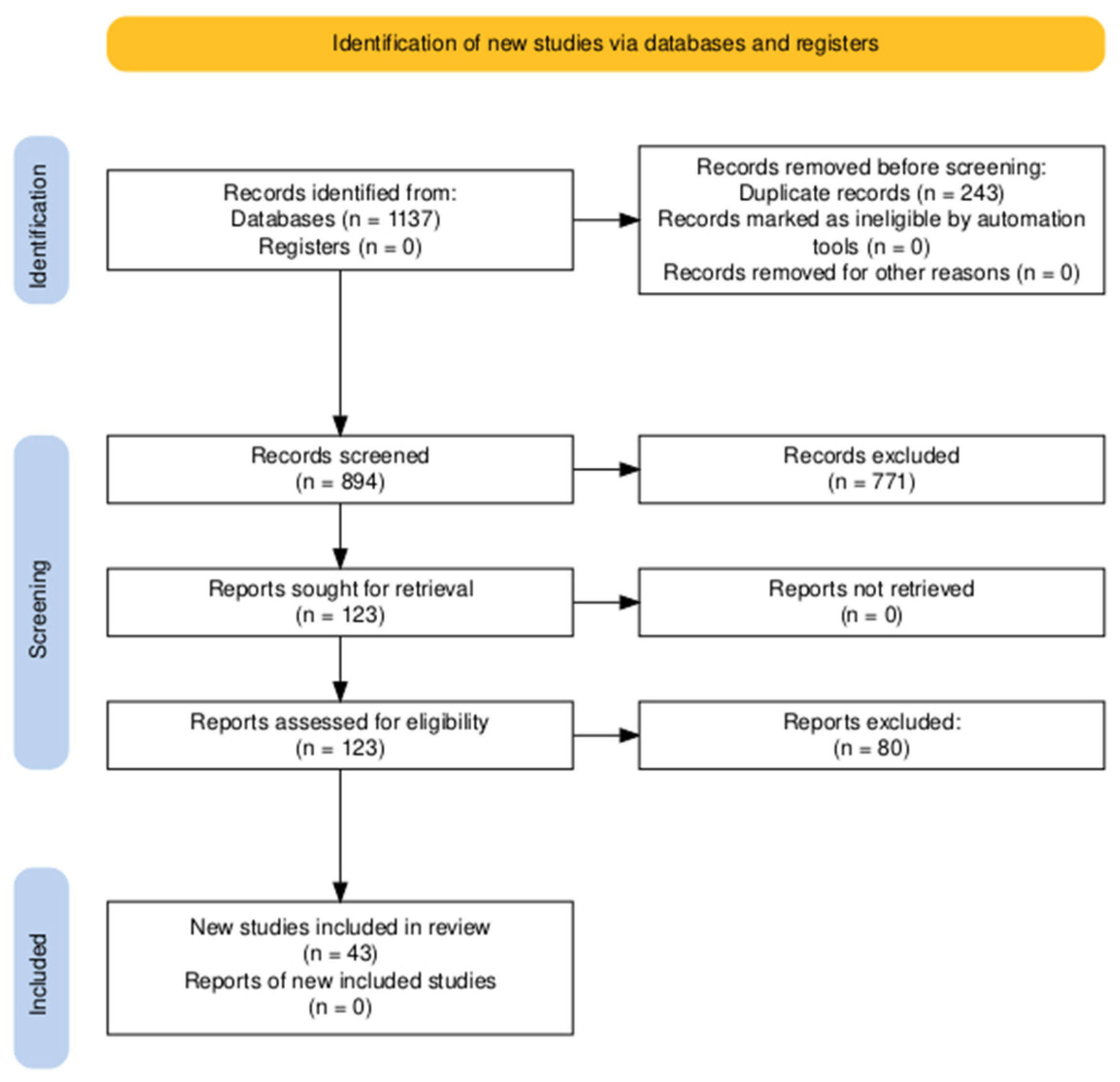
The procedure for filtering and selecting literary sources strictly follows the PRISMA (Preferred Reporting Items for Systematic Reviews and Meta-Analyses) protocol, ensuring transparency and reproducibility of the research. The process was structured into three consecutive phases, guaranteeing the precise filtering of the primary data set:
Phase 1: Consolidation and De-duplication: Initially, the results generated from the Scopus and Web of Science databases were exported into bibliographic software (Zotero, version 7.0.30). As the two databases partially overlap, an automated de-duplication process was performed, followed by a manual check for identical records, to form a single, unique list of publications for analysis.
Phase 2: Metadata Screening (Blind Screening): To prevent selection bias and ensure objectivity, the screening was conducted independently by four researchers. At this stage, each publication was evaluated based on Title, Abstract, and Keywords, without the researchers having access to the decisions of the other evaluators (blind review mode). The application of inclusion/exclusion criteria focused on the relevance of the articles to the defined conceptual clusters (project context, burnout/stress, and systems approach/EI).
Phase 3: Full-text Eligibility Assessment: Publications that successfully passed the primary filter were subjected to a detailed full-text review. At this stage, the four co-authors independently analysed the methodological rigour and the contribution of each article.
The initial search in the Scopus (n = 572) and WoS (n = 565) databases, based on the defined keywords, generated a total pool of 1137 records. Following the automated removal of duplicate records (n = 243) and primary screening of titles and abstracts, 771 articles were excluded for not meeting the thematic scope (e.g., studies outside the organisational context or lacking focus on managerial roles). The remaining 123 publications underwent a full-text eligibility assessment. At this stage, rigorous criteria for quality and relevance to the objectives of the systemic analysis were applied, resulting in the exclusion of a further 80 articles (primarily due to insufficient empirical data on causal relationships or a superficial treatment of systemic factors). The final sample consists of 43 highly relevant studies, providing the necessary depth for constructing the conceptual model, as presented in Appendix A. The visual representation of this process is illustrated via a PRISMA flow diagram (Figure 1), generated using the specialised PRISMA2020 R package and the Shiny app [55].
To ensure a high degree of inter-rater reliability, all instances of divergent evaluations among the four assessors were flagged for further discussion. The final decision to include disputed items was reached through consensus during regular methodological meetings, where the arguments for the applicability of the respective study were reviewed. This cross-validation approach minimised the risk of subjective interpretation and ensured that the final sample strictly adhered to the objectives of the systematic review. Concurrently, as the construction of a SM model requires specific methodological expertise, additional foundational works were utilised as a supplementary theoretical basis for the BRMF. These sources serve to justify the structural rules of the model and are not included in the PRISMA flow statistics, which specifically reflect the empirical analysis of the variables.

3.2. Research Design and Methodological Framework of System Dynamics

The primary objective of this study is the definition of a new management framework (BRMF), rather than its immediate statistical verification. Consequently, and taking into account the inherent nonlinearity of the burnout phenomenon, the adopted approach is Qualitative SM. This choice is epistemologically grounded as a necessary first step, enabling the visualisation of the hidden feedback architecture that linear methods frequently ignore.
The process of constructing the Causal Loop Diagram (CLD) follows established methodological protocols for systems modelling [19] and was realised in three consecutive phases:
Phase 1: Conceptualisation and Variable Definition: The first step involved transforming the themes identified in the systematic literature review (Section 3.1) into systemic variables. Using a method of thematic synthesis, qualitative data from the PRISMA analysis were encoded into two categories of variables. This step establishes that every element in the model is empirically substantiated by existing scientific literature rather than being arbitrarily selected:
  • State Variables (Stocks/States): Elements that represent the accumulations within the system over time;
  • Auxiliary Variables and Parameters (Auxiliaries): Factors that influence the rate of change in the flows.
Phase 2: Structural Mapping: In this phase, the defined variables were interconnected via causal links, reflecting both the direction and the polarity of influence (+/−). The visual construction and structural logic of the diagram were developed using the Vensim® software environment (Version 10.4.0, Ventana Systems, Inc.), an industry-standard platform for high-integrity SM modelling. Particular attention was devoted to identifying closed-loop structures:
  • Reinforcing Loops (R): Modelling processes of escalation and destabilisation.
  • Balancing Loops (B): Modelling processes of control and goal-seeking behaviour. At this stage, EI was integrated into the structure not as a passive factor, but as an active regulatory mechanism creating a novel balancing loop within the system architecture.
Phase 3: Structural Validation: As the model is conceptual, its validity was assessed through the method of theoretical triangulation. The structure of the diagram was cross-verified against the key theoretical postulates and empirical studies systematised in Section 2. This ensures that the depicted feedback mechanisms accurately represent the identified phenomenology of burnout within project environments, maintaining structural-logical consistency.

4. Results and Discussion

4.1. Identification of Key Variables in the Burnout System

As a result of the systematic literature analysis, the key variables determining the SM of burnout within PBOs were defined. The identified nomenclature of factors is classified according to the principles of SM: State Variables (Stocks), reflecting cumulative effects (Accumulated Workload, Emotional Exhaustion, Erosion of Emotional Capital, and Team Effectiveness); and Auxiliary Variables, acting as flow regulators (Emotional Intelligence, Motivation, Managerial Support, Autonomy, Social Support, and Organisational Justice). These elements form an integrated, interdependent structure where nonlinear relationships and the inherent time delay between stress exposure and the manifestation of exhaustion often mask systemic risk. Fluctuations in a single element generate cascading effects across the entire system. Such a configuration transforms burnout from an individual problem into an emergent property of the organisational structure.
A specific emphasis in the systemic model is placed on the roles of Autonomy, Social Support, and Organisational Justice, which, within the SM framework, function not merely as auxiliaries but as critical System Resources and buffer mechanisms. These resources possess the capacity to absorb systemic stress and neutralise the negative feedback loops leading to exhaustion. The results of the literature synthesis indicate that the generation and maintenance of this protective toolkit are largely determined by the Project Manager’s EI. In this sense, EI emerges as a meta-resource, under whose “umbrella” managerial strategies for ensuring psychological safety and resource adequacy are operationalised, transforming leadership capacity into a systemic stabiliser of the project environment.
In the architecture of the proposed CLD model, a vital conceptual distinction is made between the variables “Quality of Results” and “Effectiveness”. While the literature frequently groups these aspects under a single heading, for the purposes of dynamic modelling, it is critical to separate them, as they activate different coping mechanisms. Quality is defined as technical precision and the absence of defects; its decline leads directly to the physical necessity for Rework, feeding the Reinforcing Loop (R1). Conversely, Effectiveness operationalises the process dimension—execution speed, communication coordination, and decision-making. A decline in effectiveness does not necessarily generate immediate errors but results in a temporal lag (Delay), which activates the Balancing Loop (B1). This separation allows for the simultaneous modelling of the two primary symptoms of burnout: cognitive errors (quality degradation) and operational inertia (efficiency loss).
The terminology chosen for the BRMF model necessitates a further precise conceptual refinement, as within the context of PBOs, the notion of “effectiveness” ceases to be a one-dimensional performance indicator and is transformed into a complex systemic attribute. Within this scientific framework, it is critical to distinguish the subjective sense of Personal Efficacy from the objective capacity of the team unit. While psychological literature on burnout treats personal efficacy primarily as an individual’s internal deficit state, in systemic management, it remains merely an initial variable. For the purposes of the model, the concept of Team Effectiveness is more applicable, as it reflects the emergent properties of the project team as a CAS. Here, the final outcome is a function of the nonlinear interactions between individual agents rather than a simple sum of their individual efforts.
Concurrently, the prioritisation of the term Team Effectiveness over alternatives such as “Performance” or “Efficiency” is scientifically justified by the role of the Project Manager’s EI, which acts as a systemic stabilising mechanism. In a high-risk project environment, the erosion of effectiveness is manifested not merely through task delays, but through the decay of cohesion and the impairment of the team’s adaptive capacity to handle uncertainty. Consequently, the BRMF model does not seek simply to maintain work tempo, but to ensure the resilience of the team structure. Utilising the variable Team Effectiveness positions this research at the intersection of organisational psychology and strategic project management, where the emphasis lies on the group’s ability to maintain operational excellence without the psychological exhaustion of its resources. This approach legitimises the model as a tool for systemic risk management, where team effectiveness serves as the primary indicator of organisational health and sustainable project performance.
To maintain the structural parsimony of the model and adhere to empirically traceable indicators within project environments, the psychological construct “Motivation” is not included as an explicit variable. Instead, the proposed structure adopts the assumption that motivational decline is the mediating variable that transforms emotional exhaustion into reduced “Effectiveness”. This approach allows the model to focus on objectively measurable outcomes (such as velocity or throughput), avoiding the necessity of subjective modelling of latent mental states. In doing so, it enables managers to utilise standard project data for the indirect diagnostics of psycho-social risks.
Based on these dependencies and conceptual distinctions, the Burnout Causal Loop Diagram (BCLD) was constructed to visualise the feedback architecture. Structural analysis reveals that the phenomenology of burnout is a product of the dynamic interaction between competing loops. For instance, the uncontrolled growth of Workload activates a reinforcing mechanism leading to the accumulation of Exhaustion and a subsequent decline in Operational Effectiveness. In contrast, timely managerial interventions (such as task reallocation or emotional support) trigger regulatory mechanisms that limit entropy. This structural connectivity validates the fundamental thesis of the study: burnout should not be treated as an isolated individual phenomenon, but as a manifestation of dynamic systemic disequilibrium within the organisational environment.
In accordance with the theoretical principles defined in Section 2, the architecture of the model proposed in this study integrates two opposing and competing mechanisms. While the identified R-loops model the pathological escalation of burnout, the managerial intervention—operationalised through EI—was subsequently designed as a new, corrective Balancing Loop (B). Adhering to the “grammar” of SM, this loop is constructed with an odd number of negative links to ensure a return to stability [56,57]. Additionally, the structural analysis integrates the Time Delay factor to reflect the latent phase between the accumulation of fatigue and the visible decline in quality:
  • The Exhaustion Cycle (Reinforcing Loop—R1): The central destabilising mechanism is identified as a Reinforcing Loop (R1). It describes the pathological causal chain where increased Workload generates an accumulation of Emotional Exhaustion. This state leads to an erosion of Operational Effectiveness due to diminished team motivation. Within the project environment, reduced productivity results in Backlog Accumulation, which secondary increases the pressure on the team, closing the “vicious cycle” of systemic collapse [58,59].
  • The Administrative Control Loop (Balancing Loop—B1): Functioning in parallel is a Balancing Loop (B1), representing the standard managerial response. This mechanism involves structural interventions such as resource reallocation, deadline adjustments, or formal task redistribution. The function of B1 is to act as a homeostatic regulator, attempting to restore system equilibrium through organisational changes. However, as the model will demonstrate, purely administrative measures within B1 are frequently delayed due to Time Delays, necessitating the introduction of a more sophisticated, adaptive control mechanism (B2).

4.2. The Burnout Causal Loop Diagram (BCLD)

The constructed CLD maps the hypothetical architecture of the feedback loops determining burnout risk within the context of PBOs. The topology of the BRMF model integrates three key functional chains: a dominant Reinforcing Loop (R1), acting as a generator of systemic instability, and two Balancing Loops (B1 and B2). Particular emphasis is placed on loop B2, which is conceptualised as a target-seeking control mechanism activated via the exogenous variable of the manager’s EI.
Each functional link between the variables in the diagram is annotated with its corresponding polarity, indicating the mathematical sign of the derivative (the direction of influence):
  • Positive Link (→ +/s): Indicates direct proportionality, where a change in the independent variable (the cause) triggers a change in the dependent variable (the effect) in the same direction (increase → increase; decrease → decrease).
  • Negative Link (→−/o): Indicates inverse proportionality, where a change in the cause generates a change in the effect in the opposite direction.
The precise identification of these polarities is a critical condition for validating the systemic nature of each loop. The algebraic combination of signs within a closed-loop chain defines whether it functions as a Reinforcing mechanism, leading to divergent behaviour (escalation), or as a Balancing mechanism, ensuring convergent behaviour (goal-seeking/equilibrium). This logic reveals the fundamental dynamic scenarios through which the system evolves over time.
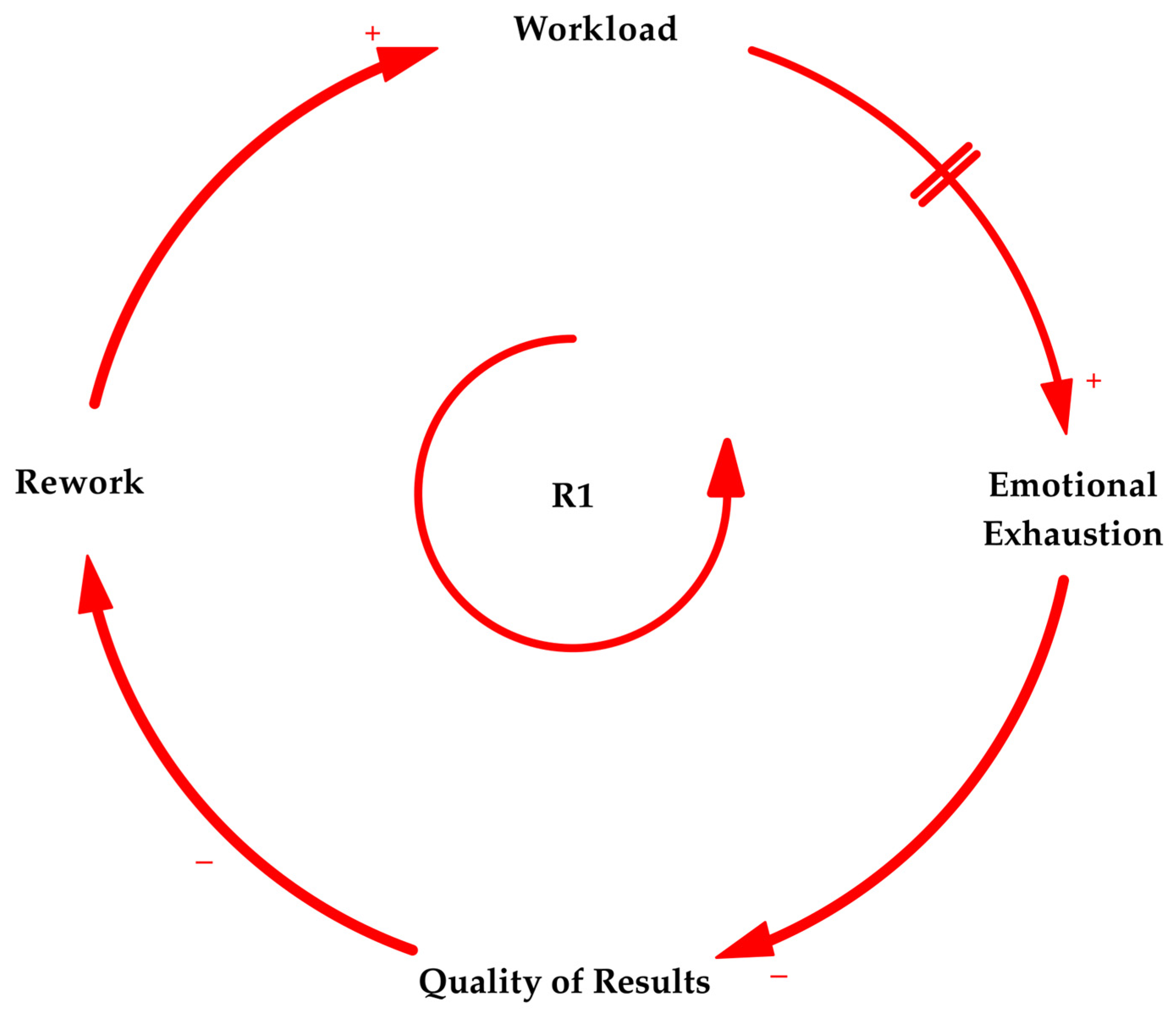
The Reinforcing Loop (R1), visualised in Figure 2, defines the systemic trap responsible for the self-generated escalation of burnout. This mechanism describes a self-sustaining spiral of degradation triggered by an initial increase in Workload. The causal chain follows this logic:
  • Increased workload leads to the accumulation of Emotional Exhaustion (↑ Workload → ↑ Exhaustion). It is crucial to note that this link is characterised by an inherent Time Delay, as exhaustion is a state variable (stock) that accumulates gradually, often masking early symptoms of dysfunction.
  • Reaching critical levels of exhaustion leads to the erosion of Quality of Results (↑ Exhaustion → (−) ↓ Quality). This represents the first negative link in the chain.
  • Deteriorated quality, in turn, generates an increased Need for Rework and corrections (↓ Quality → (−) ↑ Rework). Since low quality leads to a higher volume of corrections (inverse relationship), this link is mathematically defined as the second negative link in the structure.
  • The increased volume of rework is added to the current tasks, closing the loop by secondarily increasing the total Workload (↑ Rework → (+) ↑ Workload).
According to the algebraic rules of SM, the loop contains an even number of negative links (two): (1) between Exhaustion and Quality, and (2) between Quality and Rework. This configuration defines the structure as a Reinforcing Loop. The emergent behaviour of such a structure is an exponential divergence from equilibrium—in this case, a trajectory of accelerating resource depletion and systemic collapse.
The first and most critical structural element of the BRMF model is the Reinforcing Loop of Chronic Exhaustion (R1). This loop does not merely describe a linear sequence of symptoms; it defines a systemic configuration characterised by nonlinear and self-sustaining dynamics. In essence, R1 represents an entropy-generating mechanism, where interdependent variables interact over time to create an exponential trend toward the collapse of team capacity.
The fundamental cause for the activation of this loop is the structural asymmetry (imbalance) between systemic demands (workload, complexity, time pressure) and available resources (time, energy, cognitive capacity, autonomy). When this balance is disrupted, the system shifts into a state of chronic tension, which progressively erodes its resilience [60]. The process is initiated by an exogenous or endogenous increase in Team Workload, triggered by project deadlines or organisational pressure. When this workload exceeds the physiological and cognitive thresholds of individuals, it activates a direct causal link:
↑ Workload → (+) ↑ Emotional Exhaustion
This dependency is positive, as chronic cognitive stress and the constant need for adaptation deplete the team’s psychological capital (PsyCap) and energy reserves. Subsequently, the accumulated exhaustion leads to the degradation of cognitive functions and attention to detail, resulting in diminished work quality:
↑ Emotional Exhaustion → (−) ↓ Quality of Results
The systemic response to the decline in quality is the necessity for compensatory actions. To rectify errors, the system generates an additional volume of work (Rework) and overtime:
↓ Quality of Results → (−) ↑ Need for Rework/Overtime
This secondary task flow returns to the system’s starting point, increasing the total workload and closing the reinforcing loop:
↑ Need for Rework → (+) ↑ Team Workload
This structure demonstrates how burnout is self-propagating: the system’s attempt to compensate for exhaustion through more work (corrections) paradoxically accelerates the exhaustion process itself. As the loop progresses, the system encounters a critical phenomenon inherent to nonlinear dynamic structures—Time Delay. The degradation of results does not occur instantaneously after an increase in workload; it manifests only after the accumulation of a critical mass of so-called “stress debt” (the latent phase of the cycle) within the system:
↑ Exhaustion → [Delay] → (−) ↓ Quality of Result
When this latent period ends and quality begins to decline, the system reacts via a compensatory mechanism perceived by the team as a state of internal urgency. The organisation attempts to recover lost productivity by intensifying efforts, which is mathematically expressed through an inverse (negative) dependency:
↓ Quality of Results → (−) ↑ Need for Rework
The link is negative because a reduction in quality leads to an increase in the necessity for rework. However, this reactive response does not stabilise the system; paradoxically, it destabilises it. The volume of rework generated is added to current tasks, increasing the total workload:
↑ Need for Rework → (+) ↑ Workload
This closes the Reinforcing Loop (R1). According to the rules of SM, the presence of an even number of negative links (two: Exhaustion → Quality and Quality → Rework) defines the structure as a Positive Feedback Loop. Once activated, R1 functions as “runaway feedback” or a “vicious cycle”. In the absence of external regulators (such as recovery resources or managerial buffers), this mechanism leads to the systemic amplification of tension, where every attempt at a solution (via more work) exacerbates the problem, leading to an inevitable collapse of capacity.
In this epistemological context, the Reinforcing Loop R1 transcends the descriptive function of a stress accumulator and operationalises the structural mechanism of burnout as an authentic systemic phenomenon. The model explicates why exhaustion is not a simple linear function of workload, but an emergent result of endogenous (internally closed) dynamics.
A critical characteristic of this structure is its capacity for self-perpetuation: once activated, the spiral of degradation continues to function even after the initial exogenous stimulus (such as a deadline or peak workload) has ceased. Consequently, R1 serves as a theoretical framework that redefines burnout—transforming it from isolated individual symptoms into a systemic risk of cognitive and energetic capital erosion, leading to irreversible structural entropy.
In contrast to the destabilising nature of R1, the Adaptation Balancing Loop (B1) illustrates the built-in immune mechanisms of the organisational system. This loop functions as a Negative Feedback Loop, whose teleological goal is to neutralise the entropy generated by chronic exhaustion and restore homeostasis (equilibrium).
Adhering to the topological rules of SM, B1 is characterised by an odd number of negative links, defining its regulatory nature inherent in CAS. The activation of the loop follows the logic of a cascading collapse in productivity. Accumulated Emotional Exhaustion exerts a direct inhibitory effect on Team Effectiveness:
↑ Exhaustion → (−) ↓ Effectiveness
The decline in effectiveness is not merely a quantitative indicator but a signal of diminished organisational capacity (loss of focus, cognitive errors, communication deficits). This functional degradation leads to an increase in project Time Delay:
↓ Effectiveness → (−) ↑ Delay
The relationship is mathematically negative, as the variables move in opposite directions—lower effectiveness results in increased delay. The generated delay is the first objective systemic indicator that the organisation has deviated from its optimal state. This signal forces the system to react—either through deadline adjustments (constructive adaptation) or, in the worst-case scenario, through employee turnover (systemic failure). Paradoxically, the latter alleviates tension by forcing a cessation of activities.
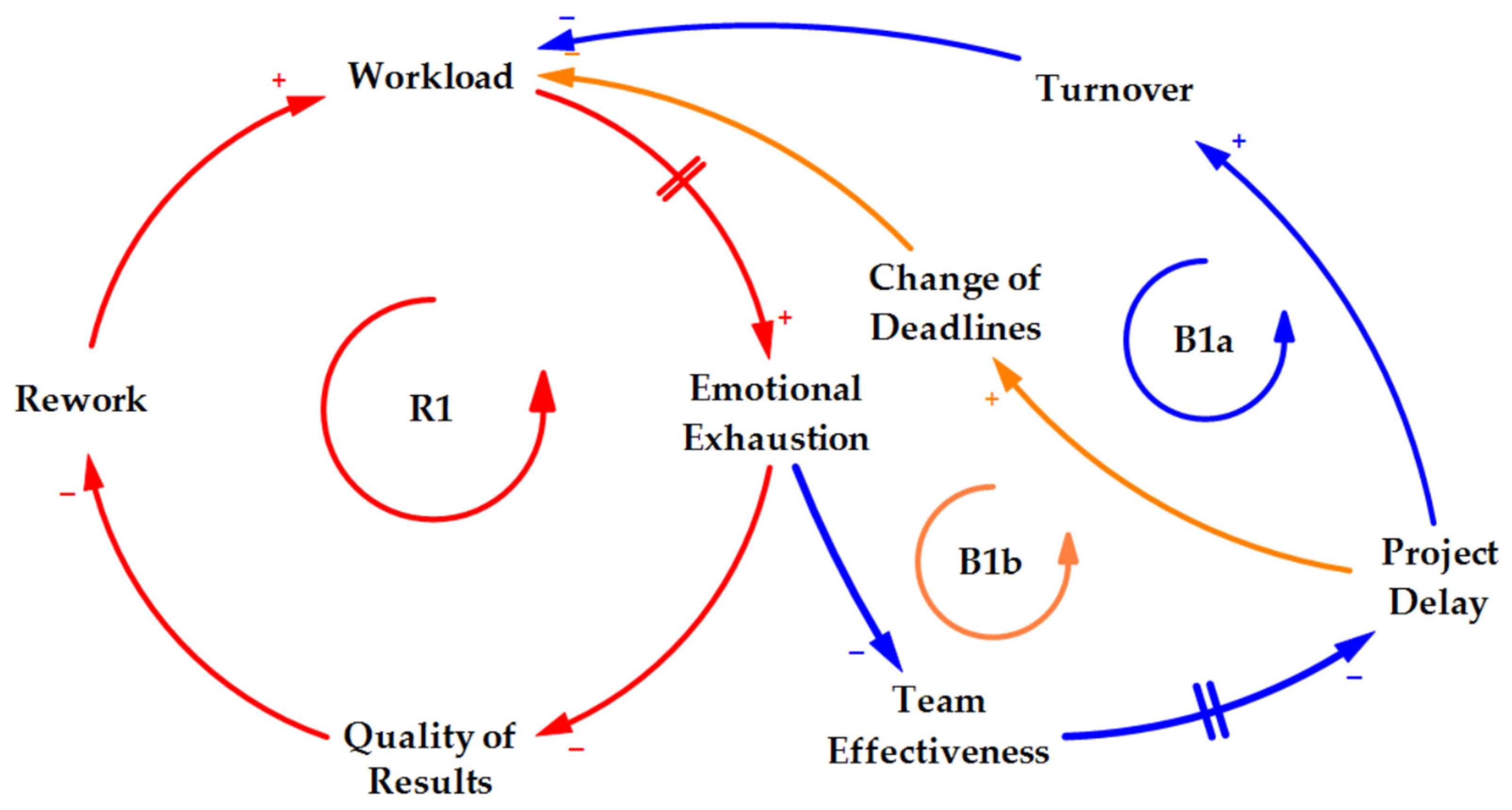
The visual operationalisation of these complex dependencies is articulated through the CLD presented in Figure 3. This graphical topology synthesises the system’s causal architecture, integrating the defined variables and their vector interactions. The model explicates the dynamic tension between the two fundamental loops—the Reinforcing (R1) and the Balancing (B1)—which jointly determine the trajectories of accumulation and regulation of emotional exhaustion within the context of PBOs. Reaching critical levels of System Delay functions as a bifurcation point. At this structural node, the system may follow one of two alternative response trajectories, defined respectively as entropic (destructive) or adaptive (constructive) regulation:
  • Entropic Regulation (B1a): Balancing through Self-Destruction (Turnover)
In the absence of adequate managerial intervention, delay activates a pathological relief mechanism through the attrition of system elements—Staff Turnover:
↑ Delay → (+) ↑ Turnover
The departure of key personnel leads to a deceptive (and often destructive) balancing effect. The reduction in capacity leads to the contraction of activities or project failure, which mechanically eliminates the workload for those who have left (or for the remaining staff if the project is terminated):
↑ Turnover → (−) ↓ Workload
This effect represents a false equilibrium. Instead of stabilising the system by restoring functionality, turnover stabilises it by dismantling the structure. This is a form of entropic regulation—a balance achieved through the loss of organisational memory, competence, and cohesion.
2.
Adaptive Regulation (B1b): Balancing through Flexibility (Deadline Adjustment)
In the optimised scenario (B1 in its ideal form), the accumulated delay is interpreted by management as a diagnostic signal necessitating a revision of project parameters. This activates corrective measures, such as Deadline Adjustment or re-prioritisation:
↑ Delay → (+) ↑ Deadline Adjustment
Extending the time horizon acts as a systemic buffer, reducing the intensity of pressure exerted on the team:
↑ Deadline Adjustment → (−) ↓ Workload
As a consequence of the reduced workload, emotional exhaustion begins to subside, restoring the functional capacity of the system:
↓ Workload → (+) ↓ Exhaustion
This dependency is positive, as the variables move in the same direction—the decline in workload leads to a decline in exhaustion. This mechanism closes the regulatory loop, allowing the organisation to adapt to reality without sacrificing its human capital.
The functional efficiency of the balancing mechanism B1 is critically dependent on the temporal lag between symptom detection and managerial intervention. In SM, delay is a determining factor for stability: when the corrective signal is synchronised with the deviation, the system successfully restores its homeostasis without structural damage. Conversely, in cases of significant latency or inadequate magnitude of response, regulation inevitably shifts into a mode of destructive adaptation—stabilisation through entropic processes such as turnover, loss of institutional knowledge, and the erosion of motivation.
Within the model’s architecture, R1 and B1 constitute a dialectical systemic pair:
  • R1 embodies the forces of positive feedback (divergence and the escalation of tension);
  • B1 embodies the forces of negative feedback (convergence and regulation).
Consequently, the balancing loop B1 should be conceptualised not merely as an administrative corrective, but as a mechanism for organisational learning and cybernetic self-regulation. Its activation indicates the system’s capacity to sense its own deviation from target parameters. This conclusion redefines the concept of resilience: within the context of PBOs, resilience is not a static attribute of the team, but a dynamic function depending on the speed of reaction and the quality of managerial decisions within the temporal continuum.
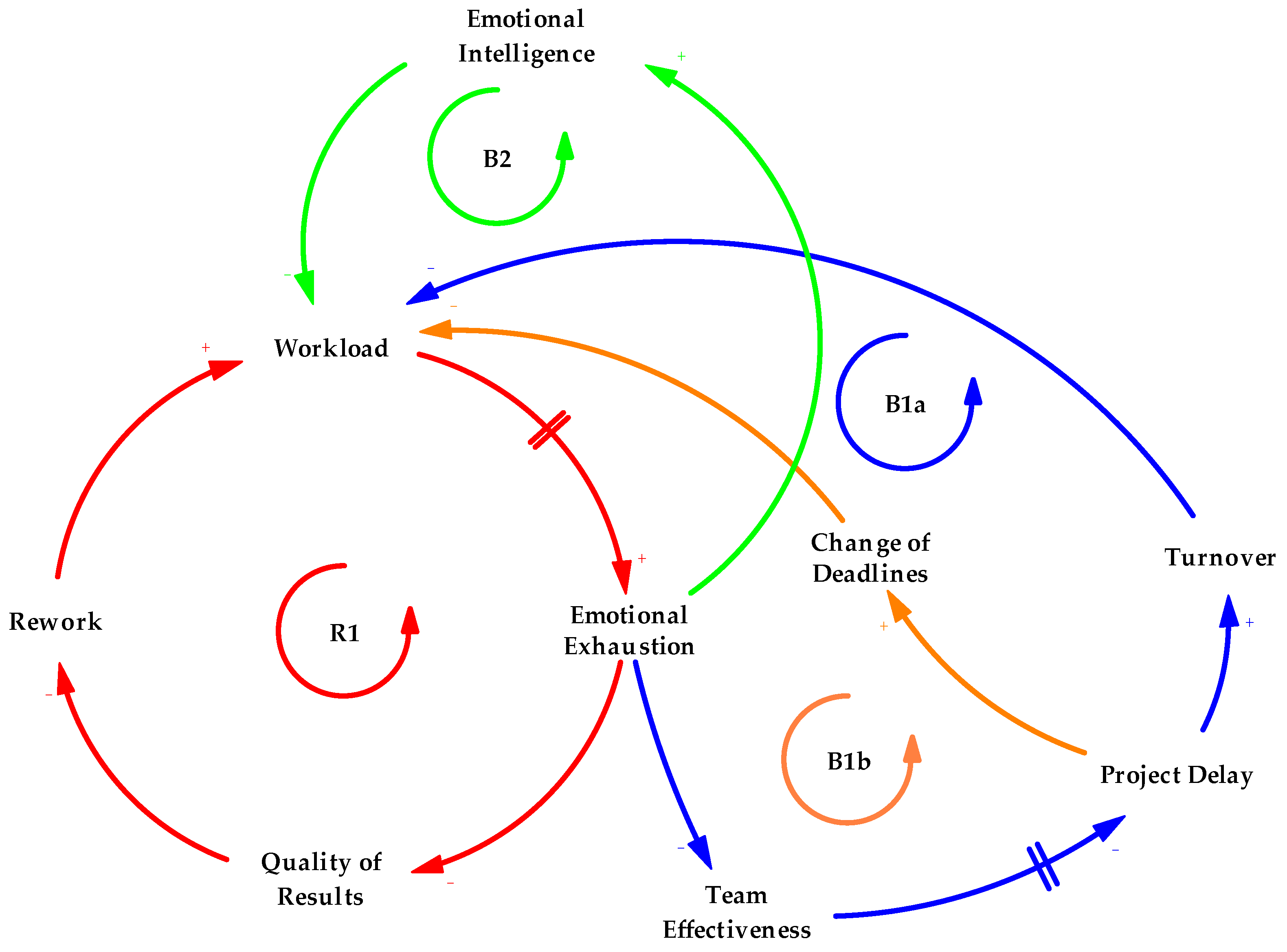
The second regulatory mechanism—the Balancing Loop (B2)—operationalises the role of EI as a strategic lever for systemic prevention (Figure 4). Unlike the reactive nature of loop B1 (which is triggered only after a delay occurs), B2 aims to proactively restore equilibrium before the system enters the collapse spiral (R1). In this structure, the high level of the manager’s EI functions as a high-sensitivity systemic sensor. The causal chain proceeds as follows:
The presence of early signs of stress, modulated by high EI, leads to an enhanced detection capacity:
↑ EI → (+) ↑ Detection of Exhaustion
The timely identification of the problem activates proactive managerial intervention. This step is the critical negative link in the loop, as the intervention aims to reduce the stressor:
↑ Detection of Exhaustion → (−) ↓ Team Workload
The link is negative because an increase in detection leads to actions aimed at reducing workload through resource redistribution or re-prioritisation. The reduced workload, in turn, leads to a direct drop in exhaustion levels:
↓ Workload → (+) ↓ Emotional Exhaustion
This dependency is positive, as the variables change in the same direction—a decrease in one leads to a decrease in the other. The mathematical verification of the loop shows the presence of a single negative link (between Detection and Workload). Since 1 is an odd number, the structure is definitively classified as a Balancing Loop (B).
The fundamental difference from B1 lies in the temporal aspect: EI drastically reduces the time delay between the onset of stress and the corrective response. By eliminating the latent period, B2 interrupts the reinforcing loop R1 at its inception, functioning as a preventive damping mechanism that maintains the system within a zone of sustainable well-being. The conceptual diagram presented in Figure 4 visualises the integrated SM of burnout in a project environment, defined by the interaction between two classes of functional loops: Reinforcing (R) and Balancing (B). This topology illustrates the fundamental tension within the system: the struggle between entropic forces, leading to a self-sustaining collapse of capacity, and regulatory managerial mechanisms striving for homeostasis.
  • Escalation Dynamics (R-Loops):
The reinforcing component of the model (R) describes the mechanics of positive feedback, where changes in the system are exponentially self-amplifying. In the context of project management, this chain is triggered when increased Workload generates an accumulation of Emotional Exhaustion:
↑ Workload → (+) ↑ Exhaustion → (−) ↓ Effectiveness
The decline in effectiveness and motivation paradoxically leads to a secondary increase in workload—through the accumulation of backlog or the necessity for compensatory labour. Thus, the system enters a spiral process of degradation, where each iteration of the loop amplifies the next, maintaining a persistent vicious cycle of low productivity.
b.
Stabilisation Dynamics (B-Loops):
In contrast, the Balancing component (B) performs a vital stabilising function. It is activated through exogenous or endogenous Management Interventions, encompassing structural changes (task redistribution) or socio-psychological measures (EI, support, open communication). The objective of these actions is to neutralise the escalating effect of workload on exhaustion, thereby refracting the amplification vector.
↑ Interventions → (−) ↓ Exhaustion → (+) ↑ Effectiveness
When the balancing forces dominate, the workload returns to manageable levels, and the system restores its dynamic equilibrium. Consequently, the state of the team at any given moment is the result of the net effect between the strength of the Reinforcing loop (R) and the efficacy of the Balancing interventions (B).
The interaction between the analysed loops (R and B) illustrates a classic example of dynamic equilibrium within complex socio-technical systems. The BRMF model reveals the fundamental antagonism governing the state of the team: reinforcing mechanisms (R1) generate constant pressure towards entropy and performance degradation, while balancing mechanisms (B1/B2) act as homeostatic forces striving to return the system to a stable state. The developmental scenario depends entirely on the net balance of forces:
  • In the absence of adequate control, the dominance of the Reinforcing Loop leads to a systemic collapse—a state where accumulated exhaustion exceeds the recovery capacity at both individual and team levels;
  • Conversely, if the balancing mechanisms are active and possess high sensitivity to weak signals (such as early dips in motivation or micro-shifts in behaviour), the system successfully neutralises deviations and prevents burnout.
The presented CLD (Figure 4) and the introduced BRMF transform traditional understandings of project management, replacing linear sequences of events with an architecture of interdependencies. Within this structure, every variable functions simultaneously as both cause and effect (circular causality)—workload causes exhaustion, but exhaustion (through errors) generates new workload.
This conclusion necessitates a fundamental reimagining of the project manager’s role: from a task administrator, they are transformed into a system regulator. Their core competency is not the simple allocation of resources, but the ability to diagnose which loops are dominant at any given moment and to apply “acupuncture” interventions (leverage points) that activate the balancing mechanisms. In this way, burnout prevention ceases to be viewed as a matter of individual endurance and is instead defined as a systemic process of managing the dynamic tension between project requirements and human capital.

4.3. Systemic Synthesis: The Dialectics of R1 and B1 Interaction

The modelling results validate the hypothesis that burnout within project environments is an emergent property of a dynamic feedback system, rather than a linear causal chain. This structural coupling between human capital and organisational parameters generates specific nonlinear behaviours, most notably the latent accumulation of exhaustion followed by a sharp, disproportionate collapse in effectiveness—a phenomenon known as tipping point dynamics [61].
The application of systems thinking and CLD modelling allows for an epistemological shift: burnout is no longer an isolated individual pathology, but a systemic process of dysregulation. It represents a failure to maintain the dynamic equilibrium between the entropic forces of project demands and the regenerative capacity of the system. In this context, the interaction between the Reinforcing Loop of Chronic Exhaustion (R1) and the Balancing Loop of Adaptation (B1) reveals the fundamental architectural duality of PBOs:
  • The Autocatalytic Logic of R1: As a positive feedback mechanism, R1 operates through an energy deficit financing model. Any initial increase in workload induces a secondary accumulation of exhaustion; without active stabilising constraints, this transforms temporary functional load into pathological chronic stress. From a thermodynamic perspective, R1 acts as the entropic vector, progressively eroding the organisation’s adaptive capacity to the point of structural collapse.
  • The Negentropic Response of B1: In opposition, loop B1 functions as the system’s immune response. It transcends simple compensation by providing a meta-mechanism for organisational learning. By decoding systemic signals—such as time delays and declines in effectiveness—the system recalibrates its internal parameters through task reallocation, revision of time horizons, or increased autonomy.
The critical determinant in this interaction is the temporal asymmetry between the two loops. R1 is characterised by high velocity and automatism, often escalating before the organisation consciously perceives the danger. In contrast, B1 is reflexive and non-automatic; it requires cognitive interpretation and coordinated managerial intervention. When the latency period between tension accumulation and B1 activation is too prolonged, R1 establishes dominance. This leads to a bifurcation in the system’s trajectory:
  • Pathological Regulation: Stabilisation through structural destruction (turnover, “quiet quitting”), which alleviates pressure in the short term but leads to long-term resource impoverishment;
  • Adaptive Managerial Reaction: Constructive restructuring that enhances systemic resilience. This is where the leverage points of the model are located—specifically in the manager’s capacity to transform the kinetic energy of pressure into organisational learning.
Ultimately, the BRMF postulates that a resilient organisation is not one that avoids workload, but one that possesses the capacity for endogenous self-correction. Burnout is thus redefined as a functional indicator: a signal that the system has reached its saturation point, where the organisational structure can no longer convert external pressure into internal resilience.

4.4. Emotional Intelligence as a Systemic Lever for Control and as a Meta-Variable

The temporal asymmetry between stress (cause) and symptoms (effect) often creates a managerial blind spot, leading to reactive interventions that are out-of-phase with the current systemic state. To address this, the BRMF redefines Emotional Intelligence (EI) as a systemic sensor and control lever [53]. In the model’s architecture, EI does not function as an isolated trait but as a meta-variable that transforms the topology of information flows, allowing for the pre-emptive activation of the Balancing Loop (B2).
  • Functional Vector 1: Workload Transparency
The primary systemic effect of this control lever is the enhancement of Workload Transparency. High EI functions as a high-sensitivity sensor for the early detection of overload. In cybernetic terms, this increases the precision of the feedback between the objective state of the system and the managerial control centre:
↑ Managerial EI → (+) ↑ Workload Transparency
By reducing the information delay, the system receives near-real-time data, enabling pre-emptive intervention before the inertia of the Reinforcing Loop (R1) becomes irreversible.
b.
Functional Vector 2: Signal Interpretation and Adaptive Regulation
High EI transcends the observation of external indicators (e.g., deadlines) by decoding weak signals—micro-fluctuations in engagement or latent defensive behaviours like withdrawal. This transforms EI into a sensory subsystem that translates affective states into manageable parameters:
↑ Workload Transparency → (+) ↑ Detection of Exhaustion
Upon identification of risk, EI shifts to a regulatory role, activating the Balancing Control Loop (B2). This mechanism introduces adaptive stabilising protocols, such as proactive task redistribution or conflict mediation. The manager exercises behavioural control where the feedback is transformed from sanctioning to supportive, creating a negative (regulating) link directed at the workload:
↑ Managerial EI → (−) ↓ Team Workload
The introduction of EI as a control lever generates a fundamental transformation in the feedback topology of the project environment. The primary systemic effect is a decisive shift in loop dominance: the Reinforcing Loop of exhaustion (R1) loses its autonomy as the balancing loops (B1 and especially B2) are activated with higher efficacy, driven by a significantly reduced information lag. Conceptually, this transition marks an evolution from reactive homeostasis to proactive homeostasis. Within this framework, the system no longer functions as a passive regulator that merely responds to manifested dysfunctions (B1); instead, it operates as an active predictor. By detecting the first primary signals of tension, the EI-driven mechanism (B2) anticipates and compensates for imbalances before they escalate into structural failure.
In this architecture, EI acts as an adaptive mediator between the system’s cognitive and affective control, shifting the focus from mechanical regulation to conscious sensitivity. This allows the manager to read the team’s emotional climate with the precision of an instrumental sensor, providing the BRMF with emotional resonance. This capacity enables the organisation not only to register changes but to interpret, prioritise, and utilise them as structural input for continuous learning.
Furthermore, while the BRMF presents EI primarily as a mechanism for mitigating workload, System Dynamics suggests that this cycle can be enhanced through additional, implicit feedback loops. Literature synthesis confirms that EI is a dynamic capability that evolves through reflection and experience rather than a static resource. Consequently, the balancing loop B2 must be interpreted as an open system, directly influenced by the interplay between Emotional Exhaustion and Team Effectiveness.
This interdependency introduces a dualistic trajectory for the system. On one hand, there is a persistent risk of emotional capacity erosion: during prolonged periods of high exhaustion, the team’s capacity for empathy and self-regulation—core components of EI—may degrade. Such a shift could transform the balancing mechanism into a reinforcing destructive process, further accelerating the burnout spiral. On the other hand, integrating feedback from Team Effectiveness back into EI closes the Learning Loop. When a team successfully navigates crisis periods and perceives positive outcomes, it reinforces group EI and collective resilience. Within this context, the Time Delay identified in the model is critical, representing the temporal space required to internalise experience and transform it into a sustainable organisational capability. Ultimately, the strategic management of these feedback loops determines whether the system enters a spiral of adaptive learning or a trajectory of degradation.

4.5. Boundary Conditions: Structural Primacy and the Limits of EI

While the BRMF identifies Emotional Intelligence as a high-leverage point (B2), it is imperative to acknowledge that it is not a panacea. The model operates under the principle of polycentric control, where EI functions as one variable within a broader ecosystem of determinants, including organisational governance, staffing models, and individual psychological predispositions (such as personal resilience or psychological flexibility).
A critical boundary condition for the efficacy of EI is the Structural Saturation Point. System Dynamics postulates that feedback loops operate effectively only within specific parametric ranges. If the sheer intensity of the Reinforcing Loop (R1)—driven by chronic understaffing or unrealistic project scope—exceeds the physical and cognitive capacity of the team, the regulatory power of EI (B2) collapses. In such scenarios of “structural violence,” soft skills cannot compensate for hard resource deficits. Therefore, EI is defined as a necessary but not sufficient condition for resilience; it acts as a filter that modulates stress, but it cannot dam a tidal wave of systemic dysfunction.
Furthermore, the operationalisation of EI is contingent upon Cultural Alignment. In organisational cultures characterised by rigid bureaucracy or a blame culture, the empathetic interventions of a project manager may be rejected by the suprasystem or perceived by the team as disjointed from reality. Consequently, the proposed framework posits that EI serves as an effective lever primarily when the organisation provides a baseline of structural hygiene—adequate resources and functional governance. Without these foundational elements, the application of EI risks becoming a palliative measure rather than a curative strategy.

4.6. Nature of the Contribution: Theoretical Plausibility and Hypothesis Generation

Given the qualitative nature of this study, it is essential to distinguish between the established empirical foundations and the conceptual propositions of the proposed framework. The BRMF is constructed upon empirically validated theories—specifically the JD-R model [3,6] and the efficacy of Emotional Intelligence in leadership [10,47]. However, the integration of these elements into a System Dynamics architecture represents a novel theoretical construct.
Therefore, the causal links visualised in the Causal Loop Diagram (CLD)—particularly the regulatory function of B2 (EI lever)—should be interpreted as theoretical plausibilities rather than empirically verified constants. The primary contribution of this research is not the statistical validation of these relationships, but their identification as a coherent system of hypotheses. The model serves as a heuristic device, offering a logical roadmap for future research. Specifically, the postulate that EI reduces information delay is a structural hypothesis derived from cybernetic logic, which requires subsequent quantitative verification through longitudinal field studies.
Consequently, the utility of the BRMF at this stage lies in its hypothesis-generating capacity: it provides researchers with a specific set of structural variables and feedback loops to test, and practitioners with a logic-based diagnostic tool, rather than a definitive predictive algorithm.

4.7. Practical Operationalisation: A Diagnostic Dashboard

To address the gap between abstract systemic variables and daily managerial practice, the BRMF proposes a specific set of observable indicators. Following the System Dynamics logic, these are categorised into two groups: Lagging Indicators (symptoms of R1 that have already manifested) and Leading Indicators (weak signals detected by B2/EI before the crisis). Table 1 operationalises these variables into a diagnostic dashboard for project managers.
The practical application of this dashboard requires its integration into the regular project review cycle (e.g., sprint retrospectives or milestone meetings). Rather than treating burnout as a post-factum medical diagnosis, managers should utilise these indicators to perform a continuous “systemic health check”. The objective is to shift managerial attention from the obvious Lagging Indicators (which signal that R1 is already dominant) to the subtle Leading Indicators, where low-cost interventions via B2 can still restore equilibrium.
Furthermore, the dashboard mandates a differentiated intervention logic. The detection of Leading Indicators should trigger immediate behavioural regulation via the EI lever (e.g., emotional validation, conflict mediation). Conversely, the presence of Lagging Indicators signals a structural breach that cannot be resolved through soft skills alone, necessitating the activation of Loop B1—structural reorganisation (e.g., scope reduction or resource augmentation). By distinguishing between these signal types, the framework prevents the common managerial error of attempting to treat structural overload with superficial wellness initiatives.

5. Conclusions

The present study proposes a new epistemological perspective on burnout within project environments, shifting the analytical focus from individual psychology to System Dynamics. Through the construction of the Burnout Risk Management Framework (BRMF), this research demonstrates that professional exhaustion in PBOs is not merely a linear function of workload but an emergent property of uncontrolled reinforcing feedback loops (R1). The analysis of the model’s architecture reveals the critical role of time delays, which mask the accumulation of hidden entropy in the early project phases, creating an illusion of stability before irreversible systemic collapse occurs.
In theoretical terms, this research contributes by redefining the role of Emotional Intelligence (EI). Unlike the traditional literature, which treats EI as a static trait, the current model operationalises it as a dynamic systemic lever (B2) capable of reducing information delays. By bifurcating the consequences of burnout into two streams—rework and slip rates—the BRMF provides a logical, structural explanation for the “efficiency–quality” paradox, illustrating why standard performance metrics often fail to predict team collapse.
From a practical perspective, the study transcends abstract theorising by offering immediate applicability through the proposed Diagnostic Dashboard (Table 1). This tool empowers managers to distinguish between lagging indicators (structural overload requiring resource intervention) and leading indicators (weak signals requiring behavioural EI regulation). By adopting this dashboard, PBOs can transition from reactive crisis management to proactive systemic regulation, treating EI investment not as a soft HR initiative but as a valid risk management instrument.
Despite the conceptual depth achieved, this research has specific limitations. Primarily, the model is qualitative and hypothesis-generating, while it visualises the structure of change, it does not quantitatively predict velocity or magnitude. Furthermore, as the framework is calibrated to the structural dynamics of PBOs (governance, staffing), it employs a degree of abstraction regarding individual psychological differences (such as psychological flexibility), which act as external variables to the managerial system.
These limitations outline the logical next steps for scholarly pursuit. Future research should focus on two parallel streams: (1) Empirical Validation—conducting longitudinal field studies to test the causal links and the efficacy of the diagnostic indicators in real-world settings—and (2) Quantitative Simulation—transforming the CLD into a Stock and Flow model to mathematically simulate scenarios and definitively validate the impact of EI on organisational resilience.

Author Contributions

Conceptualization, A.T., I.K., S.R. and S.B.; methodology, A.T., I.K., S.R. and S.B.; validation, A.T., I.K., S.R. and S.B.; formal analysis, A.T., I.K., S.R. and S.B.; investigation, A.T., I.K., S.R. and S.B.; resources, A.T., I.K., S.R. and S.B.; data curation, A.T., I.K., S.R. and S.B.; writing—original draft preparation, A.T., I.K., S.R. and S.B.; writing—review and editing, A.T., I.K., S.R. and S.B.; visualization, A.T., I.K., S.R. and S.B.; supervision, A.T., I.K., S.R. and S.B.; project administration, A.T., I.K., S.R. and S.B.; funding acquisition, A.T., I.K., S.R. and S.B. All authors have read and agreed to the published version of the manuscript.

Funding

This paper is financed by the European Union-NextGenerationEU, through the National Recovery and Resilience Plan of the Republic of Bulgaria, project No BG-RRP-2.013-0001.

Data Availability Statement

Data are contained within this article.

Conflicts of Interest

The authors declare no conflicts of interest. The funders had no role in the design of the study; in the collection, analyses, or interpretation of data; in the writing of the manuscript; or in the decision to publish the results.

Abbreviations

The following abbreviations are used in this manuscript:
BRMFBurnout Risk Management Framework
CLDCausal Loop Diagram
EIEmotional Intelligence
R1Reinforcing Loop 1
B1Balancing Loop 1
B2Balancing Loop 2
PBOsProject-Based Organisations
PRISMAPreferred Reporting Items for Systematic Reviews and Meta-Analyses
SLRSystematic Literature Review
JD-RsJob Demands-Resources
PDCAPlan, Do, Check, Act
HRMHuman Resource Management
WoSWeb of Science
CASComplex Adaptive System
BCLDBurnout Causal Loop Diagram
SMSystem Dynamics

Appendix A

The following table presents a comprehensive list of the 43 scientific papers that met the inclusion criteria for the Systematic Literature Review. These publications were the subject of thematic coding and critical analysis, forming the main data set for the development of the BRMF model. The Thematic Code column illustrates the codes extracted from each article.
Table A1. List of the 43 scientific papers included in the final qualitative synthesis (Thematic Coding Dataset).
Ref. IDFirst Author/YearTitleThematic Code
1[2]Sloot et al.
(2024)
Change in a project-based organization: The mutual shaping of institutional logics and change programsJustifies the context of PBOs and their institutional dynamics.
2[3]Edú-Valsania et al.
(2022)
Burnout: A Review of Theory and MeasurementProvides a theoretical foundation for defining and measuring the burnout phenomenon.
3[4]Tang et al.
(2025)
Burnout and Stress: New Insights and InterventionsContemporary insights into stress and burnout, supporting the necessity for new interventions.
4[5]Bes et al.
(2023)
Organizational interventions and occupational burnout: a meta-analysis with focus on exhaustionMeta-analysis confirming the significance of organisational interventions.
5[6]Wang, M.
(2024)
The effects of mindfulness-based interventions on alleviating academic burnout in medical students: a systematic review and meta-analysisExamines individual strategies that complement the focus on organisational dependencies.
6[9]Chevalier et al.
(2025)
Emotional intelligence, transformational leadership, and team satisfaction during the COVID-19 period in BelgiumLinks EI with team satisfaction under crisis conditions.
7[10]Tamer et al.
(2025)
The Importance of Emotional Intelligence in Managers and Its Impact on Employee Performance Amid Turbulent TimesHighlights the role of the manager and their EI in team performance within turbulent environments.
8[11]Waris et al.
(2024)
Perspectives on artificial intelligence in times of turbulence: Theoretical background to applicationsAnalysed EI in project management, supporting the thesis of EI as a systemic lever.
9[12]Sankaran et al.
(2023)
How do project-oriented organizations enhance innovation? An institutional theory perspectiveOrganisational perspective on PBOs, focused on innovation and structure.
10[13]Meslec et al.
(2023)
Multiple teams, multiple projects, multiple groups at the intersection of (multiple) research fields: A bibliometric studyBibliometric review of multi-project work as a primary source of workload.
11[14]Korhonen-Kurki et al. (2024)Leverage points for sustainability transformation: Identifying past and future changes in the Finnish (circular) plastic packing systemUtilises the concept of “Leverage points”.
12[15]Sazvar et al.
(2022)
A hybrid decision-making framework to manage occupational stress in project-based organizationsProposes a hybrid framework for stress in PBOs.
13[16]Aliu et al.
(2023)
Towards a New Paradigm of Project Management: A Bibliometric ReviewOutlines the new paradigm in project management, incorporating well-being.
14[17]Anderson et al.
(2023)
Opportunities for system dynamics research in operations management for public policyArgues for the application of System Dynamics (SD) in solving complex managerial problems.
15[18]Veldhuis et al.
(2020)
A Proof-of-Concept System Dynamics Simulation Model of the Development of Burnout and Recovery Using Retrospective Case DataDirect precedent: utilizing System Dynamics (SD) for burnout simulation.
16[21]Govindaras et al.
(2023)
Sustainable Environment to Prevent Burnout and Attrition in Project ManagementExamines the sustainable environment in project management as burnout prevention.
17[23]Kovács et al.
(2023)
The prevalence and risk factors of burnout and its association with mental issues and quality of life among Hungarian postal workers: a cross-sectional studyInvestigates burnout risk factors, useful for the parameterisation of the model.
18[24]Bakker & de Vries
(2021)
Job Demands-Resources theory and self-regulation: new explanations and remedies for job burnoutJob Demands-Resources (JD-R) theory—the foundation of the balancing loop (B1).
19[25]Karam et al.
(2020)
Integrating systems thinking skills with multi-criteria decision-making technology to recruit employee candidatesIntegrates systems thinking with managerial decision-making.
20[26]Dishop & Good
(2022)
A dynamic system of job performance with goals and leadership changes as shocksExamines dynamic systems and leadership shocks (changes).
21[27]Shoman et al.
(2022)
Holistic Assessment of Factors Associated with Exhaustion, the Main Symptom of Burnout: A Meta-Analysis of Longitudinal Studies.Additional theoretical support for measuring burnout.
22[28]Hwang & Yi
(2025)
Finding the paths between job demand–resources and turnover intention of community mental health nurses in KoreaAnalyses the relationship between workload and turnover through the JD-R model.
23[29]Yousef et al.
(2024)
The effect of job and personal demands and resources on healthcare workers’ wellbeing: A cross-sectional studyExplores personal resources and well-being, supporting the need for EI as a resource.
24[30]Karanikas et al.
(2020)
Symbiotic types of systems thinking with systematic management in occupational health and safetyLinks systems thinking with occupational health and safety (OHS) conditions.
25[31]Meier et al.
(2025)
Systems thinking approach to human resources development in public health supply chainsApplies systems thinking to human resource development (HRD).
26[32]Knobel & Naweed (2023)How does the regulatory context influence systems thinking in work health and safety (WHS) inspectors?Explores how context influences the systems thinking of health and safety inspectors.
27[33]Nolan-McSweeney et al.
(2023)
Interviews with rail industry leaders about systems thinking in the management of organisational change and risk managementManagerial insights into systems thinking for risk and change management.
28[34]Kunc
(2024)
The Systems Thinking Approach to Strategic Management. SystemsMethodological support for a systemic approach in strategic management.
29[35]Babysheva et al.
(2025)
Systems Thinking and Human Resource Management in Healthcare: A Scoping Review of Core Applications Across Health System LevelsReview of systems thinking in HRM, relevant to the BRMF.
30[38]David
(2024)
Human Resource Management in Complex Environments: A Viable Model Based on Systems ThinkingModel for HRM in complex environments based on systems thinking.
31[39]Cassidy et al.
(2022)
How to do (or not to do)…using causal loop diagrams for health system research in low and middle-income settingsPractical guide for using Causal Loop Diagrams (CLDs).
32[40]Veldhuis et al.
(2025)
The influence of causal loop diagrams on systems thinking and information utilization in complex problem-solvingInvestigates how CLDs improve complex problem-solving.
33[44]Midlage
(2025)
Emotional intelligence in the workplace: Enhancing team dynamicsFocus on EI for enhancing team dynamics.
34[45]Tamrin et al.
(2025)
A Review of Emotional Intelligence—Based Multi-Criteria Framework for Selecting Construction Project Managers in MalaysiaCriteria for selecting project managers based on EI.
35[46]Johennesse & Pressley
(2023)
The influence of emotional intelligence in the workplace environment: A literature reviewLiterature review on the impact of EI on the work environment.
36[47]Yasmeen et al.
(2024)
Exploring Emotional Intelligence, Remote Work Dynamics, Team Collaboration, and Adaptive Leadership for Enhanced Success in the Digital WorkplaceLinks EI with adaptive leadership and success in the digital era.
37[48]Marfu et al.
(2025)
Harnessing emotional and cultural intelligence for corporate sustainability in Indonesia: Examining psychological con-tracts, task interdependence, and environmentally sustainable project performanceExamines EI as a factor for sustainable project performance.
38[49]Pérez Domínguez
(2024)
Employees’ Emotional Intelligence and Job Satisfaction: The Mediating Role of Work Climate and Job StressConfirms the role of EI in reducing occupational stress.
39[50]Muneer et al.
(2022)
A Quantitative Study of the Impact of Organizational Culture, Communication Management, and Clarity in Project Scope on Constructions’ Project Success with Moderating Role of Project Manager’s Competencies to Enhance Constructions Management PracticesHighlights manager competence as a moderator of project success.
40[51]Hashmi et al.
(2024)
Impact of Emotional Intelligence on Professional Performance and Stress Resilience Among Healthcare PractitionersLinks EI with stress resilience and professional performance.
41[52]Montenegro et al.
(2021)
Impact of Construction Project Managers’ Emotional Intelligence on Project SuccessEmpirical evidence of the impact of manager’s EI on project success.
42[53]Rodrigues & Matos
(2024)
The Relationship Between Managers’ Emotional Intelligence and Project Management DecisionsLinks EI with managerial decision-making in a project context.
43[54]Saccardi & Masthoff
(2025)
Adapting emotional support in teams: Productivity, emotional stability, and conscientiousnessExamines emotional support within teams for stability and productivity.

References

  1. Bocean, C.G. Project based organization—An integrated approach. Manag. Mark. 2011, 9, 265–273. Available online: https://www.researchgate.net/publication/227367695_PROJECT_BASED_ORGANIZATION_-_AN_INTEGRATED_APPROACH (accessed on 9 January 2026).
  2. Sloot, R.N.; Troje, D.; Voordijk, J.T.; Volker, L. Change in a project-based organization: The mutual shaping of institutional logics and change programs. Int. J. Proj. Manag. 2024, 42, 102589. [Google Scholar] [CrossRef]
  3. Edú-Valsania, S.; Laguía, A.; Moriano, J.A. Burnout: A Review of Theory and Measurement. Int. J. Environ. Res. Public Health 2022, 19, 1780. [Google Scholar] [CrossRef]
  4. Tang, Y.; Raffone, A.; Wong, S. Burnout and Stress: New Insights and Interventions. Sci. Rep. 2025, 15, 8335. [Google Scholar] [CrossRef] [PubMed]
  5. Bes, I.; Shoman, Y.; Al-Gobari, M.; Rousson, V.; Canu, I.G. Organizational interventions and occupational burnout: A meta-analysis with focus on exhaustion. Int. Arch. Occup. Environ. Health 2023, 96, 1211–1223. [Google Scholar] [CrossRef] [PubMed]
  6. Wang, Z.; Wu, P.; Hou, Y.; Guo, J.; Lin, C. The effects of mindfulness-based interventions on alleviating academic burnout in medical students: A systematic review and meta-analysis. BMC Public Health 2024, 24, 1414. [Google Scholar] [CrossRef]
  7. Turner, J.; Keegan, A. The versatile project-based organization: Governance and operational control. Eur. Manag. J. 1999, 17, 296–309. [Google Scholar] [CrossRef]
  8. Parida, B.C. Emotional intelligence and workplace adaptability: Mechanisms for thriving in dynamic environments. IUJ J. Manag. 2025, 13, 6. Available online: https://journal.iujharkhand.edu.in/June-2025/Emotional-Intelligence-and-Workplace-Adaptability.html (accessed on 9 January 2026).
  9. Chevalier, S.; Perot, A.; Klenkenberg, S.; Dumoulin, F.; Declaye, J.; Stipulante, S.; Ghuysen, A.; Paquay, M. Emotional intelligence, transformational leadership, and team satisfaction during the COVID-19 period in Belgium. Front. Organ. Psychol. 2025, 3, 1578835. [Google Scholar] [CrossRef]
  10. Tamer, N. The Importance of Emotional Intelligence in Managers and Its Impact on Employee Performance Amid Turbulent Times. Adm. Sci. 2025, 15, 300. [Google Scholar] [CrossRef]
  11. Waris, M.; Ahmed, R.; Hussain, W.; Hiraj, T.; Bhatti, K. AI and emotional intelligence in project management: A systematic literature review. In Perspectives on Artificial Intelligence in Times of Turbulence: Theoretical Background to Applications; Khan, H.U., Khan, S., Ali, A., Eds.; IGI Global: Hershey, PA, USA, 2024; pp. 137–160. [Google Scholar] [CrossRef]
  12. Sankaran, S.; Killen, C.P.; Pitsis, A. How do project-oriented organizations enhance innovation? An institutional theory perspective. Front. Eng. Manag. 2023, 10, 427–438. [Google Scholar] [CrossRef]
  13. Meslec, N.; Curseu, P.L.; Fodor, O.C.; Batistič, S.; Kenda, R. Multiple teams, multiple projects, multiple groups at the intersection of (multiple) research fields: A bibliometric study. Front. Psychol. 2023, 14, 1027349. [Google Scholar] [CrossRef]
  14. Korhonen-Kurki, K.; Horn, S.; Entsalo, H.; Turunen, T.; D’Amato, D.; Riechers, M.; Närhi, J. Leverage points for sustainability transformation: Identifying past and future changes in the Finnish (circular) plastic packing system. Ecol. Econ. 2024, 219, 108136. [Google Scholar] [CrossRef]
  15. Sazvar, Z.; Nayeri, S.; Mirbagheri, R.; Tanhaeean, M.; Fallahpour, A.; Wong, K.Y. A hybrid decision-making framework to manage occupational stress in project-based organizations. Soft Comput. 2022, 26, 12445–12460. [Google Scholar] [CrossRef]
  16. Aliu, J.; Oke, A.E.; Kineber, A.F.; Ebekozien, A.; Aigbavboa, C.O.; Alaboud, N.S.; Daoud, A.O. Towards a New Paradigm of Project Management: A Bibliometric Review. Sustainability 2023, 15, 9967. [Google Scholar] [CrossRef]
  17. Anderson, E.G.; Keith, D.R.; Lopez, J. Opportunities for system dynamics research in operations management for public policy. Prod. Oper. Manag. 2023, 32, 13947. [Google Scholar] [CrossRef]
  18. Veldhuis, G.A.; Sluijs, T.; Van Zwieten, M.H.; Bouwman, J.; Wiezer, N.M.; Wortelboer, H.M. A Proof-of-Concept System Dynamics Simulation Model of the Development of Burnout and Recovery Using Retrospective Case Data. Int. J. Environ. Res. Public Health 2020, 17, 5964. [Google Scholar] [CrossRef] [PubMed]
  19. Sterman, J.D. System dynamics: Tools for learning in a complex world. Calif. Manag. Rev. 2001, 43, 8–25. Available online: https://faculty.sites.iastate.edu/tesfatsi/archive/tesfatsi/SystemDynamics.JohnSterman2001.pdf (accessed on 9 January 2026). [CrossRef]
  20. Bredin, K.; Söderlund, J. Project-Based Organizations. In Human Resource Management in Project-Based Organizations; Palgrave Macmillan: London, UK, 2011; pp. 23–39. Available online: https://link.springer.com/chapter/10.1057/978-0-230-29751-7_2 (accessed on 9 January 2026).
  21. Govindaras, B.; Wern, T.S.; Kaur, S.; Haslin, I.A.; Ramasamy, R.K. Sustainable Environment to Prevent Burnout and Attrition in Project Management. Sustainability 2023, 15, 2364. [Google Scholar] [CrossRef]
  22. Bakker, A.; Demerouti, E.; Sanz-Vergel, A. Job Demands–Resources Theory: Ten Years Later. Annu. Rev. Organ. Psychol. Organ. Behav. 2023, 10, 25–53. [Google Scholar] [CrossRef]
  23. Kovács, M.; Muity, G.; Szapáry, Á.; Nemeskéri, Z.; Váradi, I.; Kapus, K.; Tibold, A.; Zalayné, N.M.; Horvath, L.; Fehér, G. The prevalence and risk factors of burnout and its association with mental issues and quality of life among hungarian postal workers: A cross-sectional study. BMC Public Health 2023, 23, 75. [Google Scholar] [CrossRef]
  24. Bakker, A.B.; de Vries, J.D. Job Demands-Resources theory and self-regulation: New explanations and remedies for job burnout. Anxiety Stress Coping. 2021, 34, 1–21. [Google Scholar] [CrossRef] [PubMed]
  25. Karam, S.; Nagahi, M.; Dayarathna, V.L.; Ma, J.; Jaradat, R.; Hamilton, M. Integrating systems thinking skills with multi-criteria decision-making technology to recruit employee candidates. Expert Syst. Appl. 2020, 160, 113585. [Google Scholar] [CrossRef]
  26. Dishop, C.R.; Good, V. A dynamic system of job performance with goals and leadership changes as shocks. J. Bus. Res. 2022, 139, 602–613. [Google Scholar] [CrossRef]
  27. Shoman, Y.; Rousson, V.; Bianchi, R.; Guseva Canu, I. Holistic Assessment of Factors Associated with Exhaustion, the Main Symptom of Burnout: A Meta-Analysis of Longitudinal Studies. Int. J. Environ. Res. Public Health 2022, 19, 13037. [Google Scholar] [CrossRef] [PubMed]
  28. Hwang, E.; Yi, Y. Finding the paths between job demand–resources and turnover intention of community mental health nurses in Korea. Int. Nurs. Rev. 2025, 72, e70004. [Google Scholar] [CrossRef]
  29. Yousef, C.C.; Farooq, A.; Amateau, G.; Abu Esba, L.C.; Burnett, K.; Alyas, O.A. The effect of job and personal demands and resources on healthcare workers’ wellbeing: A cross-sectional study. PLoS ONE 2024, 19, e0303769. [Google Scholar] [CrossRef]
  30. Karanikas, N.; Popovich, A.; Steele, S.; Horswill, N.; Laddrak, V.; Roberts, T. Symbiotic types of systems thinking with systematic management in occupational health & safety. Saf. Sci. 2020, 128, 104752. [Google Scholar] [CrossRef]
  31. Meier, E.; Brown, A.N.; Chovitz, B.; Zwinkels, D.; Egharevba, M.; McHenry, B.; Kabatende, J.; Gege Buki, I.K. Systems thinking approach to human resources development in public health supply chains. J. Humanit. Logist. Supply Chain. Manag. 2025, 15, 276–293. [Google Scholar] [CrossRef]
  32. Knobel, P.; Naweed, A. How does the regulatory context influence systems thinking in work health and safety (WHS) inspectors? Saf. Sci. 2023, 166, 106237. [Google Scholar] [CrossRef]
  33. Nolan-McSweeney, M.; Ryan, B.; Cobb, S. Interviews with rail industry leaders about systems thinking in the management of organisational change and risk management. Saf. Sci. 2023, 164, 106168. [Google Scholar] [CrossRef]
  34. Kunc, M. The Systems Thinking Approach to Strategic Management. Systems 2024, 12, 213. [Google Scholar] [CrossRef]
  35. Babysheva, V.; Neiterman, E.; Bigelow, P.; Yessis, J. Systems Thinking and Human Resource Management in Healthcare: A Scoping Review of Core Applications Across Health System Levels. Systems 2025, 13, 1001. [Google Scholar] [CrossRef]
  36. Sun, D.; Hyland, P.; Cui, H. A Designed Framework for Delivering Systems Thinking Skills to Small Business Managers. Systems 2014, 2, 297–312. [Google Scholar] [CrossRef]
  37. Sankaran, S.; Haslett, T.; Sheffield, J. Systems thinking approaches to address complex issues in project management. In Proceedings of the PMI® Global Congress 2010—Asia Pacific, Melbourne, Australia, 22–24 February 2010; Project Management Institute: Newtown Square, PA, USA, 2010. Available online: https://www.pmi.org/learning/library/systems-thinking-soft-methodology-issues-6912 (accessed on 9 January 2026).
  38. David, A. Human Resource Management in Complex Environments: A Viable Model Based on Systems Thinking. Systems 2024, 12, 489. [Google Scholar] [CrossRef]
  39. Cassidy, R.; Borghi, J.; Semwanga, A.R.; Binyaruka, P.; Singh, N.S.; Blanchet, K. How to do (or not to do)…using causal loop diagrams for health system research in low and middle-income settings. Health Policy Plan 2022, 37, 1328–1336. [Google Scholar] [CrossRef]
  40. Veldhuis, G.; Smits-Clijsen, E.; Van Waas, R.; Hof, T.; Maccatrozzo, V.; Rouwette, E.; Kerstholt, J. The influence of causal loop diagrams on systems thinking and information utilization in complex problem-solving. Comput. Hum. Behav. Rep. 2025, 17, 100613. [Google Scholar] [CrossRef]
  41. Savory Institute/IISD. Systems Thinking and Dynamics: SAVI Academy. International Institute for Sustainable Development 2020. Available online: https://www.iisd.org/savi/wp-content/uploads/2020/03/savi-academy-systems-thinking-dynamics-final.pdf (accessed on 9 January 2026).
  42. Lyneis, J.M.; Ford, D.N. System dynamics applied to project management: A survey, assessment, and directions for future research. Syst. Dyn. Rev. 2007, 23, 157–189. [Google Scholar] [CrossRef]
  43. Chitongo, A.M.; Pretorius, L. Client project time schedule controls—An empirically-based system dynamics conceptual model. South Afr. J. Ind. Eng. 2018, 29, 169–183. [Google Scholar] [CrossRef]
  44. Midlage, L. Emotional intelligence in the workplace: Enhancing team dynamics. Res. Invent. J. Curr. Issues Arts Manag. 2025, 4, 17–22. [Google Scholar] [CrossRef]
  45. Tamrin, N.; Nawi, M.; Hanafi, A. A Review of Emotional Intelligence—Based Multi-Criteria Framework for Selecting Construction Project Managers in Malaysia. Archit. Image Stud. 2025, 6, 273–286. [Google Scholar] [CrossRef]
  46. Johennesse, L.-A.; Pressley, G. The influence of emotional intelligence in the workplace environment: A literature review. Indones. J. Bus. Account. Manag. 2023, 6, 25–32. [Google Scholar] [CrossRef]
  47. Yasmeen, K.; Khan, M.L.; Imran, H. Exploring Emotional Intelligence, Remote Work Dynamics, Team Collaboration, and Adaptive Leadership for Enhanced Success in the Digital Workplace. Pak. Soc. Sci. Rev. 2024, 8, 969–979. [Google Scholar] [CrossRef]
  48. Marfu, A.; Abbas, H.; Sya, A.; Purwanto, A.; Sumargo, B.; Wulandari, S.S.; Malaihollo, C.A.; Tanubrata, D.; Pratiwi, D.I. Harnessing emotional and cultural intelligence for corporate sustainability in Indonesia: Examining psychological contracts, task interdependence, and environmentally sustainable project performance. Sustain. Futures 2025, 10, 100992. [Google Scholar] [CrossRef]
  49. Pérez Domínguez, M. Employees’ Emotional Intelligence and Job Satisfaction: The Mediating Role of Work Climate and Job Stress. Adm. Sci. 2024, 14, 205. [Google Scholar] [CrossRef]
  50. Muneer, M.; Khan, N.; Awais Hussain, M.; Shuai, Z.; Khan, A.A.; Farooq, R.; Moawwez, M.A.; Tariq, M.A. A Quantitative Study of the Impact of Organizational Culture, Communication Management, and Clarity in Project Scope on Constructions’ Project Success with Moderating Role of Project Manager’s Competencies to Enhance Constructions Management Practices. Buildings 2022, 12, 1856. [Google Scholar] [CrossRef]
  51. Hashmi, S.; Tahir, O.; Nasir, Z.; Hasnain, H.; Ullah Riaz, R.S.; Ali Khan, H.M.; Ramza, R.; Alghzawi, H.M.; Mukherjee, J.; Palav, A. Impact of Emotional Intelligence on Professional Performance and Stress Resilience Among Healthcare Practitioners. Cureus 2024, 16, e74113. [Google Scholar] [CrossRef] [PubMed]
  52. Montenegro, A.; Dobrota, M.; Todorovic, M.; Slavinski, T.; Obradovic, V. Impact of Construction Project Managers’ Emotional Intelligence on Project Success. Sustainability 2021, 13, 10804. [Google Scholar] [CrossRef]
  53. Rodrigues, N.J.; Matos, C.I. The Relationship Between Managers’ Emotional Intelligence and Project Management Decisions. Adm. Sci. 2024, 14, 318. [Google Scholar] [CrossRef]
  54. Saccardi, I.; Masthoff, J. Adapting emotional support in teams: Productivity, emotional stability, and conscientiousness. Front. Artif. Intell. 2025, 8, 1449176. [Google Scholar] [CrossRef]
  55. Haddaway, N.R.; Page, M.J.; Pritchard, C.C.; McGuinness, L.A. PRISMA2020: An R package and Shiny app for producing PRISMA 2020-compliant flow diagrams, with interactivity for optimised digital transparency and Open Synthesis. Campbell Syst. Rev. 2022, 18, e1230. [Google Scholar] [CrossRef]
  56. Jonsdottir, A.T.; Johannsdottir, L.; Davidsdottir, B. Systematic literature review on system dynamic modeling of sustainable business model strategies. Clean. Environ. Syst. 2024, 13, 100200. [Google Scholar] [CrossRef]
  57. Strelkovskii, N.; Rovenskaya, E. Causal Loop Diagramming of Socioeconomic Impacts of COVID-19: State-of-the-Art, Gaps and Good Practices. Systems 2021, 9, 65. [Google Scholar] [CrossRef]
  58. Wong, A.H.; Sabounchi, N.S.; Roncallo, H.R.; Ray, J.M.; Heckmann, R. A qualitative system dynamics model for effects of workplace violence and clinician burnout on agitation management in the emergency department. BMC Health Serv. Res. 2022, 22, 75. [Google Scholar] [CrossRef] [PubMed]
  59. Barsties, L.S.; van den Berg, S.W.; Leone, S.S.; Nicolaou, M.; van Oostrom, S.H. A system science perspective on burn-out: Development of an expert-based causal loop diagram. Front. Public Health 2023, 11, 1271591. [Google Scholar] [CrossRef] [PubMed]
  60. Monat, J.P.; Gannon, T.F. The Meaning of “Structure” in Systems Thinking. Systems 2023, 11, 92. [Google Scholar] [CrossRef]
  61. Schiele, J.K.; Schröter, M.; Berschick, J.; Steinmetz, M.; Bogdanski, M.; Jankow, S.; Stritter, W.; Kessler, C.S.; Seifert, G.; Koch, A.K. Designing the LAGOM burnout prevention program: A collaborative approach with healthcare professionals using intervention mapping. BMC Med. Educ. 2025, 25, 1254. [Google Scholar] [CrossRef]
Figure 1. PRISMA Flow Diagram detailing the identification, screening, and inclusion of records for the systematic literature review. Generated using the PRISMA2020 Shiny application [55].
Systems 14 00210 g001
Figure 2. The Basic Burnout Causal Loop Diagram and the Chronic Exhaustion Cycle (R1). Source: Authors’ development.
Systems 14 00210 g002
Figure 3. Alternative response trajectories (B1a and B1b). Source: Authors’ development.
Systems 14 00210 g003
Figure 4. Integrated CLD model of burnout with EI included (B2). Source: Authors’ development.
Systems 14 00210 g004
Table 1. Operationalisation of CLD Variables into Managerial Indicators. Source: Authors’ development.
Systemic Variable (CLD Node)Signal TypeObservable Indicators
(What to Monitor?)
Managerial Interpretation
Workload/
Scope Creep
Lagging
(Hard Data)
  • Rework Rate: Frequency of tasks returned for correction.
  • Slip Rate: Gap between planned vs. actual milestone completion.
  • Overtime Spikes: Consistent logging of hours beyond schedule.
Indicates that R1 is already active; the system is compensating for inefficiency with brute force energy expenditure.
Emotional
Exhaustion
Lagging
(Behavioural)
  • Absenteeism: Unplanned leave or frequent “sick days”.
  • Silence in Meetings: Sharp drop in communicative contributions.
  • Cynicism: Increase in critical or detached comments regarding project goals.
The system has crossed the “Saturation Point”; resources are depleted. Immediate B1 intervention required (restructuring).
Early Warning
Signs
(The EI Sensor)
Leading
(Weak Signals)
  • Micro-conflicts: Subtle tension or irritability between team members.
  • Tone Shifts: Changes in digital communication (e.g., overly formal or curt emails).
  • Resistance to Feedback: Defensive reactions to routine suggestions.
These are the triggers for B2 activation. The manager must intervene now to prevent the Reinforcing Loop from gaining momentum.
Adaptive
Capacity
(Resilience)
Structural
  • Autonomy Index: Ratio of decisions made by the team vs. escalated to management.
  • Recovery Windows: Frequency of actual breaks taken between sprints.
Measures the health of the Balancing Loops. Low autonomy suggests a blocked B1 loop.
Disclaimer/Publisher’s Note: The statements, opinions and data contained in all publications are solely those of the individual author(s) and contributor(s) and not of MDPI and/or the editor(s). MDPI and/or the editor(s) disclaim responsibility for any injury to people or property resulting from any ideas, methods, instructions or products referred to in the content.